Rich Lederer • Baseball Beat
Patrick Sullivan • Change-Up
Jeremy Greenhouse • Touching Bases
Dave Allen • F/X Visualizations
Sky Andrecheck • Behind the Scoreboard
Marc Hulet • Around the Minors
Al Doyle • Past Times
Retired Uniforms:
Bryan Smith • WTNY
Joe Sheehan • Command Post
Jeff Albert • The Batter's Eye
RSS Feed
Home

*Examining the Past, Present, and Future*
Lineup Card
Recent Entries
» Putting Together a Reality Team
» Historical Hall of Fame Vote Comparisons: 2012
» An All-Christmas Team
» The New-Look Angels
» John Denny: The Forgotten Cy Young Award Winner
» Money Isn't Everything
» What Would It Take to Hit .400 in the 21st Century?
» Halos Heaven
» Brandon McCarthy's Breakout Season
» Link-o-Rama
» Historical Hall of Fame Vote Comparisons: 2012
» An All-Christmas Team
» The New-Look Angels
» John Denny: The Forgotten Cy Young Award Winner
» Money Isn't Everything
» What Would It Take to Hit .400 in the 21st Century?
» Halos Heaven
» Brandon McCarthy's Breakout Season
» Link-o-Rama
Best of Baseball Beat
Abstracts From the Abstracts
1977 Baseball Abstract
1978 Baseball Abstract
1979 Baseball Abstract
1980 Baseball Abstract
1981 Baseball Abstract
1982 Baseball Abstract
1983 Baseball Abstract
1984 Baseball Abstract
1985 Baseball Abstract
1986 Baseball Abstract
1987 Baseball Abstract
1988 Baseball Abstract
1978 Baseball Abstract
1979 Baseball Abstract
1980 Baseball Abstract
1981 Baseball Abstract
1982 Baseball Abstract
1983 Baseball Abstract
1984 Baseball Abstract
1985 Baseball Abstract
1986 Baseball Abstract
1987 Baseball Abstract
1988 Baseball Abstract
Bert Blyleven Series
Meeting Up and Hanging Out with Bert
The Results Are In And...
Aficionado Heavily Invested in Blyleven
Latest on Blyleven's Chances for the HOF
The Internet Zealot Responds
400 Down and 5 to Go...
Bert Be Home By Eleven?
Blyleven's Forgotten Season (1973)
HeyMan, Your Comments Don't Hold Water
The Waiting is the Hardest Part
Another Addition to the Blyleven Series
Search for the Truth
As Dominant as His HOF Contemporaries
Listen, Buster
A Larger Step for Blyleven
Answering the Naysayers (Part Two)
Another Small Step for Blyleven
Q&A: Blyleven on the Twins
The Majority Rules, Right?
It's All Dutch to Some
The Hall of Fame Case for Bert Blyleven
Q&A: Blyleven on Felix Hernandez
Clemens Rocketing Up Charts
Poz: An Interview With a KC Star
A HOF Chat with Tracy Ringolsby
Up Close and Personal
A Peek Into the Mind of a HOF Voter
Answering the Naysayers
It's That Time of the Year (Again)
"If Cooperstown is Calling..."
The Bert Alert
One Small Step for Blyleven...
Only the Lonely
The Results Are In And...
Aficionado Heavily Invested in Blyleven
Latest on Blyleven's Chances for the HOF
The Internet Zealot Responds
400 Down and 5 to Go...
Bert Be Home By Eleven?
Blyleven's Forgotten Season (1973)
HeyMan, Your Comments Don't Hold Water
The Waiting is the Hardest Part
Another Addition to the Blyleven Series
Search for the Truth
As Dominant as His HOF Contemporaries
Listen, Buster
A Larger Step for Blyleven
Answering the Naysayers (Part Two)
Another Small Step for Blyleven
Q&A: Blyleven on the Twins
The Majority Rules, Right?
It's All Dutch to Some
The Hall of Fame Case for Bert Blyleven
Q&A: Blyleven on Felix Hernandez
Clemens Rocketing Up Charts
Poz: An Interview With a KC Star
A HOF Chat with Tracy Ringolsby
Up Close and Personal
A Peek Into the Mind of a HOF Voter
Answering the Naysayers
It's That Time of the Year (Again)
"If Cooperstown is Calling..."
The Bert Alert
One Small Step for Blyleven...
Only the Lonely
Exclusive Interviews
Lee Sinins
Alex Belth
David Pinto
Will Carroll
Mike Carminati
Aaron Gleeman
Joe Sheehan
Jay Jaffe
Jeff Peek
Tracy Ringolsby
Joe Posnanski
Bill James Part I, II, III
Jon Lalonde
Chuck Tiffany
Dayn Perry
Fay Vincent
Nate Silver
Alex Belth
David Pinto
Will Carroll
Mike Carminati
Aaron Gleeman
Joe Sheehan
Jay Jaffe
Jeff Peek
Tracy Ringolsby
Joe Posnanski
Bill James Part I, II, III
Jon Lalonde
Chuck Tiffany
Dayn Perry
Fay Vincent
Nate Silver
Bullpen
Rich Lederer
The Odd Couple (with Alex Belth)
The MostUnder Over Underrated Player in Baseball (with Brian Gunn)
Three Wise Men (roundtable by Alex Belth)
Infrequently Asked Questions (interview with Matt Welch)
Interview (Orioles Think Tank)
Bernie and the Yanks (Bronx Banter)
Hope and Faith: How the LAA Win the World Series (Baseball Prospectus)
NL West (The Soul of Baseball)
Greatest Living Hitter? (Sports Illustrated)
Roundtable: 2008 HOF Ballot (Armchair GM)
The Most
Three Wise Men (roundtable by Alex Belth)
Infrequently Asked Questions (interview with Matt Welch)
Interview (Orioles Think Tank)
Bernie and the Yanks (Bronx Banter)
Hope and Faith: How the LAA Win the World Series (Baseball Prospectus)
NL West (The Soul of Baseball)
Greatest Living Hitter? (Sports Illustrated)
Roundtable: 2008 HOF Ballot (Armchair GM)
Patrick Sullivan
Designated Hitters
David Bromberg (Q&A: John Denny)
Mark Armour (H. Killebrew and Versatility)
Joe Lederer (Soundtrack of a Prospect)
David Bromberg (Clemente's Autograph)
David Bromberg (Woody Fryman)
D. Baumstein (WAR Against Age: Pitchers)
Doug Baumstein (The WAR Against Age)
Doug Baumstein (A Lifetime on the Road)
John Fraser (Pick Six)
Mark Armour (How to Score More Runs?)
Bill Parker (What Opening Day Tells Us)
Stan Opdyke (Pat Rispole)
Chris Jaffe (Evaluating Baseball's Mgrs)
Stan Opdyke (Baseball Radio in NYC, 1953)
A. Nathan (Performance of Baseball Bats)
Michael Weddell (Edgar Martinez/HOF)
Jon Weisman (100 Things Dodgers Fans...)
Stan Opdyke (Connie Mack and Vin Scully)
Eric Walker (Evaluating Run Production)
Brent Mayne (The Intangibles of Catching)
Chris Moore (Best Fastballs in Baseball)
Dave Baldwin (The Batter’s Brain)
Shawn Haviland (Ivy League to MLB)
Larry Granillo (Walking Off)
Rob Iracane (Solo HR Won't Break You)
Tommy Bennett (Charm of AM Radio)
Harry Pavlidis (Johan Santana's Fast Start)
John Walsh (WAR and Remembrance)
Eric Walker (Precisely Inaccurate)
Bob Timmermann (As They See 'Em)
Geoff Young (Unicycles and Delusions)
Baseball Analysis at Tufts (Groundballers)
Baseball Analysis at Tufts (GB Out Rates)
G. Rybarczyk ('09 Hit Tracker Projections)
Joe Lederer (Curt Schilling/HoF)
Conor Gallagher (Hall of Fallacies)
Chris Green (Jim Rice, HoF, the Numbers)
Shawn Hoffman (Baseball's Bear Mkt?)
Paul Anthony (Manny Syndrome)
Ross Roley (World Series Odds)
B. Timmermann (Catcher's Interference)
R.J. Anderson (Waiting the Hardest Part)
Maury Brown (Cubs, MLB, and Cuban...)
Myron Logan (Dee-Fense, Dee-Fense)
Craig Calcaterra (Frivolity, Part I, Part II)
Chad Finn (Ode to Baseball Cards)
David Cameron (Mariners Foibles)
Chris Dial (Chipper Jones)
Pat Lederer (Memory Lane)
David Appelman (Clutch Pitching)
Bob Rittner (DH)
Jonathan Mayo (Roger Clemens)
Lisa Winston (My Son-in-Law...)
Russ McQueen (The Yellow Hammer)
Bob Rittner (I'm OK, You're OK)
Mark Armour (In Defense of the HOF)
Pat Jordan (Friends)
Dan Levitt (Analysis of Terry Ryan)
Doug Baumstein (Trading Econ 101)
Ross Roley (Runner's Reluctance II)
Ross Roley (Runner's Reluctance I)
Mark Armour (No-Longer Lovable Sox)
Bruce Regal (Stealthy and Wise)
Brian Gunn (Roid Monster)
Current/McEvoy (Value of the SB)
John Rickert (Sinister Thefts)
Nate Silver (Sabermetrics)
David Vincent (Home Run Production)
Joe P. Sheehan (Enhanced Gameday II)
Mark Armour (An Ode to Sport)
David Gassko (All-Time Worm Burners)
Joe P. Sheehan (Enhanced Gameday)
John Walsh (When Titans Clash)
Fox/Williams (Quantifying Coaches II)
Fox/Williams (Quantifying Coaches I)
Jacob Luft (Bull Durham Rant)
Chad Finn (Strat-O-Matic)
Lisa Winston (Rotisserie Baseball)
Dave Studeman (Baseball Stats)
Steve Treder (Roger Craig)
Marc Normandin (Jeff Bagwell)
D. Appelman (Expanding Strike Zone)
Jeff Sackmann (Worst MiL Defenders)
Jeff Sackmann (Best MiL Defenders)
Maxwell Kates (Van Lingle Mungo)
David Appelman (Pitch Location)
Kent Bonham (Danny Ray Herrera)
Glenn Stout (Two Baseball Poems)
Bruce Regal (The Challenge Round)
Mark Lamster (Barry & Ty)
Geoff Young (NL West)
Tom Lederer (The Ryan Express)
Brian Erts (Great Leap Forward)
David Pinto (Parity and the N.L.)
Jacob Luft (Fathers and Daughters)
Jamey Newberg (Pete's Sake)
Jeff Albert (A. Jones Swing Analysis)
Jeff Albert (A-Rod Swing Analysis)
Keith Law (Death, Taxes, and Waivers)
Peter Abraham (Tales of Torre Tales)
Larry Borowsky (Let 'er Rip II)
Dan Levitt (Empirical Analysis of Bunting)
Jonah Keri (If I Met Warren Cromartie...)
Bob Klapisch (War Stories)
Bob Timmermann (John F. Kennedy HS)
Kent Bonham (Aluminum Adjustments)
Al Doyle (More Than Superstars)
Ross Roley (Instant Replay)
David Vincent (Barry Bonds Homers)
Chad Finn (Our Favorite Obscurities)
Bill Deane (1979 NL MVP)
Mark Armour (Rise/Fall of Artificial Turf)
Jeff Angus (Wally Moon Camp)
David Berri (Money and Baseball)
Larry Borowsky (Baseball w/o the #s)
Derek Zumsteg (The Irrational Market)
David Regan (Free Agent Contracts)
Peter Schmuck (Steroids and the HOF)
David Appelman (Pitchers, Pitch by Pitch)
Dan Fox (Swinging, Taking, Fouling, Etc)
Patrick Sullivan (Study of NYY CF/BOS LF)
Will Leitch (Baseball Journalism)
Jeff Sullivan (Pitcher Release Points)
Steve Treder ('69-'70 Giants)
Maury Brown (Charlie Finley)
John Brattain (Bob Johnson)
Bob Klapisch (The Case for Bert Blyleven)
Jeff Peek (Pride and Prejudice)
Dayn Perry (Bert and Warren)
Rob Neyer (If Don Sutton Was Great...)
Lisa Winston (Minor League Memories)
Alex Belth (Otis Redding Was Right)
David Cameron (Long Live the King)
Jeff Angus (Baserunning Study)
Bert Blyleven (Baseball Playoffs)
Boyd Nation (Not a Prospect List)
James Click (Batters-Baserunners Study)
Jeff Shaw (Why I Love Baseball)
David Gassko (BIP/BFP Fielding Study)
Jay Jaffe (Milwaukee Sausage Race)
Jamey Newberg (Remember When)
Bob Klapisch (Press Box to the Mound)
Dan Levitt (Predictive Value of BB)
David Vincent (Official Scorer)
Jon Weisman (Rick Monday)
Larry Borowsky (Let 'er Rip)
Will Carroll (Fictional Short Story)
Bob Timmermann (Japanese Baseball)
Cyril Morong (Best Pitching Seasons)
Sean Forman (Monte Carlo Win-Loss)
Brian Gunn (My Little Blue Book)
Joe Lederer (My Dad and Baseball)
Bill Deane (Bob Gibson, 1968)
Mark Armour (1977 Yankees)
Darren Viola (Retrosheet)
David Pinto (RFK)
Dayn Perry (Brave Heart)
Matt Welch (Dave Hansen)
Kevin Kernan (Jack McKeon)
Tom Lederer (Dodgers Road Trip)
Steve Lombardi (Slider)
Studes (Picturing Baseball)
Mike Carminati (Luck of the Drawl)
Eric Neel (Vin Scully)
J.C. Bradbury (Leo Mazzone)
John Sickels (Bill James)
Mark Armour (H. Killebrew and Versatility)
Joe Lederer (Soundtrack of a Prospect)
David Bromberg (Clemente's Autograph)
David Bromberg (Woody Fryman)
D. Baumstein (WAR Against Age: Pitchers)
Doug Baumstein (The WAR Against Age)
Doug Baumstein (A Lifetime on the Road)
John Fraser (Pick Six)
Mark Armour (How to Score More Runs?)
Bill Parker (What Opening Day Tells Us)
Stan Opdyke (Pat Rispole)
Chris Jaffe (Evaluating Baseball's Mgrs)
Stan Opdyke (Baseball Radio in NYC, 1953)
A. Nathan (Performance of Baseball Bats)
Michael Weddell (Edgar Martinez/HOF)
Jon Weisman (100 Things Dodgers Fans...)
Stan Opdyke (Connie Mack and Vin Scully)
Eric Walker (Evaluating Run Production)
Brent Mayne (The Intangibles of Catching)
Chris Moore (Best Fastballs in Baseball)
Dave Baldwin (The Batter’s Brain)
Shawn Haviland (Ivy League to MLB)
Larry Granillo (Walking Off)
Rob Iracane (Solo HR Won't Break You)
Tommy Bennett (Charm of AM Radio)
Harry Pavlidis (Johan Santana's Fast Start)
John Walsh (WAR and Remembrance)
Eric Walker (Precisely Inaccurate)
Bob Timmermann (As They See 'Em)
Geoff Young (Unicycles and Delusions)
Baseball Analysis at Tufts (Groundballers)
Baseball Analysis at Tufts (GB Out Rates)
G. Rybarczyk ('09 Hit Tracker Projections)
Joe Lederer (Curt Schilling/HoF)
Conor Gallagher (Hall of Fallacies)
Chris Green (Jim Rice, HoF, the Numbers)
Shawn Hoffman (Baseball's Bear Mkt?)
Paul Anthony (Manny Syndrome)
Ross Roley (World Series Odds)
B. Timmermann (Catcher's Interference)
R.J. Anderson (Waiting the Hardest Part)
Maury Brown (Cubs, MLB, and Cuban...)
Myron Logan (Dee-Fense, Dee-Fense)
Craig Calcaterra (Frivolity, Part I, Part II)
Chad Finn (Ode to Baseball Cards)
David Cameron (Mariners Foibles)
Chris Dial (Chipper Jones)
Pat Lederer (Memory Lane)
David Appelman (Clutch Pitching)
Bob Rittner (DH)
Jonathan Mayo (Roger Clemens)
Lisa Winston (My Son-in-Law...)
Russ McQueen (The Yellow Hammer)
Bob Rittner (I'm OK, You're OK)
Mark Armour (In Defense of the HOF)
Pat Jordan (Friends)
Dan Levitt (Analysis of Terry Ryan)
Doug Baumstein (Trading Econ 101)
Ross Roley (Runner's Reluctance II)
Ross Roley (Runner's Reluctance I)
Mark Armour (No-Longer Lovable Sox)
Bruce Regal (Stealthy and Wise)
Brian Gunn (Roid Monster)
Current/McEvoy (Value of the SB)
John Rickert (Sinister Thefts)
Nate Silver (Sabermetrics)
David Vincent (Home Run Production)
Joe P. Sheehan (Enhanced Gameday II)
Mark Armour (An Ode to Sport)
David Gassko (All-Time Worm Burners)
Joe P. Sheehan (Enhanced Gameday)
John Walsh (When Titans Clash)
Fox/Williams (Quantifying Coaches II)
Fox/Williams (Quantifying Coaches I)
Jacob Luft (Bull Durham Rant)
Chad Finn (Strat-O-Matic)
Lisa Winston (Rotisserie Baseball)
Dave Studeman (Baseball Stats)
Steve Treder (Roger Craig)
Marc Normandin (Jeff Bagwell)
D. Appelman (Expanding Strike Zone)
Jeff Sackmann (Worst MiL Defenders)
Jeff Sackmann (Best MiL Defenders)
Maxwell Kates (Van Lingle Mungo)
David Appelman (Pitch Location)
Kent Bonham (Danny Ray Herrera)
Glenn Stout (Two Baseball Poems)
Bruce Regal (The Challenge Round)
Mark Lamster (Barry & Ty)
Geoff Young (NL West)
Tom Lederer (The Ryan Express)
Brian Erts (Great Leap Forward)
David Pinto (Parity and the N.L.)
Jacob Luft (Fathers and Daughters)
Jamey Newberg (Pete's Sake)
Jeff Albert (A. Jones Swing Analysis)
Jeff Albert (A-Rod Swing Analysis)
Keith Law (Death, Taxes, and Waivers)
Peter Abraham (Tales of Torre Tales)
Larry Borowsky (Let 'er Rip II)
Dan Levitt (Empirical Analysis of Bunting)
Jonah Keri (If I Met Warren Cromartie...)
Bob Klapisch (War Stories)
Bob Timmermann (John F. Kennedy HS)
Kent Bonham (Aluminum Adjustments)
Al Doyle (More Than Superstars)
Ross Roley (Instant Replay)
David Vincent (Barry Bonds Homers)
Chad Finn (Our Favorite Obscurities)
Bill Deane (1979 NL MVP)
Mark Armour (Rise/Fall of Artificial Turf)
Jeff Angus (Wally Moon Camp)
David Berri (Money and Baseball)
Larry Borowsky (Baseball w/o the #s)
Derek Zumsteg (The Irrational Market)
David Regan (Free Agent Contracts)
Peter Schmuck (Steroids and the HOF)
David Appelman (Pitchers, Pitch by Pitch)
Dan Fox (Swinging, Taking, Fouling, Etc)
Patrick Sullivan (Study of NYY CF/BOS LF)
Will Leitch (Baseball Journalism)
Jeff Sullivan (Pitcher Release Points)
Steve Treder ('69-'70 Giants)
Maury Brown (Charlie Finley)
John Brattain (Bob Johnson)
Bob Klapisch (The Case for Bert Blyleven)
Jeff Peek (Pride and Prejudice)
Dayn Perry (Bert and Warren)
Rob Neyer (If Don Sutton Was Great...)
Lisa Winston (Minor League Memories)
Alex Belth (Otis Redding Was Right)
David Cameron (Long Live the King)
Jeff Angus (Baserunning Study)
Bert Blyleven (Baseball Playoffs)
Boyd Nation (Not a Prospect List)
James Click (Batters-Baserunners Study)
Jeff Shaw (Why I Love Baseball)
David Gassko (BIP/BFP Fielding Study)
Jay Jaffe (Milwaukee Sausage Race)
Jamey Newberg (Remember When)
Bob Klapisch (Press Box to the Mound)
Dan Levitt (Predictive Value of BB)
David Vincent (Official Scorer)
Jon Weisman (Rick Monday)
Larry Borowsky (Let 'er Rip)
Will Carroll (Fictional Short Story)
Bob Timmermann (Japanese Baseball)
Cyril Morong (Best Pitching Seasons)
Sean Forman (Monte Carlo Win-Loss)
Brian Gunn (My Little Blue Book)
Joe Lederer (My Dad and Baseball)
Bill Deane (Bob Gibson, 1968)
Mark Armour (1977 Yankees)
Darren Viola (Retrosheet)
David Pinto (RFK)
Dayn Perry (Brave Heart)
Matt Welch (Dave Hansen)
Kevin Kernan (Jack McKeon)
Tom Lederer (Dodgers Road Trip)
Steve Lombardi (Slider)
Studes (Picturing Baseball)
Mike Carminati (Luck of the Drawl)
Eric Neel (Vin Scully)
J.C. Bradbury (Leo Mazzone)
John Sickels (Bill James)
Search Baseball Analysts
Archives
By Category:
Around the Majors Content Only
Around the Minors Content Only
Baseball Beat Content Only
Baseball Beat/Change-Up Content Only
Baseball Beat/WTNY Content Only
Behind the Scoreboard Content Only
Change-Up Content Only
Change-Up/Around the Majors Content Only
Command Post Content Only
Crunching the Numbers Content Only
Designated Hitter Content Only
F/X Visualizations Content Only
Past Times Content Only
Saber Talk Content Only
The Batter's Eye Content Only
Touching Bases Content Only
Weekend Blog Content Only
WTNY Content Only
Around the Minors Content Only
Baseball Beat Content Only
Baseball Beat/Change-Up Content Only
Baseball Beat/WTNY Content Only
Behind the Scoreboard Content Only
Change-Up Content Only
Change-Up/Around the Majors Content Only
Command Post Content Only
Crunching the Numbers Content Only
Designated Hitter Content Only
F/X Visualizations Content Only
Past Times Content Only
Saber Talk Content Only
The Batter's Eye Content Only
Touching Bases Content Only
Weekend Blog Content Only
WTNY Content Only
By Month:
February 2012
January 2012
December 2011
October 2011
September 2011
August 2011
July 2011
June 2011
May 2011
April 2011
March 2011
February 2011
January 2011
December 2010
November 2010
October 2010
September 2010
August 2010
July 2010
June 2010
May 2010
April 2010
March 2010
February 2010
January 2010
December 2009
November 2009
October 2009
September 2009
August 2009
July 2009
June 2009
May 2009
April 2009
March 2009
February 2009
January 2009
December 2008
November 2008
October 2008
September 2008
August 2008
July 2008
June 2008
May 2008
April 2008
March 2008
February 2008
January 2008
December 2007
November 2007
October 2007
September 2007
August 2007
July 2007
June 2007
May 2007
April 2007
March 2007
February 2007
January 2007
December 2006
November 2006
October 2006
September 2006
August 2006
July 2006
June 2006
May 2006
April 2006
March 2006
February 2006
January 2006
December 2005
November 2005
October 2005
September 2005
August 2005
July 2005
June 2005
May 2005
April 2005
March 2005
February 2005
January 2005
December 2004
November 2004
October 2004
September 2004
August 2004
July 2004
June 2004
May 2004
April 2004
March 2004
February 2004
January 2004
December 2003
November 2003
October 2003
September 2003
August 2003
July 2003
June 2003
January 2012
December 2011
October 2011
September 2011
August 2011
July 2011
June 2011
May 2011
April 2011
March 2011
February 2011
January 2011
December 2010
November 2010
October 2010
September 2010
August 2010
July 2010
June 2010
May 2010
April 2010
March 2010
February 2010
January 2010
December 2009
November 2009
October 2009
September 2009
August 2009
July 2009
June 2009
May 2009
April 2009
March 2009
February 2009
January 2009
December 2008
November 2008
October 2008
September 2008
August 2008
July 2008
June 2008
May 2008
April 2008
March 2008
February 2008
January 2008
December 2007
November 2007
October 2007
September 2007
August 2007
July 2007
June 2007
May 2007
April 2007
March 2007
February 2007
January 2007
December 2006
November 2006
October 2006
September 2006
August 2006
July 2006
June 2006
May 2006
April 2006
March 2006
February 2006
January 2006
December 2005
November 2005
October 2005
September 2005
August 2005
July 2005
June 2005
May 2005
April 2005
March 2005
February 2005
January 2005
December 2004
November 2004
October 2004
September 2004
August 2004
July 2004
June 2004
May 2004
April 2004
March 2004
February 2004
January 2004
December 2003
November 2003
October 2003
September 2003
August 2003
July 2003
June 2003
Reference
Organizational Stats
Arizona Diamondbacks Bat / Pitch
Atlanta Braves Bat / Pitch
Baltimore Orioles Bat / Pitch
Boston Red Sox Bat / Pitch
Chicago Cubs Bat / Pitch
Chicago White Sox Bat / Pitch
Cincinnati Reds Bat / Pitch
Cleveland Indians Bat / Pitch
Colorado Rockies Bat / Pitch
Detroit Tigers Bat / Pitch
Florida Marlins Bat / Pitch
Houston Astros Bat / Pitch
Kansas City Royals Bat / Pitch
Los Angeles Angels Bat / Pitch
Los Angeles Dodgers Bat / Pitch
Milwaukee Brewers Bat / Pitch
Minnesota Twins Bat / Pitch
New York Mets Bat / Pitch
New York Yankees Bat / Pitch
Oakland Athletics Bat / Pitch
Philadelphia Phillies Bat / Pitch
Pittsburgh Pirates Bat / Pitch
St. Louis Cardinals Bat / Pitch
San Diego Padres Bat / Pitch
San Francisco Giants Bat / Pitch
Seattle Mariners Bat / Pitch
Tampa Bay Devil Rays Bat / Pitch
Texas Rangers Bat / Pitch
Toronto Blue Jays Bat / Pitch
Washington Nationals Bat / Pitch
Atlanta Braves Bat / Pitch
Baltimore Orioles Bat / Pitch
Boston Red Sox Bat / Pitch
Chicago Cubs Bat / Pitch
Chicago White Sox Bat / Pitch
Cincinnati Reds Bat / Pitch
Cleveland Indians Bat / Pitch
Colorado Rockies Bat / Pitch
Detroit Tigers Bat / Pitch
Florida Marlins Bat / Pitch
Houston Astros Bat / Pitch
Kansas City Royals Bat / Pitch
Los Angeles Angels Bat / Pitch
Los Angeles Dodgers Bat / Pitch
Milwaukee Brewers Bat / Pitch
Minnesota Twins Bat / Pitch
New York Mets Bat / Pitch
New York Yankees Bat / Pitch
Oakland Athletics Bat / Pitch
Philadelphia Phillies Bat / Pitch
Pittsburgh Pirates Bat / Pitch
St. Louis Cardinals Bat / Pitch
San Diego Padres Bat / Pitch
San Francisco Giants Bat / Pitch
Seattle Mariners Bat / Pitch
Tampa Bay Devil Rays Bat / Pitch
Texas Rangers Bat / Pitch
Toronto Blue Jays Bat / Pitch
Washington Nationals Bat / Pitch
All-Star Links
Official Websites
News and Notes
Baseball News Blog
Baseball Newstand
ESPN Baseball
Fox Sports Baseball
Pro Sports Daily
Roto World
The Roto Times
USA Today Baseball
Baseball Newstand
ESPN Baseball
Fox Sports Baseball
Pro Sports Daily
Roto World
The Roto Times
USA Today Baseball
Reference and Analysis
Baseball Almanac
Baseball America
Baseball Archive
Baseball Contracts
Baseball Cube
Baseball Graphs
Baseball Library
Baseball Musings Player Database
Baseball Page
Baseball Primer
Baseball Prospectus
Baseball Reference
Baseball Statistics
Baseball Truth
Boxscore Central
Diamond Mind Baseball
Doug's Stats
FanGraphs
Fast Balls (pitchfx catalog)
Hardball Dollars
Hardball Times
Hit Tracker
Retrosheet
Rotobase/Rotoblog
Stat Corner
STATS
Tango on Baseball
Yahoo Sports MLB
Baseball America
Baseball Archive
Baseball Contracts
Baseball Cube
Baseball Graphs
Baseball Library
Baseball Musings Player Database
Baseball Page
Baseball Primer
Baseball Prospectus
Baseball Reference
Baseball Statistics
Baseball Truth
Boxscore Central
Diamond Mind Baseball
Doug's Stats
FanGraphs
Fast Balls (pitchfx catalog)
Hardball Dollars
Hardball Times
Hit Tracker
Retrosheet
Rotobase/Rotoblog
Stat Corner
STATS
Tango on Baseball
Yahoo Sports MLB
Web Gems
Bill James Primer
Sabermetric Manifesto (Grabiner)
Pitching and Defense (McCracken)
Pitching and Defense (Tippett)
Transactions Primer (Neyer)
Baseball Stats (Batter's Box)
Prospect Report (Cameron)
Pitcher Workloads (Sheehan)
Goodbye to Old Baseball Ideas (Rickey)
Sabermetric Manifesto (Grabiner)
Pitching and Defense (McCracken)
Pitching and Defense (Tippett)
Transactions Primer (Neyer)
Baseball Stats (Batter's Box)
Prospect Report (Cameron)
Pitcher Workloads (Sheehan)
Goodbye to Old Baseball Ideas (Rickey)
Columnists
Baseball Blogs
Around the Majors
Athletics Nation
Baseball Crank
Baseball Musings
Baseball-Reference Blog
Batter's Box
Big League Stew
Bronx Banter
Catfish Stew
Cub Town
Dan Agonistes
Dodger Thoughts
DRays Bay
Ducksnorts
Futility Infielder
Halos Heaven
Inside the Rockies
It Might Be Dangerous
Knuckle Curve
LoHud Yankees Blog
Lookout Landing
Management by Baseball
Metaforian
Metsgeek
Mike's Baseball Rants
Only Baseball Matters
Redbird Nation
Red Reporter
Sabernomics (Braves)
Seth Speaks
ShysterBall
6-4-2 (Angels/Dodgers)
The Book
TheCubdom
The Cutting Edge
The House That Dewey Built
The View From The Bleachers
Tiger Blog
U.S.S. Mariner
Viva El Birdos
Where's Kernan
Athletics Nation
Baseball Crank
Baseball Musings
Baseball-Reference Blog
Batter's Box
Big League Stew
Bronx Banter
Catfish Stew
Cub Town
Dan Agonistes
Dodger Thoughts
DRays Bay
Ducksnorts
Futility Infielder
Halos Heaven
Inside the Rockies
It Might Be Dangerous
Knuckle Curve
LoHud Yankees Blog
Lookout Landing
Management by Baseball
Metaforian
Metsgeek
Mike's Baseball Rants
Only Baseball Matters
Redbird Nation
Red Reporter
Sabernomics (Braves)
Seth Speaks
ShysterBall
6-4-2 (Angels/Dodgers)
The Book
TheCubdom
The Cutting Edge
The House That Dewey Built
The View From The Bleachers
Tiger Blog
U.S.S. Mariner
Viva El Birdos
Where's Kernan
Minor Leagues
Arizona Fall League
BA Player Finder
Cal Leaguers
Jamey Newberg
JDM's Scoresheet Baseball
Minor League Baseball
Minor League Park Factors
Minor League Splits
No Pepper
Sickels' Minor League Ball
Warm October Nights
BA Player Finder
Cal Leaguers
Jamey Newberg
JDM's Scoresheet Baseball
Minor League Baseball
Minor League Park Factors
Minor League Splits
No Pepper
Sickels' Minor League Ball
Warm October Nights
Amateur
Boyd's World (College)
Cape Cod Baseball League
College Baseball Blog
College Baseball Insider
Collegiate Baseball Newspaper
College Splits
College Splits Blog
Dirtbags Baseball (Long Beach State)
NCAA Baseball
NCBWA
Team One Baseball (High School)
Texas A&M & Baseball
Cape Cod Baseball League
College Baseball Blog
College Baseball Insider
Collegiate Baseball Newspaper
College Splits
College Splits Blog
Dirtbags Baseball (Long Beach State)
NCAA Baseball
NCBWA
Team One Baseball (High School)
Texas A&M & Baseball
Historical
Cuban Baseball
House of David
Jim "Mudcat" Grant's Web Page
Negro League Baseball Players Assoc
Negro Leagues Baseball Museum
1919 Black Sox
Pacific Coast League
Philadelphia Athletics Historical Society
Shoeless Joe Jackson Society
SABR-L Archives
Walter O'Malley
House of David
Jim "Mudcat" Grant's Web Page
Negro League Baseball Players Assoc
Negro Leagues Baseball Museum
1919 Black Sox
Pacific Coast League
Philadelphia Athletics Historical Society
Shoeless Joe Jackson Society
SABR-L Archives
Walter O'Malley
Miscellaneous
Forums
Credits

Ticket Center
Tickets to Baseball -
Premium Red Sox Tickets - Tickets to Marlins Games - Cardinals Game Tickets - NY Yankee Tickets - Tickets Oakland Athletics - Dallas Cowboys Tickets - Arizona Cardinals Tickets - Tickets Seattle Seahawks - Buffalo Bills Tickets Online - Tickets to Dolphins Football
Buy Boston Red Sox tickets,
Philadelphia Phillies tix,
NY Yankees tickets,
NY Mets tickets, and
MLB All Star game tickets at ABC tickets
Not sure where to find the best online sportsbooks? Start your search with PlayersJet.
Get deals at SportsMemorabilia.com on baseball apparel, including Phillies jerseys and more for adults and children.
Shop the largest selection baseball equipment on sale at Sports Unlimited. Check out tons of baseball gloves, youth baseball gloves and catchers gear from Rawlings, Wilson, Nike & Under Armour.
2011 Draft Order
Courtesy of Baseball America
First-Round:
1. Pirates (57-105) 2. Mariners (61-101) 3. Diamondbacks (65-97) 4. Orioles (66-96) 5. Royals (67-95) 6. Nationals (69-93) 7. Diamondbacks (for B. Loux) 8. Indians (69-93) 9. Cubs (75-87) 10. Padres (for Karsten Whitson) 11. Astros (76-86) 12. Brewers (77-85) 13. Mets (79-83) 14. Marlins (80-82) 15. Brewers (for Dylan Covey) 16. Dodgers (80-82) 17. Angels (80-82) 18. Athletics (81-81) 19. Red Sox (from DET for Martinez) 20. Rockies (83-79) 21. Blue Jays (85-77) 22. Cardinals (86-76) 23. Nationals (from CWS for Dunn) 24. Rays (from BOS for Crawford) 25. Padres (90-72) 26. Red Sox (from TEX for Beltre) 27. Reds (91-71) 28. Braves (91-71) 29. Giants (92-70) 30. Twins (94-68) 31. Rays (from NYY for Soriano) 32. Rays (96-66) 33. Rangers (from PHI for Lee)Supplemental First Round:
34. Nationals (Dunn) 35. Blue Jays (Downs) 36. Red Sox (Martinez) 37. Rangers (Lee) 38. Rays (Crawford) 39. Phillies (Werth) 40. Red Sox (Beltre) 41. Rays (Soriano) 42. Rays (Balfour) 43. Diamondbacks (LaRoche) 44. Mets (Feliciano) 45. Rockies (Dotel) 46. Blue Jays (Buck) 47. White Sox (Putz) 48. Padres (Garland) 49. Giants (Uribe) 50. Twins (Hudson) 51. Yankees (Vazquez) 52. Rays (Benoit) 53. Blue Jays (Olivo) 54. Padres (Torrealba) 55. Twins (Crain) 56. Rays (Choate) 57. Blue Jays (Gregg) 58. Padres (Correia) 59. Rays (Hawpe)
| Baseball Beat | December 08, 2011 |
The New-Look Angels
The news that the Los Angeles Angels signed Albert Pujols to a ten-year contract for $250 million has motivated me to put up my first post in a month.
While I would have preferred a shorter and less expensive contract, anything under ten years and $250 million was not going to seal the deal. As such, the way to think about this signing from an Angels' perspective is to break it into two five-year periods. That's right, 5x30 and 5x20 for an average of 10x25. Sure, 5x25 and 5x15 might be closer to what Pujols is likely to produce in terms of value but an aggregate of $200 million was going to come up short of luring the three-time NL MVP to Orange County.
Pujols turns 32 in January so the Angels just signed him to a 10-year deal with a no trade clause for his age 32-41 year-old seasons. I think he will give the Angels five very good-to-great seasons for a 1B and five average-to-good seasons for a 1B/DH. If one thinks about it as I suggested above, the Angels can easily justify the first five seasons. I mean, wasn't the consensus calling for as much as an 8 x 25-30M deal as recently as last winter? Sure, Albert's numbers fell off a tad this year but he put together an outstanding second half and postseason. In other words, I believe he is basically the same player today as he was perceived a year ago. Pujols may not earn his keep during the second half of the contract unless baseball salaries inflate significantly between now and then. But that's the risk the Angels had to take to acquire the greatest right-handed hitter of the past 80 years, if not ever.
Ironically, after signing Pujols and C.J. Wilson (5/$77.5M), the Angels actually have more flexibility than they did yesterday. Therefore, it says here that Arte Moreno and Jerry DiPoto will pull off at least one more headline signing or trade before spring training. At a minimum, they have freed up Mark Trumbo and possibly Ervin Santana. In addition, the Halos can easily move Peter Bourjos, if need be, plus Bobby Abreu (if they agree to eat at least half of his contract) and either Alberto Callaspo or Maicer Izturis.
Where am I going with this? Well, I wouldn't rule out going after David Wright or Ryan Zimmerman. The Mets are reportedly interested in Bourjos. The Nats have been linked to him, too, and have indicated a desire to shore up center field and first base. Why not a Bourjos and Trumbo deal for Zimmerman? The Mets have Ike Davis and Sandy Alderson and Paul DePodesta aren't likely to be interested in Trumbo's low OBP. As such, the Angels might have to replace Trumbo with Hank Conger. Either way, I would only give up those packages for Wright or Zimmerman if I could sign them to a longer-term deal first as both are under team control for just two more years. Wright is owed $15M in 2012 with a team option at $16M for 2013 and Zimmerman is due $12M in 2012 and $14M in 2013.
Let's dream for a minute, Angels fans. Assuming the Halos trade Bourjos and either Conger or Trumbo for Wright or Zimmerman, here is a potential lineup for 2012:
Trout, CF
Kendrick, 2B
Wright or Zimmerman, 3B
Pujols, 1B
Morales, DH
Hunter, RF
Wells, LF
Iannetta, C
Aybar, SS
While I realize that Mike Scioscia would never start the season with Trout as the lead-off hitter, he can flip Trout and Erick Aybar in April and May until he realizes how much better Trout is. After he makes that change, he can flip Chris Iannetta and Aybar if he's worried about having three RHB in the 6th through 8th slots.
If Kendrys Morales doesn't recover from his leg injury, then the Angels can slide Abreu into the role of DH, hit him first or second in the batting order, slide Howie Kendrick down to sixth or seventh, and not miss much of a beat.
Here is how the starting rotation stacks up:
Weaver
Haren
Wilson
Santana
Williams
That would be about as strong as any rotation this side of Philadelphia.
Here is how the bullpen shapes up at this moment in time:
Walden
Downs
Thompson
Takahashi
(and perhaps two of three of Jepsen, Richards, and Cassevah)
Add Ryan Madson (hey, it's not my money) as the closer and you're looking at a team that would be favored to win the World Series.
***
You can read more about the Pujols and Wilson signings at Halos Heaven, which has several articles and links to other posts at SB Nation.
| Baseball Beat | October 07, 2011 |
Money Isn't Everything
No Boston Red Sox. No New York Yankees. No Philadelphia Phillies. The three highest payrolls in Major League Baseball failed to make the final four. In fact, seven of the top ten teams didn't even make the postseason.
With the Yankees losing the ALDS to the Detroit Tigers yesterday and the Phillies falling short to the St. Louis Cardinals in the NLDS this evening, none of the top nine payrolls are still alive and well.
As shown below, the 10th, 11th, 13th, and 17th highest payroll teams remain in the hunt to win the World Series. Congratulations to all four organizations, as well as the No. 25 Arizona Diamondbacks and No. 29 Tampa Bay Rays.
| Num | TEAM | TOTAL PAYROLL | AVERAGE SALARY |
|---|---|---|---|
| 1 | New York Yankees | $202,689,028 | $6,756,300 |
| 2 | Philadelphia Phillies | $172,976,379 | $5,765,879 |
| 3 | Boston Red Sox | $161,762,475 | $5,991,202 |
| 4 | Los Angeles Angels | $138,543,166 | $4,469,134 |
| 5 | Chicago White Sox | $127,789,000 | $4,732,925 |
| 6 | Chicago Cubs | $125,047,329 | $5,001,893 |
| 7 | New York Mets | $118,847,309 | $4,401,752 |
| 8 | San Francisco Giants | $118,198,333 | $4,377,716 |
| 9 | Minnesota Twins | $112,737,000 | $4,509,480 |
| 10 | Detroit Tigers | $105,700,231 | $3,914,823 |
| 11 | St. Louis Cardinals | $105,433,572 | $3,904,947 |
| 12 | Los Angeles Dodgers | $104,188,999 | $3,472,966 |
| 13 | Texas Rangers | $92,299,264 | $3,182,733 |
| 14 | Colorado Rockies | $88,148,071 | $3,390,310 |
| 15 | Atlanta Braves | $87,002,692 | $3,346,257 |
| 16 | Seattle Mariners | $86,524,600 | $2,884,153 |
| 17 | Milwaukee Brewers | $85,497,333 | $2,849,911 |
| 18 | Baltimore Orioles | $85,304,038 | $3,280,924 |
| 19 | Cincinnati Reds | $75,947,134 | $2,531,571 |
| 20 | Houston Astros | $70,694,000 | $2,437,724 |
| 21 | Oakland Athletics | $66,536,500 | $2,376,303 |
| 22 | Washington Nationals | $63,856,928 | $2,201,963 |
| 23 | Toronto Blue Jays | $62,567,800 | $2,018,316 |
| 24 | Florida Marlins | $56,944,000 | $2,190,153 |
| 25 | Arizona Diamondbacks | $53,639,833 | $1,986,660 |
| 26 | Cleveland Indians | $49,190,566 | $1,639,685 |
| 27 | San Diego Padres | $45,869,140 | $1,479,649 |
| 28 | Pittsburgh Pirates | $45,047,000 | $1,553,344 |
| 29 | Tampa Bay Rays | $41,053,571 | $1,578,983 |
| 30 | Kansas City Royals | $36,126,000 | $1,338,000 |
* The salary information is courtesy of USA Today.
| Baseball Beat | August 25, 2011 |
Halos Heaven
I went to the Angels-White Sox game last night and sat in the first row behind the home team's dugout. If you had your choice of any seats in the stadium, the ones that my friend Glen, brother Tom, and son Joe occupied on Wednesday evening would rank right there with the best of them.
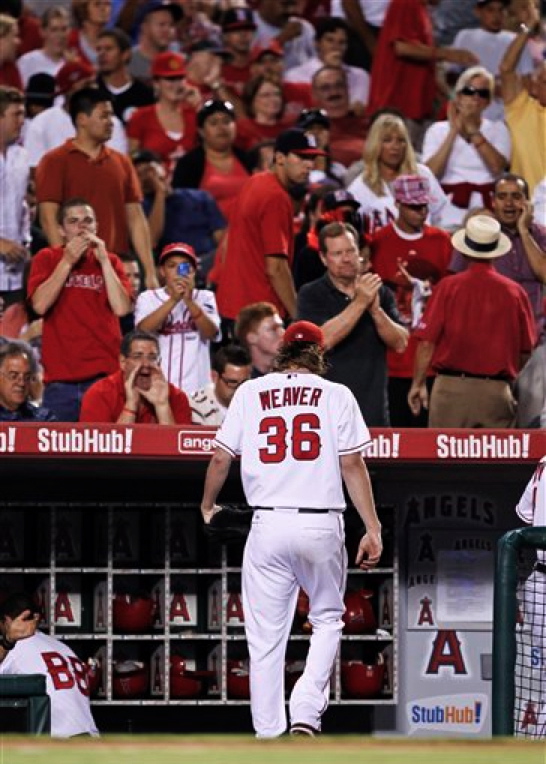 I wore a red Angels shirt to root on Jered Weaver, who was making his first start since signing a five-year, $85 million extension last weekend, and the Halos. As it turned out, Weaver shut down the Pale Hose, tossing seven scoreless innings as the Angels trounced the visitors, 8-0, for the club's sixth consecutive victory. The Angels are now 71-59 and just 2.5 games behind the first-place Texas Rangers in the American League West.
Manager Mike Scioscia pulled Weaver after the seventh inning even though Jered had only thrown 96 pitches. With the Angels heading to Texas for a three-game series beginning on Friday, the speculation is that Scioscia plans to start his ace on three days' rest this Sunday. If so, the Rangers will face the Angels Big Three in Dan Haren on Friday, Ervin Santana on Saturday, and Jered Weaver on Sunday. Depending on the outcome of tonight's Boston-Texas contest, a sweep would either put the Angels a half-game behind or a half-game ahead of the Rangers with one month to go in the regular season.
Mat Gleason, aka Rev Halofan in the baseball blogosphere, tipped me off to the adjoining photo by Chris Carlson of the Associated Press. He cropped the photo and embedded it in his recap of last night's game. ESPN also ran the photo as part of Mark Saxon's game report.
I can be found with hands cupped around my mouth saying "complete-game shutout" to Weaver as he took his first step into the dugout after the seventh inning. Little did I know that Jered had thrown his final pitch of the evening. The Angels scored four runs in the bottom half of the inning, highlighted by three doubles off the bats of Erick Aybar, Alberto Callaspo, and Bobby Abreu. Bobby Cassevah and Fernando Rodney worked the eighth and ninth innings, combining with Weaver for a team shutout.
Weaver, who started the All-Star Game for the American League, leads the circuit in ERA (2.03); ranks second in CG (4), QS (23), QS% (0.89), and WHIP (0.97); third in W (15) and W-L% (.714); fourth in IP (195.1); and sixth in K (166) and K/BB (3.77). He also places third in BAA (.206) and second in OBP (.252), SLG (.310), and OPS (.562). Among advanced metrics, Weaver ranks first in ERA+ (185), Adjusted Pitching Runs (41), Adjusted Pitching Wins (4.6), Base-Out Runs Saved (46.6), Base-Out Wins Wins Saved (5.5), and Win Probability Added (5.1); and second in FIP (2.80), Component ERA (1.95), fWAR (5.5), brWAR (6.5), Situation Wins Saved (4.4), and Adjusted Game Score (64.6).
The 28-year-old righthander has been consistently excellent all season long. According to Saxon, "(Weaver) has pitched at least seven innings and given up one run or fewer 15 times this season, most in the majors." He set an Angels team record with 15 consecutive quality starts earlier this year, which is quite an accomplishment when you consider that Dean Chance led the AL in W, ERA, CG, SHO, and IP in his MLB Cy Young Award-winning season in 1964; Bartolo Colon was named the AL CYA winner in 2005; and Hall of Famer Nolan Ryan tossed four no-hitters and led the league in strikeouts in seven of his eight campaigns with the Angels. Weaver also bested, among others, Frank Tanana (14 consecutive complete games in 1977 when he led the league in ERA and shutouts), Chuck Finley, and Mark Langston.
While skeptics may point to Weaver's BABIP (.250), LOB% (83.7%), and HR/FB (4.6%) stats as indications that he has been "lucky" or benefited from strong defense and bullpen support, one could counter such an argument by pointing to the fact that he has been victimized by the second-worst run support (3.96) in the majors. Look, Weaver has been confounding the experts for years. Be it his pitcher-friendly home ballpark in college, his average velocity, throwing across his body, comparisons of looks and pitching style to brother Jeff, and his extreme flyball tendencies, the naysayers have had more than their share of reasons not to like the pitcher who nonetheless has succeeded at every stop along the way, from Long Beach State to Team USA to MiLB to MLB. The combination of his stuff, command, deception, competitiveness, and smarts places him among the elite pitchers in the game today.
As I introduced in May 2010, popups/pop flies/infield flies are "The Most Under Appreciated Batted Ball Type." Such outcomes had long been ignored or misunderstood. Of note, according to Baseball Prospectus, Weaver has generated 86 popups this season, 21 more than any other pitcher. He also ranks first in POP (15.8%) as a percentage of batted balls. Given that popups are converted into outs about 99% of the time, such outcomes are basically the equivalent of a strikeout. As such, in addition to favoring pitchers with high K and GB rates, look for hurlers who generate a ton of K and POP.
A veteran of six seasons, Weaver has a lifetime record of 79-45 with an ERA of 3.27. Over the course of his career, his numbers rank in the ballpark with the best and highest-paid pitchers in baseball, including Roy Halladay, CC Sabathia, Justin Verlander, Dan Haren, Felix Hernandez, Cliff Lee, Tim Lincecum, Josh Beckett, Cole Hamels, Roy Oswalt, and Johan Santana. Like the Angels, it's time to give Weaver his due.
| Baseball Beat | July 30, 2011 |
Link-o-Rama
There have been a number of articles and interviews published over the past two weeks about my efforts to help Bert Blyleven get elected to the Baseball Hall of Fame. As much for my personal reference as anything else, I am linking to these stories below in chronological order.
"I think the internet helped me a lot. I feel like a guy like Rich Lederer with baseballanalysts.com brought out my numbers. Probably with Zack Greinke and Felix Hernandez winning Cy-Youngs when they didn't have the most wins. Wins are hard to come by. It's hard to win a ballgame. It's easy to lose but it's hard to win."
10. Blyleven and Rich Lederer combined to defy recent trendsAbout 10 years ago, there was a debate at the late, great Rob Neyer Message Board about Blyleven’s Hall of Fame chances. At that time only 15 to 20 percent of the electorate supported him.
To answer the question, I went to my usual modus operandi: I looked at recent historical trends. It showed that of the last 20 guys elected to Cooperstown by the BBWAA (as of then), none had ever received 20 percent or lower of the vote in any election they were up for. None had ever fallen below 30 percent. Or 40 percent. The worst election by any of 20 guys who had gone on to election was one time Tony Perez finished exactly one vote shy of 50 percent.
If you went back further, you could find guys who’d risen up: Billy Williams, Luis Aparicio, Bob Lemon. But that’s the problem, you had to go way back. Many new voters had entered the mix, and old ones passed on. I assumed Blyleven had no chance with the current BBWAA.
But he did. Thanks in no small amount to a campaign led by Rich Lederer to get Bert Blyleven into the Hall of Fame, Blyleven saw his vote total gradually rise up, election after election, until he got in. With the power of the internet, Lederer’s persistence—and, oh yeah, Blyleven’s own solid case—he’ll have a nice weekend in upstate New York this year.
Note that since the Neyer Board discussion ten years ago, things have already shifted. Gary Carter, Rich Gossage, Jim Rice, and Bruce Sutter have all gotten in, after initially finishing under 50 percent. But Gossage and Sutter are relievers, and the Hall is still trying to figure them out. Carter only had one really low year, and it was never as low as Blyleven. Rice benefited from an orchestrated movement by the Boston press corps.
None spent as many years as low on BBWAA ballots as Blyleven. If you’re a fan of sabermetrics, and of internet-based populism, this weekend’s induction ceremony is thus a double victory—one for Blyleven and one for Lederer.
Consider Blyleven. I didn't vote for him for several years before finally seeing the light, thanks in large part to blogger Rich Lederer's insightful writings pleading his case. And eventually, 80 percent of writers agreed with Rich and decided Blyleven belonged in Cooperstown. But we nearly ran out of time before coming to that conclusion. We elected Blyleven in his next-to-last year of eligibility, and Jim Rice in his final year.
The thing about Bert Blyleven's Hall of Fame case was that there was no precedent for leaving out a pitcher of his caliber. It just took baseball writers a long time to figure this out, thanks in no small part to the efforts of blogger Rich Lederer, who tirelessly campaigned for Blyleven's case (click here for Rich's writings on Blyleven).
From Vin Scully's lips to Rich Lederer's computer to Bert Blyleven's plaque in Cooperstown....He heaps plenty of praise for his eventual induction on a campaign over the past eight-some years by Lederer, who created the site BaseballAnalysts.com as a way to re-interpret career data.
Lederer, whose late father George covered the Dodgers for the Long Beach Independent Press-Telegram during the team's first 11 seasons in L.A. and then did public relations for the Angels, started to crunch Blyleven's numbers back in 2003 and built a case that slowly enlightened the Hall voters.
"You look at the new age that we are in with the Facebook and (Twitter) and the online, all that stuff is very important, because I think, as writers that do vote, that is your job to look at numbers," Blyleven said. "And that is what I think Rich Lederer brought out. He brought my numbers out a lot more."
Jon Weisman of the DodgerThoughts.com blog called Lederer's achievement "the most effective grass-roots campaigns for Cooperstown ever." Dave Studenmund, the editor of The Hardball Times, wrote it was "greatest story of Sabermetrics on the Internet."
Lederer, an investment banker in Long Beach who used to deliver the Press-Telegram on his bike, said he wrote about 20 stories about Blyleven. Having it linked and read by other voters were key to getting the word out.
"Such praise from my esteemed peers not only feels good but means I achieved what I set out to do 7 1/2 years ago, which was simply to get Bert Blyleven elected to the Hall of Fame," said Lederer, leaving today with his wife to Cooperstown to join in Blyleven's induction ceremony.
"I have no doubt that my dad would have enjoyed the whole experience, from reading my articles, to watching Blyleven's vote totals increase year-after-year to Bert's election and induction. I only wish Dad were here because I'm quite sure that he would have accompanied me to Cooperstown for this very special day.
"I know one thing. Bert would have received one more vote every year if my dad, who was a member of the BBWAA from 1958 to 1978, were still alive. Just as Bert will be thinking about and thanking his father, who passed away in 2004, I will be thinking about and thanking my dad, too."
2004 – A California blogger, Rich Lederer, starts making a statistical case for Blyleven’s inclusion in the Hall of Fame. Blyleven was named that year on slightly more than one-third of ballots; 75 percent is needed to get into Cooperstown.
What Blyleven didn't know yet was that he had an Angel in his corner. Or a former Angels publicist's son, anyway.Rich Lederer, a Long Beach investment advisor whose father once worked for the Angels, began making a statistics-based case for Blyleven's induction on the blog baseballanalysts.com in 2003. Among other arguments, Lederer noted that Blyleven would have easily eclipsed 300 victories had he received run support that matched the league average.
"I wasn't quite sure what impact it would have," said Lederer, who also lobbied baseball writers over the phone and in person, attending baseball's winter meetings in Anaheim in 2004.
Blyleven soon was a new buzzword among baseball writers, many of whom had previously dismissed his accomplishments as a function of his longevity. His vote total jumped from 17.5% in his first year on the ballot to 79.7% this year, the biggest leap since Duke Snider was elected in 1980 after receiving just 17% of the vote 10 years earlier.
Upon his election in January, in his next-to-last year of eligibility, Blyleven thanked Lederer. He then provided tickets for the induction ceremony — in the Blyleven family section. Lederer will be seated near Blyleven's mother, Jenny, 85, who will make the trip to Cooperstown from Garden Grove.
It will be heavily (and emotionally) SoCal when the baseball Hall of Fame inducts its new honorees this weekend. Former Angels pitcher Bert Blyleven goes in, and that means that Los Angeles blogger Rich Lederer will be on hand. His logical and unceasing case over seven years is the reason Blyleven was elected to the hall, and the pitcher invited the blogger to stand beside him in Cooperstown, N.Y. Forget the "Moneyball" movie, these guys could make a great baseball buddy flick — and they only met this year. Lederer's pre-flight post today:My wife and I are leaving for Cooperstown this morning for the Hall of Fame induction ceremony on Sunday. We will be joined by our son-in-law Joel and my brother Tom and his wife Jeannie this weekend. If not a baseball trip of a lifetime, it should prove to be an unforgettable memory for not only the honoree himself but all of us as well.
There will be a lot of baseball fans and bloggers applauding Lederer along with Blyleven.
I looked. You looked. Bill James looked. Rich Lederer looked. Rich Lederer really looked. We all saw a pitcher who belonged in the Hall of Fame.But for a long, long time the writers -- the writers in the Base Ball Writers Association of America, who vote for Hall of Famers -- just didn't see it that way. The writers have made a great number of mistakes over the years, most of them ultimately rectified. But if you're looking for evidence that the writers have massive blind spots, look no further than their history with Bert Blyleven.
In his first year on the ballot, Blyleven was named on 17 percent of the ballots. In his second year, he dropped to 14 percent. He didn't cross the 50-percent threshold until his ninth try.
Think about that ... For eight years -- and presumably the six years before that, too, when he wasn't yet on the ballot, which makes 14 years -- more than half the (supposed) greatest baseball experts in the world didn't think that Bert Blyleven and his 287 wins, 60 shutouts and his 3,701 strikeouts belonged in the Hall of Fame.
Of course it seems preposterous now, and all the guys who voted for him this time around, all 79.7 percent of them, will probably say it was just a matter of time. But the truth is that if not for Rich Lederer's one-man campaign, Blyleven might still be waiting. Fortunately, Blyleven's mom is still going strong at 85, and she was planning to attend the induction ceremony this weekend. Unfortunately, all those foolish writers who failed for so many years to vote for Blyleven did keep his father from attending; Joe Blyleven died of Parkinson's Disease in 2004.
Being in the Hall of Fame doesn't make Bert Blyleven a better pitcher, all of a sudden. In your mind and mine, Blyleven's exactly the same pitcher tomorrow as yesterday.
But let's not pretend that being in the Hall of Fame doesn't matter. It obviously matters a great deal to him, and presumably to those close to him. That's enough. That's enough for the writers to take their duties as Hall of Fame voters seriously. And while I prefer to think the best of my colleagues, most of whom have been exceptionally kind to me over the years, when I look at what happened to Bert Blyleven for all those years, I detect a frightening lack of seriousness.
For much more about Blyleven and the Hall of Fame, just poke around Baseball Analysts.
His first year on the ballot, 1998, Blyleven received 17.5 percent of the vote. A player needs 75 percent to get into the Hall of Fame, but Blyleven wasn't too worried; he knew he wasn't a first-ballot player. Then in 1999, he dropped to 14.1 percent."It took Harmon four years to get in," he said of Twins icon Harmon Killebrew. "Other pitchers like Don Sutton, guys that I thought my numbers were comparable to, I thought four or five years, maybe the sixth year, is when you'll see that big increase. But it went from like 17 (percent) to 14 to 17 to 19 or 20, and it was just a slow process, and I'm thinking, 'My California math is telling me that in 15 years I'm still going to be at 30 percent. I ain't getting in this thing.' "
After his second-year drop, Blyleven continued a steady rise, except when he fell from 53.5 percent in 2006 to 47.7 percent in 2007. But with a growing appreciation of Blyleven's achievements, thanks in large part to an Internet campaign spurred by Rich Lederer of baseballanalysts.com, his percentages kept climbing. In 2010, he came within five votes of 75 percent. Finally, this year, 79.7 percent of voters put him on their ballots.
"The day we've all been waiting for," said Rich Lederer, a Long Beach, Calif., resident who spent years touting Blyleven's credentials on a website, baseballanalysts.com.
“I was just talking to Peter Gammons (of MLB Network),” Blyleven began. “He told me that he didn’t vote for me and then he asked me to do an interview with him.”Blyleven refused the interview.
For the past 10 years, a fan named Rich Lederer has been conducting an annual campaign to get Blyleven into the Hall, using the same arguments that helped Felix Hernandez win the Cy Young Award last year and Zach Greinke a few years ago with the Royals. As Lederer persisted, and as the analysis of numbers changed, more people were convinced.
“All of a sudden he talks to Rich Lederer and all of a sudden, it’s, ‘Oh my God, he had 60 shutouts, oh my God, he pitched almost 5,000 innings, 287 wins’ and all this other crap, and all of a sudden 14 years later I get in,” Blyleven continued, using Gammons as the example of all that kept him out this long.
The wait was made worse by the fact that Blyleven’s father Joe passed away in 2004 and his mom Jenny is 85, and the trip from the west coast was difficult.
“All of a sudden, it’s hello, do your homework. Maybe the internet stuff will wake up some of the writers that maybe should look at Jim Kaat’s numbers, at Tommy John’s numbers, or guys that maybe should be here that aren’t here. Tony Oliva is another one. Al Oliver, it could go on and on about guys that maybe should be here. I thanked Rich Lederer.”
| Baseball Beat | July 29, 2011 |
No Longer "Only the Lonely"
I wrote my first of more than 30 articles about Bert Blyleven nearly 91 months ago to the day. I titled it “Only the Lonely: The Hall of Fame Trials and Tribulations of Bert Blyleven.” Only the Lonely was named after the 1960 song by Roy Orbison and was chosen because Blyleven was conspicuously missing from the Hall of Fame while all the pitchers ranked around him in several of the most important stats had already been inducted or were locks to be enshrined in their first year of eligibility.
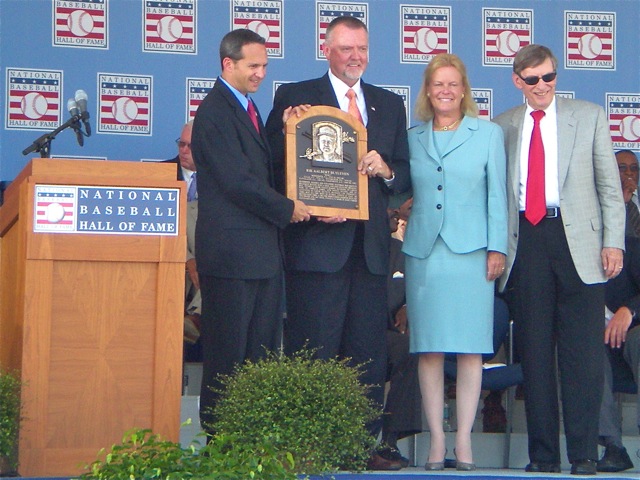 Well, eight election cycles later and nobody can call Blyleven “Only the Lonely” any longer. His vote totals steadily rose from 145 (29%) in 2003 to 463 (80%) in 2011, ultimately piercing the 75 percent threshold needed for election last January. While Blyleven was on the ballot far too long, his date with destiny finally arrived last Sunday when he was officially inducted into the Baseball Hall of Fame. My wife Barbara and I sat in the Blyleven family section during the ceremony as guests of Bert and his wife Gayle.
I can now say for the first time that the past seven-plus years have been worth every minute. I can also proclaim that the preceding seven-plus months have been joyous and memorable, highlighted by the telephone call I received from Bert informing me that he had been voted into the Hall of Fame 30 minutes before the official announcement was made to the public. He told me that I was his second call, directly after the one to his mother Jenny.
The excitement didn’t stop there though. In fact, it was a fun-tastic two weeks, culminating in a surprise trip to Fort Myers, Florida to meet Bert face-to-face for the first time at a tribute dinner in his honor. After giving each other a big, warm bear hug on stage, I recalled a story about a Saturday afternoon 38 years ago that found me umpiring behind home plate in a winter league scout’s game that the then 22-year-old veteran of four MLB seasons started.
I played catch with Bert and pitched in a fantasy camp game the next morning, followed by a round of golf with him at his club that afternoon. Our foursome tied for first place with a 65 in a scramble tournament. We played well and had a great time on the baseball field and the golf course.
While I may have been the ringleader, getting Blyleven elected to the Hall of Fame was truly a team effort and one that would have never gotten off the ground, if not for the Internet. Darren Viola (known to most of us as Repoz) of the Baseball Think Factory deserves credit for linking to and excerpting my articles, which did wonders for getting the message out in the early going. Alex Belth and Jon Weisman were also prominent linkers. Rob Neyer linked my articles and advocated on behalf of Blyleven. Even Bill James got behind Blyleven's candidacy in The Hardball Times Annual. Jay Jaffe continually endorsed him in his Hall of Fame evaluations at Baseball Prospectus. There were several other backers who chipped in over the years, too.
Importantly, dozens of high-profile writers, including Peter Gammons, Tracy Ringolsby, Ken Rosenthal, and Jim Caple, changed their minds along the way and began to not only vote for Blyleven but helped spread the word and influenced their fellow BBWAA members.
Make no mistake about it, Bert did all the work on the field. Fifth all-time in strikeouts, ninth all-time in shutouts, and top 20 since 1900 in wins. Two World Series championships coupled with a 5-1 record and 2.47 ERA in the postseason only added to his credentials. My job, if you will, was simply to make the voters aware of his accomplishments and qualifications. Lo and behold, Blyleven got his just reward in his 14th (and second-to-last) year on the ballot.
As one of 295 individuals with plaques in the National Baseball Hall of Fame and Museum, Blyleven is no longer "Only the Lonely."
| Baseball Beat | July 27, 2011 |
Circling the Airport and Bert
All of us returned home on Tuesday afternoon. My wife, son-in-law, and I had so much fun that we decided to extend our trip by an extra day. Well, not exactly. We had a lot of fun, and we stayed an extra day. But not by choice.
Instead, our flight out of Albany International Airport on Monday was delayed to the point where we were going to miss the last connection out of Newark, where inclement weather was preventing departures and arrivals for most of the day. If we stayed overnight in Newark, the first available flight to LAX was at something like 5:45 p.m. ET, meaning we wouldn't have returned home until about 9:00 p.m. PT on Tuesday. By staying in Albany, we were able to book a flight at 7:00 a.m. We boarded the plane on schedule but sat on the tarmac for about 45 minutes before returning to the gate for another 45 minutes to refuel and get clearance for takeoff. While we arrived in Philadelphia nearly two hours behind schedule, we walked directly onto our connecting plane and arrived at LAX at roughly 12:45 p.m. PT.
All's well that ends well, especially when one can hold his beautiful granddaughter (the gift of my daughter and son-in-law) once again.
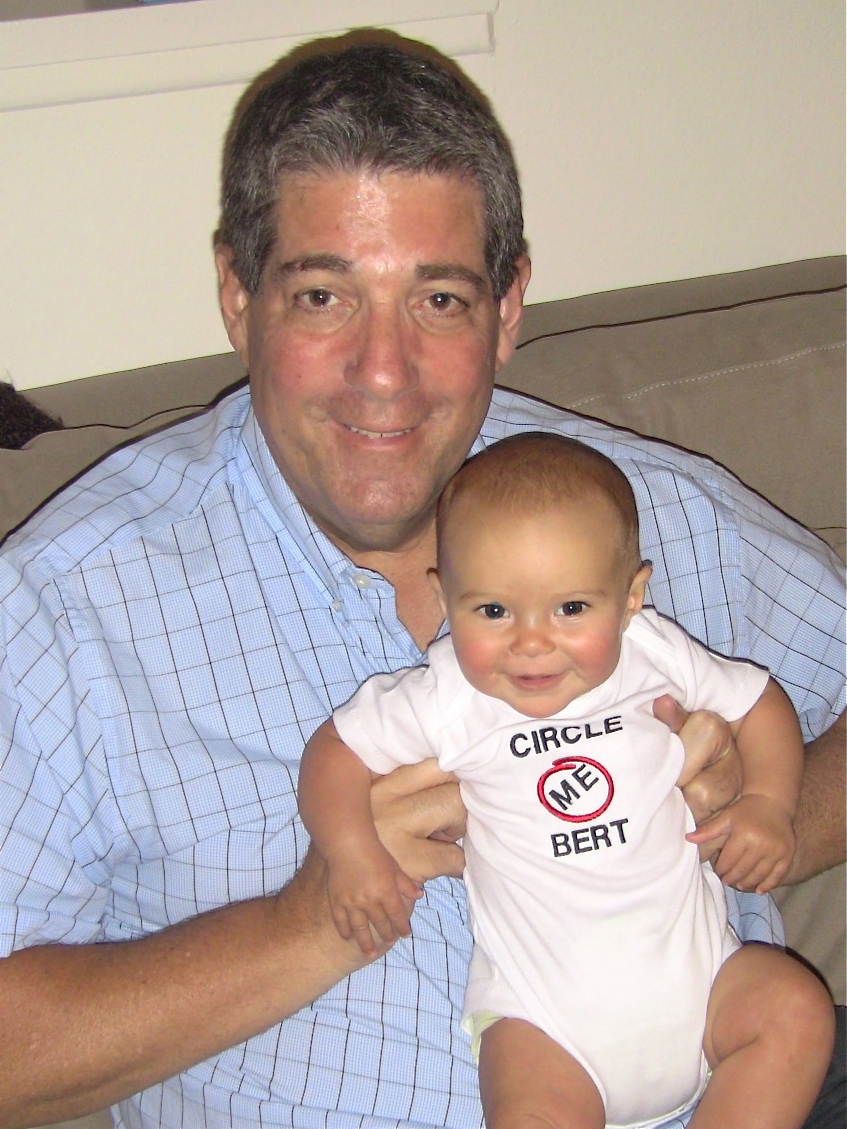
I plan to share more photos and stories of my trip to Cooperstown, including the National Baseball Hall of Fame and Museum, the private reception on Saturday night, and the induction ceremony on Sunday. Check back on Thursday and Friday for additional posts.
| Baseball Beat | July 23, 2011 |
More Photos and Stories from the Hall of Fame
We attended the Hall of Fame Awards Presentation at Doubleday Field from 4:30-5:30 p.m. ET on Saturday. The new event featured Terry Cashman singing Talkin' Baseball (Willie, Mickey, and the Duke), followed by Bill Conlin (J.G. Taylor Spink Award for meritorious contributions to baseball writing), Dave Van Horne (Ford C. Frick Award for broadcasting excellence), and Roland Hemond (Buck O'Neil Lifetime Achievement Award).
Barbara, Joel, and I sat in the stands on the third base side between the pitcher's mound and home plate among guests of the inductees. Jerry Reinsdorf and Dennis Gilbert sat in the row below and just to the right of us. Dave Dombrowski was sitting one row in front of them. There were other front office executives and their family members in the immediate area.
The award winners and Hall of Famers sat on a stage behind second base. Going around the diamond in alphabetical and numerical order by scorekeeper positions, the following players, managers, and executives were on stage: Bert Blyleven (see how I worked that out?), Jim Bunning, Dennis Eckersley, Rollie Fingers, Whitey Ford, Goose Gossage, Ferguson Jenkins, Juan Marichal, Phil Niekro, Gaylord Perry, Tom Seaver, Don Sutton, Johnny Bench, Yogi Berra, Carlton Fisk, Orlando Cepeda, Eddie Murray, Tony Perez, Roberto Alomar, Rod Carew, Bobby Doerr, Bill Mazeroski, Joe Morgan, Ryne Sandberg, Red Schoendienst, Wade Boggs, George Brett, Brooks Robinson, Ozzie Smith, Robin Yount, Lou Brock, Rickey Henderson, Ralph Kiner, Jim Rice, Billy Williams, Andre Dawson, Tony Gwynn, Reggie Jackson, Al Kaline, Frank Robinson, Dave Winfield, Paul Molitor, Whitey Herzog, Tom Lasorda, Earl Weaver, and Pat Gillick.
At the conclusion of the presentations, we were shuttled back to the front steps of the Museum to a VIP viewing area for the Parade of Legends. The Hall of Famers were driven from Doubleday Field down Main Street to the Hall of Fame individually in the back of Ford pickup trucks. We were invited to the Hall of Fame Private Reception inside the Museum afterwards. Hors d'oeuvres and cocktails were served in the Plaque Gallery.
I met Bert and Gayle Blyleven as they walked into the Hall of Fame. Bert and I shook hands and hugged. I introduced both of them to Barbara and Joel. We talked for a few minutes and concluded the conversation with a big, firm high five. I wish I had a photo of that moment but the memory will stay with me forever.
Later that evening, Bert and I met up for a few photos. The first one is of the two of us pointing to the spot on the wall where his plaque will be installed Sunday evening.
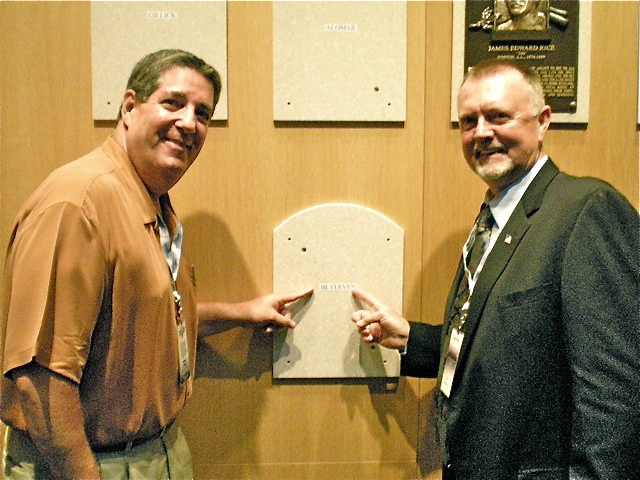
The second is in front of Blyleven's exhibit.
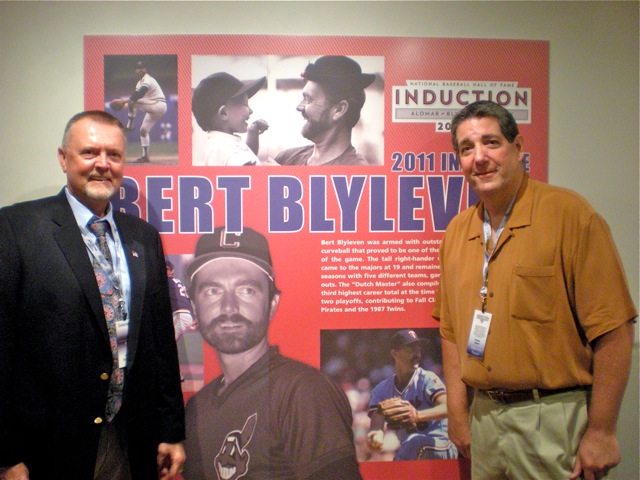
Needless to say, my family and I had a great day, topped by the Hall of Fame Private Reception. Meeting up with Bert in that setting was a once in a lifetime experience.
| Baseball Beat | July 23, 2011 |
Photos at the HOF Museum
I'm posting four photos for now. I will add more later.
My wife Barbara and me standing in front of the National Baseball Hall of Fame and Museum Saturday morning.
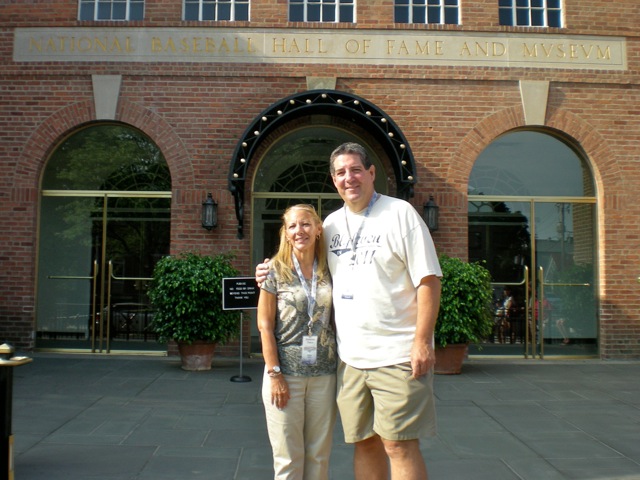
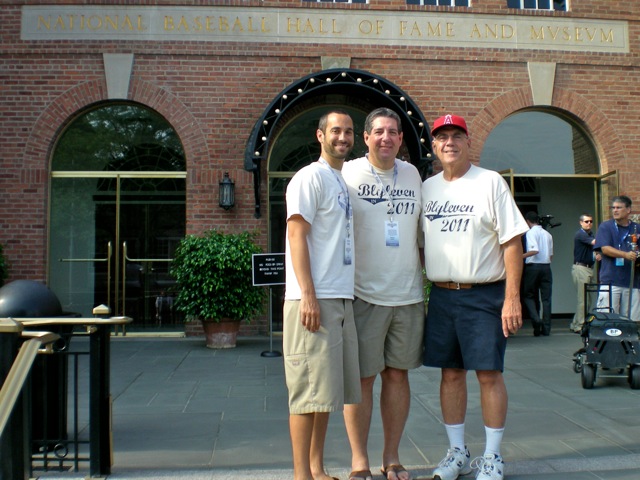
Here I am in the middle with my son-in-law Joel on the left and brother Tom on the right.
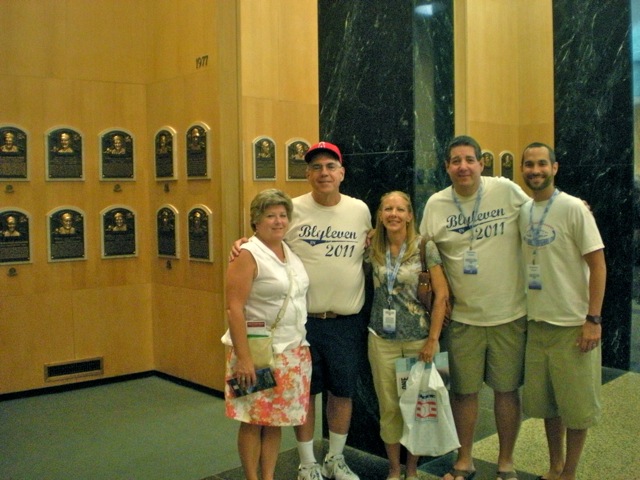
Jeannie, Tom, Barbara, me, and Joel in the Plaque Gallery.
I'm pointing to the spot where Blyleven will be enshrined in the Plaque Gallery forever.
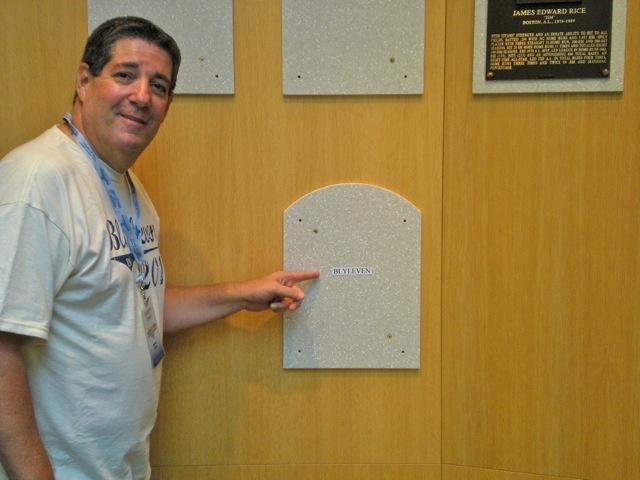
After spending the morning and early afternoon at the Baseball Hall of Fame and Museum, we're now heading to the Awards Presentation at Doubleday Field.
Check back for more photos and stories late this evening or early tomorrow morning.
| Baseball Beat | July 22, 2011 |
Off to Cooperstown
My wife and I are leaving for Cooperstown this morning for the Hall of Fame induction ceremony on Sunday. We will be joined by our son-in-law Joel and my brother Tom and his wife Jeannie this weekend. If not a baseball trip of a lifetime, it should prove to be an unforgettable memory for not only the honoree himself but all of us as well.
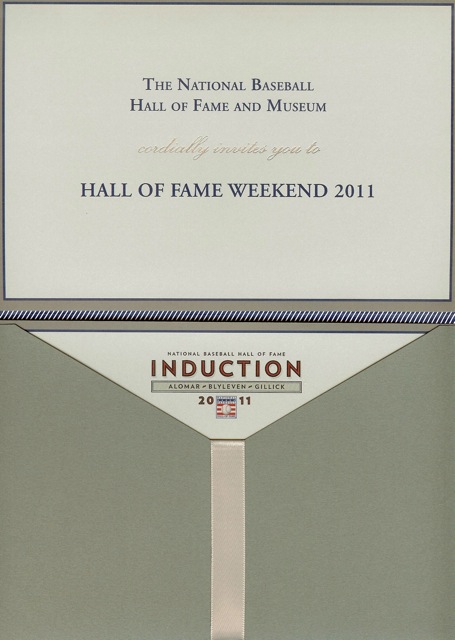
I plan on posting as many stories, links, and photos as time allows. So be sure to check back throughout the weekend to stay abreast of our trip.
That's all for now.
| Baseball Beat | July 22, 2011 |
Highlights from SABR 41
The Society for American Baseball Research held its 41st annual convention at the Long Beach Hilton two weeks ago. I enjoyed SABR 41 as an attendee and panelist, as well as for the opportunity to meet many friends in the baseball community.
Scott Boras was the keynote speaker on Thursday morning. You can listen to his 90-minute speech, which focused on his rise from a minor league baseball player to law school to becoming an attorney and then starting his own firm, known today as the Scott Boras Corporation. He talked about the use of both data and psychology in dealing with players, arbitrators, and front office executives, as well as managing the media.
 You can read about and listen to the various panels that took place throughout the convention, including the medical (Dr. Neal ElAttrache, Dr. Kevin Wilk, and Ned Bergert, and moderated by Will Carroll of Sports Illustrated), media (Dave Cameron, Sean Forman, Bill Squadron, and Russ Stanton, and moderated by SABR President Andy McCue), SABR era (John Thorn, John Dewan, Roland Hemond, Wes Parker, and Dennis Gilbert, and moderated by Tom Hufford, one of SABR's 16 founding members), general managers (Jed Hoyer, Fred Claire, and Dan Evans, and moderated by Rob Neyer, the national baseball editor for SB Nation), and player (Tommy Davis and Al Ferrara and moderated by Barry Mednick of SABR's Allan Roth Chapter).
During the SABR era panel, Dewan seconded my nomination of Bill James for the Hall of Fame (see excerpt below). At the end of that discussion, I introduced myself to Mr. Hemond, who was the scouting director for the California Angels when my Dad was the Director of Public Relations and Promotions. The longtime executive will be honored in Cooperstown tomorrow as the second recipient of the Buck O'Neil Lifetime Achievement Award. After exiting the room, I stopped and listened to Parker, who was outside entertaining a small crowd of SABR attendees (that's me in the middle and Wes on the far left) with stories about his days as a former ballplayer with the Dodgers. I waited patiently and introduced myself as "Rich Lederer, the son of George Lederer." He had nice things to say about Dad, who covered the Dodgers for Parker's first five years in the big leagues.
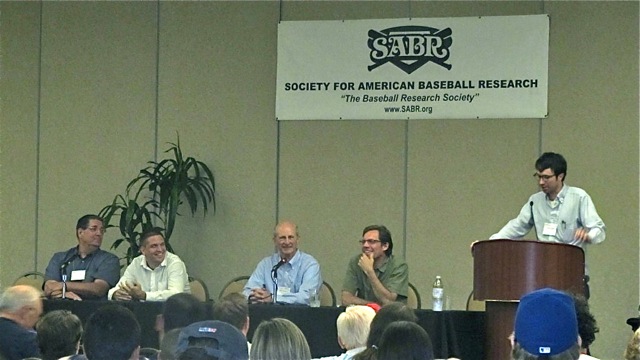
I was invited by Cameron to participate in FanGraphs Live in the main ballroom on Thursday night. I served on an Angels/Dodgers panel with Sam Miller of the Orange County Register and Baseball Prospectus, Jon Weisman of ESPN/Dodger Thoughts, and Eric Stephen of True Blue L.A. that was hosted by Jonah Keri, who writes about baseball for ESPN and FanGraphs and stocks for Investor's Business Daily. Keri introduced me as “the first stathead to induct someone into the Hall of Fame.” I also served on a national baseball panel with Cameron (second from the left in the adjoining photo), Vince Gennaro (middle), and Neyer (sitting on the far right) that was hosted by FanGraphs' Carson Cistulli (standing), who entertained us all.
The moderators and members of the audience asked me about the Angels and Dodgers, Bert Blyleven, the Hall of Fame, Jered Weaver, and Bryce Harper, among other topics. Cameron reminded me that I mentioned my disgust about the Vernon Wells signing more than once (or was it three times?). Of note, on the night before the Angels called up Mike Trout, I suggested that the team would have been better off locking him up for ten years rather than giving even more money to Wells for a shorter period. My son Joe, who attended the event along with my son-in-law Joel and brother Tom, informed me bright and early the following morning that the Angels promoted Trout from Double-A to the majors. I went to the Angels-Mariners game that evening and saw the 19-year-old prospect's MLB debut. He went 0-for-3 at the plate but made an outstanding running catch at the warning track in right-center field to record the final out in the top of the ninth inning.
I was interviewed by MLB Network at the convention the following morning. The half-hour segment was videotaped with the possibility of a portion of it being used on This Week in Baseball and/or for a documentary on the evolution of statistical analysis in baseball that will be narrated by Bob Costas and scheduled to air in the fall.
There were also numerous research presentations on Thursday, Friday, and Saturday. I listened to The Joe Morgan Trade by Mark Armour, a former Bob Davids Award winner and the most prolific guest columnist for Baseball Analysts. I had lunch at George's Greek Cafe with Mark and Dan Levitt prior to the former's afternoon presentation. Mark and Dan co-authored Paths to Glory and are working on a sequel.
Bob Keisser, a columnist for the Long Beach Press-Telegram, wrote a preview of the convention and a follow-up that was titled "Baseball Nerdery is Celebrated."
Long Beach native Rich Lederer, whose late father George was a Dodgers beat writer for their first 10 years here, created his own Baseball Analysts website several years ago to write about statistical and historical aspects of the game and provide a vehicle for other writers and links to even more."It's exciting to be here and meet a lot of people I've gotten to know through their work, and to take part in the process," Lederer said.
He got to participate in the main seminar Friday morning about SABR's impact and was feted for his statistical support of Bert Blyleven, the former Angels pitcher who finally was elected into the Hall of Fame.
"They asked me who I would help get into the Hall of Fame next," Lederer said. "I said 'Bill James' and the whole room exploded, clearly behind that idea. Next to Branch Rickey, he's given us the most information to change the way we think about baseball."
Lederer has a second choice, too - Long Beach native Bobby Grich, the former Wilson High star who had a terrific 17-year career with the Orioles and Angels, hit 224 home runs as a second baseman, had a career on-base percentage of .371 and won four Gold Glove awards.
His numbers are comparable with Hall of Fame second baseman Ryne Sandberg (16 years, 282 home runs, nine Gold Glove awards) with the notable exception that Grich, the one year he was on the Hall of Fame ballot, received a mere four votes.
"There were a lot of things back then people didn't consider," Lederer said. "Grich played in two pitchers' parks (Memorial Stadium, Angel Stadium), offense was down in the '70s, and there were a lot of things he did that didn't get people's attention then - that he got on base, was a slugger playing second base, and was the best fielder for most of his career.
"I think he's probably one of the 12 greatest second basemen in baseball history."
Of the 3,000 or so attendees at the SABR Convention here, chances are each fancies their own player like Grich, or an opinion on the horror of pitch counts, or some numbers they've jotted down that you'll never get out of a box score. As gatherings of statistical scientists go, everyone in this group can call themselves a power hitter.
Aaron Gleeman, Jeff Polman, Chris Jaffe, Peter Iorizzo, Cecilia Tan, Geoff Young, Lisa Dillman, Eno Sarris, Sam Miller, Mike Leury posted recaps from SABR 41. You can read excerpts here. The site also links to their full stories, as well as to recaps from local media outlets. You can also read some of the top tweets from SABR 41, too.
I met Gleeman, Jaffe, Young, and Miller for the first time in person even though I have corresponded with the first three via email for years, including going all the way back to 2003 in the case of Aaron and Geoff.
SABR 42 will be held in Minneapolis next summer. In the meantime, if you're not a member of this great baseball organization, you should join now. Annual dues are reasonable and entitle you to many benefits, including discounted fees to the national conventions.
| Baseball Beat | July 21, 2011 |
News and Views: Brandon Inge Redux
News: The Tigers designated 3B Brandon Inge for assignment. The 34-year-old Inge "hit" .177/.242/.242 in 239 plate appearances.
Views: How did the two-year contract Inge signed just nine months ago work out for the Tigers?
| Baseball Beat | July 20, 2011 |
Loving Baseball
Joe Posnanski took a weeklong, cross-country trip that covered five cities and more than 10,000 miles in search of what baseball means in 2011. He traveled from Charlotte to Los Angeles and chatted with Vin Scully, from L.A. to New York to witness Derek Jeter's 3000th hit, from N.Y. to Kansas City to watch a game with Bill James in which Justin Verlander's 100-mph heat was topped by the temperature, from K.C. to Phoenix to catch Prince Fielder "uncoil his wonderfully violent swing" at the All-Star Game, and from Arizona to Cooperstown where a bat stored in the archives "down in the bowels of the Hall of Fame" that stuck with him the most. Yes, Wonderboy, the bat Roy Hobbs made from a tree split in half by lightning in the movie The Natural that reminded both Hobbs and Posnanski of their fathers.
THE BAT stays with me. Isn't that strange? I did so many amazing things on this crazy cross-country trip in search of what baseball means in 2011 ...And so ... why the bat? Why does the bat keep reemerging in my mind, like a summer song that won't stop repeating? It's just a bat. It might not even be regulation size. No one used it to crack his 3,000th hit or smack his 500th homer. This bat was never even used in a major league game, or a minor league game, or a Little League game, or any real game at all.
Still ... Why do I think it's all about that bat?
"Loving Baseball" is Joe at his best. In addition to Scully, Jeter, James, Verlander, Fielder, and Hobbs, Posnanski marvels at the artistry of Adrian Gonzalez's swing, and mentions, in order, Cy Young, Sliding Billy Hamilton, Andre Ethier, Kirk Gibson, Roger Clemens, Willie Mays, Andrew McCutchen, Lance Berkman, Roy Halladay, David Ortiz, Mark McGwire, Barry Bonds, Hank Aaron, Roger Maris, Babe Ruth, Lou Gehrig, Joe DiMaggio, Honus Wagner, Robin Yount, Cal Ripken Jr., Ichiro Suzuki, Sandy Koufax, Walter Johnson, Brayan Pena, Gary Sheffield, Roberto Clemente, Johnny Bench, Ozzie Smith, Greg Maddux, Danny Jackson, Jose Bautista, Pete Rose, Jimmie Foxx, Al Kaline, Tony Gwynn, Harmon Killebrew, Lew Burdette, Ralph Terry, and Bill Mazeroski.
So why is it that as I end this trip, I keep thinking about Wonderboy?...What was I looking for? While in Los Angeles, I heard the awful news about Shannon Stone, a Texas firefighter who brought his son to a Rangers game and fell and died when he lost his balance trying to catch a baseball. In New York, I saw a young man named Christian Lopez grab Derek Jeter's 3,000th hit and then saw his father, Raul, cover him as protection from the crowd. In Arizona, I saw the determined look on Jose Cano's face as he pitched to his son Robinson in the Home Run Derby.
And in Cooperstown, I saw Wonderboy—the bat a boy carved to remind himself of his father. My father worked for most of his life in a sweater factory. When he got home each day—oil on his pants, salami on his breath—we would go to the backyard and play catch. All the while he talked: Get in front of the ball... . Put the glove under your mattress to break it in... . Don't step into the bucket... . Watch how Henry Aaron steps into the ball... . Choke up on the bat with two strikes... . Get back to your feet quickly, like Brooks Robinson... . Remember, it's easier to run in on the ball than to go back.
"They're sending you around to the country to find the meaning of baseball?" he asked.
"Something like that," I said. He looked at me with a mix of disbelief and wonder and, sure, pride. Dad's job was to keep the sweater machines running. It was a clear assignment with a clear mission—plain questions and plain answers and no time for what he always called "baloney."
"Well, baseball is fun, right?" he said.
Baseball is fun indeed.
As the subtitle of the Sports Illustrated article dated July 25, 2011 asks and answers, "What keeps the grand game great? Everything old is new again."
| Baseball Beat | July 12, 2011 |
Jered Weaver Catapults to the Forefront of Major League Pitchers
Roy Halladay and Jered Weaver have been named the starting pitchers for tonight's All-Star Game in Arizona, which will be televised by FOX at 8 p.m. ET. While the 34-year-old Halladay has participated in the mid-summer classic in eight of the past 10 years, the 28-year-old Weaver earned his first trip in 2010 but did not play because he pitched on the Sunday preceding the game.
Halladay and Weaver are leading their respective leagues in Fielding Independent Pitching Earned Run Average with FIPs of 2.16 and 2.39. Of note, Weaver also leads Major League Baseball in ERA (1.86), Adjusted Pitching Runs (31), and Adjusted Pitching Wins (3.6). He ranks first in the AL and second in MLB in not only FIP but Fangraphs (4.7) and Baseball-Reference (4.9) Wins Above Replacement among pitchers, ERA+ (199), and Win Probability Added (3.4).
If Weaver is not the best pitcher in baseball, he is certainly one of the top ten, along with Halladay and, in alphabetical order, Cole Hamels, Felix Hernandez, Clayton Kershaw, Cliff Lee, Tim Lincecum, CC Sabathia, and Justin Verlander. A healthy Josh Johnson, Stephen Strasburg, or Adam Wainwright would fill out my list of the best starting pitchers in the game. Cases for inclusion could also be made for Zack Greinke, Tommy Hanson, Dan Haren, Jon Lester, and David Price.
Importantly, Weaver is not a small-sample-size phenomenon. Over the past year, Weaver ranks second in MLB in ERA (2.38), third in FIP (2.59), and 4th in fWAR (7.4). According to Baseball-Reference.com, he ranks sixth among all active pitchers in career ERA (3.32) and ERA+ (128).
It's taken a long time for Weaver to overcome the naysayers in the prospect and stathead community as more than his brother or an innings eater. He is undoubtedly much greater than both. Jered is not only the starting pitcher in the All-Star Game but a leading candidate to win the AL Cy Young Award this year.
Tonight's recognition will do little for Halladay's reputation but should do wonders for the under appreciated Weaver.
| Baseball Beat | July 06, 2011 |
Society for American Baseball Research Annual Convention
The Society for American Baseball Research is convening in my hometown of Long Beach this week for its 41st annual convention. The event, which takes place at the Long Beach Hilton, kicks off today (July 6) and lasts through Sunday (July 10). The convention marks SABR's first in Southern California since 1993 when it was held in San Diego and the first in the Los Angeles area since 1980.
 SABR 41 includes five full days of activities and excursions, featuring approximately 30 research presentations, panel discussions, and trips to the Angels and Dodgers games this weekend. The full schedule can be found here. Members and non-members are welcome. On-site registration is $59 for a day, $93 for two days, and $159 for the full conference.
Scott Boras is the keynote speaker at the Annual Business Meeting on Thursday morning. Dennis Gilbert is the featured speaker at the Awards Luncheon on Friday. San Diego Padres general manager Jed Hoyer will join former Dodgers GMs Fred Claire and Dan Evans on Saturday afternoon for a panel discussion ("The Changing Role of the General Manager") moderated by SABR member and SB Nation baseball editor Rob Neyer. Former White Sox and Orioles GM Roland Hemond, a three-time winner of MLB’s Executive of the Year Award and 2011 recipient of the National Baseball Hall of Fame's Buck O'Neil Lifetime Achievement Award, will participate in "The Evolution of Baseball Over SABR's Four Decades" discussion on Friday. Other notable panelists from the sabermetric community include Dave Cameron, John Dewan, Sean Forman, and John Thorn.
I am looking forward to partaking in FanGraphs Live at SABR 41 on Thursday evening. The three-hour event will take place in the main ballroom. It costs $20.
Courtesy of Cameron, the managing editor of FanGraphs, the agenda is as follows:
7 p.m. to 8 p.m. - Dodgers/Angels discussion with Jon Weisman, Eric Stephen, Rich Lederer, and Sam Miller. Jonah Keri will be moderating this panel, and it will likely be split near 50/50 into questions and discussions originated by Jonah and questions from the audience.
8 p.m. to 9 p.m. - National baseball and statistical analysis discussion with Rob Neyer, Vince Gennaro, Rich Lederer, and Dave Cameron. Carson Cistulli will be moderating this panel, and likeways, it will be approximately half questions from Carson and half from the audience.
9 p.m. to 10 p.m. - FanGraphs Q&A with David Appelman, Jonah Keri, Carson Cistulli, Eno Sarris, and Dave Cameron. We'll take questions from the audience with whatever time is left over after the two panels.
Weisman operates Dodger Thoughts and is a writer/editor at Variety. Stephen is an author at True Blue L.A., the Dodgers arm of the of the SB Nation network. Miller is a sports writer for the Orange County Register. Keri writes for FanGraphs and is the author of The Extra 2%. Gennaro is the author of Diamond Dollars and professor at Columbia University. Cistulli is the editor for FanGraphs and host of FanGraphs Audio. Appleman is the president of FanGraphs. Sarris is a writer for FanGraphs, NotGraphs, and RotoGraphs.
I would welcome meeting any attendees before or after the panel discussions or even on one of the subsequent days of the convention. I plan on posting highlights and photos throughout SABR 41.
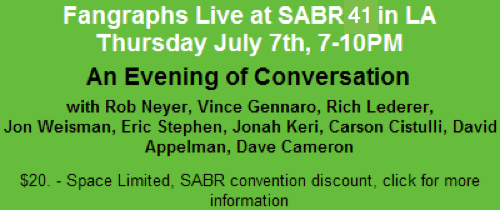
| Baseball Beat | July 02, 2011 |
The Declaration of Independents
Thanks to Google Alerts, I was made aware of an interview conducted by David Mark, a senior editor at POLITICO, with Nick Gillespie and Matt Welch, the co-authors of The Declaration of Independents: How Libertarian Politics Can Fix What's Wrong with America in Arena Chat.
My Hall of Fame "campaign" for Bert Blyleven was the subject of part of their conversation. Check out the 10-minute video and accompanying article. If you're pressed for time, fast forward to 3:30 and play it through the 7:00 mark.
Baseball fans, for example, may recall Bert Blyleven, a solid and durable major league pitcher from 1970 to 1992. Hall of Fame baseball writers shunned Blyleven for years, never giving him more than 30 percent of their votes (75 percent are needed for entry to the baseball shrine.)Then a California investment manager, Rich Lederer, took up Blyleven’s cause.
“By penning a series of convincing articles and debating individual voting writers (face-to-face, in many cases), this outside dabbler pulled off the unthinkable: he changed a doomed candidate into a 2011 inductee into the Hall of Fame,” Gillespie and Welch write.
“It shows that you can move around the traditional gatekeepers and centers of power,” Welch said.
Welch, who is the editor-in-chief of Reason magazine, a leading libertarian publication, is perhaps better known around these parts as a diehard Angels fan, astute sabermetrician, and part-time baseball writer. It's hard to believe that his outstanding guest column at Baseball Analysts on Dave Hansen is now more than six years old. Be sure to check out the accompanying photo of Welch singing and Hansen jamming on guitar.
Matt and I grew up on the same block in the Lakewood Village area of Long Beach. While an age difference separated us, our brothers played on the same Little League team, which was coached by Mr. Welch. Unaware that I was the Rich Lederer from his childhood years, Matt linked to my website in 2004, then interviewed me for his inaugural "Infrequently Asked Questions" series in 2005 after discovering that we were not only neighbors but fellow bloggers with a passion for baseball and the Bill James Baseball Abstracts. Most recently, Welch wrote "How a Part-Time Blogger Changed the Face of Baseball's Hall of Fame."
Courtesy of Google Books, here is an excerpt from The Declaration of Independents in a chapter titled "The Democratization of Just About Everything...":
Fred Eckhardt is living proof that the American tradition of impactful pamphleteer activism is more than alive and well. Four decades after publication of the Treatise, it has never been easier for self-publishers and other outsiders to build their own seats at the table and elbow the deadweight aside, forcing the top-down cultures of industrial media (and politics and music and beer and a thousand other sectors) to confront their own banal inadequacies and acknowledge (only after kicking and screaming) the newcomers' contributions. Forget Bill James and pollster Nate Silver—consider the case of Rich Lederer, an investment manager by day and sabermetrics dabbler by night at his Baseball Analysts website.Lederer, beginning in December 2003, spearheaded a one-man campaign to convince the famously stubborn and insular Baseball Writers' Association of America to elect underappreciated 1970s pitching great Bert Blyleven to the Hall of Fame. At the time, Blyleven had never received more than 30 percent of the vote (you need 75 percent to get in). By penning a series of convincing articles and debating individual voting writers (face-to-face, in many cases), this outside dabbler pulled off the unthinkable: He changed a doomed candidate into a 2011 inductee into the Hall of Fame. In a conference call with reporters after his January induction, Blyleven went out of his way to repeatedly thank Lederer, a California investment banker whom he had never met.
Irrespective of your political interests or leanings, I believe you will enjoy The Declaration of Independents. The book is as much about decentralization and democratization taking market share from "the forces of control and centralization" as anything else, and it has applications beyond politics.
| Baseball Beat | June 09, 2011 |
All in the Family
The Los Angeles Angels drafted Matt Scioscia, the son of manager Mike Scioscia, in the 45th round of the 2011 First-Year Player Draft on Wednesday. The younger Scioscia, listed in the press release as a 6-2/220 catcher from Notre Dame, was the 1,365th pick overall.
Scioscia started six times and played in a total of 16 games in his senior season. He went 6-for-30 with no extra-base hits and no walks. It appears as if Scioscia did not play in the field as he had no putouts, assists, or errors. Over his four-year career at Notre Dame, Matt hit .267/.323/.335 in 88 games and 195 plate appearances.
The Angels also drafted Scioscia out of Crespi Carmelite HS (Encino, CA) in the 41st round in 2007, but he opted to attend college. His bio on the Fighting Irish website claims he "would have been drafted much higher if not for his strong commitment to Notre Dame." Perhaps. But it's important to note that he wasn't selected after his junior season last year and has only been taken by the Angels twice and no other team in three separate drafts.
The father expects his son to sign with the Angels today. "He's excited just for the fact to get out there and play professional baseball. He's going to work hard on the defensive side. He can swing the bat. He is definitely excited for the opportunity."
I wonder how many college players with just six hits all season were drafted this year?
Nonetheless, there's hope for Matt, Mike, and the Angels. After all, Mike Piazza was selected by the Los Angeles Dodgers in the 62nd round of the 1988 draft, apparently as a favor to his godfather, who was none other than manager Tommy Lasorda. Piazza was the National League Rookie of the Year five years later en route to becoming the best-hitting catcher of all time in a Hall of Fame career that produced a .308 AVG/.377 OBP/.545 SLG, including 2,127 hits, 427 home runs, and 1,335 RBI.
| Baseball Beat | June 08, 2011 |
C-L-U-T-C-H
clutch
–adjective
1. Being or occurring in a tense or critical situation: won the championship by sinking a clutch putt.
2. Tending to be successful in tense or critical situations: The coach relied on her clutch pitcher.
My friend Jeff Wimbish called yesterday late afternoon while both of us were driving home from our respective offices, rhetorically asking me if Placido Polanco was "clutch." Jeff was listening to the Dodgers-Phillies game and L.A. play-by-play radio broadcaster Charlie Steiner said, "Polanco has always been a great clutch hitter."
Off the cuff, I told Jeff, "I doubt it." I proceeded to say that Polanco was the type who announcers love to call a "professional hitter." How does one become a professional hitter, you ask? That's simple. You have to be a (1) veteran, (2) make good contact, and (3) hit for a high average. As it relates to Polanco, he is 35 years old. Check. Secondly, he has struck out in only 6.6% of his plate appearances over the course of his career (vs. a league average of 17.1%). Check. Lastly, he has a lifetime average of .303. Check mate.
Circling back to the question at hand, I concluded that Steiner would have served his listening audience better had he backed up his claim that Polanco was clutch. Thanks to all the public resources available to us, I was able to check Polanco's splits to determine if he was indeed clutch when I returned home. I'm not sure how one qualifies, but I suspect Polanco doesn't quite make the grade. I put together the following table to satisfy my curiosity.
| AVG | OBP | SLG | OPS | |
|---|---|---|---|---|
| Career | .303 | .348 | .411 | .758 |
| Men On | .315 | .358 | .409 | .767 |
| RISP | .307 | .354 | .405 | .758 |
| 2 Outs, RISP | .263 | .328 | .350 | .678 |
| Late & Close | .283 | .340 | .382 | .722 |
| Tie Game | .300 | .344 | .401 | .745 |
| Within One Run | .303 | .350 | .414 | .763 |
| High Leverage | .305 | .347 | .399 | .746 |
| Low Leverage | .301 | .342 | .417 | .759 |
| Innings 7-9 | .287 | .336 | .383 | .720 |
Oh... Polanco went 0-for-3 with a BB and an RBI. In the bottom of the first inning, no score, and a runner on second base with nobody out, he grounded into a fielder's choice (1-5). In the home half of the second, the Dodgers up 1-0, bases loaded with two outs, he walked on four pitches and was credited with an RBI. In the fourth, the Dodgers leading 4-1, nobody on with two outs, he lined out to third. In the seventh, the Dodgers still on top 4-1, a runner on first with one out, he flied out to right. It was Polanco's final at-bat of the game as he was on-deck when Shane Victorino flied out to center to end the contest. The Dodgers beat the Phillies, 6-2.
The outcome may have turned out differently if only there had been a clutch opportunity or two for Polanco.
| Baseball Beat | May 29, 2011 |
Letter to Tony Reagins
May 29, 2011
Mr. Tony Reagins
General Manager
Los Angeles Angels
2000 Gene Autry Way
Anaheim, CA 92806
Dear Tony,
At the one-third point in the season, I thought it would be instructive to check how you and your team are doing.
The Angels are 27-27 thus far. That's right, your $142 million payroll has produced mediocrity for the second year in a row.
Looking forward to next season, I see where you have already committed $80M to seven players. This group includes two starting pitchers, two relievers, two outfielders, and a utility infielder. Unfortunately, you still need to come to terms with three members of your core roster: Jered Weaver, Howie Kendrick, and Kendrys Morales. These arbitration-eligible players will probably cost $10-12M, $6-8M, and perhaps $5M, respectively, next year. Add 'em all up and you've topped $100M for just 10 players, three of whom will do little other than pitch the middle innings out of the bullpen and provide insurance at 3B, SS, and 2B.
I understand Vernon Wells has an opt out after 2011. As such, you may be able to reduce your payroll by more than $21M should he exercise it. Do you think the left fielder who is "hitting" .183 and will turn 33 in December will seek greener pastures? I didn't think so. Enough said!
What were you thinking when you guaranteed Bobby Abreu's option for 2012 at a cost of $9M in the event he accumulated 1,100 plate appearances in 2010-2011? With just 200 to go to qualify, I suggest you order Mike Scioscia to use him sparingly the rest of the way. You're already on the hook for $39M for two aging outfielders next season. No reason to make it $48M by adding Abreu to the mix unless you're happy with a combined 12 HR in 609 PA this season from these free agent signings of yours.
How's that Hisanori Takahashi contract working out? Only 1 2/3 years to go at an average of $4M per! While the 36-year-old reliever with an ERA over 5.00 is neither the worst contract (that honor would go to Vernon Wells), reliever (tie between Brian Fuentes and Fernando Rodney), or lefty (hello, Scott Kazmir) you have signed or acquired, can we agree that it made no sense to ink *two* aging southpaws in Takahashi and Scott Downs to multi-year deals last off-season?
Turning to your contract, the Angels signed you to a long-term extension in November 2009. While no terms of the agreement were reported, would you care to at least divulge the length of this arrangement? If not, can you give us a hint? I mean, is it shorter or longer than Wells' contract (through 2014)?
Maybe you're just in a slump like Wells, Abreu, Hunter, Takahashi, Rodney, and Kazmir, and will work your way out of it like ... umm ... let me think about that and get back to you.
Until then,
Rich Lederer
Baseball Analysts
www.baseballanalysts.com
| Baseball Beat | April 19, 2011 |
Understanding the Standings
Two-and-a-half weeks into the season and the standings are pretty much in-line with the consensus viewpoint prior to Opening Day. While this observation is no solace for Red Sox fans, who is all that surprised that the Yankees, Rangers, Phillies, Reds, and Rockies are atop their divisions? Or that the Mariners, Mets, Astros, and Diamondbacks are in the basement?
Among teams in first or last place, only the Red Sox, Indians, and Twins would cause those in the know to scratch their head. As it relates to clubs in the middle of the pack, maybe the Royals are outperforming as much as the Braves are underperforming but there is really very little to quibble about as far as the rest of the W-L records are concerned. Oh, there might be a few fans out there who were hoping that their favorite team got off to a better start, but I don't see how anyone outside Boston or Minnesota could argue for more than one win or perhaps two at this juncture.
With respect to the Red Sox, absent some permanent change in the fundamental outlook, I would simply lower their projected win total for the year by the difference between the actual (5) and expected (9) wins to date. In other words, if 95 wins was a good estimate before the season, then I would be inclined to go with 91 today. Going 86-61 (.585) the rest of the way doesn't seem so unreasonable to me.
Same thing with the Twins. Instead of winning, say, 85 games, perhaps the team ends up with 82 or 83. As for Cleveland, maybe the Indians win 75 to 80 games rather than 70 to 75. I know this is a simplistic way of looking at today's standings — especially without taking into consideration strength of schedules — but I believe it is more rational than making some sweeping conclusions about this team or that team 14 to 17 games into the season.
Will there be surprises this year? Most definitely. No season ever goes according to plan. Injuries, breakouts/breakdowns, and good luck/bad luck all come into play each and every campaign. There is no reason why this year will be different. But don't give up on the Red Sox or Twins, or raise that 2011 AL Central Championship banner in Cleveland quite yet.
AMERICAN LEAGUE EAST TEAM W L PCT GB Yankees 9 5 .643 - Rays 7 9 .438 3 Blue Jays 7 9 .438 3 Orioles 6 9 .400 3.5 Red Sox 5 10 .333 4.5
AMERICAN LEAGUE CENTRAL TEAM W L PCT GB Indians 12 4 .750 - Royals 10 6 .625 2 Tigers 8 9 .471 4.5 White Sox 7 9 .438 5 Twins 6 10 .375 6
AMERICAN LEAGUE WEST TEAM W L PCT GB Rangers 11 5 .688 - Angels 10 6 .625 1 A's 8 8 .500 3 Mariners 5 12 .294 6.5
NATIONAL LEAGUE EAST TEAM W L PCT GB Phillies 10 5 .667 - Marlins 8 6 .571 1.5 Nationals 8 7 .533 2 Braves 7 10 .412 4 Mets 5 11 .313 5.5
NATIONAL LEAGUE CENTRAL TEAM W L PCT GB Reds 9 7 .563 - Pirates 8 8 .500 1 Cardinals 8 8 .500 1 Cubs 8 8 .500 1 Brewers 8 8 .500 1 Astros 5 11 .313 4
NATIONAL LEAGUE WEST TEAM W L PCT GB Rockies 12 4 .750 - Giants 9 7 .563 3 Dodgers 8 9 .471 4.5 Padres 7 9 .438 5 Diamondbacks 6 8 .429 5
Back in January, I thought the A's, Brewers, and Rockies were the best bets to exceed their projected win totals. I lowered my expectations for Milwaukee after learning about Zack Greinke's injury but still thought the NL Central would be a wide-open affair with the Reds, Cardinals, Cubs, and Brewers fighting it out for most of the summer. I have little or no reason to change my outlook for the A's or Rockies and wouldn't be totally surprised if one or both ended up in the World Series.
| Baseball Beat | April 15, 2011 |
News and Views: The Most Valuable Player in Baseball
News: Troy Tulowitzki hit his sixth and seventh home runs of the season as the Colorado Rockies swept a doubleheader and the four-game series from the New York Mets on Thursday. He was a combined 5-for-8 on the day. The 26-year-old shortstop leads Major League Baseball in HR (7), XBH (10), TB (40), RC (19), SLG (.909), and OPS (1.400).
Views: Move over Albert Pujols, Tulowitzki is now the best player in the game. The seventh overall draft pick out of Long Beach State in 2005 is nearly five years younger than the three-time National League MVP, plays a much more important defensive position (and as well as any shortstop in baseball), and, get this, has actually outhit him over the past 365 days. That's right, Tulo has a higher AVG (.324 to .300), SLG (.614 to .560), OPS (1.011 to .961), wOBA (.431 to .401), and wRC+ (161 to 153) than Pujols during this period. Moreover, the player who is now just approaching his prime has generated 7.7 Wins Above Replacement (fWAR) vs. 6.5 for his 31-year-old counterpart.
You can have Pujols or, for that matter, Hanley Ramirez if you're into shortstops. I'll take Tulowitzki.
| Baseball Beat | March 26, 2011 |
Looking for Breakout Players Based on Spring Training Stats
How many analysts, writers, and fans predicted Jose Bautista's breakout season last year? Well, I know of one. That's right, John Dewan, the owner of Baseball Info Solutions, cited Bautista as the No. 1 potential breakout player based on his 2010 spring training slugging percentage near .900, which was almost .500 higher than his career norm.
How did Bautista, who sported a career line of .238/.329/.400 with 59 HR in 2038 plate appearances prior to last season, hit in 2010? Try .260/.378/.617 while leading the majors in home runs with 54 and total bases with 351.
While Dewan admits that a player's spring stats, for the most part, are "not predictive of regular season success," a study he performed a few years ago found that "extremely good spring training numbers often indicated that a breakout season was on the way. In the study, about two-thirds of hitters who had spring slugging percentages at least .200 higher than their career total went on to best their career average that season."
Who could follow in Bautista's footsteps in 2011? My guess is that nobody will come close to matching what he did last year. Nonetheless, if you're looking for a relative unknown to break out this year, you might consider the following ten candidates based on their spring training slugging percentages.
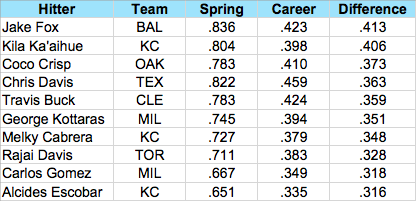
Note: Used with permission from John Dewan's Stat of the Week®, www.statoftheweek.com.
Jake Fox leads all players with nine homers this spring, including six in his last 28 at-bats. The 28-year-old has jacked 18 HR in a three-year career covering 467 plate appearances. His outstanding spring has likely earned him a spot on the Baltimore Orioles roster as the primary backup to catcher Matt Wieters and first baseman Derrek Lee.
Patrick Sullivan covered Kila Ka'aihue for Baseball Analysts last month. Ka'aihue, who turns 27 on Tuesday, has hit .429 and gone yard five times this spring. He hit .319/.463/.598 in Triple-A last year prior to being called up to the Kansas City Royals. He struggled in August but finished strongly by hitting .274/.361/.548 with six HR in 84 AB in September. He is slated to alternate with Billy Butler at first base and DH this season.
Center fielders Coco Crisp, Rajai Davis, and Carlos Gomez, and shortstop Alcides Escobar are more known for their speed and defense than their slugging. However, it should be pointed out that Crisp hit 15 HR in 2004 and 16 in 2005 when he was an up and coming star for the Cleveland Indians. After four disappointing seasons in which Crisp managed to hit just 24 HR, the switch hitter found his power stroke again last year when he produced eight four baggers in 75 games for the Oakland A's.
Chris Davis, Travis Buck, George Kottaras, and Melky Cabrera have all been highly regarded prospects at one time or another. Davis slugged a combined 38 homers in 736 plate appearances as a 22-year-old rookie and 23-year-old sophomore in 2008 and 2009. The lefthanded power hitter slumped badly for the Texas Rangers at the outset of the 2010 season and was sent to Oklahoma City (Triple-A) where he generated a line of .327/.383/.520 with 31 doubles and 14 home runs in fewer than 400 AB.
Buck was selected by the A's with the 36th overall pick in the 2005 draft and proceeded to hit .288/.377/.474 during his rookie season in 2007. However, the 27-year-old outfielder never came close to duplicating those results in 2008-2010 and was non-tendered last December. He signed a minor-league deal with the Indians with an invitation to spring training and has made the most of it by hitting .420/.453/.760 with five doubles and four home runs in 50 at-bats.
Kottaras has bounced around from the San Diego Padres organization (2003-2006) to the Boston Red Sox (2006-2009) to the Milwaukee Brewers (2010). He received more playing time than ever last year and cranked nine homers in 250 plate appearances. Kottaras and Wil Nieves are in a battle to serve as catcher Jonathan Lucroy's primary backup.
While it seems as if Cabrera has been around forever, he is only 26 years old despite amassing more than 2,600 plate appearances over the past five seasons. He reportedly dropped 15 pounds during the offseason and the six-footer is now down to 200. The slim and trim center fielder has raked to the tune of .490 with five doubles and two home runs in 51 at-bats this spring.
| Baseball Beat | March 25, 2011 |
News and Views: New York Yankees Starting Rotation
The New York Yankees reportedly signed Kevin Millwood to a minor league deal on Friday. The 36-year-old righthander will compete with the 37-year-old Bartolo Colon and the 34-year-old Freddy Garcia for the fifth spot in the team's starting rotation. And let's not forget Mark Prior who hasn't pitched in the major leagues since 2006!
These candidates would make for a nice staff if this were 2003 rather than 2011. I mean, this foursome might even give the Philadelphia Phillies' quartet a run for their money. You see, eight years ago, Colon, Garcia, Millwood, and Prior combined to post a 59-45 record with a 3.71 ERA and 733 SO/256 BB in 876.2 IP when all four starters were in their 20s.
Hey, if it's not 2003, then maybe it is the 1960s as we shouldn't forget that the club is also counting on a first-generation Nova.
| Baseball Beat | March 19, 2011 |
Scouting the G-Men (Gaviglio and Gagnon) and More
Living within walking distance of Blair Field, the home ballpark of the Long Beach State Dirtbags and the venue for many area high school teams, allows me the opportunity to witness a number of prospects every year. I have attended almost every Friday night home game that Long Beach State has played since Jered Weaver's sophomore year in 2003. Along the way, I have seen Weaver, Troy Tulowitzki, and Evan Longoria countless times plus several other notable first-round draft picks, including a matchup of Tim Lincecum vs. Ian Kennedy at USC in 2006, Bryce Harper at the Area Code Games in 2008, and Stephen Strasburg at the Major League Baseball Urban Youth Academy's Collegiate Baseball Tournament in Compton.
Last night, I was at Blair Field once again to see one of the best college pitching performances in the history of the park. While Oregon State's Sam Gaviglio is not a prospect in the class of Weaver, Lincecum, or Strasburg, the junior righthander nonetheless pitched one of the most impeccable games in the 50-plus years of this facility as the Beavers (14-3) defeated the Dirtbags (9-8), 4-0, in the opener of a three-game series between these two West Coast schools. Gaviglio (Guh-VEE-leo) threw seven perfect innings and allowed just one baserunner (a lead-off single in the eighth) in a complete-game shutout. He struck out the first four, nine of the first ten, and a career-high 14 overall while facing just 28 batters and throwing only 99 pitches.
 Gaviglio (4-0, 0.00 ERA) has now pitched 38 consecutive scoreless innings, just nine short of the single-season record of 47 by Todd Helton of Tennessee in 1994. Vermont's George Plender holds the NCAA record with 63 innings, accomplished over the 1954 and 1955 seasons. Gaviglio gave up two unearned runs in the first inning in a season-opening win over Gonzaga while outdueling the highly regarded Ryan Carpenter, threw a CG SHO against Connecticut (holding likely first rounder George Springer to an 0-for-3 with a SO) in his second start, held Hartford scoreless for six innings in his third outing, and whitewashed New Mexico State for eight prior to shutting out Long Beach State. He has allowed 14 hits and four walks while striking out 40 in 38 2/3 IP.
At 6-1 and 195 pounds, Gaviglio is the same listed height and weight as Kennedy when the latter was pitching for the Trojans from 2004-2006. The two RHP also share the fact that both rely on pitchability more than pure stuff. Gaviglio's fastball is a little light (mostly 86-88 with a high of 90) as compared to Kennedy's (89-91 when I scouted him during his college days), but his command and ability to throw strikes to both sides of the plate with all three pitches (FB-CB-CH) and at any time in the count rivals the pitcher who was recently named to start on opening day for the Arizona Diamondbacks. Gaviglio's breaking ball ranged from 78-82 and his changeup 77-81.
Gaviglio, who turns 21 in May, was a 40th-round selection in 2008 by Tampa Bay after being named the 5A Pitcher of the Year in Oregon while leading Ashland to the state championship. He chose the Beavers over the Rays and went 10-1 with a 2.73 ERA and 55 SO/9 BB in 62 2/3 IP during his freshman season. He regressed as a sophomore, going 3-4 with a 5.60 ERA and 45 SO/23 BB in an identical number of innings.
The dozen or so professional scouts (plus ESPN's Keith Law) sitting behind home plate a few rows in front of my brother and me were seemingly more interested in the opposing pitcher on Friday night. Andrew Gagnon, a 6-4/195 righthanded junior, had his first rough outing of the year, giving up six hits, four walks, and four runs in five innings. However, Gagnon (GAN-yawn) has faced much stiffer competition than Gaviglio thus far, with all five starts against ranked teams (Cal State Fullerton, Arizona, Oregon, Rice, and Oregon State). He retired Owls third baseman Anthony Rendon, a potential first pick in the 2011 draft, all three times (fly out to RF, groundout to 2B, and a line out to SS) when they hooked up a week ago Friday at AT&T Park in San Francisco.
 Gagnon, who gave up back-to-back home runs to OSU's Andrew Susac and Danny Hayes in the top of the first inning, saw his ERA rise from 1.30 to 1.91. He has allowed 25 hits and 13 walks while striking out 31 in 37 2/3 innings in 2011. Gagnon took over the role of the Friday night starter as a sophomore and moved up draft boards when he led the Cape Cod league with five wins while posting a 2.10 ERA and 43 K's in 38 2/3 IP. He was the Eastern Division starting pitcher for the Cape All-Star Game at Fenway Park and got the side out in order in his only inning of work. Gagnon throws an 89-92 mph fastball (with it comfortably sitting at 91), an 84-87 slider, and a low-80s change. His fastball is a bit straight and prone to getting turned around when left up in the zone. (Here is a video of Gagnon vs. Oregon on 3/4/11).
Susac (Suu-SACK) is a draft-eligible sophomore. At 6-1/205, the catcher has a pro body with a strong arm, quick pop times, and raw power at the plate. The home run he slugged cleared the wall in left-center field with lots of room to spare, a blast that was easily over 400 feet. He hit a hard groundball single between short and third in his next at-bat and drew a walk in the ninth. Susac (.453/.563/.811), riding a 13-game hitting streak, is 24-for-53 on the season with 7 2B, 4 HR, 14 BB, and 11 SO.
Baseball America ranked Susac, who turns 21 on Tuesday, as its No. 5 prospect in the Cape Cod League last summer when he hit .290 with five homers and the 23rd top college prospect for the 2011 draft. He was selected in the 16th round of the 2009 draft by the Philadelphia Phillies but did not sign. I wouldn't be surprised at all if a team took him in the first round in June.
Two weeks ago, I was on hand to see Oregon's Tyler Anderson also strike out 14 Dirtbags. The 21-year-old lefthander worked eight scoreless innings, throwing 77 strikes out of 112 pitches. After beating San Diego today, Anderson is now 3-0 with a 0.96 ERA and 52 SO/14 BB in 37 1/3 IP.
The 6-4, 215 pounder, who was drafted in the 50th round by the Minnesota Twins in 2008, was rated the 16th-best college prospect by Baseball America prior to the season. His fastball, which sat at 89-92 the night I saw him pitch against the Dirtbags, plays up due to a deceptive motion that includes a little quirk with the ball behind his back. The combination of a slightly across-the-body delivery and a slider with reasonable tilt wreaks havoc on LHB. Anderson can also handle RHB owing to a plus changeup with fade that ranks as his best pitch. Lastly, he displayed a strong move to first base, picking off two runners that evening. (Here is a video of Anderson vs. Long Beach State on 3/4/11.)
| Baseball Beat | March 15, 2011 |
Graphing the Pitchers: LOB% and BABIP
Thanks to the work of Voros McCracken and later Tom Tango, Defense Independent Pitching and Fielding Independent Pitching have become widely accepted in the baseball community as better measurements of pitching effectiveness (and predictability of future results) than earned run average (ERA). DIPS and FIP focus on strikeouts, walks, and home runs — the three primary outcomes that a pitcher controls. Except for perhaps catchers, fielders have no impact on these events.
While SO, BB, and HR play a large part in determining ERA, the latter is also a function of defensive and bullpen support, as well as performance with bases empty vs. runners in scoring position. As a result, the difference between ERA and FIP is almost entirely accounted by strand rate (LOB%*) and batting average on balls in play (BABIP). Each variable has a coefficient correlation of nearly 80 percent with the delta between ERA and FIP.
* Based on the formula, the strand rate is an estimator of LOB% rather than an actual tally.
When you put the two together (LOB% divided by BABIP), the coefficient correlation jumps to 90 percent. Accordingly, the coefficient of determination or R² is 81 percent. In other words, more than four-fifths of the difference between ERA and FIP is due to LOB% and BABIP. As such, in addition to SO, BB, and HR rates, it makes sense to study LOB% and BABIP to understand why a pitcher's ERA may be better or worse than his FIP.
The MLB averages for LOB% and BABIP have been running at almost exactly 72 percent and .300, respectively, for several years. These percentages held true once again in 2010.
Plotting LOB% on the y-axis and BABIP on the x-axis for all 147 pitchers who threw at least 100 innings in 2010, I created the following graph. As has become customary around these parts, I broke the graph into quadrants via the intersection of the LOB% and BABIP means. The pitchers in the northwest quadrant had high LOB% and low BABIP. Moving clockwise, the pitchers in the northeast quadrant had high LOB% and high BABIP, the hurlers in the southeast quadrant had low LOB% and high BABIP, and those in the southwest quadrant had low LOB% and low BABIP.
The numbers were lifted from FanGraphs in January. The BABIP data was subsequently recalculated, perhaps due to FanGraphs using an incorrect formula initially. While directionally correct, the BABIP used for this graph are generally about .005-.010 higher than those listed on the site now. The LOB% data matches exactly. You can download the spreadsheet with the applicable data here.
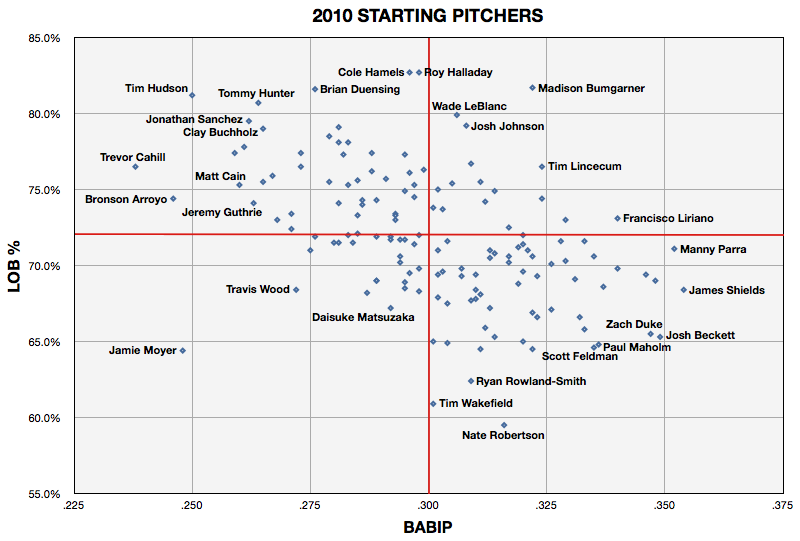
As usual, I have identified the outliers in all four quadrants in the graph above. In addition, as shown below, I have created lists of leaders and laggards for both LOB% and BABIP. For perspective, the ranges on LOB% and BABIP were 59.5-82.7 percent and .238-.354, respectively.
Starting with LOB%, I highlighted the six pitchers with strand rates over 80 percent and compared 2010 with their career marks. All but Madison Bumgarner (who pitched just 10 innings prior to last season) have career LOB% that are well below their results in 2010. That said, I found it interesting that the career rates were all above the MLB norm of 72 percent.
Roy Halladay, Cole Hamels, Brian Duensing, Tim Hudson, and Tommy Hunter all posted career high LOB%. Halladay had only exceeded 75 percent twice before last year.
In addition to sharing high LOB%, the common thread among these pitchers is that they fared better with RISP than with the bases empty.
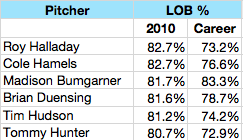
There were 11 pitchers with strand rates of 65 percent or lower. Excluding John Ely (who was a rookie), all but Luke Hochevar have career LOB% that are well above their results in 2010. Nonetheless, I found it as equally interesting as the observation from the leader board that the career rates were all at or below the MLB norm of 72 percent.
Nate Robertson, Tim Wakefield, Ryan Rowland-Smith, Jeff Francis, and Paul Maholm all posted career low LOB%. Scott Feldman, Jeremy Bonderman, and Tony Pena produced the second-lowest LOB% while Jamie Moyer had the third-lowest since he broke into the majors in 1986.
In addition to sharing low LOB%, the common thread among these pitchers is that they fared worse with RISP than with the bases empty.
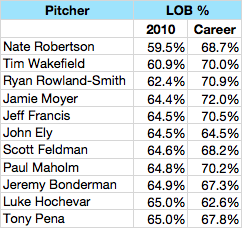
Turning to BABIP, I spotlighted the 14 pitchers with averages under .270 and, like LOB%, compared 2010 with their career marks. All of these starters (including Armando Galarraga who actually posted a .261 BABIP based on FanGraphs' revised calculations) have career BABIP that are above their results in 2010. Of note, the career rates were all below the MLB norm of .300.
Matt Cain has never had a league-average BABIP and, in fact, has not exceeded the .278 he allowed in 2007.
Hudson and Hunter appear on the most favorable LOB% and BABIP lists. Moyer, on the other hand, was the only pitcher to appear on a leader and laggard board.
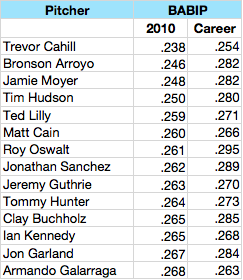
There were 16 pitchers with BABIP higher than .330. All of these pitchers have career BABIP that are below their results in 2010. In five cases, the career marks are slightly below the MLB norm of .300. The balance are all higher.
Maholm and Feldman appear on the least favorable LOB% and BABIP lists.
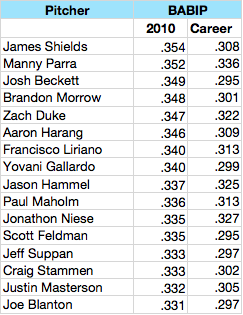
Here is the same graph presented with a best-fit trendline. As shown, it slopes from the northwest quadrant down and to the right through the intersection to the southeast quadrant. Generally speaking, the lower the BABIP, the higher the LOB%, and the higher BABIP, the lower the LOB%.
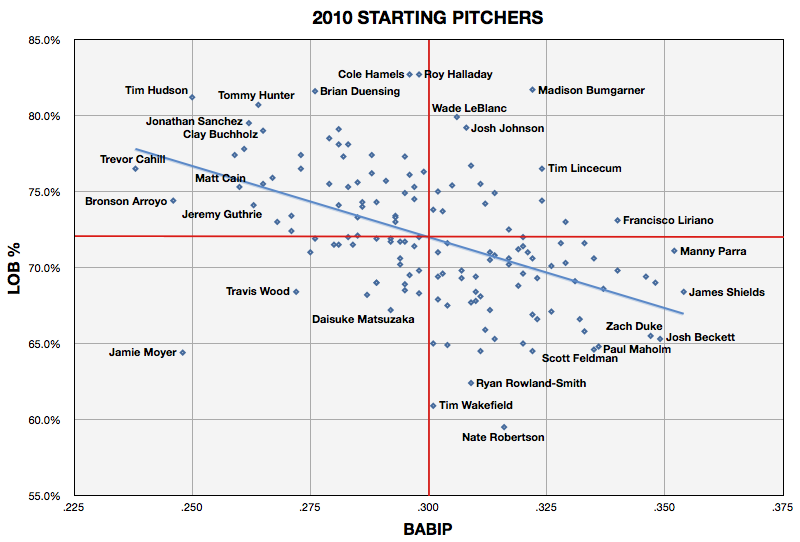
The outliers in the NWQ were the pitchers who benefited the most from high LOB% and low BABIP. Here are the pitchers with the highest ratios of LOB% divided by BABIP:
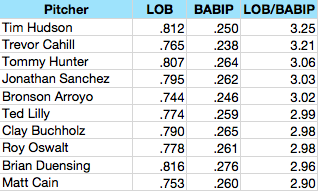
Six of the above pitchers ranked in the top seven in ascending order in ERA minus FIP (E-F), meaning they had better ERAs than FIPs. The other four placed 11th, 17th, 27th, and 28th (out of 147 pitchers who threw at least 100 innings in 2010).
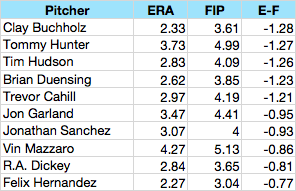
Conversely, the outliers in the SEQ were victimized the most by low LOB% and high BABIP. Here are the pitchers with the lowest ratios:
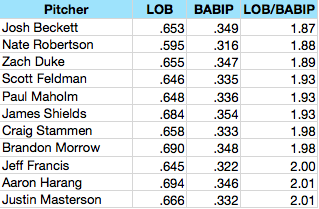
Seven of the above pitchers ranked in the top ten in descending order in E-F, meaning they had worse ERAs than FIPs. The other four placed 17th, 19th, 21st, and 22nd.
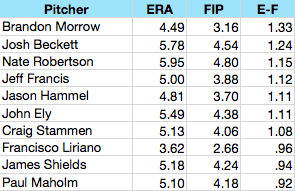
Interestingly, the outliers in the NEQ and SWQ neither benefited nor were victimized in the aggregate as the abnormal percentages in each category basically offset one another. As an example, Moyer, a SWQ outlier, had an ERA (4.84) minus FIP (4.98) of -0.14.
There are several takeaways embedded in this study, some of which are more obvious than others:
There are also a few questions: Is the discrepancy in performance between RISP and bases empty due to a pitcher's ability to work from the windup as opposed to the stretch? Do certain pitchers have an extra gear that they can employ when the going gets tough? Is there a self-fulfilling prophecy at play here, a Yogi-ism where pitchers perform well until they don't perform well? The answers to these questions could go a long way toward understanding how much skill or luck is involved in the year-to-year fluctuations in LOB%.
Courtesy of Dave Studeman of The Hardball Times, you can read more about LOB% here and here.
| Baseball Beat | March 04, 2011 |
The Duke of Hazard
Edwin "Duke" Snider died last Sunday at the age of 84. We're talkin' baseball here. Willie, Mickey, and the Duke. Three Hall of Famers who patrolled center field in New York during the 1950s.
There have been countless tributes written about Snider during the past week, including one titled simply "The Duke" by the prolific Joe Posnanski. In addition, Duke's death has been a topic of conversation on the Society of American Baseball Research's SABR-L message board. The latter has focused on the time when Snider hurt his arm trying to throw a baseball out of the Los Angeles Coliseum in April 1958.
Posnanski mentioned that Snider "had a powerful arm when he was young but hurt it and was never quite the same after he turned 30" but doesn't provide any details. SABR members Bob Timmermann and Lloyd Davis provided excerpts from articles in the Los Angeles Times and Associated Press. I also found one from The Milwaukee Sentinel.
This story got me thinking about what my Dad, who covered the Los Angeles Dodgers from 1958-1968 for the Long Beach Independent, Press-Telegram, had to say about the matter. I pulled out his scrapbooks and found three separate stories on this subject.
The first was published in the morning newspaper (then known as the Independent) in a separate boxed insert on Thursday, April 24, 1958 as part of the Dodgers-Cubs game coverage from the previous night.
Clowns, Hurts ArmDuke Snider, who so far has failed to hit a ball out of the Coliseum, tried to throw one out Wednesday night with the adverse results.
Clowning around before batting practice, the Duke attempted to clear the concrete wall bordering the 79th row. He came close once, tossing one into the 77th row, but pulled a muscle in his arm on the final try.
Manager Walter Alston had to yank Snider from his announced lineup and he may miss today's game, too.
The second was the lead to a longer story with the headline spanning the entire newspaper of that evening's newspaper (known as the Press-Telegram).
Snider in Dodger DoghouseBy GEORGE LEDERER
There are some strained feelings among the Dodgers today, both physical and otherwise.
Physically, the strain is in Duke Snider's right elbow. Otherwise, it is between Snider and manager Walter Alston and the Dodger front office.
The Duke learned the hard way Wednesday night that he is paid roughly $40,000 per season to try and hit, not throw, the ball out of the park.
In a bit of pre-game horse play with utility infielder Don Zimmer, Snider strained a tendon in his right elbow as he tried to heave a ball out of the Coliseum, 79 rows high and some 120 feet deep.
Alston, who had already announced his lineup, was forced to make some quick changes. He not only yanked Snider, but suspended him without pay until he is ready to play again.
[snip]
Snider, who had succeeded in tossing a ball as far as the 77th row before straining his elbow, watched the action from the bench and was not informed of his suspension until after the game. His injury is believed to be not serious, but may keep him out another day or two.
Alston said he would not tolerate such antics. Snider, hitting only .217, was still showing the effects of last December's knee operation that sidelined him until late in the exhibition season.
The third article appeared in the newspaper the following day.
DAFFY DODGERS---AGAINClowning Costs Duke Day's Pay
Duke Snider was in a surprisingly good mood Thursday when he was reinstated in the Dodger lineup by Manager Walt Alston after some extra-curricular clowning cost him a day's pay.
The Duke was forced to sit out Wednesday night's 7-6 loss to the Cubs when he strained his right elbow in trying to throw a ball out of the 79-row Coliseum.
Snider was suspended for the night and docked a day's pay, which amounted to $275.
When asked how the arm felt, Snider said, "Peachy. I can't afford to lose another day's pay and neither can Uncle Sam. You know, I'm the guy who's firing all those missiles."
Alston was still somewhat sore about the incident. He also fined utility infielder Don Zimmer $25 for his part in the throwing contest. "Zimmer was just as much a part of it as Snider. The only difference is that he didn't get hurt. I would have liked to have Snider in there last night."
Dodger relief pitcher Ed Roebuck also commanded the spotlight briefly during Wednesday night's three-ring circus. Roebuck drew a $25 fine for trying to hit the scoreboard clock with fungoes in pre-game practice.
"He was supposed to hit fly balls to the outfielders," Alston said. "Instead, he was fooling around and knocking balls into the peristyle end. You won't see him hitting any today."
Snider showed no signs of being affected by the elbow injury. He threw well from left field and beat out an infield hit in his first time at bat. Rookie Don Demeter replaced Snider in the seventh inning.
There you have it ... the real story behind how the Duke of Hazard hurt his arm in 1958.
While I'm not a fan of leaders by the decade*, I found it interesting that Snider led MLB in home runs (326) and RBI (1,031) during the 1950s. You know, the decade that featured Ted Williams, Willie Mays, Mickey Mantle, Stan Musial, and Eddie Mathews. Williams missed virtually all of the 1952 and 1953 seasons to the Korean War. Mays and Mantle were rookies in 1951, and Mays missed a large portion of '52 and all of '53 to the military as well. Mathews slugged 299 HR despite debuting in 1952. Many other superstars like Hank Aaron, Ernie Banks, AL Kaline, and Frank Robinson didn't make it to the majors until the mid-1950s. By the way, Snider's teammate Gil Hodges was No. 2 in HR that decade with 310. Mathews was third, followed by Mantle (280), Musial (266), Yogi Berra (256), Mays (250), Ted Kluszewski (239), Gus Zernial (232), and Banks (228).
*Jack Morris led the majors in wins during the 1980s and Mark Grace led in hits during the 1990s.
| Baseball Beat | February 28, 2011 |
Adam Wainwright and Bert Blyleven
Adam Wainwright tore the ulnar collateral ligament in his throwing elbow and is scheduled to undergo Tommy John surgery today. The normal rehabilitation time for pitchers following this reconstructive surgery is approximately one year, although many pitchers don't fully recover for two years. As a result, if everything goes well, Wainwright could return for the opening of the 2012 season.
The St. Louis Cardinals righthander skipped his final start in 2010 due to what the team described in a press release last September as a "right forearm muscle strain." He had experienced a tightening sensation in his elbow during his previous two starts after sleeping awkwardly on it the night before his 19th victory. Wainwright suffered a partial tear of the same ligament in 2004, missing a large portion of that season only a handful of months after the Redbirds had acquired the former first-round draft pick from the Atlanta Braves in a trade involving J.D. Drew.
Today's operation will be performed in St. Louis by team physician Dr. George Paletta, who has also repaired the elbows of Chris Carpenter, Jaime Garcia and Kyle McClellan. Ironically, the latter pitcher is the most likely internal candidate to replace Wainwright in the rotation this year. Meanwhile, Carpenter, who won the National League Cy Young Award in 2005, will regain his status as the club's ace. Garcia placed third in the NL Rookie of the Year balloting last season after posting a 13-8 record with a 2.70 ERA in 163 1/3 innings.
Wainwright, 29, who may possess the best curveball in baseball, might be following in the path of none other than Bert Blyleven. The Hall of Famer was 31 when he hurt his elbow early in the 1982 season. He appeared in only four games that spring and had an uneven campaign in 1983, missing time in July, August, and September. Blyleven bounced back in 1984 and enjoyed what Bert believes was the best year of his career. He won 19 games for the sixth-place Cleveland Indians despite missing four starts in May and June due to a freak foot injury. Blyleven finished third behind two relievers (Willie Hernandez and Dan Quisenberry) in the AL Cy Young voting.
In Jeremy Greenhouse's final article for Baseball Analysts, he pointed out the similarities between Blyleven and Wainwright.
When you think of big curveballs nowadays, you think of Adam Wainwright. Over the last two years, Wainwright’s curveball has been worth 45.7 runs according to FanGraphs, 20 runs better than the runner-up. Wainwright doesn’t shy away from the pitch, throwing it a quarter of the time, the third-highest rate in the Majors. However, nobody can match the 40% rate Blyleven estimated that he threw in 1978. Blyleven was known for freezing batters with his curve, and Wainwright had at least one such famous moment. Both Wainwright and Blyleven threw their curveballs in unusual fashions. According to pitch grip expert Mike Fast, Wainwright's curve "is not quite a standard curveball grip in that his index finger is completely off the ball. Most pitchers lay it down alongside the middle finger on the ball." Blyleven, on the other hand, said that he "holds both his fastball and curveball across the seams." Blyleven recalled Sandy Koufax and Bob Feller pitching the same way, but at the time knew of no one else who did. I asked Mike Fast, and he is unaware of any current pitcher who exhibits this trait. Here's an image of a potential Blyleven curve.
As shown below, Blyleven amassed about 1,750 more innings than Wainwright through their 28-year-old seasons. Nonetheless, the rate stats are nearly identical.

Buster Olney spotlighted Wainwright's usage of his breaking ball in a recent column (Insider subscription required). He threw 1,471 breaking balls in 2010, ranking fourth behind Brett Myers (1,619), Carpenter (1,589), and Dan Haren (1,482). At 44% of his total pitches, Wainwright placed third behind Myers (47%) and Carpenter (45%) among hurlers who threw over 1,500 pitches. According to Olney, the league-average mark was 24.8%. Buster also reported that the league batted .183 against Wainwright's breaking stuff.
Although Blyleven avoided surgery on his UCL, he may serve as a proxy for Wainwright's future performance. If so, look for Wainwright to struggle next season, put up one of his best years in 2013, and perhaps lead the league in innings pitched in 2014 and 2015.
As the saying goes, short-term pain, long-term gain.
| Baseball Beat | February 09, 2011 |
Graphing the Hitters: Plate Discipline
Last week, I published Graphing the Hitters: Productivity with a focus on OBP and SLG. Today's version of Graphing the Hitters is on Plate Discipline, which I introduced in this format just over a year ago.
The graph below plots walk rate (BB/PA) on the x-axis and strikeout rate (SO/PA) on the y-axis for every qualified batter in 2010. The intersection of the MLB averages for BB% (8.50%) and SO% (18.49%) created quadrants that classify players as better-than-average in both (lower right), worse-than-average in both (upper left), or better-than-average in one and worse-than-average in the other (lower left and upper right).
Unlike Fangraphs, I believe the denominator for strikeout percentage should be plate appearances (rather than at-bats). For whatever reason, Fangraphs defines walk percentage as BB/PA but strikeout percentage as SO/AB. As a result, while the raw numbers were downloaded from Fangraphs, the BB% and SO% were calculated separately.
Note: You can download a spreadsheet containing the BB, SO, BB%, SO%, and BB/SO of the 151 qualified hitters here. This information can also be used to locate the 124 players not labeled in the graph below.
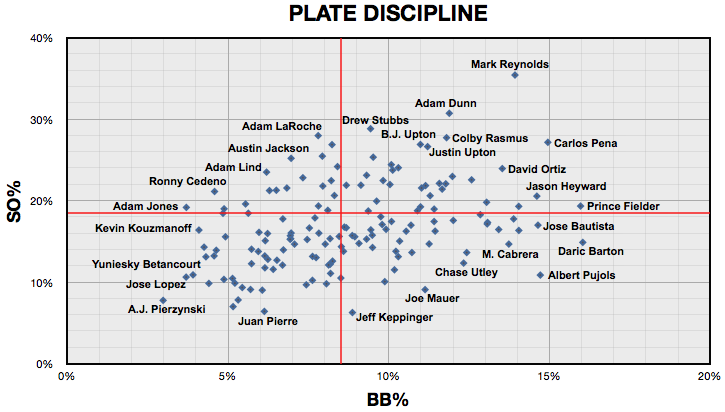
Three of the players in the bottom right quadrant ranked in the top five in OPS last year. Not only did Jose Bautista, Miguel Cabrera, and Albert Pujols produce outstanding on-base and slugging averages but they also displayed strong plate discipline. All three hitters walked at least 60% more than the MLB average while striking out less than the MLB average.
Pujols had the fourth-highest BB% (14.71%) and the 20th-lowest SO% (10.86%). No one else comes close to matching that combination of BB% and SO%. Joe Mauer was 36th in BB% (11.13%) and 7th in SO% (9.08%).
Daric Barton (16.03%), whose name is situated between Bautista and Pujols on the graph above, edged out Prince Fielder (15.97%) for the highest BB% in the majors. A.J. Pierzynski (2.98%) had the lowest BB%.
Mark Reynolds (35.40%) had the highest SO% by a wide margin, beating out Adam Dunn by nearly five percentage points. Reynolds struck out over 200 times for the third straight season. He now holds the top three spots on the all-time single-season list for strikeouts. No other player has ever whiffed 200 times in a campaign. The top nine in SO have all occurred since 2004 with Reynolds (3), Dunn (3), and Ryan Howard (2) manning eight of the nine places. As it relates to Reynolds, if one wants to look for hope and change, he has increased his walks and BB% every year since his rookie season in 2007.
Jeff Keppinger (6.26%) had the lowest SO%, squeezing past Juan Pierre (6.40%) for top honors. He also generated the No. 1 BB/SO ratio with an impressive 1.42. Adam Jones (0.19) had the worst BB/SO. The toolsy center fielder is far from a finished product. By the same token, Carlos Gonzalez, firmly in the top left quadrant with a 6.29% BB and 21.23% SO, may not be the superstar-in-making unless he improves his dismal BB/SO ratio of 0.30. With or without better plate discipline, the 25-year-old outfielder is unlikely to ever approach the rate stats (.363/.412/.679) he put up in the second half last year.
Just five qualified hitters had a BB/SO ratio of 1.0 or better (vs. 13 in 2009). Pujols and Mauer were the only players to repeat.
| Player | BB | SO | BB% | K% | BB/SO |
|---|---|---|---|---|---|
| Jeff Keppinger | 51 | 36 | 8.87% | 6.26% | 1.42 |
| Albert Pujols | 103 | 76 | 14.71% | 10.86% | 1.36 |
| Joe Mauer | 65 | 53 | 11.13% | 9.08% | 1.23 |
| Daric Barton | 110 | 102 | 16.03% | 14.87% | 1.08 |
| Chase Utley | 63 | 63 | 12.33% | 12.33% | 1.00 |
Combining the features of the Productivity and Plate Discipline graphs allows us to determine the players who had above-average BB% (> 8.50%), SO% (< 18.49%), OBP (> .325), and SLG (> .403). The 29 hitters in the table below are ranked by OPS.
| Player | BB | SO | BB% | K% | BB/SO | OBP | SLG | OPS |
|---|---|---|---|---|---|---|---|---|
| Miguel Cabrera | 89 | 95 | 13.73% | 14.66% | .94 | .420 | .622 | 1.042 |
| Albert Pujols | 103 | 76 | 14.71% | 10.86% | 1.36 | .414 | .596 | 1.010 |
| Jose Bautista | 100 | 116 | 14.64% | 16.98% | .86 | .378 | .617 | .995 |
| Paul Konerko | 72 | 110 | 11.41% | 17.43% | .65 | .393 | .584 | .977 |
| Troy Tulowitzki | 48 | 78 | 9.07% | 14.74% | .62 | .381 | .568 | .949 |
| Matt Holliday | 69 | 93 | 10.22% | 13.78% | .74 | .390 | .532 | .922 |
| Adrian Gonzalez | 93 | 114 | 13.42% | 16.45% | .82 | .393 | .511 | .904 |
| Ryan Zimmerman | 69 | 98 | 11.44% | 16.25% | .70 | .388 | .510 | .898 |
| Aubrey Huff | 83 | 91 | 12.43% | 13.62% | .91 | .385 | .506 | .891 |
| Shin-Soo Choo | 83 | 118 | 12.85% | 18.27% | .70 | .401 | .484 | .885 |
| Joe Mauer | 65 | 53 | 11.13% | 9.08% | 1.23 | .402 | .469 | .871 |
| Andre Ethier | 59 | 102 | 10.09% | 17.44% | .58 | .364 | .493 | .857 |
| Billy Butler | 69 | 78 | 10.18% | 11.50% | .88 | .388 | .469 | .857 |
| Scott Rolen | 50 | 82 | 9.31% | 15.27% | .61 | .358 | .497 | .855 |
| Hanley Ramirez | 64 | 93 | 10.34% | 15.02% | .69 | .378 | .475 | .853 |
| Alex Rodriguez | 59 | 98 | 9.92% | 16.47% | .60 | .341 | .506 | .847 |
| Mark Teixeira | 93 | 122 | 13.06% | 17.13% | .76 | .365 | .481 | .846 |
| Chase Utley | 63 | 63 | 12.33% | 12.33% | 1.00 | .387 | .445 | .832 |
| Brian McCann | 74 | 98 | 13.07% | 17.31% | .76 | .375 | .453 | .828 |
| Carlos Quentin | 50 | 83 | 9.49% | 15.75% | .60 | .342 | .479 | .821 |
| Hideki Matsui | 67 | 98 | 12.01% | 17.56% | .68 | .361 | .459 | .820 |
| Torii Hunter | 61 | 106 | 9.44% | 16.41% | .58 | .354 | .464 | .818 |
| Andrew McCutchen | 70 | 89 | 10.72% | 13.63% | .79 | .365 | .449 | .814 |
| Stephen Drew | 62 | 108 | 9.79% | 17.06% | .57 | .352 | .458 | .810 |
| Nick Markakis | 73 | 93 | 10.30% | 13.12% | .78 | .370 | .436 | .806 |
| Daric Barton | 110 | 102 | 16.03% | 14.87% | 1.08 | .393 | .405 | .798 |
| Raul Ibanez | 68 | 108 | 10.69% | 16.98% | .63 | .349 | .444 | .793 |
| Gaby Sanchez | 57 | 101 | 8.86% | 15.71% | .56 | .341 | .448 | .789 |
| Michael Cuddyer | 58 | 93 | 8.59% | 13.78% | .62 | .336 | .417 | .753 |
As I concluded last year with no particular revelation, "Pujols is the most disciplined and productive hitter in the game today." Albert may still be the "most disciplined" hitter but might not be the "most productive" anymore. You see, there is another guy out there who is a lot more like Pujols than not. In fact, this impostor had a higher AVG (.328 vs. .312), OBP (.420 vs. .414), SLG (.622 vs. 596), OPS (1.042 vs. 1.011), OPS+ (179 vs. 173), wOBA (.429 vs. .420), and wRC+ (170 vs. 165) than the three-time NL MVP (who, by the way, also has FOUR second-place finishes). No, it's not Joey Votto. It's none other than Miguel Cabrera, who sits atop the list above.
| Baseball Beat | January 31, 2011 |
Graphing the Hitters: Productivity
While I have been graphing pitchers for a number of years, I only started doing the same for hitters twelve months ago. It was a simple exercise of measuring productivity by plotting on-base percentages on the x-axis and slugging averages on the y-axis for every qualified batter in 2009.
With the foregoing in mind, I decided to create a graph using the data for 2010. As I noted a year ago, "there is nothing groundbreaking" here. Instead, my goal is just to present the information in a format that is not only visual but easier to absorb more quickly than via a spreadsheet. It is designed to be simple and straightforward. Two axis, four quadrants, and player names identifying outliers.
The quadrants were determined by the intersection of the MLB averages for OBP (.325) and SLG (.403). [The averages last year were .333 and .418. Call 2010 the Year of the Pitcher if you want to put a positive spin on it or the Year of the Worsening Hitter if you prefer to be a cynic.] The northeast quadrant is the home of hitters with above-average OBP and SLG. The southwest quadrant is made up of "hitters" with below-average OBP and SLG. The northwest and southeast quadrants identify hitters who were above average in one and below average in the other.
Note: You can download a spreadsheet containing the OBP, SLG, and OPS of the 151 qualified hitters here. This information can also be used to locate the 125 players not labeled in the graph below.
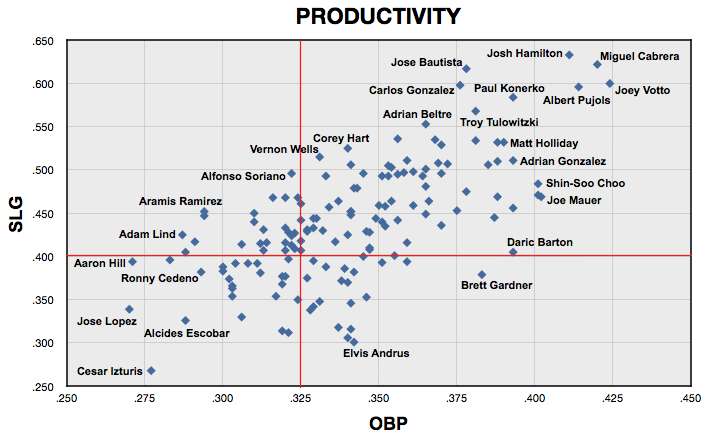
Starting with the best quadrant, the four hitters who stand out — Josh Hamilton, Miguel Cabrera, Joey Votto, and Albert Pujols — all ranked first or second in his respective league's Most Valuable Player voting. Hamilton (1.044) and Votto (1.024) led the American League and National League, respectively, in OPS and were named the MVP winners.
The only other player besides these four to receive a first-place vote for MVP was Jose Bautista, who seemingly came out of nowhere to put up a .378 OBP and .617 SLG. He ranked fifth in the majors in OPS (.995). Bautista slugged 54 HR (12 more than any other hitter) and drew 100 BB. He led MLB in HR plus TB (tied for first with 351) and XBH (92). The Toronto Blue Jay right fielder/third baseman produced an OPS+ of 166, the first time he had ever reached the MLB average of 100. Bautista was in the 90s in his prior four seasons.
In addition to the five aforementioned players, there were three others who exceeded an OBP of .375 and a SLG of .550. Paul Konerko (.977), Carlos Gonzalez (.974), and Troy Tulowitzki (.949) ranked sixth, seventh, and eighth in the majors in OPS. Konerko (3 years/$37.5M), Gonzalez (7/$80M), and Tulowitzki (10/$157.75M) were rewarded with big contracts during the off-season.
CarGo and Tulo benefited greatly by playing their home games at Coors Field, which had a park factor of 118 in 2010. Gonzalez hit .380/.425/.737 at home and .289/.322/.453 on the road. Tulowitzki hit .339/.403/.631 in Colorado and .291/.358/.504 in away games. Nevertheless, their OPS+ of 143 and 138, respectively, ranked sixth and eighth in the NL last season. Konerko generated a career-high OPS+ of 158 at the age of 34. He finished in the top eight in the AL in AVG (.312), OBP (.393), SLG (.584), OPS (.977), OPS+, HR (39), XBH (70), TB (320), and RBI (111).
Two other outliers in the northeast quadrant include Matt Holliday (.390/.532) and Jayson Werth (.388/.532), whose diamond in the above graph touches Holliday's. Interestingly, Holliday signed a 7/$120M contract (or $17M per year with a $1M buyout) with the St. Louis Cardinals in January 2010 and Werth inked a 7/$126M deal (an average of $18M annually including a $4M signing bonus) with the Washington Nationals in December 2010. The latter's salary escalates from $10M in 2011 to $21M in 2015-17. Holliday was 30 and Werth 31 at the time of their signings.
We should also give a shout out to Yo Adrian as Beltre (.365/.553) and Gonzalez (.393/.511) had terrific seasons, placing 11th and 13th in the majors in OPS. Who finished 12th? Robinson Cano (.381/.534), whose diamond sits directly below Tulowitzki's.
By the way, is it just me or does Shin-Soo Choo remind anyone else of Bobby Abreu? Both play right field, hit lefthanded, and put up .300/.400/.500 type rate stats. Through their age 27 seasons, Choo had a 138 OPS+ and Abreu had a 137. Abreu (.308/.413/.521, 151 OPS+) had his best offensive season at age 28. Just sayin'.
At the opposite end of the graph, we see a bunch of futility infielders as Jay Jaffe would be inclined to call them. Ranked from lowest to highest OPS, Cesar Izturis (.545) takes the cake, followed by Jose Lopez (.609), Alcides Escobar (.614), Ryan Theriot (.633), Erick Aybar (.636), Orlando Cabrera (.657), Aaron Hill (.665), Jason Bartlett (.674), Ronny Cedeno (.675), Alberto Callaspo (.676), Kevin Kouzmanoff (.679), Cliff Pennington (.687), Miguel Tejada (.693), Ian Desmond (.700), Jhonny Peralta (.703), and Brandon Inge (.718). Any player residing in this quadrant had better be a "plus" fielder or had an off year.
My best bet for a comeback candidate is Aaron Hill, who had a batting average on balls in play of ONE-NINETY-SIX (.196)! His BABIP is not only remarkable in an absolute sense but also relative to his previous five campaigns when he averaged .307 on balls in play with a range of .288 to .324. The source of the problem can be found in Hill's batted ball stats. According to Fangraphs, 54% were fly balls (vs. 41% career mark and a MLB average of 38%), 35% were ground balls (vs. 40% career and MLB of 44%), and 11% were line drives (vs. 19% career and MLB of 18%). Per The Hardball Times Baseball Annual 2011, 83% of fly balls turned into outs whereas only 74% of ground balls and 27% of line drives were converted into outs last year. Given the increase in FB and the decrease in GB and LD, one would expect Hill's batting average to decline but not necessarily from a previous career mark of .285 to .205. If the second baseman can keep his strikeout rate below 15% (which he has accomplished in five of his six seasons to date), I would expect his AVG/OBP/SLG to improve materially this year.
| Baseball Beat | January 24, 2011 |
The Fun Never Stops
I didn't intend to write about Bert Blyleven for my Monday entry until I received the following email from a Minnesota Twins Baseball Fantasy Camp player yesterday evening.
Rich - it was great to meet you at the camp and love the story.I have uploaded the video of Bert meeting you -
http://www.youtube.com/watch?v=DxOvjqneZ9U
I am so happy they let you play and pitch in a game - it is a great time at the camp. Lee Stange is a great guy to have as your manager (he was my manager last year - 2010) as well.
Take care - hope to see you in Cooperstown in July.
Paul
The email from Paul Bennett made my Sunday. It was a pleasant surprise, to say the least, as I had not seen a video from the night I met Bert. I had no idea that I would be asked to speak that evening so my comments were unrehearsed. I just went with the flow. My wife, who wasn't able to join me for the trip, enjoyed watching the video as well. It made her feel as if she was back there with me.
Blyleven opens by talking about fellow Hall of Famers Harmon Killebrew and Willie Stargell. Stan Dickman, the Executive Director of the Minnesota Twins Baseball Fantasy Camp, then asks Bert about the Internet just beyond the two-minute mark on the video. Check out the following YouTube to see how it all unfolded from there.
By the way, Paul had a great week, too. He received the under-the-age-of-50 Gold Glove Award and was the starting pitcher in the championship game that his team won, 4-3.
Thank you, Paul. I will see you in Cooperstown six months from today.
On a related note, Stan added a news story to his website yesterday. Here is an excerpt from 2011 Camp — In the Books and One for the Ages!
But perhaps the highlight of the night came when Bert was surprised with a visit by Rich Lederer, the Southern California Blogger that had taken up the cause for Bert's inclusion into the Hall of Fame eight years prior. In his press conference on the day of the vote announcement and again at the Tuesday night banquet, Bert had singled Rich out for his tireless efforts on the internet in making the case for Bert's body of work being Hall of Fame worthy. The look on Bert's face when Rich was introduced was priceless and will long stand as one of the most exciting moments in our camp's history.
What I thought was a fun-tastic two weeks has now turned into a great three weeks.
Thanks everyone for sharing this adventure with me.
| Baseball Beat | January 19, 2011 |
Meeting Up and Hanging Out with Bert
Make no mistake about it, I've had a fun-tastic two weeks. It all started with the phone call from Bert Blyleven on Wednesday, January 5 when he informed me 30 minutes prior to the actual announcement that he had been elected to the Hall of Fame. After 14 long years, the wait was finally over. Bert Blyleven, Hall of Famer.
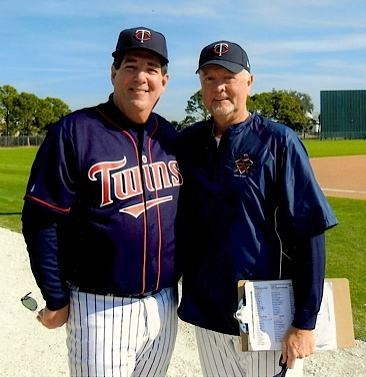 I congratulated him and then he congratulated me. I told him, "Thank you." He said, "No, thank you." Bert could not have been more appreciative or gracious in sharing baseball's ultimate honor with me. I'm not naive though. He did all the work on the field. Fifth in career strikeouts, ninth in shutouts, and top 20 in wins since 1900. Two World Series Championships with a 5-1 postseason record and a 2.47 ERA. And much, much more. My only contribution was making voters aware of his qualifications. It all seemed so obvious to me when I wrote my first article about Only the Lonely: The Hall of Fame Trials and Tribulations of Bert Blyleven in December 2003. Everybody around him in the major statistical categories was in the HOF except Blyleven. How could that be? Well, seven years and more than 30 articles later, we no longer have to answer the naysayers.
In that same phone conversation, I told Bert that I was going to be in Cooperstown on July 24 when he is officially inducted into the Hall of Fame. He responded in typical Blyleven fashion, "You can stand next to me if you'd like." Bert and his wife Gayle have since invited me to sit with the family on that momentous day this summer.
But, as it turned out, I won't have to wait six months to meet Bert for the first time in person. While I umpired one of his scout's league games 37 years ago, I never got closer than about 60 feet, 6 inches to him. You see, on the afternoon of Blyleven's election, I was invited to surprise Bert at a tribute dinner for him at the Minnesota Twins Baseball Fantasy Camp in Ft. Myers, Florida the following Tuesday. I didn't have to think too long or too hard on the offer proposed by Jay Harris, one of of the organizers of this event.
I made plans the next day to fly out of Los Angeles to Ft. Myers (via Miami) a week ago Tuesday and fly back to L.A. last Thursday. Suffice it to say, that trip was one of the most fun-filled of my life. Nearly one week after returning and I still haven't quite come all the way down from cloud nine.
Tuesday, January 11
In anticipation of playing catch with Bert, I packed my baseball glove firmly inside my carry-on bag. My son Joe took me to LAX bright and early that morning. I caught a 7:10 a.m. PT flight and landed in MIA as scheduled at 2:55 p.m. ET. My connecting flight to Ft. Myers (RSW) was at 3:35. I called Jay, who had offered to pick me up at the airport, to let him know that I would be there on time. Unfortunately, I spoke too soon. Less than five minutes later, a voice was heard over the public address system telling us that there was a change in the aircraft and that the flight was now scheduled to leave at 4:30. Well, 4:30 soon became almost 5:00 as the passengers literally stood on a bus on the tarmac waiting to be called onto the American Eagle puddle jumper. I called Jay to let him know that I wouldn't arrive until at least 5:30. He told me not to worry about it even though the dinner festivities were expected to begin at 6:00 at the Holiday Inn Ft. Myers Airport-Town Center.
We actually arrived at the hotel in the nick of time. The program began minutes later with the honorable Bert Blyleven decked out in a white wig and green robe presiding over Kangaroo Court. He fined campers and former teammates-turned instructors a total of $1,600 with all the proceeds going to Lee County Children’s Hospital. Bert had no idea I was there as I sat in the back corner of the room at a table with Jay and a half dozen campers.
Dinner was served, a FOXSports North video of Blyleven was shown on a big screen, Bert was asked to address the audience, a toast was conducted, and songwriter/storyteller Warren Nelson sang a couple of original songs about Bert and the Twins while playing his guitar. Stan Dickman, the evening's host who is also the Executive Director of Ultimate Sports Adventures (which is the licensed provider of the Twins Fantasy Baseball Camp), called Bert back up to the stage. He asked him if there was anybody not in the room that he wanted to thank. Blyleven proceeded to talk about former teammate and fellow Hall of Famer Harmon Killebrew, who was unable to attend after learning that he had esophageal cancer.
Stan then asked Blyleven about the Internet and Bert once again mentioned my name and talked about my efforts on his behalf. Stan asked Bert if he had ever met me. The latest Hall of Famer said no but indicated that he was hopeful of doing so in Cooperstown in July. Stan responded, "Would you like to meet him tonight?" After Bert panned the room, I stood up and walked to the stage amid a warm reception by the audience. Bert and I shook hands, smiled, and gave each other a big hug. The look in his eyes was a combination of surprise and gratitude.
I also met Gayle for the first time in person. She presented me with a big basket of decorative cookies wrapped in cellophane as a thank you. The sugar cookies were customized with the Twins logo and Bert Blyleven HOF 2011. It was a thoughtful gesture on her part. I suggested that we take the basket to the locker room the next morning and let the campers enjoy them.
John Gordon, the radio play-by-play announcer, stopped by to introduce himself and say hello. Two days later, I was able to hook up with a fully uniformed Dick Bremer, who is Bert's partner on the telecasts, at one of the camp games. Outstanding broadcasters and men both.
Wednesday, January 12
I arrived at the Lee County Sports Complex – Spring Training Headquarters of the Twins – at about 8:00 a.m. I was given a locker and a uniform. After I got dressed, David Dorsey of the Ft. Myers News-Press interviewed me for an article that appeared on the front page of the sports section the next day. Jay then showed me around the clubhouse and took me to the cafeteria where we served ourselves breakfast. Bert sat down directly across from me. We talked about baseball and golf before meeting up on the field and having a catch.
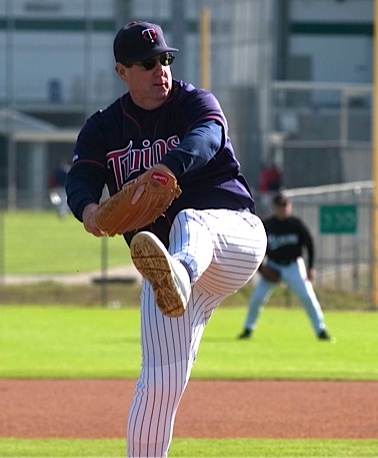 Bert went out of his way to accommodate me as he had hip replacement surgery in October. Believe me, he can still zing it. Not shy, I told Bert that I wanted to compare curveballs. I threw him a spinner and he mocked me. "That's your curveball?" Hey, it was the first one I had thrown in years and only then at a family picnic. He raised his arm and hand to a 12 o'clock position and said, "You've got to get it up here." As someone who had a good curve through high school, I knew I was supposed to throw the ball over the barrel and shake hands with the center fielder (a visual that worked wonders for me). Nevertheless, at age 55, my shoulder wasn't as cooperative as it once was. Bert, who is four years older than me, broke off a couple of tight ones. Impressive indeed.
My manager, Lee Stange, asked me what position I played. I told him pitcher but said I could also play first base. He kidded, "Everyone out here is a first baseman/DH." Lee sent me to the bullpen to warm up. He liked what he saw enough to give me the start. The first two batters hit line-drive singles. Standing just outside our dugout on the third base side, Blyleven shouted, "Hey Rich! Try to get an out, why don't you!" I smiled at him, took a deep breath, and got back to the task at hand. The next batter hit a slow roller to my right. I was thinking two but, then again, I thought I was 30-something rather than 50-something. My brain made the play with no problem, but my body failed me. The ball passed me and the shortstop had no play. A couple of runs later and Bert was now needling me again. "You've got an 18.00 ERA!" It was actually higher at that moment in time because I had not yet completed the inning. Thankfully, I did with no further damage.
Down 2-0 after the first inning, the Stingers (see lineup card signed by Stange and our coach Rick Aguilera) battled back and scored four runs in the top of the second. I got a chance to hit and landed on second base after the infielder overthrew first. It was the last thing I wanted to happen. Not only did I run hard (not fast, mind you) to first, now I had to hustle to second to beat the throw from the right fielder who did a great job in backing up the play. Believe me, sprinting from home to second was the furthest thought on my mind when I walked to the plate. But, hey, I did it for the team and eventually scored a run. Man, was I winded when I high fived Bert on my way back to the dugout.
Teammate Bob Garvin threw several innings, limiting the New Years team managed by Phil Roof and Juan Berenguer to a run or two as we went on to a 14-4 victory. The official scorekeeper credited me with the win in a judgment call that was highly favorable to me. Stange was as generous when he told me that I earned the "W" and went 1-for-1 in my debut. I'll take 'em both, as well as the congratulations from Bert after the game.
Steve Dickman, who is Stan's older brother, took me back to the hotel to change into my golf attire and then to Bert's country club where he hosted a round of golf that afternoon for ten foursomes, generally made up of one former player and three campers. I not only played in Bert's group but rode in the same cart in an 18-hole scramble format that called for playing the best ball after each shot.
Bert posed for a photo with me next to the carts prior to teeing off. Ever the prankster, he suggested we take out our drivers. I reached into my bag of rental clubs for the 12.5° squared driver while he grabbed his ball retriever. I joined in on the fun when we gave each other bunny ears, returning the favor that Bert had given me on the baseball field earlier that day. Needless to say, we had a good time playing golf.
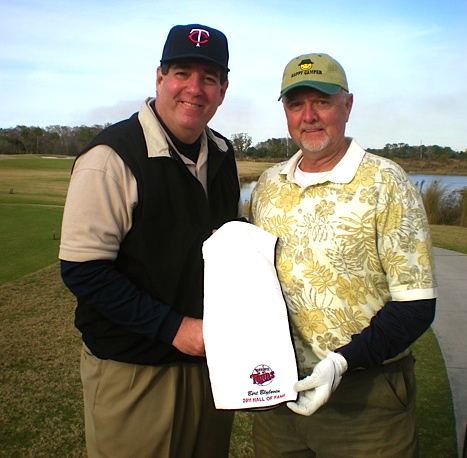 Our group also played well. We tied for first place with a 65. Bert, who plays to a five index, hit a lot of long drives. I was pleasantly surprised how well I hit the golf ball after not playing since July 4th. We didn't hit any balls on the range so my first swing in six months was on the first hole. Although I once played to a five myself, I was a little bit nervous when I stepped to the No. 1 tee. I hit a good drive (which we didn't use), then stuck a nine-iron about four feet from the hole, which led to our first birdie of the day. I contributed a few drives, several approach shots on the greens, and one birdie putt from the No. 3 position in the group. Dick Washburn, who was drafted by the Cincinnati Reds in the fifth round in 1966 and was the camp's over-the-age of 50 Cy Young Award winner, and Joe Repya, a retired Army Lieutenant Colonel and combat veteran of three wars, also helped our cause.
During our round of golf, I presented Bert with a couple of personalized, tour-quality golf towels that my son Joe, who is a Regional Sales Manager for Club Glove, had designed for me. The Twins logo, Bert's name, and 2011 Hall of Fame were all embroidered onto the towels. These gifts meant a lot to him.
We finished the day's activities with drinks and hors d' oeuvres in the clubhouse. Ron Gardenhire, Kent Hrbek, Tom Brunansky, Tim Laudner, and Bill Campbell (standing next to me in this photo) were some of the players who joined us for golf and refreshments. Campbell, who won the first two Rolaids Relief Man Awards in 1976-77, shared a bunch of great stories with me in the locker room and on the golf course. He was an old-school reliever, combining to pitch 307.2 innings (an average of more than two per outing) in those two seasons. He went 30-14 while leading the league in games finished both years and saves in 1977. Soup, as he was and is still known, placed in the top ten in the CYA and MVP voting in '76 for the Twins and '77 for the Red Sox.
I returned to the hotel that evening not knowing it was possible to be as sore as I was and still have so much fun. Due to the fact that I had no intention of playing the next day, you might say that I retired early for the night and late for my "career." One and done although, as a starting pitcher, I had a built-in excuse for not pitching for another five days. Bert Blyleven or Bill Campbell, I am not.
Thursday, January 13
I woke up at 6:45 in anticipation of packing for my return flight that afternoon and a half day of camp. I met Jay in the lobby of the hotel at 7:50 and we arrived at the spring training complex at around 8:00. I wore black jeans and my Twins undershirt, jersey, and cap but no baseball pants, belt, or tube socks for me on this day.
My teammate Bob Zuckerman, as nice a guy as you could meet, took the photo of Bert and me at the top of this page on Wednesday morning. He went to Target that evening and ordered an 8x10 that he placed in my locker prior to my arrival on Thursday. I asked Bert to sign that photo and a Rawlings Major League Baseball. He personalized both, thanking me again in writing and signing "Your friend, Bert Blyleven."
We looked at the article that appeared in the Ft. Myers News-Press that morning. The photo of me pitching above was on page three. Bert ribbed me. "We need to work on your leg kick." I said, "Are you kidding me? That's major league quality right there." When I returned home, I looked for photos to check his leg kick from his playing days. Oh well, my leg kick certainly wasn't as big as Blyleven's. But it got me thinking, "Maybe the photographer snapped the photo of me pitching with a runner on base?" OK, runners on base. Either way, it may have been too short for a windup and too long for a slide step. That's why I haven't quit my day job.
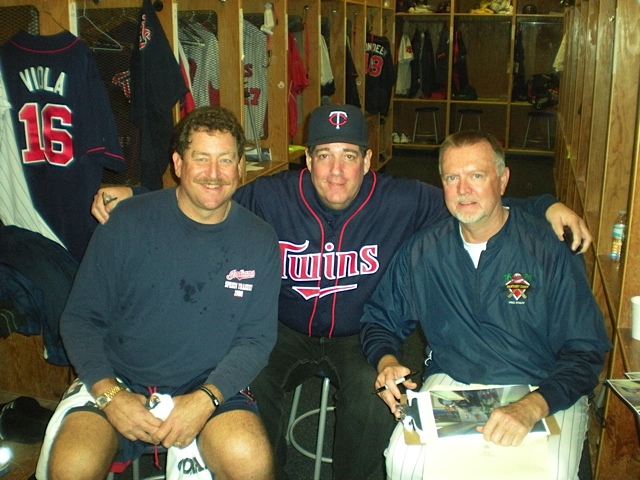 I hung out with Bert and Frank Viola in the locker room. The three of us swapped baseball stories, reminiscing more about the past than the present. Bert and Frank, of course, were the go-to guys for the 1987 Minnesota Twins World Series championship team. Viola won the AL Cy Young Award the following year when he led the league with 24 wins and a .774 W-L percentage while ranking third in ERA (2.64) and ERA+ (154). As I learned from his son, Frank Viola III, the man known as Sweet Music and possessor of the best changeup in the game never missed a start from 1983-1992. He started a remarkable 354 games and completed 2,451 innings during that ten-year stretch.
Viola's son, a minor-league pitcher, worked out with Blyleven that day. After undergoing Tommy John surgery a couple of years ago, he now throws harder than ever, touching 90 with a live fastball. He also throws a nice changeup. However, he doesn't have much of a breaking ball. In steps Bert to teach him the grip and the arm action of a cutter. I witnessed much of his bullpen session, and it was a pretty good one. At 26, he just might get one last chance.
The clock struck noon and it was time for me to say my final goodbyes to Bert. We shook hands and chatted for a few moments. It ended like it started with that phone call just over a week ago with both of us congratulating and thanking one another. As a friend told me in an email, "It's nice to know that the guy you helped so much is personally worthy of your efforts." Well, let me tell you, Bert is as great a man as he was a pitcher.
My return flight was at 1:35 p.m. Jay, who couldn't have treated me any better, drove me to the Ft. Myers Airport. He dropped me off by 12:30 and handed me a sandwich that camp chef George Serra made for me and a Killebrew Root Beer in a handsome bottle. I sat on a bench outside the terminal and ate my lunch. With my boarding pass already printed, I walked directly to the gate. Unlike Tuesday, my two flights departed and arrived on time. Joe picked me up at LAX shortly after 6 p.m. PT and took me to the Claim Jumper in Long Beach where I met my wife Barbara, daughter Macy, and son-in-law Joel for dinner. Macy is expecting in March, and Barbara and I will become grandparents for the first time.
Life is more than good.
Friday, January 14
Upon my return home, I was greeted with a wonderful article by Dave Studeman at The Hardball Times.
Bert meets RichThere's a wonderful article today in the Florida News-Press. It describes the first meeting between two men so deeply aligned in my mind's eye: one a great major league pitcher, the other his most ardent advocate. I didn't realize that the two hadn't met before; it's about time.
The story of Rich and Bert is perhaps the greatest story of Sabermetrics on the Internet. There are other great stories, such as the formation of Baseball Prospectus and the growth of Tango's sabermetric blog and theories, but none have had the impact of Rich's early and impassioned advocacy of Bert Blyleven for the Hall of Fame.
Blyleven was an under-the-radar kind of guy when he pitched, and I don't know exactly why. Perhaps it was the small markets he pitched in, or the fact he never won a Cy Young. It was easy to overlook him when you talked about the all-time greats.
But Rich changed that. When Rich laid out Bert's career stats, you took notice. Your eyes opened, and you realized that you had been missing something for a long time. It truly was like waking up.
Thanks to Sabermetrics (and one of Rich's idols, Bill James), you just couldn't deny the power of the evidence. And thanks to the Internet, the word spread quickly. Many eyes opened and minds changed. Others joined the chorus, but Rich started the chant. And eventually the BBWAA heard, too.
This is a great story within a story, and it gives many of us hope. Hope that compelling stats really can mean something; hope that some more rationality can be brought to bear to the Great Baseball Arguments. Hope that the fundamental nature of the game can be fully incorporated with its emotional impact. Hope that minds and hearts can co-exist.
This from the article...
“Would Bert had gotten in without Lederer? That’s hard to say,” said LaVelle Neal, a sportswriter for the Star-Tribune of Minneapolis. “I will say that Lederer and the stats revolution came when Bert really needed a boost.”
...gets it wrong. There is no way the BBWAA would have inducted Bert Blyleven into the Hall of Fame without Rich Lederer. Let's give credit where it's due.
Congratulations, Bert; and congratulations, Rich. You both belong in the Sabermetric Hall of Fame.
In his Friday Filberts, Rob Neyer linked to the Ft. Myers News-Press article and added, "My favorite story of the week? Rich Lederer and Bert Blyleven having a catch."
I was also interviewed that morning by Bob Sansevere, a columnist for the St. Paul Pioneer Press. He is a member of the BBWAA and is a Hall of Fame voter. To Bob's credit, he has voted for Blyleven since the get go. The Q&A appeared online that evening and in the newspaper the following day.
Buster Olney linked to the interview on his blog last Saturday (subscription required). "Rich Lederer had a lot to do with Bert Blyleven's induction into the Hall of Fame, Bob Sansevere writes."
Stan Dickman, the owner of the baseball camp, made my day on Sunday with the following note within his email. "The highlight of the week was your surprise appearance at our Tuesday evening banquet."
The pleasure was mine. Thanks to Bert and everyone involved for making the past two weeks so memorable.
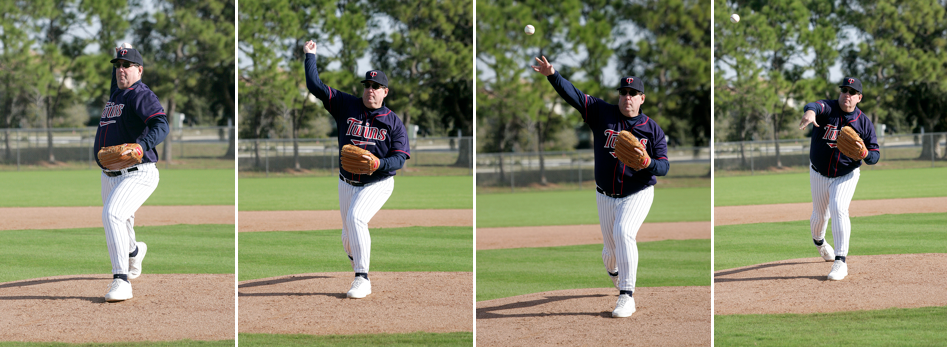
Photo credits (in order): Bob Zuckerman (standing with Blyleven), Brian Hirten/Ft. Myers News-Press (pitching), and Al Schuth, Twins Camp photographer (action sequence above).
| Baseball Beat | January 10, 2011 |
The Bill James Handbook 2011
Reviewing the Bill James Handbook has become an annual tradition for me since late 2003 when I spotlighted the 2004 edition. The Handbook, which was in its second year of publication back then, has now been around for nine years. Produced by Baseball Info Solutions and published by ACTA Sports, The Bill James Handbook 2010 offers readers more than 500 pages of stats, projections, and leader boards, as well as nine short essays by Bill James and The Fielding Bible Awards by John Dewan.
 This year's Handbook features National League Most Valuable Player Joey Votto on the cover. He follows Barry Zito in 2003, Albert Pujols in 2004, Jorge Posada in 2005, Miguel Cabrera in 2006, Ryan Howard in 2007, Grady Sizemore in 2008, Brandon Webb in 2009, and Evan Longoria in 2010. The cover boys have alternated from AL to NL every year with the exception of 2006 and 2007 when Cabrera (then of the Florida Marlins) and Howard appeared in back-to-back years. Four of the nine players call first base home. No middle infielders or corner outfielders yet.
Upon opening the book, one notices the Table of Contents, which lists 26 sections, beginning with the Introduction and ending with Acknowledgements. The heart of the book includes up-to-date statistics on every major league player and manager plus team statistics and efficiency summary, baserunning, bullpens, pinch hitting, manufactured runs, park indices, lefty/righty stats, leader boards, Win Shares, hitter and pitcher projections, and career targets. The Hall of Fame Monitor and plus/minus and runs saved fielding data for every player are new additions to the Handbook this year.
I rarely miss anything with a Bill James byline. James authors 40 pages, although many are explanations, definitions, or accompanied by lists or tables. As a result, I'm left wanting more of James. Nonetheless, he provides some compelling facts and commentary in a few sections.
In 2010 Team Efficiency Summary, James writes:
As long as we have been measuring efficiency, the Los Angeles Angels of Anaheim, California, Disneyland and Mike Scioscia have been the most efficient team in the American League, if not all of baseball. They still were, in 2010; they weren't good, but they were still efficient. In previous years their efficiency helped them to win. In 2010 it helped to disguise how bad they really were.The Angels in 2010 (and most other years) scored more runs than we would expect them to score, thus they were efficient in that way. They allowed fewer runs than we would expect them to allow, so they were efficient in that way. Even given the runs that they actually did score and the runs they actually did allow, they won more games (one more game) than we would expect them to win, so they were efficient in that way. They were, as they always are, highly efficient.
Mike Scioscia was out-sciosciaed, in 2010, by first-year manager Brad Mills of Houston. When Millsie took the job, I think I speak for most of us when I confess that we were whispering behind his back that, given the team he had to work with, he'd be lucky to get out of Houston with ten fingers and ten toes. Instead, he took a 65-win team and won 76 games—a nice start to his managerial career.
On the other hand of that was the Rockies, who took a 93-win team and scratched and clawed their way to 83 wins. Which, I should add quickly, is not necessarily the manager's fault. If a team doesn't hit in the clutch, this will be measured as inefficiency, but there's really not much the manager can do about it.
His second piece of writing in this book may be the juiciest in terms of information. The title of the section is "38 Facts about Major League Baserunning in 2010." If you're into baserunning as much as I am, then you need to buy the book for these facts and the six-plus pages of tables. While you can find much of this information on the individual player pages of Baseball-Reference.com, it's not available in a alpha sort like it is in the Bill James Handbook.
I will tease you with fact 38 below:
The three best baserunners in the major leagues—Juan Pierre, Carl Crawford, and Brett Gardner—were all left fielders. Historically, left field is interesting because that is where the greatest baserunners have played (Brock, Henderson, Raines, Coleman), but there have also been many left fielders who were absolutely terrible baserunners.
In The Bullpens of 2010, James informs us that "Fourteen major league pitchers had (Leverage) Indexes over 2.00—all of them closers except Jim Johnson of Baltimore, who was over 2.00 as a setup man." Bill shows his humor when he says David Riske ranked last because "his managers thought that to use him in critical situations was Too Riske."
James gives a shout out to Chris Jaffe, author of Evaluating Baseball's Managers, in The Manager's Record. Baseball Analysts ran the introductory essay to Chapter 5 of Jaffe's book almost a year ago. James doesn't mince words at the end of his section.
I don't know Jaffe from a hole in the wall; he's not like a friend of mine or something, and also, I have to warn you that he is not a compelling writer. He does really good research. He develops a wide range of metrics by which to compare managers, like "Ballpark Adjusted Bullpen ERA" and "Leverage Points Average" and "Average Opponent Winning Percentage" (for pitchers), and I learned a great deal from reading his book. I hope you learn something from this data.
In The Hall of Fame Monitor, James tweaks the 32 rules from the old system (which was first published almost 30 years ago) and adds a new system based on Win Shares "with a caveat for relievers and one for catchers."
For a season of 30 or more Win Shares, the formula is Win Shares, divided by 30, times 10, converted to the nearest integer. For a season of 10 to 29 Win Shares, the formula is Win Shares, divided by 30, SQUARED, times 10, converted into the nearest integer. For a season of less than 10 Win Shares, no points.That's basically all. That's the whole system; add them up and if the total is 100 or more, Hall of Famer. ... Essentially, the new system says that if you have 10 seasons as an MVP candidate of some sort, you're a Hall of Famer. 30 Win Shares is an MVP candidate; 30 Win Shares is 10 points. Ten seasons of that, you're a Hall of Famer. The two problems with that system are relievers and catchers. The Win Shares system hates relievers. Let's not get into that so, to avoid infecting this system with the problems of the other one, we count each Save as one-fourth of a Win Share before doing the calculations above. Also, since catchers' careers are generally too short for them to meet Hall of Fame standards, even if they are great players, we divide their totals by .75.
We add the points awarded under the two systems together, divide by two, and round down. Those are the points accounted for in the Hall of Fame monitor. The idea is that by looking at the question in two entirely different ways, we can avoid the weaknesses of either approach. One system probably underrates relievers; the other one probably overrates them, but when you put them together, you're OK. One system ignores park effects and changes in league standards; the other system meticulously adjusts for them. Hall of Fame voters partially adjust for them, so having a system part of which adjusts for them and part of which doesn't, that works. The system mirrors the process.
Here is a table of active players with 100 or more points:
| Num | Player | Points |
|---|---|---|
| 1 | Alex Rodriguez | 188 |
| 2 | Mariano Rivera | 150 |
| 3 | Albert Pujols | 146 |
| 4 | Derek Jeter | 138 |
| 5 | Manny Ramirez | 125 |
| 6 | Ichiro Suzuki | 110 |
| 7 | Chipper Jones | 107 |
| 8 | Trevor Hoffman | 106 |
| 9 | Vladimir Guerrrero | 105 |
James, in The Player Projections Section, opens with the following. "As Fantasy Baseball is now America's fourth-largest business, this section of the book could be considered business consulting. Got a hot tip for you, boss: This Albert Pujols, he's pretty good. Albert's gold brick is easy to project, because he does the same thing every year."
The ten best predictions are ranked in order (from first to tenth): Raj Davis, Matt Holliday, Stephen Drew, Russell Branyan, Torii Hunter, Alexei Ramirez, David Eckstein, Jason Kendall, Emilio Bonifacio, and David Ortiz.
To his credit, he also points out his biggest mistakes, which generally fell into three categories: "(a) we projected that a player would play, and he didn't, (b) we didn't project that a player would play much, but he did, and (c) we just missed on the numbers. Re the latter, James admits "the champion of those in 2010, of course, was Jose Bautista. I don't know how that happened; everybody else knew he would hit 54 homers. Why didn't we?"
Bill's wit shines through when he boasts about how close he was on Todd Coffey and Phil Coke. "We regret that there were no pitchers named Milk or Juice." He follows that line with "There was a Sipp" and shows his actual and projected stats.
In Pitchers on Course For 300 Wins, which is the final section aside from the Glossary, James writes:
The two pitchers in baseball today who have the best chance to win 300 games are Roy Halladay and the artist formerly known as Carsten Charles Sabathia. This statement was true a year ago; however, the situation is very different now than it was a year ago. A year ago, the no-hit pitcher and the Big Lefty were first and second on a list of contenders. Now they have separated themselves from the field.It is likely that one or two pitchers now active will win 300 games, and two is more likely than one.
I'm into online stats and recognize that a lot of the information in The Bill James Handbook can be found at Baseball-Reference and Fangraphs, but there is still something magical about this book. I believe it will broaden your baseball knowledge and help bridge the gap between now and the beginning of spring training next month or your upcoming fantasy baseball draft.
| Baseball Beat | January 05, 2011 |
| Baseball Beat | January 04, 2011 |
J.P. Morosi, FOXSports: Aficionado Heavily Invested in Blyleven
Jon Paul Morosi featured me in an article currently teased on the front page of FOXSports.com. The URL reads "bert-blyleven-hall-of-fame-bid-rides-on-sabermetrics-loving-blogger."
If you hurry on over to that link as fast as members of my family did, the following screenshot can be viewed live by waiting for or clicking on the number 5 on the right-hand side of the window. Or you can go to the MLB page and wait for it to scroll to the number 1, which corresponds to the title "No. 1 Fan: Investing guru turned blogger is out to save Blyleven from HOF snub."
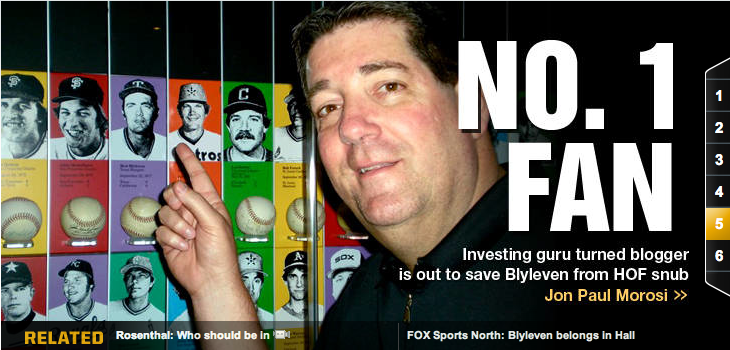
Morosi, who is a national MLB writer for FOXSports.com, interviewed me on Monday. He sent an email Sunday evening asking if he could arrange a date and time to talk about Bert Blyleven with the Baseball Hall of Fame announcement forthcoming on Wednesday. We hit it off and talked for nearly two hours.
The headline that is attached to the article is "Aficionado heavily invested in Blyleven," a play on words owing to my profession as an investment manager. I'll take aficionado over internet zealot any day.
Rich Lederer is an investment manager. Stock and bond portfolios are his thing. He is the president and chief investment officer of Lederer & Associates Investment Counsel in Long Beach, Calif.But Lederer loved batting averages long before calculating his first P/E ratio. He is a baseball guy. His father, the late George Lederer, covered the Los Angeles Dodgers for the Long Beach Independent-Press-Telegram through their first 11 seasons on the West Coast.
Lederer has since taken up the family business — as a hobby. In 2003, he founded a baseball blog, now called BaseballAnalysts.com. He writes at night, after his real job is done. The website hasn’t made him rich or famous. Yet, his words may soon resonate through the game’s most hallowed corridors.
If Bert Blyleven is elected to the Baseball Hall of Fame on Wednesday, he will have Rich Lederer to thank.
Morosi then highlights Blyleven's achievements, discusses Bert's voting trends, the "grassroots campaign," how he is polling this year, my father (including a photo of him showing off the first foul ball that he caught in the press box at Dodger Stadium in 1962), and concludes with the following:
“The Internet flattens the world a little and allows someone like me to have a say, an audience, and indirectly participate in the discussion,” Rich Lederer said. “I enjoy that. If not for the Internet, it would be next to impossible for me to have an impact on those types of things. It’s been a great vehicle. People say there have been more words written about Bert’s candidacy than anyone else in the history of the Hall of Fame.”If the wait ends on Wednesday, happy blog postings will spring up around the web, from mainstream and sabermetric writers alike.
Then they will face the question: Which cause comes next?
I have someone in mind, but it will remain a secret until Blyleven earns his just reward.
***
Here are four links on the same subject:
...and one on Jeff Bagwell:
In August, Richard Lederer of the Baseball Analyst's Web site stacked the career numbers for Bagwell and Chipper Jones side-by-side and said the two players should be "slam-dunk, first-ballot Hall of Famers." Bagwell ranks 37th all-time among position players with a WAR (wins above replacement) rating of 80. He's ahead of Pete Rose, Paul Molitor, Reggie Jackson and several other baseball greats in WAR, which combines offense, defense, baserunning and a player's position to determine how many added wins he gives a team when compared to a baseline "replacement level" substitute.Factoring in all the numbers, Lederer wrote that Bagwell is arguably the fourth-best first baseman ever behind Gehrig, Foxx and Albert Pujols.
Thanks to Jon, Craig, Anthony, Joe, Glenn, and Jerry, as well as all the tweeters out there.
| Baseball Beat | January 04, 2011 |
Latest Update on Bert Blyleven's Chances for the Hall of Fame in 2011
ESPN.com released the ballots from the ESPN writers who are voting members of the BBWAA this morning. Fourteen of the 18 writers (77.8%) voted for Bert Blyleven.
Here are the 14 that voted for Blyleven: Howard Bryant, Jim Caple, Jerry Crasnick, Gordon Edes, Pedro Gomez, Tony Jackson, Tim Kurkjian, Ian O'Connor, Peter Pascarelli, Brendan Roberts, Adam Rubin, Mark Saxon, Claire Smith, and Jayson Stark.
Barry Stanton, news editor for ESPN, did *not* vote for Blyleven (or Roberto Alomar, Jeff Bagwell, Barry Larkin, or Tim Raines), yet he voted for B.J. Surhoff plus Tino Martinez, Don Mattingly, Jack Morris, and Edgar Martinez. It looks like if your last name started with "M" you had a better shot at getting Stanton's vote than if you were fifth all-time in strikeouts, ninth all-time in shutouts, and in the top 20 all-time in wins since 1900. Why someone like Stanton has a vote is beyond me.
In any event, Blyleven has now received 82 of the 105 full ballots (78.1%) that Darren Viola (aka Repoz), the editor-in-chief of the Baseball Think Factory, has gathered from voters who have either posted their selections publicly or confessed to him privately. If this sample size is indicative of the overall total, then Blyleven should narrowly gain admission to the Baseball Hall of Fame when the results are released tomorrow.
In the meantime, here's hoping that Bert Be Home Blyleven (as in 2011). Those of us who have supported him can help the cause by keeping our fingers crossed for the next 24 hours.
| Baseball Beat | December 22, 2010 |
The Internet Zealot Responds
One Blyleven Internet supporter is such a zealot that he has guessed as to the motives for the non-support, and even on occasion taken to outing non-supporters or ridiculing them, perhaps in an attempt at persuasion. Let me just say that I have nothing against Blyleven, and have been consistent in my non-support of him. My "no'' vote has nothing to do with the Internet campaign, which has only become apparent in Blyleven's final few years on the ballot, and appears to be effective, as Blyleven's totals have risen precipitously.
- Jon Heyman
After reading Heyman's column on si.com Monday late afternoon, my son Joe sent me the following text, "New Christmas gift request... bumper sticker that reads: 'My Dad is a zealot.'" I wrote back, "One Blyleven Internet detractor is such a zealot that he writes about why he is NOT voting for him every year."
Heyman released his Hall of Fame ballot on Twitter several days ago but devoted his entire column on Monday (sans his picks on the second page) to "Why I didn't cast a Hall of Fame vote for Bert Blyleven, again." Incredible. He mentions Blyleven specifically or refers to him in 24 of the 26 paragraphs that comprise nearly 2,000 words. By comparison, he writes one paragraph on Roberto Alomar, his top candidate; four paragraphs defending his selection of Jack Morris over Blyleven; and a few sentences on a separate page on each of his five other picks (Barry Larkin, Dave Parker, Tim Raines, Don Mattingly, and Dale Murphy).
I'd like to respond to the following excerpts from Heyman's column:
Heyman tries to use the fact that Blyleven has received "less than half the votes" against him, yet he himself is voting for Mattingly, Murphy, and Parker, none of whom has even sniffed 50 percent of the vote in a single year. In fact, the individual high among these three is 28.2% (Mattingly in his first year of eligibility in 2001). All three players were greats at their respective peaks but the truth of the matter is that the trio has been polling about 10-20 percent of the vote every year they have been on the ballot.
Here we go with "impact" and being "around as long as every player on the ballot" again. I tackled these obsessions two years ago.
"I saw him play his entire career."Congratulations, Jon. If you "saw him play his entire career," then so did I. But the truth of the matter is that neither one of us saw him play his entire career. In fact, nobody has seen Blyleven play his entire career. Not his parents. Not his wife. Not his kids. Not any one teammate. Not any announcer, writer, or team executive.
Like me, you may have been alive back then. Like me, you may have even seen him pitch many times. Like me, you may have watched him perform on TV. Like me, you may have even read about him in the newspapers or magazines when he was playing.
Unlike me, you covered Blyleven when he pitched for the Angels toward the end of his career. Unlike you, I umpired a game behind the plate that he pitched. In other words, I saw Bert's curveball, the one that Bill James and Rob Neyer ranked as the THIRD-BEST EVER in The Neyer/James Guide to Pitchers, up close and personal.
But, when it comes to judging Blyleven's career, none of these facts really matter all that much. You see, I never once saw Babe Ruth play. Or Ty Cobb, Honus Wagner, Christy Mathewson, or Walter Johnson. Or Tris Speaker, Rogers Hornsby, Lou Gehrig, or Joe DiMaggio. But I can still say with 100 percent certainty that all of these players are Hall of Famers. By the same token, I didn't need to see thousands of other players in action to know they weren't Hall of Famers. Being there is great. It's fun. It's memorable. But it doesn't mean you know who is and who isn't a Hall of Famer.
"It's not about stats...it's about impact."You gotta love this one. Shame on me. I have always been led to believe that stats lead to impact. I guess not. Rather than spending so much time on making the case for Blyleven via the numbers, maybe I should have emphasized the fact that Blyleven pitched for TWO World Championship teams. I won't mention that he was 5-1 with a 2.47 ERA in five postseason series, including 2-1 with a 2.35 ERA in those two World Series because "it's not about stats." According to you, "it's about impact." And, thanks to you, I have now come to realize that Blyleven had little or no impact on the Pirates winning the World Series in 1979 or the Twins winning it all in 1987.
There you go again with impact. You see, it's difficult to argue against impact. There are no numbers. Instead, it's all about feelings and beliefs and all those other intangible goodies that only certain people possess. Just close your eyes and relive the memories, however tainted they may be, of these, ahem, human beings!
Fame. I always love that one. Another touchy-feely qualification. Alomar, Larkin, and Parker. Now those guys were famous. Even though Blyleven won two World Championships, struck out more batters than all but four pitchers and threw more shutouts than all but eight in the history of baseball, completed the third-most 1-0 shutout victories ever and the highest total in 75 years, pitched a no-hitter, and had the greatest curveball of his era and one of the best of all-time, he wasn't famous. Or at least not in Jon Heyman's world.
Sheesh. I have shown otherwise numerous times. Just because Blyleven didn't win the American League Cy Young Award in 1973 doesn't mean he wasn't the best pitcher in the league. He led the AL in WAR (9.2), ERA+ (158), K/BB (3.85), and SHO (9). He ranked second in ERA (2.52), SO (258), BB/9 (1.86), and WHIP (1.12), third in K/9 (7.15) and CG (25), and fourth in IP (325) and HR/9 (0.44). That's one heck of a résumé, no? Nonetheless, he received one point and finished seventh in the Cy Young balloting that season. As I reported six years ago, "One voter out of 24 saw fit to pencil Bert's name into the third slot on the ballot. The other 23 writers ignored him completely. Instead, they voted for Jim Palmer #1, Nolan Ryan #2, Catfish Hunter (and his 3.34 ERA in a pitcher's ballpark) #3, John Hiller #4, Wilbur Wood #5, and Jim Colborn #6. Palmer had two more wins than Blyleven and an ERA that was 0.12 lower. Otherwise, Palmer had inferior stats across the board, including WAR (6.1), ERA+ (156), K/BB (1.40), SHO (6), SO (158), BB/9 (3.4), WHIP (1.14), K/9 (4.8), CG (19), IP (296.1), and HR/9 (0.49), yet he received 88 points, including 14 first-place votes. Go figure.
Did I mention that Palmer also received much better run and defensive support than Blyleven? The Baltimore Orioles scored 4.7 runs per game for Palmer while the Minnesota Twins scored 4.2 for Blyleven. The Orioles led the AL in Defensive Efficiency (.731) while the Twins (.696) ranked eighth out of 12 teams. Looked at it another way, Baltimore (119 FRAA) was 137 fielding runs better than Minnesota (-18). These fielding differences showed up in Palmer's and Blyleven's batting average on balls in play. Palmer had a .234 BABIP and Blyleven had a .292 BABIP. With an infield that included Bobby Grich, Mark Belanger, and Brooks Robinson, the O's (184) also turned a lot more double plays than the Rod Carew-Danny Thompson-Steve Braun Twinkies (147).
Look, if you're into performance, you take Blyleven. On the other hand, if you're like Heyman and care more about impact, you take Palmer because he was selected as the Cy Young Award winner.
As for "a series of seasons," Blyleven led the major leagues in Runs Saved Against the Average (RSAA) over four-consecutive, five-year rolling periods (1971-75, 1972-76, 1973-77, and 1974-78). As I highlighted last January, "Over the past 50 years, the five-year leaders have included Don Drysdale (1x), Sandy Koufax (3x), Juan Marichal (2x), Bob Gibson (2x), Tom Seaver (2x), Bert Blyleven (4x), Jim Palmer (1x), Steve Carlton (3x), Dave Stieb (5x), Roger Clemens (7x), Greg Maddux (5x), Pedro Martinez (4x), Randy Johnson (2x), Johan Santana (3x), and Roy Halladay (1x). While it may be too early to judge Santana and Halladay, 11 of the other 12 pitchers are either enshrined or will be enshrined (including several "inner circle" Hall of Famers). The only exception is Stieb, whose HOF case was derailed by a relatively short career."
The operative word here is "considered." While Blyleven "was never considered among the two best pitchers in the his league," he was one of the two best pitchers in his league three times as measured by WAR (including twice leading the league in that all-encompassing counting stat) and four times as measured by the rate stat ERA+. He was as overlooked and underappreciated during his playing career as he has been over the first 13 years of being on the Hall of Fame ballot.
There's that word "considered" again. Heyman can side with opinions and I'll side with the facts, thank you. The facts in this case tell us that Blyleven was one of the game's best pitchers during his career. I've given multiple examples of the facts already. As for "simply outlasting almost everyone else and pitching effectively into his 40s," that's not entirely accurate. Blyleven pitched only one season in his 40s and it wasn't very effective (8-12, 4.74 ERA, 84 ERA+ in 133 IP) if the truth be told.
This is not only misleading, but it's clearly a low blow. Blyleven led the league in home runs in 1986 and 1987 when he was 35 and 36 years old. He led the league in earned runs in 1988 when he was 37. Of note, Morris, whose HOF candidacy Heyman supports, gave up the second-most number of HR in 1986 and 1987 and was sixth in earned runs allowed in 1988. For what it's worth, Morris led the league in ER and BB, as well as wild pitches six times. All I'm asking for is some consistency in judging players.
Once again, Heyman looks for a reason *not* to vote for Blyleven. Morris ranks 770th all-time in MVP shares at 0.18. No on the guy at 936th. Yes on the guy at 770th. Yup, I get it.
Morris never finished in the top ten in MVP voting. If it doesn't apply to Morris, why should it apply to Blyleven? My goodness. Besides, Blyleven dominated in several seasons and was regularly among the very best. I didn't even know who Heyman was six years ago but this article could have been written just for him.
Now that is one strange compound sentence. While I'm glad that Heyman promoted Felix for the CYA, this point proves how illogical or biased he is when it comes to evaluating Blyleven. Hernandez was 13-12 in 2010. He won one more game than he lost, yet Heyman supported him as the best pitcher in the league whereas he won't vote for Blyleven because he only won 37 more games than he lost during his career. Bert's career W-L percentage? .534. Felix's 2010 W-L percentage? .520.
Heyman admits Morris' career totals aren't as good as Blyleven's. But, you see, with Morris, you just had to be there. I don't get it. You had to be where? If you were there, I was there. Maybe not literally. But I was paying close attention all along. Unlike you, I don't think that means all that much. I mean, did you see every game he pitched? If so, what did you think about this one? Or are you just referring to that one? How much better was that Game Seven performance than Mickey Lolich's 8 2/3 scoreless innings and 4-1 complete-game victory over Bob Gibson and the St. Louis Cardinals in Game Seven of the 1968 World Series? By the way, Morris and Lolich, both of whom were World Series heroes, had career ERA+ of 105 in a comparable number of innings. Did you ever vote for Lolich for the Hall of Fame? His impact was historic. But maybe you weren't there.
Who cares if he was the ace in those particular years? Blyleven "pitched very well in the postseason" by your admission. It doesn't matter what you call him. You think it's all about impact and human beings and fame and having to be there and being called an ace. I say performance trumps them all. And, in this regard, Morris was 7-4 with a 3.80 ERA in the postseason, including 4-2, 2.96 in the World Series. Blyleven was 5-1 with a 2.47 ERA in the postseason with better peripherals and 2-1, 2.35 ERA in the World Series.
Nice try. If you exclude Morris' last two seasons, he had an ERA of 3.73 (with a ERA+ of 109). By the same token, if you exclude Blyleven's last two seasons, he had an ERA of 3.22 (with a ERA+ of 122). No matter how you cut it, so to speak, Blyleven had a much better ERA and ERA+ than Morris.
As for "pitching to the scoreboard," Jay Jaffe, who was just elected to the Baseball Writers Association of America, debunked that nonsense in his recent annual review of the Hall of Fame cases of starting pitchers, linking to research by Greg Spira and Joe Sheehan that "has long since put the lie to this claim." Sheehan's conclusion? "I can find no pattern in when Jack Morris allowed runs. If he pitched to the score—and I don't doubt that he changed his approach—the practice didn't show up in his performance record."
Gosh, shame on me. I thought being consistently good and pitching for a long time were huge positives. In fact, in Blyleven's case, he ranks 13th all-time among pitchers in Baseball-Reference WAR with 90.1 because he combined quantity and quality like so few others. By comparison, Morris ranks 140th with 39.3. This stat would suggest that Blyleven was worth 50 more wins above replacement than Morris. Not that WAR is the be all and end all to performance measurement, but that gap is so wide that it would be virtually impossible to bridge via impact alone.
By the way, the four pitchers in front of and behind Blyleven in WAR? Greg Maddux Phil Niekro, Gaylord Perry, Warren Spahn, Randy Johnson, Christy Mathewson, Bob Gibson, Nolan Ryan, and Steve Carlton. The four pitchers in front of and behind Morris in WAR? Ed Reulbach, Dizzy Dean, Noodles Hahn, Carl Mays, Ted Breitenstein, Murry Dickson, Harry Brecheen, and Al Leiter.
Wow. That's really something. Blyleven finished with 287 wins and 242 complete games while leading the league at various times in shutouts (3x), strikeouts-to-walks (3x), innings pitched (2x), games started, complete games, and strikeouts, as well as WHIP and ERA+. Seems pretty straightforward to me. If Morris is a Hall of Famer, he needs to wait until after Blyleven has been inducted to be taken seriously. As Craig Calcaterra has said repeatedly, "You can vote for Jack Morris for the Hall of Fame. You can vote for Bert Blyleven for the Hall of Fame. You can also keep both of them out if you’re a small-Hall kind of guy. You cannot, however, vote for Jack Morris and not vote for Bert Blyleven."
I agree with Craig, which is another way of saying that if Heyman were intellectually honest and consistent, I wouldn't have a problem with him voting for Morris or not voting for Blyleven. To quote Craig, "There are no right and wrong Hall of Fame votes. There are right and wrong approaches to voting however." Well said, my friend.
Blyleven fell five votes shy of the Hall of Fame last year. If everybody who voted for him does so again, this should be the year as it appears that there may be enough voters who are reconsidering his candidacy to finally make it happen.
| Baseball Beat | December 20, 2010 |
And Then There Were Three
Phil Cavaretta (1916-2010) died of complications from a stroke on Saturday. Based on an Associated Press story that appeared on ESPN Chicago, Cavaretta also had been battling leukemia for several years but that disease was in remission according to his son Phil Jr. The elder Cavaretta was 94.
Cavaretta was signed by the Chicago Cubs at the age of 17 in 1934 and made his major-league debut that same year, playing seven games in September and going 8-for-21, including a homer in his first start to account for the only run of the contest. He broke his ankle in 1939 and 1940 but bounced back and was named the National League MVP in 1945 when he topped the league in AVG (.355) and OBP (.449) while leading the Cubs to the World Series.
The first baseman/outfielder served as the team's player-manager from 1951-53. After being fired by his hometown Cubs, he signed with the White Sox in May 1954 and played parts of two seasons on the South Side of Chicago before being released in May 1955. After his playing career was over, Cavaretta managed in the minors, coached and scouted for the Detroit Tigers, and wound up his baseball career as a batting instructor for the New York Mets' organization.
Cavaretta was the last surviving player from his debut season in 1934. Buddy Lewis of the Senators is now the only survivor from the 1935 season. As reported by Peter Ridges on SABR-L, Cavaretta was the only man alive who had appeared in a World Series in the 1930s. According to Who's Alive and Who's Dead, he was the 13th-oldest former major leaguer when he passed away.
In addition, Cavaretta was one of the last four living players mentioned in David Frishberg's 1969 classic Van Lingle Mungo. He is survived by Eddie Joost (born 1916), Johnny Pesky (1919), and Eddie Basinski (1922). A photo in the music video linked in the opening sentence of the paragraph would suggest that John Antonelli, a major-league pitcher from 1948-61, is also a survivor. I don't mean to imply that the lefthander is not alive today, but he was generally known as Johnny. The John Antonelli referred to in the song is more likely the infielder who played for the St. Louis Cardinals and Philadelphia Phillies in 1944-45.
Joost turned 94 last June. With Cavaretta's death, he becomes the 13th-oldest living player. He also is the only surviving member of the Cincinnati Reds team that won the 1940 World Series. Eddie had a fascinating career. The Baseball Library carries the following biography:
Joost became the Reds' regular shortstop in 1941 and committed 45 errors. After his 45 errors in '42 led the league, he was traded to the Braves. There, Joost suffered further ignominy in 1943, setting a record by hitting just .185, the lowest batting average ever for a player with 400 or more at-bats. He then retired voluntarily but gained a second life with the Athletics beginning in 1947. Though his hitting improved, he found a better way to reach base: walking. From 1947 through 1952, he walked more than 100 times a season, twice gaining more walks than hits. He was an All-Star in 1949 (reaching highs of 23 HR and 81 RBI), and again in '52, after having led AL shortstops in putouts four times to tie the league record. Joost was the A's manager in 1954 but led his untalented crew to a last-place finish.
Frishberg, an American composer, jazz pianist, and vocalist, will turn 78 next March. He immortalized 37 different ballplayers in his baseball hit, including Van Lingle Mungo four times (plus an extra Van Lingle for good measure) and five others twice.
Here are the lyrics to Van Lingle Mungo, a three-time All-Star pitcher for the Brooklyn Dodgers in the 1930s.
Heeney Majeski
Johnny Gee
Eddie Joost
Johnny Pesky
Thornton Lee
Danny Gardella
Van Lingle Mungo
Whitey Kurowski
Max Lanier
Eddie Waitkus
and
Johnny Vander Meer
Bob Estalella
Van Lingle Mungo
Augie Bergamo
Sigmund Jakucki
Big Johnny Mize
and
Barney McCosky
Hal Trosky
Augie Galan
and
Pinky May
Stan Hack
and
Frenchy Bordagaray
Phil Cavarretta
George McQuinn
Howard Pollet
and
Early Wynn
Roy Campanella
Van Lingle Mungo
Augie Bergamo
Sigmund Jakucki
Big Johnny Mize
and
Barney McCosky
Hal Trosky
John Antonelli
Ferris Fain
Frankie Crosetti
Johnny Sain
Harry Brecheen
and
Lou Boudreau
Frankie Gustine
and
Claude Passeau
Eddie Basinski
Ernie Lombardi
Huey Mulcahy
Van Lingle
Van Lingle Mungo
Following Johnny Sain's death in November 2006, Maxwell Kates wrote a guest column for Baseball Analysts, simply titled "Van Lingle Mungo." It highlights Sain, Van Lingle Mungo, and the other 35 players mentioned in the song.
Rest in peace, Phil Cavaretta. Long live Eddie Joost, Johnny Pesky, Eddie Basinski, Dave Frishberg, and the song Van Lingle Mungo.
| Baseball Beat | December 15, 2010 |
Another Historical Perspective of the Phillies New Big Four
With the announcement that the Philadelphia Phillies had signed Cliff Lee late Monday night, the baseball world began to contemplate whether a starting rotation consisting of Lee, Roy Halladay, Cole Hamels, and Roy Oswalt was perhaps the greatest in the history of the game.
When most of us think about the best pitching rotations, we tend to point to the Oakland A's of 2001-2003, the Atlanta Braves of the 1990s, the New York Mets of the 1970s, the Los Angeles Dodgers of the 1960s, the Cleveland Indians of the 1950s, or maybe the 1971 Baltimore Orioles if you're into wins.
In the Greatest Starting Rotations of All-Time, Andrew Johnson of Fanhouse writes, "Only 25 pitching staffs since 1901 have ever boasted four or more pitchers who qualified for the ERA title with an ERA+ equal to or greater than 120, according to Baseball-Reference.com." He highlights six rotations and includes a link to his Play Index findings.
At the Baseball Reference blog, Steve Lombardi ups the ante a bit, creating a post on teams with four starting pitchers with at least 30 GS and ERA+ of 130 or above. It's happened just once: the 1997 Atlanta Braves with Tom Glavine, Greg Maddux, Denny Neagle, and John Smoltz. He includes a link to his Play Index results as well.
Dave Cameron of Fangraphs uses Wins Above Replacement (WAR) totals for the past three years to determine where the Phillies Big Four stacks up in Best. Rotation. Ever? Halladay (21.5) ranks No. 1, Lee (20.9) No. 2, Hamels (11.9) No. 16, and Oswalt (11.2) No. 21 for a cumulative total of 65.5. The 1993 to 1995 and 1996 to 1998 Braves featuring Maddux, Glavine, Smoltz, and Steve Avery/Neagle totaled 56 and 66.8, respectively. Maddux's three-year totals exceeded Halladay's, Smoltz's '96-'98 run fell just shy of Lee's, Glavine's '93-'95 is slightly worse than and his '96-'98 is superior to Hamels', and the fourth starter of Avery or Neagle is worse than Oswalt's totals.
With respect to Avery and Neagle, Cameron adds, "That was part of what made that Braves run so spectacular. They kept swapping out guys behind The Big Three and getting high-level performances even with all the changes. There were times where they got equivalent production to what we might expect from Philly’s rotation in 2011, but they never had four guys who had established themselves at this level going into a season."
In conclusion, Cameron says:
If there’s a four-man rotation that has ever looked this dominant heading into a new year, I can’t find it. It is almost certainly in the discussion for the greatest four-man rotation of all time.
Taking a slightly different approach, my brother Tom forwarded to me the following table from Baseball-Reference's Play Index. It is a list of all the teams with four starting pitchers in the rotation generating at least four WAR while qualifying for the league ERA title. Seven teams made the cut, including the Braves in 1991 (without Maddux) and 1997. Aside from those Atlanta staffs and the 1967 Cincinnati Reds, you have to go back almost 100 years to find a 4x4 rotation.
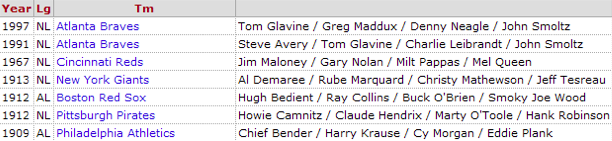
Note: Pitching WAR differs between Fangraphs and Baseball-Reference in that the former uses Fielding Independent Pitching (FIP) and the latter uses Sean Smith's defense-adjusted Run Average.
Wanting to drill down deeper to look at the individual and cumulative totals produced the next table.
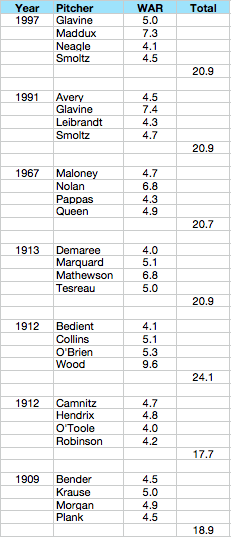
There are several interesting observations:
1. The 1912 Pittsburgh Pirates had four pitchers with at least four WAR but none with five. A very solid 1-4 but no real ace.
2. The 1909 Philadelphia A's had four pitchers with at least four WAR but none with more than five. These four starters, including Hall of Famers Chief Bender and Eddie Plank, had ERAs of 1.76 or below. It wasn't known as the Deadball Era for nothing. The league average ERA was 2.47. The league-wide run average was 3.44. Lots of errors back then. Despite the smaller gloves, the official scorekeepers held the fielders to a high standard.
3. The other five staffs all had at least one starter with a WAR of six or more. Of those five, two had three pitchers with at least five WAR.
4. The Braves, in a couple of different renditions, had the best starting four as measured by B-R WAR since the early part of the last century.
5. Led by Joe Wood, the 1912 Boston Red Sox had the most productive staff among those teams with 4x4 since 1900. With 9.6 WAR, Wood had the highest single-season total among all the pitchers on this list. Furthermore, the Red Sox had the highest four-man, single-season cumulative WAR at 24.1.
How does the Phillies staff compare to these all-time great rotations? Last year, the foursome produced 21 WAR (although not on the same team). Halladay had 6.9, Oswalt 5.1, Hamels 4.7, and Lee 4.3. Oswalt split his WAR among the Houston Astros (2.3) and the Phillies (2.8) while Lee split his among the Seattle Mariners (2.6) and Texas Rangers (1.7).
If these Philadelphia starters can repeat their 2010 performance, the Phillies could surpass the Braves and become the greatest four-man rotation since Smoky Joe and the 1912 Red Sox, at least as measured by Baseball-Reference's Wins Above Replacement.
| Baseball Beat | December 04, 2010 |
News and Views: The Adrian Gonzalez Trade
News: The Red Sox and Padres have reportedly agreed to a deal in principle that will send first baseman Adrian Gonzalez to Boston in exchange for three prospects — pitcher Casey Kelly, first baseman Anthony Rizzo, and outfielder Reymond Fuentes — plus a minor league player to be named later.
Views: While it's difficult to not like the trade from the perspective of the Red Sox, this agreement may be one of those deals that truly benefits both teams. There was no way that the Padres were going to re-sign Gonzalez before, during, or after the 2011 season. Therefore, it makes sense that San Diego GM Jed Hoyer would try to move him sooner rather than later. Hoyer and AGM Jason McLeod worked under Boston GM Theo Epstein for years and know the Red Sox talent as well as anyone.
Kelly, Rizzo, and Fuentes were ranked as the first-, third-, and sixth-best Red Sox prospects by Baseball America last month. All three were projected to be part of Boston's starting lineup in 2014 (with Kelly and Rizzo reaching the majors no later than 2012 by most estimates). According to Baseball America, Kelly had the best curveball, Rizzo the best power, and Fuentes the best athlete in the system.
As touted as this threesome may be, I would have expected San Diego to hold out for either Jose Iglesias or Ryan Kalish as the fourth player in the puzzle. Instead, it appears as if the PTBNL is not on the 40-man roster and is eligible for the Rule 5 Draft next week. Look for this player to be nothing more than a throw-in, perhaps a mid-level minor league pitcher whose upside might be as a major league reliever.
Meanwhile, Gonzalez is a monster. The lefthanded-hitting slugger ranked fifth in on-base percentage (.393) and times on base (271), sixth in total bases (302) and runs created (119), seventh in on-base plus slugging (.904), and ninth in slugging average (.511) in the National League while playing in the least-friendly home ballpark for hitters in the majors. His ballpark-adjusted OPS (or OPS+) ranked third in the league at 152, trailing only 2010 MVP Joey Votto and three-time MVP Albert Pujols.
For proof as to how much Petco Park has damaged Gonzalez's stats, look no further than his career record at Petco and on the road.

The above splits may not even tell the whole story. You see, Petco is death on lefthanded sluggers. According to the Bill James Handbook, from 2008-2010, Petco Park has produced park factors of 87 for AVG and 59 for HR (with 100 equivalent to the MLB average), meaning it reduces the former by 13 percent and the latter by 41 percent for LHB. By comparison, Petco's PF were 89 and 96 for RHB.
Despite the ballpark handicap, Gonzalez ranked as the most productive opposite-field hitter last season, according to our own Jeremy Greenhouse. His inside-out swing is a perfect fit for Fenway Park.
Check out Gonzalez's 2010 spray chart at Petco Park, then take a look at Fenway's dimensions. He pulls the vast majority of his ground balls but hits the bulk of his fly balls to the opposite field, which should be just what the doctor ordered in Boston.
Petco Park
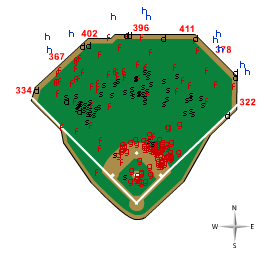
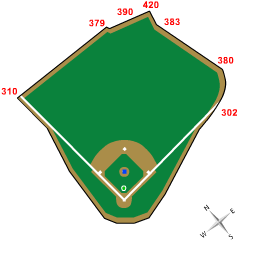
Courtesy of River Ave Blues, here's Gonzalez's spray chart overlaid onto Fenway Park (h/t Patrick Sullivan).
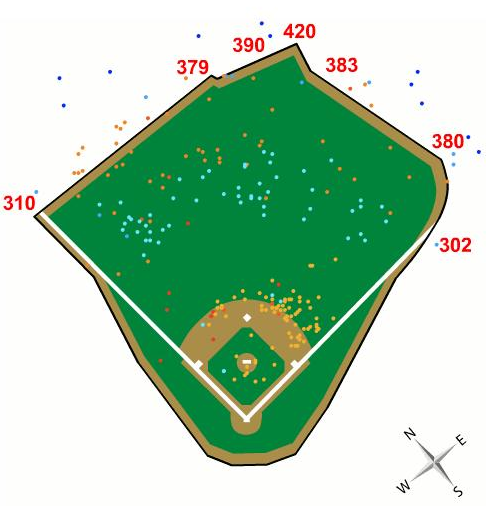
I count 30 home runs. In 81 home games. With 14 fly outs turning into four baggers. Ten of those fly-outs-would-be-home runs were hit to straightaway left field. Whether Gonzalez slugs 30 or 25 or even 20 HR at Fenway, the impact is going to be huge as Adrian has averaged 11-12 jacks at Petco since joining the Padres in 2006. Add the 21 HR he has averaged on the road during this period and it doesn't take too much imagination to project the newest Red Sox banging 40 or more homers in each of the next few seasons.
We can also view Gonzalez's home *and* road taters via HitTracker. Thirteen of his 31 HR were hit to left field, a phenomenal rate for a lefthanded batter. The image on the right displays the location of all home runs at Fenway Park last year.
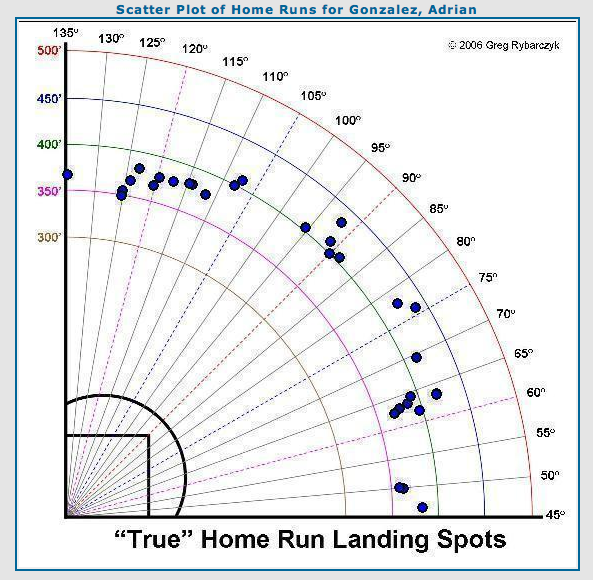
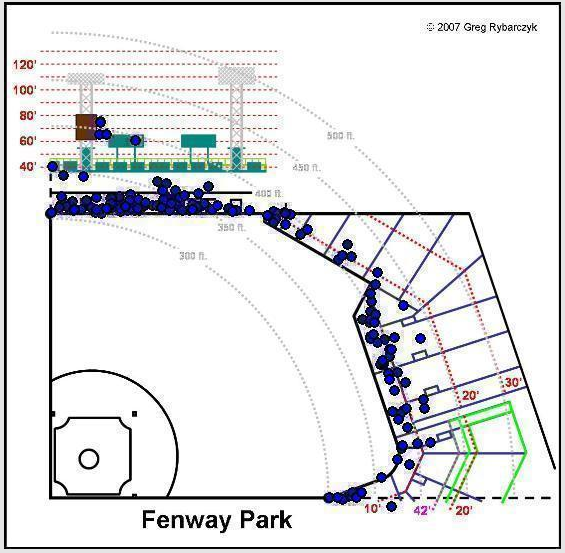
Gonzalez looks like a pretty good fit for Fenway, no? Importantly, he doesn't turn 29 until next May. While he had shoulder surgery in October, he is expected to be fully recovered by the time the 2011 season opens. You can be sure that the Red Sox put him through a full physical this weekend and wouldn't proceed with the trade if management had any doubts about his health.
In addition to the exam, the Red Sox have been given a negotiating window by MLB to work out an extension with Gonzalez. If it's true that he wants a Ryan Howard-like, 5-year/$125M contract, I would combine the last year of his current deal that pays him $6.2M into a new 6-year/$132M pact that allows him to earn an average of $22M right off the bat.
Should the Red Sox not sign Gonzalez and proceed with the deal anyway, the organization gets his services at a discount of $15M-$20M in 2011 plus two valuable picks in the 2012 draft for the loss of a Type A free agent. As a result, short of Gonzalez suffering a major injury after signing a long-term contract, I don't see how Boston can lose.
San Diego might win, too. Maybe in a big way. Only time will tell. But the Padres could lose if the three prospects don't pan out.
| Baseball Beat | November 30, 2010 |
What's a Free Agent Worth?
I have been troubled for a couple of years with the consensus belief in the sabermetric community that free agents are worth between four to five million dollars per Win Above Replacement (WAR). For the ESPN Stats and Info blog, Tom Tango of Inside the Book stated that "the value of a win on the free-agent market is between $4 million and $5 million dollars." In a recent New York Times piece, Sean Forman of Baseball-Reference.com wrote, "2009 free agents received nearly $4.5 million per win added." Led by Dave Cameron's input, Fangraphs has based its dollars per win value at approximately $4M for 2007, $4.5M for 2008 and 2009, and $4M for 2010.
I respect all three of these esteemed analysts. However, I believe there is a flaw in applying $4 million, $4.5 million, or $5 million to estimate the value of all free agents. To see if I could set the record straight, I began by using ESPN's Free Agent Tracker to create a database for the 2009-2010 crop. Of the 201 free agents last year, 121 signed MLB contracts, 66 inked MiLB deals, and 14 retired. For the purposes of my study, I excluded free agents who signed for less than $3 million per season. Most of these players were part-timers, backups, pinch hitters, or injured. In hindsight, the best of this lot included Alex Gonzalez, Kevin Gregg, Miguel Olivo, Kelly Johnson, John Buck, Jim Thome, and Jonny Gomes. In addition, I eliminated foreign players Aroldis Chapman, Noel Arguelles, and Ryota Igarashi, as well as Colby Lewis, who played in Japan in 2008 and 2009.
All in all, there were 53 free agents who qualified, a sampling that captured the most significant signees between the 2009 and 2010 seasons. The players in the table below are ranked by their total compensation. I also included the number of years, the average annual salary, the average Fangraphs WAR for the 2007-09 period, and the average annual dollars per WAR.
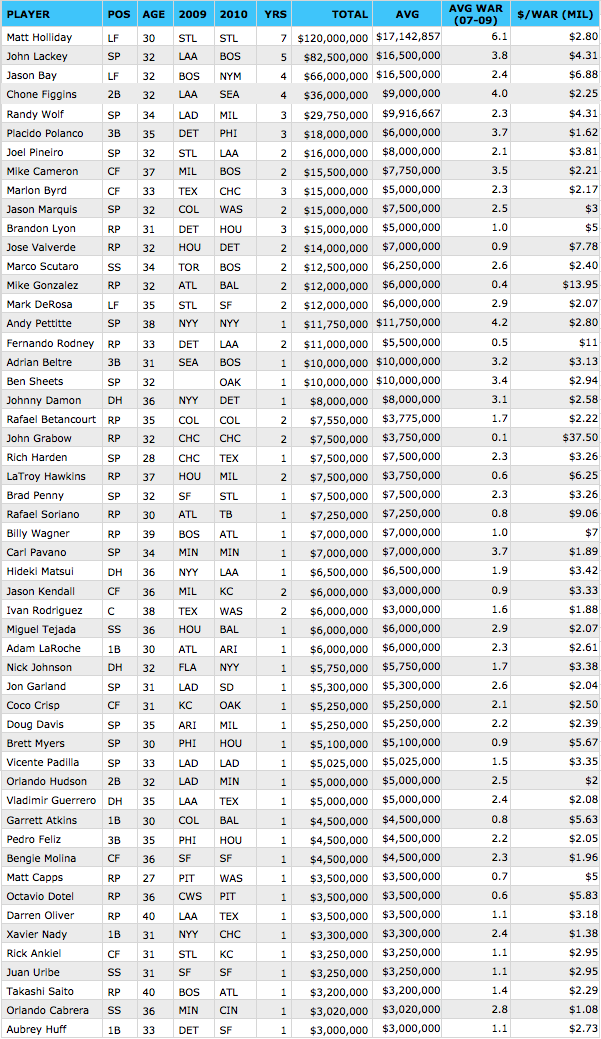
Let's take a look at Matt Holliday. He signed a seven-year contract with the St. Louis Cardinals for $120 million, equal to an average of $17.142 million per season. Holliday averaged 6.1 WAR during 2007-09. As a result, he was paid $2.80M per WAR.
Based on $/WAR, the major outliers were relievers John Grabow ($37.5M), Mike Gonzalez ($13.95M), Fernando Rodney ($11M), Rafael Soriano ($9.06M), Jose Valverde ($7.78M), and Billy Wagner ($7M), all of whom had a higher $/WAR than Jason Bay ($6.88M), the highest-paid position player based on the average WAR for 2007-09. It's pretty obvious to me that there is virtually no correlation between the salaries of relief pitchers (be it closers or setup men) and WAR. As a result, I believe it makes sense to exclude them when trying to determine what a free agent is worth. Nonetheless, I have calculated the arithmetic mean, weighted average, and median $/WAR including and excluding relief pitchers.
Here are my findings:
- The arithmetic mean $/WAR for all players was $4.36 million. Excluding relief pitchers, it was $2.88M.
- The weighted average $/WAR for all players was $3.03 million. Excluding relief pitchers, it was $2.73M.
- The median $/WAR for all players was $2.95 million. Excluding relief pitchers, it was $2.73-2.80M.
I realize this study is based on one year only. In addition, the salaries may have been negatively influenced by the overall economy. That said, no matter how you slice and dice it, excluding relief pitchers, the average free agent signed for about $2.7-$2.9M/WAR last offseason. I believe this finding is significant in that most analysts have routinely used $4.5M per win added.
Based on their performance in 2010, the biggest bargains from the list above were Marlon Byrd ($1.22M/WAR), Adrian Beltre ($1.41M), Orlando Hudson ($1.61M), and Placido Polanco ($1.62M). Beltre and Hudson are free agents once again. The biggest busts were Chone Figgins ($15M/WAR), Randy Wolf ($14.17M), and Jason Bay ($11.79M). Figgins and Bay have three years left on their contracts and Wolf has two years to go. Due to injuries, Mike Cameron (-0.3 WAR), Nick Johnson (0.1), and Rich Harden (-0.7) didn't pan out as their new employers expected.
Let's check out how this year's free agents are doing:
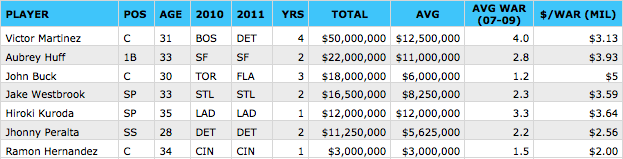
I excluded RP Joaquin Benoit and Jose Contreras from this table. For consistency, I also excluded Geoff Blum, who signed a two-year contract for $2.7 million (which was less than the $3M minimum I required for the 2009-2010 free agents).
With seven precincts reporting, the sample size is small. Nevertheless, the results are as follows:
- Excluding relief pitchers, the arithmetic mean $/WAR was $3.41 million.
- Excluding relief pitchers, the weighted average $/WAR was $3.37 million.
- Excluding relief pitchers, the median $/WAR was $3.59 million.
While it may be too early to get a definitive read for this year's class, excluding relief pitchers, the average free agent has signed for about $3.4-$3.6M/WAR this offseason.
There are several big-name players who haven't signed yet. The crop is headlined by Cliff Lee (6.97 average WAR from 2008-2010), Carl Crawford (5.0), Jayson Werth (5.0), Beltre (4.53), and Derek Jeter (4.43). Rounding up last year's $/WAR to $3M and using the mid-point of $3.5M/WAR this year produces the following average annual salaries: Lee ($20.9M-$24.4M), Crawford and Werth ($15M-$17.5M), Beltre ($13.6M-$15.9M), and Jeter ($13.3M-$15.5M). Unless the Yankees cave in to their captain, I would be surprised if any of these players sign for an average annual salary outside of these ranges. If so, it would help confirm my belief that free agents (sans relievers) are worth about $3M-$3.5M per WAR rather than the $4.5M that seems to be universally accepted.
Of note, one can reach slightly different conclusions by using Baseball-Reference WAR instead of Fangraphs WAR. I'm not necessarily more partial to one over the other. One can also weight the WAR differently. I used a simple average of the past three years, tweaking a few players based on injuries and playing time. There might be merits in going with a weighted system, such as a 3-2-1, in certain situations. In reality, teams are trying to project WAR but most estimates are going to be heavily influenced by observed WAR.
Furthermore, there are many other factors that teams consider when making offers to free agents, including a player's age, his position, current health status and history of injuries, the consistency and arc of his career, the supply and demand for that type of player, the length of contract, and whether he is a Type A or B free agent. Put it all together and shake it up, and it is my contention that the going rate for starting pitchers and position players who are free agents is somewhere in the range of $3,000,000 to $3,500,000 per the three-year trailing average WAR.
| Baseball Beat | November 02, 2010 |
The Morning After
Congratulations to the San Francisco Giants on winning the 2010 World Series. The team won the NL West by two games and then sailed through the postseason by winning 11 of 15 games in capturing the NLDS, NLCS, and World Series titles.
I have to admit, I never saw it coming. Not before the season. Nor during the season. Nor before the World Series. While I picked the Giants to beat the Atlanta Braves in the NLDS, I thought San Francisco would fall to the Philadelphia Phillies in the NLCS and to the Texas Rangers in the World Series. Rather than the Giants winning it in five, I had the Rangers winning in five. On second thought, maybe I got it half right. Just kidding.
Where did I go wrong? Let me count the ways:
1. Small sample size. (Rule No. 1 of forecasting: When you make a mistake, blame the sample size.)
2. Three games in the NLCS were decided by one run. The Giants won all three.
3. The Phillies outscored the Giants, 20-19, but won only two of the six games.
3. I had no idea that the Phillies would "hit" .216/.314/.321 in the NLCS.
4. I didn't foresee Cody Ross slugging three doubles and three home runs in the NLCS.
5. The Giants outscored the Rangers, 29-12. What can I say?
6. I had no idea that the Rangers would "hit" .190/.259/.288 in the World Series.
7. I had no clue that Josh Hamilton and Vladimir Guerrero would combine to go 3-for-34.
8. I failed to anticipate that Edgar Renteria would go 7-for-17 with two HR in the World Series. He went deep three times during the regular season.
9. Although I was never a fan of Texas' bullpen aside from Neftali Feliz, I would not have guessed that the set-up relievers would implode to the tune of of a 10.97 ERA over 10.2 innings.
10. I thought Cliff Lee and the Rangers would win Games 1 and 5. Instead, Tim Lincecum and the Giants won both of these crucial battles.
11. Don't forget Rule No. 1.
Look, San Francisco won the World Series fair and square. The Giants are worthy champions. The fact that I got it wrong is neither here nor there. As they say, flags fly forever. Conversely, predictions aren't worth the paper they're written on (or the pixels on your computer screen), especially those involving ... yes, small sample sizes. The staff at Baseball Analysts make such forecasts for fun and are not afraid of being wrong. To Patrick Sullivan's credit, he picked the Giants to win it in six. Not too bad.
| Baseball Beat | October 27, 2010 |
How We See the 2010 World Series
The 2010 World Series is upon us. Every baseball fan knows the main storyline: The Texas Rangers will appear in the World Series for the first time while the San Francisco Giants will be looking to win their first World Series since moving to the west coast in 1958.
If anyone had the Texas-San Francisco exacta at any point during the regular season, much less before the season, then you're either delusional, lucky, or in the wrong business. Send me your ticket from Las Vegas as proof. Copies not allowed.
The staff at Baseball Analysts weigh in below with our comments and predictions.
Rich: I believe Texas has the edge. The Rangers beat Tampa Bay and New York, the two best teams in baseball in the Division and Championship Series. The Rangers also have the best starting pitcher (Cliff Lee) and the best hitter (Josh Hamilton). San Francisco has strong pitching depth and home-field advantage, but the offense leaves a lot to be desired. I don't see Cody Ross, as an example, hitting three home runs in the World Series, like he did in the NLCS. While most World Series go six or seven games, I'll go out on a limb and say Texas in five with Lee winning the first game and the finale.
Jeremy: I think the difference between the American League and National League is understated. The Rangers are the better team. However, the Giants have home-field advantage. In my opinion, the National League has a natural edge in the World Series, given the difference in quality of pitcher hitting. I worry that Ron Washington will badly mismanage games in a National League park, for example failing to understand that C.J. Wilson, Colby Lewis, and Tommy Hunter should not pitch past the fifth or sixth innings. Still, the difference in talent between the two clubs appears overwhelming, so I'll take the Rangers in six.
Dave: I have to agree with Rich and Jeremy: the Rangers have the clear advantage in the lineup, and probably an advantage in starting pitching (mostly thanks to Lee), but the Giants have the advantage in bullpen (and Bruce Bochy seems more adept at playoff-bullpen management) and home-field advantage. The pluses for the Rangers outweigh those for the Giants, and so the Rangers are, rightly, slight favorites for the series (the betting line suggest they win it about 55% of the time). I will go with the Rangers in seven.
Rich: Do I hear Rangers in eight? What will it be, Sully?
Sully: I don't see the talent discrepancy between the two clubs as "overwhelming" as Jeremy. I think Andres Torres, Aubrey Huff, and Buster Posey are only a bit worse in aggregate than Hamilton, Nelson Cruz, and Ian Kinsler, the core position players for each team. I can't see much difference between the rotations and, like Dave, I think the Giants have a bullpen edge.
I'll go out on my own here and take the Giants. First, the home crowds at AT&T Park have been amazing and I think San Francisco really feeds off of it. Home field will be key, and I think particularly so this evening. The Phillies came into the NLCS with an air of infallibility thanks in large part to Roy Halladay's Division Series heroics. The Rangers are a complete team, but there's a similar dynamic at play with Lee. If the Giants take Game One like they did against Philadelphia, and then have Matt Cain, Jonathan Sanchez, and Madison Bumgarner lined up for Wilson, Lewis and Hunter, there's a clear path to victory for them. So I say Tim Lincecum carries the Giants tonight, and San Francisco goes on to win in six.
| Baseball Beat | October 22, 2010 |
News and Views: Brandon Inge
News: The Tigers re-signed 3B Brandon Inge to a 2-year, $11.5 million contract, with an option for 2013. Inge would have been a free agent.
Views: What am I missing here? Most of Inge's value is tied to his defensive prowess at third base. However, his advanced fielding metrics have been in a steady decline since 2006 when he led the majors in Ultimate Zone Rating at 19.0. It fell to 11.2 in 2007, 4.1 in 2008 (when he also played C and CF), 6.6 in 2009, and 3.1 in 2010. While Inge is still above average, the trend is not your friend here. Nor is his age. He turns 34 next May.
Over the past five years, Inge has hit .236/.313/.405 with an OPS+ of 88. His OPS+ has only exceeded 100 one time — 109 in 2004 during his age-27 season. He strikes out at an alarmingly high rate at about once every four trips to the plate. The righthanded hitter has never hit for a high average on balls in play (career rate of .285 with a peak of .316 in 2004). His baserunning is nothing to write home about. To wit, he made 10 outs on the bases last year, excluding the three times he was caught stealing in seven attempts.
Shake it all up and it's difficult for me to see why Inge is worthy of such a contract. At best, Inge may add two wins above a replacement player. At $3M per win, he could be worth $6M (vs. an average annual salary of $5.75M). If you want to ascribe a higher value per win, be my guest. Either way, I believe the downside risk is greater than the upside reward. If Inge continues to lose range in the field, he could actually become a liability at the hot corner. In that case, Inge would be nothing more than a platoon player and pinch hitter (career .267/.342/.465 vs. LHP) and perhaps a positive influence on the bench and in the clubhouse.
The contract is not a disaster, but it's one that leaves me nonplussed.
For Joe Pawlikowski's take, be sure to read his analysis of Inge's contract at FanGraphs.
| Baseball Beat | October 19, 2010 |
You're the Manager
OK, you're Joe Girardi. I'd say you're Joe Girardi for a day but, if it was for a day only, you might think differently. So let's just say you're Joe Girardi, the manager of the New York Yankees. You know, the team that is down two games to one in the best-of-four American League Championship Series.
Your club beat the Texas Rangers in the first game by coming back from a 5-0 deficit to score six unanswered runs in the seventh and eighth innings to win 6-5 on the road. You got trounced in the second game of the series, 7-2.
No problem. You did what you had to do. Your team split on the road. Two games down, a maximum of five to go with three of them at home. You've got the AL West champions right where you want them. Except for one thing. You now have to face Cliff Lee. Yes, that Cliff Lee. The guy who knows his way around New York in terms of both the city and your lineup. The 2008 AL Cy Young Award winner throws eight scoreless innings on Monday night, allowing only two hits and one walk while striking out 13 batters in an 8-0 shutout.
Lee improved his postseason record to 7-0 with a 1.26 ERA in eight starts. The southpaw has now beaten the Yankees three times in October, including twice as the ace of the Philadelphia Phillies in the 2009 World Series. He is on one of the best runs in the history of the postseason. Not known as a strikeout pitcher, Lee is the first pitcher to whiff 10 or more batters three consecutive times in the same postseason and is now tied for the lead with Bob Gibson and Randy Johnson with five career postseason games of at least 10 Ks.
With Lee perfectly positioned to start the finale of this series, "the Yankees probably need to win this series in six games and avoid a Game 7" or so says Andrew Marchand. I can't say that I disagree.
As a result, one could argue that the Yankees cannot afford to lose another game in this series. It's not that Lee can't be beaten. It's just that you don't want to go into Game 7 having to beat Lee. To the credit of the Rangers, this is exactly why management traded for him in July. It's hard to believe that someone who has gone 48-25 with a 2.98 ERA and a 5.6 K/BB in the past three regular seasons and 7-0 with a 1.26 ERA and 9.6 K/BB in the past two postseasons has played for four teams (CLE, PHI, SEA, and TEX) during this stretch.
That brings us to Game 4. Your team is now down two games to one. Do you go with AJ Burnett as previously announced or do you pitch CC Sabathia on three days' rest? If you opt for Sabathia, that means you either have to ask both Phil Hughes and Andy Pettitte to pitch on short rest or stick AJ in there for Game 5 on Wednesday or Game 6 on Friday. Should you decide on Burnett for Tuesday night, then you won't be able to start CC three times or in the final game vs. Lee in what would be an epic battle of two of the best lefthanders in baseball.
Here are the facts with respect to Burnett:

Remember, you're Joe Girardi. It's your call. Do you stick with Burnett in Game 4 or do you change it up? Sabathia threw just 93 pitches in Game 1. He is 3-1 with a 1.01 ERA and extraordinarily strong peripherals working on three days' rest during the regular season throughout his career. Moreover, don't forget the fact that you asked CC to pitch on short rest against the Los Angeles Angels in the ALCS last year and it worked out pretty darn well. He won both games, fashioning a line of 16-9-2-2-3-12. The big guy started Game 1 on Friday and Game 4 on Tuesday. Sound familiar?
What will it be, Joe?
| Baseball Beat | October 12, 2010 |
Pitching in on the Division Championship Series
With a no-hitter and four shutouts in the League Division Series and no team scoring more than seven runs in any single game, it seems as if pitching has dominated the postseason thus far. Perhaps it has but not to the extent that I thought before checking the numbers.
Through the first 14 games, the eight teams have combined to score 89 runs, an average of 6.36 per game. Don't get me wrong. Run prevention is down from the regular season. Way down. As in 38 percent down. But runs per game are off just 19 percent vs. the 2009 LDS and only 11 percent excluding the two contests in Colorado. Meaningful but not off the charts.
Like this year, no team scored more than seven runs in any LDS last fall. John Lackey and Darren Oliver combined to throw the lone shutout in Game One against Boston. In 2010, Oliver once again was part of a combined shutout, completing the final 2 1/3 innings to preserve the 6-0 whitewash for C.J. Wilson and Darren O'Day in Game Two against Tampa Bay.
Roy Halladay threw the most talked-about game of all, tossing only the second no-hitter in the history of the postseason. Halladay walked one and struck out eight while facing only one batter over the minimum as Philadelphia beat Cincinnati to set the tone in Game One in what became a three-game sweep. Teammate Cole Hamels closed out the series with another shutout, allowing just five hits and no walks while fanning nine Reds.
As impressive as those shutouts were, Tim Lincecum pitched the most dominating game of them all in terms of Game Score. The Freak pitched a complete-game shutout, striking out 14 while giving up only two hits and one walk.
Both Halladay and Lincecum will be well rested when they square off in Game One of the NLCS on Saturday. Neither starter will have thrown a pitch in competition in at least nine days. At first blush, it would seem as if the long rest may benefit the 5-foot-11, 170-pound Lincecum slightly more than the 6-6, 230-pound Halladay. However, it should be noted that the latter threw his no-no nine days after his final regular season start, which incidentally was a two-hit, no-walk, complete-game shutout on longer than normal rest.
Over in the ALCS, the New York Yankees have to be loving the fact that Cliff Lee and David Price will be facing one another tonight, meaning neither starter is likely to face the Bronx Bombers until Game Three on Monday. That said, the winner of tonight's rubber match will have their ace ready to go in the finale on four days' rest should the ALCS go the distance.
But first things first as there will be no ALCS for the losing team tonight. Only golf clubs and fishing rods.
| Baseball Beat | October 11, 2010 |
Long Beach State Produced the Most MLB Players in 2010
According to Press-Telegram columnist Bob Keisser, 17 former Long Beach State baseball players performed in the major leagues this year. "No other college team can boast of having that many players in the majors in 2010."
Known as Dirtbags during their college years, the group is headlined by three All-Stars, namely American League Most Valuable Player candidate Evan Longoria, National League Player of the Month for September Troy Tulowitzki, and MLB strikeout leader Jered Weaver. There isn't a university in the country that came close to duplicating the feats of this trio.
Tulowitzki and Weaver were college teammates in 2003 and 2004. Tulo and Longoria played side-by-side in the infield on the 2005 club. All three players were drafted in the first round by their respective teams: Weaver in 2004 by the Los Angeles Angels, Tulowitzki in 2005 by the Colorado Rockies, and Longoria in 2006 by the Tampa Bay Rays.
Longoria hit .294/.372/.507 with 46 2B, 5 3B, 22 HR, 72 BB, 96 R, 104 RBI, and 15 SB in 20 attempts for the Rays this season. He was the AL Rookie of the Year in 2008 and has been named to the All-Star team in each of his first three MLB seasons while being the recipient of a Gold Glove and a Silver Slugger in 2009. Longoria, who turned 25 last week, led the AL and NL with 7.7 Wins Above Replacement (brWAR) in 2010.
Tulowitzki posted career highs in AVG (.315), OBP (.381), and SLG (.568) this season. He hit 15 HR during the final month, including 14 in a 15-game stretch when the Colorado Rockies won 13 times to climb within one game of the NL West lead. The slick-fielding shortstop missed 33 games with a fractured wrist in June and July but still managed to jack 27 HR in only 122 G and 529 PA. He turned 26 yesterday.
In addition to leading the majors in Ks, Weaver topped the AL in GS (34); finished second in K/BB (4.315); third in IP (224.1), K/9 (9.35), and WHIP (1.07); fifth in ERA (3.01), ERA+ (135), and FIP (3.06); seventh in H/9 (7.50); and ninth in BB/9 (2.17). The 6-foot-7 righthander ranked second among pitchers in brWAR (5.4) and fifth in fgWAR (5.9). He pitched six or more innings in 31 of his 34 starts, ranking second in quality starts with 27. Unfortunately, Weave had the 10th-worst run support among 43 qualified starters, which negatively affected his W-L record (13-12). The five-year veteran turned 28 last week. Unsigned beyond 2010, he will be entering the second of his three arbitration seasons in 2011.
Longoria and Tulowitzki have two of the most team-friendly contracts in baseball. It's hard to believe but Longo made only $950,000 this year and will earn just $2 million in 2011, $4.5M in 2012, and $6M in 2013. The Rays have a $7.5M team option with a $3M buyout in 2014, an $11M option in 2015, and an $11.5M option in 2016. According to Cot's Baseball Contracts, the latter option may increase to $14M based on rankings in the MVP voting. Tulo, meanwhile, will earn $5.5M in 2011, $8.25M in 2012, and $10M in 2013. The Rockies have a $15M team option with a $2M buyout in 2014. At signing, Troy's deal was the largest ever for a player with less than two years of MLB service.
In alphabetical order, the following ex-Dirtbags also competed in the big leagues this year (with years at Long Beach State in parentheses): John Bowker (2002-04), Andrew Carpenter (2006), Bobby Cramer (2000-01), Bobby Crosby (1999-2001), Brad Davis 2002-04), Greg Dobbs (1999), Danny Espinosa (2006-08), Marco Estrada (2005), Jason Giambi (1990-92), Paul McAnulty (2002), Cesar Ramos (2003-05), Jeremy Reed (2000-02), Jason Vargas (2004), and Vance Worley (2006-08).
Crosby was a first-round draft pick (25th overall) by the Oakland A's in 2001. The shortstop was named the AL Rookie of the Year in 2004 when he hit .239/.319/.426 with 34 2B and 22 HR in 151 games and 623 plate appearances. Giambi, a second-round pick by the A's in 1992, won the AL MVP in 2000 when he hit .333/.476/.647 with 43 HR, 137 BB, and 137 RBI. The lefthanded slugger led the league in OBP, BB, and OPS+ (187). He placed second in the MVP voting the following season after topping the circuit in OBP (.477), SLG (.660), OPS (1.137), OPS+ (198), 2B (47), and BB (129).
After Longoria, Tulowitzki, and Weaver, the next most valuable player in 2010 as measured by WAR was Vargas. The Seattle Mariners southpaw started 31 games, tossed 192.2 innings, and produced a 2.15 K/BB ratio, 1.25 WHIP, and a 3.78 ERA. The 27-year old succeeded by throwing strikes and keeping the ball in the park. Nearly 90 percent of his pitches were either fastballs or changeups.
Look for Espinosa and Worley to make a bigger splash in the NL East in 2011. Espinosa played shortstop at Long Beach State and in his three years in the minors but was primarily a second baseman after the Washington Nationals called him up when rosters were expanded on September 1. He belted three homers in his first 15 plate appearances and slugged six for the month. The combination of striking out too often (30 times in 112 PA) and hitting only .239 on balls in play reduced his batting average to .214 but a slugging average of .447 was more in-line with his MiLB production (.455). Espinosa, a member of the U.S. team in the Futures Game in 2009 and 2010, figures to compete for the second base job for the Nats next spring. At worst, he should make the team as a backup middle infielder.
Worley was drafted by the Philadelphia Phillies in the 20th round out of McClatchy HS (Sacramento, CA) in 2005 and the third round after his junior year at Long Beach State in 2008. He signed and combined to go 3-2 with a 7.57 K/BB ratio, 1.07 WHIP, and a 2.66 ERA in 11 GS and 61 IP in the New York Penn League (Short-Season A) and South Atlantic League (Low Class A) that summer. Worley struggled in 2009 at Double A Reading (7-12, 2.04 K/BB, 1.38 WHIP, and 5.34 ERA) but bounced back in 2010 (10-7, 2.59 K/BB, 1.30 WHIP, and 3.36 ERA) while earning a trip to the big leagues this summer before making his Triple A debut for Lehigh Valley. The bespectacled righthander went 1-1 with a 1.38 ERA for the Phillies, highlighted by five scoreless innings against the Atlanta Braves one week after his 23rd birthday in the second-to-last game of the season. He should get a good look next spring.
Since former Long Beach head coach Dave Snow's arrival in 1989, at least two players from every Dirtbags team reached the major leagues. I'll let Keisser, who also serves as the Press-Telegram's beat writer for Long Beach State, take it from here.
The 1989 team sent Kyle Abbott, Darrell Sherman and Tom Urbani to the majors.Between 1999 and 2006, at least four players from every team has reached the majors, topped by a stunning eight players from the 2002 team - Abe Alvarez, John Bowker, Brad Davis, Chris Demaria, Paul McAnulty, Carlos Muniz, Jeremy Reed and Jered Weaver.
The 2004 team that came an inning away from a College World Series berth sent six players to the majors and all six were active this season - Bowker, Davis, Cesar Ramos, Troy Tulowitzki, Jason Vargas and Weaver.
It isn't a stretch to say the parade won't stop any time soon, either. Third baseman Adam Heether, outfielder Shane Peterson, shortstop Devin Lohman, and pitchers Jared Hughes, Nick Vincent, Andrew Liebel, Bryan Shaw, Adam Wilk, Charlie Ruiz and Jake Thompson are all performing well enough in the minors to warrant an eventual shot at the majors.
Mike Weathers succeeded Snow in 2001 and resigned after the 2010 season. He turned the program over to Troy Buckley, who served as the school's pitching coach from 2001-2007 and associate head coach in 2010. He was the minor league pitching coordinator with the Pittsburgh Pirates in 2008 and 2009. Buckley worked with Carpenter, Cramer, Estrada, Ramos, Vargas, Weaver, and Worley in his previous stint at Long Beach State. It will be interesting to see if he can be as successful at producing position players as the two previous head coaches.
As Keisser concludes, "It's about the foundation that's been built, one that includes a ramp to the majors."
| Baseball Beat | October 04, 2010 |
Six Months Down, One to Go
The staff of the Baseball Analysts made predictions before the season began and, as it turns out, did very well. Our consensus picked five of the eight teams that qualified for the postseason, missing only on Tampa Bay in the American League and Cincinnati and San Francisco in the National League.
The Giants befuddled us the most as no one placed the NL West champions higher than third in the division. We narrowly missed on the Rays with three staffers choosing Boston as the AL Wild Card entry and two going with Tampa Bay. The Rays, of course, won the AL East, edging the Yankees by one game. Four of five analysts tabbed the Reds to finish second in the NL Central with all five of us incorrectly projecting St. Louis to take the division.
All eight postseason teams had run differentials of +100 or more. No other club in the majors had a differential that high. The Yankees led in runs scored (859) and in run differential (166). The San Diego Padres allowed the fewest runs (581).
AMERICAN LEAGUE EAST TEAM W L PCT GB Rays 96 66 .593 - Yankees 95 67 .586 1 Red Sox 89 73 .549 7 Blue Jays 85 77 .525 11 Orioles 66 96 .407 30
Toronto was clearly the biggest positive surprise in the AL East, if not the entire league, in manager Cito Gaston's final season. Forget the fact that the Blue Jays finished in fourth place. Winning 85 games in a tough division and finishing much closer to first than last place made for a highly successful season for MLB's lone club north of the border. Led by Jose Bautista's major league-leading 54 HR, Toronto tied the 1996 Baltimore Orioles with 257 homers, the third-most in the history of baseball.
AMERICAN LEAGUE CENTRAL TEAM W L PCT GB Twins 94 68 .580 - White Sox 88 74 .543 6 Tigers 81 81 .500 13 Indians 69 93 .426 25 Royals 67 95 .414 27
The AL Central played pretty much to form with Minnesota winning its second consecutive division title. The Twins have now won six of the last nine division crowns. Unfortunately, Minnesota has been bumped in four straight League Division Series, never winning more than one game in any of these match-ups.
AMERICAN LEAGUE WEST TEAM W L PCT GB Rangers 90 72 .556 - A's 81 81 .500 9 Angels 80 82 .494 10 Mariners 61 101 .377 29
Texas finished atop the AL West for the first time this century. The Rangers have increased their win total from 75 in Ron Washington's first season in 2007 to 79 in 2008 to 87 in 2009 and 90 in 2010. Pitching and defense have been the key with Texas allowing 280 fewer runs this year vs. two seasons ago. Meanwhile, the Seattle Mariners may have been the most disappointing team in baseball, losing more games than any team not named the Pittsburgh Pirates.
NATIONAL LEAGUE EAST TEAM W L PCT GB Phillies 97 65 .599 - Braves 91 71 .562 6 Marlins 80 82 .494 17 Mets 79 83 .488 18 Nationals 69 93 .426 28
Philadelphia captured its fourth consecutive NL East title, winning the most games in the majors. The 2008 World Series champions have increased the number of regular season wins in each of the past four campaigns. Roy Halladay, Roy Oswalt, and Cole Hamels, perhaps the most formidable Big Three in the postseason, will be seeking to take the Phillies to the World Series for the third straight October.
In his final season at the helm, Bobby Cox is leading Atlanta into the postseason for the 15th time in the past 20 years but the first since 2005. However, it has been nine years since the Braves won a postseason series. The Hall of Fame-bound manager will be looking to win his second World Series and the first since 1995. He is 1-4 in his previous five attempts.
NATIONAL LEAGUE CENTRAL TEAM W L PCT GB Reds 91 71 .562 - Cardinals 86 76 .531 5 Brewers 77 85 .475 14 Astros 76 86 .469 15 Cubs 75 87 .463 16 Pirates 57 105 .352 34
Joey Votto, the favorite to win the NL MVP, and Jay Bruce (.388/.474/.925 with 12 HR in his final 22 games) combined to lead Cincinnati into the postseason for the first time since 1995. A healthy Edinson Volquez (27.2-17-6-6-8-31, 1.95 ERA in September) will be the key to a pitching staff that lacks a proven stopper.
NATIONAL LEAGUE WEST TEAM W L PCT GB Giants 92 70 .568 - Padres 90 72 .556 2 Rockies 83 79 .512 9 Dodgers 80 82 .494 12 Diamondbacks 65 97 .401 27
If you knew Pablo Sandoval was going to hit .268 with 13 HR, would you have believed that San Francisco would have won the NL West? Instead, rookie Buster Posey (.305/.357/.505) and newcomers Aubrey Huff (.290/.385/.506) and Pat Burrell (.266/.364/.509) combined with a stellar starting rotation and bullpen to beat back San Diego on the final day of the season.
| Baseball Beat | September 28, 2010 |
Paying Attention to the Other Races in the Final Week
Although interest in batting average, home runs, and runs batted in has waned over the past decade as more advanced metrics have emerged, these statistics are far from obsolete. Not only are AVG, HR, and RBI still the three most commonly cited stats involving hitters on radio/TV and in newsprint, but they were even played up in the new media in late August and early September as so-called statheads wrote about the possibilities of a Triple Crown winner this year.
While not as prestigious as winning the Triple Crown, there are a couple of players who are on the verge of setting "records" with respect to these stats. Specifically, if Carlos Pena and Mark Reynolds wind up hitting under .200, one or both will have the dubious distinction of hitting the most home runs or driving in the most runs in a season with a batting average below the Mendoza Line.
Going into tonight's play, Pena is hitting .198 with 27 HR and 81 RBI. Reynolds has outdone Pena slightly, hitting .199 with 32 HR and 84 RBI. Prior to this year, no player has ever accumulated more than 29 HR or 64 RBI while "hitting" under .200.
Let's take a look at where Pena and Reynolds stand in HR and RBI among those failing to crack the .200 mark.
Here are the leaders, if you will, in HR:
MAJOR LEAGUE BASEBALL
HOMERUNS YEAR HR AVG 1 Mark Reynolds 2010 32 .199 2 Mark McGwire 2001 29 .187 3 Carlos Pena 2010 27 .198 4 Rob Deer 1991 25 .179 5 Ruben Rivera 1999 23 .195 6 Mike Schmidt 1973 18 .196 7 Steve Balboni 1990 17 .192 T8 Gorman Thomas 1986 16 .187 T8 Shane Andrews 1999 16 .195 T8 Tim Laudner 1987 16 .191
AMERICAN LEAGUE
HOMERUNS YEAR HR AVG 1 Carlos Pena 2010 27 .198 2 Rob Deer 1991 25 .179 3 Steve Balboni 1990 17 .192 T4 Tim Laudner 1987 16 .191 T4 Gorman Thomas 1986 16 .187 6 Dean Palmer 1991 15 .187 T7 Reggie Jackson 1983 14 .194 T7 Harmon Killebrew 1975 14 .199 T9 Eric Soderholm 1972 13 .188 T9 Roger Repoz 1971 13 .199 T9 Deron Johnson 1974 13 .171
NATIONAL LEAGUE
HOMERUNS YEAR HR AVG 1 Mark Reynolds 2010 32 .199 2 Mark McGwire 2001 29 .187 3 Ruben Rivera 1999 23 .195 4 Mike Schmidt 1973 18 .196 5 Shane Andrews 1999 16 .195 6 Dave Kingman 1983 13 .198 T7 Darren Daulton 1991 12 .196 T7 Todd Hundley 2001 12 .187 T7 Bob Tillman 1969 12 .195 T7 Bob Robertson 1972 12 .193
And now RBI:
MAJOR LEAGUE BASEBALL
RBI YEAR RBI AVG 1 Mark Reynolds 2010 84 .199 2 Carlos Pena 2010 81 .198 T3 Mark McGwire 2001 64 .187 T3 Rob Deer 1991 64 .179 5 Harry Lyons 1888 63 .194 6 Pedro Garcia 1974 54 .199 7 Coco Laboy 1970 53 .199 T8 Tom Tresh 1968 52 .195 T8 Mike Schmidt 1973 52 .196 10 Shane Andrews 1999 51 .195
AMERICAN LEAGUE
RBI YEAR RBI AVG 1 Carlos Pena 2010 81 .198 2 Rob Deer 1991 64 .179 3 Pedro Garcia 1974 54 .199 4 Tom Tresh 1968 52 .195 5 Reggie Jackson 1983 49 .194 T6 John Gochnauer 1903 48 .185 T6 Todd Cruz 1983 48 .199 T8 Ed Kirkpatrick 1966 44 .192 T8 Harmon Killebrew 1975 44 .199 T10 Deron Johnson 1974 43 .171 T10 Tim Laudner 1987 43 .191
NATIONAL LEAGUE
RBI YEAR RBI AVG 1 Mark Reynolds 2010 84 .199 2 Mark McGwire 2001 64 .187 3 Coco Laboy 1970 53 .199 4 Mike Schmidt 1973 52 .196 5 Shane Andrews 1999 51 .195 6 Ruben Rivera 1999 48 .195 7 Germany Smith 1890 47 .191 8 Nick Esasky 1984 45 .193 9 Monte Cross 1901 44 .197 10 Darren Daulton 1991 42 .196
Three Hall of Famers grace these lists: Reggie Jackson, Harmon Killebrew, and Mike Schmidt. Jackson was on his way down, Schmidt was on his way up, and Killebrew accomplished this feat in his last season. Mark McGwire knew it was time to go when he hit .187 while clubbing 29 HR in his farewell campaign in 2001. Dave Kingman, he of 442 career home runs (the fifth-most of any hitter on these lists), hit .198 with 13 HR in 1983 before jacking at least 30 dingers in each of his final three seasons.
While far short of Jackson (139 OPS+), Killebrew (143), Schmidt (147), and McGwire (162), the 32-year-old Pena (123) is producing at a higher clip than all of the other hitters listed above, including Kingman (115) and Gorman Thomas (114).
Reynolds (108), on the other hand, appears to be heading down the path of Rob Deer (109) and fellow third baseman Dean Palmer (107), who flamed out after his age-31 season. The 27-year old may not be long for a starting assignment in the majors if he continues to strike out over 200 times per season without Gold Glove-caliber fielding or a batting average on balls in play (BABIP) that rivals his 2007-2009 mark of .343 (vs. .255 in 2010). Meanwhile, Reynolds is a cinch to become "the first regular player to strike out more times in a season than his batting average." In his defense, you have to be pretty good — or perhaps have been good — to even set such records.
While your friends are paying attention to the New York Yankees and Tampa Bay Rays or the San Francisco Giants and the San Diego Padres, make sure you don't forget about the triumphs of Carlos Pena and Mark Reynolds.
Note: Thanks to Lee Sinins and his Complete Baseball Encyclopedia for the lists.
| Baseball Beat | September 20, 2010 |
Hall of Fame Sportswriter and Dad
George Lederer, affectionately known to me as Dad, was one of seven members inducted into the Long Beach Baseball Hall of Fame on Saturday. The city's HOF was created in 2004 and the inaugural class included a couple of Cooperstown selections in Bob Lemon and Tony Gwynn as well as Bob Bailey, Jeff Burroughs, Ron Fairly, Bobby Grich, Vern Stephens, and several coaches and scouts.
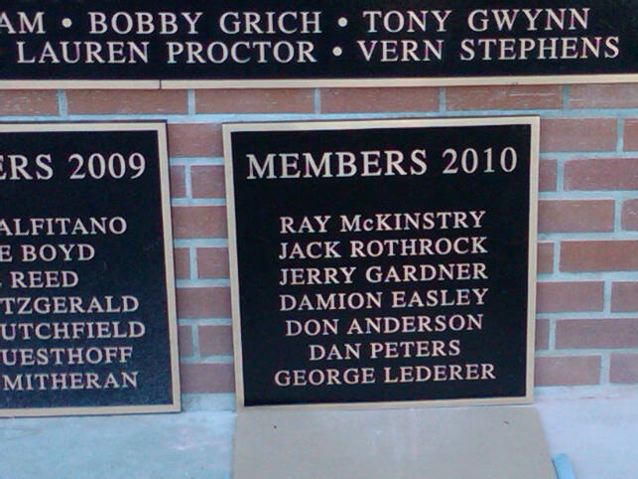
 Including the class of 2010, there are now 57 honorees, 31 of whom have played in the major leagues. The list excludes such notables as Long Beach Poly's Chase Utley and former Long Beach State All-Americans, first-round draft picks, and MLB stars Bobby Crosby, Evan Longoria, Troy Tulowitzki, and Jered Weaver. This quintet will no doubt be elected shortly after their playing days are over.
Five members were added to the Long Beach Softball Hall of Fame, a group that now totals 53, many of whom have also been inducted into the International Softball Congress HOF. The Long Beach Nitehawks won ten men's World Championships during the 1950s, 1960s, and 1970s, the heyday of men's fast-pitch softball.
The ceremony was held at Blair Field and across the way at what is now known as Red Meairs Field at Joe Rodgers Stadium. There were a number of previous inductees in attendance, including former major leaguers Joe Amalfitano and Dave Frost, scouts Bob Harrison and Harry Minor, coach Bob Myers, and umpire Joe Reed.
Dad is the third journalist to be named to the Long Beach Hall of Fame. The first two were Ross Newhan (class of 2006), a former sportswriter for the Long Beach Press-Telegram and Los Angeles Times, and Frank Blair (class of 2007), the first sports editor of the Press-Telegram from 1921 until his death in 1953. Newhan was the recipient of the J. G. Taylor Spink Award by the National Baseball Hall of Fame in 2000. Four of Dad's colleagues, including former sports editors John Dixon and Jim McCormack, who also serves on the selection committee, plus Jack Teele, an NFL executive for over 30 years, and Al Larson, were on hand to honor him.
Amalfitano, who prepped at St. Anthony High School in Long Beach, told me that Peter O'Malley and his family planned to be at the ceremony and sent their well wishes to our family through him. The former player, coach, and manager also said he spoke to Sandy Koufax, who sent his regards as well.
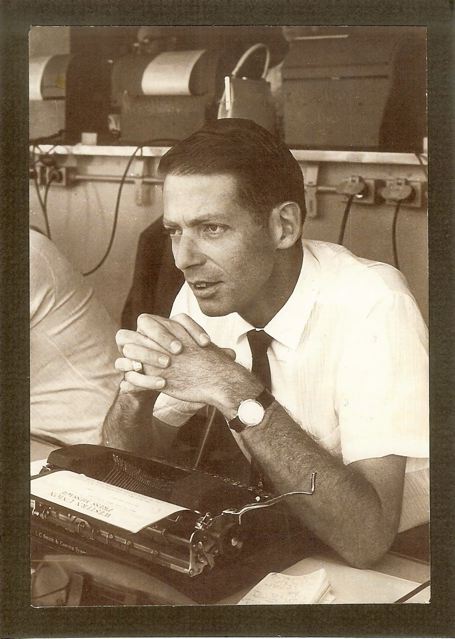 My father was the sports editor of the Wilson High School and Long Beach City College newspapers. He joined the Long Beach Independent, Press-Telegram in 1948 and mostly covered local prep and college sports for the next ten years. Dad was assigned the Dodgers beat at the tender age of 29 when the team moved from Brooklyn to Los Angeles in 1958. One of our favorite photos is of Dad walking outside the P-T in downtown Long Beach on his way to the airport for his first spring training in Vero Beach in 1958.
Dad covered the Dodgers for 11 years, including the World Series championships in 1959, 1963, and 1965. He also served as the Dodgers statistician in the post Allan Roth days and was one of four MLB official scorekeepers for the team's home games, including Koufax's perfect game in 1965. Amalfitano reminded me that he was the 26th out in that game. Dad was the president of the local chapter of the Baseball Writers Association of America and a member of the Board of Directors on a national level.
After more than a decade traveling around the country every year from late February through early October, Dad decided to accept new Angels GM Dick Walsh's (standing on the right next to my father) offer to become the club's Director of Public Relations and Promotions in early 1969. He served in that capacity until passing away in 1978 from a misdiagnosed case of malignant melanoma.
Bob Keisser featured Dad in a recent article on the front page of the Press-Telegram's sports section. In The Lederer Tree, Keisser tells the story of the family's sports legacy in Long Beach. My Mom was recognized in a follow-up column a couple of days later.
In the course of covering the Family Tree of the Lederers - the late George Lederer, the former P-T baseball writer who will be inducted into the Long Beach Baseball Hall of Fame next Saturday - the contributions of Pat Lederer, George's wife, were overlooked.That was egregious. George passed away in 1978, so it's been Pat who served as the foundation for the family for the last 30-plus years and guided her four children and seven grandchildren through life.
My mother, who just turned 82 last month, joined my brother Tom, sister Janet, and me for the ceremony on Saturday afternoon. Unfortunately, our younger brother Gary, who lives in Phoenix with his wife and three children, was unable to join us due to a major conflict in his schedule. Our three spouses, four of George's seven grandchildren, several members of the extended family, and numerous friends (one of whom traveled from out of the state and another drove over 100 miles) were also in attendance. Needless to say, it was a very special day.
There was only one person who was missing that we all wanted to be there with us. The Hall of Famer himself. George Lederer. My Dad.
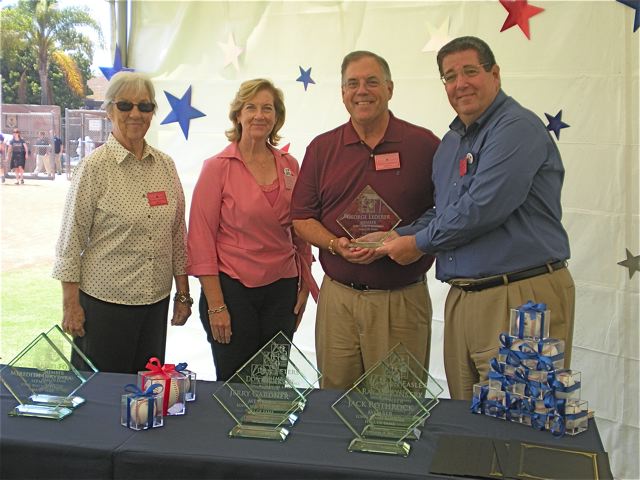
| Baseball Beat | September 14, 2010 |
Tracking Home Runs
Joey Votto slugged his 34th home run last night as the Cincinnati Reds pummeled Barry Enright and the Arizona Diamondbacks, 7-2. His dinger was overshadowed by the fact that Jay Bruce jacked two homers in his first two trips to the plate after missing a dozen games. Nonetheless, Votto's four bagger was his Major League Baseball-leading 17th HR to the opposite field according to play-by-play announcer Thom Brennaman.
I happened to be watching the game at that moment and made a note to check Votto's scatter plot on Hit Tracker, which logs and calculates the trajectory and distance of every home run in Major League Baseball. As it turns out, Greg Rybarczyk's site indicates that Votto has produced 19 homers to the left of straightaway center field (including yesterday's big fly, which isn't part of the following graph).
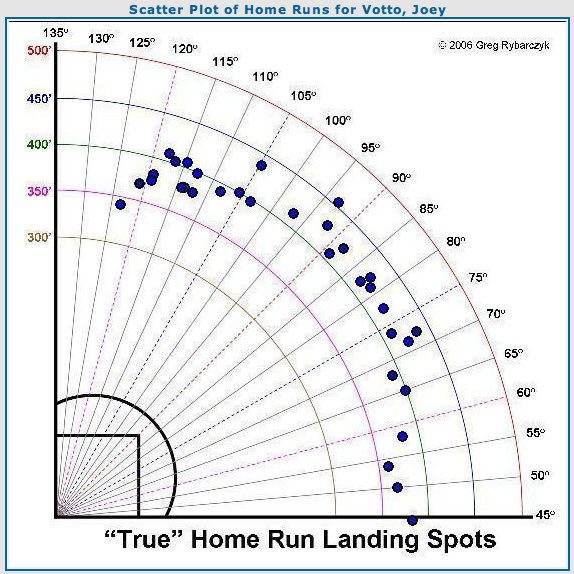
As shown, Votto has clubbed a couple of home runs just to the left of the 90° mark. My guess is that these bombs (one of which traveled 457 feet, the 24th-longest HR in 2010) were not deemed to be opposite field by MLB. The monster blast was deposited onto the party deck in center field at Great American Park, a first for Brewers' color analyst Bill Shroeder.
After looking at the distribution of Votto's home runs, I began to think about the pitch locations, especially those that were hit to the opposite field. Without the ability to create graphs like our own Dave Allen, I resorted to Joe Lefkowitz's PitchF/X Tool. Interestingly, all but four of Votto's long balls were turned around on pitches in the middle 60% of the strike zone. Yesterday's homer was on the pitch designated as a sinker on the outer 20% of the chart. Gameday described it as an 88-mph sinker.
By the way, Joe's site allows you to screen Votto's home runs for velocity (he has slugged three HR on 95-mph fast balls and two on 78-mph sliders at the other end of the spectrum), horizontal and vertical movements, and release points. If you have a cool boss or time on the weekend, click on the PitchF/X link in the banner at the top and play around with all the variables, including choosing a pitcher, batter, team, stadium, home plate umpire, plate discipline, pitch type, result, batted balls, count, pitch count, velocity, runners on base, and much more. It's a treasure chest full of information and fun.
Combining video with sites such as Hit Tracker and Joe Lefkowitz's PitchF/X Tool (among others) can help turn you into a baseball analyst or perhaps even an amateur scout in no time. Want to contemplate how to position fielders and pitch to Jose Bautista and Albert Pujols, the respective home run leaders in the AL and NL? Check out their scatter plots.
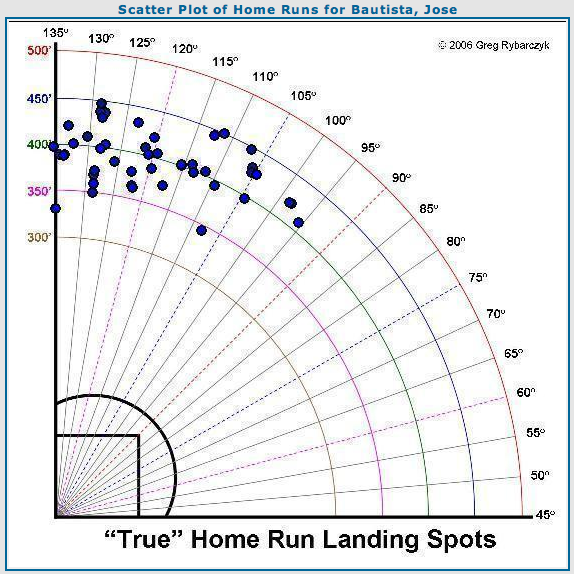
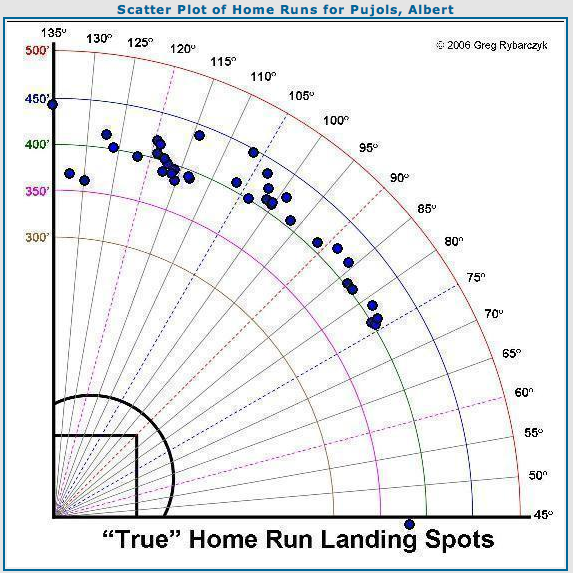
The pull hitter on the left is Bautista. The Toronto Blue Jays slugger has yet to hit a home run to the right of center field. In fact, he has only slugged about a half dozen to the middle third of the field. The other 40 or so homers have been launched to left field with more than half of those sailing over the fence between the left fielder and the foul line. Pujols, on the other hand, has tremendous power to center field, as exhibited by the fact that nearly half of his home runs have been hit to the middle third of the field. Interestingly, the three-time MVP has failed to slug a home run to the right third of the field.
Sometimes you just let the picture speak for itself.
Have fun and make sure that you don't miss lunch today.
Note: Jeremy Greenhouse's innovative Batted Ball Location Leaderboards are also valuable tools in this area.
| Baseball Beat | September 07, 2010 |
The Top 100 K/100P Leaders
While strikeouts per pitch hasn't caught on as hoped when I introduced the idea in February 2006, there is no disputing the fact that this metric explains runs better than strikeouts per inning or strikeouts per batter faced.
As detailed in Strikeout Proficiency (Part Two), K/P has the highest correlation in each of the five run measures (ERA, R/G, ERC, FIP, and DIPS). K/BF has the second-highest correlation and K/IP has the lowest correlation. In any other words, K/P > K/BF > K/IP.
To give K/P more utility, I multiply this decimal by 100. Not only do we now get a real number out of this exercise but the standard of measurement is almost exactly the average number of pitches per start during recent years. In an era of pitch counts, it seems more instructive to me to measure starters by the number of K/100 pitches than K/9 IP.
(For context, among those who are currently qualified for the ERA title, the average pitcher has thrown 100 pitches per start and completed 6 1/3 innings. The average number of K/100P is 4.88.)
With the foregoing in mind, let's take a look at this year's leaders. Interestingly, there are 100 pitchers who have averaged at least one inning per team game, which is the minimum to qualify for the ERA title. (The stats were compiled yesterday evening in real time and may not include the entire results for late games.)
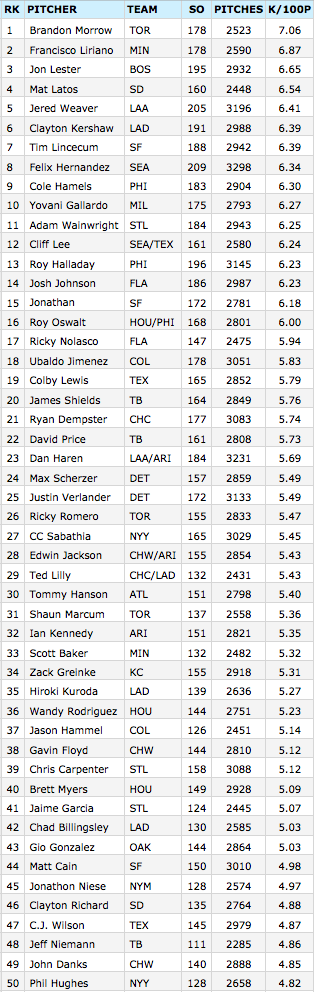
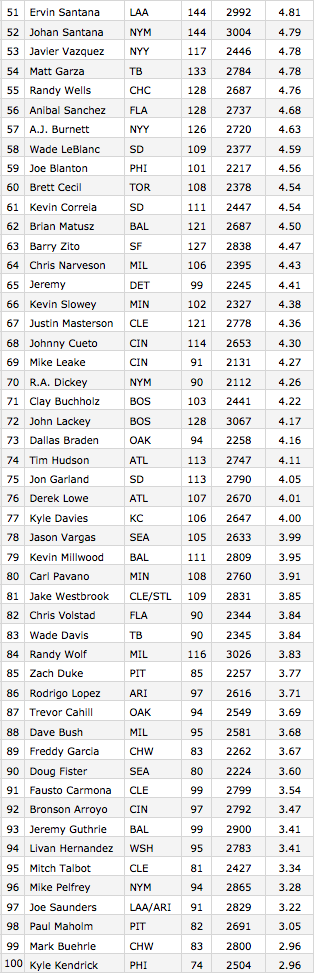 As shown, Brandon Morrow is leading the majors with 7.06 K/100P. He is averaging 97 pitches and 6.85 Ks per start. While Morrow leads MLB in K/100P, K/9, and K/BF, the 26-year-old righthander is 13th in strikeouts due to the fact that he is only averaging 5 2/3 innings per start. Aside from Morrow's dominating one-hit, 17-strikeout, complete-game shutout last month vs. Tampa Bay when he was allowed to throw 137 pitches, his starts, innings, and pitch counts have been managed closely by Cito Gaston and the Toronto front office. Along these lines, he was shut down for the season after making his last start on Friday against the New York Yankees. Although the former first round draft pick out of Cal will fall short of the required 162 innings to qualify for the ERA title, it makes little or no difference given that his 4.49 mark currently ranks 36th in the American League (out of 46 pitchers). However, it is worth noting that he has a bigger gap (1.31) between his ERA and FIP (3.18) than any starter in the big leagues.
Francisco Liriano ranks second with 6.87 K/100P. Like Morrow, Liriano's ERA (3.27), while excellent, understates his defense-independent pitching prowess this year as the lefthander tops the majors in FIP at 2.31 due to a strong strikeout rate, a better-than-average walk rate, and a home run rate (0.16 per 9) that is more than twice as low as the closest challenger (Josh Johnson, 0.34). While Liriano's HR/FB of 2.6% is probably unsustainable longer term, his xFIP (3.01), which normalizes the home run/fly ball rate to league average, still places him first in the AL and second in MLB (behind only Roy Halladay, 2.93).
Jon Lester ranks in the top five in the majors in strikeouts, K/100P, K/9, and K/BF. He is tenth in the AL in ERA and fourth in FIP and xFIP. The 26-year-old southpaw has produced three consecutive superb seasons and must now be regarded as one of the top five pitching properties in baseball.
With Stephen Strasburg sidelined through 2011, is there a better 22-year-old (or younger) pitcher than Mat Latos? The San Diego righthander is two months older than Brett Anderson and three months older than Clayton Kershaw, the other contenders for this mythical title. Latos (6.54) and Kershaw (6.39) rank fourth and sixth, respectively, in K/100P. Both starters play for teams in the NL West so they generally face similar competition. Although Latos' home ballpark is more friendly toward pitchers than Kershaw's, the former (.188/.247/.310, 2.36 ERA) has outperformed the latter (.241/.325/.350, 2.86 ERA) on the road this year. In the department of be careful when analyzing (over analyzing?) the effects of home ballparks, please note that Latos has pitched 99.1 IP on the road and just 56.1 IP at home this year. In other words, he has only thrown 36 percent of his innings at Petco Park, which means he hasn't benefited from the 87 park factor as much as one might believe without examining the facts. Oh, and it just so happens that Latos and Kershaw are the scheduled starting pitchers tonight when the Padres host the Dodgers.
At 6.41 K/100P, Jered Weaver is sandwiched between Latos and Kershaw. Weaver ranks among the top five pitchers in the majors in Ks, K/100P, K/9, K/BF, and K/BB. He is 8th in ERA, 6th in FIP, and 5th in xFIP among AL pitchers. The 6-foot-7 righthander also ranks 5th in Wins Above Replacement (WAR) and 3rd in Win Probability Added (WPA) in the junior circuit. While the Angels' ace lacks the gaudy win totals and winning percentages of CC Sabathia and David Price (and others), he has clearly been one of the five most effective starting pitchers in the league this season. Weaver can take the next step by pitching deeper into games as he is without a complete game and has only worked more than seven innings three times, primarily due to the fact that he leads the majors in pitches per plate appearance (4.17).
A lot has been written and said about Tim Lincecum's up-and-down 2010 but the fact remains that the two-time Cy Young Award winner is seventh in the majors and third in the NL in K/100P. His fastball velocity and movement have declined this season, yet he is getting more batters to swing at pitches outside the zone than ever before. In the aftermath of a poor August, the 26-year-old righthander beat the Colorado Rockies with a strong performance (8-5-1-1-1-9) on September 1. I would be slow to give up on this extraordinary talent.
Felix Hernandez leads the majors in strikeouts and ranks eighth in K/100P. He deserves to win the AL Cy Young Award as much as anybody, yet may be hurt if voters hold his mediocre win total (11) and W-L % (.524) against him. Both can be easily explained by the fact that Felix has received the lowest run support (3.90) in the AL this season. According to Lee Sinins, Hernandez would be 15-6 if he had received average run support. Sure, Sabathia is 19-5 but he has been supported by an average of 7.59 runs from his Yankees teammates. Similarly, Price (16-6) has received an average of 6.72 runs. Even Clay Buchholz, whose 15-6 record and league-leading 2.25 ERA will draw considerable attention, has been backed by 7.06 runs per nine. The truth of the matter is that Hernandez is 2nd in ERA, 3rd in FIP, 3rd in xFIP, 3rd in WAR, and 1st in WPA. No other pitcher matches those rankings.
Cole Hamels has also pitched much better than his 9-10 W-L record would suggest. He has received the fifth-lowest run support (4.92) in the NL. Teammates Roy Oswalt (3.72) and Roy Halladay (4.68) rank first and fourth, respectively. Meanwhile, the 26-year-old lefthander ranks 4th in the NL in K/100P, 7th in K/9, and 8th in K/BB and xFIP. No team wants to face the Phillies' Big Three in the postseason.
Yovani Gallardo ranks 10th in the majors in K/100P. While the Milwaukee ace can frustrate writers, analysts, and fans at times, it is hard to argue against the following NL rankings: 1st in K/9, 4th in FIP, and 6th in xFIP and HR/9. While Gallardo needs to improve his control to reach his potential, he has been victimized by the fourth-highest BABIP (.337) and the eighth-lowest LOB% (69.2%). I mean, let's give the guy a break — he's only 24 years old.
There are a number of other pitchers having superb seasons, including the next four on the list: Adam Wainwright, Cliff Lee, and the previously mentioned Roy Halladay and Josh Johnson. Along with Ubaldo Jimenez, Wainwright, Halladay, and Johnson are probably the leading favorites to win the NL Cy Young Award in 2010. An argument could be made for all four at this point. Although Lee and Halladay aren't thought of as strikeout types, both have posted strong K/100P marks in part due to their pitch-count efficiency. Lee is 3rd among qualified MLB pitchers in P/PA (3.49) and 2nd in P/IP (14.0), while Halladay ranks 6th (3.58) and 3rd (14.2) in these two measures.
Lastly, I would be remiss if I didn't point out that Strasburg (92 Ks and 1,073 pitches) averaged 8.57 K/100 pitches in 12 starts spread over 68 innings. That, my friends, is 1.51 K/100P more than the leader among all qualified pitchers!
| Baseball Beat | August 30, 2010 |
A Good Story (Even If It May Not Be True)
Let me preface today's post by stating that I love a good baseball story as much as the next fan. But I've developed a pretty good b.s. detector over the past 50-plus years. I can usually separate the fiction from the facts. My antennae tend to go up when I hear a former player recall an incident from long ago.
On Friday, August 27, the Cincinnati Reds were hosting the Chicago Cubs. I was watching the game via MLB Extra Innings. I'm not sure why I even had the game on other than to keep tallies on Joey Votto, who is on my fantasy baseball team.
With the Reds beating the Cubs 6-1 in the bottom of the sixth and Thomas Diamond facing Ramon Hernandez, play-by-play announcer Thom Brennaman asks color analyst Jeff Brantley a question out of the blue. "Cowboy, do you remember the first home you gave up as a major league pitcher? Do you remember who hit it? Do you remember the year?"
Brantley laughs, "Oh, yeah," but doesn't answer quickly. Brennaman interjects, "Let's start off with the easy part: the year." Brantley says, "The year was '88." Brennaman responds, "You're one for one." He offers Brantley a hint by saying "the guy at the time was playing for the Montreal Expos." Brantley guesses Delino DeShields. Brennaman gives him a hard time and basically hands him the answer by telling Brantley it was a slugging first baseman. Brantley asks, "Andres Galarraga?" Brennaman then chimes in, "You got it."
That discussion was all fine and dandy. No reason to question the truth here. I figured Brennaman or a staff member looked up that piece of trivia before the game. The good stuff immediately followed when Brantley proceeded to spin a tale about another home run he allowed.
Brantley: The one that I remember the most was the home run by Eddie Murray and the reason I remember it the most is because I had thrown him a split-finger on the first pitch and he swung and missed it by a mile. I mean, he looked like a clown, and I thought this guy was, like, really good.
Brennaman: (Laughing) He was pretty good.
Brantley: Yeah, and I'm thinking to myself, 'This guy just missed my pitch by a mile.' Terry Kennedy, our catcher at the time, came to the mound and he said, 'Don't throw him that pitch again.' I said, 'Why not?' I said, 'He just missed it by a mile.' He goes, 'He's going to be sitting on it.' So I threw him a bunch of fastballs and he kept fouling them off, fouling them off. Kennedy kept calling fastball. I was like, 'Forget that. This guy's not gonna hit another split-finger.' I threw it and he hit it in the upper deck in Candlestick. The upper deck.
Brennaman: That's a long home run.
Brantley: Oh my gosh.
Brennaman: Was that in '88 as well?
Brantley: No, that was in '89. I learned that one. But I learned a very valuable lesson that day.
Here is the two-and-a-half-minute clip of the foregoing conversation:
As it turns out, the valuable lesson Brantley learned that day wasn't about telling the truth. Instead, I presume he never threw Murray another split-finger again. Maybe. You see, while Brantley gave up a home run to Murray at Candlestick Park in 1989, he didn't get Steady Eddie to look like a clown by swinging and missing a split finger. Nor did Terry Kennedy come out to the mound and tell Brantley not to throw that pitch again.
How do I know, you ask? Well, thanks to Retrosheet and Baseball-Reference.com, we can look up exactly what took place on that Saturday afternoon. A fact-finding mission moments after Brantley finished his tall tale detailed the real story. It's not quite as interesting as the one Brantley told.
Brantley indeed got ahead in the count. However, the first pitch wasn't a split-finger that Murray missed by a mile. Rather, it was a *called* strike. It's pretty tough to look like a clown when you don't even swing at the pitch. But, hey, it makes for a nice story 21 years later.
Murray fouled off the second pitch. Score one for Brantley. That said, Brantley didn't throw him "a bunch of fastballs," nor did Murray keep "fouling them off, fouling them off." Heck, Brantley only threw him three pitches. A called strike, a foul ball, and the offering that Murray presumably hit into the upper deck. Murray did slug a home run. That's not being questioned. And, for all I know, he may have hit one of Brantley's split-finger pitches. And it may have landed in the upper deck. Who knows at this point?
Just a matter of not recounting the type and number of pitches? Well, not really. Terry Kennedy didn't even play that day. Kirt Manwaring started and played the entire game at catcher. As a result, there is no way that Kennedy "came out to the mound" and told Brantley not to throw that split-finger again. If the truth be told, it was this bit of information that led me to question what happened. Look, why in the world would Kennedy (or Manwaring, for that matter) take a trip to the mound to tell his pitcher not to throw the same pitch that the batter had just swung and missed by a mile while looking like a clown? It doesn't make sense. In other words, it didn't pass the "smell test."
I don't know if anybody else caught this gaffe. More than anything, it reminds me just how valuable it is to access old box scores, as well as play-by-play and pitch summaries. Thank you, Retrosheet. Thank you, Baseball-Reference.com.
And thank you, Jeff Brantley. Nothing like some good ol' Cowboy folklore.
| Baseball Beat | August 23, 2010 |
A Trio in Line for Triple Crown
I went to the Reds-Dodgers game yesterday afternoon and watched Joey Votto walk and score a run in the first inning, slug a solo home run in the sixth, and line a two-run single in the ninth as Cincinnati beat Los Angeles 5-2 to stay atop the NL Central by 3 1/2 games.
Votto is leading the National League in batting average (.323), on-base percentage (.422), and slugging average (.592). He also ranks third in HR (29) and second in RBI (86) and has an outside chance to become the first Triple Crown winner since 1967 when Carl Yastrzemski turned the trick for the Boston Red Sox.
For the most part, only Albert Pujols, who is in the hunt for the Triple Crown himself, stands in Votto's way. Pujols ranks first in the NL in HR (32) and RBI (89), fourth in AVG (.316), and second in OBP (.411) and SLG (.592). He has never led the league in RBI despite reaching 120 or more in six of his nine campaigns and never having fewer than 103. Albert has ranked first in HR, AVG, and OBP once each and SLG three times.
Over in the American League, Miguel Cabrera is second in AVG (.341), and first in OBP (.435) and SLG (.645). He also leads the league in RBI (102) and is in second place in HR (31). While it would appear that Miggy could win the AL Triple Crown, it must be noted that he trails Jose Bautista by seven home runs. If the latter returns to earth or gets hurt or traded to an NL club, then perhaps Cabrera would have a shot at winning the Triple Crown. Otherwise, he might have to settle with capturing the Triple Crown of rate stats. Joe Mauer (.365/.444/.587) accomplished the latter feat last year, joining Barry Bonds (2002 and 2004) and Todd Helton (2000) as the fourth player to do so in the past ten years.

While it is unlikely that either Votto or Pujols *and* Cabrera will win the Triple Crown this year, there is a reasonable chance that one or two of these first basemen could win the Triple Crown of rate stats. If either Votto, Pujols, or Cabrera had a monster finish and won the traditional and rate stats Triple Crown, he would become only the ninth player to produce this double since 1900. (Tip O'Neill — no, not this one — was the first in 1887.)

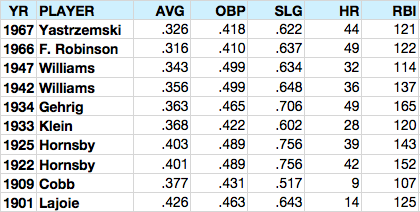
Ted Williams and Rogers Hornsby — perhaps the greatest left- and right-handed hitters, respectively, in the history of the game — won the traditional and rate stats Triple Crown in the same season twice each.
Only three Triple Crown winners failed to lead their leagues in OBP or SLG. As it turns out, the culprit was OBP every time. In 1956, Mickey Mantle had the misfortune of playing in the same league at the same time as Williams and fell short in OBP (.464 to .479). In 1937, Joe Medwick finished fourth in OBP, trailing leader Dolph Camilli (.446), Johnny Mize (.427), and Gabby Hartnett (.424). In 1933, Jimmie Foxx was edged in OBP by Mickey Cochrane (.459). (In 1878, Paul Hines led the NL in AVG, HR, RBI, and SLG while placing fifth in OBP.)
While all the hitters who won the traditional and rate stats Triple Crown in the same season are in the Hall of Fame, only three were named Most Valuable Player in that year: Yaz, Robby, and Hornsby (1925). Williams lost the MVP to Joe DiMaggio in 1947 and Joe Gordon in 1942. Gehrig succumbed to Cochrane in 1934 and Klein to Carl Hubbell in 1933. There was no NL MVP in 1922 and no award winners in 1909 and 1901. Mantle, Medwick, and Foxx, the other three Triple Crown winners, all won their league MVPs.
Only Yastrzemski, Robinson, and Mantle won Triple Crowns and played for a pennant-winning team. All three were named MVPs that season.
Meanwhile, Votto or Pujols could become the first NL Triple Crown winner since Medwick in 1937. As noted above, Cabrera could become the first AL Triple Crown winner since Yaz in 1967. Votto or Pujols could win the Triple Crown on a team that just might win the NLCS. If so, history would suggest that whoever pulls it off would be a lock to win the NL MVP this year. Cabrera, on the other hand, will be fighting history, as well as a number of other worthy candidates, including Robinson Cano and Josh Hamilton, both of whom are enjoying career years and playing for division-leading teams.
Note: Rob Neyer points out that Omar Infante could pose a problem for Votto (or Pujols) in batting average. It is my belief that Infante will cool down the stretch owing to a combination of reverting toward his career average, playing every day, and the toll of the long season for a utility player who hasn't appeared in 100 games in a single season since 2005. Nonetheless, it adds an interesting wrinkle to the NL Triple Crown this year.
Update: Dan Szymborski of The Baseball Think Factory quantifies the likelihood of Votto, Pujols, and Cabrera winning the Triple Crown with Albert given a 16.7% chance, Miggy 1.8%, and Joey 0.8%. Insider subscription required. I might be inclined to take the better than 100:1 odds on Votto.
| Baseball Beat | August 16, 2010 |
Chipper Jones and Jeff Bagwell: Two Peas in a Pod
Aside from their difference in positions, the careers of Chipper Jones and Jeff Bagwell have been almost identical. The National League rivals each won a Most Valuable Player Award and produced statistics that are almost indistinguishable from one another.
While Bagwell and Frank Thomas may have been separated at birth — both players were born on the same day (May 27, 1968), played first base, arrived in the majors within a year, won the MVP Award in 1994 (Bags in the NL, the Big Hurt in the AL), and produced career totals that were more alike than not — the similarities between Bags and Chipper are nearly as astonishing.
Jones and Bagwell have both been in the news recently. Chipper underwent surgery for a torn ACL this past week, and Bags was named the hitting coach for the Houston Astros last month. The offseason should be an interesting time for these superstars. Speculation will surround whether Jones can fully recover from his knee injury and return in time for the 2011 season, while Bagwell will be on the Hall of Fame ballot for the first time.
Meanwhile, let's take a look at how closely Jones' and Bagwell's career counting and rate stats line up:

It's pretty difficult to separate the two, no? I don't think you can really make a strong case for one and not the other based on the counting or rate stats. Given that Jones has played in 111 more games with 223 additional plate appearances, perhaps we can agree that Bagwell edges Jones by the slimmest of margins on the offensive side of the ledger by virtue of his .003 and .004 advantages in OBP and SLG, respectively, as well as his favorable ballpark-adjusted OPS (aka OPS+).
Bagwell was actually a better defensive player at his position (1B) than Jones was at his (3B). However, Jones played the more difficult corner infield spot and the difference in positional scarcity is estimated to be worth about 140 runs according to Sean Smith of BaseballProjection.com, whose work on Wins Above Replacement (WAR) has become the industry standard.
Based on WAR — which factors hitting, baserunning, fielding, and position — the difference between Bagwell (79.9) and Jones (80.0) works out to 0.1 win. One-tenth of one win over the course of their 15- and 16-year careers. They rank 56th and 57th all time in WAR among all players and 36th and 37th among non-pitchers.
As far as peak value goes, the nod goes to Bagwell, who produced three seasons (8.9, 8.3, and 8.1) that exceeded Jones' best (7.9). On the other hand, Bagwell had two seasons that were worse than anything Jones has put up to date.*
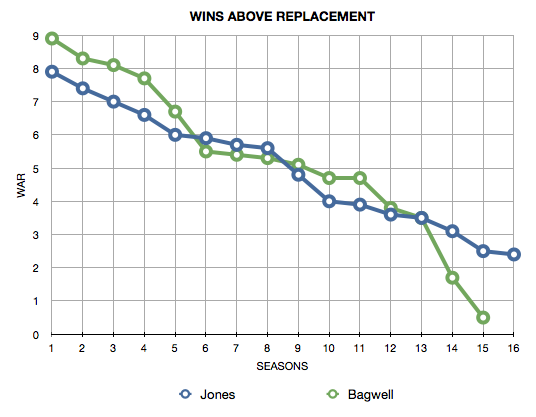
* I'm skeptical of the -19 Total Zone assigned to Bagwell's fielding in 2003, which is the primary reason for his abnormally low 1.7 WAR total that season. His basic stats (games, innings, putouts, assists, errors, double plays) are not all that different than 2002 and 2004. Moreover, his Ultimate Zone Rating per 150 games (UZR/150) was 4.1, which is almost exactly halfway between his 2002 (3.1) and 2004 (5.0) marks. The net effect of this potential glitch is that it reduces Bagwell's value by about two wins in 2003 and, by extension, two wins for his career.
The bottom line is that Jones and Bagwell are two of the greatest players of the past two decades. One can make a case that both rank among the top five players at their position since 1900 (with only Mike Schmidt, Eddie Mathews, George Brett, and Wade Boggs possibly exceeding Jones at 3B and Lou Gehrig, Jimmie Foxx, and Albert Pujols outdoing Bagwell at 1B). As a result, Jones and Bagwell should be slam-dunk, first-ballot Hall of Famers. Here's hoping that Bagwell gets his due when the results are announced in January and Jones follows up five years after his retirement, which may or may not be in 2010.
| Baseball Beat | August 11, 2010 |
Scouting Reports from the 2010 Area Code Games
The 24th annual Area Code Games were held at Blair Field during the past week. The summer showcase has been one of the premier national events for high school baseball prospects since it was moved to Long Beach in 1994. The wood bat tournament consists of eight teams and over 200 players invited from around the country, the vast majority of which will be offered major college scholarships and/or drafted in June 2011 or 2012 as the case may be for about 10 percent of the participants.
 Unlike many showcase events, the players don't pay to play. Instead, several hundred professional scouts, scores of college coaches, and dozens of agents are charged a fee for attending these games. One of the scouts in attendance (Scott Boras) is also the father of a prospect (Trent Boras, who preps at JSerra Catholic High School in San Juan Capistrano, CA). There was an even more famous father-son combo with Wayne and Trevor Gretzky (Oaks Christian, Westlake Village, CA) prominent in the stands and on the field, respectively.
In addition, there were six sons of former MLB players and a brother of an active big-league pitcher: Alec Bankhead (Greensboro, NC), son of Scott; Brandon Bonilla (IMG Academy, Bradenton, FL), son of Bobby; Shawon Dunston Jr. (Valley Christian, San Jose, CA), son of the father by the same name; Brett Geren (San Ramon Valley, Danville, CA), son of current A’s manager Bob; C.J. McElroy (Clear Creek, League City, TX), son of Chuck; Drew Stankiewicz (Gilbert, AZ), son of Andy; and Joe Ross (Bishop O'Dowd, Oakland, CA), brother of A's pitcher Tyson.
The tournament featured eight teams: Milwaukee Brewers (California) sported Blue and White entries, Texas Rangers (Texas and Louisiana), Chicago White Sox (Midwest), Washington Nationals (Pacific Northwest), Oakland Athletics (Southeast), New York Yankees (Northeast), and the Cincinnati Reds (Southwest and Rocky Mountains). As noted, the geography of the big-league clubs and their Area Code teams don't necessarily match. Nonetheless, the players wore the colors of their MLB teams with "Area Code" in script across the front of all jerseys.
Each team played five games over six days (Thursday, August 5-Tuesday, August 10) with most contests scheduled for seven innings and a few for nine.
Day One (Thursday, August 5)
In the opening game on Thursday, Henry Owens (Edison, Huntington Beach, CA) of the Milwaukee Brewers (Blue) pitched the first two innings and struck out six of the seven batters faced. He walked the other one. The lefthander threw 31 pitches, 21 for strikes. He was throwing 87-89 mph. At 6-foot-7 and 195 pounds (with size 17 shoes), his fastball plays up a bit due to the fact that he throws on a downhill plane. Moreover, his body offers lots of projection although a scout I spoke to noted that Owens' velocity is down a couple of ticks from his sophomore season in 2009. Nonetheless, he may be the most highly regarded prep pitcher in the country and could be drafted in the top half of the first round next June.
A member of the USA Baseball 18U National Team, Owens has had a busy summer. He was 3-0 with a 2.33 ERA in five appearances and four starts, whiffing 31 batters and walking nine in 19.1 innings. He was also named to the Aflac All American Baseball Classic, which will be held on Sunday, August 15 at 5 p.m. PDT in PETCO Park. The game will feature the nation’s top 38 high school players heading into their senior year.
Baseball America offered the following report in its Aflac Classic player capsules:
Scouts love Owens' frame, which has plenty of room to fill out, and he adds to the package by showing a good arsenal—and all from the left side. His fastball sits 88-91 mph from the left side, and he also works with a sharp, two-plane curveball and mixes in a changeup.
Area Code and Aflac teammates Travis Harrison (Tustin, CA) and Christian Lopes (Edison, Huntington Beach, CA) each went 2-for-4. Harrison is a 6-2, 220-pound outfielder with big-time power, as evidenced by the 504-foot home run he jacked at the Power Showcase in January, breaking Bryce Harper's record from the previous year by two feet. Lopes, a 6-0, 185-pound shortstop, has been well known in prospect circles for several years. He and his younger brother Timmy Lopes (class of 2012) transferred from Valencia to Edison last January, joining Owens and Eric Snyder, who has committed to UCLA. All four players are on the same team in the Area Code Games, too. Their high school club promises to be one of the best in the nation next year.
In the second game, Owens' 18U teammate Derek “Bubba” Starling (Edgerton, Gardner, KN) led the Chicago White Sox to a victory, pitching two innings (2-1-1-1-1-2) and knocking in the first run with a ground-rule double that the left fielder lost in the sun and bounced near the warning track and over the outfield wall that measures 348 feet down the lines, 387 to the power alleys, and 400 to center. His fastball sat in the high 80s and touched 90. The righthander has reportedly thrown in the low 90s but hasn't pitched much this summer. He hit .339/.474/.532 with three HR and 16 BB and 12 SO in 78 PA and tossed 4.1 scoreless innings with 7 SO and only 1 BB for Team USA last month. The tall and lanky Starling (6-5, 195) is an outstanding two-sport athlete who has verbally committed to play baseball and quarterback at Nebraska. The five-tool player ran a 6.56 in the 60-yard dash, tied for the fifth-fastest time in the SPARQ testing on the first day of the Area Code Games. I like the Matt Holliday (who was also one of the top high school QB in the country) comp that New York Yankees Director of Scouting Damon Oppenheimer made to ESPN Rise, a part owner and sponsor of the event.
White Sox center fielder Charles Tilson (New Trier, Winnetka, IL) showed off his athleticism on Thursday by running the fourth-fastest 60 (6.54) and stealing three bases that evening. On Saturday, a scout sitting in my row clocked the lefthanded-hitting center fielder at 3.98 while an area supervisor in front of me had him at 4.0 exactly on an infield single that didn't even draw a throw. So as not to be labeled a one-trick pony, Tilson opened Sunday's game by slugging the first home run of the tournament. It was an impressive blast to right field into a slight breeze coming off the ocean. He singled and stole two more bases later in the game and threw out a runner at third to top it all off.
Teammate Johnny Eierman (Warsaw, MO) is another speedster who had the second-fastest time in the 60 at 6.41. The 6-foot-1 shortstop and quarterback is coming off a junior year in which he was an all-state selection in baseball and football. The LSU commit slugged three home runs during batting practice on Thursday but struck out in five of six plate appearances after going 2-for-3 with a triple in the first game. While Eierman doesn't lack for load or bat speed, he may need to alter his swing plane in order to make more contact at the next level.
Nicholas Burdi (Downers Grove, IL) threw three innings in relief, striking out five without allowing a walk. The 6-5, 215-pound righthander was dialing his fastball up to 90-91 while flashing a hard slider at 84-85 and a changeup with good arm action at 81-82.
Lefty Cody Kukuk (Lawrence, KS) and righty Michael Fulmer (Deer Creek, Edmond, OK) both touched 90 on the radar guns in the later innings.
The opposing starting pitcher for the Washington Nationals, Dylan Davis (Redmond, WA), threw 92-94 in his only inning of work. His heater was the fastest of the evening. It appeared as if he only threw one other pitch, a short slider that Baseball America tabs at 83-84. The smallish righthander, generously listed at 6-0, 200 pounds, gave up two runs (one earned) on Thursday but bounced back to toss two scoreless innings on Sunday. An Aflac selection, Davis has committed to Oregon State.
Cole Wiper (Newport, Bellevue, WA) topped out at 91 with his fastball, 83-85 with what a scout told me was a cutter, and a 78 mph curve he left up in the zone that was pulled for a triple down the right-field line. He has thrown three innings overall, struggling with his control on Sunday when he walked three of the seven batters faced.
Porter Clayton (Bonneville, Idaho Falls, ID), a southpaw with a pronounced leg kick, struck out three batters around a hit and walk in his only inning of work. He was 88-89 with a good breaking ball. Kevin Moriarty (Shorewood, WA) K'd five out of six batters, showing excellent command of an 84-87 mph fastball and a slow curve.
Spencer O'Neil (Southridge, Kennewick, WA) stood out in the pre-game infield, displaying a strong, accurate arm in right field with all four throws to third base and home arriving on a clothes line with no hops. However, O'Neil, one of three returning players from the 2009 Area Code Games, has taken the collar at the plate, going 0-for-10 in the tournament.
Day Two (Friday, August 6)
Jordan Ramsey (North Davidson, Lexington, NC), Chris McCue (Ardrey Kell, Charlotte, NC), and John Hayman (Ware County, Waycross, GA) of the Oakland Athletics threw a combined, seven-inning shutout over Washington, which was forced to play the last game the previous evening and the first contest the following morning. McCue, an undersized righthander who has committed to North Carolina, had the most impressive arsenal of the trio, with an 89-92 mph fastball and a solid-average curveball and changeup.
Alex Blandino (St. Francis, Mountain View, CA) went 3-for-3 in the opener but competed for playing time throughout the tournament with several middle infielders on Oakland despite a solid swing that produced six hits in 10 trips to the plate.
Washington's Tyler Gonzales (Madison, San Antonio, TX), class of 2012, struck out the side in his lone inning of work. Teammate Dylan LaVelle (Lake Stevens, WA), another junior-to-be, hammered a triple that one-hopped the wall in center field to lead off the game for the Nats. Although LaVelle made a couple of errors at shortstop during the tournament, he was involved in three double plays and appears to have the glove, footwork, and arm to handle the position. His keystone partner, Erik Forgione (W.F. West, Chehalis, WA), was equally adept defensively, making at least one highlight reel play at second. He also doubled to right center on Saturday, one of the few hard hit balls that day.
Michael Conforto (Redmond, WA), who is playing in his second Area Code Games, stroked two hits. A lefthanded-hitting right fielder, Conforto has a powerful swing and a strong arm. Before knowing that TrackMan had measured his max exit speed at a tournament-best 105, I had written down "plus bat speed" next to his name on my roster. Keep an eye on this 6-0, 200-pounder with good bloodlines. His mother won two gold medals in synchronized swimming in the 1984 Summer Olympics in Los Angeles and added a silver in the 1988 Games in Seoul, while his father played linebacker at Penn State for Coach Paterno in the 1970s.
In the game between the New York Yankees and Texas Rangers, Bryan Brickhouse (Woodlands, TX), a 6-2, 190-pound righthander, was throwing 92-94 mph gas in the first inning, striking out the side around one walk. He allowed another free pass in the second as well as a single and triple off the bat of Rio Ruiz (Bishop Amat, La Puente, CA), a third baseman and pitcher from the class of 2012, who knocked in two runs and closed out the final inning for the Yankees, lighting up the radar guns with a low-90s fastball.
Fernelys Sanchez (Washington, Bronx, NY), another junior-to-be, ran the best 60 (6.35) on Thursday and stole two bases. Matt Dean (The Colony, TX), an Aflac selection, had a tough time at the plate, going 0-for-4 with two strikeouts. He was 3-for-17 with no XBH or BB and five SO for the tournament. The 6-foot-3, 190-pound third baseman is a two-sport athlete who has committed to Texas to play baseball but is expected to be a high draft pick next June. Teammate Daniel Mengden (Westside, Houston, TX) will also be at the Aflac game next week.
In the final game of the day, Robert Stephenson (Alhambra, Martinez, CA) led the Brewers White to a 6-1 victory over the Reds. The 6-2, 185-pound righthander struck out six batters without allowing a walk or run in three innings. The Aflac All-American was popping his fastball in the low 90s in one of the more impressive outings of the day. Teammate Billy Flamion (Central Catholic, Modesto, CA) was the offensive star of the game, banging out two hits (including a double) and stealing a base. The 6-1, 195-pound, high-energy outfielder went 5-for-17 for the tournament and his big, powerful swing will be on display next Sunday in the Aflac game.
On the other side of the diamond, Blake Swihart (Cleveland, Rio Rancho, NM), a 6-1, 175-pound switch-hitting catcher, had two hits and drew rave reviews from many talent evaluators for his offensive and defensive prowess. He is another Aflac selection who hit a team-leading .448 AVG (26-for-58) and .845 SLG (6 2B, 1 3B, and 5 HR) for the USA 18U club. He has also committed to play for the Texas Longhorns. Swihart caught Bonilla, a lefthanded pitcher whose line (2-3-3-3-3-4) left a lot to be desired. However, the University of Southern California commit, who works out of the stretch, flashed good stuff with a fastball that sat in the upper 80s and reached 90 as well as a curve that showed some promise. Interestingly, he walked Dunston, a lefthanded-hitting, fleet-footed outfielder, on four pitches. The latter drew four free passes in 19 plate appearances while stealing two bases and scoring five runs, including a jaw dropper from second base on a dropped third strike and throw to first.
Day Three (Saturday, August 7)
With all of the teams having played at least once heading into the weekend, the biggest names were generally covered in the recap of the first two days. Nonetheless, there were new pitchers who stood out and a few hitters who jumped to the forefront such as Aaron Brown (Chatsworth, CA), who went 4-for-4 in the morning game on his way to a tourney-leading eight hits in 15 at-bats. The L/L outfielder-pitcher has excellent bat and foot speed and flashed a strong arm on Monday when he struck out five batters over just two innings. Milwaukee White teammate Tyler Goeddel (St. Francis, Mountain View, CA), a 6-4, 170-pound third baseman, jacked a stand-up triple into the gap in right center, showing both power and speed on the same play. He has also displayed a great approach at the plate, drawing seven walks while striking out just once. Desmond Henry (Centennial, Compton, CA) sparkled in the 60-yard dash on Thursday with the third-fastest time of 6.47 before transferring his athleticism to the baseball field on Saturday with two doubles. He went 5-for-13 with two BB and two SO overall.
Lots of radar guns went up in the second game when Jerrick Suiter (Valparaiso, IN), a 6-3, 210-pound righthander with a smooth delivery, entered the contest in the fifth. He worked two innings on Saturday and came back and tossed two more on Monday. The three-sport star allowed only one hit, one walk, and no runs while punching out seven of the 14 batters faced in his two outings. Suiter coupled an 88-92 mph fastball with a 73-74 plus curveball. Patrick Hope (Broken Arrow, OK), a 6-3, 185-pound righthander, was 90-91 with a 72-73 hammer curve that was without question the best breaking ball I saw all week. Fellow righty teammate Clayton Blackburn (Santa Fe, Edmond, OK) was 89-90 with a sweeping breaking ball.
In the third game, Lucas Giolito (Harvard-Westlake, North Hollywood, CA), class of 2012, just turned 16 in July, yet matched the best fastball of the tournament by consistently hitting 91-93 and touching 94 on at least one occasion according to the scoreboard display facing the press box. (Note: TrackMan registered his average fastball velocity at 95.8, or 3-4 mph faster than the consensus of the dozens of handheld Stalker Sport radar guns employed by scouts. TrackMan may measure the velocity at the pitcher's release point whereas radar guns and PITCHf/x estimate velocity at about 50 feet from home plate. There may be an additional explanation as well, which I would enjoy receiving from any expert in this area. In the meantime, the TrackMan leaders can be viewed here.) Giolito was wild with his entire repetoire of pitches (which included a 76-80 mph slurve and what appeared to be either a hard change or a two-seamer with more than decent arm-side run). With additional experience, the 6-5, 215-pound righthander may be able to improve upon his command, which was lacking on Saturday as evidenced by the 24 balls against 23 strikes and four free passes in only two innings. If so, he projects to go early in the 2012 draft.
Teammate Adam McCreary (Bonita, La Verne, CA) entered the game in the sixth inning and was announced as Henry Owens due to the lefty's handedness, similar number (38 vs. 36) and size (6-8 vs. 6-7). The PA announcer corrected his mistake, noting the "even taller" McCreary, who pitched a scoreless inning by exhibiting a mid-80s fastball, a 78 mph slider, a 72 mph curve, a 75 mph change, and a good pickoff move to first base. The combination of his polish and projection makes him an intriguing prospect.
Three Yankees pitchers combined for 17 strikeouts in the nightcap with Aflac All-Star Tyler Beede (Lawrence Academy, Groton, MA) and Karl Keglovitz (Nazareth, PA) leading the way with six each. John Magliozzi (Dexter, Brookline, MA), another Aflac selection, chipped in with five Ks. The Florida commit worked in the low 90s. Keith Law, whom I chatted with in between games on Saturday, noted that Magliozzi might be more suited for a relief role due to his arm slot. I agree and believe his lack of height (5'11") may also work against him at the professional level although I overheard one scout liken him to Tim Hudson. Beede (3-2-0-0-0-6) exhibited outstanding command of a low-90s fastball and solid secondary pitches. The 6-4, 200-pound righthander has committed to Vanderbilt.
Day Four (Sunday, August 8)
The two early games were low-scoring affairs with Phillip Evans (La Costa Canyon, Carlsbad, CA) the only player to produce two hits in the opener. He plays hard but is not the best-bodied or most toolsy athlete in the tournament. However, he did make an over-the-shoulder catch that turned heads earlier in the week.
Although he gave up two runs, righthander Mathew Troupe (Chaminade, West Hills, CA) fanned seven batters without allowing a walk in three innings. The Oregon State commit, who is now up to 6-1, 185 pounds, consistently pounded the strike zone (41 strikes and 14 balls) and may turn out to be an effective, if unspectacular pitcher.
In the third game, the White Sox's Mason Snyder (Marquette, Ottawa, IL) followed Tilson's aforementioned dinger with a double high off the 348-foot mark on the left-field wall. Dylan Delso (Broken Arrow, OK) went 2-for-2 en route to a 6-for-9 tourney with three BB and no SO. He topped all hitters in the Triple Crown of rate stats, putting up a line of .667/.750/1.000. Kyle Shaw and Ty Hensley (both from Santa Fe, Edmond, OK) touched 90 but generally worked in the mid- to high-80s. Kevin Comer (Seneca, Tabernacle, NJ) of the Yankees was the most impressive pitcher of the game as he whiffed nine in four innings while allowing only one hit, one walk, and one run. The righty's fastball sat at 87-89 and peaked at 90 but it was his secondary pitches that caught my eye, including a 76-78 mph slider with good tilt, a changeup with fade, and a two-seamer with tailing action that he used primarily against LHB.
In the finale, Elliot Richoux (The Woodlands, TX), a lefthanded-hitting first baseman, bombed a double off the top of the wall in right field (although it should be noted that the pitch was an 80-mph "fastball" from someone who will most likely stick at his more natural first base position). McElroy picked up a couple hits en route to a 4-for-7 tourney with two stolen bases. The righthanded lead-off hitter and a bunt single and ran a 4.39 to first base on a broken bat groundout to the second baseman. Nick Williams (Ball, Galveston, TX), a 6-2, 185-pound outfielder, deserves mention for recording the best SPARQ test results on Thursday despite being a member of the 2012 class. Only 16, his baseball skills are still a bit raw but his athleticism coupled with his tall, projectable body suggest he could be one of the top players in the Area Code Games next summer.
Zac Freeman (Lowndes, Valdosta, GA) was, for me, the most impressive player on Oakland's squad. He went 3-for-10 with a double and a triple plus three walks and made an outstanding diving catch going to his left in shallow center field. Disregarding his poor pitching performance on Monday, the only criticism is perhaps an overly aggressive swing that led to six whiffs in 13 plate appearances.
Parker French (Dripping Springs, TX), a big righthander, started for Texas and pitched two shutout innings with four Ks. He was popping the catcher's glove with a 90-93 mph fastball and threw several 76-78 slurves, as well as at least one plus changeup. Hayman was 90-91 but lacked consistent command in his second appearance and Darren Whatley (Bibb County, Centerville, AL) was 88-90 with his four-seamer and generally 85 with his two-seamer.
Day Five (Monday, August 9)
I didn't make it out to Blair Field on Monday in what was the final full-day schedule of the six-day tournament. The primary attraction was the all-California matchup between the Milwaukee Brewers Blue and White teams. Of note, all of the players on the Blue side are from Southern California while the majority of the players on the White are from Northern California. As it turns out, the Blue beat the White, 5-1.
Owens made his second start of the Area Code Games, hurling two hitless, scoreless innings while striking out and walking two. With four innings of no-hit, no-run ball and eight Ks, Owens was probably the star of the showcase event. Assuming good health, the sky is the limit for this special talent.
Aflac All-American Daniel Camarena (Cathedral Catholic, San Diego, CA) knocked in the first run for the Blue with a long double to straightaway center. The 6-2, 200-pound L/L is a two-way threat who has committed to University of San Diego. Baseball America sees him as a "high average, low strikeout, gap-to-gap, line drive hitter." Teammate Austin Hedges (JSerra, San Juan Capistrano, CA), also an Aflac selection, had two hits and was 4-for-10 overall. He is an outstanding defensive catcher with a strong arm that was obvious to anyone paying attention before and during the games. Flamion just missed jacking a home run down the RF line for the White, a blast that TrackMan recorded at 385 feet or what would have been the longest hit of the tournament had it gone fair.
The Brewers White team played back-to-back games, coming off a 10-1 win over the A's before facing their Blue rivals. Dante Flores (St. John Bosco, Bellflower, CA), Blake Grant-Parks (Yuba City, CA), and Kevin Kramer (Turlock, CA) each contributed two hits in the victory. The 5-10, 160-pound Flores (5-for-10 with three 2B, two BB, and only one SO) is a highly skilled SS/2B, a local favorite who is likely to honor his commitment to USC.
Cincinnati's Kavin Keyes (Alta, Sandy, UT), a switch-hitting infielder, led the offense, going 2-for-3 with a double and finishing the tourney with a .500 AVG (7-for-14). Stankiewicz, meanwhile, sparked the defense with two web gems at second base. The switch hitter has committed to Cal State Fullerton. The Nats' Clint Coulter (Union, Camas, WA) and Austin Diemer (Rocklin, CA), a late add to Washington's roster, produced all five of their team's hits in 2-0 victory over the Yankees. Seven pitchers threw one inning each with only Blake Snell (Shorewood, Shoreline, MA) striking out two.
Day Six (Tuesday, August 10)
On the final day of the Area Code Games, the manager of the A's let McCue stretch out his arm by throwing 69 pitches over the first four innings (4-4-1-1-1-4). He led all pitchers with six innings of work.
Cameron Gallagher (Manheim Township, Lancaster, PA), an Aflac All-American catcher, went 2-for-3 with a double, raising his overall average to .273 with three hits in 11 AB. The 6-3, 215-pounder has committed to East Carolina.
Although hope and change has been a popular phrase the past two years, it's really Hope and his curveball. The Chicago righthander threw two scoreless innings, once again using his put-away breaking ball to strike out five batters to give him a total of eight in just four frames. Kukuk, Fulmer, lefty Brett Lilek (Marian Catholic, Chicago Heights, IL), and Shaw followed Hope to the mound, combining to pitch six innings while allowing just one hit two walks, and one run. Lilek struck out the side in the seventh. It was a bit of redemption for the junior-to-be as he allowed three runs (two earned) in his only other outing of the tourney. Eierman was the offensive star, going 3-for-4 and lifting him into the top ten for H, AVG, SLG, and RBI.
In the final game of the tournament, McCreary started for the Milwaukee Blue club and threw two innings but failed to punch out anyone in his two appearances. Giolito gave up five hits, two walks, and seven runs in 1.2 IP, showing once again that he is far from a finished product. Camarena tripled and scored two runs. At the other end of the spectrum, Max Homick (Rancho Bernando, San Diego, CA), projected by Baseball America to go in the first round in 2011 in a mock draft back in March, had a forgettable tournament, failing to get a hit in 11 AB while striking out four times. His highlight was throwing out a runner at home from left field. Keyes and Brett Harrison (Green Valley, Henderson, NV) had two hits each for the victorious Reds. The latter went 5-for-11 with four BB, one HBP, and three SO in 16 PA overall.
The following players were the most notable in my judgment:
Top 5 Hitters
Top 5 Pitchers
For those of you who are interested in following high school prospects, be sure to tune in to the 2010 Aflac All-American Baseball Classic on Sunday, August 15 at 5 p.m. PDT. The game will be broadcast live nationally by Fox Sports Net.
| Baseball Beat | August 02, 2010 |
Tonight is the First Day of the Rest of Morrow's (Potentially Great) Life
Brandon Morrow of the Toronto Blue Jays is scheduled to face the New York Yankees tonight in the first of a three-game series. The 26-year-old righthander, who is coming off two consecutive victories over the lowly Baltimore Orioles, will find the going more difficult on the road this evening against the team with the best record in the majors. That said, while it is only one game, I wouldn't bet against him.
Although Morrow's back of the baseball card stats (7-6, 4.62 ERA) are rather pedestrian, there are signs that the fifth overall pick in the 2006 draft could be on the verge of becoming one of the elite starters in the game. Call it hyperbole if you'd like but digging deeper into the stats indicates that Morrow has the makings of a top-shelf pitcher. Let me count the ways:
1. Throws gas. Morrow's fastball has averaged 93.7 mph this year, ranking eighth among all qualified starters and ahead of hard throwers such as Francisco Liriano, Mat Latos, CC Sabathia, Jon Lester, Matt Garza, Tommy Hanson, A.J. Burnett, and Max Scherzer.
2. Possesses a wicked slider. He has the 15th-highest run value and the 12th-best per 100 pitches.
3. Exceptional strikeout rate. He leads the majors with a 9.96 strikeouts per nine innings.
4. Stingy home run rate. At 0.64 HR/9, he ranks 27th among 106 qualified starters.
5. Superb advanced metrics. He is 21st in SIERA and tied for 22nd in Fielding Independent Pitching ERA. He also ranks sixth in BP's Stuff, "a rough indicator of the pitcher's overall dominance, based on normalized strikeout rates, walk rates, home run rates, runs allowed, and innings per game." He trails five of the best pitchers in the game: Francisco Liriano, Jered Weaver, Jon Lester, Josh Johnson, and Cliff Lee.
6. Swinging strikes. Morrow (11.0%) is sixth among all qualified starters in the percentage of swinging strikes. Only the aforementioned Liriano (12.6%), Johnson (11.8%), Weaver (11.2%), plus Cole Hamels (11.7%) and Tim Lincecum (11.2%) have induced higher percentages.
So what's holding Morrow back? He has the second-highest BB/9 (4.22), the sixth-highest BABIP (.343), and the 17th-lowest LOB% (68.4%). While the walk rate is clearly his own doing, the BABIP and LOB% may be a combination of poor defense, a lack of bullpen support, and being on the wrong side of the luck factor this season. The good news is that Morrow's propensity of allowing free passes has been diminishing throughout the season. He allowed four or more walks in five of his first ten starts but has only given up a similar number in just one of his last ten outings, a stretch in which he has surrendered two or fewer bases on balls seven times.
With respect to tonight's game, Morrow is 1-0 with a 2.84 ERA in four career starts against New York. He has faced the Yankees twice in the past two months, completing 13 innings while allowing 13 hits, two walks, six runs, and punching out 15 batters.
If you get the chance, you might want to tune in. If nothing else, it will put you one step ahead of Jack Zduriencik, the Seattle GM who traded Morrow last December for Brandon League and Johermyn Chavez. The latter, who was ranked by Baseball America as Toronto's 21st-best prospect, holds the key to the deal for the Mariners as a one-for-one transaction involving the two Brandons would have been highly advantageous in favor of the Blue Jays. Signed as a 16-year old out of Venezuela, Chavez, 21, is hitting .314/.383/.586 at High Desert, a notoriously hitter-friendly ballpark in the California League. A corner outfielder with limited range, Chavez will have to hit his way to the big leagues.
Meanwhile, Toronto doesn't need to wait until tomorrow for its payoff as the now-ready Morrow is only hours away from facing the Yankees once again and a few more supporters from being recognized as one of the better starting pitchers in the league.
| Baseball Beat | July 23, 2010 |
An EvenLee Match for the Texas Lefty?
Cliff Lee pitched another great game last night. He has rightfully received a lot of accolades for his pitching prowess this year and was the prize target when the Seattle Mariners were auctioning him off to the highest bidders earlier this month.
Let's face it, Lee is having a pretty good season, no?
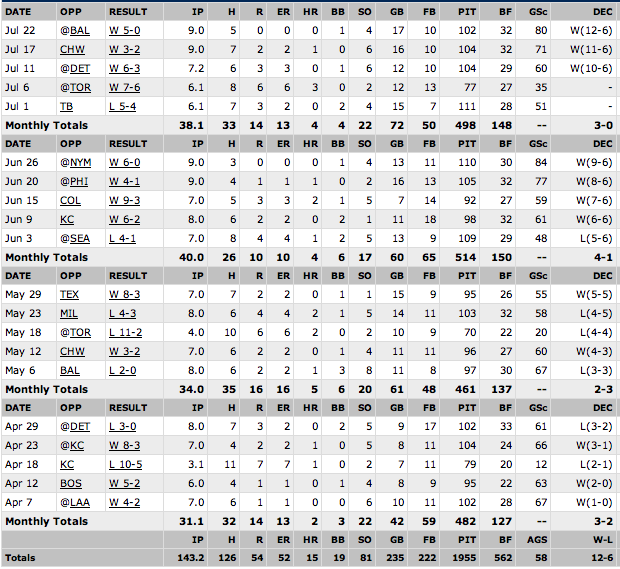
Oops, that game log actually belongs to Carl Pavano. Yes, the pitcher no Yankees fan likes. Boston fans adore him because New Yorkers don't, as well as the fact that he brought them Pedro Martinez in a trade with the Montreal Expos in November 1997. I'm sure the Minnesota faithful is appreciative, too. You see, the 34-year-old righthander is 12-6 with a 3.26 ERA this year. After last night's victory, he has now won his last seven decisions, including four complete games and two shutouts.
Pavano leads the American League in shutouts (2) and ranks second in wins (12), complete games (5), BB/9 (1.19), and WHIP (1.01); third in innings (143.2); fifth in K/BB (4.26); 11th in W-L % (.667); and 12th in ERA (3.26).
How is Pavano putting up such heady stats? In a nutshell, there are two major reasons for his success.
1. Pavano ranks first in the AL in O-Swing% (the percentage of pitches a batter swings at outside the strike zone) at 36.1%. The league average is 28.8%.
2. Pavano ranks second in F-Strike% (first pitch strike percentage) at 68.3%. The league average is 58.8%.
The comparison to Lee is appropriate in that the 2008 AL Cy Young Award winner is fourth in O-Swing% (33.7%) and first in F-Strike% (70.2%).
The bottom line is that pitchers who get ahead in the count, widen the strike zone, and get batters to swing at their pitches are usually successful. In addition to Pavano and Lee, there are three pitchers who also rank in the top 10 in MLB in both of these categories: Scott Baker (35.3%, 65.4%), Dan Haren (36.3%, 66.9%), and Phil Hughes (33.6%, 65.7%). Roy Halladay (32.0%, 67.9%) and Ricky Nolasco (32.7%, 64.8%) are among the top 15 in O-Swing% and F-Strike%.
I would take those seven pitchers on my team. Don't be misled by Baker's 5.15 ERA. His Fielding Independent Pitching ERA is 4.00. The difference between his ERA and FIP is 1.15, which is the fourth-highest in the majors. Only Brandon Morrow (1.40), Francisco Liriano (1.36), and Justin Masterson (1.27) have bigger deltas. Unlike Baker (whose success is based on his strong K and BB rates), the latter three are benefiting from their low HR/9 rates with Liriano at a league-leading 0.15 (2 HR in 122 IP).
As it relates to Pavano, his .255 BABIP and 74.4% LOB are significantly better than his career averages of .306 and 69.9%, respectively, which may suggest that he could be prone for reversion to the mean over the balance of the season. However, I am not nearly as pessimistic as ZIPS (Szymborski Projection System), which forecasts Pavano to go 3-5 with a 4.88 ERA from here on out.
With outstanding control and three plus pitches (fastball, slider, and changeup) in terms of run value, Pavano should continue to have his way with hitters, albeit at a pace perhaps closer to his FIP (3.85) or xFIP (3.88) than his ERA (3.26). Working on a one-year deal for $7 million, the 12-year veteran has been a bargain for the Minnesota Twins.
A free agent at the end of the year, don't be surprised if Pavano signs a new contract that pays him more per season than the one he inked with the Yankees (4/$39.95M) in December 2004. Just don't look for him to return to the Big Apple unless, of course, it's to face the Bronx Bombers in the postseason in October.
[Thanks to ESPN for the game log and Fangraphs for the stats and rankings.]
| Baseball Beat | July 14, 2010 |
Home Run Derby
The Home Run Derby is a made-for-TV event, one that can be enjoyed from your couch at home as much or more than almost any seat in the stadium. Nonetheless, when you get the opportunity to take two out-of-town nephews to your home ballpark to witness the festivities in person, you jump at the chance. After all, life is about relationships and shared experiences create more memories than flying solo at home.
My older brother and I took our younger brother's sons (Casey and Troy) to the Home Run Derby on Monday. Forty years ago, Tom's high school baseball team won the California Interscholastic Federation Southern Section 4-A (highest division) championship at what was then known as Anaheim Stadium. A lefthander, Tom (far left) was the winning pitcher in the final game. He was also First Team All-CIF with a 10-0 record and an ERA of 1.53. For perspective, Fred Lynn (El Monte High School) was on the second team. In the preliminary game that same evening, George Brett and Scott McGregor of El Segundo HS lost to Lompoc 8-5.
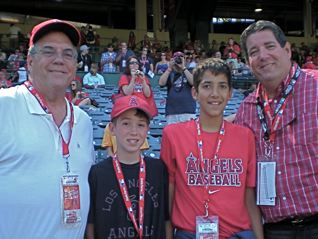
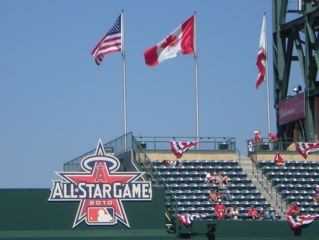
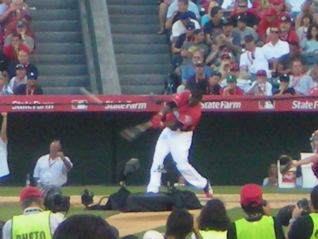
I snapped a photo of David Ortiz (bottom right) slamming one of his 32 home runs. Note the ball leaving the bat. Not bad on a less than high-speed camera without much of a telephoto lens from the field boxes well down the left-field line. Big Papi beat Hanley Ramirez, 11-5, in the final round. In his fourth appearance in the derby, Ortiz jacked the third-most number of homers in the event's history, trailing only Bobby Abreu (41 in 2005) and Josh Hamilton (35, 2008). Unfortunately, nobody "Hit It Here" (bottom left), a sign placed more than 500 feet from home plate, and won $1,000,000.
My favorite photo of the evening was a rather simple one but it captured the imaginations of a 15-year-old boy watching the flight of a long home run. Accompanied by their parents, Troy and Casey returned to Angel Stadium for the All-Star Game the following evening and Heath Bell tossed the latter a ball during batting practice.
Casey, 10, threw out the first ball at a Cubs-Padres spring training game in March. He made the PONY League (Mustang Division) All-Star Team in Phoenix.
Photographs and memories.
| Baseball Beat | July 12, 2010 |
Yesterday and the Futures
I spent the weekend before the All-Star Game attending two baseball games. On Saturday, Jon Weisman hosted Dave Cameron, his brother Jeremy, Bryan Smith, and me at Dodger Stadium for the Dodgers-Cubs game. On Sunday, my son Joe and I met up with Dave and Bryan at the All-Star Futures Game at Angel Stadium. We skipped the All-Star Legends & Celebrity Softball Game yesterday evening, choosing to eat dinner at Roy's Hawaiian Fusion Cuisine, one of many restaurants at the Shops at Anaheim GardenWalk. All of us enjoyed our fish but there was a Trout that made an even greater impression earlier in the day.
The United States beat the World team, 9-1, in the 12th annual Futures Game. It was the most lopsided score on record, outdoing the World's 7-0 whitewashing in the inaugural game in Boston in 1999. The contest was a mismatch from the moment the 25-man rosters, selected by Major League Baseball Scouting Bureau, MLB.com, Baseball America, and the 30 clubs, were released late last month. The current format, pitting the U.S. vs. the World, has run its useful course and many, including Bryan, would like to change the competition to the American League vs. the National League.
While Hank Conger (Angels, Salt Lake, Triple-A), a first-round draft pick out of Huntington Beach High School (Orange County, CA) in 2006 who Joe referred to as a switch-hitting Mike Napoli, slugged a three-run home run in the fifth inning to earn Most Valuable Player honors, future teammate Mike Trout stole the show in the eyes of the scouts yesterday afternoon. Trout, who won't turn 19 until next month, was not only the youngest player on the field but the most impressive. The 25th overall pick in the 2009 draft, who put on a display before the game in batting practice when he jacked a ball off the center field wall on his first swing and proceeded to launch several more over the fence, hit the ball hard all four times to the plate, resulting in two infield errors, an infield single, and a double that highlighted his speed and hustle. The slowest fastball he faced was 93 and his line-drive double was on a 98-mph heater thrown by 6-foot-3 righthander Jeurys Familia (Mets, St. Lucie, High Class A).
Trout entered the game in the bottom of the first inning as a pinch runner for über prospect Domonic Brown (Phillies, Lehigh Valley, Triple-A), who reached base on an infield single, advanced to second on one of four hits by Eric Hosmer (Royals, Wilmington, High Class A), and took third on a wild pitch by losing pitcher Simon Castro (Padres, San Antonio, Double-A). Brown (.326/.391/.608 with 19 HR in 330 combined plate appearances at "AA" and "AAA"), who felt tightness in his right hamstring when running down the first-base line and was nearly picked off first and second, left the game for "precautionary" measures and expects to play when minor league action resumes on Thursday.
Interestingly, Brown and Trout were ranked 1 and 2 in Baseball America's Top 25 Midseason Prospects last week.
1. Domonic Brown, of, Phillies (Triple-A Lehigh Valley): The power has come through as the Phillies predicted, as Brown has started to fill out at age 22 and surpassed his career home runs total in his first 65 games at Double-A Reading. Then he went out and hit four in his first 13 games after a promotion to Triple-A Lehigh Valley. He ranks 10th in the minors in OPS, and he's doing it with big tools at upper levels. His still-raw defensive skills (his defensive tools are fine) are his only major flaw.2. Mike Trout, of, Angels (Low Class A Cedar Rapids): Trout hasn't done much wrong. He ranked first in the minors in runs (74), second in batting (.362) and stolen bases (42), was tied for fourth in on-base percentage (.447) and ranks first in scouts' enthusiasm. Trout hasn't committed an error, plays hard and seems to be thriving rather than shrinking from the grind.
Brown (6-5, 200) and Trout (6-1, 217) have different body types. The lanky Brown reminds me of Darryl Strawberry while the thick Trout has drawn comparisons to NFL linebacker Brian Urlacher for his aggressiveness and physicality. Amazingly, Trout has legitimate 80 speed (on the 20-80 scale) and was clocked at 3.9 to first on his infield single, a time that Keith Law tweeted was the "fastest I've ever gotten from a right handed hitter." His plus-plus speed was also evident in center field as he recorded five putouts, including a nice running catch.
I first saw Trout in the 2008 Area Code Games, highlighting his name in yellow in my program. He generated the second highest SPARQ Rating at the event, with a 83.07 (3.64 30-yard dash, 4.47 shuttle, 60-foot power ball toss and 33.5 vertical jump). I was pleased when the Angels selected him in the draft last year as the club was in need of outfielders and athleticism. Although Trout, who was promoted to High Class A Rancho Cucamonga in the California League over the weekend, has not played above Low Class A yet, there has been talk that the teenager could reach the majors next year.
Trout has a big supporter in Angels manager Mike Scioscia:
He's not like one of these real gazelle center fielder types. This guy's a strong kid. He runs hard. He runs heavy, and he can fly. He drives the ball well to right field. He's got the makeup; he's focused. He's just a player with as much upside as any player that has put on the uniform.
Given Torii Hunter's presence in center field, there is no need to rush Trout. However, rest assured that the Angels will call him up to the big leagues when he is ready, perhaps moving Hunter to right field and Bobby Abreu to left field or designated hitter to make room for the youngster if indeed he returns to Angel Stadium sometime next year.
It's just too bad the Angels still don't have Tim Salmon to play alongside Trout.
| Baseball Beat | June 30, 2010 |
Lefties in the News
No, today's article is not about President Obama or Elena Kagan. Instead, the title is meant to honor two southpaws who made news this week.
They just mentioned this on Baseball Tonight, which I thought would be of interest to you:Lee also allowed two runs in the ninth, but calmly worked out of trouble. He kept his cool earlier in the day, too, when his subway sped through the stop for Yankee Stadium. Lee handled it like a local. He got off and switched to a downtown D train going the other way. No big deal.
"I'm not afraid to take the subway," Lee said.
Lee has made a habit of bypassing the team bus in favor of alternative transportation to Yankee Stadium. Taking a taxi to Game One of the 2009 World Series at rush hour, Lee got stuck in traffic and asked the driver to take him to the nearest subway station. He took the local 6 train and changed to the express 4 train, exited at the 161st Ave./Yankee Stadium stop, and walked down the stairs and across the street to the ballpark, just as he did two years ago.
The lefthander is 43-19 with a 2.81 ERA (151 ERA+) and a 7.0 K/9, 1.3 BB/9, and 0.6 HR/9 since the beginning of his 2008 Cy Young Award campaign. A free agent at the end of this season, Lee is likely to be traded to a contender within the next month. The 31-year-old veteran could give the acquiring team a big boost down the stretch and into October as he was 4-0 with a 1.56 ERA covering five starts and 40.1 IP in the postseason last year.
Here are the career leaders:
1 Jamie Moyer 506 2 Robin Roberts 505 3 Ferguson Jenkins 484 4 Phil Niekro 482 5 Don Sutton 472 6 Frank Tanana 448 7 Warren Spahn 434 8 Bert Blyleven 430 9 Steve Carlton 414 10 Randy Johnson 411
The top three all pitched for the Phillies, as did Steve Carlton, who ranks ninth. Six of the ten pitchers are in the Hall of Fame and Bert Blyleven should make it seven in 2011 and Randy Johnson eight when his name appears on the ballot five years from now, leaving Moyer and Frank Tanana as the only non-HOFers to comprise this list. Moyer and Tanana are distinguished for much more than their proclivity of giving up long balls. They have combined for 507 wins and 5,166 strikeouts over 8,243 innings with an ERA+ of 105 and 106, respectively. For more on Moyer, check out the tribute Patrick Sullivan wrote last month.
As Lee Sinins noted in his ATM Report on Monday, "Even though they are in the top 10 for most HR allowed, Spahn, Blyleven, Carlton and Johnson all allowed less than their league averages. Moyer is only tied for 36th in most HR above the league average."
HOMERUNS DIFF PLAYER LEAGUE 1 Ferguson Jenkins -111 484 373 T2 Pedro Ramos -83 315 232 T2 Catfish Hunter -83 374 291 4 Scott Sanderson -77 297 220 5 Jose Lima -76 267 191 6 Denny McLain -75 242 167 7 Brian Anderson -74 264 190 8 Tom Browning -73 236 163 9 Eric Milton -71 267 196 10 George Blaeholder -62 173 111 ... T36 Jamie Moyer -43 506 463 T36 Jim Deshaies -43 179 136 T36 Pedro Astacio -43 291 248
Funny how some writers will use Blyleven's home runs against him when casting their Hall of Fame votes (despite the fact that he gave up fewer than the league average), yet Catfish Hunter and Fergie Jenkins were elected in 1987 and 1991, respectively, in their third year on the ballot.
In addition, Jay Jaffe has everything you would ever want to know about pitchers giving up home runs in a Baseball Prospectus article (subscription required) he titled Jacktastic!
| Baseball Beat | June 23, 2010 |
My Trip to Chicago and Wrigley Field in Words, Links, and Photos
I traveled to Chicago on Wednesday for business and attended the Angels-Cubs games on Friday and Saturday at Wrigley Field. It was my first trip to the Windy City in five years. I returned home on Sunday and watched the final round of the U.S. Open before celebrating Father's Day dinner with my family.
Here were the highlights of my trip:
Wednesday
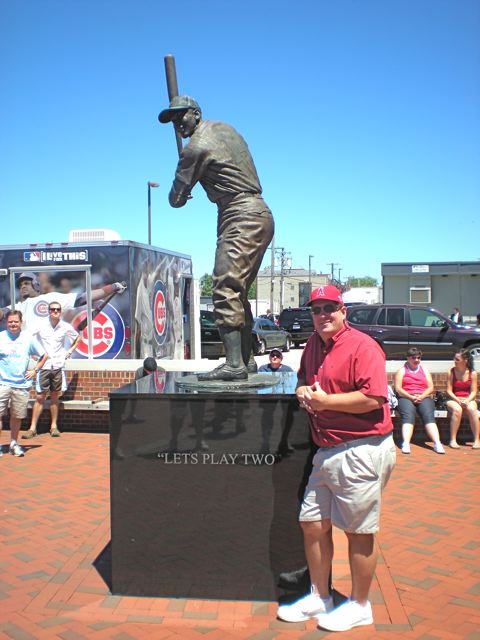 Thursday
Friday
The Angels beat the Cubs, 7-6, in a game that wasn't really as close as the final score suggests. After George Wendt sang "Take Me Out to the Ballgame," the clouds and umbrellas opened up, and the majority of Chicago fans had left, the Cubs rallied for four runs in the bottom of the ninth on a pair of home runs by Tyler Colvin and Derrek Lee, but it was too little, too late. Although the temperatures hovered in the high-80s early on, a thunderstorm struck immediately after the game and the grounds crew rolled out the tarp before the Angels could get off the field. Steven drove us to his home afterwards and his wife Patti outdid herself in preparing a delicious dinner for all of us. Never underestimate the value of friendships that persist for decades despite geographical obstacles.
Saturday
Howie Kendrick jump started the Halos' offense with a lead-off home run and Jered Weaver combined with Scot Shields to shut out the Cubs, 12-0. Weaver, who leads the American League in strikeouts (107), K/9 (10.17), and K/BB ratio (4.65), is making a strong case for earning the starting nod for the All-Star game in Anaheim next month. That said, there is always room for improvement. Jered tops the league in pitches per plate appearance (P/PA), which has contributed to the fact that he has only worked into the eighth inning twice this season, and has allowed the seventh-highest number of stolen bases (14 SB and only 3 CS) in the junior circuit.
Weaver has confounded skeptics by dominating LHB to the tune of .210/.249/.280 (with 2 HR, 10 BB, and 51 SO in 197 PA) this season. His opponent OPS vs. LHB ranks fourth in the majors among RHP. His big turn and length, outstanding command, and curve ball/slider combo "makes his fastball play up a bit" according to Mike Scioscia. Weaver's improved two-seamer now gives him five quality pitches and his ability to induce popups year-in and year-out adds to his effectiveness.
Sunday
| Baseball Beat | June 14, 2010 |
A Smorgasbord Monday
News, notes, and stats from around the major leagues while doing my best to avoid the buzzing sound of the vuvuzelas at the World Cup games over the weekend.
Let's take a look at Kemp's stats BC (before Colletti) and AC (after Colletti):
AVG OBP SLG OPS
BC .316 .379 .645 1.024
AC .243 .304 .395 .700
Coincidence? Small sample sizes? Hurt feelings? Or a combination? You pick your poison.
While Kemp didn't deserve the Gold Glove he "won" last year, the center fielder wasn't nearly as bad as he has been this campaign. According to Ultimate Zone Rating (UZR), Kemp ranks last among all CF with -15.7, which works out to -42.3 per 150 games (or about four losses more than an average fielder at that position). His baserunning has also been dismal with 9 SB, 9 CS, 2 PO (pick-offs), and 3 other outs on the bases.
Kemp will almost assuredly be moved to a corner outfield position after Manny Ramirez exits Los Angeles, but it is also possible that he could be traded during the offseason.
For his part, the 36-year-old Blake is hitting .258/.333/.442 while making $6 million (compared to the pro rated minimum that Santana will earn this year and not much more than the $500,000 he will be paid over each of the next three seasons — unless, of course, he agrees to a longer-term deal that buys out a year to two of free agency at a discounted price).
The most remarkable stat of all might be that the injury-plagued Glaus leads the league in games played with 64. With each passing day, he looks more and more like one of the best free-agent signings last offseason. He inked a contract for $1.75 million with bonuses that equal an additional $2.25 million for a maximum payout of $4M. Although Glaus ranks as the worst-fielding first baseman in the majors according to UZR, he has been worth over $5 million thus far using Fangraphs' Wins Above Replacement (WAR) converted to a dollar scale based on what a player would make in free agency.
Gregerson, who combines a 91-mph fastball with one of the best sliders in baseball (an MLB-best 10.4 runs above average among RP), may be the best-kept secret in the game and one of the main reasons why the Padres sit atop the NL West with a 37-26 record.
While Rodriguez's major league stats are in stark contrast to his minor league results (5.03 ERA, 1.55 WHIP, 6.1 K/9, and 4.4 BB/9 in 499 IP), he has pitched much better since being converted to a full-time reliever in 2008. Nonetheless, his performance in the majors has defied all reasonable expectations. Small sample size for sure but take a look at his stuff for yourself if and when you get the chance. He throws a heavy 94-95 mph fastball, an 89-mph cutter, and an occasional curveball that has generated a lot of swinging strikes (18.9%) and 11 groundballs out of the 15 batted balls in play.
| Baseball Beat | June 07, 2010 |
The 2010 MLB First-Year Player Draft Has Arrived
This has been and continues to be a big week for sports fans. The French Open. The Memorial Tournament. The Stanley Cup Finals. The NBA Championship. The NCAA Baseball Regionals. The MLB First-Year Player Draft. And the Major League debuts for Stephen Strasburg and Mike Stanton.
The main focus today is on the draft, which starts at 7 p.m. ET. It will be televised live by MLB Network and MLB.com.
Bryce Harper, the 17-year-old catcher who we highlighted two years ago, is expected to be taken by the Washington Nationals with the No. 1 pick. He hit .442/.524/.986 with 29 HR in 254 plate appearances with a wood bat for the College of Southern Nevada this year. Look for the Nats to move Harper's power bat and strong arm to right field where he can advance through the minor league system more rapidly than at catcher. Harper, who was ejected in his final junior college game last week, is lacking in maturity but not talent.
Once Washington pops for Harper, the next question will be the amount of the signing bonus. Harper is advised by Scott Boras, who will try to persuade the Nats ownership into a Strasburg-type bonus. Look for the Nats to shell out at least $10 million but not $15 million despite threats along the way of Harper playing another year at CSN and re-entering the draft in 2011.
The Los Angeles Angels, who have three first-round selections (18th, 29th and 30th overall), possess five of the first 40 picks overall. The Houston Astros (8th and 19th), the Texas Rangers (15th and 22nd), and the Tampa Bay Rays (17th and 31st) also hold multiple first-round choices.
Here are the projections of Baseball America (Jim Callis), ESPN (Keith Law), and Baseball Prospectus (Kevin Goldstein). Callis' predictions were updated within the past couple hours while Law's and Goldstein's were made a couple days ago and are subject to last-minute revisions.
| Num | Baseball America | ESPN | Baseball Prospectus | |
|---|---|---|---|---|
| 1 | Nationals | Bryce Harper | Bryce Harper | Bryce Harper |
| 2 | Pirates | James Taillon | Jameson Taillon | Manny Machado |
| 3 | Orioles | Manny Machado | Manny Machado | Jameson Taillon |
| 4 | Royals | Chris Sale | Chris Sale | Chris Sale |
| 5 | Indians | Drew Pomeranz | Drew Pomeranz | Drew Pomeranz |
| 6 | D-backs | Barret Loux | Matt Harvey | Matt Harvey |
| 7 | Mets | Zack Cox | Zack Cox | Zack Cox |
| 8 | Astros | Josh Sale | Josh Sale | Michael Choice |
| 9 | Padres | Karsten Whitson | Karsten Whitson | Nick Castellanos |
| 10 | Athletics | Michael Choice | Michael Choice | Christian Colon |
| 11 | Blue Jays | Christian Colon | Christian Colon | Josh Sale |
| 12 | Reds | Brandon Workman | Yasmani Grandal | Kolbrin Vitek |
| 13 | White Sox | Asher Wojciechowski | Asher Wojciechowski | Deck McGuire |
| 14 | Brewers | Matt Harvey | Deck McGuire | Anthony Ranaudo |
| 15 | Rangers | Jake Skole | Delino DeShields | Asher Wojciechoswki |
| 16 | Cubs | Justin O’Conner | Justin O’Conner | Alex Wimmers |
| 17 | Rays | Reggie Golden | Bryce Brentz | Austin Wilson |
| 18 | Angels | Peter Tago | Dylan Covey | Stetson Allie |
| 19 | Astros | Delino DeShields | Kolbrin Vitek | Karson Whitson |
| 20 | Red Sox | Kolbrin Vitek | Anthony Ranaudo | Yasmani Grandal |
| 21 | Twins | Alex Wimmers | Alex Wimmers | Mike Kvasnicka |
| 22 | Rangers | Bryce Brentz | Brandon Workman | Justin O’Conner |
| 23 | Marlins | Luke Jackson | Barret Loux | A.J. Cole |
| 24 | Giants | Yorky Cabrera | Nick Castellanos | Bryce Brentz |
| 25 | Cardinals | Yasmani Grandal | Stetson Allie | Brett Eibner |
| 26 | Rockies | Kyle Parker | Kevin Gausman | Dylan Covey |
| 27 | Phillies | Jesse Biddle | Christian Yelich | Kaleb Cowart |
| 28 | Dodgers | Drew Vettleson | Drew Vettleson | Brandon Workman |
| 29 | Angels | Stetson Allie | Peter Tago | Ryne Stanek |
| 30 | Angels | Dylan Covey | Tony Wolters | Sammy Solis |
| 31 | Rays | Tony Wolters | Derek Dietrich | Kelllin Deglan |
| 32 | Yankees | Christian Yelich | Gary Brown | Gary Brown |
We will have more analysis of the draft in the days to come. In the meantime, enjoy the festivities at MLB Network and MLB.com this evening. The draft will continue on Tuesday and conclude Wednesday.
***
Updates
1. Harper was indeed announced as an outfielder. ETA: June 2013 as a 20-year RF along the lines of Jason Heyward and Mike Stanton.
2. Kansas City pulls the first surprise and nabs Christian Colon, a shortstop out of Cal State Fullerton, with the fourth overall pick. Colon (.352/.439/.621 with 16 HR and 32 BB/17 SO) can handle the bat but lacks the range to play shortstop at the highest level. In a game against Long Beach State last month (in which he went 3-for-6 with a HR at Blair Field), I clocked him to first base at 4.64. While it may not have been an all-out sprint to first, I would be surprised if he can get down the line under 4.50. Look for Colon, who broke his leg last summer, to play SS in the minors but his ticket to the big leagues may be as an offensive-oriented second baseman.
3. While I've never seen Delino DeShields Jr. play in person, I'm skeptical that he merits the eighth overall selection of the draft. But nothing Houston does surprises me. Taken as a center fielder, his speed may rank as a legitimate 80 on the 20-80 scouting scale. However, with a below-average arm, DeShields may be better suited for left field or second base. At 5-foot-9 and 188 pounds, it will be interesting to see if he can hit for more power than his father (80 HR in 6652 plate appearances), who was leaner but stood four inches taller.
4. The only way to explain the Hayden Simpson pick is that the Cubs either have insight that nobody else had or are looking to save money with their first-round selection. Simpson (6-0, 175) is a smallish righthander from Southern Arkansas University (Division II). He posted a 13-1 record with a 1.81 ERA while striking out 131 and walking 35 in 99.1 innings. The school's website reported that "Simpson was listed by various sources as expected to be taken anywhere from the second through eighth rounds. None may have been more surprised than Simpson."
“I’m just blown away,” Simpson stated. “I had no idea I’d be picked then. A bunch of friends came over just to watch the draft. I was waiting for tomorrow’s rounds.”
5. The Angels drafted three high school players from Georgia with their first round picks. It will take a lot of money to sign this trio. Kaleb Cowart (3B/RHP, Cook County HS) has signed a letter of intent to play baseball at Florida State. Cam Bedrosian (RHP, East Coweta HS), the son of the 1987 NL Cy Young Award winner, has committed to LSU. Chevez "Chevy" Clarke (CF, Marietta HS) has signed to play at Georgia Tech.
| Baseball Beat | June 05, 2010 |
John Wooden, 1910-2010
John Wooden died Friday night of natural causes at Ronald Reagan UCLA Medical Center in Los Angeles. He would have turned 100 on October 14.
While Wooden is generally recognized as the greatest basketball coach ever, he was much more than a coach. He transcended the sporting world and was nearly as legendary for serving as a role model and teaching his midwestern values as the 10 national championships his UCLA teams won in 12 years (including seven straight from 1967 to 1973). Wooden amassed a record of 885-203 (.813) as a college coach, winning 88 consecutive games and 38 NCAA tournament games in a row.
Wooden is one of only three members elected to the Basketball Hall of Fame as a coach and as a player. (The other two are Bill Sharman and Lenny Wilkens.) He went to Purdue, winning All-America honors three times and leading the Boilermakers to the 1932 national championship. Wooden coached at the high school level and at Indiana State before being hired by UCLA in 1948, where he remained until retiring after winning his last championship in 1975.
 Although I went to USC, Wooden's influence was so far reaching that I grew up rooting for UCLA during the 1960s and early 1970s. My first college basketball memories were watching Walt Hazzard, Gail Goodrich, and Keith Erickson lead the Bruins to an undefeated season and the school's first NCAA basketball title in 1964. I was hooked and followed Wooden's teams, which included All-Americans Lew Alcindor, Mike Warren, Lucius Allen, Sidney Wicks, Bill Walton, Henry Bibby, Keith Wilkes, and Dave Meyers, closely thereafter.
UCLA only lost 19 games spanning a dozen years from Wooden's first championship in 1964 to his last championship in 1975. These losses were so infrequent that many of them (such as the loss to Houston in the first nationally televised college basketball game in 1968, USC's dramatic upset using a slow-down offense in 1969 at Pauley Pavilion, Notre Dame ending UCLA's 88-game winning streak in 1974, and North Carolina State defeating the Bruins in the semi-finals in 1974) stand out in my mind four decades later. But I'll never forget the big wins, including many net-cutting ceremonies that are indelibly etched in my memory.
Wooden was active in retirement, writing books, giving speeches, and attending as many UCLA home games as possible. Nell, his wife of 53 years, died in 1985. He was a devoted father, grandfather, and husband, writing love letters to his deceased wife right up until the very end. A religious man who read the Bible daily, Wooden didn't smoke, drink, or curse (although he was known to berate referees using words like "dadburn it" or "goodness gracious sakes alive"). He admired his father Joshua, regularly quoting his "two sets of three: (1) never lie, never cheat, never steal and (2) don't whine, don't complain, don't make excuses."
Upon graduation from grammar school, his dad gave him the following Seven-Point Creed:
- Be true to yourself.
- Make each day your masterpiece.
- Help others.
- Drink deeply from good books, especially the Bible.
- Make friendship a fine art.
- Build a shelter against a rainy day.
- Pray for guidance and give thanks for your blessings every day.
Wooden later developed his "Pyramid of Success," consisting of philosophical building blocks for winning at basketball and in life. I had the privilege of attending a breakfast featuring Wooden as the keynote speaker at the Pyramid on the campus of Long Beach State University about 15 years ago. Coast Federal Bank, the sponsor of the event, handed out "John Wooden's Pyramid of Success" (shown above), which he generously autographed afterwards. In his mid-80s, Wooden spoke for nearly an hour without the benefit of a TelePrompter or any notes or cards. He explained his Pyramid, shared his wisdom, and recited many poems off the top of his head. The morning was educational, inspirational, and unforgettable.

Coach taught his players fundamentals, teamwork, and sportsmanship. He was more pleased by his players’ success in life than on the basketball court. Almost all of his players graduated, with dozens becoming lawyers, teachers, doctors, or ministers.
Wooden impressed upon the rest many lessons of life, including some of my favorite Wooden maxims (from Wooden: A Lifetime of Observations and Reflections On and Off the Court):
- The best way to improve the team is to improve ourself.
- Big things are accomplished only through the perfection of minor details.
- Discipline yourself and others won't need to.
- I will get ready and then, perhaps, my chance will come.
- If you don not have the time to do it right, when will you find the time to do it over?
- The smallest good deed is better than the best intention.
- The man who is afraid to risk failure seldom has to face success.
- Time spent getting even would be better spent trying to get ahead.
- It is what you learn after you know it all that counts.
- Goals achieved with little effort are seldom worthwhile or lasting.
- Tell the truth. That way you don't have to remember a story.
- Don't let making a living prevent you from making a life.
- Although there is no progress without change, not all change is progress.
- Do not permit what you cannot do to interfere with what you can do.
- Be more concerned with your character than your reputation. Character is what you really are; reputation is what you are perceived to be.
- Much can be accomplished by teamwork when no one is concerned about who gets credit.
- Don't permit fear of failure to prevent effort. We are all imperfect and will fail on occasions, but fear of failure is the greatest failure of all.
- The time to make friends is before you need them.
- Nothing can give you greater joy than doing something for another.
- Do not mistake activity for achievement.
- You can do more good by being good than any other way.
- Treat all people with dignity and respect.
- Acquire peace of mind by making the effort to become the best of which you are capable.
Oh... and Wooden's favorite sport? Baseball. He coached baseball in college and was offered the job to manage the Pittsburgh Pirates in the 1960s.
Farewell, Mr. Wooden. You will be missed but never forgotten.
[There are videos and links to numerous articles at ESPN Los Angeles.]
| Baseball Beat | June 02, 2010 |
They Don't Make 'Em Like This Anymore
Happy 80th Birthday to Bob Lillis. My favorite player growing up was signed by Brooklyn in 1951 and played for the Los Angeles Dodgers, St. Louis Cardinals, and Houston Colt .45s/Astros. He was the expansion team's MVP in its inaugural season in 1962.
Born in Altadena, California, during the first year of the Great Depression, Robert Perry Lillis attended Pasadena High School, Pasadena City College, and the University of Southern California. He was on PCC's national championship team in 1949 and was nominated for the College World Series Legends Team based on his performance for USC in the 1951 tournament. Lillis made his MLB debut with his hometown Dodgers in August 1958 during the club's first year in Los Angeles. He wore jersey No. 30 a year before Maury Wills was called up to the big leagues. Both shortstops were previously buried in the team's minor league system behind future Hall of Famer Pee Wee Reese.
Lillis was traded to the Redbirds in 1961 and was drafted by the Colt .45s as the fifth pick in the 1961 expansion draft. He played ten years in the majors and was a scout, coach, or manager of the Astros from 1967-1985 and a bench coach with the San Francisco Giants from 1986-1996.
Even though Lillis hit only .236/.270/.277 with just three home runs in nearly 2,500 plate appearances, a young kid could not have had a better favorite player. He was the friendliest athlete I met, sending me autographed photos with hand-written inscriptions three times.
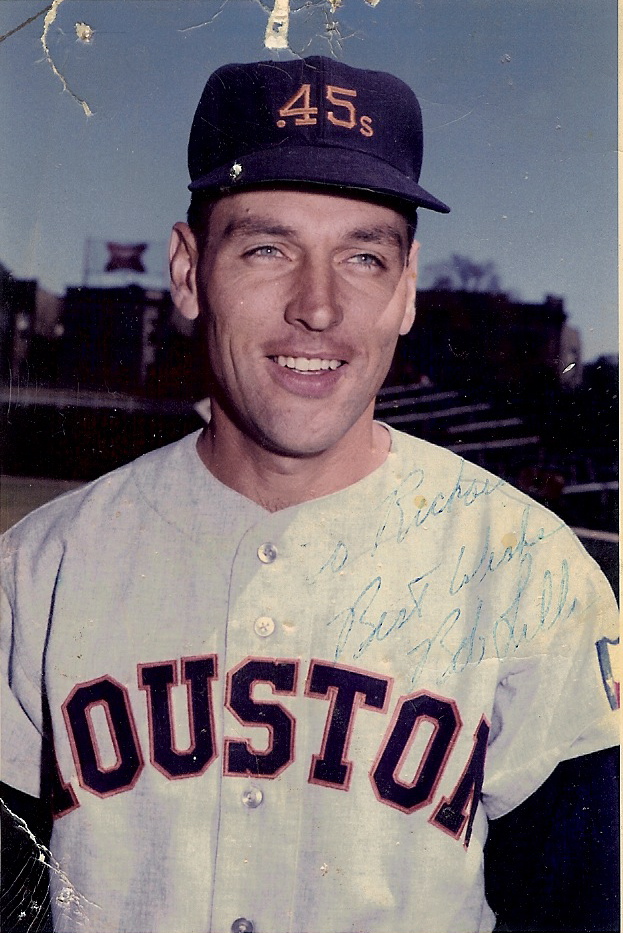
The first photo that Lillis sent to me was almost 49 years ago to the day when he thanked me for sending him a card on his 31st birthday. I was a month short of my 6th birthday. On the verso, he wrote "Dear Richard, That was a very nice picture you sent me. Thank you for the thoughtful birthday card. Sincerely, Bob Lillis."
Over the years, I lost contact with the player I called "Bobby" but he's always occupied a special place in my heart and the photos have been a treasured part of my collection now for nearly 50 years.
Happy Birthday, Bobby. If you happen to read this, please feel free to contact me via email. I would enjoy hearing from you. Thank you.
| Baseball Beat | May 18, 2010 |
The Most Under Appreciated Batted Ball Type
Call them pop-ups, pop flies, or infield flies. While these batted balls are one and the same, they are not outfield fly balls despite getting lumped together by many baseball sites and analysts. Like Rodney Dangerfield, they get no respect.
Infield fly balls are converted into outs about 99% of the time. In other words, only 1% of all pop-ups become hits. By comparison, roughly 75% of all line drives, 25% of ground balls, and 20% of fly balls result in hits (including home runs). Line drives also have the highest run value, followed by fly balls and ground balls.
If pop-ups are routinely turned into outs with no advancement by base runners, then they should be treated more like strikeouts for the purpose of performance analysis than anything else. Unlike line drives, fly balls and ground balls, pop-ups and strikeouts have no (or negative) run value.
When it comes to breaking out batted balls, I favor Baseball Prospectus over Fangraphs. My preference is not due to the source (BP uses Gameday/MLB Advanced Media and FG uses Baseball Info Solutions) but rather that the former categorizes pop-ups as a separate batted ball event (POP) whereas the latter includes infield fly balls (IFFB) as a subset of fly balls (FB). (You can read Colin Wyers' article, David Appelman's rebuttal, and a thorough discussion at The Book if you are interested in how this data is collected.)
Using BP's custom statistic reports, let's take a look at the four different batted ball types as a percentage of all batted balls for 2009 and 2010.

As shown, pop-ups account for approximately 7%-8% of all batted balls. While this rate is a fraction of the other batted ball events, it is worth knowing because pop flies are almost always converted into outs.
Batted balls represent about 72% of all plate appearances with walks (9%), hit by pitches (1%), and strikeouts (18%) accounting for the balance.

While there is a lot of interesting information in the table above, I would like to focus on POP and SO rates as it seems to me that these "automatic outs" could be combined when analyzing pitchers (and hitters, for that matter). Importantly, inducing infield flies appears to be a repeatable skill, much like strikeouts and ground balls, although perhaps not to the same extent.
As shown, SO and POP total about 23.5% of all plate appearances. All else equal, I believe that pitchers with higher POP rates — particularly as a percentage of non-SO and GB — should be preferred over those with lower rates. If nothing else, it is my hope that such pitchers may gain greater respect from those who overlook them now.
While I want to like SIERA for many of its innovations, I'm not convinced that "pop-ups represent a potential problem for the pitcher in the future."
Pop-up rate was allowed to negatively affect SIERA because it is a symptom of the pitcher throwing the ball that generates an upward trajectory, which could lead to an increase in home runs. A pitcher’s skills are throwing strikes, making hitters miss, and throwing with angles and spins such that the trajectory of the ball is downward when it hits the bat. A popup almost always represents an out, but it also represents a potential problem for the pitcher in the future.
Moving forward, here are the 2009 rankings of all pitchers with 100 or more innings with an above-average SO + POP rates (SO plus POP divided by PA).
| Num | NAME | PA | BB | HBP | SO | FB | GB | LD | POP | SO+POP |
|---|---|---|---|---|---|---|---|---|---|---|
| 1 | Rich Harden | 609 | 67 | 6 | 171 | 107 | 152 | 67 | 42 | 34.98% |
| 2 | Clayton Kershaw | 701 | 91 | 1 | 185 | 117 | 177 | 78 | 55 | 34.24% |
| 3 | Justin Verlander | 982 | 63 | 6 | 269 | 193 | 241 | 151 | 58 | 33.30% |
| 4 | Tim Lincecum | 905 | 68 | 6 | 261 | 145 | 283 | 109 | 35 | 32.71% |
| 5 | Jake Peavy | 410 | 34 | 1 | 110 | 74 | 120 | 48 | 23 | 32.44% |
| 6 | Zack Greinke | 915 | 51 | 4 | 242 | 195 | 255 | 116 | 53 | 32.24% |
| 7 | Javier Vazquez | 874 | 44 | 4 | 238 | 176 | 255 | 126 | 34 | 31.12% |
| 8 | Johan Santana | 701 | 46 | 3 | 146 | 144 | 193 | 99 | 71 | 30.96% |
| 9 | Jered Weaver | 882 | 66 | 4 | 174 | 220 | 202 | 118 | 99 | 30.95% |
| 10 | Scott Baker | 828 | 48 | 4 | 162 | 209 | 214 | 100 | 91 | 30.56% |
| 11 | Jon Lester | 843 | 64 | 3 | 225 | 142 | 269 | 108 | 32 | 30.49% |
| 12 | Jonathan Sanchez | 710 | 88 | 6 | 177 | 149 | 187 | 68 | 36 | 30.00% |
| 13 | Yovani Gallardo | 793 | 94 | 5 | 204 | 146 | 231 | 84 | 30 | 29.51% |
| 14 | Tommy Hanson | 522 | 46 | 5 | 116 | 105 | 146 | 68 | 37 | 29.31% |
| 15 | Ricky Nolasco | 785 | 44 | 2 | 195 | 176 | 218 | 116 | 35 | 29.30% |
| 16 | Dan Haren | 909 | 38 | 4 | 223 | 192 | 285 | 128 | 40 | 28.93% |
| 17 | Ted Lilly | 706 | 36 | 2 | 151 | 197 | 182 | 87 | 51 | 28.61% |
| 18 | Jorge De La Rosa | 799 | 83 | 9 | 193 | 137 | 239 | 103 | 35 | 28.54% |
| 19 | Cole Hamels | 814 | 43 | 5 | 168 | 157 | 261 | 117 | 63 | 28.38% |
| 20 | Matt Garza | 861 | 79 | 11 | 189 | 173 | 233 | 126 | 51 | 27.87% |
| 21 | Max Scherzer | 741 | 63 | 10 | 174 | 158 | 215 | 90 | 32 | 27.80% |
| 22 | Wandy Rodriguez | 849 | 63 | 5 | 193 | 176 | 276 | 96 | 41 | 27.56% |
| 23 | CC Sabathia | 938 | 67 | 9 | 197 | 178 | 296 | 132 | 59 | 27.29% |
| 24 | Josh Johnson | 855 | 58 | 6 | 191 | 126 | 307 | 125 | 42 | 27.25% |
| 25 | Chad Billingsley | 823 | 86 | 7 | 179 | 143 | 262 | 101 | 45 | 27.22% |
| 26 | Aaron Harang | 703 | 43 | 4 | 142 | 156 | 191 | 121 | 47 | 26.88% |
| 27 | Carlos Zambrano | 733 | 78 | 9 | 152 | 136 | 229 | 87 | 43 | 26.60% |
| 28 | Adam Wainwright | 970 | 66 | 3 | 212 | 150 | 360 | 136 | 45 | 26.49% |
| 29 | Roy Halladay | 963 | 35 | 5 | 208 | 163 | 366 | 141 | 45 | 26.27% |
| 30 | Joe Blanton | 837 | 59 | 8 | 163 | 181 | 257 | 116 | 56 | 26.16% |
| 31 | Josh Beckett | 883 | 55 | 7 | 199 | 165 | 299 | 126 | 32 | 26.16% |
| 32 | Felix Hernandez | 977 | 71 | 8 | 217 | 164 | 367 | 113 | 38 | 26.10% |
| 33 | Ubaldo Jimenez | 914 | 85 | 10 | 198 | 125 | 344 | 112 | 40 | 26.04% |
| 34 | Barry Zito | 818 | 81 | 8 | 154 | 163 | 235 | 120 | 59 | 26.04% |
| 35 | Francisco Liriano | 609 | 65 | 6 | 122 | 123 | 178 | 80 | 36 | 25.94% |
| 36 | Randy Wolf | 862 | 58 | 6 | 160 | 211 | 263 | 103 | 61 | 25.64% |
| 37 | Chad Gaudin | 664 | 76 | 8 | 139 | 132 | 199 | 79 | 31 | 25.60% |
| 38 | Edwin Jackson | 890 | 70 | 5 | 161 | 194 | 267 | 128 | 66 | 25.51% |
| 39 | A.J. Burnett | 896 | 97 | 10 | 195 | 184 | 259 | 117 | 33 | 25.45% |
| 40 | Scott Richmond | 610 | 59 | 117 | 144 | 151 | 101 | 38 | 25.41% | |
| 41 | Matt Cain | 886 | 73 | 3 | 171 | 211 | 263 | 112 | 53 | 25.28% |
| 42 | John Danks | 839 | 73 | 5 | 149 | 170 | 282 | 98 | 62 | 25.15% |
| 43 | Brett Anderson | 734 | 44 | 3 | 150 | 132 | 280 | 91 | 34 | 25.07% |
| 44 | Ryan Dempster | 842 | 65 | 6 | 172 | 171 | 296 | 95 | 39 | 25.06% |
| 45 | Scott Kazmir | 647 | 60 | 6 | 117 | 160 | 160 | 99 | 45 | 25.04% |
| 46 | Roy Oswalt | 757 | 42 | 8 | 138 | 149 | 265 | 104 | 51 | 24.97% |
| 47 | David Hernandez | 462 | 46 | 1 | 68 | 130 | 109 | 62 | 46 | 24.68% |
| 48 | J.A. Happ | 685 | 56 | 5 | 119 | 166 | 204 | 86 | 50 | 24.67% |
| 49 | Justin Masterson | 568 | 60 | 8 | 119 | 96 | 213 | 51 | 21 | 24.65% |
| 50 | Chris Carpenter | 750 | 38 | 7 | 144 | 110 | 319 | 93 | 39 | 24.40% |
| 51 | Gavin Floyd | 797 | 59 | 2 | 163 | 154 | 263 | 125 | 31 | 24.34% |
| 52 | Cliff Lee | 969 | 43 | 5 | 181 | 203 | 325 | 159 | 53 | 24.15% |
| 53 | Joba Chamberlain | 709 | 76 | 12 | 133 | 135 | 222 | 93 | 38 | 24.12% |
| 54 | Ervin Santana | 614 | 47 | 10 | 107 | 155 | 178 | 77 | 39 | 23.78% |
| 55 | Johnny Cueto | 740 | 61 | 14 | 132 | 158 | 230 | 103 | 43 | 23.65% |
Of these pitchers, Jered Weaver (15.5%), Scott Baker (14.8%), Tim Wakefield (14.1%), Johan Santana (14.0%), David Hernandez (13.3%), Clayton Kershaw (12.9%), Micah Owings (11.6%), Rich Harden (11.4%), David Huff (11.1%), and Todd Wellemeyer (11.1%) induced the greatest number of pop-ups as a percentage of batted balls. Weaver (11.2%), Baker (11.0%), Wakefield (10.8%), Santana (10.1%), Hernandez (10.0%), Huff (9.1%), Owings (8.7%), Wellemeyer (8.4%), Jamie Moyer (8.3%), and Jeremy Guthrie (8.0%) produced the most infield flies as a percentage of plate appearances.
Importantly, the rankings of pitchers by SO + POP and POP rates are not meant to identify the most valuable pitchers as neither takes into consideration BB, HBP, or HR rates. However, I wonder if Fielding Independent Pitching (FIP) couldn't be improved by combining SO and POP in its formula, which is typically defined as (HR*13+(BB+HBP-IBB)*3-K*2)/IP plus a league-specific factor (usually around 3.2) to create an equivalent ERA number.
The formula for FIP would need to be tinkered to account for the effect of POP as simply adding POP to SO wouldn't work. The multipliers or the league-specific factor would need to be changed to equate the newly constructed FIP with ERA.
Here are the top ten leaders for 2010 (among pitchers with 40 or more IP):
| Num | NAME | PA | BB | HBP | SO | FB | GB | LD | POP | SO+POP |
|---|---|---|---|---|---|---|---|---|---|---|
| 1 | Tim Lincecum | 218 | 15 | 69 | 28 | 70 | 26 | 10 | 36.24% | |
| 2 | Clayton Kershaw | 197 | 29 | 3 | 52 | 29 | 51 | 14 | 19 | 36.04% |
| 3 | Jered Weaver | 205 | 12 | 59 | 47 | 56 | 18 | 13 | 35.12% | |
| 4 | Colby Lewis | 212 | 21 | 3 | 54 | 43 | 50 | 22 | 20 | 34.91% |
| 5 | Tommy Hanson | 204 | 13 | 3 | 56 | 50 | 52 | 18 | 12 | 33.33% |
| 6 | Phil Hughes | 170 | 15 | 42 | 35 | 42 | 23 | 13 | 32.35% | |
| 7 | Brandon Morrow | 187 | 27 | 3 | 54 | 33 | 39 | 25 | 6 | 32.09% |
| 8 | Yovani Gallardo | 228 | 29 | 61 | 27 | 66 | 37 | 9 | 30.70% | |
| 9 | Justin Verlander | 203 | 20 | 1 | 46 | 33 | 60 | 28 | 16 | 30.54% |
| 10 | Jonathan Sanchez | 178 | 20 | 2 | 45 | 38 | 45 | 19 | 9 | 30.34% |
Tim Lincecum, Kershaw, Jered Weaver, and Justin Verlander are the only pitchers who ranked in the top ten in 2009 and 2010. Tommy Hanson (14th in 2009 and 5th in 2010), Yovani Gallardo (13th and 8th), and Jonathan Sanchez (12th and 10th) rank in the top 15 both years.
The greatest influence on SO + POP is clearly due to the former, yet the latter exerts value on the margin. The ability to induce pop-ups should not be dismissed when evaluating pitchers. Furthermore, it is my belief that certain pitchers have a knack for allowing fewer home runs as a percentage of outfield fly balls than the league average. Saying a pitcher is "lucky" because he has a lower HR/FB rate than the league average is simplistic, as is resorting to xFIP as a standalone measure (especially when a pitcher has a sufficiently large sample size to evaluate). By the same token, labeling a pitcher with a below-average BABIP "lucky" may not be totally accurate either.
The analytical community has come a long way on batted ball info. Paying more attention to pop-ups would be instructive in my opinion. Digging deeper into pitcher-batter results as they relate to pitch types, pitch sequencing, ball-strike counts, and bases occupied could lead us to solve some of the mysteries previously ascribed to luck and randomness. For example, pitchers with "plus" changeups may induce more than their fair share of pop-ups and lazy fly balls.
More than anything, I hope this article leads to additional discussion and research with respect to analyzing pitchers.
* * *
Update: Tom Tango sent me an email with a link to Tango's Lab: Batted Ball FIP. He pointed me to posts #8 and #9. Leave it to Tangotiger to have developed a formula for batted ball FIP (bbFIP). The formula is as follows:
ERA = 11*[(BB+LD)-(SO+iFB)]/PA + 3*(oFB-GB)/PA + 4.2
Note: the league-specific factor may differ depending on the data source
A line drive is like a walk, an infield fly is like a strikeout, and the gap between an outfly and a groundball is about one-fourth the gap between BB and SO.
In post #16, Tangotiger lists the results by root mean square error (RMSE) of bbFIP (1.05), SIERA (1.05), and FIP (1.11) and concludes "I’d say that bbFIP is a worthy addition here. Not to mention that it’s in the same spirit as FIP (linear and simple coefficients)."
If you have the time and interest, go ahead and read the entire discussion. Brian Cartwright goes into even more detail with numerous tables listing the predictive value of run estimators. As Brian notes, it is important to distinguish between "describing the past vs. predicting the future." I agree. Some skills are more repeatable than others. Guy cautions, "The farther forward you look, the more the skills change/deteriorate." He also warns against "survivor bias" in these studies. Excellent points all.
| Baseball Beat | May 10, 2010 |
Which Pitcher is King?
OK, class. While finals are still a week or two away for many colleges, we're going to hit you up with a pop quiz.
The stat lines for two active starting pitchers are presented below. Which pitcher would you take? Hint: One pitcher is an "innings eater" and the other is a "franchise player."

While there is no right or wrong answer, the stat lines are virtually indistinguishable in my view. Without more information, I would have a tough time choosing between the two. Feel free to dismiss the W-L records if you'd like. With the foregoing in mind, the main difference is that Pitcher A has thrown over 200 additional innings. Pitcher A also has superior strikeout and home run rates while Pitcher B has lower walk and hit rates.
After you pass your answers to the end of the row, we will reveal the names of the two pitchers. [pause] Thank you for your participation.
Pitcher A is none other than Felix Hernandez. Pitcher B is Jered Weaver.
Are you surprised? Well, you're not the Lone Ranger. I was surprised, too. But perhaps no one is — or should be — as befuddled as Dave Cameron, the co-founder of the U.S.S. Mariner and managing editor of Fangraphs who has labeled Hernandez as a "franchise player" and Weaver as an "innings eater." I like Dave personally and respect his work greatly, but he and I have seen Weaver differently for years.
In fairness to Dave, he actually labeled Weaver "more innings eater than ace" in a Two on Two AL West preview two years ago. He expanded upon his comments in a Baseball Think Factory comments thread last summer (emphasis is mine).
In case anyone is wondering, this misquote comes from an article at Baseball Analysts last year, where I stated Weaver was "more of an innings eater than an ace", which is entirely true. Really, if we're going to talk about the Jered Weaver debate, I think it's pretty obvious that my stance on his abilities is closer to reality than Rich's. He's the exact same guy he's always been, just with varying degrees of luck - he's never been a frontline starter, and he never will be. That doesn't mean he sucks - I even put him in my list of the 50 most valuable trade chips in baseball. He's a solid mid-rotation starter. He's just not more than that, and the only people who thought he was were ones who put way too much stock into the value of BABIP-driven ERA.
Cameron then downgraded Weaver to a "mid-rotation starter" and "innings eater" in a discussion with Patrick Sullivan in our Stakeholders series three months ago.
Look, the purpose of this article is not to make Dave look bad as much as it is to bring clarity to the subject. Either Weaver is not an "innings eater" or Hernandez is not a "franchise player." Or either Weaver and Hernandez are both more innings eaters than aces, both more aces than innings eaters, or perhaps both are more franchise players than not. (Note: I have never called Weaver an innings eater, an ace, or a franchise player. Instead, I started writing about him when he was a junior at Long Beach State and compared his collegiate record to Mark Prior's.)
Cameron is far from the only baseball analyst who has underestimated Weaver. Four years ago, Kevin Goldstein cautioned Baseball Prospectus readers "Don’t Believe The Hype." The hype was directed at me. Goldstein concluded:
In the end, if he hits his ceiling, he's basically his brother.
Did Goldstein mean "ceiling" or "floor?" To wit, older brother Jeff has a career ERA+ of 94 (with a seasonal high and low of 134 and 71, respectively) while younger brother Jered has a career ERA+ of 123 (with a seasonal high and low of 179 and 103).
Importantly, the above table is designed to compare actual performance. One can look at other variables (such as age, velocity, and batted ball info) to make projections.
As it relates to Hernandez and Weaver, Felix (24) is younger than Jered (27). While most would give the edge to Felix, even Cameron believes young starting pitchers "defy conventional growth curves" and notes that the normal career trajectory "heads downward" as opposed to an "arc-shaped career path" for hitters. Let's call the age factor a push.
Hernandez (94-95 mph) throws harder than Weaver (89-90), although the latter can dial it up to the mid-90s on occasion in the early innings. Edge to Felix. Mike Fast has studied the correlation between fastball velocity and run average and concluded that "starting pitchers improve by about one run allowed per nine innings for every gain of 4 mph" (or 0.25 R/9 per 1 mph).
With respect to batted ball types, Hernandez induces more groundballs than Weaver. Over the course of their careers, Felix has generated a GB rate of 57% vs. 33% for Jered. As I and others have noted, "pitchers with above-average GB rates outperform those with below-average GB rates" due to the fact that they tend to give up fewer home runs than their counterparts.
Based on age, velocity, and batted ball info, maybe Hernandez projects as a better pitcher than Weaver. But the reality is that Felix has not outpitched Jered to this point. Or, if he has, the difference between the two has been miniscule.
Interestingly, Hernandez and Weaver squared off last Friday night. While one game does not a season or career make, Felix was knocked out of the game in the fourth inning having allowed five hits, four walks, and eight runs while Jered tossed a no-hitter for 6 2/3 innings and combined with Scot Shields for a shutout.
Rotowire added the following comment on Saturday:
Weaver continued his impressive 2010, allowing just two hits over 7.1 scoreless innings Friday against the Mariners.Spin: Weaver now sits at 4-1 with a 2.66 ERA. A 47:10 K:BB in 44 innings is also quite good. Weaver is nearing elite starter status.
After Weaver's last outing, ESPN posted the following rankings on his player card:
• Ranks 2nd in AL in W (4)
• Ranks 7th in AL in W% (.800)
• Ranks 6th in AL in IP (44.0)
• Ranks 1st in AL in SO (47)
• Ranks 7th in AL in WHIP (1.05)
The 2010 season is less than a quarter completed. Weaver may regress toward his career stats (and rankings) before the year is out. In the meantime, he is the ace of the Angels' staff and has been one of the best 30 starting pitchers as measured by ERA and FIP over the past two and three calendar years.
No matter how you slice it, Weaver is much more than an innings eater, a mid-rotation starter, or his brother Jeff. Heck, he just may be King Jered.
| Baseball Beat | May 06, 2010 |
Wiffleball '79
To bridge the gap between our stat-based articles, I present to you Wiffleball '79, an entertaining and nostalgic short film directed by Perry Jenkins and Travis Kurtz. The five-minute movie made its YouTube debut yesterday. Travis notified me via email this morning. It's a good one for any baseball fan, especially those who have played wiffleball. You can be one of the first 100 people to watch it. Enjoy.
| Baseball Beat | May 04, 2010 |
Alex Gone-zalez
Has Alex Gonzalez really hit 10 2B and 8 HR thus far? It looks like the Toronto Blue Jays shortstop is on his way to putting up a season like he did in 1999, 2003, and 2004 with the Marlins or 2007 with the Reds when the native of Venezuela hit at least 27 doubles and 14 home runs. While Gonzalez's OBP stands at a below-average .319, his .617 SLG ranks seventh in the American League. Put it together and Alex has produced an OPS of .935, good for tenth-best in the league. Amazingly, Gonzalez's OPS+ is at 151, despite never producing an OPS+ of 100 in 11 seasons.
How is Gonzalez doing it? He's hitting more flyballs than ever and his HR/FB rate (18.6%) is more than 10 percentage points above his 2002-2010 average. Meanwhile, his LD% (19.0%) is virtually identical to his "career" mark (18.9%).
Gonzalez is seeing far fewer fastballs (46.4%) than at any other point in the pitch type data era (2002 to present). In fact, he has seen fewer fastballs and more sliders than any other hitter in the AL. In the past, Gonzalez has been fed 60% fastballs with the yearly rates ranging from 59-63%.
Why the change? Well, let's take a look at the Fangraphs Pitch Type Values table for a possible answer.
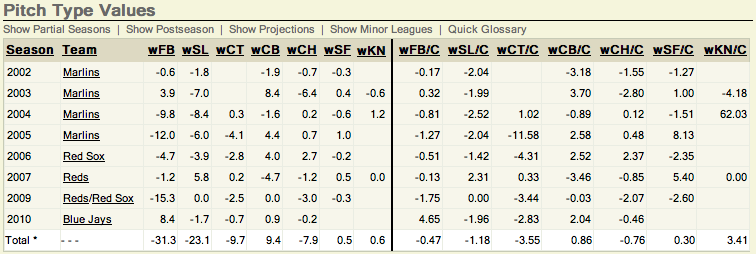
Gonzalez, who is jacking fastballs like never before, ranks third in the league in wFB (runs above average) and second in wFB/C (runs above average per 100 fastballs) while ranking in the bottom 10 in wSL and bottom 30 in wSL/C.
Of note, Gonzalez's plate discipline — as bad as it has been in the past — is worse than ever. His O-Swing% (percentage of pitches a batter swings at outside the strike zone) of 47.1% ranks second in the AL, behind only Vladimir Guerrero (47.8%). With 5 BB (4.4%) and 28 SO (24.8%) in 113 plate appearances, Gonzalez's BB/SO rate of 0.18 is the fifth-worst in the AL. Alexei Ramirez (0.07), Jack Wilson (0.08), Yuniesky Betancourt (0.09), and Adam Jones (0.12) are the only "hitters" in the junior circuit with an inferior BB/SO rate. Importantly, their OPS's range from .587 to .664.
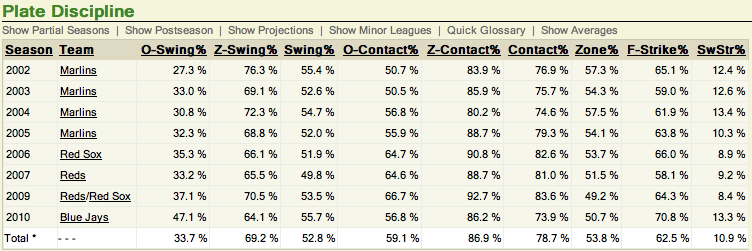
Interestingly, Gonzalez's F-Strike% (first pitch strike percentage) not only ranks higher than ever before but tops in the league, which suggests pitchers are challenging him from the moment he steps into the batter's box. While I'll defer to the advance scouts to determine whether Gonzalez should be thrown more or fewer fastballs in the future, I believe teams would be better served to make him chase as many pitches as possible.
The bottom line is that Gonzalez has hit like never before in the early going but his ability to control the plate remains as deficient as ever. There is little question that he can — and should — be had.
| Baseball Beat | April 18, 2010 |
Breaking News: Andy Pettitte Is Better Than Bert Blyleven
A member of the Baseball Writers Association of America who has written extensively on why he has never voted for Bert Blyleven for the Hall of Fame now believes Andy Pettitte is going to Cooperstown.
That's right, long-time Blyleven dissenter Jon Heyman appears to have endorsed Pettitte's candidacy for the HoF in a Twitter post over the weekend.
i think pettitte's going to cooperstown for his great 1) consistency, 2) durability, 3) octobers, 4) explanation.
Speaking of "consistency," while Heyman is entitled to his opinion on both Blyleven and Pettitte, it would be nice if he could be consistent in his evaluation of these two pitchers. You see, three months ago, Heyman wrote the following (emphasis mine):
I look at numbers, too, and while my numbers may be slightly more simplistic than WHIP, WAR or VORP, I think they tell a story of a pitcher who was extremely good, consistent and durable but not quite Cooperstown-worthy. Blyleven was dominant in a lot of at-bats (thus, the 3,701 strikeouts) and even a lot of games (60 shutouts). But he was never dominant for a decade, a half decade or even a full season.
"...extremely good, consistent and durable but not quite Cooperstown-worthy."
Heyman admits in his own words that Blyleven has two of the four things he loves about Pettitte.
OK, so we know that Blyleven has the "consistency" and "durability" down. What's missing? Ahh... "octobers" and "explanation" (whatever the heck that is).
Let's take a look at those Octobers. Blyleven pitched in an era before the Division Series so let's focus on League Championship Series and World Series. He was 5-1 with a 2.47 ERA, 1.08 WHIP, and 4.50 K/BB ratio covering five different series, eight games, and 47.1 innings pitched. Pettitte is 12-6 with a 3.99 ERA, 1.37 WHIP, and 2.15 K/BB ratio covering 16 different series, 26 games, and 162.1 innings. I know that WHIP thing may be a bit difficult to calculate (hits plus walks divided by innings), but it looks to me like Blyleven gets the vote for quality and Pettitte for quantity.
Alrighty, then the big difference between these two pitchers must come down to Heyman's fourth building block: explanation. Explanation? What the heck is explanation? Seriously. Jon, please explain. You can devote an entire guest column right here at Baseball Analysts to explain what "explanation" means and/or why Pettitte deserves to be enshrined and Blyleven does not. Have at it.
In the meantime, here is a quick and dirty summary of Pettitte's and Blyleven's regular season career:
ERA+ IP
Pettitte 116 2946
Blyleven 118 4970
Blyleven edges Pettitte in ERA+ while pitching two thousand more innings! That's right, Pettitte would have to pitch about ten more years at a slightly better clip to equal Blyleven's career. Did I mention that Pettitte will be 38 years old in June?
But, hey(man), "it's called the Hall of Fame, not the Hall of Numbers." Silly me, I was led to believe that great numbers led to fame but, then again, Eddie Gaedel didn't have have great numbers (although a 1.000 OBP isn't bad) but is certainly famous. Maybe Heyman can take up the "Eddie Gaedel for Hall of Fame" cause. If that's stretching things too far (or if you want to argue that Gaedel is infamous rather than famous), how about Johnny Vander Meer? Don Larsen? Roger Maris? Maury Wills? Fernando Valenzuela? Joe Carter? I'm sure there are many, many other famous players who should be considered for the Hall in Heyman's mind.
Speaking of which, did Heyman vote for Mark McGwire? I mean, he's pretty famous, no? Well, Heyman put McGwire on his "Disqualified List."
Disqualified List (own personal list*)25. Mark McGwire. Admitted andro use made him into a home run hero before moving into pariah territory. Projected percentage: 28 percent.
That's right, McGwire is disqualified for taking steroids (and admitting to taking them) while taking steroids and admitting to such just may be Pettitte's key to Cooperstown.
Yes, consistency. Heyman's arguments aren't very consistent but, boy, they are sure durable. It must be nice.
| Baseball Beat | April 12, 2010 |
My 2010 Fantasy Baseball Team
I thought I would share my fantasy baseball team with readers once again. As I noted last year, "our league is one of the longest, continuous fantasy pools in the country. The Lakewood Players League, as it is known, has been in existence, in one form or fashion, for over 30 years."
The LPL is a 16-team, non-keeper league. We draft new teams each year. We do not allow trades or waiver wire pickups. Instead, we allow owners to select 28 players and offer three replacement drafts at each of the quarter poles in the season.
It's a family affair with my brother serving as commissioner and an original team owner, my son and nephew co-owning a franchise, and a cousin and another cousin's husband also sharing a team. A few of the other 12 owners are friends dating back to junior and senior high school in the dark ages of the 1960s and 1970s.
While our fantasy pool is guilty of including a few team-dependent stats, we have made a few rule changes over the years to minimize stolen bases and saves. Unlike most fantasy/rotisserie pools, stolen bases are not one of four or five offensive categories. Instead, we take net stolen bases (defined as SB - 2*CS), multiply that by .5 and add it to walks plus hit by pitches. In other words, we treat (net) stolen bases as "extra" bases, if you will. As a result, you won't find Jacoby Ellsbury and Carl Crawford being drafted in the first round of our pool. We have also reduced the value of closers by making saves worth half as much as the other pitching categories (IP, ERA, WHIP, and K minus BB).
I had the good fortune of winning our fantasy pool last year for the seventh time since 1989. I have finished third or better in all but one year since 2001. I am hopeful that I can repeat like I did in 1989 and 1990 or put together a three-peat a la 1995-1997. But the competition is tough with the team to beat owning three of my players from last year (Albert Pujols, Matt Holliday, and Tommy Hanson) plus Adam Lind and Brian McCann at the turn in the fourth and fifth rounds.
Here are my draft picks:
1. Ryan Braun: Drafting in the fifth spot, I was pleased to get Braun as I had him ranked as my No. 1 outfielder and No. 3 overall hitter. In less than three full seasons, the 26-year-old slugger has averaged 40 doubles, 7 triples, and 39 home runs (along with 113 runs and 121 RBI) per 162 games. Knock off 10% for minor injuries and rest and it seems reasonable to expect Braun to hit over .300 with at least 35 doubles and 35 home runs and a minimum of 100 runs and 110 RBI. Those stats will work just fine for me.
2. Justin Upton: My decision came down to Upton or Matt Holliday. I went with Upton based on his age and upside. I have him hitting .300 with 30 HR and 90-100 runs and RBI this year. Whether those projected numbers turn out to be better than what Holliday puts up remains to be seen.
3. Ricky Nolasco: I love Nolasco. I had him last year, too. His 5.06 ERA last year masked a 3.35 FIP and his 4.43 K/BB ratio was the fifth-best in baseball. An ace in the making, he commands his 91-92 mph fastball and uses his tight slider and 12-to-6 curve as swing and miss pitches. Is as good a bet as anyone not named Tim Lincecum or Roy Halladay to win the NL Cy Young Award.
4. Joey Votto: He was my seventh-ranked first baseman. The Big 5 were all gone after the first 18 selections and Adrian Gonzalez was taken with the 29th pick. In addition, Mark Reynolds (eligible at 3B and 1B), Kevin Youkilis (also 3B/1B), Justin Morneau, Kendry Morales, Adam Dunn (OF/1B), and Pablo Sandoval (3B/1B) were off the board as well, making Votto an easy choice for me with the 60th overall pick.
5. Gordon Beckham: I liked Beckham here because, as a 2B/3B, he gave me the flexibility to go in either direction later in the draft. Pro rating his rookie stats over 150 games yields 41 2B, 20 HR, 84 R, 92 RBI, and 60 BB. I can live with those numbers at either position.
6. Manny Ramirez: Going into the draft, I had no designs on taking Manny. However, I was amazed that he was still available this late in the draft. Ramirez was the No. 12 pick in 2009 and No. 92 in 2010. That's called value. I mean, is Manny not going to hit .290 with at least 25 HR and 90 RBI, even if he only plays 130-140 games?
7. Jose Reyes: This pick was similar to my previous one in that Reyes was our pool's fourth overall pick last year and 101st this year. Sure, he missed over 100 games in 2009 with a hamstring injury and sat out most of the spring but the latter was due to a a hyperactive thyroid, which seems rather minor to this non-medical expert. Now in his eighth season, Reyes doesn't turn 27 until June.
8. Ryan Dempster: After putting together the nucleus of one of the best offenses in our league, I needed to add a couple starters with my eighth- and ninth-round picks. Dempster was not only the best pitcher on the board but also the most reliable in my judgment. He was 6-4 with a 3.15 ERA and a 4:1 K/BB ratio in 14 GS after returning from the disabled list with a broken toe in late July.
9. Jonathan Sanchez: Everyone knows that Sanchez threw a no-hitter last year, but did you realize that he was 6-4 with a 3.46 ERA and a MLB-best 10.5 K/9 the rest of the way? Like most young pitchers, he needs to become more efficient with his pitch count in order to work deeper into games. The stuff is there. Here's hoping for 180 innings with an improved walk rate.
10. Chipper Jones: Less than a week into the season and I'm already second guessing myself for this pick. But, injury risk or no, has his star fallen so far that he goes from a third rounder to a tenth rounder from one year to the next? Remember, walks are a full category in our league. Chipper had 101 free passes last year and walked more often than he struck out (89). The projection systems have him hitting at least .285 with 20 HR and producing 70-plus R and RBI. No way I can get those numbers at a non-1B or OF position this late in the draft.
11. Colby Rasmus: Now this is a guy I wanted to get. I'm quite sure I had him ranked higher than any of my competitors. A former No. 1 draft pick, top five overall prospect by Baseball America in 2008 and 2009, coming off a fantastic spring (.362/.500/.707 with 5 HR and 16 BB/18 SO), and batting fifth behind Albert Pujols and Matt Holliday gave me confidence to step up on this 23-year-old center fielder. If I'm wrong on Rasmus, it will be due to the fact that he fails to solve LHP (.160/.219/.255 in 115 career plate appearances).
12. Stephen Strasburg: I believe Strasburg is more valuable in fantasy drafts than generally perceived. You park the kid for two months, activate him when he is called up to the majors, and bank his stats for the final four months when he figures to be a top-20 pitcher in any league that counts strikeouts. I'm prepared for the fact that the Nationals will certainly limit his starts, pitch counts, and innings, which means he could be shut down by early- to mid-September. That's fine. I can plug in one of my other starting pitchers in April, May, and late September. But I'll take the best pitching prospect in decades during June, July, August, and early September.
13. Carl Pavano: Not a popular choice among many fellow participants, I took Pavano because his control is valuable in our league as we double count walks via WHIP and SO minus BB. He is an injury risk for sure, but one that I can manage around if necessary.
14. Matt Thornton: While others were paying up for closers, I sat back and drafted the reliever with the fifth-highest SO-BB total last year. The lefty whiffed 29.3% and walked 7.0% of the batters faced. He is basically a "here it is" type, pumping 95-96 mph fastballs 90 percent of the time. The combination of his velocity and location make him virtually unhittable. A good get in my mind.
15. Mat Latos: Great arm plus big ballpark means the potential is there for the youngster to shut down opponents at home this year. Only 22, Latos will be handled carefully by Bud Black and the Padres. He pitched a combined total of 123 innings in the minors and majors in 2009 and will likely be limited to about 150 IP in 2010. I plan on using Latos selectively.
16. Fausto Carmona: Who knows what I'm getting with this pick? Is Carmona the pitcher who placed fourth in the AL Cy Young Award balloting in 2007 or the wild man who posted a 13-19 record with a 5.89 ERA while allowing more walks than strikeouts in 2008 and 2009? His first start last week (6 IP, 1 H, 3 R, 6 BB, 1 SO) suggests he may be a bit of both. If the 26-year-old righthander can throw bowling balls for strikes like he did three years ago, then this pick just may be the steal of the draft.
17. Chris Perez: I was hopeful that Perez would seize the opportunity to serve as Cleveland's closer in Kerry Wood's absence and keep the job all year long. Well, the early returns are mixed. I loved his first two games and loathed his third.
18. Gio Gonzalez: This pick is all about upside. I moved Gonzalez up on my draft board when he was named the A's 5th SP as I was keenly aware of his stuff and witnessed him striking out 10 Angels without allowing a walk in his final start in 2009. Gio drew the Halos in his first assignment on Friday and was 92-93 with one of the biggest yakkers this side of Erik Bedard. He could be Jonathan Sanchez nine rounds cheaper.
19. John Baker: By far, my worst position player. I was going to take Matt Wieters but my son nabbed him in the sixth round four picks in front of me. I clearly preferred Manny, Reyes, Dempster, et al to the remaining catchers so I resigned myself to taking somebody like Baker. I'm not happy about it but am hopeful that he can reproduce his 2009 season and give me a .270 AVG with 25 2B, 10 HR, and 50-60 R and RBI.
20. David Freese: His time may have finally arrived this season. Freese hit well in the minors (.308/.384/.532) and held his own this spring (.293/.372/.453) with surprisingly decent BB (10) and SO (15) totals. The projection systems have him hitting .265-.280 with 12-15 HR. Not bad for a backup third baseman.
21. Matt LaPorta: Although LaPorta has started five out of six games at first base, he may end up in left field once Russell Branyan (herniated disc) returns from the DL. However, it's a crowded situation with three lefthanded hitters (Branyan, Michael Brantley, and Travis Hafner) competing with LaPorta at 1B, LF, and DH, which could reduce him to a platoon player if he doesn't get off to a good start.
22. Luke Gregerson: The San Diego Padres setup man had the seventh-highest SO-BB total among relievers in 2009. He possesses a wicked slider and could become the team's closer if Heath Bell is traded this summer.
23. Cameron Maybin: My fifth outfielder. While the just-turned 23-year-old center fielder is playing in his fourth MLB season, he has yet to accumulate 200 plate appearances in a single year. He can run like the wind and is a star in the making. Hitting in the two hole between Chris Coghlan and Hanley Ramirez won't hurt his numbers.
24. Mike Aviles: It was slim pickings at this point and I still needed a backup SS, 2B, and C. This selection could come back to haunt me as the Royals optioned him to Triple-A Omaha over the weekend to free up a roster spot for Gil Meche. Coming off Tommy John surgery, Aviles won me over with an outstanding rookie season in 2008 (.325/.354/.480) and a huge spring (.471/.517/.725 with 6 BB and 2 SO). Unfortunately, I don't decide who gets to play in Kansas City.
25. Blake DeWitt: He won the second base job in the spring and should put up respectable numbers two years after hitting .264 with 9 HR in just over 400 plate appearances as a 22-year-old rookie. Good sign: DeWitt has walked five times while striking out only once in his first five games.
26. Miguel Olivo: Did you know that Joe Mauer (28) was the only catcher who slugged more home runs than Olivo (23) last year? Olivo ranked 8th in RBI (65) and 13th in R (51). Hey, he's Bengie Molina with a few more strikeouts.
27. Pedro Alvarez: With a 28-man roster, I have the ability to sit on Alvarez while awaiting his likely recall around Memorial Day.
28. Dan Hudson: The White Sox optioned Hudson to Triple-A Charlotte prior to the season. The 23-year-old righthander, who went a combined 14-5 with a 2.32 ERA at four levels in the minors, was named MLB.com's 2009 Minor League Starting Pitcher of the Year. He was brought up to the majors in September and pitched six games, posting a 1-1 record with a 3.38 ERA. Hudson should get another shot this year if Freddy Garcia gets hurt or implodes.
Although I like my team, I'm not looking too swift after the first week. I'm in 13th place, lagging in troubles (doubles plus triples), runs, RBI, and innings pitched. The poor showing in the offensive categories is a function of Jones and Reyes missing a combined seven games while the lack of innings is due to not having any starting pitchers going twice last week. I should be able to make up these innings this week as Nolasco, Dempster, Pavano, and Carmona are each scheduled to start twice.
If nothing else, it should be a fun season.
| Baseball Beat | April 10, 2010 |
Get 'Em While You Can
If Pedro Alvarez and Carlos Santana are still available in your fantasy baseball pool, you might not want to wait much longer to pull the trigger on them. Facing each other, the two highly touted prospects homered in their minor-league debuts and both have already jacked three home runs in only two games.
From CBS Sportsline:
News: Pirates 3B prospect Pedro Alvarez is wasting little time making a huge impact for Triple-A Indianapolis of the International Leauge. In just his second game on Friday, Alvarez hit two homers and drove in five runs. He has already gone deep three times and driven in seven runs. He is also hitting .333.
Meanwhile, Pittsburgh's third baseman Andy LaRoche is 1-for-13 with no extra-base hits and four strikeouts. Manager John Russell has placed LaRoche in a tough spot by batting him seventh, one spot in front of the pitcher. He walked three times on Wednesday and has already seen 76 pitches in 17 plate appearances. LaRoche's 4.47 P/PA is tied for 12th in the National League.
Look for Alvarez, the second overall pick in the 2008 draft, to be playing in Pittsburgh no later than June 1 when teams are basically free to call up players and retain them for an additional three years before these so-called "Super Two" prospects become eligible for arbitration. It's possible, however, that Alvarez could force himself on the Pirates sooner if he continues to rake and LaRoche doesn't greatly improve upon his .227/.314/.348 career line.
News: Carlos Santana went 4 for 5 with two home runs and four RBI as the Columbus Clippers (Triple-A) smashed the Indianapolis Indians, 17-4, Thursday night.
Santana performed his magic on his 24th birthday. After two games, he is 6-for-10 with three HR and two doubles. He was the MVP of the Eastern League (Double-A) in 2009 and California League (High-A) in 2008. The only catcher standing between the switch-hitting Santana and the majors is Lou Marson (0-for-8 with 0 BB and 2 SO). A former third baseman, Santana has the arm to work behind the plate. However, he still needs to enhance his receiving and game-calling skills and is unlikely to be rushed to the big leagues despite a bat that could hit in the middle of the Cleveland order right now.
Lastly, for anybody who has been living on Mars, Stephen Strasburg will make his professional debut on Sunday. The No. 1 draft choice in 2010 will start for the Harrisburg Senators, the Washington Nationals' Double-A affiliate. He will face the Altoona Curve (Pittsburgh Pirates). The game will be streamed online via ESPN3 and broadcast on MiLB Gameday Audio at 2 p.m. ET. (Aroldis Chapman will begin his professional career at the same time as Strasburg, starting for Cincinnati's Triple-A Louisville Bats against Detroit's Toledo Mud Hens. This game will also be available via ESPN3.)
Strasburg, who pitched nine innings and allowed two runs while striking out 12 batters and walking one this spring, is expected to throw 85-90 pitches. According to Washington Post writer Dave Sheinin, money will trump talent and performance in determining when Strasburg gets called up by the Nats.
"Beyond just the baseball factors -- even the greatest prospects can benefit from some time in the minors -- the Nationals have a strong financial incentive to hold off on Strasburg's big league debut until at least late May, in order to delay his reaching free agency and arbitration eligibility....All they would have to do is keep him in the minors for at least 20 days, which would prevent him from gaining enough service time to qualify for free agency at the end of his sixth season, thus retaining his rights through 2016, instead of 2015. This isn't being cheap. It's being smart. And every team does it."
I recommend reading the article in full as it is an excellent primer on arbitration and free agent eligibility, including the Super Two status I referred to above.
* * *
Update (4/11/10): Strasburg pitched five innings and allowed four hits, two walks, and four runs (one earned) while striking out eight batters. He was credited with the win as Harrisburg beat Altoona 6-4. Strasburg survived a wobbly opening inning, giving up a double, single, and walk after retiring the first two hitters. The righthander retired the side in order in the second and third innings, striking out the final two batters in both frames. He was a victim of poor fielding in the fourth when Altoona scored three unearned runs, then worked a 1-2-3 fifth to finish his assignment for the afternoon.
Overall, the fireballer threw 82 pitches with his fastball sitting at 97-99 through the first three innings and touching 100 a few times (according to the stadium gun as reported by the play-by-play announcer). His 83-mph hammer curve was generally effective and he flashed an 89/90-mph changeup with diving, tailing action that resembled a two-seam fastball. With three "plus to plus-plus" offerings, Strasburg's stuff is unrivaled in both the minors and majors. While money considerations will dictate the timing of Strasburg's MLB debut, his command will determine whether he is just the best pitcher on the Nationals or one of the best hurlers in the National League this year.
While I didn't watch Chapman, his pitching line (4.2-5-1-0-1-9) suggests that he dominated Toledo batters at times. According to an MLB.com article, the Cuban defector "fired 10 pitches that read 99 mph or faster and five that traveled at least 100 mph." Mud Hens outfielder Brennan Boesch struck out twice on 101- and 100-mph heaters.
Louisville manager Rick Sweet said, "No debut compares to that at this level. As soon as the radar gun hit 100, you could hear the buzz in the ballpark."
Toledo manager Larry Parrish, who spent 15 years in the majors, was impressed with the 6-foot-4, 185-pound southpaw's arm strength but noticed mechanical flaws in his delivery. "He wasn't J.R. Richard or Nolan Ryan out there. Today, he walked one. In the big leagues, he would've walked eight. Would you like to have him? Heck yeah, but he's just not a finished project yet."
Well, the kid is only 22 with one professional game under his belt. Give him some time. As Sweet opined, "He could probably pitch in the big leagues right now and have success. The timetable is nothing more than him getting his whole game together. He's got some things to work on other than pitching."
| Baseball Beat | April 02, 2010 |
Stakeholders - Los Angeles Dodgers
We turn to Jon Weisman, the proprietor of Dodger Thoughts, to discuss the Los Angeles Dodgers in our Stakeholders series that has featured writers, analysts, and team executives giving us the inside scoop on each of the 30 teams in the Major Leagues. Jon and I met in 2003 and became colleagues at All-Baseball.com in 2004. His blog was subsequently hosted at Baseball Toaster and the Los Angeles Times, and it was moved to the ESPN Los Angeles earlier this year. He has been a regular member of our roundtables previewing division races and also served as a guest columnist in 2005.
Grab a cup of coffee and pull up a chair as we discuss all things Dodgers.
Rich Lederer: Let's give our readers an executive summary at the outset of our discussion. The Dodgers won 95 games, captured the NL West, and competed in the NLCS in 2009. Do you expect the team to be better, worse, or about the same this year?
Jon Weisman: I can't go enough out on a limb to say they'll be better, but I think they'll be closer to last year's level than a lot of people think. They have to replace Randy Wolf's production, but I think they can with a strong full season from Chad Billingsley, Clayton Kershaw pitching deeper into games, Hiroki Kuroda avoiding line drives, and perhaps more help from the farm system in the rotation this year. I do think Vicente Padilla is a mirage waiting to be exposed, though. Charlie Haeger is an interesting wild card - he may be banished by April, but he might turn out to be a real boon. And then of course the lineup figures to be as solid as last year, if not more so with growth from Matt Kemp and James Loney and a potential comeback from Russell Martin. I'm not saying everything couldn't go wrong to leave us with another 2005, but I'm not betting that'll happen.
 Rich: I think it is safe to say that the Dodgers will win more than 71 games this year. After opening the season with a 16-8 record, that team went into the tank and was victorious in only 55 of its final 138 games. Jim Tracy was fired by the Dodgers, then hired and fired once again by the Pittsburgh Pirates, but caught on with the Colorado Rockies early last summer and was named NL Manager of the Year. Do you anticipate that the Rockies will be the Dodgers' main source of competition within the division this year?
Jon: Yep. I don't think it's a flawless team, but they have a nice collection of players. The Giants still lack the bats to be considered a preseason favorite, and even though the Diamondbacks will be improved, I think they have a long way to climb. But there are always surprises.
Rich: Peter Gammons reported that the Dodgers have an $83 million payroll for 2010. He also said that the team spent the least amount of money on the MLB Draft and international signings the past two years. While it's clear that the Dodgers have been retrenching, I believe that payroll figure is a result of some Bernie Madoff-type accounting as the club has deferred salary to Manny Ramirez and obligations to many former players that may not be fully reflected in this reported total.
Jon: Nothing personal against Peter, since he's far from the only one doing it, but it's pretty disengenuous to ignore the deferred money or the money going to people like Juan Pierre and Andruw Jones when calculating what the Dodgers are spending, which is what that $83 million figure does. Isn't the big complaint against the Dodgers that they didn't go after a big-ticket free agent? Well, you don't often get those unless you take some risk or defer some money. The Dodger payroll is much closer to $100 million, which isn't sky-high but it's competitive enough. Furthermore, unless you believed the Dodgers should have handed John Lackey a guaranteed five-year, $80 million contract - the kind of contract that would typically blow up in their faces - there really wasn't a payroll issue to the offseason other than the non-arbitration offers to Wolf and Orlando Hudson.
Rich: Just who did the Dodgers add this year? How will the 2010 version differ from 2009?
Jon: They added very little - it's more about who they retained (i.e., the young core plus Manny) and their potential for growth. But there won't be a ton of difference - this is probably the most stable lineup the team has had in years.
Rich: How will the Divorce McCourt affect the Dodgers' ability to take on payroll during the season?
Jon: It's speculation, but I do think there's room for the Dodgers even in the current climate to make a decent midseason acquisition. But I'm not expecting Albert Pujols.
Rich: While every team could use an Albert Pujols, this Dodgers club should score a lot of runs. If Matt Kemp, Andre Ethier, and Manny Ramirez hit like they have in the past, the Dodgers are set with one of the most dangerous 2-3-4 hitters in the game. That said, when it comes to Ramirez, should we expect him to be the Manny of August and September 2008, the post-drug suspension Manny of 2009, or somewhere in between?
Jon: I'm more worried about Rafael Furcal than Ramirez. Furcal may or may not be healthy; either way, I think his skills are aging and I don't know how much effectiveness he has left. I don't have any idea what Ramirez will do this year, but I do think it's very relevant that he was hitting after the suspension but before his injury, and I think one might take his media silence this spring as an indication of his determination.
Rich: Moving down the lineup, is there reason to expect James Loney to fulfill his potential or is the Loney we've seen the past few years who he is?
Jon: I expect Loney to improve - maybe even reach his potential - but of course I don't think many people define his potential as that of a serious power hitter.
Rich: What's going on with Russell Martin? He added muscle and gained a bunch of weight during the offseason but strained his groin in early March and has been working his way back into shape. Do you see him bouncing back from his worst season ever and returning to his 2006-2008 form or is it possible that he could surprise us all by putting up career numbers in his age-27 season?
Jon: I expect a bit of a rebound from Martin, because it's hard to imagine him doing much worse, but it would be something if he had career numbers. Right now, if he can just maintain the good on-base percentage he has typically had, even as his power and speed have declined, I'd be happy. Even if he's in the Opening Day lineup, though, this might be the first year that Martin goes on the disabled list.
Rich: On the run prevention side, can a rotation with Vicente Padilla as its Opening Day starter and Charlie Haeger as its fifth compete for the NL West title?
Jon: Certainly. First of all, whether Padilla pitches in the first or fourth game of the season is pretty irrelevant. As for the fifth spot, the other NL West teams certainly have question marks there as well - most teams rotate guys through that slot no matter what. In no way does the Dodger starting rotation disqualify them from competing. It might simply come down to health across the board - does Brandon Webb recover it, does Jeff Francis maintain it, does Tim Lincecum keep it? And so on...
Rich: Let's talk about the bullpen. It was one of the best in the majors last year, yet Joe Torre will be without Ronald Belisario and Hong-Chih Kuo for most of April. Belisario finally made it to camp after missing the first five weeks of spring due to visa problems. He was a huge positive surprise last year as a rookie but will begin the season on the restricted list. Kuo, who was the Belisario of 2008, is on the DL. Do you think Jonathan Broxton, George Sherrill, and Ramon Troncoso can nail down the seventh, eighth, and ninth innings with little or no help from what otherwise looks to be a mediocre group of relievers?
Jon: It's similar to the rotation question. Say what you will about the Dodger bullpen, I don't see a whole lot of teams that have great fourth and fifth relievers. At least in the case of the Dodgers, they might have them by the end of April. And the team has a great number of candidates to try to help things out. Relief pitching is very volatile and unpredictable - just look at Brad Lidge, for example. But I don't see the Dodgers at a disadvantage on April 5 compared to other teams. For one thing, their top divisional rival will start the season without its closer.
Rich: How do you feel about the team's defense?
Jon: I'd like to feel better. The infield to the left of Loney is shaky, and I include Furcal in that. And Kemp is really going to be worked in center field covering for Ramirez and Ethier. One of the more interesting decisions the Dodgers might face this year is, for example, if Blake DeWitt slumps, do they call up a defensive-minded infielder like Chin-Lung Hu to plug that hole and at least improve the defense, rather than resort to Ronnie Belliard or Jamey Carroll.
Rich: Are there any minor leaguers who may contribute this year?
Jon: Among others, I expect we'll see Scott Elbert and Josh Lindblom, and since James McDonald again qualifies as a minor-leaguer, him too. Don't know that we'll see as much from the farmhands in the lineup, which looks more stable. But if the team loses an outfielder for any length of time, Xavier Paul is in line to help.
Rich: Do you think Joe Torre and Vin Scully will both be back in 2011?
Jon: You know, I have no idea. I'll admit I was a tiny bit surprised (and relieved, of course) Vin returned for this season - and I took that as a sign that he might want to do it until he physically can't anymore. Torre might simply come down to dollars, but I think he generally has liked managing the Dodgers.
Rich: Thanks, Jon. I know that I can speak for millions of Dodgers fan in hoping that Vin stays around forever. He *is* the Dodgers to most of us. It's hard to fathom following the team without him.
A native of Los Angeles, Jon Weisman has been writing about the Dodgers at Dodger Thoughts since 2002. He is the author of 100 Things Dodgers Fans Should Know & Do Before They Die. Weisman began covering sports professionally in 1985, complemented by adventures in writing for and about the screen that have culminated in his current position as a features editor at Variety. Any downtime he can muster will be happily spent with his wife and three young children.
| Baseball Beat | March 29, 2010 |
Up (Hey)Ward and On (Hey)Ward
The Atlanta Braves announced on Friday that Jason Heyward, the consensus No. 1 prospect in baseball, will be the team's right fielder on Opening Day. Bobby Cox, in his last season as the club's manager, told the 20-year old in a three-minute meeting in the clubhouse, "I'm delighted to tell you you're on the team, Jason, simply because you make us a better team."
Cox told the media, "He's as good a player as I've seen all spring—our team, any other team."
What should we expect from the superstar-in-the-making in his rookie season in the majors? To get a better handle on that question, I turned to some of the most well-known projection systems as shown below:
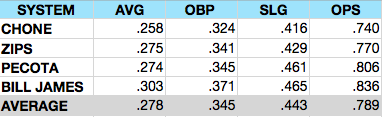
On average, the projection systems believe Heyward will hit .278/.345/.443. For perspective, that line is virtually identical to the following seven players over the past three years:
While Heyward's projected stats may be impressive for a young man who was playing high school baseball in Georgia three years ago, they look rather pedestrian from the standpoint of comparable players. However, if he were to match Bill James' projections or BP's 70th percentile (.290/.362/.497), then you would have something a bit more special as comps such as Andre Ethier, Nick Markakis, Andrew McCutchen, Victor Martinez, and Troy Tulowitzki come into play.
In the real world, Heyward hit a combined .323/.408/.555 at three minor-league levels (A+/AA/AAA) last year. He hit for average and power while drawing 51 walks and striking out only 51 times. His plate discipline is unusual for someone his age. Furthermore, the 6-foot-5, 240-pound lefthanded hitter is 17-for-49 (.347/.467/.490) with four doubles and one home run in 18 games and 58 plate appearances this spring. He has walked and struck out nine times each. Heyward has stolen four bases in five attempts, which is in line with his MiLB rate (26 SB and 5 CS).
Heyward was scratched from Sunday's game against the Nationals with left shin splints. He is expected to sit out the next few days but should be good to go when the Braves open the season at home on Monday, April 5 vs. the Chicago Cubs. The game is scheduled to be televised on ESPN.
| Baseball Beat | March 23, 2010 |
Checking in on Bryce Harper
After watching Bryce Harper in the Area Code Games following his freshman year in high school, I wrote an article titled Remember This Name in August 2008 whereby I boldly proclaimed that the then 15-year old would be the No. 1 draft pick in 2011.
Well, as it turns out, I am going to miss with my prediction. No, not because Harper didn't pan out. And not due to any injury. You see, Harper skipped his junior and senior years in high school, earned his GED, and enrolled at the College of Southern Nevada last fall at the age of 17. As a result, Harper will be eligible for the 2010 MLB Draft and is likely to be the No. 1 choice a year earlier than I forecasted.
How is Harper faring in his college debut, you ask? Just fine, thank you. He has put up a .420/.514/.864 line with 8 HR and 27 RBI through his first 27 games. In addition, the lefthanded-hitting catcher/third baseman/outfielder has drawn 18 walks and struck out only 19 times. He is leading the No. 3-ranked junior college team in the country (23-5) in AVG, OBP, SLG, H (37), R (32), RBI, 2B (13), HR, and TB (76) and is second in BB and SB (6 of 8). [Complete stats here.]
I revisited Harper in January 2009 after he pulled a Josh Hamilton at the third annual International Power Showcase High School Home Run Derby at St. Petersburg's Tropicana Field. I displayed his sophomore year stats (.626/.723/1.339) in a follow-up last May, linked to Tom Verducci's Sports Illustrated article a month later, and reported that he left high school early and registered for college last June.
For the Washington Nationals (16-45), possessors of the worst record in baseball this year, it now means having the opportunity to draft the top two amateur prospects in the first 11 years of the 21st century. The franchise won the Stephen Strasburg lottery this year and appears destined to win the Bryce Harper lottery next year. Strasburg and Harper could be the most hyped pitcher-catcher duo in decades, if not ever, should they wind up playing for the Nats. If nothing else, the two Scott Boras-advised players will be the richest signees in the history of the game.
MLB's Jonathan Mayo, a former guest columnist for Baseball Analysts, has the latest goods on Harper. In an extensive interview with the confident teenager, Harper says "I could care less about the Draft. If I could come back next year and play here, I'd come back next year and play here." Bryce is probably right. Given how important playing professional baseball has always been to him, he probably "could" care less about the draft. However, I doubt if he "couldn't" care less, which is the point he was trying to make with Mayo.
With only 2 1/2 months to go before the draft, Harper's wait won't be long. In the meantime, you can watch Harper hitting his second and third home runs this season, as well as a third round tripper that also includes a slow-motion clip of his swing. In all cases, Harper is using a wood bat as College of Southern Nevada plays in a wood bat conference.
Believe the hype and be sure to remember this name.
| Baseball Beat | March 22, 2010 |
Categorizing Starting Pitchers By K, BB, and GB Rates: 2007-2009
More than a decade ago, Defense Independent Pitching Stats (DIPS) introduced the idea that pitchers are mostly responsible for their strikeout, walk, and home run rates but have little or no control over batted balls in play. By focusing on K, BB, and HR rates only, Fielding Independent Pitching (FIP) has become increasingly accepted as a better tool than more traditional methods such as ERA to evaluate the effectiveness (and predictability of future results) of pitchers.
Playing off DIPS and FIP, I began to categorize and graph pitchers by strikeout and groundball rates in 2007 (based on 2006 stats). I broke pitchers into quadrants with the Northeast Quadrant home for those with above-average K and GB rates and the Southwest Quadrant the opposite. I have continued to publish this series annually, adding walks and even Z-scores last year.
By substituting groundballs for home runs, my methodology is more analogous to xFIP than FIP. The bottom line is that the best pitchers miss bats (K), throw strikes (BB), and keep batted balls in the park (GB).
As I demonstrated last year, strikeouts have the greatest impact on ERA and RA, followed by walks, and groundballs. As a result, K+ BB+ GB+ > K+ BB+ GB- > K+ BB- GB+ > K+ BB- GB- > K- BB+ GB+ > K- BB+ GB- > K- BB- GB+ > K- BB- GB-.
I have combined the strikeout and walk components this year by using (K-BB)/BF. In the past, I had graphed K/BF on the x-axis and GB% on the y-axis. This year, I am using (K-BB)/BF on the x-axis and GB% on the y-axis. While not three dimensional, the graph below includes the three most important variables whereas it had only focused on K and GB rates previously.
In addition, I've added a new wrinkle by using the past three years combined stats rather than the prior year only. This change has increased the number of pitchers as well as the size of the data points. I could have weighted the numbers in a 3-2-1 format to place additional emphasis on the more recent results but chose not to for simplicity. I could have added HBP to BB given the fact that the former is generally as much in the control of the pitcher as the latter. That said, I don't believe excluding HBP had much of an effect on the outcomes.
There were 173 active starting pitchers who met my requirements of 120 or more innings during the 2007-2009 period. Among these qualifiers, the average (K-BB)/BF rate was 9.87% and the average GB rate was 43.56%. The mean K-BB and GB rates are highlighted in red in the graph below. These averages separate the starting pitchers into four quadrants.
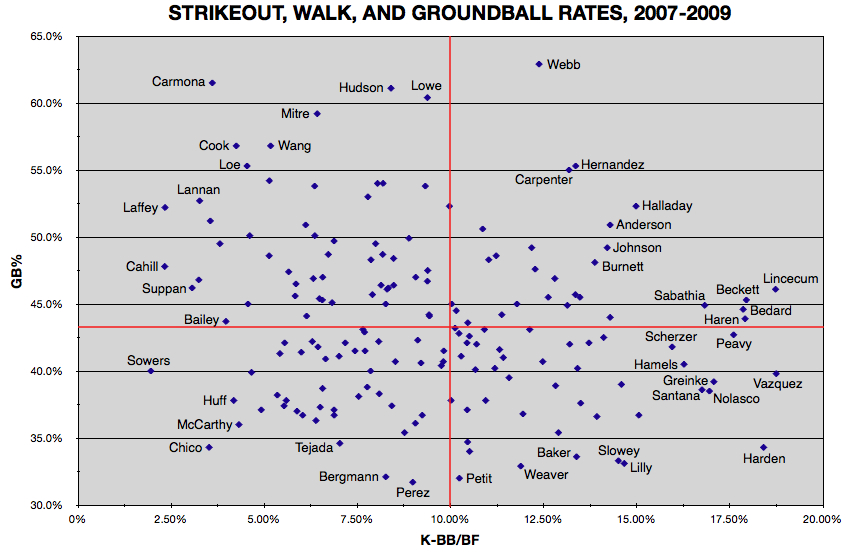
I always highlight the outliers and have identified 43 this time or more than twice the number in the previous graphs. The diamond just to the right of the average K-BB rate and ever so slightly below the average GB rate is Boof Bonser, who wins our award for being Mr. Average. He was signed by the Boston Red Sox to a one-year, $650,000 contract after being designated for assignment by the Minnesota Twins in December. A first round draft choice of the San Francisco Giants in 2000, Bonser missed the 2009 season after undergoing arthroscopic surgery to repair partial tears to the labrum and rotator cuff in his right shoulder. With Boston's starters in place and Tim Wakefield around to serve as the backup, Boof is likely to break camp as a long reliever but could be moved in a trade to a team looking to bolster its starting rotation.
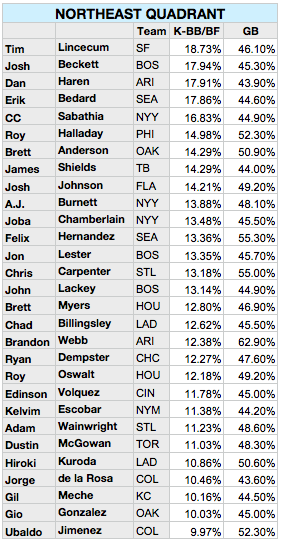
Tim Lincecum, coming off two consecutive Cy Young Award seasons, has compiled the highest K-BB rate in the majors over the past three years among those pitchers who induce more groundballs than the league average. After signing a two-year, $23 million contract in February, Lincecum has struggled this spring but threw 5 2/3 shutout innings against San Francisco's minor leaguers on Sunday. According to Fangraphs, his fastball velocity dropped 1.7 mph last year, and it has reportedly been sitting mostly at 89-91 in March. If his heater continues to recede, he may rely increasingly on his breaking balls and outstanding changeup for his "out" pitches.
The Northeast Quadrant also features former Cy Young winners CC Sabathia, Roy Halladay, Chris Carpenter, and Brandon Webb. The latter, working his way back from shoulder surgery after pitching just one game in 2009, is aiming to return to the rotation in late April. Meanwhile, Halladay will be pitching for a National League club for the first time in his 11-year career.
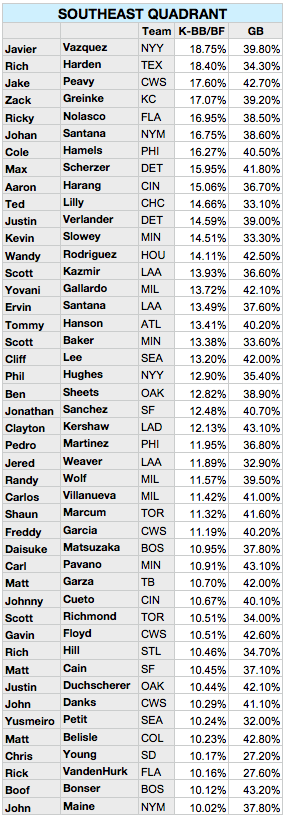
Javier Vazquez, not Lincecum, has produced the No. 1 K-BB rate in the majors over the past three seasons. He missed out on the Northeast Quadrant due to a lower-than-average groundball rate. The 33-year-old righthander will once again be pitching for the New York Yankees. Vazquez was 14-10 with a 4.91 ERA in his lone season with the Bronx Bombers in 2004. His career ERA is half a run higher in the AL (4.52) than the NL (4.02).
The Southeast Quadrant has its share of former Cy Young Award winners as well. Jake Peavy, Zack Greinke, Johan Santana (2x), Cliff Lee, and Pedro Martinez (3x) have won a combined eight CYA. Greinke (16-8 with a MLB-leading 2.16 ERA and 242 Ks and 51 BB in 229.1 IP) is coming off his best season ever. Among active pitchers, only Martinez (1997, 1999, 2000, and 2003), has bested his ERA+ of 205. Pedro, who signed with the Phillies last summer and went 5-1 with a 3.63 ERA and started three times during the postseason, is currently a free agent.
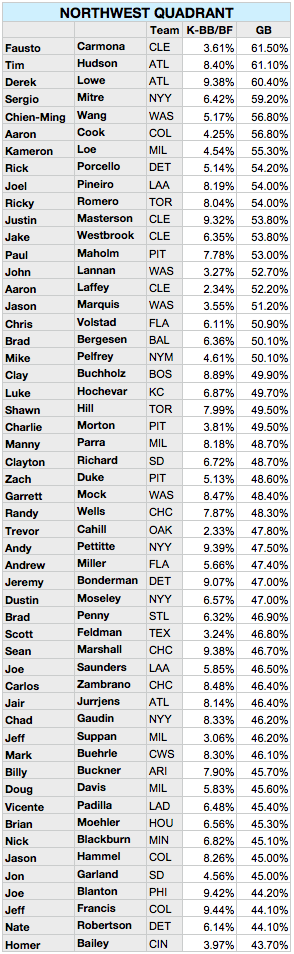
While the Northwest Quadrant doesn't sport any former CYA winners, it finds Tim Hudson, Derek Lowe, Andy Pettitte, Carlos Zambrano, and Mark Buehrle among its worm-burning residents. Lowe's (K-BB)/BF missed the Northeast Quadrant by less than 0.50%. As shown, he is one of only four starters with a groundball rate over 60 percent. The other three are Northwest inhabitants Hudson and Fausto Carmona plus Webb.
Hudson sat out the first five months in 2009 after undergoing Tommy John surgery in 2008. He started seven games and compiled a 2-1 record with a 3.61 ERA, then signed a three-year, $28 million contract with the Atlanta Braves last November. Carmona had a 19-8 record with an ERA of 3.06 in 2007 but has gone 13-19 with a 5.89 ERA while allowing more BB (140) than SO (137) over the past two campaigns. The 26-year-old righthander is owed $11 million for 2010 and 2011 so he is likely to get another shot with the Indians this season.
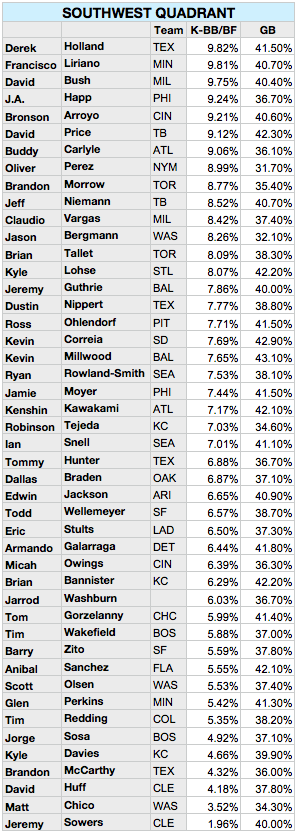
Although the Southwest Quadrant consists of several young arms that have potential, it has an even greater number of veterans and journeymen who have settled into nothing more than mediocrity. I wouldn't expect much success from those in the bottom half with groundball rates below 40 percent.
Jeremy Sowers (1.96%) had the lowest K-BB rate in the majors over the past three years. He and fellow soft-tossing lefty teammates David Huff (4.18%) and Aaron Laffey (2.34%) own three of the twelve-worst K-BB rates among the 173 qualified starting pitchers. I don't like Cleveland's chances this year if these three southpaws wind up starting half of the team's games, especially if Carmona pitches more like he did in 2008 and 2009 than 2007.
| Baseball Beat | March 15, 2010 |
Remembering Willie Davis and Merlin Olsen
While I was out of the country last week, two Los Angeles sports stars of my youth — Dodgers center fielder Willie Davis and Rams defensive tackle Merlin Olsen — passed away. Both were 69.
Growing up in Long Beach, I have fond memories of Davis and Olsen. If not for their age and overlapping athletic careers in L.A., these two men would have little, if anything, in common.
The following photos were taken by Frank Finch of the Los Angeles Times. He donated them to the Dodgers and Mark Langill, team historian and publications editor, was kind enough to share them with me a few years ago.
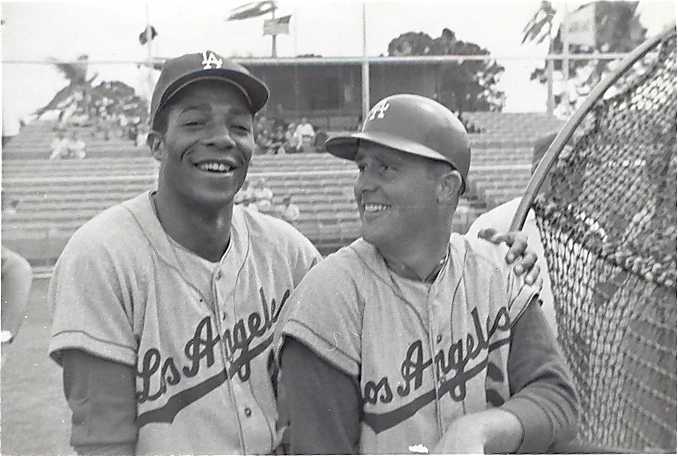
Davis (above left, standing next to Ron Fairly at a batting cage in spring training) was born in Mineral Springs, Arkansas on April 15, 1940, seven years before Jackie Robinson broke the color barrier in Major League Baseball. His family moved to Los Angeles when he was a youngster. Tall and slender, Davis lettered in baseball, basketball and track & field at Roosevelt High School. He ran a 9.5-second 100-yard dash and set a city record in the long jump of 25 feet, 5 inches. Dodgers scout Kenny Myers signed Willie after he graduated from Roosevelt HS in 1958.
Myers converted Davis into a left-handed hitter to take advantage of his speed. The scout and his protege starred in "The Willie Davis Story," a black and white made-for-television movie that I remember airing back in the early 1960s. John Herbold, a legendary high school baseball coach at Long Beach Poly and Lakewood and former scout with the Dodgers and Angels, wrote a terrific column about Myers for the Collegiate Baseball Newspaper several years ago. I had the privilege of playing for Herbold and he taught us several fundamentals that he learned from Myers, whom he called "the greatest baseball teacher and thinker I ever met."
Davis played 18 seasons in the majors (plus two years in Japan) and was a member of two World Series championship teams in Los Angeles in 1963 and 1965. He produced 2,561 hits (82nd all time) and stole 398 bases (68th). Davis also won three consecutive Gold Gloves from 1971-73 although Dodgers fans may remember him more for the record three errors on two consecutive plays in the fifth inning of Game Two of the 1966 Fall Classic against the Baltimore Orioles (which happened to be the last game that Sandy Koufax pitched). Willie's nickname was "Three Dog," not for the errors or what sometimes appeared to be his lackadaisical play in the field but rather for the number he wore on the back of his uniform. His 31-game hitting streak in 1969 broke Zack Wheat's franchise record of 29 in 1916.
The three-time All-Star fell upon hard times during the 1990s. He abused alcohol and drugs and was arrested at his parents' home in Gardena for allegedly threatening to kill them and burn down their house unless they gave him $5,000. The Dodgers subsequently reached out to Davis and hired him to work in their speakers bureau. I last saw and spoke to him at a game three years ago and am thankful for that opportunity. He recalled my Dad, who covered the Dodgers from 1958-1968. Davis looked frail to me, but he seemed to be in good spirits. I will always remember him for his positive contributions to my favorite team while growing up.
Olsen (in the photo on the right, standing near the tunnel of the Coliseum prior to the 1964 Pro Bowl game) was born in Logan, Utah on September 15, 1940. He was exactly five months younger than Davis. Olsen was the oldest son in a large Mormon family. He attended Utah State University and graduated summa cum laude and Sigma Chi with a degree in finance in 1962. Merlin was a three-time academic All-American and an All-American defensive tackle, winning the outland Trophy in his senior season.
Drafted by the Rams in the first round in 1962, Olsen played his entire 15-year career with the the team and was elected to the Pro Bowl a record-tying 14 times. He was named the NFL's Rookie of the Year and first-team All-Pro in 1964 and from 1966-1970. Olsen is a member of both the College Football and Pro Football Halls of Fame.
Although Olsen is wearing 76 in the photo above, he may be the most famous player associated with the number 74 in the history of pro football. He was a member of "The Fearsome Foursome," the Rams' defensive line that consisted of Olsen and Rosey Grier at the tackle positions and Deacon Jones and Lamar Lundy on the ends. Olsen and Jones may have been the best defensive tackle and defensive end in the game for several years during the 1960s.
A gentle giant off the field, Olsen was smart and articulate. After his playing days were over, he was a noted broadcaster, actor, and businessman. Olsen starred in Little House on the Prairie, Father Murphy, and Aaron's Way. He teamed with Dick Enberg on NBC's coverage of the AFC throughout the 1980s and was one of my favorite color commentators. Olsen also served as a pitchman for FTD Florists for a number of years.
Olsen was diagnosed with mesothelioma in 2009 and underwent three courses of chemotherapy. He died on March 11, 2010 at City of Hope Hospital in Duarte, California, two days after Davis passed away at his home in Burbank.
Davis and Olsen will be missed by their families, friends, teammates, and fans. Rest in peace.
| Baseball Beat | February 22, 2010 |
Long Beach State's Thompson Shines on Rainy Opening Night
The NCAA college baseball season got underway on Friday night. I was fortunate to be on hand for an opener once again as Long Beach State upended the visiting Pepperdine Waves, 2-1, behind Jake Thompson's first complete game of his career.
Six years ago, I saw Jered Weaver strike out the first ten USC batters, including four in the third inning, in Long Beach State's home opener. I was also in attendance when Stephen Strasburg ushered in the 2009 season by striking out 11 while fashioning an electric fastball that registered at 100 mph on the radar guns.
While Thompson is not in the same class as Weaver or Strasburg, the junior righthander is a legitimate prospect. His fastball sat at 92-93 all game and hit 95 with an adrenaline rush on the last pitch when he struck out Ryan Heroy on a high heater to end it. The Friday night ace was efficient, throwing 105 pitches (including just one that was called a ball in the first three innings) while whiffing six and allowing only a half dozen batters to reach base.
At 6-3 and 225 pounds, Thompson has a thick body with strong legs. Only 20 years old, he is young for a junior. Jake passed his GED and skipped his senior season at Wilson HS to enroll at Long Beach State a year early. Thompson is also short on experience due to the fact that he sat out his junior year in high school after transferring from Mayfair HS where he went 6-1 with a 1.33 ERA as a sophomore.
Recruited by the highly regarded Troy Buckley three years ago, Thompson didn't receive his new pitching coach's tutelage in his freshman and sophomore years owing to the fact that his mentor left the program to become the minor league pitching coordinator with the Pittsburgh Pirates. Buckley returned to Long Beach as an assistant head coach prior to this season and Thompson appears to be back on track after not living up to expectations the past two years.
Buckley has an outstanding track record in handling college pitchers. In order, Abe Alvarez, Jered Weaver, Jason Vargas, Cesar Ramos, Andrew Carpenter, and Brian Shaw were all selected in the first two rounds of the MLB draft after working under Buckley. All but Shaw, the most recent draftee of the six, have reached the majors.
Thompson outdueled Cole Cook, a draft-eligible sophomore who posted a 7-3 record with a 3.69 ERA as a freshman in 2009. The 6-6, 220-pound righthander's favorite player is none other than Jered Weaver. Cook's fastball was mostly 93 with a high of 96. He also flashed an excellent curveball and induced two inning-ending double plays in the fourth and fifth. Cook threw 96 pitches, including 66 strikes, over seven innings while allowing seven hits, a walk, two runs, and striking out seven. Look for Thompson and Cook to get taken in the early rounds in the MLB Draft this June.
In a weekend tournament that featured Long Beach, Pepperdine, Cal State Fullerton, and Oregon, the Dirtbags fell to the Ducks, 6-2, on Saturday and to the No. 4-ranked Titans, 8-1, on Sunday. CSF's Christian Colon, a potential first-round draft pick, went 2-for-4 with a solo home run in the latter contest.
Oregon is led by two-time National Coach of the Year George Horton, who spent 11 seasons at Cal State Fullerton and led the Titans to the 2004 National Championship. He is one of nine men to have appeared in Omaha as a player (1975) and a head coach. Horton's club beat his alma mater, 7-3, on Friday and lost to Pepperdine, 11-7, on Sunday.
Elsewhere, Gerrit Cole of No. 23 UCLA threw a dandy in an MLB Urban Invitational contest on Friday evening at UCLA's Steele Field at Jackie Robinson Stadium. He allowed two runs but only one hit and no walks over six innings en route to a 16-2 victory over Southern in which the Bruins belted four home runs. Cole is one of the early candidates to go No. 1 in the 2011 draft. The Yankees took him in the first round in 2008 but the 6-4, 220-pound righthander opted to attend UCLA instead.
Top-ranked Texas dropped two out of three to New Mexico over the weekend. No. 2 LSU swept Centenary with the Tigers outscoring the Gentlemen 34-12. The 6-7, 230-pound Anthony Ranaudo, who could make a strong case as the best college pitcher in the country, allowed one unearned run over five innings on Friday. Paul Mainieri won his 1,000th career game on Saturday.
No. 3 Virginia took two out of three from East Carolina, No. 5 Rice lost all three games to No. 30 Stanford, and No. 6 Florida State, No. 7 UC Irvine, No. 8 Arizona State, No. 9 Georgia Tech, and No. 10 Florida all swept their opponents over the weekend. The Seminoles outscored Georgia State 37-12. However, the Rambling Wreck did them one better, crushing Missouri State 37-3, including a 4-0 whitewash in Bryan Smith's featured opener that saw Deck McGuire, a 6-6, 218 junior righthander, toss seven scoreless innings with 10 strikeouts and no walks. If Ranaudo isn't the top college pitching prospect in this year's class, then it is probably McGuire.
For more on college baseball, be sure to check out D1 Baseball, Baseball America, Boyd's World, and College Baseball Splits.
| Baseball Beat | February 21, 2010 |
PECOTA and History on the Angels Side of Not Being 21 Games Worse in 2010
My short post on Friday seemed to create quite a stir in the comments section so I promised to deliver a follow-up piece that would expand upon my initial take on Baseball Prospectus' prediction whereby the Los Angeles Angels would go 76-86 and finish last in the AL West in 2010.
If the truth be told, PECOTA has been consistent, if not accurate, when it comes to the Angels. It has underestimated the number of Angels wins by a minimum of eight games every season since 2004. On average, the system has shortchanged the Angels by 11 games per annum over the past half dozen years.
| Year | Projected Wins | Actual Wins | Difference |
|---|---|---|---|
| 2010 | 76 | ||
| 2009 | 84 | 97 | -13 |
| 2008 | 87 | 100 | -13 |
| 2007 | 86 | 94 | -8 |
| 2006 | 81 | 89 | -8 |
| 2005 | 83 | 95 | -12 |
| 2004 | 82 | 92 | -10 |
| Average | 84 | 95 | -11 |
After reviewing these results, I have more confidence than ever in PECOTA, at least as it relates to the Angels. Here is the formula: Take the number of wins that the system forecasts for the Halos and add a minimum of eight and a maximum of 13 victories to determine the range of the team's expected win total.
With respect to 2010, PECOTA believes the Angels will win 76 games. Add 8-13 wins and... bingo, you get the range of victories (84-89) for the coming season. If you desire a more pinpoint total, then take PECOTA + 11 = 87.
While I admit to hindsight bias, my point of contention is not based on a sample size of one or two, nor selectively choosing this year or that year. Instead, it is based on each of the past six seasons. (PECOTA actually overestimated the number of Angels wins by five in the system's first year of existence in 2003. For the 2003-2009 period, PECOTA missed by an average of approximately 8 1/2 wins per season.)
If PECOTA is right and the Angels win 76 (or fewer) games in 2010, it will mark only the 36th time since Major League Baseball went to a 162 game schedule in 1961 (AL) and 1962 (NL) that a team's win total fell by at least 21 games year over year. In other words, such a collapse happens twice every three seasons or about one in 40 times when you factor in the total number of seasons involved during this period.
Granted, the higher the wins in the base year, the higher the odds of achieving infamy in the following year. Excluding 2009, teams have won 90 or more games 377 times since 1961. Twenty-one of those clubs (or 5.6%) won at least 21 fewer games the next season. Similarly, teams have matched or exceeded the Angels win total of 97 games last year 100 times since 1961. Nine of those clubs (9.0%) won at least 21 fewer games the following campaign. As a result, if history is any guide, there is less than a 1-in-10 chance of the Angels being 21 games worse in 2010 than 2009.
Here is a list of all the teams whose win totals have fallen by 21 or more games since the schedule was expanded to 162 games.
| Team | Year | Wins | Year | Wins | Decline |
|---|---|---|---|---|---|
| SEA | 2007 | 88 | 2008 | 61 | 27 |
| SD | 2007 | 89 | 2008 | 63 | 26 |
| LAD | 2004 | 93 | 2005 | 71 | 22 |
| KC | 2003 | 83 | 2004 | 58 | 25 |
| SEA | 2003 | 93 | 2004 | 63 | 30 |
| ARI | 2003 | 84 | 2004 | 51 | 33 |
| LAA | 2002 | 99 | 2003 | 77 | 22 |
| CHC | 2001 | 88 | 2001 | 67 | 21 |
| SEA | 2001 | 116 | 2002 | 93 | 23 |
| TEX | 1999 | 95 | 2000 | 71 | 24 |
| CHC | 1998 | 90 | 1999 | 67 | 23 |
| SD | 1998 | 98 | 1999 | 74 | 24 |
| FLA | 1997 | 92 | 1998 | 54 | 38 |
| OAK | 1992 | 96 | 1993 | 68 | 28 |
| MIL | 1992 | 92 | 1993 | 69 | 23 |
| PIT | 1992 | 96 | 1993 | 75 | 21 |
| SD | 1992 | 82 | 1993 | 61 | 21 |
| LAD | 1991 | 93 | 1992 | 63 | 30 |
| DET | 1988 | 88 | 1989 | 59 | 29 |
| CLE | 1986 | 84 | 1987 | 61 | 23 |
| STL | 1985 | 101 | 1986 | 79 | 22 |
| LAD | 1985 | 95 | 1986 | 73 | 22 |
| CWS | 1983 | 99 | 1984 | 74 | 25 |
| LAA | 1982 | 93 | 1983 | 70 | 23 |
| LAA | 1979 | 88 | 1980 | 65 | 23 |
| OAK | 1976 | 87 | 1977 | 63 | 24 |
| NYM | 1976 | 86 | 1977 | 64 | 22 |
| ATL | 1974 | 88 | 1975 | 67 | 21 |
| MIN | 1970 | 98 | 1971 | 74 | 24 |
| CIN | 1970 | 102 | 1971 | 79 | 23 |
| CLE | 1968 | 86 | 1969 | 62 | 24 |
| CWS | 1967 | 89 | 1968 | 67 | 22 |
| BAL | 1966 | 97 | 1967 | 76 | 21 |
| LAD | 1966 | 95 | 1967 | 73 | 22 |
| NYY | 1964 | 99 | 1965 | 77 | 22 |
As it relates to the Angels, it would be one thing if the team's payroll had been slashed or its roster dismantled via trades or free agency this fall and winter. However, the reality is that the Halos personnel has not changed materially since last October. Sure, the Angels may give up a little by losing Chone Figgins, Vladimir Guerrero, and John Lackey and replacing them with the untested Brandon Wood, the aging Hideki Matsui, and Joel Pineiro, who is coming off a career year. Maybe 2009 is as good as it gets for Erick Aybar and Kendry Morales even though both players are just 26 years old. Perhaps Bobby Abreu, 36, and Torii Hunter, 34, fall off the cliff at the same time despite providing relatively steady production over the past several years.
On the other hand, is it unreasonable to expect Scott Kazmir to contribute more to the Angels cause over the course of a full season in 2010 than he did in his only month of service in 2009? The 26-year-old lefthander has averaged nearly 29 starts during his first five campaigns. Pop in 23 additional starts for Kazmir and take away a like number from your choice of Matt Palmer (13 GS in 2009), 21-year-old rookie Sean O'Sullivan (10), Shane Loux (6), 22-year-old rookie Trevor Bell (4), Dustin Moseley (3), and 23-year-old rookie Anthony Ortega (3) and tell me what that's worth?
Speaking of starting pitchers, have we forgotten just how good Ervin Santana was in 2008 when he ranked in the top ten in MLB in FIP, xFIP, WHIP, K/9, K/BB, and WAR? Well, the 27-year-old righthander opened up 2009 on the DL, racked up a 7.81 ERA in the first half, and settled down to a 3.09 ERA with two complete game shutouts in the final two months.
Could Howie Kendrick, who hit .358/.391/.558 in the second half after returning from a stint in the minors, add more value in 2010 than 2009 when he played in only 105 games? How about Kevin Jepsen, the strikeout/groundball specialist with one of the hardest and best fastballs as well as cutters and sliders in the game?
Look, the Angels are likely to suffer their share of injuries this year. One or two youngsters won't pan out. One or two veterans will disappoint. But, maybe... just maybe a few things will go their way that could serve to offset some of the negative surprises that are bound to occur in the season ahead.
Put it all together and it seems difficult to comprehend how the Angels could go from 97 wins in 2009 to 76 wins in 2010.
| Baseball Beat | February 19, 2010 |
This Just In: Angels Will Be 21 Games Worse in 2010 Than 2009
I opened up the inbox of my emails this morning and was notified via the Baseball Prospectus Premium Newsletter that "a changing of the guard sees the Angels drop to the bottom behind a Rangers/Mariners battle" in its AL West preview. With my curiosity piqued, I clicked on the attendant link and scrolled down to the following excerpt:
Los Angeles AngelsProjected record: 76-86
Why They Might Win: While they have lost Lackey, they still have a very formidable rotation with Jered Weaver, Joe Saunders, Ervin Santana, Scott Kazmir, and Joel Pineiro. Mike Scioscia is among the game's best managers; his teams always outperform the sum of their parts.
Why They Might Not Win: Figgins is a big loss. He was excellent both as a table-setter at the top of the batting order and with the glove at third base. Counting on Brian Fuentes and Fernando Rodney to be the primary late-inning relievers just seems to be asking for trouble.
Player Who Could Surprise: Brandon Wood, whom it seems has been a prospect since Jim Fregosi was the Angels' star, will finally get his chance at the major-league level. PECOTA projects Wood to hit 25 home runs as Figgins' replacement.
Player Who Could Disappoint: Rodney converted 37 of 38 save opportunities for Detroit last season, but PECOTA sees him with a 4.34 ERA this year, a high figure for a guy who was paid a lot of money on the free-agent market to pitch in high-leverage situations.
Hmmm... According to PECOTA, the Angels are going to win 21 fewer games in 2010 than 2009 and finish last in the AL West.
Let me see if I can reconcile that difference. Rely on last year's actual or this year's projected PECOTA or WAR if you must, but I'm just going to spell out the major differences in personnel between the 2010 and 2009 Angels.
Joel Pineiro vs. John Lackey, Brandon Wood vs. Chone Figgins, Hideki Matsui vs. Vladimir Guerrero, and Fernando Rodney vs. Darren Oliver. I guess each one of these pairings is going to amount to a loss of five wins. Oops, I forgot to mention that if Scott Kazmir can stay healthy, the Angels will get a full season out of him rather than one month. We'll keep it simple and call six months vs. one month a push. With respect to the rest of the team, which is made up mostly of young players getting better rather than old players getting worse, they will be responsible for losing one more game this year than last year.
You see, last year, the Angels were apparently talented and lucky. This year, the Angels apparently lack talent and are going to be unlucky. Nice.
I just wish BP would put its money where its mouth is and book that 76 as an over/under. I would be the first one in line.
| Baseball Beat | February 15, 2010 |
Pitchers with the Highest Three True Outcomes (SO-BB-HBP)
Last week, I wrote about The Curious Case of Carlos Marmol. The Chicago Cubs closer had an unusual season in 2009, ranking among the best relievers in strikeout, hit, and home run rates while finishing with the worst walk and hit by pitch rates.
Marmol's propensity to strike out, walk, and hit batters last year ranked seventh ever and the highest since 2004 among pitchers with 50 or more games. Thanks to Lee Sinins and his Complete Baseball Encyclopedia, here's a list of all the pitchers with at least a 50 percent rate (expressed in decimal terms below).
YEAR % SO BB HBP BFP G
1 Armando Benitez 1999 .542 128 41 0 312 77
2 Brad Lidge 2004 .523 157 30 6 369 80
3 Eric Gagne 2003 .523 137 20 3 306 77
4 Matt Mantei 1999 .521 99 44 5 284 65
5 Byung-Hyun Kim 2000 .519 111 46 9 320 61
6 Billy Wagner 1999 .517 124 23 1 286 66
7 Carlos Marmol 2009 .507 93 65 12 335 79
8 John Rocker 2000 .506 77 48 2 251 59
9 Jeff Nelson 2001 .505 88 44 6 273 69
10 Billy Wagner 1997 .502 106 30 3 277 62
11 Rob Dibble 1992 .500 110 31 2 286 63
For what it is worth, here are the single-season leaders for ERA qualifiers (defined as the modern-day requirement of 1 IP/team game).
YEAR % SO BB HBP BFP
1 Kerry Wood 1998 .471 233 85 11 699
2 Randy Johnson 2001 .464 372 71 18 994
3 Randy Johnson 1997 .445 291 77 10 850
4 Randy Johnson 1991 .441 228 152 12 889
5 Randy Johnson 1992 .437 241 144 18 922
6 Kerry Wood 2003 .436 266 100 21 887
7 Nolan Ryan 1977 .436 341 204 9 1272
8 Kerry Wood 2001 .431 217 92 10 740
9 Nolan Ryan 1976 .431 327 183 5 1196
10 Pedro Martinez 1999 .430 313 37 9 835
Kerry Wood and Randy Johnson comprise the top six and seven of the top ten seasons of all time. Nolan Ryan appears twice and Pedro Martinez, mostly owing to his 37.5 percent strikeout rate (which edges out the Big Unit's K rate in 2001 by less than a tenth of a point), ranks tenth. No pitcher prior to 1976 made the list.
Lastly, here are the career leaders (with a minimum of 2000 IP).
% SO BB HBP BFP
1 Randy Johnson .384 4875 1497 190 17067
2 Nolan Ryan .384 5714 2795 158 22575
3 Sam McDowell .361 2453 1312 59 10587
4 Pedro Martinez .356 3154 760 141 11394
5 Sandy Koufax .340 2396 817 18 9497
6 Tom Gordon .325 1928 977 38 9058
7 David Cone .321 2668 1137 106 12184
8 Roger Clemens .317 4672 1580 159 20240
9 Al Leiter .315 1974 1163 117 10334
10 Bobby Witt .306 1955 1375 39 11003
Johnson, Ryan, and Martinez are joined by Sam McDowell, Sandy Koufax, Tom Gordon, David Cone, Roger Clemens, Al Leiter, and Bobby Witt. Johnson's career rate (38.448 percent) tops Ryan's (38.392) by a tiny fraction.
McDowell, who was known as Sudden Sam for his heat, led the American League in strikeouts and walks five times each from 1965-1971. He was on the cover of Sports Illustrated in May 1966 and the recipient of an outstanding SI article by Pat Jordan in August 1970.
Witt had the highest walk rate (12.5 percent) in the group. A hard-throwing righthander, Witt was drafted out of the University of Oklahoma by the Texas Rangers in the first round with the third overall pick of the 1985 amateur draft. After pitching just 35 innings with an 0-6 record and a 6.43 ERA in Double-A that summer, he earned a spot in the starting rotation the following spring. Witt led the AL in walks (143) and wild pitches (22) in 157.2 innings. He led the league in BB three times and WP twice in his first four seasons in the big leagues. While Bobby never topped the circuit in strikeouts, he whiffed 221 batters in 222 innings when he fashioned a 17-10 record and a 3.36 ERA (118 ERA+) during his best campaign in 1990.
Generally speaking, the pitchers on the lists above possess some of the best stuff in the past half century. A handful became legends while many others never quite lived up to their promise.
| Baseball Beat | February 09, 2010 |
The Curious Case of Carlos Marmol
After watching my nephew Brett make his PGA Tour debut in the Northern Trust Open at Riviera Country Club last Thursday, my wife and I headed to Palm Desert to hang out for a couple of days while our house was being fumigated for termites.
I woke up on Friday morning, checked my emails, and read the following news in Lee Sinins' daily ATM Report.
The Cubs re-signed P Carlos Marmol to a 1 year, $2.125 million contract, to avoid salary arbitration.YEAR AGE RSAA ERA G GS IP SO SO/9 BR/9 W L SV NW NL TEAM 2007 24 26 1.43 59 0 69.1 96 12.46 10.38 5 1 1 5 1 Cubs 2008 25 17 2.68 82 0 87.1 114 11.75 8.97 2 4 7 4 2 Cubs 2009 26 9 3.41 79 0 74 93 11.31 14.59 2 4 15 4 2 Cubs CAREER 40 3.42 239 13 307.2 362 10.59 12.34 14 16 23 18 12 LG AVG 0 4.35 307.2 235 6.88 12.90 17 17
I glanced at Marmol's three-year stat line and noticed that he struck out 11.31 batters per nine innings last season. Not too shabby, I thought. I had been under the impression that he didn't have a particularly good year. Despite his stellar SO/9 rate (or more commonly referred to as K/9), Marmol did indeed struggle as noted in the column next to it on the right. BR/9 stands for "base runners per 9," which is essentially WHIP expressed over nine innings rather than one (although HBP are included in the former and not the latter).
In Marmol's case, hit by pitch is not a trivial statistic. He hit 12 batters last season, good bad enough to rank third in the majors. The 28-year-old righthander, in fact, was the only reliever to reach double digits in this category.
A BR/9 of 14.59 means Marmol allowed 1.62 base runners per inning. That's a horrific rate for any pitcher, much less a closer/setup man. Marmol got there in a strange manner. Carlos allowed 43 hits, 65 walks, and 12 hit batters in 74 innings.
Nolan Ryan, one of the most famous high walks/low hits pitchers of all time, only had two seasons when he allowed more walks than hits. Unlike Marmol, Ryan never approached a BB/H ratio of 1.5:1. His worst ratio was 1.13 in 1970 when he was a 23-year-old part-time starter for the New York Mets. Marmol's BB/H ratio was 1.51 last year. Ryan's career ratio was 0.71. Marmol's ratio over his first four seasons? A stunning 1.03.
Among pitchers with 50 or more games, Marmol had the second-best batting average against (.171 vs. .170 for Jonathan Broxton) and the third-best HR/9 (0.24) and HR/TBF (0.60%) even though he is an extreme flyball pitcher. However, Marmol also had the worst BB/9 (7.91), BB/TBF (19.40%), HBP/9 (0.16), and HBP/TBF (3.58%).
You might say that Marmol missed the strike zone and a lot of bats. If so, you would be right. He struck out, walked, or hit a batter more than half the time! Yup, Carlos had a combined 170 SO, BB, and HBP while facing 335 batters in 2009.
What should we make of Marmol? His K/9, BAA, and HR/9 suggest he is one of the best relievers in the game. On the other hand, his BB and HBP rates indicate that he is a wild man and far from a polished product. Like my house, you can throw a tent over Marmol. While I wouldn't want to exterminate him if I were Jim Hendry or Lou Piniella, I might be inclined to sell tickets to his circus act if I were new Cubs' owner Tom Ricketts.
By the way, Brett and former major winners Padraig Harrington, Davis Love III, Corey Pavin, Vijay Singh, and Mike Weir all missed the cut last week as Steve Stricker won his fourth tournament in less than a year to pass Phil Mickelson as the No. 2 player in the World Golf Rankings.
| Baseball Beat | January 25, 2010 |
Graphing the Hitters: Plate Discipline
I introduced Graphing the Hitters earlier this month. The focus was on Productivity, defined as OBP and SLG.
In this week's edition of Graphing the Hitters, I'm going to concentrate on Plate Discipline. The graph below plots walk rate (BB/PA) on the x-axis and strikeout rate (SO/PA) on the y-axis for every qualified batter in 2009. The intersection of the MLB averages for BB% (8.88%) and SO% (17.96%) created quadrants that classify players as better-than-average in both (lower right), worse-than-average in both (upper left), or better-than-average in one and worse-than-average in the other (lower left and upper right).
Unlike Fangraphs, I believe the denominator for strikeout percentage should be plate appearances (rather than at-bats). For whatever reason, Fangraphs defines walk percentage as BB/PA but strikeout percentage as SO/AB. As a result, while the raw numbers were downloaded from Fangraphs, the BB% and SO% were calculated separately.
Note: You can download a spreadsheet containing the PA, BB, SO, BB%, and SO% of the 155 hitters here. This information can also be used to locate the 134 players not labeled in the graph below.
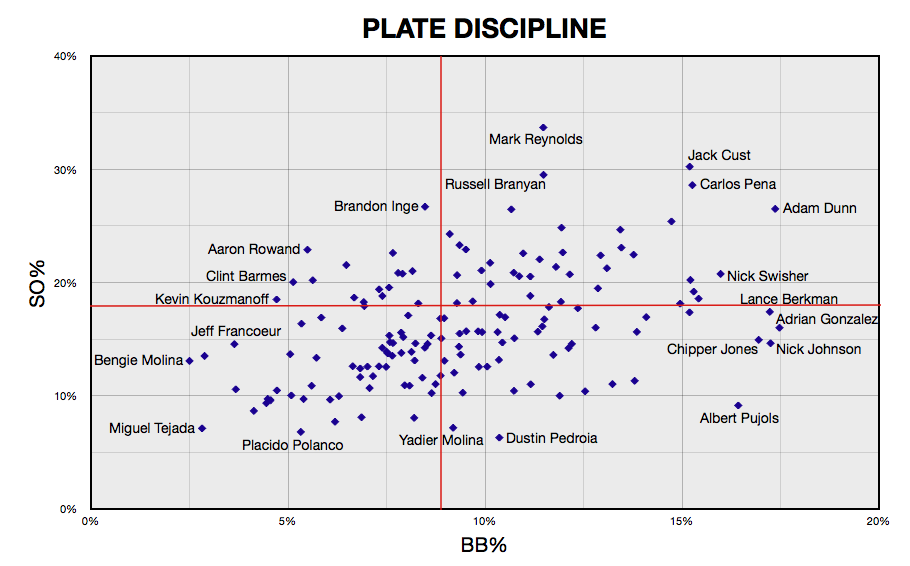
My first question following the Productivity graph was "Is Albert Pujols any good?" Well, after looking at the Plate Discipline graph, I've got to ask the same question once again. This time around, I'm going to shout out my question.
OK, I think I've made my point now. Not that it was really necessary. Everybody already knows that Pujols is better than good. I mean, this guy is great. In fact, he is on pace to become one of the greatest hitters of all time and perhaps the best or second-best righthanded hitter ever.
Pujols has played nine seasons in the major leagues. He has ranked in the top ten in batting average, slugging average, on-base plus slugging, total bases, and times on base every year. What is less known is that Albert has improved his walk rate every single season while reducing his strikeout rate by a third since his rookie campaign in 2001.
In 2009, Pujols had the sixth-highest BB% (16.43%) and the ninth-lowest SO% (9.14%). That is a remarkable combination. He was the only player in the top 50 in walk rate with a strikeout rate below 10.0%. You have to go all the way down to No. 57 in the walk rankings to find someone with a lower strikeout percentage (Dustin Pedroia). The Red Sox second baseman had the lowest SO% (6.30%) in the majors.
Pujols and Pedroia are two of only 13 qualified hitters with more walks than strikeouts.
| First | Last | Team | PA | BB | SO | BB/PA | SO/PA |
|---|---|---|---|---|---|---|---|
| Adrian | Gonzalez | Padres | 681 | 119 | 109 | 17.47% | 16.01% |
| Nick | Johnson | - - - | 574 | 99 | 84 | 17.25% | 14.63% |
| Chipper | Jones | Braves | 596 | 101 | 89 | 16.95% | 14.93% |
| Albert | Pujols | Cardinals | 700 | 115 | 64 | 16.43% | 9.14% |
| Todd | Helton | Rockies | 645 | 89 | 73 | 13.80% | 11.32% |
| Marco | Scutaro | Blue Jays | 680 | 90 | 75 | 13.24% | 11.03% |
| Joe | Mauer | Twins | 606 | 76 | 63 | 12.54% | 10.40% |
| Luis | Castillo | Mets | 580 | 69 | 58 | 11.90% | 10.00% |
| Victor | Martinez | - - - | 672 | 75 | 74 | 11.16% | 11.01% |
| James | Loney | Dodgers | 652 | 70 | 68 | 10.74% | 10.43% |
| Dustin | Pedroia | Red Sox | 714 | 74 | 45 | 10.36% | 6.30% |
| Yadier | Molina | Cardinals | 544 | 50 | 39 | 9.19% | 7.17% |
| Alberto | Callaspo | Royals | 634 | 52 | 51 | 8.20% | 8.04% |
Adrian Gonzalez led MLB in walk rate and walks (119) last year. He was one of five first basemen with more walks than strikeouts. Three second basemen, three catchers, one shortstop, and one third baseman also accomplished this feat, including three projected starters for the Boston Red Sox in 2010 (Marco Scutaro, Victor Martinez, and Pedroia). The St. Louis Cardinals are the only other team with more than one representative (Pujols and Yadier Molina).
At the other end of the spectrum, Yadier's older brother, Bengie Molina, had the lowest BB% (2.50%) in baseball. Bengie struck out in 13.08% of his plate appearances, which means he whiffed more than 5x as often as he walked.
Mark Reynolds had the highest SO% (33.69%). He set a single-season record with 223 strikeouts in 2009. The 26-year-old third baseman has played three seasons in the majors and owns the top two strikeout totals in the game's history. His SO and BB rates have increased each year. The good news is that his BB% has risen 29.2% while his SO% has advanced just 8.0% since his rookie campaign in 2007.
Russell Branyan (29.50%), Jack Cust (30.23%), Adam Dunn (26.50%), Ryan Howard (26.46%), Brandon Inge (26.69%), and Carlos Pena (28.60%) stand out for their high strikeout rates. However, Inge was the only one with a walk rate (8.48%) below the league average.
Lastly, there were 13 qualified hitters with walk rates over 15%. Other than Pujols, every player in this baker's dozen bats lefthanded or both. Therefore, I believe it is safe to say that the three-time MVP is truly unique. As the graphs have shown, Pujols is the most disciplined and productive hitter in the game today.
| Baseball Beat | January 12, 2010 |
Big Mac's Attacks
The big news on Monday was the admission from Mark McGwire that he used steroids on and off for a decade, including the 1998 season when he slugged 70 home runs and broke the then single-season record of 61 by Roger Maris in 1961.
Everybody seems to have his or her take on the subject (check the sidebar for news, analysis, video, and audio). As a general rule, we don't feel the need to weigh in with our opinions on such matters. But, in this case, I have a few thoughts that I'd like to share.
 My first is a tongue-in-cheek question. Based on the photo at left, which one of us do you suppose was on steroids when this photo was taken in October 1998? It wasn't I. But, then again, I never had the God-given talent and hand-eye coordination that he spoke about yesterday. Nevertheless, how many people other than Kerry Robinson can say they pinch hit for Big Mac?
On a more serious note, McGwire, in a statement prior to his interview with Bob Costas on MLB Network, said: "I used steroids during my playing career and I apologize. I remember trying steroids very briefly in the 1989/1990 off season and then after I was injured in 1993, I used steroids again. I used them on occasion throughout the '90s, including during the 1998 season. I wish I had never touched steroids. It was foolish and it was a mistake. I truly apologize. Looking back, I wish I had never played during the steroid era."
McGwire finally admitted that he used steroids. Great, it's over and all is forgiven, right? Apparently not. You see, the same critics who begged him to come clean are now upset that he didn't say something like the following: "By taking steroids, I hit 15 to 20 more home runs per season than I would have otherwise. I never would have broken the single-season record nor hit 500 for my career had I not been juiced."
I mean, get real folks. The truth of the matter is that nobody really knows for certain how much steroids helped, if at all. Maybe they did. Maybe they didn't. The whole subject is nothing more than just speculation at this point. It is what it is.
Look, I'm not naive. Steroids added muscles and bulk to McGwire's frame. The added strength probably allowed McGwire to hit a baseball farther. Hitting a baseball farther meant McGwire's long fly balls were more likely to clear outfield walls. Ergo, steroids probably resulted in McGwire slugging more home runs than he would have hit otherwise. Do we really need Mark to spell that out for us in that manner?
I'm also not here to apologize for McGwire. But goodness gracious. The guy admitted that he used steroids. He apologized. He said it was a mistake. He apologized again (and again). But, as Joe Posnanski tweeted: "People SAY they're forgiving but apologies never seem to go far enough for them." Or, as Rob Neyer noted of Big Mac's accusers: "Before Admission: 'I won't vote for McGwire until he admits it.' After: 'I won't vote for McGwire because he didn't admit it RIGHT.' Sheesh."
Rob, in fact, has had the single-greatest take on the record books for a long time: "In the vain hope of forestalling a ridiculous discussion, may I mention (again) that 'record books' simply 'record' what happened on field?" As it relates to the steroids era, McGwire (and others) hit those home runs and the record books simply recorded them. Nothing more. Nothing less.
Barry Bonds hit more home runs in a MLB single season and career than anybody else. That is a fact. It doesn't mean that you have to accept that Bonds is the greatest home-run hitter of all time. A judgment like that is subjective.
Babe Ruth held the single-season and career record for decades. However, he never competed against black players. Maris broke his single-season record in an expansion year when the American League diluted itself by adding two new teams. It took Hank Aaron 2,000 additional plate appearances to break Ruth's lifetime record. McGwire and Bonds broke home-run records during the steroids era.
Travel conditions have changed over the years. The same thing goes for equipment. Training and nutrition have improved. Ballpark dimensions have never been universal. Games are played in various cities with different altitudes, weather, and wind patterns. Strike zones and the height of the mound have been altered to fit the times. Day games. Night games. Doubleheaders. No doubleheaders. Designated hitters. Four-man rotations. Five-man rotations. Bullpen usage. Left-handed relief specialists.
The game of baseball has evolved over the past century-and-a-half. Some might think for the better. Some might think for the worse. Color barriers. Betting scandals. Spitballs. Expansion. Free agents. Corked bats. Amphetamines. Cocaine. Steroids.
OK, that was more than a few thoughts. But I just couldn't sit back and take the lectures any longer. If these gatekeepers are going to block McGwire and Bonds and Roger Clemens (and others) from the Hall of Fame for partaking in steroids, are they now going to kick out previously enshrined players who used amphetamines, the performance-enhancing drugs of the late 1950s, 1960s, and early 1970s? There's no need to mention names here but c'mon. These greenies were readily available in all locker rooms and players could reach into a jar or bowl and take a handful of these uppers before, during, or after a game, apparently endorsed by management and ownership alike.
Let's hear it from the level-headed Rob Neyer on the subject of the steroids era and the Hall of Fame:
It's not at all clear that McGwire will someday be elected to the Hall of Fame. On the other hand, it's fairly clear that the Hall of Fame will not be much of a Hall of Fame if, 20 years from now, many of the best players of the 1990s have been left out. It's fairly clear that someone will eventually realize that the players of the 1990s were a product of their times. And once someone realizes Barry Bonds and Roger Clemens belong in the Hall of Fame, it won't be easy to maintain the position that Mark McGwire does not belong.
Other than perhaps trying to minimize the effects of steroids (including emphasizing the "low dosage," which was unnecessary), most everything else McGwire said seemed not only reasonable but genuine to me. I hope we can get past the self righteousness and, with new regulations and testing in place, move on to the post-steroids era.
| Baseball Beat | January 11, 2010 |
Recapping a Joyous Week
Last Wednesday was a big day for Bert Blyleven and me. Blyleven was named on 74.2% of the 539 ballots cast, a gain of 62 votes and 11.5 percentage points. Within 0.8% of the 75% threshold, Rik Aalbert is now on the cusp of being elected to the Baseball Hall of Fame.
The day was made all the more memorable for me when Bert and Peter Gammons mentioned my name on the MLB Network. I was watching the Hall of Fame Class of 2010 live with my son Joe when Blyleven thanked me for my efforts shortly after the results were announced. It was also a nice surprise when Gammons, who had cited my work in his MLB.com article that morning, gave me a shout out later in the segment.
As much fun as it was for me personally, I think Blyleven's surge in the Hall of Fame voting and likelihood of getting elected next year is an even bigger day for the sabermetric movement. You might say, "That's one small step for a sabermetrician, one giant leap for sabermetrics."
While I took up the cause over six years ago to drum up support for a player whose candidacy had been grossly overlooked to that point, I was also motivated to move the discussion for awards and honors from the basic hitting/pitching stats and the "I saw him play and I know a Hall of Famer when I see one" to a more comprehensive and objective approach. With the help of others, I am confident that we are well on our way. We're not finished by any means, but there's no looking back either.
Bill James is the conductor of the sabermetric train, one that has been growing in numbers and gaining influence since he started to self-publish the Baseball Abstracts in 1977. Rob Neyer, who began his career working for James, joined ESPNet SportsZone in 1996 and was perhaps the first baseball writer to post sabermetric-oriented articles on a near-daily basis. The creation of Baseball Prospectus, Baseball-Reference.com, The Baseball Think Factory, The Hardball Times, Baseball Analysts, Fangraphs, Beyond the Box Score, Inside the Book, and other sites has made stats (both basic and advanced) more accessible than ever and generated an onslaught of sabermetric research, studies, and analysis that most of us now take for granted.
If not for the Internet, where would we be? I know the Internet has allowed me to have a voice that wouldn't be possible otherwise. It gave me the opportunity to form the predecessor to Baseball Analysts in 2003, review the Baseball Abstracts in 2004, interview Bert later that year, and meet in person and become friends with Bill and Rob (and countless other writers, analysts, and front office executives, many of whom I now correspond with on a regular basis).
In the spirit of sharing the "fame," I would like to link to the MLB Network video when Blyleven responded to a question posed by Gammons:
Peter Gammons: Bert, do you think the work of some of the guys that have been for you the past five years has really helped your case and helped players around the game that are now active understand exactly what you did as a pitcher?Bert Blyleven: I think so. You know, a guy, Rich Lederer, out of California...Long Beach, California, with BaseballAnalysts.com, I think has really put up now...You saw what happened this year with [Zack] Greinke and Tim Lincecum winning the Cy Young Awards, not leading their leagues in wins, I think, you know, just shows that there’s more behind just wins, and that’s what Rich has really kind of brought out. In the 70’s and 80’s when I pitched, that you can’t always go off of wins. You have to go off of performance and if you kept your club in the game. So yeah, I mean, I’m very, very proud to say that Rich has been in my corner, as a lot of people have.
While I don't have a link to the closing comments when Gammons mentioned me as part of his summation of the day's events, I was able to transcribe his words:
I thought Bert Blyleven's comments were terrific. He thoroughly understands the process now and I think the light that has been shone on him now has actually made people appreciate how good he was even more, and he knows he's going in. I think the next couple of years will do the same for Alomar and Larkin. I think the fact that people care so much about this now...Rich Lederer has campaigned for Blyleven we've understood. I think we'll see the same thing for Alomar and the same thing for Larkin. I just wonder if sabermetrics had been great 10-15 years ago when Ted Simmons didn't even get 4% of the vote and was only on the ballot one time whether Ted Simmons wouldn't now be a Hall of Famer?
Amen to that, Peter.
In Seven Earn Gammons' Hall Vote, Peter wrote the following with respect to Blyleven:
BlylevenWhen one thinks about his run support and career 3.31 ERA, the 13 wins he needed for 300 and first-ballot candidacy seem slight. Hats off to Rich Lederer and others who have sponsored his cause. Think about the fact that his 15 1-0 wins are the most in the last 50 years, and he had more career shutouts than the American League has had the past 18 seasons.
After the results were announced, Rob Neyer put up a "Hall adds one ... but not the one we thought" post on his Sweet Spot blog, which included this excerpt:
Also falling just short -- just five votes short -- was Bert Blyleven, in his 13th try. Consider the progress that he's made, though. In his first three tries, he couldn't clear 20 percent. Five years ago, he cleared 50 percent for the first time. And now he's at 74.2 percent, and will almost certainly join Alomar on the podium next year. And when he's up there, I suspect that Blyleven will have a word of thanks for Rich Lederer.
Bill Shaikin of the Los Angeles Times called Wednesday afternoon and interviewed me for an article that was in the newspaper's print edition the next day.
Bert Blyleven gets closer to the Hall of Fame with an assistFormer pitcher falls five votes short of election to Cooperstown after a campaign by a fan. Andre Dawson is elected.
By Bill Shaikin
January 7, 2010Bert Blyleven did not get elected to the Hall of Fame on Wednesday. He wanted to thank a few people anyway.
He thanked Harmon Killebrew and Brooks Robinson for their encouragement and support. He thanked Rich Lederer too.
"That was pretty cool," Lederer said.
Killebrew and Robinson are Hall of Fame members. Lederer is an investment advisor in Long Beach.
"I'm very proud to say Rich has been in my corner," Blyleven told MLB Network.
Andre Dawson was the only player elected Wednesday. Blyleven fell five votes short, so close that he might well be thanking Lederer in an induction ceremony next year.
This is about more than a fan on a mission, armed with arguments of all sorts, out to get his man into Cooperstown. This is about concurrent advancements in statistics and technology, enabling fans to share their own methods of evaluating players and engage in a national discussion.
"If not for the Internet," Lederer said, "I wouldn't even have a voice."
Lederer, 54, grew up in baseball. His father, George, covered the Dodgers for the Long Beach Press-Telegram from 1958 to 1968, then worked for the Angels as a publicist.
Lederer made finance his career, but he launched a blog (baseballanalysts.com) in 2003, using statistics old and new to press the case for Blyleven.
No Cy Young awards? Two All-Star game selections? Fewer wins than Tommy John?
Lederer has rebuttals for all those arguments and more on his blog, focusing in part on this question: Just how important are wins anyway?
"If wins lead to the Cy Young Award, and the Cy Young Award leads to the Hall of Fame," Lederer said, "it seems like we're double- and triple-counting the wrong things."
It is unfair, he argues, to dismiss Blyleven because he won 20 games once in a 22-year career. We might not have considered run support, defensive support and such new metrics as "runs saved above average" during his career, but we can now.
Blyleven pointed to this year's Cy Young Award voting. Zack Greinke won in the American League, with 16 victories. Tim Lincecum won in the National League, with 15.
"That shows there's more than just wins," Blyleven said. "That's what Rich has brought out. You can't always go off wins. You have to go off performance."
That's a fair point. So how about a counterpoint: If a player needs a campaign manager, is he truly worthy of the Hall of Fame?
"I realize the inner-circle Hall of Famers are no-brainer-type guys," Lederer said. "I think that is a very select group. I think there are a lot of deserving players whose record should be more closely scrutinized."
By harnessing the power of the Internet and the growing community of baseball bloggers, Lederer and friends have linked merrily, enabling his pro-Blyleven arguments to reach the voters.
And, we should add, with enormous success.
In 1999, Blyleven got 14.1% of the vote. He received 74.2% this year, without throwing a pitch in the interim. No player has ever gotten so close to Cooperstown without eventually getting in.
"It's one small step for me," Lederer said. "I think the bigger story is that people like myself, who aren't writers or voters, can have a say in how these players are viewed and perhaps help their candidacy along."
Several other writers, including MLB.com's Kelly Thesier, SI.com's Joe Lemire, and a certain pitcher-turned-writer over at NBC Sports, highlighted my efforts in raising the awareness of Blyleven's Hall of Fame credentials. Former guest columnists Chad Finn and Jonah Keri reached out as well. And even the SunSentinel's Dave Hyde mentioned me in conjunction with Tim Raines.
Blyleven (and Alomar next), then Larkin, Raines, Alan Trammell, and maybe, just maybe Peter Gammons and I will get our wish on Ted Simmons, and many of us on Ron Santo, Bobby Grich, Lou Whitaker, and ...
The Battle Cry of the Sabermetric Revolution marches on.
| Baseball Beat | January 07, 2010 |
400 Down and 5 to Go...
Well, the results of the Hall of Fame balloting were revealed on Wednesday, and it appears as if Bert will be Cooperstown bound Blyleven (as in 2011). The best eligible player not in the Hall received 400 votes, good for 74.2% of the 539 ballots cast. He missed out by 0.8% of the 75% threshold needed for induction.
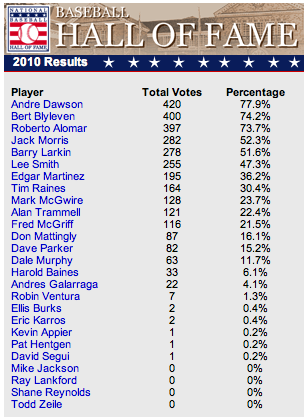 I first learned that Blyleven fell five votes short of election in an email from Bert minutes before Jeff Idelson, president of the National Baseball Hall of Fame and Museum, announced in "one of the closest votes in history" that Andre Dawson would join Veterans Committee selections Whitey Herzog and Doug Harvey as the Hall of Fame class of 2010 on July 25 in Cooperstown, New York.
From: Blyleven Bert Subject: Re: One More Update Date: January 6, 2010 11:00:50 AM PST To: Lederer Richard Reply-To: Blyleven Bert
Missed by 5 votes
Sent via BlackBerry by AT&T
In a subsequent telephone conversation, Bert told me that he received a phone call from Brad Horn, director of communications of the National Baseball Hall of Fame and Museum, five minutes before the results were announced. Thinking this may have been the call that every Hall of Fame candidate dreams of, Bert was holding hands with his wife Gayle when Horn told him that he missed out by five votes. Blyleven laughingly said, "You've got to be kidding me, right?" Turns out it wasn't a joke or one of his friends pulling a prank on him.
I initiated the email thread that morning when I sent Bert the latest update on the Hall of Fame balloting as compiled by Repoz, the editor-in-chief of the Baseball Think Factory. Based on 125 full ballots, Blyleven was at 80.0%. I told him: "I thought it was a 1-in-3 shot this year but am now thinking 50-50 with 99.9% certainty next year (if not this year). It's gonna happen, either this time around or next time around. You deserve it, and I'm very happy for you. It's been too long of a wait already. I hope it's just a matter of an hour or so now."
As it turned out, it looks as if it will be at least 8,760 more hours before Bert is rightfully elected to the Hall of Fame. The good news is that his election is no longer a matter of if but when. We only need to round up five more votes.
These needed votes could come from Carrie Muskat, Mark Newman, and Marty Noble at MLB.com and Pedro Gomez, Tony Jackson, and Michael Knisley at ESPN.com. Or from any of the other 133 writers who voted "no."
Maybe Jay Mariotti, assuming he is still a member of the BBWAA next year, will vote for Blyleven once again rather than turning in a blank ballot. Perhaps Murray Chass will reconsider his position, putting into proper perspective Bert's 10-17 record at the age of 38 when he "pitched with a sore shoulder all season long." Heck, maybe Buster Olney and Jon Heyman, both of whom have never voted for Blyleven based on their belief (here and here, respectively) that he wasn't a "dominant" pitcher, will check out the following table and recognize that he was indeed the dominant pitcher during a large portion of the 1970s.
Bert led the majors in Runs Saved Above Average (RSAA) for FOUR CONSECUTIVE FIVE-YEAR PERIODS beginning in 1971-1975 and ending in 1974-1978. RSAA was created by Lee Sinins of the Complete Baseball Encyclopedia. It measures the number of runs that a pitcher saves his team relative to the number of runs that an average pitcher in the league would allow over the same number of innings, adjusted for ballpark effects. The beauty of RSAA is that it combines quality (runs saved per inning vs. the league average) and quantity (innings pitched).
Over the past 50 years, the five-year leaders have included Don Drysdale (1x), Sandy Koufax (3x), Juan Marichal (2x), Bob Gibson (2x), Tom Seaver (2x), Bert Blyleven (4x), Jim Palmer (1x), Steve Carlton (3x), Dave Stieb (5x), Roger Clemens (7x), Greg Maddux (5x), Pedro Martinez (4x), Randy Johnson (2x), Johan Santana (3x), and Roy Halladay (1x). While it may be too early to judge Santana and Halladay, 11 of the other 12 pitchers are either enshrined or will be enshrined (including several "inner circle" Hall of Famers). The only exception is Stieb, whose HOF case was derailed by a relatively short career.
| PERIOD | PITCHER | RSAA |
|---|---|---|
| 1960-1964 | Don Drysdale | 130 |
| 1961-1965 | Sandy Koufax | 153 |
| 1962-1966 | Sandy Koufax | 194 |
| 1963-1967 | Sandy Koufax | 173 |
| 1964-1968 | Juan Marichal | 158 |
| 1965-1969 | Juan Marichal | 179 |
| 1966-1970 | Bob Gibson | 183 |
| 1967-1971 | Tom Seaver | 174 |
| 1968-1972 | Bob Gibson | 193 |
| 1969-1973 | Tom Seaver | 191 |
| 1970-1974 | Tom Seaver | 161 |
| 1971-1975 | Bert Blyleven | 164 |
| 1972-1976 | Bert Blyleven | 161 |
| 1973-1977 | Bert Blyleven | 181 |
| 1974-1978 | Bert Blyleven | 148 |
| 1975-1979 | Jim Palmer | 147 |
| 1976-1980 | Steve Carlton | 132 |
| 1977-1981 | Steve Carlton | 149 |
| 1978-1982 | Steve Carlton | 118 |
| 1979-1983 | Dave Stieb | 113 |
| 1980-1984 | Dave Stieb | 146 |
| 1981-1985 | Dave Stieb | 183 |
| 1982-1986 | Dave Stieb | 156 |
| 1983-1987 | Dave Stieb | 124 |
| 1984-1988 | Roger Clemens | 147 |
| 1985-1989 | Roger Clemens | 173 |
| 1986-1990 | Roger Clemens | 217 |
| 1987-1991 | Roger Clemens | 221 |
| 1988-1992 | Roger Clemens | 224 |
| 1989-1993 | Roger Clemens | 189 |
| 1990-1994 | Roger Clemens | 201 |
| 1991-1995 | Greg Maddux | 225 |
| 1992-1996 | Greg Maddux | 254 |
| 1993-1997 | Greg Maddux | 265 |
| 1994-1998 | Greg Maddux | 271 |
| 1995-1999 | Greg Maddux | 232 |
| 1996-2000 | Pedro Martinez | 279 |
| 1997-2001 | Pedro Martinez | 289 |
| 1998-2002 | Pedro Martinez | 271 |
| 1999-2003 | Pedro Martinez | 276 |
| 2000-2004 | Randy Johnson | 234 |
| 2001-2005 | Randy Johnson | 194 |
| 2002-2006 | Johan Santana | 181 |
| 2003-2007 | Johan Santana | 185 |
| 2004-2008 | Johan Santana | 200 |
| 2005-2009 | Roy Halladay | 167 |
Note: You can access the complete list of leaders since 1900 here.
Should Runs Saved Above Average be too abstract for your tastes, how about if we just dumb Blyleven's Hall of Fame case down to the following four sentences:
Bert Blyleven ranks fifth in career strikeouts, ninth in career shutouts, and in the top 20 since 1900 in wins. Every eligible pitcher with 3,000 strikeouts is in the Hall of Fame except Blyleven, who has 3,701. Every eligible pitcher with 50 shutouts is in the Hall of Fame except Blyleven, who has 60. Every eligible pitcher in the top 20 in wins since 1900 is in the Hall of Fame except Blyleven and Tommy John.
For those who might wonder why Blyleven and not John, please be aware that Bert struck out 1,456 more batters, pitched 14 more shutouts, and had a superior K/BB (2.80 vs. 1.78), WHIP (1.20 vs. 1.28), and ERA+ (118 vs. 110).
Be it RSAA, strikeouts, shutouts, or the fact that he completed fifteen 1-0 shutout victories (the third-most ever and the highest total in 75 years), Blyleven was clearly a dominant pitcher. He should have been voted into Cooperstown a long, long time ago. It would defame the Hall if Blyleven weren't elected in one of his two final years of eligibility. Meanwhile, here's hoping that the same 400 writers who voted for him this year mark an "X" next to his name again *and* at least five additional writers step up and support his candidacy in 2011.
With the help of long-time advocates such as Jim Caple, Jay Jaffe, Rob Neyer, Dayn Perry, Joe Posnanski, and Joe Sheehan, I believe we can convince a number of voters who have either been on the fence in the past or may not have taken the time to understand and appreciate Blyleven's qualifications. These newbies can join the ranks of converts like Caple himself, Bill Conlin, Jerry Crasnick, Peter Gammons, Bob Klapisch, Jeff Peek, Tracy Ringolsby, Ken Rosenthal, T.R. Sullivan (and many, many others), all of whom began to vote for Blyleven at some point during the past seven years.
As they say, "If you can't beat them, join them." For added measure, you'll be on the winning side next time around.
| Baseball Beat | January 04, 2010 |
Graphing the Hitters
Thanks to Fangraphs and Jeremy Greenhouse, I now have access to the 2009 stats in three spreadsheets covering 706 hitters, 664 pitchers, and 1,877 rows for fielders (including seven for Ben Zobrist). While combing through these numbers, it occurred to me that I had graphed pitchers and payroll efficiency over the years but never hitters. Well, that's about to change.
If a picture is worth a thousand words, then a graph is worth at least as many. Tables are nice to peruse but graphs are clearly more visual than columns and rows of stats. Although there is nothing groundbreaking as it relates to the graphs that I have chosen to present, I believe they tell their own stories. They are designed to be simple and straightforward. Two axis, four quadrants, and player names identifying outliers.
The first graph, which I call Productivity, plots on-base percentages on the x-axis and slugging averages on the y-axis for every qualified batter in 2009. The intersection of the MLB averages for OBP (.333) and SLG (.418) created quadrants that classify players as above average in both (upper right), below average in both (lower left), or above average in one and below average in the other (upper left and lower right).
Note: You can download a spreadsheet containing the AVG, OBP, SLG, and OPS of the 155 hitters here. This information can also be used to locate the 135 players not labeled in the graph below.

I've got two questions:
1. Is Albert Pujols any good?
2. Is Yuniesky Betancourt really the starting shortstop for the Kansas City Royals?
OK, I've got one more:
3. Did Royals GM Dayton Moore just sign Jason Kendall to a two-year contract for $6 million?
Bonus round:
4. Is it true that Moore signed a four-year extension with the Royals through 2014 more than a year before his current deal expired?
The answer to all four questions is ... drum roll, please ... YES!
Pujols (.443 OBP, .658 SLG) is very, very good. He carried my fantasy baseball team to a championship in 2009. Thank goodness for pulling the piece of paper with "1" out of the hat prior to our draft. He won his third National League Most Valuable Player Award unanimously, leading the senior circuit in OBP, SLG, OPS (1.101), OPS+ (188), R (124), HR (47), XBH (93), TOB (310), TB (374), and several other advanced metrics. Prince Albert doesn't turn 30 until the middle of this month, yet he has already produced over 1,700 hits and 800 walks, slugged 387 doubles and 366 home runs, and surpassed 1,000 runs scored and 1,100 runs batted in over the first nine years of his career.
Betancourt, on the other hand, had the lowest OBP (.274) and the seventh-worst SLG (.351) in the majors. The distinction of ranking dead last in SLG went to Yuniesky's newest teammate, the 35-year-old Kendall, who has "hit" .261/.336/.321 (OPS+ of 76) with 8 HR in nearly 3,000 plate appearances since being traded by the Pittsburgh Pirates (or was it the "Stealers"?) after the 2004 season.
Joe Mauer (very good) and Emilio Bonifacio (very bad) also stood out last year. Mauer was named AL MVP, sweeping the Triple Crown in rate stats with a .365 AVG, .444 OBP, and .587 SLG while winning his third batting title in the past four seasons. He also led the league in OPS (1.031) and OPS+ (170). Did I mention that Kendall is Mauer's third-most similar player through age 26?
Speaking of Bonifacio, how many fantasy owners picked him up when he was hitting .583/.600/.833 after the first week of the season? He rewarded them by putting up a .233/.288/.279 line the rest of the way.
There are a number of other interesting observations from the Productivity graph. For example, check out the names of the high-OBP and high-SLG players in the northeast quadrant. In addition to Pujols, the list includes Prince Fielder (.412/.602), Joey Votto (.414/.567), Derrek Lee (.393/.579), Ryan Howard (.360/.571), and Kendry Morales (.355/.569). First basemen all. The diamond directly below Votto's is Kevin Youkilis (.413/.548). The one down and to the right of Lee's is Miguel Cabrera (.396/.547). The diamond that is between Youk and Miggy is Adrian Gonzalez (.407/.551). Lastly, the one down and to the left of Lee is Mark Teixeira (.383/.565).
The following graph is a duplicate of the one above but it also includes a trendline. I chose a linear trendline as it is virtually the same as the other choices. The equation for the dataset of all qualified hitters is y = 1.1493x + 0.051. Or, more specifically, SLG = 1.1493 x OBP + 0.051. Due to the lack of pitchers and bench players, the qualified group produced a simple average OBP of .354 and SLG of .458, or 6.3% and 9.6%, respectively, higher than the league norm.
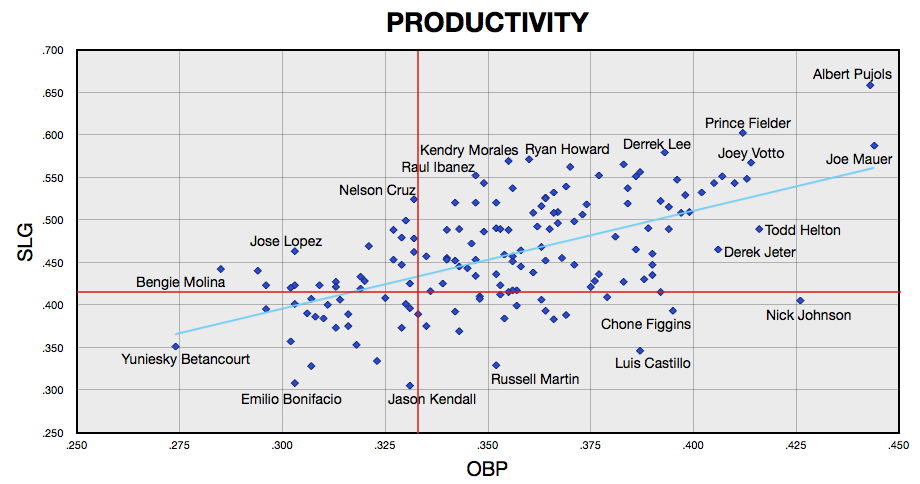
The hitters below the trendline get more of their productivity from OBP while those above the line get more from SLG. While many of the players below the trendline are not particularly skilled at reaching base (wherefore art thou Bonifacio?), they are even more inept at hitting for power.
Nick Johnson, Chone Figgins, Luis Castillo, and Russell Martin derived most of their offensive value last year from getting on base. Jose Lopez and Bengie Molina hit for some power but made far too many outs. Todd Helton and Derek Jeter were two of the more productive hitters, combining on base with slugging but generating more value from the former than the latter.
Although Mauer and Pujols led their respective leagues in OBP, both players slugged at an even higher rate relative to the league average. Given that Mauer and Pujols are standout defensive players as well, it's not difficult to understand whey they were named the Most Valuable Players in 2009.
| Baseball Beat | December 24, 2009 |
BBWAA 2010 Hall of Fame Ballot
Fifteen new candidates are among the 26 players listed on the 2010 Hall of Fame ballot mailed to more than 575 voting members of the Baseball Writers Association of America late last month. The newcomers include Roberto Alomar, Barry Larkin, Edgar Martinez, and Fred McGriff, as well as Kevin Appier, Ellis Burks, Andres Galarraga, Pat Hentgen, Mike Jackson, Eric Karros, Ray Lankford, Shane Reynolds, David Segui, Robin Ventura, and Todd Zeile.
Among the 11 holdovers, Andre Dawson (67.0%) and Bert Blyleven (62.7%) were the only players named on more than half of the 539 ballots cast last year. Candidates need 75 percent to gain entry into the National Baseball Hall of Fame in Cooperstown, New York. Among players not currently on the BBWAA ballot, Gil Hodges is the only candidate to receive over 60 percent and not eventually be elected to the Hall of Fame.
The other returnees are Harold Baines, Don Mattingly, Mark McGwire, Jack Morris, Dale Murphy, Dave Parker, Tim Raines, Lee Smith, and Alan Trammell. Candidates remain under consideration for up to 15 years as long as they are named on at least five percent of the ballots cast.
The BBWAA election rules detail the authorization, electors, eligible candidates, method of election, voting, time of election, and certification of election results. The electors, consisting of active and honorary members of the BBWAA with 10 or more consecutive years' experience, may vote for up to 10 eligible candidates deemed worthy of election. Write-in votes are not permitted. Ballots must be postmarked no later than December 31. Results will be announced Wednesday, January 6, 2010, on the web sites of the Hall of Fame and the BBWAA. The Induction Ceremonies will take place in Cooperstown on Sunday, July 25, 2010.
The Hall of Fame features 291 members, including 2010 Veterans Committee electees Doug Harvey and Whitey Herzog. Included are 202 former Major League players, 35 Negro Leaguers, 26 executives or pioneers, 19 managers and nine umpires. The BBWAA has elected 108 former players while the Hall of Fame Committee on Baseball Veterans has chosen 157 candidates. The defunct Committee on Negro Leagues selected nine members between 1971-1977 and the Special Committee on the Negro Leagues in 2006 elected 17 Negro Leaguers.
Here is a copy of the 2010 Hall of Fame Ballot that was mailed to the voting members of the Baseball Writers Association of America.
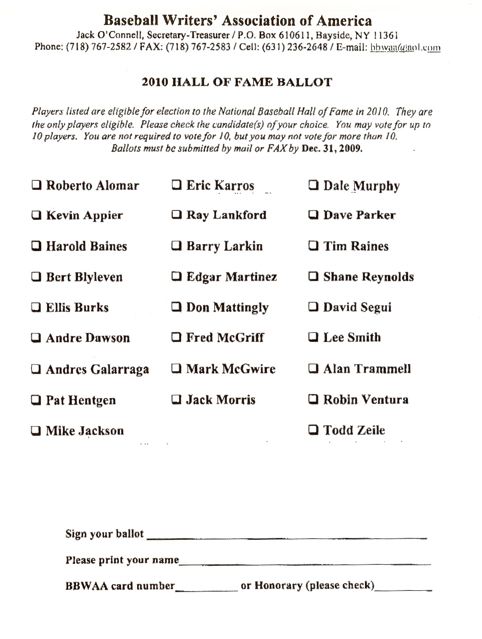
A summary of the players' records and accomplishments accompanied the ballot. The players were listed in alphabetical order, starting with Alomar and ending with Zeile. The following page, which includes Blyleven, Burks, Dawson, and Galarraga, serves as an example of the information provided to the electorate.

If I had the privilege of voting, I would have placed a check next to the names of Alomar, Blyleven, Larkin, Martinez, McGwire, Raines, and Trammell. It's well known that I'm most partial to Blyleven, who ranks THIRTEENTH (13th) among all pitchers and TENTH (10th) among eligible pitchers in Wins Above Replacement. Every pitcher in the top 23 is either in the Hall of Fame or should be five years after their retirement except Only the Lonely himself. For those who prefer more traditional measurements, Blyleven ranks fifth in career strikeouts, ninth in shutouts, and 27th in wins (top 20 since 1900). No matter how you like your numbers, Blyleven should have been voted into the HOF many, many years ago. He is, by far, the most deserving player on this year's ballot.
In addition to Blyleven, I believe Raines has been grossly overlooked. I supported 30 Rock's candidacy two years ago when he first appeared on the ballot. Raines is one of the greatest lead-off batters in the history of the game, ranking 41st all-time in getting on base (hits + walks + hit by pitch), 50th in runs scored, and 5th in stolen bases (with the second-highest success rate among those with 300 or more SB). He has more Win Shares (390) than any player up for election.
I believe Alomar, Larkin, and Trammell are more comparable than not. All three middle infielders belong in the Hall of Fame. In 2001, Bill James ranked each of them in the top ten of their positions in his New Historical Baseball Abstract. They were five-tool players who could hit for average, hit for power for their positions, run, field, and throw. In addition, Alomar (1,032 BB/1,140 SO), Larkin (939 BB/817 SO), and Trammell (850/874 SO) displayed terrific bat control and plate discipline.
Alomar (.300/.371/.443, 116 OPS+, 474 SB/81%) ranks in the top 80 all time in runs, hits, doubles, total bases, times on base, runs created, and stolen bases—remarkable achievements for a second baseman who won 10 Gold Gloves. Larkin (.295/.371/.444, 116 OPS+, 379 SB/83%), who was the first shortstop to hit 30 HR and steal 30 bases in the same season, has the 1995 NL MVP Award and three Gold Gloves in his trophy case. James called him "one of the ten most complete players in baseball history." Trammell (.285/.352/.415, 110 OPS+, 236 SB/68%) won four Gold Gloves and should have been named the AL MVP in 1987 when the shortstop hit .343/.402/.551 but lost out to left fielder George Bell (.308/.352/.605), a one-dimensional player, when voters were fixated on RBI rather than overall performance and value.
The main argument against Martinez is that he was a designated hitter and failed to get 3,000 hits or even 400 home runs. Well, Jim Rice DH'd for a quarter of his career and came up short of those two milestones, yet was voted into the HOF last year. The biggest difference between Martinez and Rice isn't in their counting stats but in their rate stats. Martinez hit .312/.418/.515 with an OPS+ of 147. Rice hit .298/.352/.502 with an OPS+ of 128. Edgar had a higher AVG, OBP, SLG, OPS, and OPS+ than James Edward. Martinez played in an era more suited to hitters while Rice benefited from a more friendly home ballpark.
Martinez had an OPS+ of 132 or higher in every season in which he had 400 or more plate appearances, other than in his final year in 2004. The righthanded hitter was an on-base and doubles machine, leading the league three times in OBP and twice in 2B while ranking 22nd and 41st in these two categories all time. He also ranks in the top 50 in BB, OPS, and OPS+. Like Rice, Martinez wasn't much in the field or on the bases, but he was a more productive hitter and a superior offensive player.
By any objective standard, McGwire is a clear-cut Hall of Famer. Big Mac ranks 8th in HR (583), 9th in SLG (.588), 11th in OPS (.982), 12th in OPS+ (162), and FIRST in AB per HR (10.6). He led the league in HR four times, including a then single-season record of 70 in 1998. McGwire (.299/.470/.752 with 41 Win Shares) inexplicably wasn't voted NL MVP that season, receiving just two first-place votes vs. 30 for Sammy Sosa (.308/.377/.647, 35 Win Shares).
Importantly, McGwire wasn't suspended nor expelled from the game. He has never admitted to or been convicted of any steroid use and wasn't even named in The Mitchell Report. In 1998, Big Mac acknowledged taking androstenedione, an over-the-counter product that was legal at the time under U.S. law and for use in MLB. It wasn't considered an anabolic steroid until three years after his retirement. If enough revisionist historians want to exclude McGwire from the Hall of Fame, I guess they will sadly win out.
Although I'm not in favor of Dawson's candidacy, I can understand why writers would vote for him. He combined power, speed, and defense in a career that resulted in 438 home runs, 314 stolen bases, and eight Gold Gloves. My beef with Dawson is that he simply made too many outs for my tastes (and many others). That said, it wouldn't be the biggest injustice if the Hawk gained entry into the Hall of Fame (unless, of course, he makes it and Raines never does).
McGriff is a borderline candidate, perhaps more suited to the Hall of the Very Good than the Hall of Fame. At a minimum, I'm hopeful that he will get at least five percent of the vote and remain on the ballot for another year. Falling seven home runs short of 500 for his career, the Crime Dog might not resonate with voters who may have forgotten just how good he was in the late-1980s and early-1990s. To wit, from 1988-1994, McGriff ranked in the top five in HR and OPS every season. That's right, for seven straight years, he finished either first, second, third, fourth, or fifth in his league in those two slugging categories. He could get on base, too, placing in the top four in OBP for four consecutive campaigns.
If peak value was the sole criteria, I could get behind Mattingly, Murphy, and Parker. Donnie Baseball may have been the preeminent hitter in the game from 1984-1986 when he hit .340 and averaged 219 hits, 48 doubles, and 30 home runs while leading the majors in total bases in '85 and '86. He could also field, picking up nine Gold Gloves at first base along the way. Murphy, who didn't miss a game from 1982-1985 when he was one of the best position players in baseball, was named NL MVP in back-to-back seasons and was a five-time recipient of the Gold Glove Award. Parker broke out in 1975 and was the man from 1977-1979 when he won an MVP, two batting titles, and three Gold Gloves. He and Rice had parallel careers, and it is my belief that the Cobra was nearly the same hitter and a much better fielder and baserunner at the height of their careers. All three candidates have loyal backers and will likely remain on the ballot for their entire 15 years of eligibility, yet none has ever received as much as 30 percent of the vote.
Morris and Smith have their fans but both seem stuck in the low-40s in terms of their overall support. It's rare to stumble across an endorsement of Morris without reading about his postseason pitching prowess. While Jack's 10-inning, complete-game shutout in Game 7 of the 1991 World Series is undoubtedly one of the best pitching performances in the history of the Fall Classic, his overall postseason record (7-4, 3.80 ERA, 1.25 WHIP, 2.00 K/BB) pales in comparison to Blyleven's (5-1, 2.47 ERA, 1.08 WHIP, 4.50 K/BB). As Joe Posnanski covered in detail earlier this week, Blyleven beat Morris head-to-head in the 1987 ALCS and returned on three days' rest to win the clincher before helping the Twins overtake the Cardinals in the World Series.
Meanwhile, Baines, who Buster Olney somehow likened to Blyleven, runs the risk of dropping off the ballot after three years of picking up more than five percent but less than six percent of the vote.
First timers Appier, Burks, and Ventura are worthy of some love but unlikely to secure five percent of the vote. Galarraga, Hentgen, and Lankford all had their moments but fall well short of consideration. I'm not sure how Jackson, Reynolds, Segui, and Zeile got past the screening committee and, along with Karros, will be surprised if any of these players receives a single vote.
| Baseball Beat | December 14, 2009 |
Bert Be Home By Eleven?
Despite ranking fifth in career strikeouts, ninth in shutouts and 27th in wins, Bert Blyleven inexplicably remains on the outside of Cooperstown looking in.
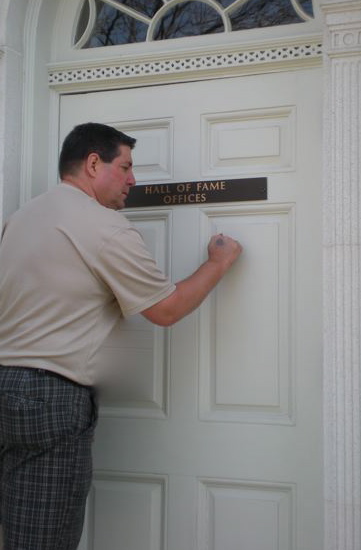 I have been knocking on the doors of the Hall of Fame since December 2003. Blyleven's voting percentage has climbed from 29% that year to 41% in 2005, 48% in 2007, and 63% in 2009. He is trending well but still needs to get to the 75% threshold to receive his just due.
According to Sky Andrecheck, "No player in the last 25 years has seen his vote totals rise so sharply and not been enshrined in the Hall. I wouldn't bet on Blyleven being the first."
Let's hope Sky is right. In the meantime, the two most widely heard arguments against Blyleven's qualifications for the Hall of Fame involve his lack of All-Star Game appearances and poor showings in the Cy Young Award balloting. While I have refuted both of these concerns many times in the past (see multiple links to the Bert Blyleven Series in the sidebar to the left), I am going to take another shot at it today, asking questions and providing answers (including an excerpt from what I wrote in December 2006).
How many times did the All-Star Game manager pick nine or ten *starting* pitchers during Blyleven's career? I might be wrong, but I would be surprised if ten starters (without double counting injured and replacements) were ever selected for a single ASG during his career. A few nines but mostly six, seven, or eight by my count.
Of those six, seven, or eight, how many pitchers did those managers select from their own teams? Do you think that is an objective measure? How many times did they pick a starting pitcher as the lone representative from that player's team? When your teammates are named Killebrew, Oliva, Carew, Stargell, and Parker, you're never going to be selected as the lone player from your club.
Was Blyleven ever passed over because he had pitched the weekend before the All-Star game? Moreover, don't you think managers were as "guilty" as the writers when making these selections by focusing on win-loss records as much or more than other stats that a pitcher has more control over? If so, can we agree that W-L records are not the best measure of a pitcher's performance?
For example, in 1972, Blyleven's ERA was 2.85 over, get this, 170.2 innings at the All-Star break. He wasn't selected because his W-L record was 9-12. He pitched like an All-Star but was penalized because his W-L record was under .500. Manager Earl Weaver went with Blyleven's teammate Jim Perry, who was 8-9 with a 3.21 ERA at the break, rather than with Bert. Think the fact that Perry was a 14-year veteran and Blyleven was in his second full season had anything to do with that injustice? How about Weaver choosing Marty Pattin (8-8, 3.75 ERA) over Blyleven?
In 1977, Blyleven had an ERA of 2.61 with outstanding peripherals at the All-Star break. Why do you suppose he wasn't named to the All-Star team? Do you think the fact that his W-L record was 8-9 had anything to do with it? Instead of selecting Blyleven as one of the seven starting pitchers, Billy Martin chose Bert Campaneris to represent the Texas Rangers. Campaneris was hitting .256/.317/.352 with 13 SB and 15 CS at the break.
In 1989, Blyleven was 8-2 with a 2.15 ERA in 125.2 IP, yet once again was passed over as one of the six pitchers Tony La Russa chose, two of whom were from his own A's team, including Dave Stewart, who "earned" the right to start the game due to his 13-4 record despite posting an ERA of 3.24 (more than a full run higher than Blyleven) while allowing more hits than innings and producing a K/BB ratio of less than 2.
Re the All-Star Game, here is what I wrote (along with breaking out his first and second half career stats) in Answering the Naysayers (Part Two) in December 2006:
As it relates to the number of All-Star Game appearances, Blyleven generally pitched better in the second half of the season than in the first half. Unfortunately, All-Star selections are based on how players perform during April, May, and June rather than July, August, and September.W L PCT ERA IP H R ER HR BB SO 1st Half 150 140 .517 3.47 2738 2620 1167 1056 258 726 2046 2nd Half 137 110 .555 3.12 2232 2012 862 774 172 596 1655Given that W-L records and ERAs are the stats most heavily considered by managers when it comes to picking All-Star starting pitchers, it follows that Blyleven would have been viewed more favorably had this honor taken place at the end of the season rather than in the middle.
If anything, Blyleven's splits should be viewed in a positive light. He did his best work in August and September (and in the postseason).
W L ERA IP H R ER HR BB SO April/Mar. 30 36 3.61 680.2 661 301 273 69 199 487 May 50 41 3.40 858.1 800 360 324 72 220 689 June 49 46 3.37 803 773 337 301 78 212 596 July 48 44 3.70 873 831 390 359 88 240 613 August 59 36 2.89 863 770 313 277 62 222 645 Sept./Oct. 51 47 2.99 892 797 328 296 61 229 671 Postseason 5 1 2.47 47.1 43 15 13 5 8 36Blyleven performed like an All-Star in 1971, 1973, 1974, 1975, 1976, 1977, 1981, 1984, 1985, 1986, and 1989. For example, in his first full season in 1971, Bert led the league in strikeouts-to-walks (3.80), ranked third in Runs Saved Against Average (26), fourth in strikeouts (224) and adjusted ERA+ (127), fifth in ERA (2.81) and shutouts (5), eighth in complete games (17), and ninth in innings pitched (278 1/3), yet he wasn't an All-Star. Blyleven rightfully made the team in 1973 when he was arguably the best pitcher in the AL.
In 1974, Blyleven was 2nd in K (249), K/BB (3.23), and ERA+ (142); 4th in ERA (2.66), WHIP (1.14), and RSAA (32); and 10th in CG (19), yet failed to earn All-Star honors once again.
One year later, Bert ended up 2nd in K (233), 3rd in WHIP (1.10) and RSAA (34), 4th in K/BB (2.77), 5th in CG (20) and ERA+ (129), 6th in ERA (3.00), 7th in IP (275 2/3), and 9th in SHO (3) and, lo and behold, didn't make the All-Star team.
In 1976, Blyleven was 2nd in SHO (6), 3rd in K (219), 4th in IP (297 2/3), 5th in K/BB (2.70), 7th in RSAA (23), 8th in ERA+ (125), and 9th in ERA (2.87) and CG (18) but took another mini-vacation in July.
Bert may have been the best pitcher in the AL once again in 1977. He led the league in WHIP (1.07) and RSAA (39); was 2nd in ERA (2.72), ERA+ (151), and shutouts (5); 7th in K (182); 8th in K/BB (2.64); and 10th in CG (15), yet had nothing to show for it in terms of being an All-Star.
In the strike-shortened 1981 season, Blyleven ranked 3rd in K (107) and K/BB (2.67); 8th in WHIP (1.16) and ERA (2.88); 9th in ERA+ (126) and CG (9); and 10th in W (11). He watched the ASG from home.
In 1984, Bert led the league in RSAA (40); placed 2nd in W (19), WHIP (1.13), and ERA+ (142); 3rd in ERA (2.87) and SHO (4); 4th in K (170) and CG (12); and 8th in K/BB (2.30) despite playing for a team with a 75-87 record that ended up sixth in a seven-team division. He must have been an All-Star that year, right? Nope, he was left off the team again.
Blyleven made the All-Star team in 1985 for the second time in his career. However, he was ignored the following year when he led the league in IP (271 2/3) as well as in K/BB (3.71); placed 2nd in CG (16), 4th in K (215) and SHO (3), 6th in W (17), 7th in WHIP (1.18), and 10th in RSAA (19).
In 1989, the 38-year-old led the league in SHO (5); ranked 3rd in WHIP (1.12) and RSAA (28); 4th in ERA (2.73), ERA+ (140), and CG (8); 5th in K/BB (2.98); 6th in W (17); and 7th in IP (241), yet missed out on being an All-Star. Go figure.
As demonstrated, the fact that Blyleven was only named an All-Star twice is more a function of the system than a reflection on how well he pitched.
Importantly, the above breakdown also works just as well, if not even better, with respect to how Blyleven should have ranked in the CYA voting.
Speaking of which, I can't help but wonder if Blyleven's candidacy wouldn't be viewed more favorably today had the Baseball Writers Association of America implemented its new policy by expanding the Cy Young ballot from three to five spots 40 years ago?
Moreover, if the voters back then evaluated pitching performance more like today, perhaps Blyleven would have won the Cy Young Award in 1973? While Blyleven may not have quite put up a season equal to the likes of Zack Greinke or Tim Lincecum in 2009, it was a lot closer than what he was given credit for in the balloting that year. With more emphasis on K/BB, WHIP, FIP, and other measures besides wins and losses, Blyleven's dominance would be more notable today than how it has been perceived by many naysayers in the past.
There's plenty of room inside the Hall of Fame for Blyleven's plaque. The writers only have 2010, 2011, and 2012 to get it right as Bert drops off the ballot in three years. I anticipate further progress this year with an enshrinement date set for July 2011.
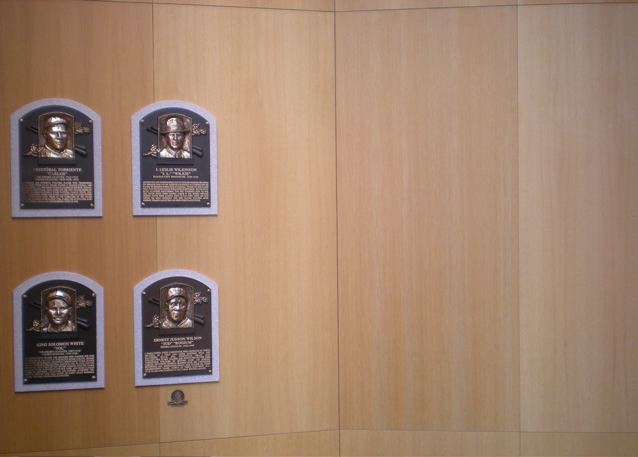
| Baseball Beat | December 12, 2009 |
A Recap of the Winter Meetings
We debut Baseball Analysts Radio today. While not technically radio, it is our attempt to provide audio content to supplement the daily articles written by analysts Dave Allen, Sky Andrecheck, Jeremy Greenhouse, Marc Hulet, Chris Moore, Patrick Sullivan, and me, as well as special guest columnists that have included many established and up-and-coming voices in the baseball world.
The first segment covers the just concluded Winter Meetings. I detail more than 15 trades and free agent signings, offering both news and views on these transactions. I'm planning to add more commentary on the three-way trade among the Yankees, Tigers, and Diamondbacks, plus the Chone Figgins signing in our next episodes.
We hope you enjoy this new feature at Baseball Analysts.
| Baseball Beat | November 30, 2009 |
The Best Baseball Analysts in the Country
The Baseball Analysts, which Bryan Smith and I co-founded in early 2005, is fast approaching its five-year anniversary. The new site was the result of a merger between Bryan's Wait 'Til Next Year and my Baseball Beat, whose origins go back to the spring of 2003.
Over the ensuing years, Baseball Analysts has witnessed Bryan's departure in 2006, followed by the additions of Jeff Albert that fall; Patrick Sullivan, Marc Hulet, and Joe P. Sheehan the following spring; and Jeremy Greenhouse, Dave Allen, and Sky Andrecheck during spring training 2009. Albert, Sullivan, Sheehan, and Greenhouse all debuted as guest columnists and their Designated Hitter articles earned them permanent spots in our starting lineup.
We eventually lost Albert and Sheehan to Major League Baseball. Albert was hired by the St. Louis Cardinals before the 2008 season to serve as the hitting instructor for the Batavia Muckdogs, its Short-Season Class A affiliate in the New York-Penn League. He was promoted to the Palm Beach Cardinals, the club's High-A affiliate in the Florida State League, prior to last season. Earlier this month, the Redbirds announced that Albert will be one of three minor-league hitting coaches returning to their positions for the 2010 campaign.
Sheehan received an internship with the San Diego Padres in 2008 and joined Dan Fox, a former writer for The Hardball Times and Baseball Prospectus, with the Pittsburgh Pirates at the conclusion of that season. Fox, who wrote a few guest columns for Baseball Analysts, is the Director of Baseball Systems Development and the architect of the team's Managing, Information, Tools and Talent (MITT) system.
Along these same lines, I'm proud to report that Sky Andrecheck, in addition to filling his normal Tuesday spot at Baseball Analysts, will be writing a weekly column during the offseason for SI.com. His first two Behind the Scoreboard articles can be accessed here. It says here that the sky is the limit for the statistician by day and baseball analyst and writer by night.
Andrecheck was also chosen by Dave Studenmund to serve as a guest writer for The Hardball Times Baseball Annual 2010. Sky wrote a piece on Championship Leverage Index. He introduced the concept last March in his second contribution at Baseball Analysts. Sky gives credit to Tom Tango for pioneering the concept of Leverage Index, which "puts a value on the importance of each moment in the game." Championship Leverage Index "takes the same idea and applies it in the context of an entire season. Like its in-game cousin, Champ LI quantifies each team's games in terms of the impact they are likely to have on winning a championship." Later in the article, he says Champ LI "essentially measures the probability that the outcome of one game will decide a playoff berth."
Dave Allen was also asked to write an article for THT Baseball Annual, which began shipping in the middle of November. Allen, who has contributed a weekly column for Baseball Analysts since last March and can also be found at Fangraphs, is one of the small number of PITCHf/x specialists. The title of his article is "Where Was That Pitch?" As with all of Dave's excellent studies, this piece is filled with graphs detailing the run values of two- and four-seam fastballs, curveballs, sliders, and changeups by pitch location.
The lowest run value is generally on pitches up and in, as these pitches have a low slugging rate on balls in play (many infield flies) and on pitches down-and-away, which have a low slugging average on balls in play (many ground balls) and a low contact rate. Pitches up-and-away and down-and-in tend to have intermediate run values and vary by pitch type.
Allen references five of his articles at Baseball Analysts and cites our own Joe Sheehan, one of the original PITCHf/x experts; Jeremy Greenhouse, who Mitchel Lichtman (also known as MGL) recently touted as a future front-office employee; and Chris Moore, author of the Best Fastballs in Baseball.
As an owner and connoisseur of the entire run of The Bill James Baseball Abstracts (1977-1988), I can tell you that The Hardball Times Baseball Annual is in that same league of annual baseball publications. You can trust its cover when it promises "timeless commentary, innovative stats, and great baseball writing."
James, in fact, is one of the contributors. He is the author of "Strong Seasons Leading Index," a system that seeks to produce "a list of the players who are most likely—and most unlikely—to sustain or improve on their 2009 seasons." Among players with 400 or more plate appearances last season, Dioner Navarro, Chris Young, and J.J. Hardy score the highest and Jorge Posada, Matt Diaz, and Craig Counsell the lowest. You might want to check out the full list when preparing for your fantasy baseball draft this winter.
Other guest columnists include Craig Wright, John Dewan, Tom Tango, Sean Smith, and Greg Rybarczyk. These highly regarded sabermetricians are joined by the stable of writers at The Hardball Times, including past Designated Hitters at Baseball Analysts Rybarczyk, Craig Calcaterra, David Gassko, Jeff Sackman, Dave Studenmund, Steve Treder, John Walsh, and Geoff Young.
For those readers who have purchased THT Baseball Annual in the past, this is a reminder that you need to get your order in now. For everyone else, I am confident that you will not be disappointed if you pick up a copy for the first time. You can help out the site and many of the best baseball analysts in the country by purchasing the book directly through this link. The small premium involved is a way of saying thanks for all the free stats, information, education, and entertainment you receive at The Hardball Times throughout the year.
| Baseball Beat | November 16, 2009 |
Holiday Shopping Ideas
"People ask me what I do in winter when there's no baseball. I'll tell you what I do. I stare out the window and wait for spring". — Rogers Hornsby
With the holiday season fast approaching, it's time to begin putting together your wish or gift list. You can do your part to stimulate the economy by purchasing an item or two in one of the many sports memorabilia auctions taking place in November and December.
In the 6th Annual Live Auction at Louisville Slugger Museum & Factory, Hunt Auctions just sold Curt Flood's 1963 Rawlings Gold Glove Award for $13,200 (vs. an estimate of $5,000-$7,000) and his 1964 St. Louis Cardinals World Series ring for $21,000 (vs. an estimate of $15,000-$20,000).
 Do not despair if you missed out on those items last weekend. There's still three days left to bid on a Frank Chance 1911-12 Chicago Cubs Game Used Home Jersey in the Legendary Auctions. The current bid has risen from $10,000 to $42,500. With bidding increments at $2,500 and an 18.5 percent buyer's premium, you might be able to land this jersey for $53,325.
For those of you who like offense more than defense at first base, you can be the first to bid on a circa 1933 Lou Gehrig New York Yankees Game-Used Home Flannel Jersey in the Grey Flannel 2009 Holiday Auction (shown at left). The minimum bid is only $225,000.
If you can't afford to lay out a quarter of a million dollars or more for the Gehrig jersey, then perhaps consider a 1927-1930 Benny Bengough New York Yankees Gamer. The platoon/backup catcher was a member of four World Series championship teams (1923, 1927, 1928, and 1932). He hit .258/.305/.322 (60 OPS+) in 95 games and 308 plate appearances for a team that went 69-85, yet finished 24th for the 1925 AL MVP Award. Bengough was either one helluva defensive catcher or had a relative who voted for him.
Bengough beat out Babe Ruth, who failed to garner a single vote in the only season from 1918-1931 in which the Bambino didn't lead the league in slugging, OPS, and OPS+.
According to Wikipedia, Ruth fell ill during spring training in 1925 and "returned to New York for what was reported as stomach surgery."
Ruth's ailment was dubbed "the bellyache heard round the world," when one writer wrote that Ruth's illness was caused by binging on hot dogs and soda pop before a game. Venereal disease and alcohol poisoning (caused by tainted liquor, a major health problem during the Prohibition) have also been speculated to be the causes of his illness. However, the exact nature of his ailment has never been confirmed and remains a mystery. Playing just 98 games, Ruth had what would be his worst season as a Yankee as he finished the season with a .290 average and 25 home runs. The Yankees team finished next to last in the American League with a 69-85 mark, their last season with a losing record until 1965.
Should jerseys not be your thing, you can pick up a 1927 Yankees (Murderers Row) autographed baseball. The signatures are faint but, hey, the bidding only starts at $5,000.
Boston Red Sox fans can add a 1972 Carl Yastrzemski Game-Used Home Flannel Jersey or a 2004 World Championship Ring to their collection. The latter belonged to Pablo Lantigua, a scouting supervisor who was fired last year for his involvement in the Dominican kickback scandal. The current bid is $12,100.
Lou Brock fans can bid on the Hall of Famer's 1974 Game Used Jersey (the one he wore to set the single-season stolen base record of 105) to the Game Used Base Stolen by him to break Ty Cobb's record to his 1967 World Championship Ring (current bid of $24,000) to a Game Used Glove or pair of Cleats to one of the many awards he won over the years. (View lots 1-78 here.)
If these items are out of your price range, consider bidding on a 1967 Jose Tartabull Boston Red Sox Worn & Autographed World Series Jacket. Heck, even if you're not a fan, this jacket might keep you warm during the cold winter months while waiting for Spring Training 2010. Only 104 days until March 1.
| Baseball Beat | November 09, 2009 |
The Bill James Handbook 2010
What a pleasant surprise it was to receive a review copy of The Bill James Handbook 2010 on Halloween Day before the third game of the 2009 World Series. The Handbook is not only the first baseball stats annual to hit the market each year but the most comprehensive as well.
 The book, featuring Tampa Bay Rays third baseman Evan Longoria on the cover, combines many of the best features of The Sporting News Baseball Register and Baseball Guide—both of which are now defunct, thanks in no small part to Bill James and the team at Baseball Info Solutions and ACTA Sports. This is the eighth year of the Handbook, which I have been reviewing since the 2004 edition was released in November 2003.
Whereas The Bill James Abstracts from 1977-1988, the Bill James Baseball Books from 1990-1992, and The Bill James Player Ratings Books from 1993-1995 were full of commentary from James himself, the Handbook is devoted more to the presentation of stats. However, I'm happy to say that the number of pages penned by James has grown from five six years ago to over 30 this year.
In addition to staples like Team Statistics, the Player Career Register, Fielding Statistics, the Fielding Bible Awards, Park Indices (including the new Yankee Stadium and Citi Field), and Win Shares, new features in this year's book include a history of Instant Replay and Pinch Hitting Analysis.
Major League Baseball introduced instant replay in late August 2008 to determine whether disputable home runs were fair, foul, or interfered with by a fan. In just over one full season, umpires have consulted instant replay 65 times and 22 calls have been overturned. The Handbook provides the details of each and every instant replay review in 2008 and 2009.
James attaches his byline to Team Efficiency Summary, The Baserunners, 2009 Relief Pitchers, Manufactured Runs, The Manager's Record, Young Talent Inventory, Hitter Projections, Pitcher Projections, and Pitchers on Course for 300 Wins.
The most efficient team in baseball is usually the Los Angeles Angels—anyway it was in 2009, and it was in 2008, and it has been in other years. The Angels do little things so well that they are consistently able to grind five or ten more wins a year out of their team than what one would think was available. We don't really understand how they do this, to be frank, but since they do it every year, we know it's not luck. Saying that they "do the little things well" is just a way of covering for the fact that we don't actually know how they do it.If it wasn't for the Angels, we might think it was all luck. There are a couple of parts of the Angels' success that we do understand. For one thing, they run the bases extremely well. They picked up about 96 bases last year, or about 20 runs, just by running the bases better than the average team. Twenty-two of those bases are "stolen base gain," but 74 of them are bases gained by things like going first-to-third on a single or tagging up and advancing. That helps a lot. The Angels in 2009 had 221 "Manufactured Runs," by far the most of any major league team. Second, they usually have a good bullpen, which means that they can put a good pitcher on the mound when the game is close. Even in 2009, when they didn't have a really good bullpen, they also didn't have a really bad bullpen. Those things help to make a team "efficient," as we are using the term.
The least efficient team? The Washington Nationals. Based on category performance such as team batting average and home runs (both offensively and defensively), James contends that the Nationals and the Houston Astros "could have been expected to win about 70 games." Nonetheless, the Astros won 74 games and the Nats were "dreadfully inefficient" with only 59 victories.
The Career Register includes career stats through the 2009 season for every major league player who participated in a game last year, as well as 32 bonus players, including those who missed the entire campaign due to injuries (such as Justin Duchscherer and Ben Sheets) and "potential foreign imports" (like Ryota Igarashi and Hisanori Takahashi). With approximately four or five players per page, this section comprises nearly 270 of the 514 numbered pages.
The Handbook provides traditional and advanced fielding statistics (G, GS, Inn, PO, A, E, DP, Pct., and Range plus SBA, CS, CS%, CERA for catchers), Runs Saved and Plus/Minus leaders, and the Fielding Bible Award winners.
Here are the results of The 2009 Fielding Bible Awards, as determined by a panel of ten analysts, including James, John Dewan, Peter Gammons, Joe Posnanski, and Rob Neyer (with the following commentary provided by Dewan). A complete record of the voting can be found in The Bill James Handbook 2010.
1B: Albert Pujols, STL - Four Fielding Bible Awards in four years. What's left to say?
2B: Aaron Hill, TOR - Hill wins the tie-breaker on the strength of four first-place votes, as opposed to only one for runner-up Dustin Pedroia.
3B: Ryan Zimmerman, WAS - Third base is a strong, deep defensive position in baseball right now, but Zimmerman has set himself apart by becoming the leader in Defensive Runs Saved over the last three years.
SS: Jack Wilson, PIT/SEA - Even though he split time between leagues, Wilson was the best shorstop in baseball this year, leading all shorstops in Runs Saved by a wide margin (27 compared to Brendan Ryan's 19).
LF: Carl Crawford, TB - No player has ever won with a perfect record (10 first-place votes from 10 panelists), but Crawford came as close as possible, garnering nine out of ten possible first-place votes. His 99 total points is an all-time record.
CF: Franklin Gutierrez, SEA - Winner of the 2008 Fielding Bible Award for right field, Gutierrez moved over to center field in 2009. His 31 Runs Saved were tied with Chone Figgins for the most in baseball.
RF: Ichiro Suzuki, SEA - Hunter Pence gave Ichiro a run for his money, but Ichiro finished with 93 points to Pence's 84. This is Ichiro's second Fielding Bible Award.
C: Yadier Molina, STL - Everyone knows about Molina's incredible throwing arm (well, maybe not the eight guys he picked off this year), but Molina was also the third-best bad-pitch-blocking catcher in baseball behind Carlos Ruiz and Jason Varitek.
P: Mark Buehrle, CWS - Buerhle has defensive chops, but his ability to hold runners is legendary. In the last four years he's allowed a total of 15 stolen bases, picked off 14 baserunners, and thrown over to first—only to have the runner break for second and be thrown out—16 times.
The chapter on Baserunning is always one of my favorites, partly due to the hard-to-find numbers and the six pages of James' insights. While Baseball-Reference.com has advanced baserunning stats on each player page, I'm not aware of an alphabetized table that is as readable as those in the Handbook.
Before listing the best and worst baserunners by position, James compares Chone "Gone" Figgins (23-for-43 going from first-to-third on a single and 26-for-31 second-to-home on a single) with Prince Fielder (1-for-45 first-to-third on a single) and David Ortiz (2-for-16 second-to-home on a single), Emilio Bonafacio (10-for-10 first-to-home on a double) with Mike Lowell (0-for-10), and Denard Span (moved up a base 31 times on a WP, PB, Balk, SF, or Defensive Indifference) with Geoff Blum (never advanced a base on any of those plays).
| BEST | WORST | |||||
|---|---|---|---|---|---|---|
| C | Kurt Suzuki | +15 | C | Yadier Molina | -26 | |
| 1B | Carlos Pena | +9 | 1B | Adrian Gonzalez | -29 | |
| 2B | Chase Utley | +50 | 2B | Robinson Cano | -23 | |
| 3B | Chone Figgins | +35 | 3B | Mike Lowell | -27 | |
| SS | Jason Bartlett | +30 | SS | Yuniesky Betancourt | -28 | |
| LF | Ryan Braun | +35 | LF | Juan Rivera | -40 | |
| CF | Michael Bourn | +55 | CF | Kosuke Fukudome | -11 | |
| RF | Ichiro Suzuki | +32 | RF | Gabe Kapler | -19 |
Most people will tell you that we should have Carl Crawford in left field ahead of Ryan Braun, and people will tell you that Yadier Molina actually runs well for a catcher, or at least for a Molina. We don't base this on reputation. Carl Crawford was 8-for-27 going first-to-third on a single. Ryan Braun was 15-for-41, which is better. Crawford was 4-for-9 scoring from first on a double. Braun was 7-for-9. Crawford moved up 24 bases on Wild Pitches, Passed Balls, Balks, Sacrifice Flies and Defensive Indifference. Braun moved up 26 times. Crawford grounded into 7 double plays in 136 DP situations; Braun grounded into 7 in 172 situations. Braun was thrown out 5 times on the bases. Crawford was thrown out 10. Crawford is a very good baserunner—the second-best baserunner among major league left fielders in 2009, including his base stealing—but Braun was better. And Yadi Molina grounded into 27 frigging double plays, which is a record even for a Molina brother.
As James points out, "the difference between the best baserunner in the majors (Michael Bourn) and the worst (Juan Rivera) was 95 bases, or about 24 runs" [editor's note: equal to about 2 1/2 wins].
That's nowhere near as large as the difference between Ryan Howard's bat and Willie Bloomquist's. It is not as large as the difference between Tim Lincecum's arm and R.A. Dickey's, or the difference between Zach Greinke and Luke Hochevar. It is not as large as the difference between having Franklin Gutierrez in center field or Vernon Wells, nor even as large as the difference between Franklin Gutierrez and an average defensive center fielder.It is not that large, but it is not meaningless or insignificant, either. It counts. We count everything because everything counts; that's our motto, or ought to be. On a team level the difference between best and worst baserunners is about 170 bases, or 40+ runs.
In the section on Relief Pitchers, the Handbook details 22 categories (with attendant commentary by James), including Games Pitched, Early Entries, Pitching on ConsecutiveDays, Long Outings, Leverage Index, Inherited Runners, Inherited Runners Who Scored, Inherited Runners Allowed Percentage, Easy Save Opportunity, Clean Outing, Blown Save Win, Saves, Save Opportunities, Holds, Save/Hold Percentage, and Opposition OPS. The stats of every pitcher who appeared in relief are listed in a table sorted by team and by job (closer, setup man, lefty relief specialist, long man, utility reliever, and emergency reliever).
James defines Manufactured Runs "loosely as any run on which two of the four bases result from doing something other than playing station-to-station baseball)" and gives a more technical description encompassing six rules. He says "the most critical element to manufacturing runs, in modern baseball, is speed. . .the bunt, yes, but modern teams don't bunt that much, and it doesn't lead to a lot of runs even when they do."
The best teams in baseball at Manufacturing Runs, pretty much every year, are the Los Angeles Angels of Anaheim and the Minnesota Twins of Bloomington. Those two teams were 1-3 in 2006, 1-2 in 2007, 1-4 in 2008, and 1-2 in 2009. They're good at that. The Angels led the majors in 2009 with 221 Manufactured Runs.
In The Manager's Record, James admits "there are many things that a manager does that are beyond the scope of our analysis." However, he points out that there are "certain things that one manager does differently than another manager that we can study" (likes to use a fixed lineup or experiment; propensity to platoon; use of pinch hitters, pinch runners, and defensive substitutions; quick hooks and slow hooks; tolerance for long outings by starting pitchers; number of relievers and those used on consecutive days; stolen base and sacrifice bunt attempts; hit and run; pitchouts; and intentional walks).
After two years of including Young Talent Inventory, James decided that this item "does not really belong in this book"—opting to move it to the Bill James Gold Mine—for three reasons:
First, this is a book about facts, as opposed to a book of analysis that is in any way speculative. We try to make a record of the season, and we try to include information that has never been seen before, and we try to pull that together as quickly as we can so that we can make it available to you while the breath of the season still hangs in the air.Second, the work process necessary for this book is not compatible with the needs of the Young Talent Inventory. This book is pulled together at a breakneck pace in the ten days following the end of the regular season. There is not a lot of room here for contemplation and review—and wouldn't be, even if that was all we were trying to do.
Third, the issue of which team owns the most talent is a forward-looking question, the sort of thing that one asks in the spring, as the season is getting underway: Who owns the future?
Of course baseball fans care about the future of their franchise as much in the fall as they do in the spring; I'm not suggesting that they don't. But I think it's a question that is more naturally asked in a spring annual than a fall summary, and we're going to move it over there where it belongs. I hope you understand.
The Bill James Handbook 2010 has much, much more to offer, including 2009 Leader Boards, mostly derived from the complex pitch data collected by Baseball Info Solutions. A lot of this information can be found at Baseball-Reference and Fangraphs, but there is something magical about flipping through a book and stumbling across the ten longest home runs in the A.L. and N.L., the ten longest average home runs in each league, the lowest and highest first swing %, the best and worst batting average plus slugging on pitches outside the strike zone, and the most pitches thrown at 95 or 100 mph. Trust me, there's enough enjoyment here to get you through the long winter.
| Baseball Beat | October 26, 2009 |
Los Angeles Angels: A Look Back and a Look Forward
I'm looking forward to tonight. John Lackey vs. CC Sabathia in Game 7 of the American League Championship Series.
But wait...
The Yankees beat the Angels, 5-2, in Game 6 last night to win the AL pennant and advance to the World Series.
Darn. That lead-in was what I was hoping to write for today's Baseball Beat. However, it wasn't meant to be. Aside from the differences in payrolls, the Yankees won fair and square. The Bronx Bombers were the better team during the season and in the ALCS. They earned the home-field advantage and won all three games in New York. The Angels won two of three in Anaheim but it's impossible for a team in their position to win a best-of-seven series without taking at least one game on the road.
The Angels made a lot of mistakes in the field and on the basepaths during the series, but the idea that the team and its manager should be embarrassed is preposterous. Look, I'm as frustrated as the next fan, yet there's no shame in winning your division, beating the Boston Red Sox in the ALDS, and losing to the Yankees in the ALCS. The last time I looked, only two teams go to the World Series and just one wins it all.
The bottom line is that the Angels played extremely well this year, although not quite up to the level of the Yankees. It's truly amazing what an extra 85 to 90 million dollars in payroll can do for your roster. Beating an All-Star team like that when it counts is no easy task.
Going forward, the Angels have a lot of decisions to make. Bobby Abreu, Chone Figgins, Vladimir Guerrero, and John Lackey are all free agents. Furthermore, the farm system has little to offer for the immediate future.
According to Cot's Baseball Contracts, the Angels had an Opening Day payroll (salaries plus pro-rated signing bonuses) of $113,709,000. The team acquired Scott Kazmir in August and will be responsible for his $8 million contract in 2010 (as well as $12M in 2011 and a $13.5M club option or a $2.5M buyout in 2012). Kazmir's salary next year will be more than offset by the loss of Kelvim Escobar, who made $9.5M with little or nothing to show for it in 2009.
Abreu ($5M), Figgins ($5.775), Guerrero ($15M), and Lackey ($9M) totalled about $35 million in salary last season. Add in Darren Oliver ($3.665M) and Robb Quinlan ($1.1M) and the Angels could free up $40M next year.
Erick Aybar, Maicer Izturis, Howie Kendrick, Jeff Mathis, Mike Napoli, Joe Saunders, and Jered Weaver are all eligible for arbitration and will pull down more money in 2010 than 2009. By my estimations, these seven players could cost the team an additional $12 million next year. Juan Rivera and Ervin Santana have contracts that will jump their salaries by $1M and $2.2M, respectively, in 2010. These increases amount to approximately $13M (net of the Kazmir/Escobar commitments) and the run-offs $40M, meaning the Angels have roughly $27M to re-sign current players and/or pursue free agents without boosting payroll beyond the 2009 level.
If owner Arte Moreno is willing to get back to the 2008 total of nearly $120 million, then general manager Tony Reagins would have more than $32M to work with this off-season. Half of this available money will need to go to Lackey should the Angels wish to keep their ace starter. The other half could be split between Abreu and Figgins although both players are likely to seek more than $8M each.
Put me in charge and I would stick to the 2/$16M offer the Angels reportedly made Abreu earlier this month. Yes, he was a bargain this year but that was a function of the market and is neither here nor there as it relates to 2010. If that offer works, great. If not, I'm OK with letting him go. The Angels can redirect that money elsewhere.
Despite Figgy's value this past year, I'm not paying a soon-to-be 32-year old for peak offensive and defensive performance that is unlikely to hold up over a three- or four-year contract. I'd like to have him back but only at 3/$27M. If Figgins can get a better contract from, say, Kenny Williams and the Chicago White Sox (who may be re-thinking an aggressive offer after watching Chone implode during the postseason), then he should go for the riches. Anyway, I think it's high time that the Angels finally give Brandon Wood the opportunity to play everyday. Should Wood flop, then the Halos can turn to Maicer Izturis at the hot corner.
As for Guerrero, I would only be interested on a short-term deal and on the cheap. Call it a Bobby Abreu 1/$5M "take it or leave it" agreement. The fact that Vladdy can no longer run or play defense limits his options and it's my belief that the number of suitors will be few and far between.
If everybody agrees to these terms, that means the Angels would need to shell out about $38 million for their services in 2010. In the meantime, I would want to be in the hunt for Jason Bay or Matt Holliday, but I would not be willing to give the latter anywhere close to the Mark Teixeira-type contract that agent Scott Boras envisions. As was the case with Tex, Moreno is unlikely to get into a bidding war for Holliday and allow negotiations to drag on throughout the winter. I don't foresee the Angels offering Holliday more than a Torii Hunter 5/$90M type deal. Depending on the appetite of the St. Louis Cardinals, Yankees, Red Sox, New York Mets, and perhaps the Atlanta Braves and San Francisco Giants, that may or may not work.
Lastly, I would go after Nick Johnson if Guerrero leaves. He could serve as the club's designated hitter and backup first baseman. Johnson would give the Angels a younger version of Abreu. He is basically the same guy without the speed. Sure, the 31-year old has a history of being injury prone, but he was relatively healthy this past year. However, I wouldn't be as aggressive as Dave Cameron so it's quite possible that the Seattle Mariners or some other team would top my offer.
With respect to the lineup, if Figgins returns, he leads off. If not, I believe Aybar can step into that role and give the Angels the same pre-2009 production as Figgy. With Kendrick stepping up, he would be my full-time second baseman and No. 2 hitter should Abreu leave for greener pastures.
Assuming the Angels lose Figgins, Abreu, and Guerrero, the lineup could look like the following if the team was fortunate enough to land Holliday and Johnson.
Aybar, SS
Kendrick, 2B
Holliday, LF
Morales, 1B
Hunter, CF
Johnson, DH
Rivera, RF
Wood, 3B
Napoli/Mathis, C
Manager Mike Scioscia could flip flop Johnson and Rivera vs. LHP in deference to the latter even though Johnson hits lefties just fine.
The bench would include Izturis as the super sub and possible third baseman if Wood doesn't live up to his promise. A combination of Gary Matthews Jr. (when does his contract run out?), Reggie Willits, and Chris Pettit would serve as the fourth and fifth outfielders. Freddy Sandoval could become the utility infielder. Pop in a cheap veteran who can pinch hit and cover for Johnson as a DH, if necessary.
With Lackey, the starting rotation would be about as formidable as any fivesome in the majors.
Lackey, RHP
Weaver, RHP
Kazmir, LHP
Santana, RHP
Saunders, LHP
The bullpen should be little changed, although consideration must be given to Kevin Jepsen as the closer. A healthy Scot Shields could add much-needed depth to a bullpen that was thin at times.
Jepsen, RHP
Fuentes, LHP
Bulger, RHP
Shields, RHP
Arredondo, RHP
Trevor Bell, Matt Palmer, and Sean O'Sullivan could fill the role of the sixth and seventh starters and bullpen insurance over the course of the long season.
I believe the aforementioned roster would win the AL West once again and have an even better shot at the World Series in 2010, all at a cost of approximately $125 million.
* * *
Update (10/27/09): Gary Matthews Jr. has no desire to return to the Angels in 2010.
"I don't expect to be back; it's time to move on," outfielder Gary Matthews Jr. said as he packed his belongings in the team's Angel Stadium clubhouse today. "I'm ready to play for an organization that wants me to play every day. This organization has other plans, and that's OK."
Matthews has two years and $23 million remaining on the five-year, $50-million contract he signed in November 2006. However, the reality is that the 35-year old outfielder is worth no more than about $1.5M-$2.5M on the open market right now, which means the Angels would have to eat roughly $10M in each of the next two seasons if Matthews were to be paid in full.
More realistically, I would expect GMJ and the Angels will wind up restructuring his contract in a manner similar to what the Dodgers and Andruw Jones agreed to last January. As part of the agreement, look for the Angels to trade or release him before the start of spring training. He'll wind up getting the $23M owed to him but it will be spread out over 5-10 years without interest. The new team will be responsible for paying him the MLB minimum of about $400,000 only. Meanwhile, the Angels will "save" approximately $7M-$9M over each of the next two years and this money could be applied toward Abreu, Figgins, Guerrero, Lackey, and possibly someone like Holliday. A win-win-win for everybody concerned.
| Baseball Beat | October 19, 2009 |
Personal Thoughts on the League Championship Series
Going into the League Championship Series, I was hopeful that one of the three (out of four) possible outcomes would come to pass. As an Angels and Dodgers fan, I wanted to see a Freeway Series more than anything else but would have settled for an Angels-Phillies or Dodgers-Yankees World Series as well.
Three games into the NLCS and two into the ALCS and things aren't looking so good for this Southern California native. Perhaps today will be the beginning of a much-needed turnaround for the locals.
Sensing that my heart leaned more toward the Angels than the Dodgers, my friend Alex Belth asked me last week why that was the case. I responded via email with the following answer.
My Dad covered the Dodgers so I grew up a Dodgers fan. When he went to work for the Angels the year I turned 14, it was hard for me to change my allegiance. I never really did, although I started following the Angels much more closely over the years. I was fortunate to be a Dodgers fan during the Koufax years and an Angels fan during the Ryan years. The Dodgers were obviously much better but Ryan and Tanana (and great seats in the press box or behind home plate) were an offsetting inducement that was hard to pass up.More recently, I have grown fonder of the Angels, primarily owing to the change in ownership of the Dodgers. I liked the Dodgers when the O'Malleys owned the club. I was not a fan of the FOX era at all and have not warmed up to the McCourts. The constant turnover, including the firing of Paul DePodesta, has rubbed me the wrong way. In the meantime, I believe Arte Moreno and Mike Scioscia are great. The Angels seem to have a style, if you will, and it grows on you as a fan. The fact that the ballpark is closer to my home and easier to get to, as well as into and out of before and after games, is a huge plus, too.
The clincher was buying season tickets (along with three other friends) BEFORE the 2002 season. Having those seats on the club level during that special season and being there for most of the playoff games, including Games 6 and 7 of the World Series (the latter with my daughter) was terrific. I also have a longtime friend who has front row tickets behind the Angels dugout, and I have been his guest many times over the years. Put it all together and it has become much easier and more fun to cheer for the Angels than the Dodgers.
I'll be in those front row seats this afternoon, rooting for Jered Weaver and the Angels to win Game 3 of the ALCS. I'll be the guy wearing the red Angels shirt and hat. LOL.
With a hat tip to Alex, former Yankees catcher and current YES analyst John Flaherty provided the following take on Weaver this morning:
Weaver could be the ace of this staff in that he has the best stuff overall. Good fastball which is pretty straight. Nice, big, sweeping ’slurve’-type breaking ball and a really good change. What makes him tough is that he really hides the ball so well. He throws across his body so much that he is real deceptive, especially for the righties. His numbers at home are fantastic and the only downside is that he gives up a lot of fly balls – which might be dangerous against the Yankee line up. I like him in that he is confident, almost cocky, out on the mound.
That is a very fair description (although a bit generous in suggesting that Weaver "has the best stuff overall"). Flaherty knows Weaver better than most and about as well as I know him.
Weaver has a much better record at home (9-3, 2.90) than on the road (7-5, 4.78) and has pitched better in day games (5-1, 3.23) than at night (11-7, 3.90), but the extreme flyball pitcher will need to keep the ball in the yard for the Angels to win this game. Unfortunately, the ball travels much better at Angel Stadium during the day than the evening. This fact alone could negate Weaver's favorable home and away splits against a powerful hitting team like the Yankees.
For Weaver to be successful, he will need to command both sides of the plate and change the eye level on occasion (as Jered did when he struck out Big Papi on a 93-mph heater up and in while taming the Red Sox last week). Look for Weaver to change speeds and use his "go to" changeup often against Johnny Damon, Mark Teixeira, Hideki Matsui, Jorge Posada, Robinson Cano, and Melky Cabrera, and perhaps even Alex Rodriguez. As Flaherty and the stats say, it's a "really good" one with excellent arm action and a 9-10 mph difference in speed from his fastball.
It's less than two hours to game time. Time to head to the ballpark.
| Baseball Beat | October 19, 2009 |
Jim Gilliam and My Dad
Thanks to Lee Sinins' ATM Reports, I learned that last Saturday was Jim Gilliam's birthday. If the former Dodgers infielder were alive, he would be 81.
I did a double take when I saw his years of birth and death. Gilliam and my Dad were born in the same year (1928) and died in the same year (1978). Their careers overlapped in Los Angeles as Dad covered the Dodgers from 1958-1968 with Gilliam a prominent member of the team for nine of those years. The Dodgers won the World Series three times during that span (1959, 1963, and 1965). Gilliam was an unsung hero in Game 7 of the 1965 Word Series, making a spectacular backhanded catch on a sharp grounder down the third base line and forcing a runner at third and saving at least one run. As I opined in Sandy Koufax and the 1965 World Series nearly six years ago, Gilliam's fielding gem was one of the best defensive plays in the history of the fall classic.
 Toward the end of his career, Gilliam gave Dad his game-used glove, a Rawlings Trapeze six-finger model. While I have no reason to suspect that it was the same Heart of the Hide as the one he used to make that play, it doesn't much matter today as it is long gone. You see, very few people thought in terms of collector's items in those days.
John Roseboro gave Dad his catcher's mitt at about that same time. Dad would use the Gilliam glove when he played catch with us or the Roseboro mitt when he got behind the plate and caught my older brother Tom and me. Gilliam's glove was passed on to me when I needed one (as I was the logical heir, seeing that Tom was a lefty and my younger brother Gary had yet to play Little League). That's me on the left in my Lakewood Colt League All-Star uniform with the Gilliam glove posing for the family camera in our front yard in the summer of 1970.
After reviewing that photo (check out those sanitary socks and stirrups), I now realize that I was more pigeon-toed than I thought. Heck, I may have pitched beyond high school had I not thrown across my front foot like that. As with so many things, if I only knew back then what I know today . . .
Take a look at the front toe of some of the best pitchers in baseball, past and present, be it Sandy Koufax, Tom Seaver, Nolan Ryan, Pedro Martinez, Roy Halladay, Felix Hernandez, Tim Lincecum, or Zack Greinke. The front toe is pointed toward home plate in every case.
Oh well, that's why they made — or are making — the big bucks while leaving me in the dust reminiscing about Junior Gilliam and my Dad.
Gary turned the above photo of me into a 1970 Topps Sporting News All-Star baseball card, did the same thing with a Lakewood Village Little League All-Star photo, and gave me those two cards along with a vintage Pete Rose card in a screw-down holder with plexiglas as a Christmas present several years ago. This item, which beats the heck out of another tie, sits on my bookshelf at home.
My brother is not only creative but he is a funny guy. Prompted by an email I sent to my Mom, two brothers, and sister on Saturday morning re the Gilliam-Dad connection, Gary shared the following story: "Twenty years ago today, I was driving to Dallas from Phoenix and I was in the middle of nowhere-ville, Texas, and was listening to the A's/Giants World Series game when the earthquake struck."
I wrote back: "One nitpick. You weren't listening to the A's/Giants World Series *game*. Instead, you were listening to the *pre-game* as the earthquake struck 11 minutes before game time."
Gary immediately responded: "Regarding nitpick...remember, I was in Texas...so it was two hours later (which meant in Texas, the game was in the fourth inning)!" Ha.
On a more serious note, Saturday was also my Uncle Bill's birthday. He died of cancer earlier this year. He would have been 78. An Irish Catholic, he loved Notre Dame and any team that was playing USC (even though his nephew was a USC graduate). He would have been disappointed that the Trojans beat the Fighting Irish, 34-27, for the eighth consecutive year. As it turns out, the last time Notre Dame defeated USC was when we were all together celebrating his 70th birthday at his home in Glendale in 2001.
Tagged Big Bill Donovan in a newspaper photo showing him swinging the lumber 60 years ago, he was an All-City first baseman at Roosevelt High School in Des Moines, Iowa in 1949. My three cousins gave me their Dad's first baseman's mitt as a keepsake upon his death. He may have been using it in this photo dated April 1948, although it's more likely that the MacGregor G154 three-fingered "Trapper" model endorsed by Earl Torgeson is from the 1950s.
Unlike the Gilliam glove, this mitt will never be used again or misplaced. Instead, it will stay in the Lederer or Donovan household forever and a day.
May Jim Gilliam, Dad, Uncle Bill, and their gloves rest in peace.
| Baseball Beat | October 16, 2009 |
ALCS Smackdown: Angels vs. Yankees
The Los Angeles Angels, champions of the AL West, and the New York Yankees, champions of the AL East, are about ready to step into the ring to battle for the American League Championship, or what some refer to as the heavyweight championship of Major League Baseball.
We'll let Michael Buffer introduce the combatants in the ALCS Smackdown, a preview designed to be informative, entertaining, and edgy.
"In the home field corner . . . wearing the navy blue pinstriped trunks . . . with a record of 103-59 . . . from Pelham, New York . . . Jeremy 'Touching Bases' Greeeeeeeen-house." (Jeremy dances around the ring with his arms held high.)
"In the visitors corner . . . wearing the red and white trunks with dark blue trim . . . with a record of 97-65 . . . from Long Beach, California . . . Rich 'Baseball Beat' Lederer-er-er-er." (Rich stares down his opponent while shadow boxing, showing a quick left jab and a powerful right hook, which is not to be confused with A.J. Burnett's curveball.)
"Let's get ready to rumble®!"
The bell rings several times and Jeremy and Rich walk to the center of the ring to listen to the referee's instructions. They touch gloves and return to their respective corners for last-second words of advice from their handlers.
The bell rings and Jeremy and Rich come out fighting with the latter getting in the first jab of the bout.
Rich: Let's be honest, Jeremy, your Yankees can't be too happy that the Angels beat the Red Sox in the American League Division Series last week. I mean, I gotta think everyone was secretly rooting for ... gasp ... Boston to beat the team that absolutely owns the Yankees, no?
Jeremy: I don't think my body could have physically handled the stress of another Yankees vs. Red Sox ALCS. But my question is this: how long does a team's "ownership" of another team last? Under Mike Scioscia, the Angels have seemingly established the ability to outperform their Pythag and to dominate the Yankees. But I like to think this Yankees team is different from years past, and even if Scioscia is still employing his same old philosophy, his players have changed and his team relies on different strengths and weaknesses.
Rich: A club's ownership of another team lasts until they no longer own 'em. Under Scioscia, the Angels are 53-38 (including postseason) vs. the Yankees. The Yankees don't have a losing record against any other AL team during that same span. While many players have come and gone on both sides, there's no denying that Derek Jeter, Andy Pettitte, Jorge Posada, Mariano Rivera & Co. are tired of losing to the Angels.
Jeremy: And the Angels have a total of zero holdovers from their first year under Scioscia. I'm not here to talk about the past, or random samples of ten games a year, for that matter. Let's take a look at some recent history. Since June 24th, incidentally the date when Brian Cashman flew down to Atlanta to rally his team, the Bombers are 67-27. That's historic. Let me repeat that. 67-27, having scored 135 more runs than the opposition over that span. Looks like Jeter, Pettitte, Posada, Mo & Co. are tired of losing, period.
Rich: I wouldn't want to talk about the past if I were in your shoes either. As for recent history, I didn't know the season started on June 24th. In honor of your GM, maybe we can date everything in that subsequent period with a BC next to it. This guy sounds more like General Sherman to me. It makes for a good story to say that the Yankees marched through Georgia and the opposition after that although it excludes the fact that the Angels still won four of seven games in head-to-head competition during this "historic" streak. Let me repeat that. Four and three, having scored 44 runs to the Yankees 34.
Jeremy: But you're not denying that the Yankees are the overall superior team. And the Angels aren't getting a pitching advantage until Jered Weaver starts Game 3. Might Scioscia be over managing in an effort to avoid throwing Weaver, a righty flyball pitcher, at the New Stadium? The Yankees actually hit lefties slightly better than righties this year. I think Scioscia might be out-thinking himself this time.
Rich: Well, if Scioscia is over managing or out-thinking himself as it relates to the starting pitchers, I believe it has more to do with not going with a three-man rotation like Joe Girardi. I'd like to see John Lackey pitch on short rest in Game 4 so he can start Game 7 on normal rest. Instead, it appears as if Big John will be pitching in Games 1 and 5 only. However, if there's a lesson to be learned from the Red Sox series (or the Dodgers-Cardinals NLDS), it's that we tend to overestimate the value of starting pitching on a game-by-game basis in the postseason. These match-ups are close enough that I'm not particularly worried about any of them.
Jeremy: You're not worried about Joe Saunders, the fifth best starter on the team, possibly pitching twice in a seven-game series?
Rich: Not really. Saunders was a much more effective pitcher when he returned from the disabled list in late August. In his final eight starts, Saunders was 7-0 with a 2.55 ERA while greatly improving his strikeout (5.3 K/9), walk (2.4 BB/9), and home run (0.9 HR/9) rates. The fact that you've labeled him as the Angels' fifth-best starter says more about the team's pitching depth than anything else.
Jeremy: Well if we're overestimating the importance of starting pitching, then what are we not valuing properly? I hope it's offense, because I know the Yankees have the Angels beat there, too.
Rich: The Angels. The sabermetric community has been undervaluing the Angels for years. As you noted, Scioscia's clubs have consistently outperformed their Pythag, yet this fact tends to be scoffed at or virtually ignored.
Jeremy: So how should we value the Angels? What, specifically, are we missing?
Rich: The Angels have a style, a brand of baseball that differentiates them from the masses. Dare I say they manufacture runs as well as anybody else? They apply pressure on the opposition by putting the ball in play and running the bases aggressively, including stealing bases at opportune times and going from first to third and second to home on a single more often and at a higher rate than any other team. I find it interesting that the Angels ranked 3rd in OBP and 21st in striking out but only 18th in GIDP. Moreover, they placed 17th in BB and 11th in HR, yet scored the second-most runs in MLB. How can that be? If you want to lay it all on luck or an unsustainably high BABIP, so be it.
Jeremy: I won't peg that all on their high BABIP. But I think the Yankees can do a good job of shutting down their manufacturing of runs. Chone Figgins, who represents a very significant share of those Angel advantages you're referring to, will have to face lefties in two-thirds of his plate appearances, and he's hit .246/.325/.305 against southpaws this year. As lefties, CC Sabathia and Pettitte also do good jobs shutting down the running game, and when A.J. Burnett is on the hill, hopefully Jose Molina will be back there to cut off Angel baserunners. And by the way, the Angels did lead the league in those extra base taken stats you cited, but they were also first in outs on bases. Baseball Prospectus' baserunning metric puts it all together and has them at only a run above average this year.
Rich: Sabathia and Pettitte are 0-4 in five starts with a combined ERA of 7.06 against the Angels this year. As for shutting down the running game, the Angels stole five bases in seven attempts against these two lefties. Figgins is 10-for-34 with six walks in his career vs. CC and AP. As for Molina, you'll be giving up a lot more on offense than you'll be gaining on defense whenever he starts. You do realize that he was the Angels' third-string catcher for 6 1/2 years, right?
Jeremy: Did you see CC and Pettitte pitch last week? 15 strikeouts to one walk combined. I'd love it if the Halos tested the historic batter-pitcher matchups and batted Chone leadoff.
Rich: Oh, Figgy will lead off against CC and Pettitte, for sure, as well as vs. AJ. You can take that to the bank. He batted first in all 158 games he played. The splits haven't been quite as pronounced in years past, but you're correct in noticing that he's much more effective hitting from the left side than the right. That said, he's performed well against the two southpaws that matter most in this series and is 5-for-12 with two extra-base hits vs. your other starting pitcher. For those of you who are scoring at home, that's 15-for-46 with 6 BB vs. the Big Three. But, hey, everything but the Yankees' $200+ million payroll is just a small sample size. Out of curiosity, do you know if the Yankees are close to signing Jason Bay or Matt Holliday in time for the League Championship Series?
Jeremy: Don't need them. But I've heard John Lackey's wife has her heart set on New York.
Rich: No, that was Mark Teixeira's wife. The Teixeiras are from the east coast. Lackey, on the other hand, is from Texas. Moreover, he and his wife live in Newport Beach. I don't see them giving up that lifestyle for the Big Apple unless, of course, the difference in money is gargantuous. You know, like the Yankees' and Angels' payrolls. The Yanks pay Tex $20 million per season and the Halos pay Kendry Morales $600,000 for almost the same production. Go figure.
Jeremy: I wouldn't expect the same production from them this series. Like Figgins, Morales struggles hitting right-handed. Teixeira, on the other hand, if you found a hole in his game last year, I'd love to hear it. Only a .455 wOBA and 6.3 UZR in 54 games while with the Angels.
Rich: Teixeira can flat out rake. I would have loved it had he stayed with the Angels. But he didn't and we move on. Turning first base over to Morales hasn't been such a bad thing though and freeing up money to sign Bobby Abreu (1 x $5M) and Juan Rivera (3/$12.75M) on the cheap has worked out just fine. As for turning Morales and Figgins around, that brings Howie Kendrick (.351/.387/.532 since his recall on the Fourth of July) off the bench and leaves Torii Hunter (.336/.400/.578 vs. LHP) and Rivera (.333/.385/.645) licking their chops. Bring those lefties on.
Jeremy: I find Abreu and Rivera are a very interesting contrast of players. Rivera hits for power but can't get on base, while Abreu has lost his power but still finds his way to first. Rivera posts great defensive numbers. Abreu, not so much. But oddly, Rivera dogs plays non-stop and Abreu does nothing but hustle.
Rich: That fits. The Angels are a well-balanced ballclub. "What makes them tough is they hit, they pitch, they run, they steal, they play defense, good bullpen, good closer, good manager. I think that pretty much wraps it up." Hey, those aren't my words. Your captain said that. Not me.
Jeremy: I'm shocked, shocked to hear Derek Sanderson Jeter say something generic and diplomatic.
Rich: Yeah, he's a really swell guy. I can't wait to hear Tim McCarver slobber all over himself. Thank goodness, FOX only shows Timmy in the booth from the waist up.
Jeremy: But how about all those gritty Angels who play the Angels' brand of baseball? Thank goodness I mute my TV every time the Angels execute a sacrifice bunt. And the Rally Monkey. The horror.
Rich: Ahh, you're just jealous. However, I feel for you as I know it's tough to root for a slo-pitch softball team. Maybe the next New Yankee Stadium can be a real ballpark.
Jeremy: In slo-pitch softball, there's a limit on the amount of homers that can be hit. For this Yankees team, I don't know. And didn't Sky Andrecheck show that teams tend to benefit from playing their home games in quirky parks? I don't see why anybody should apologize for the Yankees taking advantage of their new digs.
Rich: Well, Jeremy, the smackdown is about to end and the showdown is about to begin. There's not much more I can say at this point other than the Angels and Yankees are not only playing for the right to represent the AL in the World Series but perhaps for the Team of the Decade. May the best team win.
| Baseball Beat | October 12, 2009 |
Can't Sweep This Lesson Under the Rug
Five days into the postseason and only the Colorado Rockies-Philadelphia Phillies Division Championship Series remains in doubt. The other three series concluded on Saturday and Sunday with the Dodgers, Angels, and Yankees sweeping their opponents.
Major League Baseball and FOX must be thrilled, knowing that three of the four finalists are from the Los Angeles and New York markets. I guess it could be better if the Mets were still playing but this is about as good as it gets otherwise (with apologies to Red Sox and Cubs fans). If the Dodgers win the NLCS, it will mean either the first Freeway Series ever or the 12th World Series matchup between the team formerly from Brooklyn and the New York Yankees. The Bronx Bombers have won eight of the previous 11 World Series clashes between these two titans.
While a Dodgers-Angels World Series may not optimize interest on the east coast, it would likely outdraw the Bay Bridge Series between the San Francisco Giants and Oakland A's in 1989. Twenty years ago, an earthquake before Game 3 caused a ten-day disruption in play. Despite the delay, the World Series ended on October 28 as the A's swept the Giants with San Francisco becoming the first team never to hold a lead at one point during the Series.
If everything goes swimmingly this year, the World Series won't end until November 1, at the earliest. It could last as late as November 5 should the Series go seven games. For weather's sake (and for other reasons), I'm rooting against a Yankees-Rockies duel that won't be decided until after Halloween.
In the meantime, there is at least one lesson to be learned from the Division Championship Series. The teams with the best starting pitchers don't necessarily win these things — even if they sport two Cy Young Award candidates (as St. Louis did with Chris Carpenter and Adam Wainwright) or two No. 1s (like Boston's Jon Lester and Josh Beckett). Not only did the Cardinals and Red Sox lose their respective series, they didn't win a single game. Zero. Zilch. Nada. None. Instead, it was three and done for both of these clubs.
Look, I'm as guilty as the next guy in perhaps paying more attention to the top two starters than other factors, including home field advantage. I mean, I picked the Redbirds and Sox to beat the Dodgers and Angels, respectively, in five games. In our NLDS roundtable, I wrote, "My heart and even my mind says Dodgers, but I'm a sucker for the top-heavy Pujols/Holliday/Carpenter/Wainwright fearsome foursome." You might say I was overly enamored with the big names here. Shame on me.
I'll also plead guilty to choosing St. Louis and Boston partly as a hedge against my hometown teams losing. While I'm usually not the type to worry about sticking my neck out, I figured that I would be happier about the Dodgers and Angels winning than losing my predictions. That said, I still feel as if there is an important takeaway from these series. Do not overestimate (or underestimate) the strength of the starting pitchers in a Division or League Championship Series or, for that matter, a World Series. Especially based on names or reputations.
While Carpenter and Wainwright ranked third and sixth in the NL in Fielding Independent Pitching ERA (commonly referred to as FIP), Clayton Kershaw was FIFTH.
Over in the AL, Lester and Beckett finished with the fifth- and seventh-best FIPs but John Lackey and Jered Weaver placed ninth and 13th among the 30 qualified pitchers. The differences just weren't all that great. Lester's FIP for 2009 (3.15) was just over a half run better than Lackey's (3.73) while Beckett's (3.63) was slightly less than a half run lower than Weaver's (4.04).
Although beneficial, a half run per nine innings isn't insurmountable. Remember, FIP doesn't account for team defense, much less hitting and running the bases. If run prevention is 50% of the equation, pitching might be approximately 33% of the overall total. Put another way, a team can overcome a half run from pitching inferiority via hitting, baserunning, and team defense, not to mention the home field advantage that the Dodgers and Angels both held in the Division Championship Series.
I love pitching prowess. However, we shouldn't lose perspective on how tight the disparities may be as well as the other factors that impact run prevention and creation. Lastly, we should also be aware that a certain level of randomness always plays a part in such a short series.
| Baseball Beat | October 07, 2009 |
NLDS Roundtable: St. Louis Cardinals vs. Los Angeles Dodgers
The National League Division Series between the St. Louis Cardinals (91-71) and Los Angeles Dodgers (95-67) matches two of the most storied franchises in the history of baseball. The NL Central titleist vs. the NL West champ.
The Redbirds, who lead the all-time series 1063-1030, won five out of seven this season and four of six last year. The Dodgers, in fact, have lost 14 of their last 17 games in St. Louis.
I grew up a Dodgers fan and was surprised to learn that the team's back-to-back division titles in 2008-09 were the first since 1977-78. The Bums lost the World Series both years to the Yankees but won it all in 1981 and 1988. The Cardinals, meanwhile, captured the World Series in 2006 and could tie the Red Sox for the most world championships this decade if they can prevail in 2009.
| Game | Day | Date | Time ET | Matchup | Starting Pitchers |
|---|---|---|---|---|---|
| Gm 1 | Wed | Oct. 7 | 9:37 PM | STL @ LAD | Carpenter vs. Wolf |
| Gm 2 | Thu | Oct. 8 | 6:07 PM | STL @ LAD | Wainwright vs. Kershaw |
| Gm 3 | Sat | Oct. 10 | 6:07 PM | LAD @ STL | Padilla vs. Pineiro |
| Gm 4* | Sun | Oct. 11 | TBD | LAD @ STL | Billingsley vs. TBA |
| Gm 5* | Tue | Oct. 13 | TBD | STL @ LAD | TBA vs. TBA |
To preview the St. Louis-Los Angeles series, let's turn to Dave Allen, Sky Andrecheck, Jeremy Greenhouse, Chris Moore, Patrick Sullivan, and yours truly of the Baseball Analysts staff.
Rich: Similar to the other NLDS roundtable, let's analyze each team's hitting, pitching, and defense to determine which side should have the edge in this series. When it comes to hitting, the stats favor the Dodgers slightly. But, then again, LA doesn't have Albert Pujols on its side.
Dave: The two most important things to producing runs are not making outs and hitting for power. The Dodgers do the first really well (best OBP in the NL) and the second surprisingly poorly (in the bottom third of the NL). James Loney, Orlando Hudson, Rafael Furcal, and Russell Martin all experienced fairly signifcant drops in their power this year (as measured by ISO).
Jeremy: Loney and Martin have been humongous disappointments this year. But what Manny Ramirez and Andre Ethier lack with their gloves, they more than make up for with their bats, leading the Dodgers to the top of the NL in OBP as Dave pointed out.
Sky: This is a good, solid, all-around offense as there's not really a weak spot in this lineup. The Rafael Belliard and Jim Thome pickups should help off the bench as well.
Sully: It's a good unit but also one that slugged .332 over the last two weeks of the season. They need to re-heat.
Rich: I think the key to the Dodgers offense is whether we see the Manny of old or an old Manny. There is a peretty big difference between the two. He may have matched up well with Albert last year but not so much this time around.
Jeremy: Yeah, that Pujols guy. He's good.
Sky: There's a lot to like about this offense and, of course, the big reason is Pujols. I think commentators have made too much of the addition of Matt Holliday. Yeah, he's been awesome, but how long can you expect that to continue? Meanwhile, Pujols is going to hit no matter who's behind him. Great pickup, but not the single reason that the Cardinals have excelled in the second half.
Sully: There is no more fearsome duo heading into the playoffs than Pujols and Holliday and beyond that pair, the Cards don't have a hole in their lineup. Don't let the pedestrian season-long totals fool you. The personnel has turned over, and the St. Louis offense is formidable.
Dave: Holliday complements Pujols nicely. But Rick Ankiel, and to a lesser extent Ryan Ludwick, have disapointed after solid offensive contributions last year.
Rich: Let's turn the discussion over to the prevention of outs with a focus on the starting pitchers, relievers, and the fielders.
Skyy: I think the postseason format favors the Cardinals, with two dominant starting pitchers. That said, I do think that Adam Wainwright and Chris Carpenter have pitched over their heads a bit as their numbers are quite a bit better than their career stats.
Chris: Wainwright and Carpenter will pitch three of the five games; that will be a lot of innings in the hands of Cy Young candidates. I think two of the three games will be dominated by Wainwright and Carpenter, but that it won’t be enough because St. Louis doesn’t have the offense to back it up.
Dave: Things went about as well as anyone could have hoped for St Louis' starting pitching. Carpenter returned to ace form after effectively two lost years. Wainwright continues to improve (adding more strikeouts and groundballs) as one of the game's top pitchers. And Joel Pineiro somehow found a way to stop issuing both walks and fly balls. As a whole, the Cardinals get the second most grounders of any starting rotation. Wainwright, Carpenter and Pinero lead the way, all north of 50% GB/BIP.
Sully: How about Pineiro in 2009? I know much of the talk will center on Carpenter and Wainwright, but Pineiro's 3.89 K/BB ratio leads the St. Louis starters this season.
Jeremy: I'm concerned with Pineiro's lack of ability to miss Dodger bats. However, the Dodgers do struggle against groundball pitchers.
Rich: The Dodgers didn't have any trouble missing bats this year.
Jeremy: That's right, Rich. For the first time since 2000, the Cubs did not lead the majors in strikeouts. That honor belonged to the Giants, but the Cubs and Dodgers tied for second. I think I'm in the minority, but I'd take Clayton Kershaw/Chad Billingsley over Chris Carpenter/Adam Wainwright. I love me the strikeouts.
Rich: Yes, Jeremy, that's a contrary position for sure. But who knows if Billingsley will even get a start this series? Joe Torre has decided to go with Vicente Padilla in Game 3. Boy, that would be awfully embarrassing if the ace of the staff heading into the season didn't get a call in the postseason.
Dave: Run prevention is the name of the game for the Dodgers. Their starters are second to only the Braves in ERA (3.58). They are strong one to four with Randy Wolf, Kershaw, Hiroki Kuroda, and Billingsley all owning a FIP below 4.
Sky: I'd say LA's rotation goes six deep. Too bad for them it's only a five-game series. And Wolf is going twice. The Dodgers had a great regular season staff, but it's not necessarily going to translate in the playoffs.
Sully: It's as fascinating a mix as there is in the playoffs. Kershaw is a promising youngster who may be outpiching his peripherals. Padilla has been solid since joining the club. Game 1 starter Wolf has been way better than many realize, while Billingsley has struggled down the stretch. Stay tuned.
Rich: I think all of us would agree that the Dodgers have a fairly significant advantage as far as the bullpens are concerned, no?
Dave: The Dodgers lead the league in reliever ERA by a healthy margin (3.14 with the Giants the closest at 3.49). Jonathan Broxton leads the league in K/9 with 13.5 and is the first pitcher since Brad Lidge in 2005 to have greater than 13 K/9.
Jeremy: While the Dodgers paced the league by a fair margin in bullpen ERA, not one of their relievers has a decent walk rate. As such, that could get them in hot water when Broxton's not striking everybody out.
Chris: The one aspect I’m looking forward to most is watching LA's bullpen go to work. Ronald Belisario should line ‘em up and mow ‘em down.
Sully: Torre has no shortage of reliable options in his bullpen. How he deploys them will be something to watch.
Sky: I agree, Sully. Torre could put some of those leftover starters in the bullpen, too. I love Broxton closing and George Sherrill, Belisario & Co. setting up, the late innings advantage is going to LA big time.
Jeremy: The Cardinals have a lot of options, and Tony La Russa isn't afraid to seemingly use all of them at once. Ryan Franklin's a solid closer, Trever Miller's a great lefty, Jason Motte can get strikeouts, and Blake Hawksworth and Dennys Reyes can get grounders.
Sky: Franklin has been lights out this year. Unfortunately for the Cards, he too is in over his head. His FIP is 3.31, betraying his sub-2.00 ERA. I still do like the Cardinals pen though, as Kyle McClellan, Miller, and Reyes are serviceable relievers.
Dave: Franklin has succeded as a closer on the strength of low BABIP and HR/FB and in spite of a K/BB ratio below 2. It seems relief pitchers might have a little more control over these numbers than starters, and Franklin has had a low BABIP throughtout his career. But his 3.2% HR/FB is way out of line with his career total.
Sully: The Cards bullpen has to be a question mark heading into the post-season, especially given the way Franklin has faltered down the stretch. Will La Russa introduce America to Motte? He may have to in a big way for St. Louis to make a run.
Rich: Which team catches and throws the ball better?
Dave: The Hardball Times loves the Dodgers defense, calling them the best in the NL, 60 runs above average. But UZR at Fangraphs sees it as slightly below average.
Rich: Hmm...
Jeremy: What a disaster that would be if Torre plays Ronnie Belliard at second over Orlando Hudson. They have a terrific infield defense and ugly outfield defense but, fortunately for the Dodgers, the Cardinals as a team have a slight propensity to hit the ball on ground.
Sky: If the infield defense is a plus, outfield defense is a minus in my opinion.
Sully: Did you know that Rafael Furcal had another strong season? Yes, defense matters.
Dave: With so many ground ball pitchers, infield defense is espically important to the Cards. That makes it all the more rash that they moved Skip Schumaker from OF to 2B before the season. UZR says he has played below average, but not horribly so, -6 runs per 150 innings.
Jeremy: Schumacher's a liability at second base, but he's surrounded by plus fielders in Pujols and Brendan Ryan. Pineiro's a really solid fielder, and Yadier Molina's a good receiver too, and we too often neglect pitcher and catcher defense.
Sky: Not only can Pujols hit, but he's also a GG-caliber first baseman. Simply an amazing player.
Sully: It's a mixed bag for the Cards but as a unit they're pretty good. However, they fall short of the Dodgers defenders. Holliday and Schumaker may not win Gold Gloves anytime soon, but with standout youngsters like Ryan and Colby Rasmus, they more than hold their own.
Rich: OK, it's time to make our guesses... err, predictions. Who'da you like in this series?
Sky: The teams seem evenly matched on paper, but I think there are too many Cardinals playing over their heads this year....they've gotta come back to earth at some point. I predict it will happen this series. Dodgers in 5.
Jeremy: I agree with Sky. Dodgers in 5.
Dave: I'm going to go you one better. Dodgers in 4.
Rich: Wow, Dave's not afraid to make these bold calls. He picked the Rockies in 4 in the other NLDS.
Chris: I like the Dodgers in 4 as well.
Sully: I'll take the Dodgers over the Cardinals over the long haul but it's hard to bet against the Cardinals, who feature the two best starting pitchers in the National League post-season. St. Louis in 4.
Rich: This is a tough one for me. My heart and even my mind says Dodgers, but I'm a sucker for the top-heavy Pujols/Holliday/Carpenter/Wainwright fearsome foursome. I'll be different and say Cardinals in 5.
| Baseball Beat | October 07, 2009 |
NLDS Roundtable: Colorado Rockies vs. Philadelphia Phillies
The National League Division Series between the Colorado Rockies (92-70) and Philadelphia Phillies (93-69) matches the wild card team against the club with the second-best record in the league. But this series is much more than that. It also pits the hottest team in the NL vs. the defending World Series champions.
The last time these two teams met in the postseason was in 2007 when the red-hot Rockies swept the NL East champs. Colorado tanked the following year while Philadelphia bounced back to win its first world title since 1980.
| Game | Day | Date | Time ET | Matchup | Starting Pitchers |
|---|---|---|---|---|---|
| Gm 1 | Wed | Oct. 7 | 2:37 PM | COL @ PHI | Jimenez vs. Lee |
| Gm 2 | Thu | Oct. 8 | 2:37 PM | COL @ PHI | Cook vs. Hamels |
| Gm 3 | Sat | Oct. 10 | 9:37 PM | PHI @ COL | Blanton vs. Hammel |
| Gm 4* | Sun | Oct. 11 | TBD | PHI @ COL | TBA vs. TBA |
| Gm 5* | Tue | Oct. 13 | TBD | COL @ PHI | TBA vs. TBA |
Who will prevail this year? The World Series representative from the NL in 2007 or 2008?
To preview the Colorado-Philadelphia series, let's turn to Dave Allen, Sky Andrecheck, Jeremy Greenhouse, Chris Moore, and yours truly of the Baseball Analysts staff.
Rich: All of us know that almost anything can happen in a short series, especially one between two quality teams like the Rockies and Phillies. With that caveat in mind, I'd like to examine the strengths and weaknesses of each team's hitting, pitching, and defense to determine which side should have the edge in this series. For starters, how do the offenses match up?
Dave: The Rockies are a three-true-outcomes offense, leading the majors in K/9 and BB/9 and ranking second to only the Phillies in number of HRs in the NL.
Jeremy: Yes, the Rockies lead the league in both walk percentage and strikeout percentage. They also have a decent amount of pop, ranking fifth in the Majors in ISO and HR/FB. It should be interesting because Philadelphia's pitchers have the league-worst groundball rate.
Dave: Good point, Jeremy. The GB per ball in play for the Phillies starters is under 40%. This could play a big role in a series played in two of the most HR friendly parks.
Sky: Well, Dave, with the humidor at Coors, we don't see the crackerjack numbers there anymore. They've got a decent offense with a great hitting outfield but it's largely lefty dominated, which may prove to be unfortunate given the matchup.
Dave: The Phillies haven't had any trouble scoring runs. They had four guys with more than 30 HRs, but what happened to Jimmy Rollins? He never took many walks and now that his BABIP fell out from under him he had a sub-.300 OBP this year.
Sky: Philadelphia's offense is star-laden, for sure. Like Dave, I wonder if Rollins can regain some of his form or will he continue to slump as he has all year? His offensive production has always been overrated, but he's probably better than he's shown this year.
Rich: Rollins has earned his offensive reputation more for his counting numbers than anything else. While the 2007 NL MVP has made over 500 outs in each of the past three seasons, his supporters point to the 100 runs he scored this year as well as the 43 doubles, 21 home runs, 31 stolen bases, and even the 77 runs batted in from the lead-off spot as measures of his so-called greatness. A player can put up a lot of big numbers when he gets 725 opportunities in a single season as Rollins did this year.
Jeremy: Speaking of steals, the Phillies, renowned for their power, have actually excelled on the bases with 119 SB to 28 CS and a MLB low 90 double plays.
Chris: I focus on pitching, and this series doesn’t do much for me. I don’t believe that the pitches J.A. Happ throws deserve a sub 3.0 ERA. If Charlie decides to start Pedro Martinez instead (not a bad idea in my mind), Phillies fans should start chanting “Pull him! Pull him!” well before pitch #100.
Sky: Will Manuel reveal his plan already? Happ's probably better than Martinez at this point. But he can also go out of the bullpen more easily and gives the club a much needed lefty reliever. If I'm managing the Phillies, Martinez starts Game 4.
Jeremy: The Phillies boast a whole lot of lefties in Cliff Lee, Cole Hamels, and possibly Happ, and the Rockies have OPSed 26 points worse against lefties than righties.
Rich: With Brad Lidge struggling all year long, how would you describe Philadelphia's bullpen?
Sky: Shoddy. That's why they need Happ out there. How much confidence will they have in Lidge? It will take some stones to run him out there for saves in the playoffs. Reminds me of a certain 1993 closer....
Jeremy: I can't wait to see Lidge's projections for next year. This is the first year that he's had poor peripherals, which is scary, but he still is a useful part of the bullpen. I do think Ryan Madson is the better pitcher.
Dave: Over at FanGraphs, I wrote a little bit about Lidge's struggles. The whiff rate on both his fastball and slider has dropped each of the past three years, helping to explain the drop in strikeouts. The Phillies 'pen seems pretty shaky, particularly the back end.
Rich: The uniforms remain the same but the names on the backs have changed since these teams squared off in the NLDS in 2007. Just two years ago, Colorado went with Jeff Francis, Franklin Morales, and Ubaldo Jimenez, while Philadelphia countered with Hamels, Kyle Kendrick, and Jamie Moyer. Only two of these six pitchers are scheduled to start this year.
Jeremy: Jimenez is the most underrated elite pitcher going. Rockie starters led the league in groundball percentage, as the Rockies believe that's the solution to the Coors effect. That's possible, but having a starter in Jimenez who averages a league-leading 96 MPH on his fastball in that thin air doesn't hurt either.
Sky: Jorge de la Rosa is injured, but I don't think it hurts too much. After Jimenez, the Rockies starters are all pretty much interchangable. It's a solid staff.
Rich: I actually like de la Rosa quite a bit. He showed up well in my K/GB rankings last year. He struck out more than a batter per inning this season and was 10-2 with a 3.46 ERA in the second half. I think he will be missed.
Dave: Denver has very good starting pitching, with GBs playing a big role. They give up 51% ground balls per BIP, highest among starting rotations. This will be especially important in a series played in two home run friendly parks.
Jeremy: In case you haven't noticed, Rafael Betancourt has 29 strikeouts to five walks in 25.1 innings since joining the Rockies. He's back. Huston Street? 5.38 K/BB ratio. He's back. Alan Embree's not going to cut it as their lefty coming out of the pen, so they'd be better off sticking with exclusively righties.
Sky: Street and Betancourt are huge for Colorado.
Rich: My take is that the Rockies and Phillies may have the two worst bullpens of all the teams in the playoffs. But I would give Colorado the nod as, in addition to Street, relievers Betancourt, Joe Beimel, Matt Belisle, and even Jose Contreras were throwing much better down the stretch than their Philadelphia counterparts.
Dave: In contrast to the starters, Colorado's relievers give up the second fewest GBs of any relief staff. They offset that by minimizing walks and maximizing strikeouts and have a top three K/BB ratio as a group.
Rich: OK, we've covered hitting and pitching pretty thoroughly. Let's talk about team defense for a minute.
Dave: Over the past three years, Chase Utley has saved an average of 15 runs per 150 games on defense above the average second basemen, according to UZR. That is five runs per 150 games better than second place. He anchors a good Phillies defense.
Jeremy: Troy Tulowitzki is a pleasure to watch in the field, too.
Dave: Adam Dunn gets all the attention, but over the past three years Brad Hawpe has, by UZR, actually been a worse outfielder. Other than him, Colorado fields a pretty good defense.
Sky: I believe Colorado's defense is pretty average with the exception of Hawpe in RF, which UZR says is terrible. However, I'm not 100% confident in UZR assessment of defenders at Coors.
Jeremy: Hawpe has silently turned into a slightly lesser three-true-outcome version of Adam Dunn.
Sky: All that "Raul Ibanez' defense stinks" talk and he's got a UZR of 7.3. Go figure.
Jeremy: Have you taken a look at Jayson Werth's season recently? I mean UZR and +/- still rate him as a plus right fielder. He has 20 steals to 3 caught. A .382 wOBA for the second straight year. I wonder if Phillie fans know he's better than Ryan Howard.
Dave: Surprising stat: Based on the Fangraphs valuation system, Werth has been the second most valuable outfielder (behind Matt Holliday) over the past two seasons.
Rich: How do you see this series playing out?
Sky: The Phillies are particularly suited to shut down Colorado's lefty lineup. Otherwise, the teams seem evenly matched. Phillies are home as well and you can't discount that - especially when the opponent is Colorado. Phillies in five.
Dave: Thanks to lots of power hitters and two of the most home run friendly parks, these two teams are far and away the two leaders in NL ISO (both above .180). Looks like it could be HR-fest. Rockies in four.
Rich: Dave is going for the upset. And in four games no less.
Jeremy: I think the series will go four games as well, but I have the Phillies winning this one.
Chris: Me, too. Philadelphia in five.
Rich: I guess I had better take a stand here. I think it could go either way but look for Jimenez to carry the Rockies to victories in Games 1 and 5. It will be quite an accomplishment if he and Colorado can pull it off as both contests will be played at Citizens Bank Park in Philadelphia.
* * *
Be sure to check back later in the day to read our roundtable discussion on the NLDS between the St. Louis Cardinals and Los Angeles Dodgers.
| Baseball Beat | October 06, 2009 |
Blowing a Lead in the Last Week of the Season
According to a post by David Smith, the founder of Retrosheet, on the SABR-L message board yesterday, "If the Tigers lose to the Twins in their playoff game (today), they would become the first team to lead by 3 games with 4 to play and not win the division (or league). There have been five previous instances of a team having a lead greater than 2 games with 7 or fewer games to play and not being able to finish it off. They are:
Team Lead Date Games Left Winner Dodgers 2.5 9-24-1951 7 Giants Dodgers 3 9-24-1962 6 Giants Blue Jays 2.5 9-28-1987 5 Tigers Dodgers 2.5 9-25-1996 4 Padres Mets 2.5 9-23-2007 7 Phillies
A lifelong Dodgers fan, Smith notes that "you will hopefully excuse me for seeing a depressing pattern here."
While the Dodgers have been prone to blowing leads in the past, it's all on the Tigers this year. For the sake of avoiding infamy, I hope Detroit wins.
On the other hand, my fantasy baseball team is in first place by the slimmest of margins (0.25 points over second and 0.75 points over third), the closest finish in our league's 30+ year history. Our league uses CBS Sportsline and our commissioner was informed in an email exchange by an apparently ill-informed staffer last weekend that the site's fantasy season ended on Sunday, irrespective of makeup games and tiebreakers. I was proclaimed the winner after the final out was recorded in the last game of the "regular" season and received congratulatory emails from several competitors.
However, it all changed yesterday afternoon when CBS Sportsline posted the following missive on its message center.
Tiebreak Game The Twins and Tigers will be playing a game on Tuesday October 6th to decide who will go to the MLB playoffs. This game will count in our leagues as a regular season game for all scoring types.
Daily leagues will be able to set a lineup for this game, while Weekly leagues will use the same lineup from the final scoring period.
As a result, I'm going to have to sweat it our for another day. There's good news and bad news for me. I have Scott Baker in my lineup. As such, I will pass the team directly ahead of me in innings and pick up a full point if he can complete three innings and jump ahead of the team two above me and record two points for 6 2/3 IP. However, my team's WHIP currently stands at 1.273, .001 ahead of the third-place club. As such, I could easily lose a point if Baker allows too many hits and walks in too few innings.
Stay with me here. Although the team in second place doesn't really have any skin in today's game (unless Justin Verlander or Nick Blackburn pitch in relief), the club in third place has Michael Cuddyer and is close enough in doubles/triples, home runs, runs scored, and RBI that he could gain enough points to leapfrog me if Cuddyer goes off.
Did I mention that even the fourth-place team in our standings is within striking distance and has Jason Kubel and Brandon Inge? He could pick up a point if they combine for two runs scored and perhaps catch me should Baker falter.
If you're not a Tigers or Twins fan, please root for me. I mean, I don't want to pull a Detroit and blow the lead.
| Baseball Beat | October 05, 2009 |
The Playoffs Will Wait Another Day For Some (Literally)
The regular regular season is over. It's now time for the third straight year of a one-game tiebreaker to determine the eighth and final participant in the postseason.
After 162 games, the Detroit Tigers and Minnesota Twins are tied for first place in the American League Central with 86 wins and 76 losses. The teams head to the Metrodome for a title tilt on Tuesday. If the contest is like the tiebreakers in 2007 (Colorado Rockies edged the San Diego Padres, 9-8) and 2008 (Chicago White Sox shut out the Twins, 1-0), it means the game will be decided by one run. Heck, even the previous tiebreaker in 1999 (New York Mets beat the Cincinnati Reds, 5-4) was decided by one run.
Hard to believe but the Tigers are looking to win their first division title since 1987. When Detroit lost the World Series to the St. Louis Cardinals in 2006, the Jim Leyland-led club finished second to the Twins in the AL Central and advanced into the postseason as the wild card team. Minnesota, on the other hand, has won four division titles this decade but lost the tiebreaker last year and has gone 3-13 in its last four playoff series. Of course, Joe Mauer, who led the AL in AVG (.364), OBP (.442), and SLG (.586) this season, didn't perform in those postseason series in 2002, 2003, and 2004.
We're only talking about one game but Mauer could be the difference maker for the Twins this year. However, he struggled against Detroit's scheduled starter Rick Porcello during the season, going 1-for-9 with no extra base hits and only one walk. Tomorrow's start will undoubtedly be the biggest game of the 20-year-old Porcello's life. Look for the first round draft pick in 2007 to try and pound the lower half of the strike zone with his two-seam fastball in the hopes of keeping the ball on the ground as he has done so well throughout his rookie season, leading the AL in GB% at 54.4%.
Scott Baker will head to the mound for the Twins. He is an extreme flyball pitcher, ranking second (behind only Jered Weaver) in the AL in FB% at 46.6%. The righthander succeeds by throwing strikes (7th lowest BB/9 in the AL) and getting more than his fair share of punch outs (12th at 7.42 K/9). Porcello, on the other hand, had the second-lowest K/9 rate (4.42) in the league. The matchup should be an interesting contrast in styles, as colleague Dave Allen describes in the article below.
Meanwhile, not only are the Yankees in the dark about which team they will be facing in the ALDS, but the dates of the two series are yet to be determined. New York, by virtue of having the best record in the league, has the option of picking between a seven-day and eight-day schedule (Wed-Fri-Sun-Mon-Wed or Thu-Fri-Sun-Mon-Wed). The decision is due one hour after NY's playoff opponent has been determined. The Los Angeles Angels and Boston Red Sox will default to the schedule that the Yankees don't pick.
It says here that the Yankees will opt for the longer format, which will force the winner of the Tigers and Twins tiebreaker to play back-to-back games in different cities while the home team rests up. That means the Angels and Red Sox will likely play Thursday and Friday in Anaheim, Sunday and Monday (if needed) in Boston, and Wednesday (if needed) back in Anaheim.
If the truth be known, the suspense seems a little bit silly.
| Baseball Beat | September 28, 2009 |
"This Stuff's Harder Than It Looks"
Five years ago, I wrote an article after witnessing via MLB Extra Innings "two of the ten best pitchers in the history of baseball, one of the most underrated pitchers of the past 15 years, the favorite to win this year's American League Cy Young Award, and two of the most highly prized pitching arms in the game." In order, the six pitchers were Roger Clemens, Pedro Martinez, Mike Mussina, Johan Santana, Zack Greinke, and Scott Kazmir.
Greinke was in the midst of his rookie season and Kazmir had been in the majors less than a month. In the comments section, my former partner Bryan Smith asked me, "Well Rich, we know you've now seen Zack and Kazmir pitch this year. You start a team, who do you want? And...let's throw in Ankiel."
I responded as follows:
I can't have all three? Boy, you're no fun.I would rank them as follows:
1. Greinke
2. Kazmir
3. AnkielGreinke is more fully developed than Kazmir and doesn't have Ankiel's past problems (control and elbow surgery) to deal with. He is the most polished of the three by far. However, Zack's stuff doesn't measure up to Kazmir's or Ankiel's. As such, Greinke may not have their upside but he is more of a "sure thing".
Another consideration: Although only 25, Ankiel is four years older than Greinke and 4 1/2 years older than Kazmir.
I followed up my comments by inviting readers to "feel free to jump into the discussion." More than ten writers, analysts, and bloggers ranked Greinke, Kazmir, and Ankiel with a couple mentioning Felix Hernandez, who had yet to make his MLB debut, and Jose Capellan, who had just made his MLB debut. The rankings are well worth reviewing.
Prompted by an email from Jonah Keri, Rob Neyer revisited the post in a Monday Mendozas a year ago August:
• From the Department of Forecasting: From almost four years ago, this discussion of some of the most impressive young starting pitchers of 2004. The general consensus of the commenters, most of whom are among the more highly regarded analysts on the Web, had them ranked in this order:1. Zack Greinke, 2. Rick Ankiel, 3. Scott Kazmir. There was also some love for Jose Capellan, who at this moment is 0-1 with a 13.50 ERA as a starter in the majors. Hey, this stuff's harder than it looks.
At that moment in time, one could have easily argued that Kazmir was the most accomplished of the three and his lack of respect may likely have been what prompted Jonah and Rob to take a second look at our rankings.
A year later, there is no question that the consensus got it right, at least with respect to Greinke. And I'm happy to report that I was among those who ranked Greinke numero uno. In fact, I wouldn't change my order (Greinke, Kazmir, and Ankiel) at all, nor do I think anybody would dispute these rankings with the benefit of hindsight. However, I'm quite certain that a handful of participants would like to have a "do over."
While I got the order right, I missed on Greinke in the sense that I liked him more for his polish than his stuff. As I stated in the body of the article, "He is an artist in the mold of Greg Maddux. The youngster changes speeds, works both sides of the plate, keeps the ball down, and, most importantly, throws strikes." I did not foresee him increasing the average speed of his fastball by nearly five mph in a matter of a few years nor did I envision that his heater would become the most effective in the game. Add Greinke's filthy slider and changeup and his combination of pitches is perhaps the best among all pitchers today.
Kazmir has been pretty exceptional in his own right, fashioning a 3.85 career ERA while striking out 9.3 batters per nine over 865 innings. Meanwhile, Ankiel hasn't pitched since 2004, throwing a grand total of 10 innings since our discussion five years ago.
There are a few reminders here. Pitchers can get better, worse, or injured. Some like to point to the fact that "there's no such thing as a pitching prospect" (or TNSTAAPP for short). That's fine. While overly simplistic, it warns that there's no sure thing more than anything else. Put me in charge and I would change the meaning of TNSTAAPP to stand for: "There's no sure thing as a pitching prospect." In other words, there are pitching prospects out there. There are just no sure things. Greinke included.
For those with short memories, Greinke led the league in losses while posting a 5.80 ERA in 2005, underwent "social anxiety" and nearly quit baseball, spent almost all of 2006 in the minors and the better part of 2007 in the majors as a reliever, and didn't break through until last year. Zack tried the patience of those who saw great things in him, but he has delivered in a big way with one of the greatest single seasons ever.
| Baseball Beat | August 31, 2009 |
Greinke Brings Back Memories of Blyleven's Forgotten Season in 1973
In his Monday Mendozas, Rob Neyer weighs in on Zack Greinke and the American League Cy Young Award on the heels of the 25-year-old righthander's back-to-back 15-strikeout and one-hit games last week.
• After yet another gem from Zack Greinke, Joe Posnanski tweeted thusly:"Greinke now leads the AL in ERA, ERA+, shutouts, complete games, WHIP, HRs/9 and second in strikeouts and Ks/BB. This isn't that hard."
I'm guessing that Joe is referring to the Cy Young Award, as in, "It isn't that hard to give the award for the best pitcher in the league to the best pitcher in the league." Except we've seen them give it to lots of guys who weren't the best pitcher in the league. Joe shouldn't tweet to us; he should e-mail all his fellow BBWAA voters.
[snip]
What I really want to know is this: Take those eight metrics that Joe mentioned: ERA, ERA+, shutouts, complete games, WHIP, home runs per nine innings, strikeouts, and strikeout-to-walk ratio. Actually, let's strip ERA+ and WHIP from the discussion because nobody was paying attention a few years ago ... Take the other six. How many pitchers have finished first or second in all six of them but failed to win a Cy Young Award? (I don't have any idea, but hope somebody can tell me.)
Well, Rob, while perhaps not quite Greinkesque, Bert Blyleven finished first in K/BB and SHO, second in ERA and SO, third in CG, and fourth in HR/9 in 1973, yet finished SEVENTH in the CYA voting. Blyleven was also first in ERA+ and second in WHIP. Despite a body of work that was similar to Greinke's this year, only one writer placed Blyleven on his ballot that season. Yes, you read that right. Only one writer voted for the guy who may have been "the best pitcher in the league." And that writer listed him third.
You see, on the same stats that are now being discussed to highlight Greinke's pitching prowess this season, Blyleven should have finished first in the CYA balloting in 1973.
Here is how Blyleven compared to the five starting pitchers who placed higher than him in the voting that season (John Hiller, a reliever, finished fourth):
| Palmer | Ryan | Hunter | Wood | Coburn | Blyleven | |
|---|---|---|---|---|---|---|
| ERA | 1st | 4th | >10th | >10th | 8th | 2nd |
| ERA+ | 2nd | 6th | >10th | >10th | 10th | 1st |
| SHO | 3rd | 4th | >10th | 4th | 4th | 1st |
| CG | 7th | 2nd | >10th | 6th | 5th | 3rd |
| WHIP | 4th | 8th | 3rd | >10th | 7th | 2nd |
| HR/9 | 5th | 6th | >10th | 10th | 9th | 4th |
| SO | 10th | 1st | >10th | 8th | >10th | 2nd |
| K/BB | >10th | 6th | >10th | 7th | >10th | 1st |
This comparison isn't meant to take anything away from Greinke, who has had a fantastic season. Instead, it just goes to show what a great year Blyleven had in 1973. But he never got his due back then (nor in several other campaigns), and the failure on the part of the writers to properly acknowledge Bert's accomplishments during his playing days has continued to haunt him a dozen years into his Hall of Fame candidacy.
The writers only have three years to go to finally get it right.
| Baseball Beat | August 31, 2009 |
Team of the Decade?
Tomorrow not only marks the last month of the current season but the final month of the decade (except, of course, for the postseason in October).
As we wind down the first ten years of the 21st century, which clubs have the best shot of being crowned the "Team of the Decade?" While looking at anything in terms of decades is heavily influenced by the start and stop dates, it can still be a fun exercise nonetheless.
Although there are, at most, only a handful of candidates that can lay claim to the Team of the Decade, there is no clear-cut winner at this time. Interestingly, six World Series champions during the decade of 2000-2009 are in line to make the playoffs this season. As a result, there are five teams that could win a second World Series title and a sixth team that could win its third world championship.
If the Red Sox (2004 and 2007) win a third World Series title this October, then there will be no debate as to the Team of the Decade. However, if the New York Yankees (2000) or St. Louis Cardinals (2006) win the championship this year, then it would be difficult not to anoint the Yanks or Cards as the Team of the Decade.
A case could possibly be made on behalf of the Anaheim/Los Angeles Angels (2002) should the current AL West leader capture its second World Series title of the decade. At best, the Angels' margin of victory would be ever so slim over the Red Sox if the Halos were to win it all this year.
Although the Philadelphia Phillies (2008) and Chicago White Sox (2005) could win a second championship this decade, it would be impossible for either club to leapfrog Boston for this honor as neither team would have as many wins or playoff appearances as the Red Sox.
Let's take a look at the pertinent facts involved in designating the Team of the Decade. We'll start off ranking clubs by wins (2009 totals through Sunday, August 30).
| Num | TEAM | 2009 | 2008 | 2007 | 2006 | 2005 | 2004 | 2003 | 2002 | 2001 | 2000 | TOTAL |
|---|---|---|---|---|---|---|---|---|---|---|---|---|
| 1 | NYY | 82 | 89 | 94 | 97 | 95 | 101 | 101 | 103 | 95 | 87 | 944 |
| 2 | BOS | 76 | 95 | 96 | 86 | 95 | 98 | 95 | 93 | 82 | 85 | 901 |
| 3 | STL | 77 | 86 | 78 | 83 | 100 | 105 | 85 | 97 | 93 | 95 | 899 |
| 4 | LAA | 77 | 100 | 94 | 89 | 95 | 92 | 78 | 99 | 75 | 82 | 881 |
| 5 | ATL | 68 | 72 | 84 | 79 | 90 | 96 | 101 | 101 | 88 | 95 | 874 |
| 6 | OAK | 57 | 75 | 76 | 93 | 88 | 91 | 96 | 103 | 102 | 91 | 872 |
| 7 | LAD | 78 | 84 | 82 | 88 | 71 | 93 | 85 | 92 | 86 | 86 | 845 |
| 8 | CWS | 64 | 89 | 72 | 90 | 99 | 83 | 86 | 81 | 83 | 95 | 842 |
| 9 | MIN | 65 | 88 | 79 | 96 | 83 | 91 | 90 | 94 | 85 | 69 | 840 |
| 10 | SF | 72 | 72 | 71 | 76 | 75 | 91 | 100 | 95 | 90 | 97 | 839 |
| 11 | PHI | 75 | 92 | 89 | 85 | 88 | 86 | 86 | 80 | 86 | 65 | 832 |
| 12 | SEA | 68 | 61 | 88 | 78 | 69 | 63 | 93 | 93 | 116 | 91 | 820 |
| 13 | HOU | 62 | 86 | 73 | 82 | 89 | 92 | 87 | 84 | 93 | 72 | 820 |
| 14 | CLE | 58 | 81 | 97 | 78 | 93 | 80 | 68 | 74 | 91 | 90 | 810 |
| 15 | NYM | 59 | 89 | 88 | 97 | 83 | 71 | 66 | 75 | 82 | 94 | 804 |
| 16 | ARI | 59 | 82 | 90 | 76 | 77 | 51 | 84 | 98 | 92 | 85 | 794 |
| 17 | FLA | 68 | 84 | 71 | 78 | 83 | 83 | 91 | 79 | 76 | 79 | 792 |
| 18 | CHC | 65 | 97 | 85 | 66 | 79 | 89 | 88 | 67 | 88 | 65 | 789 |
| 19 | TOR | 58 | 86 | 83 | 87 | 80 | 67 | 86 | 78 | 80 | 83 | 788 |
| 20 | TEX | 72 | 79 | 75 | 80 | 79 | 89 | 71 | 72 | 73 | 71 | 761 |
| 21 | COL | 72 | 74 | 90 | 76 | 67 | 68 | 74 | 73 | 73 | 82 | 749 |
| 22 | SD | 56 | 63 | 89 | 88 | 82 | 87 | 63 | 66 | 79 | 76 | 749 |
| 23 | CIN | 56 | 74 | 72 | 80 | 73 | 76 | 69 | 78 | 66 | 85 | 729 |
| 24 | MIL | 64 | 90 | 83 | 75 | 81 | 67 | 68 | 56 | 68 | 73 | 725 |
| 25 | DET | 69 | 74 | 88 | 95 | 71 | 72 | 43 | 55 | 66 | 79 | 712 |
| 26 | WAS | 46 | 59 | 73 | 71 | 81 | 67 | 83 | 83 | 68 | 67 | 698 |
| 27 | BAL | 54 | 68 | 69 | 70 | 74 | 78 | 71 | 67 | 63 | 74 | 688 |
| 28 | TB | 70 | 97 | 66 | 61 | 67 | 70 | 63 | 55 | 62 | 69 | 680 |
| 29 | PIT | 53 | 67 | 68 | 67 | 67 | 72 | 75 | 72 | 62 | 69 | 672 |
| 30 | KC | 50 | 75 | 69 | 62 | 56 | 58 | 83 | 62 | 65 | 77 | 657 |
As shown, the Yankees lead by a fairly sizable margin over their division rivals. The gap works out to an average of more than four wins per season. In addition, the Bronx Bombers are the only team with three 100-win seasons thus far and the lone club projected to reach triple digits in victories in 2009.
The Cardinals, Atlanta Braves, and Oakland A's have each had two 100-win seasons this decade. Each of the top six clubs have had five 90-win seasons. It's easy for fans with short memories to forget the Braves and A's but take a look at how successful they were from 2000 through 2005 (ATL) or 2006 (OAK).
The San Francisco Giants are the only other team to win 90 games in a single season five times. Of note, the Giants performed their feat five years in a row (2000-2004) but have not won more than 76 since then (although the club is on pace to win 89 this year).
For what it's worth, the Seattle Mariners started the decade on fire, winning at least 90 games in each of the first four years (with a MLB decade-high of 116 in 2001).
At the other end of the spectrum, check out the Kansas City Royals, Pittsburgh Pirates, and Baltimore Orioles. All three teams are fighting for the dubious honor of the "Worst Team of the Decade." None of these clubs have made the postseason and only the Royals have had a winning season (2003) during the opening decade of the century.
Next, we'll take a close look at the World Series, pennant, and division champs, as well as the wild card winners year-by-year.
| 2009 | 2008 | 2007 | 2006 | 2005 | 2004 | 2003 | 2002 | 2001 | 2000 | |
|---|---|---|---|---|---|---|---|---|---|---|
| WS CHAMP | PHI | BOS | STL | CWS | BOS | FLA | LAA | ARI | NYY | |
| LOSER | TB | COL | DET | HOU | STL | NYY | SF | NYY | NYM | |
| AL EAST | TB | BOS | NYY | NYY | NYY | NYY | NYY | NYY | NYY | |
| AL CENT | CWS | CLE | MIN | CWS | MIN | MIN | MIN | CLE | CWS | |
| AL WEST | LAA | LAA | OAK | LAA | LAA | OAK | OAK | SEA | OAK | |
| AL WILD | BOS | NYY | DET | BOS | BOS | BOS | LAA | OAK | SEA | |
| NL EAST | PHI | PHI | NYM | ATL | ATL | ATL | ATL | ATL | ATL | |
| NL CENT | CHC | CHC | STL | STL | STL | CHC | STL | HOU | STL | |
| NL WEST | LAD | ARI | SD | SD | LAD | SF | ARI | ARI | SF | |
| NL WILD | MIL | COL | LAD | HOU | HOU | FLA | SF | STL | NYM |
As discussed in the opening, the Red Sox are the only team to have captured two World Series titles thus far. The Yankees, Angels, White Sox, Cardinals, and Phillies (and possibly the Florida Marlins if they qualify for the postseason this year) could win a second championship as well.
NYY (3), BOS and STL (2 each) are the only clubs to appear in more than one World Series this decade. The Red Sox are 2-for-2 while the Yankees and Cardinals have each lost at least one World Series.
The Yankees have won seven division titles, the Braves have six, the Cardinals five, and the Angels, A's, and the Minnesota Twins four each. Boston's four wild cards rank first this decade.
All in all, the Yankees lead the majors with eight postseason appearances during the first nine years of the century. New York is followed by the Cardinals and Braves (6 each) and the Red Sox, Angels, and A's (5 each).
Here is a summary of the qualifications of the leading candidates to become the Team of the Decade.
If Los Angeles wins it all this year, the case for the Angels will be as follows:
- 2 World Series championships
- 2 pennants
- 3 LCS appearances
- 5 Division titles (including 2009)
If St. Louis wins it all this year, the case for the Cardinals will be:
- 2 World Series championships
- 3 pennants
- 6 LCS appearances
- 6 Division titles (including 2009)
- 2 World Series championships
- 4 pennants
- 5 LCS appearances
- 8 Division titles (including 2009)
- 3 World Series championships
- 3 pennants
- 5 LCS appearances
- 1 Division title
- 5 Wild Cards (including 2009)
Thanks to Brian Gunn for providing the inspiration to this piece.
| Baseball Beat | August 24, 2009 |
Some Like It Hot
There were two trades during the past ten months that involved three of the hottest hitters in professional baseball.
November 10, 2008: Oakland Athletics traded Carlos Gonzalez, Huston Street, and Greg Smith to the Colorado Rockies for Matt Holliday.
July 24, 2009: Oakland Athletics traded Matt Holliday and cash considerations to the St. Louis Cardinals for Brett Wallace, Clay Mortensen, and Shane Peterson.
Netting Holliday out of the equation, the A's exchanged Gonzalez, Street, and Smith for Wallace, Mortensen, and Peterson. While Street has been a superb reliever for most of the five years he has spent in the big leagues, Gonzalez and Wallace were the keys to these two trades.
As it turns out, Holliday, Gonzalez, and Wallace have been tearing up their respective leagues. Since the All-Star break, Gonzalez and Holliday rank first and third in the majors in OPS.
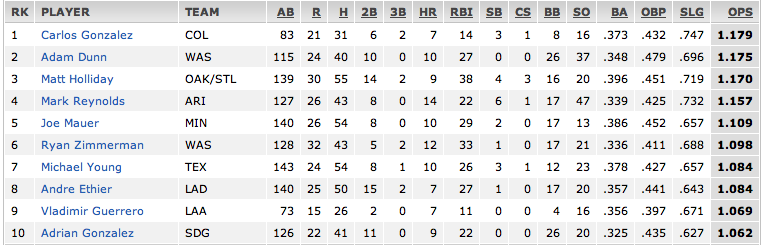
Meanwhile, Wallace was ranked No. 1 on Baseball America's Prospect Hot List for the week ending August 20.
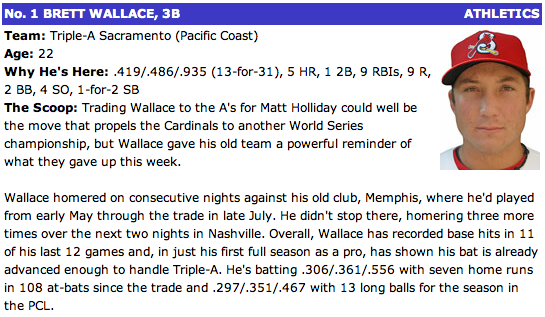
Holliday's story is well known by most baseball fans. A three-time All-Star and Silver Slugger, he has a career line of .318/.388/.546. The 29-year-old left fielder will be a free agent at the end of this season and will be seeking at least a four-year contract for well over $50 million in total.
Gonzalez and Wallace, on the other hand, are not household names. At least not yet.
Signed by the Arizona Diamondbacks as an amateur free agent in August 2002 and traded to Oakland (along with Brett Anderson, Chris Carter, Aaron Cunningham, Dana Eveland, and Greg Smith) for Dan Haren in December 2007, Gonzalez had a disappointing rookie year with the A's in 2008. He hit .242/.273/.361 and struck out 81 times in 316 plate appearances. The lefthanded-hitting outfielder struggled against southpaws (.188/.207/.247) more than anything else. The 2005 Midwest League MVP showed glimpses of power with 22 doubles in only half a season's work.
The Rockies acquired Gonzalez during the off-season in the hope that a change in home ballparks from pitcher-friendly McAfee Coliseum in Oakland to hitter-friendly Coors Field in Colorado would allow him to fulfill his vast potential. He began the year at Triple-A Colorado Springs and earned a promotion to the parent club after putting up a .339/.418/.630 line in April and May. However, Gonzalez failed to hit after being recalled in early June but his torrid second half has helped him elevate his overall rate stats to .287/.356/.539 in 191 plate appearances.
| AB | R | H | 2B | 3B | HR | RBI | BB | HBP | SO | SB | CS | AVG | OBP | SLG | OPS | |
|---|---|---|---|---|---|---|---|---|---|---|---|---|---|---|---|---|
| Pre All-Star | 84 | 11 | 17 | 4 | 2 | 1 | 5 | 9 | 0 | 25 | 5 | 0 | .202 | .280 | .333 | .613 |
| Post All-Star | 83 | 21 | 31 | 6 | 2 | 7 | 14 | 8 | 2 | 16 | 3 | 1 | .373 | .432 | .747 | 1.179 |
Selected by the Cardinals out of Arizona State University in the first round (13th overall) of the June 2008 First-Year Player Draft, Wallace hit a combined .337/.427/.530 at two levels in the minors last year. He had a higher AVG, OBP, and SLG in Double-A than Low-A, albeit in a much smaller sample size (57 plate appearances vs. 177). He opened 2009 at Double-A Springfield (.281/.403/.438) and was promoted to Triple-A Memphis (.293/.346/.423) in May. Following the trade between St. Louis and Oakland, the lefthanded-hitting Wallace was assigned to Triple-A Sacramento where he has hit .292/.348/.517 over the past month.
Wallace is more valuable to an American League team like the A's where he can play first base or DH than the Cardinals where he was blocked by Albert Pujols at 1B and forced to succeed at the hot corner, a position that isn't ideally suited for a 6-1, 245-pound body. Although Baseball America and MiLB.com list him at 6-2, 205, Baseball-Reference.com has him at 6-1, 245, the same as his college profile at Arizona State. I'm not sure about the loss of that inch, but there is no question about the added weight. In fact, Wallace admitted to weighing 245 in an interview last January. He is very thick through the middle, including massive thighs as evidenced by these videos.
Nonetheless, the youngster (he turns 23 on Wednesday) can flat out hit. He was a two-time Pac-10 Triple Crown winner and Player of the Year in 2007 and 2008. A former UCLA player told me that Wallace was the toughest hitter the Bruins faced in his four-year career, a span that included Dustin Pedroia, Jacoby Ellsbury, and Jed Lowrie (boy, the Red Sox sure love those Pac-10 guys), as well as Yonder Alonso in a non-conference series that I actually witnessed at Jackie Robinson Stadium in Westwood a few years ago.
Interestingly, Wallace, who prepped at Justin-Siena HS in Napa, California, listed the Oakland A's as his favorite team and Eric Chavez as his favorite player when he was at ASU. If Wallace doesn't get the call in September when the MLB rosters are expanded, he will surely get the opportunity to play for his favorite team and perhaps replace his favorite player at third base next spring. Depending on how quickly Chris Carter (.335/.434/.570 at Double-A Midland) develops, Wallace could also earn the starting job at first base or as the designated hitter. One way or the other, look for him to make an impact in Oakland next season.
For the record, Holliday, Gonzalez, and Wallace have run into some difficulties the past week. Holliday is just 6-for-33 in his last nine games, including 3-for-19 since fouling a pitch off his leg a week ago today. Gonzalez missed Sunday's game after suffering a puncture wound to his left hand. He is hopeful of returning to the lineup during Colorado's three-game series with the Los Angeles Dodgers on Tuesday through Thursday. Wallace cooled off considerably this past weekend, going 2-for-12 with no extra-base hits and a strikeout in each of the three games.
Some like it hot. Or not.
| Baseball Beat | August 10, 2009 |
This Week in Baseball
In honor of This Week In Baseball, the longest running sports anthology show in the history of television, we bring you news and highlights from around Major League Baseball.
Our "TWIB Notes" begin with the just concluded series between the Boston Red Sox and New York Yankees. Whereas Boston swept New York in three games at home in April, two on the road in May, and three at home in June, the Yankees got the broom out this time and took four straight from the Red Sox at Coors Field Yankee Stadium (also known as Yankee Stadium III).
The Yankees outscored their division rivals 25-8 en route to the four-game sweep. The victories included a 13-6 pounding in the opener, two shutouts (including a 15-inning, five-hour-and-33-minutes marathon on Friday night), and a come-from-behind 5-2 win on ESPN's Sunday Night Baseball in the finale.
New York (69-42), which has now won seven in a row, has opened up a 6.5 game lead over Boston (62-48), losers of six straight, in the American League East. With six more head-to-head games on the schedule, the division is far from settled. The Red Sox play 29 of their final 52 games at Fenway Park (where the club is 35-17), while the Yankees are slated to play 26 of their remaining 51 games on the road (30-25).
Boston, however, is no sure thing for the postseason as it is tied with Texas for the Wild Card berth (with Tampa Bay only 1.5 games back). The Rangers took two out of three from the Angels over the weekend and are now just 3.5 games behind in the AL West.
With a pair of home runs, Alex Rodriguez passed Harmon Killebrew into ninth place on the all-time list with 574. He has gone deep more often than any other righthanded hitter in the history of the AL.
Speaking of long balls, Mark Reynolds has slugged eight HR in the past nine games (including four consecutive) and is now tied for the MLB lead with Albert Pujols at 36. The Diamondbacks third baseman also ranks second in the NL in SLG (.613), third in OPS (.990), fourth in RBI (80), fifth in R (75), and eighth in SB (20).
Since the All-Star break, Reynolds has put up a rate line of .407/.480/.895. Over the course of the season, he has hit equally well at home (.289/.381/.598) and on the road (.290/.372/.628). Other than Mark's MLB-leading number of strikeouts (151, which is on pace to break the single-season record he set last year), there is little to find fault in his numbers. Sure, some people will point to his .371 BABIP as being unsustainable, but do these skeptics realize that he has hit .358 on balls in play throughout his career? Let's just say he's making it work with lots of whiffs.
While on the subject of home runs and strikeouts, Adam Dunn deserves recognition for reaching 30 HR for the sixth consecutive year. He is on pace to hit 44 in 2009, which would mark the sixth straight season of slugging 40 or more. Babe Ruth holds the record with seven (1926-1932).
Adam's team is far from done as Washington (40-72) has won eight games in a row. As such, we can no longer assume that the Nationals will have the first pick in next year's draft, at least not with Pittsburgh (45-66) on an eight-game losing streak and Kansas City (43-68, including 3-9 in its last dozen contests) and Baltimore (46-65, 2-8 in the last ten) stumbling down the stretch as well.
Depending on whether Washington comes to terms with Stephen Strasburg before the signing deadline a week from today, the Nats may wind up with the first two picks in the 2010 draft (No. 1 for having the worst record and the second overall choice as compensation for not signing Strasburg). In the meantime, the clock is ticking as more than half of the first-round draftees have not signed with their new clubs as yet. Look for discussions to pick up this week but don't hold your breath waiting for many announcements prior to the deadline at 12:01 a.m. on August 18.
Question for the Day
Do you believe Strasburg will sign with the Nationals? If so, how much do you think he will get?
Scott Boras is allegedly asking for $50 million while the Nationals reportedly are trying to keep the amount closer to the all-time record of $10.5M that Mark Prior received in 2001.
| Baseball Beat | August 09, 2009 |
Talking Baseball Stats
I was a guest of Brendan Wiese and Nick Barrale of The Benchwarmers on KFNS 590 The Fan. I also appeared on their St. Louis late night sports talk show in June and July.
We discussed counting stats with an emphasis on the pros and cons of RBI. I mentioned the importance of context, opportunities, and outs.
We should be counting the number of outs. There aren't very many people out there who know who's leading the league in outs or who's leading the league in the fewest outs created. We always count things — hits, doubles, triples, home runs — but we really should be counting how often a player makes an out because a team only has 27 outs; that's the currency of baseball and giving up an out is very costly to a team. I wish we all paid more attention not only to the positive side of counting stats but the negative side as well.
I was also asked about whether players such as Derek Jeter are "clutch" (which is one of my least favorite subjects) and OPS as it relates to positions. The final ten minutes were focused on pitching stats, including strikeouts, walks, and home runs (and groundball rates). Due to the location of the radio station as well as Dave Allen's insightful piece on Friday, we examined Joel Pineiro in depth and the difference between pitching to contact and missing bats.
I like guys who strike batters out because then you don't need any defensive players behind you. But, that said, a pitcher like Joel Pineiro can succeed if he throws strikes, which he throws strikes better than anybody else in baseball this year — he's walking fewer batters than anyone else — and if he also keeps the ball on the ground. He's keeping the ball on the ground about as well as anybody else in baseball this year. Both his walk and groundball rates are career bests right now and that's why he's doing so well this year. But his margin of error is really pretty small. If Pineiro doesn't have his pinpoint control and he gets that ball up a little bit, he's going to be more apt to give up home runs, which he hasn't been giving up at all this year. I believe he's only given up three home runs all season, which is just incredible. But, in years past, for example, he has walked more batters and given up more home runs. So, if he is a little bit off, he's going to get hit because he doesn't throw pitches that miss bats.
While Wiese enjoys and appreciates advanced metrics, his sidekick is a non-believer. After we exchanged thank yous at the end of the segment, Barrale concluded with the following diatribe.
I still say you get a better idea how a guy plays and how a team plays by just watching them. You don't need all these statistical numbers. The only reason why they have them is because people can't see the games and so they try to come up with their own conclusions by just adding and subtracting and dividing and multiplying numbers.
Whatever.
The audio file can be accessed through The Daily Rewind this weekend or by clicking on the play button directly below.
Check it out.
| Baseball Beat | August 03, 2009 |
Analyzing the Last of the Deadline Deals
In a transaction that wasn't consummated until minutes before the trading deadline at 4 p.m. ET last Friday, the San Diego Padres sent Jake Peavy to the Chicago White Sox for Clayton Richard, Aaron Poreda, Dexter Carter, and Adam Russell.
Although the trade wasn't popular with the San Diego media, I actually understand this deal more from the perspective of the Padres than the White Sox for three reasons:
1. The Friars are rebuilding for the future and trying to load up on good, young arms that can help the club in 2010 and beyond.
2. At $52 million over the next three seasons, Peavy's contract ($15M in 2010, $16M in 2011, $17M in 2012, and a $22M club option in 2013 with a $4M buyout) was a liability for an ownership short on cash.
3. Peavy is currently on the disabled list with a strained tendon in his right ankle and not expected back until late August. The unanimous 2007 National League Cy Young Award winner threw a 50-pitch bullpen on Sunday but will need a few more such sessions and a couple of minor league starts before joining Mark Buehrle, John Danks, Gavin Floyd, and Jose Contreras in the White Sox rotation for the final five weeks or so.
Peavy is a fantastic pitcher when healthy but, like an overpriced stock, may not be a good value at this point. He is clearly worth more to a team like the White Sox than the Padres.
In the meantime, the 6-foot-5, 240-pound Richard has begun to pay dividends for his new team, allowing one run on two hits over 5 2/3 innings in his NL debut on Saturday. The former University of Michigan backup quarterback should benefit from a change in leagues and home ballparks. The soon-to-be 26-year-old lefthander throws a low-90s fastball with sinking action plus a slider and change, and figures to be a mainstay in San Diego's rotation for the next several years.
Poreda, however, was the key to this deal. A first-round draft pick out of the University of San Francisco in 2007, the 6-6, 240-pound southpaw is a hard-throwing, groundball-inducing machine. He won't turn 23 until October yet has succeeded at every level, including 10 games and 11 innings in relief for the White Sox earlier this season. Poreda has started 48 of his 52 games in the minors and will be given a long look at one of the five spots in the rotation next spring.
The most intriguing pitcher in the group may be Carter, a 6-6, 22-year-old righthander who leads the minors in strikeouts with 143 in 118 innings (10.9 K/9). A project coming out of Old Dominion as a 13th-round draftee in 2008, Carter has whiffed 232 batters in 176 2/3 IP thus far in the low minors. According to Paul DePodesta, his fastball "runs anywhere between 87 and 93 mph" and Baseball America credits him with "a swing-and-miss curveball." He is being brought along slowly and is unlikely to reach Petco Park until 2012.
Russell, 26, was converted into a reliever in 2008. At 6-8 with a mid-90s heater, he is another tall, hard-throwing pitcher. His secondary pitches and command aren't particularly special although his curveball "rates as a plus pitch at times" in the words of Baseball America. He reported to Triple-A Portland and could be brought up to the bigs for a look-see in September when the rosters are expanded.
The Padres have now made two trades during the past month that have landed them seven young power arms, including four that had pitched in the majors prior to their arrival in San Diego. In addition to Richard, Poreda, Carter, and Russell, San Diego added Sean Gallagher, Ryan Webb, and Craig Italiano in a July 5 deal that sent outfielder Scott Hairston to the Oakland A's. Although Gallagher was the PTBNL in that 3-for-1 trade, he is just 23 years old and has already pitched parts of three seasons in the majors. The righthander has a terrific minor-league record (39-17, 2.73 ERA, 8.9 K/9, 0.5 HR/9) but needs to improve his command and makeup to reach his potential.
In Peavy, the White Sox get an eight-year veteran who is only 28 years old. General manager Kenny Williams pursued him in May but was unable to convince Peavy to waive the no-trade provision in his contract. The righthander could be a difference maker down the stretch if he can get his legs back in shape and regain his arm strength. However, let's not forget that Peavy (whose career ERA is a full run lower at home than on the road) will be going from the NL to the AL and from a pitcher's park (Petco Park) to a hitter's park (U.S. Cellular Field). Think Matt Holliday when he went from the Colorado Rockies and Coors Field to the Oakland A's and McAfee Coliseum.
While it may take two or three years before the Padres are competing for division titles and wild card berths again, management is focused on building an organization with more athleticism, depth, and sustainability than before. With the foregoing in mind, look for the Padres to sign high school draft picks Donavan Tate, Everett Williams, and Keyvius Sampson in the next two weeks and possibly move Adrian Gonzalez, Heath Bell, and Chris Young during the off-season or next summer if the price is right. Fans will need to be as patient as the ownership and front office, but the change in direction is likely to pay off in due time.
(For more on the Padres, be sure to check out Geoff Young's Ducksnorts as well as Friar Forecast and Another Padres Blog. South Side Sox is our favorite White Sox blog.)
| Baseball Beat | July 27, 2009 |
A Tribute to the Society for American Baseball Research
The Society for American Baseball Research meets for its annual convention in Washington, D.C. this week (July 30-August 2).
Known as SABR 39, the schedule includes 42 research presentations by members, including incoming president Andy McCue (American League Expansion of 1961), Mike Emeigh (Bullpen Evolution, 1960-2008), Retrosheet founder David W. Smith (Does Running the Bases Harm Pitching Performance?), Steve Treder (The Value Production Standings, 1946-2008), Chris Jaffe (The Baseball Philosophy of Charles Comiskey), Phil Birnbaum (Do Players Try Harder When a Big Goal is in Sight?), and Mark Armour (A Tale of Two Umpires).
The schedule of events also includes MLB and Negro Leagues player panels, more than 20 committee meetings, a Library of Congress presentation, Retrosheet's annual meeting, an awards luncheon, and three ballgames (Red Sox @ Orioles on Friday night, the Potomac Nationals on Saturday evening, and the Southern Maryland Blue Crabs on Sunday afternoon.
One of the many benefits of being a member of the Society for American Baseball Research (which I originally joined during the early 1980s and returned more than five years ago) is access to the organization's SABR-List Digest, a moderated research and information forum that is circulated via email to subscribers on a daily basis. In honor of SABR and its annual convention, I wanted to share highlights of the SABR-L for the past week.
1. September 6, 1995: Cal Ripken breaks Lou Gehrig’s consecutive games played record at Camden Yards
2 (tie). 1954: Major league baseball returns to Baltimore as the transplanted St. Louis Browns become the new Orioles
2 (tie). April 6, 1992: Camden Yards opens, the first of the nouveau-retro style ballpark copied by major- and minor-league teams since
4. October 15, 1970: Orioles win the World Series at Memorial Stadium; Brooks Robinson named Series MVP
5. October 9, 1966: Orioles first World Series championship at Memorial Stadium
6 (tie). February 6, 1895: Babe Ruth is born in Baltimore
6 (tie). 1971: The Orioles boast four 20-game winners in their starting rotation: Dave McNally, Jim Palmer, Mike Cuellar and Pat Dobson
8. December 9, 1965: Frank Robinson, an “old 30,” joins Baltimore in a trade with Cincinnati for Milt Pappas, and wins the Triple Crown in ‘66
9. 1988: The Orioles’ 21-game losing streak to start the season
10. 1901: Major league baseball returns to Baltimore as the Orioles join the American League
Billy Hamilton, 05/17/1893 @ PHI
Vic Power, 05/07/1957 @ KC
Darin Erstad, 06/25/2000 @ ANA
Reed Johnson, 06/15/2003 @ TOR
7/4/1908—George Wiltse, NY Giants vs. Philadelphia Phillies, (hit George McQuillen with pitch; Wiltse finished with a 10-inning no-hitter)
8/5/1932—Tommy Bridges, Detroit vs. Washington, Dave Harris
6/27/1958—Billy Pierce, Chicago White Sox vs. Washington, Ed FitzGerald (2B)
9/2/1972—Milt Pappas, Chicago Cubs vs. San Diego, Larry Stahl (walk; Pappas finished with a no-hitter)
4/15/1983—Milt Wilcox, Detroit at Chicago White Sox, Jerry Hairston
5/2/1988—Ron Robinson, Cincinnati vs. Montreal, Wallace Johnson
8/4/1989—Dave Stieb, Toronto vs. New York Yankees, Roberto Kelly (2B)
4/20/1990—Brian Holman, Seattle vs. Oakland, Ken Phelps (HR)
9/2/2001—Mike Mussina, New York Yankees at Boston, Carl Everett
You can access additional no-hit esoterica compiled by Thornley.
The purpose of the Society for American Baseball Research, which was formed in August 1971, is to foster the research, preservation, and dissemination of the history and record of baseball. According to its "About Us" page, SABR shall carry out that mission through programs:
1) To encourage the study of baseball, past and present, as a significant athletic and social institution;
2) To encourage further research and literary efforts to establish and maintain the accurate historical record of baseball;
3) To encourage the preservation of baseball research materials; and
4) To help disseminate educational, historical and research information about baseball.
You can sign up to become a member of the Society for American Baseball Research here.
| Baseball Beat | July 24, 2009 |
Breaking News: Cards Deal For Holliday
ESPN's Buster Olney is reporting that the St. Louis Cardinals and Oakland Athletics have completed a trade, sending outfielder Matt Holliday in exchange for third baseman Brett Wallace, outfielder Shane Peterson, and righthanded pitcher Clayton Mortensen.
Shortly after the news broke, Brian Gunn, everyone's favorite Cardinals blogger when he was maintaining Redbird Nation during the middle part of the decade (has it really been four years, Brian?), sent me an email with his initial thoughts and asking for my "more objective opinion." Here is our exchange, which took place only minutes ago...
Brian: Supposedly the Cardinals just traded Brett Wallace, Clayton Mortensen, and Shane Peterson for Matt Holliday. This is an email I wrote to some friends of mine about my reaction. Any thoughts? (My gut reaction to this deal was very negative, so I might be trying to talk myself into something. I need a more objective opinion.)
As I see it, the pros to the deal are:
1. It makes us better this year (we have a very winnable division, and Rick Ankiel can no longer start)
Rich: Yes, for sure.
Brian: 2. We can sign Holliday long term (he's not that old -- 30 in January, and we don't really have any major league OFers in the pipeline).
Rich: Uhh, maybe (although I don't see that happening unless the market for corner outfielders remains as weak as it was last year). No hometown discounts from Boras. Just check with the Angels re Mark Teixeira.
Brian: 3. Holliday runs and fields well, and he rarely gets injured, so he could age well.
Rich: I would agree with that. He is a good athlete (one of the best HS QB when Carson Palmer was a senior). He is also a good clubhouse-type presence from what I can tell. The latter might be more important down the stretch than how he ages because I don't see the Cardinals signing him longer term.
Brian: 4. Wallace is impressive, but not THAT impressive -- he took a tiny step backwards this year and he can't field and you can't move him to first.
Rich: Right. He can hit, more for average than power. I see him as a .300 type with 20 HR (maybe 25-30 in his peak season). He has big, thick thighs and will be a liability on the bases and at third base longer term. His future is at first base, which was taken last time I checked. However, he could have filled the gap at the hot corner, then moved to first just about the time Albert Pujols leaves STL to don the pinstripes.
Brian: 5. The move placates Tony La Russa and Pujols -- keeping Pujols happy is huge, and keeping TLR happy is also fairly necessary, especailly if you want Dave Duncan to stick around.
Rich: Makes sense on all fronts.
Brian: 6. If Holliday walks after this year, we could get a type A draft pick (which is basically how we got Wallace just 2 years ago).
Rich: Or two type A's, no?
Brian: 7. Mortensen hasn't shown he's any good. (Peterson, I don't know much about, but he does look like he can get on base, and he's only 21, so who knows. Although I don't know why Billy Beane was in the driver's seat so much that he could demand those 2 extra players. Wallace should've been enough.)
Rich: I'm very familiar with Peterson as he played his college ball at Long Beach State. A good average, gap power-type hitter. Could play corner OF or 1B. I like him but am unsure as to whether he projects as a starter on a championship-caliber team, a starter on a second-division club, or as a backup.
Brian: The cons:
1. We gave up too much. We probably could've had Adam Dunn (a better player, despite his awful fielding) much more cheaply, and I doubt the A's were getting any better offers, plus they basically had to move Holliday, so we should've been in more of a position of strength with them.
Rich: I prefer Holliday over Dunn in the NL. I think the latter's outfield defense is so "poorish" that he would be a problem, particularly on a "pitch to contact" type staff like STL.
Brian: 2. Holliday is not a huge bat -- he's never slugged .500 away from Coors (not in any season on the road, and not this season in Oakland).
Rich: I pointed out his good but not great road stats last year and many sabermetricians made a big deal out of his outstanding OPS+ rather than his home/road splits, thinking this was a better way to evaluate him. I beg to differ but what do I know?
Brian: 3. Holliday is overpaid -- important when you consider trying to sign Pujols (plus Joel Pineiro after this season, plus arb to Ryan Ludwick), and with Boras as his agent will stay overpaid.
Rich: Yes, yes, and yes.
Brian: 4. The move might indicate that La Russa, and not John Mozeliak, wears the pants in the Cardinals family -- not terribly encouraging.
Rich: I wouldn't let that minor issue, if true, bother me too much. Mike Scioscia has a say in personnel with the Angels and that's totally fine by me.
Brian: 5. Holliday is about to turn 30 and his defensive stats have been slipping -- perhaps he won't age so well.
Rich: Again, not terribly important in my mind.
Brian: 6. Combined with the Chris Perez/Mark DeRosa deal, this is another sign the Cards are cutting corners on 2010-2015 at the expense of 2009, and I'm still not sure we're good enough to get past the Dodgers or Phillies in 2009 (then again, people have estimated the value of making the playoffs -- in terms of increased ticket sales, etc. -- at $25 million on up, so this could play for itself).
Rich: Yes, an important takeaway. Not the first time either, right?
Brian: All in all, the more I think about this deal, the more I think it could be worth it. I think we gave up more value than we needed to, and I don't think Holliday is quite the player people think he is, but I think it's fair to try to go for it now. I guess the deal hinges on whether or not you think of the Cards as a win-now team (and with Pujols and Chris Carpenter at their peaks, and the window closing on both of them -- Carp b/c he's not the most durable guy, Pujols b/c we don't have him signed forever -- I can see the argument for that) or a team of the future (when you look at Colby Rasmus and our decent farm system and all our rookies this year, I can see some argument for that, too). I suppose I lean a little more toward "win now," which sorta outweighs my reservations about the pure value-per-dollar aspects of this trade.
Rich: Flags fly forever.
| Baseball Beat | July 24, 2009 |
Light Up the Halo
Down 3-0 in the first inning, the Los Angeles Angels rallied to beat the Minnesota Twins, 6-5, in 10 innings last night at the Big A. It was the Halos MLB-leading 31st "come-from-behind" victory of the season.
The Angels, with the third-most wins in the majors and second-most in the American League, have opened up a 3 1/2 game lead over the Texas Rangers in the AL West. The team has won six in a row, 10 of its last 11, and is now 27-9 since June 11 when it was just 29-29 and tied for second place in the division.
The Comeback Kids tied yesterday's game by scoring twice in the ninth inning against Minnesota's closer Joe Nathan, who had converted his last 20 save opportunities and had not allowed a run in 24 appearances covering 22 2/3 IP.
Bobby Abreu drew a walk to open the bottom of the ninth, Mike Napoli was hit by a pitch, and Gary Matthews and Howie Kendrick singled with two outs to produce a couple of runs to send the contest into extra innings. With the score tied at 5, Mike Scioscia sent southpaw Brian Fuentes, his best reliever, to the mound in the top of the 10th — a move too few managers make — to face lefthanded batters Justin Morneau and Jason Kubel, and Michael Cuddyer, the opposing team's top righthanded hitter. Fuentes got Morneau, who is tied for the AL lead with 24 HR, to pop out; Kubel, who had homered and singled to drive in three runs earlier in the game, to ground out to second base; and Cuddyer to strike out looking in a ten-pitch, 1-2-3 inning.
With Jesse Crain working the home half of the tenth, Chone Figgins lined a single to left, Brandon Wood bunted him to second, Abreu was intentionally walked, Kendry Morales struck out ending his 20-game hitting streak, and Napoli doubled to right center, scoring Figgy with the game winner and his league-leading 75th run.
Call it clutch or call it luck (as Kendrick's game-tying hit in the ninth glanced off Nathan's glove and struck second base), but, either way, the events led to another "W". It's a cliche but the Angels are winning as a team with significant contributions by everyone ranging from veterans like Figgins to youngsters such as Morales, Jered Weaver, and Erick Aybar to newcomers Abreu and Fuentes to career minor leaguers (Matt Palmer), relative unknowns (Jason Bulger and Kevin Jepsen), and reserves (Maicer Izturis).
What's remarkable is that the Angels not only suffered the loss of Nick Adenhart, the club's No. 1 prospect, in a tragic death after his first start; as well as injuries to John Lackey, Ervin Santana, and Kelvim Escobar that have curtailed up to 30 starts from this trio; but setbacks, most recently, to Vladimir Guerrero, Torii Hunter, and Juan Rivera, arguably the three best hitters going into the season.
It's all starting to feel a bit like 2002.
(For more on the Angels, be sure to check out Rev Halofan's Halos Heaven and Rob McMillin's 6-4-2 blogs.)
| Baseball Beat | July 23, 2009 |
First Basemen and Home Runs
Eight of the top 13 home run hitters this year play first base. The position has been known for its power output since the advent of the "live ball" in the 1920s, but it appears to be producing more four baggers among the league leaders than any other year this decade.
| PLAYER | POS | HR | |
|---|---|---|---|
| 1 | Albert Pujols | 1B | 34 |
| 2 | Adrian Gonzalez | 1B | 25 |
| Raul Ibanez | LF | 25 | |
| Mark Reynolds | 3B | 25 | |
| 5 | Adam Dunn | LF | 24 |
| Prince Fielder | 1B | 24 | |
| Ryan Howard | 1B | 24 | |
| Justin Morneau | 1B | 24 | |
| Carlos Pena | 1B | 24 | |
| 10 | Nelson Cruz | RF | 23 |
| Ian Kinsler | 2B | 23 | |
| Mark Teixeira | 1B | 23 | |
| 13 | Russell Branyan | 1B | 22 |
Interestingly, there are no designated hitters among the league leaders in HR. Now one might argue that some of these hitters shouldn't be playing defense, but the reality is that there is no DH among the top 18 HR sluggers in the majors. It's even a bit of a stretch to include Adam Lind (20) as the No. 1 HR-hitting DH as he has played over 30 games in left field. You have to go all the way down to Jim Thome, who is tied for 36th in HR with 16, to find the first pure DH. Whatever became of the David Ortizes, Travis Hafners, and Frank Thomases?
Is this a one-year aberration or is there something else at work here?
| Baseball Beat | July 20, 2009 |
Blue Moon
"That's one small step for [a] man, one giant leap for mankind."
- Neil Armstrong, July 20, 1969
Where were you 40 years ago? I know some of you had not yet occupied your space here on Earth. And nobody other than Neil Armstrong and Edwin "Buzz" Aldrin had stepped foot on the Moon.
I turned 14 earlier that month and spent that momentous Sunday at Anaheim Stadium where the California Angels were hosting the Oakland A's in a doubleheader. The Angels won the first game, 7-3, and lost the second, 9-6.
My Dad had joined the Angels as Director of Public Relations and Promotions in February 1969. I had only been a fan of the Angels for less than six months when I found myself sitting in what would now be called a suite on the first base side of the press box as the Apollo 11 lunar module landed on the Moon at 20:17 UTC (or 1:17 p.m. for those of us in the Pacific Time Zone).
I don't recall the exact inning when the Eagle touched down on the Moon, but I remember that the public address announcer and scoreboard informed the 17,835 in attendance of this occasion. The event either stopped the game or was reported between one of the early innings during the first game of the twin bill. It was definitely a time for national pride.
While man was making its first visit on the Moon, Vida Blue, not to be confused with teammate Johnny "Blue Moon" Odom, was making his major-league debut that day. A week short of his 20th birthday, Blue had been recalled from Birmingham, Oakland's Double-A affiliate, after excelling in the Southern League with a 10-3 record, 3.20 ERA, and 112 strikeouts in 104 innings.
The teenage sensation allowed solo home runs to Aurelio Rodriguez and Jim Spencer in the first and third innings, respectively, and was saddled with the loss after giving up six hits and five runs (three earned) in 5 1/3 IP. Andy Messersmith, in just his second season in the bigs, was credited with his eighth win on the way to a 16-11, 2.52 ERA (fourth in the AL), 211 strikeouts (third) campaign.
Two years later, Blue (24-8, 1.82 ERA) was on the cover of Sports Illustrated en route to the Cy Young and Most Valuable Player awards. Messersmith, for his part, went 20-13 with a 2.99 ERA in 1971.
Doug Miller of MLB.com wrote an article today, recalling the historic day, on and above Earth.
About 400 miles south of San Francisco, a launch of a different kind was taking place on July 20, 1969.There, in Anaheim Stadium, in the first game of a double-header, a hard-throwing 19-year-old Oakland Athletics left-hander from Mansfield, La., by the name of Vida Rochelle Blue toed the rubber in a Major League game for the first time in what would be a storied career.
Blue, eight days shy of his 20th birthday and straight out of Double-A ball, skipping an entire level of the Minor Leagues, says now that he had no doubts when he stepped on that mound.
"Well, I thought I was ready, and the folks that brought me up thought I was ready," says Blue. "So why wouldn't I have thought that way?"
Blue had been following the news stories chronicling the space program, something he still does to this day, having "TiVo'd just about every shuttle launch in the last 10 years," he says.
But as soon as he began warming up that day, throwing to catcher Phil Roof, the significance of the situation hit him with the force of the 100-mph fastballs he threw.
"I was fresh out of the Southern League," he says with a laugh. "The crowd itself was so different. It was the classic deer-in-the-headlights syndrome. As cool and as calm as you think you are, you're really not. You're thrust into a situation you've never experienced before.
"I mean, seriously, before that game, attendance at one of my games might have been 5,000, maybe 10,000. And now it's 35,000. And these were big league hitters. I'd never seen that type of talent before."
Blue would go on to win 209 career games, make six All-Star teams and take the American League Cy Young and Most Valuable Player awards in his watershed season of 1971, when he went 24-8 with a 1.82 ERA, eight shutouts and 301 strikeouts in 312 innings.
But on that day he was a regular 19-year-old kid.
He lasted 5 1/3 innings, giving up five runs -- three earned -- on six hits, including two home runs, in the A's 7-3 loss to the Angels. His career began with an 0-1 record.
"I was a young, cocky kid, and when you're young and cocky, you think you have it all and know it all," Blue says. "I was no different. That was the attitude I had. That's what kids that age do, and I certainly did it."
At some point during the game, Blue remembers, he heard about the moon landing and, for at least a moment, was able to escape the whirlwind of nerves unfolding around him to focus on something bigger than baseball.
Forty years later, Blue says that he's touched to even be asked about that day.
"I just remember it was obviously a great chance for me, and, as it turns out, it was a unique thing to pitch on the day this country landed a man on the moon.
"It's pretty cool and kind of flattering that it happened on the same day."
I returned home from the doubleheader in time to watch Armstrong and Aldrin walk on the moon that evening on our black and white television. My parents had received a color TV as a Christmas present from Walter O'Malley after the Dodgers won the World Series in 1959, a gift that would be strictly prohibited today. They held onto the TV for a few years, then sold it for the latest technology, a Hi-Fi (high fidelity stereo). The TV and the Hi-Fi were both housed in huge pieces of walnut or mahogany furniture, which was the norm in those days.
Things were big back then. Or so they seemed.
| Baseball Beat | July 18, 2009 |
The Heat Is In (the Shrine of the Eternals)
The Baseball Reliquary will induct Steve Dalkowski, Roger Maris, and Jim Eisenreich into its Shrine of the Eternals in a public ceremony on Sunday, July 19 at the Pasadena Central Library in Pasadena, California.
In a press release, Terry Cannon, the Executive Director of the nonprofit organization dedicated to fostering an appreciation of American art and culture through the context of baseball history, announced that Dalkowski, Maris, and Eisenreich "will join thirty other baseball luminaries who have been inducted into the Shrine of the Eternals since elections began in 1999, including, in alphabetical order, Jim Abbott, Dick Allen, Emmett Ashford, Moe Berg, Yogi Berra, Ila Borders, Jim Bouton, Jim Brosnan, Bill Buckner, Roberto Clemente, Rod Dedeaux, Dock Ellis, Mark Fidrych, Curt Flood, Josh Gibson, William 'Dummy' Hoy, Shoeless Joe Jackson, Bill James, Bill 'Spaceman' Lee, Marvin Miller, Minnie Minoso, Buck O'Neil, Satchel Paige, Jimmy Piersall, Pam Postema, Jackie Robinson, Lester Rodney, Fernando Valenzuela, Bill Veeck Jr., and Kenichi Zenimura."
Dalkowski, a resident of the Walnut Hill Care Center in New Britain, Connecticut, arrived in Los Angeles on Friday and threw out the ceremonial first pitch at last night's Dodgers-Astros game at Dodger Stadium. The now 70-year-old career minor leaguer emerged from a wheelchair in front of the mound and tossed a "fastball" that bore no resemblance to the 100+ mph heater the southpaw reportedly threw as a matter of routine back in the 1950s and 1960s.
The closest the bespectacled Baltimore Orioles farmhand came to the major leagues was appearing on a 1963 Topps Rookie Stars baseball card along with three other young pitchers (Fred Newman of the Los Angeles Angels, Carl Bouldin of the Washington Senators, and Jack Smith of the Los Angeles Dodgers). With no help from Dalkowski, the quartet recorded a combined total of 38 wins and 49 losses in the majors (with Newman earning 33 of those victories). However, to the extent that this card has any value whatsoever, it is solely due to the legend that is Dalkowski, the inspiration for Nick LaLoosh, the character portrayed by Tim Robbins in "Bull Durham."
Ron Shelton, who wrote and directed the 1988 movie classic, will introduce Dalkowski at tomorrow's induction ceremony. Shelton was a minor league second baseman for the Orioles during the '60s, yet, according to George Vecsey in an article in today's The New York Times, he and Dalkowski have surprisingly never met.
Dalkowski, who has been in and out of hospitals and halfway houses for the past two or three decades, is in town with his once estranged younger sister Patti Cain. An administrator at a hospital not far from the facility that houses her brother (and just a block from the ballpark where he was a high school star and a bonus baby over 50 years ago), Patti is responsible for rescuing her brother in Oklahoma City in 1994 after the death of his wife. She told Tim Hoffarth, a columnist for the Daily News, "The doctors once told us he'd only have a year to live, so how remarkable is it that he's here and has a run of the place? Of course, some days are better than others. Same with me. When he wants to talk baseball, he's still full of stories. But nothing's easy. He's laying down now. He needs his rest."
You can read more from Hoffarth about Dalkowski and his story here and here, as well as older articles from Sports Illustrated (Where Are They Now? Steve Dalkowski by Pete McEntegart and The Wildest Fastball Ever by Pat Jordan) and The Hardball Times (Delving into the Dalkowski depths by Steve Treder). The latter piece includes Dalkowski's year-by-year and career minor league record plus links to several other articles. The Los Angeles Times is scheduled to publish an article by Shelton in tomorrow's newspaper, which I will link to when it is up.
For those of you who live in Southern California, you can meet Dalkowski and Eisenreich on Sunday at 2 p.m. at the Donald R. Wright Auditorium of the Pasadena Central Library, 285 E. Walnut Street. Admission is free and open to the public.
* * *
Update: Although Paul Richards never managed Steve Dalkowski, The Wizard of Waxahachie was Baltimore's field boss from 1955-1961. He handled the "Kiddie Korps," a collection of young Oriole pitchers, including Steve Barber, Chuck Estrada, Jack Fisher, Milt Pappas, and Jerry Walker, during the late 1950s and early 1960s. Dalkowski was born in the same year as Fisher, Pappas, and Walker and was 16 months younger than Barber and Estrada.
The Wizard of Waxahachie: Paul Richards and the End of Baseball as We Knew It by Warren Corbett is available for pre-order. I previewed the book and believe it is a worthwhile read for baseball historians, especially those interested in the teams that he played on (Brooklyn Dodgers, New York Giants, Philadelphia Athletics, and Detroit Tigers), managed (Chicago White Sox and Baltimore Orioles), and served as an executive (Houston Colt .45s, Atlanta Braves, White Sox, and Texas Rangers). Richards would be 100 years old if he hadn't passed away in 1986 in his hometown of Waxahachie.
Competition and conflict marked Richards's sixty-year career, from his first week as a professional player, when the seventeen-year-old may have punched his manager. As a manager, Richards was thrown out of games more frequently than anyone else. In his first year as a general manager, he was threatened with suspension for cheating. He brought the first black players to the White Sox and the first important black players to the Orioles, but several of them denounced him as a racist. In his later years his was one of the loudest and most reactionary voices opposing the rising players' union.When his catchers couldn't handle a knuckleball, he invented a mitt as big as an elephant's ear so they could at least knock it down. He was the first manager known to enforce pitch counts to protect young arms from injury. Previously undiscovered documents reveal that Richards tracked his hitters' on-base percentages before that statistic even had a name and decades before it became a cornerstone of baseball analysis. He computed catchers' earned run averages years before the sabermetric community thought of it.
Corbett, a contributor to the Society for American Baseball Research's Biography Project headed up by fellow author and Baseball Analysts guest columnist Mark Armour, handles the Richards story in a thorough and balanced manner. The book includes a Foreword by Brooks Robinson and an Introduction by Tony La Russa, as well as a bibliography that cites more than a couple of hundred published works, interviews, and personal correspondence.
| Baseball Beat | July 13, 2009 |
Nobody Came By on the Noon Balloon from Saskatoon...
In honor of my nephew Brett, who is playing on the Canadian Professional Golf Tour and finished tied for 39th (in a field of 155) in the Saskatchewan Open at Dakota Dunes this week, nobody came by on the noon balloon from Saskatoon and asked me but...
I'm not sure if Weaver is a victim of not selecting enough starting pitchers, picking the wrong ones, or requiring that each team must be represented by at least one player, but his exclusion is an injustice that makes me wonder why so many Hall of Fame voters look to All-Star appearances as one of the reasons why they would support (or not support) a candidate for enshrinement in Cooperstown? Yes, I'm looking at you, Mr. Olney.
Question to all the Blyleven Weaver naysayers out there: When is he supposed to morph into his brother Jeff?
Through the Weaver brothers first four seasons:
| Wins | Losses | % | ERA | IP | H | R | ER | HR | BB | SO | HBP | ERA+ | WHIP | H/9 | HR/9 | BB/9 | SO/9 | SO/BB | |
|---|---|---|---|---|---|---|---|---|---|---|---|---|---|---|---|---|---|---|---|
| Jered | 44 | 22 | .667 | 3.60 | 575.0 | 540 | 243 | 230 | 64 | 166 | 467 | 13 | 125 | 1.228 | 8.5 | 1.0 | 2.6 | 7.3 | 2.81 |
| Jeff | 44 | 54 | .449 | 4.30 | 792.2 | 809 | 410 | 379 | 88 | 224 | 534 | 57 | 105 | 1.303 | 9.2 | 1.0 | 2.5 | 6.1 | 2.38 |
As Al Michaels, in his best Howard Cosell impersonation asked, "Who goofed? I've got to know."
| Baseball Beat | July 09, 2009 |
The Defense Never Rests
I returned as a guest last Friday evening on the St. Louis radio station 590 KFNS, also known as The Fan. The show was once again hosted by The Benchwarmers, Brendan Wiese and Nick Barrale. We discussed defensive metrics, including zone ratings, as well as Wins Above Replacement, and the traditional Triple Crown stats vs. rate stats such as AVG/OBP/SLG.
Nick, a former minor league play-by-play announcer, is a bit old school, expressing his skepticism over the more advanced defensive metrics and his preference for a batter who can hit as opposed to those who are proficient at drawing walks. Brendan, on the other hand, seems to appreciate the insights of these newer stats and measurements of player value.
Ozzie Smith, Franklin Gutierrez, Nyjer Morgan, Albert Pujols, and Jim Edmonds were all mentioned.
Speaking of defense, Morgan, who was recently traded from the Pirates to the Nationals, leads the majors in Ultimate Zone Rating. David DeJesus and Colby Rasmus rank second and third among outfielders in UZR. Morgan leads all LF, Gutierrez tops all CF, and Jay Bruce is No. 1 among RF.
Moving to the infield, Paul Konerko and Miguel Cabrera, much to my surprise, are first and second in UZR at first base. Brandon Phillips sits atop the defensive rankings at 2B, Jack Wilson ranks first at SS, and Joe Crede is the top-rated 3B (with a whopping 27.0 UZR/150 games). Fangraphs doesn't list UZRs for pitchers and catchers.
| Baseball Beat | July 06, 2009 |
The Mid-Season Report
With all but eight teams having played 81 games thus far, it's fair to say that the 2009 Major League Baseball season is at the halfway point. While the All-Star Game typically marks the end of the first half and the beginning of the second in the eyes of most fans as well as season splits, the truth of the matter is that we've already reached that juncture.
Ten of the 30 teams have played exactly 81 games, the mode, if you'd like to harken back to your statistics courses in high school or college. Twelve have completed more than 81 and eight have played fewer than 81. St. Louis leads the majors with 84, while the Chicago Cubs are tied with Philadelphia and Washington for the fewest with 79. As a result, the Cardinals have five more off days than one of their division rivals the rest of the way. STL has an extra day off at the All-Star break, which I believe to be advantageous plus three more during the "dog days" of August and a couple more during the middle of September.
The Los Angeles Dodgers sport the best record in baseball and, along with the Boston Red Sox, are one of only two teams with W-L percentages of .600 or better. If the Dodgers and Red Sox meet in the World Series, it would be the first time since 1916 when Boston beat the Brooklyn Robins in five games.
On the other end of the spectrum, the Nationals have the worst record and, along with the Cleveland Indians, are one of just two teams with W-L % below .400. The Nats, in fact, are making a run at the .300 mark, ensuring the No. 1 draft pick for the second year in a row. Signing Stephen Strasburg and next year's top draftee (most likely Bryce Harper) is going to cost the franchise a ton of money and make Scott Boras and his clients happy and wealthy (or, in the case of the super agent, happier and wealthier).
If the season ended now, the division champions in the American League would be Boston in the East and Detroit in the Central, with Texas and the Los Angeles Angels battling for the title in a one-game playoff. You could even think of that game as the one that is being played tonight in Anaheim, pitting the Rangers' ace Kevin Millwood against the hometown team's No. 1 this season, Jered Weaver. The New York Yankees would be the Wild Card representative from the AL.
Over in the National League, the division champs would be Philadelphia in the East, St. Louis in the Central, and the Dodgers in the West. The San Francisco Giants would be the Wild Card entrant.
However, with EIGHTEEN teams within four games of the division lead and at least two more in the thick of the Wild Card race, fully two-thirds of the clubs are thinking in terms of October as the season heads into the second half of its schedule.
Let's take a closer look division-by-division:
AMERICAN LEAGUE EAST TEAM W L PCT GB Red Sox 49 32 .605 - Yankees 48 33 .593 1 Rays 44 39 .530 6 Blue Jays 42 41 .506 8 Orioles 36 46 .439 13.5
The AL East is the toughest division in baseball, bar none. There's rarely any debate about this matter most years and there is NO rational argument that can be made against this statement this season. Three of the top four teams and four of the top six in run differential reside in this division. That is an incredible accomplishment considering that these five clubs have played against one another more than a third of the time. By definition, the team that finishes in third place will be eliminated from the postseason even though it just may be the fourth-best club in all of baseball. That means either the Red Sox, Yankees, or Rays will be on the outside looking in this October. (I didn't include the Blue Jays in this mix because Toronto has played the fewest games against its East opponents and, at 7-14, has fared worse than the others in intra-division play.)
AMERICAN LEAGUE CENTRAL TEAM W L PCT GB Tigers 44 37 .543 - Twins 43 40 .518 2 White Sox 42 40 .512 2.5 Royals 35 46 .432 9 Indians 33 50 .398 12
Plain and simple, the AL Central is a three-team race. It's hard to separate this trio. The Tigers have won the most games, the Twins have the best Pythagorean record (45-38), and the White Sox have lost the most one-run games. In the meantime, the Kansas City Royals are about where most expected and the Indians have fallen short of even their biggest detractors this season.
As a side note, Joe Mauer (.389/.465/.648) is leading the league in AVG/OBP/SLG and has been the AL MVP, no questions asked. The 26-year-old catcher has slugged more home runs (14) in 256 plate appearances this campaign than he has in any single season in his six-year career. He is playing Gold Glove defense once again and has walked more than he has struck out for the fourth consecutive year. Given Mauer's age and position, it could be argued that he is the most valuable player in the game although I wouldn't argue vehemently against those supporting Albert Pujols and perhaps even Hanley Ramirez. I know Minnesota fans don't want to read this, but it'll be interesting to see if Mauer becomes Jorge Posada's or Jason Varitek's replacement in 2011 upon free agency. The timing couldn't be better for Mauer, the Yankees, or the Red Sox.
AMERICAN LEAGUE WEST TEAM W L PCT GB Rangers 45 35 .563 - Angels 45 35 .563 - Mariners 42 39 .519 3.5 A's 34 46 .425 11
The AL West is up for grabs this year with only the Oakland A's not having a realistic shot at the division title. While the Rangers have hung in there longer and tougher than most prognosticators predicted, the Angels deserve a lot of credit for overcoming the early-season injuries to John Lackey and Ervin Santana (not to mention Kelvim Escobar's virtual yearlong stint on the DL) as well as the tragic death of Nick Adenhart, the club's No. 1 prospect, after pitching six scoreless innings in his first and only start of 2009. TEX and LAA have similar positive run differentials while SEA has won four more games than its Pythagorean record would suggest, the most in the AL.
With respect to Oakland, it will be interesting to see which team free agent-to-be Matt Holliday winds up on later this month. He could be a difference maker down the stretch for the right team. GM Billy Beane would like to get the equivalent of two No. 1s, which is what the A's will receive if they lose Holliday to free agency at the end of the year.
NATIONAL LEAGUE EAST TEAM W L PCT GB Phillies 42 37 .532 - Marlins 43 40 .518 1 Mets 39 42 .481 4 Braves 39 42 .481 4 Nationals 24 55 .304 18
The defending World Series champs sit atop the NL East while the surprising Florida Marlins are making (another) run at a world championship. In the meantime, the New York Mets, winners of just two of their last ten, and the Atlanta Braves are floundering at three games below .500. At 26-15, the Phillies have the best road record in the majors and are the only team in the division with a positive run differential.
With Ricky Nolasco once again pitching like he did last season, the young Marlins could pose a legitimate threat to Philadelphia's hopes of winning back-to-back titles. Nolasco and Josh Johnson (7-1 with a 2.76 ERA this season and 14-2 since returning from Tommy John surgery one year ago) could be as tough of a 1-2 punch as there is in the division and any team with HanRam (.346/.409/.574) at shortstop must be taken seriously. Ramirez is leading the league in AVG and 2B (26) and playing at an acceptable level in the field. In the non-Albert Pujols division of the MVP award, only Chase Utley can give his division rival a run for his money.
NATIONAL LEAGUE CENTRAL TEAM W L PCT GB Cardinals 45 39 .536 - Brewers 43 39 .524 1 Cubs 40 39 .506 2.5 Reds 40 40 .500 3 Astros 39 41 .488 4 Pirates 37 45 .451 7
The top two teams in the NL Central are facing off in a three-game set beginning tomorrow night in Milwaukee. Ryan Braun (.326/.409/.557), the NL's No. 1 vote getter among outfielders for the second year in a row, would like management to add an arm or two to the club's pitching staff before it's too late. Meanwhile, the Cubs, Reds, and Astros, and perhaps even the Pirates, are still hoping to make noise in the second half.
But let's take a second to review Pujols' numbers. As my good friend Brian Gunn (the former proprietor of the now defunct Redbird Nation, one of the best team blogs during its reign) told me when we were discussing Prince Albert's Baseball-Reference page, "I frequently get lost there. It's like the Sistine Chapel of B-R pages — not a flaw on it." So true. I mean, he is hitting .336/.460/.739 while leading the NL in games, runs, home runs, RBI, walks, IBB, times on base, OBP, SLG, OPS, OPS+, total bases, runs created, and, most importantly, all the stats that measure wins, such as Wins Above Replacement. He's the MVP of the season and is now looking like the MVP of the decade.
NATIONAL LEAGUE WEST TEAM W L PCT GB Dodgers 52 30 .634 - Giants 44 37 .543 7.5 Rockies 42 39 .519 9.5 Padres 35 46 .432 16.5 Diamondbacks 33 49 .402 19
While the NL West is all about the Dodgers, the Giants and Rockies are Nos. 1 and 3 in the Wild Card race. Los Angeles, San Francisco, and Colorado are 1-2-3 in run differential in the league. At 30-12, the Dodgers are making mince meat of its division foes, yet the five teams are playing a combined .500 in interleague play.
What makes the Dodgers record all the more remarkable is the fact that the team was without its best player, Manny Ramirez, for 50 games (or more than 60 percent of the season to date). LA is winning at home, on the road, during the day, at night, one-run games, extra-inning games, you name it. This is a legitimately excellent team and one that should be favored to represent the NL in the Fall Classic this October, provided that manager Joe Torre doesn't wear out his bullpen (headed by Jonathan Broxton), as he is wont to do, down the stretch.
| Baseball Beat | June 30, 2009 |
The 50th Anniversary of Vin Scully's Greatest Call Ever
"It's a fight, a blow-by-blow verbal battle."
- Vin Scully, June 30, 1959
One of the greatest baseball rhubarbs in my lifetime took place 50 years ago today. The "blow-by-blow verbal battle" occurred between two of the biggest rivals in all sports: the San Francisco Giants and the Los Angeles Dodgers, in just their second year on the west coast.
The game was played on Tuesday, June 30, 1959 at the Los Angeles Memorial Coliseum. The paid attendance of 59,312 was the largest Coliseum crowd since Opening Night when 61,552 fans were on hand to watch the St. Louis Cardinals beat the Dodgers, 6-2, while setting a new attendance record for a National League night game. (Interestingly, the Cardinals and Dodgers had set the previous league record on April 25, 1958 when Stan Musial's first Coliseum appearance attracted 60,635.)
The Giants and Dodgers were in a virtual tie for second place in the National League, 1.5 games behind the Milwaukee Braves. Milwaukee had beaten the New York Yankees, winners of eight of the prior ten World Series, in seven games to win the championship in 1957, then lost the title in seven games to the same Yankees in 1958. San Francisco had snapped the Dodgers' seven-game winning streak the night before when Jim Davenport and Willie Mays led off the 13th inning with back-to-back home runs en route to a 6-4 victory in what my Dad called "the most thrilling game ever played in the Coliseum" to that point.
Mays was to be heard from in more ways than one the following night. Batting second in the lineup, the "Say Hey Kid" slugged his 13th homer of the year (and fifth against the Dodgers) in the third inning to give the Giants a 2-0 lead and, according to Dad's game report in the Press-Telegram the following morning, "almost clouted another in the sixth inning, touching off a 10-minute rhubarb. While the fans hooted and hollered, the umpires changed their ruling twice and finally awarded Mays a ground-rule double. Rigney lodged a protest, but withdrew it after the game."
The batted ball was first ruled foul, then a home run and, finally, a double. I'll let Vin Scully, in what I believe is not only his most descriptive call ever but one of the greatest in the history of the game, take over from here.
Scully details the ensuing rhubarb, mentioning, in order, Drysdale, Mays, Giants manager Bill Rigney, third base coach Salty Parker, third base umpire Dusty Boggess, Dodgers first baseman Gil Hodges, shortstop Don Zimmer, first base umpire and crew chief Tom Gorman, Dodgers manager Walter Alston, left fielder Wally Moon, home plate umpire Ed Sudol, and Dodgers Vice President Buzzie Bavasi. (The fourth umpire was Stan Landes. He was stationed at second base and was never mentioned in Scully's call of the rhubarb.)
Although narrator Steve Bailey says the date was May 30, 1959, the incident actually took place on June 30, 1959. Bailey eloquently introduces the nine-minute clip, "Orchids to Vin Scully for a magnificent description of one of the wildest rhubarbs baseball has ever known."
Here is a word-by-word transcription of my favorite Scully call of all time (and, like everybody else, I love how he reported the ninth inning of Sandy Koufax's perfect game on September 9, 1965):
"Drysdale ready and the 1-1 pitch . . . curveball, cut on, there's a high flyball right down the left field line, right on the line, hits the foul pole and kicks foul. That's just about as foul as you can get without being fair.Willie Mays hit the foul pole and it kicked off in foul ground. Rigney is telling Mays to trot all the way around. Salty Parker and Bill Rigney appealing to third base umpire Dusty Boggess . . . and now they're gonna wave Mays around and here come the Dodgers after Boggess.
If you know the Coliseum at all and you know the girder that supports the screen right down the left field line, Willie Mays hit a fly ball that actually hit that girder and then kicked off into foul territory. At first, Dusty Boggess called it foul but Rigney told Mays to go around anyway. And after Rigney and Salty Parker got into the discussion, Boggess suddenly ruled home run. The Dodgers came racing out of the dugout . . . a firecracker goes off back of home plate like to scare everybody out of ten years' growth . . . and the argument continues directly back of third base along the line. All four umpires along with a heated group of Dodgers . . . and the rhubarb continues about 30 feet down the line.
So Willie Mays, who is normally causing a lot of noise either at the Coliseum or Seals Stadium, has now really set off a bomb here at the Coliseum.
When you look at that girder down the left field line, there are many cables and wires that make it a very tough spot to look at. No doubt the Dodger contention is the ball hit one of the wires to make it foul.
But Boggess is now sticking to his guns. Drysdale is so mad he almost kicked 20 feet of the Coliseum out of the park. Gil Hodges right now is jaw-to-jaw with Dusty Boggess. Gil pointing first with his left hand, then with his right hand. Drysdale appealing to the gods right now. He just wants to holler at anybody who will listen. Don Zimmer is arguing with Tommy Gorman. The other three umpires now leave Boggess alone, and he is in the midst of lions.
Don Zimmer, Don Drysdale, Walter Alston, Gil Hodges, and Wally Moon are blistering Boggess, and Dusty every now and then seems to punctuate a Dodger's sentence by pointing with his left hand to that left field foul pole. At the very top of the foul pole, there are two slanting guide wires. One goes from the top of the pole to the right, down to the screen. And the other one goes from the top to the left, down toward the stands. The Dodger contention is that the ball hit the guide wire to the left and would be foul. Alston and Hodges and Zimmer and Moon continue to appeal. Gorman now tells Hodges to walk away, but Hodges goes right after Gorman. Zimmer will be hoarse in another two minutes. The veins on each side of his neck bulging out like the cable that actually holds up the left field screen.
Boggess sticking to his guns. The Dodgers continue to appeal, but Mays has touched all the bases and will come in with a home run. Gorman, who is the captain of this umpiring quartet, has now summoned Bill Rigney out of the Giant dugout. And both Gorman and Salty Parker are flanking Bill Rigney and, of course, Gorman doing all the talking.
Meanwhile, the Dodgers are still around Boggess at third. But watching Rigney's reaction, it looks like Gorman is going to call it foul . . . and Rigney is about ready to eat his glasses. Alston has walked away like a Philadelphia lawyer who has just won his case. Rigney slams his hat down and the gray hairs glistening under the lights. Bill is now going jaw-to-jaw with Boggess. Now he kicks at the dirt, hands on his hips, left hand thrown high in the air. Ed Sudol comes in to quiet the Giant manager down. Rigney's left hand, then his right hand up in the air. Now his hat is back on.
So, first the Dodgers appeal and walk away and now it's Rigney's turn to be on the griddle. All four umpires appear to be trying to placate Rigney, presenting their case. The Giant manager now starting to walk around, slamming his hands together, pointing with the right hand, then with the left. Now a big sweeping gesture with the left hand. Gorman comes after him now as if Rigney must have touched a nerve, and Gorman goes chewing right back after the Giant manager. Rigney now goes after Gorman, points with his left hand to that girder. Gorman answers with a right-handed gesture. Rigney bows at the waist with a sweeping right hand. And Gorman and Rigney are really going at it. Boggess comes over and Rigney like a mad traffic cop now with a right hand indicating that all the umpires are mad. Rigney kicks at the dirt, walks away with a hopeless gesture of both hands. Willie Mays comes out. Rigney drapes his left arm around Mays' shoulder and tells him to go to second base, 'I'll meet you halfway and what a riot.'
First it was ruled foul, then it was ruled fair, then the Dodgers won half a case and got Mays to go to second base. As soon as we get the ground rules on this particular play off the back of a batting card, we can pass them along.
Willie Mays hits the loudest double ever heard in Southern California or in the United States, for that matter. Rigney now comes to argue with the plate umpire Ed Sudol. Sudol pointing with his right hand toward the screen. Rigney pointing with his right hand . . . let's say, towards the Dodger dugout. Now Salty Parker comes down, and it's Rigney with his head just jerking a mile a minute, and now Sudol wants to talk to third base umpire Dusty Boggess. It's a fight, a blow-by-blow verbal battle.
Rigney has Boggess on his left and Sudol on his right, and right now Rigney is laying down the law, and the umpires come right back with words and gestures. Salty Parker, third base coach, with his arms folded across his chest, just listening right now. Rigney is concentrating his verbal fire on third base umpire Dusty Boggess. Sudol is now trying to draw some of the wrath of the Giant manager, but Bill wants to stay with Boggess. Rigney now whirls and since Sudol is walking towards the plate, Bill starts to go after him, then turns and goes back after Boggess.
Willie Mays, the cause of it all, at least he hit the ball, standing quietly at second base. Tommy Gorman and Ed Sudol have a meeting halfway between home plate and first base. Boggess has his hands full, with both Rigney and Salty Parker. We will have to wait to get the actual and official clarification. Walter Alston has come out of the Dodger dugout and, in the runway leading back towards the tunnel, he is now talking to Buzzie Bavasi, the Dodgers Vice President.
Rigney is exploding at Boggess so Gorman and Sudol are coming over again, trying to bail out Dusty. Gorman talking to Rigney. Rigney turns and starts to walk away, gives a big gesture with his hands and Gorman comes back with the same gesture. Now, plate umpire Ed Sudol has hollered up to the press box that the Giants will play the ballgame under protest, and it must be announced to the crowd. Listen, here comes the announcement."
After John Ramsey, the public address announcer, informed the crowd, amidst boos, of the protest, Bailey concluded the segment, "San Francisco manager Bill Rigney quickly forgot his protest because Sad Sam Jones pitched a one-hit, 2-0 shutout."
Jim Gilliam had the only hit, a disputed infield single in the eighth inning. According to Dad, "Gilliam's high chop behind the mound was the cheapest of hits, but a hit it was in the opinion of official scorekeeper Charlie Park. 'I hated to call it,' Park told Jones after the game. But Jones, brushing by and refusing to shake hands with Park, answered, 'I don't think it was a hit, whatever you call it.'
"Gilliam's hit bounced over Jones' head and was charged by shortstop Andre Rodgers, who over-ran and fumbled the ball. Park ruled that Gilliam would have beaten the play even if Rodgers had handled the ball cleanly.
"Rodgers and Giants manager Bill Rigney said it should have been called an error. 'I thought he called it too soon,' said Rigney with Park a listener in the clubhouse. 'If he had thought about it, he couldn't have called it that way. We'll never know if Rodgers could have thrown him out, but the way Rodgers throws, I think we had a chance.'
"Jones, who was aware of his no-hitter all the way, said, 'I thought sure the shortstop would get it. Had he caught the ball, he would have got Gilliam.' Then, turning to a group of questioning reporters, Jones said, 'Why don't you buy yourself another scorekeeper.'"
My father was one of the rotating official scorekeepers during his tenure covering the Dodgers and, in fact, was the official scorer during Koufax's perfect game. In an attached piece that accompanied his article, entitled "As Lederer Saw It," he wrote, "It was a hit. Had it happened in the first inning, there would have been no question. It was unfortunate that Jones lost the no-hitter, but it was the right call. I'm happy that I didn't have to make it, but I would have done the same."
Gilliam's high chopper was indeed a hit as was Scully's "blow-by-blow verbal battle" of one of the greatest baseball rhubarbs and calls of the past 50 years.
| Baseball Beat | June 29, 2009 |
The Week That Was
News and notes from around the college, minor league, and mysterious world of baseball cards:
Anthony Ranaudo, Chad Jones, and Louis Coleman combined to hold the powerful Texas offense to nine hits and four runs while Jared Mitchell, the CWS Most Outstanding Player, slugged a three-run home run in the first inning and worked an eight-pitch, lead-off walk in the sixth to spark a five-run rally after the Longhorns had tied the score 4-4 in the fifth. Mitchell, a first-round draft choice of the Chicago White Sox, hit .348 with two homers and seven RBI in Omaha. He and Jones also starred on the LSU football team coached by Les Miles.
Although LSU will lose Mitchell, Coleman (5th round, KC), D.J. LeMahieu (2nd, CHC), Ryan Schimpf (5th, TOR), Blake Dean (10th, MIN), and Sean Ochinko (11th, TOR), the Tigers will return Ranaudo, who enters his junior season as perhaps the most highly regarded college pitcher in the nation; plus closer Matty Ott, a first-team All-Freshman; Austin Ross, the No. 3 starter as a sophomore; infielders Tyler Hanover and Austin Nola, a defensive whiz at shortstop; athletic outfielders Leon Landry and Mikie Mahtook; one of the top catchers in Micah Gibbs; and perhaps Jones, who could double as a pitcher/outfielder, if he decides to play baseball next spring.
I'm looking forward to seeing Josh Vitters, whom I interviewed two years ago as part of our 2007 draft coverage. Vitters (.316/.351/.535) has cooled down considerably after going on a tear for a couple of weeks last month. Vitters will turn 20 in August and is toiling at Low-A Peoria in the Midwest League, which is one of the toughest minor leagues for hitters. However, Mike Stanton, another Futures Game participant from Southern California, won't turn 20 until November, yet is playing Double-A for Jacksonville in the Southern League. A former tight end who turned down a football scholarship to USC, the young Marlins outfielder is off to a less than auspicious start competing mainly against players 2-4 years older than him but is on the short list of who just may be the best prospect in baseball on the heels of David Price, Matt Wieters, and Tommy Hanson ascending to the big leagues.
In an excellent piece on whether pitch recognition and plate discipline can be taught in the minor leagues, ESPN's Peter Gammons wrote the following glowing report on Stanton earlier this month:
A great case study is that of 19-year-old Marlins outfielder Mike Stanton, one of the most physically gifted prospects in the game. He is a 6-foot-6, 235-pound speedster who was a second-round pick in 2007, turned his back on a tight end scholarship to USC and hit 39 homers in Single-A last season at the age of 18.Stanton had a .968 OPS and a .390 on-base percentage with 12 homers in the pitcher-friendly Florida State League before being sent to Double-A this week, now at the ripe age of 19. But what is most remarkable about Stanton -- and he would be a natural to be thrown into the Home Run Derby at the All-Star Game -- is that every month beginning in April 2008, his strikeout rates have declined and his walk rates have increased. His strikeout rate was 33.7 percent in April 2008; last month, it was 17.3 percent. His walk rate was 7.1 percent in April 2008; last month, it was 13.6 percent.
Stanton is a student of the game and works very hard at his craft. "Still," says one scout, "he has instincts for the sport that no one can teach. That, and the fact that he can hit balls 500 feet."
There are a number of other top prospects that will be performing in the Futures Game. Be sure to set your DVR if you are unable to watch it live.
Update: Tom Meagher in the comments section is correct. Shysterball's Craig Calcaterra has resolved the mystery, confirming via email that Josh Wilker's publisher sent the baseball cards. Wilker is the founder and operator of Cardboard Gods, a fantastic blog focused on none other than baseball cards, complete with photos and stories but lacking the bubble gum sticks that were such a part of the world of collecting cards before the advent of price guides and plastic protectors.
| Baseball Beat | June 22, 2009 |
K/100P Leaders and Laggards
There are a number of preferred statistics when it comes to analyzing the performance of pitchers. Over the years, Cy Young voters have weighed wins and winning percentage more heavily than any other stat. ERA gained popularity among the masses throughout the last century, then adjusted ERA (aka ERA+) gained traction after Baseball-Reference rolled out its site and made this stat easily accessible online.
With the advent of Defense Independent Pitching Statistics (and DIPS 2.0) earlier this decade, analysts began to pay more attention to strikeouts, walks, and home runs allowed. As a result, Fielding Independent Pitching (FIP) is now recognized as a better measurement of value than wins, winning percentage, ERA, and ERA+. Some even prefer xFIP, Luck Independent Pitching Statistics (LIPS), or tRA, which, at a minimum, normalize HR/FB rates or break down the types of batted balls.
One can also value pitchers based on counting stats, such as Pitching Runs or Runs Saved Against Average. Runs can be converted into wins, giving us Win Shares, Win Shares Above Bench (WSAB), Wins Above Replacement (WAR), and Wins Above Replacement Player (WARP). The main differences generally involve the use of run estimators and definition of replacement levels.
I like looking at K, BB, and GB rates. Strikeouts exert a greater influence over pitching performance than walks and groundball rates, such that K > BB > GB. Within strikeouts, one can use K/9 (good), K/BF (better), or K/100 pitches (best). K/100P has a higher correlation to runs allowed than strikeouts per batter faced or strikeouts per inning. Granted, K/100P has vestiges of BB and BABIP mixed into the formula, but there are arguments against K/9 and K/BF as well.
I have written several articles on K/100P and summarized my findings here.
Strikeouts. Pitch totals. Putting strikeouts in the numerator and pitch totals in the denominator allows us to measure dominance and efficiency or what I have referred to it as "strikeout proficiency." As a standalone stat, I believe it tells us more than K/9 or K/BF.
With the foregoing as a backdrop, let's take a look at the K/100P results for 2009. The stats are courtesy of ESPN and the list includes all qualified pitchers. (I discuss some of the leaders and laggards below the table.)
| Num | PLAYER | TEAM | IP | H | BB | SO | ERA | WHIP | K/BB | K/9 | PIT | K/100P |
|---|---|---|---|---|---|---|---|---|---|---|---|---|
| 1 | Javier Vazquez | ATL | 92.1 | 75 | 18 | 112 | 3.41 | 1.01 | 6.22 | 10.92 | 1407 | 7.96 |
| 2 | Tim Lincecum | SFO | 96.0 | 85 | 26 | 112 | 2.72 | 1.16 | 4.31 | 10.50 | 1512 | 7.41 |
| 3 | Justin Verlander | DET | 98.0 | 83 | 30 | 118 | 3.31 | 1.15 | 3.93 | 10.84 | 1609 | 7.33 |
| 4 | Jake Peavy | SDG | 81.2 | 69 | 28 | 92 | 3.97 | 1.19 | 3.29 | 10.14 | 1302 | 7.07 |
| 5 | Zack Greinke | KAN | 101.0 | 85 | 18 | 106 | 1.96 | 1.02 | 5.89 | 9.45 | 1518 | 6.98 |
| 6 | Johan Santana | NYM | 89.1 | 79 | 27 | 97 | 3.22 | 1.19 | 3.59 | 9.77 | 1416 | 6.85 |
| 7 | Jon Lester | BOS | 86.1 | 89 | 28 | 100 | 4.69 | 1.36 | 3.57 | 10.42 | 1487 | 6.72 |
| 8 | Dan Haren | ARI | 101.0 | 70 | 13 | 96 | 2.23 | 0.82 | 7.38 | 8.55 | 1444 | 6.65 |
| 9 | Jorge De La Rosa | COL | 75.1 | 78 | 36 | 82 | 5.85 | 1.51 | 2.28 | 9.80 | 1280 | 6.41 |
| 10 | Felix Hernandez | SEA | 101.2 | 92 | 31 | 98 | 2.74 | 1.21 | 3.16 | 8.68 | 1561 | 6.28 |
| 11 | Yovani Gallardo | MIL | 90.0 | 65 | 41 | 93 | 3.00 | 1.18 | 2.27 | 9.30 | 1492 | 6.23 |
| 12 | Roy Halladay | TOR | 103.0 | 95 | 12 | 88 | 2.53 | 1.04 | 7.33 | 7.69 | 1442 | 6.10 |
| 13 | Cole Hamels | PHI | 76.1 | 90 | 14 | 72 | 4.24 | 1.36 | 5.14 | 8.49 | 1215 | 5.93 |
| 14 | Chad Billingsley | LAD | 98.2 | 81 | 44 | 96 | 2.83 | 1.27 | 2.18 | 8.76 | 1646 | 5.83 |
| 15 | Josh Beckett | BOS | 91.1 | 83 | 32 | 88 | 3.74 | 1.26 | 2.75 | 8.67 | 1515 | 5.81 |
| 16 | Randy Johnson | SFO | 75.2 | 75 | 26 | 69 | 5.00 | 1.33 | 2.65 | 8.21 | 1203 | 5.74 |
| 17 | Wandy Rodriguez | HOU | 90.2 | 85 | 33 | 87 | 3.18 | 1.30 | 2.64 | 8.64 | 1527 | 5.70 |
| 18 | Josh Johnson | FLA | 105.0 | 85 | 25 | 88 | 2.66 | 1.05 | 3.52 | 7.54 | 1566 | 5.62 |
| 19 | Max Scherzer | ARI | 73.0 | 70 | 31 | 74 | 3.58 | 1.38 | 2.39 | 9.12 | 1322 | 5.60 |
| 20 | A.J. Burnett | NYY | 87.0 | 81 | 44 | 82 | 4.24 | 1.44 | 1.86 | 8.48 | 1468 | 5.59 |
| 21 | John Danks | CHW | 74.1 | 74 | 26 | 70 | 4.48 | 1.35 | 2.69 | 8.48 | 1261 | 5.55 |
| 22 | Ted Lilly | CHC | 91.2 | 77 | 20 | 75 | 3.04 | 1.06 | 3.75 | 7.36 | 1368 | 5.48 |
| 23 | Scott Richmond | TOR | 71.1 | 64 | 23 | 61 | 3.79 | 1.22 | 2.65 | 7.70 | 1115 | 5.47 |
| 24 | Jered Weaver | LAA | 96.0 | 76 | 28 | 78 | 2.53 | 1.08 | 2.79 | 7.31 | 1426 | 5.47 |
| 25 | Clayton Kershaw | LAD | 76.2 | 57 | 46 | 75 | 3.76 | 1.34 | 1.63 | 8.80 | 1386 | 5.41 |
| 26 | Joba Chamberlain | NYY | 69.1 | 63 | 37 | 64 | 3.89 | 1.44 | 1.73 | 8.31 | 1183 | 5.41 |
| 27 | Gavin Floyd | CHW | 89.0 | 87 | 34 | 73 | 4.65 | 1.36 | 2.15 | 7.38 | 1372 | 5.32 |
| 28 | Adam Wainwright | STL | 98.0 | 94 | 36 | 84 | 3.58 | 1.33 | 2.33 | 7.71 | 1580 | 5.32 |
| 29 | Scott Baker | MIN | 81.0 | 78 | 13 | 68 | 5.22 | 1.12 | 5.23 | 7.56 | 1284 | 5.30 |
| 30 | Matt Garza | TAM | 89.1 | 71 | 36 | 78 | 3.83 | 1.20 | 2.17 | 7.86 | 1478 | 5.28 |
| 31 | Francisco Liriano | MIN | 77.2 | 83 | 35 | 68 | 5.91 | 1.52 | 1.94 | 7.88 | 1305 | 5.21 |
| 32 | Matt Cain | SFO | 94.2 | 78 | 37 | 76 | 2.28 | 1.21 | 2.05 | 7.23 | 1474 | 5.16 |
| 33 | Ryan Dempster | CHC | 87.1 | 77 | 35 | 72 | 3.92 | 1.28 | 2.06 | 7.42 | 1399 | 5.15 |
| 34 | Aaron Harang | CIN | 93.1 | 105 | 20 | 77 | 3.66 | 1.34 | 3.85 | 7.43 | 1504 | 5.12 |
| 35 | Kevin Slowey | MIN | 84.2 | 102 | 14 | 67 | 4.04 | 1.37 | 4.79 | 7.12 | 1315 | 5.10 |
| 36 | Carlos Zambrano | CHC | 70.2 | 61 | 31 | 59 | 3.44 | 1.30 | 1.90 | 7.51 | 1160 | 5.09 |
| 37 | Joe Blanton | PHI | 76.2 | 87 | 24 | 67 | 5.28 | 1.45 | 2.79 | 7.87 | 1325 | 5.06 |
| 38 | Ubaldo Jimenez | COL | 89.1 | 85 | 38 | 76 | 3.73 | 1.38 | 2.00 | 7.66 | 1512 | 5.03 |
| 39 | Edwin Jackson | DET | 94.1 | 75 | 25 | 72 | 2.39 | 1.06 | 2.88 | 6.87 | 1436 | 5.01 |
| 40 | Randy Wolf | LAD | 93.0 | 79 | 28 | 69 | 3.29 | 1.15 | 2.46 | 6.68 | 1409 | 4.90 |
| 41 | James Shields | TAM | 101.2 | 107 | 21 | 71 | 3.36 | 1.26 | 3.38 | 6.29 | 1474 | 4.82 |
| 42 | Josh Outman | OAK | 67.1 | 53 | 25 | 53 | 3.48 | 1.16 | 2.12 | 7.08 | 1103 | 4.81 |
| 43 | Kenshin Kawakami | ATL | 75.1 | 74 | 31 | 59 | 4.42 | 1.39 | 1.90 | 7.05 | 1231 | 4.79 |
| 44 | Carl Pavano | CLE | 81.2 | 96 | 17 | 59 | 5.73 | 1.38 | 3.47 | 6.50 | 1244 | 4.74 |
| 45 | Kevin Correia | SDG | 80.1 | 74 | 27 | 61 | 4.26 | 1.26 | 2.26 | 6.83 | 1301 | 4.69 |
| 46 | Cliff Lee | CLE | 104.0 | 115 | 23 | 74 | 2.94 | 1.33 | 3.22 | 6.40 | 1588 | 4.66 |
| 47 | Dave Bush | MIL | 81.0 | 83 | 26 | 59 | 5.67 | 1.35 | 2.27 | 6.56 | 1267 | 4.66 |
| 48 | Johnny Cueto | CIN | 91.2 | 78 | 25 | 66 | 2.55 | 1.12 | 2.64 | 6.48 | 1441 | 4.58 |
| 49 | Chris Volstad | FLA | 89.1 | 88 | 26 | 65 | 4.74 | 1.28 | 2.50 | 6.55 | 1422 | 4.57 |
| 50 | Roy Oswalt | HOU | 90.1 | 98 | 26 | 67 | 4.48 | 1.37 | 2.58 | 6.68 | 1466 | 4.57 |
| 51 | Gil Meche | KAN | 87.2 | 91 | 33 | 68 | 4.11 | 1.41 | 2.06 | 6.98 | 1498 | 4.54 |
| 52 | CC Sabathia | NYY | 102.0 | 85 | 31 | 70 | 3.71 | 1.14 | 2.26 | 6.18 | 1568 | 4.46 |
| 53 | Jair Jurrjens | ATL | 87.1 | 81 | 31 | 62 | 2.89 | 1.28 | 2.00 | 6.39 | 1409 | 4.40 |
| 54 | Barry Zito | SFO | 83.1 | 83 | 37 | 63 | 4.54 | 1.44 | 1.70 | 6.80 | 1435 | 4.39 |
| 55 | Brian Tallet | TOR | 82.2 | 70 | 38 | 58 | 4.68 | 1.31 | 1.53 | 6.31 | 1323 | 4.38 |
| 56 | Doug Davis | ARI | 91.2 | 84 | 42 | 65 | 3.53 | 1.37 | 1.55 | 6.38 | 1524 | 4.27 |
| 57 | Dallas Braden | OAK | 94.0 | 96 | 25 | 62 | 3.26 | 1.29 | 2.48 | 5.94 | 1455 | 4.26 |
| 58 | Jarrod Washburn | SEA | 83.1 | 75 | 24 | 54 | 3.24 | 1.19 | 2.25 | 5.83 | 1293 | 4.18 |
| 59 | Mark Buehrle | CHW | 93.2 | 85 | 21 | 58 | 3.17 | 1.13 | 2.76 | 5.57 | 1392 | 4.17 |
| 60 | Paul Maholm | PIT | 92.1 | 103 | 32 | 61 | 4.48 | 1.46 | 1.91 | 5.95 | 1501 | 4.06 |
| 61 | Mike Hampton | HOU | 67.0 | 70 | 27 | 43 | 4.70 | 1.45 | 1.59 | 5.78 | 1074 | 4.00 |
| 62 | Kevin Millwood | TEX | 106.2 | 97 | 33 | 65 | 2.62 | 1.22 | 1.97 | 5.48 | 1664 | 3.91 |
| 63 | Brett Anderson | OAK | 69.0 | 86 | 18 | 45 | 5.74 | 1.51 | 2.50 | 5.87 | 1153 | 3.90 |
| 64 | Kyle Davies | KAN | 79.2 | 81 | 41 | 54 | 5.76 | 1.53 | 1.32 | 6.10 | 1389 | 3.89 |
| 65 | Andy Pettitte | NYY | 86.2 | 96 | 33 | 57 | 4.26 | 1.49 | 1.73 | 5.92 | 1469 | 3.88 |
| 66 | Brian Bannister | KAN | 71.2 | 72 | 23 | 44 | 3.89 | 1.33 | 1.91 | 5.53 | 1137 | 3.87 |
| 67 | Chris Young | SDG | 76.0 | 70 | 40 | 50 | 5.21 | 1.45 | 1.25 | 5.92 | 1299 | 3.85 |
| 68 | Todd Wellemeyer | STL | 80.2 | 97 | 32 | 51 | 5.36 | 1.60 | 1.59 | 5.69 | 1336 | 3.82 |
| 69 | Ian Snell | PIT | 78.0 | 83 | 41 | 51 | 5.08 | 1.59 | 1.24 | 5.88 | 1342 | 3.80 |
| 70 | Brad Penny | BOS | 71.0 | 86 | 24 | 47 | 4.94 | 1.55 | 1.96 | 5.96 | 1256 | 3.74 |
| 71 | Joe Saunders | LAA | 92.1 | 89 | 28 | 51 | 3.80 | 1.27 | 1.82 | 4.97 | 1377 | 3.70 |
| 72 | Jeremy Guthrie | BAL | 86.2 | 94 | 25 | 55 | 5.09 | 1.37 | 2.20 | 5.71 | 1487 | 3.70 |
| 73 | Braden Looper | MIL | 77.2 | 87 | 21 | 48 | 5.21 | 1.39 | 2.29 | 5.56 | 1318 | 3.64 |
| 74 | Micah Owings | CIN | 72.0 | 74 | 36 | 45 | 4.50 | 1.53 | 1.25 | 5.63 | 1236 | 3.64 |
| 75 | Tim Wakefield | BOS | 88.2 | 90 | 35 | 49 | 4.47 | 1.41 | 1.40 | 4.97 | 1351 | 3.63 |
| 76 | Rick Porcello | DET | 73.2 | 73 | 23 | 41 | 3.54 | 1.30 | 1.78 | 5.01 | 1135 | 3.61 |
| 77 | Livan Hernandez | NYM | 79.2 | 89 | 22 | 45 | 4.18 | 1.39 | 2.05 | 5.08 | 1256 | 3.58 |
| 78 | Jeff Niemann | TAM | 72.1 | 73 | 33 | 44 | 4.23 | 1.47 | 1.33 | 5.47 | 1230 | 3.58 |
| 79 | Armando Galarraga | DET | 73.2 | 88 | 33 | 45 | 5.62 | 1.64 | 1.36 | 5.50 | 1258 | 3.58 |
| 80 | Bronson Arroyo | CIN | 89.0 | 92 | 32 | 48 | 5.16 | 1.39 | 1.50 | 4.85 | 1395 | 3.44 |
| 81 | Andy Sonnanstine | TAM | 76.1 | 97 | 21 | 43 | 6.60 | 1.55 | 2.05 | 5.07 | 1255 | 3.43 |
| 82 | Zach Duke | PIT | 99.0 | 95 | 23 | 47 | 3.18 | 1.19 | 2.04 | 4.27 | 1377 | 3.41 |
| 83 | Derek Lowe | ATL | 92.1 | 89 | 29 | 51 | 4.09 | 1.28 | 1.76 | 4.97 | 1500 | 3.40 |
| 84 | Scott Feldman | TEX | 71.2 | 63 | 23 | 39 | 4.02 | 1.20 | 1.70 | 4.90 | 1162 | 3.36 |
| 85 | Jamie Moyer | PHI | 72.1 | 93 | 18 | 42 | 6.35 | 1.53 | 2.33 | 5.23 | 1261 | 3.33 |
| 86 | Aaron Cook | COL | 83.0 | 87 | 28 | 42 | 4.23 | 1.39 | 1.50 | 4.55 | 1276 | 3.29 |
| 87 | Ross Ohlendorf | PIT | 82.0 | 85 | 22 | 42 | 4.94 | 1.30 | 1.91 | 4.61 | 1276 | 3.29 |
| 88 | Joel Pineiro | STL | 83.2 | 95 | 11 | 39 | 3.76 | 1.27 | 3.55 | 4.20 | 1189 | 3.28 |
| 89 | John Lannan | WAS | 85.1 | 82 | 32 | 42 | 3.38 | 1.34 | 1.31 | 4.43 | 1310 | 3.21 |
| 90 | Jeff Suppan | MIL | 76.1 | 89 | 32 | 41 | 4.48 | 1.59 | 1.28 | 4.83 | 1291 | 3.18 |
| 91 | Jason Marquis | COL | 97.0 | 96 | 34 | 44 | 3.71 | 1.34 | 1.29 | 4.08 | 1412 | 3.12 |
| 92 | Vicente Padilla | TEX | 71.1 | 72 | 34 | 37 | 4.79 | 1.49 | 1.09 | 4.67 | 1188 | 3.11 |
| 93 | Brad Bergesen | BAL | 77.2 | 79 | 17 | 35 | 3.94 | 1.24 | 2.06 | 4.06 | 1153 | 3.04 |
| 94 | Nick Blackburn | MIN | 93.1 | 92 | 25 | 39 | 3.09 | 1.25 | 1.56 | 3.76 | 1369 | 2.85 |
| 95 | Trevor Cahill | OAK | 78.2 | 78 | 32 | 37 | 3.89 | 1.40 | 1.16 | 4.23 | 1316 | 2.81 |
| 96 | Mike Pelfrey | NYM | 76.0 | 85 | 27 | 34 | 4.74 | 1.47 | 1.26 | 4.03 | 1273 | 2.67 |
| 97 | Jon Garland | ARI | 83.0 | 95 | 34 | 33 | 4.99 | 1.55 | 0.97 | 3.58 | 1359 | 2.43 |
| 98 | Shairon Martis | WAS | 80.2 | 77 | 36 | 30 | 5.13 | 1.40 | 0.83 | 3.35 | 1262 | 2.38 |
Has Javier Vazquez been the best pitcher in baseball this year? One could certainly make a strong argument on his behalf. The 32-year-old righthander leads the majors in not only K/100P by a fairly wide margin but also in total strikeouts and K/9 and is second in WHIP and third in K/BB. His 4-6 W-L record belies just how well he has pitched this season. His FIP, in fact, is three-quarters of a run below his ERA.
If Vazquez hasn't been the top pitcher this year, then how about Dan Haren, who is eighth in K/100P but first in WHIP and K/BB? While the 28-year-old righty may be in the midst of a career year, there are a couple of stats (notably, a BABIP of .238 and a strand rate of 86.0%) that suggest his ERA may be unsustainably low. I picked Haren to win the Cy Young this year so I'm not overly surprised by his stellar season.
Tim Lincecum and Roy Halladay are building on their great seasons last year, while Zack Greinke (April and May) and Justin Verlander (late April to the middle of June) have been the most dominant pitchers in the game at various times over the first three months of the season.
Among the top dozen (or those with K/100P rates over 6.00), Jorge de la Rosa is probably the one pitcher who looks like he doesn't belong. While I would take the other 11 pitchers over him, I believe the 28-year-old southpaw is much better than his 3-7 W-L record and 5.85 ERA would indicate. He pitches in a tough ballpark and has been victimized by a high BABIP and a low strand rate. The young fireballer is not all that different from teammate Ubaldo Jimenez even though the latter has posted a 6-6 record with a 3.73 ERA thus far. If de la Rosa can improve his command and control (far from a given), he could eventually reach his vast potential.
At the other end of the spectrum, Jon Garland and Shairon Martis are pitching about as poorly as any regular starter in the big leagues. Both righthanders have not only struck out fewer batters per 100 pitches and inning than any other qualifier but they have allowed more walks than strikeouts, a recipe for disaster no matter what one's BB rate may be.
| Baseball Beat | June 20, 2009 |
The "Lost" Tapes
My mother gave me a shoebox with a number of old cassette and reel-to-reel audio tapes for Christmas last year. Some items were marked and many others were not. Anxious to find out just what was in the box, I asked our local full-service editing and production storefront to transfer the tapes to compact discs. As things turned out, it was the best money I have ever spent for CDs.
No Sgt. Pepper's Lonely Hearts Club Band, Led Zeppelin IV, Goodbye Yellow Brick Road, Saturday Night Fever, or Phantom of the Opera. But, my, what a Thriller it was to find out what I now owned. Included in the tapes (and now CDs) were two interviews of Don Drysdale and my father on the Angels Warm-Up Radio Show in 1974.
While Dad had interviewed the "Big D" dozens of times over the years as a beat reporter covering the Dodgers for the Long Beach Press-Telegram, the roles had been reversed and it was Drysdale, the play-by-play broadcaster for the California Angels, interviewing Dad, the team's Director of Public Relations and Promotions. Their careers had overlapped with the Dodgers and Angels like no others from the 1950s to the 1970s.
Drysdale made his MLB debut with the Brooklyn Dodgers in 1956 and was a budding star when Dad began to cover the club after owner Walter O'Malley had relocated the franchise to L.A. in 1958. The two of them stayed with the Dodgers throughout most of the 1960s with Dad and Drysdale both retiring from the Dodgers in 1969. Dad joined the Angels before that season started and worked for the organization for the next ten years. Drysdale hooked up with the Halos in 1973 through 1979 and returned for one year in 1981. (Interestingly, Drysdale's sidekick, Dick Enberg, broadcast Angels games from 1969-1978, matching Dad's tenure with the team exactly.)
The following Warm-Up shows took place 35 years ago. Nineteen years later to the day of the second interview, Drysdale died of a heart attack in his hotel room in Montreal during a Dodgers road trip. He began his career as a Dodger and died a Dodger. He was 56. Like Drysdale, my father passed away at a young age. Dad was 50 when he died of melanoma in 1978.
While I know these "lost" tapes mean more to my family and me than to the baseball public at large, I wanted to share them on the day after what would have been Dad's 81st birthday and the one before Father's Day. Oh, and isn't it fitting that the Dodgers and Angels are playing each other this weekend? My older brother Tom, in fact, went to the game last night.
Happy Father's Day to all the dads out there. Be sure to give your loved ones a kiss and a big hug on this special day. None of us know what tomorrow brings.
"Yesterday is history. Tomorrow is a mystery. Today is a gift. That's why it is called the present."
Thanks, Dad. And thanks, Mom, for the special Christmas gift. It's nice to have you in the present.
* * *
Don Drysdale Interviews George Lederer on the Angels Warm-Up Radio Show, 5/7/74:
Don Drysdale Interviews George Lederer on the Angels Warm-Up Radio Show, 7/3/74:
| Baseball Beat | June 18, 2009 |
Q&A: Paul DePodesta
I first met Paul DePodesta on May 13, 2005 at a Cal Poly-Long Beach State game at Blair Field in Long Beach. Paul, who was in his second year as the General Manager of the Los Angeles Dodgers, joined area scout Bobby Darwin in the row directly in front of me. I recognized him, introduced myself, shook his hand, and we chatted about baseball between innings throughout the game while he was scouting college prospects a month before the draft and staying abreast of the Dodgers 7-4 victory over the Braves that evening.
Paul and I have remained friendly over the past four years. The Harvard two-sport athlete and cum laude graduate is as nice as he is competitive and smart. He is also a fellow blogger and perhaps the only senior member of a front office to operate a baseball-related website.
Now an Executive Vice President for the San Diego Padres, DePodesta has spent the past 13 years working with, for, and hiring some of the brightest minds in the game, including, among others, John Hart, Dan O’Dowd, Mark Shapiro, Josh Byrnes, Neal Huntington, Chris Antonetti, and Ben Cherington with the Cleveland Indians (1996-1998), Billy Beane, J.P. Ricciardi, and David Forst with the Oakland A's (1999-2003), Logan White, Kim Ng, and Dan Feinstein with the Dodgers (2004-2005), and Sandy Alderson, Kevin Towers, Grady Fuson, and Bill Gayton with the Padres (2006-2009).
DePodesta and winning are synonymous with one another. The Indians won the American League Central all three years, the A's won the AL West three times and finished second the other two seasons, the Dodgers captured the franchise's first division title since 1995 and first postseason berth since 1996, and the Padres won the NL West and missed tying for the division title and wild card spot by one game the following season. All in all, the clubs DePodesta has worked for have won eight division crowns and accumulated a won-lost record of 1,137-943 for a winning percentage of .547.
At 31, DePodesta was the third-youngest to become a big-league GM when Dodgers owner Frank McCourt made him his first hire on February 16, 2004. (Theo Epstein was 28 when named GM of the Red Sox in 2002 and Randy Smith was 29 when the Padres hired him in 1993. Jon Daniels subsequently became the youngest GM in baseball history when he ascended to the top spot with the Rangers in 2005 at the age of 28 years and 41 days.)
Paul is married and has two sons and a daughter. His wife Karen is a La Jolla High alum. He has enjoyed his tenure with the Padres for professional and personal reasons. Paul has also served as a keynote speaker at business conventions and his work was featured in Michael Lewis' best-selling book Moneyball: The Art of Winning an Unfair Game, and recognized by Fortune, which named him one of the Top 10 innovators under the age of 40.
I had the opportunity to chat with Paul shortly after the MLB Draft was completed last week. Pull up a chair and enjoy.
Rich: On your blog, It Might Be Dangerous... You Go First, you have a poll up, asking "How do you feel about the Padres draft?" The majority of the respondents have voted "Happy." How do you feel about it?
Paul: I'd say "ecstatic," but that's probably how most club officials feel right after their draft.
Rich: The Padres had not taken an outfielder with its first pick since 1999, yet drafted center fielders Donavan Tate (Cartersville HS, GA) and Everett Williams (McCallum HS, TX) in the first and second rounds, respectively. Both players are the sons of former NFL players. Did San Diego make a conscious effort to get more athletic in this year's draft?
Paul: It's the first time since I've been here that we drafted anywhere in the top 20, so we had a different type of player available to us this year and we wanted to take advantage of that opportunity. We've taken some other high school outfielders within the top 50 picks in recent drafts (Kyler Burke, Jaff Decker), so it wasn't necessarily a total departure for us. Due to the work of Grady Fuson and Bill Gayton over the last few years, we feel good about our farm system as a whole, so we really focused on the best player available in each round rather than worrying about organizational need.
Rich: Let's talk about Tate for a minute. Which players, past or present, serve as good comps?
Paul: A lot of different names have been thrown around. I know Donavan admires Grady Sizemore, and there are some similarities there. Some others would include a young Andruw Jones, Mike Cameron, or even Adam Jones.
Rich: Tate has signed a letter of intent to play baseball and football at the University of North Carolina. He is also represented by Scott Boras. Do you not feel as if he is going to be a difficult or costly sign?
Paul: Donavan has had a lot of options presented to him recently, including USC and Michigan football, UNC baseball and football, and now the Padres. Our feeling is that despite his impressive talents on the football field, Donavan's first love is baseball.
Rich: I remember Tate in the Aflac Classic last August quite well. He had a couple of memorable at-bats. In the sixth inning, after being behind in the count 0-and-1 and 1-and-2, he worked the count to 3-and-2 before flying out to left on the eighth pitch of his at-bat. Tate had an even better at-bat in the ninth inning when he fell behind 0-and-2 and fouled off five pitches on his way to working the count to 3-and-2, then got on base via an infield single to shortstop. He also scored the East's first run that inning on a wild pitch. I wrote down on my scoresheet, "tall, strong, fast, runs well" but was most impressed with his approach in those two at-bats.
Paul: It's interesting that you mention those ab's, because we heard some rumbings during the spring that Donavan's bat was "raw," and yet we had a representative at nearly all of his games and just didn't see it. I guess it all depends on the perspective: the bat may be "raw" as compared to his other tools or as compared to the top college bats, but as compared with the other high school bats... we felt comfortable with the risk.
Rich: Between Tate and Williams, which one do you see sticking in center field?
Paul: We think they're both good enough to play there. We hope to have that problem someday.
Rich: I saw Williams play in the Area Code Games last summer. After a terrific BP session, he went 0-for-5, striking out three times. It looked to me like he was having trouble handling breaking balls and lefthanders. Has he improved in these areas?
Paul: We see Everett as a pretty polished HS bat. That doesn't mean he won't need to make some adjustments - even the best big leaguers have to - but he has a natural feel for the barrel that is difficult to teach.
Rich: In the third round, you drafted Jerry Sullivan, a 6-4, 200-pound righthander out of Oral Roberts University. What do you see in him?
Paul: Jerry was a top prospect coming out of HS before having Tommy John surgery. Nevertheless, he came back strong from the procedure and had a stellar career at Oral Roberts. In addition to being an excellent athlete in a 6'4", 200 lb body, he has always thrown strikes with a fastball that ranges from 90-94 as well as a tough slider and solid change.
Rich: As you mentioned, Sullivan had Tommy John surgery while in high school. Do you believe that pitchers who have undergone elbow reconstruction surgery in the past pose lower injury risks than those who have not?
Paul: Not neccesarily. In fact, pitchers with prior arm injuries can be at greater risk going forward. However, we've learned by painful first-hand experience that every pitcher comes with significant risk.
Rich: I was surprised that Keyvius Sampson (Forest HS, FL) was still available in the fourth round. A three-sport star in high school, he was 93-94 and struck out the first two batters he faced (both of whom went in the top 35 in the draft) in his only inning of work in the Aflac Classic last year. At 6-foot-1, he is not as tall as some of the prep power pitchers who went in the first round, but it still seems like he was a steal as the 114th overall pick in the draft.
Paul: With the format of the draft this year (only three rounds the first day), we had ample time to digest the first three rounds and prepare for the next set of rounds. Since we were picking 3rd again on Day Two we were pleased to find a number of interesting players remaining on the board, and Keyvius was certainly one of them. As you noted, he’s a terrific athlete, and we like both his arm speed and his feel for the changeup.
Rich: How do you, Kevin Towers (EVP/GM), Grady Fuson (VP, Scouting & Player Development), and Bill Gayton (Director of Scouting) work together when it comes to the draft?
Paul: The four of us in addition to our cross-checkers, Scott Littlefield and Bob Filotei, discuss all of the top picks, and there's generally a consensus. At the end of the day, it's up to Grady and Chief to make the final call.
Rich: How much of your time do you spend on scouting?
Paul: I start entering draft mode around the end of February/beginning of March. Once the ML season begins, though, I spend probably 90% of my time on the draft until we announce that last pick.
Rich: Do you think the standard five tools (hitting for average, power, arm strength, fielding, and speed) are still the most important attributes of a player? Or would you insert plate discipline/pitch recognition skills into the mix?
Paul: Both tools and skills are important, as they often depend on one another in order to play. For instance, the combination of all tools and no skills is usually a promise unfulfilled, and all skills with no tools often results in a short career. We'd all prefer a plethora of both, but in the absence of that it's a constant effort to figure out if the shortcomings in one area will inhibit the positives in the other.
Rich: While I understand "we're not selling jeans here," what roles do height, weight, and body type play in assessing current and projectable talent?
Paul: You may be asking this because our draft class looks as much like a football or basketball team as it does a baseball team. Malcolm Gladwell once wrote that 3.9% of all adult males are 6'2" or taller, and yet 30% of Fortune 500 CEO's are 6'2" or taller. The fact is that people, in general, maintain an inherent physical appearance bias, and in sports we tend to gravitate toward big, strong guys. Therefore, nature pushes us to overvalue size at times, but things like strength, leverage, and angle can make a difference as long as there are underlying skills.
Rich: How do rank attitude, hustle, and leadership when scouting players? And how do you go about valuing those characteristics?
Paul: It can be really difficult for me to warm up to a player who has a low motor, but that's just my personal take and one that I often have to guard against when writing reports. I prefer guys who play with energy and appear to really enjoy being out there. The minor leagues can be a real grind - I can't imagine enduring that playing schedule - so I worry about guys who don't seem to have that passion. That said, that passion isn't always illuminated by a player bouncing around the diamond, which is why I have to be careful.
Rich: Is "feel for the game" something that is at all quantifiable? Is it inherent in most players or can it be taught or gained over time?
Paul: I don't have a good answer for that. Every player is unique, and sometimes we'll find a player who has terrific instincts for one part of the game while really struggling with other aspects of the game. Some of that "feel" though can come from experience.
Rich: How does ability vs. signability come into play when lining up your draft board?
Paul: We try to line up our board without accounting for signability. When it comes time to make a decision, we have to factor in everything we know, but we don't want signability to cloud our evaluations of a player's ability.
Rich: The Padres were just swept by the Angels over the weekend and are now 9-23 on the road this season. Small sample size, tough schedule, or is there something else at work here?
Paul: I wish I knew! You cite two potentially contributing factors, but it’s often tough to nail down a direct causal relationship. The reality is that winning consistently on the road is difficult, and if you can win just 50% of your road games you’ll probably be in contention for a playoff spot.
Rich: The club is now 14 games back of the Dodgers in the NL West. Given its place in the standings, is San Diego likely to be a "seller" prior to the trading deadline next month?
Paul: The ups and downs of this season have been easier to endure to some degree because we have a young club. Many of our players are still experiencing growing pains at the ML level, which is to be expected, and those aren’t guys we’re looking to trade. I believe we only have four free agent eligible players on our team right now.
Rich: When should Padres fans expect the team to be competing for division titles and playoff berths again?
Paul: One of the tough things about having a lot of young players is the unpredictability of it. Very few teams progress in a relatively linear fashion – 65 wins to 72 wins to 78 wins to 84 wins to 90 wins. Rather, it can look more like the “progression” of the Rays – 70 wins, 67 wins, 61 wins, 66 wins, and then 97 wins. Even the Oakland teams went from 67 to 78 to 65 to 74 before running off eight consecutive years of 87 or more wins. The point is that teams tend to change states rather dramatically much like water turning to ice. I will say that though we have patience to get to 32 degrees, we also have the highest of expectations internally.
Rich: I understand that you have a little bit of professional acting experience, having appeared in a few episodes of the TV show “Homicide, Life on the Street” back in the mid-1990s. As such, how do you feel about the casting choice of comedian Demetri Martin to play you in director Steven Soderbergh's adaptation of "Moneyball," which is scheduled for release in 2011?
Paul: He's a lot funnier than I am, but he definitely needs a haircut.
Rich: Good one, Paul. And with that, I'd like to thank you for taking the time to discuss the Padres, both present and future, with me today.
Paul: Happy to do it.
| Baseball Beat | June 15, 2009 |
Revisiting Bryce Harper (Again)
Last August, I wrote the following opening to Remember This Name:
Let me introduce you to the No. 1 pick in the 2011 amateur draft . . . Bryce Harper. I know, that particular draft won't take place for three more years. As such, how in the world could I make this type of a prediction now? Well, if you watched the 15-year-old, lefthanded-hitting catcher take batting practice, infield, and two plate appearances on Tuesday at the Area Code Games, as I did, then I have no doubt that you would be as enthusiastic about this phenom as I am.
Well, ten months later, I need to change the year in that first sentence. You see, according to the Las Vegas Review-Journal, Bryce Harper has registered at the College of Southern Nevada and will be eligible for the MLB Draft in 2010 if he earns his General Educational Development credential this fall.
Harper, a 16-year-old who just completed his sophomore year, has registered at the College of Southern Nevada, where he plans to attend classes in August and play for the Coyotes next season.His father, Ron Harper, announced the decision Saturday while in Oklahoma City for a baseball tournament.
"Bryce is always looking for his next challenge," Ron Harper said. "He's going to pursue his education, too. He's going to get pushed academically and athletically.
"I don't see a problem with it. I think we've handled it the right way. I think it will be a great story."
The Harper family first hinted at Bryce earning his GED in the cover article of the June 8, 2009 issue of Sports Illustrated.
So good is Harper, and so bleak the prospect of his spending two more years with high school pitchers who can't (and won't) throw their sloppy 80-mph fastballs over the plate to him, that his parents—Ron, a steelworker, and Sheri, a paralegal—are looking for ways to make their son eligible for the draft next year rather than in 2011. One of their advisers is agent Scott Boras, who has a well-earned reputation for maximizing dollars and exploiting loopholes. "I heard one of the things they're considering is taking him to the Dominican Republic to make him a free agent," says one AL executive."No," Sheri says. "We are not taking our son out of the country."
What the Harpers are considering, however, is having Bryce earn a GED credential this summer and enroll in a junior college this fall, which would expose him to more challenging baseball competition as well as make him eligible for next June's draft, in which he would likely be the first pick in the country.
For me, Harper's decision means I won't be able to see him play again in the Area Code Games at Blair Field in Long Beach this August. I was looking forward to that. Oh well.
For the Washington Nationals (16-45), possessors of the worst record in baseball this year, it now means having the opportunity to draft the top two amateur prospects in the first 11 years of the 21st century. The franchise won the Stephen Strasburg lottery this year and appears destined to win the Bryce Harper lottery next year. Strasburg and Harper could be the most hyped pitcher-catcher duo in decades, if not ever, should they wind up playing for the Nats. If nothing else, the two Scott Boras-advised players will be the richest signees in the history of the game.
While Strasburg was the 15th pitcher to be drafted No. 1 overall, Harper could become the seventh catcher to go first in the MLB draft. As with pitchers, the history of these catchers — Steve Chilcott *cough* ... Danny Goodwin twice *cough, cough* — would suggest that Harper is not a slam dunk to go from Las Vegas HS to College of Southern Nevada to the minors for a couple of years to the Nationals to the Yankees (after six years) and, finally, to Cooperstown. That said, I wouldn't want to bet against this timeline either.
In the meantime, the former high school phenom, who won't turn 17 until two months after he starts classes at CSN, will be paired with his older brother Bryan, a 6-foot-5 lefthanded pitcher who is transferring from Cal State Northridge, for the 2010 season. The Harpers will be coached by Tim Chambers, a longtime friend of the family.
Ron Harper told the LVRJ that Las Vegas High administrators and baseball coach Sam Thomas are "all supportive" of the move but recognizes that others may criticize this decision.
"There are going to be critics. I can't worry about what people think. People are going to see what they want to see and say what they want to say," Ron Harper said. "I think this prepares him for life, playing the game of baseball."People question your parenting and what you're doing. Honestly, we don't think it's that big a deal. He's not leaving school to go work in a fast-food restaurant. Bryce is a good kid. He's smart, and he's going to get his education."
Harper is expected to perform at USA Baseball’s Tournament of Stars next week. However, it is unknown at this time whether the youngster will play on the 16U, 18U, or the National Team (Collegiate) as he could technically qualify for all three.
I say skip the Tournament of Stars and CSN's baseball season and fast forward to June 2010... "Washington, you're now on the clock."
| Baseball Beat | June 10, 2009 |
Radiohead
I was a guest last night on 590 KFNS, a St. Louis radio station known as The Fan. The show, which runs weeknights from 10 p.m. to 12 a.m. CT, was hosted by The Benchwarmers, Brendan Wiese and Nick Barrale. We discussed the first day of the MLB Draft. You can access it on the radio station's rewind today or directly below.
| Baseball Beat | June 09, 2009 |
Live Blogging the 2009 MLB Draft
For the third straight year (Click here for 2008), Baseball Analysts scribes Rich Lederer and Marc Hulet will be live blogging during the first round of the Major League Baseball Amateur Draft. We'll have minute-by-minute updates and detailed scouting reports (by ourselves and the rest of the talented staff) on every player selected in the first round. We will also be providing commentary on subsequent rounds until the draft concludes after the third round.
The 2009 MLB Amateur Draft will begin with the Washington Nationals on the clock at 6 p.m. Eastern Time. There should be no surprises with the first-overall pick, as the organization is expected to take right-hander Stephen Strasburg out of San Diego State University. Many expect CF/1B Dustin Ackley, of the University of North Carolina, to go second overall to the Seattle Mariners. After the first two picks, though, it's anybody's best guess.
Be sure to refresh your browser or check back throughout the day to stay abreast of the latest news as we live blog the draft.
Update:
According to Baseball America, nine of the first 10 picks look fairly certain, with the only question coming at No. 9:
1. Nationals: San Diego State righthander Stephen Strasburg.
2. Mariners: North Carolina first baseman Dustin Ackley.
3. Padres: Georgia HS outfielder Donavan Tate.
4. Pirates: Boston College catcher Tony Sanchez.
5. Orioles: California HS righthander Matt Hobgood.
6. Giants: Georgia HS righthander Zack Wheeler.
7. Braves: Vanderbilt lefthander Mike Minor.
8. Reds: North Carolina righhander Alex White.
At No. 9, Tigers are deciding whether to spend big (California HS lefthander Tyler Matzek, Missouri HS righty Jacob Turner), smaller (Texas HS righty Shelby Miller) or a little smaller (Arizona State RHP Mike Leake).
10. Nationals: Stanford righthander Drew Storen.
1. Washington Nationals
NL East | 15-39 | Last Place
General Manager: Mike Rizzo
Scouting Director: Dana Brown
2008 1st Round: Aaron Crow, RHP, Missouri (Did Not Sign)
2007 1st Round: Ross Detwiler, RHP, Missouri State
2006 1st Round: Chris Marrero, OF/1B, Florida high school
FanGraphs' Top 5 Prospects:
1. Jordan Zimmermann, RHP, Majors
2. Michael Burgess, OF, High-A
3. Ross Detwiler, RHP, Majors
4. Derek Norris, C, Low-A
5. Chris Marrero, OF/1B, High-A
Organizational Needs: Right-handed pitching, third base, second base
Stephen Strasburg, RHP, San Diego State UniversityHeight/Weight: 6-4, 220 | DOB: 7/20/88
2009 stats: 13-1 W-L | 1.32 ERA | 109.0 IP | 65 H | 195-19 K/BB
Strasburg, who may be the best college pitcher in history, has been the consensus No. 1 pick in the 2009 draft ever since striking out 23 batters in a game against Utah in April 2008. He was the first collegian to play for the U.S. Olympic Team last summer. Strasburg led the nation in ERA and strikeouts this past season while whiffing almost half of the batters he faced. Threw a no-hitter with 17 punchouts vs. Air Force last month. Baseball America ranks his fastball, secondary pitch, and command as the best among all college pitchers. His fastball consistently sits no worse than the mid-90s and has reached triple digits on occasion. Also throws a hard slurve and a high-80s changeup with screwball-like action. Strasburg is capable of pitching in the major leagues right now, yet is unlikely to sign before the deadline on August 15. (Posted by Rich Lederer)
Rich: Let the negotiations begin, which, of course, won't get serious for another two months. I think it would be more fun if he signed and went directly into the big leagues. But it's probably not the right thing to do nor what is likely to happen.
Marc: I really hope Strasburg turns out to be as good as advertised - and for a long time... There have been too many Priors and McDonalds.
2. Seattle Mariners
AL West | 27-29 | Third Place
General Manager: Jack Zduriencik
Scouting Director: Tom McNamara
2008 1st Round: Joshua Fields, RHP, Georgia
2007 1st Round: Phillippe Aumont, RHP, Quebec HS
2006 1st Round: Brandon Morrow, RHP, California
FanGraphs' Top 5 Prospects:
1. Phillippe Aumont, RHP, High-A
2. Michael Saunders, OF, Triple-A
3. Jharmidy DeJesus, SS, Low-A
4. Greg Halman, OF, Double-A
5. Adam Moore, C, Triple-A
Organizational Needs: Starting pitching, Left-handed pitching, First base, Second base
Dustin Ackley, CF/1B, North CarolinaHeight/Weight: 6-1, 185 | DOB: 2/26/88
2009 stats: .417/.520/.781 | 242 AB | 101 H | 17 2B | 4 3B | 21 HR | 49-31 K/BB
The consensus second-best talent in the draft (next to Stephen Strasburg, of course), Ackley is a talented baseball player who spent the majority of the 2008-09 season playing first base while recovering from last year's Tommy John surgery. His draft stock rose significantly, though, when he showed he was healthy and able to play an above-average center field. His arm - even before surgery - was average at best. Although he has outstanding skills at the plate in terms of hitting for average (and he should be able to top .300 at the MLB level, if not lead the league in hitting a few times), Ackley's swing does not lend itself to the power you might expect from a first baseman. He'd be much more valuable to a team as a gap-to-gap hitter who can spray the ball all over the field, while utilizing his plus speed. Pretty much everyone expects Seattle to pop Ackley with the second overall pick. (Posted by Marc Hulet)
Rich: Seattle didn't back away from the rumors that Ackley wants Mark Teixeira money plus inflation, which would mean more than $10 million. The second pick slots at about $3M-$3.5M. Pedro Alvarez, who like Ackley is a SBC client, extracted $6M out of the Pirates last year. Look for Ackley to get closer to $6 mil than $10 mil. But, rest assured, he will be a last-minute signee.
3. San Diego Padres
NL West | 26-29 | Third Place
General Manager: Kevin Towers
Scouting Director: Bill Gayton
2008 1st Round: Allan Dykstra, 1B, Wake Forest
2007 1st Round: Nick Schmidt, LHP, Arkansas
2006 1st Round: Matt Antonelli, IF, Wake Forest
FanGraphs' Top 5 Prospects:
1. Kyle Blanks, OF, Triple-A
2. Mat Latos, RHP, Double-A
3. Jaff Decker, OF, Low-A
4. Adys Portillo, RHP, Rookie
5. James Darnell, 3B, Low-A
Organizational Needs: Catcher, Shortstop, Left-handed pitching
Donovan Tate, OF, Cartersville HS, GeorgiaHeight/Weight: 6-3, 200 | DOB: 9/27/1990
2009 stats: .488 AVG | 88 AB | 43 H | 11 2B | 1 3B | 9 HR
Tate is a toolsy outfielder “without a guaranteed bat” according to John Sickels. Other reports speak enthusiastically about the total package but no one skill of Tate’s stands out - he is simply an outstanding all-around athlete. He claims to be done with football but if the price is not right, there is speculation that Tate could go play two sports at UNC, where he is committed. (Posted by Patrick Sullivan)
Rich: By taking Tate, the Padres are breaking with past history and taking an athletic high school player rather than a more proven college pitcher or bat. Good for them.
4. Pittsburgh Pirates
NL Central | 26-29 | Fifth Place
General Manager: Neal Huntington
Scouting Director: Greg Smith
2008 1st Round: Pedro Alvarez, 3B, Vanderbilt
2007 1st Round: Daniel Moskos, LHP, Clemson
2006 1st Round: Brad Lincoln, RHP, Houston
FanGraphs' Top 5 Prospects:
1. Pedro Alvarez, 3B, High-A
2. Andrew McCutchen, OF, Majors
3. Jose Tabata, OF, Injured
4. Brad Lincoln, RHP, Double-A
5. Jeff Locke, LHP, High-A
Organizational Needs: Right-handed pitching, Left-handed pitching, Left field, First base
Tony Sanchez, C, Boston CollegeHeight/Weight: 6-1, 220 | DOB: 5/20/88
2009 stats: .355 AVG | 211 AB | 75 H | 18 2B | 0 3B | 14 HR
Sanchez is expected to be selected as the first catcher, possibly to the Pirates at No. 4. It's considered an overdraft by some, despite his talent. Sanchez shows a good bat, along with at least average power, but there is no guarantee that he will hit for average. He also runs pretty well for a catcher. Defensively, he is quite talented and has a good arm. Sanchez loves to work with pitchers and he has great makeup. He could move quickly, especially if his bat plays in pro ball. (Posted by Marc Hulet)
RL: Sully interviewed Sanchez for Baseball Analysts last week.
5. Baltimore Orioles
AL East | 24-32 | Fifth Place
General Manager: Andy MacPhail
Scouting Director: Joe Jordan
2008 1st Round: Brian Matusz, LHP, San Diego
2007 1st Round: Matt Wieters, C, Georgia Tech
2006 1st Round: Billy Rowell, 3B, New Jersey HS
FanGraphs' Top 5 Prospects:
1. Matt Wieters, C, Majors
2. Brian Matusz, LHP, High-A
3. Chris Tillman, RHP, Triple-A
4. Nolan Reimold, OF, Majors
5. Jake Arrieta, RHP, Double-A
Organizational Needs: Outfielders, Shortstop, Third base, First base, Left-handed pitching
Matt Hobgood, RHP, Norco (Calif.) HSHeight/Weight: 6-4, 245 | DOB: 8/3/90
2009 stats: 9-0 W-L | 0.38 ERA | 55.0 IP | 31 H | 84-19 K/BB
Hobgood is a big, strong right-handed stater with a durable body. His weight had been an issue, but he trimmed down for his senior season and it paid off. He dominated his high school competition with a fastball in the low to mid 90's and an outstanding 11-5 curveball. He has a slurve and change-up as well, but they need work to be effective pitches at the next level. Hobgood also sports an outstanding bat and glove. (Posted by Sky Andrecheck)
Rich: Hopgood was named the 2009 Gatorade Baseball Player of the Year yesterday. He is a big bodied pitcher who can also hit. Baltimore clearly liked him better than any other team. He is committed to Cal State Fullerton but is likely to be a fairly easy sign at this spot.
Marc: It's the first of the really surprising picks... but BA (Jim Callis) nailed it within an hour of the draft. A surprise that BAL went with signability this year after taking prospects like Wieters and Matusz in recent years.
6. San Francisco Giants
NL West | 28-26 | Second Place
General Manager: Brian Sabean
Scouting Director: John Barr
2008 1st Round: Buster Posey, C, Florida State
2007 1st Round: Madison Bumgarner, LHP, North Carolina HS
2006 1st Round: Tim Lincecum, RHP, Washington
FanGraphs' Top 5 Prospects:
1. Madison Bumgarner, LHP, Double-A
2. Buster Posey, C, High-A
3. Angel Villalona, 1B, High-A
4. Tim Alderson, RHP, Double-A
5. Rafael Rodriguez, OF, Rookie
Organizational Needs: Depth just about everywhere on the diamond
Zack Wheeler, RHP, East Pauling (Ga.) HSHeight/Weight: 6-4, 180 | DOB: 5/30/90
2009 stats: 8-0 W-L | 0.30 ERA | 69.0 IP | 28 H | 135-17 K/BB
Zack Wheeler, who Baseball Analysts interviewed earlier this week, is a right-handed high school pitcher out of Georgia. His stock rose dramatically with a dominant senior season in which he struck out more than half of all batters he faced. Wheeler has an outstanding fastball, which can reach 95 mph and a plus slurve. A lanky 6-4, he has a projectable body with excellent arm strength. He has a good head on his shoulders and is known as a baseball rat who loves the game. An important, but little-mentioned fact is that Zack is already 19, making him 3 to 15 months older than the peers in his class. (Posted by Sky Andrecheck)
Marc: The sound you hear is the Braves organization weeping after losing out on its fav player... and Georgia native. Will Atlanta nab Alex White now?
7. Atlanta Braves
NL East | 26-28 | Third Place
General Manager: Frank Wren
Scouting Director: Roy Clark
2008 1st Round: Brett DeVall, LHP, Florida HS (supplemental 1st)
2007 1st Round: Jason Heyward, OF, Georgia HS
2006 1st Round: Cody Johnson, OF/1B, Florida HS
FanGraphs' Top 5 Prospects:
1. Jason Heyward, OF, High-A
2. Tommy Hanson, RHP, Majors
3. Jordan Schafer, OF, Triple-A
4. Freddie Freeman, 1B, High-A
5. Ezekiel Spruill, RHP, Low-A
Organizational Needs: Third base, Shortstop, Second base
Mike Minor, LHP, VanderbiltHeight/Weight: 6-4, 195 | DOB: 12/26/87
2009 stats: 6-6 W-L | 3.90 ERA | 110.2 IP | 109 H | 114-37 K/BB
Mike Minor, a left-hander from Vanderbilt, was formerly drafted in the 13th round by Tampa Bay after his high school season, falling that low only due to his commitment to college. Three years later, he is ready to go pro and is expected to be selected highly. Minor's fastball is not overpowering at 88-91 mph, but he has excellent command with it and also sports an outstanding change-up as well as a hard slider and curve. While Minor has added pitches to his arsenal during his college career, his stats have not improved. His freshman year was his best season, going 9-1 with a nearly 5:1 BB/K ratio - this past year it was down to 3:1. It's been said the Padres are looking at taking him at #3 - if he goes that high, it will be due more to economics than talent. Minor's stuff or stats aren't mind-blowing, but as a signable college lefty who knows how to pitch, he's an attractive option, especially to a team who isn't looking to break the bank with its selection. (Posted by Sky Andrecheck)
Rich: Wow. Another signability choice. And a southerner to boot. A solid pick but one that lacks a high ceiling.
Marc: I love this pick because it means the Jays cannot take him. Seriously, though, the Braves have to hope that this guy is not Jeremy Sowers.
8. Cincinnati Reds
NL Central | 29-26 | Third Place
General Manager: Walt Jocketty
Scouting Director: Chris Buckley
2008 1st Round: Yonder Alonso, 1B, Miami
2007 1st Round: Devin Mesoraco, C, Pennsylvania HS
2006 1st Round: Drew Stubbs, OF, Texas
FanGraphs' Top 5 Prospects:
1. Yonder Alonso, 1B, Double-A
2. Todd Frazier, OF, Double-A
3. Drew Stubbs, OF, Triple-A
4. Neftali Soto, 3B, High-A
5. Yorman Rodriguez, OF, Rookie
Organizational Needs: Left-handed pitching, Right field, Left field, Second base
Mike Leake, RHP, Arizona StateHeight/Weight: 6-0, 180 | DOB: 11/12/87
2009 stats: 15-1 W-L | 1.23 ERA | 124.2 IP | 71 H | 143-20 K/BB
An exceptionally athletic pitcher, Leake has also been dependable throughout his career at Arizona State. The right-hander has good - but not over-powering - stuff with a fastball that ranges from 88-92 mph and occasionally touches 93-94, as well as a cutter, slider, and changeup. He has excellent command of his pitches and great mound poise, which helps him get the most out of his stuff. A stats-oriented team could definitely a lot to like about Leake, as could most scouts. In fact, it was Oakland that drafted him out of high school (in the seventh round in 2006). Teams that prefer big, physical starting pitchers will likely steer clear of Leake, though, as he stands just 6 feet tall. (Posted by Marc Hulet)
Marc: So much for Alex White here. I like Leake a lot. He has good numbers and good stuff... A great pick by the Reds.
Rich: I like him, too. Xlnt athlete. Great makeup. Big-time competitor. Outstanding numbers in a tough conference. Only concern is his size. But I wouldn't want to bet against him. Thought he might go to the A's at No. 14. Oakland drafted him in the seventh round in 2006 but Leake chose to go to ASU instead.
9. Detroit Tigers
AL Central | 29-25 | First Place
General Manager: David Dombrowski
Scouting Director: David Chadd
2008 1st Round: Ryan Perry, RHP, Arizona
2007 1st Round: Rick Porcello, RHP, New Jersey HS
2006 1st Round: Andrew Miller, LHP, North Carolina
FanGraphs' Top 5 Prospects:
1. Rick Porcello, RHP, Majors
2. Ryan Perry, RHP, Majors
3. Casey Crosby, LHP, Low-A
4. Ryan Strieby, 1B, Double-A
5. Jeff Larish, 1B, Triple-A
Organizational Needs: Depth everywhere...Shortstop, Left field, Starting Pitching...
Jacob Turner, RHP, Westminster Christian HS (MO)Height/Weight: 6-5, 210 | DOB: 5/21/91
2009 stats: 7-1 W-L | 0.40 ERA | 52.0 IP | 19 H | 105-8 K/BB
Turner may be the top prep righthander in the draft. No one doubts his size, arm strength, or projectability. Represented by the Scott Boras Corporation, some teams may shy away from the alleged bonus demands that seek to match the record $7 million for a high school pitcher garnered by Josh Beckett in 1999 and Rick Porcello in 2007. I watched Turner on TV in the AFLAC Classic at Dodger Stadium last summer. He started the game, pitched two innings, allowed just one hit, one walk, and no runs while striking out five consecutive batters. Although his fastball was mostly 91-92 and touched 93 that day, it has reportedly topped out at 98 this spring. He also throws a curveball and changeup. Baseball America ranks his fastball as the second-best among all high schoolers. He has signed a letter of intent to North Carolina. (Posted by Rich Lederer)
Rich: Finally. A team stepped up on one of the best high school pitchers. The Tigers have not been afraid to draft and sign the best of the best the past few years (see Justin Verlander, Andrew Miller, and Rick Porcello).
Marc: I agree with Rich... great choice by Detroit. Not quite the present talented that Porcello (whom people are comparing him to) had but there are some similarities, as well.
10. Washington Nationals (Compensation)
Drew Storen, RHP, Stanford UniversityHeight/Weight: 6-2, 180 | DOB: 8/11/90
2009 stats: 7-1 W-L | 3.80 ERA | 42.2 IP | 34 H | 66-8 K/BB
Storen is the top reliever in this year’s draft, though some teams have considered selecting him as a starter. He is polished enough to appear out of the pen as early as this year. As a reliever, he throws 90-94, as well as two types of breaking pitches. As a starter, he’ll mix in his change and sinker occasionally. Wherever he pitches, he’ll throw strikes and limit his walks. He was drafted in 2007 by the New York Yankees, but did not break his commitment to Stanford. As a Cardinal, he has proven himself against stiff competition, including last year’s College World Series, where as he won two Regional games, saved two Super Regional games, and earned a win in his first appearance in the World Series. Storen is a draft-eligible sophomore, which might give him leverage in negotiations, but he is strongly expected to sign. (Posted by Jeremy Greenhouse)
Marc: A college pitcher who should move quickly like Strasburg... Many expect him to move from the bullpen, where he pitched in college, to the starting rotation in pro ball.
Rich: A good, solid pick, as much for need and signability as anything else. The Nats can't take any chances here because the club will not receive a compensation pick if it doesn't sign Storen.
Jeremy interviewed Storen for Baseball Analysts last week.
11. Colorado Rockies
NL West | 23-32 | Fifth Place
General Manager: Dan O'Dowd
Scouting Director: Bill Schmidt
2008 1st Round: Christian Friedrich, LHP, Eastern Kentucky
2007 1st Round: Casey Weathers, RHP, Vanderbilt
2006 1st Round: Greg Reynolds, RHP, Stanford
FanGraphs' Top 5 Prospects:
1. Dexter Fowler, OF, Majors
2. Jhoulys Chacin, RHP, Double-A
3. Christian Friedrich, LHP, High-A
4. Charlie Blackmon, OF, High-A
5. Wilin Rosario, C, High-A
Organizational Needs: Right field, First base, Left-handed pitching
Tyler Matzek, LHP, Capistrano Valley HS (CA)Height/Weight: 6-3, 211 | DOB: 10/19/90
2009 stats: 13-1 W-L | 0.97 ERA | 86.2 IP | 40 H | 106-33 K/BB
Matzek has gone from a virtual unknown 18 months ago to arguably the best prep pitcher in the draft. A lefthander, he has the full package: size, stuff, and polish. I saw him retire the side on nine pitches with two strikeouts in the Aflac All-American Game last summer. He commanded his fastball and curveball and hit 93 on the gun three times. A top ten prospect since the beginning of the year, Matzek has zoomed up draft boards with a phenomenal run during the playoffs (when he went 4-0 without allowing a run in 18.1 IP), culminating in a 1-0 victory in the CIF Southern Section Division I final at Anaheim Stadium when he was the winning pitcher and slugged a home run with two out in the bottom of the sixth to account for the game's only run and could go as high as No. 3 to the San Diego Padres. He reportedly dialed up his fastball to 97-98 on a few occasions during the past couple of weeks. Matzek has committed to Oregon but his top-of-the-rotation potential is likely to garner a high draft pick and huge signing bonus. (Posted by Rich Lederer)
Rich: Matzek may now wish that he hadn't asked for the moon when approached by MLB teams this week. As a reward for wanting "unprecedented" money, he gets to pitch his first six years in Colorado. What a shame. But, hey, somebody has to pitch there.
Marc: Colorado got arguably the best prep arm with the 11th pick. Nice.
12. Kansas City Royals
AL Central | 24-31 | Fourth Place
General Manager: Dayton Moore
Scouting Director: J.J. Picollo
2008 1st Round: Eric Hosmer, 1B, Florida HS
2007 1st Round: Mike Moustakas, 3B, California HS
2006 1st Round: Luke Hochevar, RHP, Independent League
FanGraphs' Top 5 Prospects:
1. Mike Moustakas, 3B, High-A
2. Eric Hosmer, 1B, Low-A
3. Tim Melville, RHP, Low-A
4. Danny Duffy, LHP, High-A
5. Mike Montgomery, LHP, Low-A
Organizational Needs: Corner outfield, Shortstop, Left-handed pitching
Aaron Crow, RHP, Fort Worth CatsHeight/Weight: 6-3, 195 | DOB: 11/11/86
2008 stats: 13-0 W-L | 2.35 ERA | 107.1 IP | 85 H | 127-38 K/BB (Missouri, NCAA)
2009 stats: UnavailableHere we go again. This time... with more feeling. Aaron Crow was the Washington Nationals' first round pick (9th overall) in 2008 but the two sides failed to come to terms with the right-hander's camp looking for $4 million (Slot was $2.15 million). The former University of Missouri hurler chose not to return to school for his senior year and instead moved on to independent baseball with the Fort Worth Cats. By all accounts, his decision has not hurt has draft value whatsoever, and the right-hander is being mentioned as a possible fourth overall pick to the Pirates. With all the back story aside, Crow is a talented pitcher with an arm that could make him a No. 2 starter in the Majors. His repertoire includes a low-90s fastball that touches 96, a plus slider and a changeup. Crow varies his arm slot ever-so-slightly when throwing the breaking ball, scouts do not like his delivery, and he has struggled with his command in the past (as have most young pitchers). The team that drafts Crow should be getting a No. 2 or 3 starter who can help the big club within a year. Worst case scenario, some teams really, really like Crow as a late-game reliever as has fastball shows a little more consistent velocity and life. (Posted by Marc Hulet)
Marc: Oh. My. God. What a GREAT pick for KC and it came out of no where... I love what KC has done in the last two drafts. Did I mention this is a great pick?
Rich: This is the second time Kansas City has taken this route (drafting a player who re-entered the draft) in the past few years. However, this time they may have gotten at least as good of a righthander as Luke Hochevar without wasting spending the No. 1 overall pick.
13. Oakland Athletics
AL West | 24-30 | Fourth Place
General Manager: Billy Beane
Scouting Director: Eric Kubota
2008 1st Round: Jemile Weeks, 2B, Miami
2007 1st Round: James Simmons, RHP, UC Riverside
2006 1st Round: Trevor Cahill, RHP, California HS (2nd round)
FanGraphs' Top 5 Prospects:
1. Trevor Cahill, RHP, Majors
2. Brett Anderson, LHP, Majors
3. Chris Carter, 1B, Double-A
4. Vin Mazzaro, RHP, Majors
5. Adrian Cardenas, 2B, Double-A
Organizational Needs: Center field, Third base, Left-handed pitching
Grant Green, SS, University of Southern CaliforniaHeight/Weight: 6-3, 180 | DOB: 9/27/87
2009 stats: .374/.435/.569 | 211 AB | 79 H | 19 2B | 5 3B | 4 HR | 38-20 K/BB
After being named the Cape Cod League's top pro prospect by far last summer when he hit .348/.451/.537 and was among the leaders in most offensive categories, Green entered his junior year as high as second (behind only Stephen Strasburg) on most draft boards. While his rate stats suggest that he had a good year offensively, his home runs fell from nine in 2008 to four in 2009. His lack of power may have been due to pressing too much or a rumored hand injury. He also had an up and down year defensively, lacking consistency with the glove. As a result of these questions, combined with the fact that he is represented by Scott Boras, Green's stock has taken a minor hit, dropping from a top five selection to the middle of the first round. I've seen Green play many times and have likened him more to Troy Tulowitzki (without the powerful arm) than Evan Longoria, the two comparables most associated with him. Either way, he is the most gifted middle infielder in this year's draft. (Posted by Rich Lederer)
Rich: This is exactly where I had Green going if KC passed on him. A good fit for Oakland.
Marc: For the second straight year, Oakland goes up the middle with its first pick (Jemile Weeks at 2B last season).
14. Texas Rangers
AL West | 32-23 | First Place
General Manager: Jon Daniels
Scouting Director: Ron Hopkins
2008 1st Round: Justin Smoak, 1B, South Carolina
2007 1st Round: Blake Beavan, RHP, Texas HS
2006 1st Round: Kasey Kiker, LHP, Alabama HS
FanGraphs' Top 5 Prospects:
1. Elvis Andrus, SS, Majors
2. Justin Smoak, 1B, Double-A
3. Neftali Feliz, RHP, Triple-A
4. Derek Holland, LHP, Majors
5. Julio Borbon, OF, Triple-A
Organizational Needs: Catcher, Second base, Third base
Matthew Purke, LHP, Klein HS (TX)Height/Weight: 6-3, 180 | DOB: 7/17/90
2009 stats: 4-2 W-L | 1.18 ERA | 47.0 IP | 18 H | 91-7 K/BB
Along with Tyler Matzek, Purke entered the spring as one of the two best lefthanded high school pitchers in this year's draft. Matzek may have surpassed Purke down the stretch, relegating the tall, lanky Texan to what is still an enviable status as the second most talented lefty among all prep hurlers. His fastball sits in the low-90s and touched 95 in the Aflac All-American game last summer. His two-seamer has good, sinking action from a three-quarters arm slot and his hard slurve has sufficient tilt that he could be a high K/high GB type as a pro. He reminds me of Andrew Miller but needs to add strength to his projectable frame to reach his potential. Purke may be a risky pick as he has committed to Texas Christian and could hold out for a big signing bonus owing to his status as a draft-eligible sophomore in 2011. (Posted by Rich Lederer)
Marc: Wow, everyone thought Texas would take Texas prep pitcher Shelby Miller. But the club took a different Texas pitcher in Purke.
Rich: I'm not overly surprised by this pick. It was either going to be Miller or Purke. The latter may have a higher ceiling. A tall, projectable lefty with an electric arm right now. He will cost a bunch of money but maybe Texas will get a home state discount (not from slot but from the lofty bonus demands that were floating around this week).
15. Cleveland Indians
AL Central | 24-34 | Fifth Place
General Manager: Mark Shapiro
Scouting Director: Brad Grant
2008 1st Round: Lonnie Chisenhall, IF, North Carolina CC
2007 1st Round: Beau Mills, 1B, Lewis-Clark State
2006 1st Round: David Huff, LHP, UCLA (supplemental 1st)
FanGraphs' Top 5 Prospects:
1. Carlos Santana, C, Double-A
2. Matt LaPorta, 1B, Triple-A
3. Lonnie Chisenhall, 3B, High-A
4. Beau Mills, 1B, Double-A
5. Nick Weglarz, OF, Double-A
Organizational Needs: Center field, Right field, Left-handed pitching, Right-handed pitching
Alex White, RHP, University of North CarolinaHeight/Weight: 6-3, 200 | DOB: 8/29/1988
2009 Stats: 8-4 W-L | 4.13 ERA | 98.0 IP | 86 H | 109-41 K/BB
White's (relatively) pedestrian numbers in 2009 have him falling down some draft boards but with an excellent pitcher's frame, solid mechanics and a low-90s fastball with excellent sink, scouts still think this kid is a future front-of-the-rotation contributor. White touches 95. Fans will get a chance to see White compete in his third consecutive College World Series in the coming weeks. He's a junior, so that's three in three years for White. Not bad. (Posted by Patrick Sullivan)
Rich: Call me skeptical. A very good college pitcher. But I'm not sold on taking a pitcher who relies so heavily on a splitter for his success at this point in the draft. A high risk, high reward starter or perhaps a reliever if things don't quite work out as planned.
Marc: Definitely a typical Cleveland pick...
16. Arizona Diamondbacks
AL East | 24-32 | Fourth Place
General Manager: Josh Byrnes
Scouting Director: Tom Allison
2008 1st Round: Daniel Schlereth, LHP, Arizona
2007 1st Round: Jarrod Parker, RHP, Indiana HS
2006 1st Round: Max Scherzer, RHP, Missouri
FanGraphs' Top 5 Prospects:
1. Jarrod Parker, RHP, Double-A
2. Gerardo Parra, OF, Majors
3. Daniel Schlereth, LHP, Majors
4. Trevor Harden, RHP, Low-A
5. Billy Buckner, RHP, Majors
Organizational Needs: First base, Second base, Third base, Left-handed pitching
Bobby Borchering, 3B, Bishop Verot HS, (FLA)Height/Weight: 6-4, 200 | DOB: 8/26/90
2009 stats: .494 AVG | 77 AB | 38 H | 9 2B | 0 3B | 13 HR
One of the fastest risers in the draft throughout the season, Borchering is one of the safest high school bats. The switch-hitter has shown the ability to hit for both average and power with very impressive bat speed. His plus-plus bat speed is more evident from the left side. Unlike a lot of prep third basemen, Borchering possesses "present power," rather than just raw power potential, so he's a legit prospect at the hot corner. The only thing that will move him off the position will be his defense. He's not terrible, but he's not Scott Rolen out there, either. If the team that drafts him feels that his defensive development is slowing him down too much, he likely has enough bat to play first base - or possibly even left field. He's committed, but not strongly, to the University of Florida. (Posted by Marc Hulet)
Marc: The first pick on back-to-back choices... The best prep bat, in my mind. A great pick by a very cautious, money conscious organization.
Rich: Let's see if Arizona backs this pick up with a pitcher. A signable pitcher.
17. Arizona Diamondbacks (Compensation)
A.J. Pollock, OF, Notre DameHeight/Weight: 6-1, 200 | DOB: 12/5/87
2009 stats: .365/.443/.610 | 241 AB | 88 H | 19 2B | 5 3B | 10 HR | 30-24 K/BB
As long as he stays in center field, Pollock should be a good value pick to a team in the second half of the first round. His power is fringy for the corners but he lacks the first-step quickness in center. Teams that put a lot of value in the Cape Cod League stats will flock to Pollock, as he was the league's MVP last summer. He looked capable of a respectable batting average, 10-15 homers and 15-20 stolen bases in a full MLB season. A reworking of his timing mechanism at the plate may help him produce more line drives. Pollock is a solid but unspectacular player. (Posted by Marc Hulet)
Rich: I'm not jumping up and down on this one.
Marc: Pollock has been linked to Arizona all along, though. He's one of those guys who could end up as a tweener and a fourth outfielder.
18. Florida Marlins
NL East | 27-30 | Fourth Place
General Manager: Larry Beinfest
Scouting Director: Stan Meek
2008 1st Round: Kyle Skipworth, C, California high school
2007 1st Round: Matt Dominguez, 3B, California high school
2006 1st Round: Brett Sinkbeil, RHP, Missouri State
FanGraphs' Top 5 Prospects:
1. Cameron Maybin, OF, Triple-A
2. Michael Stanton, OF, High-A
3. Logan Morrison, 1B, Double-A
4. Matt Dominguez, 3B, High-A
5. Sean West, LHP, Majors
Organizational Needs: Right-handed pitchers, Left-handed pitchers, Left field, Shortstop
Chad James, LHP, Yukon HS (OK)Height/Weight: 6-4, 195 | DOB: 1-23-1991
2009 stats: 8-1 W-L | 1.28 ERA | 63 IP | 32 H | 100-33 K/BB
James is a big strong projectable lefty. There is room to add bulk on his 6-4 frame. He has a solid fastball that works in the low-90s and a nasty curve. Like most pitchers his age his command and mechanics have been inconsistent. He has committed to play for Oklahoma State, but there are conflicting reports about his signability. Some see him a as relatively cheap sign, while others think he will be expensive to sign away from OSU. (Posted by Dave Allen)
Marc: The Marlins take a high school hurler... surprise, surprise. Florida could really use some depth in the upper minors in terms of pitching, but they go for ceiling instead.
19. St. Louis Cardinals
NL Central | 31-25 | Second Place
General Manager: John Mozeliak
Scouting Director: Jeff Luhnow
2008 1st Round: Brett Wallace, 3B, Arizona State
2007 1st Round: Peter Kozma, SS, Oklahoma HS
2006 1st Round: Adam Ottavino, RHP, Northeastern
FanGraphs' Top 5 Prospects:
1. Colby Rasmus, OF, Majors
2. Brett Wallace, 3B, Triple-A
3. Chris Perez, RHP, Majors
4. Jess Todd, RHP, Triple-A
5. Jason Motte, RHP, Majors
Organizational Needs: Left field, Right field, Second base, Left-handed pitching
Shelby Miller, RHP, Brownwood HS (TX)Height/Weight: 6-4, 200 | DOB: 10-10-1990
2009 stats: 9-1 W-L | 1.69 ERA | 66 IP | 34 H | 129-30 K/BB
Shelby Miller is the prototypical big-framed, flame-throwing high school Texan. His fastball already works in the low- to mid- 90s and has been clocked as high as 98 mph (the fastest pitch thrown by a high schooler this season), and is said to have good movement. He also has a good curve with 12-6 break. In his junior year he threw three consecutive no-hitters preceded by a one-hitter. He is a big kid with a projectable pitcher's frame who should continue to add bulk, and presumably commensurate speed to his fastball. He played on his football team all four years, while most highly ranked baseball players skip their senior year for fear of injury (Old FJM fans will be pleased to hear he was an all-state punter). He has committed to Texas A&M. (Posted by Dave Allen)
Rich: Kudos to the Cardinals for taking the best available position player or pitcher rather than focusing on a more proven college prospect.
Marc: Nicely done. I agree with Rich... the Cards went with the best player available even though the organization typically takes college players.
20. Toronto Blue Jays
AL East | 31-27 | Third Place
General Manager: J.P. Ricciardi
Scouting Director: Jon Lalonde
2008 1st Round: David Cooper, 1B, California
2007 1st Round: Kevin Ahrens, 3B, Texas HS
2006 1st Round: Travis Snider, OF, Washington HS
FanGraphs' Top 5 Prospects:
1. Travis Snider, OF, Triple-A
2. J.P. Arencibia, C, Triple-A
3. Brett Cecil, LHP, Triple-A
4. Ricky Romero, LHP, Majors
5. Brad Mills, LHP, Triple-A
Organizational Needs: Third base, Shortstop, Right-handed pitching, Outfield
Chad Jenkins, RHP, Kennesaw StateHeight/Weight: 6-4, 225 | DOB: 12/22/1987
2009 Stats: 8-1 W-L | 2.54 ERA | 92.0 IP | 80 H | 98-15 K/BB
Due to his size, Jenkins can be an imposing figure on the mound. His stock rose quickly this season and, looking at his numbers and the way he pounds the strike zone, it's easy to see why. According to Keith Law, Jenkins "throws a hard slider" (83-85) but has "a rough delivery". With improved mechanics and conditioning, Jenkins could really pan out. It's easy to see why a team confident in its player development personnel would nab him. (Posted by Patrick Sullivan)
Marc: (Shrugs) Meh.
Rich: Can you say Brad Penny? Just remember, Marc, "we're not selling jeans here."
Marc: Yeah, but this is the third straight year that I've been left thinking... Really, that's the best they could do with that pick?! A No. 3 starter at best... and one with a pretty soft body.
21. Houston Astros
NL Central | 24-30 | Sixth Place
General Manager: Ed Wade
Scouting Director: Bobby Heck
2008 1st Round: Jason Castro, C, Stanford
2007 1st Round: Derek Dietrich, 3B, Cleveland HS (3rd round, Did not sign)
2006 1st Round: Max Sapp, C, Florida HS
FanGraphs' Top 5 Prospects:
1. Jason Castro, C, High-A
2. Brian Bogusevic, OF, Triple-A
3. Ross Seaton, RHP, Low-A
4. Jordan Lyles, RHP, Low-A
5. Bud Norris, RHP, Triple-A
Organizational Needs: Right field, Shortstop, Second base, First base, Pitching
Jiovanni Mier, SS, Bonita HS (CA)Height/Weight: 6-2, 175 | DOB: 8/26/90
2009 stats: .413 AVG | 63 AB | 26 H | 9 2B | 1 3B | 4 HR
Mier's name has been bouncing around the first round and a team in need of some talent up the middle could snap him up. A lack of speed, though, could cause him to move off of shortstop in the next five years or so, depending on how he fills out. His range is good and he has an average arm, so he could move to second or third down the road. Due to his lack of speed, Mier is more of a two-hole hitter or an eighth-place hitter. He's known as a free swinger who likely will not draw a lot of walks and he'll probably top out around 10-15 home runs. Mier has great baseball instincts, which help his abilities play up, as well as excellent makeup. (Posted by Marc Hulet)
Rich: Hey, the Astros didn't take a catcher! Mier can pick it. I think the Angels might have been on him had he floated to them.
22. Minnesota Twins
AL Central | 28-29 | Second Place
General Manager: Bill Smith
Scouting Director: Deron Johnson
2008 1st Round: Aaron Hicks, OF, California HS
2007 1st Round: Ben Revere, OF, Kentucky HS
2006 1st Round: Chris Parmalee, OF/1B, California HS
FanGraphs' Top 5 Prospects:
1. Aaron Hicks, OF, Rookie
2. Ben Revere, OF, High-A
3. Wilson Ramos, C, Double-A
4. Anthony Swarzak, RHP, Triple-A
5. Danny Valencia, 3B, Triple-A
Organizational Needs: First base, Second base, Shortstop
Kyle Gibson, RHP, University of MissouriHeight/Weight: 6-6, 208 | DOB: 10-23-1987
2009 stats: 10-3 W-L | 3.47 ERA | 99 IP | 89 H | 123-18 K/BB
Going into the end of May Gibson was the top college pitcher in the draft class not named Strasburg, but BA reports that in his last start, on May 30th, his velocity was down and he admitted feeling forearm tightness. Then over the weekend it was revealed that he has a stress fracture and would be shutdown for six weeks. He will most likely drop considerably, and even previous to the injury there were concerns over his heavy college workload. He throws three pitches: a fastball that normally works in the high 80s and low 90s (it topped out at 87 mph in his May 30th start), a very good hard slider and a changeup. He has excellent control, but John Sickels, among others, question his future as an ace because of his lack of plus velocity. Scouts love his tall frame, which gives room to continue to add bulk. He pitched for Team USA in 2008 striking out 25 and walking only 4 over 17.2 innings. He was selected by the Phillies out of high school in the 36th round of the 2006 draft. (Posted by Dave Allen)
Marc: A stress fracture in the arm had Gibson fall all the way to the 22nd pick after being considered as a Top 5 pick.
Rich: I like it. Not as risky as it may seem at first blush. First of all, the injury is a stress fracture as Marc pointed out (and not an elbow or shoulder). He is supposed to be out no more than six weeks, which gives Minnesota the opportunity to work him out prior to the signing deadline. If he is fully healthy, the Twins just stole him. If not, they either take a chance and sign him at a big discount or they don't sign him and get the 23rd pick in next year's draft instead.
23. Chicago White Sox
AL Central | 26-29 | Third Place
General Manager: Kenny Williams
Scouting Director: Doug Laumann
2008 1st Round: Gordon Beckham, IF, Georgia
2007 1st Round: Aaron Poreda, LHP, San Francisco
2006 1st Round: Kyle McCulloch, RHP, Texas
FanGraphs' Top 5 Prospects:
1. Gordon Beckham, SS, Majors
2. Dayan Viciedo, 3B, Double-A
3. Tyler Flowers, C, Double-A
4. Chris Getz, 2B, Majors
5. Aaron Poreda, LHP, Double-A
Organizational Needs: Outfield, First base, Second base, Left-handed pitching
Jared Mitchell, OF, Louisana StateHeight/Weight: 6-0, 190 | DOB: 10/13/88
2009 stats: .327/.472/.558 | 199 AB | 65 H | 11 2B | 4 3B | 9 HR | 51-60 K/BB
Mitchell is a high-energy, fast-twitch player, especially on the base paths. He's incredibly athletic and stronger than he appears on first glance; he also plays college football. Mitchell displays raw strength with the bat, but it may never develop as usable power. He'll also need to eliminate the upper cut in his swing and he strikes out far too much for a top-of-the-order hitter. Despite his gifted running abilities, Mitchell has a weak throwing arm and does not get good read on balls. As such, he's going to end up in left field unless he significantly improves. In left, his bat will relegate him to a platoon or fourth outfielder role. He was drafted out of high school in the 10th round by the Twins but went to school when the team failed to meet his price tag (reportedly $1 million). (Posted by Marc Hulet)
Rich: This pick shouldn't surprise anybody. Kenny Williams likes his athletes and got a big-time one in Mitchell.
24. Los Angeles Angels (Compensation)
AL West | 28-26 | Second Place
General Manager: Tony Reagins
Scouting Director: Eddie Bane
2008 1st Round: Tyler Chatwood, RHP, California HS (2nd round)
2007 1st Round: Jonathan Bachanov, RHP, Florida HS (Supplemental 1st)
2006 1st Round: Hank Conger, C, California HS
FanGraphs' Top 5 Prospects:
1. Nick Adenhart, RHP, In Memory
2. Jordan Walden, RHP, Double-A
3. Trevor Reckling, LHP, High-A
4. Hank Conger, C, Double-A
5. Mark Trumbo, 1B, Double-A
Organizational Needs: Outfield, Second base, Left-handed pitching
Randal Grichuk, OF, Lamar HS (TX)Height/Weight: 6-0, 195 | DOB: 8/13/1991
2009 stats: .597 AVG | 72 AB | 43 H | 9 2B | 1 3B | 19 HR
Despite standing just 6 feet tall, Grichuk generates above-average power, thank in part to excellent bat speed. As a strict pull hitter, the prep prospect may struggle to hit for a high average in the upper levels of the minors. Defensively, he is pretty much limited to left field due to his weak arm and average range. Grichuk has good makeup. He is committed to the University of Arizona. (Posted by Marc Hulet)
Marc: Another set of back-to-back picks... A name that was not being talked about before... today, yesterday? What do you think, Rich?
Rich: I love it, Marc. A high school kid who plays outfield and hits for power. Just what the Angels need more than anything else. The numbers are there and, more importantly, he reportedly had some big BP sessions with more than one team during the past week. Although he didn't stand out when I saw him play at the Area Code Games last August, I'm very pleased with this pick, even if some view it as an overdraft.
25. Los Angeles Angels (Compensation)
Mike Trout, OF, Millville HS, New JerseyHeight/Weight: 6-1, 190 | DOB: 8/7/1991
2009 stats: .521 AVG | 71 AB | 37 | 5 2B | 1 3B | 15 HR
Trout has all the tools and his 18 home runs this past season - a New Jersey prep record - are going a long way in assuring scouts that his bat will develop. Baseball America's Aaron Fitt refers to Trout as an "Aaron Rowand kind-of player but with more speed". That will work. (Posted by Patrick Sullivan)
Rich: Yay! The Angels have really filled a huge need by drafting Grichuk and Trout. I had highlighted Trout's name in my Area Code Games program last year.
Marc: That is some serious outfield depth. I'll trade you Jenks... sorry Jenkins (body confused me) for Trout?
26. Milwaukee Brewers
NL Central | 33-23 | First Place
General Manager: Doug Melvin
Scouting Director: Bruce Seid
2008 1st Round: Brett Lawrie, 2B, British Columbia HS
2007 1st Round: Matt LaPorta, 1B, Florida
2006 1st Round: Jeremy Jeffress, RHP, Virginia HS
FanGraphs' Top 5 Prospects:
1. Mat Gamel, 3B, Majors
2. Alcides Escobar, SS, Triple-A
3. Brett Lawrie, 2B, Low-A
4. Angel Salome, C, Triple-A
5. Jeremy Jeffress, RHP, High-A
Organizational Needs: Right field, Second base, First base, Left-handed pitching
Eric Arnett, RHP, Indiana UniversityHeight/Weight: 6-5, 225 | DOB: 12-25-1988
2009 stats: 12-1 W-L | 2.58 ERA | 101 IP | 77 H | 103-35 K/BB
Arnett has been a late-riser up draft boards with his incredible 2009 junior year after just mixed success in his freshman and sophomore years. His fastball, which works in the mid-90s with good sink, and slider are both plus pitches, but his changeup is still a work-in-progress. Some scouts are worried that if the changeup doesn't come around he will have to be a reliever in the majors. He has a big frame and has been durable during his college career. On the other hand he doesn't have a track record of such a high level of success before this year and John Sickels notes that guys who burst onto the scene can implode just as rapidly. (Posted by Dave Allen)
Marc: He's a rising name, so it will be interesting to see if he continues to step up in pro ball. He's got some big-time stuff.
Rich: This was a big favorite of Harold Reynolds. Based on video, said he liked Arnett as much or more than any other pitcher not named Strasburg. A big, power arm. Has been likened to Josh Johnson.
27. Seattle Mariners (Compensation)
Nick Franklin, SS, Lake Brantley HS (FL)Height/Weight: 6-1, 180 | DOB: 3/2/91
2009 stats: .538 AVG | 78 AB | 42 H | 12 2B | 3 3B | 10 HR
Franklin is not the most gifted prospect and he doesn't have one, big standout tool, but he does a lot of things well. He probably won't hit for power, but he has room to add some muscle and wright to his lean frame. Narrow shoulders, though, limit his growth potential. On the base paths, Franklin has average speed but it plays up because he's a smart runner and he could steal 10-15 bases in a full MLB season. He's also an average defender at shortstop with just enough arm to remain at the position. He future may be as an MLB utility player. Franklin is committed to Auburn University. (Posted by Marc Hulet)
28. Boston Red Sox
AL East | 33-23 | First Place
General Manager: Theo Epstein
Scouting Director: Jason McLeod
2008 1st Round: Casey Kelly, RHP/SS, Florida HS
2007 1st Round: Nick Hagadone, LHP, Washington
2006 1st Round: Jason Place, OF, South Carolina HS
FanGraphs' Top 5 Prospects:
1. Lars Anderson, 1B, Double-A
2. Daniel Bard, RHP, Majors
3. Michael Bowden, RHP, Triple-A
4. Junichi Tazawa, RHP, Double-A
5. Casey Kelly, RHP/SS, Low-A
Organizational Needs: Left-handed pitching, Second base, Left field
Reymond Fuentes, OF, Fernando Callejo HS (Puerto Rico)Height/Weight: 6-0, 160 | DOB: NA
2009 stats: Unavailable
The top offensive talent out of Puerto Rico has impressed a number of teams recently, including the Los Angeles Angels. Related to New York Mets outfielder Carlos Beltran, Fuentes is a fast-twitch, excitable player with a promising line-drive bat and blazing speed. He's a free swinger, but he has good plate coverage and a lightning-quick bat speed. Only 160 pounds, Fuentes could add home-run power with more muscle mass. His range in center field is above-average, but he has a weak throwing arm. (Posted by Marc Hulet)
Marc: Another fast-rising player and a GREAT athlete. Will the Yanks go with the big arm at 29 and nab Scheppers? I would.
29. New York Yankees (Compensation)
AL East | 32-23 | Second Place
General Manager: Brian Cashman
Scouting Director: Damon Oppenheimer
2008 1st Round: Gerrit Cole, RHP, California HS (Did not sign)
2007 1st Round: Andrew Brackman, RHP, North Carolina State
2006 1st Round: Ian Kennedy, RHP, Southern California
FanGraphs' Top 5 Prospects:
1. Jesus Montero, C, Double-A
2. Austin Jackson, OF, Triple-A
3. Dellin Betances, RHP, High-A
4. Mark Melancon, RHP, Triple-A
5. Austin Romine, C, High-A
Organizational Needs: Infielders, Outfielders, Left-handed pitchers
Slade Heathcott, OF, Texas HSHeight/Weight: 6-1, 195 | DOB: 9/28/90
2009 stats: .457 AVG | 46 AB | 21 H | 8 2B | 1 3B | 4 HR
Heathcott is coveted by a number of teams picking in the last 10 picks of the first round and he has legitimate five-tool potential. The Texas athlete, who swings from the left side, is skilled at hitting for average and power, and he also shows good speed. Defensively, Heathcott has good range and a plus arm (He can hit the mid-90s on the mound), which could serve him well in center or left field. Injuries have been a bit of an issue for Heathcott as he's been playing with a knee brace after undergoing ACL surgery. He also injured his shoulder earlier this spring. The teenager would be higher on some teams' draft boards if not for some makeup concerns stemming from off-field incidents. Heathcott is committed to Louisiana State, where he could end up being a very talented two-way player. (Posted by Marc Hulet)
Rich: Heathcott wouldn't have been available had he not been injured or had personal issues. He might ask for more than slot but the Yankees can afford to give it to him. Don't see New York losing its first-round pick two years in a row.
Marc: Nice, nice pick by the Yankees. Definitely fell because of makeup issues and he has the talent to be a monster.
Rich: I saw Heathcott hit and pitch at the Area Code Games last August. I also watched how he carried himself after the game. The kid seemed a little cocky to me and has enough hot dog in him that he did a cartwheel and back flip before the Aflac Classic in honor of Ozzie Smith, who was the honorary chairman. But there is no doubting his talent. Hit 91 on the gun and struck out the side (although not in order). He hit a groundball single up the middle in one of the two ABs I witnessed. Grounded out to shortstop in the other. In the Aflac game, he went with a pitch on the outside corner and singled in a run against Zack Wheeler in the first inning that gave the West an early 1-0 lead. He also pitched the ninth inning and was saddled with the loss after giving up four runs. I wrote down "most athletic player" next to his name on my scoresheet even though I didn't care for his attitude.
30. Tampa Bay Rays
AL East | 29-28 | Fourth Place
General Manager: Andrew Friedman
Scouting Director: R.J. Harrison
2008 1st Round: Tim Beckham, SS, Georgia HS
2007 1st Round: David Price, LHP, Vanderbilt
2006 1st Round: Evan Longoria, 3B, Long Beach
FanGraphs' Top 5 Prospects:
1. David Price, LHP, Majors
2. Tim Beckham, SS, Low-A
3. Desmond Jennings, OF, Double-A
4. Wade Davis, RHP, Triple-A
5. Jeremy Hellickson, RHP, Double-A
Organizational Needs: First, second and third basemen, Left-handed pitching
LeVon Washington, 2B/OF, Buchholz HS, FloridaHeight/Weight: 5-10, 170 | DOB: 7/26/1991
2009 stats: .400 AVG | 85 AB | 34 H | 4 2B | 1 3B | 7 HR
Washington is as highly ranked as he is for one reason only: his speed. He is a terror on the base paths and regularly beats out routine ground balls for base hits. His speed can also help him make up for spotty reads from time to time. The problem is that his power and arm are both limited, and his speed advantage will be less pronounced as he advances. Any team taking Washington will be banking on accelerated development from a kid who is obviously a standout athlete. He is a University of Florida commit. (Posted by Patrick Sullivan)
Marc: A good athlete, regardless of where he ends up on the diamond.
Rich: R.J. Harrison likes high school athletes and Washington fits the bill. If he can stick at 2B, Tampa Bay may be looking at Tim Beckham and LeVon Washington as the club's keystone combo down the road.
31. Chicago Cubs
NL Central | 27-26 | Fourth Place
General Manager: Jim Hendry
Scouting Director: Tim Wilken
2008 1st Round: Andrew Cashner, RHP, Texas Christian
2007 1st Round: Josh Vitters, 3B, California HS
2006 1st Round: Tyler Colvin, OF, Clemson
FanGraphs' Top 5 Prospects:
1. Josh Vitters, 3B, Low-A
2. Jeff Samardzija, RHP, Triple-A
3. Andrew Cashner, RHP, High-A
4. Jay Jackson, RHP, Double-A
5. Starlin Castro, SS, High-A
Organizational Needs: Left-handed pitching, Left field, Right field, First base
Brett Jackson, CF, CaliforniaHeight/Weight: 6-2, 210 | DOB: 8/2/88
2009 stats: .321/.407/.564 | 218 AB | 70 H | 17 2B | 6 3B | 8 HR | 61-29 K/BB
Ranked as the second-best college athlete in the draft by Baseball America, Jackson is a big, fast, "toolsy" center fielder who plays the game with more enthusiasm and flair than polish. Saw Jackson play a weekend series against Long Beach State early in the season and two games in the Regionals at Blair Field last year. He led off all three games vs. the Dirtbags and went 8-for-17 with three doubles but went 0-for-8 in the playoffs a year ago, including an oh-fer vs. Brian Matusz, the fourth overall pick in the 2008 draft. Jackson, who bats left and throws right, has had trouble making contact, striking out about once every four plate appearances as a junior. He stole 11 bases in 16 attempts. Was selected the eighth-best prospect in the Cape Cod League last summer. (Posted by Rich Lederer)
32. Colorado Rockies (Compensation)
Tim Wheeler, OF, Sacramento StateHeight/Weight: 6-4, 205 | DOB: 1/11/88
2009 stats: .385/.494/.765 | 200 AB | 77 H | 16 2B | 3 3B | 18 HR | 29-28 K/BB
Exactly where Wheeler ends up is anybody's guess. The college outfielder has been linked to a few teams picking in the first half of the draft, but after that he could drop down into the last few picks of the round - or even the supplemental first round. Wheeler's swing does not lend itself to power, but he's shown flashes of it and he could end up with a similar offensive profile to Chicago Cubs outfielder Reed Johnson, albeit with the ability to make a little more consistent contact. Wheeler also has some good wheels (along with smarts on the base paths) and could provide 20 steals over the course of a full MLB season. Defensively, he's suited to left field, which lowers his overall ceiling a bit because he's not going to top 20 homers very often. The team that drafts Wheeler in the first round believes A) He can play CF, or B) His power display this season is for real (From 3 HR in 08 to 18 in 09). (Posted by Marc Hulet)
Marc: And with the final pick of the first round... Tim Wheeler. Solid athlete.
Marc: Some big names and arms still on the board... Tanner Scheppers, Rex Brothers, James Paxton, Everett Williams...
Rich: With the 35th overall pick, the Arizona Diamondbacks just popped Matt Davidson, who worked out for the team at Chase Field a week ago today as we discussed in an interview that was published on Baseball Analysts yesterday. Look for Matt to sign for close to a million dollars within the next two weeks and get on with his professional baseball career. It will be interesting to see if Davidson or Borchering (Arizona's first selection and 16th overall) plays third base should they be assigned to the same rookie league team.
Matt Davidson, 3B, Yucaipa HS (CA)Height/Weight: 6-4, 225 | DOB: 3/26/91
2009 stats: .553/.685/1.153 | 85 AB | 47 H | 18 2B | 0 3B | 11 HR | 7-27 K/BB
According to Baseball America, Davidson is the third-best power hitter among high school prospects. He went yard eight times in his final dozen high school games and won the home run derby with a wood bat during the AFLAC Classic at Dodger Stadium last summer. Davidson has a strong arm and was an outstanding pitcher during his freshman and sophomore seasons. Moved to third base as a junior and is still raw defensively but possesses enough athleticism that he should stick at the hot corner with additional instruction and experience. Although Davidson has signed a letter of intent to attend the University of Southern California, he is likely to go pro if he is drafted in the first or sandwich round. (Posted by Rich Lederer)
36. Los Angeles Dodgers
NL West | 39-19 | First Place
General Manager: Ned Colletti
Scouting Director: Logan White
2008 1st Round: Ethan Martin, RHP, Georgia HS
2007 1st Round: Chris Withrow, RHP, Texas HS
2006 1st Round: Clayton Kershaw, LHP, Texas HS
FanGraphs' Top 5 Prospects:
1. Andrew Lambo, OF, Double-A
2. Josh Lindblom, RHP, Double-A
3. Ethan Martin, RHP, Low-A
4. James McDonald, RHP, Triple-A
5. Devaris Gordon, SS, Low-A
Organizational Needs: Left-handed pitching, Left field, Second base, First base
Aaron Miller, LHP/OF, BaylorHeight/Weight: 6-3, 220 | DOB: 9/18/87
2009 stats: 3-3 W-L | 5.12 ERA | 51.0 IP | 49 H | 65-26 K/BB
Miller has bounced back and forth between focusing on pitching and hitting. His preference was to hit in college but he struggled to make consistent contact in his junior year (.310 AVG, 50 Ks in 56 games). Baylor also lost a number of key pitchers to injury in 2008-09 so Miller stepped in and showcased a low-90s fastball that could creep into the mid-90s. His repertoire also includes a slider and he'll have to develop a changeup. Because of his inexperience, Miller could move slowly through the system but his ceiling could rise as he gains experience on the mound and improves his secondary pitches and command/control. (Posted by Marc Hulet)
At No. 43, the Cincinnati Reds nabbed Brad Boxberger, another Pac-10 pitcher to go along with first rounder Mike Leake.
Brad Boxberger, RHP, University of Southern CaliforniaHeight/Weight: 6-2, 200 | DOB: 5/27/88
2009 stats: 6-3 W-L | 3.16 ERA | 94.0 IP | 69 H | 99-50 K/BB
I saw Boxberger make his college debut two years ago and his first start this season. In both cases, his fastball touched 94 in the opening frame but lost velocity quickly, sitting mostly at 89 after the first couple of innings. Boxberger's proclivity of hitting the wall early may force him to become a reliever rather than a starter. He performed that role at the end of his sophomore season as well as in the Cape last summer, recording nine saves and striking out 28 batters in 18 2/3 innings. Boxberger throws four pitches but a scout told me that he may need to choose between his slider and curve "because it takes a lot of feel to throw both." His father (Rod) went 12-1 with a 2.00 ERA and earned College World Series MVP honors for the 1978 USC national championship team before being drafted with the 11th overall pick by the Houston Astros. (Posted by Rich Lederer)
Rich: With the 52nd overall pick, the San Diego Padres selected Everett Williams. Paul DePodesta says, "This is another highly athletic HS outfielder who we think can really hit. He's about 5'10" and 200 lbs and is another potential 5-tool guy." I saw Williams at the Area Code Games last August. He had a great BP session but struggled mightily in the game I attended, going 0-for-5 and striking out three times.
Everett Williams, OF, McCallum HS (TX)Height/Weight: 5-10, 200 | DOB: 1-23-1991
2009 stats: Not Available
Williams is a toolsy center fielder. He is fast, but not a total burner, has great range in center, and an average arm. Most importantly he broke out with huge power this past spring, jumping up draft boards as a result. The power is slightly surprising give his small size, but he is very athletic. Some scouts doubt that he will stay a power hitter based on his size and its sudden appearance, but no one doubts the rest of his tools. He fits the image of a high-upside toolsy raw high schooler. He has committed to the University of Texas. (Posted by Dave Allen)
72. New York Mets
NL East | 29-25 | Second Place
General Manager: Omar Minaya
Scouting Director: Sandy Johnson
2008 1st Round: Ike Davis, OF, Arizona State
2007 1st Round: Eddie Kunz, RHP, Oregon State (Supplemental 1st)
2006 1st Round: Kevin Mulvey, RHP, Villanova (2nd round)
FanGraphs' Top 5 Prospects:
1. Fernando Martinez, OF, Majors
2. Wilmer Flores, SS, Low-A
3. Brad Holt, RHP, Double-A
4. Bobby Parnell, RHP, Majors
5. Jenrry Mejia, RHP, Double-A
Organizational Needs: Outfield, Second base, Left-handed pitching
Steve Matz, LHP, Melville HS (NY)Height/Weight: 6-2, 195 | DOB: 5/29/91
2009 stats: 6-1 W-L | 0.47 ERA | 44 IP | 81-15 K/BB
Dealing with some adversity based on where the organization had to pick, the Mets grabbed a projectable prep lefty with a promising fastball. Matz also features three other developing pitches with a slider, curveball and changeup, which currently rates as his second-best pitch. He's committed to Coastal Carolina University. (Posted by Marc Hulet)
75. Philadelphia Phillies
NL East | 32-22 | First Place
General Manager: Ruben Amaro Jr.
Scouting Director: Marti Wolever
2008 1st Round: Anthony Hewitt, SS, Connecticut HS
2007 1st Round: Joe Savery, LHP, Rice
2006 1st Round: Kyle Drabek, RHP, Texas HS
FanGraphs' Top 5 Prospects:
1. Dominic Brown, OF, High-A
2. Michael Taylor, OF, Double-A
3. Kyle Drabek, RHP, Double-A
4. Jason Knapp, RHP, Low-A
5. Carlos Carrasco, RHP, Triple-A
Organizational Needs: Left field, First base, Second base, Shortstop
Kelly Dugan, OF, Notre Dame HS (CA)Height/Weight: 6-3, 195 | DOB: 9/18/90
2009 stats: NA
Dugan is a quality, switch-hitting prospect who was flying a little under the radar on draft day. His father is a Hollywood director best known for working on a number of Adam Sandler movies. The Phillies were attracted by Dugan's makeup, which is off the charts. Most of his skills currently grade out as average - both offensive and defensively - but he does possess above-average raw power. Dugan is committed to Pepperdine University. (Posted by Marc Hulet)
Be sure to refresh your browser or check back throughout the day to stay abreast of the latest news as we live blog the draft.
| Baseball Beat | June 09, 2009 |
The 2009 MLB Draft is (Finally) Upon Us
The Major League Baseball First-Year Player Draft begins today at 6 p.m. ET. The MLB Network will broadcast the first round from its Studio 42 in Secaucus, N.J. with MLB.com providing on-air coverage of the remainder of the draft, including the supplemental through fourth round action this evening.
Baseball Analysts will be live blogging the first and supplemental rounds today for the fifth consecutive year. You can access the previous coverage by clicking on the links to the years: 2008, 2007, 2006, 2005. We will be on hand to bring you all the picks in real time, including player profiles complete with name, position, school, height, weight, date of birth, stats, and comments from our staff of writers/analysts. Be sure to refresh your browser or check back throughout the opening two rounds to stay abreast of the latest news as we live blog the draft later today.
In the meantime, we would like to preview the draft in a quick-hitting, back-and-forth discussion between the two of us.
Rich: Well, Marc, today's the big day. Or, with the draft being moved to the evening, should I say tonight's the big night?
Marc: I am so excited. I look forward to this day all year... It's kind of cool that they're "dragging it out" over three days this year.
Rich: There's really no question as to what the Washington Nationals are going to do with the first overall pick in the draft. The only intrigue is how much the ownership is willing to offer Mr. Strasburg. Given his status as perhaps the greatest college pitcher ever and arguably the most obvious No. 1 since the inception of the draft in 1965, the San Diego State junior deserves to be well compensated for what he brings to the table. I would offer him $15 million, a nearly 50 percent premium to the previous high bestowed upon Mark Prior in 2001. What say you?
Marc: I am definitely concerned because Mr. Boras has his hands all over this... It's probably going to get a little ugly between the two sides - and in the media. From the sounds of it, players in MLB baseball (and the Washington Nationals) aren't really fond of the idea of Strasburg getting a huge contract having never proven himself in The Show. I read an interesting article with Ben McDonald - one of the best college pitchers of all time - recently and he said he received a lot of hostility in the Baltimore clubhouse over his ground-breaking contract (Boras was also his advisor at the time). Regardless of how it plays out, Strasburg is going to have a lot of pressure to be the player who turns the franchise around. Going back to the original question, though, I agree that $15 million would be more than fair.
Rich: Once Strasburg is off the board, Seattle is expected to draft North Carolina first baseman Dustin Ackley with the No. 2 selection. Ackley is undoubtedly the best bat among the college class of prospects and should return to center field after his arm has fully bounced back from Tommy John surgery last summer. Like Strasburg, the only concern is whether the Scott Boras client's asking price (rumored to approach eight figures) is unrealistically high.
Marc: I like Ackley a lot, although I was concerned earlier in the season that he would be stuck at first base. For me, that swing is not going to produce power at the MLB level. I think a lot of people are overrating his power. He's going to be an excellent average hitter and he's going to steal some bases and possibly play Gold Glove defense in center during his career. For me, he's not a $10 million player.
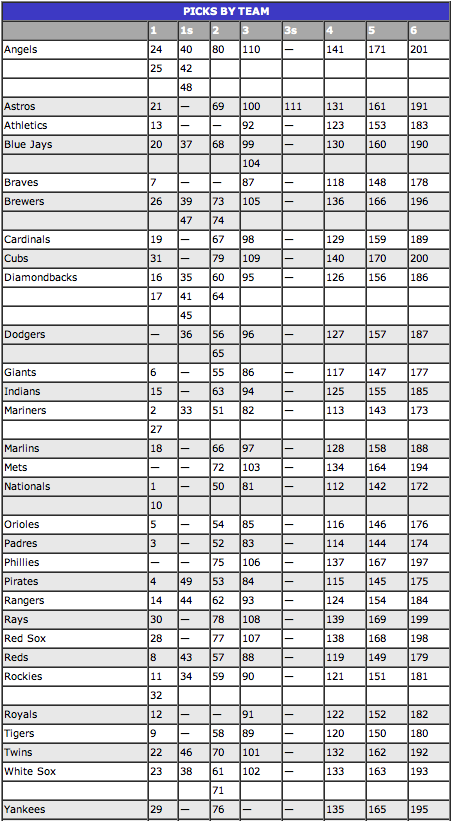 Rich: Switching gears here, the Diamondbacks and Angels each have five of the first 48 picks in this year's draft (see the adjoining Picks By Team, courtesy of Baseball America). Due to big league promotions and trades in the case of Arizona, each club's once highly regarded farm system has been depleted of late. How do you see the D-Backs and Angels handling the multitude of draft choices today?
Marc: I wanted to love the Diamondbacks organization because I love the state so much. But, I just don't have a lot of faith in the organization as a whole. I have a strong feeling that they're going to "go cheap" with their picks. If they take the best available player at 16 and 17 then I'll eat my words. Unfortunately, with so much up in the air with the draft, I can't even fathom who might be there... Bobby Borchering, Matt Purke? I could see them being one of the teams on Mike Minor, if he "slips." As for the Angels, you pretty much know the organization is going to go heavy on the prep players. I keep hearing that the club is big on Puerto Rican outfielder Reymond Fuentes. The organization needs some pitching depth too, though.
Rich: I don't see the D-Backs popping for Purke, especially if you're concerned that the organization is going to go cheap. Signability and injuries always play a factor in each year's draft. Kyle Gibson (stress fracture in his right forearm) and Baseball Analysts Draft Spotlight Tanner Scheppers (recovering from a shoulder injury last year) are the biggest risks health-wise this year. As to signability, Strasburg and Ackley pose some risk but are likely to sign right before the deadline. However, I'm not so sure you can count on a handful of high schoolers rumored to be seeking out-of-the-box signing bonuses, such as Purke, Donavan Tate, and Jacob Turner, to sign unless they get exactly what they want. It says here that if you draft any of these players, you had better be willing to pay (close to) the anticipated freight.
Marc: I agree, but I like to think that pretty much any player drafted in the first round is going to sign... There are not that many Gerrit Coles in the world, who would turn down millions of dollars to play college baseball. With that kind of money, you can set yourself up for life and go to college later, if that's really what you want to do. It also sounds like a lot of teams are saying to heck with the slot so I think we're going to see everyone sign, despite some long drawn-out negotiations. Teams have really shifted to emphasizing in-house development. It's still far cheaper to give $3 million to an amateur as a signing bonus than $50M to a 30-year-old free agent coming out of his prime.
Rich: Last year's draft was dominated by college prospects, particularly position players. Aside from Strasburg and Ackley, this year's draft seems more geared to high school arms. There's Purke and Turner, as well as Tyler Matzek, who just may be the best prep pitcher of them all, Baseball Analysts Draft Spotlight Zack Wheeler, Shelby Miller, Tyler Skaggs, and Matt Hopgood, who was named the 2009 Gatorade Baseball Player of the Year on Monday. That's seven right there as compared to just three last year (Ethan Martin, Casey Kelly, and Gerrit Cole). In this regard, the draft feels a lot more to me like 2007 than 2008.
Marc: Last year, though, you have too keep in mind that signability played into things as well as possible first-round talents like prep pitchers Tim Melville and Ross Seaton slid past the third round but still signed for first-round money.
Rich: Well, that could always happen again this year, but I think most, if not all, of those high school arms will be drafted in the first round.
Marc: One thing I am curious about, though, is if teams are going to start straying from the all-college approach that teams like St. Louis, Toronto, and San Diego have been using for a few years now... Those teams really haven't had great drafts as of late, although Toronto has scored a few good players by looking to the prep ranks a little more often.
Rich: I've always been attracted to taking the best player available, irrespective of his status as a high school or college prospect. If you end up with a good mix of both, all the better, as it helps balance out the age of players in your farm system (and eventually at the major league level as well).
Marc: Rich, I know you've seen Grant Green play a fair bit... Where do you think he ends up when all is said and done. And what kind of impact do you see him having? Is his 2009 season the real Grant Green?
Rich: Although Green didn't live up to expectations as a junior, he is still a first-round talent. Heck, he's the best shortstop in the entire draft. Premium up-the-middle players are still hard to find so I'm confident that he won't slide much beyond the middle of the first round unless teams get spooked by his above-slot asking price. Kansas City could be the best fit. The Royals haven't backed away from Boras clients in the recent past (Luke Hochevar in 2006, Mike Moustakas in 2007, and Eric Hosmer in 2008). If KC passes at No. 12, then I would look for Oakland (13th) or St. Louis (19th) to step up and take Green. As to impact, I can see him hitting between .270 and .300 with 15-20 HR during his age 25-30 seasons. Those numbers will work just fine as long as he sticks at shortstop.
OK, Marc. Washington is on the clock...
* * *
Update: Jim Callis, in his Mock Draft 4.0 posted this morning, says bonus demands are adding more confusion to a wide-open draft.
According to multiple team sources, several of the draft's best high school players blew them away when they revealed their price tags. California lefthander Tyler Matzek, the best prep prospect in the draft, wants "precedent-setting money," which is interpreted to mean that he wants to surpass the record $7 million guarantee for a high schooler given to Josh Beckett and Rick Porcello. Texas righthander Shelby Miller, previously believed to be signable for around MLB's bonus recommendations, is asking for $4 million.New Jersey outfielder Mike Trout (upwards of $2.5 million), Texas outfielder Slade Heathcott (upwards of $2 million), Florida third baseman Bobby Borchering ($2 million), North Carolina catcher Wil Myers ($2 million) and California outfielder Jake Marisnick ($2 million) all want top-10 pick money. Oklahoma southpaw Chad James seeks $1.75 million. Previously, Missouri righty Jacob Turner and Texas lefty Matt Purke alluded to Porcello money, while Georgia outfielder Donavan Tate will cost $6 million or more.
Teams are indignant about what they believe to be unrealistic expectations. Two different scouting directors remarked last night that they were getting seven-figure signability estimates for players their clubs hadn't even planned to draft. On the other side, agents are just as upset about commissioner Bud Selig's unilateral 10 percent reduction in the slot recommendations.
| Baseball Beat | June 08, 2009 |
2009 Draft Day Spotlight: Matt Davidson
Matt Davidson is one of the top high school bats in tomorrow's MLB Draft. The 6-foot-4, 225-pound third baseman is projected to go in the bottom half of the first round or early in the supplemental round.
 A righthanded power hitter, Davidson hit .553/.685/1.153 with 18 doubles and 11 home runs during his senior year. He cranked eight homers in his final dozen games, going yard twice in three separate contests down the stretch.
Using a wood bat, Davidson put on a power display at the National Classic in the spring of 2008 and won the home run derby prior to the Aflac All-American Game at Dodger Stadium last summer. He went 1-for-4 with a run-scoring double down the left-field line in his second at-bat during the game.
Matt was born in Redlands, California on March 26, 1991. The Davidson family moved to nearby Yucaipa when he was a toddler. Davidson has wanted to play professional baseball since he was a young kid. He played four years of varsity and led Yucaipa HS (27-3 overall, 13-1 in the Citrus Belt League) to a national ranking this past season, bowing to Huntington Beach HS in the quarterfinals of the CIF, Southern Section Division II playoffs two weeks ago.
Davidson committed to the University of Southern California last year but appears to be leaning toward turning pro if everything goes as planned.
I spoke to Matt on the telephone for half an hour last Wednesday night. He had just returned from Phoenix after working out with the Arizona Diamondbacks the previous day.
Rich: I understand you not only played varsity baseball all four years at Yucaipa High School but you were the MVP of the league your freshman year.
Matt: Yes. I was mostly a pitcher my freshman and sophomore seasons, then I pretty much quit throwing my junior year and moved to third base to concentrate more on my hitting and fielding.
Rich: How did you do as a pitcher?
Matt: I was 10-1 with a 0.80 ERA in my freshman year. I was 9-2 with like a point 8 ERA as a sophomore. I think I was 4-2 as a junior and 5-0 this year as a relief pitcher.
Rich: Wow. You were quite the pitcher.
Matt: Thanks. I always hit when I pitched. As a freshman, I pitched and DH'd. In my sophomore year, I pitched and played first base.
Rich: What would you say to the cynics who question your ability to stick at third base longer term.
Matt: This is just my second year at third base. I've had absolutely no coaching there. I will be able to work with an infield coach in college or in the pros. I've only been able to take about 20 grounders a day at practice. I'm really raw right now. I'll be able to spend more time on my fielding in the future.
Rich: You signed a letter of intent to play baseball at USC, my alma mater.
Matt: Oh, that's good to know. My hitting coach, Danny Davidsmeier, was an All-American at USC in 1981.
Rich: I remember him.
Matt: I've been taking personal, private lessons from him since I was 10. He was drafted by Milwaukee in the third round. He didn't play in the majors but made it to Triple-A and also played overseas.
Rich: Can either one of us convince you to become a Trojan or are you set on turning pro?
Matt: I'm totally fine with both. Either one would be a great opportunity.
Rich: Do you have a preference?
Matt: I want to go out and play. My dream is to play pro baseball. But you have to make a smart decision. I just hope everything works out well so I can go out and play.
Rich: You sound like you're anxious to start your professional baseball career.
Matt: Yeah, definitely. I'm not looking for a ridiculous amount of money. I just want a fair amount for where I'm drafted. The big money will be there later.
Rich: That's what I like to hear, Matt.
Matt: Being drafted in the first round is a special thing. Not many people get to do that.
Rich: Who is your adviser?
Matt: Ryan Hamill of CAA.
Rich: How did you go about selecting an adviser and what made you choose Ryan?
Matt: You need to talk to your agent a lot. He works for us. He's young and relates well. It just felt comfortable. Everything clicked. I hope to work with him for a long time.
Rich: Coach Stout told me that you worked out with the Arizona Diamondbacks on Tuesday. How did that go?
Matt: It went really well. They have a beautiful stadium. I took BP and infield, and then I played in a simulated game with high school and college players.
Rich: Did the team interview you?
Matt: Not really. But the area scouts and I know each other well.
Rich: Arizona has the 16th and 17th picks plus three more in the sandwich round. Any idea where the D-Backs might draft you, if at all?
Matt: The Diamondbacks definitely have an interest but they can't tell you where they might take you. We'll be talking. We'll just have to see how it goes.
Rich: Have you worked out for any other teams?
Matt: San Francisco and St. Louis. I had a couple of professional team workouts as a group on Saturday and Sunday.
Rich: Do you have any others scheduled between now and the draft?
Matt: I'm going to Milwaukee on Friday.
 Rich: From a scout's point of view, how would you rank your five tools (hitting for average, power, fielding, arm strength, and speed) in order from best to worst?
Matt: Hitting for power would be my best. Hitting for average second. My arm third. Then fielding and speed. But I want to make them all even.
Rich: Plate discipline and pitch recognition skills play important roles when it comes to hitting. How would you rate this area of your game?
Matt: I really improved on that this year from last year. Dr. Harrison and his son Ryan of Slow the Game Down helped me out a lot. They work with a lot of major leaguers. Dr. Harrison is an optometrist who works on eye training. I've learned to pick up pitches well and now see the spin of the ball better. I'm laying off pitches and waiting to get my pitch.
Rich: I noticed that you had 27 walks and only struck out seven times this year.
Matt: Yeah, and I was also hit by a pitch like 14 times.
Rich: Yikes. Were they throwing at you intentionally?
Matt: Sometimes. But it might also be because I get on the plate a little bit. That probably helps.
Rich: Do you tend to guess type of pitch and/or location when even or ahead in the count?
Matt: Umm... Sometimes I do. But Danny has taught me to be more of a react hitter. I don't really like to sit on pitches. I just like to react. I don't do as well when I get away from that.
Rich: Do you change your approach when behind in the count?
Matt: Not necessarily. I like to have a game plan of what I'm going to do. With two strikes, I want to put the ball in play. Hit it hard somewhere. I don't like to change my swing at all. Just keep it the same.
Rich: What is the biggest difference between hitting with a wood bat vs. an aluminum bat?
Matt: Bat speed. You need to have strong hands and arms. The sweet spot is smaller. You can't hit the ball off the handle like with an aluminum bat.
Rich: Do you like using wood bats?
Matt: I love hitting with wood bats more than aluminum.
Rich: You won the home run derby at the Aflac All-American Classic last summer using a wood bat.
Matt: I did. I hit six at USC and three or four at Dodger Stadium before the game.
Rich: Do you prefer facing lefthanders more than righthanders?
Matt: No, not at all. It doesn't matter to me. The ball still is coming out pretty much the same.
Rich: Who's the most difficult pitcher you've faced thus far?
Matt: I would say John Meyer, a righthander from Cathedral High School in San Diego. He is going to Clemson.
Rich: Have you patterned your game after another player?
Matt: Definitely. Alex Rodriguez, David Wright, and Cal Ripken Jr. I like to pick a little from each one. But you have to be your own player.
Rich: Who is your favorite player?
Matt: Cal Ripken or David Wright.
Rich: What is your attraction to them?
Matt: They play the game the right way. They play hard. They play every night. They present a good image, always working, showing how it's done. They're good role models.
Rich: Speaking of which, you were a member of Best Buddies, a non-profit organization founded in 1989 that is dedicated to enhancing the lives of people with intellectual disabilities.
Matt: I was heavily into it last year but haven't been as involved this year with all that has been going on. I've always had a soft spot for the less fortunate.
Rich: You have also given hitting and pitching lessons throughout your community.
Matt: I continue to do that. I enjoy helping kids. There were people who helped me when I was a kid. I like giving back.
Rich: It sounds like you've got your act together, Matt. Where will you be on draft night?
Matt: I'll be at home. It's the night before grad night. The team baseball banquet is that evening.
Rich: Good luck on Tuesday. I appreciate you taking the time to talk to me tonight.
Matt: I enjoyed it. Thank you very much.
Rich: Thank you, Matt. I look forward to staying in touch with you.
Matt: Definitely.
Rich: OK. Take care.
Thanks to Jeff Stout for coordinating the interview and to Aflac All-American and Max Preps for the photos.
| Baseball Beat | June 03, 2009 |
Sports Illustrated Jumps on the Bryce Harper Bandwagon
Bryce Harper is on the cover of this week's Sports Illustrated and the subject of a featured article by Tom Verducci. The June 8 edition hits newsstands today.
The magazine calls Harper "The Most Exciting Prodigy Since LeBron."
His name is Bryce Harper. You don't know him, but every big league scouting director does. He hits the ball a desert mile, clocks 96 on the gun, and he's only 16, more advanced than A-Rod and Junior were at the same age. And his ambition is as great as his talent.
Readers of Baseball Analysts know "Baseball's Chosen One." We were one of the first to introduce him to the baseball world in an article last summer, entitled Remember This Name. We followed up that piece with Revisting Bryce Harper in January, including a photo and a YouTube video of his exploits at the third annual International Power Showcase High School Home Run Derby at St. Petersburg's Tropicana Field. Most recently, we detailed the stats from his sophomore season (.626/.723/1.339 with 14 HR in 115 AB and 36 SB in 39 attempts) in our High School, College, and Minor League Notes.
Owing to our past coverage, our site has been overwhelmed today by Google searches looking to learn more about Harper, causing occasional load issues.
In the meantime, the Las Vegas Review Journal wonders about Harper as it relates to the SI jinx, "which sometimes haunts athletes and teams that appear on the magazine's cover."
Hijinks (by the team lucky enough to draft and sign Harper in 2011 — or 2010 if he can get a "GED credential this summer and enroll in a junior college this fall" as Verducci mentions in his excellent article), yes. Jinx, no.
Remember this name.
| Baseball Beat | May 29, 2009 |
Q&A with Baseball America's Jim Callis
Strasburg, Boras, and Everything Else You Wanted to Know About the 2009 Draft
When it comes to the First-Year Player Draft, nobody is as wired to what's going on as Jim Callis, the Executive Editor of Baseball America. He talks to general managers, scouting directors, cross checkers, area scouts, college coaches, and agents, gathering valuable information for Baseball America's website and biweekly magazine. With his ear to the ground, Jim's final mock drafts are routinely the most accurate published. Two months before I met up with Jim on a trip to Chicago in the summer of 2005, he predicted the first 18 selections of the draft in the exact order that they were taken.
 Born and raised in Virginia, Callis graduated from the University of Georgia with a degree in journalism. He began his career with Baseball America in December 1988, left for STATS, Inc. in September 1997, and returned to BA in May 2000. In total, Jim has been covering baseball for more than two decades, including 18 years with Baseball America.
Callis, 41, lives in the Chicago area with his wife and four children. In his spare time, he coaches his oldest son's 7th/8th grade baseball team. Like all of us, Jim is a baseball fan and his favorite team is . . . the Boston Red Sox! You can catch up with Jim about the draft, the Red Sox, baseball in general, and even pop culture in his online chats at ESPN Sports Nation.
Grab a cup of coffee, pull up a chair, and enjoy our discussion about the MLB First-Year Player Draft that begins Tuesday, June 9.
Rich: Hi, Jim. Thanks for taking the time to preview the 2009 First-Year Player Draft with us. How is this draft shaping up in terms of overall talent vs. those of the past?
Jim: It's not a good draft for position players, and it comes right after a draft that was loaded with hitters, so there's kind of a negative vibe about it. But there's talent in any draft. This one has plenty of pitching, college and high school, lefty and righty, whatever flavor you like, starting with arguably the best draft prospect ever in Stephen Strasburg. The college position players fall off a cliff quickly after North Carolina first baseman Dustin Ackley, but Ackley is a very good one. The high school position players are fine, with a lot of catchers and center fielders. It's kind of reminiscent of 2006, which was thought not to be deep in comparison to a hitter-rich 2005 crop, yet had Evan Longoria, Tim Lincecum, Joba Chamberlain and a host of other very talented players. So that's a long way of saying that there's talent in this draft, there's just not much consensus. I actually wrote a column on this, so I'll plug it here, though you need a BA.com subscription to read it.
Rich: The Washington Nationals are the first team to own two of the top ten picks in the same draft. The No. 1 overall choice is the reward for having the worst record in baseball in 2008 while the No. 10 selection is compensation for not signing Aaron Crow with the ninth pick last year. Aside from issues involving health, is there any chance at all that Washington would take someone other than Strasburg with the first pick?
Jim: No chance. Strasburg will be the No. 1 overall pick, barring injury. The track record of pitchers taken No. 1 overall is less than scintillating, but he's still far and away the best talent this year, and that's who you have to take with the top pick. He'll cost a lot of money, but far less than he would if he were on the open market. He also should be able to crack Washington's big league rotation almost immediately, if not immediately. There's no excuse for not taking him No. 1.
Rich: Is the $50 million price tag for Strasburg that has been floated out there simply a strategic ploy on the part of Scott Boras to reset the bar for No. 1s or do you think he will hold to something close to that figure at the risk of not getting Strasburg signed by August 15?
Jim: I'm sure Scott Boras believes in his heart that Strasburg deserves $50 million. I also believe that if all 30 teams could bid on Strasburg, he'd get that money. But the leverage to get that money doesn't exist because Strasburg's only options are to 1) sign with whoever picks him or 2) re-enter the 2010 draft. There's no avenue to free agency. If Scott doesn't get his asking price, he gives the team every chance to up its offer right up until the deadline. So don't look for Strasburg to sign before 11:59 p.m. ET on Aug. 15.
Rich: Nationals president Stan Kasten has been quoted as saying, "We know what No. 1s get and we intend to sign that player...No one's situation is going to change the industry." Doesn't that comment suggest the Nationals are going to draft Strasburg with the intention of offering him an eight-figure contract but much closer to the $8.5M-$10.5M that the top three signees (Mark Prior, Mark Teixeira, and David Price) received than the $52M awarded to Daisuke Matsuzaka, the comp Boras has reportedly used?
Jim: I think that's exactly right. To sign Strasburg, the Nationals need simply to figure out what's the lowest amount they can offer that will be too risky for him to turn down in the end. The draft record for guaranteed money is $10.5 million by Prior, and I'm guessing Washington will come in somewhere between $15 million to $20 million. Matsuzaka's price tag was artificially inflated by the $51.1 million posting fee Boston paid, and his situation isn't analagous to Strasburg's.
Rich: According to Jim Bowden, Crow asked for $4.4M and turned down $3.5M. Do you think he will get that type of money this year?
Jim: I heard Crow wanted $4 million at the end. Those negotiations were botched by both sides, who should have met in the middle at the deadline. I do think he'll get similar money this year, though he doesn't have a ton of leverage. There's no way he can really go back into the 2010 draft at this point. He's pitching well in indy ball, and first-round pitchers who have gone that route have done very well in the draft. He could get one of those $5 million major league contracts. Most teams probably wouldn't give him that much, but there always seems to be one club that will. I think he could go as high as No. 3 to the Padres or No. 4 to the Pirates.
Rich: The other Independent League wild card in this year's draft is Tanner Scheppers. How would you compare and contrast Crow and Scheppers and where do you see the latter going?
Jim: Scheppers probably would have been a top-10 pick last year if he hadn't hurt his shoulder. He hadn't bounced back by the time of the signing deadline for the Pirates to give him big money as a second-round pick. Scheppers has more arm strength, while Crow has more polish and a better health history. Scheppers came out of the gates stronger this spring, but they're pretty even now. They both should factor in the top half of the first round, possibly in the first 5-10 picks.
Rich: Let's talk about what Washington is likely to do in terms of its compensation pick for not signing Crow last year. After you posted your Mock Draft, Version 1.0 two weeks ago, acting Washington general manager Mike Rizzo contacted Baseball America, and said, "We do not have to take a signability pick. We’re going to take the best guy. We’re going to have 10 names up there on the board, and we’ll take the one we like." It seems to me that the Nats have to be careful this time around because they won't get another compensation pick if they fail to sign this particular draft choice. Agree?
Jim: They do have to be careful, because teams don't get compensation for failing to sign a draft pick they got as compensation for failure to sign another. Reading between the lines of what Mike said, they very possibly could take a guy they like but the industry doesn't value as highly as the No. 10 pick, and in that case they could use their leverage to sign him to a below-slot deal. I don't think they'll use the price as their main focus of their pick, but I also don't think they're going to roll the dice on someone like Donavan Tate if he's still there.
Rich: There is an important distinction between ability vs. signability. Which teams are most likely to pay over slot to get the player they want?
Jim: Last year, the industry spent a record $188 million on the draft and 26 of the 30 teams exceeded MLB's bonus recommendations on at least one player. I think teams in general will be more thrifty this year. But the usual suspects, particularly the Yankees and Red Sox, I'm sure will be willing to spend if a talented player falls to them. The clubs generally don't announce this, though.
Rich: How many players that could go in the first couple of rounds are being advised by Boras this year?
Jim: Several. Scott has arguably the best prospect in draft history (Strasburg), the best hitter in this draft (North Carolina first baseman Dustin Ackley), the best high school position player (Cartersville, Ga., HS outfielder Donavan Tate), arguably the best high school pitcher (Westminster Christian Academy/St. Louis righthander Jacob Turner), the best middle infielder (Southern California shortstop Grant Green) and the best college lefthander (Oklahoma State's Andy Oliver). Other top-two-round Boras advisees include Gainesville (Fla.) HS outfielder LeVon Washington, Kentucky lefthander James Paxton, Tennessee outfielder Kentrail Davis and Rocky Mount (N.C.) HS outfielder Brian Goodwin.
Rich: Are there any teams that flat out won't deal with Boras? If so, which ones?
Jim: There are, though everyone at least kicks the tires on his guys and no one will admit to avoiding his players on the record.
Rich: Has MLB sent out guidelines for slot money this year?
Jim: We had early indications that the slot recommendations will be the same as last year, but Murray Chass has reported that Bud Selig wants to roll them back by 10 percent, just like MLB tried to do in 2007. We've since confirmed that. Suffice it to say that no one is happy. I've had agents tell me there's no reason for a first-rounder to sign before Aug. 15, and I had one front-office official describe it as "fucking bullshit." You may edit that quote as you like.
Rich: Those aren't my words, Jim, so I think I'll leave that quote as is. Forget slot recommendations for a minute. Given the economy and the state of baseball, do you expect signing bonuses will be negatively affected at any point in the draft?
Jim: I don't think bonuses will be slashed, but I do think there will be fewer teams who will aggressively sign players for well above the slot recommendations. The last time MLB tried to cut slots by 10 percent, bonuses went up anyway, so I don't think that will have as much of an effect as the economy will.
Rich: Which players stand to get "out of the box" type deals and why?
Jim: Strasburg, obviously, because of his immense talent. The top college pitchers usually get major league deals with a $3 million bonus and a $5 million total guarantee, so that's may be what Missouri's Kyle Gibson and North Carolina's Alex White are looking for. Then again, they haven't lit scouts up down the stretch, so they may be more apt to sign for slot. I bet Ackley will seek a big league contract as well. The three top talents who could fall the most in the first round because of asking price are Tate, who has the leverage of a football scholarship from North Carolina, Turner and Klein HS (Spring, Texas) lefthander Matthew Purke. The numbers we're hearing on those guys are $6 million for Tate, $7 million for Turner and $5 million for Purke. There also are starting to be rumblings that the other elite high school lefty, Tyler Matzek of Capistrano Valley HS (Mission Viejo, Calif.), may not be an easy sign either. There's no number on him yet but teams are thinking he may prove costly.
Rich: The price tag on Turner seems to be based on what Josh Beckett and Rick Porcello received. Is Turner in that same league?
Jim: He's very good, arguably the best high school pitcher in this draft, but I don't think he's in the same class as Beckett and Porcello. He's not far off, but he's not as highly regarded as they were in high school.
Rich: Given Tate's talent and and how the Braves have leaned toward Georgia-based prospects in the past, it wouldn't be unreasonable to assume that he could be atop their board, if available at No. 7. However, management hasn't been known to pay over slot and, as such, do you think Atlanta will forgo Tate for another player who may not be as risky or costly?
Jim: The Braves don't usually draft Scott Boras clients. Their last prominent one was Joshua Fields, and that didn't work out too well. I would be very surprised if Atlanta took Tate.
Rich: Purke has signed a letter of intent to attend TCU and would be a draft eligible sophomore in 2011, which means he could have as much leverage in two years as he does this year. Although I have likened the tall, lanky lefthander with the three quarters delivery to Andrew Miller (not sure if that's as high of a compliment today as it may have been a few years ago), I see him as a gamble for most teams (other than perhaps the Texas Rangers or Houston Astros) at that price tag. Could he slide all the way to the Boston Red Sox at No. 28 or to the New York Yankees at No. 29, a la Porcello in 2007 and Gerrit Cole in 2008? Porcello turned out to be a great selection for the Tigers but Cole rejected the Yankees and opted to go to UCLA instead.
Jim: He could slide that far, sure. I think the Rangers could be tempted by him if Brownwood (Texas) HS righthander Shelby Miller is gone, and I'm not sure the Astros would go that far over slot if Purke holds true to his price tag. My guess is the Yankees would be more likely than the Red Sox to take Purke.
Rich: Let's circle back for a minute. Strasburg is off the board and it's now time for the Seattle Mariners to make their first pick (No. 2 overall). Is Ackley the consensus choice here?
Jim: I think he is. For a long time, the story was this draft was Strasburg and no consensus No. 2. Now I think most teams in the top 10 picks would pop Ackley if they had their choice (assuming Strasburg is gone, of course). I would do the same thing. I think he's a can't-miss bat, should have at least average power and will be able to move to center field. He's the clear No. 2 prospect in the draft for me.
Rich: Some might say that the draft doesn't really begin until the San Diego Padres make their selection at No. 3. Do you think management will take USC shortstop Grant Green a second time (14th round in 2006)?
Jim: I projected the Padres to take Green in my first projected first round two weeks ago, but now I'm hearing that while they like him more than any team in the top 10, he's not in the mix at No. 3. I've heard Tate there, but he doesn't seem to fit their type of guy as a less-polished high school athlete with a huge price tag. I've also heard Crow and Vanderbilt lefthander Mike Minor there, too. Crow would make more sense to me, but may cost more as well.
Rich: If Green slips past the Padres, where do you see him going?
Jim: He's a real wild card. I can't see Boras advertising him as a guy who signs for slot no matter where he falls, and he hasn't lived up to what scouts expected this spring. Maybe he falls all the way to the Yankees, who spent their first-round pick on another USC player under similar circumstances (Ian Kennedy) a few years ago.
Rich: Which players have been climbing the draft boards the most since you put out your Mock Draft a couple of weeks ago?
Jim: Minor is going to go very high after pitching very well in his last two starts, likely in the first 10-15 picks. We have him rated as more of an early sandwich pick, and I think that's where his talent fits, but he'll go higher than that. Of the projected first-rounders from two weeks ago, I think most guys' stock is holding firm for now. Signability may have guys rise or fall but talent-wise, I don't think anyone else is really leaping up. Guys like Lipscomb lefty Rex Brothers and Indiana righty Eric Arnett continue to pitch well, but we had them as mid-first-rounders to begin with.
Rich: Aside from signability issues, whose stock has been dropping the most — and why?
Jim: White hasn't pitched well recently. He entered the year as the No. 2 pitcher behind Strasburg for some clubs, but now I think he probably won't go in the first 10 picks. A lot of teams are backing off of Green. Even if he'd sign for slot, he might last until the middle of the first round. Baylor righthander Kendal Volz had a chance to go in the top 10 but his stock has been dropping steadlily and he might be more of a third-rounder now.
Rich: Are there any debates as to where two-way players are best suited?
Jim: The biggest debate would be over Plant HS (Tampa) shortstop/righthander Mychal Givens. He's very raw but very talented at both positions, and I think it's a 50-50 split on which way he should go.
Rich: The Arizona Diamondbacks have back-to-back picks at 16 and 17. Do you see them taking one hitter and one pitcher or doubling up? Either way, will money get in the way of how the club approaches these selections?
Jim: I don't think they'll do anything beyond take the two best players, even if they're both hitters or both pitchers. They pick again at 35, 41 and 45, so if they double up they could always shoot for balance later. Ideally, I think they'd take a high school bat and a college pitcher. That is a lot of picks to pay, and it remains to be seen if they'll take some money-savers early in the draft.
Rich: After not having a first-round pick in three of the last four drafts, the Angels own the 24th and 25th spots this June, as well as three sandwich selections (40, 42, and 48). How do you see owner Arte Moreno, GM Tony Reagins, scouting director Eddie Bane & Co. handling this year's haul?
Jim: The Angels aren't afraid to spend and their farm system is flagging a bit, so I'd expect them to pay full freight for all five picks. They love athletes and projectable pitchers, and they love to focus on players in Southern California.
Rich: With the 2nd, 27th, and 33rd picks, Seattle is also in a good position this year. How do you see the new regime approaching these choices?
Jim: When he was running drafts in Milwaukee, Jack Zduriencik took the best player available, not caring if it was college vs. high school, pitcher vs. hitter, or what the general consensus on a guy was. The system isn't loaded with arms, so they might lean a little more toward some college pitching after grabbing Ackley at No. 2.
Rich: OK, let's finish with a big surprise. It could be anything. Let 'er rip.
Jim: Hmmm . . . I guess something that has jumped out at me recently is how a lot of the expected best college pitching duos (Baylor's Volz and Shawn Tolleson, Oklahoma State's Oliver and Tyler Lyons, Stanford's Jeff Inman and Drew Storen and Kent State's Brad Stillings and Kyle Smith) have mostly fizzled, with the exception of Storen. Now the two best come from unlikely sources: Kennesaw State's Chad Jenkins and Kyle Heckathorn, and Indiana's Arnett and Matt Bashore. Jenkins and Heckathorn could both go in the first round, as should Arnett (who would be the Hoosiers' first first-rounder since 1966), and Bashore may sneak into the sandwich round.
Rich: Excellent. Thank you, Jim, for taking the time out of your incredibly busy schedule to share your expertise on this year's draft with us.
Jim: No problem. Love your website, and always glad to help.
* * *
Update: Jim posted his Mock Draft, Version 2.0 earlier today.
| Baseball Beat | May 26, 2009 |
June Madness Begins in May
Over the weekend, the NCAA Baseball Committee announced the field of 64 teams that will compete for the 2009 NCAA Division I Baseball Championship. As always, there were a handful of surprises.
The Big 12 (Baylor, Kansas, Kansas State, Missouri, Oklahoma, Oklahoma State, Texas, Texas A&M) and Southeastern Conference (Alabama, Arkansas, Florida, Georgia, LSU, Mississippi, South Carolina, Vanderbilt) landed eight spots each while the Atlantic Coast Conference (Boston College, Clemson, Florida State, Georgia Tech, Miami (FL), North Carolina, Virginia) nabbed seven. Meanwhile, the Big West (Cal Poly, UC Irvine, Cal State Fullerton) and Pacific-10 (Arizona State, Oregon State, Washington State) garnered three each.
The Big 12, SEC, and ACC combined for 23 of the 64 available berths in the NCAA tournament. By comparison, the West (including the six schools named above plus Fresno State, Gonzaga, San Diego State, Utah) earned a whopping 10 spots or two more than the Big 12 or SEC. Mind you, the West sports the defending champ (Fresno State) and three of the top six national seeds (Cal State Fullerton, Arizona State, UC Irvine), yet is represented by less than 16 percent of the total field.
The top eight national seeds are as follows:
1. Texas (41-13-1)
2. Cal St. Fullerton (42-14)
3. LSU (46-16)
4. North Carolina (42-16)
5. Arizona St. (44-12)
6. UC Irvine (43-13)
7. Oklahoma (41-18)
8. Florida (39-20)
While Texas goes in as the favorite, it has been 10 years since the last No. 1 overall seed (Miami) won the College World Series. Along the same lines, no top-eight seed has emerged victorious since Rice in 2003.
Courtesy of Baseball America, the 64-team field is as follows (with Regional hosts listed No. 1 and national seeds indicated in parenthesis after the school name):
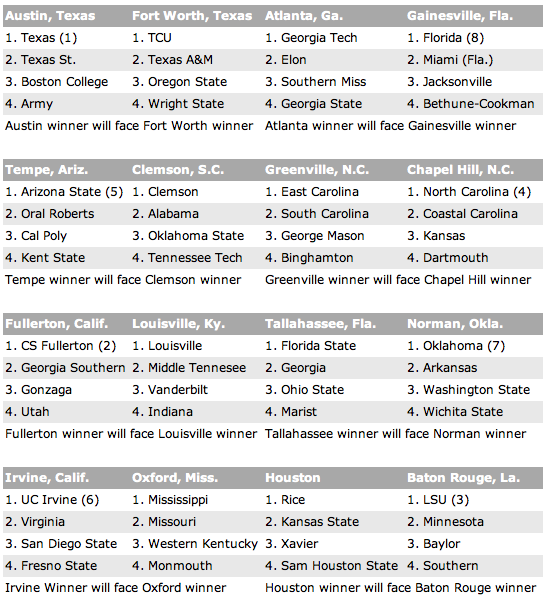
I'm all ears and eyes if anyone can explain to me how the Committee can justify placing UC Irvine (No. 1 ranked team in Baseball America's latest poll, the sixth overall seed, and the Big West champions), Virginia (No. 7 in Baseball America's poll and ACC tournament champions), Fresno State (defending NCAA champs and winner of the WAC tournament), and San Diego State (40-21 with a second-place finish in the Mountain West tourney) in the same Regional. The bracket is particularly unfair to UCI and Virginia, which gets the privilege of facing Stephen Strasburg, perhaps the greatest pitcher in the history of college baseball, in the opener on Friday night.
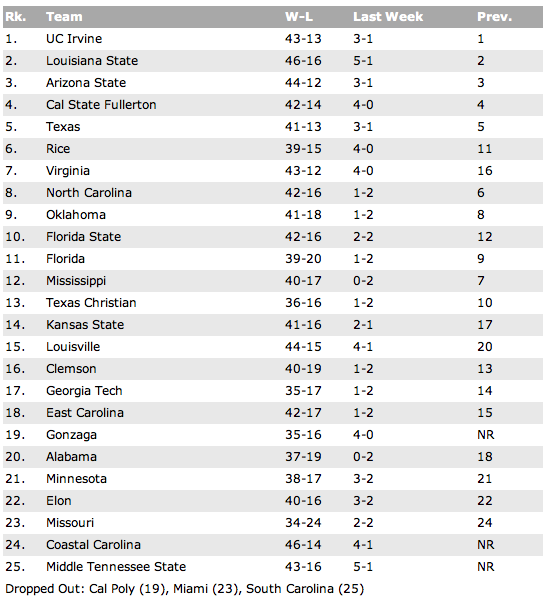
To be honest, it's hard to understand how Cal State Fullerton earned a higher national seed than UCI. The Titans finished five games behind the Anteaters in the Big West and lost the head-to-head series in early April. Granted, Fullerton (No. 1) has a higher RPI than Irvine (No. 18) but that should have little or no bearing when comparing two teams from the same conference that played an identical schedule in league and faced each other three times during the regular season. In any event, UCI gets Virginia, which could have conceivably been chosen as a Regional host, as its No. 2 seed and CSF gets Georgia Southern (unranked with the 35th highest RPI)? I'm sorry, but these pairings make no sense whatsoever.
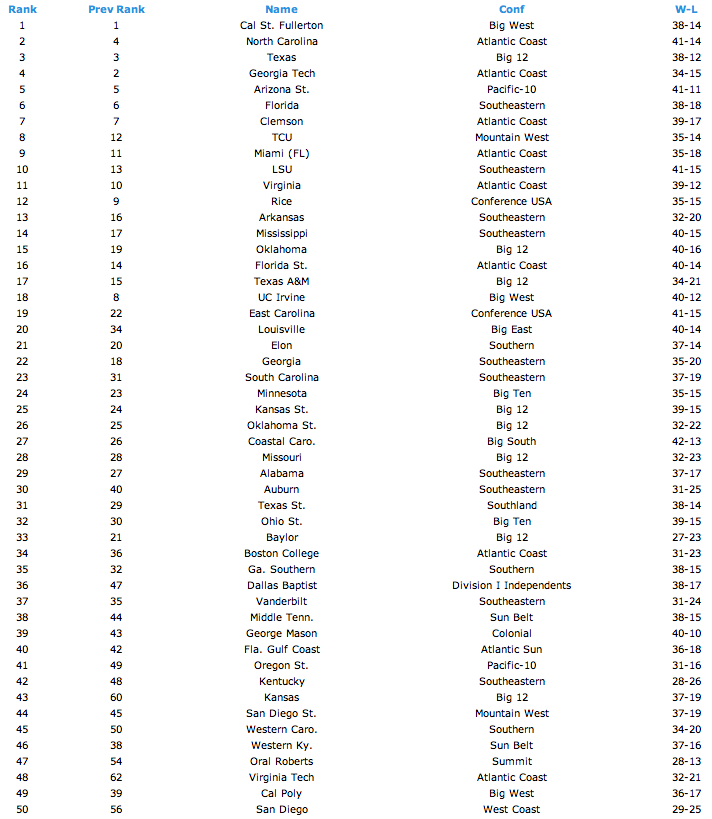
Rice and Florida State can also make reasonably strong cases over Oklahoma and Florida for national seeds. As Baseball America's Aaron Fitt pointed out, "Rice was 21-9 against the top 100 teams in the RPI, and it finished strong by winning the CUSA tournament. And Florida State won the regular-season ACC title and reached the finals of the conference tournament."
Fitt also believes that "Oklahoma State is a horrendous, horrendous choice as an at-large bid." The Cowboys won just two of its nine conference series and finished ninth in a 10-team league, yet finds itself a No. 3 in the Clemson Regional. Baylor is another questionable call from the Big 12 (which is really the Big 10 when it comes to baseball).
The Regionals begin on Friday, May 29 and conclude on Sunday, May 31 (or Monday, June 1, if necessary). Selection of the eight Super Regional hosts will be announced on Monday, June 1 at approximately 11 p.m. ET. The Super Regionals will take place on June 5-7 and June 6-8. The best-of-three-games winners will advance to the College World Series at Rosenblatt Stadium in Omaha, Nebraska on June 13-23/24.
Additional notes (from the NCAA press release):
* * *
Update (5/27/09): Boyd's World has posted its Iterative Strength Ratings (ISR)-based probabilities to determine the odds of winning the Regionals, Super Regionals, and College World Series. Not surprisingly, the 16 Regional hosts are favored to win this weekend with Texas (66.9), Arizona State (78.2), Cal State Fullerton (83.4), and UC Irvine (54.8) the only schools with a better than 50 percent chance of making it to Omaha. Based on these ISR findings, Fullerton (32.6), ASU (19.2), and Texas (13.2) are the three favorites to win it all.
| Baseball Beat | May 25, 2009 |
High School, College, and Minor League Notes
The Major League Baseball Draft will be held two weeks from tomorrow. The first day (Tuesday, June 9), which will consist of the first three rounds plus two compensation rounds, will be televised live by the MLB Network at 6:00 p.m. (ET). The draft will resume on Wednesday (fourth through 30th rounds) and conclude on Thursday (31st-50th rounds).
Baseball Analysts will live blog the draft once again, posting player profiles and comments as picks are unveiled. We plan to kick off our pre-draft coverage on Thursday, holding a Q&A with Jim Callis, Baseball America's resident draft expert. As in the past, we will also bring you interviews with several top prospects, including Tanner Scheppers, who returns to the draft this year after failing to sign with the Pittsburgh Pirates last summer. In addition, we will provide post-draft analysis, including Marc Hulet's shadow draft.
* * *
Two years ago, I interviewed Josh Vitters, who was selected by the Chicago Cubs with the third overall pick in the 2007 draft. Due to a nagging hand injury, Vitters' pro career got off to a slow start, hitting a combined .118/.164/.118 in 55 plate appearances over two levels (Rookie and Short Season). He bounced back in 2008, putting up a .322/.357/.495 line, mostly at Boise in the Short Season Northwest League. The 6-3, 200-pound third baseman is taking it to a new level in 2009, raking at a .355/.381/.612 clip at Peoria in the Low-A Midwest League. He had five consecutive three-hit games from May 14-19 and has slugged seven HR in his past nine games.
While Vitters is drawing rave reviews (landing atop Baseball America's Prospect Hot Sheet for the past week), he has drawn only three walks in 160 plate appearances. Look for the aggressive-hitting Vitters to get promoted to Daytona of the High-A Florida State League soon but keep an eye on his BB/SO ratio as an indicator of his upside potential.
* * *
I interviewed Kyle Skipworth, who Baseball America called "the best prep prospect at that position since Joe Mauer was the first pick in the 2001 draft," as part of our pre-draft coverage last year. Skipworth was taken by the Florida Marlins with the sixth overall pick and signed within a couple of weeks for a $2.3 million bonus. The lefthanded-hitting catcher has had a difficult time adjusting to pro baseball. However, his struggles in the Rookie League last year (.208/.263/.340) weren't atypical for a kid who had just turned 18 the previous March. Unfortunately, Skipworth appears to have regressed this season, hitting .174/.222/.294 at Greensboro in the Low-A South Atlantic League. Worse yet, he has struck out 44 times (with only seven walks) in 118 plate appearances.
More than anything, it just goes to show that scouting young baseball players is an inexact science and that some players develop more quickly than others while others never pan out. Only time will tell if Skipworth will become part of the first or second camp.
* * *
Remember Bryce Harper? Well, it's time to revisit the 16-year-old sophomore from Las Vegas High School. The Wildcats completed their 2009 season about ten days ago and, according to Baseball America, Harper put up the following statistics:
| AB | R | H | 2B | 3B | HR | RBI | BB | SO | SB | CS | AVG | OBP | SLG | OPS |
|---|---|---|---|---|---|---|---|---|---|---|---|---|---|---|
| 115 | 76 | 72 | 22 | 9 | 14 | 55 | 39 | 5 | 36 | 3 | .626 | .723 | 1.339 | 2.062 |
The numbers look like they came right out of one of those video games where you can rig the system by creating the best possible player in the world. But these stats are the real deal. Harper hit eight of his 14 HR in the final seven games and ended the season on a 23-game hitting streak. One can only wonder why any team would even pitch to him at all.
Harper won't turn 17 until October 1. In the meantime, there's no rest for the young. He is expected to play in a full slate of wood bat summer league games. I'm hopeful of watching him perform in the Area Code Games in Long Beach once again and will keep readers apprised of the progress made by the slam dunk No. 1 pick in the 2011 draft.
* * *
Meanwhile, in the here and now draft, check out the stats for a college pitcher out of San Diego State that you may have heard a little bit about:
| W-L | G | GS | CG | SHO | IP | H | R | ER | BB | SO | HR | BAA | ERA |
|---|---|---|---|---|---|---|---|---|---|---|---|---|---|
| 13-0 | 14 | 14 | 2 | 2 | 102.0 | 57 | 15 | 14 | 19 | 180 | 3 | .164 | 1.24 |
The only question that remains is not whether Stephen Strasburg, who leads the nation in ERA and Ks, is taken first overall but how much he signs for ($10 million, $15 million, $20 million, $25 million, or the $50 million that the Scott Boras Corporation has reportedly floated out there)? Seeing that he is already on my fantasy baseball team, my hope is that he inks a contract well before the August 15 deadline and pitches for the Washington Nationals this year.
* * *
Patrick Schuster, the Mitchell HS (New Port Richey, FL) pitcher who jumped into the national spotlight when he threw four consecutive no-hitters this season, is projected by Baseball America to go in the fifth or sixth round of the June draft. Look for the lefthander with four pitches, including a fastball that ranges from 87-92 mph, to make good on his commitment to the University of Florida if he's not drafted higher than that. You can view highlights of his slingshot delivery and an interview on ESPN's First Take here.
* * *
The top two high school southpaws in this year's draft are Tyler Matzek (Capistrano Valley HS, Mission Viejo, CA) and Matthew Purke (Klein HS, Spring, TX). I was impressed with both when I watched them pitch back-to-back, 1-2-3 innings in the AFLAC All-American Classic on TV last August. They each struck out two batters. Matzek throws four pitches but relies on a fastball that hit 93 twice that afternoon and a sharp-breaking curveball while Purke's more electric fastball out of a three-quarters arm slot touched 95. The latter may be a tougher sign as he has agreed to attend Texas Christian and will be a draft-eligible sophomore in 2011.
* * *
Update: The links to organizational statistics in our sidebar on the left have been updated for the 2009 season. Thanks to Baseball-Reference.com, you can access any player's major or minor league stats with one click. Go to the section labeled Reference, choose a team, then click on either "Bat" or "Pitch" and you will be taken to that club's complete list of major and minor league hitters or pitchers.
Furthermore, we have also updated our sidebar for the 2009 Draft Order for the first round and supplemental round. This information is courtesy of Baseball America.
| Baseball Beat | May 18, 2009 |
Process vs. Results
Our 16-team fantasy baseball league held its first replacement draft on Sunday night. Each team is allowed to drop and add two players. With five solid starters (Josh Johnson, Kevin Slowey, Ricky Nolasco [patience, patience], Scott Baker [patience, patience...or so I tell myself], and Paul Maholm) and perhaps the two best pitching prospects (Tommy Hanson and David Price) waiting in the wings, I really wasn't in need of a starter. However, I wanted to do my due diligence anyway and decided to check out a handful of available pitchers.
The "hottest" — if not best — free agent starter was probably Matt Harrison, who had recently tossed 22 consecutive scoreless innings and two straight complete game victories. Having never seen him pitch before, I checked out his last two starts on MLB.TV. Unlike MLB Extra Innings, you can go back and watch archived games on MLB.TV. As such, MLB.TV is a great source for scouting players.
Going in, I knew that Harrison was drafted by the Atlanta Braves and was the organization's top pitching prospect before he was traded, along with catcher Jarrod Saltalamacchia, pitchers Neftali Feliz and Beau Jones, and shortstop Elvis Andrus, to the Texas Rangers for Mark Teixeira and Ron Mahay in July 2007. (How is that trade working out for the Braves now? According to Baseball America, Salty, Andrus, and Harrison were the Braves' top three-ranked prospects in 2007. All three have contributed to the Rangers currently being in first place. Feliz (ranked 18th at that time) may have the highest ceiling of them all, if he can learn to command his outstanding stuff. Meanwhile, Atlanta basically has Casey Kotchman, acquired from the Angels for Teixeira a year later, to show for this lopsided deal.)
Here is what Baseball America had to say about Harrison two years ago:
The Braves cited Harrison as their breakthrough pitcher of 2005, and he maintained his momentum in 2006. He led Atlanta farmhands in ERA, reached Double-A before he turned 21 and now ranks as the system's top mound prospect. It seems like every quality lefthanded pitching prospect must be likened to Tom Glavine, but that comparison seems more legitimate when applied to Harrison. He's adept at using both sides of the plate and altering the batter's eye level. He delivers a heavy fastball between 89-92 mph and does an excellent job keeping it down in the zone. His above-average curveball breaks at times like a slider. Harrison also has a plus changeup that he uses at any time in the count. Harrison admits he gave Double-A hitters too much credit and wasn't aggressive enough following his midseason promotion. He needs to continue to learn how to mix his pitches in order to keep batters off balance. Harrison, who has No. 3 starter potential, could open 2007 in Triple-A, where he'd be knocking on the door to the big leagues.
Based upon my observations from Harrison's starts vs. the White Sox on May 8 and the Mariners on May 14, the above comments generally still hold true. His fastball, which he throws about two-thirds of the time, sat at 89-91 and touched 92 (with the two-seamer in the high-80s and the four-seamer in the low-90s). It appeared to me that Harrison was also throwing more of a cutter than what Fangraphs classifies as a slider, but it could be as much semantics as anything else. The pitch in question had a late, short break to it and was typically hitting 85-86. He also throws a changeup, which was mostly 78-79 according to the reports on the TV but has averaged 81.6 according to Fangraphs.
Harrison reminded me of Joe Saunders, a pitcher I've seen in person several times and on TV in dozens of games over the past few years. First of all, both pitchers are lefthanders. Secondly, they have somewhat similar builds (Harrison is slightly taller and stockier but they are within an inch and 10-15 pounds of each other). Thirdly, they have a similar repertoire (fastball, slider/cutter, and changeup). Fourthly, Harrison and Saunders throw their pitches at similar speeds. Lastly, they both have induced groundballs at an almost identical rate (Harrison 46.4%, Saunders 46.7%).
All of the above got me to thinking that the scouting reports — which, thanks to resources like pitch f/x, can now be quantified more accurately than ever — are perhaps a better predictor of performance than the pure stats. In other words, we may be coming full circle. The difference is that we might not have to rely mainly on the opinions of men sitting behind home plate wearing straw hats, holding radar guns, and reducing their findings to notes on index cards — at least in cases where ballparks have the necessary equipment installed. Instead, all of us can scout pitchers based on objective data (pitch types, speeds, locations, vertical and horizontal breaks, and arm angles) with more precision than ever.
For me, I would rather focus on the process than the results in almost any walk of life. In the case of identifying comparable pitchers, give me a same handedness hurler with a similar body type, pitch arsenal, speeds, and breaks, and I would value this information more highly than even the pitcher-independent stats (meaning K, BB, and HR rates), which have become all the rage among performance analysts this past decade.
In my opinion, the fact that lefthanded and righthanded pitchers with dissimilar builds, pitch types, speeds, etc. have similar stats has little or no meaning when it comes to predicting performance. Look for those projection systems that incorporate these micro details in the future to gain more traction than those that stick to the results only.
Oh, I almost forgot. I didn't take Harrison. Instead, I drafted Ian Stewart and Alberto Callaspo. These picks came down to needs for a team that lost Alex Gordon to a major injury less than two weeks into the season and now is facing the possibility of being without Rickie Weeks for an extended period. I have Brandon Wood on my team, but Mike Scioscia apparently prefers Erick Aybar, Chone Figgins, and Maicer Izturis over the 24-year-old über prospect hitting .347/.434/.806 with NINE home runs in 19 games at Triple-A.
| Baseball Beat | May 04, 2009 |
What's in a Name?
I have republished a few of my Dad's articles over the years in a series I dubbed the best of George Lederer. As longtime readers of this site know, he covered the Los Angeles Dodgers for the Long Beach Independent, Press-Telegram from 1958-1968 prior to serving as Director of Public Relations and Promotions for the California Angels from 1969-1978.
The following article, which was actually written about Dad rather than by him, appeared on the front page of the I, P-T sports section on August 11, 1971. Penned by Don Merry, the Angels' beat writer at that time (who later covered the Los Angeles Rams), the story wrapped around to the second page and was next to "Marichal tosses 2-hitter" and "Dust off mugs, Harmon finally rips 500th HR."
I was reminded of this article when Larry Diel, a family friend, gave it to my brother Tom last month. Larry, who was the first player ever selected in the amateur draft by the Montreal Expos, had cut it out of the newspaper 38 years ago and kept it in his possession for nearly four decades. Larry (in the middle), Tom (on the right), and I (on the left) met up for an Angels game against the Oakland A's in April and we reminisced about the article in question.
As a wordsmith with a sense of humor, Dad created a number of All-Star teams "based solely on names" as the article states. I can remember him putting together these lists at home on his typewriter using Western Union "yellowish" colored paper. Rereading the original newspaper article brought back lots of memories that I wanted to share. Enjoy!
What's in a name? Try these for sizeAngels' PR chief finds anecdote for losing
NEW YORK — This has been a season of frowns and grimaces around Anaheim Stadium.Laughter has been conspicuous by its absence. Somehow, there's nothing funny about being eight games under .500 and on a treadmill to nowhere in particular.
With this in mind, George Lederer decided it was time to inject a little humor into what has been a summer of sorrow. It is also assumed that Lederer, the former I, P-T staffer who is now Director of Promotions for the Angels, was attempting to divert attention from the field of play when he went about the task of devising several All-Star teams, based solely on names.
Without so much as an apology to Arch Ward, the late Chicago scribe who was responsible for the first midsummer classic in 1933, Lederer delved into the nearest baseball encyclopedia and emerged with the following, which, by the way, you'll not find among the archives at Cooperstown.
Leading off, naturally, is the Drinking Team, a subject close to the hearts of all press box inhabitants.
The catcher is Norm Sherry with an infield of Hal Chase, Eddie Joost, Bobby Wine and Harmon Killebrew. The outfield includes George Case, Goose Goslin and Johnny Hopp with Jim Bottomley and Jim Hickman in reserve.
The pitching staff of imbibers is awe-inspiring and features Bob Gibson, Jim Brewer and Pedro Borbon of modern vintage and such fully-aged names from the past as Chief Bender, Babe Birrer, John Boozer and Hollis Thurston.
Branch Rickey would be the general manager, Jigger Statz the field manager and the announcer, without peer, would be Milwaukee's Tom Collins. Hic.
Fortified by this success, Lederer plunged ahead and concocted what he calls his Cut-Up Team. Andy Seminick is the catcher with an infield of Rip Collins, George Cutshaw, Stan Hack and John Goryl and an outfield of Ray Blades, Bob Skinner and Jimmy Piersall.
For pitchers, there's Larry Staab, Steve Barber and Johnny Klippstein. The announcer? Who else but Harry Caray.
Having been a sportswriter for many years, Lederer naturally met his share of animals — or athletes as they are sometimes known in politer circles. Therefore, his All-Animal team. To wit:
Catchers, Joe Pignatano, Paul Ratliff and Don Leppert. Infielders, George Crowe, Nellie Fox, John (Spider) Jorgensen and Larry Bowa. Outfielders, Billy Cowan, Ducky Medwick and Estel Crabtree. Pitchers, Bob Moose, Bob Veale, Ray Lamb, Jim Kaat, Ted Lyons, Wally Wolf and, stretching a point, Dave La Roche.
For an announcer, who can top Jerry Doggett?
A God-fearing individual, Lederer also produced a Religious Team featuring Dixie Parsons, Jim Gentile, Johnny Temple, Charlie Neal, Max Bishop, Bob Christian, Dave Pope, Jose Cardenal, Bubba Church and Johnny Podres.
His Weather Team is composed of Merritt Ranew, Bob Hale, Joe Kuhl, Frankie Gustine, Gene Freese, Sonny Jackson, Curt Flood, Gordie Windhorn, Ron Weatherly, Denny Galehouse, Dick Drott, Don Drysdale and Bob Clear.
Listed on Lederer's Musical Team were the catching combination of Tookie Gilbert and Haywood Sullivan while others included Marty Keough, Rogers Hornsby, Sal Bando, Lou Stringer, Tommy Harper, Gus Bell, Ron Woods, Bill Singer, Bill Voiselle and Fred Toney. Cal Drummond heads the umpiring crew.
Showing his diversification, Lederer dreamed up a Lovers Team with Paul Casanova, John Romano, Dee Fondy, Jerry Priddy, Bobby Valentine, Rico Petrocelli, Sandy Amoros, Chuck Diering, Howie Bedell and George Brunet.
For a Trainer's Team or Hospital Team our man with the fertile mind came up with Elvin Tappe, Dave Ricketts, Cotton Nash, Jimmy Bloodworth, Eddie Pellagrini, Sibby Sisti, Earl Rapp, Johnny Groth, Johnny Callison, Jack Aker, Vic Raschi, Ray Scarborough, Phil Paine and Duane Pilette. The umpire is Hank Soar and Charlie Gassaway is the trainer.
"Eddie Pellagrini is my favorite," Lederer said. "Pella-GREENIE, get it?"
Finally, after working night and day for three weeks without much food or drink and, naturally, sleep, the hungry Lederer capped things with his Gourmet Team:
Del Rice, Danny Cater, Cookie Rojas, Pie Traynor, Gene Baker, Wally Berger, Zack Wheat, Billy Hamilton, Norm Bass, Woody Fryman, Gordon Maltzberger, Johnny Kucks and Chico Salmon. Beans Reardon is the arbiter.
"With this out of the way," Lederer explained, "all I need to worry about is if I still have a job with the Angels."
That and potential libel suits.
— Don Merry
Just as Eddie Pellagrini ("Pella-GREENIE, get it?") was Dad's favorite on his All-Star teams, the inclusion of the light-hitting infielder from the late-1940s and early-1950s brings a big smile to my face to this day. Pellagrini's name on the Trainer's Team says a lot about yesteryear and should serve as a reminder that baseball has never been as pure as today's critics of the steroids era would like to think.
On a separate note, which active players or even those from the 1980s and 1990s would qualify for these teams? Feel free to add players or create your own teams in the comments section below.
| Baseball Beat | May 01, 2009 |
Foto Friday #10: Swing and a Miss
Reader Gilbert Chan submitted the following photo and suggested I use it for a Foto Friday. The batter is plainly obvious. Can you name the catcher, the invisible pitcher, outcome of the at-bat and game, opposition, location, and date?
As always, good luck and have fun.
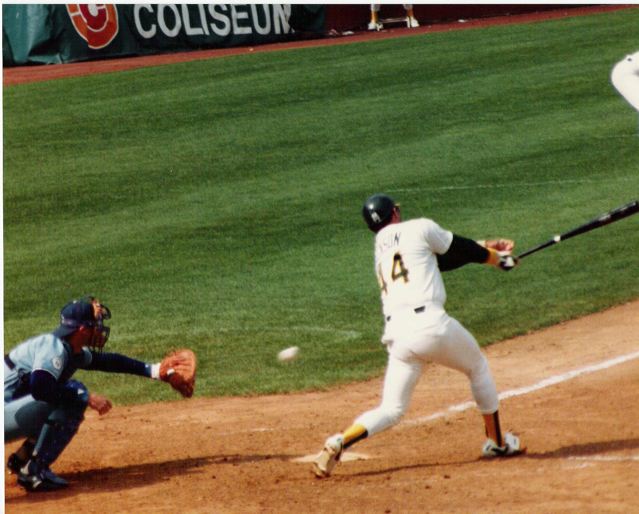
Here are the links to our previous nine Foto Fridays:
Foto Friday #1: August 18, 2006 (Hank Aaron and Jim Gilliam at McKechnie Field, March or April 1958.)
Foto Friday #2: September 8, 2006 (The Dodgers celebrate clinching the N.L. pennant in 1963.)
Foto Friday #3: November 3, 2006 (Bobby Valentine and Earl Weaver meet with umpires at home plate prior to a game on July 9, 1974.)
Foto Friday #4: February 9, 2007 (Don Drysdale blanks Giants, September 6, 1960.)
Foto Friday #5: April 13, 2007 (Ted Williams at-bat and Roy Campanella behind the plate in a spring training game, circa March 1952-1957.)
Foto Friday #6: July 6, 2007 (The Dodgers and Danny Kaye in the locker room after beating the Phillies in the first game of a doubleheader, the club's 12th consecutive victory, on June 1, 1962.)
Foto Friday #7: August 3, 2007 (Head and shoulder photos of obscure Angels.)
Foto Friday #8: August 22, 2008 (Hank Bauer, Norm Siebern, and Yogi Berra in the visitor's clubhouse in Cleveland Municipal Stadium. Bauer, Siebern, and Berra all hit home runs to lead the Yankees to a 9-4 victory over the Indians on June 17, 1956.)
Foto Friday #9: January 2, 2009 (Bobby Bonds sliding into second base as Jerry Remy applies the tag at Anaheim Stadium on August 10, 1975.)
| Baseball Beat | April 20, 2009 |
How I Ruined My Ted Williams and Mickey Mantle Autographed Baseball
Let me set the stage. The date was June 13, 1971. I was three weeks short of my 16th birthday. My sophomore year at Lakewood High School was winding down. Finals were over, summer was about to begin, and my mind was on baseball.
Given my age, I wasn't paying close attention to the news outside of the baseball world. Little did I know (or care) that the New York Times published the Pentagon Papers, a top-secret Department of Defense study of America's involvement in the Vietnam War, in the Sunday newspaper that very day.
Closer to home (literally), I had no idea that Frank Sinatra was honored with a gala farewell that evening at the Music Center in Los Angeles. Ol’ Blue Eyes returned in November 1973 in "Sinatra - The Main Event" at Madison Square Garden.
Now, thirty-eight years later, I'm much more attuned to political news and Sinatra's music has its own playlist on my iPod. But, on the morning of June 13, 1971, I was thinking about one thing and one thing only: Ted Williams and the Washington Senators were in town to play the California Angels.
Courtesy of my Dad, who was Director of Public Relations and Promotions for the Angels, I had a pair of tickets that afternoon. I invited my longtime friend and high school basketball teammate Matt Cooper to the game. Matt had turned 16 several months before and he not only had a driver's license but his own car, a 1968 Pontiac Bonneville. Having a friend with wheels is important to any teenager. We went to a lot of games that summer.
On this particular day, Matt picked me up at my house between 9:30 and 10 a.m. Although the Angels-Senators game wasn't scheduled to begin until 2 p.m., we had one pit stop to make before heading to Anaheim Stadium. The Sheraton, a castle-themed hotel right off the Santa Ana Freeway, was the home of the Senators when the club was in Anaheim.
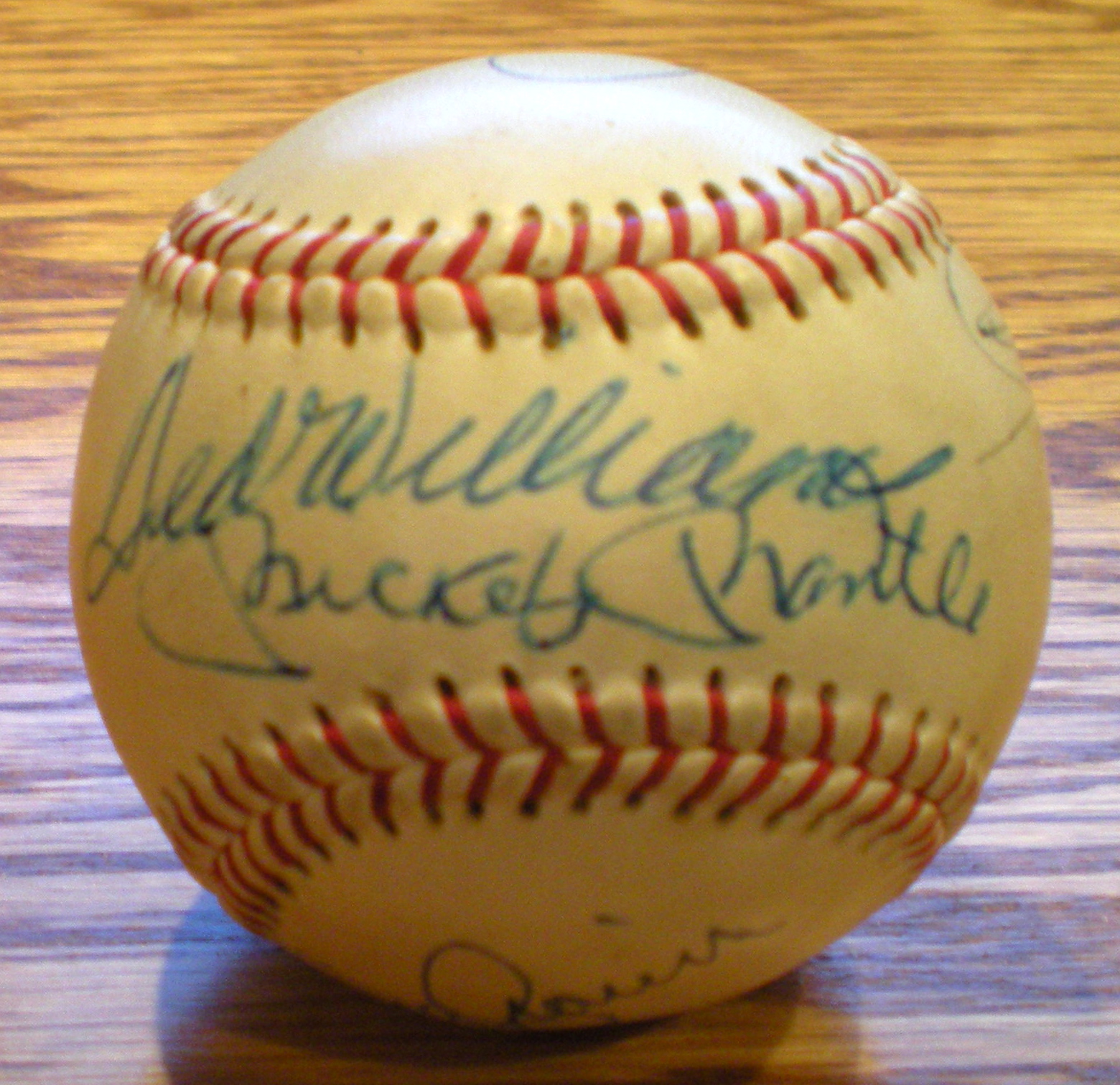 I was determined to add Ted Williams' signature to a ball that had been autographed by Mickey Mantle. Williams and Mantle. Now THAT would be an autographed baseball to pass down to my children. I had the ball, a blue ballpoint pen, and my game face on. I knew exactly what I wanted. I wasn't interested in getting Paul Casanova or Tim Cullen or Del Unser or Larry Biittner (double "i" and double "t"...I spelled it right!) to sign an autographed book or even their baseball cards. On this day, I was going to get their manager's signature. And nothing else.
Matt parked his car within steps of the team bus. We positioned ourselves between the hotel exit and the bus, waiting for "Mister" Williams, as I would call him, to emerge from the lobby. Ever the gentleman — at least with kids — Williams stopped in his tracks and paid special attention to the ball that I handed him.
As Williams was affixing his beautiful signature on the sweet spot above Mantle's gorgeous autograph, he said to me, "This is a special ball. You've got two Hall of Famers on there. Make sure you take good care of it."
Hall of Famers, ehh? Hmm. I was actually thinking much bigger than Williams. I thought I had the signatures of two of the greatest players in the history of the game on that ball. But he got me thinking, "I could turn this ball into one devoted to Hall of Famers." And Hall of Famers to be. See, Mantle had not been inducted into the HOF yet. While the Mick was retired, he was still three years away from his day in Cooperstown.
Just about the time my mind was focused on securing the autographs of Hall of Famers, out walks Denny McLain. You know, the 27-year-old pitcher with back-to-back Cy Young Awards in 1968 and 1969 and a Most Valuable Player Award, too. McLain, in fact, was the first pitcher in the history of the American League to win the Cy Young and MVP in the same season. He had three 20-win campaigns under his belt, including 31 victories in 1968, the first to win 30 games in a single season since Dizzy Dean in 1934. I mean, this guy was 117-62 with a 3.13 ERA. Little did I know that his ERA+ was only 110 at that point. I knew I should have been paying more attention to sabermetrics back then. Damn. Damn. Damn.
 With "now this is my chance to add a third Hall of Famer to my ball" ringing throughout my head, I hand McLain my prized possession and ask him politely for his autograph. He grabs it and signs his name diagonally right smack in the middle of a separate panel on the ball.
I remember being more upset about the location of McLain's autograph than the signature itself. I don't know if Denny scrawled his name on my ball not knowing that Mantle and Williams had already signed it or if he did so purposely given his dislike for the Washington manager. Either way, the latest autograph didn't compare in stature or beauty to the other two. But, hey, a Hall of Famer is a Hall of Famer, right?
If anything, I was so psyched by the prospect of adding to my themed baseball that I checked the Angels schedule and learned that the Boston Red Sox were going to be in town on Monday, Tuesday, and Wednesday. Matt and I headed back to the visiting team's hotel on one of those late afternoons or early evenings before what was then an 8 p.m. start time.
This time I set out to get Carl Yastrzemski's autograph. Yaz was only 31 at the time, but he had an MVP, a Triple Crown, three batting titles, and five Gold Gloves to his credit. Heck, he even had an OPS+ of 142 going into that season. As was the case with McLain, forget the fact that Yastrzemski was in the middle of his worst season ever. I know a Hall of Famer when I see one and these two guys were Hall of Famers, let me tell you.
Like McLain, Yaz positioned his less than bold signature on another panel that would make it difficult for anyone else to add their name next to his. I also added one more autograph either that evening or on the same day when I got Williams and McLain to sign my ball. The signature is none other than that of Joe Cronin, who was the president of the American League at that time. A major league player (1926-1945), manager (1933-1947), general manager (1948-1958), and/or president (1959-1973) for 48 consecutive years, he was inducted into the Hall of Fame in 1956.
I did well with Williams, Mantle, Yastrzemski, and Cronin, but "not so much" with McLain. While four out of five ain't bad when it comes to most baseball endeavors, 80 percent doesn't get the job done with respect to putting together a Hall of Fame autographed ball. As it turns out, I would have been better off getting McLain's father-in-law to sign the ball — at least Lou Boudreau was a Hall of Famer.
You might say that I learned one of my first — and hardest — lessons about pitchers... if not that day in June, then certainly two years later when the 29-year-old McLain was released by the Atlanta Braves, never to appear in a major-league game again. He "retired" with 131 wins and one disgruntled fan in Long Beach.
Denny McLain may be Dennis Dale McLain to his mom and dad. But he's Denny Effing McLain to me.
* * *
Do you have a similar story to share?
| Baseball Beat | April 13, 2009 |
Fantasy Baseball
My buddies and I held our fantasy baseball draft a week ago Sunday. Our league is one of the longest, continuous fantasy pools in the country. The Lakewood Players League, as it is known, has been in existence, in one form or fashion, for over 30 years.
The current format has been in place since 1987. My older brother Tom, who has served as our commissioner since the beginning, tabulated the statistics by hand in the early going. We then contracted with a service called FASTats from 1988-1998. In 1999, we used an internet service (commissioner.com) for the first time. We moved to sportsline.com in 2001 and have stuck with this scoring service ever since.
There are 16 teams in our league this year. Other than in 1995 — the year after the strike that cancelled the World Series — when we had just 11 franchises (and I had to be talked into participating at the last minute), our league has had 13 to 16 teams every year. We draft new rosters annually. While "keeper" leagues can be fun, it is our belief that they can get a bit uneven after a few years, discouraging the weaker owners from participating year in and year out and making it difficult to find replacements to take over the worst teams.
Our league is unusual in that we don't allow trades or waiver wire pickups. To make up for the lack of these transactions, we expanded our rosters from 26 to 28 players two years ago and added a third mid-season replacement draft (at each of the quarter poles) where we allow teams, in the reverse order of the standings, to throw back and pick up two players (for a total of six over the course of the season).
Stolen bases have minimal value in our league. Unlike most fantasy/rotisserie pools, stolen bases are not one of four or five offensive categories. Heck, they're not even a separate category in our league. Instead, we take net stolen bases (defined as SB - 2*CS), multiply that by .5 and add it to walks plus hit by pitches. In other words, we treat (net) stolen bases as "extra" bases, if you will. As such, the Juan Pierres and Scott Podsedniks of the world hold about as much value in our fantasy league as they do in real baseball. Close to zero. Just the way I like it.
We have also reduced the value of closers by making saves worth half as much as the other pitching categories (IP, ERA, WHIP, and K minus BB). However, our league is far from pure as we have a few team-dependent stats such as wins, win percentage, runs scored, and runs batted among our mix of counting and rate stats (with the former two also treated as half categories).
What I most like about fantasy baseball vs. other fantasy sports are the number of teams, players, positions, stats, and games — all of which combine to reduce the randomness and dependency on one or two players a la football. Fantasy baseball, in my mind, is a true test. Sure, injuries play a factor (just like in real baseball), but the owner who wins it all basically has the best collection of players in our league.
I've won the LPL fantasy baseball pool six times since 1987, including back-to-back titles in 1989 and 1990 and a three-peat from 1995-1997. My last championship was in 2006. I have finished third or better every year since 2001 sans one. I am coming off two second place finishes in a row and am hopeful that I can get back into the winner's circle again this year.
I drew No. 1 out of a hat for the first time since 1999. I had the option of either going first or sliding down to any spot of my choosing. With a serpent draft format in a 16-team league, picking first means you have the No. 1, 32, 33, 64, 65, etc. choices. What's a guy to do? I kept No. 1 and picked Albert Pujols. I've never had Prince Albert on my team before. In fact, I haven't even had a shot at him since 2003 when I selected Manny Ramirez with the 11th pick and Pujols went two spots later at 13. He was taken first or second from 2004 through 2007, then dropped to seventh last year due to concerns going into the season about his elbow.
Here is how I drafted round-by-round:
1. Albert Pujols: For me (and probably most others in my shoes), it was between Pujols and Hanley Ramirez. Some people take Ramirez because of the value of stolen bases in most fantasy pools. Others take him because of positional scarcity. I love Hanley but chose Pujols. Only time will tell if I made the right choice.
2. Nick Markakis: I had him ranked as my fifth-best outfielder. The top four (Grady Sizemore, Josh Hamilton, Ryan Braun, and Manny Ramirez) were all taken in the first 24 picks. Carlos Beltran was chosen 25th. The top three 2B, 3B, and SS were off the board as well. I thought Markakis was the next-best bat available among players not named Chipper Jones. I'm expecting a .300 season with 20+ HR, 40+ 2B, and close to or more than 100 BB, R, and RBI (or a virtual repeat of 2008 with a few more ribbies thrown in). Those across-the-board stats work for me in that spot.
3. Ricky Nolasco: I stepped up on Nolasco. Johan Santana, Tim Lincecum, CC Sabathia, Roy Halladay, Brandon Webb, Dan Haren, Jake Peavy, Josh Beckett, Cole Hamels, Jon Lester, and Roy Oswalt were off the board. Although this pick isn't looking too swift after two starts, Nolasco may have been the best pitcher in the majors from June 10 through the end of last season.
4. Matt Holliday: I was surprised that Holliday was still available as my fellow owners apparently shied away due to the trade that sent him from Colorado to Oakland. Even if Holliday falls a tad short of Greg Rybarczyk's projection, I will be happy with him at No. 64.
5. Alexei Ramirez: This was the first time I thought long and hard about my choice. His hack-tastic approach at the plate bothers me, but Alexei is a second baseman *and* shortstop out of the shoot in our league and the two-position flexibility was enough to sway me to take him over Troy Tulowitzki, who was the next-highest SS on my board. Like Nolasco, Ramirez is off to a less than thunderous start, but he hit .304/.331/.502 with 21 HR in 118 games once he was inserted into the starting lineup on May 16.
6. Josh Johnson: This pick is looking better with each start this season. I probably had him ranked higher than any other competitor in my pool. Johnson was a plus/plus/plus K/BB/GB pitcher last year and seems poised to improve upon his half season in 2008 now that he is two years removed from Tommy John surgery. The 25-year-old righthander throws a mid-90s fastball that touched 97 on the radar gun for GameDay and 98 for TV in the ninth inning of his complete-game victory over the Mets yesterday, as well as a nasty slider.
7. Kevin Slowey: Greg Maddux light. We double count walks via WHIP and K-BB, making Slowey at least as valuable in our league as in real baseball. He posted an ERA under 4.00 with a WHIP of 1.15 and a K/BB ratio over 5:1 last year. Check out his minor league stats when you get the chance.
8. Chris Iannetta: With eight catchers already gone at this point in the draft, I was quite pleased to get Iannetta. He hit .264/.390/.505 with 18 HR and 56 BB in 104 games last year. Iannetta, who turned 26 earlier this month, is off to a slow start but should be fine as long as manager Clint Hurdle doesn't panic and go with Yorvit Torrealba as his regular catcher.
9. David Price: I expect Price will be recalled no later than May 15. Although it's unlikely that the young lefthander will overpower major league hitters for six innings as a starter the way he did for an inning as a reliever in the postseason last October, there's little reason to think the No. 1 pitching prospect in baseball won't have a successful rookie season.
10. Nelson Cruz: Fantastic minor league, (partial season) major league, WBC, and spring training stats coupled with a great ballpark and lineup were enough to convince me that Cruz could put up some BIG numbers this year. Going into the draft, I had an inkling that I liked Cruz more than anyone else. Who knows, I may have been able to float him for another 32 picks, but I didn't want to take that chance.
11. Scott Baker: I think he fell a couple of rounds due to a sore arm that cost him a start last week. However, he is scheduled to make his first start on Wednesday at home against the Blue Jays. If Baker is healthy, he will be a steal at No. 161 in the draft.
12. Rickie Weeks: Long on potential, short on results to this point in his career. Call me a sucker, but I think he is going to hit around .260 with 15-20 HR and score 100 runs.
13. Rick Ankiel: I just had to remind myself that Ankiel hit .270/.343/.537 with 20 HR and 50 RBI in the first half before suffering an injury and limping home with a .245/.319/.415 (5 HR, 21 RBI) second half. I'm betting that he will be produce better numbers over a full season in 2009 than 2008.
14. Alex Gordon: The NCAA Player of the Year, the Minor League Player of the Year, and the No. 2 overall pick in the 2005 draft should be about ready to break out this year, no? I was jazzed when he went yard in his first AB of the season but am fully aware that he has gone 1-for-14 since and sat out yesterday with a stiff right hip. He produced counting stats last year that were equal to or better than his rookie campaign in 2007 while increasing his walk rate nearly 70% and decreasing his strikeout rate ever so slightly.
15. Frank Francisco: One of my two "sleeper" relievers. Francisco throws gas and didn't allow an earned run from August 18-on last season while posting a 21/4 K/BB ratio and five saves.
16. Tommy Hanson: Great minor league, Arizona Fall League, and spring stats. Hanson was the first pitcher to win the MVP award in the AFL when he struck out 49 batters in 28.2 innings with a miniscule ERA of 0.63 in a hitter-friendly environment. He whiffed 10 batters in 4.1 scoreless innings in his Triple-A debut last Thursday. With Tom Glavine unable to answer the opening bell, Hanson could be in Atlanta's rotation as early as this week.
17. Brandon Morrow: Like Francisco, Morrow is not on the best team for a closer but he is in a weak division and a favorable ballpark. I saw the fireballing righthander implode in his opening game but manager Don Wakamatsu stuck with Morrow and allowed him to save two games over the course of three days.
18. Paul Maholm: Having drafted two minor league starters up to this point, I needed a solid fifth and chose Maholm to go along with Nolasco, Johnson, Slowey, and Baker. The lefty throws strikes, generates more than his share of groundballs, and eats innings. Exactly what the doctor ordered at that spot.
19. Kelly Shoppach: Did you know that Shoppach was third in HR among all MLB catchers with 21 last season, just two behind the co-leaders (Brian McCann and Geovany Soto)? He won't hit much more than .250 or .260 but could crank 20 HR again with sufficient playing time.
20. Brett Anderson: With five starting pitchers in hand plus two high-ceiling minor leaguers, I wanted someone who was not only expected to take a regular turn in the rotation but had a little bit more upside than the fourth and fifth type starters that were still available. Anderson gives me both. Was pleasantly surprised to see him throwing as hard as 94-95 on the radar gun in his MLB debut last week.
21. Chone Figgins: Not as valuable in our league as most other fantasy formats but still above-average in a few categories.
22. Adam Jones: Only 23, Jones is probably a year away from being a fantasy star. His spring and first-week stats, along with the fact that he is batting second between Brian Roberts and Nick Markakis, give me hope that he can be serviceable this year if called upon.
23. Stephen Strasburg: Partly for fun but also as a potential difference maker down the stretch. There isn't a starting rotation in the majors that he wouldn't make better right now.
24. Grant Balfour: Third-highest weighted Z-score among all relievers last year. Fastball sits at 94-95 and can reach the upper 90s on occasion.
25. Lyle Overbay: What can I say? Except for Overbay, every starting first baseman in baseball may have been taken at this point. Look, if Pujols gets hurt, my team's not going to win it anyway.
26. Brandon Wood: Only a phone call away. Wood will be up in no time if Erik Aybar or Chone Figgins get hurt or if the Angels use him as trade bait for a starting pitcher. Either way, I think he is (finally) ready to play every day in the majors and could hit in the .260s with 20 HR if given the opportunity.
27. Chan Ho Park: Nothing special here. With two minor leaguers and an amateur among my starting pitchers at this juncture, I opted for Park, who performed well as a starter last year and this spring.
28. Aaron Miles: Assuming Wood gets some PT, Miles is my third-string SS and 2B. He is a leading candidate to get tossed back at our first replacement draft in mid- to late-May.
Oh, after the first week, I'm in third place. It's early. But it's sure fun.
| Baseball Beat | April 09, 2009 |
Breaking News: Nick Adenhart Killed in Car Accident
Hours after pitching six shutout innings on Wednesday night, Los Angeles Angels starting pitcher Nick Adenhart, 22, was killed in a felony hit-and-run car accident in Fullerton, California early this morning. The story is still developing. You can read a brief news story here.
The Angels have had a history of bad luck when it comes to player deaths. But the more important concern for now is Adenhart's family, friends, and teammates.
Like the rest of the baseball world, all of us at Baseball Analysts are shocked and reach out with our deepest sympathies and most heartfelt condolences to the families of all the victims at a time when the game itself seems so meaningless.
I had the privilege of interviewing Nick three years ago after he made his debut in the California League. In honor of him, we are going to re-run that interview today.
Nick Adenhart: A Rising Star (Once Again)
I watched Bryan Smith's 23rd-ranked prospect make his California League debut two weeks ago yesterday and had a chance to interview him after the game.
Nicholas J. Adenhart (A-den-hart) is a 6-foot-3, 185-pound right-hander out of Williamsport, Maryland. He is a very accomplished pitcher for someone who has yet to celebrate his 20th birthday. Adenhart was Baseball America's Youth Player of the Year in 2003 and its top-ranked high school prospect prior to his senior season in 2004. He tossed a perfect game in his first outing that spring, striking out 15 of the 21 batters faced.
A cinch first-round draft pick heading into his senior year, Adenhart blew out his elbow in May and had Tommy John surgery one week after the Los Angeles Angels selected him in the 14th round (413rd overall). Area scout Dan Radcliff and director of scouting Eddie Bane convinced Adenhart to forego a scholarship offer from the University of North Carolina and signed him to a $710,000 bonus on July 26, 2004.
Adenhart spent the next year rehabbing his elbow in Tempe, Arizona before making his professional debut on June 25, 2005. He pitched 50 innings in the Arizona and Pioneer Rookie Leagues that summer, fashioning a 3-3 record with a 3.24 ERA. Not surprisingly, his command was a bit off, walking 24 batters or 4.32 per 9 IP. However, he offset his wildness with 59 strikeouts, good for 10.62 K/9.
At the age of 19, Adenhart earned a non-roster invitation to the Angels' big league camp this spring. He threw three innings without allowing a run. Nick faced the Chicago White Sox, the defending World Series champions, in one outing. "I threw strikes and got a couple of punchouts," he told me matter of factly in the locker room in the aftermath of winning his Cal League debut for the Rancho Cucamonga Quakes.
Adenhart was assigned to the Cedar Rapids Kernels (Low-A) out of spring training. He dominated Midwest League hitters, leading the circuit in wins (10) and placing third in ERA (1.95) and strikeouts (99 in 106 IP). His performance earned him a starting assignment in the All-Star Game on June 20 and a promotion to the organization's High-A affiliate nine days later.
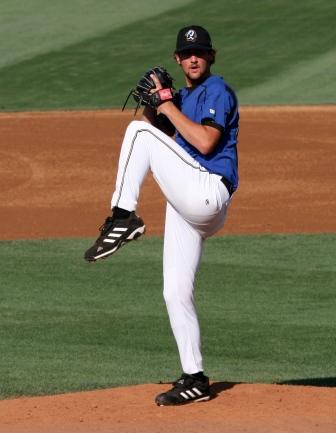 Sporting a Fu Manchu-style mustache, the dark-haired prized prospect got the start on July 2 and pitched six innings, allowing four runs on eight hits and three walks while striking out four in front of Bane and several scouts. Thanks to Ben Johnson's 3-for-3 night (including a pair of home runs and two walks), Adenhart earned his first victory for the Quakes and his 11th of the season in a performance that was less than overwhelming but hinted at his star potential. Six of the eight hits were to the opposite field and the only extra-base hit was a slicing double to left in the fifth that failed to produce a run.
"My pitch selection was good, but I left a couple of the pitches over the plate with two strikes," was Nick's response when I asked him about his outing. "I wasn't at my best in terms of command."
Trying to establish his fastball the first time through the lineup, Adenhart ran into trouble in the second, allowing four hits (including three in a row to open the inning) and a trio of runs. "My touch and feel was off, and I was trying to do too much."
Adenhart "calmed down" and gave up just three hits and one run over his final four frames. "I located my fastball better down and in the zone."
The second-year pro throws a two-seam and a four-seam fastball. "I throw my two-seamer about 80-90% of the time. There is no difference in velocity between the two fastballs. I use my four-seamer when trying to elevate on 0-2 and 1-2 counts or into left-handed batters and away from right-handed batters."
Adenhart's fastball was clocked in the high-80s-to-low-90s, topping out at 94 on a few occasions. He is an extreme groundball pitcher and has only given up two home runs in 170 innings in his professional career. "Both home runs were on changeups that I left up."
"I get good sink on my two-seamer," while attributing his favorable groundball-to-flyball ratio to the pronation in his delivery. Nick recorded 11 of his 14 non-strikeouts on the ground the evening I saw him pitch.
Adenhart, who was invited to but did not pitch in the Futures Game, also throws an 11-to-5 curveball in the mid-70s and a circle change in the low-80s. "My changeup tends to be a strikeout pitch. I get lots of swings and misses, especially down-and-away to left-handed batters."
I asked Nick how his elbow felt two years after undergoing surgery performed by Dr. James Andrews. "My elbow is great. It feels different than before I had the surgery. But there is no pain or discomfort."
Adenhart made his next start five days later but was limited to just two innings (2-1-0-0-0-3 with three groundouts) a couple of days prior to the Futures Game. His next outing was last Wednesday, an impressive six-inning, four-hit, one-run victory with six strikeouts. He has pitched 120 innings thus far, going 12-2 with a 2.10 ERA. (Complete stats from MiLB.com.)
Although Adenhart won't turn 20 until August 24, I wouldn't be surprised if he made it to the big leagues at some point during the 2008 season. Once he arrives, the kid with the three "plus" pitches is apt to become part of a starting rotation that could include Kelvim Escobar, John Lackey, Ervin Santana, and fellow 2004 draftee Jered Weaver. The future of the Halos looks bright indeed.
Photo credit: Rob McMillin, 6-4-2.
| Baseball Beat | April 07, 2009 |
Opening Impressions
All of us at Baseball Analysts are throwing a Johan Santana changeup at you today and posting short takes on what we found interesting on Opening Day.
Angels 3, Athletics 0
I sat in the front row behind the Angels dugout (that's me on the far left) and witnessed Joe Saunders carve up the A's, allowing only three hits and two walks over 6 2/3 scoreless innings. In opposition to the consensus perception, Saunders is not a soft-tossing lefthander. According to FanGraphs, his fastball averaged 91.0 mph last year and it ranged from 88-92 on Monday night. His 93rd and last pitch of the evening hit 91 and resulted in a weak comebacker off the bat of Oakland catcher Kurt Suzuki, who was retired 1-3.
Manager Mike Scioscia handed the ball to Jose Arredondo to close out the seventh. He was throwing 93-94 (in line with his 93.7 average last season). Scioscia then went to Scot Shields in the eighth. He retired the side in order with a heater that was 91-92 (vs. 92 last year). Newly signed free agent Brian Fuentes closed out the ninth 1-2-3 and earned his first save as a Halo. The slinging southpaw was working at 89-90 (down a tad from a year ago when it was sitting at 91-92).
While the Angels bullpen lacks a Jonathan Papelbon and Boston's depth (which is strong enough to exclude Daniel Bard and the easiest-throwing 100-mph fastball you've ever seen), it ranks among the best in the league. Look for Arredondo, Shields, and Fuentes to finish the final three innings of numerous games this season.
A couple of other quick takes:
- Chone Figgins made two spectacular plays at third base in the first and third innings, one where he ranged to his right, backhanded it, and made a strong throw to nip former teammate Orlando Cabrera and a second in which he dove to his left and forced out a baserunner at second with a throw from his knees. Figgy may not win any Gold Gloves for his work at the hot corner but is better defensively than generally believed.
- Howie Kendrick had two run-scoring hits, including a home run that left the park just to the right of straightaway center field. It's easy to forget that Kendrick is only 25 years old and averaged .360/.401/.571 during his minor league career (with 50 HR in 1669 plate appearances). Howie could inflict a lot of damage from the two hole this season.
...and a couple of departing questions:
- Why is it that respected analysts such as those at Baseball Prospectus, Keith Law, Rob Neyer, and our own Patrick Sullivan and Jeremy Greenhouse pick the A's over the Angels to win the AL West?
- What am I missing?
If one is worried about the Angels' starters, then one has to be equally concerned about the A's. Sure, LA is doing without Kelvim Escobar, John Lackey, and Ervin Santana in April (and perhaps part of May for one or more of the trio). But the Angels managed to go 18-11 last April without any help from Escobar or Lackey (or Mark Teixeira, for that matter). By contrast, OAK opened the season with Dallas Braden and the rotation includes Dana Eveland, a guy named Josh Outman (nice name for a pitcher but c'mon), and two highly touted but untested rookies who have thrown a combined total of 68 innings above High-A and have yet to appear in anything above Double-A. Meanwhile, the bullpen is in shambles and in no way compares to what the Angels can deliver in the late innings.
While I picked the A's to finish second behind the Angels in our AL West preview last week, I believe (as I opined on Friday) that Oakland "could find themselves in the cellar come October if the young pitchers aren't up to the challenge and Beane trades Holliday in July."
It's only one game. I know there are still 161 games to play. But I see no reason to change my assessment of the Angels and A's after last night.
| Baseball Beat | March 09, 2009 |
The Case of Michael Young and Line Drive Rates
Courtesy of The Hardball Times, the table below details the top 20 line-drive rates over the past five seasons. Do you notice any repeaters? There are only two players who qualified more than once: David Wright twice (2005 and 2008) and Michael Young FOUR times (2004-2007).
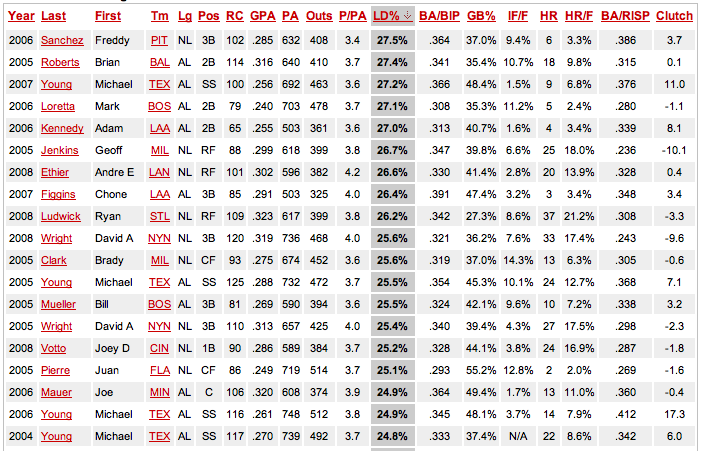
Does this data say more about Young's proclivity in hitting liners, his home ballpark, or the bias of scorekeepers? A combination of the three? Or perhaps something else?
This table captures a number of career years. Freddy Sanchez hit .344 with an OPS of .851 in 2006 vs. career averages of .300 and .753. Brian Roberts hit .314/.903 in 2005 vs. .284/.771. Geoff Jenkins hit .292/.888 in 2005 vs. .275/.834. Chone Figgins hit .330/.825 in 2007 vs. .290/.743. Ryan Ludwick hit .299/.966 in 2008 vs. .273/.857. Brady Clark hit .306/.798 in 2005 vs. .277/.744. Joe Mauer hit .347/.936 in 2006 vs. .317/.856.
Other than Juan Pierre, all of these players had BA/BIP over .300 with a mean of .340. Young, for what it's worth, owns three of the top four BA/RISP (among this sample size), including the only one greater than .400.
Of note, Young is the only Texas player included in the above list, which suggests LD% has more to do with the hitter than the effects of the ballpark or scorekeeper. However, it should be noted that Mark Teixeira had a 28.2% LD rate in 2003. In addition, Hank Blalock (2005), Milton Bradley (2008), and Ian Kinsler (2008) had rates that fell just outside the top 20. As such, I think it is fair to say that ballparks influence LD rates.
According to Baseball Analysts contributor Jeremy Greenhouse, there have been about 50 Rangers with at least 100 plate appearances since 2005 and the average line-drive rate (sans Young) was 20.5% vs. 19.9% league wide. Furthermore, in a study at Fangraphs, Brian Cartwright determined that "a batter is 18% more likely to have a batted ball coded as a LD" in Arlington . . . "while in Minneapolis, it's 20% less likely."
As Tangotiger wrote in response to Brian's work, "A 'line drive' is not necessarily a line drive. If hitters are showing as hitting 20% fewer line drives in the Metrodome than away from the Metrodome, we don't know if it's because the Metrodome depresses LD rates, or if it's because the scorer in Minnesota is depressing it. Since it makes a huge difference when looking at LD and FB rates, then you need some sort of park factor to normalize the data . . . Taking a guess, I have to believe this is a scorer issue. A line drive is really a batted ball that leaves the bat at a certain angle, at a certain velocity. I don't see how those things would affect whether a ball is a LD, FB, or GB, regardless of the park you are in. I can see how the scorer can be influenced by the positioning of the fielder (and worse, if the fielder caught the ball or not), and try to assign a batted ball code."
The thread attached to Tango's comments is fascinating and includes posts by Colin Wyers, Mike Fast, MGL, Greg Rybarczyk, Dave Studeman, and David Gassko. It is worth reading if you're into advanced batted ball studies. As studes points out, "From my work in the 2006 THT Annual, there was a greater standard error in line drive rates per park than in GB or Outfield Fly rates. Not outrageously higher, but definitely higher." You can also download a PDF of the 2004 THT Annual that includes Robert Dudek’s groundbreaking article on hang time, which is important because, as Tango notes, "how much time it takes for the ball and the fielder to intersect" is what is really important in differentiating between batted balls.
There are a number of questions to ask when it comes to batted balls. What percentage is attributed to the hitter or pitcher, the ballpark, or the scorekeeper? What distinguishes a line drive from a hard-hit groundball or a looping flyball? Is a one hopper that skips past the infield classified as a grounder or a liner? Does the ball have to hit the outfield grass first in order to be coded as a line drive? How high can a ball be hit and still be considered a line drive? Should the outcome have an effect on how a batted ball is coded? Does the outcome have an effect?
Play by play, batted ball, pitch f/x. We know a lot more today than we did just five years ago and we will know a lot more in five years than we know today. Hit f/x is next. Stats are not ridiculous. Only those who ignore (the right) stats are ridiculous.
| Baseball Beat | March 05, 2009 |
The Strasburg Watch
San Diego State's Stephen Strasburg, who struck out 16 batters and hit 102 on the gun SEVEN times a week ago today, is scheduled to make his third start of the season this afternoon against the University of San Diego at Cunningham Stadium at 2:00 p.m. (PST).
Strasburg (2-0, 1.46) has punched out 27 batters in 12 1/3 innings thus far. His pitching line stands as follows:
IP H R ER BB SO HR 12.1 8 3 2 3 27 0
The 6-4, 220-pound righthander, who has whiffed 55 percent of the batters faced in his first two outings, made a name for himself last April when he fanned 23 in a one-hit, 1-0 complete-game shutout vs. Utah. He was the only college player named to the Olympic team last summer and threw a one-hitter while striking out 11 over seven innings against Netherlands.
I saw him make his 2009 debut vs. Bethune-Cookman two weeks ago and shared my observations, as well as those from a few scouts I spoke to, in a scouting report published the following day. He K'd 11 batters that afternoon while consistently hitting 96-99 and reportedly touching 100 in the first inning according to a couple of radar guns behind home plate.
The 20-year-old junior followed up that appearance last Thursday night, striking out every hitter in Nevada's starting lineup at least once except first baseman Shaun Kort, who had a single among his three at-bats. Strasburg fanned seven of the first nine batters he faced and struck out the side four times. The 16 K's were the third-highest recorded in Mountain West Conference history. He was named Louisville Slugger National Player of the Week by Collegiate Baseball magazine.
You can check out his mechanics and stuff in a slo-mo video from the game I witnessed. His pitching motion has been criticized by Driveline Mechanics and others due to the so-called inverted W, a la Mark Prior, John Smoltz, Jeremy Bonderman, Anthony Reyes, A.J. Burnett, and Shaun Marcum. All of these pitchers have experienced major arm injuries at some point in their careers. For the sake of both Strasburg and the Washington Nationals, the team with the No. 1 pick in the June draft, let's hope he can avoid such arm troubles because he is one of the most exciting young prospects in the game, be it the amateur or professional level.
Update: Strasburg strikes out 18 over eight innings in a 5-3 victory over the 11th-ranked University of San Diego. Now 3-0 with a 1.77 ERA, Strasburg allowed two runs in the first three innings before settling down and retiring the next 11 batters in a row, including nine strikeouts. He has now whiffed 45 and allowed only four walks in 20.1 IP.
IP H R ER BB SO HR 8.0 5 2 2 1 18 1
| Baseball Beat | March 02, 2009 |
MLB Payroll Efficiency, 2006-2008
The Commissioner's Office released the final baseball payrolls for 2008 in late December. Not surprisingly, the New York Yankees spent $75 million more than the next highest team (Boston Red Sox) and $126 million over the average MLB team.
Last year, in an effort to analyze payroll efficiency, I created a graph with payroll on the y-axis and wins on the x-axis. I added a positively sloping trendline and four quadrants to provide a visual aid in determining the most and least efficient teams in terms of payrolls and wins.
Rob Neyer suggested that I plot this same information using multiple seasons, "as that would give us a better idea of the franchises' general competence over a period of years." With the foregoing in mind, I did just that. Thanks to data provided by Maury Brown at the Biz of Baseball, I added up the player payrolls and wins for the previous three seasons and divided them by three to get an average of each.
The two tables below detail the average payrolls and win totals, sorted by the former on the left and the latter on the right. The average payroll works out to $89.86M, which means MLB has spent an average of approximately $2.7 billion in each of the past three years (for a grand total in excess of $8 billion).
Payrolls cover the 40-man rosters and include salaries and prorated shares of signing bonuses, earned incentive bonuses, non-cash compensation, buyouts of unexercised options and cash transactions. In some cases, parts of salaries that are deferred are discounted to reflect present-day values. Luxury taxes are not part of these payroll figures nor are the posting fees for Japanese players.
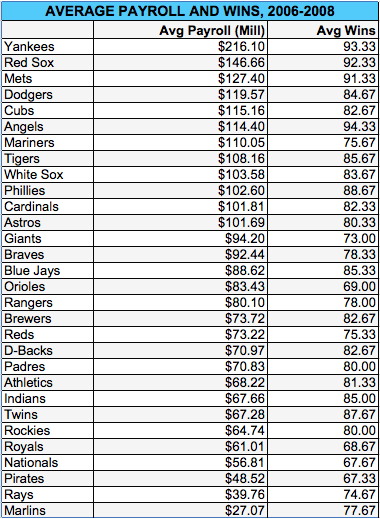
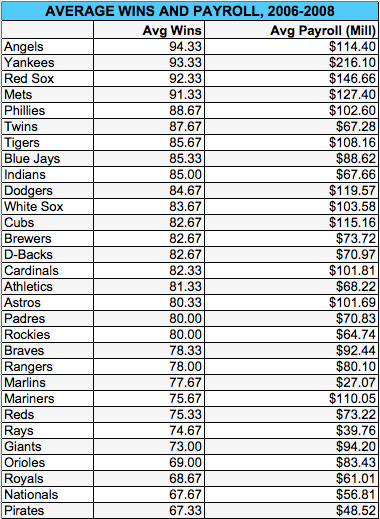
As shown, the Yankees led the majors in payroll over the 2006-2008 seasons, spending $70M more than the Red Sox and $126M over the average team. Nonetheless, the Los Angeles Angels have won more games than any other club during this same period, followed by the Yankees, Red Sox, and Mets. These four franchises were the only ones to average 90 or more victories the past three campaigns. Of note, the Bronx Bombers have spent $100M more per season than the Angels (and $305M over the three years), yet have one less win per campaign to show for their efforts. The inclusion of luxury taxes and posting fees would only widen the gap between the Yankees and the rest of the league.
The information in the tables can be displayed graphically as follows:

Based on this graph, we can once again categorize teams by the trendline and the four quadrants. Starting in the upper-right end of the graph and moving clockwise, the northeast quadrant includes teams that won more games than average with a higher-than-average payroll. The southeast quadrant depicts clubs that won more games than average with a lower-than-average payroll. The southwest quadrant includes teams that won fewer games than average with a below-average payroll. The northwest quadrant lists teams that won fewer games than average with a higher-than-average payroll.
The blue trendline indicates the positive correlation of team payroll and wins. The correlation coefficient works out to 0.64. The coefficient of determination (or R-squared) is 0.41, which means payroll explains 41 percent of a team's win total. A large portion of the balance is determined by the impact of "cost-controlled" players (i.e., minimum or close to minimum in years one through three and roughly 40-60-80 percent of free agent market values in years four through six, respectively) as Dave Studeman, who improved the correlation coefficient to 0.77 and the R-squared to nearly 0.60 for the 2006 season, pointed out in an intelligent piece in The Hardball Times a couple of years ago.
Furthermore, the relationship between payroll and wins is not linear. The difference between the highs and lows of wins (67-94) is much more tightly bunched than payrolls ($27M-$216M), suggesting that marginal wins are significantly more costly than average wins. In other words, going from 70 to 80 wins isn't as important — or costly — as going from 80 to 90 wins. By my count, 68 of the 78 teams that have won at least 90 games during the past 10 years have participated in the postseason. Win 90 and you have about an 87 percent chance of playing beyond the regular season.
Sticking to the graph, teams above the line were less efficient and teams below the line were more efficient in terms of getting the most bang for their buck. While average wins are a reasonable proxy of success, most teams are primarily focused on earning a spot in the playoffs to give them a shot at winning the World Series. Under the "flags fly forever" truism, I'm going to excuse any team that wins it all from the list of so-called inefficient teams. While the Red Sox may pay up for (part of) their success, the truth of the matter is that Boston is the only team that has won two World Series titles during the current decade. In other words, the Red Sox have been more efficient in winning World Championships than any team in baseball, not an insignificant accomplishment for a franchise that calls the AL East its home.
Aside from the Red Sox (and the Cardinals and Phillies, winners of the other two World Series in the past three seasons), which teams were the most and least efficient during the 2006-2008 time frame?
Six clubs have averaged more than 81 wins with payrolls under the league mean of $89.86M. The best of the best was Minnesota (winner of the "doing the most with the least" award), followed by Cleveland, Toronto, Arizona, Milwaukee, and Oakland. All but the Blue Jays made the playoffs once, which probably says as much about Toronto's competition as anything else.
I already cited the Phillies for winning the World Series last season but Philadelphia and the Los Angeles Angels deserve a lot of credit for payroll efficiency as well. The former captured the NL East in 2007 and 2008 and narrowly missed the playoffs in 2006, while the latter took the AL West the past two seasons but lost to the Red Sox in the ALDS both times. The Halos, lest we forget, are one of the eight clubs to have won a World Series title this decade.
Colorado, San Diego, Florida, and Tampa Bay share the award for "doing the best while pinching pennies." The Rockies (2007) and Rays (2008) made it to the World Series, while the Padres were awarded the NL West title in 2006 due to winning the season series vs. the Dodgers, the other team that won 88 games that year, and lost in a play-in game the following season. The Marlins, of course, won the World Series in 2003, the second in just a seven-year span.
The clubs in the northeast quadrant and above the trendline had mixed results. All of these teams won more than their share of games, but they did so at a cost. The Yankees are the biggest outliers by far, spending over $200M above and beyond the Red Sox with no World Series titles and only two postseason wins to show for their huge financial commitment. In fairness to the Yankees, they won a World Championship at the outset of the decade and missed out on the playoffs in 2008 for the first time since the strike-shortened season in 1994. All of the NEQ clubs made it to the playoffs at least once but only the Red Sox and Cardinals won championships.
Moving to the least efficient teams, Seattle wins the award for "doing the least with the most," while San Francisco, Atlanta, and Houston also won less than their fair share of games while sporting higher than average payrolls. In addition, Baltimore, Kansas City, and Washington spent payroll dollars unwisely during the past three years. Pittsburgh, Cincinnati, and Texas all reside on top of the trendline, meaning each team won about as many games as expected given their payrolls.
While relatively simplistic, graphing payrolls and wins — especially over a multi-year period — allows us to evaluate how efficiently ownerships and managements are spending payroll dollars.
Update: The following graph is the same as the one above except that it includes a polynomial rather than linear trendline.

The polynomial trendline improves the R-squared to .49 versus .41 for the linear. In response to a reader's question in the comments section below, I listed the regressions for each and calculated marginal wins are worth approximately $3M using the linear and range from essentially zero at the left end to as much as $7M at the right end (i.e. going from 92 to 93 wins) based on the polynomial. The bottom line is that the polynomial regression does a much better job at capturing marginal payroll and wins than the linear expression.
| Baseball Beat | February 23, 2009 |
Comparing First-Year Eligible Arbitration Signings
The 2009 salary arbitration process, which was collectively bargained and implemented in 1974, has come and gone with the players making out just fine. Of the 111 players who filed for arbitration last month, 65 settled prior to exchanging salary figures, 43 negotiated contracts after submitting numbers, and only three cases were heard by arbitration panels (with the players winning two and losing one).
Florida Marlins second baseman Dan Uggla won his arbitration case and will make $5.35 million rather than the $4.4 million the team offered. Washington Nationals righthander Shawn Hill was awarded his asking price of $775,000 instead of the $500,000 submitted by the club. Tampa Bay Rays catcher Dioner Navarro, on the other hand, lost his arbitration case and will make $2.1 million rather than the $2.5 million he was seeking. Don't feel too badly for Navarro as he will still pull down $1,667,500 more than the $432,500 he earned in 2008.
Maury Brown of The Biz of Baseball has compiled all of the vital stats. According to Maury, the average year-over-year increase in salary for the 111 players who filed was a "whopping 751 percent."
As Fred Claire observed, "The arbitration-generated salaries are in sharp contrast to what has happened in this year's free-agent market where a number of high-profile players have had to sign contracts far below their expectations and a number of other 'name' players remain on the sidelines without contracts."
What was of interest to me were the number of contracts that were negotiated at or near the midpoint with little interest on the part of players and owners to "win." I put together a list of ten first-year eligible position players who signed one-year contracts earlier this month to avoid salary arbitration with the objective of analyzing these deals. There were several others who avoided arbitration by signing longer-term agreements. The latter transactions are much more difficult to compare than the relatively simple and straightforward one-year deals.
Before we get too far ahead of ourselves here, I thought it would be instructive to review the ins and outs of salary arbitration. The Major League Baseball Players Association provides the following primer on its website.
Q: When does a player become eligible for salary arbitration?A: A player with three or more years of service, but less than six years, may file for salary arbitration. In addition, a player can be classified as a "Super Two" and be eligible for arbitration with less than three years of service. A player with at least two but less than three years of Major League service shall be eligible for salary arbitration if he has accumulated at least 86 days of service during the immediately preceding season and he ranks in the top 17 percent in total service in the class of Players who have at least two but less than three years of Major League service, however accumulated, but with at least 86 days of service accumulated during the immediately preceding season.
The details of the ten negotiated contracts referred to above are provided in the following table, along with positions, ages, major league service time, and career batting (AVG/OBP/SLG/OPS+) and fielding (Ultimate Zone Rating per 150 games) rate stats:
POS BORN ML SERV CONTRACT AVG OBP SLG OPS+ UZR/150
Andre Ethier RF 4/10/82 2.153 $3.100M .299 .364 .482 116 0.1
Jeff Francoeur RF 1/08/84 3.088 $3.375M .268 .312 .434 92 9.6
Corey Hart RF 3/24/82 3.038 $3.250M .277 .323 .485 106 -0.5
Conor Jackson LF 5/07/82 3.067 $3.050M .287 .367 .443 105 11.5
Mike Jacobs 1B 10/30/80 3.047 $3.250M .262 .318 .498 110 -8.6
Kelly Johnson 2B 2/22/82 3.127 $2.825M .273 .356 .440 108 -9.1
Ryan Ludwick RF 7/13/78 3.109 $3.700M .273 .345 .512 122 10.3
Rickie Weeks 2B 9/13/82 3.131 $2.450M .245 .352 .406 97 -10.9
Josh Willingham LF 2/17/79 3.123 $2.950M .266 .361 .472 117 -6.0
Ryan Zimmerman 3B 9/28/84 3.032 $3.325M .282 .341 .462 110 10.0
The average contract calls for a 2009 salary of $3,127,500. Ryan Ludwick ($3.7M) received the highest amount of money and Rickie Weeks ($2.45M) the lowest with the other eight tightly bunched in a range of $2.95M (Josh Willingham) to $3.375M (Jeff Francoeur).
Although Andre Ethier only had 2.153 years of MLB service, he was eligible for arbitration as a "Super Two." Ethier ranks first in AVG, second in OBP, fourth in SLG, and third in OPS+, yet agreed to a deal that was only the sixth highest overall and last among his peers in right field. This one looks like a better deal for the Dodgers than Ethier.
Francoeur and the Braves agreed to a salary that was exactly in the middle of the figures that were exchanged ($3.95M and $2.8M). He has the worst OBP and OPS+ of them all despite manning a corner outfield position. He is the second-youngest player in the group but that is neither here nor there when it comes to salary arbitration. He is one of the most overrated players in baseball and his contract is a huge win for him and a disservice to the arbitration process.
Corey Hart re-signed with the Brewers for the average of what each side wanted ($3.8M and $2.7M). No performance bonuses were attached to the deal. Hart's stats pale in comparison to Ethier but his back-to-back 20 HR/20 SB seasons give his numbers more sizzle in an arbitration hearing than his similarly aged counterpart. I would call this one a fair deal for both sides.
Like Hart, Conor Jackson and the Arizona Diamondbacks reached a settlement that split the difference between what each side submitted ($3.65M to $2.45M). There were no performance bonuses. His UZR rating in left field is based on a small-sample size, and it is still possible that he could end up at first base (where he sports a -3.5 UZR/150 games rating) if Eric Byrnes is healthy and productive enough to win back his job in left. Let's call this one a draw.
Mike Jacobs signed with the Royals at a price ever so slightly below the mid-point of what he asked for ($3.8M) and what the club offered ($2.75M). The first baseman can make up the gap of $25,000 by being named to the All-Star team. He has the second-highest SLG but plays a position that demands power, especially when one doesn't get on-base more often or contribute in a more positive manner defensively. When KC acquired him, I figured he wouldn't make more than $3M in arbitration. I stand corrected and believe his contract is a bit on the high side given his overall production.
Kelly Johnson and the Braves met at the halfway point of their submissions ($3.3M and $2.35M, respectively). The second baseman can earn $50,000 if he reaches 620 PA and another $25,000 for 670 PA. At best, Johnson can make $2.9M, which would be the second-lowest agreed-upon salary in this group. I believe this deal is the opposite of Francoeur's — a good one for the team and a bad one for the player. If anything, this contract is another in a long line of examples where second basemen are treated unfairly by the system.
The gap between the Cardinals offer ($4.25M) and Ludwick's asking price ($2.8M) was the largest in this sample. It appears as if St. Louis tried to lowball him initially because he wound up receiving a salary that was much closer to his side plus the following performance bonuses: $25,000 each for 625 and 650 PA and an additional $50,000 for 675 PA. Ludwick ranks first in career SLG and OPS+ and is coming off the best season, by far, of any of these players. However, he was rewarded handsomely for his contributions.
Weeks and the Brewers avoided arbitration by agreeing to a $2.45M deal, which was just above the mean of what each side submitted ($2.8M and $2M). Weeks can also earn the following performance bonuses: $25,000 each for 575, 600, 625, 650 PA although it should be pointed out that he has never reached any of those levels in a four-year career that has been marred with injuries and disappointments. It looks like a fair deal based on actual performance but potentially a smart one on the part of the team if Weeks finally fulfills his promise.
Willingham signed with the Nats at a price below the mid-point of the salary ranges ($3.6M-$2.55M). He will earn $25,000 at each of the following plate appearance totals: 525, 550, 575, 600. All told, Willingham can make $3.050M in salary and bonuses, which is just below the average of what each side submitted. His contract is lower than any other outfielder and appears to favor the team slightly more than the player.
Ryan Zimmerman was re-signed by Washington exactly between what the Nationals offered ($3.9M) and what the player submitted ($2.75M). He will receive the following performance bonuses: $75,000 for 500 PA and an additional $50,000 each for 550 and 600 PA. If he reaches 600 plate appearances, Zimmerman will make $3.5M in salary and bonuses. Zimmerman has the fourth-highest career OPS+ and is undoubtedly the best fielder in the peer group at one of the most challenging positions. This is a deal that will most likely pay off for both sides should the youngest player earn his performance bonuses.
| Baseball Beat | February 21, 2009 |
A Doubleheader in February
"It's a beautiful day for a ballgame... Let's play two!"
- Ernie Banks
Is there anything better than a doubleheader? In February, mind you?
Well, my brother Tom and I attended two college season openers yesterday. Two games. Two ballparks. Two of the top-ranked prospects in the country and two of the best pitching performances on the opening weekend of the year. All in all, it was a beautiful day, one that Mr. Cub would have loved.
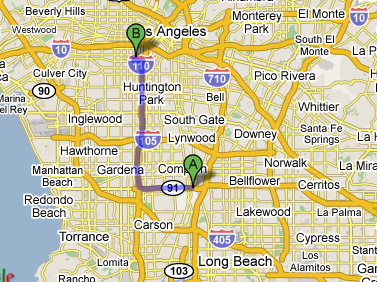 The first game of our day/night doubleheader matched San Diego State against Bethune-Cookman at the Major League Baseball Urban Youth Academy's Collegiate Baseball Tournament in Compton. The second contest was the opener of a three-game set between Long Beach State and the University of Southern California at Dedeaux Field.
Tom and I were joined by general managers, scouting directors, area scouts, and agents in making the 15-mile, 25-minute trip from Compton College to USC. Of the nearly 1,000 fans at each of the two games, approximately 5 percent were employed by MLB teams.
Come the draft in June, we may look back and say there were closer to 6 percent. Scratch that. Not June. But August. You see, Scott Boras represents Stephen Strasburg and Grant Green, who just may go 1-2 in the draft. If not for the weak economy, I could see Boras asking eight figures for Strasburg, the first college player to be named to the U.S. Olympic team since the decision was made to use minor leaguers beginning in 2000.
Boras, whose son Shane is a freshman infielder for USC, was at the evening game. The agent must have been in a great mood after getting the lowdown from one of his scouts on Strasburg's pitching performance earlier that afternoon. While not perfect, the 6-4, 220-pound righthander was dominating, striking out 11 of the 23 batters he faced without allowing an earned run over 5 2/3 innings while leading the Aztecs to a 6-3 victory over the Wildcats.
IP H R ER BB SO
Strasburg 5.2 3 1 0 2 11
Strasburg's fastball lit up the radar guns. While a couple of scouts had him at 100 in the first inning, his gas was sitting at 96-99 from the windup and 93-96 from the stretch all afternoon. His curveball, which is more of a tight-rotation slurve than a 12-to-6 drop, was 79-81, a few mph below his normal 81-84 range according to a scout who has followed him closely. Strasburg's breaking ball didn't have as much depth as you might like, especially when he released it away from his body, but it is an effective companion to his heater.
If Strasburg's fastball is a "plus plus" or a 75/80 on the 20-80 scale that scouts use, his curveball was more like "solid average" or a 55 on Friday. He experienced occasional problems in landing his front foot correctly, causing him to be a bit off balance when throwing his slurve.
As for a third pitch, Strasburg didn't show much. Out of 103 pitches, the 20-year-old junior threw his changeup one time. ONCE. As in one more time than zero and one less time than two. At 88 mph, it's a pitch that many major leaguers would welcome as their fastball. The one scout would like to see him throw it more often and another scout I spoke to told me that it "looked good in the bullpen" before the game.
Aside from the 11 Ks, Strasburg induced four groundball outs and two opposite-field flies to left. He hit one batter, walked two more, and gave up three hits: a first-inning double, a grounder that was pulled just inside the third-base line on a well-located curve below the knees; an infield single to lead off the third that could have gone either way; and a run-scoring single to right field in the sixth, which was the last pitch he threw before being taken out of the game by manager Tony Gwynn.
Strasburg is undoubtedly a special talent and only a major injury or unreasonable bonus demands will keep the Washington Nationals from drafting him No. 1 in the MLB Draft in June.
After getting our fill of one "burg" in the day game and knowing we were going to be watching a "berger" (as in USC RHP Brad Boxberger) in the nightcap, Tom and I opted not to get a hamburger between games and instead settled for prime rib sandwiches at Quizno's. We took the 91 freeway to the 110 and avoided traffic – not bad for rush hour on a Friday in Los Angeles – until a few exits short of our destination, arriving in plenty of time to snag seats in the second row directly behind home plate.
We were treated to another superb pitching performance, one that looked every bit as outstanding as Strasburg's in the box score but not quite up to the same level from a scouting perspective. Not to be outdone, Boxberger allowed just one hit and no runs while striking out a career-high 11 batters en route to USC's 5-3 victory over Long Beach State.
IP H R ER BB SO
Boxberger 6.0 1 0 0 6 11
Boxberger was most impressive in the first inning when he struck out the side after allowing the first two Dirtbags to reach base on a walk and an infield error. His fastball was electric in the opening frame, hitting 92-94, but quickly dropped to 90-92 in the second, and sat mostly in the 80s thereafter.
The 20-year-old junior whiffed two more batters in each of the next three innings (although only one of the three non-strikeouts was put into play as the other two were recorded on runners attempting to steal second base), running his K total to nine through four innings. He failed to punch anybody out in the fifth but nailed two more in the sixth to give him 11 for the evening.
Boxberger not only had a combined 17 strikeouts and walks but found himself in several 3-and-2 counts, throwing a total of 123 pitches on the night. However, the 6-2, 200-pounder came up big when needed, overpowering the opposition's slow bats and keeping them just enough off balance with his slider and curve. An area scout who pitched in the majors during the 1990s told me that Boxberger "probably needs to choose one or the other because you need a lot of feel to throw both."
Unless Boxberger can build up his arm strength, he might make a better reliever than a starter. If so, it wouldn't be the first time that he was asked to pitch out of the bullpen. He was the closer for the Chatham A's of the Cape Cod Baseball League last summer, appearing in 19 games and recording nine saves while striking out 28 without allowing a home run in 18 2/3 innings. Boxberger has good bloodlines as his father went 12-1 with a 2.00 ERA and was named the Most Valuable Player of the 1978 College World Series in leading the Trojans to a national championship.
Robert Stock, a junior who doubles as the starting catcher and closer, went 2-for-3 with a walk, threw out two runners (one in which he made a quick release and great throw after backhanding a pitch) and tossed a perfect ninth (while hitting 90-91 on the radar gun) for his first save of the season. The 6-1, 190 LHB/RHP cranked a double to right-center to lead off the bottom of the second inning and lined a single to left on a curveball from a southpaw that was on the outer half of the plate in what can only be described as a nice piece of hitting. His only out was another liner to left that looked like a hit upon contact but was run down.
Stock, who skipped his senior year in high school and just turned 19 three months ago, hasn't fulfilled the lofty expectations placed upon him since being named Baseball America's Youth Player of the Year in 2005. He has hit .248 (59-for-238) with only 14 XBH in two summers in the Cape for the Cotuit Kettleers. But it is important to remember that Stock is still young and has always played against older competition. This just might be the year that he breaks out.
The main disappointment of the day was watching Green go hitless in four at-bats while striking out three times, twice looking. The 6-3, 180-pound shortstop was fit to be tied, perhaps trying to do too much in his debut. He swung and missed with a pronounced upper cut on several hittable pitches and took a few others that were in the strike zone but not in his wheelhouse. With USC pitchers striking out 15 and nailing two trying to steal, he didn't have a lot of activity in the field but made a nice play ranging to his left on a chopper over the mound.
A scout sitting in the row behind us said Green "doesn't look as strong as he did in the Cape" (when he hit .348/.451/.537 and was among the league leaders in most offensive categories) and believes he's not as physical as Troy Tulowitzki, a comparison that I mentioned after watching him make his collegiate debut two years ago and others have made as well. He likes his hands and thinks Green can stick at shortstop in the pros, yet seemed unconcerned because the only thing that could keep him from manning that position is getting too big, which wouldn't necessarily be the worst thing in the world.
The USC-Long Beach State weekend series will resume tonight at 5 p.m. at Blair Field while San Diego State faces Southern University in the MLB Urban Youth Academy Tournament at 6:00 p.m. The latter game will be televised live on the MLB Network. I'm going to the Trojans-Dirtbags contest and will be in my seat in time to see actress Sandra Bullock, who lives with her husband Jesse James in nearby Sunset Beach, throw out the first pitch.
Update: Sandra Bullock and the Long Beach State hitters pulled a no-show on Saturday night as the Trojans shut out the Dirtbags 4-0 in the second game of the weekend series before a record crowd of 3,342 at Blair Field.
| Baseball Beat | February 20, 2009 |
Using Z-Scores to Rank Pitchers
If you're not a stathead, fantasy geek, or a baseball nerd, then you might want to skip ahead to the rankings of pitchers in the middle and at the bottom of this article. Or you just may want to skip this article altogether and check out Deadspin, the Onion, or read the latest story or opinion on Alex Rodriguez and his cousin.
You see, I've been sorting and manipulating spreadsheets on the computer in my parents' basement (kind of embarrassing when you're 53) for the past several days. However, I'm not only planning on seeing the light of day this afternoon, I will be one of the fortunate souls who will attend two season openers today: Stephen Strasburg and San Diego State are facing Bethune-Cookman at 2 p.m. PT at the MLB Youth Academy in Compton and the Dirtbags are meeting the Trojans at 6:30 p.m. at Dedeaux Field on the campus of USC. I'll be sure to trade in my pajamas and green eyeshade for a pair of jeans and a Long Beach State (my hometown team) and USC (my college) baseball caps.
In the meantime, thanks to loyal reader and baseball enthusiast Ryan Thibodaux, I have developed a system to rank pitchers based on their strikeout, walk, and groundball rates. I had categorized pitchers by K and GB rates last week before adding BB to the mix earlier this week. The K and GB rankings were grouped in quadrants while the K-BB-GB rankings were presented in eight different sets.
On average, we know that pitchers in the northeast quadrant and those with above-average K-BB-GB rates fared better than their peers, yet many of the top hurlers fell into the southeast quadrant despite sporting strikeout rates – the most important variable of the three – that were superior to many of their counterparts in the more tony neighborhood of the NEQ. So which one is better? A pitcher with above-average K and GB/K-BB-GB rates or one with an outstanding K rate and more modest BB-GB rates?
To help answer that question, Ryan posted a spreadsheet with z-scores on a fantasy baseball website that linked to one of my articles above. After reading the thread and a comment that he left on our site, I contacted him and proposed that he weight the three variables by their relative impact rather than evenly. The deltas in above-average and below-average ERA and R (vs. their means) for each of the various classifications as well as the individual K, BB, and GB correlations to ERA and RA suggested to me that strikeout rates were nearly two times as important as walk rates and five times as important as groundball rates. The best-fit ratio was approximately 5:3:1 or 5:2.5:1.
If you're one of the statheads, fantasy geeks, or baseball nerds still with me, here are the correlation coefficients for strikeout, walk, and groundball rates to ERA and RA for the universe of 135 starting pitchers with 100 or more innings last year:
K BB GB
ERA -0.5786 0.3306 -0.1121
RA -0.5918 0.3118 -0.0796
Using standard deviations (4.32% for K, 2.29% for BB, and 6.70% for GB), Ryan created z-scores (which indicate how many standard deviations an observation is above or below the mean) and then weighted them using the 5:2.5:1 ratios as mentioned above. The latter produced correlations of -0.7228 for ERA and -0.7203 for RA. By squaring these correlations, we produce coefficient of determinations (R²) that provide measures of how well outcomes are predicted by the model. Accordingly, the 5:2.5:1 weighting explains about 50 percent of a pitcher's ERA and RA, which is incredibly high given that team defense accounts for the lion's share of the unexplained balance. While we can improve the R² by substituting HR rates for GB, the former is not as reliable as the latter in terms of predicting future performance.
The K-BB-GB rates and z-score rankings can be accessed in this spreadsheet. The 135 qualifying pitchers were separated in quintiles by color. As such, there are 27 starters in each grouping or about one per team. If you'd like, think in terms of each quintile as No. 1s, No. 2s, No. 3s, No. 4s, and No. 5s in starting rotations. The reality is that front, middle, and back of the rotation starters are determined based on quality (which is the sole determinant of these rankings) and quantity (ability to pitch every fifth day, go deep into games, and amass a lot of innings over the course of a season).
The top quintile is presented below.
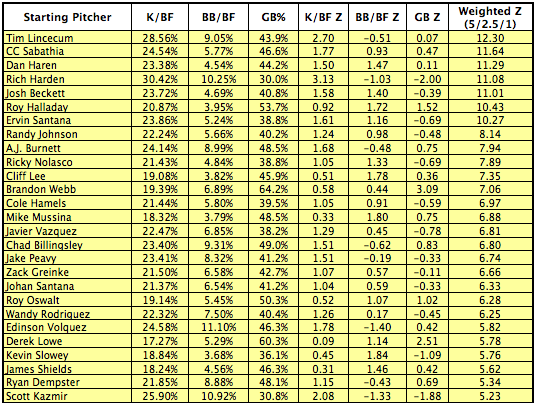
Tim Lincecum, CC Sabathia, Dan Haren, Roy Halladay, A.J. Burnett, Cliff Lee, Brandon Webb, Mike Mussina, Chad Billingsley, Roy Oswalt, Edinson Volquez, Derek Lowe, James Shields, and Ryan Dempster are all residents of the northeast quadrant. Sabathia, Haren, Halladay, Lee, Webb, Mussina, Oswalt, Lowe, and Shields are nine of the dozen pitchers from the K+/BB+/GB+ grouping. The other three are John Lackey, who heads up the second quintile; Andy Pettitte, ranked fourth in the second quintile and 31st overall; and Jon Lester, another member of the second quintile.
For purposes of illustration, I have included Lincecum's z-scores for K/BF and BB/BF (top row) and GB (bottom row) below. The colored portion of the normal distribution represents the area of probability. (You can compute your own z-scores in this applet.)
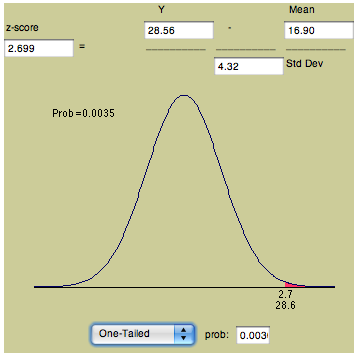
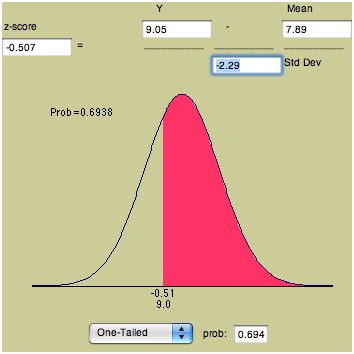
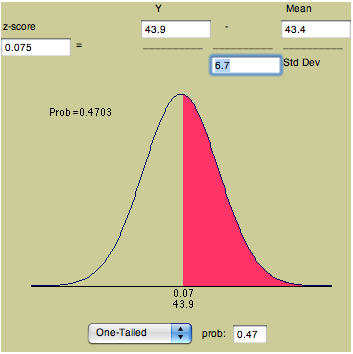
Lastly, here are the top 30 relievers as measured by z-scores.
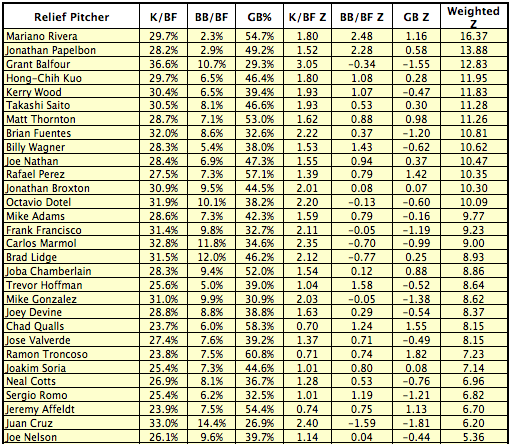
Mariano Rivera and Jonathan Papelbon 1-2. There must be something to this methodology.
| Baseball Beat | February 17, 2009 |
Categorizing Pitchers: Adding Walks to the Mix
I have added a new wrinkle to our series of categorizing pitchers by including walks as well as strikeout and groundball rates. The best pitchers miss bats (K), keep batted balls in the park (GB), and command and control the strike zone (BB).
By evaluating all three variables, we can focus on what a pitcher exercises the most authority over. While this study is not intended to quantify a pitcher's Defense Independent Pitching Statistics or Fielding Independent Pitching ERA, it borrows from these concepts for the primary purpose of categorizing pitchers by types (high K, low BB, high GB to low K, high BB, and low GB and the other six combinations of highs and lows).
Tangotiger has written an easy-to-understand primer on the subject of the Defensive Responsibility Spectrum, which discusses DIPS and introduces FIP. As we know, pitchers have the greatest influence over items such as K, BB, HBP, and HR (as well as balks, pickoffs and, to a lesser degree, wild pitches).
While I intend to use HBP in the future by combining them with BB, I did not include the former in this first attempt at categorizing K, BB, and GB types. I also chose to substitute GB% for HR rates two years ago when I began this series because the latter tends to fluctuate more based on ballpark factors (distances, altitude, and wind) and perhaps, to a certain extent, luck.
The results detailed in the table below are based on 135 pitchers who completed 100 or more innings and started in at least 33 percent of their appearances in 2008. Among these qualifiers, the average K/BF rate was 16.90%, the average GB rate was 43.45%, and the average BB/BF rate was 7.89%.
For ease of understanding and consistency, I have designated "better" than average with a plus sign ( + ) and "worse" than average with a minus sign ( - ). Based on these labels, one can readily see how different groups of pitchers fared last season.
As shown, strikeouts had the greatest impact on ERA and RA, followed by walks, and groundballs (which could also be thought of as batted balls as a more generic type). Accordingly, K+ BB+ GB+ > K+ BB+ GB- > K+ BB- GB+ > K+ BB- GB- > K- BB+ GB+ > K- BB+ GB- > K- BB- GB+ > K- BB- GB-.
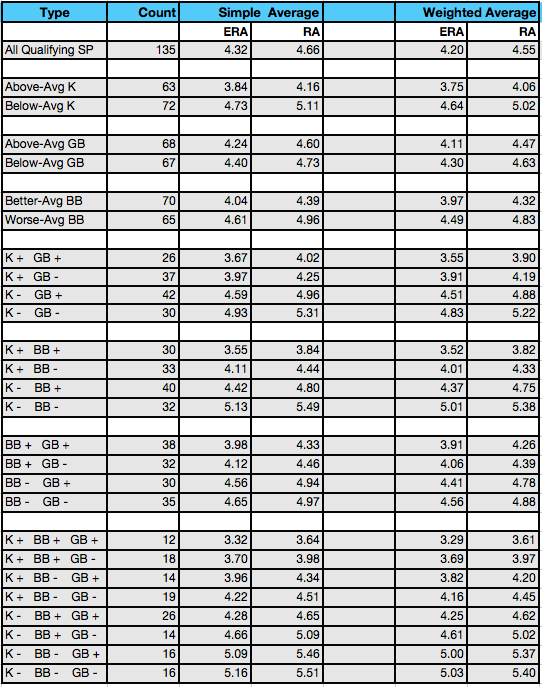
As a rule of thumb, pitchers with plus strikeout rates will have a better-than-average ERA and RA. Conversely, pitchers with minus strikeout rates will have a worse-than-average ERA and RA. Both of these general principles apply irrespective of the other variables with one exception: pitchers with minus K rates combined with plus BB and GB rates will typically sport average ERA and RA.
Another key takeaway is that pitchers with plus K, BB, and GB rates as a group will produce ERA and RA that are about 1.00 better than average. At the other end of the spectrum, pitchers with minus K, BB, and GB rates as a group will fashion ERA and RA that are about 0.85 worse than average. Therefore, the difference between the best and worst groups is nearly two runs per nine innings. Disparities among the best and worst Individual pitchers will obviously be greater than these averages.
Let's take a look at these eight classifications of pitchers.
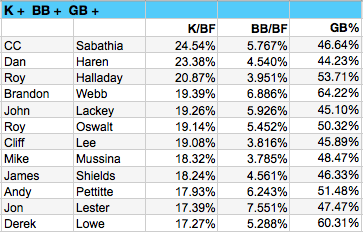
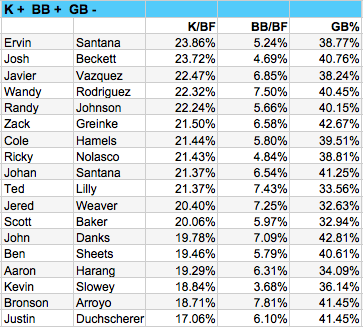
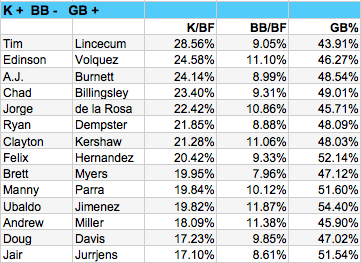
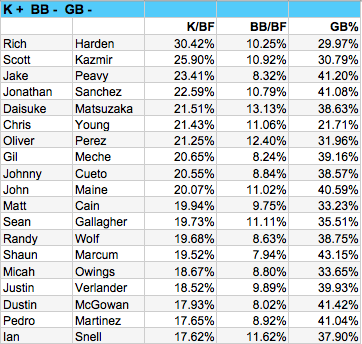
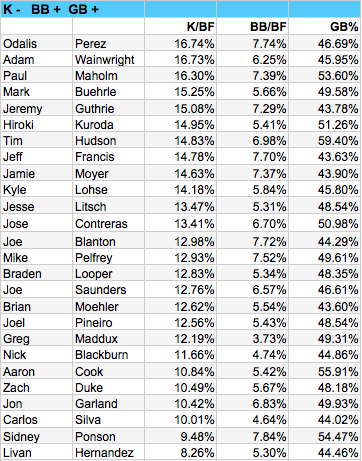
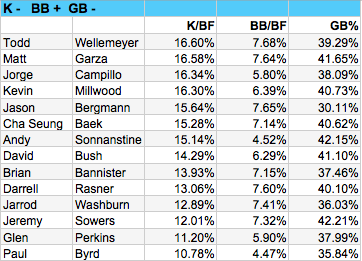
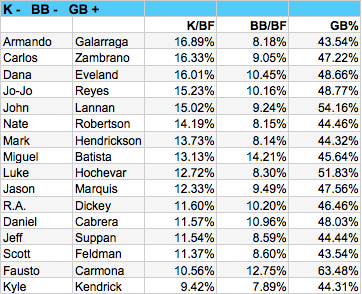
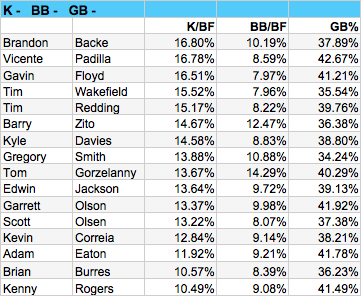
A valuable aspect of categorizing pitchers and listing K, BB, and GB rates is the ability to see comparable pitchers. Without applying similarity scores, one can see that John Lackey and Roy Oswalt are more alike than not with the latter producing slightly better walk and groundball rates. Both righthanders are fastball-slider-curveball types with Oswalt throwing a couple of miles-per-hour harder than Lackey. Oswalt gets the nod but probably not by as much as the differences in their career ERA+ (139 to 117).
Cliff Lee, Mike Mussina, and James Shields are bunched with the former getting the edge over the latter for his superior K and BB rates. Ervin Santana and Josh Beckett are hard-throwing (94.4 and 94.3 mph, respectively) righthanders with comparable K, BB, and GB rates. Dan Haren has a nearly identical K rate as Santana and Beckett but slightly better BB and GB rates. Although Javier Vazquez throws right and Wandy Rodriguez left, their fielding independent stats are not all that different even though the Houston starter is a relative unknown compared to the well-traveled, newly acquired Atlanta pitcher.
One of my favorite comps is Cole Hamels and Johan Santana, two of the best southpaws with plus-plus changeups. Ricky Nolasco may be just as good, or at least he was last year! The main difference between Jered Weaver and Scott Baker is that the latter has a roughly 20 percent better walk rate. Both righties are FB-SL-CH flyball types although Baker throws his heater about a mile per hour harder than Weaver.
A.J. Burnett and Chad Billingsley are two peas in a pod with respect to K, BB, and GB rates. Both throw gas and a hammer curve with A.J. lighting up the radar guns and his investment portfolio a bit more than his younger counterpart. When it comes to Felix Hernandez and Ubaldo Jimenez, there are more similarities (including the two hardest average fastballs in 2008) than differences as I first pointed out last July.
Other comps include Gil Meche and Johnny Cueto, Jesse Litsch and Braden Looper, Matt Garza and Gavin Floyd (and Todd Wellemeyer, Armando Galarraga, and Vicente Padilla, for that matter), and three back-to-back southpaw pairings: Dana Eveland and Jo-Jo Reyes (sporting similar FB-SL-CH repertoires), Nate Robertson and Mark Hendrickson, and, best of all, Jeff Francis and Jamie Moyer, two soft-tossing lefties with only 18 years separating them.
I will have a follow-up piece on Friday with a methodology to rank pitchers across all classifications.
| Baseball Beat | February 16, 2009 |
Let the Games Begin...Please
With pitchers and catchers reporting to camp (and a third of the position players as of Monday), the Major League Baseball season can't be too far away. Seven weeks to be exact. About the same time between now and then as it was between now and Christmas. It's just a matter of whether you like to open your presents in late December or early April.
The first spring training games will take place on Wednesday, February 25. With the Dodgers relocating to Arizona, there are now 16 teams in the Grapefruit League and 14 in the Cactus League. The American League clubs are split evenly between Florida and Arizona while the National League has nine of its 16 franchises training on the east coast.
Round one of the World Baseball Classic opens in Tokyo on Thursday, March 5. There are four pools consisting of four teams each for a total of 16 participants. Pool A consists of China, Chinese Taipei, Japan, and Korea. Pool B is comprised of Australia, Cuba, Mexico (host), and South Africa. Pool C is made up of Canada (host), Italy, USA, and Venezuela. Pool D includes Dominican Republic, Netherlands, Panama, and Puerto Rico (host). The winners and runners-up will advance to round two with the survivors from Pool A and B squaring off at Petco Park and Pool C and D meeting up at Dolphin Stadium. The semi-finals and finals will take place on March 21-23 at Dodger Stadium. The tournament will be televised by MLB Network (16 games) and ESPN (23 games). The full schedule (with dates, times, and TV network) can be viewed here. (Note: Several players listed on the rosters have opted not to play.)
In the meantime, Baseball America is counting down to the college baseball season. (Hint: It takes place this week.) Aaron Fitt, the site's lead college writer, provides scouting reports on the top 25 teams in the country (complete with projected lineups and 2008 stats).
I'm looking forward to attending the opening series between Long Beach State and USC next weekend. The Trojans will play host on Friday and Sunday while the Dirtbags will host the Saturday game. USC (ranked 24th by Collegiate Baseball) features Grant Green, a preseason first team All-America shortstop who is projected to be a top five overall pick in the MLB draft in June.
Green impressed me when I saw him (and fellow freshman Robert Stock, whose status has slipped since being named Baseball America's Youth Player of the Year in 2005) make his collegiate debut two years ago:
Green, Stock's freshman teammate, reminds me of Tulowitzki, the former Dirtbag who played 25 games for the Colorado Rockies in September. The 6-3, 180-pound shortstop has added about 15 pounds of muscle since being drafted by the San Diego Padres in the 14th round last June. He runs well, as evidenced by his 4.23 speed to first, a time that scouts would rate as a 55 or 60 for a RHB on their 20-80 scale.
After losing 11 players to the draft last year, Long Beach State is in the midst of a rebuilding campaign. Devin Lohman, who was selected in the 42nd round by the Rockies in 2007, will follow Danny Espinosa (WAS, 3rd round, 2008), Troy Tulowitzki, Bobby Crosby, and Chris Gomez (as well as a stint by Evan Longoria during his sophomore season in 2005 when Tulo missed 18 games with a hand injury), as the school's next shortstop. The sophomore hit a home run at cavernous Blair Field and made a couple of defensive gems in an intra-squad scrimmage on Saturday.
I am also hopeful of catching righthander Stephen Strasburg, the No. 1 prospect in the country, at the MLB Urban Invitational in Compton next weekend. San Diego State is scheduled to play Bethune Cookman on Friday and Southern on Saturday. If Strasburg is going, I will be, too.
If you don't know much about Strasburg, the following excerpt from a Baseball America article will whet your appetite:
The Washington Nationals have the first pick in the 2009 draft. Strasburg, a junior righthander at San Diego State, is the odds-on favorite for the first choice. So just how does a pitcher go from obscurity to the top of the draft?• By hitting 101 mph on a radar gun.
• By outdueling the first pitcher selected in last year's draft.
• By striking out 23 batters in a game.
• By being the first collegiate player selected to the U.S. Olympic team since professionals were put on the roster in 2000.
Strasburg did all that and more last year, making him The Next Big Thing. Everyone, it seems, is now on board.
College baseball this week. Spring training next week. World Baseball Classic next month. Opening Day the following month.
Bring 'em all on. I'm ready.
Meanwhile, if you're looking for some reading material, be aware that The Hardball Times Season Preview 2009 is now shipping. The book includes projections and commentaries for all 30 teams and over 1,000 players, draft strategies and values, and key rookies for 2009. You can read the first page of an eight-page preview of the Dodgers that I wrote. The other 29 teams are covered by THT's staff writers and many of the best baseball bloggers on the Internet.
| Baseball Beat | February 10, 2009 |
Categorizing Relief Pitchers by Strikeout and Groundball Rates - 2008 Edition
After categorizing starting pitchers by strikeout and groundball rates yesterday, today's article is focused on relievers. Previous entries with supporting information as to the whys and wherefores of this study can be accessed at the following links: 2008 SP, 2007 SP, 2007 RP, 2006 SP and 2006 RP.
The universe includes strikeout and groundball data for every reliever in the majors (defined for this exercise as those with 30 or more innings who started less than one-third of the time). There were 231 pitchers who met these requirements in 2008. Among these qualifiers, the average K/BF rate was 19.68% and the average GB rate was 43.74%. By comparison, starters had a mean K/BF rates of 16.90% and GB% of 43.45%, respectively. While the groundball rates were virtually the same, the average strikeout rate among relievers was 2.78 percentage points higher or 16.4%.
The mean K and GB rates are highlighted in red in the graph below. These averages separate the starting pitchers into four quadrants. By placing pitchers in quadrants, one can easily distinguish those with above-average strikeout and groundball rates (referred herein as the northeast quadrant), above-average strikeout and below-average groundball rates (southeast quadrant), above-average groundball and below-average strikeout rates (northwest quadrant), and below-average groundball and strikeout rates (southwest quadrant).
The simple average and weighted average (by innings) ERA and RA are detailed in the table below.
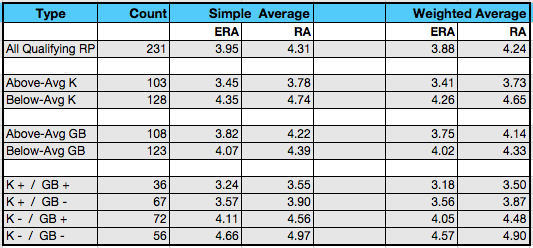
The message is the same for relievers as it was in yesterday's table for starters:
- Pitchers with above-average K rates outperform those with below-average K rates.
- Pitchers with above-average GB rates outperform those with below-average GB rates.
- Pitchers who combine above-average K and GB rates outperform all others.
As with the starters, it is always fun to look at the outliers. Starting at the upper end of the graph, Roy Corcoran had the highest percentage of groundballs among all pitchers (starters or relievers). Moving clockwise, the other outliers consist of Scott Downs, Ramon Troncoso, Rafael Perez, Mariano Rivera, Takashi Saito, Brad Lidge, Jonathan Broxton, Octavio Dotel, Carlos Marmol, Grant Balfour, Juan Cruz, Alex Hinshaw, Troy Percival, Eddie Guardado, Brad Hennessey, Todd Jones, Horacio Ramirez, and Chad Bradford. Saito, Broxton, and Bradford also stood out in their respective quadrants the previous year.
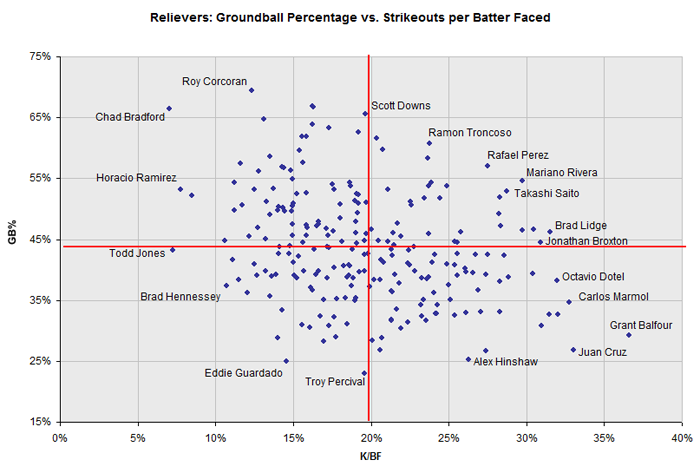
Data and graph courtesy of David Appelman, FanGraphs.
Let's drill down and take a closer look at each of the quadrants. The NE, SE, and SW quadrants are listed by K/BF, while the pitchers in the NW quadrant are in order of GB%.
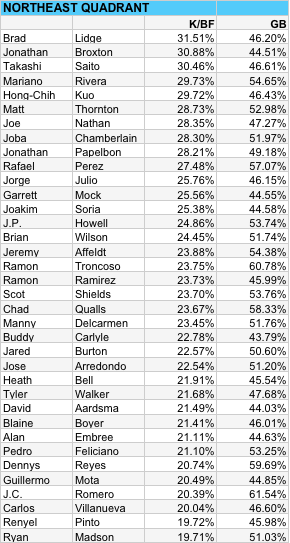
Lidge not only tops this elite group of relievers but is one of only two pitchers to exceed a 30% strikeout rate for three consecutive seasons. He was 48-for-48 in save situations (including the postseason) and led all relievers in Win Probability Added. For my money, Lidge was the best relief pitcher in baseball last year.
Saito is the other reliever who has whiffed at least 30% of the batters faced during the past three campaigns. He suffered a sprained ligament in his elbow last summer and was not tendered a contract by the Dodgers. The 39-year-old righthander signed a one-year deal with the Red Sox with a team option for 2010. Along with the newly acquired Ramon Ramirez and holdovers Jonathan Papelbon and Manny Delcarmen, Boston will have four members of the NE quadrant in its bullpen in 2009, tied for the most in baseball. Despite losing Saito, the Dodgers will also head to camp with four relievers from the NE quadrant: Broxton, Hong-Chih Kuo, Troncoso, and Guillermo Mota, who was signed in January.
Rivera and Perez qualified for the 25-50 club for the second straight year. Matt Thornton and Joba Chamberlain, who split his season between the starting rotation and the bullpen, are also card-carrying members of the 25-50 organization. Joba will either hook up with Mo to form a "lights out" eighth and ninth inning tandem or join fellow NE quadrant starters A.J. Burnett and CC Sabathia in the rotation. It's a nice "problem" for Yankees manager Joe Girardi to figure out this spring.
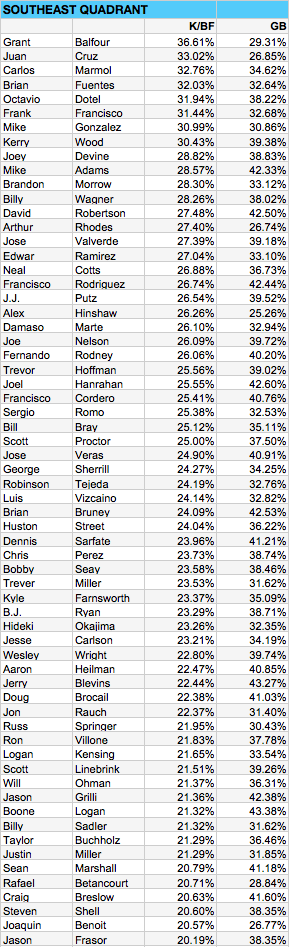

Balfour had the highest strikeout rate of any big league pitcher last year. Although the 31-year-old righthander got knocked around in October, he put up remarkable stats during the regular season (summarized by a 1.54 ERA and 0.89 WHIP). It will be interesting to see how the well-traveled and hard-throwing Balfour performs in 2009.
Cruz and Marmol are no strangers to the upper end of the southeast quadrant, placing third and second, respectively, in 2007. The strikeout artists swapped places in 2008. Cruz became a free agent after the season and remains unsigned days before pitchers and catchers report to spring training, primarily due to the fact that the acquiring team will be forced to part with a first-round draft pick as compensation for a Type A player. Marmol, who has struck out 210 batters while allowing only 81 hits in 156.2 IP over the past two seasons, is the favorite to succeed the departed Kerry Wood as the Cubs closer in 2009.
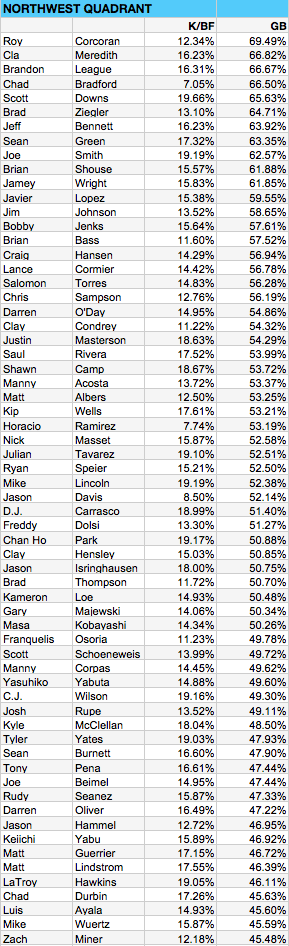
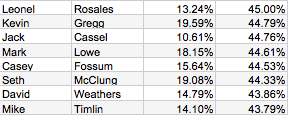
The NWQ is comprised of 11 relievers with groundball rates in excess of 60%, including Cla Meredith and Brandon League, both of whom have eclipsed the 70% mark in one of the past two seasons.
As measured by WPA, Downs (14th), Brad Ziegler (9th), and Bobby Jenks (5th) were the most successful relievers in this group. Ziegler posted a 3-0 record with a 1.06 ERA while saving 11 out of 13 opportunities for the Oakland A's even though he wasn't called up to the bigs until the last day of May. Jenks fell out of the NEQ for the first time as his K/BF has dropped from 29.76% in 2005 to 26.67% in 2006 to 22.49% in 2007 to 15.64% in 2008. The trend is not his friend.
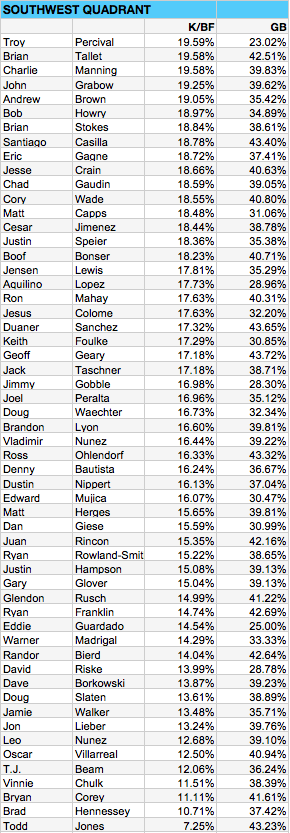
I don't think there is a single reliever in the bottom half of this quadrant that I would sign with your money, much less mine. At the bottom of the heap is Todd Jones, who lost his role as closer to Fernando Rodney, a member of the SEQ, in July and thankfully announced his retirement in September. To his credit, Jones is 14th on the all-time list for career saves. I don't know if that says more about him or the validity of the save statistic.
| Baseball Beat | February 09, 2009 |
Categorizing Starting Pitchers by Strikeout and Groundball Rates - 2008 Edition
Strikeout and groundball rates have become my favorite way to evaluate pitchers. While I also pay close attention to walk rates, I am most interested in whether pitchers can miss bats and keep batted balls in the park.
The reasons are simple and straightforward: (1) strikeouts are the out of choice and (2) groundballs are preferred over flyballs and line drives. Except for the rare missed third strike, a strikeout always produces an out and no chance for runners to advance bases (other than a stolen base). Among batted ball types, infield flies are the least harmful, followed by groundballs, outfield flies, and line drives.
Thanks to the advancements in play-by-play data, we can even place a value on the run impact of each event. For example, according to information gathered from The Hardball Times, strikeouts have had a run impact of approximately -0.11, infield flies -0.09, groundballs 0.04, outfield flies 0.18, and line drives 0.39 per incident over the past few seasons.
Although groundballs generate more hits and errors than flyballs, their run impact is lower because the hits are usually limited to singles and an occasional double down the first or third base line, whereas balls in the air that turn into hits more often become doubles, triples, or home runs. By definition, groundball pitchers give up fewer flyballs and line drives. In addition, groundball rates fluctuate less than home run rates because park effects, weather, and other forms of randomness play a huge role when it comes to the outcome of long flyballs, especially among pitchers. Therefore, if you want to maintain a low home run rate, the best thing to do is to keep batted balls on the ground.
Based on the above information, it follows that just as pitchers with high strikeout rates would generally fare better than those with low rates, pitchers with high groundball rates would normally fare better than those with low rates. Furthermore, it also suggests that pitchers who combine higher strikeout and groundball rates will outperform those with lower rates.
With the foregoing in mind, I introduced the idea of categorizing pitchers by strikeout and groundball rates for the 2006 season in January 2007 (Part I: Starters/Part II: Relievers). I also generated this information for the 2007 season in March 2008 (Part I: Starters/Part II: Relievers) and will once again provide it for the 2008 campaign, beginning with starters today and relievers tomorrow.
Consistent with the methodology that I have used in the past, the universe of starters consists of all pitchers who completed 100 or more innings and started in at least 33 percent of their appearances. There were 135 pitchers who met these requirements in 2008. Among these qualifiers, the average K/BF rate was 16.90% and the average GB rate was 43.45%. The mean K and GB rates are highlighted in red in the graph below. These averages separate the starting pitchers into four quadrants.
By placing pitchers in quadrants, one can easily distinguish those with above-average strikeout and groundball rates (referred herein as the northeast quadrant), above-average strikeout and below-average groundball rates (southeast quadrant), above-average groundball and below-average strikeout rates (northwest quadrant), and below-average groundball and strikeout rates (southwest quadrant).
The simple average and weighted average (by innings) ERA and RA are detailed in the table below. Whether using simple or weighted, ERA or RA, the message is crystal clear:
- Pitchers with above-average K rates outperform those with below-average K rates.
- Pitchers with above-average GB rates outperform those with below-average GB rates.
- Pitchers who combine above-average K and GB rates outperform all others.
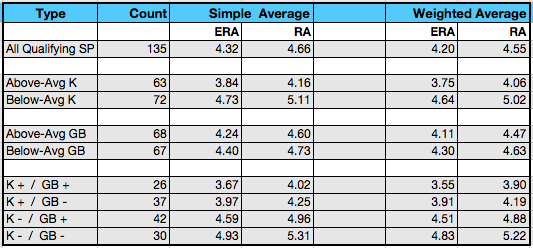
Not surprisingly, pitchers with the highest strikeout and groundball rates had the lowest average ERA, while those with the lowest K and GB rates had the highest average ERA. In the hybrid categories, pitchers with above-average strikeout and below-average groundball rates beat those with below-average K and above-average GB rates. The order of preference is the northeast quadrant, followed by the southeast, northwest, and southwest.
Looking at the outliers in the graph is one of the most interesting aspects of this study. Starting with the northeast quadrant and going clockwise, Derek Lowe, Brandon Webb, and, to a lesser extent, Ubaldo Jimenez, Roy Halladay, Chad Billingsley, A.J. Burnett, CC Sabathia, and Edinson Volquez, plus Tim Lincecum, Rich Harden, Scott Kazmir, Chris Young, Jason Bergmann, Brian Burres, Livan Hernandez, Aaron Cook, Fausto Carmona, and Tim Hudson all stand out for their extreme (good or bad) strikeout and/or groundball rates. Is there anybody who wouldn't take the outliers in the northeast quadrant over the outliers in the southwest quadrant? Lowe (3.24), Webb (3.30), Jimenez (3.99), Halladay (2.78), Billingsley (3.14), Burnett (4.07), Sabathia (2.70), Volquez (3.21), and Lincecum (2.62) all had much lower ERAs than Bergmann (5.09) and Burres (6.04).
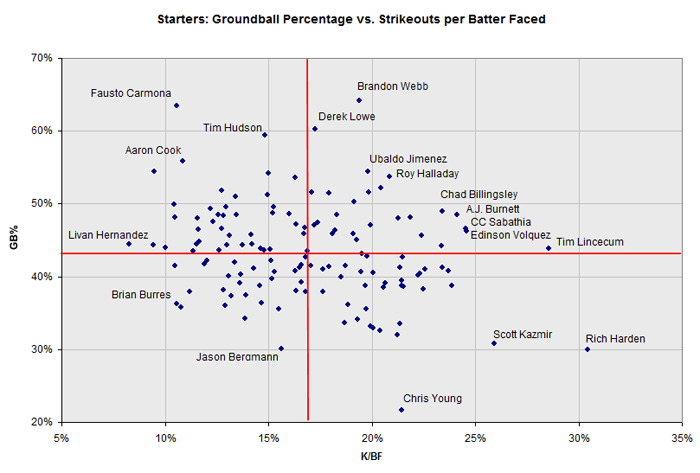
Data and graph courtesy of David Appelman, FanGraphs.
Let's take a closer look at the results. Pitchers in the northeast, southeast, and southwest quadrants are sorted by K/BF rates. Pitchers in the northwest quadrant are listed in the order of GB rates.
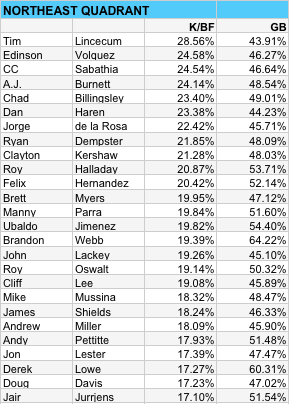
The two Cy Young award winners headline this year's northeast quadrant. Lincecum had the second-highest K/BF rate in the majors (trailing only Harden) while generating an above-average GB rate. Cliff Lee made the highly unusual leap from the dreaded southwest quadrant in 2006 (14.63%, 32.70%) and 2007 (14.89%, 35.28%) to the more tony northeast quadrant in one fell swoop, primarily owing to a harder fastball and improved movement that produced a career-best O-Swing%.
Burnett, Doug Davis, Dan Haren, Felix Hernandez, Roy Oswalt, Sabathia, and Webb have inhabited the northeast quadrant in each of our studies covering the past three seasons. If asked, "Which one is not like the others?" I'm confident that we would all answer, "Doug Davis." The 33-year-old lefthander has been near the bottom of the NE rankings in all three campaigns, barely exceeding the hurdle in both metrics each time. Davis also had the highest walk rate of this otherwise elite group in 2006, 2007, and 2008. He is what he is, an ever-so-slightly, better-than-average starting pitcher who gives up his share of hits and walks while doing a reasonably good job at missing bats and keeping the ball in the yard.
There have been just nine cases in the past three seasons of pitchers combining a 20% K rate with a 50% GB rate. King Felix is the only pitcher to accomplish this feat all three years. He posted the same K rate in 2008 as in 2007, but his GB rate dropped from 60.83% to 52.14%. Nonetheless, his three-peat is impressive, especially when you consider that he won't turn 23 until after the 2009 season starts.
Burnett is a two-time member of the 20-50 club, coming up just short on the GB side of the equation in 2008. Halladay joined the ranks this year, whiffing at least 20% for the first time since 2001. Known as a groundball pitcher, Roy was part of the northwest quadrant the previous two seasons.
Potential breakout candidates and fantasy sleepers include Jorge de la Rosa, Clayton Kershaw, Manny Parra, and Andrew Miller. Besides above-average K and GB rankings, these pitchers share two things in common: all four youngsters are southpaws with a high walk rate.
I am intrigued by de la Rosa, who was 5-2 with a 2.45 ERA and compelling peripheral stats in August and September, a period covering 11 games and nine starts (including five at Coors Field) and 58.2 innings.
Miller (6th) and Kershaw (7th) were selected back-to-back by the Tigers and Dodgers in the first round of the 2006 draft. Miller (University of North Carolina) was widely considered the top college pitcher and Kershaw (Highland Park HS, Dallas) the best high school hurler. Detroit traded Miller and Cameron Maybin (and four others) to Florida for Miguel Cabrera and Dontrelle Willis in December 2007, while Los Angeles has held on to Kershaw. Both lefties pitched an almost identical number of innings in the majors last season with the soon-to-be 21-year-old Kershaw getting the better of Miller, who turns 24 in May. Note that Clayton's K/BF and GB rates were also higher than Andrew's and his BB rate (11.06% to 11.38%) was slightly better as well.
IP H R ER HR BB SO ERA
Kershaw 107.7 109 51 51 11 52 100 4.26
Miller 107.3 120 78 70 7 56 89 5.87
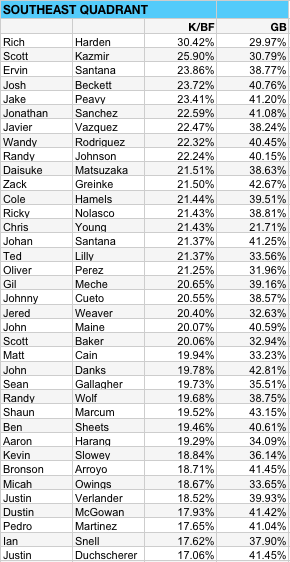
Harden stands out as the only starting pitcher in the majors with a K/BF over 30%. Over the past three years, just one starter per season has achieved this status with Francisco Liriano (30.44% in 2006) and Erik Bedard (30.15% in 2007) preceding Harden in the 30-something club. Liriano and Bedard fell victim to injuries. Following in their footsteps wouldn't be something particularly new to Harden, now would it?
Kazmir has ranked second, first, and second in the southeast quadrant for three straight seasons although it is a bit disturbing to note that his GB rate fell more than 10 percentage points below his 2006 and 2007 levels. Josh Beckett dropped out of the northeast and into the southeast grouping for the first time while slightly topping his K rate from his outstanding summer in 2007 (23.60%).
Jake Peavy, Wandy Rodriguez, Gil Meche, and Ian Snell have been a member of the northeast or southeast quadrant for each of the past three seasons, while Ervin Santana, Javier Vazquez, Cole Hamels, Chris Young, Johan Santana, Ted Lilly, Oliver Perez, Jered Weaver, Matt Cain, Ben Sheets, Aaron Harang, Bronson Arroyo, and Justin Verlander have been firmly ensconced in the SE quadrant for three years running.
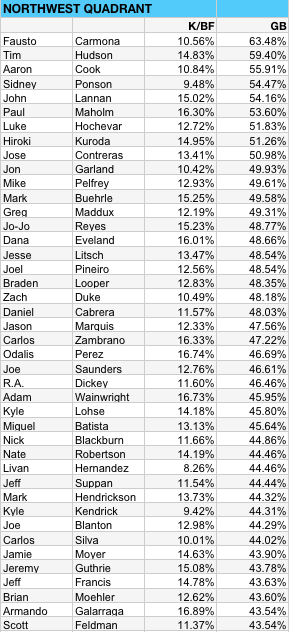
The northwest quadrant always produces a mixed bag of pitchers. Opposite of those in the SE, hurlers in the NW succeed by inducing grounders and keeping the ball in the park, whereas their counterparts thrive on strikeouts.
Carmona tops the list for the second consecutive year. Although Fausto's GB rate exceeded the rarefied 60% mark once again, his K rate fell off the cliff (from a reasonable 15.59% in 2007 when he finished fourth in the AL CYA voting to a dangerously low 10.56% in 2008). Worse yet, his K/BB rate plummeted from 2.25 to 0.83. The good news for Indians fans is that Carmona just turned 25 in December so he still has time to get his mojo back.
Paul Maholm, Carlos Zambrano, Odalis Perez (yes, Odalis Perez), Adam Wainwright, and Armando Galarraga (whose K and GB rates are essentially league average) are within hailing distance of meeting the minimum standards of the NE quadrant. With a solid K rate and a top ten GB%, the 26-year-old Maholm deserves attention as a pitcher coming into his own. Zambrano fell out of the NE for the first time since this study began, pitching to contact more often than before while improving his walk rate to a level not seen since his stellar season in 2004. Meanwhile, don't bet on Galarraga to improve his W-L record or ERA as his BABIP of .247 was unsustainably low.
At the other end of the spectrum, Livan Hernandez and Kyle Kendrick aren't long for the majors with K rates below 10%. A free agent, Hernandez may find it difficult to convince an employer to allow him to wear a big league uniform in 2009, even at the minimum salary.
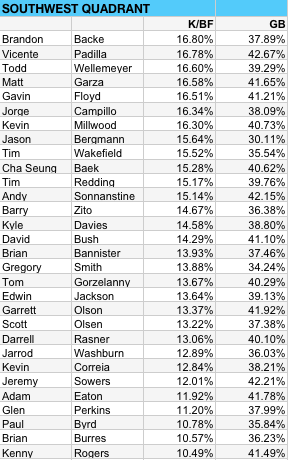
Repeating my comments from each of the past two series, "[The southwest] is the quadrant that you want to avoid. It is inhabited by some of the worst starters in the game. If you fail to miss bats and don't keep the ball on the ground when it is put into play, you are going to run into trouble." The only way to survive in this quadrant is to put up as close to league-average K and/or GB rates as possible (see Brandon Backe, Vicente Padilla, Todd Wellemeyer, Matt Garza, Gavin Floyd, Jorge Campillo, Kevin Millwood, and Andy Sonnanstine) or to throw strikes, maintain a low walk rate, and duck when the ball is put into play. However, all of these types of pitchers live on the edge with very little margin for error.
As I am wont to say, "When it comes to evaluating pitchers, I would rather know their strikeout and groundball rates than their ERA. Throw in walk rates and you have almost everything you need to know about a pitcher. Focusing on these components gives one a much more comprehensive understanding of a pitcher's upside and downside than looking at a single metric such as ERA."
Tomorrow: Categorizing Relievers by Strikeout and Groundball Rates.
| Baseball Beat | February 02, 2009 |
Heyman "Breaks" Another Story
"Just a puppet on a lonely string
Oh who would ever want to be king?"
- Coldplay, Viva La Vida
Jon Heyman has done it again. He broke another story on Friday when reporting that Jason Varitek had "reached a two-year agreement with the Red Sox."
In typical Heyman fashion, he wanted to make sure that everyone knew that "SI.com was the first to report that Varitek had an agreement with Boston." To that, I say "big deal." OK, maybe I didn't use the word "deal." I mean, this doesn't go down as some sort of exclusive or investigative reporting.
While the signing won't be officially announced until Varitek completes his physical, the Red Sox had placed a Friday deadline on an official proposal that was delivered via registered mail to him and agent Scott Boras on January 23. In other words, it was no secret that something was going to happen that day. Either Varitek was going to accept or reject Boston's offer.
If you're wondering how Heyman got wind of the news before any of the Boston beat writers or columnists, be aware that he had Mark Teixeira going to the Yankees before anyone else and, according to his biography, also "broke the story of Barry Bonds going to the Giants in 1992...Alex Rodriguez going to the Yankees in 2004, A-Rod opting out of his $252-million contract in 2007 and Manny Ramirez going to the Dodgers in 2008."
Varitek. Teixeira. Manny. A-Rod 2x. Bonds, vintage 1992. Do you notice anything in common? Yes, all of these players are or were represented by Boras at the time of their signings. It is plainly obvious that Heyman, known among fellow writers as scottboras.com, is getting fed such stories by Scott himself, which is fine and dandy except there is more going on here than meets the eye.
You see, Boras throws Heyman a bone on a Tek or Tex signing but also uses him to spread rumors about the level of interest and terms in ongoing free agent negotiations to create a false sense of demand. Teams that fall for this trick wind up competing against themselves, which is exactly what Boras desires.
While Boras is no fool, Heyman is a tool for the Scott Boras Corporation. Boras knows how to game the system to get the best deals for his clients and will gladly use Heyman as long as the latter plays along or until the market realizes what is going on. As it stands now, it's almost as if Heyman, who is no stranger to the Boras suites during the winter meetings, is on the SBC payroll.
You can see these shenanigans at work in Heyman's recent stories about a few other Boras clients, including Joe Crede, Oliver Perez, and Derek Lowe. But these are relatively innocent in comparison to following the Boras, Heyman & Co. saga as it relates to Manny.
D'oh!
Heyman not only is a mouthpiece for Boras but is wrong more often than he is right. Look, if you throw enough mud against the wall, some of it is bound to stick. That doesn't make you a soothsayer or the next Carl Bernstein or Bob Woodward.
The remaining stories are presented without comment as to let you be the judge (although I took the liberty to add emphasis for ease of reading).
While folks were understandably upset over Ramirez's terrible behavior leading up to the trade, no one could reasonably expect MLB to actually tie Ramirez's childish antics to Boras. Ramirez's lay-down behavior was so outrageous that MLB should indeed investigate him. But there's no belief from anyone credible that they'll find anything, certainly nothing against Boras. The reality is that Ramirez behaved beautifully for half a season under Boras, then became irritated over the club options that could tie him to Boston for two more years. But let's not forget that Ramirez's behavior had been erratic throughout his eight years in Boston, including long before he hired Boras, and Red Sox people have covered up a lot of it in the past. Is it possible that Boras mentioned to him that the club options in his Red Sox contract were not a good thing? It is. Will Boras benefit from the options being dropped? Presumably he will, assuming the erratic Ramirez stays with Boras for the signing of his next contract. But the real question is: Would Boras risk his seemingly excellent relationship with the Red Sox and overall reputation to orchestrate Ramirez's ridiculous behavior? According to one GM, it's just the opposite, that perhaps no agent is better than Boras at dealing with off-field issues of players. Anyway, the orchestration idea is farfetched and nothing more than misguided media musings advanced in some cases by sworn Boras enemies.
It's impossible to calculate the true worth of Manny. Though, I'm quite sure his agent Scott Boras will have an idea or two about that while shopping the good Manny around this winter.
Ramirez is believed to be seeking a six-year deal for as much as $25 million per year . . . Ramirez's agent, Scott Boras, declined to name a target price in an interview with SI.com on Wednesday. That $150 million total price tag is an estimate based on Boras' use of the word "iconic'' to describe the 36-year-old Ramirez, combined with Ramirez's own constant mention of a "six-year deal'' during frequent media interviews this postseason."He pays for himself. You've got a free player with Manny,'' Boras said. "He's an iconic player who's changed the face and fortunes of the franchise.''
The Manny Derby surely will be limited by the stratospheric price, but at least three teams are emerging as potential suitors. The Yankees' will "take a look at Manny,'' according to someone familiar with their thinking, the Mets are said to be weighing a run despite deep pitching needs, and the pitching-strong Blue Jays are also believed to be considering a run. While it's hard to imagine Ramirez embracing New York after complaining for 7 1/2 years about Boston's fishbowl existence, the Yankees and Mets have an inherent financial advantage over L.A. in owning their own TV networks (McCourt, meanwhile, is said to have a poor relationship with Fox) and introducing new stadiums. It shouldn't be forgotten that Ramirez followed the money when he took $160 million over eight years from Boston before the 2001 season.
The Orioles are another team that has been suggested as a possible landing spot, but they are more than one player away from competing in the ultra-tough AL East. Besides, new baseball chief Andy MacPhail appears to be getting away from the big-ticket buys of the Orioles past, and if they do go for a major free agent, it's more likely to be Severna Park, Md., native and Angels star Mark Teixeira. The Angels make some sense for Ramirez, but are more likely to try to keep the much younger Teixeira, whom they love.
Indeed, the pressure to retain Ramirez at almost any price in [sic] intense. As one friend of Manny's put it, "There's going to be a deep depression inside and outside the clubhouse -- among the manager, players, fans, everyone -- if Ramirez leaves.''
"I don't know how [McCourt] doesn't bring him back. It's got to be as much a business decision as a baseball decision. He's got the Dodgers by the ....'' another AL executive said.
That same executive predicted a deal for either three years plus an option or four years for $20 to $25 million annually, which would represent a major windfall from the two $20 million option years Ramirez found so onerous before working hard to get those club options dropped from his just-expired contract.
The Dodgers' early interest in keeping Ramirez to a short (but rich) deal -- first reported by SI.com on Wednesday -- might explain Ramirez's rhetoric following the season in which he professed no special interest in staying in L.A., and candidly added that his only goal was in going to the highest bidder, especially one who'd like to give him a six-year deal. Perhaps by then Manny knew of L.A.'s intentions. In any case, the Manny Derby appears as to have opened up a tad. Though while Philly, the Jays and some others might make for an interesting alternative, it's still entirely possible that the battle for Manny and the other two mega-stars comes down to a competition between the two biggest markets -- New York and Los Angeles.The Dodgers' intention to try to keep Ramirez to a short-term deal -- they're expected to make an initial offer of a two-year contract for about $55 million, perhaps a little bit more, as reported on SI.com Wednesday -- could leave an opening for one of a few other teams to try for Ramirez. And one of those clubs could be the Phillies, who would lock down baseball's best lineup by adding Manny to a batting order that already includes two MVPs.
The field may be somewhat limited for a 36-year-old player seeking a six-year deal for $25 million per, but potential Ramirez suitors include the Mets, Yankees, Blue Jays and Orioles in addition to the Phillies, who may have two things going for them: 1) Manager Charlie Manuel was Ramirez's hitting coach in Cleveland, not that Manny ever needed a hitting coach, and 2) Stiff and streaky left fielder Pat Burrell, who is behind Manny in terms of defense and personality (not to mention hitting, of course), is also a free agent.
Meanwhile, Manny Ramirez should soon expect to receive a shorter offer at close to a record annual salary from the incumbent Dodgers, perhaps a two-year deal for near the $27.5-million Yankees salary of Alex Rodriguez, as SI.com reported several days ago.Ramirez. He's not going to like the Dodgers' short-term bid and will play the field. The Yankees, Mets, Blue Jays and Phillies are among those expected to check in. My call: Dodgers, three years, $75 million.
One reason the Dodgers haven't yet made their official offer for superstar free-agent outfielder Manny Ramirez is that his agent, Scott Boras, apparently isn't fielding offers that aren't in the ballpark of the five or six years that Manny wants.As SI.com reported two weeks ago, the Dodgers intended to offer Ramirez a short-term deal at a high annual salary, perhaps $55-$60 million for two years. (Dodgers GM Ned Colletti confirmed their interest in a shorter deal here the other day and also expressed his belief that they any possible deal would take time.)
But Boras pointed out that he and Colletti negotiated a five-year deal for Barry Bonds back in 2001 when Colletti was the Giants' assistant GM, when Bonds was 37 years old (Ramirez is 36). Ramirez has said publicly that he wants a six-year deal (but probably would take five, or perhaps four) after hitting .396 with 17 home runs and 53 RBIs for the Dodgers. It apepars [sic] that if the Dodgers don't change their stance, the Yankees and others (the Phillies and Blue Jays are possibly interested) may battle for Ramirez without them.
Dodgers general manager Ned Colletti met with agent Scott Boras on Tuesday night and made an offer for Manny Ramirez. Colletti revealed in a meeting with reporters Wednesday that the offer would be the "second-highest average annual value in baseball."While the Dodgers' proposal for Ramirez calls for a high annual salary, the issue appears to be the number of years. The Dodgers' offer is believed to be a two-year deal in the neighborhood of $50 million.
The sides are so far apart that the Blue Jays, Orioles and perhaps the Yankees and other teams likely have moved ahead of the Dodgers in terms of their chances to win the services of the mercurial superstar.
Manny Ramirez still could have one chance to come home. While the Mets have all but decided they will not pursue the slugging savant from Washington Heights, in Upper Manhattan, the Yankees clearly have not ruled out a run at Ramirez.The other obvious possibility for Ramirez would appear to be the Angels, whose owner, Arte Moreno, has said publicly that they may turn to Ramirez if they can't sign Teixeira, their top target. Besides the obvious advantage of adding one of the greatest righthanded hitters of alltime, if the Angels sign Manny, they'd be tweaking the crosstown Dodgers. The same could be said if the Yankees sign Ramirez. Only they'd be tweaking the Red Sox.
There are those suggesting the Yankees are only in the running for Teixeira to either monitor the rival Red Sox or drive up the price for the switch-hitting slugger. But while it's true the Yankees don't appear as eager to sign Teixeira as the Angels and Red Sox, they do appear willing to sign him at the right price. After already signing CC Sabathia and A.J. Burnett for $243.5 million combined, the Yankees appear disinclined to offer $200 million for Teixeira, which is what it may take to get him.
He seeks a deal for at least five years, and while that seems like a tall order for the 36-year-old star, even after hitting .396 with 17 home runs and 53 RBIs in 53 games in Los Angeles, four years could be a possibility.The Dodgers, who have multiple infield needs (shortstop and third base) and could use a starting pitcher as well, remain interested in Ramirez and can resume negotiating with him if they choose to do so.
He is also a strong fallback option for two teams that are pursuing star free agent first baseman Mark Teixeira -- the Angels and Yankees. As a matter of fact, if the Yankees aren't able to convince CC Sabathia to come to New York, the Yankees may pursue both Ramirez and Teixeira.
Yankees co-owner Hank Steinbrenner is said by people close to him to want Manny Ramirez in pinstripes. Unlike his father, who dreaded dreadlocks, Steinbrenner the junior is said by a Yankees person "not to give a (hoot) about his hair.'' . . . the Yankees are mulling a run at Ramirez. The Dodgers have been pursuing Ramirez, and if the Angels miss out on Teixeira, they might join the Manny fray as well.
Teixeira, though, has said he intends to try to do a deal by Christmas, which means Manny's market should take off thereafter.At least two potential losers in the five-team Teixeira Sweepstakes are likely to pursue Ramirez (Yankees and Angels), and perhaps a third (Nationals) would, too. The incumbent Dodgers remain interested. All of which should cheer Manny's spirit if he's just a little more patient.
Manny Ramirez, OF. The Dodgers remain the favorite to keep Ramirez, but the rival Giants loom as a major threat. L.A. wants to keep it to two years but eventually gave in on a third year for Rafael Furcal, and will probably have to do the same with the man who saved the franchise last season. All along, San Francisco has said it might take a stab at one of the "big three'' (and the other two, Sabathia and Teixeira, are gone already), so it stands to reason that they're in for Ramirez, the perfect antidote for their moribund offense. The Angels say they're out, but he'll still be tempting for them as well. Then there's always that so-called mystery team to contend with.
The Giants have entered the bidding for free-agent superstar Manny Ramirez, SI.com has confirmed.KPIX-TV reported Friday that the Giants have made a three-year offer with an option for a fourth year.
The Dodgers remain interested in Ramirez, and a bidding contest between the two great West Coast rivals could loom. The Dodgers originally offered the slugging savant $45 million over two years, but later withdrew that offer. They will have to do better than that to have chance to retain his services.
While the Angels have suggested publicly that they won't be bidding for Ramirez, some baseball people aren't writing them off. There also appears to be one or two other American League teams on the periphery of the bidding. The Yankees, after signing Mark Teixeira to an eight-year, $180-million contract, are not among them.
The Texas Rangers, who are capable of bold moves and would like to replace Milton Bradley's offense, are considering a pursuit of superstar free agent Manny Ramirez.The Rangers have been quiet this winter -- their big move has been signing reliever Derrick Turnbow -- but are looking at a number of ways to improve. Owner Tom Hicks has shown a willingness to make big signings in the past (Alex Rodriguez for $252 million is the prime example), and the Rangers were the one team who showed interest in Ramirez five winters ago when the Red Sox were shopping him (discussing a Ramirez for A-Rod deal at the time). With the Rangers about to lose the free agent Bradley, who was one of the best offensive players in the game last year (.999 OPS) to free agency, their interest in Ramirez has increased.
Ramirez is said to be working out in Pensacola, Fla., a few hours north of where he makes his winter home in Miami -- and patiently (yes, that's the word a friend of his used) waiting for a job. The Dodgers and Giants still look like the most logical landing spots, with L.A. still seen as the favorite. The Angels and Mets are still showing no signs of joining the fray, and Yankees partner Hal Steinbrenner is thought to be against signing Ramirez, so it's still possible it'll come down to a battle of West Coast rivals.One final push from Hall-of-Fame manager Joe Torre could do the trick. Torre just returned from vacation in New Zealand and could certainly stump for Manny. Eventually, the guess here is that the Dodgers get to three years.
While the Dodgers have held to their two-year, $45 million offer for Manny Ramirez, the star slugger is still seeking a deal of at least twice that in length.Word is, Ramirez has told the Dodgers that he wants a deal for four or five years, and it's believed that he's looking to be paid in the range of $25 million a year. Going by those numbers, and assuming Ramirez would take a four-year contract, the sides appear to be at least $55 million apart.
No surprise, this could take a while. One executive whose team is interested in Ramirez said that he believes the Dodgers and Ramirez are no further along than the "fourth inning'' of the negotiations.
The Dodgers and Giants are currently seen as the two most active pursuers of Ramirez. The Dodgers have been viewed as the favorite to land the slugger who helped turn their season around last year, but the Giants are showing signs of serious interest, as well.
1. Manny Ramirez. The Man-child and the Dodgers appear to be in a stalemate, with the team holding at $45 million for two years and Ramirez wanting a deal for four or five years for between $25 million and $30 million per. The Giants, who are in excellent financial position, look like the biggest threat; although at least publicly they're saying they won't go crazy for Manny after diving into the market early. San Francisco already signed Edgar Renteria, Randy Johnson, Bobby Howry and Jerremy Affeldt, a commitment of more than $20 million for 2009, but if they don't get Ramirez the question has to be asked: Wouldn't that $20 million-plus have been better spent on Manny? The Angels and Mets say publicly that they won't go for Manny, while the Yankees already have upgraded their offense immensely with Mark Teixeira. So until further notice the two great West Coast rivals look like the favorites.
Now, if I can just convince Boras that Blyleven is worthy of the Hall of Fame...
***
Correction: Dennis Gilbert was Barry Bonds' agent in 1992, not Scott Boras.
| Baseball Beat | January 30, 2009 |
Revisiting Bryce Harper
Last August, I wrote an article entitled "Remember This Name," whereby I opened with the following paragraph:
Let me introduce you to the No. 1 pick in the 2011 amateur draft . . . Bryce Harper. I know, that particular draft won't take place for three more years. As such, how in the world could I make this type of a prediction now? Well, if you watched the 15-year-old, lefthanded-hitting catcher take batting practice, infield, and two plate appearances on Tuesday at the Area Code Games, as I did, then I have no doubt that you would be as enthusiastic about this phenom as I am.
Harper made some more noise earlier this month at the third annual International Power Showcase High School Home Run Derby at St. Petersburg's Tropicana Field. Although Harper didn't win the contest, according to Baseball America's Nathan Rode, the tenth grader "played the part of Josh Hamilton" while Christian Walker, a third baseman from Kennedy-Kenrick Catholic High in Norristown, Pennsylvania "served the role of Justin Morneau."
Greg Rybarczyk, who maintains the indispensable site Hit Tracker Online, which logs and calculates the trajectory of every major league home run, covered Harper's exploits at the Home Run Derby contest:
Over the next 60 seconds, Harper unleashed an awe-inspiring series of hits to areas of Tropicana Field few major leaguers have reached:• 460 feet to the top edge of the Jumbotron in right field; 119 mph off the bat
• 484 feet to the back wall of the stadium, 15 feet above the Jumbotron; 122 mph
• 485 feet to the back wall, just below the orange Bright House “target” sign; 123 mph
• 405 feet on a blistering line drive around the RF pole; 118 mph
• 502 feet to the back wall, in the vicinity of the first “A” in the Tropicana Field sign, 20 feet above the top of the Jumbotron; 124.5 mph
• 477 feet to right-center field, halfway up and a few feet to the left of the Jumbotron; 119 mph.
Harper cranked six home runs with a metal bat, averaging 469 feet with an exit velocity of 121 mph. Photographer Jeff Horton captured Harper's longest homer below (with Rybarcyzk providing location and distance for each of his dozen home runs).

Notice the white ball toward the top, left-center of the photo. It traveled 502 feet, the longest of the event and on record at Tropicana. According to Rybarczyk, the ball would have exited Yankee Stadium. Greg told Baseball America's Rode, "It was hit at precisely the right direction to get just to the left of the upper deck in Yankee Stadium, but to the right of the bleachers and back bleacher wall. It would have cleared the back wall of Yankee Stadium with probably about 15 to 20 feet to spare."
Rode added, "Another one of his shots traveled 484 feet and at its angle would have landed in the right field Upper Deck of Fenway Park, which has never been done."
Harper hit 12 home runs overall — enough to make the top five — but slugged only one in the final round. Rybarczyk said the 16-year-old high school sophomore "looked worn out, understandably so since he had the misfortune to have hit 67th out of 69 batters, and had only a few minutes to recover before the finals."
Walker won the title by going yard nine times in the final round. Ryan Gunhouse (Clear Creek HS, League City, Texas), Randal Grichuk (Lamar Consolidated HS, Rosenburg, Texas), and Dante Bichette (Orangewood Christian, Maitland, Florida) joined Harper (Las Vegas HS, Las Vegas, Nevada) in the finals. Bichette, the son of the former Colorado Rockies slugger, is a sophomore as well.
The following video of Harper is worth watching if you want to see him in action at the International Power Showcase.
You can learn more about Harper at his player profile on the Power Showcase site. If nothing else, remember this name.
| Baseball Beat | January 27, 2009 |
BABIP: Slicing and Dicing Groundball Out Rates
The Hardball Times has been at the forefront of publishing batted ball information on its website and in its Baseball Annuals for the past five years. Led by Dave Studeman, THT has written several articles on this subject, including two recent studies on BABIP by co-authors Chris Dutton and Peter Bendix and Derek Carty.
BABIP, of course, stands for Batting Average on Balls in Play. Some analysts prefer BA/BIP, others BABiP. No matter how the acronym is presented, Batting Average on Balls in Play measures exactly what it says: the batting average on all batted balls other than home runs. The formula is calculated as (H-HR)/(AB-K-HR) or (H-HR)/(AB-K-HR)+SF.
Batting Average on Balls in Play is basically the opposite of Defensive Efficiency Ratio (DER) or, perhaps more precisely, 1-DER. BABIP is used for batters whereas DER is used for team defense. Depending on one's perspective, either BABIP or DER can be employed when it comes to pitchers.
In a study on Defense Independent Pitching Stats (DIPS) eight years ago (has it really been that long?), Voros McCracken determined that Batting Average on Balls in Play was primarily a function of a pitcher's defense, ballpark and luck, rather than an actual skill. Here is McCracken's original conclusion in his own words: "There is little if any difference among major-league pitchers in their ability to prevent hits on balls hit in the field of play."
Over the ensuing years, several researchers and analysts have modified and improved the thinking behind DIPS as more information — particularly batted ball data — has become available. But the basic fact remains: Pitchers have less control over BABIP than hitters.
According to Carty, "Most pitchers regress toward the league average BABIP of around .300 or .305. Very few pitchers can repeatedly do better or worse than this, so we say that pitchers have very little control over BABIP. Hitters, on the other hand, can have a substantial amount of control over BABIP. Ichiro Suzuki, for example, has a .356 career BABIP. Hitters do not regress toward league average, rather, they each regress toward their own, unique number."
Carty then asks, "What is that number?" He proceeds to evaluate a number of BABIP estimators to find out which ones do the best "job of predicting the following year's BABIP." You can read about his process and results here.
I'm a pattern-recognition type and noticed a few common threads when thumbing through the batted ball stats in The Hardball Times Baseball Annual during the offseason. While some of my observations are included in one way or another in THT studies, I believe we can achieve even more accuracy with a few more tweaks here and there.
OK, for some background information . . .
According to THT, the MLB average groundball out rate was 74 percent in 2007 and 2008. By comparison, the MLB average flyball out rate was 83 percent in 2007 and 84 percent in 2008. Another way of looking at those percentages is to say that batters hit about .260 on groundballs and .160-.170 on outfield flyballs (excluding home runs).
The line drive out rate was 29 percent in 2008, meaning batters hit roughly .710 on these batted balls. The hit rate on infield flies is nearly non-existent as pop-ups are converted into outs 99 percent of the time.
When it comes to batting average, line drives are king, followed by groundballs, outfield flyballs, and infield flies. Put it all together and National and American League teams hit .298 and .302, respectively, on balls in play in 2008. NL and AL clubs had BABIP of .301 and .305 in 2007.
However, when it comes to production, flyballs are more valuable than groundballs. To wit, including home runs, line drives produced .40 runs in 2007 and .39 in 2008, while the average outfield flyball yielded .18 runs in 2007 and 2008. Meanwhile, the average groundball generated .05 runs per event in 2007 and .04 in 2008.
From the perspective of pitchers, all else being equal, groundball types tend to give up more hits but fewer runs than flyball types. Groundball pitchers generally allow more unearned runs, as I observed in February 2006, due to the greater frequency of errors on balls hit on the ground than in the air.
Nonetheless, I wanted to focus on the average groundball out rate as a variable impacting BABIP. I compiled a list of outliers (high and low) for the 2007 and 2008 seasons. The minimum number of plate appearances required for inclusion was 300. THT listed players by team and did not provide combined results for players who performed for two clubs. For this exercise, I simply took a weighted-average of the groundball out rate based on plate appearances as opposed to actual batted balls. The differences between the two should be minor.
2007 Highest Groundball Out Rates
Jack Cust 86 Adam Lind 85 Bobby Crosby 84 Jason Giambi 84 Paul Lo Duca 84 Dave Ross 84 Kevin Millar 83 Brian Schneider 83 Rich Aurilia 82 Adam Dunn 82 Prince Fielder 82 Josh Fields 82 Kenjii Johjima 82 Dioner Navarro 82 Gregg Zaun 82 Jermaine Dye 81 Ryan Howard 81 Tadahito Iguchi 81 Luke Scott 81 Richie Sexson 81 Marcus Giles 80 Alex Gonzalez 80 Khalil Greene 80 Geoff Jenkins 80 Paul Konerko 80 Yorvit Torrealba 80
Most of these hitters are bigger, slower with older skill types. Not a speedster on the list. Ten of the 26 players hit lefthanded and one (Dioner Navarro) bats both. More than 25 percent are catchers. Only five play middle infield or center field.
Marcus Giles only hit .275 on balls in play in 2007 after producing BABIP of .337-.365 from 2003-2005. Was his high out/low success rate on groundballs in 2007 the reason he hit so poorly on balls in play or was the reason he hit so poorly on balls due to not hitting the ball as hard as once before? Note that Giles didn't play in the majors in 2008.
2008 Highest Groundball Out Rates
Jim Edmonds 85 (84 CHC/89 SD) Corey Patterson 85 Jim Thome 85 Brandon Boggs 83 Jose Castillo 83 Carlos Delgado 83 Jack Hannahan 83 Eric Hinske 83 Craig Counsell 82 Todd Helton 82 Ryan Howard 82 Brian Schneider 82 Nick Swisher 82 Lyle Overbay 81 Alfonso Soriano 81 Omar Vizquel 81 Adrian Beltre 80 Ken Griffey Jr. 80 (81 CWS/80 CIN) Mike Jacobs 80 Kenjii Johjima 80 Carlos Ruiz 80 Jose Vidro 80
Once again, there are a number of bigger, slower, and/or older types. The list is comprised almost exclusively with catchers and corner position players. Thirteen of the 22 hitters bat lefthanded and four are switch-hitters. Ryan Howard, Kenjii Johjima, Brian Schneider showed up on both lists of high groundball out rates.
Alfonso Soriano and Corey Patterson are the only two players with plus speed. Given the fact that he bats righthanded and runs well, Soriano was the biggest surprise to me.
Interestingly, Travis Hafner made an out on 87 percent of his groundballs in 2008 but only had 234 plate appearances.
2007 Lowest Groundball Out Rates
Matt Kemp 53 Ryan Ludwick 62 Corey Hart 63 Matt Diaz 63 Ichiro Suzuki 63 B.J. Upton 63 Ryan Braun 64 Eric Byrnes 65 Akinori Iwamura 65 Mike Lamb 65 Moises Alou 66 Chris Burke 66 Jose Guillen 66 Mike Lowell 66 Hunter Pence 66 Jason Werth 66 Orlando Cabrera 67 Cliff Floyd 67 Matt Holliday 67 Raul Ibanez 67 Derek Jeter 67 Nook Logan 67 Placido Polanco 67 Jorge Posada 67 Hanley Ramirez 67 Mark Reynolds 67 Rickie Weeks 67
Of the 27 qualifiers, 20 are RHB, only six are LHB, and one is a switch-hitter. There are also more middle infielders and center fielders on the list of low versus high groundball out rates.
Matt Kemp's extraordinarily low rate was based on 311 plate appearances. In this case, you can't chalk it up to small sample size because he repeated this feat the following year — albeit at a much higher rate than the previous season but still low enough to tie for third among all qualifiers.
2008 Lowest Groundball Out Rates
Rickie Weeks 61 Dan Uggla 64 Jason Bay 65 (63 BOS/66 PIT) Milton Bradley 65 Gabe Gross 65 Matt Holliday 65 Matt Kemp 65 Mike Aviles 66 Scott Hairston 66 Adam Jones 66 Manny Ramirez 66 (59 LAD/69 BOS) Justin Upton 66 Shane Victorino 66 Jason Bartlett 67 Ryan Braun 67 Ben Francisco 67 Carlos Gomez 67 Franklin Gutierrez 67 Cristian Guzman 67 Akinori Iwamura 67 Reed Johnson 67 Evan Longoria 67 Jose Lopez 67 Hunter Pence 67 Brian Roberts 67
Nineteen of the 25 players hit righthanded, while just two bat from the left side and four are switch-hitters. Once again, there are more middle INF and CF on this list than on the opposite.
In addition to Kemp, Ryan Braun, Matt Holliday, Akinori Iwamura, Hunter Pence, and Rickie Weeks had extraordinarily low groundball out rates in 2007 and 2008.
What variables account for these outliers? Speed is obviously a major factor, not only because fast runners beat out more infield singles but these burners also force more fielding and throwing errors as infielders are forced to act more quickly. Whether a hitter bats left or right appears to have a large influence as well, although the actual results are somewhat counter intuitive as one might think that LHB would have a higher success rate than RHB.
Lefthanded batters who pull the ball to first and second basemen (and even to the left of shortstops) are hurt by the shorter (or lack of) throws in completing the out. Some of these hitters are more likely to be victimized by defensive shifts than righthanded pull hitters. Of note, LHB who slap the ball to the left side of the infield — such as Ichiro and Iwamura — appear to have higher success/lower out rates than pull hitters. An examination (and perhaps incorporation) of spray charts would be helpful here.
In addition to speed, I believe hustle or effort may play a minor role. While difficult to measure, all else being equal, I suspect players who bust their tails down the line will convert grounders into hits or errors at a higher rate than those who rarely turn it up when running to first.
Two more factors for consideration are the velocity and trajectory of groundballs. Harder hit balls are more likely to get through the infield and become hits while high hoppers have a better chance of succeeding than routine, two or three bounce hits, especially among those players who run well.
The presence and speed of baserunners, as well as the number of outs and the score, can have an effect on groundball out rates. The most likely impact is when there is a runner being held on first base, opening up the right side of the infield. Additional contextual items to consider, among others, include double play situations where middle infielders pinch toward second base and the positioning of infielders in late and close games.
There is a lot of food for thought here, all designed to improve the retrospective and predictive powers of the BABIP models.
Courtesy of The Hardball Times, here is some additional information as it relates to batted ball data.
% of Plate Appearances
2008 2007
K% 18 17
BB% 10 9
% of Batted Balls
2008 2007
GB% 44 43
LD% 20 19
FB% 36 38
Many thanks to Dave Studeman and The Hardball Times for the stats in this article.
| Baseball Beat | January 23, 2009 |
2008 Leaders and Laggards: K/100 Pitches
Three years ago, I introduced the concept of evaluating pitchers based on strikeouts per pitch, which has a higher correlation to runs allowed than strikeouts per batter faced or strikeouts per inning.
In a follow-up article in November 2007, I summarized the value of this new measurement:
All of us like pitchers who can rack up strikeouts. There is no argument between statheads and the scouting community over the value of missing bats. In a nutshell, Ks are the out of choice. The more, the merrier.We also know that pitch counts are important. The fewer, the better. As such, it seems logical that combining high strikeout and low pitch totals is a recipe for success . . . The best way to measure such effectiveness is via K/100 pitches. The formula is (strikeouts divided by total pitches) x 100.
Interestingly, the average starter's workload has been roughly 100 pitches per start for the past several years. As such, K/100P gives us additional insight as to the approximate number of strikeouts per start.
The argument against K/100P is that it has vestiges of BB and BABIP mixed into the formula and, therefore, is not a pure stat. If that is the case, then the same holds true for K/BF, as compared to K/IP or K/9. The latter is nothing more than strikeouts per out. A pitcher who gives up a lot of walks and hits is going to face more batters and increase the likelihood of striking out more hitters per inning pitched. Therefore, strikeouts per batter faced tells us more than strikeouts per inning.
Similarly, a pitcher who throws a lot of pitches is going to increase his chances of striking out more hitters per batter faced. Accordingly, strikeouts per pitch improves upon strikeouts per batter faced.
Not surprisingly, K/P has the highest correlation to ERA and RA. K/BF has the second-highest correlation and K/IP has the lowest correlation. In any other words, K/P > K/BF > K/IP.
Last season, there were 142 pitchers who threw 100 or more innings. The correlation between K/100P and ERA among these pitchers was meaningful at -.576.
The distribution of K/100P was as follows:
Best 7.37 Top 10% 5.80 Top Quartile 5.24 Average 4.54 Median 4.51 Bottom Quartile 3.58 Bottom 10% 3.13 Worst 2.39
Rich Harden was No. 1 with 7.37 strikeouts per 100 pitches. Livan Hernandez ranked dead last at 2.39 K/100P.
Let's take a look at the top and bottom 30 pitchers in terms of K/100P:
TOP 30
Rich Harden 7.37 Tim Lincecum 7.20 Joba Chamberlain 6.90 CC Sabathia 6.58 Josh Beckett 6.40 A.J. Burnett 6.33 Ervin Santana 6.24 Dan Haren 6.17 Edinson Volquez 6.08 Chad Billingsley 6.05 Scott Kazmir 6.04 Randy Johnson 5.97 Javier Vazquez 5.92 Jake Peavy 5.80 Roy Halladay 5.79 Wandy Rodriguez 5.76 Ricky Nolasco 5.74 Johan Santana 5.73 Cole Hamels 5.72 Ted Lilly 5.68 Jorge de la Rosa 5.67 Zack Greinke 5.67 Ryan Dempster 5.60 Jonathan Sanchez 5.55 Felix Hernandez 5.47 Brandon Webb 5.45 Brett Myers 5.40 Clayton Kershaw 5.38 John Lackey 5.36 Oliver Perez 5.35
When healthy, Harden ranks among the best pitchers in the game. The 27-year-old righthander dominated American League hitters when he pitched for Oakland and National League batters after he was traded to the Chicago Cubs in early July. On a combined basis, Harden was 10-2 with a 2.07 ERA. He struck out more than 30 percent of all hitters and 11 per nine innings. The good news for Cubs fans is that Harden has decided not to pitch in the World Baseball Classic.
Tim Lincecum led the majors in K/9 (10.51) among those with 162 or more innings and strikeouts (265). The National League Cy Young Award winner fanned 28.6 percent of the batters faced en route to an 18-5 record and a 2.62 ERA.
Joba Chamberlain only started 12 games while making 30 appearances out of the bullpen. He threw a total of 100.1 innings, striking out 118 (10.58 K/9). The hard-throwing righthander whiffed 27.0 percent of batters as a starter and 30.8 percent as a reliever. He began and ended the season in the latter role and is expected to serve as a set-up man starter for the Yankees in 2009.
Edinson Volquez is a good example of K/100P as a metric of effectiveness. He ranked second in the majors in K/9 (9.46) but only seventh among qualifiers in K/100P. The other side of the Josh Hamilton trade struck out 206 batters in 196 innings but walked 93. He placed eighth in most pitches per plate appearance (4.04) in the majors, which negatively affected his K/100P ranking.
BOTTOM 30
Kevin Correia 3.49 Luke Hochevar 3.47 Miguel Batista 3.46 Joe Saunders 3.43 Jason Marquis 3.42 Darrell Rasner 3.42 Joe Blanton 3.42 Braden Looper 3.34 Nick Blackburn 3.33 Mike Pelfrey 3.31 Jarrod Washburn 3.30 Paul Byrd 3.24 Jeff Suppan 3.18 Adam Eaton 3.16 Jeremy Sowers 3.16 Daniel Cabrera 3.15 Glen Perkins 3.13 Aaron Cook 3.13 Zach Miner 3.06 R.A. Dickey 3.03 Scott Feldman 2.98 Zach Duke 2.97 Brian Burres 2.90 Kenny Rogers 2.88 Fausto Carmona 2.86 Jon Garland 2.82 Carlos Silva 2.81 Sidney Ponson 2.68 Kyle Kendrick 2.60 Livan Hernandez 2.39
Joe Saunders was the most successful of those pitchers listed in the bottom 30. The Angels lefthander ranked sixth in wins (17) and W-L % (.708) and seventh in ERA (3.41) and ERA+ (130) in the AL. Rather than being named to the All-Star team for a second consecutive season in 2009, look for Saunders to regress based on his low K/100P rate and BABIP (.269). I would agree with the projection systems that call for him to win 11-13 games with an ERA of 3.90-4.25.
Fausto Carmona, on the other hand, was the most disappointing pitcher last season. In 2007, the Indians righthander was second in wins (19), ERA (3.06), and ERA+ (151) in the AL while finishing fourth in the Cy Young Award voting. However, he ranked below the average and median in K/100P (4.37) that season, perhaps portending a difficult repeat performance in 2008 when he went 8-7 with a 5.44 ERA.
Although Luke Hochevar is only 25, it doesn't appear as if he is going to make good on being the No. 1 selection in the 2006 draft. Kudos to the Dodgers in holding the line on his bonus demands when taken with the 40th pick in the 2005 draft.
Pay attention to K/100P. This metric will add more value than K/BF and K/9.
Update: 2008 K/100P Rankings (100 or more IP).
| Baseball Beat | January 20, 2009 |
Hoping for a Smarter Future
There have been a number of signings to avoid salary arbitration over the past week, most notably David Bush (1/$4M), Jorge Cantu (1/$3.5M), Jack Cust (1/$2.8M), Chone Figgins (1/$5.775M), Mike Gonzalez (1/$3.45M), Kevin Gregg (1/$4.2M), Cole Hamels (3/$20.5M), J.J. Hardy (1/$4.65M), Jeremy Hermida (1/$2.25M), Felix Hernandez (1/$3.8M), Bobby Jenks (1/$5.6M), Ryan Madson (3/$12M), Nick Markakis (6/$66M), Darren Oliver (1/$3.665M), Fernando Rodney (1/$2.7M), Huston Street (1/$4.5M), Jose Valverde (1/$8M), Todd Wellemeyer (1/$4.05M), and Kevin Youkilis (4/$41.25M).
The multi-year deals always intrigue me the most as the single-season contracts are usually just compromises between what figures the team and agent submit to the commissioner's office. The latter signings don't really reflect anything more than how much. The multi-year agreements, on the other hand, are all about buying out arbitration years and, in some cases, free-agent years as well. Clubs lock up players at a discount to what they might get in the free market while players potentially forfeit money for the sake of security. More often than not, these deals are "win, win" for both sides.
Hamels, Madson, Markakis, and Youkilis all signed longer-term contracts with the position players giving up at least a couple of years of free agency as an offset to the length and certainty of their deals. I read an article or two on each of these signings and stumbled across the following on ESPN in "Sources: O's, Markakis reach deal."
His best season was in 2007, when he batted .300 with 23 homers and 112 RBIs in 161 games.
Say what? Markakis had higher batting, on-base, and slugging averages in 2008 than in 2007. In fact, the former first-round draft pick set career highs in all three rate stats (.306/.406/.491), OPS (.897), and OPS+ (134). Not surprisingly, he also posted career highs in GPA (.302) and wOBA (.389).
YEAR AVG OBP SLG OPS OPS+ 2006 .291 .351 .448 .799 106 2007 .300 .362 .485 .847 121 2008 .306 .406 .491 .897 134
A quick view of the basic rate stats is pretty revealing. Markakis has been getting better every year. But, just for good measure, Markakis scored more runs (106), hit more doubles (48), and drew more walks (99) in 2008 than in 2007 or 2006. He also posted career bests in Runs Created Above Average (41), Win Shares (25), and WARP (8.1). If the foregoing weren't enough, he led all outfielders with 17 assists. The bottom line is that Markakis had, by far, the most productive season of his three-year career in 2008.
So who was responsible for such a gross misstatement? I'm not sure because there is no byline attached to the story. I hope it wasn't Buster Olney, whose name was listed at the bottom of the article. In Olney's (possible) defense, "Information from The Associated Press was used in this report."
On this day of hope, let's give the benefit of the doubt to Olney and assume it was a junior reporter who came up with the conclusion that Markakis had his "best season in 2007" due to the fact that he had more home runs and RBI that year than in any other campaign. One would hope that we could look beyond those "Triple Crown" stats as a primary measure of production in this day and age when there are so many other, more meaningful metrics that are readily available and sortable.
Until the time comes when the vast majority of those responsible for reporting the news; broadcasting games; adding color commentary; voting for All-Star games; naming MVP, Cy Young, and Gold Glove award winners; and bestowing baseball's ultimate honor of the Hall of Fame are writing and talking about and analyzing the right set of numbers, we will need to discount heavily any and all conclusions made by the uninformed.
| Baseball Beat | January 13, 2009 |
Hey Man, Your Comments Don't Hold Water
"I never thought [Bert Blyleven] was a Hall of Famer when he was playing, and I saw him play his entire career."
"[His popularity] is based on a lot of younger people on the Internet who never saw him play."
"It's not about stats...it's about impact."
- Jon Heyman on MLB Network, 1/12/09
In case you weren't aware, Jon Heyman is a knowitall. (Bill James combined those three words into one when describing someone else in an email exchange with me a couple of years ago. It hit home with me at the time, but I haven't used the term until today because it just never quite felt as appropriate as it does now.)
Heyman is a senior writer for Sports Illustrated and a baseball insider at MLB Network. He is also a member of the Baseball Writers Association of America. According to his biography, Heyman "developed a reputation for breaking major baseball stories while at Newsday, broke the story of Barry Bonds going to the Giants in 1992 (with Tom Verducci, who's been at SI since '93), Alex Rodriguez going to the Yankees in 2004, A-Rod opting out of his $252-million contract in 2007 and Manny Ramirez going to the Dodgers in 2008, among numerous other stories." Note that there is no mention of the countless stories he broke that never materialized.
Let's discuss each of Heyman's comments listed above individually.
Wow, that says it all. I guess there is no need to discuss further. I bet the first time you saw Don Sutton pitch, you said, "Now THAT is a Hall of Famer." Without looking at any stats, you just knew. Maybe it was the way that Sutton walked to the mound. Or the way he wound up and delivered his fastball and curveball. Or maybe it was how he scuffed the ball. If you never thought Blyleven was a Hall of Famer, I'm willing to wager that you never thought of Sutton as a Hall of Famer either. Or at least not until he won his 300th game. But, hey, "it's not about stats...it's about impact."
Conversely, I bet you never considered Steve Garvey to be a Hall of Famer during his playing days. Or Vida Blue, Fred Lynn, George Foster, Dave Parker, Dale Murphy, Keith Hernandez, Ron Guidry, Fernando Valenzuela, Bret Saberhagen, Dwight Gooden, Darryl Strawberry, Don Mattingly, or Jose Canseco. One look at these guys and you just said, "Nope." You knew all along – from the moment they broke into the big leagues through the end of their careers – that the above players weren't Hall of Famers. It's that uncanny eye you have for talent that distinguishes you from the rest of us.
Congratulations, Jon. If you "saw him play his entire career," then so did I. But the truth of the matter is that neither one of us saw him play his entire career. In fact, nobody has seen Blyleven play his entire career. Not his parents. Not his wife. Not his kids. Not any one teammate. Not any announcer, writer, or team executive.
Like me, you may have been alive back then. Like me, you may have even seen him pitch many times. Like me, you may have watched him perform on TV. Like me, you may have even read about him in the newspapers or magazines when he was playing.
Unlike me, you covered Blyleven when he pitched for the Angels toward the end of his career. Unlike you, I umpired a game behind the plate that he pitched. In other words, I saw Bert's curveball, the one that Bill James and Rob Neyer ranked as the THIRD-BEST EVER in The Neyer/James Guide to Pitchers, up close and personal.
But, when it comes to judging Blyleven's career, none of these facts really matter all that much. You see, I never once saw Babe Ruth play. Or Ty Cobb, Honus Wagner, Christy Mathewson, or Walter Johnson. Or Tris Speaker, Rogers Hornsby, Lou Gehrig, or Joe DiMaggio. But I can still say with 100 percent certainty that all of these players are Hall of Famers. By the same token, I didn't need to see thousands of other players in action to know they weren't Hall of Famers. Being there is great. It's fun. It's memorable. But it doesn't mean you know who is and who isn't a Hall of Famer.
Hmm... I don't know if you were referring to me or not, but it doesn't really matter. Blyleven's Hall of Fame candidacy is not about me (or others like me, irrespective of their ages). But neither is it about you, Jon. Instead, it's about Blyleven himself. You know, the pitcher who ranks in the top ten in strikeouts and shutouts all time and in the top 20 in wins and run prevention since 1900. The pitcher whose career record is indistinguishable from a composite of his eight most similar Hall of Fame peers (comprised of Steve Carlton, Fergie Jenkins, Phil Niekro, Gaylord Perry, Robin Roberts, Tom Seaver, Don Sutton, and Early Wynn).
Whether Blyleven's most ardent supporters come from the "Internet" or from a bunch of newspaper writers is neither here nor there, other than the fact that you guys have been given the right – and responsibility, dare I add – of voting and those of us on the outside have no direct say in the matter.
You gotta love this one. Shame on me. I have always been led to believe that stats lead to impact. I guess not. Rather than spending so much time on making the case for Blyleven via the numbers, maybe I should have emphasized the fact that Blyleven pitched for TWO World Championship teams. I won't mention that he was 5-1 with a 2.47 ERA in five postseason series, including 2-1 with a 2.35 ERA in those two World Series because "it's not about stats." According to you, "it's about impact." And, thanks to you, I have now come to realize that Blyleven had little or no impact on the Pirates winning the World Series in 1979 or the Twins winning it all in 1987.
After giving this matter considerable thought over the past 24 hours, I have decided that we should just let Jon Heyman decide who should – and who shouldn't – get elected to the Hall of Fame. Because this knowitall knows it all.
| Baseball Beat | January 12, 2009 |
The 2009 Hall of _____ Vote Is In
Rickey Henderson and Jim Rice have been elected to the Hall of Fame by the Baseball Writers Association of America. Henderson, Rice, and Joe Gordon, who was voted in by one of the two Veterans Committees last month, will be inducted into Cooperstown on July 26.
Henderson was listed on 511 of the 539 ballots (including two that were blank) cast by members of the BBWAA with 10 or more consecutive years of service. He received 94.8 percent of the vote, the 13th-highest ever. What the other five percent were thinking is beyond me. Rickey is the 44th player to be elected by the BBWAA in his first year of eligibility.
Rice cleared the required 75 percent by a narrow margin. He received 412 votes, just seven more than the 405 minimum needed for election. Rice becomes the third player (following Red Ruffing in 1967 and Ralph Kiner in 1975) elected by the BBWAA in his final year of eligibility.
Andre Dawson and Bert Blyleven were the only other players listed on more than half of the ballots. Henderson was the only newcomer to receive at least five percent. The other nine will no longer be considered by the BBWAA.
Player Votes Pct Henderson 511 94.8% Rice 412 76.4% Dawson 361 67.0% Blyleven 338 62.7% Smith 240 44.5% Morris 237 44.0% John 171 31.7% Raines 122 22.6% McGwire 118 21.9% Trammell 94 17.4% Parker 81 15.0% Mattingly 64 11.9% Murphy 62 11.5% Baines 32 5.9% Grace 22 4.1% Cone 21 3.9% Williams 7 1.3% M. Vaughn 6 1.1% Bell 2 0.4% Orosco 1 0.2% Gant 0 0.0% Plesac 0 0.0% G. Vaughn 0 0.0%
Although Blyleven picked up two more votes this year than last, his lack of progress is both stunning and disappointing to me (and many others). Assuming that the number of voters remains the same, Blyleven would need to be named on 67 more ballots in order to gain election. I was hopeful that he would get two-thirds of the vote this year, in anticipation of gaining the three-fourths needed for induction either in 2010 or 2011.
Year Votes Pct 1998 83 17.5% 1999 70 14.1% 2000 87 17.4% 2001 121 23.5% 2002 124 26.3% 2003 145 29.2% 2004 179 35.4% 2005 211 40.9% 2006 277 53.3% 2007 260 47.7% 2008 336 61.9% 2009 338 62.7%
The other major oversight is none other than Tim Raines. It is hard to believe that 30 Rock lost 10 votes this year, dropping from 132 (24.3%) in 2008 to 122 (22.6%) in 2009.
I'll have more to say about the HoF vote tomorrow.
| Baseball Beat | January 12, 2009 |
Young and the Restless
Today is all about Michael Young and those of us who are restless waiting for the Hall of Fame results to be announced at 2 PM ET.
Young has requested a trade after being asked to move to third base to accommodate Elvis Andrus, a 20-year-old shortstop who could arrive in Texas as early as this spring. Andrus is a highly regarded prospect who hit .295/.350/.367 for the Frisco Roughriders in the Texas League (AA) last year. The Rangers acquired him from the Atlanta Braves as part of the Mark Teixeira deadline deal in July 2007.
As for the announcement from the Hall of Fame, there is no doubt that Rickey Henderson will be elected in his first attempt and little question that Jim Rice will make it in his 15th and final effort. What remains unanswered for now is whether Rickey can steal the record for the highest percentage of the vote total, if Bert Blyleven can leapfrog Andre Dawson and become the leading vote getter among holdovers going into next year, and will any other first-time candidates earn the required 5 percent minimum to stay on the ballot?
According to Rice, he will literally be watching "The Young and the Restless" on TV. "I'll be watching 'The Young and the Restless,' Rice told the Boston Herald. "It's over at 1:30, so that will give me a half hour. But I never miss 'The Young and the Restless' and I’m not going to start now."
Maybe today's show will be about Michael and the restless situation in Texas. A few months after managers and coaches awarded him with his first Gold Glove, he may find himself manning the hot corner for the Rangers or returning to shortstop for another employer.
For the record, Young is not a Gold Glove-caliber shortstop. The Rangers know that. Although the American League didn't have an obvious choice last year, giving the award to Young must have been based more on name recognition and playing time than actual defensive excellence. The advanced fielding metrics, such as Ultimate Zone Rating (UZR) and Plus/Minus, suggest that he is a below-average shortstop. Young has a -12 UZR/150 games for his career and a -32 Plus/Minus rating over the past three years.
Moving Young to third base will be a lot easier than moving him to another team unless the Rangers are willing to eat a good chunk of his contract before it goes into existence. You see, Young is entering the first season of a five-year, $80 million contract extension signed during spring training in 2007. Although a no-trade clause was included in the deal, Young has apparently agreed to waive it.
Young isn't worth anywhere close to $16 million per year as a shortstop. As someone who hit .284/.339/.402 in 2008, he would be worth about a third of that average annual salary as a third baseman. Moreover, Young turned 32 in October. He will be 37 right after his current contract expires.
In June 2007, I questioned the contract that had been given to Young that spring.
While Michael Young may be the face of the franchise, did it really make sense to give the 30-year-old shortstop an extension for his age 32-36 seasons at a cost of $16M per? Young wasn't eligible to test the free agent waters until after the 2008 campaign. Make no mistake about it, Young is a productive player but the majority of his value rests in his batting average and defensive position. Young will earn his new contract if he continues to hit .310-.330 while playing a decent shortstop, but how valuable will he be if his average slips to .275-.295 as his power declines, especially if he winds up at a less desirable position on the Defensive Spectrum?
Well, Young's batting average "slipped" to .284 last year, right smack in the middle of that range I was concerned about. Moreover, he is now being asked to move to a "less desirable position on the Defensive Spectrum." That combo is flat out deadly.
Can somebody please explain to me the purpose of that extension? Did the timing help the Rangers win more games in 2007 and 2008? Did it convince Teixeira to stay in Texas? And don't give me "they had to make this deal in order to show blah, blah, blah." There is never a time or a reason to enter into a bad deal. Seriously, this contract is an unmitigated disaster, and it is rearing its ugly head right now. Whoever was responsible for it should be taken to task. A team like the Rangers simply cannot afford to make these types of poorly thought-out decisions, especially on the heels of eating a large part of Alex Rodriguez's contract. Ironically, Young moved from second base to shortstop after the Rangers unloaded A-Rod's record contract on the Yankees nearly five years ago.
While those of us who pay close attention to the HoF voting may be restless today, we're not nearly as restless as Texas Rangers owner Tom Hicks, president Nolan Ryan, general manager Jon Daniels, and manager Ron Washington.
| Baseball Beat | January 09, 2009 |
Sunrise at Fenway Park
Despite missing out on Mark Teixeira, life is good in Boston. The astute John Smoltz and ridiculously cheap Rocco Baldelli signings only make the two-time World Series champions of this decade all that much stronger.
Smoltz is coming off major surgery on his right shoulder and won't be fully recovered until June. When healthy, he will join an already potent starting rotation featuring Josh Beckett, Jon Lester, Daisuke Matsuzaka, Tim Wakefield and Brad Penny, not to mention Clay Buchholz, who threw a no-hitter in his second major league start just 16 months ago and was considered one of the brightest prospects in the game.
Think of Smoltz as the new Curt Schilling. A veteran with one of the best postseason records in baseball who can throw strikes and still miss bats. The short-term commitments to Smoltzie and Penny will cost the Red Sox just over $10 million and any additional outlays will be gladly paid if one or both can meet their performance bonuses.
Baldelli will earn a base salary of $500,000 with incentives that could double his compensation if he were to reach 350 plate appearances. Should Boston get that much playing time out of Rocco for just a million dollars, this contract will be the steal of the offseason. Sure, the "hometown" boy has had some health issues of late, but he is only 27, can play all three outfield positions, runs well, and can hit for both average and power.
Now, if the Red Sox can just sign or trade for a starting catcher...
Update: The smart just keep getting smarter. Red Sox sign free-agent Saito.
The Red Sox, taking another low-risk, high-reward gamble, have signed free-agent reliever Takashi Saito to a one-year contract with a club option for 2010, according to major-league sources.The deal was completed after Saito passed his physical on Friday. It includes a guarantee between $1.5 million and $2.5 million, the sources said, and Saito will have the chance to earn more than $7 million if he reaches all of his incentives.
The club's overall pitching depth may allow it to swing a deal with Texas for Jarrod Saltalamacchia or Taylor Teagarden. Both are young catchers. Salty, 23, was a first-round draft pick in 2003 and was one of the keys to the Mark Teixeira deal with Atlanta in 2007. Teagarden, 25, has hit .267/.390/.509 in his minor league career and slugged six home runs in 53 plate appearances in his major league debut for the Rangers last season.
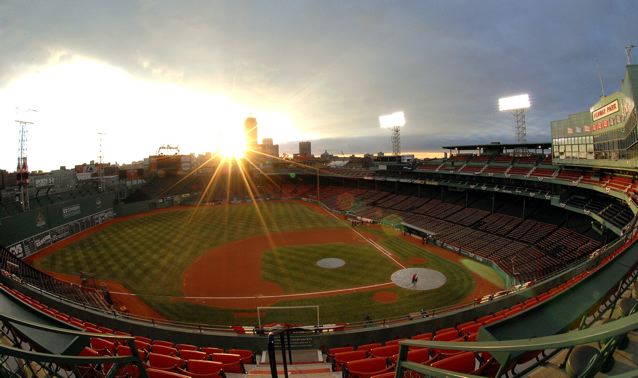
| Baseball Beat | January 07, 2009 |
The Waiting is the Hardest Part
The waiting is the hardest part
Every day you see one more card
You take it on faith, you take it to the heart
The waiting is the hardest part
The Hall of Fame voting results will be announced on Monday, January 12. Five more days. For deserving candidates like Bert Blyleven, the waiting is the hardest part.
When you rank fifth in career strikeouts, ninth in shutouts, and 27th in wins (and 19th since 1900), you take it on faith that you will be elected to the Hall of Fame, just like virtually all of the pitchers immediately ahead of and behind you in these three categories. After being snubbed 11 consecutive times (and with only three more chances after this year), you take it to the heart when you're Only the Lonely and don't get the necessary 75 percent of the vote.
I don't think it is petty to suggest that the Baseball Writers Association of America, as a whole, has gotten this one wrong for a long time. Too long. Blyleven should have been inducted in his first year. Yes, he is that deserving. But if you want to reserve that honor for the Cobbs, Ruths, Wagners, Mathewsons, Johnsons, Gehrigs, Williamses, Musials, Mantles, Mayses, Aarons, etc., that's fine. I mean, it even took Joe DiMaggio a few attempts before he was elected. (The truth of the matter is that the Yankee Clipper didn't even have to wait what has since become a minimum requirement of five years once a player retires.)
The good news is that Blyleven is polling in the right direction.
YEAR VOTES PCT 1998 83 17.5% 1999 70 14.1% 2000 87 17.4% 2001 121 23.5% 2002 124 26.3% 2003 145 29.2% 2004 179 35.4% 2005 211 40.9% 2006 277 53.3% 2007 260 47.7% 2008 336 61.9%
I look for Blyleven to approach 70 percent this year. Every day you see one more card and it gives me the confidence that The Hall of Fame Case for Bert Blyleven is being understood by more and more voters. There is no denying the fact that he has been as dominant as his Hall of Fame contemporaries.
Thanks to Repoz at the Baseball Think Factory, we can actually see how well Blyleven is doing among the approximately 14 percent of the precincts that have been reported at this point.
% on 74 Full Ballots
98.6 - Rickey Henderson
82.4 - Jim Rice
78.4 - Bert Blyleven
------------------------------
67.6 - Andre Dawson
48.6 - Jack Morris
33.8 - Lee Smith
27.0 - Tim Raines
25.8 - Alan Trammell
25.8 - Tommy John
21.6 - Mark McGwire
While Blyleven sits above the magic threshold now, the results of these published full ballots may overstate how he is faring among the larger electorate. As Repoz told me in an email, "the jobless/blogless/retired old codger vote that is still waiting for Harry Breechen's name to come up on the ballot" may not be as likely to vote for the likes of Blyleven. But we'll take it nonetheless.
Blyleven was named on 82 of the 126 full/partial ballots (65 percent) publicly announced last year compared to 62 percent of the 543 total ballots cast. According to Repoz, Bert has picked up eight new voters and lost two this year. The eight newbies are: Mark Gonzales, Dan McGrath, Phil Pepe, Bob Verdi, and first-time voters Tim Cowlishaw, Carter Gaddis, Jeff Jacobs, and Sean McClelland. Bill Kennedy and Mike Nadel are the two voters who apparently thought Blyleven wasn't as deserving this year as last. Blyleven may get a bump from the ESPN/USA/MLB.com blocks that should be released no later than Friday.
A large number of this year's partials are from the pro-Rickey Henderson/pro-Jim Rice articles where the voters make little or no mention of the rest of their ballot. Henderson, in his first appearance on the ballot, and Rice, in his final year of eligibility, are garnering the most attention. Amazingly, one writer, Dorky Corky Simpson, didn't see fit to include Rickey on his ballot. There's always someone, right? But, all is not lost as Simpson voted for Blyleven and another personal favorite of mine, Tim Raines. Heck, he even placed an "x" next to Matt Williams' name. That's right, Matt Williams but not Rickey Henderson. I kid you not.
In the case of Henderson, it's not whether he will get elected, it's whether he will break the record for the highest percentage of the vote total ever (currently held by Nolan Ryan and Tom Seaver with 98.8 percent). Like it or not, Rice looks as if he will receive the required 75 percent as well. Blyleven and Andre Dawson appear to be the only other candidates with any realistic shot this year with the former perhaps leapfrogging the latter for the first time.
The numbers game is working against Blyleven this year. According to Chris Jaffe of The Hardball Times, "In the last half-century, the BBWAA elected three players in only four elections. None of those votes (1972, 1984, 1991, and 1999) are good comps for 2009. On top of that, it's very difficult for two backloggers to win a plaque in the same year, so [Blyleven and Dawson] are unlikely to join Rice. In the last 30 years, there have been only four times more than one backlogger made it in."
If not in 2009, then one of the next two years is shaping up as a good opportunity for Blyleven to finally earn his due. While I would be in favor of Roberto Alomar and Barry Larkin in 2010 and Jeff Bagwell in 2011, I'm not at all convinced that any of these three players will make it in their first attempts. As such, Blyleven could be the odds-on favorite to have his day in Cooperstown in one of the following two summers, especially if he beats out Dawson this year.
Memo to BBWAA: Don't let this go too far. Memo to Bert: Don't let it get to you. While the waiting is the hardest part, it's going to feel like something from a dream very soon.
| Baseball Beat | January 02, 2009 |
Foto Friday #9: You Make the Call
Is the runner safe or out?
Oh, and who is the runner? While you're at it, who are the second baseman and shortstop? For bonus points, name the second base umpire.
As with all Foto Fridays, be sure to give the date, the names of the teams, and the location.
Have fun with it and best of luck.


| Baseball Beat | December 28, 2008 |
Obit: Nick Willhite, 1941-2008
Nick Willhite, a left-handed pitcher from the 1960s, died of cancer two weeks ago today at the age of 67. He made an impact on me as a member of the 1963 and 1965 Dodgers World Series championship teams when my Dad was covering the club for the Long Beach Press-Telegram.
In a brief career that spanned parts of only five seasons, Willhite's biggest achievement was tossing a five-hit, complete-game shutout against the Chicago Cubs in his major-league debut on June 16, 1963.
Here is the article as it appeared in the P-T after Willhite's debut.
Willhite Dazzles Cubs, Dodgers in SF TonightBy GEORGE LEDERER
Memo to Bo Belinsky:
You don't know what you're missing by refusing to go to Hawaii. Nick Willhite says he found some sharp curves on the Islands without visiting the beach at Waikiki.
Willhite, a 22-year-old left-hander, is the Dodgers' lastest pitching discovery and a good bet to remain in the starting rotation after breaking in Sunday with a five-hit shutout.
To the delight of 54,108 Father's Day patrons, including 45,239 paid, Willhite salvaged a split for the Dodgers by taming the Cubs 2-0 after Johnny Podres was routed in the first inning of the opener and lost 8-3.
As the Dodgers take off to start a nine-game trip in San Francisco, they are one game behind the Giants with a chance to take the league lead tonight. Sandy Koufax (9-3) will be facing Billy O'Dell (9-2) in the first of three televised games.
What promises to be the most challenging journey of the season also includes three games with the second-place Cardinals and three with the fourth-place Reds.
Off Sunday's performance, Willhite will be given serious consideration to start the St. Louis series Friday in place of Podres, who has a sore elbow. Podres retired only two Cubs and was given an injection of hydro-cortisone after leaving a 5-0 deficit to the bullpen mop-up crew.
"I was thrilled by the kid's performance," said pitching coach Joe Becker in evaluating Willhite's dominating debut. "He showed us so much improvement in his fast curve that it was hard to believe. He's certainly changed since spring training."
Willhite said he discovered the secret of throwing the fast curve "one night in Hawaii. It was in the third inning and from then on, I knew what I was doing." For proof, he went on to win his next six decisions to warrant his purchase from Spokane last Wednesday.
"I couldn't believe it when I was called up," said Willhite, "and I still can't believe that I won a shutout. No, the big crowd didn't bother me particularly. I was a little nervous, yes, but I was thinking mostly about the folks back home."
Back home is Denver, where Willhite was signed in the summer of 1959 by part-time Dodger scout Manuel Boody, who also signed Stan Williams. Coincidentally, Willhite is the first Dodger to pitch a shutout in his first start since Williams blanked the Cubs 1-0, June 1, 1958.
Boody is a sports writer for the Rocky Mountain News, which also must prove something in behalf of baseball writers.
Willhite only faced 32 Cubs, registered five of his six strikeouts in the first three innings, walked one and finished his work in one hour and 54 minutes.
"I always work fast," reported Willhite. "Last year I pitched a nine-inning game in an hour and a half. Doug (catcher Camilli) told me to slow down after the first five innings. He was afraid I might run out of steam."
Willhite earned a spot in the rotation with that sparkling performance and was 2-2 with a 1.93 ERA after his first five starts. However, the young southpaw got hit hard in his next three outings and was sent back down to Spokane. He didn't pitch another inning for the Dodgers that season, yet earned a World Series paycheck and ring for his contributions in June and July.
Unfortunately, Willhite's career never got back on track. He was sold to the Washington Senators after the 1964 season and repurchased by the Dodgers in May 1965. Willhite flirted with success for a brief moment when he combined with Ron Perranoski for a shutout of the Phillies in his second start with Los Angeles on June 19 (which just so happened to be Dad's 37th birthday). He started four more games but pitched mostly out of the bullpen the rest of the way, picking up a "save" in the final game of the regular season.
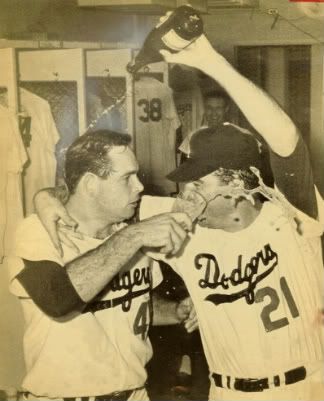 The adjoining photo of Willhite (left) and Jim Brewer is from Dad's archives and was taken after the Dodgers clinched the 1965 National League pennant on the second-to-last day of the year. Like Willhite, Brewer died a young man, one day before his 50th birthday in 1987. (In the department of it's a small world, Dad passed away in 1978 at the age of 50.)
Willhite only pitched six more games for the Dodgers after that, finishing up his big-league career in 1967 with the Angels and Mets. His last appearance in the majors was exactly four years and a week after he threw a shutout in his first game. Sadly, he was washed up at 26, perhaps due to a drinking problem that led to three divorces and life on the streets of Salt Lake City as a drug and alcohol addict.
When Willhite was 48 and with "no money, no car, no nothing," he reached out to his former teammate Stan Williams, who put him in touch with the Baseball Assistance Team (BAT), which helps former baseball players in need. As New York Times columnist Dave Anderson tells the story, "Two days later, Willhite was on his way to entering an alcohol-abuse rehabilitation center in Fort Collins, Colo."
Willhite became a drug-addiction counselor and reunited with his six children and six grandchildren. He died at one of his son's homes in Alpine, Utah. Willhite was buried at the Alpine City Cemetery in Pleasant Grove, Utah.
| Baseball Beat | December 23, 2008 |
Q&A with Dave Studenmund: The Hardball Times Baseball Annual
Dave Studenmund and I broke into the baseball blogosphere at about the same time in 2003. We became fast friends and have provided guest columns for each other's sites or books. As destiny would have it, I've actually known Dave's older brother Woody for much longer than six years. You see, Woody, my older brother Tom, and I first met in 1975. The three of us had teams in the Greater Los Angeles APBA Association, meeting in face-to-face competition once or twice annually from the mid-1970s through the early- to mid-1980s.
If not for the roll of the dice (so to speak), I may not have met Woody, who is also a charter member of the Northeast League, the longest-running baseball table-game league, way back when. But I'm glad I did. I learned a lot about APBA through my association with him and have continued to add to my knowledge of baseball via my friendship with Dave. While growing up, the Studenmunds spent their summers in Cooperstown. Dave and Woody both have bricks with dedications inscribed at Doubleday Field in Cooperstown, and I was able to take photographs (here and here) of them during my trip to the Hall of Fame last spring.
Dave has been involved with The Hardball Times site since its formation in 2004 and has been producing The Hardball Times Baseball Annuals for the past five years. These books have become an indispensable part of my baseball library, and I eagerly await the newest edition each year just as I once did with the Baseball Abstracts.
Well, I received the 2009 version a couple weeks ago and have enjoyed it immensely. I've read most of the articles and leafed through the multitude of statistics contained in the book. I plan on spending more time this winter digesting the stats in even greater detail. In the meantime, I had the good fortune of chatting with Dave about the latest Annual. Grab a cup of coffee and pull up a chair.
Rich: Congratulations, Dave. The Hardball Times Baseball Annual has become the 21st-century version of The Bill James Baseball Abstracts of the 1970s and 1980s, combining timeless commentary with insightful analysis and innovative stats. You know that I'm a big fan of the Baseball Abstracts so comparing THT Annuals to the Abstracts is big praise indeed.
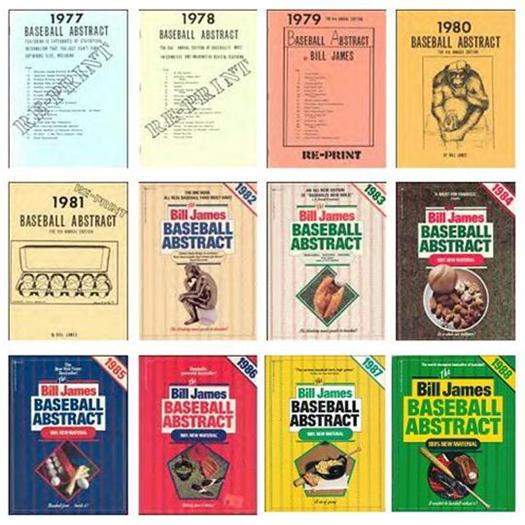
Dave: Wow, Rich. Thank you. Yes, that is high praise. And, since we're in the online world now, you won't have to abstract the Annuals in the future. Good thing, huh?
Rich: Whew.
Dave: Obviously, the Abstracts were our model. The biggest difference in what we're doing is that we don't have Bill's voice in the Annual -- in fact, we don't have one consistent voice in the Annual. I like to think that we've turned that into a positive by recruiting the best baseball writers we know, from the general media and from the Internet and blogging world.
There may not be a new Bill James, but there are a lot of terrific writers out there, and we've made the Annual a showcase for them. At least, that's our goal.
Rich: You've called this year's THT Annual the best ever. What compels you to make that claim?
Dave: Over the summer, we ran an online survey to get feedback from readers of the Annual, and we made some specific changes to the Annual in response. Obviously, the articles are the biggest reason people buy the Annual, so we increased the content from 32 articles to 40. We changed the format of the Division Reviews (we call them Division Views now) to allow more commentary from the writer, and less need to "cover" events. We also focused our statistics section better than in the past. Got rid of the leaderboards and some extra stuff, and focused on our unique batted ball stats.
Rich: Tell us about some of the writers you recruited this year.
Dave: I think the lineup of writers for this Annual was the best yet. We had two tremendous articles from Craig Wright, for instance. Craig is a well-known sabermetrician and a great writer, and the Annual really benefited from his two pieces. Joe Posnanski and Tim Marchman also contributed to the Annual for the first time. And I'll stop there because I think we had a lot of great essays from fantastic writers, and I don't want to be accused of singling anyone else out.
Rich: One of the staples of the Annual is your "Ten Things I Learned This Year." Let's talk about a couple of them. Thanks to you, I learned that the change from 2007 to 2008 was the biggest one-year age decrease in major league history. What's at work here?
Dave: The biggest factor was the resignation, forced or otherwise, of some great older players like Barry Bonds, Mike Piazza and Roger Clemens. The Giants got over three years younger last year by jettisoning Bonds and having Tim Lincecum post a dominant season.
The success of the Rays and other young teams, such as the Twins, was another factor in the youth movement. The Twins, by the way, also got much younger because of the Johan Santana trade. Just about every team got younger. It was amazing, really. This trend has been building for a couple of years, but it exploded in 2008.
Rich: While Major League Baseball players are getting younger, teams that boast lots of young players don't get the respect that perhaps they should. Do you think Tampa Bay's success last year will help change things?
Dave: Well, I would like to think so, but who knows? There is a deep, steadfast belief in the value of veteran talent. It's understandable, but it's overdone.
When you read that the Yankees "lived or died" with young pitching last year, you see that the emphasis on veterans will continue. I wonder, really, is young pitching really that much more variable than old pitching? Injuries did the Yankees in last year, but somehow their young pitchers got blamed, at least in some columns I read.
Rich: Speaking of Bonds, Piazza and Clemens, Joe Posnanski wrote about the Hall of Fame Class of 2013. Controversies or not, this class, which also includes Craig Biggio, Sammy Sosa, and Curt Schilling, is one of the best ever. Maybe the most talent since the inaugural class of 1936 when Ty Cobb, Babe Ruth, Honus Wagner, Christy Mathewson, and Walter Johnson were elected.
Dave: Yes. Bill Chuck, who writes the daily Billy-Ball column, was the first person who mentioned this, that I know of. It seemed like an obvious subject to tackle in the Annual, and Joe seemed like the perfect person to cover it.
It's amazing when you think about it. If not for the pall of steroids, you would see a fantastic Hall of Fame class in 2013. On the other hand, if not for steroids, I don't think all of these players would have retired at the same time.
Rich: Poz also added Pete Rose as a bonus seventh inductee. Rose was mentioned two other times in The Hardball Times Baseball Annual. Do you think he belongs in the Hall of Fame?
Dave: No. It seems like a pretty straightforward judgment to me, clearer than any judgment related to steroids.
Rich: As it relates to Piazza, Craig Wright contributed "Piazza, Hall of Fame Catcher" as one of his two fine articles.
Dave: Yeah, I love that article. Craig actually originally wrote it for his subscribers (you can get a regular article from Craig during the year from his website, the Diamond Appraised...I recommend it highly), but he added the extra bit about Piazza's defense for the Annual. I thought he delivered a good argument that Piazza really made his pitchers better, even though he hurt them with his throwing arm (a topic that was well-covered by Tom Tango in last year's Annual).
Rich: Rob Neyer wrote a well-researched piece about "Trades of the Midseason," comparing the CC Sabathia and Manny Ramirez deals to those of yesteryear (including Carlos Beltran in 2004, Fred McGriff in 1993, and Rickey Henderson in 1989, to name three during the past 20 years). A fourth, Rick Sutcliffe in 1984, went on to win the NL Cy Young Award with the Chicago Cubs. There were also a couple involving the Alexanders: Grover Cleveland in 1926 and Doyle in 1987. Both of these midseason acquisitions carried their new teams into the World Series. Although many of the big midseason trades took place before the advent of free agency, I can't help but think we will see more of the CC and Manny (and even Mark Teixeira) type deals in the years ahead.
Dave: You're probably right, Rich. This also seemed like a natural subject to cover, given what an impact CC and Manny had on their teams, and Rob seemed like the natural guy to cover it. Sometimes, when I ask someone to write for us, I'll just say "write whatever you want." Other times I'll ask them to cover a specific subject. I hadn't asked Rob to write about a specific subject before, but this seemed right up his alley.
The insight that Rob brought is that these two trades weren't quite as unique as they seemed during the year. Given baseball's rich history, I should have expected that.
Rich: I always enjoy Steve Treder's stat facts that are attached to each of the team sections. Heck, those 360 tidbits are almost worth the price of the book.
Dave: We've always had a lot of stats in the back of the book, and I've worried that most readers won't plow through them and understand what they say. To me, they're full of gold. So I sent an email out to THT's writers last year, asking if they'd be willing to write stat facts for a team or two. Steve stepped up and said he'd be willing to do them for all teams! You could have knocked me over with a feather, because that's a time-consuming task.
He did so well, that I asked him to repeat them for this year's Annual, and he did it happily (and well!). Steve and I are the only two people who have been involved with THT continuously from the very beginning. It's a joy to work with him.
Rich: Let's discuss some of the advanced stats used in the Annual. You claim that Base Runs is the best run estimation formula, better than Bill James' Runs Created. It seems to me that there is a tradeoff between the simplicity of the original RC formula and the accuracy and complexity of something like Base Runs. Call it fast food vs. fine dining, if you will.
Dave: Yes, I struggle with the "simple vs. correct" issue all the time. I loved the original Runs Created formula. (In my head, it's simply OBP times total bases. I used to use it all the time when the best stats in the world were the Tuesday and Wednesday stats in USA Today.) But James hasn't used the original Runs Created formula in years. If you're going to run with a complicated formula, Base Runs is better.
Rich: Win Probability Added (WPA) is gaining more acceptance, partly due to the fact that Fangraphs is publishing this information in real time. It is my feeling that WPA does a great job in measuring a player's contribution to his team's probability of winning and that more emphasis should be placed on this metric in voting for individual awards at the end of the season.
Dave: As you know, I'm a huge WPA fan. But I'm more of a fan because of its unique perspective, and the way it tells a "story." WPA is the quantification of the game story. I actually invented those WPA game graphs that Fangraphs runs, and I'm pretty proud of them. I think they're the perfect use for WPA.
Rich: Wow, I knew you were Mr. Baseball Graphs but hadn't realized that you invented those WPA game graphs. Good job.
Dave: Thanks, Rich. When it comes to individual awards, I'd consider WPA as well, primarily because of their "story" value. Many MVP writers want to reward the "story" of the season and WPA is one of the best stats for capturing that.
By the way, I owe a big thanks to David Appelman of Fangraphs for contributing his WPA stats to the Annual.
Rich: With James in mind, he created Win Shares a half dozen years or so ago. You have taken Bill's creation a step or two further with Win Shares Above Bench. Please explain these differences.
Dave: You know, Bill has updated Win Shares, though he hasn't published anything about it yet. In particular, he's added Loss Shares to the system, a very important change. If you think about Win Shares, you realize that you've got to know Loss Shares too, to really get the full picture of a player's value. It's related to playing time -- a player who racks up more Win Shares in less time played has been more valuable. Loss Shares fill in the playing time picture.
That's the same thing Win Shares Above Bench does. I take the total plate appearances, innings in the field and innings pitched by each player and translate those into "games" (from a Win Shares perspective). Loss Shares is simply my games calculation minus Win Shares.
Win Shares Above Bench is the number of Win Shares above a certain winning percentage (usually around .350, though it varies for starting pitchers). So WSAB achieves the same thing that James' Loss Shares achieve.
Bill has posted a couple of Win Shares and Loss Shares totals in articles on his site. For one player (Alan Trammell, I think), he had the exact same figures I had. For another player (Ozzie Smith?), we differed a bit, but we were close. That made me feel good about WSAB.
Rich: John Burnson's Playing Time Constellations made another appearance this year. The book devotes ten pages to graphs for every major league team. With 30 seconds of reading and understanding how these constellations work, one can easily see who played what position throughout the season for each team in the majors.
Dave: Yeah, that's another one of my favorites. John does great things with graphs, and I think the Playing Time Constellations are a perfect use of graphics. We list games played at each position in the Annual, but John's constellations graph who played where and WHEN. It's a dynamic chart, capturing the dynamics of the season. I don't follow every team as well as I'd like to, and things like John's constellations fill in some of the gaps in my knowledge. I really appreciate John's contributing those graphs to the Annual.
Rich: The Batted Ball Results may be my favorite. I don't need to know much more than the batted ball hitting and pitching stats, especially in conjunction with strikeouts and walks as a percentage of plate appearances. Give us a couple of good examples of how this information can enlighten the masses.
Dave: I'm pretty proud of the batted ball stats -- though I don't really know how well they're read or understood. I appreciate your feedback.
They're a whole 'nother way of looking at baseball stats, but I think they're simple to read and understand. As you know, the hitters' lines and pitchers' lines are formatted exactly the same way, so the format consistency should help a lot, I think.
Just using the Cubs as an example, I see that Aramis Ramirez was 31 runs above average creating runs, but 11 of those were the result of plate discipline and only 10 were the result of flyballs. That's a big turnaround for the guy, and I don't know if it bodes well for his future, particularly because he's an extreme flyball pitcher (48% of batted balls were flies).
Another example: Carlos Marmol had a great year, 26 runs "allowed" less than average. That's primarily because only 10% of his batted balls were line drives -- the major league average is 20%. That's a remarkable record. He was -16 in line drives alone. I wouldn't expect him to repeat that next year, though he'll still probably be better than average at "not allowing" line drives. In 2007, 16% of his batted balls were line drives.
Rich: I noticed that Sisyphus received a couple of shout outs, which gave me an opportunity to brush up on my Greek mythology. Is there anything Sisyphean about The Hardball Times Baseball Annual?
Dave: Every year, when I send the final PDF out to ACTA for publication, I swear I'll never do it again. Creating the THT Annual is a huge process. It begins during the season and pretty much consumes me from mid-September to mid-November. For the first month, I pore over the stats and graphs. I think there are over 250 tables of stats and over 40 graphs. I create each one and typeset them.
The second month is spent working with the writers and editors, then typesetting the articles. It's a mess, but I've got a lot of people helping push that rock up the hill. I've got to specifically mention the book's editors: Bryan Tsao, Joe Distelheim, Carolina Bolado and Ben Jacobs. I think you know that THT edits all its online articles too, and that doesn't stop while we create the book. Those guys are doing double time.
Rich: I know it is a matter of economics but perhaps you can explain why readers should order THT Annual from ACTA Sports rather than Amazon or other online booksellers.
Dave: The publishing business is not a high-margin business. We create the book mostly for the thrill of it, but we also hope to raise some money to support the site. And we don't make much money at all when people buy the book through Amazon. The difference between the Amazon price and the ACTA price goes almost exclusively to THT, to pay our costs and our writers. So buying from ACTA is a way of supporting THT. This is only true, by the way, if you use the link on our home page -- not if you go directly to the ACTA site yourself.
I know that not everyone can afford to support THT in this way, but please think about it.
Rich: As a contributor, one can call me biased. But I truly believe THT Annual offers all baseball fans -- from the casual to the most advanced -- an informative and entertaining book that will provide countless hours of enjoyable reading this winter and beyond. Do you have any final thing to add?
Dave: You said it well, Rich! One thing I've noticed is that we haven't gotten a lot of coverage on the Internet, at least not compared to previous years. Perhaps we've gone overboard and recruited too many Internet writers to the book -- so they can't blog about it because that would be a conflict of interest! Ah, the price of success.
| Baseball Beat | December 21, 2008 |
'Twas the Week Before Christmas...
...when all through the baseball world
Not a deal was stirring, not even a minor one;
Mark Teixeira and Manny Ramirez hung out by the bank with care,
In hopes that the Red Sox, Angels and Dodgers soon would be there;
Scott Boras was nestled all snug in his bed,
While visions of money danced in his head.
Without much to report, I point you to an interview I granted Joseph Decaro, owner/site manager of Mets Merized Online. The second-most famous Joe D. in New York asked me a half dozen questions.
Here is my long-winded answer as to whether the current system is fixed:
Q: The Yankees just spent almost $250 million in two days by signing C.C. Sabathia and A.J. Burnett. There are several reports that they will secure either Mark Teixeira or Manny Ramirez as well. Is it time to fix the system?
A: The Yankees fixed the system a long time ago. Just kidding. Look, as a capitalist, I'm totally fine with a team like the Yankees paying a gazillion dollars for guys like Sabathia and Burnett. However, baseball isn't a true free market. It's a closed economy. A private country club, if you will. For example, if you and I wanted to put a new team in New York, Major League Baseball wouldn't allow it. Therefore, it's not a free market at all. The truth is, there should be more than just two teams in the New York City area. At least three. Maybe four or even five. Think about it for a minute. If there were several teams in New York dividing up the fan base, corporate market, and broadcasting revenues, the Yankees' and Mets' competitive advantage would dissipate in a hurry.
On the one hand, the baseball fan in me doesn't want more teams in New York and fewer franchises in smaller markets around the country. On the other hand, I don't like the fact that the large-market clubs have more resources than everyone else. The solution to this dilemma is that the playing field needs to be leveled one way or the other. Major League Baseball can accomplish this via a free market approach or by capping payrolls at a much lower level and/or re-distributing revenues to a much greater degree. Unfortunately, the New York, Los Angeles, and Chicago teams are never going to allow the first or third ideas, and the MLBPA won't even hear of the second. Therefore, like it or not, we're just going to have to learn to live with the way things are now (or at least something close to it).
You can read the entire Q&A here.
Happy weekend to all, and to all a good night.
| Baseball Beat | December 16, 2008 |
We Shall Not Be Saved
Phil Wood, the co-host of Talkin' Baseball on Radio America, invited me to be a guest on the network's show last Sunday. The purpose of the interview was to discuss an article ("We Shall Not Be Saved") that I had contributed to The Hardball Times Baseball Annual 2009, which is available directly from ACTA today.
A replay of the interview is available via podcast for your listening pleasure. Wood, the host of the program Tim Donner, and I discussed relief pitchers, the whys and wherefores of saves, optimal usage of closers/firemen, and various metrics to evaluate bullpen performance. This segment is 15 minutes long and starts about halfway through the first hour of the show. You can pull the button to the midway point when Donner mentions the Mets adding two closers and the Indians signing Kerry Wood before introducing me.
The following excerpts from my article give you a flavor for the content of our discussion.
Before 1969, a save was either something Jesus did or a hockey statistic used to measure the value of goaltenders. In fact, the two were mixed in a famous bumper sticker that could be found on cars of Boston Bruins hockey fans of that era: “Jesus saves! And Esposito scores on the rebound!”Phil Esposito, who led the NHL is scoring in five out of six seasons during the late 1960s and early 1970s, would plant himself in the slot near the net and score goals from all angles. The big center won the Hart Memorial Trophy as the MVP of the league twice and was inducted into the Hockey Hall of Fame in 1984.
Forty years ago, there was no mention of the word “save” in Major League Baseball’s rules book. That’s right, the save, which was the brainchild of sportswriter Jerome Holtzman, didn’t become an official statistic of MLB until 1969. It was the game’s first new statistic since the 1920 introduction of runs batted in (RBI).
I defined the save as detailed in 10.19 of the Official Rules of Major League Baseball, excerpted a classic article written by Holtzman that appeared in Baseball Digest in May 2002, and quoted Roland Hemond, Steve Stone, and Bud Selig as to the legendary writer's importance on relievers. Interestingly, Holtzman later told Chicago Sun-Times columnist Bill Gleason that he was "sorry he'd come up with the (save) concept" because "it wasn't necessary." Imagine that!
Another way to illustrate how the usage of top relievers has changed over the past four decades is to compare firemen of the past, such as Hall of Famers Rollie Fingers, Bruce Sutter, and Gossage, all of whom pitched predominantly in the 1970s and 1980s, with Trevor Hoffman, the all-time career saves leader who made his mark in the 1990s and the first decade of the current century.To wit, of Fingers' 341 career saves, 135 (or nearly 40 percent) entailed pitching two or more innings, including 36 of three or more innings. Sutter and Gossage recorded 130 and 125 saves (or 43 and 40 percent), respectively, of two or more innings. Hoffman, on the other hand, has earned just seven saves (or 1.2 percent) of two or more innings out of a total of 554. Only two of his saves have exceeded two innings and none have been as long as three innings.
[Gabriel] Schecter reported that Sutter, in a matter of 39 days (from May 27 through July 4, 1984), had “more saves (nine) where he pitched at least two innings than Hoffman has in his whole career. Gossage did the same thing from Aug. 15, 1980, through the end of that season, and Fingers accomplished it in a 53-day stretch in 1979.”
As Schecter pointed out, “The earlier pitchers acted as their own setup men. These firemen put out the fire and cleaned up after themselves.”
Similarly, Fingers was credited with 101 of his saves (30 percent) when he entered the game with either the winning or tying run on base, while Hoffman has pulled off this feat in only 36 of his saves (less than 7 percent) and only once in the past seven years.
The biggest difference between yesteryear’s firemen and the current crop of closers is the number of times they enter the game to start the ninth inning with no runners on base, “the easiest situation for a reliever to face,” according to Schecter, “even with just a one-run lead.” Thanks to Tom Ruane of Retrosheet, “if the home team starts the ninth inning with a one-run lead, it will win roughly 85 percent of the time ... Start the ninth inning with a two-run lead, and you’ll win about 93 percent of the time; with a three-run lead, it jumps to a 97 percent win rate.”
Hoffman has been used in the latter situation 142 times over the course of his career, while Fingers (11), Sutter (16) and Gossage (14) were rarely used in this manner.
I also covered optimal usage patterns, quoting Bill James from The New Bill James Historical Baseball Abstract and Whitey Herzog in You’re Missin’ a Great Game.
James argued that “when you’re defining the most effective use of your closer, you should START with the tie games. That is when the impact of a run saved is the largest, when the game is tied. If the manager wants to win as many games as possible, he can get a lot bigger bang from his relief ace by pitching him in tie games than he can by pitching him with a three-run lead--eight times bigger. As percentage baseball goes, 800% is a big percentage.”
Herzog wrote, “It’s better to have your closer go two innings every other day than one inning every day.”
After discussing newer and better metrics to judge relievers, including Win Probability Added (WPA) and Fielding Independent Pitching (FIP), I concluded my essay by stating, "When it comes to measuring relievers, there’s a lot more to consider than just the raw number of saves recorded. Even Jerome Holtzman, save his soul, would agree with me on that point."
Be sure to order The Hardball Times Baseball Annual 2009. While you're at it, pick up a second book for your dad or another baseball fan in your family. It will make an excellent holiday present for you and your loved ones.
| Baseball Beat | December 11, 2008 |
The 2008 Winter Meetings in Review
With the 2008 Winter Meetings concluding today, we thought it might be worthwhile to provide a recap of the week's activities with our comments added to each of the transactions and announcements.
Monday, December 8
Arbitration: Of the 24 players who were offered arbitration by their teams, only Cincinnati RHP Dave Weathers and the Angels LHP Darren Oliver accepted prior to Sunday night’s deadline.
Comments: Nine days ago, we called offering arbitration to the Type B Weathers "a low-risk move," noting that he made $2.75M last year. We added, "The 39-year old is unlikely to get more than $3M in 2009 unless the arbitrator focuses on his 3.25 ERA rather than the fact that he gave up more hits than innings pitched and had just a 2:1 strikeout-to-unintentional walk ratio (1.5:1 including IBB)." As a Type A, Oliver would have faced resistance from other teams not wishing to part with two draft picks for an aging lefthanded reliever.
Retirement: Four-time Cy Young Award winner Greg Maddux held a press conference to announce his retirement.
Comments: Maddux was not only one of the top two pitchers of the past 20 years but one of the ten greatest of all time. He was at his best in the 1990s, fashioning back-to-back ERAs of 1.56 and 1.63 in 1994 and 1995, in the 2s in five of the other eight seasons, and a decade-high of 3.57 in 1999.
As Lee Sinins reported in his daily Around the Majors report, "Maddux is fourth on the career Runs Saved Above Average (RSAA) list since 1900."
1 Roger Clemens 732 2 Lefty Grove 668 3 Walter Johnson 643 4 Greg Maddux 552 5 Randy Johnson 533 6 Grover C Alexander 524 7 Pedro Martinez 493 8 Christy Mathewson 405 9 Tom Seaver 404 10 Carl Hubbell 355
Hall of Fame: Joe Gordon was named to the Hall of Fame by the Veterans Committee.
Comments: While Gordon may have been a deserving choice, there were many others – including Bill Dahlen and Sherry Magee from the pre-1943 era and Ron Santo from the post-1943 ballot – who were ignored despite having stronger cases and at least one under-the-radar star who wasn't even considered. More than anything, thank goodness that Allie Reynolds, who came up one vote shy of election, will not be included in the Hall of Fame class of 2009.
Trade: The Rangers traded C Gerald Laird to the Tigers for minor league RHPs Guillermo Moscoso and Carlos Melo.
Comments: Laird, who is two years from becoming a free agent, gives Detroit an inexpensive defensive catcher who can also hit for occasional power. At 25, one has to discount Moscoso's eye-opening strikeout and walk rates last season when he whiffed 122 while allowing only 21 free passes in 86 2/3 innings in High-A and Double-A. Meanwhile, Melo hasn't even turned 18 yet. He struck out 61 batters in 49 innings in the Dominican Summer League.
Signing: The Tigers signed free agent SS Adam Everett to a one-year, $1 million contract plus incentives.
Comments: Everett may be the best defensive shortstop in baseball. He can't hit a lick but saves enough runs to be a decent option at a base salary that is only about a half million dollars above the minimum.
Tuesday, December 9
Signing: The Mets signed RHP Francisco Rodriguez to what is essentially a four-year, $51 million contract (including the vesting option that is likely to be triggered).
Comments: This move was the biggest lock of the winter. K-Rod was the highest-profile name in an eclectic group of closers that includes Brian Fuentes, Kerry Wood, and even John Smoltz. The Mets had the need and the money to step up on Frankie, who set the single-season record for saves (62) in 2008.
The Angels can replace Rodriguez with Jose Arredondo, who has the stuff, if not the experience, to step into the closer's role. Of importance, the Halos will receive New York's first-round draft slot plus a compensatory pick. These selections can be used to rebuild a farm system that is no longer one of the best in baseball.
Trade: The Orioles traded C Ramon Hernandez to the Reds for utilityman Ryan Freel and minor league 2B Justin Turner and 3B Brandon Waring.
Comments: This trade makes sense for both clubs as the Reds are not giving up a lot for a veteran catcher who can still hit even though his defense is not what it once was. In the meantime, the Orioles are making room for Matt Wieters, who was named Baseball America's Minor League Player of the Year in 2008. However, don't be surprised if Baltimore picks up another catcher for April and a possible mentor for Wieters once the youngster is brought up to the majors (which likely won't be out of spring training as the club does its best to hold him back to delay his free agency by an extra year).
Signing: The Dodgers re-signed 3B Casey Blake to a three-year, $17.5 million contract with a team option for 2012 and signed INF Mark Loretta to a one-year, $1.25 million contract.
Comments: Blake is 35 years old and is unlikely to play a passable third base for all three years. Moreover, he doesn't hit well enough to warrant a full-time position at first base or as a corner outfielder. As a result, I couldn't be more confident that this signing will come back to haunt the Dodgers, perhaps as early as this season and certainly no later than next. Loretta, on the other hand, makes sense as a much cheaper solution to Nomar Garciaparra and as a backup in case Blake DeWitt doesn't pan out at second.
Wednesday, December 10
Announcement: The Baseball Writers Association of America voted to include Internet-based writers Will Carroll and Christina Kahrl from Baseball Prospectus and ESPN's Keith Law and Rob Neyer.
Comments: Congratulations to Will, Christina, Keith, and Rob. I went to bat for Neyer last year and am extremely happy that he was admitted this time around. He makes the BBWAA a better organization. Now that the wall has been torn down, it's imperative that Baseball America's Jim Callis be included in the next group of web-based members.
Signing: The Yankees signed LHP CC Sabathia to a seven-year, $161 million contract. Sabathia has the right to opt out of the contract after the third year.
Comments: The Yankees got the big one in more ways than one. While there is no doubt that Sabathia is an outstanding pitcher and citizen, the number of years and total cost seem outlandish to me and apparently to the competition as it is uncertain as to whether any other club was even in the ballpark in terms of length and value.
Speaking of ballpark, the Steinbrenners can thank the New York taxpayers for chipping in with hundreds of millions of dollars to build the new Yankee Stadium in order to pony up nearly a couple hundred million to sign one player – and a 300-pound pitcher at that! And you wonder why I'm against public funding of stadiums? Unbelievable!
Trade: The Rays traded RHP Edwin Jackson to the Tigers for OF Matt Joyce.
Comments: Both teams were dealing from strength and trying to shore up weaknesses. While the consensus appears to believe that Tampa Bay GM Andrew Friedman fleeced Detroit GM Dave Dombrowski, I'm not so sure. Jackson, who throws a 94-mph fastball, has the potential of taking it up a notch or two as a starter if he can develop his secondary pitches. Otherwise, he's not the worst option in the world as a reliever who can come in and throw heat for an inning. Joyce (.252/.339/.492) can hit for power but strikes out at an alarming rate (23.5% rate in the majors and 27.3% in the International League last year). There are also questions as to whether he can hit lefthanders consistently. As such, the 24-year-old Joyce may be limited to a platoon role with the Rays.
Trade: Seattle's GM Jack Zduriencik made his first trade last night, a three-team, 12-player transaction in which the Mariners obtained RHP Aaron Heilman, OF Endy Chavez, LHP Jason Vargas, and minor league 1B Mike Carp, RHP Maikel Cleto, and OF Ezequiel Carrera from the New York Mets and OF Franklin Gutierrez from the Cleveland Indians in exchange for RHP J.J. Putz, RHP Sean Green, CF Jeremy Reed (all NY bound) and Luis Valbuena (to CLE). Cleveland also received RHP Joe Smith from New York.
Comments: In acquiring Chavez and Gutierrez, it appears as if Zduriencik values outfield defense highly. Chavez and Gutierrez are among the best left and right fielders, respectively, in the game. In a big ballpark like Safeco, outfield defense is at a premium. According to Baseball Prospectus, Chavez has been 13 runs above average per 100 games in left field, while Gutierrez has been 10 runs above average per 100 games in right field over the course of their careers. Gutierrez, who won a Fielding Bible Award this past season, led all right fielders in Plus/Minus with +29 in 2008 in only 97 games and +20 in 2007 in 88 games.
With Rodriguez and Putz in the fold, the Mets have significantly improved their bullpen since learning that closer Billy Wagner will miss the 2009 season. However, it's also possible that Putz could be moved in another deal as he views himself as a closer and not a set-up man. In the meantime, Heilman wants to start and may get the chance in Seattle that wasn't coming in New York.
Green, a sinker/slider type, and the submarining Smith are interesting in that they are bullpen specialists who have a knack for inducing groundballs and getting righthanded batters out. They ranked seventh and eighth in GB% last year among pitchers with 60 or more innings.
Thursday, December 11
What will the final day of the meetings bring? One source has the Yankees trading Melky Cabrera to the Brewers for Mike Cameron. While Cabrera (.268/.329/.374 in 415 career games) didn't turn 24 until August and has the potential of becoming a better player over time, the fact of the matter is that he has never slugged even .400 in any of his three seasons. It would be one thing if Melky were an on-base machine but he barely put up a .300 OBP last year. Cameron, on the other hand, gives the Yankees better on-base, slugging, and defensive skills in center field. The soon-to-be 36-year-old, who will make $10 million this season, hit .243/.331/.477 while slugging 25 home runs in 120 games in 2008. He is the perfect stopgap for Austin Jackson, a prospect I ranked as the eighth-best 21-year-old last February.
In the meantime, the Yankees are also confident they have the highest bid for A.J. Burnett and still in the mix to sign Derek Lowe. Andy Pettitte and Ben Sheets remain shorter-term options if New York is unable to sign Burnett and/or Lowe.
The Rule 5 Draft takes place today. You can check out Marc Hulet's sneak preview of the best hitters and pitchers available. Look for RHP Eduardo Morlan of the Tampa Bay Rays to be taken early. The former Twins prospect turns 23 in March and can be brought along slowly in the early going as he learns to adapt to the big leagues with a fastball that no longer touches the mid-90s. He has the stuff and the credentials (10.71 K/9 in 321 MiLB innings) to eventually pitch at the back end of games.
The Winter Meetings make for a great handful of days of baseball news. As Paul DePodesta wrote on his blog last weekend, "It's an intense time and probably the most unhealthy stretch of the year - no fresh air, very little sleep, lots of room service, and an emotional rollercoaster. It's the best. I'm going first thing in the morning."
You gotta love it.
Update: Here are the complete results of the Rule 5 Draft (including MLB, Triple-A, and Double-A phases). The names of players are linked to their pages at MiLB.com.
| Baseball Beat | December 09, 2008 |
If Gordon, Then Why Not Grich?
If you're reading about baseball and come across the abbreviation "GG," what do you think of? Gold Glove, right? I mean, that's what would occur to me.
That said, there are two comparable second basemen in terms of hitting and fielding whose last names start with the letter "G," and, to be honest, I can't think of one without the other. The GGs in this case are Joe Gordon and Bobby Grich.
Gordon was elected to the Hall of Fame yesterday. He was named on 10 of 12 ballots by an odd Veterans Committee charged with the responsibility of reviewing ten candidates who began their careers prior to 1943.
I am happy for Gordon, who died in 1978, and his children. He was an outstanding player for the New York Yankees and Cleveland Indians from 1938-1950. Gordon was named the American League's Most Valuable Player in 1942 and played in nine All-Star Games and for five World Series champions.
Gordon's induction should open up the doors to Cooperstown for Grich. Not to take anything away from Gordon but Grich was every bit as good as the Hall's newest member, both defensively and offensively. If you don't believe me, then stick around and take a look at the facts.
Let's start off with their basic counting stats:
G AB R H 2B 3B HR RBI SB CS BB SO
Gordon 1566 5707 914 1530 264 52 253 975 89 60 759 702
Grich 2008 6890 1033 1833 320 47 224 864 104 83 1087 1278
Grich had 1684 more plate appearances than Gordon. The extra playing time should be viewed in a positive light but, in all fairness, it must be pointed out that Gordon missed the 1944 and 1945 seasons while serving in the U.S. Army during World War II. As such, he may have lost out on about 1275 plate appearances (his combined total in the previous two years).
Given the disparity in opportunities, it may be instructive to examine their career rate stats:
AVG OBP SLG OPS+
Gordon .268 .357 .466 120
Grich .266 .371 .424 125
As shown, Gordon and Grich had similar batting averages while the latter had a better on-base percentage and the former had a superior slugging average. However, it is important to note that Gordon played during an era of higher offense than Grich. For example, the league-wide, park-adjusted averages during Gordon's career were .271/.350/.395. The only major difference between Gordon and the league average was in SLG where he out-slugged his fellow players by .071. On the other hand, the league-wide, park-adjusted averages during Grich's career were .258/.324/.384. Grich outperformed his peers across the board with significant advantages in OBP and SLG.
While Gordon out-OPS'd Grich .823 to .795, Grich actually had a higher OPS+ (which adds context to OPS by adjusting for park factors and league averages) than Gordon (125 to 120). In other words, Grich was 25 percent and Gordon 20 percent better than average when normalized to the league.
Grich (164) also had a higher peak OPS+ than Gordon (155) and had more seasons in the 140s (two to none) and 130s (three to two). Grich, in fact, led the AL in OPS+ in 1981 in a 14-team league whereas Gordon's highest ranking was fourth in 1942 and 1947 in an 8-team environment.
The bottom line is that Grich had better counting and rate stats, as well as a higher peak, than Gordon.
Moving to the defensive side of the equation, Grich and Gordon were two of the best second basemen in the game's history. Using traditional fielding statistics, Gordon posted a .970 fielding percentage over the course of his career, leading the AL in assists four times and double plays three times. Grich had a .983 fielding percentage while leading the AL in assists, putouts, and double plays for three straight seasons. He committed only five errors and set a then major-league record with a .995 fielding percentage in 1973 when all 12 AL fields were grass.
Grich earned four consecutive Gold Gloves, tied for the seventh most among second sackers. Gordon may have also won multiple awards had he played in the Gold Glove era (1957-on). Although Boston's Bobby Doerr would have provided stiff competition, it doesn't take away from the fact that Gordon was one of the slickest fielders of his generation. In the book Win Shares, Bill James assigned Gordon and Grich with letter grades of "A" for their defensive work. It's hard to say with any authority that one was better than the other in the field. We'll say "too close to call" and rate them a push with the leather.
Speaking of Win Shares, this measure is as reliable as any other when combining offense and defense to compare two players such as Gordon and Grich. Let's take a look to see how they stack up in Win Shares:
Career WS Top 3 Top 5 Per 162
Gordon 242 31-28-26 134 21.07
Grich 329 32-31-29 143 26.54
No matter how you slice it, Grich tops Gordon when it comes to Win Shares. He had 36% more career Win Shares with better peak seasons and a much higher rate per 162 games. Whether your preference is quantity or quality, Grich gets the nod here.
Grich also compares more favorably to Gordon using Wins Above Replacement Player (WARP), a Baseball Prospectus stat designed to measure player value in terms of wins above a marginal big leaguer at the same position.
WARP3 Top 3 Top 5 Per 162
Gordon 94.2 11.5-11.1-10.6 53.3 9.74
Grich 123.9 11.8-11.6-11.0 55.6 10.00
If Grich bests Gordon offensively and hangs with him defensively while generating more career and peak value, then why doesn't he get the same respect as his fellow second baseman? Well, I believe it comes down to two things:
1. Gordon won a Most Valuable Player award and Grich never won an MVP.
2. Gordon played for five World Series champions and Grich never played in the World Series.
Gordon won the AL MVP in 1942 even though he finished fourth in Win Shares. In fact, he had FIFTEEN fewer Win Shares than Ted Williams, who just happened to capture the Triple Crown that season. Gordon hit .322/.409/.491 with an OPS+ of 155, while Williams hit .356/.499/.648 with an OPS+ of 217. Although Gordon had a great year, two of his Yankees teammates – Charlie Keller (34) and Joe DiMaggio (32) – had more Win Shares than he did that season.
In Grich's best offensive season, he finished FOURTEENTH in the MVP voting even though, like Gordon, he was fourth in Win Shares. In 1981, Grich led the league in home runs, slugging average, and OPS+ (did I mention that he was a second baseman?), yet a relief pitcher (Rollie Fingers) was named MVP and 12 of the 13 players who received more points than Grich were either pitchers or played a corner defensive position. Only center fielder Dwayne Murphy (.251/.369/.408), who placed three spots ahead of Grich in the voting, played one of the four up-the-middle positions.
If the truth be told, voters did a better job of evaluating the merits of middle infielders and catchers during the 1930s through the early 1960s than in the more modern era when a fixation on RBI has overpowered defensive position and value. It says here that Grich would have had a better chance of winning the MVP had his 1981 season taken place during Gordon's era and Gordon would have had almost no chance of winning his MVP had it taken place in Grich's era. Think about it for a second . . . Can you imagine a second baseman who didn't lead his league in any category other than SO (95) and GIDP (22) being named MVP in the same year when another player won the Triple Crown? Unfathomable.
Gordon also had the good fortune of playing in a smaller league and on more dominant teams than Grich. Gordon's teams won five World Series championships, whereas the clubs Grich played for went 0-5 in the American League Championship Series. As such, while Grich may not be perceived as a "loser," it is safe to say that Gordon is thought of as a "winner."
Maybe Grich will also get his due one day. If so, let's just hope that it doesn't take 58 years after the time of his retirement or 30 years after his death for him to be honored in Cooperstown along with Gordon, a fellow second baseman who, at best, was no better than Grich.
Correction: Grich won a World Series with the Baltimore Orioles in 1970 even though he did not appear in a World Series game that year.
| Baseball Beat | December 05, 2008 |
Another Addition to the Bert Blyleven Series
I received an email yesterday afternoon from my colleague Patrick Sullivan. The subject read: "Paging Mr. Lederer..." The body of the email had a link to a blog entry by T.R. Sullivan, the Texas Rangers beat writer for MLB.com. (Editor's note: the Sullivans are not related.)
After wringing my hands, I wrote back to Sully and said, "I'll tackle that one tonight for tomorrow. I can give T.R. Bert Blyleven's qualifications in one sentence."
However, before I do that for the umpteenth time, I believe it would be useful to provide excerpts from T.R.'s article. He has been covering the Rangers since 1989, first as a writer for the Fort Worth Star-Telegram and for MLB.com since January 2006.
The Hall of Fame ballot is supposed to be in the mail. I haven't received it yet but should shortly. Not sure on who I will vote for but no doubt others have their opinion.Really, you don't know for sure until you have the ballot in hand with pen at the ready and www.baseball-reference.com in front of you. Until then, you can only consider it in your mind. But it's not until you have the actual ability to check off somebody's name do you really know who you will vote for.
Some criterion:
1. I prefer - but don't demand - to see ten "Hall of Fame" years. That being ten seasons that were truly excellent years.
2. I prefer that a player's Hall of Fame credentials be spelled out in three sentences or less. Guys who need a full page to have their credentials explained lose me.
3. I like 20-win seasons and Cy Young Awards. I prefer guys who win games.
4. I like Gold Gloves. I know the Gold Glove Award can be suspect at times but I like players who were outstanding on both offense and defense.
5. I like the No. 100. As in 100 runs scored and/or 100 RBI. Look, you have to have some kind of cutoff point. 90 is good too. So is 18 wins. But I like 20 wins and the No. 100.
By the way: Ron Santo should be in the Hall of Fame and anybody who disagrees is dead wrong.
That said...here is the roll call and my initial feeling. None of these are final!! I can be persuaded otherwise.
Sullivan discusses Rickey Henderson, Mark McGwire, Andre Dawson, Jack Morris, Jim Rice, and then . . . Bert Blyleven.
Bert Blyleven - I spend more time on him each year than any other player. Far more. Far, far, far more. I still don't see it and I really agonize over this. I see one 20-win season. I see no Cy Young Awards and just two All-Star appearances. Two? I see just four seasons where he was at least five games above .500. I don't buy the "bad teams" argument. Between 1977-80, his teams averaged 90 wins a season. Over that same period, he averaged 12 wins per season. He won 12 games for the Pirates in 1979 when they won 98 and the World Series.Somebody explain to me what I'm missing?????
Well, T.R., here is what you are missing . . . And I'll follow the rule as set forth in No. 2 above. But I'll even make it simpler. Rather than using THREE sentences, I will reduce Blyleven's credentials to ONE.
That should do it, don't ya think?
Blyleven is 5th in career strikeouts. Every pitcher in the top 17 who is eligible for the Hall of Fame has already been enshrined in Cooperstown except Blyleven. The only four pitchers who have struck out more batters than Bert are Nolan Ryan, Randy Johnson, Roger Clemens, and Steve Carlton. The nine pitchers immediately behind Blyleven are Tom Seaver, Don Sutton, Gaylord Perry, Walter Johnson, Greg Maddux, Phil Niekro, Fergie Jenkins, Bob Gibson, and Pedro Martinez. That's keeping pretty good company, no?
Blyleven is 9th in career shutouts overall and 8th since 1900. The only pitchers with more white washes are Walter Johnson, Pete Alexander, Christy Mathewson, Cy Young, Eddie Plank, Warren Spahn, Nolan Ryan, and Tom Seaver. Hall of Famers all. In fact, one could make the case that these eight pitchers are inner circle Hall of Famers. The 13 pitchers immediately behind Blyleven are Don Sutton, Pud Galvin, Ed Walsh, Bob Gibson, Mordecai Brown, Steve Carlton, Jim Palmer, Gaylord Perry, Juan Marichal, Rube Waddell, Vic Willis, Don Drysdale, and Fergie Jenkins. Once again, each and every one of these pitchers is a member of the Hall of Fame. In fact, every pitcher who has 50 or more shutouts is in the HOF except Blyleven. And he has SIXTY!
Blyleven is 27th in career wins and 19th since 1900. Every pitcher above Blyleven who is eligible for the Hall of Fame has been inducted into Cooperstown except Bobby Mathews, a 19th-century hurler with 297 wins, and Tommy John, who accumulated one more victory than Bert. Immediately behind Blyleven are Hall of Famers such as Robin Roberts, Fergie Jenkins, Red Ruffing, Burleigh Grimes, Jim Palmer, Bob Feller, and Eppa Rixey. There are dozens of others behind this group who are also in the HOF, including such notables as Carl Hubbell, Bob Gibson, and Sandy Koufax, as well as Catfish Hunter, a Blyleven contemporary who won 63 fewer games and trailed in shutouts by 18 and strikeouts by 1,689. Blyleven didn't just trounce Hunter in counting stats but he also trumped him in arguably the most important rate stat for pitchers. Hunter's adjusted ERA (ERA+) was 104 (or 4% better than the league average). By comparison, Blyleven's ERA+ was 118 (or 18% better than the league average).
Sullivan adds a final word . . .
My ballot is subject to change every year. I go over every player on the ballot and examine his record on www.baseball-reference.com every year. Blyleven especially. There may be a year when I vote for a player and then not vote for him the next year. There are a number of players who I go back and forth on. That's just the way it is.Yes, www.baseball-reference.com is the final word.
You gotta give T.R. credit. He wants to be objective. I mean, if "www.baseball-reference.com is the final word," then Sullivan is a numbers guy. I like that. At least we can argue about facts rather than opinions.
I couldn't be more confident that the following screen shots taken directly from Sullivan's "final word" will do the trick when it comes to convincing him (and, hopefully, other voters) that Blyleven deserves to be in the Hall of Fame.
+ Indicates Hall of Famer. Bold indicates active player. * Throws left-handed.
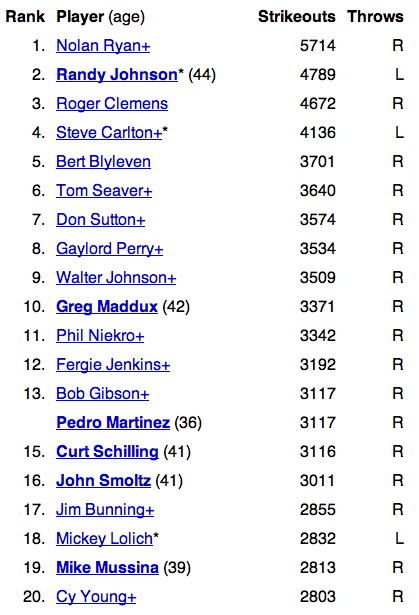
As shown, Blyleven ranks 5th in career strikeouts. Check out the pitchers directly above and below him.
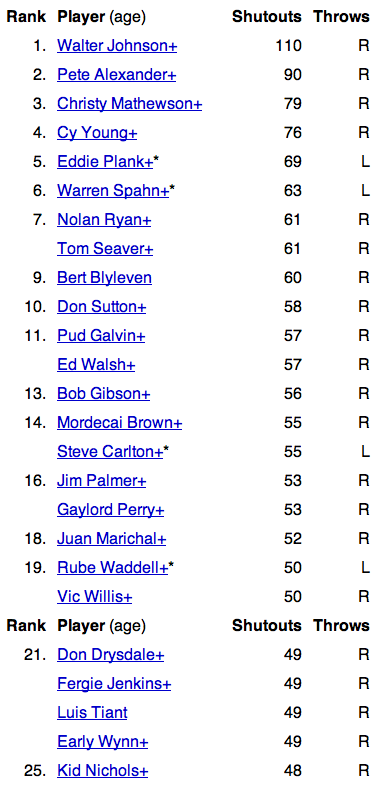
As detailed, Blyleven is 9th in career shutouts overall and 8th since 1900. Once again, check out the pitchers ranked immediately above or below him. Not too shabby, huh?
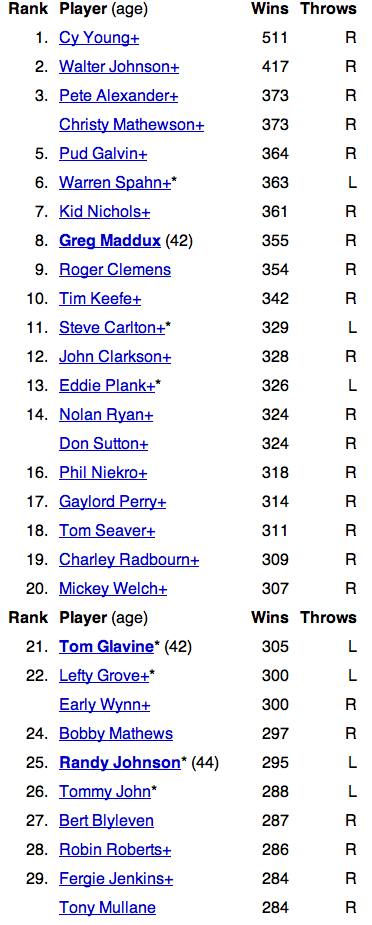
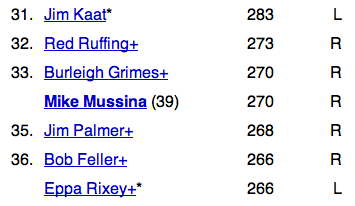
If not for 19th-century pitchers Cy Young, Pud Galvin, Kid Nichols, Tim Keefe, John Clarkson, Charley Radbourn, Mickey Welch, and Bobby Mathews, Blyleven would rank 19th in career wins (rather than 27th).
Let me close by repeating the simple and straightforward case as to why Blyleven belongs in the Hall of Fame:
Enough said.
| Baseball Beat | December 02, 2008 |
Arb Barbs
Thanks to Tim Dierkes at MLB Trade Rumors, we are able to present the list of players who were and weren't offered salary arbitration by their 2008 teams. In all, 24 players have until Sunday at midnight to accept or reject the offer of arbitration. This total compares to 17 last year.
There are 15 Type A and nine Type B players. Type A free agents are among the top 20 percent of players at their position, as defined by the formula created in the 1981 strike settlement. Type Bs are from 21-40 percent. Teams receive two extra draft picks in the First-Year Player Draft next June if they lose a Type A player (a first or second round spot from the team that signed him and a "sandwich" pick after the first round conferred by MLB) and a sandwich pick if they lose a Type B. The first 15 selections are protected, which means the compensation becomes a supplemental pick and the second-round choice that belonged to the other team. Clubs do not receive any compensation for losing unranked players.
Under the terms of the collective bargaining agreement, teams retain the right to negotiate and enter into a contract agreement with any of their free agents, regardless of whether arbitration was offered. There are no longer any deadlines for such negotiations.
Salaries can be cut by a maximum of 20% in arbitration. Many cases will not be heard until February, which limits the flexibility of teams when it comes to making other deals this winter. Furthermore, clubs do not want to be put in the position of having salaries determined by a third party, especially in a recessionary economic environment.
The "middle class" of free agents are looking at a buyer's market whereby procuring multi-year deals will prove to be more difficult than normal. The surprise may be that a few big-name players accept arbitration rather than face the uncertainty of free agency.
Look for the action to pick up at the winter meetings, which open next Monday in Las Vegas. In the meantime, only three of the 171 players who filed for free agency last month have agreed to contracts. Ryan Dempster agreed to a new four-year, $52 million contract with the Cubs. Jeremy Affeldt left the Reds and inked a two-year, $8 million deal with the Giants. Mike Hampton reached a preliminary agreement on a one-year, $2 million contract (plus $2M in performance bonuses) with the Astros.
Arizona Diamondbacks
Offered: Juan Cruz (Type A), Orlando Hudson (Type A) and Brandon Lyon (Type B)
Declined: Adam Dunn (Type A) and Randy Johnson (Type B)
Comments: The Dunn trade no longer looks favorable for the D-Backs. Losing Dallas Buck, Wilkin Castillo and Micah Owings for two months of Dunn seems silly in the face of not re-signing or offering arbitration to the slugger who has hit 40 or more homers and walked at least 100 times in each of the past five seasons.
Atlanta Braves
Offered: None
Not Offered: John Smoltz (Type B)
Comments: The Braves didn't offer arbitration to Tom Glavine either. However, it would not be a surprise if Atlanta re-signed Smoltz should the veteran righthander be willing to take a meaningful pay cut from the $12M he made last year.
Baltimore Orioles
Offered: None
Not Offered: None
Boston Red Sox
Offered: Paul Byrd (Type B) and Jason Varitek (Type A)
Not Offered: None
Comments: The Red Sox really can't lose with Varitek. Either he agrees to arbitration and comes back for one year (which is the max Boston cares to go at this point in his career) or the Sox pick up a couple draft picks.
Chicago Cubs
Offered: None
Not Offered: Bob Howry (Type A) and Kerry Wood (Type A)
Comments: Wood just became more attractive to other teams now that they won't have to give up a first-round draft pick.
Chicago White Sox
Offered: Orlando Cabrera (Type A)
Not Offered: Ken Griffey Jr. (Type B) and Juan Uribe (Type B)
Comments: If Cabrera accepts, he could be the bridge to Gordon Beckham, who isn't expected to arrive on the scene until 2010. Otherwise, look for Alexei Ramirez to move from second base to shortstop to fill the hole created by Cabrera's departure.
Cincinnati Reds
Offered: David Weathers (Type B)
Not Offered: None
Comments: A low-risk move on the part of the Reds. Weathers made $2.75M last year. The 39-year old is unlikely to get more than $3M in 2009 unless the arbitrator focuses on his 3.25 ERA rather than the fact that he gave up more hits than innings pitched and had just a 2:1 strikeout-to-unintentional walk ratio (1.5:1 including IBB).
Cleveland Indians
Offered: None
Not Offered: None
Colorado Rockies
Offered: Brian Fuentes (Type A)
Not Offered: None
Comments: Fuentes lost his arbitration case last year and is likely to take advantage of his free agency to seek the riches of a long-term deal with another club.
Detroit Tigers
Offered: None
Not Offered: Edgar Renteria (Type A)
Comments: Detroit declined its $11M 2009 club option in October on the heels of the 33-year-old shortstop's disappointing season when he hit just .270/.317/.382 and was no better than mediocre in the field. Look for Renteria to sign a two-year deal with a National League team, possibly the Giants.
Florida Marlins
Offered: None
Not Offered: Paul Lo Duca, Luis Gonzalez and Arthur Rhodes (all Type Bs)
Comments: No real surprises here. Rhodes will hook up with another team as a LOOGY (35.1 IP in 61 games in 2008).
Houston Astros
Offered: None
Not Offered: Doug Brocail (Type A), Mark Loretta (Type B) and Randy Wolf (Type B)
Comments: Houston declined its $3.25M 2009 option on the 41-year-old Brocail on October 1. He can eat up some innings in the bullpen for another club now that he won't cost a first-round draft pick. The decision not to offer Wolf arbitration is a bit puzzling.
Kansas City Royals
Offered: Mark Grudzielanek (Type B)
Not Offered:
Comments: Grudzielanek made $4.5 million last season. He may not match that figure as a free agent but apparently the 38-year-old second baseman wants to play for a contender.
Los Angeles Angels
Offered: Jon Garland (Type B), Darren Oliver (Type A), Francisco Rodriguez (Type A) and Mark Teixeira (Type A)
Not Offered: Garret Anderson (Type B)
Comments: There is no chance that Teixeira or Rodriguez accept arbitration. On the other hand, the Angels will get a boatload of draft picks should Tex and K-Rod move on. Hard to believe that Oliver is a Type A free agent. That designation will limit interest from other clubs. Look for him and Garland (who would be assured of getting at least $9.6M if he returned) to take the Angels up on their arbitration offers. Anderson has already hired Scott Boras and apparently is looking for a multi-year deal. Good luck, GA.
Los Angeles Dodgers
Offered: Casey Blake (Type B), Derek Lowe (Type A) and Manny Ramirez (Type A)
Not Offered: Joe Beimel, Jeff Kent, Greg Maddux, and Brad Penny (all Type Bs)
Comments: The Dodgers also failed to offer arbitration to Rafael Furcal, who is neither a Type A or B free agent owing to missed playing time from injuries the past two seasons.
Milwaukee Brewers
Offered: C.C. Sabathia (Type A), Ben Sheets (Type A) and Brian Shouse (Type B)
Not Offered: Eric Gagne (Type B)
Comments: Don't be surprised if Sheets accepts. Sure, he wants a long-term deal but the market may not be there given the combination of his questionable health and the slumping economy.
Minnesota Twins
Offered: Dennys Reyes (Type B)
Not Offered: None
Comments: Reyes only made a million dollars in each of the past two seasons. He will either double his salary in arbitration (which poses little risk to the Twins) or take this opportunity to ink a two-year deal with another club.
New York Mets
Offered: Oliver Perez (Type A)
Not Offered: Moises Alou (Type B) and Luis Ayala (Type B)
Comments: The Mets chose not to offer arbitration to Pedro Martinez. It will be interesting to see not only where he ends up but what kind of a deal he will sign.
New York Yankees
Offered: None
Not Offered: Bobby Abreu (Type A), Mike Mussina (Type A), Andy Pettitte (Type A) and Ivan Rodriguez (Type B)
Comments: Brian Cashman claims to have interest in negotiating with Abreu and Pettitte if either is willing to sign for considerably less than the $16 million they made last year. Mussina announced his retirement last month. It's unlikely that he will pull a Roger Clemens and sign with another team.
Oakland Athletics
Offered: None
Not Offered: Alan Embree (Type B) and Frank Thomas (Type B)
Comments: This could be the end of the line for the Big Hurt, who should but may not wind up in the Hall of Fame five years after his retirement.
Philadelphia Phillies
Offered: None
Not Offered: Pat Burrell (Type A), Jamie Moyer (Type A) and Rudy Seanez (Type B)
Comments: Not as surprised about Burrell as others. He earned $14M last year and may have been awarded an even larger salary in arbitration. The Phillies are still hopeful of re-signing Moyer, who made $8.5 million in 2008.
Pittsburgh Pirates
Offered: None
Not Offered: None
San Diego Padres
Offered: None
Not Offered: Trevor Hoffman (Type A)
Comments: The Padres and Hoffman part ways after 16 seasons. The two sides are no longer a good fit. It's just too bad things ended the way they did.
San Francisco Giants
Offered: None
Not Offered: None
Seattle Mariners
Offered: Raul Ibanez (Type A)
Not Offered: None
Comments: Ibanez has been one of the most underrated and underpaid players in baseball. He signed a two-year extension in March 2006 and earned just $5.5M in each of the past two seasons. The 36-year old outfielder is unlikely to accept arbitration but could re-sign with the Mariners if he is granted a two- or three-year deal at a much higher average annual salary.
St. Louis Cardinals
Offered: None
Not Offered: Jason Isringhausen (Type B), Braden Looper (Type B) and Russ Springer (Type A)
Comments: Looper was a relatively cheap signing (3 years/$13.5M) when he signed with the Cardinals as a free agent in December 2005. He is line to make a lot more than the $5.5M he earned last season and was too big of a risk to take in an arbitration setting.
Tampa Bay Rays
Offered: None
Not Offered: None
Texas Rangers
Offered: Milton Bradley (Type B)
Not Offered: None
Comments: Bradley, who led the AL in OBP and OPS, is unlikely to accept arbitration. He signed a one-year, $5M contract last year and is reportedly seeking a four-year deal for an average annual salary of at least $10M.
Toronto Blue Jays
Offered: A.J. Burnett (Type A)
Not Offered: Gregg Zaun (Type B)
Comments: Burnett opted out of the final two seasons of his five-year contract, forgoing the $24 million owed him to test the free-agent market once again. The Blue Jays would like to keep him but are in competition for his services with several other clubs, including the Red Sox and the Yankees.
Washington Nationals
Offered: None
Not Offered: None
GM for a day question: Which decisions do you disagree with and why?
| Baseball Beat | November 29, 2008 |
Happy Birthday, Minnie, No Matter Your Age
Depending on the source, Minnie Miñoso either turns 83 or 86 years old today.
Miñoso's actual age may or may not matter at this point. What's most important is that he's alive and apparently doing well. However, as it relates to his baseball career, Miñoso's age is relevant. You see, it could be the difference as to whether he deserves to be elected to the Hall of Fame or not. At worst, he is a borderline candidate. At best, he should have been voted in long ago.
Saturnino Orestes Armas (Arrieta) Miñoso was born in Havana, Cuba on either November 29, 1922 or 1925. On page five in Just Call Me Minnie, Miñoso claims he was born in 1925, which would make him 83 today (and not 86 as has been widely reported).
People always want to know how old I really am. The official sources have me listed as being born on November 29, 1922. That would make me 71 years old, and I would not make excuses or apologies. I am actually just 68 years old. I was 19 years old when I arrived in the United States in 1945, but my papers said I was 22. I told a white lie in order to obtain a visa, so I could qualify for service in the Cuban army. My true date of birth is the 29th of November, 1925.
Miñoso (mean-YO-so, commonly pronounced minn-OH-so by media) was the first black Latino player to appear in the major leagues. He made his MLB debut on April 19, 1949 two years after Jackie Robinson broke the color barrier. Depending on his date of birth, Miñoso was either 23 or 26 at that time. If the latter, it's fair to say that he lost at least a few years in the big leagues due to the fact that he was born with the wrong skin color.
 Before joining the Cleveland Indians in 1949, Miñoso played with the New York Cubans from 1945 to 1948. He batted leadoff and played third base when the Cubans defeated the Cleveland Buckeyes for the Negro League World Series title in 1947. In addition, Miñoso was the starting third baseman in the 1947 and 1948 East-West All-Star games.
Other than his nickname, there was nothing Minnie about Miñoso. He should have been called Maxie Miñoso because he did everything well on a baseball field. Known as the Cuban Comet, Miñoso ran exceptionally well, played strong defense, and hit for both average and power.
Miñoso was one of the most outstanding players during the 1950s. A seven-time All-Star, he finished fourth in the Most Valuable Player voting four times. Miñoso was also a three-time Gold Glove winner as a left fielder. For his career, he batted .298 with 1,962 hits. Minnie would have hit .304 had he retired after the 1961 season and not hung around for another three years as a part-timer and pinch hitter. But even as is, Miñoso hit .298/.389/.459 with an OPS+ of 130.
The 5-10, 175-pound Miñoso was an on-base machine. He ranked in the top 10 in times on base for 10 consecutive seasons (1951-1960), including seven when he finished in the top five. Miñoso had 11 consecutive seasons with 10 or more hit by pitches, including back-to-back years with at least 20. Moreover, he led the league in HBP in 10 of those 11 campaigns. He retired as the all-time leader among 20th century players and still ranks ninth in career HBP with 192. But, who paid attention to HBP back then? Heck, who pays attention to them today? I mean, can you recall seeing a column with HBP on the back of a baseball card when you were growing up? Wasn't getting hit by a pitch a fluke, something caused by a wild pitcher?
Miñoso led the AL in stolen bases in each of his first three full seasons. Unfortunately, he also topped the league in caught stealing in two of those years and ranked first four other times. For his career, Miñoso stole 205 bases and was caught 130 times (for a success rate of 61%). Nonetheless, by all accounts, he was an electrifying force on the base paths.
As good as Miñoso was, it seemed as if he was held back or overlooked throughout most of his career. As the first black player from Cuba, his MLB career may have been delayed by as many as a few years. Secondly, on May 1, 1951, Miñoso homered in his first at-bat in a White Sox uniform when he became the first black to break the color barrier in Chicago but another rookie by the name of Mickey Mantle slugged his first big-league home run in the sixth inning of the same game. Miñoso (.324/.419/.498 and 24 Win Shares) finished second to Yankees infielder Gil McDougald (.306/.396/.488, 23 Win Shares) in the Rookie of the Year balloting (although he was honored as TSN's ROY) even though he outpolled him in the MVP vote (fourth place to ninth). He also had the misfortune of being
traded from Chicago back to Cleveland two years before the Go-Go White Sox met the Dodgers in the 1959 World Series. Lastly, he played left field during the same decade as two of the greatest ever: Ted Williams and Stan Musial.
Miñoso was lauded in other ways. He had his jersey #9 retired by Bill Veeck and the White Sox in 1983. Furthermore, Miñoso was invited to present the White Sox lineup card to the umpires in the pregame ceremonies at home plate in the last game played at the old Comiskey Park on September 30, 1990. He also took part in the victory parade for the Chicago White Sox 2005 World Series Championship and his statue stands on the outfield concourse at U.S. Cellular Field.
We'll never know what kind of counting totals Miñoso may have been able to amass had he played in the majors from the get go. But, let's not forget, he had an exemplary career anyway.
Bill James, who listed Miñoso as the 10th-best left fielder and 85th-greatest player ever in The New Bill James Historical Baseball Abstract, put together a table of "the greatest players in history, based on Win Shares between ages 30 and 39, not including pitchers." Miñoso ranked 16th and was the only player in the top 20 who has yet to be enshrined in Cooperstown.
Miñoso didn't get to play in the majors until he was 28 years old, but had a better career after age 28 than almost any Hall of Fame left/right fielder. Miñoso hit for power, drove in 100 runs like clockwork, was a Gold Glove outfielder and one of the best baserunners of his time. Had he gotten the chance to play in the Majors when he was 21 years old, I think he'd probably be rated among the top thirty players of all time.
In Nothing minor about Minnie, Alex Belth argued in a SI.com article in February 2006 that "Miñoso deserves more recognition as player, pioneer" rather than "his clownish pinch-hitting stunts in 1976 and 1981, which he did as much to qualify for a pension as for the giggles."
Paul Soglin, on his Waxing America blog, contends that Miñoso's split tenure between the Negro Leagues and MLB and the poor relations between the U.S. and Cuba unfairly penalize his case for the Hall of Fame.
Rob Neyer has also been one of Miñoso's biggest supporters when it comes to the HOF. It's just too bad that James, Belth, Soglin, and Neyer don't have a vote, either as part of the BBWAA or the Veteran's Committee, both of which have failed to elect Miñoso whenever he has been on the ballot.
Hall of Fame or no Hall of Fame, 83 or 86, we should all celebrate Miñoso's birthday. Happy Birthday, Minnie. You were one of the game's best and most unrecognized players.
[Additional reader comments and retorts at the Baseball Think Factory.]
| Baseball Beat | November 25, 2008 |
The Bill James Handbook 2009 - Part Three
In the final segment of our three-part series on The Bill James Handbook 2009, we will focus on the 2008 Leader Boards. This section of the book has always been one of my favorites. Although many of the stats are now available online at Baseball-Reference, ESPN, Fangraphs, and The Hardball Times, I still enjoy looking at them in this format.
Milton Bradley and Kevin Youkilis were the only American League hitters who ranked in the top ten in AVG, OBP, and SLG. Bradley led the league in OBP and finished no lower than fourth in the other categories. Chipper Jones, Albert Pujols, Matt Holliday, Lance Berkman, and David Wright were the only National League hitters to finish in the top ten in all three rate stats. Jones led the league in AVG and OBP while finishing third in SLG. Pujols led in SLG and placed second in the other two.
The Baltimore Orioles had three hitters with 48 or more doubles. Brian Roberts (51), Aubrey Huff and Nick Markakis (48 each) ranked second and tied for third, behind MVP Dustin Pedroia (54).
Jack Cust led the AL in walks (111) and strikeouts (197). With two HBP, Cust failed to make contact 310 times out or 51.8% of his 598 plate appearances. Remarkably, he didn't lead the league in pitches per PA (4.38) as Nick Swisher (4.53) beat him out. Cust also tied for sixth with 33 HR. Jim Thome was the only other hitter in the league to place in the top ten in the three true outcomes. Adam Dunn led the NL in BB (122), ranked fifth in SO (164), and second in HR (40).
Mark Reynolds became the first player in history to whiff 200 or more times in a single season. Reynolds struck out 204 times, breaking the record Ryan Howard (199) set last year and tied this season. The top six seasons belong to four active players (Reynolds, Howard, Cust, and Dunn). Thome is the only other active player in the top 20. Interestingly, Howard, Cust, Dunn, and Thome ranked in the top five in HR/FB while Reynolds was 23rd. I think it is fair to say that these fellows are swinging for the downs and they are tremendously successful when they connect.
Not surprisingly, Reynolds had the highest swing and miss percentage in MLB at 37.7%. Howard (33.4%) and Dunn (28.3%) ranked in the top six in the NL. Kelly Shoppach (36.0%) led the AL while Cust (34.9%) and Thome (29.6%) placed in the top four.
Only four players in the National League (Skip Schumaker, Ryan Theriot, Yunel Escobar, and Cristian Guzman) and two in the American League (Ichiro Suzuki and Derek Jeter) had groundball-to-flyball ratios over 2.00 with Schumaker leading the way at 2.88. If you wonder why Delmon Young (10 HR in 623 PA) didn't hit for power, look no further than the fact that he had the third-highest GB/FB ratio (1.98) in the AL. The former No. 1 draft pick needs to get a little more lift in his swing if he is going to slug home runs at the same rate as in the minors (59 HR in 1540 PA or once every 26 trips to the plate).
Young could also learn to become more selective as he tied Vladimir Guerrero for the highest first swing percentage in the majors at 47.4%. By contrast, Bobby Abreu and J.J. Hardy swung at the first pitch just 6.2% and 7.8%, respectively, of the time.
Manny Ramirez (1.232) and Mark Teixeira (1.081) led their new leagues in OPS during the second half. Along with C.C. Sabathia, Manny and Tex are two of the top three free agents available this offseason. It will be interesting to see where the Scott Boras clients wind up.
The Handbook's attempt to measure hitter performance against various pitch types by result pitch only has graduated to the point where hitters are rated for the first time on every pitch. As a result, "the hitters you'll now see in these leader boards are a much better representation of the guys who mastered each pitch type this past year."
Carlos Quentin is a beast, leading the AL in OPS vs. fastballs (1.101) and curveballs (1.063). Josh Hamilton, Alex Rodriguez, Ian Kinsler, and Joey Votto were the only other hitters who ranked in the top ten on FB and CB. A-Rod also led the majors in OPS vs. sliders (1.168). I wonder if pitchers shouldn't be throwing him more changeups? A quick look at Fangraphs shows only 9.3% of the pitches thrown to Rodriguez were changes, placing him 87th out of 145 qualifiers.
Speaking of A-Rod's power, he led the AL with the longest average home run (413 feet) and had three of the top five, including the longest (467 feet) on 6/30 at home vs. Scott Feldman of the Texas Rangers. Thome jacked the second and third longest homers and Hamilton (excluding the Home Run Derby at the All-Star Game) cranked three of the ten longest dingers in the AL. The longest home run in the majors was ripped by Justin Upton, a 480-foot shot to left field off Josh Banks of the San Diego Padres at home on 7/6. Upton also led the majors with the longest average home run at 417 feet.
In the "Additional Bill James Leaders," Jeff Francoeur had the lowest offensive win percentage (.261), .032 lower than any other hitter (Michael Bourne). It might be time to re-think Francoeur's potential. Granted, he is only 24 but one can't help but notice that the 6-foot-4, 220-pound "veteran" of 3 1/2 seasons had the lowest AVG and SLG of his career while posting his second sub-.300 OBP and striking out nearly three times for every walk. He tied for the third-worst plus/minus total among all right fielders and was no more than an average baserunner last season.
Turning to pitching leaders, Roy Halladay led the American League in the following categories: baserunners per 9 IP (9.91), complete games (9), pitches per start (107.2), batters faced (987), innings pitched (246), most pitches in a game (130), opponent OBP (.276), opponent OPS (.621), K/BB (5.28), highest GB/FB ratio (2.00), and opponent OPS vs. curveballs (.480). The Toronto righthander also led the AL in component ERA (2.62) and highest average game score (60.48).
Tim Lincecum led the National League in winning percentage (.783), opponent AVG (.221), wild pitches (17), strikeouts (265), pitches per start (109.0), most pitches in a game (138), K/9 IP (10.51), opponent SLG (.316), opponent OPS (.612), HR/9 (0.44), opponent AVG w/ RISP (.167), and H/9 (7.22). The 2008 Cy Young Award winner also led the NL in pitchers win shares (25), component ERA (2.69), and highest average game score (62.06).
Paul Byrd (56.5% and 3.33) and Greg Maddux (55.3% and 3.20) led their respective leagues in percentage of pitches in the strike zone and pitches per batter.
Gavin Floyd allowed the most stolen bases in the majors (37), nine more than anyone else (Jair Jurrjens). Greg Smith, on the other hand, tied for the MLB lead with a dozen runners caught stealing (with Edinson Volquez) while picking off 16 or six more than Andy Pettitte, who ranked second.
Grant Balfour led the majors in strikeout/hit ratio at 2.93, while Carlos Marmol topped the NL at 2.85. It was the second consecutive year that the Chicago reliever had more than two Ks for every hit allowed. Only six others have even accomplished this feat once during this period. I would have no hesitation making Marmol (who also led all NL relievers in opponent AVG, SLG, OBP vs. first batter faced, AVG with runners on, AVG vs. RHB, and OPS vs. sliders) the Cubs closer next season.
Interestingly, Lincecum and Rich Harden were the only starters who ranked in the top ten in K/H ratio (minimum of 50 IP). Harden actually ranked second in the NL (2.28) and eighth in the AL (1.61) while Lincecum was tenth in the senior circuit at 1.46. No starter placed in the top ten last year.
Matt Lindstrom (96.9) had the fastest average fastball in the majors (minimum of 50 IP). Jonathan Broxton's heater (96.3) ranked second. Manny Delcarmen led the AL at 95.5. Ubaldo Jimenez (94.9) led all starting pitchers while Felix Hernandez (94.6) was tops in the AL. Lincecum (94.1), Ervin Santana (94.4), Josh Beckett (94.3), and A.J. Burnett (94.3) were the only other starters with an average fastball over 94 mph.
Conversely, Tim Wakefield (72.9) and Jamie Moyer (81.2) not only had the slowest average fastballs but they also used this pitch less often than any other qualifying pitcher (13.1% and 40.4%, respectively). Maddux (83.7) and Barry Zito (84.9) were the only other pitchers under 85 mph.
Broxton (28) had the most pitches clocked at 100 or higher. Lindstrom (16) and Joel Zumaya (18) were the only other pitchers with more than ten pitches over 100 mph. Jimenez (1342) and Hernandez (1035) were the only pitchers who hit 95 on the radar over 1000 times.
Daniel Cabrera (81.3%) relied on his fastball more than anyone else. Aaron Cook (80.4%) and Mike Pelfrey (80.2%) were the only others who used it 72% or more. Burnett (28.9%) and Ben Sheets (32.2%) led their leagues in throwing curveballs, Volquez (31.5%) and James Shields (26.1%) in changeups, and Armando Galarraga (38.3%) and Randy Johnson 34.6%) in sliders. Ironically, Sheets had the best opponent OPS vs. fastballs in the majors at .599.
There is a lot more information in The Bill James Handbook. I'm confident that it will help you pass the long winter ahead.
| Baseball Beat | November 24, 2008 |
The Bill James Handbook 2009 - Part Two
Last week, in Part One of The Bill James Handbook 2009, we reviewed four chapters: Team Efficiency Summary, Baserunners, 21st Century Bullpen, and Young Talent Inventory. We had previously covered the Fielding Bible Awards and Plus/Minus Leaders in a separate post.
In Part Two, we will examine Manufactured Runs, Manager's Record, Hitter and Pitcher Projections, and Career Targets (including Pitchers on Course for 300 Wins). Bill James wrote introductory comments or short essays for each of these sections.
Starting at the top, James tells us that the Minnesota Twins "manufactured 213 runs—the most of any major league team—while allowing only 139 manufactured runs, one of the lowest totals in the majors. The Twins outscored their opponents by only 28 runs on the season, but by 74 manufactured runs."
According to James, a manufactured run is: "Any run on which two or more of the bases come from something other than playing station-to-station baseball or a run that scores without a hit, or with only infield hits. If two or more of the four bases come from infield hits, moving up on a ground ball, moving up on a fly ball, stolen base, bunt, wild pitch, passed ball, anything like that . . . that's a manufactured run."
These are a few of the things we learn from studying these Manufactured Run charts:1) The best teams in the majors at manufacturing a run were the Twins, the Mets, the Dodgers, and the Angels.
2) The teams least inclined to manufacture a run were the Padres, Marlins, White Sox, D-Backs and Orioles.
3) The most difficult teams to manufacture a run against were the Blue Jays, Cubs, Astros, Rays and A's.
4) The easiest teams against which to manufacture a run were the Orioles, Rangers, Nationals, Pirates and D-Backs.
5) The standard deviation of manufactured runs is higher from a defensive standpoint than from an offensive standpoint (meaning that manufactured runs occur a little more because of what the defense doesn't do than because of what the offense does.)
6) The major league players who contributed the most to manufactured runs were Ichiro, Jose Reyes, Carlos Beltran, Carlos Gomez, Ian Kinsler, Willy Taveras and Shane Victorino. Reyes led the majors in 2007.
7) An average major league team manufactures about one run per game—156 in 162 games, on average.
8) Manufactured runs do not appear to have a disproportionate impact on wins. The teams that had manufactured run advantages do not appear, overall, to be especially efficient teams in terms of producing wins from runs.
James studies managers to identify tendencies or as he says: "We're trying to pollute the discussion of managers with actual facts." However, "the facts only become meaningful when there are standards, and the standards are slow to come into focus . . . We're trying to establish the standards. It's a slow process, but we think we're gaining a little traction."
In the hitter projections, James offers up that "we were inexplicably dense about Josh Hamilton and Carlos Quentin" although, in his defense, "both of these players were traded after we printed the projections." His biggest mistake was underestimating their playing time. "I don't know why in the world we project young studs to play 110 or 115 games," while citing Geovany Soto as another example. "We would have had a killer projection for Soto, except that we projected him to play in only 110 games."
Like everyone else, James also came up well short on projecting Ryan Ludwick's breakout year. "I don't suppose anyone saw that one coming . . . if anyone did see it coming, he doesn't work for us." As far as Andruw Jones goes, James says, "man, that has to be the worst projection we have ever published. From now on, we will refer to the inexplicable loss of all ability in mid-career as 'pulling an Andruw on us.' He was one of my favorite players, too."
One of the interesting things about doing projections is that we're actually more accurate in projecting young players than we are in projecting older players. One might think, intuitively, that it would be the opposite: that after players had been around a few years, we would have enough information to project them more accurately. But actually, while there is a problem with young players because it's hard to guess how much playing time they're going to get, there is a bigger problem with older players because they get hurt more and their production becomes unreliable.
James lists 25 rookies and first-year regulars (Rick Ankiel, Erick Aybar, Jeff Baker, Brian Buscher, Asdrubal Cabrera, Alberto Callaspo, Alexi Casilla, Jeff Clement, Elijah Dukes, Jacoby Ellsbury, Yunel Escobar, Jesus Flores, Chris Iannetta, Adam Jones, Fred Lewis, Evan Longoria, Lastings Milledge, Nyjer Morgan, David Murphy, Skip Schumaker, Soto, Ian Stewart, Kurt Suzuki, Justin Upton, and Joey Votto) that he didn't miss "too badly on." He was too optimistic on Jay Bruce (.308 AVG, .602 SLG with 36 HR projected vs. .254/.453/21 actual), Chase Headley (.310/.522/18 vs. .269/.420/9), and Daric Barton (.274/.423/10 vs. .226/.348/9).
Lastly, with respect to Brandon Wood falling short of the projected playing time: "We weren't really trying to say that Brandon Wood would play 122 games and bat almost 400 times, because we don't have any control of that, and we don't really have any way of knowing how much he will play. What we are really trying to say is that if he gets a chance to play, that's what we expect him to hit. If he doesn't get a chance to play, well . . . that's not my department."
We are not seers, psychics, prophets or geniuses; we just predict that players will mostly continue to do what they have done in the past. And we're pretty much right most of the time.
Regarding pitcher projections, James admits missing badly on Cliff Lee (didn't we all?), Gavin Floyd (17-8, 3.84 actual vs. 4-9, 5.87 projected), Joe Saunders (17-7, 3.41 vs. 8-9, 4.05), and Mike Mussina (20-9, 3.37 vs. 11-7, 3.74). He also missed in the other direction on Barry Zito (10-17, 5.15 vs. 12-12, 3.74) "but at least we didn't pay him $100 million." His best projections involved Scott Olsen (nailed the 8-11 won-loss mark) and the counting stats for Ben Sheets, Derek Lowe, Roy Oswalt, David Bush, Sean Green, Paul Byrd, Jose Valverde, and Tim Wakefield.
We had very good projections for Mike Hampton, Yusmeiro Petit, Tyler Yates, Renyel Pinto, Saul Rivera, Jack Taschner, LaTroy Hawkins, and others too humorous to mention. A blind pig will find an acorn if he hangs out under the oak tree. Our strategy is to hang out under the oak tree and see what falls on our heads.
In a section entitled "Career Targets," James gives Derek Jeter a 93% chance of getting 3,000 hits. He puts Alex Rodriguez's likelihood at 89%. Vladimir Guerrero (53%) is the only other player with a greater than 50% possibility. I was surprised to learn that Albert Pujols, with 1,531 hits at the conclusion of his age 28 season, has just a 38% shot. The 2003 NL batting champion has averaged 191 hits for his first eight seasons and had fewer than 185 only once. I realize that Pujols could get hurt, but he seems like a good bet to age well. As such, I would be inclined to wager 3:2 on him reaching 3,000.
With 295 wins, Randy Johnson has an 86% chance of notching 300 according to James' system, which focuses on a pitcher's age, what he calls "established win level" and momentum. James believes that the Big Unit is "poised to reach 300 in 2009." Prior to his retirement, Mussina was given a 47% shot at winning 300. The Yankees righthander "stunned the baseball world with his first 20-win season" at the age of 39 but has decided to hang 'em up 30 victories short of the magic mark. Jamie Moyer, "who is too old to be taken seriously as a 300-win candidate but doesn't seem to know it," has been given a 25% chance while Johan Santana (24%) and Brandon Webb (23%) are the only other pitchers with a better than one-in-five shot at 300.
We will cover the 2008 Leader Boards with a focus on some of the more esoteric categories tomorrow in the third of our three-part series on The Bill James Handbook.
| Baseball Beat | November 18, 2008 |
Pujols Wins Second MVP
Albert Pujols won his second National League Most Valuable Player Award yesterday, capturing 18 of the 32 first-place votes. Ryan Howard was the recipient of 12 first-place votes and finished second. Brad Lidge received the other two first-place votes.
While not surprised by the results, it seems to me that the race between Pujols and Howard was much closer than it should have been. Let's take a look at their rate stats:
AVG OBP SLG
Pujols .357 .462 .653
Howard .251 .339 .543
As shown, Pujols smoked Howard across the board, beating his fellow first baseman by more than 100 points in AVG, OBP, and SLG. If you want a single stat to compare the two, look no further than Pujols' 233 margin of superiority in OPS.
Given that Pujols is also a much better fielder and baserunner, it is incomprehensible to me how any voter could cast a ballot in favor of Howard over him. I understand that Howard played for a team that won its division whereas Pujols' club failed to make the postseason. The fact that the Phillies went on to win the World Series is irrelevant in that the votes were due before the playoffs began. Not for nothing, I would argue that Pujols did more for his team than Howard as St. Louis arguably overachieved its preseason forecasts to a greater degree than Philadelphia.
Let's face it, the only way a voter could reach the conclusion that Howard was more valuable than Pujols is by overemphasizing the importance of home runs and RBI at the expense of all of the other evidence, including how well they hit with runners in scoring position (h/t to Rob Neyer).
AVG OBP SLG
Pujols .339 .523 .678
Howard .320 .439 .589
But, goodness gracious, if you're into league rankings, let's at least be fair in considering more than just HR and RBI.
Pujols' rankings:
• 1st in NL in SLG (.653)
• 1st in NL in OPS (1.114)
• 2nd in NL in AVG (.357)
• 2nd in NL in OBP (.462)
• 2nd in NL in BB (104)
• 4th in NL in RBI (116)
• 4th in NL in HR (37)
Howard's rankings:
• 1st in NL in HR (48)
• 1st in NL in RBI (146)
• 6th in NL in SLG (.543)
• 9th in NL in R (105)
Think about it, Howard, who is a net negative when not at the plate, ranked FOURTEENTH in the NL in OPS, yet "earned" nearly 40% of the first-place votes!
Interestingly, the only other time in the division era (1995-on) that a player led his league in HR and RBI *and* his team finished in first place yet failed to win the MVP Award was in 2005 when Pujols picked up his first MVP by edging out Andruw Jones (51 HR, 128 RBI) in a similar vote.
Lastly, I found it hard to believe that Hanley Ramirez (.301/.400/.540) and Chase Utley (.292/.380/.535) wound up outside the top ten in the voting. Did I mention that they played shortstop and second base? And that Utley was not only a Gold Glove-caliber defensive player but ranked first in plus/minus leaders at all positions?
Ramirez, for his part, led the NL in runs scored (125) and placed in the top ten in OBP, SLG, OPS, BB, HR, and SB. If not for Ramirez, where do you suppose the Florida Marlins would have ended up in the NL East? By the same token, Utley had a higher AVG and OBP than Howard and trailed his teammate by a whopping eight points in SLG, yet tied for 14th in the voting (or 12 spots behind Howard).
I'm pleased that the writers got it right with respect to the winner but am disappointed in the overall results.
Player 1st 2nd 3rd Total Albert Pujols 18 10 2 369 Ryan Howard 12 8 6 308 Ryan Braun -- 2 3 139
4. Manny Ramirez, Dodgers, 138
5. Lance Berkman, Astros, 126
6. CC Sabathia, Brewers, 121
7. David Wright, Mets, 115
8. Brad Lidge, Phillies, 104
9. Carlos Delgado, Mets, 96
10. Aramis Ramirez, Cubs, 66
Others receiving votes: Hanley Ramirez, Marlins, 55; Chipper Jones, Braves, 44; Geovany Soto, Cubs 41; Johan Santana, Mets, 30; Chase Utley, Phillies, 30; Ryan Ludwick, Cardinals 17; Brandon Webb, Diamondbacks, 14; Adrian Gonzalez, Padres, 13; Matt Holliday, Rockies, 13; Prince Fielder, Brewers, 11; Derrek Lee, Cubs, 10; Carlos Beltran, Mets, 10; Tim Lincecum, Giants, 9; Jose Reyes, Mets, 3; Jose Valverde, Astros, 3; Stephen Drew, Diamondbacks 2; Nate McLouth, Pirates, 1.
| Baseball Beat | November 17, 2008 |
The Bill James Handbook 2009 - Part One
One of the beauties of November is the arrival of The Bill James Handbook, the most stat-filled annual baseball guide available. The book, produced by Baseball Info Solutions and published by ACTA Sports, is always the first one to hit the market following the just-completed season.
 Key features include career data for every 2008 major leaguer, fielding (including plus/minus leaders and The Fielding Bible Awards, which we covered on the last day in October), baserunning analysis, pitcher and hitter projections, team statistics and efficiency summaries, manager records, manufactured runs, win shares, a new section on relief pitching, and much more.
I always read in full anything with a Bill James byline and this year is no exception. Bill tackles Team Efficiency Summary, The Baserunners, The 21st Century Bullpen, Manufactured Runs, The Manager's Record, Young Inventory Talent, Another One Bites the Dust, Introduction to the Pitcher Projections, and Pitchers on Course for 300 Wins. In all, there are more than 20 pages devoted to James' commentary.
In the section on team efficiency – which measures: (1) how many runs did the team score compared to the number we would expect them to score based on their hitting stats? (2) how many runs did the team allow compared to the number we would have expected them to allow? and (3) how many games did the team win based on the number of runs they scored and allowed? – James writes:
If you have a homer, double, single and a walk in an inning, but you only score one run, that's very inefficient. If you have two walks and a single but you turn it into two runs, that's very efficient.If you're outscored in a three-game series 7 to 12, but you win two of the three games, that's efficient. If you outscore your opponents 18 to 3 in a doubleheader, but you split the doubleheader, that's inefficient.
The most efficient team in the majors in 2008, by far, was the Angels. The least efficient teams were the Braves and the Padres.
In The Baserunners, James writes, "We are not essentially in the business of rating or ranking ballplayers. We are in the world of keeping track of the facts, and making those available to you. It would, however, be somewhat absurd to report each player's hits and at bats, and not bother to figure the batting average, or the slugging percentage, or the on base percentage. A certain amount of primitive analysis is essential to record-keeping."
Hence, the baserunning data that follows. Let us compare Curtis Granderson, who is a really good baserunner, with Magglio Ordonez, who is a great hitter but, at 34, not quite what he used to be on the bases.Granderson was on first base when a single was hit to the outfield 34 times, and went to third base 10 times. Magglio was on first when a single was hit 21 times, and made it to third only 4 times.
Granderson was on second when a single was hit 26 times, and scored 21 times (81%). Magglio was on second when a single was hit 20 times, and scored 10 times.
Granderson was on first when a double was hit 9 times, and scored 6 times. Magglio was also on first when a double was hit 9 times, and scored only 3 times.
We compare all of these to the averages, which in all of these cases is a percentage better than Ordonez', but less than Granderson's. An average baserunner goes from first to third 27% of the time, Granderson 29%, Ordonez 19%. Granderson is +1, +6 and +2; Ordonez is -2, -2 and -1.
We also look at how often the baserunner moves up on a Wild Pitch, A Passed Ball, a Balk, a Sacrifice Fly or Defensive Indifference. These things, taken together, we call "Bases Taken." Curtis Granderson took 23 bases; Magglio Ordonez took 6.
We look at how many times the player is doubled off on the bases, and how often he runs into an out. We look at how many times he bats in a potential Double Play situation, and how often he grounds into a Double Play.
Finally, we add in base stealing—one point for a stolen base, minus two points for a caught stealing. Adding all that together, Curtis Granderson is +31, making him. . .well, not one of the top 10 baserunners in the majors, but pretty close to that. Magglio comes in at -35, making him grateful for Dioner Navarro's late-season leg injuries.
Here are the top and bottom ten baserunners of 2008, as determined by James' formula:
1. Willy Taveras +70 1. Dioner Navarro -39
2. Ichiro Suzuki +56 2. Magglio Ordonez -35
3. Matt Holliday +52 3. Edgar Gonzalez -27
4. Grady Sizemore +50 4. Yorvit Torrealba -26
5. Jimmy Rollins +46 5. Yunel Escobar -25
6. Nate McLouth +44 6. Mike Lowell -23
7. Ian Kinsler +41 7. Ramon Hernandez -22
Randy Winn +41 Prince Fielder -22
9. Jacoby Ellsbury +40 Billy Butler -22
10. Carlos Beltran +35 10. Long List of Guys -21
I believe the aforementioned system does an excellent job of identifying the best and worst baserunners but am of the opinion that it could be strengthened by adjusting for ballpark effects, the number of outs in an inning, and whether there is a full count on the batter at the time of opportunity for advancement. James Click and Dan Fox have tackled these variables as well as the nearly indistinguishable impact from hitters and fielders. Nonetheless, as evidenced by the top and bottom tens, James' methodology is a reasonable proxy for determining baserunning skills. The book devotes more than six pages to tables, breaking down the results for almost 400 baserunners.
In The 21st Century Bullpen, James writes, "The modern bullpen is still evolving very rapidly...leaving stat books in their wake. We evaluate relievers by ERA, but a modern reliever can do a lot of damage with runs charged to somebody else. In the 1950s and 60s we developed the concept of the "Save," and since then have added the derivative concepts of "Blown Saves" and "Holds," but the modern bullpen contains one pitcher who is assigned to save the game and six or seven whose job is something else entirely—something not measured by Saves or anything in their line."
The modern bullpen is staffed by two or three lefties whose job it is to get out lefties, by an eighth-inning guy whose job it is to be a bridge to the closer, by a seventh-inning guy, and by two or three pudknockers whose job is to pitch in where they can. You have a lot of different guys, doing a lot of different jobs, whose records all look pretty much the same.We're trying to stretch the record book here to cover more of the modern bullpen. This table has 21 categories, not counting the pitcher's name or his team.
James assigns all major league relievers to one of six "positions" in the bullpen: closer, set-up man, lefty, long man, utility reliever, or emergency reliever. He says, "Think about what this means. There have been "field positions" in record books for a hundred years. But, just in the last generation, (a) positions have evolved within the bullpen, and (b) nobody has officially categorized them. That's what we're doing: we're adding "positions" to the bullpen. It's an obvious step, and I don't really know why we didn't do it before now."
The categories include relief games ("no explanation needed"), early entry (sixth inning or earlier), consecutive days, long outings (more than 25 pitches), leverage index (the amount of swing in the possible change in win probability compared to the average swing in all situations), inherited runners, inherited runners scored, percentage, easy saves (three outs remaining and the first batter he faces does not represent the potential tying or winning run), easy save opportunities, regular saves (any save which does not meet the definition of an easy or tough save), regular save opportunities, tough saves (potential tying or winning run on base), tough save opportunities, clean outing (not charged with a run *and* does not allow an inherited runner to score), blown save win, saves ("don't make me explain the Save Rule...I know people"), holds, save opportunities, save/hold percentage, opposition OPS, and ERA.
For the second straight year, James ranks the top 25 individual young players under the age of 29. The rankings are based on "proven major league talents, not prospects or young players who are not yet proven as major league players."
The following list of the top 25 young MLB players includes teams, positions, and 2008 ages:
1. Prince Fielder, Milwaukee Brewers first baseman, age 24
2. Hanley Ramirez, Florida Marlins shortstop, age 24
3. Tim Lincecum, San Francisco Giants pitcher, age 24
4. David Wright, New York Mets third baseman, age 25
5. Ryan Braun, Milwaukee Brewers left fielder, age 24
6. Dustin Pedroia, Boston Red Sox second baseman, age 24
7. Matt Kemp, Los Angeles Dodgers center fielder, age 23
8. Francisco Rodriguez, Los Angeles Angels pitcher, age 26
9. Jose Reyes, New York Mets shortstop, age 25
10. Nick Markakis, Baltimore Orioles right fielder, age 24
11. Joakim Soria, Kansas City Royals pitcher, age 24
12. Ryan Zimmerman, Washington Nationals third baseman, age 23
13. Cole Hamels, Philadelphia Phillies pitcher, age 24
14. Troy Tulowitzki, Colorado Rockies shortstop, age 23
15. Felix Hernandez, Seattle Mariners pitcher, age 22
16. Jon Lester, Boston Red Sox pitcher, age 24
17. Evan Longoria, Tampa Bay Rays third baseman, age 22
18. John Danks, Chicago White Sox pitcher, age 23
19. Adrian Gonzalez, San Diego Padres first baseman, age 26
20. James Loney, Los Angeles Dodgers first baseman, age 24
21. Stephen Drew, Arizona Diamondbacks shortstop, age 25
22. Brian McCann, Atlanta Braves catcher, age 24
23. Miguel Cabrera, Detroit Tigers first baseman, age 25
24. Grady Sizemore, Cleveland Indians center fielder, age 25
25. Joey Votto, Cincinnati Reds first baseman, age 24
James also lists the teams in order of overall young talent currently on the big league squad:
1. Minnesota Twins
2. Arizona Diamondbacks
3. Tampa Bay Rays
4. Florida Marlins
5. Kansas City Royals
6. Milwaukee Brewers
7. Cleveland Indians
8. Colorado Rockies
9. Atlanta Braves
10. Boston Red Sox
11. Los Angeles Angels of Anaheim
12. Oakland A's
13. Los Angeles Dodgers
14. St. Louis Cardinals
15. Cincinnati Reds
16. New York Mets
17. Pittsburgh Pirates
18. Seattle Mariners
19. Texas Rangers
20. Philadelphia Phillies
21. San Diego Padres
22. San Francisco Giants
23. Washington Nationals
24. Baltimore Orioles
25. Chicago White Sox
26. Chicago Cubs
27. Detroit Tigers
28. Toronto Blue Jays
29. New York Yankees
30. Houston Astros
According to James, "2008 really was not a great year for young talent, except pitchers." Bill believes Evan Longoria was the "only really huge talent to emerge," claiming that he "probably would rank as the number one guy on our list, were it not for an injury, but the system relies on major league production."
I have been reviewing The Bill James Handbook since 2003. The previous reviews can be accessed at the following links:
2008 - Part One, Two
2007 - Part One, Two, Three
2006 - Part One, Two, Three
2004 - The Handiest Reference Book of 'Em All
| Baseball Beat | November 14, 2008 |
Swish, Splash...White Sox Take a Bath on Trade With Yankees
News: The White Sox and Yankees completed a trade with Chicago sending first baseman/outfielder Nick Swisher and minor league relief pitcher Kanekoa Texeira to New York for infielder Wilson Betemit and minor league pitchers Jeff Marquez and Jhonny Nunez.
Comments: I have to admit that I don't understand this trade from the vantage point of the Sox unless it is mostly about dumping salary.
With respect to the two major leaguers in the deal, Swisher is clearly better than Betemit. While the former had the worst season of his four-year career in 2008, he was still more productive than the latter. Swisher ranked last in batting average among players with at least 502 plate appearances, yet walked 82 times and slugged 24 home runs. His decline in AVG is solely attributable to a career-low BABIP of .251, which looks like an aberration given the fact that his batted ball data were, more or less, in-line with his career marks. If anything, his better-than-ever line-drive rate (20.9%) should have produced a somewhat higher – rather than lower – BABIP and AVG.
Betemit drew six bases on balls while whiffing 56 times (or once every 3.5 trips to the plate) last year. Since joining the Yankees during the 2007 season, the utility infielder has drawn 12 walks against 89 strikeouts for a horrific BB/SO rate of .135, perhaps suggesting that he has been overmatched in the AL East.
Only a year separates the two switch hitters in age. While Betemit may be slightly more valuable as an infielder than Swisher is as a corner outfielder and first baseman, his size realistically limits him to third and first and his bat just doesn't play all that well at either position. As such, he is basically nothing more than a backup, a fungible spot on a big-league roster. Eligible for arbitration, Betemit will probably "earn" $1.5-2.0M this season.
Swisher has three years remaining on a five-year, $26.75 million contract. He will make $5.3M in 2009, $6.75M in 2010, and $9M in 2011. His deal also includes a $10.25 million club option for 2012, with a $1 million buyout. At an average of $7.35M per season, Swisher is reasonably priced and a bargain if he can return to his 2006-2007 production.
Nick Swisher | 1B-OF | B/L | 6-0, 215 | 28 | MLB
G AB R H 2B 3B HR RBI BB SO SB CS AVG OBP SLG OPS OPS+
2008 153 497 86 109 21 1 24 69 82 135 3 3 .219 .332 .410 .742 92
Career 611 2114 353 515 117 5 104 324 342 539 7 8 .244 .354 .451 .805 112
Wilson Betemit | INF | B/R | 6-3, 230 | 27 | MLB
G AB R H 2B 3B HR RBI BB SO SB CS AVG OBP SLG OPS OPS+
2008 87 189 24 50 13 0 6 25 6 56 5 6 .265 .289 .429 .718 86
Career 496 1098 145 286 60 4 42 151 108 314 5 6 .260 .325 .437 .762 95
If we can agree that Swisher is much more valuable than Betemit, then that means the White Sox had to make up the difference with the three minor leaguers that were included in this transaction. Maybe I'm missing something, but I just don't see it, whether one relies on the stats, the scouting reports, or a combination of the two.
I'll let John Manuel of Baseball America provide commentary and insights on the three prospects.
Jeff Marquez | SP | RHP | 6-2, 190 | 24 | AAA
IP H R ER HR BB SO ERA BB/9 SO/9 HR/9 80.2 93 51 42 12 24 33 4.69 2.68 3.68 1.34
Marquez endured a difficult season, getting knocked around in Triple-A before being sent back to Trenton in the second half. A 2004 supplemental first-round pick, he entered 2008 as the Yankees' No. 7 prospect but would have ranked in the 21-30 range this season had he remained a Yankee. Marquez made progress with his changeup and curve in 2007 but was back to relying almost exclusively on his 88-92 mph sinker (which can reach a bit higher) and adding a slider in '08. He's a defense-dependent, early-contact kind of pitcher who lacks a strikeout pitch. Overall, he was 8-8, 4.47 with just 51 strikeouts in 102 2/3 innings. He finished strong, pitching well during Trenton's Eastern League title run, and is pitching for Peoria in the Arizona Fall League (1-2, 4.50).
Jhonny Nunez | RP | RHP | 6-3, 185 | 23 | A+/AA/AAA
IP H R ER HR BB SO ERA BB/9 SO/9 HR/9 116.1 122 58 53 13 39 124 4.10 3.02 9.59 1.01
Nunez has the best arm and upside of any prospect in the deal. The Yankees landed him earlier this year from the Nationals in the Alberto Gonzalez deal, and moved him from the rotation to the bullpen. He originally signed with the Dodgers in 2003 out of the Dominican Republic and came to the Nationals in a 2006 trade for Marlon Anderson. Nunez has a live arm and shows two plus pitches at times—a fastball that sits at 92-94 mph, touching 95, and a slider that he throws with some power that has inconsistent tilt. He throws from a low arm slot and was outstanding after the Yankees made what one club official termed "mechanical bad habits . . . he has much better balance now." He was 2-8, 5.22 as a starter at high Class A Potomac, but as a reliever in the Double-A Eastern League, with Harrisburg and then Trenton, he went 1-0, 1.65 in 27 innings, striking out 34, and had 116 whiffs in 108 innings overall. He had three saves and seven strikeouts in five scoreless innings in the EL playoffs.
Kanekoa Texeira | RP | RHP | 6-0, 210 | 23 | A+/AA
IP H R ER HR BB SO ERA BB/9 SO/9 HR/9 61.0 46 15 9 2 21 60 1.33 3.10 8.85 0.30
Texeira was a Carolina League all-star for high Class A Winston-Salem this season and had the best slider in the White Sox's system. The 22-year-old Hawaii native was the No. 19 prospect in the CL this season. He's just 6-foot, 210 pounds and went 6-3, 1.33 combined between Winston and Double-A Birmingham in 2008, with 60 strikeouts and 21 walks allowed in 61 innings overall. He spots his 90-91 mph fastball to both sides of the plate to set up his plus slider, which is both a groundball pitch and strikeout offering.
In order to like the White Sox half of the trade, one would have to place a pretty high value on Marquez and Nunez or very little value on Texeira. It seems to me that Nunez and Texeira are more alike than not, suggesting a difference of opinion on those two relievers and/or much more optimism over Marquez than I am willing to concede. Peter Abraham points out a side benefit for the Yankees: Marquez and Nunez require 40-man protection while Texeira does not, meaning that the deal gives New York some roster flexibility as well.
Although the White Sox may hope that pitching coach Don Cooper can fix Marquez's problems, I am always skeptical of any pitcher that can't whiff at least 10% of the batters faced. With 33 SO out of 349 TBF in AAA, Marquez will need to develop a new swing-and-miss pitch or get back to being a groundball machine a la Chien-Ming Wang if he is ever going to succeed in the majors.
Sure, the White Sox will save money on this deal, but it seems as if Kenny Williams got shortchanged nonetheless. In a matter of 10 1/2 months, the Chicago GM has effectively traded Texeira and fellow pitchers Gio Gonzalez and Fautino De Los Santos plus outfielder Ryan Sweeney (as Swisher was acquired for the latter three prospects on January 3, 2008) for Betemit, Marquez, and Nunez. Yikes!
| Baseball Beat | November 12, 2008 |
Billy-Holliday Hook Up in Oakland
Oakland A's general manager Billy Beane has pulled off another big trade by acquiring slugger Matt Holliday from the Colorado Rockies for Huston Street, Greg Smith, and Carlos Gonzalez. The transaction is expected to be officially announced today.
The trade is interesting from several aspects. Holliday will earn $13.5 million next season as part of a two-year contract he signed last January to avoid arbitration. With six years under his belt, Holliday will become a free agent at the conclusion of the 2009 campaign. It is highly unlikely that Oakland will sign him to a long-term deal. Instead, he is almost all but guaranteed to be a one-year rental who will bring two compensatory draft picks when he leaves for greener pastures a year from now.
Last winter, Holliday, who is represented by Scott Boras, reportedly turned down a four-year, $72 million offer from Colorado that included a club option for a fifth year. Boras will most likely seek a nine-figure deal when his client tests the free agent market prior to the 2010 season.
Beane has generally traded – rather than acquired – Holliday types prior to becoming free agents. However, Holliday is an outfielder and not a pitcher as was the case with Tim Hudson, Mark Mulder, Dan Haren, Rich Harden, and Joe Blanton. The latter three were under Oakland's control for more than a year when they were sent packing.
Is Holliday worth giving up three players for one year and two draft picks? Sure. First of all, he gives Oakland a chance to compete next season. Secondly, if the A's are not in the hunt at the trading deadline, look for Beane to entertain offers from contending teams. At worse, Holliday plays out the year and Oakland receives a couple of high draft choices that may be as good as or better than Street, Smith, and Gonzalez, all of whom have their shortcomings.
Street, 25, saved 18 games last season but lost his job as the closer to rookie Brad Ziegler (who was 3-0 with a 1.06 ERA and 11 saves in 13 opportunities) in August. A supplemental first-round pick (40th overall) out of the University of Texas in 2004, Street was named the AL Rookie of the Year in 2005 and saved 98 games in his four seasons, including a career-high 37 in 2006. However, the smallish righthander has had a history of elbow problems and his 90-mph fastball puts him in a vulnerable position should his slider lose its effectiveness. A flyball pitcher, he may not be a good fit in the thin air of Colorado and could be flipped to any number of teams looking for an experienced closer.
Smith and Gonzalez were acquired from Arizona in the Haren trade. Smith, who started 32 games for Oakland last season, possesses one of the best pick-off moves in the game but little else. An extreme flyball pitcher with fringy stuff, Smith, who had minor elbow surgery last month, will find the going much more difficult at Coors Park than McAfee Coliseum. Gonzalez, on the other hand, should find Colorado to his liking. A toolsy outfielder, he has the highest ceiling of the bunch. However, he struggled as a 22-year-old in his rookie season, "hitting" .242/.273/.361 with 81 SO and 13 BB in 316 PA. Like many young players, he needs to improve his pitch recognition – especially vs. LHP (.188/.207/.247) – to reach his potential.
Holliday broke into the big leagues in 2004 and has played five seasons with the Colorado Rockies. As shown below, his home and road splits are too pronounced to dismiss. He hits like Lou Gehrig (.340/.447/.632) at Coors Park and Mike Lowell (.279/.343/.467) on the road. You can either call him Dr. Jekyll & Mr. Hyde or you can call Dan O'Dowd and hide his road stats.
Career Splits
AVG OBP SLG
Home .357 .423 .645
Road .280 .348 .455
In fairness to Holliday, I believe his age 26-28 seasons are more representative of his true performance level.
2006-2008
AVG OBP SLG
Home .361 .430 .669
Road .296 .370 .486
Although the gap in the splits are still eye opening, Holliday's numbers away from Coors Park are noticeably better. I would use them as a baseline in trying to project what he might do for the A's in 2009.
Given the fact that most players produce at about a 4% better clip at home than on the road, it might be fair to adjust his 2006-2008 road stats to .308/.385/.505. However, it is important to recognize that Holliday will be moving to a more difficult hitting environment in terms of the league and home ballpark. In fact, McAfee Coliseum is particularly tough on righthanded batters, playing to a 94 park factor for AVG and a 78 for HR over the past three seasons. As such, those adjusted rate stats, while outstanding, are probably his upside.
Of the 95 home runs that Holliday has slugged the past three seasons, 62 have come at home and only 33 have been on the road. It says here that Holliday will hit closer to 20 HR than his three-year average of 32. In other words, I'll take the unders if the over/under line is 25.
Nonetheless, Holliday is a big-time talent and immediately makes Oakland a better team. The 6-4, 235-pound high school All-America quarterback not only hits for average and power but runs well and possesses a better-than-average arm for a left fielder. He stole 28 bases in 30 attempts and ranked as the third-best baserunner in the majors according to The Bill James Handbook. Holliday advanced from first to third on 15 of 26 singles, from second to home on 17 of 24 opportunities, and from first to home on 5 of 6 doubles while being thrown out only twice on the base paths. Among left fielders, he was third in John Dewan's plus/minus ratings and finished third in The Fielding Bible Awards.
If Holliday has any upside left in him, it may rest in his improving plate discipline. The five-year veteran's walk rate last season increased to a career-best 12.1% and his 0.71 BB/SO ratio was more than 40% above his previous high. I'm quite sure that Beane is fully aware of these facts.
I don't think the Billy-Holliday combo will be singing the blues over this deal.
| Baseball Beat | November 11, 2008 |
Awards and More Awards
On the day before Veterans' Day, the Baseball Writers Association of America announced its Rookie of the Year Awards. Third baseman Evan Longoria of the Tampa Bay Rays and catcher Geovany Soto of the Chicago Cubs were named the American League and National League Rookies of the Year for the 2008 season.
Longoria and Soto received 59 of the 60 first place votes with the former becoming the AL's first unanimous winner since Nomar Garciaparra in 1997. Longoria and Garciaparra both prepped at St. John Bosco in Bellflower, California. Longoria is also the second Long Beach State Dirtbag (the other being Bobby Crosby in 2004) to earn AL ROY honors in the past five years. Longoria's college teammate, Troy Tulowitzki, finished second in the NL ROY balloting last year.
This year's AL Rookie of the Year played in the All-Star Game and the World Series, made all the more remarkable by the fact that he began the season in the minors and spent more than a month on the disabled list. Longoria (.272/.343/.531) had 60 extra-base hits, including 27 HR, in just 122 games and 508 plate appearances. He also slugged six homers in the postseason but struck out 20 times in 62 at-bats while going 1-for-20 with no BB or XBH in the World Series.
Soto (.285/.364/.504) was the first rookie catcher to start an All-Star Game for the National League. He also played in the postseason, going 2-for-11 in a three-game sweep at the hands of the Dodgers. The native of San Juan, Puerto Rico gave a glimpse of what was to become when he hit .389/.433/.667 in 18 games and 60 plate appearances in 2007.
The AL and NL Cy Young Awards will be announced this week. Rob Neyer goes into detail breaking down the candidates in both leagues, while providing a link to the Cy Young Predictor as developed by Bill James. Neyer sees Cliff Lee narrowly beating Francisco Rodriguez in the AL and looks for Tim Lincecum to edge out Brandon Webb and Johan Santana in the NL.
Like Neyer, I would go with Lee and either Lincecum or Santana with a slight preference for the Giants righthander. In addition to Webb, look for Brad Lidge and C.C. Sabathia to round out the top five in the NL. Roy Halladay is a lock to finish in the top three in the AL (although, for my money, he should place a solid second and much closer to first than third).
Update (11/11/08): NL Cy Young Award goes to Lincecum
Update (11/13/08): Lee wins 2008 AL Cy Young Award
| Baseball Beat | November 10, 2008 |
Adding Perspective to the Jacobs Deal
News: The Texas Rangers exercised their $6.2 million option on Hank Blalock for the 2009 season.
Rangers pick up first baseman Blalock's $6.2M option for '09ARLINGTON, Texas -- The Texas Rangers on Friday exercised a $6.2 million option on oft-injured infielder Hank Blalock.
Blalock has played just 123 games the last two seasons. The two-time All-Star missed 108 days in 2008 after two long stints on the disabled list.
A career third baseman, he made a midseason switch to first base this year. Blalock finished the season batting .287 with 12 home runs and 38 RBIs in 65 games. In September, he batted .337 with eight home runs and 23 RBIs in 24 games.
"Hank really swung the bat well at the end of the year, and we look forward to him continuing to make an impact for us in 2009," Rangers general manager Jon Daniels said, according to MLB.com. "I give him a lot of credit for embracing a position change mid-year, and doing whatever's necessary to help the team."
The 27-year-old Blalock has been with the Rangers for seven seasons, second only to Michael Young among current players. He was an All-Star in 2003 and 2004.
While the headline in the above ESPN article calls Blalock a first baseman, the lefthanded hitter is returning as the club's designated hitter. According to mlb.com, general manager Jon Daniels and manager Ron Washington made that clear to Blalock when speaking with him on Friday. The following quote was attributed to Washington: "Hank made it known that he still feels he's an everyday player, but he's willing to do whatever he can to help the ballclub. In our situation right now, he'll have to be the DH. That could change depending on what else we do this winter."
No longer able to handle the duties of third base due to a damaged right shoulder, how valuable is Blalock as a DH or even as a first baseman? Are there any comps that could shed light on this question? By golly, there is at least one that I know of, and it's none other than Mike Jacobs, the 1B/DH acquired by the Kansas City Royals ten days ago.
Before we take a look at the stats, be aware that Blalock will cost the Rangers $6.2M next season while Jacobs is likely to earn no more than half of that amount, be it mutually agreed upon or awarded in arbitration during the offseason.
Conveniently, these two players are about as easy to compare as possible. Both hail from San Diego and were born three weeks apart. Both players throw right and bat left. And both are nothing more than first basemen and/or designated hitters.
Career Stats
AVG OBP SLG OPS
Blalock .274 .337 .465 .802
Jacobs .262 .318 .498 .816
Blalock tops Jacobs in OBP by .019 while the latter beats the former in SLG by .033. Adding OBP and SLG, Jacobs' OPS is higher than Blalock's by .014. OPS works well for a quick and dirty calculation, but, point-for-point, it tends to favor power hitters who don't walk over those who walk with little power. Accordingly, if we adjust OPS by weighting OBP in proportion to its relative importance vs. SLG (or OBP*1.8+SLG), then we learn that the two hitters have been virtually equal in terms of production.
Gross Production Average (or GPA) divides the above formula by 4 to put it on a scale that is more comparable to batting average, making it easier to interpret. In both cases, the career GPA is .268.
These career totals are unadjusted for ballpark factors* and the difference in the pitching superiority of the American League over the National League. The first factor clearly favors Blalock. Hank has played his home games at Arlington while Mike played at Shea Stadium for a partial season in his rookie year and Dolphin Stadium for the past three campaigns. Arlington's park factor has ranged from 98-125 with an average of nearly 114. Shea Stadium and Dolphin Stadium have ranged from 90-107 with a mean of 97. As such, Blalock's home parks have helped him by approximately 17 percentage points more than Jacobs' home fields.
* PF = ((homeRS + homeRA)/(homeG)) / ((roadRS + roadRA)/(roadG))
You can use other methodologies for computing park factors, but the conclusion is one and the same. Blalock has been helped tremendously by his home ballparks and Jacobs has been hurt by his.
At the same time, Blalock's numbers have been harmed by facing tougher pitching than Jacobs. According to an email exchange with Tom Tango, the adjustment for the difference in quality of leagues is about five runs or 0.5 wins per 162 games. "To that end, an OPS+ of 106 in the NL would roughly match 100 in the AL." That's an interesting example because Jacobs has a career OPS+ of 110 and Blalock has a 104, which means they are roughly even when viewed in the proper context of the two leagues.
Let's drill down and examine the splits more closely.
At Home
AVG OBP SLG OPS
Blalock .306 .375 .531 .906
Jacobs .252 .299 .501 .800
On the Road
AVG OBP SLG OPS
Blalock .244 .299 .402 .701
Jacobs .271 .337 .495 .832
Using the weighted formula detailed above, Blalock has been 16.1% more productive than Jacobs at home, and Jacobs has been 17.2% more productive than Blalock on the road.
While Blalock deserves credit for adapting to the advantages of his home ballpark more than one would expect, it's plainly obvious that Jacobs has been a much better hitter in more neutral environments.
vs. RHP
AVG OBP SLG OPS
Blalock .292 .356 .502 .858
Jacobs .269 .329 .521 .850
vs. LHP
AVG OBP SLG OPS
Blalock .231 .285 .371 .656
Jacobs .235 .275 .414 .689
Blalock and Jacobs have significant platoon splits. Both are relatively effective vs. RHP and ineffective vs. LHP. The difference in handedness is even more pronounced for Blalock than Jacobs.
Cutting to the chase, who would you rather have strictly from the standpoint of hitting prowess? I believe the evidence points to Jacobs being no worse than Blalock.
As for fielding and baserunning, neither Jacobs nor Blalock shine in these areas. Both are below-average first basemen, probably on a similar magnitude. While the sample size is small for Blalock at first base, he was a poor defensive third baseman and there is little reason to suspect he will turn into a plus first baseman. In the meantime, Jacobs' Revised Zone Rating and Rate (fielding runs per 100 games), while poor, are actually better than Blalock's.
According to The Bill James Handbook, Jacobs was a better baserunner than Blalock last year by a wide margin, and the latter was better than the former by a slimmer margin in 2006 and 2007. While they each stole one base without being caught in 2008, Blalock was credited with five bases taken while recording four outs as compared to seven and two, respectively, for Jacobs. Neither was particularly adept at advancing extra bases, as Blalock was 0-for-10 going from first to third on singles and Jacobs was 0-for-6 moving from first to home on doubles.
To sum it up, I wouldn't give either one an edge over the other when it comes to hitting, fielding, or baserunning. Therefore, it seems to me that Jacobs and Blalock are about the same, perhaps about as similar as any two players can be.
If my conclusion is correct, why would there be such an uproar over the Jacobs trade and little or nothing said about the Rangers exercising their option on Blalock? Could Leo Nunez really be worth the difference between their two salaries (which is likely to be at least $3 million)?
In order to like Blalock more than Jacobs, one would have to think their career stats were not indicative of their future performance. In other words, one would have to believe that Blalock is either better or Jacobs worse than what they have shown thus far. Is that possible? Sure. But it doesn't seem too likely from my vantage point.
Given how well Blalock has hit at home, I realize that he may be worth more to Texas than any other team in baseball. That's fine. However, it also reduces or eliminates any idea that the Rangers may try to trade him for pitching during the offseason because the acquiring club would have to give up a player *and* pay him $6.2 million. Signing Blalock on the hope of the Greater Fool Theory would suggest that Texas is the greatest fool of them all.
I have no axe to grind here. I have no reason to favor one over the other. I have never met or spoken to them, nor am I a fan of either player or of their teams. Instead, I am simply doing my best to be objective in analyzing the pros and cons of each so as to make an informed judgment on their merits as players and contract values.
My bottom line? It says here that Jacobs is either a cheaper version of Blalock or Blalock is a more expensive alternative to Jacobs.
| Baseball Beat | November 03, 2008 |
Not So Quick, My Friends
In the first trade since the end of the World Series, the Kansas City Royals acquired first baseman Mike Jacobs from the Florida Marlins in exchange for relief pitcher Leo Nunez. This transaction has been panned throughout most of the baseball blogosphere. Dave Cameron, Keith Law, and Rob Neyer – highly respected analysts all – strongly believe that Florida got the better of Kansas City in this deal.
I'm not so sure about that. While I don't think KC general manager Dayton Moore ripped off FLA president of baseball operations Larry Beinfest by any means, I believe that the Royals got at least equal value in this relatively simple one-for-one trade.
The strengths and weaknesses of Jacobs and Nunez are fairly well known and understood. Jacobs, who turned 28 last Thursday, is considered a one-dimensional player. He hits for power but not for average. He rarely walks and is slow afoot and a poor defensive first baseman. The 24-year-old Nunez possesses a power arm whose fastball touches the mid-90s but lacks the quality secondary pitches that would enable him to pitch in high-leverage situations.
I can't help but wonder if Jacobs is truly as pedestrian as his rate stats (.247/.299/.514 in 2008 and .262/.318/.498 over the course of his career) would suggest on the surface. Let's drill down and take a (much) closer look at the left-handed hitter's numbers. Thanks to Baseball Musings Day-By-Day Database, we can analyze splits like never before.
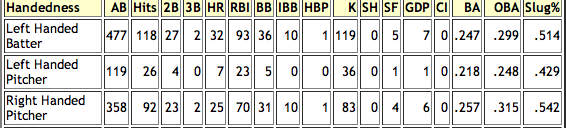
As shown, Jacobs struggled against lefties but fared well against righties. His OPS of .677 vs. LHP is below average, especially for a first baseman. However, his OPS of .857 is above average and slightly superior to the overall line put up by first basemen in the National League last year (.277/.359/.479).
Jacobs slugged nearly five times as many extra-base hits vs. righthanders as lefthanders in a little over three times as many plate appearances. He also walked more and struck out less often against RHP than LHP. Granted, his bases on balls were padded by the ten intentional walks he received, but I wouldn't discard this fact unless one were willing to do the same for all other players, including his peers at first base.
Now, let's examine his home and road splits . . .
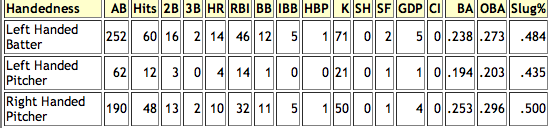
Jacobs didn't hit too well at Dolphin Stadium last season. Florida's park factor was a 97, meaning it suppressed runs by three percent. Moreover, it reduced home runs by a whopping 22 percent for LHB, more than any other stadium outside of Petco Park. That said, Jacobs was downright putrid when facing southpaws at home.
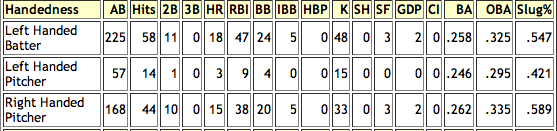
Jacobs hit much, much better on the road than at home. Mike's overall results were solid and his production vs. righthanders was outstanding. He had more than six times as many XBH vs. RHP as LHP in approximately three times as many plate appearances. Furthermore, his BB/SO ratio was reasonable. Importantly, the .924 OPS would have been good enough to put him in a tie for seventh in the NL if viewed against the field's overall stats. Although such a comparison favors Jacobs, it is meant to shed light on just how well he tattooed righties when he wasn't hamstrung by Dolphin Stadium.
Based on the above analysis, it seems to me that Jacobs could be a very effective slugger if employed properly. However, so as not to give those who might think his splits last summer were an aberration, let's cross check 2008 against his career totals.
The bottom line is that Jacobs' career splits are essentially in-line with his 2008 production.
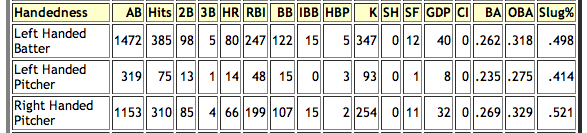
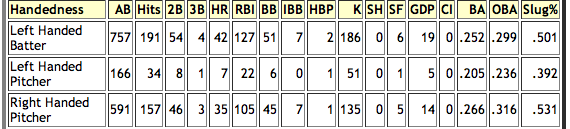
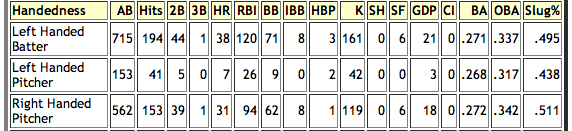
All else being equal, players usually perform better at home than away. In 2008, National Leaguers hit .265/.338/.421 at home and .256/.325/.405 on the road. The difference in production was about 4% as measured by AVG, OBP, SLG, and OPS.
Adjusting Jacobs' career road rate stats by 4% would produce a line of .281/.350/.515 at a neutral home ballpark. Averaging his actual road and theoretical home stats would suggest an overall mark of .276/.343/.505. All of a sudden, Jacobs' numbers look like a fairly typical first baseman.
I recognize that Kauffman Stadium is unlikely to be anymore accommodating as Dolphin Stadium has been to him, especially as it relates to slugging home runs (as the Royals home field played to an 82 ballpark factor for HR by LHB in 2008 and an 88 for the past three years) . But it's possible that Jacobs' right-field pull power might work to his benefit at his new home stadium. The distance between home plate and the right-field line is 15 feet shorter at Kauffman (330') than Dolphin Stadium (345').
You can see for yourself if the change in ballparks may have made a difference the past three seasons.
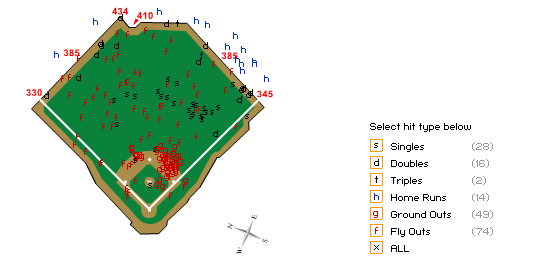
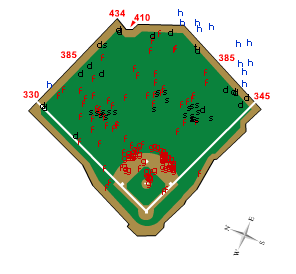
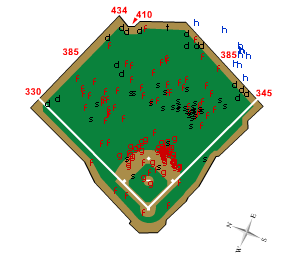
Courtesy of Hit Tracker, we can view scatter plots of Jacobs' homers during the 2006-08 seasons, both at home and on the road. Nonetheless, it's the doubles that Mike hit toward the foul line at home that could very well be four baggers at Kauffman.
Jacobs' 32 HR and .514 SLG would have led the Royals in both categories by a wide margin. In fact, he had the 10th-best HR/AB mark (6.7 percent) in the majors. Among first basemen, only Ryan Howard and Albert Pujols had better ratios.
The 6-foot-3, 215-pounder adds a new dimension to a Kansas City lineup that has been void of lefthanded power the past couple years. The Royals ranked dead last in runs, home runs, total bases, and OPS vs. RHP in 2007 and 2008. By comparison, the Royals placed second in runs vs. LHP in 2008. The numbers are a bit skewed by the fact that KC had the fewest plate appearances in the AL vs. RHP and the most vs. LHP in 2008. Go figure, right? But the OPS ranking vs. RHP corroborates the counting stats in this case.
As Moore told MLB.com, "I think we had one of the best records in baseball against left-handed pitching [36-24] and one of the worst against right-handed pitching [39-63] last year."
While the skeptics believe Jacobs only adds to the logjam at first base (given the presence of Ross Gload, Billy Butler, Ryan Shealy, and even Kila Ka'aihue), the truth of the matter is these existing options aren't all that inspiring. Gload (.273/.317/.348) is 33 and his lack of power is glaring. The 23-year-old Butler (.340/.398/.585 career vs. LHP) would make an excellent platoon partner with Jacobs. Shealy (.271/.335/.429) is 29 and not getting any younger or better. Ka'aihue will turn 25 next March and has only played 12 games in the big leagues. Big and unathletic, the lefthanded-hitting first sacker profiles as a Hee Seop Choi clone.
Jacobs can also be slotted into the DH role, which is where he is best suited. Either way, the Royals don't have to marry him. Arbitration eligible, he stands to make about $2.5-$3 million in 2009. If Mike performs well, Moore can offer him a two-year extension at roughly $5-6M per. He can seek free agency after the 2011 season at about the time last June's No. 3 overall draft pick Eric Hosmer, a lefthanded-hitting first baseman, is set to arrive in Kansas City. If Jacobs flops, he can be non-tendered next fall. Should the newest Royal fall somewhere in between, it is my guess that he could be flipped for a mid-20s reliever on the order of Leo Nunez.
Put it all together and I just don't see where there is all that much risk in this trade from the standpoint of Moore and the Royals.
| Baseball Beat | October 31, 2008 |
The New Testament of Fielding Stats and Awards
With the World Series behind us, the baseball world now turns its attention to award winners, free agents, the Rule 5 draft, and the hot stove league. We will cover all of these matters &ndash and much more – this off-season.
The Fielding Bible Awards, chosen by a ten-man panel, were announced yesterday. The balloting is distinct from the Rawlings Gold Glove Awards. The latter has been in existence since 1957 and the voting has been conducted among MLB managers and coaches since 1965. In addition to the makeup of the voters, the Fielding Bible Awards are different from the Gold Gloves in that the former is designed to honor the best defensive player at each position in the majors (as opposed to naming winners for each of the two leagues) and the outfield spots are broken down by left field, center field, and right field.
Here are the Fielding Bible Awards for the 2008 season (with commentary provided by John Dewan of Baseball Info Solutions):
First Base – Albert Pujols, St. Louis
He was the only repeat winner last year, and now Albert Pujols is the only three-time winner of the Fielding Bible Award. But this time it wasn’t so easy. Mark Teixeira gave him a run for his money. Pujols finished with 90 points while Teixeira pulled in 88. One flip-flop would have garnered Teixeira at least a tie for first. Five panelists gave first place to the slugger from St. Louis while the late-season Angels star earned four. Former Angel Casey Kotchman received the final firstplace vote.
Second Base – Brandon Phillips, Cincinnati
This one surprised me, but it shouldn’t have. Brandon Phillips finished third in our voting last year and now has won his first Fielding Bible Award with 86 points. I voted for Chase Utley, who had the highest Plus/Minus figure at any position this year (+47 – see the Kenny Rogers discussion below for more information about the Plus/Minus System). But the panelists who watched Phillips play more regularly have seen what he can do on the field and rewarded him accordingly.
Third Base – Adrian Beltre, Seattle
It was a runaway victory for Adrian Beltre. Beltre won the award two years ago in the closest vote we’ve ever had (the tiebreaker was invoked) but this year his 36-point margin of victory, 90 points compared to 64 points for second-place finisher Evan Longoria, was the second largest margin of victory in this year’s voting. Longoria showed that the rookie hype for him wasn’t just about his prodigious bat. He can flash the leather as well.
Shortstop – Jimmy Rollins, Philadelphia
Jimmy Rollins won his first Gold Glove last year, and this year he wins his first Fielding Bible Award. The year started slow for Rollins. He didn’t begin to show up on the Plus/Minus leaderboard at shortstop until well into the season, thanks primarily to his early-season injury. But he got it going and overtook Yunel Escobar in the last week of the season to win the Plus/Minus Crown with +23. Rollins also led all shortstops with the most Good Fielding Plays (65) by a good margin over Orlando Cabrera (55) and Erick Aybar (55). Rollins’ 88 points in the voting, compared to 59 points for runner-up J.J. Hardy, represented this year’s largest margin of victory. Escobar finished third in our voting, Aybar fourth and Cabrera sixth.
Left Field – Carl Crawford, Tampa Bay
He’s baaack! And he didn’t even have to play a full season to win it. Carl Crawford missed most of the month of September but still wins the Fielding Bible Award in left field for 2008 with 87 points. It’s his second award, having won it in 2006. In 2007, he finished second to Eric Byrnes by a mere three points. Despite the missed time, Crawford held off Willie Harris’ late run for the highest Plus/Minus total in left field (+23 to +22).
Center Field – Carlos Beltran, New York Mets
Like Carl Crawford in left, Carlos Beltran won the award for center fielders in 2006, but he finished second to Andruw Jones in a close battle in 2007. Now he wins his second Fielding Bible Award with 82 points. Minnesota’s rookie speedster Carlos Gomez (74 points) finished second. Unlike Crawford, Beltran played injury free in 2008, starting 158 games in center field for the Mets, the highest total of his career.
Right Field – Franklin Gutierrez, Cleveland
Franklin Gutierrez led all right fielders in Plus/Minus last year with +20, although he did not win the Fielding Bible Award. To show that 2007 was no fluke, however, Gutierrez led them again this year with +29. Here’s the amazing part: he did it while playing only 88 games in right field in 2007 and only 97 games this year. Gutierrez received 85 total points from our panel and is a first-time Fielding Bible Award winner in right field.
Catcher – Yadier Molina, St. Louis
Maybe his brothers are getting jealous; they’re creeping up on him. But it’s a repeat Fielding Bible Award for Yadier Molina in 2008 (88 points). Jose Molina finished tied for second with Jason Kendall of the Brewers this year at 63 points. With Bengie Molina placing eighth in the voting, it’s the first time any set of two brothers, much less three, have cracked the top ten in our Fielding Bible Award voting. That record may stand for quite some time.
Pitcher – Kenny Rogers, Detroit
Greg Maddux of the Dodgers has won the National League Gold Glove Award for pitchers in 17 of the last 18 years. The American League Award has gone to Kenny Rogers of Detroit in five of the last eight years. But are they truly the two best fielding pitchers in baseball? Were they really the best in each and every year that they won? Aren’t these two guys getting pretty old? Aren’t there some younger studs out there to take their places?
The complete vote tally can be viewed here.
While in general agreement with the voters as to the winners, I was surprised to learn that Garret Anderson placed fifth among left fielders. I can't imagine that he deserves to rank in the top half of his peers, much less fifth. The good news is that no single voter rated him higher than fourth. Rob Neyer and Joe Posnanski earned even more respect from me (although I don't know if that is possible given how highly I think of them) as the only two panelists who didn't vote for GA at all.
As opposed to Neyer and Posnanski, I have to wonder about Mike Murphy. Not only did the latter rank Anderson fourth but he had Robinson Cano as his No. 2 second baseman (while listing Chase Utley ninth, Dustin Pedroia tenth, and excluding Mark Ellis altogether). Murphy's credibility as a voter can also be questioned by virtue of his rankings for Fielding Bible Award winners Albert Pujols (fourth), Brandon Phillips (third), Adrian Beltre (tenth), Jimmy Rollins (third), Carl Crawford (ninth), Carlos Beltran (fifth), Franklin Gutierrez (sixth), Yadier Molina (second), and Kenny Rogers (second). Furthermore, the top players Murphy voted for at second base, third base, and shortstop didn't even rank in the top ten in total points. I have no idea why the Chicago sports radio host was asked to be on the panel, but he should be removed prior to next year's balloting if it is the goal of the Fielding Bible Awards to be taken seriously as the preeminent word on defensive excellence.
Most of the panelists value the Plus/Minus System that was developed by Dewan. A check of the 2008 and 2006-08 leaders and trailers passes my smell test. The bottom line is that fielding systems employing play-by-play data such as Dewan's Plus/Minus, David Pinto’s Probabilistic Model of Range (PMR), and Mitchel Lichtman's Ultimate Zone Rating (UZR) are much more accurate than traditional defensive statistics like putouts, assists, errors, fielding percentage, and even range factors. For more on advanced defensive metrics, be sure to check out Evaluating Fielding by Tom Tango, the noted sabermetrician.
| Baseball Beat | October 30, 2008 |
The Big Chase
Rain or shine, the Philadelphia Phillies are the 2008 World Series champions. Congratulations go out to all of the players, coaches, staff, Charlie Manuel, Pat Gillick, ownership, and the City of Brotherly Love.
As a Long Beach native, I am extremely happy for Chase Utley. He and my son Joe are the same age, and they played in the Long Beach Little League and Long Beach Pony League at the same time. I had the good fortune of coaching Chase for a couple of games on a youth All-Star team but had the bad fortune of coaching against him most of the time.
Chase played on the Pirates while Joe played for the Dodgers. We didn't stand a chance. As it turned out, the Dodgers didn't have anyone who went on to play Major League Baseball. The Pirates had two. Yes, two. Chase Utley and Sean Burroughs. Although Chase is better known today, it was Sean who made headlines in those days.
You may recall that Burroughs was the star of the Long Beach Little League teams that won back-to-back world championships in 1992 and 1993. He pitched two no-hitters at Williamsport in 1993, striking out 16 in each game. Sean was also the best hitter on both All-Star teams.

Burroughs was much more than a Little League phenom. He was the ninth overall pick in the 1998 draft by the San Diego Padres. Two years later, Sean won a gold medal as a member of Team USA in the Olympics Games in Sydney, Australia. He is the only player that I am aware of who has ever won a Little League Baseball World Series championship and an Olympics gold medal.
Chase was two years older than Sean and did not play on the Little League All-Star teams that won consecutive titles. But Utley was special in his own right. I shared my thoughts on Chase in the summer of 2006 after he had extended his hitting streak to 31 games.
I have a special affinity toward Utley. Chase and my son Joe played youth baseball for Long Beach Little League. Joe played on the Dodgers. Chase played for the Pirates. One of Chase's teammates was Sean Burroughs, who just may be the best Little League player ever. Joe and Chase are two years older than Sean and neither played on the LBLL All-Star teams that Burroughs spearheaded to World Championships in 1992 and 1993.My son's team was coached by a real estate agent and me. The Pirates were coached by an attorney and Sean's dad, Jeff, the 1974 AL MVP. Needless to say, the Dodgers never beat the Pirates in those years. Jeff was a terrific coach and the Pirates had more talent than the rest of the league combined.
I can remember Utley's tryout like it was yesterday. You could tell that he was special. Everything Chase did stood out. He roped a handful of line drives from the right side, then crossed over the plate and repeated the same feat from the left side. The kid had star written all over him.
Utley prepped at Long Beach Poly High School (hitting .525 with 12 home runs his senior year in one of the toughest leagues in the country) and was selected by the Los Angeles Dodgers in the second round (76th overall) of the 1997 amateur draft. He turned down a large signing bonus from his hometown team, played three seasons at UCLA (earning All-American honors his junior year), and was taken by the Philadelphia Phillies in the first round (15th overall) in the 2000 draft. He signed that summer, hit over .300 in low-A, advanced to high-A in 2001 and triple-A in 2002. Utley tore up the International League the second time through in 2003 and got called up to the majors that summer.
The 6-foot-1, 185-pounder was one of the best-hitting middle infielders in 2005 and has become one of the best hitters period this year. A fan favorite, Utley's makeup is off the charts. He plays hard all the time, running out groundballs and hustling in the field and on the basepaths. Chase is well-liked and respected by his teammates, as well as those of us who were fortunate to witness his beginnings.
Like his former teammate Burroughs, Utley can now lay claim to being a world champion. The second baseman did his part, hitting .292/.380/.535 with 33 HR during the regular season and adding three more homers during the postseason while making a memorable and decisive defensive play in the final game of the series.
With the score knotted at three in the top of the seventh and the go-ahead run on second base, Chase ranged to his right to field a ground ball off the bat of Akinori Iwamura, pump-faked a throw to first, and made an off-balance throw to home plate to nab a surprised Jason Bartlett for the final out of the inning. It was the type of heads-up play that has distinguished Utley throughout his baseball career, from Little League to Pony League to high school to college to the minors and for the last six years in the majors.
As fate would have it, Utley and Burroughs almost faced each other in the World Series. San Diego traded Sean to Tampa Bay for Dewon Brazelton in December 2005. Unfortunately, Burroughs only played eight games for the Devil Rays and was released in August 2006. He never played another game in the big leagues.
Two months before Burroughs was released, Tampa Bay selected Evan Longoria with the third overall pick in the amateur draft. Not only were Burroughs and Longoria third basemen but both are Long Beach products – just like the 2008 World Series champion Chase Utley.
| Baseball Beat | October 22, 2008 |
World Serious Predictions
The World Series is finally upon us.
Courtesy of ESPN.com, the following bullet points provide a concise look at the matchup between the Tampa Bay Rays and the Philadelphia Phillies.
• The Rays have home-field advantage because the AL won the All-Star Game this season. That game was won by Rays pitcher Scott Kazmir and lost by Phillies pitcher Brad Lidge. Evan Longoria drove in the tying run with an eighth-inning hit off former Phillies closer Billy Wagner.• This is the first time since 2001 that the World Series was between two division winners (i.e., no wild-card team).
• This is the first East vs East World Series matchup since 2003 (Marlins defeated Yankees).
• By making it to the World Series for the first time, we can cross the Rays off the list of teams never to make the World Series. The franchises still on the list are the Rangers, the Nationals and the Mariners.
• History: The Rays are 10-5 all-time against the Phillies, though the teams haven't met since June 18, 2006. That was eons ago, for the Rays especially, whose starters the last time they played the Phillies included an infield of Travis Lee, Jorge Cantu, Julio Lugo, and Aubrey Huff.
• Strength vs. strength: The Rays were baseball's best home team during the regular season. The Phillies' 44-37 road record was the best in the NL.
• Strength vs Weakness: The Rays were 12-6 against NL teams this season. The Phillies were 4-11 against the American League, second-worst among NL teams (Padres, 3-15).
Schedule
Game 1: Phillies (Hamels, 14-10, 3.09) @ Rays (Kazmir, 12-8, 3.49) 10/22, 8:00 PM ET
Game 2: Phillies (Myers, 10-13, 4.55) @ Rays (Shields, 14-8, 3.56) 10/23, 8:00 PM ET
Game 3: Rays (Garza, 11-9, 3.70) @ Phillies (Moyer, 16-7, 3.71) 10/25, 8:00 PM ET
Game 4: Rays (Sonnanstine, 13-9, 4.38) @ Phillies (Blanton, 9-12, 4.69) 10/26, 8:00 PM ET
Game 5: Rays @ Phillies 10/27, 8:00 PM ET
Game 6: Phillies @ Rays 10/29, 8:00 PM ET
Game 7: Phillies @ Rays 10/30, 8:00 PM ET
To find out which team is going to win the World Series, I turned to our Designated Hitters, participants in our "Who Was Your Favorite Player Growing Up?" series that kicked off Baseball Analysts, and a number of baseball insiders for their predictions.
I asked our guests three questions:
1. Which team will win?
2. How many games?
3. Why?
Without further ado, here is what our esteemed friends have predicted:
1. Rays
2. 6 games.
3. The Phillies were dreadful in interleague games this season, which doesn't bode well for the Series. The Rays have a superior rotation and with their power to left field, should be able to score runs at Citizens Bank Park. Mocking Joe Maddon for emphasizing winning in spring training might not have been such a good idea in retrospect.
1. Phillies
2. 6 games.
3. Howard, Rollins, Utley, Burrell, Werth, and Victorino. The Phillies have a superior lineup and the Rays' power output cannot continue. The Rays 20% HR/FB in the ALCS shouldn't happen again. Rays probably have an edge in the pitching department but Hamels has been stellar and and I think Myers is in for a better series. Just a hunch.
1. Rays.
2. 6 games.
3. I'm picking the Rays because I'm an AL fan, I'm familiar with the team, I enjoy watching them, and I'm impressed that they beat the Sox in 7. However, I'm not overly confident in the selection even if it proves to be a popular one. I could see the Phillies pulling out an upset in five. But I'm drinking the Tampa Bay Kool Aid, so nevermind my hunches, go Rays.
1. Phillies
2. 6 games.
3. Two reasons. One, the Rays don't hit lefties so good, and they'll have to face Hamels and Moyers twice each in this series.They'll be lucky to win 2 of those 4 games. Second, I don't like the Tampa Bay bullpen ---- it only has 2 pitchers (Balfour and Price) who can throw the ball past anybody, and the workhorse of the relief corps, Wheeler, is just not very good. Maddon needed 4 relievers to get 3 outs in the 8th inning of Game 7, which speaks volumes; Bradford, Howell, and Wheeler can't be trusted too far, and Maddon knows it. Price, who did not appear in the ALDS and was the pitcher of last resort in the ALCS, may (should) have earned himself a bigger role with his Game 7 performance; if he's used in meaningful situations in the W.S., it will make the TB bullpen a lot better.
1. Rays
2. 7 games
3. I believe the Rays have the edge with starting pitching.
1. Rays
2. 6 games
3. Predicting who will win the World Series is a 50/50 endeavor, so I'm in on this action. The match-ups should be great with the Phillies getting a slight edge in the pitching dept. while the Rays have power and speed on the offensive side.
Other observations? I predict there will be bar room conversations around the country like, "Is that Dave Navarro behind the plate for the Rays? Wasn't he in Jane's Addiction?" Odds are that FOX will figure out some way to insert "More Cowbell" into every bases loaded jam sequence when games are at the Trop. And finally, I predict that Bud Selig will say for the umpteenth time during the Fall Classic that with the Rays going from worst to first, this is truly the Golden Age of Baseball.
1. Rays
2. 6 games.
3. They'll bludgeon anyone not named Cole Hamels. The big Phillies advantage -- the bullpen -- will be neutralized as Philadelphia's will have to go to work too early, and Tampa Bay's won't have to come in under pressure.
1. Rays
2. 6 games.
3. Because they have significantly better #2 through #4 starters.
1. Phillies
2. 7 games.
3. It comes done to game 1: If Cole Hamels is effective and the Phils win game 1, I think the Phils could win in seven games. If they lose game 1, the Rays will win in 5. The thing that concerns me most about the Phils is their starting pitching behind Hamels. They might be able to ride more big postseason games from Myers and Blanton, and Moyer might bounce back after two horrific postseason starts, but more than likely, they won't. The Phils offense started to pull it together, to get the whole offense firing on all cylinders, toward the end of the Dodgers series. If they start to sputter it will hurt them.
1. Rays
2. 6 games.
3. The Rays in the World Series—it seemed to be the Impossible Dream in the team’s history entering 2008. And just when it seemed they were assured of a spot in the Fall Classic it appeared the Rays were headed for a classic fall.
The Rays have shown they have true talent in both their starting rotation and in their lineup. They are young and they are good. The biggest concern I thought the Rays faced might very well have been answered in Game 7 of the ALCS when David Price closed the door on the Boston Red Sox.
Joe Maddon’s team no longer has to worry about letting a golden opportunity slip away. The young Rays simply need to turn their wonderful young talent loose and let the rest take care of itself.
The 2008 World Champions—the Tampa Bay Rays. As strange as it may sound, that’s why they play the games.
1. Phillies.
2. 7 games.
3. Because I'm an NL fan, and I don't want to be torn between rooting for my prediction or rooting for the NL team.
1. Rays
2. 7 games.
3. They have home field advantage, they play in the tougher league, and their performance this season was no worse than the Phillies. Anything can happen in a seven-game series, but the Rays definitely have to be the favorites.
1. Rays
2. 7 games.
3. These are two fairly similar teams (both teams can mash, both can run, both have killer bullpens, neither hits for average all that well). The difference is that the Phillies have one truly reliable starter and the Rays have three. That's why I'm taking the Rays (although personally I hope I'm wrong; the Phillies -- by almost any measurement the least successful of the original 16 franchises -- need a little love from the baseball gods).
1. Rays
2. 5 games.
3. The Rays hitters are motivated. How else can you explain the numbers they posted during the League Championship Series against the Red Sox - a veteran team that is hardly a pushover?
The young trio of Evan Longoria, B.J. Upton and Carlos Pena was almost unbelievable in the series, especially in terms of power numbers. Combined throughout the seven games, the group hit 11 home runs and drove in 25 runs. Hardly a one-dimensional offence, the Rays also stole 10 bases and took their fair share of walks (25). In the NL League Championship Series, the Phillies hit five homers as a team and a pitcher (Brett Myers) was tied for second on the club with three RBI. As for pitching, the Phillies starters were hardly dominant by allowing 30 hits and 13 walks in 25.1 innings. In 43.2 innings, the Rays starters allowed 37 hits and 18 walks.
1. Rays
2. Not provided.
3. After picking the Rays to win in seven games against the Red Sox in the New York Post, I'm staying on their bandwagon.
MLB now stands for Mediocre Baseball League. Most organizations are run so poorly that it doesn't take much to separate yourself from the crowd. The Phils and Rays are the two best teams because both have instinctive, talented and hard-nosed ballplayers. Cole Hamels is the difference-maker for the Phils. David Price is the weapon Joe Maddon needed in his bullpen. The Rays have the AL edge.
1. Rays
2. 7 games.
3. Good starting pitching (big extra day off for Garza), great defense, a shutdown rookie in the bullpen (Price) and the two hottest sluggers still going (Upton and Longoria) by a nose over a loaded Phillies attack.
1. Rays
2. 5 games.
3. This is our generation’s 1969 Mets, although Longoria is a little young to play Ed Charles.
1. Phillies
2. 6 games (W-L-W-L-W-W).
3. Phillies have the best pitcher (Hamels), best closer (Lidge) and two best hitters (Utley and Howard) among the two teams. If Hamels can pick up the win on the road in Game One, I have no doubt with their big bats behind them, Myers (twice), Moyer, Blanton and Hamels (again) can pick up three more wins.
1. Rays
2. 7 games.
3. I see it as a tight matchup. I give the edge to Tampa Bay based on starting pitching. The deeper Philly bullpen will get called often in the Moyer and Blanton starts. I see David Price continuing his success and playing a key role. If Game 7 comes down to Garza vs. Moyer, look for me in the cashier's line.
1. Rays
2. 7 games.
3. I think it comes down to David Price. He makes the Phillies’ bullpen advantage slightly less vast. I hope Ryan Howard doesn’t mind facing Price about, oh, six times in the late innings this series.
1. Rays
2. 6 games.
3. The Rays have around a 57% chance of winning. They have a 19% chance of winning in 6 and 18% of winning in 7, so I have to go with Rays in 6.
As to the “why,” both teams are about equal in talent relative to their respective leagues, but since the AL is the superior league overall, the Rays are the superior team, again, to the tune of around having a 57% chance of winning a 7-game series.
More specifically, the weak link for the Phillies is Moyer. If he is the game 3 pitcher (rather than Blanton), he pitches twice in the series. Also a weak link for the Phillies is a RH DH (to play against Kazmir). They essentially have none. Not that the Rays have much of a RH DH either. Other than those items, the teams are very similar in talent. Both are more vulnerable to LH pitching of course. If Manuel continues to bat Utley and Howard back-to-back, and there is no reason to think that is going to change, the Phillies will be very vulnerable to the Rays’ bullpen which has 3 good left-handers, in Howell, Miller, and Price. If I am the Rays manager, I will bring in a lefty to oppose those two batters, any time late in the game when the leverage is decently high.
1. Rays
2. 6 games.
3. Talent, talent, talent -- Rays have a No. 1 overall pick (Price), No. 2 (Upton), No. 3 (Longoria), plus former first-rounders like Baldelli, Pena, Floyd, Howell (supplemental), Kazmir . . . just a very talented team that has been led well by veterans and the rare manager who makes a difference, Joe Maddon. Philly has talent and a better bullpen plus an ace in Hamels, but I think Tampa's offense is more varied, it's more athletic, better defensively and has better starting pitching.
1. Rays
2. 5 games.
3. The Phillies simply can't match up with the Rays. Cole Hamels is better than anyone he'll face, but otherwise every Tampa Bay starter will have the edge on his mound opponent. And the Phillies' lineup, though solid, wouldn't score more runs than the Rays if both were in the same league. Brad Lidge is the Phillies' one obvious edge ... but as good as David Price has looked lately, even that's not a sure thing.
1. Rays
2. 7 games.
3. It has been a while since we have had a great, close World Series. These things usually go in cycles. Plus this one reminds me a lot of '91, with two relatively surprising teams playing, and that series was incredible. I pick the Rays because of their starting pitching, home field, and, yeah, a little bit of destiny.
1. Rays
2. 7 games.
3. Home field advantage is the largest difference between the teams.
1. Rays
2. 6 games.
3. Rays bullpen matches up well against Phillies lefty leaning lineup and bench and Rays bench is more varied than Phillies. Also, Rays starting staff is deeper.
1. Rays
2. 6 games.
3. The Rays have home-field advantage and a huge psychological advantage after holding off that late charge by the Red Sox in the ALCS. They'll be very loose and the Phillies will be a little rusty after a week's layoff.
1. Rays
2. 7 games.
3. I think this will be a great Series, featuring two evenly matched, interesting teams. I like the Rays' starting pitching better, but I think the Phillies have the better bullpen and offense. For those who like intangibles and dramatic storylines, the Series will feature the oh so woefully inexperienced Rays vs. the prospect of a Brad Lidge meltdown. What fun!
I would look for fielding plays to make a difference. The Rays have had good defense this year, though they made some errors in the second half of the Boston series. The Phillies' defense is even better.
I have making predictions--can't we all just get along and enjoy the games???--but if forced I will pick the Rays in seven. The AL is the superior league and the Rays' starting pitching is looking good.
1. Phillies
2. 7 games.
3. Philadelphia's bullpen provides the big edge. Barring some masterful deployment of heretofore lesser options like David Price and perhaps even Edwin Jackson by Joe Maddon, I think the Rays will be outclassed in the relief pitching department. Brad Lidge and Ryan Madson are better than any option at the Rays' disposal. Grant Balfour and Dan Wheeler seem to be limping to the finish line.
1. Rays
2. 6 games.
3. The Phillies will win one start from Hamels and scratch out another from one of the other starters, but the Rays showed that they can hit the ball over the fence. Frequently. More frequently than the Phillies.
1. Rays
2. 7 games.
3. The Rays won more regular season games in a more difficult league. They did exceed their pythag W-L by a few games, but even taking that into account, I favor them over the Phillies.
1. Rays
2. 6 games.
3. Just betting on the better regular-season team. Cole Hamels will make the Phillies ultra-competitive, and I think the games will be close more often than not. But I just think Tampa Bay will prevail.
Of our 32 entrants, 26 are going with Tampa Bay and only six with Philadelphia. Nobody is predicting a sweep, three (Hulet, Langill, and Neyer) see the Rays taking the Phillies in five games, 12 are picking TB in six, and ten see the AL champs needing all seven games to win it all. Among the half-dozen PHI supporters, 50% believe the NL champs will beat back the Rays in six and 50% think it will go the full seven.
As for me, I will go along with the consensus and choose the Rays in 6. Tampa Bay won the AL East, the toughest division in baseball, and the American League once again is the superior circuit. Add the fact that the Rays have home-field advantage, and it seems to me that the 200:1 long shots at the beginning of the season are poised to win their first World Series championship ever.
| Baseball Beat | October 20, 2008 |
From Worst to the World Series
The Tampa Bay Rays pulled off the "Improbable Dream" by beating the Boston Red Sox, its American League East rival, four games to three in the ALCS to advance to the World Series. The "worst to first" Rays will now face the Philadelphia Phillies, winners of the NLCS in five games over the Los Angeles Dodgers. The latter series seems as if it took place last month.
Although FOX may not be happy about the World Series pairing, my sense is that baseball fans are thrilled. The Rays will be gunning for their first World Championship and the Phillies, the first professional team to lose 10,000 games, will be shooting for the club's second World Series victory in over 125 years. In a year in which the Chicago Cubs seemed destined for the October Fall Classic, the lovable losers-turned-World Series champs will either be the Rays or the Phillies.
Before delving into a World Series preview, I'd like to cover the highlights (and lowlights) from last night's exciting finale between the Rays and Red Sox.
| Baseball Beat | October 16, 2008 |
And Then There Were Three
. . . OK, two-and-a-half.
After beating the Dodgers in five games in the NLCS, we now know that the Phillies will represent the National League in the World Series.
What we still don't know (quite) yet is whether Philadelphia will face the Rays or the Red Sox for all the marbles. Tampa Bay, which has scored 31 runs in winning three in a row, will send Scott Kazmir to the mound tonight in the hope that the 24-year-old southpaw can shut down Boston and send the upstart Rays to their first World Series ever.
Credit manager Joe Maddon for thinking outside the box and and making the bold decision to go with his young lefty even though the order of the rotation would suggest that James Shields should pitch Game 5 in Fenway and Kazmir in a "if necessary" Game 6 at home on Saturday. Should the Red Sox extend the Rays to a Game 7 in Tampa Bay, then Maddon will turn to Matt Garza to pitch the rubber match.
In the meantime, Boston manager Terry Francona will rely on, in order, Daisuke Matsuzaka, Josh Beckett, and Jon Lester to pitch the Red Sox into their third World Series in the past five years. If history is any guide, I wouldn't count Boston out at this point. In winning it all in 2004 and 2007, Francona's club came back from 3-1 deficits in the ALCS.
Although I don't like Boston's chances of pulling off this feat for a third straight time, "it ain't over 'til it's over" as they say. One simplistic way to think about the Red Sox's chances is to recognize that Boston has about a one-in-eight shot of meeting the Phillies in the World Series if we can assume that the odds of winning each of the next three games is approximately 50-50. Sure, the Red Sox are a -150 favorite tonight, but it would likely be a slight underdog in each of the next two contests should the ALCS move to Tampa Bay.
While the real odds are somewhat less than one-in-eight, Boston faces an uphill battle after putting itself in this difficult predicament. That said, you have to take these games one at a time. A Red Sox victory tonight will change the dynamics of the series and give Boston fans hope that the Los Angeles Dodgers faithful never had the chance of experiencing.
| Baseball Beat | October 13, 2008 |
Nationalize the Nationals of the National League
If Washington is going to bail out Bear Stearns & Co., Fannie Mae, Freddie Mac, and AIG, then it may as well bail out the Nationals, too. I mean, why not? Aren't the Nats just as important to Washington and inept as those four financial firms?
Well, whether the Nationals are nationalized or not probably makes little difference as the club has faltered under the ownership of Major League Baseball as well as the Lerner family. Private, quasi-private, or public, I don't think it much matters.
If you're looking for failure, try these facts on for size. The Nationals...
- failed to sign their first-round draft pick Aaron Crow,
- finished with the worst record in the majors,
- compiled the lowest attendance in the first year of a new ballpark in the post-Camden Yards era, and
- produced the lowest TV and radio ratings in all of baseball.
Oh, and two weeks ago, the Nationals fired five of its six coaches (all but pitching coach Randy St. Claire). That's right, Pat Corrales (bench), Tim Tolman (third base), Jerry Morales (first base), Rick Aponte (bullpen), and Lenny Harris (hitting) were all booted. The club also dismissed strength and conditioning coordinator Kazuhiko Tomooka and video coordinator Tom Yost. I guess somebody or a bunch of bodies had to be the scapegoats as the owners, team president Stan Karsten, general manager Jim Bowden, and manager Manny Acta obviously were not to be blamed.
Other than all that, the organization had about as good of a year as those in the White House and on Capitol Hill.
The only consolation to this year's disastrous season is that the Nationals now own the first overall pick in the 2009 First-Year Player Draft. Washington also has the No. 9B selection as compensation for not coming to terms with Crow by the August 15 deadline (or September 22 if you're a client of agent Scott Boras).
The first prize could be a big one. While lots can happen between now and June, there is little doubt that the top prospect at the moment is righthander Stephen Strasburg of San Diego State. Strasburg, 20, was the only college player to win a spot on the U.S. Olympic baseball team in Beijing this past summer. The San Diego native leapt onto the national scene when he struck out 23 against the University of Utah at Tony Gwynn Stadium on April 11. While the 6-foot-4, 220-pounder's fastball has been known to reach triple digits, many scouts rank his knee-buckling curveball as his #1 pitch. Strasburg also throws a slider that touches the high-80s.
Strasburg won't come cheap as his "advisor" is none other than uber-agent Boras. Knowing that the Nats would face a public relations dilemma if the club failed to sign its No. 1 pick two years running, you can count on Boras using such leverage when asking for perhaps as much as an eight-figure MLB contract next summer.
Although I thought the Lerners once owned the largest stake in MBNA, the credit card behemoth, I was informed by Chris Needham, the proprietor of the former blog Capitol Punishment, the family that owns the Nationals is of the same name but different. Instead, Ted Lerner is the founder of Lerner Enterprises, the largest private real estate developer in the Washington, D.C. area. While the other Lerner family sold out to Bank of America a few years ago, these Lerners are apparently learning on the job. The Lerner family is a minority partner in Lincoln Holdings, LLC group, which owns 100 percent of the NHL Washington Capitals and the WNBA Washington Mystics and 44 percent of the NBA Washington Wizards and Verizon Center. I'll let you be the judge as to whether any of these franchises have been successful.
Where's Barack Obama and his promises of change when (and where) you need it most?
| Baseball Beat | October 11, 2008 |
| Baseball Beat | October 10, 2008 |
BOS-TB: A History Lesson
The defending World Series champions are set to face the team with the worst record in the majors last season to see which team will represent the American League in the 2008 World Series. There has never been anything close to such a matchup since the advent of the wild card.
Another story line is that Boston and Tampa Bay will be the tenth pairing of a wild card team and a first-place club from the same division. Let's check out how intra-division League Championship Series have played out in the past:
1996 ALCS: New York Yankees (92-70) over Baltimore Orioles* (88-74) 4-1
1997 NLCS: Florida Marlins* (92-70) over Atlanta Braves (101-61) 4-2
1999 ALCS: New York Yankees (98-64) over Boston Red Sox* (94-68) 4-1
1999 NLCS: Atlanta Braves (103-59) over New York Mets* (97-66) 4-2
2003 ALCS: New York Yankees (101-61) over Boston Red Sox* (95-67) 4-3
2004 ALCS: Boston Red Sox* (98-64) over New York Yankees (101-61) 4-3
2004 NLCS: St. Louis Cardinals (105-57) over Houston Astros* (92-70) 4-3
2005 NLCS: Houston Astros* (89-73) over St. Louis Cardinals (100-62) 4-2
2007 NLCS: Colorado Rockies* (90-73) over Arizona Diamondbacks (90-72) 4-0
* denotes wild card team
As shown, the wild card entrant has won four of nine, equal to a success rate of 44.4%. Looked at it in reverse, the division champ has defeated the second-place club 55.6% of the time.
Boston won the World Series as the wild card in 2004. The Red Sox swept the Angels in the ALDS that year, came back from a 3-0 deficit to beat the Yankees in the ALCS, and won four straight from the Cardinals in the World Series.
The Sox are 31-16 in the postseason with two World Series championships during the Theo Epstein era. That is nothing less than a remarkable record.
History is history. It doesn't necessarily tell us anything about today. But history has a way of repeating itself and those who ignore it do so at their own peril.
| Baseball Beat | October 09, 2008 |
League Championship and World Series Odds
Round two of the playoffs begins today with the Los Angeles Dodgers visiting the Philadelphia Phillies. The NL West champs are coming off a sweep of the Chicago Cubs while the NL East leaders took three of four from the Milwaukee Brewers.
Given the fact that we have already previewed the Dodgers and Phillies (as well as the additional information in the Link of the Day in the sidebar on the left), I thought it might be more fun to take a look at the League Championship and World Series odds as presented by Bodog.
Odds to Win the League Championship Series:
Los Angeles Dodgers Even Philadelphia Phillies -120
Boston Red Sox -140 Tampa Bay Rays +120
Odds to Win the World Series:
Boston Red Sox 7/4 Tampa Bay Rays 5/2 Los Angeles Dodgers 3/1 Philadelphia Phillies 13/4
Which League will the 2008 World Series Winner come from?
National League +125 American League -155
Will either team sweep the NLCS?
Yes +450 No -750
Exact Series Finish:
Los Angeles Dodgers 4-0 13/1 Los Angeles Dodgers 4-1 5/1 Los Angeles Dodgers 4-2 4/1 Los Angeles Dodgers 4-3 6/1 Philadelphia Phillies 4-0 8/1 Philadelphia Phillies 4-1 4/1 Philadelphia Phillies 4-2 5/1 Philadelphia Phillies 4-3 11/2
Exact Number of Games in the Series:
4 Game Series 9/2 5 Game Series 7/4 6 Game Series 6/5 7 Game Series 5/2
Odds to Win the 2008 NLCS MVP:
Manny Ramirez 3/1 Brad Lidge 5/1 Chase Utley 5/1 Ryan Howard 5/1 Cole Hamels 6/1 Derek Lowe 7/1 James Loney 7/1 Jimmy Rollins 7/1 Jonathan Broxton 8/1 Matt Kemp 8/1 Pat Burrell 8/1 Russell Martin 9/1 Andre Ethier 10/1 Takashi Saito 12/1 Casey Blake 15/1 Jayson Werth 15/1 Shane Victorino 15/1 Field Even
Will either team sweep the ALCS?
Yes +475 No -800
Exact Series Finish:
Boston Red Sox 4-0 9/1 Boston Red Sox 4-1 7/2 Boston Red Sox 4-2 3/1 Boston Red Sox 4-3 5/1 Tampa Bay Rays 4-0 12/1 Tampa Bay Rays 4-1 6/1 Tampa Bay Rays 4-2 7/2 Tampa Bay Rays 4-3 11/2
Exact Number of Games in the Series:
4 Game Series 9/2 5 Game Series 7/4 6 Game Series 6/5 7 Game Series 9/4
Odds to Win the 2008 ALCS MVP:
David Ortiz 5/1 Dustin Pedroia 5/1 Jason Bay 5/1 Jonathan Papelbon 5/1 Jon Lester 6/1 B.J. Upton 7/1 Evan Longoria 7/1 Kevin Youkilis 7/1 Akinori Iwamura 8/1 Carlos Pena 8/1 Dan Wheeler 8/1 Jacoby Ellsbury 8/1 Scott Kazmir 8/1 Carl Crawford 10/1 J.D. Drew 10/1 Field Even
Who do you like and in how many games and why?
| Baseball Beat | October 03, 2008 |
Playoff News and Notes
After a couple of days, the Phillies and Dodgers are up 2-0 in their NLDS and the Red Sox and Rays are leading 1-0 as the latter two teams head into their second games this evening. Meanwhile, the White Sox and Angels need to post victories to prevent going down 0-2 a la the Brewers and Cubs, which are facing elimination tomorrow.
Today's Schedule
White Sox (Mark Buehrle) at Rays (Scott Kazmir), 6:00 ET
Red Sox (Daisuke Matsuzaka) at Angels (Ervin Santana), 9:30 ET
The early game matches two left handers, a veteran finesse pitcher and a young power pitcher. The late contest involves two right handers. The free-swinging Angels may be just what the doctor ordered to cure Dice-K's tendency to throw lots of pitches and allow a walk every two innings. Look for Mark Teixeira, the only Halo who brings a patient and selective approach to the plate, to loom large in tonight's tilt.
Questions that come to mind:
| Baseball Beat | September 29, 2008 |
Unfinished Business
And you thought everything would be settled by Sunday? Well, the National League playoff combatants have been finalized but the American League has yet to determine which team has won the Central and will be joining the Los Angeles Angels, Tampa Bay Rays, and Boston Red Sox in the post-season.
The Chicago White Sox ended a five-game losing streak yesterday by beating the Cleveland Indians 6-0 to keep the team's hopes alive for at least another day. Gavin Floyd and the Pale Hose will face Freddy Garcia and the Detroit Tigers at home in a makeup game on Monday afternoon. If Chicago wins today, the Sox would host a tiebreaker against the Minnesota Twins on Tuesday for the division title and the final playoff spot.
Over in the NL, the Milwaukee Brewers are in, and the New York Mets are out. Behind C.C. Sabathia's complete-game gem on short rest and Ryan Braun's two-run blast in the eighth, the Brew Crew bested the Chicago Cubs 3-1 to earn the wild card berth in the senior circuit. This year marks the first time since 1982 that Milwaukee finds itself in the playoffs. In addition, as Bob Timmerman points out, "The Brewers are the first team to make the playoffs in both the AL and NL."
Heading into Monday's action, here is how the playoff picture is shaping up:
DIVISION SERIES
Wednesday, October 1
NLDS Game 1: Milwaukee at Philadelphia, 3 p.m. ET
NLDS Game 1: LA Dodgers at Chicago, 6:30 p.m. ET
ALDS Game 1: Boston at LA Angels, 10 p.m. ET
Thursday, October 2
ALDS Game 1: Minnesota/Chicago at Tampa Bay, 2:30 p.m. ET
NLDS Game 2: Milwaukee at Philadelphia, 6 p.m. ET
NLDS Game 2: LA Dodgers at Chicago, 9:30 p.m. ET
Friday, October 3
ALDS Game 2: Minnesota/Chicago at Tampa Bay, 6 p.m. ET
ALDS Game 2: Boston at LA Angels, 9:30 p.m. ET
Saturday, October 4
NLDS Game 3: Philadelphia at Milwaukee, 6 p.m. ET
NLDS Game 3: Chicago at LA Dodgers, 10 p.m. ET
Sunday, October 5
ALDS Game 3: LA Angels at Boston, TBD
ALDS Game 3: Tampa Bay at Minnesota/Chicago, TBD
*NLDS Game 4: Philadelphia at Milwaukee, TBD
*NLDS Game 4: Chicago at LA Dodgers, TBD
Monday, October 6
*ALDS Game 4: LA Angels at Boston, TBD
*ALDS Game 4: Tampa Bay at Minnesota/Chicago, TBD
Tuesday, October 7
*NLDS Game 5: Milwaukee at Philadelphia, TBD
*NLDS Game 5: LA Dodgers at Chicago, TBD
Wednesday, October 8
*ALDS Game 5: Boston at LA Angels, TBD
*ALDS Game 5: Minnesota/Chicago at Tampa Bay, TBD
* if necessary
The National League Championship Series is scheduled to commence on Thursday, October 9. The ALCS will begin on Friday, October 10.
The World Series starts on Wednesday, October 22. If the series last seven games (and there are no rainouts), the World Champion will be crowned on... Thursday, October 30th!
You can enjoy Halloween knowing full well that the baseball season is behind us. Kind of frightening, huh?
Following in our tradition of the past several years, we will be reaching out to the baseball blogosphere to assist us in bringing you playoff series previews on Wednesday and Thursday. In addition to these special articles, guest columnist Ross Roley will tell you "Why the Angels Won't Win the World Series (And the Cubs Will Win it All)" on Tuesday.
| Baseball Beat | September 29, 2008 |
Shea Goodbye
New York Mets fans waved goodbye to their stadium and season – and probably the club's bullpen – on Sunday.
The "celebration" that followed must have been bittersweet for Mets fans. Watching live on TV, I enjoyed the cascade of former players, including many from the 1969 and 1986 World Series championship teams plus all-time New York greats Yogi Berra and Willie Mays, parading around the ballpark in replica jerseys. In a fitting ending, Tom Seaver threw out the *last* pitch to Mike Piazza. Seaver and Piazza walked out to center field – at times, arm and arm – and closed the fence behind them. You didn't have to be a Mets fan to get a little teary-eyed at that moment.
MLB.com has Shea Stadium in pictures, broken down from 1964-1980, 1986-2000, and 2000-2007. The links can be found at the bottom of the sidebar on the right side of this page.
My one and only photo from Shea Stadium was taken last May when my son Joe and I hooked up with Alex Belth (standing next to me) and Darren Viola (far right) in a game that was postponed due to rain before the first pitch was even thrown.
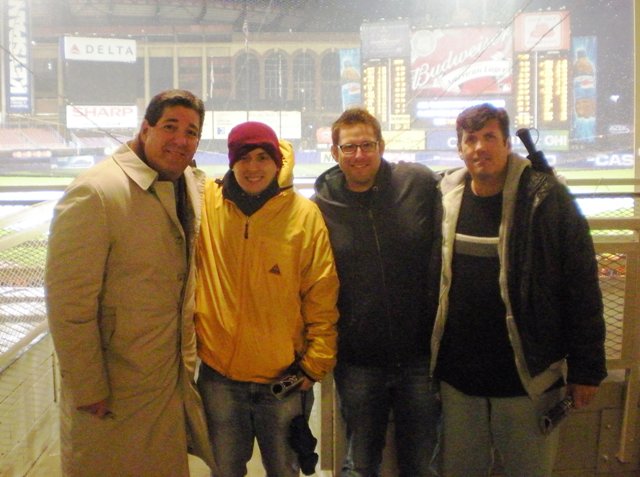
While the above visit to Shea Stadium was my most recent, it wasn't my most memorable. Not by a long shot. I wrote about the latter three years ago in Home Runs to Remember.
Rest in Peace, Shea Stadium and Michael O'Brien.
| Baseball Beat | September 25, 2008 |
All in the Family
Sports columnist Bob Keisser of the Long Beach Press-Telegram called me last week to arrange an interview to discuss the thread between my Dad and Baseball Analysts. We met on Monday afternoon and his article appeared in yesterday's newspaper.
I took a screen shot of the online edition and embedded it below for your reading pleasure. You might say I wanted to make "Lederer following in dad's footsteps" a Keisser Permanente part of this site.
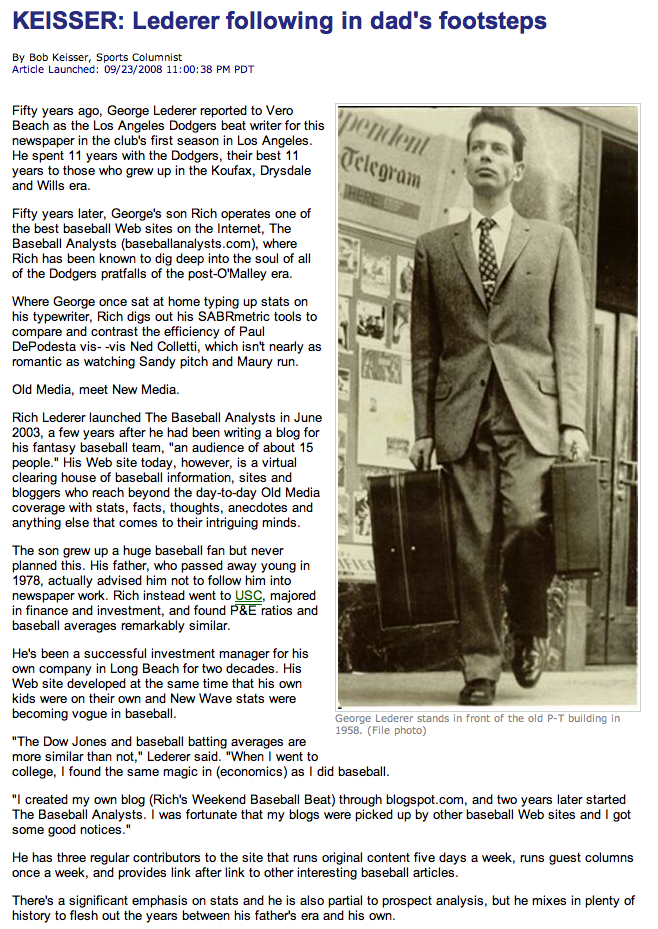
The baseball blogosphere, including sites such as the Baseball Think Factory and Dodger Thoughts, have been very instrumental in making Baseball Analysts what it is today. My friends Darren Viola (aka Repoz) at BTF and Jon Weisman of DT pointed their readers to yesterday's article by linking to it. Thanks guys! [Update: Hat tip also to Rob McMillin of 6-4-2.]
Bob Keisser's fellow columnist at the Press-Telegram, Doug Krikorian, wrote a column last Sunday in response to reaching a milestone birthday and mentioned my father when "reflecting on those many people who made a lasting impression on me since I came to Southern California in 1966 who are no longer on the scene."
I can't believe how many sportswriters I knew around the vicinity who are now gone, people like Bud Furillo, Allan Malamud, Jim Murray, Bob Hunter, Bud Tucker, Jim Mitchell, Bob Tongue, Frank Finch, Bob McGraw, George Lederer, Dan Hafner, Mal Florence, James Melroy, Bill Miller, Don Merry, Hank Hollingworth, Allen Wolfe, Maxwell Stiles and countless others.Furillo, along with Melvin Durslag, who just celebrated his 87th birthday and resides in Manhattan Beach, was my journalistic mentor, while Malamud was my closest friend in the business, as we had phone conversations almost every morning till his Sept. 15, 1996 death, which happened to be the same date as the death of my beloved wife Gillian five years later.
I forever will be grateful to Lederer, who solicitously shepherded me around on a one-week, three-city Dodger road trip to New York, Pittsburgh and Houston in August of 1968, making sure a wide-eyed, young sportswriter making his first major trip outside California wasn't overwhelmed by the circumstances, which he nearly was.
Although Dad was "only" 6-foot-1, he wore a size 14 shoe. His footsteps, both literally and figuratively, are too big for me to fill. I never set out to compete with him. Instead, I have only tried to uphold his values and work ethic while living the life that I have chosen. I have enjoyed turning his vocation into my avocation and know that he wouldn't want it any other way.
Additional comments and retorts at the Baseball Think Factory.
| Baseball Beat | September 22, 2008 |
Chicken Soup for the Baseball Soul
My longtime friend, Bill Husak, the Athletics Director at Loyola Marymount University, sent me the following email yesterday evening: "This will do your heart good." Dr. Husak included this link after his short message. The link is a video clip that can also be enjoyed at YouTube.
The following paragraph on the site of the Lexington Herald-Leader adds color to the video:
Adam Bender, 8, is one of several kids who plays catcher in Southeastern’s rookie league at Veterans Park. What makes Adam stand out is that he plays one of the toughest positions on the field with only one leg. Because of cancer, he had his left leg amputated when he was one. Adam doesn’t use a prosthesis, and only uses crutches when he reaches base for the Astros.
In addition to the video, be sure to check out Adam Bender at the Reds, a slideshow consisting of 26 photos coupled with an audio from the boy's parents, Michelle and Chris Bender.
Since the story of 8-year old cancer survivor Adam Bender was published in the Lexington Herald-Leader, and on www.kentucky.com, on June 1, 2008, the one-legged catcher has been invited to throw out first pitches at a Chicago White Sox game, a Cincinnati Reds game, a Houston Astros game, and has been invited to a Garth Brooks benefit in Las Vegas. He is also being profiled for a story that will air on ESPN. On Sunday June 6, 2008, Adam threw out the ceremonial first pitch to Adam Dunn of the Reds. Because of cancer, Adam Bender had his left leg amputated when he was one but that hasn’t stopped him from playing baseball for the Astros in the Southeastern Rookie League at Veterans Park.
I'm not the first one to report this story but thought it was inspirational enough to bring it to the attention of readers who, like me, missed out when it was first shared last spring.
Adam Bender makes the big leagues and the Kid can do it all on one leg are worthwhile reads as well.
You don't have to be a baseball fan to enjoy this heartwarming story. But it doesn't hurt either. Just ask Adam.
| Baseball Beat | September 21, 2008 |
The End is Near
And now, the end is near,
And so I face the final curtain.
My friends, I'll say it clear;
I'll state my case of which I'm certain.
I've lived a life that's full -
I've travelled each and every highway.
And more, much more than this,
I did it my way.
If ballparks could talk, I have no doubt that Yankee Stadium would be singing the above lyrics today. The words from My Way seem even more appropriate than those from New York, New York even though the sounds from the latter are sure to be blaring over the loudspeakers tonight.
The end is indeed near. After 85 years, Yankee Stadium hosts its final game tonight when the Bronx Bombers face the Baltimore Orioles on ESPN Sunday Night Baseball (8 p.m. ET).
SI.com has a photo gallery of 28 special memories, including a view of the stadium from the outside, the famous shot of Lou Gehrig pausing and wiping a tear from his eye during his farewell speech, Brooklyn Dodgers left fielder Sandy Amoros making that one-handed grab down the left field line in the 1955 World Series, Jackie Robinson's steal of home in that same World Series, Yogi Berra leaping into Don Larsen's arms after the latter's perfect game in the 1956 World Series, Roger Maris' 61st home run, Reggie Jackson's three-HR game in the 1977 World Series, George Brett going ballistic in the Pine Tar Game in 1983, Jeffrey Maier's catch in 1996, David Wells' and David Cone's perfect games, Aaron Boone's walk-off home run in the 11th inning of Game Seven of the 2003 ALCS, Derek Jeter's catch in 2004, Alex Rodriguez's 500th home run in 2007, Josh Hamilton during the Home Run Derby prior to the 2008 All-Star Game, and many, many more non-baseball shots.
Knowing this was the last opportunity to witness a game at Yankee Stadium, my son Joe and I traveled to New York in May for what was the Baseball Trip of a Lifetime. We went to Yankee Stadium, as well as Fenway Park, Shea Stadium, and the Hall of Fame. We stood next to Cliff Lee on the subway all the way from Central Station to Yankee Stadium, got there early and hung out with the fans, toured Monument Park, took plenty of photos, and watched Lee toss seven shutout innings as the Cleveland Indians beat the not-so Bronx Bombers 3-0.
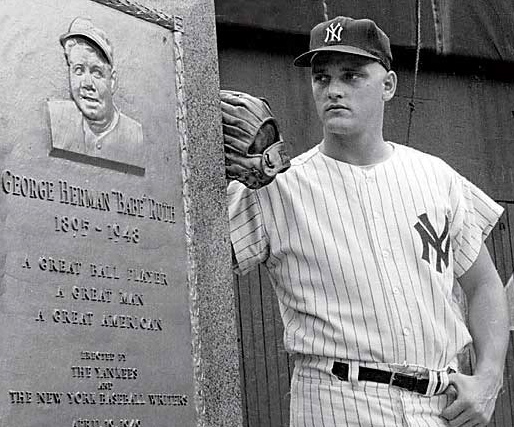
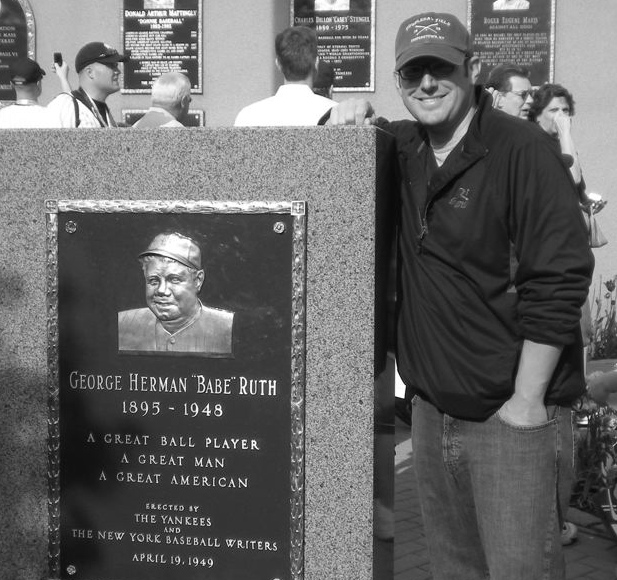
Farewell Yankee Stadium and the memories it provided all of us. You did it your way.
What was your greatest memory of Yankee Stadium?
| Baseball Beat | September 15, 2008 |
Dis and Data
While the rest of the baseball world is talking about Francisco Rodriguez's saves record, Carlos Zambrano's no-hitter, and the division races in the AL East, AL Central, and NL East, as well as the wild card in the senior circuit, we are going to change it up and discuss some statistical nuggets outside of the main.
As detailed below, the lefthanded-hitting Choo has hit ground balls to the right side while lifting fly ball outs to center and left at Progressive Field. However, he has slugged six of his seven home runs to the right of center, including four toward the right field line.
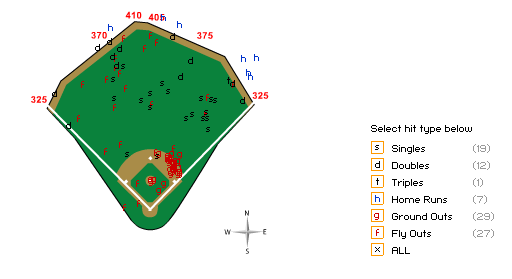
Born in South Korea, Choo was signed by the Seattle Mariners as a non-drafted free agent in August 2000. Cleveland acquired him for Ben Broussard in July 2006. The latter was released by the Texas Rangers earlier this season and has toiled in the minors for the Yankees and Cubs since last spring. The negative with Choo is that he must serve two years in the Korean military beginning no later than 2010.
Unlike Choo, Mora has been using the entire field but has been pulling all of his home runs at Camden Yards.
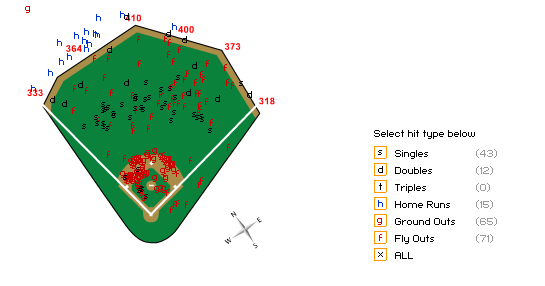
Ramirez became the latest member of the 30-30 club when he cranked his 30th four bagger of the season on Saturday. With 90 walks, the 6-foot-3, 200-pound shortstop has taken his game to the next level. He leads the NL in runs (115) and ranks fourth in BB, fifth in OBP (.396) and SB (33), eighth in OPS (.921), and 12th in HR. Did I mention that Ramirez won't turn 25 until December?
| Baseball Beat | September 11, 2008 |
Photos and Finishes
I went to the Yankees-Angels games on Tuesday and Wednesday. The teams split those two contests but the Halos captured the series by also beating the Bronx Bombers on Monday in the opener 12-1.
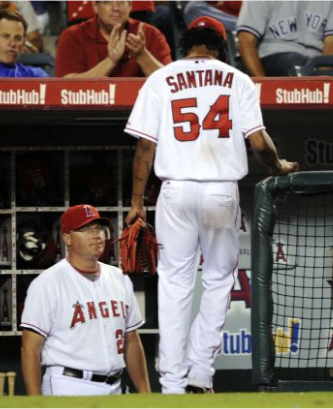 In downing the Yankees on Wednesday, the Angels won their fourth AL West title in five years and became the first team in the majors to clinch a playoff spot when the Texas Rangers lost to the Seattle Mariners 8-7 in a game that concluded about an hour after Francisco Rodriguez had nailed down his 56th save of the season. Meanwhile, the Yankees are likely to miss the playoffs for the first time since 1993. New York has had one heckuva run during this period, winning four World Series championships, including three in a row from 1998-2000.
I had the good fortune of sitting in the front row behind the Angels' dugout on Tuesday evening. The adjoining photo was published on the top of the front page of the Long Beach Press-Telegram's sports section yesterday. That's me giving Ervin Santana an appreciative clap of the hands after the Angel starter exited the game in the seventh inning behind 6-1. While Santana drew the loss, the 25-year-old All-Star pitcher is enjoying a breakout season, ranking in the top half dozen in the league in ERA (3.36), WHIP (1.12), SO (197), IP (198.1), wins (15), and WPct (.714).
While the Angels were celebrating their division title, I had this epiphany and began to wonder on my drive home just how many MLB games I have attended over the course of my lifetime. Without thinking it through, my initial guess was "about a thousand." However, after putting pencil to paper, I believe the real number is somewhere in the low 600s.
OK, so how did I arrive at that estimate? Let me count the ways (or the games in this case). I've been going to the ballpark on a fairly regular basis since Dodger Stadium opened in 1962 (see linked photo, circa 1961, with brother Tom on the left, sister Janet on the right, and me standing next to her in what would later become the outfield). Roughly speaking, I would venture to say that I have averaged around 15-18 games per year for about half of those 47 years and maybe 8-10 for the other half. That works out to approximately 600. From there, I would add 10 or 20 games from the Coliseum years from 1958-1961 to come up with a grand total of around 615-620.

My peak years were from 1962-1978 and 2002-2008. The lean years were from 1979-2001. The latter was a combination of Dad's death in 1978 – reducing the number of opportunities to go for free (hey, what can I tell ya?) – and the priorities of adulthood, including family and business. I thoroughly enjoyed my time as a youth sports coach from the mid-1980s through the mid-1990s, even if it meant watching Kirk Gibson's home run in the 1988 World Series on TV rather than in person.
 My love for baseball has never wavered, except for a brief period in 1994 and early 1995 when I swore off the game on the heels of the player strike that numbed me more than anything else. I had to be talked into our fantasy baseball pool that spring despite being a charter member dating back to the 1970s when I balanced playing fast-pitch softball, fantasy baseball, and APBA in the years leading up to and including the first few years of married life.
Over the years, I have watched MLB games in a dozen venues, from the Coliseum as a kid to Yankee Stadium as recently as last May when my son Joe and I took the baseball trip of a lifetime. I have also been to dozens of high school, college, minor league, and spring training facilities, and have even attended an NCAA Final Four at Tropicana Field in Tampa Bay. But there is no question that I have spent the vast majority of my time watching professional games at Dodger Stadium (left, with Tom in 1962) and Angel Stadium.
One of the things I haven't had the pleasure of enjoying is a Freeway Series. Maybe this will be the year that the Dodgers and Angels meet for all the marbles. It would only be fitting for me in what is Dad's 80th birthday, the Dodgers' 50th anniversary in L.A., the 40th anniversary since my father left the Dodger beat and went to work for the then California Angels, the 30th anniversary of his death, and the 20th anniversary of Gibson's home run.
In the meantime, the Yankees head back to New York for the final 10 games in Yankee Stadium. The end of an era in more ways than one.
How many MLB games and stadiums do you suppose you have you been to?
| Baseball Beat | September 08, 2008 |
Mutual (Option) of Oh-My-Ha
Carlos Delgado slugged two home runs off Cole Hamels in the Sunday Night Game of the Week. There have now been 249,996 homers hit during the regular season from 1876 to the end of play yesterday. Who will be the "lucky" player to get credit for the 250,000th four bagger? The Baseball Think Factory has been posting every home run of late and will be tracking tonight's games closely. In the meantime, you can check Baseball-Reference.com for a list of all the milestone home runs over the years.
Speaking of Delgado, the New York Mets first baseman has been on a tear since June 27. He has ripped 22 homers in his past 65 games while nearing or exceeding the magical .300/.400/.600 rate lines (with an OPS of 1.017) during this period. The 36-year old has had three two-HR games in the past two weeks.
As we pointed out in Sneak Preview of the 2009 Free Agents, which was posted right before his latest hot streak:
The Mets and Carlos Delgado have a $12M mutual option for 2009 (with a $4M buyout). The 36-year-old slugger got off to a poor start this season (.198/.297/.323 in April) but has hit .314/.407/.594 since July 1. Based on his buyout, the true cost of bringing him back is only $8M. He just may be a bargain at that price. However, Delgado, the team leader of the resurgent Mets, may not give his consent to such a deal. Stay tuned.
Well, I have no doubt that the Mets will exercise their portion of the option but won't be surprised if Delgado responds with the ol' "Thanks but no thanks" line. Put me in his shoes and I know I would. Delgado should be able to do better, both in terms of years and average annual salary. In fact, the risk of declining his option is next to nil for him as he could land at least an $8M deal with any of a number of teams for 2009. It says here that Delgado will find a suitor willing to give him a three-year contract for north of $30M. That team may, in fact, be none other than the Mets.
In the meantime, the bigger question for the game is why in the world do teams and players agree to "mutual" options? When you sit back and think about such arrangements, they are really nonsensical. It's kind of like marriage and divorce. While it takes two to get married, it only takes one to demand a divorce. A bilateral agreement in which either side can opt out is really unilateral in nature, at least when it comes to ending matters.
Look, I realize that a mutual option suggests that both parties are interested enough in the other side to maintain the relationship at a specified price for another year. While that sounds fine and dandy on the surface, the truth of the matter is that such an arrangement has no teeth. Neither party can enforce the extension on the other. If that is indeed the case, then what is the point of a mutual option? When you cut to the chase, the player in question becomes a free agent if either party declines their half of the option. As such, why bother?
There have been a number of teams and players that have agreed to mutual options during the past year. Oh, it might play well at the time of signing, but a mutual option is basically meaningless. Team options make sense. Player options make sense. Yet mutual options, as in this case, are ineffectual.
Now, if the Mets agreed to bring back Delgado and he refused, and the club was no longer responsible for the $4M buyout, then I could definitely see the merits of a so-called mutual option like this one.
Or, let's say the Mets had the right to sign Delgado for one year at $14 million and the latter had the ability to force the Mets to keep him for another season at $10 million, then you would have something that was worthwhile. If Delgado's market value had risen to $14M or more, the Mets might be motivated to bring him back. On the other hand, if Delgado's value had fallen to $10M or less, he may wish to exercise his option and return to the team for one more season.
Mutual of Omaha may sell a multitude of products, but I would advise Delgado to click on the link to "agents" rather than "long-term care" because one of the hottest hitters in the majors won't be getting much of the latter should he agree to his side of the mutual option.
But, more to the point: Just as this mutual option fails to make sense for Delgado, the reality is that mutual options, as a whole, are a totally flawed vehicle.
| Baseball Beat | September 02, 2008 |
Open Chat: And Down the Stretch They Come!
On the heels of Labor Day, here is a snapshot of the standings.
AMERICAN LEAGUE EAST TEAM W L PCT GB Rays 84 51 .622 - Red Sox 80 57 .584 5 Yankees 73 64 .533 12 Blue Jays 70 66 .515 14.5 Orioles 63 74 .460 22
AMERICAN LEAGUE CENTRAL TEAM W L PCT GB White Sox 77 60 .562 - Twins 77 60 .562 - Indians 66 70 .485 10.5 Tigers 66 71 .482 11 Royals 57 79 .419 19.5
AMERICAN LEAGUE WEST TEAM W L PCT GB Angels 83 53 .610 - Rangers 67 72 .482 17.5 A's 63 74 .460 20.5 e-Mariners 54 83 .394 29.5
NATIONAL LEAGUE EAST TEAM W L PCT GB Mets 77 61 .558 - Phillies 75 63 .543 2 Marlins 70 68 .507 7 Braves 59 79 .428 18 e-Nationals 53 85 .384 24
NATIONAL LEAGUE CENTRAL TEAM W L PCT GB Cubs 85 53 .616 - Brewers 80 57 .584 4.5 Cardinals 74 64 .536 11 Astros 72 66 .522 13 Reds 61 76 .445 23.5 e-Pirates 57 79 .419 27
NATIONAL LEAGUE WEST TEAM W L PCT GB Diamondbacks 70 67 .511 - Dodgers 68 70 .493 2.5 Rockies 65 74 .468 6 Giants 59 78 .431 11 Padres 53 84 .387 17
e - mathematically eliminated from the postseason
Which team is best positioned to win the World Series? Tradesports.com, the world's leading sports trading exchange, offers the following odds (expressed in terms of percent):
Symbol Bid Ask Last ANGELS 16.5 17.5 18.2 CUBS 15.1 18.1 18.5 REDSOX 14.2 15.4 13.3 RAYS 12.1 13.9 13.9 METS 7.2 9.5 9.5 BREWERS 8.2 9.8 7.1 WHITESOX 4.8 6.3 5.0 PHILLIES 3.0 4.2 3.5 DIAMONDBACKS 4.5 5.7 4.3 TWINS 4.7 6.5 4.6 DODGERS 1.6 3.0 1.8 YANKEES - 0.5 0.5 CARDINALS 0.1 0.4 0.9 MARLINS 0.3 0.5 0.3 TIGERS - 0.1 0.1 ATHLETICS - 0.1 0.1 BRAVES - 0.1 0.1 BLUEJAYS - 0.2 0.1 REDS - 0.2 0.1 ROCKIES - 0.7 0.4 RANGERS - 0.1 0.1 ASTROS - 0.3 0.1 PADRES - 0.1 0.1 ORIOLES - 0.1 0.1 PIRATES - 0.1 0.1 GIANTS - 0.1 0.1 ROYALS - 0.1 0.1 INDIANS - 0.1 0.1 NATIONALS - 0.1 0.1 MARINERS Expired at 0.0
The Rays, a 200:1 choice to win the World Series back in March, are now down to a 7:1 or 8:1 pick. Even though Tampa Bay has the best record in the majors (while competing in perhaps the toughest division in baseball), the betting public ranks the club fourth as far as its chances of winning it all. Division rival Boston, the Angels, and Cubs are all thought to have a better shot at being crowned World Champs.
Who do you like and why?
| Baseball Beat | August 30, 2008 |
Having a Ball at the Angels Game
My nephew Casey went to the Angels game Friday night and was caught on TV holding up a ball that coach Alfredo Griffin had flipped to him earlier that evening.
Casey is 8 years old. He lives in Phoenix. His family is in town for his older brother Troy's ice hockey tournament in Valencia and my Mom's 80th birthday, which we will celebrate at our house on Sunday. Casey was accompanied at the Angels-Rangers game by his cousin Brett. The latter is a professional golfer who qualified for his first Nationwide Tour event – the Northeast Pennsylvania Classic – last week. He shot 70-70 and missed the cut by one stroke. Brett, the 2007 Big West Conference champion, won his first pro tournament – the Rising Star Open on the Adams Golf ProTour Series – a month earlier.
Brett took the following photo of Casey and immediately emailed it to his Dad (my brother Tom), who forwarded it to me while the game was in progress.
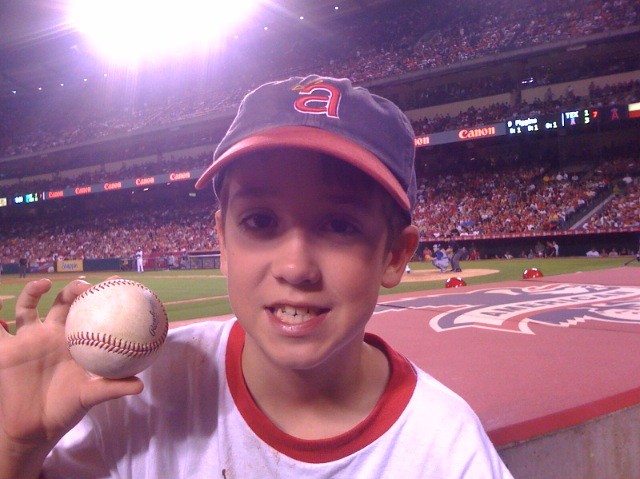
In the Dept. of the Circle of Life, the logo on the retro Angels hat that Casey is wearing was designed by his grandfather. The hat made its debut in 1971 and lasted all of one season. I guess the small "a" was never meant to be in a stadium known as the Big A. Nonetheless, the Angels held a retro hat promotion on May 15. It seems as if these hats are now more popular than ever.
Casey and Brett are going to the Angels-Rangers game tonight. However, they won't be in the front row this time. Instead, the cousins will be using my tickets on the club level. The likelihood of catching a ball is remote. That said, they should see a good contest as Jered Weaver will be on the hill for the Halos.
What am I doing to miss Weaver in action? Well, Tom and I are heading to Valencia to watch Troy play an ice hockey game. Our brother Gary is the coach.
Now THAT is called family fun.
| Baseball Beat | August 27, 2008 |
Sneak Preview of the 2009 Free Agents: Outfielders and Designated Hitters
On Monday, in the first of a three-part series on the free agent class of 2009, we took a look at the catchers and infielders. Today, we will break down the outfielders and designated hitters.
The list below includes a number of big-name players, most of whom are well into their 30s and past their peaks. In fact, Rocco Baldelli and Adam Dunn are the only free agent outfielders under the age of 30.
Outfielders Bobby Abreu NYY Moises Alou NYM Garret Anderson* LAA Rocco Baldelli TB Willie Bloomquist SEA Emil Brown OAK Pat Burrell PHI Endy Chavez NYM Adam Dunn ARI Jim Edmonds CHC Cliff Floyd TB Brian Giles* SD Ken Griffey Jr.* CWS Vladimir Guerrero* LAA Raul Ibanez SEA Mark Kotsay ATL Jason Michaels* PIT Greg Norton ATL Jay Payton BAL Scott Podsednik COL Manny Ramirez LAD Juan Rivera LAA
The Yankees exercised their option on Bobby Abreu last winter and the veteran outfielder has responded by producing at a slightly better clip in 2008 (.297/.369/.467) than in 2007 (.283/.369/.445). However, despite seeing as many pitches per plate appearance as ever, Abreu's walk (10.1%) and BB/SO (0.61) rates are the lowest of his career. His secondary average (.291) and stolen base rate (58%) are also at all-time lows. Add in the fact that he is a below-average right fielder and will turn 35 next March and one can't help but to be skeptical of Abreu, especially if his contract demands call for a multi-year deal at an average of eight figures per season.
Moises Alou is out for the season following hamstring surgery. Now 42, he may never play again. If so, Alou will retire with a line of .303/.369/.516 and 332 HR. Based on his comps, Felipe's son seems like a worthy candidate for the fictional Hall of the Very Good.
The Angels are unlikely to pick up a $14 million team option on Garret Anderson (.284/.318/.426) and will either send him packing with a $3M gold watch (the cost of his buyout) or try to negotiate a short-term contract that would be more representative of his current playing ability. The Halos showed their loyalty when they signed him to a four-year extension back in April 2004 for a whopping $48M so it's time for GA, now 36, to do likewise if he is interested in finishing his career in Anaheim.
The Rays declined their team option on Rocco Baldelli on April 1 and will instead pay him a $4M buyout. After sitting out the first four months of the season with a mitochondrial disorder, the sixth overall pick in the 2000 draft returned to action two weeks ago and has gone 8-for-23 with 2 HR. Baldelli can help out Tampa Bay down the stretch and his marketability this off-season as the soon-to-be 27-year-old has only played 135 games since the end of the 2004 campaign.
After nine seasons with the Phillies, Pat Burrell, who turns 32 in October, will become a free agent for the first time. The No. 1 overall draft pick in 1998, Burrell signed a five-year MLB contract that summer, then inked a six-year extension prior to the 2003 season. Pat the Bat can hit and ranks in the top ten in the NL in OBP (.388), SLG (.548), OPS (.936), HR (30), and BB (89). Not too dissimilar to Adam Dunn in terms of production and position, Burrell should reap huge financial rewards this off-season for the third time in his career.
Arizona acquired Adam Dunn earlier this month in a waiver deal that sent Dallas Buck, Wilkin Castillo, and a player to be named later to Cincinnati. While Dunn may be nothing more than a seven-week rental (and maybe longer if the Diamondbacks make the playoffs), don't rule out Arizona in the free agent sweepstakes should he play well down the stretch. The 6-6, 275-pound slugger, who is on pace to hit 40 homers and draw 100 walks for the fifth consecutive season, is 11-for-40 with 2 HR and 18 BB (.500 OBP) for his new team.
Ken Griffey Jr. is in the final year of a 9-year/$116.5M contract. The White Sox will undoubtedly pass on a $16M club option for 2009 and split the cost of the $4M buyout with the Reds. If and where Junior plays next year is up in the air, but, either way, he will retire with more than 600 career home runs, 10 Gold Gloves, and as the sixth-best center fielder of all time.
Although Vladimir Guerrero (.287/.352/.500) is experiencing the worst season of his career, there is little doubt as to whether the Angels will exercise their $15M club option for next year. Bringing Vlad back for one more campaign and then letting him go could be a stroke of genius in terms of timing. He has clearly slipped at the plate, in the field, and on the basepaths, and his knees require an occasional day off, yet the 2004 MVP is still productive (123 OPS+) and likely to hold up for another year.
The Dodgers acquired Manny Ramirez (.314/.413/.549) in a three-way trade shortly before the deadline. The Red Sox volunteered to pay the remainder of his 2008 salary (about $7M) and agreed to eliminate the 2009-10 club options in exchange for Manny waiving his right to block the trade as a 10-and-5 player. While Ramirez has stated that he would like to finish his career in Los Angeles, everyone knows that will only happen if the Dodgers outbid the competition for his services. Handing the enigmatic outfielder a four-year contract for $80-100M for his 37-40 year-old seasons seems like a risky bet to me. Stay tuned.
Designated Hitters Frank Thomas OAK Jim Thome* CWS
Jim Thome (.253/.376/.525) seems like a much better bet than Frank Thomas (.226/.339/.362) at this point. Pay attention to Thome's playing time between now and the end of the season as his $13M club option is guaranteed with 1,100 plate appearances in 2007-08. He needs 82 PA in the White Sox's final 30 games to reach that mark.
* subject to club and/or player options
| Baseball Beat | August 25, 2008 |
Sneak Preview of the 2009 Free Agents: Catchers and Infielders
As the baseball season finishes up the dog days of summer, I thought it would be instructive to take a peek at the upcoming crop of free agents.
With more teams signing young players to longer-term deals that buy out one or more free agent years, the talent pool is likely to age and/or diminish over time. These next few years could see the beginning of the end of the top 20-something players in their peak years turning to free agency. In the meantime, major-league baseball teams are still minting money, meaning there will be plenty of interest and dough for the best of the best. Moreover, the Yankees, with $88 million in salaries coming off the books, a new stadium that could produce a windfall in new revenues next season, and the strong likelihood of missing the post-season for the first time in more than a decade, will be bidding aggressively, driving up prices for the premiium players.
Mark Teixeira and C.C. Sabathia fit the bill this off-season, while Pat Burrell, Adam Dunn, and Manny Ramirez, among hitters, and Ryan Dempster, Derek Lowe, Oliver Perez, and Ben Sheets, among starting pitchers, and Brian Fuentes and Francisco Rodriguez, among relievers, should draw a lot of attention – and money – as well.
In the first of a three-part series, let's take a look at the catchers and infielders in the free agent class of 2009. We will follow up with the outfielders and pitchers in separate articles. Players marked by an asterisk after their names are subject to club and/or player options.
First Basemen Club Rich Aurilia SF Carlos Delgado* NYM Jason Giambi* NYY Wes Helms PHI Kevin Millar BAL Mark Teixeira LAA Daryle Ward CHC
The Mets and Carlos Delgado have a $12M mutual option for 2009 (with a $4M buyout). The 36-year-old slugger got off to a poor start this season (.198/.297/.323 in April) but has hit .314/.407/.594 since July 1. Based on his buyout, the true cost of bringing him back is only $8M. He just may be a bargain at that price. However, Delgado, the team leader of the resurgent Mets, may not give his consent to such a deal. Stay tuned.
The Yankees will undoubtedly reject a $22M club option on Jason Giambi for 2009 and instead pay him a $5M buyout. Giambi, who turns 38 in January, is still productive at the plate, hitting .250/.381/.503 this season. Look for him to sign a one-year contract with an AL team.
Mark Teixeira (.302/.408/.541) is the prize of this year's free-agent class. The switch-hitting first baseman reportedly turned down an eight-year, $140 million contract extension from the Rangers last summer and is rumored to be seeking a ten-year deal for a minimum of $200M. The Angels need Tex's bat and approach (15 BB and 10 SO in 101 PA) but will be competing with the Yankees, Mariners, hometown Orioles, and perhaps the Mets, among others, for his services. If money is no object, sign him. However, I would be skeptical of Teixeira's performance in the final five years of such an agreement when he would be 34-38 years old.
Second Basemen Club Jamey Carroll* CLE Ray Durham MIL Mark Ellis OAK Mark Grudzielanek KC Orlando Hudson ARI Jeff Kent LAD Felipe Lopez STL Pablo Ozuna LAD
Orlando Hudson (.305/.367/.450 in 107 games) is the best of a relatively weak group of second basemen. The three-time Gold Glover's season has been shortened once again as he underwent surgery earlier this month to repair ligament damage in his left wrist. The soon-to-be 31-year-old will become a free agent for the first time and will be looking to cash in. O-Dog has posted an OPS+ of greater than 100 for each of the past three campaigns. Only three other second sackers can make that claim: Ian Kinsler, Dan Uggla, and Chase Utley.
At 40, Jeff Kent has slipped noticeably this season, both at the plate (.283/.330/.424) and in the field (13 runs below average per 100 games). I guess it's possible that the Dodgers could bring him back for one more year, but it says here that the 2000 NL MVP and future Hall of Famer will retire.
Shortstops Club Orlando Cabrera CWS Alex Cintron BAL Alex Cora BOS Adam Everett MIN Rafael Furcal LAD Cesar Izturis STL Edgar Renteria* DET
Orlando Cabrera (.272/.326/.357) is a solid, if unspectacular, shortstop. He doesn't hit for much power (7 HR in 585 PA) but still runs the bases well (18 SB in 22 attempts) and can more than handle the defensive requirements of the position. However, at the age of 34, OC may find the going tough this winter. Look for a team to ink him to a two-year contract as a stop gap awaiting a younger alternative.
When healthy, Rafael Furcal is one of the most productive shortstops in the game. He put up a .366/.448/.597 line through the first week of May before hitting the disabled list with a bulging disk in his back, which was surgically repaired in early July. The Dodgers were 18-14 in those 32 games and have been 47-51 without him. There is an outside chance that Furcal could return this season. Either way, the 31-year-old will have a tough time duplicating the three-year, $39M contract he signed as a free agent in December 2005.
Coming off a .332/.390/.470 campaign with the Braves in 2007, Edgar Renteria has been a huge disappointment for the Tigers. He is arguably having the worst year (.264/.314/.355) of his 13-year career. The 33-year-old is average at best defensively and no longer steals bases like he once did. Renteria has picked up the pace a bit in August (.290/.342/.449) and how he performs in September will probably determine the level of interest this winter.
Third Basemen Club Hank Blalock* TEX Joe Crede CWS Chipper Jones* ATL
The Rangers can exercise a $6.2M club option on Hank Blalock for next season or let him go for a rather cheap $250,000 buyout. After missing more than three weeks, Blalock returned to action last Friday. Due to continued soreness in his right shoulder, Blalock may be relegated to first base, at least for the foreseeable future. Unless the seven-year veteran can man the hot corner, his value will be circumspect, especially given his career splits (.227/.282/.352 vs. LHP and .244/.301/.398 on the road). Put me solidly in the camp of the skeptics.
Joe Crede (.255/.323/.474) has been out of action with a bad back for more than a month. He is serving a rehab assignment with the Triple-A Knights and will likely join the White Sox before the month is out. His pluses (good power and excellent defense) and minuses (health and consistency) are well known. Crede will turn 31 next April and his best days are probably behind him. Put it all together and he looks like a poor man's Scott Rolen.
Make no mistake about it, Chipper Jones will be wearing a Braves uniform next season. According to Cot's Baseball Contracts, Atlanta has a club option that will vest between $8M and $11M (depending on performance and award bonuses). If anything, look for the Braves and Jones to work out a new deal that keeps the switch-hitting third baseman with the one and only club that he has known. Always an injury risk, Jones is more productive at the plate than ever. Look no further than his OPS+ marks the past four seasons:
YEAR AGE OPS+ 2005 33 151 2006 34 154 2007 35 166 2008 36 173
Jones (.359/.460/.568) is not only getting older, he is getting better. While I'm aware that the above trend is unlikely to continue, I would be comfortable tearing up his contract and signing him to an extension that would keep him in Atlanta for the next three seasons.
Utility Infielders Club Craig Counsell* MIL Nomar Garciaparra LAD Nick Punto MIN Juan Uribe CWS
Pass.
Catchers Club Rod Barajas TOR Henry Blanco* CHC Toby Hall* CWS Mike Redmond* MIN Ivan Rodriguez NYY Javier Valentin CIN Jason Varitek BOS Gregg Zaun* TOR
There are two oldies but goodies...um...scratch that, oldies and formerly goodies...in this group. Ivan Rodriguez (.284/.329/.402 overall but .217/.265/.304 in 16 games with the Yankees) will turn 38 in November and is little more than a good defensive catcher at this point. He served as a two-month rental for New York but doesn't fit into the club's future plans as Jorge Posada is expected to return next season.
Jason Varitek is in the midst of the worst year (.223/.315/.370) of his 11-year career. Boston may have an interest in bringing back its captain, who turns 37 next April, for one more season but not at the $10M average he earned from 2005-2008. However, the question is whether or not Scott Boras' client can suck it up and accept such a deal.
| Baseball Beat | August 22, 2008 |
Foto Friday #8: New York's Cup Runneth Over
As a segue to Bob Timmermann's guest column yesterday on "The World of Catcher's Interference," we bring you Foto Friday #8.
Nope, that's not a gas mask, folks. That's a holy cup, so to speak.
Your mission, should you choose to accept it, is to name the player whose ear it appears as if the cup is growing out of and his two sidekicks. For bonus points, select the correct date, location, and what took place that day. Getting the correct answers may take a bit of digging, but all of these mysteries can be solved (except for the name of the stage "hand" in the background).
Good luck.
Answers (added at 4:30 pm PT): From left to right, the three players in the photo are Hank Bauer, Norm Siebern, and Yogi Berra. The date is June 17, 1956. The location is the visitor's clubhouse in Cleveland Municipal Stadium. Bauer, Siebern, and Berra all hit home runs to lead the Yankees to a 9-4 victory over the Indians.
The caption for the AP Wire Photo read as follows:
"CLEVELAND, JUNE 17--YANKEE SLUGGERS--This trio of hitters accounted for as many home runs today as the New York Yankees downed the Cleveland Indians 8-4 [sic] to make a full sweep of a three-game series. Left, Hank Bauer, whose three-run homer in the seventh; center, Norm Siebern, who came up from Denver and hit his first major league home run; and Yogi Berra. Siebern and Berra connected for two-run homers in the first off Early Wynn, who was charged with the defeat."
My Dad was working the desk at the Long Beach Independent, Press-Telegram back then and kept a copy of the photo, caption, and the following note to editors, entitled "WIREPHOTO ELIMINATION ... Wirephoto CD1 of today, showing New York Yankee players celebrating victory over Cleveland Indians, is eliminated to all points. Picture is of questionable taste because of object in background."
The photo and the note from the AP is what makes this one a classic (and perhaps never published before). Sadly, we almost never see such photos today...oh, not of a cup in the background but just three ballplayers arm-in-arm with smiles as if they had just won the World Series.
The box score, as provided by Retrosheet and Baseball-Reference.com, contains a wealth of information, such as the fact that future Hall of Famers Whitey Ford and Early Wynn were the starting pitchers and neither finished two innings with the latter failing to record a single out. Rip Coleman, who pitched the final six innings for the Yankees, was credited with the win.
Mickey Mantle, who went on to win the Triple Crown and MVP, was hitting .382 with a 1.248 OPS as of the date of this game.
There were 41,765 fans in attendance, Cleveland's largest home crowd of the season.
| Baseball Beat | August 12, 2008 |
High School Talent is Heating Up
Tied with the best records heading into the finale of the Area Code Games on Sunday, the Texas Rangers (Texas) beat the Milwaukee Brewers Blue (Southern California), 4-2, to win the tournament with a 4-1 record. The Brewers lost their final two games while the Rangers' lone defeat was at the hands of the Oakland Athletics (Southeast) on Friday.
All in all, there there were 20 contests played over a six-day span at Blair Field in Long Beach. I attended a number of them and had the opportunity to witness more than 100 players display their talents and skills in a showcase setting in front of hundreds of scouts. In addition to playing five games each, the athletes went through a player evaluation (SPARQ testing) on Tuesday and participated in a MLB Scout Symposium at the Long Beach Marriott on Wednesday.
In 22 years of existence, the Area Code Games have hosted numerous major leaguers, highlighted by current stars Ryan Braun, Prince Fielder, Dan Haren, Ryan Howard, Albert Pujols, C.C. Sabathia, and Grady Sizemore. Looking to the future, Tim Beckham (the No. 1 overall pick in the 2008 draft by Tampa Bay), Kyle Skipworth (FLA, #6), Aaron Hicks (MIN, #14), Brett Lawrie (MIL, #16), Anthony Hewitt (PHI, #24), and Gerrit Cole (NYY, #28) all played in last summer's Area Code Games.
Whether it was the wood bats, the ballpark's dimensions, the seaside altitude, or just plain ol' strong arms, the pitchers got the best of the hitters throughout the week, as evidenced by a no-hitter in the opener on Tuesday and a 0-0 tie in the morning tilt on the final day. While the pitching results were impressive, it wasn't as if all of the chosen hurlers were lighting up the radar guns all week long. Yes, there were a number of pitchers touching the low-90s, but the majority were throwing in the mid- to high-80s.
Many of the top players from the Area Code Games also participated in the Aflac All-American High School Baseball Classic at Dodger Stadium on Saturday. The Aflac game, which was televised nationally by FoxSports, tends to attract the best of the best, including several who did not appear at the Area Code Games.
Unlike the Area Code Games, all Aflac players must have completed their junior year of high school to be eligible for participation. The Aflac participants are required "to be in good academic standing and display redeeming qualities off the field that embody the ideals of the sport of baseball, including discipline, determination and hard work." The six-year-old Aflac high school classic has produced 52 first-round draft picks during the past five years, including at least eight (2005) and as many as 13 (2007).
Down 2-0 going into the ninth inning, the East staged a sterling comback victory by scoring four runs, including a game-tying-and-winning single by MVP Brian Goodwin (Rocky Mount HS, NC). The lefthanded-hitting outfielder also singled in the second and impressed me when he took an extra base on a heads-up play while center fielder Kyrell Hudson (Evergreen HS, WA) was trying to sell the umpires that he caught the speedy Goodwin's line drive.
In contrast to the Area Code Games, there were very few fastballs that didn't register in the 90s at the Aflac game. The hardest of 'em all was delivered by Mychal Givens. He threw two pitches only, a 96-mph fastball that resulted in a fly out to left and a 98-mph heater that turned into a 4-3 ground out. Givens was relieved in the bottom of the eighth by Austin Maddox (Eagle's View Academy, FL), a starting catcher-turned-pitcher (and straight-A student) whose fastball ranged from 91-96 in 1-1/3 innings of work.
All in all, there were 26 strikeouts recorded in an event that was dominated by the nation's best power arms, including five by the West's starter Jacob Turner (Westminster Christian Academy, MO). The 6-foot-4, 205-pound righthander, who struck out the side in the first after opening the game with a hit batter and a walk, was throwing loosely from 90-93 and mixing in a quality mid-70s curve and changeup in his two innings.
The remaining radar gun readings, along with brief comments, are listed below in order of appearance (West followed by the East).
West
East
We will follow up later in the week with some additional highlights of the Area Code and Aflac games, including a focus on the offensive side of the ledger.
| Baseball Beat | August 07, 2008 |
Remember This Name
Let me introduce you to the No. 1 pick in the 2011 amateur draft . . . Bryce Harper. I know, that particular draft won't take place for three more years. As such, how in the world could I make this type of a prediction now? Well, if you watched the 15-year-old, lefthanded-hitting catcher take batting practice, infield, and two plate appearances on Tuesday at the Area Code Games, as I did, then I have no doubt that you would be as enthusiastic about this phenom as I am.
 Harper is one of only six athletes from the 2011 graduating class competing in the 22nd annual Area Code Baseball Games at Blair Field in Long Beach, California this week. Of the remaining 172 players, 19 will graduate in 2010 and 153 in 2009. Although I have only seen two games and four of the eight teams thus far, I would be surprised if there is a player who rivals Harper's talent. Yes, I believe Harper just may be the most outstanding prep in the country right now.
I'm not the only one who feels this way about the 6-foot-2, 197-pound sophomore-to-be from Las Vegas. I spoke to a handful of the more than 300 scouts in attendance on the first day of the tournament about Harper and the responses – from those who have followed him closely to others who had seen him for the first time that day – ranged from "wow" to shaking head in disbelief to "the best high school hitter I've ever seen."
Using a wood bat, Harper put on a hitting clinic toward the end of BP, blasting one shot after another. Several hours later, the prized prospect hit the two hardest balls during the opening day of the six-day tournament in which pitchers dominated the action. In his first at-bat, Harper, serving as the designated hitter for the Cincinnati Reds, lined out to center field. He hit the ball about as squarely as possible, directly up the middle but straight into the glove of Washingon Nationals center fielder Kyrell Hudson.
In Harper's second trip to the plate, he jacked a towering shot off the right-field wall for a stand-up triple to open the sixth inning. It is important to note that Blair Field is a pitcher-friendly ballpark played at seaside altitude with 348-ft dimensions down the lines that exceed those of every major-league stadium in existence. He scored the only run of the game on a subsequent ground out to short. Harper was replaced in the ninth, ending the night with one of the only two hits in the contest as seven Reds pitchers combined to no-hit the Nats.
Harper has a power bat and a plus throwing arm that "already grades out to 70 on the 20 to 80 scouting scale," according to Dave Perkin of Baseball America. During infield prior to the game, Harper, in full gear, rifled the ball out of a crouch to second and third base with precision. Upon seeing him in action, I marked down "+ + arm" next to his name in my program. Although the rap on him is that he's not all that fast, I thought he ran very well from home to third on that triple, especially considering his age, size, and power. The kid is nothing if not impressive.
While I didn't witness Harper during the SPARQ (acronym for Speed, Power, Agility, Reaction, Quickness) testing that morning, he earned a score of 63.93, the 54th highest total out of 178 participants. It was the fourth-highest rating among the 25 underclassmen. Interestingly, he ran a 3.91 in the 30-yard dash, ranking in the top 10% in that category.
Check out Harper's explosive swing in the cage during a recent batting practice session.
You can also see Harper going yard in an actual game in this video clip.
As shown, Harper employs a slightly open stance with the right heel off the ground and his hands held high. He uses his body well, gets into a good position at the point of contact, and goes after the ball in a very aggressive manner. Bryce doesn't use batting gloves and tends to lean over and grab a handful of dirt before each at-bat. The youngster displayed a good eye and a mature approach on Tuesday, waiting for his pitch and peppering the offerings that he can handle.
I am planning on catching some more games between now and Sunday and will report back on Monday with added commentary on Harper as well as a number of other standouts. The Area Code Games, long considered one of the top talent showcases in the country, has produced more than 300 major league players in just over two decades. There may be 15 or 20 participants who will eventually don big-league uniforms, and the best of the bunch just might be a kid who is still too young to drive. While Bryce Harper has a long ways to go (three more years of high school for the Las Vegas Wildcats and a few years in the minors) before reaching the Show, the June 2011 draft couldn't come any sooner for the MLB team lucky enough to select him.
Area Code Teams
Chicago White Sox – Midwest (Oklahoma, Illinois, Indiana, Kansas, Missouri)
Cincinnati Reds – Southwest (Arizona, Colorado, Utah, Nevada)
Milwaukee Brewers (Blue) – Southern California
Milwaukee Brewers (Gray) – Northern California
New York Yankees – Northeast (New York, Maryland, New Jersey, Pennsylvania, Massachusetts)
Oakland Athletics – Southeast (Georgia, South Carolina, Tennessee, North Carolina, Florida)
Texas Rangers – Texas, Louisiana
Washington Nationals – Pacific Northwest (Washington, Oregon)
Schedule
Tuesday, August 5:
8:00 a.m. to 3:00 p.m. – Player Evaluation (SPARQ Testing and Batting Practice)
3:45 p.m. – White Sox vs. Rangers (9)
7:15 p.m. – Reds vs. Nationals (9)
Wednesday, August 6:
8:30 a.m. – Rangers vs. Nationals (9)
12:00 p.m. – Brewers (Blue) vs. Athletics
3:00 p.m. – Brewers (Gray) vs. Yankees
6:30 p.m. – MLB Scout Symposium (Long Beach Marriott)
Thursday, August 7:
8:30 a.m. – Brewers (Gray) vs. Athletics
11:30 a.m. – Brewers (Blue) vs. Yankees
2:30 p.m. – Reds vs. Rangers
5:30 p.m. – Nationals vs. White Sox
Friday, August 8:
8:30 a.m. – Yankees vs. Nationals
11:30 a.m. – Athletics vs. Rangers
2:30 p.m. – Brewers (Blue) vs. White Sox
5:30 p.m. – Brewers (Gray) vs. Reds (9)
Saturday, August 9:
8:30 a.m. – Reds vs. Brewers (Blue)
11:30 a.m. – Nationals vs. Brewers (Gray)
2:30 p.m. – White Sox vs. Brewers (Gray)
5:30 p.m. – Athletics vs. Yankees (9)
Sunday, August 10:
8:30 a.m. – White Sox vs. Athletics
11:30 a.m. – Yankees vs. Reds
2:30 p.m. – Rangers vs. Brewers (Blue)
| Baseball Beat | July 25, 2008 |
All the Right Stuff
Which major league pitcher do you suppose has the following rankings among all starters this year?
No, it's not Felix Hernandez. But I can understand why you would think that. King Felix ranks 1st in fastball velocity (94.9), 13th in GB rate (50.9%), 28th in LD rate (18.8%), and 15th in HR/9 (0.65).
In any event, this pitcher's last name also ends in a "z." OK, suspense time is over. It's none other than Ubaldo Jimenez.
Jimenez and Hernandez have the same basic repertoire of pitches: fastball, slider, curve, and changeup. Both of them throw extremely hard. Jimenez relies on his heater a little bit more than Hernandez (71.0% of total pitches to 66.1%) but that could be a function of their home ballparks as the former's heavy fastball works relatively well at Coors Field.
The 6-foot-4, 200-pound righthander leapt onto the national scene last fall when his Colorado Rockies beat virtually everybody down the stretch and in the postseason except the Boston Red Sox. He started three times in the NLDS, NLCS, and World Series, fashioning a 2.25 ERA over 16 innings. That said, it feels as if the 24-year-old fireballer has flown under the radar screen for much of this season.
Jimenez's numbers are actually a mixed bag. I guess that's what is so intriguing to me. He is tied for the MLB lead in starts (22) and has produced an ERA of less than 4.00 with an ERA+ of 116. But he has also allowed more walks (65) and wild pitches (14) than any pitcher in baseball.
Strangely, the Dominican native has produced better results at home than on the road:
IP H R ER HR BB SO ERA AVG OBP SLG
Home 73.1 53 23 21 5 27 43 2.58 .204 .284 .300
Road 55.2 69 41 36 3 38 59 5.82 .305 .410 .420
As shown, his ERA at Coors Field is less than half of his ERA on the road. By slicing and dicing the numbers a bit more, we learn that Jimenez has a BABIP at home of .224 and away of .402. Both are unsustainable. The former is too low and the latter is too high. A narrowing of the gap will result in less divergence in the home and road ERAs. Jimenez has actually struck out a much higher percentage of batters on the road (21.85%) than at home (14.68%). His away stats have been hurt by poor outings in Los Angeles on April 25 and Philadelphia on May 27.
Of note, Jimenez has improved each and every month this season. All of his metrics have gotten progressively better as the year has unfolded.
ERA AVG OBP SLG OPS
April 5.90 .291 .411 .393 .805
May 4.85 .282 .341 .376 .717
June 3.60 .237 .327 .351 .678
July 2.04 .198 .297 .306 .603
While I hesitate to put too much stock into monthly trends, I'm more inclined to place some value on such progressions if the player in question is unusually young or old. In the case of Jimenez, the 2008 season is his first full year in the big leagues. As such, I believe there may be something said about paying closer attention to these trends as it is quite possible that he is learning on the job.
Is his lack of control simply a function of his age? Well, that's the $64,000 question. Or, more personal to Jimenez, the tens of millions question. In his last 14 starts, Jimenez has "only" walked 37 in 88 1/3 innings pitched.
It says here that if Jimenez can continue to harness his wildness and improve his command, he will become one of the best pitchers in the game. If not, he may end up as the second coming of Daniel Cabrera, another pitcher I had high hopes for just a few years back.
| Baseball Beat | July 19, 2008 |
All-Star Recognition is da Honor for Navarro
On Tuesday, Rob Neyer asked Who are this year's short-lived All-Stars?
What about Dioner Navarro? Like Ludwick, Navarro's an All-Star in his first season as an everyday player … but he's not really an everyday player, having played only 69 games so far. Last year he batted .227/.286/.356, and wasn't even an afterthought in everybody's rotisserie drafts this spring. What's more, when you make a list of obscure All-Stars over the years, you're going to wind up with a bunch of catchers. So maybe Navarro's our man … except he's only 24, and was highly regarded as a prospect, and catchers often take a while to develop as hitters. Anybody want to bet he doesn't enjoy a productive major league career?
My two cents is that Dioner Navarro is far from a fluke and instead a legitimate All-Star. His full-year stats last year don't do him any justice as the Tampa Bay catcher had a horrendous first half (.177/.238/.254) but rebounded in a big way in the second half (.285/.340/.475). Navarro has continued to hit well through the All-Star game this season (.310/.361/.424) and his production for the past year places him among the top-ten hitting catchers in the game.
Among catchers with 400 or more plate appearances during this time frame, Navarro ranks fifth (out of 22 eligibles) in AVG (.301) and SLG (.451), seventh in OPS (.805) and RC/27 (5.36), and eighth in OBP (.354). The six catchers who rank ahead of him in OPS and RC/27? Jorge Posada, Geovany Soto, Brian McCann, Joe Mauer, Chris Snyder, and Russell Martin.
Posada's inclusion is based on a career year in 2007 while Soto, McCann, Mauer, and Martin – All-Stars all – are probably the four most highly regarded catchers at the present time. All of these receivers are older than Navarro except for McCann, who was born 11 days later. Put it all together and the Rays have one of the youngest and most productive backstops in the majors.
Signed by the New York Yankees as an amateur free agent in 2000, Navarro has already played for three different teams in the big leagues even though he is just 24. To Paul DePodesta's credit, he acquired the youngster in a three-way trade (along with three others while dumping veteran Shawn Green's salary) in January 2005 when he was the Dodgers GM. The switch-hitting catcher split time between Las Vegas (PCL, AAA) and Los Angeles that summer. He hit .273/.354/.375 in the majors while displaying excellent plate discipline (20 BB, 21 SO) for a 21-year-old rookie.
Navarro was traded (along with two other players) to Tampa Bay in June 2006 by Ned Colletti, who had replaced DePodesta the previous fall. Who did Colletti receive for this up-and-coming prospect? Toby Hall and Mark Hendrickson. Two journeymen who did little or nothing for the Dodgers before leaving as uncompensated free agents within the next year or two.
With the arrival of Russell Martin in 2006, perhaps Navarro was no longer needed in L.A. A two-time All-Star, Martin won the Silver Slugger as the best-hitting catcher in the National League in 2007. He can hit, catch, and run with the best. Nobody inside or outside the game doubts Martin's ability or future.
But how much better has Martin been than Navarro over the past year? Let's take a look at their numbers:
AVG OBP SLG OPS
Martin .281 .378 .434 .811
Navarro .301 .354 .451 .805
The above comparison points to the fact that Navarro has essentially matched Martin's rate stats over the trailing 12 months, which I believe is a reasonable way to measure the performance of players in the midst of any particular season. Now I'm not suggesting that Navarro is Martin's equal. If given the choice, I would take the latter all day and twice on Sunday. But maybe – just maybe – the gap between the two is much narrower than generally believed.
Defensively, after throwing out only 9 of 58 base stealers with the Dodgers in 2005-2006, Navarro has gunned down 67 of 198 as a Ray, including 17 of 45 (or 38%) in 2008. Furthermore, the native of Caracas, Venezuela has only committed one error this season after making 14 miscues last year. He has also become a highly respected member of Tampa Bay's clubhouse and a take charge guy with the pitching staff.
Although Navarro will be eligible for arbitration after this season, he is the third-youngest player on the team (after Evan Longoria and B.J. Upton) and makes just $22,500 above the MLB minimum of $390,000. Don't be surprised if the Rays lock up their young catcher to a longer-term deal and fans outside of Tampa Bay begin to appreciate him for what he is: one of the top catching talents in the bigs.
| Baseball Beat | July 07, 2008 |
A Look Back at the First Half
In a follow-up to last year's First Half Observations, we're going to take a look at the races in each of the six divisions.
With a combined record of 149-102, the American League has beaten up the National League in interleague play once again. Not surprisingly, the AL sports the top five teams in ESPN's MLB Relative Power Index. The basic formula of the index is 25% team winning percentage, 50% opponents' average winning percentage, and 25% opponents' opponents' average winning percentage.
AMERICAN LEAGUE
AL East: Are the Rays for Real?
A year ago, Boston, Detroit, and Los Angeles were leading their divisions while Cleveland had the best record among the rest. The Red Sox and the Angels went on to win division titles, the Indians blew past the Tigers in the second half to capture the Central, and New York went to the whip and earned the wild card spot.
Boston had the best record in baseball at the All-Star break and won the 2007 World Series by beating the Angels, Indians, and the Colorado Rockies in the postseason. Tampa Bay owns the best win-loss mark this season. Can the Rays pull a repeat of what the Red Sox accomplished in 2007? By winning seven in a row and 11 of 12, the upstart Rays have now opened up a five-game lead in the East and are now the hottest – if not the best – team in baseball. A 200:1 shot to win it all before the season began, Tampa Bay's odds have dropped to about 11:1, behind only the Red Sox, Cubs, and Angels.
In just one year, the Rays have gone from worst to first in the AL. Get this, Tampa Bay's run differential has improved by almost 200 runs or nearly 2.5 per game. It's taken time – a long time – to build this franchise, but the average age of the major league team, the strength of the minor league system, and lots of flexibility in payroll suggest the turnaround is for real.
AL Central: Surprise, Surprise
The two Chicago teams are leading their leagues in run differentials. A Windy City World Series may not be what 28 other cities would like to see but would be pretty good for baseball (or so says this lifelong Californian). I'm not as surprised by the Cubs as I am by the White Sox. I figured them for third in the AL Central. But what do I know? I didn't see the Pale Hose winning its division in 2005 either, much less the ALDS, ALCS, and the World Series.
Minnesota caught me off guard as well. I picked them for fourth. With a five-game winning streak and an overall record of 50-38, the Twins are only one back of the White Sox. In what appeared to be a rebuilding year, Minnesota finds itself in the thick of things after the July 4th weekend. To think that the Twins would be contending without Johan Santana and Francisco Liriano means the pitching staff is performing at or better than most expectations.
Cleveland has lost eight games in a row and management appears to have called it a season with the reported trade of C.C. Sabathia to the Milwaukee Brewers for 2007 first rounder Matt LaPorta, a former college home run champ at Florida, and two other minor league prospects. The Tribe's run differential is only minus six but when you are behind the Kansas City Royals in the standings and 14 games back of the division leader, it's time to reassess your club's chances. It's hard to fault Cleveland for trading Sabathia, who turned down a four-year, $72 million contract during the spring. Good luck to Milwaukee and/or the team that gives C.C. a five-year, $100 million deal.
AL West: Same Old
Six games in front of Oakland, the Angels have the biggest lead of any division leader and probably the clearest path to the postseason. However, the Halos may not be as good as their record indicates. The team has won six more games than what would be expected based on their runs scored and allowed. The pitching has been superb, while the hitting has been mediocre at best.
The A's have allowed the fewest runs (324) and the Texas Rangers have scored the most runs (511) in baseball. Each club benefits from favorable park environments but their success goes beyond that. Both teams are playing .500 on the road. Only the Angels and Yankees sport better than .500 records away from home.
NATIONAL LEAGUE
Take heart if you're a fan of any team other than the division and wild card leaders. None of the four teams that were in this position a year ago made it to the postseason. That's right, New York, Milwaukee, San Diego, and Los Angeles were sitting pretty at the All-Star break, yet Philadelphia, Chicago, Arizona, and Colorado passed them in the second half and represented the National League in the playoffs. Although the Rockies went on to the World Series, the club was only playing .500 and in fourth place at this time last year.
NL East: Philly's Stake Looks Promising
Playing in a hitter's ballpark and Brett Myers having pitched his way to the minor leagues, who would have thought the Phillies would be third in the NL in runs allowed? And Cole Hamels didn't make the All-Star team? Philadelphia is one of two teams (the other being STL) in the league with a winning record on the road.
Florida has been an even bigger surprise than Tampa Bay, at least to me. The Marlins have been hanging tough all year and are in second place and only 2.5 games back of the Phillies. In a year in which Chipper Jones, Lance Berkman, and Chase Utley have gotten most of the press, Hanley Ramirez is doing his best to win his first Most Valuable Player award. If nothing else, he is the MVP, as in most valuable property.
NL Central: Three Team Race
Chicago, Milwaukee, and St. Louis own the three best records in the NL. That said, only two of these teams, at most, will reach the postseason. All three clubs have positive run differentials with the Cubs ranking first in the league in runs scored and fourth in runs allowed. As such, Chicago is actually two games below their Pythagorean record while the Brewers and Cardinals are four and three games over.
Cincinnati has won four in a row and would like nothing better than to work its way into this race. Whether the Reds are buyers or sellers at the trade deadline will most likely determine their fate.
NL West: Wide Open
Just as it looked as if this division was looking like a powerhouse, all five teams out west have records under .500 and rank among the bottom ten in the majors in the Power Index.
Arizona and Los Angeles, the first and second place teams, both have scored more runs than allowed. The Dodgers, in fact, have given up fewer runs than any defense in the NL. The problem is that LA ranks third-to-last in runs scored. Injuries have been a factor for sure but Rafael Furcal may not be back this season and Andruw Jones does not look like the $18 million man. Heck, based on his production, the latter would be doing well if he were making a tenth of that amount.
The Diamondbacks, all the rage in April, are 24-37 since the first month of the season. The good news for Arizona fans is that the D-Backs still sit atop the NL West. The bad news is that the club ranks 23rd in the Power Index. Nonetheless, one of these teams in the West will find itself playing in October and, remember, the Rockies were in fourth and clinging to a .500 record a year ago – so there is hope.
| Baseball Beat | June 30, 2008 |
Examining Omar Vizquel
When a 41-year-old shortstop goes 1-for-his-last-32, is it not fair to wonder if he has reached the end of the line? Is he just in a slump or is it something bigger than that?
The player in question is Omar Vizquel. To try and answer the above questions, I thought it would be instructive to take a closer look at the stats and survey a handful of prominent sportswriters and analysts.
Through yesterday's action, Vizquel is "hitting" .156 AVG/.234 OBP/.180 SLG. His OPS of .414 ranks second-to-last among players with 100 or more plate appearances. Only Tony Pena has produced a lower OPS in 2008 and over the past 365 days. His three XBH in 141 PA and line drive rate of 10% are pretty damning evidence that he is no longer squaring up the ball like he once did.
Honus Wagner is the only player who has ever played 100 games at shortstop as a 41-year-old since 1900. Luke Appling, who split time between SS and 3B as a 41-year-old in 1948, played 141 games at short as a 42-year-old. NOBODY has ever played 100 games at shortstop as a 43-year-old.
Based on the above, Vizquel, who turns 42 next April, is defying the odds by playing shortstop this year. With 37 games under his belt thus far in 2008, he still needs to play 63 more the rest of the way to become just the second shortstop to reach the triple-digit mark in a single season. *Can* he do it? Sure. *Should* he do it? That's another question.
As shown above, Vizquel is a liability at the plate. However, to his credit, he is still fielding well. Omar has only made one error and has a fielding percentage of .993. Moreover, according to The Hardball Times, the 11-time Gold Glover has made 69 plays on 78 balls hit in his zone. His Revised Zone Rating of .885 would rank first among all shortstops if he qualified. Vizquel has also made 14 plays on balls hit outside of his zone, equal to 4.62% per inning played (which would rank sixth among all qualified shortstops).
Is Vizquel's defensive prowess enough to overcome is offensive woes? Probably not. THT calculates that the 19-year veteran has been one Win Share below bench this year (normally called Win Shares Above Bench). In other words, he has been producing at a replacement level rate.
While Vizquel has had a fantastic career, he is no longer valuable in the here and now. And his team, the San Francisco Giants, are going nowhere fast. Sending Little O out there everyday is doing the club little or no good in the present or the future.
As far as retirement goes, there isn't anything Omar can really achieve by hanging around another season or two. With 2,617 lifetime hits, his chances of reaching 3,000 are slim and none – and slim just left town. Unless Vizquel is traded and makes it to the postseason, there is little that he can do to add to his resumé because it is highly unlikely that voters will reward him with a 12th Gold Glove given the injury that sidelined the defensive wizard in April and part of May.
Although Vizquel has played in two World Series, he has never been on a world championship team. In 11 postseason series covering 56 games, Vizquel has hit .250/.327/.316 over 264 trips to the plate. These rate stats are worse than his regular-season career marks of .273/.339/.355.
Is Vizquel a Hall of Famer? Six of his top ten similar batters have been inducted into Cooperstown. Of the seven shortstops, Vizquel is probably most comparable to Luis Aparicio, Ozzie Smith, Rabbit Maranville, and Dave Concepcion, all of whom were known more for their glovework than offensive value. While the first three are all Hall of Famers, Vizquel falls short of all four when viewed in terms of Win Shares (which considers offensive and defensive contributions).
Using career Win Shares, here is how Vizquel stacks up, position-wise, to his most similar batters:
WS
Bill Dahlen 394
Ozzie Smith* 325
Pee Wee Reese* 314
Rabbit Maranville* 302
Luis Aparicio* 293
Bert Campaneris 280
Dave Concepcion 269
Omar Vizquel 260
* Hall of Famer
While Win Shares are not the definitive word, it is unexplainable as to why Bill Dahlen is not in the Hall of Fame. More to the point, it is hard to make an argument on behalf of Vizquel unless one wants to ignore WS or believes Concepcion and Bert Campaneris are worthy of such status. Moreover, there is another shortstop who is currently eligible for the Hall who hasn't even sniffed the 75% of the vote required to gain election. Yes, Alan Trammell, he of 318 Win Shares, is a much stronger candidate than Vizquel, as is Barry Larkin (346 WS), who becomes eligible in two years. The bottom line is that Vizquel needs to get in line behind Larkin and Trammell and arguably Concepcion, who falls off the ballot this year after never gaining more than 16.9% of the vote.
I surveyed four experts, including two Hall of Fame voters, for their opinions on Vizquel. Question No. 1: Should he retire? Question No. 2: Is he a Hall of Famer?
As for me, I believe the time has come for him to hang up his cleats. Whether he does so now or waits until the end of the year is immaterial to me. However, his presence on the Giants makes little or no sense unless one wants to view him more as a coach than a player.
With respect to the Hall of Fame, I would say, "No." He has had a very good career, but it would be a stretch to suggest that he deserves to be enshrined based on his career or peak value, much less the rankings among his peers.
Update: I had also asked Bill James and Joe Posnanski the same questions posed above. Here are their responses, both of which were returned after I had posted this article.
2. I'd have to take a long look, but my gut feeling would be no, I would not vote for him for the Hall. I've always been a big fan of Vizquel, and I've seen him play a lot, and I saw him make enough of those cool barehanded plays to think he was a superior defensive shortstop (though perhaps overrated -- Bill James, you no doubt know, rated him a B- defensive shortstop by Win Shares, and anyway I never put him in that Ozzie, Davey, Belanger class). Still, I think as you look over his career he was not as good a player as, say, Dave Concepcion, certainly not as good as Alan Trammell, there are probably a few other shortstops on this list as well. So unless there are things I'm missing -- which is certainly possible -- he'd be down the line as far as I'm concerned."
| Baseball Beat | June 27, 2008 |
Open Chat: Best Players of Each Decade
Who were the best players in each of the decades of so-called modern baseball (1900-present)?
While I hesitate to compartmentalize players by decades, viewing players in this manner helps us identify the most dominant participants in the game. Sure, we could stretch out the time frames to 20 years or even by quarter centuries but certain players will overlap two periods and not fare quite as well under one of the formats. Willie Mays and Mike Schmidt are two players who dominated parts of two decades, yet may not be the best in either of their "clean" 10-year periods.
As food for thought, here are some of the top players in each of the past 11 decades (presented in alphabetical order):
1900-1909. Nap Lajoie, Christy Mathewson, Rube Waddell, Honus Wagner, and Cy Young.
1910-1919. Grover Cleveland Alexander, Ty Cobb, Eddie Collins, Joe Jackson, Walter Johnson, Pop Lloyd, and Tris Speaker.
1920-1929. Alexander, Oscar Charleston, Harry Heilmann, Rogers Hornsby, Babe Ruth, Turkey Stearnes, and Dazzy Vance.
1930-1939. Jimmie Foxx, Lou Gehrig, Charlie Gehringer, Josh Gibson, Lefty Grove, Carl Hubbell, Mel Ott, Satchel Paige, and Arky Vaughan.
1940-1949. Joe DiMaggio, Bob Feller, Hal Newhouser, Buck Leonard, Stan Musial, and Ted Williams.
1950-1959. Ernie Banks, Yogi Berra, Roy Campanella, Mickey Mantle, Eddie Mathews, Willie Mays, Musial, Robin Roberts, Warren Spahn, and Williams.
1960-1969. Hank Aaron, Bob Gibson, Sandy Koufax, Mays, and Frank Robinson.
1970-1979. Johnny Bench, Rod Carew, Joe Morgan, Jim Palmer, Pete Rose, Tom Seaver, Mike Schmidt, and Willie Stargell.
1980-1989. Wade Boggs, George Brett, Rickey Henderson, Dale Murphy, Tim Raines, Cal Ripken Jr., Schmidt, and Robin Yount.
1990-1999. Barry Bonds, Roger Clemens, Ken Griffey Jr., Greg Maddux, Mark McGwire, Mike Piazza, and Frank Thomas.
2000-2009. Bonds, Randy Johnson, Pedro Martinez, Albert Pujols, Alex Rodriguez, and Johan Santana.
My choices would be as follows:
1900s: Wagner
1910s: Cobb
1920s: Ruth
1930s: Gibson
1940s: Williams
1950s: Mantle
1960s: Mays
1970s: Morgan
1980s: Henderson
1990s: Bonds
2000s: Rodriguez
Of the above, I believe Wagner, Cobb, Ruth, Williams, and Bonds are no brainers. A case could be made for Gehrig in the 1930s, Aaron in the 1960s, and maybe Schmidt in the 1980s.
How do you see it?
| Baseball Beat | June 25, 2008 |
Taking Stock of the Newspaper Industry
Baseball Analysts (and its predecessor site) is celebrating its five-year anniversary this week. While not in on the ground floor of blogging, we have been around long enough to witness the gradual and steady shift in readership from newspapers to the Internet.
The mainstream media, slow to adopt the online medium, has been trying to play catch-up the past couple of years. Is it too little, too late? Or can the industry survive by diversifying away from its reliance on print journalism to the growing and "here to stay" Internet?
Well, if the stock prices of four of the largest publicly traded newspaper companies are leading indicators, one would have to be skeptical as to what the future holds for many of these businesses once thought to be "monopolies" in their local markets.
The chart on the upper left is none other than the New York Times Company (NYSE: NYT), which owns and operates the New York Times, the International Herald Tribune, The Boston Globe, and 16 other daily newspapers. The Company also runs more than 50 Web sites, including NYTimes.com, Boston.com and About.com.
Directly to the right of NYT is Gannett Co. Inc. (NYSE: GCI), a leading international news and information company that publishes 85 daily newspapers, including USA TODAY, the nation’s largest-selling daily newspaper.
Below NYT and GCI are the Washington Post (NYSE: WPO), a diversified media company best known for its flagship Washington Post newspaper; and The McClatchy Company (NYSE: MNI), the third-largest newspaper business in the U.S. McClatchy owns and operates 30 daily newspapers, including The Miami Herald, The Sacramento Bee, the Fort Worth Star-Telegram, The Kansas City Star, The Charlotte Observer, and The (Raleigh) News & Observer.
As you can see, NYT has gone from $45 to $16 over the past five years. GCI has fallen from a high of $90 to the low-$20s. WPO hit a peak of $1,000 and fell to a recent low of $550 before recovering to its current price of $590. MNI has fared the worse of them all, dropping from an all-time high of $75 just three years ago to the single digits.
With subscriber rates and advertising dwindling, newspaper profits are getting squeezed due to the decreasing revenues in a high fixed-cost business. It remains to be seen whether these companies can turn things around fast enough to remain viable longer term. In the meantime, look for more consolidation, layoffs, and plant closures to reduce capital expenditures and costs. Shareholders may face possible dividend cuts if cash flow weakens to the point where it no longer can support the current payouts. I wouldn't rule out bankruptcies or unwanted takeovers from opportunistic suitors, who most likely would finance the majority of such acquisitions with debt. Servicing high-cost bank debt and junk bonds would make it that much more difficult for the old media to survive without major changes to their business models.
If the truth be told, the newspaper behemoths were in the best position to lead, rather than lag, the growth in the online media space. Forward-thinking managements, while perhaps not entrepreneurial enough, could have beaten the Googles, Yahoos, eBays, and Monsters to the punch, ensuring not only their survival but prosperity for years and perhaps decades to come. Instead, newspapers are downsizing while changing their business models to focus on local events and become more like magazines by devoting space to features rather than old news.
Meanwhile, the news for the industry is chilling. Advertising revenues have dropped 12% year-over-year, the third-consecutive annual decline, as readers move online and companies follow them to what is a more measurable and targeted medium for such advertisers. Although the bulk of the downturn is secular, some of the recent problems can be attributed to cyclical issues, including a softening economy that has negatively affected subscription rates, national and local advertising, plus classified ads – heretofore the "bread and butter" of the newspaper business.
Prior to the advent of the Internet, the newspaper business was viewed positively by investors. Warren Buffett's Berkshire Hathaway has held a large stake in WPO for decades and has owned off and on stakes in several media conglomerates, including a number that have owned and operated newspapers. For the longest time, the vast majority of these businesses had little or no direct competition operating in markets large enough to support only one daily paper, while the larger papers had brand names and loyal readerships that served to reduce the potential threat of newcomers.
But times change and the New York Times and Los Angeles Times (and others) need to change with them. While most of us who have relied on the Internet as our only platform have sought to get the respect previously bestowed on print journalists, the latter have turned to blogging in an ironic twist of fates that, I guess, could be found in the department of "If you can't beat them, join them."
As it relates to the baseball world, I only hope that the Baseball Writers Association of America is paying attention. Otherwise, it may go down the same path as the newspaper business.
| Baseball Beat | June 23, 2008 |
Juan Dominican in the Hall
How many players from the Dominican Republic do you think have been enshrined into the Hall of Fame? Five? Ten? Fifteen? What would you say if I told you one? That's right, only one player born in the Dominican Republic has ever been voted into the HoF. And the amazing thing is that this player was inducted in 1983. Yes, 25 years ago.
His name? Juan Marichal. His Hall of Fame plaque reads as follows:
HIGH-KICKING RIGHT-HANDER FROM THE DOMINICAN REPUBLIC WON 243 GAMES AND LOST ONLY 142 OVER 16 SEASONS. WON 20 GAMES SIX TIMES AND NO-HIT HOUSTON IN 1963. LED N.L. IN COMPLETE GAMES AND SHUTOUTS TWICE AND IN ERA WITH 2.10 IN 1969. COMPLETED 244 GAMES DURING CAREER, STRIKING OUT 2,303 AND FINISHING WITH 2.89 ERA.
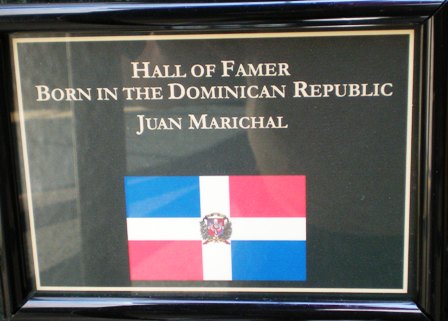 I took the photo on the left when I visited the National Baseball Hall of Fame and Museum last month. Without thinking it through, I was astonished to learn that only one native of the Dominican was in the Hall. I mean, if you're like me, it is hard to believe that no Dominican has been elected to the Hall in the past quarter of a century. However, it's not as if players from that country have been slighted. Instead, it just seems as if there would have been more representation given the growing influence and success that Latin players have had over the past few decades.
Of note, there are only two players – Roberto Clemente and Orlando Cepeda – from Puerto Rico in the Hall of Fame. If I'm not mistaken, Luis Aparicio (Venezuela) and Tony Perez (Cuba) are the only other Latin players elected to Cooperstown. All told, that makes five.
I guess these things take time. If you think about it, a candidate has to play at least ten years (and most HoF worthy players usually last over 15 years), then sit out five more, meaning it takes a minimum of 15 years and, more likely, 20. And that's, of course, only if a player is elected in his first year of eligibility.
But what's so strange to me is that Marichal played in the 1960s and 1970s. Sammy Sosa is probably the only hope from the 1980s and he made his Major League debut in 1989. Pedro Martinez (1992) and Manny Ramirez (1993) should be elected five years after they retire. Vladimir Guerrero (1996) and Albert Pujols (2001) should join Marichal, Pedro, and Manny five years after they hang up their jerseys. David Ortiz has an outside shot at the Hall but only if he can string together at least five more seasons comparable to his 2003-2007 production. Possible but unlikely.
According to Wikipedia, there were 750 players on opening day rosters at the start of the 2008 season, comprised of the following nationalities:
Of the latter, 147 (19.6%) are Latin American (76 from Dominican Republic; 44 from Venezuela; 9 from Mexico; 6 from Panama; 3 from Cuba; 4 from Colombia; 2 from the Netherlands Antilles; 3 from Nicaragua) and 19 (2.5%) are Asian (14 from Japan; 3 from South Korea; 2 from Taiwan).
Here's a partial list of players who are eligible for consideration for the Hall of Fame by the baseball writers over the next five years:
I don't know about you, but Rickey Henderson is the only player from the 2009 class worthy of inclusion. I would be in favor of Roberto Alomar and Barry Larkin in 2010 (although I think one or both may find the going difficult) and would be flabbergasted but not necessarily upset if Edgar Martinez and Fred McGriff made it. Jeff Bagwell, Kevin Brown, Rafael Palmeiro, and Larry Walker will all get various levels of consideration in 2011. Bags and Raffy should be slam dunks based on the numbers, but I would be surprised if the latter even sniffs the Hall. Bernie Williams is a borderline candidate and will be a tough sell for most voters when his name comes up in 2012. If not for the controversy surrounding steroids and performance-enhancing drugs, the 2013 class, headlined by Craig Biggio, Barry Bonds, Roger Clemens, and Mike Piazza, could go down as one of the best groups of enshrinees ever.
The latter year should make for all kinds of interesting stories. Bonds and Clemens. Clemens and Piazza. The greatest home run hitter of all time. The greatest pitcher of the post-war era and perhaps ever. The best-hitting catcher in the history of the majors. And, yes, there will be dozens of other storylines when it comes to this class. I can hardly wait. Not.
But, as it relates to Latin players, only Alomar stands a realistic chance of making the Hall over the next five years. There will be several more over the ensuing years (including the Domincans mentioned above, as well as Mariano Rivera) but perhaps not as many as I would have thought before going through this exercise.
| Baseball Beat | June 19, 2008 |
Happy 80th Birthday, Dad
My Dad, George Lederer, turns 80 years old today. Had he lived, Dad would have joined the octogenarian club. However, he barely made it to 50. He died nearly 30 years ago of malignant melanoma.
It was truly an unfortunate set of circumstances that caused his death. He was never correctly diagnosed because he had two forms of cancer whose symptoms disguised each other. Surgeons removed a benign brain tumor in the spring but called the lesion on the back of his head a wen, an unimportant blemish. Instead, it killed him just a few months later. He died on August 14, 1978 at the age of 50.
Dad was a remarkable man. He was born Gert Dagelbert on June 19, 1928, in Offenburg, Germany, the son of Irene and Julius Lederer. My grandfather, known later to us as Opa, owned an electrical supplies business and my grandmother, Omi, worked in the store. The family prospered. Until Hitler. They were forced to take new middle names – Israel for men and Sarah for women – so they could be identified as Jews. Dad's childhood memories consisted of anti-Semitic behavior by his schoolmates and random Gestapo visits at home. The open harrassment hit a new peak in November 1938 when all Jewish males over 18 in Offenburg – Opa included – were rounded up and taken to a concentration camp. My grandfather was eventually released but only after he agreed to sell his business.
Determined to leave Nazi Germany, Julius found a sponsor, a distant cousin of Irene's and a resident of Long Beach, California. Three months after submitting an affadavit, the family's number was called and my grandparents and father landed in New York in May 1939. Each person was allowed to take $55 out of the country so they arrived with $165, some jewelry Irene managed to smuggle out, and the clothes on their backs. Julius and Irene arranged for temporary lodging in New York while they cleaned houses of wealthy Jews to earn bus fare to California.
The family re-located to Long Beach later that summer, just in time for Dad – now known as George David – to go to Horace Mann Elementary School. Unable to speak or write a word of English, Dad was placed into a second grade classroom but caught up with his fellow 11-year-olds in fifth grade before the school term was up. The next year, he decided to become a sportswriter. My father never changed his mind. He was the sports editor of the Wilson High School and Long Beach City College newspapers.
Dad met Patricia Donovan, "a strikingly feminine brunette" as she was later described in a newspaper article and an "A" student, at LBCC in 1948. Engaged in February 1949, they got married that August on my mother's 21st birthday. Dad's parents were none too happy that their son had decided to marry a Catholic girl in St. Cyprian's church. They arranged to be out of town on "vacation" to avoid the whole affair but, under the "if you can't beat them, join them" theory, arrived at the reception at the house that Mom's mother had rented in North Long Beach.
Days before the wedding, Dad was offered a full-time job at The Independent, one of Long Beach's two newspapers. With no car and Dad working nights and Mom days at the Yellow Pages and later for the Board of Education, they made ends meet on about $437 a month. In 1951, they bought a TV and had their first child (Tom). Six months later, my maternal grandmother, who lived in Iowa, died of a stroke at the age of 48 with her two youngest daughters in tow on a trip to California. Being the man that he was, Dad agreed to take in Mom's youngest sisters (ages 10 and 12) and raised them until my maternal grandfather was able to move west. In the meantime, my parents had two more babies (Janet in 1954 and me in 1955). They added a fourth (Gary) in 1962.
 Life in the Lederer household took a major turn when the Dodgers moved to Los Angeles in 1958. Only 29 at the time, Dad was assigned to cover the team even though he had never seen an official major league game. The adjoining photo, taken in February 1958, is one of my favorites. The caption in the local newspaper read: "George Lederer, Independent, Press-Telegram staff reporter, left home office Thursday morning bound for L.A. International Airport and plane that carried him and contingent of Dodgers to the club's spring training home in Vero Beach, Fla. Lederer will give I-PT readers complete coverage of the Dodgers." This article was published a couple of days earlier, inviting readers to "Follow George Lederer" and his exclusive stories in the newspaper.
With Dad on the road half the time, the rest of us followed the Dodgers mostly on the radio. Unable to afford the cost of long-distance phone calls, Dad stayed in touch with us through daily letters that Mom read at dinner time. It was typical for a letter to be postmarked in, say, Cincinnati even though the Dodgers might have proceeded to St. Louis by the time it had arrived via first-class mail. Tom and I attended almost every Sunday game at home and a few night games here and there when we didn't have conflicting ball games of our own. Tom was even fortunate to take a road trip with Dad and the Dodgers.
Dad became President of the Southern California chapter of the Baseball Writers Association of America in October 1961 and was named to the BBWAA board of directors in October 1968. As the head of the local chapter of the BBWAA, Dad presented "Miss Dodger" with the winner's trophy after Jimmy Durante crowned her. This photo was on the cover of The Biltmore Hotel magazine during the week of May 19, 1962.
A month earlier, Dad caught the first foul ball in the Dodger Stadium pressbox. The back of the photo is date stamped APR 12 1962. The caption below the Associated Press wirephoto reads, "A 'first' in new Dodger Stadium went to Press-Telegram baseball writer George Lederer, who caught first foul ball hit into press box. He caught it on the fly--barehanded--Wednesday night." Another huge thrill was when Dad traded places with Walt Alston and managed an intra-squad game during spring training.
Under the ownership of Walter O'Malley, the Dodgers were like one big family. The franchise owned an airplane (known as the Kay O' after Mr. O'Malley's wife) and traveled before and after the season to places like Havana, Nassau (1960 and 1963), Jamaica (1961), Puerto Rico (1962), and Japan (1966) with wives included on some of the junkets. St. Patrick's Day always fell during spring training and Mr. O'Malley hosted a big party featuring green beer and poker. Front office executives, manager Walter Alston, coaches, broadcasters, and writers alike wined and dined together, be it in the barracks in Vero Beach or on the road. This photo was taken at the first annual writers' party for the Dodgers at the Golden Ox in Chicago in September 1958. Seated (L to R): Bob Hunter, Walt Alston, Charlie Dressen, Charlie Park, pianist. Standing (L to R): Joe Becker, Frank Finch, George Lederer, Rube Walker, Greg Mulleavy, John B. Old, Alan Roth, Bill Buhler, "Senator" Griffin, Harold (Doc) Wendler. This photo was shot at a dinner event with (L-R) Walt Alston, traveling secretary Lee Scott, Red Patterson, Dad, and Bob Hunter.
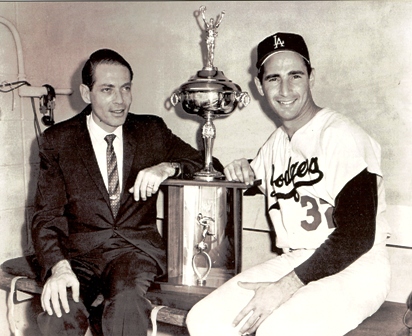 As a beat writer for the Dodgers, Dad was one of the four official scorekeepers and served as the team's statistician in the post-Alan Roth days. He was the official scorekeeper when Sandy Koufax threw his perfect game in 1965. Here is his scoresheet. In addition, Dad maintained a "Dodger of the Day" and awarded a trophy to the player with the most Dodger of the Days at the end of the season. At right, he is presenting Sandy Koufax, who was honored in 1963, 1965, and 1966, with the Player of the Year trophy in the dugout before the final home game of the season.
After covering the Dodgers for 11 years, Dad accepted a front office job with the California Angels. Newly appointed general manager Dick Walsh, in one of his first moves, hired him as the club's Director of Public Relations and Promotions in February 1969. He had grown weary of the travel and was ready for a new challenge.
Dad was known as an iron man, someone who never missed a game. In December 1963, Jack Mann of the New York Herald-Tribune made the following comments in prefacing a quote from Dad on Walter Alston: "George Lederer, the best baseball reporter on the West Coast, has covered every inning of the Dodgers for six years."
Hank Hollingworth, Executive Sports Editor of the Independent, Press-Telegram, wrote a column, "George Lederer: He Never Missed."
Nobody has seen more Dodger games since the club transferred to California than George Lederer. He has missed only two contests since 1958 when the club switched to these sunny climes from Brooklyn – and for good reason.Even skipper Walter Alston – eyeing his 16th campaign at the helm – can't make that boast. George, who is leaving our I, P-T organization after 21 years to take over as promotions and public relations director of the Angels, has a ready explanation for his failure to report two games over a span of 1753 events.
"The Dodgers weren't going any place in 1961 so I left them in Philadelphia for their last two games," said George. "At that time there was a more important thing going on in New York – Roger Maris was going for his record-breaking 61st home run. As it turned out, I covered three games in two days, not two games."
Doug Miles, columnist for the Anaheim Bulletin, wrote the following tribute to Dad when he left the Dodger beat for the Angels front office.
Tonight marks the end of a career for the man whom I consider the finest baseball writer in Southern California, and perhaps it's only one man's personal opinion, but George Lederer, to me, has had no peer in the competitive game of making baseball interesting to the reader.Lederer tonight will be introduced as the new promotion director for the Angels, thus filling the mighty big shoes left when Harold Parrott moved to Seattle. The acquisition of Lederer to the Angel fold may be the best deal general manager Dick Walsh will ever make. But it again is a personal loss to the fans, who have followed the Dodgers by reading Lederer's outpourings in the Long Beach Press-Telegram.
John Hall wrote a column in the Los Angeles Times about Dad in July 1970 entitled, "Veeck Jr. at Big A":
If any one person is more responsible than any other for the upswing at the gate, though, it is not a ballplayer. It is George Lederer, just a working stiff. He has no pension plan and no Player Assn. to cut his work day to less than five hours. George goes about 18 of every 24.
A year later, Hall devoted another column to Dad.
But above all, it is Lederer who stands out as the most important single force in the Angel pursuit of health and happiness on the attendance meter. He doesn't swing a bat or pitch a ball. Lederer is the Angel public relations and promotion director, a soft-spoken former sportswriter whose quiet manner hardly gives a hint of the electricity constantly bouncing around between his ears.He's the new king of baseball's bargain counter hucksters. The Angels may or may not wind up atop the American League West this season. But they lead the world in special events.
In the January 8, 1972 issue of The Sporting News, correspondent Dick Miller wrote an article with the following title: "Angels Show Hefty Profit on Lederer's Sharp Promotions."
Lederer may have been California's most valuable player in 1971. As public relations and promotions director, his special nights were directly responsible for putting an additional 206,000 fans into Anaheim Stadium.You can put it another way. At $3 a head, the promotions were responsible for about $618,000, or three fourths of the player payroll.
Do you think the economics of the game have changed a little bit over the past few decades?
My father's life in baseball was a dream come true. Given his background, one might say an impossible dream come true. But he lived every moment of those years. I like to affectionately call them the Koufax and Ryan years. His timing was perfect. He caught all of Sandy's years in Los Angeles and all but one of Nolan's campaigns in Anaheim. In between, Dad served as a Master of Ceremonies of an event in which he introduced Jackie Robinson and interviewed Roy Campanella. He also received numerous thank you and congratulatory letters from baseball dignitaries and politicians, including Walter O'Malley, Peter O'Malley, and Buzzie Bavasi, as well as President Richard Nixon and Vice President Hubert Humphrey. If it wasn't the Golden Age of Baseball, it was the golden age of his life. He was simply loved by everyone who knew him.
As chronicled last month, my son Joe and I visited Cooperstown. Thanks to Tim Wiles, the Director of Research of the National Baseball Hall of Fame and Museum, we were treated to a "behind-the-scenes" tour of the library. We found my Dad's folder directly behind Ricky Ledee's inside one of the filing cabinets in the library of the Hall of Fame. We looked inside, read the clippings, and made copies for my personal use. Man, that was really a special moment for both of us.
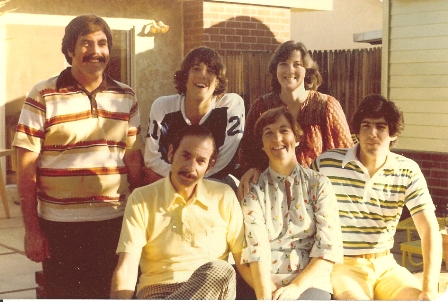 The family photo at left is the last one with our Dad. We're all 30 years older now. Can that be? Wow. The clothing, hair, and weight have changed a bit, but that's still my brothers Tom and Gary and my sister Janet standing in the back row, and me with my arm around Mom while she holds hands with the true love of her life (and vice versa). Times change but family and memories last forever. This is a forever moment. It's almost as if it were taken yesterday, a moment frozen in time for all of us to cherish whenever we get the urge.
Happy Birthday, Dad. We miss you. I mean, really miss you. It's been a long time. Too long. But we're all doing well. Mom's still going strong. Tom, Janet, Gary, and I are all happily married with good jobs. Your seven grandchildren are growing up. My little Macy even got married last year. And to a great guy. Great grandchildren (in more ways than one) can't be too far off. As I see it, you're alive and well, Dad. Your legacy lives on through all of us. We're all doing our best to make you proud. It's the least we could do. I mean, we couldn't be prouder of you.
Thanks, Dad. Happy Birthday. You're the best.
| Baseball Beat | June 16, 2008 |
State of Major League Baseball
Maury Brown, the Founder and President of the Business of Sports Network (including the Biz of Baseball), asked a number of baseball executives, writers, and analysts to comment on the state of Major League Baseball in 2008.
I was honored to serve as a participant, along with Peter Abraham (The Journal News and LoHud Yankees Blog), Chuck Armstrong (President, Seattle Mariners), Kurt Badenhausen (Forbes), Alex Belth (Bronx Banter), Tyler Bleszinski (Athletics Nation), John Brattain (THT, MSN Canada, Baseball Digest Daily), Craig Calcaterra (Shysterball), David Chalk (Bugs and Cranks), Fred Claire (Former Executive VP and GM, Los Angeles Dodgers), Jerry Crasnick (ESPN.com), Ken Davidoff (Newsday), Jeff Erickson (RotoWire), Brent Gambill (MLB Home Plate, XM Satellite Radio), Kurt Hunzeker (Active Marketing Group), Kevin Kaduk (Big League Stew), Jonah Keri (ESPN.com, YESNetwork.com, New York Sun), Jordan Kobritz (Professor Sports Management, Former Minor League Team Owner), Tim Lemke (Washington Times), Tim Marchman (New York Sun), Michael A. Neuman (Amplify Sports and Entertainment), Jeff Passan (Yahoo! Sports), Dayn Perry (FOXSports.com, Baseball Prospectus), David Pinto (Baseball Musings, The Sporting News), Todd Radom (Todd Radom Design), Ken Rosenthal (FOX Sports), Joe Siegler (Ranger Fans), Charlie Weigert (CDM Fantasy Sports Corp.), and Andrew Zimbalist (Sports Economist and Author).
My contribution was as follows:
Despite major differences in revenues, the competitive balance in baseball has improved of late and is likely to tighten up even further over the next several years. This is great news for Major League Baseball.The primary reason for this sea change is that more teams are signing younger players to multi-year deals than ever before. This new philosophy should prove advantageous for smaller market franchises and less advantageous for larger market teams because lower payroll clubs will keep their best players for a longer period and organizations that have relied heavily on free agents in the past will have fewer quality choices in the future.
Since the beginning of the year, more than a dozen young stars have been signed to long-term contracts that buy out their arbitration years and one or more free-agent seasons. To wit, the Colorado Rockies made history this year when they signed shortstop Troy Tulowitzki to a six-year, $31 million deal, the biggest contract ever given to a player with less than two years' experience. The Milwaukee Brewers topped that deal by giving Ryan Braun, the 2007 NL Rookie of the Year, an eight-year deal worth $45 million. Sandwiched between those two contracts, the Tampa Bay Rays signed Evan Longoria to a six-year deal worth $17.5 million, an unprecedented agreement for a player with less than a week's experience in the big leagues.
But that's not all. Miguel Cabrera, Curtis Granderson, Justin Morneau, Hanley Ramirez, Alex Rios, and Chris Young have all signed extensions that should keep them with their current clubs for at least the next five years.
Although these contracts are not without risk, there are valid reasons why clubs and players are entering into such deals. Given the historical salary inflation of approximately 10% per year, many of these deals will turn out to be at discounted prices at the back end as long as the players stay healthy and perform as expected. The players benefit by earning more money in the early years and have the peace of mind of long-term financial security for themselves and their families. As I like to say, the first ten or twenty million dollars are much more important than the last ten or twenty million.
Participating teams, players, and fans should reap the rewards of this new trend and that should be a major positive for the long-term health and competitiveness of Major League Baseball.
In addition to the above, I believe the willingness of teams to select players in the Rule IV Draft based on ability rather than signability (as demonstrated earlier this month) should also favorably impact the competitiveness of MLB. The combination should narrow the talent gap between the haves and have nots over time. The situation is far from perfect, but it appears to be moving in the right direction.
How do you see the state of Major League Baseball?
| Baseball Beat | June 13, 2008 |
Top College Draft Picks Splitsville for the Pros
Thanks to College Baseball Splits, we can analyze the statistics of college hitters and pitchers better than ever before. Powered by play-by-play logs, founders Kent Bonham and Jeff Sackmann have sliced and diced the data to develop extensive splits and situational statistics (through draft day) for 350 NCAA teams.
Using the links provided for college players selected on the first day of the 2008 amateur draft, I have cut and pasted the overall rate stats, as well as those vs. RHP/LHP, Home/Road, and on Fridays (which is generally against the ace of the opposing team), for all of the hitters chosen in the first and supplemental rounds last week. I have also added comments about the player to each entry.
Please note that the information offered below is intended to be instructive rather than conclusive. There are a number of caveats to consider, including the small sample sizes and the fact that the stats are unadjusted for ballpark effects and level of competition, both of which can play huge roles at any level but particularly in amateur baseball. For those of you who would like to make mental adjustments, be sure to check out the park factors and strength of schedules at Boyd's World.
While statistics tell us a great deal about the past, they rarely tell the complete story when it comes to projecting how amateur baseball talent will perform at the next level. Although our eyes can fool us at times – especially among the untrained – we should pay close attention to scouting reports, which rate players for their five tools (ability to hit for average and power, speed, fielding, and throwing arm), as well as makeup and other intangible factors. Like many others, I would also add a sixth tool that is as important as the others: the ability to control the strike zone (which basically comes down to plate discipline and pitch recognition).
Strikeouts and walks as a percentage of plate appearances and as a ratio tell a pretty good picture as far as plate discipline goes but seeing is believing when it comes to evaluating pitch recognition. Some players have it and others don't. A hitter may be able to rip 90-mph fastballs all over the park, but if he is unable to distinguish a slider from a fastball (or a strike from a ball), he is going to have a tough time adjusting to more advanced pitchers.
Lastly, it is important to note that college baseball hitters use aluminum bats whereas professional hitters use wood bats. In a nutshell, aluminum bats outperform wood bats. The sweet spot is larger and the balls come off the metal bats faster. Moreover, the barrel of an aluminum bat is hollow and the distribution of weight is substantially different than it is for a solid wood bat. The bottom line is that some players who hit well with an aluminum bat don't always transfer that skill set to the wood bat. As a result, talent evaluators like to see how amateur hitters perform with Team USA or in the Cape Cod League and other circuits and showcases where wood bats are required.
Here are the splits of hitters drafted in the first round:
Pedro Alvarez | 3B | Vanderbilt | Pittsburgh Pirates | #2
AVG OBP SLG
TOT .319 .425 .595
RHP .337 .437 .624
LHP .290 .405 .548
HOME .313 .421 .521
ROAD .354 .455 .631
FRI .250 .372 .417
Pedro Alvarez suffered a hamate bone injury to his right hand early in the season and may not have returned to full strength until last month. After missing all but one game in February and all of March, his numbers improved over the course of the spring (April: .309/.404/.519; May: .333/.438/.693). Alvarez's Friday stats were less than inspiring, but we're only talking about 43 plate appearances here. His full body of work, including playing on the USA National Team twice during his collegiate career, is impressive. Importantly, he has always hit well with the wood bat, leading Team USA in batting average (.315), slugging percentage (.551), and home runs (7) last summer.
Buster Posey | C | Florida State | San Francisco Giants | #5
AVG OBP SLG
TOT .460 .566 .866
RHP .463 .575 .878
LHP .450 .542 .833
HOME .472 .573 .896
ROAD .451 .557 .805
FRI .467 .567 1.022
Buster Posey hit everybody and everywhere all season long. He led the nation in AVG, OBP, and SLG while catching almost every inning, making him a virtual shoo-in to capture the Golden Spikes and Dick Howser awards as the college player of the year. Posey climbed draft boards throughout the spring and was among a handful of players considered by the Rays for the #1 pick. His Cape Cod League stats (.281/.361/.375 with 3 HR in 128 AB) suggest that he may not be the power hitter with a wood bat in the pros that he was with an aluminum bat at the college level. We called Posey a "solid and safe high first-round pick" when Live Blogging the MLB Draft but Matt Wieters he's not.
Yonder Alonso | 1B | Miami | Cincinnati Reds | #7
AVG OBP SLG
TOT .358 .532 .746
RHP .441 .602 .924
LHP .227 .410 .467
HOME .377 .558 .781
ROAD .362 .538 .759
FRI .410 .593 .949
Yonder Alonso was the first in a long line of highly regarded college first basemen taken in this year's draft. As evidenced by his 74 BB (which led the country) and 32 SO, Alonso's approach at the plate is outstanding. A lefthanded swinger, the only question is whether he can hit southpaws well enough to become a star at the highest level. However, his low BABIP of .236 may suggest he was a victim of bad luck, especially given the small sample size of 100 plate appearances. There is no doubt that he can swing the wood stick based on his .338/.468/.497 line in the Cape Cod League last year. Alonso topped all battters in OBP and was third in AVG.
Gordon Beckham | SS | Georgia | Chicago White Sox | #8
AVG OBP SLG
TOT .403 .512 .798
RHP .408 .514 .846
LHP .350 .487 .600
HOME .408 .516 .808
ROAD .378 .515 .770
FRI .354 .500 .646
Gordon Beckham was, by far, the premier batsman among all college baseball middle infielders in this year's draft. There is little not to like, particularly when one considers the fact that the University of Georgia home field played to a park factor of 79 from 2004-2007, meaning it suppressed runs by 21% during this period. Including Regional and Super Regional action, Beckham is tied for the most home runs in the country with 26 in only 252 AB. He also led the Cape in homers with nine and was third in slugging average when he hit .284/.370/.529 for the Yarmouth-Dennis Red Sox, a team that also featured fellow first rounders Buster Posey and Juan Castro.
Jason Castro | C | Stanford | Houston Astros | #10
AVG OBP SLG
TOT .364 .418 .587
RHP .348 .422 .630
LHP .386 .414 .535
HOME .351 .409 .641
ROAD .378 .429 .510
FRI .200 .310 .380
Although the Astros surprised many by selecting Jason Castro with the 10th pick in the draft, the lefthanded-hitting catcher is coming off a superb Cape Cod season (.341/.434/.488) and junior year (.379/.431/.617 through the Super Regionals). Of note, Stanford played the toughest schedule in the country and its home ballpark is much more friendly toward pitchers than hitters. The only fly in the ointment was his performance on Fridays, yet his low BABIP (.216) may indicate that he was simply unlucky. As for the draft pick itself, I don't believe there is such a thing as a reach in the first round, provided that the prospect in question is a first-round talent (which Castro certainly qualifies as). If you like a player, you have to take him right then and there as league rules prohibit trading picks.
Justin Smoak | 1B | South Carolina | Texas Rangers | #2
AVG OBP SLG
TOT .380 .505 .751
RHP .413 .551 .819
LHP .317 .404 .622
HOME .406 .539 .836
ROAD .365 .465 .635
FRI .408 .483 .633
Justin Smoak is coming off a terrific season in which he slugged 23 HR for the Gamecocks. A switch-hitter, Smoak has been compared to Mark Teixeira and Chipper Jones by Peter Gammons and others. His performance with the wood bat has been mixed as he led the Cape Cod League in HR (11), XBH (21), and slugging average (.565) after his freshman season in 2006, then slumped to .223/.291/.380 for Team USA last summer, producing only 20 hits and no HR in his last 102 at-bats.
Jemile Weeks | 2B | Miami | Oakland A's | #12
AVG OBP SLG
TOT .359 .445 .627
RHP .336 .424 .550
LHP .414 .494 .800
HOME .353 .442 .647
ROAD .368 .434 .574
FRI .333 .379 .667
Jemile Weeks was the A's highest draft pick since 1999. The switch-hitting second baseman has had pretty consistent splits across the board and will be on display this week when the Miami Hurricanes play in the College World Series. Look for Weeks to become a prototypical first or second hitter in the pros with his on-base skills and speed.
Brett Wallace | 3B | Arizona State | St. Louis Cardinals | #13
AVG OBP SLG
TOT .412 .529 .759
RHP .452 .558 .793
LHP .364 .495 .739
HOME .403 .505 .792
ROAD .443 .575 .754
FRI .383 .526 .667
The Cardinals chose Brett Wallace as a third baseman even though his body and lack of mobility suggest he would be a better fit on the other side of the diamond. A two-time Pac-10 triple crown winner, Wallace can flat out hit. Although he may have benefited by playing his home games in a hitter-friendly ballpark (118 PF), Wallace's road numbers were outstanding in their own right. He hit .312/.345/.404 in the Cape last summer. One baseball executive told me that Wallace reminded him of Sean Casey.
David Cooper | 1B | Cal | Toronto Blue Jays | #17
AVG OBP SLG
TOT .350 .442 .677
RHP .376 .448 .752
LHP .303 .432 .539
HOME .391 .489 .809
ROAD .293 .376 .467
FRI .321 .381 .607
David Cooper was selected by the Blue Jays after playing two seasons at Cal and his freshman year at Cal State Fullerton. The lefthanded-hitter's value rests with the bat as he is not known for his baserunning or fielding. Cooper and Yonder Alonso played for the Brewster White Caps in the Cape last summer with the former hitting .284/.415/.463 while mostly serving as the club's DH. On Tuesday, Cooper became the first player drafted in the top round to agree to a contract, signing for a $1.5 million bonus. He will report to Auburn of the New York-Penn League but is expected to move up to High-A Dunedin by the end of July.
Ike Davis | 1B | Arizona State | New York Mets | #18
AVG OBP SLG
TOT .378 .459 .756
RHP .397 .475 .777
LHP .347 .430 .733
HOME .379 .456 .743
ROAD .340 .421 .760
FRI .305 .406 .441
Another first baseman, Ike Davis was taken by the Mets with the next pick at #18. While his overall stats speak for themselves, Davis pumped up his numbers by pounding Saturday and Sunday pitchers (42-for-91 with 15 2B and 10 HR). He "hit" only .246/.308/.298 in a shortened performance in the Cape last summer after struggling in the Alaskan Baseball League in 2006. It seems prudent to view Davis with a healthy dose of skepticism until the son of former major league reliever Ron proves he can handle a wood bat.
Reese Havens | SS | South Carolina | New York Mets | #22
AVG OBP SLG
TOT .349 .479 .627
RHP .402 .524 .692
LHP .238 .384 .488
HOME .372 .497 .679
ROAD .310 .444 .529
FRI .231 .333 .385
The Mets made Reese Havens the club's second first-round draftee when they chose him with the 22nd overall pick. The shortstop teamed up with fellow infielders Justin Smoak and James Darnell at South Carolina. Although his splits were a bit more uneven than other first rounders, Havens clinched his draft standing last summer when he hit .314/.371/.487 in the Cape. He reportedly has agreed to a $1.4 signing bonus with the Mets.
Allan Dykstra | 1B | Wake Forest | San Diego Padres | #23
AVG OBP SLG
TOT .323 .519 .645
RHP .310 .515 .578
LHP .343 .526 .757
HOME .359 .541 .769
ROAD .310 .496 .575
FRI .182 .413 .364
Excluding Brett Wallace from the mix, the Padres made Allan Dykstra the fifth first baseman selected in last week's draft. The 6-foot-5, 240-pound lefthanded hitter combines raw power with the ability to take a walk. He slugged 16 HR and ranked second in the country with 62 BB in only 56 games. Dykstra struggled on Friday nights (although in a much smaller sample size than normal), going 6-for-33 with 2 HR. He was named as an All-Star in the Cape Cod League last summer, hitting .308/.444/.481 while ranking third in OBP. Dykstra was a teammate at Wake Forest with second baseman Matt Antonelli, who was SD's first-round pick (17th overall) in 2006.
Here are the splits of hitters drafted in the supplemental round:
Conor Gillaspie | 3B | Wichita State | San Francisco Giants | #37
AVG OBP SLG
TOT .424 .508 .710
RHP .432 .509 .696
LHP .406 .506 .703
HOME .438 .510 .652
ROAD .391 .481 .783
FRI .444 .510 .800
Until Conor Gillaspie was selected by the Giants, no college position player had been drafted with the previous 13 picks. The lefthanded-hitting third baseman is a pure hitter with an advanced approach at the plate. This combination is likely to produce a high batting average with lots of doubles and a fair share of walks in the pros. Gillaspie was the MVP in the Cape Cod League last summer when he hit .345/.448/.673 while ranking first in AVG and SLG and second in OBP.
Ryan Flaherty | 2B | Vanderbilt | Chicago Cubs | #41
AVG OBP SLG
TOT .324 .413 .545
RHP .366 .457 .640
LHP .250 .333 .380
HOME .299 .399 .488
ROAD .329 .427 .632
FRI .368 .393 .526
A shortstop at Vanderbilt, Ryan Flaherty was drafted as a second baseman by the Cubs. His college numbers were more solid than spectacular. A lefthanded hitter, Flaherty didn't fare too well against southpaws. Tall and lanky, Ryan isn't particularly strong and never really showed much power until this season when he went yard 14 times. He hit .270/.309/.383 for Team USA while fading after the team's opening six games in New England. If Flaherty's tools are found wanting at the big league level, look for him to stick around as a utility player. He signed a contract with the Cubs this week.
Logan Forsythe | 3B | Arkansas | San Diego Padres | #46
AVG OBP SLG
TOT .353 .479 .533
RHP .374 .509 .504
LHP .305 .394 .593
HOME .350 .442 .530
ROAD .356 .515 .548
FRI .432 .561 .750
Drafted by the Padres, Logan Forsythe was the last player selected in the supplemental round. A third baseman, he can also help out at second, short, and outfield if need be. Forsythe played for Team USA last summer on a broken foot and hit .309/.463/.404, ranking second in walks and striking out fewer times than any other starter. He underwent surgery in November, then suffered a hamstring pull in the spring, and the injury affected his stroke during non-conference play, leading to a 12-for-49 mark with 2 XBH, 0 HR, 6 BB, and 11 SO on Tuesdays and Wednesdays. Forsythe has signed with San Diego.
| Baseball Beat | June 09, 2008 |
MLB Draft News and Notes
It's still amateur hour week at Baseball Analysts. We plan on spending the first few days of this week to reviewing and analyzing the First-Year Player Draft and will turn our attention to the College World Series on Friday and this weekend.
Today's entry is a smorgasbord of news and notes resulting from last week's draft.
First baseman/corner outfielder Shane Peterson (STL, #59) was chosen in round two, shortstop Danny Espinosa (WAS, #87)) and righthanded starters Andrew Liebel (TOR, #95) and Vance Worley (PHI, #102) were selected in the third round, righthanded reliever David Roberts (CLE, #141) was taken in the fourth round, and righthanded starter Brett Lorin (SEA, #162) was plucked in the fifth round. All five players are expected to sign although Lorin, a draft-eligible sophomore, could return to Long Beach in an attempt to improve his draft status after a season in which he could be the Dirtbags' Friday Night Starter.
Long Beach nearly made it eight players when outfielder Jason Corder (TB, #203, 7th round) was nabbed with the first pick when the draft resumed on Friday. Travis Howell (SEA, #552), Nick Vincent (SD, #555), and Jason Tweedy (TB, #593) were also selected on the second day, giving the 49ers a total of 11 players chosen overall.
The five players drafted in the top three rounds and the seven taken in the first five are both school records. Led by Jered Weaver (LAA, #12), the 2004 team had three players chosen in the top three rounds and four in the first five. Troy Tulowitzki (COL, #7) and Cesar Ramos (SD, #35) both went in the opening round of the 2005 draft while three others were taken in the sixth round.
The above is a testament to coach Mike Weathers' ability to recruit and develop players, but this year's purge in talent is likely to leave the 2009 club thin in both pitching and hitting.
While the scouting reports sound convincing, Martin's dominance over high school hitters should be discounted as he turned 19 the day after the Dodgers selected him with the 15th overall pick. If anybody would like to pursue such a study as a guest columnist for Baseball Analysts to confirm or deny my suspicions, please drop me a note at the email address linked to my name in the sidebar on the left.
While some analysts expected that the Angels might go for a first-round talent who was passed over due to concerns over signability, director of scouting Eddie Bane opted for the smallish righthander with the 74th overall pick in the draft. Chatwood went 9-1 with a 1.05 ERA as a pitcher and 49-for-94 (.521) as a hitter, playing shortstop and center field when not on the mound. However, with a fastball that – according to Bane – ranges from 92-97 mph, Chatwood's pitching career didn't end when he was saddled with the loss in the California Interscholastic Federation Division 2 championship game at Dodger Stadium a week ago.
Hicks, the only draftee who showed up in Orlando, was interviewed by ESPN2 moments after he was selected by the Twins. Urban Youth Academy program senior director Darrell Miller, the brother of all-time women's basketball great Cheryl and a former catcher with the California Angels (1984-88), was part of Hicks' travel party in Florida. He told David Felton of the Long Beach Press-Telegram, "We've had a little bit of fun today. I'm pleased that he went to a team like the Twins," adding that Minnesota had been very supportive of the Academy. "(Hicks and Gose) are wonderful young men you want to have other kids see and emulate. For (the Urban Youth Academy), it's just great. It's going to really galvanize the kids."
Meanwhile, Gose was one of a trio of toolsy players selected by the Phillies with the club's first three picks. Shortstop Anthony Hewitt (#24) of Salisbury School (NY) and outfielder Zach Collier (#34) of Chino Hills HS (CA) are also talented athletes with projectable bodies and huge ceilings. While raw, Hewitt may have the most upside of any player taken in last week's draft. Overlooked on the showcase circuit last summer, Collier had been climbing draft boards ever since he slammed a home run off a 93-mph fastball from Hicks in a tournament game in Fullerton this spring.
While college players are generally much closer to the majors at the time of the draft, elite high school prospects like Bruce can make it to the bigs at a younger age than their more experienced counterparts.
Check back later in the week as we drill deeper into the stats (including various splits) of first-round picks plucked from the college ranks.
| Baseball Beat | June 07, 2008 |
The Road to Omaha is Easier for Some Than Others
The top-eight seeds in the NCAA Division I Baseball Championship all won their Regionals last weekend and automatically earned the right to host Super Regionals this weekend. However, it is important to note that no national seed has won the College Baseball World Series since Rice in 2003.
The Super Regional pairings are as follows:
Three of the four national seeds lost in the opening game on Friday. Miami, Florida State, and Cal State Fullerton were all defeated yesterday and are playing today to avoid elimination. In the meantime, Georgia, the only victorious team, lost the second game of its series to North Carolina State earlier today. The rubber match will be held on Sunday. The other four matchups kick off on Saturday, continue on Sunday, and, if need be, will conclude on Monday.
The winners of the Super Regionals will comprise the eight spots in the College World Series, which starts Friday, June 14 at Rosenblatt Stadium in Omaha, Nebraska.
Baseball America's Aaron Fitt has created excellent previews, broken down by the Friday and Saturday start dates. The articles include schedules, TV times, starting lineups, stats, and scouting reports written by college coaches.
Despite being treated harshly by the NCAA selection committee, teams from the West dominated schools from outside the area in last week's Regionals. Bob Keisser, sports columnist and college beat writer for the Long Beach Press-Telegram, broke down the grave injustices yesterday.
There were 14 regional games matching West Coast teams against colleges East of Tempe, and the West outdid itself. They were 14-0.Arizona, Arizona State and UC Irvine went 9-0, and I imagine the coaches and players at Long Beach, San Diego and Cal are somewhat envious considering they were all forced to play in the same NCAA sandbox.
But this really just puts an exclamation point on a trend. Since the field expanded to 64 teams and went to 16 first-round regionals, West Coast teams have beaten out-of-towners at a .672 clip, going 117-57.
It gets better. West Coast teams have been matched against a team from another region in a Super Regional 12 times, and won 11 of them. The winning percentage for all games played in those regionals is .806, 25-6.
When teams from here play teams from there in the College World Series in Omaha, they win at a .590 clip (36-25), which includes three champions (Oregon State twice, Fullerton once), and three runner-up efforts (Stanford all three).
It's just another layer of stats underscoring the bias that exists when it comes to NCAA decisions. Teams from here, given the opportunity to play outside their neighborhood, prove time and again their prowess, and the only thing holding them back are the parameters of the seeding.
It was noted last week that the maximum number of West Coast teams that could possibly advance to this week's Super Regionals was six. Well, six made it. It was also noted that the SEC and ACC - with 24 teams, comparative to the number of teams in the Pac-10, Big West and West Coast Conference (25) combined - had 11 chances to move on to the Super Regionals.
Only six made it. For those scoring at home, four of the SEC/ACC teams that lost did so in regionals won by a team from the West. I didn't really have to add that, did I?
Keisser suggests that "the NCAA needs to consider seeding the baseball tournament 1-to-64 like they do in basketball and stop lumping teams together automatically by geography." Using RPIs, Keisser seeded the entire field of 64 teams and determined that the 12 West Coast teams would have been "spread across nine regionals as opposed to six, and there would have been no more than two West Coast teams in any one regional." His conclusion? "There's no guarantee that any would have had more success in these brackets, but based on the numbers and avoiding neighbors, one would like their chances."
The four finalists for the 22nd annual Dick Howser Trophy to college baseball's player of the year were named this week. Georgia shortstop Gordon Beckham, Missouri pitcher Aaron Crow, Florida State catcher Buster Posey, or Arizona State third baseman Brett Wallace will be presented with this prestigious award in Omaha, Nebraska, on June 14, the first day of the College World Series. All four players were also selected as finalists for the Golden Spikes award, which also goes to the best college player. University of San Diego pitcher Brian Matusz is also a finalist for the latter honor. These five players were among the top 13 picks in the MLB draft on Thursday. All but Crow and Matusz are still playing in the Super Regionals this weekend.
| Baseball Beat | June 06, 2008 |
Reflections on Day One of the Draft
The first day of the MLB draft covered six rounds (plus compensation rounds between the first and second as well as the third and fourth) and produced 202 picks, starting with Tim Beckham (Tampa Bay) at No. 1 and ending with Ryan Lavarnway (Boston) at No. 202.
Beckham was the fifth high school shortstop in the past 20 years to be taken at the top of the draft. The other four? Justin Upton (Arizona, 2005), Matt Bush (San Diego, 2004), Alex Rodriguez (Seattle, 1993), and Chipper Jones (Atlanta, 1990). A-Rod and Chipper are headed to the Hall of Fame, Upton is at the beginning of what could be a highly promising career, and Bush has yet to play a game above Single-A. Interestingly, all five players have been moved off the shortstop position with Rodriguez and Jones manning third base, Upton right field, and Bush attempting a transformation to pitcher. If nothing else, it speaks to Bill James' Defensive Spectrum, which suggests that players can more easily switch from difficult positions such as shortstop to less demanding corner infield and outfield positions. Where Beckham winds up in five or ten years is anyone's guess, but there is no doubt that the Rays drafted the highly talented prep with the intention that he will be their shortstop of the future.
Of note, 21 college players (including one juco) – tying the previous record set in 1992 – were selected in the opening round. Thirteen of the collegians are position players (with five being first basemen, excluding Brett Wallace who St. Louis chose as a third baseman) and eight are pitchers (with four taken as relievers, excluding Carlos Gutierrez who Minnesota apparently believes can succeed as a starter).
Seven of the nine high school draftees are position players (including Aaron Hicks and Casey Kelly, two-way players who were chosen to hit and field rather than pitch) and only two (Ethan Martin and Gerrit Cole) are pitchers. By comparison, there were seven high school arms taken in the first round last year.
As we enter the second day of the draft, there are several highly ranked prospects who have yet to hear their names called. Alex Meyer (RHP, Greensburg HS, IN), ranked 25th by Baseball America, is reportedly asking for a ton of money and will be heading to the University of Kentucky in the fall unless a team steps up in a big way. Brett Hunter (RHP, Pepperdine University), ranked 51st, has had arm problems all spring and is a major health risk, yet is a top two-round talent. The 36th-ranked Isaac Galloway (OF, Los Osos HS, CA) and 48th-ranked Daniel Webb (RHP, Heath HS, KY) are raw talents who priced themselves out of the first day of the draft.
Jordan Danks (CF, Texas), the younger brother of Chicago White Sox LHP John, is someone who would have gone in the first round in 2005 had he not told teams he was set on attending college. A power bat as a high schooler, the lefthanded-hitting Danks won the home run derby at the 2004 Aflac All-American Classic, beating (among others) Cameron Maybin by hitting several balls completely out of the park. Four years later and his power has all but disappeared, having hit just 12 HR in three college seasons. At 6-5 and 210 pounds, Danks has the size and athleticism that will attract a team on day two of the draft.
Lastly, to the credit of our good friends at Baseball America, the leading source for information on amateurs and minor league prospects, Jim Callis dialed the first four picks of the draft, then Matt Blood reported from Orlando before the proceedings began that Buster Posey would go at five, and John Manuel had Cole falling to the New York Yankees at No. 28 long before the selection took place. Nice job once again, guys.
- Posted by Rich Lederer
Well, that was fun. After an entire day of being glued to the computer, we can now look back and start to analyze exactly what happened on Day 1. As a lot of people have already mentioned, it's great to see teams actually taking the best players available to them in their slot. The New York Yankees and Detroit Tigers did not walk away with some of the better players in the draft.
Fans in Kansas City, Minnesota and even Pittsburgh should be pretty gosh darn excited with the first day results, which is something most of the fans have not been able to say for a number of years (especially in Pittsburgh).
The Pirates nabbed possibly the No. 1 player in the nation with the club's first pick (second overall). Third baseman Pedro Alvarez won't come cheap but he could very well develop into the Face of the Franchise, which is something Pittsburgh has sorely lacked since... well, help me out here Pittsburgh fans... Alvarez has a potent bat and has been one of the most feared hitters in the college ranks for the past three seasons. His numbers were down a little bit due to a broken hamate bone. The Pirates also nabbed prep outfielder Robbie Grossman with the club's sixth round pick. Grossman will have to be signed away from the University of Texas after a poor senior year of high school dropped him out of first round consideration and slid him to the sixth round due to signability concerns.
Not only did the Royals get a beast with the third overall pick in prep first baseman Eric Hosmer, the club picked up two players in later rounds (third and fourth rounds) that could have been first rounders, if not for signability concerns. We even had profiles prepared for both players, in case they were chosen in the first or supplemental first rounds:
Tyler Sample, Mullen high school (Colorado)Height/Weight: 6-7, 220 | Age: 18
Sample pitches between 88-92 mph with his fastball and can touch 95 mph. His secondary pitches include a knuckle-curve with plus potential and a change-up. Sample had Tommy John surgery as a sophomore in high school. His command and control need some work and his fastball can also be too straight at times. Sample is committed to the University of Arkansas. (Posted by Marc Hulet)
2008 Pick: Tim Melville, RHP, Holt HS (Missouri)Height/Weight: 6-5, 210 | Age: 18
Melville is a big right-handed pitcher who can bump his fastball into the 94 mph range. He also has a knuckle curve ball, which is inconsistent. His change-up is below average. Melville has been likened to New York’s Phil Hughes. He is athletic and could be a two-way player at the college level if he attends the University of North Carolina. Melville’s delivery is good and with his big, strong body he should be a workhorse if he can improve his secondary pitches. (posted by Marc Hulet)
If the Royals can get both pitchers signed, a tall task, they will have had an amazing draft with just the club's first four rounds. That is just the best news that Royals fans could hope to hear - and fans of baseball in general, as the smaller market teams are beginning to step it up in the draft. Teams have no doubt learned that it is smarter to risk $10-$15 in one year on a draft (and 10-20 players) as opposed to giving $20 million a year over six years to one 32-year-old free agent.
The Twins grabbed (surprise, surprise) a raw, toolsy prep player with Aaron Hicks and then balanced that out (I guess) with a "safe" pick of college reliever Carlos Gutierrez, a player the club probably could have gotten with its supplemental first round pick (or even its second round pick). A lot of analysts were baffled by that pick. Even so, Twins fans should be ecstatic with the club's next two selections in Shooter Hunt and Tyler Ladendorf. Hunt has a poor finish to his season, which slid him out of mid-first round consideration. Ladendorf is a junior college shortstop that can absolutely hit - something the organization could really use, if the kid can stick at shortstop... which is up in the air. A year after taking Angel Morales in the third round, the club took another top-rated Puerto Rican with its fourth round pick with outfielder Danny Ortiz.
- Posted by Marc Hulet
If you are a fan of drafting college players, than the San Diego Padres' Day 1 Draft is for you. I am a little curious how Allan Dykstra fits on a team that plays half its games in Petco Park, as he may have the most raw power of any college first baseman taken in the first round. He's also not going to knock Adrian Gonzalez off first base, as Dykstra has a ways to go before he is average defensively at first base. A nice pick, though, and I wrote in an earlier posting during our draft preview that I thought he was the most likely player of the Top 6 college first basemen to really surprise some people.
The Padres organization did dip into the high school pool for its second pick (supplemental first round), but Jaff Decker (yes it's with an 'A') has a "now bat" and is a short, squat power hitter in the Matt Stairs mold... or perhaps Brian Giles. Decker, though, has limited upside due to his size.
With its next two picks, the Padres took two college third basemen with Logan Forsythe and James Darnell, two players that were high on my personal draft board. Forsythe could surprise a lot of people as he was slowed this season by a stress fracture in his foot. Darnell was overshadowed a bit by his teammates at South Carolina but he has the potential to be a four or five tool player with a little more consistency.
2008 Pick: James Darnell, 3B, University of South CarolinaHeight/Weight: 6-2, 195 | Age 21
2008: .306/.395/.580 | 255 AB | 78 H | 13 2B | 0 3B | 19 HR | 39 BB-46 SO
Darnell has good power potential and makes solid contact. He can be fooled by off-speed pitches. Defensively, he has an average arm and OK hands but his range is lacking. Darnell has good athleticism but is still raw as a baseball player. He is also streaky. (Posted by Marc Hulet)
College center fielder Blake Tekotte is a spark plug type player with above-average speed and he has shown an aptitude for hitting with wood bats. Both first baseman Sawyer Carroll and outfielder Jason Kipnis are interesting players but have been described by scouts as "tweeners" because they lack the necessary power to play everyday at first base and the corner outfield.
Cole Figueroa, who was a draft-eligible sophomore out of Florida, is an interesting player and was drafted by the Jays out of high school. When I interviewed Matt LaPorta before last June's draft, he mentioned Figueroa as the one player on his club that would go on to have a great pro career. LaPorta said the Jays would regret not signing him, and the Padres certainly hope so.
- Posted by Marc Hulet
| Baseball Beat | June 05, 2008 |
Live Blogging the 2008 MLB Draft
As detailed in the Ins and Outs of the MLB Draft, today's proceedings will get underway at 2:00 p.m. ET. Baseball Analysts will bring you all the picks from the first and supplemental rounds right here as they happen (with detailed information on the teams and draft picks below).
Breaking News: According to MLB.com: The Rays, holding the first overall selection in today's First-Year Player Draft, will select Tim Beckham, the talented high school shortstop from Griffin, Ga., according to officials with knowledge of the team's decision.Before the team had made its decision, Rays scouting director R.J. Harrison called Beckham "a really good player at a premium position."
"Middle of the field player, very good athlete, an advanced bat," Harrison said. "Has a real good awareness on the field. He plays the game with a great deal of enthusiasm. And then when you spend time with him away from the field, he's the same guy. He's a fun guy to be around."
The draft order is as follows:
1. Tampa Bay Rays
AL East | 35-24 | Second Place
General Manager: Andrew Friedman
Scouting Director: R.J. Harrison
2007 1st Round: David Price | college | High-A ball
2006 1st Round: Evan Longoria | college | Majors
2005 1st Round: Wade Townsend | college | High-A ball
Baseball America’s Top 5 Prospects:
1. Evan Longoria, 3B, Majors
2. David Price, LHP, High-A ball
3. Jacob McGee, LHP, Double-A
4. Wade Davis, RHP, Double-A
5. Reid Brignac, SS, Triple-A
Needs: Catcher, Second baseman, Relievers
2008 Pick: Tim Beckham, SS, Griffin HS (GA)Height/Weight: 6-0, 185 | Age: 18
Beckham, a bona fide five-tool player at a premium position, is generally regarded as the top high school talent in the draft. A possible No. 1 overall pick, Tampa Bay scouting director R.J. Harrison calls Beckham a "Middle-of-the-field player, very good athlete, an advanced bat, has a real good awareness on the field. He plays the game with a great deal of enthusiasm." He has signed a letter of intent to play at USC but is unlikely to ever play a single game at Dedeaux Field unless his professional team schedules an exhibition contest there. (Posted by Rich)
2. Pittsburgh Pirates
NL Central | 28-31 | Sixth Place
General Manager: Neal Huntington
Scouting Director: Greg Smith
2007 1st Round: Daniel Moskos | college | High-A ball
2006 1st Round: Brad Lincoln | college | A-ball
2005 1st Round: Andrew McCutchen | high school | Triple-A
Baseball America’s Top 5 Prospects:
1. Andrew McCutchen, OF, Triple-A
2. Neil Walker, 3B, Triple-A
3. Steve Pearce, OF/1B, Triple-A
4. Brad Lincoln, RHP, A-ball
5. Daniel Moskos, LHP, High-A ball
Needs: Pitchers, Catcher
2008 Pick: Pedro Alvarez, 3B, Vanderbilt UniversityHeight/Weight: 6-2, 215 | Age: 21
2008 stats: .317/.424/.593 | 167 AB | 55 H | 15 2B | 2 3B | 9 HR | 28 BB-28 SO
Alvarez has been the consensus best player in this class for almost two years. The combination of large bonus demands and a broken hamate bone that cut into his playing time and production no longer places Alvarez atop all lists. The lefthanded-hitting veteran of two Team USA teams has plus raw power. His defence has improved since beginning college, but some think he will have to move across the diamond to first base. Alvarez has excellent athleticism and a solid arm. He was originally drafted by the Boston Red Sox in 2005. (Posted by Marc Hulet and Rich Lederer)
3. Kansas City Royals
AL Central | 23-35 | Fifth Place
General Manager: Dayton Moore
Scouting Director: Deric Ladnier
2007 1st Round: Mike Moustakas | high school | A-ball
2006 1st Round: Luke Hochevar | college | Majors
2005 1st Round: Alex Gordon | college | Majors
Baseball America’s Top 5 Prospects:
1. Mike Moustakas, 3B, A-ball
2. Daniel Cortes, RHP, Double-A
3. Luke Hochevar, RHP, Majors/Triple-A
4. Billy Buckner, RHP, Triple-A (Arizona)
5. Blake Wood, RHP, Double-A
Needs: First baseman, Catcher, Shortstop, Pitchers
2008 Pick: Eric Hosmer, 1B, American Heritage HS (FL)Height/Weight: 6-4, 215 | Age: 18
2008: .471/.607/.989 | 87 AB | 41 H | 6 2B | 3 3B | 11 HR | 31 BB-12 SO
Signability shows its ugly head with Hosmer, a Scott Boras client. The high school first baseman’s approach has been likened to that of a college player, so he could move very quickly through a team’s minor league system. But it will cost them a boatload of cash to sign him away from Arizona State University. Hosmer has some holes in his swing but he has excellent bat speeding and developing power. He does struggle with pitch recognition at times. Despite being a big guy with no speed, he is an above-average arm strength (he can hit 95 mph on the mound as a lefty) and defence at first base. (Posted by Marc Hulet)
4. Baltimore Orioles
AL East | 28-30| Fifth Place
General Manager: Mike Flanagan
Scouting Director: Joe Jordan
2007 1st Round: Matt Wieters | college | High-A ball
2006 1st Round: Billy Rowell | high school | A-ball
2005 1st Round: Brandon Syder | high school | High-A ball
Baseball America’s Top 5 Prospects:
1. Matt Wieters, C, High-A ball
2. Radhames Liz, RHP, Majors
3. Troy Patton, LHP, Injured
4. Nolan Reimold, OF, Double-A
5. Billy Rowell, 3B, A-ball
Needs: First baseman, Pitchers, Shortstop
2008 Pick: Brian Matusz, LHP, University of San DiegoHeight/Weight: 6-4, 200 | Age: 21
2008: 12-2 W-L | 1.71 ERA | 105.0 IP | 83 H | 22 BB-141 SO
Matusz may be the top pitcher in the draft and the closest college starter to the majors. The junior lefthander possesses both plus command and plus secondary offerings. His fastball is solid average, sitting at 91-92 in a three-hit, complete-game shutout over Cal that I witnessed in the Long Beach Regionals last weekend. He touched 93 and was still hitting 88-91 in the ninth inning. However, the 6-foot-5, 200-pound doesn't pitch off his fastball; instead, he will throw any of his four pitches, including a plus-plus changeup at any point in the count. He led the country in strikeouts this year after placing second last season. (Posted by Rich)
5. San Francisco Giants
NL West | 25-35 | Third Place
General Manager: Brian Sabean
Scouting Director: John Barr
2007 1st Round: Madison Bumgarner | high school | A-ball
2006 1st Round: Tim Lincecum | college | Majors
2005 1st Round: None
Baseball America’s Top 5 Prospects:
1. Angel Villalona, 1B, A-ball
2. Tim Alderson, RHP, High-A ball
3. Madison Bumgarner, LHP, A-ball
4. Nate Schierholtz, OF, Triple-A
5. Henry Sosa, RHP, High-A ball
Needs: Anything related to offence
2008 Pick: Buster Posey, C, Florida State UniversityHeight/Weight: 6-1, 205 | Age: 21
2008: .467/.567/.864 | 214 AB | 100 H | 20 2B | 4 3B | 19 HR | 46 BB-20 SO
Posey was signed by Florida State University to play shortstop but he moved behind the plate after his freshman season. In the last two seasons, he has become the best catcher in the draft, thanks to well-rounded offence and defence. He is athletic and can throw 94 mph from the mound. Because he has only been catching for two years, there is still work to be done defensively but the ability and athleticism is there to not only succeed but become a possible Gold Glover. Posey has hit for power this season but projects more as a 15-20 HR-type at the MLB level. He was drafted out of high school in 2005 by the Angels in the 50th round. A solid and safe high first-round pick. (Posted by Marc Hulet and Rich Lederer)
6. Florida Marlins
NL East | 32-26 | Second Place
General Manager: Larry Beinfest
Scouting Director: Stan Meek
2007 1st Round: Matt Dominquez | high school | A-ball
2006 1st Round: Brett Sinkbeil | college | Double-A
2005 1st Round: Chris Volstad | high school | Double-A
Baseball America’s Top 5 Prospects:
1. Cameron Maybin, OF, Double-A
2. Chris Volstad, RHP, Double-A
3. Brett Sinkbeil, RHP, Double-A
4. Ryan Tucker, RHP, Double-A
5. Sean West, LHP, High-A ball
Needs: Catcher, Third baseman, Outfielder
2008 Pick: Kyle Skipworth, C, Patriot HS (CA)Height/Weight: 6-4, 200 | Age: 18
2008: .543/.627/1.144 | 90 AB | 49 H | 11 2B | 2 3B | 13 HR | 19 BB-16 SO
Skipworth has plus power from the left side and Baseball America ranks him as the "best pure hitter" among all high school prospects. He has good hand-eye coordination and solid bat speed. Defensively, he has a plus arm and his catch-and-throw skills have improved considerably over the past year. Catchers are rarely fast tracked through the minor leagues but left-handed power from a backstop is always a hot commodity. Skipworth is considered the best prep catcher since Joe Mauer. He is committed to Arizona State University but is eager to sign a pro contract. (Posted by Marc Hulet and Rich Lederer)
7. Cincinnati Reds
NL Central | 29-31 | Fifth Place
General Manager: Walt Jocketty
Scouting Director: Chris Buckley
2007 1st Round: Devin Mesoraco | high school | A-ball
2006 1st Round: Drew Stubbs | college | High-A ball
2005 1st Round: Jay Bruce | high school | Majors
Baseball America’s Top 5 Prospects:
1. Jay Bruce, OF, Majors
2. Homer Bailey, RHP, Triple-A
3. Joey Votto, 1B, Majors
4. Johnny Cueto, RHP, Majors
5. Drew Stubbs, OF, High-A ball
Needs: Catcher, Shortstop, Relievers
2008 Pick: Yonder Alonso, 1B, University of MiamiHeight/Weight: 6-2, 215 | Age: 21
2008: .392/.555/.807 | 166 AB | 65 H | 10 2B | 1 3B | 19 HR | 63 BB-24 SO
Alonso is a solid run producer who is also patient at the plate and doesn’t mind using the whole field. His strength right now, though, is going the other way, which helps him hit for average. He projects to hit 25-30 homers annually. Alonso came to America from Cuba as a child. He is nothing special defensively, but Alonso can make all the plays that are hit directly at him. The Twins drafted him in the 16th round of the 2005 draft. Alonso has excellent makeup. (Posted by Marc Hulet)
8. Chicago White Sox
AL Central | 31-26 | First Place
General Manager: Kenny Williams
Scouting Director: Doug Laumann
2007 1st Round: Aaron Poreda | college | High-A ball
2006 1st Round: Kyle McCulloch | college | Double-A
2005 1st Round: Lance Broadway | college | Triple-A
Baseball America’s Top 5 Prospects:
1. Gio Gonzalez, LHP, Triple-A (Oakland)
2. Fautino de los Santos, RHP, Injured (Oakland)
3. Aaron Poreda, LHP, High-A ball
4. Lance Broadway, RHP, Triple-A
5. Jack Egbert, RHP, Triple-A
Needs: Pitchers, Shortstop, Outfielder, Pitchers, Catcher
2008 Pick: Gordon Beckham, SS, University of GeorgiaHeight/Weight: 6-0, 185 | Age: 21
2008: .395/.507/.798 | 218 AB | 86 H | 17 2B | 1 3B | 23 HR | 44 BB-27 SO
Beckham’s outstanding junior year has been light years ahead of anything he did in his first two college seasons. He was not even considered a guaranteed first round pick before the season began and was undrafted out of high school. He is a line-drive hitter who has learned how to work the count. Beckham has plus power - especially for a shortstop - but is not likely to be the same home run hitter he showed in the Cape Cod League last summer when he led all players in going deep or the 23 he hit with an aluminum bat this spring. He knows how to steal bases thanks to good instincts and solid-average speed. Some project him as a second baseman longer term because he may become too big for the shortstop position. His arm and range can play at either middle infield spot. Think Aaron Hill. (Posted by Marc Hulet and Rich Lederer)
9. Washington Nationals
NL East | 24-35 | Fifth Place
General Manager: Jim Bowden
Scouting Director: Dana Brown
2007 1st Round: Ross Detwiler | college | High-A ball
2006 1st Round: Chris Marrero | high school | High-A ball
2005 1st Round: Ryan Zimmerman | college | Majors
Baseball America’s Top 5 Prospects:
1. Chris Marrerro, 1B, High-A ball
2. Ross Detwiler, LHP, High-A ball
3. Collin Balester, RHP, Triple-A
4. Michael Burgess, OF, A-ball
5. Jack McGeary, LHP, College/Extended Spring Training
Needs: Pitchers, First baseman, Catcher, Outfielder, Second baseman
2008 Pick: Aaron Crow, RHP, University of MissouriHeight/Weight: 6-2, 205 | Age: 21
2008: 12-0 W-L | 2.56 ERA | 98.1 IP | 82 H | 33 BB-117 SO
Crow is considered one of top two college pitchers available, along with Brian Matusz. Crow features a fastball that can touch 96 mph with hard sink, along with a power slider that can touch 87 mph and a change-up. His fastball command is better than that of his secondary pitches. All three of his pitches grade as “plus” and he maintains his velocity on his fastball deep into games. He had a very strong Cape Cod League last summer. Crow was undrafted out of high school. There is some minor concern about his mechanics. (Posted by Marc Hulet)
10. Houston Astros
NL Central | 31-29 | Fourth Place
General Manager: Ed Wade
Scouting Director: Bobby Heck
2007 1st Round: None
2006 1st Round: Max Sapp | high school | A-ball
2005 1st Round: Brian Bogusevic | college | Double-A
Baseball America’s Top 5 Prospects:
1. J.R. Towles, C, Majors
2. Felipe Paulino, RHP, Injured
3. Juan Gutierrez, RHP, Triple-A (Arizona)
4. Michael Bourn, OF, Majors
5. Bud Norris, RHP, Double-A
Needs: Infielders, Outfielders, Pitchers
2008 Pick: Jason Castro, C, Stanford UniversityHeight/Weight: 6-3, 215 | Age: 20
2008: .373/.422/.609 | 220 AB | 82 H | 13 2B | 3 3B | 11 HR | 20 BB-31 SO
Castro is the second best college catcher in the draft behind Buster Posey. Castro has been a catcher longer than Posey (since his high school days) but most consider him an offensive-minded catcher. His catching skills are at least average and he is showing consistent improvements. He struggled with the bat in his first two college seasons but Castro then had an excellent offensive Cape Cod League last summer and a solid 2008 college season. The left-handed batter has average power and struggled with off-speed pitches. He can put too much pressure on himself to drive in runs. Castro has above-average speed for a catcher and can steal a few bases. (Posted by Marc Hulet)
11. Texas Rangers
AL West | 30-30 | Third Place
General Manager: Jon Daniels
Scouting Director: Ron Hopkins
2007 1st Round: Blake Beavan | high school | High-A ball
2006 1st Round: Kasey Kiker | high school | High-A ball
2005 1st Round: John Mayberry | college | Triple-A
Baseball America’s Top 5 Prospects:
1. Elvis Andrus, SS, Double-A
2. Chris Davis, 1B, Triple-A
3. Eric Hurley, RHP, Triple-A
4. Taylor Teagarden, C, Triple-A
5. Neftali Feliz, RHP, A-ball
Needs: Pitchers, Shortstop, Outfielder
2008 Pick: Justin Smoak, 1B, University of South CarolinaHeight/Weight: 6-4, 215 | Age: 21
2008: .382/.509/.756 | 217 AB | 83 H | 18 2B | 0 3B | 21 HR | 55 BB-26 SO
The best all-around player of the top college first basemen in the draft, Smoak could play defensively in the majors right now and has Gold Glove potential. He also has the ability to hit 30 homers in the majors and hits to all fields, which leads to an excellent batting average. Smoak is also a switch hitter with power from both sides. He was drafted in the 16th round out of high school in 2005 by the Oakland Athletics. (Posted by Marc Hulet)
12. Oakland Athletics
AL West | 33-27 | Second Place
General Manager: Billy Beane
Scouting Director: Eric Kubota
2007 1st Round: James Simmons | college | Double-A
2006 1st Round: None
2005 1st Round: Cliff Pennington | college | Triple-A
Baseball America’s Top 5 Prospects:
1. Daric Barton, 1B, Majors
2. Trevor Cahill, RHP, High-A ball
3. James Simmons, RHP, Double-A
4. Henry Rodriguez, RHP, Double-A
5. Andrew Bailey, RHP, Double-A
Needs: Second baseman, Shortstop, Outfielder
2008 Pick: Jemile Weeks, 2B, University of MiamiHeight/Weight: 5-10, 175 | Age: 21
2008: .375/.448/.651 | 192 AB | 72 H | 15 2B | 4 3B | 10 HR | 24 BB-33 SO
The brother of Milwaukee’s Rickie, Weeks was drafted by the Brewers in 2005 out of high school in the eighth round. He has done nothing to hurt his value in the last three years. Unlike his brother, Weeks is more of a line-drive, lead-off hitter who utilizes plus speed. He should steal a lot of bases. His defence at second base is sufficient and his size and athleticism profile well for that position in the pros. He is the last quality middle infielder from the college ranks likely to be taken in the first round. (Posted by Marc Hulet and Rich Lederer)
13. St. Louis Cardinals
NL Central | 35-25 | Second Place
General Manager: John Mozeliak
Scouting Director: Jeff Luhnow
2007 1st Round: Peter Kozma | high school | A-ball
2006 1st Round: Adam Ottavino | college | Double-A
2005 1st Round: Colby Rasmus | high school | Triple-A
Baseball America’s Top 5 Prospects:
1. Colby Rasmus, OF, Triple-A
2. Chris Perez, RHP, Majors/Triple-A
3. Bryan Anderson, C, Triple-A
4. Brian Barton, OF, Majors
5. Jamie Garcia, LHP, Triple-A
Needs: Second baseman, Third baseman, Pitchers
2008 Pick: Brett Wallace, 3B/1B, Arizona State UniversityHeight/Weight: 6-2, 235 | Age: 21
2008: .411/.525/.775 | 209 AB | 86 H | 12 2B | 2 3B | 20 HR | 41 BB-31 SO
Wallace is a natural hitter - perhaps the best hitter in college baseball - but he has a “bad body,” which has turned some scouts off. He has above-average plate discipline and power to all fields. He has excellent instincts on the base paths, although he has below-average speed. Wallace has above-average arm strength at first base and has spent most of the time this season at third base out of necessity. He does not project as a third baseman in the majors due to poor footwork and limited range. Wallace also has a very thick lower half. He was drafted in the 42nd round by the Toronto Blue Jays in 2005. (Posted by Marc Hulet)
14. Minnesota Twins
AL Central | 31-28 | Second Place
General Manager: Bill Smith
Scouting Director: Deron Johnson
2007 1st Round: Ben Revere | high school | A-ball
2006 1st Round: Chris Parmelee | high school | A-ball
2005 1st Round: Matt Garza | college | Majors
Baseball America’s Top 5 Prospects:
1. Nick Blackburn, RHP, Majors
2. Joe Benson, OF, A-ball
3. Wilson Ramos, C, High-A ball
4. Tyler Robertson, LHP, High-A ball
5. Anthony Swarzak, RHP, Double-A
Needs: Third baseman, Shortstop, Outfielder
2008 Pick: Aaron Hicks, CF-RHP, Long Beach Wilson HS (CA)Height/Weight: 6-2, 175 | Age: 18
Hicks, an outstanding two-way player, is a middle of the first round pick as both a switch-hitting center fielder with all the tools and as a power pitcher. Although Hicks prefers playing everday, my eyewitness accounts suggest that he profiles better as a pitcher with a fastball that sits between 91-95 and touches 96-97 on occasion, coupled with a power curve, a hard slider/cutter, and a developing changeup. However, he could also be drafted as an outfielder with a high ceiling and moved to pitcher at a later date if he doesn't develop as expected. (Posted by Rich)
15. Los Angeles Dodgers
NL West | 28-31 | Second Place
General Manager: Ned Colletti
Scouting Director: Logan White
2007 1st Round: Chris Withrow | high school | extended spring
2006 1st Round: Clayton Kershaw | high school | Majors
2005 1st Round: None
Baseball America’s Top 5 Prospects:
1. Clayton Kershaw, LHP, Majors
2. Andy LaRoche, 3B, Triple-A
3. Chin-Lung Hu, SS, Majors
4. Scott Elbert, LHP, Double-A
5. Blake DeWitt, 3B, Majors
Needs: Second base, Relievers
2008 Pick: Ethan Martin, RHP/3B, Stephens County HS (GA)Height/Weight: 6-3, 200 | Age: 19
Martin entered the season as a third baseman but his strong arm improved so much on the mound that many scouts are now split on his future role. The right-hander can throw his fastball in the 91-96 mph range and he maintains his velocity well. He flashes a plus power curve, along with a splitter that he uses as an out-pitch. Martin’s control is OK but it should improve if he concentrates on pitching full time. As a third baseman, Martin is athletic and a plus defender. He has plus raw power. A team that really likes him as a pitcher could surprise a lot of people by taking him somewhat early in the first round. A high school football player, Martin is committed to Clemson University. (Posted by Marc Hulet)
16. Milwaukee Brewers
NL Central | 32-28 | Third Place
General Manager: Doug Melvin
Scouting Director: Dick Groch
2007 1st Round: Matt LaPorta | college | Double-A
2006 1st Round: Jeremy Jeffress | high school | High-A ball
2005 1st Round: Ryan Braun | college | Majors
Baseball America’s Top 5 Prospects:
1. Matt LaPorta, LF, Double-A
2. Manny Parra, LHP, Majors
3. Alcides Escobar, SS, Double-A
4. Jeremy Jeffress, RHP, High A-ball
5. Mat Gamel, 3B, Double-A
Needs: Second baseman, Center fielder, Pitchers
2008 Pick: Brett Lawrie, C/IF/OF, Brookswood HS (British Columbia, Canada)Height/Weight: 5-11, 200 | Age: 18
2008: Stats unavailable
Lawrie saw his value skyrocket as the draft approached, going from a second round or supplemental first round pick to a likely first rounder – possibly as high as 12th or 13th overall. The athletic Canadian’s stock was hurt by a lack of position but he convinced more and more scouts that he could stick behind the dish. Lawrie has a rocket for an arm as well as good hands and feet but his overall catching skills are raw. He is a little pull conscious right now but he has excellent bat speed, which helps created plus-plus raw power. Lawrie has international experience, having played for Team Canada, and is committed to Arizona State University. He recently played with Team Canada's junior team against MLB Dominican Summer League teams and dominated, hitting five homers in one day during a doubleheader. (Posted by Marc Hulet)
17. Toronto Blue Jays
AL East | 32-29 | Third Place
General Manager: J.P. Ricciardi
Scouting Director: Jon Lalonde
2007 1st Round: Kevin Ahrens | high school | A-ball
2006 1st Round: Travis Snider | high school | Double-A
2005 1st Round: Ricky Romero | college | Double-A
Baseball America Top 5 Prospects:
1. Travis Snider, OF, Double-A
2. Brett Cecil, LHP, Double-A
3. Kevin Ahrens, 3B, A-ball
4. J.P. Arencibia, C, High-A ball
5. Ricky Romero, LHP, Double-A
Needs: Shortstop, Outfielders, Pitchers
2008 Pick: David Cooper, 1B, University of CaliforniaHeight/Weight: 6-1, 210 | Age: 21
2008: .359/.449/.682 | 220 AB | 79 H | 14 2B | 0 3B | 19 HR | 37 BB-35 SO
Cooper is yet another left-handed college first baseman with first (or supplemental first) round potential. Not surprisingly, given his position, power is the name of the game for Cooper. Unfortunately, his swing can get long at times. His bat speed is average but he has excellent hand-eye coordination and a smooth swing, which help make up for it. Defensively, he is OK at first with a below average arm and range. (Posted by Marc Hulet)
I was not overly impressed with Cooper at the Regionals in Long Beach last week. He didn't show much at-bat (2-for-8 with no XBH and 4 SO) or in the field, and is a below-average runner. He has plus bat speed, and I have no doubt that he can hit, but I question his upside as a first baseman with only two tools in the middle of the first round. (Posted by Rich)
18. New York Mets
NL East | 30-28 | Third Place
General Manager: Omar Minaya
Scouting Director: Sandy Johnson
2007 1st Round: Eddie Kunz | college | Double-A
2006 1st Round: None
2005 1st Round: Mike Pelfrey | college | Majors
Baseball America’s Top 5 Prospects:
1. Fernando Martinez, OF, Double-A
2. Deolis Guerra, RHP, High-A ball (Minnesota)
3. Carlos Gomez, OF, Majors (Minnesota)
4. Kevin Mulvey, RHP, Triple-A (Minnesota)
5. Eddie Kunz, RHP, Double-A
Needs: Starting Pitchers, Second baseman, First baseman, Catcher
2008 Pick: Ike Davis, 1B/OF, Arizona State UniversityHeight/Weight: 6-4, 215 | DOB: Age 21
2008: .394/.468/.778 | 198 AB | 78 H | 26 2B | 1 3B | 16 HR | 30 BB-31 SO
Davis is the son of former big leaguer Ron Davis and has been on the scouting radar since high school. He was drafted by Tampa Bay in the 19th round as a prep player in 2005. Davis possesses a “sweet” left-handed swing and projects to add power as he matures. He has a solid arm and can hit 87-89 mph as a pitcher (serving as the closer for Arizona State). Defensively, he is OK in the outfield corners and can also play first base. Some scouts have referred to Davis as a “low energy player.” His raw power potential is intriguing but he has struggled with wood bats for two straight seasons. (Posted by Marc Hulet)
19. Chicago Cubs
NL Central | 38-21 | First Place
General Manager: Jim Hendry
Scouting Director: Tim Wilken
2007 1st Round: Josh Vitters | high school | A-ball
2006 1st Round: Tyler Colvin | college | Double-A
2005 1st Round: Mark Pawelek | high school | Extended Spring
Baseball America’s Top 5 Prospects:
1. Josh Vitters, 3B, A-ball
2. Geovany Soto, C, Majors
3. Tyler Colvin, OF, Double-A
4. Jose Ceda, RHP, High-A ball
5. Sean Gallagher, RHP, Majors
Needs: Second baseman, Pitchers
2008 Pick: Andrew Cashner, RHP, Texas Christian UniversityHeight/Weight: 6-5, 195 | Age: 21
2008: 8-3 W-L, 9 SV | 1.84 ERA | 49 IP | 19 H | 25 BB-73 SO
Cashner moved from junior college to Texas Christian at the start of the college season and also went from starter to reliever. Both moves combined to turn him into a possible first round selection in the 2008 draft. In the bullpen, he features a 97-98 mph fastball, which is fairly straight. He also flashes a solid slider, which is plus at times. Cashner, who has a big, strong body, may not have the mind set to be a closer. He also lacks command of his pitches and walks too many batters. As a starter, he threw more in the 90-92 mph range. Last season, Cashner failed to sign with the Rockies (as a draft-and-follow) and with the Cubs (as a 29th round pick). (Posted by Marc Hulet)
20. Seattle Mariners
AL West | 21-39 | Fourth Place
General Manager: Bill Bavasi
Scouting Director: Bob Fontaine
2007 1st Round: Phillippe Aumont | high school | A-ball
2006 1st Round: Brandon Morrow | college | Majors
2005 1st Round: Jeff Clement | college | Triple-A
Baseball America’s Top 5 Prospects:
1. Jeff Clement, C, Triple-A
2. Phillippe Aumont, RHP, A-ball
3. Chris Tillman, RHP, Double-A (Baltimore)
4. Carlos Triunfel, SS, High-A ball
5. Wladimir Balentien, OF, Majors
Needs: First baseman, Third baseman, Outfielder, Pitchers
2008 Pick: Josh Fields, RHP, University of GeorgiaHeight/Weight: 6-0, 180 | Age: 22
2008: 2-2 W-L, 16 SV | 29.2 IP | 9 H | 18 BB-53 SO
Fields could be nabbed in the second half of the first round by a team looking for help in the bullpen as early as August. The senior was drafted in the second round of the 2007 draft by the Atlanta Braves, despite an off year, but chose to return to college in the hopes of improving his stock even more. He is represented by Scott Boras. Fields throws in the 92-95 mph range with his fastball and can touch 98 mph, although it lacks movement. He has a plus-plus curve ball. Fields has a closer’s mentality and he goes right after hitters. He is a little on the smallish side and he also possesses a whipping arm motion. He can lose command of his pitches, which was an issue during his junior year of college. (Posted by Marc Hulet)
21. Detroit Tigers
AL Central | 24-35 | Fourth Place
General Manager: Dave Dombrowski
Scouting Director: David Chadd
2007 1st Round: Rick Porcello | high school | High-A ball
2006 1st Round: Andrew Miller | college | Majors
2005 1st Round: Cameron Maybin | high school | Majors
Baseball America’s Top 5 Prospects:
1. Rick Porcello, RHP, High-A ball
2. Cale Iorg, SS, High-A ball
3. Scott Sizemore, 2B, High-A ball
4. Michael Hollimon, SS, Triple-A
5. Yorman Bazardo, RHP, Triple-A
Needs: Third baseman, Outfielder, Pitchers, Catcher
2008 Pick: Ryan Perry, RHP, University of ArizonaHeight/Weight: 6-4, 200 | Age: 21
2008: 5-3 W-L, 1 SV | 3.21 ERA | 67.1 IP | 55 H | 16 BB-63 SO
Perry is one of the hardest throwers in the draft and can fire his fastball up to 96-98 mph. His slider can be plus at times. His change-up, though, is a plus pitch, which is a rarity for a power pitcher. There is good sink and deception to the change-up, which is thrown harder (84-87 mph) than some pitchers’ fastballs. Perry throws strikes but can elevate the ball at times. He also is too hittable because the fastball lacks life and he gives the hitters a good look at the ball. Perry could move quickly as a reliever, or a more patient organization could develop him as a potential second or third starter. (Posted by Marc Hulet)
22. New York Mets
NL East | 30-28 | Third Place
General Manager: Omar Minaya
Scouting Director: Sandy Johnson
2007 1st Round: Eddie Kunz | college | Double-A
2006 1st Round: None
2005 1st Round: Mike Pelfrey | college | Majors
Baseball America’s Top 5 Prospects:
1. Fernando Martinez, OF, Double-A
2. Deolis Guerra, RHP, High-A ball (Minnesota)
3. Carlos Gomez, OF, Majors (Minnesota)
4. Kevin Mulvey, RHP, Triple-A (Minnesota)
5. Eddie Kunz, RHP, Double-A
Needs: Starting Pitchers, Second baseman, First baseman, Catcher
2008 Pick: Reese Havens, SS, University of South CarolinaHeight/Weight: 6-1, 195 | Age: 21
2008: .358/.488/.633 | 229 AB | 82 H | 11 2B | 2 3B | 16 HR | 55 BB-42 SO
Havens isn’t going to be a star, but he should be a very solid major leaguer, no matter where he plays. Offensively, he has solid bat speed and projects to hit 10-15 homers. Defensively, he is hurt by below-average speed, but his plus arm makes up for a lack of range. If he has to move to third base, his lack of power won’t play well there. Havens is a smart player, solid hitter, and has a strong, athletic body. Havens is “a baseball player” and there is some speculation that he could be moved behind the plate. Havens was originally drafted out of high school in 2005 in the 29th round by the Colorado Rockies. (Posted by Marc Hulet and Rich Lederer)
23. San Diego Padres
NL West | 23-37 | Fourth Place
General Manager: Kevin Towers
Scouting Director: Grady Fuson
2007 1st Round: Nick Schmidt | college | injured
2006 1st Round: Matt Antonelli | college | Triple-A
2005 1st Round: Cesar Carrillo | college | injured
Baseball America’s Top 5 Prospects:
1. Chase Headley, 3B/OF, Triple-A
2. Matt Antonelli, 2B, Triple-A
3. Matt Latos, RHP, A-ball
4. Wade LeBlanc, LHP, Triple-A
5. Drew Miller, RHP, High-A ball
Needs: Second baseman, Shortstop, Outfielders
2008 Pick: Allan Dykstra, 1B, Wake Forest UniversityHeight/Weight: 6-5, 240 | Age: 21
2008: .323/.519/.645 | 186 AB | 60 H | 12 2B | 0 3B | 16 HR | 62 BB-45 SO
Dykstra has been overshadowed by a trio of very talented college first basemen, but he is quite impressive in his own right. The massive hitter has intriguing left-handed power, although he may not hit for a great average. Dykstra has a nice approach at the plate but has been criticized for being “overly patient” at times and he is also streaky. He was a Cape Cod League All-Star last summer and hit well with wood bats. He is not a great runner and is limited defensively, although he could be as good as “average” at first base and should not hurt a team there. Wake Forest experimented with Dykstra at third base, but that did not take. He was drafted out of high school by the Red Sox in the 2005 draft’s 34th round. (Posted by Marc Hulet)
Dykstra is a San Diego native who prepped at Rancho Bernardo HS before matriculating to Wake Forest. He has a proven track record in college as well as skills with a wood bat. Hit over .300 with walks and power in the Cape Cod League last summer. If he hits his ceiling, Dykstra could be Jim Thome. (Posted by Rich)
24. Philadelphia Phillies
NL East | 35-26 | First Place
General Manager: Pat Gillick
Scouting Director: Marti Wolever
2007 1st Round: Joe Savery | college | High-A ball
2006 1st Round: Kyle Drabek | high school | injured
2005 1st Round: None
Baseball America’s Top 5 Prospects:
1. Carlos Carrasco, RHP, Double-A
2. Adrian Cardenas, 2B, High-A ball
3. Joe Savery, LHP, High-A ball
4. Josh Outman, LHP, Double-A
5. Kyle Drabek, RHP, Injured
Needs: Pitchers, Third baseman, Outfielders
2008 Pick: Anthony Hewitt, SS, Salisbury HS (CT)Height/Weight: 6-1, 190 | Age: 19
2008: Stats unavailable
The athletic Hewitt climbed up draft charts as the spring wore down. He possesses both above-average power and speed but is raw. But some scouts question whether he’ll be able to hit pro pitchers, as he struggles to recognize breaking balls and can get beaten by average fastballs. Hewitt has a strong arm but his defensive skills are rough and scouts feel a move to center field might be in the cards. He is a smart kid who is committed to Vanderbilt. Hewitt = high risk, high reward. (Posted by Marc Hulet)
25. Colorado Rockies
NL West | 22-38 | Fifth Place
General Manager: Dan O’Dowd
Scouting Director: Bill Schmidt
2007 1st Round: Casey Weathers | college | Double-A
2006 1st Round: Greg Reynold | college | Majors
2005 1st Round: Troy Tulowitzki | college | Majors
Baseball America’s Top 5 Prospects:
1. Franklin Morales, LHP
2. Ian Stewart, 3B, Majors
3. Dexter Fowler, OF, Double-A
4. Hector Gomez, SS, Injured
5. Greg Reynolds, RHP, Majors
Needs: Pitchers, Catcher, First baseman
2008 Pick: Christian Friedrich, LHP, Eastern KentuckyHeight/Weight: 6-3, 210 | Age: 20
2008: 5-1 W-L | 1.43 ERA | 81.2 IP | 40 H | 33 BB-108 SO
Friedrich is the second best southpaw in this year's draft (behind only Brian Matusz of USD). His 12-to-6 curveball ranks as a plus pitch and his fastball, which ranges from 89-93, is solid average. An equal blend of stuff and command, Friedrich also throws a slider and changeup and could be a four-pitch starter in the big leagues. Christian made a name for himself last summer when he struck out Buster Posey, Jason Castro, and Gordon Beckham in the final inning in the Cape Cod playoffs. (Posted by Rich)
26. Arizona Diamondbacks
NL West | 32-28 | First Place
General Manager: Josh Byrnes
Scouting Director: Tom Allison
2007 1st Round: Jarrod Parker | high school | A-ball
2006 1st Round: Max Scherzer | college | Majors
2005 1st Round: Justin Upton | high school | Majors
Baseball America’s Top 5 Prospects:
1. Carlos Gonzalez, OF, Majors (Oakland)
2. Jarrod Parker, RHP, A-ball
3. Brett Anderson, LHP, High-A ball (Oakland)
4. Max Scherzer, RHP, Majors
5. Gerardo Parra, OF, Double-A
Needs: Second baseman, Catcher, Pitchers
2008 Pick: Daniel Schlereth, LHP, University of ArizonaHeight/Weight: 6-1, 210 | Age: 22
2008: 2-0 W-L, 1 SV | 1.73 ERA | 52.0 IP | 27 H | 19 BB-73 SO
The Oakland Athletics chose Schlereth in the eighth round last season as a draft-eligible sophomore, but he returned to college and that could pay off. He misses a lot of bats but issues too many walks with his 90-94 mph fastball, and curve. If he can improve his control, he could be a left-handed closer candidate. (Posted by Marc Hulet)
27. Minnesota Twins
AL Central | 31-28 | Second Place
General Manager: Bill Smith
Scouting Director: Deron Johnson
2007 1st Round: Ben Revere | high school | A-ball
2006 1st Round: Chris Parmelee | high school | A-ball
2005 1st Round: Matt Garza | college | Majors
Baseball America’s Top 5 Prospects:
1. Nick Blackburn, RHP, Majors
2. Joe Benson, OF, A-ball
3. Wilson Ramos, C, High-A ball
4. Tyler Robertson, LHP, High-A ball
5. Anthony Swarzak, RHP, Double-A
Needs: Third baseman, Shortstop, Outfielder
2008 Pick: Carlos Gutierrez, RHP, University of MiamiHeight/Weight: 6-3, 205 | Age: 21
2008: 3-2 W-L, 10 SV | 3.03 ERA | 32.1 IP | 26 H | 15 BB-45 SO
The Twins shock the baseball world again at the end of the first round, similar to what they did last year when high school outfielder Ben Revere was selected (And he is raking in pro ball). Gutierrez has the potential to move quickly in the pen but he is a one-pitch pitcher right now with a low-90s sinker. He also has an OK breaking ball. Some scouts are concerned with his delivery. (Posted by Marc Hulet)
28. New York Yankees
AL East | 29-30 | Fourth Place
General Manager: Brian Cashman
Scouting Director: Damon Oppenheimer
2007 1st Round: Andrew Brackman | college | injured
2006 1st Round: Ian Kennedy | college | Majors
2005 1st Round: C.J. Henry | high school | Injured
Baseball America’s Top 5 Prospects:
1. Joba Chamberlain, RHP, Majors
2. Austin Jackson, OF, Double-A
3. Jose Tabata, OF, Double-A
4. Ian Kennedy, RHP, Majors
5. Alan Horne, RHP, Triple-A
Needs: Catcher, First baseman, Pitchers
2008 Pick: Gerrit Cole, RHP, Lutheran HS (CA)Height/Weight: 6-3, 200 | Age: 17
Cole may have the best teenage arm in this draft. He throws a four seamer that peaks at 97-98 and a heavy two seamer that runs in the low-90s. Baseball America has ranked his fastball at the top of the high school class. There are two questions that have dogged Cole this spring: (1) his makeup and (2) his signability, as he is represented by the Scott Boras Corporation and has committed to UCLA. Slot money probably won't do the trick here. The tall righthander could slide like Rick Porcello last year, but it is unlikely that he will receive a signing bonus approaching Detroit's first pick in the 2007 draft. (Posted by Rich)
29. Cleveland Indians
AL Central | 26-32 | Third Place
General Manager: Mark Shapiro
Scouting Director: John Mirabelli
2007 1st Round: Beau Mills | college | High-A ball
2006 1st Round: David Huff | college | Double-A
2005 1st Round: Trevor Crowe | college | Double-A
Baseball America’s Top 5 Prospects:
1. Adam Miller, RHP, Injured
2. Chuck Lofgren, LHP, Double-A
3. Beau Mills, 3B/1B, High-A ball
4. Wes Hodges, 1B/3B, Double-A
5. Aaron Laffey, LHP, Majors
Needs: Shortstop, Third baseman, Second baseman, Pitchers
2008 Pick: Lonnie Chisenhall, 3B, Pitt CC (NC)Height/Weight: 6-1, 200 | Age: 19
Chisenhall was drafted in the 11th round of high school but went to the University of South Carolina and got into some legal trouble. He was later dismissed from the team after pleading guilty in a court of law and ended up in community college. Chisenhall has one of the best bats in the draft but there are serious makeup issues here. He has line drive power and profiles best at second base. (Posted by Marc Hulet)
30. Boston Red Sox
AL East | 37-25 | First Place
General Manager: Theo Epstein
Scouting Director: Jason McLeod
2007 1st Round: Nick Hagadone | college | High-A ball
2006 1st Round: Jason Place | high school | High-A ball
2005 1st Round: Jacoby Ellsbury | college | Majors
Baseball America’s Top 5 Prospects:
1. Clay Buchholz, RHP, Triple-A
2. Jacoby Ellsbury, OF, Majors
3. Lars Anderson, 1B, High-A ball
4. Justin Masterson, RHP, Majors/Triple-A
5. Jed Lowrie, 3B/SS, Triple-A
Needs: Third baseman, Shortstop, First baseman, Catcher
2008 Pick: Casey Kelly, SS/RHP, Sarasota HS (FL)Height/Weight: 6-3, 195 | Age: 18
2008: Stats unavailable
Kelly is an intriguing two-way player who prefers to play the field. A lot of scouts like Kelly, the son of former big leaguer Pat Kelly, because he has a low-to-mid 90s fastball and one of the best hammer curves in the draft. Offensively, he is athletic but raw and is a project. Currently, he is a shortstop but some feel he will outgrow the position and have to move to third. Kelly is committed to the University of Tennessee as both a shortstop and quarterback. (Posted by Marc Hulet)
31. Minnesota Twins
Shooter Hunt, RHP, Tulane UniversityHeight/Weight: 6-3, 200 | Age: 21
2008: 9-3 W-L | 2.45 ERA | 91.2 IP | 49 H | 51 BB-119 SO
Hunt fires his fastball up to 95 mph and with better movement on his two-seamer. He has a plus curve and a change-up that has not been used much to this point. Hunt has excellent mound presence but he can pitch away from contact at times. He also needs to work on his command and control. He is still learning the nuances of pitching, as he was a full-time catcher until his junior year of high school. (Posted by Marc Hulet)
32. Milwaukee Brewers
Jake Odorizzi, RHP, Highland HS (IL)Height/Weight: 6-2, 175 | Age: 18
2008: Stats unavailable
Odorizzi has been a fast mover this spring thanks to good command, a clean delivery and solid stuff. He throws 90-94 mph with his fastball, as well as a curve, slider and occasional change-up. His slider has shown the most improvement this season. Odorizzi also projects to add size, which could improve his stuff even more. One knock on the right-hander, though, is his lack of competitiveness on the mound, as well as the fact he does not miss a ton of bats. Odorizzi is committed to the University of Louisville. Regardless, some scouts are now ranking him as the top prep pitcher available. (Posted by Marc Hulet)
33. New York Mets
Brad Holt, RHP, UNC WilmingtonHeight/Weight: 6-4, 195 | Age: 21
2008: 11-1 W-L | 3.18 ERA | 93.1 IP | 78 H | 36 BB-95 SO
Holt’s fastball can range between 92-96 mph but he lacks secondary pitches and has a loose slider and a below-average change-up. He has improved his command and has a good pitcher’s body that allows him to maintain his velocity late into games. If Holt can develop reliable secondary stuff, he could be a steal. (Posted by Marc Hulet)
34. Philadelphia Phillies
Zach Collier, OF, Chino Hills HS (CA)Height/Weight: 6-2, 185 | Age: 17
Born in 1990, Collier has a nice combination of speed and power. A below-average arm will likely limit him to left field, although he has the range and speed for center. He is very raw but is a great example of the high-risk, high-reward prospect. Collier had an unusual surgery in 2006 to improve blood flow to his heart, which could scare off some teams. (Posted by Marc Hulet)
35. Milwaukee Brewers
Evan Frederickson, LHP, University of San FranciscoHeight/Weight: 6-6, 235 | Age: 21
2008: Stats unavailable
Every draft needs one of those pitchers that can blow everyone away with his stuff but can’t find the strike zone on a consistent basis. And there will always be a team that will gamble on the stuff, especially when it comes from a lefty with a 6-6, 235 pound build. Frederickson’s fastball can hit 95 mph and he has a power slider. (Posted by Marc Hulet)
36. Kansas City
Mike Montgomery, LHP, Hart HS (CA)Height/Weight: 6-4, 190 | Age: 18
Montgomery has good velocity for a southpaw and peaks at 93 mph, but he throws mainly 87-90 mph with good sink. He also has a palm ball, which can be an average pitch at times. Montgomery struggles to throw his curve ball for strikes. He is also developing a change-up. Montgomery has good control for a prep pitcher and is not afraid to throw strikes. He also has a projectable body. He is committed to Cal State Fullerton. (Posted by Marc Hulet)
37. San Francisco Giants
Conor Gillaspie, 3B, Wichita State UniversityHeight/Weight: 6-1, 200 | Age: 20
2008: .405/.494/.655 | 200 AB | 81 H | 13 2B | 8 3B | 7 HR | 35 BB-20 SO
Gillaspie is a solid hitter but he does not have the power potential that a lot of clubs look for in a third baseman. He has been likened to former Giant and Red Sox third baseman Bill Mueller. Gillaspie also has below-average speed on the base paths, although he is an above-average runner. His arm strength is OK at the hot corner and is range is fringe average. Gillaspie’s biggest strength is his “pure hitting ability” and left-handed swing. He was over .400 for much of the year and had a MVP-worthy Cape Cod League in 2007. The third baseman is an intense competitor and has excellent work ethic. (Posted by Marc Hulet)
I watched Gillaspie (pronounced Ga-LESS-pee) play three times in the opening series of the season this spring. He went 6-for-14 and hit a booming triple off the right field wall on Sunday. Gillaspie is a pure hitter and one that I believe will do well as a pro. (Posted by Rich).
38. Houston Astros
Jordan Lyles, RHP, Hartsville HS (SC)Height/Weight: 6-4, 205 | Age: 18
Lyles is a multi-sport athlete who was all-state in baseball, basketball, and football. Had an ERA just over 1.00 while batting over .400. He received football offers from Presbyterian, The Citadel, Coastal Carolina and Elon as a college wide receiver after catching 81 passes for 1400 yards and 24 touchdowns and basketball offers from The College of Charleston, Francis Marion and The Citadel. (Posted by Rich)
39. St. Louis Cardinals
Lance Lynn, RHP, University of MississippiHeight/Weight: 6-5, 260 | Age: 21
2008: 7-4 W-L | 4.52 ERA | 89.2 IP | 90 H | 31 BB-110 SO
Lynn doesn’t throw exceptionally hard, especially given his stature but the fastball has good sink. Both his curve ball and change-up are average offerings. He is competitive, has good command and knows how to pitch. The lack of a dominating out-pitch could hurt him but he should be a solid innings-eater. He was drafted out of high school in 2005 by the Seattle Mariners in the sixth round. (Posted by Marc Hulet)
40. Atlanta Braves
NL East | 31-29 | Fourth Place
General Manager: Frank Wren
Scouting Director: Roy Clark
2007 1st Round: Jason Heyward | high school | A-ball
2006 1st Round: Cody Johnson | high school | A-ball
2005 1st Round: Joey Devine | college | Majors
Baseball America’s Top 5 Prospects:
1. Jordan Schafer, OF, Suspended
2. Jason Heyward, OF, A-ball
3. Jair Jurrjens, RHP, Majors
4. Brandon Jones, OF, Triple-A
5. Gorkys Hernandez, OF, High-A ball
Needs: Pitchers
Brett DeVall, LHP, Niceville HS (FL)Height/Weight: 6-4, 220 | Age: 18
For a high school southpaw, DeVall has excellent control and a plus change-up. His fastball is fringe and thrown mostly in the high 80s, although it can tough 91 mph. His curve needs to be tightened up. DeVall is competitive and knows how to pitch. He has good, clean actions on the mound. He has the chance to have three solid pitches with some refinement. DeVall is committed to the University of Georgia. (Posted by Marc Hulet)
41. Chicago Cubs
Ryan Flaherty, SS, Vanderbilt UniversityHeight/Weight: 6-3, 210 | Age: 21
2008: .324/.411/.543 | 256 AB | 83 H | 10 2B | 2 3B | 14 HR | 39 BB-46 SO
Flaherty is a good hitter with limited power and should hit for average. He does not have a lot of speed, which limits his range and could force a move to second or third base. Flaherty has plus arm strength and good hands. He has plus makeup and athleticism. (Posted by Marc Hulet)
42. San Diego Padres
Jaff Decker, OF, Sunrise Mountain HS (AZ)Height/Weight: 6-0, 175 | Age: 18
Decker is likened to Toronto Blue Jay Matt Stairs for his compact, but powerful, body. He can really hit, but he has limited projection. Decker has a beautiful swing, a quick bat, and above-average power (14 HR in just 72 AB) from the left side. Defensively, he projects as a corner outfielder even though he played center field in high school. He can throw in the low 90s off the mound and could be a two-way player at Arizona State University. (Posted by Marc Hulet and Rich Lederer)
43. Arizona Diamondbacks
Wade Miley, LHP, Southeastern Louisiana UniversityHeight/Weight: 6-2, 215 | Age: 21
2008: 6-3 W-L | 3.98 ERA | 92.2 IP | 95 H | 35 BB-110 SO
With its 19th and 20th round picks in 2005, the Tampa Bay Rays took two prep players who could be drafted in the first round in 2008 as college juniors: outfielder Ike Davis and southpaw Wade Miley. Miley, though, may end up going in the supplemental first or second round. However, due to the lack of premium college pitching, the left-handed may very well end up high on some teams’ lists. He pitches at 88-92 mph but can touch 94 mph with his fastball. He also has a plus slider, as well as a change-up and curve. Miley needs to improve his command to fulfill his potential. (Posted by Marc Hulet)
44. New York Yankees
Jeremy Bleich, LHP, Stanford UniversityHeight/Weight: 6-2, 190 | Age: 21
Bleich (pronounced Blishe) began the year as Stanford's No. 1 starter before suffering an elbow injury that sidelined him for almost the entire Pac-10 schedule. The tendinitis went away and he returned in the last half of May. Has a fastball in the upper 80s to low 90s with good movement and deception. Also throws a curveball and changeup. Known for his competitiveness on the mound. Had a 4-2 record with a 2.44 ERA and 47 strikeouts in 44.1 innings in the Cape Cod League last summer. Bleich has never been drafted before. (Posted by Rich)
45. Boston Red Sox
Bryan Price, RHP, Rice UniversityHeight/Weight: 6-4, 210 | Age: 21
2008: 3-4 W-L, 2 SV | 3.65 ERA | 44.1 IP | 36 H | 24 BB-50 SO
Price had made some strides this season and could be one of the first college relievers taken on draft day. He has a nice sinking fastball that ranges from 89-94 mph. His slider can zip up to 87 mph but his change-up is below average, as is his command. Some teams may see enough in his three pitches to try him as a starter in pro ball. (Posted by Marc Hulet)
Price was dialing his fastball up to 94-95 when I witnessed him in Long Beach a few months back. His slider is also a potential out pitch. I believe the big righthander projects as a two-pitch set-up man in the pros although, like most Red Sox prospects, he will be tried as a starter first. (Posted by Rich)
46. San Diego Padres
Logan Forsythe, 3B, University of ArkansasHeight/Weight: 6-1, 205 | Age: 21
2008: .353/.479/.533 | 184 AB | 65 H | 8 2B | 2 3B | 7 HR | 46 BB-26 SO
A stress fracture in his foot has slowed Forsythe this season and he may end up as one of the steals of the draft. He has good line-drive power and could develop more home run power as he matures. As evidenced by his BB/SO totals, he has tremendous control of the strike zone. Forsythe is known for his great intangibles and has been likened to Mike Lowell by Baseball America. He is a good athlete and has an above-average arm, so he could also play at second base or in the outfield. (Posted by Marc Hulet and Rich Lederer)
74. Los Angeles Angels
AL West | 37-24 | First Place
General Manager: Tony Reagins
Scouting Director: Eddie Bane
2007 1st Round: Jonathan Backanov | high school | extended spring
2006 1st Round: Hank Conger | high school | High-A ball
2005 1st Round: Trevor Bell | high school | High-A ball
Baseball America’s Top 5 Prospects:
1. Brandon Wood, 3B/SS, Majors
2. Nick Adenhart, RHP, Triple-A
3. Jordan Walden, RHP, A-ball
4. Hank Conger, C, High-A ball
5. Sean O’Sullivan, RHP, High-A ball
Needs: Outfielder, Third baseman
Tyler Chatwood, RHP, Redlands high school (California)Height/Weight: 5-11, 180 | Age: 18
Chatwood is a small right-hander who can dial the fastball up to 95 mph. It also has natural cutter movement and could be further developed to separate that into a second pitch. His out-pitch is a curve ball and he is developing his change-up. He has good command of both his fastball and curve. Chatwood was a two-way player in high school and he could extend that role to UCLA, should be choose to go the college route. (Posted by Marc Hulet)
Be sure to refresh your browser or check back throughout the day to stay abreast of the latest news as we live blog the draft.
| Baseball Beat | June 05, 2008 |
The Ins and Outs of the MLB Draft
The Major League Baseball Draft will get underway at 2:00 p.m. ET and Baseball Analysts will be here bringing you all the picks as they happen with capsules on every player selected in the first and supplemental rounds. Be sure to refresh your browser or check back throughout the day to stay abreast of the latest news as we live blog the draft.
For those of you at home or with a TV at the office, you can also catch the first round of the draft plus the compensation round on ESPN2. The draft will be conducted live from The Milk House at Disney's Wide World of Sports complex in Lake Buena Vista, Florida (outside Orlando). Each MLB team will have at least one special guest at its table to announce and welcome that club's newest addition. Representatives will include Hall of Famers Al Kaline (Tigers), Billy Williams (Cubs), and Dave Winfield (Padres). General managers, assistant GMs, scouting directors, national cross checkers, and other front office personnel will operate out of a large conference (or draft) room in each organization's home city. The appropriate area scout will generally contact the drafted player by telephone immediately after the selection.
With a five-minute maximum for each of the top 30 picks, the first round is expected to take about 2 1/2 hours. Following a 15-minute break, the draft will continue with the supplemental round and the picks will move in rapid succession until approximately 9:00 p.m. ET. We would expect that the draft will cover approximately five or six rounds on Thursday. It will resume on Friday morning at 11:30 a.m. ET and end after every team has either passed or made a selection in the 50th round.
Teams must submit a written minor league contract within 15 days of selection and all draft picks must be signed by August 15 or they will go back into the pool for 2009. As such, there are no more draft and follows as was the case prior to the rule change last year. Should a club fail to sign a first or second round draft choice, it will receive a like compensation pick next June. Unsigned third-round picks will result in a supplemental pick between the third and fourth rounds next year.
Eligible players include residents of the United States, Canada, Puerto Rico and other territories of the U.S. Categories include high school players who have graduated and not yet attended college or junior college; junior college players, regardless of how many years of school they have completed; and college players from four-year schools who have either finished their junior or senior years or have turned – or will turn within 45 days of the draft date – 21 years of age. A player who is eligible for the draft but not taken becomes a free agent and may sign with any club until one week before the next draft or until the player enters or returns to a junior or four-year college.
The top 200 draft prospects were required to take drug tests for the first time this year. Clubs are notified of players who test positive for performance-enhancing or illegal drugs, although the positive test results in no punishment. Players refusing to take a test will be ruled ineligible for the draft.
According to Baseball America, the commissioner's office has recommended a 10% increase in signing bonuses for first rounders, restoring them to their 2006 levels. Second through fifth rounders have been slotted to receive a 7% increase. Baseball America estimates that "the ceiling for bonuses after the fifth round has risen from $123,300 in 2007 to roughly $150,000" in 2008.
Tampa Bay owns the top pick in the draft. The Rays are the first team in history to have the opening pick in back-to-back years. Prior to a recent rule change, the top draft slot alternated between the team with the worst record in each league.
According to MLB.com, the Rays are being "tight-lipped" as to who will go No. 1 but have narrowed their choice to Florida State catcher Buster Posey, Vanderbilt third baseman Pedro Alvarez, Georgia high school shortstop Tim Beckham, San Diego lefthander Brian Matusz and California high school catcher Kyle Skipworth. We profiled and interviewed Skipworth on Tuesday.
In 2007, Tampa Bay used its first pick on Vanderbilt lefthander David Price. Should the Rays opt for Vandy's Alvarez this year, it would be the first time that the same college would have the top pick in consecutive years.
Tampa Bay is on the clock . . .
| Baseball Beat | June 04, 2008 |
MLB Draft Preview
In anticipation of the Major League Baseball First-Year Player Draft on Thursday, it is our intention to discuss several topics today in a blog-type format.
There are a number of talented two-way prospects from the high school ranks that could be selected as position players or pitchers in the first few rounds of the draft, including a handful likely to be taken among the top 30. Some players and clubs lean toward one or the other position but the fact that these youngsters could fall back on a second position is not only an indication of their athleticism but it reduces the risk somewhat for teams willing to remain open minded as to where a prospect might fit.
Here is an alphabetical list of ten two-way players for consideration:
Smallish righthander throws a low- to mid-90s fastball and also plays shortstop, center field, and even catcher. Could be a two-way player at UCLA if the price is not right.
Decker is what he is, a short, stocky, strong kid who can hit and throw but the fact that he is only 5-10 leaves little upside as a pitcher. As such, look for Decker to be drafted outside the first round as one of the better hitting talents from the high school ranks.
Scouts like him as a lefthanded power pitcher although Gose reportedly wants to use his plus-plus speed and strong arm in center field. Either way, he is more of a project than a polished player.
Hicks would be drafted no later than the middle of the first round as a toolsy outfielder or a power righthanded pitcher. The fact that he is equally good at both makes him one of the most intriguing picks in the entire draft.
Although Hosmer can dial it up to 95 (or higher as has been rumored) in short relief outings, no team is planning on drafting the sweet-swinging first baseman as a pitcher. Unless teams shy away from the high seven-digit signing bonus that the Boras Corporation has floated out there, he will be gone by the middle of the first round. He is one of a number of highly regarded prospects who could wind up playing for Arizona State if things don't pan out as hoped.
Kelly has indicated that he would like to play everyday – most likely as a shortstop initially and perhaps at third base longer term – yet many scouts envision him as a power pitcher with one of the best fastball/curveball combinations in the high school class of 2008. Signability is an issue for Kelly, who has committed to play quarterback and shortstop for the University of Tennessee.
Like Kelly, Martin is a top-notch QB on the football field and a pitcher-infielder on the baseball diamond. However, he has signed to play baseball only at Clemson. Could be drafted as a righthanded power arm or as a tough, power-hitting third baseman.
Scouts like the athletic Melville as a pitcher even though he was named MVP of the 2007 WWBA 18-and-under as a hitter. He has committed to North Carolina but signability isn't expected to be an issue.
A legitimate two-way player, Odorizzi is likely to be taken as a pitcher. However, his combination of size, speed, and power have left some teams scratching their heads wondering if he wouldn't be an outstanding shortstop in the pros.
Another in a long line of hard-throwing Texans, Seaton will focus on pitching only as a pro but the big, lefthanded-hitting outfielder is likely to be a two-way player if he attends Tulane.
- Posted by Rich Lederer, 9:45 a.m. PT
As you probably already know by now, the 2008 MLB Amateur Draft is absolutely stacked with powerful college first basemen. Let’s take a closer look at some of their numbers:
Stats: AVG/OBP/SLG | AB | HR | RBI | BB-K
Justin Smoak, University of South Carolina
2006: .303/.407/.586 | 244 | 17 | 63 | 40-39
2007: .315/.434/.631 | 260 | 22 | 72 | 54-40
2008: .383/.505/.757 | 235 | 23 | 72 | 57-28
Yonder Alonso, University of Miami
2006: .295/.373/.492 | 244 | 10 | 69 | 32-37
2007: .376/.519/.705 | 210 | 18 | 74 | 64-31
2008: .370/.536/.767 | 189 | 21 | 66 | 69-30
Brett Wallace, Arizona State University
2006: .371/.439/.583 | 151 | 07 | 32 | 17-26
2007: .404/.484/.687 | 265 | 17 | 78 | 38-38
2008: .414/.531/.762 | 227 | 21 | 81 | 45-31
Allan Dykstra, Wake Forest University
2006: .324/.479/.670 | 185 | 15 | 56 | 51-32
2007: .310/.479/.615 | 226 | 18 | 60 | 57-33
2008: .323/.519/.645 | 186 | 16 | 50 | 62-45
David Cooper, University of California
2006: .305/.337/.404 | 151 | 02 | 37 | 09-18
2007: .382/.450/.627 | 204 | 12 | 55 | 30-21
2008: .359/.449/.682 | 220 | 19 | 55 | 37-35
Ike Davis, Arizona State University
2006: .329/.387/.542 | 240 | 09 | 65 | 20-58
2007: .349/.407/.546 | 238 | 08 | 61 | 29-39
2008: .394/.468/.778 | 198 | 16 | 73 | 30-31
I’d be pretty happy to snag just about any one of those guys with a mid-to-late first round pick. I am going to go out on a limb and say that Allan Dykstra is the most underrated of the six players and surprise a lot of people with his immediate success. I am also going to say that Ike Davis will be the biggest disappointment of the six. Of the "Big Three," I'll take Yonder Alonso over Brett Wallace and Justin Smoak. How about you? Who do you like the best from a statistical standpoint?
- Posted by Marc Hulet, 1:35 p.m. EST
Personally I am not a fan of drafting college relievers in the first round of the draft. At least if you draft a starting pitcher and he stinks the place up you can make him a reliever and hope for the best. If a reliever tanks… well, that’s pretty much all she wrote. That said, there are some cases where teams have been successful at converting relievers with deep repertoires to starters. In recent memory, the Toronto Blue Jays have had excellent success with that and converted college closers: Shaun Marcum (Southwest Missouri State University), who leads the majors with 5.95 H/9 and 0.94 WHIP, David Bush (Wake Forest University), and top pitching prospect Brett Cecil (University of Maryland).
There is certainly depth when it comes to college relievers in the 2008 amateur draft. Some of the more interesting names include senior Joshua Fields (Georgia), Andrew Cashner (Texas Christian), Ryan Perry (Arizona), Zach Stewart (Texas Tech) and Bryan Price (Rice).
Fields should remain in the bullpen as a pro, with two plus pitches, and could be the first 2008 draft pick to make it to the majors, although Craig Hansen and Joey Devine might tell you that is not such a good thing. Cashner has a little broader repertoire and has done some starting in college in the past, but his fastball loses some zip, as does his plus slider.
Perry has a slider that has been compared to Brad Lidge's and a plus-plus fastball. He also has a promising change-up, which fuels the discussion to make him a starter. Unfortunately, Perry lacks deception, which can make it easy for hitters to pick up the ball, especially over the course of three or four at-bats.
Stewart’s fastball jumps four to six miles per hour when he works as a reliever. That’s a big difference. The collection of a nasty, 92-96 mph sinker, plus-plus slider and average change-up will tempt some team to give Stewart a try as a starter but his fastball would be just average.
Price barely pitched in his first two seasons because his secondary pitches were lacking, as was his command. He has improved, but his three-pitch repertoire probably isn’t enough for him to be a dominating starter. But Price has a chance to be a lights-out reliever.
That begs the question: In this day and age where pitching is so valuable, is it better to have a lights-out reliever or an average (No. 3 or 4) starter?
- Posted by Marc Hulet, 4:20 p.m. EST
| Baseball Beat | June 03, 2008 |
2008 Draft Day Spotlight: Kyle Skipworth
On the heels of yesterday's Q&A with Brett Lawrie, we have the good fortune to spotlight another high school catcher who is projected to be taken among the top ten picks in the First-Year Player Draft on Thursday. Kyle Skipworth of Patriot High School (Riverside, Calif.) was named as the Gatorade National Baseball Player of the Year and is currently ranked as the top high school senior in the country by Perfect Game Cross Checker and the ninth best prospect overall by Baseball America.
 Skipworth, a 6-foot-4, 200-pound lefthanded-hitting catcher, produced a rate line of .543/.627/1.117 while leading his Warriors to a 27-3 record and the California Interscholastic Federation Southern Section Division IV state postseason tournament semifinals. He went 51-for-94 and produced 11 doubles, 2 triples, and 13 home runs while walking or getting hit by a pitch 23 times, scoring 51 runs, and driving home 47. Kyle also set a California state record this spring when he put together a streak of 18 consecutive hits in 18 official at-bats, reaching base safely in 25 straight plate appearances during this span.
A member of the USA Junior and Youth National Baseball teams, Skipworth is a veteran of the showcase circuit. Baseball America has called him "the best high school catcher in the nation" and concedes that he could be "the best prep prospect at that position since Joe Mauer was the first pick in the 2001 draft." A four-tool catcher, Skipworth hits for average and power and fields his position and throws well. Kyle has a plus arm and a release time of 1.90-1.93 on throws to second base. Skipworth, in fact, was rated the No. 1 throwing arm at last summer's 17-and-Under World Wood Bat Association Championships in Georgia. He has gunned down more than 70-percent of would-be base-stealers in his career.
According to Baseball America, Skipworth's hitting and power both grade out in the 65-70 range on the 20-80 scouting scale. The only tool he lacks is foot speed. Kyle is unaware of his home-to-first base times but told me he has run a 7.07 in the 60-yard dash. However, as reported by Baseball America, "Skip" has plenty of bat speed, quick reflexes, superior hand-eye coordination, and athleticism (as suggested by his 31-inch vertical leap at one of the showcases).
Rich: How does it feel to be named the Gatorade High School Baseball Player of the Year?
Kyle: It's an incredible honor. To put my name on the trophy with all the past winners like Alex Rodriguez and Gary Sheffield, it's almost like living in a dream now. Looking at the trophy in a couple of years and seeing my name next to theirs . . .
Rich: . . . is quite an honor indeed. Well, there is no doubt that this is an exciting week for you. After winning the award last night, you can now turn your attention to the Major League Baseball Draft on Thursday where you're projected to be selected among the top ten players overall. Where will you be on draft day?
Kyle: I'll be at home with a small group of family and friends just watching it from the couch.
Rich: I'll bet everyone is excited for you.
Kyle: Everyone is really excited. We're going to have the whole chips and dip and everything like that. It's going to be a nice all day long kind of thing.
Rich: I don't think you'll have to wait too long before your name is called.
Kyle: I'm hoping for that, too. [laughs from both ends]
Rich: Do you have a preference as to which team drafts you?
Kyle: No. Whichever teams drafts me I'm going to be an immediate fan, and I'm just going to go out and play with them.
Rich: Which teams have shown the most interest in you?
Kyle: Really, from about five through ten, I've gotten a lot of interest.
Rich: Well, I imagine you will be picked somewhere in that area.
Kyle: That's what it looks like right now and what I'm hoping for, but I know things can change. I'm just going in with an open mind. Whatever happens, I'm going to be happy regardless.
Rich: How many teams have asked you to work out for them?
Kyle: I've had contact from ten to fifteen clubs to come work out, and I've had questionnaires and interviews from everyone.
Rich: Do you have any private workouts scheduled for Tuesday or Wednesday?
Kyle: Not today or Wednesday. This past weekend I flew to Washington D.C. and worked out for the Nationals at their field.
Rich: What are you planning on doing between now and the draft?
Kyle: Tonight, I have a Senior All-Star Game. Tomorrow, I start my first half of senior finals. Thursday morning, I have my last half of senior finals before the draft . . . and I'll just be at home.
Rich: You signed a National Letter of Intent to play baseball at Arizona State this fall. How many colleges recruited you, which ones did you narrow the choice down to, and why did you decide on ASU?
Kyle: I actually decided on ASU before my junior year even started. It was always my dream school. It was just a perfect fit for me and my family. It was far enough away from home, and I love everything about the school and the way they play baseball. As far as being recruited, I received letters from every school in the Pac-10. I probably have two or three shoe boxes full of letters, including Miami, Florida, Fullerton State . . . any school you could really imagine I got at least something from them or talked to a coach.
Rich: Is your first choice to become a Sun Devil or play pro ball?
Kyle: My first choice is I want to play pro ball. I mean, I'm in a win-win situation. The worst case scenario is I get a free tuition for four years of my life.
Rich: Are you hopeful of signing and playing at the professional level this summer?
Kyle: Yes, that's my number one goal.
Rich: Who is your adviser?
Kyle: Joe Longo and Andy Shaw from The Gersh Agency in Beverly Hills.
Rich: Are you going to leave the negotiations up to them or will you and your parents be actively involved?
Kyle: It will definitely be a full circle. I will get input from my parents and I will go through my advisers because that's what they are there to help me do. But, for the most part, it's going to be myself and my family. The absolute final say will be me.
Rich: OK, let's step back for a minute. When did you become a catcher?
Kyle: My junior year. Prior to that I had played third base and the outfield.
Rich: When did you learn to bat left handed?
Kyle: Ever since I can remember hitting. My brother and sister were both righthanded. When I was a kid, I would just grab it lefthanded to be on the opposite side of the batter's box from them.
Rich: Sounds like what the golfer Phil Mickelson did as a kid except he was the mirror image of his righthanded-swinging dad in their garage.
Kyle: Yeah, that's what I've heard.
Rich: Do you pattern your game after anyone?
Kyle: I sort of pattern it after Joe Mauer.
Rich: Ahh, another tall, lefthanded-hitting catcher.
Kyle: Yeah.
Rich: You wear No. 9 on your jersey. Is there a story behind that?
Kyle: My brother wore it, and I've just always worn it.
Rich: Oh, I was wondering if perhaps you were a fan of Ted Williams or somebody?
Kyle: No, no . . . They've always told me that Ted Williams wore it, but I've always worn it since the very beginning.
Rich: Who has had the most influence on your baseball career?
Kyle: My dad, without a doubt.
Rich: What are your greatest strengths as a player?
Kyle: I'd probably say my hitting and my arm. I can hit for a high average if I need to or, if I get the good pitch, I can definitely take it out of the park. For the most part, I think I hit righties and lefties pretty good. I personally don't feel I have any weaknesses but there are always things you can work on. I think I am pretty solid in the hitting category.
Rich: In what areas can you improve your skills the most?
Kyle: I can improve on striking out a little less. Sometimes when I do get in a home run mode, it seems like I tend to swing the bat as hard as I can on every pitch. But every now and then, with two strikes, maybe I should shorten it up a hair and go for a line drive in the gap rather than one that goes over the fence.
Rich: What is the biggest difference between hitting with an aluminum bat and a wood bat?
Kyle: I would say bat control. With an aluminum bat, you can get jammed and still hit a double in the gap or a blooper. With a wooden bat, you have to square it up every time. You have to have bat control with the barrel, and you have to put the barrel on it at all times; otherwise, you're hands are going to be hurting.
Rich: Do you look for certain pitches or locations when you are ahead in the count?
Kyle: Definitely. When I'm ahead in the count, I look for anything straight or up whether it be a fastball or a changeup . . . something that would be easy for me to elevate and drive in the gap.
Rich: Do you change your approach at the plate when behind in the count?
Kyle: Behind in the count? Not so much. I really concentrate more on covering the outside pitch and not pull off anything. You have to fight off anything that comes close.
Rich: Tell me about the home run you hit off Quenton Miller last summer at the Aflac High School All American Baseball Classic in San Diego on national TV that catapulted you into the spotlight.
Kyle: If you can describe the ultimate adrenaline rush, that would have to be it.
Rich: You also hit another home run in the Urban Youth Academy that garnered a lot of attention from scouts.
Kyle: I hit a pretty mammoth home run to the opposite field. Everybody knew I had power from center to right but, when I hit that one to dead left field, that was kinda like 'This kid can really hit.'
Rich: You were the quarterback of your high school football team as a sophomore and junior but chose not to play last fall. Was that due to the broken hand you suffered last summer or did you just decide to concentrate on baseball during your senior year?
Kyle: No, I decided to just strictly concentrate on baseball my senior year.
Rich: Was that a difficult decision to make?
Kyle: Well, to be honest, we have a below-average football team so it was really an easy choice for me. I have a chance to make a very good living and have a very good senior year. This type of opportunity comes once in a lifetime, and I'm just gonna take it and run with it.
Rich: Good for you. What do you like to do in your spare time?
Kyle: As far as my spare time, I'm with my baseball friends all the time. Music, go out with girls, just normal things like that.
Rich: It was reported on the Aflac website that you don't have a driver's license by "personal preference." Please explain.
Kyle: Oh, no, no, no, no. I have a license. I have a '79 Corvette.
Rich: [laughing] That's a nice car to have.
Kyle: Yeah, yeah. [with excitement] Oh, it's awesome. You turn that thing on, you just want to take that car out to drive just because.
Rich: [more laughs] That sounds like a car you're dad would have driven one time.
Kyle: He's told me the stories about all the cars he got to drive in his day but, unfortunately, he never got the chance to drive the '79.
Rich: You have two older siblings, one of whom served in the Army in Iraq. Is he home now?
Kyle: He actually just left this morning. He was here for a week. He's going home for about two days, then he's heading off for his second tour.
Rich: Was he with you last night when you received your award?
Kyle: Yes, that was awesome. I was under the assumption that we were going out for a family dinner for his going away dinner. And then they surprised me with it.
Rich: Very nice. When do you graduate?
Kyle: I graduate this Friday and then I walk June 11th.
Rich: What do you plan on doing between the time you graduate and the time you sign?
Kyle: Stay in shape. Start working out again. Hit in the cage, stuff like that. Maybe get in a couple of pick-up games that I know my buddies are playing with teams . . . just anything to stay in shape.
Rich: Thank you for taking the time to talk to me. All of us at Baseball Analysts wish you the best of luck in your future endeavors.
Kyle: Thank you very much and you're definitely welcome.
Photo credits: Gatorader/Zach Cordner (top left), Heather Skipworth (above), and Gatorade/Susan Goldman (linked in opening paragraph).
For more on Kyle Skipworth, be sure to check out his draft report at MinorLeagueBaseball.com (which includes a scouting video), and two articles at Baseball America.
| Baseball Beat | May 27, 2008 |
College Baseball: The Road to Omaha
The Miami Hurricanes (47-8), which regained the No. 1 spot in the final regular season Baseball America, Collegiate Baseball, and USA Today/ESPN polls released on Monday, were selected as the top seed for the 64-team NCAA Division I Baseball Championship that begins this Friday. Miami, making its 36th straight tournament appearance to extend its NCAA record, will host one of 16 four-team, double-elimination regionals.
In order, the other national seeds are North Carolina (46-12), Arizona State (45-11), Florida State (48-10), Cal State Fullerton (37-19), Rice (42-13), LSU (43-16-1) and Georgia (35-21-1). These teams automatically host a super regional if they advance past the first round.
Four Atlantic Coast Conference schools (Miami, North Carolina, Florida State, and North Carolina State) were chosen as regional hosts. The Big 12 (Nebraska, Oklahoma State and Texas A&M) was second among conferences with three schools hosting four-team regionals, while the Big West (Cal State Fullerton and Long Beach State), Pac-10 (Arizona State and Stanford), and Southeastern Conference (Georgia and LSU) each had two schools named as host sites. The other regional hosts are Coastal Carolina, Michigan, and Rice.
The SEC leads all conferences with nine teams, followed by the ACC and Big 12 with six apiece, the Pac-10 and Conference USA with five, and the Big West with four.
Two-time defending champion Oregon State was inexplicably left out of the field. The Beavers (28-24) failed to receive an at-large bid even though it won five series against teams in the 64-team field, including #1-seeds Arizona, Arizona State and Georgia, and #2-seeds Pepperdine and UCLA. OSU, the first defending champ to miss the tourney in 17 years, was robbed of the opportunity to win a third straight national title, a feat no school has achieved since USC won five in a row from 1970-1974.
In the meantime, Oklahoma (34-24 overall with a 9-17 record and an eighth place finish in the ten-team Big 12) was given an at-large berth. The Sooners did not win a single series against any of the 16 schools selected to host a regional and went 18-20 against the top 100 RPI teams, yet it received a #3 seed. Nonetheless, it is a slight that the Pac-10 and other baseball programs from the West have come to expect from a committee that has consistently favored schools in the ACC, SEC, and Big 12 for at least the past two decades. To wit, Oregon State was left on the outside looking in while Arizona was the only #1 seed not allowed to host and Cal was given a #3 seed (rather than a #2) in one of the toughest regionals in the field.
If the past is prologue, Miami will find the going difficult. Only one No. 1 overall seed has won the College World Series since the field was expanded to 64 teams in 1999 and that was none other than the Hurricanes in the first year of the new format. Meanwhile, no top-eight seed has won it all since Rice in 2003.
The winners of each regional will advance to the super regionals on June 6-9. The winners of the super regionals will comprise the eight spots in the College World Series, which starts Friday, June 14 at Rosenblatt Stadium in Omaha, Nebraska.
Here is a sneak preview of the 16 regionals in order of the top eight national seeds (and their companion in the super regional), including regional seeds, season records, top prospects (as determined by Baseball America's rankings of draft-eligible collegians), key stats, and an overall tournament outlook.
Coral Gables Regional
#1 Miami (Fla.) (47-8) vs. #4 Bethune-Cookman (36-20)
#2 Missouri (38-19) vs. #3 Ole Miss (37-24)
Top Prospects: RHP Aaron Crow, Missouri (#5); 1B Yonder Alonso, Miami (#12); 2B Jemile Weeks, Miami (#27); OF Dennis Raben, Miami (#34); RHP Cody Satterwhite, Mississippi (#77); RHP Carlos Gutierrez, Miami (#82); RHP Lance Lynn, Mississippi (#83); CF Blake Tekotte, Miami (#85); RHP Scott Bittle, Mississippi (#97); 3B Mark Sobolewski, Miami (#150).
Outlook: While Miami is the #1 national seed, you wouldn't know it by looking at the competition. Missouri, ranked 12th in the country by Baseball America, went 10-6 vs. Top 25 teams and is one of the toughest #2s in the entire field. Mississippi is a sleeper and even Bethune-Cookman is far from a pushover. Both Missouri and Ole Miss have the pitching talent and depth to pull an upset here. The Hurricanes, however, are the team to beat. They were ranked at or near the top of the polls all year long and enter the Regionals having emerged victorious over Clemson, Georgia Tech, North Carolina State, and Virginia to capture the Atlantic Coast Conference title for the first time since joining the league.
The Hurricanes have three players – Yonder Alonso (.380/.454/.799 with 21 HR), Jemile Weeks (.373/.454/.660), and Dennis Raben (.314/.426/.541) – who are likely to be chosen in either the first or supplemental round of the amateur draft next week. Freshman southpaw Chris Hernandez (11-0, 2.44 with 97 SO and 14 BB) and junior righty Carlos Gutierrez (4-2, 2.92 with 11 SV and 60 SO in 40 IP) are the go-to starter and closer, respectively.
Ann Arbor Regional
#1 Arizona (38-17) vs. #4 Eastern Michigan (25-32)
#2 Michigan (45-12) vs. #3 Kentucky (42-17)
Top Prospects: RHP Ryan Perry, Arizona (#26); RHP Zach Putnam, Michigan (#50); LHP Daniel Schlereth, Arizona (#60); OF T.J. Steele, Arizona (#115); SS Jason Christian, Michigan (#117); RHP Scott Green, Kentucky (#118); OF Colin Cowgill, Kentucky (#194).
Outlook: This Regional is up for grabs. Arizona, playing outside of its region as the #1 seed, is a heavy favorite over Eastern Michigan in the opener. However, U of A is 25-5 at home and only 11-12 on the road this season. As such, beating Michigan on its home turf or even Kentucky will be a much more difficult task.
Kentucky's Chris Rusin (6-2, 2.85), a 6-2, 190-pound lefthander, is expected to face Michigan's Zach Putnam (8-0, 2.64), the Big Ten Pitcher of the Year, in the opener. The Wildcats are led offensively by Sawyer Carroll (.416/.507/.756 with 16 HR) and Collin Cowgill (.359/.487/.687 with 18 HR), while senior 1B-C Nate Recknagel (.372/.466/.758 with 23 HR) headlines the Wolverines offense. Chris Fetter (10-1, 2.39), a 6-8, 230-pound junior RHP, gives Michigan the best 1-2 punch in the Regional.
The winner of the Coral Gables Regional will face the winner of the Ann Arbor Regional in the Super Regionals the following week.
Cary Regional
#1 North Carolina (46-12) vs. #4 Mt. St. Mary's (21-32)
#2 UNC Wilmington (42-15-1) vs. #3 Elon (43-16)
Top Prospects: RHP Brad Holt, UNC Wilmington (#98); RHP Stephen Hensley, Elon (#157); C Tim Federowicz, North Carolina (#169).
Outlook: Three schools from North Carolina and a patsy from Maryland. Mount St. Mary's is in the tournament for the first time. The Mountaineers finished fourth in the Northeastern but received an automatic invite by virtue of beating regular-season champ Monmouth twice in the conference tourney. North Carolina, the #2 national seed, looks like a shoo-in to host a Super Regional the following week. The Tar Heels, which lost to Oregon State in the championship game in Omaha the past two years, are led by perhaps the best contingent of young players in the country, including four sophomores – RHP Alex White (8-3, 2.86 with 87 SO in 72.1 IP), 1B Dustin Ackley (.399/.497/.588), OF Tim Fedroff (.383/.448/.634), and INF Kyle Seager (.365/.426/.627) – and highly touted freshman righthander Matt Harvey (7-2, 2.50 with 71 SO in 57.2 IP). According to Baseball America, Harvey was "throwing heavy mid-90s heat, a hammer curveball and even some very good changeups" in the ACC tournament this past weekend.
Conway Regional
#1 Coastal Carolina (47-12) vs. #4 Columbia (22-28)
#2 East Carolina (40-19) vs. #3 Alabama (34-26)
Top Prospects: RHP Pete Andrelczyk, Coastal Carolina (#150).
Outlook: While generally unknown outside of college baseball circles, Coastal Carolina won its second consecutive Big South tournament championship and ninth overall. Only one program (Florida State) won more games and just three schools (FSU, Arizona State, and Miami) lost fewer than Coastal Carolina this year. Although the Chanticleers don't play a particularly tough schedule, they were 2-1 vs. top 25 teams. East Carolina won 13 consecutive games in March, 7 straight in April, and had a 9-game streak halted in early May when it was swept by Tulane at home. Alabama, which finished second in the SEC West, has as good of a shot at winning this Regional as any #3 seed in the tournament. Meanwhile, Columbia is in the field for the first time since Lou Gehrig played there. Well, not quite. The Lions haven't been to the playoffs since 1976.
The winner of the Cary Regional will face the winner of the Conway Regional in the Super Regionals the following week.
Tempe Regional
#1 Arizona State (45-11) vs. #4 Stony Brook (34-24)
#2 Vanderbilt (40-20) vs. #3 Oklahoma (34-24-1)
Top Prospects: 3B Pedro Alvarez, Vanderbilt (#1); 3B-1B Brett Wallace, Arizona State (#20); 1B Ike Davis, Arizona State (#30); SS-3B Ryan Flaherty, Vanderbilt (#68); C Petey Paramore, Arizona State (#114); RHP Brett Jacobsoen, Vanderbilt (#159).
Outlook: Arizona State, which was reportedly given consideration as the No. 1 overall seed, finished atop the Pac-10 and went 12-3 vs. top 25 teams. The offense is led by juniors Brett Wallace (.412/.527/.764 with 20 HR) and Ike Davis (.378/.451/.773 with 16 HR), while sophomore righthander Mike Leake (9-2, 3.18 with 94 SO and 16 BB in 104.2 IP) and senior reliever Tommy Rafferty (11-0 in 31 appearances) head the pitching staff. Vanderbilt's Pedro Alvarez (.312/.424/.591), projected as the No. 1 draft pick before the season began, missed several weeks with a hamate bone injury but returned in time to hit well in conference (.400/.481/.700). However, Vandy lacks the pitching to pose a serious threat in this Regional. Look for ASU to steamroll its way into the Super Regionals.
Long Beach Regional
#1 Long Beach State (37-19) vs. #4 Fresno State (37-27)
#2 San Diego (41-15) vs. #3 California (33-19-2)
Top Prospects: LHP Brian Matusz, San Diego (#2); RHP Tanner Scheppers, Fresno State (#10); 1B David Cooper, California (#31); RHP Tyson Ross, California (#35); 1B Shane Peterson, Long Beach State (#75); RHP Andrew Liebel, Long Beach State (#91); LHP Josh Romanski, San Diego (#110); RHP Vance Worley, Long Beach State (#121); SS Danny Espinosa, Long Beach State (#141); RHP Bryan Shaw, Long Beach State (#147).
Outlook: Four California teams hook up in what arguably may be the toughest Regional, top to bottom, in the country. Long Beach State received an automatic invite when it won the Big West championship by taking two of three from rival Cal State Fullerton during the final weekend of the season. The Dirtbags have a deep corps of pitchers, including two starters – senior Andrew Liebel (8-3, 1.81 with 92 SO and 17 BB in 109.2 IP) and junior Vance Worley (7-3, 4.41) – and one reliever – Bryan Shaw (2-1, 1.29 with 8 SV and 34 SO and 5 BB in 28 IP) – who will likely be taken in the top five rounds of next week's draft.
San Diego, ranked 7th in the country by Baseball America, should have received a No. 1 seed. The Toreros won the WCC regular season and conference tournament championships and beat fellow West Coast powers Cal State Fullerton, Long Beach State, UC Irvine, and UCLA in non-conference tilts. There is no better pitcher in the country than Brian Matusz (11-2, 1.88 with 131 SO and 21 BB in 96 IP), and he is backed up capably by junior lefthander Josh Romanski (9-0, 3.76) and freshman righthander Kyle Blair (7-4, 4.12). Third baseman Victor Sanchez (.281/.357/.522), a freshman, slugged two home runs earlier this season in a mid-week game at Blair Field.
Cal is the sleeper in this Regional. Although the Bears have won only six of their last 15 games, they swept Long Beach State and took two of three from Arizona and Stanford, all of whom garnered #1 seeds. However, with a road record of 9-10, it remains to be seen whether Cal can beat the likes of Long Beach State, San Diego, and Fresno State away from home. If not for an injury to Fresno State's Tanner Scheppers (8-2, 2.93 with 109 SO in 70.2 IP), this Regional would undoubtedly offer the best overall pitching talent in the country.
The winner of the Tempe Regional will face the winner of the Long Beach Regional in the Super Regionals the following week.
Tallahassee Regional
#1 Florida State (48-10) vs. #4 Bucknell (29-22-2)
#2 Florida (34-22) vs. #3 Tulane (37-20-1)
Top Prospects: C Buster Posey, Florida State (#4); RHP Shooter Hunt, Tulane (#11).
Outlook: Florida State, the #4 national seed, will be making its 31st consecutive appearance in the NCAA Baseball Tournament, including 29 straight under coach Mike Martin. The Seminoles are led by Buster Posey, who may go 1-1 in the First-Year Player Draft next week. The 6-2, 200-pound junior currently leads the nation in AVG (.471), OBP (.571), and SLG (.858). The catcher has thrown out 41.5 percent of would-be base stealers while picking six runners off base. The hard-throwing righthander has also made eight appearances on the mound and is a perfect 6-for-6 in save opportunities. He has struck out 10 batters and has not allowed a run in 7.1 innings of work.
Florida finished second in the SEC East but had a dismal record of 7-13 on the road. Look for Tulane to beat Florida in the opener if Shooter Hunt (9-3, 2.45 with 119 SO and only 49 H in 91.2 IP) is given the start. Bucknell, which earned an automatic bid by virtue of winning the Patriot League Championship, is a good bet to go two-and-out.
Stillwater Regional
#1 Oklahoma State (42-16) vs. #4 Western Kentucky (33-25)
#2 Wichita State (44-15) vs. #3 Texas Christian (43-17)
Top Prospects: 3B Conor Gillaspie, Wichita State (#23); RHP Andrew Cashner, TCU (#24); SS-RHP Jordy Mercer, Oklahoma State (#64); RHP Aaron Shafer, Wichita State (#84); LHP Anthony Capra, Wichita State (#152); SS Dusty Coleman, Wichita State (#185).
Outlook: A strong case could be made that Oklahoma State deserved one of the national seeds. Ranked sixth by Baseball America, the Cowboys went 12-7 vs. top 25 teams, while sweeping Arizona and Texas and taking three of four from Nebraska. Oklahoma State's 26-4 record at home gives them the nod over highly competitive Wichita State and Texas Christian clubs. The Shockers are led offensively by junior Conor Gillaspie (.421/.506/.708) and the starting trio of Rob Musgrave (10-1, 1.96 with 92 SO and 18 BB in 96.2 IP), Anthony Capra (9-0, 2.47), and Aaron Shafer (10-3, 2.74). The Horned Frogs counter with sophomore RHP Tyler Lockwood (7-1, 2.21) and 6-foot-6, 180-pound reliever Andrew Cashner (8-3, 1.80 with 9 SV and 74 SO vs. 19 H in 50 IP), a fireballer who consistently hits 96-98 on the radar guns and possesses what Baseball America terms an "electric" slider.
The winner of the Tallahassee Regional will face the winner of the Stillwater Regional in the Super Regionals the following week.
Fullerton Regional
#1 Cal State Fullerton (37-19) vs. #4 Rider (29-26)
#2 UCLA (31-25) vs. #3 Virginia (38-21)
Top Prospects: LHP Tim Murphy, UCLA (#63); 2B David Adams, Virginia (#102); SS Brandon Crawford, UCLA (#134); RHP Jacob Thompson, Virginia (#161).
Outlook: Cal State Fullerton let the Big West title slip away last weekend but still earned a #5 national seed and the right to host a Regional, as well as a Super Regional if it can survive the likes of UCLA and Virginia this week. The Titans swept the Bruins this season, outscoring them 32-11 in three games. For its part, UCLA, which finished third in the Pac-10, nosed out Cal for a #2 seed when it shut out its conference rival on back-to-back days last weekend. Virginia may be the darkhouse, and it should be noted that the Cavaliers' 5-10 record on the road includes six losses to Miami and Florida State.
Stanford Regional
#1 Stanford (33-21-2) vs. #4 UC Davis (34-22)
#2 Pepperdine (36-19) vs. #3 Arkansas (34-22)
Top Prospects: C Jason Castro, Stanford (#21); RHP Brett Hunter, Pepperdine (#51); 3B Logan Forsythe, Arkansas (#76); OF Eric Thames, Pepperdine (#90); C Jake Jefferies, UC Davis (#133); RHP Justin Fitzgerald, UC Davis (#192); RHP Bryan Evans, UC Davis (#196).
Outlook: Three of the four schools are from California. It is the only Regional in which all four teams received at-large berths. Stanford and Pepperdine finished second in their conferences, while Arkansas placed fourth and UC Davis sixth. The Aggies will be making their inaugural appearance in the NCAA tournament. Arkansas is well rested, owing to the fact that the Razorbacks didn't make it into the eight-team SEC tournament last week. Yes, that's right, Arkansas finished ninth in its conference and yet earned a #3 seed. The best player in the Regional is Stanford's Jason Castro (.369/.418/.592 with 11 HR), who ranks as one of the premier catchers in college baseball and is a surefire bet to be taken in the first round of the upcomng draft. Meanwhile, Pepperdine's Brett Hunter (1-0, 3.68 in only 14.2 IP) has missed nearly all of the season with an arm injury. His draft status is a huge question mark at this stage.
The winner of the Fullerton Regional will face the winner of the Stanford Regional in the Super Regionals the following week.
Houston (Rice) Regional
#1 Rice (42-13) vs. #4 Sam Houston State (37-23)
#2 Texas (37-20) vs. #3 St. John's (N.Y.) (41-14)
Top Prospects: RHP Bryan Price, Rice (#47); CF Jordan Danks, Texas (#86); LHP Scott Barnes, St. John's (#128); OF Kyle Russell, Texas (#153); LHP Cole St. Clair, Rice (#162).
Outlook: Three of the four schools call Texas home. Although Rice, the #6 national seed, went 0-2 in the Conference USA tournament, the Owls had won 10 straight and 22 of 23 prior to last week's debacle. Moreover, Rice is 11-3 vs. top 25 teams. Two of those losses were to Long Beach State in the opening series of the year and both defeats were by one run. After a disappointing campaign, Texas heads to Houston on a hot streak. The Longhorns have won 12 of its last 14 (including a 4-0 run vs. Texas A&M) and swept its three contests in the Big 12 conference championship last week. Freshman righthander Chance Ruffin (7-3, 2.04 ERA with 72 SO and only 47 H in 70.2 IP) heads the pitching staff. St. John's finished first in the Big East but got walloped in the conference tournament by Villanova and Seton Hall. Sam Houston State received an automatic invite by winning the Southland tourney.
College Station Regional
#1 Texas A&M (43-16) vs. #4 Illinois-Chicago (34-20)
#2 Dallas Baptist (37-17) vs. #3 Houston (39-22)
Top Prospects: RHP Kyle Thebeau, Texas A&M (#168); LHP Wes Musick, Houston (#177).
Outlook: This Regional looks like one of the weaker ones to me. Texas A&M, the host and #1 seed, was the regular-season Big 12 champ, yet it has lost eight of its last nine games. Dallas Baptist is the only Division I independent to make the field of 64 this year and will be making their first-ever trip to the NCAA Tournament. Houston won the Conference USA tourney in upset fashion after Rice got bumped in its first two games. Illinois-Chicago won the Horizon tournament and an automatic bid. This Regional is Texas A&M's to lose, and it should be viewed as a gift from the selection committee.
The winner of the Houston (Rice) Regional will face the winner of the College Station Regional in the Super Regionals the following week.
Baton Rouge Regional
#1 LSU (43-16-1) vs. #4 Texas Southern (16-32)
#2 Southern Mississippi (40-20) vs. #3 New Orleans (42-19)
Top Prospects: 2B Johnny Glovatella, New Orleans (#127).
Outlook: Look for Lousiana State, the #7 national seed and the hottest team in the country with 20 consecutive wins heading into the Regional, to pummel Texas Southern in a matchup of Tigers and to face Southern Missisippi or New Orleans in the finals over the weekend. Texas Southern is one of the worst teams in the field. TSU, which only won a third of its games this season and finished 7-17 in the Southwestern Athletic, swept the conference tournament and earned an automatic bid. Prior to its strong finish, Texas Southern had lost 21 of 24 contests, including a stretch in which it was on the wrong end 11 games in a row. LSU is led by sophomore outfielder Blake Dean (.346/.425/.628 with 16 HR) and junior first baseman Matt Clark (.328/.426/.727 with 22 HR), a transfer from Riverside CC (CA) and the son of former major league pitcher Terry Clark.
Lincoln Regional
#1 Nebraska (40-14-1) vs. #4 Eastern Illinois (27-28)
#2 UC Irvine (38-16) vs. #3 Oral Roberts (46-12)
Top Prospects: RHP Aaron Pribanic, Nebraska (#89); RHP Scott Gorgen, UC Irvine (#183).
Outlook: Nebraska enters the playoffs with a mixed record. While possessing fine overall and conference (17-9) marks, the Cornhuskers have lost five of their last six games, including 1-2 in pool play at the Big 12 tournament. Nonetheless, Nebraska (28-3-1 at home) is always tough in Lincoln and is a slight favorite over UC Irvine to capture the Regional. Senior Johnny Dorn (6-1, 2.38), a 6-3, 210-pound righthander, is the team's ace and may be saved to pitch game two against the winner of the UCI-Oral Roberts opener. The Anteaters and the Golden Eagles, on the other hand, won't be in a position to save their #1s for Nebraska. UCI's Scott Gorgen (10-3, 1.90 with 109 SO and 57 H in 104 IP) will likely face Oral Roberts' Jerry Sullivan (9-2, 3.61 with 104 SO and 23 BB in 99.2 IP) to earn the right to play Nebraska in the winner's bracket. Senior OF-DH Brian Van Kirk (.421/.509/.751 with 17 HR), a transfer from the University of Tennessee, just might be the best hitter in the Regional.
The winner of the Baton Rouge Regional will face the winner of the Lincoln Regional in the Super Regionals the following week.
Athens Regional
#1 Georgia (35-21-1) vs. #4 Lipscomb (32-28)
#2 Georgia Tech (39-19) vs. #3 Louisville (41-19)
Top Prospects: SS Gordon Beckham, Georgia (#6); RHP Joshua Fields, Georgia (#18); 3B Chris Dominguez, Louisville (#119); OF Charlie Blackmon, Georgia Tech (#142); RHP Trevor Holder, Georgia (#148); LHP David Duncan, Georgia Tech (#151).
Outlook: While Lipscomb, making its first tournament appearance ever, and Louisville might argue otherwise, this Regional should come down to Georgia, the #8 national seed, and Georgia Tech. The Bulldogs have the home-field advantage but come into the weekend having lost four of their last five games, including an 0-2 showing in the SEC tournament. Georgia lost two of three to Georgia Tech during the season and were outscored 22-8. However, Georgia's Gordon Beckham (.394/.507/.798 with 23 HR and 17 SB) and Joshua Fields (2-2, 1.52 with 16 SV and 53 SO vs. only 9 H in 29.2 IP), both likely first rounders, could prove to be the difference makers in the battle of state supremacy.
Raleigh Regional
#1 North Carolina State (38-20) vs. #4 James Madison (38-17)
#2 South Carolina (38-21) vs. #3 Charlotte (43-14)
Top Prospects: 1B Justin Smoak, South Carolina (#8); SS Reese Havens, South Carolina (#29); 3B-OF James Darnell, South Carolina (#58); RHP Clayton Shunick, North Carolina State (#170).
Outlook: North Carolina State finished second in the ACC Atlantic with an 18-11 record, then went 1-2 in pool play and was bounced from the conference tournament. Led by junior Clayton Shunick (7-5, 2.12 with 100 SO and 21 BB in 89.1 IP), the Wolfpack is 26-8 at home and figures to be a marginal favorite over South Carolina. The Gamecocks are spearheaded by juniors Justin Smoak (.377/.502/.745 with 21 HR), Reese Havens (.363/.490/.637 with 16 HR), and James Darnell (.310/.385/.584 with 18 HR). North Carolina Charlotte (Atlantic 10) and James Madison (Colonial) possess outstanding records but come from weak conferences and were automatic invites.
The winner of the Athens Rouge Regional will face the winner of the Raleigh Regional in the Super Regionals the following week.
| Baseball Beat | May 26, 2008 |
News and Views
News and views from around the majors on this Memorial Day weekend . . .
News: The Dodgers called up SP Clayton Kershaw from Jacksonville (AA) to start on Sunday at home against the St. Louis Cardinals.
Views: Kershaw's highly anticipated MLB debut was a huge success. The 20-year-old lefthander was loose ("I really wasn't that nervous"); he repeated his delivery consistently; his fastball sat at 94, hit 95-96 in his final inning of work, and touched 97; and his youtube.com-famous curveball buckled several knees. Kershaw struck out Skip Schumaker, the first batter of the game, and had a sheepish grin when he tossed the ball to the dugout after someone called for it. The home crowd, which included 23 family members and friends, gave him a standing ovation at that point, and it seemed as if the big Texan lost his concentration when he walked the next batter, Brian Barton, on four pitches. However, the Dodger rookie allowed only one free pass all afternoon, while striking out seven Redbirds en route to a five-hit, two-run outing that should have been four hits and one run if not for a couple of misplays by first baseman James Loney and third baseman Blake DeWitt in the sixth inning.
Kershaw threw 102 pitches (including only 42 in the second through fifth innings) on a cool afternoon at Dodger Stadium in front of 46,566 fans. He is scheduled to make his next start this Friday in, of all places, New York in the second game of a long weekend series vs. the Mets.
News: The Dodgers placed CF Andruw Jones on the 15 day disabled list and designated SP Esteban Loaiza for assignment.
Views: The Jones and Loaiza signings were two of the biggest wastes of money in the past year. (Note: Barry Zito was signed more than a year ago.)
Jones, who will have arthroscopic knee surgery on Tuesday, signed a two-year contract worth $36.2 million last December even though he was coming off a season in which he hit .222/.311/.413. The deal was praised by a few, including Joe Sheehan of Baseball Prospectus, who called it "one of the great bargains of recent memory" and "far and away the smartest thing any team does this winter."
Well, Jones has gotten worse – not better – this year. Maybe his bum knee is partially to blame. Or his weight. Perhaps it's possible that Jones is older than his listed age of 31. All I know is that Jones was "hitting" .165/.273/.271 when he landed on the DL. He isn't expected to return until after the All-Star break. In the meantime, the Dodgers can flush the first $9 million of his contract down the toilet.
Loaiza was selected off waivers by the Dodgers from Oakland on August 29, 2007 in one of the biggest gifts ever bestowed upon A's GM Billy Beane. Los Angeles agreed to pay $1.17 million of Loaiza's remaining 2007 salary and assume responsibility for his $7M salary in 2008 plus the $7.5M option or $0.375M buyout in 2009. As such, the Dodgers paid the 36-year-old righthander $8.545 million for 46 2/3 innings, 50 hits, 36 runs (all earned), 21 walks, 24 strikeouts, 12 home runs allowed, and an ERA of 6.94.
What makes the Loaiza acquistion even more troublesome is the fact that the Dodgers drafted Kyle Blair, a righthanded pitcher out of Los Gatos HS (Los Gatos, CA), in the fifth round last June and failed to sign him. A first-round talent, Blair reportedly was seeking a bonus of $2 million. The Dodgers supposedly offered him a million. As the deadline approached last August, it was said that Blair had lowered his demands to $1.5M. However, L.A. chose not to meet him in the middle and let $500,000 stand in the way of inking a highly regarded prospect. Two weeks later, the Dodgers picked up Loaiza off waivers and are now stuck with a bill that will cost them more than $7M above and beyond what it would have taken to sign Blair, who has posted a 7-4 record and an ERA of 4.12 with 90 Ks in 67.2 IP in his freshman season as the third starting pitcher for the University of San Diego.
News: The Rockies placed SS Clint Barmes (sprained medial collaterial ligament in his right knee), RF Brad Hawpe (sore right hamstring), and LF Matt Holliday (strained left hamstring) on the 15 day DL. In addition, 3B Garrett Atkins (stiff neck) and CF Willy Taveras (bruised knee) were out of the lineup on Saturday and Sunday.
Views: The defending National League champions have struggled all season long with injuries and poor play. Troy Tulowitzki, who finished second to Ryan Braun in the NL Rookie of the Year balloting in 2007, went on the disabled list on May 3, retroactive to April 30. He is not expected to return before the All-Star break. Barmes, who took over for Tulo and was raking to the tune of .343/.376/.582, has been replaced in the lineup by Omar Quintanilla, a 26-year-old light-hitting middle infielder.
With Atkins and Taveras hoping to avoid the Disabled List Inn, manager Clint Hurdle went with a lineup yesterday that included Scott Podsednik (CF) and Jonathan Herrera (2B) hitting 1-2, Ryan Spilborghs (LF) batting fourth, Seth Smith (RF) fifth, Ian Stewart (3B) sixth, and Quintanilla eighth. Cory Sullivan (CF) was the first player off the bench. That said, the Mets (23-25) are going so badly that this non-descript lineup, as well as complete-game gem by Aaron Cook, stifled them 4-1 in the finale of a three-game set in Colorado on Sunday.
News: The Nationals signed INF Pokey Reese to a minor league contract.
Views: Reese wasn't good when he was good. What makes Jim Bowden think the 35-year-old infielder can play now when he hasn't performed in a big league game in four years?
Pokey has a career rate line of .248/.307/.352. His .659 OPS translates to an OPS+ of 68! His single-season high is 86 back in 1999. It had never really registered with me – or I had forgotten – that Reese won Gold Gloves in 1999 and 2000 when he was a second baseman for Cincinnati. I was also surprised to find out that he played more innings at shortstop for Boston in their World Series championship season in 2004 than anyone else. Orlando Cabrera was second and Nomar Garciaparra third. Although Reese had lost the starting shortstop job to OC late in the season, he played in 10 postseason games, mostly as a defensive replacement at second base for Mark Bellhorn.
Maybe Reese will never see Washington and the sole purpose behind his signing was to fill a minor league vacancy. If that is the case, fine. However, if it is Bowden's intention for Reese to help the big league club this summer, then it will be a misguided move.
| Baseball Beat | May 23, 2008 |
Open Chat: Are Willie Randolph's Days Numbered in New York?
With a losing record after having been swept four games in a row by the Atlanta Braves, a divided clubhouse, and no public support from the owners, how long will it be before embattled New York Mets manager Willie Randolph is fired? Can general manager Omar Minaya escape the heat?
Should Willie and/or Omar be fired? If so, why, when, and who would you suggest as the new skipper and GM? If one or both should not be fired, tell us why?
Let's hear it from our readers.
| Baseball Beat | May 20, 2008 |
Prospects or Suspects? (Part Two)
In Part One of Prospects or Suspects? we profiled four players – Daniel Bard, Jay Bruce, Jamie D'Antona, and Mike Hessman – who are enjoying outstanding starts to their 2008 campaigns. Today, we are going to take a look at another foursome. However, unlike yesterday's piece, these youngsters are experiencing highly disappointing seasons to date.
Matt Antonelli, Colby Rasmus, Travis Snider, and Neil Walker are featured in Part Two. Can they recover and maintain their top prospect rankings or is it time to rethink their status and longer-term potential? Between yesterday and today, eight players on eight different teams. Some of them are progressing, while others are regressing.
Let's take a closer look at Antonelli, Rasmus, Snider, and Walker to determine if the change in direction is temporary or more permanent.
G AB H 2B 3B HR BB SO AVG OBP SLG 37 140 27 6 2 3 26 25 .193 .325 .329
Drafted as a third baseman out of Wake Forest in the first round of the 2006 draft, Antonelli was converted to a second baseman last season. A line drive hitter, the 6-foot, 200-pounder's bat plays better at his newer position. The power that Antonelli displayed in 2007 appears to be an aberration as he rarely, if ever, hit home runs in college, in the Cape Cod League, in his professional debut in 2006, or in the Arizona Fall League last year. The 23-year-old excels at recognizing pitches and making contact, making him a classic #2 hitter if he can maintain his walk rate and improve his batting average toward his career mark of .280. Look for Antonelli to do just that as his BABIP (.214) is unlikely to remain this low for long.
With San Diego second baseman Tadahito Iguchi signed to just a one-year deal, Antonelli is the favorite to earn the everyday job for 2008. He is definitely more prospect than suspect but expectations need to be toned down as it is becoming painfully obvious that his power surge in 2007 was more of a fluke than not.
Whether Rasmus went down with a bad attitude or not is tough to say, but he has strugggled from the get go and his numbers have been getting increasingly worse by the week. To wit, he is in the midst of an 0-for-19 skid with 7 strikeouts and is now "hitting" .133/.194/.200 in May. His overall numbers leave a lot to be desired with only his HR and BB rates showing any signs of hope.
G AB H 2B 3B HR BB SO AVG OBP SLG 44 165 30 3 0 6 21 38 .182 .270 .309
Is it time to give up on Rasmus? No, not by any means. A five-tool player who projects as a 20 HR/20 SB type in the majors, his résumé includes leading his high school team to a national championship, being taken 28th overall in the First-Year Player Draft, a Futures Game, Minor League All-Star, Team USA, and universally ranking among the top ten prospects in baseball (with a #3 ranking on our list of best 21-year-olds in February). Furthermore, his BABIP is only .198 so it is quite possible that he has been hitting in tough luck thus far, perhaps adding to his problems.
Although Rasmus has hit .300 just once in his minor league career, he accomplished this feat in the Midwest League, one of the most difficult hitting environments in professional baseball, in 2006 as a 19-year-old. His .885 OPS compared to a league-wide average of .690. The kid can play. Time is on his side, as well as the organization's. With Rick Ankiel (.285/.370/.483), Chris Duncan (.255/.365/.406), Ryan Ludwick (.350/.427/.772), and Skip Schumaker (.287/.353/.389) performing well at the big league level, there is no need whatsoever to rush Rasmus at this point. Let him develop his skills, regain his confidence, and see what he can do with a full year of AAA under his belt.
A first round pick out of Jackson HS (Mill Creek, WA) in 2006, Snider's combined stats are as follows:
G AB H 2B 3B HR BB SO AVG OBP SLG 42 152 36 7 0 8 23 60 .237 .341 .441
Snider is young for his level and should put up good numbers just like he did in 2006 and 2007 when he impressed scouts and analysts alike by hitting for average and extra-base power. However, there are a few items that raise questions. At 5-11, 245, Snider's body is a negative. Secondly, he has only DH'd this year. Thirdly, Travis has had a prospensity to strike out more often than one would like for somebody who has been labeled – by myself no less – as one of the best pure hitters in the minors.
A prospect for sure but someone whose value will be tied to his hitting prowess and little else. Think of Snider as a lefthanded-hitting Billy Butler, and I don't think you will go wrong.
G AB H 2B 3B HR BB SO AVG OBP SLG 41 150 32 8 4 5 9 30 .213 .258 .420
A former catcher, Walker has been playing third base full time since the beginning of 2007. However, he has never hit anywhere close to his hype. Call me skeptical, but the former first round draft pick has produced an .800 OPS only once at nine different stops (with the Altoona Curve of the Eastern League last season). His career OPS (.754) is less than 5% better than the league OPS (.720). Sure, he is only 22, but the 6-foot-3, 217-pound switch-hitter lacks patience at the plate, doesn't run particularly well, and has been prone to making errors in the field since moving to the hot corner.
I'm going to go out on a limb and call the Pittsburgh native no more than a decent – rather than a top – prospect. While he should play in the majors for a number of years, I will be surprised if he ever becomes a star.
| Baseball Beat | May 19, 2008 |
Prospects or Suspects?
The links to organizational statistics in our sidebar on the left have been updated for the 2008 season. Thanks to Baseball-Reference.com, you can access any player's major or minor league stats with one click. Go to the section labeled Reference, choose a team, then click on either "Bat" or "Pitch" and you will be taken to that club's complete list of major and minor league hitters or pitchers.
Using the above tool, I have identified four minor leaguers having outstanding seasons and will cover four more who are struggling in tomorrow's edition. Some of these players are clearly prospects, others suspects, and a few may elicit mixed opinions. In alphabetical order, I present a quartet putting up exceptional numbers through April and May.
YEAR G IP H R ER HR BB SO ERA K/9 2008 16 29 12 2 2 1 4 46 0.62 14.28
After a horrific professional debut as a starter in 2007 (7.08 ERA with 78 BB and 47 SO in 75 IP at Class-A and High-A), Bard was converted to a reliever and the first-round pick out of North Carolina in 2006 has dominated minor league hitters this year. A fastball/curveball pitcher, Bard's heater has been sitting at 96-98 all season long. If the 6-foot-4 righthander can maintain the command he has shown this year, his electric velocity and heavy life means he could be an effective set-up man for Jonathan Papelbon as early as this September and certainly by next year.
YEAR G AB H 2B 3B HR BB SO AVG OBP SLG 2007 50 187 57 12 2 11 15 48 .305 .358 .567 2008 42 156 56 9 5 9 11 38 .359 .390 .654
If Bruce has a weakness, it is his uninspiring BB/SO totals. His walk and strikeout rates are a little bit lower and higher, respectively, than desired. However, he is young and has played and excelled at a higher level for his age ever since he was promoted to AA and AAA last season. Cut him some slack here as this kid has top prospect written all over him. Look for him to become a permanent part of Cincinnati's outfield before the All-Star break.
YEAR G AB H 2B 3B HR BB SO AVG OBP SLG 2008 40 142 61 17 0 6 3 19 .430 .445 .676
Primarily a third baseman, D'Antona has also played first base and catcher this year. At worst, he profiles as a backup corner infielder and emergency catcher for a major league team. A second-round pick out of Wake Forest in 2003, D'Antona led the short-season Northwest League with 15 home runs that summer, then hit .315/.353/.531 in a half-season at high Class A Lancaster in 2004. Promoted to AA, he struggled (.211/.233/.282 in 73 plate appearances) for the first time, showed minimal progress (.249/.322/.385) at the same level in 2005, repeated at Tennessee as a 24-year-old in 2006 and rebounded to hit over .300 with 17 HR.
The 6-foot-2, 220-pound free swinger moved up to AAA last season and put up an .861 OPS. Blocked by Mark Reynolds and Conor Jackson, he returned to Tucson and is drawing more attention than walks for his eye-opening batting average. However, D'Antona is hitting .470 on balls in play in a favorable ballpark and league environment. I think he is a tweener but, in light of the fact that journeymen Luis Maza and Terry Tiffee are also hitting over .400 in the PCL, I would discount D'Antona's batting average quite a bit and classify him more as a suspect than a prospect at this point.
YEAR G AB H 2B 3B HR BB SO AVG OBP SLG 2008 43 161 47 9 2 18 21 47 .292 .374 .708
The 6-foot-5, 215-pound minor league slugger went yard 55 times in 767 at-bats in 2006 and 2007. Over the course of his MiLB career, Hessman has ripped 272 HR in nearly 5000 AB and leads all active minor leaguers in four baggers. Unfortunately, he has struck out 1561 times against only 482 walks. His career rate lines in the minors (.229/.300/.452) and majors (.191/.253/.397) also leave a lot to be desired. He probably deserves another shot at the big leagues but is definitely more suspect than prospect.
We will cover four more players on Tuesday, all of whom have put up disappointing numbers in the early going of the 2008 season. Are they still prospects or have they become suspects? You can find out tomorrow.
Lastly, speaking of our sidebar, we have also updated the 2008 Draft Order. This information is courtesy of Baseball America. We will add to our draft coverage to date in late May and early June. Stay tuned.
| Baseball Beat | May 16, 2008 |
Friday Fotos
As opposed to Foto Friday (as we have run in the past), today is known as Friday Fotos. The following shots are from the baseball trip of a lifetime that my son Joe and I took to the northeast last week. We spent two days in Boston, two days in Cooperstown, three days in New York City, and two days in Philadelphia.
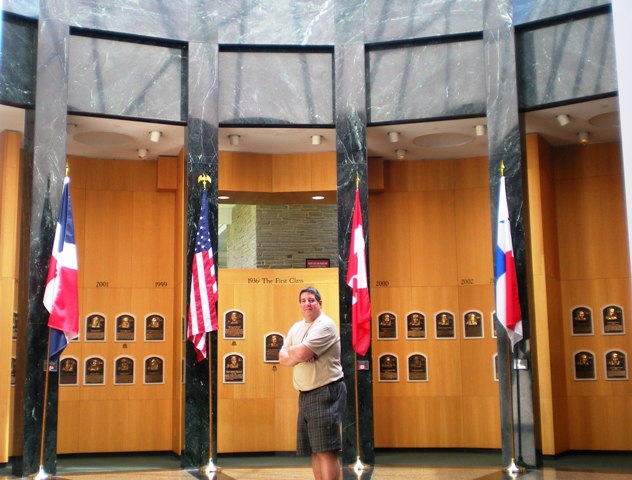
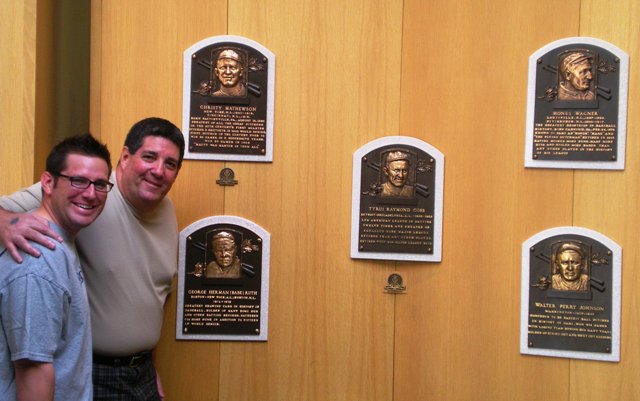
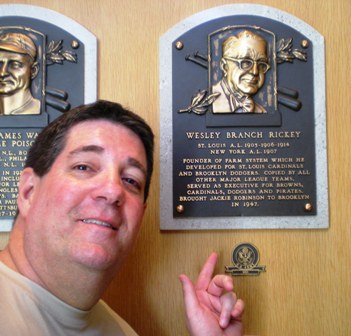
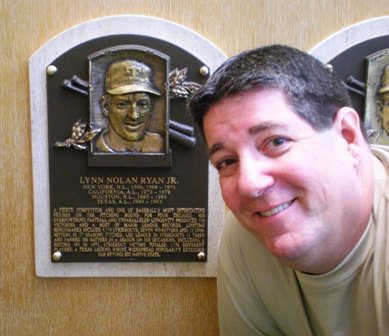

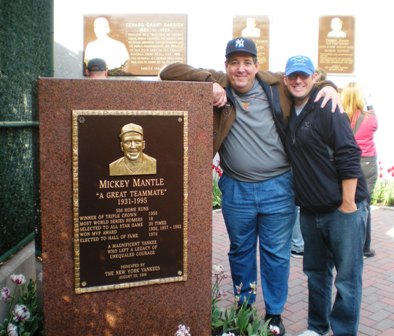

Meeting up with Sully and his wife Johanna in Boston. Breakfast with Bill James and Jared Porter before a game at Fenway Park. Cooperstown. The Hall of Fame. Lunch with Bill Deane at the Cooperstown Cafe. Yankee Stadium. Riding on the subway with Cliff Lee. Playing catch with Alex Belth in Central Park. Going to a Mets game with Alex and Repoz at Shea Stadium. Hanging out afterwards with Bob Klapisch at John's Pizzeria in Times Square. Playing golf with my old buddy Dave O'Brien and his son in Philadelphia.
Yes, Joe and I had a great time, made all the better by the fact that it was a father-son trip that we will never forget. Thanks to everyone who had a part in it.
| Baseball Beat | May 09, 2008 |
A Bite Out of the Big Apple
After a memorable subway ride and visit to Yankee Stadium (to see the old and the new) on Wednesday, Joe and I had the "day off," if you will, on Thursday.
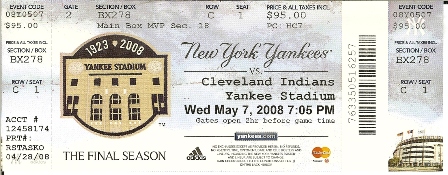 In addition to going to three ballparks (including our first and last visit to Yankee Stadium) and to the Baseball Hall of Fame in Cooperstown, one of my motivations for this trip was to meet up with Patrick Sullivan in Boston; Alex Belth and Darren Viola (known as Repoz to readers of the Baseball Think Factory) in New York; and my longtime pal Dave O'Brien in Philadelphia (which remains the last leg of our trip this weekend). Seeing people has always been more important to me than seeing places and this cross-country adventure was no different.
I met Dave for a long lunch at Pershing Square on 42nd Street and Park Avenue. A former Athletic Director at Long Beach State, Temple, and Northeastern, Dave heads up the sports management program at Drexel University, teaches sports law, and is involved in a couple of other sports ventures as well. We caught up on old times and both of us are looking forward to a round of golf with our sons on Saturday afternoon at Dave's club in Philly.
 A couple of hours later, I emerged from the canyons of Manhattan and walked to Radio City Hall to meet up with Alex . A lifelong resident of New York City, Alex was anxious to show me some landmarks in and around his old stomping grounds. On our way to Central Park for a game of catch, we passed Rockefeller Center at 30 Rock and Saks Fifth Avenue, next to St. Patrick's Cathedral, an old and glorious church. We walked back to 6th and up to the park where we stopped and tossed the ball around for about 15 minutes while softball games were going on all around us. We passed Tavern on the Green in the park as we exited onto Central Park West. We proceeded north on CPW to 72nd Street where Alex pointed out the Dakota, John Lennon's old and John Madden's current residence, and the filming location of "Rosemary's Baby." From there, we headed over to Broadway where Alex showed me the famous Ansonia Hotel, where Babe Ruth and John McGraw lived at one time. The hotel was featured in "The Sunshine Boys" and "Single White Female."
Up on 79th Street, Alex highlighted another lovely old apartment building, The Apthorp. We walked up Broadway, past the Beacon Theater (where Steely Dan is performing), and saw Fairway, Citarella and Zabars, the food emporiums on our left. Finally, we ate at a deli called Artie's where I enjoyed a pastrami sandwich and a Dr. Brown's Black Cherry while Alex plowed down a couple of hot dogs and a ginger ale. After dinner, we walked over to West End Avenue and then one block further west to Riverside Drive, where we stopped and chatted at the edge of Riverside Park with the lights from New Jersey across the river shining through the green leaves on the countless number of trees that line the park.
Alex hailed down a cab for me and asked the driver to take me by Lincoln Center on my way back to the New York Helmsley. We also passed the New York Library, the theatre district, Times Square, and I caught a glimpse of the Empire State Building in all of its green glory at night. Not bad for twenty bucks.
Tonight promises to be another special night on our nine-day trip to the northeast. Alex, Repoz, Joe and I are going to the Reds-Mets game at Shea Stadium. Alex is planning on meeting us outside our hotel around 5:45 p.m. (that's Eastern Time) and the three of us are going to take a short stroll to Grand Central where we will hook up with Repoz, rain or shine, on the platform for the 7 train at 6 p.m.
Keep your fingers crossed for us as the weather forecast calls for showers with temperatures ranging from 47 to 56 degrees. Joe and I want to extend our streak of great weather for a few more days. But there's a reason why I brought my rain coat. It just may be the day to finally bring it out of the ol' garment bag.
| Baseball Beat | May 08, 2008 |
To THE Stadium and Back
I'm planning on putting up a follow-up post regarding our second day in Cooperstown, complete with photos and a few personal stories. However, for purposes of timeliness, I want to skip ahead to Wednesday night when Joe and I attended our first game at Yankee Stadium or THE Stadium as Yankee fans like to call it.
Those of us from Southern California call our ballparks Dodger Stadium and Angel Stadium. But, then again, we also succumb to easterners when it comes to describing the time. We say "Pacific Time" when conversing with folks outside our time zone whereas people on the so-called right side of the country would never add "Eastern Time" in describing when something was going to take place. Oh well, I'll be sure to schedule an appointment with a psychiatrist to talk about my inferiority complex when I get back home.
 In the meantime, Joe and I did some Cliff Hangin' last night on our way to the game. We caught the 4 Train from Grand Central (or the Iron Horse as Alex Belth told me insiders call it) to Yankee Stadium. After getting a bite to eat in the food concourse, we hopped onto the subway at about 3:45 p.m. (Eastern Time). Our car was crowded so we found ourselves standing in the middle, holding onto the rails for safety. After we got situated, Joe whispers to me, "I'm 95% certain that's Cliff Lee standing next to you" (notice the arm of my brown jacket in the foreground). I look up and, sure enough, it looks just like the Cleveland lefthander. I turned back to Joe and remarked, "I think you're right." He then says, "I'm 99.9% certain." While I'm not into star gazing per se, you have to admit that it's an incredible coincidence that a player from the opposing team – much less the starting pitcher THAT night – would be riding the subway to the park *and* at the same time as Joe and me *and* standing next to us for the entire trip.
In any event, while making eye contact with Lee, I make a pitching motion with my left hand as if I were throwing a breaking ball. He gives me a quizzical look so I mouth "Cliff?" He nods his head. Conscientious that I'm wearing a NY hat for the first time in my life, I point to it and tell him that I'm from Long Beach, California and not really a Yankees fan. Lee smiled and shook his head. I explained that Joe and I were on a father-son baseball trip and had already been to Fenway Park the previous weekend and were going to our first Yankees game that night, and to Shea Stadium on Friday night.
There wasn't a single person other than Joe or me who had any inclination that Cliff Lee was standing on the subway, holding onto the rail tightly with his left arm. The 29-year-old southpaw stands about an inch shorter than me (although he looked a tad shorter than that) but with more facial hair and was wearing a beige LaCoste shirt with a green alligator on it, designer jeans, comfortable shoes, and a silver Rolex on his right hand – the only real Rolex on the entire subway. In fact, I'm quite sure I could have bought two or three along the way for much less than what Lee paid for his watch (or it it a time piece?).
Having garnered Lee's full attention at this point, I told him that ESPN was calling that evening's game "the pitching matchup of the season." Going into the game, Lee was 5-0 and Chien-Ming Wang was 6-0. Cliff responded modestly, "It's still early." I nodded and said, "Yeah, but it must feel good." Lee agreed, "It does." I winked as if to say, "Good job," and he smiled back as if to say, "Thanks."
I left it at that and we rode in the rest of the way, exiting at 161st Street. Lee hurried off the subway and departed into a sea of commuters and early-arriving fans. Joe and I walked down the stairs and onto the street and there they were: the new Yankee Stadium directly in front of us and the old Yankee Stadium across the street and slightly to the left. We took several photos before going to Gate 2 and getting in line to tour Monument Park inside the stadium prior to the game. (I will put up photos as time permits later today or tomorrow.)
I don't need to tell Yankee fans how the game turned out. Lee threw seven scoreless innings and picked up his sixth victory without a loss while lowering his ERA to 0.81. Did I mention that Lee has 39 strikeouts while only allowing 2 walks? I'm sure these same fans (Alex included) wish I had tripped Lee on his way out the subway. Heck, ballplayer or no ballplayer, I wouldn't do that to someone I was just hangin' with.
(As an aside, how did the Indians do in that trade where they sent Bartolo Colon to the Expos for Lee, Grady Sizemore, and Brandon Phillips? Although Lee hasn't performed to expectations and Cleveland never capitalized on Phillips' late-blooming career, Sizemore has been one of the best center fielders in baseball the past several years and Lee is pitching as well as – or better than – anyone in baseball this season.)
| Baseball Beat | May 06, 2008 |
New York State of Mind
Some folks like to get away,
take a holiday from the neighborhood.
Hop a flight to Miami Beach or Hollywood.
I'm taking a greyhound on the Hudson River line.
I'm in a New York state of mind.
– Billy Joel
After spending the weekend in Boston, my son Joe and I rented a car and drove to Cooperstown on Monday. We brought our California weather with us as it was mid-60s and sunny for the entire 240-mile trip. Aside from breaking our piggy bank to pay for the multitude of tolls (what's up with that?), the drive mostly along Interstate 90 could not have been better. Traffic was non-existent, the leaves on the trees were gorgeous, and the final 50 miles or so of back roads was a fun experience for a couple of city slickers from Long Beach. My only regret was that we didn't have an extra day to stop at the Basketball Hall of Fame in Springfield, Massachusetts en route to Cooperstown.
We checked into the Cooper Inn about 2:45 p.m. and headed directly to The National Baseball Hall of Fame, knowing full well that it was closing at 5:00 p.m. The Cooper Inn, a classic federal brick landmark built in 1812 as the private residence of publisher Henry Phinney, is located on the northeast corner of Main Street & Chestnut Street and is convenient to all attractions in "America's Most Perfect Village."
Cooperstown is a quaint village situated next to Lake Otsego, Leatherstocking Golf Course, and beautiful old-fashioned homes. If not for the winters, I think I could retire in this town, although I'm sure I would miss having a major-league baseball team – or two – within driving distance of my home. Like all eastern time zone locales, the offset is that you can work a full day and still watch two games on TV at night – as long as you're willing to stay up late (which might not be a very good idea after all if, in fact, you were going to work the next morning).
For a more complete report on Cooperstown, be sure to read Dave Studenmund's highly informative article at The Hardball Times. Dave's mother was raised in Cooperstown, his older brother Woody was born there, and the family owned a summer house in town. As such, Studes spent his summers in Cooperstown while growing up and later honeymooned there (just like my older brother Tom). In the department of "It's a Small World," Dave's brother Woody and I first knew each other in the mid-70s when we both competed in the Greater Los Angeles APBA Association. Woody is also a charter member of the Northeast League, the longest-running baseball table-game league on record. The name of his team? The Cooperstown Phillies. Dave and Woody both have bricks with dedications inscribed at Doubleday Field in Cooperstown.
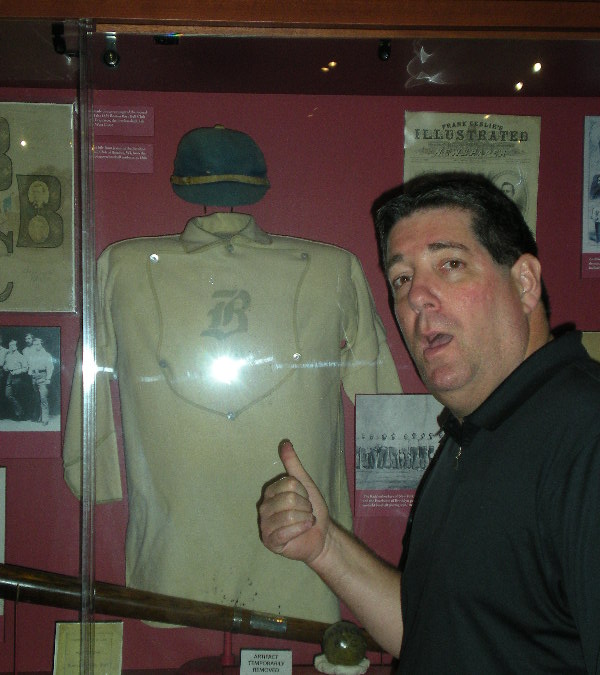 Dressed in walking shorts and short-sleeve shirts, we entered the Hall of Fame, picked up our passes courtesy of Jeff Idelson, the new president, and headed upstairs to the second floor where a timeline history of baseball exhibits and rooms are filled with baseball memorabilia, as well as game-used equipment and uniforms. Hamming for the camera, I'm acting as astonished as can be when viewing the oldest-known baseball jersey (Baraboo Base Ball Club in Wisconsin, circa 1866) in existence.
Joe and I also took photos of one another standing next to some of our favorites, including Babe Ruth's Yankees locker and jersey, Lou Gehrig's locker and jersey, a Christy Mathewson jersey donated by his wife, Honus Wagner's coach's jersey and two thick-handled game-used bats, Shoeless Joe Jackson's jersey, cap, and glove, Jackie Robinson's Brooklyn Dodgers hat and jacket, Sandy Koufax's 1965 game-used home jersey, and Nolan Ryan's seven no-hitter hats (including four with the California Angels when my Dad and Joe's grandfather was Director of Public Relations and Promotions).
At Joe's request, I also took a snapshot of him standing next to the exhibit of Ted Williams and the Science of Hitting. The Splendid Splinter has been Joe's all-time favorite player since his boyhood days.
Before our first afternoon at the Hall of Fame was complete, we found ourselves in the "Records Room," which include, among other things, game-used baseballs from no-hitters (presented in chronological order). While looking for balls from Koufax's and Ryan's no-nos, we discovered the following ball and accompanying photo of the author of a no-hitter in 1977.
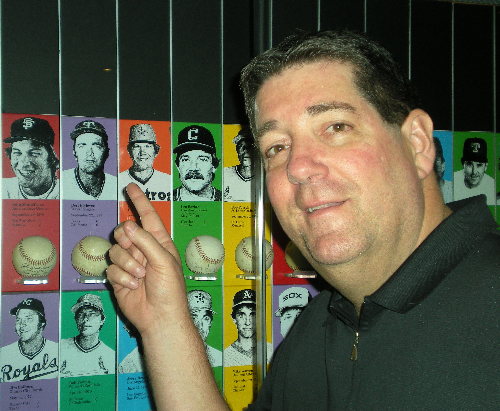
And to think I thought Bert Blyleven wasn't in the Hall of Fame! Shame on me.
Joe and I stayed until closing time at 5 o'clock, browsing through the gift shop as we exited the building. We proceeded directly to Doubleday Field, which is just a few short blocks from the Museum. The "birth place of baseball" is scheduled to host an exhibition game between the San Diego Padres and Chicago Cubs on June 16, 2008. Doubleday is a beautiful venue, complete with brick dugouts that are situated much closer to home plate than normal. The dimensions are on the small side (390 feet to center field) but certainly within the parameters of many old and modern-day ballparks.
At Dave's suggestion, we ate dinner at the Cooperstown Diner. Having passed on breakfast and lunch earlier in the day, I opted for the "three-inch thick burger" that Studes mentions in his article. Joe had a Denver Omelette. The food was excellent but the service was a bit slow, maybe because there were eight other people in the joint as well. Hey, it's a small town. And a great one at that.
We're heading downstairs to our Continental Breakfast and then off to the Hall of Fame for a full day where we will get a "behind-the-scenes" tour of the baseball library and spend lots of time in the gallery, scoping out where Bert's plaque will be permanently displayed within the next few years. It promises to be a great day.
| Baseball Beat | May 05, 2008 |
Sunday in the Park and More
We were greeted by a rather cool and damp Sunday. Although it was drizzling throughout the morning, we were relieved to find out that the outlook was for clear skies later in the day. We kept our fingers crossed in the hopes that the Rays and Red Sox would play their scheduled game that afternoon.
After posting my travelogue for the previous day, we walked over to the Eastern Standard, which adjoins our hotel, to meet Sully; Jared Porter, Director of Professional Scouting; and Bill James, who needs no introduction on these pages, for breakfast. Joe and I were the first to show up and were followed shortly by Jared, who arrived by car; Sully, via a taxi; and Bill, by foot. Sully greeted us with a classic story. He took a cab from his apartment to the restaurant. There was a Walk for Hunger, a 20-mile trek to raise money for Project Bread (which funds emergency food programs in Massachusetts), that was progressing on Commonwealth Avenue and Pat's cabbie complained about the pedestrian traffic, "These people don't care about anyone but themselves." Yogi Berra couldn't have said it any better!
While I had the privilege of meeting Bill for breakfast at the winter meetings in Anaheim in December 2004, this was a first for Sully and Joe, who later told me hooking up with James was "like a professional dancer spending two hours with Fred Astaire," adding that "it'll be one of those moments I will never, ever forget."
The five of us talked nothing but baseball for a couple of hours – what did you expect...weather, politics, religion? We didn't draft or sign any players or make any trades, but we had a good time covering current events, swapping stories, and giving our opinions here and there. Oh, now that I think of it, we veered off course for a while when we talked about college basketball. This topic gave Bill the chance to talk about his Kansas Jayhawks, and he mused at how the media only gives KU credit for championships won in the era of the tournament, completely ignoring titles won by polls back in the 1920s.
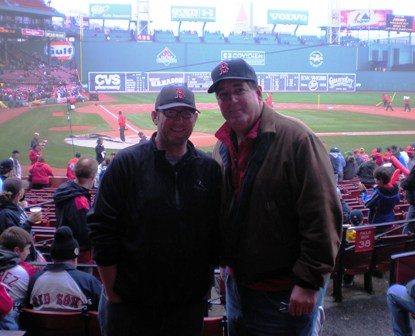 At the conclusion of our breakfast, we walked to Fenway Park, braving a light drizzle for the five-minute stroll. Bill and Jared headed to their offices while Sully, Joe, and I picked up our tickets, shopped in The Souvenir Store on 19 Yawkey Way, walked around Fenway Park, snapping several photos, and stopping into one of the many sports bars surrounding the ballpark. It was my first trip back to Fenway in almost 20 years to the day. Back then, I was on a business trip and went to an Oakland-Boston game all by my lonesome but was treated like royalty when a lady in the front office handed me a front-row ticket directly behind home plate. Assisted by hometown fans hanging onto the screen and yelling profanities (in their best Boston accents) at Ron Hassey and the home plate umpire, the Red Sox beat the A's 4-1 in similar cold and wet conditions.

We made our way inside the stadium, Sully noticed Assistant GM Jed Hoyer walking by, and we greeted him and exchanged a few pleasantries. We took a few more photos near our seats and then sat down well in advance of Jon Lester's first pitch. The southpaw was coming off his best game ever in a matchup with Scott Kazmir, who was making his 2008 debut.
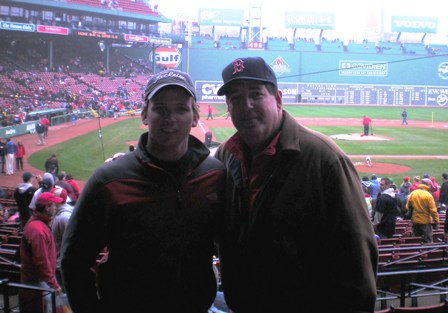
Sully's wife Johanna joined us shortly after game time. To show what a small world it is, Johanna and Joe went to middle school in Long Beach together and shared social circles, including Chase Utley, who is leading the majors in home runs and having an MVP-type season for the Philadelphia Phillies. Believe it or not but Sully and I became friends first without even knowing about the connection between his wife and my son. The friendship goes beyond our love for baseball and Baseball Analysts as my wife and I attended Sully's and Johanna's wedding in Long Beach in December 2006.
Lester and Kazmir threw a lot of pitches but the Boston youngster won the battle between the southpaws, allowing four hits, three walks, and one run over the course of six innings. Kazmir hit 93 on the gun but was working mostly at 91-92. He mixed in a few nifty changeups although the patient Red Sox hitters worked him for three walks and four runs (three earned) in just four innings. The game, which lasted 3 hours and 39 minutes, was highlighted by a Manny Ramirez double off the Green Monster, a Kevin Youkilis dinger to dead center, some excellent play in the field and at the plate by Jacoby Ellsbury and Dustin Pedroia, and another save by Jon Papelbon, who recorded the last four outs to preserve the 7-3 Sox win.
After the game, we went to The Baseball Tavern; then took a cab to Union Park, the quaint neighborhood where Pat and Jo live. After taking a quick tour of their apartment, we jumped into another cab to the north end, where we walked The Freedom Trail, stopping for photos at Paul Revere's home and the famous "One if by land, two if by sea" church. We had a delicious dinner at Cantina Italiana and spent a great three hours dining and talking good ol' times. It was a great way to cap a great day.
We're off to Cooperstown this morning. We have a long but pleasant drive ahead of us.
| Baseball Beat | May 04, 2008 |
Saturday Near the Park
Joe drove up from San Diego on Friday night and spent the night at our house. We awoke at 5:00 a.m. on Saturday morning to catch a 7:10 JetBlue flight out of Long Beach Airport, a relic right out of the 1960s. My wife dropped us off at the airport about an hour before our departure time, we checked our baggage, headed to Gate 1, and boarded the airplane on time.
We had aisle seats in row 3, complete with extra leg room (at a price, of course). Both of us were also lucky that the seats next to us were empty (no extra price . . . just the luck of the draw) despite the fact that the plane was relatively full. We took off on time and arrived 30 minutes early. An Early Wynn for us (more on him later). All in all, the flight experience was as pleasant as possible.
If JetBlue can't spin much of a profit, I don't know how any airline can. As I like to tell clients who ask about investing in airline stocks, "Any time the market is open is a good time to sell these stocks." As it relates to JetBlue, a good company doesn't always equate to a good stock (JBLU).
The gentleman on my left was a UCLA provost and the woman on Joe's right was a mother of two students currently attending USC. We chit chatted with our aisle partners, then settled in switching between watching DirecTV – one of the greatest features on any airline – and listening to our iPods. To change up our choice of songs, we even exchanged iPods for part of the trip. I mean, if not then, when would I ever listen to Jay-Z and LBC's own Snoop Dogg?
While watching Jennie Finch pitching softball for Team USA on one of the scores of channels on DirecTV, Joe leaned across the aisle and asked me, "What do you notice differently about the catcher (she was lefthanded)?" Without hesitating, I said, "No cup?" Rim shot.
About two thirds into our flight, we played a name game, involving baseball players and personalities associated with the game. Using "Notes" on my iPhone, we typed in the following names in succession. The goal isn't to stump the other person as much as it is to pass the time while having fun and enjoying a few laughs. I typed "Sandy Koufax" and away we went...
Sandy Koufax
Sandy Alderson
Tim Alderson
Tim Wallach
Tim Beckham
Tim Raines
Tim Raines Jr.
Junior Felix
King Felix
Jeff King
King Kong Kingman
Brian Kingman
Brian Gunn
Brian Jordan
Michael Jordan
Michael Young
Geoff Young
Chris Young
Chris Krug
Christy Mathewson
Eddie Mathews
Eddie Murray
Dale Murray
Dale Murphy
Dwayne Murphy
Bill Murphy
Chad Billingsley
Henry Chadwick
Henry Aaron
Aaron Bleepin' Boone
Bucky Bleepin' Dent
Buck Weaver
Jered Weaver
Earl Weaver
Earl Battey
Early Wynn
Jimmy Wynn
Jimmy Key
Mickey Mantle
Mickey Cochrane
Mickey McDermott
Mickey Lolich
Mickey Hatcher
Billy Hatcher
Billy Martin
Russell Martin
Bill Russell
Bill James
Charlie James
Charlie O'Brien
Charlie Moore
Donnie Moore
Dave Moorehead
Dave Studenmund
Dave Smith
Pete Smithson
Pete Rose
Johnny Roseboro
Johnny Ray
Jim Ray Hart
John Hart
Howard Johnson
Frank Howard
Frank Viola
Darren "Repoz" Viola
Roger Repoz
Roger Maris
The game ended with – appropriately enough – Roger Maris. My Dad was at Yankee Stadium on October 1, 1961 when Maris hit his record-breaking 61st home run off Boston's Tracy Stallard. The Dodgers were on an east coast road trip and he flew to New York to cover this event. Forty-seven years later, Joe and I will watch games in Boston and New York.
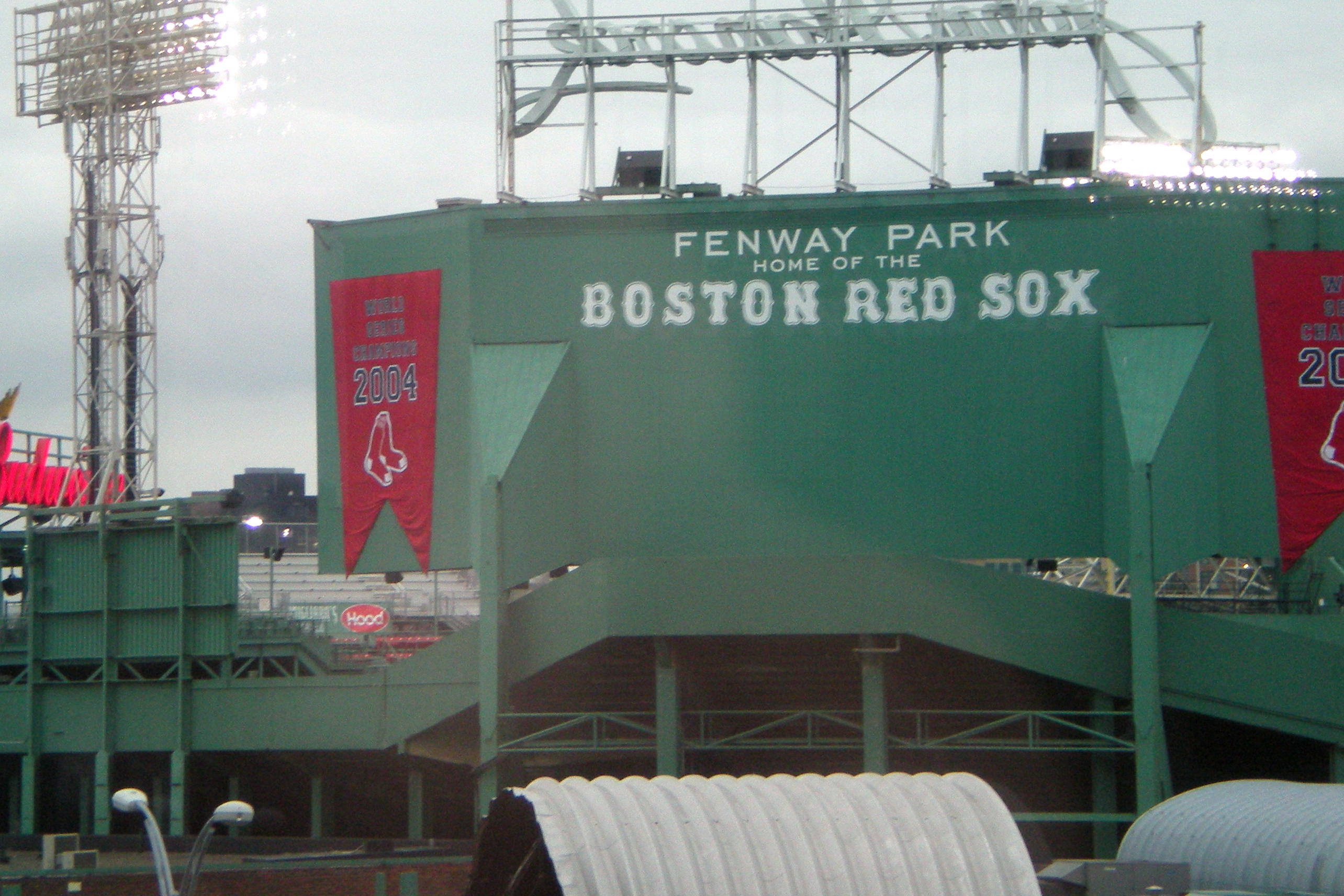 Upon landing at Logan Airport, we took a taxi to the Hotel Commonwealth. It is directly across the highway from Fenway Park. The photo at the left was shot from the window of our room. After getting situated, we took a stroll past Boston University, then reversed course and walked to Newbury Street. We ate dinner at none other than Joe's American Bar and Grill. My son has no ownership stake in the restaurant.
We returned to the hotel around 8:00 and watched Tampa Bay and the Red Sox battle it out on NESN. It wasn't much of a battle as Boston blew out the Rays, 12-4.
Off to breakfast with Sully, Jared Porter, and Bill James, followed by a Sunday game at Fenway. I'll be back on later tonight or tomorrow morning.
| Baseball Beat | May 03, 2008 |
Baseball Trip of a Lifetime
As Patrick Sullivan indicated yesterday in Welcoming the Lederers, my son Joe and I are flying from Long Beach to Boston today for the first leg of our nine-day baseball trip to the northeast. Our whirlwind adventure will take us to Boston, Cooperstown, New York, and Philadelphia, and it includes three games (Fenway Park, Yankee Stadium, and Shea Stadium), a behind-the-scenes tour of the Hall of Fame, a round of golf, and opportunities to meet up with baseball writers, executives, analysts, colleagues, and old friends.
The seeds of our trip began a year ago when I took my daughter Macy on a whitewater rafting trip to the Salmon River prior to her wedding in October. Although Joe is not about to get married any time soon, I decided it didn't make sense to wait until he got engaged to partake in a father-son trip. Heck, I wanted to go to a Yankees game at THE Stadium before it was demolished and what better way to do so than to share such a trip with my 29-year-old baseball-loving son? As it turns out, we are going to witness games at two stadiums in their final seasons, and they both just happen to be situated in New York. My wife is excited for Joe and me and will see us off at Long Beach Airport this morning.
I am planning on maintaining a daily journal of our trip on Baseball Analysts, complete with news, notes, stories, links, and photos. Feel free to ride shotgun with us as we make our way to two of the most historic ballparks in the country as well as to Cooperstown and more.
Our itinerary is as follows:
Saturday, May 3
Depart LGB @ 7:10 a.m.
Arrive BOS @ 3:42 p.m.
Hotel Commonwealth
Boston, MA
Sunday, May 4
Breakfast @ 10:00 a.m. with Patrick Sullivan, Jared Porter, Bill James at Eastern Standard Kitchen & Drinks in Kenmore Square.
Tampa Bay Rays @ Boston Red Sox, Fenway Park, 1:35 p.m. (with Sully and his wife Jo)
Monday, May 5 - Tuesday, May 6
Cooperstown/Hall of Fame
Cooper Inn
Cooperstown, NY
Wednesday, May 7
New York Helmsley
New York, NY
Cleveland Indians @ New York Yankees, Yankee Stadium, 7:05 p.m.
Thursday, May 8
Lunch with Dave O’Brien, longtime friend and former Athletic Director at Long Beach State, Temple, and Northeastern. Game of catch in Central Park with Alex Belth, followed by dinner at a restaurant of his choice.
Friday, May 9
Cincinnati Reds @ New York Mets, Shea Stadium, 7:10 p.m. (with Alex and Darren Viola, aka Repoz).
Saturday, May 10
Golf with Dave O’Brien and son at his country club in Philadelphia. (Joe was the captain of his golf club in high school and is currently the Assistant General Manager at Riverwalk Golf Course in San Diego.)
Sunday, May 11
Depart JFK @ 12:00 p.m.
Arrive LGB @ 2:49 p.m.
Mother's Day dinner with my favorite wife and Joe's favorite mom.
While it's always good to be back home, I think Joe and I are going to grin and bear the next nine days first. There will be a lot of grinning, I'm sure of that, and it looks as if we may have to bear a lot of bad weather – or just "weather" as those outside of Southern California call it.
| Baseball Beat | April 29, 2008 |
Q&A with Dan Levitt – Ed Barrow: The Bulldog Who Built the Yankees' First Dynasty
A longtime member of the Society for American Baseball Research, Daniel R. Levitt has written three guest columns for Baseball Analysts. I first invited Dan after he and Mark Armour co-authored Paths to Glory: How Great Baseball Teams Got That Way, a winner of The Sporting News-SABR Baseball Research Award.
 As a result, I took great interest when Levitt's latest book, Ed Barrow: The Bulldog Who Built the Yankees' First Dynasty, was released two weeks ago. Although Barrow wrote a relatively short autobiography in 1951, Dan's book will undoubtedly go down as the definitive work on one of the most important baseball figures in the first half of the 20th century. It is an extremely well-researched, detailed, and scholarly portrait not only of the larger-than-life Barrow but an inside look at the business of baseball and how the Yankees evolved into a powerhouse franchise.
Published by Nebraska Press, the 427-page book includes an extensive appendix, complete with tables detailing salaries, team payrolls, financial statements, population and attendance comparisons, and transactions of that era. The bibliography also provides a narrative that is more informative than the straightforward listing of resources found in most books. You can check out the table of contents, index, and the first chapter, as well as an outstanding review by Steve Treder at The Hardball Times.
I conducted the following interview with Dan via email over the past several days. It gives additional insight into Barrow and the 50 years he spent in baseball. Pull up a chair and enjoy.
Rich: You and Mark Armour co-authored Paths to Glory: How Great Baseball Teams Got That Way, a book that I bought, enjoyed reading, and have sitting on my shelf in my baseball library here at home. I can't help but think that this book must have had a big influence on your decision to pursue writing a comprehensive biography on Edward Grant Barrow.
Dan: Absolutely. My interest has always focused on team building, and Paths to Glory represented our systematic look at the issue. It was a natural follow up to take a closer look at the one of the most successful dynasties in American sports history. Barrow played the key role in assembling and maintaining it, and – fortunately for my writing career – was probably the most significant baseball executive without a full length biography.
Rich: Ed Barrow did just about everything in the minor and major leagues except play the game. What was his single greatest accomplishment?
Dan: In his fifty years in baseball Barrow had many accomplishments and, of course, several failures. I would say his greatest accomplishment was bringing professional administration to the Yankee front office at a time when few other franchises recognized its necessity. By this I mean he assumed responsibility for executive action (e.g. hiring the best scouts and manager, acquiring the best players, and never losing sight of the longer term) and then willingly delegating to his charges and listening to their advice.
Rich: The image of Barrow and a half dozen Yankees players on the cover of your book is a classic. I don't recall ever seeing it colorized like that and must admit it does wonders for that old photo.
Dan: I really like the cover photo, too. It shows Barrow with six of his star players, five of whom were landed by the Yankees' scouts. Barrow was particularly proud, and rightfully so, of the scouting department he developed and oversaw.
Rich: Your subtitle "The Bulldog Who Built the Yankees' First Dynasty" suggests that the Bronx Bombers have had multiple dynasties. How would you define these dynasties and what was Barrow's role in each of them?
Dan: There is no official definition, of course, but I identify the first Yankees' dynasty as the period from 1921 through the end of WWII in which they won 14 pennants and 10 World Series. Not surprisingly, this era corresponded to Barrow's tenure with the club. In early 1945 the Yankees were sold to a new ownership entity ending Barrow's term at the helm and a long period of stability. The mercurial Larry MacPhail's approach to running a front office was materially different from Barrow's. By the time MacPhail left and George Weiss took over, the post-war bonus-baby era of talent acquisition was in place. In sum, the huge disruption caused to American life by WWII, the dramatic change in Yankee ownership, a change of managers, and the post-war change in talent acquisition and wide-spread expansion of the farm system throughout baseball makes the period around the end of WWII a natural demarcation point.
Within Barrow's "first dynasty" I would suggest there were really three different phases: 1921 - 1923, 1926 - 1928, and 1936 - 1943. Much of Barrow's genius lay is reading the environment correctly so that he could build and then rebuild on the fly. After joining the Yankees, Barrow spent roughly $450,000 to buy up the rest of Boston owner Harry Frazee's best players. This avenue dried up in 1923 when Frazee sold the team – he was out of good players by this time anyway – and other major league teams were not sellers during the roaring twenties. To restock his team in the mid-1920s Barrow assembled a terrific team of scouts and bought top talent from the independent minors. In the 1930s the onset of the Depression led to new rules regarding the ownership of minor league franchises. With these revised, more favorable rules in place, owner Jacob Ruppert demanded Barrow start a farm system. Barrow quickly developed the best minor league organization in the league while his scouts redirected their efforts to nation's best amateurs to stock it.
Rich: How would you compare and contrast Barrow and Branch Rickey, who has been given a lot of credit for creating a competitive advantage for the Cardinals by developing the farm system at or about the same time?
Dan: Rickey's genius was more creative; Barrow's more in the realm of administrative excellence in creating an adaptable, efficient organization.
Rich: The Yankees never won a pennant until Barrow was hired as the club's general manager after the 1920 season. New York won the American League pennant in 1921 and 1922, and then captured its first World Series title in 1923. A cynic might say he piggybacked on Babe Ruth and just happened to be at the right place at the right time. No?
Dan: First of all: no question that one of the best ways to look smart is to take over a team that has the Babe.
That said, the team that won the Yankees first World Series in 1923 was materially different than the one Barrow inherited after the 1920 season. Among the position players, in addition to Ruth, only Bob Meusel and Wally Pipp started for both; among the starting rotation Bob Shawkey was the only one common to both squads. Barrow clearly turned the team over in his first three years at helm, mostly by acquiring the rest of Boston's good players.
Rich: Ed Barrow managed Ruth in 1918 and 1919 when the latter was playing for the Red Sox. It was during this time when Ruth was spending less time as a pitcher and more time as an outfielder. How much influence did Barrow have in converting the Babe from one of the best pitchers in the league to the premier slugger in the game?
Dan: Barrow was the key actor in moving the Babe from pitcher to the field. To appreciate the boldness of this move one needs to first realize that Ruth was an exceptional pitcher: in 1916 he completed the season 23-12 while leading the league with a 1.75 ERA; the next year he finished second in the league in wins with a 24-13 record and seventh in ERA at 2.01. Outfielder Harry Hooper (who also acted as something of a bench coach for Barrow – remember, Barrow was seven years removed from managing and thirteen from managing in the majors) argued that Ruth’s prodigious hitting would make him more valuable as a regular in the field. On May 6, 1918 with first baseman Dick Hoblitzel nursing an injured finger, Barrow started Ruth at first base, his first non-pitching appearance in the field after more than three years in the Majors. Ruth made Barrow and Hooper look like geniuses, going two-for-four with a home run. Over the next several weeks Barrow often used Ruth in the field when he was not pitching, mostly in left field after Hoblitzel returned.
Barrow has rightfully received widespread credit for converting Ruth to the field. Hooper certainly deserves recognition for realizing Ruth’s potential as a regular and pushing for it, but Barrow warrants the bulk of the acclaim. When a decision has a clearly identifiable decision maker who has both the authority and the responsibility to make it, that person deserves most of the credit for a successful outcome and the blame for an unsuccessful one. Had the second-best pitcher in baseball (to Walter Johnson) underperformed in his new role and then returned to the mound at anything less than his previous ability, it would have been Barrow who suffered the condemnation and abuse from the fans, the press, and, perhaps most importantly, his players.
Rich: The careers of Barrow and Ruth are sure intertwined. It would be impossible to write a biography about one and not talk about the other quite extensively. What was the relationship between the two?
Dan: Barrow always appreciated Ruth's talents – for example, even in the deadball era when small-ball was king, Barrow didn't worry about the strikeouts that came with Ruth's power. But he never really warmed to Ruth's personality like others did, notably Yankee owner Jacob Ruppert.
Ruth was immature, self-centered and somewhat naïve in his approach to life, but he could also be quite generous. Furthermore, Ruth had a surprisingly sophisticated appreciation of his celebrity status. The driven, determined Barrow, however, could never get past the immaturity and respect the happy-go-lucky Ruth as an adult.
Rich: I know you wrote about the time Barrow challenged Ruth to a fight. What was that all about?
Dan: In the spring of 1919 Ruth was doing his best to enjoy the nightlife and ignoring training camp rules. Once the season started Barrow assigned coach Dan Howley as his roommate to help restrain him. Despite Howley's proclamation that: "I’ll take care of that guy if I have to put a ring through his nose," Ruth's late night escapades continued. One evening early in the season Barrow decided to catch Ruth at his late-night dalliances. When the hotel porter informed Barrow at 6:00 AM that Ruth had just returned, he went down to Ruth’s room, where the lights were on and he could hear voices. After knocking, Barrow burst into the room and found Ruth in bed smoking a pipe with the covers pulled up to his neck and Howley hiding in the bathroom.
Later that morning at the ballpark while Ruth dressed with his teammates, Barrow locked the door and lambasted his team for their off-field shenanigans, directing his remarks mainly at Ruth. After tolerating the tongue-lashing for some time, Ruth fired back, threatening to punch Barrow in the nose. This was almost certainly the reaction the physical Barrow was agitating for. He ordered the rest of the players to head out to the field after they finished dressing and offered to fight Ruth. Ruth ignored the challenge and ran out to the field with his teammates. Barrow then sent Ruth back to the clubhouse, ordered him to take off his uniform, and suspended him. On the train back to New York, the forlorn Ruth approached Barrow regarding his reinstatement. The manager and his incorrigible star reached an unusual détente: Ruth agreed to leave a note in Barrow's hotel box with the time he returned, and Barrow would not challenge him on it.
Rich: Speaking of time, until Terry Francona's success with the Red Sox in 2004, it was Barrow who last managed Boston to a World Series Championship.
Dan: Barrow assumed Boston's helm in January 1918. That off-season the team made a number of off-season player moves, some before Barrow arrived and some after. Despite not having managed in the major leagues since 1904, he successfully integrated a host of new players into his team. Barrow also benefited from the fact that the Red Sox lost fewer players to WWI and the essential war industries than other top clubs.
The 1918 season itself was full of controversy. Barrow had several well publicized run-ins with Ruth, who even jumped the team at one point. Baseball-wide matters related to World War I brought further discord. American League president Ban Johnson's clumsy response to the government's "work or fight" order, requiring baseball players to either enlist or join an essential war industry, opened the first critical rift between the dictatorial president and his owners.
The confusion and quarrelling carried over into the World Series. Frazee complained about the distribution of games: three in Chicago followed by four in Boston due to wartime travel restrictions. Game five was nearly postponed by a threatened player's strike over a shameful reduction in their World Series shares. In the end Barrow's Red Sox prevailed four games to two despite scoring only six earned runs (nine overall).
Rich: Amazing. After winning the World Series in 1918, the Red Sox struggled with losing records in 1919 and 1920 under the leadership of Barrow. Ruth was sold to the Yankees after the 1919 season so I can understand why Boston lost more games than it won in 1920. But why did the team do so poorly in 1919 after winning it all the year before?
Dan: The Red Sox regressed both offensively and defensively. Despite Barrow recognizing the ability of future Hall of Famer Herb Pennock and inserting him into the rotation, the pitching staff collapsed, falling to seventh in the league in ERA. Key rotation starter Joe Bush missed nearly entire season with shoulder problems, Sam Jones turned in possibly his worst season, and Frazee sold Carl Mays amid a huge uproar in July. On offense, Ruth was the lone bright spot. No other player recorded a slugging percentage above .375. And although home runs were less common in 1919, it is still shocking that the rest of the team combined for only four during the entire season. Maybe even more basically, as players returned to baseball from the armed services and war related industries, other teams, particularly the Chicago White Sox, received a bigger boost than Boston.
Rich: I wanted to ask you what made Barrow give up his uniform and a spot in the dugout for a suit and the title of general manager, but I see from the wonderful photos inside the book that Ed was one of those managers who chose to wear a pair of slacks, a coat, a tie, and a fedora rather than a baseball cap.
Dan: Ever since his days working in and hanging around the Pittsburg sporting scene in the Gay Nineties, Barrow liked to dress well.
Rich: Was Barrow's move as a manager of the Red Sox to general manager of the Yankees more a function of wanting to change roles or teams?
Dan: The decision to move was as much engineered by Boston owner Harry Frazee and the Yankee owners, Jacob Ruppert and Tillinghast L'Hommedieu Huston, as by Barrow. Frazee was in the process of dismantling his team, and no longer needed a high-profile, highly compensated manager. The Yankee owners recognized the importance of professional administration to move beyond the limitations of operating like a small business and brought in Barrow to professionalize the front office.
Barrow certainly would have had mixed feelings about the job change. While he recognized that his days in Boston were numbered as Frazee scaled back the financial commitment and expectations for his team, the move would not have been viewed as a promotion. His title in New York would be "business manager," a role that traditionally involved back office duties (scheduling travel, overseeing stadium operations, managing uniforms, bats and balls, etc.) and not the front office functions associated with player transactions. Barrow, however, lived in New York, and the Yankees offered a generous salary and, more importantly, expanded responsibilities that fell within the purview of a modern general manager – he would in fact be a de facto GM. Barrow prided himself on both his organizational abilities and his player-evaluation skills; the Yankees position offered him the opportunity to employ both.
Rich: Using newly available material from the New York Yankee financial records and previously unexplored financial data from 1951 Congressional hearings, you delved into the economic environment of baseball over the first half of the twentieth century. What was the most enlightening thing you learned about the Yankees?
Dan: Two things stand out. First, the Yankees reinvested their profits in the team while other franchises often distributed theirs out to the team's owners, and second, the Yankees consistently paid the highest salaries.
Rich: Sounds like a winning strategy to me. You covered the fascinating story about the sale of the Yankees to a syndicate of Del Webb, Dan Topping and Larry MacPhail at a war-depressed price in 1945. What was Barrow’s involvement in that deal?
Dan: When Yankee owner Jacob Ruppert died in January 1939, ownership of the Yankees passed to a trust. The trust named Barrow president of the Yankees, and for several years he sat at the pinnacle of his beloved franchise. Estate tax issues quickly materialized, however, and the trust began evaluating sale options for the Yankees. Unfortunately, America's entry into World War II in December 1941 virtually eliminated all non-war related economic activity.
Nevertheless, the estate tax issues could not be postponed indefinitely, and Barrow and the trust continued their search for a buyer. Barrow even approached his friend Tom Yawkey, owner of the Boston Red Sox, to see if there was some way for Yawkey to sell the Red Sox and buy the Yankees. Eventually the sale options were reduced to a single entity: a triumvirate of construction magnate Del Webb, wealthy sportsman Dan Topping, and baseball maverick Larry MacPhail. Barrow and MacPhail had feuded publicly for many years and Barrow hated to see "his" team go to his rival. At one point early in the sale negotiations, Barrow declared that MacPhail would take control of the franchise "over his [Barrow's] dead body." But Barrow could no longer control the process, and in January 1945 the trust sold the Yankee organization to the three for the war-depressed price of only $2.8 million.
Barrow had purchased a ten percent interest in the team back in the early 1920s based on a valuation of $2.5 million that Ruppert had set when he bought out his partner. For the price (and Barrow's interest) to have barely increased after he spent 20 years turning the franchise into one of the gems of American sports galled him immensely.
Rich: I bet. Going back to Barrow's early years, did he really "discover" Honus Wagner?
Dan: Barrow certainly liked to claim he did, but the truth is a little more nuanced. In 1895, Barrow's first year in Organized Baseball, he owned and managed a team in Wheeling, West Virginia, first in the Inter-State League and then the Iron and Oil League. Wagner also played in these leagues, and Barrow would certainly have noticed him, although his older brother, Al, was generally viewed as the bigger star.
When the Iron and Oil League folded after the season, both Barrow and Wagner were technically without a team. For 1896 Barrow bought the Paterson, New Jersey franchise in the Atlantic League. To stock his team Barrow, who lived in Pittsburgh at the time, remembered Wagner, who lived in nearby Carnegie. With a little encouragement from a local promoter, Barrow sought out Wagner and signed him for $125 per month, $25 above the monthly salary limit of $100. A year-and-a-half later Barrow sold Wagner to the major leagues for $2,100, a hefty price for the time. Barrow's claim that he discovered Wagner is something of an overstatement; Wagner had already played in Organized Baseball and other teams were certainly sniffing around. Nevertheless, it was Barrow who most clearly recognized the ability of this free agent and snatched him up for his team.
Rich: Barrow was elected to the Hall of Fame in 1953, six months before his death. What did that honor mean to him?
Dan: Barrow’s ego and self-worth were completely wrapped up in his baseball success. It is impossible to overstate what his election meant to the eighty-five-year-old Barrow. His wife observed that being chosen for the Hall “kept him alive longer than he would have lived otherwise.”
Rich: Well, Barrow lived a long and full life. And you have captured it like no one before and probably no one ever again. Your book is an important and fascinating read for Yankees and Red Sox fans, as well as students of baseball history.
Dan: Thank you. Barrow was at the center of many of the key events of the first half of the twentieth century. Studying his life helps answer two of the overarching baseball questions of the era: how did baseball's competitive economic environment evolve and how did the Yankees come to dominate it.
| Baseball Beat | April 28, 2008 |
April Fools
The first month of the season is almost behind us. We know who has performed well: Chase Utley, Chipper Jones, Pat Burrell, Albert Pujols, Derrek Lee, Hanley Ramirez, Rafael Furcal, Lance Berkman, Nate McLouth, and Manny Ramirez, to name ten hitters; plus Cliff Lee, Ben Sheets, Zack Greinke, Edinson Volquez, Tim Lincecum, and Brandon Webb, as among the half dozen best pitchers in the early going.
But which players have put up the worst numbers during April?
Among the biggest names, Robinson Cano (.158/.216/.221), Alfonso Soriano (.175/.230/.298), Troy Tulowitzki (.157/.225/.245), Andruw Jones (.159/.266/.256), and Gary Sheffield (.159/.321/.254) are also feeling the summer heat earlier than normal.
I would like to finish with three off-the-field personnel:
Ricciardi worked for but apparently didn't learn much from Billy Beane, who inked Thomas to favorable terms before and after J.P. To wit, Beane got a .270/.381/.545 (140 OPS+) season out of Thomas in 2006 for $3.2M ($500,000 salary plus $2.7M in roster, performance, and award bonuses), received a sandwich round draft pick in 2007 as compensation for losing him via free agency, and swooped in and signed the future Hall of Famer last Thursday for $390,000 (pro-rated share of the MLB minimum) for the remainder of 2008. Buy low, sell high, and buy low a second time. Now that is Moneyball!
Now that Morris has been released, we can tally up his performance (3-8, 7.02 ERA over 16 GS and 84.1 IP) vs. the cost (approximately $14M). Considering the money involved, that deal has to go down as one of the dumbest in baseball history – and not with the benefit of hindsight like so many transactions. This one was a disaster from the get go. It was universally panned and no one did a better job than our own Patrick Sullivan.
Let the countdown begin. Seven baseball months down, 35 to go! Or looked at it another way, the Giants have paid Zito about $12-13M thus far and still him more than $110 million.
| Baseball Beat | April 23, 2008 |
A True Spring Roundtable with Pat Jordan and Alex Belth
After a short and unsuccessful stint as a minor-league baseball pitcher in the late 1950s, Pat Jordan has been an All-Star in the world of freelance journalism for nearly four decades. A magazine writer and author, Jordan has written countless articles for many of the country's leading publications and 11 books, including his critically acclaimed memoir, A False Spring (1975).
 Thanks to Alex Belth, The Best Sports Writing of Pat Jordan is now available for all of us to enjoy in one beautifully arranged book. Belth has selected more than two dozen of the author's most compelling portraits from the world of athletics. Spanning more than 30 years, the profiles are divided almost evenly between the famous and the obscure, the successes and the failures, the celebrated and the controversial, or, if you must, the winners and the losers. But all of the stories share one thing in common – Jordan's gift for treating his subjects in a brutally honest and riveting manner rarely seen in the world of sports.
With an uncanny eye and ear for detail, Jordan's literary works are legendary for the level of depth and insight into the lives of professional athletes. While salty at times, his writing is descriptive and provocative. Jordan's hard-hitting prose was recently featured here at Baseball Analysts in a guest column on Roger Clemens on the day of his now infamous 60 Minutes segment. A number of his articles can be found in the Sports Illustrated vault and in the archives of the New York Times. You can also buy original, unpublished and unedited stories of Pat Jordan on his website.
In a nutshell, "Pat Jordan is not just one of America's best sportswriters, but one of its best writers period." Or so says Jim Bouton, author of Ball Four.
I had the pleasure and honor to host a roundtable discussion with Pat and Alex. I am confident that you will find it as enjoyable as I did their wonderful book, The Best Sports Writing of Pat Jordan. Go grab a cup of coffee or light up a cigar in honor of Mr. Jordan and sip or smoke your way through our conversation.
Rich: Let me start off with you, Alex. On the surface, you and Pat have nothing in common other than your love of baseball and writing. Now that is not insignificant by any means. But, my goodness, how in the heck did a new school, soon-to-be 37-year-old liberal New York Yankees fan and resident of the Bronx hook up on a book with an old school, 67-year-old conservative former minor league pitcher-turned-baseball author from the paradise known as Ft. Lauderdale?
Alex: First, I try to avoid talking politics, not only with Pat but with just about everyone else, you included. So that cuts through our differences to start. Actually, when I started my blog, I wanted to run long interviews with sports writers. I thought it would be a great way to drum up some attention for the site. I had read both of Pat's memoirs and loved them, so he was on my short list of guys to contact. And when I called him out of the blue, he sounded happy to hear from me and was more than willing to be candid. Now that I know him, he always sounds miserable to hear from me. Where did I go wrong?
Pat: Actually, Alex was thrilled I was still alive when he called. So was I. He said he wanted to interview me for his blog. I said no problem. What the fuck's a blog? I figured what harm could it do. Blogs, Internet. What do I know? I write on a typewriter. Besides, Alex was one of the few people who read any of my books, and seemed to like them...I must admit for the right reasons. It's always nice when people know what you tried to do in your books. Alex is my ideal reader. If he doesn't like something, I have to think three times about it. Most of the times he's right. Sometimes not, but he has a better batting average than anyone on the Yankees right now. As for his politics, I'm waiting for him to grow up and become a Republican. I bought a new gun just for him.
Alex: I have a gub. So what am I going to do with a gub? The truth of the matter is, all of Patty's close friends are Jewish liberals and he lives in Fort Lauderdale, which is littered with 'em. He can't get away from us. Maybe that's why he has a gub. He's afraid the B'nai Birith is going to come and take his library card.
Pat: What's a gub? Yes, all my friends are young Jewish liberals. The Youngers of Zion. They meet once a year in Ft. Lauderdale to control my life. They force me to get a website, to blog, email, all kinds of loathsome chores. They demand I learn how to use the TV remote. When I was talking to Alex on the phone one night, my wife was cursing loudly at the remote she couldn't figure out. Alex said, “What's she mad at?” I told him. He said, “Jeezs, Fred and Wilma Flintstone." When my computer doesn't work I stand on a chair and drop a rock on it. In the morning Wilma and I go to the quarry to lift rocks. Still, the Youngers of Zion conspire with my wife to drag me outta the 19th century where I'm comfortably ensconced.
Alex: Pat doesn’t type e-mails. He uses a nail, chisel and a large slab of granite.
Rich: Don't mind me guys...just keep chatting away. Besides, I'm busy changing the name of the site and logo from Baseball Analysts to Psycho Analysts!
Alex: Patty was once Cyndi Garvey's analyst. Look where that got him. Pat, tell Rich about the letter she sent you.
Pat: She said I was her favorite shrink...until the story came out.
Alex: And you also got that note from Dave Letterman.
Pat: Yeah, it was the first thing he wrote on his new CBS stationary. He said the Garvey piece was one of the best stories he had read in a long time. This was back when he was doing mornings at CBS, before the Late Night days.
Rich: I'm with Letterman. "Trouble in Paradise" is one of my favorites. I remember reading it in Inside Sports back in 1980. I'm glad Alex included it in your new book. You really burst their bubble with that piece. The All-American couple...right! She went from hitting on you to trying to sue you, if I'm not mistaken.
Pat: Yeah, it turned out to be a nightmare for me because of the lawsuit. That was my first major piece after I had left Sports Illustrated. After I did it, but before the story was published, Cyndi Garvey sent me a hand-written letter thanking me, saying that I was her therapist. Then, when the story came out, the Garveys sued Inside Sports, Newsweek and me. I had to give depositions for months but nothing ever came out of it. They settled before it ever went to court. And then not so long after that, Steven and Cyndi split up. So it caused me a lot of aggravation, but it was a good story and I think it still holds up.
Alex: The published version is excellent but for our collection we actually used Pat’s original manuscript, something we did several times in the book. One of the most enjoyable parts of doing this project is that I discovered that Pat keeps EVERYTHING – notes, interview transcriptions, drafts. I thought it would be interesting to compare his originals with the published versions. I didn’t want to be indulgent about it. I generally hate “Director’s Cuts.” I mean, I come from a film-editing background and there is a good reason why something was left on the cutting-room floor. So Pat and I agreed that we’d only consider using his original manuscripts when the published version altered the original to the point of really changing the flavor of the piece. Pat’s original lede for “Trouble in Paradise” was changed by Newsweek and it didn’t need to be, so we went with the original. Same thing, only in a more dramatic fashion, for Pat’s classic O.J. Simpson profile for The New Yorker.
Rich: You have nine chapters devoted to baseball players, ranging from the famous (Roger Clemens and Tom Seaver) to the obscure (Gregory "Toe" Nash and Pete Rose, Jr.). Let's talk about each of them. For anybody who knows you or your works, it's no secret that you are not particularly fond of the Rocket.
Pat: I didn’t hate him when I did the piece, but he wasn’t one of my favorite guys. I didn’t think he’d send me a bouquet of flowers when he read it, but I didn’t think he’d be furious either. Turns out he was furious, and it also turns out that he never read it. He was told that it was a hatchet job when it really wasn’t.
Rich: On the other hand, I know you and Tom Terrific are good friends. One might even say "The Best of Friends."
Pat: Seaver is a great guy, a lot different from his public image. He’s sharp, funny, a smart ass. The first piece I did on him for SI showed that he wasn’t “Tom Terrific,” the golden boy image he had on him at the time. He was incredibly determined, a very hard worker. He was one of the first baseball players to really get into lifting weights. I followed him throughout his career and because we got along was able to do several pieces on him.
Rich: Besides the Garvey story, I would venture to say that your piece on Steve Carlton ("Thin Mountain Air," which originally appeared in Philadelphia Magazine in 1994) ranks right up there among your best. 329 wins. Four Cy Young Awards. First ballot Hall of Famer. A fitness freak. Arrogant. Stubborn. The Big Silence. Lefty was and is one complex, maybe even crazy animal.
Pat: The only thing I knew about Carlton was that he didn’t like to talk to the press. But when I met him, we started talking about guns and the next thing I know he was talking about black helicopters and the Elders of Zion. He was a nut.
Alex: And, like the Garvey piece, and, to some extent, the recent Jose Canseco essay, the Carlton story was controversial as it was released shortly before Lefty was going to be inducted into Cooperstown.
Pat: After the story came out, everybody started defending Steve. Tim McCarver, Jim Kaat, all these guys who were in the fraternity of ex-athletes. Even though they knew I had written the truth, I was not in the fraternity. I was the outside, outlaw freelance writer living in Florida. The guy you can’t trust. So the papers are running pieces about what a hatchet job I did, poor Steve Carlton. The Today Show comes down to interview me and I knew what they were going to do. They were going to ask me about guns. Now, in Florida, I have a carry permit. Perfectly legal, I carry a 9mm pistol in my bag wherever I go, except court room, athletic contests, post office, airport. It’s just the way it is. It’s a right to carry state. But the minute you mention guns in New York, you are immediately brandished as a right-wing lunatic. Sure enough, the interviewer asks, “Isn’t it true that you told Steve Carlton about a new gun you had bought?” I said, “Oh yes, I have a Czech-CZ-85, 9 mm semi-automatic, I have an East German military pistol, an American Smith and Wesson.” She said, “Well, why do you have so many guns?” And I said, “Well, it’s just like my right to vote. It’s my constitutional right to have guns, no reason why I shouldn’t.” They never ran it. They cut that part out of the interview. And that was the whole point of it all.
Alex: To make you look like a crazy schmuck.
 Pat: Hey, if you’ve been in the business as long as I have, and people interview YOU, you know ahead of time where they are going. So they were going to basically demolish me on the air by having me talk about guns in such a way that it would say that I was a right-wing nut. Once I said it was my constitutional right to have a fire arm, that was it. I said it so matter-of-factly. They ran the interview but cut that part out.
Rich: In "Conversations with the Dinosaur," you captured an angry, grouchy Carlton Fisk. Bad hair day for Pudge or is that the way he really is?
Pat: Pudge is a crotchety Yankee.
Rich: A Yankee, huh? That will be news to Red Sox fans!
Pat: I’m originally from Connecticut, so I grew up with those kinds of guys. They're always pissed off, but salt of the earth. I loved that guy. He had a great, cynical, sarcastic sense of humor. Also, he loved his wife, and like any grump was dutifully afraid of her reprimands.
Rich: You wrote a piece for the Los Angeles Times Magazine in 1992 on Whitey Herzog when he was vice president in charge of player personnel for the California Angels. The Rat is older and more schooled than even you, which really makes him really old school. Are you guys more alike or different?
Pat: Actually, the Rat was from a different generation than me, more of my father's generation. We're both old school, but his is harder earned, mine more philosophical. I did not grow up hardscrabble like the Rat. But we were alike in ways that had nothing to do with our generation. We’re both sarcastic and politically incorrect, love ethnic humor. You know, we have old-timey values, we’re patriots, believe in hard work ethic, no whimpering. Stuff like that.
Rich: Whitey missed out on the Hall of Fame by one vote this winter. Do you think he belongs in Cooperstown?
Pat: Hard to say in what category. Certainly not as a player. A manager? A GM? He might fall between the cracks of a guy who was good at many different things but not great at one. You know, a guy wins 300 games, hits 500 home runs, the numbers rule. How do you judge the Rat? Maybe he'll get one of those lifetime-achievement awards Hollywood dolls out to old actors who never won an Oscar.
Rich: Switching gears here. Who in the hell is this "Toe" Nash dude? Sounds like a kicker for the old Cleveland Browns or something.
Pat: I have a researcher out in Kansas City, a good friend of mine, named Mike Sharp. He always tosses off ideas to me and he said, “Why don’t you do Toe Nash?” I had never heard of him. So Mike sent me some clips. SI had done a piece on him, ESPN had done a piece on him – this heroic black man who came out of the sugar cane fields of Louisiana and hits home runs like Babe Ruth and signs with Tampa Bay. So I go out to Louisiana and hit all the stops. I was the only guy to see him in prison. I even tracked down the girl that he was supposed to have raped. And as it turns out, far from being a poor black kid who had been persecuted by the white law enforcement, the story that SI and ESPN had written, he was a criminal, a thug, who had raped a 16-year old girl and had gotten off because he was a ballplayer. I didn’t meet him for a long time because he was in prison. I met everybody around him. His father was the only person who could get me in to see him. So I interviewed him briefly. He was a sullen kid.
Alex: I liked that piece also because it presented a variation from some of the other profiles. That was a reporting-heavy story.
Pat: That was a private satisfaction for me about the story. I talked to everybody. I found the 16-year old girl who had been raped and nobody had spoken with her. Plus, the people there were great. The atmosphere in Louisiana was a lot of fun. I had po boy sandwiches with Craig Berteaux, the probation officer. I still talk to him and his wife over the phone. Loved him. Wonderful civil servant. A guy who really had his clients’ best interests at heart. Tormented about Toe Nash, didn’t know if he should let him loose or what. Didn’t want to ruin his life but he didn’t want to have a thug out there on the streets, either. He was actually tormented about doing the right thing for Toe Nash. And a lot of people were.
Alex: Plus, this story, like the one you did on David Williams, the poker player, and Efrain Reyes, the pool player, are so evocative of a certain kind of world. A world you can still get into. There is a kind of access there that is harder to come by with celebrities.
Pat: That’s why I enjoy these kinds of stories. These days it’s harder and harder to get a prominent athlete to give you access like they did twenty, thirty years ago. Now, you have to go through agents and publicists. The recent story on Sly Stallone which is also in the book is the rare exception. He was a great guy, very candid. Now, Toe Nash was incarcerated so that made him tough to get to, but it’s like what Gay Talese did in “Frank Sinatra Has a Cold.” Sinatra wouldn’t talk to him but he let him hang around, and by doing that, by talking to all of the people around Sinatra, his wives, his cronies, he got a great story. For me, this was “Toe Nash Has a Secret.” He’s not a poor, sympathetic black kid, he’s a thug.
Rich: You wrote an article called "War of the Roses," featuring Pete Rose, Jr. Did the acorn fall far from the oak tree?
Pat: Actually it did, but Pete, Jr. tried to rectify that. He was a much more sensitive person than his father (so was Attila the Hun). The problem was that Pete, Jr. tried so hard to be like his father, and that went against Pete Jr.'s nature, and against all common sense. He essentially worshipped and aspired to be like a man, his father, who was much less of a human being than he was. That's what was sad, and that's what caused Pete jar’s problems later in his life (i.e. arrest and prison), I believe, for steroid distribution. So that now, like father like son, both Roses have served time. It’s all a terrible waste of a kid I think was a good person when I met him.
Rich: In 2001, you met up with Rick Ankiel when he was going through his troubles on the mound. The same thing that happened to Ankiel happened to you in 1961. Tell us about it.
Pat: It’s a long story. Read “A False Spring.” Essentially, we both forgot how to pitch a la Steve Blass, Max von McDaniel and others. It happens to guys who have unlimited success in early career and fall apart at first stumbling block. The whole thing rests on the pressure of success and having to repeat it all your life until it wears you down and you hunt for a way to fail so no one can blame it on you. That’s what happened with me. The burden became so great, I couldn’t do what had come naturally all my life. So you will this curse on yourself and claim it's not your fault. I thought I could help Rick and offered to work with him, but he never took me up on it. I think I could have helped him. He was a good kid then. I hope he still is. I am happy for his success as a hitter now.
Rich: Would you have ever thought back then that Ankiel would be playing center field and batting fourth for the Cardinals? How incredible was that transformation?
Pat: It is incredible, but within reason. Rick was always a great athlete, who started as a pitcher but his other talents were well known to people inside baseball. He wouldn't be the first pitcher to become a big league hitter or vice versa.
Rich: You like to write as much or more about failures as success stories. Does that choice have anything to do with your life?
Pat: Yes. My first thought in life came as I realized I had failed as a pitcher. Why? From there, everything in my life flowed from one question after another, which led me to writing. I've always felt that failures must think more and deeper. Why did I fail? Successes try not to think about their success or it'll screw it up. No one thinks, “Why did I hit 50 home runs?” They just go with the flow. So I've always felt failures were deeper, more introspective and interesting, than successes.
Rich: Pat, I know from talking to Alex that you are a meticulous writer, a "writer's writer" as he called you in the Introduction. I understand you approach writing – on a typewriter no less – the same way you prepared for a game when you were a pitcher.
Pat: I am a Rosetta stone type of writer. I have to hammer everything out, chip by chip. It rarely comes easy to me. I outline extensively. It's like a safety net. I don't always follow my outline, I am open to mystery, but the outline is a guide for me. And my sentences, well, each one is an agony. It doesn't mean they are great, it just means they require a lot of work for me. Ironically, pitching for me was effortless. I picked up a ball at eight and discovered I could throw it faster than anyone else. Maybe if I had my writer's discipline with pitching I would have made the big leagues. But I didn't, thank God. Seaver worked hard on his pitching like I do on my writing, which is why I admired him. Also, after my failure in the game, I was determined never to let something like that happen to me again. Which is why I’m so meticulous in my approach to writing.
Rich: Alex, tell us about what you found in Pat's attic on one of your trips to his home in Florida.
Alex: Well, like I mentioned, Pat really does keep everything. They are organized in folders and stored in big storage bins. When I first went up there I was just looking for sports stories. But, on my second visit to Pat’s, I concentrated on all the other stuff. To be honest, Pat’s probably written more non-sports pieces than sports stuff. It’s a treasure chest of magazine writing – pieces for AARP, Mademoiselle, Time, People, Life, Reader’s Digest, and GQ...Pat did a weekly column for the Tampa Sunday Times for a few years in the mid-eighties. I was just overwhelmed by the evidence of a lifetime’s worth of work. It was very humbling and impressive. And what was fun for Pat is that I dug up stories that he’d long forgotten about.
Pat: Sometimes, my feelings about a story are tied up in the experience I had doing them. For instance, whether or not I liked the subject or if I put in a lot of work doing the research. I don’t go back and re-read old stories. So when Alex came down here, poking his nose in all my stuff, he unearthed pieces I had completely forgotten about. Then, after he read them, I re-read them too, and found that there were some that I remembered loving that weren’t so good, and vice versa.
Rich: I know you're at home, wearing a pair of shorts, a Hawaiian shirt, and flip flops. And I know you are smoking a cigar. Is it a Cuban? Hand rolled or machine made? A Corona, Panatela, Churchill, Robusta, Torpedo, or one of those long-ass Presidentes?
Pat: Cuban? What, are you outta your mind? Cubans cost over 20 bucks a cigar. Mine are retreads, seconds, brand-name defective cigars, like their smoker. Cost a buck-and-a-half from a wholesaler. Most grown in Nicaragua, Honduras, Dominican Republic.
Rich: Turning to the New York grown variety...Alex, I loved the Q&A you did with Pat for the back of the book. Not only was it a fun read but it allowed us to learn more about Pat while bringing so many people and stories current.
Alex: Thanks, that was a lot of fun. Even for Pat, I think it gave him an opportunity to think about things, his career, his creative evolution, in ways that he hadn’t. For me, every since I can remember, I’ve always loved reading about craft, whether it is filmmaking, painting, making records. I love learning about the nuts and bolts process. Pat was easy to interview because he’s got a sense of humor and is honest and has a very detailed, specific way in which he applies his craft. I don’t know how many people would find that interesting, but since I did, I’d like to think there are some writers, or aspiring writers, who happen to pick up the book, who will find it helpful in some way.
Rich: What do you two have in store next?
Alex: Another season of blogging about rooting for the Yankees and living in New York City over at Bronx Banter. And I have a couple of other projects I’ve got my nose in, but I’m going to be cryptic about it. Not because they are so important but because I’m superstitious and don’t want to spoil anything before they’ve come to fruition.
Pat: I don't know. I have a Ricky Williams piece coming out in Playboy in the fall. Meanwhile, I wait for an assignment. I am essentially like the girls that Elliot Spitzer rents from the Emperor’s escort service. Someone rents me for a story, than discards me until someone else rents me. You might say I've been a hooker all my writing career. It's amazing to me that at 67, some people still find me attractive enough, or maybe technically expert enough, to still hire me for a one-night stand. Maybe that's why I go to the gym everyday to stay in shape. I gotta look enticing.
Alex: As Fernando used to say, "It's better to look good than to feel good, dahlink."
Rich: Well, I'm not going to comment on your looks. But The Best Sports Writing of Pat Jordan is very enticing. I can at least vow for that. Congrats to both of you.
| Baseball Beat | April 22, 2008 |
Tuesday Tidbits
News and notes from around the majors...
| Baseball Beat | April 21, 2008 |
Q&A: Rob Neyer - The Big Book of Baseball Legends
Rob Neyer is no stranger to readers of Baseball Analysts. He has written a guest column for us, participated in roundtable discussions and surveys, and linked to a number of our articles on his ESPN.com website.
 A long-time columnist and author, Rob has been writing about baseball since 1990 when he worked for Bill James during all three years of The Baseball Book and the first year of the Player Ratings Book. Neyer has been with ESPN.com since 1996 and is a regular on ESPN Radio and sports talk shows around the country. He has written six baseball books, including one that was just released at the beginning of April.
Rob Neyer's Big Book of Baseball Legends is the latest and greatest in his Big Book series. The subtitle – The Truth, the Lies, and Everything Else – pretty much captures the essence of this fun-to-read and highly entertaining book. Rob combines his baseball knowledge, skepticism, meticulous research skills, sharp wit, and signature writing style to produce an indispensable guide that should be part of every fan's library.
The Table of Contents and excerpts from three chapters (Greg Maddux & Jeff Bagwell, Billy Martin & Jackie Robinson, and Lou Boudreau & Ron Santo) should be enough to whet one's appetite.
After meeting up with Rob for a couple of days a few weeks back when he was in Los Angeles, I had the good fortune to interview him as part of this book review. I hope you enjoy our chat as well as the book.
Rich: The Big Book of Baseball Legends is your sixth book in nine years. You have become almost as prolific in writing books as The Beatles were in producing records during the 1960s. I've got all of The Beatles CDs and all of your books. Both are important parts of my music and baseball libraries. The good news is that we don't have to worry about Rob Neyer breaking up. Or do we?
Rob: I'm absolutely sure that's the first time my name has ever been mentioned in the same breath with the Beatles, and for that I can only thank you, kind sir. And no, I'm not breaking up. But I am taking a break from book-writing until I have an idea that really excites me. Because at the moment I don't have one.
Rich: Baseball Legends is your third in the Big Book series. Baseball Lineups and Baseball Blunders were described as complete guides to the best/worst players and the worst decisions and stupidest moments in baseball history. How would you describe Baseball Legends?
Rob: Well, the subtitle for this book is "The Truth, the Lies, and Everything Else." Which is what we call a "grabber" in the book business. Most of the truths in the book are half-truths and most of the lies are merely well-told tall tales. And my job in the book is determining which are which.
Rich: In the Foreword, Bill James tells a story about a scene in a movie he recalls as Shattered Glass wherein a young reporter rises to the top of his profession in short order by "just making shit up." As it turns out, the scene is actually from Absence of Malice as you so delicately noted upon a bit of research. How perfect was that for the Foreword in a book called Big Book of Baseball Legends?
Rob: Pretty perfect. Somebody else mentioned that in a review, and assumed that I had fact-checked that story and tossed in the correction as a friendly rebuke to Bill, but he actually fact-checked himself and added that coda, which I really enjoyed.
Rich: Speaking of James, you occasionally investigated what Bill has called "tracers" when you worked with him for four years during the early 1990s. Was Baseball Legends percolating in your mind back then?
Rob: Yeah, I think so. In those days I was young and didn't have any original ideas – actually, I still rarely have an original idea – but I knew I wanted to keep writing about baseball. For a while we were planning to continue Bill's biographical encyclopedia, as a stand-alone project. But that sort of petered out, after which I talked to Bill about doing a book of tracers. Nothing happened with that, either. But yeah, the tracers have always been in the back of my mind, because I enjoyed the research so much.
Rich: I have no doubt that the research in this book was a labor of love. Although Bill claims that backtracking anecdotes no longer qualifies as research given the explosion of organized knowledge on the Internet, you obviously spent a lot of time verifying the accuracy of these claims.
Rob: I think Bill overstates his case some. The research is certainly much easier than it was, but I spent many hours poring over microfilm, and entering data from players' day-by-day logs into Excel files. Obviously, Retrosheet makes a researcher's life a million times easier, but their play-by-play data goes back "only" to the mid-1950s and a lot of the stories in the book are from before then. Anyway, the point of the book isn't necessarily the backtracking; it's what the backtracking leads to.
Rich: Of the more than 80 stories in your book, how many would you say are truths and how many are lies?
Rob: First, I should mention that there are more (many more) than 80 stories in the book if you count the sidebars. As you would probably guess, few of the stories in the book are completely true or completely false. I would guess that roughly half of them contain at least some kernel of a fundamental truth that I was able to find. Maybe two-thirds.
Rich: What do you say to those who think you are taking the fun out of the game in your attempts to debunk some of the most classic legends in the history of the sport?
Rob: It's a funny thing … I anticipated a fair number of readers making that criticism, but I haven't actually seen it yet. Also, it was never my intention to debunk anything. I just found baseball stories that I liked, then checked them out and let the chips fall wherever they fell. I was absolutely thrilled when the facts checked out.
Rich: Is it your belief that sportswriters, players, managers, umpires, and owners make up these fables for the hell of it or do you think they really believe them to be true? Or is it possible that many of them have been lost in the translation, if you will, as they are retold over and over by people other than the one who originated the story?
Rob: All of those. But I think what happens most often is that something happens, and years later someone who was there tells the story in good faith but has simply forgotten many of the details. Of course, some of the stories are simply invented out of whole cloth, often for use on the rubber-chicken circuit.
Rich: I can't help but be amused by the fact that a so-called stathead like you loves the stories of the game as much or more than the next guy.
Rob: You're not the only one. But you know, it's funny, most of my sabermetrically inclined friends enjoy a good story at least as much as I do. One of the great things about baseball is that there are so many ways to enjoy it. And fortunately there's no law restricting us to one or two of them.
Rich: Who do you suppose is the greatest "story" teller of them all?
Rob: Oh, I don't know. Whitey Herzog tells a pretty good story.
Rich: Can you share one of his stories with us?
Rob: It's too long to reproduce here, probably, but I love the story Herzog tells about betting Satchel Paige, then his teammate with Miami, that Paige couldn't throw a baseball through a hole just slightly larger than a baseball. And of course Paige did exactly that, and collected on the bet.
Rich: I know you don't want to give away the contents of your book, but can you tell us once and for all if Babe Ruth's home run in the 1932 World Series was really a "called shot?"
Rob: It depends on how you define "called shot," I guess. Did Ruth point toward the center-field bleachers like he does in the movies? No. He certainly did make a defiant gesture, perhaps toward the Cubs' dugout, from where he was taking a great deal of verbal abuse.
Rich: When did the bench jockeying disappear from the game? I mean, you can't call somebody "rabbit ears" if you don't yell at him to begin with.
Rob: Oh, it still happens. Not as much as it used to, I'm sure. But in the heat of battle, nasty things are still yelled from the dugouts.
Rich: I really like your format, starting each chapter off with a quote and then sharing your research with the readers over the next few pages. As always, I think the sidebars add a nice touch, too. All in all, it’s a fun read, a book that one can pick up and begin reading any chapter in any order.
Rob: Thanks. I wish I knew how to write a different sort of book, but I'm glad you enjoy this sort.
Rich: Let's do a lightning round that we will fittingly call Truth or Lie? If it goes well, we'll take it on the road in the hope that FOX will pick it up as its next big hit.
Rob: I'm pretty sure ESPN wouldn't like that. But okay, let’s roll...
Rich: Truth or Lie? You're a blogger now.
Rob: Oh, that's a scary thought. But, yeah. Hard to deny it.
Rich: Truth or Lie? You blog in your boxers in the basement of your parents' home?
Rob: Lie. I wear pajamas. And Mom kicked me out last month.
Rich: Truth or Lie? You only wear flannel shirts?
Rob: Truth. And man, are they itchy. Which is one of the reasons I'm so cranky in my chats.
Rich: Truth or Lie? You have written more words on ESPN.com than anybody?
Rob: Truth, as far as I know. But Henry Abbott's closing the gap fast.
Rich: Truth or Lie? You recently broke the all-time record for the longest chat on ESPN?
Rob: Truth. Twelve hours and one minute. Let's see the Sports Guy top that!
Rich: Truth or Lie? You broke the record working on next-to-no sleep?
Rob: Unfortunately, that's also the truth. I worked until midnight the night before, was up at 4 a.m. to catch a flight, got maybe fifteen minutes of sleep on the plane, and got home with exactly seven minutes to spare before the chat started. And would you believe that after the chat ended, I wrote a blog entry? It really wasn't that bad, except for a 20- or 30-minute spell, maybe seven hours in, when I was hallucinating and it seemed like all the questions were about Derek Jeter's Gold Glove-quality defensive work.
Rich: Truth or Lie? Your wife thinks you are crazy?
Rob: She's not the only one.
Rich: Truth or Lie? You're a card-carrying member of the Baseball Writers Association of America?
Rob: Ha. You know the answer to that one.
Rich: Truth or Lie? You stay up at night hoping, praying, and worrying about the results of the next BBWAA election?
Rob: Truth. Here's another: When I get my BBWAA card I'm retiring the next day, having achieved all that one may achieve in my chosen profession.
Rich: Truth or Lie? You didn't pay any attention to the Final Four this year?
Rob: Lie. I hung on every minute, having been a manic Kansas fan since 1984 when I decided that's where I wanted to go to school. And as a fan of the Royals and the Minnesota Vikings, one of my teams hasn't won a championship since these same Jayhawks won exactly 20 years ago. And as I've said when friends have congratulated me on this year's title, "Thanks. I kicked ass on my couch."
Rich: Truth or Lie? You're a vegetarian?
Rob: Truth. Unless my fondness for Tofurkey disqualifies me.
Rich: Truth or Lie? You're No. 1 hobby is birdwatching?
Rob: If I were to retire tomorrow, I would bird full-time and baseball would be my No. 1 hobby.
Rich: Truth or Lie? You went birding in Los Angeles?
Rob: Truth. Picked up a lifer (Red Knot) just a few miles north of LAX, too.
Rich: And you thought you could only find birds in Portland and Baltimore!
Rob: And St. Louis.
Rich: Ahh, I thought those Cardinals were a religious reference.
Rob: They were, originally. But in 1893 a wave of anti-Catholic sentiment swept across a great swath of the middle Midwest, and the team adopted the color red as its official mascot. In 1894, having realized how stupid it was to have a color as their mascot, management switched to the bird we've known and loved ever since.
Rich: My goodness, you are a treasure chest of baseball knowledge. A walking and talking baseball encyclopedia. No wonder I love your columns and books so much. Thanks, Rob, for taking the time to share your Big Book of Baseball Legends with us.
Rob: My pleasure, Rich, and thanks for letting me hang with you for a while.
| Baseball Beat | April 14, 2008 |
Previewing the Draft (Part Two)
Continuing with our preview of this June's draft, we stay the course by focusing on many of the big-name college prospects, including a trio of potential first rounders out of the No.1-ranked Miami Hurricanes.
Pre-season first-team All-Americans Yonder Alonso (1B), Dennis Raben (RF), and Jemille Weeks (2B) are all projected to go in the top 20 by Baseball America. In addition, third-teamer Blake Tekotte (CF) is a likely second or third round pick according to draft expert Jim Callis. Mark Sobolewski (3B), rated as the top draft-eligible sophomore by Baseball America prior to the season, is a "top five round talent" although Callis believes he won't go that high due to a poor showing on the Cape last summer and signability issues.
When coach Jim Morris makes out the lineup card, he writes down Tekotte, a prototypical lead-off hitter, first; Weeks, a speedy line-drive type, second; Alonso, a pure hitter, third; the power-hitting Raben fourth; and Sobolewski fifth. As a group, this fivesome has put up a .362/.484/.620 line through games on Sunday.
AB H 2B 3B HR BB SO AVG OBP SLG
Tekotte 123 48 6 3 6 25 12 .390 .506 .634
Weeks 119 48 11 3 7 13 18 .403 .463 .723
Alonso 106 38 8 1 8 41 17 .358 .533 .679
Raben 72 19 8 0 4 19 16 .264 .423 .542
Sobolewski 127 45 8 1 3 17 17 .354 .429 .504
Tekotte went 4-for-4 with two home runs and 12 total bases while scoring four runs and driving home seven in a 15-5 victory over Georgia Tech in the second game of a doubleheader on Saturday night. Over the course of the three-game sweep, the 5-foot-11, 180-pounder had nine hits (including 3 HR) in 15 at-bats. Weeks went 7-for-13 and Alonso slugged two homers among his four hits.
Tekotte, Weeks, Alonso, and Raben were all freshmen when I saw the 'Canes play UCLA a couple times in February 2006. Miami won two of three games in that series with Tekotte, Weeks, and Alonso starting all three contests. Raben started twice and appeared as a relief pitcher on Saturday.
Given his pedigree, I was most interested in seeing Weeks play. However, outside of sharing the same last name and playing second base, the brothers are more different than alike. The smaller Jemille is listed at 5-9 and 180 pounds, hits from both sides of the plate, and sports better speed and superior defense while Rickie has more power. Baseball America rates Jemille's speed as a 70 on the 20-80 scouting scale and calls him the "fastest runner" in college baseball. He is the best all-round second baseman in college and will probably be the second middle infielder taken (after Gordon Beckham, a shortstop out of Georgia).
Tekotte, the "third-fastest runner among the top college prospects," led the Cape with 22 steals in 23 attempts last summer. He is 16-for-19 this season. While I missed Tekotte at the Area Code Games in 2004, I saw him make a diving catch in left field with the bases loaded in the fifth inning against UCLA, a play that perhaps was the difference between Miami winning and losing the Sunday finale. Callis told me that the former football player, who tore up his knee during his senior year in high school, "might be the best college center fielder" in the draft.
Alonso, termed "the best all-around hitter in the Cape Cod League last summer" by Baseball America, combines a good, disciplined approach and a short stroke to hit the ball to all fields. He may not have the power desired from a first baseman but could be a "Todd Helton type outside of Coors Field" in terms of offensive production by Callis' way of thinking. Born in Cuba and a U.S. resident since he was nine years old, the 6-2, 215-pound lefthanded hitter was selected in the 15th round of the 2005 MLB Draft by the Minnesota Twins.
Beset by back problems earlier this season, Raben has struggled a bit in his return and may need a strong finish to warrant going in the first round this June. Rated the No. 3 prospect in the Cape by Perfect Game Cross Checker, the 6-foot-3, 220-pound lefthanded slugger has "legitimate power" according to a quote garnered by Baseball America from an NL scouting director.
We will cover at least a half dozen other top college prospects from the east in our next edition of Previewing the Draft before moving westward and then winding up the series with a focus on the best high school prospects in this year's amateur draft.
| Baseball Beat | April 12, 2008 |
Previewing the Draft
The motto of Baseball Analysts is "examining the past, present, and future," which means covering everything from baseball history to high school, college, and minor league prospects.
With the amateur draft less than two months away (June 5 and 6), we want to give progress reports throughout the next few days on a number of the top players, starting with a college pitcher who could very well be selected first by the Tampa Bay Rays.
Missouri's Aaron Crow, who entered last night's start versus Texas with a consecutive scoreless innings streak of 42 2/3, allowed five runs in the first frame and nine overall yet still picked up the victory as the Tigers beat the Longhorns by a football score of 31-12 in the opening game of their weekend series at Taylor Stadium. The nine runs allowed by the junior righthander were the first that he had given up in six weeks and the most of his college career.
According to Missouri's Sports Information Director Josh Murray, Crow's streak was the fifth longest in NCAA Division I history. The unofficial record is held by none other than Todd Helton, who hurled 47 2/3 scoreless innings for Tennessee in 1994. Ben McDonald (LSU, 44 2/3, 1989), Pat Venditte (Creighton, 43 2/3, 2007), and Eddie Bane (Arizona State, 43, 1972) also rank ahead of Crow. Kyle Jones of Southern Illinois-Edwardsville pitched a Division II-record 54 consecutive scoreless innings in 2006.
Helton won the Dick Howser Trophy as National Collegiate Baseball Player of the Year and was also honored by Baseball America as its College Player of the Year in 1995. A two-sport athlete, Helton played quarterback for the Volunteers and started several games during his junior season but was replaced by Peyton Manning when he suffered an injury. The rest of the story is history.
Crow, an undrafted pitcher out of Washburn Rural High School in Topeka, Kansas when his fastball peaked in the mid-80s, has worked hard to improve his conditioning, strength, and mechanics since his freshman season when he was a teammate of Max Scherzer, the 11th overall pick in 2006. Now 6-foot-3 and 195 pounds, Crow works in the low- to mid-90s and has reportedly touched 98 on the radar guns. Baseball America has called his heater the "best fastball in college baseball" while noting that he "owns the best slider and arguably the best command as well."
Baseball America ranked Crow as the top prospect in the Cape Cod League last summer when he went 3-1 with a 0.67 ERA and 36 strikeouts in 40 innings while pitching for the Falmouth Commodores. Along with Pedro Alvarez (3B, Vanderbilt), Brian Matusz (LHP, San Diego), and Tim Beckham (SS, Griffin HS, GA), Crow is one of the Fab Four in this year's draft and could go first if Tampa Bay shies away from Alvarez due to questions about his position or bonus demands.
Here are Crow's college stats, including his nine hits, two walks, nine runs outing on Friday:
GS CG SHO IP H R ER BB SO W-L ERA 8 3 3 57 45 13 13 13 71 8-0 2.05
Crow's college teammate Jacob Priday slugged four home runs in that 31-12 rout of Texas last night. He set a Big 12 Conference record and tied for third most in NCAA history while moving within one of the school record with 44 for his career. Priday, who went 5-for-5 with six runs and nine RBI, is hitting .410/.500/.914 on the season. Undrafted in high school and college, Priday was ranked No. 20 among seniors in Baseball America's Top 50 College Prospects by Class. A 6-1, 215-pound outfielder, Priday's future will be dependent on how far his bat takes him.
Kyle Russell, who was profiled on these pages last year, also cranked two home runs in the slugfest last evening. Selected in the fourth round last summer by the St. Louis Cardinals as a draft-eligible sophomore, Russell didn't sign a professional contract and returned to the Forty Acres for his junior season. The left-handed-hitting rightfielder got off to a horrific start this season (.230 with 1 HR in his first 24 games) and has only gone yard five times after leading the NCAA and setting a school record with 28 dingers in 2007. Questions abound as to whether Russell can hit with a wood bat, something he has failed to do during summer leagues in the past.
Teammate Jordan Danks (.344/.472/.547) is hitting for average and extra bases but still has not exhibited the home-run power expected of him when he was a high school star. The brother of Chicago White Sox lefthander John, his stock has slipped a bit but the 6-5, 209-pound outfielder was still rated by Baseball America as the 37th-best junior heading into this season.
Be sure to check back on Monday for additional updates on college propects.
| Baseball Beat | April 11, 2008 |
MLB Survivors: Pans and Faves
If they say life imitates (fill in your favorite subject), then maybe it's fair to say that baseball imitates reality TV. Just like in Survivor, the Major League Baseball team that outwits, outplays, and outlasts the competition is the one that will be the last standing in October.
Baltimore, Kansas City, Florida, and St. Louis have won most of the early reward challenges while the Detroit Tigers have been relegated to Exile Island. Can manager Jim Leyland find the hidden immunity idol in the hope of playing it when his club is on the verge of being voted out?
I mean, who thought that the Orioles, Royals, Marlins, and Cardinals would be leading their divisions heading into the second weekend of the season? Or that the Tigers would have the worst record in the majors? Sure, it's early – very early – but the win-loss records of these clubs still qualify as a huge surprise.
Well, maybe if the Tribe and Tigers merged, they might be able to beat Ozzie although I'm not sure if the White Sox manager can repeat the magic of 2005.
Let's take a look at the standings:
AMERICAN LEAGUE
EAST W L PCT Baltimore 6 3 .667 Boston 5 5 .500 NY Yankees 5 5 .500 Toronto 4 5 .444 Tampa Bay 4 5 .444
CENTRAL W L PCT Kansas City 6 3 .667 Chicago Sox 5 3 .625 Minnesota 4 5 .444 Cleveland 4 5 .444 Detroit 1 8 .111
WEST W L PCT LA Angels 6 4 .600 Oakland 6 4 .600 Texas 5 4 .556 Seattle 4 6 .400NATIONAL LEAGUE
EAST W L PCT Florida 6 3 .667 NY Mets 4 4 .500 Philadelphia 4 6 .400 Atlanta 3 6 .333 Washington 3 7 .300
CENTRAL W L PCT St. Louis 7 3 .700 Chicago Cubs 6 3 .667 Milwaukee 6 3 .667 Cincinnati 6 4 .600 Pittsburgh 3 6 .333 Houston 3 7 .300
WEST W L PCT Arizona 7 2 .778 San Diego 5 5 .500 LA Dodgers 4 5 .444 Colorado 4 5 .444 San Francisco 4 6 .400
New York Yankees and Boston Red Sox fans may not like it but an outsider could make an argument that it's good for baseball when Tampa Bay and Toronto beat these two powerhouses on the same day, especially early in the season when every team still has high hopes. The Rays and Blue Jays appear to be playing even better than their win-loss totals indicate. Both teams have positive run differentials despite losing records.
Kansas City is tied for the best record in the American League despite the fact that the team has scored the third-fewest number of runs. It follows that the Royals are obviously getting the job done on the run prevention side of the equation. KC has allowed only 24 runs, nine fewer than the next-best team. The team leads the league in ERA, BAA, OPS, WHIP, and SV. What makes everything all the more remarkable is the fact that the Royals have beaten the Tigers and Yankees five out of six with two shutouts. Yes, the same two clubs that feature perhaps the most power-packed lineups in all of baseball – or so we thought just two weeks ago.
Zack Greinke (2-0, 0.60), Brian Bannister (2-0, 1.50), and the bullpen have been outstanding. Five relievers have yet to give up a run covering 15 1/3 innings. Including Hideo Nomo's debut on Thursday, here is how the entire bullpen has performed thus far:
IP H ER HR BB SO ERA W-L SV 25 15 4 4 7 29 1.44 1-0 5
Remarkably, Kansas City has only made one error in nine games and that miscue was by a pitcher (Ron Mahay). The team's defense has converted about 72% of balls in play into outs, good for second in the AL.
Like Kansas City, Oakland has been pitching its way to a fast start, allowing just 33 runs in 10 games. With Rich Harden on the DL, it will be interesting to see if the A's have enough depth in the starting rotation to keep up the pace. While Dana Eveland has put together superb back-to-back outings, it remains to be seen whether the southpaw can stay healthy and give his club 180 quality innings this season.
Over in the National League, Florida is 6-3 even though the competition has outscored the Marlins by nine runs. Atlanta, on the other hand, is 3-6 with a positive run differential. Look for their fortunes to reverse themselves over time. Washington has been a hot and cold team, winning its first three and losing its last seven.
Many pundits thought St. Louis had one of the worst starting rotations in baseball, yet the Cardinals have only given up 30 runs in 10 games. Mind you, this is without Chris Carpenter, who is rehabbing after undergoing Tommy John surgery last year and is not expected back until the second half at the earliest. In the meantime, the Chicago Cubs head into a weekend series in Philadelphia with the second- longest winning streak in baseball.
Arizona has arguably been the best team thus far, both in terms of its 7-2 win-loss record and its 54-27 runs scored and runs allowed mark. The Diamondbacks, in fact, lead the NL in scoring and preventing runs, perhaps an early indicator of the club's prowess. Arizona will host the Colorado Rockies in a three-game set this weekend that pits the top two teams from the West last year. Tonight's matchup involves aces Jeff Francis and Brandon Webb battling one another.
On one hand, the season is less than two weeks old (well, at least for everyone other than Boston or Oakland) so it would be silly to place too much emphasis on the early returns. On the other hand, the standings a year ago ended up telling a pretty good story for almost every team not named the Phillies or Cubs.
Bottom line: Don't get overly confident or despondent based on how your team has performed in April. But, at the same time, let's not be totally dismissive of what has taken place thus far.
OK, it's time to tally up the votes...
| Baseball Beat | April 08, 2008 |
The Week That Was and Is (Part Two)
Continuing on with the week that was and is . . .
Sunday, March 30
We held our Fantasy Baseball Draft at my house a week ago Sunday. Our league dates back to the late 1970s in one form or fashion, and it has to be one of the longest-running fantasy or rotisserie pools in existence. We normally have 15 teams but added a 16th this year to accommodate a charter member who was unable to participate last season. I enjoy fantasy baseball and think it is a much more challenging than fantasy football. More players, more games, and more stats means more skill and less luck than football.
Our pool is similar to most 5x5 leagues except we basically substitute walks in place of stolen bases. We also include "troubles" (2 * doubles + 3 * triples) and subtract blown saves from saves while giving this net saves category only half weighting. We feel as if we have a nice combination of rate and counting stats and believe the best baseball players make for the best fantasy players, at least in our league.
With a total of 16 teams and 28 players per, we drafted 448 pitchers and hitters. We pulled it off in a little over 5 hours, which means we were averaging about one pick every 40 seconds. We have 16 active players (nine hitters, seven starting pitchers, and two relievers) with the remaining 12 on the bench. Changes are allowed on a weekly cycle that runs from Monday through Sunday. No trades or waiver wires are permitted. Instead, we hold three replacement drafts at each of the quarter poles whereby team owners are given the opportunity to choose two new players in a draft format based on the inverse order of standings.
I drew No. 14 out of the hat and ended up with the 13th pick when another owner opted to take the 16th and 17th slots. Alex Rodriguez went first and the usual suspects followed. David Ortiz, who can play 1B in our league, was the best player on the board when my turn came up so I drafted him in the first round, Grady Sizemore on the way back in the second, and Ryan Zimmerman in the third. Johan Santana and Jake Peavy were the only pitchers taken in the opening round but a total of 15 had been selected when I gladly took John Smoltz in the fourth round.
I've learned a number of valuable lessons over the years and try not to think in terms of wanting this guy or that guy. Instead, I let the draft come to me and take what everyone else gives me. With this strategy in mind, I nabbed Carlos Pena in the fifth round even though I doubled up on positions earlier than I would normally prefer. I chose Tim Lincecum in the sixth round before a run on pitchers produced eight consecutive and 11 of 12 spots devoted to starters. I broke the trend by taking Pat Burrell (atta boy, good job yesterday, Pat!) in the seventh round, then added A.J. Burnett and Jeremy Bonderman as my third and fourth SP in the eighth and ninth rounds. I filled out my rotation with Gil Meche in the 13th round and was pleased that Jon Lester was still around in the 15th to provide insurance for my top five.
As the draft wound down, I took a flyer on Chris Carpenter in the hope that he might be able to help me out in August and September plus Chase Headley and Jay Bruce (did you notice that he went yard yesterday?). Headley would have broken camp with the Padres if not for the fact that management didn't want him to make two adjustments simultaneously – one to the big leagues and another to the outfield. I look for him to take over LF by late May and trust Kevin Towers when he says that Headley will "bat in the middle of the order" when he arrives in SD.
Here is my roster:
C: J.R. Towles 1B: Carlos Pena 2B: Brian Roberts SS: Edgar Renteria 3B: Ryan Zimmerman OF: Pat Burrell OF: Grady Sizemore OF: Jermaine Dye DH: David Ortiz SP: John Smoltz SP: Tim Lincecum SP: A.J. Burnett SP: Jeremy Bonderman SP: Gil Meche RP: Joakim Soria RP: Rafael BetancourtMy backups include Yunel Escobar (2B-SS-3B), Mark DeRosa (2B-3B-OF), Jeff Keppinger (SS), Milton Bradley, Headley, and Bruce (OF), and Yadier Molina (C). Lester, Paul Maholm, Orlando Hernandez, and Carpenter add depth to my starting staff while Rafael Perez serves as my third reliever.
My team is in fourth place as of this morning. The team that is atop in the standings has A.J. Pierzynski, Derrek Lee, Brandon Phillips, Jimmy Rollins, Chipper Jones, Jason Bay, Vernon Wells, Andruw Jones, and Garret Anderson, plus Jered Weaver, Javier Vazquez, Johnny Cueto, Joe Saunders, and Adam Loewen/Carlos Villanueva with Francisco Liriano and Clayton Kershaw in reserve, and Matt Capps and Brian Wilson in the bullpen.
Monday, March 31
Opening Day. I watched the Dodgers-Giants game on TV in a sports restaurant at lunch with another member of our fantasy league and his father, both of whom are also in the investment management industry. I guess if you're paying a pitcher $126 million, you start him on Opening Day, especially when you're team is at home. Brian Sabean's days in San Francisco may be numbered. Paul DePodesta, in a return to the Bay Area, would make a good replacement as the club's GM.
Rob Neyer returned home to Portland on the first flight out of Los Angeles, then set a record for the longest online chat ever. It started with the first pitch on Monday and didn't stop until after the last pitch had been thrown that evening.
Unable to catch Bill James on 60 Minutes the night before, I recorded and watched it Monday evening. I was glad for Bill because a segment like that on a popular, mainstream program was long overdue. But it was disappointing for the more advanced baseball fans already familiar with his work. We really shouldn't have expected anything differently. Unlike many others, Bill didn't need the 15 minutes of fame that 60 Minutes may have brought him. However, to the extent that such a program makes him more of a household figure and an even bigger icon inside the game, then I think it was well worth the effort. Next stop for James: Cooperstown.
For more on the subject, be sure to read Joe Posnanski's 60 Not So Deep Minutes. If you missed the James piece, you can check it out here or download the video below:
Opening Day also marked former Baseball Analysts colleague Joe S. Sheehan's first day as an intern with the San Diego Padres. I exchanged emails with him yesterday. He told me that the "first week went by in a blur." Between moving into his new apartment and the week-long homestand, Joe "didn't really have a chance to breathe," but he emphasized "that's a good thing." Meanwhile, Jeff Albert, another former Baseball Analysts contributor, enjoyed his first spring training camp as the hitting coach for the St. Louis Cardinals Low-A minor league team (Battavia). Watching Albert Pujols hit in the batting cage close up was one of his memorable experiences.
Tuesday, April 1
With the baseball season underway, I was able to enjoy MLB EXTRA INNINGS like never before. The SuperFan package adds up to 40 games per week in high definition plus Game Mix and the Strike Zone Channel. DirecTV is now presenting the home and road broadcasts for most games so viewers can actually pick which one they wish to watch. Once you get a taste of HD, you can never go back.
Monday, April 7
Courtesy of my long-time friend Glen (another member of our fantasy baseball pool), I returned to the Bob Uecker seats at Angel Stadium last night, along with my brother Tom and Ken Briggs, another ex-Lakewood High School baseball player. Ken was a 19th round draft pick in 1982 by the Seattle Mariners. After a college career at Pepperdine and Long Beach State, Ken played as high as AA (Chattanooga) in the pros. A center fielder, he enjoyed his best season at Wasau (Midwest League) in 1983 when he hit .259/.328/.441 with 9 HR in 220 AB.
We had a good time scrolling through the list of draftees in 1982, learning that Ken was selected four picks before Bret Saberhagen. Shawon Dunston was the first player drafted that year, while Barry Bonds (39th), Bo Jackson (50th), and Barry Larkin (51st) were all chosen in the second round.
We paused long enough to enjoy Torii Hunter's two game-winning home runs, including a walk-off grand salami in the bottom of the ninth that catapulted the Angels past the Indians 6-4. A good time was had by all, including Tom, who won the Final Four basketball pool by selecting Kansas to win the whole thing.
It's now time to bring on the Masters. (You can read Part One, too.)
| Baseball Beat | April 07, 2008 |
The Week That Was and Is
The weeks before and after the start of the baseball season are two of my favorites for a number of reasons:
1. Opening Day: It should be made a national holiday, don't you think? Baseball fans are worthless at work anyway and the non-fans would warmly embrace another three-day weekend.
2. Fantasy Baseball Draft: My friends and I hold it on the Sunday evening that has become the Opening Night of the season. Preparing for it is as much fun as the draft itself.
3. Angels-Dodgers Freeway Series: Sure, these games are nothing more than exhibitions but, hey, they are held in Anaheim and Los Angeles rather than Phoenix and Vero Beach (soon to be Glendale, AZ). I usually go to at least one of these games every year, and this series reminds me that the beginning of the regular season is at hand.
4. NCAA Final Four: My interest in college hoops has waned a bit over the years but there was a time not long ago when I went to four consecutive Final Fours (San Antonio, St. Petersburg, Indianapolis, and Minneapolis). What I remember the most is that Michigan State made it to the finals for the latter three years. [Oh, did I mention that I went to a Tigers-Yankees spring training game in Tampa in 1999? Whatever became of Matt Anderson anyway? Was he really the No. 1 pick overall?]
5. Masters: My favorite golf tournament of the year, by far. I know every hole on the back nine almost as if I were a member, but, unfortunately, I don't have a green jacket in my closet. I watch all four majors on TV and enjoy the Masters about as much as any other single event in the sporting world, including, yes, the World Series.
I guess I could also mention the Long Beach Grand Prix (cough, cough), which takes place this weekend. My office building is in downtown Long Beach. Aargh! Hey, if you like noise, this is the sport for you.
In any event, the week that was and is was made all the more special this year by hanging out with Rob Neyer for a couple of nights. Read on . . .
Thursday, March 27
Via an email exchange, I learned that Rob was going to be in town to cover the Red Sox-Dodgers game at the Coliseum on Saturday evening. With an extra ticket in hand for the Dodgers-Angels exhibiiton at Anaheim Stadium on Thursday, I asked Rob if he would like to join my brother Tom, nephew Brett, and me in the front row behind the Halos dugout. He gladly accepted and the four of us met at my home in Long Beach prior to the game.
Knowing that Rob was working on a story about the Coliseum, I pulled out my Dad's scrapbooks (which include every article he wrote as the Dodgers beat writer for the Long Beach Independent, Press-Telegram from 1958-1968) and spiral-bound stat books. Rob and I leafed through the 1958 clippings. Rob would stop me from time to time and take some notes, one of which he used in an article two days later:
Indeed, in March 1958, the following headline appeared in the Long Beach Press-Telegram: "Knee Fine, Duke Says; Sets Homer Goal at 30." Inside George Lederer's article, Snider said, "I hope I can hit nine or 10 in the Coliseum and another 20 on the road."
After 45 minutes or so, we decided to head for the ballpark in Tom's SUV. We walked down the aisle to our seats just as the game was starting. Rob kept score and I played amateur scout with my stop watch, timing batters from home to first and catchers' throws from home to second. (Trust me, Juan Rivera is s-l-o-w.) The four of us talked baseball throughout the game, as well as in the car to and from the stadium. One of the players we talked about was Howie Kendrick. I said he reminded me of Bill Madlock and Rob concurred. Brett is an avid Angels and Kendrick fan and the two of us made the following bet for dinner: If Kendrick bats over .320, I lose; if Kendrick bats under .320, I win. By my way of thinking, that bet doesn't leave Brett with much room for error. I mean, what is he likely to hit if he does well? .325? .330? Well, as much as I like Howie, I think it's more likely that he hits somewhere between .300 and .320.
Rob made a few observations about Juan Pierre, Andruw Jones, and Brandon Wood in the next day's Friday Filberts. Rob also has Monday Mendozas, Tuesday Taters, and Wednesday Wangdoodles for his link-o-ramas . . . every weekday except Thursday. As we were walking out of the ballpark, I suggested Thursday Throneberrys. I guess it could be Throneberries but that doesn't really work, especially since there were two Throneberrys: Marv and Faye. Rob said he would name it in honor of Faye if he went with it because Marv has already gotten his due.
My brother dropped Rob and me off at the house after the game and the two of us talked baseball while he snacked on strawberries and grapes. Already deprived of sleep, Rob left for his hotel near LAX well after midnight. He spent part of Friday touring the Coliseum, and we hooked up once again on Saturday.
Saturday, March 29
Rob, Tom, and I were three of the record 115,300 fans in attendance (a number that I'm sure will grow to a quarter of a million or so in the years to come). We picked up Rob and drove to the Coliseum without tapping the brakes once on the Harbor Freeway. Traffic and parking were a breeze. However, that was not the case for everyone. A husband and wife sitting directly below Tom and me arrived in the fourth inning because it took them three hours to get from Dodger Stadium to the Coliseum on the "free" shuttle. Worse yet, the couple left in the sixth inning because they didn't want to repeat the mistake going home.
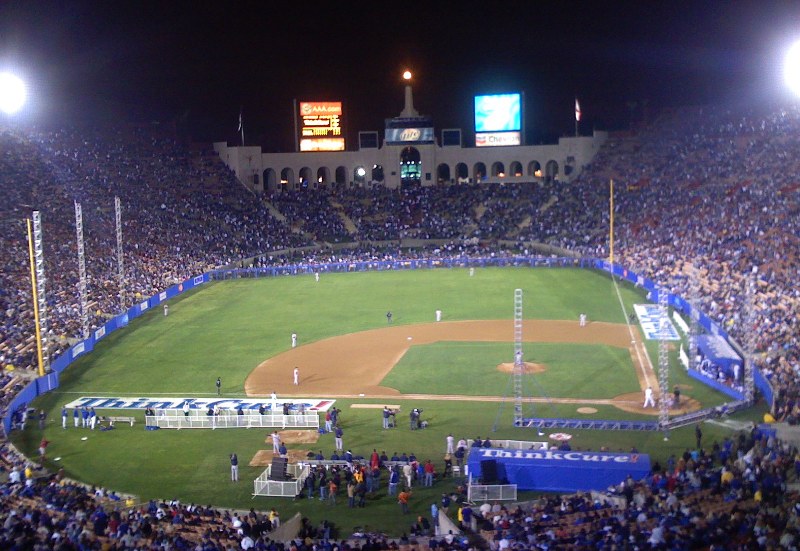
The photo above was taken with my iPhone from our seats on the third base side in Aisle 14, Row 67. It captures the Red Sox defense with left fielder Bobby Kielty positioned in left center, center fielder Coco Crisp in right center, and Jacoby Ellsbury in right. The Dodgers employed a slightly different defense with center fielder Andruw Jones playing directly behind second base and recording a 2-8 putout when Russell Martin threw out Ellsbury stealing second. Shortstops Julio Lugo and Rafael Furcal ran down a couple of hits in the left-field corner (positioned just 201 feet from home plate with a 60-foot high screen vs. the 1958-61 era of 251' and 42').
When Dad was covering the Dodgers, our family seats were in Aisle 13 (one aisle to the right) in the first row behind what was then the press box, which was situated almost on top of the field. Even though I was only 6 years old during the Dodgers last season at the Coliseum, I have some fond memories, including the pre-game activities staged by players against the lowly Philadelphia Phillies (such as milking cows, egg-tossing events, fungo-hitting contests, and catchers throwing balls through a barrel at second base). Dem were the days, my friends. Heck, I even caught my first ball at the Coliseum but had it stolen after the game by another kid who grabbed it out my hand and ran away.
Oh yes, the Red Sox beat the Dodgers 7-4 that night. Kevin Cash, Kevin Youkilis, James Loney, and Blake DeWitt hit home runs. Loney's was a "Moon shot" over the screen in left field. The game was as much about ThinkCure charity with plenty of pomp and circumstance as anything else, but it was fun to be there. For a second opinion, check out Jon Weisman's post at Dodger Thoughts, complete with 18 additional photos ranging from the line for the shuttle to the pre-game festivities to different angles inside the Coliseum.
I will resume my week that was and is tomorrow, including the results of my fantasy baseball draft. See you then.
| Baseball Beat | March 31, 2008 |
Opening Third Day is Here
Our long winter wait has finally come to an end. After a couple of "for real" games in Japan as well as the stateside opening night unveiling Washington's new ballpark yesterday, we get treated to a full slate of games for the first time in six months. With the exception of Boston and Oakland, every team will be playing today.
The Red Sox and A's split their two games last week in what now seems more like last season than this season. Emil Brown made a huge baserunning gaffe in the opener, then bounced back to hit a home run in game two when Rich Harden tossed a three-hit, one-run gem while striking out nine over six innings. One might say Harden looked as if he was in mid-season form but that would mean he was on the disabled list so we'll just say that the 26-year-old (yes, he's still young) righthander pitched as well as anyone could have hoped.
Boston and Oakland will extend their series tomorrow with Daisuke Matsuzaka facing Joe Blanton for the second time in a week, followed by a rematch of Jon Lester and Harden on Wednesday. In one of the most bizarre "road trips" in recent memory, the Red Sox will travel to Toronto for a three-game set this weekend. The defending World Series champions will finally unpack their suitcases next week when they host Detroit in what promises to be one of the best series of the young season.
Over in the National League, the Chicago Cubs are hoping to win a World Series title for the first time in 100 years. Meanwhile, the Los Angeles Dodgers and San Francisco Giants will square off today to mark the 50th anniversary of their move to California.
Let's take a look at today's schedule with a few comments attached to each game. All times are ET.
NATIONAL LEAGUE
Diamondbacks (Brandon Webb) at Reds (Aaron Harang), 2:10
In a pitching duel between two of the ten best starters (yes, Aaron Harang deserves that ranking) in baseball, the game will feature Dusty Baker's return to the dugout. His influence is already being felt as Corey Patterson will play center field and bat lead-off for the Cincinnati Reds. After a horrendous spring, Brandon Webb will need to keep his sinker down at the Great American Ball Park to give the hitting-starved Arizona Diamondbacks a legitimate shot at winning their opener.
Brewers (Ben Sheets) at Cubs (Carlos Zambrano), 2:20
This game features the top two teams from the NL Central. Although the Chicago Cubs are the favorites to win the division, the Milwaukee Brewers won't go down without a fight, especially if Ben Sheets is healthy enough to start 30 games this season. Carlos Zambrano begins the first of five years of his new $91.5M contract. Some pundits believe he will pitch better with his new deal in hand while skeptics wonder if the ace of the Cubbies may face more pressure than ever. Only time will tell.
Nationals (Matt Chico) at Phillies (Brett Myers), 3:05
Matt Chico is one of the worst starting pitchers in baseball. His strikeout and walk rates are well-below average, which spells trouble for an extreme flyball pitcher. Brett Myers, in his return to the rotation, won't enjoy an easier matchup all year (at home against a mediocre hitting club and a weak pitcher, not to mention the fact that the Nationals will be coming down from their high after celebrating Ryan Zimmerman's walk-off home run in the team's opener at its new ballpark).
Giants (Barry Zito) at Dodgers (Brad Penny), 4:10
After three consecutive years of starting on Opening Day, Derek Lowe has relinquished his role to Brad Penny even though all of his stats other than wins, losses, and ERA would suggest that he actually had a better season than his fellow righthander. In the meantime, Barry Zito and his $126 million contract – the largest-ever pitcher contract at signing – gets the nod over Matt Cain and Tim Lincecum. I guess Brian Sabean and Bruce Bochy think the former Cy Young Award winner has earned it, so to speak.
Mets (Johan Santana) at Marlins (Mark Hendrickson), 4:10
In a matchup of lefthanders – hey, how else can I compare these two? – the New York Mets and Johan Santana are the prohibitive favorites to win this game despite playing on the road. The 2004 and 2006 Cy Young Award winner will think facing the Marlins at Dolphin Stadium is a minor league tuneup compared to a more normal game from past seasons in the American League.
Rockies (Jeff Francis) at Cardinals (Adam Wainwright), 4:15
This game is as much about the changing fortunes of two teams as anything else. These two clubs represented the NL in the last two World Series but their prospects seem to be heading in opposite directions with the Colorado Rockies trying to win the NL West and the St. Louis Cardinals trying to stay out of the cellar in the NL Central.
Pirates (Ian Snell) at Braves (Tom Glavine), 7:10
I like the Atlanta Braves more than the Pittsburgh Pirates but, at the same time, think Ian Snell is a much better pitcher than Tom Glavine. The latter is entering his 22nd season in the bigs while returning to the Atlanta Braves after spending five years with the New York Mets.
Astros (Roy Oswalt) at Padres (Jake Peavy), 10:05
The Houston Astros should struggle all year but Roy Oswalt will generally give his club a decent shot at winning anytime he is on the mound. It's just too bad that the perennial Cy Young candidate will be facing the CYA and Triple Crown of Pitching winner in Jake Peavy. Take the unders if the oddsmakers forget that the game is being played at Petco.
AMERICAN LEAGUE
Blue Jays (Roy Halladay) at Yankees (Chien-Ming Wang), 1:05
It's only one game but this is a chance for the Toronto Blue Jays to make a statement right off the bat. A couple of sinkerballers will take the mound in what should be a low-scoring affair. Today's game marks the last opening game at what will be the old Yankee Stadium come next season.
Royals (Gil Meche) at Tigers (Justin Verlander), 1:05
The Detroit Tigers are the heavy favorites here but don't be too quck to dismiss the chances that Gil Meche could hurl a dandy and beat the team that many are picking to go to – and even win – the World Series. It says here that the Royals may be a little better than most think while the Tigers could be a little worse. We shall see if I'm right.
Rays (James Shields) at Orioles (Jeremy Guthrie), 3:05
Who would have thunk that James Shields and Jeremy Guthrie would be their team's Opening Day starters in 2008 just one year ago? Shields has emerged as one of the best pitchers in the AL while Guthrie finally met some of the expectations placed upon him when he was drafted out of Stanford in the first round of the 2002 amateur draft. The Rays are going up the elevator while the Orioles are going the elevator, and it would surprise few if Tampa Bay won as many as a dozen or more games than Baltimore than year (after winning three fewer last season).
White Sox (Mark Buehrle) at Indians (C.C. Sabathia), 3:05
Two lefthanded aces take the hill in this AL Central tilt. Give the edge to Cleveland as C.C. & Company are clearly better than Mark Buehrle and his teammates.
Rangers (Kevin Millwood) at Mariners (Erik Bedard), 6:40
Everyone will be watching to see if Erik Bedard can reverse a horrendous spring and pitch like he did last summer when the southpaw may have been the most dominating starter in baseball. If Bedard and Felix Hernandez put up Cy Young-type seasons, the M's just may find themselves competing for the AL West title now that the Los Angeles Angels are looking at a depleted pitching staff (with John Lackey, Kelvim Escobar, and Scot Shields all on the shelf).
Angels (Jered Weaver) at Twins (Livan Hernandez), 7:05
I haven't seen the line for this game, but if it is -120 or better, I would gladly take the Angels. Jered Weaver is healthy and he is coming off an outstanding spring. Livan Hernandez is the ace of the Twins' staff in name only. Last I heard, Ron Gardenhire hadn't even committed to Jason Kubel as his Designated Hitter. If Gardy can't see fit to play Kubel over Craig Monroe against a righthander who throws from a 3/4 arm slot, then Minnesota would be better served to trade the 25-year-old who hit .303/.379/.511 in the second half of 2007. That said, the main storyline here is Torii Hunter's return to Minnesota.
Let the games begin!
| Baseball Beat | March 24, 2008 |
Baseball and the Coliseum
The Los Angeles Dodgers will host the Boston Red Sox in an exhibition game this Saturday. It's not just another spring training contest though. There are two unusual items about this tilt: (1) the Red Sox will be playing an "in-season" exhibition game and (2) the venue will be none other than the Los Angeles Coliseum. The game will mark the 50th anniversary of the Dodgers in Los Angeles.
The Dodgers played their home games at the Coliseum from 1958-1961. It was nothing more than a temporary facility for the club that left Brooklyn after the 1957 season. The Coliseum was built in the early 1920s, and it has hosted the Summer Olympics in 1932 (and 1984), as well as the World Series in 1959, and the first NFL-AFL Championship Game (later renamed the Super Bowl) in January 1967 and a second Super Bowl in 1973. The Coliseum remains the only venue to host the Olympics, World Series, and Super Bowl.
Located across the street from the University of Southern California, the Coliseum has been home to USC football for more than 80 years. Cross-town rival UCLA played its home games at the Coliseum from 1928 until the Bruins departed for the Rose Bowl in 1982. The former Cleveland Rams of the NFL relocated to the Coliseum in 1946 and stayed there through the 1979 season (before moving to Anaheim and later to St. Louis).
The Coliseum was designed as a track and field and football stadium and was never meant to host baseball games. The field was squeezed into the closed end of the Coliseum with home plate located near the tunnel that serves as the runway to the locker rooms for home and visiting teams. The left field fence was only 251 feet from home plate and a 42-foot high screen was installed to limit the number of home runs.
Due to the subsequent elimination of the running track and the expansion of seats, the left field fence will be 200 feet for the Red Sox-Dodgers game on Saturday night. Attendance is expected to exceed 100,000, which will be the all-time record for any baseball game.
Although the largest regular season attendance at the Coliseum was 78,672 for the home opener against the San Francisco Giants on April 18, 1958, an exhibition game between the Los Angeles Dodgers and the New York Yankees in honor of Roy Campanella drew a still major league record of 93,103 on May 7, 1959. The three World Series games between the Dodgers and White Sox in 1959 exceeded 92,000, including 92,706 fans for Game 5, a current MLB record for a non-exhibition game.
Appropriately, former owner Walter O’Malley, who was responsible for moving the Dodgers to Los Angeles and the westward expansion of Major League Baseball, was elected to the National Baseball Hall of Fame by the Veterans Committee on December 3, 2007. The HoF induction ceremonies will be held on July 27, 2008 in Cooperstown, New York.
In four seasons at the Coliseum, the Dodgers posted a 330-288 record (.534), including the 1959 World Championship, their first of five titles in Los Angeles. Retrosheet's Dave Smith, who went to four games at the Coliseum (including his first MLB game), provided me with the following statistical information about the Coliseum:
TOP SINGLE-DAY PERFORMANCES IN COLISEUM
Hitters:
Most Hits
Batter Date AB H Willie Mays 5-13-1958 5 5 Jim Davenport 8-10-1958 6 5 Maury Wills 9-15-1959 5 5 (10 innings) Bob Lillis 10-01-1960 7 5 (14 innings) Maury Wills 10-01-1960 8 5 (14 innings)
Most HR
Batter Date AB H HR RBI Don Demeter 9-12-1961 5 4 3 7 Bill White 7-05-1961 5 4 3 4 Lee Walls 4-24-1958 6 3 3 8 Don Demeter 4-21-1959 5 3 3 6 (11 innings)
Pitchers:
One-Hitters
Pitcher Date Sam Jones 6-30-1959 Juan Marichal 8-02-1961
Most Strikeouts
Pitcher Date SO Sandy Koufax 8-31-1959 18 Sandy Koufax 6-22-1959 16 Sandy Koufax 9-20-1961 15 (13 innings) Sandy Koufax 5-06-1960 15
TOP CAREER PERFORMANCES IN COLISEUM
Pitchers:
Team ERA
Giants 3.91 Dodgers 3.92 Overall 4.14
Individual ERA (minimum 50 IP)
Ron Perranoski ( 50 IP) 2.34 Vernon Law ( 78 IP) 2.42 Sam Jones ( 72.2 IP) 2.72 Bob Buhl ( 71 IP) 2.92 Don Drysdale (528 IP) 3.14
Most Wins (with Losses)
Don Drysdale 36-25 Johnny Podres 29-18 Stan Williams 21-17 Sandy Koufax 17-23
Most Strikeouts
Don Drysdale 451 Sandy Koufax 367 Stan Williams 304 Johnny Podres 281
Batters:
Team Batting Averages
Pirates .279 Giants .261 Dodgers .260 Overall .256
Most At-Bats
Jim Gilliam 1019 Charlie Neal 919 Wally Moon 798
Most Home Runs
Duke Snider 38 Charlie Neal 38 Wally Moon 37 Gil Hodges 31
Most Stolen Bases
Maury Wills 42 Jim Gilliam 34 John Roseboro 16 Wally Moon 14 Charlie Neal 12
Top Batting Averages
Batter AB H BA Willie Mays 177 65 .367 Stan Musial 113 41 .363 Del Crandall 111 39 .351 Roberto Clemente 169 56 .331 Bill Mazeroski 166 54 .325 Wally Moon 798 256 .321 Orlando Cepeda 175 56 .320 Gene Freese 100 32 .320 Richie Ashburn 160 51 .319 Ken Boyer 166 52 .313
Let the Home Run Derby begin. Play ball!
| Baseball Beat | March 18, 2008 |
Categorizing Pitchers (Part Two): Relievers - 2007 Edition
After categorizing starting pitchers by strikeout and groundball rates yesterday, I wanted to devote today's article to relievers.
The graph below includes strikeout and groundball data for every reliever in the majors (defined for this exercise as those with 30 or more innings who started less than one-third of the time). The x-axis is strikeouts per batter faced (K/BF) and the y-axis is groundball percentage (GB%). The intersection equals the average K/BF of 18.99% and the average GB% of 43.34%. By comparison, starters had a mean K/BF rates of 16.33% and GB% of 43.88%, respectively. While the groundball rates were virtually the same, the average strikeout rate among relievers was 2.66 percentage points higher or 16.3%.
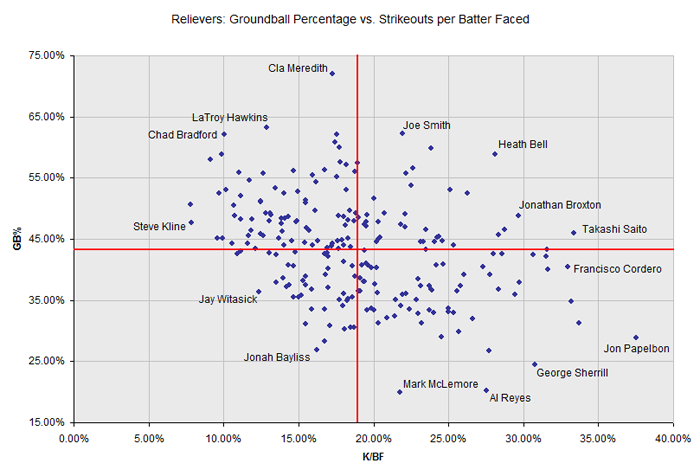
Graph courtesy of David Appelman, FanGraphs.
As with the starters, it is always fun to look at the outliers. Starting at the upper end of the graph, Cla Meredith had the highest percentage of groundballs among all pitchers. The submariner was actually a member of the northeast quadrant last year but his strikeout rate dipped a bit from 20.00% in 2006 to 17.25% in 2007 while his groundball rate inched up from 68.84% to 71.98%. Moving clockwise, the other outliers consist of Joe Smith, Heath Bell, Jonathan Broxton, Takashi Saito, Francisco Cordero, Jonathan Papelbon, George Sherrill, Al Reyes, Mark McLemore, Jonah Bayliss, Jay Witasick, Steve Kline, Chad Bradford, and LaTroy Hawkins.
Let's drill down and take a closer look at each of the quadrants. The NE, SE, and SW quadrants are listed by K/BF, while the pitchers in the NW quadrant are in order of GB%.
NORTHEAST QUADRANT (ABOVE-AVG K AND GB RATES)
Pitcher K/BF GB% Takashi Saito 33.33% 45.99% Jonathan Broxton 29.64% 48.79% Derrick Turnbow 28.77% 46.54% Brett Myers 28.33% 45.76% Heath Bell 28.10% 58.82% Rafael Perez 26.27% 52.56% Mike Wuertz 25.32% 43.98% Mariano Rivera 25.08% 53.00% Chris Ray 24.58% 44.74% Jason Frasor 24.38% 45.45% Fernando Rodney 24.22% 45.32% Scot Shields 24.06% 44.61% Scott Downs 23.85% 59.87% Tyler Yates 23.47% 46.49% John Bale 23.46% 43.36% Manny Delcarmen 23.30% 44.64% Hideki Okajima 23.16% 44.57% Chad Qualls 22.61% 56.65% Bobby Jenks 22.49% 53.76% Pedro Feliciano 22.18% 55.75% C.J. Wilson 22.11% 49.17% Matt Thornton 22.09% 46.99% Joe Smith 21.95% 62.31% Matt Lindstrom 21.83% 47.42% Jeremy Accardo 20.73% 49.21% Jared Burton 20.45% 45.22% Jon Coutlangus 20.32% 47.79% Angel Guzman 20.31% 44.94% Jason Isringhausen 20.22% 44.51% Jorge Julio 20.00% 51.60% Ron Mahay 19.57% 48.91% Ryan Dempster 19.50% 47.12% Salomon Torres 19.48% 47.83% Matt Guerrier 19.37% 47.45% Kevin Cameron 19.01% 48.54%
Saito and Broxton are 1-2, forming perhaps the top bullpen tandem in the majors. Over the past two seasons, these two righthanders have struck out nearly one-third of all batters faced. If the Dodgers starters can pitch seven innings, Saito and Broxton are a good bet to get the final six outs.
Brett Myers has been converted from a closer back to his customary role as a starting pitcher and, in fact, is scheduled to be the Phillies Opening Day starter. Look for his strikeout rate to decline to 22-23% (equal to 2005-06) as he works more innings.
Bell was one of the biggest success stories of 2007. Stolen from the New York Mets in November 2006, the burly righthander improved his ERA by more than three runs. Were there any signs that the now 30-year-old was on the verge of making such a leap forward? Well, Bell's stats (21.08% and 50.85%) placed him firmly in the NE quadrant in 2006.
In addition to Bell, Rafael Perez and Mariano Rivera were the only other relievers who qualified for the 25-50 club. (A.J. Burnett was the lone starter meeting both hurdles.) Mike Wuertz, who possesses one of the nastiest sliders in the game, ranked in the top ten in the NE quadrant for the second year in a row. If the 29-year-old righthander can improve his control, he could break out and become an elite reliever.
SOUTHEAST QUADRANT (ABOVE-AVG K AND BELOW-AVG GB RATES)
Pitcher K/BF GB% Jonathan Papelbon 37.50% 28.93% Carlos Marmol 33.68% 31.29% Juan Cruz 33.21% 34.81% Francisco Cordero 32.95% 40.52% Huston Street 31.66% 40.00% Francisco Rodriguez 31.58% 43.31% J.J. Putz 31.54% 42.14% George Sherrill 30.77% 24.51% Brad Lidge 30.66% 42.41% Octavio Dotel 29.71% 37.97% Jose Valverde 29.43% 35.90% Justin Miller 28.57% 42.58% Billy Wagner 28.37% 36.78% Damaso Marte 28.02% 42.59% Joakim Soria 27.78% 39.18% Rafael Betancourt 27.68% 26.77% Al Reyes 27.56% 20.25% Joe Nathan 27.30% 40.44% Pat Neshek 26.62% 31.95% Jonathan Sanchez 26.05% 39.13% Joaquin Benoit 25.82% 37.33% Russ Springer 25.68% 29.88% Dan Wheeler 25.55% 36.54% Rafael Soriano 25.36% 32.98% Ryan Rowland-Smith 25.00% 33.64% Armando Benitez 25.00% 33.08% Tim Byrdak 24.62% 40.83% Kevin Gregg 24.51% 29.03% Andrew Brown 24.16% 40.71% Troy Percival 24.00% 33.01% Taylor Tankersley 23.90% 36.67% David Aardsma 23.84% 36.84% Santiago Casilla 23.74% 33.33% Justin Speier 23.74% 37.40% Fernando Cabrera 23.19% 31.25% Renyel Pinto 23.14% 37.41% Eric Gagne 22.97% 38.51% Jack Taschner 22.97% 32.85% Brandon Morrow 22.84% 35.15% Chris Schroder 22.40% 33.59% Rudy Seanez 22.19% 36.07% Brian Fuentes 21.96% 35.93% Trever Miller 21.80% 34.07% Mark McLemore 21.74% 20.00% Jimmy Gobble 21.46% 35.03% Bob Howry 21.43% 32.35% Zack Greinke 20.91% 32.12% Matt Capps 20.32% 31.28% Carlos Villanueva 20.25% 36.28% Brian Tallet 20.22% 40.34% Bobby Seay 20.11% 37.69% Jon Rauch 20.06% 33.46% Joe Borowski 19.86% 33.66% Tom Mastny 19.85% 40.35% Will Ohman 19.64% 40.71% Winston Abreu 19.55% 33.33% Mike Gosling 19.51% 41.00% Dustin Nippert 19.39% 38.03% Dave Borkowski 19.38% 43.12% Chad Cordero 19.31% 38.05% Macay McBride 19.23% 40.82% Scott Dohmann 19.12% 38.64% Scott Atchison 19.08% 36.56% Joel Zumaya 19.01% 36.46%
Papelbon had the highest strikeout rate in baseball last season. Although his groundball rate fell from 37.35% to 28.93%, Paps more than made up for it by increasing his K/BF by greater than eight percentage points or over 28%.
Billy Wagner, on the other hand, saw his GB rate plummet from 52.84% to 36.78% while also striking out fewer hitters year over year (from 31.65% to 28.37%). While still reasonably effective, all of his numbers (ERA, BB and SO rates) were materially worse in the second half last season. Be forewarned: age may finally be catching up to the hard-throwing lefty.
NORTHWEST QUADRANT (ABOVE-AVG GB AND BELOW-AVG K RATES)
Pitcher GB% K/BF Cla Meredith 71.98% 17.25% LaTroy Hawkins 63.28% 12.89% Chad Bradford 62.17% 10.03% Peter Moylan 62.15% 17.55% Sean Green 60.87% 17.43% J.C. Romero 60.00% 17.72% Scott Feldman 58.82% 9.90% Jay Marshall 58.00% 9.09% Todd Coffey 57.56% 17.77% Manuel Corpas 57.40% 18.95% Shawn Camp 57.14% 18.18% John Rheinecker 56.29% 16.74% Zach Miner 56.14% 14.66% Mike MacDougal 56.06% 18.75% Mike Myers 55.85% 11.02% Brian Wolfe 55.71% 12.64% Brian Shouse 55.41% 15.92% Akinori Otsuka 55.21% 17.56% Wes Littleton 54.66% 11.71% John Parrish 54.39% 16.14% Kirk Saarloos 53.38% 13.43% Jeremy Affeldt 53.01% 18.18% Antonio Alfonseca 53.01% 10.17% Javier Lopez 52.85% 14.94% Sean White 52.50% 9.70% Brian Moehler 52.48% 14.01% Rick White 52.03% 11.11% Scott Schoeneweis 51.34% 15.47% Danys Baez 51.22% 12.45% Chris Spurling 51.12% 12.44% Boone Logan 50.90% 15.49% Chad Paronto 50.71% 7.78% Mike Wood 50.53% 10.68% John Grabow 49.68% 18.42% Saul Rivera 49.64% 16.08% Geoff Geary 49.30% 12.84% Ryan Braun 49.25% 13.11% Tom Gordon 49.18% 18.82% Casey Janssen 48.93% 13.13% Jason Davis 48.84% 10.73% Kurt Birkins 48.76% 17.65% Juan Rincon 48.66% 18.01% Joel Pineiro 48.62% 14.32% Ryan Franklin 48.44% 13.88% Elmer Dessens 48.33% 14.10% Brian Stokes 48.25% 11.90% Rob Bell 48.22% 11.16% Tony Pena 48.13% 18.31% Ruddy Lugo 48.03% 14.91% Dustin Moseley 48.00% 13.05% Darren Oliver 47.96% 18.68% Billy Traber 47.79% 14.84% Steve Kline 47.70% 7.87% Joe Beimel 47.60% 13.88% Ryan Madson 47.27% 18.14% Justin Hampson 46.84% 15.53% Matt Herges 46.48% 15.71% Clay Condrey 46.37% 11.84% Brad Hennessey 46.26% 13.94% Todd Jones 45.85% 12.45% Randy Messenger 45.61% 11.68% Jose Mesa 45.61% 12.66% Kevin Correia 45.13% 18.31% Brandon Duckworth 45.12% 9.95% Levale Speigner 45.10% 9.60% Willie Eyre 45.09% 13.68% Aaron Heilman 44.92% 17.90% Jason Grilli 44.76% 17.61% Casey Fossum 44.69% 14.56% Eric O'Flaherty 44.65% 16.29% Taylor Buchholz 44.41% 15.40% Ryan Bukvich 44.35% 10.59% Oscar Villarreal 44.30% 17.26% Aaron Sele 44.27% 11.60% Guillermo Mota 43.98% 18.01% Bob Wickman 43.98% 15.95% Roberto Hernandez 43.95% 14.03% Doug Slaten 43.80% 17.18% Shawn Chacon 43.77% 18.46% Chris Bootcheck 43.62% 16.92% Kelvin Jimenez 43.42% 12.12% Hector Carrasco 43.41% 17.65%
With an ERA of 3.50, Meredith was just a shell of his successful self in 2006 when he posted a 1.07 ERA while limiting RHB to a line of .107/.130/.170 (vs. .303/.333/.362 in 2007). The biggest culprit was a BABIP that rose from an unsustainably low .199 during his rookie season to a rather high .344 last year. Get this, the righthander allowed only 30 hits in 50 2/3 IP in 2006 and 94 H in 79 2/3 IP in 2007. He started with a big bang last season by tossing 14 scoreless innings before getting rocked in May and June (6.48 ERA with 42 hits, including 5 HR, in 25 IP). Whether hitters have caught up to the 24-year-old Padre and his unique delivery remains to be seen.
Manuel Corpas, who went from relative unknown to Colorado's closer in the second half last season, was within a whisker of being in the NE quadrant for the second consecutive season. He recorded 18 of his 19 saves in the final three months while fashioning an ERA of 1.54 and a K/BB rate of better than 4:1.
With strikeout rates below 10%,Scott Feldman, Jay Marshall, Sean White, Chad Paronto, Steve Kline, Brandon Duckworth, and Levale Speigner need to keep their walk and home run rates as low as possible if they are going to continue to earn paychecks from major league teams.
SOUTHWEST QUADRANT (BELOW-AVG K AND GB RATES)
Pitcher K/BF GB% Scott Eyre 18.75% 38.85% Trevor Hoffman 18.72% 30.59% Randy Flores 18.58% 40.56% Luis Vizcaino 18.56% 35.59% Vinnie Chulk 18.47% 30.63% Frank Francisco 18.28% 35.26% Matt Wise 18.22% 34.88% Kyle Farnsworth 18.05% 30.32% Joel Peralta 18.03% 36.10% David Riske 17.99% 41.38% Alan Embree 17.96% 34.12% Aaron Fultz 17.72% 35.14% Brian Bruney 17.11% 30.82% Todd Wellemeyer 17.00% 40.16% Scott Linebrink 16.95% 42.13% Kyle Snyder 16.94% 37.11% Micah Bowie 16.94% 42.69% Victor Santos 16.90% 42.78% Wil Ledezma 16.79% 39.15% Kiko Calero 16.76% 33.59% Scott Proctor 16.75% 28.24% Lee Gardner 16.72% 42.55% Jonah Bayliss 16.20% 26.92% Jamie Walker 15.89% 33.50% Rocky Cherry 15.86% 36.73% Juan Salas 15.48% 31.09% Luis Ayala 15.47% 38.97% Sean Henn 15.47% 37.50% Gary Glover 15.27% 38.25% Mike Stanton 15.21% 35.86% Jesus Colome 15.03% 35.55% Patrick Misch 14.77% 42.86% Tyler Johnson 14.63% 40.68% David Weathers 14.63% 35.54% Jorge Sosa 14.35% 37.50% Ray King 14.29% 40.80% Ron Villone 14.20% 37.21% Mike Timlin 13.96% 38.69% Colby Lewis 13.53% 37.98% Doug Brocail 13.48% 42.45% Brandon Lyon 13.03% 42.68% Jay Witasick 12.33% 36.36% Ramon Ortiz 11.11% 42.97% Nick Masset 10.88% 42.66%
Other than Trevor Hoffman and Brandon Lyon, the SW quadrant is nothing more than a bunch of non-descript middle relievers. If these pitchers were stocks, I would "short" all of them, including Hoffman and Lyon. Hoffman, who enters the 2008 season as the all-time leader in saves with 524, had the lowest strikeout rate of his career last year while getting knocked around for a 4.44 ERA with more hits than innings pitched during the second half. Lyon's K rate is dangerously low, especially for a closer. His effectiveness was due to a fantastic home run rate (2 HR in 74 IP), but I would be surprised if he is able to repeat that success this year.
| Baseball Beat | March 17, 2008 |
Categorizing Pitchers by Strikeout and Groundball Rates: Starters - 2007 Edition
It is no secret that the best outcome for a pitcher is a strikeout. There are no ifs, ands, or buts about that statement of fact. That's the way it has always been and that's the way it will always be. Except for the rare missed third strike, a strikeout always produces an out and no chance for runners to advance bases (other than a stolen base).
Among batted ball types, we know that infield flies are the least harmful, followed by groundballs, outfield flies, and line drives. In fact, thanks to researchers like Dave Studeman of The Hardball Times, we can even place a value on the run impact of each event. For example, according to Dave's Batted Balls Redux article in The Hardball Times Baseball Annual 2007, strikeouts had a run impact of -0.113, infield flies -0.088, groundballs 0.045, outfield flies 0.192, and line drives 0.391 per incident in 2006.
Although groundballs generate more hits and errors than flyballs, their run impact is lower because the hits are usually limited to singles and an occasional double down the first or third base line, whereas balls in the air that turn into hits more often become doubles, triples, or home runs. Not only is the run impact from a groundball lower than an outfield fly or line drive but groundball pitchers give up fewer line drives and flyballs. Conversely, pitchers who don't induce as many groundballs allow more line drives and flyballs. One of the basic truths of maintaining a low home run rate is to keep batted balls on the ground. It is also important to note that home run rates tend to fluctuate more than groundball rates because park effects and randomness play a huge role when it comes to the outcome of long flyballs, especially among pitchers.
Based on the above information, it follows that just as pitchers with high strikeout rates would generally fare better than those with low rates, pitchers with high groundball rates would normally fare better than those with low rates (all else being equal). Furthermore, it also suggests that pitchers who combine higher strikeout and groundball rates will outperform those with lower rates.
With the foregoing in mind, in January 2007, I introduced the idea of categorizing starters and relievers by strikeout and groundball rates. Due to the popularity of this series, I have decided to categorize pitchers based on the 2007 data. Like last year, I have greatly benefited from the help of David Appelman of FanGraphs in creating graphs that plot strikeout and groundball rates separately for starters and relievers (featured in part two on Tuesday).
The x-axis is strikeouts per batter faced (K/BF) and the y-axis is groundball percentage (GB%). The graph for the starting pitchers (defined as major leaguers who completed 100 or more innings and started in at least 33% of their appearances) is divided into quadrants with the mid-point equal to the average K/BF of 16.33% and the average GB% of 43.88%. By placing pitchers in quadrants, one can easily ascertain those with above-average strikeout and groundball rates (referred herein as the northeast quadrant), above-average strikeout and below-average groundball rates (southeast quadrant), above-average groundball and below-average strikeout rates (northwest quadrant), and below-average groundball and strikeout rates (southwest quadrant).
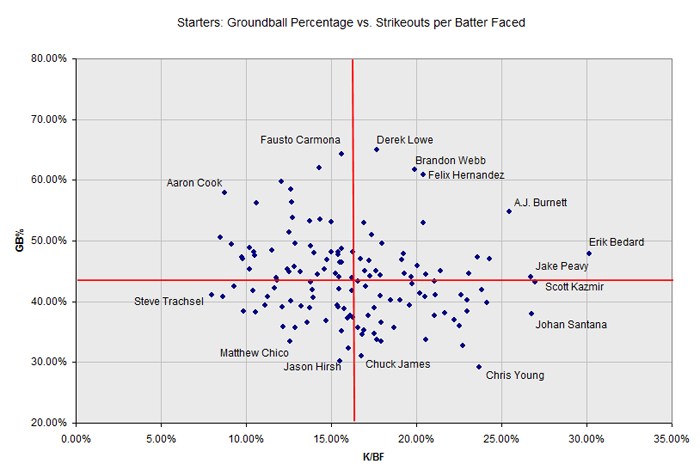
Looking at the outliers in the graph is one of the most interesting aspects of this study. Starting with the northeast quadrant and going clockwise, Derek Lowe, Brandon Webb, Felix Hernandez, A.J. Burnett, Erik Bedard, Jake Peavy, Scott Kazmir, Johan Santana, Chris Young, Chuck James, Jason Hirsh, Matthew Chico, Steve Trachsel, Aaron Cook, and Fausto Carmona all stand out for their extreme (good or bad) strikeout and/or groundball rates. Is there anybody who wouldn't take the outliers in the northeast quadrant over the outliers in the southwest quadrant? Lowe (3.88), Webb (3.01), Hernandez (3.92), Burnett (3.75), Bedard (3.16), and Peavy (2.54) all had much lower ERAs than Hirsh (4.81), Chico (4.63), and Trachsel (4.90).
Let's take a closer look at the results. Pitchers in the northeast, southeast, and southwest quadrants are sorted by K/BF rates. Pitchers in the northwest quadrant are listed in the order of GB rates.
NORTHEAST QUADRANT (ABOVE-AVG K AND GB RATES)
Pitcher K/BF GB% Erik Bedard 30.15% 47.87% Jake Peavy 26.73% 44.00% A.J. Burnett 25.47% 54.82% Tim Lincecum 24.27% 47.04% Josh Beckett 23.60% 47.31% John Smoltz 23.09% 44.69% C.C. Sabathia 21.44% 45.00% Dan Haren 20.53% 44.44% Dustin McGowan 20.43% 53.04% Felix Hernandez 20.42% 60.83% Ian Snell 20.07% 45.93% Brandon Webb 19.90% 61.76% Kelvim Escobar 19.70% 44.00% John Lackey 19.27% 44.69% Jeremy Bonderman 19.26% 47.91% Carlos Zambrano 19.14% 46.85% Daniel Cabrera 18.00% 49.51% Jeff Francis 17.90% 44.39% Derek Lowe 17.69% 64.97% Boof Bonser 17.62% 45.05% Chad Gaudin 17.38% 50.97% Mark Hendrickson 17.29% 44.13% Gil Meche 17.22% 46.81% Edwin Jackson 16.95% 45.06% Roy Oswalt 16.92% 52.97% Doug Davis 16.71% 47.02%
There are a number of outstanding arms in the group above. The best of the lot are those with strikeout rates north of 20 and/or groundball rates in the low-50s and above (both of which would be about 20% over the averages). Interestingly, Bedard, Burnett, Josh Beckett, John Smoltz, C.C. Sabathia, Dan Haren, Hernandez, Webb, Kelvim Escobar, Jeremy Bonderman, Carlos Zambrano, Roy Oswalt, and Doug Davis are all northeast quadrant returnees from last season.
Lowe graduated from the northwest quadrant (13.47% K/BF and 67.04% GB in 2006) to the northeast quadrant (17.69% and 64.97%) by improving his strikeout rate 4.22 percentage points or more than 30% while excelling at inducing grounders. The righthanded sinkerballer had the best groundball and line drive (15.8%) rates in the NL last season. Amazingly, he also had the highest home run rate as a percentage of flyballs (17.1%). According to THT, "research has shown that about 11% to 12% of outfield flies are hit for home runs. For pitchers, significant variations from 11% are probably the result of 'luck'." Here's betting that Lowe's GB will remain fairly steady while his HR/FB rate regresses toward the league mean.
The biggest surprises in the northeast quadrant for me were Mark Hendrickson and Edwin Jackson. However, both had K and GB rates that were close to the league average. As such, I wouldn't classify either as a special pitcher. If anything, I would think of Jackson more along the lines of Daniel Cabrera, another power arm, than not. Both are blessed – or cursed as it may be – with that "p" word, as in potential.
SOUTHEAST QUADRANT (ABOVE-AVG K AND BELOW-AVG GB RATES)
Pitcher K/BF GB% Scott Kazmir 26.94% 43.15% Johan Santana 26.77% 38.02% Javier Vazquez 24.15% 39.77% Cole Hamels 23.82% 41.87% Chris Young 23.69% 29.15% Daisuke Matsuzaka 23.00% 38.39% Aaron Harang 23.00% 40.27% Oliver Perez 22.75% 32.79% Chad Billingsley 22.63% 41.04% Rich Hill 22.54% 36.01% John Maine 22.22% 36.96% Yovani Gallardo 21.67% 38.17% Justin Verlander 21.13% 41.12% James Shields 21.05% 43.38% Orlando Hernandez 21.05% 37.75% Ted Lilly 20.54% 33.67% Randy Wolf 20.52% 40.78% Wandy Rodriguez 20.20% 41.44% Chris Capuano 19.73% 42.95% Matt Cain 19.59% 39.44% Byung-Hyun Kim 19.04% 40.17% Ervin Santana 18.67% 35.64% Shaun Marcum 18.48% 40.17% Jason Bergmann 17.92% 33.43% Ben Sheets 17.91% 36.53% Brett Tomko 17.86% 41.01% Claudio Vargas 17.69% 33.79% John Danks 17.52% 34.76% Andrew Sonnanstine 17.51% 38.94% Brian Burres 17.17% 37.73% Jeremy Guthrie 17.01% 42.49% Bronson Arroyo 16.94% 35.28% Scott Baker 16.83% 34.64% Chuck James 16.79% 30.99% Jered Weaver 16.55% 35.65% David Bush 16.54% 43.36%
There are at least a dozen outstanding pitchers in this group, most notably those listed in the top half (or with K rates over 20%). Kazmir just missed the northeast quadrant although he had K and GB rates that were almost identical to Peavy, who just so happened to win the Triple Crown of pitching by leading the NL in ERA, wins, and strikeouts.
Young had the ninth-highest K/BF rate of all starting pitchers and was the only one with a GB% below 30. Despite being an extreme flyball pitcher, Young has benefited by pitching his home games at Petco Park, which tied with Busch Stadium for the second-lowest HR rate in the majors in 2007 (behind only RFK Stadium).
NORTHWEST QUADRANT (ABOVE-AVG GB AND BELOW-AVG K RATES)
Pitcher GB% K/BF Fausto Carmona 64.31% 15.59% Tim Hudson 61.96% 14.27% Sergio Mitre 59.73% 12.08% Chien-Ming Wang 58.45% 12.64% Aaron Cook 57.89% 8.74% Kameron Loe 56.33% 12.68% Lenny DiNardo 56.28% 10.63% Julian Tavarez 53.78% 12.75% Jake Westbrook 53.54% 14.35% Paul Maholm 53.25% 13.73% Roy Halladay 53.10% 14.99% Greg Maddux 51.48% 12.53% Zach Duke 50.62% 8.51% Jason Marquis 49.52% 12.88% Brad Thompson 49.46% 9.14% Justin Germano 49.19% 13.78% Joe Kennedy 48.93% 10.18% Brad Penny 48.72% 15.61% Matt Morris 48.48% 11.54% Kip Wells 48.21% 16.27% Sean Marshall 48.18% 15.02% Adam Wainwright 48.15% 15.42% Jesse Litsch 48.14% 10.46% Matt Albers 47.99% 13.98% Andy Pettitte 47.69% 15.39% Carlos Silva 47.54% 10.50% Chris Sampson 47.31% 9.77% Kyle Kendrick 47.06% 9.82% Joe Blanton 46.95% 14.74% Dontrelle Willis 46.44% 15.50% Kevin Millwood 46.42% 15.61% Vicente Padilla 45.69% 12.84% Joe Saunders 45.38% 14.59% Jeff Suppan 45.38% 12.40% Odalis Perez 45.36% 10.22% Noah Lowry 44.92% 12.54% Jose Contreras 44.89% 13.17% Nate Robertson 44.63% 15.24% Edgar Gonzalez 44.54% 14.19% Miguel Batista 44.07% 15.47% Chad Durbin 43.95% 11.76%
This is an interesting group of pitchers, ranging from the highly successful (Carmona, Tim Hudson, Chien-Ming Wang, Roy Halladay, and Brad Penny) to those fighting for a spot in a starting rotation or even the majors (Kameron Loe, Julian Tavarez, Jason Marquis, Brad Thompson, Justin Germano, Kip Wells, Sean Marshall, Matt Albers, Chris Sampson, Odalis Perez, Edgar Gonzalez, and Chad Durbin). There are also several hurlers who are still serviceable but have seen better days, such as Greg Maddux, Matt Morris, Andy Pettitte, and Kevin Millwood, as well as enigmas like Dontrelle Willis.
As a whole, they rank behind those in the NE quadrant and ahead of those in the SW quadrant. Opposite of the pitchers in the SE quadrant, the NW inhabitants succeed by inducing grounders and keeping the ball in the park, whereas their counterparts thrive on strikeouts.
SOUTHWEST QUADRANT (BELOW-AVG K AND GB RATES)
Pitcher K/BF GB% Micah B Owings 16.28% 37.45% Matt Belisle 16.21% 41.75% Josh Towers 16.20% 43.85% Scott Olsen 16.10% 37.65% Buddy Carlyle 16.02% 32.35% Curt Schilling 15.96% 37.27% Kyle Davies 15.76% 38.83% Anthony Reyes 15.61% 35.17% Jason Hirsh 15.53% 30.17% Tom Gorzelanny 15.45% 42.09% Barry Zito 15.41% 39.12% Jamie Moyer 15.34% 39.41% Kyle Lohse 14.72% 36.89% Jorge de la Rosa 13.92% 40.63% Mike Mussina 13.87% 41.91% Mark Buehrle 13.77% 43.23% Tim Wakefield 13.75% 38.90% Jarrod Washburn 13.59% 36.54% Adam Eaton 13.22% 39.29% Brandon McCarthy 12.85% 35.76% Josh Fogg 12.62% 40.04% Matthew Chico 12.58% 33.39% Jeff Weaver 12.18% 35.80% Woody Williams 12.12% 39.16% David Wells 11.82% 43.53% Braden Looper 11.66% 42.16% Brian Bannister 11.27% 40.83% Jon Garland 11.10% 39.44% Paul Byrd 10.54% 38.26% Tom Glavine 10.41% 41.75% Livan Hernandez 9.86% 38.45% Mike Maroth 9.29% 42.53% Mike Bacsik 8.65% 40.84% Steve Trachsel 7.98% 41.16%
Repeating what I said last year, "this is the quadrant that you want to avoid. It is inhabited by some of the worst starters in the game. If you fail to miss bats and don't keep the ball on the ground when it is put into play, you are going to run into trouble." There are two ways to survive (or perhaps semi-survive) in this quadrant: (1) being close to league average in both K and GB rates and (2) throwing strikes and maintaining a low walk rate. Matt Belisle, Josh Towers, and Tom Gorzelanny fit the first bill, while Belisle, Towers, Curt Schilling, Kyle Lohse, Mike Mussina, Mark Buehrle, Jeff Weaver, and David Wells would qualify under the second scenario. However, all of these types of pitchers live on the edge with very little margin for error.
When it comes to evaluating pitchers, I would rather know their strikeout and groundball rates than their ERA. Throw in walk rates and you have almost everything you need to know about a pitcher. Focusing on these components gives one a much more comprehensive understanding of a pitcher's upside and downside than looking at a single metric such as ERA.
Tomorrow: Categorizing Relievers by Strikeout and Groundball Rates.
| Baseball Beat | March 03, 2008 |
Prospecting in Long Beach
The first two weekends of the college baseball season brought three-ranked teams into Long Beach to play the Dirtbags. I was able to see a number of pro prospects, most of whom will be eligible for the draft this June.
The newly implemented uniform start date pushed back the opening of the season to February 22, four weeks after last season's first games. Prior to 2008, schools could begin playing competitively once the spring semester was underway with many Sun Belt teams hosting games as early as mid-January. As it now stands, teams aren't even allowed to practice until February 1. Rolling back the start was obviously designed to level the playing field in the hope that schools in the north and midwest could return to the prominence achieved in the 1950s and 1960s when three programs from the Big 10 won six College World Series titles in a span of 14 years.
Ironically, these changes come on the heels of Oregon State, located in chilly and rainy Corvallis, Oregon, winning back-to-back national championships in 2006 and 2007. However, Oregon State and Wichita State are the only two cold-weather schools to have won the CWS since 1967. Colleges from California, Arizona, Texas, Louisiana, and Florida have captured all but five of the national titles in the past 40 years.
The current season will cover 56 games over 13 weeks, meaning schools will be required to play four contests every week and five in four of those weeks. Pushing the season forward or back a week would do away with the hardships involving five-game weeks. Alternatively, the NCAA could reduce the schedules from 56 to 52 games. Look for a change perhaps as early as next year.
In the meantime, schools with deep pitching staffs are going to have a competitive advantage, especially in the mid-week games. With scholarships already spread thin, a by-product of the new schedule may favor public schools with in-state tuitions that are affordable for walk-on pitchers. One such university is Long Beach State, ranked 13th in Baseball America's pre-season poll. The Dirtbags have played in 16 NCAA Regionals since the field was expanded to 48 teams in 1987 and made it all the way to Omaha four times. That said, it has been 10 years since Long Beach found itself playing at Rosenblatt Stadium in June.
Chomping at the bit to go to a baseball game, my brother and I went to the opener vs. 14th-ranked Rice a week ago Friday. The Dirtbags, behind outstanding pitching and the play of shortstop Danny Espinosa, won two of three from the Owls. Long Beach lost a Tuesday night game to 11th-ranked San Diego, then bounced back and swept a three-game series from 20th-ranked Wichita State last weekend. At 5-2 and playing perhaps the most difficult schedule in the country, albeit at home, the Dirtbags are likely to join the ranks of the Top 10 when the new polls are unveiled this week.
Senior righthander Andrew Liebel (pronounced LEE-bull) has struck out 22 batters without allowing an earned run over 15 1/3 innings in his two Friday night starts vs. Rice and Wichita State. On the smallish side at 6-foot and 196 pounds, Liebel commands three pitches: a fastball that sits at 89-90 mph and touches as high as 93, as well as a solid-average curveball and changeup. Drafted in the 47th round in 2004 out of Damien High School in Pomona, CA, Liebel chose to attend Long Beach State, where he spent the bulk of his first 2 1/2 years as a reliever. Liebel emerged from the bullpen in the middle of last season and became the ace of the staff, finishing with a 9-3 record and a 2.84 ERA. His experience has earned him the Friday night role in 2008 and he has pitched as well as possible, striking out 11 batters in each of his first two starts while allowing a total of just two walks.
Long Beach's Saturday night starter, Vance Worley, was a prized recruit out of McClatchy HS in Sacramento in 2005. The 6-foot-2, 220-pound righthander suffered an elbow strain during his senior season that limited his time and effectiveness on the mound and Baseball America's premier pitching prospect in Northern California slipped to the 20th round in the draft that June. Beset by inexperience and injuries during his first two seasons at Long Beach, Worley has failed to live up to his potential but still possesses the type of stuff that causes scouts to sit up and take notice. His fastball ranges from 90 to 95 and his curveball, while inconsistent, can be a plus pitch at times. He didn't play summer ball last year, choosing instead to rehab his elbow and tone his body while working out back home at Sacramento City College. Worley may have more upside than Liebel although the latter definitely has superior polish at this point in their careers.
Although only a freshman, Jake Thompson, who has performed well in his two Sunday starts, just may be the best of the bunch. A mere 18, Thompson passed the GED and skipped his senior season in high school to sign with the Dirtbags last fall. The 6-foot-3, 210-pound righthander, who was impressing scouts at Mayfair HS in Lakewood, CA during his sophomore season in 2006, transferred to Long Beach Wilson HS for his junior year in 2007 but was ruled ineligible. With his status still up in the air, Thompson earned his high school diploma a year early and is now one of the top three starting pitchers on the Dirtbags. He pitched six solid innings in his college debut a week ago Sunday and another seven strong yesterday, striking out eight without allowing a walk. Thompson throws a low-90s fastball, has a curve and change that are on the verge of being plus pitches, and has uncommon poise for someone his age.
Thompson surrendered a two-run home run to Wichita State shortstop Dusty Coleman in the first inning but shut down the Shockers the rest of the way. Coleman's roundtripper, his third of the young season, was a more than 400-foot blast to dead center. The 6-foot-2, 185-pound sophomore will be a highly regarded prospect next season. Meanwhile, his fellow infielders, third baseman Conor Gillaspie (pronounced Ga-LESS-pee) and second baseman Josh Workman, are draft eligible this year. The 6-foot-1, 200-pound lefthanded-hitting Gillaspie was the MVP of the Cape Cod League last summer, leading the circuit in AVG (.345) and SLG (.673). Baseball America ranks him as the 23rd best junior and pegs him as the Player of the Year and No. 1 prospect from the Missouri Valley Conference. He went 6-for-14 during the series with a triple off the right field wall on Sunday.
Workman appears to be healthy following two shoulder surgeries. The 6-foot-1, 200-pounder is strong and athletic. He generates power out of a pronounced crouch from the left side and was clocked to first base on a drag bunt single in 3.75 seconds. I liked what I saw of him and would be surprised if he doesn't move up the draft boards in a big way this spring.
Long Beach's Espinosa is off to a terrific start and is a multi-tooled shortstop with good range and a rocket arm reminiscent of his predecessor's, none other than Colorado's Troy Tulowitzki, who should have won the NL Gold Glove as a rookie in 2007. A starter for Team USA last summer, I believe the 6-foot, 180-pound, switch-hitting Espinosa will be drafted higher than Baseball America's current projections and could see him going as early as the second round.
Whether Espinosa is drafted before or after first baseman Shane Peterson is up for debate. The lefthanded-hitting Peterson earned All-Cape Cod League honors last summer when he led in hits (52) while batting .338 with a .436 on-base average. After a slow start, he went 7-for-14 in the just-completed weekend series with two hard-hit doubles on Sunday. A two-way performer as a sophomore, the 6-foot, 200-pounder out of Chaparral HS in Temecula, CA came on strong last year, hitting in 22 straight games and in 30 of the final 31.
Other prospects to keep an eye on who have made their way through town are Long Beach's Bryan Shaw, a righthanded relief pitcher with a 91-95 mph fastball and a major league-caliber slider; Rice's Cole St. Clair, whose fastball is way down from last year while returning from a shoulder injury and making a transition from a closer to a starter; relief pitcher Bryan Price and his 94-95 mph fastball; catcher Adam Zornes and OF/DH Aaron Luna; San Diego's Brian Matusz, a LHP who didn't pitch but struck out 11 last Friday in a highly anticipated duel with Fresno State's Tanner Scheppers; Josh Romanski, a CF/LHP; and Wichita State's Aaron Shafer, a righty whose fastball was unimpressive at 86-89, and Rob Musgrave, a finesse southpaw who was working throughout the 80s.
The future looks good for Rice's sophomore righthander Ryan Berry, who shut out the Dirtbags for seven innings, striking out eight with no walks while fashioning a Burt Hooton-like knuckle curve, and freshman shortstop Rick Hague. The same can be said for San Diego's triumvirate of underclassmen pitchers Kyle Blair, A.J. Griffin, and Matt Thomson, and perhaps most of all freshman third baseman Victor Sanchez, who went 3-for-3 and cranked two home runs in his lone appearance at Blair Field.
| Baseball Beat | February 13, 2008 |
Best Young Players in Baseball by Age: Part Three (21- and 20-Year Olds)
We continue and conclude our three-part series on the Best Young Players in Baseball. Unlike most prospect lists, players are categorized by age and major leaguers are also eligible for inclusion.
The methodologies are explained fully in parts one (25- and 24-year-olds) and two (23- and 22-year-olds). Today's focus is on 11 21-year-olds and 10 20-year olds.
All told, we ranked 75 players and gave honorable mentions to another 75. Of those ranked, 26 were pitchers or roughly 35% of the total (which is about pitching's proper proportional weighting with defense accounting for about 15% and offense the other 50%). Approximately two-thirds of the pitchers were righthanded and one-third lefthanded. There were 13 center fielders included, partly due to the fact – as you will read below – that the 21-year-old crop is overloaded with talent at that position (including seven of the top eight players). But it's also important to point out that many center fielders will end up in right or left field. Conversely, only three left fielders and four first basemen were chosen. It's nothing more than Bill James' Defensive Spectrum at work.
Interestingly, the National League had 38 players and the American League had 37. In both cases, that works out to about 2.5 players per team. The Milwaukee Brewers led all clubs with seven, including five players expected to be in this year's starting lineup and rotation. The Los Angeles Angels and Tampa Bay Rays had six each, while the Los Angeles Dodgers had five. Oakland brought up the rear with zero although it led the pack with eight honorable mentions, thanks to a couple of offseason trades that bolstered the club's pipeline of prospects. Houston, Philadelphia, Pittsburgh, San Diego, Seattle, Texas, Toronto, and the Chicago Cubs and White Sox had one each.
The Rays and Dodgers each had ten of the 150 ranked players and honorable mentions, followed by the Angels, Red Sox, and A's (all with 8). The Blue Jays (1) had the fewest and would get my vote as the worst collection of young talent in the game, follwed by the Astros, Cubs, and Giants (all with 2).
All in all, I believe the 25-and-under group is special by historical standards, albeit not up to the class of 1956 when Hall of Famers Hank Aaron, Luis Aparicio, Ernie Banks, Jim Bunning, Roberto Clemente, Don Drysdale, Al Kaline, Harmon Killebrew, Sandy Koufax, Mickey Mantle, Eddie Mathews, Willie Mays, Bill Mazeroski, Brooks Robinson, and Frank Robinson were all at a similar age.
AGE 21
1. Jay Bruce | CIN | CF
A+/AA/AAA | 576 PA | .319/.375/.587 | OPS .962
Bruce was Baseball America's Minor League Player of the Year in 2007. Over three levels, the lefthanded-hitting center fielder combined for 46 doubles, 8 triples, and 26 home runs. His 80 XBH and 306 TB ranked second in the minors. He also struck out 135 times or nearly once every four trips to the plate.
2. Cameron Maybin | FLA | CF
R/A+/AA | 385 PA | .316/.409/.523 | OPS .932
Maybin spent most of the year drilling High-A pitchers but failed miserably in his MLB debut (.143/.208/.265 with 21 SO in 53 PA) when he was rushed to Detroit in August. He was traded to Florida in the Miguel Cabrera package this winter. Maybin is a big, strong, athletic type who will succeed in the big leagues in due time. Of note, he was the second-highest drafted high schooler in 2005 at #10, ahead of fellow center fielders McCutchen (11), Bruce (12), and Rasmus (28).
3. Colby Rasmus | STL | CF
AA | 556 PA | .275/.381/.551 | OPS .932
Rasmus led the Texas League in home runs (29), extra-base hits (69), and runs scored (93), while hitting .312/.429/.624 in the second half. He also drew 70 walks and stole 18 bases. A bona fide five-tool player, Colby led off for Team USA at the World Cup in November. His spring will determine whether he starts the season in St. Louis or Triple-A Memphis.
4. Andrew McCutchen | PIT | CF
AA/AAA | 570 PA | .265/.329/.388 | OPS .717
McCutchen had a poor April and his season-long stats suffered accordingly. At 5-11, 170, McCutchen isn't nearly as big as Bruce, Maybin, and Rasmus. His game relies less on power and more on speed and defense. He stands a decent chance of getting his first look in the majors this summer.
5. Nick Adenhart | LAA | RHP
AA | 153 IP | 1.46 WHIP | 6.82 K/9 | ERA 3.65
A highly regarded high school pitcher, Adenhart suffered a major elbow injury during his senior year and fell all the way to the 14th round of the 2004 draft. He received a $710,000 bonus despite the need for Tommy John surgery that same summer. In three seasons of minor league ball, the 6-foot-4 righthander has allowed only 10 HR in 361 innings. He should be a fixture in a big league rotation in 2009 and could see some action in the majors during the second half this year if injuries dictate his call-up.
6. Jordan Schafer | ATL | CF
A/A+ | 626 PA | .312/.374/.513 | OPS .887
Although Schafer had a breakout minor league season last year, it wasn't totally out of the blue. Baseball America was on him eight years ago, naming him the nation's top 13-year-old in 2000. At worst, he should be a poor man's Grady Sizemore, a lefthanded center fielder who could be a 20 HR, 20 SB, Gold Glove-type in the majors.
7. Desmond Jennings | TB | CF
A | 448 PA | .315/.401/.465 | OPS .866
Jennings hasn't played at the same levels of his counterparts and his ranking is based in large part on tools and projection. He has plus-plus speed (77 SB in 97 attempts in 155 MiL games) and above-average power. Jennings has come a long way from 2000 when he was drafted in the 10th round and signed for just $150,000. He should arrive in the majors about a year after most of his fellow 21-year-old center fielders.
8. Austin Jackson | NYY | CF
A/A+/AAA | 555 PA | .304/.370/.476 | OPS .846
Jackson is interesting in that he hit .260/.336/.374 in the Sally League (A) and .345/.398/.566 in the Florida State League (High-A). An outstanding athlete, he can run, hit for power, and should be able to handle the defensive demands of center field at the big league level.
9. Jake McGee | TB | LHP
A+/AA | 140 IP | 1.12 WHIP | 11.25 K/9 | ERA 3.15
McGee has progressed as expected from Rookie ball in 2004 to short-season A in 2005 to Single-A in 2006 to High-A and Double-A in 2007. He has excelled at every stop along the way, striking out more than one batter per inning in each of the last four leagues. The southpaw has a plus fastball but still needs to develop a better breaking pitch and changeup to continue his ascension to the majors.
10. Aaron Poreda | CWS | LHP
R | 46.1 IP | 0.84 WHIP | 9.33 K/9 | ERA 1.17
A first round draft pick last June, Poreda had a terrific professional debut season. However, the 6-foot-6, 240-pound southpaw dominated Rookie ball as a 20-year-old and needs to show that he can handle players his age and above before gaining any more respect. Poreda has been known to light up radar guns as high as the upper-90s so he just may be the real deal. Stay tuned.
11. Bryan Anderson | STL | C
AA | 431 PA | .298/.350/.388 | OPS .738
Anderson bypassed High-A en route to Double-A as a 20-year-old all-star catcher just two years out of high school. His body of work includes Team USA and the Futures Game.
Honorable Mention: Michael Bowden, Carlos Carrasco, Daniel Cortes, Will Inman, Beau Mills, Cole Rohrbough, Ryan Tucker, and Chris Volstad.
AGE 20
1. Justin Upton | ARI | RF
MLB | 152 PA | .221/.283/.364 | OPS+ 62
Ranking #1 is nothing new for Upton. He was the first pick in the 2005 draft and was playing in the big leagues 19 months after signing with the Diamondbacks. An easy pick as the top 20-year-old, Upton is a couple of years ahead of the competition. He went 5-for-14 with two extra-base hits as Arizona's starting right fielder in the postseason despite being 15 months younger than any other player in the big leagues.
2. Clayton Kershaw | LAD | LHP
A/AA | 122 IP | 1.28 WHIP | 12.02 K/9 | ERA 2.95
Kershaw has been on the fast track since being drafted with the 7th pick in 2006. Considered by many as the best LHP in the minors, Clayton has outstanding stuff, including a low- to mid-90s fastball and a hammer curve. He still needs to work on his command and control but projects as a big league starter in a year and a potential ace shortly thereafter.
3. Travis Snider | TOR | RF
A | 517 PA | .313/.377/.525 | OPS .902
Snider led the pitcher-friendly Midwest League with a .525 slugging average, 35 doubles, 58 extra-base hits, and 93 RBI. He could be the best pure hitter in the minors this season. The only rap against him is his body (5-11, 245) although he is an average runner at this point and his arm is good enough to play in right field.
4. Lars Anderson | BOS | 1B
A/A+ | 580 PA | .292/.393/.446 | OPS .839
A high school draftee in 2006, Anderson began his professional career in 2007 at Single-A and was promoted to High-A before the season concluded. At 6-4, 215, the lefthanded hitter has the frame to hit for power as well as the approach to work counts and draw walks. He is easier to project than any 20-year-old hitter not named Snider.
5. Jordan Walden | LAA | RHP
R | 64.1 IP | 1.03 WHIP | 8.82 K/9 | ERA 3.08
According to Baseball America, Walden was the #1 high school prospect entering his senior season in 2006. The Angels nabbed him in the 12th round after his velocity fell into the 80s, signing him for $1 million as a draft-and-follow out of Grayson County Community College in Texas. His fastball has since returned, touching 100-mph in a championship game at Orem last season.
6. Matt Latos | SD | RHP
A- | 56.1 IP | 1.42 WHIP | 11.83 K/9 | ERA 3.83
Like Walden, Latos was signed as a draft-and-follow (Broward Community College in Florida). The Padres locked him up for $1.25 million hours before the signing deadline. His talent is on the raw side but his upside is evidenced by a powerful fastball that has been known to eclipse 95 on the gun. Latos K'd 74 batters in 56 1/3 innings in the short-season Northwest League.
7. Hank Conger | LAA | C
R/A | 335 PA | .289/.333/.466 | OPS .799
Conger posted a .290/.336/.472 line as a 19-year-old switch-hitting catcher in the pitcher-friendly Midwest League. There is little question that the kid can hit. Still needs to prove that he can handle the defensive chores behind the plate.
8. Jeremy Jeffress | MIL | RHP
A | 86.1 IP | 1.23 WHIP | 9.91 K/9 | ERA 3.13
Poster child for the million-dollar arm, ten-cent head. Milwaukee's #1 draft pick in 2006, Jeffress may have the best arm in the system but has tested positive for marijuana four times and will begin the 2008 season serving the bulk of the 50-game suspension levied against him last year.
9. Gorkys Hernandez | ATL | CF
A | 533 PA | .293/.344/.391| OPS .735
The Braves acquired Hernandez and Jair Jurrjens from the Detroit Tigers for Edgar Renteria. Hernandez, who played in the Futures Game last summer, won the Gulf Coast League's batting title in 2006 and the Midwest League's MVP in 2007 (even though he was thoroughly outplayed by Snider).
10. Nick Weglarz | CLE | LF
A/A+ | 540 PA | .274/.393/.498 | OPS .891
Defensively challenged, Weglarz will have to hit his way onto a big league roster. He has been compared to Justin Morneau for his size, handedness, and power potential. Like his fellow Canadian, Weglarz may wind up at first base.
Honorable Mention: Brett Anderson, Adrian Cardenas, Kasey Kiker, Chris Parmelee, and Chris Tillman.
| Baseball Beat | February 12, 2008 |
Best Young Players in Baseball by Age: Part Two (23- and 22-Year Olds)
We continue our three-part series on the Best Young Players in Baseball. Unlike most prospect lists, players are categorized by age and major leaguers are also eligible for inclusion.
As pointed out in Part One, "the rankings are heavily weighted toward stats, age vs. level of play, and position. Tools and upside also played a part, as did opinions by Baseball America, Keith Law, and Kevin Goldstein, especially among younger prospects. Ultimately, the rankings are based on a discounted present value of the future returns (like they do in the financial world) of each player's career. The closer the expected returns, the higher the value."
A player's age is based on June 30th. MLB stats are shown for those players with at least 150 plate appearances or 50 innings pitched. Minor League combined totals are listed for all others.
Yesterday, we covered 15 25-year-olds and 14 24-year-olds. Today, we will focus on ranking 13 23-year-olds and 12 22-year-olds. Tomorrow, we will conclude the series with 11 21-year-olds and 10 20-year olds.
AGE 23
1. Troy Tulowitzki | COL | SS
MLB | 682 PA | .291/.359/.479 | OPS+ 108
Tulowitzki earned the starting job in spring training and finished second in the NL Rookie of the Year balloting. He surpassed all expectations, cranking 33 doubles, 5 triples, and 24 home runs while scoring 104 runs and driving in 99. Moreover, Tulo led all shortstops in most fielding categories and was the plus/minus leader, earning a Fielding Bible Award. He was rewarded with a six-year, $31 million contract, the most money ever given to a player with less than two years of experience.
2. Ryan Zimmerman | WAS | 3B
MLB | 722 PA | .266/.330/.458 | OPS+ 107
Zimmerman is quickly becoming the face of the Washington franchise. He didn't miss a game last season and accumulated impressive counting stats, including 43 doubles, 5 triples, and 24 homers with more than 90 runs and RBI. His numbers may get a boost by playing home games this season at Nationals Park rather than pitcher-friendly RFK Stadium. He can pick it with the best at the hot corner.
3. Matt Cain | SF | RHP
MLB | 200 IP | 1.26 WHIP | 7.33 K/9 | ERA+ 122
How did Cain go 7-16 with a 3.65 ERA? Easy. He had the worst bullpen support and the second-worst run support of any qualified pitcher last season. One would think that the law of averages would be on his side this year except for one small thing: the bullpen and offense should be the same or worse in 2008. Last April, Cain gave up 12 hits and 6 runs in 35 innings and had a record of 1-1 in five starts. 'Nuff said.
4. Chad Billingsley | LAD | RHP
MLB | 147 IP | 1.33 WHIP | 8.63 K/9 | ERA+ 138
Billingsley didn't join the starting rotation until June. He had an ERA of 3.22 in July, 3.19 in August, and 2.59 in September. Unbeknown to most, Dodger Stadium hasn't played as a pitcher's park the past two seasons. Case in point: Billingsley had an ERA of 4.24 at home and 2.59 on the road. The righthander will do well by improving his command and keeping his pitch counts down.
5. Clay Buchholz | BOS | RHP
AA/AAA | 125.1 IP | 0.97 WHIP | 12.28 K/9 | ERA 2.44
After dominating Double-A and Triple-A batters, Buchholz was promoted to the majors and threw a no-hitter against the Orioles on September 1 in just his second start. In an interview a year ago, Assistant GM Jed Hoyer told us that Buchholz possessed the best slider and changeup in the system. You can call his breaking ball a slider or a curve. Either way, it is flat out wicked, especially when combined with his low-90s fastball and plus-plus change.
6. B.J. Upton | TB | CF
MLB | 548 PA | .300/.386/.508 | OPS+ 136
The second pick in the 2002 draft, Upton flew through the minors and made his MLB debut in 2004 at the age of 19. His defense at shortstop and third base was horrific and he didn't make it back to the bigs until 2006. Switched to second base and then center field in 2007, Upton finally broke out on the offensive side, hitting .300 and slugging 24 home runs. His BABIP was .447 during the first half, regressing to .356 during the second half when he hit .285/.379/.482.
7. Matt Kemp | LAD | RF
MLB | 311 PA | .342/.373/.521 | OPS+ 125
Kemp put up consistently strong numbers vs. LHP and RHP, at home and away, and in both halves. However, a cynic would point to his 17.5% line drive rate and suggest that an overall BABIP of .411 isn't sustainable. A more normal BABIP, in fact, would have reduced Kemp's rate line to .257/.293/.435. He will do well by splitting the difference between his actual and theoretical stats.
8. Lastings Milledge | WAS | CF
MLB | 206 PA | .272/.341/.446 | OPS+ 105
Blocked by Carlos Beltran in New York, Milledge was traded to Washington during the off-season and will be the everyday center fielder for the Nationals. Milledge has been highly regarded in baseball circles since being drafted in the first round in 2003. His bat is as quick as his temper and should win out as Milledge matures.
9. Jarrod Saltalamacchia | TEX | C-1B
MLB | 329 PA | .266/.310/.422 | OPS+ 91
Traded for Mark Teixeira right before the deadline, Saltalamacchia split time between Atlanta and Texas as well as catcher and first base. A switch-hitter, Salty has plenty of bat for a catcher but still needs to improve his defensive skills behind the plate. His value will drop if he winds up at first base.
10. Brandon Wood | LAA | 3B
AAA | 488 PA | .272/.338/.497 | OPS .835
Wood was one of the top five prospects in baseball after clubbing 58 HR in the minors, AFL, and Team USA as a 20-year-old in 2005. However, his star potential has waned a bit the past two seasons, primarily owing to the fact that he is no longer playing shortstop and is whiffing nearly once every four plate appearances. The raw power is still there and will play at third base if Brandon can show that he can handle breaking balls and lay off pitches outside the strike zone.
11. Andrew Miller | FLA | LHP
MLB | 64 IP | 1.75 WHIP | 7.88 K/9 | ERA+ 81
Detroit was pleased when Miller fell to them in the sixth spot in the 2006 draft. The former Tar Heel was brought up in late August that year and pitched eight games out of the bullpen during the stretch drive. The tall southpaw started 13 times last season but got rocked, allowing 73 hits and 39 walks in 64 innings. Traded to the Marlins during the off-season as part of the Miguel Cabrera package, Miller figures to land a spot in Florida's starting rotation this spring.
12. Felix Pie | CHC | CF
MLB | 194 PA | .215/.271/.333 | OPS+ 53
Pie had a forgettable rookie season with the Cubs but hit .362/.410/.563 in Triple-A Iowa. He should break camp as the team's everyday center fielder and has the potential of hitting .280 with 15-20 HR and a dozen or more triples.
13. Matt LaPorta | MIL | LF
R/A | 130 PA | .304/.369/.696 | OPS 1.065
A former NCAA home run champ at the University of Florida, LaPorta jacked 10 four baggers in 102 plate appearances in the South Atlantic League. He is expected to start the season at Double-A Huntsville and would probably see action in the big leagues as early as the second half of 2008 if not for one thing: LaPorta is blocked in left field by Ryan Braun, in right field by Corey Hart, and at first base by Prince Fielder. Absent an injury or a trade and with no DH in the NL, there may be little or no opportunity for LaPorta in Milwaukee this season.
Honorable Mention: Tony Abreu, Matt Antonelli, Melky Cabrera, John Danks, Ian Kennedy, Justin Masterson, James McDonald, Adam Miller, Brandon Morrow, and Max Scherzer.
AGE 22
1. Felix Hernandez | SEA | RHP
MLB | 190.3 IP | 1.38 WHIP | 7.80 K/9 | ERA+ 110
Hard to believe but Hernandez doesn't even turn 22 until April. The three-year veteran has already tossed 465 innings in the majors. Call him a disappointment if you must but King Felix was the youngest player in the big leagues in 2005 and 2006 and the sixth-youngest in 2007.
2. Yovani Gallardo | MIL | RHP
MLB | 110.3 IP | 1.27 WHIP | 8.24 K/9 | ERA+ 122
In 17 starts with Milwaukee, Gallardo pitched six innings or more and allowed ZERO runs five times, including three in a row in September. Subtract a start at Colorado in August (2 2/3 IP and 11 ER) and Yovani's ERA would fall to 2.84. Gallardo has the pitches and the pitchability to rank among the best starters in either league as long as he stays healthy.
3. Phil Hughes | NYY | RHP
MLB | 72.7 IP | 1.28 WHIP | 7.18 K/9 | ERA+ 100
Hughes almost pulled a Clay Buchholz last year, tossing a no-hitter in his second start in the big leagues. Almost. The big righthander threw a no-no for 6 1/3 innings before injuring his hamstring and exiting stage left. Phil sat out three months when he also suffered a severe ankle sprain during his rehab. Hughes was 3-0 with a 2.66 ERA in his final four starts and hurled 3 2/3 scoreless innings in relief to earn a win over Cleveland in Game 3 of the ALDS.
4. Joba Chamberlain | NYY | RHP
A+/AA/AAA | 88.3 IP | 1.01 WHIP | 13.76 K/9 | ERA 2.45
Chamberlain blew away minor and major league hitters last season as a starting pitcher in the former and as a late-season set-up man with the Yankees. He struck out 169 batters in 112 1/3 combined innings, ranging from High-A to MLB. His future could be as a #1 starter or as a dominant closer. His fastball sits in the mid-90s and his slider is a devastating out pitch. He also throws a curve and a change, both of which could develop into plus pitches as a starter.
5. Evan Longoria | TB | 3B
AA/AAA | 575 PA | .299/.402/.520 | OPS .922
Despite what many prospect analysts have claimed, Longoria was a third baseman in college, not a shortstop. He played SS in junior college and filled in at that position for a stretch during his junior season at Long Beach State when Troy Tulowitzki was injured. Otherwise, he was a third baseman – and an excellent one at that. The MVP of the Southern League, Longoria should be Tampa Bay's starting 3B on Opening Day.
6. Delmon Young | MIN | RF
MLB | 681 PA | .288/.316/.408 | OPS+ 91
The #1 overall draft pick in 2003, Young was the favorite among almost all prospect analysts for the next few years. His plate discipline is notoriously bad and his power hasn't developed as expected. However, it's easy to forget that he played last season as a 21-year-old. He will get a fresh start in Minnesota. Delmon is the brother of Dmitri Young.
7. Adam Jones | BAL | CF
AAA | 469 PA | .314/.382/.586 | OPS .968
Jones was the centerpiece of the Erik Bedard trade. A supplemental first round draft pick in 2003, Jones played 73 games for Seattle in 2006 and 2007. The production hasn't been there as yet but there is no disputing the raw talent and power. A former high school pitcher who dialed it up to the mid-90s and a minor league shortstop for three seasons, Jones has the arm and the speed to become a Gold Glove-caliber center fielder in the majors.
8. Billy Butler | KC | DH
MLB | 360 PA | .292/.347/.447 | OPS+ 105
Reminds me of Greg Luzinski. The Royals will be happy if he hits as well as the Bull.
9. Homer Bailey | CIN | RHP
A+/AAA | 75.1 IP | 1.34 WHIP | 7.89 K/9 | ERA 3.82
Two years after Bailey was named Baseball America's High School Player of the Year and drafted with the seventh overall pick by the Reds, the young Texan did little to hurt his national standing when he lit up radar guns and everyone's eyes at the Futures Game in 2006. Homer didn't progress as expected last season but still has the potential to become a legitimate ace in the big leagues once he adds a bit of polish to his outstanding repertoire of stuff.
10. Franklin Morales | COL | LHP
AA/AAA | 112.2 IP | 1.38 WHIP | 7.43 K/9 | ERA 3.51
Morales earned a promotion to Colorado in August and his team won six of his eight starts, including three straight in September when he threw 17 innings and allowed 7 hits and 0 runs. He also made two starts in the postseason and two relief appearances in the World Series at the tender age of 21. His minor league totals say everything you need to know about Morales: 428 IP, 462 SO, and 234 BB. His command and control will dictate his ceiling.
11. Matt Wieters | BAL | C
DNP
The fifth pick overall in the draft last June, Wieters received a $6 million signing bonus with the Orioles. A switch-hitter, he batted .358 with 10 homers during his junior season at Georgia Tech. At 6-foot-5, the only question is whether Wieters, who has plus arm strength, is too tall to stay behind the plate longer term.
12. David Price | TB | LHP
DNP
The first pick of the 2007 draft out of Vanderbilt, Price signed a major league contract with the Devil Rays last August for $8.5 million. The 6-foot-6, 225-pound lefty went 11-0 with a 2.59 ERA in 133 innings at Vandy during his junior season. With a plus fastball and slider, he projects as a future ace in the big leagues.
Honorable Mention: Daric Barton, Reid Brignac, Asdrubal Cabrera, Johnny Cueto, Chris Davis, Wade Davis, Fautino de los Santos, Ross Detwiler, Carlos Gomez, Carlos Gonzalez, Gio Gonzalez, Eric Hurley, Jair Jurrjens, Chuck Lofgren, Troy Patton, and Neil Walker.
| Baseball Beat | February 11, 2008 |
Best Young Players in Baseball by Age: Part One (25- and 24-Year Olds)
In a three-part series, Baseball Analysts is unveiling its Best Young Players in Baseball. In contrast to prospect lists, we are categorizing the players by age and basing our rankings on minor and major leaguers.
The rankings are heavily weighted toward stats, age vs. level of play, and position. Tools and upside also played a part, as did opinions by Baseball America, Keith Law, and Kevin Goldstein, especially among younger prospects. Ultimately, the rankings are based on a discounted present value of the future returns (like they do in the financial world) of each player's career. The closer the expected returns, the higher the value.
In order to come up with a total of 75 players, we have also added an unusual twist by ranking 15 25-year-olds, 14 24-year-olds, 13 23-year-olds, 12 22-year-olds, 11 21-year-olds, and 10 20-year-olds. The reasoning for this methodology is to give "older" players their due because they are more of a sure thing, whereas the younger prospects are a bit more speculative by nature.
A player's age is based on June 30th. MLB stats are shown for those players with at least 150 plate appearances or 50 innings pitched. Minor League combined totals are listed for all others.
We begin the series by focusing on the 25-year-old and 24-year-old players. We will rank the 23- and 22-year-olds on Tuesday, and the 21- and 20-year olds on Wednesday.
AGE 25
1. David Wright | NYM | 3B
MLB | 711 PA | .325/.416/.546 | OPS+ 150
Wright should have been the NL MVP in 2007 but was overlooked by voters because the Mets faltered down the stretch. Nonetheless, he did his part, hitting .352/.432/.602 during the final month of the season. Get this, Wright hit .364/.465/.596 in the second half with 53 BB and 42 SO, a huge improvement over his 41-73 clip in the first half.
2. Miguel Cabrera | DET | 3B
MLB | 680 PA | .320/.401/.565 | OPS+ 150
Cabrera won't turn 25 until after the season opens, yet already has more than 4 1/2 years of major league service under his belt. Now that he is entering his prime, Cabrera may well be the best hitter in the game over the next five seasons. He has hit .320 or better and slugged in the .560s in each of the last three campaigns. The sky is the limit if he can keep his weight down.
3. Jose Reyes | NYM | SS
MLB | 765 PA | .280/.354/.421 | OPS+ 103
Like Cabrera, Reyes has been playing in the majors since he turned 20 in 2003. He can be a game changer at the plate, on the bases, or in the field. Reyes and Wright form the best young left side of the infield in baseball and may challenge their New York counterparts for that title over the next season or two.
4. Grady Sizemore | CLE | CF
MLB | 748 PA | .277/.390/.462 | OPS+ 122
Young or old, Sizemore is one of the best players in the game. He has averaged 41 doubles, 9 triples, and 25 home runs over the past three seasons. Furthermore, the Gold Glove center fielder has improved his walk rate and on-base percentage every year, drawing more than 100 BB and lifting his OBP to .390 in 2007.
5. Joe Mauer | MIN | C
MLB | 471 PA | .293/.382/.426 | OPS+ 117
Mauer could have been the MVP in 2006 when he led the AL with a .347 batting average and slugged over .500 while giving his club strong defense at the most demanding position on the field. More than anything, Mauer just needs to stay healthy to earn his place as one of the best two-way players in either league.
6. Russell Martin | LAD | C
MLB | 620 PA | .293/.374/.469 | OPS+ 113
Martin caught 145 games last season and earned a Gold Glove for his sterling play behind the plate and a Silver Slugger as the best-hitting catcher in the league. He hit 32 doubles, 3 triples, and 19 home runs, while drawing 67 walks and stealing 21 bases.
7. Justin Verlander | DET | RHP
MLB | 201.7 IP | 1.23 WHIP | 8.17 K/9 | ERA+ 125
As the second overall pick of the 2004 draft, Verlander has held up his end of the bargain in his first two full seasons in the big leagues. He improved his strikeout rate per batter faced from 16.0% to 21.1% last year and seems poised to add a Cy Young to his trophy case one of these years.
8. Robinson Cano | NYY | 2B
MLB | 669 PA | .306/.353/.488 | OPS+ 120
Cano has put back-to-back 120 or better OPS+ seasons at the age of 23 and 24. His walk rate (5.8%), while low, improved in 2006 and 2007. Cano could rate as one of the top players in baseball if he can get his walk rate up to 10%.
9. Rickie Weeks | MIL | 2B
MLB | 506 PA | .235/.374/.433 | OPS+ 108
In stark contrast to Cano, Weeks walked in 15.4% of his plate appearances. Rickie thrived in the lead-off spot (.252/.385/.477 vs. .139/.279/.222 when batting 8th) and showed remarkable power during the final month of the season when he slugged 9 HR.
10. Jeremy Bonderman | DET | RHP
MLB | 174.3 IP | 1.38 WHIP | 7.49 K/9 | ERA+ 91
A five-year veteran, Bonderman's win-loss record (56-62) and ERA (4.78) have disappointed his most ardent supporters, yet his stuff and strikeout/groundball rates lead scouts and statheads to believe he can still become a top-of-the-rotation pitcher. His results last season may have been hampered by an elbow injury that wasn't disclosed until late last year.
11. Jered Weaver | LAA | RHP
MLB | 161 IP | 1.38 WHIP | 6.43 K/9 | ERA+ 117
After a terrific rookie season, Weaver's 2007 start was delayed by shoulder tendinitis. He regressed as expected but still had a productive season, going 13-7 with an ERA of 3.91. Keep an eye on his K/9 as it dipped 1.25 last year. As an extreme flyball pitcher, Weaver needs to maintain an above-average strikeout rate to succeed in the big leagues.
12. Hunter Pence | HOU | RF
MLB | 484 PA | .322/.360/.539 | OPS+ 130
Pence exploded onto the major league scene last season, hitting .342/.367/.589 during the first half. He suffered a mid-season injury but ended the year on a high note, going .333/.372/.590 over his final 10 games. His BABIP of .377 is unlikely to be sustained so look for what many will term a "sophomore slump" in 2008. His walk rate (5.4%) leaves a lot to be desired and will be the key to his longer-term productivity.
13. Casey Kotchman | LAA | 1B
MLB | 508 PA | .296/.372/.467 | OPS+ 119
Kotchman was enjoying a breakout season (.333/.411/.556) when he suffered a concussion on a thrown ball against the Dodgers on June 16. He returned to the lineup nine days later but was never the same, hitting .263/.338/.390 the rest of the way.
14. J.J. Hardy | MIL | SS
MLB | 638 PA | .277/.323/.463 | OPS+ 100
Hardy, not teammate Prince Fielder, was leading the NL in homers early last season. He slugged 15 HR in April and May, then slumped to 0 in July, before rebounding with 8 in the final two months. He is more solid than spectacular.
15. Stephen Drew | ARI | SS
MLB | 619 PA | .238/.313/.370 | OPS+ 72
Drew isn't as good as he showed during his rookie season in 2006 (.316/.357/.517) or as bad as he appeared to be in 2007. He should put up numbers this year that are equal to or better than his career totals (.259/.325/.411) with more upside potential than downside risk at this point.
Honorable Mention: Manuel Corpas, Edwin Encarnacion, Yunel Escobar, Josh Fields, Tom Gorzelanny, Yadier Molina, Micah Owings, Ervin Santana, Andy Sonnanstine, and Geovany Soto.
AGE 24
1. Hanley Ramirez | FLA | SS
MLB | 706 PA | .332/.386/.562 | OPS+ 145
Supremely gifted, Ramirez made a big splash in 2006 when he hit .292/.353/.480 with 46 doubles, 11 triples, 17 home runs, and 51 stolen bases en route to NL ROY honors. He then turned it up a couple of notches by improving his rate stats across the board and slugging 29 HR. While his bat can play anywhere, his defense will determine if he can remain at shortstop.
2. Prince Fielder | MIL | 1B
MLB | 681 PA | .288/.395/.618 | OPS+ 156
Fielder led the NL in HR last season with 50. Not bad for a 23-year-old. He could be one of the rare .300/.400/.600 type hitters for the next several seasons.
3. Ryan Braun | MIL | LF
MLB | 492 PA | .324/.370/.634 | OPS+ 153
Braun had a rookie season for the ages when he put up an OPS over 1.000. He was named NL ROY despite giving away a lot of runs at third base. He will move to left field this year and should be able to concentrate even more on his hitting. Braun and Fielder form one of the top 1-2 punches in all of baseball.
4. Cole Hamels | PHI | LHP
MLB | 183.3 IP | 1.12 WHIP | 8.69 K/9 | ERA+ 136
Possessing power and polish, Hamels ranks among the elite starting pitchers in baseball. He has a solid-to-plus fastball and curve, and a plus-plus changeup. Hamels spent time on the DL with an elbow injury during the second half but should begin the upcoming season in tip-top health.
5. Scott Kazmir | TB | LHP
MLB | 206.7 IP | 1.38 WHIP | 10.41 K/9 | ERA+ 130
Kazmir led the AL in strikeouts with 239 and ranked second in K/9 (behind Erik Bedard). The southpaw has K'd 617 batters in 570 2/3 innings over three-plus seasons.
6. Fausto Carmona | CLE | RHP
MLB | 215 IP | 1.21 WHIP | 5.73 K/9 | ERA+ 151
Carmona finished second in the AL in wins (19) and ERA (3.06). He and C.C. Sabathia, who won the Cy Young Award, were clearly the best righthanded and lefthanded tandem in the majors last season. A groundball pitcher, Carmona improved his strikeout rate from 5.10 K/9 in the first half to 6.37 in the second half.
7. Francisco Liriano | MIN | LHP
MLB | DNP
Hard to evaluate coming off a major arm injury. Could be as high as #1 if he returns to his former self.
8. Tim Lincecum | SF | RHP
MLB | 146.3 IP | 1.28 WHIP | 9.23 K/9 | ERA+ 111
Lincecum earned a promotion to the majors in May after going 4-0 with a 0.29 ERA and 46 strikeouts in 31 innings over five starts at Triple-A Fresno. The smallish righthander possesses a blazing fastball and a hammer curve. Endurance and command will determine his ceiling.
9. Nick Markakis | BAL | RF
MLB | 710 PA | .300/.362/.485 | OPS+ 121
One of the least-talked-about young stars in the game, Markakis improved his AVG, OBP, and SLG from already lofty levels during his sophomore season. He hit .325/.389/.550 during the second half, including 14 HR in 73 games.
10. Brian McCann | ATL | C
MLB | 552 PA | .270/.320/.452 | OPS+ 100
McCann had a fine season for a 23-year-old catcher by any measure other than his previous campaign when he hit .333/.388/.572 with an OPS+ of 143. His production may be range bound between his last two seasons, which means he should be anywhere from good to great in 2008.
11. Alex Gordon | KC | 3B
MLB | 600 PA | .247/.314/.411 | OPS+ 87
Favored to be the AL Rookie of the Year when the season began, Gordon failed to live up to expectations despite accumulating 36 doubles, 4 triples, and 15 home runs. He needs to cut down on his strikeouts (137) to reach his full potential. His power numbers improved during the second half but his walk rate plummeted to 5.2%, raising concerns about his patience and plate discipline.
12. Jeff Francoeur | ATL | RF
MLB | 696 PA | .293/.338/.444 | OPS+ 103
Francoeur doubled his walk rate while holding his strikeout rate steady. He could be on the verge of a big season this year or next.
13. Dustin Pedroia | BOS | 2B
MLB | 581 PA | .317/.380/.442 | OPS+ 112
Upside is limited but is already plenty high based on his outstanding rookie season in 2007. More steady and solid than anything else. His approach at the plate and in the field are superb.
14. James Loney | LAD | 1B
MLB | 375 PA | .331/.381/.538 | OPS+ 131
Over the course of Loney's first two seasons, he has hit .321/.372/.543 (OPS+ 130) with 24 doubles, 9 triples, and 19 home runs in 144 games, 446 at-bats, and 486 plate appearances.
Honorable Mention: Jonathan Broxton, Travis Buck, Jeff Clement, Jacoby Ellsbury, Matt Garza, Zack Greinke, Chase Headley, Jeremy Hermida, Luke Hochevar, Chin Lung Hu, Ubaldo Jimenez, Howie Kendrick, Andy LaRoche, Jon Lester, Jed Lowrie, Brandon McCarthy, Scott Olsen, Mike Pelfrey, Mark Reynolds, Kevin Slowey, Joakim Soria, Houston Street, Kurt Suzuki, J.R. Towles, Joey Votto, and Chris Young.
| Baseball Beat | February 05, 2008 |
Explaining Batter Outcomes in Percentage Terms
In the comments thread to Patrick Sullivan's thoughtful article on "Out" With The Old: A Better Way to Look at OBP, Mark Armour made the following observations and statements:
I think Sully is absolutely right here, especially because the denominator is plate appearances, not "at bats".Another advancement I would like to see everyone rally around is to eliminate the notion of an "at bat". The beauty of OBP, or Sully's OUT%, is that it really does tell you the likelihood of something happening. The denominator of batting average, slugging percentage, home-run percentage should all be "plate appearances".
I brought this up at a SABR meeting a few years ago and someone said, "but that would penalize players who walk," since Ted Williams "BA" would go down dramatically more than Jim Rice's would. While true, statistics do not penalize anyone, they just try to explain what happened.
I just want all of these percentages (OUT %, batting average, walk %, etc.) to add up to 1.
Mark's comments really hit home with me. More than anything, I like the idea of using plate appearances as the denominator to determine how often a player gets a hit, walk, hit by pitch, or makes an out. In this way, we can measure everything in percentage terms and the beauty of it all is that the four outcomes total 1 if expressed in decimal fractions (as Mark said) or 100% when stated in percentages.
All of these stats would be viewed on the same scale. Therefore, they would be more descriptive and easier to understand. Walks, hit by pitches, and outs would be put in their proper perspective, and each would be accounted for more than ever before.
For example, Ichiro Suzuki's batter outcomes could be expressed in decimal fractions or percentages, as follows:
DECIMAL FRACTIONS
HIT BB HBP OUT
Ichiro Suzuki .323 .067 .004 .606
PERCENTAGES
HIT % BB % HBP % OUT %
Ichiro Suzuki 32.34% 6.66% 0.41% 60.60%
To make things even simpler, we could round these outcomes to their closest whole number. Imagine Dave Niehaus, the play-by-play announcer for the Seattle Mariners, describing Suzuki when the lefthanded hitter approaches the plate. "Suzuki produces a hit 32%, a walk or hit by pitch 7%, and an out 61% of the time." Or "Ichiro gets on base in 39% of his plate appearances and makes an out the other 61%."
Let's take a look at last year's leaders in hitting, walk, on-base, and out percentages (minimum of 502 total plate appearances).
TOP 20 IN HITTING PERCENTAGE (H/TPA)
HIT % BB % HBP % OUT %
Ichiro Suzuki 32.34% 6.66% 0.41% 60.60%
Magglio Ordonez 31.81% 11.19% 0.29% 56.70%
Placido Polanco 31.20% 5.77% 1.72% 61.31%
Matt Holliday 30.29% 8.84% 1.40% 59.47%
Edgar Renteria 30.20% 8.47% 0.18% 61.14%
Hanley Ramirez 30.03% 7.37% 0.99% 61.61%
Carl Crawford 29.35% 5.10% 0.80% 64.75%
Mike Lowell 29.25% 8.12% 0.46% 62.17%
Michael Young 29.05% 6.79% 0.72% 63.44%
Jorge Posada 29.03% 12.56% 1.02% 57.39%
Chone Figgins 29.03% 10.14% 0.00% 60.83%
Dmitri Young 28.94% 8.66% 0.20% 62.20%
Derek Jeter 28.85% 7.84% 1.96% 61.34%
Chipper Jones 28.83% 13.67% 0.00% 57.50%
Chase Utley 28.71% 8.16% 4.08% 59.05%
Dustin Pedroia 28.40% 8.09% 1.20% 62.31%
Robinson Cano 28.25% 5.83% 1.20% 64.72%
Vladimir Guerrero 28.18% 10.76% 1.36% 59.70%
Aramis Ramirez 28.14% 7.71% 0.72% 63.44%
Alfonso Soriano 28.04% 5.02% 0.65% 66.29%
TOP 20 IN WALK PERCENTAGE (BB/TPA)
HIT % BB % HBP % OUT %
Jack Cust 19.92% 20.71% 0.20% 59.17%
Pat Burrell 20.23% 19.06% 0.67% 60.03%
Jim Thome 22.20% 17.72% 1.12% 58.96%
Todd Helton 26.10% 17.01% 0.29% 56.60%
Carlos Pena 22.55% 16.83% 1.63% 58.99%
David Ortiz 27.29% 16.64% 0.60% 55.47%
Ryan Howard 21.91% 16.51% 0.77% 60.80%
Adam Dunn 21.84% 15.98% 0.79% 61.39%
Travis Hafner 21.94% 15.43% 1.06% 61.57%
Rickie Weeks 18.97% 15.42% 2.77% 62.85%
Nick Swisher 21.40% 15.17% 1.52% 61.91%
Albert Pujols 27.25% 14.58% 1.03% 57.14%
J.D. Drew 22.83% 14.31% 0.18% 62.68%
Gary Sheffield 22.09% 14.17% 1.52% 62.23%
Lance Berkman 23.35% 14.07% 1.20% 61.38%
Jason Varitek 21.43% 13.71% 1.54% 63.32%
Chipper Jones 28.83% 13.67% 0.00% 57.50%
Ken Griffey 23.43% 13.64% 0.16% 62.76%
Kevin Millar 21.53% 13.52% 1.42% 63.52%
Grady Sizemore 23.26% 13.50% 2.27% 60.96%
TOP 20 IN OBP/LOWEST OUT PERCENTAGE
OBP % OUT %
David Ortiz 44.53% 55.47%
Todd Helton 43.40% 56.60%
Magglio Ordonez 43.30% 56.70%
Albert Pujols 42.86% 57.14%
Jorge Posada 42.61% 57.39%
Chipper Jones 42.50% 57.50%
Alex Rodriguez 42.23% 57.77%
David Wright 41.63% 58.37%
Jim Thome 41.04% 58.96%
Carlos Pena 41.01% 58.99%
Chase Utley 40.95% 59.05%
Jack Cust 40.83% 59.17%
Matt Holliday 40.53% 59.47%
Vladimir Guerrero 40.30% 59.70%
Miguel Cabrera 40.00% 60.00%
Derrek Lee 40.00% 60.00%
Mark Teixeira 40.00% 60.00%
Pat Burrell 39.97% 60.03%
Prince Fielder 39.50% 60.50%
Ichiro Suzuki 39.40% 60.60%
Total plate appearances, as provided by ESPN's stats, consist of every outcome, including sacrifice flies, sacrifice hits, and catcher's interferences. The latter should be factored into OBP but has not for this exercise. One could argue over the inclusion of SH because a player many times is asked to "give himself up" by the manager. However, in my book, the batter created an out, albeit one that would be more productive than a strikeout or infield flyout. By the same token, I have not counted grounded into double plays as two outs. Doing so would result in the batter outcomes not adding up to 1 in decimal fractions or 100% in percentages. Besides, I believe GIDP, like RBI, should be viewed in the context of opportunities.
We can also look at total bases as a percentage of plate appearances. Rather than calling it slugging average (which is TB/AB), Branch Rickey termed total bases as a percentage of plate appearances as "advancement percentage." This one might be best expressed as a decimal fraction.
TOP 20 IN SLUGGING OR ADVANCEMENT PERCENTAGE
SLG
Matt Holliday .541
Alex Rodriguez .531
Alfonso Soriano .525
Magglio Ordonez .521
Prince Fielder .520
Chipper Jones .517
David Ortiz .511
Hanley Ramirez .508
Carlos Pena .502
Curtis Granderson .500
Aramis Ramirez .498
Chase Utley .489
Jimmy Rollins .488
Miguel Cabrera .488
Mark Teixeira .483
Corey Hart .481
Ryan Howard .477
Vladimir Guerrero .476
Carlos Lee .475
Albert Pujols .473
Taking slugging or advancement percentage one step further, we can calculate bases per plate appearance (or BPA), defined as [TB+BB+HBP]/TPA. I have excluded SB, CS, GIDP from this formula. BPA may also be best expressed as a decimal fraction.
TOP 20 IN BASES PER PLATE APPEARANCE
BPA
Alex Rodriguez .695
Carlos Pena .686
David Ortiz .684
Prince Fielder .673
Chipper Jones .653
Ryan Howard .650
Matt Holliday .644
Jim Thome .642
Magglio Ordonez .636
Albert Pujols .629
Adam Dunn .625
Mark Teixeira .621
Miguel Cabrera .612
Chase Utley .612
David Wright .605
Jorge Posada .603
Jack Cust .602
Brad Hawpe .597
Vladimir Guerrero .597
Pat Burrell .594
I realize that all bases are not created equally. A single is worth more than a walk, two singles are worth more than a double, and two doubles are worth more than a home run. Linear weights captures these finer points, but the differences are minor in the scope of the bigger picture.
In any event, I'm getting far afield from the original idea of expressing batter outcomes as a percentage of plate appearances. I believe this approach would serve to de-emphasize batting average while raising the awareness and value of walks, outs, and on-base percentage. If nothing else, it would be a good first step in highlighting what is and what isn't important when it comes to batting statistics.
| Baseball Beat | January 29, 2008 |
2007 Payroll Efficiency
On the heels of the commissioner's office disclosing the final 2007 payrolls for the 30 major league clubs, I thought it might be instructive to analyze payroll efficiency by comparing team salaries to wins.
The payrolls shown below are for 40-man rosters and include salaries and prorated shares of signing bonuses, earned incentive bonuses, non-cash compensation, buyouts of unexercised options and cash transactions. In some cases, parts of salaries that are deferred are discounted to reflect present-day values.
The following table, ranked by club payroll (in millions of dollars), also includes team wins.
Team Wins $ Pay NYY 94 218.3 BOS 96 155.4 LAD 82 125.6 NYM 88 120.9 CHC 85 115.9 SEA 88 114.4 LAA 94 111.0 PHI 89 101.8 SF 71 101.5 CWS 72 100.2 STL 78 99.3 DET 88 98.5 HOU 73 97.2 BAL 69 95.3 TOR 83 95.1 ATL 84 92.6 TEX 75 78.9 OAK 76 78.5 CIN 72 73.1 MIL 83 72.8 MIN 79 71.9 CLE 96 71.9 ARI 90 70.4 SD 89 67.5 KC 69 62.3 COL 90 61.3 PIT 68 51.4 WAS 73 43.4 FLA 71 33.1 TB 66 31.8
The 2007 total payroll was $2,711,274,581 or approximately $90.4 million per team. The median was slightly higher than the mean. While the New York Yankees' record payroll of $218.3M added about $4.5M to the average, the teams below the median exerted an even greater impact on the mean than those above the mid-point. To put the payroll dollars in perspective, please note that MLB reported $6.075 billion in total revenues last season, or just north of $200M per team.
The information presented in the above table can be displayed in a graphic format, as shown below.
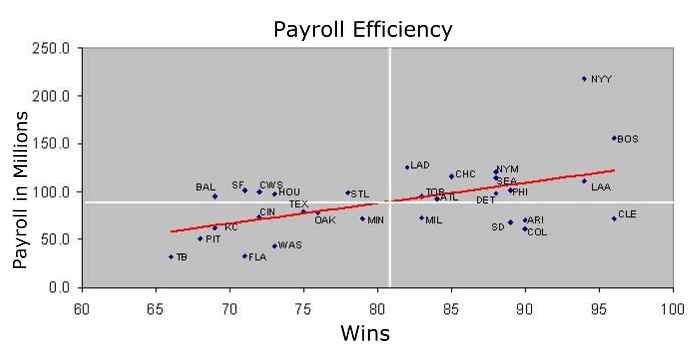
Based on this graph, we can categorize teams by the four quadrants as well as by the trendline. Starting in the upper-right end of the graph and moving clockwise, the northeast quadrant includes teams that won more games than average with a higher-than-average payroll. The southeast quadrant depicts clubs that won more games than average with a lower-than-average payroll. The southwest quadrant includes teams that won fewer games than average with a below-average payroll. The northwest quadrant lists teams that won fewer games than average with a higher-than-average payroll.
The red trendline indicates the positive correlation of team payroll and wins. The correlation coefficient works out to 0.5328. Teams above the line were less efficient and teams below the line were more efficient in terms of getting the most bang for their buck (as measured by payroll and wins).
Due to the fact that it's the goal of all teams to win the World Series, I'm going to excuse Boston from any list of inefficient clubs. Yes, the Red Sox paid up for their success, but it's hard to argue with the fact that they won it all. While Boston may not have been the most efficient in terms of regular-season wins vs. payroll, John Henry, Theo Epstein & Co. were clearly the most efficient in terms of winning World Championships – especially in view of the competition within the division.
Aside from the Red Sox, which teams were the most and least efficient last year?
There were five clubs that won more than 81 games with payrolls under the average of $90.4M. The best of the best was Cleveland, followed by Colorado, Arizona, San Diego, and Milwaukee. To their credit, the Indians, Rockies, and Diamondbacks all made the playoffs with COL advancing to the World Series. Congratulations to Mark Shapiro, Dan O'Dowd, and Josh Byrnes for doing the most with the least. Honorable mention goes to Kevin Towers and Doug Melvin.
The Los Angeles Angels, Philadelphia Phillies, Detroit Tigers, and Atlanta Braves also deserve praise for their payroll efficiency. The Angels and Phillies won division titles before falling in the first round of the playoffs. In the meantime, the Minnesota Twins, Washington Nationals, Florida Marlins, Pittsburgh Pirates, and Tampa Bay Rays should share the award for "doing the best while pinching pennies."
The clubs in the northeast quadrant and above the trendline had mixed results. All of these teams won more than their share of games, but they did so at a cost. In the case of the Yankees, George Steinbrenner, Brian Cashman & Co. did it at a huge cost. Two-hundred-and-eighteen-million dollars huge. New York's payroll was roughly $63 million higher than the No. 2 team (Boston), $128 million above the mean, and more than $186 million or nearly seven times above the lowest payroll (Tampa Bay). The Yankees made the playoffs so it wasn't a total loss. The Chicago Cubs won the NL Central and were the only other team in this group that at least got something in return for their large commitment to player payroll.
Moving to the least efficient teams, Baltimore, San Francisco, Chicago White Sox, and Houston failed miserably in their quest to buy a division title, much less a league or world championship. Mike Flanagan and Jim Duquette (Orioles), Brian Sabean (Giants), Kenny Williams (White Sox), and Tim Purpura (Astros) get the booby-prize award for (mis)managing payroll efficiency. Purpura was fired after the season and was replaced by current GM Ed Wade.
For more information on this subject, be sure to visit the Business of Baseball to check out Maury Brown's article By the Numbers: 2007 Player Payroll for the 30 MLB Clubs. Brown breaks down the data in even more detail, listing teams with the largest increases and decreases in player payroll from Opening Day while ranking playoff teams by cost per marginal win, a concept developed by the late Doug Pappas. In addition, Brown has recently published Unusual MLB Contract Clauses and Salary Arbitration.
| Baseball Beat | January 28, 2008 |
A Public Letter to Buster Olney
Dear Buster,
Thank you for taking the time to engage me in a lively debate about Jim Rice and his Hall of Fame qualifications. I don't know about you, but I believe this discussion is actually about much more than whether Rice should or shouldn't be elected to Cooperstown. I maintain that what we are really at odds over isn't Rice as much as the way we go about evaluating players when it comes time to vote for MVPs, Cy Young Awards, and the Hall of Fame. Rice just happens to serve as an excellent example of the differences in the thought processes that go (or should go) into these decisions.
I would be remiss if I didn't point out that you mischaracterized my comments on Rice and Bert Blyleven in the opening paragraph of your latest response. Rather than incorrectly interpreting what I wrote, perhaps you should have quoted me or linked to my articles so your readers could see for themselves what it is I said or didn't say.
In any event, in the spirit of Bob Rittner's guest column last week, I want to acknowledge our common ground as it relates to Rice. There is no question that Jim was a very good hitter for the vast majority of his career with the Boston Red Sox in the 1970s and 1980s. I would even go so far as to say that he was an outstanding hitter from 1977-1979 and in 1983 as well. Rice led the American League in total bases in all four of those seasons. That is a terrific accomplishment.
As you have pointed out on at least one occasion, Rice also topped the majors in RBI and hits from 1975-1986 and placed third in HR and fourth in OPS during that 12-year period. All of these rankings speak well of Rice's hitting prowess.
However, in order to fully understand and appreciate Rice's value and place in baseball history, I believe it is important to put his stats into their proper perspective. I would like to do that by focusing on context, consistency (in the application of the stats), and comparability (to other players). Allow me to refer to them as the three Cs.
Context
All players need to be viewed within the context of their era, league, team, place in the lineup, ballpark, and position. In the case of Rice, he played during a period that neither favored pitchers nor hitters. The second half of the 1970s and the decade of the 1980s were a fairly neutral time with respect to scoring runs. However, Rice benfited to a significant degree by playing his entire career in Boston. The team's home games were played at Fenway Park, which ranked as the AL's #1 or #2 most friendly ballpark to hitters in 13 of Rice's 14 full seasons (including nine years in which it was #1). As such, it follows that Rice's raw stats need to be adjusted.
Based on your skepticism of Adjusted OPS (or OPS+) as a measurement tool, I believe it is instructive to look at Rice's home (.320/.374/.546) and road (.277/.330/.459) splits to see how he performed in a more neutral environment. To the extent that Rice tailored his swing or game for Fenway Park, he should definitely get credit for his home performance above and beyond the park factor. This nuance is actually accounted for in Rice's career OPS+ mark because it only dings him about 3.5% or one-half of the average park factor of 107 and not for his total outperformance at home.
Sure, Carl Yastrzemski and Wade Boggs took advantage of Fenway, too. But Yaz and Boggs both had higher peaks and better career totals than Rice. Yastrzemski was a better left fielder and Boggs played a more vital defensive position to boot.
Context is also an important consideration with respect to counting stats such as runs batted in and hits. Opportunities play a big role in both. I covered these matters in detail two weeks ago and believe many of Rice's counting stats were largely a function of his opportunities. His career totals were definitely solid but not overly special. Combining counting stats with rate stats allows us to judge quantity and quality. A player's longevity, efficiency, and peak value are all part of the puzzle.
A player's position is another contextual item. The fact that Rice played LF for about 75% of his career and DH for the other 25% – and was generally viewed as a slightly below-average fielder – means he was basically a hitter and little else. I'm not arguing that he didn't hit; instead, I'm just trying to put his offensive contributions in their proper light. All else being equal, players on the left side of the Defensive Spectrum (DH | 1B | LF | RF | 3B | CF | 2B | SS) are less valuable than those on the right side.
Consistency
In order to have meaning, statistics and statistical profiles need to be applied consistently from one player to the next. If using a 12-year period to measure Rice's worth is fair as you suggest, should we not apply this same window to all time frames and players?
Joe Carter, for example, led the majors in RBI for four consecutive 12-year periods (1984-1995, 1985-1996, 1986-1997, and 1987-1998). He also led the majors in HR for those first two 12-year periods. Carter was a better baserunner than Rice, played on two World Series championship teams, and slugged one of the most famous home runs in the history of the game. The point of this exercise isn't to suggest that Carter is a HOFer; rather, it is to downplay the significance of Rice's rankings during his best dozen years.
You have also made a big deal out of Rice's standing in so-called MVP Shares. Along the lines of your disdain for OPS+, "if this [is] your be-all, end-all statistic, keep in mind that" . . . Dave Parker had more MVP Shares than Jim Rice, Juan Gonzalez had more MVP Shares than Rickey Henderson, and George Bell had more MVP Shares than Robin Yount even though the latter won two MVPs and was a first-ballot HOF selection.
Comparability
Is Rice the best player not in the Hall of Fame? Is he even the best outfielder not in the Hall of Fame? Seriously, is Rice really better than Andre Dawson, Dwight Evans, Dale Murphy, and Dave Parker? I don't see it myself. I will concede that a proponent of Rice could make a case that he is as good as these four outfielders (none of whom are in the HOF), but I can't for the life of me understand how somebody could claim that he was sufficiently better and deserved enshrinement over the others. By my way of thinking, if Rice is a Hall of Famer, then so are Dawson, Evans, Murphy, and Parker.
POS PA TOB TB AVG OBP SLG OPS+ WS WARP3
Dawson CF-RF 10769 3474 4787 .279 .323 .482 119 340 105
Evans RF 10569 3890 4230 .272 .370 .470 127 347 120
Murphy CF-RF 9040 3125 3733 .265 .346 .469 121 294 86
Parker RF-DH 10184 3451 4405 .290 .339 .471 121 327 85
Rice LF-DH 9058 3186 4129 .298 .352 .502 128 282 83
If Win Shares (WS) and Wins Above Replacement Player (WARP3) are too esoteric, that's fine. But please note that both measures account for defense as well. Three Win Shares equal one win. As such, both Win Shares and WARP paint a similar picture. Notably, scores of 300 WS and 100 WARP generally equate to Hall of Fame-caliber careers. There are exceptions on both sides of these magic numbers, particularly in the case of players that had short careers but extraordinary peaks (like Sandy Koufax).
I will grant that Rice may have been the best hitter of the fivesome (by the narrowest of margins), but he played the least important position and was the least competent defensively. Dawson, Murphy, and Parker were certainly better baserunners at their peaks, giving each of them a modest plus in this department as well.
Mix in the MVPs and Gold Gloves if you will, shake it all up, and how can one justify Rice's Hall of Fame worthiness over his fellow outfielders? A rational analysis would suggest it is virtually impossible. If you're a big Hall guy, then go ahead and continue to vote for Rice. But you should be voting and pushing for Dawson, Evans, Murphy, and Parker, too.
Although I don't expect to sway your vote as it relates to Rice, I'm hopeful that our debate will give you (and others) pause when filling out your ballot in the future. All of us love stats in one form or fashion, but they are most relevant when viewed in their proper context and applied consistently so that player comparability can be truly evaluated.
Respectfully submitted,
Rich Lederer
| Baseball Beat | January 23, 2008 |
The Search for the Truth Continues
Rob Neyer's wish ("here's hoping it lasts the rest of the winter") is coming true. Buster Olney responded to my article yesterday.
Rich Lederer has another post in our ongoing Jim Rice debate. Rich writes, "Despite protestations to the contrary, those of us who oppose Rice's candidacy are not viewing him through a "time-machine prism" or "offensive formulas tailored for the way the game was played in the '90s."The quoted words are mine. Rich goes on to cite an example of skeptical words written about Rice in 1985: "Virtually all sportswriters, I suppose, believe that Rice is an outstanding player. ... If someone can actually demonstrate that Jim Rice is a great ballplayer, I'd be most interested to see the evidence."
Those words belonged to Bill James, whom Rich and I both view (I assume) as an extraordinary visionary.
With this, Rich absolutely demonstrates one of my primary points about Rice. Bill James was someone who was years (decades?) ahead of his time in evaluating the value of walks and on-base percentage. But he wasn't only ahead of sportswriters, but ahead of managers, coaches, general managers and scouts, who placed value judgments on what they viewed as the proper approach to the game. Jim Rice, as a middle-of-the-order slugger, was expected to drive in runs. That's how he was evaluated, that's what he was expected to do, that's what he did well, that's why he was among the game's highest-paid players.
Guys who hit in the middle of the lineup and drew a lot of walks were viewed by the old guard, in some respects, as selfish players who refused to put their batting average at risk for the betterment of the team. I spoke about this last week with Jayson Stark, in regards to Mike Schmidt, a slugger who drew a lot of walks, and Stark specifically remembered Schmidt -- a '70s star who really played a 21st style of baseball, with lots of home runs, walks and strikeouts -- drawing criticism from peers for his approach. Sure, a Schmidt or Rice base on balls leading off an inning was a good thing, but if there were runners on base, the feeling was that they needed to swing the bat; they needed to drive in runs. Ted Williams, another slugger who drew a lot of walks, was subject to the same sort of scrutiny, as Peter Gammons recalled in a phone conversation the other day. Rice, on the other hand, knew he was expected to drive in runs, as Peter recalled.
Just two players drove in 85 or more runs in 11 seasons in the 12-year period of 1975-1986, and Rice almost certainly would've been 12-for-12 if not for the 1981 strike. In the eyes of the people he played for, he did exactly what a middle-of-the-order hitter should do. Honing his command of the strike zone and drawing walks, alongside all of those hits he generated, was not what his employers wanted him to do.
James ran the numbers and recognized the flaws in this manner of thinking. He was ahead of his time, and now almost everybody in the game has embraced his view. The thinking of hitters and evaluators has completely shifted: A middle-of-the-order hitter who refuses to take walks and trust the hitters behind him to drive in runs is now viewed, within the game, as being selfish.
But James cannot both be a visionary and an example of evaluation at that time, as Rich has used him above. It's one or the other. By the standards of the time -- and RBI unquestionably was the primary standard for the sluggers who played and for those who managed and evaluated -- Rice was exceptional, and he honed his game to that end. He swung the damn bat. The managers he played for and against respected him for it, the executives he played for paid him handsomely for it, and given the standards of his time, the sportswriters rewarded him with a staggering portion of MVP votes. In the James quote above, he takes issue with sportswriters, but he easily could've inserted "managers" or "general managers" or "players" into that sentence.
The RBI way of thinking seems, these days, as outdated as drawing blood with leeches. But Rice did his work within those parameters, and within that context, he was among the best in the game. We cannot go back now and say, Hey, Jim, remember all those times when you swung at pitches just off the plate as you tried to put the ball in play and drive in those runners, because you thought it was your job, because Derrell Johnson and Zimmy and John McNamara and their bosses thought it was your job? Well, we're here to tell you now, in the 21st century, that was a bad idea. You should've taken the walk. So forget it, you played the game the wrong way. We know this because your Adjusted OPS+ -- a statistic no ballplayer or manager or GM ever heard of until after you retired -- is poor. Oh, sure, you drove in a lot of runs, but we're here to tell you, 20 years later, that RBI is a junk stat.
I majored in Civil War history, so please excuse this completely inappropriate analogy between war and baseball: This is like suggesting now that Ulysses.S. Grant was a lousy general because he lost staggering numbers of men attacking entrenched positions. Rather, we should attempt to view his decisions through the evolving technology and tactics of war. Through that horrible vantage point, he was necessarily a tough and brilliant general.
No one can dispute that Rice was either the best or among the best RBI men in the AL for more than a decade, and for power hitters, this was the stat that defined them. That was the accepted vantage point of the time. To retroactively dismiss RBI seems utterly insane. Nicolaus Copernicus thought the sun was the center of the universe, wrongly, but that doesn't mean he wasn't exceptional for his time.
(And in case anyone hasn't noticed, I have not used the word "fear" one time in this conversation with Rich. At least I think I haven't.)
Olney is zeroing in on RBIs (or "RBI" as my Dad taught me). Although it is far from my stat of choice, let's take a look at the American League leaders in RBI since 1950:
1950--Walt Dropo 144
Vern Stephens 144
1951--Gus Zernial 129
1952--Al Rosen 105
1953--Al Rosen 145
1954--Larry Doby 126
1955--Ray Boone 116
Jackie Jensen 116
1956--Mickey Mantle 130
1957--Roy Sievers 114
1958--Jackie Jensen 122
1959--Jackie Jensen 112
1960--Roger Maris 112
1961--Roger Maris 142
1962--Harmon Killebrew 126
1963--Dick Stuart 118
1964--Brooks Robinson 118
1965--Rocky Colavito 108
1966--Frank Robinson 122
1967--Carl Yastrzemski 121
1968--Ken Harrelson 109
1969--Harmon Killebrew 140
1970--Frank Howard 126
1971--Harmon Killebrew 119
1972--Dick Allen 113
1973--Reggie Jackson 117
1974--Jeff Burroughs 118
1975--George Scott 109
1976--Lee May 109
1977--Larry Hisle 119
1978--Jim Rice 139
1979--Don Baylor 139
1980--Cecil Cooper 122
1981--Eddie Murray 78
1982--Hal McRae 133
1983--Cecil Cooper 126
Jim Rice 126
1984--Tony Armas 123
1985--Don Mattingly 145
1986--Joe Carter 121
1987--George Bell 134
1988--Jose Canseco 124
1989--Ruben Sierra 119
1990--Cecil Fielder 132
1991--Cecil Fielder 133
1992--Cecil Fielder 124
1993--Albert Belle 129
1994--Kirby Puckett 112
1995--Albert Belle 126
Mo Vaughn 126
1996--Albert Belle 148
1997--Ken Griffey Jr. 147
1998--Juan Gonzalez 157
1999--Manny Ramirez 165
2000--Edgar Martinez 145
2001--Bret Boone 141
2002--Alex Rodriguez 142
2003--Carlos Delgado 145
2004--Miguel Tejada 150
2005--David Ortiz 148
2006--David Ortiz 137
2007--Alex Rodriguez 156
If RBI is an indicator of greatness, why is it that only nine leaders (covering 11 seasons) from 1950 to 1994 (chosen to accommodate eligible candidates) have been inducted into the Hall of Fame? Sure, Jim Rice led the AL in RBI twice. But so did Al Rosen, Jackie Jensen, Roger Maris, and Cecil Cooper (as well as Vern Stephens if we also include 1949). Moreover, Cecil Fielder and Albert Belle each led the league three times. None of these players are in the Hall of Fame. In fact, other than Maris, not a single one of these players ever received even 10% of the vote. Cooper failed to get any votes at all, while Fielder was named on just one ballot.
The most damning evidence against Rice in the case of RBI is the fact that Eddie Murray is the only player who ever led the league during Rice's 14 full seasons and was later elected to the Hall of Fame. George Scott, Lee May, Larry Hisle, Don Baylor, Hal McRae, Tony Armas, Don Mattingly, Joe Carter, George Bell, Jose Canseco, and Cooper all led the league in RBI and only Donnie Baseball ever picked up 5% or more of the vote.
As far as Olney's hypothetical comments to Rice (see the italicized statements above), nobody said or is saying that he "should've taken a walk" or that he "played the game the wrong way." We're only evaluating what it is Rice did and what it is he didn't do. That's all. Roberto Clemente, Rod Carew, George Brett (save 1985-1988), Paul Molitor, and Tony Gwynn didn't walk much either, yet I don't think you will find many people who believe these players are undeserving of the Hall of Fame.
The fact that "no ballplayer or manager or GM ever heard of" Adjusted OPS "until after (Rice) retired" suggests that he would have fared better in this stat had he only known about it. That not only seems silly to me but contrary to any and all evidence, such as the fact that Rice walked at the same rate with nobody on base and with runners in scoring position (7.0% of plate appearances in both cases) [hat tip to tangotiger]. Look, OPS+ is a measurement tool. And it's not overly complicated either. You see, when you get right down to it, the factors that go into Adjusted OPS – singles, doubles, triples, home runs, walks, hit-by-pitches, and outs – have been tracked since the turn of the previous century. OPS+ simply takes these stats and adjusts them for context (i.e., era, league, and ballpark). Is it a perfect stat? No. But it is a telling stat and one that shouldn't be dismissed, whether Rice and others knew of it or not.
| Baseball Beat | January 22, 2008 |
Search for the Truth
In Rob Neyer's Friday Filberts, he made a keen observation that perhaps has been lost in the debate over Jim Rice's Hall of Fame worthiness.
• Rich Lederer and our own Buster Olney have devoted space this week in their respective venues to an entertaining back-and-forth that's ostensibly about Jim Rice but is really about something much deeper than one man's Hall of Fame candidacy. Highly recommended for the quality of the writing alone, and here's hoping it lasts the rest of the winter.
I totally agree with Rob's take on this matter. I'm not nearly as interested in whether Rice gets elected to the HOF as I am in shaping the thought process. If Rice gets in, he gets in. I'm not going to lose any sleep over the matter. I just don't want to be standing in the way of the cattle call when Andre Dawson, Dale Murphy, Dave Parker, Dwight Evans, and even George Foster storm the front door to Cooperstown.
Although Olney and I disagree on the bottom line (i.e., Rice's inclusion or exclusion), in some ways, it's neither here nor there. What is here and there is the way we go about evaluating players. Despite protestations to the contrary, those of us who oppose Rice's candidacy are not viewing him through a "time-machine prism" or "offensive formulas tailored for the way the game was played in the '90s."
For proof on this very subject, let's take a look at what Bill James had to say about Rice in the 1985 Baseball Abstract:
Virtually all sportswriters, I suppose, believe that Jim Rice is an outstanding player. If you ask them how they know this, they'll tell you that they just know; I've seen him play. That's the difference in a nutshell between knowledge and bullshit; knowledge is something that can be objectively demonstrated to be true, and bullshit is something that you just "know." If someone can actually demonstrate that Jim Rice is a great ballplayer, I'd be most interested to see the evidence.
How great is that? I mean, Bill's not saying that now. Instead, he made that statement 23 years ago while Rice was still playing!
And, again, it's not about Rice per se. It's about the search for the truth.
James opened up our eyes – and our minds – by challenging the conventional wisdom and proving it wrong in so many cases. More than anything, he taught us to ask questions. Thanks to Bill, we have learned the importance of dealing with questions rather than answers.
With the foregoing in mind, here are eight questions for Rice's supporters and undecided voters to ponder when filling out their ballots next year:
- To what extent were Rice's career totals positively affected by playing home games his entire career at Fenway Park, known as a hitter friendly ballpark?
- If Rice gets credit for leading the majors in RBI from 1975-1986, then shouldn't he be debited for topping all players by an even wider margin in GIDP during that same period?
- Was Rice as great as his RBI totals would indicate or were they heavily influenced by the fact that he ranked in the top seven in runners on base in nine of those 12 years?
- Can we ignore that Rice produced the second-most outs during these same dozen years?
- Did Rice play a difficult defensive position?
- Was Rice a Gold Glove-caliber fielder?
- Was Rice a "plus" baserunner?
- In other words, was Rice really as good as advertised?
The greatest change since Rice's playing days hasn't been the acceptance of OBP as a noteworthy stat as it has been in recognizing that many long-held beliefs based on traditional stats are as much a function of the era, league, team, lineup, and ballpark as anything else. Stats don't tell the entire story but the *right* stats tell us most of what we need to know.
Take, for instance, Bert Blyleven and Jim Palmer. One of the knocks against Blyleven is that he wasn't one of the most dominant pitchers of his era. The conventional wisdom says that Palmer was dominant and Blyleven wasn't. To that, I say, "Really?"
Can we accept a stat that measures the number of runs that a pitcher saved versus what an average pitcher would have allowed (adjusted for park differences) as a reasonable proxy to judge effectiveness?
Well, if we can, what would you say if I told you that Blyleven led all pitchers in Runs Saved Against Average from 1973-1977? Yes, all pitchers. Not just Palmer. But Tom Seaver, Phil Niekro, Gaylord Perry, Steve Carlton, Nolan Ryan, and Don Sutton, too?
Furthermore, what would you say if I told you that Palmer won three Cy Young Awards during those five years and that Blyleven received one third-place vote during that same time? I mean, would you scratch your head and wonder if the Cy Young voting process was flawed? If nothing else, wouldn't you want to consider facts outside the simple tasks of counting CYA and All-Star games?
Moreover, what would you say if I told you that Blyleven led the majors in RSAA in not just one five-year period but in four consecutive five-year periods? Yes, it is a fact. Blyleven saved more runs than any pitcher from 1971-1975, 1972-1976, 1973-1977, and 1974-1978. It seems to me that he was probably the best pitcher during that time period, no? If Bert wasn't the greatest, he was certainly one of the most dominant, don't you think?
In the spirit of asking questions, is it possible that Palmer benefited by working his home games in a ballpark that was more friendly to pitchers than Blyleven? The answer is "yes." Palmer pitched in Memorial Stadium while Blyleven toiled in Metropolitan and Arlington Stadiums. The difference in park factors averaged a tad over 7% per year.
Is it also possible that Palmer benefited by having a superior defense playing behind him? During his Cy Young seasons, Palmer had Mark Belanger at shortstop, Bobby Grich at second base, and Paul Blair in center field. He also had Brooks Robinson at third base in two of those three years. Belanger, Grich, Blair, and Robinson are among the best defensive players at their position in the history of the game. Blyleven, on the other hand, had Danny Thompson and Rod Carew as his middle infielders.
You see, there are answers in these questions. Better yet, knowledge.
As for my *debate* with Olney, I'm proud that we behaved in a mature and civil manner while arguing the message and not the messenger. Writing opposing views in a public discourse like this is healthy and can go a long way in our search for the truth, which is what these exercises should be all about.
| Baseball Beat | January 21, 2008 |
Hot Dog Links
My pal Alex Belth wrote a terrific literary piece on Ray Negron, entitled "Inside Man: A Bronx Tale." Although he published it as a Bronx Banter exclusive, the four-part series could have easily appeared in the New York Times Magazine or the New Yorker. It is that good.
Negron has been with the Yankees off and on for more than 30 years. He started as a batboy in the early 1970s and worked his way up to special advisor to George Steinbrenner. As Belth wrote, "Negron has done everything from shine the players' shoes and collect their dirty jockstraps, to bring them food from their favorite restaurants and park their cars. He has been an agent, an actor, an advisor, and a liaison; a confidant, a sounding board and a whipping boy to some of the biggest egos in the game. He is whatever he needs to be."
Here is an excerpt from the story, which was written last summer:
Ray is philosophical about his future with the Yankees. "Let's face facts, I'm not going to be with the Yankees forever, so I'm trying to find a niche for myself. Look, the Boss has told me that as long as he's here, I'd always be a Yankee, and that's all I can go by. George is here, I'm a Yankee, and that's the bottom line. Someday, he might not be here—or I may not be here—then the new people, the new regime might say, 'Okay, that's enough, get him outta here.' And I've come to grips with that."
Due to the unedited quotes, the timely article, which comes complete with photos and illustrations, is recommended for mature audiences. Hurry over to Bronx Banter and read about Negron, Steinbrenner, Reggie Jackson (who Ray nudged out of the dugout for a curtain call after the slugger hit his third consecutive home run in the deciding game of the 1977 World Series), Dwight Gooden, Darryl Strawberry, and much more.
Tulowitzki (.291/.359/.479) slugged 24 HR while driving in 99 runs and scoring 104 times. He placed second (behind Ryan Braun) in the National League Rookie of the Year balloting and should have won a Gold Glove for his outstanding fielding. He topped all shortstops in fielding percentage (.987) and ranked first at his position in Jon Dewan's Plus/Minus fielding ratings.
My former partner Bryan Smith recently brought to my attention a scouting report I gave in a One on One: Amateur Hour conversation between us in May 2005.
Tulowitzki is the real deal. I wouldn't hesitate taking him number one in the draft. He is that good. Everybody knows the comparisons to Bobby Crosby. He's got the size, a powerful arm, a good glove, 4.2 speed, and plus power. What might not be so well known is that Troy also has the energy, enthusiasm, and leadership skills reminiscent of Miguel Tejada. This is a guy who could make it to the majors by September 2006 and has as good a shot at being named Rookie of the Year in 2007 as anybody.
Despite the protestations of mainstream writers to the contrary, they have trouble wrapping their heads around the idea that a hitter can be valuable without flashing a light-tower stroke. These scribes will whine that fans and the league have made a fetish out of the home run, but then cast more ballots for the inferior Jim Rice than they do for Raines. All too often, we’re subjected to generational spats over whether the Moneyball approach to offense (i.e., waiting for your pitch and hitting it out of the park when you see it) is better than the traditionalist’s beloved “small ball” game (bunts, hit-and-run, stealing bases, being aggressive at the plate). We know that the former leads to more runs, but it’s odd that the shrillest advocates of the latter would abandon Raines, who played the small-ball way better than almost anyone else. Somehow, though, they’ve turned their backs on him.So, apparently, power matters to the writers except when they’re grouchy over the fact that bloggers/Web-based writers/stat geeks/kids on their lawns happen to like power.
Got it? It all raises the possibility that they don’t believe their own words. The truth is that Raines is a Hall-of-Fame caliber player regardless of how you think the game should be played. That he’s been so inexcusably dismissed by the writers speaks to the flawed nature of the process. Fans, however, are free to recognize Raines as one of the greats regardless of whether or not he ever gets the Cooperstown imprimatur.
As for the writers, we’ll leave them with their rank inconsistencies and their extra-large helpings of cognitive dissonance.
Update: Jeff Albert, who was a guest columnist and contributing writer to this site in 2006 and 2007, recently was hired by the St. Louis Cardinals as the organization's batting coach at Batavia (A) of the New York-Penn League. Here is an excerpt from the "Cardinals announce Minor League field staffs" press release:
Jeff Albert has been hired as hitting coach at Batavia. Albert played collegiate baseball at the Division 3 and Division 1 levels, with a couple of stops among independent professional teams. He began working on instruction and strength and conditioning with high school, college and professional players shortly thereafter and is owner and operator of swingtraining.net, which is a site dedicated to baseball training and analysis.
Best wishes to Jeff, who is weeks away from graduating with a Master's in Exercise Science at Louisiana Tech. He will report to the team's minor league spring training facility in Jupiter, Florida on March 1. Congratulations!
Late Add: Peter Gammons, who makes "no bones about (his) strong feelings about the human element," wrote a thoughtful piece about the exploration of cyberspace as it relates to politics and sports.
Pure numbers cannot do justice to character and drive and energy. They cannot measure the impact Robin Yount had on teamates when he ran down the first-base line at the same breakneck speed (one scout had nearly 90 Yount games in a six- or seven-year period and claimed he never got Yount faster than 3.9 seconds, or slower than 4.0). Mariano Rivera, Josh Beckett and David Wright are what they are because of who they are.Stat lines cannot quantify work habits, the ability to learn, emotional stability, etc., but they are important guidelines by which to remind us that, in the end, performance counts.
Gammons identifies Jack Morris, George Brett, David Ortiz, and Derek Jeter as examples of players who "transcended the human elements that so alter the sport." He adds, "But those are parts of a greater landscape of arguments." Peter admits that "we all know more about baseball because of the proliferation of creative thought" and lists The Baseball Analysts among approximately a dozen general baseball sites he enjoys, as well as another 15 team-specific sites "club officials read."
| Baseball Beat | January 17, 2008 |
Another Helping of Rice
How do you like your Rice? I'll take mine fried, thank you. Buster Olney, on the other hand, has a completely different recipe for his Rice.
With the above in mind, Olney responded today to my two-part retort to his posts about Jim Rice's Hall of Fame worthiness last Friday and Saturday.
• Rich Lederer strongly disagrees with what was written here in the Jim Rice HOF debate last week, in a couple of pieces you can locate through this link. It's interesting that he says he played APBA and counted the "on base numbers" on the card, an acknowledgement which, as a baseball board game nerd, I fully appreciate. In playing thousands of games of Strat-O-Matic Baseball, and drafting dozens of teams, the system I have always used to evaluate players before any draft (until this moment a closely guarded secret from my Strat-O rivals) was to add up the number of points based on the possible rolls of the dice. In other words, in the '80s, if Wade Boggs had hits against right-handers in Column 1 in slots 5 through 10 (I'm sorry, but anybody who hasn't played Strat-O is going to get lost in this part of the conversation), a walk or hit in Column 2-6, and hits or walks on Column 3-5 through 3-10, he scored 59 on that side of his playing card -- six points for every roll on a No. 7, five points for any roll of Nos. 6 or 8, four points for any roll of Nos. 5 or 9, three points for any roll of Nos. 4 or 10, two points for any roll of Nos. 3 or 11, and a point for a roll of Nos. 2 or 12.I'd go through all the cards and calculate these ratings of all pitchers and hitters versus right-handers and left-handers. This, of course, was a Strat-O-Matic version of calculating on-base percentage. I loaded up on guys who scored the highest in this system, including platoon monsters like Jeff Leonard and Al Newman (who killed lefties) and Dwayne Murphy (who drew tons of walks against right-handers on his '87 card), and I'd trade to get Boggs and Tim Raines; my teams always fared very well. In the early '80s, I drafted Gene Tenace as a backup catcher to pinch hit, because he drew walks, and I would effectively pair him with Ron LeFlore, who I'd keep as a fourth outfielder and as a pinch-runner because of LeFlore's high Triple-A stolen-base percentage. In a close game in the late innings, Tenace could come off the bench to draw a walk and LeFlore would swipe second, and I'd be in business.
But regardless of how Rich or I preferred to play our board games, the reality is that in the '70s and early '80s, many of the executives who ran teams and the managers who managed and the players who played did not value walks the way walks are valued these days. This is partly a function of how the game was played -- the strike zone was larger, there were fewer pitches per plate appearance, and there was more pressure on the hitter to swing the bat. The conventional wisdom was that a middle-of-the-order hitter who took a lot of walks was actually hurting his club (especially if he was a cleanup hitter on a team in a lineup without a lot of depth). Now, was that philosophy flawed, in part? Sure. Folks in baseball should've absorbed Bill James' Baseball Abstracts from the outset (I got my first as a high school graduation present in the spring of '82). But the bottom line is this: Rice's approach to hitting was engrained in the game; guys in the middle of the lineup focused on generating RBIs.
During Eddie Murray's batting practice sessions, he would take a round in which he focused on practiced emergency swings -- awkward hacks at pitches off the plate, or pitches on which he was fooled -- in order to put the ball in play. Why? Because he considered himself an RBI guy, and if there was a runner at third, his focus was to do everything he could to drive the run in. Despite breaking into the big leagues under a progressive manager like Earl Weaver, Murray wasn't thinking about on-base percentage; he defined himself by RBIs. He didn't say at the end of the year, Hey, I had an OBP of .380 and I feel damn good about that.
His first responsibility to the team, he felt (and according to colleague Peter Gammons, Rice had an approach similar to that of Murray), was being in the lineup every day as a reliable teammate, and in this role, he measured himself by RBIs -- more than 80 in 17 of the first 19 seasons of Murray's career. As Peter remembers, Rice felt enormous pressure to drive in runs, and this was not merely self-inflicted. With runners on first and second base and one out and the Red Sox down a run and the count 2-1, he was going to swing at a fastball on the outside corner with the intent of driving in the run.
Rich might not like it, and it might not make a lot of sense in today's OBP world, but that is the way sluggers were taught and expected to think. Ted Williams was one of the sluggers who took walks, refusing to swing at pitches out of the strike zone. Look at the year-to-year leaders and you can see that the elite players tend to walk and strike out more than they used to.
Football has some parallels. Johnny Unitas is regarded, in football history, as one of the greatest quarterbacks in history. And if you look at his completion percentages and quarterback ratings and interception rates, you could, at first glance, ask: What's the big deal? There were four quarterbacks who had higher ratings this year than Unitas did in his best season. His completion percentage would be pedestrian in the modern game, a skill that you might think would translate in a conversation about eras, in the same way that you might think that Rice should've drawn more walks.
But if you talk to anyone affiliated with the NFL in Unitas' era and what they will tell you, without hesitation, is that Unitas was The Man. The game was just different.
There was one thing that Rich wrote that really caught my eye, about past MVP Award results: "At the risk of speaking on behalf of serious fans and students of the game, I believe we would all like for the MVP voting to be a 'barometer' of Rice's [and everyone's] play. We're not 'ignoring the MVP voting entirely.' Instead, we're just discounting it."
I'm sorry, but I guess I'll never be such a serious fan or student of the game that I would discount the information generated in hundreds of MVP votes cast in 14 AL cities during Rice's time as a player. I'll never be such a serious student of the game that I would presume that the past voters like Peter Gammons, Ross Newhan, Tim Kurkjian, Tracy Ringolsby, Ken Rosenthal, Richard Justice, Gerry Fraley, Moss Klein, Bob Nightengale, Bob Elliott and others who spent 10-12 hours a day in ballparks eight months a year didn't know what they were watching. I'd never presume they were simply ignorant in giving Rice all those MVP votes he collected through the years.
And I've always assumed there is plenty of room for opinion and interpretation in the game. Rich's point of view is not wrong; it's his opinion. And I have my own.
Olney and I clearly disagree on Rice's value and place in baseball history. Even though we both own the 1982 Bill James Baseball Abstract, we also don't agree on how an offense functions.
As it relates to APBA and Strat-O-Matic, I never drafted or traded for Jim Rice in my ten-year stint in the Greater Los Angeles APBA Association. I just was never attracted to the fact that he was a below-average ("OF-1") or average ("OF-2") fielder, a below-average ("S") or average baserunner (neither "S" or "F"), rarely walked (averaged 2 "14"s on his card), didn't steal bases (never had an "11" and rarely had a "10"), and grounded into lots of double plays ("24"s). His strengths were limited to the fact that he had three or four "power numbers" ("0-6") on his card and normally had a couple of "7"s (which generally resulted in singles against most pitchers).
Just like in "real" baseball, Rice was a low on-base, high-slugging type hitter. Yes, he could drive in runs but wasn't adept at creating as many runs as the best players. I was much more attracted to players who could hit for power and get on base. Walks were valuable back then. It didn't matter if one was managing an APBA or major league team.
In Rice's rookie year, the Cincinnati Reds led the major leagues in walks and won the World Series (ironically beating the Red Sox in seven games). The Reds also led the majors in BB the following year while winning the World Series once again. Throughout baseball history, teams that have ranked at or near the top in drawing or preventing walks have won much more often than they have lost. For offenses, getting on base is of paramount importance – it always has been and always will. For defenses, keeping runners off base is basically what it has been, is, and will always be about. It's just a simple truism.
As it relates to my APBA playing days, I traded for two of Rice's fellow outfielders – Dwight Evans and Fred Lynn – yet never even thought about acquiring him. Like in "real" baseball, he was a good hitter but was limited in all other phases of the game. Evans and Lynn also hit well but got on-base more often via walks and were significantly better defensive players. In my mind, Rice was basically the equal of George Foster – and I never traded for him either. However, I owned Dave Parker during his peak years because he was a better hitter, better baserunner, and a better fielder than Rice.
Following the 1981 season, I made sure to trade for the number one draft pick and took Tim Raines even though many other league members were partial toward Fernando Valenzuela. Raines was one of the very best players in the game. He got on base frequently, stole bases often and at a record clip, and was as valuable at scoring runs as the Rices and Fosters were in driving them in. I knew what was important back then, and I know what is important today.
With respect to the Johnny Unitas example offered by Olney, I think he is missing the point. Johnny U. was outstanding in his day and remains one of the top QBs in the history of football despite the fact that present-day passers have surpassed his records. Relative to his era, Unitas was fantastic. Nothing will ever change that. The fact that his "completion percentage would be pedestrian in the modern game" has zero impact on his status as one of the all-time greats of the game.
I respect many of the writers Olney mentioned, and I value their opinions. It's not a matter of whose viewpoints carry more weight as much as it is about understanding and appreciating what wins and loses games. Just as no one stat is says it all, no one person or groups of persons knows it all. Beat writers, baseball columnists, statisticians, analysts, scouts, players, managers, coaches, umpires, general managers, owners, fans . . . all of us have a perspective that is neither better nor worse than the others based on our employment alone.
My Dad was a sportswriter who covered the Los Angeles Dodgers from 1958-1968. He never missed a game in 11 years. As such, he probably saw more games than any other beat writer during those years. A member of the Baseball Writers Association of America, he voted for MVP and Cy Young Awards in his day. He also voted for the Hall of Fame up until his death in 1978. Dad was also the statistician for the Dodgers, maintaining game logs, home and road, left- and right-handed splits, etc. well before doing so became popular.
A little bit of my Dad rubbed off on me. I grew up going to games at the Coliseum and Dodger Stadium, and playing Little League, Pony League, Colt League, Connie Mack, American Legion, and high school baseball. I played fast-pitch softball for 10 years. I played APBA during the 1960s, 1970s, and 1980s. I have been a participant in one of the longest-running fantasy leagues for more than 25 years. I coached my son's Little League team. I have attended dozens of games every year of my adulthood and have subscribed to MLB Extra Innings since 2001. Heck, I've even dabbled as a writer and analyst for the past five years.
I own all 12 of the Bill James Baseball Abstracts, and have read every book from cover to cover. I'm not an expert, but I pride myself on having an open mind when it comes to learning more about this great game. I can only hope that those who have been given the privilege of voting for MVPs, Cy Youngs, and Hall of Famers will be equally open minded when it comes time to fill out their ballots.
[Additional reader comments at Baseball Primer Newsblog.]
| Baseball Beat | January 15, 2008 |
"Listen, Buster" Redux (Part Two)
Moving on to Olney's second article (after reviewing his first piece yesterday), Buster begins by mentioning that he received a lot of email over his Friday piece and then jumps into a discussion on Adjusted OPS (aka OPS+).
Adjusted OPS+ is a useful number. And if this your be-all, end-all statistic, keep in mind that:Mark McGwire and Frank Thomas rank higher than Willie Mays, Hank Aaron and Joe DiMaggio.
Jim Thome ranks higher than A-Rod and Gary Sheffield.
Lance Berkman ranks higher than Ken Griffey Jr.
Brian Giles ranks higher than George Brett, Al Kaline, Orlando Cepeda, Tony Gwynn, Rod Carew and Roberto Clemente.
Adam Dunn ranks higher than Eddie Murray.
I'm not sure where to start here. But let me say that OPS+ should not be anyone's "be-all, end-all statistic." On this front, Olney and I agree. No single stat, in fact, should be viewed in such a manner.
More than anything, Olney's comparisons demonstrate a lack of understanding and appreciation for walks and OBP. Every player that he questions is well known for his ability to get on base by taking a walk. Maybe it's just me, but I don't find it so outrageous that Frank Thomas (157) has a higher OPS+ than Willie Mays (156), Hank Aaron (155), or Joe DiMaggio (155). That said, I believe Olney's splitting hairs here. These four players all have virtually identical OPS+ totals.
OPS+ measures hitting, not fielding or baserunning. Thomas was a great hitter – one of the best ever. However, the Big Hurt's offensive prowess doesn't mean he was a better player than the Say Hey Kid, Hammerin' Hank, or the Yankee Clipper. Mays and DiMaggio were two of the best defensive center fielders of all time, Aaron was a quality right fielder, and all three ran the bases extremely well. Thomas was a poor fielding first baseman or a DH and was a slow runner for the vast majority of his career. Shake it all up, and I'm quite certain that every reputable baseball historian and analyst would take Mays, Aaron, and DiMaggio for their all-round play over Thomas. But that doesn't detract from Thomas' hitting or from OPS+ as a measurement of offensive production (ex-baserunning).
Jim Thome (.281/.409/.565) over Gary Sheffield (.296/.397/.522)? Sounds plausible to me. Thome has out-homered and out-walked Sheffield in 1726 fewer plate appearances.
Adam Dunn over Eddie Murray? Oh my gosh, who thought of this stat anyway? Comparing a career rate stat for a player through his 27-year-old season to another who played up to the age of 41 tells us more about Olney than it does either Dunn or Murray. But, if the truth be known, Murray had a higher OPS+ (143) than Dunn (130) at a comparable point in their careers.
And if you think that Adjusted OPS+ is a set of numbers that generally creates a level statistical playing field for all of the eras of baseball, then you'd have to ignore the following. Of the top 63 players all time in OPS+, there are: Nineteen players who performed the bulk of their careers in the years leading up to 1920.Eight players who performed the bulk of their careers in the years from 1920-1939.
Seventeen players who have performed the bulk of their careers from 1990-2007.
And a total of 17 players from the 50-year period of 1940-89.
That all may be true. However, I'm not sure why Olney chose to measure the "top 63", but nine of the top 24 (if you include Hank Greenberg) are from 1940-1989. That works out to 37.5% of the sample size, which just happens to match the sample period (50 years divided by 132 years). Interestingly, only four of the top 24 career leaders (16.7%) are from 1990-2007 (13.6% of the overall time frame).
Getting back to Olney's point, I don't believe OPS+ is necessarily weakened by the fact that the distribution of superior results may not be equal throughout baseball history. I'm not aware of any statistic that "creates a level statistical playing field for all of the eras of baseball." Take league leaders. There is only one per category each year, yet the number of teams and players has increased over time (as Olney acknowledges in the next section), making it increasingly more difficult to lead the league – or rank among the league leaders – in any stat.
Part of the reason, of course, is there are more teams now. But part of the reason is that in years in which there is less offense, generally, it is more difficult to create a plus/minus disparity in this statistic.
I tend to agree with the latter assertion.
If you don't think that Adjusted OPS+ is a statistic that skews toward the elite players of the Steroid Era, well, then that's your story and you're sticking to it.
OPS+ might be skewed by the higher run-scoring environment and even steroids, but that does not take away from the fact that Jim Rice hit .320/.374/.546 in a highly favorable park environment at home and .277/.330/.459 on the road. His raw counting stats and unadjusted rate stats should not be compared to those from the so-called "Steroid Era," just as they shouldn't be compared to those from the Dead Ball or Live Ball eras.
But Rice's OPS+ should absolutely be compared to players of his own era. I don't think one can quibble with that unless, of course, they don't like what they see. Using Olney's hand-picked years (1975-1986), Rice ranked 11th in OPS+ among players with 4000 or more plate appearances. Jack Clark, Ken Singleton, and Fred Lynn posted higher totals. Greg Luzinski had the same OPS+ as Rice. Keith Hernandez, George Foster, Dave Parker, and Dale Murphy rank directly behind Rice.
I would submit that Foster is a pretty good comp. Same era, same position, same type of hitter/slugger. Both players won an MVP award. Rice led the AL in HR 3x and RBI 2x. Foster led the NL in HR 2x and RBI 3x. Maybe Rice was better. But, if so, the difference between the two was minor (and mostly a function of playing time), yet Foster never received more than 29 votes for the HOF (or 6.9% of the total).
If you place a lot of weight on playing time and counting stats, then perhaps Parker should be viewed more favorably than Rice. Again, both players were from the same era. The Cobra was a Gold Glove-caliber right fielder and a much better baserunner during his peak. Like Rice, he won an MVP. He also led the NL in AVG and SLG 2x, and TB 3x. As it relates to HOF consideration, Parker's vote total peaked at 116 (24.5%) in 1998 and his candidacy has been trending downward ever since.
Joe Morgan, Gary Carter, and Johnny Bench are the only three players with a lower OPS+ during Rice's best years who have been inducted into Cooperstown. None of them played left field indifferently. In fact, all three were outstanding defensively at much more difficult and important positions. And, to be fair to Morgan and Bench, the chosen period didn't capture all of their best seasons.
If we're going to get behind a player from this era, let's focus our time and attention on Bobby Grich. Note that the slick-fielding second baseman ranks 20th in OPS+ during that same period. There are only three non-OF/1B above him on that list. The three? Mike Schmidt, George Brett, and Morgan. Three of the greatest players in the history of the game. But I digress. I'll give Grich, who garnered almost zero support from the voters, his due in a separate article at a later time.
It's not a perfect statistic. There aren't any perfect statistics.
Agree. No single metric is flawless, whether they're counting or rate, unadjusted or adjusted. They all have flaws. None of them are perfect, especially as standalone measures. It's important to put all stats into their proper context.
While I'd generally agree that to focus on building a Hall of Famer's credentials around a single year of MVP voting might be dubious, the numbers cited in Friday's column accounts for hundreds of votes from every AL city over more than a decade. A lot of writers who watched Rice play daily, at the time he was on the field -- rather than through the time-machine prism of Adjusted OPS+ -- thought he was pretty damn good.
I don't doubt or dispute that. But I think it is only fair to point out that writers have always been biased toward RBI (check out the MVP award winners over time for proof) and rarely, if ever, adjusted for park effects – particularly in Rice's day. As a result, I believe it follows that Rice was overrated by writers back then and is benefiting today from the misperception that he was better than he actually was. Importantly, by making this statement, I'm not revising history. The fact that writers "thought he was pretty damn good" doesn't necessarily mean he was pretty damn good.
If you want to quibble with the fact that he won the award in 1978, or with his placement in some particular year, OK, I get that. But to ignore the MVP voting entirely, as if it isn't at least some kind of barometer of his play over the course of his career, is embarrassing. This is like saying, "Hey, forget the Oscar voting of the 1950s. Marlon Brando was clearly overrated."
At the risk of speaking on behalf of serious fans and students of the game, I believe we would all like for the MVP voting to be a "barometer" of Rice's (and everyone's) play. We're not "ignoring the MVP voting entirely." Instead, we're just discounting it. Doing so shouldn't be "embarrassing" to anybody. After all, Roger Maris and Dale Murphy won back-to-back MVPs and never even sniffed the Hall of Fame.
Look, I've never met Jim Rice, didn't grow up a Red Sox fan, don't think he is one of the very elite players of all time. I understand why someone wouldn't vote for him (but don't agree). But to portray his career as entirely unworthy of Hall of Fame consideration is silly.
I've never met Jim Rice either, didn't grow up a Red Sox fan or hater, and certainly don't think he is one of the very elite players of all time. I understand why someone would vote for him (HR and RBI titles plus an MVP). That said, I disagree. When put in the proper context, Rice was not as good as he appears to be on the surface.
| Baseball Beat | January 14, 2008 |
"Listen, Buster" Redux
Buster Olney provides an invaluable service by linking to numerous baseball articles on almost a daily basis. I enjoy skimming Olney's blog (ESPN Insider subscription required) for his notes and links to stay abreast of what others are writing and saying.
Unlike the Baseball Primer Newsblog, which tries to highlight the best (or most interesting) stories irrespective of their origin, Olney's links are nearly always to stories in the mainstream media. However, Buster linked to Baseball Analysts a year ago [editor's note: link is no longer available] when I challenged his rationale for excluding Bert Blyleven from his Hall of Fame ballot.
Olney and I differ not only on Blyleven but on Jim Rice as well. With respect to Rice, Buster wrote two entries in support of him on Friday and Saturday, and I believe there are several fundamental flaws that need to be addressed – especially in light of the fact that the candidate in question finished second in the balloting with 72.2% of the vote and is on the verge of being elected next year in his 15th and final opportunity.
I'm going to excerpt Olney's comments and respond to them on the small chance that Hall of Fame voters will take the time to read this and further evaluate their position on Rice. I'm hopeful that this exercise will also shed some light on a number of basic truths and falsehoods when it comes to analyzing stats so as to improve the process (and the quality of the inductees) in the future.
During Jim Rice's incredible 1978 season, a total of two American League players had on-base percentages over .400: Rod Carew, with .411, and Ken Singleton, at .409. In 2007, eight AL players achieved an OBP of .400 or higher.In fact, in the seven seasons played since the start of 2001, there already have been 42 AL players who have posted OBPs of .400 or better; in the entire decade, of 1970-79, there were only 36 AL players who achieved OBPs of .400 or better. It was a time of less offense and fewer runs, a time when teams didn't value walks the way they do now, a time when the strike zone was larger, a time when hitting 20 homers and driving in 80 runs was an excellent year.
Rice's OBP in 1978 wasn't anywhere close to .400. It was .370. He ranked 12th in that category. Rice, in fact, never finished higher than ninth in OBP in any single season. As such, mentioning Rice and on-base percentage in the same sentence does more harm than good when it comes to discussing his Hall of Fame qualifications.
I don't believe anyone is disputing the fact that runs were more difficult to come by during the 1970s than in the current decade. By the same token, I don't know anyone who is comparing Rice's raw totals to today's sluggers. The case "for" or "against" Rice should be based on how he performed versus the competition over the course of his career. More on that later.
As far as teams not valuing walks the way they do now, I believe there is some truth to that. However, more than anything, I contend writers and voters (both HOF and MVP) have never given walks their proper due. I played APBA during a large portion of Rice's career and used to count how many "on base numbers" players had on their cards. Walks have always been important. If anything, walks were more valuable in Rice's day because bases and runs were scarcer than they are today.
So it's almost laughable to hear and read about how Rice was nothing more than a very good player in his time. Look, if you stick his statistics into offensive formulas tailored for the way the game was played in the '90s, he's not going to look as good. Giving him demerits because he failed to draw walks is like diminishing what Pedro Martinez has accomplished because he has only two 20-win seasons.
Speaking of "laughable," comparing Rice's failure to draw walks to Martinez's lack of 20-win seasons is mixing apples and oranges. Of course, Rice deserves "demerits" for not walking more often. It's not like Rice's lack of walks wasn't his own doing. He has nobody to blame but himself for not earning more bases on balls. As such, Rice's low walk rate detracted from his value as a hitter every time he went to the plate. It was one of the weaknesses in his game. The fact that Martinez only won 20 games twice over the course of his career had little, if anything, to do with his value as a pitcher every time he took the mound.
But, if you want to go down this alley, let's at least be fair about it. To Martinez's credit, he had a pair of 20-win seasons. Rice, on the other hand, never had even one season in which he walked 100 times. (Rice's career high was 62 in 1986.) For context, there have been 54 20-win seasons during Pedro's career. By the same token, there were 72 100-walk campaigns during Rice's career. In other words, winning 20 games has been an even bigger rarity in Martinez's time than walking 100 times in Rice's era.
Olney then spends time pointing out how highly Rice ranked in HR (3rd), RBI (1st), and OPS (4th) from 1975-1986. I generally find such arguments unconvincing because the time frames chosen almost always favor the player in question. To wit, Rice gets the benefit of all 12 years whereas his competition in many cases loses the early or latter portions of their careers in such studies. Nonetheless, I believe it is instructive to see where Rice ranks in outs during this period.
OUTS
1 Steve Garvey 5402
2 Jim Rice 5298
3 Robin Yount 5099
4 Dave Winfield 5069
5 Buddy Bell 5040
6 Dave Concepcion 5025
7 Don Baylor 5006
8 Mike Schmidt 4890
9 Bill Buckner 4887
10 Cecil Cooper 4846
That's right, Rice made more outs than anyone other than Steve Garvey over the course of his 12 best seasons. I make this point not to put Rice down but to show that his counting totals and rankings were highly influenced by the fact that he had more plate appearances (7754) than any player in baseball during this period.
As for RBI, it's important to recognize that Rice benefited from hitting with runners on base much more frequently than most players. In fact, it is one of the reasons why he ranks first by a wide margin in grounding into double plays (GIDP) over this stretch.
GIDP
1 Jim Rice 269
2 Steve Garvey 215
3 Buddy Bell 195
4 Dave Concepcion 194
5 Dave Winfield 186
6 Ted Simmons 185
T7 Bill Buckner 174
T7 Ken Singleton 174
9 Larry Parrish 168
10 Doug DeCinces 167
Put another way, Rice's GIDP and RBI totals are inflated for no other reason than he had so many opportunities to accumulate both. Hitting with runners on base will do that. Rice's backers will build their case around his RBI and ignore GIDP. Those who oppose Rice will mock how many times he hit into a double play and disregard RBI. You can't really view one without the other.
Thanks to Baseball Prospectus, we can check where Rice ranked in RBI Opportunities in each of those dozen years.
RBI Rank | ROB Rank | OBI OBI% Rank
1975 102 5 458 3 80 17.5 9
1976 85 15 391 27 60 15.3 21
1977 114 3 426 17 75 17.6 15
1978 139 1 461 7 93 20.2 4
1979 130 2 474 4 91 19.2 8
1980 86 16 370 33 62 16.8 17
1981 62 10 367 1 45 12.3 53
1982 97 14 466 7 73 15.7 31
1983 126 1 504 2 87 17.3 14
1984 122 2 545 1 94 17.2 10
1985 103 9 496 2 76 15.3 33
1986 110 4 514 3 90 17.5 10
ROB = Runners On Base: the number of runners on base during a batter's plate appearances.OBI = Others Batted In: runs batted in, except for the batter driving himself in via a home run. Equals RBI-HR.
OBI% = Others Batted In Percentage: the fraction of runners on base who were driven in during a batter's plate appearances.
Although Rice led the AL in RBI in 1978 and 1983 and ranked in the top ten nine times, he was among the top three in terms of coming to bat with runners on base in six of those 12 seasons. More telling is the fact that Rice never ranked in the top three in OBI%.
In 1981, Rice had 47 more ROB than any other batter in the AL, yet ranked 10th in RBI because he was 53rd (out of 73 qualifiers) in OBI%. In 1984, Rice had 57 more ROB than anyone else so it should not be surprising that he finished second in RBI that season. Rice had the second most ROB (behind teammate Bill Buckner) in 1985 and the third most ROB in 1986 (behind teammates Buckner and Don Baylor). Hmmm. I wonder if Wade Boggs had anything to do with that?
Rice was a significantly better hitter at home than on the road, hitting .320, with a slugging percentage of .546 and 208 career homers in Fenway, compared with an average of .277 and 174 homers on the road.
Let me display Rice's home/road splits a bit more visually. I'm mean, there's no reason to gloss over something that is so fundamental to Rice's "for" or "against" case than his home and road performance.
AVG OBP SLG OPS
Home .320 .374 .546 .920
Road .277 .330 .459 .789
Rice hit like a Hall of Famer at home and closer to Ben Oglivie (.273/.336/.450) or George Hendrick (.278/.329/.446) on the road.
Let's drill down deeper and see just how Rice fared away from Fenway Park year-by-year. His MLB and AL rankings are nothing more than where his road OPS would have placed among all qualifiers (both at home and on the road).
Road OPS MLB Rank AL Rank
1975 .807 41 18
1976 .746 55 30
1977 .886 19 11
1978 .837 24 15
1979 .809 49 27
1980 .810 40 27
1981 .703 92 50
1982 .859 22 15
1983 .903 7 4
1984 .741 71 42
1985 .743 73 47
1986 .835 28 19
Rice's performance on the road would have ranked him in the top ten in the AL in OPS one time in his entire career. ONCE. Now I recognize that this exercise unfairly penalizes Rice in the theoretical rankings because his Boston teammates get the full benefit and visiting players the partial benefit of playing games at Fenway Park. Bump Rice's rankings up a bit if you would like to compensate for the simplicity in my methodology.
But again, consider the era, and how much less offense there was. If you were a team, you would like to have the guy considered to be most dominant home-field hitter in the game? Of course you would.
Look, Rice wasn't the "most dominant home-field hitter in the game." Olney makes that statement as if Rice would have hit well at any home park. There is no evidence to suggest that at all. Simply put, Rice hit well at home because he played his home games at Fenway Park. From 1975-1986, Fenway's park factor averaged 107.5, meaning it favored hitters by 7.5% over the league average. In 1977, Boston's home park played like Coors Field in 2002.
Rice was taking advantage of the conditions in the games he played, much as Sandy Koufax did. From 1962-1966, Koufax had a home ERA of 1.37, in the pitcher-friendly Dodger Stadium, and a road ERA of 2.57. Does anyone say that this diminishes what Koufax accomplished, the way it is said about Rice?
I don't know anybody who would dispute the fact that Koufax benefited by pitching his home games at Dodger Stadium during the last five years of his career. But to try and compare Jim Rice to Sandy Koufax? Oh my! Koufax's 1.37 ERA at home is much, much more impressive than Rice's .920 OPS at home. But, more to the point, Sandy's 2.57 ERA outside of Dodger Stadium is also much, much more impressive than Rice's .789 OPS away from Fenway.
Like Rice's OPS rankings in the illustration above, Koufax's MLB and NL rankings are nothing more than where his road ERA would have placed among all qualifiers (both at home and on the road). As in the case of Rice, feel free to adjust Sandy's rankings upward due to the simplicity in methodology as well.
Road ERA MLB Rank NL Rank
1962 3.53 26 14
1963 2.31 2 2
1964 2.93 19 10
1965 2.72 16 6
1966 1.96 1 1
Koufax was also much better than generally believed in 1960 and 1961 when his season totals were negatively affected by pitching home games at the Coliseum. His 3.00 ERA on the road in 1960 would have ranked fourth in the National League and sixth in MLB. His 2.77 ERA on the road in 1961 would have topped the senior circuit and placed third overall. It's all a distant memory now but Koufax's 269 strikeouts in '61 broke Christy Mathewson's NL record that had stood for 58 years.
In any event, Sandy's road ERA was good enough to theoretically lead the league two times and finish in the top ten six times in a span of seven seasons! Koufax was not only one of the greatest pitchers ever inside the confines of Dodger Stadium, but he was a terrific pitcher on the road as well. Too bad the same can't be said about Rice's hitting.
I will cover Olney's second article tomorrow, which focuses on Adjusted OPS (or OPS+) and how the adoption of this statistic has unfairly hurt Rice.
| Baseball Beat | January 08, 2008 |
Station Break
One of the rules of thumb that we try to live by at Baseball Analysts is to only write about subjects where we can add value to the discussion. Our goal is to inform, entertain, and engage our readers on all things baseball. But only when we have some insight. Otherwise, we're just filling space and wasting your time.
With the foregoing in mind, we have generally refrained from writing about steroids on this site. In more than four-and-a-half-years and nearly 1300 entries, the word "steroids" has appeared in only 20 articles. Five of them were written by guest columnists and three involved interviews. In all but two cases (including one of the most thought-provoking articles I've ever encountered), the mention of steroids was either tangental to the topic at hand or in jest. Even Sunday's widely read piece by Pat Jordan mentioned the "s" word twice.
I'm going to break with tradition and discuss steroids today. The purpose isn't to point fingers, name names, play the blame game, or act as an apologist for anyone. It is simply designed to try to add a perspective that I believe is missing from many discussions on this emotionally charged subject. You can stop right here and click to another favorite site if you'd like. Or you can read on.
First of all, I am not an expert when it comes to performance-enhancing drugs. Far from it. In fact, I would describe myself as a novice. Most people are. Heck, even the medical profession doesn't have a uniform opinion on PEDs. Dr. George Griffing, Professor of Medicine at St. Louis University, claims in a recent webcast and editorial (registration required) that "the athletic benefits of HGH is a myth." I'm sure there are doctors who believe otherwise. My point is that the benefits, if any, are not a given. Rob Neyer admits that Dr. Griffing might be wrong, "but his analysis seems to be based on the best science available at the moment." One can still frown upon its use "as it may be unhealthy and is often, as obtained by professional athletes, illegal. But it now seems quite possible that not a single home run or strikeout has been gained from the ill-gotten, illusory benefits of human growth hormone."
I'm torn on the subject myself. My head says one thing. My heart says something else. And my gut goes back and forth. Put me in the camp that has more questions than answers.
But I feel strongly about one thing: a record, by definition, is not to be tampered with. It records what has transpired. Nothing more, nothing less. Accordingly, I would not expunge any player records, stats, awards, or honors. That seems foolish and like an overreaction to me. Where do you start and where do you stop? What about players in the '60s and '70s grabbing "greenies" out of jars openly available in locker rooms? Were they legal? Did they not stimulate players and enhance performance?
Part of the fun of discussing records is that we can always speculate about context. No era is comparable to any other. Dead ball/live ball, segregation/integration, lights/no lights, day games/night games, travel by train/travel by plane, 154 games/162 games in a season, 16 teams/30 teams, symmetrical/asymmetrical ballparks, four man/five man rotations, designated hitters/no designated hitters, grass/artificial turf, and outdoor stadiums/indoor domes. I could go on and on. The strike zone, height of the mound, and equipment have changed over the years. Player usage and strategy have changed as well. In the "old" days, starting pitchers were expected to complete their games. Today, if a starting pitcher gives his team a quality start, the manager can turn to his bullpen and employ three relievers to shut down the opposition.
As with society in general, today's players benefit more from nutritional, medical, and technological advances than those from previous generations. Tommy John surgeries have prolonged the careers of countless pitchers. Less invasive surgeries allow players to return to the playing field faster than ever. Laser eye surgeries have reduced the need for glasses and contact lens.
Sure, for the sake of the record books, the purist in all of us wishes everything could be the same. But the reality is that things change over time. Sometimes for better. Sometimes for worse. But they do change.
I, for one, am not troubled by the fact that Babe Ruth's single-season home run record was eclipsed by Roger Maris. Ford Frick, the commissioner at the time, was bothered by it and vowed to put an asterisk by Maris' name in the record book. It was the prevailing hysteria of the day. I'm also not disturbed in the least by the fact that Maris' record was broken by Mark McGwire. Or that McGwire's record was short-lived and beaten by Barry Bonds.
Similarly, I was totally fine with Hank Aaron breaking Ruth's career home run mark. And I have no problem with Bonds setting the new standard as he did last season. Going forward, I won't be surprised if Alex Rodriguez breaks Bonds' record. Should A-Rod become the new HR king, I'm quite sure that someone will come along and overtake him.
Does any of this make me think less of Ruth? No. If anything, his legend has increased over the years. His memorabilia is worth more today than ever before. No player or record can take away what Ruth and Honus Wagner, Ty Cobb, Rogers Hornsby, Lou Gehrig, Joe DiMaggio, Ted Williams, Stan Musial, Jackie Robinson, Mickey Mantle, Willie Mays, Pete Rose, Mike Schmidt, Cal Ripken, and Rickey Henderson accomplished. Or what Cy Young, Christy Mathewson, Walter Johnson, Grover Cleveland Alexander, Lefty Grove, Bob Feller, Warren Spahn, Sandy Koufax, Bob Gibson, Tom Seaver, Nolan Ryan, Roger Clemens, Greg Maddux, Randy Johnson, and Pedro Martinez achieved. All of these players are great. Besides, there was never a single measure that allowed us to say that this player was better than that player anyway.
The irony is that baseball is more popular today than ever. As a result, I don't think the public is as bothered by the revelations of steroids as certain members of the media and Congress. It is what it is. It's silly to try and turn back the clock. If you want to rid the game of performance-enhancing drugs, then put a firm policy in place, test, and enforce the damn rules with stiff penalties, including fines, suspensions, and expulsions. Other than getting the MLBPA to agree, it's really not anymore difficult than that.
. . . and now back to our regularly scheduled programming.
| Baseball Beat | December 31, 2007 |
Let's Get Smart About the Hall of Fame Voting Process
"Missed it by THAT much" was made famous by Don Adams in his role as the clueless secret agent Maxwell Smart in the 1960s comedy series "Get Smart." Smart, also known as Agent 86, would utter his catch phrase while holding up his thumb and forefinger to demonstrate how close he was to pulling off a heroic super spy move.
Well, there have been numerous baseball players whose careers "missed it by that much" when it came time to vote for their worthiness as Hall of Famers. Gil Hodges, the only player to earn 50% or more of the vote and never get elected, is the poster boy for this dubious distinction.
I've always found it interesting how some candidates for the Hall of Fame get dismissed summarily while others get a second look (or more). Will Clark, Darrell Evans, Bobby Grich, Ted Simmons, Lou Whitaker, Dan Quisenberry, Bret Saberhagen, and Dave Stieb were all "one and done" guys. All eight of these players were as good or better than one or more Hall of Famers at their positions, yet not a single one received as much as 5% of the vote in their lone shot at baseball immortality. Smart would have simply said, "Sorry about that."
Granted, the Hall of Fame vote is a binary choice: it's either a "yes" or a "no." There's no place on the ballot for "maybe" or "gosh, he was awfully good...shouldn't we honor him in some other way?"
That said, in practice, many writers will not vote for a player in his first year of eligibility because they do not believe he is worthy of being a "first-ballot Hall of Famer." It's not only a silly distinction – either you're good enough in year one or you're not – but this type of thinking runs the risk that a fully qualified candidate could get booted if enough voters acted in this manner. It's unlikely, but it's certainly possible.
"Now Listen Carefully"
One way around this dilemma would be to add a category, as has been proposed by Tom Tango, that would enable writers to check the following box: "I need more time to think about this candidate." To be honest, I've never been too fond of this idea because a voter shouldn't need more than five years to think about a player's Hall of Fame worthiness. However, the time may have come to adopt something like this, especially in view of the fact that many star players from the so-called "steroid era" have now retired or will be calling it quits in the not too distant future.
Now, one can argue "for" or "against" players from this era all you want. But the whole issue might be a bit more complicated than just saying so and so cheated or that it doesn't matter. As for me, I would hope writers would either vote "yes" or "no" based on the player's merits or admit they need more time to sort this matter out.
The Hall of the Very Good has made its way into the baseball lexicon in recent years. I think most of us would agree that players like Norm Cash, Orel Hershiser, Fred Lynn, Rick Reuschel, Reggie Smith, and Jimmy Wynn all came up a little short in meeting the standards for the Hall of Fame. (Notice that I didn't mention Ron Santo as I'm still holding out hope for him.)
With respect to the Hall of the Very Good, I would like to submit a first-year eligible pitcher from this year's ballot for inclusion. He won't come close to sniffing the required 5% in order to keep his name on next year's ballot. His name? Chuck Finley.
Let me be perfectly clear here. I do not believe Chuck Finley is a Hall of Famer. However, I believe he was a better pitcher than generally recognized.
There are dozens of players who are deserving of the mythical HOTVG, yet are rarely even thought of in those terms. I would submit that Finley is one of those players. How many baseball fans realize that the tall lefthander from Monroe, Louisiana won 200 games during his career? Or that he had seven seasons in which he won 15 or more contests? Or that Chuck ranks 22nd in career strikeouts among all pitchers since 1900? Or that he had back-to-back years with ERAs under 2.60?
How many sabermetricians realize that Finley is tied for 62nd in Runs Saved Against Average in the modern era? Or that his ERA+ is 115? He's eighth in ERA+ among pitchers eligible for the HOF with 3,000 or more innings.
The bottom line is that Finley pitched at a high level for a long time. In fact, higher and longer than most fans realize.
Hold on, while I answer my shoe phone . . . I think it's Billy Pierce on the other end.
Jerry Crasnick of ESPN wrote an article a few days ago on (Chuck) Tanner backing Gossage, Blyleven. Crasnick, whose "License To Deal" is one of the best books on the world of agents, called me last Wednesday and we spoke for about 20 minutes.
But Blyleven's supporters swear by his Hall-worthiness. Rich Lederer, a baseball analyst and historian, studied Blyleven's career and estimates that if he had received even league-average run support, his record would be closer to 313-224 than his 287-250."I don't think people have taken the time to look at the statistics closely enough to appreciate how dominant he was," Lederer said. "If he had won 13 more games, I don't think we'd even be having this discussion right now."
I should point out that the win-loss records with "league-average run support" are courtesy of Lee Sinins and his Complete Baseball Encyclopedia.
The Hall of Fame ballots must be postmarked no later than today. The results of the voting will be announced on Tuesday, January 8.
Update (01/01/08): According to Keith Law, Blyleven has been named on 68% (58 of 85) of the ballots he has seen. Polling at 89%, Gossage appears to be a lock this year. If Blyleven can finish with the most votes among those who do not get elected, he will be like the Goose this year and become the favorite to get the additional support next time around.
[Additional reader comments and retorts at the Baseball Think Factory/Baseball Primer Newsblog with a focus on the merits of ERA+.]
| Baseball Beat | December 28, 2007 |
James on Raines
As a follow-up to 30 Rock, I thought it would be interesting to read what Bill James had to say about Tim Raines in the 1982-1988 Baseball Abstracts. The Abstracts hit the bookstores in the spring and were based on the previous season (e.g., the 1982 Baseball Abstract covered the 1981 campaign). As such, a look back at the Ballantine-published Baseball Abstracts gives us a glimpse of what James thought about Raines in real time during Tim's first seven seasons in the bigs.
I believe you will find the following commentary of interest with respect to both James and Raines.
1982
James ranked Raines third in his list of left fielders in the 1982 Baseball Abstract, behind Rickey Henderson and George Foster. In the "Introduction of the Player Ratings and Comments," James wrote: "This year's player evaluations, unlike the ratings I have presented in the past, are based solely on the player's performance during the 1981 season."
According to James, a player's offensive won-lost percentage is:
The offensive won-lost method is adjusted for what James termed "park illusions." "If a player plays in a park which increases offensive production by 10%, his runs created are divided by 1.05 before his OWL percentage is figured." In the team section, James concluded that "Olympic Stadium reduces offensive production by approximately 4%."
If one wanted to convert the W-L % into a W-L record, you would divide the player's outs by 25 (which is the approximate number of outs per game rounded down) to get an equivalent number of games. The number of games multiplied by the player's W-L % equals the number of offensive wins. Games minus wins results in the number of losses.
With respect to defensive won-lost percentage, James opted to use two decimals. "To use three decimals here would imply a degree of accuracy which is entirely non-existent." You gotta love his candor.
3. Tim RAINES, Montreal (.691)Offensive: .783
Defensive: .50
Playing Time: 90%Home-road breakdowns (.347 and .265) shouldn't be taken too seriously on 150 at bats each place. Raines has already established 21% chance of breaking Brock's career stolen base record. I'm anxious to get the season started and see how many he can steal. His offensive won-lost percentage is the best in baseball for a left fielder, but his defensive stats were so-so; I suppose you know he never played the outfield in the minors.
1983
Switching to a rating system based on the previous two years, James ranked Raines fourth among all left fielders in the 1983 Baseball Abstract.
4. Tim RAINES, Montreal (21-12)By the lead-off formula given in the Henderson comment, Raines ranks as by far the best lead-off man in the National League. But the formula says he should have scored 111 runs, and he wasn't anywhere near that (he had 90; the -21 is easily the largest discrepancy of the season). This suggests two things: 1) that the Expos lacked a decent #2 hitter, which it is pretty obvious they did, and 2) that all of the Montreal fans who wrote to me that Dawson wasn't hitting anything in the clutch probably weren't imagining it.
TRIVIA TIME – He came to the majors as an infielder, he was shifted to left field as a rookie, he had an outstanding rookie year in which he led the National League in stolen bases, he was then shifted back to second base, and he had a long and outstanding career in the major leagues as a second baseman. Who is he?
I'm not going to give you the answer, by the way. But I'll give you a hint: he is still active and at the major-league level in some phase of the game. (19-10; 3-2)
The latter two figures are offensive and defensive won-lost records.
1984
In "How The Ratings Are Derived" in the 1984 Baseball Abstract, James stated that "the parenthetical expression at the beginning of the player comment gives the combined number of wins and losses that the player has produced for his team over the last two years."
1. Tim RAINES, Montreal (28-15)Missed becoming the first man to score 20% of his team's runs by only three runs scored. The record for scoring the largest share of your team's runs is held by Kindly Old Burt Shotton of the 1913 St. Louis Browns (I don't think he was "Kindly Old" at the time) who has to be one of the few St. Louis Browns to hold a single season mark of any kind. George Sisler's hit record of 1920 is the only other one to come to mind.
Raines did establish a new NL record, breaking the old one set by Mays in 1964 by a good margin.
Raines and Henderson are two of the few leadoff men on this list; Shotton was another. Mostly, they're sluggers.
An interesting thing is that most of the players come from relatively good teams; there don't seem to be too many cases of exploitation of a team's low production. Shotton is the only member of a last-place team on the list, although Chapman's, Davis' and Billy Williams' teams were under .500. – Jim Baker
In the Henderson comments, James wrote, "The ratings are mixed up here; Rickey should be #1, Raines #2 and Rice #3. This happens because of a small flaw in the rating system, having to do with rounding the won/lost records into integers. Henderson is listed at 26 wins, 14 losses, but his two-year winning percentage is actually .659, not .650. I'll try to get that problem straightened out by next year."
1985
In the 1985 Baseball Abstract, James broke down the rankings by league. Raines was listed as a center fielder.
2. Tim RAINES, MontrealStrengths: Hitting for average, speed, range, line-drive power, strike zone judgment.
Weaknesses: See below.The 1984 Montreal Expos, not meaning to slight Charlie Lee (sic) or anything, had essentially two strengths. In Gary Carter, they had one of the greatest catchers in the history of baseball. In Tim Raines, they had the outstanding lead-off man in the history of the National League. Raines hit .309, got on base almost 40% of the time, reached scoring position under his own power 130 times (with the help of 75 stolen bases and 38 doubles) and, playing center field, was second among National League outfielders in putouts. Raines scored 106 runs with a terrible offense coming up behind him, led the league in stolen bases and is now five years ahead of Lou Brock's pace as a base stealer. He doesn't throw real great, but if you've got to have a weakness that's a good one to choose, because it really doesn't cost the team a half-dozen runs a year. He is a great ballplayer, one of the ten best in baseball.
So what do they do? Of course: They trade off the catcher and worry about the center fielder's throwing arm. It's crazy, but if you're losing and you're frustrated, it seems logical. Losing ball teams focus their frustration on their best players in exactly the same way that a man who gets fired from his job and loses his house to the bank will then divorce his wife, who is the only thing in his life that's worth hanging onto. You know how the story goes from there. If Andre Dawson doesn't come back and play the way he did before his knees went, the Expos will lose ninety games this year.
1986
James continued to rate players within their league in the 1986 Baseball Abstract. However, the players were rated by "a poll of the scorers who participated in Project Scoresheet." James claimed there were two reasons for allowing these scorers to vote. "One was to reward, and thus encourage, participation in the project. The other is that I sincerely believe that it's the best way that I can devise to rate the players."
The parenthetical numbers next to the names represent the number of precincts in which the player finished first in the voting. The voters from Project Scoresheet ranked Raines second among left fielders.
2. Tim RAINES, Montreal (1)Now clearly the greatest lead-off man in National League history. He hit .326 on artificial turf, the highest turf average of any player who played on turf in his home park. His .788 offensive winning percentage was third in the league, behind Guerrero and Strawberry. As mentioned in the San Diego comment, Montreal lead-off men – Raines, for the most part – scored 128 runs, by far the largest percentage of team runs scored by any batting position in the league. A great, great player.
1987
The players were once again rated in the 1987 Baseball Abstract by a poll of approximately 140 scorers participating in Project Scoresheet. The voters were divided into 26 precincts, one representing each major-league team. "The voters were asked to rank the players on the basis of present, clearly established ability."
Raines was ranked number one among all NL left fielders and given 1 1/2 pages of space. It may be a bit long, but it is well worth your time and, in my opinion, should be required reading for all HOF voters. Give yourself three units of credit in Sabermetrics 101 for tackling the following:
1. Tim Raines, Montreal (11)He would have been a deserving recipient of the National League Most Valuable Player award last year, which is not to say that Schmidt wasn't.
If you compare them offensively, Schmidt and Raines are oddly similar in dissimilar ways. They went to the plate almost the same number of times, 664 for Raines and 657 for Schmidt. Offense in baseball consists of two things: getting runners on base, and advancing runners. Raines won the batting title, and with seventy walks also led the National League in on-base percentage, at .413. Schmidt hit .290 himself and drew 89 walks besides, so that he was on base a lot, too. With adjustments for getting caught stealing and grounding into double plays (we penalize the hitter for taking other runners off base), Raines is credited by the runs created formula with being on base 259 times to Schmidt's 246. Close, but the edge to Raines.
As to advancing runners, Schmidt because of his power, had 302 total bases, which is the largest factor in the advancement of runners. However, Raines had 54 extra base hits himself (35-10-9), and being the batting champion, he too had 276 total bases. In addition, Raines stole 70 bases, 69 more than Schmidt. Although the runs created method considers the value of this to be equivalent to only 36 batting bases, with an adjustment for stolen bases and miscellaneous stuff, Schmidt is credited with 326 "advancement bases" by the runs created method, while Raines is credited with 333. Again, it's very close, but again Raines has the edge. Raines did slightly more to advance himself or other baserunners than did Schmidt.
Putting the elements together, you get:
Schmidt Raines On Base 246 259 Advancement Bases 326 333 Plate appearances 657 664 Runs Created 122 130They're very similar, oddly similar in the proportions, but Raines probably created about eight more runs for his team than did Schmidt.
Then you have to put that into a context of outs. Schmidt made 392 batting outs (552 minus 160) and 19 miscellaneous outs (9 sacrifices, 2 caught stealing, and 8 double plays). Raines made 386 batting outs (580 minus 194) and also made 19 miscellaneous outs (4 sacrifices, 9 caught stealing, and 6 double plays). The totals are 411 outs for Schmidt, 405 for Raines.
Putting the runs in a 27-out context, you have 8.01 runs created per 27 outs for Schmidt, and 8.66 for Raines. They are one-two in the league, but Raines's small advantages add up to a significant edge, making him pretty clearly the best offensive player in the league.
Except, of course, that Schmidt drove in and scored more runs than did Raines. I'll finish the MVP argument for Raines, and then I'll get back to that.
1) Raines created more runs than Schmidt despite playing in a much tougher hitter's park. Raines's batting and slugging percentages were 16 and 50 points higher on the road than they were in Montreal. Schmidt's batting and slugging averages were 16 and 94 points higher in Philadelphia than on the road. With adjustments for the statistical distortions of the parks, Raines was really a much better hitter. Further, the average Phillies game had 9.0 runs, whereas the average Expos game had only 8.2 runs, so the runs that Raines created were more valuable – had more of a win impact – than the runs that Schmidt created in his inflated environment.
2) Schmidt at 36 started the season at first base, and spent most of the season at third base, where he was an ordinary defensive player at a somewhat key defensive position. Raines played left field, where he is an exceptional defensive player at what is not a key defensive position. Raines was third in the league in outfield assists, and twice ended games by throwing out the potential tying run at the plate. We can call their defense a wash.
3) Neither player's team was ultimately successful, but Raines's early season streak of reaching base in 42 straight games helped greatly to keep the Expos in the pennant race. It wasn't ultimately meaningful, but it was very meaningful at the time. Schmidt piled up 67 RBI over the last three months of the season, when the Phillies were already dead and buried as a team. Not wanting to seem too eager to claim advantages for Raines, we'll call that a wash, too.
4) Schmidt has been a great player, but he has won the award twice before. Raines has been a great player for six years now, and he's never won it. In the interests of fairness, 1986 would have been an opportunity to balance the scales.
OK, then we go back to the issue of actual run and RBI counts. I would say this: that if Schmidt's advantage in runs scored and RBI resulted from his superior performance in run-production situations, then it is reasonable to consider this an advantage for Schmidt. If, on the other hand, the advantage resulted from offensive context (that is, having better hitters surrounding him), then it is unfair to penalize Raines because his teammates were not as good as Schmidt's.
Quite clearly, those differences resulted primarily from offensive context, and not from inidividual differences. Consider:
1) Schmidt drove in 25% of the runners that he inherited in scoring position. Raines drove in 26%. The big difference in RBI was that Schmidt came to the plate with 253 runners in scoring position, and Raines came up with only 173 ducks on the pond.
2) Schmidt drove in 49% of his runners on third base with less than two out, 20 of 41. Raines drove in 58% of his, 18 of 31.
3) Another situation in which at bats have a disproportionate impact on runs resulting is the first at bat in the inning, the leadoff spot. Raines had 190 such at bats, and Schmidt 142. In that game situation, power increases for most hitters but on-base percentage decreases, as pitchers concentrate on not allowing walks.
Schmidt's slugging percentage increased only nine points in that situation, from .547 to .556, while his on base percentage plummeted (all of this data is in the Great American Baseball Stat Book) from .390 to .340, 50 points. Adding the two together, he lost 41 points (+9, -50). Raines, on the other hand, increased his slugging percentage as a leadoff hitter by 35 points, to .511, while his on-base percentage dropped only to .404, 9 points, so he showed net gain of +26 (+35, -9). A big edge to Raines.
In the late innings of close games, pitchers strive to avoid the game-breaking homer, so exactly the opposite happens: Slugging percentages go down, while on-base percentages go up. Both players hit almost their averages in the late innings of close games – Schmidt .290 (+ or - zero) and Raines .339 (up 6 points). But again, Schmidt's slugging percentage went down 31 points while his on-base percentage went up only 21, a net loss of 10 points. Raines's slugging went down 24, but his on-base percentage went up 28, a net gain of four points. So again, Raines exploited the positives of a critical game situation more effectively than did Schmidt.
So it seems obvious that Schmidt's higher run counts resulted not from his own ability, but from the fact that he was hitting in the middle of Gary Redus, Von Hayes, and Juan Samuel, while Raines did not have comparable support. The Phillies scored 739 runs as a team, second in the league. The Expos scored 637, tenth in the league. This shouldn't be the criteria for who gets the MVP award.
I'm not criticizing anybody for his vote. I too thought, just looking at the statistics, that Schmidt had had the best year. Raines's remarkable base stealing (70/79) is easy to overlook, particularly when the run count doesn't reflect the advantage. But having looked at the issue more carefully, I now realize that Tim Raines was, in fact, the best and most valuable player in the National League in 1986.
Whew! If you're still with me, give yourself an extra unit of credit. But be prepared for a pop quiz down the road.
1988
In the "Introduction to Player Ratings" in the final Baseball Abstract in 1988, James wrote, "The players . . . will be rated by subjective judgment. Mine. For the past couple of years I've rated players by a poll of the members of Project Scoresheet, but this year I just decided to do it myself."
James changed the format, separating the rankings and comments for the first time. He also combined the two leagues and had one ranking for each position. Raines was rated as the #1 left fielder. The player comments were provided in alphabetical order and letter grades were given as follows:
TIM RAINESHitting for Average: A Hitting for Power: B Plate Discipline: B+ Baserunning: A OVERALL OFFENSE: A Defensive Range: A Reliability: B+ Arm: C+ OVERALL DEFENSE: B+ Consistency: A Durability: A OVERALL VALUE: A- In a Word: Brilliant
James printed a letter that he solicited from Neil Munro, comparing Raines to Wade Boggs. Munro provided a detailed explanation and chose Raines. "As a consequence, if you rate them pretty much even as hitters (with park adjustments) and fielders, you must give the nod to Raines for his baserunning ability."
Earlier in the book, under "Rain Delay," James penned one of his best essays, holding a conversation with himself in the search of the best baseball player in the game. It's a six pager with insightful comments on about 20 players. His conclusion? James ranked Boggs as the best player in baseball, followed by Raines, Ozzie Smith, Don Mattingly, Tony Gwynn, Darryl Strawberry, Dale Murphy, Roger Clemens, Rickey Henderson, and Kirby Puckett.
Although Raines' career lasted until 2002, the Baseball Abstracts were, unfortunately, retired in 1988. However, the Ballantine era books coincided with Raines' first seven seasons (which most would also view as the best seven-year stretch of his career).
Raines. James. Baseball Abstracts. Three of the very best of the 1980s.
* * * * *
Feel free to give James' trivia question from the 1983 comments a shot.
| Baseball Beat | December 27, 2007 |
30 Rock
Four years ago yesterday, I wrote my first article on Bert Blyleven. It was designed to raise the awareness of Blyleven's qualifications for the Hall of Fame. I have added about 20 pieces since then, including more statistical evidence, interviews with Blyleven and voters, and responses to naysayers. Blyleven's vote total jumped from 145 (or 29.2% of the total) in 2003 to 277 (53.3%) in 2006, before retreating to 260 (47.7%) in 2007.
Although Blyleven's support has increased substantially over the past few years, the man who ranks 5th in career strikeouts, 8th in shutouts, and 17th in wins since 1900 is still on the outside looking in. Bert has a long ways to go to make it to the necessary 75% – especially in view of the fact that he will have just four more years left of eligibility after this year. As everyone knows, I strongly endorse Blyleven and will continue to do my part in the hope that the voters will one day see fit to give him his day in Cooperstown.
In the meantime, there is a new player on this year's ballot who deserves to be inducted into the Hall of Fame, yet my sense is that his accomplishments may also be overlooked by the majority of voters. His name? Tim Raines. He wore number 30 on the back of his jersey and went by the nickname Rock. Ergo, 30 Rock, just like the TV series. Unlike the show, this is not meant to be a comedy. The case for Raines is serious and worthy of every voter's time and attention.
A superficial voter may dismiss Raines altogether. "Let's see here . . . 500 HR? Nope. 3,000 hits? Nope. .300 career batting average? Nope. Any MVPs? Nope. Next."
To all that, I say "hold on here." First of all, using Triple Crown stats to gauge the merits of a lead-off hitter like Raines is flat out wrong. He's simply not going to put up magical numbers in HR and RBI. If Raines did, it's unlikely that he would have batted first in 63% of the games he started over the course of his career. Instead, he should be compared to other lead-off hitters.
Isn't it the job of a lead-off batter to get on base and score runs? Well, Raines did both well. Very well. He ranks 40th all-time in getting on base (hits + walks + hit by pitch). Every player who is above him in times on base (TOB) is in the Hall of Fame with the exception of Rusty Staub. Moreover, three of the next four and 23 of the next 27 players on the list behind Raines are also in the HOF. Think about that for a second. Fifty-five of the top 60 players in TOB who are eligible for the Hall have been inducted into Cooperstown. Does Raines, who is virtually right in the middle of this group, deserve to be included among the 92% who are in or the 8% who are out?
Raines also ranks 46th in runs scored. Every player who is above him in R is also in the HOF with the exceptions of Jimmy Ryan, George Van Haltren, and Bill Dahlen – all of whom played a large part of their career in the 19th century. Not one player exclusively from the 20th century ranks higher than Raines in runs and is not in the Hall. Furthermore, the next six and 12 of the next 13 eligible players are also in the HOF. Put it all together and 47 of the top 51 players in R who are eligible for the Hall have already been enshrined. Again, does Raines belong in the 92% who are in or the 8% who are out?
The Rock's rankings in TOB and R alone should basically qualify him for the Hall of Fame with little or no argument. Unfortunately, the voter who pays attention to these two important stats is in the distinct minority. Voters look at hits but how many of them take the time to look at walks? Do walks not count? When it comes to the Hall of Fame, a player would be better served to go to the plate hacking away in hopes of getting a hit because little or no attention is placed on walks.
Had Raines gotten 3,000 hits and walked 935 times rather than accumulating 2605 hits and 1,330 walks, do you think there would be any question as to whether he was worthy of the HOF? I recognize that hits are generally more valuable than walks but the difference is less meaningful for a batter leading off the inning or with nobody on base (unless, of course, the hit goes for extra bases).
Rather than fixating on hits, I suggest we should all pay more attention to times on base and outs. Here is a simplistic way of appreciating Raines' ability to get on base for those folks who don't want to take the time to compare rate stats vs. the league average. Tim's TOB ranking is higher than his PA ranking, while his Outs ranking is lower than his PA ranking. In other words, he got on base more often and made fewer outs than expected given the number of times he went to the plate
TOTAL RANK
PA 10,359 52nd
TOB 3,977 40th
OUTS 6,670 67th
But if one truly wants to compare apples to apples, then it would be best to pit Raines versus other Hall of Fame-caliber lead-off hitters. The good news is that Tom M. Tango has already taken the time to perform this exercise. Tango's conclusion? Raines performed above the level of all Hall of Famers when such players batted in the lead-off spot and at a similar level to Hall-worthy players during the Retrosheet years (1957-2006).
Take a big part of Rickey Henderson and Pete Rose, add a good size part of Lou Brock, Paul Molitor, and Craig Biggio, and stir in some Ichiro Suzuki, Wade Boggs, Joe Morgan, Derek Jeter, and Barry Bonds, and you get a composite that is a shade inferior to Tim Raines.If you have a group of players worthy of the Hall, and an individual player compares very favorably to that group, you have a Hall-worthy player by definition. That is what Tim Raines is: the definition of a Hall of Famer.
Still not convinced? Let's take a look at the three main rate stats (AVG, OBP, and SLG), plus OPS (which is none other than OBP + SLG), and OPS+ (which compares a player's OPS to the league average while adjusting for ballpark effects) for four players. Which player is not like the others?
AVG OBP SLG OPS OPS+
Player A .271 .392 .427 .819 132
Player B .279 .401 .419 .820 127
Player C .294 .385 .425 .810 123
Player D .293 .343 .410 .753 109
Did you say "Player D?" I thought so. That would be none other than Lou Brock, who was voted into the Hall of Fame in his first year of eligibility. The other three players are Joe Morgan (Player A), Rickey Henderson (Player B), and Tim Raines (Player C).
While Raines does not quite match up to Morgan and Henderson, he was closer in value to them than Brock.
All four players rank among the top 11 in career stolen bases. Raines is number one in stolen base percentage among players with 300 or more attempts.
SB CS SB%
1 Henderson 1406 335 80.8
2 Brock 938 307 75.3
5 Raines 808 146 84.7
11 Morgan 689 162 81.0
While on the subject of stolen bases, Raines became the first player in baseball history to steal at least 70 bases in four consecutive years when he swiped 71, 78, 90, and 75 bags in his first four seasons. He extended his streak to six campaigns after stealing 70 bases in 1985 and once again in 1986. Who knows how many bases Raines would have stolen in his rookie year in 1981 had the season not been shortened due to the strike? He stole 71 as is – in just 88 games played (out of a team total of 107).
A cynical voter may also pass on Raines due to the fact that he admitted to using cocaine early in his career. It would be a fallacy given the fact that another cocaine user of the same era was inducted in his first year of eligibility.
AVG OBP SLG OPS OPS+
Raines .294 .385 .425 .810 123
Molitor .306 .369 .448 .817 122
How can one in good conscience include Molitor and exclude Raines? Sure, Molitor's counting stats are slightly better than Raines', primarily owing to the fact that he had 1,801 additional plate appearances. Molitor had 714 more hits but 236 fewer walks while producing 1,370 more outs. To their credit, Raines and Molitor cleaned up their acts and became role models in the later years of their careers. They are both worthy of induction for what they accomplished on the field.
Like Blyleven, Raines played in the majors as both a teenager and into his 40s. At 19, he was the youngest player in the National League when he made his debut in 1979. Twenty-three years later, he was the third-oldest player in the NL during his final season in 2002. Like Blyleven, Raines was also a terrific player from the get go. If not for Fernando Valenzuela, Raines would have been the Rookie of the Year in 1981 when he led the league in SB and placed in the top five in several sabermetric categories, including Runs Created Above Average (RCAA), Runs Created per Game (RC/G), Bases per Plate Appearance (BPA), Offensive Winning Percentage (OWP), and Total Average (TA).
In 1982, Raines led the league in SB and finished in the top five in TOB and triples. In 1983, he led the NL in TOB, R, and SB, while placing in the top five in H, BB, OBP, RC, RC/G, RCAA, BPA, OWP, and TA. In 1984, Raines led the league in TOB, 2B, SB, RC/G, RCAA, and TA, while ranking in the top five in R, H, BB, OBP, RC, and BPA. In 1985, he placed second in TOB, R, 3B, SB, RC, RC/G, RCAA, BPA, OWP, and TA; and third in AVG and OBP.
In 1986, in what turned out to be the best season of his career, Raines led the NL in AVG, OBP, TOB, RC, RC/G, RCAA, BPA, OWP, and TA. He should have been named Most Valuable Player that year but lost out to Mike Schmidt (more on this tomorrow). Tim also ranked 2nd in OPS and third in H, 3B, and SB. It was a remarkable season that was lost on voters perhaps due to the fact that the Expos went 78-83 and finished in fourth place in the NL East, 29 1/2 games behind the New York Mets.
In 1987, Raines led the league in runs scored with 123 even though he missed all of April due to collusion on the part of owners. He returned to Montreal on May 1 after not receiving a single offer from any team at the age of 27 and coming off an MVP-type season. Tim went on to rank in the top five in AVG, OBP, TOB, BB, SB, RC, RC/G, RCAA, BPA, OWP, and TA.
For those first seven seasons, Raines and Schmidt were clearly the two best players in the NL. Raines was every bit as good as Henderson was in those years. He led the league in Win Shares in 1984, 1985, and 1986. Just think what his résumé would look like had he won three consecutive MVP awards!
All in all, Raines had 390 Win Shares, good for 59th all time. (Three WS equals one win. Therefore, Raines was worth about 130 wins during his career.) Using Win Shares Above Bench, Dave Studeman ranked Raines 44th among all position players, post-1900.
Like Win Shares, Wins Above Replacement Value (or WARP3) takes into account defensive value. Raines' 124 career WARP3 ranks 62nd among position players and 83rd among all players (including pitchers).
When you look at all the evidence (including articles by others), Raines is one of the top 50 or 60 position players of all time and perhaps the best lead-off hitter in the history of the National League.
If 30 Rock can win the Emmy Award for Outstanding Comedy Series in its first year, there's no reason why Tim Raines can't be voted into the Hall of Fame in his first year of eligibility.
[Additional reader comments and retorts at the Baseball Think Factory/Baseball Primer Newsblog.]
| Baseball Beat | December 26, 2007 |
Q&A: Tracy Ringolsby on the BBWAA
Tracy Ringolsby has been a member of the Baseball Writers Association of America since 1976. He has covered the Colorado Rockies for the Rocky Mountain News for more than 15 years. Ringolsby had previously worked for the Long Beach Independent, Press-Telegram (California Angels, March 1977-July 1980), the Seattle Post-Intelligencer (Seattle Mariners, July 1980-July 1983), the Kansas City Star-Times (Kansas City Royals, August 1983-February 1986), and the Dallas Morning News (Texas Rangers, March 1986-1989, and the national baseball writer, 1990-1991).
 Born in Cheyenne, Wyoming and a graduate of Cheyenne East High School, Ringolsby and his wife Jane live on 80 acres northwest of Cheyenne with their four horses. Tracy has attended the University of Wyoming in pursuit of the degree he promised his father when he quit school to begin a career in journalism. And what a career it has been. Ringolsby, 56, served as President of the BBWAA in 1986 and was selected by his peers as the recipient of the 2005 J.G. Taylor Spink Award. A co-founder of Baseball America, Tracy has been a member of the Society for American Baseball Research for 28 years.
Ringolsby, who currently sits on the Board of the BBWAA, agreed to conduct a hard-hitting Q&A with me to discuss the organization's policies and procedures in the aftermath of the brouhaha created by the decision to expand membership to baseball writers whose primary forum is the internet. As was the case three years ago when I first interviewed him about his Hall of Fame ballot, Tracy answered every question thrown his way.
Rich: The Baseball Writers Association of America recently voted to open up its membership for the first time to web-based baseball writers. How long has this been in the works and why did the organization decide to allow such writers at this time?
Tracy: It is an issue that has been discussed for close to nine years. As the internet presence grew, and it became as much about reporting news as merely an outlet for opinions and research, the need to address internet writers grew.
Rich: Correct me if I'm wrong here. The admission of internet writers has not only been discussed for a number of years but it was voted down as recently as a year ago. Is the BBWAA guilty of flip flopping or just being slow to accept change?
Tracy: Not at all. The vote a year ago would have included mlb.com on the grounds that the writers are representing the official websites of the teams. When that failed, a revised proposal was adopted that excluded mlb.com, and it passed easily.
Rich: Did the BBWAA establish any guidelines for the admission of internet writers?
Tracy: The same basic guidelines as for newspaper writers.
Rich: Can you share those basic guidelines with us?
Tracy: Off the top of my head, they require a member to work for a newspaper that regularly covers a major league baseball team. Membership is open to full-time employees who are beat writers, feature writers who are primarily involved in baseball coverage, columnists, a cartoonist and an editor from each publication.
Rich: That seems like a strange mix for the Baseball Writers Association of America. "Baseball" and "Writers" should be the operative words here. What's the rationale for allowing columnists, cartoonists, and editors?
Tracy: It probably goes back to the days of formation, but I wasn't alive when the bylaws were written and can only assume the intent. Baseball was by far the premiere sport at that time, and columnists and cartoonists focused on the sport, as did an editor. Ironically, in today's media, most sports sections have assistant sports editors who deal directly with individual sports so I would assume that feeds into the setup. Have some of those areas outlived their purpose? I'm sure they have, but when you set precedents you live with them. It is one reason why whenever I have been involved with a chapter I have been very much in support of a one-year waiting period before applications can be made.
Rich: The BBWAA approved 16 "new" members (out of a total of 18 nominees). However, 14 of these 16 had previously been members, adding to the cynicism of many outsiders who feel as if this was just a token attempt to show progress by a staid organization and that the BBWAA is just another good ol' boys club.
Tracy: Cynicism I think is the correct word. What you have seen is that internet companies have moved to bring in people from the print business to be their reporters and to handle the day-to-day information that they are supplying. As a result, the bulk of those who would have an interest in joining the BBWAA, by their nature, would be former members. I think what the cynics overlook is that if it was merely taking care of the good ol' boys, why was there ever a question about the membership? Many longtime BBWAA members left the organization nearly a decade ago to pursue their current jobs, such as Peter Gammons and Tom Verducci, and, in fact, they have spoken in the past on keeping the membership from expanding because they did not want the organization to lose the focus of its true purpose.
Rich: According to the bylaws, the purpose of the BBWAA is to: (1) insure proper facilities for reporting baseball games, (2) assist in clarifying baseball scoring rules, (3) sustain cooperation and fellowship with the baseball writers of the minor leagues, and (4) foster the most credible qualities of baseball writing and reporting. Have these bylaws changed over the years?
Tracy: Not that I am aware of.
Rich: Bob Dutton, President of the BBWAA, in an interview with fellow Kansas City Star writer and BBWAA member Joe Posnanski, said, "I think it’s easy to see the association exists, primarily, to assist the coverage of baseball print reporters at big-league parks." I have a problem with that statement. I don't see the word "print" in the subsections of those bylaws and only one of the four purposes has anything to do with covering games at big-league parks. It seems to me that the bylaws are actually more accommodating to internet writers than perhaps the Board of Directors and the general membership would care to believe.
Tracy: That is called selective reading, Rich. The organization specifies membership is from newspapers which cover major league baseball on a regular basis, and those bylaws that you are referring to are a follow up on the purposes for the newspapers covering baseball. The membership felt in the changing times it was important to include internet writers in the mix.
Rich: As far as I can tell, Amy Nelson of ESPN and Dan Wetzel of Yahoo were the only newly approved writers who had never been part of the association. First of all, is that true? Secondly, doesn't that seem a bit odd to you?
Tracy: That is true, as far as I know, and no, it is not odd. Amy is not only considered a baseball writer by ESPN but is listed in the Commissioner's media guide as one of the ESPN baseball writers, which would give more credence to what her role at ESPN is. Wetzel is a columnist for Yahoo, and the BBWAA guidelines provide for admission of columnists.
Rich: As has been widely reported and discussed, Keith Law and Rob Neyer were the only two candidates who were denied admission. Can you explain why Keith and Rob were not approved?
Tracy: There were questions about their roles at ESPN, the actual coverage they provided and if BBWAA membership was necessary for them to do their jobs. While I felt both should have been admitted, I do think it is interesting that in submitting the names of writers to be included in the Major League Baseball media guide, ESPN had five different areas in which it was listed and ESPN did not submit the names of Neyer nor Law. The other thing, the BBWAA was not created as a social club. It was designed to work on coverage issues that writers faced. Over the years there have been added items that BBWAA members are involved with but those are added items, not the intent of the creation of the organization.
Rich: Were there questions about the other 16 candidates or were there questions about Keith and Rob only?
Tracy: Actually the questions were not directly about Keith or Rob. The questions were about their coverage aspects. I guess you could get in a debate over what is the difference between covering baseball and writing about baseball. There also was a feeling of trying to avoid setting precedents. I would have to say, however, that to say anything was about any individuals in particular would be unfair. There were concepts discussed, not people. I'd be willing to bet if we discussed the membership on the basis of who was liked or disliked we would have had some serious debates over every candidate (I'm just sort of kidding). Personalities, however, cannot be considered in this type of decision because we are setting precedents for the long-term in terms of membership requirements and there is a need to be careful on matters like that.
Rich: Right. However, Law and Neyer are similar to Wetzel in that all three are baseball columnists. Dan was granted membership but Keith and Rob were not. Does that really make sense?
Tracy: They are not similar from what was said by their employers. As pointed out earlier, ESPN has five different vehicles listed in the Major League Baseball Media Information Directory and neither Law nor Neyer are listed as a baseball writer by ESPN in any of those categories.
Rich: Out of curiosity, what are ESPN's five different vehicles?
Tracy: According to the MLB Media Guide, ESPN is listed under news organizations, publications for both ESPN Baseball Encyclopedia and ESPN the Magazine, television networks, and radio networks.
Rich: With respect to attending games, there is no specific number in the BBWAA's constitution. As such, why did Mr. Dutton and others draw a line in the sand with an arbitrary minimum number of games as a reason for inclusion or exclusion?
Tracy: I think it was a means for trying to provide a guideline. When I first joined the BBWAA, a writer – if he was not a columnist, cartoonist nor editor – had to cover 100 games a year to be eligible. Some chapters have sterner enforcement than others. In Detroit and Colorado, for instance, a writer from a newspaper has to cover baseball for a full year before his membership is considered. That is designed to avoid giving membership to someone who is just passing in the night and doesn't truly cover baseball. Other chapters are more lenient.
Rich: What is the current guideline in terms of number of games?
Tracy: In Colorado, writers have to cover the team on a regular basis.
Rich: You mentioned that Gammons and Verducci were welcomed back to the BBWAA. They are recognized among the best and most popular baseball writers in the business. They performed their jobs as capably as ever the past ten years or so when they weren't part of the BBWAA. Why do they now need to be members "to do their jobs?"
Tracy: This isn't a question of Gammons and Verducci, but rather what they do for their employer. The jobs they do involve being at ballparks and covering the events on a regular basis. And let's face it, there was a segment of the BBWAA that did not feel that any internet writers needed to be members.
Rich: My understanding is that the general membership was presented with a binary choice to either accept the 16 new members or not accept any of them. Is that true?
Tracy: That is not true. The general membership was told it could vote on the applicants individually or as a group, in accordance with the recommendation of the Board of Directors. The membership voted to have the group vote. None of the votes on any of the matters were unanimous.
Rich: Let me ask the question differently. Sixteen of the 18 nominations were recommended for approval by the Board, correct? And the general membership voted to approve all 16 as a group, right?
Tracy: Yes
Rich: OK. If I'm not mistaken, that means the seven-person Board – which consists of you as well as Bob Dutton (President), David O'Brien (Vice President), Jack O'Connell (Secretary), Bob Elliott, Paul Hoynes, and Phil Rogers – made a recommendation not to approve Keith and Rob. Is that right?
Tracy: Yes.
Rich: As with the "yay" vote on the 16 candidates who were approved, the general membership followed the Board's advice and voted "nay" on Law and Neyer. Correct?
Tracy: To split hairs, the membership voted yes on the recommendations of the board.
Rich: Understood. How did you vote?
Tracy: I voted against the Board's recommendation. It was my feeling that all of them should have been admitted. Had we held separate votes on each I would have voted for each. When it was decided to have a mass vote, I voted against it because I did not agree with the proposal. Trust me, this isn't the first time I have voted in the minority.
Rich: Did the membership know that the Board was split?
Tracy: I would assume they did. If there were questions we allow them and none were asked. In the board meeting there were several discussions on matters, including questions about full-time employees and contract employees. Then there was a discussion on the actual coverage requirements. An area that wasn't discussed and may need to be addressed is a difference between covering baseball and writing about baseball. I'm not sure what direction that discussion would take and I do not know if it really matters, but it is an avenue that probably needs to be addressed as the media world changes.
Rich: Absolutely. Thanks to Bob Dutton releasing the badge list earlier this month, we now know that there were approximately 780 active members of the BBWAA as of May 2007. At least 16 more were added at the Winter Meetings. That works out to about 32 per chapter and 27 per team. Maybe the BBWAA has been *too* inclusive over the years, at least with respect to the print media.
Tracy: It isn't about how large the organization is, but rather that the members are involved in regular coverage of major league baseball. I'm not one who feels there is an urgency for size if applicants are not full-time employees involved in regular coverage of baseball.
Rich: Whether these so-called active members are truly active and covering major league baseball on a regular basis is certainly an issue that could – and should – be debated.
Tracy: I don't think you ever stop needing to re-evaluate members to make sure they remain eligible for membership.
Rich: Once a writer is granted membership, does one remain a member as long as he or she continues to pay dues?
Tracy: It is not supposed to work that way. The writer should still have to meet the requirements mentioned above. If they don't, the membership should be dropped. I know several instances of writers who covered baseball for several years, left to cover something else, and when they returned to cover baseball they had to reapply for the BBWAA and they started back at year one in terms of seniority. The Hall of Fame vote and gold card eligiblity, for example, require membership for 10 consecutive seasons.
Rich: Of course, the actives don't even account for all of the members. How many inactive or "lifetime" members are there above and beyond the roughly 800 who are considered active?
Tracy: I couldn't tell you that, but I would say that number is limited. To receive a lifetime membership a person had to be an active member for 10 consecutive seasons, and then needs to apply for that type of membership. It does not provide full membership rights, and in fact there is a specific stipulation that those members, if working on a story, have to contact the local team PR people to make arrangements for access. The lifetime or gold card membership is not active membership.
Rich: Well, by definition, there must be at least 200 retired members. There were 545 Hall of Fame ballots turned in last year and only 300-and-some active members with 10 or more years of experience who were eligible to vote. I know some employers don't allow their employees to cast ballots. Therefore, the number of lifetime members has to be a couple hundred at a minimum. Other than voting for the HOF (which the association itself admits is incidental to being a member), what is the purpose of maintaining this category of membership?
Tracy: To me, it is a manner of respect for long-time members. It allows them to remain a part of the BBWAA, although they are not active and do not vote in matters other than the Hall of Fame, which in reality is an area in which they should be well versed because they have a past history with the game.
Rich: I don't have a problem with that per se, although I'm still confused about the merits of columnists, cartoonists, and editors whose main job was/is not writing about baseball. There seems to be an inconsistency here. On one hand, we're told that membership is only for those who attend games on a regular basis because they need credentials to get into the press box and the clubhouse. On the other hand, we've learned that there are numerous members who never really covered baseball at all. Am I missing something here?
Tracy: I must be missing something. Can you tell me the numerous members who never really covered baseball at all, other than columnists, cartoonists or editors, who have membership under their own job description? I'm not aware of those folks.
Rich: We must not be on the same page. I'm not referring to the beat writers. Instead, I'm actually talking about columnists, cartoonists, and editors. For example, John Feinstein is a top-notch sportswriter, but he's not really a baseball writer.
Tracy: Rich, I do believe he actually covered baseball briefly at the Washington Post and then became a columnist at the Post. I cannot swear as to what his exact position was. It does, however, seem that when Tom Boswell moved into a columnist role, Feinstein was involved in the coverage of the Orioles for the Washington Post. That aside, as I said there are provisions for columnists, cartoonists and an editor. I'd have to know the ones you are referring to in regards to the "numerous'' members who never really covered baseball. In reality, many of the columnists did at one point cover baseball as a beat. Have there been oversights in some instances or guys who might have slipped by for some reason that I do not know or can't explain? I would imagine so. Does that make it right? No. Does that mean there should be oversights in the future? No.
Rich: Unfortunately, this isn't the forum to go over the qualifications of each and every member. That said, I appreciate your time and willingness to discuss the purposes of the BBWAA and the guidelines for membership. I think we have covered a lot of ground in our Q&A. You've been a member for over 30 years – and a highly distinguished one at that – and, believe me, I applaud your efforts to open up the membership to baseball writers whose medium is the internet. I think more reforms are needed, but this is a good first step.
Tracy: There are always things that need to be fined tuned and addressed. This year's decision on internet membership was a step in that direction. Do things need to be adjusted? Certainly. The sad part was the decisions this year were turned into a personal issue by some and I can honestly say personalities weren't involved in the decision-making process. It was more a concern of trying to avoid setting precedents and wanting to obtain further information in some cases.
Rich: I hope that the BBWAA continues to revisit rules that appear to be somewhat antiquated in the spirit of advancing the profession while doing what's best for the game, including making its awards and Hall of Fame balloting as relevant as possible.
Tracy: I think any profession has to constantly look to move forward. I would say the intent is to make sure that the BBWAA awards and Hall of Fame balloting remain as relevant as they are. I don't see where they can not be considered as relevant as possible. If they were irrelevant there would not be as much attention focused on them. I do think, however, that any selection process will have its flaws because it is rarely, if ever, unanimous and those with dissenting opinions usually make the most noise. What I am proudest about with the Hall of Fame voting – and it was being done long before I cast my first vote – is that the discussions center on who should be in unlike Hall of Fames in other sports where there is a lot of time spent trying to justify who was selected.
Rich: Speaking of which, who are you voting for this year?
Tracy: Alphabetically, Bert Blyleven, Dave Concepcion, Rich Gossage, Jack Morris, Lee Smith and Alan Trammell. The biggest debates for me were Tim Raines, who obviously was overshadowed by Rickey Henderson, but also if you take Vince Coleman's five top years, I would say he outperformed Raines, too, and I don't see Coleman as a Hall of Famer.
The three I wrestle with are Andre Dawson, Dale Murphy and Jim Rice, in that order. I just see them overall as very similar players, and I have a very difficult time putting a marginal defensive player (Rice) in the Hall of Fame. I know there are a couple who are in, but I didn't vote for them and rather than considering them precedents I would rather consider them isolated incidents. The same with Don Mattingly. As much as I admired him as a player, I just don't see his numbers for a corner bat opening the door to Cooperstown. I'm also one of those who doesn't project what could have been. If a career is cut short, I consider that the career because we don't know what would have happened had the player remained healthy. Murphy is probably the best example of that. Had his career been cut short by four years I think he would have had strong support because people would have made their statistical projections and his career numbers would have been better than they actually turned out to be.
Rich: You sent me an email last year, saying that you had come around on Blyleven. I commend you for being open minded on the subject and changing your vote. My next project is to have you see the light on Raines. I would be remiss if I let the comparison to Coleman go by without comment. Yes, they both played left field, led off, and stole a lot of bases. But, other than that, the difference between Raines and Coleman is like night and day. Raines hit .294/.385/.425; Coleman, .264/.324/.345. That's 141 points of OPS. Over the course of their careers, Raines got on base twice as often and had twice as many total bases as Coleman.
I know you referenced their top five years, but the truth is that Raines (.334/.413/.476 with an OPS+ of 151) was a much better player than Coleman (.292/.340/.400 with an OPS+ of 104) at their respective peaks, too. I don't think the five-year numbers are much different. We agree on Coleman. He's not a Hall of Famer. But we disagree on Raines. I believe he is very worthy. I hope you keep an open mind on Raines and give him a closer look next year.
Tracy: That's probably not the only one we disagree on. Raines will have to get in line for me, behind Dawson and Murphy and Rice, while I still try and sort those three out. I know there is support for each of them, but I guess what I have the hardest time dealing with is why Rice's support seems stronger when I would put him third out of the three, and I'm not convinced yet on any of the three. Now that's where a vote gets difficult because I have so much respect for the people that Dawson and Murphy are that it is hard not to put them on my ballot.
Rich: Thank you for taking the time to go over these issues, Tracy. I appreciate your candidness in explaining the BBWAA's policies and procedures and for sharing your personal views on these subjects.
Tracy: Hopefully, it will provide some insight. I don't think anyone felt that the decisions this year were the end alls in dealing with the internet, but rather a first step.
[Additional reader comments and retorts at the Baseball Think Factory/Baseball Primer Newsblog.]
| Baseball Beat | December 17, 2007 |
Around and Around We Go
Dan Lewis from ArmchairGM recently invited me to participate in The 2008 Baseball Hall of Fame Ballot -- A Roundtable Discussion.
David Pinto of Baseball Musings, Dayn Perry of FOXSports, Dan McLaughlin of Baseball Crank, and Matt Sussman of Deadspin were the other guests. The five of us were asked "to pick one guy to enshrine and one guy to leave out, and write an essay for each." I chose Bert Blyleven and Jack Morris (I'll let you guess which one I elected to support). Sussman took the opposing viewpoints.
Here is what I had to say about Blyleven:
The Hall of Fame case for Bert Blyleven is not complicated at all. In fact, it is simple and straightforward. Since 1900, Bert Blyleven ranks 5th in career strikeouts (3701), 8th in shutouts (60), and 17th in wins (287).Blyleven's qualifications are obvious and compelling. One would have to ignore the facts to come up with reasons not to vote for him. To be honest, there really isn't much to debate here unless someone wants to point to all the nonsense I have refuted time and again in the past.
Blyleven has been scrutinized more closely than perhaps any other candidate in the history of the HOF voting. In fact, I would argue that he has been held to a different set of standards than most of the rest.
If Blyleven won a baker's dozen more games, he would have been a no brainer. Yes, 13 more wins and even those who now don't support Bert would have voted him in a long, long time ago. The funny thing is, there is no shame in having won 287 games, which ranks 17th among all pitchers over the past 100-plus years. I mean, there have been 60 pitchers from the ranks of MLB who have been enshrined in Cooperstown. SIXTY! Yet there is no place in upstate New York for a guy who ranks in the top ten in strikeouts and shutouts and in the top 25 in wins (including pre-1900).
After comparing Blyleven to eight of his ten most comparable pitchers according to Bill James' Similarity Scores (hint: his stats are basically indistinguishable and, if anything, slightly better) and refuting the naysayers who point to his poor showing in Cy Young balloting, I closed with the following paragraph:
Strikeouts, shutouts, wins . . . unlike Cy Young rankings, they are not subject to opinions. The facts speak for themselves. His poor showing in Cy Young votings says more about the voters than Blyleven. And, for the most part, the writers who voted for these awards are now the ones who are once again slighting Blyleven in the voting for the Hall of Fame. It's nonsensical. There was a disconnect between Bert's achievements and the recognition he received. It's time to correct that.There is no doubt about it. That is a Hall of Fame resume. He isn't just a Hall of Famer. As HOF voter Joe Posnanski told me, "He's an absolute, slam-dunk, first-ballot guy. It's absurd." Anyone who still needs more convincing should go see a shrink.
As for Morris, I argued that he was a "good pitcher but is not a Hall of Famer" while comparing his regular and postseason record to Blyleven's.
The fact that Jack Morris pitched for three different World Series championship teams is a big plus for him in the minds of many voters. He was instrumental in Detroit and Minnesota when these teams won it all in 1984 and 1991, respectively, but Toronto won in spite of him in 1992 when he went 0-2 with an 8.44 ERA.Add it all up and Morris was 7-4 with a 3.80 ERA in seven postseason series, 4-2 with a 2.96 ERA in three World Series. By comparison, Blyleven pitched on two World Series Championship teams, compiling a 5-1 record and a 2.47 ERA in five postseason series and was 2-1 with a 2.35 ERA in two World Series. And yet Morris is the one people remember as the big game pitcher? I don't want to demean his Game 7 complete game shutout over the Atlanta Braves to capture the 1991 World Series. That was huge. But he comes up well short of Blyleven by almost any rational measure.
Take neutral wins. If Morris and Blyleven both had league average run support, Jack would have won 22 fewer games and Bert would have won 26 more games. Yes, Morris' overall record would have been 232-208 (.527) while Blyleven would have been 313-224 (.583).
Morris had an ERA of 3.90. If elected, his ERA would rank dead last. I might be able to overcome that if his ballpark-adjusted ERA (or ERA+) painted a different picture. But it doesn't. Morris' ERA+ was 105. That means he was 5% better than league average. Blyleven's ERA+ was 118 or 18% above league average. Morris never had a single season higher than 133. Blyleven had six seasons in which his ERA+ was better than 133.
There really is no comparison. Blyleven had a (much) better ERA and ERA+ than Morris. Blyleven had (a lot) more strikeouts, shutouts, and wins than Morris. Blyleven is a clear-cut Hall of Famer. Morris was a good pitcher but is not a Hall of Famer. If Morris is, he'll have to wait in line behind Blyleven.
For more on Blyleven, please check out the links in the sidebar on the left under Best of Baseball Beat.
| Baseball Beat | December 11, 2007 |
Tear Down This Wall
A little over twenty years ago, President Ronald Reagan, while standing in front of the Brandenburg Gate in Berlin, challenged Soviet Union leader Mikhail Gorbachev to "tear down this wall." It was a speech that changed the world. Less than 2 1/2 years later, East Germany opened the Wall and the Soviet Union collapsed soon afterward, marking the end of the Cold War.
Depending on which side of the wall one stands, change can be difficult. With this in mind, the Baseball Writers Association of America opened up its membership to web-based writers for the first time in its history when it admitted 16 new members last week. The news was met with reactions ranging from praise to disdain to questions over who is — and should be — included in this soon-to-be 100-year-old organization.
Rather than waiting for me to break the news, the BBWAA would have been well served to put out a press release — after all, it is a news organization, right? — to announce who, what, when, and why the change was taking place. Instead, the BBWAA and its officers chose to remain secretive (perhaps because it didn't deem the change in policy to be newsworthy), failing to come forward until after I went public with it last Thursday night. The Baseball Think Factory linked to my story and the news spread faster than one could ask, "Why was Rob Neyer excluded?"
Keith Law, who along with Neyer was denied admission to the BBWAA, tried to set the record straight on his blog and a second thread was created at the BTF over the weekend. Neyer, Law, Tracy Ringolsby, and others took turns at pointing fingers, asking questions, and providing answers while trying to get to the bottom of the real story.
The real story took a turn for the better when the President of the Baseball Writers Association of America, Bob Dutton, agreed to be interviewed by fellow Kansas City Star writer and member of the BBWAA Joe Posnanski (Talking with the Prez), as well as Maury Brown of The Biz of Baseball (Bob Dutton Addresses the BBWAA Inclusion Process).
To Dutton's credit, he has knocked a few bricks off the wall. Like the Berlin Wall, it may take a few years for it to be knocked down completely. But it will come down. There's just no denying that fact. You see, the democratization of information is a wonderful thing. Speaking of which, Dutton agreed to provide Maury with a list of all badge members as of May 2007. As they say, a little sunshine is always the best disinfectant.
We learn in the Posnanski interview the four reasons for the existence of the BBWAA:
Subsection A: To insure proper facilities for reporting baseball games and to provide competent regulation of press boxes of the American League of Professional Baseball Clubs and National League of Professional Baseball Clubs, hereinafter designated as the Major Leagues;Subsection B: To assist in clarifying baseball scoring rules, thereby promoting uniformity in official scoring;
Subsection C: To sustain cooperation and fellowship with the baseball writers of the minor leagues;
Subsection D: To foster the most credible qualities of baseball writing and reporting.
Dutton then explains, "I think it’s easy to see the association exists, primarily, to assist the coverage of baseball print [my emphasis] reporters at big-league parks." I didn't see that word in those subsections myself. The newspaper industry may have been the only form of media that existed when the BBWAA was founded in 1908, but it no longer has such a monopoly today. Nonetheless, Dutton is not a stick in the mud by any means.
We realize the business is changing. We began discussing the possibility of admitting online reporters back in 1999. My personal view is we moved too slow on this. But we finally passed an amendment earlier this year that creates a portal for internet reporters to gain membership.
Dutton details how memberships are determined:
Each year at our World Series meeting, our annual meeting, the association formally considers a list of online sites. . .As a starting point, and only as a starting point, the list of sites to receive consideration are those credentialed by MLB for the World Series. Approved sites are then asked to submit qualified candidates by Dec. 1 for consideration. This year, the membership approved MLB’s World Series credential list which included: CBSSportsline.com, ESPN.com, FoxSports.com, SI.com and Yahoo.com.Qualified candidates are specifically defined as those who are full-time employees whose primary job is to write about baseball. I think it’s important to point out that we follow a similar procedure in admitting newspaper reporters. The sports editor of any qualified newspaper is asked to submit candidates for membership. Qualified newspapers are defined, basically, as those that cover at least 75 percent of a team’s games (home and away) with a staff reporter or a special correspondent. There are some exceptions, but that’s the general requirement.
Posnanski asks Dutton why Neyer and Law weren't approved and the conclusion was, "The board determined, with the best information available, that neither Rob nor Keith needed a credential." Poz then points out that "the BBWAA has finally become more inclusive, which is great, a nice first step. And that step is generally overlooked because Rob and Keith did not get in. What do you think?" And Dutton replies as follows:
Are we generally moving in the right direction? Yes. Are we moving fast enough? Not for me personally, but we have other members who believe we’re moving plenty fast. I’m encouraged by a compromise that I believe moves us in right direction.[snip]
Speaking as the BBWAA president, I’ll say that we need to constantly reconsider all aspects of our association. Also, the amendment, as written, is sufficiently broad to cover any group with the specific exception of MLB.com.
Speaking for myself, and only for myself, my general view is anyone whose full-time job is to write about baseball should be eligible for membership. I say that knowing it currently places me in a distinct minority among our members. That’s fine. Just a few years ago, the membership’s overwhelming view was in opposition to admitting any internet sites. So I choose to remain optimistic.
Again, I say kudos to Dutton. Be sure to read the full interview here as well as the one conducted by Brown here. If you have the time and interest, you might also skim through the BTF thread to the latter.
Who knows, before you finish reading both interviews, a few more bricks may have been loosened, if not knocked, from the wall.
[Additional reader comments and retorts at the Baseball Think Factory/Baseball Primer Newsblog.]
| Baseball Beat | December 06, 2007 |
BBWAA Opens Up Its Membership to Web-Based Writers
"The journey of a thousand miles begins with one step."-- Chinese Philosopher
The Baseball Writers Association of America voted yesterday to open up its membership for the first time to web-based baseball writers. Qualified candidates were required to be "full-time baseball writers who work for websites that are credentialed by MLB for post-season coverage."
Sixteen of the 18 nominations were recommended for approval: Scott Miller from CBS Sportsline; Jim Caple, Jerry Crasnick, Peter Gammons, Tim Kurkjian, Amy Nelson, Buster Olney, and Jayson Stark from ESPN; Ken Rosenthal from FoxSports; John Donovan, Jon Heyman, and Tom Verducci from SI; and Tim Brown, Steve Henson, Jeff Passan, and Dan Wetzel from Yahoo.
After combing through the list, my first reaction was "what about Rob Neyer?" Well, as it turns out, Rob's nomination was one of two that were turned down. How can that be? Isn't Rob full time? Is he not a baseball writer? Is ESPN not "credentialed" for the post-season? I don't get it.
While I'm happy for the 16 web-based writers who were approved (many of whom had previously been members for years, if not decades), it doesn't make sense to exclude one of the most thoughtful, knowledgeable, and level-headed writers in the business. Rob gets it. Unfortunately, the BBWAA didn't get it quite right this time.
I commend the BBWAA for opening up its membership beyond the newspaper industry and am hopeful that the organization will see fit to approve Rob and many others inside and outside of ESPN, CBS, FoxSports, SI, and Yahoo in the future.
[Additional reader comments and retorts at the Baseball Think Factory/Baseball Primer Newsblog.]
| Baseball Beat | November 26, 2007 |
Comparing K/100 Pitches with K/9 IP
All of us like pitchers who can rack up strikeouts. There is no argument between statheads and the scouting community over the value of missing bats. In a nutshell, Ks are the out of choice. The more, the merrier.
We also know that pitch counts are important. The fewer, the better. As such, it seems logical that combining high strikeout and low pitch totals is a recipe for success. In February 2006, I stated, "The best way to measure such effectiveness is via K/100 pitches." The formula is (strikeouts divided by total pitches) x 100.
In addition, strikeouts per pitch has a stronger correlation to runs allowed than strikeouts per inning or strikeouts per batter faced. The technical aspects of these measurements were explained in Strikeout Proficiency (Part Two).
Let's take a look at the K/100P rankings as compared to K/9 IP. (For context, among those who qualified for the ERA title, the average starter threw approximately 100 pitches and completed 6 1/3 innings. The average number of K/100 pitches was 4.66.)
Top 10 K/100 Pitches
Name IP SO Pitches K/100P K/9 K/9 Rk Erik Bedard 182.0 221 2946 7.50 10.93 1 Johan Santana 219.0 235 3345 7.03 9.66 4 Jake Peavy 223.3 240 3610 6.65 9.67 3 A.J. Burnett 165.7 176 2649 6.64 9.56 5 Scott Kazmir 206.7 239 3609 6.62 10.41 2 John Smoltz 205.7 197 3062 6.43 8.62 12 Cole Hamels 183.3 177 2791 6.34 8.69 10 Josh Beckett 200.7 194 3100 6.26 8.70 9 Javier Vazquez 216.7 213 3465 6.15 8.85 6 Aaron Harang 231.6 218 3591 6.07 8.47 14
Erik Bedard was #1 in both K/100P and K/9. With respect to strikeouts, the lefthander had a fantastic season. He blew away the field, averaging about 0.50 higher than the closest pursuer in both measurements. Bedard, who missed the final month with a strained right oblique, was a leading candidate for the AL Cy Young Award as late as August. Signed through 2009, the 28-year-old is one of the most valuable pitching properties in baseball.
Scott Kazmir ranks second in K/9 but only fifth in K/100P. John Smoltz jumps from 12th in K/9 to sixth in K/100P. Smoltz proved his proficiency by ranking among the leaders in all strikeout measurements while also placing among the leaders in throwing the fewest pitches per plate appearance (3.60) and inning (14.9). Smoltzie, in fact, was the only pitcher who struck out at least eight batters per nine innings and ranked among the top half in fewest P/PA – and, get this, he was 10th in the latter category.
Cole Hamels, who threw the second fewest pitches per plate appearance among those with eight or more Ks per nine, goes from 10th in K/9 to seventh in K/100P. Aaron Harang, another strike thrower, also fares better in K/100P than K/9.
#11-20 K/100P
Name IP SO Pitches K/100P K/9 K/9 Rk Rich Hill 195.0 183 3070 5.96 8.45 15 C.C. Sabathia 241.0 209 3581 5.84 7.80 17 James Shields 215.0 184 3177 5.79 7.70 21 Chris Young 173.0 167 2884 5.79 8.69 11 Daisuke Matsuzaka 204.7 201 3480 5.78 8.84 8 Oliver Perez 177.0 174 3015 5.77 8.85 7 Ian Snell 208.0 177 3125 5.66 7.66 22 Brandon Webb 236.3 194 3437 5.64 7.39 26 John Maine 191.0 180 3270 5.50 8.48 13 Felix Hernandez 190.3 165 3005 5.49 7.80 18
James Shields leaps from 21st in K/9 to 13th in K/100P. The Tampa Bay righthander threw the sixth fewest pitches per inning (14.9), trailing only Brandon Webb, Fausto Carmona, Paul Byrd, Roy Halladay, and C.C. Sabathia. Shields looks like the real deal. He has good stuff (including one of the best changeups in the game) and possesses a lot of polish for a second-year pitcher. If Shields has a weakness, it's in the number of home runs he has allowed thus far.
Oliver Perez and Diasuke Matsuzaka fall from seventh and eighth in K/9 to 16th and 15th, respectively, in K/100P. High pitch counts and walks are the downfall in both cases. Ian Snell is the sleeper in this group. He may be one of those undersized righthanders, but the facts are that Snell throws hard and has pretty good command of his fastball and slider.
#21-30 K/100P
Name IP SO Pitches K/100P K/9 K/9 Rk Justin Verlander 201.7 183 3354 5.46 8.17 16 Ted Lilly 207.0 174 3240 5.37 7.57 24 Dustin McGowan 169.7 144 2702 5.33 7.64 23 Jeremy Bonderman 174.3 145 2725 5.32 7.49 25 Dan Haren 222.7 192 3635 5.28 7.76 20 John Lackey 224.0 179 3396 5.27 7.19 31 Kelvim Escobar 195.7 160 3041 5.26 7.36 28 Wandy Rodriguez 182.7 158 3036 5.20 7.78 19 Derek Lowe 199.3 147 3020 4.87 6.64 39 Matt Cain 200.0 163 3351 4.86 7.34 29
There are a number of good, young righthanders in the group above. Justin Verlander improved his strikeout rate markedly in 2007, lifting his K/100P from 4.17 to 5.46 and his K/9 from 6.00 to 8.17. With one of the best fastballs in baseball, Verlander has greatness written all over him. There's a lot to like about Dustin McGowan, Jeremy Bonderman, Dan Haren, John Lackey, Kelvim Escobar, and Matt Cain, too. The latter pitched in extreme tough luck last season (as his 7-16 record and 3.65 ERA would indicate), ranking second-to-last in run support with 3.51 RS/9.
Derek Lowe is an interesting example of a pitcher who looks much better when viewed through the prism of K/100P (29th in the majors) rather than K/9 (39th). His strikeout rate was actually the highest its been since he became a full-time starter in 2002. The 34-year-old veteran sinkerballer throws strikes and induces more groundballs than any other starting pitcher.
#31-40 K/100P
Name IP SO Pitches K/100P K/9 K/9 Rk Boof Bonser 173.0 136 2823 4.82 7.08 32 Carlos Zambrano 216.3 177 3692 4.79 7.36 27 Jeff Francis 215.3 165 3485 4.73 6.90 34 Chad Gaudin 199.3 154 3293 4.68 6.95 33 Roy Oswalt 212.0 154 3303 4.66 6.54 40 Daniel Cabrera 204.3 166 3565 4.66 7.31 30 Jeremy Guthrie 175.3 123 2677 4.59 6.31 46 Bronson Arroyo 210.7 156 3432 4.55 6.66 38 David Bush 186.3 134 2979 4.50 6.47 42 Matt Belisle 177.7 125 2793 4.48 6.33 45
Like many others who walk more than their fair share, Carlos Zambrano's K/100P ranking slips a bit as compared to his K/9. On the other hand, strike throwers Jeremy Guthrie and Matt Belisle moved up a number of spots.
#41-50 K/100P
Name IP SO Pitches K/100P K/9 K/9 Rk Fausto Carmona 215.0 137 3137 4.37 5.73 55 Gil Meche 216.0 156 3579 4.36 6.50 41 Scott Olsen 176.7 133 3060 4.35 6.78 35 Kip Wells 162.7 122 2812 4.34 6.75 36 Doug Davis 192.7 144 3356 4.29 6.73 37 Adam Wainwright 202.0 136 3175 4.28 6.06 48 Jamie Moyer 199.3 133 3148 4.22 6.01 51 Brad Penny 208.0 135 3227 4.18 5.84 54 Dontrelle Willis 205.3 146 3491 4.18 6.40 44 Roy Halladay 225.3 139 3330 4.17 5.55 57
The above pitchers rank in the bottom half of all qualified starters in K/100P. The best performers, like Fausto Carmona, Brad Penny, and Roy Halladay, throw strikes and/or induce an inordinate number of groundballs. Pitchers can succeed with K/100P over 4.00. However, it becomes much more problematic when the rate drops below this threshold.
#51-60 K/100P
Name IP SO Pitches K/100P K/9 K/9 Rk Tim Hudson 224.3 132 3165 4.17 5.30 62 Kevin Millwood 172.7 123 2953 4.17 6.41 43 Andy Pettitte 215.3 141 3395 4.15 5.89 53 Nate Robertson 177.7 119 2890 4.12 6.03 49 Miguel Batista 193.0 133 3259 4.08 6.20 47 Tom Gorzelanny 201.7 135 3312 4.08 6.02 50 Joe Blanton 230.0 140 3481 4.02 5.48 58 Kyle Lohse 192.7 122 3043 4.01 5.70 56 Paul Maholm 177.7 105 2644 3.97 5.32 60 Greg Maddux 198.0 104 2703 3.85 4.73 70
Tim Hudson lowered his walk rate from 2006 (3.26 BB/9) to 2007 (2.13 BB/9) by more than a third, and it did wonders to his ERA (plunging from 4.86 to 3.33). The 32-year-old righthander also increased his GB rate and decreased his HR rate to near career bests.
#61-70 K/100P
Name IP SO Pitches K/100P K/9 K/9 Rk Barry Zito 196.7 131 3411 3.84 5.99 52 Tim Wakefield 189.0 110 2881 3.82 5.24 63 Jose Contreras 189.0 113 3006 3.76 5.38 59 Mark Buehrle 201.0 115 3103 3.71 5.15 64 Chien-Ming Wang 199.3 104 2861 3.64 4.70 71 Jason Marquis 191.7 109 3029 3.60 5.12 65 Josh Fogg 165.7 94 2675 3.51 5.11 66 Jarrod Washburn 193.7 114 3271 3.49 5.30 61 Jeff Suppan 206.7 114 3328 3.43 4.96 68 Matt Morris 198.7 102 3037 3.36 4.62 72
An extreme groundballer like Chien-Ming Wang can operate effectively with such a low strikeout rate. He needs to throw strikes and keep the ball down in the zone. If he loses the ability to do one or the other, his value will drop accordingly.
#71-80 K/100P
Name IP SO Pitches K/100P K/9 K/9 Rk Matthew Chico 167.0 94 2829 3.32 5.07 67 Woody Williams 188.0 101 3148 3.21 4.84 69 Paul Byrd 192.3 88 2836 3.10 4.12 76 Braden Looper 175.0 87 2807 3.10 4.47 73 Jon Garland 208.3 98 3293 2.98 4.23 74 Brian Bannister 165.0 77 2603 2.96 4.20 75 Carlos Silva 202.0 89 3057 2.91 3.97 78 Livan Hernandez 204.3 90 3361 2.68 3.96 79 Tom Glavine 200.3 89 3341 2.66 4.00 77 Aaron Cook 166.0 61 2407 2.53 3.31 80
You can have any and all of these pitchers. In order to survive, much less thrive, without racking up strikeouts, pitchers need to limit the number of walks and keep the ball on the ground. Matt Chico ranks poorly in all three areas. The southpaw is young and could improve, but the odds are against him and his mid-80s fastball to succeed unless he exhibits pinpoint control in the future.
Good luck to the team that ends up signing Carlos Silva to at least a four-year contract for upwards of $12 million per season. You have been forewarned. Silva does a great job at limiting the number of bases on balls, but he is living on the edge. Livan Hernandez is another free agent who is likely to disappoint his new team. This guy is simply no good. He has outlived his usefulness as a MLB pitcher. To wit, Hernandez's K/9 not only dropped by 1.37 last year to the lowest level of his 11-year career but wound up below 4.0 for the first time ever. At the same time, his BB/9 (3.48) was the highest since 1998, resulting in the lowest K/BB ratio (1.14) of his career. By the latter measurement, he was the worst qualified starting pitcher in the majors last year. Did I mention that Livan also had the second-highest HR/9 (1.50)? Woody Williams was the only pitcher who allowed more long balls, and he just happened to rank in the bottom ten in K/100P as well.
Many of these pitchers, including the newly acquired Jon Garland of the Los Angeles Angels, will find themselves in the Southwest Quadrant (below-average K and GB rates) when I unveil this series during the off-season. Take a look at the pitchers who inhabited this quadrant in 2006. There's not a lot to get excited about other than Joe Blanton.
Strikeouts. Pitch totals. Putting strikeouts in the numerator and pitch totals in the denominator allows us to measure dominance and efficiency or what I have referred to it as "strikeout proficiency." As a standalone stat, I believe it tells us more than K/9 or K/BF.
| Baseball Beat | November 20, 2007 |
O'tis the Free Agent Season
Sittin' in the mornin' sun
I'll be sittin' when the evenin' come
Watching the ships roll in
And then I watch 'em roll away again, yeah
- Written by Otis Redding and Steve Cropper
News Item #1: Tom Glavine agreed to a one-year, $8 million contract with the Atlanta Braves on Monday. Last month, the southpaw with 303 career victories declined a $13M player option to return to the New York Mets.
Comment: This signing serves as a rare example of where a player uses his free agency to choose location over money. I applaud Glavine, who is married with four children, for passing up the extra dough and taking a hometown discount to return to his roots in Atlanta.
News Item #2: Mike Lowell and the Boston Red Sox agreed to a three-year, $37.5 million deal on Monday. The World Series MVP apparently turned down more years and money from the Philadelphia Phillies and the Los Angeles Dodgers to remain in Boston.
Comment: Kudos to both sides. They found a common ground. Had Boston and Lowell been unable to agree on the number of years, I was going to suggest that they agree on a contract that would be good through the 2011 All-Star Game.
News Item #3: Mariano Rivera reportedly told the New York Yankees last night that he has agreed to a three-year, $45 million contract offer. The average annual salary becomes the highest ever for a reliever.
Comment: The Rivera signing should keep the future Hall of Famer in pinstripes for the rest of his career. With 443 saves, Mo should pass Lee Smith (478) for second on the all-time list late next season or in the early part of the following campaign. Rivera also has an outside shot at leapfrogging Trevor Hoffman (524) before his contract expires.
Glavine joins fellow oldies but goodies Greg Maddux and Curt Schilling as potential free agents who have already signed for 2008. Roger Clemens is unlikely to return next season. Andy Pettitte has said that he will either play for the Yankees or retire. Kenny Rogers would like to pitch for the Detroit Tigers again. These signings and pending retirements mean that Carlos Silva and Kyle Lohse just may be the best starters among the remaining free agents. Similarly, the only relievers of note that are still available are Francisco Cordero and David Riske.
Everybody except Scott Boras knows that Alex Rodriguez has negotiated a new ten-year, $275 million pact with the Bronx Bombers. Jorge Posada has also re-upped with the Yankees, taking two of the best players off the market. Barry Bonds, who was indicted by a federal grand jury on charges of perjury last Thursday, is unlikely to garner much interest at this point.
So what's left? As Patrick Sullivan covered last week, the cream of this year's free agent crop are four center fielders (in alphabetical order): Mike Cameron, Torii Hunter, Andruw Jones, and Aaron Rowand. Hunter will probably sign the most lucrative contract of 'em all with Rowand also getting a longer-term deal for at least $12 million per annum. Rather than learning from the Juan Pierre and Gary Matthews signings last year, teams will close their eyes and pay up for guys like Rowand and hope they produce.
This year's free agent position players and pitchers leave a lot to be desired. If a team is looking to plug in a third outfielder (Jose Guillen or Geoff Jenkins) or settle for a decent second baseman (Kaz Matsui, Tadahito Iguchi, or perhaps David Eckstein) or a warm body at catcher (Michael Barrett or Yorvit Torrealba), there are a few options out there. But the list is cluttered with aging players who are better suited as inexpensive bench players and pinch hitters. In other words, there really aren't many free agents who are likely to be impact players, much less difference makers.
Based on the limited choices in the free agency arena, I would expect that trade discussions will heat up at the Winter Meetings in early December. Front and center will be players such as Johan Santana and Miguel Cabrera who will be entering their walk year in 2008 or 2009. Yesterday's deal between the Chicago White Sox and Los Angeles Angels may be the first of many swaps in the works.
Although Jason Bay is coming off the worst season of his career, he could be a viable option for a team in need of a big bat (I'm looking at you, Arte Moreno and Tony Reagins). He is a Tim Salmon-type player who would fit nicely into left field, forcing Garret Anderson into a full-time role as the club's designated hitter (which is where he belongs). Bay could be a much cheaper option than Cabrera, both in terms of players and salaries.
With four years of major-league service under his belt, the 2004 NL Rookie of the Year will be a free agent after the 2009 season. In the meantime, his remaining arbitration years have been bought out at $5.75M in 2008 and $7.5M in 2009. By comparison, Cabrera is in line to earn about twice those figures as an arb-eligible player this year and next. Mind you, I'm in no way suggesting that Bay is the equal of Cabrera. If money is no object, then, by all means, go get Miggy.
Bay, who turned 29 two months ago, was one of the best players in the NL in 2005 and 2006. In 2007, he hit like the Jason of old through June 1 (.314/.387/.536 with 15 2B and 9 HR), then like an old Jason the rest of the way (.205/.290/.344), including a 9-for-52 finish with only one HR since his last multi-hit game in late August.
Is Bay done? I highly doubt it. You don't go from being very good to bad in a matter of months. Sure, his .247 AVG, .327 OBP, .418 SLG, and 21 HR were all career lows. His walk rate was down and his strikeout rate was up. He experienced major slippage for sure. If Bay hadn't, he would probably be an untouchable. Instead, I think he can be had.
Neal Huntington, who was hired as the Pirates GM in September, is interested in rebuilding the club and one of his best bargaining chips is none other than Bay. If an acquiring team can convince itself that Bay's knees are in good order, his eyesight is 20-20 or better, and he has the fire in his belly to bounce back from a disappointing campaign, then I would suggest giving Mr. Huntington a call.
You see, PNC Park was the most difficult environment in all of baseball for a right-handed hitter to slug home runs last season, as well as from 2005-2007. PNC's HR index for RHB was a 66 in 2007, meaning it suppressed dingers by 34%. It was a 72 over the past three years, lower than RFK Stadium in Washington (76) and McAfee Coliseum in Oakland (82).
Let's take a look at Bay's HR splits the past three seasons:
Home Road
2005 9 23
2006 13 22
2007 7 14
If Bay had slugged as many homers at home as he did on the road, he would have gone deep 46, 44, and 28 times the past three years (rather than 32, 35, and 21). These additional 30 HR would have yielded an average of 10 more per season.
Bay's hit chart at PNC in 2007 shows that he tends to pull groundballs while lifting flyballs to straightaway center and to the opposite field in right.
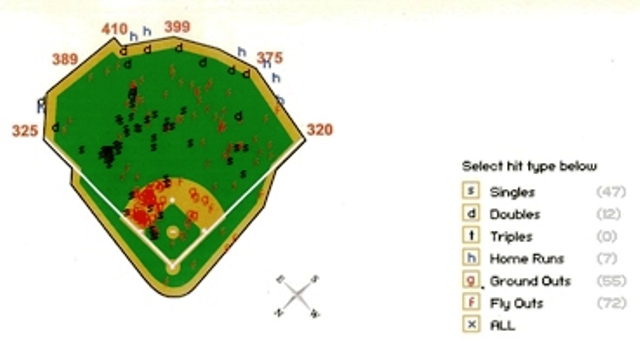
I'm unsure as to whether Bay has lost some bat speed or is simply frustrated by the dimensions of PNC. As Marc Normandin of Baseball Prospectus detailed in a Player Profile last July, Bay ripped the majority of his home runs over the LF wall in 2005 and to LCF and CF in 2006. His power has been gradually drifting from left toward right field over the past couple of years. It's possible that Bay could regain some or all of his lost power by playing in a different home ballpark, particularly one that favors RHB such as Philadelphia, Cincinnati, Colorado, Milwaukee, Houston, Chicago (AL), Toronto, or Baltimore. A more neutral site could even do the trick.
Bay isn't a slam dunk. But the reward may be more than commensurate with the risk.
Now, I'm just gonna sit at the dock of the bay
Watching the tide roll away
Oooo-wee, sittin' on the dock of the bay
Wastin' time
(whistle)
Note: (Sittin' on) The Dock of the Bay was recorded by Otis Redding almost exactly 40 years ago to the day and within 72 hours of the plane crash outside Madison, Wisconsin that took his life. The song was #1 for four weeks in 1968.
| Baseball Beat | November 19, 2007 |
Breaking News: CWS Trade Jon Garland to the LAA for Orlando Cabrera
As reported by ESPN, the White Sox traded right-hander Jon Garland to the Los Angeles Angels for shortstop Orlando Cabrera.
The 28-year-old Garland, an 18-game winner in 2005 and 2006, was 10-13 with a 4.23 ERA in 32 starts last season. He [was] 92-81 with a 4.41 ERA in 246 games, including 223 starts, over eight major league seasons, all with the White Sox.Garland was acquired by the White Sox from the Cubs on July 29, 1998, for pitcher Matt Karchner.
Cabrera, 33, batted .301 with 35 doubles, eight home runs, 86 RBIs and a career-high 101 runs with the Angels last year. He had a career-high 192 hits.
He won his second Gold Glove and led AL shortstops in fielding percentage (.983). Cabrera, who has also played with Montreal and Boston during his 11-year career, is a career .273 hitter. He was on the 2004 Red Sox team that won the World Series.
Chicago also receives cash as part of the trade.
The last sentence shocks me as much as the trade. Without knowing how much cash, it's hard to get overly bothered by this tidbit of information. But . . .
I don't understand this trade unless . . .
1. Arte Moreno caught OC in bed with his wife.
2. The Angels are on the verge of signing Alex Rodriguez and are planning on playing him at shortstop.
3. The Halos are about to deal Jered Weaver or Ervin Santana as part of a package to the Marlins for Miguel Cabrera.
4. The club is going to convert Brandon Wood back to shortstop or hand the position over to Erick Aybar, neither of whom showed last year that they are ready to assume the role on a full-time basis.
5. L.A. is planning to sign fan-favorite David Eckstein to a short-term contract, allowing minor leaguer Sean Rodriguez to develop further.
Thoughts?
| Baseball Beat | November 13, 2007 |
Dustin McGowan: Better Than You Might Think
Quick, go trade for Dustin McGowan before anyone else in your league reads this. You can ask questions later.
OK, now that you have McGowan on your team, let's see if I can put a really big smile on your face by proving that you just stole him from one of your fellow league members, who most likely didn't even know how effective the 25-year-old righthander was last season.
Let's start out by comparing two pitchers. For now, we'll call them Pitcher A and Pitcher B. Hint: one of these two pitchers is Dustin Michael McGowan from Savannah, Georgia.
GB% FB% LD% K/9 BB/9 K/BB HR/9
Pitcher A 53.0 31.0 16.0 7.64 3.24 2.36 0.74
Pitcher B 53.0 31.0 16.0 6.54 2.55 2.57 0.59
Which pitcher would you rather have? Pitchers A and B have identical GB, FB, and LD rates. Pitcher A has the superior K/9 rate, while Pitcher B has the better BB and HR rates. It's a tough call, don't you think?
Well, let's take the masks off Pitchers A and B and disclose their names. Pitcher A is none other than Dustin McGowan. Pitcher B is Roy Oswalt. Yes, the All-Star pitcher who has finished in the top five in the NL CYA in five of the past six years. The same guy who signed a five-year, $73 million contract extension in August 2006. That's an average of $14.6M per year according to my math. McGowan made no more than the MLB minimum of $380,000 (and pro rated at that) and will be under the control of the Blue Jays for the next five years.
Oswalt has the longer, more proven track record, but McGowan just might be his equal on a go-forward basis. You won't see him among the league's top ten in wins, ERA, or strikeouts. But, get this, he was 2nd in the AL in SLG (.347) and OPS (.644), 4th in BAA (.230), and 8th in OBP (.296). Only Erik Bedard had a lower opponent SLG and OPS than McGowan. Even if you include National Leaguers, McGowan was fifth in both categories (behind Bedard, Chris Young, Jake Peavy, and Brandon Webb). Oswalt didn't even place in the top ten in the NL in either stat.
McGowan was lights out against righthanded batters. The 6-foot-3, 220-pounder allowed only 59 hits (including just 2 HR) in 298 at-bats. He led the league in BAA (.198), OBP (.262), SLG (.252), and OPS (.514). That's right, Dustin dominated RHB even more than Josh Beckett, A.J. Burnett, Fausto Carmona, Kelvim Escobar, Roy Halladay, John Lackey, and Justin Verlander.
How did McGowan do it, you ask? The former first-round draft choice had the sixth-highest GB% and the sixth-lowest LD%. Only Burnett and Carmona had a better combination of GB and LD rates. Although A.J. had a higher strikeout rate, McGowan bested his teammate in walk and home run rates. The latter's relatively low LOB% (68.1%) could help explain why his 4.08 ERA was worse than his peripheral stats.
Nonetheless, from the middle of July through the end of the season, McGowan was 7-5 with a 3.29 ERA in 14 starts covering 93 innings. He held opponents to a line of .208/.277/.314 during this period, which included three starts vs. the Yankees. The youngster held Minnesota scoreless for 7 1/3 IP on 7/24; allowed only one run in eight innings of work vs. Texas (8/5) and Seattle (9/1); struck out 12 while giving up just 4 hits and 1 walk against Tampa Bay on 9/7; and tossed a 5-hit, no-walk, 9-strikeout, one-run, complete-game gem vs. Boston on 9/17. But McGowan's best start might have been back in June when he faced only 29 batters in throwing a 1-hit, complete-game shutout against the Colorado Rockies. Interestingly, that masterpiece followed his worst outing of the year when he gave up 8 hits and 6 runs in 1 2/3 innings in a 10-1 loss to the Dodgers, a team he had handled quite well just 11 days earlier.
Dubbed by Baseball America as Toronto's top prospect in 2003 and 2006, McGowan has never started a season on the 25-man roster. He was optioned to Syracuse (AAA) last March and was recalled in May after posting a 1.69 ERA with 29 SO in 22 innings. He immediately joined the rotation and never missed a scheduled start the rest of the season. Long on potential and short on results, McGowan had, by far, his best season.
YEAR AGE G GS IP H R ER HR BB SO ERA ERA+ 2005 23 13 7 45.1 49 34 32 7 17 34 6.35 70 2006 24 16 3 27.1 35 27 22 2 25 22 7.24 63 2007 25 27 27 169.2 146 80 77 14 61 144 4.08 109 CAREER 56 37 242.1 230 141 131 23 103 200 4.87 92
McGowan throws four pitches, including a fastball that sits at 94-96 mph and touches the upper-90s, a high-80s slider, power curveball, and a changeup. His fastball has better-than-average life down in the zone, inducing an inordinate number of worm burners. According to The Bill James Handbook 2008, McGowan had the fourth-fastest heater (94.7) in the AL. He was also 10th in terms of using his slider (18.7%) and fifth in opponent OPS vs. sliders (.504).
Courtesy of Joe P. Sheehan, one of the gurus when it comes to tracking pitches, I present McGowan's and Oswalt's pitch types in graphical format. The former's data is based on 1,182 pitches, which covers most of the second half of the season (when he was on top of his game).
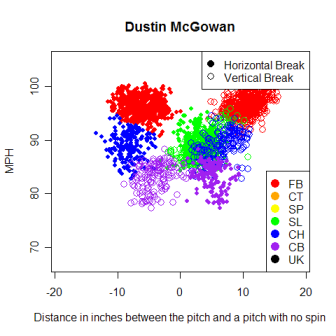
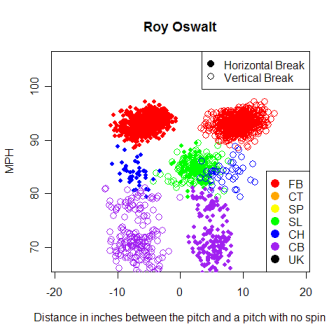
As you can see, McGowan actually throws a harder fastball (96.25 vs. 93.13) and slider (89.15 vs. 84.71). He also uses his changeup (16%) more often than Oswalt (4%), who prefers to go with his curveball (19%) as more of his off-speed offering.
McGowan by Pitch Type:
CB LHB 91 CB RHB 52 CH LHB 146 CH RHB 42 FB LHB 326 FB RHB 254 SL LHB 115 SL RHB 156
The results of these pitches are graphically displayed in the following links: FB vs. RHB, FB vs. LHB, SL vs. RHB, and SL vs. LHB. The latter two graphs give one a sense of how McGowan's slider moves across the strike zone.
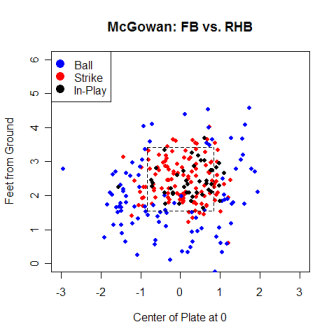
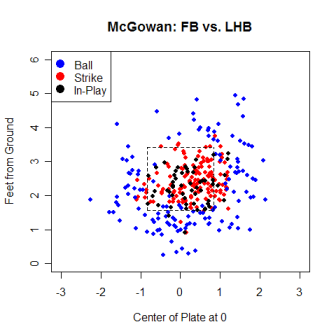
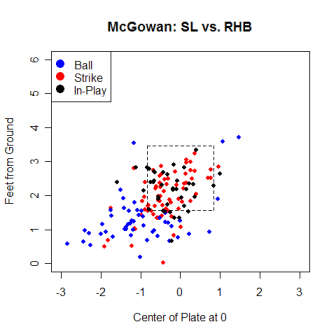
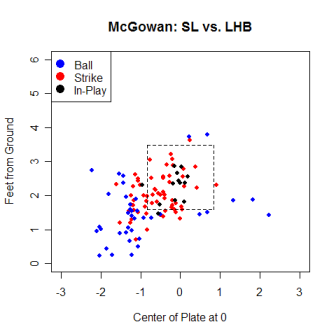
Drilling down deeper, here are McGowan's pitch types by count:
FB CH SL CB 0&0 167 38 69 25 0&1 57 24 38 21 0&2 11 3 23 18 1&0 87 26 17 2 1&1 45 28 28 14 1&2 22 13 30 40 2&0 31 11 8 1 2&1 46 9 13 3 2&2 41 14 36 16 3&0 8 7 0 0 3&1 18 8 1 1 3&2 47 7 8 2 Tot 580 188 271 143
As shown, McGowan threw his fastball 49%, slider 23%, changeup 16%, and curve 12% of the time during the second half. Not surprisingly, he relied on his fastball to get ahead of hitters. Conversely, he used his secondary pitches when he had a pitcher's count and went to his curve as a strikeout pitch.
Where can McGowan improve? Well, his control is less than impeccable. He walked 61 in 169 2/3 innings and was third in the league in wild pitches with 13. However, it is important to point out that his walk rate improved as the season progressed. Dustin only allowed two or more bases on balls in two of his final seven starts when he gave up 13 BB in 47 1/3 IP (including 6 BB in only 4 1/3 IP vs. the NYY in his second-to-last outing of the year).
McGowan could stand to lower his HR rate vs. LHB (12 in 338 AB and 377 PA). That said, his rate stats (.257/.326/.432) were actually quite acceptable for a RHP and his strikeout rate (20.7%) was a tad better than his overall total (20.4%).
Lastly, McGowan can also learn how to hold runners on base better. He was third in the AL in stolen bases allowed last season. Runners stole 29 bases in 30 attempts while he was on the mound. They have been successful 39 times in 44 tries over the course of his MLB career. Catchers Gregg Zaun and Jason Phillips are partially to blame here as they only threw out 17 of 133 base stealers (13% vs. a league-wide average of 27%).
Rogers Centre played as a pitcher's park in 2007, suppressing hits and runs. The AstroTurf surface may be conducive to McGowan, who was 8-3 with a 3.27 ERA at home and 4-7 with a 4.91 ERA on the road. An infield consisting of John McDonald at SS, Aaron Hill at 2B, and Lyle Overbay at 1B is a decided plus for any groundball pitcher. Alex Rios in RF and Vernon Wells in CF are two of the better fielding outfielders in baseball as well. The Defensive Efficiency Ratio was .727 (which is basically the same thing as saying batters hit .273 on balls in play).
McGowan has future ace written all over him. Only 25-years-old with a high ceiling. First-round draft pick. Top prospect in the system on two separate occasions. Mid-90s fastball with a "plus" slider. With excellent groundball and strikeout rates, he lives in the tony Northeast Quadrant (which I will update and feature once again this off-season) with similar percentages as Chris Carpenter in 2006. My kind of pitcher indeed.
OK, any questions?
[Additional reader comments and retorts at the Baseball Think Factory/Baseball Primer Newsblog.]
| Baseball Beat | November 12, 2007 |
Open Chat: 2007 Awards
The 2007 award winners will begin to be announced starting today with the NL and AL Rookies of the Year. The schedule is as follows:
Mon., 11/12: NL and AL ROY
Tues., 11/13: AL CYA
Thur., 11/14: NL CYA
Mon., 11/19: AL MVP
Tues., 11/20: NL MVP
Who do you believe *should* win each of the above awards (as opposed to who you think *will* win)?
| Baseball Beat | November 06, 2007 |
The Bill James Handbook 2008 - Part Two
Peter Gammons calls The Bill James Handbook, "The prize of our winter hibernation." I would agree with that assessment. The Handbook is both informative and fun, and it can be referred to throughout the off-season, used in fantasy drafts, and in the early going next season when the sample sizes are still small.
After covering the Fielding Bible Awards, baserunning, and James' Young Talent Inventory yesterday, we dig into the numbers a bit more today in the second part of our two-day review.
In the 2007 Team Statistics, I learned that the Seattle Mariners and Arizona Diamondbacks were the only clubs with winning records that played under .500 in games decided by five or more runs. The Oakland A's, on the other hand, were the only team with a losing record that played over .500 in such games. The last-place San Francisco Giants went 17-17. Well, perhaps not surprisingly, SEA and ARI led their respective leagues in what Bill James calls "team efficiency," which compares team wins to the stats of individual players. OAK and SF finished in dead last. In a similar vein, I've always thought Pythagorean W-L records would be more accurate (and meaningful) if the margin of victory in a single game were capped at, say, five runs.
The Atlanta Braves intentionally walked 27 more batters than any other team in the majors last season. Although I picked up this tidbit in the team stats, it can also be found in the Manager's Record section. Bobby Cox led all managers in issuing IBB (89), 58 of which were deemed to be "good" (defined as "no runs scored in the inning after the intentional walk") and 31 "not good" ("one run scored in the inning after the intentional walk"). James also creates a subset of "not good," which he calls "bomb" and defines it as "more than one run scored in the inning after the intentional walk."
With respect to the Manager's Record, James is quick to point out that "we try to avoid, in compiling the manager's record, making judgments about the manager's decisions. We are not trying to say whether someone is a good manager or a bad manager. We are trying to describe how one manager is different from the next." James continues, "Our desire to avoid judgments doesn't mean that we don't count Wins and Losses. The desire to avoid making subjective judgments doesn't preclude us from noting successes and failures, if those successes and failures are clearly defined."
James informs us that Manny Acta led the majors in defensive substitutes, relievers used, and relievers used on consecutive days. "Since he was a first-year manager, it is difficult to reach any firm conclusions as to what extent this reflects his preferences, and to what extent it simply reflects the talent he had to work with."
Moving on to the Leader Boards, Magglio Ordonez and Ryan Braun led their respective leagues in AVG, OBP, and SLG vs. LHP. The Milwaukee rookie third baseman destroyed southpaws, topping the majors in all three: AVG (.450), OBP (.516), and SLG (.964). Chipper Jones pulled the rate stat trifecta vs. RHP in the NL.
Brian Roberts led the majors in steals of third with 19, equal to 38% of his stolen base total. The Dodgers had four of the top ten highest GB/FB ratios in the NL, including the leader Juan Pierre. Reggie Willits led the majors in lowest first swing % (4.6) and pitches per plate appearance (4.45). Whereas Willits swung at less than one in 20 first pitches, his teammate Vladimir Guerrero hacked at nearly half (48.0%) of such offerings, the second highest percentage in baseball (behind only Delmon Young, 51.4%). In the department of "there is more than one way to skin a cat," the lowest and highest first swing percentage leaders are both loaded with outstanding hitters. To wit, Guerrero, Ordonez, Matt Holliday, Miguel Cabrera, Alfonso Soriano, and Lance Berkman can all be found among the top ten in their league in highest first swing %, while Bobby Abreu, Curtis Granderson, Mike Lowell, Gary Sheffield, Albert Pujols, Chase Utley, and Jimmy Rollins placed in the top ten in lowest first swing %.
Roy Halladay had three games throwing 125 or more pitches and A.J. Burnett had two (including tying for the MLB high of 130). Toronto manager John Gibbons used more pinch hitters and runners than any other AL skipper but surprisingly did not lead the league in long outings (defined as more than 110 pitches).
Erik Bedard is the only starting pitcher in either league to finish in the top ten in K/H ratio. The Baltimore lefthander, who led the AL in K/9 (10.93) and H/9 (6.97), struck out 221 batters and allowed 141 hits for a K/H ratio of 1.57. Bedard had the league's best Component ERA (2.71), which estimates what a pitcher's ERA should have been based on his pitching performance. Jonathan Papelbon led all pitchers with 50 or more innings in K/H at an insane ratio of 2.80 (84 strikeouts and 30 hits in 58.1 IP).
I always enjoy the leader boards displaying the fastest and slowest average fastballs, as well as the highest percentage of fastballs, curveballs, sliders, and changeups thrown. Felix Hernandez (95.6) had the fastest heater in the majors last year among pitchers with 162 or more innings. A.J. Burnett (95.1) was the only other starter who averaged over 95 mph. Brad Penny (93.4) topped the NL. Tim Wakefield (74.2) had the slowest average fastball and, in fact, was the only pitcher who didn't crack 80 mph. The knuckleballer threw the fewest fastballs (13.4%) as a percentage of total pitches. Jamie Moyer (81.1 and 37.1%) brought up the rear in the NL in both categories. Joel Zumaya had the most pitches clocked at 100+ mph with 30. Justin Verlander (17) and Joba Chamberlain (11) were the only other hurlers who touched triple digits at least 10 times. Matt Lindstrom, who had the highest average fastball among all pitchers with 50 or more innings (96.6), led the NL with 9 pitches at or above 100 mph. Interestingly, Zack Greinke, who many thought didn't throw hard enough to succeed as a starter, topped AL relievers with 50 or more IP with a 95.4 average fastball.
Aaron Cook (78.4%) and Chien-Ming Wang (75.4%) threw the most fastballs, Bedard (33.9%) and Matt Morris (28.1%) broke off the most benders, Ian Snell (35.5%) and Jeremy Bonderman (34.5%) relied on sliders, while Tom Glavine (44.1%) and James Shields (29.7%) pulled the string more often than anyone else. Jake Peavy (.550 OPS) had the most effective fastball in the majors. Josh Beckett (.645) had the lowest opponent OPS vs. fastballs in the AL. Bedard (.429) and Wandy Rodriguez (.487) had the best curveballs, Manny Corpas (.422) and Rafael Perez (.479) had the most effective sliders, and Gil Meche (.481) and Derek Lowe (.569) had the best changeups.
There are literally dozens of other leader boards for hitters, pitchers, and fielders covering standard and hard-to-find categories (as well as sections on manufactured runs, park indices, hitter and pitcher projections, career targets, and Win Shares) that I promise readers will find interesting and illuminating. Do yourself a favor and pick up a copy of The Bill James Handbook 2008. You won't be disappointed.
* * * * *
Update (11/7/07): The award-winning columnist from the Kansas City Star, Joe Posnanski, who also maintains an entertaining blog, unearths more tidbits from The Bill James Handbook 2008 in Things I Learned (Today).
| Baseball Beat | November 05, 2007 |
The Bill James Handbook 2008 - Part One
A United States Postal Service Priority Mail envelope was sitting on my desk at home when I returned from a two-day trip to Arizona last Friday. I opened it up and was pleasantly surprised to find The Bill James Handbook 2008 inside. In the department of trick or treat, this one qualifies as a definite treat.
 Like everyone else, I turned back my clocks on Saturday night. Doing so not only pleased my wife but gave me an extra hour on Sunday to devour the always eagerly anticipated annual baseball reference guide. While the New England Patriots-Indianapolis Colts game lived up to its hype yesterday afternoon, the Handbook is certain to provide baseball fans a lot more than 3-1/2 hours of enjoyment this fall and winter.
The Handbook, which is produced by Baseball Info Solutions and published by ACTA Sports, offers readers more than 480 pages of facts, stats, and lists, as well as several short essays by Bill James. Features include career data for every 2007 major leaguer, pitcher and hitter projections, team statistics and efficiency summaries, park indices, plus season-by-season and career Win Shares, Fielding Bible Awards (along with plus/minus leaders at each position), improved Manufactured Runs and Baserunning Analysis, expanded Manager's Record, and the newly added Young Talent Inventory.
Introduced in 2006, the Fielding Bible Awards are included in the Handbook for the second year in a row. Albert Pujols was the only repeat winner. As John Dewan writes, "There are quite a few new award winners and we think that's great. Through our extensive fielding research over the past few years, we're finding that, just like hitters and pitchers, fielders have good seasons and bad seasons. We were somewhat worried the awards might turn into a mirror of the Gold Glove Awards, in which it seems once a player wins, he keeps winning until retirement, injury, trade or a position switch. With a second year now in the books, that is definitely not the case with the Fielding Bible Awards."
A panel of ten experts, including Dewan and James, once again selected this year's award winners. First place votes received 10 points, second place 9 points, third place 8 points, etc. A perfect score was 100. Unlike the Gold Gloves, only one honoree was named at each position (rather than separate winners for each league).
Here are the results of the 2007 Fielding Bible Awards (with commentary excerpted or paraphrased from the book):
1B: Albert Pujols, STL (91 pts.) - the only repeat winner; his excellent defense is becoming as well-known as his prodigious offense.
2B: Aaron Hill, TOR (82) - edged out the 2006 winner, Orlando Hudson, by two points; Hudson's injury late in the year may have come into play, but it's Hill who has led the majors in plus/minus at second base in each of the last two years (+22 each year).
3B: Pedro Feliz, SFG (89) - he is especially adept at handling bunts and rates an A+ in this area over the past three years.
SS: Troy Tulowitzki, COL (87) - with the biggest margin of victory of all nine winners, Tulo is the rare rookie to win a fielding award.
LF: Eric Byrnes, ARI (85) - barely beat out incumbent Carl Crawford; led all left fielders in plus/minus (+28) and was one of the leadeers in Good Fielding Plays (23), a new defensive category being tracked by Baseball Info Solutions.
CF: Andruw Jones, ATL (86) - reversed spots with Carlos Beltran, who won last year; both center fielders have great range, but it was probably Jones' intimidating throwing arm that swayed the voters; thought to be slipping a year ago, Jones could also be crowned with the "Comeback Fielder of the Year."
RF: Alex Rios, TOR (73) - last year's runner-up in right field fills the spot vacated by Ichiro Suzuki, who finished third in center field.
C: Yadier Molina, STL (83) - threw out 49% of would-be base stealers and upstaged last year's winner Pudge Rodriguez, who threw out only 26% (down from 46% in 2006).
P: Johan Santana, MIN (62) - dethroned last year's Fielding Bible Award winner (and 16 of the last 17 NL Gold Gloves); Greg Maddux finished a close second but probably lost out to Santana due to his inability to control the running game; 32 of 34 base stealers were successful against Maddux, whereas only 11 base runners attempted to steal against Santana and five of them were gunned down.
Dewan points out that Manny Ramirez had the worst plus/minus in all of MLB over the last three years (-109). "Does that make him baseball's worst defender? Maybe, but there is a question because of the wall in Fenway Park. Are his numbers hurt by the wall? The answer is clearly yes. Balls that hit the wall might be catchable in other parks. It's an adjustment we need to make but haven't gotten around to as of yet, mostly because unique park configurations like Fenway are not as common elsewhere. Ramirez was below average in road games as well, though nowhere near as poor as his overall numbers would suggest."
The author proceeds to ask if Derek Jeter (-90) is the worst defender? "Well, Jeter's poor numbers do not have a caveat like Manny's do. There are no significant park effects clouding his stats. The numbers suggest that Jeter has hurt his team defensively as much or more than any other player in baseball. Having said that, you can still make a good case for Jeter being the best shortstop in the game. Given all that he brings to the team – hitting, baserunning, leadership, overall baseball savvy (including as a defender) – nearly every baseball general manager would prefer Jeter over almost any other shortstop. But, defensively, he's not the best. Do I personally think he's the worst defensive shortstop in baseball? No, but he's far from deserving to be a guy who will probably win his fourth Gold Glove in as many years. He's a below-average defender who should never have received a Gold Glove in the first place."
As with fielding, baserunning tends to get a disproportionate amount of my time when reviewing the Handbook because so little quantifiable data is available to the public. James delves into the subject by stating, "It is universally recognized that there is a difference between being a good base stealer and being a good baserunner. One can be a good baserunner by reading the ball well off the bat, figuring out quickly whether the ball will be caught or will drop, making good decisions and, to an extent, running good routes. It is difficult to be a good base stealer by making good decisions. That requires speed. One can be a good baserunner without being a good base stealer; one can be a good base stealer without being a good baserunner, and somebody should have zapped me with a stun gun two or three sentences ago for belaboring the obvious."
James explains that "baserunning is a very complicated concept, and we're working on measuring it all, but we're not there yet." The system gives credit for stolen bases for the first time. "The title at the head of the page doesn't say 'Baserunning other than Base Stealing;' it just says 'Baserunning.' Base stealing isn't all of baserunning, but it is part of baserunning." Interestingly, the method chosen to measure stolen bases gained is the same one I have used in the past (SB minus two times CS).
Inputs on baserunning include runners going from first to third on a single, scoring from second on a single and from first on a double; moving up on a wild pitch, passed ball, balk, sac fly, or defensive indifference; runs scored as a percentage of times on base; and baserunning outs. Lo and behold, the top base stealer in the majors was also the best baserunner, independent of stolen bases. Jose Reyes led the majors in stolen bases (78), net stolen bases gained (36), and baserunning gained above the league average (34), which generated an overall rating of +70 by adding the latter two categories. The worst? Todd Helton (-35). He was 5-for-42 moving from first to third on a single and ran into six outs.
Mike Cameron was the best baserunner at going from first to third on a single in 2007 (15-for-23) and 2006 (15-for-22). Jason Varitek (0-for-18) was on the other end of the scale this year. Rob Mackowiak was 11-for-11 at scoring from second on a single. Bengie Molina was 0-for-9. Ronnie Belliard was 7-for-7 at scoring from first on a double. Helton was 0-for-10.
The 2008 Handbook also includes team baserunning. As James writes, "There will be a time in the future, probably not too long from now, when this baserunning data will be published for all teams and all players over the last 50 years. When that happens, we'll be in a better position to understand the role of baserunning (other than base stealing) in creating runs. This data is the first step along that road."
The top five teams were as follows:
1. New York Mets 111 2. Philadelphia Phillies 104 3. Tampa Bay Devil Rays 82 3. Arizona Diamondbacks 82 5. Los Angeles Angels 76
The bottom five:
26. Pittsburgh Pirates -13 27. St. Louis Cardinals -18 28. Toronto Blue Jays -25 29. Chicago White Sox -35 30. Houston Astros -50
In a new section of the book, James evaluates the best young players in the majors under the age of 29 and ranks them based on their projected value through age 33. He excludes prospects or minor leaguers. "We're discussing proven major league players who are still young." His methodology combines youth and performance, employing runs created for position players and runs saved for pitchers as the basis for the latter.
"We are sitting in a historic bubble of young talent," James says. "Arguably there is more outstanding young talent around right now than at any other moment in baseball history." He believes the young talent in 2007 exceeds the previous peak in 1964 (which included Dick Allen, Lou Brock, Johnny Callison, Rico Carty, Dean Chance, Tony Conigliaro, Willie Davis, Bill Freehan, Jim Fregosi, Jim Kaat, Mickey Lolich, Sam McDowell, Dave McNally, Tony Oliva, Gaylord Perry, Vada Pinson, Boog Powell, Pete Rose, Ron Santo, Wilie Stargell, Luis Tiant, Joe Torre, and Carl Yastrzemski, among others).
The top 25 young players according to James are as follows (with ages as of 6/30/07):
1. Prince Fielder, 1B, MIL, 23 2. Hanley Ramirez, SS, FLA, 23 3. Fausto Carmona, SP, CLE, 23 4. David Wright, 3B, NYM, 24 5. Felix Hernandez, SP, SEA, 21 6. Scott Kazmir, SP, TB, 23 7. Jose Reyes, SS, NYM, 24 8. Matt Cain, SP, SFG, 22 9. Grady Sizemore, CF, CLE, 24 10. Cole Hamels, SP, PHI, 23 11. Ryan Zimmerman, 3B, WAS, 22 12. Troy Tulowitzki, SS, COL, 22 13. Miguel Cabrera, 3B, FLA, 24 14. Ryan Braun, 3B, MIL, 23 15. Justin Verlander, SP, DET, 24 16. Nick Markakis, RF, BAL, 23 17. Jake Peavy, SP, SD, 26 18. Adrian Gonzalez, 1B, SDP, 25 19. Tom Gorzelanny, SP, PIT, 24 20. James Shields, SP, TB, 25 21. C.C. Sabathia, SP, CLE, 26 22. Curtis Granderson, CF, DET, 26 23. Brandon Webb, SP, ARI, 26 24. Chad Billingsley, SP, LAD, 22 25. Chris Young, CF, ARI, 23
Teams were also listed by James in order of overall young talent in the majors. Here are the top ten:
1. Colorado Rockies 2. Tampa Bay Devil Rays 3. Arizona Diamondbacks 4. Florida Marlins 5. Cleveland Indians 6. Milwaukee Brewers 7. Pittsburgh Pirates 8. Kansas City Royals 9. Oakland A's 10. Toronto Blue Jays
. . . and the bottom ten:
21. Texas Rangers 22. Baltimore Orioles 23. Cincinnati Reds 24. Chicago White Sox 25. Seattle Mariners 26. St. Louis Cardinals 27. New York Yankees 28. Detroit Tigers 29. Chicago Cubs 30. Houston Astros
"Competitive teams don't have as much room to let young players thrash around," explains James, "and consequently most of the top teams don't show as having a lot of young talent. They may have the young talent; it just isn't in the lineup yet."
Part two will dig into the numbers, including the statistical leaderboards with a focus on many that receive little or no attention during or after the season.
I have been reviewing The Bill James Handbook since 2003. The previous reviews can be accessed at the following links:
2007 - Part One, Two, Three
2006 - Part One, Two, Three
2004 - The Handiest Reference Book of 'Em All
[Additional reader comments and retorts at the Baseball Think Factory/Baseball Primer Newsblog.]
| Baseball Beat | October 31, 2007 |
Boston's Future Is as Bright as Its Recent Past - Part Two
We extolled the virtues of Boston's ownership and management in Part One yesterday and discussed a few of the most important decisions at hand. In Part Two, we will cover the organization's philosophy and how it shapes the near- and long-term outlook of the club.
The foundation of the franchise is based on scouting and player development. The Red Sox are not afraid to select the best players available in the draft and pay over slot if that's what it takes to get them. More teams should follow this strategy because it is one of the cheapest ways to secure quality talent. Rather than doling out $40-50M over four years for a medicore starter like Carlos Silva, Boston concentrates on drafting and signing as many quality arms as possible, believing that it's as much a numbers game as anything else.
Management is willing to think "outside the box" while priding itself on taking an opportunistic approach when it comes to deals. However, they are not infallible. Theo Epstein & Co. have made their share of mistakes, especially when it comes to free agent signings. Look no further than their record with shortstops since allowing Orlando Cabrera to leave for free agency after the 2004 World Series championship for proof. That said, one would need to be afflicted with tunnel vision to focus on the Julio Lugos when the signing of David Ortiz five years ago more than makes up for these errors.
As we discussed yesterday, the Red Sox stand to lose Mike Lowell and Curt Schilling to free agency, as well as Royce Clayton, Matt Clement, Eric Gagne, Eric Hinske, Bobby Kielty, Doug Mirabelli, and Mike Timlin. Boston is unlikely to pursue any of the free agents other than Lowell and Schilling with much vigor. At the right price, I'm sure they would consider Hinske or Kielty, Timlin, and possibly Mirabelli if the club decides to exercise its option on Tim Wakefield.
Boston will undoubtedly pass on its option to bring back Julian Tavarez for $3.85M. Brendan Donnelly and Kyle Snyder figure to be non-tendered. Javier Lopez could be offered arbitration while Kevin Youkilis is a good bet to sign a multi-year deal to cover his arb-eligible years at a minimum.
All of the other players on the roster are either under contract or the control of the club. Boston has two everyday players (Jacoby Ellsbury and Dustin Pedroia), two starting pitchers (Clay Buchholz and Jon Lester), and two of its top three relievers (Jonathan Papelbon and Manny Delcarmen) that will be making close to the minimum salary. The Sox might be interested in working out a two- or three-year deal with Paps to keep him happy as well as to avoid arbitration a year from now.
Coco Crisp, who will earn $4.75M in 2008 and $5.75M in 2009 (with an $8M club option or a $0.5M buyout for 2010), could be moved to a team in need of a center fielder but unwilling to meet the contract demands of free agents Mike Cameron, Torii Hunter, Andruw Jones, and Aaron Rowand. Crisp runs well and his outfield defense has catapulted to the top echelon, making him an ideal fit for a team loaded with flyball pitchers in a big ballpark.
With only one more year guaranteed on the eight-year contract he signed in December 2000, Manny Ramirez is more marketable than ever. The future Hall of Famer will make $20M in 2008 and the Sox have club options at that same salary for 2009 and 2010. Manny also has $31M in deferred compensation due him, which will be paid out in 16 annual installments of $1.94M from 2011-2026.
For the sake of this analysis, we have assumed that Lowell and Schilling will be re-signed, Ramirez will be back for at least one more year, Ellsbury will be the everyday center fielder, and Crisp will be traded. With these variables in mind, here is what appears would be the starting lineup, pitching rotation, bench, and bullpen in 2008.
LINEUP
1. Ellsbury, CF
2. Pedroia, 2B
3. Ortiz, DH
4. Ramirez, LF
5. Lowell, 3B
6. Youkilis, 1B
7. Drew, RF
8. Varitek, C
9. Lugo, SS
ROTATION
1. Beckett, RHP
2. Matsuzaka, RHP
3. Schilling, RHP
4. Lester, LHP
5. Buchholz, RHP
BULLPEN
CL - Jonathan Papelbon, RHP
SU - Hideki Okajima, LHP
SU - Manny Delcarmen, RHP
BENCH
C: Doug Mirabelli, Kevin Cash, or Dusty Brown
INF: Alex Cora and Jed Lowrie
OF: Brandon Moss
The above list of players totals 21, leaving the club with four holes to fill. Lopez, Timlin, and Wakefield could take up three of these spots, and either Kielty or a player like him could wind up as a pinch-hitter and backup outfielder.
We drill down a bit deeper into the makeup of the roster with emphasis on ages, stats, and salaries.
STARTING PITCHERS
1. Josh Beckett, 27, RHP
W-L 20-7 | ERA 3.27 | WHIP 1.14
2007 Salary: $6,666,667
2008 Salary: $10,166,667
2009 Salary: $11,166,667
The above salaries include a pro rata share of a $2M signing bonus that Beckett received when he agreed to a three-year extension in July 2006. Give the Sox a high five for negotiating this deal in the midst of Beckett's most disappointing season in the majors. Boston stepped up and signed its ace to a contract that is more than $5M below market over each of the next two campaigns as well as a very reasonable $12M club option for 2010. Given his Cy Young-type season and outstanding October, Beckett may well be the top pitcher in the game at this very moment.
2. Daisuke Matsuzaka, 27, RHP
W-L 15-12 | ERA 4.40 | WHIP 1.32
2007 Salary: $6,333,333
2008 Salary: $8,333,333
2009 Salary: $8,333,333
2010 Salary: $8,333,333
2011 Salary: $10,333,333
2012 Salary: $10,333,333
As with Beckett, the above salaries include a pro rata share of a $2M bonus that Dice-K earned when he signed a six-year contract in December 2006. Matsuzaka also has escalators that could increase the total value to $60M. The heralded import from Japan faded down the stretch but seems like a good bet to improve upon his numbers in 2008.
3. Curt Schilling, 41, RHP
W-L 9-8 | ERA 3.87 | WHIP 1.25
2007 Salary: $13,000,000
Schilling is looking for a one-year deal. The veteran pitcher indicated last spring that he would return in 2008 at his current salary of $13M, but the Red Sox wanted to buy time to see how his health and performance would hold up in his age-40 season. It seems to me that the two sides should be able to work out a mutually agreeable contract.
4. Jon Lester, 24, LHP
W-L 4-0 | ERA 4.57 | WHIP 1.46
2007 Salary: $384,000
Lester bounced back from a treatable form of lymphoma to win Game 4 of the World Series. He promises to be an important piece of the Boston rotation for the next several years.
5. Clay Buchholz, 23, RHP
W-L 3-1 | ERA 1.59 | WHIP 1.06
2007 Salary: Minimum
Buchholz is best known for the no-hitter he threw in his second major-league start on September 1. He is the real deal and projects to be an All-Star caliber pitcher, if healthy, for years to come. The righthander, who missed the postseason because of shoulder fatigue, will not be pushed next season. Look for him to pitch 160-180 innings (vs. a total of 148 spread over AA, AAA, and MLB in 2007). Assistant General Manager Jed Hoyer told Patrick Sullivan and me in an exclusive interview last March that Buchholz, who throws a mid-90s fastball, had the best slider and changeup in the system. He struck out Nick Markakis with a knee-buckling breaking ball to end his no-no two months ago. In a nutshell, his stuff ranks among the best in the game.
6. Tim Wakefield, 41, RHP
W-L 17-12 | ERA 4.76 | WHIP 1.35
2007 Salary: $4,000,000
The Red Sox exercised a $4M option for 2007 a year ago and can continue to do the same each year until the club waives its right to bring Wakefield back. Think of him as an insurance policy.
On the horizon: Michael Bowden. ETA: September 2008 or 2009.
RELIEF PITCHERS
Closer: Jonathan Papelbon, 27, RHP
W-L 1-3 | SV 37 | ERA 1.85 | WHIP .77
2007 Salary: $425,500
Is there a better closer in the game than Papelbon? After watching him dominate opponents during the regular season and throughout the playoffs, I would be hard-pressed to choose someone over him. He is one tough sonofagun, a rare closer who has no problem being used in the eighth and ninth innings to get more than the usual three outs. Keeping Paps in the bullpen proved to be one of the smartest moves the Sox made.
Set-Up: Hideki Okajima, 32, LHP
W-L 3-2 | SV 5 | ERA 2.22 | WHIP .97
2007 Salary: $1,225,000
2008 Salary: $1,275,000
A former member of the Yomiuri Giants, Okajima was signed as a free agent in November 2006. The lefthanded reliever signed for a whopping bonus of $50,000 (which is included in the above salaries) and Boston has a $1.75M club option for 2009. Okajima has performance and award bonuses that are rather insignificant in the big picture. He may have been the most pleasant surprise in Beantown last season.
Set-Up: Manny Delcarmen, 26, RHP
W-L 0-0 | SV 1 | ERA 2.05 | WHIP 1.02
2007 Salary: Minimum
Long on potential, Delcarmen took a huge leap forward in 2007 and heads into next season as one of Boston's two valuable set-up relievers. He is young and cheap and possesses a live arm.
Middle Relief: Mike Timlin, 42, RHP
W-L 2-1 | SV 1 | ERA 3.42 | WHIP 1.08
2007 Salary: $2,800,000
Old reliable. If Timlin's demands don't get out of line, look for the veteran reliever to return to Boston for a sixth season.
LOOGY: Javier Lopez, 30, LHP
W-L 2-1 | SV 0 | ERA 3.10 | WHIP 1.33
2007 Salary: $402,500
Lopez actually had reverse splits last season, yet has been slightly more effective vs. LHB over the course of his career.
On the horizon: Craig Hansen (ETA: 2008) and Justin Masterson (ETA: Late 2008 or 2009).
CATCHERS
Jason Varitek, 35, C, B-B/T-R
AVG .255 | OBP .367 | SLG .421 | HR 17 | RBI 68
2007 Salary: $10,000,000
2008 Salary: $10,000,000
Varitek turns 36 next April. The Captain has one more year left on the contract he signed a couple of months after the 2004 World Series championship. His pitch calling and relationships with a diverse group of pitchers received a lot of play during the postseason telecasts. It will be interesting to see if Boston reaches out to Tek before his contract expires.
Doug Mirabelli, 37, C, B-R/T-R
AVG .202 | OBP .278 | SLG .360 | HR 5 | RBI 16
2007 Salary: $750,000
INFIELDERS
Kevin Youkilis, 29, 1B/3B, B-R/T-R
AVG .288 | OBP .390 | SLG .453 | HR 16 | RBI 83
2007 Salary: $424,500
Based on his postseason, it is safe to say that Youkilis is now much more than the "Greek God of Walks." He looks like someone who could be a .300/.400/.500 hitter, which plays at either side of the infield. If Lowell is re-signed, Youk will return to first base. However, he gives Boston a legitimate option to man the hot corner – at least for a year or two – should the bidding get outlandish for the World Series MVP.
Dustin Pedroia, 24, 2B, B-R/T-R
AVG .317 | OBP .380 | SLG .442 | HR 8 | RBI 50
2007 Salary: $380,000
Pedroia got off to a poor start last April, caught fire in May, and proceeded to put up a season that should earn him AL Rookie of the Year honors. The diminutive second baseman hit .333/.389/.467 (with 37 BB and 36 SO) from May 1 through the end of the regular season while more than holding his own in the playoffs (.283/.348/.483). A terrific defender, Pedroia's fielding gem saved Buchholz's no-hitter.
Julio Lugo, 32, SS, B-R/T-R
AVG .237 | OBP .294 | SLG .349 | HR 8 | RBI 73
2007 Salary: $8,250,000
2008 Salary: $9,000,000
2009 Salary: $9,000,000
2010 Salary: $9,000,000
2011 Salary: $9,000,000 vesting option with 2,400 PA in 2007-10 and 600 PA in 2010
There's no reason to mince words here. Lugo was a huge disappointment in his inaugural season in Boston. His 73 RBI might mislead those who don't know better but a .643 OPS playing half of one's games at Fenway can't be explained away, almost no matter how well he may have played in the field. Julio's defense improved in the final two months of the season and the play he made to his right in the World Series finale was both heady and spectacular. Lugo now owns a ring so things can't be all that bad.
Mike Lowell, 34, 3B, B-R/T-R
AVG .324 | OBP .378 | SLG .501 | HR 21 | RBI 120
2007 Salary: $9,000,000
I discussed Lowell in detail yesterday. The bottom line is that Boston will have to overpay to keep him around. Popular with fans, his price tag most likely went up – or at a minimum firmed – with the almost concurrent news of A-Rod's opt out and his MVP honors last Sunday.
Alex Cora, 32, 2B/SS, B-L/T-R
AVG .246 | OBP .298 | SLG .386 | HR 3 | RBI 18
2007 Salary: $2,000,000
2008 Salary: $2,000,000
Every team needs to have an Alex Cora on its roster. The utility infielder could get expensive though if he were to be named AL MVP as he has a clause in his contract that would pay him $125,000 for capturing this award!
On the horizon: Jed Lowrie. ETA: 2008.
OUTFIELDERS
Manny Ramirez, 35, LF, B-R/T-R
AVG .296 | OBP .388 | SLG .493 | HR 20 | RBI 88
2007 Salary: $18,000,000
2008 Salary: $20,000,000
Manny being Manny as they say. He played almost everyday from April through August, missed more than 20 games in September, then went 16-for-46 with 4 HR and 11 BB in the postseason when everything was on the line. Ramirez will be shopped once again but will most likely wind up in Boston next season. Fenway Park suits him best defensively so I would expect him to finish his career as a DH for an AL club.
Jacoby Ellsbury, 24, CF, B-L/T-L
AVG .353 | OBP .394 | SLG .509 | HR 3 | RBI 18
2007 Salary: Minimum
Ellsbury hit .330/.389/.442 and stole 50 bases in 57 attempts over approximately 600 combined plate appearances in AA, AAA, and MLB. He promises to be a significant upgrade offensively and is a plus defensive center fielder with his arm the only tool holding him back.
J.D. Drew, 32, RF, B-L/T-R
AVG .270 | OBP .373 | SLG .423 | HR 11 | RBI 64
2007 Salary: $14,000,000
2008 Salary: $14,000,000
2009 Salary: $14,000,000
2010 Salary: $14,000,000
2011 Salary: $14,000,000
Drew struggled for most of the season but rebounded in September and October, giving hope for better things to come in 2008 and beyond. With an unpopular contract in hand, Drew faced a difficult fan base and media while dealing with his 1-1/2 year-old son's health during the summer. J.D. may be much more comfortable in his second season in Boston and is certainly capable of putting up a .285/.385/.475 type line.
On the horizon: Brandon Moss. ETA: 2008.
DESIGNATED HITTER
David Ortiz, 32, DH/1B, B-L/T-L
AVG .332 | OBP .445 | SLG .621 | HR 35 | RBI 117
2007 Salary: $12,500,000
2008 Salary: $12,500,000
2009 Salary: $12,500,000
2010 Salary: $12,500,000
Signing David Ortiz as a free agent after the Minnesota Twins non-tendered him in the winter between the 2002 and 2003 seasons and re-signing him a couple of times may be a few of the best moves that the current management team has made. Big Papi earned $1.25M in 2003, $4.5875M in 2004, $5.25M in 2005, and $6.5M in 2006. He received a $2M bonus for signing an extension in April 2006 for $12.5M per year for the 2007-2010 seasons with a club option at that same price for 2011 with, get this, NO buyout!
Patrick Sullivan will handle Part Three tomorrow with a focus on Boston's amateur drafts and farm system.
Note: Contract information was provided by Cot's Baseball Contracts.
| Baseball Beat | October 30, 2007 |
Boston's Future Is as Bright as Its Recent Past - Part One
With two World Series titles in the past four years and one of the best farm systems in the game, the Boston Red Sox are now the model big-market franchise. Sure, the Sox have built-in competitive advantages and possess the second-highest payroll in baseball, but the organization, for the most part, has used its resources wisely. The same cannot be said of several other franchises, be it small or large markets.
The success starts at the top. The ownership group, headed by John Henry, Chairman Tom Werner, and CEO/President Larry Lucchino, deserves credit for buying the team, investing in it, and assembling an outstanding management team. Outside of George Steinbrenner and Carl Pohlad, I believe Henry, Werner, Lucchino, et al are the only owners who have overseen a pair of World Series championships.
Executive VP/General Manager Theo Epstein, who was hired in November 2002, is one of only three GMs who have won multiple World Series titles (the others being Pat Gillick and Brian Cashman). Not bad for anyone, much less someone who hasn't turned 34 yet.
Manager Terry Francona, who was hired in December 2003, has skippered two championships in four seasons. He is signed through 2008 and will earn $1.75M next year. Francona also earns bonuses for making playoffs and winning the LDS, LCS, and World Series. Look for Tito to get a multi-year extension and a raise that will send his average annual salary toward $2.5M.
Assistant GM Jed Hoyer and VP/Player Personnel Ben Cherington, both of whom served as co-GM during Epstein's absence from October 2005 through January 2006, coupled with Director of Player Development Mike Hazen and Scouting Director Jason McLeod, add to the strength of Boston's front office. Let's also not forget the contributions of Senior Baseball Operations Adviser Bill James, who was hired by Henry five years ago. The depth of talent in the front office is virtually unmatched in MLB.
The management team has a number of important decisions to make this fall. First and foremost is whether it wants to make a run at Alex Rodriguez, who opted out of his 10-year, $252 million contract on Sunday night. Boston, the two Los Angeles franchises, San Francisco, and perhaps Detroit, Seattle, and one or both of the Chicago clubs would appear to have the most resources and interest in signing the soon-to-be three-time AL MVP.
If the Yankees are true to their word and don't pursue A-Rod, then one has to think that Mike Lowell will receive their money and affection. The latter apparently is looking for a 4/$56M deal. Put me in charge and I would not offer anything remotely close to that asking price. The fans can chant "MVP" all they want, but he is not worth that kind of money. He will turn 34 before the season starts and is a risky proposition beyond two years.
Teams should be aware that Lowell was a product of Fenway Park in 2007 (.373/.418/.575 at home, .276/.339/.428 away). They should also all but ignore his 120 RBI. Those runs served Boston well in 2007 but are not necessarily repeatable in 2008 and beyond, especially for a club that doesn't have as strong of a lineup as the Sox.
Lowell may be a good guy, unselfish, and clutch – you know, the types of things we hear about *after* a player performs well or a team wins it all. But wasn't he all those things when Florida dumped his $9 million annual salary on Boston in the Josh Beckett-Hanley Ramirez trade? Wasn't Lowell all that when the Red Sox couldn't find any takers last winter? I know he had an outstanding season but that's now in the past. Success doesn't come by looking in the rear-view mirror; it comes to those who focus on the future rather than the past.
If the Red Sox don't want to wait out what will likely be an auction for A-Rod's services, then it can negotiate with Lowell now. However, I don't see it as an "either or" decision. Kevin Youkilis, while not the equal of Lowell defensively or as athletic as Rodriguez, could man the hot corner adequately for a year or two. David Ortiz could get more time at first base, if necessary, while waiting for Lars Anderson, who just turned 20, to develop into a major leaguer. Jed Lowrie could be a viable option as well. A second baseman at Stanford and a shortstop throughout his professional career, the 23-year-old has the hands and arm strength to make the move to third base. He would be a downgrade offensively but far from a liability.
As a result of the above, I would go after Rodriguez in a big way. Nobody knows what it will take at this point. Instead, we only know that the highest bidder will win out. Clubs are going to want to offer no more than six years and Scott Boras is going to hold out for ten. The compromise may be eight but if it's six or ten, it will – rest assured – be ten. If it works, great. If it doesn't, that's OK, too. The Red Sox are loaded and can deploy the money elsewhere if things don't work out with A-Rod.
Aside from Rodriguez and Lowell, Boston needs to make a decision with respect to Curt Schilling. Now 41, the veteran righthander, whose $13M 2007 option vested when the club won the World Championship in 2004, is free to negotiate with any team. Both sides have enough interest in each other that a deal could be reached to bring back Schilling for one more season with perhaps a mutual option for 2009. Andy Pettitte would be a high-end comp at $16M while Greg Maddux would be a low-end comp at $10M. The latter's options could serve as a model for negotiations between the Red Sox and Schilling. Maddux has a $6M player option that increased to $8.75M due to the fact that he exceeded 185 IP last season and San Diego has a $11M club option.
The Red Sox can exercise its option on Tim Wakefield each year at $4M. At worst, bringing back Wakefield gives the Red Sox insurance in case Schilling breaks down and Jon Lester or Clay Buchholz don't pan out as expected. As a sixth starter, Wake would likely get 8-12 starts and could work out of the bullpen as a long reliever when the rotation is healthy.
Be sure to return tomorrow for Part Two when we discuss Boston's lineup, bench, starting rotation, and bullpen in more depth.
| Baseball Beat | October 29, 2007 |
How Sweep It Is!
As everyone who is reading this site knows, the Boston Red Sox swept the Colorado Rockies to win its second World Series title in four years. The Red Sox have now won eight Fall Classic games in a row to become the only club to own two World Series titles this decade.
In addition to sweeping the World Series in 2004 and 2007, the Sox beat the Angels three straight in the ALDS both years, then overcame 3-0 and 3-1 deficits to the Yankees and Indians, respectively, in the ALCS. The franchise that never says die won its final eight games in 2004 and seven games in 2007.
Mike Lowell was named the Most Valuable Player in this year's World Series, capping an outstanding regular season and run in the playoffs. There are numerous side stories, including the fact that Alex Rodriguez has decided to opt out of his $252 million, 10-year contract with the Yankees. Lowell and Rodriguez are both free agents and could potentially swap teams for 2008 and beyond.
We will have much, much more on the Red Sox tomorrow, including a comprehensive review of where the team has been and where it may be going. Be sure to visit us on Tuesday and throughout the fall and winter as we discuss the season that was, the season that will be, the Rule 5 draft, free agents, trades, interviews, guest columns, and more analysis on pitchers (such as pitch types, batted balls, strikeout rates, etc.) than you can shake a stick bat at. I'll add one more sentence here so I don't end this entry with a preposition.
| Baseball Beat | October 23, 2007 |
The World Series From the Perspective of the Blogosphere
I don't know if the World Series is considered the second season or the third season, but it's finally upon us. And it promises to be an exciting one. The team with the most wins vs. the club with the most consecutive victories. Call it old money vs. new money.
All 30 teams emerged from spring training with hopes and dreams. Nine teams finished the 162-game regular season with a legitimate shot at winning it all. After the one-game playoff (or play-in) for the wild card spot, eight clubs were within 11 victories of hoisting the World Series trophy. The Division Series pared that list down to the Final Four. And the Championship Series produced the American and National League representatives for the 2007 World Series.
If the recent past is prologue, whichever team wins it this year may not even make the playoffs next season. That's right, only one of the last six World Series champs made the postseason the year after winning it all. But flags fly forever as they say so I'm sure fans of the Boston Red Sox and Colorado Rockies, if given a chance, would trade a down year in 2008 for a World Series title in 2007.
The Red Sox are trying to become the second team since 1990 to win the World Series after finishing with the best record in the majors. Only the 1998 Yankees have won the most games and the World Series in the same season during this period.
As I mentioned last week, "With Colorado's triumph over Arizona in the NLCS, a wild card team has now advanced to the World Series for the SIXTH consecutive year. Prior to 2002, only two wild cards had made it to the World Series since the current playoff format was established in 1995." These wild card champs are 4-4 in the World Series.
Don't dismiss the Rockies on the basis of the American League being stronger than the National League. Despite recent dominance by the AL in the All-Star game and inter-league play, the NL won the World Series last year as well as in two of the past four seasons and three of the past six. Any MLB club can beat any other team in a short series, especially one as hot as Colorado.
I've turned to a couple of Rockies and Red Sox bloggers to get their takes on the final chapter of the 2007 season.
Brandi Griffin, aka as the Rox Girl of Purple Row: A Colorado Rockies Blog, provided the following essay:
Long Track, Short Track
When the stretch run was getting underway, Rich handicapped the teams on this site much as one would horses at a track and it’s interesting to me to contrast these two teams in horse racing terms. Boston has been a front-runner, a Seattle Slew style marvel that raced to the lead of the pack and never really was challenged the rest of the way. Colorado, on the other hand, had a flair for the dramatic, having to chase down several teams in their improbable charge down the final straightaway for the NL Wild Card, nudging the Padres in a literal and disputed photo finish.
Now the two teams have shown equal aplomb on the series of sprints we call the MLB playoffs, with the Rockies just blowing past the Phillies and D-backs from the gate, ending the races before the other team had a chance to get their footing. The Red Sox likewise dispatched the Angels in the ALDS, but then showed the world that they still have their chaser’s legs from 2004 in the seven game set versus the Indians.
Last year, the supposed Fall Classic was a battle of two teams that showed few of these traits, Detroit and St. Louis both sputtered into the playoffs and then sputtered through, and for me at least, it was merciful of the Cardinals to dispatch a sloppy Detroit team so quickly to end the thing. This year promises to be different, both teams seem like the best their leagues have to offer, and while Boston’s got the pedigree and frankly the better team, Colorado has all the traits to like in an underdog, few weaknesses and a solid core that will be able to handle its own in the short fight. Both teams have proven that they won’t back down from the challenge of a deficit, meaning neither team should feel safe with just three wins. At the same time, both team have shown killer instincts.
Alright, a quick fact that you might not know about the Rockies is that they play to the level of their competition. Including two more wins in the playoffs against Cole Hamels and Brandon Webb, Colorado has now gone 19-13 in games started by an opposing pitcher that ranks in the top 10 of his league’s ERA. This isn’t meant to impress a team that just breezed through John Lackey, C.C. Sabathia and Fausto Carmona in the playoffs and beat Scott Kazmir regularly during the regular season, but it is a warning that the Rox will treat your aces and fifth starters alike, and sometimes make one look like the other or vice versa. Also, one of the unmentioned aspects of Colorado’s highly touted defense happens before pitches are even thrown thanks to the work of the team’s advance scouts. The Rockies positioning has been superb in both these series, and if you listen to both D-backs and Phillies fans you will hear the common lament of “we hit the ball hard, it was just right at their guys” as they try to figure out how the Rox blew right past them.
The eight day layoff might have put a chill on the momentum, but this is an intelligent team that does extensive prep work on its opponents and those eight days also gave the team plenty of time to study the Sox. Both teams execute in all facets at a very high level and take advantage of others' inability to do so. I've got a feeling that good or bad for my Rockies, that this series will be one for the ages.
Josh Wilker of Cardboard Gods is a Red Sox fan through and through. He collects baseball cards and Boston World Series titles. He has an appreciation for the past and present.
Yaz
I have the four most important baseball cards in the world spread out on the table in front of me like religious relics. The closest thing in my life to religion has for all of my literate life been baseball and the Boston Red Sox, and today I am in the midst of one of the highest moments of that life of greedy, tantrum-laced worship: the Red Sox have won the pennant.
The last time they did this, in 2004, I was elated, exhausted, wrung out, grateful, somewhat unhinged, unkempt, given to spates of maniacal laughter, and more than a little physically ill. I was most of all deeply worried that it could still all be for naught if they lost the World Series. This time it’s a little easier to simply enjoy the ride. After the joy of the final out in the 2004 World Series, I scrambled to find a way to get to Boston for the parade, as I’d always promised myself I would. I met my brother there, who had driven up from Brooklyn in a car festooned with a big red banner reading “YAZMOBILE.” We wanted to say thank you to the team that finally did it and also to the players who came before; this was their win, too. The graying former player we most hoped to see on the duckboats, to cheer our throats raw for, to thank, was Carl Yastrzemski, but Yaz wasn’t there.
Yaz is here, however, in front of me, on the table. Over the past year, for reasons I am unable to fully understand, I’ve spent a disturbingly large amount of time writing about the baseball cards I collected as a child in the 1970s. I’ve gone on at length about journeymen and utility infielders, my meditations on the likes of Jose Morales, Tom Hutton, and Rich Dauer giving some semblance of shape to my often directionless existence. I’ve even spent most of a week of my brief time here on earth writing about Kurt Bevacqua not only as a Brewer but in a fictional Topps incarnation as a Mariner (who he never actually played for).
But I have never gotten around to writing about the four most important cards in the world, my Yaz cards from 1975, 1977, 1978, and 1980. Maybe now is the time. With the Red Sox in the World Series I can barely concentrate enough to brush my teeth, but I’ve decided that I’m going to find a way during this World Series to finally write about my four cardboard conduits to Yaz. I guess you could say I’m preparing to pray.
| Baseball Beat | October 22, 2007 |
Next Up: The World Serious
The Red Sox put up the makings of a picket fence in the first three innings and never looked back despite being challenged by the Indians in the middle innings. Dustin Pedroia lowered the boom in the seventh with a two-run home run over the Green Monster off heretofore untouchable reliever Rafael Betancourt, then doubled with the bases loaded to knock in three more in the eighth to put the game out of reach and send Boston to the World Series for the first time since they won it all in 2004.
1 2 3 4 5 6 7 8 9 R H E
- - - - - - - - - - -- -
Indians 0 0 0 1 1 0 0 0 0 2 10 1
Red Sox 1 1 1 0 0 0 2 6 X 11 15 1
Kevin Youkilis and Jason Varitek both contributed two extra-base hits and Hideki Okajima and Jonathan Papelbon combined to pitch four scoreless innings to cap the winner-take-all victory in the American League Championship Series. Boston is the only team to come back from a 3-1 deficit in the LCS, remarkably accomplishing this feat three times (1986, 2004, and 2007).
Even though Boston was extended to the full seven games, its pitching rotation is set up perfectly to handle the World Series schedule. ALCS MVP Josh Beckett will pitch the opener on five days of rest. He most likely will start games one and five and be available to help out in relief in game seven, if need be.
Game 1--Wed., 10/24 at 5:35 p.m. in Boston
Game 2--Thur., 10/25, at 5:29 p.m. in Boston
Game 3--Sat., 10/27, at TBA in Colorado
Game 4--Sun., 10/28, at TBA in Colorado
Game 5--Mon., 10/29, at TBA in Colorado
Game 6--Wed., 10/31, at TBA in Boston
Game 7--Thur., 11/1, at TBA in Boston
Boston and Colorado head into the World Series with winning streaks and confidence. The Red Sox have won three in a row and have produced more victories than any other team in baseball this year. The well-rested Rockies are undefeated in postseason play, having won ten consecutive games and 21 of 22 dating back to the middle of September.
The upstart Rockies defeated the Red Sox two of three during an interleague series at Fenway Park in June, outscoring them 20-5 in the process. Manager Clint Hurdle has already announced that ace Jeff Francis will start game one on Wednesday night and rookie Ubaldo Jimenez will go in game two on Thursday night. Hurdle has not decided who he will use in games three and four. His choices will be among righthander Josh Fogg, lefthander Franklin Morales, and sinkerballer Aaron Cook, who missed the final two months of the regular season with a strained muscle in his side.
By virtue of the American League winning the All-Star game in July, the AL East/ALDS/ALCS champion Red Sox will have the home-field advantage. Boston and Colorado both have unusual ballparks and outstanding home records. If the Red Sox take the first two games in Boston, it will be interesting to see if the Rockies can regain the lost momentum in Colorado. On the other hand, if the Rockies can earn a split in Boston, the NL Wild Card/NLDS/NLCS champs will head to Denver with the home-field advantage for the rest of the series.
We will have more on the World Series, including stats and other fun-filled facts over the next couple of days.
| Baseball Beat | October 15, 2007 |
Jimenez and Morales: Not Out of Nowhere
Two of Colorado's four starting pitchers in the postseason are rookies who were not only called up to the Rockies late in the season but have proven to be instrumental as the team moves to within one win of its first World Series appearance ever.
The National League's Wild Card representative has been riding the young arms of Ubaldo Jimenez and Franklin Morales to remarkable success. The Rockies have won the last 11 games in which Jimenez and Morales have started. Three of these victories have come in the postseason. Manager Clint Hurdle is handing the ball to Morales tonight and is hoping that the lefthander can extend these streaks to 12 and four by beating the Arizona Diamondbacks in front of Colorado's home fans.
Neither Jimenez nor Morales were unknown to our readers or those who follow minor leaguers closely. During the off-season, I ran a series Categorizing Minor League Pitchers that was designed to identify promising pitching prospects by focusing on strikeout and groundball rates.
Morales, who turned 21 last January, ranked fifth in strikeouts per batter faced (K/BF) in 2006 among all minor league starters with above-average groundball rates. Yovani Gallardo and Philip Hughes made their mark in the majors this year and Wade Davis, who threw a no-hitter, continued to move up the ladder in Tampa Bay's system.
NORTHEAST QUADRANT (ABOVE-AVG K AND GB RATES)
PITCHER AGE ORG LEV K/BF GB% Yovani Gallardo 21 MIL A+/AA 31.70% 47.14% Philip Hughes 21 NYY AA 31.44 50.72 T. J. Nall 26 LAD AA 28.17 46.61 Wade Davis 21 TB A 27.82 48.25 Franklin Morales 21 COL A+ 27.37 53.18
Here is what I had to say about the 6-foot, 170-pound Venezuelan:
Speaking of Liriano, Colorado Rockies GM Dan O'Dowd said Morales has "Francisco Liriano-type ability." The lefthander struck out 16 batters in a 7-inning game last year and has whiffed 369 and walked 176 batters in 315.1 career frames. He works in the mid-90s and has reportedly touched the upper-90s. K/GB types like Morales and Deduno at Coors Field would help mitigate the disadvantage of pitching in such extreme altitude.
Jimenez was spotlighted in Part Four - Double-A. The table from that article (which has been re-printed below) included strikeout and groundball data for every pitcher in Double-A with 50 or more innings.
SOUTHEAST QUADRANT (ABOVE-AVG K AND BELOW-AVG GB RATES)
PITCHER TEAM LG K/BF GB% Dan Smith ATL SL 35.39% 30.53% Tony Sipp CLE EL 33.47% 38.89% Brandon Knight PIT EL 32.82% 35.90% William Lamura CWS SL 31.75% 26.72% Matt Garza MIN EL 30.36% 38.46% Scott Elbert LAD SL 29.57% 29.45% Carlos Marmol CHC SL 29.39% 43.26% Ubaldo Jimenez COL TEX 29.35% 41.42% Marcus McBeth OAK TEX 29.02% 38.19% Yovani Gallardo MIL SL 28.81% 39.68%
In August 2006, I also ran an article Screening for Pitching Prospects in which "I screened all of the minor league statistics to determine the top five starting pitchers in each league, sorted by K/9 with 50 or more IP and a HR/9 rate of less than 0.9 (or one home run per ten innings pitched)."
Not only did Jimenez, who turned 23 last January, lead the Texas League in K/9 but his rate (10.59) was a full strikeout better anyone else. Here is the excerpt from that article:
TEXAS LEAGUE
PITCHER TEAM W-L ERA WHIP K/9 Ubaldo Jimenez TUL/COL 9-2 2.45 1.21 10.59 Mitch Talbot COR/HOU 6-4 3.39 1.36 9.59 Juan Morillo TUL/COL 10-8 4.70 1.54 8.35 Paul Kometani FRI/TEX 5-5 5.60 1.56 7.95 Matt Albers COR/HOU 10-2 2.17 1.23 7.37
Ubaldo Jimenez pitched so well in Double-A early on that he was promoted to Triple-A at the end of June. The 6-foot-2 right-hander has struggled at Colorado Springs (3-2, 6.07 ERA, 1.58 WHIP). To his credit, Jimenez has continued to keep the ball in the high-altitude park (5 HR in 59 1/3 IP) but his strikeout and walk numbers (1.36 K/BB ratio) have suffered. It's way too early to give up on the 22-year-old from the Dominican Republic although he will need to exhibit better command before getting a shot at the big leagues.
Other pitchers of note who ranked in the top five in their respective minor league in K/9 in 2006 and were highlighted in this article included Gallardo, Hughes, Chad Billingsley, Rich Hill, Matt Garza, Carlos Marmol, Dustin McGowan, James Shields, and Jered Weaver – all of whom enjoyed anywhere from moderate to huge success in the majors in 2007.
Jimenez and Morales are excellent examples of the importance of paying attention to the ability to miss bats and age vs. level when it comes to evaluating prospects. Both pitchers still need to improve their command and throw more strikes if they are to reach their full potential. But they have been plenty good enough during the past month. How these rookies perform over the next couple of weeks could go a long way in determining just how high those Rocky Mountain Highs really are.
| Baseball Beat | October 08, 2007 |
Party Poopers
After the Rockies, Diamondbacks, and Red Sox dusted off their opponents in three games and the Indians got off to a 3-0 lead over the Yankees, I was all set to title this article "Sweeps Week." Well, so much for a clever title.
Phil Hughes shut down Cleveland for 3 2/3 innings and Johnny Damon delivered a run-scoring single to get New York on the board in the third and a go-ahead, three-run jack in the fifth to lead the Bronx Bombers to an 8-4 victory over the Tribe. The series resumes tonight with Chien-Ming Wang coming back on three days' rest to face Paul Byrd, who hasn't pitched in 11 days.
The Yankees are heavy favorites to win Game 4 and force a Game 5 in Cleveland on Wednesday. Did manager Joe Torre live to die another day or will New York do it for Joe? I have mixed feelings about the outcome. On one hand, I wouldn't want the Yankees to lose if it results in Torre getting fired in this manner. Then again, if they win the series, that means having to put up with the media giving George Steinbrenner credit for lighting a fire under his troops. Aargh!
With respect to the latter, it's funny how long it took for the men in pinstripes to respond to the Boss' threat (if indeed they did at all). Play-by-play announcer Chip Caray made it an issue in the fifth inning but only AFTER Damon had homered to put the Yankees ahead. More than anything, it just goes to show how the media likes a good story. Had New York lost, I'm sure Caray would have laid the blame squarely on the shoulders of Steinbrenner for putting too much pressure on his players. If the Yankees win this series, it will have NOTHING to do with their owner (other than the money he shelled out to acquire all of those free agents). By the same token, if they lose the series, then give credit to the Indians. Cleveland is a well-balanced team and tied Boston for the most wins in the majors this year. It's not about Steinbrenner; instead, the focus should be on the players on the field.
In any event, the winner of the Yankees-Indians series will earn the right to meet Boston in the American League Championship Series. The Red Sox swept the Angels in the ALDS for the second time in four years. The Halos scored only four runs in three games, putting up nothing but zeroes in 25 of the 27 innings. That type of output isn't going to win many postseason games unless you have Christy Mathewson on your side.
Although David Ortiz and Manny Ramirez will get a lot of the credit for lifting the Sox to the first-round victory, Josh Beckett and Curt Schilling shut out the Angels for 16 innings. These two righthanders are putting up postseason resumés that rank among the all-time greats. The bottom line is that Boston can hit, pitch, and field with the best, will be well rested for the League Championship Series, and have home-field advantage the rest of the way.
Over in the National League, did anybody predict that the Diamondbacks and Rockies would vie for the right to represent the senior circuit in the World Series? Both teams did the NL West proud. Including the San Diego Padres, a case could be made that the West may have had the three best teams in the league this season. With all of the young talent in this division, the West could become the powerhouse of the National League for years to come.
But, in the here and now, it's unlikely that Arizona or Colorado has what it takes to beat the Red Sox, Indians, or Yankees in a best of seven series. However, if one of these Cinderella teams pulls it off, it will make for a much-better story than what the Boss is saying.
| Baseball Beat | October 01, 2007 |
2007 Playoffs: Not So Fast
Although every team has now played 162 games, the regular season is not quite over. That's right, after six months and 2430 games, we need one more contest to determine the final spot in the 2007 postseason.
The San Diego Padres and the Colorado Rockies both have a shot at joining the Arizona Diamondbacks, Chicago Cubs, and Philadelphia Phillies as the playoff participants in the National League. In the meantime, the Boston Red Sox, Cleveland Indians, Los Angeles Angels, and New York Yankees are getting ready for the American League Division Series.
Today's play-in game between the Padres and Rockies will be the first one-game playoff since 1999 when the New York Mets beat Cincinnati 5-0 for the NL wild card.
OK, here is what we know as of Monday morning:
The Rockies, who have won a franchise-best 89 games, have the momentum, winning 13 of their final 14 games. But the Padres have a huge pitching advantage with Jake Peavy taking the mound vs. Josh Fogg. In a sort of David vs. Goliath matchup, Colorado fans should be comforted by the fact that Fogg has beaten several aces this year (including Brandon Webb in early September and Curt Schilling). Padres fans are heartened by the fact that Peavy, who has a chance to join Boston's Josh Beckett as the only 20-game winners in the majors this year, leads the NL in wins (19), ERA (2.36) and strikeouts (234).
Like Peavy, Matt Holliday is also playing for more than just a chance to extend his season. Holliday, who is leading the league with a .340 batting average (three points higher than Chipper Jones), will need to keep from going 0-for-5 tonight in order to win the batting crown. The Colorado outfielder also tops the NL in hits, doubles, total bases and has a chance to overtake Ryan Howard for the RBI title as well. Moreover, a big game tonight could make him the favorite – if he's not already – to capture the MVP award, too. Hey, voters like a good story so if Holliday does something heroic tonight, he would leap to the forefront of the MVP race, much to the angst of Jones, Howard, Jimmy Rollins, Chase Utley, Prince Fielder, David Wright, and Hanley Ramirez.
Neither SD nor COL have ever won a World Series. The other seven have all won a world championship although nobody reading this piece has ever witnessed the Cubs doing so. Hey, everybody is allowed a bad century now and then.
Remarkably, four of the playoff participants have won a World Series this decade, yet the Yankees are the only team back from last season's postseason. With a victory tonight, San Diego can make it two returnees. Either way, MLB will have the fewest returning playoff participants since 1995 when the postseason format was increased from four to eight clubs.
In my estimation, the four best teams in the playoffs may all come from the American League. First of all, the Red Sox, Indians, Angels, and Yankees are the only clubs that won more than 90 games. Secondly, the AL dominated the NL once again, going 137-115 (.544) in inter-league play. Thirdly, did I mention that Arizona's 90 wins are the fewest by a league leader in a full season since 162-game schedules went into effect in 1961?
But the Cardinals proved just last year that none of this stuff matters all that much once October rolls around. Let the crapshoot begin.
Note: Starting tomorrow and continuing through Thursday, Baseball Analysts will have in-depth previews for each of the four division series.
| Baseball Beat | September 27, 2007 |
The All-NincompoOPS Team
In the past, I have unveiled my All-OOPs (Overrated Offensive Players) team at the conclusion of the season. It was comprised of players who hit for a higher batting average than the league norm while putting up on-base percentages and slugging averages that were below the means. In other words, if you hit a lot of singles but had little or no power and rarely walked, you were a strong candidate to make the All-OOPs team. If nothing else, it was a fun exercise.
I have decided to retire my All-OOPs efforts in favor of the All-NincompoOPS team. Yes, that's nincompoops while capitalizing the last three letters to highlight the stat behind my latest creation. Nincompoops, in baseball terms, are nothing more than players with the lowest park-adjusted OPS (or OPS+). It's simple. It's straightforward. And, hey, it's kinda fun.
Let's take a look at the biggest nincompoOPS in 2007 (minimum of 300 plate appearances):
PLAYER TEAM POS OPS+ PA AVG OBP SLG OPS Adam Kennedy STL 2B 50 306 .219 .282 .290 .572 Nick Punto MIN 3B 52 524 .213 .293 .273 .566 Cesar Izturis TOT SS 58 325 .255 .301 .315 .616 Josh Barfield CLE 2B 58 439 .243 .271 .323 .594 Omar Vizquel SFG SS 59 568 .243 .301 .308 .609 Gerald Laird TEX C 59 439 .223 .276 .340 .616 Tony Pena KCR SS 61 523 .264 .282 .351 .633 John McDonald TOR SS 61 344 .254 .280 .339 .619 Ryan Freel CIN CF 64 304 .245 .308 .347 .655 Jason Kendall TOT C 64 502 .246 .304 .314 .618 Dave Ross CIN C 65 341 .205 .268 .404 .672 Bobby Crosby OAK SS 65 374 .226 .278 .341 .619 Brad Ausmus HOU C 66 392 .235 .317 .325 .642 Ray Durham SFG 2B 66 519 .218 .297 .345 .642 Marcus Giles SDP 2B 67 474 .230 .306 .318 .624 Craig Counsell MIL 3B 67 330 .223 .327 .313 .640 Craig Biggio HOU 2B 67 541 .250 .281 .378 .659 Emil Brown KCR LF 67 386 .259 .303 .349 .652 Michael Barrett TOT C 67 362 .242 .279 .372 .651 Craig Monroe TOT LF 68 421 .222 .269 .375 .644 Stephen Drew ARI SS 68 601 .230 .309 .360 .669 Jay Payton BAL LF 68 449 .251 .286 .352 .638 Dioner Navarro TBD C 68 418 .228 .287 .359 .646 Jerry Owens CHW CF 68 372 .265 .325 .313 .638 Nook Logan WSN CF 68 347 .261 .301 .342 .643 Darin Erstad CHW CF 69 337 .250 .308 .339 .647 Julio Lugo BOS SS 70 614 .240 .297 .355 .652 Wes Helms PHI 3B 71 305 .249 .300 .372 .672 Felipe Lopez WSN SS 71 657 .242 .307 .346 .653 Scott Thorman ATL 1B 71 300 .221 .261 .402 .663 Jose Lopez SEA 2B 71 542 .254 .285 .349 .634 Chris Burke HOU 2B 72 347 .234 .310 .362 .672 Miguel Olivo FLA C 73 464 .237 .261 .406 .667 Nelson Cruz TEX RF 73 320 .237 .292 .380 .672 Juan Uribe CHW SS 74 544 .230 .281 .394 .675 Rich Aurilia SFG 1B 74 356 .254 .306 .370 .676 Brian Schneider WSN C 75 469 .237 .327 .339 .666 Ryan Theriot CHC SS 76 578 .273 .333 .356 .689 Ramon Vazquez TEX 3B 76 337 .233 .305 .377 .682 Juan Pierre LAD CF 77 707 .294 .333 .354 .687 Yorvit Torrealba COL C 77 421 .259 .327 .376 .703 Rafael Furcal LAD SS 77 642 .270 .333 .355 .688 Johnny Estrada MIL C 79 464 .278 .296 .403 .699 Ronny Paulino PIT C 79 481 .258 .310 .387 .697
Much like Kurt Bevacqua, most of the players on the above list couldn't hit water if they fell out of a boat. If Tommy Lasorda were pitching, he would undoubtedly send these players a limousine to make sure they were in the lineup.
The Official 2007 All-NincompoOPS Team
C: Gerald Laird 1B: Scott Thorman 2B: Adam Kennedy SS: Cesar Izturis 3B: Nick Punto LF: Emil Brown CF: Ryan Freel RF: Nelson Cruz DH: Craig Monroe
Nice pickup by the Cardinals in getting Adam Kennedy. The good news is that he only had 306 plate appearances. Reminds me of the Will Rogers quote, "Just be thankful you're not getting all the government you're paying for."
Kennedy and Nick Punto are unto a club all by themselves. The All-.200s AVG, OBP, and SLG. It's one thing to hit in the .200s but a whole 'nother matter to post sub-.300 OBP and SLG. Josh Barfield joined his fellow infielders in the 6-and-under league for those with less than .600 OPS. There are 6-feet-and-under basketball leagues. Dead people have jokingly been referred to as 6-feet-and-under. Well, Kennedy's, Punto's, and Barfield's careers are all on life support. One more year like this one and their teams will be dialing 911, asking for the paramedics to come and take them away.
I hope none of you took Scott Thorman in your fantasy league. Heck, the guy didn't show anything as a rookie last year and has never been all that great even in the minors. He turned 25 before spring training camp opened, has below-average power for a first baseman, and would rather take the bus than walk.
What about those of you who got sucked into drafting Emil Brown, finally convinced after two decent years that he wasn't as bad as you once thought? Shame on you. Lesson #1 for wannabe GMs: Beware when a player puts up his first good year at the age of 30 (especially when he has a career line of .200/.289/.302 and spent the prior three seasons in the minors). Lesson #2: Don't forget lesson #1.
Moving along . . . Did you know that Bruce Bochy of the San Francisco Giants occasionally made out a starting lineup with all four of his infielders sporting an OPS+ of no better than 80? Yes, Rich Aurilia (74), Ray Durham (66), Omar Vizquel (59) – don't even try to suggest that this guy is a Hall of Famer – and Pedro Feliz (80) comprised the worst infield in baseball this year. What about Ryan Klesko, you ask? Puh-leeze. The 36-year-old "has been" put up an OPS+ of 92. But, boy, can he field and run! And I hear he's a heckuva presence in the clubhouse, too!
So as not to let the Giants have all the fun, let's take a look at the Dodgers. Rafael Furcal and Juan Pierre each produced an OPS+ of 77. Not to worry, Dodger fans. Furcal and Pierre hit 1-2 or 2-1 in the lineup all season and registered 1349 plate appearances between them or more than 22% of the team's total. Add Nomar Garciaparra (80) to the mix and the Dodgers spent about $30 million this year on three players who were dreadful. OK, make it $45 million. I mean, let's not forget Jason Schmidt here. Man, that Ned Colletti can sure pick 'em, huh?
What a bunch of nincompoOPS.
| Baseball Beat | September 25, 2007 |
Flyin' Under the Radar
While others are discussing the division and wild card races during the last week of the season, I thought it would be a welcomed relief to pay tribute to ten players who have been flyin' under the radar screen. None of these pitchers or hitters will receive a single vote for MVP or Cy Young honors, yet all of them have been among the most valuable players on their respective teams while earning at or near the minimum salary.
In alphabetical order, here are the Poor and Not So Famous . . .
Rafael Betancourt, RP, Cleveland Indians
W-L 5-1 | SV 2 | ERA 1.41 | WHIP .76
Age: 32
2007 Salary: $840,000
Acquired: Signed as a Free Agent in January 2003
Betancourt has been one of the most effective relief pitchers in the majors this season, leading all non-starters with 27 Runs Saved Against Average through games of Saturday. As the set-up man for the Cleveland Indians, the 6-foot-2, 200-pound righthander has allowed only 58 baserunners in 76.1 IP while recording (for what it's worth) 29 holds, good for second in the American League.
Throwing almost exclusively fastballs, Betancourt has struck out 75 (or nearly one per inning) and walked only 9 batters (for a K/BB of 8.33). Opponents are "hitting" .183 against him while putting up an OPS of .488. Originally signed by the Boston Red Sox as an amateur free agent in 1993, the fifth-year MLB veteran has inherited 33 baserunners and prevented all but three from scoring. He ranks second in the majors (behind J.J. Putz) in Win Expectation above Replacement (WXRL).
Manuel Corpas, RP, Colorado Rockies
W-L 4-2 | SV 16 | ERA 1.85 | WHIP 1.03
Age: 24
2007 Salary: $382,000
Acquired: Signed 1999 (undrafted free agent from Panama)
Corpas, who spent the entire 2005 season pitching for the Modesto Nuts in the California League (A+), has been nothing short of brilliant working out of the bullpen for the Rockies this season. The 6-foot-3, 170-pound righthander earned his first save on July 7 when he struck out the side to preserve a 6-3 victory over the Philadelphia Phillies. Promoted to the role of closer, Corpas has recorded 15 saves during the second half.
The fastball-slider pitcher throws strikes (2.34 BB/9) and induces about 2.5 groundballs for every flyball allowed. As reflected in his 1.64 ERA at home, his style suits Coors Field well. Corpas has been effective during the stretch run, allowing only one run over his last 12 appearances covering 13.2 innings and one earned run in his last 17 outings and 18.2 IP.
Jack Cust, DH, Oakland Athletics
AVG .261 | OBP .412 | SLG .520 | HR 26 | RBI 82
Age: 28
2007 Salary: $380,100
Acquired: From the San Diego Padres in May 2007
Cust is finally getting his first extensive action in the big leagues ten years after being drafted by the Arizona Diamondbacks with the 30th overall pick of the 1997 amateur draft. Prior to this season, Cust had played in a total of 70 games for Arizona, Colorado, Baltimore, and San Diego. The 6-foot-1, 231-pound lefthanded hitter has been everything his stathead fans have imagined, slugging 26 HR while posting an OBP over .400 and a SLG greater than .500. Over half of his plate appearances (486) have resulted in a walk (100) or strikeout (156). He ranks second in the majors (behind Reggie Willits) in the number of pitches per plate appearance (4.40).
Matt Diaz, LF, Atlanta Braves
AVG .338 | OBP .368 | SLG .504 | HR 12 | RBI 44
Age: 29
2007 Salary: $375,000
Acquired: From the Kansas City Royals in December 2005
Diaz can flat out hit. He is mashing lefthanders to the tune of .360/.385/.586. The one drawback is that the preponderance of Diaz's OBP is made up via his AVG as the aggressive hitter has drawn a base on balls only 4% of the time. A relative unknown, the former Florida State star is far from a one-year fluke as he has now hit .333 with 19 HR in 640 AB and 691 PA over the past two seasons. The 6-foot-1, 205-pound outfielder has cooled of late, going homerless since jacking two against Florida late last month.
Corey Hart, RF, Milwaukee Brewers
AVG .297 | OBP .355 | SLG .533 | HR 22 | RBI 76
Age: 25
2007 Salary: $395,000
Acquired: Drafted in the 11th round of the 2000 amateur draft
Although overshadowed by MVP candidate Prince Fielder and ROY favorite Ryan Braun, Hart is experiencing a breakout season hitting nearly .300 with 22 HR and 23 SB. Playing everyday for the first time in his career, the 6-foot-6, 214-pound outfielder is torching southpaws (.333/.423/.622). He has stepped up his production in September (.350/.402/.638) although it may not be good enough to put Milwaukee into the playoffs next week.
Carlos Marmol, RP, Chicago Cubs
W-L 5-1 | SV 1 | ERA 1.22 | WHIP 1.11
Age: 24
2007 Salary: Minimum
Acquired: Signed July 1999 (undrafted free agent from Dominican Republic)
Check out Marmol's ERA. Yes, that's not a typo. 1.22 it is. It's hard to believe that the second-year righthander spent the first month-and-a-half in the minors. Formerly a starting pitcher, Marmol has pitched exclusively in relief this season. He started strong, working 10 games before allowing his first run. And he is finishing even stronger, hurling 18 consecutive outings covering 22.1 IP without surrendering a run.
The 6-foot-2, 180-pound righthander has struck out 94 batters in only 66.2 IP. His control is still problematic, providing 35 free passes or more than one every two innings. HIs ERA has never reached 2.00 this season and he has pitched well at home (1.53 ERA with a .172 BAA) and on the road (0.86 ERA, .162 BAA). Look for Marmol to play an important role for the Cubs in the postseason.
Peter Moylan, RP, Atlanta Braves
W-L 5-3 | SV 1 | ERA 1.85 | WHIP 1.06
Age: 28
2007 Salary: Minimum
Acquired: Signed as a Free Agent in March 2006
Moylan has been a workhorse for Bobby Cox this season. The 6-foot-2, 200-pound righthander has been asked to pitch 76 games and 87.2 innings. He has put up stellar numbers although his relatively low strikeout rate (6.26 per 9 IP) for a reliever is cause for concern on a go forward basis. Born in Attadale, Australia, Moylan was originally signed by the Minnesota Twins as an amateur free agent in March 1996. He only lasted two years before deciding to return home as a pharmaceutical salesman.
The bespectacled Moylan continued pitching, dropping down to a sidearm motion while adding nearly 10 miles per hour to his fastball. He was a surprise pick for the Australian World Baseball Classic squad and opened eyes when whiffing four Venezuelans, including Bobby Abreu, Marco Scutaro, Ramon Hernandez, and Magglio Ordonez in his only WBC outing. Moylan was subsequently invited by Atlanta to spring training camp prior to the 2006 season and made his debut in the majors last summer.
Cody Ross, CF, Florida Marlins
AVG .335 | OBP .409 | SLG .659 | HR 12 | RBI 35
Age: 26
2007 Salary: $380,000
Acquired: Purchased from the Cincinnati Reds in May 2006
Ross spent part of the 2007 season on the 60-day DL, missing most of May, all of June, and part of July. With increased playing time, Ross has been a monster in September, hitting .389/.411/.796 with 7 2B and 5 HR in 54 AB. For the season, the 5-foot-9, 203-pound sparkplug has slugged 17 2B and 12 HR with an OPS of 1.065. The jury is out, but the center fielder, who bats right and throws left, may finally be finding a home in Florida after various stints with the Tigers, Dodgers, and Reds.
Matt Stairs, LF, Toronto Blue Jays
AVG .292 | OBP .370 | SLG .553 | HR 20 | RBI 61
Age: 39
2007 Salary: $850,000
Acquired: Signed as a Free Agent in December 2006
Stairs is not unknown, having played 1537 games since breaking into the big leagues with Montreal in 1992. But he is a bargain, putting up a .923 OPS for a rather meager salary of $850,000. Stairs has ripped 27 doubles and 20 homers in 342 at-bats this season. To my surprise, he has slugged at least 13 HR for 11 straight seasons and now has 240 over the course of his career.
Jayson Werth, RF, Philadelphia Phillies
AVG .303 | OBP .410 | SLG .455 | HR 7 | RBI 48
Age: 28
2007 Salary: $850,000
Acquired: Signed as a Free Agent in December 2006
Werth is posting career highs in AVG, OBP, and OPS while playing part-time for the Phillies. After missing all of July with a sprained left wrist, Werth was put into the starting lineup upon his return and he responded with a .414/.500/.609 line in August. The 6-foot-4, 210-pounder's performance has slowed considerably in September, and it remains to be seen what the future holds for the former first round draft pick and stepson of Dennis Werth, grandson of Dick Schofield, and nephew of Dick Schofield.
Honorable Mentions: Heath Bell (SD), Brandon Lyon (ARI), Hideki Okajima (BOS), Tony Pena (ARI), and Joakim Soria (KC).
| Baseball Beat | September 20, 2007 |
...And Down the Stretch They Come!
The famous horse racing call is an appropriate description as Major League Baseball winds down its six-month regular season with four division titles and two wild cards still to be determined. The postseason horses are on the board in the American League but there is a stakes race in the East in which the betting public anxiously awaits the finish while holding onto their exacta tickets.
In the meantime, the tote board is working overtime in the National League as all three claiming races and the wild card are up for grabs. The Mets, Cubs, and Diamondbacks are in front by a length or two but the Phillies, Brewers, and Padres are going to the whip as they try to overtake the lead pony in each of their respective divisions.
AMERICAN LEAGUE EAST TEAM W L PCT GB Comments Red Sox 90 63 .588 - Lug Yankees 88 64 .579 1.5 In the Money Blue Jays 77 75 .507 12.5 Show Orioles 64 87 .424 25 Checked Devil Rays 63 90 .412 27 Untried
Red Sox-Yankees. Yankees-Red Sox. Does it really matter? You bet it does. These rivals are playing for first place, possible home-field advantage, and pride. It looked like Boston in a breeze at the clubhouse turn but a sweep at the hands of Toronto has turned this race into what could amount to a photo finish.
AMERICAN LEAGUE CENTRAL TEAM W L PCT GB Comments Indians 90 62 .592 - Handily Tigers 83 70 .542 7.5 Hung Twins 75 77 .493 15 Evenly White Sox 66 86 .434 24 Washy Royals 65 86 .430 24.5 Scratch
For those of you with blinkers on, the Indians and Angels now possess the best record in the majors. Cleveland effectively put away Detroit during a three-game sweep with C.C. Sabathia, Fausto Carmona, and the bullpen leading the way. With three games in Kansas City on the final weekend, the Tribe may take the opportunity to position its rotation for the ALDS against either the Red Sox or Yankees.
AMERICAN LEAGUE WEST TEAM W L PCT GB Comments Angels 90 62 .592 - Lock Mariners 81 70 .536 8.5 Faltered A's 74 80 .481 17 Eased Rangers 70 82 .461 20 Under Wraps
The Angels were tested by the Mariners last month but met the challenge head on with a sweep in Seattle. The placing judges have been reassigned to the AL East as the Halos gallop to the finish line.
NATIONAL LEAGUE EAST TEAM W L PCT GB Comments Mets 84 67 .556 - Prep Phillies 82 70 .539 2.5 Closer Braves 79 73 .520 5.5 In Hand Nationals 68 84 .447 16.5 All Out Marlins 65 87 .428 19.5 Distanced
With 10 of its last 11 games against Washington and Florida (and the other a make-up game at home vs. the Cardinals, who most likely will mail it in), the Mets can thank the stewards for what should be a hand ride over the next one-and-a-half weeks. The Phillies (Fillies?) have a favorable schedule as well, facing the Nationals in seven of their final 10 contests.
NATIONAL LEAGUE CENTRAL TEAM W L PCT GB Comments Cubs 80 73 .523 - Blanket Finish Brewers 78 73 .517 1 Extended Cardinals 71 80 .470 8 False Favorite Reds 69 83 .454 10.5 Also Ran Pirates 66 86 .434 13.5 Steadied Astros 66 86 .434 13.5 Breakdown
Consider Chicago as the favorite to take the NL Central. The Cubs will not play a playoff-bound team the rest of the regular season while the Brewers will be jockeying for position against the Braves and Padres with the latter running as hard as possible in search of their own postseason berths.
NATIONAL LEAGUE WEST TEAM W L PCT GB Comments Diamondbacks 86 67 .562 - Overlay Padres 84 67 .556 1 Stretch Runner Rockies 80 72 .526 5.5 Solid Horse Dodgers 79 73 .520 6.5 Winded Giants 67 85 .441 18.5 Taken Up
Only the Giants have been mathematically eliminated but the NL West is really a two-horse race between the Diamondbacks and Padres. Both teams are odds-on choices of making the playoffs, either as the division champ or the wild card representative. With six games remaining against Arizona and San Diego, Colorado is still in control of its own destiny and can't be ruled out quite yet.
AMERICAN LEAGUE WILD CARD TEAM W L PCT GB Comments Yankees 88 64 .579 - Romp Tigers 83 70 .542 5.5 Bobble Mariners 81 70 .536 6.5 Pocket
Either the Yankees or Red Sox will *win* the wild card in the American League. Think of it as a consolation prize for not winning the AL East. And let's not kid ourselves here that it will be anything more than that. Sure, Boston won the World Series as a wild card in 2004 but capturing a title for the first time since 1995 would be the next best thing for the perennial runners-up in the AL East.
NATIONAL LEAGUE WILD CARD TEAM W L PCT GB Comments Padres 84 67 .556 - Front Runner Phillies 82 70 .539 2.5 Place Rockies 80 72 .526 4.5 Maiden Dodgers 79 73 .520 5.5 Lunge Braves 79 73 .520 5.5 Driving
If the Padres don't win the NL West, look for them to take the allowance race. San Diego has won six in a row and has a three-game edge over the Phillies. The Rockies, in order to have a realistic shot at the wild card, will need to sweep the Friars when these two division rivals face each other this weekend. The Dodgers and Braves are all but out of it at this point.
How would you handicap the AL East, NL East, NL Central, NL West, and NL Wild Card? Let's see who can be the best tout.
| Baseball Beat | September 18, 2007 |
When Last Place Meets First
I went to the Tampa Bay Devil Rays @ Los Angeles Angels game last night and was fortunate to sit in the first row behind the home team's dugout. The tickets fell into my lap a few hours before game time. I hightailed it out to the ballpark with a friend and met my older brother and his wife underneath the big Angels' helmet in front of the stadium about 15 minutes before the opening pitch.
The Edwin Jackson-Kelvim Escobar matchup looked like one that would favor the Halos. However, Escobar has been struggling all month and, true to recent form, gave up runs in the first, second, and third innings and was pulled in the fifth inning with the bases loaded and no outs. The big righthander's ERA has leapt from a league-leading 2.68 after beating Toronto on August 16 to 3.46 (9th in the AL). He has gone from a legitimate candidate for the Cy Young Award to a question mark as the Angels ready themselves for the postseason.
Jackson, for his part, allowed 14 (yes, FOURTEEN) hits over 4 2/3 innings. He gave up seven runs (only four earned) and took his 15th loss of the season. The 24-year-old righthander was obviously frustrated in the second inning over a fielding mishap by second baseman Brendan Harris and a close call at first base that went against TB that led to the Angels scoring three runs and overcoming a 2-0 deficit. Jackson could be seen kicking the rubber and shaking his head repeatedly, giving off body language that suggested he was feeling sorry for himself.
For as much talent as Jackson possesses, he is far from a finished product. The one-time highly-prized prospect's fastball was sitting at 92-94 all game and he touched 98 (according to the radar gun at the stadium). Although Jackson ranks fourth in the AL in walks, he was throwing strikes – perhaps too many – and inducing more grounders than flyballs. To the extent that the fireballer had good control, he didn't necessarily have good command. It was a classic example of throwing strikes but not locating one's pitches.
Aside from a lack of command, the rap against Jackson has always been that he lacked quality secondary pitches. Last night, it once again appeared that his breaking ball was far from sharp. He may be better served as a setup man who can come in and throw mid- to high-90s heat for an inning or two without facing anyone more than once. Like so many youngsters, Jackson is one offering and another year or two of experience away from being a stud. But those shortcomings loom large and illustrate the difference between a top-of-the-rotation and a back-of-the-bullpen pitcher.
Bruce Froemming worked the plate. The longest tenured umpire in the history of Major League Baseball in terms of the number of seasons umpired will turn 68 in 10 days. Froemming has umpired over 5000 games and will end his 37-year career when he retires after the season second on the all-time list (behind Hall of Famer Bill Klem). Short and overweight, Froemming positions himself a full step behind the catcher and as far back as any home plate umpire I've ever witnessed. He barely bends at the knees and can't have much of a view back there.
Froemming ejected Joe Maddon in the top of the seventh inning when the Tampa Bay manager moved to the other end of the dugout to give first base ump Mark Wegner an earful after the latter ruled that Jonny Gomes had gone around on a checked swing for strike three. Froemming, who is also the crew chief, took a few steps toward the dugout and waved his right hand as only an umpire can do. Maddon, who had argued vehemently with Wegner in the second inning, raced out onto the field and appeared to be telling the home plate ump to butt out. Froemming, red in the face and perhaps growing tired of a game that took almost four hours to complete, had the final word and Maddon walked away and exited the game for the third time against his former team.
Speaking of manager-umpire clashes, Mike Scioscia climbed up to the top step of the dugout in the fifth inning and yelled at Mike Winters, who thought he had the night off working third base. Scioscia was upset that Jackson wasn't coming to a full stop and wanted Winters to call a balk on the pitcher. Pitching coach Mike Butcher and Scioscia both baited Froemming out to the mound at different times and had words with him as they walked off the field.
It was a long and frustrating night for both the umpires and the Devil Rays, who now possess the worst record in the majors. Tampa Bay fans can be comforted in knowing that the team is likely to add another top prospect next June to go along with former No. 1s Delmon Young and David Price, No. 2 B.J. Upton, and No. 3 Evan Longoria, who could find himself manning the hot corner sometime next season.
Upton showed his athleticism and inexperience on three plays, stealing home in the third inning and overthrowing the plate and third base in separate innings. His latter throw skimmed off the top of dugout and zoomed past my brother and off the shoulder of an elderly woman seated in the third row. Unlike Jackson and Maddon, she stayed in the game, taking one for the team as her hometown Angels outlasted the Devil Rays 10-7.
| Baseball Beat | September 15, 2007 |
Overs and Unders Revisited
Back in April, I posted a Baker's Dozen of over/under lines for player and team events. Even though there are still two weeks to play, the envelopes are all in and the answers can now be revealed. Reader predictions can be found in the comments section of the original article.
Here goes...
Over. Alex Rodriguez slugged his 50th and 51st HR on September 8 vs. the Kansas City Royals. He also hit one the next day and now has 52 on the season. I guess today's question is whether he will finish the year with a hot streak and reach the magical 60 mark. The odds say no. Perhaps it is more realistic to ask if A-Rod can break his single-season high of 57 four baggers back in 2002?
Under. Josh Hamilton recently suffered a strained right hamstring and will not accompany the Reds on the final road trip of the season. The rookie hit 19 HR in 298 AB over 90 games. A pretty remarkable achievement for the Rule 5 draft pick. He mashed RHP to the tune of .314/.391/.637 with 18 of his 19 HR. Impressively, Hamilton only struck out 36 times in 226 AB vs. righties. In order to become more than a platoon player, the former #1 overall pick in the draft will need to hit southpaws better than he did this year when the now 26-year-old put up a line of .222/.296/.292 with 1 HR and 29 SO in 79 AB.
Under (but only by a week). Barry Bonds hit the 756th HR of his career on August 7 vs. Washington. You can buy that ball at auction today for what is being described as a discount price.
Today's questions: Will Bonds reach 800? Either way, will A-Rod eventually pass him?
Under. Sammy Sosa became the fifth player to blast 600 home runs on June 20 against, ironically, his old team, the Chicago Cubs. Sosa hit the first HR of his career vs. Roger Clemens at Fenway Park in 1989 as a member of the Texas Rangers.
Will Sosa, who now has 608 homers, hit his first and last dinger with the Rangers – or will he find a new employer next season and add to his career total?
Over. Tom Glavine won the 300th game of his career on August 5, becoming the 23rd pitcher – and only the fifth lefthander – to accomplish that feat.
There has been a lot of discussion about whether anyone else will ever reach that plateau. Randy Johnson has the most wins among active pitchers with 284. He is 44 years old and will be coming off back surgery next season. If The Big Unit doesn't do it, I don't think anybody is going to get there for a long, long time.
Here is a list of the top 20 active pitchers (and their ages) in career wins:
Roger Clemens (44) 354 Greg Maddux (41) 345 Tom Glavine (41) 303 Randy Johnson (43) 284 Mike Mussina (38) 248 David Wells (44) 238 Jamie Moyer (44) 229 Curt Schilling (40) 215 Kenny Rogers (42) 210 Pedro Martinez (35) 208 John Smoltz (40) 206 Andy Pettitte (35) 199 Tim Wakefield (40) 167 Aaron Sele (37) 148 Bartolo Colon (34) 146 Steve Trachsel (36) 141 Tim Hudson (31) 134 Tom Gordon (39) 133 Livan Hernandez (32) 133 Kevin Millwood (32) 132
Take, for example, Tim Hudson, the youngest pitcher on that list. He would have to win 166 more games. At 15 per season (the number he has averaged over the course of his first nine campaigns), that means Hudson would need to win one more game in 2007 and pitch for 11 more years after that. It's certainly possible. Roger Clemens has won 191 games since the conclusion of his 31-year-old season. Greg Maddux has won 161 and Glavine has picked up 150 victories from age 32 on.
Roy Oswalt (112), Barry Zito (111), Mark Buehrle (106), and Mark Mulder (103) are the only pitchers under the age of 30 with 100 or more wins. Someone like C.C. Sabathia (98) or Johan Santana (93) might give 300 a run but both need to worry about getting to 100 and 200 first. If Randy doesn't win 300, there is a good chance that it will be at least 11 more years before anyone is even remotely close to that hallowed mark – with the distinct possibility that the next one to 300 isn't even in the big leagues now.
Over. Charlie Manuel not only survived Memorial Day but he looks as if he will be back next season. I've even heard analysts on BBTN tout him as a possible Manager of the Year. The Phillies may not have much of a shot at winning the NL East but remain in the thick of things when it comes to the Wild Card.
Over. Felix Hernandez's next start turned out to be May 15. The peripherals are all there but King Felix hasn't quite pitched up to expectations to this point. Count me as someone who would not have guessed that he would have allowed 190 hits in 169.2 IP this season. But, hey, the guy is only 21. He's got plenty of time to figure things out.
Under. Clemens, who began this season sooner than last, beat the Pittsburgh Pirates (nice choice for a debut) 9-3 on June 9. The Rocket threw 108 pitches in that game and has only exceeded that total twice in his subsequent 15 starts (one of which was his next outing). Clemens hasn't thrown more than six innings since July 28 when he unleashed a season-high 114 pitches in a 7-5 loss to the Baltimore Orioles. He is scheduled to start on Sunday night against the Boston Red Sox. If his elbow fails him in that game, it's possible that we could witness the last start of his storied career tomorrow night. Let's hope not.
Under. The San Francisco Giants brought up their top pitching prospect and allowed him to make his MLB debut on May 6 against the Philadelphia Phillies on ESPN's Sunday Night Baseball Game. Cole Hamels got the better of Tim Lincecum, who allowed five hits, five walks, and five runs (four earned) in 4 1/3 innings while striking out five. The hard-throwing 22-year-old and fives were both wild that night. The 10th overall pick in 2006 was the fourth player from his draft class to reach the majors, joining fellow pitchers Andrew Miller, Joe Smith, and Brandon Morrow.
Under. Way under. Phil Hughes made his MLB debut a week after that over/under was posted. The prized pitching prospect lost to A.J. Burnett and the Toronto Blue Jays, 6-0. However, the then 20-year-old bounced back and no-hit the Texas Rangers for 6.1 innings before leaving the game with a severe hamstring injury that shelved him for three months. The righthander has taken a regular turn in the rotation the past month but has not exhibited his pre-injury stuff according to ESPN's Keith Law, who sat behind home plate at one of his recent outings.
Under. But just barely. Max Scherzer signed with the Arizona Diamondbacks within 24 hours of the deadline. The first-round pick in 2006 dominated High-A California League opponents (2-0, 0.53 ERA with a pitching line that reads 17-5-1-1-0-2-30) but struggled a bit when promoted to Double-A Mobile of the Southern League (4-4, 3.91 with a 1.41 WHIP and a K/BB ratio below 2.0).
Under. The season, of course, isn't over but Joe Mauer could go 30-for-50 in the team's final 15 games and not reach the .333 mark. The line seems far fetched now but the 2006 AL batting champ was hitting .364 back then after posting a .347 mark the previous season. Most disturbing is the fact that he hasn't gone yard since July 21, a homerless streak that has now reached 122 AB. As Rob Neyer pointed out, "The Twins have four players -- four! -- with more than five home runs this season."
That's just not a championship quality attack, and there's no help on the way from the minors. The Twins are going to have to buy hitting or trade for it. Or both. They can trade Santana for hitting and use the money they're not paying him on hitting.
It would be unfair to say that Terry Ryan resigned because of the Twins' near-term prospects but suffice it to say that new GM Bill Smith has his work cut out to make Minnesota a contender again. With so little power on the horizon, one has to truly wonder why the Twins drafted Ben Revere with its first pick this year as I have on more than one occasion. Incredulous.
Under. Not even close. I underestimated Washington by a wide margin. The Nats could lose the rest of their games this year and still not reach 100 losses. Silly me. I thought Washington was a lock to lose 100 and would not have been surprised had they lost two out of three. The Nationals are one game ahead of the Florida Marlins in the NL East and six clubs in the majors have worse records. Manager Manny Acta has his team not only exceeding expectations but playing .500 ball at home. Kudos to Acta, GM Jim Bowden, and all the players for making me look bad.
| Baseball Beat | September 10, 2007 |
New York: The Hottest Corners in Baseball
Weekend News: Alex Rodriguez hit his 52nd home run of the season on Sunday, extending his consecutive games streak of going yard to five. ARod has slugged seven homers during this span.
David Wright hit his 27th home run during Saturday's game, matching his career best in 2005. Including a day off on Sunday, Wright has jacked three homers with six RBI in his last six contests.
Rodriguez and Wright have jumped to the forefront of the Most Valuable Player discussions in the AL and NL, respectively. Should these two win the MVP awards, they would become the first players from the same city to capture such honors in the same year since Nellie Fox and Ernie Banks made the Windy City proud in 1959. Miguel Tejada (A's) and Barry Bonds (Giants) in 2002 and Jason Giambi (A's) and Jeff Kent (Giants) in 2000 were named MVPs as crosstown rivals in the Bay Area.
The third basemen would also become the first pair of players manning the hot corner to earn MVPs since George Brett and Mike Schmidt in 1980. Brett and Schmidt met in the World Series that fall with the latter leading the Philadelphia Phillies to the title over the Kansas City Royals in six games. The reigning MVPs were featured on the cover of Sports Illustrated in the magazine's baseball preview in April 1981. The headline aptly read, "Hotshots at the Hot Corner."
If Rodriguez and Wright were to win MVP honors in 2007, SI could do worse than putting them on the cover next spring. In the meantime, like Brett and Schmidt, New York's finest could lead their teams to the Fall Classic. The Yankees are 5 1/2 games back in the AL East but sit atop the Wild Card race with a four-game margin over the Detroit Tigers. The Mets enjoy a six-game lead over the Phillies in the NL East and could wind up with the best record in the league, earning home-field advantage in the NLDS and NLCS.
Rodriguez and Magglio Ordonez of the Tigers have been running 1-2 all season. ARod got off to an incredibly hot start, slugging 14 HR in the first three weeks of the season. He slipped to .235/.361/.422 in May, allowing Ordonez (.381/.450/.619 in May and June) to gain some traction in the AL MVP debate. However, with a strong September, Rodriguez (.533/.600/1.367 with 8 HR in 30 AB) is beginning to pull away from Mags.
AL RUNS CREATED ABOVE AVERAGE
1 Alex Rodriguez 77 2 Magglio Ordonez 65 3 David Ortiz 52 4 Carlos Pena 50 T5 Curtis Granderson 38 T5 Jorge Posada 38 7 Vladimir Guerrero 36 T8 Ichiro Suzuki 35 T8 B.J. Upton 35 10 Alex Rios 32
ARod is also leading Ordonez in Wins Above Replacement Value (WARP) and Win Shares, both of which incorporate defense into their tallies. At this point, it would be a huge surprise if Rodriguez didn't win his third MVP award this season.
Wright, on the other hand, experienced a poor April (.244/.370/.311) and has only recently become a strong candidate for NL MVP honors.
NL RUNS CREATED ABOVE AVERAGE
1 David Wright 55 2 Chase Utley 51 3 Chipper Jones 48 4 Prince Fielder 47 T5 Barry Bonds 46 T5 Hanley Ramirez 46 7 Albert Pujols 42 8 Miguel Cabrera 35 T9 Ryan Braun 32 T9 Matt Holliday 32
Wright not only leads the pack in RCAA but he also is #1 in WARP and Win Shares. According to the latter measurement, Eric Byrnes, Russell Martin, and Carlos Beltran should factor into the discussion as well. Beltran will have a tough time beating out Wright but Byrnes and Martin could become darkhorse choices if one of them leads their club to the NL West title.
Upon first blush, Wright's stats pale in comparison to ARod's. However, except for the differential in HR (and R and RBI), their numbers are remarkably similar. They have virtually the same totals when it comes to G, AB, H, 2B, 3B, SB, CS, BB, SO, AVG, and OBP. I realize that HR are a big deal – in fact, the biggest deal of 'em all – but I still think it is instructional to recognize the commonalities between the two. ARod has Wright beat up and down and around in HR and SLG, yet the latter's 27 dingers and .539 slugging percentage are impressive nonetheless.
G AB R H 2B 3B HR RBI SB CS BB SO AVG OBP SLG
Rodriguez 141 519 132 165 28 0 52 140 22 3 82 101 .318 .424 .672
Wright 140 523 97 165 34 1 27 93 30 4 84 108 .315 .410 .539
Rodriguez, who is on pace to hit 59 home runs, could become just the sixth player in the history of the game to slug 60 in a season. If so, he would be the first non-OF/1B to reach this hallowed mark. Amazingly, he is the only non-OF/1B to rip 50 – something he has accomplished THREE times (52 in 2001 and 57 in 2002 as a SS and 52 and counting in 2007 as a 3B). Mike Schmidt never hit 50. Eddie Mathews never hit 50. Ernie Banks never hit 50.
YEAR HR
1 Barry Bonds 2001 73
2 Mark McGwire 1998 70
3 Sammy Sosa 1998 66
4 Mark McGwire 1999 65
5 Sammy Sosa 2001 64
6 Sammy Sosa 1999 63
7 Roger Maris 1961 61
8 Babe Ruth 1927 60
ARod also has the opportunity to catch or surpass Babe Ruth and Roger Maris as the all-time, single-season HR king among Yankees.
The man who wears #13 on his jersey is projected to score 150 runs and knock in 159. ARod could become the first player to go 150-150 in the same season since Ted Williams in 1949.
YEAR R RBI
1 Babe Ruth 1921 177 171
2 Lou Gehrig 1936 167 152
3 Lou Gehrig 1931 163 184
T4 Babe Ruth 1927 158 164
T4 Chuck Klein 1930 158 170
6 Al Simmons 1930 152 165
T7 Jimmie Foxx 1932 151 169
T7 Joe DiMaggio 1937 151 167
T9 Ted Williams 1949 150 159
T9 Babe Ruth 1930 150 153
Once again, we're looking at nothing other than OF and 1B. ARod's potential inclusion in lists like those above is a testament to his hitting prowess as well as his overall value as an infielder.
And that other third baseman in New York is Wright behind him.
Source of Tables: Complete Baseball Encyclopedia
| Baseball Beat | September 06, 2007 |
A Minor League Site of Their Own
Sean Forman has done it again. The genius behind Baseball-Reference.com has now created a similar site for the minor leagues. The minor league data goes back to 1992 and is current through September 4, 2007.
You can go to the home page and get the standings and league stats for any league by clicking on the links. You can check out the 2007 Southern League or go back a dozen years and see what took place in the 1995 Pacific Coast League.
Wanna know who led the minors in home runs this year? No problem. Click on this link and you'll get the top 100. For the curious, the answer is Craig Brazell. After studying his player page, I wouldn't place a nickel on his chances of succeeding in the majors. He's played 10 years in the minors and has 161 BB and 741 SO to show for his efforts. The left-handed-hitting first baseman had a cup of coffee with the Mets in 2004 and did little to impress scouts back then. He's a minor league lifer.
While you're at the 2007 Batting Leaders for Home Runs page, be sure to click on any of the column headings to sort your favorite category from top to bottom. The 2007 Batting Leaders for Stolen Bases? None other than Ovandy Suero, a 25-year-old Detroit Tiger farmhand wasting his time playing for Lakeland of the High-A Florida State League.
Do you think Jay Bruce might be a legitimate prospect? Well, go to the 2007 AAA Batting Leaders for Age and check it out for yourself. Not too bad for a 20-year-old, huh? Adam Jones, Billy Butler, Carlos Gomez, Daric Barton, and Evan Longoria stand out as 21-year-olds. Butler and Barton walked more than they struck out. That's always an excellent sign for a youngster, especially for a power hitter like Butler (who is hitting .305/.359/.465 in 281 plate appearances at the MLB level). I've seen him play in person and he reminds me of Greg Luzinski in terms of size, position, poor glove, (lack of) speed, and his ability to hit for average and power.
You can do any and all of the above for pitchers, too. Ever wonder who led the minors in strikeouts this year? Simple. Go to 2007 Pitching Leaders for Strikeouts and there you have it, sorted from 1-100 with all of the other pertinent stats right there at your disposal. Tip: The top 15 are all pretty good prospects. In addition to the rate stats at the far right of the page, be sure to pay attention to age vs. level. Edinson Volquez, Allan Horne, and Jack Egbert are not nearly as special as Clay Buchholz (who, as you know, has already thrown a no-hitter in the majors even though he is two years younger than all three) or Clayton Kershaw (who pitched at the same level despite being FIVE years younger).
Hey, I could go on and on but it would be better if you just let yourself loose inside those pages. Go ahead and indulge. Now. Have fun. But not so much fun that you forget to come back and read Joe P. Sheehan's Command Post article tomorrow. See you then and *here*.
| Baseball Beat | September 05, 2007 |
A Preview of This Year's Free Agent Class: Part Two - The Pitchers
Before we know it, the baseball season will be over and the discussion will have progressed from the pennant race to the playoffs to the World Series to this year's class of free agents. We got a jump on the latter by previewing the free agent position players yesterday. Today, we review the starting pitchers and relievers about to hit the open market.
If you didn't care for the hitters, you won't like the starters at all. Yes, this year's class of starting pitchers is thinner than Julian Tavarez. In fact, other than a few oldies (and maybe one goodie), there isn't a single pitcher that could be much more than a fourth or fifth starter on a middle-of-the road team.
Starting Pitchers
Kris Benson BAL Paul Byrd CLE Shawn Chacon PIT Matt Clement BOS Bartolo Colon LAA Scott Elarton CLE Josh Fogg COL Casey Fossum DFA Freddy Garcia PHI Livan Hernandez ARZ Jason Jennings HOU Brian Lawrence NYM Jon Lieber PHI Kyle Lohse PHI Rodrigo Lopez COL Wade Miller CHC Eric Milton CIN Odalis Perez KC Joel Pineiro STL Kenny Rogers DET Curt Schilling BOS Carlos Silva MIN Julian Tavarez BOS Brett Tomko SD Kip Wells STL Randy Wolf LAD Jaret Wright BAL Victor Zambrano TOR
Who could have imagined that a soon-to-be-41-year-old pitcher would headline this year's crop of pitchers? Curt Schilling may not have much left in his tank but could garner some interest from a few contending clubs interested in signing him to a one-year deal. Don't rule out the Red Sox and Schilling agreeing to an incentive-laden deal that could bring back the veteran pitcher to Beantown for a fifth season.
In a similar vein, the Tigers and Kenny Rogers may see fit to work out a one-year contract to keep the 42-year-old southpaw in Detroit. Rogers, who is scheduled to start tonight for the first time since late July, is 3-2 with a 5.23 ERA in only 32.2 innings. He began the season on the disabled list after having surgery in March to remove a blood clot from his left shoulder and has spent additional time on the DL with inflammation in his elbow.
Teams may also take a flyer on Bartolo Colon and Freddy Garcia but neither is likely to earn the big bucks that would have been thrown at them had they been healthy all year.
As for club options, Paul Byrd ($8M) is the only pitcher who is apt to be renewed. The likes of Kris Benson ($7.5M) and Odalis Perez ($9M) are overpriced, while several pitchers with such options have already been released or designated for assignment (Casey Fossum and Brett Tomko) or are on the disabled list and out for the season (Randy Wolf). In picking up Joel Pineiro's contract, the Cardinals and their newest addition to the starting rotation have a mutual option for 2008. Depending on how Pineiro pitches in September (and possibly October) could determine his fate next year.
Relief Pitchers
Jeremy Affeldt COL Armando Benitez FLA Hector Carrasco LAA Francisco Cordero MIL Rheal Cormier CIN Vic Darensbourg DET Elmer Dessens MIL Scott Eyre CHC Jason Isringhausen STL Todd Jones DET Jorge Julio COL Joe Kennedy TOR Byung-Hyun Kim FLA Scott Linebrink MIL Ron Mahay ATL Trever Miller HOU Mike Myers CWS Joe Nathan MIN Chris Reitsma SEA Mariano Rivera NYY Rudy Seanez LAD Mike Timlin BOS Mike Venafro MIN Luis Vizcaino NYY Bob Wickman DFA Scott Williamson BAL Jay Witasick TB
The relievers are a horse of a different color. Five closers top this group, including a future Hall of Famer and another who currently ranks among the best in the business. However, the cream of the crop may never become free agents because of loyalty and club options.
Mariano Rivera, who has made $10.5M in each of the past three seasons, will be free to negotiate with any team in a couple of months. It's hard to fathom him pitching for any team other than the Yankees, but I guess one has to at least ponder the possibility. Like teammate Jorge Posada, New York can afford to keep him if it so chooses. Unlike Posada, Rivera is not coming off a career season. However, if his K/BB numbers (62 SO and 8 BB in 59.2 IP) mean anything, he is far from done (despite an ERA which is the highest since his rookie season in 1995 when he started 10 out of 19 games).
Unless Joe Nathan suffers a major injury over the final four weeks of the season, consider it a foregone conclusion that the Twins will pick up the $6M club option on their All-Star closer. Although his strikeout rate is down from 2006, Nathan is enjoying another marvelous season. He would probably command a contract in the neighborhood of $10M per year in the open market.
The Cardinals hold an $8M club option on Jason Isringhausen with a $1.25M buyout. With a 1.77 ERA and 28 saves, a healthy Izzy is a good bet to be back in St. Louis next season.
Source: Cot's Baseball Contracts
| Baseball Beat | September 04, 2007 |
A Preview of This Year's Free Agent Class: Part One - The Hitters
As the baseball season enters the home stretch, I thought it would be a change of pace to take a look at this year's free agent class. Today's sneak preview focuses on position players. I will complete the two-part series tomorrow by concentrating on starting pitchers and relievers.
Depending on what happens with Alex Rodriguez and several players with club options, the free agent crop ranges from uninspiring to . . . well . . . inspiring. Here is a guide broken down position-by-position.
Catchers
Brad Ausmus HOU Paul Bako BAL Michael Barrett SD Gary Bennett STL Ramon Castro NYM Wiki Gonzalez WAS Jason Kendall CHC Jason LaRue KC Paul Lo Duca NYM Damian Miller MIL Chad Moeller CIN Jose Molina NYY Josh Paul TB Jorge Posada NYY Ivan Rodriguez DET Yorvit Torrealba COL Javier Valentin CIN
Two of the best catchers in the game could become free agents after the end of the season, as well as a number of serviceable backstops.
Jorge Posada (.329/.411/.528) is not only having what looks like a career year but perhaps the best offensive season by any 35-year-old catcher in the game's history. Although there is no doubt that the Yankees want to keep Posada and can afford to bring him back, I can't help but think there could be an issue as far as the number of years involved. The Yankees will probably offer two years with perhaps a club option for a third while Posada will undoubtedly want three years guaranteed.
The Detroit Tigers have a $13M club option on Ivan Rodriguez for the 2008 season. Given the $3M buyout, one could argue that the cost to bring back I-Rod is only $10M. Thanks to EIGHT walks in 442 plate appearances, the future Hall of Famer's .288 OBP is as low as it has been since his rookie season in 1991. That's not all. I-Rod's AVG (.274) and SLG (.415) are at 14-year lows. It's a tough call at this point but look for Rodriguez to spend one more summer in Motown.
First Basemen
Sean Casey DET Tony Clark ARZ Jeff Conine NYM Julio Franco ATL Kevin Millar BAL Olmedo Saenz LAD Mark Sweeney LAD Mike Sweeney KC
Unless a club is looking for a veteran pinch hitter on the cheap, there's not much to choose from this year's crop of free agent first basemen. Don't be surprised if one or two retire while the others cross their fingers and hope they can prolong their careers for another season or two.
Kevin Millar's $2.75M option for 2008 is guaranteed with 475 plate appearances in 2007. Given that Millar is within 20 PA of the threshold, he is a virtual certainty of returning to the Orioles next season. His salary will increase based on the number of games played and additional plate appearances but is likely to be in the vicinity of $3M.
Second Basemen
Marlon Anderson NYM Craig Biggio HOU Luis Castillo NYM Damion Easley NYM Mark Ellis OAK Marcus Giles SD Tony Graffanino MIL Tadahito Iguchi PHI Jeff Kent LAD Mark Loretta HOU Kaz Matsui COL Luis Rivas CLE Jose Valentin NYM
The list of second basemen is a bit thin, especially after accounting for the club options that are likely to be exercised. However, this is more the norm than not at a one of the most replaceable and affordable positions on the field.
The Oakland A's hold a $5M club option with a $0.25M buyout on Mark Ellis. Given his offensive production (.262/.322/.421 with a career-high 16 HR) and defensive excellence, it would be a surprise if the A's didn't exercise their option on the 30-year-old second baseman.
Marcus Giles was non-tendered by the Atlanta Braves a year ago. He signed a one-year contract for $3.25M with the San Diego Padres in December with the club holding a $4M option for 2008. Based on his disappointing performance (.229/.300/.322) to date, the Padres are unlikely to bring Giles back next season, especially at $4M. However, it's possible that the two sides could work out a deal to keep the Brothers Giles together for one more season but at a greatly reduced price in the case of Marcus.
Matt Antonelli, 22, is on the verge of becoming San Diego's everyday second baseman. He has hit .305/.402/.490 with 21 HR, 82 BB, and 28 SB in High-A and AA this season. The 17th overall pick in the 2006 draft, Antonelli has developed home run power that was unseen in his professional debut last year and throughout his collegiate career at Wake Forest. Craig Stansberry, who was called up to the big league club 10 days ago when Giles went on the DL with a knee sprain, could serve as an interim solution if Antonelli isn't ready next spring. Claimed off waivers by the Padres last December, Stansberry hit .273/.370/.446 with 14 HR and 70 BB in 124 games with Portland (AAA). Born in Saudi Arabia, the 25-year-old played for the World team in the Futures Game during All-Star weekend in San Francisco.
Tadahito Iguchi was signed as a free agent from Japan in January 2005. The White Sox exercised a club option last October, paying him $3.25M for 2007. It included a clause requiring the White Sox (now the Phillies) to extend the deal before the conclusion of the 2007 season or grant him his release, effectively making Iguchi a free agent after three years of MLB service. Iguchi filled in admirably for Chase Utley in August when the latter was on the DL but doesn't fit into Philadelphia's longer-term plans. He won't have any trouble finding a suitor for his services next season.
Kaz Matsui has the same clause in his contract as Iguchi. After earning $20M from 2004-06, Matsui re-signed as a free agent last November for $1.5M. Given his success with the Rockies, it's possible that a mutually acceptable deal could be reached to keep Matsui in Colorado for another year or two.
Jeff Kent inked a one-year extension in March 2006 that called for a signing bonus of $2M, a salary of $9M, and a club option for 2008 at $9M plus $2.35M in performance incentives and escalators or a buyout of $0.5M. His option becomes guaranteed with 550 plate appearances in 2007. With almost 500 PA through yesterday, Kent, who turns 40 next March, is almost a sure thing to be back with the Dodgers in 2008.
Here is a list of all the second basemen aged 40 and above who played in 100 or more games:
PLAYER OPS+ YEAR AGE TEAM G AB R H 2B 3B HR RBI BB SO AVG OBP SLG Joe Morgan 103 1984 40 OAK 116 365 50 89 21 0 6 43 66 39 .244 .356 .351 Nap Lajoie 99 1915 40 PHA 129 490 40 137 24 5 1 61 11 16 .280 .301 .355 Craig Biggio 83 2006 40 HOU 145 548 79 135 33 0 21 62 40 84 .246 .306 .422 Nap Lajoie 79 1916 41 PHA 113 426 33 105 14 4 2 35 14 26 .246 .272 .312 R. Maranville 60 1933 41 BSN 143 478 46 104 15 4 0 38 36 34 .218 .274 .266 R. Maranville 59 1932 40 BSN 149 571 67 134 20 4 0 37 46 28 .235 .295 .284
The good news for Kent is that these players are – or will be – Hall of Famers. The bad news for the Dodgers is that only one of them had an OPS+ equal to or better than 100. But just maybe today's 40 is yesteryear's 35, giving Los Angeles and its fans hope that Kent can be productive for at least one more season.
Shortstops
David Eckstein STL Cesar Izturis PIT Ramon E Martinez LAD John McDonald TOR Neifi Perez DET Juan Uribe CHW Omar Vizquel SF
This is your year if you like good-field, no-hit shortstops. Even steroids haven't helped one of the members of this punchless group.
Cesar Izturis is in the final season of a three-year, $9.9M contract. There is zero chance that the Pirates will exercise their $5.45M option for 2008. Juan Uribe is also at the tail-end of a three-year deal that paid him $9.75M. The White Sox have a $5M club option for 2008. Uribe brings solid defense and . . . gasp . . . some power to the position but, with an OBP of .263 in 2006-07, is a certified out machine as a hitter.
Ramon Martinez re-signed a one-year deal with the Dodgers last November for $0.8M with a $1M club option for 2008. He's not really needed but flip a coin as to whether Ned Colletti brings back one of his favorites next season.
Third Basemen
Russell Branyan STL Corey Koskie MIL Mike Lamb HOU Mike Lowell BOS Greg Norton TB Abraham O. Nunez PHI Alex Rodriguez NYY
OK, now we're talking. The player whose first name starts with an "A" and last name ends with a "z" holds all the cards. No, not Abraham Nunez. We're talking about Alex Rodriguez here. The Yankees third baseman has a 10-day window after the World Series to void his contract. The Texas Rangers are hoping and praying that A-Rod opts out of his agreement. Texas, which has already subsidized the Yankees to the tune of approximately $46M over the past four years, will no longer be on the hook for about $21.3M if the future Hall of Famer terminates the 10-year contract he signed in December 2000.
Under the current arrangement, the Yankees are only on the hook for $15.9M in 2008, $16.9M in 2009, and $17.9M in 2010. Should A-Rod opt out as expected, New York will most likely need to bump up its financial obligation by an average of roughly $13M for each of the next three years and add at least two more years to the back end of the contract at a minimum of $30M per season.
In the improbable event that Rodriguez chooses not to void his contract this year, he may opt out after 2008 or 2009 unless the club increases his 2009-10 salary by $5M/year or $1M more than the highest-paid MLB position player. You can check out additional details at Cot's Baseball Contracts.
The Milwaukee Brewers and Toronto Blue Jays will split Corey Koskie's $0.5M buyout. Look for the 34-year-old third baseman, who has been out all season with a postconcussion syndrome, to hang up his cleats for good. Greg Norton (.219/.343/.315) should follow Koskie's lead and retire as well. Suffice it to say that Tampa Bay will not exercise the $1M club option for 2008.
Outfielders
Bobby Abreu NYY Moises Alou NYM Barry Bonds SF Milton Bradley SD Mike Cameron SD Brady Clark SD Jeff DaVanon OAK Adam Dunn CIN Darin Erstad CWS Luis Gonzalez LAD Shawn Green NYM Eric Hinske BOS Torii Hunter MIN Geoff Jenkins MIL Andruw Jones ATL Bobby Kielty BOS Rob Mackowiak SD Orlando Palmeiro HOU Corey Patterson BAL Aaron Rowand PHI Reggie Sanders KC Sammy Sosa TEX Brad Wilkerson TEX
Outside of Posada and the two Rodriguezes, almost all of the talent in this year's free agent class of hitters will come from the pool of outfielders. Counting Barry Bonds, there are seven players who will get the attention of more than one team. They will be expensive, especially in a market with too many dollars chasing too few players. Supply and demand will dictate that three or four players among Bobby Abreu, Mike Cameron, Adam Dunn, Torii Hunter, Andruw Jones, and Aaron Rowand will get deals that turn heads.
The Yankees have a $16M club option on Abreu for 2008. Although the 34-year-old right fielder's overall production (.284/.366/.443) isn't worthy of that salary, his second half numbers (.321/.393/.567) just might be enough to earn one more year in pinstripes. If New York passes, Abreu will receive a buyout of $2M.
Dunn will be contacted by several teams if the Reds choose not to exercise their $13M club option for 2008 that could escalate to $16M based on award bonuses. His agents should be fired for only negotiating a $0.5M buyout but that is another story. According to Cot's Baseball Contracts, "if club exercised 2008 option, Dunn receives full no-trade clause until 6/15/2008 and limited no-trade clause for the remainder of 2008 (allowing Dunn to specify 10 clubs to which he would accept a trade)."
Cameron, Hunter, Jones, and Rowand comprise a bountiful crop of center fielders. Cameron, who is putting up his usual offensive stats and chasing down flyballs in Petco, and Rowand, who is more than matching his previous career season in 2004, won't break the bank and could prove to be better values than the more highly touted Hunter and Jones.
Bonds is a special case. He earned $15.8M plus as much as $4.2M in performance bonuses this season. Other than the Giants, I don't see any team offering Bonds the opportunity to make $20M next year. If GM Brian Sabean has his way, San Francisco might not even be in the running for his services. However, owner Peter Magowan may give Bonds a chance to reach 3,000 hits by accommodating him for one more season unless he is indicted on tax evasion and perjury charges when the grand jury reconvenes later this month.
Kosuke Fukudome, who has played his entire career with the Chunichi Dragons in Japan, will be an unrestricted free agent not subject to the posting process. Nicknamed the Dome, the reigning Central League MVP has line-drive power, good on-base skills, and a strong arm. Mike Plugh at Baseball Prospectus has a more complete list of potential free agents and posting candidates from Japan.
Be sure to check back tomorrow for a discussion of the free agent pitchers about to hit the market.
Sources: Cot's Baseball Contracts and Baseball-Reference.com Play Index.
| Baseball Beat | August 30, 2007 |
Open Chat: Left Sides of the Infield
The National League East boasts two of the youngest and best left sides of the infield in all of baseball. David Wright and Jose Reyes of the New York Mets and Miguel Cabrera and Hanley Ramirez of the Florida Marlins are about as good as it gets when it comes to third basemen and shortstops. All four players are also young still under the control of their teams, adding to their value.
A (strong) argument on behalf of the New York Yankees could be made that Alex Rodriguez and Derek Jeter form the best left side in baseball. However, ARod and Jetes are 32 and 33 years old, respectively. Rodriguez costs about $25 million per season, a salary that will zoom even higher for 2008 and beyond after he opts out of his current deal. Jeter is earning north of $20 million. Together, these two are making about 50% more than the entire payroll of the Marlins.
Questions:
1. If you were a GM, which left side would you pick for the remainder of the season, irrespective of cost?
2. As a fantasy owner, which left side would you pick for *next* season?
3. If you owned a MLB club, which left side would you pick, giving consideration to all factors, including age, contract status, free agency, etc.?
Your answers can come from the teams and players mentioned above or from any other pair not highlighted.
| Baseball Beat | August 28, 2007 |
Kings of the Road
In yesterday's article, I identified the leading candidates for the Cy Young Awards and listed their qualifications with a focus on who *should* win rather than who *will* win.
The race for the American League CYA is wide open with at least five legitimate candidates while the National League has two pitchers who are equally worthy and a couple more who have an outside shot as the season approaches the Labor Day weekend.
What's interesting to me in the NL is that the two principal hopefuls pitch in ballparks that are distinctively different. Arizona's Brandon Webb pitches his home games in a hitter's park whereas San Diego's Jake Peavy performs home games in one of the most pitcher friendly environments in recent baseball history. Advantage Peavy, right?
Well, let's take a closer look at Webb's and Peavy's home and road splits:
Brandon Webb
G W-L IP H R ER HR BB SO ERA AVG OBP SLG OPS
Home 12 6-4 82.2 81 33 27 4 32 76 2.97 .258 .327 .369 .696
Away 15 8-4 109.0 83 35 29 5 26 90 2.39 .206 .258 .286 .544
Totals 27 14-8 191.7 164 68 56 9 58 166 2.63 .229 .288 .323 .611
Not surprisingly, Webb has bettered his home stats while pitching away from Chase Field. He has started three more games and thrown 26.1 additional innings on the road. I'm not sure if that is by design or sheer luck but Webb's adjusted stats may slightly overstate his pitching prowess this year if the formula assumes an equal number of starts at home and on the road.
Jake Peavy
G W-L IP H R ER HR BB SO ERA AVG OBP SLG OPS
Home 16 7-5 104.0 91 34 33 5 30 112 2.86 .236 .298 .329 .627
Away 11 8-0 73.2 42 13 10 2 24 85 1.22 .163 .235 .225 .460
Totals 27 15-5 177.2 133 47 43 7 54 197 2.18 .207 .273 .287 .558
Based on Peavy's away numbers, I think it is safe to say that his success is not a product of Petco Park. Sure, he is pitching well at home. But check out those road stats. Peavy is 8-0 with a 1.22 ERA outside of Petco. With an AVG/OBP/SLG against line of .163/.235/.225, he's making hitters long to be Nick Punto (.199/.290/.258), who has the lowest OPS of any regular player in baseball.
During Bob Gibson's CYA and MVP season in 1968 when he fashioned a 1.12 ERA during the Year of the Pitcher, opponents "hit" .184/.233/.236 against him. Gibson's OPS was .469 that year. Peavy's OPS on the road in 2007 has been .460. That's right, Peavy's road numbers are comparable to what Gibby put up in what some believe to be the best season ever by a pitcher. In fairness to the Hall of Famer, he tossed over 300 innings so his sample size is more than four times Peavy's. But the purpose of this exercise is to make sure voters don't discount Peavy's performance this year based on the fact that he pitches his home games at Yellowstone Petco Park.
Just as Webb's adjusted numbers may overstate his case, Peavy's adjusted totals may actually understate his success. Either way, the native of Mobile, Alabama is having a truly remarkable year. Excluding teammate Chris Young's current season, Roger Clemens (1.87 in 2005) is the only pitcher in the NL over the past ten years to forge a lower ERA than Peavy's current mark of 2.18.
NATIONAL LEAGUE
SINGLE SEASON ERA LEADERS
1998-2006
YEAR ERA
1 Roger Clemens 2005 1.87
2 Greg Maddux 1998 2.22
3 Jake Peavy 2004 2.27
4 Randy Johnson 2002 2.32
5 Jason Schmidt 2003 2.34
6 Kevin Brown 1998 2.38
7 Andy Pettitte 2005 2.39
8 Kevin Brown 2003 2.39
9 Mark Prior 2003 2.43
10 Al Leiter 1998 2.47
As shown, Peavy had a similar ERA in 2004 and his peripheral stats (save for HR) are comparable. However, Peavy is on pace to throw about 54 more innings this season.
IP ERA ERA+ K/9 BB/9 HR/9
2002 97.2 4.52 85 8.29 3.04 1.01
2003 194.2 4.11 96 7.21 3.79 1.53
2004 166.1 2.27 177 9.36 2.87 0.70
2005 203.0 2.88 134 9.58 2.22 0.80
2006 202.1 4.09 103 9.56 2.76 1.02
2007 177.2 2.18 189 9.97 2.74 0.35
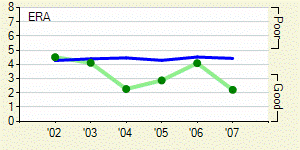
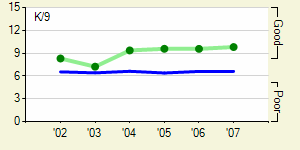
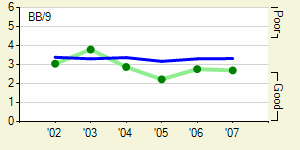
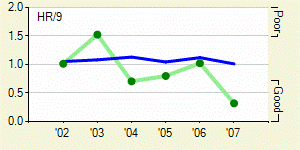
Source: FanGraphs
I'm not surprised in the least by Peavy's success. He pitched much better than most people realized in the first half last season when he was ridiculed for posting a 4-8 record with a 4.46 ERA. Peavy proceeded to go 7-6 with a 3.68 ERA in the second half even though his peripheral stats were roughly the same pre- and post- All-Star break.
Peavy beat Arizona 3-1 last night, enabling the Padres to pull within two games of the Diamondbacks for first place in the NL West. Jake allowed one run, three hits, and three walks in seven innings. He struck out 11 for the third consecutive start (including seven in a row at one point) and reached double digits for the eighth time this year, running his NL lead to 197.
Webb is scheduled to start tonight and could match Peavy's win total of 15 with a victory. He will be gunning for his seventh straight in the hopes of putting some distance between the D-Backs and the Padres.
As for the Cy Young Award, a strong case can be made for Peavy and an equally strong case can be made on behalf of Webb. It's so close, I would be comfortable giving the award to Brandon Peavy. Or maybe Jake Webb.
| Baseball Beat | August 27, 2007 |
The Denton True Young Awards
Y is for Young,
The magnificent Cy;
People batted against him,
But I never knew why.
- Ogden Nash (1902-1971), Lineup for Yesterday
Did you know that Cy Young's real name was Denton True Young? Yes, that's True.
Young was born in Gilmore, a farming community in eastern Ohio. He was known as Dent Young in his early years, then earned the nickname "Cyclone" in reference to the speed of his fastball as a young adult. His name was shortened to "Cy" a couple of years later and the pitching great was forever known as Cy Young.
By the time Young was old, he had won 511 games in his career, the most in the history of Major League Baseball. Young also holds the records for innings pitched (7,355), games started (815), and complete games (749). He wound up with the most losses (316), too.
Commissioner Ford Frick created the Cy Young Award in 1956 to honor the best pitcher in Major League Baseball. From 1956-1966, only one pitcher was selected by the Baseball Writers Association of America as the recipient of the award. Once Commissioner Frick retired, the rules were changed to honor the best pitcher from each league.
Who should win the AL and NL Cy Young Awards in 2007? Of course, the season is not over so it is premature to come up with anything definitive, but it might be instructive to at least study the candidates and what they bring to the table.
Let's take a look at the leaders in Runs Saved Above Average in both leagues as a starting point to develop a list of pitchers worthy of the award. RSAA equals the number of runs that a pitcher saved versus what an average pitcher would have allowed over the same number of innings with a home ballpark adjustment. It paints a similar picture as ERA+ but think of RSAA as the counting stat and ERA+ as the rate stat in terms of run prevention. One other minor difference is that RSAA uses runs whereas ERA+ is based on earned runs.
AL RSAA LEADERS
1 Kelvim Escobar 38 T2 Erik Bedard 30 T2 Fausto Carmona 30 T2 C.C. Sabathia 30 T5 Josh Beckett 28 T6 Dan Haren 27 T6 John Lackey 27 8 Johan Santana 24
Hideki Okajima (25) and Rafael Betancourt (23) are actually eighth and tenth, but I have excluded both because as non-starters and non-closers neither will receive a single vote for the award.
NL RSAA LEADERS
1 Brandon Webb 40 2 Brad Penny 36 3 Jake Peavy 32 4 Chris Young 27 5 John Smoltz 22
Source: Complete Baseball Encyclopedia
Tim Hudson is in sixth place but his RSAA falls all the way down to 20 or half of Brandon Webb's league-leading total. Cole Hamels and Derek Lowe round out the top eight (to put the NL on par with the AL).
Next, let's take a closer look at those in contention and examine some of the more important stats, including those which the pitcher has the most control over (such as strikeout, walk, and home run rates).
AMERICAN LEAGUE
ERA ERA+ K/9 BB/9 HR/9
Escobar 2.77 155 7.12 2.77 0.42
Bedard 3.16 140 10.93 2.82 0.94
Carmona 3.16 139 5.28 2.29 0.70
Sabathia 3.38 130 7.92 1.32 0.87
Beckett 3.21 141 8.55 1.86 0.56
Haren 2.72 160 7.62 2.23 0.92
Lackey 3.34 129 6.95 2.40 0.84
Santana 2.97 148 9.79 1.98 1.34
Kelvim Escobar may not be getting as much attention as a few other candidates but his numbers don't take a backseat to anyone. He leads the AL in RSAA and is second in ERA. In addition, his peripheral stats are solid, even spectacular in the case of his league-leading HR/9 rate. The 31-year-old righthander with a fastball that touches the mid-90s and a splitter that is one of the nastiest in the game is adept at inducing groundballs when necessary (25 GIDP, T2 in the AL) and keeping the ball in the yard.
Escobar's teammate John Lackey has the weakest case at this point. Among these eight candidates, Lackey fails to rank in the top three in any of the featured stats. He has been a good pitcher this year but not necessarily special. It would take a strong September for him to get serious consideration.
Aside from a superior walk rate, C.C. Sabathia's numbers are similar to Lackey's. As such, the Cleveland Indians ace is unlikely to gain much support. Like Lackey, the big southpaw has another member of his team's rotation that is more deserving of the honor. Yes, Fausto Carmona is – or at least should be – in the discussion for the AL CYA. The 23-year-old groundball specialist, who is leading the AL in GB % (64.5%) and GIDP (28), is tied for third in the league in quality starts with 20. It's almost hard to believe that Carmona spent time in the minors earlier this season.
Josh Beckett has the best combination of K, BB, and HR rates of any pitcher in the AL. As such, Boston's ace righthander is leading the league with a 2.79 Fielding Independent Pitching (FIP) mark. Beckett will also win over the hearts of voters with his MLB-leading win total (16, tied with teammate Tim Wakefield) and winning percentage (.762).
Dan Haren is leading the AL in ERA and is among the top three in IP (185.1), WHIP (1.11), and W-L % (.737). He has been consistently solid all year, as evidenced by his MLB-leading 25 quality starts (89% of his GS). However, with 13 unearned runs, his ERA may slightly overstate his pitching prowess this year. The 6-foot-5, 220-pound righthander is fourth in the league in RA (3.35), nearly one-third of a run behind Escobar.
Lost a bit in the shuffle has been two-time Cy Young Award winner Johan Santana. His stats are pretty much in line with the past two seasons. The only thing that has changed is the level of the competition. He is leading the league in WHIP (1.02) but is not blowing away the field in strikeouts or ERA as in years past. Santana has been hurt by the long ball, allowing a career-high 27 HR in 182 IP.
If you want strikeouts, then Erik Bedard is your man. The Baltimore Orioles lefthander is leading the majors in Ks (221) and K/9 (10.9). The power pitcher also gets an above-average number of groundballs (47.9%), making him a favorite of mine with his high K and GB rates.
NATIONAL LEAGUE
ERA ERA+ K/9 BB/9 HR/9
Webb 2.63 177 7.79 2.72 0.42
Penny 2.65 168 6.29 3.12 0.26
Peavy 2.21 186 9.81 2.69 0.32
Young 2.12 194 8.62 3.18 0.33
Smoltz 3.01 143 8.24 2.06 0.61
Unlike the American League, the Cy Young Award in the NL is really a two-horse race between Webb and Jake Peavy. Brad Penny, Chris Young, and John Smoltz have had stellar seasons but not on par with Webb and Peavy.
Webb has something in common with Cy Young, the Hall of Fame pitcher. Young once set the record for the most consecutive scoreless innings pitched with 45, which wasn't broken until 1968. Webb recently completed 42 consecutive shutout innings. The hottest pitcher in baseball has won six straight starts – including three complete-game shutouts – and has lowered his ERA from 3.38 to 2.63 in the process. As the ace of Arizona's staff with a MLB-leading 191.2 IP, the defending CYA winner may also get bonus points if the Diamondbacks win the NL West.
Despite Webb's emerging presence, Peavy remains a strong candidate to win his first Cy Young. The 26-year-old righthander is leading the NL in strikeouts (186) and K/9 (9.81). In addition, he is second in the league in ERA and ERA+. While Peavy may not get any credit from the voters for it, he has the best FIP (2.48) of any starter in baseball.
Penny has the third-best case and could become a factor with a strong stretch run. The 6-foot-4, 260-pound righthander has an impressive resumé as is, leading the league in quality starts (23) and placing second in wins (14) and winning percentage (.778). That said, it's difficult to argue on his behalf over Webb or Peavy.
Chris Young has been nothing short of fantastic this year but his stint on the DL has hurt his chance of winning the NL CYA. He is leading the majors in ERA and WHIP (1.01) but his bad back may prevent him from qualifying for the ERA title at season's end. A flyball pitcher, Young has benefited by pitching at Petco Park. In fact, it's almost hard to believe that he has only allowed five HR this season (vs. 28 in 2006). His rate stats have been outstanding, yet his counting stats have suffered from completing only 135.2 innings. The name fits the bill but the overall package comes up a bit shy.
Other Resources: Baseball-Reference.com, FanGraphs, The Hardball Times, and ESPN.com.
| Baseball Beat | August 21, 2007 |
Checking in on the First Round Draft Picks
Eighteen of the 30 first round draft picks have begun their professional careers, ranging from one game in the case of Tim Alderson to 51 games by early signee Beau Mills.
I thought it would be interesting to see how the first rounders are doing. I have compiled the stats for the pitchers first, followed by the position players. All listings are in the order of how players were drafted.
W L ERA IP H R ER HR BB SO WHIP SO/9 K/BB
Moskos asx,ROK 0 0 4.00 9.1 15 5 4 1 2 8 1.82 7.71 4.00
Detwiler H-A,ROK 1 2 4.50 24.1 30 12 12 2 8 23 1.56 8.51 2.88
Weathers L-A 0 0 3.80 9.2 3 4 4 1 4 16 0.72 14.90 4.00
Savery asx 0 1 3.86 9.2 10 4 4 0 3 5 1.35 4.66 1.67
Withrow ROK 0 0 5.60 8.0 5 5 5 0 4 12 1.13 13.50 3.00
Alderson ROK 0 0 0.00 1.0 1 0 0 0 0 2 1.00 18.00 ----
Schmidt L-A 0 1 6.43 7.0 8 5 5 0 6 6 2.00 7.71 1.00
Main ROK,asx 1 1 3.70 20.0 16 8 8 2 10 28 1.30 12.60 2.80
Poreda ROK 2 0 1.25 36.1 25 6 5 1 9 35 0.94 8.67 3.80
Simmons AA 0 0 5.79 23.2 33 17 15 2 5 20 1.61 7.61 4.00
Aaron Poreda (2-0, 1.25 ERA, 0.94 WHIP, 3.80 K/BB), selected with the 25th overall pick by the Chicago White Sox, has performed the best of all the first round pitchers to date. However, recognize that the 20-year-old lefthander out of the University of San Francisco has worked his magic at Great Falls in the Pioneer League (Rookie). I wouldn't put much stock in his numbers until he makes the jump to at least Low-A, which is where most highly regarded college pitchers start their pro careers.
Casey Weathers (COL) has enjoyed success, allowing only three hits while striking out 16 batters in 9 2/3 innings for the Asheville Tourists of the South Atlantic League (Low-A). Chris Withrow (LAD) and Michael Main (TEX) have shown spurts of dominance, averaging well over one K per inning. Main has already been promoted to the Spokane Indians (Short Season).
G AB R H 2B 3B HR RBI BB SO AVG OBP SLG OPS SB CS
LaPorta L-A,ROK 17 66 10 18 7 0 4 12 5 20 .273 .324 .561 .885 0 0
Mills L-A,asx 51 201 37 52 14 1 5 36 17 44 .259 .330 .413 .743 0 0
Heyward ROK 4 16 1 6 4 0 1 3 2 4 .375 .444 .813 1.257 0 1
Mesoraco ROK 34 116 14 25 3 0 1 7 14 22 .216 .316 .267 .583 2 0
Ahrens ROK 43 147 14 33 5 0 3 18 23 41 .224 .337 .320 .657 3 0
Kozma ROK 27 94 19 25 5 0 2 9 12 18 .266 .361 .383 .744 3 1
Arencibia asx 48 175 24 45 12 0 3 21 11 44 .257 .305 .377 .682 0 0
Revere ROK 45 173 41 55 5 9 0 22 10 17 .318 .372 .451 .823 19 8
Jason Heyward, chosen by the Atlanta Braves with the 14th overall pick, is off to a hot start. The 17-year-old outfielder has gone 6-for-16 with five XBH in his first four games for the GCL Braves of the Gulf Coast League (Rookie). Don't be surprised if he ends up as one of the top players out of the 2007 draft.
Ben Revere, the surprise first round choice of the Minnesota Twins, has put up some unusual numbers. The 5-foot-9 speester has hit 9 triples and stolen 19 bases in 45 games for the GCL Twins (Rookie). With only 10 BB and 17 SO, Revere has done little to convince me that he is not another Juan Pierre in the making. The outfielder has yet to go yard so I would discount those pre-draft reports in which he allegedly slugged a 450-foot homer.
Devin Mesoraco (CIN) has struggled the most, hitting just .216/.316/.267. His stock rose late last spring, and it's possible that he may have been a reach at #15. Toronto's first two selections – Kevin Ahrens and J.P. Arencibia – have combined to strike out 85 times in 322 at-bats.
Twelve first rounders have yet to play. In the order of how they were drafted, David Price (TB), Mike Moustakas (KC), Josh Vitters (CHC), Matt Wieters (BAL), Jarrod Parker (ARI), Madison Bumgarner (SF), Phillippe Aumont (SEA), Matt Dominguez (FLA), Blake Beavan (TEX), Rick Porcello (DET), Wendell Fairley (SF), and Andrew Brackman (NYY) are all signed but still awaiting their professional debuts. For the most part, the recent signees just reported to spring training facilities and many of them will not play until the instructional league opens in mid-September.
| Baseball Beat | August 20, 2007 |
Ryan Braun: Greatest First-Year Slugger Ever?
Ryan Braun led off the second inning yesterday with his 24th home run of the season to give Milwaukee an early 1-0 advantage although the Brewers later blew a five-run lead and lost 7-6 to the Cincinnati Reds. The Brew Crew has now dropped six of its last seven and 10 of 13 while slipping into second place in the National League Central, one game behind the Chicago Cubs.
Although the Brewers are only 35-42 since Braun made his MLB debut on May 25, nobody can blame Milwaukee's misfortunes on its rookie third baseman. The fifth overall pick in the 2005 draft is quietly having one of the greatest seasons ever for a first-year player.
Let's take a look at his year-to-date stats:
G AB R H 2B 3B HR RBI BB SO SB CS AVG OBP SLG OPS OPS+ 76 309 58 106 17 5 24 62 23 70 10 4 .343 .388 .663 1.051 168
Due to a late start to his season, Braun is 46 plate appearances short of qualifying for the league lead in batting average and other rate stats. If the 23-year-old sensation had met the minimum, he would sit atop the NL in batting average (.343) and slugging average (.663) and rank second to Barry Bonds in OPS (.1051 to 1.084). His AVG, SLG, and OPS are all higher than fellow third baseman Alex Rodriguez, who is in the midst of another great season.
By not appearing among the league leaders in the newspaper every day, the former University of Miami (FL) All-America has escaped the attention of the average fan. With 338 plate appearances and 38 games to go, Braun is on the bubble as to whether he will qualify for the batting and slugging crowns at season's end. If he continues to average 4.45 PA per game while missing no more than one contest, Braun will just meet the minimum threshold of 502 PA needed to qualify.
Should Braun fail short, he still could win the batting and slugging titles under a rule that was put in place in 1967 by figuring the remaining at-bats as hitless. If Braun's recalculated averages are superior to those who qualified, then he would be awarded the titles. According to Wikipedia, "this policy was invoked in 1981, securing Bill Madlock his third NL batting crown, and in 1996, when NL titlist Tony Gwynn finished the year with only 498 PAs."
In any event, to put Braun's numbers in historical perspective, he is on pace to produce the highest AVG, SLG, OPS, and OPS+ of any first-year player in the modern era. The 6-foot-2, 200-pound native of Southern California is in elite company with such greats as Joe DiMaggio, Johnny Mize, Albert Pujols, Frank Robinson, and Ted Williams.
Player SLG Year Age 1 George Watkins .621 1930 30 2 Wally Berger .614 1930 24 3 Albert Pujols .610 2001 21 4 Ted Williams .609 1939 20 5 Dale Alexander .580 1929 26 6 Johnny Mize .577 1936 23 7 Joe DiMaggio .576 1936 21 8 Frank Robinson .558 1956 20 9 Zeke Bonura .545 1934 25 10 Johnny Frederick .545 1929 27 11 Del Bissonette .543 1928 28 12 Buzz Arlett .538 1931 32 13 Earl Averill .538 1929 27 14 Paul Waner .528 1926 23 15 Mitchell Page .521 1977 25 16 Jimmie Hall .521 1963 25 17 Wally Judnich .520 1940 23 18 Bob Meusel .517 1920 23 19 Johnny Rizzo .514 1938 25 20 Orlando Cepeda .512 1958 20
George Watkins was 30-years-old when he slugged .621 in 1930, the season with the highest AVG, SLG, and OPS in the history of baseball. With only 424 PA, the St. Louis Cardinals outfielder would have failed to qualify under today's rules, yet met the less stringent criteria of his day by playing in a minimum of 100 games.
Braun was mentioned in the same sentence as Pujols earlier this month when he hit his 20th HR in 64 games – the fastest to reach that mark since Albert did it in his 63rd game in 2001.
At 1.051, Braun's on-base plus slugging (OPS) would also rank #1 among all first-year players.
Player OPS Year Age 1 Ted Williams 1.045 1939 20 2 George Watkins 1.036 1930 30 3 Albert Pujols 1.013 2001 21 4 Wally Berger .989 1930 24 5 Johnny Mize .979 1936 23 6 Dale Alexander .977 1929 26 7 Paul Waner .941 1926 23 8 Del Bissonette .939 1928 28 9 Frank Robinson .937 1956 20 10 Earl Averill .936 1929 27 11 Joe DiMaggio .928 1936 21 12 Mitchell Page .926 1977 25 13 Zeke Bonura .925 1934 25 14 Buzz Arlett .925 1931 32 15 Johnny Frederick .917 1929 27 16 Don Hurst .899 1928 22 17 Bob Johnson .892 1933 27 18 Alvin Davis .888 1984 23 19 Wally Judnich .888 1940 23 20 Johnny Rizzo .882 1938 25
One has to sit up and take notice when a player is producing at the same level as The Splendid Splinter. However, Williams was only 20 when he broke in so it would be a stretch to suggest that Braun's initial season might portend a similar career path.
When we adjust for home ballpark and era, Braun's OPS+ of 168 would rank as the best first season in the annals of modern baseball.
Player OPS+ Year Age 1 Johnny Mize 161 1936 23 2 Ted Williams 160 1939 20 3 Albert Pujols 158 2001 21 4 Mitchell Page 152 1977 25 5 Dale Alexander 148 1929 26 6 Paul Waner 147 1926 23 7 Alvin Davis 146 1984 23 8 Del Bissonette 144 1928 28 9 Del Ennis 143 1946 21 10 George Watkins 143 1930 30 11 Frank Robinson 142 1956 20 12 Curt Blefary 139 1965 21 13 Johnny Rizzo 139 1938 25 14 Jeff Bagwell 138 1991 23 15 Buzz Arlett 138 1931 32 16 Wally Berger 137 1930 24 17 Jimmie Hall 136 1963 25 18 Cuckoo Christensen 136 1926 26 19 Gavvy Cravath 136 1908 27 20 Earl Averill 135 1929 27
If discussing Braun's place in history is a bit premature with more than a month to go, I believe it is safe to say that he is a virtual lock to win the NL Rookie of the Year. Braun has even been mentioned as an MVP candidate although it says here that he will have a difficult time beating out teammate Prince Fielder, who is leading the league in home runs with 38.
To Braun's credit, he has hit some big home runs this season. None was bigger than the game-winning, three-run homer he cranked against Brad Lidge on Saturday, August 11. Braun moved to the cleanup spot in the order last Tuesday and went 3-for-4 with a solo home run and two runs. With Fielder hitting in front of rather than behind Braun, it will be interesting to see if pitchers begin to work him differently. In the meantime, the man who wears #8 on his jersey is absolutely crushing lefthanders.
AB HR BB SO AVG OBP SLG OPS
vs. LHP 79 11 14 12 .468 .543 1.013 1.556
vs. RHP 230 13 9 58 .300 .328 .543 .864
Small sample size for sure but impressive nonetheless. While not eye popping, Braun's numbers vs. righthanders are solid. The only disconcerting split involves his BB/SO totals against righties. He has drawn five more walks vs. LHP in 151 fewer AB while striking out just 13% of the time as compared to 24% vs. RHP.
Braun is hitting at home (.321/.384/.648), on the road (.367/.391/.680), during the day (.339/.378/.621), and at night (.346/.394/.692 ). He ripped pitchers in the first half (.350/.391/.663 ) and is tearing 'em up in the second half (.336/.384/.664).
The only place in the strike zone where pitchers have had mediocre success is up and in where the righthanded-hitting slugger is batting .273. He is hitting .324 or better in all of the other zones, including .556 over the heart of the plate and waist high and .583 down the middle between the knees and the thighs. Braun also hits the ball with authority to all fields.
Braun is not without his weaknesses. He has made 19 errors in 75 games and his fielding percentage of .893 would rank as the 14th worst among 3B with 100 or more games since 1900.
FIELDING PERCENTAGE YEAR PCT G 1 Charlie Hickman 1900 .842 120 2 Hunter Hill 1904 .864 127 3 Tommy Leach 1903 .879 127 4 Harry Wolverton 1900 .881 104 5 Otto Krueger 1901 .881 142 6 Bill Bradley 1900 .882 106 7 Joel Youngblood 1984 .887 117 8 Emil Batch 1905 .887 145 9 Doc Casey 1901 .887 127 10 Jim Delahanty 1904 .888 113 11 Jimmy Williams 1900 .889 103 12 Roy Hartzell 1906 .889 103 13 Sammy Strang 1902 .890 139 14 Fred Hartman 1901 .894 119 15 Jimmy Collins 1907 .895 139 16 Jap Barbeau 1909 .895 132 17 Nixey Callahan 1903 .895 102 18 Harry Lord 1912 .895 106 19 Heinie Zimmerman 1914 .897 118 20 Jimmy Burke 1904 .897 118 21 Charlie Pick 1916 .899 108 22 Butch Hobson 1978 .899 133 23 Gary Sheffield 1993 .899 133
Interestingly, only three other third sackers – Butch Hobson (1978), Joel Youngblood (1984), and Gary Sheffield (1993) – have had a fielding percentage below .900 since 1916.
After leading the Brewers with five home runs during spring training, Braun was assigned to Nashville of the Pacific Coast League primarily to work on his defensive footwork and throwing. Not surprisingly, the prized prospect dominated Triple-A pitchers to the tune of .342/.418/.701. Over the course of 110 combined major and minor league games, Braun has hit .343 with 34 HR.
Make sure you don't confuse Ryan Braun with the 27-year-old rookie pitcher for the KC Royals by the same name. Well, I guess it is confusing. But the key is not to be mistaken by the two. It might be helpful – and more accurate – to think of the Milwaukee Brewers slugger as none other than Ryan Brawn.
Sources for the above tables: Baseball-Reference Play Index and the Complete Baseball Encylopedia.
| Baseball Beat | August 18, 2007 |
The Wizard of Odds
I just returned from an overnight business trip to Las Vegas and thought I would share the baseball odds posted at Caesars Palace and all the other (Toby) Harrahs properties (such as Paris, Flamingo, Imperial Palace, Bally's, Harveys, and the Rio).
Odds to Win the 2007 World Series
Line
Opening Current
Team 10/9/06 8/16/07
New York Yankees 4/1 7/2
New York Mets 9/2 4/1
Chicago White Sox 5/1 2000/1
Minnesota Twins 6/1 40/1
Detroit Tigers 6/1 7/2
St. Louis Cardinals 7/1 25/1
Oakland A's 8/1 300/1
Los Angeles Dodgers 10/1 40/1
Boston Red Sox 12/1 5/2
Los Angeles Angels 12/1 4/1
Philadelphia Phillies 12/1 22/1
Florida Marlins 12/1 300/1
San Diego Padres 18/1 18/1
Toronto Blue Jays 20/1 250/1
Houston Astros 22/1 500/1
Cincinnati Reds 25/1 750/1
Atlanta Braves 35/1 15/1
Cleveland Indians 40/1 8/1
Colorado Rockies 50/1 45/1
Chicago Cubs 50/1 4/1
Texas Rangers 60/1 2500/1
San Francisco Giants 60/1 2500/1
Arizona Diamondbacks 75/1 12/1
Seattle Mariners 75/1 18/1
Baltimore Orioles 85/1 2000/1
Milwaukee Brewers 85/1 10/1
Washington Nationals 100/1 2000/1
Pittsburgh Pirates 150/1 2000/1
Kansas City Royals 200/1 5000/1
Tampa Bay Devil Rays 200/1 5000/1
None of the above lines are particularly appealing in my judgment. As with all futures bets, the odds are stacked against the bettor and in favor of the house. Assuming equal money is wagered on all teams, the book has about a 90% profit margin built into the cumulative lines (vs. a more typical 10-20% for individual games).
The Chicago White Sox have been the biggest disappointment in 2007, going from the team with the third-lowest odds in the opening line to 2000/1 with a month-and-a-half still to go. The Oakland A's have also failed to live up to expectations this year.
All has not been lost on the Windy City as the Chicago Cubs have arguably turned in the biggest positive surprise of any team in baseball, going from 50/1 longshots last October to a one-in-five chance as the season hits the three-quarters pole. Cleveland, Milwaukee, Arizona, Atlanta, and Seattle have outperformed initial expectations as well.
At 3/2, the New York Mets were favored to win the National League Championship. The line on the Cubs (8/5) seemed a bit short to me, probably reflecting the hope of the fans more than the sentiment of the professional bettor. The other teams with a reasonable shot include the Brewers (9/2), Diamondbacks (5/1), Braves (6/1), San Diego Padres (9/1), and the Philadelphia Phillies and St. Louis Cardinals (both 10/1).
Over in the American League, the Boston Red Sox (6/5) were almost odds-on to win the ALCS. The New York Yankees (9/5), Detroit Tigers (9/5), Los Angeles Angels (2/1), and Indians (3/1) were the only other clubs given much of a shot at winning the pennant. If the season ended yesterday, the Mariners (8/1) would be the Wild Card team and would have a one-in-four chance of representing the AL in the World Series if you believe, like Billy Beane, that the playoffs are nothing more than a crapshoot.
On the non-baseball side, you can bet $50 to win $20 on Roger Federer winning the U.S. Open Tennis Championship for the fourth consecutive time.
Get this, the AFC team is already a seven-point favorite to win the Super Bowl. Based on the odds to win the conference championships, the New England Patriots (6/5 to win the AFC and 5/2 to win the Super Bowl) and Chicago Bears (7/2 NFC, 7/1 Super Bowl) are favored to oppose each other in Glendale, Arizona on February 3, 2008. The over-under is 47.
For the patient, you can place a futures bet on the Men's NCAA basketball tournament (March 18-April 7) or the 2008 Masters golf tournament (April 10-13). The favorites? North Carolina at 7/2 and Tiger Woods at 9/5.
If you've got money to burn, Las Vegas stands ready to take it with the odds clearly stacked in favor of the house. Before you place that bet, take a deep breath and decide where your money could be better spent.
| Baseball Beat | August 16, 2007 |
A Recap of the First Round Signings (and More)
Major League Baseball's newly imposed draft deadline came and went yesterday without a lot of hitches. Teams and players had until midnight to reach agreements and all 30 first rounders inked contracts with their new clubs. Not surprisingly, a few signings (namely Michael Moustakas at #2, Josh Vitters at #3, and Matt Wieters at #6) were reached minutes before the deadline, adding an element of suspense to what would otherwise be termed business as usual.
According to Jim Callis of Baseball America, "the average first-round bonus went up" this summer despite MLB's efforts to reduce slot money by 10%. This year's average bonus of $2,098,083 compared to $1,933,333 in 2006 and marked the highest since 2002 ($2,106,793).
FIRST ROUND SIGNING BONUSES
1. Tampa Bay Devil Rays: David Price, LHP, Vanderbilt University - $5.6 million signing bonus as part of a six-year major league contract worth a guaranteed $8.5 million and as much as $11.25 million. Price's bonus was the second-largest in draft history when he signed, trailing only Justin Upton's $6.1 million as Arizona's No. 1 overall pick in the 2005 draft. The guaranteed value of Price’s contract is the third-highest in draft annals, trailing only Mark Prior ($10.5 million, Cubs) and Mark Teixeira ($9.5 million, Rangers) from the 2001 draft."
2. Kansas City Royals: Mike Moustakas, SS, Chatsworth HS (CA) - $4 million.
3. Chicago Cubs: Josh Vitters, 3B, Cypress HS (CA) - $3.2 million.
4. Pittsburgh Pirates: Daniel Moskos, LHP, Clemson University - $2.475 million.
5. Baltimore Orioles: Matt Wieters, C, Georgia Tech - $6 million (the largest up-front bonus in draft history).
6. Washington Nationals: Ross Detwiler, LHP, Missouri State University - $2.15 million.
7. Milwaukee Brewers: Matt LaPorta, 1B, University of Florida - $2 million.
8. Colorado Rockies: Casey Weathers, RHP, Vanderbilt University - $1.8 million.
9. Arizona Diamondbacks: Jarrod Parker, RHP, Norwell HS (IN) - $2.1 million.
10. San Francisco Giants: Madison Bumgarner, LHP, South Caldwell HS (NC) - $2 million.
11. Seattle Mariners: Phillippe Aumont, RHP, Ecole du Versant High School (CAN) - $1.9 million.
12. Florida Marlins: Matt Dominguez, 3B, Chatsworth High School (CA) - $1.8 million.
13. Cleveland Indians: Beau Mills, 1B-3B, Lewis-Clark State College - $1.575 million.
14. Atlanta Braves: Jason Heyward, OF, Henry County High School (GA) - $1.7 million.
15. Cincinnati Reds: Devin Mesoraco, C, Punxsatawney High School (PA) - $1.4 million.
16. Toronto Blue Jays: Kevin Ahrens, SS-3B, Memorial HS (TX) - $1.44 million.
17. Texas Rangers: Blake Beavan, RHP, Irving HS (TX) - $1.4975 million.
18. St. Louis Cardinals: Peter Kozma, SS, Owasso High School (OK) - $1.395 million.
19. Philadelphia Phillies: Joe Savery, LHP, Rice University - $1.3725 million.
20. Los Angeles Dodgers: Chris Withrow, RHP, Midland Christian High School (TX) - $1.35 million.
21. Toronto Blue Jays: J.P. Arencibia, C, University of Tennessee - $1.3275 million.
22. San Francisco Giants: Tim Alderson, RHP, Horizon High School (AZ) - $1.29 million.
23. San Diego Padres: Nick Schmidt, LHP, University of Arkansas - $1.26 million.
24. Texas Rangers: Michael Main, RHP/OF, DeLand HS (FL) - $1.2375 million.
25. Chicago White Sox: Aaron Poreda, LHP, University of San Francisco - $1.2 million.
26. Oakland Athletics: James Simmons, RHP, UC Riverside - $1.1925 million.
27. Detroit Tigers: Rich Porcello, RHP, Seton Hall Prep (NJ) - $3.58 million signing bonus as part of a $7.285 million four-year contract. Porcello will receive MLB salaries of $95,000 (prorated from $380,000) in 2007, $1.1M in 2008, $1.2M in 2009, and $1.025M in 2010. The Tigers have club options for $1.536M in 2011 and $1.344M in 2012.
28. Minnesota Twins: Ben Revere, OF, Lexington Catholic HS (KY) - $750,000.
29. San Francisco Giants: Wendell Fairley, OF, George County-Lucedale High School (MS) - $1 million.
30. New York Yankees: Andrew Brackman, RHP, North Carolina State - $3.35 million signing bonus (payable over six years) as part of a $4.55 million guaranteed major league contract that reportedly could be worth $13 million over seven years.
Brackman's contract is a total head scratcher, particularly in view of the fact that he is expected to have elbow ligament replacement surgery within the next few weeks. When healthy, the 6-foot-10 junior has been known to touch the upper-90s and as high as 100 on the radar guns. However, he has never thrown more than 78 innings in any season and his velocity dropped into the 80s last spring. The two-sport star is a high risk/high reward prospect.
Other notable signings:
New York Yankees: Brad Suttle, 3B, University of Texas - $1.3 million bonus (a record for the 4th round).
Baltimore Orioles: Jake Arrieta, RHP, TCU - $1.1 million bonus (a record for the 5th round).
Washington Nationals: Jack McGeary, LHP, Roxbury Latin HS (MA) - $1.8 million bonus (a record for the 6th round). According to Baseball America, "Washington will allow him to attend Stanford as a full-time student and play baseball in the summers until he graduates. The Nats are also picking up the cost of his education, with $200,000 via the college scholarship plan."
Detroit Tigers: Cale Iorg, 3B, Karns HS (TN) - $1.4975 million (6th round).
New York Yankees: Carmen Angelini, SS, Barbe HS (LA) - $1 million bonus (10th round).
Second rounders RHP Joshua Fields (Braves) and 1B Hunter Morris (Red Sox); third rounders RHP Brandon Workman (Phillies), 3B Derek Dietrich (Astros), RHP Tommy Toledo (Padres), and RHP Matt Harvey (Angels); fourth rounders 3B/OF Blake Stouffer (Reds), OF Garrett Nash (Rangers), RHP Brett Eibner (Astros), and OF Kyle Russell (Cardinals); and fifth rounders LHP John Gast (Rangers), RHP Kyle Blair (Dodgers), and RHP Nate Striz (Twins) did not sign. Fields and Harvey were represented by the Scott Boras Corporation. As a "reward" for failing to sign Fields and Morris, Atlanta and Boston will receive like compensation picks in the second round in the 2008 draft. Philadelphia, Houston, San Diego, and the Los Angeles Angels "earned" supplemental picks after the third round next year for not coming to terms with their third round selections this year.
Dietrich and Eibner were Houston's top two picks and apparently were looking for first and second round money which, if so, makes no sense. It is now safe to say that Houston had the worst draft of any organization with only three signees in the top eight rounds. Already ranked 22nd in terms of talent by Baseball America in the 2007 Prospect Handbook, the Astros may slip to the bottom when the new list is unveiled this winter.
Morris will attend Auburn, Workman is off to the University of Texas, Toledo is slated to become a member of the Florida Gators baseball program, Harvey and Striz head to the University of North Carolina, Nash will join the two-time defending NCAA champs at Oregon State, Gast is set to become a Florida State Seminole, and Blair is expected to enroll at the University of San Diego.
Fields will return to the University of Georgia today for his senior year. The hard-throwing closer was thought to be asking for a signing bonus well in excess of his slot money. All may not be lost, however, as Fields could pull a Casey Weathers, the Vanderbilt closer who elected not to sign last year. Weathers dramatically improved his draft status as a senior when he was selected by the Colorado Rockies with the eighth pick, earning a bonus of $1.8 million.
Much to the delight of Aggie fans, Stouffer will go back to College Station and complete his four-year career at Texas A&M.
Russell, a draft-eligible sophomore, will return to Texas for his junior season. He will re-enter the draft next June. The 2007 NCAA HR leader spent the summer in the California Collegiate League and hit .247 with four home runs while whiffing 34 times in 97 at-bats. He has had trouble hitting with a wood bat at every stop along the way.
For complete coverage, be sure to visit Baseball America's Draft Blog and Signing Bonus Chart (subscription required). You can learn more about each of the above first rounders via pre-draft coverage at Baseball America and Baseball Analysts.
| Baseball Beat | August 13, 2007 |
Mark McGwire and Me
Let me set the stage. The date: October 1998. The New York Yankees had swept the San Diego Padres in the World Series. Although the Bronx Bombers had won 114 games during the regular season and went 11-2 during the post-season, the biggest story of the year was the home run race between Mark McGwire and Sammy Sosa.
McGwire and Sosa inspired us all during the summer months when they engaged in the greatest home run battle in 37 years. The sluggers were the first to hit 60 since Roger Maris outlasted Mickey Mantle and slammed 61 homers in '61 to break Babe Ruth's 34-year-old.
Who can forget Big Mac lifting his son Matthew high in the air at home plate just after he tied Maris' record or when he lifted him even higher the next night after he surpassed the back-to-back MVP winner? Who can't recall Sosa, who was playing right field at the time, running in and leaping into the arms of McGwire to congratulate his pal? Or how about when McGwire climbed into the seats near the first base dugout and exchanged hugs with the Maris family? All of these images were spine-tingling moments for those of us who were there in person or at home watching live on TV.


Living in Southern California, I wasn't one of the million people who now claim they were at Busch Stadium for one or more of these record-setting home runs. However, being a resident of Long Beach soon had its rewards.
 Shortly after the season ended, McGwire, who back then made Huntington Beach his home in the fall and winter, was in town to shoot a commercial for a toy bat that Hasbro was going to market in early 1999. My sister-in-law Teri, the field manager at Blair Field, learned that McGwire's stand-in hadn't shown up and volunteered my services when the producer asked if anyone knew a big guy who could pinch hit (so to speak). She called and asked if I was available, and I told her "yes" because I didn't have any appointments that day.
Teri put the producer on the telephone, and the lady explained what was taking place and what was needed. After getting my height and weight, she asked what my waist size was, and I told her, "42." The producer shot back, "Well, McGwire is a 38!" I thought to myself (but didn't quite have the audacity to say), "That's why he's making nine million dollars per year and why I'm managing money instead of playing."
Not knowing who else to turn to at the last minute, the producer asked me if I would be willing to work for scale. I asked her what that was, and she informed me that it was $200. That was a little more than I wanted to pay (just kidding), but I took the job anyway. After we agreed on the terms, she wanted to know how long it would take me to get to the ballpark. I said, "Oh, I could be there in about 15 to 20 minutes." She told me to hurry on over and to meet her in the big white motor home that was serving as the dressing room in the parking lot.
The producer introduced me to the person in charge of costumes and I was quickly handed a full uniform identical to what McGwire was wearing that day. It was meant to look like a Cardinals outfit but there were no team names, logos, or numbers on the jersey. However, the red hat, undershirt, belt, and high-top Nike shoes fit the bill.
I strolled out onto the field and quickly discovered that McGwire and I were the only ones in uniform. I was conspicuous in both size and dress. I found the director — or did he find me? — and we made our way over to where McGwire was standing. The director introduced me. After we shook hands, I was escorted to home plate where the film crew was anxiously awaiting me. Well, not me per se. But whoever was going to stand in for McGwire that day. It could have been any other tall, husky 43-year-old businessman from the area. Hey, someone had to do the job. Thanks to my sister-in-law, that someone just happened to be me that day.

Although I had played many games at Blair Field during my youth, I hadn't stepped foot on that field in a baseball uniform in more than 25 years. In no time, I actually found my feet in the batter's box holding the Vortex Power Bat in one hand while waiting for McGwire to make his way across the field and into the equivalent of a director's chair. It was my job to impersonate him while the production staff set up the lighting and the proper distance and angles of the cameras.
When everything was good to go, I simply handed the bat to McGwire and let him do his thing. I stood by and watched the man who had slugged 70 home runs that season rip some balls to the outfield grass but not one came close to leaving the yard. You see, Blair Field isn't known to yield many homers with aluminum bats, much less plastic bats and balls.
The filming went from mid-morning to early afternoon. We broke for lunch afterwards and the photo of me towering over McGwire was taken at that time. Mark, a fellow USC Trojan, was cooperative and reasonably friendly that day.
The Vortex Power Bat and Ball were invented by Mark Rappaport, who sold the idea to OddzOn, Inc., a division of Hasbro. The toy company hired McGwire and later Mike Piazza to endorse these products. The bat featured a pressurized, high-impact, oversized barrel with a large sweet spot that was similar in design to a 2-liter soft drink bottle. The sound and results of the bat striking the ball were enough to instill confidence in any youngster's swing.
I remember being surprised that the bat and ball were not available for the holiday season. The commercials of McGwire stroking a pitched ball from that day at Blair Field didn't hit the TV screens until the first of the year. I was nowhere to be found in those ads but was proud to have played a small part in their production.
My only regret is that there weren't any scouts or talent agents in the stands. A budding major league or movie career was put on hold. Nine years later, I'm still waiting with my bat on my shoulder. The good news is that I didn't quit my day job.
| Baseball Beat | August 06, 2007 |
A Home Run Weekend
What a weekend for historic home runs. What a weekend for baseball.
You would have to be sleeping under a rock on Mars not to know that Barry Bonds and Alex Rodriguez reached important home run milestones on Saturday. Bonds tied Hank Aaron's major league record with his 755th HR while Rodriguez hit the 500th of his career.
Bonds is now one home run shy of becoming Major League Baseball's all-time home run king. Remarkably, the 43-year-old slugger has now hit 72 homers after his 40th birthday, tied with Carlton Fisk for the most among players in their fifth decade. Maybe Pudge knew something when he picked that uniform number.
After a 10-day drought, Rodriguez connected on the first pitch thrown to him on Saturday. At 32 years and 8 days, ARod became the youngest player in MLB history to hit 500 home runs, edging Jimmie Foxx (32 years, 338 days). He reached the milestone in the third-fewest games (1,855) ever with only Mark McGwire (1,639) and Babe Ruth (1,740) doing so in fewer contests.
Rodriguez is one of three players to have hit more than 100 HR with three teams. Darrell Evans (142 SF, 141 DET, 131 ATL) and Reggie Jackson (269 KC/OAK, 155 NYY, 123 CAL) are the other two. Reggie also hit 27 for the Orioles in his lone season in Baltimore in 1976.
Not on par with Bonds and Rodriguez for significance but Blue Jays DH Frank Thomas went yard twice on Saturday and passed Eddie Murray for 20th place on the all-time HR list with 505. Adam Dunn, who may be on his way to 500, ripped his 30th HR and is an odds-on favorite to go yard 40 times for the fourth consecutive year. Ryan Howard, the quickest player in terms of games to reach 100 career homers, blasted his 30th and now is nipping at NL leader Prince Fielder's heels. While far from historic, Fielder slugged his 32nd HR off Philadelphia's Tom Gordon in the bottom of the eighth inning to give the Milwaukee Brewers a 6-5 come-from-behind win over the Phillies on Saturday.
Hideki Matsui hit his 100th HR as a member of the New York Yankees on Sunday, the first Japanese-born player to reach that mark in the history of MLB. When breaking for a commercial at the end of the inning, YES analyst Bobby Murcer reported that Matsui had hit his "100th of the year." If that were the case, Hideki should have received a lot more publicity than he did. Matsui slugged 332 in Japan and could wind up with more than 500 HR for his combined career by 2010.
It's difficult to discuss home runs this past weekend without mentioning Padres left fielder Scott Hairston, who hit three consecutive dingers over two games. On Friday night, he hit one in the bottom of the 9th to tie the game and another in the 12th to end the game. His third was accomplished the following day when he went deep leading off the bottom of the first inning.
With the addition of Rodriguez, the 500 HR Club now has 22 members.
T1 Hank Aaron 755 T1 Barry Bonds 755 3 Babe Ruth 714 4 Willie Mays 660 5 Sammy Sosa 604 6 Ken Griffey Jr. 589 7 Frank Robinson 586 8 Mark McGwire 583 9 Harmon Killebrew 573 10 Rafael Palmeiro 569 11 Reggie Jackson 563 12 Mike Schmidt 548 13 Mickey Mantle 536 14 Jimmie Foxx 534 T15 Willie McCovey 521 T15 Ted Williams 521 T17 Ernie Banks 512 T17 Eddie Mathews 512 19 Mel Ott 511 20 Frank Thomas 505 21 Eddie Murray 504 22 Alex Rodriguez 500
Jim Thome (490) and Manny Ramirez (488) have an outside chance of joining the 500 HR Club this season. Gary Sheffield (478) is a good bet to make it next year. The Top 1000 All-Time HR Leaders can be found at Baseball-Reference.com. You can also view single-season, year-by-year, active, and progressive leaders.
In addition to becoming the youngest to hit 500, ARod is arguably one of only four players who can claim that they were also the best player in the game at the time of achieving that milestone. Ruth slugged his 500th in 1929 when he hit .345/.430/.697 and led the AL in HR (46), SLG, OPS (1.127), and OPS+ (194). Willie Mays jacked his 500th in 1965 when he produced a .317/.398/.645 season and led the league in HR (52), TB (360), OBP, SLG, OPS (1.043), and OPS+ (185) while earning Gold Glove honors and winning his second MVP award. Bonds hit his 500th in 2001 when he posted a .328/.515/.863 line while breaking McGwire's single-season record and earning the fourth of seven MVP awards.
Meanwhile, Rodriguez is hitting .301/.408/.632 in 2007 while leading the AL in HR (36), TOB (200), TB (256), R (101), RBI (108), SLG, OPS (1.040), and OPS+ (176). He appears to be on the way to winning his third MVP in the past five seasons.
Is it a coincidence that Ruth, Mays, Bonds, and Rodriguez are perhaps the four best players in the history of baseball?
Aaron was one of the top players in the game when he hit his 500th in 1968. Hammerin' Hank achieved his milestone during "The Year of the Pitcher" so his rate stats (.287/.354/.498) aren't comparable to any of the others. Aaron finished 12th in the NL MVP voting that season and still had two more campaigns ahead of him when he ended up third in the MVP race. Hank may have been the most dangerous hitter in the league through 1971, but it would be a stretch to argue that he was the best player.
Although Ted Williams didn't crank No. 500 until the final season of his career, he lost about 157 HR by my estimation due to serving nearly five years in World War II and the Korean War. Had he hit 37 HR (the average of his 1942 and 1946 seasons) each year from 1943-45 and 30 (the average of his 1951 and 1954 seasons) in both 1952-53 (rather than a total of 14), Teddy Ballgame would have reached 500 in 1954. Like Aaron, he probably wasn't the best player in the game at that point but may have been the most productive hitter.
In addition to the home run feats, all of us at Baseball Analysts salute Tom Glavine, who won his 300th game against the Chicago Cubs on ESPN's Sunday Night Baseball. Unless Randy Johnson returns from back surgery at the age of 44 and wins 16 more games, Glavine just may be the last 300-game winner for at least a decade, if not ever.
Our hats go off to Bonds, Rodriguez, and Glavine, and all the other greats who have hit 500 home runs or won 300 games. Congratulations.
| Baseball Beat | August 03, 2007 |
Foto Friday #7: Obscure Angels
No Dean Chances, Nolan Ryans, Frank Tananas, or Chuck Finleys here. No Jim Fregosis, Bobby Griches, Tim Salmons, or Garret Andersons either. Heck, these players are not even as well known as Rudy May or Tom Murphy.
The first pair were not only Angels teammates but are forever linked as part of something else. Name the players and the link.
A couple of former Dodgers...
You gotta love this guy's name...
Despite the name on the bat, this player is not Ken Berry...
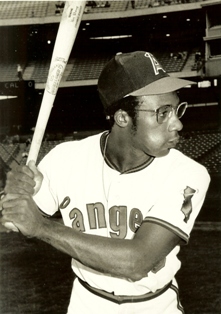
Leave your answers in the comments section below. Enjoy!
| Baseball Beat | July 30, 2007 |
Searching for Pitching Prospects
Like most scouts and prospect analysts, I like to find pitchers who can throw strikes, miss bats, and keep the ball on the ground or at least in the ballpark. In this regard, I screened minor league starters in AAA, AA, and A for the following criteria:
Among qualified pitchers, nine made the cut, ranging in talent from Boston's Clay Buchholz to Chris Jones. As I noted last year when I ran similar screens, the following list is not meant to identify the best pitching prospects in the minors. As I warned a year ago, "I don't think you can do that without...taking into consideration scouting reports and paying attention to age relative to the level of competition." If nothing else, it is a good starting point to do more research.
Last year, my screens uncovered a number of top-flight prospects, many of whom have graduated to the majors. I was a bit more generous last time around, taking the top five starters by K/9 in each league who also had low HR/9 whereas this year pitchers had to meet or exceed the rigid criteria shown above.
Name Team Level Lg Age K/9 BB/9 K/BB HR/9 WHIP ERA Matt Garza MIN AAA IL 23 9.29 3.30 3.06 0.49 1.35 3.62 Clay Buchholz BOS AA EL 22 12.05 2.28 5.27 0.42 0.89 1.77 Alan Horne NYY AA EL 24 9.84 2.83 3.47 0.39 1.24 2.36 Gio Gonzalez CWS AA SL 21 11.08 3.36 3.30 0.70 1.17 3.04 Jacob McGee TB A+ FSL 20 11.08 3.12 3.55 0.66 1.11 3.12 Chris Cody MIL A+ FSL 23 9.07 1.48 6.13 0.10 0.93 1.77 Kyle Ginley TOR A MDW 20 9.73 2.98 3.27 0.79 1.51 4.86 F. de los Santos CWS A SAL 21 11.00 3.34 3.29 0.49 0.88 2.55 Chris Jones BOS A SAL 23 9.29 2.59 3.59 0.77 1.43 4.98
Matt Garza showed up last year and once again this year. The 6-foot-4, 205-pound righthander was called up to the big leagues earlier this month and pitched his best game ever yesterday, allowing only one run while striking out 11 Indians over six innings. The 23-year-old out of Fresno State has a lot of upside and should be a permanent fixture in Minnesota's starting rotation for years to come.
Clay Buchholz, the hurler every GM asks for when talking trade with the Red Sox, just may be the best pitching prospect in the minor leagues. In an interview conducted by Patrick Sullivan and me in February, Assistant General Manager Jed Hoyer told us that Buchholz had the best slider and changeup in the system. His fastball and curve are quality pitches as well. Baseball America reported that his heater, which sits in the low-90s, hit 95-97 in the playoffs last year. An outstanding athlete, the soon-to-be 23-year-old righthander may be faster than teammate Jacoby Ellsbury and possesses a top-notch pickoff move to first base. He is an untouchable.
Alan Horne is one of many excellent pitching prospects in the Yankees system. The Cleveland Indians drafted Horne in the first round in 2001, but the big righthander opted to go to college (Mississippi, then Chipola JC in Florida, and finally the University of Florida where he led the Gators to the 2005 College World Series). He underwent Tommy John surgery a few years ago and has regained his low-90s fastball and power curve. Horne hasn't allowed more than two earned runs in any of his last 10 outings. At 24, he's on track to pitch in New York before Yankee Stadium is torn down.
The 38th overall pick in the 2004 draft, Gio Gonzalez has struck out 534 batters in 457 minor league innings. Now in his second stint in the White Sox system, the 6-0, 190-pound LHP features a plus fastball and hammer curve that Baseball America calls his "go-to" pitch. His command has improved this year but is still short of where it needs to be. That said, I would be surprised if he doesn't receive a promotion to Triple-A before the season is out and is a good bet to find himself in Chicago's starting rotation sometime next year.
As with Garza and Buchholz, Jacob McGee was featured in last year's screen. McGee is perhaps the #1 pitching prospect in a Tampa Bay system that is loaded with future big league hurlers. In fact, a case could be made that he is one of the best lefthanders in the minors. Like Gonzalez, McGee possesses terrific stuff but needs to refine his control and command. His 6-3, 190-pound frame may give him a bit more projectability than Gonzalez. He doesn't turn 21 until a week from today and is still three levels away from reaching the majors. But so far, so good.
Keith Ginley is a bit of a sleeper. Toronto drafted him in the 17th round last year and signed him to a $155,000 bonus to keep the St. Petersburg (FL) JC righthander from attending Florida Southern. He started his professional career at Pulaski of the Appalachian League (Rookie) and struck out 42 batters in 27 innings. He received a late-season promotion to Auburn (NYP, Short Season) and allowed only 5 hits and 0 runs over 10 frames. Although his BAA, WHIP, and ERA won't turn any heads, the 6-foot-2, 225-pounder is throwing strikes, missing bats, and doing a decent job at preventing the long ball. After a rough start to his 2007 season, Ginley has turned it up a notch in his past four starts, allowing only 4 ER and striking out 23 in 20.1 IP. Keep an eye on him.
Acquired by the Milwaukee Brewers from the Detroit Tigers on July 1, Chris Cody has put up some eye-popping numbers this year. Cody did his best work in Low-A as a 23-year-old so he's not nearly as good as what it might seem on the surface. The dimunitive southpaw (6-0, 180) is two weeks older than another smallish lefty by the name of Scott Kazmir. Discount Cody's stats for now but remember the name as he moves up the ladder to see if he has what it takes to get batters out in the upper minors.
The pitcher who should be climbing up prospect lists is Tyler Herron. The St. Louis Cardinals farmhand is striking out a batter per inning while walking just 1.59 per nine The righthander turns 21 next Sunday. Herron was drafted in the first round of the supplemental draft in 2005 and pitched two seasons at Johnson City of the Appalachian League (Rookie) before getting one start at State College of the New York Penn (Short Season A).
Ranked as the 18th best prospect in the STL system by Baseball America, the 6-foot-3, 190-pound RHP was assigned to Quad Cities of the Midwest League (Class A) where he dominated in relief in the early going this season (3-0, 1.75, .187 BAA with 0 HR in 25.2 IP). The sinkerballer was given another shot at starting, and he has performed admirably, chalking up a superb 6:1 K/BB ratio and HR/9 (0.44). He threw six scoreless innings on Sunday and has now walked only six batters in his last 10 outings. Throwing strikes and keeping the ball in the park is a formula for success at any level.
Fautino de los Santos has given up 48 hits in 92.2 innings, equal to 4.66 H/9. The RHP out of the Dominican Republic was a South Atlantic League All-Star and pitched in the Futures Game earlier this month. In his last three outings, the 21-year-old has allowed only 4 H, 2 BB, and 0 ER while whiffing 15 over 12 IP. For more on de los Santos, be sure to read what Marc Hulet had to say three weeks ago when discussing Sleeper Prospects.
Chris Jones surprised me that he qualified for this screen. Drafted out of Indiana State in 2005, the 6-3, 205-pound RHP pitched mostly at Lowell (Short Season A) that summer, then was assigned to Greenville of the South Atlantic League (Class A) last year where he enjoyed moderate success. Jones is repeating Greenville this year. The worst prospect on this list, the 23-year-old is likely to end up in the bullpen as a long reliever if he ever makes it to Fenway, which is far from a given.
Although Clayton Kershaw didn't technically qualify, the lefthander is leading all minor league starters in K/9. The 2006 first-round draft pick is averaging 12.51 strikeouts per nine innings while pitching for the Dodgers Class A affiliate in the Midwest League. The downside is that he is also tops in the league in BB/9 (4.43). The 19-year-old has now struck out 181 batters in his first 128.1 MiLB IP while allowing only 3 HR. Kershaw is one of the best pitching prospects in all of baseball but is still four levels away from the big leagues.
Jeff Samardzija is another pitcher who didn't show up on my screen. In fact, the richest fifth-round draft choice in baseball history is last in K/9 among all qualifiers in the Florida State League. The former Notre Dame All-America wide receiver has struck out 3.44 batters per nine innings this year. Jeff Albert discussed Samardzija's contract and analyzed his pitching mechanics in January. Suffice it to say, The Shark, who gave up 22 H and 10 ER in his last two starts covering 10.2 IP, has a long ways to go before sniffing the majors. A BAA of .331 and an ERA of 5.06 in High-A won't get the job done.
| Baseball Beat | July 24, 2007 |
An Event for the Eternals
The Baseball Reliquary held The Shrine of the Eternals 2007 Induction Day on Sunday in Pasadena. Yogi Berra, Jim Brosnan, and Bill James (shown shaking hands with me after the ceremony in the photo below) comprised this year's class of inductees. Although Berra (charity commitment on the east coast) and Brosnan (recovering from a fall) were unable to attend the event, James made the cross-country flight from Boston to Los Angeles on Saturday and spent two nights in Pasadena before returning home on Monday.
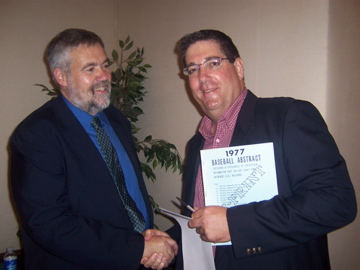 Charlie Silvera, Berra's longtime backup catcher, drove down from San Francisco with his wife Rose to fill in one last time for his former teammate. Mr. & Mrs. Silvera joined Bill and me, as well as Terry Cannon, the Executive Director of the Baseball Reliquary, and two Reliquarians (Don Malcolm, who is known for producing the Big Bad Baseball Annual in the 1990s, and his friend Jay Walker) for dinner on Saturday evening. We met in the lobby of the hotel and walked a few blocks to Cameron's Seafood on Colorado Blvd. in Pasadena.
The restaurant had a circular table for seven ready when we arrived. I sat between Bill and Terry and talked to both throughout dinner but Charlie kept us all entertained with stories about his playing days, teammates, opponents, managers, umpires, and sportswriters. Silvera, who will turn 83 in October, was as sharp as the knife that we used to cut the sourdough bread. A member of six World Championship teams during his playing days, Charlie wore one of his Yankees rings on one hand and a 1997 Florida Marlins (as a scout) on the other. Rose was wearing a World Series ring as well.
A humble and respectful man, Charlie feels fortunate to have signed and played with the Yankees, even if it meant caddying for Berra all those years. Silvera said he was paid well and never lost sight of the World Series paychecks that nearly doubled his total compensation. Charlie told us that he played with nine Hall of Famers and roomed with six of them, including Mickey Mantle during the Oklahoma Kid's rookie season. He claims Mantle was faster than Willie Mays and guessed that the switch-hitter bunted for as many as 10 to 15 hits per season during his heyday in response to a question posed by James.
Now a part-time advance scout for the Chicago Cubs, the San Francisco native and resident attends games at AT&T Park. Charlie said he doesn't pretend to tell the Cubs how to pitch to batters and instead focuses on managerial tendencies such as employing the hit and run, squeeze play, etc. James added that Boston has enjoyed success utilizing two advance scouts. As an example, the scout who tracked the Indians last weekend is now working with the players and coaching staff in the clubhouse prior to each game during its current series in Cleveland. In the meantime, the second scout is in Baltimore taking notes on Boston's next opponent — the Devil Rays — and will join the team in Tampa Bay when the Red Sox square off with their division rival this weekend.
While strolling back to the hotel, Bill and I talked about several subjects, including the club's losing record since the end of May (at least as of Saturday night), Curt Schilling's rehab start that day, Kason Gabbard's contributions, and a few minor leaguers such as Clay Buchholz ("great pickoff move"), Jed Lowrie ("athletic"), and Lars Anderson ("doing wonderfully for a 19-year-old"). After discussing logistics for Sunday, we parted company a few minutes before 9 p.m. (which, of course, was the equivalent of midnight for Bill).
I drove home to Long Beach and began putting the finishing touches on the speech that I would deliver to introduce James the following day. Sunday morning found me instant messaging with my colleague Patrick Sullivan while watching the final round of the British Open (we both found Paul Azinger's analysis "insufferable") and prepping for the speech that was fast approaching.
Arriving at the Pasadena Central Library shortly after 1 p.m., my wife Barbara and I met up with my brother Tom, our daughter Macy and her fiance Joel, and my good friend Brian Gunn, who most of you know as the brilliant writer of the now retired Redbird Nation. I also spent some time with Steve Henson, formerly of the Los Angeles Times and now the Senior Editor MLB for Yahoo! Sports, and Kevin Roderick of L.A. Observed.
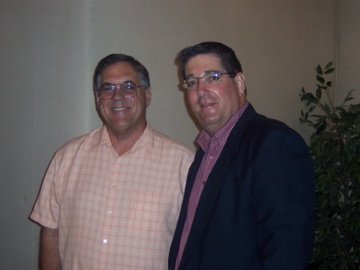
Cannon led the audience in a ceremonial bell ringing in honor of Hilda Chester, the Brooklyn Dodgers fan who was renowned for ringing her twin cowbells in the hopes of starting a rally. The National Anthem and Take Me Out to the Ballgame were performed on the ukulele by multi-instrumentalist Don Kirby. After the presentation of a couple of annual awards, the keynote address was delivered by Tomas Benitez, an artist, baseball fan, and advisor to the Baseball Reliquary on Mexican-American Baseball in Los Angeles: From the Barrios to the Big Leagues.
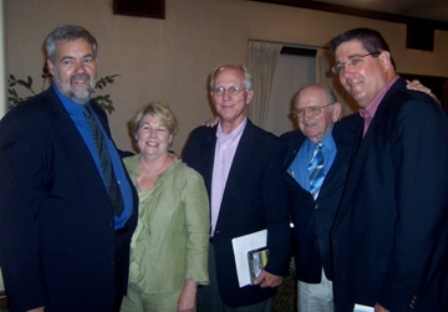 Berra was introduced by Silvera (next to me in the adjoining photo), who regaled the audience — a full house of approximately 200 in auditorium-style seating — with stories about the catcher annointed by James as the "best ever" as well as tales and jokes about Casey Stengel and others. Toni Mollett (second from the left) is Stengel's niece. She read a letter from Yogi ("I would have been there but I'm somewhere else") and accepted his plaque. John Schulian (middle), a TV writer-producer and former Chicago Sun-Times sports columnist and Sports Illustrated contributor, was there on behalf of Brosnan. His acceptance speech was featured in the L.A. Times on Sunday.
After Berra and Brosnan were inducted in The Shrine of the Eternals, I was called up to the stage to introduce James. I grabbed my notes and one of my props (the 1977 Baseball Abstract) from the shelf of the podium and delivered the following speech.
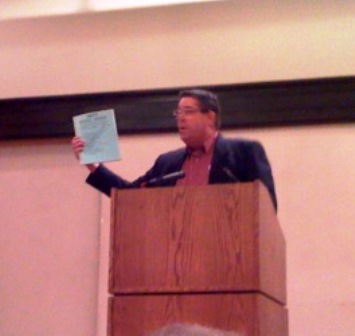
Three years ago, almost to the day, I began to review all twelve of Bill James' Baseball Abstracts. The project forced me to re-read every book from cover to cover and, in doing so, I came away with a greater appreciation for James than ever before — and, trust me, I have been a big fan dating back more than a quarter of a century.Although Bill has written dozens of books, the Baseball Abstracts are undoubtedly his best-known body of work and among the most significant collections in the game's history. James self-published the first five books. The early editions were typed on single-sided pages, photocopied, and stapled using a plain stock card cover.
The Baseball Abstracts grew in size and stature over the years. From a one-inch classified ad placed in the back of The Sporting News in 1977 to a publishing contract with Ballantine Books five years later to earning a regular spot on the New York Times bestsellers list every year, the Baseball Abstracts became an annual staple eagerly awaited each spring by the multitude of James' loyal readers.
An English major, James has a unique writing style that combines numbers and prose in a manner that make his essays clear, informative, and fun to read. To call Bill a statistician is a misnomer. Sure, he is known for debunking baseball's conventional wisdom through the use of statistical evidence but, as Bill pointed out in the 1981 Baseball Abstract, "good sabermetrics respects the validity of all types of evidence, including that which is beyond the scope of statistical validation."Take, for instance, The Defensive Spectrum, which Bill developed 30 years ago. It doesn't have anything to do with statistics, numbers, or computers. It’s totally qualitative. It’s a way to think about players, defensive positions, talent, and the aging process. Like so many of his innovations, The Defensive Spectrum is about organizing concepts so that we can understand and appreciate them.
The book "How Bill James Changed Our View of Baseball" is an apt title. His contribution to our understanding of the game of baseball is unparalleled. But more importantly, it's not just what he has taught us. It's what he has taught us to teach ourselves. Because of Bill, we have learned the importance of dealing with questions rather than answers.
Although James has company now, there was a time when Bill may have felt as if he was the lone voice in the wilderness. But there were a number of prominent early readers who were paying close attention, including current Boston Red Sox owner John Henry, who hired James as the club's Senior Baseball Operations Advisor in 2002. Bill is now in his fifth season with the Red Sox. It’s no secret that Boston won its first World Series in 86 years in 2004 — two years after Bill joined the front office.
Via email, I asked Theo Epstein, the GM of the Red Sox, how he would describe James. Theo wrote back, "2004 World Champion Bill James."
I asked Peter Gammons the same question. He told me two things: "The man who changed millions of minds . . . And I would not have my small corner in Cooperstown without him."
Rob Neyer, former assistant to James and current ESPN columnist, asked me to give his friend and the man he calls "The Babe Ruth of baseball analysis" his best.
And John Dewan, owner of Baseball Info Solutions, reduced it to one word: "Genius."
As for me, I would say that James has been the most influential person with respect to how we think about baseball since Branch Rickey. And, with that, ladies and gentlemen, it is my distinct honor to introduce one of Time magazine’s "100 Most Influential People in the World" and the Baseball Reliquary’s newest member of its Shrine of the Eternals, Bill James.
James spoke for approximately 15 minutes, covering the broad topic of change. Bill tried to deflect some of the credit that he has received over the years but admitted somewhat jokingly that he was more "arrogant" than "humble." James doesn't see himself as a "statistician," saying he doesn't produce any stats. "The players produce the stats," adding that baseball has been engaged in stats since the beginning. Speaking of which, James doesn't think 19th century baseball has much, if anything, to do with the modern game. He touched on steroids, racism, and other issues that have tainted the sport, suggesting that we should put the times in perspective, forgive and move on.
The man who hopefully one day will be enshrined in Cooperstown stuck around afterwards, speaking to attendees one-on-one, shaking hands, signing autographs, and conducting interviews with a few media outlets. He was generous with his time and the attention that he gave everyone.
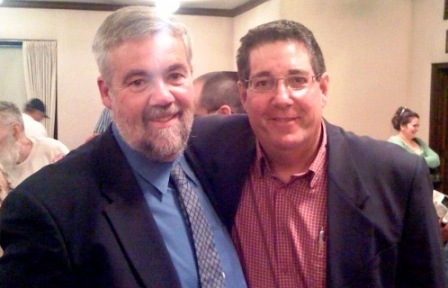
It was a great weekend. In fact, thanks to Bill, it was one for the Eternals.
| Baseball Beat | July 19, 2007 |
Batting Average on Balls in Play: Leaders and Laggards (Part Two)
In Part One of this series on Batting Average on Balls in Play (BABIP), we focused on the laggards. Today, we will take a close look at the leaders.
As I pointed out in the previous article, "there are many factors that affect BABIP, including batted ball types, ballparks, team defense, foot speed, and, yes, luck or randomness. As with any stat, sample size is also an important consideration here." Hitting for a high BABIP — especially over a long period — is more of a skill than not. That said, it is still enlightening to measure a player's BABIP, in conjunction with batted ball stats, vs. his career norms to determine the sustainability of one's AVG/OBP/SLG.
Interestingly, all ten leaders have career BABIP above the league-wide average (which tends to run at or near .300 most years).
Top Ten in BABIP Through 7/17/07
BABIP
PLAYER TEAM 2007 CAREER
Derrek Lee CHC .406 .326
Jorge Posada NYY .393 .320
Hunter Pence HOU .385 .385
Ichiro Suzuki SEA .383 .357
Dmitri Young WAS .382 .328
Matt Holliday COL .382 .352
Magglio Ordonez DET .380 .314
Willy Taveras COL .379 .348
Chase Utley PHI .373 .329
Reggie Willits LAA .371 .367
From a batted ball perspective, the only thing that is really different with Derrek Lee this season is his HR/FB%. At 8.1%, it's well under half of his average for the past five years (17.7%). Not surprisingly, Lee's ISO (.166) is lower than it's ever been for a season in which he has played at least 100 games. His AVG (.337) and OBP (.422) are almost identical to his MVP season in 2005 (.335 AVG, .418 OBP). (Tell me again how Lee missed out on that award? You say he won the Silver Slugger and Gold Glove but lost out to another first baseman? Hmmm. I know, I know. Alex Rodriguez lost out to Miguel Tejada under the same circumstances in 2002. Well, that doesn't make the snub any better in my mind. Oh well, it was close and Albert Pujols wasn't a bad choice by any means. It was just a strange one.)
Lee dropped his appeal and began serving a five-game suspension Wednesday for his part in a fight with the Padres on June 16. How convenient. Lee fouled a ball off his left ankle Tuesday night and, in his words, will be "limping for a few days." Baseball needs to re-examine its policies with respect to appealing and serving suspensions to prevent players and teams from picking their spots. Now.
Jorge Posada turns 36 next month, yet is putting together one of his best seasons ever. His home run power is down a bit but he's swatting doubles like they are going out of style. Thanks to a career high BABIP, his .332 AVG is 45 points higher than his previous best. The switch-hitting catcher is doing his job from both sides of the plate.
2007
AVG OBP SLG OPS BABIP
vs RHP as LHB .322 .407 .507 .914 .365
vs LHP as RHB .354 .418 .542 .960 .448
Although Posada's .448 BABIP from the right side is unsustainably high, he has always hit lefties better — be it AVG, OBP, SLG, or BABIP.
CAREER
AVG OBP SLG OPS BABIP
vs RHP as LHB .263 .375 .464 .839 .302
vs LHP as RHB .301 .383 .502 .885 .348
Hunter Pence may be the front runner for the NL Rookie of the Year although I sense that Ryan Braun is going to blow by him, if he hasn't already. I'm also partial toward Troy Tulowitzki, who is leading the majors in clutch hitting and all shortstops in John Dewan's Plus/Minus fielding system. In any event, Pence is off to a great start (.334/.360/.578) despite owning the seventh-lowest walk rate (3.6%) in the majors.
Let's compare Pence's rookie season vs. Jeff Francoeur's inaugural campaign in 2005:
G AB R H 2B 3B HR RBI SB CS BB SO AVG OBP SLG OPS+
Pence 69 296 42 99 24 6 12 44 8 4 11 58 .334 .360 .578 141
Francoeur 70 257 41 77 20 1 14 45 3 2 11 58 .300 .336 .549 124
Pretty scary, huh? I mean, check out those BB and SO totals. It seems to me that Francoeur drew a lot more criticism for his lack of patience and failure to walk than Pence, yet the latter is actually drawing fewer bases on balls as a percentage of his plate appearances. As much as I like Pence (full disclosure: he's on my fantasy team), I'm highly skeptical of his success thus far. He's a good player but probably not on par with Francoeur. Sure, Pence plays the more difficult position (for now), but he's putting the above numbers up at the age of 24 whereas Francoeur was just 21 when he was a rookie. Oh, did I mention that both players are 6-foot-4 and 220 pounds?
I hesitate to mention Willy Taveras and Reggie Willits in the same sentence as Ichiro Suzuki, but there are some similarities in their styles. All three outfielders are among the fastest runners in the game and they hit a lot of balls on the ground. Ichiro is the poster child in this regard. Only a quarter of his balls in play are flies. Ground balls and line drives, coupled with being fleet of foot, mean lots of hits and a high BABIP and AVG. Don't ever think his average is flukish. Instead, recognize that it is a formula. And Ichiro does it better than anyone. Granted, the two-time batting champion is a singles hitter, but he has produced more than 200 hits every season and a .332 average over his MLB career.
Although Dmitri Young has been a pretty consistent hitter since his breakout season in 1998, very few baseball people saw him rebounding after putting up career lows in AVG, OBP, and SLG last year. Give Jim Bowden, the GM of the Washington Nationals, credit for giving Young one more chance. The 33-year-old first baseman has responded in kind, hitting .341/.389/.523 as a replacement for the injured Nick Johnson.
Matt Holliday has been hitting ever since he broke in as a rookie in 2004. He took his numbers up nicely in 2005 and 2006 and has leveled off a bit in 2007. However, it would be disingenuous to suggest that his production has not benefited by playing his home games at Coors Field.
AVG OBP SLG OPS BABIP
Home .362 .422 .642 1.064 .388
Away .268 .321 .439 .760 .310
The 27-year-old outfielder has been a superstar at home and nothing more than an ordinary hitter on the road. His walk and strikeout rates, as well as his batted ball stats, have been steady throughout his four-year career. Holliday is what he is and should continue to put up big numbers as long as he calls Colorado his home.
What can you say about Magglio Ordonez? The 33-year-old outfielder is having a career year and is a prime candidate to earn his first MVP award. Ordonez (.357/.435/.589) is leading the AL in AVG, OBP, and doubles. He is in the top five in SLG, OPS, OPS+, H, XBH, TOB, TB, R, and RBI. Maggs doubled and homered against Johan Santana yesterday while driving in all three runs in Detroit's 3-2 victory over Minnesota. Voters will be partial toward Ordonez if he keeps it up and the Tigers win the AL Central.
Speaking of MVPs, nobody is having a better season in the NL than Chase Utley (.338/.408/.589). He is unquestionably the premier second baseman in the game and his margin over the next best is arguably wider than the #1 and #2 at any other position. Utley hits like a first baseman or corner outfielder and is a Gold Glove caliber second baseman, ranking first in Dewan's Plus/Minus system at his position. The $85M contract he signed in January for seven years is looking smarter from the Phillies' perspective every day.
| Baseball Beat | July 16, 2007 |
On James
Bill James will be inducted into the Shrine of the Eternals on Sunday, July 22, in Pasadena, California. James, Yogi Berra, and Jim Brosnan comprise the ninth class of electees in voting conducted by the membership of the Baseball Reliquary. All three honorees have made significant contributions to the language and literature of baseball.
According to Terry Cannon, Executive Director of the Baseball Reliquary, the Shrine of Eternals is "similar in concept to the National Baseball Hall of Fame" but "differs philosophically in that statistical accomplishment is not a criterion for election."
Previous honorees have been Jim Abbott, Dick Allen, Moe Berg, Ila Borders, Jim Bouton, Roberto Clemente, Rod Dedeaux, Dock Ellis, Mark Fidrych, Curt Flood, Josh Gibson, William "Dummy" Hoy, Shoeless Joe Jackson, Bill "Spaceman" Lee, Marvin Miller, Minnie Minoso, Satchel Paige, Jimmy Piersall, Pam Postema, Jackie Robinson, Lester Rodney, Fernando Valenzuela, Bill Veeck Jr., and Kenichi Zenimura.
Cannon and James have asked me to introduce Bill at the event, a distinct honor unto itself and one that I gladly accepted. Following my introductory remarks, Bill will speak and be presented with his induction plaque.
Here is an excerpt from the press release:
An author, historian, and statistics analyst, Kansas native BILL JAMES has been one of the most influential figures in baseball since he turned his inquisitive sights on the game in the mid-1970s. Using his annual Baseball Abstracts to question conventional wisdom, he developed his own analytical tools (Runs Created, Win Shares, Pythagorean Winning Percentage, et al.) with which he tweaked the nose of the major league establishment and revolutionized the way fans, the media, and baseball insiders think about the game. The corn-fed clarity of his writing style, combined with an acerbic wit and careful presentation of data in the Abstracts and subsequent books, made James the most widely read and imitated apostle of sabermetrics, the search for objective knowledge about baseball (after SABR, the acronym for the Society for American Baseball Research). James’ knowledge of the game also made him a valuable asset for players and agents, some of whom hired him to assist in arbitration battles with management. Since 2003, James has been employed by the Boston Red Sox as Senior Baseball Operations Advisor, giving him a chance to put some of his theories into practice. In addition, since 2006, James’ life and ideas have been chronicled in two books, The Mind of Bill James: How a Complete Outsider Changed Baseball, written by Scott Gray and published by Doubleday, and How Bill James Changed Our View of Baseball, edited by Gregory F. Augustine Pierce and published by ACTA Sports.Bill James will be in attendance to personally accept his induction, and he will be introduced by RICH LEDERER, a Southern California native and a major contributor to the Baseball Analysts Web site, which utilizes a sabermetric approach in examining college, minor league, and major league players and teams.
As one who owns the entire run of Baseball Abstracts (including the self-published editions from 1977-1981) and all of his other books, I literally bought into James and have been eating up every word he has ever written for more than a quarter of a century. James has had a tremendous influence on the way that I—and most of you—think about, understand, and appreciate the game of baseball. If not for James, the inspiration for Baseball Analysts may never have existed. Without a platform, I would not have undertaken the Abstracts From The Abstracts series, which culminated in Breakfast with Bill James, a three-part interview that took place in December 2004 at the Winter Meetings in Anaheim.
For more on Bill James and his induction into the Shrine of the Eternals, be sure to read Paul Oberjuerge's outstanding article (which appeared in print on Sunday in the Los Angeles Newspaper Group) and interview.
If you live in or around the greater Los Angeles area, I would highly recommend attending Sunday's ceremony. It will be held at the Donald R. Wright Auditorium in the Pasadena Central Library, 285 East Walnut Street, Pasadena at 2:00 PM. Admission is open to the public and free of charge. For more information, please call (626) 791-7647 or visit the Baseball Reliquary website.
Feel free to drop me an email if you're planning on attending and perhaps we can make arrangements to meet in person before or after the event.
| Baseball Beat | July 12, 2007 |
Batting Average on Balls in Play: Leaders and Laggards (Part One)
Batting average on balls in play (BABIP) is a relatively new stat that has shed some light on pitching and hitting performances. Without context, this metric can be dangerous in jumping to conclusions about a player's production. There are many factors that affect BABIP, including batted ball types, ballparks, team defense, foot speed, and, yes, luck or randomness. As with any stat, sample size is also an important consideration here.
In addition to BABIP, one can also view batting average on contact (BAC). The latter differs from the former in that it includes home runs. League-wide BABIP generally hovers around .300 while BAC is normally in the range of .320-.330. One of the many uses of BABIP and BAC is to determine how sustainable a player's batting average might be — and OBP and SLG (to the extent they are influenced by AVG). By studying BABIP and BAC, fantasy owners may get some insight as to when to buy low and sell high.
In today's article (the first of a two-part series), we'll take a look at the laggards and drill down deeper into the numbers to gain a better understanding as to the hows and whys for ten different players.
Bottom Ten in BABIP at the All-Star Break
BABIP
PLAYER TEAM 2007 CAREER
Richie Sexson SEA .210 .300
Julio Lugo BOS .215 .315
Jermaine Dye CWS .225 .301
Pedro Feliz SFG .230 .270
Pat Burrell PHI .239 .307
Andruw Jones ATL .241 .284
Ian Kinsler TEX .243 .285
Jason Kendall OAK .244 .317
Chris Young ARI .244 .249
A.J. Pierzynski CWS .250 .305
Except for Richie Sexson's injury-shortened season in 2004, he has never come close to hitting as low on balls in play as this season. His previous worst was in 1999 when he had a BABIP of .275. With a career-low strikeout rate, he's putting the ball in play more than ever and perhaps that is working against him to some extent. But, more than anything else, Sexson is a notoriously poor first-half performer.
AVG OBP SLG OPS BABIP
1st Half .247 .328 .478 .806 .278
2nd Half .290 .372 .573 .945 .322
Sexson put up a .205/.299/.413 line before this year's All-Star break, remarkably similar to his first half last season when he hit .218/.288/.418. How did he fare in the second half in 2006? Try .322/.399/.613. Although I wouldn't want to bet on a repeat perfromance, I would be surprised if the righthanded slugger doesn't light it up over the balance of the campaign.
Julio Lugo's BABIP is 100 points below his career norm. That is a huge difference. Put another way, his BABIP in 2007 is 32% under his lifetime rate. Prior to this season, the Boston shortstop's all-time low was .313. How can that be? That's a good question because Lugo's BB rate is at its highest level ever and his SO rate is the second-lowest of his career. The main culprit appears to be an abnormally poor line drive percentage of 14.5% (the 12th worst in MLB) compared to his career rate of 19.4%.
What's troubling is that Lugo began his precipitous fall last year when he joined the Dodgers at the trading deadline. He hit .219/.278/.267 during the final two months in 2006 and .197/.270/.298 in the first three months in 2007. Are these rate stats the real Julio Lugo? Is he hiding an injury? Or is there something else going on?
Other than his injury-plagued year with the Oakland A's in 2003, Jermaine Dye has never been as unproductive as he has been this season. Over the course of his career, Dye has been pretty consistent from the first half (.269/.332/.478) to the second (.278/.340/.486). The 33-year-old outfielder needs more than a slight uptick to get his current rate stats (.214/.271/.402) back to respectability at year's end.
Of all the players on the list above, Pedro Feliz is the least surprising. He has never hit .300 on balls in play, partly because the 32-year-old is so slow but mostly owing to the fact that he doesn't hit enough line drives (17.0% for his career). His SO% is at a career low and his HR% is about the same as it has been since he became a full-time player in 2004. As a result, Feliz is putting the ball in play more than ever even though he has little to show for his efforts. Why? Well, more than one-fifth of his batted balls have been infield flies. Hitting pop-ups is about as productive as striking out. As a result, Feliz's low K rate is misleading.
Count me as someone who has no idea why Feliz gets as much playing time as he does. His single-season best OBP is .305 and he has never had an OPS of .800. Did I mention that he is a third baseman?
Pat Burrell is hard to figure. The #1 overall pick in the 1998 draft has walked as much as he has struck out this year and is on pace to posting a career high in BB and a career low in SO. However, his isolated power is hovering near his single-season lows in 2003-2004, primarily due to the fact that he is hitting more fly balls (third highest rate in MLB) but fewer HR/FB than ever (12.0% vs. 16.2% career norm). Burrell doesn't run or field well and will likely wind up on an AL team as a DH. He's not known as Pat the Bat for nothing.
In the midst of a nightmarish free agent season, Andruw Jones is putting up career lows in AVG (.211), OBP (.310), and SLG (.410). In the meantime, his SO% is as high as it's been since his 19-year-old rookie season in 1996 and his HR/FB (13.9%) is well below his career average (20.5%). At the age of 30, I don't think Jones is done. However, unless he returns to form, I wouldn't be rushing out and offering him a 5 x $15M+ type contract either.
Ian Kinsler's BABIP was .310 in his rookie season in 2006 with virtually the same LD% (20.6%) as 2007 (20.2%). Although the second baseman's .241 AVG is well off the pace last year (.286), his .334 OBP and .452 SLG are almost identical to the previous campaign (.347 and .454). As such, Kinsler has been as productive this year as last. Kinsler's problem is that he just isn't as good as his overall numbers suggest.
AVG OBP SLG OPS BABIP
Home .297 .366 .531 .897 .306
Away .242 .318 .378 .696 .255
Take Kinsler out of Texas and one would have a hard time justifying his presence in any starting lineup. However, he just turned 25 so it would be unwise to write him off prematurely. Kinsler has a few tools and could very well become a valuable player. In the meantime, be careful in not getting swept up in his unadjusted stats.
When a 33-year-old catcher records seven consecutive seasons of 143 or more games, it may be time to begin wondering how much fuel he has left in his tank. The man in question, Jason Kendall, has put up career lows in AVG (.227), OBP (.263), and SLG (.280). His .543 OPS is 123 points below his previous worst season and sits 227 points under his lifetime mark of .770.
Kendall's GB and LD rates are down and his FB rate is up. That's not a good thing for any hitter, much less one who rarely goes yard. Only 2% of his flyballs (2 out of 100) have turned into HR. His BABIP — and AVG by extension — will continue to suffer if he lifts the ball in the same manner as the first half.
As a rookie, Chris Young hasn't developed much of a track record for us to get a handle on his batted ball types. Suffice it to say, the Arizona center fielder is hitting too many FB (48.3%, 11th highest in MLB) and not enough LD (12.8%, 3rd lowest). His BB rate (5.0%) is less than desirable as well. Young is a tool box and his power and speed combination is a major plus. He just needs to make some adjustments at the plate in order to fulfill his potential.
A.J. Pierzynski is another former All-Star catcher who is struggling this year. He has put up career lows in AVG (.244), OBP (.287), and SLG (.376). Like Kendall, he is hitting fewer GB and LD and more FB than ever. Unlike Kendall, A.J. has deposited a reasonable number of those fly balls (8) into the seats. His BABIP took a turn for the worse when he left Minnesota and his lack of speed only adds to Pierzynksi's challenge of hitting for a high average.
I will take a close look at the leaders in BABIP in Part Two next Thursday.
| Baseball Beat | July 09, 2007 |
First Half Observations
The first half is now behind us — even though, for most teams, it actually occurred a week ago. We can now sit back over the next few days, reflecting on the past, dreaming about the future while enjoying the All-Star Game festivities.
AL Roundup: Why Play the Second Half?
I hesitate to say that the American League races are set in stone, but the cement is drying pretty fast. Sure, the Cleveland Indians could overtake the Detroit Tigers and win the AL Central. But I will be surprised if the top four teams at the break — Indians, Tigers, Red Sox, and Angels (not in that order) — are not representing their league come October.
There may be a glimmer of hope in Seattle and Minnesota — as well as there should be — but I think the Mariners are not as good as their W-L record and the Twins will find it difficult overcoming either Cleveland or Detroit. I'm not ruling MIN out altogether, but it will take a huge second-half performance on the part of someone like Matt Garza coupled with a major injury or two in CLE and DET for the Twins to qualify for the playoffs.
NL Roundup: Is it Parity or Mediocrity?
Whereas the three division leaders in the AL are all playing .600 ball, the best record in the National League belongs to the San Diego Padres (49-38, .563). In fact, the three teams atop their divisions — Padres, Mets, and Brewers — are all barely staying above .550. Call it parity if you must, but the NL is a collective 115-137 against the AL in interleague games. Only three clubs in the so-called junior circuit — Orioles, Devil Rays, and White Sox — have losing records vs. the . . . ahem . . . senior circuit.
As a result of the mediocrity (being kind here), any team with a .500 record or better has a decent shot at making a run for the playoffs over the next three months. The Mets and Brewers are both talented clubs with several players either in the prime of their careers or experiencing breakout seasons. The NL West is still wide open and could once again send two teams to the post-season.
Biggest Negative Surprises Among Teams
The sub-.500 records of the New York Yankees and St. Louis Cardinals caught me a bit off guard. Both teams rely too heavily on older players and neither had the pitching depth to overcome injuries to key starters. I realize that the Redbirds barely played .500 last season, and I had no illusions that STL was going to revert to winning 90 games again. At the same time, I didn't peg them to limp into the All-Star break at 40-45 (.471). With a less-than-stellar farm system, the Cardinals may be entering a downturn that could be reminiscent of 1988-1995 when the club failed to make the post-season while producing a cumulative record of 601-628 (.489).
The Yankees are running in place and need to decide if they want to be buyers or sellers as the trade deadline fast approaches. I know New York has the resources to take on more payroll but going for it now — at the inevitable expense of the future — makes no sense to me. The next few months will be interesting in the Bronx. Will they offer Alex Rodriguez an extension? If not, will A-Rod bolt for even greener pastures? Bobby Abreu is a goner. What about Jorge Posada and Mariano Rivera? Can Melky Cabrera and Robinson Cano be more than role players? Stay tuned. Fans may not recognize next year's players without a program.
This section wouldn't be complete without mentioning the Chicago White Sox. I picked the Pale Hose to finish fourth but the consensus had the 2005 World Champs competing with the Tigers, Indians, and Twins for the AL Central title or Wild Card spot. This seems like a team that is betwixt and between, perhaps trying to hang onto the past while generally making personnel changes on the margin that have little or no value longer term. As I see it, the road back is going to be tough because DET, CLE, and MIN are currently stronger at the major and minor league levels. Good luck, Kenny and Ozzie.
Biggest Positive Surprises Among Players
Consider yourself a soothsayer or a future GM if you had Carlos Pena posting an OPS over 1.000 with 20 HR in the first half. Call yourself Billy Beane if you predicted that Jack Cust would slug 15 HR. The 28-year-old minor league star had hit a total of FIVE home runs going into the 2007 season. Score one for the statheads.
Brandon Phillips turned his career around last year when the Reds gave him a chance to play everyday, but the 26-year-old second baseman has already matched his home run total from last year and is currently tied for seventh in the NL with 17. While J.J. Hardy (18 HR) surprised virtually everyone (including himself) with his power in April and May, the Milwaukee shortstop has only gone yard three times since May 25. However, his teammate Prince Fielder (first in the NL and second in MLB with 29 HR) has continued to light up pitchers and appears to be on his way to a Ryan Howard-type breakout season. His success is not as surprising as the suddeness of it all. As a 22-year-old, Fielder jacked 28 homers last year. I would have thought he might have put up a 35 or 40 HR campaign before jumping to what may turn out to be a 50 HR season.
A number of pitchers are worthy of honorable mention, including Chad Gaudin, Jeremy Guthrie, and Hideki Okajima in the AL and Ryan Franklin (Ryan Franklin???), John Maine, and Sergio Mitre in the NL. Speaking of Franklin, I don't understand why Walt Jocketty felt the need to give him a two-year extension last week. Given Franklin's age (34), track record, and strikeout rate (3.48 K/9 during the 1H), I would be as skeptical as ever of his ability to succeed beyond the current season.
Biggest Busts Among Players
Julio Lugo (.197/.270/.298) is another shortstop in the post-Nomah era who has failed to live up to expectations in Boston. Jermaine Dye (.214/.271/.402) has been a huge disappointment in the Windy City following his career year last season when he garnered serious support for AL MVP.
On the pitching side of the ledger, Bartolo Colon (6.44 ERA, 1.62 WHIP with 15 HR in 79.2 IP) and Kevin Millwood (6.16 ERA, 1.68 WHIP) have almost identical contracts and stats. Colon is throwing in the low- to mid-90s but is paying the price for leaving too many pitches over the middle of the plate. Like Colon, Millwood has spent time on the DL. Unlike the 2005 AL Cy Young Award winner, the Texas righthander is working in a less pitcher-friendly ballpark. No matter the excuses, neither pitcher is coming close to earning their gigantic paychecks.
It's (way) too early to call Homer Bailey a bust, but his MLB debut has not gone as planned. The fireballer has posted a 6.99 ERA while allowing nearly two baserunners per inning and striking out only 4.76 batters per nine. Bailey, who was optioned to the minors on Sunday, will be back in the rotation in a week. The future star is a reminder that greatness rarely occurs immediately. Most young pitchers and hitters face adversity at the highest level and how they adjust is paramount to their future success.
Which teams and players surprised you the most?
| Baseball Beat | July 06, 2007 |
Foto Friday #6
As in the first five contests, name the date, location, and subjects in the photo below. Good luck.
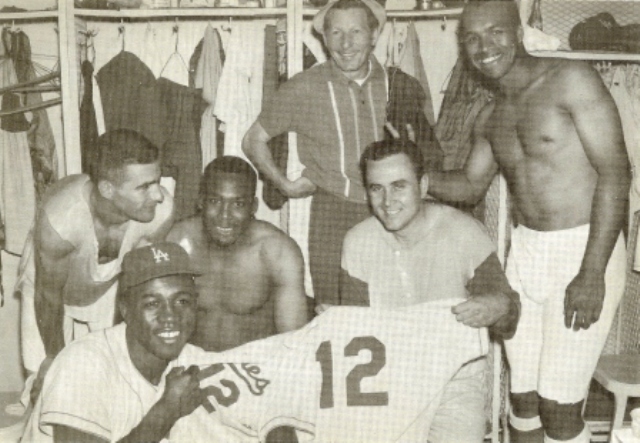
ANSWERS ADDED @ 9:00 p.m. PST
DATE: June 1, 1962.
LOCATION: Connie Mack Stadium. Los Angeles Dodgers at Philadelphia Phillies.
SUBJECTS: (left to right) Larry Burright, Jim Gilliam (in front), John Roseboro, Danny Kaye (standing), Ron Perranoski, and Tommy Davis.
OCCASION: The Dodgers beat the Phillies in the first game of a doubleheader, the club's 12th consecutive victory. See my comment at 8:54 p.m. below for more details.
PHOTO CREDIT: Andy Carey.
| Baseball Beat | July 02, 2007 |
Meet the Analysts
Every once in a while, I like to thank our readers publicly and communicate what we have in store at Baseball Analysts. The site, whose origins go back to 2003, has been operating for 2 1/2 seasons. We have undergone some changes over the past year and now offer a full slate of writers/analysts.
I wrote a State of the Site on our second anniversary in February. Since then, we have added another analyst to our staff. Joe Sheehan, who is the pioneer in studying and presenting data supplied by MLB's GameDay, has filled a valuable niche in an area that arguably is on the cusp of combining scouting and performance analysis. Joe's articles should be must reads for the intermediate and advanced fan, as well as baseball insiders.
Our goal at Baseball Analysts is to examine the past, present, and future with a primary focus on college, minor league, and major league players and teams. We have a sabermetric bent but pride ourselves in being more than just a bunch of statheads. All of us played baseball and are both students and fans of the game.
The expanded Lineup Card now features six contributors. I have gotten into the routine of taking Mondays, Marc Hulet owns Tuesdays, Patrick Sullivan Wednesdays, our guest columnists generally handle Thursdays, while Joe Sheehan and Jeff Albert rotate on Fridays. Al Doyle is our roving writer and can be read on any given day of the week. We have added The Weekend Blog this year with the hope of providing coverage on Saturdays and Sundays as well.
Rich Lederer
Age: 52
Married, 2 Children
Column: Baseball Beat
Occupation: Money Manager
Hometown: Long Beach, CA
College: USC
Favorite Team(s): Angels and Dodgers
Favorite Baseball Player: Lou Gehrig
Favorite Athlete (non-Baseball): Pistol Pete
Email: ralederer@baseballanalysts.com
Marc Hulet
Age: 30
Single
Column: Around the Minors
Occupation: Newspaper Editor/Reporter
Hometown: Ontario, Canada
College: Conestoga College and the University of Western Ontario
Favorite Team(s): Blue Jays and Diamondbacks
Favorite Baseball Player: Pat Borders
Favorite Athlete (non-Baseball): baseball or nothing
Email: marchulet@baseballanalysts.com
Patrick Sullivan
Age: 27
Married
Column: Change Up
Occupation: Consulting Services
Hometown: Boston, MA
College: University of Pennsylvania
Favorite Team: Boston Red Sox
Favorite Baseball Player: Pedro Martinez
Favorite Athlete (non-baseball): Cam Neely
Email: sully@baseballanalysts.com
Joe Sheehan
Age: 23
Single
Column: Command Post
Occupation: Tow Truck Dispatcher
Hometown: Winchester, MA
College: Oberlin
Favorite Team: Red Sox
Favorite Baseball Player: Scott Cooper
Favorite Athlete (non-Baseball): Lebron James
Email: jsheehan@baseballanalysts.com
Jeff Albert
Age: 26
Married
Column: The Batter's Eye
Occupation: Graduate Student (Exercise Science)
Hometown: Rochester, NY
College: Butler, Louisiana Tech
Favorite Team: Currently on the Brewers' bandwagon
Favorite Baseball Player: Darryl Strawberry
Favorite Athlete (non-Baseball): Tiger Woods
Email: jalbert@swingtraining.net
Al Doyle
Age: 48
Married, 4 children
Column: Past Times
Occupation: Freelance writer
Hometown: Oshkosh, Wis. (born a mile from Wrigley Field)
Favorite current players: Jeff Cirillo, Greg Maddux, Chad Bradford, Mark Loretta, Julio Franco
Favorite retired players: Tony Gwynn, Scott McGregor, Mickey Lolich, Manny Mota, Dan Quisenberry, Steve Reed, Ray Oyler, Marty Barrett, Pete Gray
Favorite baseball announcer: Vin Scully
Favorite athlete (other sports): I didn't know there were any sports besides baseball. While I'm not a huge football fan. Walter Payton is the one player I'd build my team around.
We are always on the lookout for talented contributors, whether as part of our staff or guest columnists. In addition, Baseball Analysts has also grown to the point where we could use a technical services type staff member, preferably with an expertise using the Movable Type publishing platform and perhaps web design and/or site maintenance. A webmaster, if you will. For the right person, this position could also be an opportunity to write an occasional article and make posts on our weekend blog. Let me know if you are interested in joining our team at Baseball Analysts.
Our readership is growing and ranks among the most intelligent in the baseball world. All of us value your time as well as your loyalty and support. Let us know what it is you like or dislike about the site in the comments section below or via email to any or all of us, and we will do our best to emphasize (or de-emphasize as the case may be) these features.
Thank you.
| Baseball Beat | June 25, 2007 |
Daniels Gets More Jack
Last week, the Texas Rangers signed general manager Jon Daniels to a one-year extension through 2009 for approximately $650,000. The 29-year-old Daniels became the youngest GM in MLB history when he inked a three-year contract for $1.35 million in October 2005 after John Hart resigned.
Less than eight years ago, Daniels, fresh out of Cornell, was looking for an entry-level position at the winter meetings. He went to work for the parent of Dunkin' Donuts before landing an internship with the Colorado Rockies in 2001. Hart hired Daniels as assistant of baseball operations for the Rangers in 2002 and promoted him to director of baseball operations in 2003 and assistant GM in 2004 after Grady Fuson left the organization.
Daniels seemed like a curious choice when owner Tom Hicks made him the franchise's third GM since winning the American League West in 1999. But the extension is even harder to fathom given the current state of the Rangers. My first reaction to this news was none other than "why?" What has Daniels accomplished that warranted such an extension at this time? Was Hicks afraid that his boy wonder might get a better offer elsewhere?
I realize that Hicks is hopeful of creating a measure of stability within the ranks of management. But is Daniels the right guy to lead Texas out of its current depths of despair?
Let's take a look at the facts in this case. At 30-45, Texas has the third-worst record in baseball. The club is mired in last place in the AL West, 18 1/2 games behind the Los Angeles Angels. No team is further behind in the standings than the Rangers.
TEAM W L PCT Red Sox 48 26 .649 Angels 49 27 .645 Tigers 45 29 .608 Indians 43 31 .581 Diamondbacks 44 32 .579 Brewers 43 32 .573 Padres 42 32 .568 Mets 41 32 .562 Dodgers 42 33 .560 Mariners 39 33 .542 A's 39 35 .527 Twins 38 35 .521 Phillies 39 36 .520 Rockies 38 37 .507 Braves 38 38 .500 Blue Jays 37 37 .500 Yankees 36 37 .493 Marlins 36 40 .474 Cubs 35 39 .473 Cardinals 33 39 .458 Devil Rays 33 40 .452 Giants 32 42 .432 Orioles 32 43 .427 Nationals 32 43 .427 Astros 32 43 .427 Pirates 31 44 .413 White Sox 29 42 .408 Rangers 30 45 .400 Royals 30 46 .395 Reds 29 47 .382
Daniels has made more than a dozen significant personnel decisions as the GM, including several free agent signings, six trades, and hiring Ron Washington as manager in November 2006.
MAJOR TRANSACTIONS
12/12/05: Acq'd V. Padilla from PHI for a player to be named later. 12/13/05: Acq'd B. Wilkerson, T. Sledge and A. Galarraga from WAS for A. Soriano. 12/29/05: Signed free agent K. Millwood to a 5-yr contract for $60M. 01/04/06: Acq'd A. Eaton, A. Otsuka and B. Killian from SD for C. Young, A. Gonzalez and T. Sledge. 04/01/06: Acq'd R. Tejeda and J. Blalock from PHI for D. Dellucci. 07/28/06: Acq'd C. Lee and N. Cruz from MIL for F. Cordero, K. Mench, L. Nix and J. Cordero. 11/06/06: Hired R. Washington as manager. 11/21/06: Signed free agent F. Catalanotto to a 3-yr, $13M contract with a club option for 2010. 12/09/06: Signed V. Padilla to a 3-yr, $33.75M contract with a club option for 2010. 12/12/06: Signed free agent K. Lofton to a 1-yr, $6M contract. 12/19/06: Signed free agent E. Gagne to a 1-yr, $6M contract. 12/23/06: Acq'd B. McCarthy and D. Paisano from CWS for J. Danks, N. Masset and J. Rasner. 01/30/07: Signed free agent S. Sosa to a minor league contract and invited him to spring training. 03/01/07: Signed M. Young to a 5-yr, $80M extension through 2013.
Some of those transactions have been worse than others, but I find it hard to categorize any of them as an unequivocal success. At this point, the best move appears to be signing Eric Gagne to a one-year deal for $6 million plus performance and award bonuses. However, Gagne (2-0, 1.29 ERA with 7 SV in 21 IP) has been on and off the disabled list during the first three months of the season. His value isn't necessarily as a closer for Texas as much as it might be as a bargaining chip in July. Nonetheless, Gagne has a no-trade clause that allows him to veto a deal to 12 teams.
Daniels has made three trades that have left a lot to be desired, most notably the one that sent RHP Chris Young, 1B Adrian Gonzalez, and OF Termel Sledge to San Diego in exchange for RHP Adam Eaton, RHP Akinori Otsuka and C Billy Killian. Eaton (7-4, 5.12 ERA in 65 IP in 2006) turned out to be a one-year rental while Young (18-8, 3.00 ERA in 270 IP in 2006-07) has become one of the top pitchers in the National League and Gonzalez (.298/.359/.504 with 38 HR in 867 AB in 2006-07) has developed into the premier hitter scouts expected of him when the Florida Marlins selected the San Diego native #1 overall in the June 2000 draft. Moreover, Young and Gonzalez are both young and cheap — the type of players Daniels and the Rangers should be building around rather than trading.
While Michael Young may be the face of the franchise, did it really make sense to give the 30-year-old shortstop an extension for his age 32-36 seasons at a cost of $16M per? Young wasn't eligible to test the free agent waters until after the 2008 campaign. Make no mistake about it, Young is a productive player but the majority of his value rests in his batting average and defensive position. Young will earn his new contract if he continues to hit .310-.330 while playing a decent shortstop, but how valuable will he be if his average slips to .275-.295 as his power declines, especially if he winds up at a less desirable position on the Defensive Spectrum?
Running the Rangers is not an easy job. After finishing atop the AL West in 1998-1999, the Rangers fell to last place in 2000, winning 24 fewer games than the previous season. Hicks tried to buy success when he signed Alex Rodriguez and Chan Ho Park (and others) in 2001-02. Team payroll soared to over $100 million, yet the club remained in the cellar through 2003. Hicks then unloaded A-Rod's contract on the New York Yankees while agreeing to absorb about $7 million per year (out of $25M). The opening day payroll dropped to $55 million in 2004-05 and has rebounded to approximately $68 million the past two seasons.
One of Daniels' first orders of business is to decide what to do with Mark Teixeira, who will be become a free agent after the 2008 season. Teixeira is represented by Scott Boras and the agent rarely, if ever, allows teams to buy out free agent years. As a result, Daniels has two options: (1) keep Teixeira for one more year and either sign him to a longer-term deal or get a first-round draft pick as compensation when he becomes a free agent or (2) trade Teixeira before July 31, 2008. Teams that figure to have an interest in the 27-year-old slugging first baseman include the Yankees, Red Sox, Angels, Dodgers, Tigers, and perhaps his hometown Orioles.
Most importantly, Daniels needs to find a way to rebuild a starting rotation that is the worst in the majors. The aggregate ERA is 6.70, more than one run higher than any other rotation and over two runs above the league average. The starters may challenge the dubious record set by the Detroit Tigers in 1996, the worst in the Retrosheet era (1957-present). High-priced starters Kevin Millwood (3-8, 6.72 ERA in 65.1 IP) and Vicente Padilla (4-6, 6.78 ERA in 80.2 IP) have been major disappointments, spending time on the DL and pitching poorly when "healthy." Brandon McCarthy (4-4, 5.50 ERA in 54.2 IP) hasn't lived up to his promise and has spent time on the shelf as well. Kameron Loe (3-6, 6.37, 76.2) and Robinson Tejada (5-7, 6.60, 76.2) aren't long-term answers to the club's pitching woes.
Eric Hurley, 21, and Kasey Kiker, 19, provide some hope for the future. Hurley (7-2, 3.26 ERA, 1.11 WHIP, 2.81 K/BB in AA) is a year away from reaching the bigs and Kiker (2-2, 3.09 ERA, 1.34 WHIP, 2.88 K/BB in Low A) is more of a 2010 and beyond type prospect. In the meantime, the overhyped DVD combo of John Danks, Edinson Volquez, and Thomas Diamond has been dismantled with Danks now with the Chicago White Sox, Volquez trying to regain his form in High A and AA, and Diamond out of action following elbow-ligament replacement surgery in March.
Daniels, who has beefed up the scouting and development area, held the first organization-wide meeting of coaches, scouts and administrators in years shortly after he was hired. Daniels, scouting director Ron Hopkins, Scott Servais (farm director), and Thad Levine (baseball operations) made a statement by choosing teenage pitchers Blake Beavan, Michael Main, and Neil Ramirez in the first and supplemental rounds of the most recent draft. Main, Mr. Baseball in Florida for 2007 and the Gatorade Naional Player of the Year when he went 12-1 with a 1.02 ERA, signed last week. Coming to terms with Beavan, Main's teammate on the USA Baseball Junior National team at the IBAF World Junior Championships in Cuba last September, may be more problematic.
Although it remains to be seen whether Daniels is the right man for the job, his contract extension gives him job security through 2009 while empowering the youngest GM in the game to make more deals, perhaps as soon as next month. A turnaround won't take place overnight, and Daniels' success (or lack thereof) is unlikely to be measured in terms of wins and losses until after his current deal expires.
| Baseball Beat | June 16, 2007 |
The World Series in June
The 2007 College World Series in Omaha, Nebraska got underway last night when Rice rallied to defeat Louisville 15-10 in the opener and North Carolina came from behind to beat Mississippi State 8-5 in the second game. 18,807
The Rice Owls, down 10-4 in the bottom of the fifth, scored 11 times over their final five innings in earning their sixth straight victory. The North Carolina Tar Heels, the 2006 CWS runner-up, fell behind 4-0 before rallying with four hits, two hit batters, a walk and an error to plate six runs in the sixth inning in registering their fifth come-from-behind victory in six NCAA tournament games. Rice and North Carolina will meet in the winner's round while Louisville and Mississippi State face-off in the elimination game.
Rice, North Carolina, and Arizona State are heavily favored to win it all. Of the eight teams in the World Series, only Rice, UNC, and ASU were No. 1 seeds in the Regionals two weeks ago. In addition, the Sun Devils, Tar Heels, and Owls were the only clubs to finish first in conference play.
Oregon State finished sixth in the Pac-10, Cal State Fullerton placed fifth in the Big West, Mississippi State had the fourth-best record in the two-division Southeastern Conference, Louisville ranked third in the Big East, and UC Irvine tied for second in the Big West.
BRACKET ONE
Head Coach: Wayne Graham (684-270 in 15 seasons)
Top Draft Pick: Joe Savery, LHP-1B (1-19, PHI)
Note: The Owls had 14 players drafted, tied for the most ever.
Head Coach: Mike Fox (395-173-1 in 9 seasons)
Top Draft Pick: Josh Horton, SS (#90, OAK)
Note: Fox is one of only six men to play in and then coach his alma mater to the CWS.
Head Coach: Ron Polk (1,350-668-2)
Top Draft Pick: Ed Easley, C (#61, ARI)
Note: After a four-year absence, Polk is in his second tour as head baseball coach at Mississippi State.
Head Coach: Dan McDonnell
Top Draft Pick: Trystan Magnuson, RHP (#56, TOR)
Note: The 35-year-old McDonnell, considered one of the top recruiters in the country while serving as an assistant coach at Ole Miss, has taken the Cardinals to the CWS in his first season as head coach.
BRACKET TWO
Head Coach: Pat Murphy (528-255-1 in 13 seasons)
Top Draft Pick: Eric Sogard, 2B (#81, SD)
Note: The Sun Devils are led by Brett Wallace (.423-16-78), one of the top-hitting sophomores in the country and a member of Team USA.
Head Coach: George Horton (490-200-1 in 11 seasons)
Top Draft Pick: Wes Roemer, RHP (#50, ARI)
Note: The Titans are making their 15th CWS appearance in only the 33rd year of its Div. I history. CSF has won four CWS titles (1979, 1984, 1995 and 2004) and had one runnerup finish (1992).
Head Coach: Pat Casey (13 seasons at OSU)
Top Draft Pick: Edward Kunz, RHP (#42, NYM)
Note: The Beavers are the defending champions, becoming the first-ever team from the Pacific Northwest to win the NCAA Division I College World Series.
Head Coach: Dave Serrano (third season)
Top Draft Pick: Bryan Petersen, RF (#136, FLA)
Note: Swept Texas in the Regionals and Wichita State in the Super Regionals despite playing on the road. After beating WSU, the Anteaters went directly from Kansas to Omaha.
SCHEDULE (ET)
Bracket One:
Fri 6/15: Rice 15, Louisville 10
Fri 6/15: North Carolina 8, Mississippi State 5,
Sun 6/17, 2 PM: Louisville-Mississippi State
Sun 6/17, 7 PM: Rice-North Carolina
Tue 6/19, 2 PM: Winner, Game 3 vs. Loser, Game 4
Wed 6/20, 2 PM: Winner, Game 4 vs. Winner, Game 5
Thu 6/21, 2 PM: Winner, Game 4 vs. Winner, Game 5 (if necessary)
Bracket Two:
Sat 6/16, 2 PM: UC Irvine-Arizona State
Sat 6/16, 7 PM: Oregon State-Cal State Fullerton
Mon 6/18, 2 PM: Loser, Game 1 vs. Loser, Game 2
Mon 6/18, 7 PM: Winner, Game 1 vs. Winner, Game 2
Tue 6/19, 7 PM: Winner, Game 3 vs. Loser, Game 4
Wed 6/20, 7 PM: Winner, Game 4 vs. Winner, Game 5
Thu 6/21, 7 PM: Winner, Game 4 vs. Winner, Game 5 (if necessary)
Championship Series:
Sat 6/23, 7 PM
Sun 6/24, 7 PM
Mon 6/25, 7 PM
You can stay abreast of all the live scoring and results at the official web site for NCAA Sports. Aaron Fitt and John Manuel will be covering the action at Baseball America via the site's College Blog. Baseball America also has a Game Tracker with game stories, box scores, and highlights.
Prediction: Arizona State over Rice in three games.
If there is a surprise, look for UCI to be the school that pulls it off.
Who do you like this year and why?
| Baseball Beat | June 08, 2007 |
2007 MLB Draft: The Morning After
The MLB Draft is set to resume this morning with five rounds in the books after day one. We live blogged the first through second rounds yesterday, including pick-by-pick coverage with commentary on every player selected. Thanks to the baseball blogosphere and our readers, Baseball Analysts obliterated its previous record for traffic, exceeding 2,500 per hour at the peak and settling in at nearly 15,000 for the entire day.
Although we will not be live blogging day two, we will provide highlights throughout the day while taking a look back at Thursday's developments. College lefthanders and high school players dominated the proceedings yesterday. Six collegiate southpaws—David Price (Vanderbilt/TB #1), Daniel Moskos (Clemson/PIT #4), Ross Detwiler (Missouri State/WAS #6), Joe Savery (Rice/PHI #17), Nick Schmidt (Arkansas/SD #23), and Aaron Poreda (USF/CWS #25)—were selected before a single righthander (James Simmons, UC Riverside/OAK #26) was plucked.
By the same token, 17 first rounders (vs. just 13 last year) and 20 of the top 33 draftees came from the high school ranks, including the number two (Mike Moustakas, Chatsworth HS/KC) and three (Josh Vitters, Cypress HS/CHC) choices as well as seven RHP—Jarrod Parker (Norwell HS/ARI #9), Phillippe Aumont (Ecole du Versant HS/SEA #11), Blake Beavan (Irving HS/TEX #17), Chris Withrow (Midland Christian HS/LAD #20), Tim Alderson (Horizon HS/SF #22), Michael Main (DeLand HS/TEX #24), and Rick Porcello (Seton Hall Prep/DET #27).
-Posted by Rich, 6:33 a.m. PT
ROUND THREE
The fun did not end after the second round concluded, and we all know future All-Stars are not exclusively found in the first round.
You will have to excuse Scott Carroll and Danny Carroll if they were a little confused on draft day. The two amateur prospects were taken back-to-back with overall picks 104 (Cincinnati) and 105 (Seattle). That is where the similarities end, though. Scott is a college right hander from Missouri State, while Danny is a prep outfielder from Moreno Valley, California.
The Rays made Nicholas Barnese - a right-handed prep pitcher from Simi Valley, California - the first pick of the round. According to Baseball America, Barnese missed his entire junior year of high school due to a team-imposed suspension, so there are perhaps some make-up issues. If he doesn't sign, Barnese is headed to a very good baseball program at Cal State Fullerton.
The Rays organization has had pretty good luck with choosing talent in the third round, but have only signed one player in the last four years in that round: Wade Davis. Other third rounders who did not sign include some kid named Andrew Miller in 2003 (who had fallen due to signability issues) and Bryan Morris in 2005, who was then taken in the first round by the Dodgers the very next year.
The Cubs made an interesting choice with the third pick of the round in college second baseman Tony Thomas. His numbers were seriously lacking until this season, when something clicked. In 2005, as a freshman starter at Florida State, Thomas struck out 75 times in 215 at-bats (the second most in Division I) and 66 times in 235 at-bats as a sophomore. In his junior year, however, his average raised to .430 (from .289 the year previous) and his strikeouts plummeted to 39. BA attributed the improvements to a new stance. I'm still nervous that this could be similar to the 'career season in the free agent year phenomenon.' And the Cubs don't exactly have a solid track record when it comes to developing in-house second basemen.
One of the biggest names in the draft lasted until the third round when the Angels finally took prep pitcher Matt Harvey with the 118th overall pick. The Angels are obviously looking to work some magic with Harvey, who will be a tough sign and will surely not enter pro ball for slot money. His stuff was inconsistent this spring - but still very good - and he is also a Scott Boras client who is committed to North Carolina. Will the Angels have another Nick Adenhart - who was also committed to North Carolina - steal on their hands? It will be interesting to see.
The MLB was obviously having a blue light special on Puerto Rican players in the third round, as teams grabbed the top three ranked players - about two or three rounds higher than predicted. Arizona acted first by nabbing shortstop Reynaldo Navarro with the ninth pick, followed by Cincinnati taking third baseman Neftali Sota at 15 (a fav of mine) and MInnesota with outfielder Angel Morales at 28. They will all require a lot of patience but their upsides are hugh.
-Posted by Marc Hulet
ROUND FOUR
The Arizona Diamondbacks appeared to have made out like bandits in the 2007 draft (their 2006 draft was pretty solid too) and the fourth round pick was no exception. Sean Morgan, a right-hander out of Tulane, is not flashy but he is an advanced college pitcher who could move quickly and BA rated his slider as one of the best in the draft. He could have easily gone a round earlier.
With the 18th pick of the round (and 142nd overall) the college-loving Cardinals nabbed slugging U of Texas outfielder Kyle Russell. Most pre-draft mocks had him being taken in the late first round or in the supplemental. As a draft-eligible sophomore, Russell will not be an easy sign, especially after he obliterated Texas' home run record and led Division I with 28 homers. That said, many scouts question whether he will be able to hit for average or not. Our very own Rich Lederer profiled Russell last month and was skeptical of his first-round projection after seeing him play, talking to a talent evaluator, as well as speaking with Russell:
Make no mistake about it, Russell has a powerful stroke, but his swing is not without its holes. Kyle's high strikeout rate and poor showing in the Cape Cod League last summer make one wonder how he will perform with a wood rather than aluminum bat once he turns pro... I liked Russell when I saw him play but am of the opinion that he would be somewhat of a gamble in the first round...
The Toronto Blue Jays did what they do "best" in the draft, which is A) take a lot of college left handers and B) draft a lot of college seniors. With the fourth round pick, they nabbed Arizona's Brad Mills, who fits both bills. It was also the Jays who took Mills in the 2006 draft (22nd round) despite the fact he told teams he wanted to finish his civil engineering degree. Mills told Insidethedome.com that he was not surprised to be drafted by the Jays again and he has every intention of signing this year.
With the final pick of the round, the New York Yankees chose Texas third baseman Brad Suttle. It was not a great draft for the Yankees (so far) and Suttle invokes a luke-warm response from me. Kyle Russell's teammate is also a draft-eligible sophomore, who wants $1 million to sign... which shouldn't be an issue for New York. Suttle is quite slow and has below-average power for a third baseman. Although he may hit for average, his speed will limit him in terms of stretching singles into doubles and beating out infield hits.
-Posted by Marc Hulet
ROUND FIVE
The Orioles shocked baseball when they took Boras client - but best overall hitter in the draft - Matt Wieters in the first round with their fifth overall pick. Owner Peter Angelos had previously refused to deal with Boras clients. But I guess they really want to make a splash because they took another Boras client in the fifth. Jake Arrieta was projected to be a late first round or supplemental pick. But, like most Boras clients yesterday, he fell likely due to signability concerns. If the Orioles do sign Arrieta, they will be getting a solid player with the potential to be a No. 3 or 4 pitcher.
With the 16th pick of the round, Texas nabbed prep pitcher John Gast out of a Florida area high school. The left hander was concerned a top talent before succumbing to Tommy John surgery recently. Gast was projected to be a first to third round pick. Interestingly, he didn't fall too far and Texas is obviously hoping for a result similar to what the Angels had when they took top pitching prospect Nick Adenhart with their 14th round pick in 2004 despite a similar injury. Adenhart signed for above-slot at $710,000 and the rest is history.
With the 20th pick in the round, Boston took high school two-way player Will Middlebrooks and announced him as a pitcher (according to MLB.com's draft tracker), even though most scouts projected him to be a better hitter at this point. He was considered a late round or supplemental round option so it will be interesting to see if Texas A&M loses both of its third base recruits (the Jays' first pick Kevin Ahrens is the other).
The Dodgers may have gotten an absolute steal in the fifth round... if he signs. Prep pitcher Kyle Blair has outstanding make-up and is extremely projectable. BA reported that his fastball jumped up to 94-95 as the draft neared. He also has a curveball that is rated a 60 on scouts' 20-80 scale. He is committed to the University of San Diego and could be a tough sign, but may very well be worth it.
-Posted by Marc Hulet
Word inside the Red Sox camp is that Middlebrooks was drafted as a shortstop.
- Posted by Rich
I was all set to discuss how Jack McGeary of Boston's Roxbury Latin School had not gone off the board yet but he has now been selected at pick 190 by the Washington Nationals. It's probably about 125 picks after he anticipated being taken off the board but McGeary went to bed last night a non-draftee because of "signability," a non-word that has crept its way into almost every die-hard baseball fan's vocabulary. Sign of the times, I guess.
McGeary, a Stanford commit, is a smart guy with a bright future with or without baseball and I think it was well known around Major League Baseball circles that it would take a lot of money to get a deal done. And so, he slipped. Alan Matthews of Baseball America did a nice job reviewing the other candidates who slipped due to "signability" issues.
- Posted by Sully
Now this I am psyched about. My beloved Boston Red Sox selected our guy Adam Mills of UNC Charlotte in the 8th round. I spoke with Mills about an hour ago and he sounded almost as enthusiastic as I was! When I congratulated him, Mills exclaimed "I'm excited to be heading your way, man." In all likelihood, Mills will start the year in Lowell of the New York - Penn League.
- Posted by Sully
Once the draft is over, attention will certainly turn toward signing bonuses. Courtesy of the Baseball America 2007 Prospect Handbook, I have created a table showing the bonuses for the past two years for all players drafted in the first round, followed by every fifth pick through 50 and every tenth pick thereafter (up to and including 100).
2005 2006
1. $6.100M $3.500M
2. 4.000 3.250
3. 3.400 3.000
4. 2.975 2.750
5. 2.450 2.450
6. 2.400 3.550
7. 2.300 2.300
8. 1.500 2.000
9. 3.550 2.100
10. 2.650 2.025
11. 1.900 3.000
12. 1.800 1.600
13. 1.700 1.475
14. 1.695 1.700
15. 1.570 1.625
16. 1.600 1.550
17. 1.575 1.575
18. 1.550 1.550
19. 1.525 1.525
20. 1.750 1.500
21. 1.475 2.250
22. 1.225 1.425
23. 1.400 1.400
24. 1.375 1.375
25. 1.350 1.350
26. 1.325 1.325
27. 1.300 1.300
28. 1.000 1.550
29. 1.000 1.050
30. 1.100 0.950
35. 0.950 0.950
40. N/A 0.950
45. 0.762 0.762
50. 0.690 0.690
60. 0.600 0.600
70. 0.515 0.515
80. 0.475 0.450
90. 0.422 0.422
100. 0.385 0.385
The above table allows you to see how much "slot money" is for each of the draft picks. A handful of players in each of the past two drafts were deemed "special cases" and received bonuses above slot. A few players were even willing to take less than slot.
How much the No. 1 pick gets is usually the toughest of 'em all. Justin Upton signed for $6.1M in 2005 while Luke Hochevar re-entered the draft in 2006 and signed for $3.5M. Look for David Price to get a bit more than Hochevar but not nearly as much as Upton, who had the option of not signing and going to college. Price, of course, could return for his senior year but that is highly unlikely unless Tampa Bay low balls him. The two sides obviously talked before the draft and are apparently discussing numbers that are palatable to both.
Going down the list in 2005, you can see that Wade Townsend agreed to a deal with TB for well below slot money at No. 8. Mike Pelfrey, on the other hand, held out for about an extra $1.5M when he negotiated his deal at No. 9 with the New York Mets. Cameron Maybin was a tough sign at No. 10 but the Detroit Tigers, who have shown a willingness to pay what it takes to get the players they want, stepped up and gave him a bonus of $500,000-$600,000 over slot.
Mark Pawelek (No. 20 in 2005) and his agent Scott Boras worked out a deal with the Chicago Cubs before the draft for a quarter of a million over slot. Aaron Thompson (No. 22) accepted a signing bonus from the Florida Marlins that was $200,000 below slot.
In 2006, Detroit found Andrew Miller, the consensus No. 1 pick in the draft, still on the board at No. 6 so they grabbed him and gave the former Tar Heel $3.55M, the highest signing bonus last year. Max Scherzer (No. 11) held out until almost literally the last minute, finally inking a contract with the Arizona Diamondbacks that included a bonus of $3M. A third pitcher—Ian Kennedy of USC—signed with the New York Yankees for $750,000 over slot money at No. 21. Kennedy, by the way, is pitching for the club's High-A affiliate in Tampa and is leading the Florida State League in wins (6), ERA (1.29), and WHIP (0.97). It just shows that you have to be willing to think—and pay—outside the box.
Tyler Colvin (No. 13) was drafted higher than expected because he showed a willingness to accept a bonus that was below slot from the Chicago Cubs, who were looking to save money in the first round to justify Jeff Samardzija's whopping bonus in a later round.
And that's the ins and outs of signing bonuses and slot money.
- Posted by Rich
| Baseball Beat | June 07, 2007 |
Live Blogging the 2007 MLB Draft
The Major League Baseball Draft is less than 12 hours away and Baseball Analysts will be here bringing you all the picks with capsules on every player selected in the first and supplemental rounds. Be sure to refresh your browser or check back throughout the day to stay abreast of the latest news as we live blog the draft.
For those of you at home or with a TV at the office, you can also catch the proceedings on ESPN2 from 2:00 p.m. - 6:00 p.m. ET. Karl Ravech, Peter Gammons, and Steve Phillips will be in the studio at Disney's Wide World of Sports Complex in Lake Buena Vista, Florida (just outside of Orlando), while Jim Callis of Baseball America will provide analysis from the ESPN Zone in Chicago.
With a five-minute maximum for each of the top 30 picks, the first round is expected to take about 2 1/2 hours. Following a 15-minute break, the draft will proceed with a record 34 selections in the supplemental round. The first day of the draft is scheduled to last until approximately 8:30 p.m. ET with the expectation of completing no more than five or six rounds due to television coverage, a far cry from the past when the opening day covered upwards of 20 rounds. The draft will resume on Friday morning and end after every team has either passed or made a selection in the 50th round.
You can learn more about the who, what, when, where, and how of the draft from our friends at Baseball America.
The most significant rule change with this year's draft involves a universal signing date. All draft picks must now sign by Aug. 15, or they go back into the draft pool. In previous years, players who went to junior college or simply did not return to school were eligible to sign with the team that drafted them until a week before the next year's draft.If a team doesn't sign a pick in the first or second round, it gets a pick in essentially the same slot in the next draft. Previously, unsigned first-rounders merited a pick at the end of the supplemental first round. Unsigned picks beyond that drew no compensation. So if the Pirates didn't sign the No. 4 pick this year, they would get a pick just after No. 4 next year (which would be labeled as 4-A).
Unsigned third-round picks will merit a supplemental pick between the third and fourth rounds next year. The hope from MLB's perspective is that teams will be more willing to walk away from a draft pick (and exorbitant bonus) if they know they will get an equivalent pick the next year.
A player who is drafted and does not sign with the club that selected him may be drafted again in a future draft, whenever he meets the eligibility requirements. A club may not select a player again in a subsequent year unless the player consents to it in writing.
The Tampa Bay Devil Rays own the first pick of the draft, followed by the Kansas City Royals and the Chicago Cubs. The San Francisco Giants are the only team with three selections in the first round (10, 22, and 29). The Giants also have three more in the supplemental round (32, 43, and 51). As a result, SF will draft four of the top 32 picks and six of the top 51.
The Toronto Blue Jays (16, 21, 38, 45, and 56) and Texas Rangers (17, 24, 35, 44, and 54) have two choices in the first round plus three more in the supplemental round. The San Diego Padres have one slot in the first round (23) and five more in the supplemental (40, 46, 57, 63, and 64).
- Rich Lederer, 6/7/07, 12:05 a.m. PT
Draft day is finally here! As Rich said yesterday, "It's Christmas in June." While the scouting directors for each club are probably tossing in their sleep right now - desperate for a couple hours of shut-eye after a long night - writers, bloggers and fans everywhere are madly trying to deduce exactly which player is being drafted by what club with which pick. The perennial draft experts Baseball America, and more specifically Jim Callis, usually come very, very close to predicting the actual first round - about 12 hours before the draft occurs.
This year is no different. Among the surprises, consensus top prep pitcher Rick Porcello could fall all the way to the Texas Rangers at 24 (rather than Kansas City with the second pick). The Yankees are also rumored to be hot after Porcello, much to adviser Scott Boras' delight.
The Royals, instead, are planning to pop arguably the top prep hitter - Josh Vitters. The first prep pitcher off the board could be Jarrod Parker to the Cubs at No. 3. I guess I should also mention that college left-hander David Price will be the overall No. 1 pick by Tampa Bay, but that has pretty much been a foregone conclusion for months.
One of the biggest movers in the draft in the past three or four weeks has been Pennsylvania high school catcher Devin Mesoraco. Baseball America has him being taken by Milwaukee at No. 7, although they are also considering Canadian right-hander Phillippe Aumont and college outfielder Julio Borbon.
Matt Wieters, considered to be the top hitting prospect in the draft, is predicted to fall to the San Francisco Giants at pick No. 10, which is the club's first of three choices in the round. They are also considering U of San Francisco hurler Aaron Poreda and prep pitcher Josh Smoker with the other two picks.
Over at MLB.com, Jonathan Mayo has the same first three picks predicted, although he sees some deviation at No. 4 and No. 5. He has Pittsburgh taking college lefty Daniel Moskos and Baltimore taking college lefty Ross Detwiler. Callis has Pittsburgh taking Detwiler and Baltimore taking the risk on the raw Canadian talent Aumont.
No doubt to the delight of Yankee fans everywhere, Mayo has Porcello dropping to the 30th pick. I really hope that doesn't happen because, if it does, it's a sign that the amateur draft still isn't working if the best players are not available to the clubs that need them the most.
- Marc Hulet, 6/7/07, 9:25 a.m. ET
According to Jim Callis at Baseball America, the Royals have switched gears at the last minute and will go ahead and grab Boras' client Mike Moustakas with the second overall pick. That moves Vitters to Chicago and drops Parker to Arizona, San Francisco or Florida. Isn't this fun?!
- Marc Hulet, 6/7/07, 1:24 p.m. ET
FIRST ROUND
1. Tampa Bay Devil Rays
David Price, LHP, Vanderbilt University
Height/Weight: 6-4, 195 | DOB: 8/26/85
Price was the best pitcher on the best (regular season) team in the country and is pretty much the consensus best player in the draft. He struck out 194 batters in 133 innings against some of the best competition in the country this season. He has a polished repertoire, and figures to be fast-tracked into The Bigs as many think he is already very close to being ready to contribute at that level.
- Posted by Sully
2. Kansas City Royals
Mike Moustakas, SS, Chatsworth HS (CA)
Height/Weight: 6-0, 195 | DOB: 9/11/88
A high school teammate of 3B Matt Dominguez, Moustakas will most likely be tried at the hot corner as a pro. He possesses a strong arm as evidenced by the fact that he played quarterback on the football team and was also used as a pitcher this spring. Some scouts think his best position may be as a catcher. A left-handed hitter, his bat is good enough to play anywhere on the field. Moustakas holds the California high school record for homers in a single season (24) and career (52). He was selected state sophomore player of the year in 2005, state junior player of the year in 2006, and is expected to earn the same honor for his senior year—and could very well be named Baseball America's High School Player of the Year for 2007.
One note of caution: Moustakas, who has signed a letter of intent to join his friend Robert Stock at USC, has chosen Scott Boras as his adviser. Boras may deem him to be a "special player" and aim for a bonus well above slot, making Moustakas a potentially difficult sign (unless, of course, both sides have already worked out a deal in advance).
- Posted by Rich
3. Chicago Cubs
Josh Vitters, 3B, Cypress HS (CA)
Height/Weight: 6-3, 195 | DOB: 8/27/89
Vitters can flat out hit, especially with a wood bat as evidenced by his outstanding performances in the Cape Cod Classic in Wareham (MA), Area Code games in Long Beach (CA), and the Aflac All-American Classic in San Diego last summer. He has quick hands and a smooth, compact stroke that produces line drives and "lots of pop" as a former major leaguer and current scout told me. Baseball America lists Vitters as the "best pure hitter" and the "closest to majors" among all high school players. His defense and foot speed are no better than average although both could improve with additional work over time. Although Vitters has committed to Arizona State, he is expected to sign a pro contract and report to his new team well in advance of the August 15 deadline.

For more on Josh, be sure to check out last Monday's exclusive Q&A with him.
- Posted by Rich
4. Pittsburgh Pirates
Daniel Moskos, LHP, Clemson University
Height/Weight: 6-1, 200 | DOB: 4/28/86
Clemson's Moskos was one of the top draft-eligible college closers before a late-season move to the rotation. A number of scouts also feel Moskos could succeed as a starting pitcher in pro baseball, as he possesses four usable pitches. His fastball is a plus pitch that can hit 96 mph. His slider is his second-best pitch and his change-up is a developing pitch, as he did not need it in the bullpen. At 6'1'' with a maximum-effort delivery, Moskos is probably best-suited for the bullpen long-term and would probably move very quickly through the minors in that role. He ranked as the No. 3 prospect on USA Baseball's college national team last summer.
-Posted by Marc Hulet
I can't believe that the Pirates selected another college pitcher with their first pick - and a lefthander at that. Most of the RHP have failed to date while the club currently has three southpaws (Gorzelanny, Maholm, and Duke) firmly planted in its rotation.
- Posted by Rich
5. Baltimore Orioles
Matt Wieters, C, Georgia Tech
Height/Weight: 6-5, 230 | DOB: 5/21/86
Georgia Tech catcher Wieters is considered the top college bat in the draft. He has the ability to hit both for average and power. For a big man, he does a solid job of controlling the strike zone. Behind the dish, the 6'5'' 230 lbs catcher is average. He needs to work on positioning and footwork. Wieters, who is also Georgia Tech's closer, has plus arm strength and solid accuracy on his throws to second base. He was the No. 3 prospect in the 2006 Cape Cod League, as well as a first-team Preseason All-American before the 2007 college season.
-Posted by Marc Hulet
Wieters will be the first test for owner Peter Angelos and agent Scott Boras to work out a contract. Stay tuned for the fireworks.
- Posted by Rich
6. Washington Nationals
Ross Detwiler, LHP, Missouri State University
Height/Weight: 6-4, 175 | DOB: 3/6/86
Detwiler is considered one of the top junior southpaw starters in the 2007 draft. He throws his fastball between 90-94 mph with plus life. He also utilizes a plus curve at 76-78 mph and an average change-up. Missouri State's Detwiler is extremely competitive and he has good mound presence. His command has been inconsistent but it has improved from his sophomore season. Some teams are concerned about his slight build and how his body will hold up over the course of 200 innings in a season. He pitched for Team USA last summer.
-Posted by Marc Hulet
7. Milwaukee Brewers
Matt LaPorta, 1B, University of Florida
Height/Weight: 6-1, 215 | DOB: 1/8/85
Signability concerns (he's a Boras client) and health issues (strained oblique) haunted LaPorta during his junior season in 2006. He fell to the Boston Red Sox in the 14th round last year and returned to college for his senior year. LaPorta absolutely crushed the ball in his senior season and is in the running for College Player of the Year honors. In an important final series of the regular season against Tennessee, LaPorta was walked intentionally five times in one game. As a former catcher, LaPorta does not run well and he is not a good defender. Right-handed batters with his kind of power and a willingness to work hard do not grow on trees. LaPorta is also very professional, as I learned first-hand when I interviewed him recently, and he was awarded the Daniel Silva Sportsmanship Award last year in the Cape for his positive contributions to the game.
-Posted by Marc Hulet
Wow. There is a shock. Great news for a really nice guy. But how does he fit in with a club A) with Prince Fielder and B) with no DH???
-Posted by Marc Hulet
I'm sorry, this pick makes NO sense. Fielder and LaPorta? On a NL club? Neither Fielder and LaPorta can play any other position except 1B. Not a good fit. Bad choice.
- Posted by Rich
8. Colorado Rockies
Casey Weathers, RHP, Vanderbilt University
Height/Weight: 6-1, 200 | DOB: 11/4/85
Weathers is an often overlooked senior on a solid Vanderbilt staff thanks to the presence of starting pitcher David Price. Weathers was drafted in the 25th round by Detroit but made the smart ($$$) choice to return to school. He has been a dominating college closer with his 96 mph fastball, but he needs to significantly improve his control to close in pro baseball. Weathers, a converted outfielder, also possesses a power slider at 84-86 mph. He could move quickly in pro ball, especially if his control improves with some professional coaching.
-Posted by Marc Hulet
How do you spell r-e-a-c-h?
- Posted by Rich
As a Jays fan, thank goodness Weathers isn't there to tempt J.P. Ricciardi.
- Posted by Marc Hulet
9. Arizona Diamondbacks
Jarrod Parker, RHP, Norwell HS (IN)
Height/Weight: 6-1, 175 | DOB: 11/24/88
Parker throws three pitches but relies primarily on his powerful fastball. He throws his fastball in the 94-97 MPH range and is able to spot it effectively to both sides of the plate, which is rare for right handed pitchers in high school. His change-up and curveball have the potential to be good pitches, but he was able to get by with just his fastball in high school, so he didn't develop his other pitches. While his height is a possible concern for teams, Parker has drawn comparisons to Roy Oswalt, the patron saint of small, hard-throwing right-handers. Parker went 10-0 on the season, posting a 0.13 ERA with four complete games. In 52 innings he allowed 15 hits, 96 strikeouts and eight walks.
-Posted by Joe Sheehan
Parker was universally considered the best high school pitcher in the draft not represented by Scott Boras. That is a valuable combination and one that many teams were hopeful of gaining.
- Posted by Rich
10. San Francisco Giants
Madison Bumgarner, LHP, South Caldwell HS (NC)
Height/Weight: 6-5, 220 | DOB: 8/1/89
Bumgarner, a North Carolina commit, is tall, athletic and has an advanced physique for his age, which helps evaluators feel more strongly about his projectability. He can get it up to 95 with great command and boasts two quality off-speed pitches - a snap-hook curveball and a change-up. The most common critique that I have heard is that he can have problems controlling and commanding his deuce.
-Posted by Sully
11. Seattle Mariners
Phillippe Aumont, RHP, Ecole du Versant High School (CAN)
Height/Weight: 6-7, 225 | DOB: 01/07/89
The top amateur pitcher in Canada, Aumont had the opportunity to become the highest Canadian ever drafted (Adam Loewen was taken fourth overall by Baltimore in 2004) after surging up draft boards this spring. The 6'7'' French Canadian - who speaks solid English - has a 95-98 mph four-seam fastball, as well as a two-seamer, slurve and developing change-up. Aumont has a solid understanding of pitching and believes control and movement is more important than power. He has international experience and is a former member of the Canadian Junior National Team. Amazingly, Aumont has only been pitching since the age of 14 and took up baseball at age 11 as a centerfielder. He is raw and will be a project, but he intelligent, mature and should be a quick learner. I had a chance to talk to Aumont recently about his pitching career and what the future holds. I came away suitably impressed as Aumont was the most composed high school athlete I have every interviewed.
-Posted by Marc Hulet
Interesting pick by Seattle, who was projected to take a polished college arm by just about every draft expert. Having interviewed him recently, I am thrilled for this very mature kid.
-Posted by Marc Hulet
12. Florida Marlins
Matt Dominguez, 3B, Chatsworth High School (CA)
Height/Weight: 6-2, 180 | DOB: 8/28/89
Dominguez is unlikely to fulfill his commitment to Cal State Fullerton as a highly-regarded draft prospect. He has a solid bat with power potential. Dominguez is expected to be solid defensively at third base with several scouts comparing his potential to that of Washington's Ryan Zimmerman. Dominguez is athletic and has an average arm. He has also played some shortstop in high school but does not project to have the range needed in pro ball. Dominguez has struggled with his approach at the plate this year and some adjustments need to be made.
-Posted by Marc Hulet
I'm a big fan of this pick. Dominguez can field at a MLB level now and has a power bat (including two HR at Dodger Stadium in championship high school games plus another one at Blair Field with a wood bat in the Area Code games last summer).
- Posted by Rich
The Marlins just stole the Jays' preferred choice. I'm sure general manager J.P. Ricciardi had some choice words...
-Posted by Marc Hulet
13. Cleveland Indians
Beau Mills, 3B, Lewis-Clark State College
Height/Weight: 6-3, 220 | DOB: 8/15/86
Mills made an unusual move from NCAA Division I Fresno State to NAIA powerhouse Lewis-Clark due to academic problems. But the move has paid off for him and he has rocketed into the first round in his junior season. He is now considered as one of the top three college bats in the draft along with Georgia Tech's Matt Wieters and U of Florida's Matt LaPorta. All three players possess above-average power potential and Mills' comes more from bat speed than raw strength. Mills has been exposed to professional baseball most of his life as his father Brad is a former Major League player and is currently the bench coach with the Boston Red Sox. Although not a speedster on the base paths, Mills is a smart runner who won't clog the bases. Defensively, his range is average but he handles everything he reaches. He may move to first base in pro ball. Mills is a solid leader who plays the game the right way.
-Posted by Marc Hulet
Another shock as everyone predicted Cleveland was all over prep pitcher Blake Beavan.
-Posted by Marc Hulet
Well, the Indians are known to favor college players. The fact that CLE can play him at 1B or DH makes him more valuable to them than LaPorta to MIL.
- Posted by Rich
14. Atlanta Braves
Jason Heyward, OF, Henry County High School (GA)
Height/Weight: 6-4, 220 | DOB: 8/9/89
Heyward has tremendous plus-plus, left-handed power and also has the potential to hit for a high average. As a result, he was never expected to make it out of the first 10 or 14 picks. Heyward is an average fielder who plays center field in high school but will likely move to either left or right field in pro ball. Some scouts say he can be too patient at the plate at times, but he possesses solid pitch recognition. He has committed to UCLA but is expected to display his excellent baseball instincts in pro ball instead.
-Posted by Marc Hulet
Nice pick. The Braves sure love prospects from Georgia.
- Posted by Rich
15. Cincinnati Reds
Devin Mesoraco, C, Punxsatawney High School (PA)
Height/Weight: 6-1, 195 | DOB: 6/19/88
Mesoraco has four-tool potential, with his speed being his lone weak spot. Offensively, he doesn't chase bad pitches and he has plus power. Defensively, Mesoraco has a plus arm, plus hands and makes accurate throws. He has recovered from 2006 Tommy John surgery with no ill effects. Mesoraco is outstanding at blocking balls in the dirt. He also has excellent make-up and is a natural leader. His overall package is hard to ignore and he rose up the draft charts more than any other player in the last few weeks.
-Posted by Marc Hulet
The Jays just lost their back-up option after first losing Dominguez. If they take a low-ceiling college pitcher, I may be sick...
- Posted by Marc Hulet
16. Toronto Blue Jays (from Texas for Frank Catalanotto)
Kevin Ahrens, SS-3B, Memorial HS (TX)
Height/Weight: 6-2, 190 | DOB: 04/26/89
Ahrens is one of a number of outstanding prep third basemen in this year's draft. I saw Ahrens play in the Area Code games in Long Beach last summer. The switch-hitting prep shortstop has good size, power, and arm strength—and almost assuredly will be moved to the hot corner before reaching the majors. The comparison to Chipper Jones is understandable but a bit generous given the fact that Ahrens doesn't move nearly as well at the same age as the former No. 1 pick. Baseball America ranks Ahrens as the third "best pure hitter" among high school prospects.
- Posted by Rich

I know Marc is happy!
- Posted by Rich
Much better than a low-ceiling college pick... But there was almost no talk of Ahrens to Toronto in the Canadian media before this pick occurred. A bit of a surprise, but he was the best available prep player that wasn't a pitcher. And JP was not going to take a high school hurler with his first pick.
-Posted by Marc Hulet
17. Texas Rangers (from Houston for Carlos Lee)
Blake Beavan, RHP, Irving HS (TX)
Height/Weight: 6-7, 210 | DOB: 1/17/89
Beavan's season ended nearly a month ago when his Irving High team fell in the opening round of the Texas 5A postseason tournament. Beavan finished the season with a 9-2 record, a 0.19 ERA and 139 strikeouts in 73 innings. The biggest reason for Beavan's dominance was his mid-90s fastball. Beavan threw mostly fastballs in high school, while locating it on both sides of the plate. He also features a slider and change-up, although they aren't as impressive as his fastball. In the summer of 2006 Beavan pitched for the US junior national team and shut out Cuba in the quarterfinals of the IBAF World Junior Championships. His competitive nature was on display during that game when he threw a pitch over the head of Cuba's Dayan Viciedo in retaliation for Cuba's pitcher hitting Beavan's teammate Victor Sanchez. That competitive nature appeared as cockiness/showboating in the past, although it appears he has worked past that and now only shows loads of confidence on the mound.
-Posted by Joe Sheehan
More than a hometown pick, Beavan is tall, throws hard, and has a proven track record of success.
- Posted by Rich
18. St. Louis Cardinals
Peter Kozma, SS, Owasso High School (OK)
Height/Weight: 6-1, 180 | DOB: 4/11/88
Kozma is a solid player who does not project to be a star, but an average major leaguer. He is a hard worker who gets the most out of his abilities. Kozma has excellent hitting skills and developing power. He also has above-average speed and is a solid base runner. Defensively, Kozma has an average arm and range at shortstop. He is comparable to Mark Loretta, albeit with more athleticism. Kozma is a relatively advanced high school player and he has committed to play college ball at Wichita State University.
-Posted by Marc Hulet
19. Philadelphia Phillies
Joe Savery, LHP, Rice University
Height/Weight: 6-3, 215 | DOB: 11/4/85
Savery was considered a bit of a wild card in the early rounds. He had the potential to be a first round draft pick and pitch near the top of a major league rotation but labrum surgery clouded his draft status. It also didn't help that recent Rice University high draft picks (Jeff Niemann, Phil Humber, Wade Townsend, Josh Baker) have a poor track record due to health concerns. However, Baseball America suggested Savery's injury may help him long-term, as Rice has been reluctant to use him as frequently. Savery's fastball is not as good as it used to be, but it's still pretty solid and has been between 85-94 mph this season. His curveball is still developing but he has flashed a plus change-up. Savery, a two-way player, is a good athlete.
-Posted by Marc Hulet
If he's healthy, this could be a great pick. Former top-of-the-first-round type of talent. As a two-way player, he could make a minor impact with the bat.
- Posted by Marc Hulet
20. Los Angeles Dodgers (from Boston for Julio Lugo)
Chris Withrow, RHP, Midland Christian High School, (TX)
Height/Weight: 6-3, 195 | DOB: 4/1/89
Withrow throws in the 89-94 mph range with his fastball, which also has good sink to it. Both his curve and change have the potential to be above-average pitches but they are not there yet. He has solid command of all his pitches, particularly his fastball and change. Withrow is projectable and athletic, so his game should improve significantly with professional coaching. He has excellent mechanics and repeats his delivery consistently. His father pitched in the White Sox organization, as well as at the University of Texas.
-Posted by Marc Hulet
Rick Porcello is still available, as is Matt Harvey. Both prep pitchers are Scott Boras clients. Look for the New York Yankees to grab Porcello if he is available and perhaps Harvey if he is not. Among non-Boras clients, Michael Main and Josh Smoker are probably at or near the top of most draft boards right now.
- Posted by Rich
21. Toronto Blue Jays
J.P. Arencibia, C, University of Tennessee
Height/Weight: 6-1, 195 | DOB: 01/05/86
After a very good sophomore season, Tennessee's Arencibia was considered a first-round lock in 2007. Unfortunately, his junior season was inconsistent due to injury and he almost slid out of first round consideration. Arencibia's strength is his offence and he is slightly below-average defensively. He is athletic, though, and has an average arm. His swing gets long and he tends to have too much of an uppercut stroke. I'd be a little nervous about a catcher who is already exhibiting signs of back problems at the age of 21.
-Posted by Marc Hulet
Knew this one was coming... I have liked him since last year... I just hope the back problem is a thing of the past. His defence is suspect but his bat is good enough for first base.
- Posted by Marc Hulet
22. San Francisco Giants (from the Los Angeles Dodgers for Jason Schmidt)
Tim Alderson, RHP, Horizon High School (AZ)
Height/Weight: 6-7, 210 | DOB: 11/3/88
Despite his size, Alderson's fastball currently sits in the 89-93 mph range. He has also flashed a curveball that can be a plus pitch, as well as a solid change-up that he doesn't use much against high school competition. His biggest strength right now is his plus-plus command. Not surprisingly, he has a solid mound presence and is extremely aggressive. He is athletic but has an unorthodox delivery that worries some scouts. Alderson pitches exclusively from the stretch.
-Posted by Marc Hulet
Alderson struck out 111 batters and only walked 4. Yes, 111 to 4 K/BB. Not too shabby. The Giants have now taken two power arms from the high school ranks and still have four of the next 29 picks. Alderson's family can watch him train in Scottsdale next spring.
- Posted by Rich
23. San Diego Padres
Nick Schmidt, LHP, University of Arkansas
Height/Weight: 6-5, 230 | DOB: 10/10/85
As evidenced by his 111/51 K/BB ratio in 2007, Schmidt is not blessed with overwhelming stuff and slots more into the low-risk category. He sits high 80s to low 90s and really knows how to pitch. Scouts figure he will be able to consistently get outs and eat innings due to his size as he advances to the higher levels of professional ball.
-Posted by Sully
I think the Padres were pleasantly surprised that Schmidt was still available at this pick. The big lefty has been Arkansas' Friday Night starter since the middle of his freshman season. He doesn't possess as much polish as SD normally likes, but they have always shown a preference for proven college pitchers.
- Posted by Rich
24. Texas Rangers (from the Los Angeles Angels for Gary Matthews, Jr.)
Michael Main, RHP/OF, DeLand HS (FL)
Height/Weight: 6-2, 180 | DOB: 12/14/89
Main is a two-way player, throwing heat from the mound and spending the rest of his time in the outfield. As a pitcher, Main has one of the strongest fastballs in the draft and mixes in an effective change-up and curveball as well. He has a quick delivery, which could have led to the tendonitis in his rotator cuff he suffered from over parts of the last two seasons. He appears to have fully recovered from the injury, as evidenced by striking out 121 hitters in 82 innings this spring. However, it could still cause a Major League team to think twice about using him as a pitcher because Main is very good as an outfielder as well. A five-tool player, Main hit almost .500 this season and runs like a deer. As a testament to his blazing speed, he was timed going from home-to-first in 4.07 seconds from the right-handed batters box. His swing is smooth and he projects to have power at the Major League level. Main's value is as a pitcher, but if a team gets gun shy about his injury history, his athletic ability is a nice thing to fall back on.
-Posted by Joe Sheehan
Beavan and Main? Nice. Very nice. A great athlete, Peter Gammons just compared Main to Boston uber prospect Clay Buchholz.
- Posted by Rich
25. Chicago White Sox
Aaron Poreda, LHP, University of San Francisco
Height/Weight: 6-6, 240 | DOB: 10/1/86
Poreda does not strike batters out the way you would like to see a flame-throwing lefty of his size mow 'em down (66 K's in 99 IP) but given his size and live arm, he may be well worth a flier. A good pitching coach and a quality player development system could easily mold Poreda into a quality Major League pitcher one day.
-Posted by Sully
With Poreda, the White Sox do not make a big-name splash. Looks like the Yankees (pick No. 30) may have a shot at Porcello, Brackman and Harvey but keep an eye on the Tigers at 27.
-Posted by Marc Hulet
26. Oakland Athletics
James Simmons, RHP, UC Riverside
Height/Weight: 6-4, 215 | DOB: 9/29/86
Simmons is one of the most polished pitchers in the draft. He struck out 116 batters and walked only 15 in 123.2 IP this spring. Baseball America ranks him third as the "closest to the majors" among all college players (behind only Vanderbilt's David Price and Casey Weathers). After posting a 1.18 ERA over 53.1 IP in the Cape Cod League last summer, Simmons went 11-3 with a 2.40 ERA in his junior season at UC Riverside. His ERA might be a bit misleading as he gave up 15 unearned runs (out of a total of 48) in 123.2 IP, giving the strike-throwing artist a RA of 3.49.
I had the chance to see Simmons in action vs. Long Beach State on 5/18/07. His fastball sat at 90-92 in the early innings (with one pitch touching 93), then fell to 88-91 later in the game (with a high of 92). He possesses a plus change-up and no better than an average breaking ball. Simmons tends to throw a lot of pitches for someone with his command (127 over six innings in the game I saw and 133 in 7.1 IP against Nebraska in the Regionals last week). His upside will be a function of how many bats he misses at the big league level. (Photo)
- Posted by Rich

Oakland has now taken 13 college players out of their last 14 first-round picks in the Billy Beane era.
- Posted by Rich
27. Detroit Tigers
Rich Porcello, RHP, Seton Hall Prep (NJ)
Height/Weight: 6-5, 195 | DOB: 12/27/88
The 2006-2007 Gatorade national baseball player of the year was the top high school pitching prospect in the draft. With a four-seam fastball that sits in the 95 MPH range and a two-seam fastball with movement, Porcello dominated high school hitters this spring. On the season he went 9-0 with a 1.44 ERA with 103 strikeouts and 13 walks in 63 innings. His easy delivery and good mechanics don't lend themselves to injuries and he has a projectable body. One of the knocks on Porcello heading into this season was his control, but he showed excellent command this spring, allaying that fear. Signability is the big issue with Porcello now, as he is advised by Scott Boras and has a commitment to North Carolina. However, with new rules in place that will compensate teams for unsigned picks in the first three rounds with essentially the same pick in the 2008 draft, perhaps teams will be less concerned about signability than they were in the past.
-Posted by Joe Sheehan
Take that Yankees. The Tigers LOVE to make big splashes when players fall due to signability issues. He could be a major steal, along the lines of Andrew Miller.
-Posted by Marc Hulet
Sully just IM'd me and, as a Red Sox fan, is one very happy man.
- Posted by Rich
28. Minnesota Twins
Ben Revere, OF, Lexington Catholic HS (KY)
Height/Weight: 5-9, 155 | DOB: 5/03/88
Baseball America ranks Revere as the "fastest baserunner" (6.28 in the 60) among all high school prospects. He also projects to be a plus defensive outfielder in terms of range but has a below-average arm. Makes excellent contact at the plate with occasional pop. A wide receiver and kick returner in football, Revere is considered to be a great athlete with strong makeup and a first-rate work ethic.
- Posted by Rich
Revere sounds like a better fantasy pool selection (especially in a 4x4 league) than baseball player.
- Posted by Rich
29. San Francisco Giants (from the New York Mets for Moises Alou)
Wendell Fairley, OF, George County-Lucedale High School (MS)
Height/Weight: 6-0, 190 | DOB: 3/17/88
Fairley's game is all about speed and athletic ability as he is a raw baseball player. He also spent time playing football in high school. He has shown the ability to hit for both average and power with a projectable left-handed stroke. Fairly projects as a centerfielder and has enough arm to stay there in the future. There are some questions about his make-up as he faced charges this year, stemming from a school prank, and is also a father, despite still being in high school.
-Posted by Marc Hulet
30. New York Yankees
Andrew Brackman, RHP, North Carolina State
Height/Weight: 6-10, 230 | DOB: 12/04/85
Many teams still do not know what to think about 6'10'' Brackman, whose season ended early due to fatigue after fewer than 80 innings of work. But with a 92-97 mph fastball, which reportedly hit 100 mph in the summer Cape Cod League, he is desirable baseball talent. Brackman is raw for a college pitcher and he is represented by super agent Scott Boras. Along with his fastball, Brackman possesses a 78-81 mph knuckle curve and an 82-84 mph change-up. He struggles with his balance and release point, which leads to spotty control at times. The former high school and college basketball player has good athleticism. As the draft neared, there were rumors flying that all the talk of injuries (as well as some impending Tommy John whispers) were orchestrated by Boras to help Brackman fall to a big market club.
-Posted by Marc Hulet
You can have him.
- Posted by Rich
We're in the midst of a 15-minute break between the first round and the supplemental round. Stay tuned as we will continue to bring all the coverage to you right here.
As a recap, 13 college players and 17 high schoolers were chosen in the first round with 17 pitchers and 13 position players taken. Seven top HS pitchers are now unlikely to go to college, diluting the collegiate ranks for the next few years.
According to ESPN2's coverage, Mike Moustakas and Matt Dominguez (Chatsworth HS, which won the Los Angeles Section City title) are the highest pair of high school teammates ever drafted.
- Posted by Rich
SUPPLEMENTAL ROUND
31. Washington Nationals (from the Chicago Cubs for Alfonso Soriano)
Josh Smoker, LHP, Calhoun HS (GA)
Height/Weight: 6-2, 195 | DOB: 11/26/88
Another classy looking high school southpaw, Smoker has a smooth delivery, a low-90s fastball, a very good change-up and an improving breaking ball. He can get it up into the mid-90s but sits high 80s to low 90s and is known for intelligently mixing up his pitches to get outs. He has committed to Clemson.
-Posted by Sully
The Nats get great value in the supplemental round, with a player everyone expected to be gone by the end of the first round.
-Posted by Marc Hulet
32. San Francisco Giants (for Alou)
Nick Noonan, SS/2B, Parker High School (CA)
Height/Weight: 6-1, 185 | DOB: 5/14/89
Noonan projects as a No. 2 hitter at the major league level, but he still has a long way to go to reach that potential. He has excellent bat control and the ability to hit for average. Noonan doesn't have much power but he could eventually hit 10-15 homers per year. His speed is average but he has solid baseball instincts that allow him to get the most out of his abilities. Noonan, who profiles as a second baseman, has average arm strength at best and decent range at shortstop, which is where he played in high school. He has been compared to Philadelphia's Chase Utley with less power. Noonan has committed to Clemson University.
-Posted by Marc Hulet
33. Atlanta Braves (from Baltimore for Danys Baez)
Jon Gilmore, 3B, City High School (IA)
Height/Weight: 6-3, 190 | DOB: 8/23/88
Gilmore is still in the projection stages. He has projectable power and has recently shown the ability to make adjustments with breaking pitches. Gilmore lacks quickness and range at third base. He also does not run well. Gilmore puts more effort into his hitting than his defense. Regardless, his raw power and the huge strides he has made in his hitting abilities are intriguing. Gilmore is committed to Wichita State University and is the brother-in-law of Tampa Bay's Ben Zobrist.
-Posted by Marc Hulet
34. Cincinnati Reds (from San Francisco for Rich Aurilia)
Todd Frazier, SS/3B, Rutgers University
Height/Weight: 6-4, 220 | DOB: 2/12/86
Frazier has good bloodlines as his brother Charles played in the minors with Florida and brother Jeff is currently at Double-A with the Cubs. The Rockies drafted Frazier out of high school in the 37th round in 2004, but he chose to attend Rutgers. Frazier has good bat speed with an unorthodox swing. He displays plus raw power but must avoid becoming too pull happy. Frazier is athletic and a fringe-average base runner. Frazier flashes a plus arm at third base and lacks the range to remain at shortstop long-term.
-Posted by Marc Hulet
With Encarnacion struggling for Cincy, he now has Frazier to worry about in a couple years.
-Posted by Marc Hulet
35. Texas Rangers (for Lee)
Julio Borbon, CF, University of Tennessee
Height/Weight: 6-1, 190 | DOB: 2/20/86
Borbon is a solid center-fielder who has excellent hitting abilities, including bat control and bunting. He has flashed occasional power but he is better when he focuses on "small ball." He does not walk enough for a top-of-the-order hitter. Borbon missed a good portion of the 2007 season with a fractured ankle but he still has plus speed and great range. The only negative is Borbon's arm, which is fringe-average for center. He has been likened to New York's Johnny Damon and Texas' Kenny Lofton.
-Posted by Marc Hulet
The Rangers really considered Borbon in the first round and must have been thrilled to nab him in the supplemental round.
-Posted by Marc Hulet
36. St. Louis Cardinals (from Milwaukee for Jeff Suppan)
Clay Mortensen, RHP, Gonzaga University
Height/Weight: 6-4, 180 | DOB: 4/10/85
Mortensen throws three pitches: a "heavy" fastball that sits at 89-92 and has reportedly touched 94, a hard slider, and a changeup. He was named the Western Conference Pitcher of the Year and a Louisville Slugger third-team All-America. A senior who was drafted in the 25th round in 2005 out of Treasure Valley Community College (OR), Mortensen stepped it up in conference play, posting a perfect 6-0 record in seven starts and a 1.60 ERA with a league-best 63 strikeouts. The late bloomer possesses a good frame for a pitcher and may have additional upside beyond what he has shown to date.
- Posted by Rich
37. Philadelphia Phillies (from Cleveland for David Dellucci)
Travis D'Arnaud, C, Lakewood High School (CA)
Height/Weight: 6-0, 185 | DOB: 2/10/89
D'Arnaud was considered one of the top catching options in the draft for his combined hitting and catching skills. He has shown promise with the bat, but is still inconsistent at this point. He doesn't have a naturally gifted swing and tends to get a little swing-from-the-heels happy. D'Arnaud is mostly a doubles hitter right now but projects to be a 10-15 home run hitter in his prime. He does all the little things well and is a smart base runner, even though he has below-average speed. Defensively, he has a great arm, both in terms of strength and accuracy. He also has soft hands and moves well behind the plate. D'Arnaud is poised to join his brother at Pepperdine University, unless he is drafted in the first few rounds.
-Posted by Marc Hulet
Although known more for his defense, D'Arnaud led the prestigious Moore League in home runs this spring and went deep numerous times in a wood bat session at Dodger Stadium last week.
- Posted by Rich
38. Toronto Blue Jays (from the Los Angeles Angels for Justin Speier)
Brett Cecil, LHP, University of Maryland
Height/Weight: 6-2, 225 | DOB: 7/2/86
Cecil's 81-86 mph slider should guarantee him a spot in a big league bullpen. If he can sharpen his secondary pitches and find a tool for combating righties, he could become a closer in pro ball. Cecil's fastball is 89-92 mph and his repertoire also includes a curveball, change-up and split-finger fastball. He likes to challenge hitters and throw strikes. Cecil occasionally displays immaturity on the mound.
-Posted by Marc Hulet
39. Los Angeles Dodgers (for Lugo)
James Adkins, LHP, U of Tennessee
Height/Weight: 6-6, 225 | DOB: 11/26/85
Adkins is a big left-hander but throws his fastball at 88-92 mph. His slider is his out-pitch and it flashes plus-plus ability at times. For the most part he relies on command and control to get batters out and he lacks a reliable change-up. Adkins carried a no-hitter into an SEC tournament start but probably won't see similar success in pro ball as a starter with only two pitches. If he doesn't quickly pick up an off-speed pitch, he is likely headed to the bullpen as a set-up man.
-Posted by Marc Hulet
40. San Diego Padres (from Houston for Woody Williams)
Kellen Kulbacki, OF, James Madison University
Height/Weight: 5-11, 205 | DOB: 11/21/85
Kulbacki has put up some stellar numbers in his college career, although some caution must be used due to the fact he plays in an excellent hitter's park. He is an above-average hitter, though, with a chance to hit for a high average. He has plus raw power, as well. He has average speed at best, but is not a base-clogger. He is an average fielder with an arm that is suited to leftfield. His range is nothing special. Body-wise, Kulbacki is similar to Brian Giles.
-Posted by Marc Hulet
I guess San Diego saw the Giles comparisons too? I am a little worried about the power numbers not translating to A) wood and B) a pitcher's environment.
-Posted by Marc Hulet
41. Oakland Athletics (from San Francisco for Barry Zito)
Sean Doolittle, LHP/1B, University of Virginia
Height/Weight: 6-2, 180 | DOB: 9/26/86
Doolittle is a two-way player who profiles better as a first baseman. He projects to be a Mark Grace style of player, rather than a hulking slugger. However, Virginia's spacious park can sometimes mask power potential. Doolittle is more athletic than most first basemen and he has an above average arm. He can throw 87-90 mph on the mound. His stock was on the rise as the draft neared and some had expected him to be taken in the first round.
-Posted by Marc Hulet
42. New York Mets (from Cleveland for Roberto Hernandez)
Eddie Kunz, RHP, Oregon State
Height/Weight: 6-5, 250 | DOB: 4/8/86
Kunz throws a sinking fastball that can touch 94 mph. His second pitch is a slider, with good late, hard break to it. He has average command and throws from a three-quarters arm slot out of the bullpen. He lacks a true weapon against good left-handed batters but his sinker will induce a lot of ground balls and chew up bats in pro ball. Because of his struggles against lefties, he projects more as a set-up man in pro ball, rather than a dominating closer.
-Posted by Marc Hulet
43. San Francisco Giants (for Schmidt)
Jackson Williams, C, Oklahoma
Height/Weight: 5-11, 200 | DOB: 5/14/86
A three-year starter, Williams hit .344/.426/.525 with 4 HR, 18 BB, and 33 SO in 183 AB in his junior season this spring. He played for the Hyannis Mets of the Cape Cod League last summer. An intense competitor and student of the game, Williams was the captain of the Sooners baseball team. He projects as a solid but "low ceiling" backstop.
- Posted by Rich
44. Texas Rangers (for Matthews)
Neil Ramirez, RHP, Kempsville High School (VA)
Height/Weight: 6-3, 190 | DOB: 5/25/89
Ramirez can dial his fastball up to 96 mph. He also has a curveball with potential and a developing change-up. He has above-average command of his fastball, but the command of his secondary stuff is below-average. He has a projectable body and good mound demeanor.
-Posted by Marc Hulet
45. Toronto Blue Jays (for Catalanotto)
Justin Jackson, SS, T.C. Roberson High School (NC)
Height/Weight: 6-2, 175 | DOB: 12/11/88
Jackson has slid down draft boards this spring despite solid, albeit unspectacular, play. It was fairly common knowledge that it would be difficult for teams to buy him away from his commitment to attended college at Arizona State if he was not take in the first couple of rounds. Jackson has solid bat speed with 15-20 home run potential and needs to get stronger overall. He doesn't have great stolen base speed, as he has a slow first step. Jackson has plus arm strength and can hit 93 mph off the mound. At shortstop, he has average range. Jackson has been on scouts' radars for a number of years and he attended the same high school as Detroit's 2005 first round pick Cameron Maybin.
-Posted by Marc Hulet
A very exciting pick for the Jays... A talented but somewhat raw prep shortstop that can actually stay at the position! Jackson and John Tolisano (taken in the second round) will make an exciting, flashy doubleplay combo with the new Gulf Coast League team.
46. San Diego Padres (from San Francisco for Dave Roberts)
Drew Cumberland, SS, Pace High School (FL)
Height/Weight: 5-10, 170 | DOB: 1/13/89
Cumberland is a contact, line-drive hitter with below average power. he is a plus-plus runner on the base paths and he knows how to get the most out of his speed. Defensively, he has a below-average arm at shortstop and poor footwork. He could face a move to second base or centerfield. He does have plus range, though, because of his speed. He is athletic and fits the mold of a top-of-the-order hitter. He also has excellent make-up. Cumberland's brother Shaun plays in the Rays' organization.
-Posted by Marc Hulet
47. New York Mets (from Baltimore for Chad Bradford)
Nathan Vineyard, LHP, Woodland High School (GA)
Height/Weight: 6-3, 200 | DOB: 10/3/86
Vineyard has an average 88-91 mph fastball and slider. His change-up is currently below-average. Vineyard has a solid delivery but his command is below average at this point in his career. He is athletic and likes to aggressively attack hitters.
-Posted by Marc Hulet
48. Chicago Cubs (from the Los Angeles Dodgers for Juan Pierre)
Josh Donaldson, C, Auburn University
Height/Weight: 6-1, 200 | DOB: 12/8/85
Donaldson is a strong, athletic catcher with excellent instincts. However, his arm is lacking behind the plate and he may face a move to second base in the near future. He has also played shortstop and third base in high school and college. Donaldson is a below-average runner. He falls into bad habits at the plate and some scouts question his bat speed. A strong Cape Cod League in 2006 helped to raise his profile. Donaldson has a hitch in his swing and has a habit of chasing breaking balls out of the strike zone.
-Posted by Marc Hulet
49. Washington Nationals (from Seattle for Jose Guillen)
Michael Burgess, OF, Hillsborough High School (FL)
Height/Weight: 5-11, 200 | DOB: 10/20/88
Burgess showcases above-average power potential, he has excellent hand-eye coordination and his bat speed is outstanding. That said, his game is still raw and he is the perfect example of a "boom or bust" prospect. Burgess' arm strength is also a plus tool and he can exceed 90 mph when throwing from the mound. He has OK range in center but would likely move to rightfield in pro ball. His swing is inconsistent and it makes some scouts worry that he won't hit for average.
-Posted by Marc Hulet
50. Arizona Diamondbacks (from Milwaukee for Craig Counsell)
Wes Roemer, RHP, Cal State Fullerton
Height/Weight: 6-0, 200 | DOB: 10/7/86
Roemer was projected all over the first and supplemental rounds leading up to the draft. As a smallish right-handed pitcher with an average fastball (89-91 mph), command, control and make-up are his biggest strengths. He has solid command of his slider, which he can back-door against lefties, and his change-up. Roemer is a competitor, who likes to go right after batters. He could head to the bullpen as a pro, but is likely to get a chance to start.
-Posted by Marc Hulet
Roemer regressed this year but still put up solid numbers (10-6, 3.33 ERA, with 136 SO and 22 BB in 127 IP). As a sophomore, the Titan was a unanimous first-team All-American and Collegiate Baseball's Co-National Player of the Year. He started the 2006 season pitching 65.2 innings without issuing a walk and finished the campaign with a 21:1 K/BB ratio on 145 whiffs and only 7 walks. Roemer was invited to play for the U.S. National Team last summer, going 2-0 with a 2.01 ERA in 22.1 innings pitched.
I have seen him pitch in person and believe his bulldog approach will serve him well in the pros—quite possibly as someone who will eventually be asked to get outs in the eighth or ninth innings.
- Posted by Rich
51. San Francisco Giants (from Cincinnati for Mike Stanton)
Charles Culberson, SS, Calhoun HS (GA)
Height/Weight: 6-1, 185 | DOB: 4/10/89
Calhoun High School produced two picks in the supplemental round: Culberson and teammate Josh Smoker, who was selected by the Washington Nationals at 32. The duo led their team to the Class AA state baseball finals. Culberson was the No. 2 pitcher and played shortstop when not on the mound. He hit a ton this spring, batting over .500 with 16 HR, including 6 in the postseason.
- Posted by Rich
52. Seattle Mariners (from Kansas City for Gil Meche)
Matt Mangini, 3B, Oklahoma State
Height/Weight: 6-4, 222 | DOB: 12/21/85
Oklahoma State's Mangini could be the best true college third baseman available, although some scouts prefer Rutgers University's Todd Frazier (currently a shortstop). He doesn't possess the power one might expect from a 6'4'' 220 lbs baseball player, which separates him from Lewis-Clark's Beau Mills. That said, Mangini should hit for a solid average and he won the 2006 Cape Cod League batting title while using wood bats. Defensively, he has an above-average arm and good range for his size.
-Posted by Marc Hulet
53. Cincinnati Reds (from the New York Mets for Scott Schoeneweis)
Kyle Lotzkar, RHP, South Delta High School (CAN)
Height/Weight: 6-3, 185 | DOB: 10/24/89
The 6'3'' 185 pound Canadian pitcher can touch 95 mph but has been overshadowed by fellow countryman Phillippe Aumont. Lotzkar's fastball currently has only fringe-average movement. His slurve could develop into a strikeout pitch but it is a work-in-progress at this point. He lacks a third pitch, but has flashed a change-up in limited action. Lotzkar could lack the command to pitch in the starting rotation in pro ball. He has committed to play college ball at Gonzaga University.
-Posted by Marc Hulet
54. Texas Rangers (from the Chicago Cubs for Mark DeRosa)
Raymond Hunter, RHP, University of Alabama Tuscaloosa
Height/Weight: 6-3, 255 | DOB: 7/3/86
Known in the scouting circles as Tommy Hunter, Raymond's fastball ranges from 88-94 mph but sits most comfortable around 88-91. Both his slider and change project to be average pitches in the future. He has a bulldog mentality but below-average command, which should improve over time. Hunter has a similar build to the Dodgers' Jonathan Broxton. He is a draft-eligible sophomore, so he has some signing leverage.
-Posted by Marc Hulet
55. Boston Red Sox (from Cincinnati for Alex Gonzalez)
Nick Hagadone, LHP, University of Washington
Height/Weight: 6-4, 220 | DOB: 1/1/86
Hagadone's stock has been sizzling. At the start of the year he projected somewhere in the 8-12 round range according to the more reputable amateur baseball publications. But given his size, stellar season out of the Huskies bullpen (72/17 K/BB in 68 IP) and increased velocity this season, Major League clubs have taken notice and he figures to go much sooner than 8-12.
-Posted by Sully
56. Toronto Blue Jays (from the Chicago Cubs for Ted Lilly)
Trystan Magnuson, RHP, University of Louisville
Height/Weight: 6-7, 195 | DOB: 6/6/85
The Magnuson name is well known to Canadian hockey fans, as Trystan's European father played for a number of years in the National Hockey League. Magnuson was probably a signability pick as he was a fifth year senior in college and could have signed with any team before the draft (likely for little money) had his team finished its playoffs sooner. He has a low-90s fastball and his out-pitch is a slider, but it is still inconsistent. He was a closer for Louisville but projects to be a set-up man in pro ball.
-Posted by Marc Hulet
57. San Diego Padres (from the New York Mets for Chan Ho Park)
Mitch Canham, C, Oregon State University
Height/Weight: 6-2, 212 | DOB: 9/25/84
Canham is a 6'2'' catcher who bats left and possesses solid skills at the plate. He has the potential to hit for both average and power. The athletic Canham is only in his third year of catching and his defence is a work in progress. If his skills behind the dish do not improve, he should hit well enough to play a corner infield or corner outfield position. Canham is a confident player who takes charge on the field. He was taken by the Cardinals in the 41st round last year as a draft-eligible sophomore but did not sign. Canham significantly improved his game in the Cape Cod League last summer. Some scouts are concerned about his past, as his mother died from a drug overdose.
-Posted by Marc Hulet
58. Los Angeles Angels (from St. Louis for Adam Kennedy)
Jonathan Bachanov, RHP, University HS (FL)
Height/Weight: 6-4, 210 | DOB: 1/30/89
Bachnov's fastball ranges from 89-96 mph but he has some make-up questions surrounding him. His breaking ball is a plus pitch when it's on and he also has a cutter and a developing change. He is big and strong but doesn't alway remember how good he is, while he is on the mound. With better mound presence and maturity, Bachnov could improve significantly.
-Posted by Marc Hulet
59. Oakland Athletics (from Toronto for Frank Thomas)
Corey Brown, OF, Oklahoma State University
Height/Weight: 6-2, 210 | DOB: 11/26/85
Brown is more well-rounded than teammate Matt Mangini. Brown displays both solid power and speed. He also has a quick bat and is more than willing to take a walk. Defensively, he has the range for center but probably also has enough arm for rightfield. On the negative side, he hit below .200 in the Cape Cod League last summer and faced fairly serious criminal charges in high school.
-Posted by Marc Hulet
60. Detroit Tigers (from Baltimore for Jamie Walker)
Brandon Hamilton, RHP, Stanhope Elmore HS (AL)
Height/Weight: 6-2, 205 | DOB: 12/25/88
Hamilton's power arm can overpower hitters at times, but he is far from a finished product. He failed to handle adversity well while recording a 2-7 record with a 1.83 ERA and 86 strikeouts in 49.2 IP. Hamilton committed to Troy but is expected to sign a pro contract as soon as one is offered him. "I just want to go out and play," Hamilton said. "If worse comes to worst, I'll go to college, but I'll probably sign. I'm open to anything."
- Posted by Rich
61. Arizona Diamondbacks (from Seattle for Miguel Batista)
Edward Easley, C, Mississippi State
Height/Weight: 6-1, 180 | DOB: 12/21/85
Easley was a second-team All-American coming out of high school. He has also played third base, but lacks the power to remain there long term, so his value lies in remaining behind the plate. He has a reputation as a solid hitter but his defence behind the dish is average at best.
-Posted by Marc Hulet
62. Boston Red Sox (from Cleveland for Keith Foulke)
Ryan Dent, SS, Wilson High School (CA)
Height/Weight: 5-10, 180 | DOB: 3/15/89
Dent led his high school team, ranked No. 1 in the country by Baseball America, to the California Interscholastic Federation Southern Section (CIF-SS) Division I championship. The UCLA recruit profiles as a future lead-off hitter with solid hitting abilities and plus speed. Dent flashes occasional power, but it is not a key part of his game. Although he is athletic and speedy, some scouts question his ability to stick at shortstop longer term. A move to the outfield is not out of the question, but he presently lacks the necessary power to be a regular corner outfielder. Look for Dent to play one of the up-the-middle positions, be it SS, 2B, or CF.
-Posted by Marc Hulet and Rich Lederer
63. San Diego Padres (from Oakland for Alan Embree)
Cory Luebke, LHP, Ohio State University
Height/Weight: 6-4, 200 | DOB: 3/4/85
Luebke led the Big 10 Conference in ERA during the regular season. He had a solid Cape Cod League last summer but has underwhelming stuff for a big kid with a fastball that ranges between 88-91 mph. His slider is solid but his change is nothing special. At worst, he could be a LOOGY.
-Posted by Marc Hulet
64. San Diego Padres (from San Francisco for Ryan Klesko)
Danny Payne, OF, Georgia Tech
Height/Weight: 5-11, 190 | DOB: 9/8/85
Payne has above-average hitting skills, but below average power. He is average on the base paths but can steal bases when needed. He has a pretty good arm and threw some relief in college. He has average range in the outfield but gets good jumps. Payne has good baseball instincts and will do whatever necessary to get on base. To be an everyday player, Payne is going to have to show the ability to stick in centerfield.
-Posted by Marc Hulet
SUMMARY OF SECOND ROUND
The first five selections (William Kline, Sam Runion, Jordan Zimmerman, Matt Welker, and Josh Fields) are righthanded pitchers—all but Runion from the college ranks. Fields slipped in the draft from the early-season projections based on his outstanding Cape Cod performance last summer. An undersized RHP, he had trouble commanding his fastball and throwing his breaking ball this spring, but the Braves once again pulled the trigger on a Georgia prospect.
Brian Rike, who we featured last Friday, was taken by the Colorado Rockies with the 72nd pick. Jeff Albert, a graduate student at Louisiana Tech, interviewed the power-hitting outfielder and analyzed his swing in a video scouting report attached to that Q&A.
Greg Desme (OAK, 74th) was the Big West Conference Player of the Year despite missing the last couple of weeks of the season with a broken wrist. He led the league in batting average (.405), home runs (15), RBI (53), SLG (.733), OBP (.494) and total bases (143). His size, position, and power reminded me of Jonny Gomes when I saw the Mustangs get swept by Long Beach State in a three-game series in early May. He struck out in his first two at-bats on Friday night as Manny McElroy threw him almost nothing but curveballs, a pitch Desme has had a tough time handling. He will need to make adjustments at the pro level to succeed.
Zachary Cozart (CIN, 79th), Josh Horton (OAK, 90th), and Danny Worth (DET, 91st) are three polished college shortstops who were taken in the second round. Cozart, Horton, and Worth are sure-handed fielders but their lack of plus speed and range will limit them defensively at the highest level. All three profile as low-end starting SS or backups/utility players on championship teams.
- Posted by Rich
| Baseball Beat | June 04, 2007 |
2007 Draft Spotlight: Josh Vitters
Josh Vitters is the best high school hitter in the draft this year. He has a short, compact stroke with outstanding bat speed that produces plus-plus power for someone who has yet to turn 18 years old. At 6-3 and 195 pounds, Vitters has the frame that should lead to even more power as he matures physically. He is almost a lock to be drafted with one of the top four picks in the draft on Thursday.
Although not as gifted as Ryan Braun athletically, Vitters reminds me of the Milwaukee Brewers rookie when it comes to his position, body type, and hitting prowess. I've seen Vitters play three times: once last year and twice this season. I was also fortunate to witness Josh take a "private" batting practice session for Jim Bowden of the Washington Nationals after one of the games a month or so ago. His coach stood in front of the mound and threw about 30 pitches. Fourteen of them left the yard by my count. The dimensions at Cypress High School are 320 feet down the lines and 380 feet to straightaway center field. After a loose and easy warm-up swing on the first pitch, Josh hit the next five offerings over the fence. Boom. Boom. Boom. Boom. Boom. He pumped another nine out. Bowden had seen enough and walked away, probably wishing he could trade up in the draft.
Josh's Cypress HS team won four Empire League titles plus a California Interscholastic Federation Southern Section (CIF-SS) Division II championship during his sophomore year. He was pulled up to the varsity halfway through his freshman season and played third base all four years, winning a multitude of honors and even more praise from scouts. His team recently lost a second-round playoff game. In an exclusive interview with Baseball Analysts, I asked Josh about his finale, high school career, college/pro ambitions, and a lot more.
Rich: Your high school team lost a playoff game recently.
Josh: We played Vista Murrieta at their field and lost 5-4.
Rich: That sounds like a heartbreaking loss.
Josh: Yeah, we were up 4-2 in the last inning and they came back and scored three to win.
Rich: How did you do in that game?
Josh: I went 2-for-3 with a home run.
Rich: Good for you.
Josh: Well, at least I did well in my last game.
Rich: You had a bout with pneumonia earlier in the year. How much time did you miss?
Josh: I missed about three weeks and six games. It was pretty hard to watch my team play while I was sick. I lost 15 pounds and a little bit of muscle, and it took at least three more weeks on top of that to get everything back. I'm finally starting to feel close to 100% now.
Rich: How long did it take to get your batting stroke back?
Josh: My batting stroke came back pretty fast, but my power was lagging a little bit when I came back.
Rich: If the "private" batting practice you gave to Jim Bowden a few weeks ago was any indication of power, I'd say you're all the way back now.
Josh: (bashfully) Yeah, I was feeling pretty good.
Rich: Did you get a chance to talk to Mr. Bowden that day?
Josh: Yes, he introduced himself and talked about the Nationals.
Rich: Washington, of course, has Ryan Zimmerman firmly implanted at third base. I can't help but think the Nationals might eventually move you to a different position if they drafted and signed you.
Josh: I actually asked him where I'd be going if they picked me, and he said I would probably start out at third base for the first year and then just see what happens from there.
Rich: How many teams have you worked out for?
Josh: About 20 teams.
Rich: Have most of them been one-on-one sessions like you did for Bowden?
Josh: Earlier in the year I was doing a lot more but lately it's been pretty much those private things. I did it for the Nationals when you were there. I did one for the Pirates, the Cubs, and a couple of others.
Rich: Was it mostly taking batting practice or did they work you out in the field as well?
Josh: They hit me some groundballs, too, but nothing too much.
Rich: Most mock drafts have you going third to the Cubs or fourth to the Pirates. Do you have any preference as to which team drafts you?
Josh: No, it's not a big deal because the Cubs and Pirates are both great clubs. It doesn't make any difference to me.
Rich: How long have you been swinging a wood bat?
Josh: Since after my freshman year. I played on the ABD Bulldogs [a travel team] and in a lot of wood bat tournaments. That's where I learned to use the wood bat.
Rich: When did you start playing games on a national level?
Josh: My first time was when I played for the Youth National Team as a 16-year-old after my sophomore year. We went to Monterrey, Mexico and finished in second place in that tournament.
Rich: I saw you play last summer in the Area Code Games in Long Beach. You had a good tournament.
Josh: Yeah, I did pretty good. I only got to play in about half the games because I had to leave early for the Aflac game in San Diego.
Rich: ...where you acquitted yourself quite well, going 3-for-4 with three doubles and a walk while facing four pitchers (Matt Harvey, Michael Main, Madison Bumgarner, and Rick Porcello) who are projected to go in the first round in this week's draft. Tell us a little bit about each of those at-bats and pitchers.
Josh: I knew I was going to face some pretty good pitching, probably like low- to-mid-90s for every guy who went out there. I faced Michael Main first. He was like the Big Dog, the number one pitcher in the nation for high school baseball so I knew he was going to be bringing it pretty good. I was looking fastball from him because I thought he was going to try and blow the fastball by me. He threw me some fastballs, and I fouled a few pitches back. He then threw a few curveballs. It was my longest at-bat of the game. I fouled off about seven balls before I hit a double off the fence.
Rich: That was a good at-bat.
(Chuckles on both sides.)
Josh: Yeah. My second at-bat was against Madison Bumgarner. He just threw me a low curveball on the first pitch, and I hit it for a double. I wasn't really looking for any pitch that at-bat. Instead, I was just looking for something in my zone that I knew I could handle.
Rich: See pitch, hit pitch, right?
Josh: (Smiling) Yeah.
Rich: How did you do against Harvey and Porcello?
Josh: I walked against Matt Harvey. I can't remember if I hit any foul balls off him. I just remember that I walked. Porcello . . . I hit the first pitch off him, too. It was a low-hanging curveball and I just pulled it down the left-field line for a double.
Rich: Which of those pitchers did you make an out against?
Josh: I made an out against Josh Smoker.
Rich: He might also get drafted in the first round. That's a pretty good fivesome you faced. What did you do against Smoker?
Josh: I popped out to second base in the last inning.
Rich: Did you play in any other competitions like that last summer?
Josh: I played in the Cape Cod High School Classic before the Aflac game. I did pretty good in that, too. I got the MVP Award for the game. It was televised on ESPN. . .ESPNU, I think. I went 4-for-5 with two doubles and two singles.
Rich: You signed a letter of intent to Arizona State. How many colleges recruited you, which ones did you narrow the choice down to, and why did you select ASU?
Josh: Pretty much every west coast school contacted me. There were a couple of out-of-state schools, like Miami and Oregon State. Almost all of the Pac-10 teams. I narrowed it down to UCLA, USD, Oregon State, and Arizona State. I visited ASU, loved the coaching staff and the facilities, and I knew it was the right fit.
Rich: Do you have a preference between college and professional ball?
Josh: I really want to go out and play pro ball but college wouldn't be a bad thing either.
Rich: Nez Balelo of CAA is your adviser. How did you go about choosing an adviser and what made you select Nez?
Josh: We interviewed about 10-15 different firms and Nez was just the one that really stuck out, the guy that we liked the most. Most of the firms came in with two or three or four guys. Nez came by himself and was just really professional. He's hands on with his job, which I really like.
Rich: Your brother Christian played shortstop at Cypress HS and third base for Fresno State before being drafted by the Oakland A's last June. He is now playing for the Kane County Cougars in the Midwest League (Low-A). How often do you talk?
Josh: We're really close. We talk on the phone nearly every day.
Rich: Has Christian offered any words of wisdom about college or pro ball?
Josh: He just tells me how it is in pro ball, all the things that are different from high school. It's just a lot different practicing and playing every day and not going to school.
Rich: Who is your favorite player?
Josh: Mickey Mantle. Christian and I are both pretty big Mantle fans.
Rich: Who has had the biggest influence on developing your baseball skills?
Josh: My Dad. He's really intelligent about picking up things with my swing. He pitches batting practice to me at the local park or with wiffle balls in the front yard.
Rich: Do you find hitting wiffle balls good practice?
Josh: Yeah, it's pretty good practice. Definitely not as good as live BP, but it's probably the second best thing.
Rich: Do you use a wood bat?
Josh: It all depends. Now, I probably would because I'm only going to be hitting with the wood bat.
Rich: What do you think is the biggest difference between a wood bat and aluminum?
Josh: The weight is distributed differently throughout the bat. I actually like it better than the metal bat.
Rich: What approach do you take to the plate with you? Do you guess type of pitch or location?
Josh: I look for a pitch that I can drive, not necessarily any certain type of pitch. I'm just looking for a pitch in my zone that I know I can hit.
Rich: Do you prefer fastballs or curveballs?
Josh: I just like the ball in certain locations. I don't really care what type of pitch it is.
Rich: Inside or outside?
Josh: I just like hitting the ball wherever it is pitched. If you try to pull an outside pitch, it's not going to go as far as if you just try to go with it.
Rich: What are you going to be doing between now and the draft? Are you planning on going to your prom and graduation?
Josh: Yeah, I'm going to the prom on June 2 and my graduation on June 18.
Rich: What will you be doing to stay in shape?
Josh: Working out, doing agility stuff, speed training, jump roping, and a little bit of BP to stay fresh when I hit for teams.
Rich: Well, Josh. It was nice talking to you. I appreciate your time. Good luck with the draft.
Josh: Alright. Thanks.
For more on Josh Vitters, be sure to check out his player profile at the Aflac All-American High School Baseball Classic, his draft report at MinorLeagueBaseball.com (which includes a scouting video), and an article at MLB.com. Premium subscribers at Baseball America can also access numerous articles and reports on Vitters.
| Baseball Beat | May 29, 2007 |
A Roundtable with Three of the Country's Top Draft Experts
Baseball Analysts will devote the next two weeks to the draft, starting with today's roundtable discussion, followed by Q&A's with many of the top prospects, and culminating in live blogging the first day of the draft on June 7 for the third consecutive year. The draft will be televised for the first time with ESPN2 offering coverage from 2 p.m. - 6 p.m. ET.
In the spirit of our Designated Hitter series where we reach out to guest columnists to supplement the contributions of our writers/analysts, I was pleased when Baseball America's Jim Callis, John Manuel, and Alan Matthews agreed to participate in a roundtable to discuss this year's draft. Callis, Manuel, and Matthews are three of the foremost experts when it comes to analyzing prospects and the draft. Our guests have talked extensively with scouts and scouting directors, as well as high school and college coaches.
Founded in 1981, Baseball America has been providing in-depth scouting summaries and draft analysis for more than a quarter of a century. Baseball America has the most up-to-date prospect information anywhere. Readers can access this information online and through various publications. Premium content is also available to subscribers for an annual fee.
Grab a cup of coffee, pull up a chair, and listen in as Jim, John, Alan, and I discuss next week's draft. Enjoy.
Rich: The amateur draft is just over a week away. Are general managers and scouting directors excited about this year's crop of players?
John: My sense is, even in years where they say they aren't, they are. This is a year when they are, but last year, we heard all spring "it's a bad draft," and I for one fell for it. But it was pretty good on the mound—perhaps extraordinary when you consider Tim Lincecum and Andrew Miller so far, and the potential of other pitchers. Last year was a pretty darn good draft for college pitching, and this year pales in comparison. Yet this year is the real deal in terms of high school talent, and scouts have known that since last year.
I think a lot of SDs have some Lou Holtz in them and have to because every time they say Player X is good, Player X's agent drives up the price. So publicly, before the draft, I think scouts always try to downplay the talent, but they are talent evaluators, and they love baseball, and when they see good players, they get excited. By this time of year, they've seen a lot of good players.
Jim: It does seem like there's talk every year about how the talent is down, but I don't think that's because guys are trying to drive prices down. With slotting, we already know what the majority of guys are going to get before they get picked. I think that talk comes more because some of the veteran scouts think of the days of old, when football and basketball (and skateboarding and whatever other sports you want to throw out there) didn't siphon away as many athletes. Also, teams weren't as emphatic about signing as many of the top athletes and arms out of high school every year, so the college crops (particularly in the 1980s) were a lot stronger. These days, a lot of those kids sign out of high school, and the college crops don't seem as strong.
Despite that talk, most drafts produce a similar amount of talent. Some years it's less apparent than other, such as in 2000 when the first round was pretty bleak but guys like Brandon Webb and Dontrelle Willis were around in the eighth round. The talent is there—it's up to the teams to find out where it is.
John: How many scouts, Jim, were scouts in days of old when football didn't take the best prospects? I think Art Stewart and maybe 5-10 other guys, but 25 years ago was 1982, football already was king, and that argument doesn't wash. Even with slotting, teams and scouts are extremely wary of agents and their influence on the draft. We can debate to what extent, though I think we're trying to entertain people, so maybe we shouldn't.
Jim: A lot of your scouting directors now were area scouts or players back in the halcyon days of the 1980s, so they experience with the deeper crops. Also, I really don't think guys are trying to drive prices down—those prices are pretty well established by the slots. A lot of them aren't beholden to MLB anyway, they're going to speak their mind and do believe the talent isn't as good these days.
Alan: Getting back to the original question, in my, albeit brief, five years of covering the draft and amateur players, this year's class seems to be more compelling than any I've reported on. It's not so much because of the high-end talent—David Price and Matt Wieters are exciting in their own right—but to me the reason for enthusiasm this year is the depth and diversity of the class. Over the years there have been a lot of great players drafted well beyond the first handful of picks, and that should hold true perhaps more than ever when we look back at this class. You can easily imagine a scenario unfolding where the No. 40 or 50 or even 74 pick becomes an all-star down the road.
Rich: Other than at the very top of the draft—and I mean the very top—it looks like a good year for high schoolers.
Jim: Scouts and scouting directors are very excited about the high school crop. There are eight high school pitchers who, based on talent, could go in the first 20 picks. There's also a tremendous crop of high school hitters, comparable to 2005 and perhaps even stronger. The college side of things isn't as bright. Position players are weak, particularly in terms of middle infielders and center fielders, and righthanders who excited people are few and far between. There are a lot of good lefthanders and some catching depth.
Alan: Exactly. I can't help but think back to the first high school showcase I attended, less than two weeks after the 2006 draft, which was reserved for some of the best high school players in this class. At one point, I thought my radar gun was broken because over a three-day span there must have been 40 pitchers that were all throwing 90 mph-plus. It was like that movie Groundhog Day, only instead of Bill Murray it seemed like every kid that trotted out to the mound was Josh Beckett. It was obvious at that point that this was an exceptional high school class. The diversity is pretty unique. I can't recall a time when, in one single draft class, there was the perfect type of player to fit each team's preference in terms of what they look for in high school talent.
There are awesome power pitchers in the Northeast with Rick Porcello and Matt Harvey, as well as Indiana's Jarrod Parker and Canadian righthander Phillippe Aumont. Out West you have Mike Moustakas and Josh Vitters, a couple of polished hitters with power, and there is also some really interesting middle infield talent across the country. And don't forget, Robert Stock, who left high school a year early last fall and enrolled at Southern Cal, would have been a draft-eligible, power-hitting, switch-hitting catcher available in this class. Perhaps Robert was smarter than all of us, knew how stiff the competition was going to be in this year's class and opted to wait a few years before entering the draft.
Rich: Well, let's do as much of a mock draft as possible. Are we all in agreement that David Price will be—or at least should be—the first pick?
Jim: Price will be and should be the No. 1 overall pick. The consensus among most scouting directors is that Price stands above everyone else in his draft class. As one put it, "There's David Price, but after that there aren't a lot of top-of-the-draft guys." I'd say that he's rated just slightly higher than Andrew Miller was as the top prospect last year. Price also is advised by Bo McKinnis, so there shouldn't be much risk of protracted negotiations. He'll probably get the standard contract given to the best college pitchers each year, a big league deal worth from $5 million to $6 million, and MLB may have the Rays wait to announce it because it doesn't want that deal to affect others. Price also would be a good fit for Tampa Bay. The Rays' biggest weakness in the majors is pitching, even though they have some impressive arms coming up through the minors.
John: I think Price should be, though I do think a case could be made for Matt Wieters. If "signability" weren't a factor, I'd really want to know, if I were running a club, if my scouts thought Wieters could catch and throw at the big league level. It sounds like he can, and it sounds like he can hit. A switch-hitting C, possible repeat all-star kind of talent, versus a front-of-the-rotation LHP. I'd actually consider organization need in that case, because to me both are legit 1/1 overall talents, and you're not selling yourself short on talent. In the end I'd still take Price, but it's pretty close on talent, for me. I don't think there's another true 1/1 talent in the draft; it's down to those two.
Alan: The deal breaker comes in your evaluation of Price, for me. If he's a true No. 1 pitcher, and some scouts think he is, I don't see how you can walk away from him, regardless of your evaluation of Wieters. I don't think R.J. Harrison, the Devil Rays scouting director, has any doubts about Wieters' ability to catch and throw. Let's not forget, Harrison himself was a tall, lanky catcher in his days in college at Arizona State who was drafted by the Cardinals. But based on the way Price has pitched, my hunch is the Rays' like him as a future No. 1 pitcher, recognize the lack of starting pitching in Tampa Bay at present, and make Price their choice.
Rich: OK, Tampa Bay selects Price. Kansas City is now on the board. Do they go for Wieters, pull a Luke Hochevar and take Max Scherzer, or grab Rick Porcello, presumably the best high school pitcher in the draft?
John: Scherzer is less of a starting pitcher; some scouts think he's best suited to relieve. You don't take a reliever No. 2 overall, or you shouldn't anyway unless it's Mariano Rivera. I see no reason why the Royals should pass on Wieters if they have no problem with Boras clients, but it sounds like they are leaning more toward Porcello, also a Boras client. They need pitching more than hitting so I can see why they are leaning Porcello, not a whole lot wrong with taking him here, but I'm not sure he's the best HS pitcher in this draft (he's the consensus choice, but Jarrod Parker has a more electric arm/stuff). Unless I was sure Porcello was the next-best pitcher available after Price, I'd go with Wieters, the best college bat and one who plays a premium position.
Jim: The Royals don't seem to be on Wieters or California high school third baseman Josh Vitters as much as other teams at the top of the draft, so I think that's a good indication they're looking for pitching. I agree with John in that Scherzer may well wind up being a reliever when all is said and done. If they're taking the top pitcher regardless of cost, I think it's probably Porcello. If they want to shy away from Boras guys, I think they lean to a homestate guy in Missouri State lefty Ross Detwiler. Clemson lefty Daniel Moskos would be another option.
Rich: Speaking of Vitters, it seems as if the Cubs, drafting third, have been the club most associated with him. I saw him take batting practice with a wood bat after a recent game in a "private" session for a certain GM, and, based on his performance, I can tell you that he's not going to get past the team with the sixth pick.
Alan: I don't think Cubs scouting director Tim Wilken could resist taking Vitters. Vitters is a high school hitter that has shown hittability beyond his years. His swing mechanics are outstanding, he has projection remaining and he has an agent that will keep things neat and tidy, making negotiations a non-factor.
Jim: Vitters will go very good, obviously. He and Mike Moustakas are the two best pure hitters in the draft. Even though they have Aramis Ramirez locked up for a while, we do keep hearing the Cubs on Vitters—which reinforces the notion that you take the best guy and don't draft for need in the first round. I've been hearing a lot of Jarrod Parker with the Cubs, too. He's the high school righthander from Indiana who has thrown consistently harder than any draft prospect this spring.
John: The Pirates really hope Vitters is there for them at No. 4 and that the Cubs look elsewhere, because Vitters fits well for them (though of course they also have Neil Walker, their 2004 first-round pick, in the minors at third base). He's a smooth hitter with significant power potential, and he was the best player on the summer showcase circuit in 2006; he rose to every occasion. The Pirates need hitters. More than anything they need to have a draft that goes more than one pick deep. I'm not a fan of their second-round picks the last few years, guys like Brad Corley and Mike Felix, and you build a good draft by having multiple players who end up reaching the big leagues.
Rich: If Vitters doesn't make it past the Cubs at No. 3, then who do you suppose the Pirates take at 4?
Alan: I wouldn't put it past Ed Creech to take the high school pitcher he thinks is the best on the board with this pick. If Porcello and Parker are both there, I wouldn't be surprised if the Bucs jumped up and nabbed one of them. They've had some success drafting high school players in the first round recently (Andrew McCutchen, Walker), and while they have fortified their rotation with some nice lefthanders like Tom Gorzelanny and Paul Maholm, who had some college experience, I think Creech and his staff take ceiling over steadiness, and as attractive as Moskos and Detwiler would be (two other options with this pick).
Jim: I keep hearing Vitters is the guy the Pirates really want at No. 4. What Alan says is true, and most clubs will take the best guy available on their board regardless of any specific need, but I can't see Pittsburgh taking another college first-round pitcher when they've had trouble keeping them healthy (Bryan Bullington, John VanBenschoten, Brad Lincoln) and especially a lefty when they have Zach Duke, Gorzelanny and Maholm in their rotation. They need a hitter and I think they'll take one. The tough part is that there's no great fit. I don't see them spending for Wieters or a Boras guy, and who does that leave them? The best value then would be Georgia high school outfielder Jason Heyward, and while he'd make some sense, he'd be an overdraft. Lewis-Clark State slugger Beau Mills would be more of an overdraft, and a lot of guys view him as a DH. If Vitters is gone, it's tough to figure out Pittsburgh's pick.
Rich: If Wieters is still on the board at this point, does he become baseball's version of Brady Quinn where everyone begins to wonder just how far he might slide?
John: It sounds like the Pirates want to go hitter but not so badly that they want to draft a Boras client, so Wieters may be out of the mix there. The Orioles also apparently are backing off Boras clients, and it's hard to then find a match for Wieters. Jim had him going 18 to the Cardinals in our mock draft; the team that should take him, if he falls, is the Giants at 10. They have no homegrown catcher, could use a C and could really use an impact bat, and they certainly deal with Boras at the major league level (Barry Bonds in the past and Barry Zito). Plus they have extra picks, so why not roll the dice?
Jim: Wieters is the best college position player in the draft, but I think he could slide considerably. There's no definite home for him. MLB is putting a lot of pressure on clubs not to exceed slot recommendations, and there aren't many teams in the top half of the draft that will be willing to do that.
Alan: As far as Wieters slipping, I guess it's not inconceivable because he won't be accepting a couple mil and food stamps. But I can't find many people who don't like him—really like him—so general sentiment is that he's worth the price, so let's go get it. Kansas City doesn't pick again until No. 67. So theoretically money that they would have used to sign a player for second-round slot could trickle over to use with their first pick, or to go get someone over slot at 67. Maybe that's the surplus cash they need to get Wieters done.
Mind you, this is all such an arbitrary exercise. One pick can affect the next, and so on and so forth, and other than RJ Harrison telling us that he was down to three players, not a single GM or scouting director has told us or anyone else who they are going to take, so this is all hypothetical. Predicting the draft is fun, but let's not pretend like we have some top secret information here, or a scientific formula to figure it out. What Jim does the day before the draft, by stacking up the picks when teams are actually finally locked in on one or two players, carries plenty of weight. But it's awfully optimistic to think you can nail these picks any more than a day or two before the draft.
Rich: I agree, Alan. With that in mind, let's shift gears here a bit. Rather than discussing the draft pick-by-pick, let's talk about a number of players by groups. There are four high school third basemen—or at least players who project to play the hot corner at the professional level—who could be drafted in the top half of the first round. Three of them are from California. One of them is Vitters, who we have talked about. The other two Californians are Moustakas, who Jim mentioned, and his Chatsworth HS teammate Matt Dominguez. The fourth is Kevin Ahrens out of Memorial HS in Houston, Texas. How would you rank these players, why, and are there natural fits for any or all of them?
Jim: Vitters and Moustakas are the cream of that crop, and they're also the two best high school hitters in this draft. Vitters is going to go in the top 3-4 picks as we've discussed, while projecting Moustakas is more dicey because he's advised by Scott Boras. Sounds like the Brewers aren't afraid of spending money on this draft, and I had them taking Moustakas in our mock draft, but Boras may try to send him to a team with more money. Dominguez is a very good defender, the best third-base defender in the draft since Ryan Zimmerman. His bat isn't as good as the other two guys, and I think he'll fit in the middle of the first round to someone like the Reds or Blue Jays. Ahrens, who draws a lot of Chipper Jones comps because he's a switch-hitter with power, projects more as a late first-rounder, but the Reds apparently have a lot of interest in him at No. 15. Don't be surprised if another Texas high school third baseman, Will Middlebrooks, sneaks into the end of the first round.
Alan: I’d rank Vitters 1, Moustakas 2, Dominguez 3 and Ahrens 4. Ahrens is pretty interesting. He has a nice stroke and fluid actions, with good body control on defense and he just does everything easily, which has as much to do with his comparisons to Jones as his profile. Dominguez has a lot of upside, and the only reason he’s not higher on the list is because of some things he does in his setup and swing mechanics that draw some red flags. But he can really mash. He doesn’t get to his power as often as Moustakas and Vitters right now, but he really launches balls when he connects.
Rich: I like Dominguez's upside, too. He hit two home runs at Dodger Stadium in championship high school games his sophomore and junior years, as well as one of four dingers with a wood bat in the Area Code Games at Blair Field last summer.
Alan: Yeah, it’s a buggy-whip swing, he really cocks the barrel and let’s it rip. He’s got the intangibles, as well. Another interesting aspect about he and Moustakas is that neither one of them showcased heavily as underclassmen. They weren’t overexposed, but made the right appearances at the right time to ensure that scouts could see them against good pitching (because they don’t see much in their high school league). Their makeup has been lauded by USA Baseball personnel, and they were two leaders for the junior national team that won a silver medal last fall in Cuba.
Rich: While on the high school front, there are as many as six righthanders (Porcello, Parker, Harvey, Aumont, Michael Main, and Blake Beavan) who could figure prominently in the first round. Which one throws the hardest? Who has the best overall stuff? Which pitcher is the surest thing and which one has the highest ceiling?
Jim: You could even say seven, as Tim Alderson could sneak into the end of the first round. Jarrod Parker throws the hardest, harder than anyone in this draft. He has touched 98 mph more often than anyone in this draft and also shown a pretty nasty slider at times. He has the best overall stuff. Rick Porcello is right there with him, and he has a bigger, stronger frame, so he'd be a little bit better bet and have a little higher ceiling.
Alan: Porcello has reportedly also hit 98, but the difference in terms of fastball velocity between he and Parker is negligible, in my opinion. I have seen them both pitch, and Parker does it a little easier. His arm action is splendid, and just so easy and clean. If he was 6-foot-4, rather than 6-feet, he’d have to be in the mix with Price at No. 1, so that should tell you just how good Jarrod Parker is. I would say that Harvey and Main are right there with Parker and Porcello in terms of overall stuff. Harvey’s changeup is a plus pitch and he has shown great ability to spot it down and away from lefthanded hitters. Main’s breaking ball is outstanding, and he has such good command of it, along with Josh Smoker’s curveball, it’s among the best pitches in the class. Porcello’s slider has more power to it, and Parker’s breaking ball also is a power pitch, but again, we’re talking about a slight difference, and in many cases, just personal preference. Some scouts like curveballs and others are happy with sliders, so breaking down the stuff of these guys is like going to a BMW dealership and having your choice of models. For me, ceiling is Parker and surest thing is Porcello.
Rich: Just as righthanders seem to have the upper hand (so to speak) on the high school front, the college side of the equation seems to favor southpaws.
John: We did an entire feature on scouting LHPs in the draft preview issue because this draft is so heavy in college LHPs. David Price is in a class by himself; he's the best pitcher in college baseball, period. After him, Ross Detwiler and Daniel Moskos are our next two college LHPs, and Detwiler's more polished, has more projection (6-foot-4 but just 175 pounds) and is considered the better prospect. He could go anywhere from 2 (though the Royals apparently saw him pitch poorly) and 9 (don't think he'll get past the D-backs). Moskos is a three-pitch guy who could be a dominant reliever or middle-of-the-rotation power armed starter. The next college LHPs run the gamut—Nick Schmidt has polish and command of three average pitches, and impressed in a complete-game shutout at the SEC tournament against Alabama. Joe Savery has had minor shoulder surgery, but at his best he could be the second-best college LHP after Price. I've always likened him to Mark Mulder as a two-way athlete (hitter and pitcher) with firm low-90s stuff, command of his secondary stuff and an easy, repeatable delivery that should lead to durability. (Mulder was very durable in his first 6 years in MLB, four 200-plus IP seasons.)
Other first-round possiblities include Maryland closer Brett Cecil, who also has shown the three-pitch mix necessary to start but I like better in the pen because of his wipeout mid-80s slide piece; Aaron Poreda, the tight end-sized San Francisco LHP who works off a mid-90s fastball that has touched 97 but has middling secondary stuff; and relievers Nick Hagadone (Washington, up to 95 mph) and Cole St. Clair (Rice, shoulder injury red flags). My college LHP sleeper is Brad Mills, a senior out of Arizona, he's a back-of-the-rotation guy but I love the guy's intelligence and three-pix mitch, and I think he could move quickly.
Rich: Speaking of the surname Mills, there is a righthander out of UNC Charlotte with the first name of Adam who has put up numbers as good as or better than any college pitcher in the country. I know he's on the small side at just six feet. But he throws strikes and does a pretty good job at missing bats and inducing groundballs. What do scouts think of him? And where do you see him going?
John: Adam Mills has had the best season of any player in college baseball in terms of production, but the Atlantic-10 is probably as bad as it gets this year in college baseball. He's dominating inferior competition with an upper-80s fastball, pitchability, a decent slider and changeup. He's not a threat to go high unless it's to a "Moneyball" kind of team, but the scouts I've talked to about him remain skeptical. Hard to root against the guy, his consistency is amazing. Think he'll go 4-6 round range.
Rich: While doing a run of the Mills, let's not forget Beau, the lefthanded-hitting 3B/1B out of Lewis-Clark State College (Idaho). How does his bat compare to the other college sluggers, such as Matt LaPorta (1B, Florida), Kyle Russell (RF, Texas), and Kellen Kulbacki (OF, James Madison)?
John: In our run on Mills (well played), Beau Mills has strength and leverage in his swing, big league bloodlines and a lefty power bat. He'll go better than any college hitter not named Matt Wieters and could be the first college hitter picked, NAIA or not. If he can play 3B, he's got a chance to be a real stud, but it sounds like his arm is below-average and that may push him across the diamond to first base. I'm a Kyle Russell believer, it sounds like he'll always strike out a lot, but he has mad power, in my mind the most raw power in the draft, and he's athletic enough to play some CF (though he's more of an RF). But guys who swing and miss that much just don't have a great track record. He set a Cape Cod League strikeouts record, he still is swinging and missing a lot, and he seems allergic to good breaking balls. Maybe he's a lefty Rob Deer . . . ?
Kellen Kulbacki isn't in this class; he's closer to Cal Poly slugger Grant Desme, in the next tier of power hitters/college hitters. Matt LaPorta is the real wild card, as a Scott Boras client, as a guy who was hurt last year (strained oblique) and is now having as good a year as any college hitter in recent memory. Still, he's a righthanded-hitting, righthanded-throwing 1B who is limited defensively somewhat. He's improved on that front but you're buying the bat. How much are you going to pay for that bat, and if he doesn't hit 30 home runs, he's probably not worth it, he's not going to bring much more to the table. He's probably more Rob Deer than anyone in the draft, without Deer's RF defense. I'm just not a huge Matt LaPorta guy personally, but the guy can rake, you have to respect his performance.
Jim: The consensus is that Wieters is the best college position player in the draft, but there are at least a couple of scouting directors out there who would take Mills' bat over Wieters'. That's not the consensus, but it shows you what people think of Mills. And while Mills has posted crazy numbers against NAIA competition, don't forget that he's hit D-I pitching at Fresno State and in the Cape Cod League in the past. I'd take him over LaPorta, because he hits lefthanded (LaPorta hits righty) and has a small prayer of being more than a first baseman. Russell has obliterated the home run record at Texas, but the majority of clubs think his success won't carry over to pro ball. They just don't like his swing or his approach or his track record at the Area Code Games and Cape Cod League. He'll still go late first round or early sandwich round, though.
Rich: If it's going to take a million dollars to get Russell to sign as a draft-eligible sophomore, I guess I'm at a loss as to why teams would spend a late first or early sandwich round pick on him when nobody was willing to do the same on Tim Lincecum two years ago? Lincecum was passed over by every club for 41 rounds. Cleveland finally selected him but never offered the million dollars Lincecum was seeking--even in the aftermath of a fantastic Cape Cod summer when he led the league with a 0.69 ERA and struck out 68 batters in 39 innings.
Jim: Teams made a mistake on Lincecum, plain and simple. There were rumors he wanted $2 million before the draft, and I'm not sure what the official word from the Lincecum camp was, but with the concerns about his size and delivery, thrown in with the concerns about the signability, he plummeted. This happens to a lot of the best draft-eligible sophomores, where if they aren't perceived as very signable, they're perceived as very unsignable because of their extra leverage, if that makes any sense. The Indians did make a run at Lincecum after the Cape season, but it wasn't enough to sign him. Looking back now, I'd take him over any player in the 2006 draft at this point.
Rich: Winding down here, are there any jucos or draft-and-follow types we should be aware of?
John: Calif. JCs were a bit down this year, no Tommy Hansons, but Santa Rosa JC's Matt Thompson could go quite high, three-pitch RHP who's not under control to anyone and has touched 94 mph; also Riverside CC 3B Matt Clark, who led Calif. JCs in home runs, should go in the 3-5 round range, his dad is Terry Clark, ex-big league RHP, current Frisco pitching coach (Rangers, Double-A).
Jim: From a national perspective, the top draft-and-follows are Broward (Fla.) CC righthander Matt Latos (Padres), Grayson County (Texas) CC righty Jordan Walden, Delgado (La.) CC outfielder Lee Haydel (Brewers) and Western Nevada lefty Cole Rohrbaugh (Braves). All of those guys could factor in the first couple of rounds if they don't sign. Reports are that Latos is seeking more than $3 million, and that's crazy. He's not going to get half of that if he re-enters the draft.
Rich: How will this year's new signing deadline affect draft choices and negotiations?
Jim: In MLB's mind, I think it believes that it has given teams a lot of leverage. I don't see it. A deadline is a deadline, and Scott Boras is going to back teams up against it whether it's August 15 or something more fluid like the old rule (first day a player attends class, or a week before the next draft if he doesn't attend school). Boras is very good at his job, and he doesn't care when the deadline is; he just needs a deadline to work with. The new rule giving teams better compensation for unsigned first-round picks and compensation for unsigned sandwich-, second- and third-rounders isn't going to do much either. It's a better consolation prize, but every scouting director I've talked to wants to sign his picks now. They're not going to try to hardline anyone to make a point for MLB.
So on one hand, you have MLB thinking it has given teams more leverage and looking to chop the slot recommendations for every bonus in the first 10 rounds down by roughly 10 percent. And on the other hand, we're coming off a year where the Red Sox, Yankees and Cubs were very aggressive about teams signing players over slot, worrying about getting talent rather than toeing the line—exactly the approach I would take if I had the money. The average team spends $5 million a year on the draft. If you take that number up to $7 million, you can add a few more high-quality prospects. We could be headed for a summer where MLB expects more slotting enforcement, and instead you have more teams willing to break ranks.
John: Who knows what will happen on the draft signing deadline; the law of unintended consequences may apply. I will say time is leverage in negotiations, and now agents have less time, so I'd say they have less leverage. But a lot of those guys are quite smart and know how to make rules work for them, so we'll see.
Alan: The deadline also will place some additional significance in the summers of players who were drafted but not considered a lock to sign right after the draft. They’ll be some players, especially college draft-eligible sophomores and a bevy of second-tier high school players, who fall out of the first three or four rounds because they were perceived as tough to sign for close-to-slot money there. They’ll be drafted in the later rounds, and followed over the course of the summer. That Aug. 15 deadline comes as summer leagues are wrapping up for college wood bat leagues, and right when the high school summer showcase and wood bat tournament circuit winds down. So they’ll be a lot of players under control over the course of the summer that teams will continue to scout right up to Aug. 15.
Rich: Lightning round. What's with guys named Chris Carpenter and elbow surgeries?
Jim: Carpenter is a righthander at Kent State, the highest unsigned high school pitcher from the 2004 draft (seventh round, Tigers). He has come back from Tommy John surgery and a second elbow operation to throw 93-97 mph down the stretch of the regular season, and could sneak into the first round. But he didn't look as good at the Mid-American Conference tournament, so his stock is dropping a little.
Rich: Scherzer. Signs with Arizona or goes back in the draft?
John: Back in draft.
Jim: I concur, I think he's back in the draft. Not many concrete figures are out there, but word is the Diamondbacks are offering around $3 million and Scherzer/Boras are looking for twice that. I like Scherzer, but I wouldn't give him more than $3 million, if that, or a big league contract. Very good arm, but I think he's more of a closer than a frontline starter.
Alan: I think he’ll go unsigned, and with the lack of frontline college righthanders in this year’s draft, the numbers are in his favor to get more money than he can suck out of Arizona.
Rich: Andrew Brackman. Power forward, power pitcher, or power outage?
John: Pitcher, but he's raw. He's not that great at basketball, really.
Jim: Again, I concur with John. Definitely a pitcher, but he's very raw and not a sure thing. He isn't a Jeff Samardzija, who would have been a second- or third-round pick in this year's NFL draft.
Alan: He has more upside than Samardzija, in my opinion, but I don’t think his mental approach matches his talent, and that might be one reason he hasn't been able to capture his potential quite yet.
Rich: If you're running a team, go with slot money or deal with Scott Boras?
John: Limiting your talent pool in the draft, whether by only picking college players or only picking non-Boras clients, is a bad idea.
Jim: This doesn't make for a dramatic roundtable, but again I concur with John. If you ignore Boras clients because they're Boras clients, you're ignoring some pretty serious talent. And the whole slotting thing hurts teams that buy into it. If I'm one of the 25 or so teams that will adhere to slot, that means some of my competitors are going to get some top talent that falls in the draft. I understand why MLB wants to keep bonuses down, but how is slotting going to help me win? It's not.
Alan: Jim is right on, but you have to set a dollar amount on every player at the top of your board, and stick to it. If you think a player is worth $2 million and he falls to you, but you can get him for $2 million, who cares what MLB has recommended. I’m going after the player. If it’s Matt Latos, and you think he’s worth $1.5 million, you call the boy and ask him if he’ll sign for that, regardless of which round you get him in. If he says yes, you get him, but if he wants more than that, let him walk. Make it as black and white as possible, have conviction in your evaluations of the player, place a number on him, and if they want more money than that, take him off your board.
Rich: How about in reverse? You're the father of a potential first-round pick . . . take slot money or hire Boras?
Alan: Well, I’m hiring Boras, but I’m probably going to have a little more involvement in negotiations than he wants. I’ll let him do his job, but in the end, I’m calling the shots. It’s my son, his career, and Boras works for us. There have been plenty of Boras clients who have signed for slot money. The player just has to make sure that he’s the one with ultimate say in when, and for what, he signs.
Jim: Well, if he's an elite player, I'm not so sure he should have to take slot money. But as much respect as I have for the money Scott gets his players, I think you're better off having him as your agent if you're a big-time major league free agent. I wouldn't want him as a draft agent. Too many teams are going to pass on players just because they're represented by Scott.
John: I still say go to college. Unless my son's headed for the first five picks and a major league contract, he's going to college. In fact, I already have his college picked out for him . . . As for picking an agent, if you're just going to sign for slot—if you make the decision as a family, "I'm a first-rounder and I want to go out right now, I don't want to go to college," then either (a) hire Boras or (b) don't hire an agent at all. If you're going to hold out for top dollar, Boras is the best agent for that (though other agents certainly are good at what they do; I'm just answering how the question was asked). Boras' business plan is not dependent on your son's bonus. But if you are so motivated to sign, you don't need an agent—sign for slot and save the commission, and hire an agent after your son becomes a professional. It doesn't take an agent to sign for slot, there's no negotiation going on.
Rich: Should teams be allowed to trade picks?
John: No. Everyone has money, draft the guys you want and sign them for what you want to pay them. Teams need to have more fortitude, not flexibility to trade picks.
Jim: I'll disagree here! Trading draft picks could give agents more leverage of forcing their clients where they want, though slotting does that to. There are some people opposed to this, but I think it would make the draft more interesting, so I'm for it.
Alan: Absolutely. Some teams might actually prefer to draft for need as opposed to upside, so if you’re in a position to get the player(s) you need the most later in the draft, take advantage of having lost those 85 games last summer and trade down for a minor league prospect and a later pick. Also, a team might feel like it has a projection nailed on a perceived later-round talent. Rather than risk letting him sit there for 29 more picks (or more than that, depending on how spread out the team’s picks are in the sandwich rounds), trade down to the area where you are comfortable the player will still be there. That way you pick up a prospect or major leaguer (though I don’t think there would be many teams willing to trade major leaguers for higher draft position) and you still get the guy you wanted, while rewarding your scouts for projecting a player that other teams were not on.
Rich: What will be the biggest surprise this year?
Jim: I think the biggest surprise to most followers of the draft will be how many high school players go in the first round, especially pitchers. College players are not superior to high school players—talent is talent—and this year's draft crop is much stronger on the high school side. You could see as many as 9-10 high school pitchers and 7-8 high school hitters taken in the first round.
Alan: Well, I don’t think that should be as huge of a surprise as Jim suggests, simply because we’ve been saying that for 11 months now, but I guess people who have only followed the draft recently seem to have engrained in their mind that the first round is meant for college players mostly, but that has not been the case over the 40-year history of the draft. I think the surprise will be with the number of high school players that slide after the first and supplemental rounds. There are some egregious bonus demands out there with a lot of these high school players. A lot of agents are floating dollar figures that are not close to the amount of money their client warrants receiving as a bonus, and they’re going to be free-falling on draft day.
John: This draft will be full of them, with no draft-and-follows, a signing date; it has significant "different" potential. I think you'll see a huge number of holdouts as agents try to use the little leverage they have while MLB tries to drive signing bonuses further down. I don't anticipate a pleasant summer in terms of signings.
Rich: OK, guys. We'll leave it at that. Thanks for your time and expertise.
[Additional reader comments and retorts at the Baseball Think Factory/Baseball Primer Newsblog.]
| Baseball Beat | May 21, 2007 |
Notes on a Scorecard
Today's column is in honor of the late (and great) Allan Malamud of the now defunct Los Angeles Herald-Examiner who was known for his Notes on a Scorecard during the 1970s and 1980s. However, my notes are from the back of a golf scorecard, developed while watching my nephew Brett Lederer play in the final threesome of the Pasadena City Golf Championship on Sunday.
On a baseball-related note, Brett threw out the first pitch at the UC Riverside-Long Beach State game on Friday night in recognition of the fact that he carded a Big West Golf Championship a few weeks earlier.
I'll start off with a couple of posts on Brett's favorite team, the Los Angeles Angels of Anaheim.
The Halos won the middle game 6-2 on their way to sweeping the weekend series. Weaver made his fourth consecutive "quality start" and evened his record at 3-3 for the season with an ERA of 3.46.
Although Weaver's K/9 rate has increased from 7.68 in 2006 to 8.31 in 2007, his K/100 pitches has actually slipped a tad to 5.22 (down from 5.43 last season). The reason? Jered is averaging 4.01 P/PA and 17.7 P/INN (vs. 3.94 and 15.7, respectively, in his rookie campaign). [You can check the top five starters in each league in K/100P, as well as the top three hitters in the four Quad categories, near the bottom of the sidebar on the left.]
G AB R H 2B 3B HR RBI BB SO SB CS AVG OBP SLG 34 131 10 31 3 0 1 13 2 10 0 2 .237 .252 .282
At the risk of small sample sizes, I don't think Hillenbrand is doing a very good job at hitting for average or power this year. Based on those stats, one would never know that Hillenbrand is a designated hitter. The seven-year veteran has only played two games in the field this season - both at first base. Did I mention that he made an error in one of those contests?
Oh, and as far as tools go, Hillenbrand has never possessed what should be the sixth: plate discipline. As shown above, he has drawn two walks in 135 plate appearances this season and is averaging 24 free passes per 162 games and 615 AB during his career. Shea's single-season high is 26 even though he has gone to the plate over 600 times in three separate campaigns. Hillenbrand signed a one-year contract for $6 million with the Angels last December. The club can either exercise a $6.5M option for next year or buy him out for $500,000. Hillenbrand's option becomes guaranteed with 600 plate appearances in 2007. The good news (if you're an Angels fan) is that he is on pace for just 486 PA. As such, it appears as if Arte Moreno will not be on the hook for Hillenbrand's inflated salary beyond this season.
Speaking of players who can't hit, can someone please explain to me the rationale for writing Tony Graffanino's or Craig Counsell's name on the lineup card when Milwaukee has Ryan Braun tearing apart the Pacific Coast League?
AB R H 2B 3B HR RBI BB SO SB CS AVG OBP SLG
Graffanino MLB 101 10 20 2 0 1 8 9 16 0 1 .198 .268 .248
Counsell MLB 85 7 19 5 1 0 7 15 14 3 1 .224 .350 .306
Braun AAA 102 24 34 10 0 8 17 12 9 3 3 .333 .405 .667
I realize that Graffanino and Counsell are playing well in the field while giving Braun extra time to work on his defense in the minors. However, Milwaukee's #1 draft pick in 2005 (fifth overall) has made only two errors in 28 games while manning the hot corner for the club's Triple-A affiliate (Nashville Sounds). Braun proved he belongs offensively during the spring when the former University of Miami All-American hit .353/.405/.912 with 5 HR in 34 AB.
Braun just returned after being sidelined for two weeks with tendinitis in his wrist and may need another week or so to get his batting stroke back. But there's no excuse to keep him down after June rolls around. The fact that the Brewers are in first place as a reason for not rushing matters doesn't wash with me. The big league club has won only three of its last ten and every game Braun misses is a lost opportunity to put even more distance between the Brew Crew and its division rivals.
IP H R ER HR BB SO W-L ERA WHIP K/9
Gallardo AAA 48.2 27 13 12 1 16 66 5-1 2.23 0.88 12.21
In contrast to Graffanino and Counsell, Milwaukee's starting rotation is doing well with Dave Bush the only one with an ERA over 4.00. Bush's strong strikeout (6.67 K/9) and walk (1.43 BB/9) rates, coupled with the highest BABIP (.337) on the staff, suggest that it is a matter of time before his ERA begins to more properly reflect his overall pitching.
Nonetheless, expect to see Gallardo before the All-Star break. He is just too valuable to keep down on the farm for long. It's always nice to have six starters when one of them is Ben Sheets but, like Braun, Gallardo would only make the Brewers that much stronger.
| Baseball Beat | May 07, 2007 |
B.J. Upton: Enjoy It While You Can
B.J. Upton is off to a hot start, leading the American League in batting average (.371) while ranking third in SLG (.660) and OPS (1.084). Upton is also among the top ten in the league in OBP (.425), HR (6), RBI (22), and SB (5).
Given that the 22-year-old entered the season with a .251 career batting average (84-for-334) with 5 HR, I believe it would be safe to say that 2007 is undoubtedly a breakout for the highly regarded youngster. But just what kind of numbers can we expect the #2 overall pick in the 2002 draft to put up over the course of the full season?
I don't imagine that anybody thinks Upton will hit anywhere close to .371 but is .300 even a good bet? Let's drill down a bit to see if we can answer that question.
2007 Season:
AB R H 2B 3B HR RBI BB SO AVG OBP SLG OPS 97 17 36 8 1 6 22 8 37 .371 .425 .660 1.084
Upton is obviously off to a phenomenal start. However, B.J. is hitting .556 (30-for-54) on balls in play. That's great but it's also highly unsustainable. His batting average on balls in play (BABIP) is .149 better than anyone else in the league and .161 above last year's leader (Derek Jeter).
If Upton's BABIP was .400 instead of .556, his overall average would currently be .289. If his BABIP was .350, his AVG would be just .258. Now mind you, a .400 BABIP would have been good enough to lead the AL in 2006. And a .350 BABIP would have tied Ichiro Suzuki for sixth place. In other words, I'm being fairly generous attaching these abnormally high BABIP to Upton's numbers this year in trying to determine a more realistic batting average than the one he has generated to date.
When B.J. is making contact, he is stinging the ball. Nonetheless, his AVG will plummet if he continues to strike out in 38% of his at-bats and 35% of his plate appearances. Upton, who is leading the league in strikeouts, is on pace to break Rob Deer's AL record of 186 whiffs and challenge Adam Dunn's MLB all-time high of 195 Ks in a single season.
It says here that Upton will not hit .300 this year. The only way I can be proven wrong is if the 6-foot-3, 180-pound second baseman (1) continues to hit for an almost unprecedented average on balls in play, (2) hits home runs over the course of the season at an even higher rate than the first five weeks, (3) reduces his strikeouts and puts more balls in play, and/or (4) gets hurt and doesn't play a full slate of games.
Taking a closer look at each of the above suppositions, I would be surprised if Upton's BABIP ended up above .400. But, remember, even at .400, his AVG would fall below .300. As far as home runs go, Upton is slugging them at a significantly higher rate (6.2% HR/AB and 5.6% HR/PA) than ever, including the minors when his best rates were 4.5% and 3.9%, respectively, at Durham in 2004. I realize that players get bigger and stronger as they mature and HR rates usually increase over time, but I don't think it is likely for B.J. to improve upon his better-than-30-HR pace. Could he hit 30? Sure. I just can't envision him knocking 35 or 40 out of the park this year.
What this all means is that Upton needs to strike out far less often if he is to hit at least .300 this season. Let's examine the batting averages of the top 20 leaders in strikeouts in a single season.
YEAR SO AVG
1 Adam Dunn 2004 195 .266
2 Adam Dunn 2006 194 .234
3 Bobby Bonds 1970 189 .302
4 Jose Hernandez 2002 188 .288
T5 Preston Wilson 2000 187 .264
T5 Bobby Bonds 1969 187 .259
7 Rob Deer 1987 186 .238
T8 Pete Incaviglia 1986 185 .250
T8 Jose Hernandez 2001 185 .249
T8 Jim Thome 2001 185 .291
T11 Cecil Fielder 1990 182 .277
T11 Jim Thome 2003 182 .266
T13 Mo Vaughn 2000 181 .272
T13 Ryan Howard 2006 181 .313
15 Mike Schmidt 1975 180 .249
16 Rob Deer 1986 179 .232
17 Richie Sexson 2001 178 .271
T18 Mark Bellhorn 2004 177 .264
T18 Jose Hernandez 2003 177 .225
20 Mike Cameron 2002 176 .239
Source: Complete Baseball Encyclopedia
Only two players have struck out more than 175 times and hit .300 in the same season. Ryan Howard hit .313 in 2006 and Bobby Bonds hit .302 in 1970. Howard accomplished his feat by slugging 58 HR. That's just not gonna happen with Upton. Bonds, on the other hand, only cranked 26 HR, which seems more in-line with what Upton is capable of doing. As a result, there is a precedent for somebody like Upton hitting .300 despite a historically high strikeout rate. But the margin of error is tiny as Bonds barely reached that magical mark.
Upton has been terrific through the first week of May. But his AVG could easily drop into the .260s, .270s, or .280s by season's end. By extension, his OBP could wind up between .320 and .350. B.J.'s more normalized SLG isn't quite as easy to calculate, but it is possible - maybe even probable - that it will approach or exceed .500. If forced to pinpoint my forecasts, I'd lean toward the upper end and go with .280/.340/.500 (which suggests he will hit about .260/.325/.460 the rest of the way).
| Baseball Beat | May 01, 2007 |
Kyle Russell: College Baseball's Top Home Run Hitter
After setting the Cape Cod League record for the most strikeouts by a batter last summer with 64 in 126 at-bats, University of Texas outfielder Kyle Russell is leading the country in home runs and has become one of the favorites to capture Player of the Year honors.
 Russell broke the single-season school record earlier this month when he went yard for the 21st time (video). He has slugged three more since then and now has 24 HR with seven regular season games, the Big 12 Tournament, and the NCAA playoffs still to play.
A 2005 graduate of Tomball High School (TX), Russell is part of a sophomore class at Texas (37-12 overall, 17-4 in the Big 12 Conference) that includes left fielder Jordan Danks (the brother of Chicago White Sox lefthander John), catcher Preston Clark, and third baseman Bradley Suttle. Russell, who will turn 21 on June 27, and Suttle are both eligible to be selected in the amateur draft in June. [Correction: Clark is also eligible for this year's draft.]
Ranked as the 19th best college prospect by Baseball America (premium content), Russell is currently projected to go in the supplemental round (#31-64). ESPN's Keith Law lists him 45th overall (Insider subscription).
I watched Russell play three games in early February when Texas visited Long Beach State. The Dirtbags took two out of three in a series in which each contest was decided by one run. Russell, who batted seventh every game, went 5-for-10 with two homers, four walks, and one strikeout while scoring and knocking in four runs.
Sitting next to me, my brother Tom said Russell's body type reminded him of Von Hayes. Sure enough, Russell and Hayes are both 6-5, 185-pound left-handed-hitting outfielders. The latter was a multi-talented player who enjoyed a 12-year career (1981-1992) in the big leagues. Hayes was a faster runner but didn't possess quite as much power. I timed Kyle from home to first in 4.30 on a groundout to third when he let up ever so slightly on his last step or two. He is no better than a 4.20-4.25 to first, which would grade as a major league average 50 for a LHB on the 20-80 scouting scale.
The fact that Russell plays right and the athletic Danks left tells you something about the former's defense. Kyle looked comfortable in right field and exhibited a strong and accurate left arm on a throw to third base after running to his right to track down a ball in the gap. I believe his glove and arm are good enough to handle RF in the majors.
Russell cranked two home runs in the opening game of the series. The first was a towering drive over the 400 sign in straightaway center. The second was an opposite-field shot that cleared the wall 387 feet away from home plate. Jacking balls out of Blair Field is far from a common occurrence. Right field points in the direction of the ocean and any breeze adds to the difficulty of launching long drives out of the park.
I didn't see Russell turn on any pitches that weekend, but his home runs have actually been evenly distributed to all fields this year. He has what scouts would call "pole-to-pole" power. According to play-by-play data attached to each box score, Russell's four baggers have been clubbed as follows:
LFL LF LCF CF RCF RF RFL 2 3 4 4 4 4 3
In an email interview, I asked Russell if there was a reason why he has hit so many home runs to center and left fields. "I learned at a young age to hit a ball on the outside part of the plate to left-center field and to right field when it's on the inner half of the plate."
Russell's first college home run, in fact, was hit to left field. In just his second at-bat as a Longhorn, he slugged a pinch-hit, two-run home run with two outs in the bottom of the ninth to give Texas a 5-4 victory over Rice at the Houston College Classic.
Last year, Russell hit nine of his 10 HR in the team's first 40 games. A late-season slump didn't keep him from being named as a Freshman All-American by Collegiate Baseball (first team) and Baseball America (second team). However, his cold streak followed him to the Cape when he endured more adversity than ever, hitting just .206 and whiffing in more than 50% of his at-bats for the Cotuit Kettleers.
Nonetheless, Russell views the Cape as a valuable experience. "The Cape Cod was a great league for me to mature not only as a baseball player who had a tough time, but to mature as a person as well."
To Russell's credit, he has bounced back from a dreadful summer and now leads the nation in HR, SLG, and TB, while ranking third in RBI and fifth in OPS.
Career Stats:
G AB R H 2B 3B HR RBI BB HP SO GDP SB CS AVG OBP SLG
2007 So. 47 173 54 63 10 4 24 63 32 5 52 0 8 3 .364 .465 .884
2006 Fr. 55 163 35 45 8 3 10 42 17 8 55 0 8 2 .276 .365 .546
Russell is 46-for-115 (.400) with 19 HR vs. RHP and 17-for-58 (.293) with 5 HR vs. LHP. He has slugged 11 homers in 25 games at UFCU Disch-Falk Field, 3 HR in 8 games at The Dell Diamond, and 10 HR in 16 road games. Kyle is one of only 32 players since 1975 to hit a home run over the 20-foot wall in center field at Disch-Falk Field.
Taking a page from Bryan Smith, I checked Russell's logs on Friday nights against what normally constitutes the opposition's #1 starting pitcher. Kyle is 18-for-47 on Fridays, including 13-for-32 with 7 HR, 3 BB, 2 HBP, and 11 SO vs. the starter. He has faced pre-season All-Americans Chris Ashman of Oral Roberts (0-0 w/ BB and HBP) and Tony Watson of Nebraska (0-4 w/ 2 SO), plus sophomore sensation Brian Matusz of University of San Diego (0-2 w/ HBP and SO), and Cape Cod stars Nolan Gallagher of Stanford (2-3 w/ 2 HR and SO) and Vance Worley of Long Beach State (2-3 w/ HR and SO).
Russell considers Watson to be the toughest pitcher he has faced this year. "He didn't overpower you with his velocity, but he was so effective with hitting his spots with three great pitches: fastball, slider, and changeup."
On the heels of last Tuesday's game in which he hit for the cycle against UT Pan American, Russell went 1-for-10 over the past weekend against Oklahoma State while striking out seven times. How Kyle finishes the season may well determine where he is drafted and how big of a signing bonus he is offered.
At the plate, Russell holds his hands high with a slightly open stance and medium flex at the knees. A big league talent evaluator who sat directly in front of me during one of the games vs. Long Beach State likes Russell but believes "his bat drags a bit," a polite way of saying that he has an "aluminum bat swing."
Make no mistake about it, Russell has a powerful stroke, but his swing is not without its holes. Kyle's high strikeout rate and poor showing in the Cape Cod League last summer make one wonder how he will perform with a wood rather than aluminum bat once he turns pro. When asked, Russell told me, "I have confidence in myself to know that I can hit with a wooden bat and that is all I need."
I liked Russell when I saw him play but am of the opinion that he would be somewhat of a gamble in the first round although I am sure there is an organization out there that will draft him no later than the sandwich round because of his power and upside [editor's note: wording revised]. His tall, lanky frame could easily support another 20 pounds of muscle, adding to his longer-term potential.
Russell's stock could soar if he went back to the Cape this summer and proved to the skeptics that he can indeed hit with a wood bat. Then again, he could go there and flop. It's a difficult decision for someone who hasn't even turned 21 yet.
Which direction is Russell leaning? "I'm not really focused on the draft right now. All I want to do is get through my finals and try to make it back to Omaha." Fair enough.
Photo courtesy of the University of Texas Baseball.
| Baseball Beat | April 23, 2007 |
The Mariners Ship is Taking on Water
I went to the Mariners-Angels game on Sunday afternoon and watched Ervin Santana dominate Seattle for seven innings en route to a 6-1 victory to complete a three-game sweep. Los Angeles, which outscored the M's 21-11 in the series, improved its record to 9-9, good for a first-place tie with Oakland. Seattle lost its sixth consecutive game and is now at the bottom of the AL West with a 5-9 record.
Santana and the Angels have decisive home and road splits. The Halos are 8-2 in Anaheim and 1-7 in away games in the early going. For his career, Santana is 21-5 with a 3.01 ERA at home and 9-13, 6.73 on the road. The 24-year-old righthander has been one of the league's best hurlers at home and one of the worst on the road. Angel Stadium favors pitchers but not nearly to that extent. To Mike Scioscia's credit, Santana has thrown 52% more innings at home than on the road. As a result, Ervin's career ERA of 4.50 is much better than a simple average of his splits.
Mike Hargrove, on the other hand, doesn't deserve much credit for anything. Seattle sports a record of 152-186 (.450) since Hargrove took the reins in 2005. The Mariners finished last in each of the past two seasons and find themselves in familiar territory three weeks into the 2007 campaign.
After winning five straight division titles in Cleveland from 1995-1999, Hargrove's teams (including Baltimore in 2000-2003) have placed fourth with a winning percentage below .500 every year. I would be surprised if 2007 turns out any differently.
In short, the Mariners are a mess. Maybe I caught Seattle on a bad day. Perhaps the club's bats are just cold and will come to life soon. It's also possible that Jeff Weaver is not representative of the other starters and that I am being unfair in condemning the M's so early in the season.
More than anything else, I don't understand how Hargrove has failed to impart his approach at the plate as a player on the Mariners. Hargrove had 965 BB and 550 SO in approximately 7,000 at-bats during a 12-year career in the 1970s and 1980s. He drew over 100 walks in four separate seasons and compiled a .396 OBP in a park-adjusted league environment of .328. Oh, The Human Relay Delay was painful to watch but his plate discipline proved effective (121 OPS+).
I thought it would be instructive to look at Seattle's offensive numbers, which stand in stark contrast to Hargrove's approach. Here is the lineup that Mark created on Sunday, along with two everyday players who did not see action.
Lineup AVG OBP SLG | PA BB Suzuki CF .298 .333 .474 60 2 Bloomquist 2B .100 .182 .100 11 1 Vidro DH .276 .323 .379 62 4 Ibanez LF .259 .288 .389 59 3 Sexson 1B .170 .264 .468 53 6 Guillen RF .217 .265 .326 49 1 Beltre 3B .241 .323 .444 62 7 Betancourt SS .222 .217 .400 46 0 Burke C .429 .556 .714 9 1 Lopez 2B .250 .267 .318 45 1 Johjima C .368 .415 .526 41 1
Other than the catchers, there isn't a player with an OBP better than .333. Ichiro's ability to get on base is highly influenced by his batting average, which is unlikely to remain below .300. However, two walks in 60 plate appearances is unacceptable for a lead-off hitter. I'm left wondering whether the free agent-to-be is more interested in accumulating 200 or more hits for the seventh year in a row than anything else.
The team has drawn 27 walks (or fewer than two per game) in 510 plate appearances. This pace works out to 312 free passes over a 162-game season - or 33 below the lowest team total in a non-strike-shortened season since WWII.
YEAR BB
1 Cardinals 1966 345
2 Mets 1964 353
3 Angels 1972 358
4 Mets 1967 362
5 Tigers 2002 363
6 A's 1957 363
7 Reds 1967 372
8 Pirates 1957 374
9 Cardinals 1968 378
10 Mets 1968 379
Seattle might be able to fix its woes if the problems were limited to an inept offense. Let's take a look at the club's starting pitchers.
GS W-L ERA
Hernandez 3 2-1 1.56
Batista 3 1-2 8.83
Ramirez 2 1-1 6.30
Washburn 3 0-2 4.42
Weaver 3 0-3 13.91
Other than Felix Hernandez, every starter has given up at least one hit per inning. The four starters over the age of 21 have also allowed 22 walks while striking out just 32 in 56 2/3 IP. Horacio Ramirez has walked nine and struck out only two in 10 IP.
Seattle's bullpen isn't much better. In 48 innings, the relievers have put together an ERA of 4.31 (vs. an AL average of 4.14) with 19 BB and 20 SO.
I realize it doesn't help that King Felix is hurt. But these things happen and it is incumbent on management to prepare for such unfortunate developments. Seattle's opening day payroll was north of $106 million, essentially on par with the Angels and well above the Oakland A's and Texas Rangers. As a result, I don't believe it would be fair to blame owner Hiroshi Yamauchi for pinching pennies. Instead, I think it makes sense to question where the money has been spent.
Bill Bavasi replaced Pat Gillick in November 2003. After the 2004 season, he signed free agents Adrian Beltre (5 years/$64M) and Richie Sexson (4 years/$50M) to huge contracts. A year later, he inked Jarrod Washburn (4 years/$37.5M) and Kenji Johjima (3 years/$16.5M). Most recently, Bavasi signed Miguel Batista (3 years/$25M), Jeff Weaver (1 year/$8.325M), and Jose Guillen (1 year/$5.5M). He also acquired Jose Vidro in trade from Washington, adding a vesting option in 2009 in exchange for the 32-year-old designated hitter waiving his no-trade clause.
The GM overpaid for Beltre and Sexson and these corner infielders are now absorbing 25% of the club's payroll. Washburn, Batista, and Weaver are making $8-10M per year, seemingly outrageous but perhaps defensible in a high-priced market for pitchers. The operative word is "perhaps" because this trio and Ramirez are incapable of missing many bats.
Why Weaver chose to accept a one-year deal with Seattle when he could have signed a longer-term contract with the Cardinals to keep working with pitching coach Dave Duncan is another question. But Weaver's baffling decision doesn't excuse the fact that Bavasi stepped up - even if just for a year - when it is an indisputable fact that the 30-year-old righthander was a disaster in 2006 with the Angels and 2003 with the Yankees in his last two attempts in the American League.
Weaver's stuff is below average and his body language is about as bad as I have ever seen, especially when things turn against him. He never sniffed the 90s on the radar gun Sunday, mostly working in the low-80s. Weaver's command is nothing special at this point and his breaking ball lacks the necessary bite to act as an out pitch. Furthermore, it looks as if he doesn't even want to be on the mound. His slow gait, slumping shoulders, and staring at fielders in disbelief combined with a silent "F-bomb" while backing up home plate after giving up a run do nothing to inspire the confidence of his manager, teammates, or M's fans.
The two players most likely to be around after Hargrove and Bavasi are Yuniesky Betancourt and Jose Lopez, both of whom were recently locked up to four-year deals with a club option for a fifth. However, these middle infielders epitomize Seattle's problems at the plate. Betancourt and Lopez have drawn a total of one walk combined in 91 plate appearances this season. Lopez, in fact, has averaged only 2.87 pitches per PA.
With respect to Betancourt and Lopez, put me in charge and I would have shown more patience in signing them to longer-term deals than what they have shown at the plate. Neither player projects to be a superstar, and I just don't see the need to commit to them so early in their careers. Shake a fruit or nut tree in Seattle and a dozen second basemen fall out.
The M's minor league system has a dearth of talent, ranking 24th in Baseball America's Prospect Handbook. Adam Jones, Jeff Clement, and Brandon Morrow are the organization's three highest-profile prospects. Jones, 21, played 32 games in the big leagues in 2006 and may be the heir to center field if Suzuki opts for greener (or more winning) pastures after the season. Clement, a 23-year-old catcher, was taken with the third overall pick in 2005 out of USC and signed to a team-record $3.4 million bonus. With only 45 professional games under his belt, Clement was promoted to Triple-A after undergoing operations on his knee and left elbow last May. He hit only .257 with 4 HR in 257 AB while striking out 53 times vs. just 16 BB.
Morrow, 22, was selected fifth in the 2006 amateur draft, ahead of Andrew Miller, Clayton Kershaw, and Seattle's own Tim Lincecum. He broke camp with the Mariners and has pitched five innings in relief thus far. Morrow appears to be another M's prospect who has been rushed to the majors in an era in which the club has become more dependent on signing international players than developing its own.
The M's season is far from sunk, but it is going to take a lot more than just rearranging the deck chairs to keep this vessel afloat.
| Baseball Beat | April 20, 2007 |
Open Chat: Overs and Unders
In honor of my favorite baseball manager, I've put together a Baker's Dozen of over/under lines for player and team events. Your job is to pick out one or two or all of them if you'd like and let us know the correct answers in the comments section below. Please include the biggest lock of 'em all while you're at it.
Powered by a toothpick, here goes...
| Baseball Beat | April 16, 2007 |
Prior and Wood: Dusty Track Records
Mark Prior experienced discomfort in his right shoulder and left his first extended spring training start after two innings last Thursday in Mesa, Arizona. He was scheduled to throw no more than 45 pitches or three innings.
After visiting Dr. Lewis Yocum in California over the weekend, Prior has decided to get a second opinion from Dr. James Andrews of Alabama. Andrews diagnosed the 26-year-old righthander with looseness in his shoulder capsule last winter. Rather than undergoing surgery, Mark attempted to strengthen his shoulder through an exercise and throwing program.
Prior, who signed a one-year deal worth $3.575M in January to avoid arbitration, made four appearances this spring before he was optioned to Triple-A Iowa and placed on the minor league team's disabled list. He wanted to break camp with the Cubs and was disappointed in the organization's decision to go with Wade Miller as its fifth starter. However, Prior never approached his old velocity and was ineffective in 10 1/3 innings, allowing 14 hits, 11 runs, and 9 walks while striking out only 6 batters.
Once thought to have perfect mechanics, Prior has begun each of the past three years on the DL with an assortment of injuries, ranging from his Achilles heel to his elbow and now his shoulder. Where did the youngster who finished third in the Cy Young voting in his first full season go wrong? Well, I can't help but point a finger toward the end of that 2003 campaign when then manager Dusty Baker rode Prior and his teammate Kerry Wood hard during the stretch run in September and in the playoffs in October.
Let's have a look at Prior's and Wood's late 2003 game logs:
MARK PRIOR
DATE OPP IP H R ER HR BB SO GB FB PIT Sep. 1 STL 8.0 5 0 0 0 3 8 6 10 131 Sep. 6 @MIL 7.0 10 3 3 1 1 7 9 8 129 Sep. 11 @WAS 5.2 10 3 3 0 3 8 6 6 110 Sep. 16 NYM 9.2 8 2 2 1 1 13 7 8 124 Sep. 21 @PIT 8.2 6 1 1 0 2 14 6 5 131 Sep. 27 PIT 7.2 7 2 2 1 2 10 10 6 133 Oct. 3 ATL 9.0 2 1 1 0 4 7 11 8 133 Oct. 8 FLA 7.0 8 3 2 2 2 5 9 7 116 Oct. 14 FLA 7.1 6 5 3 0 3 6 5 11 119
KERRY WOOD
DATE OPP IP H R ER HR BB SO GB FB PIT Sep. 2 STL 7.0 4 2 1 1 2 9 6 7 120 Sep. 7 @MIL 7.0 8 2 2 1 2 6 7 11 122 Sep. 12 CIN 6.0 5 1 1 0 4 9 5 8 114 Sep. 17 NYM 9.0 4 0 0 0 1 11 7 6 125 Sep. 23 @CIN 7.0 1 0 0 0 4 12 10 1 122 Sep. 30 @ATL 7.1 2 2 2 1 5 11 5 6 124 Oct. 5 @ATL 8.0 5 1 1 0 2 7 10 4 117 Oct. 10 @FLA 7.2 7 3 3 0 3 7 10 5 109 Oct. 15 FLA 6.2 7 7 7 1 4 6 4 3 112
After returning from a three-week stint on the DL with a shoulder contusion in July and August, Prior tossed 71 innings in a month-and-a-half, never throwing fewer than 110 pitches in a game while reaching 124 or more on six occasions. He made at least 130 pitches in three consecutive games (his last two starts of the regular season and his first start in the post-season) and was in a great position for a shortened effort in Game 2 of the NLCS vs. the Florida Marlins when the Cubs staked him to an 11-0 lead after five innings.
I remember watching the game on TV and was flabbergasted when Baker sent his ace out to the mound to start the sixth inning. It was the perfect opportunity to go to the bullpen and give the then 23-year-old a much-needed breather. Whether Prior was tiring or just lacking concentration, he allowed back-to-back home runs to Derrek Lee and Miguel Cabrera to open the sixth. Baker never flinched and let Prior go all the way into the eighth before pulling him with two on, no outs, and 116 pitches under his belt.
Working on five days rest, Prior started Game 6 and held the Marlins scoreless through seven innings on just three hits. With a 3-0 lead, Prior got Mike Mordecai to pop out to left field for the first out of the eighth. The Cubs were five outs away from their first World Series berth since 1945 when things began to unravel. After Juan Pierre doubled, Luis Castillo hit a high foul ball toward the left field wall that bounced off Cubs fan Steve Bartman's hands, then drew a walk on Prior's next offering - a wild pitch that allowed Pierre to reach third. Ivan Rodriguez lined a single to left to knock home Florida's first run of the game.
Cubs shortstop Alex S. Gonzalez misplayed what appeared to be a tailor-made 6-4-3 double play. With the bases loaded, Lee promptly drilled a double to left to score two and tie the game at three apiece. Prior exited and was charged with the loss when Kyle Farnsworth and Mike Remlinger allowed five more runners to cross home plate. The Marlins beat Wood in Game 7 and went on to defeat the Yankees in the World Series.
Here is how Prior and Wood, who threw 120 or more pitches in five out of six starts that September, have fared since the fateful series in October 2003.
MARK PRIOR, 2003-2006
Year G GS IP H R ER HR BB SO ERA 2003 30 30 211.3 183 67 57 15 50 245 2.43 2004 21 21 118.7 112 53 53 14 48 139 4.02 2005 27 27 166.7 143 73 68 25 59 188 3.67 2006 9 9 43.7 46 39 35 9 28 38 7.21
KERRY WOOD, 2003-2006
Year G GS IP H R ER HR BB SO ERA 2003 32 32 211.0 152 77 75 24 100 266 3.20 2004 22 22 140.3 127 62 58 16 51 144 3.72 2005 21 10 66.0 52 32 31 14 26 77 4.23 2006 4 4 19.7 19 13 9 5 8 13 4.12
Coincidence? I think not. As shown, Prior and Wood have never been the same, pitching fewer and fewer innings and with less effectiveness than ever. The franchise pitchers have been battling one injury after another the past three-and-a-half years.
Wood, who like Prior decided against surgery last winter on his frayed rotator cuff, has been unable to throw from a mound since late March when recurring pain in his right shoulder ended his bid to earn a job in the bullpen. GM Jim Hendry has described Wood's case as a "real good dose of tendinitis."
The fastest pitcher in MLB history to reach 1,000 strikeouts as measured in games and innings, Wood has now been on the disabled list ten times in his career. While it's unfair to blame Baker for all of Wood's and Prior's problems, I believe Dusty should have refrained from riding his stars as hard as he did in what can now be described not only as the early fall of 2003 but of their careers as well.
| Baseball Beat | April 13, 2007 |
Foto Friday #5
Foto Friday #1 (with Follow-Up)
As in the first four contests, name the date, location, and subjects in the wire photo below, which was part of my Dad's collection. The players should be the easiest part. Bonus points for the umpire.
Unlike the first four, I'm not sure about the date and location but am wondering if readers, through knowledge or research, can help me out here.
Good luck!
| Baseball Beat | April 09, 2007 |
Honoring a Special Man
On Saturday, March 31, I was fortunate to serve as Master of Ceremonies for a tribute to my high school baseball coach, John Herbold. The event was held at the Long Beach Petroleum Club and was attended by approximately 150 former players, coaches, scouts, and umpires. Players traveled from places as far away as Kansas, Texas, Arizona, and Northern California to pay their respects to a man who touched us all in a special way.

 Mr. Herbold retired three years ago after serving 49 years as a high school baseball coach at Long Beach Poly (1955-1968) and Lakewood (1969-1983) and college head coach at Cal State Los Angeles (1984-2004). He won a total of 938 games, including more than any baseball coach at CSULA, as well as 18 Moore League titles, three California Interscholastic Federation championships, and two California Collegiate Athletic Association Conference crowns. Many consider him to be one of the best baseball coaches in the country and perhaps the single greatest high school coach in the history of Southern California. As a prep coach, Herbold compiled a record of 438-176, winning 73% of his games in one of the nation's toughest leagues and regions.
Herbold, who also served as a scout for the Dodgers, Angels, and Padres during his coaching career, sent more than 300 players to the professional ranks, including 13 who played in the major leagues. Tommie Sisk, Brian McCall, Ollie Brown, Oscar Brown, Randy Moffitt, and Willie Norwood of Poly, and John Flannery, Floyd Chiffer, Mike Fitzgerald, Craig Grebeck, and Larry Casian of Lakewood all made it to The Show. [Photo of Fitzgerald, second from the left, and Chiffer, far right, with Shawn Arnold and Dan Gausepohl.] Baltimore Orioles outfielder Jay Gibbons and pitcher Mike Burns of CSULA also played for Coach Herbold. He also managed two number one draft picks who never made it to the majors: George Ambrow (Poly, 1970) and Bill Simpson (Lakewood, 1976). In addition, the list of MLB players from Poly includes Hall of Famer Tony Gwynn, Chase Utley, and Milton Bradley, as well as attendee Chuck Stevens, who played for the St. Louis Browns before and after World War II. The 88-year-old Stevens prepped at Poly HS during the 1930s, nearly 20 years before Coach Herbold arrived.
A recipient of the Lefty Gomez Award, presented annually by the American Baseball Coaches Association to an individual who has distinguished himself amongst his peers and has contributed significantly to the game of baseball locally, nationally, and internationally, Coach Herbold is in the American Baseball Coaches Association Hall of Fame plus the Hollywood High School, Cal State Los Angeles, and the Long Beach Century Club Halls of Fame.
We had a great group of speakers, including longtime family friend Jack Teele, a former sportswriter with the Long Beach Independent, Press-Telegram and executive with the Los Angeles Rams and San Diego Chargers, as well as the Chief Executive Officer and General Manager of the Barcelona Dragons of the World League of American Football. Teele served in the Korean War with Herbold and was partly responsible for him getting his first job at Poly High School in 1955.
Other guest speakers included Bob Myers, a former coach at rival Millikan High School and the state coach of the year at Long Beach City College in 1976; Jerry Jaso, an All-CIF baseball player at Poly in 1968 who later coached his alma mater to five CIF football titles during his 21 seasons as an assistant or head coach and sent over 100 players to Division I universities and 16 to the NFL; Bill Powell, a graduate of Poly, won two Connie Mack World Series championships while the manager of the Long Beach Cardinals and served as a high school coach in the greater Los Angeles area (including Poly) for more than 20 years; my brother Tom Lederer, an All-CIF selection at Lakewood and the winning pitcher in the CIF Finals at Anaheim Stadium in 1970, and one of the organizers of the event; Russ McQueen, All-CIF at LHS in 1970, won four consecutive NCAA championships at USC and was the MVP of the College World Series in 1972; Mike Ruddell, an All-CIF selection for LHS in 1969, pitched two no-hitters in a single minor league season for the Cincinnati Reds; and John Flannery, a two-time All-CIF selection at LHS, the seventh youngest player in the American League when he made his major league debut in September 1977, and a scout with the Atlanta Braves for the past 19 years. [Photo of Flannery at the podium.]
Brad Peasley, a bridge between the Poly and Lakewood programs and another organizer of the event, presented Coach Herbold with a framed photo of him during a game in 1972, which all of the attendees autographed. Brad's wife also made up centerpieces for each table, using sod to create baseball diamonds with pennants of Poly, Lakewood, and CSULA hanging from the foul poles. Special thanks also go to Jim George (Poly, 1968, and USC, 1971) and Tom Patterson for their help in putting this evening together.
After a couple of hours of thank yous and stories, I had the distinct privilege of introducing our guest of honor. Coach Herbold, more mellow than ever, spoke for about 15 minutes, sharing memories with a sold-out room of his former players, opposing coaches, and other distinguished guests. He was the last person to leave, generously talking individually to players and autographing programs and baseballs upon request.
To this day, I can't watch a baseball game without thinking about what I learned from Coach Herbold - be it fundamental or strategy. Don't make the first or third out at third. Throw the curve around and under the barrel, then shake hands with the center fielder. Pull down on the shade when throwing a changeup. More than anything, Coach Herbold taught his players how to think, how to carry themselves, and how to play the game the right way.
No detail escaped Herbold. Every practice was organized to the minute. He mimeographed and handed out practice sheets to all of the players everyday. We folded and carried them with us in our back pockets, checking every so often to learn if you were throwing a bullpen session or batting practice, running sprints in the outfield, doing pickups, shagging balls, etc.
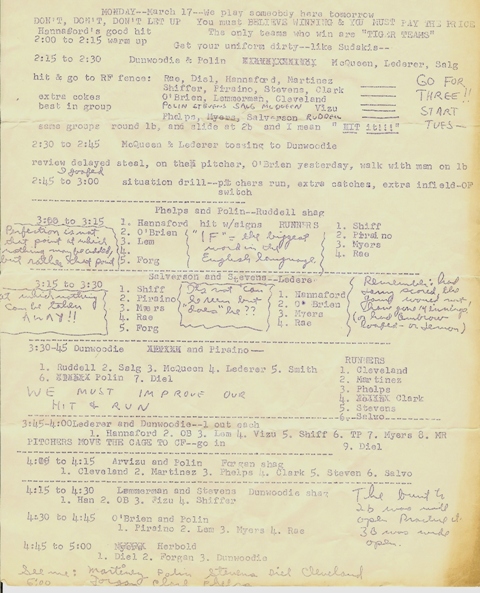
Coach Herbold would write in the margins comments such as:
- The road to the top starts here - now!
- DON'T, DON'T, DON'T LET UP.
- You must believe winning & you must pay the price.
- Talk's cheap, runs are expensive.
- Throw strikes, hit strikes...you'll win.
- Perfection is not that point at which nothing may be added but rather that point at which nothing can be taken AWAY!!
- IF = the biggest word in the English language.
- It's not can he run but does he??
- Get your uniform dirty - like Sudakis.
- We must improve our hit & run.
- First place belongs to us. We can run on them. Now, let's out field, out hustle, out pitch, and out hit them.
- Who was 0 for 5?? Why?
- There is no weapon against the walk and no defense!
- Take care of the easy plays, and the hard ones will take care of themselves.
- What hurts are not the games you lose but those you give away.
- Games at Blair Field are won by walks and errors - not hits.
- Tommyhawk up the middle.
- Little things make big things in baseball.
- It's not the size of the dog in the fight but the size of the fight in the dog.
- Why be a good loser when you can be a good winner?
We used verbal signs when a batter or runner missed a physical sign.
- "OK, Buddy...OK, Bomber...OK, break it open...OK, bear down" = Bunt.
- "OK, sock it...OK, send 'em home...OK, Slugger" = Steal.
- "OK, Tiger...OK, tag one...OK, touch 'em all" = Take.
- "OK, here we go...OK, hit one...OK, hot shot" = Hit and run.
Coach Herbold was innovative. He maintained performance charts for hitters and pitchers, and they were posted in the locker room for everyone to see (including students not on the baseball team). As an example, pitchers would get one point for throwing a strike on the first pitch, getting the first batter in the inning to make an out, preventing a runner from advancing from second with no outs, forcing a hitter to hit a ground ball in a double play situation, getting the batter out after falling behind 3-and-0 in the count, and for a strike out. Pitchers would be credited two points for keeping a runner on second and/or third from scoring with 0-1 outs, keeping the ball in the infield with a runner on third and 0-1 outs, and walking less than three batters in a complete game. Pitchers would earn three points for not allowing a run to score from third with 0-1 outs.
On the other hand, one point was subtracted for not throwing the first pitch for a strike; two points were subtracted for walking any hitter unintentionally, allowing a fly ball with a runner on third and 0-1 outs, giving up a base hit off an 0-and-2 pitch, balking, hitting a batter, and not getting to first in time on a ball hit to the right side; and three points were subtracted for allowing a man on second or third to score with two outs.
More than just a coach, Mr. Herbold was a teacher, an educator, and a mentor. A smart man, he graduated Phi Beta Kappa in Journalism and earned a Master's in Education from Stanford University, and was a high school English teacher for nearly three decades.
If you have had a special coach or teacher in your life, be sure to tell them thanks. Better yet, organize a tribute. It will mean a lot to the honoree as well as to you and your teammates or classmates.
Thank you, Coach Herbold. You made a difference in my life.
Additional photos by Mr. Herbold's son-in-law, Don Tamaki, can be viewed here.
| Baseball Beat | April 02, 2007 |
Play Ball
It's that time of the year (again). Opening Day coincides with the Finals of the NCAA basketball tournament and precedes the Master's Golf Tournament by a few days. If you're a sports fan, it doesn't get much better than this week.
The New York Mets want the season to end now and the St. Louis Cardinals can't wait to get back on the field. But both teams will have to wait one more day. In the meantime, all of the other teams (with the exception of the San Diego Padres and San Francisco Giants) will play the first of 162 games today.
SCHEDULE
American League:
Devil Rays (Scott Kazmir) at Yankees (Carl Pavano), 1:05 ET
Blue Jays (Roy Halladay) at Tigers (Jeremy Bonderman), 1:05
Indians (C.C. Sabathia) at White Sox (Jose Contreras), 2:05
Red Sox (Curt Schilling) at Royals (Gil Meche), 4:05
A's (Dan Haren) at Mariners (Felix Hernandez), 6:35
Orioles (Erik Bedard) at Twins (Johan Santana), 7:10
Rangers (Kevin Millwood) at Angels (John Lackey), 10:05
National League:
Marlins (Dontrelle Willis) at Nationals (John Patterson), 1:05
Braves (John Smoltz) at Phillies (Brett Myers), 1:05
Dodgers (Derek Lowe) at Brewers (Ben Sheets), 2:05
Cubs (Carlos Zambrano) at Reds (Aaron Harang), 2:10
Diamondbacks (Brandon Webb) at Rockies (Aaron Cook), 4:05
Pirates (Zach Duke) at Astros (Roy Oswalt), 7:05
Let's take a quick look at each of the above matchups...
Play ball!
| Baseball Beat | March 26, 2007 |
Nephews and Sun
PEORIA - My nephew Brett and I drove from Long Beach to Arizona on Thursday afternoon. The purpose was twofold: to visit my brother Gary and his family in Phoenix and attend a few spring training games in and around the area.
We were fortunate in that Gary's son Troy was playing in an ice hockey tournament over the weekend at a rink that was next door to the spring training complex of the San Diego Padres and Seattle Mariners in Peoria. The schedules were such that we were able to watch hockey, baseball, and hockey without missing a beat (or even a two-minute minor).
On Friday afternoon, we attended the Angels-Mariners game. Gary arrived in Peoria about an hour before us and was able to buy tickets on the morning of the game in the fifth row behind Seattle's on-deck circle. We could not have asked for a better location to watch a dream matchup between John Lackey and Felix Hernandez. The home team Mariners took the field first and the most startling observation was seeing the slimmed-down Hernandez loosening up on the mound.
King Felix, who was named Seattle's Opening Day starter by manager Mike Hargrove after his outing, reported to camp at 226 pounds (down from 246 last season). It's quite an honor for a pitcher who won't turn 21 until after the season starts. Hernandez, in fact, will join Dwight Gooden and Fernando Valenzuela as the only 20-year-olds to start an opener in the last 26 years.
Hernandez and Lackey were both getting their work in that afternoon against their division rivals, throwing mostly fastballs and concentrating more on mechanics and command than the results (which, in the case of the latter, were not good). Felix spun a few curves that he left up in the zone but struck out Vladimir Guerrero looking on a nice bender to end the first inning. He punched out four Angels and induced nine groundouts (including five comebackers), three flyouts, and an infield pop fly, and catcher Rene Rivera threw out Casey Kotchman trying to steal on what appeared to be a broken hit and run play. I timed Rivera's throw from home to second in 1.89 seconds, which is right about where he needs to be.
Lackey, who was working noticeably faster, has a compact, fluid motion that is among the best in the game. He was basically throwing batting practice and his line showed it: 10 hits and 9 earned runs in just four innings. He mixed in a few changeups but rarely threw any breaking balls and the Mariners jacked a couple of his low-90s fastballs out of the yard. Jose Guillen hit a two-run shot in the first inning and Adrian Beltre launched a two-run blast in the fourth. We also saw Angels rookie Nick Gorneault take Aaron Small deep to lead off the top of the ninth inning.
Brandon Morrow, Seattle's first-round pick out of the University of California in 2006, retired the Angels in order in the seventh on eight pitches. The 22-year-old righthander, sporting the number 85 on the back of his jersey, is trying to earn a spot in the bullpen with only 16 innings of professional experience under his belt. Morrow threw strikes and got Mike Napoli, Maicer Izturis, and Erick Aybar to loft easy flyball outs that were handled by Jeremy Reed in center and Mike Morse in left.
Ichiro handled DH duties and led off. He ran a 4.19 to first on a fielder's choice, pulling up the last couple of steps. Reggie Willits had the fastest time of the day, running a 4.08 on a 6-3 groundout. Box Score.
SURPRISE - On the heels of the afternoon baseball game and a second hockey match, Brett and I drove to Surprise to catch an evening tilt between the Brewers and the home team Rangers, who share the beautiful ballpark with the Kansas City Royals. Tip of the day: Don't make the same mistake as us by logically assuming that the most direct route between the two sites would also be the fastest. We crawled along the eight-mile drive on Bell Road for 45 minutes and got to the ballpark just in time to hear (and not see) Sammy Sosa's grand slam in the home half of the first inning. Oh well, I'm glad it wasn't HR #600 (although, if that were the case, I would at least have the ticket stub as a souvenir).
Our tardiness also caused us to miss Eric Gagne, who started and pitched the top of the first only. The former Cy Young Award winner allowed a hit and a walk while striking out two. Despite arriving late, we were able to secure two tickets between home and third in the top row of the field boxes. We sat next to four guys from California who were paying more attention to their Blackberrys tracking the Sweet Sixteen games that were in progress, including USC's loss to North Carolina in which the Trojans apparently ran out of gas late in the second half.
In between Sosa's home run in the first and Tony Graffanino's bomb in the ninth (which took place as we were sloshing across the wet soccer fields that had been turned into overflow parking lots for the night), we witnessed four baggers by Damian Miller, Rickie Weeks, and Johnny Estrada off Bruce Chen. But Chen wasn't the worst southpaw that evening. Zach Jackson, a first-round draft choice by Toronto in 2004 and later part of a package (along with Dave Bush and Gabe Gross) that sent Lyle Overbay from the Brewers to the Blue Jays, looked like he couldn't get anybody out that game or any other game. The 6-5, 220-pound lefty was far from impressive, and it looks as if he will spend the majority of 2007 in Triple-A Nashville once again.
Bill Hall played center field and struck out three times. It will be interesting to see if Hall can duplicate his 35-HR season while switching positions. A good athlete, the 27-year-old should have no problem handling the defensive chores, but I can't help but wonder whether 2006 was a career year for him at the plate. Hall and Prince Fielder will need to supply the power if the Brewers are hopeful of supplanting the Cardinals as the NL Central champs.
Hank Blalock, who went 0-for-2 with a strikeout and two walks, was taking his usual rips on every swing, seemingly going for the downs on every pitch. A lot has been said and written about his inability to hit on the road and his second half woes going back to the 2003 All-Star game when he took his now teammate Gagne deep for a two-out, two-run HR to lead the American League to a 7-6 victory in the midsummer classic. I believe part of his problem is his approach at the plate and maintain Hank would be better served if he didn't try to pull everything and jack every pitch out of the park.
PHOENIX - Our third and final spring training game was a Saturday afternoon clash between the Colorado Rockies and the Angels. Our luck for picking up great tickets continued as we bought a pair in the second row behind the Angels dugout from a scalper an hour-and-a-half before the sold-out event. It wasn't much of a game, but the seats made it all quite bearable.
Jeff Francis outdueled Kelvim Escobar, who left in the third inning after straining his back reaching for a groundball single off the bat of Steve Finley. Mike Scioscia and pitching coach Mike Butcher visited the mound and, after watching Escobar throw a couple of warmups, took the big righthander out as much for precautionary reasons as anything else. He is not expected to miss a regular season start.
The most impressive player was Ryan Spilborghs, who slugged a home run well beyond the wall in left-center field and made a long, running catch in right center and a strong throw to first base trying to double up Shea Hillenbrand. Spilborghs is competing with John Mabry and Alexis Gomez for the final spot on the Rockies bench. Spilborghs wasn't the only player who hit a home run in Phoenix that day. My nephew Casey hit a "don't stop running until you make it around the bases" home run in his T-ball game that morning. He plays for the Yankees and wears #7 on his back. Funny, I thought they retired that number.
Angels relievers Chris Resop and Kevin Jepsen got ripped, allowing a combined 8 hits, 4 walks, 1 HBP, and 9 runs in 2 innings. Several fans around us, apparently thinking they were attending the World Series finale, booed Resop and Jepsen to the point that I wanted to turn around and tell them to zip it up. If anything, I felt embarrassed for the pitchers who were obviously struggling to throw strikes and get batters out. Jepsen has never pitched beyond Single-A and is probably heading to Double-A Arkansas in a couple of weeks. Box Score.
LONG BEACH - I recently learned that Norm Larker died on March 12 at the age of 76. Larker became the third member of the 1959 Los Angeles Dodgers World Series Championship club to pass away during the off-season. Relief pitchers Larry Sherry (December 17) and Clem Labine (March 2) predeceased Larker.
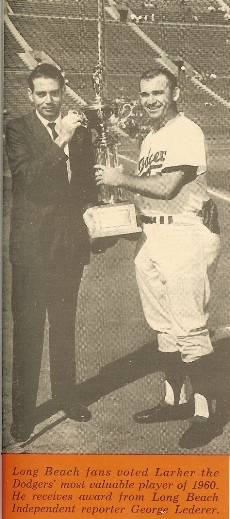 Larker was one of several Dodgers who lived in Long Beach or Lakewood. The Larkers built a new house in Lakewood Country Club, adjacent to Lakewood Village in Long Beach (which is where I was born and raised). Times were different in the late-1950s and 1960s. Dad would carpool with many of the local players such as Larker, Ed Roebuck, and Gino Cimoli, as well as the late trainer Bill Buhler, to and from the airport. My parents would also invite players and their wives to the house for a game of bridge.
The Larkers had four sons - Duane, Wayne, Blaine and Shane - who played baseball at about the same time as my brothers and me. My younger brother Gary and Blaine were Pony League teammates, and it wasn't unusual to see Norm at Heartwell Park watching their games back in the mid-1970s. Blaine was on the Cal State Fullerton team that won the College World Series in 1984. Larker was joined on the All-Tournament team by Barry Bonds.
Norm was second in the National League in batting average in 1960. He missed out on the batting title by one hit. The lefthanded-hitting Larker need to go 2-for-3 in the final game to surpass Dick Groat, who had finished the year at .325. Larker walked in the first inning, grounded out to second in the third, beat out a higher bouncer to first in the fifth on a play that was ruled a hit by the official scorekeeper, and flied out to left in the seventh. He was in the on-deck circle when Maury Wills hit a sacrifice fly in the bottom of the ninth to score Bob Lillis (my favorite player at the time) with the winning run in a 4-3 victory over the visiting Cubs.
Larker was named the Long Beach Independent, Press-Telegram Most Valuable Player in 1960. He was chosen as Dodger of the Day by my Dad 13 times, one more than fellow Lakewood resident Stan Williams and two more than Don Drysdale and Wills. The photo of Larker and Dad is from The 1961 Dodger Family pamphlet by Union Oil Company of California.
Larker played six years in the majors, including four with the Dodgers. He was selected by the Houston Colt .45s in the expansion draft in October 1961 and was traded to the Milwaukee Braves in 1962 and sold to the San Francisco Giants in 1963. Larker finished his career as a professional ballplayer with the Toei Flyers in Japan. He will be missed by all of us in the Dodger Family.
| Baseball Beat | March 19, 2007 |
Winks and Links
I have been fortunate to join up with some of the best publications of late and wanted to share these contributions with you. The quantity and quality of information is better today than ever.

Editor Dave Studeman asked me to write the team commentary for the Los Angeles Dodgers in the style of the "Team in a Box" format from the Bill James Baseball Books from the early 1990s. My article can be found here.
Spearheaded by the foursome of Liriano, Papelbon, Verlander, and Weaver, this class of first-year pitchers could be the best since 1984 when Rookies of the Year Dwight Gooden (17-9, 2.60) and Mark Langston (17-10, 3.40) were joined by Roger Clemens (9-4, 4.32), Orel Hershiser (11-8, 2.66), Ron Darling (12-9, 3.81), and Mark Gubicza (10-14, 4.05). Given the unpredictable nature of pitchers, this year's Fab Four could be caught or surpassed in due time by any number of their fellow rookies, including Chad Billingsley, Boof Bonser, Matt Cain, Cole Hamels, Rich Hill, Chuck James, Josh Johnson, Adam Loewen, John Maine, Scott Olsen, Anthony Reyes, Anibal Sanchez, James Shields, and/or Jeremy Sowers.
The pitching staff is tops in the American League. Last year, the team had the third-best ERA (4.04) while tying for first in strikeouts and allowing the fewest home runs in the league. It doesn't take much imagination to envision the Halos surpassing the Twins (especially given the absence of Francisco Liriano and Brad Radke, and the possible inclusion of Ramon Ortiz and Sidney Ponson in this year's Minnesota rotation), and one can make the case that they were better than Detroit in 2006. Sure, the Tigers had a lower ERA, but the Angels put up superior K/9 (7.2 vs. 6.2), BB/9 (2.9 vs. 3.0) and H/9 (8.7 vs. 8.8).
Lackey has emerged as a top-of-the-rotation starter, ranking in the top half dozen in the AL in IP (217.2), ERA (3.56) and K (190). Kelvim Escobar, Ervin Santana, and Jered Weaver round out what could be described as one of the best foursomes in the league. Joe Saunders should be a capable fifth and, speaking of hope and faith, what if Bartolo Colon magically returns to his 2005 Cy Young form upon his return later in the season? (I know, let's set aside for a moment whether or not Colon deserved it.) A bullpen led by K-Rod, Shields, and the newly-acquired Justin Speier means the seventh, eighth and ninth innings are pretty well taken care of most nights.
Brad Wochomurka and I also talked about the Angels' chances on Baseball Prospectus Radio. You can listen to the 10-minute discussion here.
In the meantime, don't forget to pick up Baseball Prospectus 2007 if you haven't already. I have all of the editions going back to 2001.
I believe Bill James is the most influential person in baseball with respect to how insiders and serious fans think about the game of baseball since Branch Rickey. He challenged long-held consensus viewpoints by researching such issues and presenting indisputable evidence to the contrary in many cases.
The book, edited by Gregory F. Augustine Pierce and published by ACTA Sports, is a breezy, 136-page read. I recommend picking up a copy as it promises to be a worthwhile addition to your library of Bill James books.
I hooked up with Joe last week to discuss the NL West. He asked me 21 questions, mostly about the Dodgers, Padres, Diamondbacks, Rockies, and Giants (in no particular order...all right, that is how I see the division ending up) but also plays word association on a totally separate topic:
OK, let's play a word association game. I'll say a word, and you say the first thing that comes to mind. The word is, hmm, let me think of a good one ... BLYLEVEN.HALL OF FAMER.
Is Opening Day really just two weeks away?
| Baseball Beat | March 05, 2007 |
Open Chat: 2007 Predictions
I have two questions for our readers today.
1. Which team is the most likely to win 10 more games than it did last year? Why?
2. Conversely, which club is the most likely to lose 10 more games than it did last year? Why?
OK, I guess that is four questions. Double your pleasure, double your fun. No, that is not a subliminal endorsement of the Cubs. (I guess I'm showing my age as it has been 26 years since the Wrigley family sold the Cubs to the Tribune Company.)
Bonus Question: Would Mark Cuban make a good owner for the Cubs?
For reference purposes, here is how it all shook out last year.
2006 STANDINGS
AMERICAN LEAGUE EAST
TEAM W L PCT GB Yankees 97 65 .599 - Blue Jays 87 75 .537 10 Red Sox 86 76 .531 11 Orioles 70 92 .432 27 Devil Rays 61 101 .377 36
AMERICAN LEAGUE CENTRAL
TEAM W L PCT GB Twins 96 66 .593 - Tigers 95 67 .586 1 White Sox 90 72 .556 6 Indians 78 84 .481 18 Royals 62 100 .383 34
AMERICAN LEAGUE WEST
TEAM W L PCT GB A's 93 69 .574 - Angels 89 73 .549 4 Rangers 80 82 .494 13 Mariners 78 84 .481 15
NATIONAL LEAGUE EAST
TEAM W L PCT GB Mets 97 65 .599 - Phillies 85 77 .525 12 Braves 79 83 .488 18 Marlins 78 84 .481 19 Nationals 71 91 .438 26
NATIONAL LEAGUE CENTRAL
TEAM W L PCT GB Cardinals 83 78 .516 - Astros 82 80 .506 1.5 Reds 80 82 .494 3.5 Brewers 75 87 .463 8.5 Pirates 67 95 .414 16.5 Cubs 66 96 .407 17.5
NATIONAL LEAGUE WEST
TEAM W L PCT GB Padres 88 74 .543 0 Dodgers 88 74 .543 0 Giants 76 85 .472 11.5 Diamondbacks 76 86 .469 12 Rockies 76 86 .469 12
| Baseball Beat | February 19, 2007 |
State of the Site
This week marks the second anniversary of Baseball Analysts. Thanks to our many friends around the 'net and, of course, our readers, the site has grown in traffic and stature since Bryan Smith and I merged the Baseball Beat and Wait 'Til Next Year blogs (both of which started in 2003) on February 22, 2005.
We have held true to our promise of "examining the past, present, and future" while covering college baseball, the minor leagues, and the majors to the best of our ability. From scouting reports, prospect lists, live blogging the draft, the College World Series, and the Cape Cod League, we have followed amateur baseball with a passion that exceeds the man hours available to do so on a full-time basis. We have also tracked minor and major leaguers with unique angles, statistics, and analysis - all in the name of adding value in a competitive market for our readers' time and attention.
Our weekly Designated Hitter series has proven to be a popular feature - a must read, if you will. We thank all of our guest columnists, including those of you from the mainstream media who have generously submitted articles pro bono. To all the professionals and hobbyists alike, Baseball Analysts would not be the same without you and your contributions.
For newer readers, I'd like to point you to the links in the sidebar on the left-hand side of the site. Reading and understanding The Abstracts From The Abstracts is the equivalent of a Bachelor of Science in Sabermetrics. Be sure to also check out Breakfast With Bill James, a three-part interview that took place at the Winter Meetings in Anaheim in December 2004. Bill's influence pervades this site like no other as evidenced by the following search results, including our first guest column (written by John Sickels nearly two years ago).
After partnering with me for a year-and-a-half, Bryan decided to move on last summer. He returned last month and posted the final leg of his popular Top 75 Prospects at Baseball Analysts. Bryan knows there is an open invitation for him to contribute articles in the future as well.
Jeff Albert and Al Doyle filled the void in the early going and remain ongoing contributors to Baseball Analysts. Jeff wrote two guest columns that were linked all over the web and The Batter's Eye has become a semi-regular feature on our site. Al is a veteran freelance writer who made his debut at Baseball Analysts as a guest columnist.
Patrick Sullivan joined the team in January and has already written six weekly columns. We have also added another voice in Marc Hulet, a professional journalist from Ontario, Canada. Marc's first article will appear tomorrow.
Although Baseball Analysts was designed as an online magazine, we added the Weekend Blog to our lineup yesterday to allow us to make shorter, more spontaneous posts as a diversion from our daily articles. Going forward, our schedule will generally look like this:
Mon: Rich (Baseball Beat) Tues: Marc (Around the Minors) Wed: Sully (Change-Up) Thur: Guest (Designated Hitter) Fri: Misc. (Jeff, Al, Foto Fridays, Open Chats, or Roundtables) Sat: Weekend Blog Sun: Weekend Blog
All of us at Baseball Analysts look forward to the year ahead, and we hope to earn your readership by doing our best to keep you as entertained and informed as possible. In the meantime, we thank you for your loyalty and support.
| Baseball Beat | February 13, 2007 |
Open Chat: Fantasy Baseball Draft
OK, you joined a 5x5 fantasy baseball pool. The league drafts entirely new teams every year. In other words, it is not a keeper league.
You pull draft slot #2 out of the hat. Albert Pujols was just taken with the first pick. It's your turn. Who do you take? And why?
Have at it in the comments section below.
| Baseball Beat | February 12, 2007 |
An Unfiltered Interview with Nate Silver
I met Nate Silver in the summer of 2003 at a Baseball Prospectus Pizza Feed in Anaheim. We sat together and discussed nothing but baseball for a couple of hours, developing a mutual respect that continues to this day.
After graduating from the University of Chicago in 2000 with a Bachelor of Arts in Economics, Nate "took one of those consulting jobs that an economics grad from the U of C might be expected to take." He started working on PECOTA in 2002 and found a couple of advocates for it in Gary Huckabay and Keith Woolner. Baseball Prospectus was looking for a new projection system in anticipation of launching its premium service and purchased PECOTA from Nate in 2003. A year later, Gary left BP to pursue a series of consulting opportunities both inside and outside baseball and Nate took over as Executive Vice President of the company.
I caught up with Nate over the weekend to discuss all things PECOTA. Grab a cup of coffee, pull up a chair, and enjoy.
Rich: PECOTA - Player Empirical Comparison and Optimization Test Algorithm. My goodness, that is a mouthful. How did you come up with that?
Nate: The original version of PECOTA was just for pitchers - I felt at the time like there was much more room for improvement in the realm of pitcher forecasts. It was only after I'd pitched the idea to Gary Huckabay, who was running BP at the time, that he said "hey kid, you'd better come up with a hitter version too." So the 'P' in the garbled acronym that you see above originally stood for 'Pitcher,' and from there it was just a matter of stringing together various words and letters that seemed relevant enough to come up with a catchy acronym. I think the finalists were PECOTA and PETRY - you can see the influence of American League Baseball circa 1987. But I couldn't come up anything to match the 'Y' in PETRY.
RL: Bill Pecota and Dan Petry. I like that Pecota won out. He seems more comparable to Mario Mendoza, the player behind - or right on top of - the Mendoza Line.
NS: Sure, but when I was growing up in Michigan and listening to Ernie Harwell, I didn't think of him that way - it seemed like Bill Pecota was always a real thorn in the side of the Tigers. And now, thanks to the magic of Retrosheet and Baseball Reference, we can look back and see that this wasn't entirely my imagination - Pecota was a .303 lifetime hitter against Detroit.
RL: Did Bill James and his similarity scores have any influence on your work?
NS: The basic idea behind PECOTA is really a fusion of two different things - James's work on similarity scores and Gary Huckabay's work on Vlad, BP's previous projection system, which tried to assign players to a number of different career paths. I think Gary used something like thirteen or fifteen separate career paths, and all that PECOTA is really doing is carrying that to the logical extreme, where there is a essentially a separate career path for every player in major league history. The comparability scores are the mechanism by which it picks and chooses from among those career paths.
RL: Go on.
NS: There are some differences, though, between backward-looking similarity scores and forward-looking scores like the ones that PECOTA apply. James, I don't think, really intended for his similarity scores to be used for projection purposes; instead they were introduced in The Politics of Glory as a way to assess a player's fitness for the Hall of Fame. If you're trying to determine whether Tim Raines should be in Cooperstown, the fact that he was 5'8" shouldn't really matter. But if you're trying to figure out how Dustin Pedroia is going to develop, the fact that he's 5'8" does matter.
RL: OK...so tell me, in addition to body type, how many factors do you take into account and which ones have the most impact universally?
NS: There are currently 13 different comparability factors in place for position players and 12 for pitchers, one of which changes depending on whether we're looking at a major league or minor league player. We use MLB career length for major leaguers but since this isn't relevant for a prospect we use the level he played at instead (that is, PECOTA prefers to compare a Double-A player to other Double-A players).
The most important variables for hitters are batting average, walk rate, isolated power, strikeout rate, speed score, and position. The most important for pitchers are strikeout rate, walk rate, isolated power allowed, and usage pattern. But the weights are really fairly flat - there's not any one factor that dwarfs the others in importance.
RL: Why have you chosen to keep the detailed formulas proprietary?
NS: The short answer is that we're trying to make a living off this stuff, and we're reluctant to give away trade secrets. I know that there's a strong tradition of 'open source' in the sabermetric community, which goes all the way back to Bill James, and I recognize and appreciate that. BP at times has been guilty of being too aloof from the sabermetric community, which is something that we're trying to reverse. We've debuted the Unfiltered blog, and we hope to add some community and forum features within the next couple of months. I think we've gotten a lot better about citing other good work in the field, whether it's work that you've done or the Hardball Times does or John Dewan does or what we might read at Baseball Think Factory or on Sons of Sam Horn. We're talking to people like Ron Shandler and Bill James on our radio program. We're running excerpts from 'The Book' on our website and telling everyone within earshot that they needed to buy it six months ago. But we are trying to run a business - for many of us, Baseball Prospectus is all that we do.
RL: As an owner and operator of a business myself, I can appreciate that.
NS: I would also argue that, although we haven't literally given away the formulas and algorithms, PECOTA is perhaps the best-explained projection system in history. There were long essays about PECOTA's methodology in the 2003, 2004 and 2006 annuals, and another in the Kevin Maas chapter of Baseball Between the Numbers. There's a comprehensive glossary up on the website and there have been numerous questions we've fielded about it in chats and articles over the years. The largest barrier to reverse engineering PECOTA, frankly, is not the ingeniousness of the formulas or anything like that but really just the amount of work that it has required in terms of fitting all the puzzle pieces together. I've personally put well over one thousand man hours into PECOTA, and that's before accounting for things like the Davenport Translations or VORP that feed into the system.
RL: How often do you tweak the system? Can you isolate how much these revisions have improved the overall projections from one year to the next?
NS: I'm a perfectionist about this stuff, and so we're making improvements pretty much constantly. A lot of this is accomplished through trial and error. For example, the forecast that we ran for Homer Bailey based on the previous version of the system looked unduly pessimistic to me, so I went back and said "hmm, are there any assumptions that we're making about Bailey that might not be treating him fairly." It turned out that there was one such assumption. Bailey improved a lot from 2005 to 2006 and if a veteran pitcher had experienced that sort of improvement, you'd want to regress it back to the mean fairly heavily. But we found out that a 21-year-old pitcher shouldn't be treated the same way a 31-year-old pitcher - if a 21-year-old improves markedly from year to year, there's a much better chance of most of that improvement sticking. So we made this fix, ran the pitcher projections again, and I think Bailey ended up with something like 30 points shaved off his ERA. PECOTA still thinks that there's a much bigger difference between Bailey and say Phil Hughes than most people give credit for, but they're closer than they were before.
So in some sense, there's as much art in PECOTA as there is science - you need to be able to ask questions and test assumptions based on watching baseball games, watching players develop, and talking to people both inside and outside BP. If you outsourced PECOTA to a bunch of tech geeks in Bangalore who didn't have the horse sense to say "Homer Bailey's forecast looks wrong to me," you wouldn't have the same system.
RL: I would agree. You need to know the ins and outs of your business to know if something passes the smell test.
NS: Probably the most challenging part of running an independent business like BP is that you necessarily need to be a jack of all trades. It seems to me the only way to get anything done is to be willing to trust your intuition.
RL: What have been the best improvements since the original formula was introduced in 2003?
NS: Some of the improvements are simply a matter of gaining access to new types of data. Being able to look at groundball/flyball numbers for pitchers, for example, which we didn't do originally, is greatly helpful. Or, we can look at play-by-play data to develop a better version of speed scores, since we know exactly how many opportunities a guy had to ground into a double play instead of just approximating.
Still, the improvements that I'm proudest of are things related to long-term player valuation, such as MORP and the detailed five-year forecasts and the Upside score. There are a lot of systems that can put together a pretty reasonable forecast for a player but fewer that can give you a sound idea of what that forecast really means in the bigger scheme of things. And besides, it's kind of cool to know how many triples Howie Kendrick is going to hit in 2010.
RL: What's the current over/under?
NS: Three.
RL: Are you taking any futures bets on this one?
NS: No, but I'd take the over. I remember seeing a game at Comiskey Park last year where Kendrick went 0-for-5. And even in that performance, he looked like a future star; I loved his stroke, his plate coverage, the way that he got out of the box. But now I'm starting to sound like a scout.
RL: If I understand correctly, your database goes back to 1946. Is that a matter of availability or is there another reason why you have chosen to use post-World War II players only?
NS: There are some kinds of data, like the groundball-flyball stuff, that just aren't available for the years before 1957 that Retrosheet hasn't covered yet. Still, you can always guesstimate this data where you don't have it, as we do for the 1946-1956 players in our system.
Really, the decision not to look at the pre-WWII data has mostly to do with the feeling that baseball after WWII is more similar to modern baseball than it is different, and that baseball before WWII was more different than it is similar. If you look at World War II and maybe the ten or fifteen years that followed it, you have a huge number of different things that are happening. The integration of the game, both to black players and to Latin America. Night baseball. Relief pitching. Expansion. The evolution of the farm system. Increased consistency in ballpark architecture. The improvements in nutrition and the standard of living made possible by the prosperity boom of the '50s. The professionalization of baseball. The very earliest work in sabermetrics that people like Allan Roth were doing. All of these things were happening more or less at the same time, and World War II is as convenient a cutoff point as anything.
RL: You incorporate both minor league and international baseball statistics into your forecasts. Have you given consideration to using college stats, adjusted for level of competition, strength of schedule, ballparks, and pitchers/batters faced, in your projections for younger players?
NS: I'd love to look at college stats, but thus far, neither Clay nor I have put in the work to build credible translations. I also worry a bit about the aluminum bat thing. I know that Kevin Goldstein is convinced that there are a lot of good aluminum bat hitters that just won't make the transition to wood. It also perhaps changes pitching philosophy, requiring you to work around hitters a bit more. Someone like Justin Verlander, for example, had some pretty high walk rates in college, but that control got much better once he was pitching to wood bats and with a professional defense behind him.
RL: Comparing college and professional baseball may not be apples to apples but it's not fruits to vegetables either. Scouting is obviously important when it comes to evaluating amateur talent. But I wouldn't dismiss performance analysis, especially when play-by-play data becomes standard. Put me in charge and I would place a lot of weight on strikeout, walk, and groundball rates at the college level and even in high school, for that matter. Combining this information with the 20-80 scouting reports would be very helpful in my mind.
NS: We could do some incredibly interesting things if we had a complete set of 20-80 scouting reports to look at. As long as you're able to quantify something, we should be able to incorporate in PECOTA, and we're already emphasizing things like speed score and body type and age relative to league that were once considered more in the scouting domain. But I'm not keeping my fingers crossed waiting for some team to gift their scouting database to us.
RL: How do splits come into play when it comes to PECOTA? Aside from using a pinpoint ballpark factor, is the system sophisticated enough to differentiate between RHB vs. LHB and RHP vs. LHP when analyzing player performance at home and on the road?
NS: Our park factors are very detailed, but we could probably do a bit more with LH/RH splits. If you look at someone like Jason Michaels, about half his at-bats while he was with the Phillies were against left-handed pitchers. That percentage went way down in Cleveland since he was being used as more of an everyday player and - surprise, surprise - his numbers got a lot worse. I was hoping to get around to this for this year and didn't, but it's high on the agenda for 2008.
RL: Drilling down even deeper, can PECOTA take into account spray charts to determine if a player is a pull hitter vs. an opposite-field type as a factor in determining how a player might perform at one home ballpark vs. another, especially in the event of a trade?
NS: What we're going to see over the next three or five years is a whole revolution in the way that data on the baseball field is described and quantified - we'll go beyond simply recording the outcome of every play into literally tracking the movement of every object on the baseball field from start to finish. I'd certainly hope to incorporate as much of that stuff as possible into PECOTA, but it's a lot of work, and I'd probably like to wait a year or two for the data to standardize before we do so.
RL: Switching gears here a bit, explain the idea behind upside, as well as the percentages assigned to breakout, improvement, collapse, and attrition.
NS: Upside is explained at great length in this article. The basic idea is to look at the probability of a player being an above-average performer at the major league level in the years during which he's still under club control (that is, before he becomes a free agent). This is really what you're hoping for when you're investing in scouting and development - that a player will be both very good and comparatively cheap. Upside doesn't give you any credit just for "being there," like Luis Rivas or somebody.
What the breakout, collapse and improvement numbers do is look at how a player's performance is likely to change relative to his 'baseline.' This can be confusing because 'baseline' implies looking at his last three years of performance, rather than just what he did in 2006. So Hanley Ramirez, for example, has a breakout rate of 31%, which is very high, even though PECOTA actually expects his performance to be a bit worse than last year. His 'breakout' is not in achieving a new level of performance (although this is possible) so much as it is sustaining a performance that might seem unlikely based on his longer track record. We've experimented with a lot of different definitions of breakout rates and I'm convinced that this is the most helpful version, even though it can sometimes be counter-intuitive.
'Attrition' is really in a different family than breakout, improve and collapse, in that it measures prospective changes in playing time rather than performance. Specifically, it's attempting to estimate the probability of a radical decrease in playing time. This could be because of injury, but it could also be because the player gets benched, retires, suspended, starts spending too much time hanging out with Jeff Juden, and so forth.
RL: Does it make sense for the percentages to exceed 100?
NS: Yes, because breakout rate is a subset of improvement rate. Improvement rate is the chance that a player's performance improves at all relative to his baseline; breakout rate is the chance that it improves a lot.
RL: Which competitive projection systems do you value the most?
NS: I'm reluctant to name too many names because I feel like I'll unwittingly leave someone out, but if the PECOTAs weren't around, the first system I'd look at are probably the projections that Tom Tippett does for Diamond Mind.
RL: Last year, PECOTA outperformed the other methodologies in predicting hitting (using OPS as the gauge) but it fell a bit short on the pitching side of the ledger. Is that a one-year aberration or is there something in the former or latter that makes PECOTA better or worse than the others in forecasting hitting and pitching results?
NS: We were pleased with the results that we saw in the study you're referencing - PECOTA had a large lead for position players and was a very close second for pitchers. With that said, it wasn't our study, and if you change the assumptions, you might have gotten a different result. In particular, that study looked only at pitchers who threw at least 100 innings, which creates a pretty substantial selection bias and tends to favor systems that err on the optimistic side. The one system that did better in that study on the pitching side was ZiPS. While I like the work that Dan has done a great deal, if there's one criticism I have of ZiPS it's that it seems systematically to be too optimistic for pitchers. I know that when we've done our own studies on forecast accuracy, PECOTA seems to have a larger comparative advantage for pitchers than it does for position players.
RL: Speaking of pitchers, PECOTA missed Jered Weaver so badly (6-9, 5.03 ERA with less than a 2:1 K/BB ratio vs. actuals of 11-2, 2.56, and better than 3:1 K/BB), perhaps that deviation alone caused it to perform not as well as others in the pitching department? [laughs]
NS: Yeah, that's not one of the projections we were prouder of.
RL: With respect to Weaver, why do you suppose the system broke down as it did?
NS: Weaver is a hard pitcher to find comparables for. He's extremely tall, and usually pitchers who are very tall tend to generate a lot of downward break and post strong groundball numbers. Instead Weaver is one of the more extreme flyball pitchers in recent memory. Since PECOTA is a comparables-driven system, its results always need to be interrupted carefully when this kind of thing comes up.
RL: I mentioned Chris Young was a good comp for Weaver a couple of years back. Both are very tall righthanded pitchers with outstanding control and high flyball rates.
NS: There seems to be a whole generation of Very Tall Pitchers these days. You've got Weaver and Young and Andy Sisco and Jon Rauch, and a whole host of guys in the minor leagues. I think that shows you how much a single success story like Randy Johnson can influence the conventional wisdom on this sort of subject.
RL: There is an old saying, "If you have to forecast, forecast often." Is there something inherently wrong when your five-year forecasts vary as widely from one year to the next as in the case of Weaver (who went from not winning more than six games in any one season with an average ERA over 5 to winning 11-13 games per year with ERAs ranging from 3.62-3.82 over the next five campaigns)?
NS: Well, I'm a big believer in the fact that a pitcher has a very large wall to climb between the minors and the majors. So to see that Weaver held up so well in the majors - that his flyball tendencies didn't translate into significant problems with the longball, for example - was very important. PECOTA doesn't give a lot of credit to any minor league pitchers unless they're Philip Hughes or Felix Hernandez good, since the attrition rates are pretty damn high. It's much less stubborn once they've made the leap to the majors.
RL: For Jered's sake, I hope he doesn't follow the same course as Don Wilson, one of his four comps this year.
NS: Yeah, that's one of those things that's hard to wrestle with. What happens when a player draws Don Wilson or J.R. Richard or Lyman Bostock as a comparable? What happens when a player whose primary vice is Yoo Hoo! gets comped to one of the 1980s players who ruined his career because of cocaine? In other words, should there be some sort of exception for tragic circumstances? Right now, the only exception we make are for players that served in the Korean War, who are treated as 'missing' in the dataset rather than zeroes. There's an argument that we should expand that definition. On the other hand, tragic circumstances are a part of life, and there's probably that residual 1% or 2% chance that a player's career gets ruined for circumstances having nothing to do with what takes place on the field.
RL: Alrighty. I'll get off my Weaver bandwagon here. The variability in forecasting is obviously huge, especially among younger players. Let's take a look at Elvis Andrus as an example. How in the world can you list Luis Rivas and Miguel Cabrera as two of his four best comps? Isn't that like saying a college co-ed might wind up looking like either Rosie O'Donnell or, then again, Jessica Alba?
NS: Rich, I don't know if you've been to your high school reunions - I've managed to skip mine - but I wouldn't be the least bit surprised if the prom queen had put on 70 pounds of weight, or the awkward, bookish-looking girl had turned into a hottie. A lot of things can happen between the time a person is 17 or 18 and the time they reach their mid-20s.
RL: I like your idea of attaching a beta to help explain the variability in the comps. But you've got Garrett Atkins as either the next coming of Cal Ripken or Ken McMullen with a beta of just 0.93. What am I missing here?
NS: A lot of it is simply that extreme variation is really the norm. Even for a relatively established player like Atkins, you're going to have some Cal Ripken scenarios (at least on the offensive side - Atkins leaves a lot to be desired with his glove) and some Ken McMullen scenarios. It's good that this is the case, because otherwise baseball wouldn't be much fun.
RL: I think I can speak for most readers and say it has been a pleasure reading you more often via the Unfiltered blog.
NS: Thanks, Rich. As I've said, this was something that was long overdue.
RL: In your latest post, you wrote about the limitations of major league equivalencies (MLE) and discussed the term Major League Pace or MLP for short. I like the latter approach because I maintain that the MLE PECOTA forecasts are overly optimistic for younger players and believe the MLP is a better way of thinking about them.
NS: Yeah, I have some trouble with the notion that Clayton Kershaw, say, could post a 3.91 ERA in Dodger Stadium *next year*. I have less trouble with the notion that he could post a 3.51 ERA in Dodger Stadium in 2011.
RL: Yes, I agree wholeheartedly with those notions. Would it be worthwhile to attach a 'confidence' factor to the PECOTA projections?
NS: We do have something called the 'Similarity Index' that serves to accomplish this function. An unremarkable major league pitcher like Ted Lilly or Matt Morris will usually have a similarity score in the mid-50s. Kershaw's similarity score is a big, whopping ZERO. You just don't see a lot of 18-year-old kids that post a 54/5 strikeout-to-walk in their first professional season.
RL: Well, Nate, I'm confident that we have covered the ins and outs of PECOTA. Thank you for sharing your projection system with us.
NS: Thanks, Rich.
| Baseball Beat | February 09, 2007 |
Foto Friday #4
Foto Friday #1 (with Follow-Up)
As in the first three contests, name the date, location, and subject in the photo.
Hint: "__________ blanks Giants" is written on the back of the wire photo below.
Good luck!
UPDATE (2/10/07 AT NOON PST)
Number 53 is none other than Don Drysdale.
Drysdale shut out the Giants seven times during his career (1956-1969). Five of them were at home, including one with Brooklyn at Ebbetts Field (8/30/57), three with Los Angeles at the Coliseum (9/2/58, 9/6/60, and 9/4/61), and one with L.A. at Dodger Stadium (5/31/68). The two SHO on the road took place at the Polo Grounds (7/1/57) and Candlestick Park (5/8/65). You can actually search for this information using the highly valuable Baseball-Reference's Player Index (PI) tool, which parses the data supplied by Retrosheet.
OK, so how do we know for sure which of the above shutouts is the right one? There are a few clues: the uniform, the ballpark, the sparse crowd, and the time of day.
With respect to the uniform, Drysdale is wearing home white flannels. In case you couldn't tell if the uni was white or gray, the road jerseys read "Dodgers" on the front through 1958 (the first year of playing in the L.A. Coliseum) but with no numbers on the front. The road jerseys displayed "Los Angeles" on the front beginning in 1959 and with the red numbers on the front.
The location is the Los Angeles Coliseum. The background with the high retaining wall and bench seating are the two keys here.
The game was clearly played in the daytime as evidenced by the shadows as well as the sunshades worn by many spectators in the stands. Of the three shutouts Drysdale had vs. the Giants at the Coliseum, only one was during the day and that date was September 6, 1960.
As my Dad noted in his article in the Long Beach Independent, Press-Telegram the following day, "Only 9,753 fans, the smallest home audience since Aug. 27, 1958, watched the Dodgers pull four games in front of the fifth place Giants." Drysdale's two other SHO at the Coliseum vs. the Giants were attended by 22,681 in the 1958 contest and 32,109 in the 1961 tilt.
Other facts gathered from Dad's account of the game:
| Baseball Beat | February 06, 2007 |
Baseball in February
You gotta love it. Baseball in February. Early February. And I'm not talking Little League tryouts. Division I College Baseball has arrived. And not a day too soon.
I drove two miles to Blair Field to watch USC, my alma mater, play Long Beach State, my hometown team, on the day before the Super Bowl. Given the sub-zero temperatures in many parts of the midwest and northeast, I almost felt guilty going to the game and sitting outside in the sun (with the operative word being "almost"). Look, we live in Southern California for the great weather, not to support a pro football team. Maybe we take the sunshine for granted out here, but I'll take my baseball anyway I can get it - and in any month.
The game I attended was the second of three in a weekend series that has become an early-season tradition for two of the finest baseball schools in the country. After losing the opener on Friday night, Long Beach bounced back and won the Saturday and Sunday tilts.
While USC has captured twice as many NCAA titles (12) as any other university, Long Beach State didn't arrive on the national scene until former coach Dave Snow took over the program in 1989. The Dirtbags made four College World Series appearances (1989, 1991, 1993, and 1998) in the next decade but have been shut out of Omaha the past eight years despite producing 18 big leaguers and the fourth-most first round picks (Bobby Crosby, Jered Weaver, Troy Tulowitzki, and Evan Longoria) since 1999 (based on the research of Baseball America, the most authoritative voice in the land when it comes to college and minor league baseball).
USC and LBSU disappointed their faithful last year with neither school making it to the Regionals for the first time since 1987. Mike Gillespie, who guided USC to the 1998 CWS championship and five Pac-10 titles in his 20 years as head coach, retired and his son-in-law Chad Kreuter, the former major league catcher, took over the program. Kreuter had been USC's director of baseball operations in 2005 and manager of the Colorado Rockies High-A affiliate in 2006.
Looking to bounce back from their down years, Long Beach State and USC will face the two toughest schedules in the country according to Boyd's World. The Trojans and Dirtbags ranked 25th and 30th, respectively, in Collegiate Baseball's pre-season poll. USC reloaded with the third-best recruiting class in the nation (including Baseball America's 2005 Youth Player of the Year Robert Stock, who skipped his senior year of high school, and shortstop Grant Green, a 2005 AFLAC All-American and member of the U.S. Junior National Team). Long Beach, skippered by Mike Weathers since 2002, also features a young club, led by sophomores Danny Espinosa, the Big West Freshman of the Year, and Vance Worley, one of the top-30 prospects in the Cape Cod League last summer.
Although I got a taste of baseball the prior weekend at the Long Beach State-Pro Alumni game, I had anxiously awaited the Dirtbags' home opener on Saturday. Shortly after I settled into my customary location behind home plate, Long Beach's Jason Corder, a transfer from Cal, jumped on a Brad Boxberger fastball and deposited it over the left field fence to give the Dirtbags an early 2-1 lead.
Boxberger, a freshman out of Foothill High School in Tustin (CA), was making his debut at the college level. The 6-foot-2, 185-pound righthander was the Player of the Year in Orange County last season when he went 12-0 with a 1.17 ERA while leading his team to the CIF-Southern Section Division II championship.
His father, Rod, was the College World Series Most Outstanding Player in 1978. The elder Boxberger (12-1, 2.00 ERA) was drafted in the first round (11th overall) by the Houston Astros - ahead of future Hall of Famers Cal Ripken and Ryne Sandberg, as well as Steve Bedrosian, Mike Boddicker, Tom Brunansky, Kirk Gibson, Kent Hrbek, Steve Sax, and Dave Stieb. Rod began his career in Double-A, yet never pitched a single inning beyond that classification in a professional career that ended in 1983.
The younger Boxberger, who was drafted by the Kansas City Royals in the 20th round last June, completed five innings on Saturday, allowing four runs (all unearned) on five hits with a walk and four strikeouts. With three throwing errors - two of them on pickoff attempts at first base - Boxberger would have fit in well with the Detroit Tigers staff last October. He hit 94 on the radar gun a couple of times in the early going but dropped down about 5 mph and was throwing mostly at 89 after the first few innings.
USC's Hector Estrella, a senior third baseman, slugged a solo home run off Manny McElroy in the top of the second to knot the score at two. McElroy, a junior college transfer, was pitching in his first game for the Beach. The 6-6, 220-pound righthander posted a 10-1 record with a 1.97 ERA while earning All-American honors for Bakersfield Community College last year. He showed good command of three pitches but needs to add some pop to his 85-87 mph fastball to become more than a fringe prospect.
Long Beach scored two more runs in the second to take a 4-2 lead that was never relinquished. Adam Wilk, a freshman lefthander from nearby Cypress HS (13-1, 1.17 ERA, with 118 SO and 11 BB in 84 IP), and sophomore Bryan Shaw, the team's new closer, pitched the final 2 2/3 innings to seal the victory for the Dirtbags. Wilk changes speeds well and throws a sweeping curve from a 3/4-arm slot, saving an occasional sidearm delivery for LHB. He works at 84-86 and has the frame (6-2, 165) to add a couple more mph to his fastball before he becomes draft eligible in 2009. Shaw was consistently hitting 92 and 93 on the gun after touching 94 the week before in the Pro Alumni exhibition.
I have no doubt that there were a few first- and second-round draft picks on display this weekend although no one from either side will go particularly high in this June's draft. As such, it was no surprise that there were fewer scouts in attendance than normal.
Paul Koss, a 6-foot-4, 215-pound righthanded reliever, returned for his senior year at USC after struggling as a junior (0-8, 6.28). He resurrected his prospect status in the Cape Cod League last summer, going 2-0 with 4 SV in 11 appearances without allowing a run. Matt Cusick was All-Pac 10 as a sophomore and a Cape Cod All-Star, hitting .304 with the highest OBP (.425) in the league while striking out only 12 times in 172 PA. I compared the Trojan 3B/2B to Bill Mueller last April. An overachieving type, Cusick has neither the body (5-10, 190) nor the tools to attract as much attention as his performance would otherwise suggest.
I haven't seen Corder enough to evaluate him properly but am intrigued with the 6-foot-2, 210-pound junior's power potential. I will have more on Espinosa and Worley as the season progresses but have no doubt that they will be highly ranked next year. The former displayed his defensive wizardry at shortstop on Saturday, ranging into the hole and showing off his strong arm on more than a couple of occasions. Known as a line-drive hitter, Espinosa went yard for the first time in his collegiate career to help lead the Dirtbags to a victory in the rubber match of the series on Sunday.
Long Beach State hosts Texas this weekend in a three-game set. I'll be there to bring you the action along with more scouting reports.
Notes: Senior Robert Perry, named to the initial list of candidates for the Wallace Award as the nation's top player, led the Dirtbags with 6 hits in 11 AB. I timed the 5-9, 183-pound lefthanded-hitting OF from home to first in 4.09 on a groundball to second base in which he was out on a bang-bang call...The fastest player on the field was Long Beach freshman T.J. Mittlestaedt, a LHB who ran a 3.86 on a drag bunt and 11.47 from home to third on a head-first triple...Had USC's Stock stayed in high school and made himself available for the draft this June, most experts figure he would have gone in the top 15. The lefthanded-hitting catcher and part-time relief pitcher will not be draft eligible until 2009. He went 1-for-4 on Saturday, hitting the ball to the opposite field every time (including a popout to short on a 3-0 fastball that earned the 17-year-old an earful from Kreuter when he returned to the dugout)...Green, Stock's freshman teammate, reminds me of Tulowitzki, the former Dirtbag who played 25 games for the Colorado Rockies in September. The 6-3, 180-pound shortstop has added about 15 pounds of muscle since being drafted by the San Diego Padres in the 14th round last June. He runs well, as evidenced by his 4.23 speed to first, a time that scouts would rate as a 55 or 60 for a RHB on their 20-80 scale.
Photo credit: Rob McMillin, 6-4-2.
| Baseball Beat | February 02, 2007 |
Categorizing Minor League Pitchers: Part Five - Triple-A
Part One: The Starters
Part Two: Low-A
Part Three: High-A
Part Four: Double-A
Today marks the final installment of our five-part series on categorizing minor league pitchers by strikeout and groundball rates. We end on a high note - or at least at the highest level in the minors - Triple-A (also known as AAA). The Triple-A classification comprises just two leagues: International (IL) and Pacific Coast (PCL).
Although there is a meaningful difference in league ERAs, the other "defense independent" numbers are more in-line with one another. Studying K/BF and GB% focuses on strikeout and home run rates rather than ERAs, allowing for a better "apples to apples" comparison among pitchers performing at the same level but in different leagues. The PCL is clearly the more friendly circuit for hitters but the impact on K, BB, and HR rates is minimal.
STARTERS RELIEVERS
ERA K/9 BB/9 HR/9 | ERA K/9 BB/9 HR/9
IL 4.03 6.46 3.03 0.82 3.53 7.71 3.40 0.67
PCL 4.46 6.62 3.25 0.95 4.27 7.72 3.81 0.87
Triple-A is somewhat unique in that most pitchers are working their way up to the big leagues while many others are either on their way down or are nothing more than what are known as AAAA caliber players (i.e., better than AAA but not quite good enough to cut it in MLB). Rule of thumb: pitchers under the age of 25 have a chance to make it big in the majors; hurlers in the 26-28 camp may have success but are even better candidates for AAAA; and those who are approaching their 30th birthdays are normally on their way back down or are minor league lifers.
The graph below includes strikeout and groundball data for every pitcher in Triple-A with 50 or more innings. The x-axis is strikeouts per batter faced (K/BF) and the y-axis is groundball percentage (GB%). The graph is divided into four quadrants with the mid-point equal to the average K/BF of 17.91% and the average GB% of 44.61%.
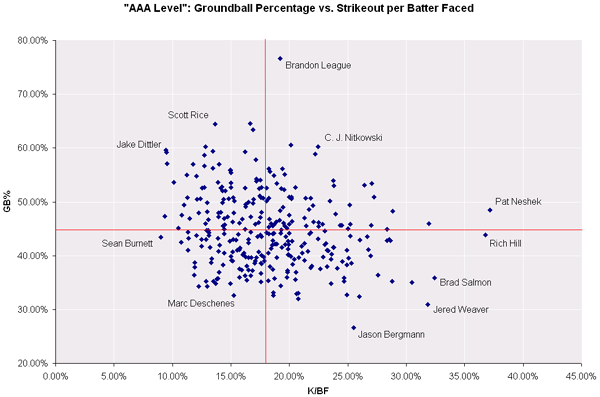
Sixty-two pitchers out of a total of 308 (or 20%) placed in the northeast quadrant. The following list includes the top half, ranked by K/BF.
NORTHEAST QUADRANT (ABOVE-AVG K AND GB RATES)
PITCHER TEAM LG K/BF GB% Pat Neshek MIN IL 37.18% 48.48% Colter Bean NYY IL 31.96% 46.00% Shaun Marcum TOR IL 28.85% 48.23% Hong-Chih Kuo LAD PCL 28.38% 44.93% Jamie Shields TB IL 27.23% 50.89% Josh Kinney STL PCL 27.05% 53.41% Chad Billingsley LAD PCL 26.99% 45.65% Dana Eveland MIL PCL 26.42% 53.05% Tom Gorzelanny PIT IL 25.20% 45.88% Scott Dunn TB IL 25.18% 49.45% Brian Falkenborg STL PCL 25.00% 45.03% Jason Windsor OAK PCL 24.50% 45.61% Hayden Penn BAL IL 24.36% 45.61% Renyel Pinto FLA PCL 23.94% 47.71% Kevin Cameron MIN IL 23.81% 52.97% Dustin McGowan TOR IL 23.76% 53.94% Brian Slocum CLE IL 23.48% 50.20% Erick Burke SD PCL 22.83% 45.85% Ryan Houston TOR IL 22.52% 45.45% J. P. Howell TB IL 22.48% 46.20% C. J. Nitkowski PIT IL 22.44% 60.23% Kason Gabbard BOS IL 22.22% 58.90% Jason Hammel TB IL 22.08% 46.25% Jake Robbins CIN IL 22.03% 49.36% Nick Masset TEX PCL 21.81% 50.71% Brad Clontz FLA PCL 21.69% 48.55% Dustin Nippert ARI PCL 21.42% 45.52% Jonathan Johnson ATL IL 21.40% 50.65% Dennis Sarfate MIL PCL 21.31% 46.98% Jose Rodriguez TB IL 20.53% 52.73%
Pat Neshek, who had the highest strikeout rate (37.18%) among all Triple-A pitchers, was called up to the majors by the Twins last summer and put up the highest K/BF (38.41%) among big-league hurlers as well. Increasing one's K rate after jumping any level, much less from AAA to the majors, is an impressive feat. The reliever with the funky sidearm delivery saw his groundball rate plummet from 48.48% to 31.58% once he reached Minnesota. His ability to get LHB out and keep the ball in the park will determine whether he can sustain his success at the highest level.
There were a number of other pitchers in the NE quadrant who made a positive impact for their parent clubs in the majors last year, including (among starters) Shaun Marcum (TOR), Hong-Chih Kuo and Chad Billingsley (LAD), Jamie Shields and J.P. Howell (TB), and Tom Gorzelanny (PIT). Several others got pounded upon their promotion, most notably Hayden Penn, who went 0-4 with a 15.10 ERA, lowlighted by 38 hits and 8 HR, 13 BB, and 8 SO in 19.2 IP.
Although not shown in the table above, another relief pitcher - Brandon League - was an outlier in terms of K/GB at AAA and MLB. Like Neshek, League was featured last month when I covered major-league starters and relievers. An extreme groundball pitcher, the 24-year-old set-up man for the Blue Jays saw his K (19.20% AAA/16.76% MLB) and GB (76.65%/72.87%) rates hold up rather well in Toronto.
Eighty-nine pitchers (or 29%) placed in the southeast quadrant. The top third are listed below.
SOUTHEAST QUADRANT (ABOVE-AVG K AND BELOW-AVG GB RATES)
PITCHER TEAM LG K/BF GB% Rich Hill CHC PCL 36.78% 43.84% Brad Salmon CIN IL 32.43% 35.88% Jered Weaver LAA PCL 31.85% 30.89% Julio Manon BAL IL 30.50% 35.00% Winston Abreu BAL IL 28.78% 35.26% Craig Breslow BOS IL 28.62% 42.77% Travis Hughes WAS PCL 28.52% 43.02% Jose Veras NYY IL 28.33% 42.77% Jonah Bayliss PIT IL 27.59% 36.43% Francisco Cruceta SEA PCL 26.97% 39.95% Matt Roney OAK PCL 26.75% 41.10% Marty McLeary PIT IL 26.68% 43.51% Edinson Volquez TEX PCL 26.05% 42.90% Aquilino Lopez SD PCL 25.99% 32.40% Jason Bergmann WAS PCL 25.51% 26.67% Mike Meyers MIL PCL 25.29% 38.55% Eric Hull LAD PCL 25.23% 43.63% Anthony Reyes STL PCL 25.08% 39.50% Angel Guzman CHC PCL 24.92% 38.25% Scott Strickland PIT IL 24.91% 32.68% John Wasdin TEX PCL 24.90% 41.04% Carlos Villanueva MIL PCL 24.68% 35.26% Andy Cavazos STL PCL 24.66% 35.85% Wayne Franklin ATL IL 24.53% 38.89% John Danks CWS PCL 24.11% 37.63% Robinson Tejeda TEX PCL 23.80% 41.51% Mike Burns CIN IL 23.74% 41.51% Kazuhito Tadano OAK PCL 23.62% 40.23% Wilfredo Ledezma DET IL 23.57% 34.85% Hyang-Nam Choi CLE IL 23.57% 39.33%
Rich Hill and Jered Weaver stand out not only for their performance in Triple-A, but both pitchers showed they could get big-league hitters out as well. Hill was featured on Monday when I looked at all starting pitchers in the minors with 90 or more innings. Weaver fell short of qualifying by 13 frames but thoroughly dominated AAA hitters in a tough league and ballpark for pitchers when he posted a 6-1 record with a 2.10 ERA and a 9.3 K/BB ratio. The 6-foot-7 righthander, who also placed in the southeast quadrant in the majors, went 11-2 with a 2.56 ERA in 19 GS covering 123 IP for the Angels.
Anthony Reyes was called up to the Cardinals and struggled during the regular season (5-8, 5.06) but redeemed himself by winning Game One of the World Series when he held the Tigers to only two runs in eight-plus innings.
Eighty-two pitchers (27%) landed in the northwest quadrant. The following table includes the top quartile.
NORTHWEST QUADRANT (ABOVE-AVG GB AND BELOW-AVG K RATES)
PITCHER TEAM LG K/BF GB% Andy Mitchell BAL IL 16.67% 64.55% Scott Rice BAL IL 13.67% 64.49% Zach McClellan COL PCL 16.90% 63.38% Jack Cassel SD PCL 12.83% 60.29% Jake Dittler CLE IL 9.44% 59.58% Jamie Vermilyea TOR IL 13.47% 59.39% Kevin Gryboski WAS PCL 16.23% 59.30% Shane Loux KC PCL 9.47% 59.22% Danny Graves CLE IL 12.74% 58.72% Terry Adams PIT IL 17.14% 57.82% Beau Kemp MIN IL 9.51% 57.10% Lance Cormier ATL IL 11.74% 56.99% Chris Sampson HOU PCL 13.99% 56.97% Clint Nageotte SEA PCL 12.72% 56.62% Sun-Woo Kim COL PCL 13.45% 56.22% Tim LaVigne NYM IL 14.94% 55.98% Jason Scobie TOR IL 14.94% 55.79% Joe Mays CIN IL 14.98% 55.45% Franquelis Osoria LAD PCL 11.24% 55.00% Brian O'Connor ATL IL 12.07% 54.80%
None of the starters in the above table strike my fancy as pitchers to watch. A number of them are older or perhaps back-of-the-bullpen types. However, there is one pitcher - Jeremy Sowers (14.29%/49.83%) - who fell into the northwest quadrant, although not shown, who has had success at every stop along the way, including his foray in the bigs last season. The crafty lefthander, who was the #1 pitching prospect in the International League (9-1, 1.39), went 7-4 with a 3.57 ERA for Cleveland. His K/9 rate has declined from 9.46 in A+ to 7.65 in AA to 4.99 in AAA to 3.57 in MLB. The good news is that it can't go down much more from that level.
Seventy-five pitchers (24%) found themselves in the southwest quadrant. The bottom six are listed below.
SOUTHWEST QUADRANT (BELOW-AVG GB AND K RATES)
PITCHER TEAM LG K/BF GB% Sean Burnett PIT IL 9.00% 43.48% Jerome Williams WAS PCL 10.77% 42.44% Chris Michalak CIN IL 11.34% 40.97% R. A. Dickey TEX PCL 11.34% 44.34% Matt Wilhite LAA PCL 11.36% 43.17% Randy Leek STL PCL 11.86% 36.36%
I'm not going to pan Sean Burnett and Jerome Williams again. They both received my wrath on Monday. In the spirit of double jeopardy, I will withhold any additional comments.
| Baseball Beat | February 01, 2007 |
Categorizing Minor League Pitchers: Part Four - Double-A
Part One: The Starters
Part Two: Low-A
Part Three: High-A
The series on categorizing minor league pitchers by strikeout and groundball rates makes its way to Double-A (also known as AA) today. Double-A comprises three leagues: Eastern, Southern, and Texas.
Based on the 2006 pitching means for the three circuits, the Southern League would appear to be the most pitcher friendly and the Texas League the most hitter friendly. However, the numbers are skewed by the fact that the Southern and Eastern Leagues had a number of quality arms, while the Texas League experienced a down year in terms of top-tier pitching prospects.
STARTERS RELIEVERS
ERA K/9 BB/9 HR/9 | ERA K/9 BB/9 HR/9
EL 3.97 6.94 3.08 0.82 3.60 8.18 3.53 0.67
SL 3.45 7.26 3.11 0.65 3.51 8.16 3.83 0.67
TEX 4.54 6.49 3.37 0.98 4.16 7.91 3.93 0.85
The graph below includes strikeout and groundball data for every pitcher in Double-A with 50 or more innings. The x-axis is strikeouts per batter faced (K/BF) and the y-axis is groundball percentage (GB%). The graph is divided into four quadrants with the mid-point equal to the average K/BF of 19.13% and the average GB% of 45.32%.
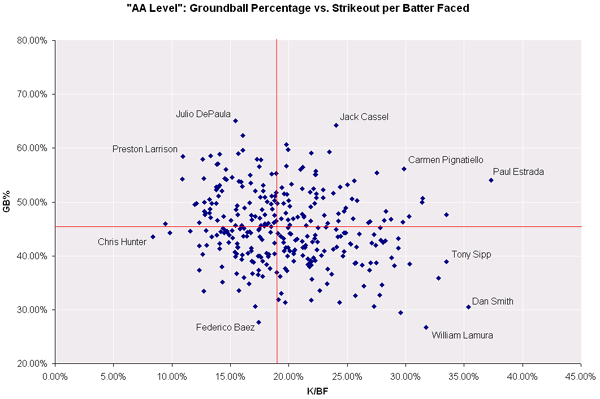
Sixty-three pitchers out of a total of 316 (or approximately 20%) placed in the northeast quadrant. The following list includes the top half, ranked by K/BF.
NORTHEAST QUADRANT (ABOVE-AVG K AND GB RATES)
PITCHER TEAM LG K/BF GB% Paul Estrada HOU TEX 37.33% 54.01% Jorge Vasquez PIT EL 33.46% 47.68% Philip Hughes NYY EL 31.44% 50.72% Humberto Sanchez NYY EL 31.39% 50.00% Connor Robertson OAK TEX 30.31% 47.29% Carmen Pignatiello CHC SL 29.84% 56.13% Mark Worrell Jr. STL TEX 29.76% 46.30% Homer Bailey CIN SL 28.73% 46.78% Mike Pelfrey NYM EL 28.31% 48.28% T. J. Nall LAD SL 28.17% 46.61% Carlos Vasquez CHC SL 27.52% 55.38% John Hudgins SD SL 26.96% 46.32% Chris Hernandez PIT EL 26.79% 46.15% Joe Bateman SF EL 25.84% 50.25% Adam Miller CLE EL 25.61% 53.92% Anibal Sanchez FLA SL 25.48% 46.94% Jeff Kennard NYY EL 25.00% 53.25% Sean Gallagher CHC SL 24.86% 48.90% Travis Foley CLE EL 24.71% 48.26% Mitch Talbot TB SL 24.41% 50.68% Davis Romero TOR EL 24.39% 52.74% Ron Chiavacci PIT EL 24.26% 47.89% Charlie Manning NYY EL 24.25% 46.49% Jack Cassel SD SL 24.04% 64.25% Jason Pearson BAL EL 23.83% 51.63% Kason Gabbard BOS EL 23.45% 59.30% Justin Pope NYY EL 23.33% 46.10% Carlos Villanueva MIL SL 23.05% 47.57% Jentry Beckstead COL TEX 22.96% 52.22% Jean Machi TB SL 22.37% 51.50% Matthew Wilkinson ARI SL 22.35% 50.82%
Philip Hughes, who was profiled on Monday, and Humberto Sanchez dominated Eastern League opponents. Both righthanders struck out over 30% of the batters they faced and kept half of the batted balls on the ground. Thanks to a trade with the Tigers, Sanchez is now employed by the same team as Hughes. The former was the starting pitcher for the World in the Futures Game. He didn't fare too badly in his only inning of work, striking out Stephen Drew and Alex Gordon and getting Howie Kendrick to ground out to short.
As I pointed out in yesterday's article, Homer Bailey actually improved his K and GB rates when he went from High-A Sarasota of the FSL (27.92%/43.48%) to Double-A Chattanooga of the Southern League (28.73%/46.78%). Like Bailey, Adam Miller is a hard-throwing RHP - another in a long line of fireballers from Texas. He added a two-seamer last summer and was virtually unhittable in the second half of the season, going 7-1 with a 1.09 ERA, 1.01 WHIP, and a 4:1 K/BB ratio.
Anibal Sanchez made the leap from the Southern League to the Florida Marlins last summer and wound up pitching a no-hitter in his rookie season while fashioning a 10-3 record with a 2.83 ERA. Not surprisingly, the soon-to-be 23-year-old's strikeout and groundball rates declined once he reached the Show but his MiL tendencies did an excellent job of foretelling his potential at the highest level.
Mike Pelfrey, 23, pitched at four different levels in 2006. The 6-foot-7, 210-pound righthander started the season at A+ (2-1, 1.64), jumped to AA (4-2, 2.71), then AAA (4-2, 2.71), and even started four games with the New York Mets (2-1, 5.48). The ninth overall pick in the 2005 draft, who was 33-7 with a 2.18 ERA during his three-year career at Wichita State, relies on a plus fastball in terms of speed and command but needs to develop his secondary pitches to realize his full potential.
The Devil Rays stole Mitch Talbot and Ben Zobrist from the Astros for Aubrey Huff and cash considerations last July. Talbot pitched in AA all year, first with Corpus Christi of the Texas League (6-4, 3.39 w/ a 25.40% K/BF and 50.58% GB), then with Montgomery of the Southern League (4-3, 1.90 w/ 22.96% K and 50.82% GB). The 23-year-old RHP also struck out 24 over 18 scoreless innings in two postseason starts, earning MiLB's Double-A Playoff Performer of the Year Award.
Ninety-five pitchers (equal to 30%) landed in the southeast quadrant. The top third can be found below.
SOUTHEAST QUADRANT (ABOVE-AVG K AND BELOW-AVG GB RATES)
PITCHER TEAM LG K/BF GB% Dan Smith ATL SL 35.39% 30.53% Tony Sipp CLE EL 33.47% 38.89% Brandon Knight PIT EL 32.82% 35.90% William Lamura CWS SL 31.75% 26.72% Matt Garza MIN EL 30.36% 38.46% Scott Elbert LAD SL 29.57% 29.45% Carlos Marmol CHC SL 29.39% 43.26% Ubaldo Jimenez COL TEX 29.35% 41.42% Marcus McBeth OAK TEX 29.02% 38.19% Yovani Gallardo MIL SL 28.81% 39.68% Bill White ARI SL 28.25% 42.77% Cory Doyne STL TEX 28.06% 42.50% John Danks CWS TEX 27.99% 34.58% Jesse Chavez TEX TEX 27.89% 42.95% Brian Rogers DET EL 27.82% 45.18% Judd Songster COL TEX 27.76% 32.74% Scott Mathieson PHI EL 27.50% 38.75% Jeff Niemann TB SL 27.45% 42.00% Tracy Thorpe TOR EL 27.31% 30.66% Carlos Guevara CIN SL 27.30% 43.93% Tyler Clippard NYY EL 27.09% 42.35% James Happ PHI EL 27.00% 38.66% Glen Perkins MIN EL 26.91% 37.38% Justin Olson MIN EL 26.42% 34.40% Thomas Diamond TEX TEX 26.27% 38.32% Calvin Medlock CIN SL 26.02% 44.07% Michael Bumstead TEX TEX 25.81% 41.67% Joshua Newman COL TEX 25.75% 38.69% Francisley Bueno ATL SL 25.69% 32.61% Dan Kolb WAS EL 25.63% 38.57% Joel Hanrahan LAD SL 25.28% 42.17% Ian Ostlund DET EL 25.27% 42.25%
After being converted to a starting pitcher late in the season, Dan Smith put up a 2.27 ERA over eight starts with a 12.0 K/9. The 23-year-old lefthander, who stands 6-foot-5 and tips the scales at 250 pounds, could earn a spot in Atlanta's bullpen next season if he continues to progress as he did last summer.
Like Pelfrey, Matt Garza was a first-round draft pick in 2005 who jumped from High-A (5-1, 1.42) to Double-A (6-2, 2.51) to Triple-A (3-1, 1.85) and to the majors (3-6, 5.76) in 2006. The 23-year-old righthander was USA TODAY's Minor League Player of the Year last season when he posted a combined record of 14-4 with a 1.99 ERA and a 4.8 K/BB. Mature beyond his years, Garza has developed a four-pitch repertoire, including a fastball that sits in the low-90s and a curve and slider that he needs to learn to trust at the highest level.
Although Scott Elbert, Yovani Gallardo, and J.A. Happ were covered in parts one and three, other prized prospects such as Ubaldo Jimenez, John Danks, Jeff Niemann, Tyler Clippard, Glen Perkins, and Thomas Diamond deserve a nod.
Eighty-four pitchers fell in the northwest quadrant. The top quartile is presented in the table below.
NORTHWEST QUADRANT (ABOVE-AVG GB AND BELOW-AVG K RATES)
PITCHER TEAM LG K/BF GB% Julio DePaula MIN EL 15.41% 65.09% Shawn Hill WAS EL 16.08% 62.35% Chris Russ STL TEX 16.08% 59.58% Brock Till CIN SL 15.69% 58.95% Brian Henderson TB SL 14.07% 58.90% Aaron Laffey CLE EL 13.32% 58.56% Preston Larrison DET EL 10.93% 58.45% Kevin Ool STL TEX 12.61% 57.95% Shane Youman PIT EL 17.30% 57.93% Kevin Cave FLA SL 17.62% 57.83% Adam Harben MIN EL 13.94% 57.14% Chris Begg SF EL 13.84% 56.94% JR Mathes CHC SL 17.48% 56.61% Tyler Lumsden KC SL 14.60% 56.04% Billy Buckner KC TEX 18.92% 55.27% Matt Childers NYY EL 18.55% 55.15% Cody Smith KC TEX 16.71% 54.98% Levale Speigner MIN EL 15.16% 54.55% Bryan Edwards NYM EL 14.52% 54.36% Rich Rundles STL TEX 12.74% 54.33% Marc Kaiser COL TEX 10.88% 54.23%
Aaron Laffey is a typical finesse-type lefty who competes by throwing strikes and inducing groundballs. He went 12-4 with a 3.16 ERA in 153.2 combined innings in the CAR (A+) and EL (AA). The 6'0", 180-pounder, who doesn't turn 22 until April, is one of many highly regarded pitching prospects in the Cleveland organization.
A highly touted southpaw out of Clemson, Tyler Lumsden was taken by the White Sox in the supplemental round as the 34th overall pick in 2004. He underwent elbow surgery the following January and missed the entire 2005 season. Lumsden bounced back and pitched 159 innings in 2006 (split between the Sox and Kansas City AA teams as a result of a late summer trade between the two clubs), recording an 11-5 mark with a 2.77 ERA. At 6-4, 215 pounds, Lumsden has a good pitcher's build plus quality stuff and enough polish to compete for a spot in Kansas City's rotation this spring.
Seventy-four pitchers (or roughly 23%) wound up in the southwest quadrant. The bottom half dozen as measured by K/BF rates are listed below.
SOUTHWEST QUADRANT (BELOW-AVG GB AND K RATES)
PITCHER TEAM LG K/BF GB% Chris Hunter LAA TEX 8.38% 43.58% R.D. Spiehs SF EL 9.82% 44.26% Steven Register COL TEX 11.54% 44.58% Daniel Davidson LAA TEX 12.35% 41.85% David Maust WAS EL 12.35% 37.35% Miguel Pinango NYM EL 12.64% 40.27%
Let's take a look at Chris Hunter. He is a poster boy for why looking at K and GB rates works so well. I will admit that I had never heard of the guy before I dove into this project and only became aware of him because he had the absolute lowest K/BF rate of any minor league pitcher last year. Well, suffice it to say that I wasn't surprised in the least when I learned that the 26-year-old righthander had a 4-14 record with a 7.45 ERA. He allowed 168 hits and walked 69 batters while striking out only 49 in 125.2 innings for a WHIP of 1.89 and a K/BB ratio of 0.71. Good grief!
The five-part series will conclude tomorrow with a focus on Triple-A pitchers.
| Baseball Beat | January 31, 2007 |
Categorizing Minor League Pitchers: Part Three - High-A
Part One: The Starters
Part Two: Low-A
Continuing our tour of the minor leagues categorizing pitchers by strikeout and groundball rates, we focus on High-A (also known as A+) today. High-A comprises three leagues: California, Carolina, and Florida State.
According to Mike Hollman of Inside the Warehouse, the 2006 pitching means for the three leagues were as follows:
STARTERS RELIEVERS
ERA K/9 BB/9 HR/9 | ERA K/9 BB/9 HR/9
CAL 4.81 7.36 3.32 0.87 4.40 8.06 3.97 0.75
CAR 4.13 6.58 3.41 0.72 3.90 7.46 3.94 0.64
FSL 3.82 7.04 3.05 0.68 3.82 8.07 3.12 0.69
The ERAs in the Florida State League are lower than the Carolina and California Leagues. The latter has the highest ERAs and HR/9 rates. Relief pitchers, not surprisingly, had lower ERAs and HR/9 rates as well as a higher K/9 across the board. The key takeaway is that the CAL is more of a hitter's paradise and is not as pitcher friendly as the CAR and FSL.
The graph below includes strikeout and groundball data for every pitcher in High-A with 50 or more innings. The x-axis is strikeouts per batter faced (K/BF) and the y-axis is groundball percentage (GB%). The graph is divided into four quadrants with the mid-point equal to the average K/BF of 19.10% and the average GB% of 45.79%.
As a reminder, the northeast quadrant is comprised of pitchers with above-average strikeout and groundball rates; the southeast quadrant encompasses pitchers with above-average strikeout and below-average groundball rates; the northwest quadrant is made up of pitchers with above-average groundball and below-average strikeout rates; and the southwest quadrant is the home for pitchers with below-average strikeout and groundball rates.
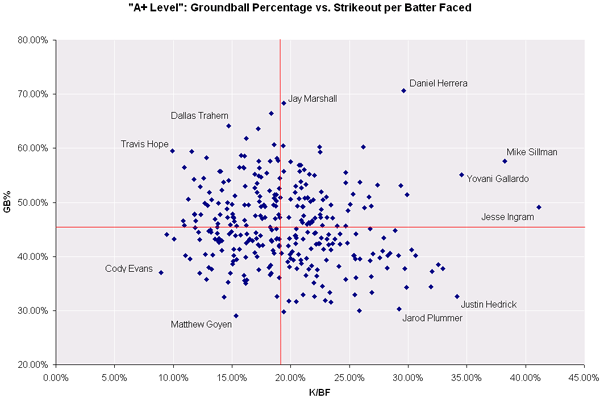
There were 64 pitchers (out of 317 qualified) that landed in the northeast quadrant. The following table lists the top half, sorted by K/BF.
NORTHEAST QUADRANT (ABOVE-AVG K AND GB RATES)
PITCHER TEAM LG K/BF GB% Jesse Ingram TEX CAL 41.13% 49.14% Mike Sillman STL FSL 38.22% 57.63% Yovani Gallardo MIL FSL 34.56% 55.06% Mark Rogers MIL FSL 29.91% 51.41% Daniel Herrera TEX CAL 29.61% 70.68% Fernando Hernandez CWS CAR 29.35% 53.05% Franklin Morales COL CAL 27.37% 53.18% Daniel Powers MIN FSL 26.84% 49.36% J. P. Martinez MIN FSL 26.67% 51.01% Manny Parra MIL FSL 26.29% 48.95% Samuel Deduno COL CAL 26.18% 60.26% Sean Gallagher CHN FSL 25.89% 53.70% Joseph Bisenius PHI FSL 25.31% 51.52% John Bannister TEX CAL 25.06% 49.64% Justin Thomas SEA CAL 24.89% 48.47% Aaron Trolia SEA CAL 24.69% 55.56% Nick Pereira SF CAL 24.68% 53.60% Kevin Lynch LAA CAL 23.56% 47.10% Reid Santos CLE CAR 23.43% 49.49% Rodrigo Escobar HOU CAR 23.10% 47.19% Joshua Schmidt NYY FSL 23.02% 51.03% Nick Debarr TB CAL 22.76% 50.51% Robert Rohrbaugh SEA CAL 22.60% 48.72% Ryan Schroyer BOS CAR 22.58% 51.97% Zachary Hammes LAD FSL 22.56% 47.19% Jonathan Barratt TB CAL 22.52% 47.76% Jesse Litsch TOR FSL 22.50% 59.34% Jose Garcia FLA FSL 22.44% 60.22% Paul Kometani TEX CAL 22.05% 47.06% Billy Buckner KC CAL 22.02% 54.96% Jimmy Barthmaier HOU CAR 21.93% 50.49% Edwin Vera TEX CAL 21.83% 46.55%
As detailed in the opening article on starters, Yovani Gallardo, Franklin Morales, Samuel Deduno, and Sean Gallagher all qualified for the 25-50 club (25% K/BF and 50% GB rate). Mark Rogers, who turned 21 yesterday, also made the 25-50 club. The fifth overall pick in the 2004 draft has a high ceiling but one that may never be reached. The 6-foot-2, 205-pound RHP underwent shoulder surgery in January and will miss the 2007 season.
John Bannister (25.06%/49.64%) and Justin Thomas (24.89%/48.47%), both 23, barely missed as did Nick Pereira (24.68%/53.60%), 24, who succeeded at A+ (7-1, 2.06) but was overmatched upon his promotion to AA where his K and GB rates dropped and his H, HR, and BB skyrocketed.
Although Jesse Ingram dominated CAL opponents (6-0, 2.43), the 24-year-old reliever didn't fare nearly as well after he received the phone call to join AA Frisco in the Texas League (3-2, 5.21) and was horrible in the Arizona Fall League (0-0, 12.41 with 19 H, 17 ER, 7 BB, and 6 SO in 12.1 IP).
Mike Sillman went 4-3 and recorded 35 saves with a 1.10 ERA. Keep in mind, however, that the former Cornhusker turned 25 in December and has not pitched a single inning above A+. It's difficult to say how well the righthanded submariner will perform against better competition as he advances through the Cardinals' system.
Kent Bonham wrote a guest column last October on Danny Ray Herrera. The diminutive (5'8", 145) LHP pitcher out of New Mexico had a phenomenal season last year as a junior in college and in his professional debut in the Arizona and California Leagues. Herrera had a 2.86 ground outs/air outs ratio at the University of New Mexico, then had the highest GB rate (70.68%) in A+ after he signed with the Texas Rangers. Oh, the 45th-round draft pick recorded a MiLB ERA of 1.45 over 62 IP without allowing a single home run.
Seventy-nine pitchers fell into the southeast quadrant. The top 40 are listed in the following table.
SOUTHEAST QUADRANT (ABOVE-AVG K AND BELOW-AVG GB RATES)
PITCHER TEAM LG K/BF GB% Justin Hedrick SF CAL 34.16% 32.64% Jose Arredondo LAA CAL 32.95% 37.75% Brian Anderson SF CAL 32.57% 38.51% Matthew Scherer STL FSL 32.05% 37.21% Kevin Whelan NYY FSL 31.94% 34.43% Juan Ovalles WAS CAR 30.65% 40.13% Kevin Slowey MIN FSL 30.28% 41.18% Harvey Garcia FLA FSL 29.86% 34.34% Jose Mijares MIN FSL 29.73% 37.74% Jarod Plummer KC CAL 29.23% 30.30% Dennis Dove STL FSL 29.17% 40.15% Scott Elbert LAD FSL 28.87% 44.83% Radhames Liz BAL CAR 28.44% 40.61% Bo Hall MIL FSL 28.25% 40.17% Donald Veal CHN FSL 28.21% 37.84% Homer Bailey CIN FSL 27.92% 43.48% Scott Lewis CLE CAR 27.83% 41.02% Kyle Wilson LAD FSL 27.57% 39.74% Elvys Quezada NYY FSL 26.98% 40.54% Adalberto Mendez CHN FSL 26.89% 33.33% Milton Tavarez TOR FSL 26.86% 36.24% Matt Daley COL CAL 26.78% 45.13% Ricky Romero TOR FSL 26.75% 39.24% Daniel Core TOR FSL 25.89% 39.53% Michael Megrew LAD FSL 25.83% 30.00% Brett Wayne TB CAL 25.54% 36.11% Robert Hinton MIL FSL 25.54% 44.19% Eric Hurley TEX CAL 25.48% 39.58% Jim Henderson WAS CAR 25.45% 32.88% Alberto Bastardo LAD FSL 25.42% 40.22% Matt Farnum TEX CAL 25.35% 40.14% James Happ PHI FSL 24.84% 42.53% Johnny Cueto CIN FSL 24.70% 35.76% Alexander Hinshaw SF CAL 24.68% 45.60% Kyle Stutes SD CAL 24.17% 44.16% Troy Patton HOU CAR 24.17% 42.27% Ben Stanczyk MIL FSL 24.12% 38.21% Chris Schutt MIN FSL 23.97% 45.61% Garrett Olson BAL CAR 23.77% 43.22% Alan Horne NYY FSL 23.55% 42.37%
Jose Arredondo and Kevin Slowey, both of whom turn 23 this spring, struck out over 30% of the batters they faced in A+. Arredondo (6'0", 170) impressed in the hitter friendly CAL League (2.30 ERA w/ 11.5 K/9, 6.2 H/9, and 0.40 HR/9) but got lit up at AA Arkansas in the Texas League (6.53 ERA, 1.68 WHIP). The 6-foot-3, 190-pound Slowey is as polished as they come. He has plus-plus major league command of his fastball. If you believe in the power of stats, then you have to love the pride of Winthrop University. The RHP has pitched 220.2 minor league innings with a 1.96 ERA, 0.80 WHIP, and a 7.8:1 K/BB ratio.
Other notables include Scott Elbert, Radhames Liz, Donald Veal, Homer Bailey, and Scott Lewis. Elbert, 21, held Florida State and Southern League opponents to 6 H/9 in 146 combined IP while whiffing 173. However, the 6-2, 190-pound LHP gave up 9 HR in 32.1 IP at home in Jacksonville. He needs to improve his control (MiL career 4.99 BB/9) to reach his full potential.
Liz, who turns 24 in June, will likely start at AA again after struggling upon a mid-season promotion for the second year in a row. The 6-2, 170-pound RHP with a mid-90s fastball, may wind up as a reliever if he doesn't "learn" how to pitch.
The 22-year-old Veal made a smooth transition from Low-A (29.55%/34.52%) to High-A (28.21%/37.84%) when he was called up last summer. The 6-4, 215 LHP was 11-5 with a 2.16 ERA, 174 SO, 82 BB, and 7 HR in 154.1 combined IP.
Bailey, who turns 21 in May, was one of the few pitchers who actually improved his K and GB rates upon a mid-season promotion. His 96-97 mph fastball and plus curveball translated well at the higher minor league level and his stuff should earn him a trip to Cincinnati at some point during the 2007 season.
Lewis, 23, led the minors with a 1.48 ERA. The southpaw had a monster April and May when he threw 41 IP with only 2 ER while striking out 56 against just 4 BB. Lewis, who was kept on a strict pitch count all year, has excellent command of a below-average fastball coupled with an outstanding 12-to-6 curve.
Ricky Romero, Eric Hurley, J.A. Happ, and Troy Patton are also prized prospects. Romero, the first pitcher taken in the 2005 draft, pitched well in High-A (2-1, 2.47 ERA w/ 9.46 K/9) but struggled in Double-A (2-7, 5.08 ERA w/ 5.51 K/9). However, the lefty finished the year strong, including a four-game stretch covering 23 IP where he gave up only four ER. Hurley was promoted to AA before he turned 21. The RHP's ERA was more than two runs better in the TEX League even though his K, BB, and GB data were about the same at both levels. The 6-6, 200-pound Happ jumped from A+ to AA to AAA in the same year while averaging a strikeout per inning. Patton, 21, went 7-7 with a 2.93 ERA in High-A, then regressed to 2-5, 4.37 with a 7.35 K/9 in Double-A.
There were 85 pitchers who placed in the northwest quadrant. The table below includes the top quartile, as determined by GB rates.
NORTHWEST QUADRANT (ABOVE-AVG GB AND BELOW-AVG K RATES)
PITCHER TEAM LG K/BF GB% Connor Falkenbach TOR FSL 18.35% 66.47% Dallas Trahern DET FSL 14.70% 64.13% Rommie Lewis Jr. BAL CAR 17.22% 63.58% Justin Berg CHN FSL 16.21% 61.84% Tim Lahey MIN FSL 18.57% 60.70% Travis Hope NYM FSL 9.92% 59.46% Wesley Whisler CWS CAR 11.59% 59.45% Jaime Garcia STL FSL 15.76% 58.65% Adam Russell CWS CAR 16.05% 58.54% Richie Daigle SD CAL 12.81% 58.22% Thomas King SF CAL 18.80% 58.09% Mark Rosen ARI CAL 18.91% 57.67% Evan Englebrook HOU CAR 18.22% 57.62% Abe Woody CIN FSL 17.26% 57.62% Jeff Hahn DET FSL 15.63% 56.47% Jacob Marceaux FLA FSL 15.97% 56.46% Nick Webber STL FSL 10.94% 56.45% Douglas Mathis TEX CAL 17.33% 56.39% Eric Haberer STL FSL 16.00% 56.39% Casey Cahill BAL CAR 13.95% 55.74% Adam Bright COL CAL 14.06% 55.74%
Dallas Trahern was profiled on Monday. Adam Russell, 24, has come a long way from his days at Ohio University. The 6-8, 250-pound groundball specialist had a better ERA at High-A than Double-A but his K and BB rates improved materially upon his promotion last summer. Russell's upside may be higher than his more renowned teammate Lance Broadway.
I'm not particularly interested in minor league pitchers with below-average strikeout and groundball rates. There wasn't much to pick from the 78 hurlers who placed in the least desirable quadrant although I chose to include the worst half dozen as ranked by K/BF.
SOUTHWEST QUADRANT (BELOW-AVG GB AND K RATES)
PITCHER TEAM LG K/BF GB% Cody Evans ARI CAL 8.96% 36.97% Luis Atilano ATL CAR 9.41% 44.07% Tyler Adamczyk STL FSL 10.07% 43.23% A. J. Shappi ARI CAL 11.03% 40.22% Brian Allen TB CAL 11.44% 39.53% Jim Paduch CIN FSL 11.85% 45.29%
If a pitcher can't whiff at least 10% of the batters faced, he better have a good excuse like working on a new set of pitches or an injury. Otherwise, I would suggest that such pitchers go back to school, earn their degrees, and get real jobs.
The five-part series will continue tomorrow (Double-A) and conclude on Friday (Triple-A).
| Baseball Beat | January 30, 2007 |
Categorizing Minor League Pitchers: Part Two - Low-A
Yesterday's Categorizing Minor League Pitchers focused on starters at all levels other than Rookie and Short Season. Today's article is the first of four follow-ups, covering more than 300 pitchers who performed in Low-A (also referred sometimes as A- or even A) last year.
The graph below includes strikeout and groundball data for every pitcher in the Midwest and South Atlantic Leagues with 50 or more innings. The x-axis is strikeouts per batter faced (K/BF) and the y-axis is groundball percentage (GB%). There are four quadrants with the mid-point equal to the average K/BF of 19.92% and the average GB% of 47.71% and for relievers.
The following table shows the breakdown by strikeout and groundball rates from Low-A all the way up to Major League Baseball. The MiLB GB percentages are slightly understated due to the fact that bunted balls were included in the balls in play totals. If bunted balls were excluded, the GB% would be approximately 1-2% higher across the board.
Not surprisingly, the K/BF and GB% generally decline as the competition stiffens. Hitters at advanced levels put the ball in play more often and tend to get greater lift by hitting more line drives and flyballs.
K/BF GB%
Low-A 19.92% 47.71%
High-A 19.10 45.79
Double-A 19.13 45.32
Triple-A 17.91 44.61
MLB 16.83 43.63
I found it interesting that the strikeout and groundball rates flatten out between High-A and Double-A, whereas they drop by approximately one percentage point at each of the other jumps.
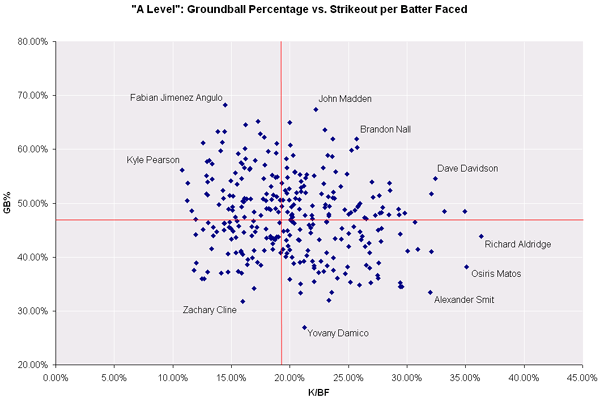
A total of 73 pitchers ranked in the northeast quadrant. The list below includes those in the top half, ranked by K/BF.
NORTHEAST QUADRANT (ABOVE-AVG K AND GB RATES)
PITCHER TEAM LG K/BF GB% Todd Doolittle FLA SAL 34.96% 48.48% Michael Zagurski PHI SAL 33.19% 48.48% Dave Davidson PIT SAL 32.43% 54.55% Brent Leach LAD SAL 32.06% 51.75% Andrew Barb PHI SAL 29.82% 48.18% Ricky Steik DET MDW 29.30% 47.83% Matt Davis CLE SAL 29.26% 48.92% Johnny Cueto CIN MDW 28.57% 52.36% Mark McCormick STL MDW 28.51% 53.72% Blake Jones FLA SAL 28.45% 47.86% Jo-Jo Reyes ATL SAL 27.91% 49.23% Wade Davis TB MDW 27.82% 48.25% Justin Vaclavik PIT SAL 27.70% 48.18% Matthew Trent STL MDW 27.62% 51.41% Noe Rodriguez CWS SAL 27.31% 47.74% Michael Bowden BOS SAL 27.09% 51.10% David Patton COL SAL 26.99% 53.97% Greg Dupas TB MDW 25.99% 50.00% Chi-Hung Cheng TOR MDW 25.84% 49.48% Anthony Claggett DET MDW 25.78% 49.32% Jaime Garcia STL MDW 25.72% 60.37% Brandon Nall NYM SAL 25.70% 61.90% Aaron Walker TB MDW 25.53% 48.68% Joey Newby OAK MDW 25.24% 59.85% Carlos Carrasco PHI SAL 25.21% 48.23% Jose Marte TEX MDW 25.00% 47.98% Ronald Hill PHI SAL 24.89% 55.41% Jonathon Niese NYM SAL 24.67% 48.84% Cory Wade LAD SAL 24.35% 53.15% Kraig Schambough KC MDW 23.92% 55.81% Nick Adenhart LAA MDW 23.80% 50.85% Kevin Guyette BOS SAL 23.72% 52.03% Russ Savickas TOR MDW 23.68% 61.90% Eduardo Baeza ARI MDW 23.66% 50.96% Thomas Fairchild HOU SAL 23.61% 58.69% Eddie De La Cruz TB MDW 23.36% 49.46% Ryan Tucker FLA SAL 23.33% 47.99%
Other than Brent Leach (who started all 11 of his games at Low-A before becoming a full-time reliever at High-A), no starting pitcher had a K/BF rate over 30%. Four starters (Johnny Cueto, Mark McCormick, Michael Bowden, and Jaime Garcia) qualified for the 25-50 club. The 5-foot-11, 174-pound Cueto, 21, was a combined 15-3, 3.00 with 143 SO and 38 BB in 138 IP in the MDW (A-) and FSL (A+). McCormick, a 23-year-old hard-throwing RHP out of Baylor, has walked 72 batters in 105 innings the past two seasons. Bowden (20, RHP, 6'3", 215) had the sixth-highest K/BF rate among all starting pitchers in the minors with above-average GB results. As I noted in the comments section yesterday, Garcia, a 20-year-old LHP, put up sensational stats in Low-A but wasn't quite as special once he moved up to High-A (15.76%/58.65%).
Baseball America named Nick Adenhart, 20, as the top pitcher in the Midwest League and Carlos Carrasco, 20, as the top pitcher in the South Atlantic League. Garcia and Wade Davis, 21, also ranked among the top 10 players in the MDW. Although not shown, Sean West (20.82%/50.70%), a 21-year-old LHP, placed in the top 10 in the SAL.
Other notables:
Jo-Jo Reyes, 22, had a combined 12-5 record with a 3.51 ERA in Low-A and High-A but his K and GB rates declined after his promotion. The 43rd overall pick in 2003, Reyes had Tommy John surgery in 2004, tore his ACL in 2005, and bounced back to become the starting pitcher in the SAL All-Star Game in 2006. The 6-foot-2, 230-pound lefthander has a Sid Fernandez-type body and a deceptive delivery to boot.
Chi-Hung Cheng, who turns 22 in June, pitched for Lansing in the Midwest League for the second consecutive season. The lefthander from Taiwan tore his labrum and underwent surgery during the off-season. He isn't scheduled to pitch again until the middle of the year. Cheng, who has struck out more than a batter per inning at each stop in his minor league career, throws a plus curveball but lacks command of an average fastball. His road to the majors may be as a reliever.
A total of 81 pitchers ranked in the southeast quadrant. The list below includes those in the top half, ranked by K/BF.
SOUTHEAST QUADRANT (ABOVE-AVG K AND BELOW-AVG GB RATES)
PITCHER TEAM LG K/BF GB% Ryan Aldridge LAA MDW 36.32% 43.80% Osiris Matos SF SAL 35.06% 38.19% Will Inman MIL SAL 32.06% 40.98% Alexander Smit MIN MDW 31.97% 33.46% Jacob McGee TB MDW 30.92% 41.49% Brad Kilby OAK MDW 30.67% 46.53% Ryan Doherty ARI MDW 30.04% 41.10% Donald Veal CHC MDW 29.55% 34.52% Brandon Erbe BAL SAL 29.42% 35.25% Eduardo Morlan MIN MDW 29.41% 34.47% Clay Buchholz BOS SAL 29.40% 44.23% Matt Avery CHC MDW 27.84% 45.35% Scott Mitchinson PHI SAL 27.78% 42.96% Ruben Flores SEA MDW 27.60% 38.89% David Quinowski SF SAL 27.54% 36.11% Kevin Lynn TB MDW 27.51% 45.03% Samuel Gervacio HOU SAL 27.50% 36.62% Jason Rice CWS SAL 26.88% 35.19% Raymar Diaz HOU SAL 26.82% 37.93% Hunter Jones BOS SAL 26.81% 40.77% Yohan Pino MIN MDW 26.76% 42.58% Derek Miller MIL SAL 26.52% 38.49% Paul Moviel CWS SAL 26.50% 47.12% Harold Williams SEA MDW 26.41% 41.99% Justin Rayborn CHC MDW 26.37% 47.28% German Marte NYM SAL 26.18% 43.87% Billy Carnline TOR MDW 26.09% 43.26% Matthew Maloney PHI SAL 25.97% 44.64% Chris Nicoll KC MDW 25.93% 34.82% Joshua Outman PHI SAL 25.43% 45.59% Ismael Casillas BOS SAL 25.14% 35.32% James McDonald LAD SAL 25.00% 44.33% Jason Ray OAK MDW 25.00% 41.95% Thomas Cowley CLE SAL 24.90% 38.17% David Hernandez BAL SAL 24.72% 36.88% Sean Stidfole TOR MDW 24.45% 45.31% Donald Julio ARI MDW 24.36% 43.37% Sergio Romo SF SAL 24.03% 36.07% Marlon Arias LAD SAL 23.85% 43.45% Jeff Kamrath TB MDW 23.73% 39.84% Daniel Griffin SF SAL 23.72% 37.50%
Ryan Aldridge, a 23-year-old righthanded reliever, had the highest K/BF rate of any pitcher with 50 or more innings at Low-A. He recorded 24 saves while limiting opponents to a .169 BAA.
Will Inman, 20; Alexander Smit, 21; and Jacob McGee, 20, had K/BF rates over 30%. All three pitchers were featured in yesterday's article.
Baseball America named Inman and Brandon Erbe, 19, among the top ten players in the SAL, and McGee and Donald Veal, 22, among the top ten in the MDW. Although not shown, Matthew Walker (20.24%/47.41%), a 20-year-old RHP, placed in the top ten in the MDW.
Other notables include Ryan Doherty, a 7-foot-1, 255-pound relief pitcher from Notre Dame. An intimidating force on the mound, the 23-year-old righthander won 9 games out of the bullpen while posting a 2.59 ERA with 5 saves and 76 SO in 62.2 IP. Eduardo Morlan, 21, was 2-0 with a 0.00 ERA in his final four starts (22 IP, 12 H, 6 BB, 26 SO) and could be a sleeper for 2007.
Clay Buchholz, 22, had a combined record of 11-4 with a 2.42 ERA in the SAL and CAR, striking out 140 batters in 119 innings, including 23 in 16 frames at the more advanced High-A level. Matthew Maloney, 23, was the SAL Pitcher of the Year. The 6-foot-4, 220-pound southpaw led the league in W (16-9), IP (168.2), and SO (180), and was second in ERA (2.03).
A total of 81 pitchers ranked in the northwest quadrant. The list below includes those in the top quartile, ranked by GB%.
NORTHWEST QUADRANT (ABOVE-AVG GB AND BELOW-AVG K RATES)
PITCHER TEAM LG K/BF GB% F. Jimenez Angulo CHC MDW 14.48% 68.27% Garrett Patterson NYY SAL 17.26% 65.16% Blake Maxwell BOS SAL 16.21% 64.56% Justin Blaine PHI SAL 14.40% 63.30% Brad James HOU SAL 13.86% 63.27% Jean Garavito PIT SAL 17.47% 62.90% Eric Brown NYM SAL 17.81% 62.22% Ryan Shaver SF SAL 14.23% 61.32% Anthony Cupps ARI MDW 12.59% 61.21% Jeramy Simmons NYM SAL 18.88% 61.05% Chris Hayes KC MDW 16.14% 60.19% Kyle Waldrop MIN MDW 14.06% 59.67% Burke Badenhop DET MDW 18.13% 59.59% Jake Stevens ATL SAL 18.82% 59.26% Chris Volstad FLA SAL 15.58% 59.15% Dane Renkert MIL SAL 19.68% 58.30% Jason Cairns STL MDW 16.23% 58.21% Julian Cordero TEX MDW 17.01% 57.94% Brok Butcher LAA MDW 13.11% 57.92% Cory Meacham STL MDW 12.91% 57.72%
The Cubs acquired Fabian Jimenez Angulo and Joel Santo (who had the second-lowest K/BF ranking in the dreaded southwest quadrant) from the Padres for Scott Williamson last July. Although Angulo has been a groundball machine, the 20-year-old lefthander from Columbia has allowed 336 hits in 284 minor league innings while surrendering 163 walks vs. 154 strikeouts.
Chris Volstad, who I covered in more detail yesterday, is the most highly regarded prospect in the northwest quadrant. The 20-year-old righthander was listed among the top two pitchers and top ten players in the SAL by Baseball America.
A total of 70 pitchers ranked in the southwest quadrant. The list below includes the bottom six in terms of K/BF, sorted in ascending order.
SOUTHWEST QUADRANT (BELOW-AVG GB AND K RATES)
PITCHER TEAM LG K/BF GB% Zachary Simons COL SAL 11.82% 37.59% Joel Santo CHC MDW 11.95% 44.14% Ryan Rote CWS SAL 11.96% 47.03% Ryan Schreppel ARI MDW 12.00% 38.87% Scott Taylor CHC MDW 12.48% 35.95% Waner Mateo NYM SAL 12.60% 45.16%
The six pitchers in the above table would be better labeled as suspects than prospects. I'm not sure how Scott Taylor and Waner Mateo pulled off ERAs in the 3s but the other four all had ERAs in the 5s and 6s.
I will continue my five-part series tomorrow, breaking down the 2006 K and GB rates for High-A pitchers, followed by Double-A on Thursday, and Triple-A on Friday.
Once again, I extend a special thanks to Jeff Sackmann of Minor League Splits for gathering the raw data and David Appelman of FanGraphs for providing the graphs.
| Baseball Beat | January 29, 2007 |
Categorizing Minor League Pitchers: Part One - The Starters
Earlier this month, I published a two-part special designed to categorize major league starters and relievers by batted ball types and strikeout rates. I am going to continue this project by analyzing minor league pitchers this week, beginning with starters today and covering all pitchers by level of classification from Tuesday through Friday.
Strikeout and groundball tendencies can tell us more about pitchers than win-loss records, ERAs, and most opinions. Pitchers who combine high K and GB rates are almost always successful. Conversely, pitchers who combine low K and GB rates are rarely successful.
It's no secret that strikeouts are the best outcome for a pitcher. Next to infield flies, grounders are the least harmful among batted ball types. Although groundballs result in a higher batting average than fly balls, their run impact is lower because the hits are usually limited to singles and an occasional double down the first or third base line, whereas balls in the air that turn into hits become doubles, triples, or home runs.
Groundball rates are an important predictor of home runs because the latter can be influenced to a much greater degree by park factors, which vary significantly from one minor league stop to another. Keep in mind that no attempt has been made to adjust the data for classification, league, or park factors.
To provide a visual aid, the strikeout and groundball rates for all minor league starters with 90 or more innings have been plotted in the graph below. The x-axis is strikeouts per batter faced (K/BF) and the y-axis is groundball percentage (GB%). The graph is divided into four quadrants with the mid-point equal to the average K/BF of 18.42% and the average GB% of 45.68%.
The northeast quadrant is comprised of pitchers with above-average strikeout and groundball rates; the southeast quadrant encompasses pitchers with above-average strikeout and below-average groundball rates; the northwest quadrant is made up of pitchers with above-average groundball and below-average strikeout rates; and the southwest quadrant is the home for pitchers with below-average strikeout and groundball rates.
Most of the outlying names in the northeast and southeast quadrants were highlighted last year when I ran a three-part series on Screening for Pitching Prospects. Rather than using K/BF and GB%, I sorted pitchers by high K/9 and low HR/9 rates.
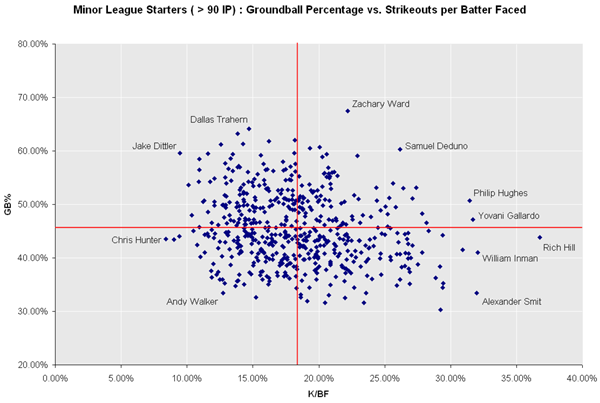
I have listed the top 25 pitchers in the northeast quadrant by strikeout rate. Ages are as of July 1, 2007. Organizations, for the most part, are updated to include trades. Levels are based on classifications where the pitcher threw at least 50 innings in 2006. Stats have been combined for those who competed at more than one level, provided they pitched a minimum of 50 innings at each of the stops.
NORTHEAST QUADRANT (ABOVE-AVG K AND GB RATES)
PITCHER AGE ORG LEV K/BF GB% Yovani Gallardo 21 MIL A+/AA 31.70% 47.14% Philip Hughes 21 NYY AA 31.44 50.72 T. J. Nall 26 LAD AA 28.17 46.61 Wade Davis 21 TB A 27.82 48.25 Franklin Morales 21 COL A+ 27.37 53.18 Michael Bowden 20 BOS A 27.09 51.10 Dana Eveland 23 MIL AAA 26.42 53.05 Samuel Deduno 23 COL A+ 26.18 60.26 Chi-Hung Cheng 22 TOR A 25.84 49.48 Adam Miller 22 CLE AA 25.61 53.92 Sean Gallagher 21 CHC A+/AA 25.33 51.24 Carlos Carrasco 20 PHI A 25.21 48.23 Tom Gorzelanny 24 PIT AAA 25.20 45.88 John Bannister 23 TEX A+ 25.06 49.64 Jonathon Niese 20 NYM A 24.67 48.84 Mitch Talbot 23 TB AA 24.41 50.68 Cory Wade 24 LAD A 24.35 53.15 Renyel Pinto 24 FLA AAA 23.94 47.71 Ryan Tucker 20 FLA A 23.33 47.99 Kevin Roberts 23 MIL A 23.13 46.60 Justin Thomas 23 SEA A/A+ 23.01 51.02 Kason Gabbard 25 BOS AA/AAA 22.92 59.13 Adam Daniels 24 STL A 22.70 51.75 Jonathan Barratt 22 TB A+ 22.52 47.76 Zach Ward 23 MIN A 22.20 67.44
When separating the wheat from the chaff, it helps to look at age vs. level. Yovani Gallardo, Philip Hughes, and Sean Gallagher all pitched in Double-A as 20-year-olds. T.J. Nall pitched in Double-A as a 25-year-old. All else being equal, you take the younger pitcher every time. Nall isn't the only Dodgers hurler that needs to be discounted due to his age. Cory Wade spent the majority of the season pitching in Low-A as a 23-year-old. He was promoted to High-A (Vero Beach, Florida State League) and got clobbered (2-4, 8.24 ERA with 9 HR in 39.1 IP). Despite Wade's excellent K and GB rates at Low-A, he is NOT a legitimate prospect. [Update: Nall signed with the Washington Nationals as a minor league free agent on 11/6/06.]
Gallardo won't turn 21 until next month, yet is about as polished and mature as any minor leaguer. Milwaukee's second-round draft pick in 2004 ate up hitters in A+ (6-3, 2.09 ERA) and AA (5-2, 1.63) although his K and GB rates dipped at the higher level. The righthander out of Mexico led the minors with 188 strikeouts in 155 combined innings while only allowing 104 hits and 6 HR. At 6-foot-3 and 215 pounds, he combines size with stuff (including a low-90s fastball, a slider, and changeup), command, and performance. Unlike Nall and Wade, Gallardo is the real deal.
Hughes, a 6-foot-5, 220-pound righthander, went 12-6 with a 2.16 ERA in 146 combined innings in the Florida State (A+) and Eastern (AA) Leagues. The first-round draft choice in 2004 was a dominant force down the stretch (5-0, 1.43 with 62 SO, 21 H, and 9 BB in 44 IP) and in the first game of the playoffs (13 punchouts in 6 IP vs. Portland, the team that won the EL championship). He throws a heavy two-seam fastball, a four-seamer that sits at 93-95, a plus curve, and is working on developing his changeup. Hughes will begin the season in Triple-A at the Yankees' new Scranton/Wilkes Barre affiliate and should reach the Big Apple no later than this summer.
Gallagher, while not nearly in the class of Gallardo or Hughes, has been overlooked by many prospect analysts. The 6-foot-2, 225-pound righthander sported an 11-5 record and a 2.51 ERA with 171 SO in 164.2 combined IP in the FSL and Southern League (AA). However, the big jump in Gallagher's walk rate (5.73 BB/9) when he was promoted to West Tennessee bears watching this year. The youngster may have tried to be "too fine" rather than trusting his stuff against the older competition.
Special mention also goes to Franklin Morales, Michael Bowden, Dana Eveland, Samuel Deduno, and Adam Miller for being part of the 25-50 club. 25% K rate. 50% GB rate. The combination is rare at any level. Among major leaguers, only one starting pitcher (Francisco Liriano) and four relievers (Bobby Jenks, J.J. Putz, Dennys Reyes, and Billy Wagner) pierced both marks last year.
Speaking of Liriano, Colorado Rockies GM Dan O'Dowd said Morales has "Francisco Liriano-type ability." The lefthander struck out 16 batters in a 7-inning game last year and has whiffed 369 and walked 176 batters in 315.1 career frames. He works in the mid-90s and has reportedly touched the upper-90s. K/GB types like Morales and Deduno at Coors Field would help mitigate the disadvantage of pitching in such extreme altitude.
Zach Ward was selected by the Cincinnati Reds in the third round in 2005. The pride of Gardner-Webb University made his pro debut in Low-A in 2006 and went 7-0 with a 2.29 ERA before being traded to the Minnesota Twins for Kyle Lohse in July. What makes Ward unique is his MiLB-high (among pitchers with at least 100 innings) GB rate of 67.44%. With a heavy fastball that sits in the low-90s and a hard slider, the 6-foot-5, 225-pound righthander allowed only 3 HR in 144.1 IP last year. He is a long ways from the bigs but is an intriguing prospect to say the least.
The following are the top 20 pitchers in the southeast quadrant by strikeout rate.
SOUTHEAST QUADRANT (ABOVE-AVG K AND BELOW-AVG GB RATES)
PITCHER AGE ORG LEV K/BF GB% Rich Hill 27 CHC AAA 36.78% 43.84% Will Inman 20 MIL A 32.06 40.98 Alexander Smit 21 MIN A 31.97 33.46 Jacob McGee 20 TB A 30.92 41.49 Brandon Erbe 19 BAL A 29.42 35.25 Eduardo Morlan 21 MIN A 29.41 34.47 Clay Buchholz 22 BOS A 29.40 44.23 Scott Elbert 21 LAD A+/AA 29.17 38.40 Donald Veal 22 CHN A/A+ 28.86 36.26 Homer Bailey 21 CIN A+/AA 28.31 45.07 Scott Lewis 23 CLE A+ 27.83 41.02 Scott Mathieson 23 PHI AA 27.50 38.75 Tyler Clippard 22 NYY AA 27.09 42.35 Francisco Cruceta 25 TEX AAA 26.97 39.95 Glen Perkins 24 MIN AA 26.91 37.38 Raymar Diaz 23 HOU A 26.82 37.93 Johnny Cueto 21 CIN A/A+ 26.78 44.66 Kevin Slowey 23 MIN A+/AA 26.77 39.90 Radhames Liz 24 BAL A+/AA 26.56 40.88 Humberto Sanchez 24 NYY AA/AAA 26.54 44.48
Rich Hill (7-1, 1.80 ERA with 135 SO in 100 IP) dominated the Pacific Coast League last spring and earned a promotion to the Chicago Cubs. After going 0-4 with a 9.31 ERA in his first four starts, the 6-foot-5, 205-pound southpaw went 6-3 with a 2.92 ERA, a 1.05 WHIP, and 8.89 K/9. He turns 27 in March.
As of next week, Will Inman will no longer be a teenager. The third-round draft pick in 2005 overcame a sore right shoulder early in the season to go 10-2 with a 1.71 ERA at West Virginia in the South Atlantic League. His peripheral stats (10.90 K/9, 1.95 BB/9, and 0.24 HR/9) were among the best in the minors. The three HR he allowed last year all came in his final two starts. Inman can flat out pitch. His durability and stuff will dictate just how good he becomes.
Maybe I'm just partial to Dutch pitchers but Alexander Smit baffled Midwest League hitters when he became a starting pitcher in the second half of the season. The lefthander fashioned a 5-1 record with a 2.31 ERA while punching out 106 batters over 78 IP. He has fanned more than 12 per nine innings during his minor league career.
Jacob McGee and Wade Davis (with the fourth-highest K/BF rate in the northeast quadrant) formed a strong 1-2 punch for Southwest Michigan in the Midwest League. McGee K'd 171 batters in 134 innings. The southpaw has a lively fastball that he can dial up to around 95-96 mph on occasion. He is far from a finished project but has the size, stuff, and handedness that make scouts sit up and take notice.
Homer Bailey, Johnny Cueto, Humberto Sanchez, and Clay Buchholz fell just below the average GB rate and missed placing in the northeast quadrant. That said, it's much better to have a K/BF rate 10 percentage points above the norm with league-average GB tendencies than the other way around.
The next table lists the top dozen pitchers in the northwest quadrant ranked by GB rates. A few pitchers in this group may stick in the majors but not nearly the same number or percentage as those in the northeast or southeast quadrants. Pitchers who miss bats are the most likely to graduate to the majors but keeping the ball on the ground is the next best avenue to the Show.
NORTHWEST QUADRANT (ABOVE-AVG GB AND BELOW-AVG K RATES)
PITCHER AGE ORG LEV K/BF GB% Dallas Trahern 21 DET A+ 14.70% 64.13% Brad James 23 HOU A 13.86 63.27 Jack Cassel 27 SD AA/AAA 18.17 62.07 Justin Berg 23 CHC A+ 16.21 61.84 Ryan Shaver 22 SF A 14.23 61.32 Anthony Cupps 24 ARI A 12.59 61.21 Burke Badenhop 24 DET A 18.13 59.59 Jake Dittler 24 CLE AAA 9.44 59.58 Wesley Whisler 24 CWS A+ 11.59 59.45 Jamie Vermilyea 25 TOR AAA 13.47 59.39 Chris Volstad 20 FLA A 15.58 59.15 Aaron Laffey 22 CLE AA 13.32 58.56
Dallas Trahern is a classic groundball pitcher who throws strikes and keeps the ball in the yard. A 34th-round draft pick out of high school, the 6-foot-3, 190-pound righthander throws a sinking fastball in the low-90s and a hard slider. He's been moving up one level per year and is likely to be assigned to Erie in the Eastern League (AA) as a 21-year-old. Like most of the pitchers in this group, Trahern suffers from a lower-than-desirable strikeout rate.
The biggest name and body belongs to Chris Volstad, one of Florida's five first-round draft picks in 2005. The 6-foot-7 RHP struggled in the early part of 2006 (including 1-4, 5.94 in May), then went 6-1 with a 1.53 ERA in the second half. He is an extreme groundball pitcher who gave up 21 unearned runs in 152 IP last year. Volstad and his fellow first rounders are slated for High-A Jupiter in the Florida State League this spring.
The southwest quadrant is not the place you want to be if your goal is to earn a major league pension. The bottom half dozen pitchers ranked by strikeout rate would be best served by learning a new pitch, approach, or occupation.
SOUTHWEST QUADRANT (BELOW-AVG GB AND K RATES)
PITCHER AGE ORG LEV K/BF GB% Chris Hunter 26 LAA AA 8.38% 43.58% Sean Burnett 24 PIT AAA 9.00 43.48 Luis Atilano 22 WAS A+ 9.41 44.07 Tim Kester 35 BAL AAA 10.49 45.10 Jerome Williams 25 PHI AAA 10.77 42.44 A. J. Shappi 24 ARI A+ 11.03 40.22
Sean Burnett may be too young to cut loose at this point, but the former first-round draft pick of the Pittsburgh Pirates is no longer the highly regarded prospect he once was as a high school All-American in 2000 or the organization's Minor League Player of the Year in 2001 and 2002 or the Carolina League Pitcher of the Year in 2002 or the Eastern League Pitcher of the Year in 2003. In fairness to Burnett, he had elbow surgery in April 2005 and missed the entire season. His career is on the line in 2007.
Jerome Williams threw 260 innings in the big leagues and won 17 games for the Giants before his 23rd birthday. A first-round selection in 1999, the native of Honolulu was assigned to Low-A ball his first year out of high school, then progressed one level per year until reaching the majors in 2003. He was traded to the Cubs in 2005 and claimed off waivers by the Phillies in September 2006. Williams is only 25 but his career is going in the wrong direction.
Tim Kester, on the other hand, is a minor league lifer. He has been pitching professionally since 1993 but has never thrown a single pitch in the majors. Drafted by the Yankees in 1990 and 1991, Kester didn't sign until he was selected by the Astros in 1993. The righthander has been employed by Houston, Boston, and Baltimore, working 1,482 innings for 10 different minor league clubs. If nothing else, Kester has traveled extensively and would be a good person to ask for motel accommodations in rural and suburban towns across the country.
I will break down the 2006 K and GB rates for pitchers (including relievers) in Low-A on Tuesday, High-A on Wednesday, Double-A on Thursday, and Triple-A on Friday.
A special thanks to Jeff Sackmann of Minor League Splits for gathering the raw data and David Appelman of FanGraphs for providing the graphs throughout the five-part series.
| Baseball Beat | January 17, 2007 |
Blyleven: As Dominant as His Hall of Fame Contemporaries
The results of the Hall of Fame balloting were announced last Tuesday. As expected, Cal Ripken Jr. (98.5%)and Tony Gwynn (97.6%) were near-unanimous choices. Congrats go out to these first-time candidates for their well-deserved honors.
Ripken and Gwynn were the only players who received the necessary 75% of the vote to qualify for Cooperstown. Except for Goose Gossage and Dave Concepcion, all of the other holdover candidates lost ground. Among those who suffered a setback was none other than Bert Blyleven. Only the Lonely saw his vote total fall from 277 to 260 and his percentage retreat from 53.3% to 47.7%.
Blyleven's loss of momentum and lack of overall support are disappointing and surprising in the face of the evidence that he is Hall worthy. Unfortunately, there are not enough voters who are willing to take the time to study the facts. Although Blyleven's record speaks for itself, too many writers seem to be looking for reasons not to vote for him. The most common objection to his candidacy is that he wasn't one of the dominant pitchers of his era. To that, I say nonsense.
Despite claims to the contrary, dominance is not measured solely by 20-win seasons, All-Star games, or Cy Young Awards. Wins are dependent on run support, while All-Star appearances and Cy Young votes are heavily influenced by W-L records. The circular logic (or illogic) also extends to the Hall of Fame voting. Wins = All-Star games and Cy Youngs = Cooperstown.
The whole thing is rather silly. It's really all about wins (and little else). A pitcher is deemed dominant because he won games, or so goes the conventional wisdom. Sorry, but a pitcher should be deemed dominant because he prevented the other team from scoring runs. If a pitcher works deep into games and keeps runs off the board, he has performed his job. It's no more complicated than that.
Shutouts may not be as meaningful of a gauge in today's era when complete games are a rarity, but they were a great measure of pitching prowess prior to the 1990s. More than anything else, dominant pitchers threw shutouts.
Let's take a look at how Blyleven compared in this category with the 11 starting pitchers in the Hall of Fame who overlapped his career by at least five years.
SHO GS PCT
Tom Seaver 61 647 9.43%
Nolan Ryan 61 773 7.89
Bert Blyleven 60 685 8.76
Don Sutton 58 756 7.67
Bob Gibson 56 482 11.62
Steve Carlton 55 709 7.76
Jim Palmer 53 521 10.17
Gaylord Perry 53 690 7.68
Juan Marichal 52 457 11.38
Fergie Jenkins 49 594 8.25
Phil Niekro 45 716 6.28
Catfish Hunter 42 476 8.82
Blyleven, who ranks ninth in career shutouts, is third among his HoF contemporaries in blanking the opposition, one behind the leaders (Nolan Ryan and Tom Seaver). He ranks sixth in shutouts as a percentage of games started. As such, you can see that Blyleven's success was not just about longevity. He had more white washes and notched them at a greater rate than Don Sutton, Steve Carlton, Gaylord Perry, Fergie Jenkins, and Phil Niekro.
Blyleven won 15 1-0 games - more than of any of these pitchers. He ranks third all time in the number of 1-0 victories, trailing only Walter Johnson and Christy Mathewson. On the other hand, Blyleven lost nine 1-0 games - also more than any of these pitchers. That's not a negative. If anything, it is indicative of his poor run support over the years (which, according to Chris Jaffe's Run Support Index or Pete Palmer's SUP, ran about 3-4% below average for Blyleven's career).
Strikeouts are another indicator of dominance. An out may be an out but a strikeout, unlike a batted ball, isn't dependent on team defense. As such, I would argue that strikeouts are one of the most basic measures of dominance at the pitcher-batter level. Let's see how Blyleven fares in this area.
SO BF PCT
Nolan Ryan 5714 22575 25.31%
Steve Carlton 4136 21683 19.07
Bert Blyleven 3701 20491 18.06
Tom Seaver 3640 19369 18.79
Don Sutton 3574 21631 16.52
Gaylord Perry 3534 21953 16.10
Phil Niekro 3342 22677 14.74
Fergie Jenkins 3192 18400 17.35
Bob Gibson 3117 16068 19.40
Juan Marichal 2303 14236 16.18
Jim Palmer 2212 16112 13.73
Catfish Hunter 2012 14032 14.34
Blyleven, who ranks fifth in career strikeouts, is third in Ks among these distinguished pitchers. He ranks fifth in K/BF. Once again, you can see that Blyleven's success was about the quantity and quality of his career numbers. He struck out more batters in total and at a greater rate than Sutton, Perry, Niekro, Jenkins, Juan Marichal, Jim Palmer, and Catfish Hunter.
In addition to strikeouts and shutouts, the number of low-hit complete games is a useful measure of dominance. Thanks to Retrosheet and Baseball-Reference.com's Play Index (the best $29 one can spend when it comes to baseball subscriptions), we can now see how Blyleven compares to these same 11 pitchers (listed in the order of their major league debuts).
0-Hit 1-Hit 2-Hit 3-Hit 4-Hit Total
Bob Gibson 1 2 8 24 31 66
Juan Marichal 1 3 6 13 32 55
Gaylord Perry 1 1 13 21 43 79
Phil Niekro 1 2 13 14 27 57
Steve Carlton 0 6 9 21 34 70
Jim Palmer 1 5 11 19 25 61
Catfish Hunter 1 1 6 20 19 47
Fergie Jenkins 0 3 10 20 30 63
Don Sutton 0 5 10 14 25 54
Nolan Ryan 7 12 18 32 29 98
Tom Seaver 1 5 10 27 31 74
Bert Blyleven 1 5 9 13 41 69
Blyleven is tied for second with the most no-hitters, tied for third in one-hitters, tied for eighth in two-hitters, tied for last in three-hitters, and is second in four-hitters. He ranks fifth in the number of four-hit or better games (although with a greater percentage of four-hitters than any other pitcher in the group). As shown below, Blyleven had more low-hit games (LH) and at a superior rate than Niekro, Sutton, and Hunter.
LH GS PCT
Nolan Ryan 98 773 12.68%
Gaylord Perry 79 690 11.45
Tom Seaver 74 647 11.44
Steve Carlton 70 709 9.87
Bert Blyleven 69 685 10.07
Bob Gibson 66 482 13.69
Fergie Jenkins 63 594 10.61
Jim Palmer 61 521 11.71
Phil Niekro 57 716 7.96
Juan Marichal 55 457 12.04
Don Sutton 54 756 7.14
Catfish Hunter 47 476 9.87
The win-loss record in these games isn't particularly meaningful in my judgment, but I decided to include this information to counter those who might suggest that Blyleven pitched well but didn't win such battles.
W-L PCT
Nolan Ryan 87-11 .888
Gaylord Perry 72-7 .911
Tom Seaver 68-6 .919
Steve Carlton 67-3 .957
Bert Blyleven 65-4 .942
Jim Palmer 60-1 .984
Fergie Jenkins 60-3 .952
Bob Gibson 58-8 .879
Juan Marichal 54-1 .982
Don Sutton 52-2 .963
Phil Niekro 51-6 .895
Catfish Hunter 44-3 .936
Blyleven ranks fifth in the number of wins with four or fewer hits allowed. He ranks sixth in winning percentage. Carlton is the only pitcher in the group with more wins and a better winning percentage than Blyleven when it comes to low-hit games.
Interestingly, three of Blyleven's four losses occurred in 1975 when he pitched for a Minnesota team that went 76-83 and placed fourth in the AL West. He allowed seven runs (five earned) in those three games but the Twins only scored once. His other loss took place in 1986 after Bert had returned to MIN (71-91, 6th in the AL West), and he was on the short end of a 3-0 defeat.
Let's further refine these pitching gems to low-hit games with no more than one walk.
Total W-L GS PCT
Fergie Jenkins 42 41-1 594 7.07%
Bert Blyleven 33 33-0 685 4.82
Gaylord Perry 33 31-2 690 4.78
Tom Seaver 31 30-1 647 4.79
Juan Marichal 29 29-0 457 6.34
Jim Palmer 23 23-0 521 4.41
Don Sutton 23 22-1 756 3.04
Catfish Hunter 22 22-0 476 4.62
Steve Carlton 21 21-0 709 2.96
Phil Niekro 20 19-1 716 2.79
Bob Gibson 18 16-2 482 3.73
Nolan Ryan 9 8-1 773 1.16
Blyleven is tied for second in the number of games with four or fewer hits and one or no walks. He ranks second in wins and is tied for first in winning percentage. Blyleven also ranks third in low-hit, low-walk games as a percentage of games started.
I also examined the number of low-hit, low-walk games each pitcher tossed as a percentage of the number of low-hit, low-walk games thrown by all major leaguers during each hurler's respective career to adjust for the slight differences in eras. (Incidentally, Blyleven is the only pitcher among the 12 who did not pitch a single inning during the 1960s and is one of just two who performed beyond 1988.)
PCT LG AVG RATIO
Fergie Jenkins 7.07% 2.34% 3.02
Bert Blyleven 4.82 1.94 2.49
Juan Marichal 6.34 2.64 2.40
Tom Seaver 4.79 2.17 2.21
Gaylord Perry 4.78 2.40 1.99
Jim Palmer 4.41 2.30 1.91
Catfish Hunter 4.62 2.46 1.88
Bob Gibson 3.73 2.63 1.42
Don Sutton 3.04 2.19 1.39
Steve Carlton 2.96 2.22 1.33
Phil Niekro 2.79 2.24 1.25
Nolan Ryan 1.16 2.04 0.57
Blyleven has the second-best ratio of games with four or fewer hits and one or no walks compared to the major league average. In other words, aside from Jenkins, he was the most proficient of the bunch at throwing such gems.
Shutouts. Strikeouts. Low-hit, low-walk complete games. Those are generally under the control of the pitcher and are much better ways of evaluating dominance than 20-win seasons, All-Star appearances, and Cy Young votes.
If Steve Carlton, Bob Gibson, Catfish Hunter, Fergie Jenkins, Juan Marichal, Phil Niekro, Jim Palmer, Gaylord Perry, Nolan Ryan, Tom Seaver, and Don Sutton were dominant pitchers, then Bert Blyleven was dominant, too. If these pitchers are Hall of Famers, then Blyleven is a Hall of Famer as well. How they can all have plaques in Cooperstown while Blyleven continues to sit on the outside looking in is incomprehensible and a wrong that should be righted.
| Baseball Beat | January 16, 2007 |
Listen, Buster
Buster Olney wrote a column last Tuesday, entitled "On Blyleven's Candidacy" (ESPN Insider subscription required). Olney, who has never voted for Blyleven in the past, gives his reasons as to why he didn't support him again this year.
I have highlighted excerpts of Olney's comments below followed by my responses.
I've looked for a way around the strong belief that Blyleven is the pitcher's version of Harold Baines -- a very steady, reliable player during a long career, but never a dominant presence for a period of at least a few years.
Bert Blyleven has now been reduced to a "pitcher's version of Harold Baines?" You've got to be kidding me, right? I mean, how can Olney make such a comment while keeping a straight face?
I will grant you, Harold Baines was a good hitter. Maybe even a very good hitter. However, as a player who spent the vast majority of his time as a designated hitter, I'm not sure you can say he was much more than that. But I will concede that he was a good, solid hitter.
Blyleven, on the other hand, was a great pitcher. I would even argue (and will in tomorrow's article) that his record is no worse than right smack in the middle of the pack with 11 Hall of Fame pitchers who overlapped his career by five or more years.
I'm not talking perception here. Instead, I'm talking about facts. Blyleven was one of the best pitchers in the league in 1971, 1973, 1974, 1975, 1976, 1977, 1981, 1984, 1985, 1986, and 1989. I won't go through all the details here but will point you to this article instead.
TOP FIVE RANKINGS
SO: 13x (including 6 consecutive years from 1971-76) K/BB: 13x (including 7 straight from 1970-76) SHO: 9x (led the league 3x) ERA: 7x ERA+: 7x (led league in 1973) WHIP: 7x
Blyleven also placed in the top five multiple times in many other categories, including W, H/9, BB/9, K/9, IP, GS, and CG.
Baines, on the other hand, was rarely among the top hitters in the league. Given that there are about twice as many batters in the starting lineup as there are pitchers in the starting rotation, I'll expand the rankings to ten in order to be fair to Baines.
TOP TEN RANKINGS
AVG: 3x (with a high of 6th in 1985) OBP: 1x (7th in 1989) SLG: 1x (led league in 1984) OPS: 3x (high of 6th in 1984) OPS+: 4x (high of 5th in 1989) TB: 2x (high of 5th in 1984) HR: 1x (9th in 1984) RBI: 2x
Baines also ranked in the Top 10 at least twice in 3B, G, and AB.
We can also compare Blyleven and Baines by looking at their Black Ink, Gray Ink, HOF Standards, and HOF Monitor. There is some double counting with the top five and ten rankings above, but these tallies are instructive nonetheless. The overall ranks are in parentheses.
BLYLEVEN
Black Ink: Pitching - 16 (129) (Average HOFer ~ 40)
Gray Ink: Pitching - 239 (24) (Average HOFer ~ 185)
HOF Standards: Pitching - 50.0 (36) (Average HOFer ~ 50)
HOF Monitor: Pitching - 120.5 (68) (Likely HOFer > 100)
BAINES
Black Ink: Batting - 3 (499) (Average HOFer ~ 27)
Gray Ink: Batting - 40 (595) (Average HOFer ~ 144)
HOF Standards: Batting - 43.5 (116) (Average HOFer ~ 50)
HOF Monitor: Batting - 66.5 (267) (Likely HOFer > 100)
Baines was good but Blyleven was great.
With almost all of the current Hall of Famers, there is a period in their careers in which they had a turn as The Man. Blyleven was clearly a very good pitcher for a long time, but did he dominate his league the way other current and future Hall of Famers have -- Seaver, Gibson, Carlton, Clemens, Johnson, Maddux, Martinez?
I didn't realize that those seven pitchers were the standards. I mean, one could easily argue that Olney's talking about six of the top dozen pitchers in the history of baseball and another who certainly belongs in the top 20. Why does a pitcher have to "dominate his league" in the manner of these inner circle Hall of Famers in order to get elected as well?
I can't find another Hall of Famer voted in by writers with less than three All-Star appearances; Blyleven had two. Blyleven never finished first or second in Cy Young balloting and was never the most coveted free-agent pitcher or the object of a huge bidding war in trade talk, the way that Tom Seaver and even Vida Blue were.
"Never the most coveted free-agent pitcher or the object of a huge bidding war in trade talk." When did either become criterion for the Hall of Fame? I mean, Buster is groping here. It sounds to me like he might be looking for a reason to vote for Mike Hampton when he becomes eligible down the road. With respect to All-Star appearances, I say "big deal." I addressed this matter last month in response to naysayers like Olney.
During the course of Steve Carlton's career, he finished in the top three in his league in ERA, strikeouts, victories or Cy Young voting 23 times. Tom Glavine has done that 14 times; Roger Clemens 38. Nolan Ryan did this 23 times; Fergie Jenkins 18; Don Sutton 6, Ron Guidry 11, Randy Johnson 35; Blyleven, 12 times.
Notice the three-card monte trick Buster is pulling here? He switches from "first or second in Cy Young balloting" a couple of excerpts above to "top three" in the latest. Besides, combining rankings of stats with vote totals doesn't make a whole lot of sense to me. Be that as it may, let's run this same exercise using "top five" rather than "top three" and see what we come up with here. Why he picked these pitchers, who knows? But let's give it a go, huh?
ERA SO W CYA TOT
Blyleven 7 13 2 3 25
Carlton 5 12 8 6 31
Glavine 5 1 8 6 20
Clemens 12 16 11 10 49
Ryan 5 18 3 6 32
Jenkins 0 8 7 5 20
Sutton 4 3 4 5 16
Guidry 3 5 4 4 16
Johnson 8 13 10 9 40
Hmmmph. Blyleven doesn't look so bad now. Funny how that works. Instead of placing seventh out of nine under Olney's methodology, Blyleven now ranks in the center, trailing only Clemens, Johnson, Ryan, and Carlton while beating out two Hall of Famers in Jenkins and Sutton and one HOFer-to-be in Glavine (as well as Guidry). Looks like an argument on behalf of Blyleven rather than against.
In his second year on the Hall of Fame ballot, in 1999, Blyleven got 14.08 percent of the vote. I can find only one example since 1969 in which a player ever polled that low among writers and was subsequently elected -- Luis Aparicio, who got 11.97 percent of the vote in 1981 and was elected in 1984.
What does this have to do with anything? The writers got the vote wrong. What else is new?
What I wanted to hear from his peers, the guys who faced him, was this: He was easily among the most dominant pitchers of our generation; he wasn't Seaver or Carlton, but he was right there behind them. If I had heard that from even half of those I talked to, I would've reconsidered my vote. What I heard from almost all of them was this: He had a great curveball and he could be really tough. I wanted to vote "yes" for Blyleven; I did not.
Whom did he poll? Obviously not George Brett. "He was as good as there was for a long time. Bert is up there with the toughest four or five guys I faced in my career. Hopefully, he will get in. I'd think he'd be a perfect fit."
"Was as good as there was for a long time." Sounds pretty dominant to me. And coming from one of the best hitters of his generation to boot, a player who happened to face Blyleven more than any other batter this side of Reggie Jackson.
"Bert is up there with the toughest four or five guys I faced in my career." I would imagine so. Brett went 27-for-117 vs. Blyleven with only 2 HR, good for a batting line of .231/.281/.342. Boy, that Blyleven guy must have been lucky to do so well against a three-time batting average champ and first-ballot Hall of Famer like Brett.
"Hopefully, he will get in. I'd think he'd be a perfect fit."
Touche.
[Additional reader comments and retorts at The Baseball Think Factory.]
| Baseball Beat | January 09, 2007 |
Categorizing Pitchers (Part Two): Relievers
As a follow-up to yesterday's Categorizing Pitchers by Batted Ball Types and Strikeout Rates (which focused on starters), today's article is devoted exclusively to relievers.
The graph below includes strikeout and groundball data for every reliever in the majors (defined for this exercise as those with 30 or more innings who started less than one-third of the time). The y-axis is groundball percentage (GB%) and the x-axis is strikeouts per batter faced (K/BF). There are four quadrants with the mid-point equal to the average GB% of 43.30% and average K/BF of 18.63% for relievers. By comparison, starters had a mean GB% and K/BF rates of 43.8% and 15.88%, respectively. Interestingly, while the groundball rates were virtually the same, the average strikeout rate among relievers was 2.75 percentage points higher or 17.3%.
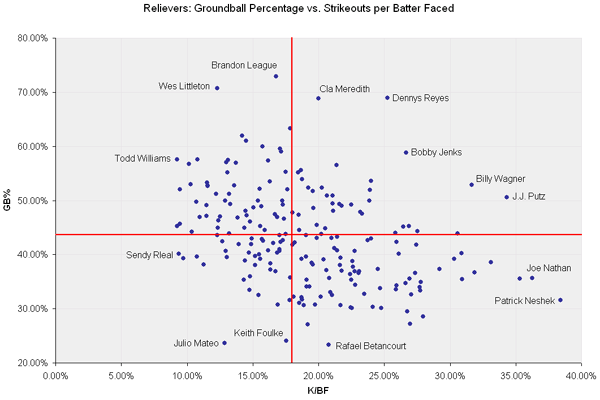
Graph courtesy of David Appelman, FanGraphs.
The average ERA among all qualifiers was 3.90. The average ERA for relievers with above-average K rates was 3.67. The average ERA for those with below-average K rates was 4.13. Similarly, the average ERA for relievers with above-average GB rates was 3.93, while the average ERA for those with below-average GB rates was 3.88.
The average ERA by quadrants:
W E
N 4.12 3.55
S 4.14 3.73
As shown, it appears as if groundball rates do not positively impact ERA for relievers - at least not in 2006. Instead, it's all about strikeouts. This is potentially a very interesting and enlightening conclusion.
The various results are also much tighter. As one would expect, the average ERA for each type was lower across the board for relievers than starters. But the disparity in average ERA between relievers with above-average and below-average K and GB rates is not as significant as it was for starters.
ERA is far from foolproof as a measurement of a relief pitcher's effectiveness. Win Probability Added (WPA) is arguably a better metric to use when evaluating relievers. That said, reliever ERA isn't worthless and is a decent indicator of performance.
Let's take a closer look at the results, beginning with the northeast quadrant and going clockwise. The pitchers are sorted by K/BF rates in the first three tables and by GB% in the last table.
NORTHEAST QUADRANT (ABOVE-AVG GB AND K RATES)
Name GB% K/BF J.J. Putz 50.55% 34.32% Billy Wagner 52.84% 31.65% Brad Lidge 43.85% 30.59% Hong-Chih Kuo 44.30% 27.52% Tom Gordon 45.28% 26.88% Bobby Jenks 58.79% 26.67% Luis Vizcaino 45.12% 26.47% Taylor Tankersley 44.00% 25.84% Dennys Reyes 68.99% 25.26% Mike Wuertz 53.64% 24.00% Scot Shields 51.93% 23.93% Scott Williamson 50.00% 23.86% Adam Wainwright 47.55% 23.30% Greg Aquino 47.86% 23.18% C.J. Wilson 49.18% 22.51% John Grabow 48.97% 21.78% Matt Thornton 49.33% 21.59% Ambiorix Burgos 43.32% 21.43% Fernando Rodney 56.54% 21.38% Tim Hamulack 48.04% 21.12% Pedro Feliciano 49.43% 21.09% Heath Bell 50.85% 21.08% Juan Rincon 50.92% 20.63% Aaron Heilman 44.86% 20.51% Akinori Otsuka 52.33% 20.26% Jason Isringhausen 43.83% 20.23% Cla Meredith 68.84% 20.00% Manuel Corpas 45.45% 19.85% Joe Kennedy 48.57% 19.59% Ryan Dempster 51.74% 19.59% Duaner Sanchez 52.32% 19.21% Brendan Donnelly 43.62% 19.06% Mariano Rivera 53.92% 18.77% Scott Downs 55.60% 18.65%
As shown in the graph, J.J. Putz, Billy Wagner, Bobby Jenks, Dennys Reyes, and Cla Meredith stand out as outliers with significantly higher strikeout and/or groundball rates than the others. Brad Lidge's K rate (30.59%) is worth pointing out. I wouldn't give up on him. He pitched much better on the road (.202/.311/.271) than at home (.267/.350/.509). Anyone who dominated hitters the way he did away from Minute Maid Park can pitch on my team.
SOUTHEAST QUADRANT (BELOW-AVG GB AND ABOVE-AVG K RATES)
Name GB% K/BF Patrick Neshek 31.58% 38.41% Joe Nathan 35.62% 36.26% Takashi Saito 35.50% 35.31% Francisco Rodriguez 38.55% 33.11% B.J. Ryan 36.65% 31.85% Jose Valverde 35.43% 30.94% Jorge Julio 40.25% 30.88% Jonathan Broxton 39.25% 30.31% Jonathan Papelbon 37.35% 29.18% Logan Kensing 28.57% 27.95% Kiko Calero 34.90% 27.80% Fernando Cabrera 33.33% 27.73% Joel Zumaya 33.98% 27.71% Scott Eyre 41.77% 27.44% Mike Gonzalez 36.64% 27.35% Trever Miller 32.58% 27.05% Rafael Soriano 27.15% 26.97% Scott Cassidy 35.51% 26.92% Brian Sikorski 29.47% 26.76% Brian Fuentes 34.73% 26.64% Francisco Cordero 40.10% 26.09% Kyle Farnsworth 34.25% 25.95% Derrick Turnbow 42.38% 25.94% Will Ohman 33.53% 25.87% Justin Speier 30.07% 24.77% Damaso Marte 33.80% 24.71% Joaquin Benoit 37.27% 24.50% George Sherrill 30.30% 24.14% Alan Embree 42.95% 23.98% Jason Frasor 42.66% 23.72% Eddie Guardado 32.73% 23.49% Huston Street 36.95% 23.10% Dan Wheeler 36.55% 23.05% Joe Nelson 34.45% 22.80% Justin Duchscherer 36.88% 22.77% Ron Mahay 40.63% 22.76% Bob Howry 37.79% 22.61% Tyler Johnson 38.78% 22.56% Rick Helling 30.11% 22.54% Chad Cordero 35.32% 22.48% Jon Rauch 30.20% 22.45% Arthur Rhodes 36.43% 22.43% David Aardsma 36.99% 21.78% Rudy Seanez 30.63% 21.69% Scott Linebrink 39.37% 21.66% Jimmy Gobble 38.04% 21.62% Ramon Ramirez 40.72% 21.40% Tyler Yates 41.18% 21.20% Joe Borowski 32.50% 21.05% Vinnie Chulk 43.07% 20.98% Scott Proctor 33.00% 20.89% Kevin Gregg 35.66% 20.82% Rafael Betancourt 23.35% 20.78% Emiliano Fruto 37.14% 20.61% Randy Flores 39.06% 20.41% Trevor Hoffman 32.24% 20.16% Kurt Birkins 43.02% 19.85% Ron Villone 30.74% 19.73% Aaron Fultz 38.18% 19.56% Brandon McCarthy 38.46% 19.49% Kevin Correia 34.12% 19.32% Russ Springer 27.06% 19.17% Chris Ray 35.33% 19.10% Guillermo Mota 34.12% 19.09% Scott Dohmann 39.58% 19.05% Jamie Walker 30.61% 18.88% Joel Peralta 31.72% 18.75% Jose Capellan 32.06% 18.71% Andy Sisco 39.23% 18.71%
The outliers depict why Minnesota's bullpen was so effective last year. Just as Reyes was one of the standouts in the NE quadrant, Patrick Neshek and Joe Nathan head the group of relievers with above-average strikeout and below-average groundball rates. Add Juan Rincon (50.92% GB and 20.63% K/BF) and Jesse Crain (55.19%/18.46%) to the mix and the Twins received 307 relief innings at an ERA of 2.35.
SOUTHWEST QUADRANT (BELOW-AVG GB AND K RATES)
Name GB% K/BF Christopher Britton 31.06% 18.55% Jeremy Accardo 42.27% 18.18% Armando Benitez 32.20% 18.13% Bob Wickman 41.76% 18.03% Jonathan Sanchez 35.77% 17.84% Jason Bergmann 31.55% 17.82% Keith Foulke 24.05% 17.56% Chad Paronto 42.60% 17.30% Neal Cotts 42.29% 17.13% Fernando Nieve 40.97% 17.03% Matt Capps 40.65% 17.02% Jeremi Gonzalez 30.77% 16.92% Bryan Corey 40.34% 16.87% Ken Ray 36.89% 16.72% Mike Stanton 42.11% 16.55% Randy Messenger 38.38% 16.36% Travis Harper 37.24% 16.33% Brian Tallet 40.76% 16.16% Roberto Novoa 42.56% 15.77% Brandon Lyon 42.86% 15.70% Tony Pena 39.22% 15.56% Josh Hancock 40.08% 15.48% Bruce Chen 32.56% 15.45% Danys Baez 39.68% 15.18% Ryan Vogelsong 38.02% 15.17% Esteban Yan 42.98% 14.91% Brandon Medders 41.88% 14.87% David Riske 35.97% 14.81% Wil Ledezma 33.51% 14.77% Roman Colon 40.31% 14.71% Fabio Castro 38.89% 14.40% Jorge Sosa 35.34% 14.31% Jake Woods 41.95% 13.95% Chad Gaudin 39.49% 13.04% Jon Adkins 40.70% 12.93% Julio Mateo 23.63% 12.86% Danny Miceli 42.42% 12.68% Brian Meadows 38.13% 11.25% Mike Timlin 39.65% 10.75% Brian Sweeney 39.27% 9.70% Sendy Rleal 40.13% 9.36%
Except for a few closers who have fallen from grace, this is a pretty non-descript group of pitchers. I don't think I would want to bank on any of these relievers. Sendy Rleal should give thanks for having had the opportunity to pitch in the big leagues last year. It would be one thing if he was a left-hander but a RHP with a K/BF rate of less than 10% has almost no chance to survive at this level.
NORTHWEST QUADRANT (ABOVE-AVG GB AND BELOW-AVG K RATES)
Name GB% K/BF Brandon League 72.87% 16.76% Wes Littleton 70.75% 12.32% Chad Bradford 63.30% 17.86% Ryan Wagner 62.00% 14.18% Rick White 60.98% 14.49% Chad Qualls 60.00% 15.73% Fausto Carmona 59.58% 17.06% Scott Feldman 59.06% 17.14% Todd Williams 57.56% 9.23% Sean Green 57.55% 10.79% Scott Schoeneweis 57.50% 13.12% Shawn Camp 57.32% 16.16% Julian Tavarez 57.01% 12.99% J.C. Romero 56.97% 13.72% Joe Beimel 56.78% 10.17% Salomon Torres 55.24% 17.52% Jesse Crain 55.19% 18.46% Brad Thompson 55.14% 13.06% Chad Harville 53.49% 16.30% Christopher Sampson 53.27% 11.54% Todd Jones 52.94% 10.29% Gary Majewski 52.77% 13.61% Rick Bauer 52.77% 11.59% Ray King 52.67% 11.56% Edwin Jackson 52.10% 15.52% Mike Wood 52.05% 9.45% Todd Coffey 52.03% 17.65% Danny Kolb 51.22% 12.21% Brian Shouse 51.20% 13.22% Hector Carrasco 50.00% 17.27% Geoff Geary 50.00% 15.38% Lance Cormier 50.00% 12.91% Jeremy Affeldt 49.70% 10.71% Braden Looper 49.36% 13.31% Tom Martin 49.20% 17.29% Jon Switzer 49.14% 11.46% Todd Wellemeyer 48.92% 15.65% Jason Davis 48.66% 15.04% Matt Belisle 48.06% 14.44% Darren Oliver 47.76% 18.02% Mike Myers 47.42% 16.67% Macay McBride 47.31% 18.47% Steve Kline 47.20% 14.54% Jason Grilli 47.09% 11.48% Ryan Franklin 47.06% 12.54% Roberto Hernandez 46.97% 16.84% Matt Herges 46.88% 10.98% Oscar Villarreal 46.86% 13.85% Dave Borkowski 46.58% 17.39% Jose Mesa 46.32% 12.38% Saul Rivera 46.11% 14.80% William Eyre 45.62% 9.45% Elmer Dessens 45.28% 15.57% Rheal Cormier 45.28% 9.27% Matt Guerrier 44.96% 12.33% Matt Wise 44.93% 14.36% Manny Delcarmen 44.57% 18.52% David Weathers 44.55% 15.92% LaTroy Hawkins 44.24% 10.34% Ruddy Lugo 43.91% 13.22% Bill Bray 43.83% 17.49% Brad Halsey 43.61% 12.30% Craig Hansen 43.55% 17.05%
Brandon League is intriguing. The groundball specialist could become a highly effective set-up man or perhaps even a closer if he can improve his K rate from 16.76% toward 20%. He made huge strides in 2006 and won't turn 24 until March. League was death on RHB (.178/.239/.238) and handled LHB (.276/.323/.362) admirably as well.
In addition to the notes I made at the end of yesterday's article, be aware of the small sample size caveat when it comes to relief pitchers. However, the aggregate results are statistically relevant with more than 10,000 innings measured.
| Baseball Beat | January 08, 2007 |
Categorizing Pitchers by Batted Ball Types and Strikeout Rates
We all know that strikeouts are the best outcome for a pitcher. When a batter fails to put the ball in play, there is little or no chance for him to reach base or to advance runners on base. Among batted ball types, infield flies are the least harmful, followed by ground balls, outfield flies, and line drives. Although groundballs result in a higher batting average than fly balls, their run impact is lower because the hits are usually limited to singles and an occasional double down the first or third base line, whereas balls in the air that turn into hits are almost always doubles, triples, or home runs.
According to Dave Studenmund's Batted Balls Redux article in The Hardball Times Baseball Annual 2007, strikeouts had a run impact of -0.113, infield flies -0.088, groundballs 0.045, outfield flies 0.192, and line drives 0.391 per incident last year.
Based on the above information, it follows that just as pitchers with high strikeout rates would generally fare better than those with low rates, pitchers with high groundball rates would normally fare better than those with low rates (all else being equal). Furthermore, it also suggests that pitchers who combine higher strikeout and groundball rates will outperform those with lower rates.
To provide a visual aid to categorize such pitchers, I created a graph (with the help of David Appelman of FanGraphs), plotting the strikeout and groundball rates for everyone in the major leagues who completed 100 or more innings and started in at least 33% of their appearances. The y-axis is groundball percentage (GB%) and the x-axis is strikeouts per batter faced (K/BF). The graph is divided into four quadrants with the mid-point equal to the average GB% of 43.80% and average K/BF of 15.88%.
The northeast quadrant is comprised of pitchers with above-average groundball and strikeout rates; the southeast quadrant encompasses pitchers with above-average strikeout and below-average groundball rates; the northwest quadrant is made up of pitchers with above-average groundball and below-average strikeout rates; and the southwest quadrant is the home for pitchers with below-average groundball and strikeout rates.
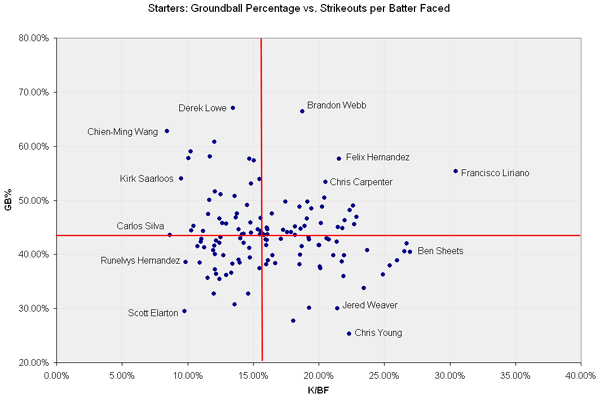
The average ERA among all qualifiers was 4.44. The average ERA for starters with above-average K rates was 4.12. The average ERA for those with below-average K rates was 4.78. Similarly, the average ERA for starters with above-average GB rates was 4.24, while the average ERA for those with below-average GB rates was 4.62.
The average ERA by quadrants:
W E
N 4.53 3.94
S 5.01 4.27
Not surprisingly, pitchers with the highest strikeout and groundball rates had the lowest average ERA (3.94), while those with the lowest K and GB rates had the highest average ERA (5.01). In the hybrid categories, pitchers with above-average strikeout and below-average groundball rates (4.27) beat those with below-average K and above-average GB rates (4.53).
Looking at the outliers in the graph would help us reach the same conclusion. There isn't a one of us who wouldn't take Brandon Webb, Felix Hernandez, Chris Carpenter, or Francisco Liriano over Scott Elarton or Runelvys Hernandez. Liriano, in fact, arguably had the best combination of K and GB rates, while Elarton had the worst combo. Lo and behold, Liriano had the lowest ERA (2.16) among starters with at least 100 IP and Elarton had one of the worst (5.34).
Let's take a closer look at the results, starting with the northeast quadrant and going clockwise. The pitchers are sorted by K/BF rates in the first three tables and by GB% in the last table.
NORTHEAST QUADRANT (ABOVE-AVG GB AND K RATES)
Name GB% K/BF Francisco Liriano 55.33% 30.44% Carlos Zambrano 46.88% 22.90% Brett Myers 45.55% 22.69% Roger Clemens 49.02% 22.62% Jeremy Bonderman 48.17% 22.37% John Smoltz 46.29% 21.98% Scott Olsen 44.80% 21.81% Felix Hernandez 57.72% 21.57% C.C. Sabathia 45.05% 21.45% Chris Carpenter 53.34% 20.54% A.J. Burnett 50.49% 20.45% Erik Bedard 48.81% 20.26% Josh Johnson 45.77% 20.18% Adam Loewen 48.48% 19.44% Andy Pettitte 49.77% 19.16% Dave Bush 46.65% 19.10% Danny Haren 45.24% 18.92% Brandon Webb 66.48% 18.74% Kelvim Escobar 44.70% 18.63% Roy Oswalt 48.80% 18.53% Josh Beckett 45.10% 18.18% Vicente Padilla 44.10% 17.89% Doug Davis 44.08% 17.59% Cory Lidle 49.72% 17.45% Kevin Millwood 44.57% 17.31% Dontrelle Willis 47.54% 16.41% Jose Contreras 44.62% 16.09% Wandy Rodriguez 44.95% 16.04%
That's an elite group of pitchers. The best of the bunch are those with strikeout rates above 20% and/or groundball rates over 50%. I had already signaled out Hernandez, Carpenter, and Liriano, but check out A.J. Burnett. The latter is one of the premier pitchers in baseball when healthy.
While Jose Contreras and Wandy Rodriguez fall into the NE quadrant, both pitchers have K and GB rates that are close to the league average. As such, I would be reluctant to label either one as a special pitcher.
On the other hand, I would be shocked if Hernandez (4.52), Adam Loewen (5.37), and Josh Beckett (5.01) don't lower their ERA by at least 0.50 and perhaps by more than 1.00 in 2007. With Liriano injured, I would rank Felix directly behind Johan Santana as the pitcher most likely to lead the AL in ERA this year.
SOUTHEAST QUADRANT (BELOW-AVG GB AND ABOVE-AVG K RATES)
Name GB% K/BF Ben Sheets 40.41% 26.98% Scott Kazmir 41.97% 26.72% Johan Santana 40.59% 26.54% Cole Hamels 38.86% 25.99% Jake Peavy 38.00% 25.41% Pedro Martinez 36.29% 24.91% Daniel Cabrera 40.72% 23.72% Orlando Hernandez 33.78% 23.46% Chris Young 25.37% 22.31% Curt Schilling 39.83% 21.94% Matt Cain 35.98% 21.88% Aaron Harang 38.69% 21.75% Jered Weaver 30.03% 21.43% Mike Mussina 42.37% 21.39% Javier Vazquez 39.84% 21.10% Ian Snell 42.78% 20.79% John Lackey 42.99% 20.61% Jason Schmidt 37.40% 20.13% Ted Lilly 37.73% 20.08% Boof Bonser 41.69% 20.05% Randy Johnson 41.71% 20.00% Oliver Perez 30.12% 19.28% James Shields 42.75% 19.26% Gil Meche 43.12% 19.24% Byung-Hyun Kim 41.51% 18.72% Chris Capuano 39.88% 18.59% Bronson Arroyo 38.15% 18.55% Brad Penny 43.54% 18.20% Chuck James 27.67% 18.06% Kyle Lohse 42.89% 17.11% Ervin Santana 38.41% 16.67% Claudio Vargas 39.86% 16.47% Ricky Nolasco 38.84% 16.15% Taylor Buchholz 43.73% 16.08% Rodrigo Lopez 42.61% 16.06% Justin Verlander 41.72% 15.98% Barry Zito 38.20% 15.98% Ryan Madson 42.79% 15.97%
There are a couple of dozen outstanding pitchers in this group, most notably those listed in the top half (or with K rates over 20%). Ben Sheets, Scott Kazmir, and Santana had almost identical K and GB rates. Cole Hamels and Jake Peavy rank just below this threesome with metrics not too dissimilar from one another or those immediately above them.
Oliver Perez (6.55) has the most room to shave a couple of runs off his ERA. Having gone to bat for Daniel Cabrera (4.74) last year, I hesitate to bring up his name again but he and Ian Snell (4.74) are good bets to show improvement in 2007.
SOUTHWEST QUADRANT (BELOW-AVG GB AND K RATES)
Name GB% K/BF Chan Ho Park 43.60% 15.84% Jason Jennings 43.77% 15.74% Victor Santos 43.64% 15.52% Brett Tomko 37.47% 15.48% Tim Wakefield 39.39% 14.75% Freddy Garcia 41.19% 14.72% Cliff Lee 32.70% 14.63% Esteban Loaiza 42.10% 14.29% Odalis Perez 43.72% 14.14% Jon Lieber 42.96% 14.01% Tony Armas Jr. 38.52% 14.00% Jeff Weaver 38.99% 13.90% Eric Milton 30.80% 13.60% Jaret Wright 38.30% 13.44% Livan Hernandez 36.58% 13.35% Michael O'Connor 36.17% 12.97% Jarrod Washburn 39.87% 12.73% Joe Blanton 43.13% 12.50% Jae Seo 35.40% 12.45% Jon Garland 42.11% 12.44% Noah Lowry 36.38% 12.19% Josh Fogg 42.55% 12.16% Jamie Moyer 40.03% 12.08% Seth McClung 37.25% 12.07% Brad Radke 41.64% 12.05% Shawn Chacon 32.70% 12.02% Ramon Ortiz 40.81% 11.94% Woody Williams 35.69% 11.54% Kris Benson 41.32% 11.27% Jason Marquis 42.88% 11.03% John Koronka 42.30% 11.01% Paul Byrd 38.52% 10.93% Steve Trachsel 41.52% 10.73% Runelvys Hernandez 38.58% 9.84% Scott Elarton 29.49% 9.78% Carlos Silva 43.62% 8.63%
This is the quadrant that you want to avoid. It is inhabited by some of the worst starters in the game. If you fail to miss bats and don't keep the ball on the ground when it is put into play, you are going to run into trouble. There is basically only one way to survive in this quadrant: throwing strikes and maintaining a low walk rate. Freddy Garcia, Jon Lieber, Jon Garland, Brad Radke, Paul Byrd, and Carlos Silva fit this description. But these types of pitchers live on the edge with very little margin for error.
Chan Ho Park, Jason Jennings, and Victor Santos were near league average in K and GB rates and should be classified more like Jose Contreras and Wandy Rodriguez (both of whom fell in the NE quadrant) than the rest of their SW brethren.
NORTHWEST QUADRANT (ABOVE-AVG GB AND BELOW-AVG K RATES)
Name GB% K/BF Derek Lowe 67.04% 13.47% Chien-Ming Wang 62.80% 8.44% Jake Westbrook 60.80% 12.06% Jason Johnson 59.02% 10.25% Jamey Wright 58.06% 11.69% Aaron Cook 57.77% 10.05% Tim Hudson 57.66% 14.70% Roy Halladay 57.33% 15.07% Kirk Saarloos 54.00% 9.49% Clay Hensley 53.87% 15.50% Paul Maholm 53.05% 14.85% Miguel Batista 51.66% 12.09% Zach Duke 51.12% 12.51% Greg Maddux 50.80% 13.57% Kenny Rogers 50.07% 11.66% Luke Hudson 49.10% 14.55% Mark Hendrickson 47.59% 13.77% Joel Pineiro 47.46% 11.55% Sean Marshall 46.81% 13.68% Nate Robertson 46.75% 15.55% Jeff Suppan 46.65% 12.43% Casey Fossum 45.88% 14.81% Aaron Sele 45.76% 12.64% Matt Morris 45.66% 12.96% Brian Moehler 45.25% 10.43% Jeff Francis 44.67% 13.88% Anibal Sanchez 44.61% 15.35% Mark Redman 44.41% 10.27% Mark Buehrle 44.35% 11.19% Tom Glavine 44.28% 15.56% Elizardo Ramirez 44.00% 14.84% Enrique Gonzalez 43.84% 14.29%
This is an interesting group of pitchers. As a whole, they rank well behind those in the NE quadrant and well ahead of those in the SW quadrant. Although they are the opposite of the pitchers in the SE quadrant, their results (in terms of ERA) are the most similar. The two groups just get there in drastically different ways. The NW pitchers succeed by inducing grounders and keeping the ball in the park, whereas the SE hurlers thrive on strikeouts.
Derek Lowe, Chien-Ming Wang, and Jake Westbrook are the biggest outliers - three pitchers who turned more than 60% of batted balls into grounders. As such, Lowe (0.58), Wang (0.50), and Westbrook (0.64) had extraordinarily low HR/9 rates. They also have one other common thread: low walk rates. Lowe (2.27), Wang (2.15), and Westbrook (2.34) offset their high hit rates by limiting the number of bases on balls.
Roy Halladay, Clay Hensley, Nate Robertson, Anibal Sanchez, and Tom Glavine - all with K/BF rates exceeding 15% - are within a few whiskers of being in the NE group. However, Sanchez and Glavine are close to league average with K rates just to the west and GB% slightly to the north of the means.
I would rather know a pitcher's strikeout and groundball rates than his ERA. Throw in a third dimension - walk rates - and you have almost everything you need to know about a pitcher. Focusing on the components gives one a much more comprehensive understanding of a pitcher's upside and downside than looking at a single metric such as ERA.
(Notes: I could have chosen run average (RA) rather than earned run average (ERA), but the results would have been essentially the same in both direction and magnitude. As previously demonstrated, groundball pitchers generally give up a greater percentage of unearned runs because more errors (of the fielding and throwing type) are committed on grounders than balls hit in the air. Ballpark factors, team defense, and the level of competition may affect the components and/or ERA to varying degrees.)
Tomorrow: Categorizing Relievers by Batted Ball Types and Strikeout Rates.
| Baseball Beat | January 06, 2007 |
Weekend Ramblings
This weekend's column segues from one point to another, covering the Randy Johnson trade to Bert Blyleven's Hall of Fame candidacy with a musing here and there along the way.
The theme of the first two bullet points is the following: "When you don't have a sound argument, fall back on the fact that you know better than everyone else because you have been around awhile."
With a tip o' the cap to Repoz at The Baseball Think Factory, here is an exchange between Kay and Chris from West Nyack (as transcribed by Ken at Fire Joe Morgan):
Kay: Randy Johnson won 17 games last year in the toughest division in baseball...People say he didn't win in the playoffs. Neither did Mike Mussina and we signed him to a two-year extension. He's well worth the money he has on his contract....16 million. He won 17 games...please don't forget that.Chris: You keep saying that it's important that Randy Johnson won 17 games, but equally as important is, he had a five ERA.
Kay: Why does that matter? Only thing that matters is the W.
Chris: The win is the function of the team. But the ERA is more indicative of how he pitched.
Kay: How come Mike Mussina didn't win 17 games?
Chris: This isn't about Mike Mussina. How many pitchers in the AL would win 17 games if they pitched behind the Yankees. With that run support?
Kay: But...but...It doesn't matt...I again I tell you I understand what you're saying that it's a function of a team but I also say it's a function to a...You're a Yankee fan right? They scored eight runs he gave up six...they won, so what....he's a veteran pitcher that knows how to pitch to the score so his ERA is going to be higher. It doesn't matter. All that matter is if he wins and loses.
Chris: Any pitcher who gives up six runs a game under your scenario would win 17 games.
Kay: Pitchers pitch to the runs they are given. Good pitchers do that.
Chris: That's not true. Pitchers are going out there to give up the fewest runs possible.
Kay: No. If the Yankees score 8 runs in five innings he's not going for the shutout!
Chris: What about the year Jason Marquis won 15 games and had a 6.21 ERA. Are you impressed with that?
Kay: No, not in the National League.
Chris: What if he did it in the American League?
Kay: Yeah. I would [be impressed].
Chris: So you would take someone like that over Kevin Millwood in '04 who went 9-13 in and won the ERA title with Cleveland.
Kay: I'm gonna tell you why, and you are bringing up good points so I am not going to say that you are 100% wrong here. I believe by watching baseball my whole life and being involved with it for 25 years is that there is nothing harder to do in sports than to win a game by a pitcher.
[Ken inserts the following comments on FJM - "Nothing harder, save for the fact that in every major league game that has ever been played it has happened exactly one time."]
Kay: That's why the era of the 300 win pitcher is going. It's not easy to win games. And there is an art to it. So if the art is to win 17 games and have a 5.00 ERA I don't care. All these sabermetricians get locked up with all of these stats and I don't. You know what stat I care about? Did he win the game?
Would you rather have a guy really lose a good game. "Wow, he pitched well -- we only lost 2-1!" I always said this about those pitchers, "Oh, the Yankees only scored one, then you have to give up zero." In twenty years you're going to look back on Mike Mussina in game 2 against the Tigers...had a 3-1 lead and we lost 4-3....That's not that bad...yeah, it is bad! He gave up runs he shouldn't have given up!
I don't care that his ERA was 5. It was good enough to win 17 games. Mike Mussina didn't win 17 games.
[Kay closes the exchange with Chris, who has remained silent during the former's diatribe.]
Kay: You are wrong in that sense...dead wrong.
"Watching baseball my whole life and being involved with it for 25 years." Just precious. As a commenter asked at the BTF, I wonder why Johnson didn't "pitch to the score" in 2004 when he went 16-14 with a 2.60 ERA for Arizona? He must have forgotten how or perhaps the 43-year-old veteran of 19 big league seasons just learned this skill in the past two years.
15. Bert Blyleven, Stat freaks love this guy. It's true that his 3,701 strikeouts (fifth all-time) and 287 career victories are numbers that are generally good enough for enshrinement, but unlike a lot of those stathounds, I saw the entirety of his career and he was rarely one of the best. Had only one 20-win season at a time they weren't so rare and only four years with Cy Young votes.
"I saw the entirety of his career." Well, bust my buttons, that's an expert of a different color. Gotta love the emotional attack on "stat freaks" and "stathounds." If you use stats and your name isn't Heyman, you're either a "freak" or a "hound." If you use stats and your name is Heyman, then it's OK because you were there.
I don't know, Jon. I never saw Ty Cobb, Babe Ruth, Christy Mathewson, or Walter Johnson play in person.
| Baseball Beat | January 03, 2007 |
Run Element Ratio
In the 1988 Baseball Abstract, Bill James introduced the concept of "run element ratio" when discussing Rickey Henderson in the Player Ratings and Comments section.
Run element ratio divides the parts of secondary average into that which is valuable early in the inning, valuable for scoring runs (walks and stolen bases) and that which is valuable late in the inning, or valuable for driving in runs (power). The formula is (SB+BB)/(TB-H). If a player is over 1.00, then generally speaking you want him up early in the inning. If he is under 1.00, then he is more valuable later in the inning. Vince Coleman's career run element ratio is 4.4, meaning that he has little use except as a leadoff man; Don Mattingly's is .38, meaning that he is much more valuable later in the inning.
With the foregoing in mind, I thought it would be interesting to examine the run element ratio leaders and laggards for the 2006 season.
TOP 20
1. Joey Gathright 3.05 2. Jason Kendall 2.46 3. Willy Taveras 2.09 4. Dave Roberts 2.00 5. Brad Ausmus 2.00 6. Scott Podsednik 1.96 7. Felipe Lopez 1.89 8. Luis Castillo 1.88 9. Chone Figgins 1.77 10. Bobby Abreu 1.71 11. Nick Punto 1.68 12. Ryan Freel 1.62 13. Kenny Lofton 1.60 14. Brady Clark 1.53 15. Omar Vizquel 1.48 16. David Eckstein 1.46 17. Ichiro Suzuki 1.45 18. Brian Giles 1.40 19. Jamey Carroll 1.38 20. Craig Counsell 1.35
The number one mission for any leadoff hitter is to get on base. As James points out in another essay (entitled "The Lineup") in the same Abstract, "The largest determination of how many runs are likely to be scored in an inning is whether or not the lead-off man reaches base. If the lead-off man reaches base, the number of runs that will probably be scored in an inning is about three times as high as if the lead-off man is put out."
Players with high OBP and high run element ratios are ideal leadoff hitters, especially if they also run the bases well. Brad Ausmus, for example, doesn't have a high OBP (.308) and isn't as fast as he was earlier in his career. Therefore, he is an outlier and would not be a good fit at the top of a lineup.
In the Cory Snyder comments, James lists the players with the lowest run element ratios. Well-known names include Mattingly, Mark McGwire, Jim Rice, Harold Baines, Will Clark, and Joe Carter. "These are all players who are much better at finishing trouble than at starting it."
BOTTOM 20
1. Miguel Olivo .145 2. Juan Uribe .147 3. Jeff Francoeur .195 4. Johnny Estrada .220 5. Joe Crede .231 6. Shea Hillenbrand .239 7. Bengie Molina .253 8. Robinson Cano .261 9. Kenji Johjima .284 10. Pedro Feliz .306 11. Craig Monroe .317 12. A.J. Pierzynski .319 13. Aramis Ramirez .325 14. Ben Broussard .333 15. Juan Rivera .344 16. Angel Berroa .362 17. Matt Holliday .363 18. Ty Wigginton .364 19. Rich Aurilia .385 20. Jacque Jones .386
James concedes that "there are two types of players who are awkward to position properly in the an offense. Those are 1) players who have no speed but still have high run element ratios, like Mike Scioscia and Mike LaValliere; and 2) players who have extremely low run element ratios. A player like Scioscia is difficult to position offensively because he is much more valuable early in the inning than late in the inning, but managers are reluctant to use him early in the inning because of his lack of speed."
As it relates to lineup construction, James counters the conventional wisdom that was popular back then and, for the most part, today.
One of the things that I have found, just in the last year, is that one problem in the design of an offense is the use of players with extremely low run element ratios in the four and five spots, who often lead off the second inning, leading to extremely few runs scored in the second inning. If you look at the list above, you'll see that many of these players, who are the least suited in baseball to lead off an inning, usually bat in the spot where they often lead off the second inning. I think you should try to avoid that.If the player is an outstanding hitter, like Don Mattingly or Harold Baines or Mark McGwire or Will Clark or Jim Rice at his best or Matt Nokes last year, you can avoid this problem by placing the player in the number three spot. In the case of Nokes, for example, you can move Kirk Gibson or Alan Trammell, who run element ratios are about 1.00 and who therefore are as valuable at one part of the inning as at another, to the fourth and fifth spots, and use Nokes at third; that way you'll score just as many runs in the first inning (I think) and more in the second.
The harder case is when you have a player who has a very low run element ratio, but who isn't really a good enough hitter to be put in the number three spot, like Cory Snyder or Jim Presley. In my opinion, these people logically should hit eighth. The eighth spot is the end of the cycle of the offense, either in the NL, where the pitcher bats ninth, or in the AL, where the ninth spot is ideally filled by a player who doesn't get on base enough to be a lead-off man, but who still has a high run element ratio - thus starting off the next offensive cycle. But that creates a problem, too, because if you put an undisciplined hitter batting ahead of the pitcher he won't get any pitches to hit, and his strikeouts will usually go through the roof. So Cory Snyder is a hard player to use offensively - wherever you put him, you create one problem or another.
James says Andre Dawson (whose run element ratio was .246) "wasn't anything like the Most Valuable Player in the National League. If you drive in runs but don't do anything to carry on the offense, that's going to show up in the RBI count of the next two or three players." Later on, James points out, "An RBI man helps the offense in one way but hurts it in the other; a player who sets the table helps the offense in both ways. That is why the St. Louis Cardinal offense works so well - an offense of eight leadoff men, or eight guys with high run element ratios, is a perfectly workable offense, because so long as people keep getting on base, runs are going to keep scoring. But an offense that strings together several people with low run element ratios is not workable."
The Detroit Tigers may have been a bit one-dimensional last year. And I don't mean pitching. I'm talking about the type of offensive players. The lineup was filled with low run element ratios in basically every spot.
Craig Monroe .317 Magglio Ordonez .434 Brandon Inge .439 Ivan Rodriguez .453 Chris Shelton .486 Placido Polanco .563 Curtis Granderson .698 Sean Casey .717 Carlos Guillen .843
The Tigers were third in the AL in HR but second-to-last in BB. The team was 12th in OBP, 11th in SB, and last in SB%. Sure, DET was fifth in runs scored but perhaps the club could have been even more productive by changing out a "run producer" for a set-the-table type offensive player.
There is more than one way to skin a cat or score runs to be more specific. Walks are always good, but they are generally more valuable at the beginning rather than later in an inning. Hits, on the other hand, are usually worth more with runners on than with nobody on base. Having the proper balance and knowing when to emphasize one over the other are two ways of getting the most out of a team's offense.
[Update: The Run Element Ratios for all players with at least 400 plate appearances are listed in the comments below.]
| Baseball Beat | December 30, 2006 |
Zito Shuffle
Zito, whoa-oh-oh-oh....
He's for the money, he's for the show
Zito's a-waitin' for another go
Zito, whoa-oh-oh-oh-oh-oh....
"one more job oughta get it"
"One last shot, and we quit it"
"One more for the road"
With apologies to Boz Scaggs (but not Barry Zito), the former Cy Young Award winner has left that shack in Oakland and shuffled across the bay to the San Francisco Giants. Zito may have missed the boat on his way but that was all he missed because he ain't coming back.
Brian Sabean put the money down and let her roll. If it doesn't work out, he will be heading for the borderline, having gone broke.
What can I say? Here's the lowdown on the signing:
Positives
Negatives
Here are a couple of Zito's pitching lines. Which one do you suppose produced the better ERA?
G GS IP H HR BB SO 34 34 213 216 28 81 163 34 34 221 211 27 99 151
The seasons are so close statistically that it would be difficult to favor one over the other. One could argue the top because of the lower BB and higher SO totals. Another person could make a case for the bottom due to the slightly lower hit and home run per 9 IP rate. Well, guess what? The first set of numbers produced an ERA of 4.48 in 2004, the second 3.83 in 2006.
Maybe Zito was a bit unlucky in 2004 or a bit lucky in 2006. OK, average the two and you get an ERA of 4.16. For what it's worth, Zito's Fielding Independent Pitching ERA (FIP) last year was 4.94, his Defense Independent Pitching Run Average (DIPS 3.0) was 4.65 (which equates to an ERA of about 4.40-4.45), and his Component ERA (ERC) was 4.47. In other words, he looks more like a guy who should have an ERA in the 4s than the 3s.
In addition, the number of baserunners Zito allowed last year (13.15 BR/9) and his ERA (3.83) are not consistent with one another - at least not based on the results of other pitchers with a similar penchant for giving up hits, walks, and hit by pitches.
BASERUNNERS/9 BETWEEN 12.80 AND 13.50
(Minimum of 100 IP)
ERA BR/9 IP
1 Barry Zito 3.83 13.15
2 Jeff Suppan 4.12 13.45
3 Jake Westbrook 4.17 13.03
4 Andy Pettitte 4.20 13.02
5 Mark Hendrickson 4.21 13.06
6 Aaron Cook 4.23 12.87
7 Ted Lilly 4.31 13.08
8 Brad Penny 4.33 12.81
9 Cliff Lee 4.40 13.01
10 Gil Meche 4.48 13.26
11 Vicente Padilla 4.50 13.19
12 Aaron Sele 4.53 13.24
13 Ian Snell 4.74 13.26
14 Noah Lowry 4.74 12.88
15 Chan Ho Park 4.81 13.17
16 Kris Benson 4.82 12.98
17 Ricky Nolasco 4.82 13.37
18 Claudio Vargas 4.83 13.15
19 Jamie Shields 4.84 13.28
20 Cory Lidle 4.85 13.18
21 Tim Hudson 4.86 13.31
22 Esteban Loaiza 4.89 13.03
23 Mark Buehrle 4.99 13.28
24 Luke Hudson 5.12 13.32
25 Enrique Gonzalez 5.67 12.87
Source: Complete Baseball Encyclopedia
The average ERA and BR/9 of the above 25 pitchers was 4.61 and 13.13, respectively. Importantly, the average BR/9 was essentially the same as Zito's but the ERA was 0.78 higher (or a not insignificant 20%).
To Zito's credit, his actual ERA has consistently defied his FIP and DIPS calculations, as well as his PECOTA projections. He is obviously doing something well that isn't being captured in these systems. The most obvious abnormality is Zito's outstanding career Batting Average on Balls in Play (BABIP) of .269 (vs. a more normal league-wide rate of about .300). It should be noted that the one year (2004) in which Barry had a BABIP of .300, his ERA was 4.48.
Looking at his batted ball data adds some insight to the lefty's proficiency. A fly ball pitcher, Zito gets more than his share of infield popups and gives up fewer HR/FB than the average pitcher. Zito unquestionably has been a beneficiary of a big ballpark with a large foul territory, both of which help convert batted balls in the air into outs. The combination of Oakland's Defensive Efficiency, friendly pitching environment at home, and strong bullpen support have undoubtedly helped Zito over the years.
We are about to find out just how much. AT&T Park has shifted from one that heavily favored pitchers to a much more neutral site the past few years. It is prone to doubles and triples but suppresses home runs about as much as any big league stadium. He will certainly benefit by changing leagues, which (among other pluses) means facing the opposing pitcher a couple of times per game rather than a designated hitter.
Don't be surprised if Zito's K/9 and HR/9 rates improve next year, offset at least partially by a higher BABIP. Netting it all out suggests to me that his ERA should be around 4.00, plus or minus 0.25. An ERA better than the league average coupled with a minimum of 210 IP means he will be a valuable pitcher in 2007. I'm just not sure he will be so valuable as to dictate $18M per year nor am I confident that he will be producing at this level in the back-end of his contract.
Zito, whoa-oh-oh-oh-oh-oh....
| Baseball Beat | December 28, 2006 |
A Larger Step for Blyleven
E-mails. There are some that are more enjoyable to get than others. Take this one for instance. About a week before Christmas, I received an unsolicited email from veteran baseball writer Tracy Ringolsby. The message stated, "I voted for Blyleven this year. You won me over."
Not knowing if Tracy was planning on going public with that pronouncement in a future column, I sent him a return email, asking if it would be permissable to write an entry at Baseball Analysts regarding his change of heart. He wrote back:
Between the information you provided and the constant conversations I have had with Blyleven's contemporaries, I became convinced that I had slighted him in the past. He is the first guy I can remember that I have ever failed to vote for on the first time and then added later. I'm a believer, in general, that a player is either worthy or isn't, and put little credence in the first ballot issue. That's a dead issue, in my opinion. It stems from the days when the Hall was in its infancy and there were just so many qualified players that all of them couldn't be voted in at the same time.
Like many other converts, I give Tracy credit for being open minded and man enough to admit his mistake in not voting for Blyleven the first nine years. Like an umpire, the important thing is getting the call right - even if it means reversing your original stance.
Ringolsby is an influential baseball writer. As the 2005 recipient of the J.G. Taylor Spink Award, Tracy was inducted into the writers wing of the Baseball Hall of Fame last July. He has covered the game since 1976, including the last 15 years for the Rocky Mountain News. A co-founder of Baseball America and former president of the Baseball Writers Association of America, Tracy has been a member of the Society for American Baseball Research for 27 years.
I first got to know Tracy when he covered the California Angels for the Long Beach Independent, Press-Telegram from 1977-1980. I was born and raised in Long Beach and remember reading his articles every day. My Dad's career as Director of Public Relations and Promotions for the Angels also overlapped the first couple of years of Tracy's stint as a beat writer for the Press-Telegram.
Tracy and I met up at the Winter Meetings in Anaheim in December 2004, and he agreed to a hard-hitting interview, mostly about his Hall of Fame selections that year. Although we disagreed on a couple of exclusions (Blyleven and Wade Boggs) and inclusions (Dave Concepcion and Jack Morris), Ringolsby concluded the chat by noting, "It's always nice to exchange ideas with people who realize you can disagree with dignity and respect."
Absolutely, but it's even nicer when you can agree with dignity and respect.
| Baseball Beat | December 21, 2006 |
Bill James Handbook (Part Three)
Today marks the third and final day of reviewing The Bill James Handbook. On Tuesday, I covered mostly fielding and baserunning. On Wednesday, I concentrated on hitting. That leaves pitching, easily my favorite area when it comes to analyzing stats.
As I wrote last year, "Good hitters usually put up good numbers and are generally easy to spot. Good pitchers, on the other hand, don't always put up numbers that are so easily recognizable."
That said, let's start off with an easily recognizable name so as not to omit his greatness when looking at the more esoteric stats of others. Johan Santana. Have you ever heard of him? The two-time Cy Young Award winner led the AL (and in many cases MLB) in ERA (2.77), BAA (.216), baserunners per 9 IP (9.13), wins (19), strikeouts (245), quality starts (24), innings (233.2), K/9 (9.44), opponent OBP (.258) and SLG (.360), H/9 (7.16), opponent AVG w/ RISP (.174), and opponent batting average + slugging or what the BJH calls BPS vs. changeups (.352). Santana also topped the majors in component ERA (2.36) and had the highest average game score (62.21). It only follows that the southpaw was number one in Win Shares (24), too. Not bad for a year's worth of work, huh?
Over in the NL, a lesser-known name nearly dominated to the same degree - at least among his reliever peers. Cla Meredith was #1 in relief opponent AVG (.170), OBP (.207) and SLG (.244), as well as relief opponent AVG vs. RHP (.107), relief opponent OBP vs. 1st batter faced (.178), and relief opponent AVG w/ runners on (.114). Was he really traded to San Diego with Josh Bard and cash for Doug Mirabelli last May? Boy, I wonder how he would look in a Red Sox uniform this year?
Jonathan Papelbon wasn't too bad either. Among AL relievers, Paps led in opponent OBP (.211), AVG w/ runners on (.112) and RISP (.082), and AVG vs. RHB (.128). He was second in relief BAA (.167) and ERA (.0.92). It will be interesting to see how he performs as a starter next year.
Chien-Ming Wang had the lowest HR/9 rate (0.50) among all pitchers with 162 or more IP. John Lackey (0.58) was second in the AL. Brandon Webb (0.57) and Derek Lowe (0.58), extreme groundball types, were first and second in the NL. Of note, Colorado had three starters - Aaron Cook (0.72), Jason Jennings (0.72), and Jeff Francis (0.81) in the top ten in the senior circut. Although not the rocket pad as in past years, Coors Field still played to an index of 114 (meaning it enhances HR by 14% over a neutral park).
Josh Beckett and Ervin Santana hit the trifecta by ranking in the top ten in the AL in BB, WP, and HBP. Neither pitcher is as wild as their counting stats might otherwise indicate because they both threw over 200 innings. On the plus side, Beckett (8.40) and Santana (7.99) were in the top five in the league in H/9. Beckett, in fact, was #1 in the majors in OBP vs. leadoff hitters (.231). Santana placed eighth (.276) in that category. The similarities don't end there. The hard-throwing righthanders ranked among the AL's top ten starters in average fastball speed (Beckett, 3rd, 94.7; Santana, 8th, 93.1). The main difference is that Beckett throws a curve (and an outstanding one at that, ranking third in the AL in Opp BPS) and Santana a slider. The latter's fastball produced the sixth-lowest Opp BPS in the league.
While on the subject of pitches, Felix Hernandez (95.2) had the highest average fastball in the AL while Brad Penny (93.9) was #1 in the NL. Joe Morgan might be happy to know that Joel Zumaya (98.6) ranked first among relievers, followed by Billy Wagner and Kyle Farnsworth (both at 96.2). Zumaya led the majors with 233 pitches over 100 mph. Farnsworth (26) was second, and Justin Verlander (19) third.
On the opposite end of the spectrum, Greg Maddux (83.4), Livan Hernandez (83.9), and Mark Redman (84.1) had the slowest fastballs among pitchers with 162 or more IP. Tim Wakefield, in 140 innings, threw 1,598 pitches under 80 mph - the most in baseball.
Mark Buehrle (44.4%) relied on his fastball less than anyone else while Cook (81.0%) went with his more than four out of five pitches. Matt Morris (28.6%) was #1 in curveballs, Jon Lieber (35.4%) tops in sliders, and Tom Glavine (37.5%) the king of changeups.
Daniel Cabrera led the majors in wild pitches (17) and the AL in BB (104) even though he only threw 148 innings. Frank Bertaina (17 WP in 127 IP in 1968) and Scott Williamson (21, 112, 2000) are the only two who have ever thrown as many wild pitches in fewer innings than Cabrera. I thought the Baltimore righthander profiled like Carlos Zambrano but so far he looks to be imitating Victor Zambrano. I wouldn't give up hope just yet but would like to see the 6-foot-7 strikeout artist take a step in the right direction in 2007.
There is a treasure trove of information in the 458 pages of The Bill James Handbook. I know it will help me get through the winter and will be a useful reference source at my fantasy draft next spring. I am confident that you will enjoy this book, provided you can live with the mistakes in the park indices (which ACTA has rectified by making the corrected tables available online).
| Baseball Beat | December 20, 2006 |
Bill James Handbook (Part Two)
In reviewing The Bill James Handbook yesterday, I spent most of time covering fielding and baserunning. Today's article is going to concentrate on hitting in one of my favorite sections of the book - The 2006 Leader Boards.
Maybe it's just me but I like to look for players who show up among the best and/or worst in a combination of related stats. In this regard, there were five players in the majors who placed in the top ten in their respective leagues in HR, BB, and SO. Troy Glaus and Jim Thome accomplished this feat in the AL, while Jason Bay, Adam Dunn, and Ryan Howard performed this trick in the NL. Dunn was the sole repeater from last year. He has now finished in the top ten in HR, BB, and SO for three consecutive seasons. The 6-foot-6, 275-pound lefthanded-hitting slugger might be working on a four-year streak, if not for an injury to his left thumb on 8/15/03 that sidelined him for the remainder of that campaign.
Speaking of Thome, he led the majors in SLG vs. RHP (.749), beating out his closest challenger in the AL (David Ortiz) by .100. Ortiz was one of four sluggers who ranked in the top ten in SLG vs. RHP and LHP. The other three? Jermaine Dye, Albert Pujols, and Manny Ramirez. Pujols and Ramirez also finished in the top ten in OBP vs. RHP and LHP, as did Miguel Cabrera, Derek Jeter, and Nick Johnson.
Kevin Youkilis led the majors in pitches per plate appearance (4.43) and was second in the AL in percentage of pitches taken (63.8). Jason Giambi, Travis Hafner, and Thome ranked in the top ten in the AL in both. Pat Burrell led the NL in pitches per PA (4.32). Carlos Beltran, Johnson, and Felipe Lopez finished in the top ten in the NL in both stats. Based on the information supplied in the book, one can deduce that Youkilis led all batters in number of pitches taken per PA (2.83). Giambi (2.80), Johnson (2.79), and Burrell (2.78) followed closely behind. Of the eight players mentioned above, all but Lopez can be found among the top ten in BB in their league.
Miguel Cabrera was the best hitter in the majors on pitches outside the strike zone (OutZ). Nick Markakis was tops in the AL. The worst? Jhonny Peralta and Geoff Jenkins. Peralta and Jenkins were also in the top ten in their league in highest strikeout per plate appearance. I would argue that hitters who whiff a lot and fare poorly on OutZ have a difficult time recognizing pitches and/or long swings. In addition to Peralta and Jenkins, players who were among the leaders in both areas include Mike Cameron, Dunn, Brandon Inge, Craig Monroe, Richie Sexson, Nick Swisher, and Preston Wilson. Dunn, Peralta, Sexson, and Swisher also had some of the highest swing and miss % of anyone (with the Seattle first baseman topping the league for the second year in a row). On the other hand, Mark Loretta, Juan Pierre, and Pujols ranked among the best on OutZ and lowest strikeout per PA.
Prince Albert, by the way, was the only hitter who was in the top ten in at-bats per HR and lowest strikeout per PA - a pretty remarkable combo. With respect to roundtrippers, Howard launched the longest one of 'em all (496'). Wily Mo Pena had the longest average HR (411'), including two of the top eight rockets in the AL (475' and 451'). Prince Fielder (475' and 471') and Matt Holliday (481' and 478') had two of the longest eight in the NL. The shortest average HR (with a minimum of 10 or more)? Craig Biggio (358'). He lost three feet from his average last year. Hey, where else are you going to get this info?
Hackers with the highest first swing % were Vladimir Guerrero (50.2%) and Jeff Francoeur (49.9%). Two free swinging, powerful, athletic right fielders with strong arms. However, there is one big difference between them - Guerrero K'd 68 times in 608 AB while Francoeur whiffed 132 times in 651 AB. As a result, Vlad hit .329 and Jeff hit .260. Patient hitters with the lowest first swing % were Jamey Carroll (8.8%) and Jason Kendall (9.2%).
With respect to pitch data, Howard and Ramirez were the best hitters in the NL and AL, respectively, vs. fastballs. Guerrero and Lance Berkman were #1 in their leagues vs. curveballs, Thome and Nomar Garciaparra tops vs. changeups, and Josh Bard and Giambi (for the second year in a row) the kings of sliders.
Ichiro Suzuki had a strange year on the basepaths in 2006. One might say it was the best and worst of times. He was the only player in baseball who ranked in the top ten in the league in SB, SB%, GIDP%, and triples. He pulled this quadruple the previous year as well. As noted yesterday, Ichiro also led the majors in Bases Taken (bases gained via wild pitch, passed ball, balk, sacrifice fly, or defensive indifference) with 33. However, he was thrown out trying to advance an extra base on a hit three times and doubled off base on a ball hit in the air five times. His total of eight baserunning outs topped everyone in the majors.
Carl Crawford, Corey Patterson, Dave Roberts, and Jimmy Rollins were in the top ten in three of the four speed categories (SB, SB%, GIDP%, and triples). Crawford (16 of 18 chances) and Patterson (18 of 19) were also two of the best at scoring from second on a single. Roberts, on the other hand, was surprisingly one of the worst at going from first to third on a single (2 of 18 times).
Alfonso Soriano led all players in steals of third with 14. He also had the lowest GB/FB ratio (0.63) in the NL. There's no way to verify my gut instinct, but I would venture to say that the $136 million dollar man is the first player in the history of the game to pull off that combo. Only Frank Thomas had a lower GB/FB ratio (0.47). On the other end of the spectrum, Jeter had the highest GB/FB ratio (4.07).
I will wrap up the series tomorrow with a focus on pitchers and pitch data.
| Baseball Beat | December 19, 2006 |
The Bill James Handbook 2007
I don't know what I like more: the baseball season itself or the off-season when I can devour The Bill James Handbook, The Hardball Times Annual, and Baseball Prospectus. The Handbook, produced by Baseball Info Solutions and published by ACTA Sports, is highly regarded for its statistics and being the first baseball annual available after the season ends. It has taken the place of the Baseball Register as my player career reference book of choice.
 Reviewing the Bill James Handbook has become an annual tradition for me. I started in 2003 and built it up over the years to a more comprehensive three-part series last winter. I am planning on running another three-parter this time around, beginning today and concluding on Thursday.
This year's Handbook contains all of the normal features, such as player and manager career records, team statistics and efficiency summaries, park indices, lefty/righty splits, leader boards, fielding statistics, baserunning analysis, hitter and pitcher projections, and season-by-season and career Win Shares totals. This year's book also includes The Fielding Bible Awards (along with the plus/minus leaders at each position) and a new section called Manufactured Runs (with a detailed, seven-page explanation by Bill James).
As in prior editions, the book opens with a compilation of team statistics, highlighted by the information within the tables for the 2006 standings. The number of days in first place, the last day in first place, and the largest number of games that a team led its division are presented with the standard wins and losses, winning percentage, and games back. The New York Mets, in stark contrast to the previous year when the club was one of only four never to be in first place, were atop the NL East for 181 of the 183 days. The Detroit Tigers, Oakland A's, and St. Louis Cardinals were the only other teams to spend at least 100 days in first place. Among the division winners, the Minnesota Twins occupied the top spot the fewest number of days (4).
For the second year in a row, the Cleveland Indians and St. Louis Cardinals were two of five teams with winning records in five-plus run differentials and losing records in one-run games. Speaking of STL, the two World Series participants both had losing records in the second half of the season. So much for the hot team having an edge in October.
The following players won Fielding Bible Awards:
1B: Albert Pujols, STL 2B: Orlando Hudson, ARI 3B: Adrian Beltre, SEA SS: Adam Everett, HOU LF: Carl Crawford, TB CF: Carlos Beltran, NYM RF: Ichiro Suzuki, SEA C: Ivan Rodriguez, DET P: Greg Maddux, CHI/LAD
Adam Everett was a runaway winner, landing eight first place and two second place votes from the ten panelists (James, John Dewan, Nate Birtwell, Mike Murphy, Rob Neyer, Mat Olkin, Joe Posnanski, Hal Richman, the BIS Video Scouts, and the Tom Tango Fan Poll). Ichiro Suzuki received seven first place votes, two seconds, and a fourth (from James, who gave the nod to J.D. Drew - prior to the Red Sox agreeing to terms with the free agent right fielder). Ivan Rodriguez garnered six first place votes and four seconds.
The Plus/Minus Leaders were as follows:
2006 2004-06
1B: Albert Pujols, +19 Albert Pujols, +37
2B: Jose Valentin, +22 Orlando Hudson, +66
3B: Brandon Inge, +27 Adrian Beltre, +64
SS: Adam Everett, +43 Adam Everett, +98
LF: Dave Roberts, +16 Carl Crawford, +56
CF: Corey Patterson, +34 Andruw Jones, +48
RF: Randy Winn, +22 Ichiro Suzuki, +59
P: Johan Santana, +8 Kenny Rogers, +22
Fielding Statistics (putouts, assists, errors, double plays, fielding percentage, and range factor) are provided in a separate section of the book. There is also a "Catchers Special" table that details stolen base numbers and catcher ERA. Mike Piazza led all regulars in CERA (3.52) in 718 innings. Josh Bard, San Diego's #2 catcher, had a CERA of 4.28 working 494.2 innings. Neither catcher was adept at throwing runners out with Piazza successful on just 13 of 110 attempts and Bard 10 of 51 with SD and 11 of 64 overall (including BOS).
The Career Register includes complete career stats for every major leaguer who played in 2006 (from David Aardsma to Joel Zumaya), plus 21 bonus players such as Daisuke Matsuzaka. Full minor league stats are listed for those with fewer than three major league seasons. In addition to traditional statistics, the Register features Runs Created for hitters and Component ERA for pitchers. This section comprises 256 of the 459 pages in the book.
James wrote a five-page analysis of Baserunning, asking "Who is the best baserunner in the major leagues? Who is the worst? Who is on the list? Who isn't as good as the public thinks? Who is better than the announcers say?" The six factors evaluated were: (1) runners going from first to third on a single, (2) scoring from second on a single, (3) scoring from first on a double, (4) bases taken, (5) baserunning outs, and (6) runs scored as a percentage of times on base.
Bases Taken was a new category in this year's book. As James describes, "A player is credited with a Base Taken whenever he moves up a base on a wild pitch, passed ball, balk, sacrifice fly, or defensive indifference. Ichiro led the majors in Bases Taken with 33 and Orlando Cabrera was #1 in Bases Taken per time on base. As detailed in Net Stolen Bases: Leaders and Laggards, Suzuki was also the most efficient base stealer last year. On the other hand, Garrett Atkins, Jason Giambi, and Adam Dunn were the least likely players to take a base in these situations.
Based on the formula derived by James, the top and bottom two dozen baserunners in the majors were:
BEST WORST
1. Chone Figgins 1. Josh Willingham
2. Chase Utley 2. Adrian Gonzalez
3. Mark Ellis 3. Mike Piazza
4. Orlando Cabrera 4. Frank Thomas
5. David DeJesus 5. Jason Giambi
6. Jose Reyes 6. Ryan Howard
7. Mark Teahen 7. Pat Burrell
8. Willy Taveras 8. Travis Hafner
9. Carlos Beltran 9. Victor Martinez
10. Hanley Ramirez 10. Juan Rivera
11. Johnny Damon 11. Joe Crede
12. Grady Sizemore 12. Kenji Johjima
13. Juan Pierre 13. Richie Sexson
14. Corey Patterson 14. Javy Lopez
15. Scott Podsednik 15. Jorge Posada
16. Marcus Giles 16. Willy Aybar
17. Jason Michaels 17. Jermaine Dye
18. Mark Grudzielanek 18. Bengie Molina
19. Felipe Lopez 19. Mike Jacobs
20. Carlos Guillen 20. Jacque Jones
21. Melky Cabrera 21. Kevin Millar
22. Brandon Fahey 22. Mike Lowell
23. Steve Finley 23. Brian McCann
24. Shane Victorino 24. Paul Konerko
Moving forward, we learn that the Twins manufactured the most runs (224) and the Tigers the fewest (124) in the AL, while the Rockies were #1 (198) and the Reds dead last (135) in the NL.
In The Manager's Record, James proclaims, "Whereas fielding stats now are about where batting stats were in 1940, managerial stats are closer to where batting stats were in 1878." He says "we have a long ditch ahead of us" in terms of asking and answering the right questions, as well as compiling and studying the data. In the spirit of "It's like pulling teeth, but we keep pulling," James asks the following 16 questions:
- How many different lineups did he use?
- What percentage of the players in the starting lineup, over the course of the season, had the platoon advantage at the start of the game?
- How many pinch hitters did the manager use?
- How many pinch runners did the manager use?
- How many defensive substitutes did the manager put into the game?
- How many quick hooks and slow hooks did the manager have?
- How many long outings from his starting pitcher did this manager have?
- How many times did this manager use a reliever on consecutive days?
- How willing is this manager to use his closer for more than one inning?
- How many relievers did this manager use over the course of the season?
- How many stolen base attempts did the manager order or allow to occur on his watch?
- How many sacrifice bunt attempts did the manager use?
- How many times did the manager have a runner moving when the pitch was thrown?
- How many intentional walks did this manager use?
- How many pitchouts did the manager order?
Season-by-season and career records are provided for 31 managers (ranging from Felipe Alou to Ned Yost and including Billy Doran, who managed the Royals for 10 games last year), broken down by lineups, substitutions, pitcher usage, tactics, and results. It is interesting to compare one manager to another using their 162-game career averages to reduce the context-driven numbers from any given year.
As much as I like the BJH, I was disappointed to learn this past weekend that the park indices for LHB/RHB home runs and batting average were incorrect. Unfortunately, I relied on this information in challenging an Unfiltered post at Baseball Prospectus by Nate Silver regarding J.D. Drew's home run projection for 2007. Most frustrating of all is that I had to uncover the errors myself (at the bottom of the promotional page for the book under Errata).
I give ACTA credit for owning up to its mistakes but still feel let down by this misinformation. I sent Nate an email this past weekend, notifying him that my retort was based on faulty data. He is one of the best analysts in the business and his PECOTA projections have become the standard of the industry.
The review of the Handbook will continue the next two days. The 2006 Leader Boards will be analyzed closely with a focus on the proprietary pitch data collected by Baseball Info Solutions.
| Baseball Beat | December 18, 2006 |
Answering the Naysayers (Part Two)
Two years ago, I wrote a column Answering the Naysayers that was designed to counter three general beliefs held by the dissenting crowd as to why Bert Blyleven wasn't a worthy Hall of Fame selection. The notions that Blyleven (1) didn't win a Cy Young Award or finish in the top ten often enough, (2) wasn't a "dominant" pitcher in his era, and/or (3) was no better than Tommy John or Jim Kaat were pretty much dispelled with facts rather than opinions in that particular article.
Today, I'm responding to two more arguments against Blyleven that come up from time to time when discussing his candidacy. Many naysayers contend that Blyleven made only two All-Star teams and found a way to lose too many close games. The first point is true - Blyleven was named to All-Star teams in 1973 and 1985 - but it is hardly valid. And I will show you why. The second point has been researched by a few analysts, including most recently by Bill James in The Hardball Times Annual 2006. My goal in this matter is to add a different perspective, suggesting that he was really no different than most of his peers.
Thanks to Retrosheet and Baseball-Reference, we can examine these issues more closely today than when Blyleven's name first appeared on the ballot in 1998.
As it relates to the number of All-Star Game appearances, Blyleven generally pitched better in the second half of the season than in the first half. Unfortunately, All-Star selections are based on how players perform during April, May, and June rather than July, August, and September.
W L PCT ERA IP H R ER HR BB SO
1st Half 150 140 .517 3.47 2738 2620 1167 1056 258 726 2046
2nd Half 137 110 .555 3.12 2232 2012 862 774 172 596 1655
Given that W-L records and ERAs are the stats most heavily considered by managers when it comes to picking All-Star starting pitchers, it follows that Blyleven would have been viewed more favorably had this honor taken place at the end of the season rather than in the middle.
If anything, Blyleven's splits should be viewed in a positive light. He did his best work in August and September (and in the postseason).
W L ERA IP H R ER HR BB SO
April/Mar. 30 36 3.61 680.2 661 301 273 69 199 487
May 50 41 3.40 858.1 800 360 324 72 220 689
June 49 46 3.37 803 773 337 301 78 212 596
July 48 44 3.70 873 831 390 359 88 240 613
August 59 36 2.89 863 770 313 277 62 222 645
Sept./Oct. 51 47 2.99 892 797 328 296 61 229 671
Postseason 5 1 2.47 47.1 43 15 13 5 8 36
Blyleven performed like an All-Star in 1971, 1973, 1974, 1975, 1976, 1977, 1981, 1984, 1985, 1986, and 1989. For example, in his first full season in 1971, Bert led the league in strikeouts-to-walks (3.80), ranked third in Runs Saved Against Average (26), fourth in strikeouts (224) and adjusted ERA+ (127), fifth in ERA (2.81) and shutouts (5), eighth in complete games (17), and ninth in innings pitched (278 1/3), yet he wasn't an All-Star. Blyleven rightfully made the team in 1973 when he was arguably the best pitcher in the AL.
In 1974, Blyleven was 2nd in K (249), K/BB (3.23), and ERA+ (142); 4th in ERA (2.66), WHIP (1.14), and RSAA (32); and 10th in CG (19), yet failed to earn All-Star honors once again.
One year later, Bert ended up 2nd in K (233), 3rd in WHIP (1.10) and RSAA (34), 4th in K/BB (2.77), 5th in CG (20) and ERA+ (129), 6th in ERA (3.00), 7th in IP (275 2/3), and 9th in SHO (3) and, lo and behold, didn't make the All-Star team.
In 1976, Blyleven was 2nd in SHO (6), 3rd in K (219), 4th in IP (297 2/3), 5th in K/BB (2.70), 7th in RSAA (23), 8th in ERA+ (125), and 9th in ERA (2.87) and CG (18) but took another mini-vacation in July.
Bert may have been the best pitcher in the AL once again in 1977. He led the league in WHIP (1.07) and RSAA (39); was 2nd in ERA (2.72), ERA+ (151), and shutouts (5); 7th in K (182); 8th in K/BB (2.64); and 10th in CG (15), yet had nothing to show for it in terms of being an All-Star.
In the strike-shortened 1981 season, Blyleven ranked 3rd in K (107) and K/BB (2.67); 8th in WHIP (1.16) and ERA (2.88); 9th in ERA+ (126) and CG (9); and 10th in W (11). He watched the ASG from home.
In 1984, Bert led the league in RSAA (40); placed 2nd in W (19), WHIP (1.13), and ERA+ (142); 3rd in ERA (2.87) and SHO (4); 4th in K (170) and CG (12); and 8th in K/BB (2.30) despite playing for a team with a 75-87 record that ended up sixth in a seven-team division. He must have been an All-Star that year, right? Nope, he was left off the team again.
Blyleven made the All-Star team in 1985 for the second time in his career. However, he was ignored the following year when he led the league in IP (271 2/3) as well as in K/BB (3.71); placed 2nd in CG (16), 4th in K (215) and SHO (3), 6th in W (17), 7th in WHIP (1.18), and 10th in RSAA (19).
In 1989, the 38-year-old led the league in SHO (5); ranked 3rd in WHIP (1.12) and RSAA (28); 4th in ERA (2.73), ERA+ (140), and CG (8); 5th in K/BB (2.98); 6th in W (17); and 7th in IP (241), yet missed out on being an All-Star. Go figure.
As demonstrated, the fact that Blyleven was only named an All-Star twice is more a function of the system than a reflection on how well he pitched.
With regards to point number two ("Blyleven found a way to lose too many close games"), an examination of how he pitched when earning a "W" or "L" is instructive as well as his so-called clutch stats.
First things first. Blyleven had an ERA of 1.60 in games he won. He had an ERA of 5.40 in games he lost. Although the disparity between the two results seems wide, it is in-line with Blyleven's ten most comparable pitchers as determined by Bill James' similarity scores.
WERA LERA
Bert Blyleven 1.60 5.40
Don Sutton 1.66 5.70
Gaylord Perry 1.54 5.26
Fergie Jenkins 1.85 5.27
Tommy John 1.57 5.72
Robin Roberts* 1.93 5.35
Tom Seaver 1.61 4.92
Jim Kaat 1.87 5.40
Early Wynn* 1.62 6.27
Phil Niekro 1.77 5.37
Steve Carlton 1.73 5.28
* 1957-on
The average WERA is 1.72 and the average LERA is 5.45. The spread between the two is about the same for Blyleven and his peers. Bert actually outperformed the group in both winning and losing efforts, and there is certainly no evidence to suggest that he fared materially better or worse than the others in either case.
If Blyleven didn't pitch well when the game was on the line, wouldn't this fact show up in his situational stats?
AVG OBP SLG OPS
2 outs, RISP .236 .325 .350 .675
Late & Close .260 .320 .368 .688
Tie Game .246 .304 .362 .666
Within 1 R .248 .304 .363 .667
Within 2 R .251 .306 .368 .674
Within 3 R .249 .304 .366 .670
Within 4 R .250 .304 .368 .672
Margin > 4 R .225 .269 .352 .621
Career .248 .301 .367 .668
Sure, Blyleven was at his best when the margin was over four runs but that is basically the case with all pitchers. In fact, nine of his top ten comps also pitched better in such situations (with only Kaat doing worse). Like Blyleven, seven of them were at their best when the margin was over four runs. It is simply the norm rather than the exception.
Perhaps the most damning evidence against those who claim Blyleven didn't win the close ones is the following fact:
Over the course of his career, Bert was 15-10 (.600) in 1-0 games. His 15 1-0 victories rank third on the all-time list behind Walter Johnson and Christy Mathewson.
None of these points alone should put Blyleven in the Hall of Fame. By the same token, none should keep him out. The bottom line is that his stats speak for themselves. To wit. . .
- Since 1900, Blyleven ranks 5th in career strikeouts, 8th in shutouts, and 18th in wins.
- Blyleven is one of only eight pitchers in the top 20 in strikeouts, shutouts, and wins. The other seven? Steve Carlton, Fergie Jenkins, Johnson, Gaylord Perry, Nolan Ryan, Tom Seaver, and Don Sutton. Four of these seven pitchers were first-ballot HOFers and the other three made it no later than the fifth year of eligibility.
- Blyleven is 12th in Runs Saved Against Average.
- Of Blyleven's top ten comps (see list above), eight are in the Hall of Fame. Here is how he stacks up with those HOFers:
IP H ER BB SO HR ERA ERA+ BB/9 SO/9 HR/9 Blyleven 4970 4632 1830 1322 3701 430 3.31 118 2.39 6.70 0.78 Group Avg 4974 4541 1800 1429 3263 434 3.26 115 2.59 5.90 0.79Despite having numbers equal to or better than the group average, Blyleven remains on the outside looking in while two were elected in their first try and the other six waited no more than five years.
Let's face it, Blyleven is more than qualified for the Hall of Fame. He is not a "borderline candidate" as Buster Olney called him last year. Based on career value, one could easily make the case that he is one of the top 20 most productive pitchers in the history of modern baseball, yet 2007 marks the 10th year he has been on the ballot.
Sutton (1998) and Ryan (1999) are the only starting pitchers who have received 75% of the vote since Blyleven became eligible. That's right, no starter has been inducted in Cooperstown in the last seven years - a period in which the voters have seen fit to honor ten position players and two relievers. Amazingly, only four starting pitchers - Sutton, Ryan, Phil Niekro (1997), and Carlton (1994) - have been enshrined since Blyleven retired 14 years ago.
For whatever reason, voters seem to have a hard time pulling the trigger not just for Blyleven but starting pitchers in general. The fact that Bert won "only" 287 seems to be holding him back even though he ranks 18th in victories since 1900. EIGHTEENTH! I don't know what the equivalent stat is for hitters but Rod Carew ranks 18th in hits, Charlie Gehringer ranks 18th in runs, Cal Ripken Jr. ranks 18th in RBI, Eddie Mathews and Ernie Banks are tied for 17th in HR (Mel Ott is 19th), Reggie Jackson is 18th in extra-base hits, Wade Boggs is 18th in times on base, and Jimmie Foxx 18th in total bases since 1900.
Still not convinced? No problem. Blyleven ranks eighth in career shutouts. Hitters who also rank eighth in the categories above include Eddie Collins, Harmon Killebrew, Eddie Murray, Stan Musial, Frank Robinson, Tris Speaker, and Carl Yastrzemski.
Anyone who still needs more convincing shouldn't have a vote. But let's finish this little exercise anyway. Blyleven ranks fifth in career strikeouts. Hitters who rank fifth in the categories above include Speaker and Yaz, as well as Ty Cobb, Willie Mays, and Babe Ruth.
The hitting equivalents of Blyleven are all inner circle Hall of Famers. It follows that he is also a Hall of Famer. No more excuses. Vote for Bert Blyleven for the Hall of Fame. Now.
| Baseball Beat | December 14, 2006 |
The Big Heist
The Boston Red Sox and Diasuke Matsuzaka reached agreement Wednesday on a six-year contract that will pay the Japanese star $52 million plus the potential for an additional $8 million in escalators based on awards. Matsuzaka will also receive a "litany of personal comforts" as described by his agent Scott Boras, including an interpreter, personal assistant, therapists, special housing and transportation arrangements and accommodations for his wife, and 80-90 flights over the course of the deal.
The deal calls for Matsuzaka to receive a $2 million signing bonus, a $6 million salary in 2007, followed by $8 million in each of the following three seasons, and $10 million in each of the final two years. Aside from the personal services side of the equation, the Red Sox will spend a minimum of $103.1M and a maximum of $111.1M (including the $51.1M posting fee) to secure the 26-year-old righthander for the next six years. In other words, Boston winds up paying Barry Zito-money for Matsuzaka, and the MVP of the World Baseball Classic last spring makes less dough than Gil Meche. Go figure.
Matsuzaka will actually cost the Red Sox less than what Zito is likely to command because the $51.1M posting fee is not subject to luxury taxes. At a rate of 40% for clubs over the threshold three or more times, John Henry & Co. could save more than $20M over the life of the D-Mat contract. Credit Henry, Larry Lucchino, and Theo Epstein for waiting Boras and Matsuzaka out and getting their man on the cheap at the eleventh hour.
The man whose first name is pronounced "Dice-K" joins fellow 26-year-olds Josh Beckett and Jonathan Papelbon, plus Curt Schilling and Tim Wakefield in a rotation that potentially becomes one of the most powerful in the game. Boston also has Jon Lester as its "sixth man" and Clay Buchholz waiting in the wings. The only piece of the puzzle still missing is a top-shelf closer to shut down the opposition in the late innings. Could the Red Sox sign Roger Clemens and ask Papelbon to gut it out for one more year in the 'pen? Paps may not be too happy about that but Sox fans sure would be.
What kind of numbers do you expect Matsuzaka to post? I'm going to set the range at 14-16 wins, 3.50-4.00 ERA, and 150-180 strikeouts. You can take the unders, the middle, or the overs.
Discuss.
| Baseball Beat | December 11, 2006 |
Another Small Step for Blyleven
I was preparing to write an editorial about the controversy surrounding this year's Hall of Fame ballot when none other than Bill Conlin of the Philadelphia Daily News beat me to the punch late last week.
Yes, the same Bill Conlin who basically accused me of being a "cybergeek" three years ago when we exchanged emails over the merits of Bert Blyelven's HOF candidacy. Conlin had just voted for Dennis Eckersley, Paul Molitor, and Ryne Sandberg but not for Blyleven. In addition to making three points about Blyleven ranking fifth in career strikeouts, ninth in shutouts, and 24th in wins, I mentioned that he was also among the top 20 in Neutral Wins, Runs Saved Above Average, and ERA vs. the League Average.
Conlin quickly shot back a second email:
I find strikeouts to be the most overrated pitching stat. An out is an out. . .Just as 1-0 and 4-3 are both wins. I don't do cybergeek stuff, so you lost me after point 3.
A year later, I exchanged emails with Bill but to no avail.
I don't plan to vote for Blyleven. He was not a dominant pitcher of his era, merely a very good one. Take away the final 7 hanging-around years of Jim Kaat and you have a record very close to Blyleven's and I have never voted for Kaat.
Scratching my head over the term "dominant pitcher," I asked Bill if he had ever voted for Don Sutton.
I voted for Sutton every year he was eligible. He won the same number of games as Ryan in three fewer seasons and had 36 fewer losses. That was the crux of my NOT voting for Ryan his first year of eligibilty.
With the conversation shifting from Blyleven to Sutton to Ryan, I wrote back, "Re Ryan...so, you were the guy, ehh? 98.79% of the voters saw fit to write his name on their ballots and only about five saw fit not to...That puts you in some pretty unique company, I must say."
Bill fired back:
7 and that's an old story which I addressed in two widely distributed columns and I'm not going to re-open it with the likes of you. . .
As I wrote in It's That Time of the Year (Again), "Last year, our email exchange ended with Bill telling me that he didn't do 'cybergeek stuff.' This year, it came to a halt because of who I am or who I'm not. However, I'm not deterred in the least and am hopeful that one day it will conclude with, 'You know, Rich, I think you've made a good case for Blyleven. 5th in career strikeouts, 9th in shutouts, 24th in wins, and 19th in ERA vs. the league average. That's one heckuva record. He's got my vote this year.'" I concluded my article with, "A man can dream, can't he?"
Well, guess what, folks? The dream has become a reality. You see, Conlin last week admitted to voting for Blyleven.
For those reasons, I have just checked the box next to McGwire's name on my Hall of Fame ballot. I have also checked the names of Bert Blyleven (all you campaigners finally won me over), Tony Gwynn, Jim Rice, Cal Ripken Jr., and Lee Smith.
"I have also checked the names of Bert Blyleven (all you campaigners finally won me over)..." Hallelujah! Score one for the cybergeeks. Blyleven hasn't won a game in more than 14 years, yet is finding a growing legion of supporters among the voting members of the Baseball Writers Association of America. Better late than never, right?
Year Votes Pct 1998 83 17.6 1999 70 14.1 2000 87 17.4 2001 121 23.5 2002 124 26.3 2003 145 29.2 2004 179 35.4 2005 211 40.9 2006 277 53.3
After an inauspicious first three years, Blyleven's vote total jumped 39% in 2001, then stagnated the following year before accelerating in 2003 and beyond to the point where he crossed the magical 50% barrier for the first time in 2006. Other than Gil Hodges, every candidate who has received half of the vote has eventually been enshrined in Cooperstown.
Will Blyleven make the quantum leap from 53% to the required 75% this year? Probably not. But if Bert can continue to pick up votes from "the likes of guys like Bill" in the manner he has the past few years, his induction should only be a matter of time.
| Baseball Beat | December 08, 2006 |
Attention Teams Interested in Vernon Wells. . .
Vernon Wells turns 28 years old today. The Blue Jays center fielder has been the subject of speculation as to whether Toronto should hang onto him for the final year of his contract or trade him prior to his free agent season.
Toronto has earned an outstanding return on its investment in Wells over the years. As the fifth overall pick in the 1997 amateur draft, Wells earned a $1.8M signing bonus, then minor league and major league miniumums through 2002 before inking an extension in March 2003 that called for a $850,000 bonus and salaries of $350K, $700K, $2.9M, $4.3M, and $5.6M over the ensuing five years.
Wells is on the verge of tripling or quadrupling his salary once his contract expires at the conclusion of the 2007 season. Not wanting to pay up, the Blue Jays are now faced with the decision of what to do with their star player.
There is a lot to like about Wells. He has played in 154 or more games in four of the past five seasons, slugged 23 to 33 home runs each year, and earned three consecutive Gold Gloves for his defense. As a result, it is no surprise that there are a number of suitors looking closely at Wells. MLB Rumor Central lists the Phillies, Dodgers, Angels, and White Sox as having an interest in the soon-to-be free agent.
The Dodgers and Angels just entered into five-year commitments with Gary Matthews Jr. and Juan Pierre so it would seem implausible that one of these two teams would now go after Wells. The Phillies could upgrade from Aaron Rowand to Wells, but it just may be that Kenny Williams is in the best position to make such a deal work. The White Sox clearly need a quality CF and have excess starting pitching to deal plus the revenues to support Wells' likely new contract.
Wells is from Louisiana and could be interested in playing closer to home, making the Houston Astros or Texas Rangers a distinct possibility for his services. The Colorado Rockies and Seattle Mariners also have reportedly held preliminary discussions with the Blue Jays.
But let me offer an alternative for those teams who may be hot to trot for Wells. Rocco Baldelli. He is three years younger than Wells, has a much more team-friendly contract, and may be every bit as good. Stay with me.
According to Cot's Baseball Contracts, Baldelli signed an extension in November 2005 to avoid arbitration. His base salary will be $750K in 2007 (yes, $750,000) and $2.25M in 2008. Rocco can earn performance bonuses based on plate appearances that could lift his pay to $2.5M in 2007 and perhaps $4.5M in 2008. Furthermore, the club has a $6M option in 2009, $8M in 2010, and $9M in 2011. At most, Baldelli will cost $30M over the next five years.
Beginning in 2008, Wells will make $30M over the course of 1 1/2 seasons and will probably cost his new employer $160M over the 2008-2015 period. Carlos Beltran signed a seven-year, $119M contract with the New York Mets in January 2005. J.D. Drew signed a five-year, $55M deal that same month. He opted out and agreed to a new five-year, $70M offer from the Boston Red Sox this week. Using Drew's increase as an indication of wage inflation, one could argue that salaries have grown 27% since Beltran inked his contract with the Mets.
In other words, Carlos would now be worth about $21.5M per year. If we assume that Wells is not quite at Beltran's level, we can back that figure off a bit and come up with $20M. The fact that Alfonso Soriano signed an 8/$136M contract with the Chicago Cubs this offseason also suggests to me that Wells won't be far off that $20M mark for a similar number of years.
OK, so who would you rather have - Wells for an average annual salary of $20M or Baldelli for $6M? The difference in pay alone should allow the team with Baldelli (rather than Wells) to acquire another premium player.
Let's take a look at how Baldelli compared to Wells last year.
G AB R H 2B 3B HR RBI BB SO SB CS AVG OBP SLG OPS
Baldelli 92 364 59 110 24 6 16 57 14 70 10 1 .302 .339 .533 .872
Wells 154 611 91 185 40 5 32 106 54 90 17 4 .303 .357 .542 .899
Wells had superior counting stats because he played in 62 more games. However, Baldelli's rate stats are nearly the same. Wells' home ballpark is slightly more friendly for RHB than Baldelli's. According to The Bill James Handbook, Rogers Centre played to a park index for RHB of 101 AVG and 131 HR in 2006, whereas Tropicana Field played to a 102 and 119, respectively.
If we dig down a bit deeper and compare their performances on the road, one can't help but come to the conclusion that Baldelli may be every bit as good as Wells. Both center fielders call the AL East their home so the level of competition has been essentially the same. Batters hit .254/.330/.404 vs. the pitchers Baldelli faced and .257/.338/.410 vs. the pitchers Wells faced last year.
2006 Road Stats
AVG OBP SLG
Baldelli .298 .323 .534
Wells .276 .340 .422
Career Road Stats
AVG OBP SLG
Baldelli .286 .313 .467
Wells .276 .323 .455
This analysis may be moot if not for the fact that the Tampa Bay Devil Rays seem open to the idea of trading Baldelli. TB has a surplus of young outfielders, including Carl Crawford, Elijah Dukes, B.J. Upton, and Delmon Young. Last time I checked, teams only need three starting outfielders. Put Crawford in LF, Young in RF, and one of Baldelli, Dukes, or Upton in CF. That means two of the latter three could conceivably be traded for much-needed pitching help.
Tampa Bay will certainly require equal value in return for a player such as Baldelli. Although signing Wells as a free agent will only cost a first or second round draft pick, the winning team will need to outbid all the others - not something that can be counted upon. But the reality is that Wells will cost a lot more than a draft choice. About 160 million more dollars than just a draft pick.
You can have Wells. I'll take Baldelli.
| Baseball Beat | December 06, 2006 |
All Things Boston
The Boston Red Sox made the biggest splash of the Winter Meetings on Tuesday by signing free agents J.D. Drew for five years/$70 million and Julio Lugo for four years/$36 million.
Drew and Lugo figure to be major upgrades over Trot Nixon and Alex Gonzalez. Whether using Wins Above Replacement Player (WARP) or Win Shares, it appears as if the newly acquired duo could be worth as many as five or six additional wins next year. Although Drew and Lugo are on the wrong side of 30 (both turned 31 in November), they are actually ever so slightly younger on a combined basis than their predecessors.
Peter Gammons likened Drew to former Boston All-Star Fred Lynn in his ESPN Insider column last Saturday. I'm on board with that comparison. Lefthanded-hitting outfielders both, talented, laid back, and injury prone. While neither fulfilled the huge expectations placed upon them after their outstanding college careers and sizzling debuts in the majors, Lynn was one of the more valuable players in his day and Drew has been a productive force as well.
Nate Silver of Baseball Prospectus, in an Unfiltered post, predicts Drew will hit 14 HR next year for his new employer.
Fourteen home runs? What gives? Park effects for one thing. Dodger Stadium has a reputation as a pitcher's park which is no longer really warranted. In fact, it's a downright good park for home runs, especially for left-handed hitters; I have its park factor for lefty home runs at 1045. Fenway, conversely, rates as a 903 for left-handed power; only AT&T Park has a lower score.League effects are another. As I opined earlier today, the superior competition in the American League has become an increasingly important factor in player analysis.
I beg to differ. The Bill James Handbook gave Dodger Stadium a LHB-HR index of 99 for 2006 and 100 for 2004-06, meaning the park is neutral. (It favors RHB with a HR index of 131 in 2006 and 114 in 2004-06.) The Handbook gave Fenway Park a LHB-HR index of 86 for 2006 and 2004-06, suggesting that it suppresses home runs by 14%.
If we use the 20 HR Drew slugged last year as a baseline and assume that he would normally hit about half at home and half on the road, then we could project about 18.5 HR next year based on the above park factors. The reality is that Drew went yard 12 times at Dodger Stadium and 8x on the road. Doubling his away total and adjusting for Fenway Park would result in roughly 15 HR next year.
As Silver points out, the move to the AL could also have a negative impact on Drew's homers in 2007. Perhaps, but it is important to point out that three of the four competitor ballparks in the AL East are friendly to LHB in terms of HR. Yankee Stadium had a LHB-HR park index of 118 from 2004-06, Rogers Centre (Toronto) 116, and Tropicana Field (Tampa Bay) 105. Only Oriole Park at Camden Yards (96) suppresses home runs for LHB. The NL West, on the other hand, is more balanced with Bank One Ballpark (Arizona) and Coors Field (Colorado) heavily favoring HR by LHB and AT&T Park (San Francisco) and Petco Park (San Diego) hurting LHB-HR by a similar degree.
Drew's HR/FB% may give us an indication of how much he was helped or hurt when it comes to longballs last year. Only 14.1% of the 142 flyballs he launched left the park vs. a five-year average of 17.1%. Normalizing his HR/FB% would result in an additional four HR. Shake it all up and I believe it is just as likely that Drew jacks 22 as 14. Of course, these forecasts will be rendered moot if J.D. doesn't play in at least 135 games, a level that he has only attained in four of his eight seasons to date.
[Correction (12/17/06): The park indices in The Bill James Handbook were wrong. Dodger Stadium played to a 120 index for LHB-HR in 2006 and a 109 in 2004-06. It was a 123 and 111, respectively, for RHB. Fenway Park played to a 69 for LHB-HR in 2006 and a 77 in 2004-06. As such, Dodger Stadium enhanced HR for LHB by 20% last year and 9% over the previous three seasons. Fenway, on the other hand, suppressed HR for LHB by 31% in 2006 and 23% in 2004-06. As a result, instead of hitting 12 HR at home (as he did last year), Drew might be expected to go yard about 7-8 times at Fenway.
For the 2004-06 seasons, Toronto's LHB-HR park index was 122, Tampa Bay was a 115, New York 114, and Baltimore 99. These AL East ballparks should help LHB by an average of about 12.5%. By the same token, Arizona was a 141, Colorado 111, San Diego 89, and San Francisco 73. These NL West parks are about 3.5% additive to HR totals for LHB. The difference between the remainder of the ballparks in both leagues would suggest that Drew's HR total on the road would be about 4% lower. If you apply a weighted average based on team schedules, Drew's HR on the road should be about the same. However, the stronger competition in the AL might be a small depressant on these numbers. Applying a more normalized HR/FB% gives Drew an additional four HR. Factoring in the corrected park indices and the other variables and my new HR projection for Drew in 2007 is 18. The wild cards are the number of games he plays and whether his power has been permanently reduced by a weakened shoulder.]
Fenway Park has been kind to Lugo over the years. He has a career line of .330/.384/.496 in 127 plate appearances in Boston. On a go forward basis, one could even argue that Lugo could benefit a tad by facing Tampa Bay's pitching rather than Boston's. He certainly knows the AL East well and has, in fact, hit .286/.358/.431 vs. the Yankees, Blue Jays, and Orioles throughout his career.
Here is how Boston's lineup stacks up for now (with 2006 stats):
AVG OBP SLG
Lugo, SS .278 .341 .421
Crisp, CF .264 .317 .385
Ortiz, DH .287 .413 .636
Ramirez, LF .321 .439 .619
Drew, RF .283 .393 .498
Youkilis, 1B .279 .381 .429
Varitek, C .238 .325 .400
Lowell, 3B .284 .339 .475
Pedroia, 2B .191 .258 .303
Should Coco Crisp not return to his 2004-05 form, the Sox could move Kevin Youkilis into the second slot and slide Coco down to as low as eighth in the order. Another option would be to give up a little bit of defense by playing Drew in CF and inserting Wily Mo Pena (.301/.349/.489) in RF. Pena, of course, may end up in LF if the Red Sox ditch Manny Ramirez for much-needed bullpen help.
I wouldn't rule out the possibility of the Red Sox trading Pena rather than Ramirez. However, attention all rival GMs, don't say you weren't forewarned. Pena's batting average on balls in play (BABIP) of .411 last year was the highest in the majors among those with at least 300 plate appearances.
Pena has zero chance of hitting .300 next year. He barely reached that plateau in 2006 despite an unsustainably high BABIP in excess of .400. That's not gonna happen again. Ever. Secondly, Wily Mo whiffed 90 times in 276 AB. Players who strike out in a third of their at-bats don't hit .300. Lastly, Pena hit .322 at home and .276 on the road. If I was a GM, I'd pay more attention to the away stats than those at Fenway. For his career, Pena has put up a line of .243/.297/.455 on the road. He is still young (doesn't turn 25 until January) and will likely improve upon those career numbers but it's a r-e-a-c-h to expect him to hit .300 with Boston or any of the other 29 ball clubs.
Boston's next order of business is coming to terms with Daisuke Matsuzaka. The midnight December 14th deadline is fast approaching. The Red Sox submitted a winning bid of $51,111,111.11 last month to earn the exclusive rights to negotiate a contract with the MVP of the World Baseball Classic. That was the easy part. Working out a mutually acceptable deal with Matsuzaka and his agent Scott Boras will be the more difficult task.
Although Boston is not allowed to work out a side deal with the Seibu Lions, Boras told Michael Silverman of the Boston Herald, "no rules exist that would prohibit Seibu from paying money to Matsuzaka to help him come to a decision where he would sign with the Red Sox and the Lions collect their $51.1 million." If that is the case, then this deal should get finalized rather easily. Here is how it gets done:
- Boston puts up $10 million per year for five years.
- Seibu kicks back $3M per year to Matsuzaka.
- Matsuzaka earns $13M per year from 2007-2011.
- The total outlay for the Red Sox ends up being just over $100M or approximately $20M per season.
- Seibu nets $36M.
- Oh, and Boras earns a tidy $4M commission.
Everybody walks away happy. The deal will get done. And the numbers won't be too far off my proposal. The only matter to be resolved is my take. Let's do lunch. Soon.
| Baseball Beat | December 04, 2006 |
The 2006 Quad Leaders
In the summer of 2003, I introduced the concept of the Quad in a three-part series (I, II, III) and subsequently listed the year-end leaders in the four categories (on-base percentage, slugging average, times on base, and total bases) at the conclusion of each season (2003: AL, NL; 2004; 2005).
The Quad is designed to pay tribute to those players who rank among the league leaders in the two most important components of run production - the ability to get on base and the ability to drive baserunners home. Players who rank among the league leaders in these counting and rate stats are unquestionably the most productive hitters in the game.
The beauty of the Quad is not only in filtering out the noise inherent in many traditional stats but its simplicity as compared to the more advanced metrics. At the risk of being a simpleton or caught up in a time warp, I like quoting numbers and percentages that can be tracked with each and every plate appearance by everyone from the most casual fan to the more sophisticated stathead.
If you're a proponent of Runs Created (or one of many derivative stats), a concept Bill James developed in the late-1970s, then the Quad is for you. Think about it. The Quad is nothing more than the factors that determine Runs Created. To wit, OBP x TB = Runs Created in its original and most basic definition. Similarly, Advancement Percentage (which is akin to SLG but uses plate appearances as the denominator rather than at-bats) x TOB = Runs Created.
With the introductions behind us, let's take a look at the players who did the best job of getting on base and accumulating bases (both in terms of the number of times as well as the percentage of times), starting with the National League.
TIMES ON BASE (N.L.)
1 Ryan Howard 299 2 Miguel Cabrera 291 3 Garrett Atkins 284 4 Chase Utley 280 5t Jason Bay 273 5t Albert Pujols 273 7 Lance Berkman 271 8 Rafael Furcal 270 9t Brian Giles 268 9t Nick Johnson 268
Ryan Howard led the NL in times on base, falling one short of the magical mark of 300. If 200 hits and 100 walks are meaningful, then reaching base 300 times should be considered quite an achievement. However, owing to a lack of publicity, there is little or no context for fans to understand or appreciate the virtues of a 300 TOB season. During the preceding 10 years, there have been a minimum of two and a maximum of six players per season who have pierced this level of success. Barry Bonds set the NL record with 376 in 2004. Babe Ruth holds the MLB record with 379 in 1923.
Chase Utley and Rafael Furcal deserve mention as the only up-the-middle defensive players among the top ten NLers. Miguel Cabrera and Garrett Atkins are the only other non-1B/corner OF on the above list.
ON BASE PERCENTAGE (N.L.)
1 Albert Pujols .431 2 Miguel Cabrera .430 3 Nick Johnson .428 4 Ryan Howard .425 5 Lance Berkman .420 6 Garrett Atkins .409 7 Todd Helton .404 8 Jason Bay .396 9 J.D. Drew .393 10 Scott Hatteberg .389
Albert Pujols topped the senior circuit in OBP for the first time in his career. However, one could make a case for Bonds, who had a .454 OBP but fell nine plate appearances short of qualifying. By giving Bonds nine additional outs, we can adjust his OBP down to .446 - a mark that would have been good enough to lead both the NL and AL.
Kudos to Cabrera and Atkins for being the only non-1B/corner OF in the top ten.
TOTAL BASES (N.L.)
1 Ryan Howard 383 2 Alfonso Soriano 362 3 Albert Pujols 359 4 Matt Holliday 353 5 Chase Utley 347 6 Garrett Atkins 335 7t Lance Berkman 333 7t Aramis Ramirez 333 9 Jimmy Rollins 329 10 Miguel Cabrera 327
Howard swept the two counting stat categories, leading the league in times on base and total bases. He is the first player in the NL to achieve this double since Todd Helton in 2000, a year in which the Colorado Rockie first baseman won the Quad Award by leading the league in all four categories. Helton also won the rate triple crown by topping the league in AVG, OBP, and SLG. However, as a reflection of how much Coors Park helped his cause, Helton finished eighth in OPS+.
Howard had two teammates who also placed in the top ten. Utley and Jimmy Rollins, the double play combo of the Phillies, were the only up-the-middle defensive players to make the list. Cabrera, Atkins, and Aramis Ramirez gets props for their appearances as non-1B/corner OF.
SLUGGING AVERAGE (N.L.)
1 Albert Pujols .671 2 Ryan Howard .659 3 Lance Berkman .621 4 Carlos Beltran .594 5 Matt Holliday .586 6 Miguel Cabrera .568 7 Adam LaRoche .561 8 Aramis Ramirez .561 9 Alfonso Soriano .560 10 Garrett Atkins .556
Pujols led the NL in SLG for the first time in his career. Just as Howard led in TOB and TB, Pujols was #1 in OBP and SLG. Howard had the edge in counting stats and Pujols in rate stats. The two first basemen were clearly the top two hitters in the league in 2006.
Carlos Beltran was the lone up-the-middle defender on the list, while Cabrera, Atkins, and Lance Berkman made their way into the top ten for the fourth time. Ramirez also gets a mention as a non-1B/corner OF.
TIMES ON BASE (A.L.)
1 Derek Jeter 295 2 David Ortiz 283 3 Grady Sizemore 281 4 Ichiro Suzuki 278 5 Mark Teixeira 270 6 Miguel Tejada 269 7 Michael Young 266 8 Alex Rodriguez 264 9 Joe Mauer 261 10 Kevin Youkilis 259
To his credit, Derek Jeter was the only non-1B/LF/DH to lead his league in one of the four Quad categories. Like Howard, he fell just short of the magical 300 mark. It was the second time that Jeter has led the league in TOB, the other being 1999 with 322. He hit in the .340s both years and had OBP over .400.
Grady Sizemore, Miguel Tejada, Michael Young, and Joe Mauer (along with Jeter) gave the up-the-middle fielders five of the top ten spots. Alex Rodriguez was the only other non-1B/DH/corner OF.
ON BASE PERCENTAGE (A.L.)
1 Manny Ramirez .439 2 Travis Hafner .439 3 Joe Mauer .429 4 Derek Jeter .417 5 Jim Thome .416 6 Jason Giambi .413 7 David Ortiz .413 8 Carlos Guillen .400 9 Alex Rodriguez .392 10 Victor Martinez .391
Manny Ramirez nosed out Travis Hafner by .000347 to take the honors in OBP. Both players missed quite a bit of action. Ramirez played in 130 games and Hafner 129. Manny has now led the league in OBP three times and has a career mark of .411, eighth best among active players and 35th in the all-time rankings.
Mauer, Jeter, Carlos Guillen, and Victor Martinez were the lone up-the-middle defensive players among the top ten. A-Rod gets mention as the only other non-1B/DH/corner OF.
TOTAL BASES (A.L.)
1 David Ortiz 355 2 Grady Sizemore 349 3t Jermaine Dye 335 3t Vladimir Guerrero 335 5t Justin Morneau 331 5t Vernon Wells 331 7t Raul Ibanez 323 7t Mark Teixeira 323 7t Miguel Tejada 323 10 Michael Young 317
David Ortiz topped the AL in total bases. It was the first time he led the league in any of the four Quad categories during his career. He had finished second several times before but had never been #1 until this season.
Center fielders Sizemore and Vernon Wells and shortstops Tejada and Young were the only up-the-middle position players in the top ten. Sizemore, in fact, ranked in the top three in both of the Quad counting stats.
SLUGGING AVERAGE (A.L.)
1 Travis Hafner .659 2 David Ortiz .636 3 Jermaine Dye .622 4 Manny Ramirez .619 5 Jim Thome .598 6 Justin Morneau .559 7 Jason Giambi .558 8 Vladimir Guerrero .552 9 Paul Konerko .551 10 Frank Thomas .545
Hafner led the AL in SLG and has now placed in the top four in OBP and SLG in each of the past three seasons. Moreover, Hafner has quietly topped the league in OPS+ in 2004, 2005, and 2006. He is the first player in the junior circuit since Mickey Mantle in 1960-62 to pull off that feat.
Every player in the top ten was a 1B/DH/corner OF. Ortiz deserves credit for being the only one who ranked among the league leaders in all four Quad categories.
The following matrix provides a way to quantify the results of the Quad in a manner similar to the MVP voting (14 points for 1st, 9 for 2nd, 8 for 3rd, etc.).
TOB OBP TB SLG TOT
Ryan Howard 14 7 14 9 44
Albert Pujols 5.5 14 8 14 41.5
Miguel Cabrera 9 9 1 5 24
Lance Berkman 4 6 3.5 8 21.5
Garrett Atkins 8 5 5 1 19
Chase Utley 7 6 13
Matt Holliday 7 6 13
Alfonso Soriano 9 2 11
Nick Johnson 1.5 8 9.5
Jason Bay 5.5 3 8.5
Carlos Beltran 7 7
Aramis Ramirez 3.5 3 6.5
Todd Helton 4 4
Adam LaRoche 4 4
Rafael Furcal 3 3
J.D. Drew 2 2
Jimmy Rollins 2 2
Brian Giles 1.5 1.5
Scott Hatteberg 1 1
Howard and Pujols stand out among their peers in the National League. They were the top two offensive forces in the league last year. Howard won the Hank Aaron Award as the league's top hitter, as well as the Most Valuable Player Award as the top player. I don't have a problem with the former selection but believe Pujols' superior glovework and baserunning were enough to vault him over Howard as the MVP.
TOB OBP TB SLG TOT
David Ortiz 9 4 14 9 36
Travis Hafner 9 14 23
Derek Jeter 14 7 21
Manny Ramirez 14 7 21
Grady Sizemore 8 9 17
Jermaine Dye 7.5 8 15.5
Jim Thome 6 6 12
Vladimir Guerrero 7.5 3 10.5
Justin Morneau 5.5 5 10.5
Joe Mauer 2 8 10
Mark Teixeira 6 3 9
Jason Giambi 5 4 9
Miguel Tejada 5 3 8
Ichiro Suzuki 7 7
Vernon Wells 5.5 5.5
Michael Young 4 1 5
Alex Rodriguez 3 2 5
Carlos Guillen 3 3
Raul Ibanez 3 3
Paul Konerko 2 2
Kevin Youkilis 1 1
Victor Martinez 1 1
Frank Thomas 1 1
Ortiz topped the American League in Quad points, amassing more than 50% above his closest challenger. Ortiz - and not Jeter - should have won the Hank Aaron Award. I would have voted for Jeter as the AL MVP but don't understand how he could have been selected as the top hitter in the league.
How did the Quad fare as it relates to Runs Created? Well, it got the top five right in the NL (with Cabrera and Berkman reversing positions) and the top two plus three of the top five in the AL.
| Baseball Beat | December 02, 2006 |
Pre-Winter Meetings Update
The Winter Meetings begin on Monday with league officials, club executives, player agents, writers, exhibitors, and job seekers (including players) all gathering in Orlando to play baseball's version of "Let's Make a Deal."
There will be more rumors circulating Disney's Epcot Center this week than free agent signings, trades, and players selected in the Rule 5 draft. Yes, the action will be both real and imagined. More gossip will make the rounds than at a slumber party.
In the meantime, teams were required to offer salary arbitration to free agents no later than yesterday. Players offered arbitration have until December 7 to accept. Unlike in years past, those who were not offered arbitration may still sign with their old teams without having to wait until May 1.
Type A free agents, defined as those ranked in the top 30% of players at their positions, will cost the acquiring team a first-round pick (or a second-round choice in the case of clubs with one of the top 15 slots) in the Rule 4 draft next June. The "losing" club also receives a supplemental pick between the first and second rounds. Teams that sign Type B free agents (the next 20%) do not forfeit any picks although the "losing" club receives a "sandwich" round selection. There is no compensation for players who rank in the bottom half (formerly known as Type C free agents) under the new Collective Bargaining Agreement.
Here is a list of the 25 free agents who were offered arbitration. (Note: The Rich Aurilia (2/$8M w/ SF), David Dellucci (3/$11.5M w/ CLE), Jose Guillen (1/$5M w/ SEA), Roberto Hernandez (2/$12M w/ CLE), Carlos Lee (6/$100M w/ HOU) and Dave Roberts (3/$18M w/ SF) signings had not been finalized as of the deadline.)
AMERICAN LEAGUE
BOSTON: Keith Foulke, rhp.
NEW YORK: Ron Villone, lhp (Type B).
OAKLAND: Barry Zito, lhp (Type A).
SEATTLE: Gil Meche, rhp (B).
TEXAS: Carlos Lee, of (A); Vicente Padilla, rhp (B).
TORONTO: Ted Lilly, lhp (B).
NATIONAL LEAGUE
ARIZONA: Miguel Batista, rhp (B).
CINCINNATI: Rich Aurilia, 3b (A); Scott Schoeneweis, lhp (B).
LOS ANGELES: Julio Lugo, ss (A).
MILWAUKEE: Tony Graffanino, 2b.
NEW YORK: Roberto Hernandez, rhp (A); Guillermo Mota, rhp (B).
PHILADELPHIA: David Dellucci, of (A).
ST. LOUIS: Mark Mulder, lhp (B); Jeff Suppan, rhp (A).
SAN DIEGO: Alan Embree, lhp (B); Ryan Klesko, 1b (B); Chan Ho Park, rhp (B); Dave Roberts, of (A); Todd Walker, 2b (A); David Wells, lhp (B).
SAN FRANCISCO: Jason Schmidt, rhp (A).
WASHINGTON: Jose Guillen, of (B).
Here is the list of the 114 free agents not offered arbitration:
AMERICAN LEAGUE
BALTIMORE: Bruce Chen, lhp; Chris Gomez, ss; LaTroy Hawkins, rhp; Kevin Millar, 1b; Russ Ortiz, rhp; Fernando Tatis, 3b; Chris Widger, c.
BOSTON: Gabe Kapler, of; Mark Loretta, 2b; Doug Mirabelli, c; Trot Nixon, of.
CHICAGO: Sandy Alomar Jr., c; Dustin Hermanson, rhp; Jeff Nelson, rhp; David Riske, rhp.
CLEVELAND: Aaron Boone, 3b; Lou Merloni, 2b.
DETROIT: Troy Percival, rhp; Matt Stairs, of.
KANSAS CITY: Paul Bako, c; Doug Mientkiewicz, 1b; Mark Redman, lhp.
LOS ANGELES: Darin Erstad, of; J.C. Romero, lhp.
MINNESOTA: Phil Nevin, 1b; Brad Radke, rhp; Shannon Stewart, of; Rondell White, of.
NEW YORK: Miguel Cairo, 2b; Octavio Dotel, rhp; Tanyon Sturtze, rhp; Bernie Williams, of; Craig Wilson, of.
OAKLAND: Steve Karsay, rhp; Jay Payton, of.
SEATTLE: Eduardo Perez, 1b.
TAMPA BAY: Brian Meadows, rhp; Tomas Perez, ss.
TEXAS: Rod Barajas, c; Eric Young, 2b.
TORONTO: Bengie Molina, c.
NATIONAL LEAGUE
ARIZONA: Luis Gonzalez, of.
ATLANTA: Brian Jordan, of; Todd Pratt, c; John Thomson, rhp; Daryle Ward, 1b.
CHICAGO: John Mabry, 1b.
CINCINNATI: Ryan Franklin, rhp; Eddie Guardado, lhp; Todd Hollandsworth, of; Jason Johnson, rhp; Kent Mercker, lhp; David Weathers, rhp; Paul Wilson, rhp.
COLORADO: Vinny Castilla, 3b; Mike DeJean, rhp; Ray King, lhp; Tom Martin, lhp; Jose Mesa, rhp.
FLORIDA: Joe Borowski, rhp; Matt Herges, rhp; Brian Moehler, rhp.
HOUSTON: Jeff Bagwell, 1b; Roger Clemens, rhp; Aubrey Huff, 3b; Andy Pettitte, lhp; Russ Springer, rhp.
LOS ANGELES: Einar Diaz, c; Eric Gagne, rhp; Kenny Lofton, of; Greg Maddux, rhp; Aaron Sele, rhp.
MILWAUKEE: David Bell, 3b; Jeff Cirillo, 3b; Rick Helling, rhp; Dan Kolb, rhp; Tomo Ohka, rhp.
NEW YORK: Mike DiFelice, c; Cliff Floyd, of; Yusaku Iriki, rhp; Ricky Ledee, of; Darren Oliver, lhp; Steve Trachsel, rhp; Michael Tucker, rf; Chris Woodward, ss.
PHILADELPHIA: Aaron Fultz, lhp; Alex S. Gonzalez, ss; Jose Hernandez, ss; Mike Lieberthal, c; Arthur Rhodes, lhp; Rick White, rhp.
PITTSBURGH: Jeromy Burnitz, of; Joe Randa, 3b.
ST. LOUIS: Ronnie Belliard, 2b; Jason Marquis, rhp; Jose Vizcaino, ss; Jeff Weaver, rhp; Preston Wilson, of.
SAN DIEGO: Doug Brocail, rhp; Shawn Estes, lhp; Sterling Hitchcock, lhp; Mike Piazza, c; Rudy Seanez, rhp.
SAN FRANCISCO: Barry Bonds, lf; Pedro Feliz, 3b; Steve Finley, cf; Todd Greene, c; Shea Hillenbrand, 1b; Steve Kline, lhp; Jamey Wright, rhp.
WASHINGTON: Tony Armas Jr., rhp; Robert Fick, 1b; Ramon Ortiz, rhp.
Jeff Bagwell is effectively retired so it was no surprise that the Astros failed to offer him arbitration. An argument could be made for or against offering arbitration to teammates Roger Clemens and Andy Pettitte. Houston declined in both cases, apparently unsure as to what an arbitrator might award and not being particularly concerned about the compensation in the event either or both signs elsewhere.
Other big names who were not offered arbitration include Barry Bonds, Eric Gagne, Greg Maddux, Mike Piazza, and Bernie Williams. Without arbitration, Bonds will be hard-pressed to find a team willing to pay him more than $10M per year. Gagne will be lucky to do much better than Kerry Wood in terms of base salary, although I wouldn't be surprised if he was able to entice a club to give him incentives that could add up to over $5M. Given Glavine's deal, Maddux could easily ask for - and perhaps be granted - $10+M, a gamble the Dodgers were not interested in undertaking. The Padres had already declined an $8M option on Piazza and most likely didn't want to subject themselves to the whims and ways of an arbitrator. Williams will either sign with the Yankees or retire.
I thought it was interesting that the Cardinals offered Mark Mulder and Jeff Suppan arbitration but not Jeff Weaver. These moves may give us an indication of who Walt Jocketty would like to keep, but it is also defensible from a strategic point of view. Mulder is more likely to come cheaper than Weaver, whereas Suppan, as a Type A free agent, could bring a first-round pick in the next amateur draft.
Under the terms of J.D. Drew's contract, the Dodgers were not able to offer him arbitration. Although Drew would have been a Type A free agent, the Dodgers will not receive any compensation when he signs with his new club (rumored to be the Boston Red Sox any day).
Moises Alou, SF: Signed with the NYM (1/$8.5M).
Danys Baez, ATL: Signed with BAL (3/$19M).
Chad Bradford, NYM: Signed with BAL (3/$10.5M).
Sean Casey, DET: Re-signed with DET (1/$4M).
Frank Catalanotto, TOR: Signed with TEX (3/$13M).
Ray Durham, SF: Re-signed with SF (2/$14M).
Jim Edmonds, STL: Re-signed with STL (2/$19M).
Gary Matthews, TEX: Signed with the LAA (5/$50M).
Mike Mussina, NYM: Re-signed with NYY (2/$23M).
Aramis Ramirez, CHC: Re-signed with CHC (5/$73M).
Alfonso Soriano, WAS: Signed with the CHC (8/$136M).
Justin Speier, TOR: Signed with LAA (4/$18M).
Woody Williams, SD: Signed with HOU (2/$12.5M).
Best: Mike Mussina and Aramis Ramirez. Two star players at salaries that don't look so outlandish relative to others. Hard to give the Cubs too much love, given the opt out clause that allowed Ramirez to negotiate a multi-million dollar per year raise.
Worst: Danys Baez. Oh my!
Craig Biggio, HOU: Re-signed with HOU (1/$5.15M).
Henry Blanco, CHC: Re-signed with CHC (2/$5.25M).
Craig Counsell, ARI: Signed with MIL (2/$6M).
Mark DeRosa, TEX: Signed with CHC (3/$13M).
Nomar Garciaparra, LAD: Signed with LAD (2/$18M).
Alex Gonzalez, BOS: Signed with CIN (3/$13M).
Orlando Hernandez, NYM: Re-signed with NYM (2/$12M).
Adam Kennedy, LAA: Signed with STL (3/$10M).
Juan Pierre, CHC: Signed with LAD (5/$45M).
Mike Stanton, SF: Signed with CIN (2/$5.5M).
Frank Thomas, OAK: Signed with TOR (2/$18M).
Jose Valentin, NYM: Re-signed with NYM (1/$3.8M).
Jamie Walker, DET: Signed with BAL (3/$12M).
Gregg Zaun, TOR: Re-signed with TOR (2/$7.25M).
Best: Adam Kennedy. Not exciting by any means but a reasonable value.
Worst: Juan Pierre and Jamie Walker. Hard to believe the Dodgers would marry Pierre when they could have dated Kenny Lofton for another year, especially with Matt Kemp in waiting. Makes you wonder if the latter might not be used as trade bait to get the bat Ned Colletti covets.
Gary Bennett, STL: Re-signed with STL (1/$900K).
Henry Blanco, CHC: Re-signed with CHC (2/$5.25M).
Geoff Blum, SD: Re-signed with SD (1/$900K).
Royce Clayton, CIN: Signed with TOR (1/$1.5M).
Alex Cora, BOS: Re-signed with BOS (2/$4M).
Damion Easley, ARI: Signed with NYM (1/$850K).
Adam Eaton, TEX: Signed with PHI (3/$24.5M).
Wes Helms, FLA: Signed with PHI (2/$5.45M).
Ramon Martinez, LAD: Re-sgined with LAD (1/$850K).
Kaz Matsui, COL: Re-signed with COL (1/$1.5M).
Wade Miller, CHC: Re-signed with CHC (1/$1.5M).
Scott Spiezio, STL: Re-signed with STL (2/$4.5M).
Kip Wells, TEX: Signed with STL (1/$4M).
Scott Williamson, SD: Signed with BAL (1/$900K).
Randy Wolf, PHI: Signed with LAD (1/$8M).
Kerry Wood, CHC: Re-signed with CHC (1/$1.75M).
Best: Kerry Wood. Lots of upside and very little downside.
Worst: Adam Eaton certainly stands out as one of the most ridiculous signings of the offseason, at least in terms of his place in the Elias rankings. His contract also sets the floor for many of the remaining free agent starters.
To stay abreast of signings and those who remain unsigned, be sure to check ESPN's Free Agent Tracker and Cot's Baseball Contracts.
| Baseball Beat | November 28, 2006 |
2006-2007 Free Agency Preview (Part Three)
Part One: Top Ten Hitters
Part Two: Top Ten Pitchers
Our free agent series concludes today with The Best of the Rest, a smorgasbord of mid-level and second-tier hitters and pitchers not featured in the first two parts. Teams should be looking to fill specific needs and round out rosters by giving such players one- and two-year deals, yet market forces will bestow three- and four-year contracts on many of these fortunate souls.
The following free agents are presented in alphabetical order as we believe the average annual salaries will prove to be virtually indistinguishable when it's all said and done.
Moises Alou - 40 - OF - 2006: San Francisco Giants
.301 AVG/.352 OBP/.571 SLG | HR 22 | RBI 74 | 28 BB/31 SO
Alou signed a one-year, $8.5M deal with the New York Mets more than a week ago. He seems like a perfect fit for the NL East champs. The 15-year veteran should be able to give his club 120 quality starts in left field, sitting out against certain righthanders and in day games following night contests. Endy Chavez can also replace Alou for defensive purposes when the Mets have late-inning leads.
How good is Alou? Well, Felipe's son slugged 22 HR in fewer than 100 games last year. He has over 2,000 career hits and a lifetime batting average of .301. Moises has tattooed lefties to the tune of .330/.395/.556 over the years. Still not convinced of his place in baseball history? OK, try this on for size: Alou's OPS+ of 128 is the same as Jim Rice, the man who garnered the second-highest vote total in the 2006 Hall of Fame balloting.
Ray Durham - 35 - 2B - 2006: San Francisco Giants
.293 AVG/.360 OBP/.538 SLG | HR 26 | RBI 93 | 51 BB/61 SO
Durham set career highs in HR and RBI last year. His SLG was more than .050 better than his previous single-season best. You would think he could really cash in on his numbers, but the problem is that nobody knows how much an aging second baseman with limited defensive skills should be paid.
Projection: If Durham is willing to settle for a one-year deal, he could probably command upwards of $10 million. But no GM is going to pay him that kind of money for anything beyond a year. Grab the money, Ray, and worry about next year next year.
Adam Eaton - 29 - SP - 2006: Texas Rangers
W-L 7-4 | ERA 5.12 | WHIP 1.57 | 65 IP | 43 K/24 BB
What goes around comes around. The Philadelphia Phillies drafted Eaton in the first round of the 1996 amateur draft, then re-signed him as a free agent ten years later. The two sides reached a three-year, $24 million deal yesterday, including a mutual option for a fourth season that could bring the overall package to more than $33 million.
Long on potential and short on results, a healthy Eaton will be counted on to give the Phillies 30 starts next year. Just don't look for him to beat his career 4.65 road ERA pitching half of his games at hitter-friendly Citizens Bank Park.
Kei Igawa - 27 - SP - 2006: Hanshin Tigers
W-L 14-9 | ERA 2.97 | WHIP 1.10 | 209 IP | 194 K/49 BB
Igawa, who has a career mark of 86-60 in Japan, had his finest season in 2003 when he went 20-5 with a 2.80 ERA, leading the Central League in wins and ERA. He won the Sawamura Award, given to the top pitcher in Nippon, and was selected as the Central League's MVP. The fifth-fastest pitcher in Nippon history to strike out at least 1,000 batters, Igawa led the league in Ks in 2002, 2004, and 2006.
According to ESPN's Keith Law, Igawa has a "below-average fastball in the 84-88 mph range with a little run, and a plus 74-79 mph curveball with a late two-plane break." He is likely to be placed at the back-end of the rotation but could wind up as a LOOGY if righthanded batters feast on his soft offerings.
Projection: Igawa became the third Japanese player posted this offseason. Bids were due by 5 p.m. ET on Monday. The Yankees, Mets, and Cubs were rumored to have shown an interest in the lefthanded starter.
Update (11/28) - Yanks win Igawa rights with $25M bid
Akinori Iwamura - 28 - 3B or LF - 2006: Yakult Swallows
.311 AVG/.389 OBP/.544 SLG | HR 32 | RBI 77 | 70 BB/128 SO
Iwamura, an eight-year veteran of the Tokyo Yakult Swallows of the Central League and a member of Japan's World Baseball Classic championship team, has been known to slug home runs and strike out a lot. The soon-to-be 28-year-old throws right and bats left. He has won five Gold Gloves at third base in Japan, yet may find himself playing left field for the Devil Rays (who have B.J. Upton and minor league sensation Evan Longoria waiting in the wings to man the hot corner).
If you're looking for some predictions as to how Iwamura might do here in the States, then check out Jeff Sackmann's recent article for The Hardball Times.
Projection: Tampa Bay paid $4.5 million to win the right to negotiate with Iwamura. I have no idea what the terms of any contract will look like. Just put me in the skeptical camp.
Julio Lugo - 31 - SS - 2006: Tampa Bay Devil Rays/Los Angeles Dodgers
.278 AVG/.341 OBP/.421 SLG | HR 12 | SB 24 | 39 BB/76 SO
Will the real Julio Lugo please step forward? The TB version hit .308/.373/.498 with 12 HR in 289 AB while stealing 18 bases in 22 attempts. Meanwhile, the imposter who played for the LAD hit (so to speak) .219/.278/.267 with 0 HR (yes, ZERO) in 146 AB and 6 SB/5 CS.
Maybe the Devil (Rays) made him do it. If Lugo had performed at that level all year, he might be looking at something approaching Rafael Furcal's 3x13 contract in a market as lucrative as this year's. On the other hand, the guy who played for the Dodgers should be thankful if a team offers him an Alex Gonzalez three-year, $14M deal.
Projection: The truth of the matter will fall somewhere between what Furcal and Gonzalez are making. Call it 4x8 with Boston but not until Theo & Co. unloads Manny Ramirez to free up the needed cash to sign Daisuke Matsuzaka, J.D. Drew, and finally Lugo.
Greg Maddux - 41 - SP - 2006: Chicago Cubs/Los Angeles Dodgers
W-L 15-14 | ERA 4.20 | WHIP 1.22 | 210 IP | 117 K/37 BB
Maddux had a much lower ERA (3.30) and WHIP (1.09) with the Dodgers than the Cubs, but his strikeout rate dipped to less than 1 K per 2 IP while pitching for LA. The 4-time Cy Young Award winner still throws strikes but now needs a big ballpark and a strong defense in order to succeed. The San Diego Padres fit the bill although I suspect that Kevin Kouzmanoff could become a minor problem at third base should he win that job.
Projection: One or two years, at or near $8M per season.
Gil Meche - 28 - SP - 2006: Seattle Mariners
W-L 11-8 | ERA 4.48 | WHIP 1.43 | 186.2 IP | 156 K/84 BB
A first-round draft pick in 1996, Meche has never lived up to the hype that surrounded him in the early years of his career. A victim of two shoulder surgeries, he missed the entire 2001 and 2002 seasons and has only been a shadow of what was once expected of him.
From 2003-2006, Meche has posted single-season ERAs ranging from 4.48 to 5.09 despite starting nearly half his games at pitcher-friendly Safeco Field. His road ERA during this period has been 5.41. Don't say you weren't forewarned.
Projection: 4 x 8. The Cubs seem to have the inside track on Meche. Blame Lou Piniella for hanging onto yesteryear's hopes and dreams rather than paying attention to his actual performance the past four years.
Jeff Weaver - 30 - SP - 2006: St. Louis Cardinals
W-L 8-14 | ERA 5.76 | WHIP 1.51 | 172 IP | 107 K/47 BB
My, how things change. Weaver turned down a multi-year offer from the Dodgers a yaer ago, then signed a one-year contract with the Angels last spring, only to find himself DFA'd in late June to make room for his younger brother Jered, traded to the Cardinals by the ASG, and finally becoming one of the most unlikely postseason heroes for the World Series champs.
Projection: Weaver is likely to sign the biggest contract in the history of the game for a pitcher coming off a season with a 5.76 ERA. If he pitches like he did in the playoffs (when he won a game in each of the three series), Weaver will be a bargain at a 3x8-type deal. On the other hand, if Jeff reverts to his in-season form, he won't be worth the piece of paper he signs.
Randy Wolf - 30 - SP - 2006: Philadelphia Phillies
W-L 4-0 | ERA 5.56 | WHIP 1.69 | 56.2 IP | 44 K/33 BB
A native of Southern California, Wolf has reportedly agreed to a one-year contract with the Dodgers that guarantees him a minimum of $8 million ($7.5M salary plus a $500K buyout if the $9M team option for 2008 isn't exercised).
Wolf threw a total of 136.2 innings in 2005-2006 and hasn't pitched a full season since 2003. Apparently fully recovered from Tommy John surgery on July 1, 2005, the southpaw figures to earn a spot in the rotation next spring. A gamble for sure but a relatively low-risk one, given the short-term nature of the contract.
Other Position Players
C: Rod Barajas, Mike Lieberthal, Bengie Molina, Mike Piazza, Gregg Zaun (TOR, 2/7.25)
1B: Sean Casey (DET, 1x4), Shea Hillenbrand, Craig Wilson
2B: Ronnie Belliard, Mark DeRosa (CHC, 3/13), Adam Kennedy, Mark Loretta, Jose Valentin (NYM, 1x3.8)
3B: David Bell, Pedro Feliz, Wes Helms (PHI, 2/5.45), Aubrey Huff, Scott Spiezio (STL, 2/4.5)
SS: Alex Gonzalez (CIN, 3/14)
UT: Craig Counsell
OF: Frank Catalanotto (TEX, 3/13), Cliff Floyd, David Dellucci (CLE, 3/11.5), Luis Gonzalez, Jose Guillen, Kenny Lofton, Trot Nixon, Jay Payton, Dave Roberts, Preston Wilson
Other Pitchers
SP: Tony Armas, Miguel Batista, Bruce Chen, Orlando Hernandez (NYM, 2x6), Rodrigo Lopez, Jason Marquis, Mark Mulder, Tomo Ohka, Chan Ho Park, Mark Redman, Steve Trachsel, Woody Williams (HOU, 2/12.5)
RP: Danys Baez (BAL, 3/19), Joe Borowski, Chad Bradford, Keith Foulke, Eric Gagne, LaTroy Hawkins, Dustin Hermanson, Roberto Hernandez, Dan Kolb, Arthur Rhodes, David Riske, Justin Speier (LAA, 4/18), Mike Stanton (CIN, 2/5.5), Jamie Walker (BAL, 3x4), Kerry Wood
The above lists are not meant to be all inclusive. For a full report, be sure to visit ESPN's Free Agent Tracker.
| Baseball Beat | November 27, 2006 |
2006-2007 Free Agency Preview (Part Two)
Our free agency preview continues with a focus on the Top Ten Pitchers. As with the hitters, the pitchers are ranked based on their average annual projected salary. Unlike last year, there are no high-end relievers to speak of among the current crop of free agents.
1. Daisuke Matsuzaka - 26 - SP - 2006: Seibu Lions
W-L 17-5 | ERA 2.13 | WHIP 0.92 | 186.1 IP | 200 K/34 BB
Fifty-one point one million dollars. No, that's not how much Matsuzaka got; that's how much the Seibu Lions stand to make if the free agent pitcher agrees to terms with the Boston Red Sox. As the story goes, the Red Sox decided to submit a bid for $50M, then bumped it up a million in case another team had the same number in mind, and finally tagged on a bunch of 1s at the end just to be sure. Well, at an exchange rate of approximately 117-118 Japanese yen to the U.S. dollar, a bid of $51,111,111.11 also equals 6 billion yen.
Matsuzaka was the #1 pick of the 1998 draft, Rookie of the Year in 1999, ERA leader in 2003, Olympian in 2004, and the MVP of the World Baseball Classic in 2006. He has thrown 1402.2 innings in his eight-year career in the Japanese Leagues. His total through age 25 has been exceeded by only eight pitchers in MLB's expansion era. It's a who's who of elite young hurlers but most of them had a difficult time maintaining a similar level of success over the ensuing years.
IP
1 Bert Blyleven 1909
2 Larry Dierker 1625
3 Catfish Hunter 1587
4 Fernando Valenzuela 1554.2
5 Dwight Gooden 1523.2
6 Denny McLain 1501
7 Joe Coleman 1417
8 Frank Tanana 1411.1
9 Vida Blue 1367.2
10 Dennis Eckersley 1346
Projection: 3 x $15M. Total cost? $96.1M or over $32M per year. Boston has until December 15 to ink the Japanese star to a contract. The deal will get done. Everybody has too much at stake not to make it happen. The Seibu Lions pick up a cool $51M, Matsuzaka's annual salary quintuples, agent Scott Boras gets his usual 6%, and the Red Sox add a premier starting pitcher to its rotation. If there is a hitch, it is on the number of years. The Red Sox would like to amortize the $51M over a longer contract whereas Boras will be seeking as short a deal as possible in the hopes of hitting an even bigger jackpot when his client becomes an unrestricted free agent and can negotiate with all 30 teams.
2. Roger Clemens - 44 - SP - 2006: Houston Astros
W-L 7-6 | ERA 2.30 | WHIP 1.04 | 113.1 IP | 102 K/29 BB
Clemens left no doubt last year that he can still pitch. His rate stats were every bit as good as the prior two years when he finished first and third in the NL Cy Young balloting. His monthly splits point to a pitcher who is as good as anyone in the game.
BAA OBP SLG ERA
June .225 .295 .275 2.38
July .215 .254 .333 2.00
August .239 .283 .394 2.54
Sept/Oct .179 .278 .221 2.33
Projection: Clemens either retires or signs a contract worth about $3M-$4M per month. If not Houston, then Boston.
3. Barry Zito - 28 - SP - 2006: Oakland A's
W-L 16-10 | ERA 3.83 | WHIP 1.40 | 221 IP | 151 K/99 BB
Zito has been a solid pitcher over the years. He has a terrific career win-loss record of 102-63 and a Cy Young Award to boot. However, his reputation may actually exceed his performance at this point. Barry's strikeout rate in 2006 was his lowest in three years and his walk rate was the highest since his rookie season. Furthermore, he is prone to giving up gopher balls, allowing 1.1 HR/9 IP over the past three campaigns. An ace, he's not. A reliable starter who will take the ball every fifth day, he is.
The Mets seem like the most likely suitor, especially if Tom Glavine ends up in Atlanta. New York has the money, the need, and a pitching coach (Rick Peterson) who enjoyed success working with Zito for four years in Oakland, including Barry's Cy Young season in 2002. The Angels, Dodgers, and Padres are probably in the hunt as well but unlikely competitive at the upper end of the range.
Projection: Minimum 5 x $15M. Given what we have seen thus far, I wouldn't be surprised if Zito ended up signing for something like 6/$100M unless he chooses to give up a few bucks for the comfort of playing in his home state of California.
4. Jason Schmidt - 34 - SP - 2006: San Francisco Giants
W-L 11-9 | ERA 3.59 | WHIP 1.26 | 213.1 IP | 180 K/80 BB
Schmidt is no longer as dominant as he was in 2003-2004, yet still ranks among the top 20 starters in baseball. He is a power pitcher who can dial his fastball up to the mid-90s on occasion and has one of the more effective changeups in the game. Given his age and injury history, Schmidt is a risky bet for the back half of his next contract. He has a higher ceiling than Zito but isn't nearly as dependable.
Projection: Widely rumored to be heading to Seattle, look for Schmidt to ink a four-year contract at about $13M per season. However, don't be surprised if Ned Colletti jumps into the mix and pays up for the veteran righthander with the idea of trading Chad Billingsley or Hong-Chih Kuo and Jonathan Broxton for the bat he covets.
5. Andy Pettitte - 34 - SP - 2006: Houston Astros
W-L 14-13 | ERA 4.20 | WHIP 1.44 | 214.1 IP | 178 K/70 BB
Pettitte had an up and down season last year. You might say he was a Tale of Two Pitchers.
IP H R ER HR BB SO ERA WHIP K/BB
1st Half 121.0 150 78 71 18 43 92 5.28 1.60 2.14
2nd Half 93.1 88 36 29 9 27 86 2.80 1.23 3.19
Based on how Pettitte pitched in the second half, you might also say he is the best lefthanded pitcher on the market.
Projection: Depending on what Andy would like to do, I could see him signing anything from a one-year, $15M deal to a three-year, $36M contract.
6. Mike Mussina - 38 - SP - 2006: New York Yankees
W-L 15-7 | ERA 3.51 | WHIP 1.11 | 197.1 IP | 172 K/35 BB
Despite little acclaim, Mussina enjoyed a fabulous season last year. To wit, he ranked third in the AL in WHIP, H/9 (8.39), BB/9 (1.60), and K/BB (4.91); and fourth in ERA and ERA+ (125).
Moose recently re-upped with the New York Yankees for two years and $23 million. His new contract will look like a bargain in six weeks.
7. Tom Glavine - 41 - SP - 2006: New York Mets
W-L 15-7 | ERA 3.82 | WHIP 1.33 | 198 IP | 131 K/62 BB
In a game of cat and mouse, Glavine declined his $7.5M player option and the Mets rejected a $14M team option. One thing we all know for certain, the crafty lefthander will play somewhere next season. More than the money, Glavine's biggest motivating factor for coming back is the desire to win 10 more games to reach the magic 300 mark.
Long removed from being a contender for his league's Cy Young Award, the two-time recipient is still a capable starter. His ERA has only exceeded the 4.00 level twice in the last 16 years. Relying on a changeup for more than one-third of his pitches, Glavine is good for 32-33 starts and 200 innings.
Projection: Look for the future Hall of Famer to work out a two-year deal with either the Mets or the Braves at an average annual salary north of $7.5M and south of $14M. Let's round it to an even $10M per year. The Braves will get the nod if they cough up the dough.
8. Jeff Suppan - 32 - SP - 2006: St. Louis Cardinals
W-L 12-7 | ERA 4.12 | WHIP 1.45 | 190 IP | 104 K/69 BB
More than anything else, Suppan is an innings eater. You can put him down for 31-32 GS and 190-200 IP. The results will be no better than average. He will allow more hits than innings, one walk every three frames, and one HR per nine. Shake it all up and the guy will give you what looks like a quality start every outing. Six innings, three runs.
Projection: Nothing short of 4 x $10M. Mark my words, this is the contract that is going to make people sit up and take notice. Yes, Jeff Suppan is going to sign a new contract for at least $40 million. It won't be with the Cardinals at that price.
9. Vicente Padilla - 29 - SP - 2006: Texas Rangers
W-L 15-10 | ERA 4.50 | WHIP 1.38 | 200 IP | 156 K/70 BB
A strong case can be made "for" or "against" Padilla. He has a live arm and quality stuff. But he also has a poor reputation when it comes to makeup. A lack of consistent focus on the mound has produced a number of good and bad outings over the years. When Padilla's good, he can be really good. When Padilla's bad, he can be really bad.
Projection: Speaking of 4 x 10, the first team that comes up with Padilla's rumored asking price will sign him. The Rangers and Cubs have apparently shown the most interest thus far. Padilla could also wind up being an option for those teams shut out of the higher-priced talent. Drinking problems and all, don't be surprised if he gets it.
10. Ted Lilly - 31 - SP - 2006: Toronto Blue Jays
W-L 15-13 | ERA 4.31 | WHIP 1.43 | 182.2 IP | 160 K/81 BB
Lilly is a lot like Zito in terms of stuff but not necessarily performance. In his defense, Lilly has pitched in more difficult home ballparks than his fellow lefty but has never thrown 200 innings in a single season or had an ERA below 4.00 in over 100 IP.
Despite a less than stellar track record, Lilly will undoubtedly cash in on the fact that he is southpaw who is alive and kicking.
Projection: The Blue Jays or Yankees will sign him for four years at about $9M per season. Raise your son to be a lefty, tell him to hang in there for six years, and then team up with Scott Boras. Heck, Larry O'Brien might even due.
| Baseball Beat | November 22, 2006 |
RBI, RBI, RBI . . .
The 2006 Most Valuable Player voting results have been tabulated...and the winners are Ryan Howard and Justin Morneau!
NATIONAL LEAGUE
Player Team 1st 2nd 3rd 4th 5th 6th 7th 8th 9th 10th Pts Ryan Howard PHI 20 12 - - - - - - - - 388 Albert Pujols STL 12 19 1 - - - - - - - 347 Lance Berkman HOU - - 21 4 3 2 1 - 1 - 230 Carlos Beltran NYM - 1 5 15 6 2 2 1 - - 211 Miguel Cabrera FLA - - 2 6 10 5 5 1 2 - 170 Alfonso Soriano WAS - - 1 2 4 6 1 7 2 1 106 Jose Reyes NYM - - 1 1 5 5 3 4 1 2 98 Chase Utley PHI - - - 1 - 6 7 10 1 1 98 David Wright NYM - - 1 1 2 2 5 2 3 1 70 Trevor Hoffman SD - - - 2 1 1 1 2 2 7 46 Andruw Jones ATL - - - - - 1 2 1 5 3 29 Carlos Delgado NYM - - - - 1 1 1 - 2 4 23 Nomar Garciaparra LA - - - - - - 2 - 3 4 18 Rafael Furcal LA - - - - - - 1 - 3 1 11 Garrett Atkins COL - - - - - 1 - 1 - 2 10 Matt Holliday COL - - - - - - - 1 2 3 10 Aramis Ramirez CHC - - - - - - - 1 1 - 5 Freddy Sanchez PIT - - - - - - - - 2 1 5 Chris Carpenter STL - - - - - - 1 - - - 4 Chipper Jones ATL - - - - - - - 1 - - 3 Mike Cameron SD - - - - - - - - 1 - 2 Jimmy Rollins PHI - - - - - - - - 1 - 2 Bronson Arroyo CIN - - - - - - - - - 1 1 Jason Bay PIT - - - - - - - - - 1 1
AMERICAN LEAGUE
Player Team 1st 2nd 3rd 4th 5th 6th 7th 8th 9th 10th Pts Justin Morneau MIN 15 8 3 2 - - - - - - 320 Derek Jeter NYY 12 14 - 1 - 1 - - - - 306 David Ortiz BOS - 1 11 5 7 3 1 - - - 193 Frank Thomas OAK - 3 4 7 7 4 1 - - - 174 Jermaine Dye CWS - 1 2 6 5 7 4 2 1 - 156 Joe Mauer MIN - - 3 6 1 2 5 3 2 1 116 Johan Santana MIN 1 - 5 1 3 3 3 1 1 3 114 Travis Hafner CLE - 1 - - - 2 4 7 3 2 64 Vladimir Guerrero LAA - - - - - 2 3 4 6 - 46 Carlos Guillen DET - - - - 1 - 3 3 2 3 34 Grady Sizemore CLE - - - - 1 - 1 1 2 7 24 Jim Thome CWS - - - - - 1 3 - - - 17 Alex Rodriguez NYY - - - - 1 - - 2 - 1 13 Jason Giambi NYY - - - - - 1 - - 1 - 9 Johnny Damon NYY - - - - 1 - - - - 1 7 Justin Verlander DET - - - - 1 - - - - 1 7 Ichiro Suzuki SEA - - - - - 1 - - 1 - 7 Joe Nathan MIN - - - - - 1 - - - 1 6 Manny Ramirez BOS - - - - - - - 1 1 1 6 Miguel Tejada BAL - - - - - - - - 2 1 5 Raul Ibanez SEA - - - - - - - 1 - 1 4 Robinson Cano NYY - - - - - - - 1 - - 3 Paul Konerko CWS - - - - - - - 1 - - 3 Magglio Ordonez DET - - - - - - - 1 - - 3 Vernon Wells TOR - - - - - - - - 1 1 3 Carl Crawford TB - - - - - - - - 1 - 2 Mariano Rivera NYY - - - - - - - - 1 - 2 Kenny Rogers DET - - - - - - - - 1 - 2 Chien-Ming Wang NYY - - - - - - - - 1 - 2 Troy Glaus TOR - - - - - - - - - 1 1 Gary Matthews Jr. TEX - - - - - - - - - 1 1 A.J. Pierzynski CWS - - - - - - - - - 1 1 Michael Young TEX - - - - - - - - - 1 1
There were 32 voters in the NL and 28 in the AL. Two writers per team. The results left me scratching my head on Monday and Tuesday.
Howard picked up 20 of the 32 first place votes. Morneau received 15 of the 28. The NL MVP placed first or second on every ballot. The AL MVP finished no lower than fourth.
I "voted" for Albert Pujols and Derek Jeter. I still feel good about both. But what do I know? I had Howard fourth and Morneau seventh!
Pujols and Howard were close, but it's much easier to make an argument for the former than the latter. Pujols (.331/.431/.671) beat Howard (.313/.425/.659) across the board in AVG/OBP/SLG. He led the league in OPS (1102). They both play first base - Pujols like the Gold Glove winner he was; Howard like a DH. In short, Pujols, not Howard, was the best player in the league.
I realize that Howard (58) hit more HR than Pujols (49). He also had more RBI (149 to 137). Good for him on both fronts. But if we are going to make a big deal about RBI, what about runs scored? Pujols had 119. Howard had 104. Albert had more RBI plus R than Howard. Subtract the double counting from the roundtrippers and the gap widens to 12. Yes, Pujols produced a dozen more runs than Howard.
Now I don't want to overstate the importance of runs batted in or runs scored, particularly as standalone stats. Instead, my purpose is to point out the foolishness of paying so much attention to RBI, especially at the expense of R. I recognize that voters have valued this stat highly now for a number of years but that doesn't make it right.
Moving on to the AL, Morneau's selection is even more difficult to comprehend. He was second in the league in RBI (130) behind David Ortiz (137). Ortiz, in fact, had more RBI and R (115 to 97) than Morneau, yet finished third in the voting. Ortiz also had a much higher OBP (.413 to .375) and SLG (.636 to .559) than Morneau. Other than the differences in positions, it is hard for me to even understand how one could vote for the Minnesota first baseman over the Boston designated hitter.
Mind you, I'm not trying to make a case for Ortiz per se. I'm only pointing out that he was at least as worthy as Morneau. Writers apparently got behind their MVP choice based on what he did from June 7 through the end of the season. Look, I don't want to dismiss his contributions and how they coincided with the fortunes of the Twins, but don't the first two months count, too? Justin was as responsible for the team's shortcomings in April and May as he was for the club's surge in June through September.
I believe Morneau was no better than the third most valuable player on his own team. Yes, I have no doubt that Joe Mauer and Johan Santana were more deserving than their teammate. Mauer led the league in batting average (.347) and had a significantly higher OBP (.429) while playing a more important and demanding position at or near the highest level in the game.
Santana led the majors in ERA (2.77), wins (19), and strikeouts (245) - the Triple Crown of Pitching. Although a starting pitcher only takes the mound every fifth game, they have just as much impact as hitters. To wit, Santana faced 923 batters last year and was partly or wholly responsible for 701 outs. Morneau had 661 plate appearances.
Morneau was 10th in the league in Runs Created Above Average. I know this much for sure: if a 1B who adds little or no value in the field or on the base paths is 10th in an all encompassing hitting stat like RCAA, he ain't the MVP.
ESPN's Keith Law wrote an excellent diatribe on the MVP selections (subscription required):
I think all carping about the NL MVP voters getting their choice wrong must immediately cease. The AL's voters couldn't even correctly identify the most valuable Twin, never mind wrapping their heads around a whole league.The reality of baseball is that a great offensive player at an up-the-middle position is substantially more valuable than a slightly better hitter at a corner position. And when that up-the-middle player is one of the best fielders at his position in baseball, there's absolutely no comparison. Joe Mauer was more valuable than Justin Morneau this past season. If you don't understand that, you don't understand the first thing about baseball.
Dayn Perry of FOX Sports wrote an equally profound piece:
The fact that Howard had more RBI is a result of the fact that he had more RBI opportunities - period. As well, consider how their 2006 numbers (AVG/OBP/SLG) compare in certain RBI situations:Player w/RISP w/Runners on base w/RISP and two outs Howard .256/.423/.518 .287/.436/.644 .247/.468/.480 Pujols .397/.535/.802 .343/.475/.729 .435/.581/.826There's just no comparison. Pujols, quite plainly, was better than Howard in RBI situations, and it's not a particularly close call. Again, Howard had more RBI because he had more opportunities. This is say nothing of the fact that Howard played his home games in a park that's much more accommodating toward hitters.
Law and Perry got it right. Kudos to them. I wish I could say the same for the writers who voted for these awards.
| Baseball Beat | November 21, 2006 |
Making Ned Resign
Today's regularly scheduled programming has been changed. It was my intention to rank the Top Ten Free Agent Pitchers. However, I couldn't resist discussing the free agent signing of Juan Pierre and what it might foretell for the future of the Los Angeles Dodgers.
I'm quite certain that General Manager Ned Colletti believes he just found the perfect fit for his ball club. With Pierre now in the fold, the Dodgers don't have to worry about a center fielder or a lead-off hitter for five years. Yes, five years. Wait a minute. . .Come to think of it, this signing means the Dodgers do have to worry about center field and the man at the top of their lineup for five years. And that, my Dodgers friends, is the problem.
As I see it, this acquisition says more about Colletti and his "old school" philosophy than any move he has made thus far. If he believes tying up $45 million over the next five years on a player such as Pierre is a good use of the organization's resources, well, what can I say that I haven't said already?
I wrote the following in my 2006-2007 Free Agency Preview on Monday:
Pierre has led the league in hits in two of the past three seasons, but he has also finished in the top two in outs in each of the last four campaigns. The hits are nice. The outs are painful. As a lead-off hitter who plays everyday and doesn't walk or strike out much, he gets plenty of both.The bottom line is that Pierre is one of the most overrated players in the game. He was first-team All-OOPs in 2006 and second-team All-OOPs in 2005. Pierre can still run and, in fact, has finished first or second in stolen bases in every full season of his career. He can chase down fly balls but his arm is well below average, making him nothing more than a passable center fielder.
In order to be defamed as an All-OOPs honoree, a player, by definition, is a singles hitter who only walks on occasion and rarely slugs home runs. In other words, batting average makes up the lion's share of his value.
I mean, I just don't get it. Here is what I wrote in the comments section attached to yesterday's article.
Why the Dodgers would ink Pierre to a long-term deal is beyond me. Not only do they have Matt Kemp in waiting but re-signing Kenny Lofton for one year could give the team almost everything Pierre can (albeit in 25 or so fewer games) for a lot less money - and I'm not even a Lofton fan!
In the grand opening of Weekend at Colletti's last year, the movie poster stated, "Ned Colletti would be the perfect General Manager except for one small thing. . .He's working for Frank and Jamie McCourt."
Well, it's no longer on the McCourts. You see, the Pierre signing is on Colletti and nobody else. No blaming Frank and Jamie here. No blaming Paul DePodesta. Heck, you can't even blame Al Campanis for this one.
As a public service for all Dodgers fans, I am hereby releasing the sequel to last year's blockbuster. The name of the movie? Making Ned Resign. Just in time for the Thanksgiving holiday.
Who knows? Maybe it will be a (Logan) White Christmas after all. If not this year, then perhaps next.
| Baseball Beat | November 20, 2006 |
2006-2007 Free Agency Preview (Part One)
The free agent class this year will be the most handsomely rewarded of them all. Baseball teams are swimming in cash and will be looking to put the money to bad. . .err, good. . .use in order to improve their competitive positions. In a nutshell, we will see players getting more money, more years, and a lot more total dollars.
Oh, I don't expect anybody to challenge Alex Rodriguez's 10-year, $252 million jackpot but that was a special situation unlikely to be seen anytime soon. A-Rod was a 25-year-old shortstop who was already regarded as one of the best players in the history of the game. Nonetheless, hit for hit and strikeout for strikeout, players will be as amply rewarded this offseason as ever.
As to what free agents will end up getting, my suggested rule of thumb is to add one to two years and anywhere from one to four million per season over the numbers one might have expected a year ago. These agreements may not make sense on the surface, but there's no use trying to be overly analytical about such matters at this point.
The free agents are broken down by hitters and pitchers and ranked by projected average annual salary. Part One starts with the top ten hitters (I use that term loosely when including Juan Pierre).
1. Alfonso Soriano - 31 - OF - 2006: Washington Nationals
.277 AVG/.351 OBP/.560 SLG | HR 46 | SB 41 | 67 BB/160 SO
Soriano is coming off a career year with single-season highs in HR, BB, and OPS+ (132). The athletic Soriano became the fourth player in major league history to join the 40-40 HR/SB club. His numbers, however, were not all that different than 2002-03 when he played for the Yankees and hit for a slightly higher average with fewer walks. That said, Alfonso surprised those who were of the belief that his stats in RFK Stadium (with a park factor of 93 in 2005) wouldn't come close to matching the ones he put up in hitter friendly Ameriquest Field (PF of 111 in 2004 and 104 in 2005) the past two years. Well, Soriano not only matched 'em, he bested 'em.
OK, so we know the guy can still put up the numbers. What is he worth in today's market?
Career Totals:
Player G AB H 2B 3B HR BB SO AVG OBP SLG OPS+ Soriano 961 3902 1091 240 18 208 224 836 .280 .325 .510 115 Ramirez 1047 3897 1089 224 11 196 279 596 .279 .332 .493 109
Do you see any similarities between the two? Aramis Ramirez just re-signed with the Chicago Cubs for five years and $75 million. Soriano is 2 1/2 years older than Ramirez. As a left fielder, he plays a less demanding position (yet has the arm strength to play CF or RF). The bottom line is that Ramirez is at least as valuable as Soriano. Given the choice between the two, I would actually take Ramirez.
If Soriano gets the number of years and dollars that has been rumored, then it would be fair to say that he was either overpaid or Ramirez left a lot of money on the table.
Projection: 7 years, $120M. Most likely sucker acquirer? Chicago Cubs (with the Angels, Dodgers, Astros, and Phillies thanking their lucky stars five years from now).
Update: Soriano and the Cubs reportedly agreed to an eight-year contract worth approximately $136 million. Like most deals, it is apparently contingent on Soriano passing a physical.
2. Aramis Ramirez - 28 - 3B - 2006: Chicago Cubs
.291 AVG/.352 OBP/.561 SLG | HR 38 | RBI 119 | 50 BB/63
Ramirez opted out of his old contract and filed for free agency at the end of October, then re-signed with the Cubs for five years and $75 million. As explained in The Art of a Bad Deal Revisited, "his total salary increases by $7.5M over the next two seasons and he has gained an extra three years of security at $15M per. The 28-year-old third baseman has a full no-trade clause through 2010 and the right to void his contract after four years."
3. Carlos Lee - 30 - LF - 2006: Milwaukee Brewers/Texas Rangers
.300 AVG/.355 OBP/.540 SLG | HR 37 | RBI 116 | 58 BB/65 SO
Lee is one of the best run producers in this year's crop of free agents. Carlos set career highs in HR and SLG last year while playing 161 games, the sixth time in the past seven years in which he has participated in 150 or more contests. Bad body and all, Lee has been relatively injury-free over the years. However, he is unlikely to age as well as Soriano and may need to become a DH before his next contract expires.
Like fellow free agents Nomar Garciaparra, Aramis Ramirez, Barry Bonds, Frank Thomas, and Ray Durham, Lee has the rare ability to jack the ball out of the park without whiffing much. Carlos ranked fourth last year in the majors in the number of home runs per strikeout. Only Albert Pujols slugged more homers and struck out fewer times.
TOP TEN HOME RUN/STRIKEOUTS
Player HR SO HR/SO Albert Pujols 49 50 0.98 Nomar Garciaparra 20 30 0.67 Aramis Ramirez 38 63 0.60 Carlos Lee 37 65 0.57 Joe Crede 30 58 0.52 Barry Bonds 26 51 0.51 Vladimir Guerrero 33 68 0.49 Frank Thomas 39 81 0.48 David Ortiz 54 117 0.46 Ray Durham 26 61 0.43
Projection: Four or five years at $14-15 million per season. The Astros appear to be the most intent on signing Lee. Peter Gammons reports that Baltimore, San Francisco, and San Diego have also expressed keen interest in the slugging outfielder.
4. J.D. Drew - 31 - RF/CF - 2006: Los Angeles Dodgers
.283 AVG/.393 OBP/.498 SLG | HR 20 | RBI 100 | 89 BB/101 SO
Drew's ability to put up .300/.400/.500-type rate stats won't go unnoticed in this year's free agent frenzy. Five-tool players with a disciplined approach at the plate don't grow on trees. If Drew can handle the defensive demands of center field, his offensive contributions become that much more valuable.
Some teams may hesitate to fork out the big bucks for a guy who has only exceeded 135 games twice in his career and has drawn the wrath of managers and teammates alike. There is no mistaking the fact that Drew is a gamble - a high reward, high risk type investment for his next employer.
Projection: 4 x $14M. Tracy Ringolsby recently reported that the Red Sox were set to sign Drew for two years and $30 million. If that were the case, it seems unlikely in the aftermath of Soriano's contract. Agent Scott Boras should be able to double the number of years and perhaps the total dollars in a market with fewer options than teams that are looking for the type of production Drew can offer.
5. Barry Bonds - 42 - LF/DH - 2006: San Francisco Giants
.270 AVG/.454 OBP/.545 SLG | HR 26 | RBI 77 | 115 BB/51 SO
They don't come any more controversial than Bonds. He can still hit and even played left field reasonably well toward the end of the year. How many people realize that Bonds produced at a .319/.437/.652 pace from the beginning of August through the end of the season?
Bonds is 22 home runs short of Hank Aaron's all-time MLB record of 755. If healthy, Barry should have a decent chance of surpassing Aaron in the second half of the year. Whoever signs Bonds will have to put up with him, the media blitz (not likely to be quite as big as once thought), and the steroid allegations for at least a year.
Projection: Not sure. Bonds doesn't want to take a pay cut from the $18M club option he received last year. On the other hand, the Giants are unlikely to step up again and make that type of financial commitment. The A's are a possible backup option but only on the cheap. A third club could enter the fray with a bid north of the Giants and A's if they get shut out elsewhere.
6. Gary Matthews, Jr. - 32 - CF - 2006: Texas Rangers
.313 AVG/.371 OBP/.495 SLG | HR 19 | RBI 79 | 58 BB/99 SO
Coming off a career year at the age of 31, Matthews is an enigma. Is he as good as he showed last year? Was that a breakout or a fluke season? Is Gary overrated defensively based on a handful of web gem plays or is he a Gold Glove-caliber center fielder?
Digging deeper into the splits provides a little bit of insight as to his offensive capabilities. Matthews was pretty consistent across the board. Not surprisingly, Matthews hit slightly better at home (.324/.396/.512) than on the road (.303/.347/.480). Little Sarge was a tad more productive in the first half (.328/.374/.539) than the second half (.296/.368/.448). He hit with more power vs. LHP as a RHB (.314/.374/.577) than RHP as a LHB (.312/.370/.473). RISP? .302/.383/.575. Nobody on? .312/.370/.474. Leading off an inning? .302/.352/.465.
Take his worst splits and you wind up with .296/.347/.448. The Angels, Dodgers, and Giants, among others, would take those numbers in a heartbeat. Let's not forget, there are several teams looking for a center fielder (including the Rangers). There are just as many seeking a lead-off hitter. Here's a guy who can do both.
Projection: Three years, $30 million. Don't laugh, it only takes one team. Is he worth it? We'll soon find out.
7. Juan Pierre - 29 - CF - 2006: Chicago Cubs
.292 AVG/.330 OBP/.388 SLG | HR 3 | SB 58 | 32 BB/38 SO
Pierre has led the league in hits in two of the past three seasons, but he has also finished in the top two in outs in each of the last four campaigns. The hits are nice. The outs are painful. As a lead-off hitter who plays everyday and doesn't walk or strike out much, he gets plenty of both.
The bottom line is that Pierre is one of the most overrated players in the game. He was first-team All-OOPs in 2006 and second-team All-OOPs in 2005. Pierre can still run and, in fact, has finished first or second in stolen bases in every full season of his career. He can chase down fly balls but his arm is well below average, making him nothing more than a passable center fielder.
Projection: Three years totaling $27-30M. Hard to believe but it just goes to show how much money is floating around.
8. Jim Edmonds - 36 - CF - 2006: St. Louis Cardinals
.257 AVG/.350 OBP/.471 SLG | HR 19 | RBI 70 | 53 BB/101 SO
Edmonds showed the Cardinals in October that he can still play and was rewarded with a new two-year contract that will pay him $8M in 2007 and 2008 plus $3M deferred, paid in equal installments from 2010-2019. The Redbirds basically spread out the $3M buyout that was due him over 10 years while keeping him at what looks like a below-average salary compared to what his fellow free agent center fielders are likely to command.
No longer of the age and health that enabled him to put up the best numbers of any center fielder in baseball from 2000-2005, Edmonds can still hit for power and play more than adequate defense. He also gives STL a lefthanded bat in the middle of the order to sandwich between Albert Pujols and Scott Rolen.
9. Frank Thomas - 38 - DH - 2006: Oakland A's
.270 AVG/.381 OBP/.545 SLG | HR 39 | RBI 114 | 81 BB/81 SO
Thomas proved last year that he still has his mojo. Billy Beane signed him on the cheap ($500k plus $2.6M in bonuses and incentives) in January 2006 when nobody else was willing to give the future Hall of Famer a chance. The A's were rewarded with a big season out of their full-time DH.
The Big Hurt signed a new contract with the Toronto Blue Jays last week. He got a $9.12M signing bonus and will earn $1M in '07 and $8M in '08. Thomas also has an option in '09 for $10M that automatically vests if he attains 1,000 PAs in 2007-08 or 525 PAs 2008.
10. Nomar Garciaparra - 33 - 1B - 2006: Los Angeles Dodgers
.303 AVG/.367 OBP/.505 SLG | HR 20 | RBI 93 | 42 BB/30 SO
Garciaparra made $8.5M last year, including $6M in salary and $2.5M in incentives. After starting the season on the DL, Nomar returned and had a fantastic first half (.358/.426/.578) but struggled mightily in the second half (.229/.286/.408). However, he hit several clutch home runs down the stretch, helping the Dodgers reach the postseason for only the third time since their World Series championship in 1988.
Projection: 2 x $8.5M (with perhaps some minor incentives that could bring the annual compensation to as much as $10M). Owing to the loss of J.D. Drew, look for the Dodgers to ink Garciaparra sooner rather than later.
Update: Dodgers to bring back Garciaparra for two more years.
Tomorrow: Part Two. The Top Ten Pitchers.
| Baseball Beat | November 15, 2006 |
The Art of a Bad Deal Revisited
Score one for J.D. Drew and Aramis Ramirez. The players signed contracts two years ago allowing them to opt out after their second season. Guess what? They both did. The players won and their teams lost. No ifs, ands, ors, or buts about it.
Drew exercised his option last Thursday and is now a free agent. He left three years and $33 million on the table. Ramirez filed for free agency on October 30, turning his back on $11M in 2007 and $11.5M in 2008, before agreeing to a new five-year, $75 million deal with the Cubs.
Ramirez's windfall is highly transparent. His total salary increases by $7.5M over the next two seasons and he has gained an extra three years of security at $15M per. The 28-year-old third baseman has a full no-trade clause through 2010 and the right to void his contract after four years.
We won't know how much Drew stands to gain until he comes to terms with his new team. But one thing is certain: J.D. will sign a more lucrative deal than the one he just forfeited. You can take that to the bank.
First of all, it was not an accident that Scott Boras negotiated the escape clause to coincide with the arrival of the new Collective Bargaining Agreement. Secondly, Boras sized up the market, determined that Drew would be one of the most highly prized free agents this offseason, and realized his client would have no problem securing a better contract than what remained on the old arrangement.
Based on Ned Colletti's comments, the Dodgers are not going to bid on Drew. According to the Los Angeles Times, the general manager, who hadn't spoken to his star right fielder since October 6, was "surprised" and "disappointed" in Drew's decision to test the free agent waters. Colletti was also blunt in his assessment of the situation. "I'm done. He wants out. He can have out."
I recognize that it was Paul DePodesta--and not Colletti--who signed Drew to that one-sided deal in December 2004. But Ned inherited the contract and could have negotiated a new one if he wanted to keep Drew in Dodger Blue. It might be a painful lesson but the door swings both ways. The Dodgers exercised their right not to pick up Eric Gagne's $12M option for 2007 and J.D. Drew exercised his right not to return to the Dodgers. What's good for the goose is good for the gander.
Drew was a polarizing figure in L.A. He was generally supported by the sabermetric crowd but never embraced by the casual fan or the mainstream media. In fact, there are many who see Drew's exit and say good riddance, others who view his departure as a blessing, and those who seem relieved by it all. The more objective, even-handed take on the matter seems to be the exception rather than the rule.
Whether one likes or dislikes Drew is not the point here. Players who hit close to .300/.400/.500 don't grow on trees. Lost on the critics is the fact that Drew was the #1 right fielder in the NL last year and the sixth-best in the majors (behind Jermaine Dye, Vladimir Guerrero, Ichiro Suzuki, Mike Cuddyer, and Bobby Abreu).
The point is that the Dodgers are worse off without Drew than with him. His production cannot be easily replaced in today's market for $11 million per year. The Dodgers--and the Cubs in the case of Ramirez--made a costly mistake in agreeing to the escape clause. As I pointed out in The Art of a Bad Deal in January 2005, "you don't give the other side the right to put (the contract) back or call it away unless you get something in return."
A year later, I included the following comments on Drew in High Risk, High Reward:
The risk to the Dodgers is twofold: (1) if J.D. plays well, he has the ability to opt out of his contract; (2) on the other hand, if Drew gets hurt and/or plays poorly, he sticks around for the last three years of his contract and collects the remaining $33 million owed to him.
Heads Drew wins, tails the Dodgers lose. One way or the other, the outcome was not going to work out in L.A.'s favor. Mind you, between the two risks, losing a productive Drew earlier than expected beats the heck out of keeping an unproductive Drew for three additional years.
Nonetheless, the Dodgers now face the prospect of having to replace Drew in an environment in which comparable players will cost them more dollars and years. Welcome to the laws of supply and demand. Economics 101. When demand exceeds supply, prices rise. In the case of MLB, the supply of talent is more or less fixed while the amount of money chasing these goods has generally been on the rise.
Baseball teams are awash with cash and the bidding for top-tier talent will be fast and furious. The Dodgers will either be forced to pay up for Alfonso Soriano or Carlos Lee, or settle for someone like Moises Alou, Frank Catalanotto, Cliff Floyd, Luis Gonzalez, Aubrey Huff, or Trot Nixon. Besides Nixon, none of these players have the tools to play right field. Andre Ethier could be switched from one corner to the other, freeing up a spot in left for one of the above or perhaps even James Loney (should the Dodgers bring back Nomar Garciaparra).
Given Colletti's reluctance to hand the center field job to Matt Kemp, the Dodgers will also need to re-sign Kenny Lofton, pursue Juan Pierre or Gary Matthews Jr., or make a trade for someone like Chone Figgins.
No matter what, the Dodgers are going to spend more money or wind up with lesser players than Drew at all three outfield spots. There's just no opting out of that.
| Baseball Beat | November 10, 2006 |
2006 All-Anti-OOPs Team
In the comments section of the 2006 All-OOPs Team, Brian Gunn asked "Who's on the All-Anti-OOPs Team?" I thought it was a worthwhile project and have come up with the the most underrated offensive players in the game. We could affectionately call this squad the All-UPs for Underrated Players (rather than All-UOPs) so as not to compete with the University of Pacific.
The criteria for identifying underrated offensive players would be the flip side of OOPs.
1. Batting Average < League Norm
2. On Base Percentage and Slugging Average > League Norm
By definition, the players who meet the above criteria are sluggers who hit for power and walk frequently. In other words, batting average accounts for a minor share of their value. Put another way, the qualifying hitters have high Isolated Discipline (IsoD) and Isolated Power (IsoP). IsoD equals OBP minus AVG, and IsoP equals SLG minus AVG. These isolated stats tell you what's not a part of batting average.In order to make the All-UPs team this year, an American League player had to hit lower than .275 with an OBP and SLG higher than than .342 and .437, respectively, while a National Leaguer had to hit lower than .264 with an OBP higher than .334 and SLG above .427. No second basemen or shortstops qualified. As such, we picked the players who were the closest.
Ideally, the standards for making the All-UPs team would be adjusted position-by-position. Nonetheless, as with our All-OOPs team, it's not our goal to get overly technical with something that is intended to be both informative and fun.
The 2006 All-UPs or Anti-OOPs team is as follows:
AVG OBP SLG
C: Mike Napoli .228 .360 .455
1B: Jason Giambi .253 .413 .558
2B: Jose Valentin .271 .330 .490
3B: Morgan Ensberg .235 .396 .463
SS: Bill Hall .270 .345 .553
LF: Adam Dunn .234 .365 .490
CF: Andruw Jones .262 .363 .531
RF: Austin Kearns .264 .363 .467
DH: Frank Thomas .270 .381 .545
Mike Napoli tied for seventh among all catchers in home runs with 16 while accumulating the fifth-highest walk total (51) despite only 268 at-bats. Jason Giambi placed dead last in batting average among all qualified first basemen, but the former MVP tied for first in BB (110) and ranked fifth in HR (37). Put it all together and he had the fourth-best OPS (.971), finishing behind only Albert Pujols, Lance Berkman, and Ryan Howard. Morgan Ensberg led all third basemen in BB with 101 while cranking 23 HR. Bill Hall hit 10 more HR than any other shortstop and had the highest SLG.
Although Adam Dunn had the lowest batting average among all qualifed left fielders, the lefthanded-hitting slugger ranked second in HR (40) and first in BB (112). Andruw Jones had the second-worst AVG among 18 center fielders with 502 or more plate appearances, yet he had the sixth-best OBP and the fourth-highest SLG. Only Carlos Beltran, Vernon Wells, and Grady Sizemore had a better OPS than Jones. Austin Kearns went yard 24 times while working pitchers for 76 walks. Am curious, how did those relievers work out for the Reds?
Harmon Killebrew is the only player who has ever slugged as many homers as Frank Thomas did last year with as few doubles. In 1964, Killer yanked 49 HR and only 11 2B. Thomas had the same number of two-base hits with 39 long balls.
Honorable mentions for the All-UPs team go out to catcher Gregg Zaun (.272/.363/.437), first baseman Carlos Delgado (.265/.361/.548), third basemen Aubrey Huff (.267/.344/.469) and Troy Glaus (.252/.355/.513), and outfielders Pat Burrell (.258/.388/.502) and Nick Swisher (.254/.372/.493). Although Jim Edmonds came up shy of 502 PA, he put up a lower-than-norm AVG (.257) and a higher-than-average OBP (.350) and SLG (.471).
If Mark Grudzielanek was named the Most Overrated Offensive Player based on having the highest batting average among the All-OOPs recipients, then Adam Dunn would be the rightful Most Underrated Offensive Player honoree. (Mike Napoli had a lower AVG but failed to qualify for the batting title.)
The 6-foot-6, 275-pound Dunn turned 27 yesterday, suggesting that his peak offensive season may be at hand. However, he experienced a miserable August and September (.174/.309/.348), putting into question whether he has seen his best days. His body type and tools are such that I would be inclined to bet "against" rather than "for" much, if any, improvement.
| Baseball Beat | November 09, 2006 |
Open Chat: CLE-SD Trade
News: The San Diego Padres traded second baseman Josh Barfield to the Cleveland Indians for corner infielder Kevin Kouzmanoff and righthander Andrew Brown. [ESPN story]
Questions: Who got the better of whom? What are your projections for Barfield, Kouzmanoff, and Brown next year? Who will the Padres acquire to play 2B?
I wrote the following on Kouzmanoff in mid-September when discussing Late Season Call-Ups:
Kevin Kouzmanoff | CLE | 3B | 25 | 6-1, 210 | B/T: R/R
High School: Evergreen (CO)
College: University of Arkansas-Little Rock
Drafted: Selected by CLE in 6th Round (168th overall) in 2003
Pros: Has always hit in the minors, including .379/.437/.656 with 22 homers in 94 games between AA and AAA this season. On 9/2/06, belted a grand slam on the first pitch he faced in the majors. Slugged three HR in 20 AB in the MLB.
Cons: Already 25 years old. Limited defensively. Chronic bad back.
Comp: Robb Quinlan. Kouzmanoff and Quinlan are both RHB and corner INF with similar builds. Xlnt track records vs. LHP.
Outlook: Part-time 1B/3B/DH. Stuck behind Ryan Garko, Andy Marte, and Travis Hafner. Valuable player off the bench.
Here are Barfield's and Kouzmanoff's stats last year:
Kouzmanoff
G AB R H 2B 3B HR RBI BB SO SB CS AVG OBP SLG OPS
AA 67 244 46 95 19 1 15 55 23 34 2 3 .389 .449 .660 1.109
AAA 27 102 22 36 9 0 7 20 10 12 2 1 .353 .409 .647 1.056
CLE 16 56 4 12 2 0 3 11 5 12 0 0 .214 .279 .411 .690
Barfield
G AB R H 2B 3B HR RBI BB SO SB CS AVG OBP SLG OPS
SD 150 539 72 151 32 3 13 58 30 81 21 5 .280 .318 .423 .741
| Baseball Beat | November 08, 2006 |
2006 All-OOPs Team
OOPs, here it is! The sequel. The most Overrated Offensive Players in the game.
Last December, we introduced criteria for identifying overrated offensive players (or OOPs). It is simple and straightforward:
1. Batting Average > League Norm
2. On Base Percentage and Slugging Average < League Norm
By definition, the players who meet the above criteria are singles hitters who only walk on occasion and rarely slug home runs. In other words, batting average makes up the lion's share of their value. Put another way, the qualifying hitters have low Isolated Discipline (IsoD) and Isolated Power (IsoP). IsoD equals OBP minus AVG, and IsoP equals SLG minus AVG. These isolated stats tell you what's not a part of batting average.
In order to make the all-OOPs team this year, an American League player had to hit higher than .275 with an OBP less than .342 and a SLG below .437, while a National Leaguer had to hit higher than .264 with an OBP less than .334 and a SLG below .427. No first basemen or third basemen qualified. As such, we picked the players who were the closest.
Ideally, the standards for making the all-OOPs team would be adjusted position-by-position. However, it was never our goal to get overly technical with what was intended to be both informative and fun.
The 2006 All-OOPs team is as follows:
AVG OBP SLG
C: A.J. Pierzynski .295 .333 .436
1B: Shea Hillenbrand .277 .313 .451
2B: Mark Grudzielanek .297 .331 .409
3B: Melvin Mora .274 .342 .391
SS: Yuniesky Betancourt .289 .310 .403
LF: Garret Anderson .280 .323 .433
CF: Juan Pierre .292 .330 .388
RF: Jay Payton .296 .325 .418
A.J. Pierzynski walked a grand total of 22 times in 509 at-bats. Shea Hillenbrand drew 21 BB in 530 AB. Mark Grudzielanek had 28 BB and 7 HR in 548 AB. Yuniesky Betancourt walked 17 times and hit 8 HR in 558 AB. Garret Anderson had 38 BB and 17 HR in 543 AB, Juan Pierre, 32 BB and 3 HR in 699 AB, and Jay Payton, 22 BB, 10 HR, 557 AB.
Melvin Mora was 19th in OPS among 22 qualified third basemen. He will be 35 in February. His three-year, $25 million extension that includes a no-trade clause isn't looking too swift for the Orioles at this point. Similarly, the Angels are still choking on a $48 million, four-year contract extension given to Anderson during the 2004 season that lasts through 2008. The deal also includes a team option for 2009 with a $3 million buyout. Pierre led the NL with 204 hits, but he also topped the circuit in outs with a career-high 532 (the 11th most ever and the second-highest total since 1982).
Based on the precedent set last year, Grudzielanek has earned the Baseball Analysts' OOPs Player of the Year award by virtue of having the highest batting average among those who qualify. Congrats, Mark! He was deemed to be the Most Overrated Offensive Player among all active players last year.
Grudzielanek is also the only LOGGY (Low Offense, Gold Glove Yokel) on the 2006 team. Orlando Hudson was the lone LOGGY on last year's OOPs squad.
Honorable mentions for the all-OOPs team go out to second basemen Josh Barfield (.280/.318/.423), Ronnie Belliard (.272/.322/.403), Jose Lopez (.282/.319/.405), Placido Polanco (.295/.329/.364), and Brandon Phillips (.276/.324/.427); shortstops Orlando Cabrera (.282/.335/.404) and Jack Wilson (.273/.316/.370); and outfielders Mark Kotsay (.275/.332/.386) and Willy Taveras (.278/.333/.338).
Well, to steal last year's closing statement, that'll about rap it up. OOPs, there it is!
| Baseball Beat | November 06, 2006 |
Cy Young and Rookie of the Year Selections
I made my MVP picks over a month ago but never followed through as promised with my Cy Young and Rookie of the Year selections. The National and American League Rookies of the Year will be announced on November 13, while the NL and AL Cy Young Awards will be revealed on November 14 and 16, respectively. (The MVP winners are scheduled for November 20 and 21.)
CY YOUNG AWARD
AMERICAN LEAGUE
Johan Santana is a no brainer. He led the majors in wins, ERA, and strikeouts - the Triple Crown of Pitching. If Santana doesn't win the Cy Young Award unanimously, they should hold an investigation. He is simply the most deserving honoree of them all. The gap between Santana and the next best pitcher is much wider than the top two candidates for the NL CYA, the AL/NL ROY, or the AL/NL MVP.
I realize that the Cy Young isn't a lifetime achievement award, but I still found the following research from Lee Sinins of the Sabermetric Baseball Encyclopedia of interest:
Santana became the 10th pitcher to lead the league in Runs Saved Above Average for at least three consecutive years:
1901-03 Cy Young 1910-16 Walter Johnson 1911-13 Christy Mathewson 1915-17 Grover Cleveland Alexander 1928-32 Lefty Grove 1945-47 Hal Newhouser 1990-92 Roger Clemens 1992-95 Greg Maddux 1999-02 Randy Johnson 2004-06 Johan Santana
Roy Halladay, who was heads and shoulders above everyone except Santana, would get my second-place vote. A number of pitchers can stake a claim for third but my choice would go to C.C. Sabathia. The Cleveland lefty was third in ERA (3.22), ERA+ (139), and FIP (3.37). He also finished in the top five in RA (3.88), WHIP (1.17), and K/BB (3.91).
I don't quite understand the support for Chien-Ming Wang. Although he tied for the league lead in wins (19), his numbers were generally no better than teammate's Mike Mussina, who doesn't seem to have garnered any attention at all.
NATIONAL LEAGUE
Over in the NL, like most people, I believe the award comes down to choosing among last year's winner Chris Carpenter, Roy Oswalt, or Brandon Webb. After slicing and dicing all the numbers, I would go with either Oswalt or Webb, although I wouldn't be terribly disappointed if Carpenter won again.
Oswalt led the league in ERA (2.98) and RA (3.10) while placing second in ERA+ (152) and FIP (3.32). Webb led the league in ERA+ (154), FIP (3.20), and RSAA (45). Make me pick between the two and I would lean ever so slightly toward Webb.
ROOKIE OF THE YEAR
AMERICAN LEAGUE
I wrote an article for The Hardball Times Baseball Annual 2007 (have you ordered your copy yet?) entitled "The Year of the Rookie." I covered the Fab Four of Francisco Liriano, Jonathan Papelbon, Justin Verlander, and Jered Weaver in depth, and spotlighted Joel Zumaya as well.
Fully aware that a case could be made for any of the top three, I would tend to vote just as they are listed above. Yes, alphabetical order seems to be as persuasive as Win Shares, WARP, or any of a number of other measures. Kenji Johjima was clearly the best position player, but I would have a hard time elevating him above Liriano, Papelbon, Verlander, or Weaver.
NATIONAL LEAGUE
Just as with the NL CYA, I believe there is a trio of players worthy of consideration. While the AL was led mostly by pitchers, the NL was paced by three position players. My vote would go to shortstop Hanley Ramirez (.292/.353/.480), followed by third baseman Ryan Zimmerman (.287/.351/.471) and second baseman Dan Uggla (.282/.339/.480). Ramirez ranked in the top 10 in the NL in games (158), at-bats (633), runs (119), hits (185), doubles (46), triples (11), and stolen bases (51).
Josh Johnson, Matt Cain, and Takashi Saito deserve recognition as the best rookie pitchers. There were several other hitters and pitchers who put up good numbers but none were in the league of those mentioned above.
How would you have voted?
| Baseball Beat | November 03, 2006 |
Foto Friday #3
Foto Friday #1 (with Follow-Up)
As in the first two contests, name the date, location, and subjects in the photo.
Good luck!
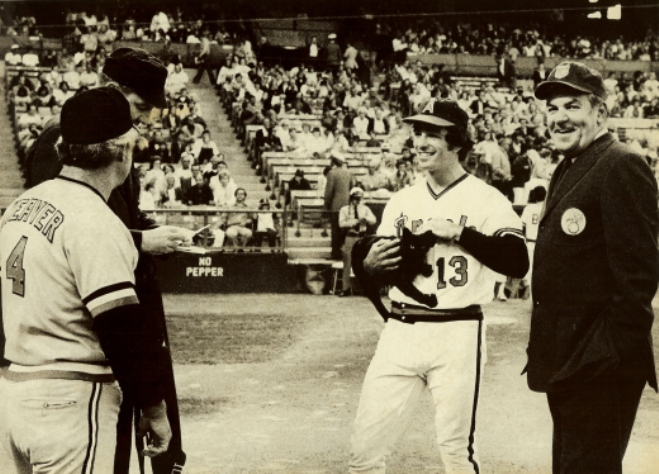
ANSWERS ADDED @ 6:00 p.m. PST
DATE: July 9, 1974.
LOCATION: Anaheim Stadium. Baltimore Orioles at California Angels.
SUBJECTS: (left to right) Earl Weaver, Bill Haller, Bobby Valentine, and Bill Kunkel. Weaver and Valentine were exchanging the lineup cards with home plate umpire Haller before the game. Third base ump Kunkel is enjoying the prank.
OCCASION: As Bob Timmermann correctly noted in the comments section below, "The Angels had lost 9 straight games and hoped that Valentine (wearing 13 and carrying a black cat) would change their luck. It didn't. They lost to the Orioles 3-1."
SPECIAL NOTES: Haller is the brother of former major league catcher Tom Haller. Bill umpired his first big league game when he was 26. He retired in 1982 after a 21-year career at the age of 47. Kunkel pitched for the Kansas City Athletics in 1961-63. Here is his 1962 Topps baseball card. He is the father of former Texas Rangers infielder Jeff Kunkel. Bill had just celebrated his 38th birthday two days before that photo was taken. He died 11 years later.

BONUS PHOTO: Not only was Valentine, in his #13 jersey, carrying a black cat but he walked underneath a ladder on his way to home plate. Ellie Rodriguez and Bob Oliver (right-hand side) and my Dad (far left) look on from the dugout.
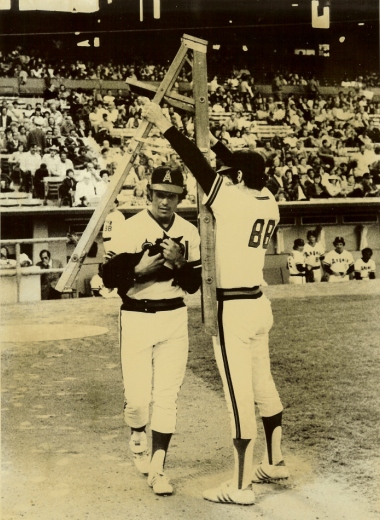
| Baseball Beat | October 30, 2006 |
St. Louis Cardinals: Onward Ho!
While the Redbird Nation rightfully celebrates its World Series championship, I'm going to jump ahead and take an in-depth look at the future of the Cardinals.
The fact that St. Louis won the World Series shouldn't have come as a complete surprise to anyone. The Cardinals made it to the Fall Classic in 2004 and the National League Championship Series in 2005. Before the season began, the Cardinals were the heavy favorites to win the NL Central and appeared to have the easiest road to this year's World Series of any team in baseball.
The club's roster was lined with several stars, including Albert Pujols, the best player in the game today, and Chris Carpenter, the 2005 NL Cy Young Award winner. The Cards also had veterans Scott Rolen and Jim Edmonds, possessors of 14 Gold Gloves between them and still among the best at their positions in the league, as well as a solid #2 in Mark Mulder (16-8, 3.64 in 2005) and a proven closer in Jason Isringhausen (2.14 with 39 saves).
If anything, the Cardinals were a bit top heavy going into the season. The team was noticeably weak at 2B, LF, and the 5th SP. Junior Spivey was signed in December but had a terrible spring (10-for-68 with only 2 XBH and 20 SO) and was cut. Manager Tony La Russa then turned to Aaron Miles and utilityman Hector Luna as a stop gap until GM Walt Jocketty acquired Ronnie Belliard at the trading deadline. So Taguchi and John Rodriguez took turns in left during the first half, while rookie Chris Duncan, who turned out to be a pleasant surprise, and Scott Spiezio split time down the stretch.
Sidney Ponson was given first crack at the #5 spot in the rotation but was released in July. St. Louis picked up Jeff Weaver, who put up numbers (5-4, 5.18, 1.50 WHIP) more similar to Ponson (4-4, 5.24, 1.62) than not, yet survived the season and wound up winning one game in each of the NLDS, NLCS, and World Series.
As things turned out, it wasn't so much that the Cardinals won it; rather, it was how they won it. Pujols slugged 25 HR in April and May, then went on the DL and missed 15 games with a strained right oblique. Rolen, who was relatively healthy in the aftermath of an injury-plagued 2005, played with a bum shoulder in September (.227/.299/.398) and was benched twice in the playoffs. Edmonds was sidelined for six weeks with post-concussion syndrome and World Series MVP David Eckstein sat out more than a month, not starting 35 of the final 40 games of the year.
Mulder missed all of July, came back and got ripped in two abbreviated starts in August and underwent shoulder surgery in September. Isringhausen went down with a bad hip and also had a season-ending operation the same week as Mulder.
It took everything the team had just to hold off the Houston Astros at the wire and put itself in a position to win the city's first World Series championship in 24 years. Suffice it to say that more people saw it coming in April than in September.
With that backdrop, let's drill down into the roster and examine how things stack up for next year. The Cardinals have eight players under contract for a total commitment of $58.2 million. (The team's opening day payroll in 2006 was approximately $89M.)
Player Salary Status
Albert Pujols $15.00M Signed thru 2010 (club option for 2011)
Scott Rolen 12.00 Signed thru 2010
Jason Isringhausen 8.75 Signed thru 2007 (club option for 2008)
Chris Carpenter 7.00 Signed thru 2007 (club option for 2008)
Juan Encarnacion 5.00 Signed thru 2008
Braden Looper 4.50 Signed thru 2008
David Eckstein 4.50 Signed thru 2008
Ricardo Rincon 1.45 Signed thru 2008
$58.20M
The Cardinals also control a number of players, including pitchers Randy Flores, Josh Hancock, Tyler Johnson, Josh Kinney, Anthony Reyes, Brad Thompson, and Adam Wainwright; catcher Yadier Molina; infielder Aaron Miles; and outfielders Chris Duncan, John Rodriguez, and So Taguchi. Other than Taguchi ($825,000), all of the above players earned no more than $400,000 (with 10 of the 12 within 10% of the minimum salary of $327,000). Only Taguchi and Miles are eligible for arbitration.
Based on the above, the Redbirds - absent trades, non-tenders, or outright releases - could return 20 players from the 2006 championship team. With the minimum salary increasing to $380,000 next season, the Cardinals are already on the hook for roughly $65M in 2007. This figure is based on the $58.2M plus the following estimates:
Player Salary
So Taguchi $1.000M
Yadier Molina 0.800
Adam Wainwright 0.650
Anthony Reyes 0.500
Chris Duncan 0.500
Aaron Miles 0.500
John Rodriguez 0.425
Randy Flores 0.425
Josh Hancock 0.425
Tyler Johnson 0.425
Josh Kinney 0.425
Brad Thompson 0.425
$6.500M
Flores, Hancock, Johnson, Kinney, and Thompson should all draw similar salaries, somewhere in the range of $400-450K. In the meantime, I doubled Molina's and Wainwright's 2006 salaries and bumped up Reyes and Duncan by 50%. If one player makes a little bit more or less than these projections, it won't have much effect on the team's total.
Should Bill DeWitt, Jr. choose to maintain a payroll in the neighborhood of $90 million, it will mean that the organization can spend approximately $25M to fill out its roster. Let's take a peek at which holes need to be filled before speculating as to where the money should be spent.
C: Molina
1B: Pujols
2B: Miles
3B: Rolen
SS: Eckstein
LF: Duncan
Rodriguez
CF: Taguchi
RF: Encarnacion
SP: Carpenter
Reyes
Wainwright
RP: Isringhausen
Looper
Rincon
Flores
Hancock
Johnson
Kinney
Thompson
One of the first orders of business is to make a decision on whether or not to exercise the option on Jim Edmonds. The Cardinals can re-sign the 36-year-old center fielder for $10M or buy out his contract for $3M. As such, the real cost to bringing back Edmonds for one more season is $7M. Can Walt Jocketty find a suitable replacement offensively and defensively for that kind of dough? I highly doubt it. As a result, I believe it makes sense to keep Edmonds in the fold.
The club also needs to decide Wainwright's future. Should they keep him as the closer or convert him to a starting pitcher? If Wainwright can be successful throwing at least 100 pitches per outing, wouldn't it be a better use of his talent to make him a starter? Sure, he may not be able to throw that hammer curve and a 94-mph heater all game, but 91-93 with a "plus-plus" breaking ball should work just fine.
Once Wainwright's fate is determined, management will know how many starting pitchers are needed. Re-signing Jeff Suppan and Jeff Weaver may be the path of least resistance although I would be surprised if the budget is such as to accommodate both. Suppan is an average pitcher who could easily command a three-year, $21-24M deal as a free agent in a market that is ripe with cash. Weaver is represented by Scott Boras and is likely to seek a similar deal even though he would have been hard pressed a couple of months ago to find a team that would be willing to give him anything more than a one-year, $3-4M "take it or leave it" offer.
A starting rotation of Carpenter, Wainwright, Suppan, Reyes, and a low-cost option would be a reasonable fivesome. The bullpen is a different matter. Isringhausen, 34, is coming off his second hip operation in two years and may not be ready when the season opens next spring. If Izzy is healthy, the Cardinals should try and get one more year out of him. Otherwise, Jocketty might be well served to trade the defensively challenged Duncan to an AL team for a set-up man who could step into the closer role if given the opportunity. Brian Gunn has suggested Pat Neshek or Fernando Rodney as the type of relievers the Cardinals may wish to target.
OK, let's see where St. Louis stands with respect to that $25M in discretionary funds. Give $7M net to Edmonds and $7-8M to Suppan, leaving $10-11M for three other players - a starting 2B, a #5 SP, and perhaps a LF (to replace Duncan if traded).
Ronnie Belliard made $4M last year. I don't think the Cardinals will allocate more than that for a second baseman. Belliard didn't hit too well in his stint with the 'Birds but should be good for .270/.330/.400 type production. Other options include Craig Biggio, Ray Durham, Adam Kennedy, and Mark Loretta. Biggio, Kennedy, and Loretta all made between $3-4M last year.
With the remaining $6-8M, I might be inclined to offer Luis Gonzalez $5M for one year with a club option for 2008. Gonzo supposedly wants to stay in the NL and may value the opportunity to get back to the World Series one more time. He is obviously in the decline phase of his career but still hit .264/.345/.427 on the road. Another slightly younger and more athletic possibility would be Jay Payton (.296/.325/.418), who might be able to command a 2x5 offer.
As far as the fifth starter goes, reaching out to Mulder with an incentive-based deal seems like a prudent course of action to me. If he doesn't pan out, Jocketty could try to pick up someone else off the scrap heap or give Brad Thompson a shot. The latter throws strikes and induces a lot of groundballs. There are worse options than him.
Shake it all up and it's possible that the 2007 Cardinals could be just as good as the 2006 model. Such a team, if healthy, should win more than 83 games but not necessarily another World Series championship.
Update: For more on the Cardinals, be sure to read Brian Gunn's How the Cardinals Shocked the World and Won the World Series at The Hardball Times and Larry Borowsky's Right as Rain post at Viva El Birdos that details how the pitchers stepped up during the playoffs.
| Baseball Beat | October 29, 2006 |
. . . And Then There Was One
The St. Louis Cardinals. The only team that won 11 postseason games. The only playoff team that won its last game. The only team whose players can say they are the 2006 World Series champions.
Who'da thunk four weeks ago? The Cardinals barely made the playoffs, holding off the Houston Astros on the final weekend of the season to capture the National League Central title. St. Louis (83-78) entered postseason play with the third-worst record ever and emerged as the World Series champ with the lowest winning percentage of all time.
Better to get pinned with that label than to win 116 games like the Seattle Mariners in 2001 and the Chicago Cubs in 1906 and not win the World Series. Flags fly forever. The number of victories just becomes a piece of trivia. Quick, how many regular-season games did the 1982 St. Louis Cardinals win on the way to their last championship? The answer is 92 but nobody really cares anymore.
There are only two things that matter: (1) making the postseason and (2) winning your last game. Do both of those and you can call yourselves World Series champs.
The Redbirds went into the Fall Classic as heavy underdogs. The Detroit Tigers, winners of 95 games during the season and seven in a row in the playoffs, were made 2:1 favorites to win the World Series. The American League destroyed the National League in inter-league play this year, going 154-98 (.611). The AL had also shown its superiority of late by winning 10 straight All-Star Games and 10 of the past 14 World Series. The poor team from the NL didn't stand a chance or so most pundits and fans thought.
The fact that the Tigers had six days off going into the World Series received a lot of attention - and for good reason. The last half dozen teams with five or more days of rest all went on to pop champagne corks in the locker room following their final game. But there were a couple of trends working against Detroit. Five of the six division and league championship series in 2006 were won via upsets (with only the Mets' sweep of the Dodgers in the NLDS going by the book). Moreover, the team with the lower win total during the regular season had captured the World Series title more often than not since the introduction of divisions in 1969.
Thanks to the Cardinals, the team with the inferior record has now won 3-of-the-last-4, 6-of-the-last-8, 10-of-the-last-14, and 21-of-the-last-37 World Series. Call it mystifying. Call it exciting. Or do as Billy Beane and call it a crapshoot or "five hands of blackjack." Roll the dice or deal the cards. The recipe is pretty straightforward. Make the postseason, give your club a 1-in-8 chance to win it all, get hot, and earn the right to tell the world that the reason you won was because your team pulled together when it mattered most. It's as simple as that.
The Cardinals won the NL Central, then played their best baseball of the season in beating the Padres in the NLDS, the Mets in the NLCS, and the Tigers in the World Series. Make no mistake about it, St. Louis won it all fair and square. The team did just enough from April through September and everything asked of it during October. St. Louis was the only team to win all three of its postseason series and that, my friends, is all that matters.
Sure, some people will say that Detroit didn't hit or field or run the bases well. And you know what? Those folks are right. But rather than calling the Tigers out for losing the Series, why not give credit where credit is due? St. Louis beat Detroit four games to one. The Yankees didn't do that. The A's didn't do that. And the Cardinals didn't give the Padres or the Mets a chance to do that either.
The St. Louis Cardinals. The only team that won 11 postseason games. The only playoff team that won its last game. The only team whose players can say they are the 2006 World Series champions. Congratulations to management, the players, the city of St. Louis, and Redbird Nation.
Part Two: Monday. An in-depth look at the Cardinals and how they stack up for 2007.
| Baseball Beat | October 25, 2006 |
Net Stolen Bases: Leaders and Laggards
Back in March 2005, I introduced the concept of the net stolen base. The idea was founded on rewarding players for SB and penalizing them for CS. The original formula was SB - (2 * CS) = Net SB. In this year's version, I have also included pickoffs. The updated formula is now SB - (2 * (CS + PO)).
The number of stolen bases, as a standalone stat, is misleading. It is somewhat like hits. If you don't know the number of at-bats, it is hard to put the the number of hits into context. As a result, when looking at SB, we need to know the number of attempts. Stolen bases as a percentage of attempts gives us a rate stat similar to batting average. However, in order to add value, a player needs to be successful stealing bases much more often than just 51% of the time. You see, CS is a double-edged sword. A runner who is cut down trying to steal not only produces an out, but he also removes himself from the base paths. As a result, we need to penalize him for the out as well as the lost baserunner.
In one of many studies on the value of stolen bases, James Click demonstrated that the breakeven point for stealing second base is approximately 73%, and it ranges from 70% to 93% (depending upon the number of outs) for stealing third base.
OUTS STOLEN BASE BREAKEVEN 0 Second 73.2% 1 Second 73.1% 2 Second 73.2% 0 Third 74.8% 1 Third 69.5% 2 Third 92.7%
The above breakeven points may zig and zag a percentage point or two from one season to the next, but the basic premise is the same year in and year out. When stealing bases, a player needs to be successful somewhere between 70-75% of the time. If not, he is doing more harm than good by attempting to steal bases. Sure, there are some other factors at play here, mainly the game context (i.e., the score, the number of outs, who's pitching, who's catching, and who's at bat). But, generally speaking, a baserunner needs to be called safe nearly three times as often as out when attempting to take those extra 90 feet.
Before we get ahead of ourselves here, let's take a look at the past season's stolen base leaders.
2006 STOLEN BASE LEADERS
PLAYER TEAM SB 1 Jose Reyes NYM 64 2 Juan Pierre ChC 58 Carl Crawford TB 58 4 Chone Figgins LAA 52 5 Hanley Ramirez Fla 51 6 Dave Roberts SD 49 7 Ichiro Suzuki Sea 45 Corey Patterson Bal 45 9 Felipe Lopez Was 44 10 Alfonso Soriano Was 41 11 Scott Podsednik CWS 40 12 Rafael Furcal LAD 37 Ryan Freel Cin 37 14 Jimmy Rollins Phi 36 Brian Roberts Bal 36 16 Derek Jeter NYY 34 17 Willy Taveras Hou 33 18 Kenny Lofton LAD 32 19 Bobby Abreu NYY 30 20 Orlando Cabrera LAA 27 21 Chris Duffy Pit 26 22 Johnny Damon NYY 25 Mike Cameron SD 25 Luis Castillo Min 25 Eric Byrnes Ari 25 Brandon Phillips Cin 25
Jose Reyes led the major leagues in SB with 64. Carl Crawford led the American League with 58. The question is: How valuable were these stolen bases?
Here are the stolen base leaders in the context of caught stealing, pick offs, and net SB.
SB LEADERS WITH CS AND PO TOTALS
PLAYER TEAM SB CS PO NET SB* 1 Jose Reyes NYM 64 17 3 24 2 Juan Pierre ChC 58 20 0 18 Carl Crawford TB 58 9 1 38 4 Chone Figgins LAA 52 16 0 20 5 Hanley Ramirez Fla 51 15 0 21 6 Dave Roberts SD 49 6 3 31 7 Ichiro Suzuki Sea 45 2 1 39 Corey Patterson Bal 45 9 0 27 9 Felipe Lopez Was 44 12 1 18 10 Alfonso Soriano Was 41 17 2 3 11 Scott Podsednik CWS 40 19 2 - 2 12 Rafael Furcal LAD 37 13 0 11 Ryan Freel Cin 37 11 4 7 14 Jimmy Rollins Phi 36 4 0 28 Brian Roberts Bal 36 7 2 18 16 Derek Jeter NYY 34 5 0 24 17 Willy Taveras Hou 33 9 2 11 18 Kenny Lofton LAD 32 5 0 22 19 Bobby Abreu NYY 30 6 1 16 20 Orlando Cabrera LAA 27 3 0 21 21 Chris Duffy Pit 26 1 1 22 22 Johnny Damon NYY 25 10 0 5 Mike Cameron SD 25 9 0 7 Luis Castillo Min 25 11 1 1 Eric Byrnes Ari 25 3 2 15 Brandon Phillips Cin 25 2 2 17
* Net SB = SB - (2 * (CS + PO))
Based on Click's work, I could have used SB - (3 * (CS + PO)) rather than SB - (2 * (CS + PO)) to come up with a 75% breakeven point. However, I chose to err on the side of conservatism, plus I think it is slightly easier to compute the net number in your head using two times rather than three. When possible, remember to keep it simple, stupid. So, in honor of KISS, we will use the Deuce in our formula.
Based on the adjusted stolen base totals, the top 10 most efficient base stealers were as follows:
MOST EFFICIENT BASE STEALERS
PLAYER TEAM NET SB 1 Ichiro Suzuki Sea 39 2 Carl Crawford TB 38 3 Dave Roberts SD 31 4 Jimmy Rollins Phi 28 5 Corey Patterson Bal 27 6 Jose Reyes NYM 24 Derek Jeter NYY 24 8 Kenny Lofton LAD 22 Chris Duffy Pit 22 10 Hanley Ramirez Fla 21 Orlando Cabrera LAA 21
Ichiro Suzuki and Carl Crawford were the most efficient base stealers last year. Both combined quantity with efficiency. Feel free to add Dave Roberts if you're interested in the NL leader in this category.
Using the same forumula, we can also determine the least efficient base stealers.
LEAST EFFICIENT BASE STEALERS
PLAYER TEAM SB CS PO NET SB 1 Jamey Carroll Col 10 12 3 -20 2 Jeff Francoeur Atl 1 6 1 -13 3 Bill Hall Mil 8 9 1 -12 4 Jose Bautista Pit 2 4 2 -10 5 Reggie Abercrombie Fla 6 5 2 - 8 Ronny Cedeno ChC 8 8 0 - 8 Dan Uggla Fla 6 6 1 - 8 8 Magglio Ordonez Det 1 4 0 - 7 Yuniesky Betancourt Sea 11 8 1 - 7 Ryan Zimmerman Was 11 8 1 - 7 David Eckstein StL 7 6 1 - 7
Every player on the list above is literally costing his team outs and potentially runs and even wins. Jamey Carroll, Yuniesky Betancourt, and Ryan Zimmerman may have pleased their fantasy baseball owners in the stolen base department last year, but they were a net negative for their real owners with respect to stealing bases. Using Carroll as an example illustrates the point. The little second baseman stole 10 bases last year, but he also finished among the top 10 in CS (12) and was tied for second in PO (3). In other words, he cost the Rockies 15 outs while removing himself from the bases 15 times. Shake it all up and our formula suggests that Carroll was worth minus 20 bases when attempting to steal in 2006.
As it relates to the NL Rookie of the Year balloting, if you are at all torn among Hanley Ramirez, Dan Uggla, and Zimmerman, look no further than their net SB as perhaps a tie breaker. Ramirez contributed a net positive 21 bases - good for 10th best in MLB - while Uggla and Zimmerman cost their teams 8 and 7 bases, respectively, for a net differential of nearly 30 bases.
Jeff Francoeur is a certified out maker. He was third in the NL and fourth overall in outs (defined as AB - H + CS + GIDP + SH + SF) last year. He had a poor OBP (.293) and SB% (14%). A good athlete, Francoeur lacks discipline at the plate and on the bases. Oh, his ceiling is high. But he has more holes than Pinehurst in his game at the moment.
Looking at net stolen bases can be valuable in so many ways. For example, if a team wants to sign Alfonso Soriano to a huge long-term contract, I just hope that management realizes what it's getting or not getting, as the case may be. Every serious baseball fan knows by now that Soriano became just the fourth player to hit 40 home runs and steal 40 bases in the same season. But, if the truth be known, he wasn't much of an asset when attempting to steal bases in 2006. At best, Alfonso turned in an ever so slightly positive net SB contribution last year.
Worse yet is Scott Podsednik, whose claim to fame to date has been stealing bases. Although the Chicago White Sox left fielder stole 40 bases, he was a net liability in this department. Yep, you read that right. Podsednik was caught or picked off 21 times, resulting in a net contribution of minus 2 bases. If Podsednik's not helping you on the base paths, where is he adding value? Certainly not with the bat (.261/.330/.353).
Net stolen bases can also be used at the team level. Here is a ranking from top to bottom based on the offensive side of the equation (exclusive of pickoffs).
TEAM SB CS NET SB 1 NY Mets 146 35 76 2 NY Yankees 139 35 69 3 San Diego 123 31 61 4 Cincinnati 124 33 58 5 Baltimore 121 32 57 6 Philadelphia 92 25 42 7 LA Angels 148 57 34 8 Seattle 106 37 32 9 LA Dodgers 128 49 30 Tampa Bay 134 52 30 11 Chicago Cubs 121 49 23 12 Pittsburgh 68 23 22 13 Oakland 61 20 21 14 Minnesota 101 42 17 15 Arizona 76 30 16 16 Cleveland 55 23 9 17 San Francisco 58 25 8 18 Houston 79 36 7 19 Texas 53 24 5 Boston 51 23 5 21 Toronto 65 33 - 1 Washington 123 62 - 1 23 Chicago Sox 93 48 - 3 Kansas City 65 34 - 3 Milwaukee 71 37 - 3 26 St. Louis 59 32 - 5 27 Florida 110 58 - 6 28 Colorado 85 50 -15 29 Atlanta 52 35 -18 30 Detroit 60 40 -20
The Mets, Yankees, and Padres - playoff teams all - were 1-2-3 in the majors. The Tigers and Cardinals - battling each other in the World Series - ranked among the bottom five.
Now let's take a look at the defensive side of the picture.
TEAM SB CS NET SB
1. Florida 69 46 -23
2. Detroit 49 35 -21
3. Baltimore 80 50 -20
Cincinnati 50 35 -20
5. Texas 67 40 -13
6. Minnesota 54 31 - 8
7. Seattle 72 38 - 4
8. LA Angels 77 40 - 3
9. Kansas City 58 30 - 2
Pittsburgh 102 52 - 2
NY Yankees 92 47 - 2
12. St. Louis 63 32 - 1
13. Arizona 90 45 0
14. Oakland 88 41 6
15. Colorado 99 42 15
16. Tampa Bay 108 46 16
17. San Francisco 98 40 18
18. Houston 78 28 22
19. Philadelphia 94 35 24
20. NY Mets 111 40 31
21. LA Dodgers 110 38 34
22. Milwaukee 97 31 35
23. Chicago Cubs 118 39 40
24. Atlanta 101 30 41
25. Chicago Sox 116 34 48
26. Washington 110 30 50
27. Cleveland 128 34 60
28. Boston 108 23 62
29. Toronto 130 32 66
30. San Diego 150 26 98
Detroit, as one would expect, doesn't look so bad here. The Tigers do a pretty good job at holding runners and Pudge Rodriguez has been one of the best catchers ever at throwing out runners attempting to steal. San Diego, on the other hand, looks downright awful. Mike Piazza, without a doubt the best-hitting catcher of all time, has never been known for his defensive prowess, especially his arm.
Netting out the offensive and defensive contributions for each team produces the following results:
TEAM OFF DEF NET 1 Cincinnati 58 -20 78 2 Baltimore 57 -20 77 3 NY Yankees 69 - 2 71 4 NY Mets 76 31 45 5 LA Angels 34 - 3 37 6 Seattle 32 - 4 36 7 Minnesota 17 - 8 25 8 Pittsburgh 22 - 2 24 9 Philadelphia 42 24 18 Texas 5 -13 18 11 Florida - 6 -23 17 12 Arizona 16 0 16 13 Oakland 21 6 15 14 Tampa Bay 30 16 14 15 Detroit -20 -21 1 16 Kansas City - 3 - 2 - 1 17 LA Dodgers 30 34 - 4 St. Louis - 5 - 1 - 4 19 San Francisco 8 18 -10 20 Houston 7 22 -15 21 Chicago Cubs 23 40 -17 22 Colorado -15 15 -30 23 San Diego 61 98 -37 24 Milwaukee - 3 35 -38 25 Cleveland 9 60 -51 Washington - 1 50 -51 Chicago Sox - 3 48 -51 28 Boston 5 62 -57 29 Atlanta -18 41 -59 30 Toronto - 1 66 -67
Seven of the eight playoff teams were essentially even to plus in terms of their effectiveness in stealing bases and preventing stolen bases. Only the Padres were hugely negative.
Whether plus or minus, keep in mind that stolen bases are worth less than one-half of a base per game to the best and worst teams. The difference between the #1 club (Cincinnati) and the #30 (Toronto) approaches one base per game - not insignificant but a relatively minor matter when compared to the disparities between the best and worst teams with respect to pitching, hitting, and fielding.
In closing, it is important to make two points:
1. Stolen bases are not as valuable in today's high-scoring environment as they were in the Dead Ball era or during the pitching-dominated 1960s and early 1970s.
2. Outs are more precious today than ever before.
As a result, pay attention to both quantity and quality. The net stolen base concept does a good job at doing just that.
| Baseball Beat | October 23, 2006 |
Open Chat: PineTarGate
We have two posts for you today. Two-for-the-price-of-none. A World Serious special.
First of all, be sure to read Al Doyle's feature on Mickey Lolich, entitled The "Fat Man's Hero" and the 1968 World Series. It's a good read, whether you remember following the series back then or for those of you who may not have been born quite yet.
Secondly, let's turn this entry over to the readers with a return of the Open Chat that was unveiled last week.
The Cardinals won the first game behind the solid pitching of Anthony Reyes, who was backed by an early two-run HR by Albert Pujols. The Tigers came back and took the second game with Kenny Rogers turning in another masterful start in October. He has now joined Christy Mathewson as the only pitchers to make three starts in the postseason without allowing a run. Mathewson, of course, threw three shutouts in the 1905 World Series.
Rogers had either a "clump of dirt" or pine tar on his pitching hand. I don't know about you but is this dirt? If it was a one-time thing, I might say "ehh, maybe." But ESPN ran video clips after the game that clearly showed Rogers with pine tar in the same spot on his pitching hand in every postseason start this year. Coincidence? I think not!
My first question to you is:
For some background info on the subject, here is how Rule 8.02 reads: "The pitcher shall not . . . (b) Have on his person, or in his possession, any foreign substance. For such infraction of this section (b) the penalty shall be immediate ejection from the game. In addition, the pitcher shall be suspended automatically for 10 games."
There is a precedent for ejecting a pitcher for the use of a foreign substance in a postseason game. Jay Howell, a reliever for the Los Angeles Dodgers, was ejected and suspended for two games in the 1988 National League Championship Series. Don't ask me why it was two games rather than 10. (Tip of the hat to Viva El Birdos.)
Some folks might argue that Rogers shut out the Cardinals for seven more innings after washing off the clump of dirt (as he called it). Well, who is to say that Rogers didn't simply transfer the pine tar to his glove or the bill of his cap? Could this help explain why he has suddenly turned into Whitey Ford in the ALDS, ALCS, and World Series? I mean, it's not like this guy is without controversy.
My second question is:
Thirdly, speaking of TLR. . .
It's all yours. Have at it.
| Baseball Beat | October 21, 2006 |
2006 World Series: Tale of the Tape
After two months of spring training, six months of regular season play, and more than two weeks of the division and championship series playoffs, the time has come for the Detroit Tigers and St. Louis Cardinals to put their gloves on and square off in the 102nd World Series.
We bring you all the facts and figures, including the schedule (with projected starting pitchers), stats, lineups, and more.
DETROIT TIGERS
95-67, Finished 2nd in AL Central Division
Scored 822 Runs, Allowed 675 Runs (Pythagorean W-L: 95-67)
Won ALDS (3-1) over the New York Yankees
Won ALCS (4-0) over the Oakland A's
10th World Series (4-5)
Last Appearance: 1984 (Beat SD in five games)
Ballpark: Comerica Park (Park Factor - 99)
ST. LOUIS CARDINALS
83-78, Finished 1st in NL Central Division
Scored 781 Runs, Allowed 762 Runs (Pythagorean W-L: 82-79)
Won NLDS (3-1) over the San Diego Padres
Won NLCS (4-3) over the New York Mets
17th World Series (9-7)
Last Appearance: 2004 (Lost to BOS in four games)
Ballpark: Busch Stadium III (Park Factor - 98)
The last time the Tigers and Cardinals met in the World Series was in 1968 when Detroit fought back from a 3-1 deficit and won Games 5, 6, and 7 to capture the title. Mickey Lolich won three games, including the finale on two days' rest.
SCHEDULE
Game 1: Saturday, October 21 @ Detroit, 8:03 p.m. ET - Anthony Reyes (5-8, 5.06) vs. Justin Verlander (17-9, 3.63)
[According to the Elias Sports Bureau, it's the first time in World Series history that each team will start a rookie pitcher in the opening game.]
Game 2: Sunday, October 22 @ Detroit, 8:23 p.m. ET - Jeff Weaver (8-14, 5.76) vs. Kenny Rogers (17-8, 3.84)
Game 3: Tuesday, October 24 @ St. Louis, 8:33 p.m. ET - Nate Robertson (13-13, 3.84) vs. Chris Carpenter (15-8, 3.09)
Game 4: Wednesday, October 25 @ St. Louis, 8:27 p.m. ET - Jeremy Bonderman (14-8, 4.08) vs. Jeff Suppan (12-7, 4.12)
Game 5: Thursday, October 26 @ St. Louis, 8:27 p.m. ET
Game 6: Saturday, October 28 @ Detroit, 7:57 p.m. ET
Game 7: Sunday, October 29 @ Detroit, 8:00 p.m. ET
* all games on Fox
REGULAR SEASON STATS
Hitting:
NAME G AB R H 2B 3B HR TB RBI BB SO SB CS AVG OBP SLG OPS Tigers 162 5642 822 1548 294 40 203 2531 785 430 1133 60 40 .274 .329 .449 .777 Opp 162 5535 675 1420 263 38 160 2239 642 489 1003 49 35 .257 .321 .405 .725
NAME G AB R H 2B 3B HR TB RBI BB SO SB CS AVG OBP SLG OPS Cards 161 5522 781 1484 292 27 184 2382 745 531 922 59 32 .269 .337 .431 .769 Opp 161 5496 762 1475 310 34 193 2432 735 504 970 63 32 .268 .337 .443 .779
Pitching:
NAME G GS W L Sv QS IP H R ER HR BB SO K/9 P/GS WHIP ERA Tigers 162 162 95 67 46 88 1448 1420 675 618 160 489 1003 6.23 94.1 1.32 3.84
NAME G GS W L Sv QS IP H R ER HR BB SO K/9 P/GS WHIP ERA Cards 161 161 83 78 38 74 1430 1475 721 762 193 504 970 6.11 92.8 1.38 4.54
POSTSEASON STATS
Hitting:
NAME G AB R H 2B 3B HR TB RBI BB SO SB CS AVG OBP SLG OPS Tigers 8 276 44 82 19 1 13 142 44 26 47 3 2 .297 .353 .514 .867 Opp 8 265 23 62 14 0 8 100 23 22 52 1 1 .234 .302 .377 .680
NAME G AB R H 2B 3B HR TB RBI BB SO SB CS AVG OBP SLG OPS Cards 11 351 42 90 12 5 11 145 40 36 54 6 3 .256 .337 .413 .750 Opp 11 363 33 83 19 3 8 132 33 40 70 7 1 .229 .311 .364 .674
Pitching:
NAME G GS W L Sv QS IP H R ER HR BB SO K/9 P/GS WHIP ERA Tigers 8 8 7 1 3 0 71 62 23 23 8 22 52 6.59 100.4 1.18 2.92
NAME G GS W L Sv QS IP H R ER HR BB SO K/9 P/GS WHIP ERA Cards 11 11 7 4 3 0 97 83 32 33 8 40 70 6.49 93.1 1.27 2.97
PROJECTED LINEUPS
Detroit:
AVG OBP SLG OPS+
1. Curtis Granderson, CF .260 .335 .438 99
2. Placido Polanco, 2B .295 .329 .364 81
3. Sean Casey, DH .272 .336 .388 87
4. Magglio Ordonez, RF .298 .350 .477 113
5. Carlos Guillen, 1B .320 .400 .519 137
6. Ivan Rodriguez, C .300 .332 .437 98
7. Craig Monroe, LF .255 .301 .482 100
8. Brandon Inge, 3B .253 .313 .463 99
9. Ramon Santiago, SS .225 .244 .262 32
St. Louis:
AVG OBP SLG OPS+
1. David Eckstein, SS .292 .350 .344 81
2. Scott Spiezio, LF .272 .366 .496 121
3. Albert Pujols, 1B .331 .431 .671 180
4. Jim Edmonds, CF .257 .350 .471 111
5. Juan Encarnacion, RF .278 .317 .443 94
6. Scott Rolen, 3B .296 .369 .518 127
7. Preston Wilson, DH .263 .307 .423 84
8. Yadier Molina, C .216 .274 .321 54
9. Ronnie Belliard, 2B .272 .322 .403 88
FACTS AND FIGURES
Seven of the nine teams in baseball history to start the Series with five days off went on to win. The only losers were the 1988 Oakland Athletics (to the Los Angeles Dodgers) and the 1990 A's (to Cincinnati). Both were managed by Tony La Russa.
Detroit manager Jim Leyland sums it up best, "Do I think overall, by the looks of things, that the American League was a stronger league this year? Yes, I do. Do I think that it goes in cycles? Yes, I do. Do I think that has anything to do with this World Series? Not one damn thing. Nothing."
Play Ball!
Predictions, anyone?
| Baseball Beat | October 17, 2006 |
Open Chat: Alex Rodriguez and Aramis Ramirez
News Items
Questions
1. Will Alex Rodriguez waive the no-trade clause in his contract and agree to a trade with the Cubs?
2. If you were Jim Hendry, what would you offer for A-Rod?
3. If you were Brian Cashman, what would you ask for in return?
4. Will Aramis Ramirez opt out of his contract and sign with the Yankees? Or the Angels? Or will he stay put in the Windy City?
FWIW: TradeSports.com is taking action on whether Alex Rodriguez will start the 2007 season as a Yankee. Go to Trading Categories on the left-hand side of the site > Baseball > MLB Reg Season Props. As of late last night, the bid was 70 and the offer was 79.5 with the last trade at 70.
You provide the answers in the comments section below.
| Baseball Beat | October 16, 2006 |
Lyons and Tigers and Berra. . .Oh, My!
News Item: Fox fires baseball broadcaster Steve Lyons for making a racially insensitive comment directed at colleague Lou Piniella's Hispanic heritage on the air during Game 3 of the American League Championship Series.
Response: I have never cared for Lyons - as a player, a color analyst, or as an in-studio commentator - and I don't condone his comments in this instance. That said, I believe Fox overreacted by firing him.
In these politically correct times, we have simply become overly sensitive about such comments, especially when the subject matters are on the American Civil Liberty Union's protected list. I believe a reprimand or even a suspension (if he had been reprimanded before) would have been more suitable.
Wondering if I was being insensitive, I shared the news with my brothers via email in the hopes of getting another view on the matter. Neither one of them is a red neck or anything close to it. In fact, I believe my older brother Tom is as objective and fair as they come. My younger brother Gary is principled and culturally sensitive. In short, they would both make excellent jurors or even arbiters.
Tom wrote back, "I thought it was a very stupid comment" and went on to elaborate as to the whys and wherefores.
My son Joe, who I also included as a recipient of the original email, chimed in, "My question is 'What took so long?'"
Now it was Gary's turn. We were all online and the emails were being exchanged rather quickly. He wrote back, "While understanding the seriousness of racism and the like, this undersores the political correctness that is at hand." The example he then gave is priceless.
"I see, in the Tigers game, it's not OK for Lyons to say that Piniella was 'hablaing Espanol' and 'I still can't find my wallet,' albeit for cheap laughs . . .
. . . But what if Lyons had been working alongside Yogi Berra and Yogi said . . . (as he did about a hotel stay he recently had):
'The towels were so thick there I could hardly close my suitcase . . . but nobody ever goes there any more cuz it's always too crowded!'
Lyons then would add, 'Huh, was that English, Yogi? Come to think of it, Yogi, since you stayed at my house, my linen closet seems to be a bit lighter!'"
Gary concludes by adding, "I'm sure he would have been fired for that, too. Good grief! If I've learned one thing, you can observe a lot just by watching!"
Pretty good, huh? Oh, and I owe Gary a special thanks for the title to this post as well. He is pretty clever.
For more on the matter, including reactions by Lyons to his firing, be sure to read the L.A. Times version of the story.
| Baseball Beat | October 12, 2006 |
Taking a Critical Look at Leyland's Lineups
I was all prepared to write a positive article about Jim Leyland and his lineup creation in Game 1 of the ALCS.
. . . and then I saw Neifi Perez's name in the #2 hole in Game 2. Yes, the guy who hit .243/.260/.316 in 2006 and just .200/.235/.215 in 21 games and 65 at-bats with the Tigers was elevated from the bench to the second spot in the lineup.
I realize Leyland's hand was forced a bit once he learned that Sean Casey had a partial tear in a muscle in his left calf and would be unable to play in Game 2. With backup Chris Shelton not on the ALCS roster, Leyland improvised by sliding shortstop Carlos Guillen over to first base and inserting Perez with a 6 next to his name on the lineup card. The veteran manager's only other realistic option would have been to put Ramon Santiago at short. However, the 27-year-old is more like Perez than not, sporting a .225/.244/.263 line this year and .227/.292/.299 in 793 career AB.
Leyland chose his poison and went with Perez over Santiago. I have no problem with that. Neither player can hit so why not go with the better gloveman? If nothing else, Neifi can pick it. An ounce of run prevention is always worth a little more than an ounce of run creation.
What I don't get is why Leyland wrote down Perez's name in the batting order between Curtis Granderson's and Placido Polanco's. He is a liability with a bat in his hands. I don't want to hear that Perez has a history of hitting Esteban Loaiza well. Three singles in 10 AB doesn't overcome a career of offensive ineptitude.
The only rationale for putting Perez in that spot is to hope that Granderson gets on base and Neifi moves him over to second via a sacrifice bunt or to third on a groundout to the right side. That's all well and good if one wants to employ a "little ball" strategy, but the bottom line is that the likelihood of scoring more than one run in a particular inning nosedives when using outs to advance runners. There is a time and a place for productive outs, but I'm not an advocate of designing a lineup in today's higher run-scoring environment with this stragegy in mind.
To wit, what if Granderson doesn't get on base, which is about two-thirds of the time? Now you're left with a batter who has a lifetime OBP under .300 coming up next. In fact, Perez has never even had a single season away from Colorado with an OBP of .300. With the exception of pitchers, Neifi is about as close to an automatic out as there is in baseball. Placing him in the order where he has roughly a 1-in-9 chance of getting an extra plate appearance over the course of the game vis-a-vis the #3 hitter (Polanco), a 2-in-9 chance over the #4 hitter (Magglio Ordonez), a 3-in-9 chance over the #5 hitter (Carlos Guillen), etc. makes absolutely no sense whatsoever.
Granted, the Tigers beat the A's on Wednesday night - but they did so in spite of Leyland's lineup. After upsetting the New York Yankees in the ALDS, Detroit has now won the first two games of the ALCS. Whatever it is that they're doing, they're doing it well. Kudos to Leyland and his troops. However, I would argue that Detroit's margin of error is rather small, and it gets even smaller by batting Perez second. Look, this is a team that doesn't put many runners on base. Oh sure, they can hit for power, but the Tigers need all the help they can get when it comes to generating base runners.
As long as the club's pitching holds up, the Tigers will be just fine. Leyland has four capable starters and can run Fernando Rodney, Joel Zumaya, and Todd Jones out there in the seventh, eighth, and ninth innings. That threesome reminds me of the 2002 Angels with Scot Shields, Francisco Rodriguez, and Troy Percival. A couple of young power arms and a proven veteran to shorten ballgames in a hurry.
Pitching and defense. This combo has always been a good recipe for success - and never more so than in the postseason. There was a reason why Detroit was 76-36 on August 7. But let's not forget the fact that this same team was 19-31 in its last 50 games. To their credit, the Tigers have stepped up in October and are once again playing as if the calendar read April, May, June, and July when they were the best team in baseball.
Oh yes, I almost forgot. I liked Leyland's Game 1 lineup because he loaded up the back end with low on-base and high slugging types. Given the same personnel, there aren't too many managers who would have had the resolve to bat Craig Monroe (28 HR), Marcus Thames (26), and Brandon Inge (27) seventh, eighth, and ninth. Unfortunately, there are way too many skippers who would bat Perez second as Leyland did in Game 2.
| Baseball Beat | October 10, 2006 |
League Championship Series Predictions
The American and National League Championship series are upon us. Oakland vs. Detroit and New York vs. St. Louis. The A's have the home field advantage in the ALCS even though they didn't have it in the ALDS. The Mets, who were the only favorites to win last week, retain home field advantage in the NLCS.
There will be no predictions this time around. Not gonna go there again. No need to embarrass everyone - including myself - a second time. Once is enough.
If there was a lesson to be learned in the Division Series, it is this: Any MLB team can beat any other MLB team in a short series. Period. Better yet, put an exclamation point at the end of that sentence. And, while we're at it, let's put it all in caps and in bold and in a larger font size.
ANY MLB TEAM CAN BEAT ANY OTHER MLB TEAM IN A SHORT SERIES!
How's that?
Now that proclamation doesn't mean that "any MLB team will beat any other MLB team in a short series." There is a big difference. I'm not saying that the inferior team *will* win; rather, I'm saying that the inferior team *may* win. Everybody needs to remember that simple tenet. You. Me. The New York media. George Steinbrenner. Every. Body.
This isn't 1968. Bob Gibson and Mickey Lolich are retired. The Chicago Seven is nothing more than the Cubs starting rotation. And the Oakland Raiders sure as heck aren't going to be in the Super Bowl this year.
For the past 38 years. . .err. . .For 37 of the past 38 years, baseball has traded quality for quantity. More is better. More teams. More divisions. More series. More this. More that.
What were they thinking when they came up with the idea of the wild card? After a 162-game season, teams that did not win their division get another chance to win their league and win the World Series? What a country! Step right up! Everybody's a winner. Give everybody a participation trophy while we're at it. Nobody goes home a loser. (I can hear Jay Stewart now, telling the Tampa Bay Devil Rays that their consolation prize is the #1 pick in the June draft.)
The bottom line is that the postseason is no longer what it once was. Teams no longer play 154 or 162 games to determine who wins the pennant and goes to the World Series. Today, teams play nearly every day for six months so baseball can determine which EIGHT teams make the playoffs, including two clubs that weren't even good enough to beat out teams in their own division!
As a result of this more egalitarian system, the best teams no longer wind up in the World Series. In fact, wild cards have advanced to the Fall Classic in each of the past four years and five of the last six. The wild cards even won three championships in a row, including one in which both teams made it in through the back door.
2005: Chicago White Sox in four games over the Houston Astros*
2004: Boston Red Sox* in four games over the St. Louis Cardinals
2003: Florida Marlins* in six games over the New York Yankees
2002: Anaheim Angels* in seven games over the San Francisco Giants*
2000: New York Yankees in five games over the New York Mets*
* denotes wild card
Makes you want to put down some money on the Tigers, huh?
The whole point is that **** happens in the postseason. Teams with home field advantage can and do lose. Underdogs can and do win. Wild cards have as good of a chance to win as anyone else. Billy Beane was - and is - right: The playoffs are a crapshoot. Nothing less. Nothing more.
Oh, sure, you've got to get there. I understand that. But once you're there, the nature of the beast (five and seven game series) is such that any MLB team can beat any other MLB team in a short series. Period. Exclamation point.
| Baseball Beat | October 07, 2006 |
...and That's Why They Play the Games on the Field Rather Than on Paper
I believe in Jeremy Bonderman and am not surprised that the Tigers won today. However, I was blindsided by Detroit beating the New York Yankees in the American League Division Series. I'll tell ya, I just did not see that coming at all.
But so what? I also had the Twins defeating the A's. In other words, I'm 0-2 in my playoff predictions thus far. And I'm not looking too keen in the Padres-Cardinals series either.
As far as the Mets-Dodgers NLDS goes, I don't know who I had. I picked the Mets on Tuesday, then took the Dodgers on Wednesday when I learned of the injury to Orlando Hernandez. It wasn't that I was all that enamored with El Duque as much as I was concerned about the team's starting pitching depth.
Unfortunately for the Dodgers, they may not extend the series to get to Oliver Perez or John Maine a second time. L.A. is losing 4-2 through four innings as I write this. We know it will be the Tigers and A's in the American League Championship Series. The participants in the NLCS are still to be determined but odds would point to a Mets-Cardinals showdown right now. But the way things have gone thus far, who knows?
The last time Detroit and Oakland faced each other in the ALCS was in 1972. (Speaking of the 1972 Tigers, getting a chance to listen to Ernie Harwell call the action in the DET-NYY game on Friday night was a special treat.) Will 2006 turn out to be more like 1973 when the A's outlasted the Mets in the World Series in seven games or 1984 when the Tigers defeated the Padres in five? Dodger fans are no doubt hoping that a rematch of the 1988 Fall Classic is at hand. (In the meantime, Kirk Gibson is on standby, not knowing if he should dress in a Tigers' uniform or in a Dodgers' uni.)
More likely than not, 2006 will have its own script - one that none of us would have foreseen ahead of time . . . well, at least not me.
On a somewhat separate note, the Yankees' lineup in Game 4 seems like the death knell for Alex Rodriguez. I mean, batting eighth? Wow. I'm not going to jump all over A-Rod like many in the mainstream media. Instead, I'm just making an observation about how he is being used more than anything else. If you ask me, the guy is as good as gone. Rightly or wrongly, I don't see him in pinstripes next year.
Do you think Rodriguez *will* be back with the Yankees in 2007? Do you think he *wants* to return to New York next year? If A-Rod is traded, where will he go and how will he do with his new team? If you were the owner or GM of one of the other 29 clubs, would you give the Yankees an everyday player and a prospect *and* take on his contract in full? (Remember, the Texas Rangers are still picking up a significant portion of his salary.]
Rodriguez stands to make $27 million per year from 2007-2010. According to Cot's Baseball Contracts, he may opt out after 2007 unless he gets an $8M/year raise or $1M more than MLB's highest-paid player. The likelihood of him opting out is slim and none - and slim just left the room. His complicated deal can be found here. The bottom line is that a new team would only be on the hook for $16M per year or $64M over the life of the remaining contract.
Is A-Rod a good or bad risk at that price? You make the call.
| Baseball Beat | October 05, 2006 |
Playoff Musings
NATIONAL LEAGUE
New York Mets-Los Angeles Dodgers
First batter: Single to center.
Second batter: Infield single.
Third batter: Long single to deep right field.
Fourth batter: Double to left.
Fifth batter: Intentional walk.
At a minimum, you would expect a station-to-station team to have scored two runs and still have the bases loaded with no outs, right? At that point, according to Baseball Prospectus' Run Expectancy Matrix, teams at-bat would have scored an additional 2.37 runs during the 2006 season. Let's round that number down to 2 to be conservative. Last time I checked, 2 + 2 = 4. In other words, the above sequence should have led to a 4-run inning. Instead, the team in question scored once, leaving THREE runs on the table in what turned out to be a - you guessed it - 6-5 loss to the hosts.
San Diego Padres-St. Louis Cardinals
"I know you are watching...and I know you are loving this!!! Is Albert Pujols any good?"
Brian wrote back, "If Pujols learns how to hit the intentional ball, he'll have no holes in his game."
I responded with "...and then his name would be Albert Nojols."
AMERICAN LEAGUE
Minnesota Twins-Oakland A's
Vincent, who is also the official scorekeeper for the Washington Nationals, proceeded to make a list of of the players with the longest waits along with the number of years between post-season dingers.
Frank Thomas 13 Mark Grace 12 Bobby Grich 12 Wally Joyner 12 Hank Aaron 12 Eddie Murray 12
In addition, Vincent included a table of the oldest players with a multi-homer game (with ages expressed as yy.ddd):
PLAYER DATE AGE Frank Thomas 10/03/2006 38.129 Larry Walker 10/05/2004 37.308 Babe Ruth 10/01/1932 37.237 Eric Karros 10/04/2003 35.334 Ted Kluszewski 10/01/1959 35.021
New York Yankees-Detroit Tigers
Today's slate:
TEAMS TIME (ET) NAT TV PITCHERS Detroit at NY Yankees 1:00 PM ESPN Verlander vs Mussina St. Louis at San Diego 4:00 PM ESPN Weaver vs Wells LA Dodgers at NY Mets 8:00 PM FOX Kuo vs Glavine
Enjoy!
| Baseball Beat | October 04, 2006 |
Maddux, Lowe and Who's This Guy Kuo?
Hi, I'm Dave Studeman of The Hardball Times, and I've been a Mets' fan since Don Bosch first patrolled center field for Casey Stengel. Given the disastrous news that's come the Mets' way lately, I'd like to call this article Glavine, Maine, and Pray for Rain.
Hi, I'm Rich Lederer of Baseball Analysts. (I think you know me.) Following Dave's lead - never a bad thing to do - I've been a Dodgers' (see I even used an apostrophe here, just like Dave) fan since - dare I say? - Walter O'Malley moved the team to Los Angeles from some borough in New York. Wow, that was a long sentence. Are you still with me? If so, I'd like to call this article Maddux, Lowe, and Who's This Guy Kuo? because I think the latter could be the difference maker in this series.
So we're just a couple of old baseball fans happy that our favorite teams are facing each other in the postseason and collaborating on a preview. Dave will supply the following comments for the Mets, and Rich will do likewise for the Dodgers. But if you want to see both of our predictions, you'll have to check both of our sites.
Catcher:
Paul Lo Duca (.318/.355/.428, 5 HR, 49 RBI) was the Mets' number-two hitter all year, and the strange combination of Reyes and Lo Duca at the top of the order worked well for the Mets. Lo Duca was very durable this year (he was the only catcher to qualify for the batting title) and he avoided his usual second-half slump.
Russell Martin (.282/.355/.436, 10 HR, 65 RBI) started the season in Las Vegas (AAA), yet played in 121 of 133 possible games after he was called up to the Dodgers. He hit much better at home (.319/.391/.514) than on the road (.244/.319/.356). Martin threw out 31% of potential base stealers and made just six errors and had only five passed balls.
Dave says: Dead even.
Rich says: I agree.
First base:
Carlos Delgado (.265/.361/.548, 38 HR, 114 RBI) had an off year in batting average, but his home run power remains. Delgado is one of those guys who actually really provides veteran leadership and he's been partially credited with Beltran's resurgence this year. Good lefties can get him out.
Nomar Garciaparra (.303/.367/.505, 20 HR, 93 RBI) began the season on the DL but wound up playing 122 games, the most since 2003. He hit for average and power and struck out only 30 times all year. However, Nomar slumped in the second half (229/.286/.408) although he slugged a couple of walk-off home runs in the final two weeks of the season.
Dave says: Edge to the Mets.
Rich says: Ho-hum, I agree.
Second base:
Jose Valentin (.271/.330/.490, 18 HR, 62 RBI) was one of the two most pleasant surprises of the Mets' season. When Kaz Matsui was injured (and finally traded to Colorado), it was Valentin who stepped forward to take over the second base job. In addition to his offensive numbers, he was superb in the field. Should handle the postseason pressure well.
Jeff Kent (.292/.385/.477, 14 HR, 68 RBI) played like the Kent of old down the stretch rather than an old Kent. Missed most of July and the first week in August but is once again healthy. He hit well at Dodger Stadium (.333/.432/.565) and ripped LHP (.347/.444/.592).
Dave says: Edge to the Dodgers.
Rich says: Dave's the man. Did Valentin really hit .170./.326/.265 for the Dodgers last year?
Shortstop:
Jose Reyes (.300/.354/.487, 19 HR, 81 RBI) isn't really the Mets' MVP, but that's the only negative thing you can say about the young superstar. According to ESPN The Magazine, no player in the history of the major leagues has ever had a season with as many runs, hits, homers and steals as Reyes has had this year. He is a supercharged force on the basepaths.
Rafael Furcal (.300/.369/.445, 15 HR, 113 R, 37 SB) was the Dodgers MVP this season. He didn't have as much competition as Reyes. The two shortstops have pretty similar stats. Rafael walks more often and Jose steals more bases. But they are more alike than not. The Dodgers lead-off hitter will need to get on base to ignite their offense, which is more dependent on walks, singles and doubles than home runs.
Dave says: Edge to the Mets (but not a big edge).
Rich says: Not so fast, Dave. Too close to call. A dead heat.
Third base:
David Wright (.311./381/.531, 26 HR, 116 RBI) seems to have lost ground to Miguel Cabrera and Ryan Zimmerman as the hot young third baseman in the National League East, but don't overlook the kid. Wright can be shaky in the field and streaky at bat, but he's a talent who could have a big impact this postseason. He had some big clutch hits this year, and his righthanded bat will be critical against the plethora of lefties the Mets are likely to see.
Wilson Betemit (.263/.326/.469, 18 HR, 53 RBI) joined the Dodgers at the trading deadline in late July. He fared worse as a Dodger than as a Brave. A switch-hitter, Betemit usually sits vs. LHP. Struck out 102 times in 373 AB.
Dave says: Edge to the Mets.
Rich says: Big Huge edge to the Mets.
Left Field:
Cliff Floyd (.244/.325/.407, 11 HR, 44 RBI) appears ready to play, but it's hard to say how well he'll play. When healthy, Floyd is a dynamite hitter and an underrated fielder, but he's not in great shape at this time. Also very prone to lefties.
Marlon Anderson (.297/.354/.513, 12 HR, 38 RBI) was acquired at the end of August. He hit .375/.431/.813 (including 7 HR and 12 XBH in 64 AB) during his month with the Dodgers. Went from being a pinch-hitter to starting LF, replacing rookie Andre Ethier down the stretch. Which Anderson will show up in the series - the newfound slugger or the batsman with a career OPS of .710?
Dave says: Edge to the Dodgers
Rich says: Not an Anderson believer. Call it even.
Center Field:
Carlos Beltran (.275/.388/.594, 41 HR, 116 RBI) was the Mets' MVP. He not only had a great year at bat, but he was superb in center field and may well be the best baserunner in the majors. Only weakness is that he can't hit at Shea (.224/.368/.487) and also has some trouble against lefties.
Kenny Lofton (.301/.360/.403, 79 R) enters the postseason with a nine-game hitting streak in which he went 12-for-37 with 11 runs scored. His 32 SB were the most since he stole 54 in 1998. Hit into a career-high 16 GIDP. May sit vs. LHP (.214/.275/.274). The Mets would be well advised to run on the poor-throwing Lofton.
Dave says: Edge to the Mets.
Rich says: You can drive a truck through the spread that separates Beltran and Lofton.
Right Field:
Shawn Green (.277/.344/.432, 15 HR, 56 RBI), another former Dodger, was a midseason pickup from the Diamondbacks and has performed about as expected for the Mets. Another Met outfielder vulnerable to lefties.
J.D. Drew (.283/.393/.498, 20 HR, 100 RBI) was as good as any RF in the NL despite the lack of attention this year. Known as a five-tool player, Drew no longer tries to steal bases. However, he runs the bases well and is one of the best-fielding RF in the league. J.D. struggles vs. LHP (.244/.338/.378) and was often rested during the season when the Dodgers faced a tough southpaw.
Dave says: Edge to the Dodgers.
Rich says: Edge to the Dodgers.
Off the Bench:
Endy Chavez (.306/.348/.431, 4 HR, 42 RBI) has been the other pleasant surprise among Met regulars. Look for him to get significant playing time, particularly if Floyd's injuries slow him down.
Julio Franco (.273/.330/.370) had another age-defying year. The 48-year-old with the two-year contract even played some third base for the Metropolitans. Franco will likely be the Mets' primary pinch hitter.
Andre Ethier (.308/.365/.477, 11 HR, 55 RBI) was a candidate for Rookie of the Year through August, hitting over .300 every month. Then September arrived and his numbers (.143 with 0 HR in 49 AB) fell off the cliff. One camp believes he tired; another camp thinks the league finally caught up to him. He could be a factor either off the bench or perhaps in a starting role in one or more games.
Olmedo Saenz (.296/.363/.564, 11 HR, 48 RBI) lit up lefties to the tune of .397/.457/.741 with 5 HR in 58 AB. He is a dead fastball hitter and is vulnerable to breaking balls and off-speed pitches by RHP. Inexplicably, Saenz didn't play much in August and September. It will be interesting to see how Grady Little uses him in this series.
Dave says: Chavez will be a key contributor. Edge to Mets.
Rich says: Edge to the Dodgers.
Starters:
Orlando Hernandez (11-11, 4.66, 4.09 with the Mets) would have opened the series for the Mets, but he injured his calf yesterday and his status is questionable. Like his younger brother, Livan, Orlando has starred in the postseason and will be key to the Mets' hopes.
Tom Glavine (15-7, 3.82) will be the Mets' highest-profile starter this postseason, with the injury to Pedro Martinez. Glavine had a remarkable year for a 40-year-old, changing his pitching approach at an age when most pitchers are looking for new employment. He now strikes out more batters than he used to, but he's still a crafty lefthander in his heart.
Steve Trachsel (15-8, 4.97) wasn't a lock to even start in the postseason until Pedro Martinez's shoulder gave out. Trachsel seems to be playing with fire every time he pitches, and many Met fans will be holding their breath when he's on the mound. Given how slowly Trachsel works, that's not the healthiest thing to do.
John Maine (6-5, 3.60) has been another pleasant surprise for the Mets. Acquired from the Orioles during the offseason, Maine has shown he can succeed on the major league level if he doesn't nibble with his pitches. Trust your stuff, John!
Derek Lowe (16-8, 3.63) established himself as the ace of the Dodgers with a 9-3, 3.33 second half. He wins by throwing strikes (2.27 BB/9) and keeping the ball on the ground (3.99 G/F) and in the ballpark (0.58 HR/9). The tall righthander was 3-0 with a 1.86 ERA while carrying the Red Sox to the World Series championship in the 2004 postseason.
Hong-Chih Kuo (1-5, 4.22) made a name for himself and earned a permanent spot in the rotation when he shut out the Mets for 6 innings at Shea Stadium on 9/8 for his first (and only) big league win. The 25-year-old lefty had a 3.06 ERA with 42 K and only 9 BB in 32.1 innings in September. How he performs in Game 2 could make or break the series for the Dodgers.
Greg Maddux (6-3, 3.30 with LA and 15-14, 4.20 overall) was intentionally held back so he could start Game 3 at Dodger Stadium, where he was 3-1 with a 1.76 ERA this year. The four-time Cy Young Award winner had a 1.09 WHIP during his two-month stay in LA. Don't look for Maddux to face more than 27 batters as he will take himself out of the game before that happens.
Brad Penny (16-9, 4.33) is not the pitcher everyone saw at the All-Star Game. Owing to a bad back, Penny may not start and, in fact, could be held out of the series entirely. His ERA skyrocketed to 6.25 in the second half, culminated by a one-inning, four-hit, three-run outing in his last start of the season.
Dave says: Definite edge to the Dodgers.
Rich says: We're on the same page again.
Relievers:
Billy Wagner (3-2, 2.24, 40 Saves) has been everything the Mets hoped for when they signed him to a megadeal during the offseason. Wagner's arm is electric and he's used to pitching under pressure. He hardly ever worked more than one inning at a time during the season, so it will be interesting to see how Willie Randolph uses him this postseason.
Aaron Heilman (4-5, 3.62, 27 Holds) leads a very deep bullpen of secondary relievers. Heilman got off to a slow start, but he's had a 2.65 ERA since the All-Star break and can pitch several innings. Randolph has an extremely deep bullpen (Bradford, Mota, Feliciano, Hernandez, etc.) and he won't hesitate to pull a starter who's on the ropes.
Takashi Saito (6-2, 2.07, 24 Saves) didn't break camp with the big-league club, yet took over as the closer after Eric Gagne went down and the since-departed Danys Baez proved incapable of holding down that role. He struck out 107 batters while allowing only 48 hits in 78.1 innings. His rise to prominence proved to be one of the keys to the Dodgers' stretch run.
Jonathan Broxton (4-1, 2.59, 12 Holds) joined the Dodgers in May and assumed the set-up role for good in August and September. Broxton will try to overpower hitters, relying on a fastball that will hit 97-99 on the radar guns. He is just coming into his own, as evidenced by a 1.53 ERA and 11.97 K/9 in August and September.
Dave says: It's a wash.
Rich says: Wagner is the difference. Slight edge to Mets.
Rich's Prediction
The Mets had the best record in the NL with 97 wins. The Dodgers qualified for the postseason via the wild card with 88 victories. The Mets beat the Dodgers, 4 games to 3, in head-to-head play. The Mets also have the home-field advantage. So, I must like the Mets, right? Wrong.
If this series were played back in the spring or, better yet, in the middle of July (when the Dodgers were in the midst of losing 13 out of 14 games and Pedro was striking everyone out), I would fully expect that the Mets would not only emerge victorious but perhaps sweep. However, fall is now in full swing, the Dodgers have won 7 in a row and 9 of 10 (I know, the Mets are on a 4-game streak of their own), and New York's starting pitching may be the weakest of any team in the postseason. As such, I'm going with the Dodgers. Yeah, dem Bums in 5.
My MVP? Derek Lowe.
If you'd like to see Dave's prediction, check out this same article at The Hardball Times.
| Baseball Beat | October 03, 2006 |
AL and NL Division Series Previews
The second season begins today. Eight out of 30 teams remain in the running for the World Series. If the playoffs are a "crapshoot" as Oakland A's GM Billy Beane once said, then the Detroit Tigers and the Los Angeles Dodgers have as good of a chance to win it all as the New York Yankees and New York Mets.
To help me sort it all out, I have turned to eight writers who have followed their respective teams for years. Their expert analysis and opinions are included in each of the previews below. Be sure to visit each of their sites for an even deeper look into the series at hand.
NATIONAL LEAGUE
New York Mets (first place, NL East, #1 seed) vs. Los Angeles Dodgers (NL wild card, #4 seed)
GAME 1: Dodgers @ Mets, Wed., 4:00 PM ET - Lowe (16-8, 3.63) vs. Hernandez (11-11, 4.66)
GAME 2: Dodgers @ Mets, Thu., 8:00 PM ET - Kuo (1-5, 4.22) vs. Glavine (15-7, 3.82)
GAME 3: Mets @ Dodgers, Sat., TBD - Maddux (15-14, 4.20) vs. Trachsel (15-8, 4.97)
GAME 4: Mets @ Dodgers, Sun., TBD
GAME 5: Dodgers @ Mets, Mon., TBD
W L PCT HOME ROAD RS RA
NY Mets 97 65 .599 50-31 47-34 834 731
LA Dodgers 88 74 .543 49-32 39-42 820 751
Head to Head: Mets, 4 games to 3.
The series between the Mets and Dodgers will come down to two battles: the one between the Mets and Hong-Chih Kuo, and the one between Mets SS Jose Reyes and Dodgers C Russell Martin.
The opening game of this series will be crucial for the Mets, given that the left-handed Kuo, who has pitched well already this season at Shea Stadium, is set to start in Game Two. It's no secret that the Mets have struggled against left-handed pitching since early-August. Therefore, a loss for the Mets in Game One could realistically put them down two games heading to Los Angeles to face their old nemsis, Greg Maddux.
Meanwhile, as always, Reyes will have the responsibility of providing momentum for the Mets, while confusing and demoralizing the Dodgers. Martin's job will be to control him. If he can, New York's offense will struggle.
In the end, because of their veteran advantage in these two scenarios, I believe the Mets will control both battles and win the series.
There's little reason to think that any National League team should be able to beat them on the way to the World Series - except for the fact that what happened in the first few months of the season might no longer be relevant. The Dodgers finished the season 7-0 and 41-19, and in a four-game series in September, took two easy victories from the Mets and nearly a third. The Mets should be chomping at the bit to show their supremacy, but the Dodgers have positioned themselves as a worthy rival. Dodger rookie Hong-Chih Kuo may not be ready for the pressure of a Game 2 start, but will Steve Trachsel and/or John Maine be ready for later games themselves? Call the Mets the favorites, but as far as a series prediction goes, I offer only this: Game 5 heads into extra innings.
San Diego Padres (first place, NL West, #2 seed) vs. St. Louis Cardinals (first place, NL Central, #3 seed)
GAME 1: Cardinals @ Padres, Tue., 4:00 PM ET - Carpenter (15-8, 3.09) vs. Peavy (11-14, 4.09)
GAME 2: Cardinals @ Padres, Thu., 4:00 PM ET - Weaver (5-4, 5.18 w/ STL and 8-14, 5.76 overall) vs. Wells (1-2, 3.49 w/ SD and 3-5, 4.42 overall)
GAME 3: Padres @ Cardinals, Sat., TBD - Young (11-5, 3.46) vs. Suppan (12-7, 4.12)
GAME 4: Padres @ Cardinals, Sun., TBD
GAME 5: Cardinals @ Padres, Mon., TBD
W L PCT HOME ROAD RS RA
San Diego 88 74 .543 43-38 45-36 731 679
St. Louis 83 78 .516 49-31 34-47 781 762
Head to Head: Padres, 4 games to 2.
The Padres and Cardinals are pretty evenly matched, but San Diego's pitching staff is deeper. As long as the Padres don't let mega superstud Albert Pujols beat them again, they stand a good chance of advancing. Some folks are predicting that San Diego will take the series in fewer games, but since this is the Padres, and they don't do anything the easy way, it'll almost certainly go the distance. That fifth game probably will go extra innings and scare the bejeezus out of the home crowd. And then everyone will have to try and figure out what bejeezus means. Face it, this could get ugly.
Why? In a word, bullpens. The Padre relievers had the second-best ERA in the league, 0.62 better than their Cardinal counterparts (who ranked 7th). San Diego's top three relievers (Hoffman, Linebrink, and Meredith) held batters to a .212 average and a .256 on-base percentage; St. Louis' top trio (Wainwright, Looper, and Hancock) posted .249/.303 in those categories. The Cardinal trio was effective; San Diego's was dominant.
In the rotation pairings, the Padres gain a big edge with David Wells, the type of left-hander who's given the Cardinals fits all year; whichever game he starts is a probable Padre win. The Cardinals' hopes rest almost entirely with Chris Carpenter; two good starts from him and it could be a series. But that brings us back to the bullpens: In each of his last two starts Carpenter carried a lead into the 8th inning but coughed it up. He was well past 100 pitches both times, but Tony La Russa had so little trust in the bullpen -- still reeling from the loss of Jason Isringhausen in early September -- that he opted to stay with his tiring ace. La Russa's relievers will have to rise to the occasion for the Cardinals to have a shot.
AMERICAN LEAGUE
New York Yankees (first place, AL East, #1 seed) vs. Detroit Tigers (AL wild card, #4 seed)
GAME 1: Tigers @ Yankees, Tue., 8:00 PM ET - Robertson (13-13, 3.84) vs. Wang (19-6, 3.63)
GAME 2: Tigers @ Yankees, Wed., 8:00 PM ET - Verlander (17-9, 3.63) vs. Mussina (15-7, 3.51)
GAME 3: Yankees @ Tigers, Fri., 8:00 PM ET - Johnson (17-11, 5.00) vs. Rogers (17-8, 3.84)
GAME 4: Yankees @ Tigers, Sat., TBD
GAME 5: Tigers @ Yankees, Sun., TBD
W L PCT HOME ROAD RS RA
NY Yankees 97 65 .599 50-31 47-34 930 767
Detroit 95 67 .586 46-35 49-32 822 675
Head to Head: Yankees, 5 games to 2.
One team has gotten steadily better as the season progressed, the other steadily worse. Now that the Yankees have Hideki Matsui and Gary Sheffield back, Joe Torre can wield a lineup that will quickly run up pitch counts on starters and run through relief pitchers.
I remain amazed that the Tigers won so many games in the American League with that lineup. But their steady slide in the second half (19-31 in the last 50 games) was probably a better representation of their roster than how they performed in the first half
The Yankee pitching is suspect because of late-season injuries to Randy Johnson and Mariano Rivera. But they need only be adequate for the Yankees to win this series.
Keep an eye on right-handed reliever Scott Proctor. Torre got him some rest at the end of the season and he could be a difference maker if Rivera is limited to one inning because of muscle strain in his forearm.
This is your classic match up of pitching vs. hitting and in a playoff setting, pitching usually rules. I like the game two battle of Justin Verlander over Mike Mussina and the game four match-up of Jeremy Bonderman over Jaret Wright, so that leaves the Tigers having to win their game five matchup against Chien-Ming Wang. I expect the Tigers to lose bad in game one but then figure Wang out the second time through in game five.
It'll be really interesting to see how each manager uses their pens. While both have studs in Mariano Rivera and Joel Zumaya, it's anywhere from bad to okay throughout the rest of the pen for both teams. So if the Tigers can get to the ailing Randy Johnson early and force Joe Torre to go to less consistent part of the Yankees' pen, the Tigers might even be able to pull this one out in four.
Minnesota Twins (first place, AL Central, #2 seed) vs. Oakland A's (first place, AL West, #3 seed)
GAME 1: A'S @ Twins, Tue., 1:00 PM ET - Zito (16-10, 3.83) vs. Santana (19-6, 2.77)
GAME 2: A's @ Twins, Wed., 1:00 PM ET - Loaiza (11-9, 4.89) vs. Bonser (7-6, 4.22)
GAME 3: Twins @ A'S, Fri., 4:00 PM ET - Radke (12-9, 4.32) vs. Haren (14-13, 4.12)
GAME 4: Twins @ A's, Sat., TBD
GAME 5: A's @ Twins, Sun., TBD
W L PCT HOME ROAD RS RA
Minnesota 96 66 .593 54-27 42-39 801 683
Oakland 93 69 .574 49-32 44-37 771 727
Head to Head: Twins, 6 games to 4.
To me, winning in the playoffs is all about starting pitching. If your starting pitcher can keep you in the game, anything can happen. He just has to be able to turn the game over to a strong bullpen and specifically, a strong closer. So, how do we compare the Twins starters to the A's starters? Well, Johan Santana is remarkable. He faces the A's best, in Barry Zito. After those two pitchers, neither team is really sure what it will get. The Twins have question marks, and the A's have pitchers with potential who just haven't put it together yet for various reasons. That's why I think this series will be won in the bullpens. That definitely favors the Twins whose season bullpen ERA was just 2.03 (the A's 3.57 is good for third in the AL). Offensively, both teams are middle of the pack. The A's have Frank Thomas, Nick Swisher and a bunch of other guys. The Twins have Joe Mauer, Justin Morneau, Michael Cuddyer and the very hot Torii Hunter right now.
However, the beauty of the playoffs (and maybe its frustration), is that it is a new season. You never know who is going to play poorly in a short series. And you know that some lesser-known player is going to come up with some big hits. I expect that to be the case. Both of these teams are very good, very sound teams. But I think that the Twins bullpen will be the factor that helps them advance to the ALCS.
These are two very similar teams: they both have good starters, deep bullpens and a solid defense (each team committed only 84 errors). Neither offense is intimidating; the two teams finished 8th and 9th in runs scored.
The Twins have two major advantages in this series. First, the A's let-'em-hit-it-weakly approach to pitching and defense seems to be neutralized on artificial turf. The A's had an AL-worst 6.21 ERA on fake grass this year. In the six games at the Metrodome between the two teams this year, the Twins scored 37 runs. In Oakland, the Twins only scored four runs in four games.
The second Twins' advantage is having Johan Santana lined up to pitch twice. The A's either have to somehow beat Johan Santana at the Metrodome, where he hasn't lost in over a year, or sweep the three non-Santana games. Barry Zito will probably have to outduel Santana at least once, if his career in an Oakland uniform is to continue beyond this series. Santana is by far the best pitcher in these playoffs, and he should be the difference here.
As for me, I would take the Mets, Padres, Yankees, and Twins. Favorites all. These teams had better records than their opponents and also beat them head-to-head in every case. Should an upset occur in the NL, I would expect the Dodgers to beat the Mets. In the AL, I can see the A's beating the Twins, especially if they handle Santana in the opener. If there is a sweep, I would look for the Yankees to get their brooms out against the Tigers.
Thank goodness, the games are played on the field rather than on paper. It's time to get after it. Play ball!
| Baseball Beat | October 02, 2006 |
Baseball Analysts - Most Valuable Players
With the regular season behind us, it is time to focus on the playoffs. I will have a preview of the ALDS and NLDS on Tuesday. In the meantime, I wanted to fill out my (make believe) ballot for each league's Most Valuable Player, Cy Young, and Rookie of the Year. We will start with the MVP today, move to the CYA on Wednesday, and finish with the ROY on Friday.
MOST VALUABLE PLAYER
NATIONAL LEAGUE
1. Albert Pujols, 1B, STL: He beat his closest statistical challenger, Ryan Howard, in AVG/OBP/SLG. They both play first base - Pujols like a Gold Glove winner; Howard like a DH. Albert hit RHP and LHP. Albert hit at home and away. He led the league in OPS (1102). In short, Pujols was the best player in the league (again).
Back in February, I wrote "You can write down what Albert Pujols is going to do now. When it's all said and done, he's going to be right around .330/.420/.620 with 40 HR and 125 R and RBI." Well, I was close. But Pujols actually exceeded all three rate stats, as well as my HR and RBI projections - despite spending 15 days on the DL in June.
2. Carlos Beltran, CF, NYM - .275/.388/.594, 38 2B, 41 HR, 127 R, 116 RBI, 95 BB, 18 SB 3. Miguel Cabrera, 3B, FLA - .339/.430/.568, 50 2B, 26 HR, 112 R, 114 RBI 4. Ryan Howard, 1B, PHI - .313/.425/.659, 58 HR, 149 RBI, 108 BB 5. Lance Berkman, 1B, HOU - .315/.420/.621, 45 HR, 136 RBI, 98 BB 6. Chase Utley, 2B, PHI - .309/.379/.527, 40 2B, 32 HR, 131 R, 102 RBI, 15 SB 7. David Wright, 3B, NYM - .311/.381/.531, 40 2B, 26 HR, 116 RBI, 20 SB 8. Jose Reyes, SS, NYM - .300/.354/.487, 30 2B, 17 3B, 19 HR, 122 R, 64 SB 9. Rafael Furcal, SS, LA - .300/.369/.445, 32 2B, 9 3B, 15 HR, 113 R, 37 SB 10. Mike Cameron, CF, SD - .268/.355/.482, 34 2B, 9 3B, 22 HR, 25 SB
Just missed: Brian McCann, C, ATL - .333/.388/.572, 34 2B, 24 HR, 93 RBI
I feel good about having representatives from all playoff teams. The fact that no pitchers are included leaves me with an empty feeling. But how do you differentiate among Brandon Webb, Roy Oswalt, and Chris Carpenter to include one and not the others? Billy Wagner was also a consideration. However, if I wasn't willing to give the closer my Cy Young vote, how could I leapfrog him over the other three?
Most voters won't have Rafael Furcal or Mike Cameron in their top tens. Instead, they will favor someone like Alfonso Soriano, who has gaudier stats. That's fine. Soriano had a fantastic season. I'm just partial toward up-the-middle defensive players. In the case of Furcal and Cameron, I believe they were the MVPs of teams going to the playoffs.
AMERICAN LEAGUE
1. Derek Jeter, SS, NYY: The Yankees captain had a terrific season. He was 2nd in the AL in AVG (.343) and 4th in OBP (.417). Jeter was also 2nd in R (118), 3rd in H (214), and 7th in SB (34 with only 5 CS). Derek played in 154 games and did a little bit lot of this and a little bit lot of that. Did I mention that he hit .388/.489/.592 with runners in scoring position?
Like it or not but Jeter will probably win his third consecutive Gold Glove, too [corrected version]. Add it all up and you have a player who hit, ran the bases, and played defense for a team that had the biggest margin of victory over its division opponents.
2. Johan Santana, SP, MIN - Led MLB in W (19), ERA (2.77), and K (245) 3. Joe Mauer, C, MIN - .347/.429/.507 (first catcher to lead MLB in AVG) 4. Grady Sizemore, CF, CLE - .290/.375/.533, 53 2B, 11 3B, 28 HR, 22 SB in 162 G 5. Jermaine Dye, RF, CWS - .315/.385/.622, 44 HR, 120 RBI 6. David Ortiz, DH, BOS - .287/.413/.636, 54 HR, 137 RBI, 119 BB (led AL in WPA) 7. Justin Morneau, 1B, MIN - .321/.375/.559, 34 HR, 130 RBI 8. Carlos Guillen, SS, DET - .320/.400/.519, 41 2B, 19 HR, 100 R, 20 SB 9. Roy Halladay, SP, TOR - 16-5, 3.19 ERA, 1.10 WHIP 10. Travis Hafner, DH, CLE - .308/.439/.659, 42 HR, 117 RBI, 100 BB
Just missed: Frank Thomas, DH, OAK - .270/.381/.545, 39 HR, 114 RBI
I would not wince at all if Johan Santana won the MVP. Unfortunately, I don't think the best pitcher in baseball stands much of a chance and, in fact, would be surprised if he finishes in the top five. Sad but true.
You know the competition is fierce when I can't find room on my ballot for Manny Ramirez (.321/.439/.619, 35 HR, 102 RBI, 100 BB), Jim Thome (.288/.416/.598, 42 HR, 109 RBI, 107 BB), and Jason Giambi (.253/.413/.558, 37 HR, 113 RBI, 110 BB). Just goes to show how valuable C, SS, 2B, and CF are, especially in the AL where there are 14 DHs competing with all the position players for batting stats. Or how about Alex Rodriguez? He had one of the best seasons ever for someone so ridiculed in the press. A third baseman on the best team in baseball, putting up a .290/.392/.523 line along with 35 HR and 121 RBI would normally be in the discussion for league MVP. Not this year.
| Baseball Beat | September 29, 2006 |
Biggest Surprises of 2006
Every baseball season presents it surprises - both positive and negative. Teams and individual players. Booms and busts. It's the nature of the beast. And the reason why they play the games. If games were won or lost on paper, the Boston Red Sox would be preparing for the post-season rather than the winter meetings.
Which teams and players were this year's biggest surprises? This exercise is meant to be participatory. My job is to make suggestions. Yours is to provide the final word in the comments section below.
Here we go. . .
STANDINGS
HITTING
BATTING AVERAGE
ON BASE PERCENTAGE
SLUGGING AVERAGE
HOME RUNS
PITCHING
ERA
WINS
STRIKEOUTS
SAVES
Who were your biggest surprises? Have at it.
| Baseball Beat | September 26, 2006 |
Making Sense of Stats - Pitching
Just as hitters were the subject of yesterday's article, pitchers rule today. The pitchers are on a word count here . . . so let's get after it.
Halos Light Up Edinson
I went to the Rangers-Angels game last night and had a chance to witness first hand Edinson Volquez. The rookie entered the game with the following stats:
G GS W L IP H R ER HR BB SO ERA
Career 13 10 1 9 43.0 68 45 42 8 27 25 8.79
(The above numbers include a start vs. SEA last month in which the right-hander threw seven scoreless innings.)
He left the game with the following line: 3.0-9-5-5-0-1 (including two HR). His updated career stats now look like this:
G GS W L IP H R ER HR BB SO ERA
Career 14 11 1 10 46.0 77 50 47 10 27 26 9.20
Volquez's H/9 is 15.1. His K/9 and BB/9 are 5.09 and 5.28, respectively. Edinson's HR/9 is 1.96. I recognize the small sample size here, but I'm more than skeptical. His fastball (which sits at 92-93 and touched a high of 94 Monday night) may have been good enough to get minor leaguers out, but his command and secondary pitches aren't going to get the job done at the big league level.
Plurality Wins Out
While on the subject of young pitchers, don't mistake Jason Hammel for Cole Hamels.
G GS W L IP H R ER HR BB SO ERA
Hammel 7 7 0 4 34.2 43 27 27 6 18 21 7.01
Hamels 22 22 9 8 126.1 110 62 57 18 47 138 4.06
Sure, both pitchers are rookies. But the similarities stop right there. Hammel is ordinary (at best). Hamels is extraordinary.
Fantasy Tip of the Week
Eric Bedard is fast becoming one of the best pitchers in baseball. While his strikeout rate has been remarkably stable the past three seasons, he has been walking fewer and fewer batters. The reduced number of free passes has resulted in a successively lower WHIP and ERA.
K/9 BB/9 WHIP ERA HR/9 GB% FB%
2004 7.93 4.65 1.60 4.59 0.85 38.3 42.5
2005 7.94 3.62 1.38 4.00 0.64 40.0 36.8
2006 7.90 3.06 1.33 3.67 0.75 48.8 30.1
In the meantime, Bedard's current HR/9 rate is the 10th-lowest among all qualified pitchers. He's inducing more groundballs and fewer flyballs. Since late June, the Baltimore lefty is 9-4 with a MLB-best 2.27 ERA and 3.61 K/BB ratio. (Don't pay any attention to the guy with the third-best ERA during this period. You know, the one sandwiched between Roger Clemens and Johan Santana.)
A Buehrle ERA
During this same period (6/21/06-present), Mark Buehrle has had the second-worst ERA (6.69) in baseball. He has nobody to blame but himself. The Chisox southpaw is simply allowing too many balls in play. Buehrle has also been less successful due to giving up more home runs than ever.
BABIP K/9 HR/9 BAA ERA
2004 .298 6.05 1.21 .271 3.89
2005 .298 5.67 0.76 .264 3.12
2006 .307 4.32 1.59 .300 4.99
Fewer strikeouts mean more balls in play. More balls in play equal more hits. More hits result in more runs. It's really no more complicated than that.
Here is a list of pitchers with K/9 rates below 4.50 (fewer than one whiff per two innings):
K/9
Paul Byrd Cle 4.45
Kenny Rogers Det 4.40
Jason Marquis StL 4.40
Steve Trachsel NYM 4.37
Kris Benson Bal 4.34
Mark Buehrle CWS 4.32
Mark Redman KC 4.08
Aaron Cook Col 3.84
Carlos Silva Min 3.53
Chien-Ming Wang NYY 3.06
Extreme groundball pitchers Chien-Ming Wang (3.04 G/F) and Aaron Cook (2.77) might be able to get away with K/9 rates below 4.0. Kenny Rogers, at the upper end of this group and with an above-average G/F rate of 1.62, has shown an ability to succeed as well. Aside from these three, I'm not at all sanguine about the prospects for the other pitchers on the above list.
By the way, did Mark Redman (5.83 ERA, 1.61 WHIP, 4.08 K/9) really make the All-Star team this year?
Raise Your Son to be a Left-Handed Pitcher
K/9 BB/9 WHIP
2003 5.12 2.34 1.25
2004 5.18 2.41 1.33
2005 4.77 2.59 1.33
2006 4.96 2.65 1.35
The pitcher's ERA must have been about the same all four years, right? Wrong. Try 4.43, 4.64, 3.20, and 4.67. The pitcher in question is Jarrod Washburn. Fortunately for him, he put up the 3.20 ERA in his contract year and got Seattle's Bill Bavasi to bite on a four-year, $37.5 million contract.
Question: Do you think Washburn's ERA next year will be closer to 3.20 or 4.60? That's what I thought. A league-average pitcher at only $9.375M per year. What a country!
| Baseball Beat | September 25, 2006 |
Making Sense of Stats - Hitting
As the regular season winds down, I thought it would be instructive to take a close look at a number of players to see if their stats or trends might foretell us something about the future. Today, we start with hitters. Tomorrow, we will finish with a select group of pitchers.
Luke the Fluke?
Granted, Luke Scott has barely garnered 200 plate appearances this season but, get this, only seven players in the history of baseball have exceeded his .368/.454/.697 line this year.
SINGLE SEASON (MIN 200 PA)
AVG >= .368, OBP >= .454, SLG >= .697
YEAR AVG OBP SLG
1 Ted Williams 1941 .406 .553 .735
2 Rogers Hornsby 1925 .403 .489 .756
3 Rogers Hornsby 1922 .401 .459 .722
4 Babe Ruth 1923 .393 .545 .764
5 Ted Williams 1957 .388 .526 .731
6 Larry Walker 1999 .379 .458 .710
7 Lou Gehrig 1930 .379 .473 .721
8 Babe Ruth 1924 .378 .513 .739
9 Babe Ruth 1921 .378 .512 .846
10 Babe Ruth 1920 .376 .532 .847
11 Lou Gehrig 1927 .373 .474 .765
12 Babe Ruth 1931 .373 .494 .700
13 Todd Helton 2000 .372 .463 .698
14 Babe Ruth 1926 .372 .516 .737
15 Barry Bonds 2002 .370 .582 .799
Source: Sabermetric Baseball Encyclopedia
Larry Walker and Todd Helton both benefited by playing their home games at Coors Field when it was hugely advantageous for hitters. The other five names? Ted Williams, Rogers Hornsby, Babe Ruth, Lou Gehrig, and Barry Bonds. Great Scott!
Another Bonds Controversy
Speaking of Bonds, with his 734th career home run, he (reportedly) broke Hank Aaron's National League record this past weekend. But did he really? Bonds may have hit more HR in a NL uniform than anyone else, but he has not slugged all of them against NL teams. As a result, one could argue that Aaron's record is still in tact, so help me interleague play.
Winn, Lose or Draw?
Randy Winn is a good example of the danger of extrapolating the past when it comes to older players. His age 28-31 seasons were pretty similar to one another. Anybody who expected Winn to put up his 2002-2005 averages of .296/.353/.453 in 2006 was badly mistaken as the switch-hitting outfielder has fallen to .262/.324/.399.
AGE AVG OBP SLG
2002 28 .298 .360 .461
2003 29 .295 .346 .425
2004 30 .286 .346 .427
2005 31 .306 .360 .499
2006 32 .262 .324 .399
But wait a minute. Is Winn's down season owing to his age or is it a statistical aberration? If the latter, is there something in the numbers that would give us confidence that he may not be headed southward? Well, let's take a look at his BABIP the past five years:
BABIP
2002 .345
2003 .345
2004 .321
2005 .334
2006 .279
Hmmm. Could Winn's lower BABIP be a function of changing home ballparks following last year's trade that sent him from the Mariners to the Giants? Oh, it's possible, I suppose. But how do you account for his 2005 splits when he had a .306 BABIP for SEA and .385 for SF? Perhaps Winn, with his lowest SB total and success rate since 2000, has lost some speed and is legging out fewer hits--thereby negatively affecting his BABIP?
Thanks to FanGraphs, we can verify if the above is the case.
IFH IFH% BU BUH BUH%
2002 31 13.7 14 7 50.0
2003 15 6.0 12 4 33.3
2004 17 6.2 17 2 11.8
2005 17 6.6 11 0 0.0
2006 12 4.9 4 0 0.0
Winn has been getting fewer infield hits (IFH) and bunt hits (BUH) than in prior seasons. Although his infield hit percentage (IFH/GB) and bunt hit percentage (BUH/BU) are down, they only account for a small portion of his lower BABIP.
Drilling down a bit further with respect to Winn's batted ball data, we can see that he isn't hitting as many line drives this year as he has in the past.
LD% GB% FB%
2002 22.2 46.1 31.6
2003 20.2 51.0 28.8
2004 18.2 52.4 29.4
2005 22.0 49.1 29.0
2006 16.7 49.4 33.9
According to Dave Studemund of The Hardball Times, league-wide BABIP generally equals LD% + about .110 in the AL and .100 in the NL. Using Winn as an example, his predicted BABIP = .167 + .100 or .267. Scrolling back up, we can see that Winn's actual BABIP in 2006 is .279.
Best Young Hitter in Baseball
Here are Miguel Cabrera's yearly stat lines since he broke into the big leagues:
AGE AVG OBP SLG OPS
2003 20 .268 .325 .468 793
2004 21 .294 .366 .512 879
2005 22 .323 .385 .561 947
2006 23 .336 .427 .567 994
Do you notice a trend here? Think Cabrera is likely to exceed his career averages (.310/.383/.536) next year? At some point, his stats will level out. However, I wouldn't want to make the bet that he will regress next year at age 24. If anything, I think Cabrera's HR and BB rates have room for further improvement. The only obstacle in the way of a 40-HR season might be his home ballpark. Gary Sheffield (42, 1996) is the only one who has ever gone yard more than 33 times in a season while playing for the Marlins.
Nonetheless, Cabrera has reverse splits this year, albeit not significant. He is hitting better at home and vs. right-handed pitchers (despite playing in a pitcher-friendly ballpark and being a RHB).
AVG OBP SLG
Home .350 .449 .600
Road .324 .409 .543
RHP .344 .427 .578 LHP .310 .431 .540
Happy Holliday
Like Cabrera, Matt Holliday has been going up the elevator since his debut in 2004.
AGE AVG OBP SLG OPS
2004 24 .290 .349 .488 837
2005 25 .307 .361 .505 866
2006 26 .332 .391 .592 983
Despite somewhat similar numbers, Holliday is no Cabrera. The Colorado outfielder benefits by playing in a friendlier hitting environment and is three years older than the Marlins third baseman. A good hitter for sure but unlikely to make his way into the great camp.
AVG OBP SLG
Home .376 .443 .681
Road .288 .336 .492
Sweeney Todd
Holliday's teammate Todd Helton is going in the opposite direction.
AGE AVG OBP SLG OPS
2004 30 .347 .469 .620 1088
2005 31 .320 .445 .534 979
2006 32 .307 .408 .487 895
Helton has gone from being Lou Gehrig to Mike Sweeney (at his best) to Mark Grace in a matter of a few years. What kind of line would you predict the former backup QB to Peyton Manning at the University of Tennessee to put up in his age 33 season? I'll suggest the mid-points within the following ranges: .290-.300/.380-.400/.450-.480. At $16.6M per year through 2010 and $19.1M in 2011 (with a $23M club option or $4.6M buyout for 2012), suffice it to say that Helton has become a liability for the Rockies.
More Powerful Than. . .A Chicago Cub Middle Infielder
Carlos Zambrano slugged his sixth home run of the campaign on Saturday. He ranks seventh on the club in homers, with twice as many jacks in a Cubs uniform as Neifi Perez (2), Tony Womack (1), Jerry Hairston Jr. (0), and Cesar Izturis (0) combined in 371 fewer AB.
Since 1900, only seven pitchers have hit more roundtrippers than Zambrano in a single season. Three of them--Wes Ferrell, Don Drysdale, and Earl Wilson--had two or more years in which they went yard at least seven times. Bob Lemon ripped seven in 1949 and six in 1950.
SINGLE SEASON HR BY PITCHERS
MODERN ERA (1900-2006)
YEAR HR
1 Wes Ferrell 1931 9
T2 Bob Lemon 1949 7
T2 Don Drysdale 1965 7
T2 Wes Ferrell 1933 7
T2 Wes Ferrell 1935 7
T2 Mike Hampton 2001 7
T2 Don Drysdale 1958 7
T2 Brooks Kieschnick 2003 7
T2 Don Newcombe 1955 7
T2 Earl Wilson 1966 7
T2 Earl Wilson 1968 7
Source: Sabermetric Baseball Encyclopedia
Zambrano might become the most renowned Three True Outcomes pitcher at the plate (6 HR and 26 SO in 70 AB) and on the hill (first in the NL in BB and 2nd in SO).
| Baseball Beat | September 22, 2006 |
The Prospect Maven Returns
Have you wondered what Bryan Smith is up to these days? Well, my former partner has been busy selecting his Top 20 prospects in the Pioneer League. Bryan's picks can be accessed at BaseballAmerica.com. Subscribers can also read the man behind WTNY's scouting reports on all 20 players and participate in a chat with him at 3 p.m. ET.
Here is a sneak preview of Bryan's top 5:
1. Bryan Morris, rhp, Ogden (Dodgers)
2. Josh Bell, 3b, Ogden (Dodgers)
3. Hector Gomez, ss, Casper (Rockies)
4. Sean O'Sullivan, rhp, Orem (Angels)
5. Gerardo Parra, of, Missoula (Diamondbacks)
Morris was the 26th pick overall in the June draft. Here is what I had to say about him three months ago in Live Blogging the 2006 MLB Draft:
26. Los Angeles Dodgers: Bryan Morris, RHP (Motlow State CC, Tenn.)Callis correctly tabbed this pick in his Tuesday morning mock draft (although he later moved him all the way up to the Dodgers' first pick at #7). Morris may not be as well known as many college pitchers because he played for a community college in Tennessee. However, he earned Freshman of the Year and Pitcher of the Year honors while fashioning a 10-1 record with a 0.82 ERA, which included a no-hitter vs. Southwest Tennessee and a four-hit, complete-game shutout with 14 strikeouts vs. Hiwasee in the playoffs.
Morris is my type of pitcher. The 6-3, 200-pound RHP has a plus fastball and a power curve. Moreover, the freshman recorded 122 Ks in 88 IP (12.48 K/9) and induced nine groundouts (and only two flyouts) in that Hiwasee shutout last month. He was drafted in the third round by the Devil Rays out of high school last June. The two sides supposedly agreed on a $1.3 million bonus that greatly exceeded the slot money, but the deal was never consummated due to an inability on the part of ownership to pull the trigger. Morris chose to attend Motlow State and join his Dad, who is the assistant coach, for one year.
Without seeing him pitch before, I'm still going to give Logan White a big thumbs up on this draft pick.
Posted by Rich at 2:53 p.m. ET
As it turns out, Morris' stats (4-5, 5.13 ERA, 1.74 WHIP) weren't all that impressive this year. However, he struck out 79 batters in 59.2 IP (11.92 K/9) and only allowed three home runs (0.45 HR/9). He has good size and plus stuff. Like a lot of rookie pitchers, it appears as if he needs to work on his command more than anything else.
John Manuel named his top 20 Arizona League prospects and Alan Matthews did the same for the Gulf Coast League earlier in the week. The Dodgers and Angels are faring quite well to date. Bryan listed Bryan Morris as the #1 prospect in the Pioneer League on the heels of Angels catcher Hank Conger (Arizona) and Dodgers pitcher Clayton Kershaw (Gulf Coast) getting the nod in their respective leagues.
With respect to the latter, the following comments are excerpted from our draft coverage in June:
7. Los Angeles Dodgers: Clayton Kershaw, LHP (H.S./Dallas)Kershaw was the first high school player chosen in this year's draft. Highly coveted by the Dodgers, he got past the Tigers because Andrew Miller was still available when Detroit's turn came up. The 6-4, 215-pound LHP had a 13-0 record with a 0.77 ERA in his senior season. He has reportedly touched the mid-90s with his fastball and has a plus curveball. Improved mechanics have contributed to better command. Given his height, handedness, stuff, and track record, Kershaw has one of the highest ceilings among all draftees.
Posted by Rich at 3:25 p.m. ET
Kershaw was as good as advertised in his professional debut. The 18-year-old dominated the short-season GCL this summer, fashioning a record of 2-0 with an ERA of 1.95 and a WHIP of 0.89. He whiffed 54 batters in 37 innings (13.14 K/9) and walked only five hitters (for a K/BB ratio of 10.8). Furthermore, the southpaw did not give up a single home run among the 28 hits allowed.

For more on any of these (or other) prospects, be sure to check out Minor League Baseball's improved stats pages (which now include splits and recent game logs).
Oh, and don't forget to stop by and say "hi" to Bryan this afternoon.
| Baseball Beat | September 20, 2006 |
The Best 5-7 Pitcher in Baseball
While checking out the new leaderboards section at a favorite baseball site, FanGraphs, I discovered that Ben Sheets had one of the best Fielding Independent Pitching (FIP) ERAs among all starters this season. I've always liked Sheets but apparently hadn't paid much attention to him in 2006 because I was totally unaware just how well he was pitching.
Having thrown just 92 innings on the campaign, Sheets has flown under the radar screen despite a better FIP than Jered Weaver, Francisco Liriano, Roger Clemens, Johan Santana, Chris Carpenter, and Brandon Webb. FIP, like Defense Independent Pitching Stats (DIPS), is comprised of those measures for which a pitcher has responsibility--SO, BB, HBP, and HR.
Based on the FIP or DIPS metrics, Sheets has been nothing short of sensational. Although Ben has given up more than a hit per inning, he has kept the ball in the park and been downright stingy in allowing walks while striking out well over a batter a frame. With 7.51 K/100P, Sheets ranks second among all starting pitchers (behind only Liriano).
SEASON STATS
IP H R ER HR BB SO H/9 HR/9 BB/9 K/9 K/BB 92.0 93 45 43 9 10 103 9.10 0.88 0.98 10.08 10.30
One would think that the above stats would result in a win-loss record of better than .500, yet Sheets has been credited with only 5 Ws against 7 Ls. Don't let that record mislead you. He is the best 5-7 pitcher in the game. I know that's not saying much so let me rephrase that line. When healthy, Sheets is one of the best pitchers in the game. Period.
The operative words here are "when healthy." Sheets has spent more than his fair share of time on the DL during the past two years. He was a workhorse prior to 2005, averaging 225 IP the previous three seasons. Only Mark Buehrle, Livan Hernandez, and Bartolo Colon had logged more innings than Sheets from 2002-2004.
Sheets began 2006 on the disabled list with tendinitis in his right shoulder, was activated in mid-April, made four starts and then landed on the DL once again in early May. After sitting out 2 1/2 months, Ben returned on July 25 and hasn't missed a start since.
GAME LOG
DATE OPP IP H R ER HR BB SO GB FB TBF #Pit Dec. 9/19 StL 6.0 10 4 4 1 1 8 4 6 29 114 L(5-7) 9/13 @Pit 8.0 2 1 1 1 0 10 5 8 25 100 W(5-6) 9/08 Hou 6.2 7 2 2 0 1 6 5 10 28 112 -- 9/02 Fla 7.0 4 3 3 2 1 8 5 12 27 96 -- 8/28 @Fla 7.0 6 3 1 0 1 6 7 6 27 96 L(4-6) 8/23 Col 7.0 6 1 1 0 0 7 8 7 27 97 W(4-5) 8/17 Hou 7.0 10 7 7 2 2 6 9 10 33 103 L(3-5) 8/12 @Atl 7.0 6 5 5 0 0 8 9 8 27 86 W(3-4) 8/05 @StL 1.0 2 1 1 0 2 1 0 3 7 27 L(2-4) 7/30 Cin 8.0 7 2 2 1 1 10 8 7 30 101 W(2-3) 7/25 Pit 7.0 6 1 1 1 0 5 11 10 27 94 -- 5/02 Hou 2.1 9 7 7 0 0 3 6 3 16 60 L(1-3) 4/26 Atl 6.0 6 2 2 0 1 9 6 3 24 92 W(1-2) 4/21 Cin 7.0 6 2 2 0 0 10 8 5 28 97 L(0-2) 4/16 @NYM 5.0 6 4 4 1 0 6 5 6 21 96 L(0-1)
Allowing 10 hits and 4 runs in 6 IP last night vs. the St. Louis Cardinals, Sheets had his worst outing in over a month. Nonetheless, the 6-foot-1, 220-pound RHP struck out 8 batters and yielded just 1 walk in a game that was somewhat of a microcosm of his season.
Sheets knows what it's like to pitch in tough luck. In 2004, he placed in the top five in the N.L. in GS (34), CG (5), IP (237), SO (264), ERA (2.70), WHIP (0.98), K/9 (10.03), BB/9 (1.22), and K/BB (8.25), yet had nothing more than a 12-14 record to show for his efforts. When a pitcher finishes among the league leaders in both K/9 and BB/9, you know he is pretty special.
Strikeouts, walks, and home runs. When it comes to evaluating pitchers, pay more attention to those numbers than wins and losses and, for that matter, ERA. In early July, I extolled the virtues of Jake Peavy for just these very reasons even though his oft-quoted stats were less than inspiring at that time. As it turns out, Peavy now has the 5th-lowest FIP among qualified starters in the N.L.
If you're looking for two pitchers to improve upon their W-L records and ERAs next year, look no further than Ben Sheets and Jake Peavy. Neither is without risk but, then again, who isn't?
| Baseball Beat | September 19, 2006 |
Ted Williams and the MVP Award
"It appears that the oldtimers must have checked out other metrics besides triple crowns as Cobb, Gehrig and Williams did not win the MVP for those years."
--Comment by Reader
In Supernatural, I presented a list of pitchers and hitters who led both leagues in their respective Triple Crown categories. As detailed, there have been seven hurlers (covering 12 different seasons) and four players who have won MLB's Triple Crown.
With respect to the comment, it should be noted that the MVP award wasn't in place when Ty Cobb led the majors in AVG, HR, and RBI in 1909. However, the reader was correct in stating that Lou Gehrig and Ted Williams were not named MVPs in their Triple Crown seasons.
Williams, in fact, is one of only two players--along with Rogers Hornsby--to win the Triple Crown twice. The Splendid Splinter led the A.L. in AVG, HR, and RBI in 1942 and 1947. Amazingly, the man some believe was the greatest hitter of all time was NOT named the Most Valuable Player in either of those two years.
In 1942, the writers saw fit to give the award to Joe Gordon. Five years later, the voters selected Joe DiMaggio. Williams was the runner-up both times.
Let's take a look at how Williams compared to Gordon in 1942 and DiMaggio in 1947.
1942
G AB R H 2B 3B HR RBI SB CS BB SO AVG OBP SLG OPS+
Williams 150 522 141 186 34 5 36 137 3 2 145 51 .356 .499 .648 217
Gordon 147 538 88 173 29 4 18 103 12 6 79 95 .322 .409 .491 155
Williams led the league in everything. He won the traditional Triple Crown (AVG, HR, RBI) and swept the rate stats (AVG, OBP, SLG). He even captured to so-called Quad Award by leading the league in OBP, SLG, times on base (TOB), and total bases (TB). The Thumper also led in walks, extra-base hits, runs, runs created, and adjusted OPS (or OPS+).
Gordon, on the other hand, led the A.L. in two categories only. Strikeouts and Grounded Into Double Plays (GIDP). I'm not kidding!
Need more evidence that Williams got shafted? The Boston left fielder earned 46 Win Shares and the Yankee second baseman was credited with 31. In addition, Ted picked up 15.3 Wins Above Replacement Player (WARP3) and Joe had 10.9. By both measures, Williams was worth about 4-5 more wins than Gordon that year.
In the book Win Shares, Bill James wrote, "Ted's still mad about that one."
1947
G AB R H 2B 3B HR RBI SB CS BB SO AVG OBP SLG OPS+
Williams 156 528 125 181 40 9 32 114 0 1 162 47 .343 .499 .634 205
DiMaggio 141 534 97 168 31 10 20 97 3 0 64 32 .315 .391 .522 154
Once again, let the record show that Williams led in every important offensive category. AVG, OBP, SLG, OPS, OPS+, R, HR, BB, R, RBI, TB, TOB, XBH, and RC. DiMaggio? He didn't lead the league in anything (other than MVP votes).
Williams had 44 Win Shares, DiMaggio had 30. The Kid had 13.5 WARP3, Joe D. 7.3. Therefore, Williams was worth about 5-6 more wins than DiMaggio that season.
James dubbed the balloting, "A famous controversy."
According to Baseball: The Biographical Encyclopedia, "Williams always blamed Boston writer Mel Webb for leaving him completely off the ballot, thereby costing him the award, but Webb didn't even have a vote that year--a writer in the Midwest had left Williams off the ballot instead. He collected only three first-place votes; had any of the 20 other writers who voted for Williams picked him even one place higher, he would have won the award."
Teddy Ballgame also led the A.L. in Win Shares in 1941, 1948, and 1951 without winning the MVP. Instead, he lost the award to DiMaggio, Lou Boudreau, and Yogi Berra, respectively. Yes, Williams had the most Win Shares in the league seven times, yet captured only two MVP trophies--neither of which took place in the years when he won the Triple Crown.
As it relates to the opening comment, I don't know what the "oldtimers" were considering when filling out their MVP ballots. It goes without saying that they certainly weren't impressed with Teddy's Triple Crowns. But I don't think one can say that they were checking out "other metrics" because, by almost any objective measure, Williams clearly was the Most Valuable Player in the A.L. in 1942 and 1947, and arguably in 1941, 1948, and 1951, too.
| Baseball Beat | September 18, 2006 |
Supernatural
Johan Santana currently leads all pitchers in ERA (2.77), wins (18), and strikeouts (237). If the 2004 Cy Young Award winner can maintain his position, he will be the first pitcher in over 20 years to capture the Major League Triple Crown. The last MLB Triple Crown winner? Dwight Gooden in 1985 for the New York Mets when he racked up 24 victories and 268 Ks along with the lowest single-season ERA (1.53) since 1968.
Randy Johnson was the last pitcher to lead his league in all three categories. The Big Unit struck out 334 batters while winning 24 games and fashioning a 2.32 ERA for Arizona in 2002. The American League's most recent Triple Crown winner was Pedro Martinez (2.07, 23, 313) of the Boston Red Sox in 1999.
There have been only seven pitchers (covering 12 different seasons) who have won MLB's Triple Crown of pitching.
MLB TRIPLE CROWN WINNERS - PITCHING
Year Pitcher Team ERA W SO 1913 Walter Johnson WAS (AL) 1.09 36 243 1915 Grover Alexander PHI (NL) 1.22 31 241 1917 Grover Alexander PHI (NL) 1.86 30 201 1918 Walter Johnson WAS (AL) 1.27 23 162 1924 Dazzy Vance BRO (NL) 2.16 28 262 1930 Lefty Grove PHI (AL) 2.54 28 209 1931 Lefty Grove PHI (AL) 2.06 31 175 1945 Hal Newhouser DET (AL) 1.81 25 212 1963 Sandy Koufax LAD (NL) 1.88 25 306 1965 Sandy Koufax LAD (NL) 2.04 26 382 1966 Sandy Koufax LAD (NL) 1.73 27 317 1985 Dwight Gooden NYM (NL) 1.53 24 268
As shown, Sandy Koufax performed this feat a record three times. Walter Johnson, Grover Cleveland Alexander, and Lefty Grove have two MLB Triple Crowns to their credit. Of note, Alexander led the N.L. in all three areas four times, including three consecutive seasons (1915-17).
Interestingly, five of the above pitchers also won their league's Most Valuable Player award - Johnson (1913), Dazzy Vance (1924), Grove (1931), Hal Newhouser (1945), and Koufax (1963). No N.L. MVP was named in Alexander's Triple Crown seasons and no A.L. award was presented in 1918.
The number of MVPs should bode well for Santana's chances. The operative word here is "should." The reality is that Johan will find it difficult to garner enough support among writers to finish first, irrespective of whether he leads the majors in wins, ERA, and Ks, much less WHIP (0.98), W-L % (.783), K/9 (9.67), and K/100P (7.27). Unfortunately, too many voters will either undervalue his contributions or leave him off their ballot because he doesn't play everyday. For validation, look no further than the fact that Roger Clemens (1986) is the only starting pitcher in the past 37 years to win the MVP award. I mean, when Willie McGee beats out Gooden in 1985 in a landslide, you know the odds are stacked in favor of position players and against pitchers.
The Twins are 26-6 in Santana's 32 starts. Minnesota is 62-55 in the games in which its ace hasn't pitched (including 11-5 when fellow southpaw Francisco Liriano has started). I would argue that Santana has been more valuable than teammates Joe Mauer and Justin Morneau and deserves to be given serious consideration for the A.L. MVP.
Topping the big leagues in ERA, wins, and Ks isn't quite as rare as leading in batting average, HR, and RBI but it is an impressive feat nonetheless. The fact that wins and RBI are team dependent may reduce the significance of the Triple Crown of pitching and batting in the eyes of modern-day statheads for sure. That said, I place credence on almost any list that produces such revered names as those who have led both leagues in the Triple Crown categories.
MLB TRIPLE CROWN WINNERS - HITTING
Year Batter Team AVG HR RBI 1909 Ty Cobb DET (AL) .377 9 107 1925 Rogers Hornsby STL (NL) .403 39 143 1934 Lou Gehrig NYY (AL) .363 49 165 1942 Ted Williams BOS (AL) .356 36 137 1956 Mickey Mantle NYY (AL) .353 52 130
If nothing else, Santana will join a rather exclusive group of pitchers who have won multiple Cy Young Awards. The list includes Roger Clemens (7); Randy Johnson (5); Steve Carlton and Greg Maddux (4 each); Sandy Koufax, Pedro Martinez, Jim Palmer, and Tom Seaver (3 each); Bob Gibson, Tom Glavine, Denny McLain, Gaylord Perry, and Bret Saberhagen (2 each). Winning a third CYA down the road would elevate Santana into a group that ranks among the top 15 or 20 pitchers in the history of the game.
But first things first. It may not be Smooth when it comes down to the actual voting but Santana ranks as this year's #1 hit single in the A.L. in my book.
| Baseball Beat | September 15, 2006 |
My Side of the Story
Yesterday's guest columnist admitted he couldn't throw as hard as Nolan Ryan, the subject of his article. A southpaw, he fancied himself as the next Sandy Koufax in his Pony League, Colt League, American Legion, Connie Mack, and high school playing days. But, like every left-hander before and after him, he fell short of such lofty aspirations.
Although my brother Tom never made it to the professional ranks, he was one heckuva pitcher in his youth. I'll admit, I'm biased when it comes to singing his praises. Hey, it's an easy thing to do. As Casey Stengel is famous for saying, "You can look it up."
As a 14-year-old, Tom was named to the Lakewood Pony League All-Stars. His team won the sectional, divisional, and regional tournaments and earned a berth in the 1966 Pony League World Series in Ralston, Nebraska. Tom, in fact, was the winning pitcher in the Western Regionals, throwing a four-hitter while striking out 12 in an 8-1 victory over Martinez, California.
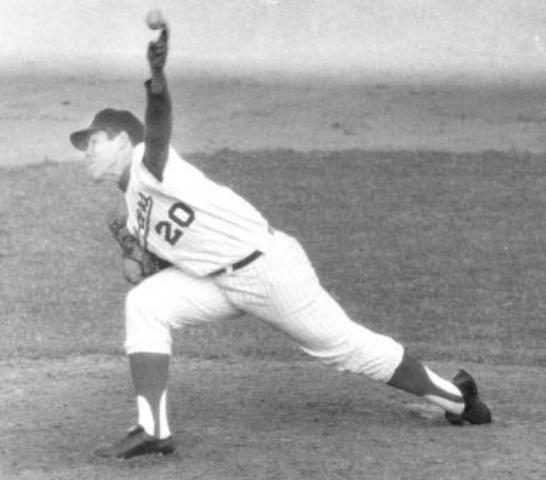
Four years later, Tom and many of his Pony League All-Star teammates won the California Interscholastic Federation (CIF) Southern Schools championship. Tom was the winning pitcher in the CIF semi-finals and finals. I'll let the Los Angeles Times tell the story:
Tom finished his high school senior year with a record of 10-0 and an ERA of 1.53. He also had a batting average of .429. Tom earned first team All-CIF honors. Future major leaguers Fred Lynn (El Monte High School) and Eddie Bane (Westminster HS) were named to the second and third teams, respectively. The latter is now the Angels Director of Scouting.
The next step in Tom's baseball career was either the pros or college. The California Angels general manager Dick Walsh and farm and scouting director Roland Hemond huddled with my Dad to ask if Tom was leaning toward signing a pro baseball contract or pursuing his college education.
Long Beach Press-Telegram columnist Loel Schrader included the following recruiting information back in June 1970: "Lakewood High pitchers Tom Lederer and Russ McQueen are being courted by USC and Chapman. Lederer is interested in both. McQueen is pretty well committed to Chapman." Days later, Schrader provided P-T readers with an update in the Cuff Stuff section of his column: "Tom Lederer, winning pitcher in Lakewood's 5-4 victory in the CIF championship game with Ventura, appears headed for Chapman College . . . Check signals on Russ McQueen, another Lakewood pitcher. It was reported here last week that Chapman had the inside track on the Lancer righthander. But Justin Dedeaux, junior varsity baseball coach at USC, reports that McQueen told him this past Thursday that he'll join the Trojans."
Prior to attending Chapman College that fall, Tom played for the Anchorage Glacier Pilots, a summer collegiate league team that included several future major leaguers. Tom transferred to Long Beach City College the following spring after Paul Deese, the coach who recruited him to Chapman, resigned and founded the Alaskan Summer Baseball League.
Once again, I'll let the L.A. Times fill us in on the details: Deese Looks North to Alaska for Better Baseball Opportunity - "Behind him, Deese leaves a group of frosh stars at Chapman--Manny Estrada, CIF Player of the Year as a junior at Bishop Amat; Bob Blackledge of Foothill High, and Tom Lederer, 10-0 for Lakewood's CIF championship team."
Joining the talented LBCC baseball program a semester behind everyone else, Tom never received much of an opportunity his freshman year on a team that featured Dave Frost, who went on to win 16 games for the 1979 American League Western Division champion California Angels. Tom played for LBCC his sophomore year, then transferred to Long Beach State with the intention of playing for coach John Gonsalves in 1973 but opted out before workouts began the prior fall.
Retired from baseball at the age of 21, Tom earned his degree in Business Administration from Long Beach State and now manages sports and aquatics programs for the City of Lakewood, California, selected the number one Sportstown in California by Sports Illustrated. He has been married for over 25 years to his wife Jeannie and has two children, Brett, 22, and Kelsey, 20. Tom also has a younger brother who is very proud of his older sibling.
| Baseball Beat | September 13, 2006 |
Late Season Call-Ups
In the first of a three-part series, I'm going to spotlight a dozen of the most highly regarded August and September call-ups. Each player's position, age, height and weight, and bats/throws will be included, along with current year minor and major league stats, and my subjective takes on their pros, cons, best comp(s), and outlook.
Part one covers four hitters. Part two will highlight an additional quartet of position players. Part three will be reserved for pitchers only. The subjects are not presented in either alphabetical order or in terms of their rankings.
High School: Evergreen (CO)
College: University of Arkansas-Little Rock
Drafted: Selected by CLE in 6th Round (168th overall) in 2003
2006 STATS
G AB R H 2B 3B HR RBI BB SO SB CS AVG OBP SLG OPS
AA 67 244 46 95 19 1 15 55 23 34 2 3 .389 .449 .660 1.109
AAA 27 102 22 36 9 0 7 20 10 12 2 1 .353 .409 .647 1.056
MLB 5 20 3 5 1 0 3 8 0 2 0 0 .250 .250 .750 1.000
Pros: Has always hit in the minors, including .379/.437/.656 with 22 homers in 94 games between AA and AAA this season. On 9/2/06, belted a grand slam on the first pitch he faced in the majors. Slugged three HR in 20 AB in the MLB.
Cons: Already 25 years old. Limited defensively. Chronic bad back.
Comp: Robb Quinlan. Kouzmanoff and Quinlan are both RHB and corner INF with similar builds. Xlnt track records vs. LHP.
Outlook: Part-time 1B/3B/DH. Stuck behind Ryan Garko, Andy Marte, and Travis Hafner. Valuable player off the bench.
High School: Camarillo (Camarillo,CA)
Drafted: Selected by TB in 1st Round (1st overall) iin 2003
2006 STATS
G AB R H 2B 3B HR RBI BB SO SB CS AVG OBP SLG OPS
AAA 86 342 50 108 22 4 8 59 15 65 22 4 .316 .341 .474 .814
MLB 13 53 10 21 4 1 2 8 1 7 1 0 .396 .411 .623 1.034
Pros: Five-tool talent. Has been the best player at every stop along the way. Baseball America Youth Player of the Year in 2002, #1 overall draft pick in 2003, TB MiL POY in 2004, Minor League POY in 2005. Turns 21 tomorrow.
Cons: Makeup. Was suspended for 50 games for throwing a bat at the home plate umpire following a called third strike while playing for the Durham Bulls of the International League. Poor plate discipline.
Comp: Tommy Davis, circa 1962-1963. Davis led the NL in batting average in back-to-back years at the age of 23 and 24. Similar speed and power. Young, however, has a much better arm than the former Dodger. Among current players, Young profiles somewhere between Jeff Francoeur and Vladimir Guerrero.
Outlook: Will be an All-Star as is. Improved plate discipline could spark talk of a Gary Sheffield-type HOF career.
High School: Anderson Highland (IN)
College: University of South Alabama
Drafted: Selected by MIN in 8th Round (242nd overall) in 2002 and by TOR in 3rd Round (83rd overall) in 2004
2006 STATS
G AB R H 2B 3B HR RBI BB SO SB CS AVG OBP SLG OPS
AA 91 348 43 108 24 0 19 71 25 87 2 1 .310 .357 .543 .900
AAA 34 109 20 43 7 0 5 18 23 18 1 0 .394 .496 .596 1.093
MLB 7 21 3 9 4 0 1 4 2 4 0 0 .429 .478 .762 1.240
Pros: One of the best-hitting prospects in the TOR organization. Was named the Eastern League's MVP even though he spent the final month of the season with Syracuse (AAA). At the time of his promotion, he led the Eastern League with 19 HR, 71 RBI, 43 XBH, and a .543 SLG.
Cons: Defensively challenged.
Comp: Clint Hurdle. Among active players, downside is of a less athletic Todd Hollandsworth. Upside is Luis Gonzalez (sans 2001).
Outlook: Likely starting LF next year. Could hit .280-.300 with 15-20 (or more) HR by 2008.
High School: St. Raphael (RI)
College: University of North Carolina
Drafted: Selected by COL in 4th Round (110th overall) in 2004
2006 STATS
G AB R H 2B 3B HR RBI BB SO SB CS AVG OBP SLG OPS
AA 44 156 38 50 10 2 11 26 24 26 1 0 .321 .418 .622 1.040
AAA 47 151 23 53 11 2 3 22 24 29 0 0 .351 .447 .510 .957
MLB 9 33 5 7 0 0 1 5 2 7 0 1 .212 .278 .303 .581
Pros: .300./400/.500 hitter with xlnt strike-zone judgment in college and the minors. Strong defensive skills. Positive intangibles. Hit the first HR of his MLB career on Tuesday.
Cons: Not much to complain about for a young catcher.
Comp: Russell Martin with less speed and slightly more power.
Outlook: The future is now. Has the potential to become the best catcher in COL history.
| Baseball Beat | September 12, 2006 |
Bush's League
In the best performance of his career, Dave Bush threw a complete-game, five-hit shutout against the Houston Astros on Sunday. In the process, the Milwaukee right-hander whiffed 10 without allowing a single walk. He faced a total of 31 batters, recording 23 of the 27 outs via Ks or groundballs.
Bush has now struck out 41 and walked only four in his last nine starts. After yielding 23 homers in his first 25 games, Bush hasn't given up a roundtripper in his last four. During this period, the 26-year-old with a plus curve has induced 45 GB and 19 FB while striking out 6.32 batters per 100 pitches - a rate that would place him second in the N.L. over a full season.
For the year, Bush is tied for third in the league in WHIP (1.16). Importantly, the man with the pinpoint control has lowered his BB/9 (from 1.91 to 1.70) and HR/9 (1.32 to 1.09) and raised his K/9 (4.95 to 7.27) by nearly 50% from one season to the next. His Defense Independent Pitching (3.88) and Fielding Independent Pitching (3.85) are considerably better than his ERA (4.44). In fact, his DIPS and FIP rank 11th and 13th, respectively, while the difference between his FIP and ERA is the fourth highest in the league.
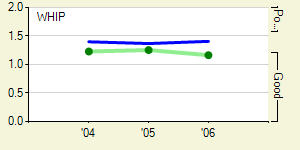
Source: FanGraphs
The three-year veteran is one of the most efficient pitchers in baseball. He has averaged just 14.5 pitches per inning, the fifth-lowest total in the majors. The top four? Greg Maddux, Roy Halladay, Chien-Ming Wang, and Brandon Webb.
Bush is arguably more like Chris Carpenter than not. They have two of the best Uncle Charlies in the game. Furthermore, these hurlers have similar K and BB rates. The main difference is that last year's Cy Young Award winner does an even better job of keeping the ball on the ground and in the ballpark. Nonetheless, Bush is more advanced than Carpenter at the same age. The latter didn't break out until his first year with the Cardinals when he was 29. Putting Bush in Carpenter's class may be a bit premature, but I believe it captures the younger hurler's upside. Based on his improved command and results of late, it wouldn't surprise me if Bush made a big push in narrowing whatever gap there exists within the next year.
A bird in the hand may be worth two in the bush. But a Bush in hand may be the best bet of 'em all.
| Baseball Beat | September 11, 2006 |
Leaving Las Vegas
Having spent the past couple days in Las Vegas, I'm heading home today. I'm not a huge fan of Vegas per se but can take the Entertainment Capital of the World in small doses from time to time.
Flying in the face of the adage, "What happens in Vegas stays in Vegas," I'm going to report on my long weekend in the largest U.S. city founded in the 20th century.
Rather than walking up and down The Strip looking for Pete Rose, my wife and I decided to spend virtually all of our time at The Venetian. I booked a room and purchased tickets to see Phantom of the Opera a couple of months ago. My tip of the week doesn't involve a sports bet. Instead, if you have a reason to be in Vegas, be sure to see the Phantom. The musical is a favorite of ours, having seen Andrew Lloyd Webber's hit three times when it was playing in Los Angeles (including all three Phantoms - Michael Crawford, Robert Guillaume, and Davis Gaines). In any event, I don't think you will be disappointed in the Vegas version of the longest running musical on Broadway.
Arriving at about the time of the Ohio State-Texas football game on Saturday evening, I decided to check out the Sports Book while my wife fed the slots. I learned that USC was 10/1 to win the Bowl Championship Series but was unable to place such a bet during the OSU-TEX game. When I returned the following morning, the line had dropped to 7/1. I passed. I'm not sure what USC did in the preceding 18 hours to get the linesmakers to reduce their odds, but I didn't think the Trojans were all that attractive at that price.
While everyone around me was placing bets on the NFL, I asked the gentleman at the window for updated lines on the American and National League pennants as well as the World Series. Here is the information directly from the pieces of thermal paper I was given:
ODDS TO WIN 2006 A.L. PENNANT
YANKEES +120 RED SOX 50/1 WHITE SOX +350 INDIANS 250/1 ANGELS 20/1 ATHLETICS +500 RANGERS 100/1 ORIOLES OFF TWINS +300 TIGERS +200 BLUE JAYS 85/1 MARINERS 200/1 DEVIL RAYS OFF ROYALS OFF
ODDS TO WIN 2006 N.L. PENNANT
CARDINALS +400 BRAVES 90/1 ASTROS +800 MARLINS 14/1 METS EVEN CUBS OFF PHILLIES 12/1 PADRES 12/1 GIANTS 12/1 DODGERS +500 D'BACKS 100/1 BREWERS 150/1 NATIONALS OFF REDS 40/1 PIRATES OFF ROCKIES 150/1
ODDS TO WIN 2006 WORLD SERIES
YANKEES +300 CARDINALS 12/1 RED SOX 125/1 WHITE SOX +800 INDIANS 500/1 BRAVES 200/1 ASTROS 20/1 ANGELS 50/1 MARLINS 60/1 METS +350 ATHLETICS 12/1 CUBS OFF PHILLIES 40/1 PADRES 30/1 GIANTS 35/1 DODGERS 12/1 RANGERS 250/1 ORIOLES OFF D'BACKS 250/1 TWINS +700 TIGERS +450 BLUE JAYS 200/1 BREWERS 350/1 MARINERS 500/1 NATIONALS OFF DEVIL RAYS OFF REDS 100/1 PIRATES OFF ROCKIES 350/1 ROYALS OFF
Interestingly, the order of appearance was based on the opening lines last fall. The Yankees were the favorites back then and continue to be the team of choice as the season heads into the final three weeks. The Red Sox and Indians in the A.L. and the Braves and Cubs in the N.L. have been the biggest disappointments in 2006. On the other hand, the Twins and Tigers easily qualify as the greatest surprises of the season.
A few teams looked tempting to me even if the odds were a bit short across the board. To wit, if you add up all of the lines in the A.L., the book has about a 50% profit margin built in (assuming equal money is bet on all teams still on the board). At roughly 30%, the N.L. pennant and World Series odds aren't stacked against the bettor quite as much.
At -115, I actually bet the house on Jered Weaver and the Angels to beat Roy Halladay and the Blue Jays on Sunday. Just kidding. Besides, who needs two houses anyway? As it turned out, Weaver was the Angel of Music, striking out former Halo Troy Glaus with the bases loaded to escape a jam in the fifth. The rookie won his 11th game against just two losses as Los Angeles beat Toronto 4-3.
By the way, with respect to the title of this entry, Nicholas Cage is my least favorite "known" actor. My favorite? A tie for first between Robert De Niro and Edward Norton. If De Niro was the successor to Marlon Brando, then Norton is following in the former's footsteps in about the same manner. My first exposure to De Niro was as the dying MLB player in Bang the Drum Slowly (1973). Although De Niro would never pass for a big-league catcher, he made the part work in baseball's fictional version of Brian's Song (1971). Speaking of the latter film, to this day, I have never understood why Hollywood felt the need to do a remake. Give me James Caan and Billy Dee Williams anytime.
| Baseball Beat | September 09, 2006 |
Happy Days, Starring Ryan Howard
With another pair of home runs on Friday, Ryan Howard has now hit 56 this year and 80 for his career. According to Bill Deane, "no player had ever hit more than 76 home runs in his first 1,000 at bats" in the 130 years of major league baseball. Howard has 80 - and he still has 135 at-bats to go!
Deane's research uncovered the following all-time leaders:
80 Ryan Howard (in 865 at bats through 9/8/06) 76 Cecil Fielder 75 Jim Gentile 74 Rudy York 74 Ken Phelps 72 Eric Davis 71 Don Mincher 71 Bob Horner 71 Mark McGwire 68 Rob Deer
Interestingly, there is not one player who is in the Hall of Fame. One of the players not named Howard will be eligible for the first time in the coming election.
There are a lot of first basemen on the above list. Lots of slow first basemen. (Is that redundant?)
Excluding Eric Davis, the players in the group averaged 16 SB and 14 CS for their career. At the high end, Rob Deer stole 43 bases and Rudy York pilfered 38. At the low end, Howard has yet to steal a base while Cecil Fielder bagged two and Jim Gentile nabbed three.
There are a lot of feast or famine types, too. Howard has struck out 156 times in 514 at-bats this year. He has 269 SO in 865 AB for his career. The 26-year-old first baseman is on pace to K 179 times in 2006, which would tie him for 14th on the single-season list with. . .Rob Deer! The latter also had a season in which he struck out 186 times - good for sixth all-time.
STRIKEOUTS YEAR SO HR 1 Adam Dunn 2004 195 46 2 Bobby Bonds 1970 189 26 3 Jose Hernandez 2002 188 24 T4 Preston Wilson 2000 187 31 T4 Bobby Bonds 1969 187 32 6 Rob Deer 1987 186 28 T7 Jim Thome 2001 185 49 T7 Jose Hernandez 2001 185 25 T7 Pete Incaviglia 1986 185 30 T10 Jim Thome 2003 182 47 T10 Cecil Fielder 1990 182 51 12 Mo Vaughn 2000 181 36 13 Mike Schmidt 1975 180 38 14 Rob Deer 1986 179 33 15 Richie Sexson 2001 178 45
Source: Sabermetric Baseball Encyclopedia
Howard has blasted 24 HR in his last 154 AB. That works out to one every 6.4 AB. During this span, the native of St. Louis, Missouri has put up a batting line of .383/.513/.890 for an OPS of 1.402.
The slugger's home (.305/.409/.664) and road (.318/.402/.694) splits have been about the same for the season despite playing in hitter-friendly Citizens Bank. In fact, he has jerked exactly 28 HR at home and away in an almost identical number of AB (259 to 255, respectively).
If Howard has a weakness, it is definitely his ability to put the ball in play against left-handers. Although his overall production (.283/.344/.584) is quite acceptable vs. southpaws, he has struck out 60 times in 166 AB or once every 2.8x. Including BB (14) and HBP (2), Howard has still K'd in 33% of his plate appearances when facing portsiders. More alarming is the fact that he has a 4.3:1 ratio of SO to BB vs. LHP.
Howard's partner-in-crime, teammate Chase Utley, is maintaining a similar batting average against both lefties (.306) and righties (.302) but his home run prowess falls off the cliff vs. LHP (4 HR in 180 AB) as opposed to RHP (22 HR in 387 AB). As a team, the Phillies have had surprisingly good balance vs. left-handers (.256/.336/.442) and right-handers (.270/.348/.450). Bobby Abreu, who was traded to the New York Yankees in late July, had reverse splits with respect to AVG and SLG but had a slightly higher OBP vs. RHP due to an incredibly high BB rate (69 in 229 AB).
There are a lot of unanswered questions about Howard and the Phillies:
- Can he carry his team to a wild card berth in the final three weeks of the season?
- How many HR will he hit this year? How about for his career?
- *Will* Ryan Howard be named the National League's Most Valuable Player in 2006?
- *Should* Howard get the MVP nod?
- Who is Howard most like? Cecil Fielder? Jim Thome? Adam Dunn? David Ortiz? Or somebody else?
- If you were starting a team from scratch, would you take Howard or Utley?
- Can the Phillies compete for the NL East title next year?
While contemplating the answers to the above questions, be sure to do one thing: enjoy Ryan Howard for what he is - a slugger who is cranking home runs at a faster pace than anyone in the history of the game.
| Baseball Beat | September 08, 2006 |
Foto Friday #2
As a follow-up to the original Foto Friday three weeks ago, I am posting a black and white glossy from my Dad's files (which is date and time stamped on the back). As in the first contest, name the date, location, and subjects in the photo, as well as the special occasion.
Good luck!
ANSWERS ADDED @ 10:00 p.m. PST
DATE: September 24, 1963.
LOCATION: Dodgers locker room at Dodger Stadium prior to an evening game vs. the New York Mets (which the Dodgers won 4-1).
SUBJECTS: (left to right) Sandy Koufax, Don Drysdale, Ron Perranoski, Pete Richert, manager Walt Alston, Lee Walls, coach Pete Reiser, Tommy Davis, Willie Davis, and Bob Miller.
LOCKERS IN BACKGROUND: Roy Gleason (#36) and Joe Moeller (#38). Gleason and Moeller were September call-ups. The former played eight games in his MLB career, all in September 1963. He had one at-bat and hit a double, retiring with a 1.000 batting average. Moeller did not appear in a game that year.
SPECIAL OCCASION: The Dodgers were celebrating the clinching of the N.L. pennant in 1963. The second-place St. Louis Cardinals lost to the Chicago Cubs earlier that day, thereby eliminating the Redbirds from contention.
| Baseball Beat | September 06, 2006 |
Boston's Theme
"If you get caught between the moon and New York City,
The best that you can do, the best that you can do, is finish second."
With apologies to Christopher Cross, the Boston Red Sox once again look as if they will finish behind their arch rivals in the American League East. If the division race plays out as expected, the New York Yankees will win their ninth AL East title in a row while the Sox will end up as the bridesmaid for a like number of consecutive years.
There are worse things in baseball than placing second every season. For confirmation, just ask the Tampa Bay Devil Rays. The cellar dwellers have been in the league for the same number of years as the Yanks and Sox have captured first and second, respectively. In these nine years (including 2006), the Devil Rays have finished last every time, save for 2004 when they. . .gasp, ended up in fourth, three games ahead of the Toronto Blue Jays.
Two-thousand-and-four is significant for one other minor reason. Boston just happened to win the World Series that year in a post-season for the ages. The Red Sox swept the then Anaheim Angels in the ALDS, then beat the Yanks four straight after falling behind three games to none in the ALCS. It's almost easy to forget for those of us who don't live, breathe, sleep, and eat the Sox that Boston had been outscored 32-16 in those three losses. The inhabitants of Fenway Park looked like they were dead in the water at that point. Nonetheless, the Red Sox came back and won four in a row, including back-to-back, extra-inning victories in games four and five. Then, in an almost anti-climatic World Series, the Sox got the brooms out and swept the St. Louis Cardinals, outscoring their counterparts 24-12 in the process.
Last year wasn't so bad either. . .well, at least with respect to the regular season. The Red Sox and Yankees finished with identical 95-67 records, leaving them in a tie for first. Or so some would like to think. But the reality of the matter is that New York was credited with the AL East title by virtue of winning their season series with the Red Sox ten to nine. Boston beat out the Cleveland Indians for the wild card by two games.
First, second. . .it doesn't really matter a whole lot as long as you qualify for the post-season. In fact, the World Series champ from 2002-2004 was none other the wild card. The Angels, Marlins, and, yes, the Red Sox all emerged victorious by sneaking into the playoffs and getting hot at the right time. It just so happened that there was an even hotter club last year. The Chicago White Sox led the American League with 99 victories, including five straight to end the campaign. The Pale Hose then swept the defending World Champs in the ALDS, beat the Angels four out of five in the ALCS, and completed their dream season by sweeping the Houston Astros in the Fall Classic.
Despite a disappointing post-season in 2005, the Red Sox were still the popular choice to win their division and even the league this year. At the All-Star break, Boston was three games in front of New York. A month later, the Red Sox were two games behind the Yankees. Fast forward to today and the team that has a bad case of "seconditis" finds itself eight games back of the Bronx Bombers. Moreover, Boston is six games behind in the wild card standings and looking as if it will be on the outside looking in come October for the first time since 2002.
EAST W L PCT GB HOME ROAD RS RA NY Yankees 82 55 .599 - 43-25 39-30 776 646 Boston 75 64 .540 8.5 43-26 32-38 717 705 Toronto 72 67 .518 11.5 42-28 30-39 697 669 Baltimore 61 77 .442 21.5 36-34 25-43 661 759 Tampa Bay 55 84 .396 28.5 36-34 19-50 592 729
Interestingly, Boston's win-loss record is actually better than what one would expect, given its run differential. Having scored 717 runs and allowed 705, the team's Pythagorean record works out to approximately 71-68. The Yankees, by comparison, are playing right about in line with expectations based on runs scored and prevented.
Look, the Red Sox have nothing to be ashamed of - they just picked the wrong division. New York has won at least 87 games every year since 1996 and 95 or more in eight of the last nine. Boston, on the other hand, has garnered a minimum of 92 victories in six of the past eight seasons. The Red Sox have been good. Very good. The Yankees just have been great during this same period.
It hasn't always been this way though. Hard to believe but the Sox had a better record than the Yanks in 17 of the previous 30 seasons (1966-1995). The Bostonians also thoroughly dominated the New Yorkers from 1903-1918, topping them in 13 of those 16 campaigns while capturing five world championships. The real problem is what took place between those two stretches. Get this, from 1919-1965 - a span of 47 years - the Red Sox had the superior win total TWICE. Yep, Boston won more games in 1946 and 1948 and that was it. The Sox won the AL title in 1946 but lost to the Cardinals in the World Series in seven games.
The Red Sox have certainly closed the gap over the years but are finding it difficult to overcome their competitors to the south. If not for the World Series championship two years ago, I believe the disappointment in failing to win the division more often would be an even bigger deal.
This winter will likely be one of reflection from principal owner John Henry to president Larry Lucchino to general manager Theo Epstein to manager Terry Francona all the way down to the players. Sure, the team has suffered a number of injuries this season. But there have been a number of mistakes, too, including judgments in personnel and flawed in-game strategy. Who will be back and who won't will be part of the intrigue, yet the real question comes down to whether the Red Sox have what it takes to dethrone the Yankees - be it money, smarts, or players. Only time will tell.
| Baseball Beat | September 05, 2006 |
Back to School
If Labor Day has come and gone, it means only one thing for families with children. It's time to go back to school. Today and tomorrow will bring in the school year in many locales around the country.
My family's favorite "Back to School" story involves younger brother Gary. The following paragraph is excerpted from a column in the Long Beach Independent, Press-Telegram in 1969:
FARMED OUT: George Lederer covered the Dodgers for the Long Beach Independent, Press-Telegram from the time the team moved West until this season, when he moved to the Angels as director of promotions and public relations. It's understandable that his family has become baseball oriented. But Lederer was slightly shocked this past week when son Gary, 7, returned home from his first day in second grade and said: "Guess what? I've been traded." Upon further questioning, it was discovered Gary had been moved from the room in which he had been originally assigned to another room. Asked if the youngster had threatened to retire, Lederer replied: "He's been threatening to do that since kindergarten."
Gary turns 44 next week. Happy Birthday, Gary!
Speaking of going back to school, isn't there some way we could all chip in so ESPN's Joe Morgan would do just that? Well, I guess it wouldn't be going *back* to school in his case as I doubt he ever took any courses in broadcasting. You play 22 seasons in the big leagues and they just wind you up, give you a microphone, and let you have at it. I mean, Li'l Joe knows it all. If you don't think so, just ask him. Or maybe listen in to the following exchange between Morgan and play-by-play announcer Jon Miller in the Sunday night telecast of the Los Angeles Angels-Detroit Tigers game. It is vintage Morgan with Miller doing his best straight-man performance. (Thanks to my older brother Tom for transcribing it.)
Miller begins the seventh inning in full tease mode, setting up his sidekick:
Jon Miller: Back at Comerica Park in Detroit. Jon Miller, Joe Morgan, Bonnie Bernstein with you. 2-1 the Angels lead as we head into the late innings as Joel Zumaya, the young flame-throwing right hander comes into the game. And, Joe, you know, you were telling me all about this research you were doing, picking up all the background info and what not. And you told me there was like a huge event when Zumaya came into a game. So, we were all set. [Morgan chuckles] I had the camera on the gate and everything. It was like we were the only ones in the park who knew he was coming in.Joe Morgan:
They didn't know he was coming. Miller: They were running a commercial on the jumbo screen out there.
Morgan: They were listening to our interview with Leyland and he said he wanted one more from Ledezma.
[Meanwhile, Zumaya has thrown two fastballs, the first outside and the second on the outside corner. Miller then gets around to introducing Angels batter Erick Aybar as the third pitch creates a moderate, but audible, reaction from the crowd. To this point, there have been no radar readings on the ESPN graphics.]
Morgan: I guess they're saying he must have been close to 100. They're watching a radar gun on the scoreboard, I presume.
Miller: They listed it at 101, Joe. What happened to our radar gun? Did you forget to pack it?
[As Zumaya's fourth pitch is thrown far outside, the camera goes to the scoreboard display of the radar gun, showing 99.]
Morgan: Yeah, but I would trust mine better than I would the stadium's because they have a tendency to want to hype their players.
Miller: So, you think, what, he was only throwing 75?
Morgan: No, I don't think he was throwing 101. Maybe 100.
Miller: heh, heh, heh, heh
[The fifth pitch to Aybar is a strike as the count goes to three and two. For the first time, the ESPN graphic shows a radar reading: 99.]
[Speaking over each other:]
Miller: Here we go. We're getting 99.
Morgan: 99, see.
[The camera shows the scoreboard radar: 99.]
Miller: Now, they said 99 as well.
Morgan: OK.
[Miller briefly describes the action as the sixth pitch is thrown. Then Aybar swings and misses.]
Miller: 98 and out!
Morgan: One more thing. When the ball's down, it's not going to be as hard as when it's up. The high fastball is when you'll get the best reading. That was a good low fastball. This is more effective, but, see, it's down. When the pitch is down, you get more movement, yet you get less speed.
Miller: See, that looked like 98 to me. That got there pretty quickly.
[Jose Molina steps up, accompanied by some general commentary.]
Morgan: That's that old saying, Jon. I love hitting fastballs, but I like ice cream, too, but I don't like a gallon at a time. That's a little too much speed on the fastball.
Miller: But I've seen you - I've seen you eat a gallon of ice cream.
Morgan: hah, hah, hah, hah
[As Molina grounds to first base, the play is described and they go to a video review of Tigers starter Wilfedo Ledezma's performance. Reggie Willits steps into the box.]
Miller: [finishing up about Ledezma] . . . great change up, around 84, 85, 86 miles per hour. Now, here's a guy throwing 100.
[The first pitch to Willits registers 101 on the ESPN radar.]
Miller: 101. Now, we got him at 101, Joe.
[Scoreboard shows 101.]
Morgan: I would love . . . That can't be 101, right there, that last pitch. I'm just gonna tell you that.
Miller: Scoreboard got it . . .
Morgan: [talking over Miller] I don't care.
Miller: . . . we got it.
Morgan: That wasn't a 100 miles per hour fastball. I'd love to see Gary Sheffield hook up with him once just to see him swing.
[Second pitch to Willits is 100 on ESPN gun. The camera shows a close up of a fan wearing a t-shirt with the likeness of a highway speed limit sign "Zumaya Zone Speed Limit 102 MPH"]
Morgan: Now, there you go. Zumaya zone.
Miller: See, he gets him at 102.
Morgan: Yeah, I don't . . .
Miller: He feels like we're shorting him.
Morgan: Well, I've seen enough pitches to know 100 when I see it and 102.
Miller: When you played, they didn't have radar guns.
[Third pitch shows 103 on ESPN radar.]
Morgan: I've seen 102 and I've seen 100. I know the difference. [The camera is now trained on Miller and Morgan in the booth. Miller is laughing mildly.] As you know, we all know, they have different radar guns. Some of them are faster than others.
Miller: Yeah. [He smiles as the camera zooms in and produces a pronounced raising of his eyebrows.]
Morgan: I mean, I'm not saying he's not throwing 100, but that pitch you said was 101, wasn't 101. That was a sinker.
Miller: I was just reading the radar gun reading.
[Fourth pitch to Willits shows 100 on ESPN radar and is a fly ball to left field.]
Morgan: See, that might have been 100.
Miller: [tongue firmly in cheek] I thought that was only about 98.
[Miller describes the fly ball and the end of the inning.]
Now is that a beaut or what? If Morgan is unlikely to go back to (broadcasting) school, couldn't he at least threaten to retire - just like my brother Gary 37 years ago?
Update: Here is a video of the above conversation.
| Baseball Beat | September 03, 2006 |
Here, There, and Everywhere
With college football's opening day behind us (Is USC any good?), I'd like to direct readers to three sites for your Sunday and Monday reading pleasure.
All of this isn't meant as an argument for Thomas' place in Cooperstown - his status as a first-ballot Hall of Famer should not even be subject to debate.Anyone who sees him as anything less is hopelessly misguided.
Rather, it's a reminder of what a tremendous and rare performer we have in our midst. Thomas may be in the waning hours of his career, and that means it's time to reflect on what an amazing career it's been. Don't let his injuries or his occasional recalcitrance detract from that fact.
Frank Thomas has been a gift to baseball fans. He should be remembered for what he is: one of the greatest hitters ever to play the game.
Perry is also a Bert Blyleven-for-Hall-of-Fame supporter. If Dayn's not part of your regular reading, he should be. You can access his archives at Fox Sports here. Bookmark it and be sure to return often if your game is anything from prospects to astute analysis of MLB.
PA: What cap should Mike Piazza wear into the Hall of Fame and which one will he most likely enter with?RL: Boy, that is a tough call. It could go either way--and I'm not talking about the Marlins or Padres! New York fans may not agree with me, but I believe his best years were with the Dodgers. His career batting, on-base, and slugging averages are higher as a Dodger than as a Met. Furthermore, despite fewer plate appearances in L.A., Piazza generated more Runs Created Above Average (RCAA) and Runs Created Above Position (RCAP) as a Dodger (263 and 298, respectively) than a Met (177 and 235). Mike won five Silver Slugger awards for each team but picked up the N.L. Rookie of the Year in 1993 as a Dodger and finished in the top ten in the MVP voting five years in a row (including two seconds) out west, whereas he placed in the top ten in the MVP balloting just twice with a high of third as a Met.
There is one factor that might favor Piazza going in as a Met: the 2000 World Series. Mike played in the post-season twice with both teams but the only time he made it to the Fall Classic was as a Met. I would argue that he *should* go into the HOF as a Dodger, but I would not be surprised in the least if he winds up wearing a Mets cap. Mets fans really showed their appreciation earlier this month by giving Piazza multiple standing ovations when he returned to Shea Stadium as a Padre. Sadly, Mike never got that type of love in L.A. as his departure (via trade) was much more acrimonious than leaving N.Y. as a free agent.
[snip]
PA: Is OPS useful, or is Bill James right that SLG and OBP shouldn't be added?
RL: Yes and yes. OPS is quite useful in my book. It has an incredibly high correlation with runs scored. OPS is also intuitively easy to understand. I put a lot of value in both. But James is technically correct in that the two shouldn't be added together. In fact, multiplying OBP x SLG does an even better job of explaining runs scored. However, the difference isn't great enough to offset the simplicity in summing these two components.
Pat is doing a Q&A series with several writers, including David Pinto and Aaron Gleeman. Next up: J.C. Bradbury on Monday and Rob Neyer on Tuesday.
Quoting Forman directly from his B-R.com newsletter, player batting and pitching lines now end with a short note if the player was an All-Star or received MVP, CYA or RoY votes that year. And player debut information includes their performance in their debut game along with a link to the box score of that game (from the last 50 years or so).
Sean has also added handedness and place of birth reports, links to box scores and league standings, team schedules and head-to-head reports. In addition, B-R.com now offers franchise Hall of Fame registers, most games played with no post-season appearance and most rings won, updates to player birth and death dates, player transactions, player schools, and much, much, more, including a blog with in-depth information about the site.
Baseball-Reference.com depends upon page sponsorships to stay in business. If you use and like the site, please consider sponsoring a page to cover operating expenses and to allow Sean the ability to develop new features.
| Baseball Beat | August 31, 2006 |
Players Who May Be On The Move
At the risk of getting ahead of myself here as baseball enters the final month of regular-season play, I decided to take a sneak peek at the upcoming crop of free agents as well as those who will be subject to team and/or player options.
Interestingly, Maury Brown recently reported that "teams may no longer receive draft picks as compensation for free agents who leave as part of the upcoming Collective Bargaining Agreement." If this is indeed the case, clubs such as the Nationals and Rangers could wind up with nothing to show for free agents Alfonso Soriano and Carlos Lee. Stay tuned.
The following table lists most of the starting position players and pitchers along with a number of the better-known relievers. It also includes a couple of injured stars (Eric Gagne and Kerry Wood) who most likely will be forced to sign incentive-laden contracts to catch the attention of their current or prospective employers. In all, I have gathered 84 names that run the gamut from fringe everyday players to All-Stars to future Hall of Famers.
FA=Free Agent TO=Team Option MO=Mutual Option PO=Player Option
PLAYER TEAM AGE POS STATUS Moises Alou SF 40 OF FA* Rich Aurilia CIN 34 UT MO Rod Barajas TEX 30 C FA Miguel Batista ARI 35 SP FA Ronnie Belliard STL 31 2B FA Craig Biggio HOU 40 2B FA Barry Bonds SFG 42 LF FA Aaron Boone CLE 33 3B MO Mark Buehrle CWS 27 SP TO Jeromy Burnitz PIT 37 OF MO Mike Cameron SD 33 CF TO Sean Casey DET 32 1B FA Frank Catalanotto TOR 32 UT FA Royce Clayton CIN 36 SS FA Roger Clemens HOU 44 SP FA Francisco Cordero MIL 31 RP TO David Dellucci PHI 32 OF FA Mark DeRosa TEX 31 UT FA J.D. Drew LAD 30 RF PO Ray Durham SF 34 2B FA Jermaine Dye CWS 32 RF TO Adam Eaton TEX 28 SP FA Jim Edmonds STL 36 CF TO Pedro Feliz SF 31 3B FA Cliff Floyd NYM 33 LF FA Eric Gagne LAD 30 RP TO Nomar Garciaparra LAD 33 1B FA Tom Glavine NYM 40 SP MO Luis Gonzalez ARI 38 LF TO** Alex Gonzalez BOS 29 SS FA Eddie Guardado CIN 35 RP FA Jose Guillen WAS 30 OF FA Shea Hillenbrand SF 31 1B FA Aubrey Huff HOU 29 OF FA Torii Hunter MIN 31 CF TO Adam Kennedy LAA 30 2B FA Byung-Hyun Kim COL 27 SP TO Carlos Lee TEX 30 LF FA Cory Lidle NYY 34 SP FA Mike Lieberthal PHI 34 C FA Ted Lilly TOR 30 SP FA Kenny Lofton LAD 39 CF FA Mark Loretta BOS 35 2B FA Julio Lugo LAD 30 SS FA Greg Maddux LAD 40 SP FA Jason Marquis STL 28 SP FA Gary Matthews, Jr. TEX 32 CF FA Gil Meche SEA 27 SP FA Bengie Molina TOR 32 C TO** Jamie Moyer PHI 43 SP MO Mark Mulder STL 29 SP FA Mike Mussina NYY 37 SP TO Trot Nixon BOS 32 RF FA Tomo Ohka MIL 30 SP FA Vicente Padilla TEX 28 SP FA Jay Payton OAK 33 OF FA Andy Pettitte HOU 34 SP FA Mike Piazza SD 37 C MO Juan Pierre CHC 29 CF FA Brad Radke MIN 33 SP FA Aramis Ramirez CHC 28 3B PO Joe Randa PIT 36 3B FA Mark Redman KC 32 SP FA Dave Roberts SD 34 OF FA Jason Schmidt SF 33 SP FA Gary Sheffield NYY 37 OF TO John Smoltz ATL 39 SP TO Alfonso Soriano WAS 30 OF FA Shannon Stewart MIN 32 LF FA Jeff Suppan STL 31 SP FA Frank Thomas OAK 38 DH FA Steve Trachsel NYM 35 SP FA Jose Valentin NYM 36 UT FA Tim Wakefield BOS 40 SP TO Jeff Weaver STL 30 SP FA David Wells BOS 43 SP FA Bob Wickman ATL 37 RP FA Bernie Williams NYY 37 OF FA Woody Williams SD 40 SP FA Craig Wilson NYY 29 OF FA Preston Wilson STL 32 OF TO** Kerry Wood CHC 29 RP MO Gregg Zaun TOR 35 C FA Barry Zito OAK 28 SP FA
Corrections: * changed to free agent from player option ** changed to team option from mutual optionTom Glavine has a unique situation with the Mets. In a contract that was restructured in May, he agreed to reduce his 2006 salary to $7.5 million (with $5.25M deferred at 6% interest) while adding a 2007 player option at $5.5M (which increases by $1M each for 180, 190 and 200 IP in 2006) with a $3M buyout; or a $12M club option (increases by $2M with 180 IP in 2006) with a $3M buyout.
J.D. Drew and Aramis Ramirez have the right to void their contracts this fall. Drew signed a 5 x $11M deal with the Dodgers prior to the 2005 season. He has three years and $33M left. Ramirez signed an extension with the Cubs in April 2005 and has $11M coming his way in 2007 and $11.5M in 2008 with a $11M mutual option in 2009. The latter year is guaranteed if Ramirez plays 270 games during the previous two campaigns.
Of the two, it would seem as if Ramirez (.289/.353/.559 with 31 HR) is the more likely candidate to opt out of his current contract. Teams such as the Angels and Padres are in need of a power-hitting third baseman and the Halos will have some money to spend when the approximately $8M contracts of Darin Erstad, Steve Finley/Edgardo Alfonzo, and Jeff Weaver run off the books.
David Wells is rumored to be going to San Diego in a trade that could be imminent (in order to beat the deadline and make him eligible for post-season play). I don't understand how the Padres could part with Triple-A catcher George Kottaras, but we will just have to sit tight until a deal is announced before analyzing its pros and cons.
The St. Louis Cardinals have the option of re-signing Jim Edmonds for $10M next season or they can buy him out for $3M. Tony La Russa has said that Edmonds has to prove he is worth $10M when, in fact, the eight-time Gold Glove winner only needs to show that he is a $7M player. The buyout money is a sunk cost so the Cards will only be out of pocket an additional $7M if they choose to bring Edmonds back--something that is looking less and less likely in view of the post-concussion syndrome that has limited his playing time and effectiveness.
While on the subject of the Cardinals and injuries, Mark Mulder underwent an MRI on his ailing shoulder yesterday. He may not return this season. If so, the left-hander has probably pitched his last game for the Redbirds.
Mulder is just one of four starting pitchers for St. Louis eligible for free agency. Teammates Jason Marquis, Jeff Suppan, and Weaver are in the same boat. It will be interesting to see which pitcher(s) general manager Walt Jocketty pursues this winter.
Brad Radke, who has been pitching with a torn labrum this season, is unlikely to draw the type of attention he might otherwise. Look for the 12-year veteran to work out a less than optimal deal financially to return to the Twins for perhaps the final years of his career.
A discussion of free agents would not be complete without mentioning the players who are being advised by Scott Boras. Among those listed above, Boras is expected to represent Gagne, Greg Maddux, Weaver, Bernie Williams, and Barry Zito. Speaking of Zito, how much is he apt to get in the aftermath of Roy Oswalt's new five-year, $73 million deal? Prediction: the Yankees ink him to a five-year, $75M contract.
In the past, Boras has also negotiated deals for free-agents-to-be Bruce Chen, Jose Hernandez, Danny Kolb, Travis Lee, Chan Ho Park, Scott Schoeneweis, and Ron Villone. Yes, Ron Villone. You see, Boras doesn't just handle $50M clients only. He also does some pro bono work, too.
References: Unofficial Major League Baseball and Cot's Baseball Contracts. Both sources have a more complete list of potential free agents. They also include player agents and show major league service time in years and days. Unofficial Major League Baseball even has details of free agents in 2007, 2008, 2009, etc.
| Baseball Beat | August 30, 2006 |
Flipping Channels
Courtesy of the MLB Extra Innings package, I was able to follow most of the games Tuesday night. I should have gone to Las Vegas instead as my right thumb was punching the right buttons at the right time. I saw a number of home runs live rather than as part of the nightly highlights on Baseball Tonight. You gotta have good timing (or luck) to catch everything I did in one evening.
Here was the lineup on my DirecTV system:
Ch. 734: Cubs at Pirates
Ch. 735: Phillies at Nationals
Ch. 736: Blue Jays at Indians
Ch. 737: Tigers at Yankees (rained out)
Ch. 738: Giants at Braves
Ch. 739: Marlins at Cardinals
Ch. 740: Devil Rays at White Sox
Ch. 741: Royals at Twins
Ch. 742: Brewers at Astros
Ch. 743: Mets at Rockies
Ch. 744: Reds at Dodgers
Ch. 745: Angels at Mariners
Ch. 746: Red Sox at A's
All of the day's games were carried by the Extra Innings package except the Orioles @ Rangers and the Padres @ Diamondbacks. The LAA-SEA game was blacked out or as the banner at the bottom of the screen proclaimed: "Program is not available in your area." Not a problem. I watched it on our local Channel 13 instead.
When I got home from the office, I clicked on 734 out of habit and proceeded to scroll through the channels to get a feel for what was on TV. Most of the east coast games were a few innings old when I got my first glimpses of action. Here is what I was able to catch Tuesday night.
In the meantime, Carlos Zambrano was pitching a lot better than he was fielding. The Cubs clogged up the bases by walking seven times and lost 7-6 to the Pirates in 11 innings.
Paciorek pointed out that Willie Mays was famous for not taking an extra base in similar situations to "protect" Willie McCovey, even refusing to advance on wild pitches. Now that is laughable. If the Giants were better off with Mays on first and McCovey at the plate than with Mays on second and McCovey on first (after the ensuing IBB), then why wouldn't the defensive team just walk Big Mac in either situation? The point is that it is never a negative event for a base runner to take an extra base, no matter who is coming up next.
As it turned out, Howard launched a three-run HR off the facing of the upper deck in straightaway center field. It was his 48th roundtripper of the year, tying him with a guy named Mike Schmidt for the single-season team record. True to form, Carpenter responded with the following beauty: "I wish those runners had tagged up." Not only did that comment expose the fact that he is a homer, but it suggests that the Nats were disadvantaged by runners failing to advance. I'll admit, this mentality is a pet peeve of mine and is probably worthy of a separate column.
The Indians have now won 15 of their past 20 games. Nonetheless, Cleveland's actual winning percentage (.473) is well below its Pythagorean (.548). The Tribe has scored the third most runs in the majors and is a bullpen ace away from being a contending team next year.
Like a lot of pitchers, Weaver likes to establish his fastball the first time through the lineup. He was facing Seattle for the third time in less than two months and the Mariners were sitting on his heater early in the count. Weaver was tagged with a loss that seemed pretty inconsequential in view of what took place in the top of the eighth inning. Mariner relief pitcher Rafael Soriano was hit squarely on the side of his head by a line drive off the bat of Vladimir Guerrero. He fell to the ground and was later strapped to a stretcher, removed from the field on a cart, and taken to a local hospital. Here's hoping Soriano is doing well and resting comfortably by the time you read this article.
| Baseball Beat | August 28, 2006 |
Monday Morning Musings
I was fortunate to attend two of the Boston Red Sox @ Los Angeles Angels games last week plus yesterday's final game of the New York Yankees @ LAA series.
Observations and comments:
One can't help but notice Pedroia's smallish size. Listed at 5-foot-9 and 180 pounds, the 23-year-old infielder does himself no favors in the looks department with his baggy pants. Nevertheless, the guy can play. The 2003 Pacific-10 Player of the Year started one game at shortstop and the other at second base. He played well in the field and squared up the ball several times at the plate (although you might not know it by looking at his 2-for-18 results through Sunday). To his credit, Pedroia has always had more BB than SO every stop along the way going back to his freshman year at Arizona State. We're not looking at a superstar in the making but don't be surprised if he becomes a serviceable every day player.
Weaver asked to go back for the seventh inning but manager Mike Scioscia pulled his prized rookie after throwing 107 pitches. In the "old" days, I'm quite certain that Weaver would have been allowed to keep pitching based on how well he was performing. Jered made one bad pitch--a 1&2 fastball in David Ortiz's wheelhouse--and he paid dearly for it as Big Papi deposited that mistake deep into the right-field seats.
Williams looked like the vintage Bernie from 1996-2002. He collected four hits and knocked in six runs. The switch-hitter is putting up better numbers from the right side this year. Williams may be a liability in the field but is producing enough offensively to warrant another year in pinstripes.
| Baseball Beat | August 25, 2006 |
Rushing a Prestigious Fraternity
Frank Thomas slugged the 475th home run of his career on Wednesday night to tie Stan Musial and Willie Stargell for 23rd place on the all-time list. Moreover, he is now just 25 HR shy of 500. Despite all the rhetoric about how easy it now is to club 500 homers, there are still only 20 players in the history of the game who have reached that milestone.
The player known throughout the game as The Big Hurt not only is closing in on 500 HR but is also hitting over .300 for his career with a little room to spare. Entering Friday night's game at Texas, Thomas has 2,229 hits in 7,303 at-bats (.3052). If he maintains his current pace this year and goes something like 25-for-95 the rest of the way, he will head into next season with 2,254 hits in 7,398 at-bats (.3047).
Barring a complete collapse, in order for Thomas to fall below the .300 mark for his career, he would have to hit under .220 with 450 or more AB. Although that's certainly within the realm of possibilities, it is unlikely for two reasons: (1) Thomas has never hit worse than .252 over a full season and (2) he probably wouldn't get that many AB if he was hitting so poorly.
Should Thomas call it quits after the 2007 season, he seems like a decent bet to finish his career with at least 500 HR and a .300 or better batting average. If so, he would become just the seventh retired player to reach those magic numbers. (The operative word here is retired because Manny Ramirez, with 469 career dingers, is the odds-on favorite to beat Thomas to the 500 club next year. The Boston slugger also has a career batting average of .315. As a result, he stands an excellent chance of joining Hank Aaron, Babe Ruth, Willie Mays, Jimmie Foxx, Ted Williams, and Mel Ott upon retirement in this exclusive fraternity.)
CAREER
HR >= 500
AVG >= .300
HR AVG
1 Hank Aaron 755 .305
2 Babe Ruth 714 .342
3 Willie Mays 660 .302
4 Jimmie Foxx 534 .325
5 Ted Williams 521 .344
6 Mel Ott 511 .304
Interestingly, Barry Bonds has dipped below the .300 lifetime mark this year to .298. It would be nearly impossible for Bonds to lift his average back up to the .300 level this late in his career. Nonetheless, the fraternity could gain new membership over time as Alex Rodriguez (455, .305) is a lock to hit 500 but a much longer shot to maintain a .300 batting average. At 37, Gary Sheffield (453, .298) is borderline on both fronts. Vladimir Guerrero (332, .324), who won't turn 30 until December [correction: he celebrated his 30th birthday on February 9, 2006], seems like a distinct possibility to join this exclusive club in due time. Albert Pujols (239, .332) has a ways to go but figures to learn the secret handshake as well.
While it is far too early to speculate on youngsters such as Miguel Cabrera and David Wright, I think we can safely assume that veterans Jeff Bagwell (449, .297), Jason Giambi (349, .293), Ken Griffey Jr. (561, .291), Chipper Jones (350, .304), and Mike Piazza (415, .309)--as good as they have been--are likely to fall short in at least one of the two departments. In other words, there may be no more than a dozen players in the history of baseball ten years from now who have combined hitting 500 HR with a .300 lifetime batting average.
Thomas, if and when he makes it, will clearly be at the low end in both areas. But, hey, that's OK when you are rubbing elbows with many of the best hitters ever. Granted, Frank's defensive shortcomings may prevent him from being thought of as an "inner circle" Hall of Famer but his offensive production is such that there should be no question as to his Cooperstown worthiness when it comes time to vote for him.
Oh sure, Thomas benefited by playing in a higher-scoring environment than many of his brethren. And, by serving as a designated hitter, he was also able to extend his career beyond those who weren't afforded the same luxury. That said, there have been dozens and dozens of DHs during Big Frank's career who have not come close to putting up such prodigious numbers.
In the category of what have you done for me lately, it's almost easy to forget just how great Thomas was in his first seven full seasons. From 1991-1997, Thomas hit .330/.452/.604 with an average of 36 HR, 34 2B, 171 H, 119 BB, 107 R, and 118 RBI. He scored and knocked in more than 100 runs every year. Thomas also walked over 100 times each season. The guy was an on-base machine. His lowest OBP during this stretch was .426. Looked at it a different way, he averaged getting on-base exactly two times per game.
Thomas lost games in 1994 and 1995 owing to the strike. In fact, he was in the midst of one of the greatest seasons of all time--certainly by a RHB in the post-War era--when the work stoppage cut short the 1994 campaign on August 12. He was limited to 113 games that year and the 1995 season was revised to 144 games.
From 1991-1997, Thomas finished in the top 10 of the Most Valuable Player voting every year, winning back-to-back MVPs in 1993 and 1994. Big Frank is the only player in MLB history to hit .300 with at least 100 BB, 100 R, 100 RBI, and 20 HR for seven consecutive seasons.
Thomas struggled over the next two seasons but bounced back in 2000 when he hit .328 with a career-high 43 homers, 115 runs, and 143 runs batted in. The slugger finished second in the MVP voting that season. He was slowed by injuries in 2001, then returned and had a sub-par year in 2002, before rebounding once again in 2003 to hit 42 HR along with 100 BB and 105 RBI.
After a couple more injury-riddled seasons, Thomas (.268/.390/.524 with 27 HR in only 347 AB) has risen from the scrap heap a third time and is one of the mainstays of the AL West-leading A's offense this year. Although the 38-year-old DH is definitely in the twilight of his career, fans and HOF voters alike should take note of just how great he was during the 1990s.
With or without 500 HR and a .300 lifetime average, Thomas is one of the top two dozen most productive hitters in the history of the sport. Now that, in and of itself, is a pretty prestigious fraternity.
[Additional reader comments and retorts at Baseball Primer.]
Update: Sports Illustrated ran a concurrent article on Frank Thomas. It is a good read.
| Baseball Beat | August 23, 2006 |
Screening for Pitching Prospects: A Recap
Part One (Double-A and Triple-A)
Part Two (Single-A)
On Monday and Tuesday, I screened ten different minor leagues covering 120 teams and over 1,000 pitchers to develop a list of 48 pitchers (10 x 5 with two pitchers qualifying twice) with high K/9 and low HR/9 rates. I am in no way suggesting that these pitchers are the top four dozen prospects in baseball, but--after reviewing the names--I am confident that this approach was effective in separating the wheat from the chaff.
Interestingly, there were 16 LHP and 32 RHP. There is also a good mixture between pitchers drafted out of high school and college. From a team perspective, the Milwaukee Brewers lead the way with five of the 48 pitchers. The Colorado Rockies, Los Angeles Dodgers, Minnesota Twins, and Texas Rangers each have four, while the Baltimore Orioles, Chicago Cubs, Cleveland Indians, and Houston Astros have three apiece. On the opposite end of the ledger, the Arizona Diamondbacks, Florida Marlins, Kansas City Royals, Washington Nationals, Oakland Athletics, San Diego Padres, San Francisco Giants, and Seattle Mariners have no representation whatsoever.
Homer Bailey and Yovani Gallardo were the only pitchers who made the lists for two different leagues. In their cases, it just so happened that they both pitched in the Florida State and Southern Leagues. There are other pitchers, most notably Matt Garza, who have succeeded at more than one level, but they may not have thrown the requisite 50 innings at each stop.
Twelve pitchers have graduated to the major leagues or had the opportunity to perform at the highest level.
PITCHER TEAM W L ERA G GS IP H R ER HR BB SO Jered Weaver LAA 9 0 1.95 12 12 78.1 53 18 17 4 20 65 Chad Billingsley LAD 4 3 3.19 13 13 73.1 65 30 26 7 49 52 Edinson Volquez TEX 1 2 4.02 3 3 15.2 17 7 7 1 8 8 Matt Albers HOU 0 1 4.35 3 1 10.1 11 5 5 0 6 8 Jamie Shields TB 6 6 4.74 16 16 95.0 110 52 50 11 31 83 Mike Pelfrey NYM 2 1 5.48 4 4 21.1 25 14 13 1 12 13 Boof Bonser MIN 2 4 5.51 10 10 50.2 59 34 31 12 16 42 Carlos Marmol CHC 5 6 5.65 15 13 71.2 64 47 45 12 55 52 Rich Hill CHC 3 6 6.44 10 9 50.1 52 39 36 11 29 38 Dana Eveland MIL 0 3 8.13 9 5 27.2 39 25 25 4 16 32 Dustin McGowan TOR 1 1 9.78 12 1 19.1 27 24 21 2 18 19 Matt Garza MIN 0 2 11.74 2 2 7.2 13 10 10 2 4 7
Dana Eveland, Rich Hill, Dustin McGowan, and Edinson Volquez also had a cup of coffee in the majors last year. None of them have found their footing yet.
Jered Weaver is, by far, the most advanced pitcher among those who have made it to the bigs. He also has the best numbers and would make an easy choice for A.L. Rookie of the Year in a more normal year. However, 2006 may end up being known for the number of quality first-year pitchers it produced (Francisco Liriano, Jonathan Papelbon, Justin Verlander, and Weaver) in a manner similar to the 1983 NFL season when John Elway, Jim Kelly, and Dan Marino all made their debuts.
There are several pitchers not listed in our screens who I would prefer over those who may have made the grade. That said, I am going to stick my neck out and choose a Top Ten from the pool of 48 pitchers. The following list is based on a discounted present value of the future returns (like they do in the financial world) of each pitcher's career. The closer the expected returns, the higher the value.
PITCHER TEAM COMMENTS
1. Jered Weaver LAA He's in the big leagues now and producing in a big way.
2. Chad Billingsley LAD Permanent fixture in the starting rotation for years to come.
3. Homer Bailey CIN Might have the highest ceiling of 'em all.
4. Philip Hughes NYY The total package. Stuff and command.
5. Matt Garza MIN From A to AA to AAA to the majors in one year.
6. Mike Pelfrey NYM Ultimate success will be a function of his secondary pitches.
7. Yovani Gallardo MIL He has matched Bailey at both stops this year.
8. Humberto Sanchez DET Can't leave him off the list but weight and elbow concern me.
9. Scott Elbert LAD Arguably the best LHP in the minors.
10. Brandon Erbe BAL Lights up the radar guns. Doesn't turn 19 until Xmas Day.
In due time, pitchers such as Luke Hochevar, Clayton Kershaw, Tim Lincecum, and Andrew Miller might have something to say about who belongs in the Top Ten. (I didn't include pitchers who haven't completed 50 innings of professional ball in my objective or subjective rankings.) Weaver and Chad Billingsley will lose their rookie status so most prospect lists this winter will probably include at least a couple of the above first-year pros in their Top Tens.
Age. Stuff. Command. They all factor into prospect evaluations. But eventually it comes down to performance. In other words, when it's all said and done, you gotta deliver the goods. Potential is nice but actual performance rules once you get to the Show.
| Baseball Beat | August 22, 2006 |
Screening for Pitching Prospects - Part Two
On the heels of yesterday's article, I continue my efforts to identify some of the top pitching prospects in the minors by screening the Class-A Leagues. In order to qualify, the pitchers, who are ranked by K/9, need to have thrown at least 50 innings with a HR/9 rate of less than 0.9 (or one home run per ten innings pitched).
The stats have not been adjusted to normalize league and home ballpark context. I have also not attempted to combine MiLB totals for those pitchers who have appeared at more than one level.
As noted in the comments section on Monday, these screens are not intended to identify "the top 5 pitching prospects" in each league. Importantly, I don't think you can do that without establishing a more comprehensive statistical formula, taking into consideration scouting reports, and paying attention to age relative to the level of competition. Instead, I am simply trying to uncover pitchers who have high K/9 and relatively low HR/9 rates. I am pleased with the results as the lists yesterday and today include several high-profile prospects as well as some lesser-known pitchers.
HIGH-A
California League
PITCHER TEAM W-L ERA WHIP K/9 Jose Arredondo RCQ/LAA 5-6 2.30 1.08 11.50 Samuel Deduno MOD/COL 5-7 4.13 1.38 10.76 Franklin Morales MOD/COL 8-9 3.81 1.41 10.51 John Bannister BAK/TEX 5-8 5.87 1.68 10.20 Edwin Vera BAK/TEX 0-8 5.65 1.79 9.81
As good as Jose Arredondo was at Single-A Rancho Cucamonga, he has been just as bad at Double-A Arkansas (2-2, 7.03 ERA, 1.73 WHIP). His hit and home run rates have skyrocketed at the higher level. The RHP out of the Dominican Republic has gone from unknown position player in 2004 to a project with a good arm in 2005 to a top-flight prospect in May 2006 to a head scratcher in August 2006. At 22, he is still young and has time to regroup. Arredondo may be one level ahead of Nick Adenhart, but the latter still ranks as the Angels #1 pitching prospect.
A special nod goes to Jesse Ingram (BAK/TEX), a relief pitcher with a 6-0 record, a 2.43 ERA, 0.94 WHIP, and an eye-opening 14.47 K/9 rate (95 Ks/22 BB in 59.1 IP). At 24, he was a bit old for "A" ball. However, Ingram has since been promoted to Double-A Frisco of the Texas League (3-0, 4.40 ERA with 4 SV in 14.1 IP).
Carolina League
PITCHER TEAM W-L ERA WHIP K/9 Radhames Liz FRD/BAL 6-5 2.82 1.22 10.30 Scott Lewis KIN/CLE 3-2 1.59 0.97 10.06 Troy Patton SAL/HOU 7-7 2.93 1.27 9.08 Garrett Olson FRD/BAL 4-4 2.77 1.23 8.55 Charles Lofgren KIN/CLE 15-5 2.46 1.17 8.23
The story of Radhames Liz isn't all that different from Arredondo's. The 23-year-old right-hander had his way at Single-A Frederick before getting knocked around at Double-A Bowie (2-1, 5.60 ERA, 1.58 WHIP). His season is somewhat reminiscent of last year when he dominated the NYPL (A-), then found his match in the South Atlantic League (A). Liz pitched for the World in the Futures Game in July, striking out one of the two batters he faced. He has a live arm but needs to command the strike zone better as evidenced by his BB/9 rates (44 BB/83 IP in "A" and 19/35.1 in "AA").
Florida State League
PITCHER TEAM W-L ERA WHIP K/9 Mark Rogers BRE/MIL 1-2 5.07 1.70 12.17 Yovani Gallarado BRE/MIL 6-3 2.09 0.99 12.01 Scott Elbert VER/LAD 5-5 2.37 1.17 10.49 Manuel Parra BRE/MIL 1-3 2.96 1.45 10.13 Homer Bailey SAR/CIN 3-5 3.31 1.00 10.13
Mark Rogers was a first-round draft pick (5th overall) in 2004 out of Mount Ararat HS (Orr's Island, ME). His MiL career numbers tell you everything you need to know: 200.1 IP, 139 BB, and 245 SO. The 6-foot-2 right-hander has electric stuff but lacks command and control. Rogers has had stretches of greatness (such as earlier this season when he allowed only five hits and eight walks while striking out 29 over 20 2/3 innings covering three starts). He went on the DL in July with tendinitis in his shoulder and has made three rehab appearances for the AZL Brewers (Rookie League). At 20, Rogers has a huge ceiling but still needs a few coats of polish in order to reach his potential.
SINGLE-A
Midwest League
PITCHER TEAM W-L ERA WHIP K/9 Alexander Smit BEL/MIN 7-1 3.15 1.24 11.48 Jacob McGee SWM/TAM 7-9 3.07 1.28 11.21 Mark McCormick QC/STL 2-4 3.78 1.45 10.88 Eduardo Morlan BEL/MIN 5-5 2.52 1.12 10.68 Donald Veal PEO/CHC 5-3 2.69 1.15 10.57
Since joining the rotation in late June, Alexander Smit is 5-0 with a 2.55 ERA and a 1.07 WHIP in 11 starts and 60 innings. The 6-foot-4 southpaw has allowed only 38 hits during this stretch and has struck out 77 batters against 26 walks. A native of the Netherlands, Smit had back-to-back starts earlier this month with 12 Ks in 6 IP and 11 Ks in 7 IP. He turns 21 in October and is just one of many outstanding pitching prospects in the Minnesota Twins organization.
South Atlantic League
PITCHER TEAM W-L ERA WHIP K/9 Brent Leach COL/LAD 4-2 3.27 1.38 11.57 Noe Rodriguez KAN/CWS 0-6 3.48 1.40 10.81 William Inman WVA/MIL 9-1 1.38 0.90 10.78 Brandon Erbe DEL/BAL 5-9 3.53 1.18 10.62 Clay Buchholz GRE/BOS 9-4 2.62 1.04 10.22
Brent Leach started 10 times at Columbus and was promoted to Vero Beach where he has pitched 27 games--all in relief. The 6-foot-5 lefty's combined numbers include 119 Ks and only 2 HR in 96 2/3 IP.
Given that the focus here is on starting pitchers, I would be remiss in not highlighting Will Inman. The 6-foot RHP has not allowed a home run all season in 91 innings of work. The third-round draft pick in 2005 has punched out 109 batters while giving up only 22 free passes. Unlike a lot of MiL pitchers, Inman's run average (1.48) is almost identical to his earned run average (1.38). Oh yes, the kid doesn't turn 20 until February 2007.
| Baseball Beat | August 21, 2006 |
Screening for Pitching Prospects
I screened all of the minor league statistics to determine the top five starting pitchers in each league, sorted by K/9 with 50 or more IP and a HR/9 rate of less than 0.9 (or one home run per ten innings pitched).
The stats have not been adjusted to normalize league and home ballpark context. I have also not attempted to combine MiLB totals for those pitchers who have appeared at more than one level.
TRIPLE-A
Pacific Coast League
PITCHER TEAM W-L ERA WHIP K/9 Rich Hill IOW/CHC 7-1 1.80 0.83 12.15 Jered Weaver SLC/LAA 6-1 2.10 0.95 10.87 Chad Billingsley LVG/LAD 6-3 3.95 1.26 10.00 Dana Eveland NAS/MIL 4-4 2.32 1.05 9.90 Edinson Volquez OKL/TEX 6-6 3.21 1.31 9.73
Rich Hill's minor league stats look like Sandy Koufax's run from 1962-1966. But his career major league numbers (3-7, 7.68 ERA, 1.69 WHIP) tell a different story. He strung together a couple of excellent starts vs. Arizona and Pittsburgh earlier this month, then got lit up in Colorado in his next outing. After holding Houston scoreless in a two-inning relief appearance last week, Dusty Baker is giving the 6-foot-5 southpaw another chance to start tonight against Philadelphia. At the age of 26, he is neither too young to look the other way or too old to write off. A change of scenery--or a new manager--might be the best medicine for one of baseball's biggest enigmas.
International League
PITCHER TEAM W-L ERA WHIP K/9 Marty McLeary IND/PIT 2-4 2.88 1.25 10.02 Jamie Shields DUR/TAM 3-2 2.64 1.08 9.43 Dustin McGowan SYR/TOR 4-5 4.73 1.44 9.23 Hyang-Nam Choi BUF/CLE 8-5 2.50 1.22 8.81 Boof Bonser ROC/MIN 6-4 2.81 1.19 8.68
Marty McLeary is not a prospect in the true sense of the word. First of all, he is 31 years old. Secondly, the 6-foot-5 right-hander has been around since 1998. Thirdly, he has thrown 99.5% of his professional innings in the minors. His MLB experience consists of 3 2/3 IP with San Diego in 2004. Correction, 3 2/3 awful IP. In other words, there is nothing in McLeary's background that would suggest he has what it takes to pitch at the big league level. At best, the journeyman is a "AAAA" pitcher, a veteran to keep around just in case the need arises to recall him if no other options exist.
DOUBLE-A
Eastern League
PITCHER TEAM W-L ERA WHIP K/9 Humberto Sanchez ERI/DET 5-3 1.76 1.03 10.87 Matt Garza NBR/MIN 6-2 2.51 0.94 10.72 Philip Hughes TRE/NYY 8-3 2.46 0.96 10.53 Mike Pelfrey BIN/NYM 4-2 2.71 1.30 10.48 J.A. Happ REA/PHI 6-2 2.47 1.21 10.30
Humberto Sanchez was the starting pitcher for the World in the Futures Game last month. He retired the side in order while striking out two batters. The 6-foot-6 right-hander has major-league stuff but still lacks a bit of polish. However, at 23, Sanchez is still young enough to improve his command. Humberto's weight raises concerns longer term. His tender elbow raises concerns shorter term. He was promoted to Triple-A Toledo in June but hasn't pitched in nearly three weeks.
Southern League
PITCHER TEAM W-L ERA WHIP K/9 Dan Smith MIS/ATL 3-6 2.98 1.23 13.31 Carlos Marmol WTN/CHC 3-2 2.33 1.16 10.40 Homer Bailey CHA/CIN 5-0 1.26 1.09 10.26 T.J. Nall JAX/LAD 9-6 2.98 1.07 10.23 Yovani Gallardo HUN/MIL 4-2 1.44 0.99 10.00
Dan Smith is a reliever-turned-starter who has been extremely effective in his new role this month. After striking out six in two scoreless innings of relief on July 28, the 6-foot-5 left-hander has thrown 21 2/3 frames over four starts while allowing just 13 hits, eight walks, and two earned runs (0.83 ERA). Smith has K'd 93 batters in 62 1/3 IP on the year (split between High-A and Double-A), giving up just three HR. An undrafted free agent, the soon-to-be 23-year-old was signed by the Braves in 2003 and has worked his way through the system almost exclusively in relief until getting a chance to start three weeks ago.
Texas League
PITCHER TEAM W-L ERA WHIP K/9 Ubaldo Jimenez TUL/COL 9-2 2.45 1.21 10.59 Mitch Talbot COR/HOU 6-4 3.39 1.36 9.59 Juan Morillo TUL/COL 10-8 4.70 1.54 8.35 Paul Kometani FRI/TEX 5-5 5.60 1.56 7.95 Matt Albers COR/HOU 10-2 2.17 1.23 7.37
Ubaldo Jimenez pitched so well in Double-A early on that he was promoted to Triple-A at the end of June. The 6-foot-2 right-hander has struggled at Colorado Springs (3-2, 6.07 ERA, 1.58 WHIP). To his credit, Jimenez has continued to keep the ball in the high-altitude park (5 HR in 59 1/3 IP) but his strikeout and walk numbers (1.36 K/BB ratio) have suffered. It's way too early to give up on the 22-year-old from the Dominican Republic although he will need to exhibit better command before getting a shot at the big leagues.
We'll take a similar look at the Class-A Leagues tomorrow (while skipping the short-season Class-A and rookie leagues). In the meantime, feel free to discuss any of the above pitchers as well as those who may not have made today's screens in the comments section below.
| Baseball Beat | August 20, 2006 |
Follow-Up to Foto Friday
I put up a post on Friday along with a photo that illicited a number of comments from readers who were charged with the responsibility of naming the players, the year, and the location. I added the following comment: "If you can pinpoint the actual month and day, that would be herculean."
Well, DXMachina, who played an important role in tracking down critical information on photos displayed at Humbug Journal, named the players (Hank Aaron and Jim Gilliam) and narrowed down the year in question to 1954-1958 in the first two comments. Shaun P. identified Milwaukee's spring training site in those years as Bradenton, Florida shortly thereafter. Spike then found a couple of fabulous photos of Bradenton showing the same "white house with the angled roof" that appears between Aaron's right elbow and body in the original photo. Moments later, Marc Ronan introduced a third photo of McKechnie Field in Bradenton along with a history of its spring training tenants.

Justin followed up the numerous early comments a few hours later by suggesting that "March 13, 1958 looks promising. Dodgers vs. Braves in an exhibition game in Bradenton, Florida." He checked the archives of the Los Angeles Times and determined that this date was the only one in which the Dodgers and Braves played each other that spring. Justin also noted that "the article mentioned it was raining pretty hard the night before" and adds "the ground [in the photo] sort of looks wet, so I'll buy that."
Very interesting indeed. As it turns out, my Dad wrote the following in his game story (which appeared in the Long Beach Independent, Press-Telegram on March 14, 1958):
Bombed by Braves Rough Day for PodresBy GEORGE LEDERER
(I, P-T Staff Writer)BRADENTON, Fla. - Johnny Podres didn't have his stuff Thursday. The Milwaukee Braves found his offers as soft as the rain-soaked turf in Braves Field and pounded out six runs in the first two innings en route to an 8-2 Grapefruit League victory over the Dodgers.
A downpour that dumped 4.9 inches of rain on Bradenton Wednesday made some spots in the outfield as mushy as a bowl of grits. But a warm morning sun and some fast work by the ground crew made the field playable and the show went on as scheduled before 3,024 fans.
Despite all the trials and tribulations, I don't believe there is enough evidence that we can conclude with 100% certainty that the March 13, 1958 date is correct. You see, the Dodgers and the Braves played one game in Bradenton the following spring. As such, it is possible that the photo was taken on March 23, 1959. The Dodgers won, 10-6. Gilliam, in fact, went 3-for-5 in that game whereas he didn't play in the 1958 match between the Dodgers and Braves. (According to the box score, Aaron went 0-for-1 with a RBI in the 1958 game but wasn't mentioned in Dad's article about the 1959 contest and no box score accompanies the write-up.)
I can hear a reader or two bellowing, "How can it be 1959? The Dodgers' road jerseys had red numerals on the front." That is correct. The Dodgers added the numbers in 1959 but, as RevHalofan asked, "Any chance that the Red Uniform numbers on the Dodger jerseys were added at the commencement of the actual 1959 season and that the Spring Training uniforms were from the previous year?"
The short answer is "yes." It was customary practice in those days for teams to wear the previous year's uniforms during spring training. In fact, there is a photo of my Dad talking to Ron Fairly wearing a 1958 road jersey that appeared in the newspaper on March 2, 1959. These uniforms were then handed down to the minor leaguers and used in subsequent seasons.
If forced to pick one date or the other, I would choose March 13, 1958. Dad, unfortunately, only wrote the following on the cardboard frame of the slide (which the photo was reproduced from): "Hank Aaron - Jim Gilliam." No date or place.
Great job everyone. Kudos for some great sleuthing. I hope you enjoyed this project as much as I did.
Here is a bonus special of Hank Aaron taking batting practice, circa 1958-1960. However, in this instance, Aaron is in his road grays and the background clearly indicates that the location is Holman Stadium in Vero Beach.
Check out Hammerin' Hank's batting form. This is great proof of Aaron hitting off his front foot--a style he made famous--with his back foot off the ground at impact.
Note: All photos are copyrighted and intended solely for the private use of Baseball Analysts. Any reproduction, re-creation, download or use of the photos or content herein without the express written consent of Rich Lederer is prohibited.
| Baseball Beat | August 18, 2006 |
Foto Friday
Three weeks ago, I posted A Mystery Solved, which included a photo of my older brother and me at Dodger Stadium. With the help of Retrosheet, I was able to identify the date (July 29, 1962) due to the information on the scoreboard in the background.
Baseball Toaster's Ken Arneson was inspired by the above project to start a mystery photo contest on his Humbug Journal. Ken found a bunch of baseball photos in a barrel in a "Recycle Store" while on vacation and has used four of them thus far. Cliff Corcoran of Bronx Banter, Bob Timmermann of The Griddle, a reader by the name of DXMachina, and several others have regularly participated in researching each of the photos to determine the date, the players, and even the actual play. Jon Weisman of Dodger Thoughts even contributed mystery photo #5.
The subjects in the photo below are well known and easily recognizable. Name the players, the year, and the location. If you can pinpoint the actual month and day, that would be herculean. Enjoy! (Photo credit goes to my Dad.)
| Baseball Beat | August 14, 2006 |
The Weekend in Review
By sweeping the Detroit Tigers this weekend, the Chicago White Sox have started a new dance in the AL Central. It's called the Tighten Up. Without any help from Archie Bell and the Drells, the Pale Hose have closed the gap to 5 1/2 games. The Sox and Tigers meet up for a four-game series in Detroit next week and three more in Chicago next month.
The Tigers appear to have the scheduling advantage, with 25 of their remaining 45 games at home (including the final six). The White Sox will be on the road for 25 out of 46 games down the stretch (including the last half dozen).
The Minnesota Twins can still make some noise in the division, with nine games against the White Sox (including six of the next 12 plus the final weekend of the season) and four vs. the Tigers. Passing both teams--especially without Francisco Liriano--will be difficult but not impossible. Outside of these 13 contests, the key for the Twins may be a ten-game road trip in September that takes them to Cleveland, Boston, and Baltimore.
MIN and DET have the two best bullpens in the league. In the meantime, division rival CLE has gone from the best set of relievers in 2005 to arguably the worst in 2006. The Indians have the fewest saves in the majors (16) and all but one were recorded by Bob Wickman, who is no longer with the team.
While on the subject of AL Central bullpens, how about rookie reliever Pat Neshek of the Twins? Here is his pitching line from 2006:
G IP H R ER HR BB SO W L Sv K/9 K/BB WHIP ERA 13 19.2 6 2 2 2 3 29 1-0 0 13.27 9.67 0.46 0.92
Check out that strikeout-to-hit ratio. Neshek has whiffed nearly five batters for every hit allowed. At the risk of small sample sizes, let's review how he performed earlier this season in the minors when pitching for the Rochester Red Wings in the International League (AAA):
G IP H R ER HR BB SO W L Sv K/9 K/BB WHIP ERA 33 60.0 41 13 13 7 14 87 6-2 14 13.05 6.21 0.92 1.95
Still not convinced? OK, here is Neshek's cumulative MiLB totals prior to this year:
G IP H R ER HR BB SO W L Sv K/9 K/BB WHIP ERA 173 234.2 181 69 58 17 67 280 16-12 68 10.76 4.18 1.06 2.23
To learn more about Pat, feel free to visit his personal website.
With six straight wins, the Cleveland Indians have the longest current undefeated streak in baseball. The Tribe is 53-64 despite scoring 60 more runs than allowed. The team's Pythagorean record is the inverse of its actual mark.
Travis Hafner hit his sixth grand slam of the year on Sunday to tie Don Mattingly's single-season record set in 1987. Hafner now has 35 HR and 104 RBI on the campaign.
Staked to an 11-0 lead in the top of the first, Jeremy Sowers went out and pitched six scoreless innings to win his fourth game of the year. The southpaw hurled back-to-back shutouts in late July and has allowed only five earned runs in his last 36 innings of work.
Andy Marte went 0-for-3 and is now 4-for-36 (.111) on the season and 12-for-90 (.133) with no home runs for his career. He won't turn 23 until October so it is premature to write him off at this point. However, it's not too early to wonder if he will ever become the impact player so many have predicted the past few years.
The Big OC took a bite out of the Big Apple again. By capturing two of the first three games of the series, the Angels improved to 4-2 against the Yankees this year and 53-50 since 1996. The Halos are the only team to have a winning record over New York during the Joe Torre era.
After three consecutive no decisions, Jered Weaver got back on track on Sunday. He beat the Yankees to go 8-0 on the season and 6-0 on the road. Jered struck out eight batters in six innings and recorded seven outs on the ground (including two double plays) and three in the air. The rookie right-hander K'd Alex Rodriguez twice and got him to hit into a DP to close out the sixth. After falling behind A-Rod 3-0 in the first, Weaver came back and whiffed him by mixing in an off-speed slider between two heaters.
Weaver handled Johnny Damon with ease as well, striking him out on a running fastball in the first and a nasty fastball that had the action of a two-seamer in the fifth. If there was a negative, it was the fact that Jered threw too many pitches--taking the count to 3 & 2 on eight of the first 11 hitters. But he battled all game and made the big pitches when the situation called for it. The only mistake that cost him was a sidearm fastball that Craig Wilson deposited over the left-field fence in the fifth. It was the first and only time in the game Jered imitated his brother Jeff with that lower arm angle.
Although Weaver hasn't thrown enough innings to be listed among the leaders, his 2.14 ERA is 0.05 better than Liriano's MLB-best mark. He also has a WHIP of less than 1.00 (0.97) and a BAA under .200 (.195).
You can check out what Alex Belth, who watched from the press box, had to say about Weaver in his outstanding play-by-play recap of the game at Bronx Banter.
Much to the pleasure of Dodgers GM Ned Colletti, Greg Maddux has pitched in August like he did in April. His performance Sunday night was nothing less than vintage Maddux. He held the Giants scoreless for eight innings, throwing only 68 pitches (including 50 for strikes). Yes, the four-time Cy Young Award winner averaged just 8 1/2 pitches per inning. He allowed two hits and no walks while retiring the last 22 batters in a row.
Maddux, unfortunately, didn't get the win as he left the ballgame after eight innings with the score 0-0. Opposing starter Jason Schmidt didn't pitch too poorly himself, shutting out the Dodgers for eight frames as well. Los Angeles has won all three of Maddux's starts and his pitching line as a Dodger now reads 20 IP, 9 H, 2 R, 2 ER, 4 BB, and 9 SO. He has thrown only 221 pitches or just over 11 per inning.
For more on Greg Maddux and the Dodgers, be sure to visit Jon Weisman's Dodger Thoughts on a regular basis.
Trivia Question: What was the name of Archie Bell's more famous brother?
| Baseball Beat | August 12, 2006 |
Who's Hot, Who's Not
We're all too familiar with the players who start the season hot or cold. Chris Shelton, anyone? How hitters and pitchers perform in April is tantamount to swimming in a fishbowl. Everything they do is highly visible.
By comparison, we sometimes fail to recognize the extent of how well or poorly a player is doing during one-month stretches in the middle of the season. With that in mind, I thought it would be interesting to check out the hottest and coldest hitters and pitchers since the All-Star break.
Most teams have played about 26 games since Michael Young stroked a two-out, two-run triple in the ninth to lead the American League to a 3-2 victory over the National League in the All-Star bonanza. Using the MLB standard of 3.1 plate appearances per game, I chose 80 as the qualifier in determining Who's Hot and Who's Not.
Here are the top ten hottest players, as ranked by OPS:
PLAYER TEAM AB R H 2B 3B HR RBI BB AVG OBP SLG OPS 1 Lance Berkman Hou 65 17 24 4 0 7 19 18 .369 .512 .754 1.266 2 Ryan Howard Phi 97 18 33 6 0 11 31 30 .340 .500 .742 1.242 3 Alfonso Soriano Was 95 23 34 9 2 9 17 15 .358 .461 .779 1.240 4 Troy Glaus Tor 85 22 30 4 0 8 26 20 .353 .477 .682 1.159 5 Aramis Ramirez ChC 97 21 32 5 1 11 27 12 .330 .407 .742 1.149 6 Adam LaRoche Atl 79 18 26 5 0 10 22 5 .329 .364 .772 1.136 7 Brian McCann Atl 83 14 31 5 0 8 23 6 .373 .411 .723 1.134 8 Luke Scott Hou 75 10 31 8 1 3 11 7 .413 .463 .667 1.130 9 David Ortiz Bos 106 21 34 7 1 10 23 20 .321 .433 .689 1.122 10 Manny Ramirez Bos 105 19 40 8 0 8 28 14 .381 .435 .686 1.121
Question: Is Lance Berkman the most underrated great player in the game today? The product of Rice University has a career batting average over .300 (.304), on-base percentage above .400 (.417), and a slugging average in excess of .500 (.565). He is younger than David Ortiz, yet has more hits (1070 to 1002) and walks (657 to 499) than Big Papi and almost the same number of home runs (211 to 218) in fewer AB (3516 to 3541).
Ryan Howard is leading the NL in HR this season and is tied with Aramis Ramirez since the ASG. Howard is also sitting atop the majors in BB during the second half. Furthermore, the Phantastic Phillie is leading the league during this period in RBI and is tied for first in MLB with...drumroll, please...Mark DeRosa. Yes, the latter has 31 ribbies while hitting .336 and slugging .636 during the past month. We hear a lot about the versatility of guys like Chone Figgins and Ryan Freel but how about DeRosa? The 31-year-old utilityman has played 1B, 2B, SS, 3B, LF, and RF for the Texas Rangers this year.
While on the subject of relative unknowns, what's up with Luke Scott (.413/.463/.667)? The 28-year-old outfielder had a total of 80 AB going into this season with a batting average of .188 and no HR. Since becoming a regular on July 22, Scott has had two four-hit and seven two-hit games. He has also flexed his muscles by going yard three times in the past dozen contests.
Here are the top ten coldest players:
PLAYER TEAM AB R H 2B 3B HR RBI BB AVG OBP SLG OPS 1 Jonny Gomes TB 81 8 7 1 0 2 4 11 .086 .194 .173 .366 2 David Eckstein StL 113 12 26 0 0 0 2 4 .230 .269 .230 .499 3 Ramon Hernandez Bal 72 6 14 3 0 0 5 9 .194 .289 .236 .525 4 Joey Gathright KC 74 9 15 1 2 0 6 7 .203 .282 .270 .553 5 Brad Ausmus Hou 78 7 17 2 0 1 11 6 .218 .274 .282 .556 6 Cesar Izturis ChC 82 5 17 5 0 1 7 7 .207 .286 .305 .591 7 Chone Figgins LAA 103 11 25 4 0 0 6 12 .243 .322 .282 .603 8 Eric Chavez Oak 78 9 16 4 0 1 4 12 .205 .311 .295 .606 9 Mike Lowell Bos 88 11 18 6 0 2 9 7 .205 .265 .341 .606 10 Jorge Cantu TB 97 10 20 2 1 3 14 9 .206 .274 .340 .614
Jonny Gomes has reminded fantasy owners what it was like to own high-tech stocks in 2001 and 2002. Last year's shining star has all but crashed and burned since the All-Star break. Jonny's troubles may simply be related to a strained rotator cuff ligament in his right shoulder (which could require off-season surgery), but it is interesting to note that his BB rate is higher this year than last and his HR and SO rates are essentially the same. Well, by definition, that means his batting average on balls in play (BABIP) in 2006 (.249) is substantially below 2005 (.360). Luck or skill? You take your pick.
Teammate Jorge Cantu has also tanked this year. His 2005 season (.286 with 28 HR and 117 RBI) is beginning to look like a fluke. OK, it was a fluke. Lesson: don't get too enamored with RBI and be wary of players who have a low BB rate coupled with a less than outstanding minor league record.
David Eckstein has ZERO extra-base hits in the second half. Yes, his .230 batting and slugging averages are one and the same. But do not despair Cardinals fans, the X-Man has drawn four walks in 113 AB. As such, his OBP is a robust .269. Let's not forget, those gritty, hustling, over-achieving types are fun to watch but they still need to produce to be effective.
Jason Tyner has one XBH this year. He is batting .294 with a slugging average of .303. Hard to believe in this day and age but Tyner has yet to hit a home run in 943 career at-bats. Given the fact that he doesn't walk too often (.047 BB/PA), the guy is pretty much worthless offensively.
Catchers Ramon Hernandez and Brad Ausmus have hit the skids after strong starts. Hernandez and Ausmus were hitting .286 and .298, respectively, at the end of May with the former having slugged eight HR during the first two months.
Shea Hillenbrand has not walked in 74 at-bats since the All-Star break. Prior to this year, Hillenbrand had averaged 555 AB and only 22 BB in his five big league seasons. The well-traveled 3B-turned-DH-and-1B can hit but he also makes lots of outs.
With respect to pitchers, I'm using one inning per game (or 26 IP) as the qualifier.
Here are the ten hottest hurlers since the All-Star game, as determined by ERA:
PLAYER TEAM IP H R ER BB SO W L ERA 1 Joe Saunders LAA 27.0 18 7 5 10 18 4 0 1.67 2 Roger Clemens Hou 38.0 31 9 8 6 35 3 2 1.89 3 Jeff Francis Col 44.1 35 13 10 11 25 3 2 2.03 4 Ricky Nolasco Fla 30.0 23 9 7 8 20 4 1 2.10 5 Chad Billingsley LA 34.0 28 9 8 26 24 3 1 2.12 6 Felix Hernandez Sea 32.2 24 8 8 16 24 2 1 2.20 7 Jeremy Sowers Cle 37.0 34 11 10 4 15 2 1 2.43 8 Chien-Ming Wang NYY 35.0 30 10 10 10 7 4 0 2.57 9 Erik Bedard Bal 33.1 28 11 10 10 31 2 2 2.70 10 Justin Verlander Det 29.2 35 10 9 5 27 4 1 2.73
Joe Saunders has won his first four starts in 2006, never allowing more than two earned runs in any game while lasting seven innings three times and six innings in his most recent outing vs. the Yankees at The Stadium (as they say in New York). For those readers who may not be familiar with Saunders, he is Jeremy Sowers without the pinpoint control. The latter tossed back-to-back shutouts against the Minnesota Twins and Seattle Mariners last month. With a strikeout rate of just 3.76 per 9 IP, Sowers will need to keep the ball down and in the ballpark if he is to succeed beyond this year.
Speaking of youngsters, take a second look at the pitchers in the table above. All but Roger Clemens are in their early- to mid-20s. While not quite the same pitcher as the one we saw last year, Felix Hernandez, the baby of 'em all, is once again limiting opponents to about two runs per nine innings. His walk and strikeout rates aren't where you'd like them to be but King Felix should be just fine longer term.
Chad Billingsley is getting better results than he deserves in the early going. His Fielding Independent Pitching (FIP) this year is 5.65 vs. an actual ERA of 3.52. Billingsley has been living on the edge in the second half, walking 26 while striking out 24 in 34 innings of work. He has the stuff but needs to exhibit better command in order to become the pitcher prospect analysts have been forecasting now for a couple of years.
Chien-Ming Wang is the talk of the Bronx but with only seven Ks in his last 35 innings, one can't help but wonder how the groundball pitcher will fare with an infield of Alex Rodriguez, Derek Jeter, Robinson Cano, and Jason Giambi behind him. I think what we've seen the past month is about as good as it's going to get. Don't get me wrong, Wang can still be an effective pitcher as long as he keeps the ball in the yard. However, I will be surprised if the sinkerballer ever becomes an elite pitcher.
Despite getting knocked around by the White Sox on Friday night, Justin Verlander has been a stud all year long. Including his most recent outing, the fireballer is 4-1 with a 2.73 ERA since the ASG. It will be interesting to see how the rookie from Old Dominion, who missed his previous start with what was termed as a "fatigued shoulder," fares down the stretch.
What can be said about Clemens that hasn't already been said? Not much. The guy is the best pitcher of his era for sure and maybe the best ever. Enjoy watching him while you can.
Here are the ten coldest pitchers:
PLAYER TEAM IP H R ER BB SO W L ERA 1 Runelvys Hernandez KC 27.0 34 28 27 17 13 1 3 9.00 2 Mark Buehrle CWS 28.0 36 28 27 8 13 0 4 8.68 3 Jamie Moyer Sea 26.1 40 24 23 10 14 1 2 7.86 4 Gil Meche Sea 27.1 37 30 23 18 24 1 3 7.57 5 Jason Marquis StL 33.1 50 28 25 11 15 1 4 6.75 6 Tim Hudson Atl 33.0 44 26 24 13 22 3 2 6.55 7 Matt Morris SF 32.1 38 24 23 8 15 1 3 6.40 8 Esteban Loaiza Oak 31.0 47 25 22 11 23 2 2 6.39 9 Dave Bush Mil 26.0 29 20 18 5 17 3 1 6.23 10 Mark Redman KC 32.2 43 23 22 16 18 1 2 6.06
Kenny Rogers missed qualifying by a few innings but would have placed between Mark Buehrle and Jamie Moyer. Three peas in a pod. Mark Redman fits into that camp, too. He has never been as successful as the other three but perhaps he serves as a reminder for who Rogers, Buehrle, and Moyer could become if they don't get their mojo back. Given his age, Buehrle is probably the best bet to return to form. However, to be successful, he will need to increase his strikeout rate to a more acceptable level. Whiffing fewer than four per nine innings means the southpaw is not missing enough bats to post a more Buehrle-like sub-4.00 ERA.
Jason Marquis, WHIP it good! Fifty hits in 33 1/3 IP? Yikes! The reality is that Marquis isn't as good as his 12-10 record or as bad as his 5.82 ERA. The latter has been negatively affected by two games in which he gave up a total of 25 earned runs in 10 innings. Without those outings, Marquis' ERA would be 4.63.
How are those Matt Morris and Esteban Loaiza contracts looking right about now? The Bay Area's economy has been aided by the arrival of these two pitchers but the fortunes of the Giants and A's are none the better.
Chris Young (24.0-29-19-19-14-14, 1-1, 7.13) is also struggling of late. However, watching the tall right-hander isn't quite as painful as taking in a Mark Prior (22.2-19-19-17-18-16, 1-2, 6.75) game. More walks than strikeouts. Think something might be wrong with him? It would be a shame if Prior ended up being the modern day's coulda, shoulda, woulda pitcher.
Note: All stats are through games of Friday, August 11.
| Baseball Beat | August 07, 2006 |
Shhh! Jered Weaver is Pretty Good
Jered Weaver is the Rodney Dangerfield of pitching. He gets no respect. Well, some people have given him his due over the years. But, outside of the many awards Jered earned in college, he has never quite achieved the level of esteem that his amateur and professional record would otherwise suggest.
For those who weren't paying attention or perhaps for those who have forgotten either willingly or unwillingly, let's take a look at Weaver's numbers the past four seasons.
IP H R ER BB SO W-L ERA
2003 LBSU (So.) 133.1 87 35 29 20 144 14-4 1.96
2004 LBSU (Jr.) 144.0 81 31 26 21 213 15-1 1.63
2005 RC (Cal-A) 33.0 25 18 14 7 49 4-1 3.82
2005 ARK (Tex-AA) 43.0 43 22 19 19 46 3-3 3.98
2006 SL (PCL-AAA) 77.0 63 19 18 10 93 6-1 2.10
2006 LAA (MLB) 59.2 41 13 12 14 47 7-0 1.81
Interestingly, Weaver's combined minor and major league totals this year include a 13-1 record and a 1.98 ERA. Kinda looks like 2003 and 2004 all over again.
If you've been on the wrong side of Weaver thus far, don't feel too bad. Heck, even Bill Stoneman wasn't sure what he had. No doubt, the Angels general manager deserves credit for drafting the College Player of the Year in 2004. He gets a high five for signing Weaver, too. But, let's face it, Stoneman was willing to let Jered re-enter the draft if the prized prospect didn't accept the Angels' terms. The GM won the poker game here but let the record show that he was prepared to fold his cards had Weaver not folded first.
Stoneman also showed a lack of confidence in Jered when he signed his brother prior to the start of spring training. The Angels already had a strong foursome in Bartolo Colon, Kelvim Escobar, John Lackey, and Ervin Santana. There is no reason why Stoneman needed to bring Jeff Weaver into camp when he had two rookie starters in Jered and Joe Saunders waiting in the wings, as well as newly signed free agent Hector Carrasco as a backup.
I have said all along that I would rather give Jered eight or nine million dollars for five years than Jeff the same amount for one. Well, after signing Jered on the cheap, Stoneman turned around and wasted a bunch of money that could have been spent elsewhere on Jeff.
The younger Weaver outpitched his brother and virtually everyone else during the spring, yet was sent down to Salt Lake when camp broke. While Jered was blowing down Triple-A hitters in April and May, Jeff was blowing up in the majors. Who knows how many of big brother's starts little brother could have won although I think it would be fair to say that the team would have fared better than 2-7 in those first nine outings had Jered been slotted into that spot in the rotation.
Little Weav finally got the chance to show his stuff on May 27 vs. the Baltimore Orioles. Jered not only won that game but he went on to win his first four starts, never allowing more than five hits or two runs in any single contest. Despite a 4-0 record and 1.37 ERA, Weaver was sent back down to make room in the rotation for Colon, who was returning after spending nearly two months on the disabled list.
Stoneman could have kept Jered in the mix by temporarily going to a six-man rotation or by sending Escobar to the bullpen where he excelled late last season or facing the facts and designating Jeff for assignment right then and there. After a poor start less than 48 hours after getting the bad news that he was being demoted, Jered bounced back and dominated two opponents, striking out 25 batters while allowing just eight hits and one walk in 15 innings. Meanwhile, Jeff got in three more starts, losing two and running his personal record to 3-10 on the season.
The disparity between the two Weavers was such that Stoneman had no choice but to dump Jeff and recall Jered. The latter proceeded to win three straight, becoming the only pitcher in 25 years to earn victories in his first seven starts. Weaver failed to earn a decision the last two outings even though he gave the Angels a quality start on both occasions, including the Red Sox at Fenway Park and the Texas Rangers at home.
Weaver is scheduled to start tomorrow night in Cleveland. It will be the second time that he has faced the Indians this year. Some naysayers believe Jered will get his comeuppance the second time through the league. But wait, Weaver has already faced the Kansas City Royals twice. He beat them on June 13 at home and once again on July 23 on the road. All told, the tall right-hander pitched 13 2/3 innings, giving up just eight hits and one earned run. Oh, I can hear the snickering now. "C'mon, Rich, that was Kansas City!" Well, the Royals had scored an average of 5.6 runs per game--a pace that would be good for second in the league for the season--for the month prior to facing Weaver the second time around.
Look, if it's not one thing, it's something else. The doubters have been pointing out (supposed) weaknesses in Weaver's game for quite some time now. "He doesn't have great stuff...He's nothing more than a #3 or #4...He's a flyball pitcher...He can't get left-handed batters out...He's just like his brother." Yada, yada, yada.
Let's address these issues one by one. As far as Weaver's stuff goes, it is plenty good. He throws a fastball that hits 92-93 on the gun, yet it gets on top of hitters quicker than that because of his big turn and length. His slider and changeup are also quality pitches that can be used at any point in the count.
With respect to whether Weaver is a #3 or #4, I don't understand how one could reach such a conclusion. Not only is he better than that now, his upside is one of a top-of-the-rotation starter. In fact, I would go so far as to say that he would be a #1 for about half the teams in the big leagues right now.
There is no disputing the fact that Weaver is a flyball-type pitcher. But guess what? He has given up only two home runs thus far. I realize his HR rate is bound to go up from here, but I don't anticipate that it will be a problem as long as he can continue to strike out around seven batters per nine innings. I like groundball pitchers as much as the next guy, but there's more than one way to succeed at this level.
Weaver's arm angle is such that he is not supposed to be able to get LHB out consistently--or so they say. Hmmm, let's take a look at the facts here:
BAA OBP SLG OPS
vs. LHB .210 .238 .300 .538
vs. RHB .175 .252 .263 .515
I don't know about you, but I can't see much difference between those two lines. Both look pretty darn solid to me. If the truth be told, there's not too much to choose from on any of Weaver's splits.
BAA OBP SLG OPS
Home .213 .241 .307 .547
Away .180 .248 .266 .515
BAA OBP SLG OPS
None On .203 .259 .301 .559
Runners On .173 .225 .247 .472
BAA OBP SLG OPS
Inning 1-3 .146 .230 .202 .432
Inning 4-6 .238 .270 .362 .632
Inning 7-9 .150 .190 .200 .390
Finally, let's put to rest the notion that Weaver is no better than his brother. Yes, they share the same parents, the same initials, and the same color hair. But they're not siamese twins. Jered is taller. He is more of a power pitcher than Jeff. Their arm angles are not identical despite those who might beg to differ. The fact of the matter is that Jered throws from the 3/4-to-7/8 slot whereas Jeff delivers from about 5/8-to-3/4.
The Weavers are brothers. They make their living playing professional baseball. They are both right-handed pitchers. But these facts don't make them one and the same, so help me Hank and Tommie Aaron. Or Dick and Hank Allen. Or, for that matter, Tony and Billy Conigliaro, Rick and Paul Reuschel, and on and on.
Now is Jered Weaver going to remain undefeated at the end of the year? No, not unless he gets injured before his next start and misses the rest of the season. Is he going to maintain a sub-2.00 ERA? No, not if you ask me. The guy is human. He will get knocked around just as all pitchers do. It hasn't really happened yet but just give it some time. In the meantime, can't we all agree that we are witnessing a pretty special pitcher?
[Additional comments and retorts at Baseball Primer.]
| Baseball Beat | August 02, 2006 |
This Song Has No Title
It's difficult trying to be Captain Fantastic every article so I decided to enlist Elton John's help in breaking down the division races as the season enters the dog days of August. Born Reginald Kenneth Dwight and knighted in 1998, Sir Elton has sold over 250 million records and recorded over 50 Top 40 hits, making him one of the most successful musicians of all time.
Without further ado or Bernie Taupin, I present the current standings and the former owner of the Watford Football Club's views on each of the 30 MLB teams.
AMERICAN LEAGUE
EAST W L PCT What Elton John Has to Say New York 62 41 .602 Bernie and the Jetes Boston 63 42 .600 (David Ortiz) Saved My Life Tonight Toronto 57 49 .538 Grow Some Funk of Your Own Baltimore 49 59 .454 Better Off Dead Tampa Bay 44 63 .411 Whipping Boy
CENTRAL W L PCT What Elton John Has to Say Detroit 71 35 .670 Don't Go Breaking My Heart Chicago 63 42 .600 You Can Make History Minnesota 61 44 .581 Midnight Creeper Cleveland 46 59 .438 (Gotta Get) A Meal Ticket Kansas City 37 69 .349 Nobody Wins
WEST W L PCT What Elton John Has to Say Oakland 56 51 .523 Tell Me When the Whistle Blows Los Angeles 55 51 .519 Roy Rogers (or Was it Gene Autry?) Texas 53 54 .495 Texas Love Song Seattle 52 54 .491 Take Me To The Pilot(s)
NATIONAL LEAGUE
EAST W L PCT What Elton John Has to Say New York 63 42 .600 Believe Philadelphia 50 55 .476 Philadelphia Freedom Florida 50 56 .472 Whenever You're Ready Atlanta 49 56 .467 Where Have All the Good Times Gone? Washington 48 59 .449 Funeral for a Friend
CENTRAL W L PCT What Elton John Has to Say St. Louis 58 47 .552 High Flying Bird(s) Cincinnati 55 51 .519 The Bitch is Back Milwaukee 51 56 .477 You're So Static Houston 50 56 .467 Rocket Man (I Think It's Going To Be A Long, Long Time) Chicago 44 62 .415 Curtains Pittsburgh 40 67 .374 Nobody Wins
WEST W L PCT What Elton John Has to Say San Diego 55 51 .524 Border Song Arizona 54 52 .509 Don't Let the Sun Go Down on Me Los Angeles 51 55 .481 Candle in the Wind Colorado 51 55 .481 Sacrifice San Francisco 51 56 .477 Have Mercy on the Criminal
I saw Elton John in concert at the Hollywood Bowl in 1973. He had just released Goodbye Yellow Brick Road, which includes my favorite John song of all time: Saturday Night's Alright for Fighting.
The Oakland A's beat the New York Mets in the World Series that year. Could history repeat itself? We shall see. In the meantime, be sure to check out the The Captain and the Kid, which is scheduled to hit the record stores on September 12, 2006. No, it's not about Jason Varitek and Jon Papelbon. Instead, it's a sequel to Captain Fantastic and the Brown Dirt Cowboy. I know, One Day at a Time.
| Baseball Beat | July 31, 2006 |
All Things Dodgers (and Almost a Dodger)
I went to the Nationals-Dodgers game on Sunday. Los Angeles won 4-3 to sweep the three-game series with the Nats.
The attendance was reported at 43,346 even though it appeared as if there were somewhere between 23,000 and 33,000 fans on this sunny day. The 56,000-seat stadium looked about half full to me, which would suggest the middle point of my range. The freeways, parking lot, and concession stands were as light as I can recall in a long, long time.
The matchup of cellar-dwelling teams may have offered an excuse to stay home but perhaps the real reason was a Dodger lineup that featured an "Unknown" player batting fifth when the game started. The name on the right-field scoreboard was changed to "Betemit" before the newly acquired third baseman batted in the second inning.
Those fans in attendance are now quite familiar with Wilson Betemit. The 6-foot-3, 200-pound switch-hitter doubled twice and singled in his Dodger debut. He went 3-for-4 but didn't score or drive in a run.
The Dodgers scored their first three runs on solo homers by JD Drew, Andre Ethier, and Jose Cruz Jr. Drew and Ethier hit theirs back-to-back in the third and Cruz went yard as a pinch hitter in the seventh to tie the game. The fourth and decisive run was scored when James Loney and Cesar Izturis ripped consecutive doubles in the bottom of the eighth. Jonathan Broxton (2-0) picked up the win and Takashi Saito recorded his ninth save.
Broxton and Saito have combined to strike out 124 batters in 97 2/3 innings. The balance of the pitching staff has whiffed only 533 in 842 1/3 innings. Including their current setup man and closer, the Dodgers are 11th in the NL in Ks. Worse yet, LA is 15th in punchouts on the road and the starters are within 10 strikeouts of being in the cellar.
General Managers Jim Bowden and Ned Colletti apparently sat together during the game and discussed an Alfonso Soriano trade. Trading prized prospects for Soriano without locking him up to a longer-term deal at a reasonable price seems short-sighted to me, especially when the Dodgers are in greater need of a power pitcher who can take some pressure off the defense.
By the way, is it just me or has anyone else noticed that Frank McCourt and Jim Tracy are in last place while Paul DePodesta's new employer is in first place?
Congratulations to Chase Utley, who extended his hitting streak to 31 games on Sunday. The Phillies second baseman has now hit in more consecutive games than any other player this year.
I have a special affinity toward Utley. Chase and my son Joe played youth baseball for Long Beach Little League. Joe played on the Dodgers. Chase played for the Pirates. One of Chase's teammates was Sean Burroughs, who just may be the best Little League player ever. Joe and Chase are two years older than Sean and neither played on the LBLL All-Star teams that Burroughs spearheaded to World Championships in 1992 and 1993.
My son's team was coached by a real estate agent and me. The Pirates were coached by an attorney and Sean's dad, Jeff, the 1974 AL MVP. Needless to say, the Dodgers never beat the Pirates in those years. Jeff was a terrific coach and the Pirates had more talent than the rest of the league combined.
I can remember Utley's tryout like it was yesterday. You could tell that he was special. Everything Chase did stood out. He roped a handful of line drives from the right side, then crossed over the plate and repeated the same feat from the left side. The kid had star written all over him.
Utley prepped at Long Beach Poly High School (hitting .525 with 12 home runs his senior year in one of the toughest leagues in the country) and was selected by the Los Angeles Dodgers in the second round (76th overall) of the 1997 amateur draft. He turned down a large signing bonus from his hometown team, played three seasons at UCLA (earning All-American honors his junior year), and was taken by the Philadelphia Phillies in the first round (15th overall) in the 2000 draft. He signed that summer, hit over .300 in low-A, advanced to high-A in 2001 and triple-A in 2002. Utley tore up the International League the second time through in 2003 and got called up to the majors that summer.
The 6-foot-1, 185-pounder was one of the best-hitting middle infielders in 2005 and has become one of the best hitters period this year. A fan favorite, Utley's makeup is off the charts. He plays hard all the time, running out groundballs and hustling in the field and on the basepaths. Chase is well-liked and respected by his teammates, as well as those of us who were fortunate to witness his beginnings.
| Baseball Beat | July 29, 2006 |
A Mystery Solved
Is there a better baseball website than Retrosheet? Thanks to the miracle of Dave Smith's creation, I was able to identify the date--rather easily, I might add--of the following photo of my brother Tom (right) and me prior to an afternoon ballgame at Dodger Stadium.
The date? July 29, 1962. Yes, this photograph was taken 44 years ago today by my Dad prior to a game between the Dodgers and Giants in the first year of the stadium that was also known as Chavez Ravine.
JFK was President. Richard Nixon, Kennedy's opponent in the 1960 election, would go on to lose the California governor's race in November. Lawrence of Arabia won an Oscar for Best Picture. Johnny Carson took over as host of the Tonight Show. Wilt Chamberlain of the Philadelphia Warriors scored 100 points against the New York Knicks in a single game. Sonny Liston knocked out Floyd Patterson in the first round to become World Heavyweight Champion. Arnold Palmer won two of golf's majors and Rod Laver became only the second man to capture the Grand Slam in tennis. Bob Feller and Jackie Robinson were voted into the Hall of Fame in their first year of eligibility.
The photo was snapped one week before the birth of Roger Clemens and the death of Marilyn Monroe. I had just turned seven earlier that month. My brother was ten. We spent many a Sunday in those days in Loge 149, Row A, Seats 1-4. It was our home away from home. (The Dodgers later moved our season tickets down a couple of aisles to Loge 153, Row A, Seats 1-4. But we didn't complain. They were free.)
For Dodger Stadium historians, note the yellow seats in the Loge section--the same color as the Field Box and the Pavilion. The grass was not particularly green and the outfield wall was a pale blue. Looking past the two cowlicks on my head, the left-field foul pole (which was mistakenly placed in foul territory that first year) and the Dodger bullpen can be seen to the right of several palm trees with brown drooping fronds in serious need of some tender loving care.
Oh, I almost forgot. Now, why am I so sure of the date, you ask? Well, the scoreboard above the left-field pavilion and below the Union Oil 76 sign tells it all.
The American League scores were on display at that moment. All ten teams were in action. In a sign of the times, there were three doubleheaders (signified by 1G and 2G). The Los Angeles Angels--not quite yet of Anaheim--and Detroit Tigers were deadlocked, 2-2, in the third inning of the first game of a doubleheader. The New York Yankees were beating the Chicago White Sox, 5-3, in the fifth. The Cleveland Indians were shutting out the Minnesota Twins, 1-0, in the seventh. The Kansas City Royals...err, Athletics...were leading the Baltimore Orioles, 4-2, in the fifth. And the Washington Nationals Senators were edging the Boston Red Sox (yes, your father's Red Sox), 2-1, in the fourth.
Going into this project, I suspected that the year was 1962. But I wasn't 100% sure. To satisfy my curiosity, I went to the home page of Retrosheet, clicked on Boxscores, then 1962, Los Angeles Dodgers, Game Log, and began searching various Sundays in the hope of finding the head-to-head contests as detailed on the scoreboard. Starting with April 15, I clicked on seven dates until I found the perfect match.
It was magical. I checked the line scores for every American League game first, making sure that they coincided with those on the scoreboard. Yes. Yes. Yes. Yes. Yes. Five-for-five.
Upon the realization that I had stumbled upon the actual date of the prized photo, I wanted to know who the Dodgers played and how they fared on that sunny day in Los Angeles. Lo and behold, the Dodgers beat the Giants that afternoon, 11-1. Maury Wills, Jim Gilliam, Willie Davis & Co. batted around in the first inning, scoring six runs while knocking out starter Billy O'Dell. Don Drysdale won his 19th game by limiting the team that Danny Kaye called the JINTS in his D-O-D-G-E-R-S song later that summer to six hits, no walks, and one run.
Here is an excerpt of Dad's game story, which appeared in the Long Beach Press-Telegram the following morning:
The sizzling Dodgers completed a three-game sweep by belting their immediate challengers, 11-1, Sunday, thereby taking a four-game edge into the second All-Star break. Not since 1955, when they won by 13 1/2 games, have the Dodgers enjoyed such a refreshing pause.
The one run the Giants scored was on a homer by Willie Mays. It was his 32nd of the season. While perusing the other line scores, I learned that Hank Aaron and Frank Robinson each slugged two HR playing head-to-head in Cincinnati, while future Hall of Famers Roberto Clemente, Brooks Robinson, and Billy Williams also clubbed long balls that day.
Furthermore, I noticed that Bob Gibson picked up his first and only save of the season and second of his career while giving up three hits and two runs in just one inning against the hapless New York Mets (who were 26-76 and 43 games back of the Dodgers before August rolled around). I also got a kick out of the fact that Juan Pizarro lost the first game and won the second game of a doubleheader against the Yankees. The southpaw started the opener and pitched just two-thirds of an inning, then came back in the nightcap and hurled 4 1/3 innings of scoreless relief.
As shown in the Standings At Close of Play of July 29, 1962, the Dodgers were leading the major leagues in runs scored and the Yankees in fewest runs allowed. Did I get that backwards? Nope. That's not a typo. Oh sure, the Dodgers could pitch and the Yankees could hit. Don Drysdale won the Cy Young Award with a 25-9 record and a 2.83 ERA while leading the majors in strikeouts with 232. Sandy Koufax led the NL in ERA (2.54), H/9 (6.54), WHIP (1.04), and K/9 (10.6). Conversely, Mickey Mantle won the AL MVP, finishing second in AVG (.321) and first in OBP (.486), SLG (.605), and BB (122).
But the Dodgers had a potent lineup that year. Tommy Davis led MLB in batting average (.346), hits (230), and RBI (153). Maury Wills, the NL's MVP, broke Ty Cobb's 47-year-old record by stealing 104 bases. He was only thrown out 13 times all year. Maury also led the big leagues in games played with 165. Ahh, yes, 165.
The Dodgers and Giants finished the regular season with identical records of 101 wins and 61 losses. They met in a best-of-three playoff series in October and the Giants prevailed two games to one, thereby winning the National League pennant. The stats from the playoffs counted so Wills was credited with playing in a total of 165 games that year.
The Giants faced the Yankees in the World Series and lost in seven games. MVP Ralph Terry threw a four-hit shutout in the decisive game for his second victory of the series. Nursing a 1-0 lead in the bottom of the ninth with two outs and runners on second and third, Terry got Willie McCovey to line out to second baseman Bobby Richardson to end the game and the series. Some say that if the ball had been hit a half-foot higher, it may have left the ballpark and the Giants--rather than the Yankees--would have been crowned World Champs.
The 1962 season is coming back so clearly to me now. Thank you Kodak. Thank you Retrosheet.
| Baseball Beat | July 24, 2006 |
Q&A: Bert Blyleven on the Twins
Bert Blyleven played for five different teams, covering 22 seasons during the 1970s, 1980s, and early 1990s. He was drafted by the Minnesota Twins out of high school in 1969 and made his major-league debut exactly one year later at the tender age of 19, beating the Washington Senators 2-1 at Robert F. Kennedy Stadium.
The man who would go on to win 287 games (17th most since 1900), strike out 3,701 batters (5th highest of all-time), and hurl 60 shutouts (9th most ever) is now in his 11th season as the color analyst for the Twins. He has been playing or announcing in the big leagues for four decades, spanning a total of more than 5,000 games (including over 3,000 under the employ of the Twins).
I caught up with Bert while the Twins were on the road in Cleveland this past weekend to get a handle on the hottest team in baseball. Minnesota has won nine of its last 10 games and 31 of its last 39. The only dry spell was right before and after the All-Star break when the team lost four of five.
Rich: Hi, Bert. Thank you for taking the time today to talk about your favorite team: the Minnesota Twins.
Bert: Thank you, Rich, for asking me to do this with you.
Rich: The Twins have the sixth-best record in all of baseball, yet find themselves in third place in the AL Central, 9 1/2 games back. Climbing over two teams to win the division is going to be tough and, last time I looked, MLB still only allows one Wild Card team per league. Close but no cigar. . .or do you think these guys could be smoking some good Cubans amidst the free-flowing champagne in the clubhouse in October?
Bert: A Major League baseball season is always a roller coaster ride. With 162 games to play a lot of things happen over the six months. The Twins started the season with a poor April while Detroit and Chicago started off hot. The cigar will have to wait until they start winning within their own division. Currently the Twins are 14-22 within their division as they start a three-game series in Chicago before heading home to face Detroit.
Rich: At 37-11, Minnesota has the best home record in all of baseball. But at 19-30, the Twins have the sixth-fewest number of wins on the road. It's typical for teams to play better at home than away but my goodness. . .
Bert: The Twins have been unbelievable at the Metrodome. I have always said that if a team can play .500 on the road and win at home that they should be in the race in late September. Eleven games under .500 on the road will have to improve if the Twins want a stiff of that cigar in October.
Rich: Stepping back for a moment, the Twins won a couple of World Series in 1987 and 1991. I bet you might even remember that first one.
Bert: As in 1987 and 1991, the key to any team winning their division is pitching and solid defense. In 1987, the Twins had a great bullpen that helped them get to the World Series and the defense was very consistent. In 1991, the key was their starting staff along with a good bullpen. Also those two teams had very consistent offenses with some power. The key for this year's Twins team is the starters because the bullpen might be the best in baseball. The starters have to be more consistent to allow this team to stay in games.
Rich: We're going to talk about the team's starting staff and bullpen in a bit more detail, but I'd like to review the team's recent history first. After hoisting two world championship banners in five years, the franchise then hit the skids, going eight seasons (from 1993-2000) without a .500 record. What happened?
Bert: Minnesota is known as a small-market team so when they lose key players through trades or free agency, they depend on their minor-league system to develop players for the Majors. The strength of any consistent organization is the young players and if they don't come up and produce it reflects in the standings. As the Twins did in the late '70s and early '80s, it sometimes takes time to develop a team that can work together to build a Championship team.
Rich: The Twins turned things around in 2001 and have played better than .500 ball every year since, including winning division titles and 90 or more games three times.
Bert: That's what I mean. Starting in 1999 you saw these names in the Twins lineup: Hunter, Lawton, Jones, Koskie, Mientkiewicz, Pierzynski, Guzman, Rivas. The pitching staff was young with Mays, Milton, Radke, Redman, Guardado, Hawkins and Romero. The Twins also had some veterans on this 1999 team but mainly these players, under manager Tom Kelly, learned to play together as a team. They took their lumps and finished the season with a 63-97 record. Three years later, with almost the same cast of players, they finished the 2002 season with a 94-67 record and went to the post-season for the first time since 1991.
Rich: Looking to the here and now, the team has a couple of big series this week vs. the White Sox and Tigers. Do you think the Twins need to win at least two out of three in each case to have a legitimate shot at winning the division or earning a Wild Card spot?
Bert: This year's Twins players are now going to face their biggest challenge. They are now starting to play teams within their division and they have to win series. It's not a matter of sweeping series but winning the series, two of three or three of four. They cannot afford to be swept in a series from here on out.
Rich: Let's talk about that pitching. Minnesota leads the AL in strikeouts while giving up the fewest walks. That's a pretty impressive combination.
Bert: Pitching is always the key to a team's success. The Twins have two starters in their rotation--Santana and Liriano--that strike players out. The other starters like Radke, Silva, and now Baker are control-type pitchers. They may give up more hits then innings pitched but this staff doesn't beat itself with walks. Then you look at the bullpen and you see relievers that throw gas like Rincon, Crain, Nathan and the newest member of the bullpen Pat Neshek. Even Dennys Reyes is doing a great job as the only lefty in the pen. This bullpen is the best in baseball.
Rich: Neshek has a lot of supporters among bloggers who follow the team closely. I know they were glad that the Twins finally called him up. I mean, this kid has had a history of doing nothing but getting batters out.
Bert: Pat's time will come. He has a funky delivery with an explosive fastball with a lot of movement. The Twins will let him get his feet wet first before throwing the rest of him into the water.
Rich: The starting staff has just one complete game thus far. You averaged 14 per year with your two stints with the team. What is the biggest difference between then and now?
Bert: Complete games are a thing in the past. Starters are usually asked to go seven innings and the bullpen will take it from there. This is why in today's game you see some teams carrying 12 or 13 pitchers. Starters are on pitch counts today and I'm still waiting for the first pitcher to "blow up" throwing his 101st pitch. I am not a believer in pitch counts, but I'm from a different era. Pitchers today are role pitchers rather then complete pitchers back in the "old days."
Rich: Francisco Liriano has been a pretty good role pitcher this year. Have you ever seen a more impressive rookie than him?
Bert: Liriano is probably the key player that has helped get the Twins back into the race. He is currently 12-2 with a Major League leading 1.93 earned run average. He has helped stabilize the starting rotation even though he is only 22 years old. Bet the Giants would like this guy back.
Rich: Liriano, Joe Nathan, and Boof Bonser for AJ Pierzynski and cash. Is that the biggest heist of all time or what?
Bert: What a trade Terry Ryan, the General Manager of the Twins, and his scouting staff did to pull off this one. Pierzynski for three pitchers that will be in the Twins system for years to come. Sometimes the baseball scouts don't get enough credit for the success in an organization, but they are huge.
Rich: Liriano has got to be the best young pitcher in baseball right now.
Bert: Hopefully, he can stay healthy as baseball is seeing a lot of young arms develop this season. It's an exciting time in baseball because of these young guns throughout both leagues.
Rich: Speaking of which, name a few young pitchers and hitters that have made you sit up and take notice this year.
Bert: Of course, you have to look at Detroit. Justin Verlander and Joel Zumaya are having a huge impact on this team's success. Jon Papelbon with Boston is a great story with him taking over the closer role and leading the league in saves. Looks like Eric Bedard of the Orioles is coming into his own. Bobby Jenks is doing his thing for the White Sox. On the hitting side, the story has to be Joe Mauer. Can he hit .400 and can a catcher win the batting title for the first time in the American League? In the National League, it's Freddy Sanchez of the Pirates. Getting his first chance to play every day, he is leading the league in hitting. And even though he's a veteran, how about the job Nomar Garciaparra is doing for the Dodgers? He has really helped the young Dodgers stay close in the National League Western Division. Brandon Webb, of the Arizona Diamondbacks, is having a Cy Young year winning his 11th game the other night and leading the National League in earned run average.
Rich: There's also another young gun out west who is having a pretty good start to his career. Seven starts. Seven wins. You have to go back to 1981 to find someone who has matched that feat.
Bert: Weaver didn't pitch when the Twins visited the Angels in late May. But, yes, he's another one. Over the years we have been spoiled by the veteran aces like Schilling, Johnson, Clemens, Mussina, and Maddux. It's nice to see young arms come into the different leagues and have instant success.
Rich: Changing gears here. . .Carlos Silva has really struggled this year. He was more of a groundball pitcher in 2005 than what he has shown in 2006. Silva's GIDP rate is down, the HR/9 rate is up, and his ERA has doubled from the mid-3s to nearly 7. What gives?
Bert: Baseball is about making adjustments. Carlos is going through that now. He has had to rely on changing speeds on his fastball, throw more breaking balls while continuing to throw strikes. Last year was last year. Today he is a different pitcher who doesn't have the same sinker he had last year. If you don't make adjustments in your game, whether you're a pitcher or a hitter, you will be watching from the sidelines. Plain and simple!
Rich: Two players we can always find on the field are Joe Mauer and Justin Morneau. The M&M Boys are in the midst of terrific seasons. Was this always just a matter of time or are they doing anything differently this year?
Bert: I would rather call them the "J&J" boys. In my opinion there is only one set of "M&M Boys" and that was Mantle and Maris. Or is it Maris and Mantle? Joe and Justin are both very good hitters. Joe is leading the Majors in hitting and Justin is becoming one of the best power hitters in the game. Joe is a pure hitter who will hit the ball where it is pitched. He is so calm at the plate and has a great eye and knowledge of the strike zone. Justin is a power hitter who wants to drive the ball over the fence but his batting average is over .300. And these two players are only 23- and 25-years-old. Another great find by the Twins and their scouts.
Rich: On the topic of finds, do you expect Terry Ryan to make any significant deals before the trade deadline next week?
Bert: I asked Terry that question the other day and he told me that if there is someone out there who can help this Twins team win, then he would have to see what can be done to get that player. But, as he told me, last season the Twins were also looking to improve their team right around this time of the season and everyone wanted Liriano in the trade. Sometimes it's the trades you don't make that work out best for a team. I really would be surprised if the Twins make a major trade because everyone trading wants young talented players in the Twins organization and I don't see them giving any of them up.
Rich: While on the subject of youngsters, can you give us your views on Matt Garza and Kevin Slowey? Their minor league stats have been sensational.
Bert: Here are two more examples of two young pitchers in the Twins minor-league system that are making an impact. Both pitchers are starters and hopefully one day starters for the varsity club. With Brad Radke, Kyle Lohse and maybe even Carlos Silva not coming back next season in a Twins uniform, these two might fit nicely into next year's plans.
Rich: OK, here is a fun one to close out our chat. It's the seventh game of the World Series and Liriano and Santana are both well rested. Who would you start and why?
Bert: I would start Santana because he has the "Cy Young" behind his name. But, Liriano would be the first one out of the bullpen if Johan got into trouble early in the game. Let's hope it happens for the Twins.
Rich: Well, good luck to Santana, Liriano, and the Twins. Come October, I don't think there are too many teams who would want to face those guys.
Bert: If the Twins are able to get to post-season I'm sure there are teams that would not like facing these two pitchers in a five-game series twice and maybe one of them three times in the World Series.
Rich: Boy, that would almost seem unfair. Thanks again, Bert.
Bert: Anytime, Rich.
| Baseball Beat | July 17, 2006 |
Nick Adenhart: A Rising Star (Once Again)
I watched Bryan Smith's 23rd-ranked prospect make his California League debut two weeks ago yesterday and had a chance to interview him after the game.
Nicholas J. Adenhart (A-den-hart) is a 6-foot-3, 185-pound right-hander out of Williamsport, Maryland. He is a very accomplished pitcher for someone who has yet to celebrate his 20th birthday. Adenhart was Baseball America's Youth Player of the Year in 2003 and its top-ranked high school prospect prior to his senior season in 2004. He tossed a perfect game in his first outing that spring, striking out 15 of the 21 batters faced.
A cinch first-round draft pick heading into his senior year, Adenhart blew out his elbow in May and had Tommy John surgery one week after the Los Angeles Angels selected him in the 14th round (413rd overall). Area scout Dan Radcliff and director of scouting Eddie Bane convinced Adenhart to forego a scholarship offer from the University of North Carolina and signed him to a $710,000 bonus on July 26, 2004.
Adenhart spent the next year rehabbing his elbow in Tempe, Arizona before making his professional debut on June 25, 2005. He pitched 50 innings in the Arizona and Pioneer Rookie Leagues that summer, fashioning a 3-3 record with a 3.24 ERA. Not surprisingly, his command was a bit off, walking 24 batters or 4.32 per 9 IP. However, he offset his wildness with 59 strikeouts, good for 10.62 K/9.
At the age of 19, Adenhart earned a non-roster invitation to the Angels' big league camp this spring. He threw three innings without allowing a run. Nick faced the Chicago White Sox, the defending World Series champions, in one outing. "I threw strikes and got a couple of punchouts," he told me matter of factly in the locker room in the aftermath of winning his Cal League debut for the Rancho Cucamonga Quakes.
Adenhart was assigned to the Cedar Rapids Kernels (Low-A) out of spring training. He dominated Midwest League hitters, leading the circuit in wins (10) and placing third in ERA (1.95) and strikeouts (99 in 106 IP). His performance earned him a starting assignment in the All-Star Game on June 20 and a promotion to the organization's High-A affiliate nine days later.
Sporting a Fu Manchu-style mustache, the dark-haired prized prospect got the start on July 2 and pitched six innings, allowing four runs on eight hits and three walks while striking out four in front of Bane and several scouts. Thanks to Ben Johnson's 3-for-3 night (including a pair of home runs and two walks), Adenhart earned his first victory for the Quakes and his 11th of the season in a performance that was less than overwhelming but hinted at his star potential. Six of the eight hits were to the opposite field and the only extra-base hit was a slicing double to left in the fifth that failed to produce a run.
"My pitch selection was good, but I left a couple of the pitches over the plate with two strikes," was Nick's response when I asked him about his outing. "I wasn't at my best in terms of command."
Trying to establish his fastball the first time through the lineup, Adenhart ran into trouble in the second, allowing four hits (including three in a row to open the inning) and a trio of runs. "My touch and feel was off, and I was trying to do too much."
Adenhart "calmed down" and gave up just three hits and one run over his final four frames. "I located my fastball better down and in the zone."
The second-year pro throws a two-seam and a four-seam fastball. "I throw my two-seamer about 80-90% of the time. There is no difference in velocity between the two fastballs. I use my four-seamer when trying to elevate on 0-2 and 1-2 counts or into left-handed batters and away from right-handed batters."
Adenhart's fastball was clocked in the high-80s-to-low-90s, topping out at 94 on a few occasions. He is an extreme groundball pitcher and has only given up two home runs in 170 innings in his professional career. "Both home runs were on changeups that I left up."
"I get good sink on my two-seamer," while attributing his favorable groundball-to-flyball ratio to the pronation in his delivery. Nick recorded 11 of his 14 non-strikeouts on the ground the evening I saw him pitch.
Adenhart, who was invited to but did not pitch in the Futures Game, also throws an 11-to-5 curveball in the mid-70s and a circle change in the low-80s. "My changeup tends to be a strikeout pitch. I get lots of swings and misses, especially down-and-away to left-handed batters."
I asked Nick how his elbow felt two years after undergoing surgery performed by Dr. James Andrews. "My elbow is great. It feels different than before I had the surgery. But there is no pain or discomfort."
Adenhart made his next start five days later but was limited to just two innings (2-1-0-0-0-3 with three groundouts) a couple of days prior to the Futures Game. His next outing was last Wednesday, an impressive six-inning, four-hit, one-run victory with six strikeouts. He has pitched 120 innings thus far, going 12-2 with a 2.10 ERA. (Complete stats from MiLB.com.)
Although Adenhart won't turn 20 until August 24, I wouldn't be surprised if he made it to the big leagues at some point during the 2008 season. Once he arrives, the kid with the three "plus" pitches is apt to become part of a starting rotation that could include Kelvim Escobar, John Lackey, Ervin Santana, and fellow 2004 draftee Jered Weaver. The future of the Halos looks bright indeed.
Photo credit: Rob McMillin, 6-4-2.
| Baseball Beat | July 15, 2006 |
Confessions of a Baseball Analyst
News item: The Baltimore Orioles optioned struggling right-hander Daniel Cabrera to Triple-A Ottawa on Friday.
Comment: I thought Cabrera was poised to build on his improvement last season and take it up another notch this year. Boy, was I wrong. Rather than get better, the big right-hander has actually regressed. The lesson here is simple: no matter how hard one throws, it's virtually impossible to succeed if you don't throw strikes.
Cabrera has basically been a mess all year long. Oh, he faked me out and pitched well during the World Baseball Classic. But I had already fallen for the guy long before that. You see, I saw what was then a 24-year-old flamethrower who was striking out about one batter per inning while getting almost twice as many groundballs as flyballs. He flat out dominated RHB and looked as if he was a changeup away from working his magic against LHB, too.
On top of all that, the arrival of Leo Mazzone as the Baltimore Orioles pitching coach gave me added confidence that Cabrera was likely to take the next step in his burgeoning career. Instead, the Dominican walked seven batters in 1 1/3 IP in his opening start, then came back five days later and gave up nine free passes in 5 IP. He allowed no more than two runs in six of his next eight starts but was still having trouble commanding the strike zone, walking 25 batters over a stretch of 20 innings.
For the year, Cabrera has given up an unacceptably high 7.9 BB/9 (vs. 4.9/9 in 2005). He leads the majors with 75 walks and 13 wild pitches. Although Daniel's K/9 rate was up by seven-tenths of a point this year, his K/100P was essentially flat with last season.
Did I mention that I drafted Cabrera in my fantasy pool four rounds before Francisco Liriano was taken by my cousin's team? Darn. I was actually hoping to nab Liriano but thought I could float him a bit more. Double darn!
News item: Nomar Garciaparra wins All-Star "Final Vote" fan balloting.
Comment: I wasn't crazy about the Dodgers signing Garciaparra in the off-season. As a first baseman, I figured Nomar was no better than Shea Hillenbrand at this stage in his career. You know, a .290-.310 hitter with 18-20 HR. And that was assuming that he would stay healthy.
Garciaparra started the season on the DL and missed the first 16 games of the campaign. It looked like 2004-05 all over again (when he played in a combined total of 143 games). Little (so to speak) did I know that Nomar would come back and put up numbers reminiscent of 1999-2000. Second in the NL in AVG (.354), 5th in OBP (.421), 6th in SLG (.580), and 3rd in OPS (1.001).
I know we don't like to talk about such things, but Garciaparra has been nothing if not clutch for the Dodgers this year. The two-time batting champ is hitting .385/.468/.564 with runners in scoring position and .394/.475/.697 close and late. He is leading the team in RBI with 55. Nomar has walked (26) more often than he has struck out (17) and has stolen three bases without being caught. Garciaparra has also played a superb first base, making only one error while ranking in the top five at his position in the majors in range factor and zone rating.
I'm not going to doubt the soon-to-be 33-year-old Nomar. Well, at least not until the next organization signs him to what could easily be a 3 x $10+M contract this winter.
Comment: Hey, I picked the Tigers to finish fourth in the AL Central. Moreover, I was skeptical that the division could average 83 wins per team and said "No way the Tigers and Royals combine for 18 more victories."
Well, the five teams in the AL Central are on pace to average more than 86 wins, Kansas City is on track to match its 56 victories in 2005, and Detroit currently projects to win a whopping 110 games, or 39 (yes, THIRTY-NINE) more than last year. Yikes! I figured the Royals would wind up with about the same record but couldn't foresee the Tigers winning close to 90 games before the season began.
Detroit's pitching staff leads the majors with an ERA of 3.47. The Tigers rank first among all teams in defensive efficiency, fewest stolen bases allowed, and highest percentage of caught stealing.
The bottom line is that Jim Leyland's Tigers have been absolutely Grand(erson) this year.
While on the subject of teams, I must also confess to picking the Cincinnati Reds to finish last in the NL Central. Yes, you read that correctly. I thought the Reds would end up with an even worse record than the (cough) Pittsburgh Pirates. Here is what I said in early March in response to a comment about the Reds being "a few years away":
Oh, the Reds can be turned around. But it won't happen overnight, and it won't be easy. It's gonna take time and patience. Unfortunately, most of the talent at the big-league level is at the wrong end of the defensive spectrum, the pitching staff could be the worst in baseball, and the minor-league system is bereft of talent.
The good news is that I have Aaron Harang on my fantasy team. Reds fans can have second place if they want it. I'll take Harang.
Whew, it sure feels good to come clean. I mean, that was a heavy load to get off my chest. Now I can rest peacefully again. Sweet dreams!
| Baseball Beat | July 09, 2006 |
There's A New Sheriff in Town
Francisco Liriano pitched seven scoreless innings yesterday and is now eligible to be listed among the league leaders in rate stats such as ERA and one of our favorites, strikeouts per 100 pitches (or K/100P). The rookie southpaw allowed four hits and three walks while striking out seven batters in winning his 10th game and lowering his league-leading ERA to 1.83 Liriano's ERA is nearly a full run better than the #2 pitcher, teammate Johan Santana (2.76).
Among AL pitchers, Liriano ranks:
According to Elias, Liriano is the second rookie to head into the All-Star break with at least 10 wins and a sub-2.00 ERA. The other was Jerry Koosman of the New York Mets in 1968 when he was 11-4 with an ERA of 1.94. There is one big difference between these two seasons. Koosman's rookie campaign was the Year of the Pitcher. The league-wide ERA was 2.98. The Cincinnati Reds had the worst team ERA at 3.56. This year, on the other hand, the league-wide ERA is 4.56--or more than 50% higher!
Outside of the Mark Redman family, does anyone really believe that the fans of Kansas City would rather see the Royals veteran LHP than the Twins rookie LHP in the All-Star game?
Here are the K/100P totals for all qualified pitchers:
PLAYER TEAM K/100P F. Liriano Min 7.86 Johan Santana Min 7.08 Pedro Martinez NYM 7.04 Jake Peavy SD 6.59 J. Bonderman Det 6.50 Scott Kazmir TB 6.37 C.C. Sabathia Cle 5.91 Carlos Zambrano ChC 5.82 Felix Hernandez Sea 5.82 Mike Mussina NYY 5.81 Chris Capuano Mil 5.81 Aaron Harang Cin 5.81 John Smoltz Atl 5.78 Dave Bush Mil 5.78 Curt Schilling Bos 5.67 Chris Young SD 5.61 O. Hernandez NYM 5.52 Chris Carpenter StL 5.51 Ted Lilly Tor 5.43 Jason Schmidt SF 5.35 Brandon Webb Ari 5.28 Josh Beckett Bos 5.24 Randy Johnson NYY 5.16 Vicente Padilla Tex 5.14 John Lackey LAA 5.12 Dan Haren Oak 4.99 Brett Myers Phi 4.92 Cory Lidle Phi 4.89 Ian Snell Pit 4.84 Bronson Arroyo Cin 4.79 Javier Vazquez CWS 4.77 Jason Jennings Col 4.74 Erik Bedard Bal 4.73 Kelvim Escobar LAA 4.67 Gil Meche Sea 4.63 Brad Penny LA 4.62 Chan Ho Park SD 4.61 Roy Oswalt Hou 4.59 Ervin Santana LAA 4.54 Barry Zito Oak 4.49 Nate Robertson Det 4.48 Jose Contreras CWS 4.43 Taylor Buchholz Hou 4.38 Kevin Millwood Tex 4.37 Andy Pettitte Hou 4.34 Doug Davis Mil 4.24 Tom Glavine NYM 4.23 Jeff Weaver StL 4.19 Tim Wakefield Bos 4.18 Tim Hudson Atl 4.17 J. Verlander Det 4.12 Greg Maddux ChC 4.10 Roy Halladay Tor 4.04 Sean Marshall ChC 4.03 Cliff Lee Cle 4.03 Jeff Francis Col 3.94 D. Willis Fla 3.83 Kenny Rogers Det 3.78 Paul Maholm Pit 3.78 Wandy Rodriguez Hou 3.76 Zach Duke Pit 3.74 Matt Morris SF 3.72 M. Hendrickson LA 3.66 Miguel Batista Ari 3.66 Paul Byrd Cle 3.64 Freddy Garcia CWS 3.62 Rodrigo Lopez Bal 3.61 Mark Mulder StL 3.53 Jamie Moyer Sea 3.47 Jake Westbrook Cle 3.44 Livan Hernandez Was 3.41 Clay Hensley SD 3.37 Jarrod Washburn Sea 3.34 Joe Blanton Oak 3.30 Ramon Ortiz Was 3.28 Derek Lowe LA 3.26 Jamey Wright SF 3.23 Brad Radke Min 3.20 Jon Garland CWS 3.08 Aaron Cook Col 3.05 Jason Marquis StL 3.04 John Koronka Tex 3.03 Kris Benson Bal 3.01 Jeff Suppan StL 3.00 Mark Buehrle CWS 2.98 Josh Fogg Col 2.92 Steve Trachsel NYM 2.79 Carlos Silva Min 2.77 Joel Pineiro Sea 2.72 Scott Elarton KC 2.60 Chien-Ming Wang NYY 2.41
Four of the top five pitchers in the AL--Liriano, Santana, Scott Kazmir, and C.C. Sabathia--are left-handers. The only other pitcher in the top five is right-hander Jeremy Bonderman, who is enjoying a breakout season.
I like to look for pitchers who combine the ability to strike out batters and induce groundballs. The top five pitchers in K/100P who also have a G/F ratio of at least 2.0 are Liriano (2.31), Bonderman (2.03), Felix Hernandez (2.18), Chris Carpenter (2.15), and Brandon Webb (3.84). All five pitchers rank in the top 21 in K/100P and top 13 in G/F.
On the other end of the spectrum, I dislike pitchers who allow an inordinate number of flyballs and are unable to miss bats. The bottom five in K/100P with G/F under 1.00 are Scott Elarton with the second-worst K/100P and G/F (0.58) in the majors, Steve Trachsel (0.95), Jarrod Washburn (0.98), Livan Hernandez (0.86), and Jamie Moyer (0.93). Of these pitchers, only Elarton is an extreme flyball type. I have no idea why the Royals keep throwing his glove out there and hereby nominate the 30-year-old right-hander as the worst "regular" starting pitcher in the big leagues.
Chien-Ming Wang (3.24 G/F), Aaron Cook (3.43), Jamey Wright (2.86), Derek Lowe (3.56), and Jake Westbrook (3.28) can get away with low K/100P rankings because they keep the ball on the ground and in the ballpark. However, Wright is walking too many batters (43 in 110 1/3 or 3.50 BB/9) to be effective, as evidenced by his 1.26 K/BB rate and 5.06 ERA.
Now it's also important to point out that pitchers don't have to induce grounders to be successful. Pedro Martinez, Jake Peavy, Mike Mussina, Curt Schilling, Chris Young, Jason Schmidt, and John Lackey have pitched well, despite allowing more flyballs than groundballs. Why? Because they all rank among the top 25 in K/100P.
Update: At reader and guest columnist Kent Bonham's request, here is a graph courtesy of Dave Studeman of The Hardball Times and Baseball Graphs, depicting K100P and GB % (rather than G/F).
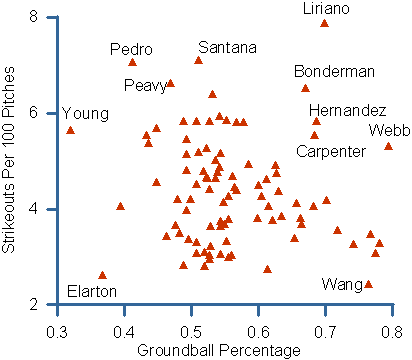
| Baseball Beat | July 08, 2006 |
Don't Be Jaked By Peavy's Mainstream Stats
On the surface, it appears as if Jake Peavy is having a poor season. His record stands at 4-8 with a 4.46 ERA. So what's wrong with Peavy, you ask? Well, not much.
Let's compare his vital stats this year to those in 2004 when he led the National League in ERA:
G GS W-L IP H R ER HR BB SO ERA BR/9 H/9 BB/9 K/9 K/BB
2004 27 27 15-6 166.1 146 49 42 13 53 173 2.27 11.34 7.90 2.87 9.36 3.26
2006 17 17 4-8 107.0 102 53 53 14 26 118 4.46 10.98 8.58 2.19 9.93 4.54
Peavy is actually walking fewer batters (top left graph below) and striking out more (top right) per nine innings in 2006 than 2004, yet his ERA is more than TWO runs higher this year. That's almost impossible. How can that be? The obvious answer is that Jake is serving up more gopher balls (bottom left) this season (1.18 per 9 IP) than two years ago (0.70/9).
A closer examination shows that Peavy is giving up more flyballs (45.7% vs. 37.0%) and a greater percentage of those batted balls are leaving the ballpark (10.4% vs. 8.0%). But there are some other factors at play here. Consider that the 25-year-old right-hander has yet to allow an unearned run this year, whereas he gave up seven such runs in 2004. Furthermore, Jake's batting average on balls in play (BABIP) is a tad higher (.324) than it was two years ago (.310) despite the increase in flyballs and a decrease in groundballs.
Perhaps due to the reduction in grounders, Peavy is inducing fewer GIDP (0.34 per 9 IP vs. 0.92/9 in 2004). Jake is also allowing more stolen bases (1.26 SB/9 IP) than before (0.87).
Thanks to sites such as The Hardball Times and Fan Graphs, we can also ascertain one other important variable that gets little, if any, attention even among the stathead crowd. Peavy's LOB% was 84.0% in 2004 and is just 70.0% in 2006 (bottom right). That is an important difference. The 6-foot-1, 180-pounder was lights out with runners on base two years ago (.218/.311/.324) compared to the current campaign (.250/.315/.424).
With respect to the difference in Peavy's won-loss records, look no further than run support. When Peavy was 15-6 in 2004, the Padres averaged 6.44 runs per nine innings while he was the pitcher of record. His run support ranked 12th out of 86 qualified pitchers. This year, his teammates are scoring 4.21 runs per 9 IP, ranking him 82nd among 93 qualified pitchers.
The bottom line is that Peavy's Expected Fielding Independent Pitching (xFIP) is virtually the same this year (3.50) as it was in 2004 (3.56). In other words, the native of Mobile, Alabama hasn't lost much, if anything. He is basically the same pitcher. You just wouldn't know it by looking at his win-loss records and ERAs.
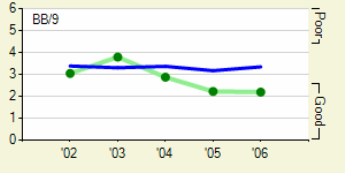
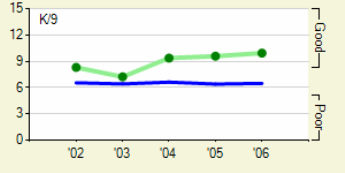
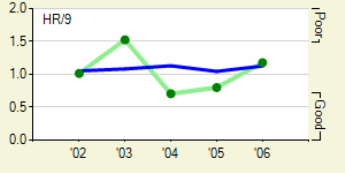
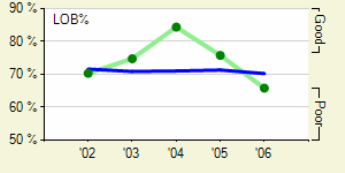
Graphs courtesy of Fan Graphs.
| Baseball Beat | July 03, 2006 |
Lists, Lists, and More Lists (Part Two)
As a follow-up to yesterday's article, we present the pitching leaders in a number of special categories not widely publicized (all stats through Saturday, July 1):
PITCHING
Pitches Thrown AL: Curt Schilling, 1823 NL: Carlos Zambrano, 1906
...and these numbers exclude Sunday's outing when Zambrano threw 112 more pitches. Oh, did I mention that Carlos has hit THREE home runs through Sunday?
Batting Average Allowed (BAA) AL: John Lackey, .209 (81/388) NL: Carlos Zambrano, .194 (78/403)
Lackey improved his league-leading mark on Sunday when he allowed only four hits in 6 2/3 innings of work vs. the Dodgers. He has become the ace of the staff and one of the best starters in the AL.
OBP Allowed AL: Johan Santana, .253 (116/459) NL: Pedro Martinez, .267 (108/405)
Are these the two best starters in baseball? They not only lead in OBP allowed but in K/100P (see the bottom of the sidebar to the left).
SLG Allowed AL: John Lackey, .327 (127/388) NL: Derek Lowe, .333 (142/426)
There's that Lackey guy again. Lowe has allowed only seven HR this year after giving up a career-high 28 in 2005. His worst season had been 17 in 2003 so it looks like last year was a fluke.
ERA at Home AL: Scott Kazmir, 2.36 (11/42.0) NL: Josh Johnson, 1.62 (8/44.1)
What is it about those Florida ballparks? Kazmir is third in K/100P in the AL. Johnson put up a solid line (7-4-3-3-4-5) against the Red Sox at home on Sunday. The 6-foot-7, 240-pound RHP needs to reduce his walk totals but looks as if he is here to stay.
ERA on the Road AL: Justin Verlander, 2.25 (12/48.0) NL: Aaron Harang, 1.57 (10/57.1)
Verlander is near the top in a number of pitching categories, including mainstays like wins (6th w/ 10) and ERA (3rd, 3.13). Harang is third in the NL in K/100P and among the league leaders in Wins (9), WPct (.643), IP (112.1), SO (109), ERA (3.45), and CG (3).
AVG vs LHB AL: Fernando Rodney, .132 (7/53) NL: Enrique Gonzalez, .113 (7/62)
Rodney throws gas and can pierce 100-mph on the radar gun. Gonzalez has pitched well against LHB and at home. It's too early to tell if he is the real deal or not.
AVG vs RHB AL: Johan Santana, .200 (68/340) NL: Carlos Zambrano, .142 (32/226)
A couple of familiar names. You gotta love it when a LHP like Santana has the best BAA vs. RHB. His outstanding changeup might have something to do with that.
AVG w/ Men on Base AL: Rafael Soriano, .177 (14/79) NL: Jason Isringhausen, .158 (9/57)
After pitching just 10 2/3 innings in 2004-05, Soriano has bounced back and become the dominant relief pitcher he was in 2003 when he fashioned a 1.53 ERA with 68 Ks in 53 IP.
AVG w/ RISP AL: Scott Kazmir, .168 (17/101) NL: Jason Schmidt, .111 (8/72)
Speaking of comebacks, Schmidt has once again become one of the best starting pitchers in the NL this season. He ranks in the top ten in IP (115.1), SO (99), ERA (2.73), WHIP (1.09), WPct (.667), CG (3), and BAA (.211).
Run Support Per 9 IP AL: Javier Vazquez, 8.88 (100/101.1) NL: Jeff Suppan, 7.41 (76/92.1)
Now you know why Vazquez is 8-4 despite a 5.15 ERA and Suppan 6-4 with a 5.17 ERA and 1.56 WHIP.
G/F Ratio AL: Jake Westbrook, 3.19 (220/69) NL: Brandon Webb, 3.82 (252/66)
Keep the ball on the ground, keep the ball in the yard. Westbrook has allowed only 8 HR in 103 innings, while Webb has given up just 9 dingers in 132 1/3 frames.
GIDP Induced
AL: Chien-Ming Wang, 18
NL: Miguel Batista, 18
Roy Oswalt, 18
Jamey Wright, 18
GIDP Induced/GIDP Situation AL: Jason Johnson, .238 (15/63) NL: Ray King, .333 (8/24)
Johnson should find Boston's infield defense to his liking. His K/9 rate (3.78) is abysmal but his BABIP (.349) is well above his career norm (.306). Johnson's FIP (5.00) this year is more than a run below his actual ERA (6.22), whereas his career FIP (4.96) matches his lifetime ERA (4.97).
Stolen Bases Allowed AL: Freddy Garcia, 20 NL: Chris Young, 18
Caught Stealing Off AL: Kelvim Escobar, 8 NL: Zach Duke, 8
The Pirates have two young southpaws who do a whale of a job in preventing baserunners from stealing. Scroll down to find out the name of the other lefty.
SB Att (1BH+BB+HBP) AL: Kenny Rogers, .021 (2/95) NL: Chris Capuano, .019 (2/108)
Pickoff Throws per Baserunner AL: Kenny Rogers, 0.50 (66/132) NL: Chris Capuano, 0.74 (111/149)
Maybe pickoff throws do indeed help in keeping runners close to the bag. Rogers and Capuano have attempted more pickoffs than any other pitcher and runners have responded by almost never running on them.
Pickoffs AL: Justin Verlander, 5 NL: Paul Maholm, 6
Verlander is tough to hit but is also difficult to run against. He has picked off five runners and only allowed one stolen base. Pretty impressive for a rookie RHP.
% Inherited Runners Scored AL: B.J. Ryan, 4.5 (1/22) NL: Chad Bradford, 9.7 (3/31)
Ryan has been lights out this year. The Toronto closer has an ERA of 0.45 with 22 saves. His WHIP is 0.64 and BAA is .137. He has whiffed 51 batters in 40 1/3 IP, including all five outs vs. the Phillies on Saturday.
First Batter Efficiency AL: Chris Britton, .045 (1/22) NL: Tom Gordon, .133 (4/30)
Source: STATS LLC
| Baseball Beat | July 02, 2006 |
Lists, Lists, and More Lists
At the halfway point in the 2006 seaon, we present the leaders in special batting categories not widely publicized (all stats through Saturday, July 1):
BATTING
Fly/Pops Hit
AL: Orlando Cabrera, 126
NL: Carlos Lee, 127
Alfonso Soriano, 127
This is the first year in which Cabrera has hit more balls in the air than on the ground. He has a lifetime 1.17 G/F ratio. Orlando's walk (.084 per PA) and BB/SO (1.22) rates are the highest ever. He is also putting up career bests in AVG (.299) and OBP (.361) and has a current streak of getting on-base in 58 consecutive games, the longest such skein since 1960.
% Flys/Pops Hit AL: Jonny Gomes, 66.23% (100/151) NL: Jason Lane, 64.08% (91/142)
Two players who are struggling. Gomes hit .203/.289/.392 in June and hasn't gone deep since slugging two vs. Kansas City three weeks ago. Lane hasn't hit for average at home (.226) or on the road (.187), vs. LHP (.226) or RHP (.200). To his credit, he has drawn 40 walks and ripped 11 HR.
Grounders Hit AL: Ichiro Suzuki, 174 NL: Juan Pierre, 161
Suzuki is well on his way to his sixth consecutive 200-hit season. Only Willie Keeler (8, 1894-01) and Wade Boggs (7, 1983-89) have had longer streaks. Ichiro is 24 hits shy of matching his Japan total and now has 2,532 for his combined career.
% Grounders Hit AL: Derek Jeter, 79.12 (144/182) NL: Matt Murton, 74.39 (122/164)
In his first full season, Murton is looking more like a platoon or fourth outfielder. He is mashing LHP (.333/.410/.493) with 9 BB and 5 SO in 69 AB but is struggling vs. RHP (.234/.299/.304) with 13 BB and 31 SO in 158 AB.
Groundball/Flyball Ratio AL: Derek Jeter, 3.79 (144/38) NL: Matt Murton, 2.90 (122/42)
Always a groundball-type hitter (2.20 career G/F ratio), Jeter is banging them into the turf at a higher rate than ever before. Derek is hitting in the .330s for the first time since 2000 and is walking at the highest rate (.121) since 1999. He is a legitimate MVP candidate this year.
Pitches Seen AL: Kevin Youkilis, 1533 NL: Bobby Abreu, 1550
Although Abreu's batting average and power are down, his OBP is the highest its been since 1999 when he hit .335 with 109 BB. Bobby has walked at least 100 times in each of the last seven seasons and is on pace to exceed 150 free passes this year.
Pitches Seen per PA AL: Kevin Youkilis, 4.47 (1533/343) NL: Bobby Abreu, 4.49 (1550/345)
The Greek God of Walks has seen more pitches in total and per plate appearance than any other batter in the AL this year. Youkilis slugged his 10th HR of the season on Sunday, raising more than a few eyebrows with his power. He has played first and third base and been the most valuable addition to Boston's starting lineup this year.
% Pitches Taken AL: Jason Giambi, 66.3% (886/1337) NL: Barry Bonds, 68.3% (670/981)
The names of Giambi and Bonds are usually not found in the same sentence because of the high percentage of pitches taken. These power hitters are as selective as they come when it comes to swinging at pitches. Both sport outstanding on-base and isolated power marks to more than offset suspect defense and baserunning.
% Swings That Missed AL: Frank Catalanotto, 5.8% (21/364) NL: Juan Pierre, 6.1% (37/608)
Catalanotto is the best-kept secret in Canada. He is hitting .335/.439/.503 and now has a career batting average of .300. The left fielder has never walked more than he struck out, yet has 35 BB and just 15 SO this season. As a role player, Frank is much more valuable to the Blue Jays than to any fantasy owner and that may be why he has never quite gotten his due.
% Swings Put Into Play AL: Placido Polanco, 60.2% (278/462) NL: Scott Hatteberg, 61.4% (208/339)
Polanco has reverted to his prior career form with a batting average in the .280s after hitting .331 last year. He has always put the ball in play, striking out in fewer than 7% of his plate appearances.
% Strikes Taken AL: Vladimir Guerrero, 8.2% 8.2 (57/698) NL: Jeff Francoeur, 10.8% (82/758)
Guerrero and Francoeur have never met a pitch they didn't like (or wave at). Although there are a lot of similarities between the two right fielders, Guerrero has been much more productive when swinging at pitches. Vlad has hit for a higher average (.292 to .251) and more power (19.3 to 22.6 HR/AB) than his NL counterpart.
% Swung at 1st Pitch AL: Johnny Damon, 10.1% (36/356) NL: David Eckstein, 10.2% (36/352)
Two of the most patient lead-off hitters in the game. Damon and Eckstein work the pitcher by rarely swinging at the first offering. These "little things" aren't always appreciated among statheads but are valuable nonetheless.
Bunts In Play AL: Corey Patterson, 28 NL: Juan Pierre, 37
Patterson and Pierre would have made better fast-pitch softball players than big leaguers. Slow pitch, no. Fast pitch, yes.
AVG w/ Men on Base AL: Frank Catalanotto, .446 (37/83) NL: Dan Uggla, .396 (42/106)
There's Catalanotto's name again. Uggla has been anything but ugly for Florida. After missing a week due to a sore hamstring, he was back in the starting lineup this weekend vs. Boston. The NL Rookie of the Year candidate is hitting .308 with 13 HR.
AVG RISP
AL: Kenji Johjima, .407 (22/54)
Placido Polanco, .407 (22/54)
NL: Albert Pujols, .480 (24/50)
AVG Late & Close AL: Reed Johnson, .609 (14/23) NL: Nomar Garciaparra, .444 (12/27)
At the risk of small sample sizes, the players in the two categories above have hit well thus far with runners in scoring position or late and close. Call them clutch, call them lucky. Whatever you prefer. The numbers are what they are but also subject to huge swings between now and the end of the season.
AVG vs LHP AL: Vladimir Guerrero, .418 (33/79) NL: Freddy Sanchez, .500 (29/58)
Can you say breakout season? Sanchez is hitting .356/.390/.517 with 24 doubles and more than 40 runs and RBI in 79 games. He is also leading the league in OBP vs. LHP and batting average at home (see below).
OBP vs LHP AL: Jermaine Dye, .495 (48/97) NL: Freddy Sanchez, .531 (34/64)
Dye has already slugged 20 HR, including 8 in just 78 AB vs. LHP.
SLG vs LHP AL: Jonny Gomes, .768 (53/69) NL: Bill Hall, .833 (45/54)
Hall just may be the most underrated player in the game. With the injury to J.J. Hardy, the former utilityman has become Milwaukee's everyday shortstop. He has 40 extra-base hits in 72 games. The 26-year-old has also played second, third, and center this year.
AVG vs RHP AL: Joe Mauer, .391 ( 70/179 ) NL: Miguel Cabrera, .352 (80/227)
What's most amazing about Mauer is that he is tattooing everybody everywhere. To wit, the #1 pick in the 2001 draft is hitting .393 vs. LHP, .391 vs. RHP, .380 at home, and .403 on the road. Consistent but, more importantly, just flat out awesome.
OBP vs RHP AL: Joe Mauer, .469 (97/207) NL: Nick Johnson, .442 (100/226)
Johnson is on pace to post career highs in AVG (.300), OBP (.429), and SLG (.533). When healthy, he is among the most productive hitters in the NL.
SLG vs RHP AL: Jim Thome, .780 (124/159) NL: Albert Pujols, .709 (117/165)
It takes more than great slugging vs. RHP to win the MVP but two of the leading candidates are doing just that.
AVG at Home AL: Ichiro Suzuki, .387 (67/173) NL: Freddy Sanchez, .396 (55/139)
If Safeco is a pitcher's park, how much does it really affect a player like Ichiro? A word to the wise: be wary of adjusted park data as a be all and end all to evaluating hitters.
AVG on the Road AL: Joe Mauer, .403 (56/139) NL: Scott Rolen, .391 (45/115)
Rolen is a lock to win Comeback Player of the Year in the NL. The way Scott is swinging the bat this year, one would never know he hit just .235 with 5 HR in 2005. He is on pace to reach career highs in AVG (.343) and OBP (.411) while SLG (.577) is only a tad shy of his best season in 2004.
SB Attempt (1BH+BB+HBP) AL: Corey Patterson, .522 (35/67) NL: Jose Reyes, .457 (43/94)
After reaching first base on a single, walk, or hit by pitch, Patterson and Reyes are attempting to steal second more often than anyone else.
Steals of Third
AL: Derek Jeter, 7
Scott Podsednik, 7
NL: Alfonso Soriano, 8
Stealing third is an art in itself. Sure, it takes speed. But it also takes an even bigger lead and jump to swipe third than second. The best time to steal third is usually with one out as you don't want to make the first or last out of an inning at third.
GDP/GDP Situation AL: Grady Sizemore, 0.0% (0/57) NL: Craig Counsell, 0.0% (0/30)
Sizemore is an excellent all-round player. His stats speak for themselves. But here is one that gets almost no attention.
Extra Bases Taken as Runner AL: Chone Figgins, 0.85 (22/26) NL: Mike Cameron, 0.83 (19/23)
The above percentages are extraordinarily high. Always a great baserunner, Figgins took the extra base 62% of the time last year. His rate this year is worth an extra five or six bases vis-a-vis 2005. Cameron took the extra base 64% of the time last season without being thrown out, another important component to this baserunning stat.
Tomorrow: Special Pitching Stats
Source: STATS LLC
| Baseball Beat | June 28, 2006 |
Winners Never Quit
1968. It was a down year for the Dodgers. And for me. I turned 13 that July. Oh, becoming a teenager wasn't so bad. But coming down with Osgood-Schlatter disease and pneumonia at the same time just about ruined my summer.
If you're going to suffer both illnesses, I guess it makes sense to come down with them concurrently. No need to be on the disabled list any longer than necessary. I think my Mom and Dad put me on the 60-day DL in early June. It was the first time in my "career" that I had ever missed any action.
After playing four years of Little League, I was enjoying my first season of Pony League when I was diagnosed with my diseases. I played the first half of what I believe was a 20-game schedule but missed the entire second half with my knee pain and pneumonia.
I couldn't play baseball. I couldn't ride my bike. I couldn't even run. Well, now that I think about it, I really never could run all that well anyway. To wit, my high school coach used to time me running from home to first with a calendar. I can hear him now, "January, February, March, April..." I wasn't all that bad. I mean, I don't think I ever made it into May. Mickey Mantle could run to first base in 3.1 seconds. I could run to first base in 3.1 months. But the Mick could only do that hitting from the left side. I had the disadvantage of being a right-handed hitter.
In any event, I was sidelined that summer. I was instructed by my doctor to rest and apply ice to my knees frequently. I don't think the ice bags helped my pneumonia much, but my lungs seem to clear up at about the same pace as the improvement in my knees. I was a prime candidate for Osgood-Schlatter as it generally afflicts children in a "growth spurt" between 10 and 15 years old who are involved in sports. I was always tall for my age, but I shot up several inches that year. The good news is that I lost all my baby fat and was as slim as I had ever been.
What's a 13-year-old boy, who has no clue about girls, to do in his summer between seventh and eighth grades when he can't play his favorite sport and is mostly confined to home? Well, he listens to all of the Dodger games on the radio, plays lots of APBA, and reads a bunch of sports books.
My Dad gave me Winners Never Quit by Phil Pepe. The title was short for the slogan, "Quitters Never Win; Winners Never Quit." It could be found scribbled on blackboards in locker rooms across the country. Pepe's book was inspiring, given to me by Dad to cheer me up during a period when I was down and out.
The book chronicled 15 star athletes who overcame injuries and obstacles with courage, guts, and desire. Each chapter had a subtitle that was an actual quote from another player or coach.
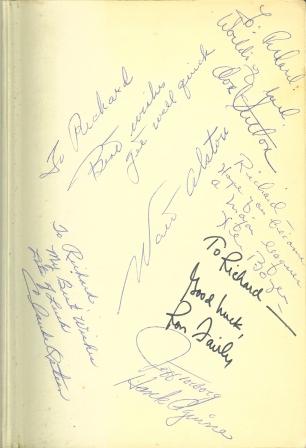
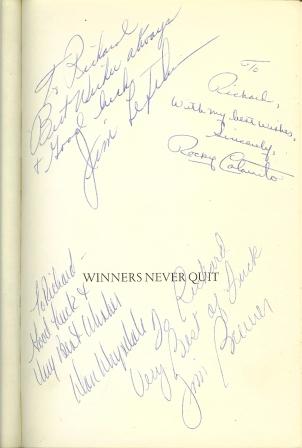
What made the gift extra special were the autographs that adorned the first two pages of the book. My Dad, who covered the Dodgers as the beat writer for the Long Beach Independent, Press-Telegram from 1958-1968, had asked manager Walt Alston and ten players (including several of the best known) to sign the book for me. Alston, Don Sutton, Ken Boyer, Ron Fairly, Claude Osteen, Jim Lefebvre, Rocky Colavito, Jim Brewer, and Don Drysdale personalized their signatures by adding "To Richard" and either "Good Luck," "Best of Luck," or "Best Wishes." Alston even added, "Get well quick." Boyer wrote, "Hope you become a major leaguer."
Although the Dodgers didn't fare all that well that season, Drysdale broke Walter Johnson's consecutive scoreless innings mark of 56. The Big D's streak was almost snapped during his fifth shutout when he hit Giants' catcher Dick Dietz with a pitch with the bases loaded in the ninth inning. But as Vin Scully told those of us listening to the game, "It hit the bat said Wendlestedt. It hit the bat." In actuality, the home plate umpire ruled that Dietz had not made an attempt to get out of the way and called the pitch a ball rather than awarding the batter first base. Drysdale retired Dietz, Ty Cline, and Jack Hiatt to end the game and preserve his streak.
The Hall of Famer epitomized what the book was all about. He never quit. With the help of Wendlestedt, he persevered and went on to record 58 consecutive scoreless innings. Although Drysdale wasn't one of the subjects in Winners Never Quit, the book featured a couple of my favorite players from that era. In junior high school, I wore number 22 and could twitch my head at the free throw line better than anybody not named Elgin Baylor. Being a righty, I couldn't imitate Sandy Koufax nearly as well but, suffice it to say, I knew everything about him--from his birthday to his stats to his mannerisms on the mound.
I read the book from cover to cover. At least twice. I bought into all the messages conveyed from one chapter to the next as well as the Introduction.
Call it courage. Call it guts. Call it desire. There are many names for it, but what is it, really, this indefinable quality that makes a man put out that extra something just when it seems there is nothing left to give?It takes courage merely to try out for the team. It means willingness to suffer, to sacrifice, to work harder than the next fellow. It means you ran that extra lap, practiced the jump shot a half hour longer, ran the dive play a few more times. It means you got home a little later, a little wearier, a little hungrier and with a few more aches and pains. Maybe you thought it wasn't worth it. Maybe you considered skipping practice tomorrow or quitting the team altogether. But you didn't. That is courage.
Missing ten baseball games that summer turned out to be a small price to pay in the big picture of life. You see, the games come and go. But the values we learn stay with us forever. Just like that book, tucked away neatly on a shelf in my home office.
| Baseball Beat | June 25, 2006 |
Stats You Won't Find in Your Sunday Newspaper
Remember when we used to wait until the Sunday newspaper arrived to get all of our in-season baseball statistics? My, have times changed. We are now able to track play-by-play (or even pitch-by-pitch) stats in real time. We can sort 'em and slice and dice 'em to our heart's desire.
Although not on the cutting edge in terms of the delivery, Baseball Analysts is proud to present the Quad and K/100P every Sunday morning. The Quad categories (OBP, SLG, times on base, and total bases) are nothing new but thinking in terms of these four basic measures and combining them to gain an appreciation of both counting and rate stats is our primary purpose in presenting the leaders at the bottom of the sidebar on the left each week.
The K/100P is much more innovative. It does a better job of correlating with runs allowed than K/9 or K/BF. Pitchers who rank high in K/100P tend to prevent runs at an even greater clip than league leaders in the other strikeout measures. To the extent that there is a discrepancy between what K/100P shows and, say, ERA, it usually means that a pitcher may be the beneficiary or victim of a small sample size, home ballpark, team defense, bullpen, or luck. Betting that K/100P and number of runs allowed will converge over time makes more sense than ignoring such disparities.
Herewith are the leaders in the Quad and K/100P as of June 24. Let's start with the hitters first...
American League
OBP: Travis Hafner, .447
SLG: Vernon Wells, .625
Jim Thome, .625
TOB: Ichiro Suzuki, 145
TB: Vernon Wells, 175
National League OBP: Bobby Abreu, .450 SLG: Albert Pujols, .751 TOB: Bobby Abreu, 143 TB: David Wright, 176
Vernon Wells and David Wright are the only non-corner outfielders, first basemen, or designated hitters leading their league in any of these four areas. Wells is atop the AL in SLG and TB, which means he is slugging better than anyone per at-bat and in total. It's one thing to lead in one or the other but all the better to do so in both.
What can you say about Wright? The 23-year-old third baseman is not only leading the majors in total bases but is second in the NL in OPS (1.018), 4th in RBI (64), 5th in SLG (.612), 6th in AVG (.339), 9th in OBP (.406), and 10th in HR (18).
For what it's worth, here are Wright's projected full-year stats:
G AB R H 2B 3B HR RBI SB AVG OBP SLG OPS 161 629 109 213 41 7 39 139 24 .339 .406 .612 1.018
Most .300/.400/.600 guys are pretty special, especially those who play infield and can run. To wit, here is a list of all the third basemen who have reached those milestones over a full season (with a minimum of 502 plate appearances):
AGE YEAR OPS AVG OBA SLG
1 George Brett 27 1980 1.118 .390 .454 .664
2 Chipper Jones 27 1999 1.074 .319 .441 .633
3 Jim Thome 25 1996 1.062 .311 .450 .612
4 Al Rosen 29 1953 1.034 .336 .422 .613
5 Eddie Mathews 21 1953 1.033 .302 .406 .627
6 Chipper Jones 29 2001 1.032 .330 .427 .605
7 Alex Rodriguez 29 2005 1.031 .321 .421 .610
8 Ken Caminiti 33 1996 1.028 .326 .408 .621
9 Albert Pujols 21 2001 1.013 .329 .403 .610
Next, we move to the K/100P leaders. Johan Santana and Pedro Martinez have been at or near the top all year long. Let's face it, they just might be the best two pitchers in baseball. Any stat that identifies the greats should be taken seriously, especially as it relates to uncovering those who are not as well-known.
American League Johan Santana, 7.00 Jeremy Bonderman, 6.66 Scott Kazmir, 6.07
Despite a 3.82 ERA, I have no doubt that Jeremy Bonderman is one of the elite pitchers in the game. Always long on potential, Bonderman has arrived. The 23-year-old right-hander throws a 94-96 mph fastball and a plus breaking ball. His command has been outstanding this season, as evidenced by a career-low BB/9 (2.54) and career-highs in K/9 (8.55) and K/BB (3.36). Bonderman hasn't allowed more than two runs in any of his last four starts and struck out 12 batters in his previous two outings. [Update: Bonderman put up a 7.0-7-1-1-1-8 line vs. STL on Sunday, lowering his ERA to 3.65.]
National League Pedro Martinez, 7.33 Jake Peavy, 6.48 Dave Bush, 6.47
Dave Bush is probably the biggest surprise on either list of league leaders. Bush has been solid but not outstanding in his two-plus seasons in the big leagues. His K/100P rate would suggest that he is pitching better than his 4.64 ERA would otherwise indicate. He is among the top ten in the NL in IP (104.2), K (86), and WHIP (1.17). Bush throws strikes and his out pitch is a big hook. Dave's only downfall is a higher-than-desirable career HR/9 rate of 1.17. He has pitched better at home (4-2, 3.16) than on the road (0-4, 7.14).
If Bush is available in your fantasy league on the cheap because of his mediocre W-L record and ERA, then I would advise trading for him before these stats converge with his much more telling K/100P rate.
| Baseball Beat | June 23, 2006 |
The Best #6 Starting Pitcher in Baseball
I wonder how this guy might do in the majors if given a chance? If he could only get batters out in the ninth. . .
Boy, I can't wait to see how he does when he becomes a "finished product."
| Baseball Beat | June 22, 2006 |
Numerous Castles Among This Year's Rooks
As the season approaches the halfway point, I thought it would be instructive to check out how the rookies have performed in both the American and National Leagues. What I found of most interest is the fact that the AL seems to have the upper hand when it comes to pitchers and the NL with respect to hitters.
In total, there is a lot of talent in both leagues. The Rookie of the Year races are wide open but seem to be limited to the pitchers in the AL and the hitters in the NL.
Let's take a look at the stats through the conclusion of most games on Wednesday, June 21. I'll start off with the group that may be the weakest of the four.
AL ROOKIE HITTING STATS (Min. 100 PA)
PLAYER TEAM AB R H 2B 3B HR RBI SB BB AVG OBP SLG OPS Mike Napoli LAA 93 19 27 5 0 7 15 2 18 .290 .416 .570 .986 Ian Kinsler Tex 94 16 30 7 1 5 21 2 10 .319 .385 .574 .960 Kenji Johjima Sea 221 28 60 13 0 5 29 0 11 .271 .321 .398 .719 Melky Cabrera NYY 133 21 33 4 1 1 16 2 20 .248 .351 .316 .666 Brandon Fahey Bal 108 16 29 1 1 2 16 2 4 .269 .307 .352 .659 Kendry Morales LAA 101 10 23 4 0 3 11 1 7 .228 .278 .356 .634 Nick Markakis Bal 181 21 42 7 1 2 16 0 19 .232 .312 .315 .627 Brian Anderson CWS 152 22 27 5 0 5 18 2 19 .178 .274 .309 .583
Ian Kinsler and Mike Napoli are the only rookies in the American League enjoying standout seasons. Kinsler, who turns 24 today, dislocated his left thumb in early April and missed more than six weeks. He slugged two home runs in his first game back and has gone deep twice since, giving the second baseman a total of five in less than 100 AB.
Napoli began the year at Triple-A Salt Lake and didn't make his MLB debut until May 4 when he became the 92nd player to homer in his first at-bat, connecting off fellow rookie Justin Verlander of the Detroit Tigers. The 24-year-old catcher, who led the Texas and California leagues in home runs the previous two seasons, is number one among AL rookies with seven cranks and has a superb OBP of .416.
NL ROOKIE HITTING STATS (Min. 100 PA)
PLAYER TEAM AB R H 2B 3B HR RBI SB BB AVG OBP SLG OPS Dan Uggla Fla 265 49 83 11 4 13 43 4 20 .313 .366 .532 .899 Prince Fielder Mil 258 35 76 20 1 14 40 5 23 .295 .351 .543 .894 Russell Martin LA 132 20 40 8 2 4 27 0 15 .303 .376 .485 .861 Mike Jacobs Fla 212 25 58 17 0 10 38 2 30 .274 .365 .495 .860 Andre Ethier LA 112 15 33 6 1 4 15 1 10 .295 .360 .473 .833 Josh Willingham Fla 195 20 52 13 0 9 34 1 22 .267 .351 .472 .823 Willy Aybar LA 106 14 29 9 0 3 20 1 12 .274 .364 .443 .807 Ryan Zimmerman Was 270 37 75 20 1 10 46 5 23 .278 .333 .470 .804 Jeremy Hermida Fla 98 14 26 7 1 2 8 2 14 .265 .368 .418 .787 Ronny Paulino Pit 171 17 54 9 0 2 15 0 15 .316 .369 .404 .772 Conor Jackson Ari 198 30 52 11 0 6 38 0 28 .263 .355 .409 .764 Hanley Ramirez Fla 251 52 67 16 5 3 20 20 25 .267 .338 .406 .745 Josh Barfield SD 231 30 58 11 2 4 19 8 11 .251 .287 .368 .655 Nate McLouth Pit 176 31 39 10 0 3 9 8 14 .222 .292 .330 .622 Re. Abercrombie Fla 170 23 37 10 1 3 14 3 14 .218 .280 .341 .621
The Marlins have six rookies playing everyday. Dan Uggla has not only been Florida's best first-year player but is in a good position to earn NL Rookie of the Year honors. Not as heralded as teammates Jeremy Hermida, Mike Jacobs, Hanley Ramirez, or Josh Willingham, the 26-year-old second baseman is leading NL rookies in hits (83), batting average (.313), and OPS (.899).
Hermida was on the disabled list with a right hip flexor from April 18 to May 23. The 22-year-old outfielder is starting to play well, going 16-for-55 with six doubles in June (including a walk in each of his last five games).
Hitting only .177 on May 7, Jacobs has turned his season around and raised his average by nearly 100 points. The 25-year-old first baseman is hitting .404/.456/.750 in June. He has slugged 24 doubles and 21 home runs in 312 career at-bats. However, Mike's value may be limited to a platoon role unless he begins to hit LHP better than the .122/.204/.204 line he has put up in 2006.
Ramirez got off to a hot start but is just 2-for-40 in his last 11 games. The toolsy shortstop was batting .344 on May 22 but has had only one two-hit game in the past month. Although ripping LHP to the tune of .396/.482/.688, he is hitting just .236/.302/.340 vs. RHP. To his credit, Ramirez is seventh in the NL in pitches per plate appearance (4.13) and has drawn a walk 9% of the time.
Willingham was placed on the 15-day disabled list last week, retroactive to June 7, with a left hand injury. He could be activated today. The 27-year-old left fielder went yard in his last two games. Call yourself fortunate if you have him as a catcher on your fantasy team.
Aside from the Marlins, the Dodgers are playing the most rookies in the NL this year. Willy Aybar, who was recently sent back to Las Vegas despite hitting .274/.364/.443, Andre Ethier (.295/.360/.473), and Russell Martin (.303/.376/.485) have already exceeded 100 plate appearances while Matt Kemp slugged seven HR in his first 15 games in the big leagues and is now an everday fixture in the starting lineup.
Prince Fielder and Ryan Zimmerman are also vying for NL ROY honors. Fielder and Zimmerman gave glimpses of what was to come last year when the Milwaukee first baseman hit .288 with two HR in 59 AB and the Washington third sacker batted .397 with 10 doubles in only 20 games. They have each slammed 20 two baggers this year. The 22-year-old Fielder leads all rookies with 14 HR and the 21-year-old Zimmerman sits atop the RBI leaderboard with 46.
AL ROOKIE PITCHING STATS (Min. 25 IP)
PLAYER TEAM IP H R ER BB SO W L SV ERA WHIP K/9 K/BB Jon Papelbon Bos 35.2 19 1 1 4 35 1 1 23 0.25 0.64 8.83 8.75 Jered Weaver LAA 26.1 16 5 4 4 22 4 0 0 1.37 0.76 7.52 5.50 Zach Miner Det 26.0 19 8 6 7 13 3 1 0 2.08 1.00 4.50 1.86 Fran. Liriano Min 58.1 47 14 14 17 67 6 1 1 2.16 1.10 10.34 3.94 Joel Zumaya Det 35.1 19 9 9 17 45 3 0 1 2.29 1.02 11.46 2.65 James Shields TB 30.0 32 10 10 10 27 4 0 0 3.00 1.40 8.10 2.70 Bobby Jenks CWS 29.2 26 10 10 9 36 2 1 20 3.03 1.18 10.92 4.00 Sendy Rleal Bal 31.2 28 13 11 17 12 1 1 0 3.13 1.42 3.41 0.71 Justin Verlander Det 89.2 84 34 32 28 53 8 4 0 3.21 1.25 5.32 1.89 John Rheinecker Tex 30.0 38 12 12 5 16 2 1 0 3.60 1.43 4.80 3.20 Bobby Keppel KC 29.2 32 12 12 12 15 0 3 0 3.64 1.48 4.55 1.25 Ruddy Lugo TB 42.1 36 18 18 20 24 1 5 0 3.83 1.32 5.10 1.20 Casey Janssen Tor 62.0 62 33 31 12 32 5 5 0 4.50 1.19 4.65 2.67 Jake Woods Sea 29.1 25 17 16 19 25 1 1 1 4.91 1.50 7.67 1.32 Fausto Carmona Cle 31.0 32 17 17 10 25 1 2 0 4.94 1.34 7.47 2.60 John Koronka Tex 81.0 89 45 45 30 38 5 4 0 5.00 1.47 4.22 1.27 Boof Bonser Min 26.1 30 17 17 8 22 1 1 0 5.81 1.44 7.52 2.75
What can you say about the rookie pitchers in the AL? Francisco Liriano, Jonathan Papelbon, Justin Verlander, Jered Weaver, and Joel Zumaya have been lights out thus far. In fact, Liriano and Papelbon have been so dominant that either one could wind up winning the Cy Young Award almost as easily as Rookie of the Year. The 22-year-old Liriano (6-1, 2.16 ERA) makes his seventh start of the year tonight against a guy named Roger Clemens. Set your DVR now.
Papelbon (1-1, 0.25, and 23 saves) has been the best closer in either league during the first three months of the current campaign. The 25-year-old RHP has allowed only 24 baserunners and one run in 36 innings of work. Opponents are hitting--if you can call it that--.153/.186/.185 against him.
Verlander and Zumaya, both of whom can hit triple digits on the radar gun, are two reasons why the Detroit Tigers have the best record in baseball. Verlander, 23, has won eight games and ranks fifth in the AL in ERA (3.21). The 21-year-old Zumaya lost his first game of the year last night but has struck out 45 batters in 35.2 IP while leading the league in holds with 17.
Weaver made his MLB debut on May 27 and proceeded to beat the Baltimore Orioles, Cleveland Indians, Tampa Bay Devil Rays, and Kansas City Royals in his first four starts before managing to get sent back down to the minors on June 17. The 23-year-old RHP didn't allow more than five hits, two walks, or two runs in any game while limiting opponents to an OPS of .489 or .047 lower than the worst-hitting regular in the majors this year.
James Shields is off to a fantastic start. The 24-year-old won his fourth game without a loss last night and has yet to give up a home run in 30 innings while inducing twice as many groundballs as flyballs. Shields has a major-league quality changeup and could be a solid starter if he continues to command his fastball the way he has this month.
Bobby Jenks (2-1, 3.03 ERA, 20 saves) has been among the best closers in the league this year. The hard-throwing righthander earned his fame last fall when he helped the White Sox win their first World Series championship since 1917.
Boston's Jon Lester and Craig Hansen are two prized prospects to keep close tabs on, and Cleveland's Jeremy Sowers will be making his MLB debut against the Cincinnati Reds on Sunday. The latter was 8-1 with a 1.27 ERA for Buffalo. The 23-year-old Sowers was 14-4 with a 2.37 ERA at three levels in his first season of professional baseball last year.
NL ROOKIE PITCHING STATS (Min. 25 IP)
PLAYER TEAM IP H R ER BB SO W L SV ERA WHIP K/9 K/BB Takashi Saito LA 34.2 20 7 7 8 45 3 2 4 1.82 0.81 11.68 5.63 Josh Johnson Fla 67.0 53 21 15 32 59 6 4 0 2.01 1.27 7.93 1.84 Ramon Ramirez Col 31.0 18 8 8 6 31 2 1 0 2.32 0.77 9.00 5.17 Brian Sweeney SD 34.1 32 10 9 11 12 2 0 1 2.36 1.25 3.15 1.09 Adam Wainwright StL 33.2 22 9 9 6 28 2 1 1 2.41 0.83 7.49 4.67 Shawn Hill Was 26.0 22 8 7 9 12 1 1 0 2.42 1.19 4.15 1.33 Jonathan Broxton LA 26.2 20 9 8 12 34 1 0 0 2.70 1.20 11.48 2.83 Brian Bannister NYM 28.0 22 9 9 17 14 2 0 0 2.89 1.39 4.50 0.82 Alay Soler NYM 33.0 25 13 11 13 19 2 1 0 3.00 1.15 5.18 1.46 Ken Ray Atl 32.2 26 11 11 15 23 0 0 4 3.03 1.26 6.34 1.53 Ricky Nolasco Fla 53.0 56 24 18 16 41 5 3 0 3.06 1.36 6.96 2.56 Mike O'Connor Was 63.0 46 28 24 29 44 3 4 0 3.43 1.19 6.29 1.52 Enrique Gonzalez Ari 27.0 19 11 11 6 21 2 0 0 3.67 0.93 7.00 3.50 Clay Hensley SD 80.0 69 36 36 35 38 4 5 0 4.05 1.30 4.27 1.09 Matt Capps Pit 35.2 37 17 17 5 28 2 1 0 4.29 1.18 7.07 5.60 Jose Capellan Mil 38.2 33 20 19 13 29 2 0 0 4.42 1.19 6.75 2.23 Paul Maholm Pit 82.0 101 42 41 41 56 2 5 0 4.50 1.73 6.15 1.37 Mike Thompson SD 39.0 42 22 20 10 17 3 2 0 4.62 1.33 3.92 1.70 Scott Olsen Fla 67.0 60 38 35 29 58 6 3 0 4.70 1.33 7.79 2.00 Fernando Nieve Hou 65.0 64 35 34 20 42 2 3 0 4.71 1.29 5.82 2.10 Matt Cain SF 77.0 66 45 41 34 62 6 5 0 4.79 1.30 7.25 1.82 Cole Hamels Phi 25.2 22 15 14 14 25 1 2 0 4.91 1.40 8.77 1.79 Sean Marshall ChC 76.0 70 42 42 36 50 4 5 0 4.97 1.39 5.92 1.39 Angel Guzman ChC 25.1 24 18 16 20 29 0 2 0 5.68 1.74 10.30 1.45 Taylor Buchholz Hou 77.1 78 52 50 19 47 4 6 0 5.82 1.25 5.47 2.47
Josh Johnson (6-4, 2.01 ERA) and Takashi Saito (3-2, 1.82, 4 saves) have been the top-performing rookie starter and reliever, respectively, in the NL this year. The 22-year-old Johnson began the season in the bullpen and didn't earn his first start until May. He hasn't allowed over three runs in any game and has held the opposition to no more than two runs in eight of his nine starts. Johnson has struck out almost 8 per 9 IP while giving up just two homers over the course of 67 frames.
While it is hard to think of the 36-year-old veteran of Japanese baseball a rookie, Saito qualifies as a first-year player here in the States. He has performed admirably as both a set-up man and closer for the Dodgers. The RHP is averaging 11.7 Ks per 9 while limiting opponents to a .168/.219/.277 hitting line.
In the department of the best of the rest, Matt Cain, as a whole, hasn't pitched up to expectations yet but nearly tossed a no-hitter against the Angels in his last start to go along with a one-hit shutout vs. the A's a month ago. The 21-year-old has a huge ceiling and could wind up as the best of the lot five or ten years from now. Chad Billingsley, Cole Hamels, and Anthony Reyes are three other rookie starters to watch closely.
My sense is that 2006 is going to be remembered as a year in which a number of great--not good--players began their MLB careers.
[Additional reader comments and retorts at Baseball Primer.]
| Baseball Beat | June 16, 2006 |
Angels Option Jered Weaver to Salt Lake
Breaking News: The Angels just announced that Jered Weaver has been sent back down to the Salt Lake Bees, the team's Triple-A affiliate in the Pacific Coast League. Bartolo Colon was activated and will start on Sunday.
The five-man rotation will be comprised of Colon, Kelvim Escobar, John Lackey, Ervin Santana, and Jeff Weaver. The older Weaver started on Friday night and pitched a solid game, striking out nine batters without allowing a walk. Poor defense once again lost it for the Halos as Weaver, Dallas McPherson, Juan Rivera, Adam Kennedy, and Mike Napoli made errors or failed to make fairly routine plays.
Jered was interviewed after the game and seemed rather downcast despite saying all the right things. I'm on record as stating that sending Weaver down is nothing more than the easy way out. You don't mess with a prized prospect who has won four games in his first four starts while fashioning a 1.37 ERA. Going to a six-man rotation, as unconventional as that might seem, would make more sense than demoting Weaver.
Look for the Angels to deal the older Weaver, if at all possible, or Santana within the next few weeks in order to get another bat in the lineup and free up a spot in the rotation for Jered. That said, I'm not in favor of swapping Santana for Carl Crawford unless the latter can handle center field adequately. He doesn't make sense as a left fielder because playing him there would force Garret Anderson into a full-time role as a designated hitter, which then limits the team's ability to find at-bats for Tim Salmon this year and either Kendry Morales or Casey Kotchman next year.
Put me in charge and I would keep Jered and Santana in the rotation, even if it means using six starters on a temporary basis. I would also trade Kennedy in order to make room for Howie Kendrick. If the Angels come up short this year, so be it. But I'm of the belief that Jered, Ervin, Howie, and perhaps Shea Hillenbrand give the team a better chance to win now.
Next year, you're looking at a rotation of Colon, Escobar, Lackey, Santana, and Jered Weaver. If Colon is healthy, I would be willing to put up that fivesome versus any other group of starters in the majors. The Halos can fix their offense by applying the $24 million now going to the likes of Jeff Weaver, Darin Erstad, and Steve Finley/Edgardo Alfonzo toward two heavy-duty hitters. This is a ballclub, if run properly, that could contend for the World Series championship as early as next year.
Longer term, Nick Adenhart is in a great position to replace Colon in 2008 after Bartolo's contract runs out. Brandon Wood will reach the majors sometime in 2007 and figures to be one of the league's elite bats at shortstop or third base for many years to come. Erick Aybar is on the cusp of being ready to play every day in the majors and could be used as trade bait or as a valuable reserve middle infielder while awaiting Orlando Cabrera's departure in two years.
Of a more immediate nature, Jered Weaver will need to pack his suitcase and catch a plane flight from Orange County to Salt Lake on Saturday. He will face the Las Vegas 51s on Sunday or Monday rather than the San Diego Padres, the team that should have drafted him in 2004.
| Baseball Beat | June 12, 2006 |
The Weekend That Was
Major League Baseball took a backseat on the sporting scene this past weekend. The World Cup. The French Open. The Belmont Stakes. (Did Jazil win the French Open and Nadal the Belmont Stakes or was it the other way around?) The LPGA championship. The NBA Finals. The Stanley Cup. Heck, baseball fans could even enjoy the Super Regionals on The Road to Omaha.
Oh, and let's not forget the Arena Football League's championship. You know, the ArenaBowl (yes, it is one word). There's nothing like football in June. Indoors. Aargh!
HR SB
Barry Bonds 716 506
Willie Mays 660 338
Andre Dawson 438 314
Bobby Bonds 332 461
Reggie Sanders 300 302
Steve Finley is in the on-deck circle. After hitting only 47 HR in his first seven seasons, Finley has managed to go yard 299 times and steal 316 bases in a career that has now spanned 18 years.
Rickey Henderson fell three homers short of admission before retiring. That reminds me, has he called it quits yet? The man Rickey calls Rickey cleared the other requirement by 1106. Think he was any good? That's 168 more stolen bases than anyone else in the history of the game.
Eric Davis and Ryne Sandberg ended their careers with 282 dingers and over 340 thefts. Close but no cigar.
Among active players, Craig Biggio (266 HR and 408 SB) could be the next player to follow in Finley's footsteps. He's going to need to play at least two more years after this one though. How likely is that? Otherwise, Bobby Abreu (197 HR/251 SB), Carlos Beltran (179/220), Alex Rodriguez (442/232), and Alfonso Soriano (185/183) have a reasonable chance of reaching the 300-300 club over time. Derek Jeter (174/225) is a longshot unless he picks up the power. Let's assume he gets to 180 or so by the end of this year. He would have to average 15 per season over each of the next eight years if he exited the game when he turned 40. Possible but not probable.
And let's not rule out Julio Franco (171/274) just quite yet. At the 47-year-old's current pace of two HR per season, he should get there in about three score and four years from now.
I need to look this one up but Bobby Bonds, Sanders, and Finley may also be a part of the 300-300-300 club. Home runs. Stolen bases. Number of MLB teams.
DATE OPP IP H R ER HR BB SO GB FB TBF #Pit 6/11 Bal 7.0 1 0 0 0 2 6 9 6 23 98 6/06 @Sea 6.0 7 3 3 0 2 3 15 5 28 91 5/31 @LAA 6.0 1 0 0 0 4 4 12 1 22 105 5/26 Sea 5.0 4 0 0 0 1 6 6 4 19 83 5/19 @Mil 5.0 2 1 1 0 3 5 5 1 17 68 Totals 29.0 15 4 4 0 12 24 47 17 109 445
The Twins are 28-34 with the fourth-worst record in the A.L., yet could find themselves at the end of the year with the Rookie of the Year (Liriano), Cy Young Award winner (Johan Santana), and the batting champion (Joe Mauer). I don't think this combo bodes well for Ron Gardenhire in his quest to become the Manager of the Year.
G IP H R ER HR BB SO W-L Sv ERA WHIP AVG OBP SLG 29 30.1 15 1 1 0 4 31 1-1 20 0.30 0.63 .144 .183 .163
Clemens will make his final MiL tune-up on Friday at Round Rock against the New Orleans Zephyrs (AAA). The seven-time Cy Young Award winner is scheduled to face major-league hitters (maybe that should be singular for Mauer only) for the first time this season when he meets the Minnesota Twins in Houston on Thursday, June 22.
There's lots to look forward to this weekend. Besides Finley and his pursuit of the 300-300 club, Liriano and Papelbon doing their rookie schtick, Roger getting back in shape for when it all counts, and the College World Series, we've got the U.S. Open. Men's Professional Golf. At Winged Foot.
Now that sounds like a soccer team to me. Winged Foot. Well, at least here in the States. You know, our soccer. Everyone else's football. I agree with Scott Van Pelt of ESPN here. Wouldn't it be a lot easier if the rest of the world would call our football their soccer? That way, they'd have our football, their soccer. Our soccer, their football. So instead of having football and football, they'd have football and soccer just like us. But the reverse, you know, to avoid confusion.
| Baseball Beat | June 08, 2006 |
Three and Out?
With a win over the Tampa Bay Devil Rays yesterday, Jered Weaver is now 3-0 with a 1.86 ERA. Not a bad start, ehh? A nonpartisan observer might even go so far as to say that he has earned a spot in the Angels' starting rotation with his performance thus far. Well, that person might just be wrong. You see, Bartolo Colon is scheduled to start this Sunday after spending nearly two months on the DL. The 2005 Cy Young Award winner's return means one of the members of the current rotation needs to be traded, demoted to the bullpen, or sent down to the minors.
If you were Bill Stoneman or Mike Scioscia, what would you do? Let's take a look at the numbers. The names have been deleted to protect the innocent guilty.
G IP H R ER HR BB SO W-L ERA WHIP H/9 BB/9 K/9 3 14.0 23 14 11 3 4 9 0-2 7.07 1.93 14.79 2.57 5.79 11 67.0 77 40 29 7 17 53 5-6 3.90 1.40 10.34 2.28 7.12 12 79.1 59 32 27 8 29 62 4-3 3.06 1.11 6.69 3.29 7.03 12 73.0 67 41 35 6 18 51 5-3 4.32 1.16 8.26 2.22 6.29 12 69.0 85 53 49 15 19 40 3-8 6.39 1.51 11.09 2.48 5.22 3 19.1 11 4 4 2 3 17 3-0 1.86 0.72 5.12 1.40 7.91
I'll let you in on a little secret. The pitchers were listed in alphabetical order--Bartolo Colon, Kelvim Escobar, John Lackey, Ervin Santana, Jeff Weaver, and Jered. Remember now, which one would you NOT boot from the rotation? OK, that's what I thought. I just wanted to make sure I wasn't being biased here.
With a small sample size caveat, the younger Weaver is leading the six starters in ERA, WHIP, H/9, BB/9, and K/9. 5-for-5. A clean sweep. Whether Jered is the best starter or not might be debatable. However, what's clear is that he's not the worst starter.
I mean, why would you send Jered back to the minors at this point? Sure, he has options left. But is sending Weaver down what's best for him or the team? No way. Once a pitcher is major-league ready, it makes no sense to yank him back and forth like a yo-yo. Besides, if the name of the game is to win, who gives you a better chance at doing just that than the kid himself?
The team's future lies in the fate of Escobar, Lackey, Santana, and Weaver. Uhh, that's Jered, not Jeff. Escobar recently agreed to a three-year contract extension that secures his services through 2009. Lackey is signed through 2008 with a club option for 2009. Santana is making $350,000 and is under the control of the Angels for at least four more years. Jered is earning a prorated share of the MLB minimum salary of $327,000 in his rookie season.
Unfortunately, Colon's contract isn't tradeable unless, of course, the Angels are willing to eat a large chunk of it over the next 1 1/2 years. If the veteran RHP is healthy, he is an asset. If the big guy's not, well, he becomes a liability faster than you can say one year remaining at fourteen million dollars. The good news is that I don't think Arte Moreno needs to lie awake at night wondering if Bartolo's salary next year is going to jump to $15M with a top three finish in the 2006 Cy Young balloting.
One possible solution not being bandied about is to keep all six pitchers in the rotation. Giving Colon an extra day's rest may not be the worst thing in the world. Skipping Santana on the road from time to time is certainly justifiable given his career splits (9-3, 3.18 at home and 3-5, 7.44 away). Letting Jeff Weaver take an occasional turn could serve to increase his trade value should he return to form. Escobar, Santana, and the older Weaver could even be used in relief in between starts, strengthening a bullpen that tends to become too dependent on Scot Shields and Frankie Rodriguez for long stretches.
There are a lot of decisions that could be made here. Sending Jered back to Salt Lake at this time should not be one of them.
| Baseball Beat | June 04, 2006 |
Lakewood Beats Blue-Chip Stock to Win CIF Championship
Lakewood High School, my alma mater, beat Agoura in the California Interscholastic Federation Southern Section Division I championship, 2-1, at Angel Stadium in Anaheim on a warm Saturday evening to capture its fifth CIF title since the school was founded in 1957. Agoura, the #1 ranked team in the country when the season began, featured Robert Stock, Baseball America's 2005 Youth Player of the Year.
Keith Chipman (13-1, 1.07) was the winning pitcher while Stock (5-3, 2.70) was saddled with the loss. The latter threw six scoreless innings and then gave up the decisive runs in the bottom of the seventh as David Ross laced a groundball double that skipped over first base to score the tying and winning runs. Stock (.456/.588/.756), a catcher by trade, led off for the Chargers and went 3-for-3 with three hard-hit singles and an intentional walk. He has a great stroke at the plate and a strong arm.


I sat behind the Chipman family by coincidence, just to the left of home plate and a few aisles over from Bret Saberhagen, the two-time Cy Young Award winner and currently the head coach at Calabasas High School (which plays in the Marmonte League with Agoura). A 6-foot-1, 170-pound senior, Chipman throws strikes and keeps hitters off balance with a good, looping curveball. Stock, on the other hand, has a fastball that has reportedly touched the mid-90s on the radar gun. He appeared to be throwing around 90-mph to the naked eye along with a curve and an outstanding changeup, especially for a kid who wasn't old enough to get a driver's license until last November.
A junior, Stock was also Baseball America's best 13-year-old in 2003, best 14-year-old in 2004, and last year's best 15-year-old. He follows Delmon Young, Nick Adenhart, and Cameron Maybin as BA's Youth Player of the Year and is the first underclassman to earn this honor. Two summers ago, Stock became the youngest player ever to make Team USA's national team. The 6-foot-1, 185-pound Stock is a special talent who would be among the top draft choices on Tuesday if he was eligible.
Lakewood's victory may have been sealed earlier that evening when Damion Easley, the star of the 1987 LHS team that won the school's last CIF championship, hit three home runs for the Arizona Diamondbacks. I mean, that's gotta be The Omen when a former player by that first name goes yard three times and drives in a career-high seven runs on the very same day!
Speaking of old (so to speak) Lancers, my brother Tom was the winning pitcher in the very same game 36 years ago when Lakewood defeated Ventura High School at Anaheim Stadium. George Brett played shortstop and Scott McGregor was the starting pitcher for El Segundo High School in the preliminary game that night. Tom was first team All-CIF with a 10-0 record and an ERA of 1.53. For perspective, Fred Lynn (El Monte High School) was on the second team.
Tom picked off the tying run at second base in a timing play with his second baseman, Kim Hannaford, who went on to play at Stanford University. Four years earlier, Tom and Kim were two of the star players on the Lakewood Pony League All-Star team that went to the World Series in Ralston, Nebraska. Interestingly, this year's Lakewood team had only two seniors among its starters. The rest of the lineup was comprised of a junior class that won the Pony League World Series three years earlier and a sophomore who led off the last inning with a double down the left-field line.
Lakewood has produced over 50 professional baseball players and 12 major leaguers, including Larry Casian, Floyd Chiffer, Easley, Bruce Ellingsen, Mike Fitzgerald, John Flannery, Rod Gaspar, Chris Gomez, Craig Grebeck, Dave Marshall, Tony Muser, and Jim Strickland. The school has had only three baseball coaches--Artie Boyd, John Herbold, and Spud O'Neil--in the last 45 years. O'Neil has a career record of 569-205 and has won 14 Moore League titles and two CIF championships.
Mike Ruddell of the Class of 1969 sat one aisle over from my brother behind the Lakewood dugout on the third-base side. He was selected by the Cincinnati Reds in the 4th round (84th overall) of the 1969 amateur draft in June and pitched two no-hitters in the same minor-league season. Mike and Don Gullett were teammates on the Sioux Falls Packers in the Northern League (Single-A). His Dad was my Colt League All-Star coach in 1970.
Russ McQueen, who like Tom was Ruddell's teammate in 1969 and an All-CIF selection in 1970, won four College World Series titles as a pitcher for the USC Trojans from 1971-74. McQueen was the CWS MVP in 1972 and was selected on the All-Decade team for the 1970s. He was drafted by the California Angels in the 14th round in June 1974.
Clint Myers, who played third base on the 1970 Lakewood team, is the Head Softball Coach at Arizona State University. His Sun Devils were eliminated from the College World Series about an hour before the first pitch of the 2006 CIF game was thrown. Myers played his college ball at ASU and was a member of the CWS runner-up in 1972 and 1973 before being drafted in the third round by the St. Louis Cardinals in 1973.
Clint's oldest son, Casey, also played and starred for the Sun Devils, winning the Pacific-10 Conference Player of the Year honors in 2000 and 2001. He played five years in the Oakland A's minor league system. Clint's youngest son, Corey (Desert Vista HS in Phoenix), was chosen by the Arizona Diamondbacks in the 1st round (4th overall) of the 1999 amateur draft. He has played in the minors for eight seasons, including the Salt Lake Bees in 2006.
Lakewood High School has had a history of great baseball teams and players. This year's squad has just perpetuated that tradition and should be one of the favorites to win its sixth CIF championship next season when all but two starters return to defend their title.
| Baseball Beat | May 30, 2006 |
Jered Weaver Rises to the Occasion in His MLB Debut
Jered Weaver made his much-anticipated major-league debut on Saturday night vs. the Baltimore Orioles. He allowed only five O's to reach base (one by error) while putting up nothing but O's on the scoreboard over seven innings as the Angels beat the Birds, 10-1.
The rookie faced 25 batters and allowed three hits and one walk while striking out five different Orioles, including three in a row in the second and third innings. He threw 97 pitches, 64 for strikes. Six outs were recorded on groundballs, seven on flyballs to the outfield, and two via infield popups.
Weaver benefited from a perfect throw by right fielder Vladimir Guerrero to double up Javy Lopez at home plate in the second inning for what would have been a sacrifice fly and the visiting team's first run of the game. Catcher Mike Napoli used his left leg to block the sliding Lopez from touching the plate while quickly administering the tag. Jered rose to the occasion by fanning Corey Patterson on a 94-mph fastball up in the zone, stranding Ramon Hernandez on third base--the last time a runner advanced beyond second while Weaver was on the hill.
Weaver extended his string of scoreless innings to 34 1/3, including 27 1/3 for the Salt Lake Bees. He is 6-1 with a 1.50 ERA over his last 13 appearances, covering three spring training starts vs. MLB teams, nine outings in Triple-A, and his big-league debut against the Orioles. During this period, Weaver has pitched 78 innings and allowed just 53 hits, 12 walks, and 13 runs, while striking out 82 batters.
The tall, lanky right-hander is in a groove that is reminiscent of his sophomore and junior seasons at Long Beach State. Jered was a two-time All-America and won eight national player of the year awards in 2004 when he went 15-1 with a 1.63 ERA against the fifth most difficult schedule in the country.
I had the privilege of attending Weaver's MLB debut as well as his first professional game last June when he pitched for the Rancho Cucamonga Quakes, the High-A affiliate of the Angels. The first round selection (12th overall) two years ago needed just 23 starts in the minors before getting his shot in the bigs.
Not surprisingly, Scott Boras was in the dugout seats behind home plate, along with who appeared to be Jered's mother and father. I shook hands and spoke to Scott just outside the front gates as we walked into the stadium together. He not only remembered me from our encounter at the 2004 winter meetings at the Marriott Hotel in Anaheim but knows I've been a Weaver supporter for a few years.
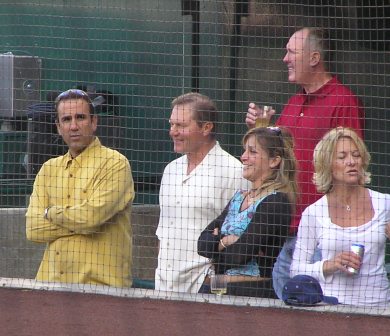
Rob McMillin and I got to the ballpark early, ate dinner in the Diamond Club, and were seated in the first row just to the left of home plate in time to watch Weaver loosen up in the outfield before the game and return to the dugout after his bullpen session.
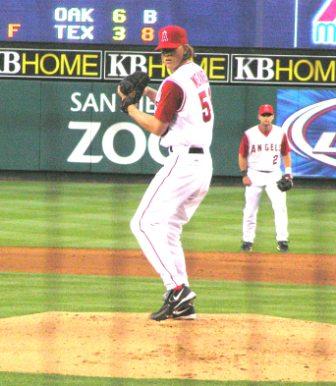
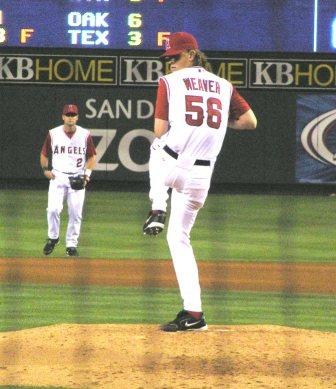
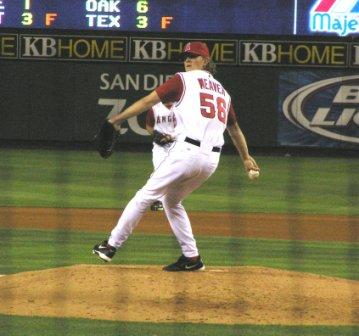
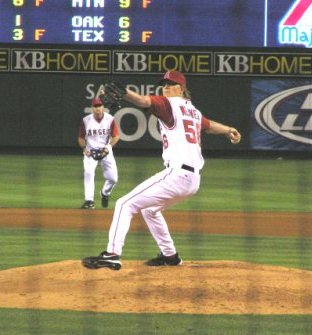
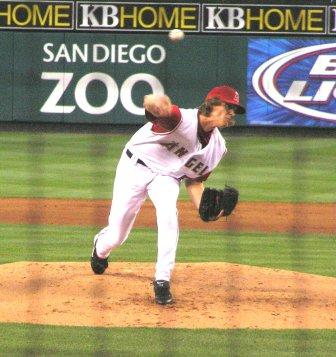
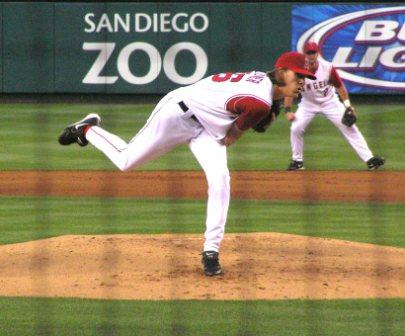
Weaver retired the Orioles in order in the first inning. He threw 14 pitches, including nine fastballs (ranging from 87-94 mph), four sliders (74-81), and an 83-mph changeup that fooled leadoff hitter Brian Roberts into tapping a lazy groundball to Adam Kennedy for the first out of the game. I was most impressed with a 94-mph heater that Weaver used to knock Miguel Tejada off the plate on a 1-and-2 count. Whether facing D-1 hitters, minor leaguers, or a former MVP who happens to be leading the league in total bases, Jered lets you know who is in charge when he is on the mound.
After working his way out of trouble in the second inning, Weaver struck out Luis Matos and Nick Markakis to begin the third. He walked Roberts on a 3-and-2 fastball, then fielded Melvin Mora's inexplicable bunt and threw him out at first base.
Weaver mowed down Tejada, Lopez, and Hernandez in the fourth. He got the Orioles' best hitter to ground out meekly to short by throwing his slowest pitch of the night, a 71-mph slider via a lower arm angle than anything he had shown to that point. Weaver struck out Hernandez on a feeble swing by unleashing a nasty, 92-mph sidearm fastball that ran up and in on the batter's hands. Ramon had just swung and missed on an 81-mph straight change for strike two. The O's catcher had beaten Weaver the first time up by raking a hanging slider down the left field line for a double.
Although Weaver mishandled a bunt by Patterson with one out in the fifth, he battled back from a 3-and-0 count on Matos and got him to foul out to first baseman Kendry Morales, who later supported his fellow rookie with an opposite-field home run off Adam Loewen. Weaver also retired Markakis on a flyball to deep left field, leaving the speedy Patterson on second after he had stolen the base on the first pitch to Matos.
Weaver allowed his third hit of the game with one out in the sixth on a Mora flyball that fell between what seemed to be two statues in Garret Anderson in left and Juan Rivera in center. After the home crowd booed in response to the indifferent outfield defense, Weaver got Tejada to fly out to Rivera in deep right-center field and Lopez to ground into a 6-4 force play to end the inning.
In his seventh and final inning, Weaver whiffed Jeff Conine on a 3-and-2 slider down in the zone, sandwiched by two medium-deep flyouts to center and left. He walked into the dugout and was greeted by his brother Jeff, as well as a chest bump and hug from John Lackey, and a big smile and a "way to go" nod from manager Mike Scioscia.
Weaver pitched an outstanding game. He knows how to pitch and put batters away. Jered attacked the Orioles all night and consistently pounded the strike zone. The youngster with the #56 on the back of his jersey had excellent command of his fastball, throwing it for strikes when he needed to and using it to back hitters off the dish a few times when ahead in the count. He mixed his pitches well and changed speeds on his four-seam fastball and slider.
The Orioles never figured out Weaver. After the game was over, the 39-year-old Conine said, "When you face a guy who hides the ball like he does, it takes a couple of at-bats to try to find his release point." Maybe. However, in Conine's case, he went 0-for-3 and struck out in his third plate appearance.
As I have mentioned before, Weaver's length, big turn, and ability to hide the ball makes his best 93- or 94-mph fastball look and feel like 96 to a hitter. Call him deceptive, if you will. But just don't call him a #3 or #4 pitcher or someone whose upside is nothing more than his brother Jeff's.
One game a season nor career makes. Weaver will not pitch a shutout every start. He won't win all the time either. The guy is human. He will get roughed up now and then, as all good pitchers do. But give the kid a chance. He has earned that right by virtue of his success in college, the minors, and now his big-league debut.
[Additional reader comments and retorts at Baseball Primer.]
| Baseball Beat | May 26, 2006 |
Finally!
Jered Weaver has been called up to the Los Angeles Angels and will make his long-awaited major-league debut Saturday night against the Baltimore Orioles.
According to the Orange County Register, Weaver will take Kevin Gregg's spot in the rotation. Ervin Santana, who was scheduled to start tomorrow night, will move up a day and work on his normal four days of rest. Gregg returns to the bullpen and Esteban Yan apparently will be released.
"Little Weaver," as he is known by his big league teammates, has a 4-1 record in nine starts for the Salt Lake Bees and is leading the Pacific Coast League with a 2.05 ERA, 66 strikeouts, and a 0.91 WHIP in 57 innings. The Angels #1 draft pick (12th overall) in the 2004 draft hasn't allowed a run over his last 27 1/3 innings, ironically matching the Salt Lake record set by Gregg in 2003.
Game Logs:
IP H R ER BB SO BF PIT ST BA G F
4/08 @ TUC 7 2 1 1 0 8 24 83 62 21 5 8
4/13 @ LV 5 9 4 4 0 6 23 91 63 28 1 7
4/19 vs TUC 6 5 0 0 2 6 25 102 64 38 3 8
4/24 @ POR 5 7 5 5 2 6 23 95 58 37 2 7
4/29 @ TAC 6 4 2 2 1 12 23 90 64 26 2 4
5/06 vs TAC 6 5 1 1 1 8 24 101 70 31 5 5
5/11 @ OMA 7 3 0 0 0 4 22 89 64 25 6 10
5/16 @ IA 6 4 0 0 2 8 24 96 62 34 3 7
5/22 vs NO 9 5 0 0 0 8 29 110 82 28 12 6
TOTALS 57 44 13 13 8 66 217 857 579 268 39 62
The Golden Spikes Award winner as the nation's top collegiate player two years ago is coming off his finest performance as a professional. As shown above, the tall right-hander tossed a five-hit, complete-game shutout with eight strikeouts and no walks last Monday vs. New Orleans. Three-quarters of his pitches went for strikes and two-thirds of his non-K outs were generated on the ground.
Weaver faced major league hitters (including the World Champion Chicago White Sox, the entire Oakland A's starting lineup sans Frank Thomas, and the Barry Bonds-led San Francisco Giants) in the Cactus League two months ago and went 1-0 with a 1.02 ERA in five appearances. He didn't allow a single run in his three starts.
IP H R ER BB SO
03/12 vs. CWS 4 2 0 0 2 2 -
03/17 vs. Oak 5 2 0 0 0 5 -
03/30 vs. SFG 5 2 0 0 1 4 W
TOTALS 14 6 0 0 3 11 1-0
Mixing apples and oranges here but adding up Weaver's last 12 appearances finds him with a 5-1 record and a 1.65 ERA (with 71 IP, 50 H, 13 R, 13 ER, 11 BB, and 77 SO). Those numbers work out to a 6.34 H/9, 9.76 K/9, and a 7:1 K/BB ratio.
I will be at the ballpark tomorrow night to take in Weaver's MLB debut. Rob McMillin and I were planning on watching Weaver on Saturday night. But we thought the occasion was going to take us to Las Vegas to catch the Bees and the 51s (the Dodgers Triple-A affiliate). Oh well, rather than driving nearly 300 miles to Vegas, it looks like I will be making the 15-20 mile trek to Anaheim.
Man, I hate when that happens!
For more on the Angels (including a couple of quotes from yours truly), be sure to check out Jon Weisman's fine article over at SI.com.
| Baseball Beat | May 22, 2006 |
What a Weekend
I went to a high school baseball playoff game on Friday afternoon, a championship boxing match on Saturday night, and a major league game on Sunday. The judges' cards are in...baseball by a knockout. And the two games I saw weren't even close. In fact, they both had the identical scores of 7-0.
The title bout, on the other hand, was very close. After 12 rounds, Michael Buffer announced to the Staples Center crowd that defending WBC super featherweight champion Marco Antonio Barrera and challenger Rocky Juarez had fought to a draw. One judge had it 115-113 Barrera, another 115-113 Juarez, and the third scored it 114-114.
Or so we all thought. I woke up the next morning, opened up the sports page, and saw the following headline: "Upon further review: Barrera wins." The subtitle read: "Error in scoring is blamed for the original decision." My jaw just about dropped into my bowl of cereal. I gotta admit, that was a first for me. No, not going to a boxing match - I had gone once before. I mean, that was the first and only time I have ever left a sporting event after it ended only to find out that the outcome was different the following morning.
As it turns out, the scores on the judge's card with the 114-114 draw had been added wrong. The correct (as I raise both hands, hold up my index and middle fingers, and move them up and down to signify quotation marks) total was 115-114 in Barrera's favor, giving the champion a split decision victory over Juarez. (Not that it affected the outcome, but the 115-113 announced score in favor of Juarez actually was changed as well, to 115-114.)
Like baseball, I guess the tie goes to the runner. Barrera was backing up most of the fight as Juarez was clearly the aggressor. The former also fought dirty, hitting the latter behind the head and below the belt. In addition, he happened to conveniently lose his mouthpiece a couple of times during the fight, forcing the ref to call timeouts just long enough to allow him to catch his breath.
Although I would have given the decision to Juarez, I had resigned myself to the fact that the two fighters had battled to a draw when my son and I left the arena that evening. Little did we know at the time but Barrera ended up winning the match. It looks like a Barrera-Rocky II rematch is in the cards. But don't expect Apollo Creed to show up for this one.
I learned one thing from this episode. Boxing is NOT a sport. Call it what you want, but it ain't a sport. A sport has to have a definitive winner at the end of the contest. The team with the most points or runs wins. The golfer with the lowest score wins. The runner or swimmer with the fastest time wins. Those are what I call sports. Activities that are determined by judges are not sports.
If you want to make boxing a sport, don't allow decisions. Let them fight until one knocks out the other. Hey, I know that sounds a bit barbaric, but I don't want judges determining the outcome. If you have to write down scores in secret (as in a boxing match) or hold up a card with a 9.5 on it (like in a gymnastics meet), then it's not a sport. A competition? Yes. A sport? No.
And while I'm on this subject, boxers are NOT athletes. Or least not exceptional ones. I have a friend who believes boxers are the best athletes in the world. Uhh, no. They might be the best-conditioned athletes (if you want to call 'em that), but they are not better than baseball shortstops and center fielders, football quarterbacks, shooting guards in basketball, or hockey centers. You see, I believe the best athletes are those whose skills and talents transfer from one sport to the next.
A boxer is a boxer but, generally speaking, he is not someone who is adept at hitting or throwing a baseball, shooting hoops, throwing and catching a football, wristing a hockey puck into the net, or getting up and down on a golf hole. There is a reason why the high school pitcher and shortstop are two of the best players on the diamond. They just might be the quarterback or wide receiver on the gridiron or perhaps the leading scorers on the basketball team - well, at least in the so-called "old" days when kids were allowed to play more than one sport.
Maybe I'm just upset and taking it out on boxing and boxers here. I dunno. But I do know one thing: I'll take baseball over boxing, and baseball players over boxers any day of the week, including Saturday.
A public thank you to Rob McMillin of 6-4-2 fame and his wife Helen for renting a suite at Dodger Stadium on Sunday and inviting my wife and me to the game. Jon Weisman and Mat Gleason joined the McMillins, along with several other friends and family members. Jon was in Dodger blue and Mat in Angel red. Rob wore Dodger colors, too, under the "When in Rome, do as the Romans do." As for me, I brought along my Dodger and Angel hats and vowed to wear the one from the winning side. I put my Dodger hat on in the bottom of the first after the hometown team scored and didn't take it off until the game was over. (Update: Photo of Jon, Rob, Mat, and me.)
Oh, and I don't think I'll need to check this morning's paper to see who won the game.
| Baseball Beat | May 21, 2006 |
Weekly Stats Leaders
The QUAD and K/100P leaders have been updated at the bottom of our sidebar. Albert Pujols maintained the lead in slugging average (.803), times on base (80), and total bases (114), but fell to second place in on-base percentage (.447, behind Barry Bonds' .479).
Pujols is actually leading MLB in those three departments, bettering the AL leaders in SLG (Jim Thome, .685), TOB (Derek Jeter, 82), and TB (Miguel Tejada, 103). Jason Giambi tops the junior circuit in OBP (.476). After giving way to Thome in SLG last week, Giambi dropped into a tie for third in TOB (79).
Thome and Travis Hafner are clearly having the best seasons offensively in the AL. Thome is first in SLG, fourth in OBP (.434), T3 in TOB (79), and T2 in TB (98). Hafner is third in OBP (.435) and SLG (.645), second in TOB (81), and T2 in TB (98). Both players are on teams in the AL Central, hit left-handed, and serve as DHs. Thome was drafted by the Cleveland Indians in the 13th round of the 1989 amateur draft and hit .287/.414/.567 with 334 HR and more than 900 runs, RBI, and BB during a span that covered 1991-2002.
Speaking of leaders, how much money could you have won for picking Brad Ausmus to rank fourth in OBP at this juncture of the season? Believe it or not but the man with a lifetime OBP of .328 has been getting on base at a clip better than 43% of the time thus far in 2006. Ausmus is hitting a relatively hollow .336 but has walked more often than he has struck out (16 to 15).
Bill Hall is also exceeding expectations. His .635 slugging average tops everyone in the NL other than Pujols and Matt Holliday (.643). Had someone told you that two Colorado players whose last names start with the letter "H" were in the top 10 in the Quad categories, is there one person outside Holliday's and Brad Hawpe's families who would not have guessed Todd Helton would be one of them? Holliday is second in SLG and TB (108), while Hawpe is sixth in OBP (.422), fifth in SLG (.625), T10 in TOB (73), and T4 in TB (95). Pretty heady stuff.
With respect to surprises, how about Casey Blake and Alexis Rios ranking second in the AL in OBP (.440) and SLG (.664), respectively? I know there were a lot of skeptics who thought Blake was a weak link in Cleveland's offense and that Rios was better suited to be a fourth outfielder despite his tools.
On the pitching side, Pedro Martinez and Johan Santana once again are leading their leagues in strikeouts per 100 pitches. Martinez has the best K/100P in the majors with a phenomenal 7.84, or 0.70 better than Santana's MLB-leading rate last year.
At the request of a reader, I am providing the entire rankings (from 1-99) for K/100P. Among qualified pitchers, the league average is 4.18 and the median is 4.07.
PLAYER TEAM K/100P Pedro Martinez NYM 7.84 Johan Santana Min 7.49 Chris Capuano Mil 6.45 Cory Lidle Phi 6.31 Jeremy Bonderman Det 6.30 Carlos Zambrano ChC 6.28 Aaron Harang Cin 6.02 Mike Mussina NYY 5.86 Dave Bush Mil 5.83 Scott Kazmir TB 5.81 John Smoltz Atl 5.63 Jake Peavy SD 5.35 Curt Schilling Bos 5.22 Chris Carpenter StL 5.12 Cliff Lee Cle 5.08 Tom Glavine NYM 5.06 John Lackey LAA 5.04 Chan Ho Park SD 5.00 Sean Marshall ChC 4.88 Brandon Webb Ari 4.85 Bronson Arroyo Cin 4.85 Vicente Padilla Tex 4.84 Kelvim Escobar LAA 4.84 Greg Maddux ChC 4.82 Javier Vazquez CWS 4.71 Scott Baker Min 4.70 Dan Haren Oak 4.70 Kevin Millwood Tex 4.68 Brett Myers Phi 4.67 Tim Hudson Atl 4.67 Ervin Santana LAA 4.66 Ted Lilly Tor 4.59 Brandon Claussen Cin 4.57 Chris Young SD 4.57 Andy Pettitte Hou 4.56 Brad Penny LA 4.54 Ian Snell Pit 4.53 Jon Lieber Phi 4.50 Josh Beckett Bos 4.48 Jason Schmidt SF 4.46 Miguel Batista Ari 4.44 Matt Clement Bos 4.34 Jeff Francis Col 4.31 Jason Jennings Col 4.28 Nate Robertson Det 4.26 Gil Meche Sea 4.23 Randy Johnson NYY 4.20 Roy Halladay Tor 4.10 John Thomson Atl 4.09 Tim Wakefield Bos 4.07 Barry Zito Oak 4.00 Clay Hensley SD 3.95 Roy Oswalt Hou 3.94 Tony Armas Was 3.92 Wandy Rodriguez Hou 3.91 Mark Mulder StL 3.85 Zach Duke Pit 3.83 Brett Tomko LA 3.81 Victor Santos Pit 3.81 Jamie Moyer Sea 3.80 Livan Hernandez Was 3.72 John Koronka Tex 3.71 Kenny Rogers Det 3.60 Rodrigo Lopez Bal 3.60 Justin Verlander Det 3.60 Erik Bedard Bal 3.53 Jamey Wright SF 3.52 Dontrelle Willis Fla 3.51 Brad Radke Min 3.50 Doug Davis Mil 3.47 Jeff Suppan StL 3.46 Jake Westbrook Cle 3.45 Jeff Weaver LAA 3.41 Freddy Garcia CWS 3.41 Steve Trachsel NYM 3.39 Jose Contreras CWS 3.32 Paul Maholm Pit 3.30 Josh Towers Tor 3.20 Derek Lowe LA 3.16 Kris Benson Bal 3.14 Josh Fogg Col 3.14 Joe Blanton Oak 3.13 Seth McClung TB 3.10 Aaron Cook Col 3.08 Paul Byrd Cle 3.04 Mike Maroth Det 2.98 Jon Garland CWS 2.97 Matt Morris SF 2.90 Jarrod Washburn Sea 2.83 Joel Pineiro Sea 2.78 Kameron Loe Tex 2.76 Mark Buehrle CWS 2.72 Chien-Ming Wang NYY 2.72 Scott Elarton KC 2.67 Jason Marquis StL 2.59 Jason Johnson Cle 2.48 Ramon Ortiz Was 2.09 Carlos Silva Min 1.92 Casey Fossum TB 1.87
The White Sox have four starters with below-average K/100P. Only Javier Vazquez sports a respectable rate. The team's strong pitching is more a testament to its outstanding defense as well an ability to keep the ball in the yard. It may also be a function of the fact that CWS starters are allowed to pitch deeper into games than any other staff. The Pale Hose are first in the Beane Count, ranking no worse than fifth in the league in walks and home runs, offensively and defensively.
| Baseball Beat | May 15, 2006 |
Mmm Mmm Good!
May, Monday, Miscellany. With apologies to Minnesota Mining & Manufacturing (as well as to my Mom--Happy Mother's Day!), these are my 3M for the day. Pieced together by Scotch Tape, I hereby convert my Post-it Notes into today's column.
To show you how well Albert Pujols has performed during the first month-and-a-half, look no further than the bottom of our sidebar on the left. Pujols is leading the National League in on-base percentage, slugging average, times on base, and total bases. Should the reigning MVP keep this pace up, he will become only the 18th player in modern history to earn The Quad Award by leading his respective league in all four Quad categories. He would become the first player to achieve this rare distinction since Todd Helton in 2000 and only the third National Leaguer (Mike Schmidt being the other) since fellow Redbirds star Stan Musial captured such honors in 1943 and 1948.
Over in the American League, Jason Giambi sits atop the leaderboard in OBP and TOB. He relinquished bragging rights in SLG this week to Jim Thome, who is the early favorite to win Comeback Player of the Year and may be a good reason why Kenny Williams could earn the title of Executive of the Year.
I love pitchers who combine strikeouts with groundouts but Pedro and Johan are proof positive that flyball types can succeed, too. However, such pitchers need to be able to punch out batters or else the tendency to give up flyballs will come back to haunt them. To wit, Dave Williams has the third-worst K/100P (2.40) among qualifieds and the lowest G/F ratio (0.67). It should be no surprise that he has one of the worst ERAs (6.32). Paul Byrd also sports a low strikeout (2.69)/high flyball (0.88) combination that virtually guarantees trouble (6.52 ERA).
Let's say you want to look up a player's stats like...oh, Jered Weaver. You can get his AVG/OBP/SLG, BABIP, WHIP, BB/9, K/9, HR/9, and batted ball types vs. LHB and RHB, home, road, with 0-1-2 out, none on, men on, and RISP.
Speaking of Weaver's splits, you can see for yourself that he is handling left-handed batters just fine despite claims to the contrary. (The Brew Crew numbers don't include Weaver's last outing on 5/11 and his AVG/OBP/SLG stats are all materially lower than what is shown.) I have rarely, if ever, seen a pitcher who is held to a higher standard than all others as I have with Weaver. "Doesn't have good enough stuff" becomes "Gives up too many flyballs" becomes "Can't get LHB out." If it's not one thing, it's something else.
All I know is that the guy is 3-1 with a 2.79 ERA in Triple-A. He is also striking out batters at a rate of 10.71 K/9, 30.5% of batters faced, and 7.68 K100P.
IP H R ER BB SO BF PIT ST BA G F
4/08 @ TUC 7 2 1 1 0 8 24 83 62 21 5 8
4/13 @ LV 5 9 4 4 0 6 23 91 63 28 1 7
4/19 vs TUC 6 5 0 0 2 6 25 102 64 38 3 8
4/24 @ POR 5 7 5 5 2 6 23 95 58 37 2 7
4/29 @ TAC 6 4 2 2 1 12 23 90 64 26 2 4
5/06 vs TAC 6 5 1 1 1 8 24 101 70 31 5 5
5/11 @ OMA 7 3 0 0 0 4 22 89 64 25 6 10
TOTALS 42 35 13 13 6 50 164 651 435 206 24 49
Interestingly, like Martinez and Santana, Weaver is another example of a pitcher who can do just fine by giving up more flyballs than groundballs. Would I like to see Jered induce more grounders? Sure. But, as long as Weaver keeps his K rate up, he will succeed no matter where he pitches.
For more on Weaver, be sure to check out Eric Neel's human interest article on Jered and Jeff online (subscription required) or in the May 22 edition of ESPN The Magazine.
| Baseball Beat | May 13, 2006 |
De-Lovely Pitcher
Cole Hamels. Sounds more like the name of a songwriter than a baseball pitcher. Nonetheless, the 22-year-old southpaw was composing his own music on Friday night as he held the Cincinnati Reds scoreless for five innings while striking out seven and allowing just one hit in his major league debut.
Thanks to MLB Extra Innings, I watched all 92 pitches. Hamels only threw 51 for strikes but was extremely effective, despite walking five batters (including the bases full in the second inning). The tall, lanky youngster (6-4, 195) with the impeccable minor league record (195.1-114-39-31-72-273 with a 1.43 ERA and 2 HR in 35 GS) is the real deal. He is as good as they come.
Hamels is not a power pitcher per se. Oh, he throws his fastball plenty hard, working mostly at 90-91 and topping out at 93. But he combines excellent stuff with great deception. In addition to his heater, Hamels throws a good curveball and a plus-plus change-up. The latter pitch is what makes Hamels so special.
Check out the grip on his change-up. You can see why they call it a circle change. The index finger and thumb form a circle on the side of the ball. The middle and ring fingers hold the ball in a similar fashion as a two-seam fastball with the pinky on the opposite side as the thumb and index finger. The pitch is thrown with the same arm motion as the fastball and is released with the pitcher driving his thumb toward the ground. The movement on the ball is similar to a screwball, diving down and away from RHB (in the case of a lefty like Hamels).

Hamels retired the Reds in order in the first inning. He got Ryan Freel to ground out to short, struck out Felipe Lopez swinging on a circle change, and punched out Ken Griffey Jr. looking on a breaking ball.
After walking the bases loaded in the second, Hamels reached back and K'd opposing pitcher Elizardo Ramirez on three fastballs to end the inning. He walked Griffey on four pitches in the third but got Freel, Lopez, and Austin Kearns to make easy outs before and after allowing Junior to reach base.
Ryan Howard staked Hamels to a two-run lead in the top of the fourth when he homered to the opposite field on a short, compact stroke. The first round (17th overall) draft pick in 2002 out of Rancho Bernando High School in San Diego stepped it up in the bottom half of the inning by striking out Brandon Phillips and Javier Valentin--the latter on a circle change--after issuing Edwin Encarnacion a free pass with one out.
Hamels whiffed Ramirez on three pitches again in the fifth and induced Freel to ground out for the third time. He threw the pesky lead-off hitter three straight change-ups, retiring him on a ball that was cued off the end of the bat to the first baseman. There are not many veterans--much less pitchers making their MLB debuts--who have the guts and confidence to throw a change back-to-back-to-back to the same hitter. Hamels then impressed me by throwing his biggest hook of the night for a called strike to Lopez. On a 3-and-1 count, Lopez hit a line drive double to right-center field that just eluded a diving Shane Victorino, who short hopped the ball and momentarily held his glove up in the hopes of selling the second base umpire that he caught it.
The hit was Cincy's first and only against Hamels as the man who wears the number 35 on his back saved his best for last by striking out Junior swinging on a curve down and away with outstanding tilt. His boyhood idol never put the ball in play against him, whiffing twice and walking once.
Although Hamels didn't get the win--Ryan Madson, the pitcher Cole replaced in the rotation, gave up home runs to two of the first three batters he faced to allow the Reds to tie the game--he pitched about as well as anyone could have hoped. Hamels held the top-scoring team in the NL without a run in a ballpark that is the second most unfriendly to pitchers in the majors.
Hamels flat out knows how to pitch. He mixed up his pitches and kept the ball down, even enticing more than one batter to bite at a few breaking balls and changes in the dirt. Hamels works quickly and has a smooth windup and delivery, especially for someone who looks like he is all arms and legs. The lefty brings his hands together above the head, kicks his right leg up with the knee perpendicular to his body, and then uses his height and arm length to deliver the ball on a downward plane.
The prized prospect's career is anything but on a downward plane. Health permitting, Hamels should be the favorite to take NL Rookie Pitcher of the Year honors and be among the top pitchers in the league in 2007 and beyond. That should be sweet music to the ears of all Phillies fans.
| Baseball Beat | May 08, 2006 |
The Art of Pitching
"You only need two pitches. The one the hitter's looking for, and the one he's not."
--Warren Edward Spahn, the winningest pitcher in baseball since 1930 (with a 363-245 W-L record)
Don't look now but Tom Glavine is leading the National League with a 1.94 ERA. No, it's not 1991 or 1998, the two years when the southpaw took home Cy Young award honors. Glavine won 20 games both seasons and sported ERAs around 2.50.
Two innings short of 4,000 for his career, Glavine has been credited with 279 victories while fashioning a 3.43 ERA in a league environment consistently over 4.00. He has a couple of Cy Youngs in his trophy case and was the The Sporting News NL Pitcher of the Year in a third season (2000). How is it possible that a finesse pitcher could have such a successful career?
Despite the love affair with power pitchers, Glavine and others have demonstrated that success at the highest level can be achieved by spotting the ball, changing speeds, and throwing strikes. In other words, the best pitchers aren't necessarily those who can throw a ball through a car wash without getting it wet.
Greg Maddux has forged a pretty good career doing many of the same things as his former Atlanta Braves teammate. The 40-year-old right-hander, winner of four consecutive Cy Young Awards (1992-95), is a half-dozen victories shy of ranking sixth in wins since 1900 (behind Walter Johnson, Christy Mathewson, Grover Cleveland Alexander, Warren Spahn, and Roger Clemens). His lifetime ERA of 3.01 is more than one run better than the league average.
Like Glavine, Maddux is pitching like it was the early-1990s. He is tied for the league-lead in wins (5) and is fifth in ERA (2.35). Glavine and Maddux are veterans who know a thing or two about pitching. In contrast to many younger pitchers, they are not afraid to pitch inside. Aluminum bats at the amateur level allow good hitters to turn on inside pitches in a way that very few professionals can with wood bats. As such, young pitchers "learn" to keep the ball away, working the outer half of the plate much more often and confidently than the inside corner.
Glavine and Maddux also have a penchant for keeping the ball down, inducing more than their share of groundballs. Over the years, this pair has allowed about a third fewer home runs than the league average. Together, they have given up just four homers in 13 starts covering 84 2/3 innings in 2006.
Brandon Webb is another pitcher who profiles more like Maddux than not. His 2.05 ERA ranks second in the NL. No longer dependent on a heavy sinker in the mold of a Kevin Brown, Webb is getting batters out by changing speeds and locations while throwing significantly more strikes than at any point in his career (1.01 BB/9 vs. a single-season best of 2.32).
What's going on here? "Hitters today are better trained to hit a fastball than any time in baseball history," Rangers manager Buck Showalter recently told Peter Gammons. "They grow up hitting tennis balls shot out at them at 100 miles an hour. They hit off pitchers from 45 feet. . .Today, most of the hitters can hit any fastball."
Glavine and Maddux work in the mid-80s, while Webb's fastball sits at about 89-91. Look, all else being equal, I'll take the pitcher who can throw the hardest. I get as excited as the next guy when I see a pitcher register triple-digits on the radar gun. But pitching is about a lot more than just speed. In fact, hurlers who change speeds and keep batters guessing can be as successful as those who grade at or near the top of scouts' 20-80 ratings.
Part and parcel to this discussion is that aces and so-called #1s can come in all sizes, shapes, and colors. Labeling a pitcher a #3 or #4 because he doesn't hit 95 on the speed gun is a lazy man's way of evaluating talent. Good pitching is good pitching, no matter how it is accomplished.
| Baseball Beat | May 02, 2006 |
The Only Game in Town: Q&A With Fay Vincent
I had the pleasure of interviewing Fay Vincent, the former commissioner and author of the recently published The Only Game in Town: Baseball Stars of the 1930s and 1940s Talk About the Game They Loved, about his book and the state of baseball. Vincent is a former entertainment and business executive who served as the commissioner of baseball from 1989 to 1992. He is also the author of The Last Commissioner: A Baseball Valentine.
Rich: The Only Game in Town is part of The Baseball Oral History Project. How did you become involved with it?
Fay: The origins of this book begin with my listening to tapes of interviews Larry Ritter did in the '60s with old ballplayers who played in the early years of the 20th century. I was fascinated, and I realized nothing of comparable interest was being done with players of later decades. Moreover, the Baseball Hall of Fame had no organized oral history project. So I began with players from the '30s and '40s with unique stories to tell including my great friend Larry Doby, the first black in the American League who was then ill and whose story was about to be lost. Similarly Warren Spahn, Bob Feller, and Tommy Henrich were growing older and I was eager to capture their stories and did so in 4-hour video taped interviews. The idea is that 50 years from now fans will be able to go to Cooperstown and see these tapes of wonderful players talking about a period in baseball that would otherwise be forever lost.
Rich: I understand that you, Herb Allen, and George Cooney provided financial support. This project must have been a labor of love for you.
Fay: It was and is. I have done 40 of these video interviews and just did one with Carl Erskine of the old Brooklyn Dodgers. I will continue to do 4 or 5 new ones a year, perhaps more.
Rich: You were inspired by the audiotapes of Lawrence Ritter's book, The Glory of Their Times. I own and cherish those CDs. Do you have plans to introduce a video or audio version of The Only Game in Town?
Fay: No plans. But I hope the video tapes will be made available via The Hall or in some other commercial fashion. HBO and ESPN have shown no interest.
Rich: That's too bad. I know fans like myself would be very interested in watching and perhaps even owning the video tapes. Maybe a Ken Burns-type could make use of them for a documentary.
Fay: Perhaps and I have not given up - I hope to find someone who will work with these tapes. I think they are unique, precious, and extremely interesting.
Rich: The focus on Volume One is on the 1930s and 1940s. How many volumes do you anticipate unveiling?
Fay: All depends on the sales of this volume.
Rich: Gosh, I hope the sales of this book are such that the project can be continued. I know you have conducted dozens of interviews thus far. It would be a shame if they weren't made public.
Fay: I suspect they will be public in some fashion through the Hall of Fame. It would be absurd to have done them for fans only to find out fans are not able to see them. Perhaps The Hall will license someone to distribute the tapes.
Rich: You interviewed ten players for Volume One. Elden Auker, Dom DiMaggio, Larry Doby, Bob Feller, Tommy Henrich, Monte Irvin, Ralph Kiner, Buck O'Neil, Johnny Pesky, and Warren Spahn. Quite a group. Five Hall of Famers and five others who were stars in their own right. How did you go about contacting and choosing these particular players?
Fay: I was interested in the oldest with focus on their historical significance - each of them is unique.
Rich: The interviews appear to have been transcribed as literally as possible. Little or no editing. If the player repeated himself, went off on a tangent, or spoke in incomplete sentences, you printed it.
Fay: Correct. Had we interviewed the President of Harvard the text would have been similar because none of us speaks as well as we believe we do. Perhaps I was wrong but I would be interested in readers' reaction.
Rich: I think it works. Sure, a few of them ramble a bit, but this format makes it feel as if the reader is sitting in the same room listening to these oldtimers tell their stories.
Fay: Thank you. It was a judgment call and I hope we were correct. But Ritter did much the same and his tapes were fascinating.
Rich: You asked everyone the same two questions: Who got you interested in baseball? Who gave you your first ball and glove?
Fay: Yes, and they would go off for a long spell that was fascinating. The common thread is that each was terrific at the game from the very beginning.
Rich: OK, it's my turn. Who got you interested in baseball? Who gave you your first ball and glove?
Fay: My father who was a fine college and semipro player. He was a very good hitter at Yale and led the college league in hitting in the '30s. He taught me to love the game. (See The Last Commissioner.)
Rich: The 1940s included the World War II years as well as integration of the major leagues. The former altered the world and the latter changed the game forever.
Fay: Correct, these 10 were part of the greatest generation. I liked each one of them and admire them greatly.
Rich: How would you compare and contrast the players of yesteryear with those of today?
Fay: Very similar. They all love the game, the old players lived in a different world with no union, no long term contract and a lot less money but the similarities are many.
Rich: Has the game of baseball changed for the better or worse over the years?
Fay: Fortunately is hasn't changed that much on the field. The mistakes like the DH are few and the game remains magical.
Rich: If you were still the Commissioner, how would baseball be different today?
Fay: Hard to tell. I doubt it would be very different though I hope I would have done something about the steroid issue earlier.
Rich: Do you think players were taking performance-enhancing drugs back then?
Fay: Not extensively but certainly to some extent. In those days cocaine was reasonably widely used but steroids were just beginning. I have no idea the extent of the use in 1992 when I left.
Rich: What one change would you like to see baseball make?
Fay: Eliminate the DH and stop shrinking the size of the playing field.
Rich: Will Pete Rose ever make the Hall of Fame?
Fay: I do not think so. He should not be admitted and for the time being I think the issue is dead.
Rich: If you had a vote, would you be "for" or "against" electing Barry Bonds, Mark McGwire, and Rafael Palmeiro to Cooperstown?
Fay: I would not vote for them at present and would wait to read the Mitchell report.
Rich: How about one of your featured players in The Only Game in Town - Buck O'Neil?
Fay: The Negro League Committee that I chaired without a vote made what I believe is a final decision on Buck. I hope The Hall of Fame will honor him in some other fashion for his remarkable conduct as an eminent senior citizen of baseball.
An excerpt of the opening chapter on Elden Auker is available for those interested in previewing The Only Game in Town. In addition to the players featured, the book includes multiple stories and photos of Joe DiMaggio, Jimmie Foxx, Hank Greenberg, Satchel Paige, Jackie Robinson, and Ted Williams. There are more than 50 photos in all, including most of the stars from MLB and the Negro Leagues in the '30s and '40s. I devoured the book from cover to cover and believe it is a good read and a valuable part of any baseball library.
| Baseball Beat | April 30, 2006 |
Jered Weaver: Good to Go
Speaking of measuring strikeouts per 100 pitches, Jered Weaver is averaging 8.24 K/100P through his first five games at Triple-A Salt Lake City.
Weaver pitched six innings in a game suspended yesterday and resumed today. He actually relieved starter Dustin Moseley, who went just one inning. The tall right-hander faced 23 batters. He threw 90 pitches: 64 strikes and 26 balls. Of the 18 outs, 12 were retired via strikes, two on the ground, and four by air.
Here is Weaver's 2006 game log, complete with batters faced (BF), number of pitches (PIT), strikes (ST), balls (BA), groundouts (G), and flyouts (F).
IP H R ER BB SO BF PIT ST BA G F
4/08 @ TUC 7 2 1 1 0 8 24 83 62 21 5 8
4/13 @ LV 5 9 4 4 0 6 23 91 63 28 1 7
4/19 vs TUC 6 5 0 0 2 6 25 102 64 38 3 8
4/24 @ POR 5 7 5 5 2 6 23 95 58 37 2 7
4/30 @ TAC 6 4 2 1 1 12 23 90 64 26 2 4
TOTALS 29 27 12 11 5 38 118 461 311 150 13 34
In addition to Weaver's outstanding K/100P, he has K'd 12.7 per nine IP and whiffed 32.2% of the batters faced. The Angels' #1 draft pick in 2004 also has a 7.6 K/BB ratio. The only bone of contention is his low G/F ratio of 0.38. Jered has given up four HR but it's important to note that he's pitched three of his five games in hitter-friendly ballparks. According to the indispensable Baseball Prospectus 2006, Tucson has a park factor of 1099 (or 9.9% above average), Las Vegas 1076, Salt Lake City 1085, Portland 944, and Tacoma 917 for 2003-2005.
I suspect that Weaver is ready to make his major league debut. With Bartolo Colon on the DL and Kelvim Escobar nursing a blood blister, his opportunity may come sooner rather than later. I can't wait.
| Baseball Beat | April 30, 2006 |
New Sidebar Features
Effective today, we have begun to list the league leaders in the four QUAD categories and the top three in strikeouts per 100 pitches at the bottom of our sidebar. These stats will be updated every Sunday morning (through games of the day before).
As a reminder, the QUAD encompasses the four most important offensive categories: on-base percentage (OBP), slugging average (SLG), times on base (TOB), and total bases (TB). The first two measures are rate stats and the latter two are counting stats. Players who lead their respective leagues in both rate and counting stats--such as Albert Pujols--are clearly the most productive hitters in the game.
Pujols is leading the NL in SLG (.925), TOB (52), and TB (74). Jason Giambi sits atop the AL in OBP (.557) and SLG (.828). The 2005 NL MVP led the league in TOB last year, while placing second in OBP, SLG, and TB. The 2000 AL MVP led his league in OBP last season, while finishing eighth in SLG. (See the 2005 top ten leaders in all four categories for both leagues here.)
The strikeouts per 100 pitches (K/100P) stat is more highly correlated to run prevention than strikeouts per nine innings (K/9) or strikeouts per batter faced (K/BF). It measures pitching proficiency as well as any stat using just one variable in the numerator and one variable (such as innings, batters faced, or pitches) in the denominator.
Ben Sheets is showing just how valuable he is to the Milwaukee Brewers, leading the majors in K/100P with 8.77. Johan Santana led MLB in 2005 with 7.14 (among those with 162 or more IP). Activated from the DL on April 16, Sheets has started three games, throwing 18 innings while striking out 25 batters against just one walk. His 1-2 W-L record and 4.00 ERA do not reflect how well he has pitched in the early going.
Cory Lidle is probably the biggest surprise among the league leaders. The Philadelphia right-hander has whiffed 33 batters in 30 2/3 IP and is averaging 7.48 K/100P. He has the lowest number of pitches per plate appearance (3.47) and pitches per inning (14.4) among the strikeout leaders, primarily owing to the fact that he has only walked three batters thus far. Lidle is first in K/BB at 11.00. The only stat failing him is batting average on balls in play (.344). If Cory continues to pitch as well as he has in his first five starts, look for his BABIP to regress toward the league average--usually around .300--and his ERA (4.40) to decline accordingly.
Seeing J.J. Putz leading the AL might also open up some eyes. The Seattle relief pitcher has struck out 21 batters in 14 innings and is averaging 8.57 K/100P. Other than 2001 when pitching for San Antonio in Double-A, Putz has never had 7 Ks per 9 IP in his minor or major league career. J.J.'s groundball-to-flyball ratio (G/F) of 2.38 is also intriguing. Keep an eye on the 29-year-old Mariner as a pitcher who may be on the verge of a breakout season.
Be sure to check back on Sundays for ongoing updates throughout the season.
| Baseball Beat | April 24, 2006 |
The Lincecum & Kennedy Connections
I attended one of the best college pitching matchups of the year at Dedeaux Field on the campus of USC on Friday. The game pitted two of the top amateur pitchers in Washington's Tim Lincecum and USC's Ian Kennedy.
Just as Presidents Lincoln and Kennedy have been inextricably linked over the years, so have Pitchers Lincecum and Kennedy. The junior right-handers have been their team's Friday Night starters throughout their college careers. Lincecum (2004) and Kennedy (2005) were named the Pac-10 pitchers of the year the past two seasons, and both were preseason All-Americans in 2006.
Lincecum entered the game with a 36 2/3-inning scoreless streak. With two outs in the bottom of the first, he gave up a two-run double to designated hitter Baron Frost but Washington bounced back to score seven runs in the fifth to defeat Kennedy and the USC Trojans, 7-2 (box score). All nine runs were scored in just two innings.
Pitching six innings, Lincecum (9-2) allowed two runs on five hits with four walks and 11 strikeouts. Kennedy (3-5) went 4 2/3 innings, allowing seven runs (four earned) on six hits with three walks and four strikeouts. Although Lincecum's streak was halted at 37 1/3 innings, the NCAA strikeout leader has allowed only three earned runs on 19 hits over his last 59 innings.
There were approximately 40 scouts in attendance. The Kansas City Royals, owners of the #1 pick in the draft this June, had a large contingent of scouting personnel paying close attention to Lincecum. The Royals are considering selecting either Lincecum, North Carolina left-hander Andrew Miller, or Houston right-hander Brad Lincoln. Kennedy was among a quartet of pitchers (along with Miller, UNC teammate Daniel Bard, and Missouri's Max Scherzer) on Kansas City's radar when the year began but is apparently no longer under consideration.
Deric Ladnier, the Royals' senior director for scouting, told Bob Dutton of The Kansas City Star, "We're looking for an advanced player. One thing we're asking is, 'Who can be productive at the major-league level the quickest?' We want to see command, stuff and the makeup to be a front-line starter in the big leagues."
Lincecum's stuff is as good as or better than any college pitcher in the draft (video). He throws a mid-90s fastball and an outstanding curve. A veteran scout that I spoke to rated Lincecum's fastball as a 7 (on the 1-8 scale the team uses) or a 70 (on the more traditional 20-80 range). He called Lincecum's curve and change-up a 6 and his pitchability a 65.
The same scout graded Kennedy's fastball a 50, curve 55, change 60, and pitchability 60. I was surprised he gave Lincecum a higher ranking for pitchability than Kennedy. The scout believes Kennedy will be "better with wood bats," pointing out that the Trojan ace "knows where to put it" (video). He would like to see Kennedy pitch inside more often than he has been allowed in college and mentioned that Ian tends to "get around his curve a little," producing what's known as a "slurve."
With respect to Lincecum, the talent evaluator said he had never seen a pitcher of his size throw so hard. He believes Lincecum is closer to 5-10 1/2 or 5-11 than his listed height of 6-0 and projects him to be what he called a "stopper," which, upon clarification, meant "closer." To be an effective big leaguer, the scout contends that Lincecum needs to get "more ride" on his fastball or learn to "keep it down."
I charted Lincecum and Kennedy on Friday night. Both pitchers have the traditional fastball (FB), curveball (CB), and change-up (CH) repertoire. I have also included some game notes along the way.
Lincecum vs. USC
Bottom of the 1st
Cusick: FB-95 ball, FB-93 ball, FB-93 called strike, CB-81 called strike, FB-96 foul, CB-82 foul, CB-82 ball, CB-82 called strike three.
Sharpe: CB-84 called strike, FB-95 foul, CB-83 ball (just inside), FB-96 foul, CB-82 foul tip, CB-82 ball (big curve), CB-84 single to RF.
Hankerd: FB-93 foul, FB-94 strike swinging, FB-95 foul, CB-82 ball, CB-82 5-4 fielder's choice.
Perales: FB-94 foul, CB-81 ball in the dirt, FB-95 line drive single to LF. Runners on first and second.
Frost: CB-81 called strike, FB-96 strike swinging, FB-94 line drive double down LF line. Two runs score.
Duda: FB-93 ball, FB-93 ball, CB-81 ball, FB-92 called strike, FB-93 foul, CH-81 ball four. Runners on first and second.
Vierira: FB-92 foul, FB-94 called strike, CB-81 foul tip, FB-94 single to LF. Bases loaded.
Coach Knutson makes a brief visit to the mound.
Estrella: CB-81 ball, CB-81 called strike, CB-81 ball, FB-93 called strike, CB-81 6-4 fielder's choice (barely getting runner at second).
2 R, 4 H, 1 BB, 3 LOB. 8 BF, 41 pitches. 21 FB (92-96), 19 CB, 1 CH.
Bottom of the 2nd
Bowden: CB-81 ball high, FB-92 ball, FB-91 called strike, FB-94 strike swinging, FB-94 strike three swinging. Lincecum blew him down.
Cusick: FB-94 fly out to CF.
Sharpe: FB-89 called strike, CB-82 called strike, FB-95 foul tip, CB-82 ball high, CB-79 strike three swinging. The last pitch was a slow curve.
Three up, three down. 11 pitches. 7 FB (89-95), 4 CB.
Bottom of the 3rd
Hankerd: CB-79 called strike, CB-80 called strike (big 12-to-6 curve), FB-94 strike three swinging on a pitch high out of the zone--a great 0-2 count "pitcher's pitch."
Perales: CB-83 called strike, CB-80 ground out to 2B.
Frost: CB-82 called strike, FB-94 strike swinging, FB-95 foul tip, CB-83 ball down and in, CB-82 foul, FB-94 foul, CB-84 strike three swinging. Poor swing. Lincecum totally fooled him.
Three up, three down. 12 pitches. 4 FB (94-95), 8 CB. Lincecum threw first pitch called strike on all three batters.
Bottom of the 4th
Duda: CB-85 foul, CB-84 called strike, CB-80 strike three swinging. Duda looked bad. Lincecum struck out four of the previous five batters.
Vierira: FB-94 called strike, CB-84 ball, CB-80 called strike, FB-94 foul, CB-82 ground out to 2B on a high hopper. Play went 4-1. Lincecum hustled over and covered first.
Estrella: FB-94 ball high, CB-76 ball, FB-92 ball down, FB-91 ball four.
Bowden: CB-86 called strike, CB-82 ball high, CB-81 called strike, FB-91 6-4 fielder's choice.
0 R, 0 H, 1 BB, 1 LOB. 4 BF, 16 pitches. 6 FB (91-94), 10 CB.
Bottom of the 5th
Most of the scouts have put their Stalker Sport guns in their cases.
Cusick: CB ball, FB called strike, FB bloop single to LF.
Sharpe: FB called strike, FB foul, CB strike three swinging.
Hankerd: FB swinging strike, CB called strike, FB ball high, CB ball, CB ball (looked good), CB ball four. Runners on first and second.
Perales: FB-92 called strike, FB-93 called strike, CB foul, CH ball, FB called strike three.
Frost: FB-93 ball, CB-78 called strike, FB-94 ball, CB ball, FB foul, CB-79 ball four high. Bases loaded.
Duda: FB ball, FB called strike, FB ball, FB foul, CB called strike three.
0 R, 1 H, 2 BB, 3 LOB. 6 BF, 28 pitches. 16 FB (92-94), 11 CB, 1 CH.
Bottom of the 6th
Vierira: CB called strike, FB-94 ball, CB foul, CB ball, CB ball, FB foul, FB called strike three.
Estrella: FB foul, FB strike swinging, CB bal, FB-94 foul, FB-95 foul, CB ball down, CB-82 ball, FB-93 ground out to SS. Estrella is the only batter who Lincecum didn't strike out.
Bowden: FB-93 strike swinging, FB-94 ball inside, FB-93 strike swinging, FB-94 ball, FB-94 ball, CB-81 called strike three.
Three up, three down. 21 pitches. 13 FB (93-95), 8 CB.
Total: 129 pitches. 67 FB (89-96), 60 CB, 2 CH.
Kennedy vs. Washington
Top of the first
Rife: FB-89 ball, FB foul, CH-79 ball, FB fly out to RF.
Hague: FB-89 called strike, CB-74 ball, FB-90 fly out to RF.
Clem: CB-82 called strike, FB-88 ball, CH-78 strike swinging, CB ball (checked swing, just outside--xlnt 1-2 pitch location), FB-88 foul, FB-91 fly out to CF (against the wall just left of the 395' sign).
Three up, three down. 13 pitches. 8 FB (88-91), 3 CB, 2 CH.
Top of the 2nd
Rindal: FB-90 foul, FB-90 called strike, CB-82 ball outside, FB-90 ball, FB-88 called strike three.
Lane: FB-89 foul, FB-91 foul, CH-76 strike three swinging. Vintage Kennedy. He pulled the string and fooled Lane.
Boyer: FB-90 fly out to CF.
Three up, three down. 9 pitches. 7 FB (88-91), 1 CB, 1 CH.
Top of the 3rd
Stevens: FB-90 pop out to 2B.
Kaluza: FB-89 ball, FB-89 ball, FB-89 called strike, FB-88 called strike, FB-89 ball just outside, FB-88 strike three swinging. Kennedy ties Mark Prior in career strikeouts (352) at USC.
Cox: FB-90 foul, B-78 ball down, FB-91 HBP. Kennedy overthrew it.
Rife: CB-82 hit and run single between 1B and 2B. Runners on first and third.
Hague: CB-80 ball, FB-88 ground out to 3B.
0 R, 1 H, 1 HBP, 2 LOB. 5 BF, 13 pitches. 10 FB (88-91), 3 CB.
Top of the 4th
Clem: CB-82 strike swinging, FB-89 ball just inside, FB-91 ball, CB-84 foul, FB-91 foul, FB-91 foul, FB-90 foul, CH-80 ball low. 3 & 2. FB-90 foul, FB-92 foul. Kennedy really reached back on that pitch. CB-83 called strike three. 11-pitch AB. Kennedy passes Prior in career strikeouts and now ranks fourth Rik Currier (1998-2001), Seth Etherton (1995-98), and Brent Strom (1968-70).
Rindal: CB-85 ground out to 3B.
Lane: FB-91 called strike, CB-76 strike swinging, CB-75 ball in the dirt, FB-92 foul, CB-77 ball just missed inside (Kennedy ran off mound, thinking he had a K). FB-91 ball high, FB-92 foul down the LF line, FB-90 ball four low.
Boyer: FB-90 called strike, CB-81 ball, FB-89 fly out to CF.
0 R, 0 H, 1 BB, 1 LOB. 4 BF, 23 pitches. 14 FB (89-92), 8 CB, 1 CH.
Top of the 5th
No radar guns in sight.
Stevens: CB ball, FB called strike, FB swinging strike, CB fly out to RF.
Kaluza: FB called strike high (lots of barking from the Washington dugout), CB called strike, CB ball outside (waste pitch), FB ball just missed, FB ball just missed away. 3 & 2. FB line drive single between 3B and SS.
Anderson: FB ball. Kennedy getting squeezed. FB foul bunt down 3B line (not a SAC attempt), CB ball outside, FB ball. Runner steals second base. Double pump by Bowden owing to one of the middle infielders failing to cover. FB line drive single off Kennedy's thigh. Trainer and pitching coach check him out. Runners on first and third.
Rife: CB ball inside. Fake pick off to 3B, look to 1B--no throw. FB called strike, FB called strike, CB ground out to 3B. Run scored. 2-1 USC.
Hague: FB ball just missed outside, FB single to RF (not particularly hard hit). Run scored. Game tied, 2-2.
Clem: FB ball low and away. Kennedy overthrew it. Pickoff attempt at first. FB called strike, CB ball high and inside. Kennedy quit on the pitch. FB ball low and away. Ball overthrown again. Kennedy has clearly lost his rhythm. FB strike swinging. 3 & 2. FB fouled to the right side, FB fouled to the left side. Kennedy took something off that fastball. CB ball four. Runners on first and second.
Coach Gillespie visits the mound.
Rindal: FB ball, FB called strike, FB ball, FB ball, FB ball four just outside. Bases loaded.
Lane: FB double to LF. Two runners scored. 4-2 Washngton. Runners on second and third.
Boyer: FB foul, CB ball, FB called strike, FB ball, FB ground ball to 3B. Cusick throws wildly to first. Two-base error. Two runners scored. Both runs unearned. 6-2 Washington.
Stevens: FB called strike, CB double to RF. Runner scored. Unearned run. 7-2 Washington.
John Dunn relieves Kennedy.
Kaluza: Ground out to 2B.
7 R (4 ER), 5 H, 2 BB, 1 E, 1 LOB. Kennedy: 10 BF, 42 pitches. 31 FB, 11 CB.
Total: 100 pitches. 70 FB (88-92), 26 CB, 4 CH.
Lincecum outdueled Kennedy on Friday night and has clearly been the better pitcher this season. The latter arguably had put up superior stats the previous two campaigns.
Lincecum's Career Stats:
IP H R ER BB SO HR ERA W-L
2004 112.1 83 55 44 82 161 5 3.53 10-3
2005 104.1 62 40 36 71 131 4 3.11 8-6
2006 85.0 41 23 15 45 140 5 1.59 9-2
Totals 301.2 186 118 95 198 432 14 2.83 27-11
Kennedy's Career Stats:
IP H R ER BB SO HR ERA W-L
2004 92.2 86 34 30 31 120 4 2.91 7-2
2005 117.0 85 40 33 38 158 6 2.54 12-3
2006 74.0 69 40 32 24 75 3 3.89 3-5
Totals 283.2 240 114 95 93 353 13 3.01 22-10
Drafted by the Cubs (48th round, 1408th overall) in 2003 and the Indians (42nd round, 1261st) in 2005, Lincecum has been climbing the draft boards all season long and is going to make every MLB organization wish it had met his $1 million price tag last year. Kennedy, on the other hand, has seen his stock slip of late and could wind up falling further than anyone could have imagined three months ago. The fact that he will be represented by Scott Boras only adds to his uncertain status.
Notes: With 432 career strikeouts, Lincecum is now 17 shy of the Pac-10 record set by USC's Currier...Zach Clem, an undrafted senior left fielder for the Huskies, slugged his league-leading 17th home run of the season on Sunday. He doubled, tripled, and homered while driving in three runs in the second 7-2 victory of the three-game series...USC won the middle game, 15-8, as senior second baseman Blake Sharpe went 4-for-4 and freshman starter Tommy Milone (7-0) kept his perfect won-lost record in tact...Trojan third baseman Matt Cusick reminds me of Bill Mueller. The 5-foot-10, 190-pound sophomore bats left and throws right. He is hitting .392 with 31 BB and 10 HBP while striking out only 7 times in over 200 plate appearances. His OBP of .512 is the school's highest since Steve Kemp's .526 in 1975. Geoff Jenkins recorded a .500 OBP in 1995. Cusick was named the most outstanding player at the NCAA First-Round Regional in Long Beach last year.
| Baseball Beat | April 18, 2006 |
Sigh Young and Mr. Cy Young
I had the pleasure of watching two pitchers with distinctly different approaches and stuff dominate opponents on Monday. On a night in which Pedro Martinez won his 200th game and Jose Contreras combined with two relievers to throw a one-hit shutout, I witnessed the young and inconsistent Daniel Cabrera and the wily veteran Greg Maddux carve up and beat the two Los Angeles franchises in convincing fashion.
Cabrera entered the game with 16 walks in 6 1/3 innings. You might say he had been the Rocky Horror Pitcher Show in his first two outings. He left Monday's contest with 17 BB in 13 1/3 IP. The 6-foot-7, 258-pound right-hander yielded his only walk with two outs in the seventh. He permitted just one runner past second base through six innings and the only run allowed was on a passed ball by Ramon Hernandez. His mechanics were outstanding, employing a nice and easy delivery with a mostly consistent release point throughout the game. Cabrera's fastball sat in the mid- to high-90s and topped out at 99.
Maddux, on the other hand, was working in the low-80s, mixing two-seam fastballs with curves and changeups. The four-time Cy Young award winner, who turned 40 last Friday, put on a pitching clinic. He proved that a pitcher can win by throwing strikes, painting the corners, keeping the ball down, and changing speeds. The Professor retired the first nine batters he faced and also got the sides out in the sixth, seventh and eighth innings. He won his 321st game in less than two hours and is off to a 3-0 start for the first time since 1994. Oh, Maddux also went 1-for-3, scored a run and had an RBI. In addition, he showed everyone why he has won the Gold Glove for 16 consecutive years by fielding his position superbly and picking Rafael Furcal off second base.
Here are the pitching lines for Cabrera and Maddux:
IP H R ER BB SO
Cabrera 7 5 1 0 1 6
Maddux 8 3 1 1 0 6
I charted Cabrera's outing vs. the Angels. He threw 106 pitches, including 70 strikes. (FB stands for fastball, CB for curveball, and SL for slider.)
Angels 1st
Figgins: Ball in the dirt (FB), Ball (FB), Strike looking (FB-95), Foul (FB-96), Foul (FB-96), Figgins struck out swinging (CB-83).
Cabrera: Strike looking (FB-96), Ball (SL-93), Foul (FB-97), Foul (FB-96), Cabrera grounded out to shortstop (CB-83).
Guerrero: Ball (FB-95), Guerrero grounded out to third (FB-94).
Angels 2nd
Anderson: Strike looking (CB-83), Strike looking (FB-96), Ball (FB-96), Ball that hit catcher's target just outside (FB-97), Long foul down the RF line (SL-86), Anderson flied out to deep left (FB-97).
Erstad: Strike looking (FB-99), Ball (SL-86), Strike looking (CB-84), Ball (FB-96), Erstad grounded out to first (FB).
Kotchman: Strike looking on the inside corner (FB-92), Strike looking down and away on the outside corner (FB-97), Foul (FB-98), Ball (FB), Kotchman fouled out to third (CB).
Angels 3rd
Kennedy: Ball (FB), Foul (FB-95), Kennedy flied out to left (FB-97).
Molina: Strike swinging (FB-96), Ball (FB-96), Foul (FB-96), Ball (FB-98), Ball in the dirt (SL-88), Molina struck out swinging on a pitch up and out of the strike zone (FB-97).
Izturis: Ball (FB), Ball (FB), Strike looking (FB), Ball well inside (FB), Strike looking (FB-95), Foul (FB-96), Izturis reached on an infield single off the glove of Roberts (FB).
Figgins: Figgins popped out to third (FB-96).
Angels 4th
Cabrera: Ball (FB-95), Ball (FB-94), Strike looking (FB-96), Strike swinging (FB-96), Ball high (FB-98), Cabrera grounded out to pitcher on a low pitch out of the strike zone (FB-97).
Guerrero: Foul (FB-95), Strike swinging down and away (SL), Ball (SL-86), Guerrero reached on an infield single with Tejada showing a lack of range (FB).
Anderson: Strike looking (CB-84), Strike looking (FB-96), Anderson singled to right on an 0-2 pitch above the belt and right down the middle (FB-96), Guerrero to second.
Erstad: Ball (FB-98), Strike looking (SL-86), Ball (FB-96), Foul (CB-84), Erstad struck out swinging on a low and away great "pitcher's pitch" (FB-96).
Kotchman: Strike looking (CB-85), Kotchman flied out to left (FB-96).
Angels 5th
Kennedy: Strike swinging (FB), Ball (CB-85), Foul (FB-97), Kennedy lined out to first (SL-89).
Molina: Strike looking (FB-96), Ball (FB), Molina flied out to the warning track in LF (FB-96).
Izturis: Strike looking (FB-96), Strike swinging (SL-87), Izturis struck out looking (FB-98).
Angels 6th
Figgins: Ball (FB), Strike looking (FB-94), Strike swinging (SL-88), Figgins struck out swinging when the ball was already in the catcher's glove (FB-98).
Cabrera: Ball in the dirt (CB-84), Foul (FB-96), Foul in on the hands (FB-97), Ball (SL-87), Ball just missed outside (FB-98), Cabrera popped out to shortstop (FB-97).
Guerrero: Guerrero grounded out to shortstop on a ball that was a full foot inside (FB-95).
Angels 7th
Anderson: Ball in the dirt (CB-84), Anderson singled past a diving Roberts just right of 2B (FB-96).
Erstad: Ball (FB-94), Strike swinging (FB-95), Strike swinging...totally overmatched (FB-95), Erstad singled to left center, fighting off a pitch late (FB-95), Anderson to second.
Kotchman: Kotchman grounded out to pitcher (FB-96), Anderson to third, Erstad to second.
Kennedy: Strike looking (CB), Foul (CB-84), Ball (FB-95), Foul (FB-96), Kennedy struck out on a lazy swing and miss...ball popped out of the glove of Hernandez, who tags Kennedy to complete the out (FB-97).
Molina: Strike looking (FB-94), Ball (SL), Ball (CB-85), Ball high and tight (FB-95), Molina walked (FB-94).
Izturis: Ball (FB), Anderson scored, Erstad to third, Molina to second on passed ball, Izturis lined out to center (FB).
Cabrera left the game with the Orioles leading the Angels, 4-1. Latroy Hawkins and Chris Ray preserved Cabrera's first victory of the season, a huge confidence booster for the man with as much potential as any pitcher in baseball.
Ray picked up his fifth save of the campaign and impressed me in doing so. His fastball was timed at 95 and 96 with one pitch supposedly touching 99 on the radar gun. He has a hurried windup and his 3/4-arm angle is likely to cause problems for right-handed batters.
Although I didn't chart Maddux's pitches, I have included his pitch-by-pitch log vs. the Dodgers below (courtesy of Sportsline.com).
Dodgers 1st
Furcal: Ball, Strike looking, Ball, Strike swinging, Ball, Furcal grounded out to second.
Lofton: Strike looking, Foul, Ball, Lofton struck out swinging.
Cruz Jr.: Strike looking, Cruz grounded out to pitcher.
Dodgers 2nd
Drew: Ball, Drew grounded out to first.
Saenz: Strike looking, Saenz flied out to center.
Mueller: Ball, Mueller grounded out to first.
Dodgers 3rd
Robles: Strike looking, Strike looking, Ball, Ball, Foul, Foul, Ball, Robles grounded out to second.
Navarro: Ball, Strike looking, Navarro popped out to third.
Tomko: Strike swinging, Strike looking, Ball, Tomko struck out looking.
Dodgers 4th
Furcal: Strike looking, Foul, Ball, Foul, Furcal singled to center.
Lofton: Lofton sacrificed to catcher, Furcal to second.
Cruz Jr.: Furcal picked off at third, pitcher to shortstop to third, Cruz flied out to center.
Dodgers 5th
Drew: Drew singled to center.
Saenz: Strike looking, Ball, Ball, Saenz flied out to center.
Mueller: Ball, Foul, Pickoff attempt, Mueller doubled to deep left, Drew scored.
Robles: Ball, Strike looking, Foul, Robles struck out looking.
Navarro: Ball, Ball, Navarro grounded out to second.
Dodgers 6th
Repko: Strike looking, Strike swinging, Repko struck out looking.
Furcal: Ball, Ball, Strike looking, Furcal grounded out to third.
Lofton: Ball, Foul, Ball, Ball, Foul, Lofton struck out swinging.
Dodgers 7th
Cruz Jr.: Strike (missed bunt), Strike swinging, Cruz flied out to center.
Drew: Ball, Foul, Drew flied out to deep right.
Saenz: Saenz lined out to third.
Dodgers 8th
Mueller: Mueller grounded out to second.
Robles: Ball, Strike looking, Ball, Foul, Ball, Robles grounded out to second.
Navarro: Strike looking, Strike looking, Navarro struck out looking.
Maddux was seemingly breezing through eight innings, throwing just 85 pitches (including 57 strikes). However, Dusty Baker brought in Ryan Dempster to work the ninth, presumably managing to the save rule--something I will never understand.
Cabrera and Maddux. A contrast in styles. But exhibits A and B as to how pitchers can win in the major leagues. The common thread yesterday was throwing strikes. Maddux has been known to do that his entire career. If Cabrera can reduce the number of free passes allowed, he could be on the verge of a big year.
| Baseball Beat | April 15, 2006 |
Curt Flood: Between the Lines
My good friend Alex Belth spent the better part of the last three years writing the first-ever biography on Curt Flood, a player I had the privilege of watching perform with the St. Louis Cardinals during the 1960s. Stepping Up: The Story of All-Star Curt Flood and His Fight for Baseball Players' Rights tells the life story of a man with a conscience who took on the system and paved the way for free agency. The book is long overdue and is an important part of baseball and social history.
 Belth is well-known in the baseball blogosphere as the founder and co-writer of Bronx Banter. He is also a contributing columnist for SI.com. In addition, Alex penned a guest article (Otis Redding Was Right) - a stirrring tribute to a dear friend - as one of our designated hitters last November. He is an exceptional writer and storyteller. An excerpt of the book and interview with Belth are available for readers who would like to preview Stepping Up.
I wrote the following essay on Flood exclusively for alexbelth.com. Alex has granted me permission to publish it here as well. Whereas Stepping Up details Flood's formative years in Oakland and off-the-field battles against Major League Baseball as an adult, my article is 100% about Curt Flood, the baseball player.
Curt Flood. With those initials, he was destined to be a center fielder. And what a center fielder he was!
He wasn't a power hitter. He wasn't a base stealer. He didn't draw many walks either. But Flood was a terrific player.
Sure, Curtis Charles Flood has become more famous over the years for what he did off the field. Taking on the owners by challenging the reserve clause was a courageous act. But let's not forget what he did between the chalk lines. Flood, in fact, was best known for what he did right smack in the middle of those white lines.
You see, Flood was one of the greatest fielding center fielders of all time. He won seven consecutive Gold Gloves. Yes, from 1963-1969, Curt won the coveted Rawlings award every year.
Only 11 outfielders have been named a Gold Glove winner more often than Flood. Two of these players - Willie Mays and Roberto Clemente - were on the National League Gold Glove team with Flood for six straight years. Now that is pretty good company to keep. To wit, Mays and Clemente are tied with the most Gold Gloves (12) of any outfielder since the inception of the award in 1957.
Mays and Clemente were automatics year-in and year-out. That meant Flood had to beat out the likes of Hank Aaron, Johnny Callison, Willie Davis, Vada Pinson, Frank Robinson, and Bill Virdon to earn a spot on that team. A 25-year-old Flood replaced Virdon as a Gold Glover in 1963. Virdon, in turn, had beaten out Pinson in 1962. Davis, whose career began in 1960, picked up two Gold Gloves after Flood retired.
From Flood's rookie year in 1958 through his last full season in 1969, he had a higher fielding percentage than Mays (.987 to .982) along with more assists (114 to 100) and double plays (28 to 23). Among all NL center fielders during that span, Flood ranked first in fielding percentage and double plays; and second in putouts (4005 to 4239 for Mays) and assists (only Pinson, with 116, had more). It is noteworthy that Flood remained in center and Pinson was switched to right the one year they played together in St. Louis (1969), even though the latter was seven months younger than the former and a lifelong CF.
Flood had marvelous range. He could run down fly balls with the best of 'em. Flood, however, didn't have much of a choice. He played the majority of his career in what was once known as Sportsman's Park. It was renamed Busch Stadium in 1953, but it was a vastly different ballpark than the one that was built in 1966. The center field fence at Sportsman's Park-turned-Busch Stadium I was more than 420 feet from home plate. Flood had a lot of ground to cover, and, boy, did he do it well.
The man who wore the number 21 on the back of his flannel jersey also played a pretty mean center field in the first year of the new Busch Stadium. He led MLB in putouts with 391 and was the only outfielder who played in at least 100 games not to make an error all season. Flood played 159 games in the field and remains one of only 10 outfielders to field 1.000 in 150 or more games in a season. Among these players, nobody had as many fielding chances as he did that year.
From September 3, 1965 through June 2, 1967, Flood played 226 games in the outfield and handled 568 chances - a league record - without committing an error. Two weeks after his streak was broken, Flood completed the first unassisted double play by an NL outfielder since 1945.
According to Baseball Prospectus, Flood's defensive prowess in 1966 was worth 23 runs above an average outfielder. He had his worst year offensively that season (.267 AVG/.298 OBP/.364 SLG) since 1960, but he more than made up for it defensively. For his career, it is estimated that Flood saved about 109 runs in the field over an average player and 380 runs over a replacement level player.
Over the course of Flood's career, his defense was worth about 10 runs per year compared to a typical CF and more than 30 per year vs. a backup or bench player. In the world of sabermetrics, every 10 runs equates to a win. As a result, Flood's defense alone was worth at least one extra victory annually for the Cardinals and perhaps as many as three.
Although best known for his work with the glove, Flood was an important member of the Cardinals' offense as well. He played during an era when batting average was more highly valued than it is today. Curt batted over .300 six times during his career, including a personal high of .335 in 1967 when the league average was just .249. He had more than 200 hits in back-to-back seasons and led the NL with 211 in 1964. You could find Flood's name in the top ten in hits and batting average five times, doubles four times, triples once, and hit by pitch twice. He ranked in the top ten in times on base for three consecutive campaigns.
Putting the ball in play was another emphasis of the day and Flood could do that about as well as anyone. Curt never struck out even 60 times in a single season despite seven years in which he had more than 600 at bats. Importantly, he was one of the eight toughest batters to fan in the NL every year from 1962-1968.
Flood was also a player who could do the "little things." He was a leadoff hitter before Lou Brock arrived on the scene and for another year after that. The unselfish Flood then batted second or third the rest of his career (in lineups that featured players like Ken Boyer, Bill White and later Orlando Cepeda, Roger Maris, and Joe Torre). He could take pitches to allow Brock the opportunity to steal bases and was adept at hitting behind the runner and bunting. Flood, in fact, was tied for fifth with the most sacrifice hits during the 1960s.
The 5-foot-9, 165-pound Flood finished in the top 24 in the MVP voting every year from 1963-1968. He placed fourth in 1968 (behind teammate Bob Gibson, who won the MVP and Cy Young that year; Pete Rose; and Willie McCovey), yet ranked in the top ten in just two categories - placing fifth in hits and batting average. Of his 186 hits, 160 were singles. He had just 17 doubles, 4 triples, and 5 home runs. Granted, it was the "Year of the Pitcher," but Curt really didn't do anything fancy. The co-captain just went out and played spectacular defense in center field while putting up solid numbers at the plate.
Flood ranked 21st in Win Shares during the 1960s. In fairness to other players of that era, using this period most likely overstates Flood's standing among his peers because it just so happens to coincide with the ten best years of his career. Nonetheless, he was a key player for the Cardinals, tying for the team lead in Win Shares in 1962 and never finishing worse than fifth from that point forward.
The Win Shares formula rates Flood as the best defensive outfielder in baseball history, per inning played. As Bill James noted in The New Bill James Historical Baseball Abstract, Flood "rates higher than he probably ought to because he skipped the decline phase of his career." James ranks Paul Blair, Garry Maddox, and the DiMaggios with Flood as the best ever in terms of their "prime years."
More than any everyday player, Flood was the face of the Cardinals during the 1960s. He led the team in games, at bats, hits, doubles, runs, times on base, and total bases. Flood was also in the top three among NL center fielders - along with Mays and Pinson - in each of these categories.
A competitive player, Flood was all about winning. The three-time All-Star was a major factor in the Cardinals going 1027-883 (.538) with three NL pennants and two World Series championships during his stay in St. Louis. Although Flood's offensive numbers pale by comparison to the greats of his day, he was good enough to bat first, second, or third for one of the most successful franchises during the 1960s.
But it was Flood's defense that will be remembered more than anything else - well, at least when it comes to what he did between the lines.
| Baseball Beat | April 10, 2006 |
First Week Notes
On the heels of my Opening Day Notes last Tuesday, I thought it would be appropriate to add a few more facts, observations, and questions into the mix after the first week of the season.
Sitting on a sofa on a Sunday afternoon...
Here are Jered's last four outings, including his three spring training starts:
IP H R ER BB SO
04/08/06 vs. Tuc 7 2 1 1 0 8 W
03/30/06 vs. SFG 5 2 0 0 1 4 W
03/17/06 vs. Oak 5 2 0 0 0 5 -
03/12/06 vs. CWS 4 2 0 0 2 2 -
Totals 21 8 1 1 3 19 2-0
Peter Gammons saw Weaver in person earlier this spring and said his "stuff is far more powerful than that of his brother." Buster Olney called Weaver "terrific" and said that he keeps hearing that he "looks great."
Call him a #3 or a #4 if you feel the need to do so. That's fine. I've never understood such comments anyway. I'll just go on record and say that Jered Weaver will be one of the top 30 starting pitchers in the majors (as measured by ERA, DIPS, VORP, RSAA, K/100, you name it) for at least a few years of his career.
I thought Walt Jocketty made two mistakes with respect to Encarnacion. Number one was signing him. Number two was giving him a three-year contract. I feel badly reminding St. Louis fans that Encarnacion won't be Juan Gone for a long time.
| Baseball Beat | April 04, 2006 |
Opening Day Notes
At the risk of being apprehended by the small sample size police, here are some facts, observations, and questions about the greatest day of the season (unless, of course, you are a fan of the Toronto Blue Jays or Minnesota Twins)...
Ground Balls-Fly Balls: B Webb 15-2
Did I mention that this game was played at Coors Field?
I couldn't give a better example of how ridiculous a SF is than pointing to what Jason Kendall was credited with last night. He hit a sacrifice fly in the NINTH inning of a 15-1 game. Now there's a selfless player!
Hitters AB R H RBI BB SO LOB AVG A Miles 2B 5 2 4 2 0 0 1 .800
My turn's up. What did you notice?
| Baseball Beat | March 30, 2006 |
Only The Agent Was Free
Last September, I republished an article written by my Dad for the Long Beach Independent, Press-Telegram about Sandy Koufax's perfect game. The title of that entry was "It Was Forty Years Ago Today..." Well, in the spirit of 40-year anniversaries, I bring you two more specials from the "Best of George Lederer" series.
Here are the articles exactly as they appeared in the Long Beach newspaper on March 30 and March 31, 1966.
FINAL OFFER REFUSED Dodgers Give Up on Big 2 By GEORGE LEDERERVERO BEACH, Fla. - There's no business like show business left for Sandy Koufax and Don Drysdale.
The baseball curtains fell on them and the Dodgers Tuesday night. It fell with the impact of an iron curtain with the announcement from Dodger general manager, Buzzie Bavasi:
"There is no sense in negotiating further."
Six weeks of cold war and the battle for two signatures ended with heavy losses on both sides. It ended with only one signature - club owner Walter O'Malley's letter of truce.
The man accustomed to waving pennants did not wave the white flag because he refused to give in to the bitter end. He considered the incident closed, kissed the boys goodbye and wished them luck.
"We have no apology," said O'Malley. "We think they're great boys and great performers. One had a chance for absolute greatness. But many of us have had a chance to change professions and have done so.
"We wish them great success. While I am sorry the incident is being closed, I am pleased to say it is ending on a note minus hard feelings and name calling. They leave baseball with our very good wishes. They're entitled to go out with the greatest amount of dignity."
Bavasi made his final offer to Koufax, Drysdale and their agent, Bill Hayes, Tuesday afternoon and was turned down by all three.
The offer was $112,500 for Koufax, $97,500 for Drysdale, each on a one-year contract.
Bavasi, unable to see Hayes in New York Monday as planned, flew to Los Angeles Tuesday morning and spoke with Koufax and Drysdale.
"Let's get this nonsense over with," he told them. He asked them to "give up this business, the three-year contracts, etc., because if it comes to money alone, my offer will be the highest in the history of baseball to two players on one club."
Bavasi was told he would have to see Hayes. He called the agent and described him as a "friendly and decent sort of guy."
Flattery got Bavasi nowhere. Hayes turned down the deal.
"This must be distressing to you and your club," Bavasi quoted Hayes. "But, let's face it - the deal is the same as before. The boys want three-year contracts and $500,000 apiece. Sandy will not settle for less than Willie Mays ($125,000).
"Let's not drag this thing out. The boys have an interesting offer for a new television show, a movie contract and plans for a lucrative exhibition tour of Japan."
Convinced that Hayes would not budge, Bavasi called O'Malley and suggested they terminate negotiations.
"I think we've been more than fair," Bavasi told his boss. "Let's close the incident. Let's wish the boys well. They've been darn good Dodgers and we can't blame them if they can improve their future, even if it takes them out of baseball. There is no sense in negotiating further."
O'Malley backed his general manager 100%.
The next question is: Will the fans continue to back the Dodgers?
O'Malley believes, "We'll manage to survive. We have a record sale of season tickets (estimated at 16,000). We have not had a parade of cancellations, even though these negotiations have been dragged out in the newspapers for six weeks.
"I think the fans are buyers of good attractions. What kind of an attraction we will have remains to be seen. Maybe this is a good way to find out."
Manager Walter Alston also believes the club will survive.
"I'm disappointed. I can't lie about that," said Alston. "But it's not exactly a shock. I've felt this coming on for a couple of weeks now. I'm not mad at them. They've won too many games for me.
"I don't know where we'll finish this season, but this club showed me last year that it won't throw in the sponge now. I've been optimistic about our young pitchers all spring. Once given the opportunity, they may do even better than we think.
"Hell, if I didn't think we'd win tomorrow's game, I'd stay in bed."
Pitching coach Lefty Phillips vowed, "I'll do the best I can with the fellows I've got and get ready for the man who runs the club."
John Roseboro, who has caught most of the 309 games won by Koufax and Drysdale, said, "Well, we've played without 'em for a month now - I guess we can go six months more."
Captain Maury Wills believes the Dodgers "still are a first division club - definitely. I'm sorry to hear we've lost Sandy and Don. It's a great loss to both sides - to baseball and to them.
"But now that it's settled, we can expect to play better. Up to now, we've all sat around, waiting and hoping. It's been distracting. Now we can concentrate on the job at hand. We still have a good club.
"No, I don't hold a grudge against them."
Koufax and Drysdale will launch their acting careers in Paramount's "Winning Shot," starring David Janssen. They'll start shooting April 11.
When the Dodgers start shooting the next night, Koufax and Drysdale still will be listed on the 28-man roster, said club vice president Fresco Thompson.
"Ten days after the opening of the season, they'll go on a restricted list, for players who fail to sign contracts. If they should change their minds and decide to sign, they would be eligible immediately. If they don't sign, then they go off the roster April 23."
Under baseball's reserve clause, they cannot sign with any other club unless the Dodgers give them their outright release. This the Dodgers will not do, nor will they consider a trade.
"We have been approached by several clubs about a deal," said O'Malley, "but at no time have we seriously discussed this as a matter of fact or strategy. We were approached by clubs that were interested in letting their public know they'd like to have them. That's all."
After the Dodgers all but gave up hope in signing Koufax and Drysdale, the future Hall of Famers agreed to end their 32-day holdout. Dad was right there to bring his readers the news.
'THE GREAT HOLDUP' ENDS Sandy, Big D Sign for ONE Year By GEORGE LEDERERVERO BEACH, Fla. - Twenty-four hours ago, 32 and 53 equalled 86 "Outsville," as the saying goes.
Today, things are back to normal. Thirty-two and 53 equal $220,000.
That's baseball biz!
To refresh memories, 32 and 53 are numbers of a couple of movie actors named Sandy Koufax and Don Drysdale, who have decided to play ball with the Dodgers.
For six weeks they have co-starred as villains in the comedy-drama, "The Great Holdup," receiving more newspaper space than John Barrymore and Helen Hayes in entire careers.
The script, written by Bill (No-Cut) Hayes, called for Koufax and Drysdale to extract one million dollars from the bank of O'Malley over a three-year period.
There was only one flaw. The bank was burglar proof and owner Walter O'Malley announced so daily. Chief teller Buzzie Bavasi wouldn't fill the paper sack because, if he did, he would have have to fill 23 others accordingly.
The plot needed revision. It began to drag and needed a shocker before the happy ending. The shocker came Thursday night when the would-be bank robbers were told they had a right to change professions and "go with our very good wishes. . .and with the greatest amount of dignity."
Wednesday, the entire production wound up on the cutting room floor. There would be no way to sell such a farcical ending.
The teller not only filled the sack, he shook hands with the villains upon reaching a compromise.
The actors, realizing they might be a bit rusty since the filming of their last hit, "World Series of 1965," settled for salaries totaling $220,000 for one year, only $780,000 and two years short of their original demands.
Koufax will receive "in excess of $115,000," Drysdale $105,000.
Hayes (Bill, not Helen) apparently will be the spy who was left in the cold. There was no mention of a commission for him. He might, however, sell his press clippings. They're worth their inches in advertising.
O'Malley compared the sudden turn of events to a poker game.
"It is a little difficult to understand after what happened Tuesday," he explained. "I can only say it is somewhat like a poker game where players are entitled to change their minds and draw another card.
"Sandy and Don came in as an entry and wanted to split the pot. They wanted a long-term contract and a no-cut (in salary) contract. This was difficult for us to meet.
"I made it clear the other day that money never was the problem. The deterents were this entry business and three-year contracts, important not only to the Dodgers, but to baseball generally.
"The entry could have led to practices we could not tolerate in baseball. What happened in the past is relatively unimportant. I am pleased to report that the boys changed their minds, negotiated as individuals and will report to the club in Phoenix on Friday."
* * * * The signing took place in Bavasi's office at Dodger Stadium exactly 24 hours after Bavasi announced "there is no sense in negotiating further. Let's close the incident and wish the boys well."
The incident was reported when Bavasi called the entry late Tuesday.
"It is fair to assume - in fact, I know it to be so - that Buzzie raised the ante on the basis of individual negotiations," said O'Malley.
"It is, however, not fair to say than an agent was not involved. Buzzie said some complimentary things about Hayes Tuesday and I am sure this helped.
"There were also certain things present in the negotiations that were awkward, to say the least, but it all worked out well."
How well they work out will be determined when Koufax and Drysdale make their first appearances in Dodger Stadium. Will their long holdout and the resulting furor be detrimental to the players' reputations?
"No, I don't think so," said Bavasi. "If anything was detrimental, it was done by the news media. Then, too, you have to look at the good side of it. It kept baseball in the newspapers."
Bavasi's analysis must have come as another shock to O'Malley, who immediately issued a more diplomatic statement to the press:
"This has been a real rough story for you writers to 'sit out' and I wish to say that had you not handled it with restraint and professional dignity, the present satisfactory result would NOT have been reached. My sincere thanks to each."
Manager Walter Alston, who had reason to smile after Claude Osteen shut out the Reds, 4-0, on two hits, had even more cause after attending the press conference.
Alston said Osteen still will be the opening night pitcher, but promised "to find a spot" for Koufax and Drysdale.
"I don't know how soon they'll be ready," he said, "but I imagine they'll be ready for a certain amount of work within 10 days. Until I have a chance to see how fast they can get in shape, we'll have to play it by ear."
Drysdale has been working out the past week and announced his intention to "pitch a couple of innings this weekend."
Koufax, who has not touched a ball since the World Series, said he did not begin workouts because "I'd all but given up hopes of reaching an agreement. Now I wish I had worked out."
The Dodgers will fly to Phoenix after a game against their minor leaguers here this afternoon.
Believe it or not but Sandy Koufax started the second game of the regular season on Wednesday, April 13, 1966 vs. the Houston Astros at Dodger Stadium. He was knocked out of the box in the fourth inning with the following line:
IP H R ER BB SO 3 5 5 1 2 2
The Dodgers lost the contest, 7-6, yet Koufax was spared the loss. He threw six shutout innings four days later, beating the Chicago Cubs, 5-0. Sandy tied a career-high by giving up 13 hits in his fourth start and lasted only 1 1/3 innings two outings later, before running off eight consecutive complete-game victories--a period in which he gave up only 43 hits and nine runs (six earned) while striking out 75 batters and allowing just 13 walks.
Koufax finished with the most wins (27) and the lowest ERA (1.73) of his career. In what turned out to be his final season, Sandy led the league in W, ERA, K (317)--the Triple Crown of pitching--as well as IP (323), GS (41), CG (27), and SHO (5). He was credited with the most victories in the NL by a left-hander since 1900 and set a ML record with his fifth consecutive ERA title. Koufax won the Cy Young Award (which was only given to one pitcher in all of baseball back then) and placed second--behind Roberto Clemente--in the NL MVP voting, despite garnering more first-place votes than anyone else.
Drysdale started the fourth game of the season on Friday, April 15, 1966 vs. the Chicago Cubs at Dodger Stadium. The Dodgers won, 4-2, although Drysdale didn't figure in the decision.
IP H R ER BB SO 6 8 2 2 1 3
Interestingly, in a sign of the times, the Dodgers drew only 24,049 for Koufax's start and 28,596 for Drysdale's. The latter won fewer than half as many games (13) as Koufax and his ERA (3.42) was nearly twice as high. With the exception of Don's final season when he only pitched 62 2/3 IP, his ERA+ of 96 was the lowest of his career. Big D's batting (.189/.211/.264) even suffered in 1966, a year after hitting .300 with 7 HR!
I don't know if Drysdale earned his pay that year, but Koufax certainly gave the Dodgers a pretty good return on their investment in his swan song season. I wonder what he would be worth today?
| Baseball Beat | March 24, 2006 |
Rationally Speaking
Derek Zumsteg's guest column on the The Irrational Market prompted a discussion about the Chicago White Sox in the comments section. One reader claimed the White Sox were the worst team in the last 40 years to win the World Series and others had various takes and spins on the South Siders.
I'll be the first to admit that I underestimated the White Sox last year. I selected them to finish fourth in the AL Central. I was even skeptical after the team broke out to a fast start but began to respect the Pale Hose as the season progressed. It wasn't difficult for me to realize that I was wrong: the White Sox were much better than I had thought. In fact, I became such a believer that I picked the White Sox to beat the Red Sox in the ALDS. However, Chicago did me two better by beating the Angels in the ALCS and the Houston Astros in the World Series.
The White Sox won it all in convincing fashion. The team finished the regular season with the most wins in the AL and the second most in the majors. They swept the defending champions in the first round of the playoffs, then won the pennant by winning four of five (including four consecutive complete game victories by a quartet of starting pitchers) against the best of what the AL West had to offer, before sweeping the Astros in the World Series. Put it all together and the White Sox went 11-1 in the postseason, tied with the 1999 Yankees for the best playoff record under the current format. Since divisional play began, only the Cincinnati Reds in 1976 had a better winning percentage with a 7-0 record.
To suggest that the White Sox weren't a great team is ignoring the facts. We can form our own opinions going into a season or quote Pythagorean records but the bottom line in measuring how successful--or unsuccessful--a team is (or was) is based on actual wins, place in the standings, and performance in the playoffs. Period. It is simply a mistake to do otherwise. If we want to use Pythagoras for predicting future performance, fine, go for it. But the bottom line isn't about having the biggest run differentials; it is about winning games.
I mean, at some point, we have to put away all of our other tools and subjective reasonings and pay respect to the team that actually wins games on the field. This debate reminds me of one of my favorite stories of all time.
After Notre Dame beat USC in a football game at the Los Angeles Coliseum in the 1920s, the losing coach told reporters that the Trojans had more first downs than the Fightin' Irish. Upon returning to South Bend and reading the newspaper account of the game, Knute Rockne, Notre Dame's legendary coach, sent his counterpart a telegram with the following message: "The next time you want to play for first downs, let me know." [Update: According to research performed by Bob Timmermann, the game in question may have been the 1925 Rose Bowl between Notre Dame and Stanford, not USC.]
No baseball team won more games than the White Sox last year. And they were the only team in the postseason that won its last game. You see, the Sox may not have led the league or majors in first downs but they led in what mattered: wins.
Mike Hollman of Orioles Think Tank recently interviewed me about the state of the Birds, including the team's starting pitchers (Daniel Cabrera, Bruce Chen, and Erik Bedard), the bullpen, Jay Gibbons, Melvin Mora, and its prospects. I even shared my short- and long-term projections for the Baltimore franchise.
OTT: I'm sure a lot of people would like to hear that better times are ahead. Care to indulge us?Rich: Well, everybody likes to think better times are ahead. But I have a hard time coming to that conclusion. The problem for the Orioles is that they are competing in a tough division. The Yankees, Red Sox, and Blue Jays are all better right now, and the Devil Rays are likely to be better down the road.
I hesitate to say this, but I would expect the O's to finish last more often than first over the next five years. Put the Orioles in another division and they would clearly have a better chance of succeeding. Gerrymandering, anyone?
The full transcript can be found here. Enjoy!
| Baseball Beat | March 18, 2006 |
Winners
More than anything, I like to read articles and books with insightful writing and analysis. I enjoy them all the better when I also know the author. In Winners: How Good Baseball Teams Become Great Ones (And It's Not the Way You Think), I have found a book that offers everything dear to me.
 Dayn Perry, the author of Winners, is not a new name to those of us who spend time reading baseball articles online. He writes for FoxSports.com and Baseball Prospectus. Dayn has also contributed two guest columns to Baseball Analysts.
Winners is a detailed look at the 124 teams that made it to the playoffs from 1980 through 2003. Dayn sorts out the myths from reality by examining the strengths, weaknesses, and common threads of these successful ball clubs. He shares their strategies and principles while entertaining readers with stories of great teams and players.
Courtesy of Wiley, the publisher of Winners, you can read the first chapter (pdf file) in its entirety to get a flavor for Dayn's storytelling ability and analytical prowess.
I had the chance to interview Mr. Perry during the past week. I hope you enjoy it as much as I liked his first book.
Rich: Winners. How Good Baseball Teams Become Great Ones. Nice title. Why couldn't you have left it at that, my friend? I mean, was the parenthetical comment (and It's Not the Way You Think) really necessary?
Dayn: That was the publisher's decision. I'm with you, though--I'm a little put off by haughtiness in titles, and I think the whole shtick is a little played out. However, I think the book itself is substantially more modest in its delivery.
Rich: The book is more than modest. The book itself is a great read. I'm not even against the parenthetical subtitles in the chapters as I believe they help frame the discussion at hand.
Dayn: Yeah, I think those were actually a bit helpful in terms of giving the reader the lay of the land. What can I say? I suppose subtitles are a tricky business. I do, however, prefer the humble approach when it comes to titling. My affection for Philip Roth's "The Great American Novel" notwithstanding.
Rich: Being a St. Louis Cardinals fan, what made you choose Derek Jeter as the coverboy of Winners?
Dayn: Another publisher's decision. Still, when you think of quintessential winning ballplayers in the modern era, Jeter's bound to come to mind. He's also eminently recognizable--even with his nameless back to the lens.
Rich: You claim there's no such thing as a player who "knows how to win." If so, how can Jetes be considered a "winning ballplayer?"
Dayn: Actually, that's mostly a marketing flourish found on the back flap. I don't think I've said anything like that. If you want to conflate this topic with clutchness, I'll say I do believe players respond to pressure situations with varying degrees of success. I believe in clutch performers; I just think it's difficult to identify them mid-career.
Rich: Let me ask you this: are there players who "know how to lose?"
Dayn: On the other side of this, I think there are players who wilt under the glare of, say, Yankee Stadium or the World Series or the All-Star Game or against Roger Clemens or whatever. We all have situations that gum up our ability to respond with poise and efficiency. So, yeah, I think there are players out there who might be quality "low-leverage" ballplayers but might not be ideally suited to the wide stage, however the wide stage is defined. Reminds me of a great line from a Tom Drury novel I read in grad school: "I'm not a loser, but I've lost things."
Rich: In your opening chapter, entitled "The Slugger," you make the case that hitting for power is more important than getting on base. Has anyone banned you from sabermetric circles yet?
Dayn: Not as of yet, but I don't know that I ever had strong bona fides in that regard. In terms of correlating with the scoring of runs, yeah, SLG is more important than OBP, but both are substantially more important than AVG. We knew the latter point already, but some may be surprised to see SLG's superior correlation over the years. I was.
Rich: You make the point that isolated power (ISO), which is slugging average minus batting average, has an even stronger correlation to winning than SLG. That means extra base hits are really the most important, single stat of 'em all.
Dayn: Yeah, I thought that was curious. ISO doesn't correlate well with run scoring (worse than AVG, in fact), but it's common to winning teams. That is, winning teams generally post higher ISOs than non-contenders. So, yeah, as you surmised, doubles and homers are where it's at for winning offenses.
Rich: Your work points out that winning teams were better at preventing runs than scoring runs. Does that mean pitching and defense are more important than hitting in building a successful team?
Dayn: Yeah, but it's by a rather narrow margin. Specifically, since 1980 teams making the playoffs have ranked higher in their league and bettered the league average by wider margin in runs allowed than in runs scored. Please forgive that crime of syntax right there. That sort of dovetails with the traditional notion that pitching and defense win games, but the vehemence with which that's parroted overstates the relationship. They're both vital, of course, and most teams can't get by if they brazenly neglect one or the other. One of the recurring discoveries was that balance is vital--a balanced rotation, a balanced bullpen, a balanced lineup, and a balanced team. Winning teams tend to be solid to very good at everything as opposed to unfathomably awesome at one element of the game and rather lousy at another. There are exceptions, of course, but those are, well, exceptions.
Rich: I agree with you. I think balance is the key to a winning baseball team. Heck, I think balance is the key to life. That said, which championship teams have been the most unbalanced?
Dayn: Interesting question. I wouldn't call them a championship team by any means, but the wild card-winning '95 Rockies were almost completely carried by their bullpen. Other examples ... the '01 Yankees had an awful team defense; the '95 Red Sox, on a park-adjusted basis, didn't have much of an offense; the '90 Red Sox were painfully slow; and the '87 Twins--who, of course, won the World Series--had a pretty awful pitching staff, as winning teams go. So there are a number of exceptions to the "balanced" principle, but it's nevertheless generally how things get done.
Rich: Oh great, Dayn. That'll do wonders for Bert Blyleven's chances of getting elected to the Hall of Fame.
Dayn: Well, let me amend that. Blyleven was above-average that year, Frank Viola was excellent, and Les Straker was solid, but the back of the rotation and almost the entirety of the bullpen (save Juan Berenguer) were not optimal, to say the least. Incidentally, I'm somewhat heartened by the progress Blyleven made in the most recent round of balloting.
Rich: I am, too. And don't think for a moment that I didn't notice the two full pages you devoted to Bert in "The Veteran and the Youngster (or, What Teams Can Learn from a Bottle of Wine)."
Dayn: He certainly warrants them. Like you, I'm a shrill advocate for Blyleven's election to the Hall of Fame. And I hope, at the very least, I demonstrated that he's the greatest Dutch-born player in the annals of the sport.
Rich: Your book is much more narrative than just numbers. Although I love stats, I really liked how you told stories about so many different players, from Pedro Guerrero in the first chapter to Darrell Evans in one of the later chapters. Those were fun reads.
Dayn: Thanks, Rich. That was certainly by design. I don't enjoy reading books that are driven by something other than a narrative, and reams and reams of numbers, while useful for reference purposes, aren't all that interesting. So the book has stories, anecdotes and profiles throughout. The numbers undergird all the conclusions, but stories make the book, I hope, an interesting read.
Rich: Kevin Towers gave Winners a ringing endorsement. If he hired you as assistant general manager, what words of wisdom would you have for Kevin in the aftermath of your studies on how to build a championship ball club?
Dayn: Well, Kevin already has a highly capable and skilled assistant GM in Fred Uhlman Jr., but I'll bite anyway ... (Let's keep in mind that many of these suggestions are best implemented early in the gestation period.) I'd bolster the middle-relief corps, I'd be less hesitant to platoon veterans like Ryan Klesko and Vinny Castilla (Russ Branyan would've been a great fit for this team), and I'd spend some dough to shore up the back of the rotation. Vague enough?
Rich: All of your ideas sound like winners to me.
Dayn Perry's new book "Winners: How Good Baseball Teams Become Great Ones (And It's Not the Way You Think)" is now available at Amazon.com and major bookstores.
| Baseball Beat | March 14, 2006 |
High Risk, High Reward
Unlike many academicians, I've never been one to believe that there is a 1:1 correlation between risk and reward. High risk doesn't necessarily mean high reward, nor does high reward mean high risk. However, there is a group of players Antonio Alfonseca could count on one hand who qualify as high risk and high reward this coming season.
Don't confuse these players with guys like Nomar Garciaparra or Frank Thomas. Garciaparra, in my judgment, is certainly a risky bet at this stage but can no longer be thought of as someone who could deliver a high reward. Thomas, on the other hand, is a relatively low risk (at least in relationship to the contract he signed), yet is unlikely to post more than moderate rewards for his new employer or fantasy owners.
Instead, what we're looking for are players who can make or break their teams. If healthy (and in uniform), the chosen six could put up MVP or Cy Young-type seasons. If not, well, they will serve to do little more than to frustrate anyone who has banked on their success.
The hitters:
Bonds was an even bigger wild card last year. Nobody really knew if he was going to sit out the first month or half or the entire season. As it turned out, Bonds played only 14 games and had just 52 plate appearances. He was a major disappointment for Giants fans as well as fantasy owners who gambled and took him early in their drafts.
Although Bonds is far from completely healthy this year, he is planning on being in the lineup on opening day. Whether his tender right knee can hold up all season is the question at hand. The Giants are likely to go as far as Barry takes them. If Bonds plays 120 games, he will be worth an early-round pick in most fantasy drafts. If he plays 140 games, he could be the MVP.
Bonds hit his first home run of the spring on Sunday. Just be sure you don't draft him with the expectation that he will be the Bonds of old. But don't completely dismiss him either. Advice: if you can't resist the temptation of taking Bonds, make sure you get a quality fourth outfielder as a hedge.
Drew played just 72 games in his first season in Los Angeles. In J.D.'s defense, he only missed nine games during the first three months. However, he had the misfortune of breaking his left wrist when Brad Halsey hit him with a pitch last July. Drew missed the rest of the campaign, giving his detractors plenty of ammunition to second guess Paul DePodesta's decision to sign the man who has a reputation for being fragile.
When Drew is in the lineup, he is one of the most productive offensive players in baseball. J.D. put up a .286/.412/.520 line with 15 HR and more BB (51) than SO (50) in half a season. If Drew's spring stats (7-for-15 with two triples and two home runs) are any indication, his wrist appears to be fully healed.
A healthy Drew will make new GM Ned Colletti look a lot smarter than his predecessor. The risk to the Dodgers is twofold: (1) if J.D. plays well, he has the ability to opt out of his contract; (2) on the other hand, if Drew gets hurt and/or plays poorly, he sticks around for the last three years of his contract and collects the remaining $33 million owed to him.
Griffey played 128 games last year, the most since 2000. Be mindful of the fact that Junior has averaged fewer than 90 games over the past five seasons. Importantly, he turned 36 in November and is heavier and slower than ever.
I would be surprised if Griffey hit .300 with 35 HR again. He is a much better bet to go yard 35 times than hit .300. Junior has cranked three homers in the WBC but two of them came against South Africa in a 17-0 romp.
Griffey will hurt the Reds defensively in center field. He is more suited to be a designated hitter at this point in his career and would be more likely to avoid the disabled list if allowed to ride a stationary bicycle in the clubhouse between at-bats.
Honorable mention: Jeff Kent and Jim Thome.
The pitchers:
Clemens holds all the cards here. The Rocket is unsigned and is the only person who knows whether he will play this year. Clemens said he plans to retire after the World Baseball Classic, yet reserved the right to change his mind this spring or summer.
If Roger wishes to pitch for the Astros, he will have to wait until May 1 to sign a contract. The Yankees, Red Sox, and Rangers are supposedly in the mix as well. No matter which direction Clemens chooses, don't look for him to return until at least May. I wouldn't be surprised if Clemens sat out even longer, although I would be shocked if he hung up his spikes for good.
Clemens won't add to his Cy Young Award collection this year, but he is likely to be more valuable to his real baseball team than to his fantasy owner -- if he chooses to play.
Prior is one of the best pitchers in baseball when he takes the hill. He has struck out more than a batter per inning in each of his first four seasons in the big leagues and is averaging 10.6 K/9 for his career. Mark ranked fifth last year (among those with at least 10 GS) with 6.65 K/100 pitches. Number one? None other than teammate Kerry Wood (7.27 K/100).
Prior and Wood, when healthy, give the Cubs one of the best starting rotations in the league. They both pitched 211 innings in 2003 but neither has thrown more than 166 frames since. Whether Dusty Baker is to blame or not is one thing but recognize that history is not on the side of Mark or Kerry approaching 200 innings this year.
Prior's chances of making his first regular-season start on April 5 at Cincinnati will hinge on his ability to throw 80 pitches before that date. He has yet to pitch in a spring training game. However, Prior reportedly threw about 35 pitches on Sunday in a two-inning simulated game at HoHoKam Park. The outing was behind closed doors so that might tell you something. Remember, you've been warned.
Sheets is much better than generally believed. Despite a 12-14 record in 2004, the former #1 draft pick was one of the top pitchers in the NL that season. His numbers weren't quite as good last year, but they were more than respectable.
Ben's fastball has been known to hit the upper-90s and his curve ranks among the best in the biz when he's got it working. He is as talented as they come but is a health risk to both the Brewers and whoever drafts him in fantasy pools.
Sheets was disabled twice last year, once with an infection in the inner ear and later with a torn muscle in his right shoulder. Furthermore, he left in the first inning of his most recent spring start due to a muscle irritation in his right side. Team doctor William Raasch examined Sheets over the weekend, diagnosing him with a strain of an adjoining muscle. He will undergo physical therapy and is hopeful of throwing from the mound later this week. Watch him closely and track his progress.
Honorable mention: Curt Schilling, Jason Schmidt, and Kerry Wood.
| Baseball Beat | March 11, 2006 |
Un-Weaving Some Prior Comments
I'm going to preface my diatribe below by saying upfront that I have no reason to dislike Kevin Goldstein of Baseball Prospectus. This is not a personal issue. Rather, I'm taking the time to set the record straight because Goldstein not only mischaracterized my stance on Jered Weaver and Mark Prior recently but did it in such a condescending manner that I felt the need to respond.
For the record, I sent Goldstein an email, informing Kevin that I was "very disappointed in one of (his) initial columns at BP" and letting him know that his comments were "inaccurate" and "patronizing." I asked him to run a retraction if he couldn't show me "where I ever said Weaver was as good as Prior, much less better than him." He chose not to, saying "I feel the link I used showed that."
Well, let's go back and take a look at what Goldstein had to say last week, as well as the article that I wrote two years ago this week that was the subject of his comments.
Don't Believe The Hype: In 2003, Jered Weaver had one of the best seasons statistically of any pitcher in recent college baseball history. Pitching for Long Beach State, Weaver had a 1.63 ERA in 144 innings, while accumulating more than twice as many strikeouts (213) as baserunners allowed (81 hits, 21 walks). This caused people to make the dangerous mistake of judging a college player solely by his statistics, and some started to say Weaver was as good as, if not better than, the last college super-pitcher, USC's Mark Prior. Those people didn't talk to the scouts, who saw a pitcher dominating with good stuff and excellent command in a pitcher-friendly park, as opposed to Prior, whose pure stuff was off the charts. Weaver's 3/4 arm slot was also a concern, as that family of pitchers has a tendency to struggle against good lefthanded hitters. Weaver took nearly a year to sign, and now that he's pitched in the pros, all of those concerns have come to light. In the Texas league, lefty batters hit .278 against him, and in the small sample-size Arizona Fall League, his platoon splits were downright ridiculous (.220 vs. RHB, .365 vs. LHB). Add in an incredibly low groundball-to-flyball ratio (0.36) in the regular season, and you have a pitcher who's hard to project as more than a No. 3 or 4 starter. In the end, if he hits his ceiling, he's basically his brother.
No, I didn't make the "dangerous mistake of judging a college player solely by his statistics." I simply pointed out the similarities between the two pitchers and was the first writer to compare Weaver's and Prior's stats. The season was just 1 1/2 months old at that time, yet I made a comparison that stood three months later. I was way ahead of Goldstein or anyone else.
Nope. Wrong again. And, Kevin, if you want to address me, I'd prefer "Rich" rather than "some." Oh, and don't link to my article if you weren't referring to me directly.
"Those people?" Man, that really irritated me. "Didn't talk to scouts?" Really? Hmmm. This is where Goldstein tries to put me in my place as if I am just a naive stathead who has no clue about stuff, ballpark adjustments, etc. I saw every game that Weaver pitched at home in 2004 (and it was 2004 when "Weaver had one of the best seasons statistically of any pitcher in recent college baseball history" and not 2003 as Goldstein stated) -- as well as his outing vs. UCLA at Petco Park -- plus several more during his freshman and sophomore seasons. I also have talked to many scouts about Weaver and have an extensive portfolio of articles that covers all these matters.
While waiting for Goldstein to show me where I ever said "Weaver was as good as, if not better than, the last college super-pitcher, USC's Mark Prior," I'd like to re-print what I actually wrote:
The similarities are startling. Both were born and raised in Southern California. Jered hails from Simi Valley and Mark is from San Diego.Both come from athletic families. Jered's older brother, Jeff, is a pitcher with the Dodgers and his cousins, Jed and Dan, play football for the 49ers and the University of Oregon, respectively. Mark's father, Jerry, played football at Vanderbilt; his sister, Millie, played tennis at San Diego; and his brother, Jerry, played tennis at Villanova.
Both pitchers are tall righthanders. Weaver is 6'6" and 200 pounds. Prior is 6'5" and 220 pounds. Both pitchers throw a fastball, curveball, and a change-up. Both pitchers have pinpoint control. And both pitchers have very impressive resumes.
I then compared their college records season-by-season and concluded with the following summary:
The two pitchers had similar freshman seasons, the Long Beach State 49er eclipsed the USC Trojan in their sophomore campaigns, and Jered is on pace to equal or better Mark's outstanding junior year.Weaver, who still has his work cut out for him to match Prior over the full schedule, is expected to start 11 more games during the regular season and perhaps one or more in the playoffs.
I began reporting on Weaver after I attended his first home game (vs. USC) in February 2004. I went as a fan and only decided to turn that outing into a news story when Baseball America's Pitcher of the (previous) Summer struck out the first ten Trojans he faced, including four in the third inning. I sat directly behind home plate among a sea of major league baseball scouts, surrounded as I wrote "by more radar guns than at a California Highway Patrol convention." I spoke to a Kansas City Royals scout sitting behind me, the first of many that I would engage that year.
In my second article on Weaver, I pointed out that Blair Field was a pitchers' ballpark. I also shared one of my exchanges with a couple of scouts sitting directly in front of me.
Top of the sixth: Weaver strikes out the side, racking up his sixth, seventh, and eighth Ks of the night. "Another one bites the dust" is heard over the PA. In between half innings, I ask the scouts where they think Weaver will be drafted and the younger one tells me, "Top half of the first round". That's a pretty safe bet. I ask him what he likes most about Weaver and he says, "Good arm...good arm angle...good movement".
While on the topic of scouts, I spoke to Bill "Chief" Gayton, the scouting director for the San Diego Padres, at Petco Park minutes after Weaver mowed down the UCLA Bruins for his sixth win, allowing one hit and no runs while striking out 15 batters.
Gayton, who was featured in a three-part series on mlb.com prior to the 2002 draft (Part I/Part II/Part III), told me after the game that Weaver was under consideration as the Padres #1 pick but said there was "still a lot of time between now and the draft." I asked Gayton if he thought Weaver could pitch in the majors in 2005, and he nodded "yes." However, he believes Weaver will be in no hurry to sign with or without Scott Boras acting as his agent due to the number of innings that he will have pitched at that point over the past year.
After Weaver beat the University of Arizona for his seventh win, I reported that "he hit 92 and 93 on the speed guns on occasion but was not his usual overpowering self." Importantly, I wrote, "More than anything, Weaver knows how to pitch. His stuff is good but not great for a big leaguer. The scouts like his size (6'7", 205), outstanding command, ability to change speeds, and mound presence. I think Weaver projects as a 6 or 7 K/9 type pitcher, not an 8 or 9 guy despite his collegiate record."
For comparative purposes, I ran a screen showing MLB pitchers who had averaged 6-7 K/9 and fewer than 3 BB/9 the previous season. Prior was not on this list. Instead, I highlighted six pitchers (including Ben Sheets before his breakout season in 2004) plus his brother Jeff. "Given their similar builds, looks, and styles, one cannot dismiss the possibility that Jered may also be comparable to his older brother Jeff, who was an outstanding college pitcher in his own right at Fresno State."
While providing a pitch-by-pitch account of Weaver's fifth start in 2004, I may have been the first to report that Weaver was an extreme flyball pitcher:
Weaver threw 108 total pitches (officially), including 74 strikes and 34 balls. Of the 23 outs, 15 were recorded via strikeouts, eight through the air, and none on the ground.
In my next article, I had a section "What They're Saying About Weaver." I included quotes from seven college baseball coaches and three writers, including Allan Simpson and Jim Callis, Goldstein's former colleagues at Baseball America. Simpson quoted San Diego Padres GM Kevin Towers: "He's the top player on our list...He could hold his own right now, he's that good." Callis reported that Towers said "only Mark Prior has dominated college hitters as much as Weaver in recent memory, and that Weaver could go straight from Long Beach State to the majors." (To Jim's credit, he also offered one of the best scouting reports on Weaver, comparing and contrasting him with Prior.)
I interviewed Weaver in ...And Down The Stretch They Come!, discussing the pitches he throws and his flyball tendencies.
In The Bane of Weaver's Existence, I detailed the record of Weaver's and Prior's junior seasons:
IP H R ER BB K W-L H/9 BB/9 K/9 K/BB ERA
Weaver 144.0 81 31 26 21 213 15-1 5.1 1.3 13.3 10.1 1.62
Prior 138.2 100 32 26 18 202 15-1 6.5 1.2 13.1 11.2 1.69
I even adjusted these numbers to account for ballpark and schedule effects, concluding with "Now I'm not suggesting that Weaver is going to be as good as or better than Prior. Nobody knows that at this point."
In the comments section of A Holiday on the Links, I wrote the following:
Prior undoubtedly has better mechanics, throws a tad harder, and has better stuff. Weaver, however, does not take a back seat to Prior in the areas of command or control. He is a very polished pitcher and is as close to being major-league ready as any amateur has been since Prior.
Five days later, in Seriously Speaking, I reiterated my position on Weaver and Prior:
Although Weaver has stats comparable to Prior, one could argue that the latter projected to a somewhat higher ceiling owing to his superior mechanics, a 2-3 mph advantage on their fastballs, and arguably better stuff. Jered, on the other hand, has equally good command and control. He is as polished as Mark was at the same stage of their careers. When you shake it all up, Prior comes out on top with Weaver not too far behind.
After Weaver signed last year, I covered his professional debut (complete with photos) and first home start, predicting that "I think it remains a distinct possibility that Weaver could make the jump to the Angels as early as next summer." I correctly anticipated his promotion from High-A Rancho Cucamonga to Double-A Arkansas after an 11-strikeout performance vs. Lancaster in mid-July but was wrong when I suggested he might "wind up in Anaheim before the year is out."
I pieced together Jered's game logs last September, pointing out that he had "struck out 11.41 batters per nine innings, equal to 30% of the batters he has faced this year. However, his 0.40 G/F ratio is off the charts in the other direction. To wit, if Jered had these same stats in the majors this year, he would be the most prolific strikeout and flyball pitcher in the game."
I also wrote, "As an extreme strikeout/flyball type pitcher, Jered most closely resembles John Patterson among today's starters. I hesitate to suggest that his upside could be Mark Prior, but one would have to be oblivious to the facts to think otherwise. His downside appears to be Chris Young." I concluded by saying, "Weaver, more likely than not, will wind up being somewhere between Prior and Young. Think Patterson or a right-handed Cliff Lee."
Jered's height gives him an advantage by allowing the former two-time All-American the ability to throw on a downward plane. That said, he clearly needs to work at or near the knees more often and preferably add more sink to his two-seam fastball. A power pitcher, Weaver favors his four seamer while mixing it up with his breaking ball and change-up. Like his brother Jeff, Weaver works in the low-90s but his big turn and length can make batters feel as if he is bringing it a couple MPH faster than what the gun says.
Finally, in a postseason review of the Angels last October, I said "Weaver has the most upside of the three (Weaver, Chris Bootcheck, and Joe Saunders) and could be a factor in the second half of 2006."
Until today, I hadn't uttered a word about Weaver in five months. But, thanks to Goldstein, I'm now back on track.
As a USC alum, I have no reason to favor Weaver. By the same token, as a Long Beach native, I have no reason to favor Prior. You see, I just call 'em as I see 'em.
To summarize:
1. Weaver and Prior had remarkably similar stats in college.
2. Prior has better mechanics and stuff and throws harder than Weaver.
3. Weaver has equally good command and control as Prior.
4. Prior has a higher ceiling but Weaver is not too far behind.
[Additional reader comments and retorts at Baseball Primer.]
| Baseball Beat | March 06, 2006 |
The Great Discussion
Sabermetrics. The term, which is derived from the acronym for the Society for American Baseball Research, was originated by Bill James in the 1980 Baseball Abstract.
A year ago I wrote in this letter that what I do does not have a name and cannot be explained in a sentence or two. Well, now I have given it a name: Sabermetrics, the first part to honor the acronym of the Society for American Baseball Research, the second part to indicate measurement. Sabermetrics is the mathematical and statistical analysis of baseball records.
James admitted to me in our interview in December 2004 that his original meaning was "not a very good definition." Bill said he had recently stumbled across an even worse definition in a dictionary ("the computerized use of baseball statistics") because "computers don't have anything to do with it." The Senior Baseball Operations Advisor for the Boston Red Sox was pleased to learn that he said "good sabermetrics respects the validity of all types of evidence, including that which is beyond the scope of statistical validation" in the 1981 Baseball Abstract.
I'm glad to know I wrote that back then. In the wake of Moneyball, some people have tried to set up a tension in the working baseball community between people who see the game through statistics and scouts. There is no natural tension there. There's only tension there if you think that you understand everything. If you understand that you're not really seeing the whole game through the numbers or you're not seeing the whole thing described through your eyes, there is no real basis for tension and there's no reason for scouts not to be able to talk and agree on things.
A year after The Great Debate, hosted by Alan Schwarz of Baseball America, I gathered three top baseball minds in the hopes of advancing the discussion beyond the idea that sabermetricians are nothing more than statheads. Joining me today are Tom Tango, Mitchel Lichtman, and Eric Van.
Tom (aka Tangotiger) and Mitchel (MGL), along with Andy Dolphin, recently published The Book: Playing The Percentages in Baseball. The Book is aimed at coaches, managers, and front office executives, as well as baseball fans interested in strategies such as batter/pitcher matchups, platooning, the sacrifice bunt, base stealing, and much more.
All three of my guests are noted sabermetricians. Tom works full-time in computer systems development and part-time as a consultant to major-league teams (currently in the NHL, formerly in MLB); Mitchel is currently senior analyst for the St. Louis Cardinals; and Eric, whose lifelong dalliance with sabermetrics turned serious in 1999 when he started posting analysis to Usenet, was hired as a consultant in 2005 by the Boston Red Sox after his work on Sons of Sam Horn caught the eye of John Henry and his management team.
Please feel free to pull up a chair, listen in, and enjoy.
Rich: It's March 2006. Nearly 30 years have passed since Bill James wrote his first Baseball Abstract. The sabermetric community has grown significantly in numbers and respect over the last few decades. Our voices are now being heard more than ever. Let's take a few minutes to assess where we've been, where we are, and where we're going.
Mitchel: Wow, that's a heck of a question to start off with Rich! It sounds like the topic for an entire book (by Bill James no doubt)! The way I see it is that there has been an evolution of sorts on two fronts. One is with the technology/information itself. We know and understand infinitely more about baseball (in a sabermetric sense) than we did 30 years ago. Two is with the acceptance and use by the fans, the media, and the teams themselves. The latter appears to be much slower and much more disjointed, for various reasons.
As far as the future is concerned, I anticipate that teams "jumping on the sabermetric bandwagon," if you will, will continue to accelerate at a rapid pace. As far as the information and technology is concerned, I anticipate that the evolutionary pace will slow down considerably. In certain "industries" there is a limit to the amount of information/understanding that can be gleaned. Sabermetrics and the game of baseball in general is one of those industries I believe. Sabermetrics is more like "trigonometry in mathematics" then "computers in science." With sabermetrics, as with trigonometry, you create a number of theories, constructs, and paradigms, and then you move on to something else. We are not quite ready to move on to something else, but we are close, in my opinion.
Tom: Where we've been? Tons of ideas, by tons of people and tons of superb work having been produced. Where are we? Like in everything in life, you have alot of people who contribute to the party, and you have alot of people who insist on sticking their heads in the party to tell the partygoers that the party is lame. Where are we going? As the community keeps expanding, you will naturally get factions. And that's what's going to happen here.
I will disagree with Mitchel about the slowdown. If anything, it's going to accelerate. What should now happen with the data is that we'll be plotting everything in 4D. You will not only plot the exact location of all the fielders and the ball, but also do so in real-time, from the moment the ball is in the pitcher's hand until he gets it back. This kind of data is the gold mine that we've been looking for. The slowdown will happen if MLB and the data owners considers it more important if 30 analysts look at this data instead of 30,000.
Mitchel: Tom, I agree with you that "data in 4D" is one of the next (and exciting) frontiers, so to speak, and that there is lots of potential in analyzing that kind of data, especially on the defensive front. However, that is why I said that we are not quite ready to move on. And while we will never actually complete the sabermetric quest, I do think that it is and will slow down considerably.
Eric: I don't see either a slowdown or an acceleration! Or, rather I see both. Punctuated equilibrium. I'll agree with Mitchel in that the progress we've made in many individual areas appears to be slowing down. And yet most such areas are amenable to breakthroughs, and breakthroughs spawn orgies of new work. We may see a future in which whole years go by with nothing too exciting happening, and other years when we're all piling gleefully on some new concept or approach, like we did with DIPS.
The reason why you're going to see this pattern is that so many of our problems are bedeviled by Bill James' fog. For instance, no one has ever shown statistically that hot and cold streaks are real, but you can watch the game and see that guys go through weeks where their mechanics are off and their numbers suffer. What's now clear to me is that this is real and important and still absolutely swamped by random variation. Manny Ramirez had one of his patented two-to-three week slumps last May and June and right in the middle had seven straight singles in Yankee Stadium, only two of which were hit hard. Tons of noise and a weak signal. Every so often, someone's going to make a breakthrough on one of these difficult problems, and we'll all be very busy and very happy for a while.
Mitchel: Eric, I disagree with your comments on "Bill James' fog." While I have never had a problem with his basic premise (that just because something cannot be measured or measured well, using certain statistical techniques, does not mean that it does not exist), I consider anything which cannot be measured or supports the null hypothesis with a high degree of certainty to be essentially a non-issue, at least in a practical sense.
For example, in our new book we actually do find the "existence" of a clutch-hitting skill. We also explain, however, that for all practical purposes, we might as well assume that there is none (which was the previous finding by most researchers). We also analyze "streak hitting and pitching" and similarly find a small level of predictive value, but again, nothing to write home about, and nothing that would have a whole lot of practical significance as far as decision-making or evaluation of players goes. I do not consider these kinds of issues important in sabermetrics, other than for their nominal value I suppose.
Eric: I'm a little less sanguine about the inevitable flood of data that Tom correctly anticipates. I already have more data than I can comfortably process! A wealth of new data will not necessarily translate instantly to a wealth of new findings; there has to be an inevitable period where we learn how to play with our new toys.
In terms of our influence on the public and the profession, I see the former steadily growing. As for the latter, does anyone actually have an idea how many teams employ sabermetric consultants, and how many total consultants are on MLB payrolls? I do think it will become universal, and fairly soon.
Rich: Well, now that you've raised the question, how many teams would you estimate employ sabermetric consultants?
Mitchel: Good question. I have no idea exactly. Obviously St. Louis, Oakland, and Boston are the most notable. I have heard that Cleveland, Toronto, and San Diego may use sabermetrics and employ analysts.
Tom: I think the way that question is posed can have answers that lead to different conclusions. Even if a team employs a "sabermetric consultant," do they listen to him? In my limited experience, teams have this dichotomy of overspending on players, and under-spending on the support staff. Spend equals listen.
Eric: Let's hear it for under-spending! When I first met with the Sox, I pointed out that they were spending $200,000 on the free agent market for each extra run scored or fewer run allowed (it's now $300,000), so that there was no way they could overpay me. That elicited a great round of laughter from those assembled.
Mitchel: That's hilarious! The story, that is, not what you said. Speaking of dollars per marginal run, for position players at least, I try to counsel the Cards not to spend more than $200,000 per marginal run (also on the free agent market). I consider anything less than that to be somewhat of a bargain. Less than $150,000 is a real bargain, and less than $100,000 (almost impossible) is an absolute steal.
Tom: Yes, $200,000 per run or $2 million per year should be the going rate. If teams operated on that basis, they wouldn't even need a sabermetrician! The sports markets are incredibly inefficient and ripe for the taking. But teams jump over themselves to overspend on players. Guys will give up a limb for a chance at Carmen Electra, without thinking that they can wait a minute for Jessica Alba to round the corner. Or wait for Keira Knightley.
Rich: Tom, are we so advanced now we know what Jessica Alba's baserunning is worth?
Tom: You'd be surprised.
Eric: Mitchel, do you make an exception at the top of the talent pyramid? Do you break the bank just for the elite? You're not going to wrap up Albert long term for that kind of money.
Mitchel: Yes and no, Eric. As I've said many times in many different forums, the essential bottom line for the owner (for whose interests I essentially look out for) is, "How much net profit will this player provide over the course of his contract, as compared to how much money we are paying him, and what are the alternatives?" That is usually a function of that player's marginal win value (as compared to some baseline, like a replacement player) over the length of that contract (among other things). As Tom said, to figure that, teams don't really need sabermetricians. All they need is the Marcel formula and a calculator or spreadsheet!
I do "allow" some leeway for elite, "top of the pyramid" players, where supply and demand really affects the market (even though it really shouldn't). But anything more than 3 or 4 million per marginal win (per year, of course) is generally a waste of money. Compare that to Konerko's contract which will cost the White Sox around 8 or 9 mil per marginal win - or Jeter's current salary, which is almost 7 mil per marginal win. Heck, Albert is currently worth around 7 wins above replacement and is making only around $15 million per. Of course, he was signed pre-arb, I think, which entitles the Cards to a substantial discount, as compared to a free-agent player.
Tom: Actually, didn't they wrap him up for 110/7? I didn't run the numbers, but that sounds right to me. Don't forget that baseball inflation is probably 10%, so in 7 years, the marginal cost will double. Pujols may have been underpaid!
Rich: Generally speaking, are teams still spending too much on scouting and too little on performance analysts? Or should the extra money that would go to pay for the latter come out of the hide of the players or the profits of the owners?
Tom: Well, we don't even know how much they spend on scouting. I've asked, and they don't like to tell me. My best guess is they spend $15-20 million a year on scouting, minors, and player development. That sounds low to me.
Eric: If a team is spending nothing on analysis, there are obviously hundreds of guys in the field who could do a solid, competent job...and because it's a fun job with hundreds of candidates for thirty positions, they're not going to pay much. The bang for buck here is off the scale. The much more interesting question is how many analysts there are who are way more than competent, who can do more than just prevent their team from making Saber 101 mistakes, but can come up with great stuff, stuff that gives their team a real edge over rivals whose analysis is pedestrian. It will be very interesting to see how much money such elite analysts can eventually make, if they can establish a track record of adding that kind of value. I know I'm working on it.
Mitchel: I have no idea what teams should or do spend on scouting. I have never asked the Cardinals and no matter what they said, it wouldn't mean much to me anyway. As far as what teams do or should spend on "analysis," I ditto what Eric just said. And I don't think it is an "either/or" thing, although teams may perceive it that way, at least for now. At the present time and probably in the near future, teams can get a more than competent sabermetrician for pennies on the dollar. As more teams recognize the value of a good analyst or two (or three), the supply and demand balance will change, competition will likely heat up, and analysts will make more money. There is a limit, however, for various reasons. For one thing, as the "baseline" increases, analysts will be able to save their teams less and less money, as compared to other teams or the average team. For another, geeks and nerds will always make a lot less than athletes. I guess eventually we will have to set the value of a "replacement-level sabermetrician" and go from there. Perhaps we should also form a union and start hiring agents like Boras or Moorad. Without collective bargaining or some other powerful force in the market (like extreme competition), it is difficult for anyone to make a whole lot of money.
Eric: I think we've stumbled on a question that had never occurred to me before - just how much value can a top analyst add, above a replacement-level one? What kinds of new discoveries are out there, and how exploitable might they be in terms of getting a competitive advantage? And a thorny-related question: let's say an analyst crunches, say, some pitch-type data from BIS and discovers some wonderful new platoon pattern. A pattern that could be exploited to get a competitive edge, but also a pattern that every fan would be interested in and would add to everyone's appreciation of the game. Is it fair to sell this finding to an MLB club for their exclusive use, or is there a scientific obligation to publish?
Tom: I think you should publish, after a couple of years. One thing that I negotiate in all my contracts is that I maintain IP rights to all my work, and that I grant the team or individual a non-exclusive, non-transferrable, perpetual-use licence. I don't want to happen to me what happened to Kramer.
Rich: Well, Bill James has said that he wishes he could talk about certain studies, but that the Sox now own the rights to some of his recent findings. In the 1988 Baseball Abstract, James released the formulas and theories to his old works in Breakin' The Wand. I guess it comes down to whether or not you are independent or employed by a team.
Mitchel: As Tom said, or at least implied, if you are employed by a team or work for them as an IC, it is up to the two parties to decide how to deal with the IP rights. Obviously, teams would like as much exclusivity and ownership as possible. It is certainly a little frustrating and disappointing when James says something like, "I would love to talk about X, but I can't."
In my case with the Cardinals, I have an agreement which is very fair and balanced. With some of my work I retain ownership and there is no exclusivity agreement, and with other stuff the team acquires most of the rights. I also have a limited non-compete clause in my contract. To be honest, I have not looked at the contract in a while and there have never been any disagreements between us. The Cardinals are a very pleasant organization to work with and we have a very deferential, almost informal, relationship.
Eric: Having studied neuroscience, I was trying to work out an analogy with pharmaceutical research and, unfortunately, it just doesn't fly. If you find a new serotonin receptor subtype, and think you can design a drug to target it, you have to publish the scientific finding as an eventual justification for the drug's efficacy. You probably have a year or two head start on the competition in terms of developing the drug, and once you beat everyone to the market with it, you patent it! So there are no incentives against making scientific findings public.
If we do unionize, we might want to consider a policy whereby all our contracts state that such research becomes public domain after, say, 10 years (via the rights reverting back to us for publication). It's nice to give your employer a competitive edge but I'd hate to see the scientific understanding of the game suffer as a result.
Mitchel: I don't think that sabermetricians have any responsibility whatsoever to publish or release any of their work in the public domain. It is their work and it is up to them to decide what suits them best. We are not talking about the cure for cancer or global warming here.
Eric: C'mon. There's a profound correlation this century between global temperatures and strikeout rates. And it's not like we lack a causal explanation in terms of hot air.
Tom: Right, I agree. Some people expect strikeout rates to jump 1% based soley on our discussion here today.
Rich: Tom, you have stated before that sabermetrics includes both quantifiable and qualifiable measures. Do you care to elaborate on that point?
Tom: I think people like to associate "numbers" and performance analysis to sabermetrics, and relegate scouting and observation as some ugly duckling. Sabermetrics is about the search for truth about baseball. And, at its core, baseball is about the physical and mental abilities of its players, which manifest themselves in explosions a handful of times in a game. Since we have limited samples in which to evaluate a player by his performance, we need to supplement that with some keen observations. The pinnacle of sabermetrics is the convergence of performance analysis and scouting.
Mitchel: Tom, I know that is not politically correct to "bash" traditional scouting and observation, so I won't. I will say, however - and you and I have had this discussion before - that the more data we have - the "explosions" you refer to - the less we need scouting and other "subjective" data in order to reach the correct conclusions. To a large extent, an infinite amount of unbiased data always yields perfect results. This is an important point that is often missed or at least misunderstood by even good analysts.
Tom: There is no question that if you had an infinite sample that we would have no need for observational analysis. It's essentially a scale, where good scouting can be worth 300 at bats, just to use as an illustration. That is, if I had a player with a 300 AB season, and I had a good scout who watched him for 5 or 10 games, I would "weight" his analysis by 300 AB. However, after a couple of seasons, my player will now have 1200 or 1500 AB, and the scout is still worth 300 AB. So, the scout becomes less and less relevant with the more AB that the player piles up.
Eric: The convergence of sabermetrics and scouting has me as juiced as Tom but for a different reason. When I dream at night I dream of spreadsheets, and they have not just the columns we're all used to from The Bill James Handbook, but all the scouting-style data that BIS gathers: who throws what pitches how fast, all that. And I'm running correlations between that data and the standard numbers, and looking for career patterns and so forth. And Liv Tyler is lending a hand with the thornier linear regressions. They're pretty good dreams.
Tom: Yes, the scouting-style data is exactly what I'm talking about, as anyone who follows my Fans' Scouting Report project knows. We need to capture all these traits of players, all the little things, so that we can better appreciate the context of the performance, and properly assign a value to the performance.
Eric: I want to return to something Mitchel said earlier: "I consider anything which cannot be measured or supports the null hypothesis with a high degree of certainty to be essentially a non-issue, at least in a practical sense." And I think that's irrefutable. But the question is, are the things that are unmeasurable going to stay that way? Some very real and important things can be unmeasurable if enough noise is added. Who's to say that the right noise filter doesn't exist?
Mitchel: Eric, sure, heretofore never been used statistical techniques as well as new methodologies can reduce background noise and otherwise enable us to measure things that we were previously unable to measure. But, to tell you the truth, if quality researchers have had difficulty measuring something in the past, it is most likely not worth a whole lot even if it can eventually be measured. That is not an absolute statement of course. We are talking about a relatively simple environment to study (with all due respect to Bill James, who generally refers to baseball as a complex dynamic), as compared with, say, quantum physics or cosmology.
Rich: Well, Mitchel, I would rather talk about baseball than the structure of the universe any day. With that in mind, I'd like to go around the room and hear the most interesting topic you are working on right now.
Eric: Hmm . . . I actually did recently send a letter to New Scientist about the structure of the universe (some unappreciated implications of Heim's Grand Unified Theory). This may be why it took me 35 years to get a career going in sabermetrics . . .
Tom: I've started a few things, and they are all based off the play-by-play and pitch-by-pitch logs. Studes at Major League Baseball Graphs did a sensational job with what I was dipping my toes in, with his Batted Ball Index project. And I was also dipping my toes into what David Pinto already did with his fielding graphs chart. David Appelman did the third thing that I've been working on and off with, understanding pitch-by-pitch. There are plenty of great minds out there working their butts off.
I think the Holy Grail centers around understanding the pitch-by-pitch process. This is what baseball is all about, this is where performance analysis can do the most damage, this is where you can have a real impact on the approach to hitters and pitchers themselves, and this is where scouting and game theory really comes to the forefront. It's the center of the baseball universe. My guess is that top baseball game designers may have cracked this nut already, and I would bet that Tom Tippett may be ahead of everyone on this. Just a guess. This is a journey I'd love to take, if I had time.
Mitchel: Well, I can't really say, as it is all proprietary, but I can say that in 10 or 12 years when it becomes public, it will rock the baseball world! Just kidding!
I'm not really working on anything earth-shattering right now. I have recently revamped my entire UZR methodology, which doesn't really mean anything to too many people, as I haven't published any wholesale results in a long time anyway. And, of course, I've been "scooped" by John Dewan in terms of any future public disclosure of UZR ratings in the form of a book. That is fair, as the original concept of a "zone rating" and even an "ultimate zone rating" was originally published by John and STATS Inc (although I developed my own "zone rating" independently and about the same time - along with several other people that I know of - remember DeCoursey's and Nichols' "defensive average" back in the late 80's or early 90's?).
Eric: You kids! The adjective "back" should be reserved for the early 70's. I had to hand-calculate league OBP's and emend my copy of the 1974 MacMillan Encyclopedia in ballpoint ink. And walk a mile to school, too. Carrying the book.
Mitchel: I don't think I'm that much younger than you, Eric! Anyway, I am also working on an "ultimate, ultimate zone rating (UUZR)" which, rather than using distinct zones or vectors and the probabilities of catching a certain type ball within them, uses a smooth function such that we can basically plug in the x, y coordinates of a batted ball (along with the usual characteristics - speed, type, etc.) and come up with the probability of that ball being caught, regardless of whether we already have an historical "baseline" for that particular type of ball at those coordinates. I am also going to incorporate into the UUZR methodology subjective ratings on all plays made (which STATS routinely provides) to improve the integrity of the data.
As well, I am working on better ways of "park adjusting" player stats in order to do better context-neutral projections as well as to determine the future value of a player in a specific park, especially when that player changes home teams. I am continually working on improving my projection models, as these are really at the heart of what a sabermetrician can do for a team. Tom might disagree with this as he tends to think that one projection system is basically as good as another.
Tom: For established big-league hitters, that's pretty much true. You can more or less prove that the maximum r possible for a forecasting system is around .75, while a group of fans can get you .65, and these sophisticated forecasting systems are at the .70 level (as a basic illustration). That's for hitters. For pitchers and fielders, that's not true of course.
As for park factors, I've been talking about this for years. I find it extremely disappointing that we always talk about a single park factor, when that's simply not reality. Busch Stadium cannot possibly affect Coleman, McGee, and Jack Clark the same way, and we should not pretend that it does. Same for Coors. Yes, using something is better than nothing. But, there's been very little published on this subject and very little innovation.
Eric: The overall park factors work fine for evaluating past value, but can be close to worthless for predicting future value. And there's a whole breakthrough project waiting to be done correlating weather and park data. Look at the year-to-year PF variation for Dodger Stadium vs. a place that actually has weather like Wrigley Field.
Mitchel: My next big project is delving into the pitch-by-pitch data (TLV data - type, location, and velocity) that Tom just mentioned. He is right in that that is one of the Holy Grails left in baseball analysis with respect to evaluating and "scouting" players (and understanding and incorporating game theory into the analysis) in a very different way than we have been doing for the last 20 years.
Eric: I'm doing some interesting things for the Sox that I won't talk about. On my own, as you might have guessed from my fog challenge to Mitchel, I'm chasing some of the Holy noise-obscured Grails. I've found a lot of interesting things about pitcher's BABIP (and can we please start calling it BPA? The tops of my spreadsheet columns thank you).
Mitchel: I'm all for that (BPA). BABIP is way too long. Almost as bad as TINSTAAPP!
Eric: For instance, team BPA depends significantly on team K and BB rates. So good pitchers do allow a lower BPA, and differences between pitchers must be reasonably large. It also means that when you use BPA as a team defensive metric (and all the best people do), you want to tweak it to adjust for the quality of the staff as evidenced by the K and BB rates.
I'm also just wrapping up my other recent project. I'm about to send the Hardball Times an article that, I believe, proves that RISP hitting differences are real rather than random (a question so settled in the other direction that Keith Woolner omitted it from "Baseball's Hilbert Problems" in the 2000 Baseball Prospectus). I'm not talking about "clutch hitting," but real and reasonably common variations in performance by hitters with RISP in response to the different tactics of the batter/pitcher matchup. I hope it will open up that topic for a good deal of further analysis.
Rich: Thanks for the chat, guys. Based on our discussion, I think it is safe to say that there is a good deal of further analysis ahead of us in a number of areas.
[Additional reader comments and retorts at Baseball Primer.]
| Baseball Beat | February 21, 2006 |
Strikeout Proficiency (Part Two)
In A New Way to Measure Strikeout Proficiency yesterday, I introduced the concept of strikeouts per pitch (or 100 pitches) and proclaimed that "this stat just might be the best way to measure pitcher dominance, if not overall performance."
Well, as it turns out, strikeouts per pitch (K/P) explains runs allowed better than strikeouts per inning or strikeouts per batter faced. The stat measures dominance and efficiency, and I strongly believe that it is "the single greatest Defense Independent Pitching Stat out there."
Today's article is focused on the technical aspects of this argument. I refrained from getting overly technical yesterday because I wanted to share the idea without overburdening the reader with statistical terms such as correlation coefficients.
Among pitchers with 162 or more innings, I compared the correlations of three strikeout measures (by inning, batters faced, and pitches) against Earned Run Average (ERA), Runs Per Game (R/G), Component ERA (ERC), Fielding Independent Pitching (FIP), and Defense Independent Pitching Stats (DIPS).
ERC, FIP, and DIPS are metrics that estimate what a pitcher's ERA should have been, based on variables within his control (such as K, BB, HBP, and HR).
In addition to ERA, R/G, ERC, FIP, and DIPS, I am also going to use K/IP for strikeouts per inning, K/BF for strikeouts per batter faced, and K/P for strikeouts per pitch.
The correlation coefficient measures the strength of a linear relationship between two variables. The correlation coefficient is always between -1 and +1. The closer the correlation is to +/-1, the closer to a perfect linear relationship.
All of the correlations in the tables below are negative. A negative correlation is evidence of a general tendency that large values of "X" are associated with small values of "Y" and small values of "X" are associated with large values of "Y". Think of "X" as strikeouts and "Y" as runs.
Correlation Coefficients Matrix For 2005
ERA R/G ERC FIP DIPS
K/IP -0.414 -0.436 -0.516 -0.615 -0.659
K/BF -0.503 -0.528 -0.614 -0.681 -0.720
K/P -0.534 -0.557 -0.656 -0.717 -0.755
As detailed above, K/P has the highest correlation in each of the five run measures. K/BF has the second-highest correlation and K/IP has the lowest correlation. In any other words, K/P > K/BF > K/IP.
Conversely, DIPS has the highest correlation to each of the three strikeout measures. FIP has the second highest, ERC the third highest, R/G fourth highest, and ERA the lowest correlation. That is, DIPS > FIP > ERC > R/G > ERA.
Correlation Coefficients Matrix For 2004
ERA R/G FIP ERC DIPS
K/IP -0.520 -0.527 -0.621 -0.637 -0.655
K/BF -0.581 -0.587 -0.673 -0.701 -0.704
K/P -0.592 -0.595 -0.703 -0.718 -0.736
Once again, K/P has the highest correlation in each of the five run measures. K/BF has the second-highest correlation and K/IP has the lowest correlation. Just like in 2005, K/P > K/BF > K/IP.
Conversely, DIPS has the highest correlation to each of the three strikeout measures. ERC and FIP switch spots with the former having the second-strongest correlation and the latter the third. R/G ranks fourth and ERA has the lowest correlation. That is, DIPS > ERC > FIP > R/G > ERA.
Despite claims to the contrary by some readers around the baseball blogosphere (including our site), the evidence is indisputable. K/P is not only a better measure of strikeout proficiency than K/IP and K/BF, but it has a stronger correlation to runs allowed than these other measures.
For whatever reason, many people are slow to accept new ideas. No matter how much proof one provides, there will always be naysayers who don't want to embrace the truth. But that is OK with me. You see, I'm not a member of the Flat Earth Society.
| Baseball Beat | February 20, 2006 |
A New Way to Measure Strikeout Proficiency
Strikeouts. The out of choice. You don't have to be a stathead or a scout to know that pitchers who record a lot of strikeouts are generally preferred over those who don't. But the $64,000 question is: How do we best measure strikeout proficiency?
Once upon a time, we simply looked at the number of strikeouts. This method is certainly simple, and it has proven to be a good indicator of pitching prowess over the years.
Johan Santana led the majors in strikeouts last year with 238. Jake Peavy led the National League with 216. In the 1960s, mugshots of pitchers like Santana and Peavy would appear on Topps baseball cards honoring the league leaders in Ks.
TOP TEN LEADERS IN STRIKEOUTS
Johan Santana Min 238 Jake Peavy SD 216 Chris Carpenter StL 213 Randy Johnson NYY 211 Doug Davis Mil 208 Pedro Martinez NYM 208 Brett Myers Phi 208 Carlos Zambrano ChC 202 John Lackey LAA 199 A.J. Burnett Tor 198
With the proliferation of computers, we began to crunch numbers and value the rate of strikeouts in addition to the sheer quantity. The stat of choice soon became strikeouts per nine innings (or K/9).
TOP TEN K/9
Mark Prior ChC 10.15 Jake Peavy SD 9.58 Johan Santana Min 9.25 Brett Myers Phi 8.69 Pedro Martinez NYM 8.63 Jason Schmidt SF 8.63 John Lackey LAA 8.57 A.J. Burnett Tor 8.53 Randy Johnson NYY 8.42 Scott Kazmir TB 8.42
Mark Prior, who ranked 12th with 188 Ks in 166.2 IP, led MLB with 10.15 K/9. Interestingly, Prior, Peavy, and Santana were the only pitchers who punched out more than one batter per inning. (For perspective, among pitchers with 162 or more innings, the average number of K/9 was 6.21 last year.)
Strikeouts per nine innings is very effective but strikeouts as a percentage of batters faced is even better. Why? Well, K/9 favors pitchers who face more batters and penalizes those who don't allow a lot of hits, walks, and hit by pitches. To wit, if a hurler strikes out the side but allows a couple of hits and a walk along the way, is he as effective in whiffing batters as someone who strikes out the side in order? The answer is clearly no.
Not surprisingly, strikeouts per batter faced (also known as K/BF, K/TBF or K/BFP) has become an increasingly popular metric among performance analysts the past few years.
TOP TEN K/BATTERS FACED
Mark Prior ChC .268 Jake Peavy SD .266 Johan Santana Min .262 Pedro Martinez NYM .247 Brett Myers Phi .230 Randy Johnson NYY .229 Josh Beckett Bos .228 A.J. Burnett Tor .227 John Patterson Was .226 Chris Carpenter StL .224
Prior, Peavy, and Santana--the only starters who averaged more than a strikeout per inning--also whiffed over 25% of the total batters faced. Prior led the majors in K/BF, striking out almost 27% of the hitters. However, his margin over Peavy narrows considerably because the latter, by not allowing as many hits and walks per 9, faced fewer batters per out than Prior. (Among pitchers with 162 or more innings, the average number of K/BF was .163 last year.)
Chris Carpenter climbs from 16th in K/9 to 10th in K/BF. The Cy Young Award winner allowed only 1.9 BB/9 last year and was 6th in baserunners per 9. Josh Beckett (13th in K/9) and John Patterson (12th in K/9) also make the top ten in K/BF due to the fact that they had considerably better BR/9 than those they replaced (Jason Schmidt, John Lackey, and Scott Kazmir).
Now, just as K/BF is a better gauge than K/9, strikeouts per total pitches is even better yet. In fact, it is the best one of 'em all. Yes, strikeouts divided by total pitches is the single greatest Defense Independent Pitching Stat out there. It measures dominance and efficiency.
Just as striking out the side in order is preferred over getting all three outs via the K regardless of the number of batters faced, a pitcher who strikes out hitters on three pitches is more effective than those who take five or six to get the job done. By definition, he is missing bats a higher percentage of the time and is also more likely to pitch deeper into games and record a greater number of outs than his counterparts.
TOP TEN K/PITCHES
Johan Santana Min .0714 Jake Peavy SD .0684 Pedro Martinez NYM .0683 Mark Prior ChC .0665 Chris Carpenter StL .0627 Randy Johnson NYY .0616 A.J. Burnett Tor .0600 Brett Myers Phi .0599 Josh Beckett Bos .0592 John Patterson Was .0582
Although the top ten in K/pitches (or K/#PIT) is the same as K/BF, the order is slightly different. Santana moves up from 3rd to 1st and Prior drops from 1st to 4th because Johan (3.66) averaged 10% fewer pitches per plate appearance (P/PA) than Mark (4.03).
What does .0714 K/#PIT really mean? That's a good question. In and of itself, that percentage is rather awkward. However, the decimal comes to life if we multiply it by 100. You see, Santana struck out 7.14 batters per 100 pitches last year. Not only do we now get a real number out of this exercise but the standard of measurement is almost exactly the average number of pitches per start during recent years.
The only difference in the list below vs. the one above is that the number shown represents how many strikeouts per 100 pitches. In an era of pitch counts, it may be more instructive to measure starters by the number of K/100 pitches than K/9 IP.
(For context, among those who qualified for the ERA title, the average starter last year threw approximately 98 pitches and completed 6 1/3 innings. The average number of K/100 pitches was 4.44.)
TOP TEN K/100 PITCHES
Johan Santana Min 7.14 Jake Peavy SD 6.84 Pedro Martinez NYM 6.83 Mark Prior ChC 6.65 Chris Carpenter StL 6.27 Randy Johnson NYY 6.16 A.J. Burnett Tor 6.00 Brett Myers Phi 5.99 Josh Beckett Bos 5.92 John Patterson Was 5.82
I thought it might also be fun to take a look at the worst pitchers in terms of K/100.
BOTTOM TEN K/100 PITCHES
Horacio Ramirez Atl 2.62 Jose Lima NYM 2.79 Kenny Rogers Det 2.89 Kyle Lohse Min 2.99 Bronson Arroyo Bos 3.03 Jason Marquis StL 3.09 Carlos Silva Min 3.10 Jason Johnson Cle 3.10 Jamie Moyer Sea 3.12 Josh Fogg Pit 3.14
All of the pitchers on the above list are more renowned for throwing strikes than getting outs via strikes. Carlos Silva is the best example. The man who led the majors in fewest pitches per plate appearance (3.06) was successful because he only walked a MLB-low 0.43/9 IP last year.
Pitchers who strike out a lot of batters tend to be much more effective than those who don't because they allow fewer balls in play (BIP). As a general rule, the more BIP, the more hits and errors. Hits and errors lead to runs, and runs lead to losses.
We have known for some time that strikeouts are the out of choice. The more Ks, the better. We also know that the fewer pitches, the better. Combining high strikeout and low pitch totals is a recipe for success. The best way to measure such effectiveness is via K/100 pitches. This stat can be improved upon by adjusting for ballpark effects.
Unfortunately, I don't have pitch totals for home and road splits. When this information becomes more readily available, we could rank pitchers by ballpark-adjusted K/100 (or K/100+). I believe this stat just might be the best way to measure pitcher dominance, if not overall performance.
[Additional reader comments and retorts at Baseball Primer and Scout.com.]
| Baseball Beat | February 18, 2006 |
A Blast From My Past
Rev Halofan of Halo's Heaven has been counting down The 100 Greatest Angels of all time during the offseason. I turned in a ballot, ranked the top 25, and contributed a short write-up on Bert Blyleven (who placed 79th) in December.
I also volunteered to cover Frank Tanana, the 14th-best Angel according to this informal survey among a select group of bloggers, writers, and fans. With Mat's permission, I am republishing my article on Tanana, who was one of my favorite Angels ever. Frank made his debut the year I graduated from high school, and I followed him closely during my college years and into my young adulthood.
I don't know where the time has gone, but it's hard to believe that more than 30 years have passed since I took the photo which accompanies my article below. How many of today's pitchers get as much power from their legs as Tanana did? You've also gotta love the dirt on the upper left thigh. Oh, and it was a lot easier to get good seats back then!
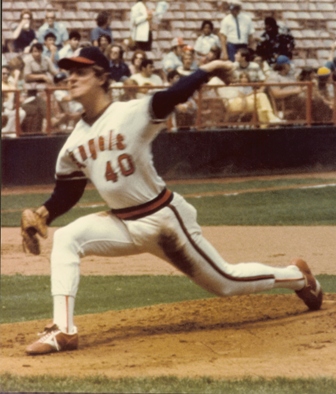 Frank Daryl Tanana pitched for six teams--California Angels (1973-1980), Boston Red Sox (1981), Texas Rangers (1982-1985), Detroit Tigers (1985-1992), New York Mets (1993), and New York Yankees (1993)--over the course of his 21-year major league career.
Since 1900, Tanana ranks 14th in games started (616), 22nd in innings pitched (4188.1), 18th in strikeouts (2733), and 37th in wins (240). Among left-handers, Tanana places 5th in GS, 7th in IP, 4th in K, and 11th in W. He has started more games than any other southpaw in the history of the American League.
Tanana enjoyed his best years when he pitched for the Angels. Drafted in the first round (13th pick) of the 1971 amateur draft, Tanana blew through the minor leagues in less than two years, compiling a 24-8 record with a 2.71 ERA. In 1973, at El Paso ("AA"), he led the Texas League in CG (15), IP (206), and K (197), pitched two games for Salt Lake City ("AAA"), and made his major league debut on September 9 at Kansas City. Tanana started four games that month, going 2-2 with a 3.08 ERA. All told, the lefty pitched 246 innings in a year in which he turned 20 halfway through the season.
Replacing Clyde Wright, who was traded to the Milwaukee Brewers after the previous season, in the rotation in 1974, Tanana started 35 games and was named The Sporting News AL Rookie Pitcher of the Year when he went 14-19 with a 3.12 ERA. He won his last two decisions to keep from losing 20 games for the last place Halos (68-94).
Frank Tanana "Daquiri," as he was known by ESPN sportscaster Chris Berman, notched the first of three straight 200-strikeout seasons in 1975, while leading the league in K (269), K/9 (9.41), and K/BB (3.68). It was the only year from 1972-1979 in which teammate Nolan Ryan did not lead the AL in whiffs. The co-number-1 starter in the Tanana and Ryan and two days of cryin' rotation fashioned a remarkable 16-9 (.640) record for a team that once again finished dead last (72-89, .447). He was recognized for his outstanding accomplishments by finishing fourth in the AL Cy Young balloting that year.
On June 21, 1975, in the first game of a twi-nite doubleheader against the Rangers in Anaheim, Tanana struck out a career-high 17 batters without recording a single K in the 9th in a 4-2 victory. He whiffed 15 Minnesota Twins nine days later. Tanana also punched out 14 batters in a game and had two 13s and a 12 that same year.
The young, brash strikeout artist returned more confident than ever in 1976 and earned the first of three consecutive All-Star appearances. Tanana had career bests of 19 wins and a 2.43 ERA. He led the league in WHIP (0.99) and K/BB (3.58) and placed 3rd for the CYA and 15th for MVP.
Firmly entrenched as the best left-hander in the league, Tanana led the AL in ERA (2.54), ERA+ (154), and shutouts (7) in 1977. He was 10-2 on June 10th and on pace to win 30 games. Two starts later, Tanana recorded his sixth shutout of the young season to win his 11th game to along with his 1.81 ERA. From April 29th through July 3rd (his 24th birthday), the 6-foot-3, 195-pounder completed 14 straight games, an all-time Angels record.
Working every fourth day, the complete-game streak finally took its toll. Tanana pitched just 10 innings over his next three starts, yielding 17 hits and 11 runs. Pitching with an inflamed triceps tendon in his left arm, Tanana started only nine more games that year, making his last appearance on September 5th.
Manager Norm Sherry had overworked his young star and the more than 1300 innings compiled from 1973-1977 reduced the hard-throwing southpaw to a pitcher who relied on a looping curveball and finesse the rest of his career. Nonetheless, Frank remained one of the most effective hurlers in the game through the All-Star break in 1978 when he was 12-5 with a 3.09 ERA. Despite tiring down the stretch once again (6-7, 4.41 in the second half), Tanana still managed to win 18 games. However, his strikeout rate plunged from a career average 7.79 per 9 IP to 5.16/9 IP in 1978.
Tanana was never the same pitcher. He spent almost three months on the disabled list the following season but returned in time to throw a complete-game in a 4-1 victory over the Royals to clinch the first-ever American League West title for the Angels. The image of Tanana completing the 3-1 (first base to pitcher) play for the final out and jumping into the air with his hands held high remains one of the greatest memories for any Angels fan.
The 26-year-old veteran of six-plus seasons started one game in the AL Championship series against the Baltimore Orioles. He pitched five rather undistinguished innings, allowing six hits, two walks, and two runs while striking out three batters in a no decision. It was the first of two postseason outings for Tanana and the only one with the Angels.
After pitching his final season as a Halo in 1980, Tanana was traded to the Boston Red Sox along with Joe Rudi for Fred Lynn and Steve Renko the following January. At the time of the trade, Tanana was second to Ryan among the team's all-time leaders in starts, complete games, innings, shutouts, strikeouts, and wins. Twenty-five years later, the man who wore #40 on the back of his jersey ranks in the top four in every important pitching statistic: GS 4th (218), CG 2nd (92), IP 4th (1615.1), SHO 2nd (24), K 4th (1233), W 4th (102), and ERA 4th (3.08).
Although Tanana was at his best with the Angels, he went on to pitch 13 more years in the big leagues, including 7 1/2 seasons with his hometown Detroit Tigers. The highlight of Tanana's post-Angels tenure occurred in 1987 when the native son shut out the Toronto Blue Jays on the last day of the season to win the AL East title.
During his career, Tanana threw a one-hitter and five two-hitters, including four with the Angels--three of which were shutouts. As an indication of his lack of run support with the Angels, Tanana had two 13-inning outings in which he allowed no runs, yet failed to get a decision in either game. The hardluck pitcher set a major-league record for the most victories without racking up a 20-win season.
Tanana's success was a function of his great stuff in the early years and outstanding command throughout his career. "My best pitch has always been control. I lost some velocity, but at the same time, thank God, I didn't lose my control. That's 90% of pitching, keeping the hitter off balance."
Whitey Herzog, manager of the Kansas City Royals during Tanana's heyday with the Angels, is quoted in the Angels' 1978 media guide, "I haven't seen Tom Seaver in a few years, but Tanana has to be the best pitcher in baseball."
Milwaukee Brewers manager Alex Grammas concurred. "Tanana is the best pitcher, not only in the American League, but in the National League, too."
The brash Tanana didn't disagree with his admirers. "When people talk about the number one pitcher in baseball, I want Frank Tanana's name to come to mind first."
After signing a five-year, multi-million dollar contract in 1977, the always quotable Tanana emphasized, "I play the game because I love it and want to be the best at it. Sure, I make a lot of money, but that's only because they are passing it around."
A resident of Corona del Mar during his stay with the Angels, Tanana was voted Southern California's most eligible bachelor one year. He was known as a playboy until he got married in January 1978. With age and maturity, Tanana settled down and became a family man. Frank and his wife, Cathy, and their four children, Lauren, Jill, Kari and Erin, now reside in Farmington Hills, Michigan. Mr. and Mrs. Tanana serve on the Pro Athletes Outreach Board of Directors and are also involved in the Home Plate and Career Impact ministries.
Here are Halo's Heaven top 20 Angels:
20. Wally Joyner
19. Reggie Jackson
18. Doug DeCinces
17. Mike Witt
16. Vlad Guerrero
15. Dean Chance
14. Frank Tanana
13. Mike Scioscia
12. Rod Carew
11. Don Baylor
The top ten, which have yet to be unveiled, are presented in alphabetical order:
Garret Anderson
Brian Downing
Darin Erstad
Chuck Finley
Jim Fregosi
Troy Glaus
Bobby Grich
Troy Percival
Nolan Ryan
Tim Salmon
Who would you vote for as the #1 Angel of all time?
| Baseball Beat | February 13, 2006 |
A Look at Unearned Runs by Pitcher Type
I have thought for quite some time that groundball pitchers were more likely to experience defensive errors behind them for the simple reason that most fielding miscues occur on grounders rather than flyballs. As my high school baseball coach liked to say, "There are no bad hops in the air."
There are three primary reasons why groundballs lead to more errors than flyballs.
1. Groundballs are more difficult to field cleanly than flyballs.
2. Infielders are more likely to make throwing errors on groundballs than outfielders on flyballs.
3. Infielders are also held to a higher standard by scorekeepers than their counterparts.
With respect to point number three, when an infielder throws a ball low, high, or wide of the first baseman, he most likely will be charged with an error if the batter-runner is safe. On the other hand, if an outfielder throws a ball off line while attempting to nail a runner, he won't be charged with an error unless the ball gets away and the errant throw results in the runner advancing an extra base.
If my longheld belief is correct, groundball pitchers should give up more unearned runs than flyball pitchers. I decided to test my hypothesis to see if it is true by analyzing last year's data.
According to ESPN's stats, pitchers allowed 54,981 groundballs and 44,528 flyballs last year. The ratio of groundballs-to-flyballs was 1.23.
By the same token, pitchers allowed 19,760 runs and 18,202 earned runs. The ratio of runs to earned runs was 1.086. Conversely, the ratio of earned runs to runs was .921. In other words, .079 or 7.9% of the runs scored last year were unearned.
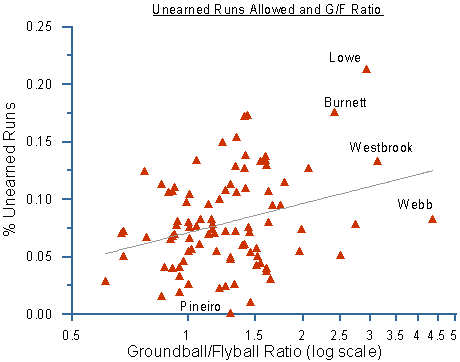
Graph courtesy of Dave Studeman, Baseball Graphs and The Hardball Times.
Derek Lowe led the major leagues in unearned runs as a percentage of total runs with .212. That's right, more than one out of every five runs Lowe allowed was unearned. Lowe's high number of unearned runs is partly a function of the number of groundballs he induces. A secondary cause could well be the Dodgers' infield defense, which The Hardball Times Baseball Annual rated as below average in 2005. There is also the potential for scorekeeper bias, as well as a certain amount of randomness, especially when dealing with smaller sample sizes.
Let's take a look at the top and bottom 20 pitchers in terms of allowing unearned runs as a percentage of total runs.
TOP 20 PITCHERS, 2005
UNEARNED RUNS/TOTAL RUNS
162 OR MORE INNINGS
Pitcher Team %UER G/F Derek Lowe LAD .212 2.92 A.J. Burnett Fla .175 2.42 Jeff Suppan StL .172 1.43 Mark Buehrle CWS .172 1.40 Kevin Millwood Cle .153 1.34 Josh Towers Tor .149 1.23 Roger Clemens Hou .137 1.41 Jason Marquis StL .136 1.59 Scott Kazmir TB .133 1.05 Nate Robertson Det .133 1.59 Carlos Silva Min .133 1.55 Jake Westbrook Cle .132 3.13 Matt Morris StL .129 1.60 Kenny Rogers Tex .128 1.33 Do. Willis Fla .127 1.40 Jamey Wright Col .126 2.06 Br. Claussen Cin .124 0.77 Cory Lidle Phi .114 1.79 Bronson Arroyo Bos .112 0.85 Kip Wells Pit .112 1.29
The top 20 pitchers have a weighted-average G/F ratio of 1.51, or 22.8% higher than the league average (1.23). This would suggest that groundball pitchers are indeed more prone to giving up unearned runs than flyball types.
BOTTOM 20 PITCHERS, 2005
UNEARNED RUNS/TOTAL RUNS
162 OR MORE INNINGS
Pitcher Team %UER G/F Joel Pineiro Sea .000 1.29 Brian Lawrence SD .009 1.46 Pedro Martinez NYM .014 0.85 Ryan Franklin Sea .018 0.95 Esteban Loaiza Was .022 1.21 Kyle Lohse Min .024 1.25 Jeff Francis Col .025 1.00 Brad Penny LAD .026 1.32 John Patterson Was .028 0.61 Mark Redman Pit .030 1.64 Aaron Harang Cin .032 0.95 Horacio Ramirez Atl .037 1.60 Johan Santana Min .039 0.91 Freddy Garcia CWS .039 1.60 Jamie Moyer Sea .040 0.87 Brett Tomko SF .040 0.95 David Wells Bos .042 1.51 C.C. Sabathia Cle .043 1.55 Jarrod Washburn LAA .045 0.97 Jon Lieber Phi .047 1.29
The bottom 20 pitchers in terms of allowing unearned runs as a percentage of total runs have a weighted-average G/F ratio of 1.15, or 6.5% below the league average. This data once again confirms that groundball pitchers are more apt to give up unearned runs than flyball types.
I could also present the data by listing the top and bottom 20 in G/F ratio and showing the percentage of unearned runs to total runs. However, for the sake of brevity, I have chosen not to run what amounts to a duplicate effort. Besides, batted ball types have been analyzed more than unearned runs/total runs. Ergo, I thought these lists would generate more new information than the other way around.
Everyone knows that Lowe is an extreme groundball pitcher. But how widely known is it that he also gives up more unearned runs than the average pitcher? Over the duration of Lowe's career, 13.2% of his runs allowed have been unearned vs. a league average of 7.9%.
What can we do with this knowledge? I'll be the first to recognize that I'm not trying to break any new ground here. Voros McCracken, who developed Defense Independent Pitching Stats (DIPS) five years ago; Tom Tippett and Mitchel Lichtman have already beaten me to the punch.
David Gassko wrote an excellent article on Batted Balls and DIPS for The Hardball Times last August in which he concluded that "a pitcher's ground ball rate has a weak, but nonetheless significant, correlation with unearned runs allowed."
Gassko added:
The idea of earned runs, originally, was almost somewhat ingenious; it was the first attempt to separate pitching and fielding. But once we can characterize each outcome independent of defense, the need to separate earned and unearned runs disappears.
I would agree with David and recommend that we pay more attention to total runs than earned runs. Oh, you'll still find me giving an ERA here and there, but recognize that run average (RA) is an even better gauge of a pitcher's performance than earned run average.
Secondly, as it relates to ERA, be aware that a pitcher with a high percentage of unearned runs is more likely to regress than a pitcher with a low percentage of unearned runs. Not surprisingly, pitchers in the top 20 table above have a higher DIPS ERA relative to actual ERA than those in the bottom 20.
Lastly, do not make the mistake of discounting groundball pitchers. All else being equal, a groundballer is preferable to one who gives up flyballs. Yes, groundballs turn into more hits and errors than flyballs, but the latter are more harmful because they result in a greater number of extra base hits and home runs.
[Additional reader comments and retorts at Baseball Primer.]
| Baseball Beat | February 06, 2006 |
Super Weekend
How many people can say that they went to three baseball games last weekend? To pull this off, you would have to live in one of the Sunbelt states, love baseball, and not care all that much about the Super Bowl. Well, folks, let me introduce you to this week's college baseball correspondent.
Twelve of Baseball America's top 25 teams played on Friday, Saturday, and/or Sunday. However, there was only matchup--#17 USC vs. #22 Long Beach State--involving two ranked teams. I had the privilege of attending all three games: Friday and Sunday at Blair Field in Long Beach and Saturday at Dedeaux Field on the campus of the University of Southern California.
After getting swept by SC last year (in the traditional three-game series in February plus once more in the Regional in June), the Dirtbags returned the favor and beat the Trojans 4-2 on Friday, 9-6 on Saturday, and 8-6 on Sunday. Long Beach State was behind in all three games but battled back to beat Ian Kennedy in the fog in the opener and ace reliever Paul Koss in the daylight twice.
On a damp, chilly night for Southern California, Kennedy was dominating the Beach through five innings when the fog began to hover in the outfield. Down 2-0 in the bottom of the sixth, the 49ers mounted a two-out rally against USC's first team All-American and Pac-10 Pitcher of the Year. Freshman shortstop Danny Espinosa singled to center and advanced to third on a ball that preseason All-American Evan Longoria fisted into shallow right field. Roberto Lopez got a late break on the ball and instead of making a routine catch for the third out, dove and trapped it.
With runners on first and third, cleanup hitter Sean Boatright lifted a fly ball to medium right field. Lopez lost the ball in the fog and both runners scored, tying the game at two each. Brandon Godfrey was polite enough to hit a similar ball to right for those who didn't see the first one and once again it fell untouched for a double that put the Beach ahead, 3-2. The Dirtbags, who held the Trojans scoreless after the first inning, added an insurance run in the seventh and won, 4-2.
Kennedy, who should be 1-0 with a 0.00 ERA, had the following pitching lines:
IP H R ER BB SO
Pre-Fog 5 1 0 0 1 7
In Fog 1 4 3 3 0 0
Total 6 5 3 3 1 7
Jared Hughes picked up the victory for Long Beach. The junior right-hander overcame a shaky first inning, allowing three walks and a single before getting an out. He settled down, retired 12 batters in a row, and escaped a jam in the fifth when he got leadoff hitter Matt Cusick to hit into an inning-ending double play. The preseason All-American posted a respectable 6-3-2-2-3-3 line with two HBP. He got two GIDP, eight other groundball outs, and a pickoff.
Longoria and Boatright were the heroes in game two. Long Beach's third and fourth hitters each slugged two-run homers, with Longoria's blast off the scoreboard in right-center field giving the 49ers the upper hand in the first and Boatright's poke off the top of the wall in center providing the go-ahead lead in the eighth. USC sophomore first baseman Lucas Duda lined a two-run home run that hooked over the wall in right field in the bottom of the third to give his team a temporary 5-3 lead, but it wasn't enough as the 49ers outscored the Trojans 6-1 the rest of the way.
On Sunday, USC jumped on top to a 5-0 advantage after four innings, knocking out the highly touted freshman starter Vance Worley in the process. The Dirtbags clawed back to tie the score at six in the seventh, then Espinosa ripped a two-run triple off Koss in the eighth inning to give Long Beach a lead that Brett Andrade saved for the second time in two appearances over the weekend.
Espinosa went 6-for-13 with two doubles and a triple during the series. He scored three runs and drove in five. The switch-hitter could have picked up a couple more hits on Sunday but was twice robbed by left fielder Cyle Hankerd, who made a diving catch in the first and a running grab in the fourth.
Longoria went 4-for-10 with a home run, triple, two walks, and two HBP, while scoring five times and knocking in two. Boatright also went 4-for-10 with a home run, two doubles, a walk, HBP, three runs, and five RBI.
There were more than 20 radar guns in action Friday night. Scouts from the Boston Red Sox, Detroit Tigers, Houston Astros, Kansas City Royals, Los Angeles Dodgers, Milwaukee Brewers, Minnesota Twins, New York Mets, and Toronto Blue Jays were visible. Bill "Chief" Gayton, the scouting director for the San Diego Padres, was in attendance on Saturday.
Here are my scouting reports on the players most likely to be taken high in the amateur draft in June:
Ian Kennedy - 6-0, 195 - Jr. - SP
W-L 12-3 | ERA 2.54 | 158 K/38 BB in 117 IP
Following in the footsteps of fellow Trojans Tom Seaver, Randy Johnson, Barry Zito, and Mark Prior...Consensus All-American...Pac-10 Pitcher of the Year...Two-time pitcher for Team USA...Although stuff is no better than average for a major league hurler, the right-hander exhibits outstanding command of four pitches...Fastball ranged from 89-91 all night...Throws strikes and changes speed...His stretch position is similar to Mike Mussina...Top ten draft pick unless his advisor and soon-to-be agent Scott Boras scares off potential suitors.
Paul Koss - 6-4, 215 - Jr. - RP
W-L 4-1 | ERA 2.81 | 42 K/21 BB in 51 IP
Right-handed closer...Came of age last year...Recorded three saves with 3 2/3 scoreless innings in the Regional...Didn't get any gun readings on him although I would be surprised if he was throwing harder than 90 or 91...Failed to record a strikeout despite facing 12 batters on Saturday and Sunday...Composite line (1.2-4-4-4-3-0 with 2 HBP and two Ls) unlikely to earn Coach Gillespie's early-season confidence.
Cyle Hankerd - 6-2, 205 - Jr. - OF
.298 AVG/.378 OBP/.404 SLG | HR 1 | SB 0 | 24 BB/42 SO
Drafted in the 45th round by the Chicago Cubs in 2003...Broke out last summer in the New England Collegiate League, hitting .383 with nine HR and 36 RBI (two short of winning a triple crown)...Big, strong kid...Keeps weight back with left heel off the ground...Lifts front foot straight up...Slight uppercut swing...Hits the ball hard and usually in the air...Outfield defense is plenty good enough...Made three spectacular catches, including diving grabs to his left and right plus a running catch going back and toward the line in left field...Also threw out a runner trying to score on a single from second base with two outs with a one-hop strike to the catcher...Should be moving up draft boards as the spring progresses.
Jared Hughes - 6-7, 235 - Jr. - SP
W-L 8-3 | ERA 2.83 | 87 K/23 BB in 89 IP
Drafted in the 16th round by the Tampa Bay Devils Rays in 2003...Transfer from Santa Clara University...Named a second team Summer All-American by Baseball America following a 7-0, 1.62 ERA in the Cape Cod League...Fastball sits at 90-91 and touched 92 on several occasions...Good curveball...Can induce groundballs...Needs to develop more consistency with his command...Hit a single-season school record 19 batters in 2005 and plunked two more back-to-back in the sixth inning Friday night...Projected to be a late first or supplemental round draft pick.
Evan Longoria - 6-2, 213 - Jr. - 3B/SS
.320 AVG/.368 OBP/.421 SLG | HR 5 | SB 10 | 15 BB/41 SO
Second-year transfer from Rio Hondo JC...Named the Cape Cod MVP after leading the league in homers (8), RBI (35), and SLG (.500) and a first team Summer All-American by Baseball America...Can play 3B, SS, or 2B...Adequate defensively...Slightly open stance with left heel off the ground...Steps into ball as it is pitched...Drives ball to all fields...Hit a long flyout that was held up by the thick air in the first inning on Friday against Kennedy...Tattooed a line drive past a diving CF for a triple in the fourth inning vs. the USC ace...Runs well for his size and is a good baserunner...Rated as the 10th-best prospect by Baseball America and is a lock to be one of the first position players drafted in June.
Sean Boatright (6-0, 190, Sr. OF), a 36th-round selection by the Florida Marlins in 2005, opted to return to Long Beach State to improve his draft status. The oft-injured outfielder, who appears to be healthy, is a good athlete. He should move up in the draft but is unlikely to go in the top several rounds.
Shawn Olsen (6-1, 200, Jr. SP/DH) is USC's Saturday pitcher and will also see action as a DH. He was the conference player of the year at College of Southern Nevada last year, primarily as an outfielder.
Players to keep an eye on for the 2007 and 2008 drafts include Danny Espinosa (6-0, 185, Fr. SS) and Vance Worley (6-2, 215, Fr. SP) from Long Beach State and Lucas Duda (6-4, 220, So. 1B) from USC.
In other Top 25 action, San Diego swept the #1-ranked Texas Longhorns 4-2, 6-0, and 12-8. Host Stanford also surprised #5-ranked Cal State Fullerton. By winning all three games, the Cardinal will surely jump back into the Top 25 when Baseball America releases its rankings on Monday.
Florida State (#15), Arizona State (#16), and North Carolina State (#24) also got the broom out, beating Charleston Southern, Northern Illinois, and Delaware State, respectively. Tennessee (#9), Pepperdine (#11), and Fresno State (#21) took two of three over their unranked opponents, while UC Irvine pulled a mild upset by doing the same vs. the 25th-ranked Cal Bears.
In the only other action involving a ranked team, Rice shut out Central Missouri, 9-0, on Saturday. Joe Savery pitched four shutout innings, then pinch hit for the DH and went 2-for-3 with a double. As a two-way player, Savery could be one of the most valuable players in college baseball this year. He earned Freshman of the Year honors in 2005 while being named player and pitcher of the year in his conference.
| Baseball Beat | January 30, 2006 |
Pac-10 Baseball Preview: Leave It To Beavers
When it comes to baseball, the Pacific-10 Conference is really a misnomer. The University of Oregon dropped baseball 25 years ago. Accordingly, for the purposes of baseball, the conference is really the Pac-9.
Baseball was Oregon's oldest athletic program (dating back to 1877), but it was eliminated from the school's athletic program in 1981 because of budget reductions in the aftermath of Title IX. Although it took awhile for Oregon State to pick up the slack, the Beavers made the state proud last year by winning the conference, hosting a Regional and Super Regional, and earning one of the eight spots in the College World Series.
OSU was joined in postseason play by fellow CWS participant Arizona State, Arizona, Stanford, and USC--making it the second straight year and fourth time overall that five Pacific-10 teams made the NCAA Tournament. The Pac-10 has produced a World Series participant each year since 1996 and has made it to Omaha 24 times overall since Arizona and Arizona State joined the league in 1979.
The 24-game conference schedule begins March 17. The winner and as many as five other schools could earn a postseason bid this year.
The teams are presented in the projected order of finish in the Pac-10 preseason poll among coaches.
1. Oregon State
2005: 46-12 | College World Series | 7th in final poll | 9th RPI
Coach: Pat Casey (341-234-4, 11 years)
Preseason Rankings: (8th by Baseball America, 3rd Collegiate Baseball and NCBWA)
A "feel good" story last year, Oregon State now has to live up to the huge expectations placed upon the program. Picked by the coaches to finish eighth in the league before the year began, the Beavers surprised everyone by winning the conference with a school-record 46 wins and advancing to the College World Series for the first time since 1952.
Led by one of the best pitching staffs in the country, OSU was selected by seven of the nine coaches to capture the Pac-10 title this year. The team's three starting pitchers--Dallas Buck (12-1, 2.09 ERA with a .194 BAA), Jonah Nickerson (9-2, 2.13 with a nearly 4:1 K/BB ratio), and Anton Maxwell (11-1, 4.33)--return for their junior years. Ace reliever Kevin Gunderson (6-4, 14 saves, 2.76)--all 5-foot-8, 155 pounds of him--is back as well.
Buck wasn't as sharp in the Cape Cod League as he was the summer before but is still expected to be no worse than a mid-first round selection in the June draft. Nickerson and Gunderson, meanwhile, pitched for Team USA last summer.
Whether Buck, Nickerson, and Maxwell can combine to go 32-4 again will be largely determined by how well the offense performs this year. Senior Tyler Graham (.307 with 0 HR and 21 SB), a speedster who was drafted in the 15th round by the Chicago Cubs, takes over for first-round draft pick Jacoby Ellsbury in CF and at the top of the lineup. Sophomore shortstop and Pac-10 Freshman of the Year Darwin Barney (.301, 2 HR, 44 RBI), sophomore catcher Mitch Canham (.325 with a team-leading 8 HR), and senior third baseman Shea McFeely (.319, 5 HR) will be asked to generate power in the middle of the order.
Put it all together and the Beavers are not only the favorite to win the Pac-10 title but are a legitimate contender for the national championship.
2. USC
2005: 41-22 | Super Regional | 17th in final poll | 11th RPI
Coach: Mike Gillespie (738-438-2, 19 years)
Preseason Rankings: (17th by Baseball America, 21st Collegiate Baseball, and 25th NCBWA)
USC missed the College World Series last year by one game, falling in the rubber match to conference rival Oregon State in the Super Regionals at Corvallis. Coach Mike Gillespie, one of only two men (along with Arizona's Jerry Kindall) to both play for and coach an NCAA championship baseball team, loses Jeff Clement, the third overall pick in last year's draft, but returns junior right-hander Ian Kennedy, possibly the top hurler in the country.
Kennedy (12-3, 2.54 ERA, 12.2 K/9), who led the nation in strikeouts with 158, is a consensus first-team All-American. He was named Pac-10 Conference Pitcher of the Year and has pitched for Team USA with success in back-to-back summers, including last year when he allowed just 11 hits in 28 innings while striking out 35. Look for the 6-foot, 195-pound starter, possessor of a low-90s fastball and outstanding command of four pitches, to go in the top five next June unless Ian's advisor and agent-to-be Scott Boras scares off potential suitors.
In addition to Kennedy, the Trojans have seven starting position players, as well as junior closer Paul Koss (4-1, 14 saves, 2.81 ERA), back in the fold. The offense will be spearheaded by sophomore third baseman Matt Cusick (.311, 4 HR), junior outfielder Cyle Hankerd (.298, 1 HR), and senior second baseman Blake Sharpe (.297, 5 HR). Hankerd was selected the number one prospect in the New England Collegiate League last summer, falling two RBI short of the Triple Crown (.383, 9, 36). He also hit a home run in the All-Star game, two more vs. Team USA in an exhibition game, and slugged a couple in a two-game sweep in the finals.
T3. Stanford
2005: 34-25 | Regional | 38th in RPI
Coach: Mark Marquess (1224-590-5, 29 years)
Preseason Rankings: (25th by Collegiate Baseball and 29th NCBWA)
Stanford, which failed to earn a Top 25 ranking by Baseball America for the first time since 1981, is coming off its poorest conference record (12-12) since 1993. The Cardinal could find the going tough this year, trying to replace a couple of first rounders (John Mayberry Jr. and Jed Lowrie) and its two best starting pitchers.
Three-time NCAA Coach of the Year Mark Marquess, however, is not without talent. Seven starters return on offense. Sophomore outfielder Michael Taylor (.289, 4 HR), selected the top prospect in the Alaska League last summer, is an emerging star. The 6-foot-5, 250-pound behemoth has the offensive and defensive tools, including surprising speed, to become one of the top picks in the 2007 draft.
Seniors John Hester (.282, 5 HR), picked by Baseball America to be the catcher on the All-Conference team, and Chris Minaker (.291, 3 HR), a slick-fielding shortstop, add experience and leadership, while junior third baseman Adam Sorgi (.322, 5 HR) provides another potent bat. Junior right-hander Greg Reynolds (2-3, 5.08 ERA) has the most potential among the pitchers and is expected to become the team's "Friday Night" starter. At 6-foot-7, 230 pounds, Reynolds has the size and the stuff (90-95 mph fastball and hard curve) to be considered as a first round draft choice if he can improve his command and throw more strikes than he has in the past.
T3. Arizona State
2005: 42-25 | College World Series | 6th in final poll | 13th RPI
Coach: Pat Murphy (443-221-2, 11 years)
Preseason Rankings: (16th by Baseball America, 12th Collegiate Baseball, and 10th NCBWA)
Arizona State begins the year ranked in Baseball America's Top 25 for the 20th consecutive season, the longest streak in the country. The Sun Devils surprised host Cal State Fullerton in the Super Regionals last year, reaching the College World Series for the 19th time in school history.
After losing six starters, Coach Pat Murphy reloads with 20 letter winners plus the second-ranked recruiting class in the nation. The influx of talent includes five recruits who were drafted last year, yet opted to attend school in hopes of winning a sixth national championship during their stay at ASU.
Newcomers Preston Paramore (NYM, 22nd round), Brett Wallace (TOR, 42nd), and two-way player Ike Davis (TB, 19th) are expected to replace the departing Tuffy Gosewich, Jeff Larish (fourth in the country with 23 HR), and first round draftee Travis Buck at catcher, first base, and DH/OF, respectively. Freshman shortstop Matt Hall (LAA, 8th) is also slated to fill in for Andrew Romine, who will redshirt this year after doctors found a blood clot in his chest.
Junior outfielder Colin Curtis (.342, 2 HR, 17 SB), a first-team preseason All-American, will lead the offense, while junior right-handers Pat Bresnehan (5-4, 5.60 ERA) and Zechry Zinicola (4-4, 5.48) plus senior Brett Bordes (5-7, 4.24) will provide mound experience for the Sun Devils.
T5. Arizona
2005: 39-21 | Regional | 12th in final poll | 30th RPI
Coach: Andy Lopez (141-95-1, 4 years at U of A)
Preseason Rankings: (31st by Collegiate Baseball)
Arizona lost more talent than any team in the conference. Four players were drafted in the first five rounds last June, including first rounder Trevor Crowe, the co-Pac-10 Player of the Year. All three weekend starters will need to be replaced as well.
Coach Andy Lopez, who guided Pepperdine to a national championship in 1992 and has twice been been named National Coach of the Year, will have just three regulars back from last year's squad. Fortunately, both middle infielders return. Shortstop Jason Donald (.288, 5 HR), a second-team preseason All-American, and second baseman Brad Boyer (.285, 3 HR) form the best double-play combo in the conference.
Team USA closer Mark Melancon (4-3, 11 saves, 2.58 ERA), a junior RHP, becomes the number one starting pitcher this year and sophomore left-handers Eric Berger (6-2, 3.84) and David Coulon (3-3, 5.50), coming off strong summers in the Cape, fill out the weekend rotation.
T5. California (34-23)
A team that should have made the field of 64 last year returns seven regulars, headed by three All-Americans--outfielders Brennan Boesch and Chris Errecart plus right-hander Brandon Morrow. Boesch (.355, 7 HR), Errecart (.298, 8 HR), and Morrow (0-1, 9.36 ERA) are all potential number one draft choices in June.
Morrow is much more of a project. The 6-foot-3 junior can hit the upper 90s on the radar gun but has battled control problems in limited duty as a Golden Bear. Coming off a big summer in the Cape, Morrow has the ability to be "one of the most dominant pitchers in the country," Coach David Esquer told Baseball America.
7. Washington (33-22)
Tim Lincecum (8-6, 3.11 ERA with 131 Ks in 104 IP) is the story here. A draft-eligible sophomore last year, Lincecum wasn't taken until the 42nd round by the Cleveland Indians because he reportedly was looking for a seven-figure contract. He went to the Cape and led the league with a 0.69 ERA while striking out more than half the hitters (69 of 134) he faced. Lincecum has a major league-quality fastball and curveball but his 6-foot, 160-pound frame may prevent him from ever being drafted as high as his stats might otherwise suggest.
8. UCLA (15-41)
Eight regulars, including the top six hitters in the lineup, return for a UCLA team that went 4-20 in conference action last year. The Bruins have three junior pitchers--starters Hector Ambriz (3-7, 3.94 ERA) and David Huff, a UC Irvine transfer via Cypress JC, and closer Brant Rustich (2-7, 5.23)--who could gain the attention of scouts this spring, as well as the fifth-ranked recruiting class in the country.
9. Washington State (21-37)
The Cougars went 1-23 in the Pac-10 and have finished in last place in the conference every year since 1999. Six regulars return, plus the team's winningest pitcher (Wayne Daman, 7-6, 4.91 ERA). Daman will be joined in the rotation by junior transfer Mike Wagner, who went 4-0 with 66 strikeouts in 63 innings in a two-year stint at Vanderbilt.
| Baseball Beat | January 29, 2006 |
College Baseball Preview
Hooray! Baseball is upon us. Yes, the college baseball season is underway. It's not even February, yet the first pitches of 2006 have already been thrown in several warm-weather locales.
The schedule picks up steam next Friday with 33 non-conference games, including the defending champion Texas Longhorns at the University of San Diego for a three-game set. Other featured series include Cal State Fullerton at Stanford and the University of Southern California meeting Long Beach State.
Texas beat Florida in the finals of the College World Series last June and has now hooked six national championships, including two of the past four. The Longhorns finished #1 in 2002, #3 in 2003, #2 in 2004, and #1 again in 2005.
Not surprisingly, Texas is ranked #1 in all the preseason polls. The eyes of Texas will be looking for the Longhorns to become the first school to win back-to-back titles since Louisiana State in 1996 and 1997. Stanford won it all in 1987 and 1988. If Texas outlasts everyone this year, talk will quickly turn toward the 'Horns being in the midst of the greatest run of championship finishes since USC won five in a row from 1970-1974.
Augie Garrido has captured five titles and is the only coach to win national championships at two schools--Cal State Fullerton (1979, 1984, and 1995) and Texas (2002 and 2005). He has taken 12 teams to the College World Series and will be seeking his sixth appearance since 2000 with preseason All-Americans Adrian Alaniz (So. RHP, 8-3, 2.67 ERA), Jordan Danks (Fr. OF, Round Rock, TX), Kenn Kasparek (So. RHP, 8-0, 2.10 ERA), Kyle McCulloch (Jr. RHP, 12-4, 2.92 ERA), and Drew Stubbs (Jr. OF, .311/.384/.527) leading the way.
Garrido's Longhorns will have to fend off nearly 300 Division I baseball programs in the country. Like college basketball, 64 teams will make it into postseason play. The 16 Regional winners will advance to the Super Regionals, and the eight teams victorious in the Super Regionals will head to Rosenblatt Stadium in Omaha, Nebraska for the 60th College World Series. The winners of the two brackets in the double-elimination tournament will meet in a best-of-three championship series.
We are going to preview the Big West, Pac-10, Big 12, SEC, and ACC over the next five days and conclude our series with the Best of the Rest on Saturday and predictions on Sunday. Our articles will highlight the teams most likely to make the playoffs with a particular focus on All-Americans and potential first- and second-round picks in the amateur draft in June.
With a record number of intersectional games this year, the college baseball season promises to be more exciting than ever. Boyd Nation, an opponent of the Ratings Percentage Index (RPI) that the NCAA committee uses to seed schools and select at-large berths for the playoffs, believes that "the Left Coast teams may start being treated more fairly. The RPI's still broken, but teams may be learning to work around it."
Play ball!
[Editor's note: A salute to the legendary Rod Dedeaux, who passed away earlier this month at the age of 91, is in order. Dedeaux, who retired from USC in 1986, won 11 national and 28 conference championships. He was named the head coach of the all-time College World Series team in 1996 and was honored by Baseball America and Collegiate Baseball as Coach of the Century in 1999. Rest in peace, Rod.]
| Baseball Beat | January 26, 2006 |
Dark Thursday
I'm sorry to report that our guest columnist stiffed us for the second week in a row. He was originally scheduled for last Thursday but asked if he could push it back a week after I had sent out a reminder a few days ahead of the publication date. Well, this week is now upon us with nary a story or a word from the man who was so "eager to contribute."
We were bailed out last week by Jeff Sullivan. The creator and primary author of Lookout Landing turned in his article a week early. The piece was posted as if it had been slated for that day all along.
Do not despair. The Designated Hitter series is in great shape. We have a couple of new columnists for our College Baseball Preview slated for next week, followed by Will Leitch of Deadspin and Patrick Sullivan of The House That Dewey Built. We also have two nationally known writers booked for March.
Thanks to our guest writers, the momentum has been built. We appreciate the time, thought, and energy that has gone into every column. The series is approaching its one-year anniversary, and it has become one of the must reads in the baseball blogosphere.
In lieu of today's feature, please take the time to peruse the "Designated Hitters" section in the sidebar on the left. Feel free to click on a link to any article you may have missed or perhaps re-visit one of your favorites. There are 44 different columns in all, ranging from sabermetric studies to player profiles, baseball history, and those with a personal touch.
Enjoy!
| Baseball Beat | January 23, 2006 |
Q&A: Dodgers Tampa Bay Prospect Chuck Tiffany
I had the opportunity to speak with former Dodger farmhand Chuck Tiffany a couple of days after the trade that sent him, along with Edwin Jackson, to Tampa Bay for Danys Baez and Lance Carter. Unlike my interview with Bill James in December 2004, I can't say I had breakfast at Tiffany's. I'll admit, it would have made for a nice title. Instead, I settled for a 45-minute telephone call one evening last week with the young man who will turn 21 on Wednesday.
Tiffany was drafted in the second round out of Charter Oak High School (Covina, CA) in 2003. He signed a $1.1 million bonus in August and pitched two innings at Ogden (Rookie) in the Pioneer League. The southpaw made the jump to Columbus (Low-A) in the South Atlantic League in 2004 and Vero Beach (High-A) in the Florida State League in 2005.
The pitcher (see photo) who Bryan Smith tabbed as the 72nd-best prospect in baseball earlier this month has a minor league record of 16-9 with a 3.90 ERA. Moreover, he has struck out 279 batters in 211 innings (or nearly 12 per 9 IP). Tiffany's first two wins included a combined no-hitter (in which he pitched the first five innings) and a seven-inning perfect game.

Had Tiffany opted for Cal State Fullerton rather than signing with the Dodgers out of high school, he would be a couple of weeks away from beginning his junior season. However, rather than being the "Friday Night" starter for the Titans this year, Tiffany is entering his third full professional season and first with the Tampa Bay Devil Rays.
Rich: As a Dodger fan growing up, how did it feel to be drafted by your hometown team?
Chuck: It was a childhood dream. I grew up in the city and had always watched them play. I was really excited about everything and was shocked when they traded me. It's now just a new chapter in my life that I have to open up.
Rich: Did someone from the Dodgers contact you regarding the trade?
Chuck: Ned Colletti called me up and said he had some news for me. He told me it was very hard for him to even tell me. He then said the Dodgers had traded me. A couple of the people within the organization called, and I thanked them all.
Rich: The news must have been tough on you.
Chuck: Like I said, it was a dream. They gave me everything they could, and I gave them everything back I could. It just happened to be in the cards that I was part of the trade. Now that I'm with another team, I'm going to do the same thing I did with the Dodgers and give the Devil Rays everything.
Rich: That's good. Who did you hear from the Tampa Bay side?
Chuck: Andy Friedman. He called me about an hour or two later. Mr. Colletti actually told me that Mr. Friedman would call sometime throughout the day. He then called and welcomed me, and I thanked him and said I was shocked at first. He knew I was shocked but said everybody was excited over there. At the time, I couldn't really say how upset I was because I didn't really know what to do because everything was a shock. If I had a chance to talk to him now, I would tell him I'm excited to be with them and that I can't wait for the season.
Rich: One of the nice things about the trade is that Tampa Bay has a lot of good, young players and appears to have a bright future.
Chuck: That's the same way I feel about it, too. They actually have faith in a lot of the young players, bring them up, let them do what they've been doing and what we're paid to do and what we love to do.
Rich: In some ways, the trade could turn out to be a positive for you. The organization has more hitting than pitching in terms of depth of talent so the opportunity might be greater with Tampa Bay than with Los Angeles.
Chuck: Yeah, which, in time, we shall see.
Rich: Did Friedman tell you where they expect you to play this year?
Chuck: He told me that they would call me within a week and let me know.
(Editor's note: Tiffany was subsequently told that he will report to St. Petersburg on March 2.)
Rich: After succeeding in High-A last year, the obvious assignment would seem to be Montgomery, Tampa Bay's AA-affiliate.
Chuck: It's up to them. It's all in their hands now. All I can do is just go there and compete and earn my spot.
Rich: Absolutely. What are you doing this winter to stay in condition and make yourself better?
Chuck: I'm doing a lot of running. I've taken a little bit of time off from playing catch, but I've been throwing the football, working out, and pretty much running at least two or three miles every day.
Rich: When will you start throwing a baseball?
Chuck: I'm slowly working my way up so I will be ready when I start pitching in games.
Rich: Do you have a personal catcher you work with during the offseason?
Chuck: No, I'll just throw to Lenny Strelitz, my agent at West Coast Sports Management, or call a friend or my little brother and they will play catch with me. I'm meeting up with Cory Lidle tomorrow, and we're going to play catch.
Rich: From what I understand, you throw three pitches. A fastball, curve, and change.
Chuck: Yes, that's correct.
Rich: How would you rank those pitches in terms of their effectiveness?
Chuck: All three are the same. I worked on my changeup a lot last year. My changeup was a weak pitch at one time. In fact, everytime I threw a changeup, it was, pretty much, a home run. The Dodgers brought me to the instructional league to work on my changeup, and I was throwing 80-90% changeups and only five or ten fastballs and two or three curveballs to try and get out of innings. It was probably the best thing that's ever happened because I noticed how much a changeup can work against a batter. I felt really confident when they let me throw all three pitches and now my fastball, curveball, and changeup are all great pitches that I can use.
Rich: One complements the other.
Chuck: Yes, exactly. When you're expecting one pitch and another one comes, it's sort of hard to hit. Before, it was only fastball or curveball. Now, I can throw all three for strikes.
Rich: Do you throw a circle change or do you choke it in the back of your palm?
Chuck: I actually throw it with my ring finger and my middle finger. I don't choke it off or anything. I just throw it like a four-seam fastball, but the way it is positioned on my hand and fingers it rolls off at a slower speed.
Rich: I see.
Chuck: I can try and throw it as hard as I want. I could probably get it up to about 84, but it won't go any harder. My fastball is usually about 88-90. When I throw it really good, it's about an 82 miles per hour pitch and it just sinks.
Rich: There is a philosophy that one should maintain a certain spread in terms of speed between a fastball and a change of pace. Is that something you have tried to achieve?
Chuck: Everybody laughs when I pitch because my fastball will range between 82 and 93 at times. I learned how to change speeds myself by just throwing the ball. I realized you can't always throw it one speed. I know that changing speeds between a fastball and a changeup is a big thing because now you throw a ball at 90 and then you throw a change at 80, it looks like a fastball but it's different timing. I feel the change in speeds really helps out, and I've worked on that a lot.
Rich: With respect to your fastball, do you throw a four-seam only or do you also throw a two-seamer?
Chuck: If I need to, I'll throw a two-seamer. But most of the time I use a four-seamer. My ball has a natural movement to it so that's why I really don't worry about two-seams at times.
Rich: To the extent that there has been criticism about your pitching style, it generally is about the number of flyballs you give up and that you don't induce enough groundballs. Do you think that is a fair assessment?
Chuck: You know what, I've never heard of that. Honestly, I've never heard of a coach being mad about a flyball for an out. I'd rather have a popup as an out than a groundball. The reality is that a player doesn't have to throw the ball to a base. He just has to catch it.
Rich: My high school coach liked to say, "There are no bad hops in the air."
Chuck: Exactly. But don't get me wrong. In different situations, when it calls for a groundball, I know which pitch to throw to get a double-play ball. It just depends on what type of batter is up, who's running the bases, and everything like that.
Rich: If you were looking to get a double play, which pitch would you be inclined to throw?
Chuck: It depends on the hitter. What they can and can't hit. I study everybody before I pitch. I have charts on them. I've played against them before and remember certain pitches I've thrown. All three pitches work good for me, so I'm not worried about always throwing this pitch to get a groundball.
Rich: Do you keep your own charts or do you get scouting reports?
Chuck: I do my own. When I was with the Dodgers, I had to be up in the stands two nights in a row before I pitched. I don't know how the Devil Rays do it. But when I did that, I just kept my own chart and studied it along with the stats the night before to make sure I knew what they could or couldn't do.
Rich: Is your curveball more of an overhand drop or a left to right pitch?
Chuck: Whatever way I want to throw it. Sometimes I have it just drop off the table but, most of the time, I can make it slurve.
Rich: Alan Matthews from Baseball America said your propensity to give up home runs might have to do with your arm angle and the curveball flattening out.
Chuck: No, I just gave the guy the right pitch that he wanted to hit. They still have to hit it, no matter which arm angle I'm coming from. It's just that I left it in their sweet spot, maybe a changeup stayed a little high or a curveball that didn't really break that much. People say that, in this game, you make a lot of mistakes. You're not going to be always perfect. There are times I throw a pitch where a guy wants it to be and he'll totally miss it. That's the one shot he had. That's his mistake. Well, sometimes they hit my mistakes and that's what hurts. That's what gives up the home runs. My mistakes. Not the arm angle.
Rich: Do you think you have given up more home runs on one type of pitch than the others?
Chuck: Probably the changeup because I wasn't very good at it and most of the time I left it hanging and it pretty much never came back into my glove. You know?
[Both of us laugh.]
Rich: That's an honest answer but something that can also be fixed.
Chuck: Oh yeah, that's why they sent me to instructional league. Seriously, they told me everyday, "throw changeups, changeups, changeups." So everyday I sat there and threw a changeup and they didn't let me go until I perfected it.
Rich: Some people have speculated that your future might be as a relief pitcher instead of a starting pitcher. I imagine you'd rather be a starting pitcher?
Chuck: Oh, I'd rather be a starting pitcher. But whatever they need in the big leagues. If they need me to come out of the 'pen, I'm more than willing to go in there but, in my eyes, I want to be a starting pitcher.
Rich: Your fastball, curveball, and change repetoire seems better suited to being a starting pitcher than a relief pitcher. A reliever, for the most part, just needs two really good pitches. If you could develop that changeup, have that third pitch. . .
Chuck: The only thing that I think is the difference between a starting pitcher and a relief pitcher throughout the game is I get stronger. In the fifth, sixth, and seventh innings, if you look at the radar gun, I'm still throwing as hard as I did in the first. With the relief pitcher, you just come out and give it everything you've got because you don't get to throw those extra innings. Once you go through the lineup, three-fourths of the time you get taken out for the set-up guy or closer. So, I think the three pitches, no matter what, can work as a starter or a reliever. It's just the way you use them.
Rich: You have averaged nearly 12 strikeouts per nine innings in the minors. Do you feel as if you are a strikeout pitcher and why?
Chuck: I've been told that I'm not a power pitcher, I'm a crafty pitcher. In my eyes, I've always been a guy when I needed a strikeout, I know I can get it. I know I have the pitches to do it. Most of the time, when I get a guy 1-2, 0-2, I just try to put him away. I don't like to mess around with them and sit there and go 3-2. My goal is when a guy comes up to bat, I'd rather see him walk back to the dugout than popout. I want to strike him out everytime because that means I'm giving it everything I've got. I don't want to think, "Here, put the ball in play." To make this really easy on myself, I'd rather just go right at them.
Rich: Looking at your game logs, my partner Bryan Smith has noted that you have generally been more effective in games when you have been a bit wild, if you will.
Chuck: Every game is different. It just depends on what game it is. Some days your arm feels great and some days it doesn't. When I'm out there, honestly, none of that is going through my head. If my arm is tired or not, I'm just throwing 110% each pitch and that's all that matters. If I'm throwing it a little bit softer, it's not because my arm is sore or tired. It's just the way it felt that day. There are games I've gone out and thrown 85-88 and pitched great and other times I've thrown 91-94 and had awesome games. It just depends on the day.
Rich: After finishing 2004 by striking out 46 batters in your last 21 innings of work, you beat first-round draft pick Philip Humber and the St. Lucie Mets, 1-0, in the season opener. You allowed just one hit in five innings while striking out 11. You went 4-0 in April and were named the Florida State League Player of the Week twice and the Dodgers Minor League Player of the Month.
Chuck: I felt good when I finished in 2004 and was pumped up going into the 2005 season. I got hit pretty hard by the Mets in a spring training game. They shelled me. I later walked by them in a scrimmage and they asked if I was ready to be lit up again. They tried to get in my head. I proved them wrong.
Rich: Nice. You then experienced a setback in May when you had surgery to remove a pre-cancerous mole from your back.
Chuck: I actually pitched a game the day I heard I was going to need surgery within the next two weeks. It was scary news. Once I got it done, I was in bed for two or three days because my lower back was really sore. But, as soon as I was able to move without it nagging, I had a baseball in my hand and I was throwing it and just getting ready. About a week-and-a-half later, I was back even though I was supposed to be out for about two, two-and-a-half weeks. I came back a bit early and was just trying to get back into a throwing mode. No excuses, I lost. I went out there and threw and got hit, and I lost. It's nobody's fault. It's just the game of baseball.
Rich: Well, you righted the ship in July.
Chuck: I did. I came back and didn't lose much.
Rich: You had some ups and downs last year. The season might best be characterized as one of peaks and valleys, but that is probably pretty normal for someone your age who is working his way through the system.
Chuck: I've always been taught that failure is a part of success. If I went the whole season without losing, then what happens when I lose? I've always been the type of kid who hasn't been able to handle failure. It just teaches me never to do it again. When I lost those couple of games, I knew I was in a valley, but I also knew sooner or later that I would hit a peak again. All I knew to do was to keep on battling.
Rich: Logan White, the Dodgers Scouting Director, called you a great competitor.
Chuck: I always talk to him. Like he said, I do compete. When I go out there, I never give up. I could be having the worst game or the best game of my life, but I'll be giving everything I got. You could have nine runs off me in the first inning...I won't give up. That's one thing my teammates know about me. When I'm on the mound, I'm giving them everything I got. Everybody respects me because they can see it. There's not one pitch I throw without trying, and I think that's where I get a lot of my respect from because I'm a competitor.
Rich: Is there a pitcher out there who you model yourself after?
Chuck: I've always wanted to be like Randy Johnson. Without a doubt. Randy Johnson. Nolan Ryan and Roger Clemens are right-handed. But Randy Johnson has always been the guy that I've looked up to and been a hero to me. I try to pitch like him. I don't have his height or anything but am hopeful that one day I could have a name like him and other people could look up to me.
Rich: At one time, it appeared that you were on the fast track and that you might be going from Vero Beach to Jacksonville.
Chuck: Yeah, they were projecting me to be in Jacksonville by the All-Star break but then I had that little back surgery, which set me back a little. They then took up Justin Orenduff, and he kicked butt and did awesome. They needed pitching in High-A because we were in the race for the playoffs so they kept me down. High-A, Double-A, Big Leagues--it doesn't matter because I'm gonna give it everything I got. So, I wasn't disappointed. As long as I can keep throwing the ball, that's all that matters to me.
Rich: You were named to the All-Star team in 2004 and 2005. Did you pitch in both games?
Chuck: I didn't pitch in Georgia, but I pitched in the Florida State League game.
Rich: How did you do?
Chuck: I gave up a home run and struck out the next guy. [Laughs] I didn't know in the All-Star game that they expect fastball first pitch--especially from a reliever--so, when I threw the first pitch fastball, he hit it about 400 feet. My agent told me I should have thrown an off-speed pitch. It's a learning process and now I know.
Rich: I'm sure you have played with or against some of the guys in the Tampa Bay system along the way. Are there any players in particular who stand out?
Chuck: Delmon Young. I played on the USA Team with him. Coltyn Simmons. He's a catcher. I've hung out with him. I met Elliot Johnson at the All-Star game. We talked a lot. I know quite a few guys from that organization. We all have respect for each other. I'm just excited to go join them.
Rich: Are you familiar with another Tampa Bay left-hander, Scott Kazmir?
Chuck: Yes, when I was a sophomore in high school, we played in Joplin, Missouri, on different teams. I got to watch him. He's a good, little left-hander.
Rich: Looking at the Tampa Bay farm system, if you are assigned to Montgomery, you should be the youngest player on the team and one of the youngest in the league. As a result, you are still ahead of most players your age.
Chuck: I feel being young is an advantage. When I get out there and see these older players, I just picture them being the same age as me. There's a reason why they are there and a reason why I'm there. I believe in everything I throw--my fastball, curveball, and changeup--and know my stuff can compete with them. Age, in my mind, doesn't matter when it comes to pro ball. Age is only a number; it's not the way you play. We're all there for the same reason: to compete for a job in the big leagues. Whether you're 20 or 40, it's all the same when you get to the Show.
Rich: Given your frame (6-foot-1, 220), do you feel like you have the ability to stretch your fastball out a little bit more?
Chuck: Yes, I believe that's realistic. I've worked hard in the off-season, and I believe that all the running and working out will pay off in time.
Rich: I'm sure you are chomping at the bit and looking forward to spring training.
Chuck: I'm totally looking forward to it. I can't wait. I'm excited. It's going to be culture shock because I won't be in Dodgertown anymore. I'll be staying in hotels rather than dorms. It's a big city. I'm ready to go.
Rich: Well, good luck this season, Chuck. Let's be sure to stay in touch.
Chuck: Will do. Thanks, Rich.
| Baseball Beat | January 20, 2006 |
The Ballad of Ned
Here We Go, Dodger Fans was one of the more controversial articles I've posted at Baseball Analysts. In fact, it seemed to be as polarizing among readers as the trade that sent Edwin Jackson and Chuck Tiffany to Tampa Bay for Danys Baez and Lance Carter.
Although the column only generated about a tenth as many comments as a typical Jon Weisman post at Dodger Thoughts, it received more than our normal share. The debate centered on two questions: (1) was it a good or bad trade and (2) an indication that similar trades might be in the offing as well?
I thought the deal was ill conceived and expressed concern that it could also be a harbinger of things to come. Look, I might be wrong on both fronts. We shall see. In the meantime, I remain steadfast in my belief that Jackson and Tiffany will provide more long-term value than Baez and Carter. Sure, the latter may be more useful to the Dodgers in 2006, but what about 2007 and beyond?
Perhaps Dodgers General Manager Ned Colletti and I see things differently. With that in mind and in the spirit of fun, I present to you The Ballad of Ned, sponsored by Kellogg's Corn Flakes.
Come and listen to a story about a man named Ned
A poor Assistant General Manager, barely kept his family fed,
Then one day he was interviewin' in L.A.,
And exiting the freeway at Dodger Stadium Way.
Traffic that is, brown smog, California tea.
Well, the first thing you know ol' Ned's a millionaire,
The San Fran folk said Ned move away from there
Said Southern California should be awfully keen
So they loaded up the truck and moved to Chavez Ravine.
Dodger Stadium, that is.
Grady Little, aging stars.
The Beverly McCourts!
If Colletti wins a title in his first year (a la Paul DePodesta in 2004) but fails to do so in his second, we just may be hearing the following verse in October 2007...
Well, now it's time to say good-bye to Ned and all his kin.
They would like to thank the fans fer kindly droppin' in.
You're all invited back next year to this locality
To have a heapin' helpin' of the McCourts' hospitality.
Frank and Jamie, that is. Buy a team. Drive it into the ground. Y'all come back now, y'hear?
Hey, if I'm wrong, I will be the first critter to yell, "Well doggies!"
| Baseball Beat | January 17, 2006 |
Hardy Guardy Man
Widely considered a defense-first shortstop in the minor leagues, J.J. Hardy broke out offensively in the second half of his rookie year and now ranks as one of the most intriguing players going into the 2006 season.
Among shortstops, Hardy ranked fifth in AVG (.308), seventh in OBP (.363), second in SLG (.503), and fourth in OPS (.865) after the All-Star break last year. He was the best-kept secret in baseball during the summer months because his overall numbers were held back by a horrendous first half.
AB R H 2B 3B HR RBI BB SO SB AVG OBP SLG OPS
Pre-AS 187 22 35 12 0 1 19 28 25 0 .187 .293 .267 .560
Post-AS 185 24 57 10 1 8 31 16 23 0 .308 .363 .503 .866
Totals 372 46 92 22 1 9 50 44 48 0 .247 .327 .384 .711
Were both halves aberrations and Hardy is nothing more than just another middle-of-the-road shortstop as his season statistics suggest? Or is there something in the numbers that paint a different story? Well, let's take a closer look at J.J.'s first half stats above.
There are four points of interest.
1. Hardy walked more often than he struck out.
2. He was putting the ball in play at a pretty good clip.
3. His Batting Average on Balls In Play was a meager .211 (vs. a MLB norm of about .300). Give him a more normal BABIP and he would have hit .262 before the All-Star game rather than .187.
4. The number of doubles-to-home runs was unusually high.
Based on the above, Hardy was a virtual lock to boost his numbers rather dramatically in the second half. Lo and behold, his extreme bad luck turned to a bit of good fortune as the season progressed. Hardy's BABIP jumped more than 100 points to .318 and many of his two-baggers turned into four-baggers.
For the year as a whole, Hardy had a BABIP of .263. Recognizing that the type of batted ball can influence BABIP, it is important to note that Hardy's outcomes (33% groundball, 22% outfield fly, 5% infield fly, 15% line drive, and 3% bunt, according to The Hardball Times Annual) were almost identical to the major league averages. Accordingly, I feel comfortable suggesting that Hardy should have come closer to hitting .277 than .247 for the year.
The 6-foot-2, 205-pound shortstop's monthly rate stats capture the marked improvement in July and the surge in power in September.
AVG OBP SLG OPS
April .143 .284 .179 .462
May .218 .283 .309 .592
June .188 .304 .313 .616
July .274 .376 .425 .801
August .273 .298 .382 .680
September .305 .352 .561 .913
October 1.000 1.000 1.000 2.000
Hardy ended the season with an eight-game hitting streak (11-for-32), and he hit safely in 17 of the last 18 (25-for-75), 21 of 23 (31-for-89), and 26 of 29 (39-for-110). He slugged five HR in September after not hitting any until the middle of June.
The three-time Arizona All-State High School selection (1999-2001) hit much better batting second than eighth for the Brewers last year. In a chicken or the egg question, did Hardy benefit by seeing better pitches in the second slot or was he promoted because his hitting picked up? The answers appear to be "yes" and "yes."
Manager Ned Yost rewarded Hardy by moving him into the number two hole in late August, and Milwaukee's second-round pick in 2001 responded by putting up Miguel Tejada-type numbers the rest of the year. Hardy's walks plummeted and his other stats soared when he wasn't hitting directly in front of the pitcher.
AB R H 2B 3B HR RBI BB SO SB AVG OBP SLG OPS
Bat #8 211 23 49 13 0 1 23 30 22 0 .232 .331 .308 .639
Bat #2 96 16 29 4 1 5 18 6 15 0 .302 .337 .521 .858
Hardy also performed much better with runners on base and with runners in scoring position than with nobody on.
AB R H 2B 3B HR RBI BB SO SB AVG OBP SLG OPS
None On 211 5 48 14 1 5 5 12 30 0 .227 .269 .374 .643
Runners On 161 41 44 8 0 4 45 32 18 0 .273 .393 .398 .791
RISP 91 34 26 6 0 1 38 23 10 0 .286 .427 .385 .812
A season-ending shoulder injury suffered the previous year helps to further understand why Hardy experienced such a Dr. Jekyl and Mr. Hyde rookie campaign. He underwent arthroscopic surgery for a torn labrum on May 28, 2004. Hardy recovered in time for spring training and became just the fifth Brewers player to make his ML debut in the Opening Day starting lineup, joining Pedro Garcia, Paul Molitor, Gorman Thomas, and Robin Yount. (Speaking of Yount, the Hall of Famer is returning to the Milwaukee Brewers this year as bench coach and should be in a position to help Hardy as much as any other Brewer.)
Although Hardy has a reputation of having a good glove, his fielding statistics last season weren't particularly inspiring. His range factor (3.76) and zone rating (.843) were at or near the bottom among all regular shortstops. Hardy, however, made just ten errors and his fielding percentage (.975) might suggest that he is more of a sure-handed infielder than one who covers a lot of ground. He makes up for his lack of quickness with a strong and accurate arm.
The son of a professional tennis player (father) and golfer (mother), Hardy was 18-for-30 (60%) on taking extra bases on hits. He was 6-16 (38%) going from first to third, 11-12 (92%) second to home, and 1-2 (50%) first to home. J.J. was never thrown out trying to take an extra base or caught stealing. According to THT, Hardy was second on the Brewers in baserunning, adding a shade over one run with a rate of 23% above the norm.
Hardy, 23; double play partner Rickie Weeks, 23; and first baseman Prince Fielder, 21, form a trio of young infield talent unmatched in the National League. The Brewers were 81-81 in 2005, their first non-losing season in 12 years. Consider that Milwaukee's Pythagorean record was 84-78 and there's every reason to think that the up-and-coming Brewers could be the favorites to win the NL's Wild Card berth in 2006.
Longer term, Hardy profiles a bit like Chris Speier. He has a similar body type with medium speed, a good knowledge of the strike zone, and above-average power for a SS. Speier had better range than Hardy showed in his rookie year but was eventually hampered by a bad back despite enjoying a 19-year career in the majors. For what it's worth, the former Giant was one of the best players in the league during his second season.
Look for Hardy to avoid the sophomore slump and put up a Bobby Crosby-like .280/.350/.460 line. If so, he could emerge as perhaps the #1 or #2 shortstop in the NL in 2006.
| Baseball Beat | January 15, 2006 |
Here We Go, Dodger Fans
How high's the water, mama?
Five feet high and risin'
How high's the water, papa?
Five feet high and risin'
Well, the rails are washed out north of town
We gotta head for higher ground
We can't come back till the water comes down,
Five feet high and risin'
Well, it's five feet high and risin'
--Johnny Cash, Five Feet High And Rising
The dam has been broken. After showing a sense of discipline by not trading any farm prospects this offseason, Dodgers General Manager Ned Colletti sent Edwin Jackson and Chuck Tiffany to the Tampa Bay Devil Rays for Dannys Baez, Lance Carter, and the proverbial minor league player to be named later.
Who's next? Pitchers Chad Billingsley, Jonathan Broxton, or Scott Elbert? Infielders Joel Guzman or Andy LaRoche? How about outfielder Matt Kemp or catcher Russell Martin?
Well, I know one thing. Colletti can no longer say that he is rebuilding the team without compromising the future.
Jackson, 22, and Tiffany, 21, represented two of the best arms in one of the most highly regarded systems in baseball. Although Jackson has regressed since being rushed to the majors in September 2003, the right-hander is just two years removed from being named the top pitching prospect in the game and the fourth-best overall by Baseball America.
Tiffany has shown flashes of brilliance since being drafted out of high school in the second round of the 2003 draft. The southpaw struck out 46 batters in his final 21 1/3 innings in 2004 and began the next season with a 4-0 record, a pair of Florida State League Player of the Week honors, and was named the Dodgers Minor League Player of the Month for April. He had a pre-cancerous mole removed from his back and was placed on the disabled list in May. Tiffany, who Bryan Smith ranked as one of his top 75 prospects, never returned to his early-season form but still ended the year 11-7 with a 3.93 ERA and 134 Ks in 110 IP.
Jackson has a plus fastball and slider, yet needs to improve his changeup and command in order to maximize his potential. Tiffany throws three quality pitches--a fastball, a curve that was rated as the best in the organization a year ago by Baseball America, and a changeup. Both pitchers are far from certain bets to become stars at the big league level, but they have the type of upside that make scouts and performance analysts alike dream of what might be one day.
In the meantime, trading two young starting pitchers for a pair of veteran relievers is problematic at best. Yes, Baez was fifth in the American League in saves last year, but his peripheral stats (8.2 H/9, 6.4 K/9, 1.7 K/BB, and 1.33 WHIP) are rather pedestrian. As a so-called proven closer, the 28-year-old right-hander is the type of pitcher who is more often overrated than not.
Colletti apparently sees Baez as a setup man and insurance in the event that Eric Gagne isn't ready to start the season. He may also view him as the Dodgers closer of the future. However, just as Gagne will become a free agent at the end of year, so will Baez. As a result, there is no guarantee that the latter will even be on the roster in 2007.
Although Carter was an All-Star selection in 2003, he is nothing more than a throw-in (to put it kindly). The 31-year-old right-hander had a 4.89 ERA in 2005, striking out just 22 batters in 57 innings. His 3.5 K/9 was the fourth-lowest among all AL relievers last year. He also gave up nine home runs (or 1.42 HR/9) and has allowed a similar rate of long balls throughout his career.
According to Ken Gurnick at MLB.com, the Dodgers now have 18 players under contract totaling $95 million. Accordingly, it appears that the Dodgers payroll will be no less than $100 million next year--a significant increase over last year's budget.
What is Frank McCourt getting for his money? The Dodgers signed free agent Rafael Furcal to a three-year, $39 million contract last month. They also inked Nomar Garciaparra to a one-year, $6 million deal; Bill Mueller to two years and $9.75M; Brett Tomko, 2/$8.7M; Kenny Lofton, 1 x $3.85M; and Sandy Alomar, Jr., 1 x $650,000.
Furcal is a terrific shortstop who can help you at-bat, on the basepaths, and in the field. Although the Dodgers paid up for him, I'm not going to argue against that acquisition. That said, I can't really see the merits of the other deals.
For instance, why give the 39-year-old Lofton almost a million more than what it took the Oakland A's to sign Milton Bradley? Dollar-for-dollar, I would rather have Bradley. Throw in an extra $850,000 plus the $4M from the Baez money and now I'm upgrading from Tomko to a much more significant starter.
I could see the Dodgers' interest in Garciaparra as a third baseman but am having a hard time coming to grips with the idea of converting him to a first baseman. If he's healthy, what's he going to hit? .280-.300/.320-.340/.460-.480? I'm sorry, but these numbers look like Shea Hillenbrand to me. Heck, why not just go with the platoon of Hee-Seop Choi (.258/.335/.460 vs. RHP) and Olmedo Saenz (.261/.338/.548 vs. LHP)?
How much of an improvement is Mueller (.295/.369/.430) over Willy Aybar (.326/.448/.453 in 105 PA)? I wouldn't expect the latter to match those numbers over a full season, but is it unrealistic to think he could put up a .275/.350/.400 line while saving the Dodgers about $4.5M over each of the next two years?
Jon Weisman of Dodger Thoughts brings up another potential use of the $4 million spent on Baez by throwing top-draft choice Luke Hochevar's name into the mix. The University of Tennessee right-hander might be a lost cause at this point, but the idea of investing the money in the system or waiting for the right opportunity down the road is a valid one.
I think Colletti has gotten himself in a pickle here. He made the decision to find a handful of players who could bridge the gap between 2005 and 2007 before reversing course by exchanging two of the organization's most talented pitchers for what might amount to 130 innings of a 3.75 ERA, if Baez and Carter duplicate last year's stats. Moreover, I believe the Dodgers GM has set a bad precedent and would not be at all surprised if he orchestrated another similar deal between now and the beginning of the season.
When it comes to the Dodgers and sticking to a game plan, I think it's not just the water that's five feet high and risin'.
| Baseball Beat | January 10, 2006 |
Blyleven for Hall of Fame: The Majority Rules, Right?
Although Bert Blyleven came up short in the Hall of Fame voting announced earlier today, his total increased by more than 31% as he was named on 277 of the 520 ballots cast by members of the Baseball Writers Association of America. By crossing the important 50% level for the first time, Blyleven appears to be on track at one day getting inducted into Cooperstown. Gil Hodges, in fact, is the only player no longer eligible for the HOF to receive 50% of the vote total and not have his day in upstate New York.
Bruce Sutter was the only candidate who received the required 75% for enshrinement. Sutter picked up 400 votes or 76.9% of the total. Jim Rice (337, 64.8%), Rich Gossage (336, 64.6%), and Andre Dawson (317, 61.0%) finished between Sutter and Blyleven.
Blyleven, who has been on the ballot for nine years, has a chance to follow a similar path to the Hall of Fame as Sutter. The newest member of the Hall passed the 50% mark for the first time in 2003, earning an almost identical total as Blyleven this year. The 1979 NL Cy Young Award winner then bridged the gap over the next three years, adding between 6%-10% annually to his totals to gain induction into baseball's most prestigious fraternity in his 13th year of eligibility.
As shown below, Blyleven's momentum is really building:
Year Votes Pct 1998 83 17.6 1999 70 14.1 2000 87 17.4 2001 121 23.5 2002 124 26.3 2003 145 29.2 2004 179 35.4 2005 211 40.9 2006 277 53.3
Based on the number of ballots cast this year, Blyleven needs 113 more votes out of the 243 writers who did not support him. That does not seem insurmountable by any means. In fact, there are many writers who have professed to be on the fence, both in public and in private conversations and emails with me. I won't name names here, but you know who you are. All I can say is that you were in the majority by not voting for Bert in the past, but you will be in the minority if you continue to leave his name off your ballot in the years to come.
In the meantime, the favorable press on Blyleven's behalf continues to mount. Non-voters and voters alike have even mentioned our efforts in getting out the word. It's easy to be an advocate when someone has as strong of a case as the man who is 5th in strikeouts, 8th in shutouts, and 17th in wins since 1900. I haven't accomplished anything other than trying to get voters to take a look at Blyleven's stellar record. To the extent that they have, I say amen. To the extent that they haven't, I only ask that they please do before they mark their ballots next year.
Here are a few excerpted paragraphs from an excellent article written by Childs Walker of the Baltimore Sun in today's newspaper:
Blyleven, like many of his peers, is acutely aware of his case. He has watched his name rise on the ballot and can tick off the wins, innings pitched and strikeout totals that comprise the best parts of his argument. He has read the material on BertBelongs.com and by another advocate, Rich Lederer at baseballanalysts.com.The first two can be parried easily. Blyleven didn't win more because he often didn't pitch for good teams. Had he received even league-average support, Lederer calculated, his record would be 313-224.
As for the Cy Young voting, the contemporary voters just didn't appreciate what they were seeing.On baseballanalysts.com, Lederer does a fantastic season-by-season breakdown of Blyleven's career, showing how consistently he outpitched those who finished above him in awards voting. In 1973 for example, Blyleven won 20, finished second in the league in ERA and strikeouts and fourth in innings pitched but appeared on only one of 24 Cy Young ballots.
Joe Sheehan, author of Baseball Prospectus, wrote the following in his outstanding Hall of Fame column (subscription required) yesterday:
Bert Blyleven essentially has a campaign of people like me trying to get him into the Hall of Fame, one that peaked late last year over at Baseball Analysts. I'm with them. Blyleven isn't even a borderline case, but rather, an above-average Hall of Famer who is underrated due to criminally bad run support during his best seasons. The reputation he picked up as a guy who couldn't win close games is unfair.Blyleven may have been a difficult teammate--I mostly remember the 1980s version, the veteran jokester, although I've learned more about his earlier days over the years--but that's an argument you make about a player on the bubble. Blyleven should not be on the bubble. As Rich Lederer says, succinctly, "Since 1900, Blyleven ranks fifth in career strikeouts, eighth in shutouts and 17th in wins." Blyleven isn't qualified for the Hall; he's overqualified, and with six years of eligibility left, I'm optimistic that the voices of reason will eventually carry the day.
Blyleven was nice enough to tip his cap in our direction in a radio interview with MLB.com yesterday and another with ESPN Radio this afternoon. The former is currently listed on the home page in the upper right-hand corner under Highlights (Broadcaster and Hall of Fame candidate Bert Blyleven on possibly getting the call and the team's prospects for 2006). The first few minutes can also be accessed here.
I asked Bill James, one of Blyleven's earliest supporters and the author of a fascinating feature called The Nasty Dutchman in the The Hardball Times Baseball Annual 2006, for his comments about Bert's chances of gaining election now that he has passed the 50% barrier.
The 300-game winners are disappearing from the ballot; there is more room to vote for the 280-game winners, and the 280-game winners have always gotten in eventually. I'm sure Bert will as well ... there are a lot of people advocating for him.
Yes, and these people have only just begun (and are more energized than ever before). Bert Blyleven for Hall of Fame 2007 starts now.
Now back to our regularly scheduled programming, starring Bryan Smith and his must-read 2006 WTNY Top 75 Prospects.
| Baseball Beat | January 06, 2006 |
Casual Friday
Friday has become known as a casual day here in the U.S. Hence, Casual Friday.
I've always thought it should be Thank God It's Saturday. Unless you're going to party on Friday night, why would the last workday of the week be viewed as a cause for celebration? Seems to me it should be the first non-workday.
Come to think of it, maybe Friday has become the first non-workday. More and more employees get every other Friday off. And do college students even go to school on Fridays anymore?
We even stack our holidays on Mondays to lengthen the weekends. Before you know it, we'll be working Tuesday through Thursday only. Just like they do in Europe.
Hey, before you send me a nasty email, go find a catcher for Italy's World Baseball Classic team who wasn't born in Norristown, Pennsylvania, OK? Just teasing. Hey, I'm happy for ol' (literally) Mike. You see, no team in the U.S. is planning on letting him catch for them.
In any event, I wanted to share a comment from a bulletin board in response to an article -- OOPs, Here It Is! -- I wrote a couple of weeks ago. New York Mets shortstop Jose Reyes showed up on a list I created to identify the most overrated offensive players in baseball. Although he was spared first-team honors in favor of Dusty Baker's favorite shortstop, a reader essentially called me a slacker and an "Overrated Analyst."
"Too bad he is only 22 years old and only going to get better. How about a new stat judging the most overated stats and analysts? No Life+Spending 20-30 hours a week on the computer+Never playing the game beyond High School+Ignoring Intangibles=Most Overated Analysts."All this from a guy who goes by "ItalPiazza31" and has FIVE-THOUSAND-ONE-HUNDRED-EIGHTY (5180) posts to his "credit."
With respect to OOPs, let me emphasize that this exercise was designed (1) for fun and (2) as a means to show which players have the most hollow batting averages out there. To the extent that batting averages are given more air time than on-base or slugging percentages, I think it is safe to say that those who met our test are OVERRATED OFFENSIVE PLAYERS (as in hitters). I'm not suggesting that they are necessarily overrated in the other aspects of the game, such as Baserunning And Defense.
You see, those players are assigned a different acronym: BAD.
Happy Friday!
| Baseball Beat | January 02, 2006 |
American Idols
The National Football League concluded its regular season on Sunday. The playoffs begin next Saturday with what is called Wildcard Weekend.
Saturday, January 7:
Washington (10-6) at Tampa Bay (11-5)
Jacksonville (12-4) at New England (10-6)
Sunday, January 8:
Carolina (11-5) at N.Y. Giants (11-5)
Pittsburgh (11-5) at Cincinnati (11-5)
The Indianapolis Colts (14-2), Denver Broncos (13-3), Seattle Seahawks (13-3), and Chicago Bears (11-5) all have byes.
Here's my question: does anybody really believe that one of the teams from the National Football Conference has a legitimate chance to win Super Bowl XL? From my vantage point, the American Football Conference appears to be as stacked as Major League Baseball's American League. Bookmakers, in fact, have already installed the AFC representative as a 10 1/2-point favorite to win the extra large one this year.
What is it with these AFC and AL teams? The Americans have beaten the Nationals in each of the last two Super Bowls and World Series. I would be surprised if they don't make it a three-peat in both.
The AFC includes the team with the best record in football as well as the two-time defending Super Bowl champs. The Steelers, the sixth and last seed in the AFC, are probably better than every team in the NFC, with the exception of the Seahawks.
Da Bears have no almost no shot. I mean, this isn't 1986. That Super Bowl victory has been in the Fridge for 20 years. Tampa Bay? Yes, they won it three years ago, but this is Chris Simms at quarterback -- not Phil. New York Giants? They've got the right surname at QB, just the wrong version. The Carolina Panthers have the Sports Illustrated cover jinx working against them. Joe Gibbs is back with the Redskins but, unfortunately, Mark Rypien, Doug Williams, and John Riggins have all long retired.
The AFC has not only won four of the last five Super Bowls, but it went 34-30 against the NFC this year. Kinda reminds me of the superiority of the AL over the NL. The AL, which has won six of the last eight World Series, beat up the NL in interleague play to the tune of 136-116 last year.
I think the National League may have only two teams that are as good as the top seven in the Americal League. Other than the St. Louis Cardinals and New York Mets, I don't see a NL club that can compete with the Chicago White Sox, New York Yankees, Boston Red Sox, Los Angeles Angels, Cleveland Indians, Oakland A's, or Toronto Blue Jays.
Thanks to the Sox (Soxes? Socks?), the AL has swept each of the past two World Series. That's right, the NL hasn't won a World Series game since Josh Beckett pitched a five-hit shutout against the Yankees in Game Six of the 2003 Series. But it's not just about what happens in October.
Only four AL teams had losing records vs. the NL last year. Conversely, only four NL teams had winning records vs. the AL. The two leagues look more unbalanced than their schedules.
I'm reluctant to count out the Atlanta Braves because I have been proven wrong when doing so in the past. Arguments could also be made on behalf of the Houston Astros and Philadelphia Phillies. However, all three teams went 7-8 in interleague play last year. Outside of the teams mentioned and the Milwaukee Brewers, who are young and poised to get better, I don't see another club in the NL that could put up a .500 record in any of the three divisions in the American League.
Don't even suggest that the San Diego Padres or the new and improved Los Angeles Dodgers are up to the task of beating these AL teams. The NL West, which looks like a Triple-A league when compared to the AL, went 32-55 in interleague play last year. There are so many old players in San Diego, Los Angeles, and San Francisco, one would think California had become Florida.
Just as the AFC is far removed from the old American Football League (you know, the one looking to merge with its more established National Football League brethren), the AL is no longer MLB's junior circuit. If anything, it appears as if the NL has been short circuited.
| Baseball Beat | December 27, 2005 |
Pass the Trash
What is Walt Jocketty doing with his Cards? Unfortunately, for Redbird fans, the general manager is sitting out the high-stakes poker game that is taking place this winter. Instead, he is playing a game known as Pass the Trash.
In Pass the Trash, seven cards are dealt to each player. Before the first betting round, each player examines his/her hand, then passes three cards to the left while adding the discards from their neighbor on the right. After a round of betting, players pass two cards, bet, then pass one card. Finally, the participants who have yet to fold choose their best five cards and a showdown round of betting ensues. The winner is the player with the best poker hand among those still remaining at the end of the game.
As it relates to St. Louis, rather than landing an A.J. Burnett or a Brian Giles, Jocketty appears to be getting everyone else's discards.
Let's take a look at the players the Cardinals have acquired or signed since the end of the season (in reverse order):
12-23-05: Agreed to terms with outfielder Juan Encarnacion, who had been with the Florida Marlins, on a three-year contract; agreed to terms with second baseman Junior Spivey, who had been with the Washington Nationals, on a one-year contract.
12-21-05: Agreed to terms with pitcher Sidney Ponson, who had been with the Baltimore Orioles, on a one-year contract; signed first baseman-outfielder Brian Daubach and pitcher John Riedling to minor league contracts.
12-15-05: Signed pitcher Braden Looper, who had been with the New York Mets, to a three-year contract.
12-13-05: Agreed to terms with pitcher Ricardo Rincon, who had been with the Oakland Athletics, on a two-year contract.
12-08-05: Acquired outfielder Larry Bigbie and infielder Aaron Miles from the Colorado Rockies for pitcher Ray King.
12-05-05: Signed catcher Gary Bennett and shortstop Deivi Cruz to one-year contracts.
The Cardinals, in the meantime, have lost three regulars and a starting pitcher via free agency (Mark Grudzielanek, Reggie Sanders, and Matt Morris) and retirement (Larry Walker). St. Louis will also be without a couple of backups (John Mabry and Abraham Nunez) and three relievers (Cal Eldred, Al Reyes, and Juan Tavarez) who figured prominently in last season's ML-leading 100 wins.
Additions Subtractions Bennett Diaz Bigbie Eldred Cruz Grudzielanek Daubach King Encarnacion Mabry Looper Morris Miles Nunez Ponson Reyes Riedling Sanders Rincon Tavarez Spivey Walker
If the above table looks a bit lopsided, it has a lot more to do than just with Grudzielanek's long name.
Here is a snapshot of the team's current depth chart:
C: Yadier Molina and Bennett 1B: Albert Pujols and Daubach 2B: Spivey and Miles 3B: Scott Rolen and Cruz SS: David Eckstein and Hector Luna LF: So Taguchi and Bigbie CF: Jim Edmonds RF: Encarnacion and John Rodriguez SP: Chris Carpenter (R), Mark Mulder (L), Jeff Suppan (R), Jason Marquis (R), and Ponson (R) RP: Jason Isringhausen (R), Looper (R), Rincon (L), Brad Thompson (R), and Randy Flores (L)
The Cardinals have additional spare parts on their 40-man roster in Rick Ankiel (OF), Chris Duncan (1B), John Gall (OF), Michel Hernandez (C), and Skip Schumaker (OF), as well as pitchers Carmen Cali (L), Tyler Johnson (L), Juan Mateo (R), Chris Narveson (L), Anthony Reyes (R), and Adam Wainwright (R). Reyes and Wainwright are highly regarded prospects who could wind up in the rotation due to an injury, Ponson's failure to rebound, or should Jocketty wish to move someone like Marquis before next year's trade deadline.
Let's be clear here. Any lineup featuring a top four of Eckstein, Edmonds, Pujols, and Rolen is not to be taken lightly. It's the next four hitters that concern me. As things stand now, Encarnacion would bat fifth with some combination of Spivey, Taguchi, and Molina in the sixth to eighth slots. The top half may be unparalleled as far as the NL goes, but the bottom half could be equally bad.
Encarnacion is a liability at the plate. He's a corner OF, yet his offensive production was worse than league average for six consecutive seasons (1999-2004) before turning positive for the first time in 2005. Take a look at his comparative career rate stats:
AVG OBP SLG OPS OPS+
Encarnacion .268 .316 .440 .757 96
League Average .270 .342 .433 .775 100
Furthermore, Encarnacion has a lifetime BB/SO ratio of 1:3 (240/724). Despite being known as a "toolsy" player, the man who will be joining his fifth team appears to have lost whatever speed he once enjoyed. To wit, Encarnacion has stolen 11 bases and been caught 9 times the past two seasons. According to The Bill James Handbook, he was successful in taking an extra base on hits 11 out of 36 opportunities (for a below-average 31%) while being thrown out twice last year. The Hardball Times Annual "credits" him with minus 2.38 incremental runs in 2005, the second-worst total on the Marlins.
Defensively, the advanced metrics suggest Encarnacion is a below-average right fielder. THT ranks him 23rd among RF in terms of runs saved/allowed per 150 games at -9.1, and Baseball Prospectus rates the soon-to-be 30-year-old in a similarly negative vein.
In the case of Encarnacion, the popular catch phrase "What's not to like?" should be re-coined "What's to like?"
Looper was Jocketty's second-biggest signing. Like Encarnacion, I'm not sure what the GM sees in him. Looper allowed more hits than innings pitched, and he struck out just 4.1/9 IP. Those are horrific stats for a relief pitcher. The fact that Braden is a groundball pitcher (career G/F ratio of 2.0) is undoubtedly what impressed Jocketty the most about the seven-year veteran. He has shown a penchant for such pitchers, as witnessed by "worm burners" Mulder, Thompson, Carpenter, Isringhausen, and Marquis. His interest in Ponson (1.82 G/F ratio last year) and even Burnett (2.63, sixth-highest in MLB) is no coincidence.
Are the Cardinals in danger of losing their stranglehold on first place in the NL Central? Probably not, especially if Rolen is healthy and returns to his pre-2005 form. But the margin of safety is no longer what it once was.
When it comes to baseball, one man's trash is generally not another man's treasure.
[Additional reader comments and retorts at Baseball Primer.]
| Baseball Beat | December 20, 2005 |
OOPs, Here It Is!
Who are the most Overrated Offensive Players in the game? Well, to answer that question, we developed the following simple equation:
(Batting Average > League Average) + (On-Base Percentage < League Average) + (Slugging Average < League Average) = Overrated Offensive Players
These Overrated Offensive Players are also known as OOPs. We're not in the business of adding more acronyms into the broth of alphabet soup that already exists. OOPs is different. It's not one of these newfangled stats. Instead, it's just a fun way to identify those players who aren't nearly as good as advertised.
By definition, the players who meet the above criterion are singles hitters who only walk on occasion and rarely slug home runs. In other words, batting average makes up the lion's share of their value. Put another way, the qualifying hitters have low Isolated Discipline (IsoD) and Isolated Power (IsoP). IsoD equals OBP minus AVG, and IsoP equals SLG minus AVG. These isolated stats tell you what's not a part of batting average.
Here are the players who met the above equation in 2005:
2005 SEASON: AVG > .264, OBA < .330, SLG < .419 w/ MIN 400 PA
YEAR AVG OBA SLG 1 Willy Taveras 2005 .291 .325 .341 2 So Taguchi 2005 .288 .322 .412 3 Toby Hall 2005 .287 .315 .368 4 Terrence Long 2005 .279 .321 .378 5 Edgardo Alfonzo 2005 .277 .327 .345 6 Juan Pierre 2005 .276 .326 .354 7 Neifi Perez 2005 .274 .298 .383 8 Shannon Stewart 2005 .274 .323 .388 9 Jose Reyes 2005 .273 .300 .386 10 Darin Erstad 2005 .273 .325 .371 11 Orlando Hudson 2005 .271 .315 .412 12 Royce Clayton 2005 .270 .320 .351 13 Aaron Rowand 2005 .270 .329 .407 14 Angel Berroa 2005 .270 .305 .375
The 2005 All-OOPs team is as follows:
C: Toby Hall 1B: Darin Erstad 2B: Orlando Hudson SS: Neifi Perez 3B: Edgardo Alfonzo OF: Willy Taveras OF: So Taguchi OF: Terrence Long
Although Darin Erstad is conspicuous by being the only first baseman in the table, Willy Taveras wins the Baseball Analysts' OOPs Player of the Year award by virtue of having the highest batting average among those who qualify. Earning the OOPs POY award does not equate to being the worst player in baseball. It just signifies the most overrated offensive player in the game.
The All-Active OOPs team (minimum of 2,500 PA):
C: Paul LoDuca 1B: Darin Erstad 2B: Mark Grudzielanek SS: Jimmy Rollins 3B: Joe Randa OF: Mark Kotsay OF: B.J. Surhoff OF: Quinton McCracken
I'm sorry to disappoint the Kansas City Royals but Mark Grudzielanek is the Most Overrated Offensive Player among those who are still active. The shortstop-turned-second baseman has a career AVG that is 6% above the league norm with an OBP and SLG that are 4% and 9% below the mean.
Erstad is the only player who made the 2005 and All-Active OOPs teams. In the comments section at 6-4-2 earlier this month, my son corrected another reader who called newly acquired Angels reliever J.C. Romero the team's LOGGY. Joe remarked that "Romero is a LOOGY, not a LOGGY. Erstad is the team's LOGGY (Low Offense, Gold Glove Yokel)."
The All-Time OOPs team (minimum of 5,000 PA):
C: B.J. Surhoff 1B: Lou Finney 2B: Glenn Beckert SS: Alvin Dark 3B: Enos Cabell OF: Lance Johnson OF: Willie Wilson OF: Doc Cramer
B.J. Surhoff made the All-Active team as an OF but was forced onto the All-Time team as a catcher, given that no other backstop qualified.
Based on the OOPs methodology, Glenn Beckert is the Most Overrated Offensive Player ever. Beckert had a career AVG that was 9% above the league norm with an OBP and SLG that were 2% and 10% below the mean. What is it about these former Chicago Cubs second basemen?
That'll about rap it up. OOPs, there it is!
Source: Sabermetric Baseball Encyclopedia
Update: I missed Terry Kennedy the first time through. He belongs as the catcher on the All-Time OOPs team. Surhoff can stake his claim as on OF on the All-Active OOPs team.
[Additional reader comments and retorts at Baseball Primer.]
| Baseball Beat | December 16, 2005 |
It's All Dutch to Some
After four days of Bert Blyleven for Hall of Fame articles, I thought it would make sense to take inventory of where the series stands.
First of all, I would like to thank Rob Neyer, Dayn Perry, and Jeff Peek for submitting their guest columns. Neyer did a masterful job favorably comparing Bert Blyleven to Don Sutton, who was inducted into the HOF in 1998 with 81.6% of the vote. Perry showed that Blyleven's stats were closer than not to Warren Spahn, "the board-certified, inner-circle Hall of Famer." Peek, a member of the BBWAA, urged fellow voters "to put their stubborness aside and swallow their pride. If you didn't vote for Blyleven in the past, you've been making a mistake. I know. I made the same one. But only once."
I feel good about the body of work that has been put on display this week. To recap, Blyleven ranks 5th in career strikeouts, 8th in shutouts, and 17th in wins since 1900. He is also 12th in Runs Saved Above Average. Other than Blyleven, the top 15 in Ks, 16 in SHO, 19 in W (sans Tommy John), and 16 in RSAA are in the HOF or will be five years after they retire (Roger Clemens, Randy Johnson, Greg Maddux, and Pedro Martinez).
Blyleven's stats are indistinguishable from the eight most similar pitchers (as determined by the highly respected Baseball-Reference.com) -- Don Sutton, Gaylord Perry, Fergie Jenkins, Robin Roberts, Tom Seaver, Early Wynn, Phil Niekro, and Steve Carlton -- who have already been inducted into Cooperstown.
IP H ER BB SO HR ERA ERA+
Blyleven 4970 4632 1830 1322 3701 430 3.31 118
Group Average 4974 4541 1800 1429 3263 434 3.26 115
If you want some sizzle to go with your steak, Blyleven was named American League Rookie Pitcher of the Year in 1970 at the age of 19, threw a no-hitter in 1977, and was voted Comeback Player of the Year in 1989. He also pitched on two World Series Championship teams, compiling a 5-1 W-L record and a 2.47 ERA in the postseason. Bert won 15 games by a 1-0 score -- third on the all-time list behind a couple of guys named Walter Johnson and Christy Mathewson. Lastly, he is one of only three pitchers in MLB history to win a game before the age of 20 and after 40.
There are 66 pitchers in the Hall of Fame, including seven who pitched in the Negro Leagues. Of the 59 who spent their career in the American and National Leagues (or their predecessors), only 20 had the good fortune of winning 300 games. That's right, nearly two-thirds of the pitchers in the HOF never won 300 games. Moreover, Blyleven's 287 victories place him above 39 pitchers currently enshrined in Cooperstown.
Nonetheless, the fact that Blyleven failed to win 300 has been used against him in arguing why he doesn't belong since his first year on the ballot in 1998. I have heard countless other claims ("never won a Cy Young," "didn't have enough 20-win seasons," "wasn't a dominant pitcher," "couldn't win close games," "rarely was the ace of his own staff," "was a malcontent," ad finitum) and have tried to address each and everyone in previous articles as well as in some of the comments attached to them on our site or at the Baseball Primer Newsblog. Nobody ever said Blyleven was perfect. He certainly wasn't the best pitcher ever or even the greatest of his generation. But that shouldn't be the point here. Among all the HOF pitchers, Bert fits right smack in the middle of the pack. Blyleven's admission wouldn't lower the standards by any means, yet his absence raises lots of questions about dozens of pitchers who have already been inducted.
In Neyer's latest column at ESPN Insider (subscription required), he covers the five Hall of Fame candidates -- Bruce Sutter (67%), Jim Rice (60%), Goose Gossage (55%), Andre Dawson (52%) and Blyleven (41%) -- who received the most support last year without gaining the necessary 75% for election.
Every great (or near-great) player has his supporters. But Blyleven is a special case. Blyleven's qualifications are so obvious, so compelling that reasonable citizens of the reality-based community have lined up behind him everywhere. In the just-published Hardball Times Annual, Bill James addresses the question about the support (or lack thereof) Blyleven received from his teammates. And over at baseballanalysts.com, they're running a whole series of articles about Blyleven.If you read all these things, you might think everybody's stacking the deck in Blyleven's favor. They're not. As far as I know, none of the authors has a rooting interest in anything more than justice. And I'm still waiting for a serious analyst to make a convincing argument that Bert Blyleven does not belong in Cooperstown.
Former colleague Alex Belth, the founder and co-writer of Bronx Banter, has hooked up with SI.com for the second time in two weeks. Alex's first special was "Catfish to A-Rod: Landmark moments from baseball's free-agent era" and his second "The all-time non-Hall of Fame team" was posted today.
Since 1900, Blyleven ranks fifth in career strikeouts (3701), eighth in shutouts (60) and 17th in wins (287). Other than Tommy John (who has one more win than Blyleven), everybody who ranks ahead of Blyleven in strikeouts, shutouts or wins is either in the Hall of Fame or will be enshrined five years after they retire. According to Rich Lederer, who is hosting a "Bert Blyleven for Hall of Fame Week" at The Baseball Analysts this week, "The case against Blyleven is that he didn't win 300 games or a Cy Young Award. But there are dozens of pitchers who were elected to the HOF who didn't accomplish that either, yet there isn't one pitcher who did everything he did who is NOT in Cooperstown."
Belth's first book, Stepping Up: The Story of All-Star Curt Flood and His Fight for Baseball Players' Rights, will be published next spring. It says here that Belth will become a regular columnist for SI before Opening Day.
Jay Jaffe has begun his annual series of Hall of Fame articles at Baseball Prospectus. Today's feature is The Class of 2006: Starting Pitchers (subscription required).
Blyleven is quite possibly the best player not in the Hall of Fame; among those eligible, no player scores higher on the JAWS scale. He's the stathead's choice among Hall-eligible starters, and his candidacy has been gaining momentum in recent years. As I write this the Baseball Analysts website is in the midst of a week devoted to Blyleven's candidacy, with guest articles from honest-to-goodness BBWAA voter Jeff Peek, ESPN's Rob Neyer, and my BP colleague Dayn Perry.
Jaffe writes several more paragraphs on Blyleven and details how he ranks among his contemporaries, as well as the all-time greats.
We also got a link at Honkbalforum:
Ik vind persoonlijk dat Blyleven in de Hall of Fame thuishoort maar ik ga niemand proberen te overtuigen, dat laat ik doen. Deze week besteed http://www.baseballanalysts.com/ aandacht aan de Hall of Fame-case van Bert Blyleven. Lees en wees overtuigd.
My son, via an online translator, did me a favor and converted the Dutch to English: "I find personal that Blyleven in the Hall or Fame belong but I will try nobody persuade, that lets do I. These yielded spend http://www.baseballanalysts.com/ attention to the hall or Fame-case of Bert Blyleven. Read and indicated convinced."
There are a couple of follow-up comments at that forum for those who would like to bone up on their Dutch.
The series concludes this weekend with another special guest appearance by a well-known Hall of Fame voter who is now casting his ballot for Blyleven for the first time. Pretty cool, huh?
Dank u voor het bezoeken.
[Additional reader comments and retorts at Baseball Primer.]
| Baseball Beat | December 12, 2005 |
The Hall of Fame Case for Bert Blyleven
Beginning today, it's Bert Blyleven for Hall of Fame Week at the Baseball Analysts. We have a killer lineup, including Rob Neyer on Tuesday, Dayn Perry on Wednesday, and Jeff Peek on Thursday.
I'm going to be candid about the motive behind this special feature right from the outset. The purpose is none other than to raise the awareness of Blyleven's qualifications for the Hall of Fame prior to the time when most of the voting members of the Baseball Writers Association of America cast their ballots.
There are 29 eligible players on the ballot this year and nobody is more qualified than Bert Blyleven. His case is pretty simple and straightforward.
The good news is that Bert's vote total has increased every year since 1999, and it appears to be picking up steam. The bad news is that he is still well short of the 75% needed for enshrinement.
Year Votes Pct 1998 83 17.55 1999 70 14.08 2000 87 17.43 2001 121 23.50 2002 124 26.27 2003 145 29.23 2004 179 35.38 2005 211 40.89
This year marks the ninth time that Blyleven has been on the ballot. Fifteen players have been elected since Bert's first year. Twelve position players and three pitchers. In other words, only 20% of the honorees during the past eight years have been pitchers, despite the fact that pitching is widely considered to be about 35% of the game. Moreover, no starting pitcher has gained election since 1999 when Nolan Ryan was inducted with a near-record 98.8% of the votes.
The writers are instructed that "voting shall be based upon the player's record, playing ability, integrity, sportsmanship, character, and contributions to the team(s) on which the player played." I'm not the one to judge integrity, sportsmanship, and character, but the Hall of Fame case for Blyleven based on his playing record and the contributions to his teams is indisputable.
Now that I have made my way up to the top of the mountain and cupped my hands around my mouth, I will shout out the following:
Since 1900, Bert Blyleven ranks 5th in career strikeouts, 8th in shutouts, and 17th in wins.
There are only eight pitchers who rank in the top 20 in wins, shutouts, and strikeouts. Here is the list:
Wins SO SHO Bert Blyleven 17th 5th 8th Steve Carlton 6th 4th 13th Ferguson Jenkins 19th 11th 17th Walter Johnson 1st 9th 1st Gaylord Perry 12th 8th 14th Nolan Ryan 8th 1st 6th Tom Seaver 13th 6th 6th Don Sutton 8th 7th 9th
Ryan is the only pitcher who ranks higher than Blyleven in all three categories. That's right, there is only one pitcher in the history of baseball who has more wins, strikeouts, and shutouts than Blyleven. There are thousands of pitchers who rank below Blyleven in these three important measures, including tens of Hall of Famers and a half dozen -- Jim Bunning, Bob Gibson, Catfish Hunter, Ferguson Jenkins, Juan Marichal, and Jim Palmer -- who had overlapping careers.
Blyleven ranks in the middle of these six pitchers in ERA+ (the ratio of the league's ERA to that of the pitcher, adjusted for the effects of the home ballpark). The calculation is as follows: lgERA divided by ERA, where > 100 is above average and < 100 is below average.
ERA+ Bob Gibson 127 Jim Palmer 125 Juan Marichal 122 Bert Blyleven 118 Ferguson Jenkins 115 Jim Bunning 114 Catfish Hunter 104
As detailed, Blyleven's career totals exceed all of the pitchers in the table above and his Adjusted ERA is better than Jenkins, Bunning, and Hunter. But let's not stop with this group of pitchers. Bert's stats, in fact, are indistinguishable from the eight most similar pitchers who have already been given their day in upstate New York:
Don Sutton (914) *
Gaylord Perry (909) *
Fergie Jenkins (890) *
Robin Roberts (876) *
Tom Seaver (864) *
Early Wynn (844) *
Phil Niekro (844) *
Steve Carlton (840) *
* - Signifies Hall of Famer
Source: Baseball-Reference.com
IP H ER BB SO HR ERA ERA+ Blyleven 4970 4632 1830 1322 3701 430 3.31 118 Group Average 4974 4541 1800 1429 3263 434 3.26 115
Blyleven's counting stats and ERA/ERA+ are almost identical to the average of these eight pitchers across the board. However, his rate stats for the three areas most controlled by the pitcher are slightly better than this exclusive group.
BB/9 SO/9 HR/9 Blyleven 2.39 6.70 0.78 Group Average 2.59 5.90 0.79
As we have all been taught along the way, "with privileges come responsibilities." Those writers who have been entrusted to vote for the Hall of Fame need to take the time to examine Blyleven's credentials. I have read and heard many convincing cases over the years "FOR" Blyleven and am still waiting for someone to present a strong case "AGAINST" him. Oh, sure, I know about those critics who claim that "Blyleven didn't win a Cy Young Award or finish in the top ten often enough" or "Blyleven wasn't a dominant pitcher in his era" or "Blyleven was no better than Tommy John or Jim Kaat and neither of them are in the Hall of Fame."
Well, I've got responses for all three in Bert Blyleven For Hall of Fame: Answering the Naysayers. I urge all voters who have yet to mark an "x" next to Blyleven's name and those who are sitting on the fence to read that column as well as Only the Lonely: The Hall of Fame Trials and Tribulations of Bert Blyleven. If these articles don't do the job, I can only say that I wish you success in booting out of Cooperstown every player not named Aaron, Alexander, Cobb, DiMaggio, Gehrig, Grove, Hornsby, Johnson, Mantle, Mathewson, Mays, Musial, Schmidt, Speaker, Wagner, and Williams because your Hall of Fame is a lot smaller than mine.
I wrote a short piece recently about Blyleven in a feature at Halo's Heaven called the The 100 Greatest Angels. Blyleven was ranked #79 by the Rev Halofan Mat.
[Additional reader comments and retorts at Baseball Primer.]
| Baseball Beat | December 08, 2005 |
Fact or Fiction?
This offseason has been characterized as much by the moves the St. Louis Cardinals haven't made as the moves the San Diego Padres have made. It's a fact that the Padres have been busier than rush hour on the Interstate 5, and it's fiction to think that the Cardinals have done anything other than auction off a bunch of player lockers and urinals from old Busch Stadium.
San Diego got things started last month when they traded Brian Lawrence for Vinny Castilla, and the Padres have remained active ever since. The Cardinals, on the other hand, have been left standing at the altar on more than one occasion.
It's a fact that baseball is awash in money. Teams that understand the sport's new economics are putting this fresh cash to work. Teams that are living in the past are simply hoarding the proceeds from record attendance and new revenue streams. It's not fiction to think there will be errors of omission and commission along the way. As always, throwing money around in an undisciplined manner will prove to be wasteful down the road. But doing little or nothing could be as detrimental in its own way.
Now I'm not one to advocate building a ballclub through free agency. Far from it. I believe in organic growth. It's not only cheaper, but it's more of a sure thing. A team has more control over its destiny by investing in scouting, the draft, and the farm system than relying on expensive trades and high-priced free agents. It's much better to buy at wholesale and sell at retail than vice versa. However, I think there is a time and a place when an organization needs to step up and go get that missing piece of the puzzle.
With the foregoing in mind, I don't find what the Toronto Blue Jays did in signing B.J. Ryan and A.J. Burnett as objectionable as the purists. It wouldn't make any sense to sign one without the other. I mean, if you're going to go for it, then go for it. No use getting caught up a creek without a paddle (or an ace reliever).
As I pointed out ten days ago, Toronto was "one of five teams with winning records in five-plus run differentials and losing records in one-run games." Interestingly, the other four teams were the Cleveland Indians in the American League and the Philadelphia Phillies, New York Mets, and Cardinals in the National League. I'll ask the same question I did before: "Does it make a little bit more sense why TOR, PHI, and the NYM are being so aggressive this winter?" Even the Indians have been active, signing Paul Byrd and, after just missing out on Trevor Hoffman, re-signing Bob Wickman.
The Cardinals? Well, what can I say? Brian Gunn, Redbird Nation writer/analyst and fan extraordinaire, agreed to share an email he sent to me immediately upon hearing that the Cardinals lost out on the Burnett sweepstakes:
Looks like the Jays did indeed get him. Apparently Cards ownership just wouldn't go that extra mile. Damn. Damn. The Cards didn't get (Brian) Giles, they didn't get Burnett, they have no farm system to deal from, they have no farm system from which to find replacements, they didn't get in on the Marlins' fire sale, and they have holes at second, left, right, and in their bullpen. Looks like the end of an era to me...
Given the soaring cost of relief pitchers and the price of entry for "middle of the road" starters, I believe the Blue Jays made out just fine with Burnett. In our Free Agent Preview, we called Burnett the "best starting pitcher among this year's free agent class" and predicted that he would sign for four years and $48 million. We were close. Look, if I'm J.P. Ricciardi (what is it with those initials in Toronto?), I would have no problem giving Burnett an extra $7M for that fifth year. Sure, I'd rather go 4/$44 than 5/$55 but that wasn't gonna get the job done. Just go ask the Cardinals for confirmation on that very fact.
My good friend Brian even weighed in on the Redbirds' inability to trade for Mark Loretta on a day in which it became clear that incumbent 2B Mark Grudzielanek was headed elsewhere.
I was about as sickened at Jocketty's failure to land (Luis) Castillo or Loretta as anything I've heard in a long while. Here are the additional revenue streams the Cards have drawn on recently:1. An unanticipated total attendance (something like $8 million in revenue more than their projections) due to the final season at Busch Stadium
2. Sale of Busch Stadium memorabilia (most via auction, but well in excess of a million dollars)
3. Postseason money
4. A new, favorable radio deal (because it's in-house, the Cardinals are expected to make much more money off the deal than they did in their last deal with KMOX)
5. Seat license fees (which season ticket holders had to pay to transfer their seats over to the new stadium)
6. Increased luxury box sales (virtually the raison d'etre of the new stadium itself)
7. An expectation that they will sell out every game of the 2006 season (eminently reasonable)
8. A share of the pie divvied up from mlb.com and other sources
. . .so with all that, what major moves have the Cards made this offseason? That's right -- signing Deivi Cruz and Gary Bennett.
Getting back to the Padres. . .Although I don't understand the thinking behind the Castilla deal or trading Loretta for a 35-year-old backup catcher, I wholly endorse the Giles and Hoffman signings. If anything, the Friars lucked out here. Giles and Hoffman accepted significant discounts to stay at home. Both players live in San Diego and have young kids that they didn't want to uproot. I give both of them a high five for placing quality of life over signing for top dollar. I think more players should use their free agency in this manner.
Here's one for you. Fact or fiction? The Padres trade Sean Burroughs for Adrian Beltre. Fiction. However, it was almost a fact. In March 2004, Dodger GM Paul DePodesta offered Beltre to the Padres for Burroughs. D'oh! Kevin Towers turned him down. Double d'oh! Beltre went on to hit .334 with 48 HR and 121 RBI for the Dodgers in his free agent year, then signed a five-year, $64 million contract with the Seattle Mariners.
Burroughs hit .281/.338/.342 with 3 HR in 223 games and 807 AB during 2004-05. The ninth overall pick in the 1998 amateur draft, who signed with the Padres on the first day of the fall semester at USC, never developed the power he displayed in Little League through his years at Long Beach Wilson High School. He tore up A-ball in his first year as a pro (.359/.464/.479) and was named by Baseball Prospectus as the #4 prospect in 2000, #2 in 2001, and #3 in 2003.
Well, BP's "Prospect of the Decade" was traded on Wednesday for Tampa Bay right-hander Dewon Brazelton, the third overall pick of the 2001 draft. Brazelton has fashioned a career won-loss record of 8-23 with a 5.98 ERA, while allowing more hits than innings and more walks than strikeouts. If there is a lesson to be learned here, it's this: trading highly coveted prospects for proven major leaguers prior to their free agency years is a strategy that shouldn't be dismissed.
Just as emerging growth stocks get overvalued from time to time, so do young baseball players. Portfolio managers and general managers alike should be quick to sell when the price exceeds value. And that's a fact!
| Baseball Beat | December 05, 2005 |
Last But Not Least: Pitching
Part One: The 2006 Bill James Handbook
Part Two: Digging Deeper Into The Handbook
The third part of The Bill James Handbook review is focused on the 2005 American and National League Pitching Leaders. I've always been more intrigued by pitching stats than hitting. Good hitters usually put up good numbers and are generally easy to spot. Good pitchers, on the other hand, don't always put up numbers that are so easily recognizable.
Case in point: Daniel Cabrera. (Hey, if I don't mention him at least once per month, I am no longer entitled to a 1% "finder's fee" on his future earnings.)
Cabrera posted a 10-13 W-L record with an ERA of 4.52 for the Baltimore Orioles in 2005. I know, pretty pedestrian. However, I will be shocked if he doesn't improve upon those numbers over the next couple of years, perhaps in a material way. Why? Well, let's take a look at a combination of his stuff (37 pitches over 100 mph, #1 in baseball) and his advanced performance metrics (8.76 K/9, 1.73 G/F, and a .174/.257/.221 line vs. RHB). 'Nuff said. Show me a guy who throws hard, whiffs batters, and induces ground balls, and I will tell you about a potential future Cy Young candidate. Did I mention that Leo Mazzone will be Baltimore's pitching coach next year?
The first pages I look for when I get my new Handbook each year are those with the best and worst average fastballs; number of pitches reaching 100+ and 95+ mph; number of pitches less than 80; lowest and highest percentage of fastballs; and the highest percentage of curveballs, sliders, and changeups. I don't know where this information can be found anywhere else. I'm only hoping that the folks at Baseball Info Solutions will make this data standard for all pitchers in the near future.
Based on the average speed of fastballs, A.J. Burnett (95.6 mph) was the hardest-throwing pitcher in the majors last year. C.C. Sabathia (94.7) was number one in the AL. Billy Wagner led the NL with 18 pitches over 100 mph. Burnett was second with 17. No other pitcher had more than three. Kyle Farnsworth hit triple digits 14 times, Seth McClung 11x, and Bobby Jenks 10x while facing just 168 batters.
Which pitchers threw the slowest fastballs? Tim Wakefield (76.1), Jamie Moyer (81.8), Brian Lawrence (83.3), Greg Maddux (84.3), and Mark Redman (84.4) were the only hurlers who had a mean (poor choice of words) fastball under 85. Not surprisingly, Wakefield only used his so-called fastball 11.9% of the time -- the lowest, by far, of any pitcher in the majors. Moyer was second at 40.1%.
Attention Boston Red Sox fans: Josh Beckett had the second-fastest heater in the NL (93.5 mph), while throwing 3 pitches in triple digits (3rd in the league) and 442 more at 95 or above (4th). He also has one of the best curveballs as witnessed by the fact that he led MLB in allowing the lowest batting average plus slugging (BPS) on benders, and a pretty good changeup to boot (ninth lowest BPS). Stuff, performance, youth, and World Series experience all neatly wrapped up for the next couple of years at prices well below market. My kind of pitcher.
I gotta spend a minute on Pedro Martinez. Here is a guy who ranked in the top ten in the NL in Opponent BPS vs. fastballs, curveballs, and changeups. No other pitcher can make that claim. Pedro may not throw as hard as he did five or ten years ago, but he remains one of the toughest pitchers around. Martinez also extended his streak of fashioning a component ERA (ERC) -- a stat that estimates what a pitcher's ERA should have been based on his pitching performance -- equal to or lower than his actual ERA for the 12th consecutive season. His career ERA is 2.72 and his ERC is 2.34. Among active pitchers, he is number one in K/BB (4.32), H/9 (6.82), percentage of quality starts (70.7), and winning percentage (.701).
Much has already been said about Johan Santana not getting the respect he deserved for his outstanding pitching performance in 2005. At the risk of repeating myself and others, is it really possible that a pitcher led his league in opponent batting, on-base, and slugging average; hits and baserunners per 9; strikeouts and strikeouts per 9; quality starts; and highest average game score and not win the Cy Young Award? The winner must have smoked him in ERA, huh? Nope. The guy who led the league in everything was second in ERA (2.87), .01 away from the top. The winner? Well, he finished eighth (3.48) or more than a half-run behind our man Santana, who also happened to lead the league in ERC (2.14) by more than a full run over Mark Buehrle (3.21) and Mr. Cy Young himself, Bartolo Colon (3.28).
Johan's teammate Carlos Silva posted some very interesting numbers last year. I'm not even talking about the fact that he led the AL in K/BB (7.89) and was fifth in ERA (3.44) and fourth in BR per 9 (10.70). What I'm referring to is the fact that Silva was first in % of pitches in the strike zone (65.2), fewest pitches per batter (3.06), GIDP induced (35), GIDP/9 (1.67), and highest % fastballs (83.0). You don't even need to see Silva pitch to know what kind of hurler he is. Carlos throws a good, hard fastball and keeps it down in the zone. He doesn't fool around much with other pitches nor in trying to nibble. Instead, Joe Mauer just puts down his index finger and Silva comes right at you with his best pitch. Nothing fancy here. Just a lot of strikes and more batted balls on the ground than not.
There is much, much more among the 426 pages in The Bill James Handbook. Don't get left behind without your own copy. You won't regret it if you buy this book. Trust me on that.
| Baseball Beat | December 04, 2005 |
A Baseball Fan's Perspective of The Big Game
The Big Game? I must be thinking in terms of the Yankees-Red Sox. Or the Dodgers-Giants. Or the Cardinals-Cubs. Right? Wrong. I'm talkin' football here. The college variety. And don't give me Army-Navy or Harvard-Yale, or even Michigan-Ohio State, Texas-Oklahoma, or Alabama-Auburn. I don't want to hear about Cal-Stanford either. Any rivalry whose best game involves a band running onto the field during the final play while the other team is lateraling the ball five times like a rugby scrum doesn't qualify.
Although the University of Southern California and the University of Notre Dame football game is the greatest intersectional rivalry in any sport, the USC-UCLA annual matchup is the Big Game. The best one I ever witnessed was my first: 1967. The Bruins were ranked number one and the Trojans three. They were playing for the conference championship, the national championship, and the Rose Bowl. The teams also featured the top two players in the country -- Gary Beban, who won the Heisman Trophy, and O.J. Simpson, who finished second his junior year before winning the award the following season with the most total points ever.
USC beat UCLA, 21-20, on that sunny Saturday afternoon in November. Simpson ran for two touchdowns -- a 13-yarder that some coaches have dubbed the best run ever and a 64-yard gallop on third-and-eight in the fourth quarter that won the game -- and 6-foot-8 Bill Hayhoe blocked one field goal attempt by Zenon Andrusyshun and tipped a missed extra point, which turned out to be the margin of victory.
I liked Beban, and UCLA's powder-blue jerseys and metallic-gold helmets won me over in those days. I changed my allegiance prior to attending USC, but I have been hooked on the Big Game now for almost 40 years. I've been to most of these battles over the past four decades. Lots of great players, teams, and games. When Reggie Bush accepts the Heisman Trophy in New York on Monday, December 12, 2005, he will become the seventh Trojan to win the most prestigious award in sports since 1965 and the third in the past four years.
I had the good fortune yesterday of once again attending this crosstown titanic. It was held at the Los Angeles Coliseum, across the street from USC's campus. UCLA used to call the Coliseum home before moving to the Rose Bowl in Pasadena. Trojans like to say that we still own the Rose Bowl; we just rent it out to the Bruins from September-December each year.
This year's game may not have had the build-up of the 1967 classic, but it pitted #1-ranked USC and #11-ranked UCLA. The oddsmakers made the undefeated Trojans 21-point favorites with 74 as the over/under line. From this combination, one could deduce that SC was favored to win 48-27 or thereabouts. That score looked about right to me, as I figured it would be a shootout. It was a shootout all right, but the Bruins forgot to bring their weapons. The Trojans scored first and often in running up a 66-19 victory over the hapless Bruins.
Running up the score seems to be the operative phrase where Bruin fans are concerned. I was taken aback when I heard some chatter on a radio station as well as a message board or two. In response to Jon Weisman's Los Angeles Bruins of Pasadena at Los Angeles Trojans post Saturday morning, I left the first comment before making my way to the Coliseum. Upon returning home last night, I read the rest of the comments on Dodger Thoughts, including those that transpired during the game.
More than anything, I was bemused by the number of Bruin supporters who were complaining about Pete Carroll. You gotta love it when the fans of the losing team whine about the other team's tactics. Precious.
Going down the list here. . .Let's see, USC going for it on 4th-and-10 at the UCLA 32 with 9:24 to go in the third quarter was called into question by a reader. Don't mind that the Trojans have been doing this all year. C'mon, what are they supposed to do? Punt the ball into the endzone like UCLA did from the USC 35 in the first quarter and move the ball a net 12 yards? Go for a 49-yard field goal when kicker Mario Danelo hasn't made anything beyond 39 yards all year? Or maybe they should take a knee and turn the ball over to the poor Bruins, who were trailing 31-6 at that time?
This notion that you can't go for it on fourth down is one of the silliest pieces of so-called strategy ever concocted in football. The sport needs a Bill James (OK, Football Outsiders is trying) to show what you should and shouldn't do in game situations. Without ever performing such a study, I'm telling you right here that more teams should think in terms of going for it on fourth down in certain circumstances.
Moving on. . .A commenter noted that Carroll allowed Matt Leinart and John David Booty to throw the ball 24 times in the second half. Oh my gosh, what bad sportsmanship! Get real. Using a baseball analogy, I guess batters shouldn't try to get base hits by swinging in the 7th, 8th, and 9th innings of a romp. Instead, they should just keep the bats on their shoulders and take all the pitches. Or maybe they should play pepper with the other team's pitcher. But they should never swing away and try to score more runs. No, because that would be considered "pouring it on."
Another commenter was upset that USC called a timeout in the fourth quarter. Boy, that's really Bush league, so to speak, huh? I mean, calling a timeout so Leinart -- the team's fifth-year senior QB, co-captain, last year's Heisman Trophy winner, a three-time All-American, and the leader of a team that has a chance to become the first to win three national championships in the history of college football -- could enjoy a standing ovation from the Trojan faithful and well wishes from his teammates in his final home appearance is a classless thing to do. Baseball analogy: letting a star player, who is about to retire, run out to field his position late in the game, then sending in a sub before the inning starts so the home crowd could give him one last cheer. I think both are pretty classy things myself.
For the record, Leinart and Bush left the game with 12:21 left to play. In other words, SC's starting QB and RB played 47 minutes and 39 seconds or 79.4% of the game. Again, in baseball terms, that is equal to playing the first seven innings and sitting out the final two. LenDale White, who set a school record for the most touchdowns in a season this year despite being the backup to the Heisman Trophy winner, stayed in the game for three more plays. His TD and the subsequent extra point put the Trojans up 59-6, which, for all intents and purposes, was the final score of the game in my mind.
Karl Dorrell, the head coach of UCLA, on the other hand, stuck with starting QB Drew Olson the entire game. Olson, in fact, led the Bruins to two touchdowns in the closing minutes, including one with just 11 seconds remaining. What's up with that? If one team is supposed to call off the dogs, then why shouldn't the other?
But I don't want to come across as whining. I'll leave that to the losers.
While on the subject of Dodger Thoughts, be sure to check out Jon Weisman's new book, a 325-page collection of his best work since the summer of 2002.
Heisman Trophy trivia: Purdue has never had a player who has won the award, yet had one third-place and three second-place finishers from 1966-1969. Without going to heisman.com, name the players and the years.
| Baseball Beat | December 02, 2005 |
Digging Deeper Into The Handbook
At a price of slightly more than one dollar per month, The Bill James Handbook is a bargain. It should be carried in your briefcase or on top of your desk or, at worse, stashed no more than an arm's length from your favorite reading chair. In addition to all the goodies covered in the book review earlier in the week, I'd like to take this time to go over the 2005 Leader Boards. Several top ten lists are derived from the complex pitch data that Baseball Info Solutions collects and are unavailable elsewhere.
When it comes to batting leaders, the Handbook includes the standard rate stats (such as batting average, on-base percentage, and slugging avergage), as well as the traditional counting categories (games, at bats, hits, runs, doubles, triples, home runs, runs batted in, walks, strikeouts, stolen bases, caught stealing, and more). These leader boards, while important, can be found at a multitude of places online. I'm more fascinated by the lists that aren't typically published by other sources.
Bobby Abreu led the majors in pitches per plate appearance (4.40) and percentage of pitches taken (66.6). This combination of stats means, by definition, that Abreu takes nearly three pitches per plate appearance. The only players within a half pitch of the leader are Jason Giambi (2.73), Craig Counsell (2.60), David Dellucci (2.59), and Nick Johnson (2.53). Not surprisingly, Abreu was second in the majors in BB (117), while Giambi was first in the AL in free passes (108).
All walks, however, are not created equally. Abreu was seventh in the NL in stolen bases (31) and eighth in SB success (77.5%). Giambi, on the other hand, didn't attempt to steal a base all year for the first time ever. Nonetheless, his baserunning numbers were actually pretty good. Giambi went from first to third on a single 14 times, tied for sixth in the majors -- behind five players more known for their speed (Derek Jeter, 18; Carlos Beltran, 17; Juan Pierre and Luis Castillo, 16; and Chone Figgins, 15). Of this quintet, only Figgins (68%) and Beltran (61%) had a higher percentage of extra bases per opportunity than Giambi (47%). Abreu went from second to home (24) more often than anyone else in either league.
Speaking of stolen bases, how many people are aware that Jason Bay led the ML in percentage success rate (21-for-22, 95.5%)? Bay was 28-for-62 (45%) in extra bases taken on base hits and was never never thrown out. The man who did not miss a game all year, while ranking in the top ten in BA, OBP, SLG, OPS, H, 2B, TB, R, BB, and BA w/ RISP, is arguably the most underrated star player in the game. Look no further than the fact that Bay placed 12th in the NL MVP voting. Only 12 out of 32 writers even put Bay on their ballot and just two listed him higher than seventh (4th and 6th). I would have voted him third, if given the opportunity.
For fantasy players in keeper leagues, be sure to check out the under age-25 OPS leaders:
American League National LeagueTeixeira .954 Pujols 1.039 Peralta .885 Cabrera .947 Sizemore .832 Dunn .927 Crisp .810 Wright .912 Cantu .808 Tracy .911 DeJesus .804 Holliday .866 Crawford .800 Lopez .838 Mauer .783 Hall .837 Cano .778 LaRoche .775 Swisher .768 Atkins .773
In addition to being the NL MVP, Albert Pujols is the most valuable property in baseball. End of discussion. The second most valuable? Let's not kid ourselves here, folks. David Wright. Look, the guy hasn't even turned 23, yet hits for average (.306) and power (27 HR with 15 on the road), draws walks (72), runs the bases well (17 SB, 26-for-44 XB taken on base hits without being thrown out), and just happens to play third base.
While on the subject of young players, Wily Mo Pena hit the two longest home runs in baseball last year (492 and 490 feet) and had the longest average HR (415) among those with 10 or more. Travis Hafner launched the second (477), third (474), and fourth (471) longest HR in the AL and was number one in average (407). Adam Dunn had two of the top six cranks in the NL (470 and 464). Kinda fun, huh?
We all know that Pujols and Vladimir Guerrero can hit for power. But how well known is it that Vlad was the second-most difficult batter to strike out in the AL (.081) and Albert was the ninth-hardest to fan in the NL (.093)? If you're looking for someone who might take it up a notch or two next year, consider Jay Gibbons. He was the only other player in baseball who hit more than 15 HR (26) and ranked in the top ten in lowest strikeout rate per plate appearance (.108). The Baltimore OF/1B/DH doesn't field or run all that well, but he still has further upside when it comes to mashing the ball. Consider this: Gibbons was 31st in the AL in RC/G with just a .268 batting average on balls in play. You have to go all the way down to the 63rd batter (Nick Swisher) to find someone with a lower BABIP.
Who swings and misses the most? Richie Sexson (24.4%) was number one, followed by Jason LaRue (24.0%), Troy Glaus (23.3%), Sammy Sosa (23.0%), and Jose Cruz (22.6%). Not surprisingly, Sexson also led the AL in highest strikeout per plate appearance (25.5%). Preston Wilson was the only batter who K'd more than once per four plate appearances (25.7%).
The Handbook includes a stat rarely seen, called "Batting Average Plus Slugging Percentage" (BPS). Owner John Dewan and President Steve Moyer at Baseball Info Solutions believe BPS "makes more sense than OPS for some leader boards because (they) wanted to know who was having success putting those balls in play, not just drawing walks." Derrek Lee (1.098) and David Ortiz (1.077) led their respective leagues in BPS vs. fastballs. Miguel Cabrera (.932) and Ichiro Suzuki (.887) were #1 in BPS vs. curveballs; Jose Reyes (1.076) and Giambi (1.365) were the best hitters vs. sliders; and Moises Alou (1.358) and Craig Monroe (1.130) ate up changeups.
Be sure to check back on Monday for the review of the 2005 American and National League Pitching Leader Boards.
| Baseball Beat | November 28, 2005 |
The 2006 Bill James Handbook
I always give thanks for The Bill James Handbook in November. The book, produced by Baseball Info Solutions, is usually not only the first to market with all the statistics from the previous season, but it invariably offers much, much more.

What with Baseball-Reference.com, ESPN, Baseball America, Baseball Cube, Baseball Prospectus, The Hardball Times, Baseball Musings Day-By-Day Database, STATS, and Retrosheet, I get most of my data online nowadays. Ironically, it might be for that reason why I love getting my hands on a stat book (with the operative word being hands), especially so early in the offseason.
You can be sure that I go directly to anything that has a Bill James byline attached to it. As such, I found the sections on Team Efficiency, Baserunning, Hitter Projections, and 300-Win Candidates of utmost interest. In addition, I can never get enough of the 2005 Leader Boards, particularly those stats that aren't available elsewhere.
The book opens with the 2005 Team Statistics. Included in the more traditional tables for standings are such nuggets as days in first place, last day in first place, and the largest number of games that a team led their division. There were only four teams last year that never held a share of the lead for even just one day. Two of them were the. . .surprise, surprise. . .Kansas City Royals and Pittsburgh Pirates, possessors of the worst record in baseball and National League, respectively. The other two teams were the New York Mets (83-79) and, get this, the Cleveland Indians (93-69 and just two games removed from the Wild Card). We all know that the Chicago White Sox got off to a great start, but it's easy to forget that the Minnesota Twins and the Detroit Tigers both spent at least three days atop the AL Central back in April.
The Baltimore Orioles (74-88) were in first place for 69 days vs. just 20 for the New York Yankees (95-67). Only the division-winning White Sox, Los Angeles Angels, Atlanta Braves, St. Louis Cardinals, and San Diego Padres, as well as the Wild Card Boston Red Sox, picked up more lap money than the Orioles last year.
In the Team Efficiency Summary, James notes that the Indians "should have won their division by a whopping 13 games." The White Sox just so happened to be the "most efficient team" in baseball, while the Indians were the "least efficient" in the league. Cleveland was 22-36 in one-run games and 34-14 in games that ended with a margin of victory or defeat of five runs or more. The Tribe, in fact, was one of five teams with winning records in five-plus run differentials and losing records in one-run games. The other four? The Toronto Blue Jays in the AL, and the Philadelphia Phillies, Mets, and Cardinals in the NL. Does it make a little bit more sense why TOR, PHI, and the NYM are being so aggressive this winter?
The Career Register includes season-by-season and career stats for every major leaguer, as well as full minor league stats for those players who have appeared in fewer than three ML seasons. The Fielding Statistics in the following section are disappointing in that they only include the traditional defensive numbers (such as putouts, assists, errors, double plays, and fielding percentage) plus range factor (which is the number of successful chances times nine, divided by the number of Defensive Innings played) for all positions other than catchers. There is a special table for the latter that details stolen base attempts, caught stealing, and catcher's ERA. The book also includes SBA, CS, and pickoffs for pitchers.
James writes a short essay on Baserunning. This section captivated me more than any other because there is so little data publicly available in this facet of the game.
On April 14, 2002, Matt LeCroy hit a triple off of Steve Sparks of Detroit. Have you ever seen Matt LeCroy run? Neither has anybody else.Matt LeCroy is a fun player. He is built like a catcher, only more so. Later in the game, David Ortiz pinch hit for LeCroy, and he also hit a triple. Must have been something in the air conditioning.
David can't run, either, but David once hit two triples in a game. LeCroy has never hit two in a career. He has never stolen a base, either, despite several tries. . .
Last year, Matt LeCroy was on first base when a single was hit 14 times. He was 0-for-14 on making it to third. He was on second when a single was hit 3 times, and was 0-for-3 at scoring on those, and he was on first base when a double was hit six times, and he was 0-for-6 on those. Altogether, he was 0-for-23 on opportunities to take an extra base on a teammate's hit.
James points out that Frank Thomas (0-7 while being thrown out once) and Calvin Pickering (1-for-3 with an out), "who sort of looks as if he might have eaten Frank Thomas for breakfast with peanut butter and pancakes," were even worse than LeCroy. He also tells us that Aaron Guiel was 3-for-3 going first to third, 2-for-2 scoring from second on a single and 3-for-3 scoring from first on a double for an overall total of 8-for-8. Who does James think is the best baserunner in baseball? None other than Carlos Beltran, who was 32-for-47 (68%), second to Aaron Boone (31-for-44, 70%) in advances-to-opportunities.
Are these differences meaningful? Certainly. Let's suppose that a regular player has 40 chances a year to advance on a teammate's hit, and that the range of performance is from 15% to 70%. That's a difference of 22 bases between the players. If you figure that a run is four bases, that's five runs. That's a very meaningful difference.
Pat Burrell, Mark Loretta, and Rickie Weeks were thrown out five times each trying to take an extra base on a hit. Rich Aurilia, David Bell, Milton Bradley, and Luis Gonzalez got nailed four times. As James writes, "If you figure that the team is going to lose a little more than half a run for each runner thrown out. . .that's certainly significant." Hallelujah, Bill.
James has always been interested in managers and the Handbook provides stats on lineups, substitutions, pitcher usage, tactics, and results in a season-by-season and 162-game career average format for every field boss in the majors. Among veteran managers, Tony LaRussa (131 per 162 games) uses more lineups than anyone else, while Bobby Cox (98/162) uses the least. Substitutions are detailed by number of pinch hitters, pinch runners, and defensive replacements. Clint Hurdle, understandably so, and Jim Tracy like to PH the most. Pitcher Usage details quick and slow hooks, long outings (defined as the number of games in which the starter threw more than 120 pitches), and relief appearances. Dusty Baker and, surprisingly, Joe Torre have worked their starters the hardest over the years. Tactics shows stolen base attempts, sacrifice bunt attempts, intentional walks, and number of pitch outs called. Mike Hargrove and Mike Scioscia love to run, while Frank Robinson likes to sacrifice and call for IBB but doesn't believe much in pitch outs (with just 9/162 games).
My second favorite part of the book involves Park Indices. At-bats, runs, hits, doubles, triples, home runs, walks, strikeouts, and errors are all broken down by park in absolute and relative terms. A park index of 100 is neutral and "can be said to have had no effect on that particular stat." What I like most of all is the fact that batting averages and home runs are also detailed by LHB and RHB. No longer should we rely on one park factor when this type of information is available to us. A case in point that I mentioned in my Friars Roast article discussing Vinny Castilla and his new home ballpark: Petco played to a 51 HR index for RHB last year and 59 for 2004-05, as compared to a 93 and 91 for LHB. This data is significant and should be used accordingly because it gives more color than just saying that Petco Park has a HR index of 66.
Speaking of LHB and RHB, the next section (Lefty/Righty Statistics) breaks down every player's stats vs. LHP and RHP. Suffice it to say, Bengie Molina, Richie Sexson, Gary Sheffield, and Vernon Wells mash southpaws; Vladimir Guerrero, Travis Hafner, Manny Ramirez, Brian Roberts, and Alex Rodriguez torch righties in the AL. Jason Bay, David Bell, Derrek Lee, and Aramis Ramirez hammer portsiders; and Carlos Delgado, Todd Helton, Lee, and Albert Pujols have their ways with right-handers.
The chapter on 2005 Leader Boards has 26 pages of top ten lists, the majority you never see anywhere else. There are 87 batting, 89 pitching, and 13 fielding categories for each league. The pitching data (such as fastest and slowest average fastballs; pitches over 95 and 100 mph; pitches less than 80 mph; and highest % of fastballs, curveballs, sliders, and changeups) alone is worth the price of the book ($19.95 cover, $13.57 at amazon.com). I am going to dig deeper into the Leader Boards in a follow-up article.
The Bill James Handbook also includes sections on Win Shares, Hitter and Pitcher Projections, Projected Career Totals for Active Players, Injury Projections, Career Assessments, 300-Win Candidates, and a Baseball Glossary in the back. The projections are basically how a player has performed in the past, modified by age, playing time, and park effects. James admits that they have no idea how the system worked in 2005 but says, "We are certainly obligated at some point to do a serious study of how well our system works and where and when it fails."
Projections involve both skill and luck but no matter how the system worked last year, I can honestly say The Bill James Handbook has always worked for me. It is a must-own for performance analysts, fantasy players, and serious fans alike. If you haven't bought your copy yet, be sure to ask Santa.
| Baseball Beat | November 26, 2005 |
Friars Roast
Warren Buffett, the Oracle of Omaha, once said he would rather have one athlete who could high jump seven feet than seven who could jump one. I've always subscribed to that theory as well. Give me quality over quantity any day of the week. I realize price is a factor, but I've learned over the years you generally get more value buying good merchandise than mediocre.
When it comes to baseball, I'll take an All-Star and a replacement player over two middle-of-the-road types. In other words, I would have no problem paying a "difference maker" $10 million per season even if it limited me to giving another guy the minimum ($316,000 in 2005). I believe using one's resources in this manner will generally beat the alternative of paying two average players $5 million each, especially when it involves free agents.
Let me be a bit more specific. I think the San Diego Padres are making a big mistake not signing free agent outfielder Brian Giles. The team had reportedly offered him a three-year deal worth $25.5 million earlier this month, then rejected a proposal from his agent for three years at an estimated $30 million. General Manager Kevin Towers said the Friars valued Giles at a lower price and made the ridiculous statement that they "(didn't) want to put all of (their) eggs in one basket."
According to Baseball-Reference.com, San Diego's payroll last year was over $63 million. I didn't major in math but $10 million divided by that sum works out to less than 16%. The average Padre made about $2.5M in 2005. Giving your best player a premium of $7.5M is not all that much in this day and age. And Giles is much more than just the MVP on the Padres. He is one of the most productive players in baseball.
As we pointed out in our free agent series, "the ten-year veteran has essentially been a .300/.400/.550 hitter over the course of his career while averaging 100 R/RBI/BB and 30 HR per 162 games." Aware that Giles' power totals have receded the past few years, we also drilled down and noticed that his road stats ranked 7th in AVG (.333), 1st in OBP (.463), and 20th in SLG (.545), "while placing 6th in OPS behind only Derrek Lee, Jason Bay, Travis Hafner, Albert Pujols, and Miguel Cabrera. Put another way, Brian outproduced Carlos Delgado, David Ortiz, Alex Rodriguez, Vladimir Guerrero, Andruw Jones, and Manny Ramirez on the road." I forgot to mention last time around that these six players are averaging about $15M per year and $12M even if you exclude A-Rod. This information seems appropro now.
Sandy Alderson, San Diego's CEO, called the "San Diego discount" to which Giles' agent referred as a "bunch of baloney." Well, we'll see about that. I'd love to make a wager with ol' Sandy on this matter. I'll match dollar-for-dollar any amount below $30M if Alderson will just give me 50 cents for each dollar over $30M. Giles, an alum of Granite Hills High School in nearby El Cajon, resides in Poway and his parents live in San Diego County. He would like to finish his career with the Padres and is willing to sign for less to stay at home than he could get elsewhere.
The Padres are likely to turn their attention toward free agent outfielders Jacque Jones or Jeromy Burnitz. Jones, a graduate of San Diego High, is a good defensive right fielder and has above-average power and speed. However, he is worthless against LHP (career .227/.277/.339) and, as such, should be used almost exclusively vs. RHP. Burnitz, who also calls Poway home, could be an even cheaper option. He is 37 years old and apparently is eager to finish his career in San Diego. Alternatively, the Padres could go with rookie Ben Johnson, who was the organization's Minor League Player of the Year, or land an outfielder via trade. Texas Rangers outfielders Kevin Mench and Laynce Nix have been mentioned, although neither projects as a replacement for Giles in RF.
A player like Jones would probably cost the Padres about $5 million per year. He and Johnson could make a good platoon combination, but neither is a viable full-time option. In the meantime, Towers traded for Vinny Castilla and his $3.2 million salary next year. The Padres are also on the hook for another $1 million because they agreed to offset most of Brian Lawrence's $550,000 buyout and pay an additional $300,000 to offset his salary. As a result, San Diego will pay in excess of $4 million for Castilla/Lawrence in 2006.
Who would you rather have, Giles at $10 million and a replacement level 3B near the minimum salary or Jones and Castilla at a combined pay of more than $9 million?
RCAA VORP WS WSAB Giles 49 65.1 35 23 Jones -7 17.7 15 4 Castilla -8 14.2 12 1
RCAA = Runs Created Above Average
VORP = Value Over Replacement Player
WS = Win Shares
WSAB = Win Shares Above Bench
Nonetheless, Towers believes Castilla's right-handed, pull-hitting power will prove suitable to Petco Park, where Vinny hit three home runs in a three-game series in September 2004. By comparison, Joe Randa and Sean Burroughs -- San Diego's two primary third basemen in 2005 -- hit just three HR at home all year. It will be hard for Castilla not to hit more dingers than Randa and Burroughs, but I have my doubts about him beyond that.
First of all, Castilla's three HR at Petco followed a three-game series in San Francisco in which he went deep twice, so I would argue that Vinny just happened to be on a hot streak more than anything else. Secondly, at the risk of small-sample size, Castilla is just 10-for-42 at Petco (.238/.256/.524). Thirdly, and most importantly, the 38-year-old third sacker has never been much of anything when not donning Colorado pinstripes.
TEAM G AB R H 2B 3B HR RBI BB SO AVG OBP SLG OPS OPS+ 1991 Atl 12 5 1 1 0 0 0 0 0 2 .200 .200 .200 .400 11 1992 Atl 9 16 1 4 1 0 0 1 1 4 .250 .333 .313 .646 80 2000 TB 85 331 22 73 9 1 6 42 14 41 .221 .254 .308 .562 42 2001 TB 24 93 7 20 6 0 2 9 3 22 .215 .247 .344 .591 54 2001 Hou 122 445 62 120 28 1 23 82 32 86 .270 .320 .492 .812 102 2002 Atl 143 543 56 126 23 2 12 61 22 69 .232 .268 .348 .616 61 2003 Atl 147 542 65 150 28 3 22 76 26 86 .277 .310 .461 .771 101 2005 Was 142 494 53 125 36 1 12 66 43 82 .253 .319 .403 .722 94 Totals 684 2469 267 619 131 8 77 337 141 392 .251 .295 .404 .699 81
OPS = On-Base Plus Slugging
OPS+ = Adjusted OPS (An OPS+ > 100 is above average, < 100 is below average)
Those totals leave a lot to be desired. But they are even worse than one might initially think. Castilla played for the Houston Astros in 2001, the second year that Enron Park (now Minute Maid) was open. Enron/Minute Maid is known as a hitter-friendly ballpark. The Park Factor for batters was 105 that year. Furthermore, Houston's home field has always been much more favorable to RHB than LHB, and this discrepancy shows up the most in HR totals.
Here is Castilla's career record when he played for teams other than Colorado and Houston:
G AB R H 2B 3B HR RBI BB SO AVG OBP SLG OPS OPS+ 562 2024 205 499 103 7 54 255 109 306 .247 .289 .384 .674 76
Castilla's .247/.289/.384 production is well below the average 3B (approximately .260/.330/.420) during these years. As a result, I believe it is fair to say that he is a liability offensively and roughly 20-25% worse than the average hitter outside of Colorado. Castilla was never really any good even when he was good. His numbers just happened to be inflated by Coors Field in the years he was fortunate to play in Colorado.
I would like to go on record predicting that Castilla will not exceed .250/.300/.400 in 2006. Aside from slugging average, those rate stats are not materially different than Vinny's career road totals (.256/.303/.436). Despite what Towers claims, Castilla is not a "middle-of-the-lineup hitter." Or, at least he shouldn't be. In fact, any lineup that features Castilla in the fourth or fifth spot is doomed for failure. As shown, the guy is a stiff outside the Rocky Mountains. Moving to Petco Park, the toughest hitter's ballpark in the majors, is certainly not going to help his numbers. Granted, RFK Stadium is no hitter's paradise, but San Diego's home field suppresses runs -- especially HR -- even more than Washington's.
According to the Bill James Handbook, Petco had a runs index of 77 (meaning it was 23% below the league norm) last year, which was the lowest in either circuit. At 66, San Diego also had the lowest home run index. Moreover, it played to a 51 for right-handed batters. Yes, Petco reduced HR nearly in half for RHB. There isn't a ballpark in MLB that is as harsh on RHB when it comes to going yard.
Unless the Padres are going to punt the next couple of seasons, it seems to me that Giles should be a part of their plans. I'll take a Faberge egg in one basket over a bunch of broken ones anytime. That said, I think Alderson and Towers are going to try and serve the latter sunny-side up. I mean, you might as well be positive about what you're doing -- even if it means be a little wet.
For more on the business of baseball, be sure to read Nate Silver's Lies, Damned Lies: Defending Jeffrey at Baseball Prospectus (subscription required) and Dave Studemund's Avoiding Arbitration and Locking up Free Agents at The Hardball Times. The baseball world has made great strides in analyzing on-field performance. Articles like Nate's and Dave's offer insights into the economics of the game, a nascent area begging for more review, analysis, and discussion.
| Baseball Beat | November 24, 2005 |
Hope Springs Eternal on Thanksgiving
Bob Hope's signature song, "Thanks For The Memory," was written by composer Ralph Rainger and lyricist Leo Robin for the actor's first feature film, "The Big Broadcast of 1938." The tune was an instant hit and won the pair the Academy Award for Best Song.
Over the years, Bob would sing "Thanks For The Memory" when signing off The Bob Hope Special variety show. Bob and his writers would change the words to fit the occasion, and it always proved to be a big hit with guests and viewers alike. Bob's last special was in 1996. He died on July 27, 2003, a few months after celebrating his 100th birthday.

As a tribute to the part owner of the Cleveland Indians in the early 1950s, as well as a way to thank all of our readers and baseball friends, I hereby bring you the Baseball Analysts' version of "Thanks for the Memory."
On key. . .
Thanks for the memory
Of baseblogs that are neat, Dave Smith's Retrosheet
Redbird Nation, Dodger Thoughts, Bronx Banter and Baseball Beat
How lucky I am.
Thanks for the memory
Cooperstown's Hall of Fame, Schwarz's Numbers Game
Baseball Prospectus and Primer we love you all the same
How cozy it was!
Many's the time we lacked the facts
Then Bill James wrote the Baseball Abstracts
No need to get stats from baseball card packs
We did have fun and no harm done...
And thanks for the memory
Of Sunday afternoons, left and right platoons
Joe and Vince and Dom DiMaggio, the Deans and the Boones
How lovely it was!
Thanks for the memory
Bert Be Home Blyleven, two-hundred-eighty-seven
Seventy-five percent of the votes will be like heaven
How lovely it would be.
Thanks for the memory
Designated Hitters, all the Larry Ritters
Pinto, Perry, Kernan, Neel, Klap, Opening Day jitters
How awesome you were!
Thanks for the memory
Repoz, Cheat, Ruz and Studes, and all the other dudes
With friends like Sully, Blez, Poz and Crank, there's no need for feuds
How great it's all been.
I know it's a fallacy
That grown men never cry, baby, that's a lie
Read Otis Redding Was Right, don't forget friends really die
And thank you all so much.
Happy Thanksgiving everyone.
| Baseball Beat | November 22, 2005 |
Red Sox-Marlins Trade Analysis
News: Josh Beckett and Mike Lowell have reportedly been traded by the Florida Marlins to the Boston Red Sox for Hanley Ramirez, Anibal Sanchez and a player to be named later. The deal should become official once physicals are satisfactorily completed for all five players involved in the transaction.
Although the Marlins and Red Sox have not confirmed or denied the trade, the Texas Rangers held a conference call with reporters on Monday night to report that Florida was moving in a different direction. In other words, the rumored trade talks between the Marlins and Rangers are dead. Beckett will be heading north to New England rather than westbound to his home state of Texas.
The first-round draft pick (second overall) in 1999 out of Spring High School (Spring, TX) has been one of the most highly touted pitchers in baseball for years. The 6-foot-5 RHP blew through the minors in 2000 and 2001, pitching a total of 26 games and 133 2/3 innings of A and AA ball before making his MLB debut on 9/4/01. He was an instant success, hurling 24 innings while striking out a batter per frame and allowing just 14 hits. His 1.50 ERA, however, was a bit misleading as he gave up five unearned runs in those four games. That said, the youngster's 3.38 RA was impressive and a sign of things to come.
Beckett became famous at the age of 23 when he shut out the New York Yankees in the sixth and final game of the 2003 World Series on only three days' rest. He pitched a total of 42 2/3 IP in the postseason, giving up 21 hits, 12 walks, and 10 runs while whiffing 47 batters. His 0.77 WHIP, 9.9 K/9, and 2.11 ERA made him an untouchable and elevated him to first- or second-round status in many fantasy leagues the following spring.
Unfortunately, Beckett did not live up to the hype in 2004 and, despite setting career highs in GS, CG, IP, K, and W, was more of a disappointment than not in 2005. Josh served two stints on the disabled list last year, marking the eighth and ninth times he has been placed on the DL during the past four seasons.
What Beckett offers is a ceiling that ranks among the highest when it comes to starting pitchers. His numbers don't put him in the league of Roger Clemens, Randy Johnson, Pedro Martinez, or Johan Santana, but his stuff rates alongside these pitchers, as well as A.J. Burnett, Roy Halladay, Rich Harden, Felix Hernandez, Roy Oswalt, Jake Peavy, Mark Prior, and Carlos Zambrano, as one of the dozen or so best. Beckett had the third-highest average fastball (93.5 mph) among all MLB pitchers with at least 162 IP last year and hit triple-digits on the radar gun on three occasions, based on information provided in The Bill James Handbook. His 12-to-6 curveball is, at a minimum, a plus pitch and arguably one of the better breaking balls around when he is on top of his game.
But for all of Beckett's strengths and potential, his record is somewhat flawed. He has never come close to throwing 200 innings in a single season and his home/road splits leave performance analysts scratching their heads a bit, wondering how much of his success is attributable to pitching home games at pitcher-friendly Pro Player Stadium.
Beckett's Career Record:
G GS W L IP H R ER HR BB SO ERA WHIP BAA Home 57 56 26 14 326.2 264 128 114 26 130 342 3.14 1.21 .222 Away 49 47 15 20 282.1 265 138 120 29 93 265 3.83 1.27 .248 Total 106 103 41 34 609.0 529 266 234 55 223 607 3.46 1.23 .234
Beckett's career ERA of 3.46 compares to a park- and league-adjusted norm of 4.04, according to Baseball-Reference.com. His ERA+ is 117, which puts him in the same group as Bartolo Colon, Matt Morris, Mark Mulder, and Kerry Wood. Of these pitchers, Beckett is more like Wood than the others -- two of the most promising, yet underachieving pitchers in the big leagues.
Beckett and Wood are both from Texas and are pretty good comps. However, Josh is three years younger than Kerry and won't be coming off arthroscopic shoulder surgery when he reports to camp next spring. He will also make a lot less money than Wood in 2006 and 2007. Beckett agreed to a $2.4 million salary last January and is arbitration-eligible this year and next. My best guess is that he will make five or six million next season. If all goes well, I suspect the Red Sox will try to lock him up to a longer-term deal by buying out his last arb year at a premium with the hopes of getting a small discount in the out years of the contract.
As to whether it is prudent for Boston to take on Lowell's bloated contract, I think the answer is clearly "yes." Don't get me wrong, I'm not suggesting that the soon-to-be 32-year-old third baseman (.236/.298/.360) is worth $9 million over each of the next two years. He's not. But I don't think he is a lost cause either. The Gold Glove third baseman had the second-lowest BABIP (.253) among qualifiers in the majors last season and his strikeout rate (.116) was the lowest of his career. The multi-million question is whether he has completely lost his power. Lowell's Isolated Power (.124) was a personal low and his HR/FB ratio (.04) was near the bottom among all hitters.
When acquiring a talent like Beckett, you sometimes have to take the bad with the good, so to speak. Here's how you have to think about this one: pretend Beckett is making $9M and Lowell is making $5-$6M. It basically all works out the same because the former is making less than market and the latter is making more.
I asked Jim Callis of Baseball America last night for his perspective on the trade. Jim follows the Red Sox closely and is an expert when it comes to evaluating young players. "Ramirez and Sanchez are two of Boston's four best prospects, along with Jon Papelbon and Jon Lester. There probably wasn't another team out there willing to give up a shortstop prospect and a starting pitching prospect combo as good as Ramirez and Sanchez."
Well, how about the Dodgers -- could they offer Joel Guzman and Chuck Tiffany or Greg Miller? "Guzman isn't a shortstop, Tiffany might be a reliever, and Miller is hurt," Callis responded.
Despite parting with two of its best prospects, Jim thinks the trade is a good one for Boston. He has heard that Jesus Delgado might be the third minor leaguer in the deal. "Delgado is an interesting guy. He had Tommy John surgery and missed 2002-03. Works at 95 and hit 97-98 last year out of the 'pen in low-A. Good curve at times, not much of a changeup yet. Promising arm but far away. Not a bad third player if he's the guy."
Callis also told me that Sanchez never had TJ in contrast to the MLB.com article reporting the trade, saying "he had a nerve moved in his elbow." What Sanchez has though is one impressive record last year in high-A and AA.
Anibal Sanchez's 2005 Season:
Team Lg IP H R ER HR BB SO ERA BAA OBP SLG G/F Wilmington A+ 78.2 53 25 21 7 24 95 2.40 .187 .253 .278 0.89 Portland AA 57.1 53 28 22 5 16 63 3.45 .244 .308 .355 1.14 Totals 136.0 106 53 43 12 40 158 2.85 .212 .277 .311 0.99
Callis, who says Ramirez has "great tools" and can "definitely play SS," points out that he "keeps hitting .275 with 8 HR."
Hanley Ramirez's 2005:
Team Lg G AB R H 2B 3B HR RBI BB SO SB CS AVG OBP SLG Portland AA 122 465 66 126 21 7 6 52 39 62 26 13 .271 .335 .385
I believe more teams should be making these types of trades. Every club can't make a legitimate run at the World Series. Some need to retool for the future. If nothing else, transactions like this allow for lots of discussion and analysis. As for me, I think the Red Sox-Marlins trade can be summarized as follows: a Beckett and Lowell in hand beats three players in the bushes.
| Baseball Beat | November 18, 2005 |
Weekend at Colletti's
Fridays are normally known as the day of the week in which the new movies hit the big screen. And November, many times, features some of the biggest films of the year. This year is no exception. Hitting the theatres today is none other than Weekend at Colletti's, a parody of the 1989 comedy by a similar name.
I was able to catch a sneak preview of this farce and snag one of the movie posters. The latter is sure to become a collectible for fans of the Dodgers, Frank and Jamie McCourt, and/or Ned Colletti.
The above serves as a segue to a chat Jon Weisman of Dodger Thoughts hosted after the recent appointment of Colletti as the Dodgers GM was made official. Jon invited Jay Jaffe from The Futility Infielder, Rob McMillin from 6-4-2, and me to give our insights about the hiring as well as the near-term outlook over at Elysian Park Avenue.
Here is an excerpt of an exchange between Jon and me in Dodger Squaretable with Jaffe, Lederer and McMillin.
Jon: Well, while we resolve to be thoroughly guarded in our predictions for Colletti, let's try to set his agenda. Among other things, there is true mystery about who the Dodgers' third baseman and No. 5 (if not No. 4) starter will be, and true mystery about whether two statistically qualified players, Milton Bradley and Hee Seop Choi, will still be Dodgers by February.
[snip]
Rich: It all comes down to time horizon. If you want to win next year, you upgrade the starting rotation, the corner infield spots, and left field via free agency or by trading prospects (like LaRoche or Guzman, Russ Martin or Dioneer Navarro, Chad Billingsley or Chuck Tiffany, and Jonathan Broxton) plus Choi, Perez, Aybar, and Jayson Werth. If you're not so worried about 2006, you might even do the opposite - you know, trade Eric Gagne and Jeff Kent for younger players who can help you in 2007 and beyond when the Dodgers could field one of the best teams in all of baseball.
Jon: I think the division still looks too weak, and that there is too much evidence of teams rising from the dead (like the phantom contender in Arizona this past year) for the Dodgers to give up on 2006. Certainly, the Dodgers didn't flip GMs to sit back on 2006. I think Colletti will pick and choose - go with kids in one place, sign a free agent for another position, trade a prospect to get a name vet in a third position.
Rich: I'm not saying the Dodgers will sit back on 2006. I have no doubt that Colletti is going to try and deliver a winner for the McCourts this year. The weak division will seduce them into thinking they can have their cake and eat it, too. That's too bad because anything they do this offseason at the expense of the future will come back to bite them in the butt.
Hurry on over to read the entire chat and to see what Jay and Rob also have to say. I think the consensus view leans more toward pessimism than optimism but cynicism is what probably rules the day.
| Baseball Beat | November 14, 2005 |
The 2005 QUAD Leaders
With the Most Valuable Players scheduled to be announced this week, I thought it would be timely to unveil "The Quad" honorees in each league. I introduced the concept of the Quad in a three-part series in July 2003 (Part I, II, III) and subsequently listed the year-end leaders in October 2003 (AL, NL) and November 2004.
The Quad, which is short for quadruple, is comprised of the most important offensive statistics -- on-base percentage, slugging average, times on base, and total bases. By combining the best rate and counting stats, the Quad delivers both qualitative and quantitative measurements of performance analysis. In a nutshell, it evaluates the two most important components of run production -- the ability to get on base and the ability to drive baserunners home. Players who rank among the league leaders in both areas on a per at-bat or plate appearance basis and an absolute basis are, without a doubt, the most productive hitters in the game.
The Quad is superior to the more widely quoted Triple Crown categories (AVG, HR, and RBI) for two reasons. Number one, batting average is not as highly correlated with runs scored as OBP and SLG. Number two, RBI is team and lineup dependent. The beauty of the Quad is not only in filtering out the noise inherent in many traditional stats but its ease of understanding and use. Granted, the Quad may not be as sophisticated as some of the more advanced summary stats, but the numbers employed are actual counting and rate stats rather than derivatives of such. Call me a simpleton, but I like quoting numbers and percentages that can be tracked with each and every plate appearance by everyone from the most casual fan to the more sophisticated stathead.
In the 1979 Baseball Abstract, Bill James wrote the following:
A hitter should be measured by his success in that which he is trying to do, and that which he is trying to do is create runs. It is startling, when you think about it, how much confusion there is about this. I find it remarkable that, in listing offenses, the league offices will list first--meaning best--not the team which has scored the most runs, but the team with the highest team batting average. It should be obvious that the purpose of an offense is not to compile a high batting average.
If you're a proponent of Runs Created, a stat James developed more than 25 years ago, then the Quad is right up your alley. Think about it. The Quad is nothing more than the factors that determine Runs Created. To wit, OBP x TB = Runs Created in its original and most basic definition. Similarly, Advancement Percentage (which is akin to SLG but uses plate appearances as the denominator rather than at-bats) x TOB = the same RC number as above.
The only fly in the Quad ointment is that the stats used are not adjusted for ballpark effects. Adding Adjusted OPS or what is known as OPS+ (which is OBP plus SLG, normalized for the player's park and league) as a fifth category provides what I call Quad+, and it serves as a good tool to verify the efficacy of the Quad results.
With the whys and wherefores out of the way, let's take a look at the National and American League players who did the best job of getting on base and accumulating bases (both in terms of the number of times as well as the percentage of times).
TIMES ON BASE (N.L.)
1 Albert Pujols 301 2 Bobby Abreu 291 3 Derrek Lee 289 4 Brian Giles 285 5 Jason Bay 284 6 Todd Helton 278 7 Miguel Cabrera 264 T8 Pat Burrell 260 T8 Adam Dunn 260 10 David Eckstein 256
Albert Pujols led the NL in times on base and was the only player who reached first 300 times. He has now ranked in the top 10 every year since he broke into the league in 2001. His teammate, David Eckstein, shows the value he brought atop the Cardinals' lineup. The X Factor was the only non-corner OF or 1B in the top 10.
ON BASE PERCENTAGE (N.L.)
1 Todd Helton .445 2 Albert Pujols .430 3 Brian Giles .423 4 Derrek Lee .418 5 Lance Berkman .411 6 Nick Johnson .408 7 Bobby Abreu .405 8 Jason Bay .402 9 Carlos Delgado .399 10 Luis Castillo .391
With Barry Bonds on the disabled list most of the year, Todd Helton seized the opportunity to lead the NL in OBP. The Colorado first baseman also led the league in 2000 and has finished no worse than fourth every year since, a period in which his OBP has never dipped below .429. Pujols placed first in TOB and second in OBP. Luis Castillo, like Eckstein above, was the only non-corner OF or 1B to rank in the top 10. Pujols, Helton, Bobby Abreu, Jason Bay, Brian Giles, and Derrek Lee were the only players to make the top 10 in both of the on-base categories. It should also be noted that David Wright, given his position (3B) and age (22), was 11th in TOB and 12th in OBP.
TOTAL BASES (N.L.)
1 Derrek Lee 393 2 Albert Pujols 360 3 Miguel Cabrera 344 4 Andruw Jones 337 5 Jason Bay 335 6 Carlos Delgado 303 T7 Carlos Lee 301 T7 David Wright 301 T9 Adam Dunn 293 T9 Morgan Ensberg 293 T9 Chase Utley 293
Derrek Lee led the NL in total bases with 393 or nearly 10% more than the runner-up Pujols. It was the first time that Lee placed among the top 10 in the league. Andruw Jones and Chase Utley were the only up-the-middle defensive players in the top 10. Wright and Morgan Ensberg also receive mention as non-corner OF or 1B.
SLUGGING AVERAGE (N.L.)
1 Derrek Lee .662 2 Albert Pujols .609 3 Carlos Delgado .582 4 Ken Griffey Jr. .576 5 Andruw Jones .575 6 Aramis Ramirez .568 7 Miguel Cabrera .561 8 Jason Bay .559 9 Morgan Ensberg .557 10 Chad Tracy .553
Lee beat out his arch-nemesis Pujols in SLG as well. It was the first time he placed in the top 10. Jones and Ken Griffey Jr. are the only up-the-middle defenders on the list, while Ensberg and Aramis Ramirez get special attention as non-corner OF/1B. Lee, Pujols, Bay, Miguel Cabrera, Carlos Delgado, Ensberg, and Jones all finished in the top 10 in both slugging departments.
TIMES ON BASE (A.L.)
1 Alex Rodriguez 301 2 Derek Jeter 290 3 David Ortiz 283 4 Michael Young 282 5 Mark Teixeira 277 T6 Ichiro Suzuki 258 T6 Hideki Matsui 258 8 Gary Sheffield 256 T9 Manny Ramirez 252 T9 Johnny Damon 252
Alex Rodriguez led the AL in times on base with 301, 11 more than his teammate Derek Jeter. It was the first time that A-Rod led the league in this category. However, he has placed in the top 10 for six consecutive seasons and seven overall. Jeter, Michael Young, and Johnny Damon were the only up-the-middle defensive players on the list. Rodriguez joins them as the other non-corner OF/1B.
ON BASE PERCENTAGE (A.L.)
1 Jason Giambi .440 2 Alex Rodriguez .421 3 Travis Hafner .408 4 David Ortiz .397 5 Vladimir Guerrero .394 6 Derek Jeter .389 7 Manny Ramirez .388 8 Brian Roberts .387 9 Michael Young .385 10 Mark Teixeira .379
Jason Giambi bounced back from a dismal 2004 to lead the AL in OBP. The Yankees first baseman added nearly 100 basis points to his OBP from last year, the only time he dropped below the vaunted .400 level since 1998. It was the third time that Giambi has led the league and the fifth time he has placed among the top three since 2000. A-Rod ranked first in TOB and second in OBP. Jeter, Young, and Brian Roberts receive special mention as the up-the-middle players, and A-Rod joins them as the only other non-corner OF/1B. Rodriguez, Jeter, Young, David Ortiz, Manny Ramirez, and Mark Teixeira were the only players to make the top 10 in both of the on-base categories.
TOTAL BASES (A.L.)
1 Mark Teixeira 370 2 Alex Rodriguez 369 3 David Ortiz 363 4 Michael Young 343 5 Miguel Tejada 337 6 Manny Ramirez 329 7 Alfonso Soriano 326 8 Hideki Matsui 312 9 Grady Sizemore 310 10 Paul Konerko 307
Mark Teixeira edged out Rodriguez in total bases, the first time he has ranked among the top ten in his career. Young, Miguel Tejada, Alfonso Soriano, and Grady Sizemore were the only up-the-middle fielders and were joined by A-Rod as the non-corner OF/1B.
SLUGGING AVERAGE (A.L.)
1 Alex Rodriguez .610 2 David Ortiz .604 3 Travis Hafner .595 4 Manny Ramirez .594 5 Mark Teixeira .575 6 Vladimir Guerrero .565 7 Richie Sexson .541 8 Jason Giambi .535 9 Paul Konerko .534 10 Jhonny Peralta .520
Rodriguez led the AL in SLG. It was the second time that he finished atop the league in this category and the seventh being in the top six. Like Lee and Pujols in the NL, A-Rod and Ortiz were the only players who reached the magical .600 mark in 2005. Jhonny Peralta gets special merit as the only up-the-middle defensive player and A-Rod joins him as a non-corner OF/1B. Rodriguez, Ortiz, Teixeira, Ramirez, and Paul Konerko all finished in the top 10 in both slugging departments.
The following matrix provides a way to quantify the results of the Quad in a manner similar to the MVP voting (14 points for 1st, 9 for 2nd, 8 for 3rd, etc.).
TOB OBP TB SLG TOT Derrek Lee 8 7 14 14 43 Albert Pujols 14 9 9 9 41 Todd Helton 5 14 19 Jason Bay 6 3 6 3 18 Miguel Cabrera 4 8 4 16 Brian Giles 7 8 15 Carlos Delgado 2 5 8 15 Bobby Abreu 9 4 13 Andruw Jones 7 6 13 Ken Griffey 7 7 Lance Berkman 6 6 Aramis Ramirez 5 5 Nick Johnson 5 5 Adam Dunn 2.5 1 3.5 Carlos Lee 3.5 3.5 David Wright 3.5 3.5 Morgan Ensberg 1 2 3 Pat Burrell 2.5 2.5 David Eckstein 1 1 Chad Tracy 1 1 Chase Utley 1 1 Luis Castillo 1 1
Derrek Lee and Albert Pujols are head-and-shoulders above the rest. Lee is the only player in the NL to lead in two of the four Quad categories. He also ranked first in OPS+.
TOB OBP TB SLG TOT Alex Rodriguez 14 9 9 14 46 David Ortiz 8 7 8 9 32 Mark Teixeira 6 1 14 6 27 Manny Ramirez 1.5 4 5 7 17.5 Jason Giambi 14 3 17 Michael Young 7 2 7 16 Travis Hafner 8 8 16 Derek Jeter 9 5 14 Vlad Guerrero 6 5 11 Hideki Matsui 4.5 3 7.5 Miguel Tejada 6 6 Ichiro Suzuki 4.5 4.5 Alfonso Soriano 4 4 Richie Sexson 4 4 Gary Sheffield 3 3 Brian Roberts 3 3 Paul Konerko 1 2 3 Grady Sizemore 2 2 Johnny Damon 1.5 1.5 Jhonny Peralta 1 1
Alex Rodriguez is a runaway leader in the AL Quad. He led the league in two departments and finished second in the other two, as well as OPS+ (behind Travis Hafner). No other player led the AL more than once.
In determining worthy MVP candidates, I favor players who ranked first in these categories and/or in the top ten multiple times. I give bonus points to catchers, middle infielders, center fielders, and even third basemen, especially when they are "plus" defensive types. I also discount designated hitters, poor-fielding left fielders and first basemen, and those candidates who had the good fortune of playing home games in extreme hitter-friendly ballparks, such as Colorado and Texas.
With the above in mind, I believe Derrek Lee and Alex Rodriguez deserve to win the MVP awards. Lee's margin of victory in the NL voting should be about as tight as it was in the Quad totals. A-Rod is an absolute no-brainer in the AL. He not only beat out Ortiz in the four most important offensive categories but played third base well while Ortiz served as a DH. Make no mistake about it, Big Papi had a terrific season. However, he wasn't as valuable as A-Rod this year.
Like the Quad itself, it just isn't all that complicated.
Sources: Sabermetric Baseball Encyclopedia and Baseball-Reference.com.
| Baseball Beat | November 12, 2005 |
Bullets
No, basketball fans, this column isn't about Walt Bellamy, Gus Johnson, Earl the Pearl Monroe, Wes Unseld, or Elvin Hayes. It's simply a hodge podge of ideas separated by small, bold, round symbols.
How did the writers do? Well, how about if we take a look at eight key pitching stats in the AL:
ERA ERA+ H/IP WHIP SO K/9 K/BB HR/9 Colon 3.48 120 0.96 1.16 157 6.35 3.65 1.05 Santana 2.88 153 0.77 0.97 238 9.25 5.29 0.85
What am I missing here? Ohhhhhhh. Wins. Dummy me. Colon, 21. Santana, 16. Man, how could I have missed that? Now I understand why the writers gave (and I mean gave) the award to Colon. Sheesh, I thought the honor was supposed to go to the "best pitcher." If it's designed to go to the pitcher with the most wins, why jerk everyone around and vote?
I realize that the pitcher with the most wins (Dontrelle Willis, 22) didn't win the CYA in the NL. That's because the winner was close enough (21) for BBWAA work while fashioning a much better W-L % (.808 vs. .688), the other team-dependent criterion that gets way too much attention. Although Clemens got aced out of the award this year, he beat out Randy Johnson in 2005 for the same reasons. He won more games (18 to 16) and had a much better W-L % (.818 vs. .533) than the Big Unit, yet the latter had superior K-BB stats, such as K/9 (10.62 to 9.15), K/BB (6.59 to 2.76), similar HR/9 (0.66 to 0.63), and a lower ERA (2.60 to 2.98) and ERA+ (171 to 145).
Carpenter was a much better selection than Colon. But guess what? Bartolo won by a substantially wider margin than the St. Louis right-hander. Don't pay attention to me though. My choices finished third in both leagues. Five writers didn't even see fit to include Santana on their ballots and one voter thought Chad Cordero was more deserving than Clemens. I'm serious. The writer in question must have thought that ol' Roger didn't have enough victories or a good-enough winning percentage for his tastes so he chose the relief pitcher who went 2-4 with a .333 W-L % while recording 411 fewer outs than the man who led MLB with a 1.87 ERA.
Hmmm. Didn't Paul DePodesta trade for Bradley? Gosh, maybe the former GM did have a "keen eye for talent," despite Frank McCourt's claims to the contrary.
Didn't Bradley cause chemistry problems? Or was that Jeff Kent (.289/.377/.512), the All-Star second baseman who DePo forced upon his poor manager?
Besides, I thought Tracy liked to keep his teams intact? If that is the case, it seems to me the Pirates would be better off fielding a lineup of Humberto Cota, Daryle Ward, Jose Castillo, Freddy Sanchez, Jack Wilson, Jason Bay, Tike Redman, and Craig Wilson, don't ya think? Speaking of Ward, I wonder how he is feeling these days? He played for Tracy in 2003 and hit .183/.211/.193 with 3 BB, 19 SO, 1 XBH, and 0 HR in 52 games and 109 AB. D'oh!
Let's see how Sammy has been doing of late. Anyone notice a trend?
YEAR G AB R H 2B 3B HR RBI BB SO AVG OBP SLG OPS+ 2001 160 577 146 189 34 5 64 160 116 153 .328 .437 .737 201 2002 150 556 122 160 19 2 49 108 103 144 .288 .399 .594 160 2003 137 517 99 144 22 0 40 103 62 143 .279 .358 .553 135 2004 126 478 69 121 21 0 35 80 56 133 .253 .332 .517 110 2005 102 380 39 84 15 1 14 45 39 84 .221 .295 .376 82
Yeah, me neither (cough, cough). The number of games, at-bats, runs, hits, home runs, RBI, walks, batting average, on-base percentage, slugging average, and OPS+ have declined for four years in a row. Sosa went from superstar to great to good to average to poor or from the proverbial penthouse to the outhouse in four years.
You know, Sosa's trend kinda looks like Westley Sissel Unseld's coaching record.
YEAR W-L WPct 1988 30-25 .545 1989 40-42 .488 1990 31-51 .378 1991 30-52 .366 1992 25-57 .305 1993 22-60 .268 1994 24-58 .293
Just think, if Sosa can bounce back in 2006 the way Wes turned things around in 1994. . .
Quiz: The franchise that is now known as the Washington Wizards was previously the Baltimore Bullets (1964-73) and the Washington Bullets (1975-97). What was the full name of the team in 1974?
| Baseball Beat | November 01, 2005 |
Looking Through the Classifieds
Headlines: Paul DePodesta Fired. Theo Epstein Resigns.
So you want to be a general manager, huh? Well, there are four openings at the moment. The Dodgers, Red Sox, Phillies, and Devil Rays are all looking to hire a GM. The list of candidates includes Jim Bowden, Pat Gillick, Gerry Hunsicker, and all the other unemployed former GMs. Kevin Malone, are you listening?
The qualifications for the various jobs are detailed below.
Dodgers: Must be a good friend of Tommy Lasorda. Mutual admiration society preferred. Ability to work side-by-side with Bobby Valentine, our next manager. Knowing what it means to be a Dodger will please carpetbagging Chairman and President. So will getting on the good side of Plaschke. No computer experience necessary.
Red Sox: Working knowledge of sabermetrics is indispensable. Strong aptitude desired. Knowing your place in the hierarchy of organizations required. Call a plumber if leaks bother you. Bonus points awarded for being a former college baseball or basketball player.
Phillies: Must have been fired at least once by another MLB team. Any suggestions on how to void Jim Thome's contract a huge plus. Contractor's license preferred to coordinate movement of outfield wall back to more normal distances.
Devil Rays: If you've ever heard of the Rule 5 draft, you're our man. Ability to think outside the box to create something different than a traditional general manager's role secondary consideration. Manager interviews have already taken place. Having little or no say in who that person might be a fact of life.
By the way, don't jump to any conclusions about DePodesta's and Epstein's departures having anything to do with the decline or demise of Moneyball. Even though a lot of old school types would love nothing more than that, the use of statistical analysis in player evaluation, taking advantage of inefficient markets, and using one's limited resources as wisely as possible are all here to stay, so help me Joe Morgan. No? For proof, look no further than Arizona and Texas where Josh Byrnes, 35, and Jon Daniels, 28, now have corner offices. Both were schooled in combining the best that stats and scouting have to offer.
Tom Timmermann, sports columnist for the St. Louis Post-Dispatch, makes a great point about this very matter.
For those who think that the Los Angeles Dodgers' firing of general manager/whiz kid Paul DePodesta is an indictment of the "moneyball" methodology of baseball, a defeat for those who puts statistics over flesh-and-blood analysis, I would say that only applies if you agree that the firing of every other general manager in the history of baseball is an indictment of the old-school method.
Timmermann is the older brother of Bob, longtime SABR member and known in the baseball blogosphere as a respected Dodger Thoughts reader/commenter.
OK, here is how I see this game of musical chairs playing out. Gillick or Bowden will wind up in L.A. If pressed to name one or the other, I would say Bowden. Gillick (60%) or Hunsicker (40%) will end up in Philly. Hunsicker or Andrew Friedman will get the nod in Tampa Bay. Either Kevin Towers will land in Boston to be reunited with Larry Lucchino, his old boss in San Diego (see photo below of pending press conference), or look for Hunsicker -- if he hasn't been gobbled up elsewhere -- to be the one to worry about what to do with Manny. Sandy Alderson will appreciate Epstein's talents and offer him the Padres job should Towers bolt for greener pastures.
Longshot: Epstein remains the Red Sox GM. He never resigned from Boston. He simply re-signed with the Sox. John Henry intercedes, sits down Lucchino and Epstein, and lays down the law. Hey, it happened in Oakland.
[Additional reader comments and retorts at Baseball Primer.]
| Baseball Beat | October 30, 2005 |
The Morning After
There are more questions than answers on the morning after Frank and Jamie McCourt fired Paul DePodesta. (Note that I didn't say the Dodgers. The Dodgers didn't fire DePodesta, the McCourts did. Besides, aren't the McCourts the brand and the Dodgers the product?)
Here are 32 questions -- 32 seems like a good number when discussing the Dodgers -- that are on my mind:
1. Why did McCourt hire DePodesta in the first place?
2. Why did he give him a five-year deal and then fire him in less than two years?
3. Did he hire him because Moneyball was in?
4. With the White Sox the new World Series champs, is Moneyball now out and Smartball--or whatever the hell you call the newest, latest, and greatest way to win--in? Did that influence the McCourts?
5. Why wasn't leadership, now a "very important characteristic" in the search for the new GM, not valued 20 months ago when DePo was hired?
6. Ditto for being a "good communicator" and finding "someone with the experience to do the job?"
7. Why do executives go a complete 180 when they hire a replacement for the guy who failed previously?
8. If experience is so important, why do the McCourts think they know how to run a baseball team?
9. Why don't the standards they hold to others apply to themselves?
10. Just why is Jamie McCourt Vice Chairman and President?
11. Other than being married to Frank, what are her qualifications?
12. Who else interviewed for that job?
13. Was Drew McCourt really 23 years old when he was appointed Director of Marketing last April?
14. When did the Dodgers become Sly and the Family Stone?
15. If leadership, being a good communicator, someone with experience, and having a "keen eye for baseball talent" are so important, why didn't McCourt hire Pat Gillick rather than DePodesta?
16. What would Gillick bring to the table today that he didn't back when he interviewed for the same position in 2004?
17. If McCourt "wants Dodgers here," then how does Gillick fit into that goal?
18. What makes Bobby Valentine such a great choice?
19. Would Gillick or whoever becomes the new GM truly pick the next manager or will there be an understanding that Valentine is the manager in waiting?
20. Has anyone pointed out that it took Valentine more games (1,704) to reach the playoffs (in 1999 with the Mets) than any other manager since divisional play began in 1969?
21. If Tommy Lasorda is so fond of Valentine, why didn't he hire him as one of his coaches after Bobby retired in 1979 and before he became the manager of the Texas Rangers in 1985?
22. If Lasorda's comment that Orel Hershiser's "not qualified" for the GM position is correct "because he has never done it," then would any of us have ever gotten a promotion to a new position? Based on that logic, wouldn't we all still be cavemen?
23. Why would a "special advisor" be so widely quoted in the press? Aren't such confidantes supposed to be more behind the scenes types?
24. Has Lasorda ever done anything behind the scenes, other than snipe about guys like DePodesta, Fred Claire, and Bill Russell?
25. How did the Dodgers perform the year Lasorda was named special advisor?
26. Is he not to blame for the Dodgers' problems this year or is that Al Campanis' fault, too?
27. Has there ever been anyone who clamored the spotlight more than Tommy?
28. As long as Lasorda is in a position of power, why would anyone other than one of his cronies or a McCourt family member want to become the next GM or manager?
29. If McCourt is so fond of staying the course, why did he let DePodesta go?
30. When did that course begin? In 1955 when the Dodgers won their first championship? In 1958 when they moved to Los Angeles? In 1977 when Lasorda became manager? In 2004 when McCourt bought the team and hired DePodesta?
31. Is baseball the only business in the world in which a degree from Harvard is a negative?
32. Wasn't the late and great Branch Rickey the forefather of the use of baseball statistics in player evaluation?
Please help. I need to know the answers to all of the above questions.
Sunday evening update: I highly recommend to all readers of Baseball Analysts that you head over to Dodger Thoughts, if you haven't already, and check out one of Jon Weisman's masterpieces (The Dodger Tradition).
| Baseball Beat | October 29, 2005 |
As the (Dodgers) World Turns...
News Item
According to the Los Angeles Times and the Los Angeles Daily News, Frank McCourt is expected to fire Paul DePodesta this weekend.
Comments
Check Jon Weisman's Dodger Thoughts and Rob McMillin's 6-4-2 for additional commentary.
3:00 p.m. PST update: It's official.
Excerpts from an article by Ken Peters of the Associated Press:
LOS ANGELES - Paul DePodesta was fired as general manager of the Los Angeles Dodgers on Saturday.
Team owner Frank McCourt cited the team's lack of success as the reason DePodesta was let go.
"Our high expectations were not met," McCourt said.
"I met with Paul DePodesta this morning and let him know that the Los Angeles Dodgers were moving on," McCourt said at the afternoon news conference at Dodger Stadium. "I thanked him for his contributions."
Comment: Too bad the McCourts aren't the ones moving on.
| Baseball Beat | October 25, 2005 |
Petty Opinions on the Series
The postseason has been a series of heartbreakers for the likes of the Yankees, Angels, Braves, Cardinals, and Astros. Oh well, even the losers had a shot. But the White Sox seem to be runnin' down a dream.
Help is on the way, you say? I don't think so. The Angels top two minor-league hitters -- Brandon Wood and Howie Kendrick -- have drawn 3 BB in 120 AB in the AFL. Surprisingly, Kendry Morales, who walked only 23 times in 400 plate appearances in High-A and AA this past summer, has 9 BB in 53 AB in the AFL. So perhaps there is hope after all. Stay tuned.
"We came to where we needed 40-man roster space. We needed the space, and he was the guy we decided to remove."
Look, you don't need "space" to keep a guy like Paul or Nieves. Paul is a journeyman catcher who will never be anything more than a third stringer. Nieves is a career minor leaguer who has hit .171/.212/.237 in 76 big-league at-bats. Guys like Paul and Nieves are a dime a dozen. Pitchers with power arms like Jenks are one in a million. The 6-foot-3, 270-pounder throws gas. You don't drop prospects who can hit triple digits on the radar gun to make room for a warm body. In case you weren't watching Saturday night, here are the speeds Jenks reached when pitching to Jeff Bagwell. 99-99-100-100-99-100.
How can a young pitcher with the upside of Jenks be dismissed so easily? Sure, he has had more than his share of problems off the field. But Jenks wouldn't be the first player in need of special handling, would he? Did Stoneman ever consider making Jenks a relief pitcher? The answer is "no." In 80 minor-league games with the Angels organization, the hard-throwing right-hander started 77 times. That's right, he was used in relief just three times in five years. The White Sox claimed Jenks last December, converted him to a reliever in the spring, and used him exclusively out of the bullpen all year (35 times at Birmingham "AAA" and 32 appearances with Chicago).
"He's always had the potential to do what he's done toward the end of this season," Stoneman said. "It's nice to see him do well."
Very nice indeed.
Oh, did I mention that Stoneman also let Derrick Turnbow go? He of the high-90s heater who is now the closer for the Milwaukee Brewers? You know, the guy who had a 1.74 ERA with 39 saves. Well, the Angels didn't have room for him either. But Stoneman made sure the Angels protected Tim Bittner, a pitcher who was later traded for a player they released. Beautiful. Just beautiful.
[Additional reader comments and retorts at Baseball Primer.]
| Baseball Beat | October 21, 2005 |
Play On or Play Off?
After the World Series is over, the baseball world will turn its attention to the year-end awards and the current crop of free agents. Some of these players will be retained and many others will be let go.
In a two-part series, we start with the four playoff teams from the American League. These players have all had an extra audition to play their way on or off the rosters of their respective ballclubs.
AMERICAN LEAGUE
Los Angeles Angels
Paul Byrd, RHP
Jason Christiansen, LHP (x)
Bengie Molina, C
Tim Salmon, OF
Jarrod Washburn, LHP
Paul Byrd, Bengie Molina, and Jarrod Washburn are the only three free agents who matter. The Angels are unlikely to exercise their club option on Jason Christiansen, a journeyman left-handed reliever, while Tim Salmon will undoubtedly be extended an invitation to attend spring training as a non-roster player.
The Angels have Bartolo Colon, John Lackey, Ervin Santana, and Kelvim Escobar coming back. They can either sign Byrd, Washburn, or another free agent, or make a trade for their fifth starter. Chris Bootcheck, Joe Saunders, and Jered Weaver give the team insurance in the event of an injury. Weaver has the most upside of the three and could be a factor in the second half of 2006.
Byrd will be a cheaper option than Washburn and is also more likely to accept a shorter deal. The soon-to-be 35-year-old right-hander is coming off the second-best season of his career and could be offered a one- or two-year deal for $5-$6 million per. I would let him go if it turns out he wants more security or dollars.
Washburn is represented by Scott Boras and will probably command a three- or four-year contract at an average salary of at least $8M. I would pass. Although he was fourth in the AL in ERA in 2005, it is a misleading indicator of his performance. Wash gave up more hits than innings and his K/BB ratio was under 2.0. In fact, his 4.77 K/9 was the lowest of his eight-year career. Jarrod had the highest DIPS/ERA ratio in the league, suggesting that he benefited last year from strong defense and luck more than anything else.
Molina presents a more difficult situation. The Angels would love to bring him back but not at his asking price, which might be in the neighborhood of $20-$25M for three years. I might give him $7.5M for one year or an average of $6.5M for two, but I wouldn't go beyond that. Bengie is not the power hitter that he appeared to be in the ALDS when he slugged three HR in the first three games nor as worthless as he was in the ALCS. He is at best a .280/.320/.440 type who has more downside than upside at this point in his career.
Given the fact that Molina is perhaps the slowest runner in baseball, putting the ball in play as often as he does isn't necessarily a virtue. The 31-year-old, heavyset catcher has grounded into a double play once every 25 AB over the past four years. He is one of the top defensive catchers in baseball but certainly no better than his brother Jose, who I believe has one of the quickest releases around. The highly touted Jeff Mathis is also a viable option. He will be 23 on opening day and is coming off a .276/.340/.499 season with 21 HR in 427 AB at Salt Lake City (AAA).
Boston Red Sox
Johnny Damon, OF
Tony Graffanino, 2B
Matt Mantei, RHP
Kevin Millar, 1B
Bill Mueller, 3B
Mike Timlin, RHP
John Olerud, 1B
Mike Myers, RHP
Mike Stanton, LHP
Johnny Damon is obviously the biggest name among the Red Sox free agents. He has star power and will be hotly pursued by multiple teams during the offseason, most notably the rival Yankees. Johnny D. (3-for-13 with a double and a walk in the ALDS) will garner a three- or four-year deal at an average annual salary of at least $10M. That's a tough one in my mind. I would probably offer 3x10, but if it takes 4x12 or something along those lines, I'd shake his hand and wish him luck.
The 11-year veteran will be 32 in November and his numbers -- while still outstanding -- raise a few questions. The lead-off hitter's walk rate (.077) dropped to a level not seen since 1996 and his isolated power (.123) and secondary average (.236) were well below his career norms. I also can't help but wonder if Damon's poor arm will require a switch to LF or DH before his next contract expires. A change in positions coupled with any further slippage in his offensive production could make Damon more of a liability than an asset at anything exceeding $10M per.
Damon would like Boston to re-sign Kevin Millar and Bill Mueller, too. The Red Sox have no business asking Millar (1-for-3 in just one start out of three) to come back unless he can be had on the cheap and as nothing more than the 25th man on the roster -- a pinch hitter who could start occasionally at Fenway Park. As to Mueller (0-for-11), well, I would offer him a one-year deal at or near the $2.5M he made in 2005. If that works, great. If not, c'est la vie.
Chicago White Sox
Carl Everett, OF
Paul Konerko, 1B
Cliff Politte, RHP (x)
Frank Thomas, dh
Paul Konerko (9-for-33 with 4 HR and 11 RBI), in my judgment, is going to get more than he should due to his high-profile postseason (Carlos Beltran, anyone?) combined with a weak free-agent class. I see Konerko receiving one or more offers similar to the four-year, $50 million deal Richie Sexson inked last year. Too rich for my blood. We're talking about a 1B/DH who has hit 60% of his dingers at home-run friendly U.S. Cellular Field over the past five years. Put him in a more neutral environment and I'd expect him to hit closer to 30 HR than 40.
Nonetheless, I have no doubt that the White Sox will pay up for him, especially if they wind up winning the World Series. Let's face it, Chicago wouldn't be the first ballclub to show loyalty to a star player in such a situation by rewarding him with a rich contract.
Frank Thomas may get a one-year deal at a greatly reduced salary. The traditionalist in me hopes the future Hall of Famer will take it and finish his career as a White Sox.
New York Yankees
Kevin Brown, RHP
John Flaherty, C
Tom Gordon, RHP
Tino Martinez, 1B (x)
Felix Rodriguez, RHP
Rey Sanchez, 2B
Ruben Sierra, OF
Bernie Williams, OF
Al Leiter, LHP
Hideki Matsui, OF
Alan Embree, LHP
Eleven free agents. Other than Hideki Matsui, is there anyone on that list worth keeping? The Yankees will surely bid good riddance to Kevin Brown, redirecting part of his $15.7M annual salary to Matsui and the remainder to another free agent signing.
Just as I would like to see the Big Hurt return to the ChiSox, I'm hoping that the Yankees and Bernie Williams (4-for-19 with a couple of doubles and a walk) can work out a mutually agreeable deal and relationship. The 37-year-old onetime star center fielder will probably have to accept a $10M paycut if he wants to continue playing in the Bronx.
Matsui deserves something north of $10M per year. I'd be agreeable to a 3x12 deal. Despite a disappointing playoff performance in which he went 0-for-9 in games four and five while stranding eight runners on base in the finale, Matsui gives the Yankees solid, consistent production and is a drawing card to boot. I don't think Hideki has much upside, but he seems a good bet to hit close to .300 with 20-25 HR and 70-80 BB.
I shouldn't dismiss Tom Gordon, who is still an effective set-up man. However, he will turn 38 in November and his K/9 rate (7.70) in 2005 was his lowest since becoming a full-time reliever in 1998. A one-year deal at or near $4M would seem ideal for New York, whereas a two-year contract at $5M per and a chance to be a closer might be more to Gordon's liking.
(x) = club option for 2006
| Baseball Beat | October 13, 2005 |
"Y'er Out" or . . . Not
Rob McMillin of 6-4-2 asked me if I saw the call in the Angels-White Sox game on Wednesday night, and here is what I told him...
The umpire clearly called "strike three" by signaling with his right arm in an outstretched manner. He also clenched his fist, which normally means "y'er out." What we don't know is if he said anything. I get the impression that he didn't. Not that he has to, but if he said "y'er out" in addition to the hand signals, then the batter is out. Plain and simple.As a former umpire, my opinion is as follows: if he didn't say "y'er out," then it is much more ambiguous as to whether the ump thought he was out. I would like to see a replay of the game so I could re-evaluate how he called strikes and strike-three outs the rest of the game. That would be very telling.
Catcher Josh Paul made a huge mistake by rolling the ball back to the mound if he didn't hear the ump say "y'er out." Instead, he should have either:
turned around and showed the ump the ball and gotten confirmation if it was ruled an out or not ...
tagged out A.J. Pierzynksi right then and there, just to be sure ... or
thrown the ball to first to complete the 2-3 putout. Pierzynski gets kudos for his heads-up play. It was the first time all series that a Chicago White Sox baserunner did something right.
In a postgame interview, Doug Eddings, the home plate umpire, said "I'm watching Josh Paul, I'm seeing what he's going to do. Sometimes you go off the reaction of the player."
Well, if he Eddings was going off the "reaction of the player," he should have called Pierzynksi out. Paul didn't hesitate one bit. He caught the ball and immediately rolled it back to the mound. That shouldn't, in and of itself, mean the batter is out, but it makes no sense for the umpire to determine that the pitch hit the dirt if he was basing his call off Paul's reaction.
Solution to the problem: Major League Baseball needs to develop uniform and distinct signals for "strike" and "out" calls that would be required of all umpires. There should be no ambiguity like there was Wednesday night. Substance should always win out over style. We don't go to the ballgame to watch an umpire make a call.
Umpires, in such situations, also need to commit to a call right then and there. Either call the batter out by giving the out sign and yelling "y'er out" or signal bobble/no catch and yell "no catch, no catch."
I was also asked by Rob and another writer why manager Mike Scoscia didn't protest. The short answer is that such a call is one of judgment and, therefore, not something that can be protested.
From Major League Baseball Official Rules:
9.02(a) Any umpire's decision which involves judgment, such as, but not limited to, whether a batted ball is fair or foul, whether a pitch is a strike or a ball, or whether a runner is safe or out, is final. No player, manager, coach or substitute shall object to any such judgment decisions.
Let me be clear here: The call or non-call wasn't the reason the Angels lost. But it was the reason why they didn't have a chance to win.
| Baseball Beat | October 10, 2005 |
The Greatest Game Ever Played
I may be guilty of spewing hyperbole here but yesterday's Atlanta Braves-Houston Astros game ranks among the greatest ever played in the postseason.
Was it better than Bill Mazeroski's or Joe Carter's World Series-winning, walk-off home runs? Or Carlton Fisk's or Kirk Gibson's dramatic game-winning homers? How 'bout Don Larsen's perfect game? What about Babe Ruth's "called shot" against the Cubs? Have I forgotten Willie Mays' over-the-shoulder catch or Bill Buckner's non-catch?
Well, I know one thing--if it wasn't the best, it was certainly the longest. Since the first World Series in 1903, no postseason game had ever lasted 17 innings until the Braves and Astros did the record one better on Sunday by battling for 18 frames in a five-hour and fifty-minute marathon that featured 553 pitches. But it wasn't the length in and of itself that made this game so special.
This contest was one for the books because of what took place between the chalk lines. We're talking quantity and quality of play here.
Tim Hudson and the visiting Braves were a slight favorite over Brandon Backe and the Astros to even up the series and take it back to Atlanta for a fifth and decisive game. Behind Adam LaRoche's third-inning grand slam, the Braves had what appeared to be an almost insurmountable 6-1 lead as the game headed into the home half of the eighth.
With the bases loaded and relief pitcher Kyle Farnsworth now on the mound, Lance Berkman poked a fastball on the outside edge of the plate over the left-field wall to cut the deficit to just one. The opposite-field homer marked the first time in the history of baseball that two grand slams were hit in the same postseason game. Pretty special, huh? If nothing else, it sure got my attention. I put down my remote control and decided right then and there that I was going to forget about the pro football games and watch every pitch from that point on.
My willpower paid off an inning later when Brad Ausmus, of all people, smoked another Farnsworth heater over the outstretched glove of the leaping Andruw Jones and the yellow-painted line on the wall in left-center field with two outs in the ninth to tie the game 6-6.
The pitching dominated the extra innings as neither side scored a run through 17. The Braves and Astros, in fact, mustered just five hits. It felt as if the game was being played inside the Astrodome rather than Minute Maid Park. Houston's relief pitchers--Chad Qualls, Brad Lidge, Dan Wheeler, and Roger Clemens. . .yes, that Roger Clemens--struck out 12 batters after the ninth inning. Clemens was going on two days' rest and just so happened to be the last available pitcher for the Astros unless one wanted to count Andy Pettitte, who apparently wasn't even at the ballpark; Roy Oswalt, who went 7 1/3 innings the day before; or Jason Lane, the team's right-fielder who was the winning pitcher for USC in the NCAA championship game against Arizona State in 1998.
Clemens, making just the second relief appearance of his career and the first since his rookie year in 1984, retired nine of the 11 batters he faced. The Rocket was pitching on fumes--and rather effectively I might add. He had entered the game as a pinch hitter for Wheeler in the bottom of the 15th and promptly advanced Craig Biggio to second with a sacrifice bunt. Chris Burke, who made his way into the game as a pinch runner for Berkman in the tenth (a move that I would not have made had I been in manager Phil Garner's shoes, which would be impossible given that I wear a size 13), walked. With runners on first and second, Morgan Ensberg, Lane's college teammate at USC, grounded into a 6-4-3 double play to end what was the best opportunity for either team to score in the extra innings--if you exclude Luke Scott's blast down the left-field line that sliced just left of the foul pole by inches in the tenth inning.
Clemens struck out to lead off the home half of the 18th. Without sifting through Retrosheet, I think it is pretty safe to say that Roger has never batted in the 18th inning before Sunday. Clemens, in fact, hasn't pitched more than 10 innings in a game and when he was used in relief it was for the fifth and sixth innings when the Oakland A's were beating the Red Sox 6-0.
Up to the plate stepped Burke, a highly regarded player out of the University of Tennessee and in the Astros minor league system but a disappointment in his rookie season with Houston. Burke deposited a 2-0 pitch from Joey Devine, four months removed from North Carolina State University, into the left-field stands to give the Astros the 7-6 victory and the right to meet the St. Louis Cardinals in the National League Championship Series, which starts Wednesday night at Busch Stadium. It will be the first NLCS rematch since Pittsburgh and Atlanta played in 1991-92.
The Redbirds beat Clemens in Game Seven last October, denying the Astros their first World Series appearance. Will St. Louis beat their divisional rivals once again or is this the year that Houston finally goes all the way? I know I am conflicted. I picked the Cardinals to win the World Series before the year began, then hedged my bet a week ago by suggesting that the Astros were a good choice behind the three-headed monster of Clemens, Oswalt, and Pettitte to win it all.
Bryan and I will offer our insights into the NLDS and the ALDS on Tuesday. But first things first. The Chicago White Sox and the rest of the baseball world will be watching the New York Yankees take on the Los Angeles Angels tonight in Game Five of the ALDS in the greatest game ever played.
| Baseball Beat | October 03, 2005 |
Pitching, Pitching, Pitching
OK, it's that time of the year when everyone is making postseason predictions. I'm not sure the Houston Astros have enough offense to win three consecutive series against the Atlanta Braves, presumably the St. Louis Cardinals, and the AL champs, but I like their odds of winning the whole thing. Why? One word: pitching.
The Astros have the best trio of starting pitchers in baseball. Roger Clemens (1.87) led the majors in ERA, Andy Pettitte (2.39) was second, and Roy Oswalt (2.94) was ninth. Three of the top nine pitchers in terms of ERA. There are only two other starters in the postseason -- Chris Carpenter (2.83) and Jake Peavy (2.94) -- with a better ERA than Oswalt.
Throw Brad Lidge (41 saves, 2.30 ERA, 103 Ks in 70 1/3 IP) and Dan Wheeler (2.21 ERA, 0.98 WHIP) into the mix, and you've got yourself the best top-of-the-rotation and arguably the strongest 1-2 bullpen punch in baseball.
The above discussion provides a nice segue into a question I have been meaning to ask. Can anyone explain to me why Andy Pettitte isn't part of the NL Cy Young Award discussion? As noted above, Pettitte finished the year second to his pal Clemens in ERA, plus he tied for the league lead with Carpenter in quality starts (27), placed third in WHIP (1.03) and OPS allowed (.616), fifth in K/BB (4.17) and wins (17), and sixth in winning percentage (.654).
Pettitte (.230/.268/.348) actually edged out Carpenter (.231/.273/.351) in the three major rate stats. Clemens (.198/.261/.284), in turn, beat Pettitte across the board, as did Pedro Martinez (.204/.252/.334). Andy's second in MLB in VORP and fourth in pitching Win Shares.
Consistent with leading the league in quality starts, Pettitte allowed more than three earned runs in a game only twice all year. After giving up seven tallies in five innings on May 18, the 33-year-old southpaw pitched 165 1/3 IP while allowing just 33 ER for an ERA of 1.80 the rest of the way. Pettitte didn't win 21 games like he did in 1996 and 2003, but he pitched better this year than ever before. When the ballots have been counted, 2005 should mark the fifth time that the 11-year veteran has finished in the top six in the Cy Young Award voting.
Over in the AL, Johan Santana should win the award if voters take into consideration statistics other than wins and saves. The defending Cy Young Award winner led the league in the Triple Crown of pitching rate stats (.212 BAA/.251 OBP/.348 SLG) and it follows in OPS by a wide margin (.600 to Barry Zito's .665).
Santana also topped the AL in Ks (238) and WHIP (0.97), placed second in ERA (2.87) and IP (231 2/3), and fifth in wins (16) and winning percentage (.682). He ranked first in VORP and second in pitching Win Shares behind Mark Buehrle. (Note: The VORP and WS data may be slightly different once they have been updated.)
Like last year, the 26-year-old lefty mowed down the opposition after the All-Star break (9-2, 1.59 ERA). Johan pitched better than Bartolo Colon and more often than Mariano Rivera. If you like wins, vote for Colon. Saves? Look no further than Rivera unless, of course, his name gets lost among the five relievers with 40 or more show-up-late-in-the-game, thank-you Jerome Holtzman saves. But if you value quality and quantity, then Santana is the unquestioned pick for the AL Cy Young Award.
This is not meant to be a knock against Rivera, who had an outstanding year. However, it must be noted that Mo gave up six unearned runs out of a total of 18. His RA was 2.07. Nothing to sneeze at but a far cry from his 1.38 ERA. By the same token, Kevin Millwood, the AL leader in ERA, allowed 11 unearned runs compared to just three for Santana. The latter beat Millwood handily in RA (2.99 to 3.38) and was just two scoreless innings short of leading the league in ERA.
Santana, by the way, became the first Minnesota pitcher to lead the majors in strikeouts this year. Bert Blyleven finished second in 1973 (258) and 1974 (249). Blyleven didn't lead the AL either year because he had the misfortune of pitching in the same league as Nolan Ryan, who set the all-time record for Ks in a single season with 383 in 1973 and then came back and whiffed 367 the following year. Bert had more strikeouts than the NL leader in 1973 (Tom Seaver, 251) and 1974 (Steve Carlton, 240). He led the AL in punchouts in 1985 when he split time with the Cleveland Indians and the Twins.
With 59 career wins, 3 shutouts, and 901 strikeouts, Santana is just 228 Ws, 57 SHO, and 2,800 Ks shy of not being good enough to make the Hall of Fame.
| Baseball Beat | October 02, 2005 |
Should Tracy Stay Or Should He Go?
Darling you gotta let me know
Should I stay or should I go?
If you say that you are mine
I'll be here 'til the end of time
So you got to let me know
Should I stay or should I go?
Stay Tuned for the Clash
Los Angeles Dodgers manager Jim Tracy and his agents, Alan and Randy Hendricks, met with owner Frank McCourt and general manager Paul DePodesta last month and reportedly asked for an extension that has little, if any, chance of being granted on his terms. Tracy has one year left on a two-year deal that was signed last winter. The contract has an escape clause that allows Tracy the right to opt out within seven days of Sunday's final game in San Diego.
Tracy is obviously going for the jugular here. Either the Dodgers agree to his request or he leaves to pursue a multi-year deal elsewhere. However, there is a third alternative, one that is likely to be exercised sooner rather than later. According to Steve Henson of the Los Angeles Times, "the club plans to let the manager know by Tuesday whether he's fired or is given a contract extension." DePodesta previously said that the Dodgers would not wait until after the opt-out period to fire Tracy "out of respect for what he's done here."
DePodesta inherited Tracy when he was hired by McCourt before the 2004 season. He had no choice other than to give him an extension after the Dodgers won the NL West last year, but there was never a reason to think that Tracy was DePo's man. If anything, the Dodgers GM made a statement by negotiating a two-year deal rather than a longer-term contract last winter.
Tracy has a penchant for taking responsibility only for wins and not losses as Jon Weisman so eloquently editorialized on his Dodger Thoughts blog this past week. Tracy's attitude in this regard reminds me of Tommy Lasorda's not so eloquent retort when asked about trading the homegrown Dave Stewart, who went on to win 20 or more games in four consecutive seasons for the Oakland A's. "Ain't my (bleeping) fault, Campanis is the (bleeping) guy!"
Nothing is ever Tracy's fault. He has cited missing components (obviously referring to the departures of Adrian Beltre, Alex Cora, Steve Finley, and Shawn Green), lack of familiarity, injuries (Milton Bradley, J.D. Drew, Eric Gagne, and Cesar Izturis, among others), and too many rookies for the Dodgers' woes this year. Tracy said Wednesday's 4-3 loss to the Arizona Diamondbacks, in which Luis Gonzalez hit a go-ahead two-run HR off Yhency Brazoban in the eighth inning, was indicative of the team's season.
"It's games like that that make the difference between being mediocre and being very good. We have 14 rookies out of 32 active players in there. . .I can't remember a team that was playing in October that had that many rookies."
Rob McMillin at 6-4-2 reminded Tracy and what he called his defective memory, "Let me introduce you to this team called the Atlanta Braves, with a roster containing thirteen rookies." I would also add that the extra players in September are more likely than not going to be rookies, so it's a bit misleading to suggest that Tracy was handed a team with first-year players comprising nearly half the roster.
Tracy, in fact, was singing a different tune while the Dodgers were in the process of matching the best start (12-2) in the club's history. Here is what he had to say after the Dodgers scored eight consecutive runs to beat the Milwaukee Brewers 8-6 on April 19:
"If you look at what we've been able to do in one-run games over the past couple of years, it's indicative of a ballclub that understands what it has to do to win games like that. . .It's a tremendous team win. When you look at my lineup card and see the number of players involved, I think that would constitute a total team effort."
Hmmmph. Sounds like the components, familiarity, rookies, et al weren't a problem back then. Of course, knowing the way Tracy is, I'm sure he was as much patting himself on the back for winning those one-run games and working the roster in a masterful way as anything else.
Regarding the so-called components, does Tracy really believe that the Dodgers would be better off with the likes of Beltre (.257/.304/.415) and Finley (.220/.269/.373), players who cost their new employers $17.4M for this year alone? Would he prefer Cora (.275/.315/.402) over Jeff Kent (.289/.377/.512)? Who knows, maybe Tracy thinks these players would have magically played better had he managed them.
Rather than speculating about players who are no longer with the organization, let's concentrate on a fellow who is on the current roster. Hee-Seop Choi. The way Tracy has handled him is indefensible. To wit, Choi hit six home runs in a three-game set with the Minnesota Twins in June and slugged another vs. the Kansas City Royals in the team's next contest, giving the left-handed-hitting first baseman seven HR in a matter of four games. He went 1-for-7 over the following two games, sat out against Mark Buehrle, a southpaw, then was inexplicably benched against right-handers Woody Williams, Tim Stauffer, and Brian Lawrence after being reinserted in the starting lineup for all of two games.
Just as it appeared Choi (with 13 HR and a .540 SLG in 161 AB) was about to break out and become the offensive force both scouts and statheads have long predicted, Tracy saw fit to let him ride the pine in four of the team's ensuing nine games. His use (or misuse) of Choi just underscores the philosphical differences between the field manager and the general manager. DePodesta traded for Choi in July 2004, ostensibly to play--yet Tracy has seemingly defied his boss by going with Robin Ventura, Olmedo Saenz, or Jason Phillips more often than the 26-year-old who at least could be the longer-term answer at first base.
Let's face it, Tracy and Choi simply can't co-exist. One of them has to go. But this isn't about Tracy and Choi. It's about whether Tracy and DePodesta can co-exist. Choi is expendable. But whether he realizes it or not, Tracy is expendable, too. DePodesta is in charge here, and he needs to find a manager who can command the respect of the players as well as implement his vision. Tracy succeeded in the former requirement but failed in the latter.
Tracy has won the support of the local press and appears to be doing his best to leverage his current popularity into a longer-term deal. I recognize that it doesn't hurt to ask, but I think he has boxed himself into a corner here. He is forcing management to make a decision on his future from a position of weakness rather than strength. Yes, Tracy will be paid his 2006 base salary of $700,000 if the Dodgers fire him and he doesn't find another job, but the timing is less than ideal from his standpoint. Tracy is a full-time resident of Southern California and has two sons, Chad, a junior at Pepperdine, and Mark, a senior at Claremont High, who are highly-thought-of catchers.
If Tracy had laid low, he would have kept his job and had the chance to earn another extension at the conclusion of his contract next year. He could have seen his kids through their final year in college (Chad is a lock to be drafted next June) and high school. Instead, Tracy went all in with a short stack, and the soon-to-be former skipper is going to realize that he doesn't really have the cards to win at this table. Oh, he will surely be invited to play another game elsewhere, but his time in Los Angeles is all but up.
DePodesta, in the meantime, has three more years on his five-year deal. The next manager is on him. He won't get another shot at doing it right. So, who will he turn to when the moment arrives? Well, he could hire third-base coach Glenn Hoffman or director of player development Terry Collins, if he wanted to stay within the Dodger family and pick somebody with previous managerial experience. DePo could go outside the organization and get an Orel Hershisher or Bud Black, two highly respected pitching coaches, or perhaps Ron Roenicke, the third-base coach of the Angels who spent five years as a minor-league manager for the Dodgers during the 1990s. He could also go back to his roots in Oakland and choose Ron Washington, who is in his tenth season as a coach with the A's.
What do you think? Should Tracy stay or should he go? If he goes, who would you hire to replace him?
| Baseball Beat | September 26, 2005 |
Shame, Fame, and Lame
The second-to-last weekend of the regular season received a good deal of my attention but not quite all of it, as I was also busy watching USC pummel Oregon after falling behind 13-0, the Americans bounce back to defeat the International team in the President's Cup, and just enough pro football to keep tabs on my fantasy team.
Powered by Matt Leinart, Reggie Bush, Fred Couples, Chris DiMarco, Jim Furyk, and Brian Westbrook, I hereby deliver reality baseball in a smorgasbord format.
A Snitch in Time Saves Nine?
Rafael Palmeiro's season and possibly career came to an abrupt end following a claim from an anonymous source who said the 500 HR/3,000 hit club member cited a vitamin he received from Baltimore teammate Miguel Tejada as possibly causing the positive steroid test that led to his suspension this summer. Palmeiro was just 2-for-26 with one RBI in seven games following his suspension last month.
Executive vice president and general manager Jim Beattie made the following statements:
"He wanted to come back and play, but I think in this instance we had to do what we felt was best for the rest of the players out there.""He won't be dressing for the rest of the year. [We made this decision] for a variety of reasons; one, he would not play very much, if at all. And for him to get back into the flow of things would take some time, and then, obviously, the distraction of bringing all this back into the clubhouse."
"It's better off for these guys to be allowed to play out the season with as little distraction as they can. It's been a long season with respect to that."
Beattie also said it was "doubtful" that Sammy Sosa would return to the Orioles this year. The slugger who ranks seventh in career home runs with 574 was in a 5-for-50 skid when placed on the disabled list at the end of August. Sosa's career may also be in jeopardy after hitting .221 with 14 HR and 45 RBI.
All of the news out of Baltimore wasn't so gloomy though. Tejada, who the Orioles said was absolved by MLB of any wrongdoing, hit his 50th double of the year during the past week. Brian Roberts had 50 two-base hits last year. The B-12 Bomber and his keystone partner are the only players in Baltimore history to accomplish that feat.
Most Versatile Player?
Chone Figgins and Bartolo Colon were named co-MVPs of the Los Angeles Angels this year.
Figgins is valuable in the sense that he is versatile, but he isn't the Most Valuable Player on the Angels. The MVP of the Angels this year is the same player who was the MVP of the AL in 2004. The only difference between Vladimir's two seasons is about a dozen games, which has had the effect of slightly reducing some of his counting stats. In any event, Guerrero beats Figgins up and down and around in all the summary stats, including Win Shares and Value Over Replacement Player (VORP).
At the risk of sounding as if I'm arguing out of both sides of my mouth, I believe Figgins is more valuable than the raw statistics suggest. You see, a player who allows a manager the flexibility to write his name on the lineup card at any one of several positions is more valuable than what VORP tells us because the size of rosters is finite rather than infinite. Figgins, who has played 52 games at 3B, 46 in CF, 39 at 2B, and filled in occasionally at SS, LF, RF, and DH, gives his team roughly the equivalent of three or four players wrapped into one.
I like the fact that Figgins is being recognized for his role with the Angels and am hesitant to find fault with his teammates selecting him as their co-MVP. He's probably worthy of being the Most Valuable Player on a half dozen teams this year but not one with Vladi on board.
Cy Young or Sigh Old?
Colon didn't do himself any favors in the Cy Young balloting by allowing ten hits and six runs, including three home runs in an 8-4 loss to the Tampa Bay Devil Rays on Sunday. His record fell to 20-8 with a 3.51 ERA.
The Cy Young Predictor, a Bill James concoction that tries to project the winner based on past results, rates Mariano Rivera (7-4, 1.41 ERA, 42 saves) as the most likely choice. Rivera has had an outstanding season and could also get support for the Cy Young as a Lifetime Achievement Award in a year in which many questioned him after he got rocked in his first two outings.
Over in the National League, Chris Carpenter (21-5, 2.71) is still the favorite according to the Cy Young Predictor, but I can't help but think that Dontrelle Willis (22-9, 2.44) would win if the voting was held today. He has more wins and a better ERA than his chief rival. Carpenter and Roger Clemens (12-8, 1.89) lost ground this past weekend when the former got shelled (5 1/3 IP, 12 H, 9 R/ER, 3 BB, 4 SO) and the latter sat out with a sore left hamstring while Willis (8-5-1-1-2-7) pitched another gem.
While on the subject of pitchers, Tom Glavine won his 274th game in a 5-2 victory over the Washington Nationals on Saturday. He needs 26 more wins to reach 300. Two more good years, right? Not so fast. Glavine won 9 games in 2003, 11 in 2004, and has 12 with one week remaining in the 2005 season. However, the two-time Cy Young Award honoree won 13 or more games in each of the prior 12 campaigns.
According to Lee Sinins, Glavine has 306 Runs Saved Above Average (RSAA). All of the retired pitchers above Glavine are in the Hall of Fame except. . .well, I think you know who.
The other two members of what was once known as the "Big Three" made news this week as well. Greg Maddux picked up his 13th victory of the year last Thursday and has a chance to extend his record of winning 15 or more games to an 18th year if he can get a "W" in his final two starts of the year (tomorrow and Sunday).
Maddux's numbers are pretty much in line with those in 2003-2004. The four-time Cy Young Award winner (in four consecutive seasons) still throws strikes and gets two times as many ground balls as fly balls. If not for his tendency to give up home runs these past three years, Maddux would continue to rank among the elite pitchers in the game. He is tied with Phil Niekro at 318 wins and will be trying to surpass Nolan Ryan and Don Sutton (324), Eddie Plank (326), John Clarkson (328), and Steve Carlton (329) when he returns in 2006 at age 40. Twelve more wins will vault Maddux into the top ten all time.
While Glavine and Maddux are trying to add to their career win totals, John Smoltz may skip his next scheduled start on Wednesday to rest his sore right shoulder if the Braves clinch a playoff spot before then. The 1996 Cy Young Award winner has thrown 229 2/3 innings this year, his highest total since 1997.
Win One for the Gipper Guillen?
White Sox manager Ozzie Guillen says if the team wins the World Series, he might step down. First things first, Ozzie. I can see Joe Torre saying something like this but Ozzie Guillen? If he wants to retire, fine, but I don't think it is going to motivate his Sox one bit. Now if Frank Thomas was on the postseason roster. . .
| Baseball Beat | September 19, 2005 |
Letting Loose on Use vs. Abuse
In a recent interview with Bert Blyleven, I asked the man who ranks fifth in career strikeouts and ninth in shutouts how Felix Hernandez compared to Dwight Gooden. Blyleven's following response caused several readers to reply in the comments attached to the article and via email.
Again, let's see how Felix does in his next start and how he finishes the season. Baseball has always compared this player to that player. Hernandez has made only two major-league starts. It's not fair to him to start comparing him to Gooden or any other pitcher. "Doc" Gooden had a very bright future in the game of baseball but ruined it by taking drugs. We will never know how good he could have been over a long career because of his choices.
More than a few readers blamed Mel Stottlemyre for Gooden's subsequent decline. In reaction to those comments, I said pointing the finger at Stottlemyre for Gooden's problems would be like finding fault with Darryl Strawberry's hitting coach as the reason he fell short of the high expectations placed upon him.
To get another perspective, I asked Bob Klapisch, who has covered baseball in New York for more than 20 years with the New York Post, New York Daily News, The Bergen Record and ESPN.com, "Do you believe Dwight Gooden's failure to put together a Hall of Fame career is due to overuse, drugs, or some combo of the two?"
Here is what Klapisch, the author of five baseball books (including High and Tight: The Rise and Fall of Dwight Gooden and Darryl Strawberry) had to say:
Definitely drugs and drinking. All the Mets failed to take the game seriously back then, but Doc and Darryl were the worst offenders. They thought it was cool to show up to the park hungover. I remember when Kevin Elster gave it one last go-round with the Yankees in spring training in '02. He still had great hands, but he was like some alien creature to the other players - showing up two minutes before everyone had to be on the field, still smelling of beer and cigarettes. Everyone else had already been in the complex for two hours working out, but Elster - like all the other Eighties Mets - never believed in that. Gooden especially.Too bad. At the core, he was a nice guy with an unbelievable arm.
Klapisch, who also co-authored a book with Gooden (Heat: My Life on and Off the Diamond), knows as much or more about the 1984 NL Rookie of the Year and 1985 NL Cy Young Award winner as any writer in the business. He witnessed and reported on Doc's good years as well as the bad.
Although not directly related to Gooden per se, I thought Bill James made some poignant comments regarding pitcher usage on the SABR-L board last Monday. With Bill's permission, I am reprinting his post in its entirety:
Since my research has been cited in the discussion of pitcher longevity, I thought perhaps I should take a moment to put my views on the issue on record. Sabermetrics prizes knowledge and despises opinion. Over the last thirty years, many serious people have made sincere and dedicated efforts to understand the relationship between pitcher usage patterns and pitcher injuries. It seems to me that, despite these efforts, there is very little about the subject which is actually known. What we have is more along the lines of research-based opinions.The ways in which pitchers are used in games has changed, since 1975, not only in one way, but in many, many different ways. The ways in which young pitchers are trained and developed have also changed in many different ways. Somebody offered a summary of some research I published twenty-five years ago. Without commenting on whether or not the summary was accurate--I don't have any idea whether it was or wasn't--I would say that no research done in this area twenty years ago is of very much relevance to modern baseball. The usage patterns have simply changed too much.
Years ago, many of us questioned the wisdom of certain usage patterns of young and less experienced pitchers, arguing that these patterns were careless and would lead to unnecessary injuries. What I think a lot of people don't understand is that that argument ended in the 1980s. Major league managers now universally accept the idea that pushing young pitchers too deep into the game carries a risk of injury. There is nobody left in the managerial ranks who does that, and there hasn't been for years.The more relevant questions now are whether these changes in pitcher usage patterns are well thought out, whether they are appropriate, and whether they are delivering actual benefits. The two most significant changes are:
1) The switch from four-man to five-man rotations, which began in the 1970s and was completed by 1990, and
2) The imposition of pitch limits, which began about ten years later mid-1980s) and was completed about ten years later (ca. 2000).My opinions, for what they may be worth, are that
1) There is no evidence that the switch from four-man to five-man rotations has delivered any benefits except in limited cases.
2) Modern pitch limits, while they are no doubt useful and appropriate for young pitchers, may be unnecessarily strict for mature pitchers.
3) There is little reason to believe that any modern manager is abusing the arms of his pitchers.
4) There is, however, a substantial question as to whether the ways that we develop young pitchers are solid, and even a fair question as to whether they are as good as they were thirty years ago.
5) Much of the discussion seems to proceed on the assumption that injury rates for pitchers are higher now than they used to be. I very much doubt that this is true. It seems to me overwhelmingly likely that the injury rates of modern pitchers are lower than they used to be, not higher.
Given the results of Hernandez's last two outings, it will be interesting to see if Seattle opts to shut him down for the remainder of the year. He has already acquired a lot of valuable experience and the Mariners are going nowhere fast. As such, it seems like there is more to lose than to gain by pitching Hernandez the final two weeks of the season.
As history and the above commentary demonstrates, pitcher usage is an inexact science. Every pitcher and situation is different. Some can handle the increased loads better than others. How Blyleven and Gooden responded is a matter of record. What becomes of Hernandez remains to be seen.
[Additional reader comments and retorts at Baseball Primer.]
| Baseball Beat | September 17, 2005 |
Stats and Almost Nothing But
There are three players this year who are likely to reach the gold standard by posting .300/.400/.600 seasons.
AVG OBP SLG Derrek Lee .341 .423 .678 Albert Pujols .336 .432 .622 Alex Rodriguez .321 .423 .608
Derrek Lee and Albert Pujols are the top two candidates for National League Most Valuable Player (sorry, Andruw Jones), and Alex Rodriguez is in the process of putting a padlock on the American League MVP.
Lee leads the NL in AVG (.341), SLG (.678), and OPS (1.100); ranks second in HR (44) and R (113); fourth in OBP (.423); seventh in RBI (102); and ninth in BB (77). Pujols tops the NL in R (119), while ranking second in AVG (.336), OBP (.432), SLG (.622), OPS (1.054); third in HR (39) and RBI (109); and seventh in BB (87).
Rodriguez leads the AL in HR (43), R (111), SLG (.608), and OPS (1.031); ranks second in AVG (.321) and OBP (.423); third in BB (83); fourth in RBI (116); and tenth in SB (15).
As a third baseman, A-Rod's monster season stands out more than those produced by Lee and Pujols. While there have been 24 different first basemen covering 54 seasons who have put up .300/.400/.600 years, only seven third basemen have posted such rate stats. In fact, there have been just a dozen 2B, SS, or 3B in the history of baseball who have reached those magical numbers in the same season.
THIRD BASEMEN, SINGLE SEASON
AVG >= .300, OBA >= .400, SLG >= .600
YEAR AVG OBA SLG 1 George Brett 1980 .390 .454 .664 2 Al Rosen 1953 .336 .422 .613 3 Chipper Jones 2001 .330 .427 .605 4 Albert Pujols 2001 .329 .403 .610 5 Ken Caminiti 1996 .326 .408 .621 6 Chipper Jones 1999 .319 .441 .633 7 Jim Thome 1996 .311 .450 .612 8 Eddie Mathews 1953 .302 .406 .627
George Brett, Ken Caminiti, Chipper Jones (1999), and Al Rosen were named MVP during their .300/.400/.600 seasons. Rosen, in fact, was a unanimous choice. The Cleveland third baseman led the league in HR and RBI and missed winning the Triple Crown by finishing second in AVG to Washington's Mickey Vernon by a single point. Pujols, lest we forget he was once a 3B, was the NL Rookie of the Year in 2001 when he rang up the first of his soon-to-be four .300/.400/.600 seasons.
Rogers Hornsby accomplished this feat six times (1921-22, 1924-25, 1928-29) as a 2B. Heck, the Rajah almost went .400/.500/.700 in 1924 when he hit .424, .507, and .696. Hornsby, perhaps the greastest right-handed hitter ever (see OPS vs. League Average table below), won the Triple Crown in 1922 and 1925. Nap Lajoie also won the Triple Crown in 1901 when he posted the only other .300/.400/.600 season among second sackers.
SECOND BASEMEN, SINGLE SEASON
AVG >= .300, OBA >= .400, SLG >= .600
YEAR AVG OBA SLG 1 Nap Lajoie 1901 .426 .463 .643 2 Rogers Hornsby 1924 .424 .507 .696 3 Rogers Hornsby 1925 .403 .489 .756 4 Rogers Hornsby 1922 .401 .459 .722 5 Rogers Hornsby 1921 .397 .458 .639 6 Rogers Hornsby 1928 .387 .498 .632 7 Rogers Hornsby 1929 .380 .459 .679
Of note, if Rodriguez finishes the season at or above .300/.400/.600, it won't be the first time he has accomplished this trifecta. As a shortstop in 1996 and 2000, A-Rod hit these targets, posting almost identical totals five years ago and in 2005.
SHORTSTOPS, SINGLE SEASON
AVG >= .300, OBA >= .400, SLG >= .600
YEAR AVG OBA SLG 1 Arky Vaughan 1935 .385 .491 .607 2 Alex Rodriguez 1996 .358 .414 .631 3 Nomar Garciaparra 1999 .357 .418 .603 4 Alex Rodriguez 2000 .316 .420 .606
To put Alex's current season in perspective vs. Derrek's and Albert's, let's check the first basemen who have reached these three milestones in the same year.
FIRST BASEMEN, SINGLE SEASON
AVG >= .300, OBA >= .400, SLG >= .600
YEAR AVG OBA SLG 1 George Sisler 1920 .407 .449 .632 2 Bill Terry 1930 .401 .452 .619 3 Lou Gehrig 1930 .379 .473 .721 4 Lou Gehrig 1928 .374 .467 .648 5 Lou Gehrig 1927 .373 .474 .765 6 Todd Helton 2000 .372 .463 .698 7 Andres Galarraga 1993 .370 .403 .602 8 Jimmie Foxx 1932 .364 .469 .749 9 Lou Gehrig 1934 .363 .465 .706 10 Norm Cash 1961 .361 .487 .662 11 Jimmie Foxx 1939 .360 .464 .694 12 Todd Helton 2003 .358 .458 .630 13 Jimmie Foxx 1933 .356 .449 .703 14 Lou Gehrig 1936 .354 .478 .696 15 Jimmie Foxx 1929 .354 .463 .625 16 Frank Thomas 1994 .353 .487 .729 17 Lou Gehrig 1937 .351 .473 .643 18 Stan Musial 1957 .351 .422 .612 19 Eddie Morgan 1930 .349 .413 .601 20 Johnny Mize 1939 .349 .444 .626 21 Frank Thomas 1996 .349 .459 .626 22 Lou Gehrig 1932 .349 .451 .621 23 Jimmie Foxx 1938 .349 .462 .704 24 Todd Helton 2004 .347 .469 .620 25 Frank Thomas 1997 .347 .456 .611 26 Jimmie Foxx 1935 .346 .461 .636 27 Carlos Delgado 2000 .344 .470 .664 28 Jason Giambi 2001 .342 .477 .660 29 Lou Gehrig 1931 .341 .446 .662 30 Hank Greenberg 1934 .339 .404 .600 31 Jimmie Foxx 1936 .338 .440 .631 32 Johnny Mize 1938 .337 .422 .614 33 Hank Greenberg 1937 .337 .436 .668 34 Todd Helton 2001 .336 .432 .685 35 Jimmie Foxx 1930 .335 .429 .637 36 Jimmie Foxx 1934 .334 .449 .653 37 Lou Gehrig 1933 .334 .424 .605 38 Jason Giambi 2000 .333 .476 .647 39 Albert Pujols 2004 .331 .415 .657 40 Hank Greenberg 1935 .328 .411 .628 41 Hank Aaron 1971 .327 .410 .669 42 Ted Kluszewski 1954 .326 .407 .642 43 Jim Bottomley 1928 .325 .402 .628 44 Willie McCovey 1969 .320 .453 .656 45 Frank Thomas 1993 .317 .426 .607 46 Hank Greenberg 1938 .315 .438 .683 47 Johnny Mize 1940 .314 .404 .636 48 Mark McGwire 1996 .312 .467 .730 49 Hank Greenberg 1939 .312 .420 .622 50 Jeff Bagwell 2000 .310 .424 .615 51 Frank Thomas 1995 .308 .454 .606 52 Dick Allen 1972 .308 .420 .603 53 Jim Thome 2002 .304 .445 .677 54 Jim Gentile 1961 .302 .423 .646
Don't misunderstand me, the above is not meant to be a knock on Pujols, who has gone .300/.400/.600 every year since he broke in, except 2002 when he slumped to .314/.394/.561. Get this, Pujols' career rate stats are .334/.417/.624.
Pujols, in fact, is so great, he ranks second behind Hornsby among RHB in career OPS vs. the league average.
CAREER, RHB
OPS vs. LEAGUE AVERAGE
DIFF PLAYER LEAGUE 1 Rogers Hornsby .276 1.010 .735 2 Albert Pujols .268 1.040 .772 3 Jimmie Foxx .263 1.038 .775 4 Hank Greenberg .249 1.017 .768 5 Frank Thomas .232 .995 .763 6 Mark McGwire .232 .982 .751 7 Manny Ramirez .231 1.004 .773 8 Joe DiMaggio .213 .977 .764 9 Willie Mays .210 .941 .731 10 Frank Robinson .206 .926 .720
* through 9/16/05
Here is the same table through age 25:
DIFF PLAYER LEAGUE 1 Jimmie Foxx .300 1.073 .773 2 Albert Pujols .268 1.040 .772 3 Joe DiMaggio .229 1.025 .796 4 Rogers Hornsby .215 .897 .682 5 Joe Medwick .201 .938 .738 6 Frank Robinson .195 .946 .750 7 Joe Kelley .188 .952 .764 8 Vladimir Guerrero .183 .965 .781 9 Hank Aaron .176 .931 .756 10 Alex Rodriguez .170 .949 .779* through 9/16/05
Source: Lee Sinins, Sabermetric Baseball Encyclopedia
While Lee's season appears to be either a break out or a fluke, A-Rod's and King Albert's are more the norm than not. I'll let others spend the next couple of weeks and beyond arguing about who the MVPs should be. Me? I'm going to sit back and enjoy watching two of the greatest players in the history of the game doing the stuff they do so well.
[Additional reader comments and retorts at Baseball Primer.]
| Baseball Beat | September 11, 2005 |
Weav Only Just Begun
Jered Weaver was credited with the victory on Thursday night as the Arkansas Travelers swept the Tulsa Drillers three games to none to win the Texas League's Eastern Division Championship. The Travelers will face the Midland RockHounds, who defeated the San Antonio Missions in a best-of-five series 3-1, for the Texas League Championship beginning Monday.
The Travelers (Angels) and RockHounds (A's) are battling it out just like their parent ballclubs. In addition to Weaver, Arkansas sports future major leaguers Erick Aybar, Howie Kendrick, and Kendry Morales, while Midland counters with Daric Barton, Dallas Braden, Kevin Melillo, and Jason Windsor, the 2004 College World Series MVP. Windsor (Cal State Fullerton) and Weaver (Long Beach State) know each other well from their days dueling for the Big West championship.
Weaver pitched six innings, allowing a like number of hits, three runs, and two walks, while striking out nine for the third consecutive game. The College Player of the Year in 2004 improved his record with Arkansas to 4-3 and is now 8-4 on the season with a 3.95 ERA.
The 6-foot-7, 205-pound right-hander has had an up and down first year, showing flashes of brilliance and even dominance. However, he has yet to build back his arm strength and has only completed seven innings once this year.
Weaver didn't sign with the Angels until May 30, minutes before he would have been forced to go back in the 2005 First Year Player Draft. He reported to Rancho Cucamonga (High-A) a week later, worked out for about ten days, and made his professional debut on June 20. After struggling in his first three starts, Weaver won four consecutive games while limiting opponents to nine hits, four walks, and six runs (four earned) in 23 2/3 innings. He struck out 36 batters (or more than 1.5/IP) during this streak, capping his California League experience with a seven-inning, one-hit, ten-strikeout performance in a 1-0 win over Inland Empire.
I pieced together the following game logs from the box scores:
IP H R ER BB SO HR GO FO BF 6/20/05 3.0 3 1 1 2 4 0 2 3 14 -- 6/25/05 2.1 5 4 4 0 5 1 0 2 12 (L, 0-1) 6/30/05 4.0 8 7 5 1 4 1 1 6 20 -- 7/05/05 5.0 2 2 0 0 7 0 1 7 19 (W, 1-1) 7/11/05 5.2 3 3 3 1 8 1 3 6 21 (W, 2-1) 7/16/05 6.0 3 1 1 1 11 0 3 3 22 (W, 3-1) 7/21/05 7.0 1 0 0 2 10 0 3 7 23 (W, 4-1) ----------------------------------------------------------------- 7/26/05 4.0 7 4 3 1 2 1 3 7 21 -- 7/31/05 6.0 3 1 0 2 6 0 2 11 24 (W, 1-0) 8/06/05 5.0 6 4 4 4 6 1 2 7 25 (L, 1-1) 8/12/05 4.0 7 5 5 3 6 2 2 3 21 -- 8/18/05 6.2 5 2 2 4 2 0 6 12 29 (W, 2-1) 8/24/05 6.0 4 0 0 1 6 0 1 11 23 (W, 3-1) 8/29/05 5.1 6 4 4 3 9 1 3 4 25 (L, 3-2) 9/03/05 6.0 5 2 1 1 9 0 2 6 24 (L, 3-3) 9/08/05 6.0 6 3 3 2 9 2 5 3 25 (W, 4-3)Totals 82.0 74 43 36 28 104 10 39 98 348 8-4
Although three of Weaver's first four starts at Arkansas were nothing to write home about, the four-million-dollar man has bounced back in his last five outings to record a 3.00 ERA while striking out 35 batters in 30 innings. In the department of good news/bad news, Weaver has struck out at least one batter per inning in 14 of his 16 starts but has gotten more outs via the air than the ground in all but two starts.
Rate Stats:
H/9 SO/9 K/BF BB/9 K/BB G/F HR/9 WHIP ERA 8.12 11.41 0.30 3.07 3.71 0.40 1.10 1.24 3.95
Most impressively, Weaver has struck out 11.41 batters per nine innings, equal to 30% of the batters he has faced this year. However, his 0.40 G/F ratio is off the charts in the other direction. To wit, if Jered had these same stats in the majors this year, he would be the most prolific strikeout and flyball pitcher in the game.
MLB, TOP TEN K/9 IP
K/9 K/BF G/F Mark Prior 10.00 .267 0.94 Jake Peavy 9.98 .278 1.17 Johan Santana 9.24 .259 0.93 John Lackey 8.93 .231 1.37 Pedro Martinez 8.77 .251 0.82 Jason Schmidt 8.61 .218 0.93 Randy Johnson 8.51 .229 1.21 Brett Myers 8.40 .225 1.41 John Patterson 8.38 .227 0.62 A.J. Burnett 8.38 .223 2.60
MLB, BOTTOM TEN G/F
G/F K/9 John Patterson 0.62 8.38 Scott Elarton 0.65 5.52 Eric Milton 0.67 6.03 Chris Young 0.69 7.62 Cliff Lee 0.75 6.56 Pedro Martinez 0.82 8.77 Bronson Arroyo 0.83 4.62 Woody Williams 0.83 6.13 Tim Wakefield 0.85 5.87 Runelvys Hernandez 0.87 5.22 Ben Sheets 0.87 8.10
I realize the above comparisons are not "apples to apples." They are meant to add perspective in terms of profiling Weaver more than anything else. As an extreme strikeout/flyball type pitcher, Jered most closely resembles John Patterson among today's starters. I hesitate to suggest that his upside could be Mark Prior, but one would have to be oblivious to the facts to think otherwise. His downside appears to be Chris Young. I admit, that's a wide range but they represent reasonable ceilings and floors for Weaver, depending upon whether he makes the proper adjustments or not.
As I have pointed out in the past on more than one occasion, there is no denying that Prior has better mechanics and stuff than Weaver. Nonetheless, their college stats were eerily similar--even when adjusted for competition and park effects--and they both possess good command and control while having the ability to strike out batters.
Weaver, more likely than not, will wind up being somewhere between Prior and Young. Think Patterson or a right-handed Cliff Lee. I even made the case for Ben Sheets 18 months ago and was ridiculed for reaching so low. Well, that was before the product of the University of Louisiana at Monroe (formerly known as Northeast Louisiana University) pitched a one-hitter, struck out 18 batters in another game, and fashioned a 2.70 ERA, 0.98 WHIP, and 264 Ks during 2004.
Jered's height gives him an advantage by allowing the former two-time All-American the ability to throw on a downward plane. That said, he clearly needs to work at or near the knees more often and preferably add more sink to his two-seam fastball. A power pitcher, Weaver favors his four seamer while mixing it up with his breaking ball and change-up. Like his brother Jeff, Weaver works in the low-90s but his big turn and length can make batters feel as if he is bringing it a couple MPH faster than what the gun says.
The soon-to-be-23-year-old is scheduled to pitch for the Surprise Scorpions in the Arizona Fall League. His teammates will include current Travs Kendrick and Morales as well as his fellow former Quake Brandon Wood, who led the minors in home runs and doubles this year. At the end of August, Morales was ranked first on Baseball America's Prospect Hot Sheet, Wood was second, and Kendrick fourth.
So much of life ahead
We'll find a place where there's room to grow
And yes, Weav's just begun.
| Baseball Beat | September 09, 2005 |
It Was Forty Years Ago Today...
Sandy Koufax pitched a perfect game against the Chicago Cubs at Dodger Stadium on September 9, 1965. My Dad was in the press box that evening, covering the game for the Long Beach Independent, Press-Telegram. He was also the official scorekeeper. As it turned out, Dad didn't have to make any judgment calls that night (other than ruling an overthrow by Cubs catcher Chris Krug an error). All he really needed to know was how to record various outs in the scorebook, especially those marked by the letter "K" (as in Koufax).
In the "Best of George Lederer," I bring you another anniversary special from his archives. Here is the article exactly as it appeared in the Long Beach newspaper the following day.
NO HITS, NO WALKS, NO NUTHIN' Perfect Game for Koufax! By GEORGE LEDERERSandy Koufax pitched his fourth annual no-hitter Thursday night and this one was the best. It had to be. It was perfect.
The great representative of the Arthritis Foundation set down 27 Cubs in an hour and 43 minutes for a 1-0 Dodger victory.
But it wasn't easy, by any means.
The Dodgers were held to one hit by loser Bob Hendley.
But they didn't need a hit for the run. Lou Johnson produced it in the fifth inning on a walk, a sacrifice, a steal and an overthrow of third base by catcher Chris Krug.
It was as unearned as Hendley's defeat.
The end of a three-game losing streak for Koufax came in dramatic fashion before a crowd of 29,139.
Koufax found his fast ball and the Cubs never saw it. Sandy struck out 14, the last six in a row. He ran the count full on only one hitter and Billy Williams flied out on that occasion to end the seventh inning.
It was the 10th perfect game in baseball history and only the second in National League regular season play since 1900. Jim Bunning of the Phils pitched the first one in the "modern" era against the Mets, June 21, 1964.
Koufax, the first to pitch four no-hitters in the majors, had no choice but to describe this one as his greatest.
"The one against the Phillies last year was the best of the first three, but this one had to be the topper."
It was the topper in every respect. There were only three groundouts and Koufax said, "This indicates I had good stuff. I had a good fast ball, especially late in the game. I felt loose and my control was better than it had been all year."
Koufax gave little indication at the start that this, his sixth try for win No. 22, would make history.
His first pitch was a curve that bounced off the plate and rolled to the backstop.
Glenn Beckert, the second batter, hit a line drive down the left field line that was foul by six inches.
Rookie outfielder Byron Browne lined sharply to Willie Davis in center to end the second inning.
And Koufax admitted his "heart skipped a beat when (Wes) Parker had to scoop up Maury's (Wills) low throw" after Chris Krug's ground ball in the sixth inning.
After that, Koufax said he had his best stuff.
"In the last couple of innings I just tried to keep the ball away from everyone. They had their big guys coming up, Santo and Banks, the guys who could beat me.
"Sure, I knew about the no-hitter. You always do. All you have to do is look at the scoreboard. Then, along about the seventh inning, you begin to think - well, maybe there's a chance.
"I never thought about the perfect game. Naturally, I tried not to walk anybody. After all, I had only a one-run lead.
"It's great to have a tight game early. It makes me bear down more. But later on, it's nice to have a four or five-run lead."
This was the tightest of Sandy's quartet of gems.
The first was against the Mets, June 30, 1962, and the score was 5-0. No. 2 was 8-0, against the Giants, May 11, 1963. Last year, on June 4, it was 3-0 against the Phillies. Last year's was the only one on foreign soil.
Only Cy Young and Bob Feller had pitched three no-hitters since 1900. Both are in the Hall of Fame, waiting to answer Sandy's resounding knock on the door.
The only other triple no-hit pitcher was Lawrence J. Corcoran, who did it for the Cubs in 1880, 1882 and 1884.
Sandy's last three no-hitters were caught by different catchers. John Roseboro caught the first two, Doug Camilli the one against the Phils and Jeff Torborg Thursday.
Torborg, a sophomore, was far more nervous than Koufax. He was still shaking in the clubhouse.
"I kept telling myself when (Harvey) Kuenn stepped up - 'only three more pitches.' Then, I realized how long that would be. Wow, three more pitches! I thought it would never end."
Torborg confirmed that Koufax' best pitch early was his curve "and later on, when he loosened up, his fast ball was great. He was exceptionally fast when he wanted to be. He started with (Ernie) Banks in the fifth inning. He struck him out on a fast ball that was unbelievable."
Banks was a three-time strikeout victim and Billy Williams and Hendley went down swinging twice.
The last six strikeouts were against Santo, Banks, Browne, Krug, Joey Amalfitano and Kuenn.
Koufax made seven pitches to Krug, starting the ninth. Amalfitano, who had a 4-for-6 pinch-hitting record against the Dodgers, batted for shortstop Don Kessinger and fanned on three pitches. Kuenn, batting for Hendley, struck out on five.
"I pitched to Kuenn with everything I had left," said Koufax. "They were all fast balls."
Kuenn also made the final out in the 1963 no-hitter against the Giants. The last time he grounded to Koufax.
For the first time in his no-hitters, Koufax said "there was no reaction from our bench or from their players during the game. Nobody said a word about it. I don't know why. In all the others, they did.
"It's a shame that Hendley had to get beat that way. But don't misunderstand, it was great from my standpoint."
Koufax acknowledged that "our hit was a blooper (by Johnson)." It came with two out in the seventh inning, after Santo had made a good play in spearing Jim Gilliam's high bouncer to third.
Johnson's hit fell about 40 feet behind first base and Ron Fairly grounded out to end the inning.
Johnson was the lone Dodger base runner. He drew his walk on a full count to start the fifth inning and Fairly bunted him to second. Johnson took it from there. He stole third on his own and continued home on Krug's throw into left field.
"I had a big lead," said Johnson, "and I jumped an extra three steps. Only Beckert was paying attention to me, but he was too late. I knew I could make it. I'd have died if Jimmy (Lefebvre) had fouled off that pitch."
Lefebvre said he was tempted to swing at it. "It was a fat one, right down the middle."
Manager Walter Alston took the whole thing in stride.
"I told you Sandy would be a pretty good stopper. And don't forget to mention our hitting."
In the notes section at the end of the article, in what Dad termed "DIS AND DATA," he added, "Koufax struck out 10 or more for the 79th time in his career and 18th time this season, both major league records." An excerpt of the National League standings, titled "The Great Race," was included in the body of the article. The Dodgers (80-61), who went on to win the World Series in 1965, were tied for second place with the Cincinnati Reds (80-61), 1/2 game behind the San Francisco Giants (79-59). The Milwaukee Braves (77-62) and Pittsburgh Pirates (77-66) were in fourth and fifth place, respectively.
Although there were only 29,000 people in the ballpark "and a million butterflies" as Vin Scully so beautifully called it, I'm sure there are hundreds of thousands who now claim they were there. I had always thought the low turnout for a Koufax start in a pennant race in September was owing to the Watts riots the previous month, but the Dodgers drew 53,581 and 48,576 vs. the Giants on the Monday and Tuesday before Sandy's perfecto. The crowd dipped to 21,918 for a Houston Astros game the following Sunday, but it never fell below 30,000 the rest of the year (a period which included a ten-game final homestand against the Cardinals, Reds, and Braves) and exceeded 55,000 for all three World Series games vs. the Minnesota Twins.
Unfortunately, I wasn't one of the fans in attendance that night, but it sure is fun to relive the game 40 years later. Thanks, Sandy. Thanks, Dad.
| Baseball Beat | September 06, 2005 |
The One and Only Felix
If you do a search for Felix on Baseball-Reference.com, you will find the following players with matching first or last names.
Felix Chouinard (1910-1915)
Felix Diaz (2004)
Felix Escalona (2002-2004)
Gus Felix (1923-1927)
Harry Felix (1901-1902)
Junior Felix (1989-1994)
Felix Fermin (1987-1996)
Felix Heredia (1996-2004)
Felix Jose (1988-2003)
Felix Mackiewicz (1941-1947)
Felix Mantilla (1956-1966)
Felix Martinez (1997-2001)
Felix "Tippy" Martinez (1974-1988)
Felix Millan (1966-1977)
Felix Rodriguez (1995-2004)
Felix Sanchez (2003)
Felix Torres (1962-1964)
With apologies to four All-Stars (Jose, Mantilla, Martinez, and Millan), I have to think this must be one of the worst groups of namesakes involving 17 or more players in baseball annals. You could put Felix Unger in there and not miss a beat.

Well, hop on the bus, Gus. You don't need to discuss much. It's time to make room for the one and only Felix that matters. Who could that be? The answer is easy if you take it logically. Felix Abraham Hernandez. Like Cher, Madonna, and Prince (oops, not so fast), the rookie might just be good enough to be known as simply Felix.
When Felix was born on April 8, 1986, Julio Franco had already played in 485 games and had 1,883 at-bats, 250 runs, and 532 hits. Roger Clemens had thrown 231 2/3 innings and struck out 200 batters in 1984-85. The Rocket, in fact, won the first of seven Cy Young Awards when Felix was about six months old. Barry Bonds and Greg Maddux made their major-league debuts the year of Felix's birth.
Red Sox fans may want to forget, but 1986 was a pretty good year for baseball. Not a lot has changed in Seattle though. The Mariners finished last that season with a 67-95 record, 25 games behind the first-place Angels. Mark Langston was the star pitcher back then, striking out an AL-high 245 batters in 239 1/3 innings. The closest thing to Felix was Edwin Nunez, a 6-foot-5, 237-pound, hard-throwing right-hander, who had made his MLB debut four years earlier at the tender age of 19.
Nunez never really panned out and Seattle wallowed for another five years before reaching the .500 plateau for the first time in the franchise's 15-year history. Edwin was long gone by then but a relative newcomer by the name of Randy Johnson, who came to the Mariners in 1989 from the Montreal Expos in a trade involving Langston, was just beginning to hit his stride at the more advanced age of 27.
Although mired in last place behind the Angels once again in 2005, the M's won more than half their games nine times from 1991-2003. Granted, the past two years have been difficult but hope appears to be on the way in the form of a 19-year-old kid from Valencia, Venezuela. Let's face it, Felix just may be the single most valuable property in baseball today.
Courtesy of MLB Extra Innings, I had the pleasure of watching Felix mow down the Oakland A's on Sunday. Felix combined with three relievers to shut out the A's 2-0 despite an impressive performance by Oakland's Joe Blanton, another young, baby-faced pitcher.
Felix's 2005 Game Log:
IP H R ER HR BB SO GB FB W/L Aug. 4 @DET 5.0 3 2 1 0 2 4 11 0 L Aug. 9 MIN 8.0 5 0 0 0 0 6 11 6 W Aug. 15 KC 8.0 3 1 1 0 1 11 9 4 W Aug. 20 @MIN 8.0 5 2 2 0 1 9 11 4 - Aug. 26 CWS 7.0 7 3 3 2 1 8 9 3 - Aug. 31 NYY 8.0 4 2 2 2 4 7 15 2 L Sept. 5 OAK 7.0 4 0 0 0 1 5 14 2 W Totals 51.0 31 10 9 4 10 50 80 21 3-2
If Felix qualified, his ERA (1.59) would rank numero uno in the AL and second in the majors among starting pitchers; his WHIP (0.80) would place him at the top; his K/BB ratio (5.0) would be good enough to tie him for seventh in the majors; and his G/F ratio (3.82) would be the second highest in the bigs. Small sample size? Maybe. But it's not just the stats telling the story here, folks. There are also times when you gotta give in to your eyeballs. And, when it comes to Felix, seeing is believing.
I have watched Felix work his magic a few times now and am more convinced than ever that he is not only the real deal but one of the elite pitchers in baseball. Now. Not next year or the year after. He is as good as any pitcher right now. I know that may sound outlandish to some, but I'm just telling it like it is.
Felix throws four pitches. A four-seam fastball that ranges between 96-99 MPH, a two-seamer that he runs up there anywhere from the low- to mid-90s, a hard-breaking curveball, and a plus changeup. I would argue that each of his pitches ranks among the top 10% in the game. As such, I don't think there is a pitcher around who can match Felix's overall stuff. Furthermore, I'm beginning to think that his command rates right there with the best.
I know that is a lot to put on a guy who was pitching in the California League (High-A) last summer. But I'm living in the present and am more concerned about the future than the past. As I mentioned ten days ago, "he is what he is. . .one of the very best starting pitchers in the league. Period."
Here is the play-by-play data from ESPN in bold with my added commentary:
Bottom of the first inning:
M Ellis struck out swinging. Nice way to start the game.
J Kendall grounded out to shortstop. Does Kendall really have more than 570 plate appearances without a home run this year? Only 15 players have gone homerless in more opportunities while Felix has been alive.
E Chavez grounded out to pitcher. 1-2-3. Just the way Len Barry likes it.
Bottom of the second:
S Hatteberg grounded out to second. He was way out in front of an 84-MPH changeup after Felix started him out with some gas.
J Payton struck out swinging. Four seamer, two seamer, four seamer. Strike one, strike two, strike three. Have a seat.
D Johnson grounded out to shortstop. He was late on a 98-MPH hummer. Almost the opposite of the Hatteberg at-bat. Felix throws Johnson a big curve ball, then comes right back with the hard stuff. No runs, no hits, no errors.
Bottom of the third:
M Scutaro doubled to right. He hit a 98-MPH fastball down the right-field line, just past a diving Richie Sexson at first base. Scutaro was lucky to put the ball in fair territory. He had no chance of hitting that pitch left of where it landed.
N Swisher struck out swinging. Yikes, he's like 5-for-his-last-50 after that at-bat. Ken Macha had Swisher attempt to bunt once, then allowed him to swing away in hopes of pulling the ball and moving the runner over to third. To be honest, I'm not sure Swisher, at that moment in time, was even capable of hitting the ball to the right side of the infield. Felix mixed his fastball with off-speed pitches before finally whiffing him on a straight change. Yes, he pulled the string on him. Hard to believe he won't turn 20 until next season.
M Watson grounded into fielder's choice to pitcher, M Scutaro out at third. Felix shows his athleticism by fielding his position and throwing out the lead base runner, who had no business going from second to third on a comebacker.
M Ellis singled to right, M Watson to third. Scutaro would have scored had he stayed put. His poor base running costs the A's a run.
J Kendall grounded out to third. No runs, two hits, and no errors (if you don't count Scutaro's).
Bottom of the fourth:
E Chavez grounded out to first.
S Hatteberg grounded out to shortstop.
J Payton grounded out to third. Bingo, bango, bongo.
Bottom of the fifth:
D Johnson struck out swinging. Felix K's him on a breaking ball in the dirt.
M Scutaro grounded out to shortstop. Ho hum.
N Swisher struck out swinging. Felix backs him off the plate with a fastball clocked at 99, then comes back two pitches later and strikes him out with a 85-MPH Uncle Charlie. Fifteen outs, ten via the ground and five by strikes.
Bottom of the sixth:
M Watson grounded out to shortstop.
M Ellis lined out to shortstop. Yuniesky Betancourt robs Ellis of a hit. He looks like a future Gold Glover to me.
J Kendall grounded out to third. No runs, no hits, no errors. Felix has retired the order in the first, second, fourth, fifth, and sixth innings.
Bottom of the seventh:
E Chavez grounded out to second. That's 11 in a row.
S Hatteberg grounded out to third. Make it 12 straight. He's thrown 83 pitches at this point, two thirds of them for strikes.
J Payton singled to right center. Oakland gets its third hit of the afternoon.
D Johnson singled to right center, J Payton to third. Felix had him 0-2 and just missed up and/or away on a fastball. On 2-2, he threw some 99-MPH cheese that looked good but was called a ball. Throwing one pitch too many to the batter, Johnson tags a curveball past second baseman Jose Lopez.
M Scutaro walked, D Johnson to second. Although still hitting 98 on the radar, I thought Felix looked like he might be laboring just a tad while throwing low for ball two, outside for ball three, and walking him on a high curve.
N Swisher flied out to left. With the bases loaded, two outs, and a three-and-two count (and not much left in the tank), Felix gets Swisher on a change-up to end the inning. You gotta love it.
That does it for Felix. Seven innings, four hits, one walk, five strikeouts, and no runs. He threw 107 pitches, 68 for strikes. Of the 21 outs, 14 are on the ground and five by strikes.
J.J. Putz, George Sherrill, and Eddie Guardado get the last six outs to save the victory for Felix. All hail the King.
| Baseball Beat | September 02, 2005 |
Dis and Data
When my Dad became a beat writer for the Dodgers in 1958 (the team's first year in Los Angeles), he labeled the notes at the end of his articles "Dodgers Dis and Data." This section was in agate type and in the format of what I call dot, dot, dot. By December of that year, he shortened the title to "Dis and Data" and it remained as such for ten years until he changed jobs and became Director of Public Relations and Promotions with the Angels.
In honor of my Dad, I hereby dust off his creation for today's version of Baseball Beat with opening comments on, who else, the Los Angeles Dodgers.
With all the talk, finger pointing, and second guessing about the lack of team chemistry and wins this year, has everyone forgotten the recent past? The Dodgers won 93 games last year, the most since 1991 when they were victorious the same number of times...That's kinda interesting but not my main point here. It turns out dem Bums of yesteryear went 63-99 the following season...Sound familiar? Well, as poorly as this year's team has performed, the Dodgers have already won 61 games...Look, things tend to ebb and flow in life, and the Dodgers, whether under Branch Rickey (63-91 in 1944), Buzzie Bavasi (71-93 in 1958), Al Campanis (73-89 in 1986), Fred Claire (63-99 in 1992), Kevin Malone (77-85), or Paul DePodesta (61-72 in 2005), have had their ups and downs over time. More than their fair share of ups than downs, mind you...Dan Evans, in fact, was the lone Dodgers GM who escaped a losing season. In fairness, he was also the only one--other than Malone--never to win a division, league or World Series championship.
Speaking of general managers, J.P. Ricciardi obviously got dumb in a hurry last year when the Toronto Blue Jays went from 86 to 67 wins. With the team playing .500 ball this season, I guess he is somewhere between genius and idiot...Funny how Billy Beane had his comeuppance three months ago--or so his detractors thought. Now that Oakland is right back in the thick of things, I can hear the same folks blaming him if the A's fail to make it to post-season or lose once again in the first round of the playoffs...I mean, you can take that one to the bank...If Beane and John Schuerholz aren't Executives of the Year in the AL and NL, respectively, you may as well ditch that award.
I think it is safe to say that Eric Gagne's streak of throwing 82 1/3 innings for three consecutive years won't be extended to a fourth...Despite his arm troubles, Gagne amazingly struck out 22 batters this year in just 13 1/3 innings. His K/9 rate of 14.85 was the second highest of his career (only behind the 14.98 per nine in his phenomenal season in 2003, which just might be the greatest year ever by a relief pitcher)...Gosh, I wonder if Gagne's presence in the bullpen all year might have made the tempestuous clubhouse more like the A's and Yankees of yore rather than the misfits we're bombarded reading about today?
Jay Payton made one of the best plays I've ever seen on Wednesday night. Unless you saw it live or on the highlights (a rarity for a west coast game at night), it would have been easy not to notice. Here is how ESPN's play-by-play report described it:
M Izturis singled to center, D Erstad scored, M Izturis out at second.
Hold on here. Izturis out at second. That's it? How did that happen? Sit tight and I'll tell you...The Angels third baseman hit a dunker into shallow center field that fell between Mark Ellis, Marco Scutaro, and Payton. Payton fielded the ball on a hop, looked up, and noticed that nobody was covering second base. He ran with the ball like a running back heading for the endzone and slid in front of the base feet first to tag out the hustling Izturis in the nick of time. That's 8-U (as in unassisted) on your scorecard...Payton's awareness, athleticism, and tenacity were such that I don't think there is another CF in the game who either could have or would have made that play.
Payton followed up one spectacular play on Wednesday evening with another on Thursday night. He gunned down Chone Figgins, one of the fastest runners in the league, trying to score from second base on a single to center. Payton's throw was breathtaking, an absolutely perfect strike from medium center field to home that Adam Melhuse caught chest high. You could have hung the laundry out to dry on the clothes line Payton created with that throw. It beat Figgins by such a wide margin that the Angels speedster tried to reverse course before getting tagged out by the A's catcher...Oh, here is how it reads in the play-by-play report:
G Anderson singled to center, C Figgins thrown out at home.
Sheesh, what's a guy gotta do to get a little respect (or recognition)? By the way, did I mention that Payton also made a nice, running catch near the warning track earlier in the game?...For one series, Payton looked like a Gold Glove outfielder to me. Who knows, he might even look like a Shannon Stewart-style MVP to Jayson Stark when the season is over.
Not sure if this qualifies as Department of Useless or Useful Information but Florida's Jeremy Hermida became the second player to hit a grand slam in his first plate appearance and the only one to do it as a pinch-hitter when he connected in the seventh inning Wednesday night. Only two players -- William "Frosty Bill" Duggleby in 1898 and Bobby Bonds in 1968 -- had previously hit a grand slam in their first major-league game. Duggleby is the only other player to do so in his first at-bat...I had the good fortune of watching Bonds do his thing at Candlestick Park against the Dodgers in a game televised to the Los Angeles market. Bonds hit his grand slam in his third at-bat, a shot in the sixth inning off Dodgers reliever John Purdin...Thanks for bringing back those memories, Jeremy, who, at 6-4 and 200 pounds with power and speed to burn, could put up a whole bunch more Bobby Lee Bonds-type numbers before his big-league career is out.
| Baseball Beat | August 29, 2005 |
Billy Wagner: Time to Give Him His Due
Which active pitcher in the big leagues has the best collection of career rate stats? Pedro Martinez? Randy Johnson? Roger Clemens? Greg Maddux? Nope. Ahh, it must be a relief pitcher, ehh? Mariano Rivera? Trevor Hoffman? Eric Gagne? Wrong again.
 The answer, my friends, is Billy Wagner. Yes, Billy Wagner. He is number one in hits (5.87), baserunners (9.28), and strikeouts (11.97) per nine innings, and is in a virtual tie for third with Hoffman behind Martinez and Curt Schilling in strikeouts/walks (3.84) while ranking second behind Rivera in ERA (2.44).
Having the best rate stats doesn't make Wagner the best pitcher in baseball, but it might make him the most underrated. Martinez, Johnson, Clemens, Maddux, and several other starters have been more valuable than the 34-year-old native of Virginia because they have pitched many, many more innings. Total value is determined by rate stats times volume and Wagner simply doesn't have the latter to be considered on a par with the starters. However, Billy Wags is the best of the best when it comes to measuring performance on a per at-bat or inning basis.
Without the fanfare of a Rivera, William Edward Wagner is having one of the best seasons of any reliever this year. He is 4-1 with 31 saves and a 1.65 ERA. Billy has allowed only 36 hits and 15 walks while striking out 62 batters in 60 innings.
Wagner has been hotter than a Philadelphia summer day the past six weeks. The Phillies go-to-guy hasn't allowed a run since July 19, a scoreless streak covering 16 games and 16 2/3 innings. He has given up just five hits and one walk while saving all 11 opportunities.
Far from a summer fling or one-year wonder, Wagner has been dominating opposing batters his entire career.
IP H R ER HR BB SO W L SV ERA Career 614 400 177 166 58 212 815 34 30 277 2.44
* through 8/28/05
Remarkably, the left-hander has racked up more than two Ks for every hit allowed. He struck out more than a batter per inning at every stop in the minors and majors, including over 1.5 per inning from 1997-1999. As the winner of the National League Rolaids Relief Award in 1999, he established a big-league record for strikeouts per nine innings (14.95)--a mark since topped by Gagne (14.98) in 2003, a season some believe to be the best ever by a reliever.
In addition to his strikeout prowess, it should be noted that Wagner has never allowed an on-base plus slugging average of .600 in any campaign other than his injury-shortened season in 2000. His career OPS is .557. To put that in perspective, Alberto Castillo, with the worst OPS among active players at .592, has been a more productive hitter throughout his career than the average batter vs. the four-time All-Star (1999, 2001, 2003, 2005).
Like almost all closers today, Wagner, for the most part, is now a one-inning pitcher. However, that wasn't always the case. Going back to his rookie year in 1996, Billy, in a period encompassing less than 30 days, pitched 3 1/3 innings on June 6, 2 1/3 on June 13, 3 on June 14, 2 2/3 on June 20, and 3 2/3 on July 2. On those back-to-back outings on the 13th and 14th of June, he gave up one hit and one walk while striking out six. Seven of the eight outs on the 20th of June were Ks.
Although Wagner has never started a game at the major-league level, he was used exclusively as a starting pitcher in the minor leagues. Wagner started all 70 games he pitched, throwing 402 innings while compiling a 3.20 ERA. In 1994, Wagner had 204 Ks in just 153 IP at Single-A Quad City. But that was nothing compared to what he did in college.
Wagner, while posting a 17-3 record in three years at Ferrum College (VA), set the Division III mark for career strikeouts with 327 in 182 1/3 IP. He still holds the single-season NCAA records for K/9 IP (19.1) and fewest H/9 IP (1.58) as well as the career record for fewest H/9 IP (2.22). Yes, you read those numbers right. He averaged more than 19 Ks and fewer than two hits per 9 IP as a sophomore in 1992.
Selected by the Houston Astros in the 1st round (12th pick) of the 1993 amateur draft, Wagner made his MLB debut on September 13, 1995. He pitched well as the setup man in 1996, giving management the confidence to trade closer Todd Jones to the Detroit Tigers in December. Wagner became the ace in 1997, a position he held until the Astros traded him to the Phillies in November 2003 in a move designed to free up salary that was later used to sign Andy Pettitte and Roger Clemens.
While Houston's Brad Lidge emerged as one of the most dominating closers in baseball last year, Wagner was beset by injuries which limited him to 45 appearances in his first year with Philadelphia. Healthy in 2005, the 5-foot-11, 201-pound reliever is one of the principal reasons the Phillies have the inside track on the Wild Card berth in the NL. A free agent at the end of the year, Wagner, who is making $9 million this season, reportedly turned down a two-year, $16-million contract with a club option for 2008. He is believed to be seeking a three-year, $24-million deal with a no-trade clause.
No stranger to physical pain while growing up, Wagner broke his right arm twice playing football. With his throwing arm in a cast, Billy began to toss the ball left-handed and, as they say, the rest is history. Although Wagner eats and writes with his right hand, he throws his signature 100-MPH fastball as a southpaw. He also mixes in a 86-90 MPH slider, which breaks in on RHB and down and away on LHB. Over the years, he has learned to pitch on both sides of the plate and is almost unhittable when he throws his gas up in the strike zone.
At a minimum, Wagner is the best left-handed relief pitcher in history.
CAREER LEADERS SAVES
LEFT-HANDED PITCHERS
SV 1 John Franco 424 2 Randy Myers 347 3 Billy Wagner 277 4 Dave Righetti 252 5 Sparky Lyle 238
* through 8/28/05
Although John Franco and Randy Myers have more saves than Wagner, their peripheral stats don't compare to the new kid on the block.
ERA WHIP BAA K/9 BB/9 K/BB Franco 2.89 1.33 .249 7.0 3.6 1.97 Myers 3.19 1.30 .233 9.0 4.0 2.23 Wagner 2.44 1.00 .184 12.0 3.1 3.84
* through 8/28/05
Not only does Wagner have a better career ERA than Franco and Myers, he sits atop all left-handed relievers in this department.
CAREER LEADERS ERA
LEFT-HANDED PITCHERS
(SAVES >= 100)
ERA SV 1 Billy Wagner 2.44 246 2 Ron Perranoski 2.79 179 3 John Hiller 2.83 125 4 Sparky Lyle 2.88 238 5 John Franco 2.89 424
* through 8/28/05
Forget relief pitchers. Wagner is one of the best lefties period. Don't believe me? Check out the following tables.
VS. LEAGUE AVERAGE
LEFT-HANDED PITCHERS
(MINIMUM 500 IP)
ERA DIFF PLAYER LEAGUE 1 Billy Wagner 1.78 2.52 4.31 2 Lefty Grove 1.36 3.06 4.42 3 Randy Johnson 1.28 3.07 4.35 4 Lefty Gomez 1.16 3.34 4.50 5 Barry Zito 1.15 3.41 4.56
BASERUNNERS/9 IP DIFF PLAYER LEAGUE 1 Billy Wagner 3.39 9.46 12.85 2 Johan Santana 2.17 10.91 13.08 3 Carl Hubbell 2.14 10.62 12.77 4 Randy Johnson 2.08 10.88 12.95 5 Lefty Grove 2.04 11.60 13.63
HITS/9 IP DIFF PLAYER LEAGUE 1 Billy Wagner 3.11 5.93 9.03 2 Herb Score 2.39 6.39 8.78 3 Randy Johnson 2.15 6.98 9.13 4 Sandy Koufax 1.95 6.79 8.74 5 Johan Santana 1.89 7.48 9.37
STRIKEOUTS/9 IP DIFF PLAYER LEAGUE 1 Billy Wagner 5.48 12.26 6.78 2 Randy Johnson 4.84 11.12 6.28 3 Herb Score 4.05 8.78 4.73 4 Sandy Koufax 3.71 9.27 5.57 5 Rube Waddell 3.39 7.04 3.65
* through 2004
But, wait a minute, Wagner might even be better than advertised. You see, he has pitched more than half of his career in home ballparks (Enron/Minute Maid and Citizen's Bank) that are considered unfriendly to pitchers.
Career Home and Road Splits:
ERA WHIP BAA Home 2.80 1.03 .199 Away 2.03 0.96 .168
* through 8/28/05
Another factor working against Wagner is that 54% of his games and innings pitched have been at home. His adjusted Earned Run Average (ERA+), which assumes a 50-50 home/road split, was 169 going into this season. By comparison, Pedro Martinez, the all-time leader among those with a minimum of 1000 IP, 3000 PA and 100 decisions, had a career ERA+ of 167 entering 2005. (Note: Rivera betters both with a 190.)
Based on rate stats, Wagner is unquestionably one of the best active pitchers, left-handed relievers, and southpaws in the history of the game. Playing outside New York and unable to work his magic in the World Series, the man some call Canned Heat has flown under the radar screen for nearly ten years. It is high time we begin to recognize his greatness.
[Additional reader comments and retorts at Baseball Primer.]
| Baseball Beat | August 22, 2005 |
A (Devil) Ray of Sunshine
Don't look now but the Tampa Bay Devil Rays have won five games in a row, the longest current winning streak in the majors. Fluke? I think not. The Devil Rays (23-12) have the second-best record since the All-Star break, trailing only the more highly publicized Oakland A's (24-12).
Yes, the franchise with an all-time record of 502-753 (.400) is not only the hottest team in baseball but perhaps on the verge of becoming one of the best. Incredibly, this is the same team that had an even worse record in the first half (28-61) than the Kansas City Royals (30-57).
A telltale sign of whether the Devil Rays are for real will be revealed in the final six weeks of the season. To wit, Tampa Bay plays 32 of its final 38 games against ballclubs with winning records, including seven vs. Boston (71-51) and Cleveland (68-56), and six vs. Los Angeles (71-53), New York (67-55), and Toronto (63-60). Five weeks ago, these five teams--all seeking playoff berths--were wringing their hands in anticipation of facing the then lowly Devil Rays during the stretch run. Not now though.
Tampa Bay has undoubtedly made the most of its run differential (176-165) during the past 35 games, winning four more contests than its Pythagorean record would suggest was reasonable. The team is 7-1 in one-run games since the All-Star break, an unsustainably strong pace that is likely to even itself out over the course of the season. However, if the Devil Rays can split their remaining games, the franchise known more for its futility than anything else can match its all-time best win total of 70 reached last year.
I realize that it would be difficult to get overly excited about a ballclub with back-to-back 70-win seasons, but I think the Devil Rays are in the midst of putting together a highly competitive team over the next three-to-five years.
With an average age of 27.4 years, Tampa Bay sports the second-youngest roster in baseball. The Devil Rays also have the second-lowest payroll ($37,975,067), giving the front office a lot of room to compete for free agents as well as flexibility to make trades should owner Vince Naimoli decide to get serious for the first time since TB broke into the league as an expansion club in 1998.
Looking ahead to 2006, the Devil Rays could field a talented lineup highlighted by Jorge Cantu (.319/.352/.481 in the second half), Carl Crawford (.289/.312/.481), Jonny Gomes (.279/.388/.550), Aubrey Huff (.277/.314/.538), and Julio Lugo (.317/.373/.463), plus newcomers B.J. Upton and Delmon Young. Rocco Baldelli, who has spent the year recovering from knee and elbow surgeries, and Joey Gathright figure to battle for the center field spot with perhaps the odd man out becoming trade bait in a package to add depth to the team's starting rotation.
Cantu, 23, leads the team in doubles (30), home runs (19), RBI (81), and on-base plus slugging average (.815). He can play first, second, or third base and figures to be one of the starting nine next April.
Crawford, 24, is on pace for 191 hits, including 30 doubles, 17 triples, 16 homers, 98 runs, 85 RBI, and 44 steals in 50 attempts. The 6-foot-2, 219-pound speedster with developing power could become one of the elite players in the league if he can cut down on his strikeouts and learn to draw more walks. Crawford still makes too many outs, an important stat that receives far too little attention inside and outside the game.
Gomes, 24, has slugged 17 home runs in 214 at-bats, a rate of one HR per 12.6 AB. Only Manny Ramirez (12.4) has hit homers at a more prolific rate than the 6-foot-1, 205-pound rookie. The fiery Gomes does more than just swing for the fences as he has reached base 14 times in his last 25 plate appearances.
Upton (.303/.391/.501), who turned 21 on Sunday, has 56 extra-base hits, including 17 HR, to go with 70 BB and 37 SB in 485 AB for the club's Triple-A Durham affiliate. Young (.336/.386/.582 with 20 HR and 25 SB) put up outstanding numbers in Double-A and the 19-year-old is holding his own (.294/.312/.444) since being promoted to Durham last month. Like Crawford and several other Devil Rays, Young needs to improve his pitch selection and plate discipline in order to reach his full potential.
The starting rotation is led by Scott Kazmir, the hard-throwing lefthander who joined the Devil Rays last year in one of the organization's most lopsided trades ever. He leads the team in IP (146.1), ERA (3.94), SO (134), and K/9 (8.24). Moreover, the 21-year-old is 4-1 with a 2.42 ERA in seven starts since the All-Star break.
The signing of Joe Borowski, on the heels of being released by the Cubs, has solidified the bullpen. Since joining the Devil Rays, the veteran reliever has not allowed a run in 16 appearances. Over a span of 17 1/3 innings, Borowski has allowed only six hits. Danys Baez has recorded a save in 21 of Tampa Bay's last 30 victories and leads the majors with 15 saves since the All-Star break.
After a long dryspell, things appear to be looking up in Tampa Bay. Granted, the Devil Rays are in a tough division, but they just might have the best combination of talent and youth per payroll dollar of any team in baseball.
| Baseball Beat | August 21, 2005 |
Friends
Analyzing and writing about baseball the past two-plus years has been an extremely enjoyable experience. One of the biggest rewards is meeting others who share the same passion for the best game ever invented.
I have met dozens of baseball writers, bloggers, and executives in person and communicated via email and telephone with many, many more. I have even been fortunate to attend ballgames with the likes of Brian Gunn, Jonah Keri, Rob McMillin, Dayn Perry, Joe Sheehan, Bob Timmermann, and Jon Weisman. I have had pre-game meals with Ken Arneson, Mat Gleason, and Sean Smith, and have broken bread with Jim Callis, Will Carroll, Alex Ciepley, Jay Jaffe, Bill James, Nate Silver, Bryan Smith, and Peter White. The purpose of the foregoing isn't to name drop but to add color to the wonderful friendships I've developed over the past three summers.
Well, Thursday night television was known for Friends, so it was appropriate on that very night to hook up with another baseball writing pal of mine, Patrick Sullivan. Pat, known to most in the blogosphere as Sully of The House That Dewey Built fame, is vacationing in Long Beach with Johanna Wise, his girlfriend of five years, and Ryan McDonough, his longtime friend from Boston.
Johanna was born and raised in Long Beach, and her parents live within a couple of Manny Ramirez Juan Rivera home runs from me. In the department of this is a small world, she and my son Joe went to the same middle school even though we didn't live as close to each other back then as we do now. After graduating from high school, Johanna attended Penn, where she and Sully met for the first time. Pat now works for a leading global financial services firm in Boston and Jo is going to law school at Boston College.
Sully just so happened to time his trip to Southern California while his beloved Red Sox were in town for a four-game series with the Los Angeles Angels. He invited me to go the Thursday night game with Johanna and Ryan, the son of the late great Will McDonough.
I picked up the threesome at the home of Johanna's parents a couple of hours before the game. Dressed in Red Sox garb, Sully and Johanna (who is actually a Cubs fan at heart) were raring to go. Ryan's outfit was more non-descript. Like me, he is more passionate about baseball than any one particular team. However, just as I lean toward the Angels and Dodgers, Ryan, if pressed, would root for his hometown Red Sox over the other 29 teams. His first love though is the Boston Celtics. You see, Ryan works for the team as a Special Assistant in Basketball Operations.
Wearing a button down short-sleeve, cranberry-red shirt with no team name, I could pose as a Red Sox or Angels fan. You might say I was sitting on the fence. If so, you wouldn't be far off because we sat in field box seats down the right-field line. We had one future Hall of Famer and a retread from the Japanese leagues playing directly in front of us all night. (Sorry, Johanna.) Our view of center field was totally obstructed by the seats in right field. As a result, we had to rely on the crowd noise and the video screen above the grandstands in the outfield to determine if a ball hit to deep right-center, center, and left-center were fly outs or home runs. As an example, we had no idea what happened on this play until checking out the replay on the scoreboard.
Oh well, we more than made up for the missed plays with good chatter and banter throughout the game. Trying to bridge the gap with my Bostonian friends, I told them that Joe, when asked by a park director who his favorite player was, replied, "Ted Williams." I get a kick out of that story because Joe was just seven years old at the time and The Splendid Splinter had been retired for 26 years. Williams is actually one of my favorites, too, and, if the truth be told, he died on my birthday.
Looking like Teddy Ballgame, Casey Kotchman hit a line drive that almost literally knocked Tim Wakefield out of the box in the fifth inning. Kotchman, who homered in the second inning to give the Angels a lead they never relinquished, has surprisingly hit for more power than average in his second stint in the big leagues this year. I have to keep reminding myself that the rookie is only 22 years old. A first-round pick in 2001, Kotchman has hit well in the minors and is generally regarded as one of the top dozen prospects in the game.
Kotchman is good enough right now to start at first base for the Red Sox. Sully won't disagree with me here. He knows more about Kevin Millar's failings than just about anybody. Did you know the Sox first sacker is slugging .285 on the road (with no HR in 190 AB) this year? The Bruce Springsteen wannabe isn't dancing in the dark or hitting in the dark (.241/.332/.319 at night). To put it bluntly, Millar is the worst-hitting first baseman in the big leagues.
Although Kotchman is usually compared to Mark Grace, it's possible that his upside could be as high as Don Mattingly. The 1985 American League MVP--has it really been 20 years?--displayed little power in the minor leagues while hitting .332, yet slugged 30 or more HR in his second, third, and fourth full big-league seasons. At 6-foot-3 and 215 pounds, there is no reason why Kotchman shouldn't develop into a 20-30 HR type (whereas Grace never went yard more than 17 times in any season).
In any event, make Sully the Boston manager and Roberto Petagine would be his first baseman. Granted, the 34-year-old hasn't played in the majors in seven years, but he tore it up in Japan from 1999-2004 (223 HR in six years) and was putting up big numbers at Pawtucket (.327/.452/.635) before he was recently recalled. Although the native of New York, New York didn't have a plate appearance on Thursday night, he had a 10-pitch walk as a pinch hitter on Friday evening. Given his age, he is obviously not the answer to Boston's problems at first base longer term. However, Petagine could be the solution to their woes this year. Sully just wants Terry Francona to give Roberto a chance.
Following Sully's lead, we headed for the exits after the Red Sox batted in the top of the eighth. I thought that was something only Southern Californians pulled, but I guess even Boston fans leave early when their team is behind 10-3. Had we stayed 'til the finish, Sully would have had to endure the Angels padding their lead with three more in the home half of the eighth. Bill Mueller hit a home run in the top of the ninth--or so I'm told--to narrow the final margin of defeat to less than a touchdown and PAT plus a field goal.
I better quit now before we start comparing notes on the New England Patriots and the. . .and the. . .hmmm. Baseball, friends, Thursday nights. It sure beats the heck out of TV.
Speaking of Friends and Bruce Springsteen, who did the Boss pull out of the audience and onto the stage in the Dancing in the Dark music video?
| Baseball Beat | August 12, 2005 |
Q&A: Bert Blyleven on Felix Hernandez (and Much More)
When Felix Abraham Hernandez pitched scoreless ball for eight innings in his home debut for the Seattle Mariners on Tuesday, there was one former major leaguer on hand who was two months younger than baseball's newest teenage sensation when he won his first big-league game. His name? None other than Rik Aalbert Blyleven. You see, Blyleven was working that night as a broadcaster for the Minnesota Twins, the team Hernandez defeated, 1-0.
Born on April 6, 1951, Blyleven made his major-league debut in June 1970 when he was 19 years and 2 months old. Bert did much more than just pitch in the big leagues that season. He went 10-9 with a 3.18 ERA and was named the American League Rookie Pitcher of the Year by The Sporting News.
In Blyleven's first month in the majors, he pitched a complete-game victory against the Chicago White Sox, allowing just two hits, one walk, and one run while striking out eight. Bert tossed four more complete-game wins that season, including two four-hitters (one of which was a shutout), a three-hitter, and a seven-hitter in which he fanned 12 batters. Get this, Blyleven allowed no more than two runs in 14 of his 25 starts that year.
Who better to ask about Hernandez than Blyleven himself? I caught up with Bert on Thursday to get his impressions of the young pitcher already known as King Felix.
Rich: Felix Hernandez pitched a five-hit, no-walk shutout over eight innings in his first major-league start at home Tuesday night against the Minnesota Twins. How did he look in person?
Bert: Felix looked like a young man that was on a mission. That mission was trying to prove that he belongs at the major-league level.
Rich: According to the telecast on Fox Sports Net, Hernandez was throwing 96-97 MPH consistently and the gun even registered 98 on occasion. Does that square with what you witnessed?
Bert: Yes. What impressed me was that he was throwing that hard in the 7th and 8th innings. He had excellent control of his fastball and that's the key to pitching a great ball game, in which he did.
Rich: In addition to his two-seam and four-seam fastballs, Felix throws a big, overhand curveball. You were known to throw a few of those in your day. How would you rate his curve?
Bert: Hernandez has very tight rotation on his curveball and he got some strikeouts in the game on his curveball. His curveball is thrown hard but, from what I saw, he doesn't have the big curveball that I had. I feel he has a Kerry Wood curveball. He was able to throw it for strikes and that's another key.
Rich: Hernandez also was effective with his changeup. Mid-to-high-90s fastball, good breaking ball, and a change. Three quality pitches. Do you think he has what it takes to become the star pitcher everyone has been forecasting?
Bert: Let's wait and see, he has made only two major-league starts. Baseball and especially the Mariners are looking for young major-league pitchers to help bring fans into the park. Let's not compare him to anyone else and let him be Felix Hernandez and not the next Bob Gibson, Bert Blyleven or whoever.
Rich: I know you are reluctant to compare Hernandez to others, but, if you wouldn't mind, I wanted to ask you about two other pitchers. The first one, Dwight Gooden, went 17-9 with a 2.60 ERA while striking out a career-high 276 batters in just 218 innings during his rookie season in 1984 when he was 19.
Bert: Again, let's see how Felix does in his next start and how he finishes the season. Baseball has always compared this player to that player. Hernandez has made only two major-league starts. It's not fair to him to start comparing him to Gooden or any other pitcher. "Doc" Gooden had a very bright future in the game of baseball but ruined it by taking drugs. We will never know how good he could have been over a long career because of his choices.
Rich: That's true. All right, I promise the next one will be the last. It's someone you've watched pitched many, many times. Johan Santana.
Bert: Johan Santana is a very good pitcher who is also from Venezuela. You can stop there with the comparisons. Johan won the 2004 American League Cy Young Award. Besides the one game, what has Hernandez won?
Rich: Hernandez, like his countryman Santana, throws a good changeup. That said, there aren't many 19-year-olds who have a change in their repertoire. Why is that?
Bert: Usually 19-year-old pitchers aren't mature enough or they want to throw the ball pass everybody to worry about the changeup. I was that way when I came to the big leagues in 1970, at the age of 19. It looked like Felix has learned that a changeup is a big part of his repertoire to help keep the hitters off balance.
Rich: I was impressed with Hernandez's mound presence. I know it is easy not to get flustered when you are sailing along the way he was Tuesday night. However, there were a couple of times in that game in which a pitcher with less composure might have lost it out there. Were you as impressed with his poise as you were with his stuff?
Bert: Very much so because of the score of the game. It was a 0-0 game until the Mariners put a run on the board in the bottom of the 7th. He worked out of a couple of jams throughout his appearance and when he needed an out, he got it.
Rich: Hernandez is the youngest pitcher to start a major-league game since Jose Rijo in 1984. Why do you suppose that the number of teenage pitchers has declined so sharply over the years?
Bert: The number has declined because minor-league pitchers don't throw enough. Come on, minor-league managers and pitching coaches, along with their organizational staffs, rarely let a starter go past the 7th inning and they pitch about once every 5th or 6th day. If a young minor-league pitcher has more then 150 innings in a season, my God, they shut him down. The pitch count is so over-rated. I believe mound presence would tell you more then a pitch count! Plus the hitters on the other side would let you know, too, if he was tiring because of the hard-hit balls.
Rich: As you mentioned, you pitched in the big leagues in 1970 when you were just 19 years old. In fact, at 19 years and 2 months, you were even younger than Felix. Heck, you were less than a year from having graduated from high school. How nervous were you in your first big-league start?
Bert: I was very nervous in my major-league debut. My first start was against the Washington Senators in Washington, June 5, 1970. I was with the Twins and we had Jim Perry and Jim Kaat on our staff. They helped me so much in my first few years. I won my first major-league game 2-1, but the first batter I ever faced, Lee Maye, hit a 3-2 fastball over the right field fence for a home run. Believe it or not, that kinda relaxed me and I ended up pitching 7 innings, allowed 5 hits, 1 run, 1 walk and 7 strikeouts. It's a game that will be with me for the rest of my life. What a way to start my career.
Rich: You were also the youngest player in the majors that season. Jeff Burroughs, the number-one pick in the amateur draft the previous season, was the only other player in the majors who was born in 1951. However, Jeff only played six games and had 12 at-bats. You pitched 164 innings in 27 games. Gosh, you even had 50 at-bats that year.
Bert: I wouldn't call those at-bats. They were more of a bad hitter trying to make contact. I did learn the art of bunting, and I did take a lot of pride with that. [Note: Bert had 56 sacrifice bunts in approximately 500 plate appearances over the course of his career.] But I wasn't a very good hitter. My first major-league hit was a single off Mel Stottlemyre of the Yankees in my second start. But I lost the game 2-1 in Yankee Stadium. I think my career batting average was like .131. Swing as hard as you can and hope you make contact. That was my approach to hitting. I just swung and missed too many times.
Rich: Well, they finally took the bat out of your hands after the 1980 season. However, you went on to pitch for 12 more years, the last being in 1992 when you were 41.
Bert: Actually the Designated Hitter rule came in to the American League in 1973 so I didn't have to hit anymore, except for Pittsburgh from 1978 through the 1980 seasons. I personally liked that rule because I could stay in more games rather than to be pinch hit for the the 6th, 7th or 8th innings. Plus in Minnesota our DH was Tony Oliva. Not a bad guy to hit for the pitcher, huh? Tony was a great hitter and it's a shame that he is not in the Hall of Fame. Just too bad his knees were bad. He still put up great numbers in the time he did play, just like Kirby Puckett. And just like for a pitcher, Sandy Koufax.
Rich: Although Oliva began his career more than 40 years ago, the number of Latin players has grown by leaps and bounds since then, with Hernandez being the latest. Do you think the globalization of the game, if you will, has been the biggest change in baseball the past few decades?
Bert: If you have baseball talent the scouts will find you, no matter where you live. The game has changed because of so much talent in the Latin American countries. These players work hard to try and fullfil a dream. It's the American way, isn't it? I was born in Holland but raised in Southern California. I was given the opportunity to fulfill my baseball career, but it took a lot of hard work. The Latin American players have the same opportunity like everyone else to succeed. I think that's great.
Rich: OK, it's time to get your crystal ball out. A couple of writers have speculated that Hernandez could be the next best bet to win 300 games. He's got 299 to go. How many wins would you guess Felix will get in his career?
Bert: Wow, I'm surprised the writers didn't say he might be the next 400-game winner. How do they know? One major-league win and two good outings shouldn't be considered as a future 300-game winner.
Rich: Since you retired 13 years ago, Roger Clemens and Greg Maddux are the only pitchers who have exceeded your win total of 287. Do you think we will ever see another 300-game winner during our lifetime?
Bert: I hope there are more 300-game winners in the future for baseball. That means that individual, whoever he or she would be, will have the love of the game to stay at it for a lot of years. That will only help promote baseball in the coming years.
Rich: George Brett and Robin Yount reached the 3,000 hit milestone in your last year. Eight more players have joined that parade since then while six have crashed the 500-HR party. There are now 26 players in the 3,000-hit club and 20 in the 500-HR club. By the same token, there have only been 22 pitchers who have won 300 games--and only 15 since 1900. You rank 17th in wins among modern-day pitchers.
Looked at it another way, had you been a hitter, you would rank right there with Rickey Henderson in hits and Eddie Mathews and Ernie Banks in home runs. With or without 300 wins, you are in pretty rarefied territory.
Bert: The same could be said about the pitchers that struck out 3,000 batters or more. Only 13 pitchers have accomplished that feat compared to the 26 hitters that have 3,000 hits or more. As a starting pitcher, at any level, the hardest thing to do is win a baseball game. You depend on your teammates to make the plays behind you and score the runs you need to win a game. It took me a long time to realize this as a pitcher. When I was younger and I lost 1-0 or 2-1, which I did a lot, I thought it was all my fault because we lost. I know this attitude allowed me to pitch 23 years at the major-league level. When I lost, I worked harder; and when I won, I worked harder to compete for the next game. But it takes a team to win and lose. That is what's so great about the game of baseball and why I still love the game.
I broadcast for the Minnesota Twins and I look at each game, that we televise, as if I were pitching that game. Through my job, I have a lot more then 287 career wins. But I also have a lot more then 250 career losses.
Rich: Speaking of broadcasting, you've become famous for circling fans on your telestrator during games. Now, if we can just get more Hall of Fame voters thinking in terms of circling your name come December.
Bert: I wish I could sit down with every writer that doesn't vote for me for the Hall of Fame. I know they will say that I never won a Cy Young or that you won only 20 games in one season or they would say I won only 287 games. I would respond and ask them to look at the Hall of Fame pitchers, and they would be surprised to see that a lot of them never won a Cy Young. I would ask them if they knew exactly how difficult it is to win a major-league game. I would have them look at the 300-game winners and then look at the guys that didn't win 300 in the Hall. They would see that there are a lot more pitchers who didn't win 300 in the Hall of Fame then the 22 who did win 300.
Rich: That's for sure.
Bert: My career numbers rank with the great pitchers in the game in every category. I hope they put as much time doing their homework as any pitcher does in preparing for a game. You are all hereby "circled."
Rich: Thank you for your time, Bert. I appreciate your thoughtful and candid responses.
Bert: My pleasure. Take care, Rich.
[Additional reader comments and retorts at Baseball Primer and USS Mariner.]
| Baseball Beat | August 08, 2005 |
A Tale of Two Pitchers
Daniel Cabrera must be manic depressive. His highs are really high and his lows are extraordinarily low. At his best, Cabrera is as good as any pitcher in the major leagues. At his worst, he is as bad as any pitcher in the big leagues.
Case in point: Saturday, August 7, 2005. Baltimore Orioles vs. Texas Rangers, the top-scoring team in MLB, at Ameriquest Field in Arlington. Cabrera opens the game by striking out David Dellucci, Michael Young, and Mark Texeira. Now those are three pretty good hitters. Their combined on-base plus slugging (OPS) is roughly .900 this year.
Pitch-by-pitch:
Fifteen pitches. Ten strikes. Five balls. Not one ball in play. According to the game story, Cabrera was reaching the high-90s with his fastball in that inning.
OK, let's check to see how the big right-hander fared in the second inning.
Six runs on three hits and no errors. Did I mention three walks? Two with the bases loaded? Aargh! Amazingly, the three batters that Cabrera walked all had two strikes on them. He had Mench 2-2 and Matthews 0-2. Yes, with one out in the second and the bases loaded, Cabrera threw a called strike and another one past a swinging Matthews. Strike him out and then any ol' out will suffice to escape the inning unharmed. Instead, he loses Matthews by throwing four balls (with a foul ball mixed in there) and then follows that up by walking Alomar, too.
Now I'll grant you that Matthews (career .249/.327/.397) is no longer the easy out he once was. He's hit 11 home runs since June 29, but you gotta go after him in that situation. We're not talking about Eddie Mathews or his Dad's former teammate Willie Mays here. Heck, the son of Sarge has played for six different teams (including two separate stops with the San Diego Padres), excluding a winter with the Atlanta Braves.
With respect to Alomar, this is Sandy (circa 2005), not Roberto (circa 1993-2001). Junior has only walked 20 times in a season twice! The last time he had that many free passes was more than a decade ago. His career high? 25, for goodness sakes. I mean, this guy walks less than a chauffeured aristocrat.
How can a guy so good be so bad? Well, I'll let Cabrera try to explain that.
"The first inning was good. Everything felt right. The next inning, I gave up two base hits and that's when the problem started. My problem was walks. I was trying to make the perfect pitch."
Cabrera pitched a scoreless third, then got Alomar to ground out and Dellucci to strike out for the second time to open the fourth. Just when it looked like the native of San Pedro de Macoris, Dominican Republic was back on track, he walked Young after getting ahead of him 1-2 and gives up a two-run dinger to Texeira. Exit Cabrera with the following line for the game:
IP H R ER BB SO 3.2 5 8 8 5 7
Of the 11 outs, Cabrera whiffed seven and retired three more on groundballs. Let me tell you, I like guys who get more than 90% of their outs via Ks and on the ground. Unfortunately, he faced 21 batters in all. Ten of the 21 reached base successfully. Five hits and five walks. Aargh! Two of the five hits were home runs. Both were to left-handed hitters.
Cabrera's lefty-righty splits are about as wide as I have ever seen:
SPLIT AB H 2B 3B HR RBI BB SO BAA OBP SLG OPS vs. LHB 251 74 14 3 10 46 49 53 .295 .416 .494 .910 vs. RHB 228 37 7 0 1 20 22 69 .162 .248 .206 .454
Cabrera absolutely dominates right-handed hitters (if you can even call them that). Check that line once again. One HR in over 250 plate appearances. A slugging average of .206. How good is that? Well, no batter from 1900-present with 400 or more plate appearances has ever finished a season with a slugging average lower than that. Not Hal Lanier (.239) in 1968. Not even Goat Anderson (.225) in 1907.
Looked at it another way, Cabrera has been almost as unhittable vs. RHB as Bob Gibson was in 1968--in a year some have argued is the best ever by a pitcher--when the Hall of Famer produced the lowest single-season ERA (1.12) in the post-Dead Ball era.
Cabrera ('05) and Gibson ('68)
vs. Right-Handed Hitters
BAA OBP SLG Cabrera .162 .248 .206 Gibson .160 .203 .197
Aside from the huge differential in batters faced, the only real variation is OBP. And that is totally a function of the number of walks allowed by Cabrera vis-a-vis Gibson. Cabrera actually hasn't been all that wild when facing RHB (one per 11.5/PA). It's just that Gibson was so damn stingy (one per 19.6/PA) vs. such batters. Other than that, we're looking at two peas in a pod--at least when it comes to facing righties.
Some of you may not give a Hoot, but Cabrera's numbers arguably are even more impressive than Gibson's when adjusted for context. In 1968, the N.L. hit .243/.300/.341. In 2005, the A.L. has hit .269/.332/.427. The difference between the two years in AVG and OBP is approximately 10% and the disparity in SLG is roughly 25%, yet Cabrera's BAA and SLG numbers vs. RHB are almost on top of Gibson's.
Cabrera even stacks up nicely with Pedro Martinez in 2000 when the latter posted the best adjusted ERA (285) in modern baseball history. The league AVG, OBP, and SLG were about 3-5% higher five years ago.
Cabrera ('05) and Martinez ('00)
vs. Right-Handed Hitters
BAA OBP SLG Cabrera .162 .248 .206 Martinez .185 .238 .306
Other than Cabrera's inability to get LHB out, what are his problems? Well, from a statistical viewpoint, he walks too many batters (5.0 BB/9, the worst in the majors among pitchers with 100 or more IP). Daniel also goes deep into too many counts (4.04 P/PA). As a result, he throws far too many pitches (17.9/IP). In addition, Cabrera doesn't pitch nearly as well with runners on base (.256/.381/.433) as he does with nobody on (.214/.304/.301). The power pitcher has been lights out in the first inning (.198/.309/.272 with more than one K per 4/PA), facing the opposing team's best hitters. He apparently has pitched in bad luck away from Camden Yards as his 7.09 ERA on the road belies his .245/.352/.399 component averages.
With respect to mechanics, Cabrera has been known to have an inconsistent release point, which leads to high walk totals and erratic intra-game performances. Stuff-wise, the man who stands 6-foot-7 has an excellent fastball (which sits in the mid-90s and can reach the upper-90s) as well as an above-average curveball. He needs to develop a more formidable off-speed pitch, such as the changeup he began throwing for the first time when he reached the majors last year.
In Cabrera's defense, he is only 24 years old. He didn't pitch above Class-A ball until 2004. In many respects, the youngster is a work in progress. He profiles similarly to Carlos Zambrano.
Cabrera vs. C. Zambrano, 2005
K/9 HR/9 G/F Cabrera 8.6 0.78 1.71 Zambrano 8.0 0.72 1.79
The biggest difference between the two pitchers is that the Big Z, unlike DC, has been almost as effective against LHB (.225/.333/.347) as he has RHB (.201/.273/.297). Zambrano has also learned to throw more strikes than Cabrera, plus he has induced opposing batters to hit into 10 more double plays than his counterpart. However, Cabrera throws a "heavy" fastball, too, so one would think that he could eventually rival Carlos when it comes to getting DP.
Cabrera's downside is probably that of a closer. He has the heat, the two pitches, the ability to get a strikeout when needed, and the high G/F that you like to see in a late-inning reliever. That said, I hope Cabrera can make it as a starter because I think he has an incredibly high ceiling. I know one thing, if I were a general manager, Daniel Alberto Cabrera would be high on my shopping list this winter.
| Baseball Beat | August 02, 2005 |
My Kind of Town
. . .Chicago is.
I was in the Windy City for business last week and had the opportunity to go to Wrigley Field for the first time, the National Sports Collectors Convention, and hang out with three of my favorite baseball writers.
On my flight from Los Angeles International to O'Hare a week ago today, I read Luckiest Man: The Life and Death of Lou Gehrig. I didn't realize that Jonathn Eig, the author, lived in Chicago. I would have tried to arrange a meeting if I had known that because Eig captures Gehrig like no writer before. As far as I am concerned, the book is the definitive work of my all-time favorite baseball player.
Aside from Eig, the book has Chicago ties that made reading it that much more enjoyable on this particular trip. Gehrig's wife, the former Eleanor Grace Twitchell, lived with her mother and younger brother on Chicago's South Side prior to their brief courtship and subsequent move to New York prior to tieing the knot. The real Mrs. Gehrig was far different than the one portrayed by Teresa Wright (1918-2005) in The Pride of the Yankees. Although Wright received an Academy Award nomination for her work in 1942 (and an Oscar for another film that same year), her role as Gehrig's wife didn't quite capture the poker-playing, cigarette-smoking, and hard-drinking woman that she was in reality.
After I checked into the hotel, I took a courtesy shuttle back to the airport to catch the Blue Line toward Wrigley Field. I took the train to the Irving Park exit where I met Dayn Perry of FoxSports and Baseball Prospectus for the first time in person. Dayn and I then rode the bus to Wrigley, walking the last several blocks in the rain. A native of Southern California, I wore blue jeans and a t-shirt and--other than a small umbrella which failed me--was ill-prepared for a rainstorm that evening.
We picked up our tickets across from the ballpark and passed through the turnstiles more than a half hour before the scheduled game time of 7:05. I have never been tempted to sign up for those credit card promotions that can be found at almost any sporting event but came pretty close to doing so that night. I didn't need any credit, mind you, but a dry t-shirt and/or blanket (even with the Chicago Cubs logo) was somewhat appealing at that moment in time.
As we made our way toward aisle 110, I was hoping that the rain would go away and come back some other day. The tarp was lifted nearly three hours later and the game finally began around 9:40 p.m. The rain delay wasn't so bad because it gave Dayn and me a whole bunch more time to talk. What did we talk about? Baseball. And more baseball. From sabermetrics to discussions about the Hall of Fame merits of certain players to possible subjects for future articles, we talked about everything under the sun grandstands.
Our patience was rewarded when Greg Maddux struck out Omar Vizquel (does David Schoenfield really believe Omar is a worthy HOF candidate?) to end the third inning. You see, it wasn't just another strikeout. It was the four-time Cy Young Award winner's 3,000th K of his career. Maddux is now one of only 13 pitchers to strike out that many in the big leagues.
This is how the all-time leaders looked at that moment in time.
STRIKEOUTS SO 1 Nolan Ryan 5714 2 Roger Clemens 4440 3 Randy Johnson 4303 4 Steve Carlton 4136 5 Bert Blyleven 3701 6 Tom Seaver 3640 7 Don Sutton 3574 8 Gaylord Perry 3534 9 Walter Johnson 3509 10 Phil Niekro 3342 11 Ferguson Jenkins 3192 12 Bob Gibson 3117 13 Greg Maddux 3000
I pulled out a copy of my train schedule so I could have something to write on, and Dayn and I came up with 12 of the 13 within a couple of minutes of Maddux's achievement (including the top six in order). I wrote down Warren Spahn, thinking his 20-plus-year career would have resulted in 3,000 Ks even though he never whiffed 200 batters in any season. As it turns out, Spahn only struck out 2,583--good for 22nd on the all-time list.
Shortly after Bruce Sutter sang Take Me Out to the Ballgame in the home half of the seventh, Dayn and I decided to exit stadium left. It was a couple of minutes before midnight. I didn't want to turn into a pumpkin at Wrigley Field and, besides, I had a long drive ahead of me the following morning. We caught the Addison bus directly in front of the ballpark and made our way to the blue line, not knowing that the Cubs were in the midst of tieing the score and sending the game into extra innings. There is the sentimental part of me that wishes I had stayed, but, thankfully, the more rational side won out as the game didn't end 'til about 1:15 a.m.
I had dinner with Bryan Smith on Wednesday night. We met at the Cheesecake Factory in Oak Brook, directly across the street from McDonald's world headquarters. We talked about the ballgame the night before and lots, lots more. Three hours went by in what seemed like 90 minutes. Bryan and I didn't prepare our food, but we cooked up some interesting ideas down the road for Baseball Analysts.
My baseball travels found me at the National Sports Collectors Convention on Thursday. Hundreds of memorabilia dealers had tables set up to buy, sell, and trade anything from old baseball cards to artwork and photographs to game-used equipment. Penny Marshall was there along with some members of the All-American Girls Professional Baseball League, who were signing autographs. You could also buy autograph tickets for Hall of Famers Ralph Kiner, Rollie Fingers, Billy Williams, and Dave Winfield, as well as Dwyane Wade, Ara Parseghian, the 1965 Green Bay Packers, and many former Bears, Bulls, and White Sox players.
On Saturday morning, I had the good fortune of having breakfast with Jim Callis of Baseball America. Jim is one of the brightest and most knowledgeable baseball writers in the biz. He is also a great guy. Married and the father of two boys and two girls, Jim was nice enough to meet with me prior to coaching a summer league youth baseball game that morning.
Callis predicted the first 18 selections in the MLB draft in June in the exact order that they were taken. From Justin Upton at #1 to Cesar Carrillo at #18, Jim nailed each and every pick. He missed the Rangers' and Cubs' choices at #19 and #20, got back on track when the A's grabbed Cliff Pennington at #21, and dialed a few more first rounders to boot.
We chatted about Jered Weaver, Stephen Drew, the recent signings of Craig Hansen and Jeff Clement, and rumored baseball deals a day before the trade deadline. Jim and I agreed that we could have talked baseball with each other for hours upon hours with no problem whatsoever.
A trip like this could only happen to a guy like me. And only happen in a town like this. So may I say to Dayn, Bryan, and Jim most gratefully as I give Greg Maddux a high five, this is my kind of town, Chicago is. My kind of people, too. The Wrigley Field, Chicago is. The National Sports Collectors Convention, Chicago is. One town that won't let you down. It's my kind of town.
| Baseball Beat | July 25, 2005 |
Fathers and Sons
I went to the Yankees-Angels game on Saturday night. The front row seats behind the third base dugout were courtesy of my longtime friend, Glen Bickerstaff. Glen and his son Brian invited my brother Tom and his son Brett, along with my son Joe and me to the game. There were six of us in total. Three fathers, three sons. A fathers and sons night at the ballpark, if you will.
My wife stayed home and watched part of the game on TV. She said we were featured on the big tube from time to time. Maybe not as often as Kobe Bryant and his women, all of whom were sitting in the same row and aisle as us. In any event, I haven't had any agents call me yet so I must not have stood out too much. Or, on second thought, maybe I did stand out and that's why they're not calling. Either way, the opportunities to flash our pearly whites were somewhat limited as the camera pointing in our direction from the first base dugout rarely had the green light on. Understand, it's mostly used when right-handed batters are up and there were only six in the starting lineups for both teams combined.
Glen organized a home run pool whereby each of us threw five bucks into the pot and drafted two players. Whoever has the player with the most HR that evening goes home the winner. We decided to draft in order from youngest to oldest. Hey, I gotta give those youngsters a chance.
Name Player Comments Brian Matsui My pre-season pick for A.L. MVP Brett Guerrero How can you go wrong with Vladi? Joe Martinez Tino slugged 10 of his 15 HR between 5/3-5/15 Glen Rodriguez The "second-best player ever" according to Glen Rich Posada Nothing more than a hunch bet Tom Jeter May have more chances than anyone Tom Anderson Guaranteed not to walk so why not? Rich Giambi Swinging the hottest bat of the bunch Glen Sheffield Standing out like a sore thumb Joe Finley Best of the rest Brett Erstad I guess inside-the-park HR count, too Brian Molina Sentimental pick
Tom jumped out to the lead when Derek Jeter hit a home run to right-center field in the third inning. (Doesn't Jeter hit everything in the air to the opposite field? Put me in charge and I would deploy a shift that would make fans think Ted Williams was at bat.) And while on the subject of hitting tendencies, Glen believes Garret Anderson is one of the biggest guess hitters of all time. He pulls everything to right when he's on the money and either strikes out or flies out weakly to left when he's wrong.
Robinson Cano followed his double-play partner with another four bagger, giving the Yankees back-to-back homers and a 3-1 lead. However, the rookie second baseman wasn't chosen in our pool, so no harm, no foul (at least to us pool participants).
Mike Scioscia wasn't sweating matters either as he went out and gave Ervin Santana, his young pitcher, a pep talk. Bud Black, the Angels pitching coach, visited the mound in the first inning, presumably to offer an opinion on Santana's mechanics. Scioscia, who doesn't visit the mound that often without bringing back the pitcher with him, had no intention of pulling Santana.
With Alex Rodriguez and Gary Sheffield coming up next, I'm quite certain that the Angels skipper didn't want Santana to feel sorry for himself, lose his focus, serve up a couple of more dingers, and let the game get totally out of hand. Given that Kevin Brown was on the hill for New York (and offering nothing more than a big name from the past rather than an intimidating pitcher at the present), Scioscia wanted his 95-MPH fireballer to bear down right then and there in order to keep his team close. The Angels have been known to mount a comeback or two under his regime. Can you say Rally Monkey?

Santana escaped the inning without allowing anymore runs. Adam Kennedy and Chone Figgins--suffice it to say, two players who weren't picked in our pool--led off the bottom of the third with walks. After Darin Erstad flied out to left, Vladimir Guerrero stepped up and deposited Brown's second pitch over the center field wall. Brett was on the board. My brother and nephew were working the rest of us over really good at this point.
The Halos knocked Brown out of the box in the fourth. Joe Torre turned matters over to Alex Graman. Now, I've heard of Alex Grammas before but never this guy. Oh well, the lefty was making his first appearance of the season and only the fourth of his big-league career. He gave up a double, an intentional walk, and a run-scoring single while facing four batters. Exit stage left. Felix Rodriguez came in and retired Bengie Molina on a groundout, stranding two runners. Angels 8, Yankees 3.
New York scored another run in the top of the fifth to make it 8-4. The managers were going deeper and deeper into the bullpens as Esteban Yan and Buddy Groom held the opposing sides scoreless in the sixth. Looking at the scoreboard, I noticed Yan's stats and wisecracked, "There's no way he has an ERA under 4."
Sure enough, Jason Giambi took him deep over the CF wall with a monster blast that not only put the Yankees within striking distance, it got me on the board, too. It was the 16th time the former opposite-field singles hitter from Long Beach State went yard this season and his 11th in the past 16 games. Yes, you read that right. In case you didn't know, this guy has been on fire in July (.379/.507/1.034).
With the score now 8-6, the Yankees sent in another biggie with the appropro name of Aaron Small. Where do they find such pitchers? A 33-year-old with a career ERA over 5 makes me want to start loosening up my arm a bit. Oh well, he got the Angels 1-2-3 in the bottom of the seventh.
Speaking of non-descript Yankees, how about Bubba Crosby (not to be confused with Bobby Crosby)? Glen asked how he could play CF for the Bronx Bombers, following in the footsteps of Joe DiMaggio, Mickey Mantle, Bobby Murcer, and Bernie Williams. Heck, even Rickey Henderson patrolled that hallowed ground at Yankee Stadium from 1985-1987. However, not every Yankee CF has been a Hall of Famer. I mean, let's not forget Bobby Brown, Henry Cotto, and Victor Mata. Dare I mention Roger Repoz?
Despite allowing Jeter to get another one of his ugly singles to right field (his fourth hit of the game--all to the opposite field), Scot Shields did his job and kept the Yankees off the scoreboard in the eighth inning. Francisco Rodriguez handled the heart of the order--Sheff, A-Rod, and Godzilla--in the ninth with ease, nailing down his 24th save of the season while lowering his ERA to 1.82. K-Rod gave another one of his patented fist pumps after the Angels beat the Yankees for the third straight game.
We stood and cheered, then exited the stadium without squaring up. You see, it was never about the money. Instead, it was about three fathers spending time at the ballpark with their three sons.
| Baseball Beat | July 23, 2005 |
A National Treasure
Do we realize just what is taking place here, folks?
Roger Clemens vs. the Washington Nationals, July 22, 2005, at RFK Stadium.
IP H R ER BB SO HR PC-ST ERA Clemens (W, 8-4) 6.0 3 0 0 3 10 0 102-70 1.40
Season and Career Statistics:
IP H R ER HR BB SO W L ERA 2005 135 90 25 21 5 39 123 8 4 1.40 Career 4628 3936 1773 1609 341 1497 4440 336 168 3.13I mean, these results are incredible for anyone--much less a pitcher who will turn 43 in two weeks. Bob Gibson's ERA, in the Year of the Pitcher, was only 0.28 runs per nine innings better. In fact, other than Gibson, no pitcher in the live-ball era finished the season with a lower ERA than what Clemens has fashioned thus far.
Oh, Clemens' ERA in nine road starts this year? 0.31.
Here's a deconstruction of Roger's latest outing, batter by batter and inning by inning.
Washington - Bottom of 1st:
J Carroll lined out to second.
J Vidro lined out to second.
J Guillen singled to right.
R Church struck out swinging.
The Nats get a runner on base and Clemens buckles down and strikes out their clean-up hitter.
Washington - Bottom of 2nd:
P Wilson struck out looking.
B Wilkerson struck out looking.
B Schneider grounded out to second.
Sit down. Sit down. (Brad Wilkerson didn't take his bat off his shoulder. I'm sure glad I took him this year for my fantasy team.) Ground out.
Washington - Bottom of 3rd:
C Guzman walked.
R Drese sacrificed to first, C Guzman to second.
J Carroll struck out swinging.
J Vidro walked.
J Guillen struck out swinging.
How could Clemens walk Cristian Guzman to open the inning? The Washington shortstop is on pace to post the fourth-lowest OPS (.500) since 1920. Is he really making $4.2 million this year? O Barry, O Barry! Wherefore art thou, Barry?
Quite simply, Guzman has been as bad this year as Clemens has been good. Take a look at Guzman's stats vs. those allowed by Clemens:
AVG OBP SLG Guzman .188 .227 .273 Clemens .197 .261 .269
In other words, Guzman makes all pitchers look like Clemens, and Clemens reduces all hitters into nothing more than a bunch of Guzmans. As far as I am concerned, that says it all.
Back to the action. Great at-bat by Jose Vidro in the third inning: strike one looking, strike two looking, foul, ball one, ball two, foul, foul, ball three, ball four. Vidro draws a walk. Down 0-2, Vidro worked Clemens for seven more pitches to earn a base on balls, allowing the Nationals' best hitter, Jose Guillen, to get a shot at hitting a home run to tie the score at three. Power vs. power. Clemens reaches back and strikes out Guillen to end the inning.
Washington - Bottom of 4th:
R Church singled to right.
P Wilson struck out looking, R Church stole second.
B Wilkerson struck out swinging.
B Schneider struck out swinging.
Another runner makes it as far as second base and how does Clemens respond? He blows down Wilkerson (hey, he swung at all three strikes this time) and Brian Schneider.
Washington - Bottom of 5th:
C Guzman struck out swinging.
R Drese fouled out to shortstop.
J Carroll walked.
J Vidro lined out to right.
Not sure how Clemens could walk Jamey Carroll on five pitches in that situation (nobody on and two outs). Carroll has no power whatsoever. As my high school baseball coach, John Herbold, would yell, "Throw it down the middle and see how far he can hit it." Oh well, I guess Roger's human after all.
Washington - Bottom of 6th:
J Guillen doubled to deep left.
R Church hit by pitch.
P Wilson struck out swinging.
B Wilkerson flied out to left.
B Schneider flied out to left.
Clemens made a mistake to Guillen with no balls and two strikes. Clemens then hit Ryan Church on an 0-2 pitch. First and second, nobody out. Having thrown 94 pitches to this point, Roger realizes the sixth inning is going to be his last one way or the other. Herbold was also fond of saying, "When the going gets tough, the tough get going."
The seven-time Cy Young Award winner rises to the occasion and gets the fifth, sixth, and seventh hitters on eight pitches, leaving both runners stranded. The Astros score four more in the top of the seventh, giving Clemens an 8-0 cushion. Chad Qualls enters the game as the first of four relievers asked to get the final nine outs.
Houston adds four in the eighth and two more runs in the ninth to put up a 14-spot on the scoreboard, the team's highest output of the season. The Astros beat the Nationals, 14-1.
On a night when Jon Garland picked up his 15th win of the season, it is hard to believe that Clemens has only won eight games. How could that be? Well, the White Sox are averaging 6.24 runs per game for Garland (13th best in the majors), while the Astros are backing Clemens with just 3.53 runs per game (12th lowest in the majors). Chicago scored six or more runs in each of Garland's first half dozen starts. Houston didn't even score five runs in any game started by Clemens until his 12th. The Astros were shutout four times during this period and have been whitewashed a total of five times with Roger on the mound.
As well as Clemens has pitched this year, would you believe that his OPS allowed was even lower back in 1986 (the year of his first Cy Young Award)?
AVG OBP SLG OPS 1986 .195 .252 .264 .515 2005 .197 .261 .269 .526
Although Clemens led the A.L. in ERA in 1986, his 2.48 mark was more than a full run higher than this year. The Rocket gave up more home runs 19 years ago (21 or 0.74 HR/9) vs. 2005 (5 or 0.33 HR/9), but the two slugging averages are almost identical so that's not it. No, the real difference between the two years is the fact that Clemens has only allowed one HR with a runner on base in 2005 (vs. eight in 1986) and has been lights out with runners in scoring position.
Clemens w/ RISP:
AVG OBP SLG OPS 1986 .188 .238 .253 .491 2005 .108 .198 .151 .349
Clemens proved just how tough he has been with runners in scoring position vs. the Nats Friday night. Washington batters were 0-7 in such situations with a walk and a hit by pitch. He didn't allow any base runners to reach third. But pitching success is not about how many get to third. Instead, it's all about how many--or how few--get to home.
In the case of Roger Clemens vs. Major League Baseball, let the facts show that he has allowed only 25 runners to score all year long or about half as many as Garland in almost the identical number of innings. If you like Jon Garland, you loved Bob Welch in 1990. Me? I'll take my chances of winning with Roger Clemens, thank you.
[Additional reader comments and retorts at Baseball Primer.]
| Baseball Beat | July 22, 2005 |
Golly Gee, Weav
Overheard in Simi Valley this morning:
"Well, hello Mrs. Weaver, and how is young Jered today?"
"Why Eddie, he's doing just fine. Thank you."
After last night's performance, Mrs. Weaver might be understating just how well the li'l squirt is doin'. Her son Jered threw seven innings of scoreless ball against the Inland Empire 66ers on Thursday, allowing just one hit and two walks while striking out ten. Weaver was credited with his fourth victory of the season as the Rancho Cucamonga Quakes edged their California League rivals, 1-0.
Jered struck out the first four batters while fanning ten or more for the second straight game. Over his last four starts, Weaver has thrown 23 2/3 innings, allowing 9 hits, 6 runs (4 earned), and 4 walks, while striking out 36. Yes, 36 Ks in less than 24 innings. You don't need to be a math major to figure out that Weaver has been whiffing Class-A batters at a rate of 1.5 per inning during July.
Game Log:
IP H R ER BB SO 6/20/05 3.0 3 1 1 2 4 -- 6/25/05 2.1 5 4 4 0 5 (L, 0-1) 6/30/05 4.0 8 7 5 1 4 -- 7/05/05 5.0 2 2 0 0 7 (W, 1-1) 7/11/05 5.2 3 3 3 1 8 (W, 2-1) 7/16/05 6.0 3 1 1 1 11 (W, 3-1) 7/21/05 7.0 1 0 0 2 10 (W, 4-1)Totals 33.0 25 18 14 7 49
Rate Stats:
H/9 SO/9 BB/9 K/BB HR/9 WHIP ERA 6.82 13.36 1.91 7.00 0.82 0.97 3.82
If you can look past that ERA (which actually is much more respectable than it was at the end of June), it is pretty easy to see just how dominating Weaver has been thus far. Including his two poor outings, Weaver is once again putting up numbers like he did in college in 2003-2004 when he was a two-time first team All-American at Long Beach State.
In fact, Weaver is pitching so well I fully expect that the Angels will promote him to Double-A Arkansas before the month is out as predicted after his last start on Saturday. I'm now going to up the stakes and say that Weaver will wind up in Anaheim before the year is out. Yup, I see him leapfrogging Triple-A, passing go, and collecting $200 four million dollars before the year is out. Heck, Weaver could find himself pitching against the A's in Oakland or the Rangers in Texas during the last week of September and the first weekend of October.
Unlike in 2004 when he pitched 144 innings for the Dirtbags, Weaver's arm is fresh this year. He has completed his so-called spring training during the summer and has nothing left to prove with the Angels' High Class-A affiliate. I'll be surprised if he's not pitching for the Arkansas Travelers by the beginning of August. A month in Little Rock anywhere close to his last month in Rancho Cucamonga and the Angels will undoubtedly call him up when the rosters expand in September.
Three months ago when the Dodgers were riding high at 12-2 and the 2004 College Player of the Year was laying low as an unsigned first round draft pick from the previous June, who'da thunk that Jered--and not older brother Jeff--would be the more likely one to wind up pitching during the pennant race THIS year? Although it is far from a done deal, I think the odds are now approaching 50-50 that Weaver is assigned a Los Angeles Angels jersey with 34 on the back. Why not? The guy can flat out pitch and nobody else on the team is wearing that number.
Just as "Leave it to Beaver" brought to television viewers an image of late 1950s/early 1960s suburban prosperity and stability, Weaver has the potential of bringing both to a ballclub situated in the Big OC for many, many years to come. For the sake of Angels fans, let's just hope Jered continues to mature--something Theodore never seemed to do.
| Baseball Beat | July 18, 2005 |
If I Were a Carpenter
News item: In a matchup of Cy Young Award candidates, Chris Carpenter outdueled Roger Clemens on Sunday as the St. Louis Cardinals defeated the Houston Astros, 3-0. The National League's starting pitcher in the All-Star game won his 14th game while lowering his ERA to 2.34. Carpenter is tied along with Jon Garland for the major-league lead in wins and is second in ERA behind Clemens (1.47).
In addition to ranking at or near the top in wins and ERA, Carpenter is unique in averaging one strikeout per inning (with some rounding help) combined with a groundball/flyball ratio exceeding 2.00. To wit, the 6-foot-6, 230-pound right-hander ranks fifth in the majors in K/9 (8.91) and ninth in G/F (2.11). No other pitcher in the top ten in K/9 has a G/F higher than 1.38. By the same token, nobody in the top ten in G/F has a K/9 higher than 6.58 other than A.J. Burnett (2.50 G/F, 6th; 8.65 K/9, 7th).
Why is this combination so important, you ask? Well, if you strike out a bunch of guys and get the vast majority of the remaining outs via groundballs, you're not likely to allow too many home runs. Granted, groundball pitchers tend to give up more hits than flyball pitchers, but the extra hits generally go for singles rather than homers.
Carpenter is actually giving up fewer four-baggers in 2005 than at any point in his career. In fact, this is the first time that the 30-year-old has allowed under one HR per ten IP in a full season. More than anything, his success this year is attributable to career-high strikeout and groundball/flyball rates. His walk rate (2.15 BB/9) is outstanding but is still above his pace from last year (1.88).
To determine just how rare Carpenter's double is, I checked the available data on ESPN.com for the past five years and determined that Brandon Webb in 2003 and Kevin Brown in 2000 were the only pitchers who came close to striking out one batter per inning while getting two times as many groundballs as flyballs.
In 2004, Matt Clement had the highest G/F ratio (1.60) among pitchers in the top ten in K/9 and, lo and behold, Carpenter had the highest K/9 (7.52) among hurlers in the top ten in G/F.
Webb, like Carpenter this year, was in the top ten in both in 2003 (3.44 G/F, 2nd; 8.57 K/9, 7th). Chuck Finley placed in the top ten in both in 2002 (1.77 G/F, 9th; 8.21 K/9, 10th).
In 2001, Roger Clemens had the highest G/F ratio (1.48) among pitchers in the top ten in K/9, while Matt Morris had the highest K/9 (7.70) among those in the top ten in G/F.
While pitching for the Colorado Rockies in 2000, Pedro Astacio had the highest G/F ratio (1.63) among hurlers in the top ten in K/9. Meanwhile, Brown had the highest K/9 (8.45) among those in the top ten in G/F.
If anybody else has data going back beyond 2000, I would be curious to know the last time a pitcher averaged a strikeout an inning coupled with a groundball/flyball ratio greater than 2.00. No pitcher has cleared those two hurdles this decade although Carpenter stands a good chance of doing so this year.
Based on this combo, I predict that Daniel Cabrera will break out next year and become one of the best pitchers in all of baseball. Interestingly, the Marlins were asking for Cabrera when discussing the possibility of trading Burnett to the Orioles earlier this month. Baltimore wisely turned down Florida's offer. Cabrera and Burnett are two of the hardest-throwing pitchers in the game.
Cabrera, a 6-foot-7, 251-pound starter, is 8-7 with a 4.70 ERA in 2005. More importantly, he is averaging 8.12 K/9 and 1.74 G/F. His totals are nearly identical to Carlos Zambrano, another big guy who throws heat, and only Carpenter and Burnett better him in both categories.
Over his last three starts, Cabrera has thrown 20 innings, allowing nine hits and three runs while striking out 19 against nine walks. He is not without a weakness though. The 24-year-old RHP needs to develop a more effective off-speed pitch that he can use against LHB. If and when he masters that, the Dominican with a mid-90s fastball and a plus curveball will rank among the most dominant starters in the game. Cabrera is closer than you might think to becoming such a pitcher. Get this, he is already blowing away RHB to the tune of .150 BAA/.215 OBP/.189 SLG with 0 HR in 180 AB along with 51 SO and only 11 BB.
Carpenter, in the meantime, is overpowering righties as well (.189/.219/.256). Although not quite at the level of Clemens on the road, he has also put up extraordinary numbers away from Busch Stadium (7-0, 1.69, .183/.239/.292). Ironically, the former Blue Jay is averaging more pitches per batter (3.91) while averaging fewer pitches per inning (14.4) than at any point in his career.
How can that be? It's simple once you think it through. Carpenter is facing only 3.69 batters per inning this year vs. a previous low of 4.10 in 2004 and 4.35 for his career prior to 2005. Yes, if I were a Carpenter, I would continue to throw strikes, get ahead of the hitters, and put them away via Ks and groundouts. That's a recipe for success.
Update: In Daniel Cabrera's next start (vs. the Minnesota Twins on Tuesday, July 19), he had the following line:
Pitchers IP H R ER BB SO HR PC-SR D Cabrera 5.1 5 2 2 4 7 0 106-61
Of his sixteen outs, Cabrera struck out seven and retired the other nine on the ground.
| Baseball Beat | July 17, 2005 |
He's Baaack!
Jered Weaver struck out 11--including a half dozen in a row--en route to a six-inning, three-hit, one-run outing while earning the win over the Lancaster JetHawks Saturday night. Weaver has now won his last three starts but, more importantly, pitched the best game of his four-week-old professional career.
Fellow Scott Boras client, June 2004 draftee, and holdout Stephen Drew went 0-for-2 against Weaver. Hitting third, Drew struck out swinging to end the first inning, walked in the fourth, and flied out to left in the sixth. The shortstop was the first of six consecutive strikeouts for the 6-foot-7 right-hander from Long Beach State.
After a reasonably impressive debut, Weaver was hit hard by the Stockton Ports and the Lake Elsinore Storm in his next two starts. He righted the ship in his fourth outing vs. Bakersfield and followed that up with a strong performance last Monday against High Desert. Saturday night's game was the first time Weaver completed six innings this year.
Game Log:
IP H R ER BB SO 6/20/05 3.0 3 1 1 2 4 -- 6/25/05 2.1 5 4 4 0 5 (L, 0-1) 6/30/05 4.0 8 7 5 1 4 -- 7/05/05 5.0 2 2 0 0 7 (W, 1-1) 7/11/05 5.2 3 3 3 1 8 (W, 2-1) 7/16/05 6.0 3 1 1 1 11 (W, 3-1)Totals 26.0 24 18 14 5 39
Rate Stats:
H/9 SO/9 BB/9 K/BB HR/9 WHIP ERA 8.31 13.50 1.73 7.80 1.04 1.15 4.85
Over his last three starts, Weaver has thrown 16 2/3 innings, allowing 8 hits, 6 runs (4 earned), and 2 walks, while striking out 26. He has gradually increased his pitch count from approximately 50 toward 100 and his arm strength apparently is close to where he was a little over a year ago when he led the Dirtbags to the Super Regionals and was honored by winning all of the collegiate player of the year awards.
In total, Weaver has K'd 36% of the batters faced. By comparison, Johan Santana and Pedro Martinez, the respective leaders in the American and National Leagues, have whiffed 28% of the hitters. Of the 78 outs, Jered has gotten 39 of them by strikes, 10 on the ground, 27 via the air, one pickoff, and another trying to stretch a single into a double. Weaver has given up three home runs but only one in his last 20 innings of work.
Now that Weaver has found his groove after a long layoff, I would expect that the Angels will promote him to Arkansas, their Double-A affiliate in the Texas League, sooner rather than later. Former teammate Howie Kendrick (.384/.421/.638) was called up to Arkansas on Saturday prior to the game. Look for Quakes shortstop Brandon Wood (.307/.371/.656), who slugged his minor-league-leading 30th home run on Wednesday, to join his longtime keystone partner before the year is out.
In the meantime, Drew is tearing up the California League and should be in line for a promotion to Tennessee, Arizona's Double-A affiliate in the Southern League.
G AB R H 2B 3B HR RBI TB BB SO SB CS AVG OBP SLG 24 94 22 35 10 2 8 28 73 15 19 0 0 .372 .464 .777
Weaver is scheduled to face the Inland Empire 66ers for the first time on Thursday, July 21. Another dominating performance could send the four-million-dollar man from his native California to Little Rock, Arkansas before the month is out. You know, he just might be a Traveler in more ways than one.
| Baseball Beat | July 10, 2005 |
Roger Clemens: Going, Going. . .And Still Going
You've heard of the seven-year itch before, right? Well, how about the nine-year twilight?
Roger Clemens, in defying Dan Duquette and Father Time, is pitching about as well as ever in what is now his 22nd season in the majors and the ninth since the former Boston Red Sox general manager deemed the then 34-year-old future Hall of Famer "in the twilight of his career." Duquette let Clemens become a free agent after the 1996 season, and the Rocket has gone on to win more Cy Young Awards after his departure than before.
The Red Sox-turned-Blue Jay-Yankee-and-now-Astro great is gunning for his eighth Cy Young Award and the fifth since leaving the franchise that originally signed him as their first-round pick (19th overall) in June 1983. If Clemens were to win another one this year, it would mark the third time that he has been saluted in consecutive seasons.
The soon-to-be-43-year-old had another strong outing against the Los Angeles Dodgers on Friday (7 IP, 8 H, 2 R/ER, 1 BB, 4 SO), yet increased his major-league leading ERA from 1.41 to 1.48. Clemens has now thrown 122 innings this year and is on pace for 232, his highest total since his second season north of the border in 1998.
If history is any guide, it is unlikely that Clemens can maintain a sub-1.50 ERA for the remainder of the year. To wit, Bob Gibson (1.12) is the only pitcher to go that low over a full season since 1919, and he did it in 1968 in the so-called Year of the Pitcher when the league ERA was under 3.00. Should Clemens regress to his career norm (3.14) the remainder of the way, he would end the season with an ERA of 2.27. Interestingly, only Pedro Martinez (1997, 1999-2000, 2002-2003), Greg Maddux (1994-95, 1997-98), Kevin Brown (1996), and Clemens (1997) have bettered that mark since the offensive explosion began in 1993.
Chris Carpenter (13-4, 2.51 ERA) and Dontrelle Willis (13-4, 2.39) are Roger's main competition for the Cy Young Award this year although I wouldn't rule out Pedro Martinez (9-3, 2.80), Roy Oswalt (11-7, 2.44) or, based on what the voters look for, Livan Hernandez (12-3, 3.48). Chad Cordero (2-1, 1.17 ERA, 31 saves), in the midst of an Eric Gagne-like 2003 season, might get a lot of support, too, especially if the Washington Nationals win the NL East.
The fact that Clemens has had eight no-decisions thus far works against him even though it should have virtually no bearing when voting for the best pitcher in the league. His 7-3 record projects to 13 or 14 wins and 5 or 6 losses.
No starter has ever won the Cy Young with fewer than 16 victories (Rick Sutcliffe, 1984). Sutcliffe was a special case in that he was traded from the Cleveland Indians to the Chicago Cubs in the middle of June, and he was perceived as the catalyst for the Cubbies finishing atop the standings for the first time in nearly 40 years. However, his combined record wasn't particularly impressive (109 ERA+), owing to a 5.15 ERA over 94 1/3 IP with the Tribe prior to the trade.
In fact, there have been just two winners with 17 victories over the course of a full season (Pedro Martinez, 1997 and Randy Johnson, 1999) and only four with 18 (Clemens, 2004 and 1991; Martinez, 2000; and Pete Vukovich, 1982). Based on the above, Clemens will have a difficult time convincing voters to give him the nod unless he wins at least 10 more games this year.
One stat the writers might want to take into consideration before filling out their ballots is the home-road splits. Clemens has been nearly flawless away from Minute Maid Park, the eighth-most hitter friendly ballpark in MLB.
IP H R ER BB SO ERA Home 69 50 19 17 18 64 2.22 Road 46 24 1 1 15 44 0.20
The only run Clemens has allowed on the road this year was in Colorado! He gave up a solo home run to Preston Wilson at Coors Park on June 28.
As shown above, Roger has pitched 60% of his innings in Houston despite the fact that the Astros have played an equal number of games at home and away. Last year, Clemens pitched 62% of his innings at Minute Maid. His unbalanced schedule isn't a surprise though. When he signed with the Astros, it was agreed that the father of four wouldn't always travel with the team--allowing him to spend more time with his wife Debbie and their sons Koby, Kory, Kacy, and Kody.
Speaking of splits, the funny thing is that managers are trying to beat Clemens by stacking their lineups with left-handed hitters. Guess what, guys? The Rocket has been mowing down LHB (.181/.238/.222) at an even better clip than RHB (.181/.249/.293). Home or away. Lefties or righties. Day or night. Early innings or late innings. Ahead of the count or behind the count. It doesn't really matter. Clemens has been dominating hitters all season long.
With Eric Gagne on the disabled list, I believe it is safe to say that Clemens throws the best splitter of any active pitcher in the game. He disguises it like a fastball, running it up there at close to 90 MPH. But, unlike his heater (which sits in the low-90s and can easily get as high as 95 or above), the bottom drops out of the ball just as it approaches home plate. Although the splitter has undoubtedly become his "out" pitch, Clemens can still go up the ladder on hitters with his four-seam fastball, and he can mix in an occasional slider (usually as a backdoor pitch to left-handed batters) and slow curve (which serves as nothing more than an off-speed offering to keep 'em guessing).

As a power pitcher, Clemens uses his strong legs a la Sandy Koufax, Tom Seaver, and Nolan Ryan. He is a warrior on the mound and his competitive--maybe even arrogant--nature adds an intangible element to his pitching akin to Ryan, Don Drysdale, and Bob Gibson. What separates Clemens from his idol Ryan is the fact that the younger Texan has always had better control. Nolan arguably was more overpowering at times (as evidenced by his all-time best seven no-hitters and 5714 strikeouts), but it's hard to ignore Roger's two 20-strikeout, 0-walk outings in 1986 and 1996 when discussing the best single-game pitching performances ever.

One of the keys to Clemens' success this year has been his ability to keep the ball in the park. The man who began his major-league career in 1984 has only had two seasons in which his home run rate has been lower than 2005--in his fourth Cy Young Award season in 1997 and in his Cy Young Award-snubbing campaign in 1990. Looking at that latter year, can anyone please tell me how Bob Welch won and not Clemens?
IP H R ER HR BB SO W L ERA ERA+ Clemens 228.1 193 59 49 7 54 209 21 6 1.93 211 Welch 238.0 214 90 78 26 77 127 27 6 2.95 126
Let's hone in on those metrics which the pitcher has the most control over.
K/9 BB/9 HR/9 Clemens 8.24 2.13 0.28 Welch 4.80 2.91 0.98
Must have been the park factor, right? Nope. Clemens pitched his home games at cozy Fenway Park and Welch pitched his home games at spacious Oakland Coliseum. Fenway had a park factor of 104 and Oakland a 95. Granted, Clemens may have won an extra Cy Young Award or two along the way, but he was obviously much more deserving than Welch in 1990.
Clemens won his third and final Cy Young Award as a Red Sox the following year. He was allowed to leave Beantown five years later when Duquette made the mistake of thinking that Roger was losing his effectiveness and fast approaching the end of his career. Duquette, a numbers man, should have been able to see past Roger's misleading 10-13 record as the Rocket topped the AL in strikeouts (257) and K/9 (9.53), placed second in H/9 (8.01), fourth in ERA+ (142), and seventh in ERA (3.63) and WHIP (1.33).
Not only did Clemens put up numbers that made him one of the best pitchers in the league in 1996, but he finished the season by going 6-2 with a 2.09 ERA in his final 10 starts. Moreover, in his third-to-last appearance in a Boston uniform, Clemens fanned 20 without walking a single batter while holding the Detroit Tigers to four hits en route to a 4-0 shutout. If that's "twilight," I'd sure like to see what daybreak or sunrise looks like.
Duquette later admitted, "I think I motivated Roger, don't you? I think I did him a service." A free agent, Clemens signed a three-year contract for $24 million with the Blue Jays. He strung together two of his best seasons, winning back-to-back Cy Young Awards in 1997 and 1998 when he led the AL in ERA, wins, and strikeouts--the Triple Crown of pitching.
Discouraged by the fact that Toronto finished more than 20 games back both seasons, Clemens forced a trade to the New York Yankees in February 1999. He helped the Bronx Bombers win the World Series in each of the next two seasons, then won his sixth Cy Young in 2001 on the back of his stellar 20-3 record.
Clemens, who announced his intention to retire following the 2003 season, filed for free agency in November that year, giving himself the option to negotiate with other teams if he changed his mind. After former teammate and close friend Andy Pettitte signed with the Astros, Clemens was persuaded to ink a deal with his hometown club, too. He accepted a below-market contract that guaranteed him $5 million, of which $3.5 million was deferred without interest until July 1, 2006. He earned an additional $1,825,000 in bonuses based on his selection to the NL All-Star team and Houston's home attendance.
On the heels of winning his seventh Cy Young last year (and the fourth during the "twilight" of his career), the 6-foot-4, 235-pound right-hander signed an $18 million contract with Houston for 2005. The transaction made him the highest-paid pitcher in the history of baseball.
Will Clemens return for a 23rd season in 2006? Given the fact that Houston just drafted Koby, a third baseman from Memorial High School in Houston, in the eighth round, is it possible that Roger and his oldest son could spend February and part of March together in Kissimmee, Florida? Stay tuned. In the meantime, the elder Clemens has some business he needs to take care of prior to worrying about what he's going to do in the twilight of his career.
| Baseball Beat | July 05, 2005 |
The Boy of Summer
July 5, 1955. My birth announcement in the Long Beach newspaper the following day read as follows:
THIRD CHILD TO LEDERERSIt may be another 20 years or so before it becomes a reality, but the Baltimore Orioles apparently have another future bonus baby in the George Lederer household.
George, night sports deskman on the Independent, announced very sleepily Tuesday that his wife, Pat, gave birth to their third child, Richard Allan, in the wee hours of the morning at St. Mary's Hospital.
Mrs. Lederer and the seven pound, eight-ounce "Little Leaguer" are doing fine as are Richard's brother, Tommy and sister, Janet. George is still fighting the cobwebs.
Well, I never signed with the Orioles. In fact, I never signed with any professional baseball team. I don't know what Baltimore was thinking, drafting a guy named Eddie Murray out of Locke High School in Los Angeles instead of me in 1973. Just because this catcher-first baseman (as he was listed in the regular phase of the June draft) went on to get 3255 more hits and 504 more home runs than me doesn't get the Orioles off the hook for not drafting me. I mean, take a look at the guys they drafted the year I graduated from college:
1. Drungo Hazewood, of
2. Dan Logan, 1b
3. Richard Moore, c
4. David Caldwell, of
5. Larry Jones, rhp
6. Will George, lhp
7. Mark Van Bever, 2b
8. John Denman, of
9. Mark Smith, rhp
10. Russ Brett, 3b
11. Michael Sherman, c
12. Steven Polan, 3b
13. William Marrero, of
14. David Lankster, ss
15. Mike Martin, 3b-c
16. Mark Bolton, rhp
17. Tom Eaton, 2b
18. Michael Lacasse, 2b
19. Steve Lesser, rhp
20. David Emala, 3b
21. Robert Whitfield, ss
22. Lorenzo Bundy, ss
23. Chris Jones, of
Granted, I couldn't play second base but apparently neither could Van Bever, Eaton, or Lacasse. Number of major-league games? Lederer, 0. Bever, Eaton, and Lacasse, 0. The rest of the players couldn't do much either. Get this, the Orioles got a grand total of six games out of that haul. Baltimore's draft was so bad, they would have been better off drafting George Will rather than Will George in the sixth round.
Only four players even made it to the major leagues. Drungo Hazewood, the team's #1 pick, was the only one who played for the Orioles. I don't know who whiffed more, Hazewood (four times in five at-bats) or Baltimore? If you combine all of the Oriole draftees, they had as many hits for the franchise as me. Zero.
Mark Smith pitched eight (very undistinguished) games for the Oakland A's in 1983, Mike Martin played eight (equally undistinguished) games for the Chicago Cubs in 1986, and Chris Jones appeared in 34 (totally undistinguished) games with the Houston Astros and San Francisco Giants in 1985-86. Add 'em all up and their composite batting record looks like this:
G AB R H 2B 3B HR RBI SB BB SO AVG OBP SLG 48 44 2 6 1 0 0 1 1 5 15 .136 .224 .159
Bitter? Not me. Why would I want to spend my 27-year-old "peak year" playing alongside a rookie like Cal Ripken, Jr.? I don't even wear a wedding band so what would I do with a World Series ring from 1983 anyway?
The closest I came to being an Oriole was working in the front office with Harry Dalton. Not in Baltimore, mind you. In Anaheim, when Dalton later became the general manager of the Angels. "Working in the front office" might overstate my importance a bit. This Boy of Summer spent the months of July and August in 1972 and 1973 taking care of the fan mail. There weren't a lot of Angels fans back in those days but someone had to take care of those Nolan Ryan autograph requests, right?
Lots has happened since Dr. F. Lowell Bowton delivered me 50 years ago. The Brooklyn Dodgers celebrated my birth by winning the first world championship in the ballclub's history. The team moved to Los Angeles three years later and, boy, how that changed life in the Lederer household. It was kinda nice being on board for the next three World Series titles plus Sandy Koufax and his four no-hitters, let me tell you.
Similarly, the Angels hadn't quite made it to Anaheim when I was born. Instead, the big attraction in that city in 1955 was the opening of Disneyland. The Los Angeles Angels joined the American League in 1961 and moved to Anaheim in 1966. They had become the California Angels in 1965 in anticipation of their relocation to Anaheim Stadium the following year. My Dad joined the team in 1969, and the memories of my teenage years and early-20s are filled with Tanana, Ryan and two days of cryin', as well as a Clyde Wright no-hitter here and an Alex Johnson batting crown (and subsequent suspension) there. The evening of Tony Conigliaro's swan song as an Angel is as vivid today as it was in July 1971 when I watched the marathon game on TV with my Dad.
College. Full-time job. A great marriage. Two wonderful children. Buying my first house. Starting my own business. Coaching my kids. A close-knit family. My best friends are still those who date back to my childhood. Good health. Happiness. I mean, what else could a 50-year-old guy dream for?
OK, I'll admit it. I wish I could have played for those damn Orioles, too.
| Baseball Beat | July 04, 2005 |
Bits and Pieces
Released on March 20, 1964, Bits and Pieces was one of The Dave Clark Five's 15 consecutive Top 20 American hits in a two-year span. Yes, 15 straight--more than The Rolling Stones, The Beach Boys, The Four Seasons, and The Supremes. In fact, the DC5 had more hits than any British or American group during that period other than The Beatles.
The Dave Clark Five, who sold more than 50 million records worldwide, was banned from playing Bits and Pieces at their live concerts because fans would jump up and down to the song's beat, and promoters feared this would damage the theatre. This weekend's Baseball Beat column, which focuses on "pieces, bits and pieces" of news, information, and opinions, is dedicated to the Mersey Beat tunes of the DC5 and fellow British invaders.
Carpenter ranks second in the NL in wins (12), strikeouts (121), and complete games (3); third in innings (121.1); fourth in ERA (2.60); and fifth in WHIP (1.10). The 6-foot-6, 230-pound RHP may be this year's Johan Santana as he hasn't allowed more than three runs in a game since May 7. In his last ten starts, Carpenter has thrown 74.2 IP with 55 H, 14 R, 13 ER, 19 BB, and 81 SO. He has an 8-2 W-L record with a 1.57 ERA during that span.
Moreover, the 30-year-old Exeter, New Hampshire native has allowed just one run in his past four starts (4-0, 0.27 ERA). At a salary of $2 million, Carpenter is undoubtedly one of the best bargains in all of baseball. Walt Jocketty is Glad All Over.
Santana sits atop the league in Fielding Independent Pitching (or FIP) at 2.84. His FIP was 3.16 last year. FIP, a metric invented by TangoTiger, is similar to Defense Independent Pitching Statistics (DIPS), which was developed by Voros McCracken. Both stats measure a pitcher's effectiveness based on plays which are completely under his control: home runs allowed, strikeouts, and walks.
As further proof that Santana hasn't lost it, here are three other telling stats:
K/9 K/BB WHIP 2004 10.46 4.91 0.96 2005 10.68 6.09 1.01
Lesson? You need to look a lot deeper than ERA when comparing and evaluating the performance of pitchers.
With 26 dingers, Andruw Jones is on pace to become the sixth center fielder to hit 50 or more during a season. Ken Griffey, Jr. hit 56 in back-to-back years (1997-98). Mickey Mantle (1956 and 1961) and Willie Mays (1955 and 1965) are the only other CF to reach the half-century mark twice. Hack Wilson also hit 56 in 1930. Brady Anderson slugged 50 in 1996, or greater than two times his next best season (24 in 1999).
Oh, I almost forgot. My favorite DC5 song was Any Way You Want It, a souped-up, hard charging track, featuring unique echo effects for the time. This lesser-known single peaked at #14 on the charts and was later a part of the Coast to Coast and Greatest Hits albums.
As it turned out, the Dave Clark Five should have been known as the Bobby Graham Five. Or perhaps the BG's. According to wikipedia, "Clark was not quite the multi-tasking specialist that publicity materials had suggested. Although he took a writing credit on each song, Clark didn't actually compose; rather, his name was on the songs as a contractural (sic) obligation with the members of the group. It was also revealed in 2004 that Clark, who had rudimentary drumming skills, did not play on the group's hit records. That work was done by session veteran Bobby Graham, as revealed in his 2004 autobiography."
[Additional reader comments and retorts at Baseball Primer.]
| Baseball Beat | June 30, 2005 |
The Futures of the Game
Rob McMillin (6-4-2) and I went to the Stockton Ports @ Rancho Cucamonga Quakes game Saturday night. The primary attraction was watching Jered Weaver of the Quakes make his first home start, but I was also interested in checking out teammates Brandon Wood and Howie Kendrick for a second time in less than a week as well as seeing Daric Barton, Danny Putnam, and Kurt Suzuki of the Ports.
I had witnessed Weaver's professional debut the Monday before and was anxious to see if he could improve upon his three-inning, three-hit, one-run effort against the Lake Elsinore Storm. It turned out that there were 5,797 curious fans in attendance--or nearly triple the number that braved the Southern California freeways five days earlier--who found out that Weaver (2.1-5-4-4-0-5, L) may not be as "major-league ready" as his agent Scott Boras once thought. (I may be guilty of being overly optimistic as well, although I think it remains a distinct possibility that Weaver could make the jump to the Angels as early as next summer.)
The ballpark, known as the Epicenter, is about an hour's drive from my home in Long Beach. It is located just off the famous Route 66 near the San Gabriel Mountains in the Inland Empire.


I requested media passes far in advance and took advantage of the opportunity to access the field and dugout prior to the game. Rob and I also sat in the tiny press box, which accommodated one radio announcer from each team, two local cable-TV broadcasters (including Darrell Miller, brother of Reggie and Cheryl), the official scorekeeper, the scoreboard operator, and a local reporter.

Arriving on the field around 5:45 p.m., I met Todd Steverson, the 33-year-old manager of the Stockton Ports. Steverson, who was drafted by the Toronto Blue Jays in the first round (25th pick) of the 1992 amateur draft out of Arizona State, played 31 games in the big leagues in 1995 and 1996. While introducing myself and shaking hands, I realized just how much more professional "Baseball Analysts" sounds than "Rich's Weekend Baseball Beat."
Upon my request, Steverson arranged for me to interview Barton and Suzuki in the Stockton dugout. Suzuki, who played his college ball at Cal State Fullerton and was on the 2004 NCAA Championship team, was a familiar face to me. The 21-year-old catcher was drafted in the second round last June. He signed for $550,000 and played in the Rookie League last summer and the Instructional League in the fall.
The Hawaiian-born Suzuki likes playing for the A's. "I love it. Everybody's laid back. They just want you to get your work in and get the job done."

I asked him about the A's penchant for teaching plate discipline (each farm team is either first or second in its league in walks drawn according to Kevin Goldstein of Baseball America) and Suzuki (.280/.394/.459 with 41 BB and 39 SO) revealed that, "It's not so much about walking but gettting on base. If you get a pitch to hit, they want you to hit it."
As to whether it was true that the A's don't promote players unless they walk at least once every ten plate appearances, the 6-foot-1, 200-pound catcher candidly remarked, "No, there's nothing like that."
Suzuki, who hit a two-run homer off Weaver in the second inning later that evening, was 3-for-9 with no extra base hits and two strikeouts vs. the Long Beach State right-hander in 2003-2004. "He was pretty unbelievable in college. He's a competitor. He throws a fastball on both sides of the plate and a decent slider to keep you off balance."
Barton waited patiently while I spoke to Suzuki, then walked over and sat next to me on the bench. Daric, who went 3-for-5 that evening, was an important piece of the Mark Mulder trade between the Oakland A's and St. Louis Cardinals last December. Listed at a generous 6-foot-1 and a more realistic 205 pounds, he was a first-round draft pick in 2003 out of Marina High School in Huntington Beach, California.
A catcher by trade, Barton was moved to first base this year for three reasons. First of all, he lacks a strong arm and the receiving skills to catch at the major-league level. Secondly, the A's have their fill of catchers in the minors, including John Baker (Sacramento, AAA), Jeremy Brown (Midland, AA), Suzuki (Stockton, High-Class A), and Landon Powell (the 24th selection in last year's draft), who tore the lateral meniscus in his left knee and has yet to play in 2005. Thirdly, Barton, whom general manager Billy Beane labeled as "the best pure bat in the minor leagues," has the stick to play elsewhere.

Fair-skinned and sporting a blond crewcut and the makings of a goatee, Barton (.310/.439/.467 with 59 BB--second in the league--and 46 SO) told me that, "Patience is one of the keys to my success. When I'm going good, I'm selective." The sweet-swinging, left-handed hitter, with an advanced knowledge of the strike zone, said he was "one of the few guys who worked with the A's philosphy of working the pitcher and getting on base via walks" when he was with the Cardinals last year. He likes the fact that "everybody does that here."

As far as which position he plays now or in the future, Barton's answer was rather refreshing: "Whatever keeps me in the lineup." Although he got off to a slow start this year, the modest Barton didn't even mention that he underwent an emergency appendectomy during the spring. Instead, he admitted to "pressing a bit the first couple of months, trying to do too much" on the heels of the trade.
Besides Weaver, who wasn't on his game that night, the two best players on the field were undoubtedly Barton and Wood. In addition to being the only invitees to the seventh annual All-Star Futures Game on Sunday, July 10 in Detroit, Barton and Wood are the youngest players on their teams. Daric, 19, is a full two years younger than any of his teammates, while Brandon, 20, is six months younger than anyone on the Quakes.
When it comes to evaluating prospects, one of the most important factors is age relative to level of play. Starring in High Class-A ball at or under the age of 20 is a telltale of a potential impact player.
Wood (.306/.358/.661) hit a towering shot to straightaway center field--his league-leading 26th HR of the year and fourth in five games--in the bottom of the first inning. It was "the longest home run" that the official scorekeeper had ever seen at the Epicenter. The Angels' #1 choice in the 2003 draft is a special talent. At 6-foot-3, 185 pounds, he is another protypical big shortstop from the post-Cal Ripken era.

If Wood has a weakness or two, it would arguably be his plate discipline (24 BB against 68 SO) and perhaps range in the field. Whether he winds up at SS, 2B, or 3B, Wood is likely to make it to Anaheim based on his bat more than his glove. He has a slightly open stance and likes to pull the ball. As such, the former high school star out of Scottsdale, Arizona may find more and more pitchers testing him with off-speed pitches and fastballs away as he moves up the chain. How Wood responds could determine just how quickly he makes it to the big leagues.
[Additional reader comments and retorts at Baseball Primer.]
| Baseball Beat | June 27, 2005 |
When All Else Fails, Blame The General Manager
"It ain't my (bleeping) fault. Campanis is the (bleeping) guy!"
--Tommy Lasorda (radio outtake, circa 1980s, replayed incessantly by the legendary radio broadcaster Jim Healy)
Bob Keisser of the (Long Beach) Press-Telegram wrote a column today, entitled "Tracy's future role: the fall guy." While defending Dodger manager Jim Tracy, Keisser rips into general manager Paul DePodesta:
Add it all up, and you have the perfect fall guy for the Dodgers' swoon of 2005. It's not (Tracy's) fault, but when did that ever matter?Owner McCourt's not going to take any of the blame.
...
General manager Paul DePodesta isn't going to step up and take the heat, either, even if this is more his team than Tracy's.
...
DePodesta signaled how much he thought of Tracy in the offseason. He gave him just a two-year contract, a measly raise, and then put the same kind of financial squeeze on his coaches.
Tracy deserves better. He's not Tommy Lasorda one per planet is enough and he's not even Walter Alston, but then neither of those Hall of Famers were handed what has become an annual mess since Tracy was, um, fortunate to succeed Davey Johnson after the 2000 season.
...
So Tracy won in spite of DePodesta's moves. Now he's losing because of them.
The GM never replaced Lo Duca. Jason Phillips can't throw anyone out, and he's a hack at the plate.
The infield defense is predictably weaker with the departure of Beltre and Alex Cora, not a good thing when you also go out and acquire a big-dollar pitcher, Derek Lowe, who depends on ground-ball defense.
The two key players acquired in the Lo Duca trade are flawed. Hee-Seop Choi has played enough now to know he's average. Brad Penny averaged 6.5 strikeouts every nine innings through the injury he suffered three games into his Dodgers career. His 2005 strikeouts/per nine innings average is down to 4.8, along with some of his velocity.
I don't really know how many managers could have handled this kind of chaos as well as Tracy, other than Joe Torre. The bigger question may be how much longer he gets to handle it.
For whatever reason, Keisser obviously has an axe to grind here. I think this type of "analysis" is proof that (many of) the oldtimers are uncomfortable with the changing of the guard within the executive suites of major-league baseball. To say it is disappointing in the case of Keisser, a member of the Society for American Baseball Research, is an understatement.
On occasion, Keisser has shown that he "gets it." But, more often than not, he reverts to criticizing DePodesta in a less than objective manner. He uses the cafeteria approach by picking and choosing his spots, pointing out the failures and ignoring successes.
First of all, to write that "Tracy won in spite of DePodesta's moves" last year is irresponsible. And then to go on and say that he's now "losing because of them" is pretty outrageous.
I mean, Keisser talks about the (poor) team Tracy inherited, especially as compared to Walter Alston and Tommy Lasorda. But what did DePodesta inherit? A ballclub that was still reeling in some respects due to bloated contracts from the Kevin Malone era and moves (or lack thereof) from the pending sale of the team by FOX. Vladimir Guerrero, anyone?
DePodesta has been on the job 18 months. I'm not sure how much credit he should get for last year or how much blame he should get for this year. But to not give him credit for last year while blaming him for this year is unfair, to say the least. I'm not even trying to defend DePodesta per se. To be honest, I'm not convinced he has the shrewdness yet of Billy Beane, and he certainly doesn't have the luxury of a budget the size of Theo Epstein's Boston Red Sox.
Keisser says "Phillips can't throw anyone out." Granted, Phillips has only thrown out 20% of base stealers this year, but LoDuca has thrown out just 29%. The difference between the two is about four or five stolen bases for the year. I'm sorry but that is not statistically significant.
Phillips is a "hack at the plate?" C'mon. He is about average for a catcher. Not good, not bad. Is he LoDuca? No, although I'm quite sure Keisser overvalues the latter's batting average. What I will say is that LoDuca (.298/.355/.399) isn't worth $4.2M more than Phillips (.246/.300/.365). Not surprisingly, Keisser fails to mention the difference in money. I guess it must be nice to have an unlimited budget to work with in this department, as Keisser most assuredly would have in putting together his "fantasy" team. He writes that McCourt is cheap but blames DePo for making cost-conscious moves. Talk about having it both ways?
I give Keisser credit for pointing out the decline in Brad Penny's strikeout rate, but he doesn't mention that the loss in Ks has been offset by a lower walk ratio while importantly increasing the number of groundballs vis-a-vis flyballs.
Let's face it, Phillips isn't the hack here. Keisser is.
| Baseball Beat | June 25, 2005 |
Oldies But Goodies
In order to qualify for today's column, the featured players had to be alive during Lyndon Johnson's term in the Oval Office. From oldest to youngest, we'll start with an active player whose birth pre-dates LBJ's presidency.
Question: If the Houston Astrodome was considered as the Eighth Wonder of the World, then isn't Roger Clemens the Ninth? The seven-time Cy Young Award winner is pitching as well as ever at the age of 42. According to Lee Sinins' Runs Saved Above Average (RSAA), ol' Roger has already saved more runs this year (34) in just 15 games than all of last year (32). Since 1900, only five pitchers--Pedro Martinez (1997, 1999-2000), Lefty Grove (1936 and 1939), Greg Maddux (1994-1995), Lefty Gomez (1937), and Clemens (1997)--have ever saved at least two runs per game in a full season.
Moreover, there have been just four pitchers--Martinez (1.23), Grove (1.08), Clemens (1.04), and Randy Johnson (1.02)--in the 20th and 21st centuries who have averaged at least one RSAA per game over the course of their careers. The University of Texas alum, undoubtedly rooting for his Longhorns in this weekend's College World Series, passed Grove earlier this year for first place among modern-day pitchers in RSAA. He currently stands at 676 vs. 668 for Grove and 643 for Walter Johnson.
Question: Are you aware that the 1996 Cy Young Award is now within 30 victories of becoming the first pitcher to ever win 200 games and save 100? To fully appreciate the merits of achieving both benchmarks, it is worth noting that only 82 pitchers have ever won 200 and just 105 relievers have ever saved 100.
While on the subject of starting and relieving, Smoltz is a great example to show how much easier it is to put up great rate stats as a one-inning closer than as a six- or seven-inning starter. To wit, the Atlanta veteran struck out more than one batter per inning as a reliever but is only averaging 6.75 SO/9 this year. He is also allowing nearly two more baserunners per 9 IP (11.20) than he did from 2001-2004 (9.21).
Despite inferior rate stats, Smoltz illustrates how much more value a starter is worth to a ballclub in terms of saving runs. He already has 18 RSAA this year, topping three of his four seasons in relief--and is within four of exceeding the 22 runs he saved in 2003 when he put up a Bob Gibson-like 1.12 ERA. Same pitcher but vastly different results.
Question: Has there been a more productive hitter in the American League the past 15 years than Thomas? The two-time MVP is the only player in the history of baseball to hit .300 or better with 20 or more home runs and 100+ walks, runs, and RBI for more than four consecutive seasons (and the Big Hurt put up these magical numbers for SEVEN straight years).
While accomplishing this streak in his first seven full seasons (1991-1997), Thomas averaged .321/.443/.587 with 35 HR, 118 BB, 107 R, and 117 RBI. For the record, Thomas had a similarly fantastic campaign in 2000 when he hit .328/.436/.625, 43 HR, 112 BB, 115 R, and 143 RBI.
To show just how great Thomas has been, realize that Ty Cobb, Babe Ruth, Ted Williams, Mickey Mantle, Carl Yastrzemski, and Rickey Henderson were the best offensive players in the AL for 15-year stretches since the league was founded in 1901. The Hall of Fame should hold an investigation if the White Sox slugger doesn't make it into Cooperstown on the first ballot.
[Additional reader comments and retorts at Baseball Primer.]
| Baseball Beat | June 22, 2005 |
Patience, My Friends
"All things come round to him who will but wait."
--Henry Wadsworth Longfellow
Tales of a Wayside Inn, The Student's Tale
LAKE ELSINORE - At times as clunky as the famous American poet's proverb, Jered Weaver made his long-awaited professional debut Monday night for the Rancho Cucamonga Quakes in a High Class-A minor league game vs. the Lake Elsinore Storm at The Diamond.
Three weeks after ending his year-long holdout, Weaver appeared in a game for the first time since June 2004. The Angels' first-round draft pick a year ago pitched three innings, allowing three hits, two walks, and one run while striking out four. He faced 14 batters and exceeded his 50-pitch limit by two (throwing 32 for strikes).
Although Weaver struggled in the second inning, he simply overpowered the Storm in the other two innings. Jered struck out George Kottaras and Jordan Pickens, the number three and four hitters in the Storm lineup, in the first and third frames. Kottaras, who slugged a game-winning, two-run home run in the seventh inning, appeared overmatched by Weaver's heat the first time around and various breaking balls the next time when he was called out attempting to check his swing. Weaver K'd Pickens twice on a total of seven pitches, including a slow curve to end the first and a sidearm fastball for the second out of his third and final inning of the evening.
In addition to punching out four batters, Weaver induced two comebackers which he fielded skillfully, two fly outs, and a pop out to the third baseman. The three hits allowed were all singles, including a broken-bat blooper to right by Fernando Valenzuela, Jr. The son of the 1981 National League Rookie of the Year later scored from third base on a single that fell just in front of right fielder Ben Johnson, who threw a perfect one-hopper to home that beat the stocky first baseman by a country mile but was mishandled by catcher Timothy Duff for what turned out to be the only run scored against Weaver.
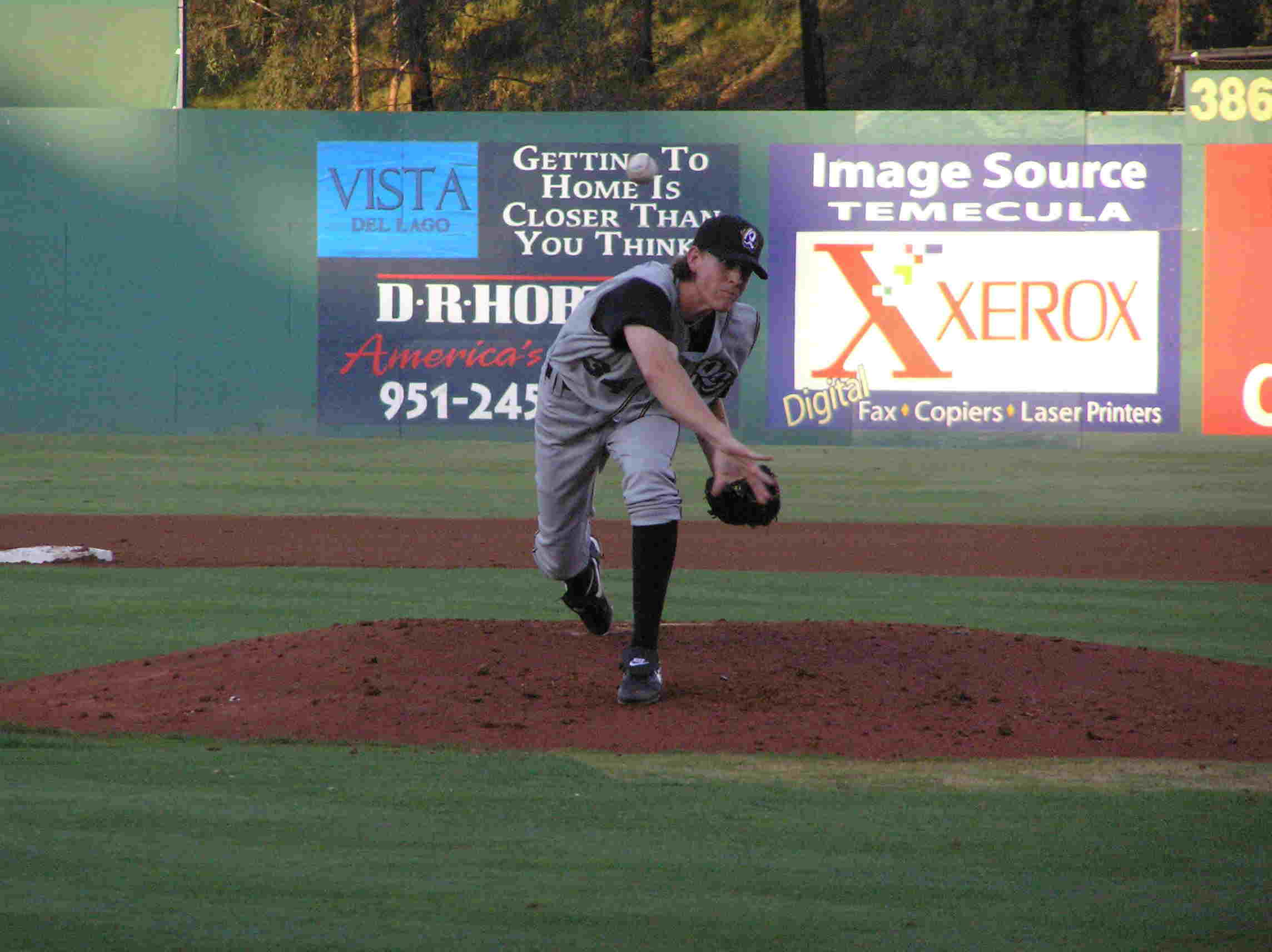
At 6-foot-7 and 210 pounds, Weaver is an imposing figure on the mound. Jered reminded me of A.J. Burnett in terms of the number on the back of his sleeveless road gray jersey, the blond hair, high dark socks, big turn, long stride, and stiff leg finish. Although not reaching the high-90s like the Florida Marlins hurler, Weaver's fastball was clocked at 92 mph in the first inning and generally sat between 89-91. He also mixed in a slider, curve balls of varying speed, and a changeup.

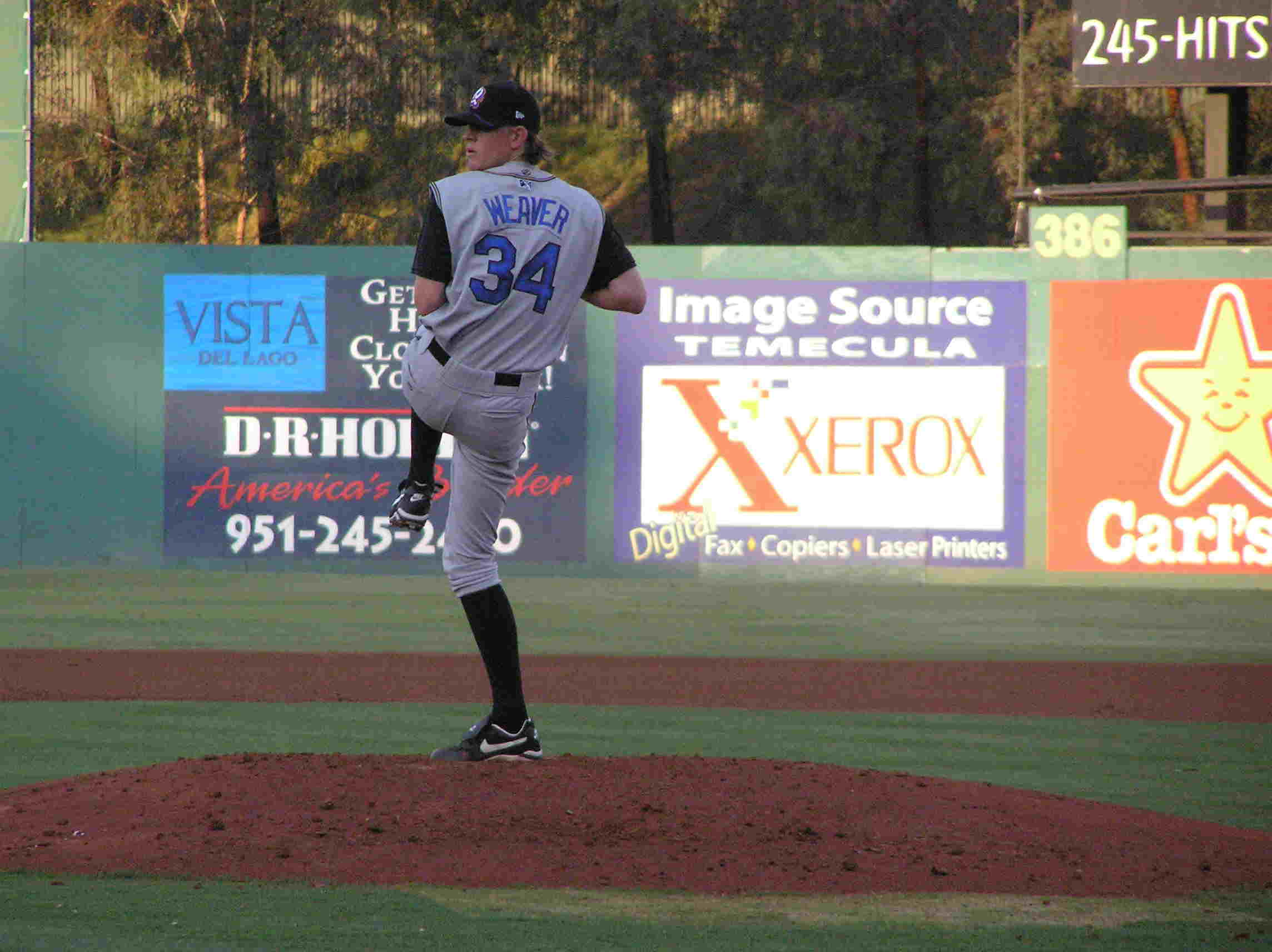
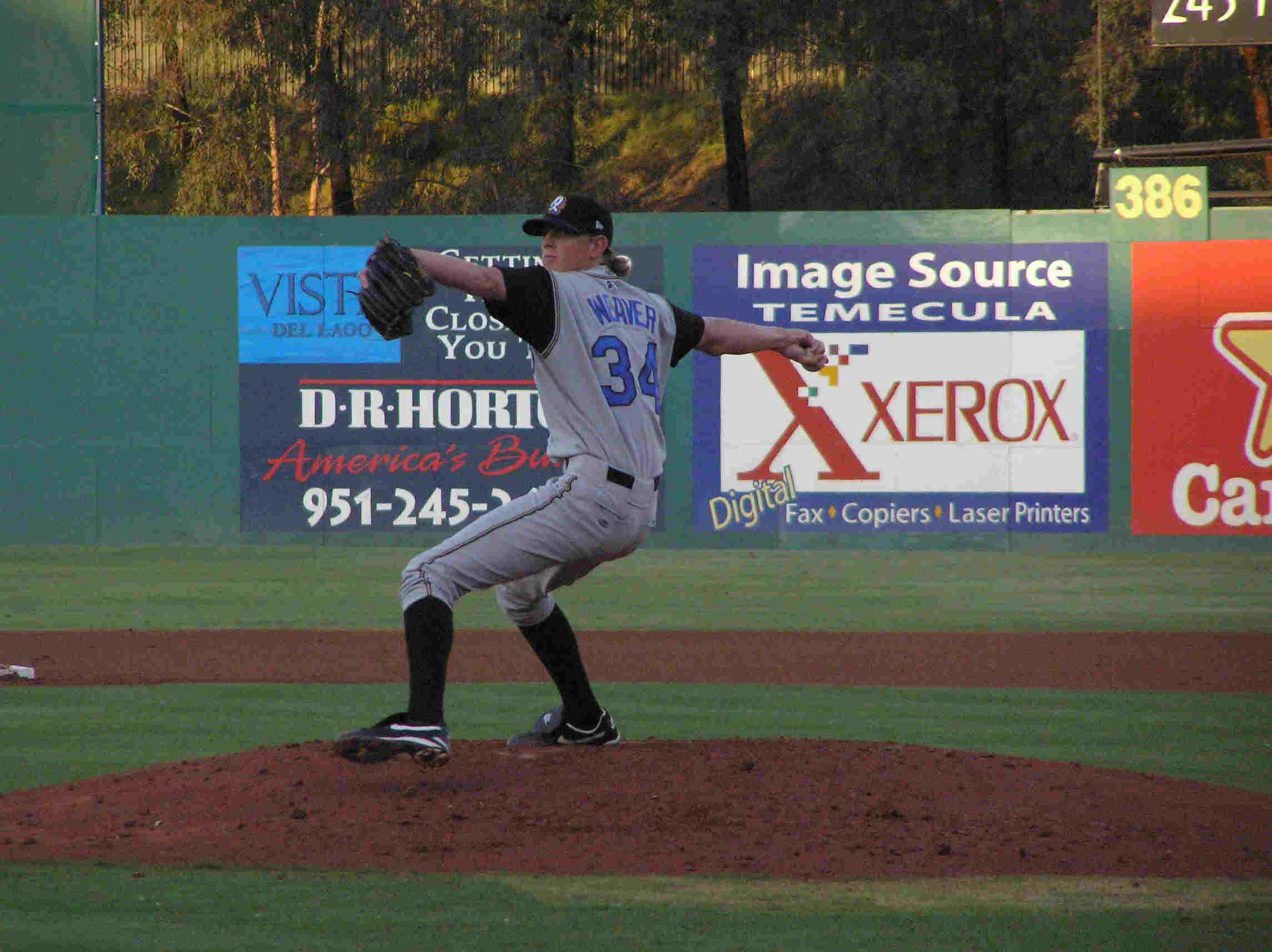
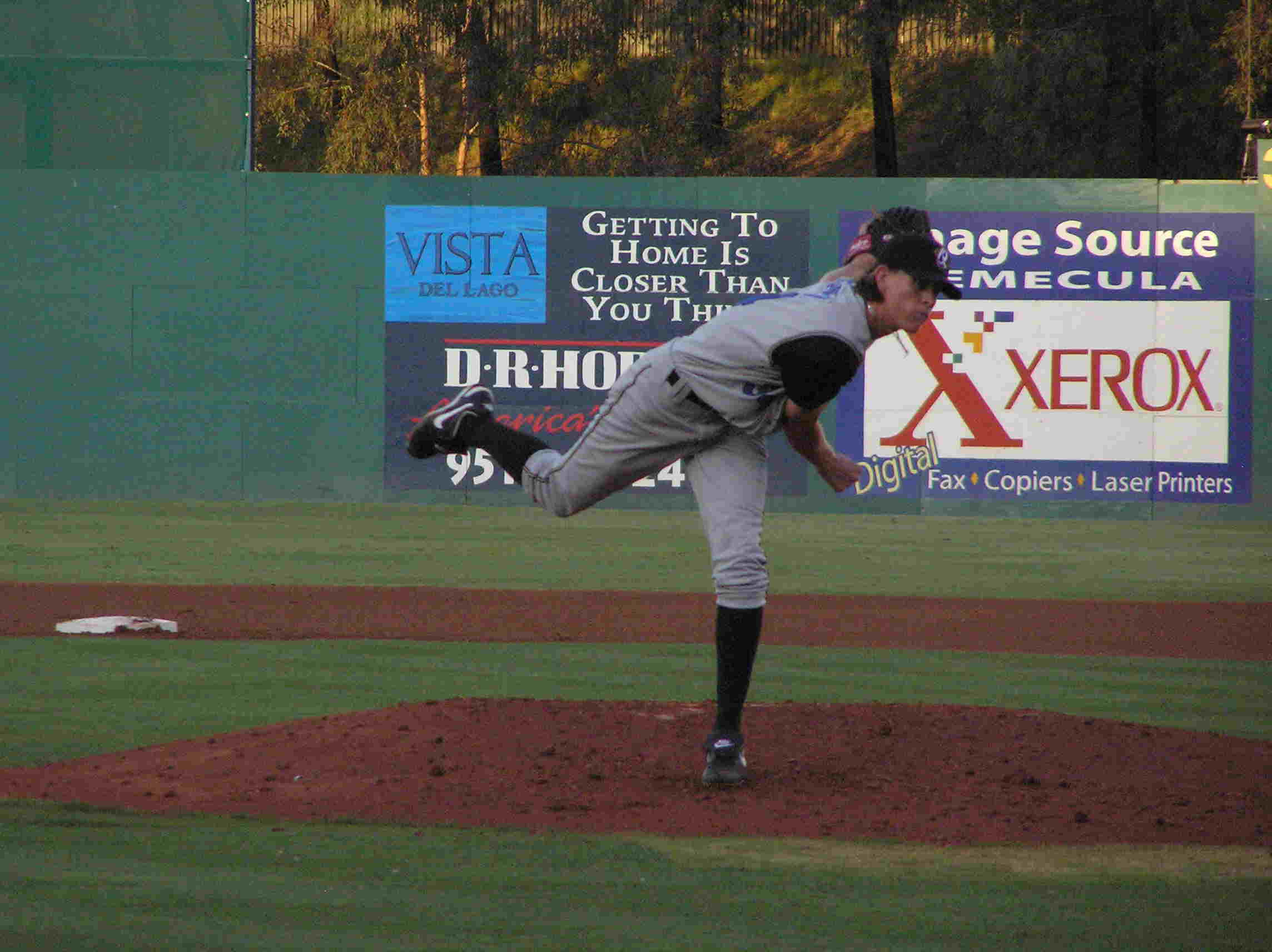
After signing with the independent Camden Riversharks of the Atlantic League last month, Weaver threw in the bullpen but never appeared in a game. While in New Jersey and awaiting his first outing, the 2004 College Player of the Year finally agreed to a $4 million bonus--the seventh-largest in draft history--with the Los Angeles Angels, hours prior to the deadline on May 30. The product of Simi Valley High School and Long Beach State then reported to Rancho Cucamonga on June 11, exactly one year after his final college game (a seven-inning, 12-strikeout no-decision vs. Arizona in the NCAA Super Regionals at Blair Field in Long Beach).
The 22-year-old threw two simulated games before getting his first start in the pro ranks. As expected, Weaver was a bit rusty, but Jered left no doubt in the minds of the 2,085 fans in attendance that he has what it takes to pitch in the big leagues. It is only a question of when and not if. Let's face it, there have been skeptics at every stop along the way even though the two-time, first-team All-American has put up numbers as good as any college or Team USA pitcher in history.
Far from perfect, Weaver needs to work on quickening his delivery to home with runners on base. Lake Elsinore stole two bases against him although one was as much the fault of the catcher (who hesitated following a tipped strike) as Weaver. He may also benefit in due time by getting more sink on his two-seam fastball, which he uses to complement his more powerful four-seamer. That said, Weaver's stuff is plenty good enough as is and he undoubtedly has the command to succeed at the major league level, perhaps as early as next spring or summer.
Weaver is scheduled to make his next start on Saturday, June 25 when the Quakes host the Stockton Ports. His pitch limit is expected to rise to 75. Therefore, if all goes well, look for Jered to go five innings in his second start of the year. I'll be there once again to bring you the action.
Photos by Tom Lederer
| Baseball Beat | June 20, 2005 |
Traveling Man
Ahh, the life. Surrounded by Father's Day, I am on the verge of attending three games in four days, each at different ballparks but all within driving distance of home.
On Friday night, I joined Rob McMillin, his wife Helen and his Dad at the Angels game in Anaheim. We met Mat Gleason (aka Rev Halofan) and his girlfriend plus Sean Smith and his wife prior to the game at Fresca's, a Mexican quick-service restaurant across the street from the stadium. We talked about the Angels past and present, including David Eckstein, Darin Erstad, and Jarrod Washburn, while we ate before making the five-minute walk across Katella, through the parking lot, and into the ballpark just in time to get seated for the first pitch.
Rob, wearing an Angels hat, and Helen, sporting a Cubs cap, kept score the entire game. I haven't kept score at a major-league game in ages although I was known to keep track of Jered Weaver last year pitch-by-pitch. The Angels beat the Marlins, 3-2, in 11 innings on Big Bang Friday. Chone Figgins had the first big bang of the night when he homered to lead off the bottom half of the first inning. Figgins made a diving catch in left field for the second out in the top of the inning and had the presence of mind to quickly throw the ball to second to double up Luis Castillo. If it wasn't a Web Gem that night (are games on the West Coast included in these highlights?), it should have been.
When Figgins strolled to the plate, I turned to Rob's Dad and mentioned the adage about always leading off an inning after making a great play in the field. I only said that in passing as I am not a believer in such things. It just so happens that we choose to remember those instances while conveniently ignoring the other times. Kinda reminds me of the myth that celebrities die in groups of three. Speaking of which, has anyone died since Anne Bancroft? Or was she the third?
On Saturday night, my son Joe and I went to the San Diego Surf Dawgs-Fullerton Flyers Golden Baseball League game at Cal State Fullerton. Stephen Roney, President of the Allan Roth Chapter of the Society for American Baseball Research (SABR), organized the outing. I also had the pleasure of meeting Dick Beverage, the President of SABR, and Andy McCue, a member of the Board of Directors, among others. Interestingly, Barry Mednick of SABR is the official scorekeeper for the Flyers.
About a dozen members and their guests met with Flyers Manager Garry Templeton before the game. He was cordial (signing a few autographs and allowing a couple of photo ops) but complained about losing the night before when the home plate umpire awarded Rickey Henderson a base on balls rather than ringing him up on strikes. Templeton even mimicked Henderson's crouched stance and first step toward the third base dugout to add color to the presentation. The former All-Star shortstop, while generous with his time, wasn't happy about that particular call, the long road trip the Flyers just completed, or the lack of suitable replacements for injured players.
Heck, other than Rickey, I didn't think the starters were even suitable. The defense was inadequate and the last-place Flyers seemingly emptied their bullpen while getting routed by the first-place Surf Dawgs, a team managed by Terry Kennedy. I thought Scott Dierks, the Surf Dawgs second baseman, had good hands and was deft at turning two, but I was less than impressed with the defensive play as a whole.
Although the contracts of three GBL players have been purchased by Major League Baseball franchises thus far, most of the players are on their way out rather than on their way up. As such, for my money, I would prefer watching a California League (high-Class A) game, primarily featuring 20-23 year-olds over an independent minor league dependent upon mostly 24-26 year-olds who were unable to make it to the next level.
The player drawing most, if not almost all, of the attention was the oldest on the field by at least 15 years. Henderson (.299/.489/.403) flied out weakly to center in his first trip to the plate, blooped out to short in his next appearance, and got on-base three times via a hit by pitch, a groundball double down the left-field line, and a hard-hit single. Rickey didn't walk or steal a base, but he scored a couple of runs. He has lost a couple of steps over the years but still runs better than most major leaguers. Baseball Toaster's Ken Arneson saw ol' #24 walk, steal bases, and hit his only home run of the year last month on a family trip to San Diego.
The good news is that we were able see Henderson bat five times. We would have gotten an opportunity to witness the future first-ballot Hall of Famer hit a sixth time except for the fact that I tipped off the Flyers third baseman Sean Walsh by yelling "appeal" in reference to the fact that a Surf Dawg baserunner had tagged up from second base a tad too early on a fly ball to center. Walsh, who is hitting the snot out of the ball in the early going (.462/.538/.754), heard me (hey, I was sitting on the third base side and was one of only about a thousand fans in attendance), tossed the ball to second, and the umpire called the runner out.
Shame on me because Henderson ended up in the on-deck circle when the final out was recorded in the top of the ninth. To my surprise, Henderson jogged out and played center field in the bottom of the inning even though the game was all but over. To Rickey's credit, he loves to play and entertain the fans. Rich Lederer (a little third-person humor) can't fault him for that.
Speaking of the California League, my next outing involves driving to Lake Elsinore to catch Jered Weaver's professional debut Monday night. The Four-Million-Dollar-Man is scheduled to pitch for the Rancho Cucamonga Quakes vs. the Storm. I'm not sure if he is supposed to start or relieve, but I didn't want to miss the opportunity to be there so I purchased four tickets in the front row behind home plate.
According to Mark Saxon of The Orange County Register, the Angels' 2004 first-round pick "will make his professional debut Monday night pitching for Class-A Rancho Cucamonga at Lake Elsinore. Stoneman indicated Weaver likely will pitch just two innings or so, as he missed spring training because of a contract holdout."
I am also looking forward to scouting Quakes 2B Howie Kendrick and SS Brandon Wood, Bryan's 62nd and 63rd top prospects, respectively. Kendrick, who is leading the league in batting average (.376) was recently activated from the disabled list. The 20-year-old Wood has hit 22 HR, three more than anyone else in the league. Unfortunately, I won't be able to see Kendry Morales swing the bat as he was promoted to Arkansas (AA) a week ago. The folks in Arkansas apparently haven't seen him do much with the wood in his short stint there (4-for-23, .174 with no HR, 1 BB and 6 SO).
Angels. Marlins. Flyers. Surf Dawgs. Quakes. Storm. Major league. Independent League. California League. They all have one thing in common. Baseball. Ahh, the life.
OFFICIAL WEAVER WATCH
The Storm Will Host Rancho Cucamonga
The First Pitch Scheduled For 7:05 pm
#27 Javier Martinez RHP (4-2) vs. #34 Jered Weaver RHP (0-0)
WEAVER ACTIVATED, MAKES PROFESSIONAL DEBUT MONDAY NIGHT
Angels 2004 first round-draft pick (12th overall) Jered Weaver will make his professional debut with the Rancho Cucamonga Quakes Monday night at Lake Elsinore. Weaver has worked out with the Quakes for two weeks and participated in two simulated games including one on Wednesday.

Rancho Cucamonga @ Lake Elsinore
Jun 20, 2005 - 7:05 PM
RHP Jered Weaver (2004: 15-1, 1.62 @ Long Beach State) at RHP Javier Martinez (4-2, 5.15)
Webcast Start Time: 7:00 P.M.
Jered Weaver, the Angels' first-round draft pick from 2004, will make his professional pitching debut tonight in Rancho Cucamonga, but it is not expected to last more than a couple of innings.While the Angels will be focused on their three-game series with Texas, Scioscia acknowledged he will be interested to know how Weaver does.
"We're very excited to have Jered, not only in our organization, but starting on the path to reach his goal of pitching in the major leagues," Scioscia said. "Our player development department will be very conservative with the approach to Jered because there is a lot that a young pitcher needs to absorb and especially a pitcher that hasn't pitched in a year."
| Baseball Beat | June 15, 2005 |
Blue Jay Way: Q&A With Jon Lalonde
A native of Wyevale, a small town 120 kilometers north of Toronto, Jon Lalonde is living the American Canadian dream--well, at least those who, like Lalonde, favor baseball over hockey. You see, at the age of 29, Jon is the Scouting Director for the Toronto Blue Jays.
A graduate of Laurentian University in Sudbury, Ontario with a Bachelor of Commerce specializing in Sports Administration, Lalonde joined the Blue Jays in November 1999 as Service Coordinator in the Corporate Partnerships department. His duties included organizing stadium giveaway days and assisting Blue Jays sponsors leverage their sponsorships effectively. He joined the Scouting Department as Scouting Coordinator in January, 2001 and accepted the position of Scouting Director in July of 2003.
To the credit of J.P. Ricciardi & Co., the Blue Jays have already agreed to terms with 23 of the 49 players selected in the 2005 First-Year Player Draft. The team's number one pick, Ricky Romero, just completed his junior season on Sunday when Cal State Fullerton was defeated by Arizona State in the Super Regional. Lalonde is very high on Romero and the direction of the Blue Jays.
Pull up a chair and find out what he has to say about the draft, various players, scouting, and the Blue Jay Way.
Rich: This year marked the first time since the draft's origin in 1965 that no pitcher was taken in the top five. What do you think accounted for this change?
Jon: I actually wasn't aware that this was the first time that a pitcher wasn't selected in the top five overall. Each draft is so unique that I would have expected there to have been a year somewhere along the line where the overwhelming strength was position players. This is also probably indicative of the fact a prevailing thought has always been to build a team through its starting rotation. I guess this year the talent pool, combined with the needs of the teams selecting in the top five, dictated position player selections one through five.
Rich: The Toronto Blue Jays then broke the trend and selected Ricky Romero with the sixth pick in the draft. Romero was the first pitcher chosen. Why did you go with Romero over some of the more highly ranked pitchers, like Mike Pelfrey, Luke Hochevar, and Craig Hansen?
Jon: Firstly, we believe that Ricky possesses that unique combination of "stuff" and "pitchability." He's not what you would necessarily consider a true power pitcher, but he's not a finesse pitcher either. He's able to change speeds and locate all of his pitches in the mould of a finesse pitcher, but then he's also able to run his fastball into the mid 90s with a plus curveball and a plus changeup.
Rich: Does Ricky throw any other pitches?
Jon: We also believe his slider has a chance to be a real weapon for him. He's very aggressive and does a great job of pitching inside. But, in all honesty, as much as any physical attributes, it's his competitive nature, his will to win that really sets him apart in our minds. When Ricky does get into trouble on the mound, he shows the aptitude to make in-game adjustments and even pitch-to-pitch adjustments. That's not real common in a pitcher Ricky's age.
Rich: How much importance do you put on "pitchability" vs. "signability?"
Jon: Pitchability and signability are mutually exclusive and we treat them as such. Both are important when discussing a pitcher, but because the two items are so unrelated, we don't really put emphasis on one vs. the other.
Rich: Are you a proponent of getting a college workhorse like Romero signed and onto a Minor League team right away or do you think it makes sense for a pitcher that has thrown as many innings as he has over the past year (including last summer with Team USA) to sit out the remainder of the current season?
Jon: I certainly think it's to our benefit and to Ricky's benefit to have him report at some point this summer. He has been a workhorse and he's pitched many innings over the last couple of years when you factor in his postseason innings and time with Team USA. It's not really about how many innings he throws this summer, it's more about introducing him to the professional baseball lifestyle. Things like riding buses, meeting coaches and teammates, adjusting to a pro-style pitching program (every fifth day vs. once a week). I believe it would be a big advantage for him to begin his pro career this summer.
Rich: Toronto has had a recent history of getting its top picks signed shortly after the draft.
Jon: Yes, we've seen that the last few years with Russ Adams, Aaron Hill, David Purcey and Zach Jackson. We were able to get them out playing the summer of their draft years, and they're either in the big leagues or appear to be on the fast track. That said, we certainly would want to be cautious in terms of Ricky's workload. Having seen him compete, I'm sure he'd want to take the ball and pitch a complete game as soon as he arrives. In some instances it's best to protect the player from himself.
Rich: After Oakland drafted Jason Windsor last year, Billy Beane complained that Titan Manager George Horton rode him too hard in the Super Regionals and College World Series. Romero threw nine innings last Friday night vs. Arizona State. Are you concerned about the number of pitches a draftee like Romero is asked to throw during the postseason?
Jon: When it comes down to elimination play and the College World Series, I think that we have to cut teams and coaches some slack. It's not uncommon in MLB's postseason to see a starter pitch out of the bullpen in an elimination game a couple of days after a start. Or like Brad Lidge in postseason last year being called upon to pitch multiple innings several times in a series. When your season's hanging in the balance you have to pull out all of the stops. For these college teams and many of the players, this will be the pinnacle of their careers so to begrudge a coach because he brings a pitcher back on short rest isn't really fair. I think where I get more concerned is when you see very high pitch counts and high innings early on in the season. When I see things like pitch counts of 165 and 150 in March, that's more disturbing than what might take place in elimination games in June.
Rich: That makes sense, Jon. Do you anticipate that Romero, once signed, will report to Dunedin (Toronto's high-A farm team)?
Jon: Depending on when we're able to get Ricky under contract, I would expect that he would initially begin his career at our New York Penn League affiliate in Auburn, NY. We have started most of our high drafts there the last few years, and it has worked out very well. It's an excellent league and Auburn is a great affiliate for us. That will likely be our plan with Ricky, but that decision would ultimately lie with our Farm Director Dick Scott and General Manager J.P. Ricciardi.
Rich: Zach Jackson, your #1 pick in 2004, was recently promoted to New Hampshire (AA). His first two outings were quite impressive. How far away is Jackson from the big leagues?
Jon: Obviously we were pleased to select Zach in the 2004 draft and felt he had an opportunity to help us. Following his progress this season has been enjoyable. In terms of when he will be ready to compete in the Major Leagues, that's a question that's better asked of either Dick Scott or J.P. Ricciardi. We like him alot though. He throws strikes, competes very well and has an out pitch in his cut-fastball.
Rich: Your first selections in 2002 (Russ Adams) and 2003 (Aaron Hill) made it to the majors in about two years. They both play shortstop. Are you of the belief that you take players as far to the right on the defensive spectrum as possible in anticipation that they can always be moved to a less-demanding position later, if need be?
Jon: Generally speaking if a player is capable of playing a quality SS or CF then he can be moved to another position. When drafting players this is something we consider strongly. The more defensive options a player offers, the more valuable he is. That having been said, most baseball people will tell you that the one area of a player's game that can improve the most is defense. Repetitions and quality instruction combined with a sound work ethic can help a below average defender become average or better.
Rich: I've noticed that the club has tended to emphasize pitching in its draft selections. Is there a general belief that drafting and developing pitchers over hitters is a more cost effective way to go, given the price of big league pitchers in the free agent market?
Jon: I think that when J.P. came into the organization, one of the first conclusions he reached was that pitching was an area of need through each of our minor league levels right into our Major League team. Therefore, in his first couple of drafts, he really wanted to emphasize pitching. Specifically, more mature college pitchers that could be pushed quickly through the system.
I think we have been very successful in that regard when you look at players like David Bush, Josh Banks, Shaun Marcum, Jamie Vermilyea and Adam Peterson who we were able to trade and acquire a quality Major League hitter in Shea Hillenbrand. Each of those players were selected in either 2002 or 2003 and are already pushing towards the upper tier of the organization. Acquiring quality pitching at the Major League level, either through free agency or trade has been very difficult recently; therefore, drafting and developing our own pitching is definitely one of our goals.
Rich: College players dominated the draft on day one but high schoolers made a splash on day two. In fact, the percentage of high school players drafted reversed a declining trend that has been in place since 1995. Does this suggest that college players are still the preferred way to go early on because they are both easier to project and more likely to pay dividends sooner but that it's more of a numbers game when it comes to high school kids?
Jon: I'm not sure what to make of the number of high school vs. college players drafted this year. I do believe that in some circumstances, when a Club believes it's close to contending that selecting more advanced college players might make sense. In most cases you can be more aggressive in your development of an advanced college player and challenge him with the higher levels of the minor leagues sooner than a high school counterpart. Also, I think there are many more variables on day two of the draft. Often times you don't know those players as well as your early selections and I think teams are much more open to higher risk/higher reward selections the deeper you go in the draft. So, taking the younger, more raw high school player, perhaps as a draft and follow, makes more sense on day two when the selections are not scrutinized as those earlier on.
Rich: I imagine you are much more dependent on your Area Scouts on day two than day one.
Jon: We're dependent on our Area Scouts right from Round One. They see these guys play more than any of us so to disregard or ignore their thoughts in any round is perilous. Our staff does a great job of identifying not only the best players, but focusing on those that play the game the way we like. Certainly on the draft's second day as you get into the later rounds, it's unlikely we've been able to cross-check those players; therefore, you do have to rely on your Area Scouts. We're very comfortable doing that and we really lean on them in every round, it's just in a different way on the draft's second day.
Rich: Of the 49 players drafted last week, how many did you see play in person? How many would J.P. Ricciardi, Tim McCleary, Tony LaCava, and Dick Scott see?
Jon: J.P. and Tim McCleary focus mostly on potential first round selections although while we're at spring training in Dunedin they like to travel around to see local college and high school games. Tony LaCava and I focus mainly on the higher draft choices, potential top 10 rounders.
Rich: How would you rank order the various tools when it comes to their importance in evaluating a position player?
Jon: We really do place great importance on a player's ability to hit, so that stands out. As I mentioned earlier, defense can generally be improved if the player is willing to work at it. It's much more difficult for a player to rise to another level as a hitter. Hitters can certainly improve and there are many examples of players that were late bloomers offensively, but predicting which players those will be can be perilous.
Rich: What do you most look for in a young pitcher?
Jon: Obviously the first thing you can measure is a pitcher's "stuff." How hard does he throw? What kind of breaking pitch, if any, does he possess? Does he have a feel for a changeup? Once you've identified Major League-type weapons, the most important thing to me becomes can the pitcher throw strikes with all of his pitches? That is so critical in the Major Leagues and specifically in our division.
There's nothing the Red Sox and Yankees love more than facing a pitcher that's constantly behind in the count. In those instances it doesn't matter how hard you throw, if quality hitters know a fastball strike is coming, they're likely to have great success. The last thought I'd offer here is you really want to identify pitchers that compete and aren't afraid to challenge hitters in big situations and in close games.
Rich: Here's a theoretical question: Would you prefer a young power hitter who doesn't strike out a lot or a young power hitter who does strike out in the hopes that you can help him put the ball in play more and make him an even better hitter?
Jon: All things being equal, you'd always prefer the player who strikes out less. That's an indication of hand-eye skills which are critical in successful hitters. The question we often are faced with in the draft room when comparing hitters is that Player A has fewer strikeouts but less power than Player B who strikes out more but has more power. We then have to discuss which player we think will have more value down the road.
Rich: Do you think MLB should allow teams to trade draft picks? If so, would a franchise like Toronto be helped or hurt by such a change?
Jon: I believe that the ability to trade draft picks would only serve to enhance the draft's appeal. As a scout, it would really test your evaluation skills. Not only now do you have to line up the players based on what you believe their abilities are, but now you'd have to consider the scenario "We like player X, but do we like him enough to trade player Y and our 2nd round pick for him?" I think that adds excitement for teams and fans alike.
Rich: I totally agree. Last question, Jon. Beer or tacos?
Jon: I believe that it's in any talent evaluator's best interest to use all information available to make decisions. As much as statistics can be extremely valuable in quantifying a player's accomplishments, there's no substitute for observing a player over a period of time to breakdown his physical abilities. At the end of the day, this business is all about making decisions and in any business situation, the more information the decision-maker can gather, the more accurate his decisions will be in the long run.
Rich: Thanks, Jon. I appreciate your time and insightful answers.
Jon: You're welcome, Rich. I hope you found the information useful.
Update (Thursday, June 16): The Blue Jays announced the signing of Ricky Romero. Here's the Jon Lalonde quote from ESPN story: "We have followed Ricky for some time now and it's clear that he possesses that rare combination of physical ability and mental toughness."
| Baseball Beat | June 13, 2005 |
The Road to "Oh, My, Ha"
 Four teams have made travel plans to visit Omaha next weekend. Tennessee, Florida, and Nebraska swept their respective Super Regionals on Friday and Saturday, while Arizona State went the distance to beat Cal State Fullerton, the defending champions, in a three-game set that ended Sunday evening. The other four series are still in doubt and will be decided today. You can follow these games live by visiting the line scores, play-by-play, and boxscores on NCAASports.com, the official web site for NCAA sports.
The right side of the College World Series brackets has been finalized. The Volunteers and Gators will face each other in the opening round, while the Cornhuskers will square off against the Sun Devils. The Nebraska players, in fact, may have already started their 50-mile trek from Lincoln to Omaha. Cornhusker coach Mike Anderson, however, might want to dry off first. In the meantime, Nebraska fans haven't seen this kind of tackling in years.


Notes and observations from around the Super Regionals:
Let me set the stage. ASU was beating Cal State Fullerton, 2-1, in the bottom of the ninth inning in the first game of the Super Regional. Brett Pill of the Titans led off the frame with a double down the left field line that glanced off ASU third baseman Travis Buck's glove. Danny Dorn reached first base on a bunt single, moving Pill to third. Zinicola, who replaced Brent Bordes at this point, plated the tying run on an errant pickoff attempt to first, scoring Pill and moving Dorn to third base.
Zinicola intentionally walked Ronnie Prettyman to put runners on the corners. He was in the process of intentionally walking Bobby Andrews to load the bases when, on the fourth pitch of the walk, third base umpire Jack Cox charged Zinicola with the balk to score Dorn and clinch the victory for the Titans.
Cox claimed Zinicola violated Rule 9-3j of the NCAA Baseball Rules Book which says the pitcher has to come to a "complete and discernable stop."
Balk SECTION 3. A balk shall be called for the following action by a pitcher: j. The pitcher delivers the pitch from the set position without coming to a complete and discernable stop, or the pitcher comes to more than one stop from the set position (see 9-1-b); A.R. -- With the bases unoccupied, the pitcher does not need to come to a complete and discernable stop.
Crew chief and second base umpire Paul Guillie sounded as if he wanted nothing to do with the call. "The call was made on the 3-0 count. The third base umpire made the call." He may as well said, "I didn't make the call. Go talk to Jack."
"I'd like to see the players end the game," Arizona State Coach Pat Murphy said of the balk call by Cox. "He's got to live with it. That's not a sound baseball call and he knows it."
Even Cal State Fullerton Coach George Horton admitted he had never won a game that way. "It was a good baseball game," Horton said. "It's just unfortunate it had to end on an unusual play. It certainly would have been more fulfilling I think for our club if we had won on a base hit or a sacrifice fly or something."
I watched the game live and saw the replay of that incident many times. There is no doubt in my mind that Zinicola paused at the belt before delivering what would have been ball four to Andrews. The more germane point though is that Zinicola didn't gain any advantage if, in fact, he failed to come to a "complete and discernable stop." It was simply one of those "no harm, no foul" plays that 99.9999% of the time are "no calls."


Let me tell you, these third base umps had one heckuva weekend during the Super Regionals. When I umpired, we always thought working third was like being given a night off. Ha!
Update (4:00 p.m. EST):
Baylor beat Clemson, 6-1. Kris Harvey homered for the Bears while Cory VanAllen and Ryan LaMotta combined on a nine-hitter.
Tulane outscored Rice, 9-6. The Green Wave scored seven runs in the eighth and ninth innings to support J.R. Crowel and Daniel Latham who combined to stop the Owls.
| Baseball Beat | June 06, 2005 |
Winner Take All
Results from Monday's NCAA Men's Baseball Division I playoffs:
*Texas beat Arkansas, 5-2, in the Austin Regional. Taylor Teagarden and Chance Wheeless homered in the seventh and eighth innings to break a 2-2 tie, and closer J. Brent Cox allowed just one hit and no runs over the final three innings to preserve the victory for the Longhorns.
*Rice edged LSU, 4-3, in the Baton Rouge Regional. The Owls scored the game-winning run in the top of the ninth on a triple by Tyler Henley and a single by Greg Buchanan.
*Baylor turned back Stanford, 4-3, in 12 innings to win the Regional in Waco. The Bears tied the game in the ninth and won it in the 12th on a home run by Jeff Mandel. Greg Reynolds pitched 11-plus innings for the Cardinal, facing 44 batters. Stanford didn't go down easily, loading the bases in the bottom of the 12th with two outs before Tyler Bullock struck out Ben Summerhays to end it. (Thanks to Stanford grad Jon Weisman for providing the painful details.)
*Georgia Tech-South Carolina in progress in the Atlanta Regional.
10:00 pm PST update: Georgia Tech shut out South Carolina, 5-0. Sophomore right-hander Tim Gustafson, named the Most Outstanding Player in the tournament, threw seven shutout innings to lead the Yellow Jackets to their fourth Regional title in the past six years.
*Tulane-Alabama just underway in the New Orleans Regional.
10:00 pm PST update: Tulane handled Alabama, 7-4. Micah Owings was credited with the victory in a game that was originally scheduled for Sunday night and pushed back from 1 p.m. to 3 p.m. to 7 p.m. Monday night because of rain.
*Cal State Fullerton-Arizona (Fullerton Regional) and USC-Pepperdine (Long Beach Regional) are scheduled to begin at 6 p.m. and 7 p.m. PST, respectively.
10:30 pm PST update: CSUF toppled Arizona, 6-3. Fullerton scored five runs in the third inning and never looked back. Freshman Wes Roemer, named the Most Outstanding Player of the tournament, allowed only three runs (eight hits and no walks) over eight innings to lead the defending CWS champs over the Wildcats. The Titans advance to the Super Regionals for the fourth time in the past five years.
USC defeated Pepperdine, 5-2. Three pitchers combined for the Trojans to muster the victory in the seventh and final game of the Regional.
Super Regional Pairings
#1 Tulane vs. Rice
#8 Oregon State vs. USC
#4 Baylor vs. Clemson
#5 Mississippi vs. Texas
#3 Nebraska vs. Miami, Florida
#2 Georgia Tech vs. Tennessee
#6 Cal State Fullerton vs. Arizona State
#7 Florida vs. Florida State
All eight of the national seeds and 14 of the 16 top-seeded teams advanced to the Super Regionals. USC and Arizona State won their Regionals as the number two seeds, defeating host Long Beach State and Coastal Carolina, respectively.
| Baseball Beat | June 06, 2005 |
Pop Quiz
As Alice Cooper said, "SChool's out for Summer." But that won't stop me from asking ten questions that are on my mind.
1. Is there a better story in baseball this year than the Washington Nationals leading the NL East one-third of the way into the season? This is the latest a Washington-based team has been at the top of the standings since 1933.
2. How would you like to be 28-26 and realize your team is in last place, as is the case with the Florida Marlins? The Fish would be no worse than third in all of the other divisions.
3. Did anyone out there have a Pick Six ticket with the Washington Nationals, St. Louis Cardinals, San Diego Padres, Baltimore Orioles, Chicago White Sox, and Texas Rangers? Me neither.
4. Anybody else so engrossed in the NCAA Playoffs unaware that the Philadelphia Phillies are the hottest team in baseball? The Phillies have won six in a row and nine out of the last ten.
5. How many of you know what these nine schools--Arizona State, Clemson, Florida, Florida State, Miami, Mississippi, Nebraska, Oregon State, and Tennessee--have in common?
6. Was there a more clutch performer than Sergio Pedroza this weekend? The Cal State Fullerton right fielder hit a two-run home run in the top of the ninth to give the defending College World Series champions the lead then made a diving catch near the right-field line with the bases loaded to end the game as the Titans eliminated Missouri on Sunday afternoon. Pedroza was two for three with another HR and three more RBI in the game in progress last night vs. Arizona.
7. Will any of the pitchers who started on Friday draw the same assignment on Monday in the finals of the Regionals? USC's Jack Spradlin is the best bet but there may be others as well.
8. Speaking of SC, did you think I made a typo in the opening sentence above?
9. If you were in charge of a major-league team's draft on Tuesday, would you select a Scott Boras client in the first round?
10. What is the over-under (month and year) on Jered Weaver's MLB debut?
Good luck. Well, I can't salute ya. Can't even find a flag. If that don't suit ya, that's a drag. School's out for summer, except for those nine teams listed above. They all won their Regionals and will be joined by seven more on Monday to form next weekend's Super Regionals.
Be sure to check back tomorrow for live coverage of the MLB Draft.
| Baseball Beat | June 04, 2005 |
Planting the Seeds
The number one seeds won every game in the opening round of the NCAA Division I Baseball Regionals yesterday. There were three mild upsets but no big surprises on day one of the playoffs.
In the Corvallis Regional, #3 St. John's beat #2 Virginia, 5-3. Craig Hansen, considered the best closer in the country, made his first start in two years, subbing for the injured Anthony Varvaro. Hansen faced 32 batters in a seven-inning, eight-hit, three-run performance and the Red Storm backed him with five runs in the fifth and sixth innings to earn a second-round matchup with host Oregon State, a 4-3 winner over Ohio State in a battle of the OSUs. Shea McFeely hit the first pitch in the bottom of the ninth over the centerfield wall for a walk-off home run in the nightcap.
Number three Creighton won its first NCAA tournament game since 1992 over number two North Carolina State, 8-3. Creighton, one of 28 Jesuit colleges and universities in the nation, faces the Nebraska Cornhuskers (which slipped past Illinois-Chicago, 8-6) today in the winner's bracket in the Lincoln Regional.
Third-seed Oklahoma outsoared the Golden Eagles from Southern Mississippi, 5-4, to earn the right to square off with Ole Miss (which whitewashed Maine, 5-0, behind a complete-game, six-hitter courtesy of Mark Holliman) in the Oxford Regional.
In perhaps the best-pitched game of them all, Winthrop's Kevin Slowey scattered seven hits while striking out 13 without a walk. Slowey improved his record to 14-2 in outdueling Mike Pelfrey (12-3), one of the top two starting pitchers (along with Luke Hochever, who earned the victory over Austin Peay, 7-5, to go 15-2) in Tuesday's draft.
Elsewhere, Cal State Fullerton, the defending College World Series champions, took Harvard to school in a 19-0 blowout in the Fullerton Regional. In another laugher, Texas hammered the Mighty Quinn, 20-2, in Austin. The Bobcats were treated rudely by the Longhorns in their first NCAA tournament game. Quinnipiac's second and perhaps last game will be against Miami (Ohio).
Top-ranked Tulane beat Southern, 17-7, in the New Orleans Regional as Mark Hamilton went 4 for 5 with two homers and seven RBI. The Jaguars closed within a field goal in the top of the seventh, but the Green Wave added a run in the bottom half and six more in the eighth to win by the football score.
In other action involving national seeds, Georgia Tech outlasted Furman, 5-4, in 10 innings in Atlanta, while Florida's game with Stetson and Baylor's opener vs. UT-San Antonio were both postponed by rain. You might call the Regional in Waco a Texas Hold 'Em. If it keeps raining, some team may end up winning on the river.
I attended the Regional in Long Beach on Friday and witnessed USC handle Pepperdine with ease, 7-3, in the afternoon and Long Beach State manhandle Rhode Island, 11-2, in the nightcap. The Trojans and 49ers will face each other for the fourth time this season in the winner's bracket tonight. Long Beach will be looking to avenge three previous losses to the university with 12 NCAA championships, more than twice as many as any other school.
USC put up a four-spot in the bottom of the first inning and the Waves never recovered despite a two-run home run off the bat of Steve Kleen in the eighth. Trojans coach Mike Gillespie gambled and started his number two pitcher, Jack Spradlin, a tall left-hander who succeeds by mixing his pitches and changing speeds, rather than Ian Kennedy, the team's ace. Kennedy was held back so he could challenge the Dirtbags in tonight's featured pairing. The SC sophomore led Team USA in strikeouts last summer and the nation this spring.
Just as Gillespie's move paid off, Long Beach State coach Mike Weathers rolled the dice by going with the team's number four starter, Cody Evans. The transfer from Golden West (Calif.) Community College hadn't won a game all year and found himself behind, 1-0, in the first inning after giving up a two-out hit by pitch, a stolen base, and a run-scoring single.
I have a feeling that 2,451 of the 2,452 fans in attendance were beginning to second guess Weathers right about then. However, I thought it was a brilliant move, one in which only a number one seed in a position like Long Beach could possibly consider. The 49ers coach can now avail himself of his Big Three of Cesar Ramos, Marco Estrada, and Jared Hughes the rest of the way. That said, I am not in agreement with Weathers' decision to bypass Ramos in Game Two in favor of either Estrada or Hughes. Although the latter two pitchers are highly capable, Ramos is the guy you want starting the most important game of the year, especially considering the fact that SC is going with its top gun in Kennedy.
Hall of Famer Tommy Lasorda and legendary USC coach Rod Dedeaux, long-time friends, sat together in a box just to the left of home plate. Lasorda signed autographs and posed with young boys as their fathers quickly snapped photographs. He even shook hands and spoke with Troy Tulowitzki, who was in full uniform with bat in hand, as early as the fourth inning of the USC-Pepperdine opener. Lasorda (2000) and Dedeaux (1984) coached medal-winning teams in the Olympics.
Bret Saberhagen was also in attendance. His son, Drew, a freshman, is a reserve first baseman. There were no signs of Ryne Sandberg (whose son, Justin, who is a third-year sophomore utility infielder) or Jim Tracy (father of Collegiate Baseball's second-team All-America catcher, Chad). I wasn't particularly impressed with Chad's arm although he showed some power when he hit a long fly ball to the edge of the warning track in left-center.
On the other hand, the opposing catcher, Jeff Clement, is projected to be among the top dozen players taken. Clement is ranked the number-one power hitter in Baseball America's draft preview. I've rarely seen him get a hit, but he takes a vicious cut and has put up good numbers during his college career at SC.
After falling behind 1-0 in the first, Long Beach State scored eight runs in the second frame off Dan Frederick, whose only chance of getting drafted is if World War III breaks out. Freshman Jose Hernandez and Sean Boatright hit back jack, do it again home runs over the IN-N-OUT sign on the wall in left-center field. Frederick faced 13 batters, giving up six hits, two walks, and a snowman. I haven't seen a Ram get hit this hard since the days of Kurt Warner.

Third baseman Evan Longoria, not to be confused with Tony Parker's spur of the moment arm candy, had three hits. Longoria may very well replace the departing Tulowitzki at shortstop next season. Tulo was ranked by Baseball America among all the prospects #1 in arm strength, #2 in five-tool talent, #3 best athlete, and #4 best defensive player. He demonstrated his arm by making a perfect relay throw from short right field to third base, nailing a Ram trying inexcusably to stretch a double into a triple in the seventh inning while down, 10-2. Wham bam, thank you, Rams.


Rhode Island went through more pitchers during the game than the Long Beach frat houses afterwards. The throws by the defense were higher than Dock Ellis in his no-hitter against the San Diego Padres in 1970. The team is more likely to spend Sunday at Disneyland than at Blair Field.

Between now and then, USC and Long Beach State will square off in front of what promises to be a standing-room only crowd. The K-Man Kennedy will be going for the Trojans while Weathers opts for Estrada or Hughes. Weathers had this to say about his decision not to start Cesar Ramos today:
"I feel both (Hughes and Estrada) match up better with USC. It's nothing against USC, but the other two can't be forgotten. Righthanders are better suited for USC."
I guess it's possible that Long Beach could win the Regional without using Ramos against USC, but it seems unlikely, if not unwise. In the meantime, I can't help but wonder if Weathers has planted a negative seed in the back of Cesar's head. I backed him the first time around when few others did but am less enamored with his strategy from here on out.
Time will tell.
Quiz: Who will be the best pitcher in the ballpark this evening? Ramos, deemed to have the best command of any college pitcher in the opinon of Baseball America? Kennedy, the sophomore sensation who is putting up better numbers than former Trojan Mark Prior at the same stage of their careers? You could make a case for either, but there is also a third candidate to consider. His name? Jered Weaver, who is expected to attend tonight's game.
Weekend Link: Dirtbags Baseball. Although "dedicated to fans of Long Beach State Dirtbags baseball," Jeff Agnew covers college baseball about as well as anyone.
| Baseball Beat | May 31, 2005 |
Blink
In one of the longest stare downs in history, Scott Boras and Jered Weaver blinked first and Arte Moreno and Bill Stoneman were rewarded by signing the consensus number-one player in the 2004 draft to a minor league contract calling for a bonus of $4 million.
I guess you might say I was four months early and several million dollars off, but the two sides finally agreed to tie the knot after protracted discussions and negotiations, which led to the longest holdout (along with Arizona Diamondback Stephen Drew) for an eventual signee in history. With the system stacked against them, Weaver and Drew obviously decided to capitulate to the "take it or leave it" offers made by their respective ballclubs.
In an Instant Message last night, Jim Callis of Baseball America told me he thought "it was a smart business decision because I don't think there was a safety net for him in the 2005 draft." Jim also opined that Weaver "could have cost himself by taking the mound" with the Camden Riversharks on Tuesday and Friday prior to the upcoming draft. In other words, Jered had more to lose than to gain by rejecting the Angels' offer--even as low as it was--and making himself available in the draft next week.
By agreeing to a minor league deal, Weaver gets the $4 million signing bonus upfront rather than spread out over the life of the contract. Had he elected to go for a major league contract, Jered would have also risked losing the prorated share of his bonus in the post-arbitration years. The disadvantage in signing a minor league deal is that Weaver is more vulnerable at the back-end because, under a major league contract, he could only get cut 20% from the average value of, say, $1.05 million (based on $5.25M for five years).
Based on the contract signed, Weaver will receive a standard minor league salary until he reaches the majors. The agreement is subject to the tall right-hander passing a physical this week. He is scheduled to fly back to Southern California today and is slated to begin his professional career in Rancho Cucamonga, the Angels' High Class-A farm team, immediately thereafter. Both Boras and Angels scouting director Eddie Bane think he could move through the system "quickly."
If Boras was quoted correctly in today's L.A. Times article, I have to wonder just how much he knows about his client.
"I think Anaheim is a good place for him. He's a sinkerball pitcher."
Well, I don't know about that. Unless Weaver has added to his repertoire during the past year (while not pitching competitively), he has never been known to throw a sinker. While his brother Jeff may throw a cutter, Jered has always been a fastball, slider, curve, and changeup type. He is as much of a flyball as a groundball style pitcher and could actually benefit by adding a sinker or cutter as he progresses through the Angels' system.
Oh well, what would you expect from just a 5% payout on $4 million?
Update: Jim Callis tells me that Drew is also going to the California League (Lancaster). Interestingly, the Lancaster JetHawks are scheduled to visit the Rancho Cucamonga Quakes on June 3-5 (probably too soon for Weaver to pitch but most likely just in time to accommodate Drew). The Quakes travel to Lancaster on July 1-2 and then these two teams face off again in Rancho Cucamonga on July 3, as well as for a four-game series from July 14-17. (Full schedule.)
| Baseball Beat | May 30, 2005 |
Today's The Day
Update (Monday, 9:50 pm PST). . .MLB.com: Angels, Jered Weaver Agree to Terms. Baseball America: Weaver, Drew Agree to Terms.
The standoff continues. If the Los Angeles Angels and Jered Weaver don't reach an agreement by midnight Eastern time (is there any other?), then one of the most decorated players in college baseball history will go back into the amateur draft.
Here is where the two sides stand:
Depending on how you look at it, the Angels and Weaver are a minimum of $750,000 and a maximum of $1.5M apart. Given that the deal being discussed is for five years, it is fair to conclude that the difference comes down to between $150,000 and $300,000 per year--amounts that seem like chump change for a billionaire owner and perhaps a matter of pride for a 22-year-old, soon-to-be multi-millionaire.
By offering Weaver (barely) more than any other player from the 2004 draft, the Angels seem to think their offer is more than fair. On the other hand, the Weaver camp believes it has compromised on two occasions to a range that puts the price tag much closer to the deals inked by Justin Verlander, Jeff Niemann, and Philip Humber in late 2004 and early 2005 than that signed by Prior in 2001.
The Angels seem intent on staying pat with their offer and appear willing to let Weaver go back into next week's draft.
Rightly or wrongly, Boras has shown his hand by lowering his demands of a $10M deal to, say, $6M-$6.75M. As such, I would be surprised if the team that drafts Weaver even matches that offer. You see, it's not like Weaver is going to have much, if any, leverage the next time around. What is he going to do, sit out another year?
From my vantage point, the system, which is stacked for the teams and against the amateur players, needs to be changed. I would argue that Major League Baseball and The Major League Baseball Players Association should discuss the following alternatives in their next Collective Bargaining Agreement:
1. Adopt an NBA/NFL-style pay scale for first round draft slots.
2. Allow teams the right to trade draft picks.
3. Open up the negotiations to more than one team (perhaps an American and a National League club could each have the right to negotiate with first round draft picks).
4. Keep the system the same for high school players and underclassmen but allow seniors the right to negotiate with all teams.
5. Disallow the right to a supplemental draft slot for teams that fail to sign their first round picks.
Going down the list, proposal number one would make it known in advance how much draftees would make, irrespective of the team that selected them or the agent who represented them. Number two would actually help level the playing field by allowing a team like the Padres last year to trade the number one pick to another team in exchange for perhaps two late first round picks or a package of amateur picks and minor or major league players. Number three will never happen as long as the owners have any say in the matter but would be a much more fair proposition for the players that would still fall well short of total free agency.
Proposal number four intrigues me for a couple of reasons. First of all, high school, community college, and juniors all have the option of going pro or back to school. They have some--although not a lot of--leverage when it comes to bonus and salary negotiations. Seniors, on the other hand, have virtually nowhere to turn other than to capitulate to whatever the teams offer. I mean, where else are they going to get that kind of money? They have no competing league to negotiate with, their skills are not transferable to pro basketball or football, and, for the most part, could never make that kind of dough in the real world. Putting seniors into a better position from a bargaining standpoint would also encourage students-athletes to complete their college education and get a degree.
With respect to proposal number five, I cannot for the life of me understand why teams should be compensated for not signing a player they chose. MLB pulled a fast one on the players here. If anything, it discourages a team from paying up, knowing they will get a reasonable consolation prize if they don't reach an agreement. Look, if you select a player and you don't sign him, whose fault is that? Why should the rest of baseball subsidize your ignorance, stupidity, hardheadedness, or even bad luck? The penalty for taking a player like Weaver and not signing him is simply not stiff enough. Do away with the supplemental pick and you will see a more concerted effort on the part of the teams to draft and sign all of their selections.
As it relates to Weaver (and Stephen Drew, the other unsigned first round pick), the clock is ticking and neither side seems willing to budge off their final offers. The Angels didn't even bother sending Bill Stoneman, Eddie Bane, or one of the team's east coast scouts to watch Jered pitch a simulated game for the Camden (N.J.) Riversharks of the independent Atlantic League on Saturday although 20 scouts from around baseball found the time to check out Weaver.
"Our number is not going to change," Stoneman told the L.A. Times this weekend. "If they're not going to find that one acceptable, there's not much point in sending anyone out there. . .I've had no indication they're going to accept what we have out there."
If Weaver doesn't sign with the Angels within the next 12 hours, he will pitch twice before the upcoming draft--in relief on Tuesday and as a starter on Friday. Where Jered will go and how much he will get is anybody's guess. On one hand, he probably won't get much more than what the Angels are offering, if that. On the other hand, the Angels aren't going to find anybody outside the organization as good and as cheap as Weaver who could fill the shoes of either Paul Byrd or Jarrod Washburn, both of whom will be free agents at the end of the year and looking at contracts on the order of $5M per year in the case of Byrd and $7.5M-$8M/year for Washburn (who, by the way, is another Boras client).
| Baseball Beat | May 29, 2005 |
Final Exam
Ahh, the wonders of the Internet. A freshman from Canton High School in Plymouth, Michigan sent me an email yesterday, asking if he could conduct a personal interview concerning baseball history and opinions as part of a report used for a final exam in his Language Arts class. I told him "yes" and he sent the following 11 questions to me earlier today. I hope he gets an "A" on this project.
Q: Have you played baseball? If so, how far did you go? Are you involved in baseball today?
A: Yes, I played baseball. I played all the way through high school. I was a pitcher, catcher, and first baseman in Little League, Pony League, and Colt League but was a pitcher only in high school. I also was a fast pitch softball pitcher into my mid-20s. Our team won the city of Long Beach "A" league championship, the highest level.
I'm not involved in baseball in any official capacity today. After coaching my son in Little League during the late 1980s and early 1990s, my involvement has been as a fan, a long-time fantasy baseball participant, and, most recently, as a baseball writer/analyst but only as a hobby.
Q: Who is your favorite baseball team?
A: My favorite baseball teams are the Angels and the Dodgers. I live in Long Beach, California, which is almost equi-distant between Los Angeles and Anaheim. Furthermore, my Dad was a sportswriter who covered the Dodgers from 1958-1968 before becoming Director of Public Relations and Promotions for the then California Angels from 1969-1978.
Q: Who is your favorite baseball player? Why?
A: My favorite baseball player of all time is Lou Gehrig. I admired him from the first time I read his biography and watched the movie "The Pride of the Yankees" as a kid. I idolized him not only for his baseball prowess but for his consecutive game streak and the courage and dignity in handling his illness and retirement. Educated at Columbia University at a time when so few people went to college, he showed up for work every day and gave his best. No excuses. He showed a sense of duty to himself, his teammates, manager, employer, and the fans. He was and remains a true, genuine hero in my book.
Q: Which stadium do you like the best? Have you been there in person?
A: Well, Dodger Stadium was the prettiest and the cleanest back in the 1960s when I was regularly going to Dodgers games. It has lost some of its luster over the ensuing years. I was fortunate to catch a Red Sox-A's game with Roger Clemens pitching back in 1988 on a business trip. I went to the game by myself, walked into the office to pick up my ticket, and was ushered down to the first row behind home plate. I don't know if Fenway is the "best" stadium, but it sure is one of the oldest and has a lot of history attached to it.
Q: Do you think that the whole steroid issue has been taken too far?
A: I have tried to stay out of the steroid debate. I think there are too many voices already, many of whom lack knowledge or expertise on the subject.
Q: Do you think that if Babe Ruth was playing today, he could out hit some of the major leaguers today like Mark McGwire, or Barry Bonds?
A: I don't know, Babe Ruth would be 110 years old today. That would be a tough thing to do.
On a more serious note, if Babe Ruth was playing today, he would be a great player. However, I don't think you can say players of the past would be better or worse than those today. It's an apples and oranges type of comparison. Like society as a whole, players today, generally speaking, are bigger, stronger, and faster than those of yesteryear.
I like comparing players against those from their era. In that regard, Ruth was the best player ever. He dominated the competition more so than any player in the history of the game. Did you know that the Babe hit 54 HR in 1920 at a time when all of the other players in the league hit only 315? Ruth hit more homers than every team (yes, TEAM) in the league other than the Yankees.
Q: Do you think that curses exist in baseball?
A: No.
Q: Do you think that some players get overpaid?
Yes, just as some actors/actresses, rock stars, doctors, lawyers, accountants, truck drivers, and longshoremen get overpaid. Every profession has its share of underpaid and overpaid people. I don't get hung up on that point. In a free market, capitalistic economic system, people are generally worth no more or less than what they make because it takes both sides to agree on a contract, salary, or wage. We may think people make too much or too little, but they get paid what the market will bear.
Q: How do you think the game has improved equipment-wise (bats, balls, playing field, gloves)?
A: The equipment is much better today than ever before. The bats come from the finest and hardest wood available. The balls are livelier today than in the Dead Ball era (pre-1920) and perhaps even more than in the not too distant past of the 1970s and 1980s. The playing fields, thank goodness, have gone back to natural grass after a growth spurt in artificial turf during the late 1960s through the 1970s. The gloves are bigger and better than ever before although there hasn't been a lot of advancement in that area for the past 30 or 40 years.
Q: What team do you think has the best uniform?
A: I like the classic look of the Dodgers the best. The uniforms are essentially the same as what Jackie Robinson wore when he played on the Brooklyn Dodgers in the 1940s. You can say the same for the Yankees, too, although they lack the color of the Dodgers blue lettering and the small red numbers on the front. I didn't care for the Astros uniforms or some of the other teams during the 1970s and 1980s because they reminded me of softball uniforms.
Q: What is one thing you would change to better baseball?
Being a traditionalist, I would get rid of the designated hitter in the American League. I'm also not a big fan of the wild card although I realize it has given more teams (and fans) hope throughout the season. We just need to come to grips with the fact that the "best" team doesn't always win the World Series. Many times, it is the "hottest" team that wins. To wit, did you know that the last three teams to win the World Series (the Angels in 2002, the Marlins in 2003, and the Red Sox in 2004) weren't even good enough to finish in first place in their divisions during the regular season?
Baseball is a great game and, despite its labor problems and other controversies from time to time, will outlive us all.
| Baseball Beat | May 27, 2005 |
A Day (Looking) at the Races
On the eve of Memorial Day weekend, I wanted to reflect on the first two months of the 2005 season by reviewing each of the division races in the American and National Leagues.
AL EAST
AL CENTRAL

AL WEST
NL EAST
NL CENTRAL
NL WEST

| Baseball Beat | May 22, 2005 |
How the West Was Won
Oregon State (41-8, 19-4) took the first two games of the series vs. USC (33-18, 12-8) to secure a share of the Pac-10 Conference title for the first time since 1952. The Beavers beat the Trojans, 5-4, on Friday night and 10-7 on Saturday.
The opener featured a pitching duel between USC's Ian Kennedy (10-2) and OSU's Dallas Buck (11-1). Kennedy and Buck--both sophomores and among 10 semifinalists for the 2005 Roger Clemens Award and the leading candidates for Pac-10 Pitcher of the Year--threw seven scoreless innings. The Beavers scored five in the eighth to take a seemingly insurmountable lead before the Trojans bounced back with four in the top of the ninth and had the tying run on second when closer Kevin Gunderson struck out Cyle Hankerd to end the game.
The Beavers scored seven runs in the fifth inning on Saturday to overcome a 4-0 deficit. Anton Maxwell improved his record to 10-1, while Gunderson secured his 13th save of the season with 1 1/3 no-hit innings in leading OSU's to its tenth-straight victory. Yesterday's game was played in front of a record crowd of 2,322, the most since Goss Stadium at Coleman Field was renovated in 1999.
Sunday late afternoon update: Too little, too late. . .USC trounced OSU, 12-2, to win the final game of the three-game series in Corvallis.
Down south, Cal State Fullerton's Ricky Romero (11-4) outpitched Long Beach State's Cesar Ramos (10-6) to win the opener on Friday night, 7-2. Romero pitched a no-hitter for 4 2/3 innings and had a two-hit shutout through seven, while Ramos gave up five runs in the first two frames. The sellout crowd of 3,554 was the third largest in Goodwin Field history.
The number ten-ranked 49ers (36-18, 14-6) then bounced back to upend the top-ranked Titans (39-13, 14-3), 5-1, in Saturday's nationally televised game on CSTV (Direct TV 610). Long Beach's Evan Longoria drove in three runs, including the go-ahead run in the sixth and two more in the eighth to seal the victory. Marco Estrada (8-2) picked up the win by hurling six innings and the team's bullpen, led by senior closer Neil Jamison (4-0, 11 saves, 0.00 ERA), once again shut down the opposition. The Beach is now 27-1 when leading after six innings.
After winning two out of three games in a non-conference series at Blair Field in Long Beach earlier this season, the Dirtbags have now taken three out of five from the defending College World Series champions. No other team has won a series from CSUF this year.
Update: Third verse, same as the first. . .CSUF clinched its second consecutive Big West Conference title by whitewashing LBSU, 10-0, on Sunday afternoon in Fullerton. The Titans are headed to the NCAA Regionals for the 14th consecutive year. A Goodwin Field record 10,355 witnessed the three-game series.
In the other important Pac-10 series, Arizona (34-17, 15-5) and Stanford (31-20, 11-9) split the first two games with the Wildcats winning the opener, 9-4, and the Cardinal taking the second, 5-4, at Sunken Diamond in Palo Alto.
Trevor Crowe, who leads the conference in virtually every hitting stat, went 3-for-7 with two doubles and teammate Nick Hundley also had three hits including his 14th HR of the year. Crowe and Hundley both figure to be taken in the first round of the amateur draft next month.
Update: Stayin' alive. . .Arizona beat Stanford, 11-8, on Sunday to remain in the race for the Pac-10 crown. The Wildcats now need to sweep their remaining three-game series against California to tie the idle Beavers for the conference championship. If U of A and OSU end the regular season with the same records, the Wildcats would capture the automatic NCAA postseason berth due to winning the head-to-head season series, two games to one in April.
The host sites for the 16 NCAA Regionals will be announced next Sunday, and the full 64-team bracket will be announced on Memorial Day at 8:30 a.m. Cal State Fullerton, the number one-ranked team in the country, is a lock to host a Regional. Oregon State is almost a sure thing and Arizona should have an excellent shot at staying home if the Wildcats win their next three and take the conference crown via the tie-breaker.
Although Long Beach State will most likely wind up in the top 16 in the final regular season rankings, the guess here is that the Dirtbags will be sent packing to Corvallis or Tucson for the Regionals. USC or Stanford will probably get an invite to Fullerton with the other perhaps heading eastward for one of the remaining 13 locations.
| Baseball Beat | May 14, 2005 |
A Brad Penny For My Dodger Thoughts
Jon Weisman, owner/operator/author/moderator extraordinaire of Dodger Thoughts, and I conducted what Jon called a "face-to-computer-to-computer-to-face chat about the state of the Dodgers." You can read Talking the Fifth: A Dodger Thoughts-Baseball Analysts Chat in its entirety at one of the best baseball blogs in the universe.
Here is a snippet. . .
Rich: The problem, as I see it, isn't just one of offense at third base. I'm also concerned about the position from a defensive standpoint. The team's defensive efficiency (.691) is the fifth-lowest in the league.
Mike Edwards and Oscar Robles are career minor leaguers, Perez has some talent but is unproven, and, thank goodness, the Dodgers had the sense to drop Nakamura. I'm not suggesting that DePodesta should panic here, but I would be inclined to find a one-year stop gap for as little consideration as possible.
Jon: I agree. But in a sense, the point you bring up about left field leads us to the fact that DePodesta does have multiple weaknesses to consider with this team. Which is the bigger problem right now, for example: third base or a complete starting rotation?
Rich: Given that Scott Erickson is the pitcher who makes the starting rotation incomplete, there is no doubt in my mind that finding a fifth starter is the more important issue, at least from the standpoint of the regular season. A fifth starter isn't all that important in the post-season though so I would want to shore up the third base situation before the trading deadline passes.
Jon: Well, I assume that Perez will get his shot to prove himself offensively and defensively at third base, and then if by mid-June the position is this year's version of Dave Ross-Brent Mayne 2004, DePodesta will make a move.
Rich: That's fair. One guy he won't be able to move in a trade though is Erickson. For my money, I don't see how Jim Tracy can afford to hand him the ball even one more time. I mean, five strikeouts in 31 innings? C'mon. I'm not sure what they saw in him to begin with but it's painfully obvious by now that the guy is done. No good. Incapable. Over-the-hill. Kaput.
Jon: One of the Dodger Thoughts commenters found, I think, that three of his five strikeout victims were pitchers. I believe Adam Eaton accounted for two.
Rich: Wow, if that doesn't say it all ... I can't add much beyond that other than to also chime in with the fact that Erickson has only struck out ONE batter in 17 IP at home. You know, as in Dodger Stadium, the renowned pitcher's ballpark. Now that is pathetic!
Hurry up, head on over to Dodger Thoughts if you want to read the before and after. Be sure to read the attached comments from Bob Timmerman & Co. If you have anything to add, feel free to leave your comments over there this one time. I'll check them out and respond, if need be.
| Baseball Beat | May 08, 2005 |
News & Views
I remember taking Driver's Education, Career Guidance, and News & Views my sophomore year in high school. (Hey, I went to public school. I will say these were the easiest classes I took, if you don't count Teacher Aide the last semester of my senior year.) I had the same teacher--Mr. Gough--for all three subjects, which were rotated as a wheel program for tenth graders.
The News & Views of that time were the Vietnam War, anti-war demonstrations at Kent State, cigarette advertising banned from television and radio, and the voting age lowered to age 18. Having felt cheated by not discussing baseball in our class back then, I decided to hold my version of News & Views as this weekend's Baseball Beat column.
"We've been talking about that all week--we look at Fin, see his average and wonder how a guy could be hitting so low but be so productive," Manager Mike Scioscia said. "From runs to big hits to RBIs to home runs, every other number he has is terrific.
"That probably highlights the fact that batting average is way down the scale of how you evaluate a player. You look at runs scored and runs knocked in. Not only has he been knocking them in, but at key moments."
Views: I'm glad to hear that Scioscia de-emphasizes batting average in his evaluation of players. Although he points to runs scored and RBI as the more important measures, what he really is saying (without doing so) is that Finley's batting average on balls in play is artificially low while his power and plate discipline are basically in line with his career norms--points that I made last week.
Steve Finley: OF, 40, LAA, .149/.227/.322. Although Finley has perhaps the worst rate stats of anyone, I suspect he is the most likely player of them all to end up with numbers closer to his seasonal average. Why? Well, for one, he is in outstanding shape. Two, his HR, ISO, SEC, and BB rates are all in line or better than his career norm. Three, Steve has stolen four bases in five attempts, suggesting he hasn't lost much, if any, speed. Come October, I think Finley's numbers will be just fine.
Views: I have always been intrigued by Towers because he throws strikes. More often than not, good things happen when you don't walk batters. The Toronto starter has walked two and struck out 25 in 35 1/3 innings. He is on pace to give up 11 BB in 187 IP. Since 1900, no pitcher has given up so few walks throwing 150 or more innings.
Since the 6'1", 188-pound right-hander signed as a free agent with the Blue Jays in November 2002, he is 18-11 with a 4.40 ERA in 204 IP as a starter. J.P. Ricciardi has gotten a lot of value out of the pitcher making $358,000 this year.
Towers reminds me of Bob Tewksbury and Jon Lieber. Like Tewksbury and Lieber, Towers almost always gives up more hits than innings--the tradeoff for being around the plate so often and not having much in the way of a strikeout pitch. Interestingly, Tewks and Lieber didn't really come into their own until they turned 29, which Towers will be on his next birthday in February.
Here's a secret: strikeouts are a good thing for a young power hitter.
Views: Well, what I'm about to say isn't a secret. In fact, it is a well-documented fact. Strikeouts are not a good thing for a young power hitter.
Silver went on to explain, "Let's reverse things for a moment and think of things this way: if Adam Dunn hits .266 and slugs .569 in a year in which he strikes out 195 times, that means he's absolutely murdering the ball those times that he does make contact. In other words, *if* he's able to improve his ability to hit for contact at all, the upside is real, real high as compared with, say, Sean Burroughs or someone."
I'm not saying Dunn doesn't have more upside *if* he cuts back on his strikeouts than Burroughs. That's a given. In fact, I don't see any value added in that argument at all. I'm also not saying that Dunn, strikeouts or no strikeouts, isn't a better hitter than Burroughs. I don't think you will find many people on the side of the San Diego third baseman in such a debate.
What I'm saying is that strikeouts are NOT a good thing for a young power hitter despite Nate's claim to the contrary. All else being equal, you would always prefer a young power hitter who doesn't strike out over a young power hitter who does strike out. And my statement is coming from someone who doesn't think strikeouts are nearly as bad as the general public believes.
Young power hitters who strike out a lot can be good players. Young power hitters who don't strike out often are almost always great players.
The major league burial grounds are filled with players such as Billy Ashley, Roger Freed, Phil Hiatt, Sam Horn, Dave Hostetler, and Hensley Meulens. I could list many, many more but limited the names to a half-dozen of the higher-profile names that have come along in the past couple of decades. More to the point, there are hundreds of unknowns out there who never even got a sniff of the big leagues because they simply didn't make enough contact to get a chance.
Look no further than active players Joe Borchard, Jack Cust, Bobby Estalella, Bucky Jacobsen, Brandon Larson, Ryan Ludwick, Eric Munson, and Calvin Pickering as further evidence of young power hitters who are having a difficult time making the transition from the minors to the majors. I'm even skeptical as to whether Dallas McPherson and Wily Mo Pena will be as good as advertised. Josh Phelps, a one-time Baseball Prospectus coverboy, has a huge hole in his swing and is unlikely to be anything more than a mediocre DH on a poor team.

All else being equal, the goal is to find power hitters who don't strike out. Active players who meet this criteria include Barry Bonds, Brian Giles, Vladimir Guerrero, Todd Helton, Magglio Ordonez, Albert Pujols, Gary Sheffield, and Frank Thomas (circa 1993-1997). I'm also high on Aramis Ramirez, who hit 36 HR last year while reducing his SO from 99 in 2003 to 62 in 2004.
One of the weaknesses of the sabermetric community is that we don't challenge each other often enough. By allowing such comments to pass without addressing them adds to the conflict between scouts vs. stats or scouting vs. performance analysis. Nate is an excellent analyst, but he is off base on this subject.
[Additional reader comments and retorts at Baseball Primer.]
| Baseball Beat | May 02, 2005 |
Over the Hill and Coals
On the rare occasion when I order a steak in a restaurant, I always ask for it to be "medium well." I like my meat cooked. Not burnt, mind you. But no steak tartare for me.
Based on age and performance in the early going, there are several players who look like they are as "well done" as some of my steaks. I'm talking about ballplayers you can stick your fork in. As in meat that has been overcooked, these guys appear to have very little springyness in their games.
Older players with subpar rate stats such as AVG/OBP/SLG or K/BB are one of the best ways to identify seasoned veterans on the decline. I also like to check base on balls to strikeout ratios for batters, the number of triples and stolen bases, and the ratio of runs scored to runs batted in. For pitchers, I think strikeouts to walks, strikeouts to innings or, better yet, strikeouts/batters faced are the best measures in deciphering trends in effectiveness.
After stir frying around ESPN's stat pages, I came up with three categories of players who have little or no juice left in them.
Medium Well Done
Well Done
Very Well Done
I'm sure there are other players who may qualify for one of the above lists, but I don't have Nomo at this time.
[Additional reader comments and retorts at Baseball Primer.]
| Baseball Beat | April 30, 2005 |
St. Louis Fans Let Their Cards Do The Talking
Even though the St. Louis Cardinals had the best record in major league baseball last year, the preponderance of fans outside Missouri were in a show me state of mind. The Chicago Cubs were the consensus pick to win the National League Central and the Houston Astros were generally thought to be the next best team in the division.
Not only did the Cardinals win 105 games but they beat the Los Angeles Dodgers three games to one in the NLDS and staved off the Astros by winning the final two games of the NLCS. When the Redbirds were swept by the Boston Red Sox in the World Series, the disbelievers came out in droves once again to pronounce that the NL champs were nothing but a one-year fluke.
The team's starting pitchers weren't any good, the naysayers proclaimed. It didn't matter that the Cardinals had the best ERA in the majors last year. Chris Carpenter, Jason Marquis, Matt Morris, Jeff Suppan, and Woody Williams? C'mon, the team doesn't have an ace in its deck of Cards.
As far as the offense was concerned, everyone agreed that Albert Pujols was a stud but how many thought Jim Edmonds and Scott Rolen were just good fielding, good hitting types who happened to string together career years? The fact that Pujols, Edmonds, and Rolen finished in the top five in the voting for Most Valuable Player was mentioned but not really glamorized.
Including the postseason, the Cardinals had more wins (112) and a better winning percentage (.633) than every other team in the majors last year. The sabermetric community even seemed skeptical despite the fact that the Cardinals had the best Pythagorean record (100-62) in the big leagues in 2005. The team scored 855 runs and only allowed 659. St. Louis also led the NL in Rob Neyer's Beane Count.
More people should pay attention to Neyer's concoction (derived by summing a team's ranks in home runs hit, walks drawn, home runs allowed, and walks allowed) as it relates to identifying the best teams in a particular year. The Beane Count nailed both World Series teams last year and singled out the New York Yankees in 2003 and the San Francisco Giants in 2002. The system missed out on the Anaheim Angels in 2002 and the Florida Marlins in 2003, teams that made their way to the World Series via Wild Card berths and hot streaks.
What is the Beane Count telling us this year? Well, Boston is leading the AL and St. Louis is atop the NL--just like in 2004. The Cardinals, in fact, have the best record in baseball this year.
We heard a lot about the Dodgers when they got off to a 12-2 start. We were also made aware of the Chicago White Sox when the South Siders had a 16-4 record. But who is touting the Cards and their league-best .714 winning percentage as the season concludes its first month?
How are the Cardinals doing it this year? Smoke and mirrors once again? I'm afraid not. The Redbirds have allowed the fewest home runs in the majors and the second lowest walk total in the NL. That's not a bad combo if you are trying to piece together a winning ballclub. In the meantime, Pujols, Edmonds, Rolen & Co. are tied for fourth in the league in home runs and ninth in walks.
Only three of the 13 Baseball Analysts panelists picked the Cardinals to win the National League pennant and just one, ahem, selected St. Louis to win it all. Now I know it is early, but I think it is high time the Cardinals get a bit more respect given that they have arguably been the best team in baseball now for over a year. Red Sox fans may have something to say about that but nobody else can even come close to making such a claim.
Let's give credit where credit is due by acknowledging that Walt Jocketty, Tony LaRussa, and Dave Duncan are right behind John Schuerholz, Bobby Cox, and Leo Mazzone when it comes to management expertise and success. Only the Braves and Yankees have won more divisional titles during the past five years than the Cardinals.
LaRussa has won 10 divisional titles since 1983, including four league championships and one World Series. He has managed three different ballclubs for 27 consecutive seasons. Duncan has been associated with six Cy Young Award winners throughout his career--Vida Blue, Jim Hunter, and Jim Palmer as a catcher; and Bob Welch, Dennis Eckersley and La Marr Hoyt as a coach.
Given the strength of the Red Sox, Yankees, Twins, Angels, and perhaps the Orioles and White Sox, the road to the World Series in the American League looks a lot more treacherous to me than the path the Cardinals need to navigate in the National League. I'll say it again, I think the Redbirds are the team to beat in 2005. If you are suspicious, let me (Beane) count the ways for you.
| Baseball Beat | April 25, 2005 |
By The Time I Got to Phoenix
I was in Phoenix this past weekend on a combination business and pleasure trip. I met with a client Friday afternoon, went to the Padres-Diamondbacks game that evening, and then spent all day Saturday meeting with the management team of International Speedway and attending the Subway Fresh 500 at Phoenix International Raceway.
You might say I experienced my own version of Planes, Trains, and Automobiles. After a scheduled one-hour flight from Long Beach took two hours, I had the misfortune of getting the next available taxi cab at the Phoenix airport. I should have known I was in trouble when I said "Mesa" and he asked me "which freeway?"
Despite giving the driver the directions from Mapquest my secretary provided me, he chose to take a circuitous route that ended up with nearly as many left turns as I witnessed the following day at the stock car race. The taxi cab driver, who hails from Guana, waited in the car during my meeting and then drove me back to the hotel. I would be shocked if the U.S. Treasury ever sees one cent of the $130 the combined fares and tips cost me.
My younger brother Gary picked me up in his SUV and we drove to the ballgame with his two boys. It was the quickest and straightest trip of the weekend, which also included a three-hour bus ride from the track to the hotel Saturday night. Two of the three hours were spent in the parking lot in one of the biggest jams since Woodstock.
Shortly after we took our seats, Troy Glaus hit another home run in his first trip to the plate for my nephew by the same first name. It was the sixth time Troy has gone yard this year. He looks a heckuva lot better than Dallas McPherson, Robb Quinlan, and Maicer Izturis, who have combined to put up a .169/.194/.292 line thus far. But do not despair Angels fans. This trio has walked twice and struck out 17 times without a single home run. And lest we forget just how well McPherson and Quinlan can pick it at the hot corner.
Although Glaus was hitting just .213 going into the game, his slugging average was .574 -- a great example of a player performing much better than what his batting average would otherwise indicate. After the four bagger on Friday night and two doubles on Sunday, the big third baseman has upped his slugging average to .648. He is leading the National League in HR and is ninth in SLG and eighth in RBI.
Glaus is one of the principal reasons the Diamondbacks are 11-8 and in second place three weeks into the season. Unlike the former UCLA Bruin, the other stalwarts haven't exactly been the higher-priced stars brought in to turn the Snakes around.
Craig Counsell has walked 15 times thus far and is doing a pretty good imitation of a lead-off hitter. His .411 OBP is .050 higher than the next best starter (Shawn Green). The 34-year-old second baseman is second in the NL (behind Jose Valentin) with 4.34 pitches per plate appearance and his BB/PA rate of .205 is nearly twice his career average. For good measure, Counsell has also stolen four bases in five tries.
Brandon Webb (3-0, 2.63) is pitching the way I had hoped for last year when I drafted him in the fifth round of our fantasy draft. Although striking out batters at the lowest rate of his young career, Webb has only allowed nine walks in 27 1/3 innings -- significantly below his norm. Not surprisingly, the man with the heaviest sinker in the game is leading the league in groundball/flyball ratio at 5.55 or nearly two times the next best pitcher (Dontrelle Willis, who just so happened to steal Rookie of the Year honors from Webb two years ago).
The player who has stepped up more than anybody -- and I mean anybody -- could have imagined is Brandon Lyon. He is leading the major leagues in saves with eight. I, for one, remain skeptical. His 1.64 ERA is misleading due to the four unearned runs he allowed vs. the Dodgers in the first week of the season. The man who did not pitch a single inning in the big leagues last year has also given up 14 hits (including two home runs) in just 11 innings of work. To his credit, Lyon has struck out eight batters and allowed only one walk.
Brad Halsey (2-0, 2.74) pitched a good game when I was there Friday night. The former Yankee is enjoying success by throwing strikes (15 Ks, 2 BB). I'm not sure if the southpaw can keep the ball in play all year long at Bank One Ballpark, but he may turn out to be a pleasant surprise. Halsey isn't the type of pitcher who will make Diamondback fans forget Randy Johnson, but he may end up outpitching Javier Vazquez (another one of my great fantasy draft picks in 2004).
I don't know if you can call me a convert just yet, but please don't call me a cab.
| Baseball Beat | April 18, 2005 |
This Day in Dodger Baseball
With the Los Angeles Dodgers (9-2) off to the best start in baseball, I thought it would be interesting to look into my Dad's archives and check out what happened on April 18th from 1958 (the Dodgers first year in L.A.) through 1968 (his last year covering the team).
1958 - Dodgers Nab Home Opener From S.F.
"The Dodgers came to Southern California Friday, but they were not the daffy Dodgers of old. The screwball role belonged solely to the San Francisco Giants, who lost an exciting, historic and at times hilarious 6-5 decision.
It was exciting in that the Giants had the tying run on second base with only one out in the ninth.
It was historic because 78,672 fans, the largest crowd ever to watch a regular major league single game, packed all but the peristyle end of the Coliseum.
And it was hilarious when the Giants had two runners camped on second base in the first inning and lost a run in the ninth when rookie Jim Davenport was called out for failing to touch third base.
Only three balls were hit against the much-discussed left field screen in this test tube contest, the first major league game played here. Three others cleared it and it was rookie Dodger third baseman Dick Gray's seventh inning home run that provided the margin of victory."
1959 - Cubs' Last Gasp Rally Falls Short
"Art Fowler, determined to make good in a comeback at the age of 36, pitched his heart out for four innings Saturday night but tired in the ninth and needed Johnny Klippstein's help to save an 8-7 Dodger victory over the Chicago Cubs.
A ladies night crowd of 27,466 saw the Cubs score three times in the ninth and threaten further when Klippstein struck out Sammy Taylor with the tying run on base. The paid attendance was 22,091.
Fowler, making his fourth appearance in seven games, took over after starter Danny McDevitt loaded the bases with none out in the fifth and turned in an incredible performance. The Cincinnati castoff was faced with the middle third of the Cubs' dangerous batting order, including Ernie Banks and Walt Moryn, who homered Friday, and Bobby Thomson, the greatest Dodger killer of them all."
1960 - Dodgers, Giants' TV Feud Renewed Today
"This is the city where, on Sept. 19 and 20 last year, the Dodgers pried open the golden gate to a pennant. They came here trailing by two games, won three and left with a one-game lead.
As Charlie Dressen once put it, "the Giants was dead." They were the victims of premature pennant fever and finally succumbed to too many long strokes.
Though Seals Stadium, the Giants' burial ground, was locked forever, it was a tough winter for San Francisco fans. The ill fortunes of the football 49ers made it seem that much longer.
Now it's spring again and the picture has changed materially in the past week. In the new environment of Candlestick Park the Giants gave birth to hope by matching the Dodgers with four victories in their first five games.
Much to the Dodgers' regret, the patient breathes again and it is fire that spews from the nostrils of the once wounded and still angry dragon.
It is in this setting that the two ancient rivals are to start their 1960 feud this afternoon with Johnny Podres pitching for the Dodgers against Bill O'Dell in a battle of lefthanders.
The two-game series will be televised over KTTV (11) and therein lies what may be the Dodgers first trump over a pennant contender. Television agrees with the Dodgers even more than it does with Ed Sullivan. The Dodgers won 9 of the 11 games televised from San Francisco last year, and then rose to stardom in the playoff and World Series, screened to a nationwide audience."
1961 - Howard, Moon Hit Homers; Boyer Two
"Dodger starting pitchers have yet to complete a game, but at least there is relief in sight for Larry Sherry, the one-man bullpen of the first week.
Rookies Jim Golden and Ron Perranoski silenced the St. Louis bats in the late innings Tuesday night and protected a 5-4 victory for Roger Craig and the Dodgers. Both took care of Daryl Spencer, whose grand-slam homer off Sherry dumped the Dodgers in Monday's opener."
1962 - Cincinnati Rakes 4 Dodger Pitchers for 14-0 Triumph
"Dodger pitching isn't what it's cracked up to be. It's just cracked up. And in more ways than one.
After trainer Bill Buhler cracked Johnny Podres' aching back and pronounced him unfit for duty Wednesday night a quartet of Dodger pitchers took a 14-0 massage from the Cincinnati Reds.
At this rate, Dodger statistician Allan Roth will have to compute his averages through Univac. In the last three games, Dodger pitchers have allowed 40 runs and 24 walks. For the still young season, they have issued 51 walks and watched 22 of the free-loaders score."
1963 - Dodger Bats Muzzled Again, Cubs Win 5-1
"It's too early to say that the Dodgers won't make a run for the pennant. But one run isn't going to be enough.
Thursday, for the third successive evening, Dodger hitters were as cool as the weather and they produced precisely one run. The result was a 5-1 victory for the Chicago Cubs, who took the sugar game of the series and dropped the Dodgers back to seventh place, three lengths behind Milwaukee.
Don Drysdale, who entered with a six-game winning streak over the Cubs, was the loser to Glen Hobbie, the last Cub pitcher to beat him. This upset took place on Aug. 17, 1960, when Ernie Banks homered in the ninth inning for a 1-0 win. Since then, Drysdale has won 43 games and Hobbie has won six, a piece of insignificant information which undoubtedly failed to show up on the Cubs' computer when head coach Bob Kennedy selected his pitcher."
1964 - Howard Spoils Reds' No-Hit Bid in Loss
"Saturday night is the lowliest hit night of the week at Dodger Stadium.
Three no-hitters have been pitched at Dodger Stadium on Saturday nights and the fourth eluded Jim Maloney and John Tsitouris by one strike. Frank Howard broke it up with a scratch single and the Reds had to settle for a one-hit, 3-0 victory.
Sandy Koufax, a two-time no-hit winner on Saturdays, was on the other end of the shutout as the Dodgers suffered their fourth successive defeat.
...Koufax allowed only three hits, all in the fourth inning, while losing for the first time since last Aug. 11. Cincinnati was the last team to beat him, 9-4. He had won 10 in a row, including two in the World Series.
Koufax never has won his first two starts. Last year he opened with a 2-1 victory over the Cubs, then lost at Houston, 5-4." [Ed. Note: Sandy broke his string the following year by winning his first two starts, both complete-game victories over the Phillies (6-2) and the Mets (2-1).]
1965 - Phils Nip Dodgers, 3-2
"All good things must come to an end. So, the Phillies ended the Dodgers' brief unbeaten and league-leading status by winning, 3-2, Saturday night.
But Don Drysdale wonders when the bad things will end. He and Bob Miller held the Phillies to four hits, which was good, but not good enough. All Drysdale received for his effort was his eighth successive defeat at the hands of the Quakers since June 1, 1962."
Headline of an adjoining article: Koufax Faces Biggest Test Today
"Two weeks ago, Sandy Koufax was worried about his arm and didn't know how frequently he would be able to pitch. Today, Koufax is still worried about his arm, but only because he hasn't had the opportunity to pitch.
'The only thing I'm worried about is that I haven't thrown enough,' Koufax said on the eve of his first regular-season appearance since Aug. 16. 'I've pitched exactly three innings since March 30 and I've thrown twice on the side in between. Everything else is fine. There's been no swelling in the elbow since I started to work again and I haven't had a bit of pain.'"
1966 - Dodgers 6, Astros 3 -- Sutton's First Win
"Don Sutton was three years old when Robin Roberts won his first major league game in 1948. Monday night Sutton achieved his first major league victory at the expense of the 39-year-old Roberts, who leads all active pitchers with 281 wins.
Sutton, though one inning short of going the distance as the Dodgers trimmed the Astros, 6-3, 'felt 9 1/2 feet tall.' He grinned from ear to ear, which covers a lot of territory, but said this thrill ranked second to his losing debut at Dodger Stadium last week.
'My biggest thrill was that standing ovation I got in L.A. when I left in the eighth inning. I'll never forget it. It made me feel 10 feet tall.'
Sutton's entire family was clustered around the radio, listening to the Houston broadcast in Molino, Fla., and his mother telephoned the clubhouse minutes after he entered. What did mother have to say?
'She wants me to make sure I brush after every meal,' Sutton reported.
There were no cavities in the Dodger attack Monday. Ron Fairly and Lou Johnson led the 13-hit display with three apiece and Maury Wills had a pair. Sutton himself chipped in with a key single and a sacrifice in the pasting that ran the Dodgers' winning streak to four."
1967 - First Dodger Win, 735th for O'Malley
"The rain, 'twas plain, could only end one chain.
After a dry spell of a week, the Dodgers have their first victory of the season, and to Walter O'Malley it must seem as if he had won a doubleheader. The original Smiling Irishman opened his gates for the 735th consecutive time, pocketed 17,947 paid admissions and watched the Dodgers climb out of the National League basement with a 7-2 conquest of the Reds.
The gates weren't closed until well after midnight because it was 12:04 when Phil Regan struck out pinch-hitter Art Shamsky for the final out.
Rain delayed the start of the game 13 minutes and interrupted it for an hour and 18 minutes in the seventh inning. During these periods it became obvious that the ground crew hadn't had any spring training in 10 years.
Only once since the Westward-Ho move in 1958 had a Dodger game been held up because of rain. That was last Sept. 18, against the Phillies, when the delay was only seven minutes and there wasn't enough time to run for the field cover."
1968 - Wes Parker: Dodgers' Shot in the Arm
"Wes Parker, batting .308 and leading the club with four extra-base hits, has given the Dodgers a shot in the arm.
Whether the shot is a cure-all miracle drug or will provide only temporary relief for the many batting headaches remains to be seen. Thursday, on an off day, they were waiting for the reaction.
'The thing we have to watch now,' said coach Danny Ozark, 'is his reaction after a trip like this. Because of his asthmatic condition, trips have been his biggest trouble. In the past he needed frequent rest, and Walter (Alston) always tried to give it to him by not starting him on the night before a coast-to-coast trip.'"
Just a random date in Dodger history. In these 11 years, the Dodgers played host to the largest crowd ever to watch a regular major league game, Don Drysdale and Sandy Koufax suffered early-season losses, Don Sutton's first big-league victory, and a rare rain-delayed game in Los Angeles.
What will happen this year? (For more complete coverage of the Dodgers, make Jon Weisman's Dodger Thoughts and Rob McMillin's 6-4-2 a part of your daily reading.)
| Baseball Beat | April 17, 2005 |
Home Runs to Remember
My nephew Troy turned 10 last Sunday. He lives in Phoenix. Troy celebrated his birthday by attending the Los Angeles Dodgers-Arizona Diamondbacks game. His favorite player is none other than Troy Glaus.
Can you think of a better present for a 10-year-old baseball fan than his favorite player going yard on his birthday? In a game he attended? The first time at bat? Well, that is exactly what Troy Glaus did last Sunday. He led off the second inning and drove a Derek Lowe offering over the fence in right field for a solo home run.
The Diamondbacks went on to win the game, 5-4, putting a big smile on my nephew's face. Although perhaps not on par with Babe Ruth and Johnny Sylvester, it's the type of script that is made for Hollywood.
Eight years ago, I witnessed an even more poignant home run first hand. It's my real life little Johnny story. Unfortunately, the boy wasn't at the game on his tenth birthday or in a hospital room rooting for his man to hit that special home run for him. You see, the boy that I am referring to had died in an automobile accident just a few days before that unforgettable game.
Michael O'Brien, the son of my close friend Dave, was a special kid. The Dad and I met when he was the athletic director at Long Beach State University during the first half of the 1990s. Michael was one of the ballboys at the men's basketball games. He watched those games from the baseline underneath the basket with a level of intentness belying his youth. I had no doubt that Michael was going to become a point guard or a scrappy middle infielder.
Dave and his family moved back to Philadelphia when he took the A.D. position at Temple University in 1996. His wife and boys were vacationing down the Jersey shore at his in-laws' summer home in August 1997. Dave had left earlier and was at Veterans Stadium on business the evening of the accident.
I learned about Mike's death the following morning when Dave's secretary called and told me that the O'Brien van was involved in a tragic collision with an oncoming car. Dave's wife and his two other sons survived the accident. A fourth son was not in the vehicle, deciding to stay behind with his grandparents.
Bill Husak, formerly Senior Associate Athletics Director at LBSU who went on to become the A.D. at Loyola Marymount University, and I went back for the funeral. Watching my good friend Dave eulogize his own son was one of the most moving events I have ever experienced. He mentioned that Mike was buried with some memorabilia of his favorite ballplayer, Jeff Bagwell.
Bill and I visited the O'Brien home after the service. We left after a couple of hours so the extended family could spend some time alone. On short notice, we actually found it easier to fly in and out of JFK than Philadelphia. While we were driving back to New York, we decided to check out the Astros-Mets game at Shea Stadium that Saturday evening.
Arriving almost an hour late, we walked to the Will Call window and told the gentleman that we were visiting from California in the hopes that he might be able to produce something better than the upper deck. Lo and behold, he reached into his shirt pocket and handed us two complimentary tickets for box seats directly behind home plate.
While walking into the stadium, we heard the type of noise that sounded like a home run from the visiting team. Yes, Mike's main man, Jeff Bagwell, took Bobby Jones deep to break a 1-1 tie in the top of the fourth inning. The first thing Bill and I saw was Bagwell touching home plate. We looked at each other and the same thought rushed through both of our minds.
Call it what you want. Divine intervention, a miracle, or a stroke of pure luck. But what were the Houston Astros doing in New York that evening? What were two guys from California -- only in town for a funeral -- doing at that ballgame? How is it that we were running an hour late, causing us to miss Bagwell's relatively uneventful first-inning walk but allowing us to first hear and then see Mikey's favorite player hitting a home run?
That's a pretty touching story, don't you think? Well, Mike wasn't quite through pulling the strings that evening. Although Bill and I had an early-morning flight on Sunday, we stuck it out for nine and, boy, were we rewarded for our perserverance. With two men on and one out in the top of the ninth, Bagwell hit another home run -- a game-winning, three-run poke off Mel Rojas.
After Billy Wagner mowed down the Mets in the bottom of the ninth, I called Dave from the ballpark to share the almost unbelievable events with him. On one hand, it was a difficult call to make so late on the day of his son's funeral. On the other hand, it was a moment I had to share with my pal. Dave thanked me and said he had no doubt that Mike was Bagwell's guardian angel that evening.
Mike's birthday is Tuesday, April 19. I will be thinking of him.
| Baseball Beat | April 11, 2005 |
Ball Games
When I was a kid, we played a lot of baseball. Organized and unorganized. Spring, summer, fall, and winter. Morning, noon, and night.
The first organized league I joined was at the local park. It was called the Ice Cream League and my team was the Chocolates. Hey, don't blame me. I didn't make up the name of the league or my team. But, I'll tell you one thing, we sure beat up on those Vanillas and Strawberrys.
After park league, I graduated to Little League. I was one of the few kids who was drafted into the majors as a nine-year-old (bottom row, left). Wink, wink. Our manager -- Mr. Martinez (yes, he'll always be Mister to me) -- had the exclusive rights to me because my older brother Tom (the lefty in the back row) was on the team. Mr. Martinez took me and I played for him all four years.

The name of our team was the Yankees. You know, the Yankees with the green letters, hats, piping on the sides of our pants, and stirrups. We didn't have George Steinbrenner's money behind us so we had to wear big patches on the back of our flannel jerseys with the name of our sponsor.
One year it was a local laundromat, another year it was Sparrow Realty. Man, I had so many patches on my jersey, it felt like I was carrying five more pounds than necessary. I was always a big kid for my age so I didn't need any extra weight to lug around. Heck, I was so slow, my high school coach used to give me a hard time by timing me with a calendar when I ran from home to first. I can hear him now, "April, May, June..." Cruel. But one helluva coach.
In between Little League and high school, I played two years of Pony League and two more years of Colt League. I also played Connie Mack and American Legion in the summers during high school plus a couple of years in what was called a scout's league during the winter.
Although I played at least ten years of organized ball, some of my favorite memories involve pickup games with my brothers and the kids from the neighborhood. Gosh, I even enjoyed playing baseball by myself. I would throw the ball as a pitcher against our brick planter, then turn into a fielder when the ball bounced back to me. On occasion, I would lob the ball onto our sloped roof and play outfielder.
 When I wasn't just chillin' in the backyard (resting on my catcher's mitt), I was either recreating a Dodgers game I had just attended or perhaps making up my own game while listening to Vin Scully on the radio. Give me a rubber ball (note the condition of the one next to me in the photo) or a tennis ball. They both did the job. Hardballs were generally limited to the times we played catch because we didn't want to rough 'em up. Besides, real baseballs just didn't do the trick when it came to throwing against a planter or a wall or off a rooftop.
We played all sorts of games from the more conventional over-the-line (also known as "hot box"), home-run derby or pickle to what we called first and short(stop), pitcher and catcher or swing the bats. The latter was something I made up as a youngster. It would almost always be played on a Sunday in the early evening, immediately upon returning from an afternoon game at Dodger Stadium. I would keep score of the game, then play it once again all by myself in the backyard. It was called "Swing the Bats" because I would mimic Maury Wills, Jim Gilliam, Willie Davis, and the opposition by swinging the bat (from the left or right side, exactly like each hitter) at an imaginary pitch and running the bases accordingly.
I had an aunt who would watch me through the kitchen window. To this day, she teases me for staging the commercials ("Blatz is Milwaukee's finest beer!") and stopping action for the proverbial station identification. I even went so far as to provide cheers and boos from the crowd, always whistling when the Dodgers scored a run or won a game.
Call me nuts -- I'm sure Aunt Kathy had her doubts -- but these ball games meant the world to me back then. As I got older, Swing the Bats turned into wiffle ball and games using ping pong balls and the orange 76 Union balls (that were meant to be placed atop the radio antennas on cars for identification purposes) as the baseballs of choice. We also brought out our Larry Sherry Pitchback, a large, rectangular frame attached to elastic netting that allowed you to play catch with yourself, when it wasn't broken, and we occasionally played Sacket, a one-on-one baseball game, at the local park.
Depending on the type of game, we used wood or plastic bats. I was particularly fond of a game-used Lou Brock bat that was given to me by the Cardinals batboy one afternoon. It was broken but I made it work by driving a few nails into the pine-tar-covered handle. The bat must have weighed 34 ounces (or about two to four more than I could realistically handle in my pre-teen days) and, of course, the wood bat was not ideal for hitting wiffle, ping pong, and styrofoam type balls. But that didn't matter much to me because I was swinging the real deal.
If we weren't playing ball at home, we walked or rode our bikes (with gloves hanging on the handle bars) to the nearest park or school. Some of our best over-the-line and home-run derby games were played on a grassy area at a community college. I think what strikes me most when looking back is the fact that we put these games together without the involvement of any coaches, umpires, or parents. What a concept!
Let me tell ya, dem were the days.
[Additional reader comments and retorts at Baseball Primer.]
| Baseball Beat | April 09, 2005 |
Just Wondering
The weekend edition of Baseball Beat brings you a Dusty Baker dozen questions for your consideration.
C: Earl Battey and Jerry Zimmerman
1B: Harmon Killebrew and Rich Reese
2B: Jerry Kindall and Bernie Allen
SS: Zoilo Versalles
3B: Rich Rollins
OF: Bob Allison, Jimmy Hall, and Joe Nossek
SP: Jim Kaat, Jim Perry, Dave Boswell, and Jim Merritt
RP: Johnny Klippstein
Tony Oliva, who replaced Lenny Green the previous year, and Don Mincher were the only position players who did not have back-to-back identical letters in their last names.
Did I mention that the Twins also had a relief pitcher by the name of Garry Roggenburk?
Saberhagen, the son of two-time Cy Young Award winner Bret, is a freshman pitcher. Sandberg, the son of Cubs Hall of Fame second baseman Ryne, is a redshirt sophomore backup infielder. Tracy, the son of Dodgers manager Jim, is the starting catcher. He leads the Waves in batting average (.366), HR (6), RBI (32), OBP (.420), and SLG (.626). The younger Tracy was selected as a freshman All-American by Collegiate Baseball last year.
"It's a combination power hook/slider. I've seen some great breaking pitches over the years -- Nolan Ryan, Don Sutton, Bert Blyleven, guys that really spin the ball. As far as power breaking pitches, (Rodriguez) might be at the top of the list."
IP HR BB SO ERA 2002 233 17 62 208 3.01 2004 237 17 62 206 3.49
Although the Houston pitcher gave up 18 more hits (233 vs. 215) last year, his batting average on balls in play (BABIP) was not significantly different (.287 in 2002 and .300 in 2004). However, these extra hits were all in the form of doubles (57 vs. 39).
| Baseball Beat | April 04, 2005 |
You Gotta Say His Name
As I mentioned in my weekend article, my friends and I held our 22nd annual fantasy baseball draft Sunday night. We drafted 364 players (14 teams x 26 players each) over the course of a five-and-a-half-hour evening. Long but well worth it.
I drew number seven out of the hat but wound up with the third pick owing to the fact that four members opted to slide back in the draft. My college roommate pulled out the slip of paper with a number one on it but decided to go sixth. My cousin also had a low number but chose the 14th slot, which allowed him the last selection in the first round and the first pick in the second round. There were two other team owners who decided for one reason or another to move back toward the middle of the group.
Before I tell you who went first and how my team shaped up, I should point out that we have six hitting -- AVG, R, RBI, HR, (2*DBL + 3*TPL), and BB+HBP+(.5*(SB-2*CS)) -- and what amounts to five-and-a-half pitching -- IP, ERA, WHIP, K-BB, W, W-L %, and SV -- categories. The latter three pitching stats are half weighted. You get 14 points for finishing in first place and one point for last in the full categories and seven points for the penthouse and 1/2 point for the cellar in the half-weighted categories.
We start one player at each position plus a DH and use five starting pitchers and two relievers. Each team has 10 players on the bench. Each player is assigned one position and he can only play that particular spot all year. We do not allow trades, instead opting for three replacement drafts of two players per team at each of the quarter poles in the season.
OK, now that I've got your heading spinning a bit, let me tell you that the owners in charge of this year's first four draft slots have won eight of the last 12 pools. I have won three and I was directly in front of a friend who has also won three during this period. Of course, I was after him during the even rounds of our serpent draft.
Alex Rodriguez was the first player chosen in our draft. It was the eighth time in the past nine years that A-Rod was numero uno. He went second in 2000, right behind Pedro Martinez. Albert Pujols went in the number two spot for the second consecutive year.
With A-Rod and Pujols off the board, I selected...drum roll, please...Johan Santana. I've always been fond of pitchers with 13-0 records, 1.21 ERAs, and 0.75 WHIPs in the second half of the previous season. The rest of the first round went as follows: Randy Johnson, Vladimir Guerrero, Miguel Tejada, Carlos Beltran, Ichiro Suzuki, Jason Schmidt, Alfonso Soriano, Todd Helton, Manny Ramirez, Bobby Abreu, and Scott Rolen.
On the way back in the second round -- remember I had to sit out 22 picks waiting for my next selection -- the order was as follows: Pedro Martinez, Roy Oswalt, Jim Thome, Jeff Kent, David Ortiz, Jim Edmonds, Carlos Delgado, Curt Schilling, Ben Sheets, Mark Teixeira, and Mark Prior. The last choice was interesting because it gave the defending champ The Big Unit and Prior in the first two rounds. A gamble no doubt but one he was obviously willing to make.
So, with those 25 players all crossed off on my draft sheet, I picked Adam Dunn. If the big, power-hitting outfielder can deliver the same stats in 2005 as in 2004 -- and why not, he only turned 25 last November -- I will make out just fine with the man who was second in the majors last year in HR and fifth in BB. I would have taken Teixeira had he been available because I believe first base is a surprisingly weak position this year, but I chose a somewhat comparable player in Dunn.
This is where the draft got interesting. Oliver Perez, Carlos Zambrano, and Josh Beckett were taken in three of the next four picks (along with Nomar Garciaparra). I was actually hoping to get Beckett this year but, in lieu of the Florida right-hander, I took the next best thing -- Rich Harden. Yes, the kid with a grand total of 16 wins in his career and an ERA north of 4.00. Well, as we like to remind ourselves, "You gotta say his name" if you want somebody bad enough.
I had actually told Patrick Sullivan, aka Sully, in an instant message the night before that I was planning on getting two of the following three starting pitchers: Beckett, Harden, and AJ Burnett. Well, guess what, I was able to get my man Burnett (the third time in four years I've drafted him) in the fifth round. I selected AJ in his breakout season in 2002, let a competitor pay up for him the following year, and then came back and swooped up the Marlin flamethrower on the cheap in the 23rd round last year when others backed off, knowing full well that he wasn't slated to pitch until late May at the earliest.
In between my Harden and Burnett picks, I was fortunate that Derek Jeter was still available when my turn came up in the fourth round. Jeter gives me a middle infielder and provides strength in areas in which Dunn comes up a bit wanting. I continued with my unplanned method of taking pitchers and hitters every other round by stepping up and calling out Justin Morneau's name in the sixth round. One or two members commented to the effect that I had taken the Minnesota slugger a tad early, but I felt as if he was right where he belonged as the eighth first basemen selected in our draft. Besides, with Santana and Morneau locked up, I wanted Aaron Gleeman to have another team to root for other than his beloved Twins.
From there, I took Lance Berkman in the seventh round (87th pick in the draft), Greg Maddux in the eighth, and Brad Wilkerson in the ninth. I figure I can live with my fourth outfielder for the first few weeks of the season while waiting for Berkman to recover from a torn ACL. Heck, if it wasn't for flag football, there is no way the 29-year-old outfielder would have lasted beyond the first round. By my way of thinking, Berkman just needs to deliver something close to .290-.300 with 20-25 HR and approximately 80 R, RBI, and BB for me to get my money's worth with that pick.
Maddux was flat out cheap in the eighth round. For some strange reason, players who have been around awhile tend to be under -- rather than over -- valued in our pool. Based on our statistical categories, my spreadsheet calculated the four-time Cy Young Award winner as the 16th most valuable starter last year. He was surprisingly 12th in K-BB and 14th in WHIP among pitchers with 180 or more IP. Who knows how many wins Maddux may get this year, but he's won 15 or more every year going back a few years now.
Wilkerson is Adam Dunn Light. A cynic might accuse me of duping certain stat categories but I don't mind accumulating a bunch of HR and BB, especially when I can do so with a couple of guys who I think are still going up the elevator.
I picked Corey Koskie in the 10th round (my brother chose David Wright eight spots earlier) and backed him up with Mike Cuddyer, his successor at the hot corner for the Twins. Santana, Morneau, Koskie, and Cuddyer, and someone might accuse me of being a closet Twins fan. I can hear them now, "Next thing you know and Rich will probably begin singing the praises of Bert Blyleven." Well, I'm here to tell you that I didn't take Joe Nathan and Juan Rincon for my bullpen. Instead, I chose Billy Wagner in the 11th round and Scot Shields in the 17th. Shields may not have much value in most 4x4 or even 5x5 pools, but I figured he was one of the top 20 relievers in the majors last year and I see no reason why he won't put up comparable numbers in 2005. I picked up another similar reliever in Juan Cruz in the 25th round and figure that either Shields or Cruz will give me as many K-BB as most starters and even better ERAs and WHIPs, albeit in fewer innings.
Craig Biggio -- a player I didn't come to the draft to get but one with whom I am perfectly happy to field at second base -- and Mike Lieberthal round out my starting eight. In addition to Cuddyer, my backups are Mark Kotsay (you know what you're going to get with him) and Austin Kearns (my breakout choice for 2005) in the OF, Jose Reyes at SS, Orlando Hudson at 2B, Adam LaRoche at 1B, and Koyie Hill (don't make me repeat his name) at C.
After my Big Four of Santana, Harden, Burnett, and Maddux, I have Adam Eaton (20th in K-BB and an ERC a half-run below his actual ERA), Dan Haren, Ted Lilly, and Kevin Brown. I don't care for Brown per se, but I think he makes for a heckuva eighth starter in a 14-team league.
Hmmm, Harden, Haren, and Cruz give me three Oakland pitchers. Well, that kinda makes sense to me, seeing that I have picked them to win the AL West this year. I even have a Billy Beane-castoff in Lilly to boot, perhaps in more ways than one if the tendinitis in his shoulder doesn't subside prior to our first replacement draft on May 15th.
How did I do? Where did I go wrong? What would you have Dunn instead? Feel free to go on record. After all, I did. Now that you know my team, I feel like I'll be swimming in a fishbowl all year long. Oh well, you gotta say his name.
| Baseball Beat | April 03, 2005 |
Making Fantasy Reality
My friends and I are holding our 22nd fantasy baseball draft tonight at my house. Although the current format started in 1984, we actually began in the late 1970s when we drafted players to win certain hitting and pitching categories.
In our earlier format, I can distinctly remember taking Willie Wilson to lead the majors in stolen bases in his rookie season. That pick raised a few eyebrows among my competitors, but I was rewarded when he stole 46 bases and finished in a sixth place tie with Frank Taveras. Wilson only had 43 hits that year, meaning he accumulated more stolen bases than hits.
In any event, we switched to a more comprehensive 5x5 system in 1984. Dale Murphy, coming off back-to-back MVPs, was the first player chosen in that year's draft. We later added doubles plus triples (what we call troubles) and walks as statistical categories, improving the scoring so that the best baseball players were also the best fantasy players.
Although most of us come to the draft with spreadsheets in hand, it has always been our goal to design the scoring system in a manner that would identify the most valuable players as opposed to those formats that place too much emphasis on stolen bases and saves. With that in mind, we combined our walks and stolen bases this year into a new category -- dubbed additional bases.
In the past, we used walks plus hit by pitches as one category and stolen bases were ranked separately. Even though we weighted SB at half AVG, R, RBI, HR, DBL+TPL, and BB+HBP, they still seemed as if they had more impact in our league than real baseball. In our continuing efforts to dilute SB, we are including caught stealing as an offset and multiplying them by two to add a sense of realism to the value of net stolen bases. In this way, we are rewarding the most and penalizing the least efficient base stealers.
Our formula for additional bases is as follows:
We recognize that net stolen bases are an extra base, but they do not carry the same value as a BB or HBP. Yes, they add an incremental base but no one has yet to steal first. Walks and hit by pitches are generally more valuable because they put runners on base and have the potential of moving other baserunners up 90 feet as well.
The leaders in additional bases are some of the best players in the game. Let's take a look at last year's top 20:
ADDITIONAL BASES
PLAYER BB HBP SB CS A/B Barry Bonds 232 9 6 1 243 Bobby Abreu 127 5 40 5 147 Lance Berkman 127 10 9 7 135 Todd Helton 127 3 3 0 132 J.D. Drew 118 5 12 3 126 Carlos Beltran 92 7 42 3 117 Adam Dunn 108 5 6 1 115 Brad Wilkerson 106 4 13 6 111 Jim Edmonds 101 5 8 3 107 Jim Thome 104 2 0 2 104 Jeff Bagwell 96 8 6 4 103 Alex Rodriguez 80 10 28 4 100 Gary Sheffield 92 11 5 6 100 Eric Chavez 95 3 6 3 98 Brian Giles 89 4 10 3 95 Mark Bellhorn 88 5 6 1 95 Jorge Posada 88 9 1 3 95 Hideki Matsui 88 3 3 0 93 Rafael Palmeiro 86 6 2 1 92 Chipper Jones 84 4 2 0 89 Albert Pujols 84 7 5 5 89
Instead of being number one in stolen bases, Scott Podsednik shows up 25th in additional bases. Carl Crawford's and Juan Pierre's contributions are also minimized. Crawford is still a good player in our league, but he goes from being one of the top OF in most fantasy scoring systems to 26th best (according to my spreadsheet). Podsednik slides all the way down to 66th.
In the meantime, walking machines like Bobby Abreu, Lance Berkman, JD Drew, Adam Dunn, Brad Wilkerson, and Jim Edmonds become as valuable in our pool as in baseball. Importantly, Barry Bonds, when healthy, is the number one fantasy player rather than just being one of the ten best.
Our format also has the dual purpose of knocking down a player like Alfonso Soriano, who doesn't get as much credit for his stolen bases and gets dinged for his lack of walks. There is no way Soriano, who is a consensus first round pick in most fantasy drafts, will wind up on my team as I am quite certain that somebody will still overvalue his worth based on the so-called scarcity factor at his position.
Speaking of second basemen, the revised scoring system rewards a player like Mark Bellhorn. I have seen Bellhorn ranked anywhere from 14th to 21st at his position when, in fact, he was among the top half dozen most productive 2B in baseball last year.
When it comes to pitching, I am also proud to report that our league has halved the weighting for saves so as to dilute the value of relievers who show up in the ninth inning and are asked to preserve three-run leads. Unlike most fantasy drafts, a relief pitcher has never been selected in the first round in the history of our 21 drafts -- despite the fact that we have generally had 15 participants.
I've got the seven-year itch this time around. After winning our pool in 1995, 1996, and 1997, I have been relegated to no higher than second place and am coming off my worst season in memory. Winning back-to-back titles takes some doing because we re-draft our teams every year. I can't promise that I will win this year but rest assured Javier Vazquez won't be my second round pick tonight.
| Baseball Beat | March 28, 2005 |
Baseball As Numbers
Ten, twenty, one hundred, one thousand. Yes, we like our nice, round numbers. The world of baseball even embraces them more than society at large.
Oh, there are certain numbers not ending in a zero that resonate with baseball fans like no others. Mention 755 and nobody outside my immediate family will say the month and year of my birthdate. 73? Yes, that was the year I graduated from high school but that number conjures up a different meaning in baseball circles.
Baseball statistics is a language in and of itself. You can't say the number 60 or 61 without thinking of Babe Ruth and Roger Maris. Offer up 2130 and I've got a black and white still image of Lou Gehrig wiping the tears away from his eyes while giving his "luckiest man on the face of the Earth" speech.
Baseball is full of milestones based on 3000 hits, 500 home runs, and 300 wins. We love them zeroes. Attach a zero to any crooked number and there is bound to be a feat or player that comes to mind.
Rightly or wrongly, the difference between a 20-win season and a 19-win season is much, much more than just one win. Greg Maddux has put together a streak of winning 15 or more games for 17 consecutive seasons. He's won 20 games only two times during that run. Little does anyone know or care that Maddux has also had five seasons with 19 victories. Had Greg won just one more game in each of those years, he would be tied for third with the most 20-game seasons since World War II. Instead, the four-time Cy Young Award winner is tied with Joe Coleman, Larry Jansen, Frank Lary, Joey Jay, and Howie Pollet (among others) for 36th.
Numbers are revered in baseball. Can you imagine what the reaction would be if we just rounded all numbers to the nearest ten? Man, that would be sacrilegious. Yes, we like 'em round but we also like them profound.
Just as 20 wins is everything and 19 wins is just another number, 200 hits makes fans think of Pete Rose, Ty Cobb, or Wade Boggs. Let the number one-nine-nine roll off the tip of your tongue and people are going to think you are talking about your weight or perhaps last year's gasoline prices. One hit in this case may as well be 50 in the world of baseball numerology.
The truth of the matter is that we like to put players in nice, neat boxes. At the assembly line of statisticians, you can hear them packaging 40-HR seasons here and 50-HR seasons there (although Brady Anderson's 1996 campaign may have a hard time getting past the folks in quality control). Does anybody care that Gehrig and Harmon Killebrew each hit 49 dingers twice? I didn't think so.
At the risk of feeding the frenzy surrounding magic numbers, I present the Magical Numbers Tour. Step right this way!
OK, speaking of hitting 40 home runs, there are three active players who have current streaks in tact. Barry Bonds with five, Jim Thome four, and Albert Pujols two. Alex Rodriguez and Sammy Sosa had their streaks halted last year at six. Only the Babe (7) has had more consecutive 40-HR seasons than A-Rod and Say It Ain't Sosa.
Thirteen players are working on two or more straight seasons with 100 RBI, topped by A-Rod and Manny Ramirez (7 each) and followed by Thome (6); Miguel Tejada (5); Scott Rolen, Carlos Beltran, and Pujols (4); and Bobby Abreu, Hideki Matsui, David Ortiz, Aramis Ramirez, Gary Sheffield, and Aubrey Huff (2). Jimmie Foxx and Gehrig are tied for first all time at 13.
Sixteen have scored 100 or more runs in two or more consecutive years, led once again by Mr. Rodriguez (9, which is every full season of his career); Johnny Damon (7); Todd Helton (6); Bonds (5); Pujols, Lance Berkman, Beltran, and Ichiro Suzuki (4); Rafael Furcal, Craig Biggio, Juan Pierre, Michael Young, Manny Ramirez, Jeff Bagwell, Sheffield, and Carlos Lee (2). With 100 runs this year, A-Rod can move up into a tie for fourth place for the longest streak of such seasons -- behind Hank Aaron and Gehrig (13 each) and Willie Mays (12).
Only three active players have accumulated 200 or more hits for at least two seasons in a row. Suzuki (4) can tie for second place all time with another 200-hit campaign, trailing only Boggs (7). Pierre and Young (2) also have current streaks in tact.
There are other ways to get on base besides a base hit. Five players have walked at least 100 times for two or more years, including Abreu and Thome (6), Bonds (5 with a 200+ season thrown in just for fun), Berkman (3), and Helton (2).
With respect to hits and walks, the following combination is one of my favorite Boggs stats of all:
CONSECUTIVE SEASONS
HITS >= 200 AND WALKS >= 100
1 Wade Boggs 1986-89 4 2 Lou Gehrig 1930-32 3 T3 Babe Ruth 1923-24 2 T3 Lou Gehrig 1936-37 2
Source: Sabermetric Baseball Encyclopedia
That's not a bad threesome. Wade, Lou, and Babe with the recently elected Hall of Famer on top.
How 'bout a few rate stats? Nine players are trying to extend the number of consecutive .300 seasons beyond two, led by Helton (7), Manny Ramirez (6), Bonds (5), Suzuki and Pujols (4), Abreu (3), and Pierre, Young, Jason Kendall, and Mark Loretta (2). Among this group, Bonds and Helton (5), Abreu (3), and Pujols (2) each have .400 OBP streaks on the line as well. Bonds (5), Helton and Pujols (2) are also working on .600 SLG streaks. The only other active player who has posted back-to-back seasons with .600 SLG is none other than Jim Edmonds.
Turning to OPS, five players are currently trying to extend the number of 1.000 seasons beyond two, including Manny Ramirez (6), Helton and Bonds (5), and Edmonds and Pujols (2). Gehrig is once again numero uno in the history books with 11 straight years (1927-1937).
Although not as much attention is paid to negative stats, Pierre is in a position to tie Dave Cash for the most consecutive seasons creating 500 or more outs with three. Bobby Richardson had two skeins of two each. Cal Ripken, Jr. had a record five such seasons during his career but he managed to space them out so as not to post back-to-back seasons more than once.
The type of outs created doesn't mean as much in determining the value of hitters as they do to pitchers but Brad Wilkerson is the only active player with a string of two or more seasons of 150 strikeouts -- and he has accomplished this feat three years in a row. Rob Deer (4) and Sosa (5) are the only batters who have fanned at least 150 times in consecutive seasons more often than Wilkerson, who, with 100+ BB and 30+ HR, is fast becoming known as one of the top Three True Outcomes players in baseball.
Oh, this is also the year Rafael Palmeiro is expected to get his 3000th hit and Maddux his 3000th strikeout. That's 15 years of 200 or 20 years of 150. Either way, 3000 is a big, round number that only two dozen hitters and a dozen pitchers have ever attained in those categories.
Baseball is much more than just numbers, but there is no doubt that the stats are a part of the fabric of the game. The two are inseparable. If you're not convinced, the Magical Numbers Tour is just waiting to take you away.
Speaking of numbers, I strongly encourage readers to pick up a copy of The Numbers Game (Baseball's Lifelong Fascination With Statistics) by Alan Schwarz. Henry Chadwick, Branch Rickey, Bill James and more.
[Additional reader comments and retorts at Baseball Primer.]
| Baseball Beat | March 26, 2005 |
I Saw It On The Radio
Like Eric Neel, Vincent Edward Scully was my favorite announcer growing up and, in fact, Vinny remains atop my list to this day.
"Dodger baseball is on the air" meant a whole lot more than just listening to another baseball game. Don't get me wrong, the baseball games were great. But they were made even greater by Vinny. The games were just not quite the same when Scully's sidekick, Jerry Doggett, was on the air for his two innings of work. This is not a knock on Doggett. Nobody could match Vin, be it his distinctive voice, his engaging stories, how he called the game and how he sometimes let the game call itself.
The Dodgers may as well have given the redhead a uniform because he was every bit as much a part of the team as Hall of Famers Walter Alston, Roy Campanella, Don Drysdale, Sandy Koufax, Tommy Lasorda, Pee Wee Reese, Jackie Robinson, Duke Snider, or Don Sutton. The graduate of Fordham University has been calling Dodgers games since he partnered up with the great Red Barber back in Brooklyn in 1950. He has outlasted Walter O'Malley, Peter O'Malley, and, thankfully, FOX to entertain three generations of fans.
Over the years, I have had the privilege of hearing Scully, now 77, bring us Sandy Koufax's four no-hitters, Don Drysdale's and Orel Hershiser's consecutive scoreless innings records, Kirk Gibson's World Series pinch-hit home run, and hundreds of other moments that remain firmly entrenched in my memory bank. I treasure some of his recordings, including the ninth inning of Koufax's perfect game, the highlights of Drysdale's streak, and Dodgers '59 (an LP of "the season's most thrilling moments as reported on KMPC by Vin Scully").
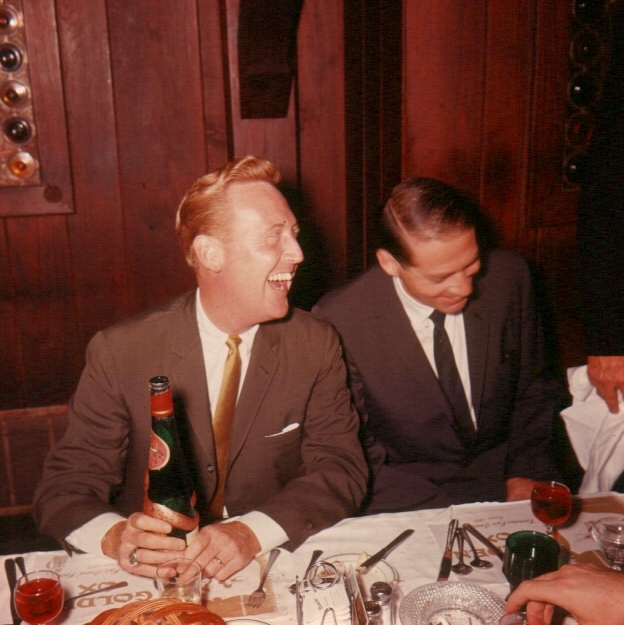 When I was a kid, my Dad (at left, sitting next to Scully at a restaurant, circa mid-1960s) worked nights. You see, he was either in the pressbox at Dodger Stadium or at Candlestick Park, Crosley Field, Forbes Field, or one of the other ballparks in the National League. With my Dad not home and able to tuck me into bed, it was Vin Scully's voice who I would last hear before falling asleep at night. I would turn the "sleep" dial to the maximum allowable 60 minutes and hope I could stay awake just long enough to catch the last out.
Back in the "old" days, baseball games routinely started at 8:00 p.m. The only Dodger games that were ever televised were the nine on the road in San Francisco. That was it. These games were incredibly special. There were usually three series of three games. As such, we would watch the Dodgers on TV no more than about every other month.
I remember watching most of the Dodgers-Giants games in black and white. My Dad received a big color TV console from the Dodgers as a Christmas present after the team won the World Series in 1959, but my parents traded it in after a couple of years for an equally large High-Fidelity stereo. The Hi-Fi had two speakers built into the walnut-stained furniture that housed this new piece of technology.
But I didn't need a Hi-Fi stereo to listen to the Dodger games. I only needed my bedside radio. Me 'n' Vinny. I'll be the first to admit that li'l Richard felt very secure in bed, knowing Vin was there keeping me company.
Given the choice, I would rather listen to Vinny than just watch a game. With the introduction of cable-TV, there are nearly as many games broadcast on television as on radio. As a result, it is now possible to do both. But there was a time when I saw almost all the Dodger games on the radio. Yes, with Scully describing the action, I saw all of those Dodger games even though they weren't on TV.
Play-By-Play (I Saw it on the Radio)
-- Terry Cashman
Play-by-play on the radio
Play-by-play...
("There's a long one, deep to left center, back goes Gionfriddo. Back, back, back, back, back, back, he makes a one-handed catch against the bullpen. Oh ho, doctor!")
Out on the porch in the summer heat
The sound of a southerner's voice filled the street
Me 'n' the Redhead were up in the catbird's seat
And out in St. Lou it was surely the same
Holy cow! What a baseball game
The sacks are loaded and here comes that Man again
And it was play-by-play on the radio
Play-by-play on the radio
Play-by-play, I saw it on the radio
The swing of The Splinter, DiMaggio's glide
The men at the mics made it come alive
Ernie and Mel and Bob was a Prince of a guy
Out of thin air pictures somehow appear
You can smell the hot dogs and taste the beer
I felt the excitement as the crowd began to cheer
And it was play-by-play on the radio
Play-by-play on the radio
Play-by-play, I saw it on the radio
Play by play, I saw it on the radio...
("There's a drive, way back, it may be, it could be, it is"..."Base hit, right field, the Tigers win it, here comes Kaline to score and it's all over"..."Stargell swings and there's a long drive hit deep into right field, going way back, back, back, back, she goes and you may kiss it goodbye, over the roof for a home run")
The men at the mic, they make it come alive
Oh, what a catch, there's a long, long drive
Turn it up louder, the pictures are coming in fine
And it's play-by-play on the radio
Play-by-play on the radio
Play-by-play...
Yes, day after day
Play-by-play, I saw it on the radio
Play-by-play, I saw it on the radio...
("It is going, it is going, it is gone")
Thank goodness for baseball, radio, TV, and play-by-play announcers. And thank you, Vinny. You allowed me to see a lot of games on the radio.
| Baseball Beat | March 20, 2005 |
Monster's (Fast) Ball
"I liked Dick a lot. He was a great, fun guy who enjoyed life to the fullest." -- Bill Monbouquette
"He was well liked and respected by the other players. He wasn't a flaky reliever but a down-to-earth family man." -- Frank Malzone
Source: We Played The Game (1994)
We lost another All-Star from a time when baseball was just a game. Richard Raymond Radatz died Wednesday when he fell down a flight of stairs in his home. He was 67.
Forty years ago, in an era when saves were considered a hockey stat, Dick Radatz was the premier relief pitcher in baseball. He was a big guy with a loose arm who could really bring it. His windup and sidearm motion make me think of Don Drysdale. Like Big D, Radatz coupled a slow, deceptive delivery with a devastating 95-mph fastball. He was as unhittable as anybody in his heyday.
 Dick Radatz was a rookie the year of my first APBA baseball game set. He was an A* (XY)(Z) in 1962 and 1963 and an A* (XY) in 1964. A letter grade of "A" was the highest awarded to pitchers at that time, the "X" and "Y" symbols were only given to the best strikeout pitchers, and the "Z" was bestowed upon those with excellent control. The asterisk meant a pitcher could only be used in relief.
Sandy Koufax was the type of starter who was an A (XY)(Z) and Radatz was the prototypical A* (XY)(Z) reliever. Radatz was not only the best relief pitcher of his day, but he arguably had the greatest three-year run of any reliever in history.
From 1962-1964, Radatz appeared in 207 games -- all in relief -- and, get this, threw 414 innings (yes, you read that right, an average of 138 IP per season or nearly twice the output of today's typical closer). He only allowed 292 hits and posted a cumulative ERA of 2.17 (with a low of 1.97 and a high of 2.29). His ERA+ (the ballpark-adjusted ratio of the league's ERA to that of the pitcher) was 180. He had a 40-21 record (a .656 winning percentage) and 78 saves during that period. By comparison, the Red Sox were 224-259 (.463) during those years or 184-238 (.436) in games not won or lost by Radatz.
Radatz had the best ERA among pitchers with as few as 150 or more IP and was number one in saves, strikeouts/inning, and hits/inning from 1962-1964. He was even second in Runs Saved Above Average and fifth in strikeouts.
AMERICAN LEAGUE (1962-1964)
EARNED RUN AVERAGE 1 Dick Radatz 2.17 2 Gary Peters 2.46 3 Dean Chance 2.54 4 Whitey Ford 2.60 5 Juan Pizarro 2.89
RUNS SAVED ABOVE AVERAGE 1 Whitey Ford 87 2 Dick Radatz 80 3 Dean Chance 73 4 Camilo Pascual 68 5 Gary Peters 60
STRIKEOUTS 1 Camilo Pascual 621 2 Whitey Ford 521 3 Dean Chance 502 4 Juan Pizarro 498 5 Dick Radatz 487
STRIKEOUTS 9/IP 1 Dick Radatz 10.59 2 Al Downing 8.32 3 Dick Stigman 7.34 4 Camilo Pascual 7.23 5 Gary Peters 6.85
HITS 9/IP 1 Dick Radatz 6.35 2 Al Downing 6.73 3 Gary Peters 7.18 4 Jim Bouton 7.47 5 Joe Horlen 7.54
SAVES 1 Dick Radatz 78 2 Hoyt Wilhelm 63 3 John Wyatt 52 4 Stu Miller 50 5 Ron Kline 33
Source: Sabermetric Baseball Encyclopedia
Among relief pitchers, Radatz is the greatest strikeout artist of all time. Of note, Brad Lidge set the NL record for strikeouts by a reliever last year with 157. Radatz topped him twice with 181 in 1964 and 162 in 1963. Dick set the record 40 years ago, and it has remained unbroken ever since. He ranks first, third, and seventh for the most strikeouts in a single season by a relief pitcher.
RELIEF PITCHERS
SINGLE-SEASON STRIKEOUT LEADERS
YEAR SO 1 Dick Radatz 1964 181 2 Mark Eichhorn 1986 166 3 Dick Radatz 1963 162 4 Brad Lidge 2004 157 5 Dick Selma 1970 153 6 Goose Gossage 1977 151 7 Dick Radatz 1962 144 8 Mike Marshall 1974 143 9 Rob Dibble 1989 141 10 Eric Gagne 2003 137
If you're unfamiliar with Radatz, think Rich Gossage, circa 1977-1978, in terms of the number of innings and strikeouts. Dick was every bit as overpowering as the Goose was with the Pirates and Yankees those two seasons. Radatz, though, worked his magic for three consecutive years. The Boston fireballer led the league in games, games finished, and saves in 1962; was second in all three categories in 1963; and led once again in games finished and saves in 1964 while placing second in games.
Radatz was an All-Star in 1963 and 1964, and he ranked 5th and 9th, respectively, in the MVP voting. He was named Fireman of the Year by The Sporting News in 1962 and 1964.
In the New Bill James Historical Baseball Abstract, Bill James termed Radatz's season in 1964 the sixth most valuable relief season ever and called his 1963 season the most valuable in the league that year. Radatz had 21, 24, and 24 Win Shares, respectively, in 1962-1964. To put those totals in perspective, Eric Gagne had 25 in 2003, in a year many have called the best ever by a relief pitcher; Lidge topped the majors last year with 17; and Mariano Rivera has never even had 20 in a single season.
I asked Bill if he could share a memory of Radatz from the latter's playing days.
"In Kansas City we were very jealous of Radatz. We had our own star relief ace at the same time, John Wyatt, and, although of course Wyatt was nowhere near Radatz, he was nonetheless one of our biggest stars, and we were loathe to believe that anybody in the same role was better. Radatz is one of the key people who established the notion of using hard throwers as relief aces. He was a big, strong, overpowering pitcher, which was a contrast to most of the relief aces of that time -- Ted Abernathy, who whipped the ball to the plate underhanded; and Hoyt Wilhelm, who could have raced his pitch to home plate and finished in a tie; or Ron Perranoski, who threw a big, wide curve; and Stu Miller, who threw 18 different changeups, none of them over 70; or Ron Kline, a washed-up starter who released a mediocre fastball from the middle of a dizzying array of twitches and gyrations intended to force the batter to guess when he might decide to turn loose of the ball."
Radatz had several pitching outings that would be unheard of today. Most notably, on June 9, 1963 and June 11, 1963, Radatz pitched 14 2/3 innings over a 50-hour span, allowing five hits, two walks, and no runs, while striking out 21 and picking up two wins in relief. In the first game, Radatz recorded 18 outs, including 10 strikeouts, five foul pop-ups, a sacrifice bunt, and one caught stealing. The only batter he walked was intentional. Moreover, only four of the 20 batters hit the ball into fair territory.
One of Radatz's most memorable performances came in the 1963 All-Star Game, when he struck out Willie Mays, Willie McCovey, Dick Groat, Julian Javier, and Duke Snider in two innings of relief. He also struck out five more batters -- including Hank Aaron -- in the following year's All-Star game, before serving up a game-winning home run to Johnny Callison in the bottom of the ninth inning in what Radatz later termed the biggest disappointment of his career. Although Radatz was tagged with the loss in the 1964 All-Star game, he struck out 10 batters in just 4 2/3 innings of work in his two mid-summer classics.
Speaking of striking out Hall of Famers, according to a Boston Red Sox press release, Radatz K'd Mickey Mantle 44 times in 67 lifetime at-bats. (Update: Rob Neyer tells me that David Smith via Retrosheet determined that the actual numbers are 12 Ks in 16 at bats and 19 plate appearances. Still impressive but not of the legendary magnitude previously reported.) Radatz became known as "The Monster" after overwhelming the Mick at Yankee Stadium in one particular game. Richard Goldstein, in a New York Times tribute to Radatz, relayed the following story:
"I had a lot of success with Mantle," Radatz told Bob Cairns in 'Pen Men,' a history of relief pitching. "I'd just start him out with fastballs around the waist and go up the ladder. For some reason he just couldn't move on it. I struck him out in Yankee Stadium with the bases loaded and boom, ba-boom, ba-boom, he started cussing and Monster came out about the tenth word. He was cussing so loud that the press heard it."
"The Monster" also whiffed Roger Maris and Elston Howard -- striking out three AL MVPs in a row -- on a total of 10 pitches. After that game, Radatz, one of the first pitchers to show emotion after getting the last out, punched the sky, as if to say, "I did it!"
Not surprisingly, Mantle once said, "I guess I would have to say that Dick Radatz was the toughest pitcher I ever faced." Bill Monbouquette, Radatz's teammate from 1962-1965, recalled, "Mickey used to say, 'Damn it, I know what he's going to throw and I still can't hit it.' I think he hit one home run off Dick, in Yankee Stadium, and I think Dick broke his bat."
Monbouquette, in We Played The Game, believes Radatz "was the best reliever there ever was. Dick could pitch five innings one day and then pitch the next day. If he had been used differently, where he pitched only an inning or two a game, I know he could have saved between 80 and 100 games a year. That sounds farfetched but I believe it."
"One game, I was leading the Yankees 1-0, but I loaded the bases with no one out in the ninth. Then Dick came in and struck out, in succession, Maris, (Yogi) Berra, and (Johnny) Blanchard. Maris and Blanchard I could see, but Berra was, along with Nellie Fox and Bobby Richardson, the toughest guy in the league to fan."
A native of Detroit, Radatz was a baseball and basketball star at Michigan State during the late 1950s. One of his college teammates was Ron Perranoski, later an outstanding relief pitcher for the Los Angeles Dodgers and Minnesota Twins. Radatz was a starting pitcher in college and the first two years in the minors. He was moved to the bullpen in 1961 by Johnny Pesky, who also managed Radatz in the majors in 1963 and 1964.
Despite dominating American League hitters in his first three years, Radatz tried to develop a sinker in the spring of 1965. The Neyer/James Guide to Pitchers attributed the following Radatz quote to Splendor on the Diamond:
"Ted Williams had said that I needed another pitch. So I tried adding a pitch in '65. It got me into control problems. I changed my arm position, and came up with a sinker. I started using it when I shouldn't have, and it as all downhill after that. It was a classic case of, if the wheel's not broke, don't fix it. I tried changing something, and it became a nightmare for me."
Although Radatz saved 22 games in 1965, his ERA increased more than one-and-a-half runs to 3.92. He was traded to the Cleveland Indians for Don McMahon and Lee Stange in June 1966 and was out of baseball three years later. Radatz never started a game in the big leagues but, man, was he a Monster in relief.
| Baseball Beat | March 14, 2005 |
Stealing Their Thunder Rather Than Bases
The number of stolen bases has been flat to trending downward for the past 30 years. Why? Well, in a nutshell, stolen bases are simply not as valuable in today's high-scoring environment as they were in the Dead Ball era or during the pitching-dominated 1960s and early 1970s or, for that matter, during a more neutral environment like the 1980s.
Traditionalists may long for the next Ty Cobb, Maury Wills, Lou Brock, or Rickey Henderson, but the emphasis has moved away from base stealing to such a degree it is unlikely that baseball will produce another 100-stolen base season anytime soon. In fact, Vince Coleman may turn out to be the last player who built most of his value around his speed and baserunning ability.
Yes, Marquis Grissom stole nearly 80 bases twice during the early-'90s, but he has transformed his game to the extent that the soon-to-be 38-year-old outfielder has hit at least 10 home runs for 13 consecutive seasons (including 20+ in three of the past four). Kenny Lofton has combined a nearly .300 lifetime batting average with sufficient walk totals to elevate his on-base percentage .031 above the norm -- making him much more valuable than just someone known for stealing bases.
One might be able to make an argument on behalf of Otis Nixon, Brian Hunter, or even Tony Womack, but they each had just one season stealing 70 or more bases. I'm telling you, they just don't make thieves the way they used to -- or maybe they do but, instead of playing for the Dodgers or the Cardinals, these bandits chose to sign up with Enron and Worldcom and the like.
Only one player has stolen 70 bases during the first five years of the current century. His name? Scott Podsednik. The year? 2004. Let's take a look at the top 20 stolen base leaders for last season.
2004 STOLEN BASE LEADERS
PLAYER TEAM SB Scott Podsednik Mil 70 Carl Crawford TB 59 Juan Pierre Fla 45 Carlos Beltran KC/Hou 42 Bobby Abreu Phi 40 Dave Roberts Bos/LA 38 Ryan Freel Cin 37 Ichiro Suzuki Sea 36 Chone Figgins Ana 34 Endy Chavez Mon 32 Corey Patterson ChC 32 Jimmy Rollins Phi 30 Rafael Furcal Atl 29 Brian Roberts Bal 29 Alex Rodriguez NYY 28 Tony Womack StL 26 Cesar Izturis LA 25 Derek Jeter NYY 23 Matt Lawton Cle 23 Mike Cameron NYM 22
Only two players even stole 50 bases and only five nabbed 40 or more. How valuable were these stolen bases? Here are the stolen base leaders in the context of caught stealing.
SB LEADERS WITH CS TOTALS
PLAYER TEAM SB CS Scott Podsednik Mil 70 13 Carl Crawford TB 59 15 Juan Pierre Fla 45 24 Carlos Beltran KC/Hou 42 3 Bobby Abreu Phi 40 5 Dave Roberts Bos/LA 38 3 Ryan Freel Cin 37 10 Ichiro Suzuki Sea 36 11 Chone Figgins Ana 34 13 Endy Chavez Mon 32 7 Corey Patterson ChC 32 9 Jimmy Rollins Phi 30 9 Rafael Furcal Atl 29 6 Brian Roberts Bal 29 12 Alex Rodriguez NYY 28 4 Tony Womack StL 26 5 Cesar Izturis LA 25 9 Derek Jeter NYY 23 4 Matt Lawton Cle 23 9 Mike Cameron NYM 22 6
Juan Pierre stands out in the above table for the number of times caught attempting to steal a base. Pierre was thrown out so often, he would be well advised to just stay put. I know that flies in the face of conventional wisdom, but there is no disputing the facts here.
James Click of Baseball Prospectus has demonstrated that the breakeven point for stealing second base is approximately 73%, and it ranges from 70% to 93% (depending upon the number of outs) for stealing third base.
OUTS STOLEN BASE BREAKEVEN 0 Second 73.2% 1 Second 73.1% 2 Second 73.2% 0 Third 74.8% 1 Third 69.5% 2 Third 92.7%
In other words, if a player isn't successful about three-quarters of the time, then he is doing more harm than good by attempting to steal bases. I realize there are some other factors at play here, such as the score, who's pitching, and who's at bat. But, generally speaking, a baserunner needs to be called safe nearly three times as often as out when taking that extra 90 feet.
To determine the most efficient base stealers, I devised a simple formula in which I took stolen bases minus two times caught stealing. The reason behind this logic is twofold:
1. A baserunner who is caught stealing not only produces an out, but he also removes himself from the basepaths. It truly is a double whammy.
2. The breakeven point is 67% or slightly below the needed success rate to justify the event in the first place. I could have used three times rather than two to come up with a 75% breakeven point. I decided to err on the side of conservatism, plus I think it is slightly easier to compute the net number in your head using two times rather than three. I'm a big fan of KISS -- and I don't mean Gene Simmons. Keep it simple, stupid.

MOST EFFICIENT BASE STEALERS
PLAYER TEAM SB CS SB-(2*CS) Scott Podsednik Mil 70 13 44 Carlos Beltran KC/Hou 42 3 36 Dave Roberts Bos/LA 38 3 32 Bobby Abreu Phi 40 5 30 Carl Crawford TB 59 15 29 Alex Rodriguez NYY 28 4 20 Endy Chavez Mon 32 7 18 Ryan Freel Cin 37 10 17 Rafael Furcal Atl 29 6 17 Lew Ford Min 20 2 16 Tony Womack StL 26 5 16 Derek Jeter NYY 23 4 15 Eric Byrnes Oak 17 1 15 Jose Reyes NYM 19 2 15 Ichiro Suzuki Sea 36 11 14 Corey Patterson ChC 32 9 14 Darin Erstad Ana 16 1 14 Luis Castillo Fla 21 4 13 Luis Rivas Min 15 1 13 Jimmy Rollins Phi 30 9 12 Jeff Davanon Ana 18 3 12
Podsednik is not only the most prolific base stealer, but he also happens to be the most efficient. Carlos Beltran would be number one if I chose to subtract three times the number of CS rather than two times. Lew Ford, Eric Byrnes, Jose Reyes, Darin Erstad, Luis Castillo, Luis Rivas, and Jeff Davanon all show up for their efficiency even though none of them finished in the top 20 in stolen bases.
If the players in the table above are the most efficient base stealers, who are the least efficient?
MOST INEFFICIENT BASE STEALERS
PLAYER TEAM SB CS SB-(2*CS) David DeJesus KC 8 11 -14 Juan Uribe CWS 9 11 -13 Casey Blake Cle 5 8 -11 Bernie Williams NYY 1 5 -9 Luis A Gonzalez Col 1 5 -9 Jason Bay Pit 4 6 -8 Gary Sheffield NYY 5 6 -7 Milton Bradley LA 15 11 -7 Jeromy Burnitz Col 5 6 -7 Jacque Jones Min 13 10 -7 Michael Barrett ChC 1 4 -7 Quinton McCracken Sea/Ari 3 5 -7 Alex Sanchez Det 19 13 -7 Manny Ramirez Bos 2 4 -6 Andruw Jones Atl 6 6 -6 Dustan Mohr SF 0 3 -6 Todd Walker ChC 0 3 -6 Paul LoDuca LA/Fla 4 5 -6 Coco Crisp Cle 20 13 -6 Bobby Hill Pit 0 3 -6 Henry Blanco Min 0 3 -6 Ross Gload CWS 0 3 -6 Raul Mondesi Ana/Pit 0 3 -6
Every player above is literally costing his team outs and potentially runs and even wins. Milton Bradley, Jacque Jones, Alex Sanchez, and Coco Crisp might win their fantasy baseball owners a few extra points, but they are a net negative for their real owners -- at least as far as stealing bases goes.
I suggest these players lose their CS (and SB) as well as their fancy names. Look, if you can't be in or around Mister Roberts' neighborhood (as in Padre outfielder Dave), then you may as well forget about trying to stealing bases altogether.
Interestingly, speaking of fancy names, Juan Pierre was the most inefficient base stealer in the majors last year using the more aggressive three times CS in the inputs. Rather than being the best base stealer in baseball as chosen by scouts in Sean McAdam's Hot Stove Heaters article for ESPN in January, Pierre is arguably the worst.
I got a big kick out of the following comment from a so-called "talent evaluator":
"He steals when it means something. He's not padding his total. Everyone knows he's going and he still makes it most of the time. That, to me, is the mark of a really great basestealer."
Does that also mean Pierre is thrown out when it doesn't mean anything? Well, for fun, I decided to check to see what Florida's record was in games Pierre stole a base and in games he was caught stealing. It turns out the Marlins were 22-15 in games in which Pierre recorded a SB and 11-12 when he had a CS. This finding may not be statistically significant although it could shed some light on the value of stolen bases and caught stealings in the context of a team's wins and losses.
The bottom line is that "making it most of the time" is not good enough. And it's certainly not "the mark of a really great base stealer."
| Baseball Beat | March 12, 2005 |
Weekend Roundup: Hot off the Press and Griddle
Welcome to the first of what promises to be many Weekend Roundups. This format is designed to allow me the opportunity to present information in a less formal manner than my normal Baseball Beat column. It will be eclectic and run the gamut from news, notes, and short takes on happenings inside the world of baseball.
Owners of Baseball Prospectus 2005 get a lot more than a bunch of photocopies. Flip the book open to page 397 and you get the minor and major league statistics plus proprietary BP metrics (MLVR, EQBA, EQOBP, EQSLG, EQMLVR, and VORP) since 2002, the PECOTA projection for 2005, and a full paragraph of commentary for Joe Mauer, Justin Morneau, Luis Maza, and Jose Morales. Call it one penny apiece for Mauer and Morneau with Maza and Morales thrown in for free.
I won't give all of the book's secrets away here but suffice it to say that BP is concerned about the health of one of the M & M boys and thinks the other may "soon become one of the 20 best hitters in the league." OK, I'll give you a hint as to which is which just this one time. The latter's initials are...wink, wink...J.M.
Buy three books like I did through Amazon and the shipping is free. Hurry up. What are you waiting for? For you fantasy leaguers, your draft is less than three weeks away! For everyone else, emulate Theo Epstein and make Baseball Prospectus "one of the first things (you) read every day." Hmmm. Now that I think about it, I wonder where he keeps his book?
The Bullpen Book has 20 pages of articles and 90 pages of statistical tables. Studes has created Win Probability Added for relief pitchers. I am a big fan of this stat as well as BP's Expected Wins Added and believe they may be the best measurement tools for evaluating the performance of relievers. The Bullpen Book is a must read for anyone who is serious about advanced sabermetric studies.
The multi-talented Belth has partnered up with Cliff Corcoran to form a powerhouse among Yankee blogs. Be sure to stop by and see what Alex, Cliff, and the rest of the Toastmasters are cooking up while the Hot Stove League is in full swing.
Baseball Prospectus, The Hardball Times, Baseball Toaster, and Baseball Analysts. That's not a bad foursome for your daily reading. Add in Baseball Think Factory/Baseball Primer along with the columnists in the sidebar and your personal favorite blogs -- many of which are also listed on this page -- and you have the makings of an All-Star lineup of baseball analysts and writers right here on the 'net.
Enjoy your weekend and don't forget to check back on Monday for the next edition of Baseball Beat.
| Baseball Beat | March 10, 2005 |
Balls, Strikes, and Holdouts
Before Curt Flood, Donn Clendenon, Ken Harrelson, Bobby Tolan, Jim Hunter, Andy Messersmith, and Dave McNally, there were two ballplayers -- Sandy Koufax and Don Drysdale -- who received little or no credit for the eventual rise in major league baseball salaries.
It was no coincidence that the players hired Marvin Miller as executive director of the Major League Baseball Players Association for $50,000 a year, effective July 1, 1966. In the aftermath of the Koufax and Drysdale holdouts that spring, the players realized they were dealing from a position of weakness rather than strength.
Koufax and Drysdale weren't the only holdouts on the Dodgers that year. Maury Wills held out as well although, unlike his teammates, he went it alone.
The following article dated Thursday, March 10, 1966 is from my Dad's archives. In the "Best of George Lederer," I bring you another anniversary special -- this one from 39 years ago to the day.
IN SAME CLASS WITH RUTH Wills Set to Sign for $80,000 Up By GEORGE LEDERER VERO BEACH, Fla. -- A comparison between Maury Wills and Babe Ruth no longer is as far off base as a normal lead by the Dodger captain.General Manager Buzzie Bavasi placed the banjo-hitting shortstop in the Babe's category Wednesday when he announced that Wills "will make as much this season as Ruth ever made."
Ruth reached his peak salary of $80,000 after hitting 60 home runs for the Yankees in 1927. Wills, with a total of 49 homers in nine minor and seven major league seasons, will equal it this weekend.
As long as Sandy Koufax and Don Drysdale are holdouts, only Willie Mays ($125,000) and Mickey Mantle ($100,000) have better contracts than Wills will be offered tonight or Friday.
"I don't expect any trouble," said Bavasi. "If I did, I wouldn't have invited Maury to come here. When we talked during the winter, we were talking in terms of $75,000. We're not far apart."
Bavasi tendered his invitation in a telephone call late Thursday night. "We did not discuss salary," said Bavasi. "We'll do that when he gets here."
The problem was in how to get here.
Wills said he was ready to check into the O'Malley Hilton this evening, but Bavasi had some reservations other than a room.
"He wanted to fly down on our plane with the Stadium Club group," said Bavasi. "But I told him not to. There'll be some reporters aboard and I don't think Maury should be bothered by a lot of questions."
For the sake of privacy, Bavasi was willing to spend an extra $100 and suggested a commercial flight. "His arrival will depend upon what flights are available. He'll be here either tonight or Friday."
Bavasi, for the first time, also disclosed Wills' 1965 contract at $60,000, about $8,000 more than appeared in print.
Wills' demand of $100,000 "or whatever Koufax and Drysdale are getting" was treated lightly by Bavasi.
"I'm sure Wills was as shocked as we were when he found out what Sandy and Don are asking. If he wants what they're getting, that means he wants nothing."
DIS AND DATA--Al Ferrara hit the first home run of three intrasquad games and also singled twice in a losing cause as the Danny Ozarks defeated the Preston Gomezes, 4-3...Ferrara homered against winning pitcher Don Sutton with the bases empty in the fourth inning...the two teams combined for 20 hits, eight more than in the first two games that failed to produce an earned run...Nate Oliver continued his strong bid for the second base job with a double and two singles for the losers...His .455 average (5-for-11) tops the regulars...Despite the first sign of power, the Ozarks used a squeeze bunt for the winning margin in the seventh inning...Hector Valle doubled, advanced on an infield hit and scored on Tommy Dean's safe bunt...Dean also tripled, as did Jim Marshall of the Ozarks. Marshall added a single and a walk in his most productive afternoon...Ron Fairly doubled and singled.
Claude Osteen started for the Ozarks, allowing one run on four hits in three innings...Howie Reed gave up three hits and a run in three innings for the losers...The loss was charged to rookie Bill Singer...Ron Perranoski makes his debut in another intrasquad game today...Lou Johnson flew home to visit his 14-year-old son, Don, who is seriously ill in UCLA medical center...Denny Lemaster, Ken Johnson and Hank Fisher are the Braves' pitchers for Saturday's exhibition opener with the Dodgers at West Palm Beach...Singer, Nick Willhite and Thad Tillotson go for the Dodgers...Strictly for laughs, the secretary of the Los Angeles Bartenders' Union called Walter O'Malley Wednesday and said his organization would picket Dodger Stadium unless Drysdale settles a dispute with employees at his "Dugout" restaurant in Van Nuys...Drysdale's bartenders are seeking an increase of 18 cents an hour.
Two days earlier, my Dad wrote the following bulletin as an aside to his daily story:
STRIKE 'TOO' AT BIG D'S EATERY The tigers have turned on their trainer at Don Drysdale's restaurant in Van Nuys. Drysdale, as the world knows, is holding out with Sandy Koufax for a joint million-dollar, three-year contract with the Los Angeles Dodgers.An official of the AFL-CIO Hotel and Restaurant Workers Union announced Tuesday that employees of Drysdale's restaurant have received strike sanction from the Los Angeles County Federation of Labor, adding that "if Don can 'strike' for his contract, so can his employees."
As it turned out, Wills did not sign with the Dodgers that day. The headline to my Dad's article two days later read: "Wills Balks at 'Final Offer,' Won't Join Club in Florida." Dad wrote a follow-up piece on Monday, March 14, suggesting that Wills and Bavasi had agreed on a compromise of $78,000 -- a figure that "might reach $80,000 with fringe benefits."
Two days later, the headline to my father's daily article was as follows: "Maury in Tune at $75,000." Bavasi told Dad, "He will sign for $75,000 but with a great year he can make from $5,000 to $10,000 more."
Wills had perhaps the worst season of his career to that point (.273/.314/.308 with only 38 SB in 62 attempts) and was traded to the Pittsburgh Pirates after jumping the team without permission when the Dodgers were in Japan for an exhibition tour following their World Series loss to the Baltimore Orioles. He returned in 1969 and finished his career as a Dodger in 1972.
Update: Attention Dodger fans...Former All-Baseball colleague Jon Weisman has moved his superb Dodger Thoughts to the brand new Baseball Toaster website, effective today. Be sure to bookmark both locations and make them a part of your daily reading.
| Baseball Beat | March 07, 2005 |
Trading Places
On March 7, 1964 -- 41 years ago today -- my Dad (George Lederer) and Los Angeles Dodgers manager Walter Alston changed places for one day. Dad managed the Dodgers -- coming off a World Series sweep over the New York Yankees the previous October -- in a spring training intrasquad game in Vero Beach, Florida, and Alston wrote an account of the game for the Long Beach Independent, Press-Telegram.
Alston managed the Dodgers from 1954-1976, operating under 23 one-year contracts for owner Walter O'Malley. The Hall of Famer won more than 2,000 games, seven National League pennants, and four World Series championships as the skipper of the Brooklyn and Los Angeles Dodgers. However, his playing career (with the St. Louis Cardinals) lasted about as long as Dad's managerial reign.
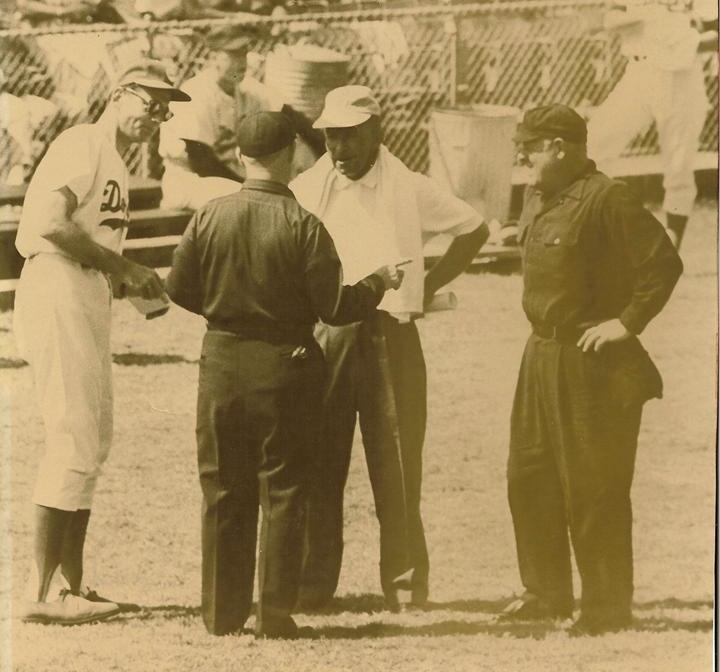
Here is the article exactly as it appeared in the Long Beach newspaper the following day:
ALSTON'S ACCOUNT: I, P-T Scribe Flop as Mgr. ED. NOTE: Dodger manager Walter Alston and I, P-T baseball writer George Lederer traded jobs Saturday -- for one day. The following is Alston's account of Lederer's managerial debut and retirement, written exclusively for the Independent, Press-Telegram: By Walter Alston (Who feels quite secure today) VERO BEACH, Fla. -- I'll try to break it to you gently:Your Dodger reporter, George Lederer, mixed his signals Saturday as he mixes his metaphors. His team -- which he named the "Lettermen," but should have named "Leadfoots" -- lost 6-2 in an intasquad game.
I wouldn't say that the opposing manager, Phil Collier of the San Diego Union, was smarter. I'll let Collier say that.
But I will say that Lederer lost his only chance to win the game when he didn't lodge a protest against Collier during a third-inning rhubarb.
Collier, dressed in street clothes -- a la Burt Shotton and Connie Mack -- broke the rules when he charged onto the field to argue an umpire's decision at second base. At this stage of the game, with the score still 1-1, Lederer was sharp enough to remind the umpires that Collier had no right to be on the field.
But he filed no formal protest and that was to be his biggest mistake.
Lederer at least showed a little class by managing in uniform. He even took calistenics and ran a lap with the squad.
Before the game, Lederer reminded me a lot of Pee Wee Reese. Maybe it was because Lederer wore Reese's old jersey. Come to think of it, there couldn't have been another reason.
One of the writers said, "Lederer in uniform reminds me more of Captain Kangaroo."
One of the contributing factors to Lederer's defeat might have been in the fourth inning when he was a victim of a prank by Pete Reiser, his own coach.
The score was 2-2 with the Collier Cats batting, none out and a runner on first base. Derrell Griffith of the Cats grounded to the right side and collided with Dick Tracewski, the second baseman who was covering first.
Griffith and Tracewski lay sprawled. Neither moved a muscle. Lederer, deep in thought, didn't move either until Reiser yelled to the dugout: "Hey, Lederer, get some water. Hurry."
Lederer panicked. Not knowing whether to bring the hose or a bucket, he fumbled, finally filled a Dixie cup with water and ran to the scene.
"Where do you want it, Pete?" Lederer asked. "Give it to me, and hurry," yelled Reiser. Then Pete drank the water and added a polite, "Thanks."
You should have seen the look on Lederer's face. He was fit to be tied, but not for long.
John Roseboro doubled home the tie-breaking run, Bart Shirley drove in a pair with a single and Griffith's single in the next inning made it 6-2.
After that, George didn't have much chance to manage. He was down and couldn't do anything but wait for a rally.
He found out, though, what it's like to have a player mad at the manager.
Through some ingenious maneuvering, Lederer had replaced Tommy Davis in left field with rookie Barry Erdos, a catcher. Then, when Tracewski asked to be excused, Lederer brought in Jeff Torborg to catch and sent Doug Camilli to third base.
The mistake wasn't so much in having three catchers in the same lineup. It was in switching Erdos and Torborg in the batting order, perfectly legal but unfair in the opinion of Erdos, who never did get to bat.
I'd like to see Lederer interview Erdos now!
* * * * I was told that Lederer worked under a disadvanatge early. Roseboro happened to walk by the dugout when Lederer explained the signs before the game. The first time George gave the steal sign, Roseboro picked it up, called for a pitchout and threw out Tracewski by a mile. It's too bad we can't get our signs like that during the season.
George appeared a little miffed, too, when he said he gave Wally Moon a bunt sign in the first inning and Wally swung away twice and missed.
I thought at the time that George's strategy was very good. But I thought he had put on the hit-and-run.
I don't think George used many signs after that and I heard Jim Gilliam comment, "This is great. That's the way the game should be played."
Personally, I can't agree.
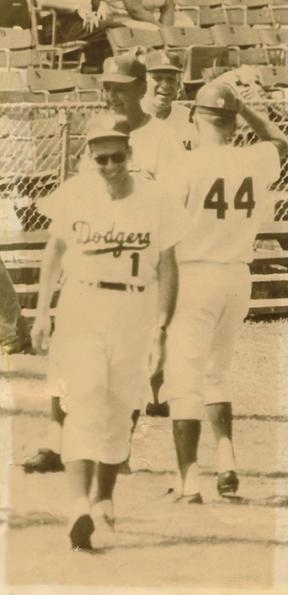
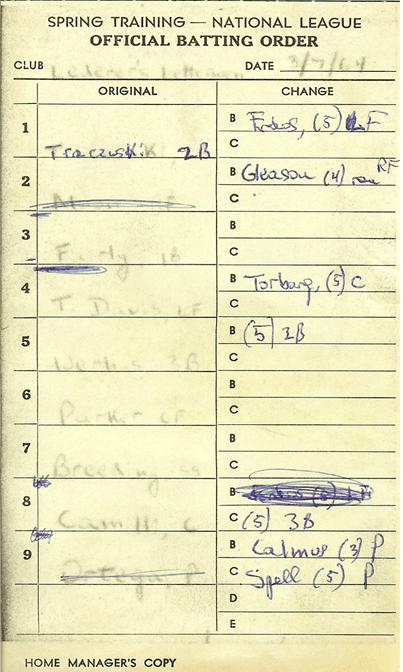
My Dad. Number one in the Dodgers' program for a day. Number one in my heart for a lifetime.
| Baseball Beat | March 02, 2005 |
Breakfast With Bill James (Part Three)
Who: Bill James and Rich Lederer
What: Interview ("Abstracts From The Abstracts")
Where: Marriott Hotel in Anaheim, CA
When: Sunday, December 12, 2004 (Winter Meetings)
[The discussion transitions from Bill's former assistants to his current boss.]
RL: In "Inside-Out Perspective," a chapter in the 1984 Baseball Abstract, you wrote about the differences between the way a forest looks on the inside and the way it looks from the outside. How do the trees look now that you are on the inside working for the Red Sox and General Manager Theo Epstein?
BJ: Theo works phenomenally hard. He is 31 and has a lot more energy than I do. He works really hard. At the same time, what makes him successful over the course of the year are eight or ten decisions. If those eight or ten decisions are good, he's going to have a good year. If they're not, he's not. But it's not just those eight or ten decisions because, in order to make those eight or ten things happen, you have to try to make 800 things happen and only one percent of them actually happen. I try to stay close enough to the process of trying to make things happen to contribute to seeing the eight things that eventually happen are good decisions. I don't try to work as hard as Theo because I couldn't. I don't try to make the decisions because they're not my decisions to make. I just try to stay involved enough to know what's going on.
RL: After the 1984 Baseball Abstract sold 150,000 copies and peaked at #4 on the New York Times bestseller list, the Elias Sports Bureau produced The 1985 Elias Baseball Analyst. How did Elias impact your decision to stop publishing the Abstracts a few years later?
BJ: Not only the Analyst but other books started to appear. It started with Rotisserie guides. It started a competition to get the books out earlier, which caused the timeframe in which the books had to be written to evaporate. In the 1978 Abstract, if you read it carefully, you'll find remarks about things that happened early in the 1978 season because by the time the '78 season had opened, I wasn't even done writing the book. I probably finished it on April 20th of 1978 and was selling it by early May of 1978 because it was just a matter of getting it copied and bound.
The first national publication -- the 1982 Abstract -- was due to the publisher by December 15th and was out in bookstores the first week of April. I tried to push to get the deadline moved back into January so I had a little more time to write the book. The first Elias Analyst came out in March, so we tried to come out in early March, then they tried to come out on the first of March, so we tried to come out in late February. This competition caused the book to be due to the publisher by November 10th or something. The season ends on October 25th! If I were older and more mature, I would have told the publisher "You do what you want but I'm not sending this book until January 15th." But I tried to cooperate with them and they would talk to me how important it was to get the book in earlier. I tried to go along with them but it just caused the timeframe to disappear.
RL: The size of the book had increased every year from 1977 through 1986 and then the number of pages declined in the 1987 and 1988 Abstracts.
BJ: I wasn't aware of that.
RL: Was it due to the new deadlines imposed on you?
BJ: I don't know what caused it. It could be the fact that I had a baby in '86. [smiles]
RL: Fair enough. In the 1985 Baseball Abstract, you developed the Major League Equivalencies, which I think had a big impact on baseball.
BJ: Right, [deadpanning] it could be the end.
RL: You also analyzed the Major League draft and the impact on drafting high school and college players. At one time, there was a bias towards high school players. Now the bias is towards college players. Do you think it is possible that could change again?
BJ: We debate this a lot -- and I can't really tell you what we debate within the Red Sox system -- but we all assume that, if more and more people move toward drafting college players, there will come a point at which the advantage of college players will disappear. Then there is a question of how we will recognize that point and when will it occur and how close are we to that point occurring. We worry about that a lot, but I don't think we know the answer.
RL: The 1986 Baseball Abstract was dedicated to John and Sue Dewan, your "heckuva good wife" Susan McCarthy, Dan Okrent, Pete Palmer, and Craig Wright. I know Craig is a "treasured friend and compatriot." What is he doing these days?
BJ: Craig, at one point, retired from sabermetrics entirely. He was working as a Christian Science counselor -- I think he still does that -- but he's back doing some sabermetrics. I got a very long email from him last week, talking about the Red Sox, congratulating me on the World Series, and I responded to that. I still hear from him several times a year, but since we talk almost entirely about baseball, you asked what he's doing personally and I don't really know.
RL: Who was the best baseball player you ever saw?
BJ: George Brett, probably.
RL: If George Brett was the best player you ever saw, who was the best pitcher?
BJ: I'll give you a Kansas City baseball fan's response to that. If you ever saw Bret Saberhagen on a day when he had his stuff, I'm not sure that you could have been better. You would see Saberhagen on those days and think, "This is perfection in a pitcher." He would be throwing 98 with excellent movement on the fastball, big curve, tremendous change, fantastic control, excellent fielder, and a phenomenal understanding how to pitch. I know over the course of his career he wasn't (Roger) Clemens -- I guess Clemens is the greatest pitcher I ever saw -- but Saberhagen on a given day, when he was healthy, it was hard to see what separated him from being perfect.
RL: Short answers on the following players, who mostly spanned the life of the Abstracts. I have to lead off with Bert Blyleven.
BJ: Wonderful curveball and apparently a wonderful character. There are a lot of stories about him that you hear from inside baseball that I never knew about when I was writing.
RL: Mike Schmidt.
BJ: Sabermetric superstar. A .270 hitter but such a great player despite a modest batting average that everyone had to figure out he was a great player anyway.
RL: Joe Morgan.
BJ: Similar. We all wish he was as good a broadcaster as he was a player.
RL: Johnny Bench.
BJ: I don't have any comment on him.
RL: Gary Carter.
BJ: Carter hit about the same things as Bench did, only he did them less spectacularly.
RL: Carlton Fisk.
BJ: I loved watching Carlton Fisk play. There's a movie, "For Love of the Game," in which Kevin Costner plays a no-nonsense baseball player and, to me, Carlton Fisk was that character come to life. Although the character was a pitcher, it still fits him.
RL: Rickey Henderson.
BJ: Rickey is one of a kind. Someone should write a really good book about Rickey. There is an essential connection between ego and greatness and no one better illustrated that than Rickey. When Rickey is 52, he will still believe that he could play in the majors. You can say that his ego is out of scale to his real world, but his ego is what made him so special. Somebody should document mannerisms and Rickey was a walking catalog of annoying mannerisms. He was a show. Every at-bat was a show. It's not like a Reggie Jackson show where it's done for television. It's a live show. It's done for the guys in the ballpark and the guys on the field. The show made him totally unique.
Tim Raines was almost as great of a leadoff man and almost as great of a player. Tim is a good guy, just a nice, reasonable person that everybody likes. Rickey is a show. [laughs] The show was essential to his greatness.
RL: OK, here's one for you. If Bobby Grich or Darrell Evans were ever inducted into the Hall of Fame, do you think that would be a feather in the cap of your work and the sabermetric community?
BJ: Absolutely not. If Bobby Grich or Darrell Evans ever makes the Hall of Fame, that's a tribute to Bobby Grich or Darrell Evans. It has nothing to do with me.
RL: There were about eight managers during this time that were among the most significant in the history of baseball. Could you comment on Whitey Herzog?
BJ: Whitey always reminded me that there is more than one way to make things work. I don't mean he reminded me personally. I've never had a conversation with him in my life. Whitey's way of thinking about problems is very different from mine, but it was self-evidently effective. That always reminded me that there are a lot of things that I'm just looking at this in one way, and there are other ways of looking at it that work very well, too.
RL: Who was your favorite manager during the 1970s and 1980s?
BJ: Earl Weaver and Herzog were very different. Both were wonderful managers to watch work. Herzog was "let's take charge of this game, let's make this game as hard as possible for the other team, let's force the action, put pressure on them, and make them lose." Weaver is like "let's be patient, look for our opportunities, and eventually grind out a win." Their approaches were totally opposite, but they were both extremely effective.
RL: Gene Mauch. How do you feel about the little ball versus the three-run homer?
BJ: I think Mauch was a tremendous manager. I know that his record was .500 or under .500, but I think that he was a terrific manager and if you had put him in charge of a team like the Red Sox last year he would have been as successful as we were. I think he was very, very good. He's just different.
RL: Dick Williams.
BJ: Dick Williams may have been too much like me personally to have been a successful manager in the long run. Dick was not subtle or generous or patient. Dick knew what he thought and he knew what he wanted to do and his notion was that since he was the manager that was the way things ought to be done. [laughs] And so he was very, very effective in the short run. In the long run, you had to do something else.
RL: If you were to produce the 2005 version of the Bill James Baseball Abstract, what would be some of the features that you would want to discuss?
BJ: Baserunning and fielding. I know that I've spent more time worrying about fielding in my career than I ever have about hitting, but that's because we started out so far behind and that is still true. We're still way behind on fielding and baserunning. We ought to do better.
RL: That's great. We've got 99% covered on hitting...
BJ: Right, right.
RL: ...and there are these guys who are still worrying about finding some magic formula...
BJ: I know, I know.
RL: ...it drives me nuts.
BJ: Me, too!
RL: Why not put that same time and energy into fielding and baserunning instead of that last 1% of hitting?
BJ: That's right, that's right.
RL: As you look to the future, is there anything beyond fielding and baserunning that we haven't even begun to develop?
BJ: Transitions between levels. As the world gets smaller and there is more interaction all the time between people playing baseball in Caracas and people playing baseball in Japan -- if you look at the playing biography of Tsuyoshi Shinjo, he went to the Domincan to the Japanese minor leagues when he was 16 [laughs] -- maybe he wasn't 16, who the hell knows? [laughs] There is a difference in the quality and also a difference in the way the game is played and our understanding of that could be a lot better.
RL: Bill, you credited "veteran leadership" in a couple of interviews after the World Series as the reason the Red Sox came back and beat the Yankees. There was a debate whether or not you were saying that tongue-in-cheek.
BJ: Right. I certainly was not saying that tongue-in-cheek. You also have to understand that somebody asked me why the Red Sox won in 2004. I can't say it was because we were geniuses. First of all, it's not true. Even if it was true, you're trying to find an answer that (a) is true and (b) you can give. And by saying veteran leadership was more important than other things -- maybe not really -- but it's a valid answer. I don't think you can come back from a 3-0 hole against the Yankees without guys who really believe in themselves [laughs] and guys who know how to handle a situation like that, so it's a true answer. Maybe it's not the only true answer, but it's the one I chose to give.
RL: I think that's great. There really was this discussion wondering whether you were saying that in jest like you've been known to do sometimes or if you were being serious.
BJ: I was being very serious.
RL: Well, Bill, you've been very kind and generous with your time. I enjoyed our discussion very much.
BJ: I appreciate it. I have a meeting upstairs. We've got irons in the fire and I better get up there. Thanks a lot.
RL: Thank you, Bill.
Bill and the Boston Red Sox were busy indeed. They signed David Wells the day before to a creative two-year contract although the official press release wasn't announced until two days after our meeting. We talked about that deal as we walked out of the restaurant.
In addition, the Rule 5 Draft was the day after our meeting. The Red Sox also signed John Halama, Edgar Renteria, Matt Clement, Wade Miller (in what may have been the best acquisition of the offseason), and Jason Varitek within the next two weeks.
December 2004. A special month for the Red Sox and me.
[Additional reader comments and retorts at Baseball Primer.]
| Baseball Beat | March 01, 2005 |
Breakfast With Bill James (Part Two)
Who: Bill James and Rich Lederer
What: Interview ("Abstracts From The Abstracts")
Where: Marriott Hotel in Anaheim, CA
When: Sunday, December 12, 2004 (Winter Meetings)
[Bill returns from the buffet with eggs Benedict and potatoes, Rich with scrambled eggs, sausage, and fruit. The discussion turns toward today's more advanced sabermetric studies.]
RL: Do you feel as if the baserunner on the front end of a double play has much bearing on the outcome?
BJ: I think it probably has an impact. I wish we had specific data about it. Less than two weeks ago, I was studying it with some guys I work with at BIS (Baseball Info Solutions), who do the Handbooks now, working on a form for a baserunning report. One thing that it will say on the stat sheet is how many times a guy is thrown out on the front end of a double play. There is no reason not to know.
RL: Do you think people are calculating that on any level?
BJ: The information is available. If they're calculating it, they're not publishing it.
RL: With respect to baserunning, are you working on any other stats that are of interest to you?
BJ: We are working on it. It's of interest to me at least. The problem is you can create 20 categories of events for baserunners (first to third on a single, baserunner stops at second on a single, baserunner is thrown out at third on a single, baserunner scores from first on a double, etc.). If you are going to report those results, then you need to summarize the categories somehow. So it's hard to report summary categories without leaving out specific information or, on the other hand, it's hard to find room to publish the whole detailed report.
RL: Do you think there is much work left on outfielder's throwing arms in allowing or preventing base runners to advance?
BJ: Yes, there is. As long as we've been doing this and as much attention has been paid to this, it is curious that we don't have this information. Well, someone has it. But where is it? It's curious that this basic information, such as runners going first to third on Vladimir Guerrero vs. ordinary right fielders, is not publicly available. There is no reason for it.
RL: Another thing, Bill, that needs work -- and you brought it up in one of your Abstracts regarding Toby Harrah -- is the idea that advanced defensive metrics only account for the quantity of the balls that may or may not get through, but not the quality of the result. In the Harrah example, the fact that he played the line and prevented more doubles by doing so isn't adequately reflected in his fielding stats.
BJ: John Dewan (BIS) is working on the problem also, and he has shown some results. He has a formula. Just this year, he added that adjustment.
RL: Is it significant for both infielders and outfielders?
BJ: Yes. As far as significance, take the case of Torii Hunter. If you are making five extra plays a year and they are all what would be otherwise home runs, it's real significant. It's very significant also for infielders. I suppose if you have a first baseman who plays way off the line, he may wind up making plays that the second baseman would make anyway whereas the balls he's not getting to wind up going for a double down the first base line.
[The conversation shifts back to a chronological review of the Baseball Abstracts.]
RL: I just realized, Bill, but it just happens that we covered the 1977-1981 Abstracts before taking a break to get a bite to eat. These five books were, of course, self-published. Things began to look up the next year when Ballantine Books won a bidding war to publish the 1982 Baseball Abstract.
BJ: Well, as to the bidding war -- I don't think I've ever told anybody this before -- but I believe Ballantine paid me $10,000 for the first national Abstract. It wasn't exactly the type of bidding war in which one retires. (laughs) The first one did well enough that we did get a contract for four years for a reasonable amount of money.
RL: The 1982 edition was the first Abstract that included "Bill James" in the title of the book.
BJ: Yeah, that wasn't my decision or idea. I would have never done that myself.
RL: Your name didn't even appear on the cover until 1979...
BJ: Is that right?
RL: ...and then only as an author.
BJ: People from publishing said, "You gotta put your name in the title of the book." The publisher made that decision.
RL: Dan Okrent wrote an article for Sports Illustrated about you the previous year. How did Dan discover you?
BJ: I can't speak for him but one of Dan's friends ordered the book when Dan was organizing the Rotisserie league. The guy had this book and then Dan got interested in it. He contacted me from that, I believe.
RL: You had written an article in Esquire before that?
BJ: The first Esquire article was in '79 but that also was Dan. In '78, Dan found the book and wrote me a letter to arrange for me to write the Esquire baseball previews in '79, '80 and '81.
RL: When were you first published in a national magazine?
BJ: I was published in Baseball Digest in 1975, so it depends on how you define "national magazine."
RL: There you go. In the 1982 Baseball Abstract, you introduced the Defensive Spectrum, which I believe was one of your biggest contributions. How did you develop that and does it still hold true to today?
BJ: It still holds true. I use the Defensive Spectrum as an example to try to explain to somebody why the definition of sabermetrics proposed by the dictionary ("computerized study of baseball records") is totally wrong. The Defensive Spectrum doesn't have anything to do with numbers, doesn't have anything to do with computers, statistics or anything. It has to do with organizing concepts so that you can understand them.
The Defensive Spectrum is still tremendously useful to me. The Red Sox...we don't have a shortstop -- we're losing (Orlando) Cabrera -- so there's a debate in the organization. If we had no second baseman and could come up with a lefthanded-hitting second baseman and a righthanded-hitting second baseman that were pretty good, no one would worry too much about it. But shortstop is really hard to find guys who are good. If you wind up filling in someone at that position, you almost, by definition, wind up weak. If we needed to attune at first base, we'd be fine. We'd find a guy who could crush lefties and a lefty who was pretty good, and we'd be fine.
At shortstop, if you have to fill in, you're in trouble most of the time. The Defensive Spectrum is a necessary concept to explain why that is true because there is nobody drifting into the shortstop position because he failed [chuckling to himself] at somewhere else. Nobody! There are guys who are good and there are the guys who are not shortstops because they're not good.
RL: One of the things you have pointed out is the absence of players at the right end of the Spectrum and the abundance of players at the left side. As such, in building a ballclub, Bill, is it important to focus on the right side if you were starting a team from scratch?
BJ: I think a lot of people understand that even if they have never heard of the Defensive Spectrum. I have a nephew who's been a huge Red Sox fan since birth who's very, very sharp about what the Red Sox need to do. Very often he calls and tells me "I think the Red Sox ought to do this, this and this" and, at that moment, that's exactly what we are trying to do. He's that sharp. He's a huge Nomar fan, so a year ago he was asking, "Why are you guys getting all these minor league shortstops?"
We have five shortstops in the minor leagues who are going to be major league players. I'm not kidding you. We have Hanley (Ramirez), who everyone knows about. There's a guy who's going to be at Triple-A next year, Kenny Perez. He's probably not going to be a major league star, but he is going to be a major league player. The guy we drafted last year named Dustin Pedroia. He's very good. Guys in the lower levels, Christian Lara and a guy named (Luis) Soto. And they are all good. The reason why you do that is they are all good, but they are probably not all shortstops. One of them will be a good second baseman, one may be a third baseman or a leftfielder or something, but you start them out at shortstop.
RL: It gives you a lot more flexibility.
BJ: Right.
RL: If you start out at first base or DH, there's nowhere to go.
BJ: Exactly.
RL: One of the other things you wrote about in the 1982 book was that players who have "unusual batting stances" tended to be good hitters. You mentioned Rod Carew, Brian Downing, and I think John Wockenfuss.
BJ: I imagine John Wockenfuss is very flattered to be mentioned with Rod Carew. [smiles] I don't know if they tend to be good, but I still like them. A lot of scouts like a guy who's odd just because if you thought they were doing something wrong, you can fix that. If he's doing something that no one else can do, then that's probably a useful thing.
RL: In the 1983 Baseball Abstract, you said "Hi. My name is Bill James, and I'm an eccentric." I think that was the first time you called yourself "an eccentric."
BJ: Probably the last. [laughter]
RL: You mention that year the debate over four-man and five-man pitching rotations. Do you think we will ever go back to the four-man rotation?
BJ: Between 1973 and 1984, baseball made two important steps back. In the early '70s, the workloads of pitchers were at historic high-water marks. They were higher than they had been since the Dead Ball era. Within ten years after that, we switched from a four-man to a five-man rotation and also began to limit pitchers in how many pitches they throw in a game and began to use more and more relievers earlier in the game.
In spite of these changes, it is difficult or impossible to establish that injury rates for pitchers have dropped. It seems to me that the desire to avoid injuring pitchers is certainly good and we should do whatever we can to avoid injuring pitchers. But it seems to be clear that one of those adjustments was appropriate and one was overkill. It's difficult to explain how you can make two changes designed to reduce injury rates to pitchers without reducing injury rates to pitchers! I think there is better evidence for the pitch limits than there is for the five-man rotation and, therefore, I think it's reasonably likely that at some point in the future we will go back to the four-man rotation.
RL: In the old days, pitchers like Christy Mathewson would throw harder to certain batters than to others. The fact that we have DHs now and second basemen who can hit, does that have an effect on the quality of each pitch?
BJ: Yes. When I wrote about that, I wasn't aware of that transition in history until I was working on the Historical Abstract -- and I wrote about that in '83 or '84. When I wrote about that, I thought it was over. I thought that was a transition that happened in history but what I didn't realize, particularly in the '90s, was this transition was still ongoing. One of the great differences between the '70s and now is that now you have a lot of guys who throw 86 as starters who can throw 90 as relievers for one inning and who do that. So, the starters push themselves harder, are out of the game earlier, and then you see a series of relievers who are throwing harder. So yes, it does affect the quality of the pitch but it's an open question -- a fair question -- whether by making this transition we've lost this, sort of, "pitchtility."
The Orioles in the '70s were extremely successful with a bunch of pitchers who probably threw 82-85 ninety percent of the time. Mike Flanagan, Scott McGregor, and Steve Stone weren't hard throwers but they could pitch 250 innings by saving their best stuff and pacing themselves. People don't pitch that way anymore, and it's not clear that you couldn't pitch that way anymore. It's fairly likely you could.
A few years ago we had a lead-off man, Brady Anderson, who hit 52 homers. In the '70s the idea of a lead-off man hitting 30 home runs was preposterous. Now it's as common as dirt. So that's a real transition, that you have to worry about the home run on every pitch. A lot of people because of that are reluctant to throw that 82 mile-an-hour screwball or cutter or something because they're afraid they're going to be changing the scoreboard with just one bad pitch.
RL: Excellent. In the player ratings section of the 1983 Abstract, you mention that you were hired by the Hendricks Brothers to help on Joaquin Andujar's salary arbitration. When did you begin to serve in that capacity?
BJ: It started in November, 1979, I think. I worked with the Hendricks Brothers regularly for about ten years and gradually cut it down and eliminated it in the early 1990s. I also worked for a lot of the other agents.
RL: Switching gears here, the Law of Competitive Balance, the Plexiglass Principle, and the Whirlpool Principle are all favorites of mine. How do these theories relate to how you would analyze trends or players today?
BJ: It relates to how you would analyze everything. People are astonished that our elections tend to wind up 50/50 or 51/49 but it's just the Law of Competitive Balance. When a political party is ahead, they get arrogant and start to overreach. When they are behind, they tend to compromise and gain. It's just the Law of Competitive Balance working itself out. It relates to how I analyze everything.
RL: In the Player Ratings section of the 1983 Abstract, you did a number on Enos Cabell.
BJ: I believe I told this story to several reporters, but I don't remember ever seeing it in print so I'll tell you again. One of the agents I worked for was Tom Reich and I went to a party at Tom's house and Enos Cabell was there. I was introduced to him and there was no look of recognition in his eyes and I thought, "Thank God." [laughs] But, later in the evening, I was talking to him and he made a joke about something I'd written, and I realized he knew exactly who I was. He was just unbelievably classy in handling it. So, from that time on, [chuckling] I assure you I have not written another negative word about Enos Cabell in the last 20 years. He was a very nice man and a very classy man. I don't know what I wrote about him, but I know people still ask me about it. [laughs]
RL: In the 1984 Baseball Abstract, you dedicated the book to sportswriters Bob Hentzen, Jim Murray, and Leonard Koppett.
BJ: Right.
RL: I found it surprising that they were the heroes of your adolescence rather than athletes.
BJ: I think that's fairly common. For a lot of people, the athletes are sort of the secondary heroes of the universe. If you interview general managers, I think that you would find that more of them grew up fantasizing about being general managers than fantasizing about being second basemen. Maybe they want to be second basemen, too, or clean-up hitters but...
RL: ...I'd rather grow up to be Bill James than Jim Rice.
BJ: [laughs]
RL: You hired Jim Baker that year. I was wondering if you could talk about some of the different people that worked for you. The fact that your disciples have become notable in their own right reminds me of the success of Bill Walsh and his assistant coaches.
BJ: Jim Baker is a very talented person. I conducted perhaps an over-organized search for an assistant at that time and hired him. He was the most talented person I could find. He is an extremely funny writer. He's hilarious. I think everybody who knows Jim and knows how good his stuff is has been waiting for him to explode as a popular pop icon for 20 years. It hasn't happened yet and maybe it won't, but he's a very talented guy.
RL: Rob Neyer was your second assistant.
BJ: Rob is the easiest person to work with that I've had. I hired him just because I liked him. I knew he was a big baseball fan. It was sort of a trial thing and I didn't really know how long it would last. He is a natural assistant to me because I'm not organized enough to spend any time directing anybody's work. You give Neyer a stack full of baseball books and he's busy. He was naturally doing it by his own intellectual curiosity and interests so I never really had to worry about what he was doing, which was a good thing for me.
RL: How about John Sickels?
BJ: I hired John because I was looking for an assistant. We went to lunch and one of the things I did was draw up a list of young players. I thought I'd ask John to see if he knew anything about them as sort of an intern test. He knew far more about these players than I did! Just off the top of his head, he could rattle off where they were last year and what they were doing. I was quite amazed at that. John always had -- and it doesn't have anything to do with me -- an area of expertise. He always knew more about that stuff than anybody did. Through working with me, he was able to let people know all of the expertise he had in that area.
RL: Though he is not as well known as Jim, Rob, and John, tell me about the relationship between you and your good friend, Mike Kopf.
BJ: Mike is an interesting guy. He's single, older than I am, thin, spends a lot of time at racetracks, a lot of time at bars. Mike also reads voluminously and has this phenomenal acquaintance with classical music. He has this memory that, you go to a baseball game -- he's sitting there drinking pretty heavily -- and you can talk about the game two years later and you realize that he can still reconstruct the fourth inning in his mind and he starts debating with you why the manager bunted in a situation in the fifth inning. [laughing] "What in the hell are you talking about?!" [laughter persists] There's no frame of reference here at all. He remembers and bursts upon certain instances that happened in a game.
RL: Mike seems like quite a character. Thanks for sharing those stories.
Be sure to check back tomorrow for the third and final segment of my exclusive interview with Bill James.
[Additional reader comments and retorts at Baseball Primer.]
| Baseball Beat | February 28, 2005 |
Breakfast With Bill James
Last summer, I decided to review all twelve of Bill James' Baseball Abstracts, not knowing just how long such a task would take or how enjoyable such a task would become. The project forced me to re-read every book from cover to cover and, in doing so, I came away with a greater appreciation for James than ever before -- and, trust me, I have been a big fan dating back a quarter of a century.
Although Bill has written nearly 40 books overall, the Baseball Abstracts are undoubtedly his best-known body of work and among the most significant collections in the game's history. James has arguably been the most influential person with respect to how we think about baseball since Branch Rickey.
James self-published the first five books. The early editions were typed on single-sided pages, photocopied, and stapled using a plain card stock cover and back page. The 1977-1981 Abstracts, in fact, were rather crude with several noticeable strikeovers, white outs, and handwritten corrections throughout the pages. If nothing else, they serve as a reminder to Bill's humble beginnings as a baseball writer.
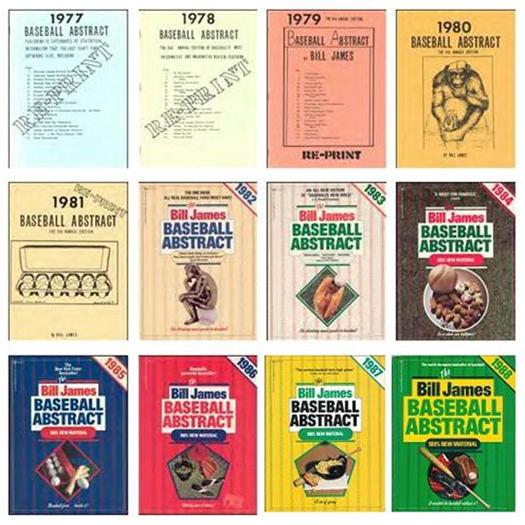
The Baseball Abstracts grew in size and stature over the years. From a one-inch classified ad placed in the back of The Sporting News in 1977 to a publishing contract with Ballantine Books five years later to earning a regular spot on the New York Times bestsellers list every year, the Baseball Abstracts became an annual staple eagerly awaited each spring by the multitude of James' loyal readers.
An English major, James has a unique writing style that combines numbers and prose in a manner that make his essays clear, informative, and fun to read. To call Bill a statistician is a misnomer. He is a writer who took on the challenge of debunking baseball's conventional wisdom through the use of statistical evidence. At times, Bill may have felt as if he was the lone voice in the wilderness but there were a number of prominent early readers who were paying close attention, including current Boston Red Sox owner John Henry, who hired James as the ballclub's Senior Baseball Operations Advisor in 2002.
In what I view as the culmination of my "Abstracts From The Abstracts" series, I had the distinct honor and pleasure of interviewing Bill on Sunday, December 12, 2004 during the Winter Meetings in a restaurant at the Anaheim Marriott Hotel.
The following is the first in a three-part series of the conversation that took place at our two-hour breakfast on the third and final day of the meetings.
RL: I was curious how you originally came up with the idea of writing the Baseball Abstracts?
BJ: I didn't understand how difficult it was to do this. It actually started spring of '75 or '76 when I bought a stack of preseason baseball annuals. I was working my way through them and realized that there were guys writing these who didn't know more about it than I did. I thought, "I could do better than this," with no understanding of the difficulty of finishing the book and getting it published.
RL: How did you come up with the Baseball Abstract name?
BJ: All of the good names were taken. Digest, Guide, Register and Preview...so that was all that was left.
RL: Good choice. It has been reported that you sold about 75 copies of the 1977 Baseball Abstract.
BJ: I know that's been reported forever. That sounds reasonable but it's been so long ago, why would I remember?
RL: Is it true that you made less than $100 in profits selling those books?
BJ: I'd be surprised if I made any money at all.
RL: What kept you going from one year to the next?
BJ: Well, I did the second one because I didn't do a good job on the first one. The first one I had an idea of what I wanted to do, but I didn't get a lot of it done. So I thought if I started this earlier and worked harder on it, I could do more things.
While the Abstracts didn't sell big numbers, the other good things that happened in my career happened as a side benefit to the Abstracts.
RL: In the 1978 Baseball Abstract, you wrote if readers didn't like your work, their money would be "cheerlessly refunded." Did anybody ever take you up on that?
BJ: Uhh, it seems to me that somebody did.
RL: [shakes his head]
BJ: I'm almost sure that one person did.
RL: Shame on him. I bet that person wishes he had that book back. I was curious how you developed the "dot, dot, dot" style of writing used in the early Abstracts?
BJ: I don't think I developed that. I think I borrowed it. There were certain Sporting News columnists of that era who wrote the same way.
RL: I think your writing is as fun to read today as it was 27 or 28 years ago. One thing you pointed out in 1978 is the notion that "the final test of any statistic is whether or not it correlates with winning."
BJ: I might state it a little bit differently. The value of a statistic is whether it's tied to winning. There may be valuable statistics that don't correlate to winning because the correlation is hidden. A lot of people, who don't understand what we do, think that it's just measuring individual glory. What we're trying to do was change the way we looked at statistics, so instead of measuring individual glory they measured contributions to winning. That's always what I've been trying to do.
RL: You also mentioned that "any statistic the meaning of which can be expressed in understandable terms in a common English sentence is always to be preferred, other things being equal, to one which cannot."
BJ: Right.
RL: I think that holds more true today than ever given the number of complex formulas that have been created.
BJ: That is true. There are actually a lot of stuff that loses me and I don't know whether it loses me because I'm just not following the math or it loses me because someone failed to say what it is they are actually measuring. But if we don't know what it is you are actually measuring, then I'm kind of lost.
RL: In the 1979 Baseball Abstract, the text was copied on both sides of the paper for the first time.
BJ: [in a facetious voice] We progressed that year.
RL: You indicated that it was remarkable you had "so little company" back then.
BJ: Is that right? I didn't realize that.
RL: Do you remember who the others were back then?
BJ: There may have been a couple of people doing similar stuff that I didn't know. The only people I knew that were doing anything vaguely familiar were Pete Palmer and Dick Cramer. Otherwise I didn't really know anybody who was doing anything similar.
RL: You said there were "two essential offensive statistics: on-base percentage and advancement percentage"...
BJ: Right...which closely ties into slugging percentage. But that's right.
RL: Similar to Branch Rickey's way of looking at slugging, right?
BJ: That's correct.
RL: You developed Runs Created for the first time. Do you think Runs Created has made any significant advances since then or is that original definition close enough?
BJ: The more sophisticated versions are better and are probably worth the trouble figuring them out, but the basic formula still pretty much works.
RL: Do you think today's version of Runs Created, which includes hitting with runners in scoring position, is a more retrospective way of measuring contributions rather than a prospective way of determining value?
BJ: Stats are backward looking by nature. That is one of the limitations of them. One might be able to step from the stats to an assessment of the skills in a more pure form. It's debatable whether there is an ability or a skill involved in hitting with runners in scoring position so at that point, you might cut that off. As long as you are simply dealing with what the stats mean, they are always backward looking. The danger is that because stats are backward looking, if you're not careful, you could be the last person to see something.
There may be a pitcher who adds a pitch and the scout may see immediately that, wow, that pitch looks good and it's going to make him into a totally different pitcher. But, if you are just looking at the stats, you won't see that until two years later when the value of it has gone...so there are some situations in which you need to be aware of that.
RL: You brought "park illusions" to the forefront that year. I knew there were differences from ballpark to ballpark but never realized the magnitude of those differences until I read your work.
BJ: Well, Pete Palmer was certainly ahead of me at that time. It is surprising how far back some knowledge of that goes. Rob Neyer and I started noticing when pitchers became aware of what can now be called "the Colorado effect." As soon as the Babe Ruth era began, it was very apparent pitchers in Salt Lake City and other high altitude towns were very aware of that right away, so park effects have been around for a long, long time.
RL: In the 1979 Abstract, you noted that Rod Carew once swung at two pitches when he was being intentionally walked, trying to get the pitcher to throw him something he could reach. Do you think that is a strategy Barry Bonds could employ today?
BJ: I don't know. I would argue about it this way. If it is genuinely advantageous for the defense to intentionally walk Barry Bonds, then logically it has to be defensible for Bonds to swing at one or two pitches to try to negate that advantage and try to tempt them into throwing him a pitch. On the other hand, if hitters never react by swinging at pitches to try to stop the opposing team from intentionally walking them, the implication is that the offense always agrees to accept it even though the defense thinks the walk is helpful, which seems somewhat illogical.
RL: Do you think if Bonds swung at a pitch or two that pitchers would then decide to pitch to Barry by virtue of being ahead of him in the count?
BJ: No, in the case of Bonds, probably not. I suspect if number eight hitters in the National League, for example, swung at a pitch or two, the pitcher would decide to try and get him out. In the case of Bonds, it's black and white. His walk totals have become surreal because of a blanket decision not to pitch to him with men on base. I'm fairly confident that the blanket decision would automatically cover the situation where he was hitting 0-2 just as much as if he were hitting 0-0.
RL: Moving to the 1980 Baseball Abstract, you defined sabermetrics for the first time.
BJ: Is that right?
RL: Yes, you said sabermetrics is "the mathematical and statistical analysis of baseball records."
BJ: And not a very good definition. My wife bought a dictionary recently and I pulled it out to check to see if sabermetrics was in there, which it is, but the definition is even worse. They defined it as "the computerized use of baseball statistics" or something. It's an awful definition because computers don't have anything to do with it.
RL: Well, as long as they didn't attribute that definition to you, then maybe it's OK. [wink]
On that subject, in the 1981 Baseball Abstract, you said "good sabermetrics respects the validity of all types of evidence, including that which is beyond the scope of statistical validation."
BJ: I'll be darned. I'm glad to know I wrote that back then. In the wake of Moneyball, some people have tried to set up a tension in the working baseball community between people who see the game through statistics and scouts. There is no natural tension there. There's only tension there if you think that you understand everything. If you understand that you're not really seeing the whole game through the numbers or you're not seeing the whole thing described through your eyes, there is no real basis for tension and there's no reason for scouts not to be able to talk and agree on things.
RL: Conversely, you indicated that "bad sabermetrics attempts to end the discussion by saying that I have studied the issue and this is the answer."
BJ: That's one I'm still committed to.
RL: Do you still see bad sabermetrics out there?
BJ: Yeah. One of my failings is that I can't keep up with the discussion very well. My justification for it is that I grew up in a world in which nobody was doing this type of baseball research and the only person who was working on the issues was me. I was 40 years old before there became to be an established community of people working on the issues. I never established a habit of following the rest of the discussion. I often wished I did.
RL: Now that you're with the Red Sox, do you find that you have less time than before staying abreast of the developments within the sabermetric community?
BJ: I don't have the time and sometimes I think I'm wasting time studying something that probably someone else has already studied or someone else knows more about it than I do. Nonetheless, I don't know where the research is and I'm not in the habit of looking through it.
RL: In light of the Red Sox World Series victory this year, I thought it was interesting that you wrote in the 1981 Abstract "the lion's share of championships have been won by teams which play in pitcher's parks." Do you think that still holds true today?
BJ: I think it is true. I think there are special challenges to winning a championship playing in a hitter's park. If you look at the last few years, I'm not sure. I mean, Arizona is obviously a hitter's park and they won a championship. But you got Anaheim, Florida, and several with the Yankees. I think it's still possibly true.
[We take a break to visit the buffet line.]
Be sure to check back tomorrow for Part Two of my exclusive interview with Bill James.
[Additional reader comments and retorts at Baseball Primer.]
| Baseball Beat | February 24, 2005 |
Day Three: "Who Was Your Favorite Player Growing Up?"
Part Three of a Three-Part Series
Today's column concludes the opening series of the launch of the Baseball Analysts. We would like to thank all of our guests for their time and participation in what has turned out to be a fun discussion of a very popular and dear topic to all of us baseball fans.
Interestingly, only three players received more than one vote out of a total of 39 respondents. Carl Yastrzemski was named as the favorite player five times. Tim Raines won the hearts over three participants -- all of whom grew up in Canada. And Tom Seaver was the number one choice by two New Yorkers.
Boston Red Sox players gathered ten votes, while the New York Yankees and Chicago Cubs had five each. The New York Mets and Los Angeles Dodgers had four apiece, and the Montreal Expos three (thanks to the "Rock"). The only other team that had more than one pick was the St. Louis Cardinals with two.
At the risk of small sample size, it comes as no surprise that the list of teams -- with the exception of the now defunct Montreal Expos -- are pretty much the most popular ones then and now. Geographical biases were even minimized. There was a cross-section of west and east coast respondents as well as those from the midwest. Why else would I ask Bill James to participate in such a poll other than to get some balance in this survey?
With that, we'll start off Part Three with one of Bill's neighbors. You go, Joe.
"I remember listening to the home run on the radio, against Steve Stone, wind-blown, just fair over the right-field wall. My recollection is that Herb Score, the announcer said, 'Fly ball to right, it has a chance, is it foul? No, it's gone. Home run.' He sounded as surprised as I felt. My favorite call for Kuiper though was Joe Tait's, 'Grounder to second. Kuiper bobbles, gobbles, picks it, throws it, gets it!' I also remember that Kuiper's jersey was always dirty."
I asked Joe if he had ever come into contact with Kuiper. "Amazingly, no. I know Duane is a broadcaster in San Francisco. But I've never met him. My football hero was Brian Sipe and my basketball hero was Austin Carr and I've never met either of them. Maybe I'm avoiding them -- who wants to be disappointed?
"I don't have any special memorabilia of Kuiper's, but I do have a Jim Kern autographed baseball. Jim Kern was my very first autograph. I remember he had to go back to the dugout, and I pleaded with him and cried, and he came back and signed. Unfortunately, I was about eight years old, and I didn't know you shouldn't have people sign with pencil. By the time I got back to my seat, I couldn't even SEE his autograph. It broke my heart. Many years later, I wrote the story, and a Royals marketing guy got me a baseball signed by Kern. It says: 'Joe, here's your autograph. Stop whining. Jim Kern.' I cherish that ball."
Rapoport remembers "that it appeared he might be a big star, but it didn't work out that way. A good lesson for a young boy to learn." Ron never came into contact with him nor collected any baseball cards or autographs of his favorite player.
What made you like him, Tracy? "He was left-handed and was versatile. He'd pitch in relief or start in the outfield. I remember his versatility the most. I got his autograph in the bullpen at Chavez Ravine."
Rosenthal remembers "his great catch in the '69 World Series" the most. He never came into contact with Swoboda and doesn't have any special memorabilia of him. "But I was a HUGE autograph collector as a kid -- had more than 1,000. I would write letters to players on every team. The Orioles and Mets were both good about sending autographed pictures back, as I recall."
Is there anybody out there who can say they never wrote such a letter to a player? I remember writing to Johnny Bench during the summer of his first MVP season. I think I still have the carbon copy of the typed letter I sent. That means more to me than the black and white photo with the facsimile signature that I received back in the mail.
What do you most remember about Billy Buck, Christian? "He had bad knees, hit for a high average, and rarely struck out."
Did you ever come into contact with him? "No, but I was at the game in 1989 when the Cubs moved into first place for good, and sat down the left field line at Wrigley with a guy whose name was Bill Buckner."
Do you have any special memorabilia? "Nope. Used to have an autographed baseball, but lost it in the fire."
"Yaz seemed like a quiet, classy fellow who took his craft seriously. I admired that." Did you ever come into contact with him? "Not as a kid. I have interviewed him several times as a journalist, though.
"I collected baseball cards pretty seriously as a kid in the early '80s, and made sure to have all of his cards, even his rookie card, which was pretty expensive. I still remember buying it for $47 and having it complete my collection."
"Don't remember why with Chambliss...the only resemblance to me as a player was that we both batted left-handed. I remember him as a classy, quiet guy on the late 1970s Yankee teams. I can still remember the night he was traded to the Blue Jays.
"Mattingly...I can remember latching onto him even when he came up at the end of '82, and wanting him to get more playing time in '83. He just screamed 'hitter,' and I would eventually adopt his crouch at the plate.
"Both were the quiet centers of some very turbulent Yankee teams. Mattingly always seeming to come up with a big hit when we needed one (even though I know now that's a memory trick). His explosiveness out of the crouch, before the bad back ruined him."
Asked if Joe had met either player, "No, not yet. Saw Chambliss at the winter meetings, and just couldn't go up and say, 'hi.' I was never a collector, but I do have a couple of framed Mattingly pics in my office -- including this 'Hit Man' poster from his peak. And Sophia got me an autographed baseball for our anniversary a few years back."
Now that is an understanding wife. Let's just hope that Joe didn't give her a Chambliss autographed baseball in return!
"I remember the diving catches the most. . .he made about 500 of them his rookie season. And he used to spray the ball off the wall. It's funny, I remember nothing about actually seeing him play other than his 3-HR/10-RBI game in Detroit, which I vividly remember for some reason."
Did you ever come into contact with him, Bill? "Yes. I met him at All-Star Weekend two years ago. Wrote a whole column about it."
Do you have any special memorabilia? "Yeah, I keep his rookie card in my wallet (the one when he was Topps All-Rookie). . .it's been in every wallet I've had since I was 16, like a good luck charm. He autographed it for me in Chicago and was genuinely flabbergasted when I pulled it out of my wallet. I've been afraid to take it out of my wallet for 15 years because I didn't want to anger the Karma Gods. So I left it there. It's in TERRIBLE shape."
I can relate to Bill's story. I have a 1959 Jim Gilliam baseball card that was torn and so heavily taped that I felt an obligation to keep it. I think that particular card meant more to me as a kid than a perfectly centered card with four sharp corners.
"Simply put, his name is synonymous with power. It will be hard to ever forget the highlight of him hitting a baseball over the rooftops at Wrigley. That and his face during his stance. The latter still gives me shivers."
Did my partner ever come into contact with Hill? "No, but I'd definitely like to thank him for getting Candy Maldonado out of dodge."
As far as special memorabilia goes, Bryan told me, "Not really, but I do have a Bo Jackson autograph. And it's quite possible no human has ever seen both players in the same room at the same time."
"I pretty much became a baseball fan when Seaver was first promoted to the majors, and he seemingly made the Mets contenders single handedly. The psychological transformation of the Mets from losers to winners was incredible, and he was credited with being the guy who wouldn't settle for losing anymore. One of my favorite all-time baseball memories is the near no-hitter he threw against the Cubs in 1969 (the one Jimmy Qualls broke up).
"Clemente was just amazing to watch. Grace on the field. Awesome arm. Great hitter. Always dignified. I just loved seeing him on the field and watching him play. I lived in West Virginia from 1969-1973 and watched the Pirates all the time. Casey Stengel was Casey Stengel. Say no more.
"Besides the Qualls game, I most remember Seaver's RC Cola commercials with Meredith McRae (the blonde from Petticoat Junction), with Seaver singing. He couldn't sing, but who cared? Meredith McRae! Remember, I was an adolescent at the time. I have no specific memory of Clemente. My respect for him is based on the impact he made every time he stepped onto the field.
"I think you know that Cooperstown is like a second home to me. Spent all my summers there, etc. My Dad was having lunch at the Otesaga one day (with Ed Stack, the Director of the HoF at the time) when he saw Casey Stengel eating lunch at a table. Knowing I was a huge Met fan, Dad asked Ed if they could get Casey's autograph for me. They went over and asked him and he graciously signed the Otesaga lunch menu for me: 'To David, Best of Luck, Casey Stengel' That is my most prized baseball possession."
"To the extent that I believe in clutch hitting, Tim Raines was the clutchest player of all time. Well, my lifetime anyway. He was forced to sit out until May, and I was watching his first game back, against the Mets, on the Game of the Week. And he took over the game. At bat after at bat, he was getting better and better, to cap the game with a grand slam in extra innings. Vin Scully was in awe at the end of the broadcast, the way he sounded with Kirk Gibson in the World Series in '88.
"And Raines just kept going that week. In his first four games, he came to bat 20 times, got on base 11 times, with 3 HR, 8 runs, 7 ribbies, and just two steals. And, of course, that great All-star game, won by Raines. He ended that year with 26 IBB, even though he missed one month. Late in the season, I remember how teams would constantly give him the 'unintentional intentional' walk.
"He was to me what Barry Bonds is to today's fans. A guy so feared by other teams, but who other teams did not want to admit their fear so blatantly, that they would throw pitches a foot outside, even though they knew this guy was the smartest hitter around and would not be fooled. I'm sure I can't prove any of this clutch stuff -- and that most of my research tries to separate (though recognize) the human element from the results -- but in the case of Raines, I don't care. My bias on Raines has been shaped growing up in Montreal as a teenager, and that's the way I like to keep it."
"I remember the famous drop-and-drive pitching motion, which came to be mimicked often in whiffle ball games."
When I asked Tom if he had ever come into contact with Seaver, he responded, "Several times. First, I met him outside the Mets clubhouse after a game around 1969. Later, as a baseball writer, I saw him at the 1986 World Series when he was with the Red Sox, some time later when he made a brief comeback try with the Mets, and now in his role as a broadcaster.
"The poster that hung in my room is long gone. I have several Seaver baseball cards, but that's because I've kept all the cards I collected as a kid."
"One of the first packs of Topps Baseball Cards I can remember opening (from Herman the Germans' Grocery Store circa '59-'60), I pulled a Mantle card. It was the only name I sort of recognized, seeing that I wasn't hep to the underground coolness vibe of a Vito Valentinetti just yet, so I showed it to my pop and asked him about this Mickey Mantle. My Red Sox lovin' dad said, 'Haa! Mickey Mental. He's no Ted Williams!'
I'll let Darren, the man known to Primates as Repoz, tell us if he ever came into contact with Mantle. "A few times at the Yankee Stadium's penal institution holding cell -- known as The Kinney Parking Lot. His good looks in bad clothes, the command in his voice as he shooed us away, the swiftness in which he rolled up his window on us kids, the deftness in which he avoided the gravity adjusted beehive hairdo jabs of his wife Merlyn, the manly handling of his flashy Cadillac as it screeched into the unlit Bronx with kids hanging on like strung-out wedding cans -- it all added to his mystique.
"I used to have a full-length Mantle poster on my closet door in the early '60s, until my evil brother (Marvel over DC, Pepsi over Coke, Beatles over Stones, Curly over Shemp, Sonny Fox over Chuck McCann, Boys over Girls, Education over Beer, Collecting Tropical Fish over Baseball Cards) saw fit to tear it up one summer day. Did you know that an orange Elston Howard batting donut will cause an attached plastic guppy hatchery to completely sink!! Neither did I!!
"But I still have my 'Deep Well, Action Anchored Web, The Finest in the Field,' Mickey Mantle Rawlings MM5 glove from 1961! Of course, it is now held together by staples, shoelaces, Wonder Bread tie twisters, a 24-gauge wire running through it -- and undying faith. It has now taken on all the allure of my 6th grade honey, 'Face-Braces' Sherri Ann Peterski -- wadda sight!"
"Pedro was perhaps the first real prospect I was aware of rooting for before the major leagues, and then actually coming up and making it, and making it big. And boy, could he hit. I didn't care that he couldn't field, because he could just mash. And he never really got the respect that he deserved, I don't think -- except from Bill James."
As far as memories go, Jon recalls "lots of things. I can still remember a picture of him in the paper as a rookie at second base, of all places. He had a great World Series in 1981, which James explained should have earned him the World Series MVP by himself. I vividly remember the excitement of his 15-homer month in June 1985. I can remember him wrenching his back in the process of hitting a home run, and taking so long to struggle around the bases that Vin Scully speculated in the middle of his cringing home-run trot whether they would bring in a pinch-runner.
"I can remember the little finger-wiggle he would do for his wife in the stands after he crossed home plate following a homer. He was generally a happy guy on the field in my memory. I remember how devastated I was when he broke his ankle in Spring Training '86. He had one more great year after that, but then got traded for John Tudor in the middle of the Dodgers' 1988 season, before the World Series.
"The whole thing with his drug arrest and then getting off because of his low IQ -- it was depressing, and I had trouble believing it, or at least didn't want to."
Jon hasn't had any contact with Guerrero, but he has something to remember him by. "The Dodgers put out a commemorative poster in late 1985 to celebrate his 15-homer month, which I believe was then a record but no longer. I believe the poster is rolled up and in a tube somewhere in a closet with other posters from my youth."
Ahh, rolled up posters. I bet all of us have at least one of those lying around a closet or up on a shelf or in a box in the garage. Let's face it, nobody wants to dismiss their childhood heroes and memories. Favorite player growing up? Hmmm. Have any of us really grown up yet?
[Additional reader comments and retorts at Baseball Primer.]
| Baseball Beat | February 23, 2005 |
Day Two: "Who Was Your Favorite Player Growing Up?"
Part Two of a Three-Part Series
All of us had a favorite player when we were growing up. It is as natural to a young kid as Carl Yastrzemski's batting stance was unnatural. In Part One, our man Yaz took home MFP (Most Favored Player) honors, capturing the hearts of three of the ten respondents. Although his batting average among yesterday's guests was better than his .285 lifetime average, it's more the exception than the norm that numbers play a big part of who we choose as our favorite player.
Yesterday's article drew nearly 200 responses from readers at The Baseball Think Factory's Baseball Primer discussion. In addition, it was the inspiration behind a column written by Fred Claire, who is also one of today's guests, and published at MLB.com and Sportsticker Baseball Notebook at Yahoo! Sports.
The following questions were asked of each of our participants in the three-part series:
1. Who was your favorite player when you were growing up? 2. Why? 3. What do you most remember about that player? 4. Did you ever come into contact with him? 5. Do you have any special memorabilia (baseball card, autograph, etc.)?
As was the case in Part One, the cast of star-studded respondents will be provided in alphabetical order. With that, it's now time to listen to our guests as they stroll down memory lane.
"I never had a chance to see Stephens play and didn't make my way to Fenway Park until 1968 when I joined the Long Beach newspaper. Your father was covering the Dodgers at the time. When we went to Boston on that first series we were met by two or three days of rain, but I took a walk to Fenway and saw Bobby Doerr entering the park. All of the Red Sox of the late 1940's and early 1950's were great with Doerr, Johnny Pesky, Dom DiMaggio, Al Zarillia, Williams, Walt Dropo, Mel Parnell, Ellis Kinder, Williams, etc. . .but it was Stephens who was my favorite.
"I never met Stephens but I was working the desk at the Long Beach paper one night when word arrived that Vern had passed away. I was assigned the task of writing his obituary. I have no special memorabilia of Vern Stephens but memories of a favorite player as a youngster growing up in Jamestown, Ohio. I later wrote a column about the Red Sox and received a nice message from a member of Vern's family. When we love baseball, many paths seem to cross."
"Yastrzemski was already legendary among Sox fans by the time I caught up with him. I think the fact that he was almost as old as my Dad and still playing stuck in my head." Jon never came into contact with his favorite player admits to "sadly" not having any special memorabilia of Yaz. "My brother won an autographed ball for guessing the date of either his 3000th hit or 400th home run, but I don't know what happened to it."
The reason Walt liked Kessinger so much is the same he gave in response to what he remembers most of his favorite player. Davis never met the Chicago shortstop and doesn't claim to have a piece of memorabilia that stands out.
"I'm sure I had his baseball card at one point but have never been into autographs and such and the cards are long gone now. My only remaining piece of memorabilia is the game ticket and pin from Barry Bonds's 600th HR game (boy did I take a trip to SF on the right day). Of course with all this 'roids stuff, they're probably worthless now."
Sean remembers "Rickey's stance and all the doubles Boggs hit" more than anything else. He never came into contact with either player, "but I was at the game where Henderson walked and scored a run. I wished that he had stolen a base, so I could say that I saw the walks, stolen bases, and runs scored record all be set on the same day."
"My other favorite was Herb Score, Sandy Koufax before his time. Even though I was righthanded, I would emulate his delivery for hours against a wall. Yes, I was listening the night he got hit in the eye, and my house was on Score watch for days. Naturally, I did get to know him as a broadcaster for the Indians, ever the gentleman. In 1991, I asked Ted Williams to name the best lefthanded pitcher he ever faced. 'Herb Score,' he answered."
What Gunn remembers most about Tudor was "during Game 7 of the 1985 Series, Tudor had just gotten hammered for five runs and would eventually end up the game's losing pitcher. He stormed into the clubhouse, punched an electric fan, sliced open his hand, and had to be taken to the hospital. It was a sad end to an otherwise great season in which he went 20-1 with a 1.37 ERA and 10 shutouts after June 1st. Those shutouts were something else -- the most in baseball by any pitcher since Bob Gibson in '68. It was really a sight to behold -- game after game he'd get that big loopy changeup over for strikes.
"I also vividly remember Tudor's performances against the Mets that year. He had a 0.93 ERA in six starts against the Cards' arch rivals, including two games down the stretch where he gave up no runs in 10 innings. The first one was in Shea, won by Tudor and the Cardinals, 1-0 over Dwight Gooden. The next was in Busch, won by the Mets when Darryl Strawberry hit a gargantuan laser off the stadium scoreboard in the 11th inning -- a blast so ferocious that it stopped the clock at 10:44.
"I heard him on KMOX radio last year during the broadcast of a Cardinals game, and he sounded as pleasant as could be. Part of me wanted him to be more like J.D. Salinger -- a cypher living in the woods of New Hampshire, burdened by Calvinist guilt or something."
What about a piece of special memorabilia? "I've got his Topps baseball card from 1985 right next to my desk."
You've got to love that. So simple, yet so special.
"That look skyward at the top of his pitching motion is what I remember most about Valenzuela, that infectious smile, the gritty 150-something pitch complete game in the '81 Series, and of course, Fernandomania!"
Jaffe never met Valenzuela but "wrote Ron Cey a letter as a classroom project in '81. I did get to take a picture of Fernando at Spring Training '89. I've got several cards of them all, but it's Fernando who takes the memorabilia prize and probably the overall crown as well. I have his bobblehead and this past winter I bought a customized Dodger jersey with his name and #34 on it. I did get it in my size, so there's no need to put on the extra pounds to fill it out.
"During his rookie season, I had a scrapbook of sorts for Fernando. I cut out the box scores and taped them into a notebook, adding up his cumulative stats. I'm not sure I made it through the whole season doing that, and haven't seen the thing in over 20 years."
"Minnie played the game with vast enthusiasm and a childish disregard for caution. Ball bounced away from the catcher with Minnie on third, Minnie was coming home. He might be out, he might be safe, but he wasn't staying on third and watching. . .
Asked what Bill remembers most about Minoso, "Well, gosh. . .among a million things, I remember discovering that he was really good. I 'adopted' him based on his smile and his headlong manner. It was later, when I got into baseball cards, that I realized that he was actually good."
Did you ever come into contact with him? A one-word answer does the trick. "Nope." Special memorabilia? "I have a lot of junk."
"I remember, on a general level, his amazing speed. But more than that, the fact that he never got caught. If he got on base in the late innings with the Expos down one, you knew you'd soon have a runner in scoring position. You knew.
"As for specific memories, the game that stands out for me is this one. Because of collusion, Raines couldn't get a sniff on the free agent market. So he became the rare elite player forced to sit out the first month of the season. His first game back, May 2, 1987, he put on one of the most dominating performances I've ever seen. In six trips up he reached base five times, with a walk, two singles, a triple and a home run. The home run? A game-winning GRAND SLAM in the 10th inning off Jesse Orosco to win it 11-7. I was 12 years old at the time, and just remember jumping around my grandparents' living room, where I watched so many games growing up. I still remember that game vividly.
Jonah hasn't met Raines. "Although I became a sports writer of sorts -- including a brief stint in the sports department of the local paper (Montreal Gazette), I never covered the Expos in an official capacity. Actually I did one time, in an exhibition game in Washington, D.C. vs. the Cardinals, but I mostly just hung out in the press box and sneered at Bill Collins and the rest of the cold-hearted bastards who wanted to move the team to the D.C. area, out of Montreal.
"Never been a huge memorabilia guy, so nothing that stands out. My biggest souvenirs are literally souvenirs -- the memories of all the great games I was lucky enough to see over all those years in Montreal."
"I loved to play baseball when I was a kid and I had (unrealistic of course) dreams of being a big-leaguer. Even though I was a pretty good athlete and baseball player, I couldn't relate to most of the "jock types." Staub was someone I could relate to. He didn't look like the classic ballplayer, with his red hair and cherubic, freckly face. Like I said, he appeared to be a cerebral player, which gave me something else to relate to. Plus, my mother has red hair!
"I don't know what ever happened to him. I vaguely recall that he opened up a restaurant a long time ago. Other than that, although he seemed like he could be manager material, after he retired, I never heard a thing about him. If I recall correctly, he was a pretty darn good hitter, at least for a while in his career, although I never have looked at his career stats with my now highly trained and skilled sabermetric eye!"
"I met him at the winter meetings in Anaheim last year. I shook his hand and told him I was his biggest fan in New York. He seemed pretty cool with that despite all the crap Steinbrenner gave him when he was there.
"I never got an autograph from him directly, but a buddy of mine saw him years ago in Washington D.C. at the Capitol Building and had Winfield sign a D.C. map for me. I still have that. I have a bunch of his cards, too."
"I don't know why you like a guy, really. Some of it's performance and circumstance (he had good years when I was 10 and my baseball head and heart were really coming alive then), and some of it's a feeling. I had a feeling for him, that's all I can tell you."
Regarding what Eric remembers most about Lopes, "You mean after the mustache? Give me Game One of the 1978 Series, when he hit two out and drove in five.
"I never met Davey as a kid, but I did get to talk with him while working on a Khalil Greene story last spring. He was funny and gracious, I was a giggling, awestruck kid. It was perfect." As far as special memorabilia goes, "I've got my eye on a retro jersey even as we speak."
Retro jerseys, Retrosheet, and don't forget, Rico Retrocelli.
"I spent a few of my childhood years in Minnesota and North Dakota. I didn't care much about the Twins, probably because they weren't all that good. But Carew was one of the more famous players in the game, so it was easy to latch onto him.
"I remember reading an article about him, in which he talked about using some sort of weird tobacco/gum combination to make sure his right eye stayed wide open."
Rob has never come into contact with his boyhood idol. "When I was eight or nine, though, I did send him a letter asking for an autograph, and some months later I did receive a signed photo (though if actually signed by Carew, I don't have the slightest idea). I still have that photo, somewhere.
"I have a few things, collected over the years even though I don't really think of myself as a collector (yeah, they all say that). There's only one thing I really care about, though: a late-1940s National League baseball, signed by Stan Musial and Whitey Kurowski for my grandfather during a hospital visit. If my house is burning up, I grab my computer and my Stan Musial ball."
"I remember when my dad bought me my first Tiger yearbook in 1972, there was a black and white photo inside of Rodriguez and his new bride, Maria. I didn't want to rip the page out, so I used an old instamatic camera and took a picture of that picture, and taped it to the wall beside my bed. Years later, in 1999, I covered the final game at Tiger Stadium, and Rodriguez was one of the ex-players who came back for the affair. I sought out Rodriguez, who attended the game with his teenage son. I told him I used to keep his wedding photo beside my bed. Speaking over the laughter of his son, I asked him, 'Is Maria still beautiful?' I thought his son was going to pass out. Aurelio said he couldn't wait to get home and tell Maria that she had a fan (or a stalker).
"That was the last time I ever saw him. Less than a year later, while he was in Detroit for a memorabilia show, Rodriguez was struck by a car and killed while walking with a friend. I remember seeing the bulletin come across the Associated Press wire and feeling like I'd just lost a family member.
"About eight years ago, I won an auction for a cracked bat that Rodriguez used as member of the Yankees late in his career. I eventually sent it away to a memoriabilia show where Rodriguiez was a guest, and he signed it for me. When the bat came back I noticed a difference in the way Rodriguez wrote the "A" in his first name -- from a rounded "A" in the autograph he sent when I was a kid, to a pointed "A" on the bat. I asked him about that when I met him at Tiger Stadium, and he said he couldn't remember when his signature changed -- but he seemed impressed that I even noticed. As I was leaving he gave me his address and asked me to drop him a line sometime. I felt like a kid again. Unfortunately, the only time I used that address was to send condolences to Maria.
"I've heard (and repeated) many times that you don't want to meet your heroes bacause they will disappoint you. But I won't ever forget the day I met Aurelio Rodriguez. To many baseball fans, he is just another name in the Baseball Encyclopedia, but he will always be a legend to me."
And isn't that what a favorite player is all about?
"The backflips before each game, which, for me, set the tone as 'let's have some fun today.' His left-handed home run off Niedenfuer in the Game 5 of the '85 NLCS was, for me, probably the happiest moment of an otherwise miserable 7th grade year. We also once took in a stray cat, and I named her after him.
"Never had the honor of meeting him, although I did once eat at his largely forgettable restaurant in suburban St. Louis.
"I have a few of his Topps cards, and I have an 8x12 glossy of him that they gave out before a Cardinal game one time. I insisted that my mom frame it for me, and it still hangs on the wall in my room back home."
"I liked the way he blocked the plate, especailly compared to Carlton Fisk. Munson would use his whole body to take on runners trying to score. Fisk would stick his leg out and get it broken.
"When we played strat-o-matic with the 1979 cards, we had a special rule that allowed Munson to die. I had him on my team anyway, and I still have his 1979 strat-o-matic card."
Not even death do us part.
Tomorrow (Part Three): Joe Posnanski, Ron Rapoport, Tracy Ringolsby, Ken Rosenthal, Christian Ruzich, Alan Schwarz, Joe Sheehan, Bill Simmons, Bryan Smith, Studes, TangoTiger, Tom Verducci, Darren Viola, and Jon Weisman.
[Additional reader comments and retorts at Baseball Primer.]
| Baseball Beat | February 22, 2005 |
"Who Was Your Favorite Player Growing Up?"
Part One of a Three-Part Series
The first of my favorite players when I was growing up was a relatively obscure player by the name of Bob Lillis. My attraction with Lillis began in 1960 or 1961 when I set eyes upon his Bell Brand potato chip baseball card. It was from a regional set featuring the Los Angeles Dodgers. The card itself was very colorful, especially for that era.
The photo was taken at spring training in Vero Beach the previous year. I can still picture Lillis straddling second base, holding his glove out awaiting a throw with a beautiful blue background that is as vivid today in my mind as it was 45 years ago. I loved the card so much that the two of us became inseparable. Me and my Bob Lillis card. Well, that's the way things were at least for a while.
You see, I lost that very card waving it outside the backseat window of the family car while my Mom was driving us to and fro. When I let out a cry, my Mom looked back and asked me what was the matter. I told her that the wind blew the card out of my hand. Like the good Mom she was (and still is), she pulled the car over to the side of the road so that we could retrieve it. However, the card was never to be found again. Well, maybe it was but not by a member of the Lederer clan.
My liking Lillis only deepened after he was traded by the Dodgers to the St. Louis Cardinals and then selected by the Houston Colt .45s in the 1961 expansion draft. Why? Knowing how much Lillis meant to me, my Dad took me into the visitors' locker room to meet the player who became the team's Most Valuable Player in its inaugural season in 1962. The handsome shortstop shook my hand, introduced me to several other players, and gave me a tour of the clubhouse.
Lillis sent me birthday cards and autographed photos with handwritten greetings on the back the next two years. Although I went on to favor Tommy Davis and Sandy Koufax during the mid-1960s, I always had a soft spot in my heart for the man whose baseball card I once latched onto and then lost.
When I interviewed Joe Posnanski (Kansas City Star) last month and learned that his favorite player growing up was another relatively inept infielder (Duane Kuiper), I began to wonder if it was more the rule than the exception to favor lesser-known players as opposed to stars. Who better to ask than a group of my favorite baseball writers?
Fifteen of the 38 respondents told me their favorite player growing up was someone who went on to become a Hall of Famer. One of those players was listed five times. Willie Mays? No. Mickey Mantle? Nope. Nolan Ryan, Johnny Bench, or Mike Schmidt? Not a single vote for any of them. The winner of the "Who was your favorite player growing up?" award is none other than Carl Yastrzemski. Dave Albee (Marin Independent Journal), Jim Baker (Baseball Prospectus), Jim Callis (Baseball America), Jon Daly (Baseball Think Factory), and Alan Schwarz (Baseball America) each named Yaz as their favorite player growing up.
I asked a talented group of writers, analysts, and baseball executives the following questions:
1. Who was your favorite player when you were growing up? 2. Why? 3. What do you most remember about that player? 4. Did you ever come into contact with him? 5. Do you have any special memorabilia (baseball card, autograph, etc.)?
Today, in the first of a three-part special, I am going to provide the responses in alphabetical order -- starting from the top with the letter "A" as in Albee.
"I finally met him in 1981 when I was a sportswriter for the Rockford (Ill.) Register Star and I went to a Red Sox-Brewers game in Milwaukee. I was so excited at the prospect of meeting him that I hardly slept the night before. I was 27 years old at the the time. Well, I approached him right after batting practice on the field at County Stadium and asked if I could speak with him -- and he walked right past me. Blew me off. Said he had to go inside and get ready for the game. I was crushed. That was my first introduction to big-time athlete looking down on small-time sportswriter. I didn't hate him for it. But I got a quick lesson in understanding how my business works.
"Don't have any baseball cards of him. All my cards wound up with clothespins being pinned to the spokes of my bike. Oh, well. They smelled good and they sounded good but they ultimately wound up in a landfill in Dover-Foxcroft, Maine."
"My first trip to Yankee Stadium was also courtesy of my mother's friend. She hooked us up with the Lehman box, which, as you can imagine, was very close to the field. So, she got me the autograph and then, the following season, put me in a seat about 20 feet from the Red Sox on-deck circle where I could see him up close. It's possible I would have ended up loving baseball just as much if these things hadn't happened, but you have to wonder. That was very powerful, formative stuff for someone that age."
Baker remembers Yaz's batting stance the most. "He would hold the bat up very high like Craig Counsell does only Yaz would get results. As I recall, several teammates emulated him: Reggie Smith and Joe Lahoud -- at least for a while. I didn't grow up in New England, but I would bet you there were countless Little Leaguers there who tried that stance and were chided for it by their coaches."
Jim never came into contact with his favorite player nor does he have any special memorabilia of him. "I have lots of collections of things but, after seeing pictures of Barry Halper's collection, decided that it was absolutely futile to even consider collecting baseball stuff."
Belth remembers "the controversy" surrounding Reggie the most. "I remember feeling a strong need to defend him all of the time. I was really too young to remember the three home-run game in the '77 series, but I do vividly recall his return to the Stadium as an Angel. Ron Guidry was pitching for the Yanks, and I think Jackson had singled and grounded out in his first two at bats before smacking a dinger off Guidry. The entire stadium rocked, chanting, 'Steinbrenner sucks.' I was watching on our 10-inch Sony Trinitron at home, running around the apartment like it was the best thing that had ever happened."
Alex never came in contact with his man. "My mom took my friends and me to the bleachers for a day game one year for my birthday. My friend Michael wrote a nasty placard about Jackson. He kept yelling at Reggie during warm-ups, and Jackson finally looked up, acknowledged the sign and adjusted his cup. That's as close as I've ever come. A dubious encounter indeed.
"I have some of Reggie's cards, none in decent shape. I have a baseball with Reggie, Dave Winfield and Bucky Dent's autographs that I won at a camp raffle one year. My favorite book as a kid was 'The Reggie Jackson Scrapbook.' It's long gone now, but one of those things that I keep on the lookout for when I'm in used bookstores. That was probably my most prized book of my childhood."
Blez would like to remember "the home run he mashed that almost made it out of the Skydome or his 40/40 season" the most but realizes "it will probably be steroid use now. Or the headbutt home run. He perfected that move."
Tyler never met Canseco. "Probably a good thing. He might've asked me to juice in the bathroom." Blez doesn't have any memorabilia of Canseco, but he has "a ton of Athletics memorabilia, from autographed baseballs to pretty much every stadium giveaway bobblehead they've had."
"The second was that he was a bundle of energy in the field and at the plate. He was a very hyper player and seemed much more athletic than some of the other Expos. The last reason, maybe the most important, was that Raines was a very small man. I was a small kid,
usually one of the shortest in my class, and Raines' success meant a lot to me. As time went on, and I stayed relatively small, it meant all the more, especially as he became one of the game's more feared hitters.
"I never really understood the drugs things until much later (I was a fairly naive kid in some ways). By the time I did understand what had happened, I was old enough -- and it was far enough in the past -- that I was able to forgive him. I have never met Tim Raines -- though one day I still hope to -- to tell him what he meant to me as a kid growing up. As for mementos, I have a few favoured baseball cards (especially his first "Rock Raines" card) and a little folded poster that came in a pack of O-Pee-Chee trading cards. But nothing else; I'm not a collector of anything except memories, I guess."
As far as whether Jim ever had contact with Yaz, he recalls having "interviewed him once when I was doing a story on Red Sox prospect Jeff McNeely, and Yaz was a guest instructor in spring training." Callis has no special memorabilia "though I still have all my baseball cards from when I was a kid (unless my mom has thrown them out)."
Three for six so far for Yaz. Sounds like 1967 all over again.
Jim remembers Willie's "basket catch" the most. "And this amazing catch he had against the Reds on Game of the Week when he crashed into Bobby Bonds. And how he homered in each of the first four games of the 1971 season. And how sad I was when the Giants traded him.
"I've often heard he's a miserable old man so I've limited my exposure. I've done some group interviews with him. I remember seeing him in the Giants clubhouse last spring or the spring before in Scottsdale and he was in such a foul mood that he gave an absolutely unapproachable aura. I remember thinking, how could this man I idolized possibly feel so miserable?
"My best friend gave me a baseball that Mays and Willie McCovey signed for him decades ago. It's one of the few baseballs I have signed by any player. But it wasn't signed for me, it was signed for someone else."
"I was standing on the field with Jon Sciambi, Len Kasper, and Al Leiter at Game 6 of the '03 NLCS (The Bartman Game) when someone walked up next to me. I did the little 'Oh, who's this' glance and it was Sandberg. Sciambi says I went white as a ghost and I know I didn't say anything."
Regarding special memorabilia, Will has "some cards, a jersey, and home run ball #201, signed."
As far as memories go, Alex asks, "Damon Berryhill? Did he have many great moments? I guess he had a good at-bat in some random playoff game with the Braves, but otherwise nothing stands out. I do remember his stance, though. He had a fat ass.
"I didn't come into contact with him in person but through letters. I wrote a bit about it in a blog entry a long time ago. In summary: I sent him a few hand-drawn portraits to have signed (I was generally too cheap to send cards), and he always sent them back with an autograph. Once he included a nice note, which was one of the highlights of my youth. My favorite pic of him was actually a three-portrait card I drew with Mark Grace and Rafael Palmeiro on the same page. One of these days I hope to track down Palmeiro and get his signature to finish the card."
From the obscure (Berryhill and Lillis) to the famous (Mays and Yastrzemski) to the controversial (Canseco and Jackson), when it comes to your favorite player, there is a place for them all.
Who was your favorite player growing up?
Tomorrow (Part Two): Fred Claire, Jon Daly, Walt Davis, Sean Forman, Peter Gammons, Brian Gunn, Jay Jaffe, Bill James, Jonah Keri, Mitchel Lichtman, Doug Miller, Eric Neel, Rob Neyer, Jeff Peek, Dayn Perry, and David Pinto.
[Additional reader comments and retorts at Baseball Primer.]
| Baseball Beat | February 19, 2005 |
Five and Ten Story
Mike DiGiovanna of the Los Angeles Times gets Jeff Weaver's take on the ongoing negotiations (or lack thereof) between his brother and the Angels.
Dodger pitcher Jeff Weaver said Friday that his younger brother, Jered, the Angels' first-round pick in the 2004 draft, was growing impatient with negotiations that have dragged on for more than eight months."We had similarities, but I had a different approach - I went back to school," said Jeff Weaver, who spurned a $750,000 offer from the Chicago White Sox in 1997 to return for his senior season at Fresno State and eventually signed with Detroit in 1998. "I know what it's like to wait it out. My brother doesn't want to wait."
Jered Weaver is seeking a package in the $10-million range; the Angels would prefer to pay something closer to $5 million.
Asked if Jered could just tell agent Scott Boras that he wanted to sign, Jeff Weaver said, "Absolutely. Your agent works for you � not the opposite."
The Angels' hardball tactics are obviously beginning to wear Jered down. He wants to sign and, in fact, was hopeful of doing so prior to the start of spring training. Despite previous comments to the contrary, the former Long Beach State ace is anxious to get on with his professional career.
Brother Jeff's comments are not a revelation to me. Three weeks ago, my source was told by a former player with ties to the Angels that Jeff had indicated to him that Jered was about to sign "any day."
Jeff could be doing his brother a big disservice by going public with his comments unless, of course, Jered is no longer interested in holding out for a contract much larger than what the Angels have been offering. Let's face it, if the Angels sense that the Weavers are growing impatient with Scott Boras and his $10 million asking price, they will stay firm at or near the $5 million area in the hope that Jered gets so frustrated with the proceedings that he winds up caving in to their low-ball bid.
Look, I still say there could and should be a middle ground here. Jered, either you can be had or I can be had as a mediator or an agent. I'm here to help.
| Baseball Beat | February 18, 2005 |
Mediator for Hire
This morning's Los Angeles Times article (Team, Weaver Are Still Far From Agreement) makes the Weaver signing more a matter of if rather than when.
Mike DiGiovanna quotes owner Arte Moreno as being "cautiously optimistic" about the chances of the Angels signing Weaver. However, it appears that the two sides are still millions apart. The Angels are stuck on the contracts inked by fellow first-rounders Justin Verlander, Philip Humber, and Jeff Niemann -- the second, third, and fourth picks in the June 2004 draft. Scott Boras, on the other hand, is set on getting a deal closer to the one signed by Mark Prior three years ago.
Boras made it clear before last June's draft what it would take to sign Weaver, a pitcher Boras has compared to Chicago Cub standout Mark Prior, who received a $10.5-million signing package out of USC. That's why so many teams with high picks shied away from Weaver, considered the top college pitcher in the draft.
(The Angels) would prefer to sign Weaver for something closer to $5 million, which is roughly what Rice University pitchers Philip Humber and Jeff Niemann, the third and fourth picks in the draft, received.
The Angels are at fault here given that "Angel General Manager Bill Stoneman called Boras shortly before the draft and asked what it would take to sign Weaver. After being told it would take something in the Prior range, the Angels used the 12th pick to select Weaver." As DiGiovanna asks, "Why did the Angels pick Weaver when they weren't ready to meet his asking price?"
Even Moreno can't answer that question.
"We had an opportunity to draft him, and Bill and Eddie [Bane, Angel scouting director] felt we could sign him," Moreno said. "He's a local kid, his brother pitches for the Dodgers, it was a great opportunity for him to pitch in his hometown � we focused on that."
As mentioned in my Weaver Update last weekend, "I don�t see where these negotiations should be as difficult as they have been. Given Boras� admission as well as the framework provided by the signings of Justin Verlander, Philip Humber, and Jeff Niemann, a contract somewhere between the one that Mark Prior signed and those inked by the above trio should be agreeable to both sides."
The failure on the part of Stoneman and Boras to reach such an agreement is troublesome, but I will be the first to admit that I am more upset with the Angels than Weaver's camp. As Scott told me at the Winter Meetings, the Angels have been "disingenuous" and, you know what, I agree. They never should have taken him in the first place -- at least not in the first round -- if they weren't willing to pay the asking price or something close to it.
I mean, if you listed your house for $500,000 and someone came along and offered $250,000, how would that make you feel? How would you feel if nobody else could even bid on your house for a whole year and you were left to negotiate a deal with that one "buyer"? Do you think that would be fair?
Offering half the asking price is insulting and a poor way to handle the negotiations for the most talented and major-league ready player in the draft. In the spirit of trying to get both sides to see the light, I will once again do my civic duty and volunteer the following two proposals:
- $3.5 million signing bonus. $6 million minimum. $10 million maximum.
- $3.5 million signing bonus. $8.5 million.
I want to know now -- which of you is not agreeable to one of those two deals? Whichever side is unwilling to meet in the middle on this matter should be named so we all realize just who is being stubborn here.
Memo to Arte, Bill, Scott, and Jered: I am available this weekend.
| Baseball Beat | February 17, 2005 |
Only a Matter of When, Not If
Thanks to Repoz at Baseball Primer for sending me an email to tip me off to an article written by Doug Miller at MLB.com. The headline reads:
Angels owner Arte Moreno said negotiations are going on and that he was "confident" something would get done soon. Weaver, who starred at Long Beach State, is believed to be asking for a comparable deal to that of Cubs pitcher Mark Prior, who got over $10 million when he signed in 2001."Bill Stoneman and Boras need to see if we can close the gap," Moreno said. "... We're real optimistic about it happening."
Moreno said he had a good working relationship with Boras, who works in Orange County and has season tickets behind home plate at Angel Stadium.
That sounds pretty good to me. Like I've said all along, I don't doubt that they will reach an agreement. The Weaver camp has been quite optimistic for, gosh, nearly three weeks now. But the important takeaway here is that the deal is going to get done. I promise that. In fact, I'll bet Rich's Weekend Baseball BEAT on it. When it's all said and done, that may not be much of a wager. Stay tuned!
Update: Rob McMillin of 6-4-2 fame beat me to the punch by 45 minutes.
| Baseball Beat | February 16, 2005 |
Clemens Rocketing Up the All-Time Charts
Lee Sinins, in an Around The Majors report late last month, suggested that Roger Clemens has a chance to set the modern-day record for career Runs Saved Above Average (RSAA).
The Rocket is 23 RSAA behindLefty Grove . How many is 23? Well, Clemens has had 23 or more in 14 of the 18 seasons in which he has pitched 162 or more innings. As such, one would think that Roger has a pretty good shot at surpassing Grove during the 2005 season.
RUNS SAVED ABOVE AVERAGE, 1900-2004
1 Lefty Grove 668 2 Roger Clemens 645 3 Walter Johnson 643 4 Greg Maddux 553 5 Grover C Alexander 524 6 Randy Johnson 511 7 Pedro Martinez 477 8 Christy Mathewson 405 9 Tom Seaver 404 10 Carl Hubbell 355
Clemens is fourth all-time (including the 19th century), behind
In any event, it just so happened that Lee also reported that Clemens had 645 RSAA in 640 games. That made me wonder how many pitchers had averaged at least one RSAA per game. Using the Sabermetric Baseball Encyclopedia, I sorted all the pitchers (including those from the 19th century) with 200 or more games to determine just who and how many qualified for this feat.
TOP TEN ALL-TIME, RSAA/GAME
Pitcher RSAA GAMES RSAA/G 1 Pedro Martinez 477 388 1.23 2 Kid Nichols 678 620 1.09 3 Lefty Grove 668 616 1.08 4 Randy Johnson 511 489 1.04 5 Roger Clemens 645 640 1.01 6 John Clarkson 508 531 0.96 7 Greg Maddux 553 608 0.91 8 Cy Young 813 906 0.90 9 Walter Johnson 643 802 0.80 10 Amos Rusie 370 462 0.80
The answer is five. As shown, Clemens ranks fifth -- behind
Speaking of Sinins' ATM reports, Lee also reported last week when Carlos Zambrano signed with the Chicago Cubs that the big right-hander ranked 12th in RSAA through the age of 23 over the past half century.
CAREER RSAA, AGE <= 23
RSAA 1 Bert Blyleven 137 2 Don Drysdale 122 3 Dwight Gooden 110 4 Frank Tanana 96 5 Bret Saberhagen 78 6 Gary Nolan 74 7 Herb Score 72 8 Dennis Eckersley 70 9 Dean Chance 68 10 Mark Buehrle 65 11 Dave Rozema 64 12 Carlos Zambrano 63 13 John Candelaria 61 14 Roger Clemens 59 15 Mark Prior 58
Damn, there's that Blyleven guy again. This list would suggest that young Bert was the best pitcher in the post-World War II era through the age of 23. And therein lies one of his problems when it comes to the Hall of Fame. I believe it is human nature for voters to discount a player's record from the early years of his career and place too large a premium on the tail end of one's career. (Fred McGriff will be hurt and Rafael Palmeiro will be helped by this phenomenon, in my opinion.)
And while we're on the subject of ATM reports and Blyleven, how about Lee's latest RSAA table? When reporting Johan Santana had signed a four-year, $40 million contract with the Minnesota Twins, Lee pointed out that the Cy Young Award winner ranked fourth on the Senators/Twins single season RSAA list.
SENATORS/TWINS, SINGLE-SEASON RSAA LEADERS
YEAR RSAA 1 Walter Johnson 1913 75 2 Walter Johnson 1912 74 3 Walter Johnson 1918 56 4 Johan Santana 2004 54 5 Bert Blyleven 1973 53 6 Walter Johnson 1919 52 T7 Walter Johnson 1910 49 T7 Walter Johnson 1911 49 T7 Walter Johnson 1915 49 10 Frank Viola 1988 45
I find it amazing that Johnson, as great as he was, only had three years in which he had more RSAA than Blyleven had in 1973 in what was and still remains one of the most underappreciated seasons ever. Bert, in fact, finished second in the A.L. in RSAA that year (one behind
As I explained in Answering the Naysayers, Blyleven "might have been the best pitcher in all of baseball that year. He led the A.L. in K/BB (3.85), SHO (9), ERA+ (158), and -- for 'cybergeeks' like me -- neutral wins* (26); was 2nd in ERA (2.52), K (258), WHIP (1.12), and RSAA (53); 3rd in CG (25); 4th in IP (325); and 7th in W (20)."
*a projection of the number of wins the pitcher would have been credited with if he was given average run support.
Blyleven's 1973 season was essentially on par with Santana's 2004 campaign. However, the modern-day Twin was a unanimous Cy Young Award winner whereas Bert garnered one third-place vote out of 24 ballots.
I apologize, folks. I didn't mean for this to be an article about Blyleven. But, gosh, it's just difficult writing about the best pitchers in the history of baseball without running across Blyleven's name more often than not.
[Additional reader comments and retorts at Baseball Primer.]
| Baseball Beat | February 13, 2005 |
Saturday in the Park
...People dancing, people laughing
A man selling ice cream...
--Chicago, Chicago V (1972)
I went to the USC-Long Beach State game at Blair Field on Saturday afternoon. I graduated from USC but was born and raised and still live in Long Beach. Therefore, when the Trojans and 49ers get together, I figure I can't lose. Well, now that I think about it, I guess I win and lose. Oh well, I'll take being .500. Or to put it another way, let's just say I go to these games to have fun.
Did I have fun yesterday? Let me count the ways:
1. The nearly 2,000 fans in attendance were privileged to watch two of the best college pitchers -- USC's Ian Kennedy and Long Beach's Cesar Ramos -- go head-to-head. Kennedy and Ramos played for Team USA last summer and were preseason All-America selections.
Saturday was my second opportunity to watch Kennedy in person. I was there last February when he made his college debut against the Dirtbags in the same ballpark. Kennedy had the ill-timed task of taking on the number one pitcher in the country last year -- a fellow by the name of Jered Weaver. The freshman acquitted himself well in that game, allowing only two hits and one run in five innings while striking out eight and walking three. He just couldn't match Weaver, who struck out the first ten Trojans he faced (including four in the third inning) and 14 overall in a seven-inning, two-hit, one-walk, one-run performance.
Kennedy's fastball sits in the low-90s, while Ramos works in the upper-80s. I like the young righthander's mechanics and how he hides the ball. His physique reminds me of Tim Hudson and Roy Oswalt, and he mimics Mike Mussina when he pitches out of the stretch. Only a sophomore, Kennedy seems like a good bet to be among the top players chosen in the 2006 draft.
There were two other players in uniform -- Jeff Clement and Troy Tulowitzki -- who also played for Team USA. Unfortunately, Tulowitzki missed his second consecutive game with an injury to his left hand and may be out of action until the league conference begins on April 1. The Trojan catcher and Dirtbag shortstop have been projected by Baseball America as first-round draft picks in the June 2005 draft.
The left-hand hitting Clement struck out twice against the southpaw who was his batterymate last summer. He is listed at 6'1", 210 pounds but looks stockier than that. Jeff has a slightly open stance and takes a wicked hack at pitches he likes. Clement has supposedly improved his defense but colleague Bryan Smith is concerned that the all-time high school home run king may be nothing more than former Trojan catcher and current Minnesota Twins third baseman Eric Munson reincarnated.
2. I sat in the stands behind home plate with my older brother. Sitting and talking to your brother at the ballpark is a pretty good way to spend a Saturday afternoon. Tom graduated from Long Beach State and wore his black baseball cap with the interlocking white "LB" logo. He is a quiet and unassuming type. Heck, nobody would know just how good Tom was in high school if it was left up to him. But, hey, it's my blog and I'm the one in control of the keyboard so let me be the one to brag on his behalf.
Just how good was Tom? Well, he was a first-team all-CIF (California Interscholastic Federation) pitcher in 1970.
Tom pitched for the Anchorage Glacier Pilots in the summer following his high school graduation. He was the youngest player on a team that featured the 1976 National League Cy Young Award winner
3. I also sat next to Joe Reed, who played baseball at Long Beach State in 1955 and went on to become a high school, college, and minor league umpire. Joe was the best umpire in the greater Long Beach area during the 1960s-1980s. I remember Joe working games when I played in junior high, high school, American Legion, and later on as an adult playing fast-pitch softball. Joe is a retired stockbroker who now works as an observer for the Pac-10.
4. We sat in front of Tom Patterson, a local attorney who knows more about the rich history of Long Beach baseball than anyone I know. He has at least one baseball card of virtually every minor or major league baseball player to come out of Long Beach, going back to the turn of the last century.
5. Rob McMillin and his wife, Helen, sat two rows behind us at the opposite end of the same aisle. They were each wearing their black Long Beach State hats as well. Rob and Helen stopped by to say hello during the game, and we spoke for more than a half-hour afterwards. I met them for the first time last July when Jon Weisman invited us to a Dodgers game. Rob and I also hooked up at the Winter Meetings in December. Although there weren't any 6-4-2 double plays, there was a 7-4-5 DP in the top half of the fifth for guys like Rob and me to note on our scorecards.
Rob and Helen are alumni -- or should I say alumni and alumnae? -- of Cal State Long Beach (that's how the university is known outside the sports world). They met on Thanksgiving Day in 1988. Helen, on her way to visit family friends in Phoenix, changed her mind after spending an hour or so not moving on the 91 freeway and decided to take Rob's Mom (whom she knew because both were taking classes at CSULB) up on an offer to join the McMillins for Thanksgiving dinner. And, as they say, the rest is history. Ahh, the romance of bumper-to-bumper traffic in Southern California.
Oh, did I mention that USC won the game, 4-3? (USC recap. Long Beach State story. Box Score. Play-by-Play.) Sorry, the outcome didn't matter all that much to me.
Can you dig it, yes I can
And I've been waiting such a long time
For Saturday
| Baseball Beat | February 12, 2005 |
Weaver Update
The Orange County Register has a somewhat more pessimistic outlook on the negotiations between Jered Weaver and the Angels than the Los Angeles Times. According to the headline, "Weaver will wait until deal is right" and is prepared "to hold out if the Angels don't offer him what he and his agent, Scott Boras, are seeking."
"It would be a great experience, something I've always wanted to do. But if it doesn't get done, it doesn't get done," Weaver said. "I don't really know what else to say. I hope to have the experience, whether it's this year or next year."
Boras and the Angels have exchanged offers and counteroffers during the past two weeks in the first serious attempt to work out a deal since Weaver was drafted eight months ago. However, a signing does not appear to be as imminent as I was led to believe when I reported that Weaver and the Angels could tie the knot "any day now."
With Boras admitting that they are "not seeking to make Jered the highest-paid college pitcher ever," he is acknowledging that Weaver can be had for less than $10.5 million. "We're seeking something under that. We're seeking a bonus that places Jered in the upper echelon of talent. He's one of the best pitchers in the history of college baseball."
"The greater the talent, the later they seem to sign. Everyone knew going into the draft that Jered Weaver was heads-and-shoulders above any other college pitcher. The other talents were not comparable."
I don't see where these negotiations should be as difficult as they have been. Given Boras' admission as well as the framework provided by the signings of Justin Verlander, Philip Humber, and Jeff Niemann, a contract somewhere between the one that Mark Prior signed and those inked by the above trio should be agreeable to both sides.
For background purposes, let's review what each of these players received. As I reported in Weaver-Prior Revisited last June, Mark Prior signed a five-year contract with the Chicago Cubs for $10.5 million in August 2001, which included a $4 million signing bonus and the following annual salaries:
2002: $ 250,000
2003: $ 650,000
2004: $1,600,000
2005: $2,000,000
2006: $2,000,000
Verlander, Humber, and Niemann agreed to the following terms:
Player Team Bonus Min-Max Verlander Tigers $3.12m $4.5-$5.6m Humber Mets $3.00m $4.2-$5.116m Niemann Devil Rays $3.20m $5.2m
OK, less than Prior would mean a signing bonus under $4 million and a total package below $10.5 million. More than Verlander, Humber, and Niemann would suggest a signing bonus in excess of $3.2 million, a minimum value north of $5.2 million, and a total value greater than $5.6 million.
Although I should get a fee for brokering this deal should it come to pass, I will do my civic duty and volunteer the following two proposals:
In Seriously Speaking, I used the same $6 million and $10 million bookends and suggested that the Angels -- in the spirit of the Houston Astros-Roger Clemens compromise -- "agree to give in a little to let the player win and, bingo, you�ve got yourself a deal at or near $8.5 million." I said it back then and I will say it again, "that is a number that should work for both sides."
C'mon, guys. This isn't rocket science. Weaver gets more than any player from the 2004 draft. The Angels get the most polished and major-league ready pitcher with the 12th pick and save face by not having to pop for a Prior-like contract. Although the total value would be outside the "slot" money assigned by the Commissioner's Office, even Frank Coonelly (Chief Labor Counsel, MLB) would have a difficult time not endorsing this deal given the extenuating circumstances surrounding it.
However, if Arte Moreno, Bill Stoneman, and Eddie Bane are more interested in keeping Coonelly happy than Weaver, then they need to recognize that the winner of every major award in college baseball last year is willing to go back in the draft if the Angels don't meet his demands.
"I've waited eight months. What's another three? It's a big game. You never know when things are going to get going, but it's definitely been tough. I just kind of laugh at it at this point. You don't expect something like this, especially after what I did last year."I just want a team to want me. Whatever that team may be, I'm going to give my all to prove what I'm all about."
Unfortunately, Stoneman seems to have a take it or leave it attitude about the proceedings. "It's up to him (Weaver) to decide when he's going to get going."
No, Bill, it is up to you to offer a contract that is commensurate with Weaver's stats and scouting report. The Angels are either in denial if they don't think he is the best amateur pitcher this side of Prior or are simply playing hardball with the man who may be good enough to pitch in Anaheim as early as this summer and certainly no later than the beginning of 2006.
In the meantime, should Stoneman and Boras wish for me to mediate their negotiations in time for Weaver to report to spring training with the pitchers and catchers on Wednesday, they know where I can be reached.
| Baseball Beat | February 09, 2005 |
Counting Down the Days
Tip of the cap to Jeffrey Agnew, the proprietor of DirtbagsBaseball.com, a blog "dedicated to fans of Long Beach State Dirtbags baseball," for pointing me toward a couple of paragraphs in the "Angel Report" in today's Los Angeles Times.
Negotiations between the Angels and the representative for first-round draft pick Jered Weaver are ongoing, and although a deal does not appear imminent, the sides seem to be making progress. Weaver, the former Long Beach State ace who was the 12th overall pick, is seeking a signing package in the $10-million range."We're still in the initial negotiating process, talking about the market, having dialogue, exchanging proposals," agent Scott Boras said. "Everyone wants to get this resolved. Certainly, we're trying to move this forward, but you have to understand, Jered is not your typical draft pick. He's major league ready."
I forget, did I say "any day now" or "any week now"? Oh well, I still believe that Jered Weaver will sign with the Angels prior (bad choice of words?) to spring training. It's simply in the best interests of both sides.
Pitchers and catchers report on Wednesday, February 16. Yes, that is one week from today. There's nothing like a deadline when it comes to completing a task. Now that Scott Boras has the Magglio Ordonez fleecing behind him, he can focus his time and attention on getting Weaver signed, sealed, and delivered.
| Baseball Beat | February 06, 2005 |
Viva Las Vegas
I was in Las Vegas on Thursday and Friday on business and wanted to share a few baseball stories from my trip.
As my wife and I were walking down Las Vegas Boulevard on Thursday afternoon, we were approached by a salesman (for the lack of a better word) who asked if we were interested in getting Pete Rose's autograph while pointing in the direction of a pathetic man sitting behind a desk with not a soul in sight. Not that I had any interest but I asked him, "How much?" (I was more curious than anything else.) He said, "Fifty dollars." I shook my head and muttered, "I don't think Pete should have to pay me that much."
We laughed and began to walk away when the man hawking Rose's signature took a few steps in our direction, offering a bonus. "You can even get your photo taken with him." My wife beat me to the punch. "That assumes you like him." I felt as if I was watching one of those ads on cable-TV. "Limited supply. Call now and you will receive. . ."
I looked back over my shoulder and took one more look at the former player, thinking to myself that the nickname "Charlie Hustle" was more appropriate today than ever. After checking out the MGM for a bit, we walked past Rose on our way back and noticed once again not a single person in line awaiting his signature. I think he should have named his latest book, "My Prison Without Adoring Fans."
Talk of Rose allows a nice segue into the odds to win the 2005 World Series posted by three casinos. The Mirage and MGM are both owned by. . .drumroll, please. . .MGM Mirage -- pretty creative, ehh? -- and, as such, have identical lines. Paris Las Vegas is owned by Caesars Entertainment (soon to be part of Harrah's) and, for the most part, had a different set of odds.
MGM/Mirage Paris Las Vegas Team ALCS WS ALCS WS New York Yankees Even 2/1 13/10 2/1 Boston Red Sox 3/2 5/2 2/1 4/1 Anaheim Angels 4/1 7/1 3/1 6/1 Minnesota Twins 8/1 15/1 7/1 15/1 Chicago White Sox 10/1 20/1 12/1 30/1 Texas Rangers 15/1 30/1 15/1 30/1 Cleveland Indians 15/1 30/1 15/1 35/1 Baltimore Orioles 15/1 30/1 18/1 35/1 Seattle Mariners 25/1 40/1 12/1 28/1 Oakland A's 25/1 40/1 30/1 60/1 Detroit Tigers 30/1 60/1 20/1 40/1 Toronto Blue Jays 50/1 100/1 50/1 100/1 Tampa Bay Devil Rays 75/1 150/1 100/1 200/1 Kansas City Royals 150/1 400/1 85/1 175/1
MGM/Mirage Paris Las Vegas Team NLCS WS NLCS WS Chicago Cubs 5/2 6/1 5/2 5/1 St. Louis Cardinals 3/1 7/1 2/1 9/2 Atlanta Braves 4/1 7/1 6/1 12/1 San Francisco Giants 5/1 15/1 6/1 12/1 Florida Marlins 10/1 20/1 6/1 12/1 New York Mets 5/1 12/1 6/1 12/1 San Diego Padres 10/1 20/1 10/1 20/1 Philadelphia Phillies 8/1 15/1 10/1 22/1 Los Angeles Dodgers 12/1 25/1 12/1 28/1 Houston Astros 5/1 10/1 12/1 25/1 Arizona Diamondbacks 60/1 100/1 25/1 50/1 Cincinnati Reds 50/1 100/1 40/1 85/1 Pittsburgh Pirates 100/1 200/1 60/1 125/1 Milwaukee Brewers 75/1 150/1 85/1 175/1 Colorado Rockies 50/1 100/1 125/1 200/1 Washington Nationals 125/1 250/1 75/1 200/1
If you like the Red Sox, then you should place your bet at Paris Las Vegas rather than MGM or The Mirage. On the other hand, if you wanted to put something down on the Cardinals, then you should head over to MGM or The Mirage.
The New York Mets had the biggest reduction from the opening three months ago (60/1) to the current odds (12/1). Can you say Pedro Martinez and Carlos Beltran? Conversely, the Oakland A's had the biggest increase (from 18/1 to 60/1). I guess the bettors liked Tim Hudson and Mark Mulder more than the Dans (Meyer and Haren).
Interestingly, Paris had a higher line on the Colorado Rockies to win the NLCS (125/1) than the MGM/The Mirage did to win the World Series (100/1). It's too bad you couldn't bet the middle on the Houston Astros by going long at the Paris' odds (25/1) and shorting MGM's line (10/1). A man could retire arbitraging such bets.
Why do such disparities exist in the first place? My guess in this case is that MGM has a lot of exposure on Houston and simply doesn't want any more action on the Astros.
The Race & Sports Books in Vegas know what they are doing. If the casinos were able to balance their takes, they would stand to make about a 65% profit on the ALCS and NLCS propositions and approximately 80% on the World Series. These outlandish margins on futures compare to the more normal vigorish of 10% on standard bets (such as which team is going to win a particular game).
I got a kick out of the disclaimer on the sheets listing the odds. "All bets are action regardless of team change in name or site." (The Anaheim Angels was their description, not mine.) Similarly, the Paris sheet was the only one of the three to concede the following: "If any team is eliminated by Major League Baseball, all wagers on that team will be refunded." That must make Florida Marlins or Minnesota Twins fans breath a little bit easier, at least while Bud Selig is still in office.
MGM/Mirage even offered a proposition on the number of John Smoltz wins during the 2005 regular season. The over/under was 14 1/2. Either way, you lay $120 to win $100. Smoltz must start 25 games "regardless of what team he plays for" or there is no action.
Speaking of odds, what are the chances of having a tire blow-out on a rental car? I gotta think they are longer than those on the Kansas City Royals winning it all this year. I had driven a total of 12 miles when the front right tire of the Lincoln Town Car I was driving literally tore apart. I was close enough to the hotel that I was able to nurse the car back to the parking garage. I called Hertz for roadside assistance and scheduled a time later that evening for a tow truck to replace the tire.
In the meantime, my wife and I took a taxi to The Mirage where we watched Danny Gans, comedian-impersonator-singer extraordinaire, put on an entertaining show in -- of all places -- The Danny Gans Theatre. Gans, in fact, was drafted by three major-league baseball teams, turning down the Royals and the Chicago White Sox before signing with his hometown Los Angeles Dodgers. His baseball career ended prematurely when he severed his Achilles tendon in a collision with another player at first base in 1980. Gans went on to play shortstop Deke Rivers in Bull Durham before hitting the big-time in Vegas.
We took a taxi back to the hotel after the show and waited at the car for roadside assistance. The tow-truck operator replaced the flat tire with one of those miniature spares and pointed to a bubble forming on the rear right tire. Not wanting to risk a problem the following morning on my drive to a scheduled appointment in North Las Vegas, we decided to drive back to the rental lot to exchange cars.
When the Hertz representative presented me with the keys to a Lincoln LS, I felt as if I had traded down much in the same way as Jim Hendry when he exchanged a Sammy Sosa model for a Jeromy Burnitz while being stuck with the former tab. However, it was now midnight and I was more interested in getting back to the hotel to sleep than in fighting with the Hertz rep.
Life isn't all that bad though. The Danny Gans Show was sold out, yet we were lucky enough to get two tickets center aisle in the seventh row of a 1200-seat theatre just two hours before the performance began. The tickets had been returned moments earlier. The moral of the story? You win some, you lose some. Especially in Vegas.
| Baseball Beat | February 05, 2005 |
Put a Tank in Your Tigers?
In the 1960s, Exxon (between its Esso and ExxonMobil days) launched one of the most successful advertising campaigns of the decade with the catch phrase, "Put a tiger in your tank". Well, with today's news that Detroit signed Magglio Ordonez, I might say, "Put a tank in your Tigers."
The Tigers and Ordonez have apparently agreed to a five-year contract for $75 million in a deal that could be worth up to $105 million over seven seasons. However, "Detroit would have the right to void the contract after the 2005 season if Ordonez has a reoccurrence of the left knee injury that hampered his production with the Chicago White Sox for most of last year and the reoccurrence lands him on the disabled list for 25 days or more."
According to the article, Magglio is guaranteed a $6 million signing bonus and a $6 million salary in 2005. As a result, the Tigers' exposure is said to be $12 million. But, oh my, it is much more than that. Detroit's minimum exposure is $12 million. However, the organization can't just cut him loose if they are unhappy with his play or if he suffers another injury. In fact, Mags could land on the DL with the exact same knee problem for up to 24 days and the Tigers would have no recourse (other than being forced to pay Ordonez another $63 million for the following four years).
When healthy, Ordonez is a very good player. But is he really worth $75 million over the next five seasons when he will range in age from 31 to 35 years old? Given his status, I don't see how he could command much more than a one-year Nomar Garciaparra-type contract ($8 million with performance bonuses that could add another $3 million).
This deal feels a lot more like Carlos Beltran than Nomar Garciaparra. Granted, there is an escape clause in the contract but it is limited to a specific injury and for a specific time period. I mean, aren't the Tigers showing a lot of faith in Ordonez just by guaranteeing the 31-year-old corner outfielder $12 million this season? Didn't Magglio undergo two operations last year? Correct me if I'm wrong but I don't believe he has played in a single game since he went on the disabled list on July 22 with bone marrow edema.
I may not be a medical doctor, but I'm also not a fool. Call me dumbfounded. Again.
| Baseball Beat | February 01, 2005 |
Poz: An Interview With a Kansas City Star
Joe Posnanski has been a sports columnist for The Kansas City Star since 1996. Prior to joining The Star, Posnanski was a columnist in Cincinnati and Augusta, Georgia. He was named the best sports columnist in America by the Associated Press Sports Editors in 2003 and has won numerous awards for his outstanding writing over the years.
 Born and raised in Cleveland, Joe had the misfortune of following some of the worst professional sports teams in the country as a youngster. He moved to Charlotte, North Carolina when he was 15 and later got his start in the business as a general assignment writer for the local newspaper. Joe and his wife, Margo, live in Kansas City with their young daughter, Elizabeth, and their not-so-young dog, Hilton.
Poz, as he is known in the biz, is one of my favorite columnists. Joe's best work has been collected and published in book format in The Good Stuff. He is outgoing, funny, and extremely knowledgeable on just about every sports topic imaginable. I'm confident that you will find his comments interesting and entertaining so pull up a chair and listen in.
RL: You just turned 38 and, according to one of your recent columns, you still feel like a kid. Is that a good thing or a bad thing?
JP: Probably both. It's good for my job, that's for sure. There are probably times, though, that my wife Margo would say I could be more of a grownup.
RL: You and Margo are expecting your second child in about a week. Congratulations from a father of two.
JP: Thank you, it's exciting. I've had friends say that the second child is the tough one because now instead of playing zone you have to go to a man-to-man defense. You know what the first couple of months is like. You sleep about three hours per week. I remember about two weeks after we had Elizabeth, a friend called and asked how I was doing and they swear to this day I said, "Oh, you know, hungry diaper, sleepy diaper, hungry diaper, sleepy diaper," again and again, like some sort of deranged Howard Hughes. Still, it's going to be great.
RL: I know you were hoping to have a son so you could name him after your favorite ballplayer,
JP: Yeah, we're having another girl, which means I won't have a light-hitting Duane to carry the torch. Actually, Margo is a baseball fan, and she was willing to go as far as naming a son Joshua Aaron to get the two great home run hitters covered. But with a girl, we're thinking about Allison Ruth, which is still 970 home runs.
RL: My favorite player growing up was Joe Namath. My son's name? Joseph William or Joe Willie for short.

JP: Perfect. You know the great Namath stat that he never beat a single team with a winning record after Super Bowl III? I don't know if that's true - I've never actually researched it - but it's one of my favorite trivia questions anyway. Why let facts affect great trivia?
RL: Getting back to Kuiper, when I look at his record, I can't see past the fact that he hit one home run in his entire career and was thrown out stealing 37% more often than he was successful.
JP: You say that like those are bad things. (wink)
RL: In the 1982 Baseball Abstract, Bill James wondered how "a player this bad could be given 3000 at bats in the major leagues."
JP: All right, yes, I know, I know. Bill and I already have had some fine discussions about Duane Kuiper (a player I love so much that "Kuiper" is in my Microsoft Word dictionary). What I told Bill was that, looking back, it was Kuiper's remarkable staying power that made me love him. Look, the guy couldn't hit, couldn't run, banged one home run in his entire career (wind-blown shot off of
Also, he always had his uniform dirty. No player has ever dived for more balls than Duane Kuiper. A grounder could be hit right at him, and he would dive for it. He was the first guy I ever saw do that neat trick where he scoops a ball with his glove and flips it to first in one motion. Man, I loved that guy. Still do.
RL: Now that I've beaten your childhood hero into submission, you're probably reluctant to share with me your second favorite player of all time.
JP: You know, Kuiper was far and away my No. 1, and then there were a bunch of players who were up there at No. 2:
Later, when I first became a sportswriter, I started liking the players who were nice to me: Tom Glavine, Reggie Sanders, Bret Boone, guys like that. And there was a guy who played for the old Charlotte O's, big slugger,
RL: How difficult was it to root for the Indians while you were growing up in Cleveland in the 1970s and 1980s?
JP: What's funny is, I didn't know that I had an option. I honestly wish someone had told me in 1973, when I went to see my first game (and
RL: That's good stuff, Joe. You were in high school when
JP: I actually have a funny story about that. I moved to Charlotte in 1982, and I became best friends with a guy named Robert Sadoff. The first time I went over to Robert's house, he showed me his enormous baseball card collection. Man, I'd never seen a real baseball card collection before -- we all had cards, but Robert had them in these great plastic sheets, divided by player, he explained the whole rookie card concept to me. It was a whole new world.
Anyway, I'm looking through his cards, and suddenly there is page after page of Bert Blyleven rookie cards -- 1971, black border, I can still see them. I said, "Hey, I'm an Indians fan, but what's the deal with all the Blyleven cards? I mean he's a good pitcher and all. . ."

And he said: "Oh, they're going to be worth something. He's going to the Hall of Fame."
Man, I thought he had snapped his cap. Bert Blyleven -- Hall of Fame? I mean, sure, at that time I knew players like
And from then on I started collecting cards, and whenever I was in a baseball card shop, I looked for Bert Blyleven rookie cards. I probably had 20 of them 15 years ago when I decided it was time to grow up and sold all my cards.
I will point out that Robert was not always dead on. He also got me into the not-so-lucrative Rich Dotson and Jose DeLeon markets.
RL: I wonder if Robert would be willing to take a bunch of
JP: I doubt it. I tried to dump my 239
RL: You cast your first Hall of Fame ballot this past year and I was glad to see that you voted for Blyleven. What is it that we see in him that others don't?
JP: I'll tell you, it's baffling. Absolutely baffling. I mean, you know this better than anybody. But let's go over it again. He's fifth all-time in strikeouts. He's ninth all-time in shutouts. His ERA+ is better than every single pitcher voted in since he retired. He threw a no-hitter and, what, five one-hitters? He was great in the postseason. He had, according to my friend Rany Jazayerli, 33 games between 1971-77 when he pitched great -- seven innings or more, two runs or less -- and either lost or received a no decision. Win half those, he's a 300-game winner.
He isn't just a Hall of Famer, he's an absolute, slam-dunk, first-ballot guy. It's absurd.
RL: I don't get it. What do you think it is that the voters see that we don't see?
JP: Oh, I think it's all perception -- just like my first reaction when I was a kid. People simply do not perceive Blyleven as a Hall of Famer. I can only guess why that is -- he played for small market teams most of his career, he only won 20 games once, he never won the Cy Young, his pitch was the curveball instead of the fastball and so on. But all of it is insanity: Two of those small-market teams won the World Series, he won 17 or more seven times, he easily could have won the Cy Young (he was the best starter in 1984 but finished behind two relievers, he had 26 neutral wins in 1973, which is how many
RL: Neutral wins? What are you, a cyber geek or something?
JP: Yeah, I got that Sabermetric Encyclopedia and now I can't help myself.
RL: Are you a fan of sabermetrics?
JP: I am. I'm a SABR member. I mean, I'm not smart enough to keep up with a lot of it. But I do love to see numbers broken down to the point where they offer real insight. I remember reading Voros McCracken's ideas about pitching -- hit percentages and all that -- and I thought it was some of the greatest stuff I'd seen. It gave me a whole new way to look at baseball. I'm always looking for that. I don't know why people would be resistant to it.
Now, I will say that sometimes it seems like people just move the numbers around in some sort of shell game, and it just doesn't speak to me. But, I mean, people still living in the batting average, home run, RBI world are simply missing the game. It's good to see on-base and slugging and OPS and a few others make it into mainstream.
RL: Which advanced stats do you like the best?
JP: Well, of course, I like Bill's win shares even if I have no idea how he does it. That's one I just take on faith. I'm a big fan of ERA+ -- to me, that's brilliant, looking at an ERA in context. Plus, it makes my man
RL: Which ones do you dislike?
JP: Hmmm, I tend to just ignore the ones that don't do anything for me. I do know as a sportswriter, it's not easy to use new statistics because you have to explain them, and often the explanation either: (a) takes up too much space or (b) is so involved that it halts the story. I know this is an even bigger problem for full-time baseball writers.
So for me, a statistic has to really enlighten. Take neutral wins. To me, the fact that when you consider pitchers getting average support,
RL: Regarding the Hall of Fame, by your own admission, you are "obsessed" with it.
JP: Yeah, it's actually quite frightening. It's been that way for years. This year was my first vote, and I must have called 50 people to ask for advice. It was absurd -- I called players, scouts, managers, writers, you name it. Then I put together this giant Hall of Fame spreadsheet and compared every player on the ballot with every player in the Hall of Fame -- it was frightening. Margo thought I had lost my mind.
RL: We see almost eye-to-eye on the HOF ballot. We were both happy to see
JP: Yeah, probably the only time I went off the board was with Murphy, and I admit there was probably more than just a little bit of personal feeling there. He was just such a class person, and it says very specifically on the ballot that you should consider a player's character on and off the field. I thought Murphy had a good case anyway because for six years he was arguably the best player in baseball. I usually don't like the word "arguably" because you could argue anything. But in this case, you'd be arguing with
I have Gossage right behind Blyleven on my list. He's another guy that in my mind should have been a first-ballot Hall of Famer (not that I buy the first-ballot stuff -- a Hall of Famer is a Hall of Famer). I remember Goose as the most dominant pitching force in the game when I was growing up -- and his numbers hold up. Trammell was my last choice, but I really felt good about voting for him. Four Gold Gloves, good offensive numbers, great in the World Series, he's a Hall of Famer to me.
Of the people I left off, I've heard from more
RL: It's hard to believe Dawson never walked more than 44 times in any season.
JP: The funny one was Jack Morris. I absolutely, positively was not going to vote for Morris. And then Bill James sent me an e-mail where he made a well-reasoned and interesting case for Morris, built mostly around his incredible Game 7 in the 1991 World Series. Like I didn't have enough problems making my choices (Bill didn't say he would vote for Morris. I think he was just being contrary. He did say he would vote for Murphy, however).
Anyway, in the end, I didn't vote for Morris and didn't lose any sleep over it. I really don't see his Hall of Fame case. He had a 3.90 ERA -- which would be the highest in the Hall. To me, if I'm going to vote for someone with that kind of ERA, he better have a very, very, very convincing argument. I don't see it with Morris. Three hundred wins? No. Three thousand strikeouts? No. Remarkable winning percentage? It's good, but below
Brilliant in big games? Yes, certainly, both in '84 and '91 and there are regular season examples, too. Although it's worth pointing out that one year after his 1991 heroics, he went 0-2 with a 8.44 ERA in the '92 World Series. I recall as a kid in high school thinking he was not as good as two of my favorites --
I told you I'm obsessed.
RL: Like me, you would also like to see
JP: Wow, I sure hope so. He is by far the most deserving candidate on the Veterans list (although how can you not like Smokey Joe Wood?). I did not see Santo play -- he's before my time. But based on numbers and all the people I've talked to about him, it's a complete mystery how he has been left out.
RL: Speaking of the Veterans' Committee, as a citizen of Kansas City, you have a soft spot in your heart for Buck O'Neil.
JP: More than just a soft spot, I love the man. He is one of the greatest people I know. He's in a different category from all the other people mentioned, but in his own way Buck O'Neil is as deserving of the Hall of Fame as anyone -- player, manager, coach, trailblazer, scout, spokesman, it's hard to imagine anyone who has given more to baseball. We've talked forever about getting together writing a book; I really need to do that.
RL: You met with
JP: Yes, I didn't get to spend much time with him. I sensed a lot of sadness in Mays. Maybe I was just misreading him, I don't know. He's had quite a few health issues. Still, it was great to meet him, now I can say I have talked to most of the great players who were alive in my lifetime: Mantle, DiMaggio, Williams, Mays, Musial, Aaron. I didn't exactly have extensive conversations with them -- the only one I spent any real time with was Musial and Aaron (and Pete Rose, if that counts). I'd love to talk to Koufax someday.
One thing that's interesting is that since I wrote that I've gotten numerous e-mails from people questioning whether Mays really is the greatest living player. I called him that a couple of times but I really wasn't trying to make a judgment there -- I was referring to him that way because I figure that's how most people see him. I do think it would make an interesting argument -- Mays, Aaron or Musial. And, of course, the greatest living ballplayer is probably Bonds anyway.
RL: Not that Carlos Beltran is Willie Mays but how painful is it to lose a player like him?
JP: For this town, it's very painful. I'll tell you what hurts most: Everybody knew it was coming. I think when the Royals felt forced to trade Johnny Damon and Jermaine Dye, there was this anger in Kansas City, fans felt like the Royals should have been able to keep those guys (and then, the fact the Royals got Neifi Perez in the Dye deal didn't help). But with Beltran, while there were a few holdouts, it seems like most fans accepted three years ago that time was running out on Beltran in Kansas City. It's hard to convince fans to be passionate when they no longer believe that the team can compete for even its own players.
As far as the team goes, while obviously it hurts to lose a player who can do so many things and is so thrilling to watch, the Royals did get their everyday catcher, their soon-to-be everyday third baseman and a serviceable pitcher. I think that's probably a fair haul for a half-season of Carlos Beltran, especially with the team already out of the race.
RL: Do you think the Royals will ever produce and retain a Hall of Fame player for his entire career like they did with
JP: No, I don't, but then I don't think that makes them different than most teams. Who are the sure Hall of Famers these days? Bonds -- two teams. Clemens -- four teams. Maddux -- two teams. Randy Johnson -- five teams. Griffey -- two teams.
You start looking around: Palmeiro? Three teams (two of them twice). Pedro? Three teams. Manny? Two teams. Piazza? Three teams. Pudge? Three teams. Alomar? Five teams.
I'm glad that Larkin won't play for another team, if indeed that works out. There are other potential Hall of Famers who have so far stayed with one team -- Frank Thomas, maybe? Derek Jeter, maybe? Todd Helton? I'm sure I'm missing someone obvious.
In any case, it will be harder obviously for the Royals to keep a great player. But I will say this: They did manage to keep Mike Sweeney, and while he is not exactly hammering his way to Cooperstown at the moment, he was putting up George Brett offensive numbers for a while there. In Kansas City, people and players hear so much about George -- and, of course, he's still so prominent here -- that there is a certain appeal to being "like George Brett," and staying in KC. Players do talk about it.
I will also say this: George Brett has told me more than once that if he was playing today there is no chance he would stay his whole career in Kansas City. There's too much money to be had.
RL: Is Zack Greinke the second coming of
JP: Whew, I'm a big fan. This is one of the big disagreements I have with Bill James. He doesn't see too much in Greinke -- thinks his stuff has topped out, thinks he's not a strikeout guy, etc. I hate to be on the other side of Bill -- usually that means I'm wrong -- but I disagree. I think Greinke's stuff will get better, it got better as last year went along. And his stuff is pretty good now. He can get his fastball into mid-90s, he's got a decent slider, a plus changeup, a curve that's been clocked at 49 and he's fooled around with a knuckler. He's already got astonishing command. He doesn't walk anybody. He's a little bit off-center, which is good for pitchers. I think he's like some sort of pitching savant -- hard to know who to compare him to. Saberhagen's not a bad comparison. But, as always, I could be wrong.
RL: What is your take on Mark Teahen, the Royals so-called third baseman of the future?
JP: Like comedian Ron White says: I like him. I don't love him. I like him. I haven't seen much, but from what I have seen I think he's above average defensively, he'll hit .280-.300, he'll provide a little power as he gets older, I think he's a lot like a young Joe Randa, which isn't a bad thing to be. He does strike out an awful lot, and I wouldn't mind seeing a few more walks either. I mean he does come out of the Oakland organization.

RL: While we're on the subject of Kansas City, you and Chiefs running back Priest Holmes have been known to play a game or two of chess. Who has uttered the words "check mate" the most often?

JP: Oh, he's won many, many more games than I have. In fact, he was at a speaking engagement once, and someone asked him about our games, and he said, "Joe's a good player, but he chokes." Great to hear those words from a superstar running back. I will say though that a little while ago, I went to do a column on him in San Antonio, and he wanted to play some chess at, of all places, a Hooter's near his house. Maybe he thought it would distract me, I don't know, but whatever the case I beat him three straight games, and we have not played since.
RL: Your friend Rany Jazayerli says you "see the world through a different shade of glasses than most people do." Are you an optimist by nature?
JP: Oh yeah. Especially around sports. I remember when I went to my first Olympics, 1996 in Atlanta. Man, there was all this grumbling -- the buses are late, the accommodations are bad, the traffic is terrible, the restaurants suck, on and on. And all the while I'm thinking: This is great! I'm at the Olympics! I will never forget this: They gave us these little cards which we could put into any Coca-Cola machine in Atlanta and get a free Coke. It was the greatest thing. So I see this journalist put in his card, get his free Coke, he holds it up and shouts angrily, "Ugh! Warm!"
Right then, I promised myself I would never be like that. You've probably heard the old joke: How many sportswriters does it take to change a light bulb? None, they just sit in the dark and complain. I think it's bad for us to have that reputation. Lots of sportswriters do appreciate and love what they do. Lots of them know what a great lift this is -- shoot, we write about sports. Sure, there are lousy parts of the job, and we do write about drugs and crime and DUIs, and sometimes the teams do suck, and sometimes the players are jerks and all those things. But I figure 99.97 percent of the time, this is the greatest gig on earth. I was sitting next to John Lowe during last year's playoffs, he writes for the Detroit Free Press, and we were watching Carlos Beltran, and he said, "Isn't baseball a great game?"
I liked that a lot.
RL: You have also been described by others as a sentimentalist and I noticed that you like to write human interest stories.
JP: I do like a good story. I probably am a sentimentalist, although I don't cry at movies. There's an old line that column writing is like pitching -- gotta mix in fastballs and curves and changeups and maybe an occasional screwball. I'm always working on that mix.
RL: You have covered much more than just baseball over the years, including the Olympics, Super Bowls, Final Fours, and every major golf championship. Which one event stands out the most?
JP: One event? Hmm. Probably Tiger Woods winning the Masters in '97. I was a columnist in Augusta for three years before that, so I could appreciate what an extraordinary moment that was. Then, I would say being in Yankee Stadium after Derek Jeter hit the home run to win that World Series game so soon after 9/11 -- with the crowd staying and singing "New York, New York" over and over again, that was incredible. Then I was in Australia when Rulon Gardner beat the unbeatable Russian -- that has to be the greatest sports moment I will ever witness when I had absolutely no idea what was happening. That's three events, but oh well.


RL: What is your favorite baseball book of all time?
JP: My first instinct is to say "The Boys of Summer" because that was the one that made me want to be a sportswriter (along with Frank Deford's "The World's Tallest Midget"). I love my "Bill James Historical Abstract," of course. I'm a huge Phillip Roth fan and "The Great American Novel" is on my list. And, you know what? I liked "Moneyball", too.
RL: Which sportswriter or columnist do you most admire?
JP: Jim Murray was the sun and the moon -- I was more nervous meeting him than Mantle or Mays. But, since you probably mean living sportswriters, I'd need to pick someone I don't know well or I'll tick off somebody. I mean, I think the world of Mike Vaccaro at the New York Post and the L.A. Times' Bill Plaschke, among many others, but I'd consider them friends. I don't want to upset any of my buddies, so I'll give you two non-newspaper guys that I don't know at all but love reading: The New Yorker's Malcolm Gladwell, who is not technically a sportswriter but I find his writing relates beautifully to sports, and ESPN's Sports Guy, who I think is hysterically funny and has also said nice things about me. And as far as admiration goes, I think Nick Hornby is utterly brilliant -- "Fever Pitch" is one of the five best sports books ever written.
RL: Do you think it is possible that bloggers and others whose primary forum is the Internet could one day become members of the Baseball Writers Association of America?
JP: I wonder about that. There would be a lot to overcome -- the Baseball Writers Association isn't necessarily the most open group in the world. A little old-fashioned. All right, more than just a little old-fashioned. I think of the line we used to use about Augusta National: "Come to the Augusta National gift shop, your confederate money is still good here." I don't think it's too swift or forward-thinking to ignore the Internet. Then, I think Bill James should go to the Baseball Hall of Fame and I'm not exactly sure how that could happen either.
RL: James belongs in the Hall of Fame, for sure. I mean, c'mon. He's even met the test for Black Ink, he has a World Series ring, and he's done so much more. In fact, I recently argued that Bill has had as much impact in terms of how we think about the game as anyone.
JP: There is no doubt about it. Shoot, if only because he helped people to realize that batting average tells a very small part of the story and players don't really peak at 32, he should be in the Hall. Bill's the greatest.
RL: You have been known to keep tabs on what's happening over at Baseball Primer.
JP: Oh, absolutely. I check there all the time. They find great stories. And I think a lot of the comments are inspired. I try to never read comments about my own stories though -- no good to do that. Most of the people who post there are much smarter than me, and I don't want to read what I screwed up.
RL: Darren Viola, also known as Repoz, is undoubtedly one of the most culturally complete and wittiest guys in the baseball blogosphere.
JP: He's great. He e-mailed me a while back, and I told him that his lead-ins to the stories are brilliant -- they're better than most sports writing in America.
RL: I'm not going to try to compete with Repoz on lead-ins. But maybe I can come up with a fitting ending to our interview. . .How 'bout we take a Poz here but only if you will agree to have another Cup O' Joe with me down the road?
JP: I'd work on the lead-ins. But we'll have that coffee anytime you like.
[Additional reader comments and retorts at Baseball Primer.]
| Baseball Beat | January 29, 2005 |
Weaver and Angels About to Tie the Knot
According to two unrelated but reliable sources, Jered Weaver is expected to sign with the Angels "any day now." One source has ties to Long Beach State and the other to the Angels. No terms were revealed.
[Additional reader comments and retorts at Baseball Primer.]
| Baseball Beat | January 29, 2005 |
Play Ball!
Long Beach State beat Arizona State last night, 7-3, at Tempe, Arizona in the season opener for these two highly ranked teams. The crowd of 4,783 was the largest crowd at Packard Stadium since drawing 5,965 against LSU in 2001. (Boxscore)
The win was the 400th in the head coaching career of Mike Weathers, who recently agreed to a four-year extension through 2010. He took over the 49ers program in 2002 after serving as a long-time assistant coach to Dave Snow. Weathers, 54, joined Snow's staff after a successful run as the head coach of his alma mater, Chapman University in Orange, California.
Don't mistake the 3:51 time in the boxscore for Jim Ryun's record-setting mile run. Instead, it reflects the nearly four-hour marathon in which the 9th-ranked Sun Devils and the 14th-ranked Dirtbags combined for 21 hits while rummaging through nine pitchers. ASU, which lost its season opener for only the third time since 1977, now has a 13-3 all-time record vs. LBSU.

The star of the game was Long Beach State's All-American shortstop Troy Tulowitzki, who went 3-for-4 at the plate with a pair of intentional walks and three runs scored while making three sparkling plays in the field. Tulowitzki is a name to remember. The 6'3'', 200-pound junior is already drawing comparisons to former 49er SS Bobby Crosby. Tulowitzki and Crosby are both big and strong with outstanding arms and good power.
Tulowitzki, the sixth-ranked junior prospect in the country by Baseball America, was selected by the magazine as the tenth pick in its 2005 mock draft. The Sunnyvale, California native was the Most Outstanding Player in last year's Regionals and was the starting shortstop for the gold-medal winning Team USA last summer.
In a preseason poll among Big West coaches, Tulowitzki was chosen as the conference's best athlete, the best defensive shortstop, and the infielder with the best arm. "Tulo" was a first-team All-Big West pick last season and earned honorable mention All-America honors in a year that featured fellow highly acclaimed shortstops Stephen Drew and Dustin Pedroia.
Long Beach State ace Cesar Ramos, who was credited with the win last night, is also a likely first-round draft choice this June. The left-hander is Baseball America's 18th-ranked prospect among juniors. He was chosen by the Tampa Bay Devil Rays in the sixth round of the 2002 draft. Like Tulowitzki, Ramos was a member of Team USA in 2004.
Ramos, who has been likened to former Dirtbag and current Red Sox lefty Abe Alvarez, has big shoes to fill. The preseason All-American has been designated as the team's Friday night starter, an honor previously bestowed on last year's College Player of the Year Jered Weaver. Ramos and Alvarez, who Theo Epstein was pleased to take with Boston's second-round pick in the 2003 draft, are both 6'2", 190-pound southpaws with exceptional control and command of their fastballs and off-speed pitches.
The product of El Rancho High School in Pico Rivera, California faced two potential first-round picks in third baseman Jeff Larish and right fielder Travis Buck. The latter was teammates with Ramos and Tulowitzki on Team USA.
Speaking of the Sun Devils, Arizona State honored former All-American Paul Lo Duca in a special pregame ceremony. His #16 jersey was added to the outfield wall--the 14th player in the school's history to receive that distinction. Lo Duca was the 1993 Sporting News Player of the Year, setting ASU single-season records with a .446 batting average and 129 hits.
If Long Beach State can win two out of three on the road against the 9th-ranked Sun Devils, it is possible that the Dirtbags could jump into the top ten in one of the polls next week. After playing the fifth most-difficult schedule in the country last year, the 49ers play several teams that have received votes in this year's preseason polls, including defending College World Series champion Cal State Fullerton six times as well as ASU, Wichita State, Baylor, USC, UCLA, Pepperdine, Houston, UC Irvine, California, Cal Poly, and UC Santa Barbara.
Saturday Update: The Sun Devils beat the 49ers, 8-6, on Saturday in game two of the three-game series.
Sunday Update: Long Beach State won the rubber match, 11-1, on Sunday. The Dirtbags outscored the Sun Devils, 24-12, in the series. Tulowitzki went 7-for-14 with two doubles, two walks, and a hit by pitch. His on-base percentage for the series was .588 and his slugging average was .643.
| Baseball Beat | January 24, 2005 |
No Hatfields and McCoys Here
Matt Welch is the proprietor of a popular current-events weblog known by his name. He is a Contributing Editor and media columnist for Reason magazine and a U.S. Correspondent for The National Post, Canada's second-largest newspaper. Matt writes about politics, sports, music and pop culture.
Matt and I grew up on the same street in the Lakewood Village section of Long Beach. We lived within ten houses of each other, separated only by a road that intersected our block. Although Matt is 13 years my junior, the Welch and Lederer families were connected through baseball. Matt's Dad was my younger brother Gary's first Little League coach. As an eight-year-old, Gary struck out almost every batter he faced. He was awesome. His batterymate was none other than Matt's older brother Larry. Four years later, Gary and Larry played on the same Little League All-Star team coached by Matt's Dad.
Welch, 36, is married and lives in Los Angeles. His two sisters and two brothers also live in Southern California. He has four nieces. His Dad still lives in the same house. My Mom still lives in her house. Although Matt and I haven't seen each other in ages, our passion for baseball has brought us together once again.
Matt linked the first Abstracts From The Abstracts review last July without making the connection. I sent an email to Matt, thanking him and asking if he was the Matt Welch from down the street. He wrote back and said "yes" and we proceeded to exchange questions and answers that brought us up to date on everyone from our parents on down.
I received an email from Matt a few weeks ago, asking if I would be interested in serving as the first subject in a new MattWelch.com feature ("Infrequently Asked Questions!") that he was considering launching in the near future. I told him that I was game. He sent me a bunch of questions, I returned them, and, bingo, Matt posted the following interview on his weblog Monday morning.
We talk about our shared background, Bert Blyleven, Bill James, All-Baseball.com, and much more. Go check it out.
| Baseball Beat | January 22, 2005 |
Seriously Speaking
Weaver Talks Getting 'Serious' is a headline in today's Los Angeles Times. Staff writer Mike DiGiovanna reports that the Angels and Scott Boras are in "serious discussions" that may lead to a deal before the start of spring training next month.
Neither agent Scott Boras nor Angel General Manager Bill Stoneman would elaborate, but Boras confirmed Friday that they had spoken by phone several times this week and would have face-to-face meetings "shortly."
The two sides have had little dialogue since the Angels selected Jered Weaver with the 12th pick in the draft last June. They are believed to be "millions apart" with Boras seeking a Mark Prior-like contract and the Angels offering money more in line with what other first-round starting pitchers have received. The former USC star received $10.5 million for five years while Justin Verlander, Philip Humber, and Jeff Niemann have each recently signed five-year contracts for approximately $5 million.
The five-million dollar gap between the deal Prior inked 3 1/2 years ago and those consummated as recently as the past week (in the case of Humber and Niemann) is presumably what needs to be compromised if the Angels and Weaver are going to reach an agreement. You can probably narrow that gulf to four million as I am quite certain that Boras and Weaver would be happy with an eight-figure deal and the Angels would have no hesitation making the College Player of the Year the highest-paid player from the 2004 draft by offering at least six million.
Maybe the Houston Astros-Roger Clemens negotiations can serve as a model for the Angels and Weaver. The Astros offered $13.5 million and The Rocket asked for $22 million when the two sides filed their proposals for salary arbitration last Tuesday. Three days later, they agreed to $18 million (a number that was just north of the mid-point at $17.75 million).
Let's see, $6 million and $10 million leaves a mid-point of $8 million. The Angels agree to give in a little to let the player win and, bingo, you've got yourself a deal at or near $8.5 million. That is a number that should work for both sides.
Although Weaver has stats comparable to Prior, one could argue that the latter projected to a somewhat higher ceiling owing to his superior mechanics, a 2-3 mph advantage on their fastballs, and arguably better stuff. Jered, on the other hand, has equally good command and control. He is as polished as Mark was at the same stage of their careers. When you shake it all up, Prior comes out on top with Weaver not too far behind.
Ten million is probably a tad too close to Prior. Six or even seven million doesn't leave enough separation between Weaver and his fellow pitchers in the class of 2004. Eight to nine million is the number that makes sense. With so much definition provided by the various signings, I would be surprised if the amount of money winds up below or above that range.
Should the Angels and Weaver agree on a pact before spring training, I think it is quite possible that the player who Baseball America ranked as the closest to the major leagues among the draftees will pitch in Anaheim sometime this summer. If they don't, it's possible that the two sides could still negotiate a deal all the way up to the week before the next draft. However, I wouldn't expect Weaver to make the jump to the big leagues without the benefit of spring training and at least a couple of months in the minors.
Weaver and the Angels. The Angels and Weaver. I hope a million dollars or pride doesn't get in the way of this match made in heaven.
| Baseball Beat | January 18, 2005 |
The Rise and Fall of Dale Murphy and the Abstracts
Reader Tom Meagher of The Fourth Outfielder Baseball Blog, a terrific site "about baseball in general and the Los Angeles Dodgers in particular" sent me the following email in response to the Abstracts From The Abstracts series:
I wanted to point out something I realized from your Abstracts series. James clearly lovedDale Murphy , with the one word "Cooperstown" description in the '88 abstract being but one manifestation. Well, when he wrote that there probably wasn't any debate about Murphy's Cooperstown credentials; his peak was easily good enough. But in '88, Murphy's production fell off a cliff. Murphy's first full season in the majors was '77, the year of the first abstract. His first great season was '82, the year of the first abstract not home-published. And the year of his sudden decline was when James stopped writing the abstracts! The James curse?
Interestingly, here is what Bill had to say about Dale in The Baseball Book 1990:
A lot of people have asked me whether I think Dale Murphy can come back, but I don't really have an opinion about it. I won't be drafting him this year, and if he gets traded out of Atlanta his numbers could quickly slide to where he earns his release.
Murphy was traded by the Braves to the Philadelphia Phillies that August. He had one of the ten highest salaries in baseball at the time, and it was essentially a salary dump.
In The Baseball Book 1991, James asked "What are (Murphy's) Hall of Fame chances? What's the best year he's going to have from now on?"
Murphy will probably go into the Hall of Fame without much of a fight. He is not overwhelmingly qualified, like Pete Rose orMike Schmidt orGeorge Brett , but he is in the strong part of the gray area, and likely to annex enough career totals to push him even higher. Murphy has done more than 40 things which would be characteristic of a Hall of Famer.Murphy has a huge platoon differential. Last year against left-handers he hit .311 with a .617 slugging percentage, whereas against right-handers he hit .214 with a .324 slugging percentage. Although less than one-third of his at bats were against left-handers, most of his home runs (14 of 24) were against lefties. His 1989 data is less dramatic, but even in the 1989 data there is a striking feature, which is that Murphy had a strikeout/walk ratio almost four to one against right-handers, but better than even against left-handers.
Murphy probably should be platooned at this stage of his career, and probably would be a much more effective hitter if he played 130 games a year, half of them against left-handers. It probably hasn't been done simply because he is still The Great Dale Murphy.
Dale actually played 153 games in 1991. Amazingly, he cut down on his strikeouts (from a range of 125-142 the previous seven seasons to a career-low 93 for a 500-AB season) but put up rather mediocre rate stats (.252/.309/.415) in his first full year with the Phillies.
James listed Murphy as the tenth-best right-fielder in the N.L. in The Baseball Book 1992. Remember, there were only 12 teams in the league back then. The only RF ranked behind Murphy were
Just another player now, a cleanup hitter who should hit about seventh.Joe DiMaggio retired when he reached this stage of his career, but we can't expect everybody else to be Joe DiMaggio.
I'll let Bill tell us what happened to Murphy in 1992 in his comments from The Bill James Player Ratings Book 1993.
On the DL April 15 with infection in left knee, back May 7, out for season May 12 after arthroscopic knee surgery. The good news is that nobody took control of his job. The bad news is that there is scant evidence he can still play. He hasn't hit higher than .252 since 1987, can't run, and doesn't connect often enough for his power to justify his overall game.
Even though Murphy retired during the 1993 season, James had these parting comments in his 1994 Player Ratings Book:
Murphy called it quits in May after getting about one hit a week. Murphy's last good year came when he was 31; after that, six years of trying to get it back...The most-similar player to Dale Murphy in all of baseball history is his last manager,Don Baylor . Murphy hit .265 in his career; Baylor, .260. Murphy hit 398 homers, Baylor only 338, but Murphy drove in 1,266 runs, Baylor 1,276.
Although Baylor shows up number three on Murphy's similarity scores, I think that comparison is a little harsh. Murphy not only had a slightly higher career OPS+ (121 to 118), he had four seasons with a higher OPS+ than Baylor's best of 145. Moreover, Murph won five Gold Gloves as a center fielder whereas Baylor appeared in more than half his games as a designated hitter and was inadequate defensively when forced to play one of the corner outfield spots or first base.
Murphy also smokes Baylor across the board when it comes to Bill's Hall of Fame standards. In fact, he exceeds the average HOFer in three of the four measures. Baylor comes up short in all four.
Dale Murphy
Black Ink: Batting - 31 (54) (Average HOFer ~ 27)
Gray Ink: Batting - 147 (87) (Average HOFer ~ 144)
HOF Standards: Batting - 34.3 (204) (Average HOFer ~ 50)
HOF Monitor: Batting - 115.5 (117) (Likely HOFer > 100)
Overall Rank in parentheses.
Don Baylor
Black Ink: Batting - 8 (263) (Average HOFer ~ 27)
Gray Ink: Batting - 67 (353) (Average HOFer ~ 144)
HOF Standards: Batting - 29.5 (298) (Average HOFer ~ 50)
HOF Monitor: Batting - 44.0 (393) (Likely HOFer > 100)
Overall Rank in parentheses.
Although Dale Murphy was no Joe DiMaggio as James once thought, he was no Don Baylor as Bill finally concluded either.
| Baseball Beat | January 17, 2005 |
A Holiday on the Links
While golf courses may be crowded around the country on this Monday holiday, the links are wide open on Rich's Weekend Baseball BEAT.
First, Rich Lederer wrote a dead-on assessment of the opt-out part of the JD Drew contract. Essentially, JD Drew has the option to leave his contract with the Dodgers after the first two years and re-sign with another team if he wants to. It's totally up to him.Of course, Drew will only invoke this clause if he feels he can make more money with a new contract. In other words, he'll only do this if he has two great years, remains healthy, and figures that other major league teams will be willing to pay him more than $11 million a year.
On the other hand, the Dodgers are on the hook to pay him $11 million a year for five years. They can't get out of this deal if Drew does poorly.
Studes goes on and discusses the risks and rewards of long-term contracts, mentioning that "the Drew deal is different." He also refers to a related article (Option Value in the Beltran Deal) in The Sports Economist that is worth reading.
There are mixed signals coming out of the camps of Weaver and the Angels:
"It's coming along. I have a good feeling about it," said Weaver about the ongoing negotiations between Boras and the Los Angeles Angels of Anaheim."Scott and (Angels owner Arte) Moreno met during the winter meetings about things, and that's just one step forward in this long process," said Weaver, who does not wish to discuss financial terms.
But Angels director of scouting Eddie Bane said the club hadn't had any recent conversations with Boras about Weaver's contract as of two weeks ago.
"We have basically developed a no-comment situation. We haven't talked to Scott in a while about anything," said Bane. "But we still believe we are going to get Jered signed. I believe the next big date will be spring training (Feb. 20)."
I find the final three paragraphs of the article somewhat amusing in light of previous comments coming out of the Angels' hierarchy. It's almost as if Bane is saying, "Yeah, we like everything about it -- except for those Mark Prior-like stats because they're going to cost us a lot of money."
But Bane hopes a deal with Weaver will get done this season. He was thrilled when the Golden Spikes Award winner who led the nation in wins (15-1) and strikeouts (213) was still available when the Angels made their first selection."We knew it would be a long process, and we knew all along his first year would be 2005," said Bane.
"He is such a good kid. We hear such great things about him, and we did our research. He had a nice career at Long Beach State, but it's time to go out and play some baseball now."
No, it's time to go out and sign him, Eddie. If you do that, then Weaver can "go out and play some baseball."
Say you are a general manager in an alternate universe and you can choose a clone of either the 19-year-old Koufax or the 19-year-old Blyleven, knowing ahead of time that both will perform exactly as they did in our major leagues. Wins, losses, ERA, innings -- all those stats on the backs of their Topps baseball cards will be exactly duplicated. The key aspect to keep in mind, however, is that free agency is still banned in this alternate universe. In other words, you'll not only get the pitcher for the start of his career, you will have lifetime rights to him (just as the Dodgers did with Koufax). He's your indentured servant for as long as his arm can still pitch.Who do you pick? The Hall of Fame pitcher who had three 25-win seasons, threw four no-hitters and won three Cy Young awards in a four-year span, but who only won a dozen games six times and was done by age 31? Or the non-Hall of Famer who won 20 games only once and never won a Cy Young award, but who won at least 14 games a dozen times, was still pitching at age 42 and finished with 122 more wins than Koufax?
Well, I'm not sure you could go wrong with either. According to Bill James and Rob Neyer in The Neyer/James Guide to Pitchers, you would have the pitcher with the best curveball of all time (Koufax) or the one with the third best ever (Blyleven). Number two?
The book credits Koufax with having the second-best fastball from 1960-1964 and Blyleven the ninth-best fastball from 1970-1974. Sandy is also ranked fifth from 1955-1959 and 1965-1969. Koufax and Blyleven, in fact, are the only two pitchers ranked in the top ten Best Curveballs of All Time and in the top ten Best Fastballs in one of the 25 half decades listed (1880-present).
For those Hall of Fame voters who don't think Blyleven was dominant enough, his curveball and fastball ratings are something you can hang your hat on -- if ranking fifth in strikeouts and ninth in shutouts in the history of baseball isn't already enough.
| Baseball Beat | January 14, 2005 |
The Art of a Bad Deal
The Los Angeles Dodgers of Los Angeles signed free agent J.D. Drew to a five-year, $55 million contract late last month. He received a $2 million signing bonus and will earn $9 million in 2005 and $11 million in each of the following four seasons.
Dodger Executive Vice President and General Manager Paul DePodesta made the following comments at the press conference:
J.D. is a bona fide offensive force in the prime of his career. He's one of the most complete players in the majors and we expect him to be a cornerstone of the Dodgers for years to come.
"...we expect him to be a cornerstone of the Dodgers for years to come." Well, let's hope so for the sake of Dodger fans but there is no guarantee that Drew will stay more than a couple of years as he has a clause in his contract that would allow him to opt out after the 2006 season.
In defense of DePodesta, he said "years" and there is no mistaking the fact that two is plural. As such, he is technically correct. However, it is the Dodgers -- and not their new star -- who are taking all the risk here. The only reason why Drew would opt out is if his market value has grown to where he can get an even more lucrative deal elsewhere. If he plays poorly or gets hurts, then the Dodgers will be stuck with him for the duration of the five years.
I've heard the argument that the Dodgers would be obligated to pay Drew for years three through five even if they didn't give him the option to leave after two so what's the big deal? First of all, it is a big deal -- and that is precisely the point. In fact, there are 55 million reasons why it's a big deal. In any sizable transaction, you don't give the other side the right to put it back or call it away unless you get something in return.
In other words, the Dodgers should have received some type of consideration for giving Drew the ability to walk after just two years. DePo should have insisted that the Dodgers also have the right to terminate the contract at that point -- essentially making the final three years a mutual option -- or reduced the average annual value of the contract to less than the going rate.
With respect to the last point, perhaps the Dodgers got Drew at a discount. My instincts tell me not, but I am not privy to such information. The only thing I do know is that the Atlanta Braves reportedly offered him a three-year, $25 million deal (which Drew turned down).
In the investment world, investors have the option of purchasing five-year, non-callable notes from government agencies such as Fannie Mae, Freddie Mac, Federal Home Loan Bank, and Federal Farm Credit at approximately 4.00%. If the agency puts an option in there to call the notes in two years, the seller has to offer a higher yield of around 4.375%. In other words, the buyer gets more if the seller asks for the right to opt out early.
In the case of the Dodgers and Drew, the former would be the buyer and the latter the seller. Just as the government agency has to accept terms that are less favorable if they choose to issue a bond that can be called before its stated maturity, Drew should have to do the same.
Instead, Drew is holding all the cards here -- and not just the St. Louis variety. His contract is a one-sided transaction. The fact that J.D., who played in a career-high 145 games last year, has been prone to getting hurt is another reason why he got the best of his new employers. Even DePodesta sounds cautious. "If he can remain consistently healthy, he has a chance to put up some pretty gaudy numbers over the length of the contract.''
"If he can remain consistently healthy...?" That's a lot of money the Dodgers have guaranteed a player they are hoping will stay healthy. At $11 million per year for five seasons, he had better "put up some pretty gaudy numbers," let me tell you.
I have also heard the line of reasoning that if Drew opts out in two years, that could be perfect because he could be entering the decline phase of his career. The team that signs him next would then be the ones on the hook rather than the Dodgers. Well, maybe. But doesn't that presuppose that everyone else is a sucker? That doesn't make sense to me.
Mitchel Lichtman, in a recent interview with Jon Weisman on Dodger Thoughts, had this to say about Drew and his contract:
Drew is one of the few high profile players who are worth their contracts. He is a top 10 player and only a top 10 player is worth 10 mil a year or more. I think the health concerns with Drew have been overstated. I don’t particularly like long-term contracts, but one, sometimes you have no choice, and two, people forget that salaries in baseball have risen 12% a year for the last 16 years, and I see no reason why that should not continue.
Well, MGL, nothing grows 12% per year forever. I've got the unders on that forecast. You see, trees don't grow to the sky. Baseball salaries started well below what a free market would bear at the time of free agency and have been playing catch-up ever since. To think that they are going to continue to grow at such enormous rates flies in the face of economic reality.
Asset and business values can grow at a 12% or better clip for years, sometimes even decades, but not indefinitely. Baseball salaries have caught up with the economics of the game. Unless the revenues of the sport itself can grow at 12% or more per year, baseball salaries will not be able to sustain the same level of advancement as they have in the past.
At a 12% growth rate, here is what a player of Drew's ability would be worth down the road:
2005: $11,000,000
2006: $12,320,000
2007: $13,798,400
2008: $15,454,208
2009: $17,308,713
2010: $19,385,759
2011: $21,712,050
2012: $24,317,495
2013: $27,235,595
2014: $30,503,866
2015: $34,164,330
2016: $38,264,050
2017: $42,855,736
2018: $47,998,424
2019: $53,758,235
2020: $60,209,223
2021: $67,434,330
Is there anybody out there who thinks players of Drew's caliber will be making $67 million per season 16 years from now? I didn't think so. Looked at it another way, at a 12% growth rate, the Yankees' payroll would equal almost a billion dollars in 15 years. A billion dollar payroll means each player would have an average salary of $40 million per year!
I would contend that the idea of locking up a player now so as to keep from having to pay escalating salaries down the road is nonsensical. The irony of it all is that the owners are responsible for outbidding one another, forcing salaries ever higher. Even DePo, who I defended when he was hired a year ago, admitted as much when explaining the rationale for signing Drew and not Beltre. "It's a matter of timing."
I won't mention what happened the last time the Dodgers gave a player with questionable health a $55 million, five-year deal. Scott Boras played the Dodgers like a fiddle back then and has once again gotten the upper hand in his most recent dealings with the club. A good deal for Drew. A bad deal for the Dodgers.
| Baseball Beat | January 10, 2005 |
January Bonus
Rich's Weekend Baseball BEAT has been given the distinct honor of being featured by ESPN senior writer Rob Neyer as the link of the month on his home page. Rob's columns can be found on ESPN Insider, the premium level of ESPN.com's baseball coverage. His older articles can still be accessed without charge via the Rob Neyer Archives.
LINK OF THE MONTH
Rich's Weekend Baseball Beat
Richard Lederer's weekly essay is just one part of the excellent All-Baseball.com, but I'm spotlighting Rich's work because it's always good, and because I want everybody who's interested in Bill James to know about Rich's series of articles about James's 1980s Baseball Abstracts. You'll have to dig around a little to find those articles, but for you Bill James aficionados it's worth the effort.
Thanks, Rob. To make it as easy as possible for readers to find the reviews from the Abstracts From The Abstracts series, I have placed the links to the entire series below.
Abstracts From The Abstracts:
1977 Baseball Abstract
1978 Baseball Abstract
1979 Baseball Abstract
1980 Baseball Abstract
1981 Baseball Abstract
1982 Baseball Abstract
1983 Baseball Abstract
1984 Baseball Abstract
1985 Baseball Abstract
1986 Baseball Abstract
1987 Baseball Abstract
1988 Baseball Abstract
Enjoy!
| Baseball Beat | January 09, 2005 |
The Bane of Weaver's Existence
In The Great Debate, a must-read roundtable discussion moderated by Alan Schwarz of Baseball America, the Los Angeles Angels of Anaheimed scouting director Eddie Bane made a comment that has received little, if any, attention.
I’m in the middle of a negotiation right now (with Jered Weaver) where a guy wants to compare our first-round pick’s stats to Mark Prior’s. And to me, there’s no correlation whatsoever.
Hmmm. "There's no correlation whatsoever," ehh? Even though Prior and Weaver both pitched on the west coast at the Division I level for and against teams that went to the NCAA playoffs? And "where a guy" seems a bit disrespectful to agent Scott Boras if you ask me. It's no wonder that the Angels and Boras haven't reached a deal.
Let's go back and take another look at their remarkably similar statistics:
IP H R ER BB K W-L Weaver 144.0 81 31 26 21 213 15-1 Prior 138.2 100 32 26 18 202 15-1
H/9 BB/9 K/9 K/BB ERA Weaver 5.1 1.3 13.3 10.1 1.62 Prior 6.5 1.2 13.1 11.2 1.69
If anything, Weaver's raw numbers were slightly superior to Prior's. However, to be fair, the numbers should be adjusted for park effects. In that regard, Weaver pitched his home games at Blair Field, a ballpark known to suppress hitting, whereas Prior pitched his home games at Dedeaux Field, a more neutral park.
Using Boyd Nation's total park factors (weighted-average park factor for all games), Long Beach State was an 88 for the 2001-04 period and USC was a 101 for 1999-2002 (a rate above 100 favors hitters and below 100 favors pitchers). These are far from perfect numbers given that they cover four years rather than just the specific years in question. However, one could argue that the longer stretches serve to normalize the data, making them more -- not less -- reliable.
A simplistic way to compare the two ERAs would be to divide 101 by 88 and multiply that quotient (1.15) by Weaver's ERA of 1.62 to get an equivalent park-adjusted ERA of 1.86 (vs. Prior's actual ERA of 1.69). As a result, Prior's ERA is a little bit better than Weaver's on an adjusted basis. It is also worth noting that Jered's defense-independent ERA was 1.60. Boyd's World does not have DERA for Prior as such records only go back to 2002.
Long Beach State had the seventh most difficult schedule in the country last year. USC had the second-toughest schedule in 2001. The 49ers and Trojans play each other every year and they compete against a number of the same teams year in and year out.
Like it or not, Eddie, Weaver's and Prior's numbers can be adjusted and compared quite easily. This point, in fact, is one of the major issues separating the stats vs. the scouts debate. A lot of the scouts simply don't want to believe the numbers because doing so dilutes the value of their worth (or so they think).
Last year, Weaver faced five different Pac-10 teams in six games. He threw seven shutout innings to beat 26th-ranked Cal in the season opener. Jered struck out the first 10 batters he faced en route to a 14-strikeout victory over 16th-ranked USC in his next outing. The tall right-hander hurled eight shutout innings, allowing just one hit and one walk while striking out 15 vs. UCLA a month later. The College Player of the Year tossed seven shutout innings in a win over 17th-ranked Arizona the following week. He beat Stanford, the #1-ranked team in the country, in the Regionals in June by throwing eight innings and allowing just one earned run while whiffing eight. In his final collegiate game, Weaver went 7 2/3 IP and gave up only one earned run while striking out 12 vs. Arizona in the Super Regionals. The Wildcats went on to the College World Series.
Suffice it to say that Weaver acquitted himself rather nicely vs. Prior's alma mater and the best teams in the Pac-10 conference. He also beat 11th-ranked Baylor, 4-1; 7th-ranked Wichita State, 10-1 (with 16 Ks); 7th-ranked UCI Irvine, 3-0; and the 2004 College World Series champion Cal State Fullerton, 6-2. His only loss was against 3rd-ranked Miami.
I'm sorry, but it is simply disingenuous to say that there is "no correlation whatsoever" between Weaver's and Prior's stats. Bane knows the stats are incredibly similar so he is trying to play a little three-card monte on the public by proclaiming that they aren't akin to one another.
Boras is believed to be asking for a deal similar to the five-year, $10.5 million contract Prior signed with the Chicago Cubs in August 2001. Given their comparable stats and competition, is that so unreasonable?
The whole thing is really quite silly when you think about the fact that Jered's brother Jeff is scheduled to earn $9.25 million in 2005. I know Jeff is a more proven pitcher at the big-league level, but who would you rather have for about the same amount of money -- Jered Weaver for the next five years or Jeff Weaver for one year?
Another point in Jered's favor is the fact that Prior's contract has proven to be a bargain for the Cubs. I could understand the reluctance on the part of the Angels to give their first-round pick Prior-type money if the former Trojan was a bust in the majors, but he obviously hasn't been. If anything, the Cubs ace should be making more money.
Now I'm not suggesting that Weaver is going to be as good as or better than Prior. Nobody knows that at this point. However, based on his college and Team USA records, I think he has earned the right to a Prior-like contract.
By the way, how much money do you think Weaver would be getting if he were a free agent like Eric Milton, Derek Lowe, or any number of starters who are being gobbled up at $7.5-$9 million/season for three or more years rather than having to negotiate with the Angels only? I think it is high time that general manager Bill Stonewall step up to the plate and make an offer that approaches the contract that Prior got from the Cubs. Period. End of story.
[Additional reader comments and retorts at Baseball Primer.]
| Baseball Beat | January 08, 2005 |
Looks Like We Made It
Brian Gunn notified me via email late last night that the Jim Edmonds article we co-authored in August (The Most Under-Over Underrated Player in Baseball) was named as one of the top ten sports columns in 2004 by The Daily Fix of The Wall Street Journal.
Carl Bialik and Jason Fry wrote the following introduction in The Fixers Make Their Picks For The Best Columns of 2004:
Your average Daily Fix contains a dozen links to columns we liked, which over a year adds up to some 3,000 sports stories that we thought were worthy of a look.But some columns stuck with us weeks and even months after we sent you their way. As the year wound down, we decided to try something new: putting our heads together and picking the 10 we found most memorable.
Enjoy our first-ever Fix Picks for the year's best sports columns, presented in alphabetical order.
The other honorees included Thomas Boswell of the Washington Post, Tommy Craggs of the San Francisco Weekly, Jeff Jacobs of the Hartford Courant, Bruce Jenkins and Gwen Knapp of the San Francisco Chronicle, James Lawton of The Independent (U.K.), Steve Politi of the Newark Star-Ledger, Joe Posnanski of the Kansas City Star, and Bill Simmons of ESPN.com. Eight of the ten articles appeared in the print media and ours was the only one that appeared on a blog.
Brian Gunn and Richard Lederer, Redbird Nation Take a knowledgeable, rational, literary fan. Add a great season for the fan's chosen team, with sympathetic players sparking a run to the World Series. Stir in the wonders of blogs, whose cheap, easy publishing software makes anyone an Internet commentator. The happy result for baseball fans this year was Mr. Gunn's Redbird Nation, a site about the St. Louis Cardinals and their loyal supporters. Our favorite post from our favorite baseball blog, included in the Aug. 12 Fix, profiled Cardinals centerfielder Jim Edmonds. Unbound by the confines of a newspaper column, Messrs. Gunn and Lederer mixed links, stats, biography and colorful observations like this one: "Put Jim Edmonds in a batter's box and he's transformed. Gone are the heavy eyelids and the cavalier attitude, and they're replaced with something else altogether -- a series of rituals, neuroses, and tics. He grimaces, jabbers with umpires and catchers, steps out to do calisthenics or pace around or talk to himself."
Alas, Mr. Gunn retired after the season. We wish him well, and hope his writing resurfaces.
Brian and I enjoyed collaborating on the Edmonds article, and we are most appreciative of the recognition our work has received. Despite Brian's "retirement," we are hopeful of producing another jointly written column in the near future.
In the meantime, you can read the Edmonds piece and dozens of other articles written by Brian in A Redbird Nation Reader, a 248-page, must-own book for all Cardinal fans.
| Baseball Beat | January 06, 2005 |
Fight On
While I was in Miami rooting my USC Trojans on to victory in the National Championship game in the Orange Bowl at Pro Player Stadium (the Orange Bowl at Pro Player Stadium -- is that like the Los Angeles Angels of Anaheim?) --

Boggs received 91.9% of the vote (exeeding my over/under line of 88%), the third-highest total in the past ten years. Interestingly,
Maybe third basemen are finally getting their due -- let's not forget that Sandberg even began his major-league career at the hot corner -- but I won't go that far until
Sending Sandberg and Santo into the HOF together would not only do wonders for the travel business between Chicago and New York in late July, but it would go a long way toward rectifying two wrongs as Ryno should have been a first-ballot pick and the player without a nickname should have been selected by the BBWAA years ago.
Speaking of Cubbies, relief pitcher
Although I'm not one to think of the Goose on the Cubs (Chicago, maybe; but more on the South Side than the North), Sutter won the Cy Young and Dawson the MVP while calling Wrigley Field their home. Of the three, I'm actually the most partial to Gossage -- and not just because we share the same birthday.
Gossage threw 1809 innings whereas Sutter tossed 1042. That, my friends, is a difference of 767 innings. In other words, Gossage got 74% more batters out during his career than Sutter. C'mon now, guys, if you're going to consider enshrining pitchers with 1000 innings, then what about
IP SV ERA ERA+ Sutter 1042 300 2.83 136 Quisenberry 1043 244 2.76 146
Quiz had five seasons in which he pitched 128 or more innings, which is about 50 more than the average of today's top closers. He finished in the top three in the Cy Young voting for four consecutive years (1982-1985). I'm not suggesting that Quisenberry was Sutter's equal at their respective peaks, but I find it hard to believe that the latter is getting such respect when his A.L. counterpart got less than 5% of the vote his first and only year on the ballot.
When reviewing the qualifications of relief pitchers, let's not forget the number of innings pitched, OK? Just as volume x profit margin = total profits, it's number of innings x runs not allowed (vs. the league average) = runs saved. If we don't begin to make a distinction in the number of innings pitched (as well as the quality), they're going to have to order a bus to transport the potential onslaught of relievers to upstate New York in the future.
| Baseball Beat | January 04, 2005 |
Abstracts From The Abstracts
Part Twelve: 1988 Baseball Abstract
 Bill James wrote the twelfth and final edition of the Baseball Abstract in 1988. Citing workload-related burnout, James made a "gut-wrenching decision" to stop producing the "world champion bestseller of baseball" that year. In describing baseball in the late 1980s, the back cover of the green and gold book proclaims: "These are the best of times and the worst of times." Well, for James' fans, it was the latter.
I was shocked when I learned that the Baseball Abstract was no longer to be. I mean, how could someone take away what had become a rite of spring? For me, awaiting the arrival of the Baseball Abstract each year had replaced the anxiety of looking forward to the new APBA cards during the 1960s and 1970s.
I figured we hadn't heard the last of ol' Bill but wondered if we would ever read his work in this type of format again. Oh, there were more Bill James works to come -- the Baseball Books of 1990-1992, the Player Ratings Books of 1993-1996, and the hardcover books about baseball history -- but never has there been another Baseball Abstract as we once knew.
James dedicates "my last Baseball Abstract" to his fellow table-game (Ballpark) league members from the 1970s.
As you reach the end of things, you look back to the beginnings. It was during this period, in trying to win that league, that I became obsessed with how an offense works and why it doesn't work sometimes, with how you could evaluate a trade and understand whether you had won or lost, with finding what information you would need to have to simulate baseball in a more accurate way. I had thought about these things before, of course, but to win that damn little league I had to know. That focused my interest in the game onto analytical questions; and then there was an economic accident, and there I was on the bestseller list.
James once again acknowledges Susie McCarthy, "the best wife in the world. Yes, it's true; the computerized rankings were just released on Tuesday by WWRS (World Wife-Rating Service), and Susie is ranked first again. . .Among husbands, by the way, I rated 912,474,384th, between a Yugoslavian alcoholic and a Jamaican guy who's been dead for several years." He mentions several others, including his agent, editor, Dan Okrent, Dallas Adams, Walt Campbell, Pete Palmer, John Dewan, and Don Zminda. "For all you do. This book's for you."
James writes several essays in the first section of the book. He discusses the best players of the day in "Rain Delay" in a conversational format reminiscent of Abbott & Costello's famous "Who's on First?" comedy routine. James opines that
In "Platooning," James wonders why "we know almost nothing about it" even though "it is an old strategy, dating back at least to 1906." He studies the data from 1984-86 and concludes that the platoon differential is not only real but "a condition of the game, shared by everybody" rather than "a weakness peculiar to some players."
Owing to baseball's decision to reduce the size of the strike zone in theory while making it larger in practice by instructing the umpires to uniformly enforce the new rules, James predicts in "The New Strike Zone" that "runs scored are going to be down this year -- and attendance will be down right with them."
In the history of baseball, whenever runs scored go down, attendance goes down. When runs scored go up, attendance goes up.
A check of the records shows that runs scored declined by more than 12% in 1988 but attendance actually increased by nearly 2%. In 1963 -- the last time the strike zone was enlarged -- runs scored dropped approximately 11% while attendance fell by 4%.
In "Game Scores," James introduces his annual fun stat, "a kind of garbage stat that I present not because it helps us understand anything in particular but because it is fun to play around with." The purpose was to create a way to evaluate pitching performances on a scale of zero to a hundred, starting with 50 and adding one point for every hitter the pitcher retires, two points for each inning the pitcher completes after the fourth inning, one one point for each strikeout; then subtracting one point for each walk, two points for each hit, four points for each earned run, and two points for an unearned run.
James also discusses a couple of spinoffs -- "Cheap Wins" (any game in which a starting pitcher is credited with a victory despite a game score below 50) and "Tough Losses" (any game in which a starting pitcher is charged with a defeat despite a game score of 50 or better), which he details more thoroughly later in an article named after these two concepts. "The unluckiest pitcher, by far, was
In the Team Comments in Section II, James writes a companion piece to the Minnesota Twins review called "The Gap" in which he discusses the need for front-line talent when it comes to the postseason. "I've been trying to tell people every World Series time for ten years that in a short, crucial series, depth don't count."
James leads off the Kansas City Royals segment by announcing, "It is dangerous for a baseball team to have too many players with the same weakness, no matter what the weakness. . .So in building a ballclub, you have to be aware of the weaknesses of your stalwart players, and avoid duplicating those weaknesses among the replaceable players."
The fan in James emerges in "The Hobby", a three-page article that sympathizes with
The problem is, Saberhagen was pitching too much. Now, I don't mean that pitching 161 innings in a half-season is necessarily destructive. Working in a four-man rotation, seven innings a start and occasionally eight or nine, for some pitchers, might be all right. The critical factor isn't the number of innings pitched, but the number of innings pitched when tired [my emphasis, not Bill's].
James lists Saberhagen's innings pitched for his first 18 starts (9, 8, 8, 9, 8, 9, 7, 9, 9, 5, 9, 9, 9, 7 2/3, 9, 9, 7, and 9). "In the game that he pitched 7 2/3 he threw 142 pitches. What makes this so irritating, in retrospect, is that it was so unnecessary. Those games include wins by the scored (sic) of 13-1, 10-2, 6-1, 4-0, 4-1, 6-1, 10-5, 6-0, and 10-3. In Saberhagen's first 16 starts the Royals outscored the opposition 99 to 35. In game after game, the risks involved in letting somebody else finish up would have been minimal; the worst reliever in baseball couldn't have lost more than a couple of those games."
Not surprisingly, Saberhagen "wasn't the same pitcher" in the second half of the year. Sabes went on to win his second Cy Young in 1989, but it turned out to be the last time he pitched as many as 200 innings in a season. Although Saberhagen was an effective pitcher the rest of his career (75-56, 3.47 ERA, 4:1 K/BB ratio), he never approached the supremacy he reached in 1985, 1987, and 1989 when he was 21, 23, and 25 years old, respectively.
James compares his days in the military when "generals were in the habit of thinking of manpower as a free resource" to the Seattle Mariners, who "treat talent as if it were a free resource." At the time, the Mariners had a streak of 11 consecutive losing seasons -- the longest since the Kansas City A's run of ineptitude ended in 1967 -- and it was James' belief that it was "due to the organization's failure to perceive a simple reality: that young men who can play baseball are precious to baseball teams. You shouldn't give one away unless you also acquire one." By the way, it took Seattle four more years before it had its first winning season (out of 15) in 1991.
"As a sports fan you hear a lot about momentum. As a scientist you'll have a hell of a time proving that any such animal exists," James writes in "Momentum, Ad Nauseum." By studying the issue, he concludes "that which is called momentum in baseball is not a characteristic of play but a characteristic of the perception of play." He calls momentum "one of those superficial concepts that is hard to resist if you don't think it through" and says "the illusion of momentum will in time, I think, be overpowered by its own absurdities."
James, in a study regarding lineup construction, reports that the number of runs scored was the highest in the first inning ("the only inning in which you get to decide who will hit"), the lowest in the second inning ("when the bottom of the order comes up"), and almost the same in innings three through seven.
What was surprising, however, was this: If you took the first two innings and added them together, the average was not up from the standard for innings three through seven. It was down. What does that mean? By setting the lineup for the first inning, managers are exercising a degree of effective determination over not one but two innings, the first and the second. They accept the cost of a poor second inning in order to get the benefit of a strong first inning -- and they lose on the deal! They wind up scoring fewer runs than if they just started the lineup at a random point.
The implication is that lineups are not constructed properly. "The largest determination of how many runs are likely to be scored in an inning is whether or not the lead-off man reaches base. If the lead-off man reaches base, the number of runs that will probably be scored in an inning is about three times as high as if the lead-off man is put out. . .The one player who is least likely to lead off the second inning is the number-three hitter. . .Thus, the one player who is most likely to start a successful inning and the one player who is least likely to start the second inning are the same player.
"Further, the traditional baseball thinking puts in the fifth spot the slow-moving slugger with the low on-base percentage. . .Think about it. Who leads off the second inning most often? The first inning ends 1-2-3 a little less than 30 percent of the time. The most common lead-off man for the second inning is the fifth hitter -- the one player in all the lineup least suited to be a lead-off hitter!"
James wonders if it wouldn't make more sense to put the player with the high on-base percentage in the fourth spot and the one with the low on-base percentage in the third spot. What do you know? Maybe Felipe Alou gets it after all. Although I would prefer to see
In the St. Louis Cardinals segment, James writes about the advantages and disadvantages of the running game. He doesn't buy into the incidental benefits generally but does in the case of the 1987 Redbirds.
The stolen base, it is argued, puts pressure on the pitcher, breaks up the infield, and takes the double play out of order. While all of these benefits are real, it is my belief that in general, in the normal case, the hidden benefits of the stolen base are canceled out (sometimes more than canceled out) by hidden costs of the running game. The running game can create a balk, and it can create an error on the pitcher; it can also lead to a runner being picked off first base without being charged with a caught stealing, a hidden cost which doesn't show up in the box score. The running game can distract the pitcher; it can also distract the hitter. Hitters who take pitches to allow the runner to steal often find themselves behind in the count, and for that reason the aggregate batting average of all hitters following a stolen base attempt is awful. The stolen base attempt can break up the infield and allow a hit to get through, but if the runner just stays on first base he'll add 30 points to the batting average of a left-handed hitter by forcing the first baseman to stay close to the bag. If you steal second you give those 30 points back. In general, it's a wash; the negatives and positives balance out.
James explains that first-run strategies are well understood when it comes to the sacrifice bunt but not when applied to a stolen base attempt.
If a batter attempts to steal second and is successful, he increases his own chance of scoring a run, but does almost nothing to increase the chance that any other player will score. If he attempts to steal and is thrown out, however, this decreases not only his own chance of scoring but that of every player who will bat in the inning. There is a big, big difference in your chance of scoring a run if you reach first base with no one out or if you reach with one out.So the runner, in attempting to steal, is doing something to decrease the other players' chance of scoring, and nothing to increase it. Thus the effect of the stolen base attempt, like the sacrifice bunt, is to increase the chance of scoring one run, but to decrease the chance of scoring several runs in an inning.
James develops his idea further by stating that "not all runs in a baseball game are equal. The first few runs that you score are crucial. After five runs, each run is, as economists say, of diminishing utility, meaning that it will have less probable impact on the win column. . .One of the possibly legitimate arguments for the running game, then, is that it tends to rearrange runs into more productive groups."
In the case of the Cardinals, James reports that they were only eighth in the majors in runs scored, yet scored less than three runs fewer times than any other team. He says the Cardinals were 15-9 when they scored just three runs whereas most teams lose almost two-thirds of such games.
In "Management," James reduces a manager's job "into three levels of responsibility" -- (1) game-level decision making, (2) team-level decision making, and (3) personnel management and instruction. James praises Whitey Herzog as a successful manager who "makes decisions on all three levels at the same time." He proceeds to list "some very fundamental premises of Herzog's managing which receive very little attention" such as:
Nonetheless, James correctly predicts that Whitey is "reaching the end of his effectiveness in St. Louis" despite the fact that the Cardinals were the defending National League champions and a World Series participant in three of the previous six seasons. "I suspect that Whitey Herzog may have managed his last championship team in St. Louis." The White Rat resigned 2 1/2 years later, having gone 195-209 (.483) in that interim period.
James questions Frank Cashen in the New York Mets comments about the need for players to spend at least one full year in Triple-A. "My theory is that once a player has proven that he can play AAA ball, every extra game that he plays in the minors will make his career less than it would otherwise have been."
James mentions
Speaking of Dawson, James ridicules his selection as the National League's Most Valuable Player in 1987. "There are occasions in your professional life that make you think you're not making any progress. The election of Andre Dawson as the National League's MVP is one of mine." He states that Dawson "couldn't have been one of the thirty best players" in the league, listing 20 players who created more runs per out "without adjusting for illlusions of context." James points out that "Dawson's statistics were tremendously inflated by playing in Wrigley Field" (.332 with 27 HR vs. .246 and 22 HR on the road).
So why did he win the MVP Award? I know what some people will say. It wasn't Dawson's statistics, it was his leadership and his throwing arm. People will say that, but you know it isn't. You don't give him an MVP for "leadership" on a last-place team. Half the time, the MVP Award goes to the league leader in RBI. That's not leadership; that's statistics. And if they really understood his statistics, they wouldn't have done it.
In "SQ, IQ" James reviews speed quotient -- a concept he introduced the year before -- and unveils intelligence quotient as "another characteristic of a player that is useful both on offense and on defense." He identifies five characteristics of an intelligent baseball player: (1) the tendency not to make errors, (2) command of the strike zone, (3) effective baserunning relative to speed, (4) consistency, and (5) growth.
Although speed scores "can be independently verified by watching players run. . .I can't say that somebody is stupid unless I can support it." James mentions
The centerpiece of the final Baseball Abstract are the comments in the San Diego team segment that have become known within the sabermetric community as A Bill James Primer.
Of all the studies I have done over the last twelve years, what have I learned? What is the relevance of sabermetric knowledge to the decision-making process of a team? If I were employed by a major-league team, what are the basic things that I know from the research I have done which would be of use to me in helping that team?1. Minor-league batting statistics will predict major league batting performance with essentially the same reliability as previous major-league statistics.
2. Talent in baseball is not normally distributed. It is a pyramid. For every player who is 10 percent above than the average player, there are probably 20 players who are 10 pecent below average.
3. What a player hits in one ballpark may be radically different from what he would hit in another.
4. Ballplayers, as a group, reach their peak value much earlier and decline much more rapidly than people believe.
5. Players taken in the June draft coming out of college (or with at least two years of college) perform dramatically better than players drafted out of high school.
6. The chance of getting a good player with a high draft pick is substantial enough that is clearly a disastrous strategy to give up a first-round draft pick to sign a player like Rick Dempsey, Pete Falcone, or Bill Stein.
7. A power pitcher has a dramatically higher expectation for future wins than does a finesse pitcher of the same age and ability.
8. Single-season won-lost records have almost no value as an indicator of a pitcher's contribution to a team.
9. The largest variable determining how many runs a team will score is how many times they get their leadoff man on.
10. Any one of the following:
A great deal of what is perceived as being pitching is in fact defense. True shortages of talent almost never occur at the left end of the defensive spectrum. Rightward shifts along the defensive spectrum almost never work. Our idea of what makes a team good on artificial turf is not supported by any research. When a team improves sharply one season, they will almost always decline in the next. The platoon differential is real and virtually universal.
Feel free to clip and save this Primer. It's James at his best.
In Section III, James subjectively rates the players and separates the rankings and comments for the first time. Rather than providing brief comments on every starter like in years past, he chooses to focus on 63 players but spends at least one full column on each of them. James also adds a new feature ("in a word") to describe each player.
George Bell, slugger. Wade Boggs, offense.
In Section IV, James informs his readers that STATS (Sports Team Analysis & Tracking Systems), "a company run by some friends of mine (Dick Cramer and John Dewan), plans to collect a pitch-by-pitch, play-by-play database for every game played during the season." He distinguishes STATS from Project Scoresheet ("a not-for-profit group that collects scoresheets from every game for the benefit of its members") and states that he is no longer associated with the latter despite being its founder, "although I'll still do anything I can to help them too."
At the moment, some of the directors of Project Scoresheet and STATS tend to see themselves as being competitors and are engaged in some stupid squabbling over absolutely nothing. There is no fundamental reason why both groups cannot succeed. . .My effort in this field has been to break the Elias monopoly, and to insure for the fans permanent access to the records of the games. I support both groups because I think we're better off with two independent sources for public access, rather than one; indeed, if there were a third credible effort I'd support that, too. But you've got to remember, guys, that Elias is still there and still wants desperately to deny everybody else access to the scoresheets. Nothing would make them happier than for you two to push each other over into insolvency. Watch your ass, OK?
James puts the finishing touches on the Baseball Abstracts in "Breakin' The Wand."
Well, it's time for me to go. The Baseball Abstract has been good to me. Starting this project twelve years ago was a casual decision. . .In retrospect, it is fortunate that I had not the foggiest idea what I was up against. . .I had no idea how difficult it would be, once I had written the book, to turn it into a commercial product.. . .The first book was very far from being what I wanted it to be. I did the second book because I knew that I could do a better job than I had done on the first. In the first effort I had compiled data, but had not had the time -- or, indeed, the self-confidence -- to write about the material.
. . .In the years 1977-1981 I produced the book every year out of my home. I wrote articles about teams and players, and typed them up and had them photocopied and stapled together, and we sold them. . .We never sold very many copies -- about 2,200 tops, I think -- but good things happened as a consequence of doing the book.
James believes his work built a bridge between the mountains of traditional wisdom and statistics. "A statistician is concerned with what baseball statistics are. I had no concern with what baseball statistics are. . .I was concerned with what the statistics mean." His audience was not the public but an informed public. "I was aiming at the top of the pyramid. . .By assuming an intelligent audience, I developed a small audience, but an audience with which I had a wonderful relationship."
Okrent wrote an article about James for Sports Illustrated in 1981 and several publishers expressed an interest in distributing the Abstract at that point. He signed with Ballantine Books and the first edition sold well. "The second edition sold better. The third edition sold better. This remains true; I don't think we've ever had a year when the sales didn't increase. It became the best-selling baseball book each season."
After the book became successful, there was a period of years in which it was not rational for me even to consider whether I wanted to keep doing it. Having written the book for several years for almost no money, I couldn't walk away from it the minute it began to pay off. The process of writing this book is so exhausting that...every year since 1978, I have told Susie in the spring that this would be the last year of the Abstract.I made it to the end of this contract, and the time has come to consider whether or not I should sign another. I have decided not to.
James discusses how the relationship with his readers changed over the years from a "virtual love fest" to one in which he was getting "more and more letters that irritate the living hell out of me. People have started assuming that I am a goddamn public utility or something. I get letters from people telling me that I do this well but that I shouldn't do that and I should do more of that and less of this and try some of the other. If they irritate me enough, I write back "Dear Jackass: I am not your employee. It is not my function to write about what you are interested in. I write about what I am interested in. If you want to read it, read it. If you don't, don't. But DON'T TELL ME WHAT TO WRITE ABOUT."
James says that he only wrote about 30 such letters the last year but was concerned about how many more he would need to write in the future. "I think that whenever a writer finds that he is beginning to dislike his own readers, it's a very clear sign that he's heading down the wrong road."
I've also got to say, guys, that having done this, I've now done all I can do. I can't help you any more. . .I leave the field to whoever is playing in it. Because four months a year of cyclical depression has gotten too much for me. Because I am no longer certain that the effects of my doing this kind of research are in the best interests of the average baseball fan. Because I wonder if anything I found now could have any real impact on the game. Because I have been repaid for my years of doing this book in anonymity, and no longer have any claim to go on drawing paychecks from it. Because while I have enjoyed doing this book, I have only one lifetime and many dreams. Because I have confidence that I will make a living one way or another. Because I feel that I am on a collision course with my own audience. Because I suspect that my leaving the field may be in the interests of sabermetrics.Because it is time to go, friends. I'm breakin' the wand, exit stage right. I hereby release any and all of my formulas, theories, and other systems of analysis to any other analyst who wishes to use them and to call them by name (runs created, value approximation method, etc.) either for private or economic use, even by Elias should they so desire. I'll be doing other things, writing other books. I won't be hard to find. I hope that some of you will enjoy those other books. I know that some of you won't, and that's all right, too. It's been good.
Bill James
Sabermetrician, Retired
February 1988
It's been good? Wow! What an understatement. Thanks for the Baseball Abstracts, Bill, and for all your wit and wisdom over the years.
Abstracts From The Abstracts:
1977 Baseball Abstract
1978 Baseball Abstract
1979 Baseball Abstract
1980 Baseball Abstract
1981 Baseball Abstract
1982 Baseball Abstract
1983 Baseball Abstract
1984 Baseball Abstract
1985 Baseball Abstract
1986 Baseball Abstract
1987 Baseball Abstract
[Additional reader comments and retorts at Baseball Primer.]
| Baseball Beat | December 31, 2004 |
A Hall of Fame Chat with Tracy Ringolsby
My Dad's and Tracy Ringolsby's careers overlapped in 1977 and 1978. My father was Director of Public Relations/Promotions for the California Angels from 1969-1978, and Tracy covered the Angels for the Long Beach Independent, Press-Telegram from March 1977-July 1980.
Ringolsby subsequently covered the Mariners for the Seattle Post-Intelligencer from July 1980 - July 1983, the Royals for the Kansas City Star-Times from August 1983 - February 1986, and the Rangers for the Dallas Morning News from March 1986 through the 1989 season. He was the national baseball writer for the Dallas Morning News during the 1990-91 seasons and has been covering the Rockies for the Rocky Mountain News since April of 1992. Tracy has also written a syndicated weekly column since March of 1986.
A co-founder of Baseball America, Ringolsby was the President of the Baseball Writers Association of America in 1986. He was the Master of Ceremonies at Cooperstown in 1986 and 1992. Tracy has been a member of the Society of American Baseball Research for 25 years. Ringolsby holds the distinction of being the only sportswriter ever nominated for the Shining Star Award for journalistic excellence by the Colorado Press Association (which he won in 2001).
Ringolsby, 53, lives on 80 acres northwest of Cheyenne, Wyoming with his wife, Jane, two thoroughbreds and a quarter horse. His daughter Laramie also lives in Cheyenne and works for the State Department of Transportation. He is also a member of the Professional Rodeo Cowboy Association, the University of Wyoming Cowboy Joe Club, the National Western Stockshow, the Scout of the Year Foundation, and the Professional Baseball Scouts Foundation.
Tracy and I met in person for the first time in over 25 years at the Winter Meetings in Anaheim earlier this month. He agreed to discuss his Hall of Fame ballot with me in a series of emails and instant messages.
RL: I saw your ballot and was curious as to why you voted for
TR: I didn't vote Dave Concepcion over Wade Boggs. That's not a fair statement. I had three open spots on my ballot so it wasn't a matter of choosing any individual over the other.
RL: OK. Let me rephrase the question. Why did you vote for Concepcion?
TR: I feel Concepcion was a dominant player at his position in his time, very underrated for intangibles, and things he -- along with Tony Perez -- did to keep the egos on those Reds teams from tearing the team apart. Concepcion and Perez were the settling influences. Concepcion also was a marvelous shortstop and handled the bat extremely well.
RL: I would rank Boggs as the fourth-best third baseman ever and am not convinced that Concepcion is even one of the game's top 15 shortstops.
TR: I am sure there is a statistical comparison that allows you to say you feel Boggs is the fourth-best third baseman ever, and I respect your opinion. I, however, see major fallacies in the comparsion of stats over generations because the emphasis of the game changes dramatically. Guys can benefit statistically or be hurt in terms of stats based off their park. A left-handed hitter at Fenway Park probably has as much a stat edge as any hitter at Coors Field. I don't think of Boggs among the dominant players at his position during his era, much less all time. This comes from personal observations and feelings from having covered the American League during the bulk of Boggs' career. I never felt Boggs was a threat in game situations, much like
RL: At least you're consistent. Boggs and Carew are very comparable offensively. I even pointed this out in an article I wrote earlier this month in support of Boggs. However, I believe Boggs was a superior player overall because he was a better than average third baseman most of his career whereas Carew split time between first and second base and was no better than average defensively.
TR: While Boggs did win two Gold Gloves, I don't know that you'd say he was exceptional as a third baseman. He worked to become a decent third baseman.
RL: Do you look at factors besides statistics and awards?
TR: Despite how easy it is for those who don't know me to pass off everything I write as being anti-stats, I have been a member of SABR for roughly 25 years. Stats are the tool I can use to feel I have a handle on a player. I do not pretend to be able to visually break down a player like a scout.
I see intangibles as counting along with tangibles in determining a player's greatness. I look for players who their teammates felt would make them better in a tough situation. I look for players who played the game to win and didn't care about the personal aspects, realizing that if they succeeded the personal accolades and stats would be there. Boggs was a corner infielder. For him to be dominant, in my opinion -- and it's just my opinion -- he had to be a power guy.
RL: I don't know why you have to be a power guy to be considered a "dominant" third baseman. I love power, but I value players who make a habit of getting approximately 200 hits and 100 walks every year very highly, too.
TR: Well, third basemen, first basemen need to be power guys or else they get a lineup out of whack. You can afford to carry a non-power guy at one of the corners if you have an A-Rod at shortstop or a
RL: I also noticed that you voted for
TR: Jack Morris has always been an easy choice for me. He was the pitcher that you wanted on the mound in a big game throughout his career. He had that extra sense of how to win. He didn't let big games get away from him.
RL: Have you ever voted for Blyleven? If not, why not?
TR: I felt Blyleven was a pretty darn good pitcher but never felt he was dominating or intimidating or the best in the game. He was able to build up quality numbers because he was good for a long period of time -- which is an excellent accomplishment -- but I don't see him as great at his position in his era.
RL: Are you comfortable denying Hall of Fame honors from a pitcher who is 5th on the all-time list in strikeouts, 9th in shutouts, and 24th in wins?
TR: The fact that I don't vote for a Boggs or Blyleven doesn't mean they were bad players. Let's remember, in voting on the Hall of Fame we are talking about the elite of the elite. So I do get a bit uncomfortable in trying to explain why I didn't vote for somebody because then it makes it look like I am belittling the player's accomplishment. I'm much more comfortable explaning why I did vote for a player.
RL: What do you make of the fact that, other than Blyleven, every pitcher who is eligible for the HOF in the top 14 in strikeouts and top 20 in shutouts has already been enshrined?
TR: There are players in the Hall of Fame I didn't vote for or, if I had been voting at the time, wouldn't have voted for -- and I don't feel compelled to use their comparisons in assessing a candidate's worth. Also the fact I don't vote for someone does not mean I didn't respect their accomplishments or credentials.
RL: Some people have accused you of voting for or against players based on your relationships with them.
TR: That's off base. When I covered the Seattle Mariners,
RL: Maury was a special player. I had the privilege of watching him play for the Dodgers from 1959-1966. His stolen bases were much more valuable during the lower-scoring 1960s than they would be today.
TR: I don't think the value of stolen bases has really declined. It's a matter of the quality of the stolen base and the disruption it can create. What happened, particularly with
RL: Well, we may disagree on Boggs, Blyleven, Concepcion, and Morris (and perhaps the value of stolen bases) but reasonable people can disagree, right?
TR: Exactly. That's why it takes 75 percent (not 100 percent or 50 percent) to get a player elected. What's important in baseball is the arguments are more strongly about people who aren't in than with other sports where you always wonder why certain people are actually in.
RL: Your Hall of Fame selections generated a lot of controversy at Baseball Primer.
TR: As I'm sure you know from having met me many years ago when I played cards with your Dad at your house, I don't really care if people agree with me. But I do care if they question my integrity. My method of making decisions or drawing a conclusion may be different from somebody else, but nobody who has ever known me has ever been able to accuse me of being lazy or not putting effort into trying to determine my decisions.
RL: You have certainly made the rounds over the past three decades.
TR: To have people like Michael Lewis write that I have never talked to Billy Beane -- even though Billy and I actually have a good relationship -- and then to say I'm a writer who sits at home, without going to the ballpark and issues decrees eats at me. If anything, maybe I've gone to too many ballparks. I've covered baseball for 29 years and I am still a beat writer by choice. The day to day presence at the park is what I enjoy. Sadly, I must assume that guys who want to be baseball writers and aren't, for whatever reason, find it easy to cling to misstatements of someone like Michael Lewis and give legs to the lies. Funny thing is, it makes me question the validity of anything those people claim to be true because from my own experience I have seen that they don't put much effort into drawing conclusions -- at least they didn't in regards to me.
RL: Thanks for taking the time to talk with me.
TR: It's been a pleasure. It's always nice to exchange ideas with people who realize you can disagree with dignity and respect.
[Additional reader comments and retorts at Baseball Primer.]
| Baseball Beat | December 29, 2004 |
Bert Blyleven: Up Close and Personal
Born in Zeist, Holland on April 6, 1951, Rik Aalbert Blyleven moved to the United States when his mother Jenny and father Johannes Cornelius Blijleven emigrated from the Netherlands. He was raised in Garden Grove, California along with his four sisters and two brothers.
As a youngster, Bert delivered the Long Beach Press-Telegram -- the newspaper that employed my father for approximately 20 years, including 11 as the beat writer covering the Los Angeles Dodgers from 1958-1968 -- as well as the Herald-Examiner, the Los Angeles Times, and the Orange County Register.
I spoke to Bert a couple of times on the telephone recently and asked him if these paper routes helped develop his throwing arm. "Oh, definitely." Laughing, "I could hook it around anything." Well, there you go, the secret behind Blyleven's famous curveball revealed for the first time.
 I actually had the good fortune of being a home plate umpire to witness firsthand Blyleven throwing what he calls an "overhand drop." Bert was pitching in a scout's league game at Lakewood High School in January 1974. Although we are only four years apart in age, I had just graduated from high school the previous June.
Bert, on the other hand, was a four-year veteran of the major leagues and already one of the best pitchers in baseball at the tender age of 22. He was coming off a season in which he made the American League All-Star team and finished seventh in the Cy Young voting.
When my former high school baseball coach asked me to umpire a game that afternoon, I had no idea that Blyleven was going to be the starting pitcher. However, having played in the scout's league during the winters of my sophomore and junior years, I was fully aware that these games brought together major leaguers, minor leaguers, and local college and high school players.
"Every winter, right around January, we started working out in the scout league. There were a lot of well-known players out there.
Dressed in my umpire's attire (including an old-style balloon chest protector just like the A.L. umps of that day), I watched Blyleven toss his seven or so warm-up pitches before taking my position behind the catcher, gently bending my knees as the lead-off batter stepped into the batter's box. The tall right-hander took his sign, went into his windup, and threw the most hellacious curve I had ever seen. The ball started chin high, and it broke sharply downward, crossing the plate just above the batter's knees.
It was my turn to let out the big "steee-rike" call. Instead, I froze. Even though I had mentally prepared myself for Bert's wicked hook, I had never seen one quite like that up close. I knew it was a strike. Everybody in the ballpark knew it was a strike. However, by the time I had processed the pitch in my mind, it was too late. I hadn't said anything, and I hadn't signaled a strike with my right hand.
A home plate umpire has a split-second to call a pitch a strike or a ball. In the vernacular of baseball, a pitch is a ball unless called a strike. As such, my no call meant the pitch was a ball. I looked out to the mound, and I see Bert standing there with his hands on his hips, wondering if I was ever going to pull the trigger. After a few seconds, his astonishment turned into a head shake and a chuckle.
I can picture Bert having a good time at my expense like it was yesterday. Hey, I deserved it. I flat out missed the call. I simply gave up on Blyleven's monster curve too soon. I guess I could have called it a strike retroactively, but it's just not in the makeup of an umpire -- even an 18-year-old one -- to do such a thing. I took a deep breath, settled in, and ended up calling a good game.
When I shared that story with Blyleven on the telephone recently, he laughed (again). "Jim Evans couldn't call my curveball either. He kept calling it low even though the ball would cross the plate as a strike."
 Blyleven prepped at Santiago High School in Garden Grove. He was drafted in the third round (55th overall) out of high school by the Minnesota Twins in June 1969.
Bert recalls his first season in professional baseball. "I went to someplace in Florida called the Rock. The baseball fields were worse than ours growing up in Southern California."
Blyleven pitched well in 1969 and was invited to spring training with the Twins before his 19th birthday in 1970. Was there a chance that Bert could break camp with the defending A.L. West champions? "Well, I thought so but the Twins already had a set four-man rotation. In addition to
After just 21 minor-league starts, Blyleven was called up to the big-league team on June 2, 1970. At 19, he was the youngest player in the major leagues. He started three days later and gave up a home run to the first batter (
"Manager Bill Rigney came out to visit me on the mound and I thought to myself, 'Oh great. He's gonna take me out.' On the back of my bubblegum card, I could see 'Bert Blyleven, 0-1 with an ERA of infinity.' As it turns out, we won the game, 2-1, and that was the only run I gave up. I pitched seven innings and allowed only five hits and one walk while striking out seven batters.
Later that season, Blyleven -- coming off a start in which he tied an American League record by striking out the first six batters -- became the 25th teenager to win 10 games in a season when he beat the Chicago White Sox with a three-hit, one-run gem. Bert was named the A.L. Rookie Pitcher of the Year by The Sporting News in 1970. He gave up more than three runs only twice in his first 19 starts and the Twins, in a sign of things to come, scored a total of 11 runs in his nine losses.
"When they say, 'You didn't win 300,' the whole idea is to keep your team close. It took me a long time to realize that. As I got older, when we lost a 1-0 game, I knew I did my job. When I was younger, I thought it was my fault."
 In 1973, Blyleven became the 13th-youngest 20-game winner of the century, leading the league in shutouts (9) and placing second in ERA (2.52) and strikeouts (258). He started 40 games and pitched 325 innings. Think about that for a second. That's over eight innings per outing. "I took a lot of pride in my complete games that year."
After being traded to the Texas Rangers in June 1976, Blyleven pitched 11 innings in his first start and lost, 3-2. What's more, his first two wins with the Rangers were ten-inning, complete-game 1-0 shutouts (one of which was a one-hitter). Over the course of his career, Bert won 15 games by a 1-0 score -- third on the all-time list behind
Blyleven threw a no-hitter against the California Angels the following season in his final start after sitting out more than two weeks with a groin injury. "I re-aggravated it in the eighth inning of that game, and I ended up throwing nothing but curveballs the rest of the way." Bert faced only 28 batters, allowing just one walk with two outs in the ninth inning. His chance for a perfect game was lost in the third when Ron Jackson reached base on an error by shortstop
From 1971-77, Blyleven's ERA was never worse than 3.00. Yet, his win-loss record stood at 122-113. "Back in the 1970s when
Blyleven was traded to the Pittsburgh Pirates prior to the 1978 season, and he helped lead the Bucs to a World Series victory over the Baltimore Orioles in 1979. Although Bert won two games in the postseason -- including a "do-or-die situation" in Game Five of the World Series -- he became disenchanted with the fact that he was only allowed to complete four games that year (after never having fewer than 11 in any full season) while setting a record with 20 no-decisions.
"Chuck Tanner and I did not see eye-to-eye. My only beef with him ever was 'why do I have to wait five to six days to pitch if I'm only pitching five to six innings?' What you're doing is taking away about 50 extra innings."
Blyleven threatened to retire on April 30, 1980 unless he was traded. After being placed on the disqualified list, Bert agreed to rejoin the Pirates on May 13. Although he allowed more than three runs only twice in his first ten starts, his record stood at 0-4 when he shut out the New York Mets on the last day in May. He failed to win 10 games for the first time in his career and was dealt to the Cleveland Indians in a six-player transaction in December 1980.
 "To me, baseball was always supposed to be fun. In 1980 I wasn't having fun. I didn't leave on the best of terms. It was a frustrating experience."
Blyleven missed most of the 1982 season with a severe elbow injury. However, he bounced back in 1984 and enjoyed what Bert believes was the best year of his career. He won 19 games for a sixth-place team despite missing four starts in May and June due to a freak foot injury.
"It was a stupid mistake.
The Indians were in no position to sign Blyleven after his free agent year and traded him back to the Twins on August 1, 1985. Bert led the league that season in innings pitched, complete games, shutouts, and strikeouts. He topped the league in innings once again the following year while allowing 50 home runs, a record that still stands today.
When the subject of home runs allowed comes up, Blyleven is quick to point out that five of the six pitchers ahead of him on the all-time list (
 Blyleven's voice perks up when talking about the World Series championship the Twins won in 1987. "Oh, that was exciting. No one expected us to be there." Bert started four games during the postseason and won three times.
After hurting his shoulder in 1988, Blyleven was traded to the Angels. He was named Comeback Player of the Year in 1989, pitching home games in front of his parents and siblings regularly for the first time in his professional career. Bert won 16 more games with the Angels in 1990 and 1992, becoming one of only three pitchers in major league history to win a game before the age of 20 and after 40. As USA Today columnist Jon Saraceno pointed out, "He was that good for that long."
Blyleven's father passed away on October 15, 2004 from Parkinson's at the age of 78. It was Bert's dream to share the honor of Cooperstown with him. He wrote a touching tribute ("Today We Lost a Great Man") on The Official Website of Bert Blyleven.
We children will always remember a father that was a very hard worker, dedicated husband and father, and someone that was always looking for a laugh. . .We will remember a caring father, an unselfish father, and a very loving man with a big heart. . .I know without the help of my father's guidance I would not have been a successful baseball player. He taught me determination, dedication, and never giving up. I will miss the time we had together.Thank you for reading this column and letting me tell you about the greatest man I ever knew, my dad. I will continue to help raise needed funds to hopefully one day find a cure for Parkinson's.
I will always love you dad. Your loving son, Bert
 Blyleven and his wife Gayle reside in Ft. Myers, Florida. He has four children and two step-children. Bert just finished his ninth season as the color analyst for the Minnesota Twins. During the off-season, Blyleven enjoys spending time with his family and playing golf "three or four times per week." He shot a 73 on the day I first spoke to him.
Although Blyleven is frustrated that he hasn't received the one telephone call in January that every Hall of Fame candidate yearns for, he is resigned to the fact that there is nothing left for him to do. "It's up to the sportswriters. I have no control over it."
The man, renowned in Minnesota for circling on a Telestrator a fan carrying a sign in the stands at the Metrodome during a lull in a Twins game in early 2002 (thus creating numerous "Circle Me, Bert" signs at subsequent games), should hereby be circled on the Hall of Fame ballot by every voting member of the Baseball Writers Association of America -- if not this year, then certainly next.
[Additional reader comments and retorts at Baseball Primer.]
| Baseball Beat | December 27, 2004 |
A Peek Into the Mind of a Hall of Fame Voter
Jeff Peek is a columnist for the Traverse City (Michigan) Record-Eagle. He graduated from Central Michigan University with a journalism degree in 1986 -- "about 10 years after realizing the only way I was going to make the major leagues was as a writer."
 Peek is a member of the Detroit chapter of the Baseball Writers Association of America. He was bestowed with Hall of Fame voting privileges for the first time last year. Jeff placed
Bert Blyleven? Near miss? I sent Jeff an email with a link to Only The Lonely: The Hall of Fame Trials and Tribulations of Bert Blyleven in the hope that he would read it and reconsider his stance on the only eligible pitcher in the top 14 in both career strikeouts and shutouts not to have been enshrined in Cooperstown. Peek not only read my article but he was humble enough to send the following email back to me:
Hi, Richard: Thanks for the e-mail. I read your piece on Blyleven with great interest. Your research is outstanding, and your column is must-reading for every voting member of the BBWAA. Let's face it, I blew it on Blyleven. He'll get my vote next year.
Well, a year has passed so I thought it would be worthwhile to check back with Mr. Peek. He recently unveiled his Hall of Fame selections for 2005 in an article entitled "Boggs belongs on first ballot." In addition to
I dropped Blyleven from my ballot about 10 minutes before I mailed it last year. Two days later, his Hall of Fame worthiness became clear after a series of e-mails from baseball historian and All-Baseball.com columnist Rich Lederer. So I'm fixing my mistake.Lederer has been called a "cybergeek" by at least one longtime member of the BBWAA -- and it wasn't meant as a compliment -- but I was fascinated by his numbers crunching. He also convinced me that even conventional stats prove Blyleven belongs in the Hall.
Blyleven, who pitched 22 seasons for five teams, is fifth on the all-time strikeouts list with 3,701 -- behind
Nolan Ryan ,Roger Clemens ,Randy Johnson andSteve Carlton , and ahead ofTom Seaver ,Don Sutton ,Gaylord Perry ,Walter Johnson ,Phil Niekro ,Ferguson Jenkins andBob Gibson . All of the Hall-eligible players on that list are already in, except for Clemens and Johnson -- who will both be elected as soon as they're on the ballot -- and Blyleven.In addition to his impressive strikeout total, the right-handed Dutchman is ninth on the career shutout list with 60. Every other pitcher with 50 or more is in the Hall.
Blyleven also ranks 17th in Runs Saved Above Average (RSAA) -- which Lederer says represents "the number of runs that a pitcher saved his team versus what an average pitcher would have allowed, adjusted for ballpark effects." Blyleven is the only pitcher in the top 20 who is not a member of the Hall of Fame. It's easy to pooh-pooh stats like RSAA. Actually, my first reaction was, "What?" But to pass it off as nothing more than the work of a "cybergeek" would have been irresponsible. So I looked closer -- and agreed.
Simply put, a guy who finishes fifth in career strikeouts, ninth in shutouts and 24th in wins (287) -- as well as 20th in ERA versus the league average (4,000 or more innings pitched) -- deserves my vote. And Blyleven got it.
Although Peek isn't classified as a beat writer, he admits to "watching, reading, and breathing as much of this game as possible." Jeff believes his four-hour drive between Traverse City and Comerica Park is a longer commute than any other member of the BBWAA. "Baseball is my passion -- always has been, always will be. There is not a day when I step into a major league ballpark that I don't say a prayer of thanks for being fortunate enough to do this job."
Jeff agreed to discuss his Hall of Fame ballot with me in a series of email exchanges over the past ten days. I am confident that you will find his comments thoughtful and refreshing.
RL: I see from reading your article that you are voting for Wade Boggs this year.
JP: I think Boggs is an absolute no brainer. But you can bet the house that he won't get 100 percent of the vote.
RL: I put the over/under at 88% in an article I wrote in support of Boggs but, based on some of the early polls, it doesn't look like he is likely to reach that mark.
JP: I'm getting a little tired of people who refuse to vote for certain players because they don't feel they're worthy of "first ballot Hall of Famer" status. I find it amusing how some Hall voters feel they're the "keepers of the gate" and believe it is their duty to keep out the riff-raff -- or at least not let certain players in until they've waited the "proper" number of years. If Boggs is a Hall of Famer next year, he's certainly a Hall of Famer this year.
RL: Are you voting for any of the relief pitchers?
JP: Yes, Goose Gossage. Bruce Sutter and Lee Smith are popular choices, but what sets Gossage apart from them -- much like Hall of Famer
RL: I agree with you. I would rank Gossage over Sutter and Smith as well.
JP: I haven't voted for Sutter or Smith. In the case of Sutter, I know he revolutionzed the split-fingered fastball -- but his career numbers closely parallel those of the late
RL: Is there anyone in particular that you would like to highlight from your ballot?
JP: Trammell's lack of voter support bugs me more than any of the others -- much like Blyleven's lack of support stings you -- because I grew up watching him play.
RL: I'm obviously not as passionate about Trammell as I am Blyleven, but I believe that he is a deserving candidate, too.
JP: I think he compares favorably with
RL: Speaking of Blyleven, I applaud the fact that you are making the switch this year.
JP: As I said last year, I found your research fascinating and very persuasive. To pass it off as nothing more than the work of a "cybergeek" was not only insulting to you and your fellow researchers but irresponsible, in my opinion.
RL: Well, it seems to me that you are more open-minded on this subject than many of the other voters.
JP: Why not use every tool possible when determining who deserves a spot in the Hall of Fame? The argument that "I know a Hall of Famer when I see one" -- then closing the book forever -- is like a juror voting "guilty" when three witnesses have yet to be heard. Our courts didn't always hold DNA evidence in high regard, but it sure has proven to be invaluable over the years. I think we should keep that in mind when weighing baseball evidence, as well.
RL: You're voting for Blyleven this time around but 65% of the voters didn't cast a ballot on his behalf last year. Do you have any idea why your fellow writers don't support his candidacy?
JP: It's the same old argument. If you vote for Blyleven you might as well vote for Tommy John and
RL: It sounds like you now can distinguish Blyleven from John and Kaat.
JP: Close inspection of their numbers allows that. Blyleven is better across the board. John and Kaat were both great pitchers and are oh-so-close to being Hall of Famers. Blyleven deserves to be in.
RL: If
JP: What I remember most about Blyleven was his curveball. I grew up during Blyleven's prime, and that's all I ever heard: Bert Blyleven has the best curveball in baseball. I had an opportunity to spend an hour chatting with former major league pitcher
RL: Other than Bert's hook, what is the one image that comes to your mind when you think of him?
JP: I know Blyleven had many great years with the Twins, but whenever I picture him, he's with the Pirates -- scruffy beard and wearing one of those late 1970s caps with the horizontal stripes.
RL: Which Blyleven stat impresses you the most?
JP: The strikeouts. It's the only out that a pitcher is solely responsible for, and Blyleven got a lot of them.
RL: What would your response be to those who say, "Blyleven didn't win a Cy Young Award or finish in the top ten often enough."
JP: Whatever. If you use that reasoning, you can kick some great names out of Cooperstown (Bunning, Marichal, Ryan, Sutton, Niekro). Besides, wins, losses, strikeouts. . .they aren't subject to opinion. Cy Young awards are.
RL: How about to those who say, "Blyleven wasn't a dominant pitcher in his era."
JP: I guess it depends on what your definition of "dominant" is. If it's Cy Young awards, no he wasn't. Twenty win seasons? Nope. But a guy who strikes out 3,701 batters? He'd be the "dominant" pitcher on practically every pitching staff in baseball.
RL: Do you think Blyleven will be elected one day?
JP: I think he will. But -- and I hate to say this -- it will have to be in a "down" year when there are few clear-cut candidates. The reason that bugs me so much is, I believe a Hall of Famer is a Hall of Famer, no matter the year. So I'm going to continue to vote for the same guys every year. If Blyleven makes it in during a "down" year, that means other voters don't follow the same logic. That means they've suddently decided Blyleven is a Hall of Famer only because they have no one better to vote for. That reasoning is flawed.
RL: Which pitcher do you think Blyleven is most comparable to?
JP: I think Perry, minus the petroleum jelly.
RL: Has achieving 300 wins become a de facto Hall of Fame standard for starting pitchers?
JP: It has, but I don't think it should be. Those standards are going to eventually change because there just aren't going to be many 300-game winners anymore. With the big contracts of today, no one is going to stick around long enough to do it.
RL: Why do so many writers seem so averse to looking beyond the basic stats (i.e., batting average, number of hits, home runs, runs batted in for hitters; earned run average, number of wins, and saves for pitchers)?
JP: Beats me. Compare the Hall of Fame voting process to a courtroom trial. Would you ignore important evidence that could help solve a case just because it was new or you didn't totally understand it? I hope not. If DNA testing was tossed aside for that reason, there'd still be a lot of criminals running around -- and a lot of innocent people would be sitting in prison. You use what you have. Take advantage of technology, don't turn your back on it.
RL: Do you think voters will ever recognize any of the newer metrics such as Bill James' Win Shares; or OPS+ and Runs Created Above Average for hitters; or ERA+ and Runs Saved Above Average for pitchers?
JP: I hope so, but it will take open minded voters (which, unfortunately, I believe translates to "younger" voters). Too many current voters are under the false assumption that they know a Hall of Famer when they see one -- and that's that.
RL: It would be one thing if Blyleven didn't have the traditional stats to support the more esoteric metrics us "cybergeeks" like to quote. But he does!
JP: I'd like to close by saying, "You know, Rich, I think you've made a good case for Blyleven -- 5th in career strikeouts, 9th in shutouts, 24th in wins. That's one heckuva record. He's got my vote this year." Just like you wrote it!
RL: I appreciate that, Jeff.
JP: Continued good luck on your campaign to get Blyleven into the Hall of Fame. As you've already found, however, there are a lot of closed minds out there.
RL: I realize that it's an uphill climb. But I know of at least one open mind.
JP: Well, keep swinging.
RL: Thanks for your words of encouragement.
JP: Cheers!
[Additional reader comments and retorts at Baseball Primer.]
| Baseball Beat | December 24, 2004 |
Bert Blyleven For Hall of Fame: Answering the Naysayers
When
Well, I wanted to address those faulty assertions one by one because Blyleven's case for the HOF is so compelling it is simply unfair to allow such comments to linger without being addressed properly.
1. "Blyleven didn't win a Cy Young Award or finish in the top ten often enough."
With respect to winning the Cy Young Award, when did that become a requirement for membership? If it is, then I guess we'd better let
As far as not placing in the top ten often enough, Blyleven had two more such rankings than Bunning and Marichal combined. He also had three more than
Now let's take a look to see how many Cy Youngs and top ten finishes Blyleven should have garnered.
AMERICAN LEAGUE, 1971
ERA IP SO W RSAA 1 Vida Blue 1.82 312 301 24 56 2 Wilbur Wood 1.91 334 210 22 54 3 Jim Palmer 2.68 282 184 20 26 4 Mike Hedlund 2.71 206 76 15 15 5 Bert Blyleven 2.81 278.1 224 16 26 6 Mel Stottlemyre 2.87 270 132 16 15 7 Dave McNally 2.89 224 91 21 16 8 Pat Dobson 2.90 282 187 20 19 9 Sonny Siebert 2.91 235 131 16 20 10 Mickey Lolich 2.92 376 308 25 16
After being named the American League's Rookie Pitcher of the Year as a 19-year-old in 1970, Blyleven led the league in strikeouts/walks (3.80), ranked third in Runs Saved Above Average (26), fourth in strikeouts (224) and adjusted ERA+ (127), fifth in ERA (2.81) and shutouts (5), eighth in complete games (17), and ninth in innings pitched (278 1/3) in his first full season. (Runs Saved Above Average or RSAA equals the number of runs that a pitcher saved vs. what an average pitcher would have allowed, adjusted for ballpark effects. ERA+ equals a pitcher's ERA, adjusted for ballpark, against the league average. An ERA+ of 100 is average.)
In what was a microcosm of his career, Blyleven didn't receive a single vote for the Cy Young Award. In fact, only six pitchers even received points that year. For those voters who put a lot of credence on Cy Young finishes, it was as if Blyleven didn't even pitch that year even though he was obviously one of the top ten hurlers in the league.
Blyleven didn't receive any support in 1972. He had a good season (3rd in K/BB, 4th in K, 5th in IP, and 8th in RSAA) but perhaps one that wasn't worthy of a top ten Cy Young ranking. I won't make a fuss here as I'd rather save that for later -- as in the very next year.
AMERICAN LEAGUE, 1973
ERA IP SO W RSAA 1 Jim Palmer 2.40 296.1 158 22 54 2 Bert Blyleven 2.52 325 258 20 53 3 Bill Lee 2.75 284.2 120 17 41 4 Nolan Ryan 2.87 326 383 21 28 5 Doc Medich 2.95 235 145 14 22 6 Ken Holtzman 2.97 297 157 21 9 7 Mel Stottlemyre 3.07 273 95 16 22 8 Jim Colborn 3.18 314 135 20 18 9 Dave McNally 3.21 266 87 17 24 10 Bill Singer 3.22 316 241 20 15
The 23-year-old right-hander may have been the best pitcher in the A.L. in 1973, yet he finished seventh in the Cy Young voting. Heck, Bert might have been the best pitcher in all of baseball that year. He led the A.L. in K/BB (3.85), SHO (9), ERA+ (158), and -- for "cybergeeks" like me -- neutral wins* (26); was 2nd in ERA (2.52), K (258), WHIP (1.12), and RSAA (53); 3rd in CG (25); 4th in IP (325); and 7th in W (20).
*a projection of the number of wins the pitcher would have been credited with if he was given average run support.
Blyleven's seventh-place finish was the result of netting -- get this -- one point. Yes, that's right. One voter out of 24 saw fit to pencil Bert's name into the third slot on the ballot. The other 23 writers ignored him completely. Instead, they voted for
This is a good time to stop and reflect for a moment. Just because Blyleven was treated unfairly back then, should the voters continue to overlook him today when it comes to the Hall of Fame? Convicted felons have served less time than The Dutchman.
OK, maybe that was an anomaly, right? Nope, I wish I could say it was but, unfortunately, that's not the case. I'm here to report that Bert didn't receive a single vote for the Cy Young for the next 10 years (1974-1983). Is it possible that he failed to put up numbers worthy of such acclaim? I'll let you be the judge of that.
Let's take a peek at how Blyleven fared the following year. I mean, I don't want to be accused of just cherry picking his best years.
AMERICAN LEAGUE, 1974
ERA IP SO W RSAA 1 Catfish Hunter 2.49 318 143 25 38 2 Gaylord Perry 2.51 322.1 216 21 42 3 Andy Hassler 2.61 162 76 7 13 4 Bert Blyleven 2.66 281 249 17 32 5 Al Fitzmorris 2.79 190 53 13 23 6 Ferguson Jenkins 2.82 328.1 225 25 23 7 Nolan Ryan 2.89 332.2 367 22 16 8 Luis Tiant 2.92 311.1 176 22 33 9 Jim Kaat 2.92 277.1 142 21 26 10 Jim Perry 2.96 252 71 17 20
In 1974, Blyleven was 2nd in K (249), K/BB (3.23), and ERA+ (142); 4th in ERA (2.66), WHIP (1.14), and RSAA (32); and 10th in CG (19). What did all that get him? Nothing. Nada. Zip. Zilch. Not one lousy point. So, once again, it was like Blyleven didn't even pitch that year for those writers who don't take the time to look beyond how many top ten Cy Young finishes he earned during his career.
AMERICAN LEAGUE, 1975
ERA IP SO W RSAA 1 Jim Palmer 2.09 323 193 23 45 2 Catfish Hunter 2.58 328 177 23 40 3 Dennis Eckersley 2.60 186.2 152 13 24 4 Frank Tanana 2.62 257.1 269 16 28 5 Ed Figueroa 2.91 244.2 139 16 19 6 Bert Blyleven 3.00 275.2 233 15 34 7 Vida Blue 3.01 278 189 22 14 8 Rudy May 3.06 212 145 14 15 9 Mike Torrez 3.06 270.2 119 20 8 10 Steve Busby 3.08 260.1 160 18 22
In 1975, the 25-year-old ended up 2nd in K (233), 3rd in WHIP (1.10) and RSAA (34), 4th in K/BB (2.77), 5th in CG (20) and ERA+ (129), 6th in ERA (3.00), 7th in IP (275 2/3), and 9th in SHO (3). Another outstanding year and another goose egg on the Cy Young scoreboard.
AMERICAN LEAGUE, 1976
ERA IP SO W RSAA 1 Mark Fidrych 2.34 250.1 97 19 38 2 Vida Blue 2.35 298.1 166 18 37 3 Frank Tanana 2.43 288.1 261 19 25 4 Mike Torrez 2.50 266.1 115 16 29 5 Jim Palmer 2.51 315 159 22 31 6 Wayne Garland 2.67 232.1 113 20 19 7 Paul Hartzell 2.77 166 51 7 8 8 Bill Travers 2.81 240 120 15 18 9 Bert Blyleven 2.87 297.2 219 13 23 10 Gary Ross 3.00 225 100 8 5
In 1976, Blyleven was traded from the Minnesota Twins to the Texas Rangers. Nonetheless, he still had a typical Blyleven year, placing 2nd in SHO (6), 3rd in K (219), 4th in IP (297 2/3), 5th in K/BB (2.70), 7th in RSAA (23), 8th in ERA+ (125), and 9th in ERA (2.87) and CG (18).
There was one fly in the ointment. Blyleven had a won-loss record of. . .gasp. . .13-16. It was the first time he lost more games than he won. Bert only had five such seasons in his 22-year career despite playing for teams that had a winning record less than half the time.
Don't mind the nearly 300 innings pitched with an ERA of 0.65 below the league average. Focus instead on his losing record. Indicative of Bert's tepid run support that year, his first two wins with the Rangers were ten-inning, complete-game 1-0 shutouts.
AMERICAN LEAGUE, 1977
ERA IP SO W RSAA 1 Frank Tanana 2.54 241.1 205 15 35 2 Bert Blyleven 2.72 234.2 182 14 39 3 Nolan Ryan 2.77 299 341 19 35 4 Ron Guidry 2.82 210.2 176 16 26 5 Jim Palmer 2.91 319 193 20 29 6 Dennis Leonard 3.04 292.2 244 20 32 7 Dave Rozema 3.09 218.1 92 15 29 8 Dave Goltz 3.36 303 186 20 29 9 Gaylord Perry 3.37 238 177 15 22 10 Dennis Eckersley 3.53 247.1 191 14 13
In 1977, Blyleven may have been the best pitcher in the A.L. once again. He led the league in WHIP (1.07) and RSAA (39); was 2nd in ERA (2.72), ERA+ (151), and shutouts (5); 7th in K (182); 8th in K/BB (2.64); and 10th in CG (15). He also threw a no-hitter against the California Angels in his final game that year.
Based on his superb stats and no-hitter, one would think that Blyleven must have garnered some support with the writers. Au contraire. Bert failed to get a single point when it came time to vote for the Cy Young Award. Why? His W-L record was only 14-12 and voters were beginning to become infatuated with relief pitchers, naming
After the 1977 campaign, Blyleven was traded to the Pittsburgh Pirates in the first four-team trade in major-league history. In his initial year with the Pirates, Bert finished in the top ten in K, K/BB, WHIP, ERA+, RSAA, SHO, CG, and IP. It was the eighth and ninth consecutive years that Blyleven placed in the top ten in RSAA and K/BB, respectively.
Bert's numbers fell in 1979-80, yet he was among the top five in strikeouts both seasons and placed in the top ten in IP one year and K/BB the other.
Blyleven was 2-0 with a 1.42 ERA in the 1979 postseason, tossing four scoreless innings in relief to win Game Five of the World Series as the Pirates went on to defeat the Baltimore Orioles in seven.
AMERICAN LEAGUE, 1981
ERA IP SO W RSAA 1 Sammy Stewart 2.32 112.1 57 4 16 2 Steve McCatty 2.33 185.2 91 14 23 3 Dennis Lamp 2.41 127 71 7 17 4 Tommy John 2.63 140.1 50 9 15 5 Britt Burns 2.64 156.2 108 10 17 6 Larry Gura 2.72 172.1 61 11 17 7 Ron Guidry 2.76 127 104 11 12 8 Bert Blyleven 2.88 159.1 107 11 9 9 Ken Forsch 2.88 153 55 11 16 10 Dennis Leonard 2.99 201.2 107 13 14
Blyleven pitched for the Cleveland Indians in the strike-shortened 1981 season. He found the A.L. to his liking, ranking 3rd in K (107) and K/BB (2.67); 8th in WHIP (1.16) and ERA (2.88); 9th in ERA+ (126) and CG (9); and 10th in W (11). It was the 11th consecutive year in which Blyleven finished in the top seven in strikeouts. As far as the Cy voting went, no can do.
A severe elbow injury sidelined Blyleven for most of 1982 and part of 1983.
AMERICAN LEAGUE, 1984
ERA IP SO W RSAA 1 Mike Boddicker 2.79 261.1 128 20 27 2 Dave Stieb 2.83 267 198 16 35 3 Bert Blyleven 2.87 245 170 19 40 4 Phil Niekro 3.09 215.2 136 16 15 5 Geoff Zahn 3.12 199.1 61 13 20 6 Bud Black 3.12 257 140 17 23 7 Storm Davis 3.12 225 105 14 15 8 Doyle Alexander 3.13 261.2 139 17 26 9 Ray Burris 3.15 211.2 93 13 13 10 Frank Viola 3.21 257.2 149 18 29
In 1984, Blyleven rebounded with one of the best seasons of his career. He actually earned some respect from the writers that year -- ranking third in the Cy Young voting -- although he arguably deserved even better. Bert led the league in RSAA (40); placed 2nd in W (19), WHIP (1.13), and ERA+ (142); 3rd in ERA (2.87) and SHO (4); 4th in K (170) and CG (12); and 8th in K/BB (2.30) despite playing for a ballclub with a 75-87 record that ended up sixth in a seven-team division.
A broken bone in Bert's right foot cost him at least four starts, a chance at 20 wins, and possibly the Cy Young Award. He received more first-place votes than any starting pitcher that year but, as luck would have it, two relievers --
AMERICAN LEAGUE, 1985
ERA IP SO W RSAA 1 Dave Stieb 2.48 265 167 14 47 2 Charlie Leibrandt 2.69 237.2 108 17 39 3 Bret Saberhagen 2.87 235.1 158 20 34 4 Jimmy Key 3.00 212.2 85 14 26 5 Bert Blyleven 3.16 293.2 206 17 31 6 Tom Seaver 3.17 238.2 134 16 25 7 Ron Guidry 3.27 259 143 22 18 8 Charlie Hough 3.31 250.1 141 14 36 9 Jack Morris 3.33 257 191 16 31 10 Dan Petry 3.36 238.2 109 15 28
Blyleven split the 1985 season between the Indians and the Twins. The workhorse led the A.L. in IP (293 2/3), CG (24), SHO (5), and K (206); ranked 4th in K/BB (2.75); 5th in W (17), ERA (3.16), and RSAA (31); 6th in ERA+ (135); and 7th in WHIP (1.15). He also led the league in neutral wins (21) for the second time in his career. Bert picked up one first-place vote and wound up third in the Cy Young race for the second year in a row.
Since 1985, no pitcher has thrown more innings in a season than Blyleven's total that year. The 35-year-old veteran led the league in IP (271 2/3) the following season, as well as in K/BB (3.71); placed 2nd in CG (16), 4th in K (215) and SHO (3), 6th in W (17), 7th in WHIP (1.18), and 10th in RSAA (19). He also gave up 50 HR in 1986, a record that still stands today. Be that as it may, Blyleven actually gave up fewer homers than the league average during his career.
Blyleven won 15 games in 1987 plus three more in the postseason as he led the Twins to a World Series upset over the St. Louis Cardinals.
After a disappointing season in 1988, Blyleven was traded to the Angels where he earned Comeback Player of the Year honors.
AMERICAN LEAGUE, 1989
ERA IP SO W RSAA 1 Bret Saberhagen 2.16 262.1 193 23 44 2 Chuck Finley 2.57 199.2 156 16 26 3 Mike Moore 2.61 241.2 172 19 36 4 Bert Blyleven 2.73 241 131 17 28 5 Kirk McCaskill 2.93 212 107 15 19 6 Chris Bosio 2.95 234.2 173 15 20 7 Bob Welch 3.00 209.2 137 17 22 8 Mark Gubicza 3.04 255 173 15 18 9 John Cerutti 3.07 205.1 69 11 13 10 Tom Candiotti 3.10 206 124 13 21
The 38-year-old bearded wonder led the league in SHO (5); ranked 3rd in WHIP (1.12) and RSAA (28); 4th in ERA (2.73), ERA+ (140), and CG (8); 5th in K/BB (2.98); 6th in W (17); and 7th in IP (241). For his efforts, Blyleven finished fourth in the Cy Young balloting that year.
Blyleven pitched two more seasons before retiring in the spring of 1993.
Although Blyleven didn't win a Cy Young Award during his 22-year career, a pretty strong case could be made on his behalf in 1973, 1977, 1984, and 1985. Furthermore, Bert should have placed in the top ten as many as a dozen times. To the extent that he didn't, it should be noted that not only was Blyleven regularly ignored by writers but they were only allowed to vote for first, second, and third in contrast to the Most Valuable Player balloting in which these same voters rank their selections from one to ten.
The bottom line is that Blyleven was one of the top ten pitchers in the league often enough that his record would reflect it had the writers been given the opportunity to vote for ten pitchers rather than three. I think it is safe to say that the season-by-season analysis and commentary debunks the idea that he failed to produce enough "Cy Young type" seasons.
Fool us once (Cy Young voting), shame on you. Fool us twice (Hall of Fame voting) and we're not going to sit back and take it anymore.
2. "Blyleven wasn't a dominant pitcher in his era."
Really? If striking out batters is a pretty good indication of dominance, there is no doubt that Blyleven was one of the most dominant pitchers of his era. To wit, Bert led the league in Ks once and placed among the top five 13 times!
Blyleven, in fact, is fifth in career strikeouts. The players immediately ahead of him and behind him are all in the Hall of Fame other than
CAREER STRIKEOUTS
SO 1 Nolan Ryan 5714 2 Roger Clemens 4317 3 Randy Johnson 4161 4 Steve Carlton 4136 5 Bert Blyleven 3701 6 Tom Seaver 3640 7 Don Sutton 3574 8 Gaylord Perry 3534 9 Walter Johnson 3509 10 Phil Niekro 3342
If the above isn't convincing enough, Blyleven is tied for sixth all-time in the number of 200-strikeout seasons. The 11 pitchers below were about as dominant as they come.
NUMBER OF SEASONS
STRIKEOUTS >= 200
1 Nolan Ryan 15 T2 Randy Johnson 12 T2 Roger Clemens 12 4 Tom Seaver 10 5 Bob Gibson 9 T6 Pedro Martinez 8 T6 Bert Blyleven 8 T6 Steve Carlton 8 T6 Gaylord Perry 8 T10 Mickey Lolich 7 T10 Walter Johnson 7
I can hear the argument now. Eight seasons of 200 or more whiffs might suggest Blyleven had a very good and long career but he just didn't have the peak that great pitchers are known to have. Well, you can shoot that one down, too, because Bert is tied for fourth all-time in the number of consecutive seasons with 200 or more Ks. The pitchers ranked ahead of Blyleven are three of the best in the history of the game and that Koufax fellow wasn't too bad either.
CONSECUTIVE SEASONS
STRIKEOUTS >= 200
1 Tom Seaver 1968-76 9 T2 Walter Johnson 1910-16 7 T2 Roger Clemens 1986-92 7 T4 Sandy Koufax 1961-66 6 T4 Sam McDowell 1965-70 6 T4 Mickey Lolich 1969-74 6 T4 Bert Blyleven 1971-76 6 T4 Randy Johnson 1997-02 6 T9 John Clarkson 1885-89 5 T9 Bob Gibson 1962-66 5 T9 Ferguson Jenkins 1967-71 5 T9 Nolan Ryan 1976-80 5 T9 Nolan Ryan 1987-91 5 T9 Randy Johnson 1991-95 5 T9 Pedro Martinez 1996-00 5
If you don't like strikeouts as a measure of dominance, how 'bout shutouts (as I wring my hands)? Blyleven led the league in shutouts three separate times and ranked among the top five nine times. He is ninth all-time in this category, surrounded by a who's who of the greatest pitchers ever.
CAREER SHUTOUTS
SHO 1 Walter Johnson 110 2 Grover C Alexander 90 3 Christy Mathewson 79 4 Cy Young 76 5 Eddie Plank 69 6 Warren Spahn 63 T7 Nolan Ryan 61 T7 Tom Seaver 61 9 Bert Blyleven 60 10 Don Sutton 58
If you're not a stats guy, then try this on for size. Ask any ballplayer from the 1970s and 1980s who had the best curveball and, almost to a man, they will tell you "Bert Blyleven."
Strikeouts. Shutouts. Uncle Charlies. Blyleven was dominant and among the very best in all three areas.
3. "Blyleven was no better than Tommy John or Jim Kaat and neither of them are in the Hall of Fame."
According to Baseball-Reference.com, the most similar pitchers to Blyleven are as follows:
Don Sutton (914) *
Gaylord Perry (909) *
Fergie Jenkins (890) *
Tommy John (889)
Robin Roberts (876) *
Tom Seaver (864) *
Jim Kaat (854)
Early Wynn (844) *
Phil Niekro (844) *
Steve Carlton (840) *
*denotes Hall of Famer
Sutton and
I guess it's not enough that eight of the ten comps are in the Hall of Fame. The naysayers would rather focus on the similarities between Blyleven vs. John and Kaat. OK, I can deal with that.
First of all, these two left-handers were outstanding in their own right and are certainly more worthy candidates for the Hall of Fame than several inductees. Secondly, Blyleven was even better. Although Bert's superiority may not show up immediately upon a cursory glance of the facts, the evidence is overwhelming when you dig below the basic statistics.
IP W-L PCT ERA Blyleven 4970 287-250 .534 3.31 John 4710 288-231 .555 3.34 Kaat 4530 283-237 .544 3.45
There is no doubt about it, it is difficult to distinguish one from another when it comes to the stats above (which, unfortunately, is about as far as some voters get when reviewing the merits of these and other candidates). But let's dig a little deeper.
ERA+ RSAA WHIP SO K/BB CG SHO Blyleven 118 344 1.20 3701 2.80 242 60 John 111 173 1.28 2245 1.78 162 46 Kaat 107 144 1.26 2461 2.27 180 31
Blyleven beats John and Kaat across the board in ERA+, Runs Saved Above Average, WHIP, Strikeouts, Strikeouts/Walks, Complete Games, and Shutouts. The most telling stat of all is RSAA. Blyleven saved nearly twice as many runs as John and 200 more than Kaat over the course of their careers.
Another stat that distinguishes Blyleven from his peers is neutral wins and losses. Had Blyleven received league average run support, he would have ended up with a 313-224 W-L record, whereas John's (284-235) and Kaat's (282-238) totals would have remained virtually the same.
Why are Blyleven's adjusted numbers so much better than John's and Kaat's? In a nutshell, Blyleven played for weaker teams than John and Kaat, received less run support, and he also pitched in more difficult ballparks.
Lastly, I would like to point out that Blyleven meets or exceeds the average Hall of Famer in three of the four de facto standards developed by James, while John and Kaat meet just one each. Only 21 pitchers in the history of the game have met all four standards, including just nine who began their careers after World War II.
Here is where they stand with their overall rank in parentheses.
Bert Blyleven
Black Ink: Pitching - 16 (128) (Average HOFer ~ 40)
Gray Ink: Pitching - 239 (23) (Average HOFer ~ 185)
HOF Standards: Pitching - 50.0 (36) (Average HOFer ~ 50)
HOF Monitor: Pitching - 120.5 (67) (Likely HOFer > 100)
Tommy John
Black Ink: Pitching - 8 (276) (Average HOFer ~ 40)
Gray Ink: Pitching - 137 (114) (Average HOFer ~ 185)
HOF Standards: Pitching - 44.0 (52) (Average HOFer ~ 50)
HOF Monitor: Pitching - 111.0 (75) (Likely HOFer > 100)
Jim Kaat
Black Ink: Pitching - 19 (98) (Average HOFer ~ 40)
Gray Ink: Pitching - 128 (131) (Average HOFer ~ 185)
HOF Standards: Pitching - 44.0 (52) (Average HOFer ~ 50)
HOF Monitor: Pitching - 130.5 (54) (Likely HOFer > 100)
John and Kaat were very good pitchers, but Blyleven was clearly better than both of them. As shown in the similarity scores above, Blyleven is more like Sutton and Perry than anyone else.
There are only two differences between Sutton/Perry and Blyleven. Sutton and Perry each won 300 games and are in the Hall of Fame. Blyleven fell 13 games short and is not in the Hall of Fame. Had Bert pitched under more favorable conditions, I don't think any rational voter could conclude that he would not have won 300 games.
Besides, if winning 300 games is what it takes, why are such well-known oldtimers as
Bert Blyleven. 5th in Strikeouts. 9th in Shutouts. 24th in Wins. Not to mention 17th in Runs Saved Above Average and 15th in Neutral Wins. There is no doubt about it. That is a Hall of Fame resume. Here's hoping the voters take the time to check it out thoroughly.
[Additional reader comments and retorts at Baseball Primer.]
| Baseball Beat | December 23, 2004 |
Money for Free Agents and Opinions for Free
I'm in dire straits this morning searching for an article so I thought I'd comment on the latest bash of free agent happenings.
Now Look at Them Yo-Yo’s
News item: Alou near deal with the Giants.
When did the National League adopt the designated hitter rule? Did I miss something? Upon hearing that the San Francisco Giants had reached a preliminary agreement with Moises Alou, I figured that the N.L. must now allow DHs -- otherwise why would they go out and sign another left fielder? I don't get it. MOY-zes ah-LOO? Hell-LOO? Is there anyone home (other than his Daddy)?
I mean, if the guy can't even drive a car, what makes the Giants think he can navigate right field? According to Baseball Prospectus, Alou is 29 runs below average for his career as a left fielder. He has played 100 games in right field only twice in his career (1996 and 2001) and -- other than for five games in 2002 -- has has been used exclusively in left field the past three years.
I don't know but maybe Brian Sabean thinks Alou will be able to get to more balls in San Francisco now that he will be free of Steve Bartman. Alou can still hit but can he still field? Call me skeptical. Just don't call me collect.
I Shoulda Learned to Play. . .Right Field
News item: Dodgers to unveil Drew today.
It's easy to love J.D. Drew, but I wouldn't advise anyone to marry him. He's just not the type of guy you would want to have a long-term relationship with. He's good for dating. Heck, you might even go steady with the guy. Or string him along as your fiancee. But no wedding vows, please.
I could see giving Drew $11 million for 2005. That's more than I would prefer but what the heck, the guy is one of the premier players in the game when healthy. But that's just it -- when healthy. What would happen if he were to "get a blister on (his) little finger or maybe get a blister on (his) thumb"?
Drew has never played in more than 145 games in a season. In fact, he has only played in more than 135 games once and has averaged just 121 games per year (not counting 1998 when he was brought up in September during Mark McGwire's magical run at Roger Maris' then single-season home run record).
What I can't fathom is giving Drew an average of $11 million per season for five years. That just seems downright silly to me. Why should the Dodgers take all the risk? If -- and it's a big IF -- Drew plays at least 140 games per year and puts up 2004 stats for each of the next five years, he will prove to be a bargain. However, if he gets hurt and/or reverts to his 2002 form, then we'll be talking about an even bigger bust than Joe Simpson.
That’s the Way You Do It
News item: Miller signs with Red Sox.
Has there been a better free agent signing this offseason than Wade Miller? Granted, the former Houston Astro starter is coming off a rotator cuff injury that prematurely ended his season last June. But how much risk is there for the Red Sox at a base salary of $1.5 million next year?
Miller's agent Bob Garber expects that his client will be ready to pitch by Opening Day. If that's the case, he will join Curt Schilling, Tim Wakefield, and Bronson Arroyo along with fellow free-agent signees David Wells and Matt Clement to form one of the deepest -- if not best -- starting rotations in all of baseball. The Miller and Wells acquisitions speak to the brilliance of Boston's management. Both contracts call for a low guarantee with the ability for each veteran pitcher to more than double his base salary.
Lemme tell ya, them guys ain’t dumb.
| Baseball Beat | December 21, 2004 |
Abstracts From The Abstracts
Part Eleven: 1987 Baseball Abstract
 Ten years after self-publishing the first Baseball Abstract, Bill James was still producing "100% new material" with each and every new version of the baseball annual. In fact, the 1987 Bill James Baseball Abstract, in its Oakland A's green and yellow cover, is one of the best books in the 12-year series. It is replete with more essays than any other Abstract.
Despite the fact that the Baseball Abstract was still in its glory, the first visible sign of James reducing the quantity -- as opposed to the quality -- took place in this year's edition. After increasing the number of pages fivefold from 1977 to 1986, the 1987 Abstract saw a 40-page decline, followed by a 65-page drop in its final year in 1988.
Year Pages 1977 68 1978 115 1979 120 1980 200 1981 206 1982 213 1983 238 1984 273 1985 308 1986 340 1987 300 1988 235
James told me over breakfast at the Winter Meetings earlier this month that the reason for the reduction in pages was a direct result of the publisher pushing up the deadline to December 15th in order to beat the growing competition to market. As a result, Bill simply didn't have the time to put together as much information as he once had or would have liked. If he had to do it all over again, James told me that he would produce the book on his schedule rather than theirs.
Speaking of publishers, Ballantine Books also published "The Great American Baseball Stat Book" by Bill James, John Dewan, and Project Scoresheet in April 1987. The editors included Gary Gillette, Craig Wright, and Don Zminda.
There is some overlap in the information of the two books, but there are several distinctions. Let me clarify:1) With the exception of a letter here or a short article there, I write all of this book. I didn't personally write that much of The Great American Baseball Stat Book.
2) The other book contains much, much more raw statistical information than does this one -- and, for that matter, much more than any other baseball statistics book has ever contained.
3) In the book, I use analytical methods to look at the issues of the game. . .Those methods are mine. (I mean, other people are welcome to use them, but they don't often choose to.) They're in this book.
4) We did something in the other book that I felt strongly needed to be done. There are several reference books around that present player records year by year over the player's career. All of these books, in my opinion, have allowed themselves to get dangerously out of date. . .Most of these publications don't even carry strikeouts and walks, for heaven's sake. There is no reason for that, except for the intransigence and laziness of the people who publish those books. So we decided. . .to assemble and provide that information.
5) This book is sometimes challenging, occasionally abstruse or difficult to figure. I don't intend it to be that way: I'm just a confusing writer. The other book probably will have an article or two which might be difficult to understand, but in the main it is closer to the surface.
6) Most of this book discusses issues and is organized by teams. Most of the other book discusses players and is organized by players.
7) A certain amount of this book is personal. . .most of what I write reflects my attitude not only about the subject but about stuff in general. I tell jokes. I swear. I relate the lessons of baseball to the lessons of my own life. . .If you're offended by what I write or the way I write, I'm sorry but I'm not going to change to accommodate you.
The other book, being written and edited by a large number of different people, is not personal. . .The book is more accurate and less argumentative. The book is more interested in being informative, and less in being funny.
The distinction is clear in my mind now: I hope it is in yours. . .I didn't start this publication as a resource book. It wasn't my original intention to gather and make available information about hitting against left-handed and right-handed pitching, batting at home and on the road, that sort of thing. I have always been interested in issues, not in details.
I really don't care whether
Rickey Henderson hit .235 or .238 in Yankee Stadium and don't know what difference it makes. . .Had there been an Elias Analyst or any similar book when I began my book, I would have been very happy to let them have that market. But there wasn't any such reference, and I wanted the data, and I wanted to make a living as a writer. To assemble and provide that information was something that I saw I could do to add value to my book. So I started doing it, and the book has been a tremendous success.Now, while I would have been perfectly happy for somebody else to have published all the data years ago, I am not all that thrilled to have people trying to push me out of the market that I have established. But the Abstract cannot be all things to all people. . .It's time for me to start getting out of the business of rounding up and selling statistics, and I couldn't be happier about that. . .I have made a great deal of information permanently available to the public, and I'm happy about that. It served its purpose in my career, but it's time to move on.
James reproduces a sample page --
In Meaningful and Meaningless Statistics -- a wonderful primer, a must-read for any aspiring sabermetrician -- James suggests that there are four basic criteria by which statistics can be judged:
1. Importance (Significance) - "Does it correlate with winning? . . .Winning games in baseball consists of three parts -- scoring runs, preventing runs, and putting the two together in a desirable combination."
2. Reliability (Integrity) - "What outside influences are there on this accomplishment?
3. Ease of comprehension ( Intelligibility) - "Can the average baseball fan make sense of this information?"
4. Construction (Putting the Elements Together) - The "stat value" score of which James calls a starting pitcher's ERA "the best basic stat in baseball" and on-base and slugging percentage the "two statistics that stand above the others" for hitters.
James admits to getting "letters every week telling (him) why won-lost records of pitchers are meaningless, or why saves or game-winning RBI are meaningless." He explains, "The problem with this is that, when you declare one category to be meaningless, you are left to rely that much more heavily on the ones remaining. And they ain't perfect either."
Now, if you say that won-lost records are meaningless because they depend on who the player plays for and how many runs he scores. . .then you're left judging the pitcher essentially by his ERA -- which is, in fact, also subject to outside influences. When people say that one statistic is meaningless, what they are really saying is that they have learned to see the distortions in that statistic -- but haven't yet learned to see the distortions in the alternatives.
In Beyond the Basics, James elaborates on "new" statistics (dividing them into two classes -- ratings and records), including baserunner errors, quality starts ("Vin Scully's favorite baseball statistic"), total average ("the product of the fertile mind of Thomas Boswell, possibly America's finest baseball writer"), runs produced ("invented by Spiro Agnew. . .Spiro was never too complex"), linear weights ("devised by my friend Peter Palmer"), and on base + slugging ("comes from the work of Peter and Dick Cramer").
I'm not big on on base plus slugging. Its accuracy is not quite that of linear weights, but it is high -- higher than total average. . But the sum of the two isn't quite as easy to make sense of as are linear weights. . .And the statistic is put together wrong. . .They shouldn't be added together, the should be multiplied. A team with a .400 on-base percentage and a .400 slugging percentage would score more runs than a team with a .350 and .450 although both would add up to .800.
In My Own Menagerie, James discusses stats that he has developed himself -- runs created ("my way of evaluating a hitter"), offensive winning percentage (an attempt to place runs created "in the context of the number of outs made"), defensive winning percentage, approximate value, power/speed number, secondary average ("the impact of a player's secondary offensive skills. . .not reflected in his batting average"), defensive efficiency record, isolated power ("the difference between batting average and slugging percentage"), established performance levels, The Favorite Toy ("not a statistic but a process. . .to estimate a player's chance of accomplishing some particular, very difficult goal"), and The Brock6 System (an attempt to "project the normal expectation for the rest of a player's career").
In chapters one through three, James spends 39 pages on "The Greatest Rookie Crops of All Time," "Outstanding Performances by Rookies as Rookies," and "Evaluating a Rookie," followed by a three-page Appendix with definitions and a list of rookies with comparable records at different ages.
The key points are as follows:
Furthermore, as a player ages. . .
As a result, "the further along in this progression the player is (regardless of age), the closer he is to the end of his career (or, conversely, the earlier he is in this progression, the longer he can be expected to play)."
Many players, perhaps most players, are driven out of the major leagues indirectly because they lose their speed. If you can create seven runs a game if doesn't matter how fast you are; you can play first base or DH. But as a player loses speed as he ages, he loses the ability to play the positions (center field, shortstop, second base) at which offensive ability is scarce, and thus loses the ability to stay in the majors without creating seven runs a game.
Of all the various conclusions from James' study, I was surprised to read that K/BB ratio for hitters is "not an indicator of potential growth or development for a rookie."
James also addresses defense in the section on rookies, proclaiming that "there are four basic kinds of defensive value.
* The ability to play a key defensive position, like shortstop, second base, center fielder or catcher, at which talent is always in short supply and where consequently the aggregate offensive performance is less.
* Range, which is the ability to maximize opportunities at the position assigned, and which is measured by range factor.
* Reliability, which is the ability to make the plays a player at the position is expected to make, and which is measured by fielding percentage or errors.
* Specialty skills, such as the ability to turn the double play or a strong throwing arm."
The above words of wisdom obviously apply to all players, rather than just rookies. I, for one, think center fielders unfairly get grouped in with corner outfielders -- especially when voting for All-Stars, MVPs, and Hall of Fame -- and would like to see more of a distinction made among the three OF positions.
In between each of the team comments, James provides a one- or two-page essay on a random topic. He first tackles runs created in which he identifies six factors "which can cause a discrepancy between expected runs. . .and actual runs scored:
1) Exceptionally poor or exceptionally good hitting with runners on base and in scoring position.
2) Baserunning errors or effective baserunning.
3) Exceptionally poor or exceptionally good lineup design.
4) An unusual number of opponent's errors.
5) Doing a particularly good or a particularly poor job of advancing runners with outs.
6) Luck, which would usually be expressed as unusual performance in one of the previous five areas."
James expects to better account for the differences in the future owing to Project Scoresheet but points out that "all of these factors, taken together, do not create huge discrepancies from the current estimates. . .and to the extent that teams do exceed (or fall short of) runs created estimates in one year, they tend to relapse (or improve) in the next year."
On the other hand, James is skeptical of the Cardinals going from 101 wins in 1985 to 79 in 1986 and back to 101 in 1987. (The Redbirds didn't make it all the way back, but they won 95 games, finished in first place in the East, and won the N.L. pennant before losing in the World Series to the Minnesota Twins in seven.) "Maybe, but if a man is thrown from a horse in a half-second, does that mean that he must be able to get back on in another? If you wrap your car around a tree, can you put it back together as quickly? It is a rule of nature that the processes of destruction, such as fire and violence, act more quickly than the processes of growth and development. In the course of a decade there are more teams that improve from season to season than there are that decline, which means that the declines are larger than the improvements."
In "The Fastest Player in Baseball," James attributes a truism that speed is the only thing you can use both on offense and defense to Whitey Herzog. James hypothesizes that "it is probably the only characteristic of a player that you can evaluate by looking at so many different areas of play."
In "Rushing 'Em," James concludes from a study -- despite claims to the contrary -- that the average number of minor-league games played by major-league regulars has been "remarkably consistent" since 1940. If anything, James found that there were actually fewer players rising through the minor leagues quickly then there were a generation ago.
James addresses what is now known as Defense Independent Pitching Stats in "Indicated ERA" [(HRA x TBB x 100)/Innings Pitched²]. The major difference between the two is that James doesn't account for strikeouts in his formula.
There are two elements of a pitcher's record that are independent of the team. Those are his walks and his home runs allowed. Those are the two elements on which, as the announcer says, the defense can't help you; if you don't throw strikes or the ball leaves the park there is nothingWillie Mays orOzzie Smith can do about it.
Using James' version, in 2004 the American League had an Indicated ERA of 4.75 vs. an actual ERA of 4.67 and the National League had a 4.65 vs. 4.31.
In "Why Cleveland, Texas and San Francisco Shouldn't Be Expected to Contend in '87," James points out teams which improve by 20 or more games from one year to the next "very rarely" win even more games the following season. In fact, his study shows such teams will decline "at least 80% of the time. He contends the plexiglass principle is most compelling for teams that win a pennant or come very close because management "will be less inclined to identify and address its remaining weaknesses." However, "the tendency to relapse is somewhat weaker if the improvement was based on young players."
Three teams -- Detroit Tigers, St. Louis Cardinals, and San Diego Padres -- improved by 20 or more games in 2004. Based on James' work, the Cardinals are the most likely ballclub to recede in 2005. By the same token, don't expect the Tigers or the Padres to show much, if any, improvement this coming season.
James writes a pointed short essay about baseball and business, entitled "You Don't Say." His conclusion? "Anybody who tells you that baseball is basically a business is either badly confused or a jackass. And you can tell her I said so." Is "her" the operative word in that statement? If so, it's not all that surprising to me. I mean, whoever said Bill was politically correct?
The satirist in James spills out in "Score," in which Bill creates an aptitude test for prospective official scorers "in the American League Championship Series or possibly even the World Series." He asks four questions and gives humorous answers, yet requests that completed examinations be returned to "Urbane Pickering's School of Official Scoring, Valentine Design, and Toilet Traning, P.O. Box E-5, Cotton Balls, Iowa."
In "MVP," James discusses whether a pitcher (
A baseball roster consists of 24 players, usually 9 pitchers and 15 position players. If success in baseball is 37.5% due to pitching, then the average pitcher is exactly as valuable as the average everyday player. For Mattingly to be correct that a pitcher can't be as valuable as an everyday player, one must conclude that baseball is much less than 37.5% pitching. I don't think too many people are going to argue for that.Don Mattingly faced a pitcher 742 times last year. Roger Clemens faced a batter 997 times. Couldn't you just as well argue that a hitter, involved in only 742 confrontations with a pitcher, can't possibly be as important as a pitcher who is involved in a thousand confrontations with a batter? Even if the hitter is a more important determinant of the outcome of each at bat than the pitcher, which he probably is, that only balances the scales.
In order to believe that the pitcher, working one day in five, is more valuable than the hitter working every day, all you have to accept is that the pitcher has five times as much impact on the games in which he appears. That seems, to put it mildly, most reasonable.
James runs the numbers for the 1986 season and concludes that "Clemens deserved the award." He also takes a second look at the 1978 A.L. MVP race and switches allegiance from
In "The
Ken Phelpses are just available; if you want one, all you have to do is ask. They are players whose real limitations are exaggerated by baseball insiders, players who get stuck with a label -- the lable of their limits, the label of the things they can't do -- while those that they can do are overlooked.
The players are once again rated by approximately 140 scorers from Project Scoresheet. "Polling people who know the players is the surest, best way to incorporate a broad base of knowledge about the players in to the rankings, and thus the most accrurate way that I know of to rate players."
Here is a sampling of James' more biting comments:
I also thought James' comments on
Next up: 1988 Baseball Abstract (the last in a 12-part series)
Abstracts From The Abstracts:
1977 Baseball Abstract
1978 Baseball Abstract
1979 Baseball Abstract
1980 Baseball Abstract
1981 Baseball Abstract
1982 Baseball Abstract
1983 Baseball Abstract
1984 Baseball Abstract
1985 Baseball Abstract
1986 Baseball Abstract
[Reader comments and retorts at Baseball Primer.]
| Baseball Beat | December 15, 2004 |
Day Tripper
At the conclusion of the Winter Meetings (in which I commuted between home and the Marriott Hotel in Anaheim), it didn't take me so long to find out -- and I found out. . .
. . .talk may not always be cheap but it is indeed plentiful.
. . .I could get used to having breakfast with Bill James every day.
. . .Fred Claire is a class act (but I already knew that).
. . .the Hot Stove League would be more aptly named the Microwave Oven Circuit -- better for thawing out old stories and reheating recently fed rumors than cooking up a real meal.
. . .my All-Baseball colleagues -- Ken Arneson, Will Carroll, Alex Ciepley, Jon Weisman, and Peter White -- are not only great writers but great guys as well.
. . .friends of A-B, including Jay Jaffe, Jonah Keri, Rob McMillin, and Joe Sheehan, are fun guys to hang with, too.
. . .why many of these guys don't have children. They never go to bed!
. . .Jaret Wright is thankful for second chances (physicals).
. . .Scott Boras has the goods, knows he has the goods, and will wait patiently until the goods are paid for -- no credit extended, thank you.
. . .there were more rumors making the rounds than actual news.
. . ."the likes of" Bill Conlin were nowhere to be seen. Must be home studying the W-L records of retired pitchers.
. . .Voros McCracken is very young, very smart, and very nice.
. . .Ken Rosenthal, Alan Schwarz, and Tom Verducci are all a bit different (as one would expect) but approachable nonetheless.
. . .Ken is a converted Blyleven for HOF voter. He is also voting for Boggs, Sandberg, Trammell, Gossage, Sutter, Smith, and "maybe" Dawson.
. . Alan is against Fred McGreat. . .err, Fred McGriff. . .for the HOF.
. . As for Tom, well, he is for Wade Boggs and "probably" Jim Rice.
. . .Steve Finley is young looking, fit, trim, and a relative bargain at $7 million for each of the next two years.
. . .among the movers and shakers, there was more shakin' than movin'.
. . .the Winter Meetings will be held in Dallas next year. See you there, Scott.
It took me so long to find out, but I did find out. Day Tripper, yeah.
| Baseball Beat | December 13, 2004 |
Winter Wonderland -- Day Three
The famous Christmas song "Winter Wonderland" was first published in 1934. The composer was Felix Bernard (1897-1944) and the lyricist was Richard B. Smith (1901-1935). Seventy years later, the lyricist is another Richard (1955-).
Winter Wonderland
Trade rumors ring, are you listening,
In the lobby, Boras is glistening
A beautiful sight,
We're happy tonight.
Hanging in the winter wonderland.
Gone away is Jose Guillen,
Time to put Steve Finley in
Scioscia sings a love song,
As the Angels go along,
Progressing in the winter wonderland.
In Jeff Kent we can build a third baseman,
Then pretend that he is Adrian Beltre
The fans'll say: Are you crazy?
DePo'll say: No way,
Because Jeff can do the job
For a two-year stay.
Later on, the Yankees'll conspire,
As Cashman dreams by the fire
To face unafraid,
The plans that they've made,
Talking in the winter wonderland.
In Seattle Bill can build a first baseman,
And pretend that he's gonna make the town
We'll have lots of fun with mister Sexson,
Until the shoulder injury knocks him down.
When Omar talks, ain't it thrilling,
The payroll may go up another million
New York will frolic and play, the only Mets way
Walking in a winter wonderland
Talking in a winter wonderland
Walking in a winter wonderland.
| Baseball Beat | December 12, 2004 |
Winter Wonderland -- Day Two
I returned to the Marriott on Saturday only to find that the clothes had changed but not the people. Jack McKeon was still outside puffing on a cigar -- presumably not the same one as last evening -- and the other cast of characters were inside, in some cases talking to the identical folks as the night before.
In between trips back and forth to the hotel,
Yesterday's All-Baseball.com crew was joined by Jon Weisman of Dodger Thoughts. Jon, Alex Ciepley, Peter White, and Jay Jaffe were talking to Steve Henson, the Los Angeles Times' new beat writer for the Dodgers, when I arrived. Jon, another one of the thirty-something crowd, speaks softly but carries a big stick when it comes to all things Dodgers.
Speaking of the Dodgers, Fred Claire is standing nearby and Tom Lasorda can be seen across the room. Paul DePodesta, on the other hand, has been conspicuously invisible thus far. He must be spending his time upstairs in the suites, discussing deals with the paying folks. There is a rumor on the floor that he and his pal Billy Beane are working on a trade involving
Beane apparently has put Hudson,
It's 1:15 p.m. and stomachs are beginning to growl. The All-Baseball quartet meets up with Will Carroll for a sandwich in the hotel delicatessen. Peter Gammons, clad in slacks and tennis shoes, is ahead of us in line, ordering lunch to go. We set up shop outside at a round table that Jay is destined to knock over with his right foot.
Speaking of kicks, I can't help but look up to see the expressions on Jon's and Peter's faces when "Scoop" Carroll tells us that
6-4-2's Rob McMillin joins us back in the lobby after lunch. Rob, Jon, and I are three locals who only have to pony up the $10 parking for the lot catty-corner to the hotel. Courtesy of Jon, we attended a Dodgers-Astros game in July in which I was impressed that Rob's wife kept score the entire game. Like pitchers of today, it seems as if so very few scorekeepers finish what they start.
Rob and I have different takes on Jered Weaver. He is of the belief that Weaver is essentially an unproven pitcher, someone who has never pitched at the professional level. Whereas Rob doesn't think Weaver should get millions of dollars, I maintain the opinion that he would be a much better value at $9 million for four years than his brother Jeff at $9 million for one year. There is no doubt in my mind that if Jered were allowed to negotiate with all of the teams, he would not only be considered a bargain at those terms but would most likely wind up with a deal similar to what
I excuse myself and approach Lasorda, introducing myself as George Lederer's son. Tommy puts a smile on my face when he tells me that my Dad was "a great, great man." I give Tommy my All-Baseball.com business card -- smartly designed by Alex Ciepley -- and he studies it for about 15 seconds while allowing me to sneak in what it is we all do.
McKeon walks by, exchanges pleasantries with the Hall of Fame manager (with a lifetime pitching record of 0-4 and a 6.48 ERA, he wasn't voted in as a player, right?), and proceeds to exit the hotel to light up another one. Given the fact that the Marlins failed to make the postseason this year, I don't think it's one of those Red Auerbach-victory cigars.

In the meantime,
After learning from Will that
I notice Tom Verducci standing alone for the first time since I've been there, so I walk over and tell him that Alex B. had asked me to say hello. Tom, who has movie-star looks especially when compared to many of us who have faces only suited for radio, recalls meeting Alex at the winter meetings last year in New Orleans.
Joined by my fellow A-Bers and a certain Futility Infielder, we wind up talking about Tom's Hall of Fame selections -- past, present, and future -- as well as rumored deals for about 15-20 minutes. Much to my chagrin,
I thank Tom for his time, speaking of which I realize that I am in need of calling it a day. We're hosting my older brother's 53rd birthday in conjunction with our community's Christmas Boat Parade in about an hour so I better hurry on home before the guests arrive.
I'm looking forward to my return trip on Sunday which, if all goes as planned, will be an extra special day in the life of Rich's Weekend Baseball BEAT. Suffice it to say, there will be no NFL football games on my agenda.
| Baseball Beat | December 11, 2004 |
Winter Wonderland -- Day One
I drove to the Anaheim Marriott, the host site of major league baseball's winter meetings, on Friday afternoon. I met All-Baseball.com colleagues Alex Ciepley and Peter White at their hotel down the street, and we walked to the Marriott.
Ciepley and Jay Jaffe came out on the same flight from Newark to Los Angeles International Airport earlier that day, arriving at LAX about the same time as White (Kentucky), Will Carroll (Indianapolis), and Ken Arneson (Oakland). The fivesome took a bus from the airport to the hotel and had a late lunch prior to my arrival at a one-star Chinese fast food restaurant located in a nearby strip center.
After getting a bite to eat, Ciepley, White, Jaffe, Carroll, and Arneson checked into their hotel rooms. The latter three then headed over to where the action was while Ciepley and White opted to wait for my arrival before making the five-minute walk to the Marriott.
Upon arrival, we learn that Will and Jay are attending an Angels press conference announcing the signing of
Has the price of first-round draftees gone up so much that they are now considered liabilities? I don't know but you might want to check with the Giants front office for an answer to that question. We chat about that very subject with former Dodgers General Manager Fred Claire, who now writes and does radio for MLB.com.
Finley emerges from the press conference, carrying an Angels hat and looking every bit as good as he did when he signed with the Diamondbacks as a free agent as a 33-year-old in December 1998. Finley, a resident of Del Mar (a San Diego suburb), is excited about staying "close to home" and playing for "a great team...with a chance to win." He expressed disappointment that the Dodgers didn't try to sign him, saying conversations with the team "never materialized."
In the spirit of Alex Belth's wonderful essay on last year's winter meetings, I look around the lobby and there's Peter Gammons within footsteps chatting with friends; Tom Verducci leaning up against the bar; and Tracy Ringolsby, decked out in his cowboy hat, making the rounds. There's the youngish J.P. Ricciardi and Brian Cashman circling the room. Ahh, I recognize Terry Ryan. . .and Omar Minaya. The fit and trim Terry Collins is standing near the registration. Oh, there goes Lou Piniella and Lee Mazzilli, not together mind you.
We meet up with Joe Sheehan and Jonah Keri from Baseball Prospectus shortly thereafter. Joe, Jonah, and I attended a Dodgers-Angels game last summer, along with Brian Gunn, the writer extraordinaire who recently retired his highly popular and entertaining Redbird Nation blog. Joe kiddingly asks if I was there to meet Bill Conlin. Jonah mentions the Abstracts From The Abstracts ("What a great idea") and admires my tenacity in taking Bert Blyleven's case for the Hall of Fame to the baseball public.
Looking at the BP triumvirate of Carroll, Sheehan, and Keri makes me think that these are a bunch of normal guys who, thanks to Jonah, average about five-foot-ten. Like most of the All-Baseball.com writers, they are also thirty-something. Gosh, one more year and I guess I'll be known as a fifty-something. Will, Joe, and Jonah could star in a TV sit-com "Married With No Children."
More than anything, it is the love for the game of baseball that is the common thread among us. We kibitz about the Yankees signing
Speaking of the Jaffe-Ventura resemblance, Jay makes up for the three or four inches in height in the length of his sideburns. As a result, I gotta call it a wash. Peter, on winter break from seminary school, said Jay looked like Elvis Costello. Whether compared to the baseball star or the rock-n-roller, there is no doubt about one thing: Jaffe is one helluva nice guy, an outstanding analyst/writer, and someone I would like to spend more than just one weekend kicking it around.

Alex C., who is also affectionately known as Ciepster, went back to the hotel across the street because he was in need of a "30-minute nap" that actually turned into about a one-hour snooze. If there is a more passionate Cubs fan than Alex, I've yet to meet him. Everybody should be so lucky as to have a friend like Alex. He is simply a joy to be around.
In the meantime, "Scoop" Carroll is working the room. "Something's going down with the A's." Ken, a devoted A's fan, and I speculate whether it involves his favorite player
I look across the lobby and see a crowd gathered. I think to myself, "There must be something going on." Not one to sit back, I walk over and notice Scott Boras in the midst of several reporters -- most of whom had MLB.com press credentials. I sneak in there and ask Boras if the Finley signing now takes the Angels out of the running for
I don't think the Angels ever had an interest in signing him. They have invested $12 million per year in (Garret) Anderson and another $14 million in (Vladimir) Guerrero. They already have a lot of money tied up in their outfield.
Boras said that he didn't expect to consummate a deal for Beltran before the holidays. In response to a question from a reporter, the super agent tells us that he and the Red Sox have agreed to the money on the first four years of a five-year deal for
I asked Boras about the status of Jered Weaver, and he turned to me and said "Is that a question?" I rephrased it, suggesting that it was the Angels and not Weaver who had the leverage at this point. Boy, did I strike a nerve! Boras said it was "disingenuous" of the Angels to draft Weaver and not negotiate with him in good faith. He made it clear that "our demands were fully known before the draft," that "11 teams had passed on him," and the fact that the whole process was "unfair to Jered."
I told Boras that I was sympathetic to their situation but mentioned that it would be difficult, if not impossible, to make up the lost money should Weaver choose to wait and go back into the draft next June.
Jered is a special talent, a premier pitcher. He's about as close as you can be from pitching in the major leagues.J.D. Drew decided that he didn't want to play for a team that wasn't going to treat him fairly. We'll see what happens.
That's about as good as it gets, folks. I joined up with Ken, Jay, and Peter, sharing my Boras experience as we walked back to the hotel to wake up Alex on our way to dinner at an El Torrito restaurant not more than a five-minute drive away. We piled into my car and the conversation turned to where Jay and the two Alexes (Alexii?) live in New York. When we were at a stoplight, Jay said, "There's no place in all of New York that looks like this."
At dinner, we swapped baseball stories. What else would you expect from a bunch of baseball nerds?
Afterwards, I drop off Alex, Ken, and Peter at the hotel. Jay and I decide to make the rounds one more time at the Marriott. It's after 10:00 p.m., and I'm skeptical as to whether anyone will still be there. Oops. There's Jack McKeon smoking his cigar out in front of the hotel. There's Stan Williams sitting on a bench, smoking a cigarette. We walk inside and can't help but notice Tommy Lasorda holding court with a few admirers. Felipe Alou, looking taller than I would have expected, and Dusty Baker enter the lobby.
Man, this is good stuff. But, wait, it's now 11:30 and I gotta get home before I turn into a pumpkin. Besides, I'm going back tomorrow. I wonder if everyone will still be standing in their same places? I don't know, but I can't wait to find out.
| Baseball Beat | December 10, 2004 |
It's That Time of the Year (Again)
After I wrote Only The Lonely: The Hall of Fame Trials and Tribulations of Bert Blyleven last December, I sent emails with the link to my article to two members of the Baseball Writers Association of America with Hall of Fame voting privileges. One of the recipients of my email was a well-known veteran writer and the other a lesser-known member casting his first ballot.
As it turned out, the rookie sportswriter (Jeff Peek of the Traverse City Record-Eagle) wrote back and told me that he made a mistake not voting for Blyleven.
Hi, Richard: Thanks for the e-mail. I read your piece on Blyleven with great interest. Your research is outstanding, and your column is must-reading for every voting member of the BBWAA. Let's face it, I blew it on Blyleven. He'll get my vote next year.
That email made my day. OK, it made my year! I was thrilled that a voting member of the Hall of Fame took the time to read my article, re-evaluate Blyleven's qualifications, and agree to support his candidacy the following year.
In a follow-up email, Jeff wrote the following:
I don't have a problem admitting I'm wrong. I'm more interested in getting it right- even if it's the second time around.
On the other hand, the more experienced writer (Bill Conlin of the Philadelphia Daily News) told me that he didn't vote for Blyleven but left open the possibility that the best pitcher eligible for the Hall of Fame could make it in some day.
I think (Blyleven) will get in in an off year the way Carter did last year. It's really tough when an Eck and Molitor come along because a lot of us - including me - tend to vote for fewer guys rather than clutter the ballot with names you know have no shot that particular year. That's what happens when guys stay eligible 15 years.
Well, with that in mind, I figured that Conlin might see fit to vote for Blyleven this time around. The ballot includes just 27 names this year--one of the smallest ever--with only one newly eligible player likely to get 75% of the votes. As a result, I decided to check in with Bill to see if he had changed his mind about Blyleven.
I don't plan to vote for Blyleven. He was not a dominant pitcher of his era, merely a very good one. Take away the final 7 hanging-around years of Jim Kaat and you have a record very close to Blyleven's and I have never voted for Kaat.
Upon receipt of his email, I thought to myself, "Hmmm. Not a 'dominant pitcher,' ehh? All right, let me see if this approach will resonate with him."
Out of curiosity, did you vote for Don Sutton when he was on the ballot? If so, do you believe Sutton was a better pitcher than Blyleven? You had mentioned to me last year that you thought Blyleven might make it in on a down year, which both 2005 and 2006 have the potential of being. Do you still believe that?
Ten minutes later, I heard the familiar "You've Got Mail."
No, he hasn't had enough support. . .I voted for Sutton every year he was eligible. He won the same number of games as Ryan in three fewer seasons and had 36 fewer losses. That was the crux of my NOT voting for Ryan his first year of eligibilty. If Sutton didn't even come close his first year with the same number of wins in less time and significantly fewer losses, why should Ryan be rewarded with first ballot election. The answer, of course, was the no-hitters he threw after age 40 that obscured a string of every (sic) ordinary seasons. If he had mastered the art of pitching the way Clemens has, he would have won 400 games.
Man oh man. There is a lot of stuff wrapped up in that one, short response. I mean, that's a beaut. That damn Ryan. Why couldn't he throw 100-mph with one of the best curve balls in the game and "master the art of pitching" like Clemens? What a waste of talent! 324 wins (13th on the all-time list), 61 shutouts (7th), a record 7 no-hitters, 5714 Ks (including 11 strikeout titles and a single-season high of 383 in 1973), 8 top ten Cy Young Award finishes, 2 ERA titles, and a lifetime ERA of 3.19. That ain't a bad resume in my book.
I sent Bill an email that I knew wouldn't qualify for the "third time's a charm" award.
Re Ryan...so, you were the guy, ehh? 98.79% of the voters saw fit to write his name on their ballots and only about five saw fit not to...That puts you in some pretty unique company, I must say.
Bill shot back:
7 and that's an old story which I addressed in two widely distributed columns and I'm not going to re-open it with the likes of you. . .
I don't mean to split hairs here but the actual number is six. Even Bill pointed that out in an article in December 1999, defending his decision not to vote for Ryan. But whether there were five, six, or seven stubborn voters back then isn't really the point here. I was more interested in talking about Blyleven, but I don't think he wants to take up that subject "with the likes of me."
Last year, our email exchange ended with Bill telling me that he didn't do "cybergeek stuff." This year, it came to a halt because of who I am or who I'm not. However, I'm not deterred in the least and am hopeful that one day it will conclude with, "You know, Rich, I think you've made a good case for Blyleven. 5th in career strikeouts, 9th in shutouts, 24th in wins, and 19th in ERA vs. the league average. That's one heckuva record. He's got my vote this year."
A man can dream, can't he?
| Baseball Beat | December 08, 2004 |
Wade Boggs: A First-Ballot Hall of Famer (Part Two)
In Part One, I compared Wade Boggs to the first-ballot Hall of Fame honorees over the past decade to determine whether he was worthy of being selected on his initial attempt. I believe the answer was a resounding yes.
In Part Two, I am going to wade through Boggs' background; present his accomplishments; review his standing among third basemen, modern-day (1900-present) players, and post-expansion era hitters; and discuss his two most similar comps.
Boggs was born in 1958 in Omaha, Nebraska. He was an all-state kicker at Tampa's Plant High School and an All-America shortstop at Hillsborough Community College in Tampa.
Drafted by the Boston Red Sox in the seventh round of the 1976 amateur draft, Boggs toiled in the minors for six years -- including two at "AA" Bristol (Eastern League) and two at "AAA" Pawtuckett (International). After an inauspicious start (.263 with no home runs) at short-season "A" Elmira (New York-Penn League), he hit over .300 in five straight minor league campaigns and won the International League batting title in 1981.
Stuck behind
The Red Sox traded Lansford to the Oakland A's for
Boggs' career was off and running. He ended up playing 18 seasons in the big leagues -- 11 with the Red Sox, 5 with the New York Yankees, and 2 with his hometown Tampa Bay Devil Rays -- and, in the process, became one of the best third basemen in the history of the game. From 1982-1999, the sweet-swinging, left-handed hitter achieved the following:
Last but not least, Boggs holds the record for the most consecutive seasons with 200 hits and 100 walks with four.
The red-haired, mustachioed Boggs was as methodical as he was consistent. A perfectionist with superstitious work habits, he awoke at the same time every morning, ate chicken before every game, and took exactly 150 ground balls during infield practice. He stepped into the batting cage at 5:17 and ran wind sprints at 7:17. His daily rituals were such that a scoreboard operator in Toronto tried to hex him one time by flipping the stadium clock directly from 7:16 to 7:18. Boggs was also known for taking the same route to and from his position in the field and for drawing the Hebrew word "Chai" (meaning "life") in the batter's box before each at-bat.
More fortuitous than superstitious, Boggs banged out hit #3000 one day after Gwynn and on the same weekend in which
The Devil Rays held Wade Boggs Day later that month on former teammate
"You don't get 3,000 hits in this game, buddy, without being one hell of a hitter. I am really happy to be here. Boggs earned my applause."
The groundskeepers dug up and presented the home plate that Boggs knelt down and kissed after circling the bases for his 3000th hit. Boggs played his final game five days later, ending his season (and career) prematurely with an injured knee.
Boggs retired with the following Hall of Fame qualifications:
Black Ink: Batting - 37 (39) (Average HOFer ~ 27)
Gray Ink: Batting - 138 (109) (Average HOFer ~ 144)
HOF Standards: Batting - 57.5 (33) (Average HOFer ~ 50)
HOF Monitor: Batting - 267.0 (16) (Likely HOFer > 100)
Overall Rank in parentheses.
Boggs exceeds the average HOFer in three of the four categories. He barely misses in Gray Ink but laps the field in HOF Monitor, ranking #16 all time.
The man who wore uniform numbers 26 and 12 throughout his career also compares favorably in Win Shares with 394 vs. 337 for the average HOFer. He is tied for 50th all time, 38th among non-pitchers, and 4th among third basemen (behind
AVG OBP SLG OPS OPS+ Boggs .328 .415 .443 .858 130 Brett .305 .369 .487 .857 135 Mathews .271 .376 .509 .885 143 Schmidt .267 .380 .527 .908 147
TOB TB Boggs 4445 4064 Brett 4283 5044 Mathews 3785 4349 Schmidt 3820 4404
No matter whether one prefers basic counting stats, rate stats, more advanced metrics, peak value, or career value, the conclusion is the same: Schmidt is the best third baseman of all time while Brett, Boggs, and Mathews rank second through fourth in whatever order you like. I would argue that Frank "Home Run" Baker is worthy of the number five spot based on his superb peak value and would rate
Since 1900, Boggs ranks 39th in Runs Created Above Average and 26th in Runs Created Above Position. His RCAA puts him ahead ahead of Carew,
Boggs ranks third all-time as a Red Sox (behind Williams and Yaz) in RCAA, second in RCAP (behind only Williams), and fourth among 3B in RCAA (behind Mathews, Schmidt, and Brett).
Since 1961, Boggs ranks 18th in RCAA and 6th in RCAP. That's right, only five players in the post-expansion era have created more runs above the average at their position than Boggs. The five?
If you look up Wade Boggs in the Thesarus, you might find the following:
Entry: Boggs.
Part of Speech: Proper noun.
Definition: Left-handed, high-average, line-drive hitter with good bat control and eye.
Synonyms: Rod Carew and Tony Gwynn.
If you look up Boggs on Baseball-Reference.com, you will find the following:
Similar Batters
Rod Carew (881) *
Tony Gwynn (851)
Paul Waner (828) *
Sam Rice (807) *
Zack Wheat (802) *
Frankie Frisch (798) *
Roberto Alomar (778)
Tim Raines (768)
Jimmy Ryan (765)
Charlie Gehringer (757) *
*denotes Hall of Fame
Boggs, Carew, and Gwynn are all from the same school of hitting. They each accumulated at least 3000 hits while winning a total of 20 batting titles during their careers.
AVG OBP SLG OPS OPS+ Boggs .328 .415 .443 .858 130 Carew .328 .393 .429 .822 131 Gwynn .338 .388 .459 .847 132
TOB TB Boggs 4445 4064 Carew 4096 3998 Gwynn 3955 4259
Three peas in a pod. The bottom line is if you like Carew or Gwynn, you gotta like Boggs (and vice versa).
Wade Boggs. 3000 hits + five-time batting champ + one of the top four third basemen of all time + one of the top 40 non-pitchers ever = first-ballot Hall of Famer.
| Baseball Beat | December 06, 2004 |
Wade Boggs: A First-Ballot Hall of Famer (Part One)
The Baseball Writers Association of America (BBWAA) mailed out the 2005 Hall of Fame ballots to more than 500 voting members during the past week. The list of candidates features 12 players who are eligible for the first time plus 15 holdovers from the 2004 ballot in which
According to the Rules for Election to the Hall of Fame, "voting shall be based upon the player's record, playing ability, integrity, sportsmanship, character, and contributions to the team(s) on which the player played."
There is a newcomer whose record and contributions to his teams rank among the best ever. His career totals speak for themselves.
Wade Anthony Boggs
Bats Left, Throws Right
Height 6' 2", Weight 197 lb.
Born: 6/15/58, Omaha, NE
'82-'92 BOS, '93-'97 NYY, '98-'99 TB
CAREER TOTALS
G AB R H 2B 3B HR RBI BB SO SB Boggs 2440 9180 1513 3010 578 61 118 1014 1412 745 24
AVG OBP SLG OPS OPS+ .328 .415 .443 .858 130
There have been others, of course, who have exceeded Boggs' averages in one or the other by a wide margin, such as
In short, Boggs was an on-base machine. To wit, Boggs ranks among the top 22 in six different hitting categories (involving getting on base) among all players since the turn of the last century.
All-Time Career Totals and Rankings
Hits 3010 20th Doubles 578 12th Walks 1412 22nd Times on Base 4445 17th On Base Pct .415 17th Batting Avg .328 20th
As you can see, we're not talking just about a Hall of Famer here. We're looking at one of the truly elite players in the history of the game. Boggs ranks among the top four third basemen of all time and the greatest 20 non-pitchers from the post-expansion era (more on both in Part Two, which is scheduled to run tomorrow). He is a legitimate first-ballot HOFer, a player in which there should be ZERO questions about his qualifications.
During the past 10 years, the following players were elected in their first year of eligibility:
Year Player Pct
2004 Paul Molitor 85.2
2003 Eddie Murray 85.3
2002 Ozzie Smith 91.7
2001 Dave Winfield 84.4
Kirby Puckett 82.1
2000 N/A
1999 George Brett 98.2
Robin Yount 77.5
1998 N/A
1997 N/A
1996 N/A
1995 Mike Schmidt 96.5
*excludes pitchers
The eight first-ballot honorees over the past ten years have garnered an average of 87.6% of the vote. Let's take a look to see if Boggs is worthy of a similar percentage of the total vote.
RATE STATS
AVG OBP SLG OPS OPS+ Boggs .328 .415 .443 .858 130 Molitor .306 .369 .448 .817 122 Murray .287 .359 .476 .836 129 Smith .262 .337 .328 .666 87 Winfield .283 .353 .475 .827 129 Puckett .318 .360 .477 .837 124 Brett .305 .369 .487 .857 135 Yount .285 .342 .430 .772 115 Schmidt .267 .380 .527 .908 147Wtd Avg .293 .363 .454 .817 124
Boggs has the best career batting average and on-base percentage. He is just below the mean for slugging average and is above the norm for OPS and OPS+.
COUNTING STATS
TOB TB Boggs 4445 4064 Molitor 4460 4854 Murray 4606 5397 Smith 3565 3084 Winfield 4351 5221 Puckett 2810 3453 Brett 4283 5044 Yount 4156 4730 Schmidt 3820 4404Average 4055 4472
In addition to the offensive measurements listed above, I thought it would be instructive to analyze these nine players by a more comprehensive system such as Win Shares (which takes into account, among other things, defensive contributions).
WIN SHARES
WS >30 >20 WS/100 Boggs 394 5 10 16.2 Molitor 414 2 10 15.4 Murray 437 3 15 14.4 Smith 325 1 8 12.6 Winfield 415 2 12 14.0 Puckett 281 2 9 15.8 Brett 432 4 11 16.0 Yount 423 4 10 14.8 Schmidt 467 9 14 19.4Average 399 4 11 15.4
Boggs is just about in line with the norm in terms of the number of Win Shares and seasons with over 30 and 20 but is nearly one full win share per 100 games above his peers (ranking second behind Schmidt). Michael Jack stands out once again, leading in three of the four ways I chose to use Win Shares.
I would conclude from this study that Boggs is not only fully qualified but is likely to receive close to 90% of the vote. Only 15 non-pitchers -- Cobb, Ruth,
Is Boggs as good as DiMaggio, Mantle, (Frank) Robinson, and Morgan? No, he is a cut below those four greats. However, I have no doubt that Boggs was a better player than (Brooks) Robinson -- which is significant given that they played the same position -- Carew, and Smith and is arguably in the same ballpark as Yastrzemski, Jackson, and even Brett.
It is also important to note that voters have become more liberal over the years with respect to voting for players who are eligible for the first time. In other words, I am quite confident that if DiMaggio, Mantle, Robinson, and Morgan -- as well as Collins,
I think it is safe to say that Boggs will easily exceed the minimum threshold of 75% and could get as much as 90% of the vote. I would put the over/under at 88%.
Tomorrow: Part Two. A more in depth review of Boggs' accomplishments plus how he ranks among the all-time great third basemen and post-expansion era hitters.
| Baseball Beat | December 01, 2004 |
Angels Pass on Weaver for More Rallies?
The Angels reached an agreement today with Kendry Morales, a highly touted prospect who defected from Cuba in June. According to ESPN.com and MLB.com, the length of the contract is said to be for six years. No dollar terms were announced.
The deal is conditional upon Morales, 21, receiving clearance to enter into a contract with the Angels from the U.S. Treasury Department's Office of Foreign Assets Control. Morales, who was originally granted asylum in the United States, gained residency in the Dominican Republic earlier this week. A Cuban player that acquires residency in a third country can avoid the draft and become immediately eligible for free agent status.
"We hope it's sooner rather than later," Angels general manager Bill Stoneman said Wednesday on a conference call. "I think he got a pretty nice contract. I'm not going to get into (terms). Hopefully he'll play very well for those six years and beyond."
Morales, a first baseman, third baseman, and corner outfielder, has been described "as the best position player to come out of his country in decades." The 6'1", 225-pound slugger batted cleanup for Cuba in the 2003 World Cup in Havana. His grand slam helped the Cubans beat Taiwan 6-3 in the finals.
The recipient of a major league contract, Morales is expected to compete for a spot on the big league club in spring training. If the switch-hitting youngster breaks camp with the Angels, look for him to become the primary designated hitter and backup LF/1B.
With the addition of Morales, Casey Kotchman becomes more expendable than ever. I wouldn't be surprised if the Angels used Kotchman as trade bait to acquire either a center fielder or a starting pitcher, especially if they are unsuccessful at signing free agent Carlos Beltran. A Kotchman-plus package for Randy Johnson would give the Diamondbacks a low-cost replacement for Richie Sexson, who is rumored to be seeking a multi-year contract at $10 million per season. The Angels could also include John Lackey, either Jeff DaVanon or Juan Rivera, Alfredo Amezaga or Maicer Izturis, plus one of their middle relievers (Kevin Gregg?) in as much as a five-for-one deal for the Big Unit.
The Morales transaction also may have implications for Jered Weaver. As I reported two weeks ago, Weaver could find himself on the outside looking in if the Angels use the money earmarked for their #1 pick to sign the Cuban youngster. Ten million here and ten million there. Pretty soon, it starts adding up to real money.
Oh, what tangled webs we weaver, when first we practice to deceiver.
Update (12/2/04): The Los Angeles Times is reporting that the Morales contract, according to two sources familiar with the negotiations, includes a $3-million signing bonus and an overall value of $10 million if "the bulk of the incentives" are attained. Stoneman also said Weaver was "still under consideration."
| Baseball Beat | November 29, 2004 |
Abstracts From The Abstracts
Part Ten: 1986 Baseball Abstract
 The Bill James Baseball Abstract in 1986 was the tenth in a series that lasted twelve years. It was probably nine more than what James anticipated when he self-published the first edition in 1977. Who would have thought back then that the Baseball Abstracts would end up selling hundreds of thousands of copies and find their way onto the New York Times bestseller list?
The price of the 1986 Abstract was raised one dollar for the second consecutive year to $8.95. I still have a Crown Books sticker for $6.71 on the front cover of my book, a 25% discount off the publisher's price. The value obviously rests in the record 340 pages of fresh content rather than in the design of the cover that features an amateurish home plate that only a pitcher could love.
James dedicates the book to John and Sue Dewan and thanks, among others, Susan McCarthy ("heckuva good wife"), Dan Okrent ("still appreciated for the role that he played several years ago in bringing this book to the attention of the nation"), Pete Palmer ("esteemed colleague and occasional competitor"), and Craig Wright ("treasured friend and compatriot").
I wanted to thankWillie Mays for being Willie Mays,George Brett for being George Brett andFrank White for being Frank White. They don't give a hoot for the book, but what the heck, it wouldn't be the same without them, would it? Since the Royals won the World Championship, I'll even thank John Schuerholz for being John Schuerholz.
In refuting the statement that "baseball is 75% pitching," James points out in the Introduction and Methods section that, "No pitcher allows home runs as often as
"This is true of every significant area of performance, including those things like walks and hit batsmen, which are usually considered to be controlled by the pitcher. And what does that mean? It means that in order to create a working model or simulation of a baseball game, you must allow the hitters to be the dominant, shaping force in the game. And if baseball were 75% pitching, one would not expect that to be true."
In Here We Go Again, James explains "the major principles and methods which are used and/or referred to repeatedly in sabermetrics." He reviews Runs Created, Value Approximation, the Defensive Spectrum, the Brock6 System, Range Factor, Minors to Majors Projection System, and The Favorite Toy.
With respect to runs created, James acknowledges that "the formulas are imperfect. . .there are many factors of a real-world baseball economy which we cannot measure. . .Base-running is one of those. The ability to move baserunners by making outs--that legendary little thing which doesn't show up in the box score--is another one. The ability to create extra runs by producing at key moments, if such an ability exists, is poorly measured, and not really accounted for in the current formulas."
Nonetheless, James believes "there are essentially stable relationships between batting average, home runs, walks, other offensive elements--and runs. The relationship is not random or arbitrary." He shares three conclusions from studies made by Palmer, Paul Johnson, Wright, and himself over the past few decades:
1) The old idea that a high-average hitter is the man who makes an offense go, and that low-average power hitters don't really do much for the team, is nonsense...Power is an extremely important element in the production of runs.2) Don't ignore the number of walks that a player draws. The number of walks drawn by a player is far more important than many of the more commonly seen statistics, such as how many doubles and triples he hits.
3) On balance, stolen bases have very little to do with runs scored.
James goes on to explain that a team with a high on-base percentage and slugging percentage "will always do well in runs scored, no matter what else they don't do. They can be slow as the devil, they can be terrible bunters, bad clutch hitters, stupid baserunners and completely inept at hitting behind the runner. They will still score runs."
In explaining that baseball statistics are circular, James emphasizes that "the sum total of measured successes and measured failures" is always .500. As such, he believes it is "of paramount importance to try to understand the meaning of what the player has done in its own context. Missing this essential point, one would wind up with the conclusion that almost everybody who played in 1930 was a great hitter, while almost no one who played in the 1960s was of the same level."
To understand the value of any accomplishment in baseball, we must constantly relate the accomplishment to the context.
James amplifies his point with the following statement: "There are two major variables which define context: time and place. The level of run production has changed dramatically over time, and adjustments must always be made for this when comparing players in different eras. . .The levels of run production also change dramatically from place to place. . .Or, to put it another way, ballparks create gigantic illusions in player statistics."
It is not possible to make accurate evaluations of any player's accomplishments without adjusting for this bias. The effect of the park in which the man plays must constantly be kept in mind when evaluating his accomplishments.
In Baseball's Big Honor, James provides an updated version of his Hall of Fame Monitor, which he originally published in the 1980 Baseball Abstract and re-printed in the 1983 edition.
What we are trying to do here is not to decide who should go into the Hall of Fame. What we are looking at is who will, who is likely to and who is not likely to. . .I constructed this method by an after-the-fact analysis of voting patterns, combined with a limited amount of intuition to cover things that can't be entirely cleared up by the voting. . .The system is intended to help the baseball fan monitor the progress of a player toward the Hall of Fame. It is not intended to say who should or should not be selected.
Don Sutton is qualified not using the lowest common denominator, but using the highest common denominator. "It is not that there is a precedent for putting Don Sutton in the Hall of Fame, but that there is no precedent for keeping him out."
James introduces Similarity Scores as a means to objectively compare the "degree of resemblance" between two players. "The similarity scores begin with the assumption that players who are all identical in all respects considered will have a similarity score of 1000." Points are subtracted based on the statistical and position differences between players.
James is quick to point out that "uniqueness is one of the fundamental tests of quality," something that I'm not sure most followers of similarity scores fully comprehend. For example,
James suggests several areas in which similarity scores might be useful, including Hall of Fame voting, making minors-to-majors adjustments and career projections, salary negotiations, and evaluating trade proposals. He also believes similarity scores have an even greater potential to "(1) define control groups which have the characteristics of the group under study in all areas except the one being investigated, and (2) construct theoretical models (or 'profiles') and identify real teams which are similar to the model."
Other things being equal, a catcher's career will be shorter than that of a player at any other position. Using this method, we'll be able to measure for the first time exactly how much catching shortens a player's career on the average.Other things being equal, a 22-year-old rookie should have somewhat more growth potential as a hitter than a 25-year-old rookie. Using this method, we will be able to define equivalent groups of 22-year-old and 25-year-old rookies, and assess what the differences are.
In How is Project Scoresheet Doing?, James answers, "Very well, thank you." Owing to the "Herculean efforts of John and Sue Dewan," accounts of all major league games are now available to the public. He also mentions that STATS (of which James is "a minor shareholder") markets some of the information developed through Project Scoresheet to organized baseball.
In Section II (Team Comments), James devotes 30 pages to his hometown Kansas City Royals, split between "A History of Being a Kansas City Baseball Fan" and "A World Series Notebook." The latter recounts the 1985 World Series between the Royals and the St. Louis Cardinals.
James talks about Gene Mauch and his one-run strategies in the California Angels comments. "Strategies such as the sacrifice bunt and the stolen base are called one-run strategies because they tend to increase the number of times that a team will score one run in an inning, but tend to decrease the number of times that a team will score 3, 4, 5 or more runs in an inning."
The 1985 Chicago White Sox "were a terrific ballclub" in the clutch, begging the question by James if clutch ability exists. "Clutch performance certainly exists, but whether it is a function of ability or random chance is an issue on which there is no definitive or convincing evidence."
James cites a study by Don Zminda regarding the White Sox success in moving a runner from second to third with no outs. He proclaims, "And anybody who thinks you can win baseball games by making outs is probably one of those guys who tries to tell you that you can get rich by remembering to write your underwear off on your taxes." Is Buster Olney a CPA?
James lists the young talent on the Seattle Mariners--
In the New York Yankees segment, James introduces the term "secondary average," which he defines as "the sum of his extra bases on hits, walks and stolen bases, expressed on a per-at bat basis."
Unlike total average, runs produced, estimated runs produced, runs created, base/out percentage, linear weights and runs ad infinitum, secondary average does not attempt to sum up all of a player's offensive contributions; rather, it focuses on the major areas of offensive productivity which are not reflected in the player's batting average.
James describes secondary average as "a summation of the strength of the 'kickers' to the player's primary average." James makes two points worthy of our understanding. "Overall secondary averages are almost identical to overall primary batting averages" and "secondary average is...a better indicator of hitting ability than is batting average."
The relationship of secondary average to batting average didn't begin to approximate one another until the post-World War II years. Since James introduced the concept in 1986, the secondary average for the major leagues (including caught stealing as an offset against stolen bases) has been .257 vs. a batting average of .263. In 2004, the secondary average and batting average were .268 vs. .266, respectively. The spread between the first (
In reviewing the Cardinals, who had the second-most stolen bases (314) since 1912 while leading the National League in batting average and walks, James repeats "the one most universal truth about good offenses is that they get lots of people on base. If there is one thing that separates a good team from a bad team, it is the ability to get runners on base--as well as, defensively, the ability to keep runners off the bases." According to James, the fact that St. Louis had the best OBP in the league--and not base stealing (despite claims to the contrary)--is the reason why the Cardinals led the league in runs scored.
In "The Devil's Theory of Ballpark Effects" within the Chicago Cubs commentary, James speculates that "baseball teams tend to develop those characteristics which are least favored by the park in which they play."
Park illusions create unequal and misplaced pressures upon teams and players, which in the long run yield results which are precisely opposed to the characteristics of the park.
James theorizes further on ballpark effects when discussing the Philadelphia Phillies:
1) The way in which people think about baseball players is essentially formed by their statistics; 2) Those statistics are heavily influenced by the park in which the player performs; 3) The image of the park tends to become confused with the image of the player.
In the Houston Astros segment, James writes about "Late Season Success" and determines that teams that finish strongly have "an unmistakable advantage" the following year, particularly those with records of .500 or better. In "Hot Streaks," James commissioned a study performed by Steven Copley, who found that there was "a moderatley strong inverse relationship between a player's average in his last ten games and his likely performance 'today'...a tactical corollary to Bill's Plexiglass principle."
James wonders why inexperienced managers (such as Jim Davenport of the San Francisco Giants) aren't required to manage their teams "through a thousand or so games of table baseball" before taking the helm if, for no other reason, "just to get a feel for what works and what doesn't." He answers himself, "Because those games are for fans, that's why. We're professionals, you know; we don't have anything to learn from these fans."
In many other professions, simulations are much prized as educational tools; a major airline would never think of sending a pilot up with lives in his hands unless he had pulled a few dozen planes out of simulated crashes. And what is an APBA game, anyway? Why, it is a simulation of a manager's job, nothing more nor less.
In the Introduction to Player Ratings, James, in defending his decision to rank players by a poll of the scorers who participated in Project Scoresheet, writes what some may believe is contradictory to the development of Win Shares nearly 15 years later.
...I've always said that the best evaluation of players is subjective judgment; this is just the first time I have acted in a way that is consistent with what I have written. I've always railed against "great statistics," arguing that it is inappropriate to try to summarize everything a player can do in one number unless or until you can actually measure everything that he does. The problem with formal rating structures is that there are simply too many things that we don't know. To rate players by strictly objective methods, we have to construct a model of the baseball world. The real baseball world is inevitably going to be hundreds of times more complicated than the model that we construct, and therefore we are going to have to a) leave out many factors, factors which are very real and very important even though we can't measure them, and b) make assumptions about things that we don't really know.
Notable comments:
Well, I checked and, sure enough, ol' Bill hit the nail squarely on the head once again. After hitting .270 and walking a career-high 113 times in 1985, Harrah's batting average fell to .218 in 1986 with no change in team or home ballpark. He was granted free agency that November and never hooked on with another team again.
"So what you have is: 1) the greatest defensive player ever; 2) at one of the two most important defensive positions; 3) who is also the best hitter in the league at his position; 4) having his best season offensively as well as possibly defensively; 5) holding together a team expected to collapse; 6) and leading them to the league championship. That is about as good a definition of an MVP as one can write--yet Ozzie finished eighteenth in the MVP voting! He was mentioned on only two ballots, placing eighth and ninth on those two.
"I didn't expect that, I don't understand it, I can't justify it, and I don't think it reflects very well on the award or the men who did the voting."
James goes on and says George Brett should have been named the MVP, citing "a much higher offensive winning percentage" than Mattingly or Henderson as well as a Gold Glove and, "with the pennant on the line in the last week of the season...as good a week as any player ever had under those conditions."
In Section IV (Essays, Etc.), James writes about "Age and Performance" and provides all-time all-star teams for each age from 18 to 42 along with single-season, career, and active player records along with the pace of the record holder at each particular age for the categories shown. He also names the Most Valuable Player for each age. I remember being mesmerized by this information when it was revealed as it was something that nobody (as far as I knew) had ever put together. Back then, I felt like I had gotten my money's worth on this feature alone.
Lastly, Bill's wife, Susan McCarthy, writes a two-pager "Looking Backward at Ten" in response to the tenth anniversary of the Baseball Abstract. It is an interesting and revealing history of the Abstract, dating to its primitive beginnings and covering the progress made over the ensuing decade.
Ten down, Susie, and two to go.
Next up: 1987 Baseball Abstract
[Additional reader comments and retorts at Baseball Primer.]
Abstracts From The Abstracts:
1977 Baseball Abstract
1978 Baseball Abstract
1979 Baseball Abstract
1980 Baseball Abstract
1981 Baseball Abstract
1982 Baseball Abstract
1983 Baseball Abstract
1984 Baseball Abstract
1985 Baseball Abstract
| Baseball Beat | November 24, 2004 |
Underappreciated? That's a Mora
When the Quad hits your eye like a big-a pizza pie
That's a Mora
When the MVP voters don't treat you kind like they've had too much wine
That's a Mora
(With apologies to Dean Martin)
More than anything, putting together The 2004 Quad Leaders allowed me to appreciate just how well
 Mora was one of only three players in the American League to place in the top ten in all four of the Quad categories (on-base percentage, slugging average, times on base, and total bases). The other two players--
Only two of 28 writers even saw fit to vote for Mora. One writer listed the 32-year-old Venezuelan 8th and the other 9th. By comparison, all 28 voters had Guerrero and Ramirez on their ballots and nobody placed either player lower than fifth.
Did Guerrero and Ramirez really do that much better than Mora? Let's take a look.
AVG OBP SLG OPS OPS+ Guerrero .337 .391 .598 .989 154 Ramirez .308 .397 .613 1.009 152 Mora .340 .419 .562 .989 149
I don't know about you, but I can't discern much of a difference in their rate stats. Mora had the highest batting average and on-base percentage, Ramirez had the best slugging average and on-base plus slugging average, and Guerrero had the number one on-base plus slugging normalized for both the park and the league.
Hmmm. It must have been something in their counting stats. Well, perhaps. All three players reached base essentially the same number of times but Guerrero and Ramirez outdistanced Mora in total bases by 57 and 39, respectively.
TOB TB Guerrero 266 366 Ramirez 263 348 Mora 264 309
Let's call the rate stats even while giving a slight edge to Guerrero and Ramirez in counting stats. But is the difference enough to justify Vlad and Manny finishing 1st and 3rd in the voting and Mora T18th?
Mora, the father of three-year-old quintuplets, plays the most difficult position of the three although not all that well, I might add. However, Guerrero is no better than an average right fielder in spite of his strong arm and Ramirez is barely acceptable in left. Mora and Guerrero are faster and better baserunners than Ramirez.
Then what is it that the voters see that I don't see?
W L PCT PLACE Anaheim 92 70 .568 1st Boston 98 64 .605 2nd Baltimore 78 84 .481 3rd
Ahh, Guerrero and Ramirez played on winning ballclubs while Mora, working on a three-year, $10.5 million contract, played on a losing team. A cynic might say that Vlad and Manny had the good fortune of playing for two owners who were willing to spend over $100 million on their team's payrolls. The Baltimore Orioles, on the other hand, spent just $51 million or about half the Angels and 40% of the Red Sox. Put a red uniform on the popular and versatile Mora and I gotta think he would have contended for MVP honors.
I'm not mocking the selection of Guerrero as the MVP nor am I questioning the fact that Ramirez placed third. Far from it. I actually had Guerrero and Ramirez in those exact same spots on my ballot for the Internet Baseball Writers Association Awards. If anything, I am guilty of underestimating Mora myself as I listed him eighth--as high as any voter from the Baseball Writers Association of America but lower than he deserved.
Not only did Mora get on base and drive runners around the bases with the best in the league, but he was arguably the most consistent player in all of baseball. Melvin's splits tell it all. He hit righties (.352/.419/.567) and lefties (.303/.418/.545). He hit at home (.356/.452/.605) and away (.327/.389/.525). He hit in the first half (.347/.433/.556) and second half (.333/.406/.567). He hit with nobody on base (.334/.409/.597) and with runners on base (.346/.430/.521). He even hit when batting second in the lineup (.354/.444/.594) and third (.331/.400/.541). No matter the situation, Mora flat out raked last year.
Unbeknownst to most, Mora actually had one of the better seasons among third basemen in the history of the game. As a point in fact, he is one of only 17 players at the hot corner to put up rate stats that were 20% better than the league average across the board.
SINGLE SEASON TOTALS, 1900-2004
AVG, OBP, SLG, OPS >= 120 vs. LEAGUE AVERAGE
RANKED BY RUNS CREATED ABOVE POSITION
YEAR RCAP AVG OBA SLG OPS 1 George Brett 1980 85 145 137 166 153 2 Wade Boggs 1987 83 137 138 138 138 3 George Brett 1985 74 128 133 144 139 T4 Al Rosen 1953 73 124 122 154 139 T4 Joe Torre 1971 73 140 129 146 138 6 Wade Boggs 1988 66 141 147 125 135 7 Ken Caminiti 1996 65 121 120 147 135 8 Home Run Baker 1913 64 127 123 142 132 9 Chipper Jones 2001 63 123 126 137 132 10 Wade Boggs 1983 62 136 136 121 128 T11 Melvin Mora 2004 55 126 124 129 127 T11 Edgar Martinez 1992 55 132 123 141 133 13 Minnie Minoso 1951 45 121 120 127 124 14 Pete Rose 1976 43 123 123 120 121 15 Harry Steinfeldt 1906 37 129 124 134 129 16 Rogers Hornsby 1919 35 120 121 124 122 17 Bill Madlock 1976 31 129 125 134 130
That's not a bad list. Of the ten players listed above Mora, four of them (
First in OBP. Second in AVG. Fourth in OPS+. Fifth in SLG and OPS. Who could that have been in 2004? That's a Mora.
[Additional reader comments and retorts at Baseball Primer.]
| Baseball Beat | November 22, 2004 |
The 2004 QUAD Leaders
Now that the Most Valuable Player awards have been announced, I thought it would be interesting to compare the results of the voting with the offensive statistics that really matter. I'm not talking about batting average, home runs, and runs batted in, nor am I referring to a "great" stat like Value Over Replacement Player (VORP) or Win Shares--both of which have been widely quoted by members of the baseball blogging and analyst community as a means to support their MVP selections.
The stats that I am referring to--times on base, on base percentage, total bases, and slugging average--can be tracked with each and every plate appearance and do not involve some complicated, impossible to recite formula. They may not be as sophisticated as some of the more advanced summary stats, but they are actual "counting" and "rate" stats (rather than derivatives) and are easily understood.
The way to win baseball games is to score runs when at bat and prevent runs when in the field. With respect to the offensive end of the game, the four components of what I have previously called "The Quad" (TOB, OBP, TB, and SLG) are the true determinants of run production. Times on base and total bases measure quantity whereas on-base percentage and slugging average measure quality. Players who show up among the best quantitatively and qualitatively are those who are succeeding on a per plate appearance the most times over the course of a full season.
There are multiple problems with the traditional Triple Crown stats (BA, HR, RBI). They ignore walks, treat doubles and triples the same as singles, and one of the three variables is highly team dependent. The Quad, on the other hand, measures the two most important components of run production--the ability to get on base and the ability to drive baserunners home. The former is covered via on base percentage (OBP) and times on base (TOB). The latter is covered via slugging average (SLG) and total bases (TB). It is also important to note that these stats are not team dependent.
Another beauty of The Quad is that the components are the factors in calculating runs created, which is essentially nothing more than OBP x TB or SLG x TOB. Slugging average could be replaced by what Bill James calls "advancement percentage" (total bases divided by plate appearances) if one wanted to fine tune it and measure performance based on PA rather than AB.
With the foregoing as a backdrop, let’s take a look at the National and American League players who did the best job of getting on base and accumulating bases (both in terms of the number of times as well as the percentage of times).
TIMES ON BASE (N.L.)
1 Barry Bonds 376 2 Todd Helton 320 3 Lance Berkman 309 4 Bobby Abreu 305 5 Albert Pujols 287 6 J.D. Drew 281 7 Mark Loretta 275 8 Juan Pierre 274 9 Brian Giles 266 10 Adam Dunn 264
As shown,
ON BASE PERCENTAGE (N.L.)
1 Barry Bonds .609 2 Todd Helton .469 3 Lance Berkman .450 4 J.D. Drew .436 5 Bobby Abreu .428 6 Jim Edmonds .418 7 Albert Pujols .415 8 Scott Rolen .409 9 Jason Kendall .399 10 Jim Thome .396
Not surprisingly, Bonds also led the league in on-base percentage. In fact, the Giant slugger set a major league single-season record, beating his two-year mark by .027. He now holds four of the top ten spots all-time. Ruth and
The difference between Bonds and the second-place
TOTAL BASES (N.L.)
1 Albert Pujols 389 2 Adrian Beltre 376 3 Todd Helton 339 4 Moises Alou 335 5 Adam Dunn 323 6 Jim Edmonds 320 7 Aramis Ramirez 316 T8 Vinny Castilla 312 T8 Bobby Abreu 312 10 Miguel Cabrera 309
SLUGGING AVERAGE (N.L.)
1 Barry Bonds .812 2 Albert Pujols .657 3 Jim Edmonds .643 4 Adrian Beltre .629 5 Todd Helton .620 6 Scott Rolen .598 7 Jim Thome .581 8 Aramis Ramirez .578 9 J.D. Drew .569 10 Adam Dunn .569
Yawn. Bonds once again shows up as the top dog. Although Bonds fell short of his single-season record of .863 set in 2001, his slugging average this past year was only the fourth time a player has exceeded .800. Bonds and Ruth hold the top six spots on the single-season list with three each.
TIMES ON BASE (A.L.)
1 Ichiro Suzuki 315 2 Gary Sheffield 269 3 Johnny Damon 267 4 Vladimir Guerrero 266 5 Hideki Matsui 265 6 Melvin Mora 264 7 Manny Ramirez 263 8 Alex Rodriguez 262 T9 Michael Young 261 T9 Miguel Tejada 261
Everyone knows that
ON BASE PERCENTAGE (A.L.)
1 Melvin Mora .419 2 Ichiro Suzuki .414 3 Travis Hafner .410 4 Jorge Posada .400 5 Eric Chavez .397 6 Manny Ramirez .397 7 Erubiel Durazo .396 8 Gary Sheffield .393 9 Vladimir Guerrero .391 10 Jason Varitek .390
TOTAL BASES (A.L.)
1 Vladimir Guerrero 366 2 David Ortiz 351 3 Miguel Tejada 349 4 Manny Ramirez 348 5 Michael Young 333 6 Ichiro Suzuki 320 7 Hank Blalock 312 8 Carlos Lee 310 9 Melvin Mora 309 10 Alex Rodriguez 308
SLUGGING AVERAGE (A.L.)
1 Manny Ramirez .613 2 David Ortiz .603 3 Vladimir Guerrero .598 4 Travis Hafner .583 5 Melvin Mora .562 6 Mark Teixeira .560 7 Aaron Rowand .544 8 Carlos Guillen .542 9 Carlos Delgado .535 10 Paul Konerko .535
In determining worthy MVP candidates, I like to look for players who led their league in these categories and/or finished in the top ten multiple times. I also tend to sit up and take notice when players other than 1B and corner OF show up on such top ten lists, especially when they are "plus" defensive types. Conversely, I discount those hitters who had the fortune of playing home games in extreme ballparks (i.e., Colorado and, to a lesser extent, Texas).
In this regard, it is noteworthy that Bonds led the N.L. in three of the four categories. There have only been 31 different players covering 47 separate seasons who have led in three of the four legs of the Quad. Bonds has accomplished this feat five times. (For the record, 17 different players have earned "The Quad Award" by leading their respective league in all four categories. Six players have achieved this honor on more than one occasion--led by Ruth and Williams with five each.)
No player in the A.L. led in more than one category. Guerrero, Mora, and Ramirez stand out for finishing first once and landing in the top ten in all four. Over in the N.L., only Helton and Pujols ended up in the top ten in each of these four areas. Suzuki had three top tens as did
Among non-1B/DH/corner OF, Beltre, Edmonds,
The following matrix provides a way to quantify the results of The Quad in a manner similar to the MVP voting (14 points for 1st, 9 for 2nd, 8 for 3rd, etc.).
TOB OBP TB SLG TOT Bonds 14 14 14 42 Pujols 6 4 14 9 33 Helton 9 9 8 6 32 Edmonds 5 5 8 18 Berkman 8 8 16 Beltre 9 7 16 Abreu 7 6 2 15 Drew 5 7 2 14 Dunn 1 6 1 8 Rolen 3 5 8 Alou 7 7 Ramirez 4 3 7 Thome 1 4 5 Loretta 4 4 Pierre 3 3 Giles B 2 2 Kendall 2 2 Castilla 2 2 Cabrera 2 2
TOB OBP TB SLG TOT Guerrero 7 2 14 8 31 Ramirez 4 5 7 14 30 Suzuki 14 9 5 28 Mora 5 14 2 6 27 Ortiz 9 9 18 Hafner 8 7 15 Sheffield 9 3 12 Tejada 1 8 9 Damon 8 8 Young 2 6 8 Posada 7 7 Matsui 6 6 Chavez 6 6 Teixeira 5 5 A-Rod 3 1 4 Durazo 4 4 Blalock 4 4 Rowand 4 4 Lee 3 3 Guillen 3 3 Delgado 2 2 Varitek 1 1 Konerko 1 1
To the credit of the MVP voters, it looks like they got it right. Let's face it, Bonds was a no-brainer in the N.L. although, with only 24 of the 32 first-place votes, that means there were eight writers who should have joined Dorothy on her way to go see the Wizard of Oz in hopes of getting a brain.
Incredibly, Guerrero received the same percentage of first-place votes (75%) as Bonds. He was a worthy honoree but in no way, shape, or form should have gotten the same respect as Bonds. Understand, I have no beef with Guerrero's selection and, in fact, picked him as the MVP in the Internet Baseball Writers Association Awards.
As far as injustices go, look no further than Abreu, who finished tied for 23rd place in the N.L. voting, and Mora, who finished tied for 18th in the A.L. Only two out of 32 voters in the N.L. even saw fit to include Abreu in their top ten (one 9th and one 10th) and just two of 28 voters in the A.L. listed Mora on their ballots (one 8th and one 9th). The IBWA, on the other hand, placed Abreu and Mora 7th in the N.L. and A.L., respectively, with 25 and 26 of the 37 voters including them in their top ten.
Let's hope that the two voters from the Baseball Writers Association of America who put
I had Mora listed eighth on my ballot and, upon further review, now believe he warranted no worse than a fourth place finish (behind Guerrero,
Defense and baserunning are also important elements and The Quad, by design, ignores pitching. Despite claims to the contrary, I'm not convinced that we have quantified defense down to a science yet. I think some of the advanced metrics are doing a good job at identifying the outliers, but they are not as reliable as hitting stats in my judgment.
I think we run the risk that the public will never catch onto the latest alphabet soup of stats if we don't do a better job of bridging the gap between the "old" stats and the "new" first. The four measures referred throughout this article capture as well as anything the ability to get on base and drive runners around the bases--and isn't that what it is all about?
There is a place for VORP, Win Shares, and other all-encompassing measurements, but they are much more esoteric than those stats that can be tracked with each and every plate appearance. If you can't recite the formulas to a friend sitting next to you at a ballgame, I advise you to stick to what can be more easily explained and understood. Maybe then--and only then--will more fans come our way.
[Additional reader comments and retorts at Baseball Primer.]
| Baseball Beat | November 19, 2004 |
Hello, Is Scott Boras There?
According to Mark Saxon in an article in The Orange County Register this morning ("First come, first served?"), Jered Weaver could find himself on the outside looking in if the Anaheim Los Angeles Angels decide to use the money earmarked for their #1 pick to sign Kendry Morales, a switch-hitting young slugger who defected from Cuba in June and is now living in the Dominican Republic.
Morales, reputed to be 20 years old, is represented by David Valdes, who is reportedly seeking a deal similar to the four-year, $9.5 million contract that
The dollar amount is believed to be in the neighborhood of what Weaver's agent Scott Boras is seeking for his client. The Angel draftee's college stats are on par with
Boras and Angel General Manager Bill Stoneman, however, have not begun serious negotiations. Scouting director Eddie Bane, no doubt frustrated that Weaver isn't already signed, sealed, and delivered with a month of instructional or fall league ball under his belt, fired off the following quote:
"It's just time to get going. I don't sense any urgency on their part at all. We've just been like, 'OK, we'll see what happens.' But (Boras) ran into a very patient man in Stoneman. He knows what he wants to do. We're not going to bid against ourselves."
Although Bane insists "there's only a finite amount of money," Weaver says the deal is "going to get done" and that he will be an Angel by spring training. Weaver's options are limited, especially in view of the fact that he apparently isn't interested in playing independent ball if a deal can't be worked out with the Angels.
In the meantime, the Angels are also pursuing free agent
Could the Angels' interest in Morales be a ploy to get Boras' attention? Sure. With Weaver unlikely to return to college or play in an independent league, his only other option is to wait out the Angels and return to the draft next June. The question Boras has to ask himself is whether the market is apt to be better or worse seven months from now, taking into consideration the potential loss of income for a year as he goes through a new round of negotiations with another major league team.
Like it or not, the Angels have more leverage than Weaver under the rules of the draft. Granted, Boras is not one to be bullied, but he ought to be at least talking to the Angels given Weaver's desire to sign and what should be a match made in heaven for the hometown Halos and the College Player of the Year.
(Thanks go out to Repoz at Baseball Think Factory for alerting me to this developing story.)
| Baseball Beat | November 14, 2004 |
Abstracts From The Abstracts
Part Nine: 1985 Baseball Abstract
 Bill James produced his ninth Baseball Abstract in 1985. The previous year's edition was the most successful to date, selling approximately 150,000 copies and peaking at the #4 spot on the New York Times bestseller list. The price of the 1985 Abstract was raised from $6.95 to $7.95 in the U.S. and from $8.95 to $10.75 in Canada, perhaps in recognition of its growing popularity as well as a 70-page expansion in the size of the book since the last price increase in 1983.
This year's Abstract also found competition in the form of The 1985 Elias Baseball Analyst, a reference book produced by the Elias Sports Bureau that contained reports generated from play-by-play details that had formerly been marketed only to the major league teams. There is no doubt that Seymour Siwoff & Co. seized upon the success of James' Abstracts in deciding to make this information available to the public for the first time.
The "Baseball fever . . . hatch it!" slogan on the front cover was recycled from the 1981 Abstract. Sport Magazine gives James a glowing review on the back side of the book.
...But success hasn't spoiled Bill James. He's still the Sultan of Stats, the man who's done more for baseball enlightenment in the last decade than any sportswriter alive. And he's back to knock the cover off more myths and misconceptions with all new material for the '85 campaign, including the usual brilliant charts and graphs, arguments and insights that are unmistakeably, well, Jamesian.
Craig Wright writes a two-page foreward, which includes the following definition of sabermetrics and a clarification of what sabermetricians do:
Sabermetrics is the scientific research of the available evidence to identify, study, and measure forces in professional baseball. A sabermetrician is not a statistician. Sabermetricians do not study baseball statistics. Sabermetricians are actually involved in research, scientific study, and the subject is baseball.
In the Introduction for New Readers, James mentions "a method of translating minor league batting statistics into equivalent major league performance." He proceeds to explain the system in the Introduction for Old Readers.
As a guide to major league performance, minor league batting statistics are reliable virtually 100% of the time. . .In anticipating future major league performance, minor league batting records are of essentially the same degree of reliability as previous major league batting statistics.
Before getting into the evidence supporting his point, James looks at the four foundations of the myth "that minor league batting statistics are not valid as an indicator of major league hitting ability."
1. Major league players actively promote and defend the belief that minor league batting statistics are meaningless because this belief helps to reduce the threat of competition, and thus greatly increases their job security.
2. Members of the media prefer to believe that minor league batting statistics are meaningless because it creates a mystique about major league performance.
3. Given an option to do so, all men prefer to reject information.
4. Minor league batting statistics are, in fact, subject to powerful illusions, and therefore difficult to interpret accurately.
This, of course, is the most important of the four factors; it is this element of confusion which enables the other factors to operate freely. If minor league batting statistics were easy to understand, then the mechanisms for rejecting them would be stymied.
In Making Sense of Minor League Batting Statistics, James adjusts for (1) the run environment, (2) the calibre of competition ["since a player ordinarily loses about 18% of his offensive ability relative to the league in moving from AAA to the majors, we will multiply the environment adjustment by .82"], (3) the levels of major league productivity, and (4) park factors. He completes the process by re-assembling the player's record (in this case, Dick Schofield and
The minor league translation is not a prediction of what the player will do, but an evaluation of what he has done. Incidentally, it is true in most cases that what he does next will be somewhat similar to what he has done in the past.
James concludes that "the most important research that I have ever done" will allow major league executives to project major league performance on the basis of minor league stats, completely altering "the way in which decisions about marginal players are made."
Will the baseball world ever accept that what I am saying here is true? Absolutely. They will have to; it is a truth so powerful that ultimately it cannot be locked out. Some will resist believing it for a year, some for ten years.And some have already accepted it. They may not have understood the trivial truth--that minor league batting statistics can be accurately projected into the majors--but they have certainly understood the essential truth, which is that good minor league talent is a far better thing to bet on than "proven" major league talent that isn't good enough to win.
James also introduces another projection method known as the Brock2 system. The name is in deference to Greg Brock who, at the time, was a young first baseman for the Los Angeles Dodgers. This system takes the actual records that a player has produced and projects them for the rest of his career. He admits that his method doesn't create knowledge nor is it necessarily accurate or sophisticated ("I wish it were half as sophisticated as it is complex"). Instead, his reason for including it in the book is that "it's fun to play around with." James offers a complete five-page explanation of the system in the back of the book, located between the glossary and the appendix (both of which are useful for those looking for definitions and formulas).
In the section on The Teams, James provides the results for and against the Toronto Blue Jays of the first pitch and when the first pitch was put in play--courtesy of Project Scoresheet (which was launched the previous year) and David Driscoll, one of more than 100 volunteers who signed up for a project that James called "a limited success." Upon examining Driscoll's research and analysis, James opines that "the data on the whole does support the Ted Williams-Earl Weaver offensive philosophy very powerfully and very consistently, and, speaking for myself, makes a valuable contribution toward understanding both sides of the issue."
James' comments about the "nibbler's edge" on the first pitch are particularly interesting in the aftermath of the World Series in which disciplined Red Sox hitters negated the first-pitch advantage of the Cardinal pitchers, who succeeded during the year by getting impatient hitters to go after "their" pitch.
This study also inspires James to share the following words of wisdom:
James gives Ralph Houk credit for his lineup selection (Boggs, Evans, Rice, Armas, Easler, Buckner, Gedman, Barrett, and Gutierrez), calling it "the best-structured, best-defined batting order in the major leagues."
If you have nine hitters and nine batting order slots to put them in there are 362,880 ways to do it, and only one of them is right . . . It was not only an impressive collection of hitting talent, as was so often remarked, but an order as polished as Wren's buildings, Mozart's music or Angell's prose.
In the Cleveland Indians segment, James offers one of his most famous compositions ("Counting The Stitches") in response to a series of mailings designed to promote the Hall of Fame candidacy of
Q. What is a Hall of Famer?
A. A Hall of Famer is a player of the quality usually elected to the Hall of Fame.
Q. What is the quality of player who is usually elected to the Hall of Fame?
A. It all depends.
Given the ambiguity of the question of what constitutes a Hall of Famer, James develops what has become known as The Keltner List--a series of subjective questions ("a kind of common-sense approach") to evaluate where a player stands.
1) Was he ever regarded as the best player in baseball? Did anybody, while he was active, ever suggest that he was the best player in baseball?
2) Was he the best player on his team?
3) Was he the best player in baseball at his position?
4) Did he have an impact on a number of pennant races?
5) Was he a good enough player that he could continue to play regularly after passing his prime?
6) Was he the best player in the league at his position?
7) Is he the very best player in baseball history who is not in the Hall of Fame?
8) Are most of the players who have comparable triple crown stats in the Hall of Fame?
9) Are the player's totals of career approximate value and offensive wins and losses similar to those of other Hall of Famers?
10) Is there any evidence to suggest that the player was significantly better or worse than is suggested by his statistics?
11) Is he the best player at his position who is eligible for the Hall of Fame but not in?
12) How many MVP-type seasons did he have? Did he ever win an MVP Award? If not, how many times was he close?
13) How many All Star-type seasons did he have? How many All Star games did he play in? Did most of the other players who played in this many go into the Hall of Fame?
14) If this man were the best player on his team, would it be likely that the team could win the pennant?
In The Politics of Glory (later renamed Whatever Happened to the Hall of Fame?), James makes a few revisions to the above list. He combines questions three and six, replaces "triple crown stats" with "career statistics," drops the notion of "career approximate value and offensive wins and losses" in lieu of "Hall of Fame standards," and adds two new ones:
14) What impact did the player have on baseball history? Was he responsible for any rule changes? Did he introduce any new equipment? Did he change the game in any way?
15) Did the player uphold the standards of sportsmanship and character that the Hall of Fame, in its written guidelines, instructs us to consider?
In the 1985 Baseball Abstract (as well as in The Politics of Glory with minor modifications, including substituting
None of these questions is unanimously accepted as a criterion of Hall of Fame selection, and I'm not suggesting that it should be. . .If you review this set of questions for a player of the calibre of Mantle, Mays, Schmidt or Dale Murphy, you'll find that almost every answer is positive. It seems to me that if a man doesn't meet any of the standards outlined here, you've got to ask yourself why you are considering putting him in the Hall of Fame.
In the Kansas City Royals commentary, James discusses the fact that player walk totals historically had not been accounted for in the weekly batting summaries and daily lists of league leaders compiled by the wire services, The Sporting News weekly batting lists, the box scores, baseball cards, Who's Who in Baseball, The Sporting News Baseball Register, or Daguerreotypes ("another Sporting News publication that is basically a Baseball Register for players from the past").
Because these were the essential sources that were used by announcers and sportswriters, they were largely unaware of whether the player walked a great deal of whether he swung at everything and drew 15 walks a year. . .a walk was something that the pitcher did; the batter was just the guy who was standing there when he did it.. . .When I began to analyze baseball as an adult, two things were immediately obvious to me. One was that the batter, far from being an innocent bystander to the occurrence, was a larger factor in determining where and when a walk would happen than was the pitcher. Some batters would walk 20 times a year; some would walk 100. This obviously was not coincidence--and, since the hitters who drew the 100 walks were often not the best hitters, neither was it merely a side-effect of the pitcher's reluctance to throw the ball in the strike zone. In fact, the differences among different hitters as to walk frequency were larger than the differences among different pitchers.
The other thing that was obvious was that it [a walk] was just as important as I had always been told that it was. I found that . . .
a) there was a clear, predictable relationship between the individual offensive acts of a team's players--their singles, doubles, home runs, walks, etc.--and the number of runs the team would score, and
b) in the relationship, the number of walks drawn was one of the most important determinants of the number of runs resulting. There are basically three things that are important--batting average, power and walks. Runs result from the proportions of those three.
James gives himself a pat on the shoulder ("through the efforts of men like David Neft, Pete Palmer, Earl Weaver and myself") when detailing the progress that has been made in the last 15 years "in overcoming the legacy of neglect that the walk has suffered." He mentions several sources that now list walk information, including The Baseball Abstract.
Of course, those of us who played APBA and Strat-O-Matic were well ahead of the baseball public at large when it came to understanding and appreciating the value of walks. When evaluating APBA cards and lineup construction, one of the first things I considered was the number of 14s (a base on balls in most instances) on a player's card. I'm sure Strat players did the same.
In the Oakland A's review, James says he would not have traded
James discusses the "Johnson effect" (named after Bryan Johnson, a Toronto journalist) and the Law of Competitive Balance in the Chicago White Sox section.
The Johnson effect states that when a team wins more games than it could be expected to win in view of the number of runs scored and runs allowed . . . that team will tend to decline in the following season. When a team wins significantly fewer games than could be expected in view of its runs scored and runs allowed . . . that team will tend to improve in the following season.
James also determines "that there is a Johnson effect which applies to the creation of runs. . .a larger and more powerful than the Law of Competitive Balance" (which suggests that all things in baseball tend to be drawn toward the center).
Under the subtitle "Telling Stories" in the Houston Astros commentary, James writes:
Even before I got into sabermetrics I had always been fascinated by baseball statistics. . .I didn't care about the statistics in anything else. I didn't, and don't, pay any attention to statistics on the stock market, the weather, the crime rate, the gross national product, the circulation of magazines, the ebb and flow of literacy among football fans and how many people are going to starve to death before the year 2050 if I don't start adopting them for $3.69 a month; just baseball. Now why is that?It is because baseball statistics, unlike the statistics in any other area, have acquired the powers of language.
1) Baseball statistics have the ability to conjure images.
2) Baseball statistics can tell stories.
3) Baseball statistics acquire from these other properties a powerful ability to delude us.
Regarding the first two points, James creates stat lines for two mythical players, asking questions such as "Which one runs faster? Which one is stronger? Which one is older?" As to the third point, James unleashes a two-page, wonderfully thought out and written analysis on
James summarizes a "hard study of the baseball draft" in the Cincinnati Reds segment that was first published as a special edition for The Bill James Baseball Abstract Newsletter. His conclusion 20 years ago has had a profound effect on the drafting strategies of several major league organizations since then with an ever growing appreciation the past decade or so.
Not only is there no basis for the prejudice against the drafting of college players, but in fact the reverse is true. College players, from the beginning of the draft until at least 1978, had been seriously under-valued and under-drafted in comparison to high school players.
James offers three theories why college players have shown an advantage:
1) College competition, operating at a higher level, is more difficult to dominate than high school competition. Scouts are bowled over by people who hit .573 and drive in three runs per game; you can't do that in college. College players are good enough that they expose one another's weaknesses.2) College players succeed relative to their expectations because there is still a prejudice against them, operating at a lower level. A "preference" for drafting high school players, however small, might cause college players to be drafted lower than they ought to be. This would cause their rates of return to be higher.
3) College players are older and more mature than those drafted out of high school, thus better able to deal with and succeed through minor league life. A player drafted out of high school is going to be away from home for the first time; a player drafted out of college isn't.
James provides four other conclusions from his study:
1) The South has been seriously over-scouted and over-drafted.2) It is going to be very common for a team to lose a free agent and come out ahead on the deal. The first prominent example of this is that the Seattle Mariners got a second-round draft pick from the Texas Rangers as compensation for
Bill Stein ; that second-round pick turned out to beMark Langston . That's a hell of a trade, and there are going to be a lot more like it.3) Pitchers who have been made very high draft picks (among the first ten players taken) have proven to be quite poor risks.
Moving along, James provides an interesting piece of trivia in the Pittsburgh Pirates comments. In 1984, the Bucs were the first team in the history of major league baseball to lead the league in ERA and finish last. Amazingly, the Chicago Cubs had the division's worst ERA that year and finished first. James indicates that the Atlanta Braves in 1982 were the only other team to win a division despite having the worst ERA in the division. My research shows that no team with the best ERA has finished last and no team with the worst ERA has ended up in first since then.
Upon ranking the top dozen best-hitting pitchers in baseball, James remarks that "it is very unlikely that any pitcher could be a good enough hitter that his batting could have a consistent value of one win per year to his team." He works through the numbers and concludes, "A pitcher's ability to swing a bat plays a very minor role in determining his ability to help the team win, and thus in determining his value to the team."
In the Player Comments section, James ranks more than 200 players and analyzes the strengths and weaknesses of each. He gives us a glimpse of his humor when describing Bill Madlock's weaknesses--"sour cream, fudge, desserts of all kinds"--and "the five most reasonable explanations that I can think of why anyone would trade
1. Don Slaught is a secret hemophiliac and his hobby is playing with chain saws.
2. Don Slaught likes to jump out of airplanes and frequently forgets to put on his face mask before the start of an inning.
3. Don Slaught made a pass at Ewing Kaufmann's wife.
4. Don Slaught made a pass at Ewing Kaufmann.
5. Don Slaught's agent carries a razor.
If none of these conditions applies, then I really don't understand the trade."
James also publishes the results of Jim Baker's study regarding Murphy's batting records with and without
In A History of the Beanball (not to be confused with Billy Beane or Moneyball), James writes a six-page article followed by a four-page Record of Known Cases of Death From Pitched Ball in Professional Baseball (1900-1984) and a Summary of Significant Injuries Resulting from Hit Batsmen (1950-1984).
James revisits "Range Factor" and includes an essay by Paul Johnson, entitled "Estimated Runs Produced," in the back of the book. Estimated Runs Produced is similar to runs created in that "both are designed to calculate the number of runs that individual players produce for their teams."
Lastly, James shares his "Other Efforts," including Project Scoresheet ("an attempt to collect and make available to the public the complete records of each and every major league game"), The Society for American Baseball Research (SABR), The Newsletter ("I don't know that to this point we have delivered a quality product . . . but we're trying"), The Baseball Analyst ("for people who have a real interest in hard-core sabermetrics"), and The Historical Abstract (a 721-page hardcover book that was published by Villard Books in December 1985 under the title of "The Bill James Historical Baseball Abstract").
I like the book--in fact, I like that book quite a bit better than I like this one. . .This [meaning the '85 Abstract] is probably the heaviest and most technical book that I've written, and I'm not real pleased with it in that respect--but the other one [the Historical Abstract] is certainly the lightest and least technical book, and the most fun book, that I have done.
Next up: 1986 Baseball Abstract
[Additional reader comments and retorts at Baseball Primer.]
Abstracts From The Abstracts:
1977 Baseball Abstract
1978 Baseball Abstract
1979 Baseball Abstract
1980 Baseball Abstract
1981 Baseball Abstract
1982 Baseball Abstract
1983 Baseball Abstract
1984 Baseball Abstract
| Baseball Beat | November 07, 2004 |
Rich's Weekend Edmonds Beat
Lee Sinins provided the following table in his Around The Majors report yesterday when revealing that Houston Astros outfielder
Runs Created Above Average (2001-2004)
1 Barry Bonds 597 2 Todd Helton 284 3 Albert Pujols 281 4 Jim Thome 250 5 Manny Ramirez 240 6 Lance Berkman 236 7 Jason Giambi 225 8 Alex Rodriguez 218 9 Jim Edmonds 216 10 Gary Sheffield 210
Other than the fact that
While A-Rod has certainly received his due throughout his career, Edmonds is generally viewed as a good player rather than a great player. Edmonds' offensive productivity has essentially been the same as Rodriguez' over the past four years during a period in which the latter has won an MVP and led the league in home runs three times, runs and total bases twice, plus slugging average, extra-base hits, runs batted in, and runs created once each.
I'm not trying to take away anything from A-Rod. He deservedly is considered one of the two best players in all of baseball and the finest in his league. Rodriguez was also on pace to become one of the two best shortstops in the history of the game before shifting to third base last year in an attempt to win his first World Series championship. When A-Rod retires, he will be remembered as an inner circle Hall of Famer--perhaps one of the top 20 players ever.
Why then is Edmonds so overlooked? It's my contention that he unfairly gets grouped among all outfielders rather than just center fielders when discussing and comparing players. Comparing CF to LF and RF is almost like viewing SS in the same light as 1B and 3B. Just as not any infielder can play short, most corner outfielders are incapable of playing center. Saying that Edmonds "plays center" is an understatement. He has won seven Gold Gloves, including five in a row.
Although Edmonds ranks among the best outfielders as detailed in the table above, he has unquestionably been the best center fielder in the game over the past four years.
Center Fielders
RCAA (2001-2004)
1 Jim Edmonds 216 2 Carlos Beltran 121 3 Bernie Williams 91 4 Lance Berkman 55 5 Mark Kotsay 51
Edmonds, in fact, has shown a similar superiority over his fellow center fielders as Bonds has over the entire field. Don't get me wrong here. I'm not suggesting that Edmonds compares favorably to Bonds. I'm only making the case that he has outdistanced his peers in CF by almost the same margin as Bonds versus all of baseball. In other words, if you think that there should be no argument about Bonds being the best player over the past four years, then there should be no debate that Edmonds has been the best center fielder during the same period.
What's even more amazing is the fact that Edmonds ranks number one among all CF in RCAA from 1994-2004, 1995-2004, 1996-2004, 1997-2004, 1998-2004, 1999-2004, 2000-2004, 2001-2004, 2002-2004, 2003-2004, and 2004. The only other player in baseball who can make such a claim over his position is Barry Bonds. (Had A-Rod not been moved to 3B, he would have also qualified--assuming that his offensive numbers would have been the same last year as a SS.)
While
Not only has Edmonds outshone his contemporaries, he has now entered the pantheon of the greatest center fielders of all time. No? Let's take a look.
Center Fielders (Position Ranked By Career)
Runs Created Above Average (1900-2004)
1 Ty Cobb 1369 2 Mickey Mantle 1099 3 Tris Speaker 1053 4 Willie Mays 1008 5 Joe DiMaggio 708 6 Ken Griffey Jr. 547 7 Duke Snider 467 8 Earl Averill 391 9 Hack Wilson 367 10 Bernie Williams 361 11 Larry Doby 359 12 Jim Edmonds 353
As I have pointed out in previous articles (one of which was co-authored with Brian Gunn of Redbird Nation), the top five center fielders of all time (in alphabetical order,
Furthermore, it is becoming increasingly clear to me with each passing season that Edmonds has a legitimate shot at becoming the eighth best CF in the majors since the turn of the 20th century. To wit, Edmonds may well pass Earl Averill in RCAA in 2005--thus becoming #8 on the above list of CF. (For the record, Edmonds already ranks in the top ten--ahead of
If Edmonds remains healthy and plays at or near his established level of play for another three years, it is conceivable that he could end up passing the Duke of Flatbush not only in terms of RCAA but possibly in runs, doubles, home runs, and walks. Although the run environments during the peaks of their careers favor Edmonds by approximately 4%, the home park factors give Snider about a 5% edge. As a result, I believe it is reasonable to compare their rate stats:
AVG OBP SLG OPS Snider .295 .380 .540 .920 Edmonds .294 .384 .544 .928
As shown, they are almost identical. In fairness to Snider, Edmonds has not yet entered the decline phase of his career. At Snider's peak in 1957, his rate stats were .303/.383/.560 (.943). Whether Edmonds can build upon his career averages at the age of 34 remains to be seen, but it wouldn't surprise me if he maintains all but his batting average over the next few years.
My initial point though was not to suggest that Edmonds was the equal of Snider. Rather, it was to show that he has firmly established himself as the best center fielder over the last several years and now deserves to be mentioned among the top dozen all-time with the understanding that he could catapult into the top eight as early as next season.
Source: Sabermetric Baseball Encyclopedia
[Additional reader comments and retorts at Baseball Primer.]
| Baseball Beat | November 05, 2004 |
Banter Up
Alex Belth invited me to join Allen Barra and Glenn Stout in a roundtable discussion focusing on the New York Yankees and Boston Red Sox. Three Wise Men (as I look over my shoulder looking for the third member) can be read in its entirety at Alex's always informative and entertaining site, aptly known as Bronx Banter.
The first installment of Belth's Season-Ending Review featured five baseball bloggers (including All-Baseball's very own Mike Carminati), King Kaufman, and Rob Neyer. It's a two-parter, entitled And Say Children, What Does it all Mean? and Mecca in the Nation.
By the way, if the Yankees sign a couple of prized free agents during the offseason, will it be because New York has a monopoly on the letters B-e-l-t? You know, Alex B-e-l-t-(h), Adrian B-e-l-t-(re), and Carlos B-e-l-t-(ran). Maybe Alex will rename his site, the Bronx Belters.
| Baseball Beat | November 05, 2004 |
Moneyball
Tom Gardner of The Motley Fool recently conducted an exclusive five-part interview with Michael Lewis, author of the best-selling Moneyball. The interview is a must-read for investors and baseball fans.
Some call it the best business book out there. Michael Lewis is the author of the best-selling Moneyball, a look into the roaring success the Oakland A's baseball team has achieved recently through contrary thinking and unconventional means.
Part I: Moneyball's Home Run Insights
Michael Lewis: Well, Moneyball is about how the Oakland A's, on a low budget, win so many baseball games. The way they've done it is by finding value in players that other people have overlooked. And the way they do that is actually rather complicated. It involves a sophisticated and, in some cases, original use of baseball statistics to measure a player's performance. What they've had to do in Oakland, out of economic necessity since they are a small-market team, is to question all the traditional statistics that get used to evaluate players. They've challenged the traditional measures, asking if they really are a good way to measure what a particular guy brings to a team and how much he contributes to winning.Believe it or not, the answer in most cases is "no" -- traditional measures are not very accurate. It turns out that you can find much better ways to measure value, if you approach the game unconventionally. And once you've done that, you can find value that other people haven't.
Part II: Don't Listen to Buffett
Lewis: Here's an example. Bill James, all the way back in the early 1970s, starts asking questions about baseball statistics. He stumbles upon something like errors. Errors are used to measure whether a player is a good or bad defensive player. And James comes up with the radical notion that the errors statistic is complete baloney. Teams are judging all of their fielders by a system that is flawed. They're deciding who is a good defensive player on the basis of what a scorekeeper says is an error (a player mishandling a ball). But James forced everyone to ask: What is the easiest way to never get any errors? Just don't get to any balls. You can't mishandle any then! And anyone who does that is clearly a bad defensive player... someone who is too slow to even get to many balls. So he concludes that this clearly is an area where we need to rethink things.
Lewis: In baseball, people were told for generations that batting average was what was really important. Well, it turns out that when you actually ran historical studies to determine what correlated highly with a team's run totals, batting average was very low on the list. Imagine that! And that's because you have these teams that have high batting averages who never get on base with walks and who don't hit for power. Compared to a team that had a lower batting average but walked a whole lot and hit home runs, they weren't on base as much so they weren't scoring as much. A fetish was made of the wrong number. It's been that way for decades in baseball and persists even today. And this created a huge opportunity for the Oakland A's.
Part IV: Finding Baseball and Stock Opportunities
Lewis: The market in baseball players is actually getting more sophisticated pretty rapidly and so now what they are doing, they are almost short-term arbitrageurs. They are seeing that the market jumps around and the opportunities aren't as big as they once were. There are smaller opportunities that they have to fight to exploit. It feels like they are less Warren Buffett today and more John Meriwether. They're looking for a short-term mispricing of left-handed relievers or a short-term mispricing of outfield defense. That kind of stuff....But, having said that, the single biggest opportunity for someone running a baseball team is that black hole of misunderstanding surrounding amateur baseball players. If you can go out and find the guys who are in college or in high school who will be successful major league baseball players, you will have a dynasty like none that's ever been seen before because of the way baseball is structured. You will own all of the best players for the first six years of their big league careers. Yet nobody has figured out how to do it. This is the biggest opportunity out there. It's the mother of all inefficiencies in baseball.
Part V: Moneyball's Undervalued Players
Lewis: This thing, baseball, has been going on for 100 years in full view. Everyone thinks they know it. And Bill James is a night watchman at a Stokely Van Camp's pork and bean factory who has no real background in math, in statistics. He's an English major who just starts to think and discovers the joy of rethinking conventional assumptions. And in doing it, he revolutionizes the entire sport. That is an incredible story.
Yes, indeed.
| Baseball Beat | November 01, 2004 |
Abstracts From The Abstracts
(After taking a pause for the postseason, the twelve-part Abstracts From The Abstracts series resumes.)
Part Eight: 1984 Baseball Abstract
 Twenty years ago, Bill James produced his eighth Baseball Abstract. Although the book was once again expanded (this time to a record 273 pages), the price was maintained at $6.95.
James dedicates the 1984 Abstract to "three men that I don't know--Bob Hentzen, Jim Murray, and Leonard Koppett." The first sentence of Acknowledgments reads, "Sportswriters, not athletes, were the heroes of my adolescence."
In his Welcome page, James announces the new changes for this year's Abstract, including hiring Jim Baker as his assistant; replacing two of the three runs created formulas used in the previous year's Abstract with new ones; changing the method by which players are rated "in light of new knowledge that has been developed;" introducing a section that discusses the characteristics of the managers in the American League; and the onset of Project Scoresheet, "which is one of the biggest things in my life right now."
James concludes the introductory page with the following statement: "I'm sort of a baseball agnostic; I make it a point never to believe anything just because it is widely known to be so."
In Inside-Out Perspective, James discusses the trend toward "inside stuff" in sportswriting when, in fact, "the walls between the public and the participants of sports are growing higher and higher and thicker and darker, and the media is developing a sense of desperation about the whole thing."
This is outside baseball. This is a book about what baseball looks like if you step back from it and study it immensely and minutely, but from a distance.You know the expression about not being able to see the forest for the trees? Let's use that. What are the differences between the way a forest looks when you are inside the forest and the way it looks from the outside?
The first thing is, the insider has a much better view of the details. He knows what the moss looks like, how high it grows around the base of an oak and how thickly it will cling to a sycamore. He knows the smells in the air and the tracks on the ground; he can guess the age of a redbud by peeling off a layer of bark. The outsider doesn't know any of that.
James admits, "I can't tell you what a locker room smells like, praise the Lord."
But perspective can be gained only when details are lost. A sense of the size of everything and the relationships between everything--this can never be put together from details. For the most essential fact of a forest is this: The forest itself is immensely larger than anything inside of it. That is why, of course, you can't see the forest for the trees; each detail, in proportion to its size and your proximity to it, obscures a thousand or a million other details.
James asks if you can tell the height of a tree by standing beside it and looking up. "No, of course not; it's too big." He says you must stand back and look at the tree from a distance to get an idea how tall it is.
I've never said, never thought, that it was better to be an outsider than it was to be an insider, that my view of the game was better than anyone else's. It's different; better in some ways, worse in some ways. What I have said is, since we are outsiders, since the players are going to put up walls to keep us out here, let us use our position as outsiders to what advantage we can. Let us back off from the trees, look at the forest as a whole, and see what we can learn from that. Let us stop prentending to be insiders if we're not. Let us fly over the forest, you and I, and look down; let us measure every tract of land and map out all the groves, and draw in every path that connects each living thing. Let us drive around the edges and photograph each and every tree from a variety of angles and with a variety of lenses; and insiders will be amazed at what we can help them to see.
Well, how is that for foresight? Two decades later, not only have Billy Beane, J.P. Ricciardi, Theo Epstein, and Paul DePodesta been hired as General Managers but our man Bill James is now the Senior Baseball Operations Advisor for the World Series championship team.
In Logic and Methods in Baseball Analysis, James states axioms, corollaries, and the known principles of sabermetrics in the following order:
That probably sounds so simple as to be childish; it is. It is, at the same time, one of the least understood basic truths about an offense or about an offensive player.
The ratio between a team's wins and its losses will be the ratio between the square of their runs scored and the square of their runs allowed. This is called the Pythagorean approach to won/lost percentage. If you score three runs for every two scored by your opponent, you'll win nine games for each four that he wins. If you score four to his three, you'll win sixteen games to his nine....Another method that I have never tested but which I suspect would work as well as the others would be just to "double the edge;" that is, if a team scores 10% more runs than their opponents, they should win 20% more games than their opponents. If they score 1% more runs, they should win 2% more games. That method would probably work as well or better than the Pythagorean approach.
If there is just one takeaway from the 1984 Baseball Abstract, it is the above truisms. Read, study, and memorize 'em. You will become a more intelligent student of the game.
James spends two short chapters on Victory Important RBI and RBI Importance in an attempt to measure "clutch performance," which is not to be confused with "clutch ability"--an area "I see little point in talking about." James later tweaked his runs created formula to account for deviations in performance in clutch hitting, and he uses this advanced version in calculating Win Shares where situational data is available.
Moving to Section II (The Teams), James compares Montreal Expos first baseman
When you add all this together, Oliver created 81 runs while using 458 outs, which is 4.79 runs per game; Brock created 64 runs while using 371 outs, which is 4.69 per game. Further, Brock created his runs in Dodger Stadium in Los Angeles, where runs are scarcer and therefore more valuable than they are in Olympic Stadium in Montreal. When park adjustments are taken into account, Brock actually had a slightly better offensive season than did Al Oliver.
Although the Chicago Cubs were coming off a 71-91 fifth-place finish the previous year, James encourages readers to take anyone up on a 100:1 offer against winning the N.L. East in 1984. He points to the team's 79-83 Pythagorean record; the change in managers from Lee Elia to Jim Frey; miracles taking place "in leagues where the difference between the best teams and the worst teams is not wide;" the problems of the incumbent division champion (Phillies); steps taken in the winter to improve the team's pitching; and the worst record in baseball on artificial turf (13-35), a "specific, correctable weakness." (Editor's note: The Cubs finished in first place in 1984 with a 96-65 record.)
In the San Diego Padres comments, James highlights the fact that the team scored 653 runs versus a projected total based on the runs created formula of 602. He attributes the difference partially to the Padres infield (not the players but the playing surface, which resulted in an unusually large number of errors) as well as the effect of a "1-to-4 offense"--an offense that began with
James claims "you cannot win a pennant with a four-man offense." I wonder if that adage could be updated to "you cannot win a World Series with a four-man offense" in view of the makeup of this year's Red Sox and Cardinals teams?
In a segment entitled "The Future of
James shows us his sense of humor in the opening paragraph of the Detroit Tigers comments.
I wrote an article last summer for the Detroit Free Press (for which, by the way, they never paid me. So that's what that means; I'd been wondering since I was a kid how they could stay in business giving their paper away.)
With the Yankees in the early stages of the franchise's biggest dryspell since the pre-
Another thing that I think people often underestimate is how difficult it can be to accurately assess your needs. A lot of the free-agent signings that have been made in response to needs, it seems to me, have worked out badly. The Padres signedOscar Gamble because they thought they needed power. The Yankees signedDave Collins because they thought they needed speed.Whenever you talk yourself into thinking that you need a player that's when you pay too much for him. And that's what George has been doing in the last few years.
Steinbrenner accused of overspending? Dog bites man. The only thing that has changed over the years is the size of the Yankees' payroll--a more than tenfold increase from 1984 to 2004.
In the Toronto Blue Jays section, James gives Bobby Cox (then 42) credit for being one of a handful of managers who understands the distribution of talent in the major leagues. "Talent in baseball is not normally distributed. This is a fundamental fact of baseball life, and if you have any analytical interest in the game it is terrifically important to understand that." He points out that the most common level in the general population is the norm whereas in major league baseball it is the bottom, "the worst fellow out there." As such, "far more players are below average than are above average. You will always find that those who are above average are further from the average in absolute terms than those who are below average."
James believes Project Scoresheet will definitively answer questions about baserunning, "one of baseball's unmeasured skills."
Baserunning is perfectly measurable; it can be easily defined and, given properly maintained scoresheets, easily researched. Our lack of knowledge on the subject is attributable entirely to record-keeping decisions that were made a little over a century ago and have never been intelligently or systematically reviewed. We know so much about hitting that we can talk about it forever and measure it with extraordinary precision because a few men, at the beginning of Time, made some very good decisions about how to record and organize information, decisions that are now so natural a part of our thinking about the game that it is difficult even to see that any decision had ever to be made.For this we applaud them. Their decisions about baserunning and fielding were much less wise. They failed to address many issues, and drew arbitrary lines where they drew them at all, and time has laid waste to their designs.
If this information is known today, it sure isn't widely disseminated. Why don't we know how often (in absolute terms and as a percentage of opportunities) various runners go from first to third on a single, first to home on a double, or second to home on a single? How often does Ichiro Suzuki reach base on an error as opposed to the average batter? Are we limited in recording the data or in distributing the data? Until this information is made available to the public, our ability to fully understand and appreciate all the nuances of the game and its players will be constrained.
With respect to computers and its effects on baseball, James says "it is not going to do anything and it is not going to change anything."
We are going to do things with the computer. You and I are going to change the world, and we're gong to change baseball, and we're going to use the computer to do it. Machines have no capabilities of their own. Your car cannot drive to Cleveland. What machines do is extend our capabilities....The main thing that is happening in computers now is that they are becoming much easier to use. As computers become easier to use, our dependence on "computer people" becomes smaller and smaller. Computer people are not going to be running baseball in a few years; indeed, computer people are not going to be running anything in a few years except computers. The rise of the computer age is not going to put computer specialists into positions of power any more than the rise of the auto age put auto mechanics and bus drivers into positions of power. Don't worry about it.
I am engaged in a search for understanding. That is my profession. It has nothing to do with computers. Computers are going to have an impact on my life that is similar to the impact that the coming of the automobile age must have had on the life of a professional traveler or adventurer. The car made it easier to get from place to place; the computer will make it easier to deal with information. But knowing how to drive an automobile does not make you an adventurer, and knowing how to run a computer does not make you an analytical student of the game.
In Section III (Player Ratings), James writes separate essays in favor of and against "the idea of rating ballplayers." He concedes the reason for rating players is because "it sells books, and I have to make a living." However, James says the ratings provide a framework for his comments on players and cautions that his opinions "are offered in the spirit of fun."
I am very leery of "great statistics," of statistics which consider everything and provide the once and final answer to great baseball questions, questions like "Who was the greatest player ever?" or "Who should have won the MVP award?" or "Who really belongs in the Hall of Fame?" or even, "Who is better, Dawson or Murphy?" It is my considered opinion that we have no business answering those questions by formula.
James believes that great statistics "consume knowledge but don't yield it. They are not a part of the discussion, they are the end of a discussion."
Bad sabermetrics attempts to end the discussion by saying that I have studied the issue and this is the answer. Good sabermetrics attempts to contribute to the discussion in such a way as to enable it to move forward on a ground of shared understanding.
James questions great statistics because they "define out of existence everything that is not included in their measurement" (such as knowing how many times a player was out attempting to take an extra base, how many times a player gave away a base by throwing to the wrong one, how many runs an outfielder prevents by keeping runners on third base, or how many runs a catcher saves by his ability to call pitches or his ability to spot a problem with the pitcher's delivery). "And this is only the shadow of the monster; our whole ignorance is much larger than we can conceive of."
The work of sabermetrics is not to ignore all of these considerations or to deny them, but to find ways to deal with them. Given enough good sabermetricians, those ways can and will be found. Bad sabermetricians characteristically insist that those things which cannot be measured are not important, that they do not even exist. They run from the monster in terror, and insist that he does not really exist, that there is only That Shadow.
Here are some of the more noteworthy player comments:
The discussion on Harrah raises an interesting philosophical question not only in terms of defensive positioning but as it relates to the advanced defensive metrics in vogue today. Are such stats tracking the quality of the results (i.e., the percentage of hits that go for singles as opposed to doubles) or are they just measuring the quantity of the balls hit into a particular zone?
"You hear that stuff every day, although most athletes are smart enough to disguise it a little better. Many athletes truly believe that they are successful at what they do not because God made them strong and fast and agile, but because they're better people than the rest of us.
"...Reggie Jackson is an ordinary human being, glib but of average intelligence at best, of character unshining and fortitude unknown, who has hit ten home runs in World Series play, and who is not, on that basis, entitled to the stature of a demi-god."
In the Pitcher Ratings and Comments, James originates the idea of the
Under
In Section IV (Essays and Articles), James writes about Project Scoresheet, the precursor to all the situational stats that are now recorded.
PROJECT SCORESHEET is an attempt to build a network of fans to collect those scoresheets, and to construct the necessary administrative framework to get the scoresheets to the public. I'm asking for your help.What do you have to do? At a minimum, score some ballgames. Put the scoresheets in an envelope with somebody's name on it.
...When PROJECT SCORESHEET is in place, all previous measures of performance in baseball will immediately become obsolete, and an entire universe of research options will open up in front of us. With your help, ladies and gentlemen, there is no need for the next generation to be as ignorant as we are.
Next up: 1985 Baseball Abstract
[Additional reader comments and retorts at Baseball Primer.]
| Baseball Beat | October 29, 2004 |
...And The Envelope, Please
The results of the Internet Baseball Writers Association (IBWA) Awards have been made public by Christian Ruzich at the All-Baseball.com home page.
My selections for Player of the Year (Barry Bonds and Vladimir Guerrero), Pitcher of the Year (Randy Johnson and Johan Santana), and Debut of the Year (Khalil Greene and Bobby Crosby) matched the consensus picks of the group.
The Baseball Writers Association of America (BBWAA) will announce its awards during November. It will be interesting to compare the honorees from the IBWA with those from the BBWAA.
| Baseball Beat | October 29, 2004 |
The 1918 Red Sox Revisited
Everyone knows by now that the Red Sox had not won a World Series in 86 years.
Everyone also knows that the Curse of the Bambino has now been 86'd.
Furthermore, everyone knows that the last time the Red Sox made it to the World Series was in '86.
But how many know that Fred Thomas, the last surviving member of the 1918 Boston Red Sox, died in '86?
Although Frederick Harvey Thomas (1892-1986) only played 41 games at third base for the Red Sox in 1918, he played more games at the hot corner than anyone else that year. Nine different BoSox manned the position, including first baseman
Thomas was a 25-year-old rookie in 1918. He made his debut on April 22, played sporadically throughout the season, and then started every game in the World Series as the Red Sox beat the Chicago Cubs four games to two. Thomas went 2-for-17 in the Series with no extra-base hits, runs or RBI. You might say he had a World Series like Scott Rolen. However, Thomas at least won a ring.
Tommy, as he was known, went on to have an undistiguished career. He played for the Cleveland Indians in 1919 and for the Indians and Washington Senators in 1920. His final game was August 9, 1920. He had lifetime on-base and slugging averages below .300 and an OPS+ of 65.
Other than playing in the World Series, Thomas' claim to fame might be the fact that he hit one of Boston's 15 home runs in 1918. A fellow by the name of
Ruth not only led the major leagues in home runs that season, but he also topped all players in extra-base hits (48), slugging average (.555), OPS (.966), and OPS+ (194). Oh, I almost forgot. Ruth finished ninth in the American League in ERA (2.22), second in WHIP (1.05), fourth in H/IP (.75) and W-L % (.650), and ninth in CG (18 out of 19 GS).
If that wasn't enough, Ruth was 2-0 with a 1.06 ERA in the World Series. He threw a complete game shutout in Game One and was the winning pitcher in Game Four when he blanked the Cubs for seven innings before giving up two runs in the eighth. Having completed 13 scoreless innings in his first World Series two years ago, Ruth strung together a total of 29 2/3 consecutive shutout innings--a World Series record that stood until
Gosh, 1961. That was 43 years ago, an equidistance between the Red Sox World Series victories in 1918 and 2004.
(For those readers who are interested in learning more about the 1918 Red Sox, I suggest purchasing Allan Wood's, Babe Ruth and the 1918 Red Sox. Allan, who maintains The Joy of Sox website, will personally autograph the book if you order it directly from him. I bought the book for my son--an ardent Red Sox fan--last year, and I know he thoroughly enjoyed it.)
| Baseball Beat | October 28, 2004 |
Obituaries
The Curse of the Bambino died last night in St. Louis. He passed away in front of a national television audience. The Curse was 86 years old.
The Curse battled to the bitter end and was only three outs away this postseason from extending his life. He will be missed by all who knew and loved him.
The Curse touched four generations of family, friends, and foes alike. His life spanned 16 presidents (from Woodrow Wilson to George W. Bush), two World Wars, The Great Depression, and The Cold War. It included World Series heartbreaks in 1946, 1967, 1975, and 1986 in which the BoSox lost the seventh and deciding game every time.
The Curse was preceded in death by Jimmie Foxx, Lefty Grove, and Ted Williams. He is survived by starting pitchers Derek Lowe, Pedro Martinez, Curt Schilling, and Tim Wakefield; relief pitchers Bronson Arroyo, Alan Embree, Keith Foulke, Curtis Leskanic, Mike Myers, and Mike Timlin; catchers Doug Mirabelli and Jason Varitek; infielders Mark Bellhorn, Orlando Cabrera, Doug Mientkiewicz, Kevin Millar, Bill Mueller, David Ortiz, Pokey Reese, and Kevin Youkilis; and outfielders Johnny Damon, Gabe Kapler, Trot Nixon, Manny Ramirez, and Dave Roberts.
Services will be held this weekend throughout Red Sox Nation. Eulogies will be offered by Johnny Pesky and Bill Buckner. Pallbearers will include Mel Parnell, Carl Yastrzemski, Jim Lonborg, Carlton Fisk, Luis Tiant, Dwight Evans, Fred Lynn, Jim Rice, Wade Boggs, Roger Clemens, Mo Vaughn, and Nomar Garciaparra.
In lieu of flowers, members of the Red Sox Nation are asked to make donations to help re-sign free agents such as Cabrera, Lowe, Martinez, and Varitek.
| Baseball Beat | October 26, 2004 |
IBWA Awards
My ballot for the 2004 Internet Baseball Writers Association Awards is listed below the following descriptions and rules.
* PLAYER OF THE YEAR should go to the player you believe was the best in his league in 2004. Pitchers are eligible for this award.
* PITCHER OF THE YEAR should go to the pitcher you believe was the best in his league during in 2004.
* DEBUT OF THE YEAR should go to the player you believe had the best first major league season in his league in 2004. A player is eligible for this award if he is eligible for the BBWAA Rookie of the Year award.
* MANAGER OF THE YEAR should go to the person you believe was the best manager in his league in 2004.
* EXECUTIVE OF THE YEAR should go to the person you believe was the best executive in his league in 2004.
For PLAYER OF THE YEAR you may vote for up to ten players, with points being awarded for 1st place, 2nd place, etc., on a 14-9-8-7-6-5-4-3-2-1 basis.
For all other awards, you may vote for up to three players, with points being awarded for 1st place, 2nd place and 3rd place on a 5-3-1 basis.
Your votes should take into account the players' performances during the 2004 regular season, and should NOT take into account players' performances during the post-season.
Ties are NOT ALLOWED in your voting. You must rank the players 1-10 or 1-3.
2004 IBWA END-OF-YEAR AWARDS
NATIONAL LEAGUE PLAYER OF THE YEAR
1. Barry Bonds
2. Albert Pujols
3. Adrian Beltre
4. Jim Edmonds
5. Scott Rolen
6. Mark Loretta
7. J.D. Drew
8. Lance Berkman
9. Bobby Abreu
10. Todd Helton
We should beat major league baseball to the punch by renaming the N.L. Player of the Year Award the Barry Bonds Award. Or we could just put him in his own league--you know, the American League, the National League, and the Barry Bonds League.
AMERICAN LEAGUE PLAYER OF THE YEAR
1. Vladimir Guerrero
2. Johan Santana
3. Manny Ramirez
4. Gary Sheffield
5. David Ortiz
6. Mariano Rivera
7. Carlos Guillen
8. Melvin Mora
9. Miguel Tejada
10. Alex Rodriguez
Guerrero went to the whip in the final week of the campaign to differentiate himself over Ramirez, Sheffield, and Ortiz. Some ballots probably won't even have Santana listed. However, I don't see how you can ignore him. His second half (13-0, 1.21) was just sick.
NATIONAL LEAGUE PITCHER OF THE YEAR
1. Randy Johnson
2. Roger Clemens
3. Ben Sheets
Clemens was phenomenal in his first year of retirement, but he was no match for Johnson. Whoever wins will join Bonds in the over-40 winners circle.
AMERICAN LEAGUE PITCHER OF THE YEAR
1. Johan Santana
2. Curt Schilling
3. Mariano Rivera
A no brainer.
NATIONAL LEAGUE DEBUT OF THE YEAR
1. Khalil Greene
2. Jason Bay
3. David Wright
Greene's position the deciding factor over Bay and his counting stats overwhelm Wright's slight advantage in rate stats.
AMERICAN LEAGUE DEBUT OF THE YEAR
1. Bobby Crosby
2. Zack Greinke
3. Shingo Takatsu
Greinke will have the most career value when it is all said and done.
NATIONAL LEAGUE MANAGER OF THE YEAR
1. Tony LaRussa
2. Bobby Cox
3. Jim Tracy
Hats off to all as I didn't pick any of these three to win their division.
AMERICAN LEAGUE MANAGER OF THE YEAR
1. Buck Showalter
2. Eric Wedge
3. Mike Scioscia
To be fair, Showalter should split his winnings with Teixeira-Soriano-Young-Blalock.
NATIONAL LEAGUE EXECUTIVE OF THE YEAR
1. Walt Jocketty
2. Gerry Hunsicker
3. John Schuerholz
All three GMs made some important moves. Jocketty's in-season acquisition of Walker was huge as was getting Pujols to sign a long-term contract before the year began.
AMERICAN LEAGUE EXECUTIVE OF THE YEAR
1. Dave Dombrowski
2. Brian Cashman
3. Theo Epstein
Dombrowski orchestrated one of the biggest year-over-year improvements in baseball history. How he convinced I-Rod to sign with the Tigers after losing 119 games the year before, I'll never know. And he totally ripped off Bavasi in the Guillen deal.
Agree? Disagree? Let's hear who you would have picked and why.
(Update: Check out TwinsFanDan's ballot at Will Carroll Presents... for another view on the subject.)
| Baseball Beat | October 25, 2004 |
Justin Time For Weaver
The Detroit Tigers signed Justin Verlander over the weekend to a five-year major league contract according to Pat Caputo of Baseball America. Verlander received a signing bonus of $3.12 million in a deal that guarantees the second pick in the draft a minimum of $4.5 million and a maximum of $5.6 million.
With a fastball that approaches 100-mph, the former Old Dominion right-hander was regarded as the hardest-throwing college pitcher available in the draft. In an interview with Jered Weaver last spring, I asked the former Long Beach State ace how he compared to Verlander given that the two pitchers played together on Team USA in the summer of 2003.
"Verlander, I think, throws harder. I think I have better location and 'pitchibility'. It's just a matter of developing for both of us."
With Verlander under contract, there remains five first-round picks who have not come to terms with the teams that drafted them--Rice’s threesome of Philip Humber (#3, Mets), Jeff Niemann (#4, Devil Rays) and Wade Townsend (#8, Orioles); Weaver (#12, Angels) and Florida State's Stephen Drew (#15, Diamondbacks). Townsend returned to classes at Rice this fall and will go into next year's draft pool, while the other four are at various stages in their negotiations.
Weaver's agent Scott Boras is believed to be asking for a deal similar to Mark Prior's five-year $10.5 million contract. The Angels, on the other hand, are reportedly posturing a willingness to forego signing the College Player of the Year in order to pursue one of the many talented free agent pitchers available this off-season. Make no mistake about it, the Angels would like to corral Jered. With that in mind, it would seem to me that Verlander's deal sets the floor for Weaver's services while Prior's contract three years ago establishes the ceiling.
Question to Boras and Angels' General Manager Bill Stoneman: Why can't you agree on a five-year deal for $7.5 million? When you finally get together, don't forget to send me a check for 3% of the transaction value. That's "L-e-d-e-r-e-r."
| Baseball Beat | October 23, 2004 |
The Cardinals Vs. The Red Sox: A Historical Perspective
The St. Louis Cardinals and Boston Red Sox are two of the most storied franchises in baseball history. The Cardinals have won nine World Series titles and the Red Sox have won five (including once as the Boston Pilgrims in 1903 in the inaugural year of the Series). The Redbirds are tied with the Athletics for the second most championships--behind the New York Yankees with 26, which works out to more than one out of every four.
Interestingly, the Red Sox won all five of their titles before the Yankees won their first. In fact, the Red Sox were so good, they were 5-0 in their World Series appearances between 1903-1918. And then something happened. Strapped for cash, Boston owner Henry Frazee sold
When Ruth arrived on the New York scene, the Yankees had never even won a pennant in their history. The Yankees proceeded to win seven A.L. pennants and four World Series titles during The Babe's tenure in New York, while the Red Sox have yet to win another World Series championship since Ruth's departure. Hence, the Curse of the Bambino.
Meanwhile, it took the St. Louis Cardinals 23 years before they made it to the World Series. Led by player-manager
The Cardinals won the World Series in 1931 and 1934. Second baseman
The Cardinals were the dominant team in the National League during the 1940s, winning three World Series championships in the decade.
After a dry spell in the 1950s, the Cardinals rebounded and won world championships in 1964 and 1967. Third baseman
The Cardinals didn't win another pennant until 1982 when Whitey Herzog led a team that hit the fewest home runs in the league (67) to another World Series championship. St. Louis won two more pennants during the '80s but lost the seventh game of the 1985 and 1987 World Series.
It's been 86 years for the Red Sox and 22 years for the Cardinals since winning the World Series. The last time these two franchises met in postseason play was in 1967 when St. Louis beat Boston, four games to three.
The Red Sox came into the World Series as dramatic underdogs that year, yet fought and clawed their way into the seventh and decisive game before falling to the Cardinals, 7-2, at Fenway Park when Gibson outdueled Lonborg (who was pitching on two days' rest) for his third victory of the Series.
Woody Williams and Tim Wakefield, the scheduled starting pitchers in Game One of the 2004 World Series, were both born in August 1966 and had just celebrated their first birthdays when the Cardinals and Red Sox last faced off in the World Series. Williams and Wakefield come into today's matchup sporting regular-season ERAs in excess of 4.00, perhaps the only time in the history of the series that the Game One starters had such lofty ERAs.
The 2004 World Series is set up just like 1967 with the Red Sox at home in games one, two, six, and seven. Who will be this year's Bob Gibson? Or
Stay tuned. We're about to find out.
| Baseball Beat | October 21, 2004 |
Baseball in October
Playoffs.
Wild Cards.
Thirteen Straight Division Titles.
Houston Finally Wins.
Carlos Beltran.
The Revenge of Tom Niedenfuer.
8-3 Repeat After Me.
Lima Time.
Albert Pujols.
The Handshake.
Angels-Red Sox.
I Live For This.
Jarrod Washburn?
David Ortiz.
Walk-Off Home Runs.
Twins Double Up Yankees.
Jeter Scores on Sac Fly.
Ron Gardenhirefire
Santana Dana's Short Skit on Saturday Night.
A-Rod Steals Third And The Series.
Bengie Molina.
Jose Molina.
Yadier Molina.
The Debates.
Carlos Beltran.
Ken Caminiti.
Ray Boone.
Chuck Hiller.
Bill Mueller.
Kevin Millar.
No More Nomar.
Red Sox Nation.
Redbird Nation.
FOX.
FX.
MNF?
Division Rivals.
Killer B's.
Larry Walker.
Albert Pujols.
Cards Rolen Along.
The Rocket Fuels Astros.
Beltran Five Straight.
Broken Left Hands.
Broken Hearts.
Backe From The Dead.
Brad Lidge.
Jeff Clark Kent.
Oh Really, Dan Miceli?
Hats Off To JEdmonds.
Cards Talk.
The Best Rivalry In Sports.
Six-Inning Perfect Game.
Moose Calls.
Godzilla.
What A Day For Rivera.
Who's Your Daddy?
Rain Out.
Anklegate.
Idiots.
Curse Of The Bambino.
19-8.
Wait 'Til Next Year.
Three Outs Away From A Sweep.
Do We Still Believe?
Make Room For Papi.
Boston Marathon(s).
Four Hours.
Five Hours.
Six Hours.
Longest Playoff Game Ever.
Clock Strikes Midnight.
Extra Innings.
Blown Saves.
Keep The Faith.
Why Not Us?
Schilling Shuts Up Yankees.
Blood And Guts.
Hand Interference.
Umpires Overturn Two Calls.
It's All Tied Up.
Bucky Fucking Dent.
Jeff Weaver. Kevin Brown.
Jeff Weaver. Javier Vazquez.
Derek Lowe Down.
Johnny Damon or Johnny Demon?
Greatest Comeback In Postseason History.
Greatest Collapse.
Heads Will Roll.
Where's The Big Fat Obnoxious Boss?
That's Fired With One "R".
Boston.
Massachusetts.
John Kerry.
Houston?
Texas?
George Bush?
| Baseball Beat | October 19, 2004 |
Home Sweep Home
In the meantime, there is no correlation between teams that ranked high in productive outs and those that made the postseason. In fact, the Montreal Expos wound up number one in the highest percentage of productive outs on offense and the lowest percentage of productive outs on defense.
The moral of the story? Give me home runs and walks and you can have all the productive outs you'd like.
| Baseball Beat | October 16, 2004 |
The Hot (And Not So Hot) Corner
Lee Sinins reports that Castilla had -9 Runs Created Above Average (aka nine runs below average) in 148 games in 2004. Sinins writes that Vinny has a "Coors-inflated .813 career OPS, compared to his league average of .771, and -159 RCAA in 1625 games."
For the uninitiated, this is a great example of how runs created on a park-adjusted basis captures the essence of a player like Castilla, who has put up what appear to be gaudy numbers throughout his career (including a N.L.-leading 131 RBI in 2004). However, he has actually been a below-average producer when viewed in the context of his home ballpark and the era in which he has played.
On the surface, one might think that Castilla's .280 career average and 303 home runs would be such that he would be viewed as one of the most productive hitters to ever man the hot corner. Au contraire. There have been more than 50 3B who have played 1000 or more games with positive RCAA totals as compared to Castilla's minus 159. Get this, our man Vinny has the fourth worst RCAA total among all third basemen in the history of the game. Only Aurelio Rodriguez, Ken Reitz, and Billy Shindle have generated such ugly totals.
In fairness to Castilla, the 37-year-old must have some value or else he would never have stuck around this long in the big leagues. It is fair to say though that his career stats greatly overrate him. He is one of three players to hit 300 HR and put up negative RCAA totals. The others? Fellow third baseman Gary Gaetti (a reasonable comp) and Lance Parrish who, as a catcher, was a much more valuable player than Castilla. Parrish actually created 130 runs above his position whereas Castilla's RCAP total has been nearly as bad as his RCAA.
Other overrated players based on RCAP include Joe Carter, Cecil Fielder, Dave Kingman, and Lee May--all of whom also slugged at least 300 HR while producing at a lower rate than the average player at their respective position (i.e., negative RCAP totals).
Suffice it to say that Castilla has been a bigger beneficiary of Coors than all the family's kids and grandkids combined.
Signing Beltre would not only give the Yankees another big bat, but it would enable them to finally put all the pieces where they rightfully belong. Adding one of the best third basemen in the game would "force" the team to find a home for Rodriguez and make it easier for Jeter to accept a switch to the other half of the keystone combination.
Sign me up for first base because an infield consisting of Beltre, Rodriguez, and Jeter could be one of the best in the history of the game.
| Baseball Beat | October 13, 2004 |
A Nearly Perfect Night
Game One. American League Championship Series. Red Sox @ Yankees. FOX TV.
4:30 PST -- My son Joe, donning his Red Sox jersey, and I stretch out on the leather couch. Time to take in the pre-game shows on YES and NESN.
4:58 -- We switch the channel to FOX and put the remote control away for the evening.
5:00 -- Star Wars pre-game spoof complete with Johnny Damon as Chewbacca and Don Zimmer as The Emperor.
5:13 -- Commercial break. After having several fall previews forced upon me, I'm not sure why anyone would ever watch FOX other than to take in a ballgame.
5:15 -- Joe Buck begins by calling the Yankees and Red Sox "The Best Rivalry in Sports." He is joined by Tim McCarver forever plaid and Al Leiter, who is looking dapper in his suit and tie. Leiter just might be the best left-hander in the ballpark.
5:20 -- The action begins and Mike Mussina strikes out Johnny Damon on three pitches.
5:22 -- McCarver informs us that the Yankees are the only team to win 100 games without having a 15-game winner.
5:24 -- After the second Moose call of the evening, Manny Ramirez grounds out to John Olerud who tosses the ball to Mussina for an easy out.
5:26 -- The George Steinbrenner-Joe Torre ("with two Rs") Visa commercial makes its debut for the evening.
5:28 -- Curt Schilling faces Derek Jeter, who is 3-for-21 off the Boston right-hander. First pitch, a fastball down the middle for a called strike. Jeter hits a long fly ball that Trot Nixon runs down in right-center field.
5:29 -- Alex Rodriguez comes to the plate. His steal of third base in the fourth and deciding game of the ALDS didn't get as much pub as I thought was warranted. Without that theft, A-Rod doesn't score on the subsequent wild pitch.
5:30 -- Ten minutes into the game and Leiter speaks for the first time.
5:33 -- Gary Sheffield rips a line-drive double into the LF corner on a hanging slider over the outside part of the plate. Does anybody hit the ball harder than the Yankee slugger?
5:36 -- Hideki Matsui does his best impression of Ichiro Suzuki by chipping a one-handed double to left field. Sheffield scores and the Yankees draw first blood.
5:37 -- Bernie Williams hits an RBI single up the middle. Three two-out hits. NY 2, BOS 0. A graphic is displayed, indicating that the Yankees were 55-18 when scoring first this year--the second best record in the majors behind the St. Louis Cardinals.
5:38 -- Jorge Posada grounds out 4-3. Inning over. Time to put the fish on the grill.
5:46 -- Kevin Millar, with his paint-brush looking goatee, grounds out 6-3. With the way Millar yanks things, he's bound to end up blind.
5:47 -- McCarver: "Jeter has the calmest pair of eyes under pressure." The love affair begins.
5:53 -- Mariano Rivera arrives at the ballpark.
5:56 -- Having lost track of time, I make a dash for the barbeque. Opening up the hood, I haven?t seen salmon that done since Tim went on the DL earlier this year.
5:58 -- Jason Varitek, who was moved down to seventh in the batting order apparently in response to an 0-34 season with 18 Ks in New York, flies out to left.
6:01 -- Bill Mueller pops out to short. Nine up, nine down.
6:05 -- A-Rod follows a Jeter single with an infield hit. First and second with Sheffield coming up.
6:08 -- Buck and Leiter discuss the fact that Schilling appears to be favoring his ankle. He is throwing 5 mph below his normal velocity and is leaving the ball up in the zone. The replays show Schilling is not pushing off the rubber. Great work guys.
6:10 -- Sheffield walks on a 3-2 pitch to load the bases with no outs.
6:10 -- Godzilla mashes a three-run double off the wall in right field, clearing the bases. Yankees up 5-0. Much to Schilling?s chagrin, the New York fans haven't "shut up" yet.
6:13 -- After a Bernie Williams ground out that advances Matsui to third, Posada hits a sacrifice fly to center. A productive out I hear Buster Olney whisper. 6-0 Yankees.
6:14 -- As John Olerud draws a four-pitch walk, a "Curt Shelling" banner is shown hanging over the facade down the right-field line.
6:21 -- Damon strikes out looking on a 3-2 pitch which the replay shows was inside.
6:22 -- A Gillette M3 Power razor ad is displayed behind the batter. Does Boston have any razor ads or razors, for that matter?
6:23 -- Mark Bellhorn is also called out on strikes on another 3-2 pitch that the replay clearly indicates was a ball. Instead of two on with nobody out, Manny strolls to the plate with nobody on and two outs.
6:25 -- Ramirez takes a called third strike for the first legitimate K of the inning.
6:35 -- With Schilling watching from the dugout, Lofton and Jeter draw back-to-back walks off Curtis Leskanic.
6:40 -- After A-Rod hits into a 6-4-3 DP, Sheffield strikes out looking in an at bat which features Varitek framing pitches in a manner resembling a Little League catcher.
6:45 -- McCarver points out that Mussina has taken perfect games into the ninth inning twice.
6:48 -- Mussina fans Ortiz and Millar, tying a LCS record with five consecutive Ks (a record he already shared with Schilling).
6:50 -- Leiter explains the knuckle curve grip from the booth and a video still of Mussina adds to the excellent presentation. However, I could do without Scooter.
6:51 -- With the home crowd chanting, "Who?s your Daddy," Mussina flashes his five-time Gold Glove skills by fielding Nixon's checkswing groundball toward the third base side of the mound with ease.
6:54 -- Matsui flies out to deep left field off Ramiro Mendoza. Is it just me or has Manny made some big catches this year?
6:56 -- Rivera appears in the Yankees bullpen, hugging his fellow relievers while the fans cheer "Mar-i-an-o."
6:59 -- Olerud, a Wayne Gretzky lookalike, hits a slapshot to shallow left, advancing Posada to third.
7:00 -- Buck and McCarver are talking ad nauseam about Schilling's ankle, covering it more than Curt's sock.
7:03 -- With five perfect innings in the book, when will we hear the first Don Larsen reference?
7:06 -- After witnessing another one of Mussina's knuckle curves, I wonder if it has ever been referred to as a "moose dropping?"
7:07 -- Aha, the Larsen reference is displayed graphically.
7:08 -- Mueller flies out to shallow left. Mussina has gone through 18 faster than the first group off your local muni.
7:09 -- How good is that Louis Armstrong song ("When We Are Dancing I Get Ideas") in the RICOH commercial? Satchmo is the best.
7:11 -- Lofton pulls a Tim Wakefield knuckler down the line for a solo HR to give the Yankees a 7-0 lead. Deja Boone?
7:16 -- With two outs, Sheff cooks a ball between Ramirez and Damon for a double.
7:17 -- Matsui singles down the first base line, scoring Sheffield for his 5th RBI of the game (tying an ALCS record). Yankees 8, Red Sox nothing (and I mean NOTHING).
7:25 -- With one out in the top of the seventh, Bellhorn breaks up Mussina?s perfect game with a double off the left-field wall. The Yankee faithful reward their ace with a standing-O.
7:29 -- One out later, Ortiz singles to right. Mussina looks spent.
7:31 -- Millar doubles just over Matsui's glove, driving in Bellhorn and Ortiz. Perfect game. Gone. Shutout. Gone. Mussina. Gone?
7:32 -- With Mussina still in the game, Millar trots in with Nixon's single up the middle. Yankees 8, Boston 3.
7:33 -- Tanyon Sturtze gets the call from the bullpen as Mussina exits stage left. Who do you like now? NY -5 runs or BOS +5? Give me Boston and the runs, thank you. Heck, I might just take Boston straight up.
7:36 -- Sturtze gives up a two-run homer to the Catcher Formerly Known as Oh-Fer. 8 to 5. What a way to make a living!
7:37 -- Let me get this straight?Mussina started the inning with a perfect game and ends up not getting a "quality start"?
7:45 -- Terry Francona hands the ball over to Alan Embree to start the bottom of the seventh. Boston's going through pitchers quicker than a frat party.
7:48 -- Embree, who sports more cheek than Paris Hilton (that should earn me a couple of Google searches!), gets Posada and Olerud quickly.
7:52 -- After a Miguel Cairo single, Lofton pops out to Ramirez. Manny has seen more flies than the New York Sanitation Department.
7:58 -- After Mueller opens the inning with an infield hit off Tom Gordon, Damon whiffs--giving him more Ks for the evening than Mike Krzyzewski.
8:01 -- Manny fists a two-out single to left center, advancing Mueller to third.
8:03 -- Ortiz makes his way to the plate, representing the tying run. I live for this!
8:04 -- The Boston DH launches a triple off the top of the left-field wall, missing a homerun by two feet. Do Red Sox fans now think Ortiz is Mo better than Vaughn?
8:06 -- With the Yankees clinging to an 8-7 lead, Torre calls on Rivera to get the game's last four outs.
8:10 -- Millar pops out to Jeter to end the Red Sox rally. Looks like Papi's not coming home.
8:26 -- Two on and two out?Bernie jazzes the crowd with a double just out of Ramirez's reach. Is it just me or has Manny made some big catches this year? Yankees 10, Red Sox 7.
8:35 -- McCarver announces that the Yankees are 88-2 this season when leading after the 8th inning. The good news for Boston is that both losses were at the hands of the Red Sox.
8:39 -- Varitek and Orlando Cabrera mount a one-out rally with successive singles.
8:40 -- It's Mueller Time. Another home run by the Red Sox third baseman off Rivera would sure taste great to Boston.
8:41 -- Mueller is apparently less filling. Bill grounds into a 1-6-3 double play to end the game.
8:42 -- Rivera is all smiles as his teammates pour onto the field to congratulate him. What a day for Mariano. What a night for baseball fans!
| Baseball Beat | October 11, 2004 |
Archiving the Abstracts
With seven of the 12 Baseball Abstract reviews completed, I thought it would be helpful for reference purposes to link each of them for easy access. The entire series will be added to the sidebar in due time.
1977 Baseball Abstract
1978 Baseball Abstract
1979 Baseball Abstract
1980 Baseball Abstract
1981 Baseball Abstract
1982 Baseball Abstract
1983 Baseball Abstract
In addition to these reviews, I wrote an article ("The James Gang") about the assistants who have worked for Bill James over the years. I am hopeful of posting other related articles at the conclusion of the series as well.
I have added the links to the discussion threads at Baseball Primer at the end of each of the reviews and have inserted an updated reproduction of a classic Bill James graph from the 1982 Baseball Abstract in that particular review. The graph is courtesy of none other than Studes of Baseball Graphs and The Hardball Times.
I may be guilty of being overly ambitious, but I am planning on adhering to the following schedule for the remaining five reviews:
The 1977-1981 Baseball Abstracts were self-published by Bill James and the 1982-1988 Abstracts were published by Ballantine Books, a division of Random House. Copies of the book covers for each of the Abstracts are included at the beginning of the respective review.
I have enjoyed putting together this series and am looking forward to completing the reviews over the next month.
| Baseball Beat | October 08, 2004 |
Bronx Banter
Alex Belth asked me to convey the comments I shared with him about Derek Jeter in our telephone conversation Wednesday night after the Yankees beat the Twins in extra innings. He was interested in my "objective opinion" (is that an oxymoron?) on Jeter given that I am an outsider with no reason to like or dislike him.
The Man Some Love to Love and Others Love to Hate was posted on Alex's Bronx Banter site this morning and, not surprisingly, it has generated the type of responses one would expect when discussing Jeter.
Here is an excerpt from the article:
Finding fault in Jeter's game is similar to finding fault with Ichiro Suzuki. Jeter can't field and Suzuki can't hit for power. Don't mind the fact that Derek can hit for average, hit for power, and steal bases. Forget the fact that Ichiro can hit for a very high average, steal bases, and field and throw with the best of them. Let's concentrate on what they can't do rather than what they can do. It's kind of like looking at the Mona Lisa and questioning the slight smile rather than the overall beauty and elegance of the portrait.
Speaking of Ichiro, did anyone catch Gary Sheffield's comments in Tom Verducci's article "Swinging Away," which appears in the October 11, 2004 issue of Sports Illustrated?
"Two hundred singles? Come on. That doesn't make you a great hitter. If I didn't care about hitting the ball hard and hitting it out of the park, I'd hit you singles all day long. Any guy can go out there and get a single if that's all you try for. I ain't impressed."
Well, give me a player who can hit a single every time up, and I will show you the best player in the history of baseball. No? Do you know anyone with a 1.000 OBP and a 1.000 SLG? Even Barry Bonds in his best years (.609 OBP in 2004 and .863 SLG in 2001) has never come close to achieving either of these two marks.
By the way, I'm not suggesting that Suzuki is a better hitter than Sheffield. I wrote an article last January singing Gary's praises before it became fashionable to do so. It's a fact, Sheff has had an outstanding career. However, he always seems to find himself embroiled in some type of controversy and his comments directed toward Ichiro as well as Pedro Martinez and his (current) teammate Alex Rodriguez in Verducci's article are unlikely to find him in good stead with his peers.
[Reader comments are available at Bronx Banter and Baseball Primer.]
| Baseball Beat | October 06, 2004 |
Angels in the Infield
I went to the Red Sox-Angels game on Tuesday. I was horrified at the Angels infield. Not sure what I was expecting given that Adam Kennedy was declared out for the remainder of the season two weeks ago and Troy Glaus has yet to play in the field since returning on the last day in August. But I was shocked nonetheless when I took note of the Angels in the Infield.
Darin Erstad (.295/.346/.400) at 1B, Alfredo Amezaga (.161/.212/.247) at 2B, David Eckstein (.276/.339/.332) at SS, and Chone Figgins (.296/.350/.419) at 3B must be one of the worst infields ever to start in a postseason game. Let's face it, when Figgins has the highest slugging percentage among your infielders, you're in a world of hurt.
The aforementioned quartet hit 16 home runs all season. Yes, you read that right. SIXTEEN. In other words, the Angels starting infield in Game One of the ALDS went yard fewer times than Mark Bellhorn over the course of the 2004 regular season despite approximately 1,250 more plate appearances than the Red Sox second baseman.
I think one would need to go back to the 1988 Dodgers to find such an inept-hitting infield that started during the postseason. The Dodgers that year featured Franklin Stubbs (.223/.288/.376) and Mickey Hatcher (.293/.322/.351) at 1B, Steve Sax (.277/.325/.343) at 2B, Alfredo Griffin (.199/.259/.236) at SS, and Jeff Hamilton (.236/.268/.353) at 3B. Including Stubbs at first, this infield hit 20 homers. With Hatcher, they hit just 13.
If the Dodgers could win it all with such a weak infield, could the Angels? Perhaps. Consider the following similarities.
The Dodgers had Kirk Gibson, who won the N.L. MVP. The Angels have Vladimir Guerrero, who seems destined to win the A.L. MVP this year. Gibson and Guerrero arrived as free agents during the off-season to rescue franchises that were several games under .500 the previous season.
Both ballclubs faced long odds going into the playoffs. Just as the Angels find themselves in an uphill battle against Curt Schilling (21-6, 3.26 ERA) and Pedro Martinez (16-9, 3.90), the Dodgers were forced to overcome the one-two punch of David Cone (20-3, 2.22) and Dwight Gooden (18-9, 3.19) in their first series.
Darryl Strawberry, who led the league in HR (39), SLG (.545), and OPS (.911) was second in the MVP voting in 1988. Manny Ramirez (43, .613, 1.009) led the A.L. this year in those very same categories and could easily finish second in the MVP voting.
The Angels and Dodgers both had the home field advantage in their first series, yet lost the opening game.
Mike Scioscia provides another eerie connection. He was the starting catcher with the Dodgers back then and is the manager of the Angels today. Two members of that fabled Dodgers infield--Griffin and Hatcher--are now members of Scioscia's coaching staff.
Both ballclubs had deep bullpens. The Dodgers had three relievers (Jay Howell, Alejandro Pena, and Brian Holton) who totaled 244 innings pitched with a combined ERA of 1.88. The Angels have three relievers (Troy Percival, Francisco Rodriguez, and Brendan Donnelly) with 176 IP and a 2.40 ERA.
Heck, the Dodgers even had a Guerrero on the team that year. However, he was peddled to the St. Louis Cardinals in August for John Tudor in a move meant to improve team chemistry similar to the suspension of Jose Guillen. Both teams played their best ball of the season from those points forward.
The biggest dissimilarity? The starting pitching. The Dodgers had a Big Three of Orel Hershiser (23-8, 2.26), Tim Leary (17-11, 2.91), and Tim Belcher (12-6, 2.91) vs. the Angels' trio of Bartolo Colon (18-12, 5.01), Kelvim Escobar (11-12, 3.93), and Jarrod Washburn (11-8, 4.64). Hershiser not only was the Cy Young Award winner that year, but he ended the regular season with a record 59 straight scoreless innings--including five consecutive shutouts in September.
Whether the Angels bounce back or not against the Red Sox remains to be seen. It could also dictate the course of action the Halos take this off-season. Do they re-sign Glaus? If so, will he be healthy enough to play third base? If he plays third, what becomes of Dallas McPherson? Does it make sense to slide Glaus or McPherson over to first base, move Erstad back to center field, and Garret Anderson to left to replace the good-as-gone Guillen? Where does Casey Kotchman fit into the picture?
Is Nomar Garciaparra willing to take a "hometown discount" and sign with the Angels? Do you play him at shorstop or third base? If he plays short, do you move Eckstein over to second and trade Kennedy or do you make Eckstein the new utility player and trade Figgins to whichever team hires John Kruk to be its next general manager?
No matter which direction the Angels go next year, it is a safe bet that the infield will be much stronger than the one they are forced to put on the field this postseason.
| Baseball Beat | October 01, 2004 |
The James Gang
Help, I need somebody,
Help, not just anybody,
Help, you know I need someone, help.
--John Lennon and Paul McCartney
My older brother Tom wrote a letter to Bill James in early 1983 inquiring about purchasing the 1977-1981 editions of the Baseball Abstract. Bill's wife Susan wrote the following hand-written letter to my brother in March 1983 (one month prior to the release of the 1983 Abstract):

March 8, 1983
Mr. Lederer --
Thanks for writing. Glad to hear from anyone who greatly enjoys Bill's work.
Concerning previous editions of the Baseball Abstract -- we published #1-5 ourselves and have re-prints (exact duplicates of the originals except the word "re-print" appears on the cover) available at the following prices:
1977 (covers '76 season) $6.001978 " '77 " 8.001979 " '78 " 8.001980 " '79 " 10.001981 " '80 " 13.00
Price includes cost of mailing.
Thought I should mention to an "aspiring sabermetrician" that Bill is looking for an assistant. If you subscribe to The Sporting News you might keep your eye out for a classified ad describing the position. But briefly . . . you would need to re-locate in Lawrence, KS; have a facility for statistics as well as writing ability and preferably knowledge about computer operations. I have no way of knowing what your station in life is but if this interests you, send us a resumé and whatever other info. would be relevant.
Susan McCarthy
(B. James' wife)
My brother never applied for the job. James ended up hiring Jim Baker, who responded to an ad in the SABR bulletin in the spring of 1983, as his assistant. Jim applied for the job, took a test, and was one of four finalists who were flown out for an interview with Bill. Jim worked with Bill for a year and contributed to the 1984 Baseball Abstract and the The Bill James Historical Abstract, which made its debut in October 1985. The latter was Bill's first hardcover book, a 700-plus pager that became an immediate classic.
Jim is now an author of Baseball Prospectus and writes the Prospectus Matchups column. Will Carroll put me in touch with him earlier this week. The following is an excerpt from one of Jim's emails to me:
The stats we all take for granted now were so hard to come by back then. For instance, something as simple as platoon splits for hitters required us to jump through hoops to get them. Bill had me send $2.00 and a self addressed stamped envelope to every big league team (except the Rangers because Craig Wright worked there and he was cool). Along with the money and the return envelope I'd send a note asking for the platoon splits on their players. Some teams sent them and returned the money. Some teams sent them and kept the money and some teams kept the money and never sent them. Now, we just go to ESPN.com and find things like that with a couple of mouse clicks. In 1983, though, it was extremely exotic to have George Brett's batting average against lefties.
Baker was the first of four full-time assistants employed by James. The others were Rob Neyer (1989-1992), John Sickels (1993-1996), and Matthew Namee (2002-2004). Mike Kopf, a long-time personal friend of Bill's, worked on the 1988 Baseball Abstract and The Bill James Baseball Books in the early 1990s. Mike Webber filled in the gap between Sickels and Namee by helping out once a week, and he continues to work part-time for Bill.
Although Namee is not as well known as Neyer and Sickels, he was a co-founder of The Hardball Times earlier this year. Rob is a senior writer and baseball columnist for ESPN Insider, a premium level service. He has also authored four books, including The Neyer/James Guide to Pitchers (which was co-written with Bill James). John writes the weekly Down on the Farm column for ESPN.com and has authored The Baseball Prospect Book each of the past two years and Bob Feller: Ace of the Greatest Generation.
Like his disciples, James has also gone on to bigger and better things and has been the Senior Baseball Operations Advisor with the Boston Red Sox since November 2002.
Late add: Oh, and my brother? He's gone on to bigger and better things, too. Tom was Manager of the Year for the City of Lakewood in 2003. He is happily married with two children attending Cal State Long Beach, including a son, Brett, who was a first team All-Big West Conference golfer as a freshman last spring.
[Additional reader comments and retorts at Baseball Primer.]
| Baseball Beat | September 19, 2004 |
Abstracts From The Abstracts
Part Seven: 1983 Baseball Abstract
 The 1983 edition of The Bill James Baseball Abstract is the seventh in a series dating back to 1977. On the heels of a successful commercial introduction in 1982, the price of the soft-covered book was raised a dollar to $6.95. The book was also expanded to a then-record 238 pages.
James dedicates the 1983 Abstract to "all of the early readers of the book, to all of the people who helped in one way or another to bring it along to where it was profitable in the ordinary sense." He lists 91 names, many of whom are famous (including Roger Angell, whose "Invaluable. . .Dazzling. . .Original" quote is front and center on the cover of the book).
The first half paragraph in the 12-paragraph Introduction reads as follows:
Hi. My name is Bill James, and I'm an eccentric. . .The reason that I am an eccentric is that I spend all of my time analyzing baseball games. Well, not all of my time--I have a wife to neglect--but most all of my time. I count all kinds of stuff that lots of people are sort of interested in, but nobody in his right mind would actually bother to count. I devise theories to explain how things in baseball are connected to one another.
The first part of the book is called Methods, and it is conveniently divided into two sections--Old Business and New Business--for the convenience of readers who may not wish to wade through material that has been previously presented. James limits the Old Business to six pages but still manages to cover tools that are used to analyze and evaluate hitters, pitchers, defense, careers, and teams as a whole.
Over the next three pages, New Business introduces 1) account-form box scores, 2) ballpark influences, 3) Cooperstown's trail, 4) late-inning records, 5) the law of competitive balance, 6) logs method, 7) percentage of offensive value, and 8) runs created with technical adjustments.
Many of you believe that I am fascinated with the ways that ballparks shape the statistics of those who play there. Actually, I am rather more inclined to wish that the whole subject would go away, or that there were some Preparation B that we could spray on them ("Shrinks Ballpark Effects Fast") so that we could go on to other subjects. But there isn't, and since there isn't the subject is too important to ignore. The ways in which the ballparks alter the game and therefore the statistics of the players who play there are so massive that it is impossible to perceive the abilities of the players accurately without constantly adjusting the lens.So I have undertaken a kind of consciousness-raising drive on the subject of ballpark effects this year, with the goal of being able to say much less about it in the future.
. . .I suppose I should say that my own awareness on this subject is fairly recent. When I began the Abstract in 1977, I had been a hard-core baseball fan for many years. But I still thought of ballpark effects, as I suspect many of you do yet, as a marginal effect, the sort of thing that could make a .300 hitter into a .310 hitter and give a power hitter a break on a few longballs. But as I got down more deeply into the evaluation and analysis of player records, it became clear to me that in fact it was much more than that. . .
. . .The essential thing that I am trying to show this year is that this is not a theory or a hypothesis or abstract speculation. . .Twenty years ago, when a National League slugger said that he would hit ten more home runs a season if he played in Wrigley Field, if you disagreed with him it was just a matter of you?ve got your theory and I?ve got mine. Now it?s a matter of you've got your theory and I've got a stack of evidence this high to show that your theory is bunk.
With the help of Pete Palmer, James shows the career home and road breakdowns for (in the order presented) Ted Williams, Bobby Doerr, John Pesky, Hank Greenberg, Joe DiMaggio, Lou Gehrig, Bill Dickey, and Babe Ruth.
Although Williams slugged 25 more home runs on the road (273 to 248) in 38 fewer games, he actually had 152 more hits and a higher batting average (.361 to .328) at Fenway. In 1951, Williams hit .403 at home and .232 on the road?the only time The Thumper hit under .300 in any of his home/road splits with at least 200 at bats.
The biggest difference in Williams' career splits was in the number of doubles (319 at home vs. 206 on the road). The greater than 50% increase is primarily a function of The Green Monster, further validated by the fact that Carl Yastrzemski and Fred Lynn--the next two biggest lefthanded-hitting Red Sox stars to that point--had similar home and road splits in terms of doubles. Yaz, Lynn, and Doerr all hit over .300 at home and in the .260s on the road. Doerr, a right-handed hitter, slammed nearly twice as many homers at Fenway (145 to 78).
Greenberg's stats benefited from Tiger Stadium across the board. Adjusting for his 1947 season in Pittsburgh, Hank hit .343 in Detroit and .295 on the road while a Tiger. He also slugged 68 more HR at home while with Detroit in 27 fewer AB.
DiMaggio was actually victimized by playing his home games in Yankee Stadium. Joe D. hit .315 with 148 HR at home vs. .333 and 213 HR on the road. His splits were most pronounced from 1942 through the end of his career with the exception of his final season in 1951 when his numbers were fairly uniform. The Yankee Clipper only had six seasons in which he hit 10 or more HR at home whereas he had 11 such seasons on the road (including four with 20+).
On the other hand, the batting average and home run totals of the lefthanded-hitting Gehrig and Ruth were neither hurt nor helped by playing their home games in New York. The Iron Horse, however, lost a meaningful number of two-base hits playing in Yankee Stadium. Bill Dickey, another LHB from that era, slugged twice as many homers at home than on the road by taking advantage of the shorter porch in right field. Dickey, in fact, hit 44 HR at home in 1937 and 1938 vs. only 12 on the road.
Staying with the ballpark theme, James challenges a comment by Bill Buckner in the Chicago Cubs team commentary. Billy Buck had complained the previous summer that the Cubs didn't have a home field advantage because the conditions at Wrigley Field changed so much from day to day. It turns out that the Cubs actually sported a 29% improvement at home vs. on the road over the previous six years--the third highest in the National League. After performing this study (which showed that the overall won-lost percentage had been .550 at home and .450 on the road with nearly every team winning more than half its games at home and losing more than half on the road), James concluded that the home field advantage was greater than generally believed.
Although stating that the home field advantage decides one game in ten, James acknowledges "there is some evidence to suggest that the more unique or distinctive a park is, the greater the advantage." Notwithstanding a park's uniqueness, James says it is "an unavoidable fact that the teams which play in the best hitter's parks in baseball--Fenway, Wrigley, County Stadium in Atlanta, Tiger Stadium--win obviously fewer championships than their share, and that the group of teams which play in the pitcher's parks--Yankee, Memorial in Baltimore, Dodger Stadium are in the group--win more than their share." James believes "there is a connection," that it is "easier to build and maintain a starting rotation in a pitcher's park than it is in one that favors the hitter."
James studies the Mets--the team with the smallest differential between its home and road records--and concludes that the team's failure to emphasize power pitchers over control pitchers to take advantage of the poor visibility at Shea Stadium is the reason for not having a more pronounced home-park edge.
The Mets as a team have led the NL in pitchers' strikeouts six times. They have finished over .500 all six of those times. They have finished over .500 without leading the league in strikeouts only once in their history.
Although that strict record was broken a year later, the Mets led the N.L. in strikeouts in 1985 and 1988-1990, winning 87-100 games and finishing first or second each of those seasons. The Mets have not led the league in K's during the past 14 years and have only played .500 or better ball five times--all during a consecutive stretch from 1997-2001. Goodbye Tom Seaver, Dwight Gooden, and David Cone. Hello Steve Trachsel, Tom Glavine, and Jae Weong Seo.
In the Houston Astros essay, James says the Astrodome is a "negative image" of Fenway, an "exactly opposite park in almost every way." James claims that the Astrodome (where "it takes three players to make a run") humbles hitters and controls egos, whereas Fenway inflates egos and causes teams to "pull apart over time." He believes the Astros need to "maintain a stable personnel" to win but thinks the Red Sox (where "the longer they stay together, the more stale and lifeless they become") are constantly in need of "fresh talent." And you thought the Nomar Garciaparra trade had to do with his contract status, ehh? (Only four of the nine combined position players and designated hitter are holdovers from the pre-James era and, if memory serves me correctly, Boston management tried valiantly to trade--give away?--Manny during the last off-season.)
Speaking of Fenway, James informs us that Craig Wright believes it is a "common misconception that you have to play longball in this park" when, in actuality, "it is a park in which a long-sequence offense can do very well."
In the Red Sox team commentary, James theorizes:
I believe in the Natural Selection of Strategies. If a team tries something and wins, other teams will follow; if a team tries something and loses, nobody else imitates it. If the imitating team tries it and goes into a slump, they'll stop; if they try it and get hot, they'll keep it up. Successful managers stay around while unsuccessful managers learn to sell insurance, and therefore the strategies of the successful managers stay around, too. By small degrees and over a painfully long period of time, the best strategies come into use and the worst die out, and all a sabermetrician can do is speed up the process a little.
Regarding the debate over four-man vs. five-man pitching rotations, James writes:
1) If I have a four-man pitching rotation and you are trying to persuade me to switch to a five-man rotation, what you are saying is that I should take eight starts away from my best starting pitcher, eight away from my second-best starting pitcher, eight away from my third-best starting pitcher, eight away from my fourth-best and give all 32 starts to my fifth-best starting pitcher.2) Before I am going to do that, I want to see some real good evidence that I am going to get something back in exchange for it.
3) I have not seen any such evidence. Ergo
4) I wouldn't do it.
James' research on the subject uncovered two anomalies. The first is that "the National League has almost universally adopted the five-man pitching rotation, while the A.L. has not" despite the designated hitter rule in the latter. "I cannot explain that. It seems backward." The second anomaly is that "the organizations seem to have adopted a protectionist policy toward their players at a moment when they have just surrendered that which they are attempting to protect."
Ten years ago, it was one thing to say that we are using a five-man rotation to protect our pitchers' futures, because that future really belonged to you. You either used it or you traded it; either way it was yours, to do what you would with it. It's not that way any more. What sense would it make for the Toronto Blue Jays to cut Dave Stieb back to 240 innings to protect his future, when it seems to be agreed that his future includes free agency? None at all.
James predicts that "when baseball management grows up, the four-man rotation is going to make a comeback." Well, it's been 21 years since James made that statement. Aren't 21-year-olds considered grown ups?
In the San Francisco Giants section, James somewhat surprisingly admits, "I am, among sabermetricians, not an enthusiastic proponent of walks as an offensive weapon." However, he believes the public at large is either unaware that walks are either kept or are "just a sort of random result of being at bat when a pitcher is stricken with control trouble." James also says the public "tends to overestimate the value of a high batting average in producing runs, and to underestimate the value of power."
To put it in a few words, the relationship between a player's batting average and his total offensive value varies immensely from player to player; the two primary factors according to which it varies are the player?s isolated power and his walks.
James believes that "no manager has ever understood this better than Earl Weaver" and proceeds to show that the 1982 Giants (which included Joe Morgan, Reggie Smith, Darrell Evans, and Jack Clark) were "an Earl Weaver team" that not coincidentally was managed by Frank Robinson. James points out that the Giants had many characteristics of Weaver's teams, including the tendency to have poor starts and strong finishes; win more games than they should based on the number of runs scored and allowed; superior performance in double headers; low number of stolen base attempts combined with a high success rate; lack of success on artificial turf; strength in winning one-run games; and losing a close pennant race. The primary differences involved a difference in the depth of talent as well as ability to turn the double play well without making many errors.
In discussing the Baltimore Orioles, James breaks down the number of runs teams score in an inning to analyze the effectiveness of Weaver's "big inning" vs. Gene Mauch's "first run" strategies. James lays out Weaver's theory that "the probable loss on the third or fourth run in the inning is more important than the probable gain on the first." He labels sacrifice hits and caught stealing as "first-run outs," which is short for "outs invested by the manager in first-run strategies."
James determines that (1) the Orioles had the highest big-inning percentage in the league, (2) the big-inning teams averaged 85 wins and 765 runs scored; the others average 77 wins and 687 runs scored; (3) the big-inning teams invested an average of only 92 outs in first-run strategies while the other teams invested an average of 131.
In the next team section, James lists the Orioles and Tigers team hitting stats. Other than runs scored, stolen bases, and walks, the numbers are virtually identical. The Orioles (774 runs scored) drew 634 BB and had 49 SB, while the Tigers (729) had 470 and 93. James advises his readers to divide the difference in walks by four and "you've got the difference between the two offenses." The relative impact of walks and stolen bases may seem rather obvious today, but it was pretty eye-opening back then.
James continues discussing the impact of stolen bases on offenses when reviewing the Yankees:
Anything you do--anything at all, anything you can devise, if it has even a reasonable degree of intellectual integrity--will lead you to the same conclusion. Stolen bases, compared to any other type of offense, are trivial. They create virtually no runs on balance; they have very little to do with who wins and loses.
In commenting on his hometown Royals, James shares the data from 47 games in which he used a "hit-location" scoring system. He lists in order the 12 largest "holes" in the defense and admits being surprised "that more hits go up the middle than through the hole." James also gives Wright credit for tracking data with the Rangers. These innovative studies provide an early glimpse into zone ratings and other more sophisticated defensive metrics that have since been developed.
In a tribute to Wright, James says "the most interesting work that is being done in sabermetrics these days is not being done by me."
I have attributed the reappearance of the running game in recent years almost solely to declining home-run rates. Craig has convinced me that a much larger share of it is due to the simple physical fact that you can run faster on artificial turf than you can on grass. Well, I can't find the data, but take my word for it--stolen-base percentages are way up on artificial turf.
Me? I would argue that artificial turf and big ballparks entered and exited the baseball world at about the same time. As such, I think the rise and fall of the stolen base as well as the fall and rise of the home run were highly correlated with the existence (or lack thereof) of artificial turf and big ballparks.
On topic, James disputes the conventional wisdom that Whitey Herzog believes in speed, aggressive base running and line-drive hitting. "What absolute malarkey. Whitey believes in winning," pointing out that "intelligent men adapt to the situation that they are given, take what fate allows them and do what they have to do with it."
About 1976, which was the height of the stolen-base mania, I pondered on the question of why the stolen base had gone out of the game in the 1920s, and why it came back in the 1960s. I concluded that the biggest factor was the home-run rates; the more reachable the fences were, the more home runs there were, the fewer stolen bases there would be. About a week later Denny Matthews asked Whitey Herzog why he thought there were so many more stolen bases, and Whitey said, "Well, the biggest reason is the ballparks, Denny. They?re not building those bandbox ballparks like we played in in the '50s, so you've got to go out and get the runners around some other way.". . .There are things that Herzog believes in a priori. He believes in building a team that is close-knit. He believes that you can't do anything unless you have players who want to win. He is never afraid to take a chance with an unproven player, if that player has ability and shows desire. He doesn't tell you those things flat out, but they come through plain enough. Those things he would carry with him no matter where he went. But the style of play? The shape of his ball club is the shape of his talent and the shape of his ballpark. Herzog is too smart to believe in building a ball club by trading, or building a ball club from free agency or building a ball club out of the farm system. He believes in building a ball club out of ballplayers. That's all.
Switching gears, James questions whether most ballgames are decided in the late innings or in the early innings and the relative importance of bullpens in the Milwaukee Brewers section.
I'm not saying the bullpen isn't important. It is; the question is whether it is especially important, more so than any other position. I hear people say all the time that somebody isn't going to win the pennant because they lack an outstanding reliever; I can't remember hearing anybody say that somebody isn't going to win because they lack an outstanding second baseman. I don't see any evidence to justify that distinction.
James stays on theme in the Minnesota Twins commentary and provides an interesting wrap-up:
The overrating of the late innings in contrast with the early, I think, is very much like the overrating of RBI and RBI men in comparison to the men who get rallies started. Early in the rally, late in the rally; early in the game, late in the game. People are always fascinated by "payoff" statistics, by wins and losses as opposed to ERA, by who caught the touchdown pass. Mazerkoski [sic] was the hero; who remembers Hal Smith? If the food is good you tip the waitress. Sabermetricians are an odd lot. We always want to know what the recipe was.
I believe a huge thank you is in order to Bill for providing many of us with the secret ingredients.
[Part B: Originally published as a separate entry on September 26, 2004]
In the Player Ratings section, Bill James admits that he has yet to use the same rating system twice since its creation in the 1980 Baseball Abstract. The players are evaluated offensively based on runs created adjusted for the league average and park factor, expressed as a won-lost record and percentage by use of the Pythagorean method. The players are also rated on four defensive categories (which are different at each position) with adjustments for playing surface, ballpark and team factors, and, once again, expressed as a W-L record and %.
James repeats the calculations for the previous year and at the end of the explanations asks his readers to "please take my word for it." He adds the offensive and defensive won-lost marks together and determines the won-lost percentage. The players are then listed "according to the random chance that a .400 team would post their record in the same number of decisions" in order to adjust for the size of a player's contribution in relationship to a replacement-level player.
Pitchers are rated by the number of runs they saved as opposed to a replacement-level pitcher which James defines as "a pitcher allowing one run per game more than the league average," adjusted for the park in which he pitches.
In the section on catchers, James claims that Gary Carter had the best defensive won-lost percentage of any catcher in baseball and wonders whether Carter or Ozzie Smith saves more runs for their teams. He also points out that the Expos were 6-14 with Carter out of the lineup the past two years whereas the Tigers were 40-16 without Lance Parrish and sub-.500 by nine games with him during the same period. James mentions that there was "no tendency to have Fahey catch Jack Morris' games or anything like that." He says "we can prove that Parrish is an outstanding hitter, we can prove that he cuts off the running game, we can see how well he blocks the plate" but "we cannot prove that he is or is not an inept handler of pitchers."
James ranks Ted Simmons 14th and questions the importance of his 97 RBI "batting behind three players who had 616 hits and 155 walks." He sides with Cardinals manager Whitey Herzog for trading the popular catcher to the Brewers after refusing to change positions for the good of the team.
I don't know what you'd do, but I know what I would do. If I had to trade that man for five cents on the dollar, I'd trade him. You don't have to be in baseball to relate to that circumstance. Suppose that you are the new manager of an office, or a loading dock, or the new plant manager in a factory, and things aren't running worth a hoot, and people are bitching and moaning a lot intstead of working together, and you approach your highest-paid employee, who is also the most popular, visible man in the organization, and who is also a friend of your boss, and you tell him that you're going to assign him some different duties. And he tells you to stick it. What are you going to do?De facto authority, that is the message. You either get rid of that son of a bitch, or you accept the fact that he is running the show and you are not. If Whitey Herzog didn't have the guts to run Ted Simmons out of St. Louis, he might as well have quit on the spot. Because if he didn't, from that moment he was not the man-a-ger of anything.
Enos Cabell, the 26th and last-ranked first baseman, draws James' most interesting comments:
When Enos Cabell was hot early in the year, you'd ask Sparky Anderson about him and Sparky would say "Enos Cabell is a we ballplayer. You don't hear Enos Cabell saying 'I did this' and 'I did that.'" I think that's what drives me nuts about Sparky Anderson, that he's so full of brown stuff that it just doesn't seem like he has any words left over for a basic, fundamental understanding of the game. I want to look at a player on the basis of what, specifically, he can and cannot do to help you win a baseball game, but Sparky's so full of "winners" and "discipline" and "we ballplayers" and self-consciously asinine theories about baseball that he seems to have no concept of how it is, mechanically, that baseball games are won and lost. I mean, I would never say that it was not important to have a team with a good attitude, but Christ, Sparky, there are millions of people in this country who have good attitudes, but there are only about 200 who can play a major-league brand of baseball, so which are you going to take? Sparky is so focused on all that attitude stuff that he looks at an Enos Cabell and he doesn't even see that the man can't play baseball. This we ballplayer, Sparky, can't play first, can't play third, can't hit, can't run and can't throw. So who cares what his attitude is?
When covering second basemen, James writes about players with colors as names in the Frank White comments as only Bill can do.
Did you ever notice that players named "White" are almost always black, and players named "Black" are usually white? Why is that? The last White major leaguer who was actually white was Mike White, who played for Houston in the early sixties. Since then we've had Bill White, Roy White, Frank White and Jerry White, all of whom were black; Mike White probably would have been black except that his father played in the majors in the thirties and they didn't allow you to be black then. The Royals also had a Black on their roster, Bud, who of course is white; in fact, the Royals had to set some sort of record by having four colored people on their team. White, Black, Blue and Brown. Scott Brown is not any browner than anybody else, Vida is definitely not blue, nor for that matter is Darryl Motley. I suppose that it is the nature of names, as with Peacekeeping Missiles and Security Police, to disguise the truth more often than they reveal it. Horace Speed stole only four bases in his career, Vic Power was a singles hitter, Bill Goodenough was not good enough, and Joe Blong did not belong for long.
Three of the four Whites playing today are white (Gabe, Matt, and Rick). Only Rondell White is black. There are no white or black Blacks. But there are three Greens (Andy, Nick, and Shawn), not to mention two Greenes (Khalil and Todd), as well as four Browns (Adrian, Dee, Jamie, and Kevin).
On the topic of names, James complains in "Somebody Named JOHNSON, Minnesota" in the designated hitter section:
What I want to know is just where the hell are all these Johnsons coming from? Is there a Johnson factory down there in the Sun Belt somewhere? In 1980 there were only four Johnsons playing in the majors--Cliff, John Henry, Lamar and Randy (John Henry is one Johnson), and Randy only batted 20 times. Last year we had at least five R. Johnsons alone--R. Johnson of Atlanta, R.R. Johnson and R.W. Johnson of Montreal, plus Randy Johnson of Minnesota (I think this is Randy I'm supposed to be writing about here) and Ron Johnson of Kansas City, with at least eleven total Johnsons around the majors. How are we supposed to keep track of all these people? Maybe we should start assigning them distinctive nicknames, Clicker and Turkey Shoot and stuff like that. Howard Johnson of Detroit, needless to say, is exempted from this requirement. And Drungo Larue Hazewood languishes in the minors. What a waste.
There are ten Johnsons who have played in 2004, including three R. Johnsons--the most famous obviously being the R. Johnson, as in Randy Johnson, the 6'10" lefthander who is vying for his sixth Cy Young Award and the fifth in the past six years.
James discusses the cost of stealing bases under Tom Herr, who was caught stealing second in the first inning of the opening game of the 1982 N.L. playoffs.
How many 2-run innings do you have to lose before the stolen base becomes a bad gamble? Damn few. People overestimate the value of the stolen-base gamble because they fail to make a reasonable accounting of the cost of a caught-stealing. It's an invisible loss; you don't really see the runs you don't get, whereas you do see it when it pays off. But I've noticed something about those big innings that win ball games. You hardly ever see anybody caught stealing in the middle of a three-run rally.
Sliding over to third basemen, James writes a noteworthy essay when evaluating Luis Salazar's defensive record.
I'll teach you a trick for trying to get a line on what kind of defensive players somebody out of the past was, somebody you didn't see play. If the player's position is at the right of the defensive spectrum, the less he played at some other position, the better defensive player he probably was.
James proceeds to give examples of modern-day shortstops such as Rick Burleson, Dave Concepcion, Mark Belanger, and Ozzie Smith--all of whom had played nearly every inning of their career at SS--as well as a few slick-fielding shortstops from the past (Luis Aparicio, Marty Marion, and George McBride).
On the left end of the spectrum, however, just the opposite rule applies; the great defensive first basemen like Vic Power and Wes Parker and George Scott were usually men who came from some other position and were continually shifted around to plug gaps. In the middle of the spectrum, as at third base, a good defensive player will have a few games when he is shifted rightward; a poor defensive player will have games when he is shifted leftward.
James mentions Mike Schmidt, Brooks Robinson, and Buddy Bell as third basemen who played games at short and second but not at first. On the other hand, Bob Horner and Johnny Bench (who had become the Reds 3B by this time) were substituted for and moved to 1B or LF.
Sure, it's not a perfect generalization. But if I was evaluating a third baseman out of the past, and I could know one of two things, his fielding percentage or how many games he played at shortstop, I would a lot rather know how many games he played at short.
James labels John Lowenstein "the most effective hitter, per plate appearance or per out, in baseball in 1982. His .419 on-base percentage was 35 points higher than Robin Yount's and 20 points higher than Rickey Henderson's. His .602 slugging percentage was 34 points higher than Yount's. And those are the two most important offensive statistics." Yount was the MVP that year (with 27 of 28 first-place votes), leading the league in hits, doubles, extra-base hits, total bases, runs created, slugging average and OPS while earning a Gold Glove at SS for the pennant-winning team.
In the Rickey Henderson and Dwayne Murphy discussions, James goes to great lengths proving that the former's "selfish pursuit of the stolen-base record" hurt his team and "detracted" from the latter's hitting by taking pitches and causing him to hit from behind the count more than would otherwise be the case. Murphy, a six-time Gold Glover, could run, hit with power, and draw walks--all of which led to him being rated the number one CF in the A.L. despite having the misfortune of playing in a big ballpark that favored pitchers rather than hitters and in the shadow of Rickey for a franchise that routinely lost more games than it won.
James argues that Dwayne's namesake Dale didn't deserve to win the N.L. MVP in 1982. He points out that the Atlanta center fielder created fewer runs per out than any other MVP candidate except Lonnie Smith "without adjusting for the fact that Murphy played in the second-best hitter's park in the league, where the runs he creates are less valuable." James makes a case for Carter, asserting that he plays a key defensive position "better than anyone else in the league and on top of that hits better than Murphy."
How can you not vote for him for the MVP? If the Expos were to trade Carter to Atlanta in exchange for Murphy, which team would that help and which one would it hurt? It's obvious, isn't it?
As far as pitchers go, James reports that Pete Vuckovich "demolished all the old records for mediocrity by a Cy Young Award winner" (worst ERA, strikeout-to-walk ratio, hits and baserunners per inning while pitching fewer innings and winning less often than any other starter to win the award over a full season). "I think it's just an incredibly bad selection. Dave Stieb pitched over 60 innings more than Vuckovich and pitched better."
James was hired by the Hendricks Brothers of Houston (Alan and Randy were early and loyal readers of the Baseball Abstracts) to work on Joaquin Andujar's salary arbitration three years ago, and he offers some insightful comments on the subject:
A lot of the public, I think, has the idea that arbitration hearings are sort of bullshit sessions in which the agent tried to convince the arbitrator that Joaquin Andujar is Steve Carlton's brother, and the club tries to convince him that he is Juan Berenguer's niece. It's not really like that. The first and foremost rule of an arbitration proceeding is that you never, ever, say anything which can be shown to be false.The second rule of an arbitration case is that you don't start any arguments that you can't win. . .Stick to the facts. . .Tell the truth. It's the only chance you've got.
In the final part of the book (The Game), James uses his Favorite Toy to estimate the chances of players getting 3,000 hits or 500 home runs as well as breaking Lou Brock's career stolen-base record.
Any time performance levels in a given category rise to where the record represents less than 18 seasons of outstanding performance, the record becomes soft; less than 15, very soft. Almost all records become visibly soft 10 to 15 years before they are broken; most records which become soft will be broken. That is what is remarkable about Pete Rose's run at Ty Cobb's hit record. He is trying to pick off a record that shows no signs of being ripe.
As everyone knows, Rose broke Cobb's record in 1985. Pete accumulated 387 hits after the 1983 Baseball Abstract was written when he was 42-45 years old, ending up with 4,256 hits to Ty's 4,189. Interestingly, Rose had 2,788 more plate appearances and 2,619 more at bats than Cobb and yet he produced only 67 more hits than the previous record holder. More hits, yes. But he used up a lot more outs to get there.
In The Law of Competitive Balance, James reiterates the Plexiglass Principle and renames it The Whirlpool Principle: "All teams are drawn forcefully toward the center. Most of the teams which had winning records in 1982 will decline in 1983; most of the teams which had losing records in 1982 will improve in 1983."
A check of this year's standings shows that only six of the 18 teams with winning records last year are likely to improve upon their record this year (with the Yankees on pace for roughly the same number of wins and losses), while nine of the 12 teams with losing records in 2003 are likely to improve their record this season (with the Brewers on pace to repeat its record from the year before). Something to remember, especially for those who may be interested in making over/under bets based on the number of team wins next year.
James asks, "Why does this happen?"
The Law of Competitive Balance: There develop over time separate and unequal strategies adopted by winners and losers; the balance of those strategies favors the losers, and thus serves constantly to narrow the difference between the two.
James reprints the What Does It Take? (Discerning the De Facto Standards of the Hall of Fame) article from the 1980 Abstract, which I reviewed in July. James also provides Team Age Analysis in Graph Form with bars representing the young talent, prime talent, past-prime, and old for each team; takes another crack at Account-Form Box Scores ("I can build a better box score, and I have. I can't force anybody to use it."); and offers an advanced version of runs created in Tinkering With The Runs Formula by reluctantly including HB, SH, SF, and GIDP.
One of the most interesting things about this adaptation of the formula is its treatment of the sacrifice hit. . .Several sabermetricians have concluded that the sacrifice bunt is not a very good play, that generally speaking you'll score more runs if you don't bunt much than you will if you do. . .My problems with the studies is that they miss a key point, which is that most managers already know that, and thus don't use the bunt to try to increase their offensive production, but rather to try to preserve it through a weak spot in the batting order. Almost all bunts are laid down by poor hitters--65% of all bunts in the NL last year were laid down by hitters hitting less than .250. This knowledge changes the equation. . .It seems obvious, but the people who have tried to refute the logic of a sac bunt too often haven't dealt with it. Managers don't bunt with the middle of their lineup.
Through a series of calculations, James tries to figure out the advantages and disadvantages of bunting and raises two questions:
1) What is the theoretical point at which a player should be asked to bunt, and 2) What is the empirical level at which players are asked to bunt.
James concludes this essay by stating: "The world needs more sabermetricians; I'm never going to get this all figured out by myself."
Next up: 1984 Baseball Abstract
[Reader comments and retorts regarding Part A at Baseball Primer.]
[Reader comments and retorts regarding Part B at Baseball Primer.]
| Baseball Beat | September 15, 2004 |
Tuesday Night Fights Ballgames
If you enjoy watching pitchers throw baseballs from the mound toward the plate rather than folding chairs from the bullpen into the stands, then Tuesday was your kind of night.
I felt privileged to watch two of the ten best pitchers in the history of baseball, one of the most underrated pitchers of the past 15 years, the favorite to win this year's American League Cy Young Award, and two of the most highly prized pitching arms in the game. All in one sitting. All via MLB Extra Innings.
Roger Clemens. Pedro Martinez. Mike Mussina. Johan Santana. Zack Greinke. Scott Kazmir. You might say some of the most dominant past, present, and future pitchers all before your eyes. Together, these pitchers threw 40 innings, allowing only 19 hits and five runs while walking 14 and striking out 48 batters.
Clemens, who is old enough to be Greinke's and Kazmir's father, hurled seven innings of five-hit, one-run ball against the best offensive team in the National League. Roger is an ageless wonder. Who would have thought a year ago that Clemens would even be pitching, much less 17-4 with a 3.12 ERA?
The Rocket has now won 327 games in his 21-year career and his W-L percentage (.666) is the second highest among pitchers with at least 300 wins. In fact, Roger is just one win shy of having twice as many victories as defeats. Only Lefty Grove (300-141) can make that claim.
Martinez, who just may be the best pitcher ever based on rate stats, struck out 10 Devil Rays in just six innings but was dealt only his sixth defeat of the year against 16 wins. Although Pedro's ERA is higher than what we have come to expect, he is having another outstanding season. How many baseball fans outside of Boston know that Martinez is in the top five in the league in wins, winning percentage (.727), strikeouts (213), ERA (3.43), WHIP (1.11), and BAA (.226)?
Mussina (11-9, 4.76) pitched his best game of the year, shutting out the Royals for eight innings on just three hits and one walk while striking out 11. Don't look now but Mike has pitched a total of 23 innings in his last three starts, allowing only 14 hits and three runs while walking one and striking out 25. While Kevin Brown sits out with a broken left hand and Javier Vazquez wonders what went wrong, Mussina is taking over as the ace of the staff as the Yankees ready themselves for the playoffs.
Santana pitched another nearly flawless game, allowing only two hits, one walk, and no runs over seven innings. That was his third consecutive outing without allowing a run. The only time Santana failed to give up two or fewer runs in 18 of his last 19 starts, he allowed--get this--three!
The 25-year-old southpaw is now 18-6 with a league-leading ERA of 2.76. Santana also ranks first in the league in strikeouts (240), WHIP (0.92), and BAA (.193). He is a shoo-in for the Cy Young Award and should receive serious consideration for the Most Valuable Player Award as well.
Greinke's numbers (6-3-2-2-2-6) weren't quite as impressive as the others, but seeing was believing. He is an artist in the mold of Greg Maddux. The youngster changes speeds, works both sides of the plate, keeps the ball down, and, most importantly, throws strikes. Zack has allowed only 1.6 BB/9 IP this year, a terrific rate for any pitcher--much less one who still isn't old enough to drink alcoholic beverages.
Kazmir had his way with Manny Ortez & Co. last night, shutting down the vaunted Red Sox lineup for six innings while striking out nine--including five in a row at one stretch. I guess no one told the rookie that lefthanders aren't supposed to pitch well at Fenway. Kazmir is now 2-1 with a 4.09 ERA. He has fanned 26 batters in just 22 innings while allowing only one home run.
While on the subject of great pitchers, YES broadcaster Ken Singleton told his listeners last night that Bob Gibson was 22-9 with a 1.12 ERA in 1968 but excused him for a third of those losses because Sandy Koufax had beaten him three times, 1-0. Gosh, I knew Koufax was good, but I didn't know he was thaaaaaat good! I mean, shutting out the Cardinals three times two years after he retired? Boy, I have more respect for Koufax than ever before. Thanks, Kenny, for making my evening complete.
| Baseball Beat | September 12, 2004 |
Cardinal Knowledge of Second Base Lacking
Second base was not kind to the St. Louis Cardinals Saturday night.
Edgar Renteria made a fabulous stop on a hard-hit grounder up the middle off the bat of Milton Bradley in the bottom of the seventh, but he was unable to get the ball out of his glove cleanly in time to force Shawn Green out at second. Had the play been made, Steve Finley would not have scored the tying run and the Cardinals would have escaped the inning, leading 4-3.
In the bottom of the eighth inning, Jose Hernandez hit a groundball just to the right of Tony Womack, who flipped the ball to Renteria covering second and Edgar dropped the ball. It was ruled an E-Rent. Cesar Izturis later singled to center, scoring two runs and giving the Dodgers a 6-5 lead.
(Eric Gagne pitched the ninth, retiring the Redbirds in order to pick up his 40th save of the season and becoming only the fifth reliever to record 40 or more saves in three consecutive seasons. Gagne now has 147 saves since becoming a closer in 2002--the most over a three-year span in the history of major league baseball.)
But the play that may have been most costly was a running error on the part of Larry Walker in the top of the eighth. With one out and a runner on third, Walker singled to right center to put the Cardinals up by one run. With Albert Pujols and Jim Edmonds coming up next, the St. Louis fans were looking for the proverbial knockout punch.
What happened next not only cost the Cardinals the game but it should, in time, also cost Pujols a hit that he would otherwise have deserved.
In the box score on espn.com, Pujols is credited with two hits when, in fact, he only had one. Let's take a look at Albert's plate appearances one at a time:
Although it may seem unfair to penalize Pujols for Walker's slip (so to speak), the proper scoring decision is clearly spelled out in the Official Rules.
Official Rules: 10.00 The Official Scorer:
10.06 A base hit shall not be scored in the following cases: (a) When a runner is forced out by a batted ball, or would have been forced out except for a fielding error; (b) When the batter apparently hits safely and a runner who is forced to advance by reason of the batter becoming a runner fails to touch the first base to which he is advancing and is called out on appeal. Charge the batter with a time at bat but no hit.
Yet, in the play-by-play game log on espn.com, Pujols is credited with a single in his last plate appearance. "A Pujols singled to right, L Walker tagged out at second."
As shown in the Official Rules, Pujols cannot be given a hit on that play. Rule 10.06 (b) is unambiguous. Charge the batter with a time at bat but no hit. It doesn't matter if the batter's name is Albert Pujols or Luis Pujols. It also doesn't matter if the hitter has a lifetime batting average of .333 or .193.
Look, I'm not here to steal a hit from Pujols. Walker took care of that, not me. But, hey, a rule is a rule. Let's hope this is one Cardinal error from Saturday night that can still be corrected.
(Editor's Note: After this article was posted, Major League Baseball correctly ruled that Pujols was charged with a time at bat but no hit on the play in question.)
| Baseball Beat | September 11, 2004 |
"Must Be in the Front Row"
I went to the Toronto Blue Jays-Anaheim Angels game Thursday night. My older brother, daughter, her boyfriend, and I sat in the first row behind the Angels' dugout. The tickets were courtesy of a longtime friend of mine who had sent me an instant message earlier that day, asking if I had an interest in going to the game. I jumped at the opportunity and immediately got on the horn to round up my foursome.
We left a few minutes later than I would have liked, ran into some minor traffic on the freeway, and walked into the stadium as the game was just getting underway. We hurried to our seats, just in time to catch Orlando Hudson, the second batter of the game, ground out to second baseman Adam Kennedy. As Keith Olberman used to say, "4-3 for those of you scoring at home. Or even if you’re by yourself!"
With two outs and nobody on, Vernon Wells reached first on an infield single, then Carlos Delgado drew a walk on a pitch that was "juuuust a bit outside" to steal a line from Bob Uecker in the movie "Major League." Alexis Rios, a string bean if there ever was one, struck out swinging against Jarrod Washburn to end the inning.
Dallas McPherson, a candidate to be named Minor League Player of the Year, spent the evening on the top step of the dugout leaning on the railing next to fellow third basemen Troy Glaus and Shane Halter. The Good, The Bad, and The Ug…err, Unknown. Call me skeptical unless the 24-year-old, 230-pound McPherson cuts down on his strikeouts while maintaining or adding to his walks (57 BB/169 SO in 521 AB in "AA" and "AAA" action this year).
Having never seen Ted Lilly pitch in person before, I was anxious to check out the Toronto southpaw. He has a casual delivery that makes you think he is doing nothing more than tossing batting practice. Lilly throws over the top and lands on a very stiff front leg without bending his back. The lefthander relies on throwing an assortment of pitches at varying speeds with pinpoint control. You might even say he throws slop.
A junk baller, Lilly had several instances in which he threw slow, slower, and slowest. He topped out at 91 mph and threw as many pitches in the 60s as he did in the 90s. Lilly spent most of the evening working in the 70s and 80s, throwing more off-speed pitches than fastballs.
Lilly's confrontation with Glaus in the bottom of the seventh was a microcosm of his outing, throwing consecutive pitches of 67, 78, 91, and 81--the first time I can recall ever witnessing four straight offerings to the same batter with different first-digit speeds.
When Eric Hinske and Frank Menechino came up to bat in the top of the second, it got me thinking about J.P. Ricciardi and the Oakland connection. After Hinske went down swinging, I look up at the scoreboard to check out Menechino's batting average (.285), on-base percentage (.387), and slugging average (.468) because I had no idea how he was doing this year. Not too bad, I think to myself. My brother observes that Menechino has "a Ron Cey body," a thick, squatty torso that makes him look more like a fire hydrant than a baseball player.
Garret Anderson, whose mug on the giant scoreboard in right field resembles the Cowardly Lion in The Wizard of Oz, grounded out to first base to open the second inning. Given the higher than normal humidity in the air, I turned to my brother and said, "Unusual weather we’re having here, ain’t it?"

Delgado tattooed a Washburn offering in the third that cleared the wall in right center with plenty of room to spare. Delgado’s homer, the 27th of the season and 331st of his career, gave the Blue Jays a 5-0 lead. The blast by the 32-year-old, soon to be free agent prompted a chorus of boos directed toward Washburn, a pitcher who has struggled since the team's championship season in 2002.
By the way, can someone please explain to me the purpose of chalking the third-base coach's box? If I didn't know better, I'd swear that designated area must be the only place in foul territory where the coaches are not allowed to stand. Anaheim's Ron Roenicke and Toronto's Brian Butterfield didn't disappoint me, meandering everywhere other than inside the box. Upon further reflection, can a box really be three sided?
Vladimir Guerrero took Lilly deep in the fourth inning, jumping all over a fastball that landed at least 15 rows up in the left-field seats between the foul pole and the bullpen. Vlad's helmet, with as much pine tar and gunk on it as a Kirk Gibson bat, is a sight to behold up close. An immediate fan favorite upon his arrival in Anaheim, Guerrero is putting up an MVP-type season (.330, 30, 107) despite gimpy knees that are reminiscent of a broken-down colt.
In between frames, the scoreboard shows a video clip of former Angel Alex Johnson hitting a groundball to third and beating the throw to first to gain the necessary hit that enabled the enigmatic outfielder to nip Carl Yastrzemski for the 1970 American League batting title by .00037. Watching that highlight reminded me that Johnson was the fastest righthanded batter in the game during his heyday. Unfortunately, he rarely busted his butt on the base paths or in the field and his career was shorter and less productive than it would have been otherwise.
In the fifth, Lilly set up Chone Figgins with 72 and 62-mph breaking balls before getting him to fly to center on an 89-mph fastball that must have looked like a Randy Johnson heater to the Angel third baseman. The Toronto lefty then left a pitch up and Adam Kennedy deposited it into the right-field stands with his patented, upper-cut swing. It was A.K.'s tenth home run of the season.
At this point, Toronto manager John Gibbons could be seen stomping his feet in the dugout, bellowing, "Darn. Darn. Darn. Darn. Lilly." However, he let his starter work his way through the seventh inning and allowed him to retire the first batter--the lefthanded-hitting Darin Erstad--in the eighth before turning the game over to Jason Frasor and Justin Speier, who combined to shut down the Angels over the final 1 2/3 innings.
The Angels have made guessing the attendance a late-inning, multiple-choice quiz for a number of years, and I am here to tell you that the correct answer is invariably the second highest total on the board. It's not necessarily letter A or B or C or D. You see, the folks in the press box are smarter than that. They like to mix it up a bit. However, it is never the two lowest totals as that would just be calling unwanted attention to what might be perceived as a disappointing crowd. Conversely, it is the rare exception when the right answer is the highest figure as that must be "too obvious".
The announced attendance was 37,514. The Angels, on pace to shatter the franchise's all-time attendance record set last year, are averaging more than 41,000 fans per game in 2004--the third-highest total in the majors after the New York Yankees and Los Angeles Dodgers. The Angels and Dodgers, in fact, are on the verge of setting a record this year for the most combined attendance in one market. Who said Los Angeles wasn't a baseball town?
In the bottom of the ninth, the Angels had their sixth, seventh, and eighth hitters coming up. It was a matter of having the "wrong players in the wrong game at the wrong time" as they went down 1-2-3, giving the last-place Blue Jays its second consecutive one-run victory over the playoff-contending Angels.
The only bad thing about sitting in the front row is when it's time to leave the stadium after the game ends. Despite having to "hurry up and wait" for all the other fans to file out first, we were able to walk to my car and exit the parking lot within ten minutes.
We listened to the post-game radio show on our way home, intent on learning who had gone yard that evening and then enduring a few irate callers who were second-guessing Mike Scioscia's decisions not to start Jeff DaVanon (for whom may I ask?), pull Washburn earlier in the game (despite not giving up a hit after the third inning), or pinch run for Bengie Molina in the seventh (even though the slow-footed catcher scored the Angels' fourth and final run of the evening).
Ahh, there's nothing like being a manager unless, of course, you can sit directly behind him.
| Baseball Beat | September 08, 2004 |
Rich's Weeknight Baseball BEAT
Life is good. I'm home all alone Tuesday evening, sitting on the couch watching five baseball games on the west coast--all with postseason implications. I've got the remote control in one hand, pen and paper in the other. The only thing missing is my secretary to transcribe the following notes:
After defeating Oakland in the first round of the playoffs last year, Boston has taken seven out of eight games from the A's thus far this year.
Question: Does Billy Beane's "shit" not work in the playoffs or not work against Boston?
Colon yielded just one home run, a rinky dink fly ball off the bat of Gregg Zaun that landed in the first row of the seats just inside the foul pole down the right field line. Bartolo has now allowed 35 four baggers and is only three behind Manny Ramirez for the league lead. Oops, scratch that. Colon is a pitcher. Well, that's what the program said the last time I checked. Sheesh, it must be nice to be 14-11 with a 5.33 ERA. By comparison, Ben Sheets is 10-11 with a 2.93 ERA and a major league-leading 7.5:1 K/BB ratio.
I guess Bartolo must be doing a helluva job of "pitching to the score." Or perhaps Colon is benefiting from an Angels offense that is producing 6.56 runs per game for him (ninth best in the majors) whereas Sheets is being held back by a Milwaukee offense that is backing him with just 3.33 runs per game (second lowest run support in baseball).
Question: How would you like to be Arte Moreno, knowing you owe a pitcher who appears to be in the early stage of decline an average of $12.75 million for each of the next three years? Repeat after me. There is no such thing as a (31-year-old, 250-plus pound) pitching prospect--at least not one that is worth more than $50 million over four years.
Bonds' four bagger was his 40th of the campaign--the eighth time he has reached that mark, tying him with Hank Aaron for the N.L. record. Babe Ruth holds the major league record with 11. It was also Bonds' fifth consecutive year of slugging 40 or more homers--two seasons short of Ruth's record, which is being challenged by Alex Rodriguez and Sammy Sosa this year. However, A-Rod (33 HR) and Sosa (29) both need to step up their current pace if they want to tie the Bambino.
Bonds is now just two homers shy of 700 and two walks short of his major league record of 198 set in 2002. For a daily fix on this subject, be sure to track the Bonds watch on Lee Sinins' Around The Majors Reports, which are also published at The Hardball Times.
Question: Will Bonds become the Hall of Fame's first unanimous selection or will some writer show his ignorance by snubbing the greatest player of at least the last half century?
In the meantime, the Diamondbacks slumped to 54 games under .500. The difference between the 2004 version of the D-Backs and 2003 is a lot more than just Curt Schilling. Arizona's offensive woes have been well chronicled, but the team's defensive ineptness has hurt starters such as Randy Johnson and Brandon Webb just as much.
One of the pleasures of watching a Dodgers game in September in the heat of a pennant race is listening to Vin Scully simultaneously calling the action live while giving a play-by-play account of game(s) affecting the team's pennant hopes elsewhere around the league. Scully's best work may have come in 1959 when he was broadcasting Dodgers games while giving his listeners updates on the rival San Francisco Giants and Milwaukee Braves happenings. As a kid, I listened to Dodgers '59 so often that Scully's words are indelibly etched in my mind. Happily, I was fortunate to pick up a mint copy of the LP over the internet earlier this year.
"Big bouncer over the mound, over second base. Up with it is Mantilla, throws low and wild! Hodges scores! We go to Chicago!"
Question: Has there been a more important "Dodger" than the redhead from Fordham University?
The Cardinals have given up fewer runs than any team in baseball, yet most fans seem to think the team's success is strictly a function of its high-powered offense. I'll let you in on a little secret. The Cardinals pitching staff has also allowed the lowest combined on-base percentage and slugging average in the majors. The fewest runs and the lowest OPS. What's not to like?
Chris Carpenter (14-5, 3.37 ERA), Jason Marquis (14-4, 3.44), Matt Morris (15-8, 4.40), Jeff Suppan (15-6, 3.97), and Woody Williams (10-7, 4.00) may not win the award for the most talented staff in baseball, but they just may be the best performing set of starting pitchers around. The fivesome has not only put up good numbers but it has been durable, starting all but three games this year.
Jason Isringhausen, who is tied for the league lead in saves with 40 to go along with a 2.86 ERA and a 1.06 WHIP, gives the Redbirds an elite closer. If Steve Kline can make it back for the playoffs, the Cardinals could have three southpaws in their bullpen to offset the club's all-righthanded rotation. Should St. Louis face San Francisco in the playoffs, let it be known that Ankiel has faced Barry Bonds three times during his career and struck him out every time. Talk about wild?
You may or may not think the Cardinals have good pitchers, but they sure as hell have good pitching.
Question: Are we going to have to endure the Hunt for Red October cliche every year that a team with such colors challenges for a spot in the World Series? Enough, OK?
| Baseball Beat | September 05, 2004 |
When 40 = 300
Jim Edmonds became the 103rd member of the 300-HR club on Saturday night when he hit a two-run shot in the second inning off Kazuhisa Ishii to propel the St. Louis Cardinals to a 5-1 victory over the Los Angeles Dodgers. The win gave the Redbirds a record of 91-44 (.674), a won-loss percentage better than any St. Louis team since the 1942-1944 dynasty that captured three N.L. crowns and two World Series titles.
 Edmonds' blast was his 40th of the season--giving the Cardinals their first pair of 40-HR men in franchise history--and his ninth in 10 games. JimmyEd only trails teammate Albert Pujols and Dodger third baseman Adrian Beltre (with 43 each) for the major league lead in home runs.
In less than five full seasons with the Cardinals, Edmonds has now hit 179 dingers. He ranks ninth in the majors during this period and is the only non-corner outfielder or first baseman other than Alex Rodriguez in the top twelve.
Notably, Edmonds is one of only five center fielders in the history of baseball to hit 40 HR in a single season more than once. He joins Ken Griffey Jr. (7 times), Willie Mays (6), Duke Snider (5), and Mickey Mantle (4) in a select group of power-hitting CF.
There have been just ten other center fielders who have hit 40 home runs in a single season. Hack Wilson and Joe DiMaggio each hit 40 once and also had seasons in which they totaled 39 in a 154-game schedule (the equivalent of 40 over 162 games).
The 34-year-old Edmonds ranks ninth all time among CF in career home runs.
CENTER FIELDERS
CAREER HOME RUNS
HR 1 Willie Mays 660 2 Mickey Mantle 536 3 Ken Griffey Jr. 501 4 Duke Snider 407 5 Dale Murphy 398 6 Joe DiMaggio 361 7 Ellis Burks 352 8 Fred Lynn 306 9 Jim Edmonds 300
Only Mays, Mantle, Griffey Jr., Snider, and DiMaggio accumulated at least 300 HR in seasons in which their primary position was CF. (Edmonds hit five four-baggers in 1994 as a corner outfielder for the Angels.) Murphy played a couple of seasons early in his career at 1B and two more at the end of his career in RF. Burks had his biggest HR output ever as a LF with the Colorado Rockies, and he also played three seasons as a RF and three others as a DH. Lynn hit 42 HR in seasons in which he played more games in RF or LF than CF.
According to Bill James' The Favorite Toy, Edmonds has a better than 80% chance of hitting 400 HR and a nearly 20% shot at 500. This method gives Edmonds almost a three-in-four odds of surpassing Snider for fourth place on the career home run list for center fielders. Yes, that's right. Mays, Mantle, Griffey, and. . .Edmonds.
Edmonds is on pace to hit .310 with 48 HR and 125 RBI in 2004. Among CF, only Hack Wilson, Mickey Mantle (twice), and Willie Mays have had individual seasons reaching those levels before.
CENTER FIELDERS
SINGLE SEASON
BA >= .310, HR >= 48, RBI >= 125
YEAR AVG HR RBI 1 Hack Wilson 1930 .356 56 191 2 Mickey Mantle 1956 .353 52 130 3 Willie Mays 1955 .319 51 127 4 Mickey Mantle 1961 .317 54 128
Before arguing that Edmonds has benefited from an era of high-powered offenses, consider that Wilson's campaign occurred during the most hitter-friendly year in baseball history and Mantle's numbers in 1961 were produced in the first year of an expansion that increased the number of teams in the A.L. by 25%.
Loosen the criteria to .300/45/120 in case Edmonds falters a tad down the stretch, and the club also admits Hank Aaron (in 1962 when he played 83 games in CF and 71 in RF), DiMaggio, and Griffey. Welcome aboard!
Edmonds has a .424 OBP, .678 SLG, and a 1.102 OPS through September 4. Believe it or not, his slugging average currently ranks fourth among CF in modern baseball history.
CENTER FIELDERS
SINGLE SEASON
TOP TEN SLUGGING AVERAGE
YEAR SLG 1 Hack Wilson 1930 .723 2 Mickey Mantle 1956 .705 3 Mickey Mantle 1961 .687 4 Ken Griffey Jr. 1994 .674 5 Joe DiMaggio 1937 .673 6 Joe DiMaggio 1939 .671 7 Willie Mays 1954 .667 8 Mickey Mantle 1957 .665 9 Willie Mays 1955 .659 10 Duke Snider 1954 .647
Furthermore, if Edmonds maintains his on-base plus slugging average, his 2004 season would place sixth among CF from 1900-on.
CENTER FIELDERS
SINGLE SEASON
TOP TEN OPS
YEAR OPS 1 Hack Wilson 1930 1.177 2 Mickey Mantle 1957 1.177 3 Mickey Mantle 1956 1.169 4 Mickey Mantle 1961 1.135 5 Joe DiMaggio 1939 1.119 6 Mickey Mantle 1962 1.091 7 Ty Cobb 1911 1.088 8 Joe DiMaggio 1937 1.085 9 Joe DiMaggio 1941 1.083 10 Al Simmons 1927 1.081
Last month, Brian Gunn and I co-authored an article on our man Jim Edmonds. The Most Under Over Underrated Player in Baseball was featured on Brian's Redbird Nation. We made a case for Edmonds ranking as one of the two best CF of his era and among the top dozen ever.
The article, which was featured on The Wall Street Journal's Daily Fix website and by Eric Neel on his ESPN Page 2 column, caused many readers to question placing Edmonds in such hallowed company. Importantly, we never claimed that he was in the same class as Ty Cobb, Joe DiMaggio, Mickey Mantle, Willie Mays, and Tris Speaker or even Ken Griffey Jr. or Duke Snider. However, I have yet to be convinced that there is a more deserving candidate than Edmonds as the eighth-best center fielder of all time (notwithstanding Billy Hamilton of 19th century fame or Oscar Charleston of the Negro Leagues).
Heck, if Jimmy Edmonds played center field in New York, they would be writing songs about him. If the sweet-swinging lefty played his entire career in his home state of California, he would be a candidate to become Governor. I ask, what does the guy have to do to get some respect? Why is it that we hold today's players to loftier standards than those before them?
Does anyone out there really believe that Richie Ashburn, Earl Averill, Max Carey, Earle Combs, Larry Doby, Kirby Puckett, Edd Roush, Lloyd Waner, and Hack Wilson--Hall of Famers all--were truly better than the man who is on track to produce his fourth consecutive season with an OPS+ of at least 150?
As we noted in the article, using Wins Above Replacement Value (WARP) and Equivalent Average (EqA) as proxies for counting and rate stats, how many readers realize that there are only six CF who exceed Edmonds’ rankings in both categories?
Jim Edmonds also ranks among the top ten CF in Runs Created Above Average, one of the best measures of offensive production. In addition, he is a six-time Gold Glove winner who stands a good chance of bagging his seventh this year. In other words, the guy can beat you in about as many ways as I can sing his praises.
The only player standing between Edmonds and the Most Valuable Player Award this year is Barry Bonds, who is a virtual shoo-in to earn his seventh MVP this year. Barring a collapse, Edmonds, Pujols, Scott Rolen, and Beltre are the most likely players to finish in the top five behind Bonds for the N.L. MVP. Too bad Edmonds doesn't play in the A.L. or else he would be the odds-on favorite to win this coveted award.
Whether Edmonds plays in the N.L. or the A.L., he is in an elite league when it comes to center fielders.
Tables created via the Sabermetric Baseball Encyclopedia.
[Reader comments and retorts at Baseball Primer.]
| Baseball Beat | August 31, 2004 |
"School's Out" For Weaver
According to an article in the Long Beach Press-Telegram this morning, "a school official confirmed that unsigned Angels first-round pick Jered Weaver will not enroll this year, ensuring the Angels retain rights to the 12th overall selection."
Weaver remains one of six unsigned first-round picks. Old Dominion's Justin Verlander (#2, Tigers) and Rice's threesome of Philip Humber (#3, Mets), Jeff Niemann (#4, Devil Rays) and Wade Townsend (#8, Orioles) have not signed yet. These four pitchers are undoubtedly waiting to see what Weaver gets before committing as I have no doubt that the College Player of the Year will wind up with the most lucrative financial package of all the draftees.
In the meantime, Baseball America is reporting that Stephen Drew has been offered a four-year major league contract by the Arizona Diamondbacks for "close to the $4.79 million package Rickie Weeks got from the Brewers" as the second overall pick in the 2003 draft. The contract offer reportedly would allow Drew to earn 50% more than Weeks' maximum of $5.5 million.
According to the Baseball America article, "a Drew family source said there are concerns with Arizona's proposal. The two main sticking points are that more than half of the signing bonus is deferred to the years 2011 and 2013, and that the guaranteed money is less than Weeks' and well short of what Drew made it be known he wanted at the time of the draft, believed to be at least $7 million."
Drew's contract is important to Weaver because both players were considered #1 draft picks at one point but fell because of signability concerns. Drew and Weaver also share the same agent--Scott Boras. Although neither player is likely to get as much as they may have had they gone first or second in the draft, both stand a good chance of signing for as much or more than anyone else despite slipping to the 12th (Weaver) and 15th (Drew) spots.
As an indication that a player's draft position isn't necessarily correlated to the size of the contract, consider that the Angels paid 18th-round third baseman Mark Trumbo, a first-round caliber talent who had signed a letter of intent to attend USC, $1.425 million.
Had Weaver attended class when school started on Monday, the Angels would have lost the rights to sign him. Instead, the Angels will retain negotiating rights until next year's draft in June.
Given the fact that Weaver is a Southern California native, it would seem as if the two parties are a match made in heaven. However, the Angels are not willing to offer the eight-figure contract that Boras indicated might be necessary to sign his client. Former USC star Mark Prior received a $10 million package from the Chicago Cubs in 2001 and Boras apparently is intent on getting a similar deal for Weaver.
The Angels, on the other hand, are probably thinking in terms of a $5 million type package. Is there room for a compromise? Probably, but it may take a while for both sides to see the light.
Angels minor leaguers report for instructional league on September 16, and the organization's top prospects will begin play in the Arizona Fall League the following month.
"Fall League is really important to Jered," P-T reporter Gabe Lacques quotes Eddie Bane, the Angels scouting director, in today's article. "(Weaver) needs to be here and start competing for a job in the Angels organization."
For more on the status of the other draft choices, check out All-Baseball colleague Bryan Smith's Wait 'Til Next Year columns.
| Baseball Beat | August 24, 2004 |
Great Scott!
As green as the color of his hat, Scott Kazmir made his major league debut Monday evening against the Seattle Mariners a victorious one. The highly touted rookie stole the spotlight on a night that featured many of the best pitchers in baseball.
 Johan Santana, the frontrunner for the American League Cy Young Award, pitched another brilliant game, striking out 11 batters while only allowing four hits and one walk over eight innings to gain his 14th win of the season. Pedro Martinez, a three-time Cy Young winner, struck out 10 but was overshadowed by Ted Lilly--who K'd 13 Red Sox in a three-hit, complete-game shutout. (It should also be noted that Jeremy Bonderman pitched the game of his life, fanning 14 and walking just one while registering a CG SHO.)
Over in the National League, Roger Clemens, the recipient of six Cy Youngs, hurled seven strong innings despite an injured right calf to notch his 323rd career victory. Jake Peavy, who has a good shot at leading the league in ERA, pitched well enough to defeat the organization that traded away the lefthander who was once thought to be an untouchable.
Now whether Mets fans should lay the blame for inexplicably trading away Kazmir at the feet of the Wilpons, Jim Duquette, Al Goldis, Rick Peterson, or Al Leiter, I have no idea. What I do know is that this trade made absolutely no sense. The Mets will rue the day they swapped a 20-year-old phenom for a 29-year-old stiff. I didn't get it a month ago, don't get it now, and won't get it in the future (even if it turns out that the Mets were right and I was wrong).
Despite the notion that There is No Such Thing as a Pitching Prospect, I would take my chances on Kazmir all morning, day, and night over Victor "The Wrong" Zambrano. (Tip of the cap to Avkash Patel at The Raindrops for the nickname.) No matter what kind of magic Peterson thinks he might be able to perform on pitchers, guys who lead the league in walks, hit batters, and wild pitches don't give me much reason for hope. Sure, there are a couple of indicators (H/IP and K/IP) that might lead one to think Zambrano has the makings of a decent pitcher. But despite having good stuff, he has shown no signs whatsoever of having the requisite command or control of his pitches to become a big-league star.
The fact that Zambrano was placed on the disabled list last week has no bearing in my thinking. Instead, it just shows that even veteran pitchers are health hazards. His elbow tendinitis may not cause the Mets' brass to stay up at night but hearing that Kazmir was making his first appearance in a big league game last night sure as heck made me stay up and take notice.
Thanks to MLB Extra Innings, I was able to watch every pitch that Kazmir threw yesterday--from the very first (a 94-mph fastball called strike to Ichiro Suzuki) to the very last (a ball to Raul Ibanez that catcher Toby Hall threw to Julio Lugo to throw out Ichiro trying to steal second). When Kazmir retired for the evening, he had thrown 101 pitches over the course of five well-pitched innings. (Pitch by pitch.)
IP H R ER BB K Kazmir 5 4 0 0 3 4
Benefiting from a four-run outburst in the top of the sixth, the young southpaw earned his first victory in the major leagues. Although Kazmir didn't allow a run, it was far from a perfect performance. He walked three, went too deep in the count on most batters, and was fortunate that Edgar Martinez's drive to right-center field in the third inning hit the thick yellow line at the top of the fence and bounced back into play for a double--inches short of being ruled a home run.
The #15 overall pick in the 2002 draft, Kazmir was everything we had all heard and read. He threw 93-95 mph consistently and hit 96 and 97 on the gun on occasion. The lefty has an easy throwing motion, filthy stuff, and seemingly impressive composure for someone who is not even old enough to drink.
Five months shy of his 21st birthday, Kazmir is not only the youngest pitcher to perform in the major leagues this season but perhaps one of the most talented as well. The kid who tossed six no-hitters in high school and led all minor league pitchers in K/IP in 2003 (with nearly 12 per nine innings) bypassed Triple-A after posting a combined ERA of 1.59 with 53 Ks and no home runs in 51 IP for the Mets' and Devil Rays' Double-A affiliates this summer.
The 6'0", 170-pound lefthanded power pitcher has been compared to a young Billy Wagner or even Ron Guidry or Randy Myers from the not too distant past. If handled properly, Kazmir has the potential to be a top-of-the-rotation starter for many years. He already has a major-league caliber fastball and slider and only needs to further develop his change-up (a pitch that he wasn't afraid to use Monday night) and improve his control to become known as the Kazmir Sweater--the type of pitcher that will send opponents perspiring in anticipation of facing him. I wouldn't be surprised in the least if Kazmir causes more than a few lefthanded hitters down the road to find an excuse to take the day off when he is scheduled to pitch.
Is Kazmir a sure thing? Of course not. He hasn't even faced the Yankees or Red Sox yet. But I distinctly remember the last undersized, hard-throwing young pitcher who was traded for immediate help because it was thought he was a health risk or would never make it as a starter. Although it would be ludicrous to say that Kazmir is going to duplicate Pedro's career, I would venture to say that he may have already exceeded Zambrano's.
| Baseball Beat | August 22, 2004 |
Abstracts From The Abstracts
Part Six: 1982 Baseball Abstract
 The Bill James Baseball Abstract took a major step forward in 1982 when Ballantine Books won a bidding war to publish "The One Book All Real Baseball Fans Must Have!" The price of the soft-cover, 213-page book was $5.95 in the USA and $7.25 in Canada.
The use of color on the cover was also a first. Auguste Rodin's The Thinker sits atop a baseball with the caption, "The thinking man's guide to baseball" in red script. The book also features a testimonial--"James finds things in statistics that most people don't know are there!"--from a Sports Illustrated article written by Daniel Okrent the previous year.
Okrent's piece in SI essentially introduced James and his brand of sabermetrics to a segment of the baseball fan base that was hungry for more (and better) statistics and analysis. James credits Okrent, one of the original 75 owners of the 1977 Baseball Abstract, with developing "an affection for my work, an affection which he has worked very hard to share with the world at large."
Okrent was also one of the founding fathers of Rotisserie Baseball in 1980. The birth and subsequent growth of rotisserie and fantasy baseball helped propel James' Baseball Abstracts from a cottage industry into national bestsellers despite appealing to a market that was originally considered too narrow for such commercial success.
In addition to Okrent, James acknowledges his wife Susie (for whom the book is dedicated) and his father George (among others). The Introduction on page three replaces the "Dear Reader" letter, which James wrote each year from the second edition in 1978 through the last of his self-published books in 1981.
If you sometimes get the feeling between here and the back cover that you are coming in on the middle of a discussion, it is because you are. This is the sixth annual edition of a book which throughout its first five years has been read by a number of people who could congregate peacefully in the restrooms in the left field bleachers in Yankee Stadium.
The 1982 Abstract is divided into five parts, namely The Baseball Abstract and Sabermetrics, Team Comments, Player Ratings and Comments, The Game, and Not of Any General Interest.
Each of those five is divided into dozens or hundreds of smaller parts, every one of which is related in one way or another to every other. It traces a circuit among the 26 teams and among several hundred players and among thousands of issues, and around that circuit there is no natural beginning or end. For that reason, the book can be read backward or forward or at random.
In the opening chapter, entitled "Pesky/Stuart: Understanding Offensive Statistics," James discusses the concept of runs created and offers the simplest version of the formula he first introduced in the 1979 edition:
It looks so simple that you think it can't possibly work, but it does. 99.9% of the illions of offensive rating indices which are proposed yearly are more sophisticated, more complex and intricate, than this spare 4-element don't-need-no-college-arithmetic-to-understand-it-formula, and 99.8% of them are also less accurate.When applying the formula to estimate the runs created by a league, it is usually within 1% and almost always within 2%...When dealing with teams, the formula is usually accurate within 3%...When dealing with players, we can only speculate as to what the standard error might be, since we have no independent way of knowing how many runs each player has created. When teams are figured as a sequence of individuals, however, the results seem to be about as accurate as the team estimates shown before.
The standards in runs created are very similar to the standards in runs scored or runs batted in; indeed, individual totals of runs created are usually close to the player's runs scored and RBI counts...A player who creates 100 runs in a season, like a player who scores 100 or drives in 100, is a very good hitter.
James explains that hits plus walks represents the player's ability to get on base, total bases his ability to advance baserunners, and at bats plus walks the number of opportunities. He expresses the runs created formula in three other ways:

Graph courtesy of Studes, Baseball Graphs and The Hardball Times.
James proceeds to compare and contrast
There isn't a dime's worth of difference between them. In his three best years, Pesky created 299 runs; in his three best years, Stuart created 300. Pesky did this while using 1,257 outs, Stuart while using 1,259.Pesky had all three of his good years in Fenway Park; Stuart two of his three in the same park. Pesky may have been a better ballplayer because he was a decent shortstop, whereas Stuart was a first baseman and a terrible one...But that isn't what the argument was about. As hitters, the only thing to choose between is the needs of the team. If you were leaving people on base, you'd need Stuart; it you were having trouble getting on base, you'd need Pesky.
In chapter two, "The Tool Shack," James discusses opposition stolen bases by catchers and starting pitchers. He highlights
James points out that the lists of league leaders in fewest stolen bases allowed have been dominated by left-handed pitchers while the lists of league leaders in most OSB have been dominated by right-handed power pitchers.
The number of bases that are stolen against a pitcher will be proportional to the number of pitches that it takes him to dispose of a batter. A pitcher who throws a lot of balls and a lot of strikes, a pitcher with a high strikeout and walk totals, will almost always be victimized by a large number of opposition stolen bases. The reason, I believe, is deceptively simple: he gives the runner more pitches to go on.
Joe Morgan's analysis has been mocked for years but how many of his critics realize that James may have been the first one to expose him?
Another thing that you hear sometimes--I think this is a Joe Morgan original--is that a left-handed pitcher is easier to run on than a righthander because the baserunner gets to watch a lefthander better. This is one of those things which people say in part to counteract the natural assumption that the opposite is true. People say that the lefthander is easier to run on when what they mean is that he is not as much harder to run on as you might think.
James also brings his new readers up to speed on The Pythagorean Method, Offensive Wins and Losses, The Value Approximation Method, and The Favorite Toy. I have covered all of these other than Offensive Wins and Losses in the prior reviews. James creates an offensive won and lost record for each player by combining the Pythagorean and runs created formuals as follows:
--------------------------
(Runs Created/Game)2+(League Runs/Game)2
In "Making Sense of Numbers," James gives a wonderful description of baseball statistics as a form of language.
Suppose that you see the number 48 in a player's home run column...Do you think about 48 cents or 48 soldiers or 48 sheep jumping over a fence? Absolutely not. You think aboutHarmon Killebrew , aboutMike Schmidt , aboutTed Kluszewski , aboutGorman Thomas . You think about power.In this way, the number 48 functions not as a number, as a count of something, but as a word, to suggest meaning. The existence of universally recognized standards--.300, 100 RBI, 20 wins, 30 homers--plus the daily lists of league leaders and the weekly summary of everybody, transmogrifies the lines of statistics into a peculiar, precise form of language. We all know what .312 means. We all know what 12 triples means, and what 0 triples means. We know what 0 triples means when it is combined with 0 home runs (slap hitter, chokes up and punches), and we know what it means when it is combined with 41 home runs (uppercuts, holds the bat at the knob, can't run and doesn't need to).
There are many sabermetricians--myself included--who can improve their writing and analysis by heeding the following words of wisdom:
What is disturbing to some people about sabermetrics is that in sabermetrics we use the numbers as numbers. We add them together; we multiply and divide them. Rather than saying that Gunzie Bushcracker is a .300 hitter as a way of saying that Gunzie is a good ballplayer, we say that he is a .304 hitter and that the measurable impact of this is ... [the ellipsis marks are James' and not mine and are meant as a way to "fill in the blank"] In using the numbers in the way that we do, in adjusting them for whatever influences them unfairly, in restating them in unfamiliar forms in which they retain no standards, we rob them of their traditional meaning. Sabermetricians often aggravate this problem by dismissing as meaningless the traditional reference points, so as to emphasize the need for their new methods. It is not surprising that this is disorienting and sometimes irritating to baseball fans who love the numbers as words.
James elaborates on The Defensive Spectrum (shown below) in more detail than ever before.
As a player grows older, and in certain other cases, he tends to be shifted leftward along this spectrum. Sometimes he moves in dramatic leaps, likeErnie Banks , a shortstop one year and a first baseman the next, orRod Carew , from second to first. Sometimes he crawls unevenly along the spectrum, like Pete Rose. Sometimes, likeWillie Mays , the only movement in a player's career is within the area covered by one position; that is, the player moves gradually from being a center fielder who has outstanding range to being a center fielder with very little range. But always he moves leftward, never right. Can you name one aging first baseman who has been shifted to second base or shortstop to keep his bat in the lineup?
James concedes that certain young players whose position-specific skills are either undeveloped or under-utilized can move rightward but notes these shifts are always dangerous and often disastrous. He also points out the implications of the leftward drift in building a ballclub, including the need "to allow the talent at the left end of the spectrum to take care of itself, as it will, and to worry first about the right end."
At the end of Part I, James takes a jab at people who "analyze" the game of baseball by correlating anything with everything and running regression analyses "till hell wouldn't have it."
If it is done with intelligence, it becomes the equivalent of kicking the television set vigorously. If it is done with persistence, it becomes the equivalent of kicking the television set repeatedly. If your TV goes on the blink at a crucial moment, you may derive a certain amount of gratification from kicking it; if baseball mystifies you, you may derive some satisfaction out of correlating things willy-nilly, running regression analyses and making up more and more ways to rate the hitters. But it is not going to fix the television set. Unless you get unusually lucky.
The Team Comments in Part II contain a lot of information presented in the 1977-1981 Abstracts, much of which I have covered in the reviews to date. James provides team and individual player statistics in this section but nothing that is particularly groundbreaking. One noteworthy item in the Oakland A's discussion is the unveiling of The Plexiglas Principle, which "holds that all things in baseball have a powerful tendency to return to the form which they previously held."
The Player Ratings and Comments in Part III are a joy--not for their rankings but for the free form style of writing and opinions that defines James. I love the varying lengths of comments, from one liners in the case of many to 1 1/2 pages for none other than
Butch always plays as if there were no game tomorrow. The problem with that is that there is a game tomorrow, and one the day after. I will never understand why baseball fans admire a player who runs into walls. Running into walls is a stupid waste of talent. Playing hard in baseball is so much admired that people make up lists of players who play hard, with the implication that this is a good to be sought after in its own right. The problem is that 80% of the people on those lists are dyed-in-the-doubleknit losers. And the ones who aren't losers are players likeGeorge Brett andPaul Molitor who spend a third of the season on the disabled list.
Other player comments that stand out:
From James' list of candidates, only
In the comments under
...it simply is not true that the players are more willing than the writers to ignore the offensive stats and vote for some Rick Burleson type who plays defense. In point of fact, quite the opposite pattern exists; the players vote as if they had never heard the word defense mentioned. In many cases where there is a conflict between the votes, it is a matter of the writers voting for a shortstop or second baseman or catcher who combined considerable offensive skills with defensive ability, and the players voting for an outfielder or first baseman who hit a little more.
James then shows the discrepancies with MVPs voted by writers followed by The Sporting News Players of the Year voted by players. Joe Morgan vs.
There is, on the other hand, not one single case, not one, in which the players have picked a catcher, second baseman or shortstop, but the writers have ignored him to pick an outfielder or first baseman with better offensive totals.
James does not rank the relief pitchers because he admits not having a "very good way to rate them nor anything very interesting to say about most of them." However, his comments about saves vs. wins and the use of relief pitchers are worth noting, especially in view of the time.
The truth is that saves are far better defined than wins and losses are, that the description is far more carefully tailored to avoid rewarding an undeserving pitcher than is the description of the "win," which requires of a starter only that he last five. People seize on the occasional undeserved save because it is uncommon, whereas they simply accept the large numbers of undeserved wins and losses because they are commonplace....The other objection is that saves are imbalanced; there should be a "failure to save" to balance the books. Well, great, count them...People actually say that saves are the only category in baseball where the positive is not balanced by any potential negative, where the player has a possibility of gaining something without any chance of losing something. This is riotous nonsense. Did you ever see a record for runners not driven in? How about double plays not turned? Sacrifice hits not delivered? The record books are full of uncounted negatives.
Not that saves are perfect. They're not, but neither is any other category. People make demands of a "new" statistic that they would never think of making of the traditional data. They demand that the statistic be pure wheat and no chaff. They demand that it tell them all there is to know about the subject. By those standards, all statistics would be found wanting.
As far as usage goes, James attributes Herman Franks with developing "the idea of never, ever using
Over the years, it seems as if Tony LaRussa--for the way that he used
Whether this change is "correct" or "logical" or not I have no idea. It would seem to me that a relief pitcher could have just as much impact on his team's chances of winning by preventing a team from going ahead by more than one run as he could in many "save" situations, but I really don't know. I think it would make an interesting study.
In "Looking For The Prime," James determines that "the heights of excellence are scaled most frequently by players aged 26 to 30, not 28 to 32 as was long believed." Drilling down further, James says players attain their greatest value at the age of 27. He also concludes "most players are declining by age 30; all players are declining by age 33."
With respect to superstars and aging, James writes:
In all of my baseball research, I have discovered only one thing which could be described as an absolute rule. That rule is this: any hitter who is destined to become a great ballplayer will reach the majors at an early age. I know of no clear-cut exception to this rule in the history of baseball.
On the heels of discussing theories of aging, James closes the narrative section of the book with the following nugget:
The Baseball Abstract never ends; I will know more about this subject a year from now than I know now. We will never reach the point at which we will be able to say that Mike Schmidt will hit .244 with 21 HR in 1993 and then retire, and because we will never reach that point, we will always be approaching it. The goal of science--and sabermetrics is a science--is not to predict what will happen but to understand what does happen; predictability attains significance only as a test of knowledge. However well we might speculate about the future, it is an article of faith that that future, once accomplished, will resemble the past far more closely than it resembles any of our speculations about it.
For owners of the 1977-1981 Abstracts, the 1982 edition is by far the most redundant--but it is a classic nonetheless. James not only reviews many of the concepts that he introduced previously but he literally reprints several commentaries as if they were being written for the first time. Having said that, James did what was necessary to inform and enlighten his new and growing readership base--myself included, as it wasn't until my brother and I read the 1982 Baseball Abstract that we ordered the first five.
Next up: 1983 Baseball Abstract
[Additional reader comments and retorts at Baseball Primer.]
| Baseball Beat | August 11, 2004 |
"If Cooperstown is Calling, It's No Fluke..."
Courtesy of Seth Stohs, I recently learned Only The Lonely: The Hall of Fame Trials and Tribulations of Bert Blyleven article I wrote in December has been posted on none other than Bert Blyleven's Official Website.
Blyleven's home page includes a welcome letter and hyperlinks to Autographs, Columns, Biography, Career Statistics, and Hall of Fame. Visitors who click on the Hall of Fame link are directed to a page entitled "Hall of Famer? -- You Decide..."
There are many baseball fans that feel I deserve to be in the Baseball Hall of Fame. I have been on the ballot now for seven years and on the last ballot I received almost 35% of the baseball writer's votes. My site will give you the opportunity to see where I rank on the All-Time lists in pitching categories and see why I should or should not be elected.
There are six articles referring to Bert being inducted into the Hall of Fame--three by Rob Neyer, one by Michael Wolverton, one by Joe Saraceno, and another by yours truly. My article was originally published on the baseballbeat.blogspot.com site although it is also located in the archives of my new address at all-baseball.com.
Bert also presents eight tables showing how his numbers stack up against other Hall of Famers. These lists are eerily similar to the ones I created for my article. He also shows his other accomplishments below these tables, such as his no-hitter and five one-hitters, Rookie Pitcher of the Year and Comeback Player of the Year awards, two World Series championships and a postseason record of 5-1 with a 2.47 ERA, and the number of top ten rankings in various statistical categories.
There is no doubt that Blyleven has the credentials to gain admission to Cooperstown. The only thing missing at this point are the required number of votes. We'll see if we can rectify that situation come this winter.
| Baseball Beat | August 09, 2004 |
RWBB Hooks Up With Redbird Nation
I took a weekend off from writing Part Six of The Bill James Baseball Abstract reviews in order to co-author a magazine-length article on Jim Edmonds with Brian Gunn of Redbird Nation. The Most Under Over Underrated Player in Baseball was appropriately published on the best Cardinals website in the baseball blogosphere.
That’s Jim Edmonds for you – one of the most mercurial players in the game, and perhaps the only one to catch grief for being both under-emotional and over-emotional. He’s been called, variously, a showboat, a stud, a lazybones, a workhorse, a whiner, a powerhouse, an overachiever, an underachiever, you name it. But let us submit to you one label you almost never hear in relation to Jim Edmonds: Hall of Famer.Hall of Famer? Jim Edmonds? The guy who’s finished in the top ten in MVP balloting exactly once? The player who’s never led the league in any hitting category, who’s not even halfway to 3,000 hits, who has fewer career homers than Kent Hrbek? Is that the Cooperstown Jimmy Edmonds you’re talking about?
Collaborating with an outstanding writer like Brian was a very enjoyable experience for me, similar to the joint effort All-Baseball colleague Alex Belth and I created last February when we wrote an article on Bernie Williams and Derek Jeter (The Odd Couple) for Alex's Bronx Banter.
If you haven't already done so, I recommend you check out both of these articles. Who's better? Bernie or Jimmy? I'm torn between the two myself, but I'm beginning to believe that Edmonds may end up with the superior career.
[Additional reader comments and retorts at Baseball Primer.]
| Baseball Beat | August 06, 2004 |
Weaver and Stoneman Unable to Say "Halo"
Jered Weaver and the Angels are "nowhere close to an agreement" according to Doug Miller, a reporter for MLB.com. (Thanks to Darren Viola, aka Repoz, for pointing me toward this story.)
Miller quotes Angels General Manager Bill Stoneman, "I don't think it's going normally, no. I'm not sure exactly what we expected, but we were hoping to have a negotiation here and it's not really happening."
Not surprisingly, Scott Boras is believed to be asking for a deal similar to the five-year, $10.5 million contract Mark Prior signed with the Chicago Cubs in August 2001. Boras is well-known in baseball circles as a tough negotiator. He is a highly controversial figure who some say gets the most for his clients while others argue that his mere presence reduces the "signability" of those he represents.
Call Boras what you want but don't call him impatient. Like an owner looking to sell a prime piece of real estate, I have no doubt he will wait until he gets close to his asking price.
If Weaver hired you to represent him, what would you ask for? Well, if it were me, I would insist on Prior type money. Why not?
Weaver vs. Prior
IP H R ER BB K W-L Weaver 144.0 81 31 26 21 213 15-1 Prior 138.2 100 32 26 18 202 15-1
H/9 BB/9 K/9 K/BB ERA Weaver 5.1 1.3 13.3 10.1 1.62 Prior 6.5 1.2 13.1 11.2 1.69
Given the fact that Weaver's stats for his junior season were arguably better than Prior's, I guess it wouldn't be unreasonable to ask for more money. But, what the heck, I'm not greedy. Gosh, I might even allow the Angels to get the best of me and settle for a nice round number like $10 million--or $500,000 less than what Prior received.
Granted, the Angels will undoubtedly point out that Weaver slipped to the 12th pick in this year's draft whereas Prior was chosen second. Yes, that's true. However, I would remind Messrs. Moreno and Stoneman that Weaver may have gone as high as number one if money wasn't a factor. Like the Padres and ten other teams before them, the Halos should have passed on Weaver if they weren't willing to pay the freight.
I'm not surprised at what has taken place thus far. As a matter of fact, I wrote the following on the day of the draft:
Although I don't think he will get more than what Prior received, I believe the College Player of the Year could still end up getting the biggest contract of all the draftees despite being taken 12th.
Despite the current stalemate, I'm not wavering in my belief one bit. Weaver may not get $10 million but, when it's all said and done, he will ink the richest pact of any draftee. Boras knows it. Weaver knows it. And the Angels know it.
In the meantime, I don't think either side is in any hurry to get married. It's highly unlikely that Weaver will pitch this season, which is probably best for everyone anyway. As a result, it really doesn't matter whether they agree on a contract this month, next month, or the following month.
Prior signed in late August, reported to spring training in February, broke camp with the club's Double-A entry in West Tennessee, was promoted to Triple-A Iowa, and made his major league debut on May 22--striking out 10 Pirates in a six-inning, four-hit, two-run victory.
Only time will tell whether Weaver is placed on a similar fast track. If all goes well, I think it is possible that he could get a shot in the bigs sometime next year. But first things first.
| Baseball Beat | August 02, 2004 |
Abstracts From The Abstracts
Part Five: 1981 Baseball Abstract
 The 5th Annual Edition is the last of Bill James' self-published Baseball Abstracts. It features a light-yellow cover with artwork by Susan McCarthy of a dozen baseballs in an egg carton with the handwritten inscription "Baseball Fever - Hatch It". Susie, as Bill calls her in the acknowledgements section, also created a silkscreen on the "same motif as the cover design". The 15" x 23" four-color serigraph, "suitable for matting and framing", was offered for sale at $12 ($9 cost, $3 for postage and handling).
James also lists price information on back issues, noting 1980 and 1979 are "still available" for $10 and $7, respectively. He also mentions doing a reprint of the 1978 and 1977 editions and writes: "If you want one--and, to be frank about it, I don't know why anyone would--then send me a check or m.o. for the appropriate amount, the check sent before September 1 but dated (please) September 10. On September 1 I will count the checks and reprint the number needed. These copies will be exactly like the originals except they will say 'REPRINT' on the cover."
Down below, James offers the 1977 book for $5 ("Virtually all numbers; only one essay remains interesting at this point") and the 1978 version for $8 ("Far better, but still largely outdated").
James opens the 1981 Abstract with a two-page "Dear Reader" letter entirely on the subject of sabermetrics, including what is sabermetrics, the definition of sabermetrics, and the difference between sportswriting and sabermetrics.
1) Sportswriting draws on the available evidence, and forces conclusions by selecting and arranging that evidence so that it points in the direction desired. Sabermetrics introduces new evidence, previously unknown data derived from original source material.2) Sportswriting designs its analysis to fit the situation being discussed; sabermetrics designs methods which would be applicable not only in the present case but in any other comparable situation. The sportswriter say this player is better than that one because this player had 20 more home runs, 10 more doubles, and 40 more walks and those things are more important than that players 60 extra base hits and 31 extra stolen bases, and besides, there is always defense and if all else fails team leadership. If player C is introduced into this discussion, he is a whole new article. Sabermetrics puts into place formulas, schematic designs, or theories of relationship which could compare not only this player to that one, but to any player who might be introduced into the discussion.
3) Sportswriters characteristically begin their analysis with a position on an issue; sabermetrics begins with the issue itself. The most over-used form in journalism is the diatribe, the endless impassioned and quasi-logical pitches for the cause of the day--Mike Norris for the Cy Young Award, Rickey Henderson for MVP, Gil Hodges for the Hall of Fame, everybody for lower salaries and let's all line up against the DH. Sportswriting "analysis" is largely an adversary process, with the most successful sportswriter being the one who is the most effective advocate of his position. I personally, of course, have positions which I advocate occasionally, but sabermetrics by its nature is unemotional, non-committal. The sportswriter attempts to be a good lawyer; the sabermetrician, a fair judge.
For that reason, good sabermetrics respects the validity of all types of evidence, including that which is beyond the scope of statistical validation.
On the subject of sabermetrics, James intersperses the following remarks in the Player Ratings and Comments section:
Bad sabermetrics attempts to end the discussion by saying that I have studied the issue and this is the answer. Good sabermetrics attempts to contribute to the discussion in such a way as to enable it to move forward on a ground of common understanding.Bad sabermetricians characteristically insist that those things which cannot be measured are not important, like Earnshaw Cook's incredible assertion that major league teams should play the best hitters available, more or less regardless of defense. Bad sabermetricians run from the monster in terror, and insist that he does not really exist, that there is only That Shadow.
Speaking of Cook, James' disdain for the mathematician-turned-author shows up later in the book: "Cook knew everything about statistics and nothing at all about baseball--and for that reasons, all of his answers are wrong, all of his methods useless."
James also takes on Tom Boswell's Big Bang Theory and Total Average. He disproves Boswell's assertion that "the winning team will score more runs in one inning than the loser will in all nine" in a significant majority of games. James says that "Boswell reached his conclusion by studying World Series games, and World Series games are not typical of regular-season games".
As to Total Average, James huffs, "The world needs another offensive rating system like Custer needed more Indians...What we really need, as I wrote three years ago, is for the amateurs to clear the floor."
I don't mean to sound harsh or negative about the work that Boswell has done. He is a first-rate writer, and I would happily say that he was a first-rate sabermetrician if I thought that any of you would believe it. If, like most of the nation's sportswriters, he had never developed a single idea about how baseball games were won, if he had never done a half-hour's research to check his idea, then I would not be criticizing him. It would hardly seem wise or fair to single him out for criticism because he did have a single idea, and he did do a half-hour's research, give or take ten minutes. The best ideas are those which have one saying, "Well, I wonder why nobody else ever thought of that?" Boswell has yet to come up with such an idea. But I would give a week's pay to have Boswell working for a KC newspaper, where I could read his stuff regularly. He's good.
James uses his Value Approximation method throughout the book, including the creation of a "Talent Balance Sheet" for each major league team as well as a spin-off version that he refers to as "Trade Value" (defined as years remaining multiplied by established value). James says he might call Trade Value "Estimated Future Approximate Value" except for the fact that "I hate acronyms".
No, they're alright in their place but they are too dangerous when you are writing about numbers; you can wind up saying that A has an EV of X and a PYR of Y and X times Y equals Z which is his EFAV and nobody knows what the hell you are talking about. Or cares.
"The Favorite Toy" essay was a culmination of James' search "for some way to estimate accurately a player's chances of attaining some particular career goal". As James saw it, "the most relevant issues in the question of whether A can X are:
1) Distance. How far away is A from X? 2) Momentum. How fast is A approaching X? And 3) Time. How long does A have to attain X?"
James provides a table of "Major League Players Who Have At Least A .01 Chance Of Getting to 3000 Hits". The top three players are Rod Carew (53%), Robin Yount (32%), and George Brett (31%). Seven players in total eventually reached the magical plateau, including the three above plus Eddie Murray (24%), Dave Winfield (13%), Paul Molitor (7%), and Henderson (6%). Pete Rose (1978) and Carl Yastrzemski (1979) had already reached the 3000 hit mark, while Wade Boggs, Tony Gwynn, and Cal Ripken had yet to make their major league debuts.
The total expectation for all of the players figured, from Rod Carew to Bill Russell, is 6.16; that is to say, this system would estimate that, out of all major league players now playing regularly but with less than 3000 hits, about 6 would eventually reach that mark. That is, I think, a very good guess.
With respect to breaking Hank Aaron's career home run total, James predicts that the player "will have to do it from ahead, because, no one, comparing age levels, is goning to catch Aaron from behind". James points out, "The best 5-year home run period of Aaron's career began when Henry was 35 years old, and that is without historicial precedent. So if you're behind him at 33 or 35, forget it."
Although Barry Bonds was only 16 years old when James wrote the 1981 Abstract, I thought it would be interesting to compare Bonds' and Aaron's home run totals from age 35-on.
Aaron Bonds Age 35 44 49 Age 36 38 73 Age 37 47 46 Age 38 34 45 Age 39 40 27 (through 7/31/04)
Bonds has outhomered Hank, 240-203, from age 35-39 with a third of a season still to go. This is not meant to put James or Aaron down at all; rather, it is designed to show once again just how incredible Bonds has been these past five years.
James asks himself, "If I were to name five American League players who should win an MVP award, I would name Molitor, Murray, Parrish, Wilson, and Henderson." He tells us to "save the list and we'll see". Well, I'm here to tell you, Bill, that you picked one correctly (Henderson, 1990). To his credit, Henderson or Murray finished second in the A.L. voting the following three years. However, the closest that Parrish and Wilson ever came to winning the MVP award was 9th and 10th, respectively.
James further develops his ideas as to determining won/lost percentages in "Pythagoras and Logarithms". This essay is loaded with a graph and several formulas, including the log5 equation. James even provides a table of the NFL standings, showing the actual and projected W/L records (the latter based on points and opposition points by the Pythagorean method). "Of the 28 teams, 21 are within 1 game of being correct; the standard error is 1.27 games." James goes on to say that the approach "could also be used to estimate the won/lost records of hockey teams...and to do any number of other jobs within the world of sports statistics".
In "Other Voices", fellow sabermetrician Pete Palmer writes a letter to James, telling him, "I still like my formula best." James concedes the difference between the two is that "the Palmer formula tends to be slightly more conservative, and to give answers which are a little closer to .500".
James concludes in his essay on "Ability and Career Expectation" that the peak period for players is "more 26 to 30 than 28 to 32". He summarizes his finding by saying "very few players are still at their best at age 32". James also puts forth the notion that all players "move downward [as far as Offensive W-L%] and leftward [defensive spectrum] over time".
Elsewhere, James raises several questions about areas of performance that are not as easily quantifiable.
We do not know how many times each player was thrown out attempting to take an extra base. We do not know how many times each player gave away a base by throwing to the wrong one. We do not know how many hits Mark Belanger has robbed the opposition of over the years, how many doubles Greg Luzinski has given away. We don't have any idea how many runs Roberto Clemente prevented by keeping people at third on sacrifice flies. We couldn't even guess how many runs Mickey Cochrane saved his teams by knowing what pitches to call for, or Carlton Fisk. We do not know which or whether players are especially good in the clutch. And this is only the shadow of the monster; our whole ignorance is much larger than we can conceive of.
James was early in discovering that, much to his and everyone else's surprise, power pitchers were more likely to have "better durability" than control pitchers.
On the subject of pitching, James refutes the belief that "pitching is 75% of baseball" and suggests "about 35%" as the correct weighting. One of the most persuasive arguments James makes on behalf of hitting over pitching is as follows:
Another point which seems to me to be relevant is that the spread of occurrence of every single type of offensive incident is wider for hitters than it is for pitchers. No pitcher allows home runs as often as Mike Schmidt hits them, or as rarely as Duane Kuiper hits them. No pitcher allows opposition batters an average of as high as George Brett, or as low as that of the league's lowest average. No pitcher strikes out batters as often as Gorman Thomas strikes out, or as in-frequently (sic) as Brett strikes out. No pitcher walks batters as often as Gene Tenace walks, or as rarely as Rob Picciolo walks, even though "walks" are traditionally considered the province of the pitcher.
While sitting at the typewriter, James notices that "the lion's share of championships have been won by teams which play in pitcher's parks" and concludes by saying "more research, more research" when wondering if "there is an inherent advantage to a team which must force itself to learn to play the 1-run game that is often forced upon it by a low-scoring battle".
A section entitled "Joint Project" was basically a request put forth by James to code the pitching motions of all the major league pitchers. It was his "first reader-participation project". The letters used in the coding remind me of those proposed in the last chapter in The Neyer/James Guide to Pitchers, entitled "Pitcher Codes".
In a similar vein, James tells his readers he has a folder on his desk labeled The Baseball Analyst that for the last two years "has collected mostly dust".
The Baseball Analyst, if it is to be, is to be a journal of sabermetrics. I will edit it, and occasionally make comments or even small contributions, but 90 to 95% of it will be written by other people. People like you.If you are interested, this is the way I'm going to set it up. The Analyst, or course, will not pay for copy. All people who contribute, whether they contribute a 5-page article or a paragraph, must also subscribe...The number printed will be exactly the number of subscribers. The Analyst would come out six times a year, and contain 20 pages an issue. The pages would look, in general, a lot like the earliest Abstract's (sic)--photo copied, staple bound. The cost: $12 a year.
The system is set up to avoid the possibility of the Analyst running in the red, because I just couldn't afford to carry the thing if it doesn't pay for its own way...If you are interested, send a check for $12 to "Bill James" or "The Baseball Analyst", drawn on an account that will still be active on August 1...I will put all of the checks, and all of the work, in that same dusty folder, cleaned out for the occasion. If, on August 1, that folder contains at least 50 checks and at least 40 pages of material--enough for the first two issues--then the Baseball Analyst will finally get off the couch. If it fails on either account, the checks will be returned to you, and the folder put away.
Next up: 1982 Baseball Abstract, the first of seven soft-cover annuals published by Ballantine Books.
[Additional reader comments and retorts at Baseball Primer.]
| Baseball Beat | July 26, 2004 |
Abstracts From The Abstracts
Part Four: 1980 Baseball Abstract
 The 4th Annual Edition by Bill James was expanded from 120 pages in 1979 to 200 in 1980. The book, which is bound for the first time, features a mustard-yellow cover with artwork of an ape contemplating a baseball. The drawing is discretely signed by James's wife, "SMcCarthy80". It is a takeoff on Auguste Rodin's "The Thinker," and it looks curiously like the logo for the Baseball Think Factory.
According to Rodin, The Thinker was originally meant to be Dante in front of The Gates of Hell, pondering his great poem. In explaining his equation, The Thinker = the Poet = the Creator, Rodin wrote "the fertile thought slowly elaborates itself within his brain. He is no longer a dreamer, he is a creator."
Like Rodin, James was way ahead of his time. Both Rodin and James are rare artists whose works demand repeated visits and study -- precisely the reason behind these reviews.
James wrote a "Dear Reader" letter (which once again can be found on the opening page of the book) for the third consecutive year.
A year ago I wrote in this letter that what I do does not have a name and cannot be explained in a sentence or two. Well, now I have given it a name: Sabermetrics, the first part to honor the acronym of the Society for American Baseball Research, the second part to indicate measurement. Sabermetrics is the mathematical and statistical analysis of baseball records.
In a ten-page essay entitled "The Elephant Gun," James boasts that The Baseball Abstract has "reverentially avoided rating people" because "a rating is a form of an opinion" and "it takes a certain amount of gall to charge money for them." However, in the next paragraph, he tells us "these reservations...have been superseded" by the Value Approximation Method, which he believes to be "worthy of special consideration." James, who mentions that "modesty was never my strong suit" in his opening letter, says his rating sytem "is potentially the most powerful analytic weapon that the game of baseball has ever had at its disposal."
The Value Approximation Method evaluates records, and not ballplayers, and as such it lacks any knowledge of timing, clutch hitting, base-running judgment, mental lapses, leadership ability, wining spirit, or throwing to the right base. But if the method evaluates talent without regard to deeper insights, it also evaluates talent without regard to favoritism, press clippings, self-promotion, over-exposure or a lack of exposure, or any of the other greater forms of ignorance. It is perhaps not such a bad trade. It is just the facts, reduced into a spare adjective and the adjective into a number, stated, weighted, and approximated in the simplest possible form.
James provides "platoon statistics" (batting records vs. left- and right-handed pitchers) and a Player Ratings Section for the first time in the four Abstracts. He ranks the players by league at each position using their "current established value" and attaches comments.
In the latter, James calls Johnny Bench "the greatest catcher in baseball history," yet a quick look at The New Bill James Historical Baseball Abstract shows that he rates Yogi Berra ahead of one of the main cogs in the Big Red Machine. I wonder what Berra did during the past two dozen years that moved him ahead of Bench?
James labels Mike Schmidt as "the best defensive player in baseball at his position," projects that the Philly slugger will hit 400-450 home runs in his career, and says that he hopes Schmidt "doesn't get left out of the Hall of Fame because of his batting average." On the same page, James writes "if any active player is to challenge either Maris or Aaron, (Bob Horner) is likely to be the man." Horner hit a career-high 35 HR the following season and finished his career with a total of 218 four baggers.
James also missed badly on Mike Ivie, calling him "a potential MVP if given 550 AB to cut loose" and proclaiming that the San Francisco first baseman "just might be the best hitter in baseball right now." Ivie was out of baseball four years later, having hit a grand total of 18 HR since James sang his praises.
With respect to players' chances of being inducted into Cooperstown one day, James tells us that Dave Parker is "virtually a certain Hall of Famer" and Jim Rice "has virtually qualified for the Hall of Fame already." As to Steve Garvey, James writes "I don't believe there is anyone who has 200 hits in five seperate (sic) seasons, is eligible for the Hall of Fame and isn't in." For the record, Garvey had his sixth and final such season in 1980 -- two more 200-hit seasons that anyone else not in Cooperstown.
Under Bobby Grich's and Dave Winfield's comments, James informs his readers that he would have voted for them for the MVP Award in 1979. James compares Grich with his teammate Don Baylor, the MVP winner that year, "If you were building a ballclub, which would you rather have--a DH who hits .296 with 36 HR, or a fine defensive second baseman who hits .294 with 30? It wouldn't be a tough pick for me."
James introduces the "Power/Speed Number" in his commentary on Bobby Bonds. He writes "it is so crafted that a player who does well in both home runs and stolen bases will rate high, and his rating is determined by the balance of the two as well as by the total."
When discussing Bruce Sutter, James counted how many times each reliever was used under what circumstances and determined that the Chicago Cub ace entered the game only 26 times in the ninth inning out of 62 total appearances and 13 times when the score was tied or his team was behind in the score.
Speaking of relief pitchers, James writes a terrific piece on George Bamberger, then the manager of the Milwaukee Brewers.
Bamberger does not develop the bullpen. In all his years in the majors he has never had anything resembling an ace reliever. The Orioles top relievers starting in 1968 posted save totals of 11, 16, 13, 11, 8, 9, 12, 8, 10, and 9. When Bamberger left and Weaver was on his own, he immediately traded for an ace reliever, and the man (Don Stanhouse) posted 24 and 21 saves in two years...The Brewers, meanwhile, are just like the Orioles were--a lot of complete games, very few saves. The top reliever in '78 was McClure with 9; in '79 it was Castro with 6. Bamberger, quite simply, is not interested in having an ace reliever.It's not that he has had bad bullpens. What he has is 3-out specialists who pitch 50 innings a year with 2.25 ERA's.
James also points out that Bamberger's pitchers "throw strikes" and proceeds to back up his claim by saying that the 1979 Brewers staff had the second-lowest walk total by an A.L. team since 1919.
Interestingly, James analyzes other managers--including Whitey Herzog, Tommy Lasorda, Gene Mauch, Chuck Tanner, Earl Weaver, and Dick Williams -- and their styles and tendencies in more detail than ever before. James says Herzog, who was fired after the 1979 season, "gave away too many games by staying with a starter who just wasn't getting the job done." He calls Lasorda and Tanner "butt-patters" and describes Williams' theory of managing as identifying "the best young talent in the system, and get it in the lineup immediately."
James compares and contrasts Mauch with Weaver, mentioning that "both platoon extensively;" Weaver "doesn't like to bunt," Mauch "bunts more than any other manager;" Weaver "uses pinch hitters a lot," Mauch "uses them obsessively;" Weaver "likes power hitters" while Mauch "builds around high-average men;" Mauch "believes strongly in the one-man bullpen," Weaver "has never had a bullpen workhorse;" Mauch is "engaging and analytical," Weaver is "intense and emotional;" both managers "make very cautious use of the stolen base" and both "make limited use of the intentional walk, a decision which I strongly endorse."
Earl Weaver may be the only manager in the majors today -- Stengel was another -- who uses complex platooning. What I mean by that is that in addition to "simple platooning" along the left/right axis, he alternates players according to several other features, using home run hitters more in home run parks and against HR-vulnerable pitchers, using "defensive" and "offensive" platoons when the circumstances call for it, putting more speed in the lineup when he think he can run, and, of course, batting Mark Belanger second against a pitcher that he thinks Belanger can hit.
Thinking of Garvey, James asks "what causes one player to draw more attention than he should, another less" and lists three "obvious" factors:
1. Players who play in New York and Los Angeles tend to draw more attention than players in small towns.2. Players on a championship team tend to catch the public eye quicker than players on also-rans.
3. Players who have charisma or who cater to the press tend to make the endorsement circle sooner than those who don't.
James also lists two "arguable" factors:
1. White players may tend to be adopted by the public somewhat more readily than black players.2. A player who plays in circumstances which emphasize his particular talents will tend to be overrated, because the public takes the statistics as gospel truth, rather than as the product of man and circumstances, as they really are.
Finally, James lists three factors in what he calls the "statisticians corner":
1. Players who happen to excel in those few statistical categories which are understood by the widest public sector tend to be over-rated. Batting average is probably the most over-rated, or perhaps I should say over-recognized, category...The most ignored category, as I've said, is batter's walks, probably for the simple reason that it is not included on a bubble gum card. Low-average power hitters tend to be under-rated in comparison with high-average singles hitters.2. Players who make their primary contribution to a team through defense tend to be under-rated, the reason being that the assessment of defensive performance in statistics is to some degree unreliable and to a much larger degree beyond the public's comprehension.
3. A player who does one thing well, or who does a comparatively few things well, will acquire more recognition than a well-balanced player who lacks a specialty.
James writes "if you fed a computer this data and asked it to pick the perfect over-rated player, you would get--Steve Garvey:
Among James' various essays is one entitled, "What Does It Take? Discerning the De Facto Standards of the Hall of Fame."
Understand, I am not in the least talking about what Hall of Fame standards should be. I am talking about what they are. De Facto standards, inferred from a study of who has made it and who hasn't.
Of note, James takes a couple of potshots at Earnshaw Cook. In discussing outsiders vs. insiders, James writes, "We shouldn't be arrogant about it, as Earnshaw Cook was in Percentage Baseball, a book that virtually assumed that all managers are idiots and nobody but a mathematics professor could really understand the game." Twenty-seven pages later, James, when unveiling his original Pythagorean Theory, writes "I had one formula which I used since I was a teen-ager in the 60's, Dallas Adams has one, Pete Palmer has one, Earnshaw Cook had one (although, like most of his ideas, it didn't work very well.)"
James adds an Appendix for the first time in the Abstract's history, offering definitions, explanations, and formulas for runs created, isolated power, consistency ratio, defensive efficiency, and the value approximation method.
In addition, James provides an Index (which is nothing more than a table of contents) and an Acknowledgements section on the last page of the book. He thanks his "beloved wife, Susan McCarthy, without whom there might possibly have been a first Abstract, but most certainly not a second, third, or fourth," Walt Campbell for "heavy statistical help," as well as Dallas Adams and Dan Okrent, "two friends among the many who have supported and encouraged me."
Next up: 1981 Baseball Abstract
[Additional reader comments and retorts at Baseball Primer.]
| Baseball Beat | July 18, 2004 |
Abstracts From The Abstracts
 Part Three: 1979 Baseball Abstract
The 3rd Annual Edition of the Baseball Abstract had the words "By Bill James" on the salmon-color cover for the first time. The book was still held together by three staples. The number of pages increased from 115 from the previous year to 120, but the 1979 version is about half the weight because the text was copied on both sides of the paper for the first time.
For the second consecutive year, James wrote a "Dear Reader" letter (which graces the opening page of the book), signing it as Editor and Publisher along with a "Copyright Bill James 1979" and "All Rights Reserved" for the first time.
With a speed which would be considered quick for geologic changes, the Baseball Abstract shows promise of emerging from obscurity. The media is beginning to take note; I never much wanted to be famous, but if somebody offers rich. . .. . .You will note, if you read carefully, that I often use mechanical metaphors. I am a mechanic with numbers, tinkering with the records of baseball games to see how the machinery of the baseball offense works. I do not start with the numbers any more than a mechanic starts with a monkey wrench. I start with the game, with the things that I see and the things that people say there. And I ask, "Is it true? Can you validate it? Can you measure it? How does it fit in with the rest of the machinery?" And for those answers, I go to the record books.
What is remarkable to me is that I have so little company. Baseball keeps copious records, and people talk about them and argue about them and think about them a great deal. Why doesn't anybody use them? Why doesn't anybody say, in the face of this contention or that one, "Prove it. Baseball's got a million records and if that is true you can prove it, so prove it." Why do people argue about which catcher throws best, rather than figure the catchers' records against base-stealers? I really don't know.
But that, essentially, is what I do. I hope you like it. But if not, your money will be expeditiously [my emphasis] refunded.
James writes a two-page essay on "The Defensive Record" with a sub-title "A word of explanation." He concludes that "(1) the more important measure of a player's defensive ability is not his fielding average, but his range factor, which is simply the number of plays per game that the fielder makes, and (2) the important measure of a defensive team is the percentage of all balls put into play against it that it can get to and make a play on."
James attempts to prove his point by stating that the "good defensive teams" based on Defensive Efficiency Record (DER) allowed fewer runs during the 1978 season than "poor defensive teams", whereas there were no clear patterns based on fielding averages. "DER, always, correlates well with W/L Pct."
The form of the book is very similar to the prior year. James covers the National League East and West, then the American League East and West. Rather than providing tidbits on each team as in the last review, I am going to include James' most interesting commentary irrespective of its place in the book.
In response to the accuracy of his numbers, James tells his readers that he sells two things, "an approach, a novel way of looking at the statistics which brings out insights you can't get otherwise, and the general truths which emerge from that."
The general truth is that Richie Hebner hit vastly better last year in Philadelphia than on the road. If it is important to you that difference might have been .324-.239 rather than .327-.236, or that those games started by Randy Jones may have seen only 49 double plays rather than 50, then I suggest you do two things: ask for your money back, and count them yourself. And have fun. . .
James writes an essay on "Guidry/Rice, A Primer of Stat Analysis" in which he compares the top two finishers in the A.L. MVP voting. James introduces the concept of runs created for the first time (and, in fact, lists the number of runs created for all the regulars along with monthly and season totals as well as home/road splits).
We begin with the offense. A hitter should be measured by his success in that which he is trying to do, and that which he is trying to do is create runs. It is startling, when you think about it, how much confusion there is about this. I find it remarkable that, in listing offenses, the league offices will list first--meaning best--not the team which has scored the most runs, but the team with the highest team batting average. It should be obvious that the purpose of an offense is not to compile a high batting average....There are two essential offensive statistics: on-base %, and advancement percentage (Total bases divided by Plate appearances). Other things tend to magnify or minimize the effects of those two; speed maximizes the effect of on-base percentage, timeliness maximizes the effects of advancement percentage.
James then provides the following formula for runs created:
James proceeds to tell us that "70 is about an 'average' runs created total for a full-time player. 80 is above average, 90 good, 100 or more excellent. These standards generally conform to those of the 'Run' or 'RBI' totals." He provides a table comparing "the results of these formula computations to actual run totals" for every team in the majors.
Of the 26 teams, 9 estimates are within 1%, 20 are within 3%, 25 within 5%. The big error is on California, and it is caused by an unusual number of HBP--60% more than any other team in the league, and a total over twice the league average.
A number of runs created formulas were later derived, including the use of hit by pitches and grounded into double plays. The reasons James left out HBP originally is because "there aren't that many of them, the data is hard to come by, and it isn't worth the loss in simplicity", but he advises us to "use your common sense--if you're figuring Ron Hunt, count his HBP as walks." James leaves out GIDP "for the same reason I leave out RBI and runs scored--they are influenced by what the guy in front of you does. There is not an equal spread of opportunity."
With this information in hand, James calculates that Rice created 148 runs while using up 469 outs vs. 78 runs for an average American Leaguer, concluding that "Rice's superiority to the league average is therefore 70 runs (approximately 9 games)." Guidry, on the other hand, allowed 61 runs in 274 innings whereas an average American League pitcher would have allowed 129 runs over that span, concluding that "Guidry's superiority is therefore 68 runs--and Rice, by two runs, wins the award."
James admits that "it is, fortunately, not that simple...but there's a limit to how long anybody can think about this at one time, so take a break and I'll get back to the subject on page 83."
In Guidry/Rice Part II, James reminds his readers that:
...we were attempting to compare Rice and Guidry by comparing each to an average player, and calculating how many more runs the MVP candidate had saved or created. The first complication is the substitution level. Is it appropriate, in discussing the player's worth, to compare him to an 'average' player, or to some level below that, a so-called 'replacement level' at which a minor leaguer or the best available fringe player, in case of need, might fill in. It would be a lot easier to use the average, no doubt about it, but a lot better to use the replacement level.
James also discusses "park illusions," mentioning five effects: (1) dimensions, (2) playing surface, (3) configuration, (4) visibility, and (5) climate. He says "if you add all of those things up, their potential impact on statistics becomes so obvious that the arguments against such things tend to degenerate rapidly."
James then makes one final adjustment for defense "both ways." He adjusts Guidry's runs saved downward by suggesting that "defense is probably 70% pitching and 30% defensive play," applying .7 factor to his replacement level and park adjusted runs saved total. He adjusts Rice's runs created upward by giving him "credit for 'saving' at least 7 to 10 runs" based on leading A.L. LF in range factor (2.26) "in a park which has a small left-field area and in which, traditionally, left fielders have had low range factors" and his "excellent" fielding average (.989) and assists total (13 in 114 games).
The conclusion that James reaches is that "it was close and arguable--but Jim Rice was the MVP." I grab my Win Shares book at this point to see if James may have had a change of heart over the years and learn that Rice is credited with 36 (tops in the league) and Guidry with 31 (2nd). Although the inputs have changed, the bottom line is that Rice won out both ways--in James' more primitive attempt 25 years ago and in his more sophisticated and updated analysis.
Later, in "Guidry/Rice: A Post Script," James volunteers that "the purpose of this essay, of course, was not to put to rest the MVP debate as much as to introduce a variety of analytical theories and techniques that you might not be familiar with." He also discusses timeliness and clutch factor before bringing up Victory-Important RBI, a stat that gives more weight to RBI in winning close games than in blow-outs and no weight whatsoever in defeats. VI-RBI, as James calls it, lacks merit in my mind, and I'm glad it never took hold.
James also launches the novel idea that "there exists a spectrum of defensive positions, left to right, which goes something like this: first base, left field, right field, third base, center field, second base, shortstop", claiming that "each postion is more difficult to play than the position before it."
In discussing the fact that Davey Lopes scored "only" 90 runs in 1978, James discloses a "generally accurate format for estimating how many runs a lead-off man will score" as follows: (Times on First x .35) + (Times on Second x .55) + (Triples x .80) + (Home Runs x 1.00). He adds that the discrepancies "can be explained by failings or bonuses from the offense behind them, the players own speed or lack of it, and random deviation from chance."
In the case of Lopes, James says the discrepancy is due to Bill North batting second. North, whose only extra base hits in his 110 games with the Dodgers that season were his 10 doubles, ranked "dead last in the league in isolated power, meaning that he just never scores a runner from first."
Moving along, James comments on the "shortage of third basemen in the Hall of Fame", the baddd [his word and spelling] choice of Bob Horner over Ozzie Smith as the Rookie of the Year, and "the nonsensical notion that a pitcher 'wins' or 'loses.'"
James also observes that "a team that improves dramatically in one season will almost always decline markedly in the next," "the largest element in shutting off the running game is not the catcher's arm...or the pitcher's move...but the pitcher's ability to throw strikes," and that "it is a mistake to try to build the pitching staff first" due to the fact that their careers are "in perpetual danger of coming to an abrupt end."
Long before any player was ever on pace to draw more than 100 intentional walks in a single season, James noted that "Rod Carew last year once swung at two pitches when he was being intentionally walked, trying to get the pitcher to throw him something he could reach." He writes that "this was once a common strategy", mentioning Cap Anson and King Kelly "did that often." He finishes with "For some reason it isn't done anymore." Hmmm. Paging Barry Bonds, paging Barry Bonds...
In the section on the Kansas City Royals, James makes the assertion that they "are not the kind of team that traditionally has done well in a short, crucial series."
A short series favors power hitting, for reasons that I won't get into, and the Royals do not have that much power. They have always had a deep pitching staff with a deep bullpen--but a short series favors a team with outstanding front-line pitching. How often are you going to use your #5 starter in a World Series, anyway? A short series favors a team that runs the bases conservatively--the Royals run them aggressively.
In view of the recent thinking so heavily influenced by the playoff success of the Anaheim Angels and Florida Marlins, I find the opinions expressed by James 25 years ago quite interesting. Was James wrong? Or are the Angels and Marlins flukes? And what does this say about the Oakland A's approach and the validity of Billy Beane's staunchest critics?
Next up: 1980 Baseball Abstract
[Additional reader comments and retorts at Baseball Primer.]
| Baseball Beat | July 12, 2004 |
Abstracts From The Abstracts
 Part Two: 1978 Baseball Abstract
Although Bill James made less than $100 selling approximately 70 copies of the 1977 Baseball Abstract, he proceeded to write, compile, and publish a second book. The 1978 Baseball Abstract, which has a celery-green cover, was expanded to 115 pages.
"The 2nd Annual Edition of Baseball's Most Informative and Imaginative Review" features a Dear Reader letter by Bill James, Editor and Publisher, dated May 30, 1978. The letter is intended to "take the place of the notes (James) used to mail."
The following is an excerpt of the third paragraph from James' letter:
I would like to produce here the most complete, detailed, and comprehensive picture of the game of baseball available anywhere--and I would like to avoid repeating anything that has ever been written before. Obviously the two conflict. The book is full of "new" statistics, but the poorest qualification of a statistical category is its newness. Baseball is overrun by statisticians who, working with the ten or fifteen basic categories available anywhere, can spend a book or two multiplying and dividing them in "new" ways. I try to avoid any of that nonsense. Virtually all of my statistics focus on specific areas of performance, previously not measured or poorly measured, and attempt to devise ways to assess player performance in them.
James thanks his readers, stating that he hopes they enjoy their Abstract "but if you don't, your money will be cheerlessly [my emphasis] refunded".
Unlike the 1977 Abstract, the information in this book is provided team by team rather than alphabetically by league. James begins with the N.L. East with monthly won-loss records, team age analysis, fielding records, come from behind records, and opposition errors presented in table format on one page.
James writes notes on each of the teams in what I call a dot, dot, dot format. They are as fun to read today as they were 26 years ago. Here are excerpts on each of the teams with an emphasis given to stats and strategies that weren't widely understood or appreciated at the time:
After James reviews the N.L. East teams, he inserts a two-page explanation of "what all of these numbers are." James admits that a "well-organized editor would do this at the end of the book, or the beginning...But as I write this, the season is already a month gone, and I've got to get this thing out."
Moving on to the N.L. West...
On pages 42-51, James provides one of his first essays, entitled "On All These Numbers." He estimates the book contains "some 40,000 statistics" with the bulk "compiled one by one, picked out of box scores" and sorted into groups with titles like "Triples hit by Larry Parrish in July." James laments, "That's a lot of work, folks, and apart from a rather obscure and esoteric chance that I will make some money off of it in a few years, one would wonder what motivates it."
James evaluates the merits of certain statistics, including month-by-month breakdowns ("surprisingly informative" in his words), team age analysis ("intriguing"), defensive efficiency record ("excellent"), come from behind records ("surprising"), opposition errors ("very puzzling"), opposition stolen base records ("satisfactory"), pitcher run support ("it's there"), pitcher DP support ("very interesting"), attendance by pitchers ("disappointing"), game times ("significant"), three hit games records ("Echh!!"), umpiring statistics ("very tenuous"), isolated power ("correct"), range factors.
With respect to team age analysis, James admits "there may be more to this than I thought when I made it up." He points out that 10 of the 12 youngest teams in the majors in 1976 improved their records in 1977 and the two that didn't only fell by 1/2 game and two games. Regarding "power percentage," James gladly adopts Branch Rickey's "isolated power" terminology, volunteering that "dragging his name into the argument is always good for a few cheap points."
Moving on to the A.L. East...
A.L. West...
After James finishes commenting on each of the teams, he writes a 4 1/2 page essay "On Ratings and Records." Regarding ratings, James asks "what constitutes a good one?" and proceeds to evaluate them in four ways:
1. The first, unstated, law of elementary arithmetic is: never divide A by B unless there is a damn good reason for dividing A by B.2. Any system which is never surprising is never interesting. Any system which is consistently surprising is probably wrong.
3. The final test of any statistic is whether or not it correlates with winning. Since the two sub-categories by which games are won are runs scored and runs prevented, the most valid test of most statistics is their correlation with runs scored and opposition runs.
4. Any statistic the meaning of which can be expressed in understandable terms in a common English sentence is always to be preferred, other things being equal, to one which cannot.
In closing, I find the last sentence of James' essay appropriate:
For the attention of my reader's interest, I'd better stop now.
Next up: 1979 Baseball Abstract.
[Additional reader comments and retorts at Baseball Primer.]
| Baseball Beat | July 10, 2004 |
Abstracts From The Abstracts
The First in a 12-Part Series: 1977 Baseball Abstract
 I own all of the Baseball Abstracts by Bill James. My 1977-1979 and 1981 books are re-prints and the 1980, 1982-1988 are first editions. I ordered the 1977-1981 books at the same time, and it just happened that the 1980 edition that was sent to me was an original.
The 1977-1981 Baseball Abstracts are rather crude. The pages of the first three editions were stapled using a plain card stock cover and back page. The 1980 and 1981 books were bound using a textured card stock cover and back page. All five were typed and copied with several noticeable strikeovers, white outs, and handwritten corrections throughout the pages.
As noted on the inside of the back cover, "The 1977 Baseball Abstract was written and compiled by:
Bill James
Box 2150
Lawrence, Kansas
Your suggestions and comments concerning the publication are invited."
Below the Baseball Abstract title on the front cover, it reads "FEATURING 18 CATEGORIES OF STATISTICAL INFORMATION THAT YOU JUST CAN'T FIND ANYWHERE ELSE".
You turn the baby-blue cover page and, boom, the first page is the beginning of the National League monthly hitting records in alphabetical order, starting with Rob Andrews of the Houston Astros. James writes:
The first section of this book gives the complete month-by-month playing records of all major leaguers who appeared in 100 or more games in 1976. These records, compiled from the daily box scores carried in the newspapers, provide some interesting insights into the course of the campaign. For example, was Robin Yount, the 21-year-old Milwaukee shortstop, really strong enough to lead the league in games played? Check his monthly batting averages. The records of rookies are particularly interesting. You can "see" Hector Cruz learning to hit major league pitching, watch the league catch up with Jason Thompson. Wonder how Bill Madlock won the batting title? Look him up.
Flipping to page 18 out of the 68-page book, I look up Yount's stats and his monthly batting averages are listed at .341 for April, .272 May, .269 June, .276 July, .220 August, and .206 September. Yount tied John Mayberry and Rusty Staub for the A.L. lead in games played with 161. The curiosity in me made me look up Mayberry's and Staub's records. Mayberry, who turned 28 that September, "hit" just .175 in the final month of the season. The 32-year-old Staub hit a monthly low of .268 in September, lowering his batting average to 11th in the league at .299.
Underneath Yount, who is the last player listed, James asks the following trivia question:
The record for RBI's by two teammates in one season is 347, by Gehrig (184) and Ruth (163) in 1931. But who holds the season record for runs scored by two members of the same team?ANSWER (typed upside down at the bottom of the page): The record for runs scored by teammates is also held by Gehrig and Ruth--in the same season! The dynamic duo also scored 312 runs during the 1931 season. Incredibly enough, the Yankees did not win the pennant, finishing 13 1/2 games behind Connie Mack's A's.
James lists the National and American League monthly leaders in the ten basic stats (G, AB, R, H, 2B, 3B, HR, RBI, SB, AVG) on the following page and the monthly team batting records on pages 20-24. He asks a second trivia question at the bottom of page 24.
Who was the only pitcher ever to lead his league in most strikeouts per nine innings and fewest walks per nine innings in the same year?ANSWER: Walter Johnson, which is really to be expected. The trick is that he did it in the worst season of his career--1920. While Johnson had some eye-catching SO-W ratios like 313-76, 303-76, 203-56, and 243-38, the only season in which he--or anyone--led the league in both ratios was 1920, when he was 8-10 with 78 SO and 27 BB in 144 innings.
James provides the monthly won-lost records of pitchers on pages 25-31. The Cincinnati Reds, who were 102-60 in 1976, had seven pitchers with 11 or more wins, led by Gary Nolan with 15. Randy Jones, the N.L. Cy Young Award winner, was 18-4 at the end of July before sputtering home with a 4-10 record in August and September.
The next section of the book is on stolen bases. James breaks out "the world's only stolen-bases-against statistics" for catchers and pitchers. "Lacking access to the official records of the games," James "counted stolen bases against pitchers, and catchers, starts." He states "the distortion this creates is minor for catchers, who finish most of their starts, but fairly significant for pitchers."
In pointing out the importance of the catcher, James notes "there were more bases stolen against the Dodgers in the 54 games that Steve Yeager didn't start than in the 108 that he did." Yeager led the N.L. in stolen bases (51) divided by games starts (108) and was followed by Johnny Bench, Gary Carter, and Bob Boone. Yeager, Bench, Carter, and Boone were generally considered the four-best defensive catchers in the league during that era. In fact, one of the latter three catchers was awarded the N.L. Gold Glove every year from 1968-1982.
Page 34, which discusses pitcher run support, attendance by pitchers, and fast and slow pitchers based on average game times, isn't listed because the text almost runs off at the bottom (with the last line on the page handwritten). Steve Carlton, who led the majors in run support in 1976 with 6.17 per start, actually was responsible for provoking this study by James when Lefty went 27-10 in 1972 for a team that was 32-87 "when he wasn't on the hill." Bert Blyleven, for what it is worth (wink, wink), had the second-lowest run support in the A.L. at 2.75 runs per game vs. a league average of 4.01.
With respect to attendance, James concludes that Tom Seaver, despite comments by a New York sportswriter which triggered the study, Mark Fidrych and Jones were the only "pitchers who could definitely be said to be 'draws' in 1976." James also offers "the first actual data I've ever seen on how fast a pitcher works" and determines that "the fastest pitcher in the majors, Jim Kaat, was a staggering 42 minutes faster than the average game started by the slowest, Nelson Briles."
James then offers the finest writing in his initial book when he delves into fielding statistics over the next 8 1/2 pages.
...a fielder's visible fielding range, which is his ability to move to the ball after it is hit, is vastly less important than his invisible fielding range, which is a matter of adjusting his position a step or two before the ball is hit.So if we can't tell who the good fielders are accurately from the record books, and we can't tell accurately from watching, how can we tell? We could tell, quite simply, the same way that we tell who the good hitters are--by counting things.
...There are a limited number of places to which a baseball can be safely hit. Suppose that we divide the baseball field into 16 sections. An infield hit could just as easily be recorded as a "single 1"...A single that goes between the first baseman and the bag could be recorded as a "single 2" (or double 2 or triple 2, as the case may be). The 3 hole would be between the first baseman and the second baseman, the 4 hole between second and short, the 5 hole between the shortstop and third baseman, the 6 hole between third and the baseline.
...It's a very simple system--any scorer would have it memorized in three games. And I sincerely believe that at the end of only one season, the impact of such a system upon the accurate evaluation of talent would be enormous, and enormously to be desired. Shortstops would have as much chance to become superstars as outfielders ("Did you see the season that Mark Belanger had last year? Only 22 hits in the 5 hole in 157 games! What a year...")
James also suggests we separate "fielding" in the sense of "catching" the ball from "throwing."
Take, for example, the Royals' third baseman George Brett. Brett in 1976 handled 501 chances, which is a lot, but made 26 errors, which is also a lot. Looking at that record 20 years from now, almost any fan would consider that Brett had good range in the field, but rather bad hands. In point of fact George has excellent hands--as good as anybody's. What he also has is a strong but inaccurate arm. A lot of his throws to first base don't go to the first baseman. Of those 26 errors, I'd bet 20 were on throws. Why not record the fact? Why not separate fielding from throwing. Lumping the two together makes no more sense than lumping together balks and wild pitches....The same holds for outfielders. Why don't we count how many bases are advanced on fly balls to the outfield? Mickey Rivers gets a lot of bad press for his arm, but how much does it really cost him? How many times last year did a runner tag up and score form third on a fly ball hit to Mickey Rivers? How about Cesar Geronimo? How many did he throw out trying? Or even, how many were in a position to try and didn't?
...But because fielding statistics are inadequate, we don't know. So why do we go on using a set of fielding statistics that has been outdated for decades? I'm not arguing for my system but for a system. If we think about it, we can well devise a simple system of fielding statistics that would be complete and informative. It is worth the effort.
In the next section, James lists every major league pitcher who pitched at least 100 innings in 1976, followed by the number of home runs he gave up per 1000 batters. James states "some pitchers will surrender home runs 15 times as often as others," making the case that a pitcher's tendency to allow HR "is a major part of their pitching record, but mostly an ignored one."
James proceeds to turn career records into seasonal notations, the first time I can recall seeing statistics expressed per 162 games. The following nine active players in 1976 had averaged 30 or more HR per 162 games:
Hank Aaron 37 Dick Allen 33 Johnny Bench 30 Reggie Jackson 33 Dave Kingman 36 Willie McCovey 35 Frank Robinson 34 Mike Schmidt 35 Willie Stargell 34
For reasons unknown to me, James spends six pages on a baseball simulation game using a deck of cards. I believe this effort died on the vine as I don't recall reading anything more on this subject in future Abstracts.
In the last section of the book, James discusses "another almost-new statistic, this one named power percentage" (or what is now more commonly referred as isolated power). "Power percentage is that part of slugging percentage which is accounted for by the extra bases; in simple terms, slugging percentage minus batting average." James informs us that "slugging percentage is a summary statistic, while power percentage is a descriptive statistic that applies to power alone."
Knowing that a player has a .400 slugging average tells you nothing about what kind of player he is, neither what kind of an average hitter or how much power. He could be a .350 hitter with no power or a .230 hitter with great power.
Put in its proper context, the 1977 Baseball Abstract is simply a classic.
By the way, did Hector Cruz ever learn how to hit major league pitching? The journeyman outfielder-third baseman, who hit 13 HR in 1976 and only 26 more the rest of his career, retired in 1982 at the age of 29 with a career batting average of .225.
Next up: 1978 Baseball Abstract.
[Additional reader comments and retorts at Baseball Primer.]
| Baseball Beat | July 06, 2004 |
Yankee Doodlin'
Over the Fourth of July weekend, I thought it would be appropriate to profile the team with the best record in baseball at the halfway point in the season.
Outfielder Gary Sheffield and relief pitchers Tom Gordon and Mariano Rivera were added to the team. If someone had told me before the season started that the Yankees were going to have six players on the All-Star squad--including two pitchers--and not one would be Javier Vazquez, Kevin Brown, or Mike Mussina, I would not have believed them.
Jon Lieber has been the stingiest pitcher of all with only six BB in 76 IP (or about one walk per every 13 innings). Babe Adams, Christy Mathewson (twice), Bret Saberhagen, and Cy Young are the only hurlers since 1900 with a better ratio than Lieber among pitchers with 154 or more innings pitched (which is the number that Lieber is currently projected to throw this year). Saberhagen (1994), Bob Tewksbury (1992 and 1993) and Greg Maddux (1997) are the only pitchers in the top 15 since 1933.
The Bronx Bombers also lead the A.L. in HR with 123. The pitching staff hasn't fared quite as well in this department, ranking sixth in the league with 94. Ranking first in three of the four Rob Neyer's Beane Count stats is usually a good recipe for success, and the Yankees have demonstrated just that with the best winning percentage (.638) in the major leagues.
The Jeter haters will most assuredly point to his defense as a continued flaw even though his range factor (4.75) and zone rating (.860) are a career best, and he is turning two at a personal high rate. In addition, the Yankee captain's fielding percentage is currently his second-highest ever. Better range, more double plays, and fewer errors mixed in with a great play here and there adds up to a possible Gold Glove for the man who always seems to be #2. If you think I've lost my mind, let me point out that no shortstop in baseball has a higher range factor, zone rating, and fielding percentage than Jeter this year. Rich Aurilia, David Eckstein, Pokey Reese, and Jose Valentin rank higher in two of these three areas among A.L. SS but only Aurilia has played in more than 60 games at short thus far.
Isn't the purpose of sabermetrics one of objectivity? When it comes to Jeter's defense this year, it is only fair we rid ourselves of the biases and let the facts speak for themselves.
| Baseball Beat | June 28, 2004 |
Book Review
Fred Claire: My 30 Years in Dodger Blue
 As someone who grew up as a Dodger fan and has fond remembrances going back to the team's days in the Los Angeles Coliseum, I found Fred Claire: My 30 Years in Dodger Blue to be extremely interesting, enjoyable, and informative.
From sportswriter to publicity director to executive vice president and general manager, Fred Claire was with the Dodgers for 30 years--a period in which the team won five National League pennants and two World Series championships. Along the way, Fred became the fifth Dodger in the organization's illustrious history to be named Executive of the Year by The Sporting News. The other four? Larry MacPhail (1939), Branch Rickey (1947), Walter O'Malley (1955), and Buzzie Bavasi (1959).
According to Maury Wills, "If you were looking for someone to write a book on Dodger Blue, you couldn't find a more qualified person than Fred Claire."
Claire and Steve Springer, a sportswriter with the Los Angeles Times for the past 20 years, have co-authored a book that is a must read for all Dodger fans. The 205-page book published by Sports Publishing LLC is one that I found difficult to put down as the authors provide an inside look at the ups and downs of Fred's career with the Dodgers.
Ironically, Fred Claire's connection with the Dodgers began in 1969 when he took over the Dodger beat for the Long Beach Press-Telegram after my Dad, who had covered the team since its arrival in Los Angeles in 1958, left to become Director of Public Relations and Promotions with the California Angels.
After just a half season, Claire was hired by the Dodgers as an assistant to Red Patterson, who had been a sportswriter himself back in New York before making the switch to publicity when he joined the Yankees in the 1940s. Fred was promoted to Vice President of Public Relations and Promotions in 1975 when Mr. Patterson was hired by Gene Autry as President of the Angels.
Chapter five, "Nightline Without a Lifeline", details the events on opening day in 1987 when Al Campanis was invited to be a guest on ABC's Nightline to discuss the 40th anniversary of Jackie Robinson breaking the color barrier. Campanis, the Dodger General Manager for nearly two decades, was uniquely qualified to speak at length about Robinson as he had been Jackie's keystone partner and roommate in 1946 when the two played for the Montreal Royals, then the Dodgers Triple-A affiliate.
Campanis' inappropriate comments in response to Ted Koppel's question about the lack of blacks in significant positions of authority in baseball led to his dismissal two days later and Claire was immediately hired as the new Dodger GM.
The following chapter, "Out of a Nightmare, a Dream Job", brings us the following exchange between Claire and Peter O'Malley:
"Peter, you've asked me to take this position and I will take it under one very important condition. That is that I get full, total and complete responsibility for baseball operations. If you don't want this, and you want me to serve as part of a committee until you find a general manager, that is okay with me. But if I have the job, I want the responsibility. If I get run out of town, I want to be sure it's for the right reasons."Peter looked at Claire and smiled.
"Fred, it's yours. I wouldn't touch that job with a 10-foot pole."
And with that, Claire took over the helm for the next 11 1/2 years until he was fired by Fox on Father's Day in 1998. Claire and Springer share the particulars of that fateful day at the outset of the book in the first chapter entitled "The End". As it turned out, the sale of the Dodgers by the O'Malley family to Fox that spring and the subsequent trade of Mike Piazza without Fred's knowledge was the beginning of the end for the man that Orel Hershiser in his foreward called "the complete professional".
In between his hiring in 1969 and his firing in 1998, Fred Claire experienced a lifetime of memories and he shares them with us in My 30 Years in Dodger Blue. From the O'Malleys to Rupert Murdoch; from Walter Alston to Tommy Lasorda; from Steve Garvey, Davey Lopes, Bill Russell, and Ron Cey to the free agent signings of Kirk Gibson and Darryl Strawberry as well as the trade of Pedro Martinez for Delino DeShields, Claire and Springer take you every step of the way.
Like Fred Claire himself, this book is a class act. I devoured it from cover to cover on the first go-round, have read several chapters a second time, and am proud to have it in my baseball book collection.
| Baseball Beat | June 21, 2004 |
A Special Weekend
I was unable to participate fully in All-Baseball's Rashomon Project on Sunday because I missed the first half of the Yankees-Dodgers game celebrating Father's Day dinner with my wife and two children. Family comes first in the Lederer household. Despite the fact that we have been known to eat, drink, sleep, and breathe baseball, this wonderful game always takes a backseat when it's time to celebrate birthdays, anniversaries, and special occasions.
Although my Dad (George) passed away in 1978, this weekend was all about him. His birthday was on Saturday and Father's Day was, of course, on Sunday. Back-to-back special days. My Dad would have turned 76 years old on June 19. It's hard to believe that he has been gone for 26 years.
My son is 25 and my daughter is 22. Unfortunately, they never knew their grandfather. What a shame. In the meantime, my Dad lives on inside of my two brothers, my sister, and me, as well as his seven grandchildren. I called my Mom on Saturday to acknowledge his birthday, and we reminisced for a while.
I think of my Dad much more often than just on his birthday and on Father's Day. More than anything, I miss having an adult relationship with him. You see, I was only 23 when he died.
In May of 1939, my Dad and his parents escaped Nazi Germany when he was 11 years old. None of them could speak a word of English. They moved from New York to Long Beach in October. My Dad was placed in the second grade for three weeks but was in the fifth grade by the end of the first term. My Dad decided that he wanted to become a sportswriter when he was in the sixth grade, and he never changed his mind. A first-generation immigrant with no knowledge of English when he arrived in the states became a student and master of the language.
My Dad was the sports editor of his high school and junior college newspapers before going to work for the Long Beach Independent--later to merge with the Press-Telegram. When the Brooklyn Dodgers moved to Los Angeles in 1958, he was given the baseball beat at the tender age of 29.
We have a precious photo of him walking in front of the Independent, Press-Telegram on Sixth and Pine in downtown Long Beach in February 1958 carrying his suitcase and briefcase. The black and white photo had the following caption in the newspaper the next morning, "George Lederer, Independent, Press-Telegram staff reporter, left home office Thursday morning bound for L.A. International Airport and plane that carried him and contingent of Dodgers to the club's spring training site in Vero Beach, Fla. Lederer will give I-PT readers complete coverage of the Dodgers."
The first spring training must have been intimidating. The New York writers, furious at being displaced, showed up and sneered at this upstart reporter from a small town who had never even seen a major league baseball game. My Dad didn't spend a lot of time in his room--an old navy barrack--because he was busy covering an impressive cast of veteran Dodgers, including Duke Snider, Pee Wee Reese, Gil Hodges, and Carl Furillo. He reported on each of the team's 36 exhibition games that spring (from the opener with the Philadelphia Phillies in Miami on March 8 to the final spring training game against the Chicago Cubs in Las Vegas on April 13) and was on hand for the season opener on April 15--the first game in the history of the San Francisco Giants and the Los Angeles Dodgers. (The Giants, behind Ruben Gomez, shut out the Dodgers, 8-0, in Seals Stadium.)
From 1958-1968, my Dad missed only two Dodger games--and for good reason. The Dodgers were on an east coast swing in September 1961 (and going nowhere) so he left the team after they drubbed the Phillies, 10-0, on a Thursday and headed to New York to catch Roger Maris' pursuit of Babe Ruth's single-season home run record that weekend against the Boston Red Sox. Lo and behold, my Dad was in the press box in "The House That Ruth Built" when Maris hit HR #61 into the right-field stands against Tracy Stallard.
During these 11 years, my Dad was there every step of the way as the Dodgers won the World Series in 1959, 1963, and 1965. On April 11, 1962, he caught the first foul ball hit into the press box at Dodger Stadium. The caption below the Associated Press wirephoto showing my Dad holding up the souvenir baseball reads, "A 'first' in new Dodger Stadium went to Press-Telegram baseball writer George Lederer, who caught first foul ball hit into press box. He caught it on the fly--barehanded--Wednesday night."
One of the highlights of my Dad's career covering the Dodgers was being the official scorekeeper when Sandy Koufax threw his perfect game against the Cubs in September 1965. We still have the official scoresheet as well as the lineup card made out by Walter Alston that hung in the Dodgers' dugout that evening. He was also the official statistician for several years, and he kept copius records and notes in 5" x 8" spiral notebooks. His stat books and scrapbooks with all of his articles remain prized possessions of the family.
My Dad was the Chairman of the Southern California Chapter of the Baseball Writers Association of America in 1962. He was also named to the BBWAA Board of Directors in 1968 along with Dick Young (New York Daily News), Bob Hunter (Los Angeles Herald-Examiner), Jack Lang (Long Island Press), Lou Hatter (Baltimore Sun), Allen Lewis (Philadelphia Inquirer) and Watson Spoelstra (Detroit News). Ross Newhan (1961-1967) and Fred Claire (1968) handled the Angels beat for the Long Beach paper during the years my Dad covered the Dodgers.
After the 1968 season, my Dad joined the California Angels as Director of Public Relations and Promotions. Dick Walsh, a long-time Dodger executive, became the General Manager and hired my Dad in one of his first moves. He also worked under Harry Dalton and Buzzie Bavasi during his ten-year career with the Angels--one that was prematurely shortened due to his death at age 50. It was a lean period for the franchise but one in which Nolan Ryan came into prominence, throwing four no-hitters and leading the league in strikeouts six times, including a major league record 383 in 1973 (breaking Koufax's record of 382 set in 1965).
The Koufax and Ryan eras. Boy, those were the years. Eight no-hitters, three Cy Youngs, five ERA titles, five 20-win seasons, and ten times leading the league in strikeouts. Koufax and Ryan threw as hard as any pitcher during the 1960s and 1970s and both had outstanding curveballs. It was certainly a great time to be with the Dodgers and Angels.
I just wish I could have watched Sunday night's Yankees-Dodgers game on TV with my Dad. Maybe we could have collaborated on the All-Baseball Rashomon Project. I'm sure he could have given me a unique perspective on Eric Gagne, who just may have one of the best fastballs and change/splitters in the game today. Eighty-one straight saves. Wow! I wonder what he would say about that?
Happy Birthday, Dad. And Happy Father's Day, too. Thanks for everything. I love you.
| Baseball Beat | June 07, 2004 |
Weaver-Prior Revisited
How scary are these numbers?
IP H R ER BB K W-L Prior 138.2 100 32 26 18 202 15-1 Weaver 136.1 76 29 25 19 201 15-1
H/9 BB/9 K/9 K/BB ERA Prior 6.5 1.2 13.1 11.2 1.69 Weaver 5.0 1.3 13.3 10.6 1.65
Mark Prior signed a five-year contract with the Chicago Cubs for $10.5 million in August 2001, which included a $4 million signing bonus and the following annual salaries:
2002: $ 250,000 2003: $ 650,000 2004: $1,600,000 2005: $2,000,000 2006: $2,000,000
What is the over-under on Weaver? Six, eight, ten or twelve million?
Will Arte Moreno let money get in the way of signing the most accomplished player in the draft? Although I don't think he will get more than what Prior received, I believe the College Player of the Year could still end up getting the biggest contract of all the draftees despite being taken 12th. In any event, the Weaver family has to be elated. Jeff in Los Angeles and Jered in Anaheim.
What is the over-under on Weaver's arrival in the major leagues?
If Long Beach State makes it to the College World Series, Weaver may start four more times before the playoffs are over. At eight innings an outing, that would give him almost 170 for the year. As such, I think there is a good chance that he will either be shut down for the remainder of 2004 once his college obligations are over or he will be given some time off before his pro career begins (most likely at the Double-A level).
ETA: June 2005.
| Baseball Beat | June 05, 2004 |
...And Down The Stretch They Come!
Jered Weaver faces number one-ranked and fifth-national seeded Stanford this afternoon in the winner's bracket of the NCAA Regional in Palo Alto. Win or lose, it could be Weaver's last college outing. The game will be shown on CSTV (Channel 610 on DirecTV) at 3:00 p.m. PST. Next to the Belmont Stakes, this should prove to be one of the best and most exciting sporting events of the day.
Prior to the end of the regular season, I asked the two-time, first-team All-American pitcher about his team's chances in the playoffs.
"Everybody's goal is to get to Omaha and we tried the last two years. We always got stomped by Stanford, and I wouldn't mind going back there again and seeing what happens."
Today is the day when we will indeed see "what happens". Long Beach State (37-19) squeaked out a victory over St. John's (36-22), 4-3, in the bottom of the ninth inning on a one-out walk and consecutive singles to break the tie yesterday afternoon. In the nightcap, Stanford (45-12) roughed up UNLV (37-23), 10-4, behind Danny Putnam's home run and five RBI.


Weaver (14-1, 1.68 ERA) will be matched against left-hander Mark Romanczuk (11-2, 4.03), his roommate last summer on the U.S. National team.
Team USA Totals:
IP H R ER BB SO ERA W-L Weaver 48 21 2 2 11 36 0.38 4-1 Romanczuk 36 25 4 3 8 34 0.75 5-0
Weaver, who was named Collegiate Baseball's Player of the Year on Friday, will have his hands full versus one of the best-hitting teams in the country. Stanford is hitting .327/.413/.525 with 91 home runs in 57 games. Putnam, who also played on Team USA, and Jed Lowrie, the Pac-10 Player of the Year, have belted 16 HR each.
The winner of this double-elimination regional will face the winner of the Notre Dame regional, which features UC Irvine, Arizona and Kent State, next week in the Super Regionals. The Beach is looking to advance to its fifth College World Series, having made it to Omaha in 1989, 1991, 1993, 1998.
I asked Weaver if he was pleased with his season thus far. "I was hoping to have a winning season, but what's happening right now is unbelievable. Who could expect this? I've been having a great season so far and hopefully I can keep it going and help our team get to Omaha. As long as I can keep our team in ballgames, I can help lead us to victories--and that's what's most important."
The level-headed Weaver is expected to go high in the major league baseball draft on June 7, but he has stated that his number one goal is Omaha and the College World Series.
"The draft is great and this is what I have been waiting for, but I just have to take it one step at a time. We still have a goal to get to Omaha, and that's my first goal right now. Whatever happens after that, happens."
Speaking of the draft, I asked the pitcher who currently adorns the cover of Baseball America, how he would compare himself to Justin Verlander, another Team USA teammate and one of the most highly touted college pitchers. Weaver told me, "Verlander, I think, throws harder. I think I have better location and 'pitchibility'. It's just a matter of developing for both of us."
I mentioned to Weaver that he has also been talked about in the same breath with Jeff Niemann, Wade Townsend, and Philip Humber of Rice and wondered aloud how the four junior pitchers compared to one another. Jered responded with an honest answer. "I don't know much about them."
Baseball America speculated that Weaver could drift down in the upcoming draft, possibly to the Colorado Rockies in the number nine slot due to his desire for Mark Prior-type money. I sure hope Weaver doesn't end up pitching at Mile High Stadium because he is ill suited for that ballpark.
Weaver agrees that he is a flyball type pitcher and told me that, "we'll see what happens down the road" when I asked him if he was interested in developing a sinker, splitter, or cutter in order to induce more ground balls.
I would also think that the risk of injury is that much higher for a Colorado starter. I asked Weaver if he concurred with a Kansas City Royals scout I talked to who thought Weaver had developed to the point that the risk of injury to him at the age of 21 was actually less than an 18-20 year-old. "I had never really heard of that. I don't really think about it honestly."
Weaver has good but not great stuff relative to major leaguers although he has outstanding command of his pitches. The man who wears number 36 on the back of his uniform throws a low-90s fastball along with a curve and changeup as well as an occasional slider. Jered has impressed me against left-handed hitters owing to his unique ability to throw hard and inside combined with a change that fades away from lefties. "Yes, those are my pitches" when asked to confirm his repertoire. "I throw both a two-seam and a four-seam fastball."
Weaver has improved since his high school days and has graduated from being a Sunday pitcher for the 49ers his freshman year to a Saturday pitcher his sophomore year to being the "go to" Friday night guy his junior year.
How many baseball scholarship offers did you have and what made you choose Long Beach State?
"I was offered a scholarship by all the California schools. I chose Long Beach State because of the schooling and the baseball program. I have had a lot of fun, and I would not have had it any other way. It was the best decision of my life. I have had great coaches, and I've reallly learned a lot.
"When I came to Long Beach State, it was a tremendous learning opportunity for me. I started lifting weights and started an intensive throwing program. I worked on my lower body but not much on the upper body. My velocity as a freshman was 86-89 mph. Now it is consistently 90-94 mph.”
The no-hitter that Weaver threw in Alaska in the summer of 2002 in front of his Dad has been one of the highlights of his young career. I asked him how many no-nos he's thrown and what impact that particular game had on his confidence. "That was my only no-hitter. Whenever you do something like that, it gives you confidence in your next start."
I asked Weaver, who was named Pitcher of the Summer last year for his performance on Team USA, to compare the level of competition in the Pan Am Games vs. Division I college baseball. "In the Pan American Games, there is a lot more talent. You're facing grown men. They are stronger and it's good competition. It's a good comparison between guys swinging wood bats and college guys swinging aluminum."
Although I know that Jered idolizes his older brother Jeff, I still questioned him as to which pitchers, if any, he has patterned himself after. His answer was quick and short. "My brother Jeff."
Jered was kind enough to give me some one and two word answers to several questions that I thought might reveal some more information about him.
Q: The nickname your teammates call you.
A: Weave.
Q: Your favorite major league team.
A: Dodgers.
Q: Your favorite major league player.
A: Jeff Weaver.
Q: Your favorite sport besides baseball.
A: Basketball.
Q: Your major.
A: Criminal justice.
Q: Your favorite class.
A: Science.
Q: Your favorite baseball movie.
A: Bull Durham.
Q: Your favorite non-baseball movie.
A: Braveheart.
Thanks, Jered. It has been a pleasure covering you this season. Good luck in the playoffs and in the draft.
Update: Long Beach State beat Stanford, 7-4, Saturday. Weaver pitched eight innings, giving up just two runs (one earned) and getting his 15th victory of the season. The 49ers are now in the championship game(s) on Sunday.
| Baseball Beat | June 01, 2004 |
Prince Albert
"It's not what you did last year. It's what you’re going to do this year. That's more important."
--Albert Pujols
 Barry Bonds. Roger Clemens. Alex Rodriguez. Randy Johnson. Mike Piazza. Greg Maddux. Sammy Sosa. Pedro Martinez. Ken Griffey Jr.
Baseball's royalty. The kings, bishops, dukes, earls, knights, and lords of the game. At the risk of being early, I believe it's time to add Albert Pujols to the House of Bud. Prince Albert.
Jose Alberto Pujols is the only player in baseball history to hit .300 with 30 homers, 100 runs, and 100 RBI in each of his first three seasons, and he is on pace this year to make it four in a row. That's right, no one--not Babe Ruth, Lou Gehrig, Jimmie Foxx, Joe DiMaggio, Ted Williams, Stan Musial, Willie Mays, Hank Aaron, Frank Robinson, nor Bonds--has ever begun their career with such heady stats.
Although Albert is not thought of first and foremost as a home run hitter, his 114 four baggers in 2001-2003 tied Ralph Kiner's major league record for most homers by a player in his first three years. Furthermore, with six dingers in his last ten games, Pujols is now leading the majors in home runs this season with 15.
Season Totals:
G AB R H 2B 3B HR RBI BB SO SB BA OBP SLG OPS 49 188 45 57 15 0 15 35 33 14 2 .303 .404 .622 1.027
Projected Totals:
G AB R H 2B 3B HR RBI BB SO SB BA OBP SLG OPS 162 622 149 188 50 0 50 116 109 46 7 .303 .404 .622 1.027
Check out Albert's projected walks and strikeouts. 109 BB and 46 SO is phenomenal. In fact, no player has ever hit 50 HR in a single season while drawing 100 walks and striking out fewer than 50 times. But forget the walks. Pujols would become the second player ever to hit 50 or more home runs while striking out less than 50 times in a season. The only other player to achieve such a combination is Johnny Mize, who hit 51 HR while K'ing just 42 times in 1947 for the New York Giants. Based on his current projections, Pujols could also join Mize as the only players among those with 50 or more homers to go yard more often than striking out.
Speaking of walks and strikeouts, Prince Albert has increased his BB and decreased his SO totals every year of his career and is once again on pace to shatter his high for base on balls and his low for whiffs this year. He has accomplished this streak while reducing the number of pitches per plate appearance each season--a testament to the fact that the Cardinals slugger is as aggressive as ever early in the count but disciplined enough to take a walk when the opposing pitcher tries to work him outside the strike zone.
How good is Albert Pujols? Well, would you believe it if I told you his seasonal lows thus far in his career have been as follows?
Runs 112 Hits 185 2B 40 HR 34 RBI 124 BB 69 BA .314 OBP .394 SLG .561 OPS+ 155
There have been baseball players who could hit for a higher average, slug more home runs, or draw more walks. But very few who could do all three and at such a young age. The Pujols concoction is one part DiMaggio, one part Williams, and one part Musial.
According to Baseball-Reference.com, The Yankee Clipper has been the most comparable hitter at the ages of 21, 22, and 23, and he had the most similar career totals through the age of 23.
H R HR RBI AVG OBP SLG DiMaggio 615 412 107 432 .331 .384 .610 Pujols 591 367 114 381 .334 .412 .613
Teddy Ballgame was the only player other than Pujols to hit .300 with an OBP of .400 and a SLG of .600 through age 23.
AVG OBP SLG Williams .356 .481 .642 Pujols .334 .412 .613
Relative to the league averages, Stan the Man and Pujols arguably had numbers that were the most alike in terms of batting average, isolated power, walks, and strikeouts through age 23. (The numbers below are expressed as ratios to the league averages.)
AVG ISO BB SO Musial 130 193 152 57 Pujols 125 170 132 75For those who don't believe that Pujols turned 24 in January and, therefore, are inclined to discount his accomplishments to date, I suggest they pay attention to the following tables (the first is comprised of players with career .300+ BA, .400+ OBP, and .600+ SLG and the second is a list of the top ten career Adjusted OPS+, both of which are irrespective of age):
AVG OBA SLG Ruth .342 .474 .690 Williams .344 .482 .634 Gehrig .340 .447 .632 Helton .337 .425 .616 Foxx .325 .428 .609 Pujols .334 .412 .613 Greenberg .313 .412 .605
That's pretty exclusive company. Unlike Todd Helton, Pujols has never had the luxury of playing in an extreme hitters' ballpark. The others--Ruth, Williams, Gehrig, Foxx, and Hank Greenberg--are simply the pantheon of baseball sluggers.
ADJUSTED OPS+ 1 Ruth 207 2 Williams 190 3 Bonds 179 Gehrig 179 5 Hornsby 175 6 Mantle 172 7 Brouthers 170 Jackson 170 9 Cobb 167 Pujols 167
Pujols once again finds himself among the creme de la creme. The best hitters of all time adjusted for era and ballpark effects.
The young slugger attributes the questions surrounding his age to stereotypes about Dominican players but says he is not bothered by the criticism. It's possible that Pujols was older than the reported age of 16 when his family moved from Santo Domingo to New York City in 1996. Let's say he was really 18. If so, that would make him 26 today (rather than 24). But I think there is as much reason to believe Pujols' stated age as not.
In any event, the family relocated to Independence, Missouri where Albert made a name for himself as a star shortstop on his high school baseball team. Pujols played baseball at Maple Woods Community College in Kansas City before he was drafted in the 13th round and signed by the St. Louis Cardinals for $60,000 at the end of the summer in 1999. He played one season in the minors in 2000 (with all but three games at the Single-A level) and then made a monumental jump to the big leagues after an impressive showing in the Arizona Fall League and Grapefruit League.
The 6'3", 225-pound slugger was named the National League Rookie of the Year in 2001. Pujols set the N.L. rookie records for RBI (130), extra-base hits (88), and total bases (360). Albert followed up his freshman campaign with similarly outstanding seasons in 2002 and 2003. Last year, Pujols joined Rogers Hornsby as the only players in Cardinals history to record 40 homers and 200 hits in the same season.
Unfortunately, Pujols has had the misfortune of playing in the shadow of Bonds during a period in which the latter has pieced together perhaps the best three-year stretch in baseball history. If not for Bonds, Pujols would have won the MVP Award in each of the past two seasons.
In early 2004, Pujols and the Cardinals agreed on a seven-year, $100 million contract--the largest ever bestowed upon a ballplayer of his age. But if there was ever an athlete who was "money in the bank", it's the Prince of St. Louis.
Pujols is as reliable and dependable as they come. He has played at least 157 games in each of his first three seasons and has yet to miss a game this year. Tony LaRussa, who called Pujols "the best player I've ever had" two years ago, has written Pujols' name in the lineup at first base and in the number three slot in the order every game so far in 2004.
Pujols is the type of player who shows up for work with his lunch box every day from April to September, including weekends and holidays. He goes out there daily and does what he is paid to do as quietly, consistently, and efficiently as anyone in the game. Albert reminds me of Tim Duncan and Jerry Rice in his workmanlike preparation and attitude. Fittingly, he performs off Broadway in the heartland of America.
Not surprisingly, the Cardinals are getting their money's worth this year. The tall, muscular right-handed hitter is not only leading the majors in home runs but he is also leading in runs scored (45), ranks seventh in BB (33), eighth in OPS (1.027), and ninth in SLG (.622). The man can flat out rake. Pujols is ripping lefties to the tune of a .438 BA and a 1.338 OPS, and he is hitting .315/1.147 on the road.
Through the Memorial Day weekend, the third baseman-outfielder turned first baseman has put up the following career totals in just 3 1/3 seasons:
G AB R H 2B 3B HR RBI BB SO SB BA OBP SLG OPS 524 1955 411 646 152 7 129 414 252 241 10 .330 .411 .613 1.024
His seasonal averages (per 162 games) are as follows:
G AB R H 2B 3B HR RBI BB SO SB BA OBP SLG OPS 162 604 127 200 47 2 40 128 78 75 3 .330 .411 .613 1.024
If Pujols can maintain his current level of performance for the next 8-10 years, he will go down in baseball history alongside Aaron, DiMaggio, Foxx, Hornsby, Mays, Robinson, and Honus Wagner as one of the greatest right-handed hitters of all time. His numbers have been that princely.
| Baseball Beat | May 23, 2004 |
15-and-Oh So Close!
After a two-week hiatus, Rich's Weekend Baseball BEAT returns to bring you the latest on Jered Weaver. I was fortunate to be among the sell-out crowd of 3,036 fans at Blair Field in Long Beach Friday night in my usual seating area behind home plate surrounded by major league scouts to witness Weaver's latest dazzling performance.
The junior right-hander was one strike away from throwing a complete-game shutout and winning his 15th game without a loss this season when arch-rival Cal State Fullerton rallied with a back-to-back double on an 0-2 pitch and a run-scoring single to tie the game in the top of the ninth. Weaver was removed from the contest at that point, having thrown 120 pitches and Long Beach State went on to lose 2-1 in 10 innings. (Box Score)
 Weaver vs. CSUF:
IP H R ER BB K Weaver 8.2 8 1 1 0 11
Kevin Towers, the General Manager of the San Diego Padres, was in attendance to keep tabs on his prized prospect. Weaver, as has been predicted here for months, is likely to be chosen by the Padres with the #1 pick in next month's amateur draft.
In fact, if Weaver signs a contract with the Padres in June, I wouldn't be at all surprised if he ends up pitching in the big leagues this year. If he pulls a Mark Prior and signs later in the summer, then it wouldn't be feasible for him to pitch for the Padres until early 2005.
Health permitting, only Jake Peavy (with a league-leading 2.01 ERA) is a lock to remain in San Diego's rotation all year. Ismael Valdez (4.47 ERA with only 15 Ks in 44 1/3 IP) is the most likely pitcher to be replaced by an early Weaver signing. However, Adam Eaton (5.23 ERA with 10 HR in 53 1/3 IP) and Brian Lawrence (4.56 ERA and a 1.70 WHIP despite his six wins) have been spotty as well.
Weaver would give the Padres another starting pitcher for the stretch run. He has an unusual delivery and could be effective in his first go round the league. It might be perceived as a risky move but one that I wouldn't put past the Padres, who have a reasonable shot at the post-season for the first time since 1998.
I have been impressed not only with Weaver's power and command but also his makeup. He has the guile, guts, and determination that makes him a special talent. When Jered has his best stuff, he simply dominates Division I hitters. When he isn't on top of his game, he still finds a way to beat the opponent with a mound presence rare for any pitcher--much less a 21-year-old.
Weaver can reach back and rise to the occasion when needed. On Friday night, the youngster who wears the number 36 on his back stranded four Titans at third base, getting out of minor jams with a popup in the first inning, a soft lineout in the second, two strikeouts in the sixth, and three punchouts to end the eighth.
The hard-throwing Weaver has a knack for challenging left-handed hitters inside in a manner that reminds me of a young Frank Tanana, a lefty who could bust a fastball on the hands of right-handed batters as well as anyone I've ever seen during his heyday in the 1970s. And to think that Weaver is doing so against hitters with aluminum bats says a lot about his confidence.
Weaver's year-to-date stats are simply phenomenal. A strikeout-to-walk ratio of 13:1 is unheard of at any level of competition. Opponents are batting a lowly .151 against him with a .195 on-base percentage and a .218 slugging average.
Season Totals:
IP H R ER BB K ERA W-L Weaver 122 63 20 17 14 182 1.25 14-0
The All-American has struck out 10 or more batters in 12 of his 16 starts; K'd at least 14 on seven occasions, including a school record 17 one game and 16 in only six innings against Wichita State; and whiffed the first 10 in a game twice (USC, BYU). Weaver has also hurled two complete-game shutouts; retired 21 and 18 consecutive batters; and strung together 23 1/3 consecutive scoreless innings at one point during the season.
The pride of Simi Valley High School has been named Collegiate Baseball’s National Player of the Week a record six times (2/9, 2/16, 3/8, 3/15, 3/29, 5/10) and is a strong candidate for three Player of the Year honors (Baseball America, The Dick Howser Award, and the Golden Spikes Award) plus The Roger Clemens Award, given to the top collegiate pitcher.
Rich's Weekend Baseball BEAT and Jered Weaver have been joined at the hip this year. Although Weaver is synonymous with Weekend Baseball, there still isn't a team this year that can say they BEAT perhaps the best pitcher in the history of college baseball.
Important Note: Jered Weaver's next outing may be shown live on College Sports Television. CSTV has moved the Dirtbags nationally televised game at Miami to Thursday, May 27 at 7:00 p.m. EST. It was originally scheduled for Friday, which is normally Weaver's night but it is likely that Jered's start will be moved up to Thursday to kick-off the three-game series with the University of Miami Hurricanes.
NCAA Playoffs: The sites for the NCAA Regionals will be announced on Sunday, May 30. The field of 64 for the NCAA Tournament will be revealed on Monday, May 31 with Regional play beginning on June 4. The Super Regionals will commence on June 11 with the College World Series opening on June 18.
Photo Credit: Matt Brown
| Baseball Beat | May 09, 2004 |
A Tribute To My Mom
Tuesday, August 28, 1928. Lefty Grove threw a shutout, defeating the Chicago White Sox, 1-0, at Shibe Park in Philadelphia. Grove was in the midst of a great season in which he led the American League in wins (24) and strikeouts (183) while finishing third in ERA (2.58).
But the most important development that day--at least from my perspective--was the birth of another lefty. Patricia Ann Donovan.
While Grove went on to become the best southpaw in baseball history, Patricia Ann Donovan went on to become the best Mom a guy could have.
My Mom was born in Grand Island, Nebraska and grew up in Des Moines, Iowa during the depression years. After graduating from high school, she delayed college for a year to work and save a little money. In August 1947, my mother moved to Long Beach, California (which was affectionately known as Iowa by the Sea in the post-War years). She applied to UCLA but the out-of-state tuition was prohibitively expensive, prompting her to attend the more affordable Long Beach City College instead.
Going to LBCC turned out to be a blessing in disguise. My Mom met the love of her life while working at the college newspaper, The Viking. My Mom and Dad were engaged in February 1949 and married six months later on her 21st birthday. George and Patricia Lederer. They began married life with my Dad working nights in the sports department of The Independent (one of the two Long Beach newspapers at the time) and my Mom working days for the Yellow Pages. They managed without owning a car--unheard of today, especially in California.
My Mom and Dad had four children. My older brother Tom was born in 1951, my sister Janet in 1954, and my younger brother Gary in 1962. I was born in 1955--the middle child, if there can be such a thing among four.
The love affair between my family and baseball began in 1958 when my Dad was assigned the job of covering the Dodgers in the team's inaugural season in Los Angeles. March Madness around our house was the month my Mom also played Mr. Dad while our father was in Vero Beach each spring with the Dodgers.
My brothers and I played organized baseball all through our youths. It seemed as if we lived at the ball fields. If we weren't at the Coliseum or Dodger Stadium, we were at Heartwell Park (home of our local Little League, Pony League, and Colt League), Lakewood High School, or Blair Field. On many a day, we ran (well, I should say drove now that we had a car) from one game to the next. In any event, these ballparks were our home away from home.
When my Mom wasn't cooking us a homemade meal, we were grabbing a Poor Boy at the snack shack. And perhaps a Big Hunk or Look candy bar for dessert with a few Pixy Stix in between. All the while, my Mom was not only our chauffeur and number one fan but team mother, league secretary, and/or in charge of the Ladies' Auxiliary.
Although my Dad attended as many of our games as he could, his job covering the Dodgers prevented him from being there as often as he would have liked. Nonetheless, it was always reassuring to at least see my Mom in the stands. And in the stands she was--every game.
Like a lot of women from that era, my Mom chose to shelve her personal ambitions in devotion to the most difficult, important, and exhausting job in the world--being a loving mother to her four children. Yet, as I approached college, my Mom went back to work--putting in half days at the Child Study Center at the local community college in order to help pay my tuition to USC.
At about the time my Dad died from melanoma at the age of 50 in 1978, my Mom went back to college and earned the Bachelor's degree that brought her out to California in the first place nearly 30 years earlier. My brothers, sister, and I were all very proud of her. In 1980, she accepted an invitation to teach pre-school and kindergarten in Japan for a year. When my Mom returned home, she resumed her career here and taught for about ten years before retiring.
My Mom. Three quarters of a century old and still going strong. Nearly half of that century as my Mom. Lucky me. My Mom--parent, teacher, confidant, ardent supporter, and friend all wrapped up in one package. Thank you for being there for me, Mom. You're the best.
Happy Mother's Day!
| Baseball Beat | May 02, 2004 |
No Baloney
Upon further research, I discovered that Jim Maloney was the first pitcher in modern baseball history to hurl no-hit ball for 10 or more innings twice in the same season.
On June 14, 1965, Maloney did not allow a hit for ten innings against the New York Mets. He lost his no-hitter when Johnny Lewis led off the top of the 11th with a home run. Roy McMillan also singled later in the inning. Maloney struck out 18 batters and only walked one in the 1-0 heartbreaker.
On August 19, 1965, Maloney tossed a complete-game, 10-inning no-hitter vs. the Chicago Cubs at Wrigley Field. Leo Cardenas hit a game-winning HR off the left-field foul pole in the top of the 10th before Maloney polished off the Cubs in the bottom half of the inning to secure the 1-0 victory. The final frame was the only one in which the 6'2", 200-pounder failed to strike out a batter. The Cincinnati ace threw 187 pitches--including 14 full counts--while fanning 12 and walking 10.
In addition to the three no-hitters, Maloney hurled five one-hitters and nine two-hitters during his career. The flamethrower also pitched six innings of no-hit ball against the Los Angeles Dodgers in 1964 (before leaving with a pulled muscle), and he retired all 19 batters vs. the Pittsburgh Pirates in 1967 (exiting with an injured ankle).
On April 16, 1970, Maloney severed the Achilles tendon in his left leg while running the bases against the Dodgers. Maloney's career effectively ended right then and there as the 29-year-old never won another game in the majors.
Source: BaseballLibrary.com
| Baseball Beat | April 30, 2004 |
This Date in History
Lou Gehrig, in 1932, was the first player to go deep four times in a game in the 20th century. Mays, Gehrig, Ed Delahanty, Chuck Klein, and Mike Schmidt are the only Hall of Famers to accomplish this feat. Among active players, Mike Cameron, Carlos Delgado, and Shawn Green have gone yard four times in a contest.
Only two pitchers in baseball history--Nolan Ryan (7) and Sandy Koufax (4)--have thrown more no-hitters in their career than Maloney. One of Maloney's three no-nos was broken up in the 11th inning.
Here is how Maloney fared from 1963-1969:
IP H R ER BB SO W-L ERA ERA+ 1963 250.3 183 84 77 88 265 23-7 2.77 121 1964 216.0 175 72 65 83 214 15-10 2.71 133 1965 255.3 189 77 72 110 244 20-9 2.54 148 1966 224.7 174 75 70 90 216 16-8 2.80 139 1967 196.3 181 76 71 72 153 15-11 3.25 115 1968 207.0 183 100 83 80 181 16-10 3.61 88 1969 178.7 135 64 55 86 102 12-5 2.77 136
Maloney was 134-84 (.615) with a 3.19 ERA for his career, which ended prematurely in 1971 due to a damaged Achilles tendon and a shoulder injury. He ranked in the top seven in ERA from 1964-1966 and in the top nine in ERA+ from 1963-1966. The fireballer once struck out eight consecutive Milwaukee Braves--including Hank Aaron and Eddie Mathews--and he also fanned 18 Mets in an 11-inning game in 1965.
According to Baseball-Reference.com, Maloney's most similar pitchers by age include Roger Clemens (26), Steve Carlton (27), Koufax (28 and 29), and Bob Gibson (31). In my opinion, the most comparable pitcher today is Kerry Wood.
| Baseball Beat | April 30, 2004 |
Oh Kay!
I received the following email from Repoz of Clutch Hits fame Thursday evening:
Overheard on the YES Network Yankee game tonight (not verbatim)...Michael Kay: "Not many people know this, but Jeff Weaver has a brother named Jered, who will probably be the number one pick in the country. I believe he goes to school at USC or Cal State Fullerton somewhere ... help me out here Kenny (Singleton)."
Kenny Singleton: "I think he goes to Long Beach State or is it ... maybe Fresno State?"
Repoz adds that the exchange "ended with Kay coming back from a break and stating that Weaver goes to Long Beach State and thanking one of the guys in the booth for the info".
I'm going to pull a Mike Carminati here and evaluate that little chit chat. Let's take 'em one at a time.
Yeah, maybe your wife and mother-in-law don't know, Michael, but that doesn't mean the rest of us are in the dark, too. It must be nice to have such inside information at your disposal. Gee whiz! Thanks for sharing.
Yep, and I believe Mike Mussina pitches for the Mets or the Phillies. And to think Kay gets paid for such wisdom. My oh my!
Gosh, I bet it's one of those four schools, guys. It's just so doggone confusing. Weaver has been compared to Mark Prior, who went to USC. And Jered's brother Jeff went to Fresno State. And hasn't Fullerton State been Long Beach's biggest nemesis? I mean, how does one keep all of this information straight?
| Baseball Beat | April 28, 2004 |
Catch Him If You Can
 Mike Piazza hit his 351st home run as a catcher Tuesday night ironically against the Los Angeles Dodgers--the team that originally signed him--at Dodger Stadium. Piazza's homer tied Carlton Fisk for the most ever by a catcher.
The 35-year-old superstar has now gone deep 362 times in his career (177 with the Dodgers and 185 with the Mets), passing Joe DiMaggio for 58th on the all-time list. Should Piazza reach the 400 mark in 2005, he will most likely rank 41st in HR--behind the 36 players who currently have that many plus four more active sluggers (Jim Thome, Gary Sheffield, Manny Ramirez, and Alex Rodriguez) who are also within striking distance of that level.
TOP HR-HITTING CATCHERS OF ALL TIME
1 Mike Piazza 351 1 Carlton Fisk 351 3 Johnny Bench 327 4 Yogi Berra 306 5 Lance Parrish 299
Remarkably, Piazza, who was drafted in the 62nd round in 1988 by Tommy Lasorda and the Dodgers as a favor to his father Vince, tied Fisk in HR playing 832 fewer games than the Hall of Famer (1,394 for Mike and 2,226 for Carlton). Another way of looking at it is to say that Piazza has played only five games behind the plate for Fisk's eight.
Recognizing that Fisk played in an era of fewer home runs, it would only be fair to compare the two catchers versus their league averages. (For this purpose, I have used their total career HR rather than those accumulated while catching.)
HOME RUNS RELATIVE TO THE LEAGUE
RATE PLAYER LEAGUE 1 Gabby Hartnett 249 236 95 2 Johnny Bench 235 389 166 3 Mike Piazza 229 362 158 4 Ernie Lombardi 222 190 86 5 Yogi Berra 208 358 172 6 Gene Tenace 207 201 97 7 Bill Dickey 194 202 104 8 Mickey Tettleton 186 245 132 9 Gary Carter 185 324 175 10 Lance Parrish 181 324 179 11 Walker Cooper 181 173 96 12 Carlton Fisk 179 376 210As shown, the unanimous National League Rookie of the Year in 1993 ranks third behind Gabby Hartnett and Johnny Bench in terms of home runs hit as a ratio of the league average. Fisk ranks 12th.
After Piazza hits his next four bagger, an argument could still be made that Hartnett or Bench hit home runs at a greater clip than Piazza but there will no longer be one made on behalf of Fisk. (Josh Gibson undoubtedly is the most prolific HR-hitting catcher in baseball history, but this comparative study is based on statistics while playing in the major leagues only.)
OK, Piazza is arguably the top HR-slugging catcher in the history of the majors. But is the Norristown, Pennsylvania native the best catcher ever? Questionable defense and all, I think one can make a case that he is. However, I believe defense is an important component when it comes to judging catchers so I am not comfortable annointing the 10-time All-Star as unequivocally the best ever. Nonetheless, I believe it is safe to say that he is the best-hitting catcher in major-league history.
The following two rate tables are based on career averages for catchers with a minimum of 1,000 games through 2003.
ON BASE PLUS SLUGGING (OPS)
RATE PLAYER LEAGUE 1 Mike Piazza 124 .959 .770 2 Mickey Cochrane 116 .897 .776 3 Johnny Bench 115 .826 .716 4 Gabby Hartnett 114 .858 .754 4 Roy Campanella 114 .860 .753 6 Ernie Lombardi 112 .818 .727 7 Bill Dickey 112 .868 .773 8 Ted Simmons 112 .808 .720 9 Yogi Berra 112 .832 .742 10 Carlton Fisk 111 .799 .718
Piazza (.319/.387/.571) has the highest OPS in absolute terms and relative to the league average by a fairly wide margin.
To Piazza's credit, he is number one in OPS despite playing in two home ballparks that are among the toughest on hitters in all of baseball. He has a significant advantage over his peers in OPS adjusted for park effects.
ADJUSTED OPS
OPS+ 1 Mike Piazza 153 2 Mickey Cochrane 128 3 Bill Dickey 127 4 Johnny Bench 126 5 Gabby Hartnett 126 6 Yogi Berra 125 7 Ernie Lombardi 125 8 Roy Campanella 124 9 Ted Simmons 118 10 Carlton Fisk 117
Piazza, who was traded by the Dodgers to the Florida Marlins in a salary dispute in May 1998 and then to the New York Mets a week later, also ranks number one in Runs Created Above Average and Runs Created Above Position with his closest pursuers in generally the same order. (For the purposes of the following two counting stat lists, I used the career totals of players who appeared in more games as a catcher than any other position.)
RUNS CREATED ABOVE AVERAGE
RCAA 1 Mike Piazza 433 2 Bill Dickey 339 3 Yogi Berra 312 4 Mickey Cochrane 303 5 Gabby Hartnett 254 6 Johnny Bench 247 7 Ted Simmons 217 8 Carlton Fisk 216 9 Gene Tenace 160 10 Joe Torre 159
RUNS CREATED ABOVE POSITION
RCAP 1 Mike Piazza 528 2 Bill Dickey 473 3 Yogi Berra 430 4 Mickey Cochrane 425 5 Gabby Hartnett 364 6 Carlton Fisk 360 7 Johnny Bench 347 8 Ted Simmons 321 9 Gary Carter 251 10 Wally Schang 249
Using the top dozen catchers as rated by Bill James in The New Bill James Historical Baseball Abstract (elevating Ivan Rodriguez, listed at #13, over Bill Freehan at #12), I thought it would be informative to see how they stack up in Win Shares, WS per 100 games, and number of seasons with 30 or more WS. The beauty of Win Shares is that it also accounts for defensive contributions whereas all of the previous rankings were based solely on offensive value.
WIN SHARES
WS WS/100 >30 1 Yogi Berra 375 17.7 4 2 Carlton Fisk 368 14.7 3 3 Johnny Bench 356 16.5 4 4 Gary Carter 337 14.7 4 5 Gabby Hartnett 325 16.3 0 6 Joe Torre 315 14.3 1 6 Ted Simmons 315 12.8 1 8 Bill Dickey 314 17.6 1 9 Mike Piazza 285 19.5 4 10 Mickey Cochrane 275 18.6 2 11 Ivan Rodriguez 240 14.8 0 12 Roy Campanella 207 17.0 2
As detailed, Yogi Berra has the most Win Shares (375), Piazza tops the group in Win Shares per 100 games (19.5), and Berra, Bench, Gary Carter, and Piazza tie for the most seasons with at least 30 Win Shares (4 each).
Berra is the only one who ranks in the top five by all three measures. Fisk, Bench, Carter, and Piazza rank in the top five in two of the three. Joe Torre, Ted Simmons, and Rodriguez are the catchers in the above list who do not place in the top five in any of the three categories.
OTHER AWARDS
MVP T10 GG 1 Yogi Berra 3 7 0 1 Roy Campanella 3 4 N/A 3 Johnny Bench 2 5 10 3 Mickey Cochrane 2 6 N/A 5 Gabby Hartnett 1 4 N/A 5 Ivan Rodriguez 1 3 10 5 Joe Torre 1 2 1 8 Mike Piazza 0 7 0 8 Bill Dickey 0 5 N/A 8 Carlton Fisk 0 4 1 8 Gary Carter 0 4 3 8 Ted Simmons 0 3 0
Berra and Roy Campanella, forever linked in baseball history as the catchers of the rival Yankees and Dodgers during the late 1940s to late 1950s, each won three MVPs--twice in the same year. Bench and Mickey Cochrane picked up two MVP Awards each, while Hartnett, Rodriguez, and Torre won one each (the latter as a third baseman). Piazza finished second in the MVP balloting in back-to-back seasons in 1996 and 1997.
Berra and Piazza placed among the top ten in the MVP voting the most times (7). Bench and Rodriguez earned the most Gold Gloves (10). It should be noted for fairness that the first Gold Gloves weren't awarded until 1957, eliminating the possibilities for Cochrane, Dickey, and Hartnett and effectively doing the same for Campanella while reducing Berra's opportunities. James claims that Harnett deserved eight Gold Gloves by the Win Shares method, "ranking him among the greatest defensive catchers in the history of baseball".
It's no secret that Piazza, who is working on the next-to-last season of a seven-year contract signed in 1999, has been one of the weakest defensive catchers in the game since he broke into the big leagues as a regular in 1993. He is at best a mediocre receiver with a below-average arm.
After a comprehensive review, I am at peace with the idea that Piazza is the best-hitting catcher ever. As far as the game's best overall backstop, I would be inclined to place Piazza in my top three along with Berra and Bench.
Interestingly, of the top twelve, there is representation from every decade going back to the 1920s (Cochrane, Bill Dickey, and Hartnett) through the 2000s (Piazza and Rodriguez). Simmons and Torre are clearly inferior to the other ten catchers and would rank 11th and 12th, respectively, in my book.
Although Piazza is no longer the player he once was, he still deserves to be included in any discussion as to who is the greatest catcher in major-league history. With A-Rod now at third base, an argument as to the best ever at a position among active players could only be made on behalf of Piazza and Barry Bonds. Elite company indeed.
Sources: Baseball-Reference.com and Sabermetric Baseball Encyclopedia
| Baseball Beat | April 23, 2004 |
News Flash
Jered Weaver won his 12th game of the season without a loss as the fifth-ranked Long Beach State 49ers (27-9) beat the #31-ranked Cal Poly Mustangs (33-14-1), 11-5. The Big West Conference battle attracted a record 3,274 fans at Baggett Stadium in San Luis Opisbo, surpassing the opening night crowd in 2001 against Stanford.
Mr. Friday Night struck out 14 batters (the ninth time he has had 10 or more Ks in a game this year) in seven innings. Although Weaver gave up three runs in the first inning, two were unearned. He ended up allowing seven hits, one walk, five runs but only two earned. (Box Score)
SAT MORN UPDATE: Thanks to Repoz, you can also read an account of the game from the Santa Maria Times--an article that includes a few quotes from Weaver.
| Baseball Beat | April 22, 2004 |
Weavering Through The Web
Aaron Gleeman of The Hardball Times is the latest to hop aboard The Weaver Wagon. He writes an excellent recap of the USA TODAY story by David Leon Moore and gives me credit in the meantime.
Those of you who are blog readers know this already, but Rich Lederer of All-Baseball.com has been following Weaver's amazing exploits all season on his blog, Rich's Baseball Beat. Lederer has attended and reported on a bunch of Weaver's starts and his recaps of the games and stories of the scouts sitting near him are must-reads.
Aaron specifically mentions the article I wrote last month comparing Weaver to Mark Prior as well as my coverage of Jered's one-hit, 15-strikeout masterpiece vs. UCLA at Petco Park in March when I spoke to the Padres' scouting director Bill "Chief" Gayton about the phenom after the game.
Gleeman also makes an observation that Weaver's combined sophomore and junior seasons are virtually identical to Pedro Martinez's stats in 2000--a year that some have dubbed the greatest single-season pitching performance ever.
IP ERA SO BB H Pedro 2000 217.0 1.74 284 32 128 Weaver 03-04 214.0 1.60 262 31 127
Unlike a lot of writers, Gleeman does his homework. That's why you'll be reading his articles for years to come.
| Baseball Beat | April 20, 2004 |
All Aboard the Dream Weaver Train
Jered Weaver is the subject of a feature article in USA TODAY.
Writer David Leon Moore compares Weaver to Mark Prior as I did last month in Richard's Prior.
His stats are astounding, similar to what another big right-hander, Mark Prior, did at Southern California in his junior season in 2001, when he was 15-1 with a 1.69 ERA. That June, Prior was picked No. 2 overall by the Chicago Cubs; last year, he was 18-6 for the Cubs and finished third in the National League Cy Young Award voting.Weaver, heading into his next start Friday against Cal Poly San Luis Obispo, has struck out 118 hitters and walked just 11 in 80 2/3 innings, a 10.7-to-1 strikeouts-to-walks ratio. Prior's was 11.2-to-1. Weaver's opponents are batting .146 against him. Prior's opponents hit .201. Weaver has won Collegiate Baseball national pitcher of the week honors five times, a record two more times than Prior won the award in 2001.
Moore points out that Weaver pitched his latest gem (a complete-game shutout last Friday night against UC Irvine, beating another undefeated pitcher and pro prospect--righthander Brett Smith--in the process) under the watchful eyes of high-powered baseball agent Scott Boras and Padres scouting director Bill "Chief" Gayton. Boras is expected to be Weaver's agent and the Padres have the number one pick in the upcoming draft.
Note: Thanks to Darren Viola (aka Repoz) at Baseball Primer's Clutch Hits for pointing me in the direction of this article.
| Baseball Beat | April 18, 2004 |
Small Sample Size Surprise Stars
If I wanted to extend the alliteration in the title, I could have added the word skeptical as that would describe my general feeling about the players discussed below in my Sunday Special (there I go again).
Hitters:
Pitchers:
If nothing else, it's sure fun to speculate when it comes to these suddenly special springtime stars.
| Baseball Beat | April 17, 2004 |
Ho Hum...Weaver Throws Another Gem
Jered Weaver pitched a four-hit, complete-game shutout as the #5-ranked Long Beach State 49ers (24-9) beat the #7-ranked UC Irvine Anteaters (23-8-1), 3-0, on Friday evening at Blair Field in Long Beach. Weaver (11-0) struck out 12 and did not allow a walk in outdueling UCI's Brett Smith, who was also undefeated going into the game.
The All-American threw 107 pitches (77 strikes and 30 balls) while facing only 30 batters. In addition to his dozen Ks, Weaver induced seven outs through the air, seven on the ground, and one via a caught stealing. The junior righthander has struck out ten or more batters in eight of his 11 starts this season.
Weaver and Smith pitched a scoreless game for six innings before the 49ers scored the decisive run in the bottom of the seventh, the first Smith (6-1) had allowed in the past 31 innings. Jered's victory was his first ever against UCI, a team that had roughed him up to the tune of a 8.64 ERA in his previous two outings against them. (Box Score)
Weaver's Line vs. UCI:
IP H R ER BB K 9 4 0 0 0 12
With the win over UC Irvine, Weaver now has six wins over top-30 opponents. The Pride of the Beach previously had beaten Cal, USC, Baylor, Arizona, and Wichita State. Opponents are hitting .146 against him.
Season Totals:
IP H R ER BB K ERA W-L 80.2 40 9 9 11 118 1.00 11-0
Weaver, who has already been named the National Pitcher of the Week a record five times (2/9, 2/16, 3/8, 3/15, 3/29), is in a good position to earn his sixth weekly award. He is also a leading candidate for The Roger Clemens Award honoring the outstanding pitcher in college baseball, Baseball America's College Player Of The Year, and the USA Baseball Golden Spikes Award.
Last year's Golden Spikes Award winner was Rickie Weeks of Southern University. Other past winners of this prestigious award include current major major leaguers Mark Prior ('01), Jason Jennings ('00), Pat Burrell ('98), J.D. Drew ('97), Travis Lee ('96), Mark Kotsay ('95), Jason Varitek ('94), Darren Dreifort ('93), Phil Nevin ('92) and Robin Ventura ('88). Former major leaguers that have captured the award include Alex Fernandez ('90), Ben McDonald ('89), Jim Abbott ('87), Will Clark ('85), Dave Magadan ('83), Terry Francona ('80), Tim Wallach ('79), and Bob Horner ('78).
Career Totals:
IP H R ER BB K ERA W-L 306.2 207 90 83 63 336 2.44 33-8
Weaver's latest victory tied ex-Dirtbag pitcher Andy Croghan's school mark for career wins with 33. Before the season is out, Jered could also pass Croghan in innings pitched (356 2/3) and Rocky Biddle in strikeouts (361). Weaver is on pace to become the single-season leader in innings (currently held by Steve Trachsel with 148 2/3), strikeouts (144 by Scott Rivette and Weaver in '03), and wins (17 by Daniel Choi).
| Baseball Beat | April 11, 2004 |
Rockin' and Rolen
After the first week of the 2004 season, Scott Rolen is leading the major leagues in home runs (4), runs (7), and RBI (13). Is this the year Rolen has an MVP-type year and finally gets his due?
 Scott Bruce Rolen, who graduated from Jasper (Ind.) High School in 1993, won the state's "Mr. Baseball" honor given to the top high school player. Although Scott received several basketball scholarship offers from Oklahoma State and Georgia (among others), he signed with the Philadelphia Phillies after being drafted in the second round of the 1993 amateur draft.
Rolen progressed through the Philly farm system at a fast pace before emerging as the National League Rookie of the Year in 1997. However, Rolen never quite lived up to being "the next Mike Schmidt" and was traded in July 2002 from the Phillies along with Doug Nickle and cash to the St. Louis Cardinals for Placido Polanco, Mike Timlin, and Bud Smith. That's right--Polanco, Timlin, and Smith. And don't forget the money that the Phillies threw into the deal to even things out.
Although Rolen has never batted .300 or hit more than 31 HR in a season, he has produced at a consistently high level over the first seven-plus years of his career.
Season Averages Per 162 Games:
AB R H 2B 3B HR RBI SB CS BB SO BA OBP SLG 598 103 169 41 4 30 109 13 5 81 131 .282 .374 .510
Rolen's adjusted on-base plus slugging average (OPS+) has averaged 128, and it has ranged from 121 to 139 every season. The five-time Gold Glove winner has also averaged 25 Win Shares per year and already has a total of 176 for his career.
The righthanded-hitting Rolen, who has yet to lead the league in any hitting category or play in a World Series, hasn't performed under the limelight in Philadelphia and St. Louis. Nonetheless, the 6'4", 240-pound Rolen has been a productive hitter, an excellent third baseman, and a good baserunner.
Rolen, who turned 29 years old last week, may, in fact, be one of the top ten third basemen in baseball history through age 28.
ON BASE PLUS SLUGGING AVERAGE
OPS 1 Eddie Mathews .933 2 Chipper Jones .931 3 Wade Boggs .898 4 Scott Rolen .884 5 John McGraw .883 6 Mike Schmidt .874 7 Harlond Clift .872 8 George Brett .863 9 Denny Lyons .862 10 Troy Glaus .849
That's not a bad threesome ahead of Scott. Two of the best third basemen in history and perhaps the best of the previous ten years.
Let's take a look at how Rolen compares to his peers in OPS vs. the league average so as not to slight players from eras with less favorable hitting conditions:
OPS RELATIVE TO THE LEAGUE
RATE PLAYER LEAGUE 1 Home Run Baker 126 .845 .673 2 Eddie Mathews 124 .933 .752 3 Wade Boggs 123 .898 .731 4 Denny Lyons 122 .862 .704 5 Mike Schmidt 121 .874 .720 6 George Brett 121 .863 .713 7 Chipper Jones 120 .931 .775 8 John McGraw 118 .883 .746 9 Bob Horner 118 .847 .719 10 Ron Santo 118 .841 .716 17 Scott Rolen 114 .884 .775
Rolen slips to 17th under this method but is not far behind many legends of the game. Hmmm...seeing Bob Horner's name on that list reminds me that it's probably time to unload those rookie cards I still own.
Rolen ranks 10th in runs created and 14th in runs created vs. the league average (see below).
RUNS CREATED
RC 1 Eddie Mathews 1088 2 John McGraw 1063 3 Denny Lyons 930 4 Harlond Clift 894 5 Ron Santo 879 T6 Freddy Lindstrom 839 T6 Billy Nash 839 8 George Brett 786 9 Eddie Yost 774 10 Scott Rolen 759
RUNS CREATED RELATIVE TO THE LEAGUE
RATE PLAYER LEAGUE 1 Wade Boggs 177 572 323 2 John McGraw 171 1063 622 3 Eddie Mathews 164 1088 665 4 Home Run Baker 159 651 409 5 George Brett 157 786 500 6 Mike Schmidt 151 629 417 7 Chipper Jones 151 756 502 8 Denny Lyons 150 930 619 9 Darrell Evans 141 450 320 10 Ron Santo 139 879 632 14 Scott Rolen 133 759 571
Rolen ranks 8th in runs created per game and 14th in runs created/game relative to the league average.
RUNS CREATED/GAME
RC/G 1 John McGraw 11.00 2 Denny Lyons 9.77 3 Wade Boggs 8.04 4 Eddie Mathews 8.01 5 Chipper Jones 7.91 6 Harlond Clift 7.29 7 Billy Nash 7.17 8 Scott Rolen 6.96 9 George Pinckney 6.94 10 Home Run Baker 6.88
RUNS CREATED/GAME RELATIVE TO THE LEAGUE
RATE PLAYER LEAGUE 1 Wade Boggs 177 8.04 4.54 2 John McGraw 172 11.00 6.40 3 Eddie Mathews 163 8.01 4.90 4 Home Run Baker 159 6.88 4.33 5 George Brett 157 6.79 4.32 6 Mike Schmidt 151 6.80 4.50 7 Chipper Jones 150 7.91 5.26 8 Denny Lyons 150 9.77 6.51 9 Darrell Evans 141 6.25 4.44 10 Ron Santo 139 6.10 4.37 14 Scott Rolen 133 6.96 5.24
Most impressively, Rolen places 10th and 8th in runs created above average and runs created above position.
RUNS CREATED ABOVE AVERAGE
RCAA 1 Eddie Mathews 482 2 John McGraw 434 3 Denny Lyons 305 4 George Brett 278 5 Home Run Baker 258 6 Chipper Jones 255 7 Wade Boggs 234 8 Ron Santo 212 9 Mike Schmidt 197 10 Scott Rolen 189
RUNS CREATED ABOVE POSITION
RCAP 1 Eddie Mathews 481 2 John McGraw 451 3 Denny Lyons 308 4 George Brett 278 5 Home Run Baker 273 6 Chipper Jones 251 7 Wade Boggs 230 8 Scott Rolen 197 9 Mike Schmidt 188 10 Harlond Clift 184
The above screens were based on 3,000 or more plate appearances.
Source: Sabermetric Baseball Encyclopedia
Given that Rolen is a superior-fielding third baseman to those players on the above lists (with the exception of Schmidt), it would be fair to conclude that he is definitely one of the top all-round 3B ever through the age of 28.
According to Bill James' similarity scores, Rolen's closest comps from an offensive standpoint are as follows:
Similar Batters through Age 28:
Gary Sheffield (927)
Chipper Jones (922)
Shawn Green (922)
Dale Murphy (901)
Greg Luzinski (899)
Harlond Clift (894)
Bob Horner (889)
Reggie Jackson (889)
Dick Allen (888)
Barry Bonds (886)
Source: Baseball-Reference.com
The players with similarity scores above 900 are considered to be "truly similar" based on James' definitions. Gary Sheffield, Chipper Jones, Shawn Green, and Dale Murphy are or were top-notch offensive players. What separates Rolen from the pack is his defensive position. He is probably most similar to Jones given that the latter also played third base through the age of 29. Jones has been better with the bat and Rolen has been better with the glove.
I think the comments in Baseball Prospectus 2004 say it best:
So maybe he's Ron Santo instead of Mike Schmidt. The Cardinals aren't complaining. Rolen's excellence in Philly was veiled only by the expectations he shouldered. He's a complete ballplayer and an elite performer. He'll have many more fine seasons like this past one.
There is no question that Schmidt was a better home run slugger than Rolen through age 28. However, Schmidt didn't reach the 40-HR plateau until he turned 29. Could this be the year Rolen steps it up and hits 40? If so, look for the Schmidt comparisons to re-emerge as Michael Jack followed his 45-HR season in 1979 at the age of 29 with 48-31-35-40-36-33-37-35.
Like the authors of Baseball Prospectus, I think Rolen is more like Santo than Schmidt. That said, I think we should leave open the possibility that Rolen could be entering his prime power seasons and may end up being compared once again to the best third baseman in baseball history.
| Baseball Beat | April 09, 2004 |
A Perfect Ten
A day after watching his brother pitch impressively at Dodger Stadium in front of nearly 27,000 fans, Jered Weaver returned to the hill Friday with Jeff among the 309 in attendance as the visiting Long Beach State 49ers defeated Cal State Northridge, 15-4, in the Big West Conference opener.
Despite allowing three runs in a game for the first time this season, the younger Weaver ran his record to 10-0 in ten starts. The junior righthander was far from his best, matching his season-low with six strikeouts and allowing two walks for only the second time this year. He also gave up a home run and benefited from a couple of outstanding defensive plays by center fielder Steve Velazco. (Box Score)
After the game, Weaver told beat writer Gordon Verrell of the (Long Beach) Press-Telegram:
"I wasn't 100 percent. I didn't have my good stuff at times. But I was pitching with a lead, and you're going to pitch a little differently than if it's tied."
Coach Mike Weathers echoed Weaver's comments:
"He didn't have his great stuff. He didn't strike everybody out. But he did a good job pitching with the lead."
The All-American leads the nation in wins (10) and strikeouts (106) and is fifth in ERA (1.13).
DIVISION I PITCHING LEADERS
Wins
1 Jered Weaver, LBSU 10
2 Michael Martin, UCSB 8
2 Matt Fox, Central FL 8
4 J. P Howell, Texas 7
4 Spencer Grogan, Okla St 7
4 Eddie Cannon, FSU 7
4 Matt O'Brien, FL Atl 7
4 Jason Urquidez, ASU 7
4 Michael Gardner, Tex-Arl 7
4 Jarrett Santos, UNC-Greens 7
4 Jeff Gilmore, Dallas Baptist 7
4 Justin Simmons, Texas 7
4 Dennis Robinson, Jacksonville 7
ERA
1 Alan Drechsler, LeMoyne 0.84
2 David Ayre, Lipscomb 0.93
3 Drew Bigda, Holy Cross 0.95
4 Kyle Bono, Central FL 1.00
5 Jered Weaver, LBSU 1.13
6 Casey Janssen, UCLA 1.15
7 Josh Bell, Auburn 1.19
8 Jose Pena, Southern 1.23
8 Nick Murphy, Albany 1.23
10 Phillip Davidson, No Car St 1.26
Strikeouts
1 Jered Weaver, LBSU 106
2 Thomas Diamond, New Orl 78
3 Wade Townsend, Rice 77
3 Tim Lincecum, Washington 77
3 Ian Kennedy, USC 77
6 Scott Shoemaker, SDSU 75
7 Justin Verlander, Old Dom 74
8 Philip Humber, Rice 72
8 Matt Fox, Central FL 72
10 J. P Howell, Texas 70
Source: Boyd's World
Last year, Weaver was third in wins (14) and sixth in strikeouts (144) and ERA (1.96). Only Jeff Niemann of Rice ranked ahead of Weaver in all three stats with 17 wins, 156 Ks, and an ERA of 1.70. The 6'9", 260 pound Owl got off to a slow start this year owing to minor elbow surgery last fall but has pitched well of late and is now 5-2 on the season with 60 strikeouts and an ERA of 2.68.
Weaver, Niemann, and Justin Verlander of Old Dominion are considered three of the top pitching prospects. Niemann's teammates Philip Humber and Wade Townsend are also potential first-round picks in the upcoming draft.
| Baseball Beat | April 05, 2004 |
Opening Night in the States
Passing the time watching the Boston Red Sox-Baltimore Orioles game Sunday night on ESPN2.
*Top of the first inning. Johnny Damon, looking like the main character in the comic strip B.C., and Bill Mueller both ground out to Miguel Tejada, Baltimore's biggest offseason acquisition. Manny Ramirez comes to bat and lines a pitch on the outside part of the plate to right field for a single. A beautiful piece of hitting. David Ortiz strikes out on a 96-mph fastball by Sidney Ponson.
The Yankees and Devil Rays kicked off the season in Japan and now Baltimore hosts Boston. Has Cincinnati played yet?
*Bottom of the first. Pedro Martinez gets the opening day start for the BoSox. It will be interesting to see how he pitches given his questionable performance during the spring. Baltimore's lineup is introduced, and it looks stronger than the visitors. Granted, Nomar Garciaparra and Trot Nixon are out with injuries but it is what it is.
Jon Miller informs us that Dave Wallace, Boston's pitching coach, says Pedro will be on a 90-pitch count limit. Martinez' first five pitches are all thrown at 88 mph, well below his normal velocity. Brian Roberts grounds out 6-3 and then Melvin Mora hits an infield single on a 79-mph changeup. I'm anxious to see how the Oriole newcomers (Miguel Tejada, Rafael Palmeiro, and Javy Lopez--Baltimore's 3-4-5 hitters) perform in their first game together.
Tejada flies out to center field. Johnny Damon throws the ball back to the infield weakly, and it reminds me of a thought I had last October. Has there ever been a worse-throwing group of CF in the final four than Damon, Bernie Williams, Kenny Lofton, and Juan Pierre?
Palmeiro singles to left but Ramirez throws out Mora going from first to third base. Cincinnati shortstop Pokey Reese makes a great play to beat Mora to the bag, and the latter does the unthinkable by running into the final out of the inning at third.
*Top of the second inning. Joe Morgan predicts that Pedro will throw better as the game goes on. Gabe Kapler hits a grounder under Mora's glove. E-5. Count me as a skeptic as to whether Mora can make the transition to 3B. Miller announces that it's the "coldest opener in Oriole history". Speaking of history, I notice the Orioles wearing 50-year anniversary patches on their sleeves. Kapler gets thrown out attempting to steal second base and yells "no way" to the umpire as he walks off the field to end the inning. While it's never wise to make an out on the basepaths, this one is more understandable given that Kapler was trying to get himself in scoring position with two outs.
*Bottom of the second. Lopez hits a first pitch fastball for a line drive home run down the left field line. That one's gotta feel awfully good for the free agent catcher as well as Peter Angelos, the Baltimore owner who stepped up this winter in hopes of making his team more competitive this season. Jay Gibbons singles to right on a 79-mph changeup, then steals second on another change of pace for only the second SB of his career.
With first base open, Martinez drills David Segui in the back. Not surprisingly, the Baltimore fans begin to boo Pedro. Larry Bigbie taps the ball back to the mound, Pedro picks it up, looks at second, and then throws awkwardly and wildly to first. Gibbons scores. Luis Matos singles to left, scoring Segui and sending Bigbie to third. Baltimore 3, Boston 0.
Pedro's start is reminiscent of his opening day performance at Toronto two years ago when he got roughed up for nine hits and eight runs (seven earned) in only three innings. It also harks back to his third start of the season last year in Baltimore when he got knocked around for nine hits and ten runs over 4 1/3 innings. If not for that one outing, Pedro's ERA would have been 1.78 or nearly half a run below his league-low 2.22.
Back to the action on the field. Matos steals second base. Pedro then strikes out Roberts and Mora on 91-mph fastballs (the highest level he's reached on the speed gun thus far) and retires Tejada on a fly out to deep right center field. Damon catches the ball on the run, then jumps toward the crowd in the outfield bleachers, handing the ball to a lucky fan.
*Top of the third inning. Mark Bellhorn comes to the plate, and it occurs to me that he and Todd Walker essentially swapped teams (albeit Bellhorn via a short stay with Colorado in between) without being traded for one another. Bellhorn's walks will be more appreciated by Boston management and Walker's experience is more up Dusty Baker's alley. It might be one of those situations where each player prospers, making both teams happy.
While Reese is drawing a base on balls, ESPN reporter Sam Ryan interviews Bud Selig. She asks him about the controversies surrounding major league baseball's decision to export its opening day to Japan, the outlook for Montreal moving to Washington D.C., and steroids. Selig never looks particularly comfortable in such settings, but he does his best to answer what Ryan probably believes are "hard-hitting" questions.
Damon proceeds to hit a dribbler up the first base line, Ponson fields the ball cleanly, tosses it toward first base, and the ball hits the caveman in his back. The home plate umpire calls Damon out for interfering with the throw. The replay clearly shows that the ump made the correct call despite Damon's protestations. Mueller inside outs a single to left field and Ramirez hits a single off Ponson's leg, driving in Reese. Baltimore 3, Boston 1.
*Bottom of the third. Palmeiro flies out to right field. Seeing Kapler out there makes me think Boston is in for a long year if Nixon doesn't return as expected in May. If the Red Sox were willing to sacrifice defense, they could always put Millar out in right, Ortiz at first base, and Ellis Burks in the DH role. I'm not suggesting these moves as much as I'm pointing out that Boston may not be as strong as generally believed without their full roster healthy.
Lopez then singles off the body of Martinez, the sixth hit allowed in just 2 1/3 IP. Pedro then induces Gibbons to hit into a 4-6-3 inning-ending double play. After three innings, Martinez has thrown 58 pitches and is looking like someone who will be lucky to get in six innings tonight.
*Top of the fourth inning. With two outs, Bellhorn doubles to right and Kapler fails to score. Reese comes up with runners on second and third and bunts--yes, bunts--the ball back to Ponson, who makes a poor underhanded toss that Palmeiro digs out to end the inning.
*Bottom of the fourth. The Dodgers-Indians trade involving Milton Bradley is scrolling along the bottom of my TV screen. I think this is a good trade for both franchises. Bradley gives the Dodgers a young, talented CF who can hit third, while the Indians pick up Franklin Gutierrez, a 21-year-old OF who was the Dodgers' minor league player of the year in 2003. During the inning, Martinez strikes out Matos, looking like the Pedro of old.
*Top of the fifth inning. Damon grounds out 4-3 and is now oh-fer-three for the evening. Mueller has his third good at bat, slapping a single to left field. Ramirez lines to center and Matos throws behind the runner, trying to beat Mueller scrambling back to first. Ortiz comes to the plate, looking like a 1990s version of Mo Vaughn. He gets hit in the leg with the pitch despite a valiant attempt to get out of the way. Ponson then overpowers Millar, striking him out to end the inning.
*Bottom of the fifth. Cal Ripken joins Miller and Morgan in the booth, primarily to promote his new book Play Baseball The Ripken Way. Morgan asks Cal if he can teach kids to play every day--at least for 10 years, apparently referring to Ripken's consecutive games streak (which, hello Joe, actually lasted 17 years ... but who's counting, right?). Tejada gets his first hit as an Oriole on a full-swinging bunt. Upon questioning, Ripken concedes that he may wish to come back as a manager or coach some day, but he appears to be in no hurry to return until his 14-year-old daughter and 10-year-old son are grown.
*Top of the sixth inning. Miller mentions that Babe Ruth grew up in Baltimore and played for a minor league team in town before he was sold to Boston. A timely piece of Baltimore-Boston trivia. Jason Varitek hits into a 4-6-3 DP with Palmeiro making another nice scoop at first. Ponson throws his 100th pitch of the evening while walking Bellhorn. I've got to think that this will be his last inning even though he's still hitting 93-94 on the speed guns.
Reese comes to the plate and Morgan admits that he thought Pokey was going to be a good hitter when he was playing for Cincinnati because the same hand/eye coordination that makes him such a noted defensive player is what should make him a good hitter as well. I'm shaking my head on this one as I think of dozens of similarly gifted no-hit, good-field players. Ponson walks Reese and is replaced by Rodrigo Lopez with two outs and runners on first and second.
Miller and Morgan question the choice of the righthanded-throwing Lopez over the lefty Buddy Groom, who is also warming up in the bullpen, given that Damon and Mueller are due up for Boston. A quick check of the splits shows that LHB and RHB both ripped Lopez equally last year and Damon appears not to be affected by one more than the other. Damon then grounds out to short on a nice play by a charging Tejada.
*Bottom of the sixth. Martinez delivers the first pitch of the inning and 84th of the game wide right to Gibbons, who later grounds out to short. Ramirez makes a nice running catch in shallow left on a ball hit by Segui. Pedro throws three straight balls to Bigbie, then three consecutive strikes--the last on a questionable call that appeared to be low and/or outside. Martinez throws 93 pitches and is congratulated in the dugout for a workmanlike opening-day performance (six innings, seven hits, three runs, only two earned, one walk, and five strikeouts). Pedro gets credited with a quality start whereas Ponson (5 2/3 IP and only one run) doesn't. So much for the credibility of that stat.
*Top of the seventh inning. Mueller leads off with his third single of the game. Ramirez grounds into a 4-6-3 DP with another fine play by Tejada turning two. Ortiz launches a long foul ball down the right field line that just misses being a home run. He then draws a base on balls for the second time. I think Ortiz's OBP may go up this year because it wouldn't surprise me if he adds at least 20 BB to last year's total. However, I think his SLG will drop owing to the likelihood of more at bats early in the season and against more lefties (.216/.260/.414 in 2003) due to an overall increase in playing time. Millar then flies out to end the inning.
*Bottom of the seventh. Mike Timlin enters the game and strikes out Matos on a pitch in the dirt. Sam Ryan interviews Ponson in the Orioles clubhouse, the first time MLB has granted permission for such exchanges during the course of a game. I think that is a nice touch. I also like the idea of miking players (in this case Reese, who asked Palmeiro when he reached first base earlier in the game if Ripken was in the ballpark because he was hopeful of meeting him).
Roberts walks and is caught stealing second. Mora also walks. Tejada fights off an inside pitch and singles to right. Palmeiro, who Morgan says is 220 hits from becoming only the fourth player in history to reach 500 HR and 3000 H, singles through the hole vacated by the shortstop as a result of a shift which puts three infielders between first and second base. The replay shows Raffy looking more like Wee Willie Keeler ("Hit 'em where they ain't") than Willie Mays, Hank Aaron, or Eddie Murray--the other three in the 500/3000 club.
Lopez doubles to deep right center field between a confused Damon and Kapler, knocking in two more runs. Baltimore 6, Boston 1. Exit stage left for Timlin with a 40.50 ERA to work off at the gym. Alan Embree, Boston's designated LOOGY, comes in and retires Gibbons. LOOGY stands for a "Lefthanded One Out Guy". I think the acronymn would be better if it were "Lefthanded One Out Get Yanked" but nobody asked me.
*Top of the eighth inning. Mike DeJean loads the bases and is relieved by B.J. Ryan. Damon grounds into a 6-4 force play, scoring the runner from third and getting credited with a run batted in. This is another reason why RBI is an overrated stat. Team dependent and not nearly as valuable when exchanged for a precious out. In any event, Baltimore now leads 6-2.
*Bottom of the eighth. Scott Williamson enters the game. Segui hits a bouncer that glances off the outside of the first base bag for a gift double. Bigbie strikes out looking for the second time. Matos reaches base on a throwing error by Boston SS Cesar Crespo allowing the pinch runner Jose Bautista to score from second. Fans of the Red Sox Nation must be muttering to themselves about now, praying for Garciaparra's stay on the DL to be as short as possible. Roberts and Mora both ground out to end the inning.
*Top of the ninth inning. After Ryan retires the first two hitters, Millar and Kapler reach base on Boston's 10th and 11th hits and 18th and 19th base runners of the evening. Ryan, in hopes of becoming more than just a LOOGY to Baltimore, Ks Varitek to end the game. Boston fans spit. Baltimore 7, Boston 2. The Orioles are now in first place in the A.L. East with a 1-0 record and the Red Sox are in last place at 0-1.
What's that saying? Hope springs eternal? Well, no matter how they look on paper, you gotta play the games on the field. Play ball!
| Baseball Beat | April 04, 2004 |
Rich's Weaver Baseball BEAT Continues
Jered Weaver won his ninth consecutive game, striking out 11 over eight innings as the visiting Long Beach State 49ers defeated the Cal State Fullerton Titans, 6-2, in a non-conference matchup Friday evening.
Weaver, after falling behind 2-0 in the third, retired 16 of the final 18 batters he faced. It was the first time this season that the junior righthander had either trailed during the course of the game or allowed more than one run. (Box Score).
The All-American, who had his scoreless streak halted at 23 1/3 innings, struck out double digits for the seventh time out of nine starts this season. Weaver now has an even 100 strikeouts vs. only nine walks.
Weaver vs. CSUF:
IP H R ER BB K Weaver 8 7 2 2 1 11
Season Totals:
IP H R ER BB K ERA W-L Weaver 64.2 29 6 6 9 100 0.84 9-0
What They're Saying About Weaver
"Since 1974, I have been covering college baseball for Collegiate Baseball newspaper. There have been some fabulous pitchers who have participated in college baseball since that time, such as Roger Clemens of Texas, USC's Randy Johnson and Mark Prior, as well as numerous others. But I can't remember any who has had the season Jered Weaver is putting together. He is the only college pitcher to be named Louisville Slugger's National Pitcher of The Week four times (he now has five). What he has done is absolutely amazing."
"Jered is doing things I've never seen before in college ball, and I've been around a while. I've never seen a guy start a game striking out the first 10 batters he faced, as that's what Jered did in a game against USC. For sure, I never thought I'd see it again. And then Jered comes back and does it again against Brigham Young. He's just been phenomenal."
"He's something, that's for sure. I know the Padres are interested."
"He was already a great pitcher and now ... well, now he's unbelievable."
Eric Stephens, a staff writer for the Los Angeles Times, recently quoted four prominent college coaches in Absolute Power.
"He was sensational. What was unbelievable was that he was that good that early in the year."
"Two words. Awesome and phenomenal. You had the GM there and all the scouts, and he got up for it. Didn't faze him."
"There was nothing we could do. He could have struck out 25 if they had left him in there."
"If you put him in a big-league game tomorrow, I think he could handle himself pretty well. His stay in the minors will be very short."
"He's the top player on our list," said Padres general manager Kevin Towers, whose team has the No. 1 pick this year. "He's the only guy Chief (Padres scouting director Bill Gayton) has told me to lock in on so far."Weaver has been so dominant that Towers believes he could step into the big leagues straight from the draft, something that hasn't occurred since Ben McDonald, the No. 1 overall pick in 1989, did so with the Orioles.
"He could hold his own right now, he's that good," Towers said. "He's been exposed to good competition, both at Long Beach State and internationally. He's a strike thrower, he changes speeds well, he's got good deception and he can get his fastball up to 93-94 mph. But it's a lot to ask because all eyes would be on him, especially the media and his fellow players. The expectations would be so high.
"It wouldn't hurt for him to get in a few innings in the minor leagues first, like Prior did, to acclimate himself to wood bats and the professional environment. Plus, he would earn his stripes with his peers by proving himself in the minors first."
Weaver's pitching style is similar to his older brother Jeff, a 1998 first-round pick of the Tigers who is now with the Dodgers.
"Their body types are very similar, and they've both got the same three-quarters arm slots," Towers said. "They're both very intense, very animated. But where Jeff was slider-happy and has tended to live off his slider, Jered uses his whole repertoire more and has better command."
"We're still going to cover all our bases by seeing the Rice pitchers and Justin Verlander," Towers said, "but barring injury, it's going to be pretty hard for anyone to jump over Weaver."
Any debate on Weaver vs. Verlander will center on a pitcher with a higher upside (Verlander) against one who is much more polished and should reach the majors sooner (Weaver).
"Verlander's definitely got better pure stuff than Weaver," an AL scouting director said. "He has better arm strength and a better power breaking ball. But Weaver's got the whole package. He's got better pitchability and a better third pitch. He's more of a sure bet."
The Padres, who pick No. 1 overall, already are zeroing in on Weaver. Petco Park, the Padres' new home, was christened with a college tournament, and San Diego GM Kevin Towers was on hand to watch Weaver fan 15 while one-hitting UCLA for eight innings. In a previous Baseball America story, Towers couldn't contain his enthusiasm about Weaver.Towers said that barring injury, it will hard for anyone to move past Weaver on the Padres' draft board. He also said that only Mark Prior has dominated college hitters as much as Weaver in recent memory, and that Weaver could go straight from Long Beach State to the majors.
Teams never talk about prospective draftees in this manner, at least not on the record, because they fear their comments will come back to haunt them in negotiations. I'm sure Towers believes what he said, because I can't figure out any ulterior motive he'd have for driving Weaver's price up for some other club. But I also can't discern why he'd want to give Weaver's adviser any extra ammunition, especially when that adviser is Scott Boras. San Diego can start drafting a big league contract right now.
Weaver is very good, but his numbers are so unfathomable that I think he's getting overrated by the general public. I'd project him as more of a No. 2 starter than as a classic No. 1, and he's not the next Mark Prior. Both his fastball and breaking ball are a half-grade or full grade behind where Prior's were when he came out of Southern California. Weaver throws an 88-94 mph fastball with lots of life, but his low three-quarters arm slot has led to debate about how much of weapon his slider will be against big league lefthanders. Weaver's fastball would rate a 60 on the 20-80 scouting scale, with his slider and changeup 50 pitches. His command is so good that his stuff plays better than its raw grades.
| Baseball Beat | March 29, 2004 |
Nothing But the 'Net
Monday morning musings:
DePodesta discusses the need for blending statistics with the human element, working pitchers deeper into the count, and college players vs. preps:
"Mark Prior went to college and Kerry Wood signed out of high school. Jim Thome was drafted from high school, Jason Giambi out of college. Eric Chavez went pro out of high school, and Troy Glaus went to college."There's definitely a mix. There's probably an ideal blend there somewhere. The key is you can't limit yourself to just college or high school. If you do, you may miss on some guys.
"You have two or three more years to scout a guy who plays college and have a better idea what he will look like physically than you do a kid who's 17 or 18. But there are high school kids who get up here (the majors) just as fast, like Sean Burroughs. What you look for is the common ingredient that makes someone a success."
Walter Johnson (Fullerton), Orange County's finest, and Gary Carter (Sunny Hills) are the other HOFers on this select team. Bert Blyeven (Santiago), Bret Boone (El Dorado), Trevor Hoffman (Savanna), Jeff Kent (Edison), and Dan Quisenberry (Costa Mesa) also appear on this high school squad.
I drafted Raines for my APBA team after his outstanding rookie season in 1981 and followed the early part of his career with utmost interest. Raines was the National League's version of Rickey Henderson and one of the best left fielders and leadoff hitters of all time. I believe he is as underappreciated as Bert Blyleven and Fred McGriff.
For more on Raines, I recommend reading Rock On, Tim Raines by Jay Jaffe of The Futility Infielder. If you don't think Raines is a Hall of Famer now, you will after reading Jay's excellent piece.
| Baseball Beat | March 25, 2004 |
Fred McGreat
Fred McGriff was reassigned to the Tampa Bay Devil Rays' minor league camp yesterday. Is the Crime Dog's 18-year run in the majors over? If so, is he worthy of the Hall of Fame?
Before you dismiss his case, please reach back into your memory bank beyond the past ten years and think about the 40-year-old first baseman's accomplishments with the Toronto Blue Jays, San Diego Padres, and his first full year with the Atlanta Braves. Prior to the ball and players getting more juiced up, Frederick Stanley McGriff was one of the very best hitters in all of baseball.
Don't believe me? Let's take a look.
First of all, did you realize that McGriff finished in the top ten in the MVP voting for six consecutive years (1989-1994)? If you don't think that is an impressive feat, consider that Barry Bonds has never--I repeat NEVER--placed in the top ten in the MVP balloting six straight years.
Speaking of streaks, is ranking among the top nine in the league in slugging average, on-base plus slugging (OPS), and adjusted OPS+ for seven years in a row (1988-1994) any good? Get this, McGriff was actually in the top five in OPS each of those years. Over the 1988-1994 period, McGriff ranked third in the majors in OPS and fourth in slugging.
Was McGriff just a slugger? No, far from it. He also ranked in the top four in on-base percentage for four consecutive years (1989-1992).
Ahh, a rate stat guy, ehh? Wrong again, doubters. McGriff finished among the top six in total bases every year from 1988-1994 except in 1991 when he finished 11th of all things, one total base behind Bonds. The lefthanded-hitting first baseman was also third in Runs Created Above Average during this period.
All right, so the guy could rake a bit way back when. But a seven-year stretch does not a career make, you say? I dunno. You be the judge:
ALL-TIME CAREER RANKINGS:
Hits 81st Walks 33rd Runs 86th Runs Batted In 34th Extra-Base Hits 30th Home Runs 21st Total Bases 38th Times on Base 47th
Source: Baseball-Reference.com
Yes, folks, Fred McGriff ranks among the top 100 in every one of those major hitting categories and in the top 50 in all but hits and runs scored.
But he hasn't hit 500 home runs, you argue? Well, you're right there. If that is the de facto criteria for getting into the Hall of Fame, then maybe they ought to just close the damn place down. Either that or call it the Hall of Home Runs. Induct the 19 players with 500 or more homers and be done with it. Simple. Easy. No more arguing about who's in and who's not.
Rafael Palmeiro shows up at the doorsteps of Cooperstown. "Oh, you got 500 HR?" ... (sound of the gatekeeper whistling) ... "Hey, Ernie, make room for one more." Fred McGriff shows up. "You don't have 500? Sorry, bud, this place ain't for you."
If the voters ever decide to limit Hall of Famers to those with 500 HR, then I sure as heck hope they hand me over the plaques for Lou Gehrig, Stan Musial, Willie Stargell, Dave Winfield, Carl Yastrzemski, Ralph Kiner, Joe DiMaggio, Johnny Mize, and Hank Greenberg (not to mention a slew of hitters who were not known for their slugging prowess). Boy, these plaques would sure look good in my collection, let me tell ya.
I can hear the naysayers now. "Yes, McGriff hit 491 HR, but he played in an era when they were so plentiful they didn't mean as much." Well, I'm not so sure about that.
The following table ranks the players by the difference in their career home run totals and the league average.
CAREER HOME RUNS (1900-2003)
DIFF BETWEEN PLAYER AND LEAGUE AVG
DIFF PLAYER LEAGUE 1 Babe Ruth 622 714 92 2 Hank Aaron 457 755 298 3 Barry Bonds 426 658 232 4 Mark McGwire 405 583 178 5 Jimmie Foxx 403 534 131 6 Willie Mays 389 660 271 7 Lou Gehrig 377 493 116 8 Ted Williams 376 521 145 9 Mel Ott 373 511 138 10 Mike Schmidt 367 548 181 11 Harmon Killebrew 361 573 212 12 Mickey Mantle 346 536 190 13 Frank Robinson 337 586 249 14 Willie McCovey 333 521 188 15 Reggie Jackson 327 563 236 16 Sammy Sosa 317 539 222 17 Willie Stargell 305 475 170 T18 Eddie Mathews 285 512 227 T18 Dave Kingman 285 442 157 20 Ken Griffey Jr. 280 481 201 21 Ernie Banks 266 512 246 22 Rafael Palmeiro 262 528 266 23 Jose Canseco 254 462 208 24 Johnny Mize 252 359 107 25 Fred McGriff 251 491 240 26 Ralph Kiner 247 369 122 27 Juan Gonzalez 241 429 188 28 Joe DiMaggio 240 361 121 29 Hank Greenberg 239 331 92 30 Stan Musial 234 475 241
Source: Sabermetric Baseball Encyclopedia
Let me say that I'm not wild about Dave Kingman, Jose Canseco, and Juan Gonzalez appearing on the above list either. But the other 26 players are either in the Hall of Fame or bound to get there shortly after retirement.
With respect to Kingman, Canseco, and Gonzalez, I don't think anyone believes that the former is in the same class as McGriff. Kingman hit home runs and did very little else. As far as Canseco and Gonzalez go, I admit there are some similarities among these three. However, McGriff's counting stats are better than Canseco's across the board, and he has superior career batting and on-base averages as well. Canseco only nudges him out in slugging average (.515 to .511). With respect to Gonzalez, he may or may not end up with comparable numbers. It all depends on whether he can rejuvenate and prolong his career.
Who else is comparable to McGriff? According to Similarity Scores, a concept introduced by Bill James in his book The Politics of Glory (p. 86-106), the following players can be described as "similar" or "essentially similar":
Willie McCovey (889) *
Willie Stargell (883) *
Rafael Palmeiro (863)
Andres Galarraga (855)
Billy Williams (849) *
Jeff Bagwell (829)
Chili Davis (828)
Eddie Mathews (828) *
Dwight Evans (814)
Ernie Banks (814) *
* - Signifies Hall of Famer
Of the ten comps above, five are already in the Hall of Fame. In addition, Jeff Bagwell should be a surefire HOFer and Palmeiro appears likely to gain enshrinement as well. As such, seven of McGriff's ten most similar batters have or will soon have plaques in Cooperstown.
How does McGriff compare to his fellow first basemen?
RUNS CREATED ABOVE AVERAGE
FIRST BASEMEN (1900-2003)
RCAA 1 Lou Gehrig 1247 2 Jimmie Foxx 985 3 Frank Thomas 770 4 Johnny Mize 667 5 Mark McGwire 665 6 Jeff Bagwell 663 7 Willie McCovey 606 8 Rafael Palmeiro 562 9 Hank Greenberg 549 10 Jim Thome 528 11 Harmon Killebrew 516 12 Dick Allen 511 13 Eddie Murray 490 14 Fred McGriff 486 15 Will Clark 473 16 Jason Giambi 445 17 Bill Terry 425
Note: The above list excludes three players who played more games at first base than any other single position, yet I feel should be classified elsewhere--Musial (OF), Pete Rose (anything but 1B), and Rod Carew (2B). It also includes Frank Thomas and Jason Giambi, both of whom may be considered more as DHs when their careers are all said and done. However, in the cases of Thomas and Giambi, they will each have enjoyed their greatest seasons as first basemen.
Other than Dick Allen, all of the players above McGriff are either in the HOF or likely to gain admittance once they become eligible. Furthermore, there are several others--including recent inductees Orlando Cepeda and Tony Perez--who fall well below McGriff's standing and yet have made their way to Cooperstown.
I'm not suggesting that McGriff belongs in the inner circle of the Hall, but I think he is certainly worthy of inclusion based on his accomplishments and rankings. No, he is not someone who jumps out at you and screams "Hall of Famer" like another contemporary by the name of Mark McGwire. By the same token, I don't think McGriff is the type of player who can be rejected flat out like so many others.
In the meantime, McGriff needs to come to grips with his more immediate future. He ceased being a productive player last year and is unlikely to find an employer willing to give him another shot as he enters the fifth decade of his life. McGriff no longer hits well enough to warrant a job as a 1B or DH. In fact, Fred's bat has slowed to such an extent that his slugging average in 2003 was a career low and the number of times he struck out was more than double his walk count for the first time ever.
The bottom line is that it's time for ol' Fred to hang 'em up. McGriff wasn't just a good player, he was a great player. Unfortunately, the operative word at the moment is the three-letter word "was", as in the past tense.
Five years from now, the Baseball Writers Association of America will decide whether he was a good player or a great one. Put me squarely in the camp of being skeptical as to whether these voters can see beyond McGriff's failure to reach 500 HR, if that ends up being the case. Remember, it's these same voters who have penalized Bert Blyleven for coming up short of the 300-win magic mark despite career totals that place him among the all-time best in strikeouts, shutouts, and several other more advanced metrics.
Perhaps Blyleven will have made it to the HOF by the time McGriff becomes eligible. If so, Bert's inclusion could go a long way toward helping tear down certain statistical barriers to entry. If Blyleven hasn't made it in by then, McGriff will undoubtedly have a difficult time overcoming those missing nine home runs. And that would be a crime, dog.
| Baseball Beat | March 23, 2004 |
Buy The Kid A (Soft) Drink
The All-Baseball team has gathered around the table to discuss Miguel Cabrera's outlook.
I'm estimating that the talented youngster, who won't turn 21 until April, will follow up his rookie season with an even better performance in 2004. In fact, I asked the group if anyone would be willing to take the unders on the halfway point between my rate stat projections (.284/.344/.520) and those established by PECOTA (.264/.323/.439).
I'll propose the same friendly bet to my readers here. I've got the overs on .274/.333/.479.
What does your crystal ball say?
| Baseball Beat | March 20, 2004 |
Bobbing and Weavering
 On the same day in which brother Jeff Weaver of the Los Angeles Dodgers gave up eight hits and four earned runs over five innings in a Grapefruit League game against the Florida Marlins, Jered Weaver pitched seven shutout innings to lead the 10th-ranked Long Beach State 49ers (14-5) to a 4-0 victory over the 17th-ranked University of Arizona Wildcats (11-8-1). (Box Score)
The younger Weaver allowed only three hits, one walk, and one hit batter as he improved his record to 7-0 on Thursday night at Blair Field in Long Beach. Jered's ERA (0.71) is now one-tenth of his brother's ERA this spring (7.07).
Weaver vs. Arizona:
IP H R ER BB K Weaver 7 3 0 0 1 3
Season Totals:
IP H R ER BB K ERA W-L Weaver 50.2 20 4 4 6 73 0.71 7-0
What was missing this time around were the strikeouts. Weaver only fanned three Wildcats, the fewest Ks he's had in his last 20 starts. The big righthander had been working on a streak of five outings of 10 or more whiffs, including back-to-back games of 15 strikeouts heading into his start vs. Arizona.
Going into the game, I was concerned as to whether Weaver's career-high 120 pitches the previous Friday vs. UCLA combined with starting on one day less rest than normal would negatively affect his performance against the Wildcats. As it turned out, Weaver definitely did not have his best stuff. He hit 92 and 93 on the speed guns on occasion but was not his usual overpowering self.
Although the All-American had an impressive strikes-to-balls ratio of 2.1:1 over his 114 pitch count total, he threw nearly as many first pitch balls as strikes. Working behind in the count more often than he had in any previous start this year, Weaver seemed to be throwing in the high-80s as much as in the low-90s. He also went with his fastball about 80% of the time, mixing in an assortment of varying off-speed breaking balls and change-ups as needed.
On one hand, Weaver was not nearly as dominant as he had been in the other four appearances that I have witnessed this year. On the other hand, it was notable that the 21-year-old did so well with as little as he had that night.
More than anything, Weaver knows how to pitch. His stuff is good but not great for a big leaguer. The scouts like his size (6'7", 205), outstanding command, ability to change speeds, and mound presence. I think Weaver projects as a 6 or 7 K/9 type pitcher, not an 8 or 9 guy despite his collegiate record.
Let's take a look at some potentially comparable major league pitchers based on their 2003 seasons.
RIGHT HANDED PITCHERS
STRIKEOUTS/9 IP BETWEEN 6 AND 7
WALKS/9 IP < 3
K/9 IP BB/9 IP 1 Roy Halladay 6.90 1.08 2 Livan Hernandez 6.87 2.20 3 Kevin Millwood 6.85 2.76 4 John Lackey 6.66 2.91 5 Miguel Batista 6.61 2.79 6 Bartolo Colon 6.43 2.49 7 Ben Sheets 6.40 1.75 8 Brad Penny 6.33 2.57 9 Matt Morris 6.27 2.04 10 Woody Williams 6.24 2.24 11 Tim Hudson 6.08 2.29
Source: Sabermetric Baseball Encyclopedia
Roy Halladay, Miguel Batista, and Tim Hudson are extreme groundball type pitchers, which Weaver is clearly not. Even Livan Hernandez and Matt Morris have higher GB/FB ratios than Weaver. That narrows the field down to Kevin Millwood, John Lackey, Bartolo Colon, Ben Sheets, Brad Penny, and Woody Williams.
Although there is a difference in their height, I think Sheets (6'1", 200) may be Weaver's most comparable major leaguer. Both were excellent college pitchers and have a similar array of pitches (low-to-mid-90s fastball, curveball, and change-up). Sheets was selected by the Milwaukee Brewers as the tenth pick in the first round of the 1999 draft.
Given their similar builds, looks, and styles, one cannot dismiss the possibility that Jered may also be comparable to his older brother Jeff, who was an outstanding college pitcher in his own right at Fresno State. What's unknown is whether Jered would be more like the 2000-2002 version of Jeff or the 2003 model that resulted in a disastrous season with the New York Yankees and a subsequent trade to his hometown Dodgers.
And that, my friends, brothers, and Padres, is the multi-million dollar question.
Photo Credit: Matt Brown
| Baseball Beat | March 17, 2004 |
The East Isn't Least In The A.L.
The All-Baseball roundtable series continues today with a preview of the American League East.
Just as Christian Ruzich was afraid to annoint the Chicago Cubs champions of the N.L. Central, Alex Belth is trying to convince himself (and others) that the Red Sox are the team to beat in the A.L. East.
Go to the All-Baseball.com home page to find out what Christian, Alex, and the rest of the gang--including Mike Carminati, Mark McClusky, Bryan Smith, Twins Fan Dan, Jon Weisman, and Peter White--have to say.
| Baseball Beat | March 15, 2004 |
Richard's Prior
Some people in the baseball community have suggested that I may be stalking Jered Weaver. Truth of the matter, Weaver is stalking Mark Prior.
If the former University of Southern California ace is the king of college pitchers as many have claimed, then let the record show that Weaver is on pace to dethrone him.
The similarities are startling. Both were born and raised in Southern California. Jered hails from Simi Valley and Mark is from San Diego.
Both come from athletic families. Jered's older brother, Jeff, is a pitcher with the Dodgers and his cousins, Jed and Dan, play football for the 49ers and the University of Oregon, respectively. Mark's father, Jerry, played football at Vanderbilt; his sister, Millie, played tennis at San Diego; and his brother, Jerry, played tennis at Villanova.
Both pitchers are tall righthanders. Weaver is 6'6" and 200 pounds. Prior is 6'5" and 220 pounds. Both pitchers throw a fastball, curveball, and a change-up. Both pitchers have pinpoint control. And both pitchers have very impressive resumes.

Mark Prior

Jered Weaver
The following is a season-by-season comparison of Prior and Weaver.
Freshman Seasons:
IP H R ER BB K W-L Prior 82.1 107 56 42 23 71 4-8 Weaver 92.2 80 46 45 32 74 8-4
H/9 BB/9 K/9 K/BB ERA Prior 11.7 2.5 7.8 3.1 4.59 Weaver 7.8 3.1 7.2 2.3 4.37
Prior earned 1999 Freshman All-American second team honors from Baseball America while pitching at Vanderbilt. Mark pitched a complete-game victory against West Virginia and had a season-high 10 strikeouts in seven innings against Mississippi.
Weaver was honorable mention Freshman All-American by Collegiate Baseball. Jered struck out seven and walked two over seven shutout innings to eliminate Cal State Fullerton in the NCAA Regional.
Sophomore Seasons:
IP H R ER BB K W-L Prior 136.1 126 70 54 46 150 10-7 Weaver 133.1 87 35 29 20 144 14-4
H/9 BB/9 K/9 K/BB ERA Prior 8.3 3.0 9.9 3.3 3.56 Weaver 5.9 1.4 9.7 7.2 1.96
Prior was named to the Pac-10 honorable mention list. He led the team in innings and strikeouts. Mark also pitched for the USA National Team that summer, going 3-2 with a 1.60 ERA in six starts.
Weaver was named co-Big West Pitcher of the Year and was a first team All-American by Collegiate Baseball and Baseball America. He ranked third nationally in wins, seventh in strikeouts, and 16th in ERA. Jered also ranked third in Runs Saved Above Average (adjusted for ballpark and competition) in Craig Burley's statistical evaluations.
In addition, Weaver was named Baseball America's Player of the Summer. He had a record-low 0.38 ERA for Team USA and threw 45 2/3 consecutive scoreless innings, not allowing a run until the Gold Medal loss to Cuba.
Junior Seasons:
Mark Prior's 2001 Game Logs (through 3/14/01):
DATE OPP IP H R ER BB K W/L 31-Jan Santa Clara 1 1 0 0 1 2 N/A 3-Feb Louisville 5 3 0 0 0 10 W 9-Feb at LB State 7.1 4 2 2 1 10 W 16-Feb at UCLA 7 2 1 0 1 12 N/A 23-Feb Miss St 6 4 3 2 2 9 W 3-Mar at Houston 8 9 3 3 0 10 W 9-Mar at Stanford 7.1 8 2 2 1 13 L Totals 41.2 31 11 9 6 66 4-1
Jered Weaver's 2004 Game Logs (through 3/14/04):
DATE OPP IP H R ER BB K W/L 6-Feb at California 7 3 0 0 0 6 W 13-Feb USC 7 2 1 1 1 14 W 20-Feb Baylor 7 6 1 1 1 10 W 27-Feb at Houston 7 3 1 1 1 10 W 5-Mar BYU 7.2 2 1 1 1 15 W 12-Mar UCLA at SD 8 1 0 0 1 15 W Totals 43.2 17 4 4 5 70 6-0
H/9 BB/9 K/9 K/BB ERA Prior 6.7 1.3 14.3 11.0 1.94 Weaver 3.5 1.0 14.4 14.0 0.82
Prior turned in one of the most dominating seasons in college baseball history, becoming only the second player to sweep every national player of the year award. He was a first team All-American and was also one of the five finalists for the Sullivan Award, only the fourth baseball player ever to reach that level. Mark was third in the nation in ERA (1.69) and strikeouts per nine innings (13.2).
Weaver has been named the Collegiate Baseball National Player of the Week three times (and will likely receive a fourth honor for his eight-inning, one-hit, 15-strikeout masterpiece vs. UCLA last Friday). He has had five consecutive games of 10 or more Ks, including 15 twice. Jered leads the nation in strikeouts and wins, and is seventh in ERA according to Boydsworld.com.
Summary
The two pitchers had similar freshman seasons, the Long Beach State 49er eclipsed the USC Trojan in their sophomore campaigns, and Jered is on pace to equal or better Mark's outstanding junior year.
Weaver, who still has his work cut out for him to match Prior over the full schedule, is expected to start 11 more games during the regular season and perhaps one or more in the playoffs.

My advice to Prior:
"Don't look back. Something might be gaining on you."
Satchell Paige, How to Keep Young
Collier's, June 13, 1953
| Baseball Beat | March 13, 2004 |
Six-and-Oh (My)
Jered Weaver did not fail in his first test in a big league ballpark yesterday as he mowed down the UCLA Bruins, 3-0, in the Aztec Invitational at San Diego's new Petco Park. The 8th-ranked Long Beach State Dirtbags (12-4) have now beaten the Bruins (11-7) in eight of their last 11 meetings.
Weaver (6-0) allowed one hit and struck out 15 for the second straight game. The All-American righthander has now recorded double-digits in Ks in each of his last five outings. He struck out the side in the first inning again (as well as the seventh) and whiffed eight of the nine Bruins in the order, including Brett McMillan and Matt Thayer--the third and fifth hitters--all three times.
Of Weaver's career-high 120 pitches, an amazing 84 went for strikes (70%). The tall junior didn't show any signs of fatigue, retiring the final 10 batters he faced--eight via strikeouts. (Box Score)
Weaver's Stat Line vs. UCLA:
IP H R ER BB K Weaver 8 1 0 0 1 15
The potential number one draft pick has now given up no more than one run in each of his six contests and has allowed three or fewer hits in five of them. Opponents are "hitting" just .117 against him.
Season Totals:
IP H R ER BB K ERA W-L Weaver 43.2 17 4 4 5 70 0.82 6-0
Weaver made his pitch late Friday afternoon in front of Padres general manager Kevin Towers and scouting director Bill "Chief" Gayton. The Padres have the first pick in this year's draft and are in a position to add Weaver to their corps of young, talented starting pitchers.

Bill Gayton (L) and Kevin Towers (R)
Photo credit: John Sandoval/MLB.com
Gayton, a dead ringer for Terry Francona, was born in South Dakota, coincidentally the same state as the Red Sox manager. As a player, Gayton made it as high as A-ball in the White Sox organization. Dave Dombrowski, who was with the ChiSox at the time, hired him as a scout at the age of 22. Gayton, now in his fourth year with the Padres, has been in the scouting profession for more than 20 years.
In an interview with Baseball Prospectus correspondent Craig Elsten last year, Gayton said the Padres "pay close attention to the Cape Cod League and Team USA statistics". If so, one has to believe the Padres are all over Weaver.
Team USA Totals:
IP H R ER BB K ERA W-L Weaver 48 21 2 2 11 36 0.38 4-1
Weaver was named Baseball America's Player of the Summer after hurling an unprecedented 45 2/3 consecutive scoreless innings for Team USA and fashioning a single-season record 0.38 ERA. In Weaver's last 91 2/3 innings pitched for Long Beach State and Team USA, he has allowed only 38 hits, 6 runs, and 16 walks, while striking out 106 batters en route to a 10-1 record and a 0.59 ERA.
Gayton told David Hammel of the North County Times:
(Weaver's) a pitcher. He changes speeds, mixes it up. He's fun to watch. He has the mound presence that you look for, along with confidence and the ability to get people out.
Gayton, who was featured in a three-part series on mlb.com prior to the 2002 draft (Part I/Part II/Part III), told me after the game that Weaver was under consideration as the Padres #1 pick but said there was "still a lot of time between now and the draft".
I asked Gayton if he thought Weaver could pitch in the majors in 2005, and he nodded "yes". However, he believes Weaver will be in no hurry to sign with or without Scott Boras acting as his agent due to the number of innings that he will have pitched at that point over the past year. As an example, Mark Prior, after being drafted second by the Chicago Cubs in the 2001 draft, waited until August 23 to sign and didn't pitch professionally at all that year. He was assigned to the West Tennessee Diamond Jaxx of the AA Southern League at the beginning of the following season, then promoted to the Iowa Cubs of the AAA Pacific Coast League before making his major league debut on May 22, 2002--less than one year after the draft.
Gayton and the Padres were unsuccessful signing Matt Harrington, another Boras client in 2001. Harrington had turned down a reported $4 million offer from the Colorado Rockies the previous year, switched agents from Tommy Tanzer to Boras and promptly turned down a reported $1.25 million major league contract. Harrington was last drafted by the Cincinnati Reds in the 24th round of the 2003 draft.
In hindsight, the Rockies and Padres are lucky Harrington didn't take them up on their offers. Everybody makes mistakes. Even Weaver. Gayton brought up the fact that Jered "got away with some high pitches", probably referring to a high fastball that UCLA third baseman Brandon Averill pulled foul into the left field seats and a hanging curveball that catcher Chris Denove drove to left for a long out in back-to-back at bats in the third inning. Nonetheless, Gayton was impressed with Weaver hitting 94-mph on the speed gun in his eighth and final inning.
Weaver's performance reminded me of a line made famous by John Lennon (fractured grammar and all) after The Beatles performed "Get Back" on the roof of Apple's headquarters in London.
"I'd like to say 'thank you' on behalf of the group and ourselves, and I hope we passed the audition."
Like The Beatles, you can rest assured that Weaver has more than "passed the audition".
Monday's Entry: Jered Weaver vs. Mark Prior.
| Baseball Beat | March 09, 2004 |
All-Baseball.com
My colleagues and I have joined together to participate in a roundtable discussion previewing each of the six divisions.
First up: The American League West.
The consensus believes that the Oakland A's are still the team to beat out west. However, Jon Weisman doesn't see it that way. For more on this debate, go check out the All-Baseball.com home page.
The series will run as follows:
We hope you find these discussions relevant, interesting, and entertaining. If you agree or disagree with any of us, please feel free to chime in using the comments section below or over at All-Baseball.com.
| Baseball Beat | March 09, 2004 |
Leave It To Weaver
Long Beach State's Jered Weaver may not graduate with his class next year, but he will have earned high honors nonetheless.
On Monday, Weaver was selected as the Collegiate Baseball National Player of the Week for the third time this season. He shares the weekly award with South Carolina's Billy Buckner (16 strikeouts in 7 2/3 innings vs. Clemson), Kansas State's Jim Ripley (retired 18 of the first 19 Alabama batters, including 10 by strikeout), and Mississippi's Stephen Head (reached base 16 consecutive plate appearances).
By the way, there is no truth to the rumor that Buckner allowed a ground ball to roll between his legs.
| Baseball Beat | March 06, 2004 |
Taking the Fifth
All-American Jered Weaver won his fifth start of the year last night vs. Brigham Young University in another dominating performance. Dream Weaver struck out the first 10 batters for the second time this season en route to a new career-high total of 15 as the seventh-ranked Long Beach State 49ers (11-3) defeated visiting BYU (4-15), 3-1.
The tall righthander retired the first 17 Cougars before allowing a base runner on a fluke single that 99 times out of 100 would have resulted in an out. BYU second baseman Wade Vest hit a high pop fly 20 feet down the first base line. The ball landed about a foot in foul territory untouched by three 49ers, then trickled fair for what was ruled as a base hit.
Weaver proceeded to hurl 7 2/3 innings, giving up one run on two hits and one walk. The only other hit the junior allowed was a double in the eighth inning to first baseman Tim Law, the grandson of former Pirate All-Star pitcher Vern Law and the son of the BYU coach and ex-major league infielder Vance Law. Weaver had double-digit strikeouts for the fourth-straight contest. He is now 5-0 on the season with a 1.01 ERA. (Box Score)
Season Totals:
IP H R ER BB K ERA W-L Weaver 35.2 16 4 4 4 55 1.01 5-0

Weaver is the early favorite for The Roger Clemens Pitcher of the Year Award and among 18 players listed on Baseball America's College Player of the Year Watch List.
Logan White, scouting director for the Los Angeles Dodgers, was one of more than a dozen talent evaluators in attendance. White and area Dodger scout Bobby Darwin sat directly behind me. Darwin, who was signed by the Los Angeles Angels in 1962 as a "bonus baby" out of L.A. Jordan HS, pitched one game in the big leagues that season as a 19-year-old. He then bounced around the Angels, Orioles, and Dodgers farm systems for the remainder of the 1960s before the pitcher-turned-outfielder was traded to the Minnesota Twins, where he placed in the top seven in HR and RBI in 1972 and 1974.
The general consensus is rapidly coming to the conclusion that Weaver will be among the first players drafted this June. Based on last year's standings (and alternating from the worst record in the N.L. to the worst record in the A.L.), the top six draft picks belong to the San Diego Padres, Detroit Tigers, New York Mets, Tampa Bay Devil Rays, Milwaukee Brewers, and Cleveland Indians.
*************************
Bonus coverage
The following is a pitch-by-pitch recap of Weaver's performance.
Top of the first:
92 mph fastball, fouled back (0-1)
90 mph fastball, called strike (0-2)
93 mph fastball, ball inside (1-2)
93 mph fastball, strike three swinging (one out)
curveball, away (1-0)
change, strike swinging (1-1)
curve, down (2-1)
92 mph fastball, swung on and missed (2-2)
78 mph curve, strike three swinging (two outs)
fouled back (0-1)
curve, strike looking (0-2)
93 mph fastball, strike three looking (three up, three down...all by strikeouts)
12 pitches (9 strikes/3 balls)
Top of the second:
89 mph fastball, high (1-0)
89 mph fastball, fouled off (1-1)
fastball, called strike (1-2)
76 mph off speed curve, strike three swinging (one out)
88 mph fastball, away (1-0)
88 mph fastball, called strike on the inside corner (1-1)
fastball, inside (2-1)
92 mph fastball, away (3-1)
93 mph fastball, called strike (3-2)
87 mph slider, strike three swinging (two outs)
off speed breaking ball, called strike (0-1)
91 mph fastball, away (1-1)
76 mph off speed curve, ball (2-1)
fastball, called strike (2-2)
92 mph fastball, called strike three (three up, three down...all by strikeouts)
15 pitches (9 strikes/6 balls)
Top of the third:
fastball, outside (1-0)
fastball, low (2-0)
89 mph high fastball, chased and missed (2-1)
87 mph, away (3-1)
90 mph fastball, strike swinging (3-2)
91 mph, called strike three (one out)
91 mph fastball, strike swinging (0-1)
92 mph fastball, called strike on the outside corner (0-2)
78 mph curve, strike three swinging (two outs)
89 mph fastball, high (1-0)
76 mph off speed curve, called strike (1-1)
78 mph curve, low and away (2-1)
fastball, called strike on the outside corner (2-2)
73 mph slow curve, strike three swinging (three up, three down...all by strikeouts)
14 pitches (9 strikes/5 balls)
Nine up, nine down...all by strikeouts
Top of the fourth:
81 mph curve, fouled back (0-1)
86 mph slider, strike swinging (0-2)
84 mph slider, fouled off (still 0-2)
92 mph fastball, high (1-2)
breaking ball, low and inside (2-2)
off speed, foul tipped and held, strike three (one out)
Ten strikeouts in a row
70 mph change, outside (1-0)
change, called strike (1-1)
75 mph off speed curve, fouled out to the catcher (two outs)
91 mph fastball, down (1-0)
91 mph fastball, swung and tipped (1-1)
78 mph curve, called strike (1-2)
fastball, fly out to right field (three up, three down)
13 pitches (9 strikes/4 balls)
Perfect game through four
Top of the fifth:
(no access to radar gun)
curve, called strike (0-1)
fastball, strike swinging (0-2)
fastball, just inside (1-2)
fastball, fouled off (still 1-2)
curve, line drive to the first baseman (one out)
fastball, ball (1-0)
off speed curve, strike swinging (1-1)
fastball, fouled back (1-2)
slider, fly out to right field--diving catch (two outs)
off speed, called strike (0-1)
fastball, swung and missed (0-2)
fastball, called strike three (three up, three down)
12 pitches (10 strikes/2 balls)
Perfect game through five
Top of the sixth:
curve, called strike (0-1)
fastball, away (1-1)
change, swinging strike (1-2)
slider, just inside (2-2)
fastball, strike three swinging (one out)
fastball, foul out to first baseman (two outs)
curve, strike on the outside corner (0-1)
slider, high popup that falls untouched along the first base line for a single
ball (1-0)
strike swinging (1-1)...runner steals second
off speed, strike swinging (1-2)
fastball, fouled off to the left side (still 1-2)
fastball, fly out to left field (side retired with one runner left on base)
13 pitches (10 strikes/3 balls)
One-hit shutout through six
Top of the seventh:
fastball, fouled off to the left side (0-1)
89 mph fastball, inside (1-1)
off speed, fly out to left field (one out)
fastball, high (1-0)
fastball, called strike (1-1)
curve, called strike (1-2)
slider in the dirt (2-2)
curve, fouled weakly (still 2-2)
outside (3-2)
fastball, strike three swinging (two outs)
fastball, pop out to shortstop (three up, three down)
11 pitches (7 strikes/4 balls)
One-hit shutout through seven
Top of the eighth:
ball (1-0)
ball (2-0)
fouled off (2-1)
ball outside (3-1)
fastball, just missed outside...base on balls
changeup, called strike (0-1)
pick-off attempt
88 mph fastball, swinging strike (0-2)
90 mph fastball, called strike three (one out)
pick-off attempt
pitchout (1-0)
pick-off attempt
fastball, strike (1-1)
fastball, called strike (1-2)
missed inside (2-2)
pick-off attempt
double to center field, scoring the runner from first (L.B. State 3, BYU 1)
fastball, called strike (0-1)
curve, called strike (0-2)
sidearm fastball, away (1-2)
fastball, strike three swinging (two outs)
17 pitches (10 strikes, 7 balls)
Neil Jamison relieved Weaver in the eighth with two outs and a runner on second. The Long Beach State bullpen ace retired the last four Cougars for his sixth save of the year.
Weaver threw 108 total pitches (officially), including 74 strikes and 34 balls. Of the 23 outs, 15 were recorded via strikeouts, eight through the air, and none on the ground.
*************************
Next up for Weaver: The UCLA Bruins on Friday, March 12 @ 3:00 p.m. at Petco Park in San Diego State's Aztec Invitational. I will be there to bring you the coverage.
| Baseball Beat | February 29, 2004 |
An All-Out Effort
I can't help but think that former Dodgers president and general manager Branch Rickey would be rolling in his grave if he knew what manager Jim Tracy was planning to do with the lineup this year.
According to Rich Hammond of the (Long Beach) Press-Telegram, Tracy has spent a lot of time during spring training talking about "lengthening the lineup" and creating more balance from top to bottom. He apparently intends to move Paul Lo Duca down to the cleanup spot and elevate light-hitting shortstop Cesar Izturis to the number two position in the order.
"The thing I'm looking to do is finding different scenarios of lengthening the lineup, and one way to do that is to move Lo Duca into more of a run-producing spot. I think Paul would relish that opportunity."
First of all, why would Tracy want to dilute his lineup by putting bad hitters in between good hitters? If anything, it probably makes more sense to stack the Dodgers lineup to the extent possible, thereby improving the team's chances of scoring every second or third inning.
Next, why is Paul revered? Maybe I'm missing something, but is this the same Lo Duca who has had only one year in which he hit more than 10 home runs, slugged over .402, or had an adjusted on-base plus slugging average greater than 100? Is this the same guy who hit .226 with one homer after the All-Star break last year?
Lastly, is Tracy aware that Izturis has a career OBP of .270 with a season-high of .282 in 2003? Do you think he even knows that Cesar hasn't walked more than 25 times in a season and has never even been hit by a pitched ball before?
Tracy seems to think Izturis is capable of improving, but he also has another take on the situation. "(On-base percentage) is important, but it's also important to have the ability to move David Roberts from second to third if he gets on and steals a base."
You Don't Know Dick, Tracy
The Dodger skipper obviously places a lot of value on putting the bat on the ball, moving runners around, playing hit and run, and bunting. That's all fine and dandy but, contrary to the beliefs of so many "baseball men", not what a manager should want out of his second hitter.
I don't want to hear the old saw that Izturis can handle the bat well. Look, the guy struck out 70 times last year, which is pathetic given that he only hit one home run. Alex Sanchez, in fact, was the only player in the majors last year who struck out more often than Izturis with an equal or lower home run total.
Unlike Sanchez, Izturis isn't all that great of a base stealer either. He has only stolen 17 bases the past two years as a Dodger and has been thrown out 12 times for a less than acceptable SB rate of 59%.
Last year, Izturis ranked 20th in the National League in the number of outs recorded and yet had fewer plate appearances than everyone in the top 20. Not surprisingly, Izturis had the lowest OBP in the league among players with 502 or more plate appearances.
2003 NATIONAL LEAGUE LEADERS IN OUTS
OUTS PA 1 Juan Pierre 511 746 2 Jimmy Rollins 491 689 3 Rafael Furcal 480 734 4 Aramis Ramirez 476 670 T5 Juan Encarnacion 475 653 T5 Craig Biggio 475 717 7 Orlando Cabrera 472 691 8 Jeff Bagwell 469 702 9 Richie Sexson 467 718 10 Shawn Green 466 691 11 Preston Wilson 464 661 12 Jay Payton 458 658 13 Andruw Jones 457 659 14 Luis Castillo 450 676 15 Ty Wigginton 449 633 16 Jack Wilson 448 615 17 Adrian Beltre 447 608 18 Alex Gonzalez 446 601 19 Paul Lo Duca 444 630 20 Cesar Izturis 441 593
Source: Sabermetric Baseball Encyclopedia
Hammond reports that Tracy may go with a lineup that includes Dave Roberts leading off, followed by Izturis, Shawn Green, Lo Duca, Adrian Beltre and Juan Encarnacion. As shown above, the proposed second through fifth hitters all ranked in the top 20 last year in the N.L. in outs. David Ross and Alex Cora (.287 OBP, the second lowest in the league among qualifiers) figure to bat seventh and eighth.
Given what Tracy has to work with, I don't envy him. Tracy isn't responsible for the makeup of the current roster. If anything, the Dodgers are still reeling in the aftermath of the front office chaos since Peter O'Malley sold the franchise to News Corp. during the 1990s. Nonetheless, Tracy should be asking his new boss, "How are we going to drive runners home, DePo?"
Knowing Paul DePodesta's disposition toward OBP, one would think that the Dodger lineup may be overhauled between now and the beginnng of next year. The poor offense isn't entirely attributable to a lack of walks (even though the team placed last in the league in that department with 82 fewer than the next worst club). Let's not forget that the Dodgers were also last in the N.L. in batting, on-base, and slugging averages as well as runs scored. Relative to the league norm, the Dodgers scored the second fewest runs of any team since World War II.
As a result, an offense that was once known as The Big Blue Wrecking Crew has been reduced to a mere pittance of its former self. Tommy Lasorda liked to talk about bleeding "Dodger Blue" back in those days. Well, the current Dodger lineup is hemorrhaging outs.
Dodger fans are in for a long summer. But the good news is that the games will at least be short. Three up, three down. Three up, three down. Three up, three down... Good night, folks. Drive home safely.
Note: For more on this subject, read Ross Newhan's article in today's Los Angeles Times, which is entitled Dodgers Better Walk Before They Run.
| Baseball Beat | February 26, 2004 |
Odds and Ends
Fellow All-Baseball.com writer Alex Belth and I co-authored an article that appeared on Bronx Banter yesterday. Belth is one of the best baseball writers in any medium and working with him on a collaborative piece was an honor and a pleasure.
The article was part of Alex's Yankee Preview, a series which he has been running this week, featuring Mike Mussina (by Ben Jacobs) on Monday, Jason Giambi (by Steven Goldman) Tuesday, Bernie Williams and Derek Jeter (by Alex and yours truly) Wednesday, Alex Rodriguez (by Cliff Corcoran) Thursday, Jorge Posada (by Jay Jaffe) Friday, and Mariano Rivera (by Christopher DeRosa) Saturday. Alex will wrap up his series with a Roundtable discussion on Sunday and Monday with a star-studded cast of baseball experts, including several nationally known sportswriters.
Our article was also highlighted yesterday on Clutch Hits.
Bronx Banter: The Odd Couple (February 25, 2004)Today's episode stars Derek Jeter and Bernie Williams.
brought to you from the good people at Lederer & Belth.
On July 10th, Bernie Williams was asked to remove himself from his place of residence, CF...That request came from his manager. Deep down, he knew he was right, but he also knew that someday he would return to CF. With nowhere to go, he appeared at the locker of his friend, Derek Jeter. Sometime earlier, this same manager threw Jeter off SS and requested that he never return.
Can two men share the spotlight with A-Rod...without driving each other crazy?
--posted by Repoz at 10:59 AM EDT
Have you ever read a more clever introduction than that? Well, thanks to Darren Viola, aka Repoz, baseball fans can enjoy his witty comments every day on Baseball Primer's Clutch Hits.
Here are a couple of other examples from earlier this week:
ESPN: Neyer: Erie feeling about IndiansIs Neyer on a Pluto-Kuiper mission?
--posted by Repoz at 2:52 PM EDT
For the uninitiated, the Pluto-Kuiper mission is designed to fly by and make studies of the planet Pluto and to encounter one or more of the large bodies in the Kuiper belt beyond the orbit of Pluto. Terry Pluto is a longtime Cleveland Indians beat writer and Duane Kuiper was a singles-hitting second baseman for the Tribe from 1974-1981.
Baker Likens Drug Search to 'McCarthyism'STOP THE PERESS!!!
Dusty Baker on the steroid witchhunt
--posted by Repoz at 2:48 PM EDT
Irving Peress was the Army dentist who took the Fifth Amendment multiple times in connection with his affiliation with the Communist Party.
There are plenty more where those came from. Here are a few more "Repozisms":
*Crouching Tiger, bidden' dragged on regarding an article at the time on the Detroit Tigers' difficulty in signing catcher Ivan Rodriguez.
*A matchick made in heaven? in reference to my interview with Jay Jaffe of the Futility Infielder last weekend. Tom Matchick was a futility infielder with the Detroit Tigers (among others) in the late 1960s and early 1970s.
*(Kirk) Reuter gives out more singles than a dating service.
*This is the worst Met patch-up job I've seen since Lindsey Nelson split his underarm hoisting a few at McCanns.
*...and Clutch Hits co-worker Jon Daly's favorite: (After Tony LaRussa and Mike Scioscia both won Manager of the Year awards in 2002) The last time two Italians won Manager of the Year it was at the Gristedes on Mott Street in 1957.
Among his varied contributions to baseball writing and analysis, Darren wrote an article for Baseball Library on July 31, 2002, entitled The Day I Turned The Mesas On Two Angels.
An Army brat, Darren is married and has twin boys (who he claims are both 15). He hung around Yankee Stadium in the 1960s and 1970s, various New York City punk clubs in the 1980s and 1990s (primarily as a DJ), and has been doing his schtick on Baseball Primer during the 2000s. His favorite player (drumroll, please) is none other than Roger Repoz, who had an undistinguished career with the Yankees, Athletics, and Angels from 1964-1972.
If the baseball-playing Repoz has a claim to fame, it's that he ranks second on the all-time list for the highest OPS in a season with a batting average of less than .200.
HIGHEST OPS WITH BA < .200 (250 OR MORE AB)
YEAR OPS AVG 1 Mark McGwire 2001 .808 .187 2 Roger Repoz 1971 .707 .199 3 Ruben Rivera 1999 .701 .195 4 Rob Deer 1991 .700 .179 5 Steve Balboni 1990 .697 .192 6 Mike Schmidt 1973 .697 .196 7 Andre Thornton 1976 .696 .194 8 Harmon Killebrew 1975 .692 .199 9 Gorman Thomas 1986 .687 .187 10 Dean Palmer 1991 .684 .187It may not be The Beatles, but it's not Bad Company either. Two Hall of Famers and a first-ballot inductee on his way. Three out of ten. A better batting average than Repoz, whose career high was .247 in 1967, ever had. Twenty home run crowns, 54 top ten HR finishes, 13 times leading the league in strikeouts, and 50x among the top ten in Ks. Everyone except Darren's man Repoz contributes to the good as well as the dubious rankings.
Darren, on the other hand, contributes nothing but positives for all of us.
| Baseball Beat | February 22, 2004 |
A Night At The Ballpark
Having watched Long Beach State's Jered Weaver dominate USC the previous week, I decided to go to the ballpark last Friday to see if he could continue his mastery against the #11-ranked Baylor Bears.
The tall right-hander didn't disappoint me or his teammates as he pitched a solid seven innings, striking out ten and walking only one en route to a six-hit, one-run victory over the visitors from the Big XII Conference. (Box Score)
Weaver, who is now 3-0 with a 0.86 ERA vs. three-ranked opponents, and Friday night college baseball go together like Bonanza and Sunday night TV.
Season Totals:
IP H R ER BB SO Weaver 21 11 2 2 2 30
*Top of the first inning: The 49er ace warms up with Dream Weaver playing over the public address system. Weaver proceeds to set down the Bears 1-2-3, striking out the third hitter swinging on a high, hard one.
*Bottom of the first: Mark McCormick, Baylor's starting pitcher and third team preseason All-American, strikes out the lead-off man, then walks the next three batters. The coach strolls to the mound with "He do the walk, he do the walk of life" blaring over the PA. With the bases loaded and McCormick in dire straits, Troy Tulowitzki hits a triple off the glove of a diving rightfielder. Long Beach State 3, Baylor 0.
*Top of the second: Weaver jams the cleanup hitter on a 3-2 fastball, retiring him on a blooper to the second baseman--the type of contact that would normally result in a broken bat if not for the aluminum ones in college baseball. The home-plate umpire squeezes Weaver on a couple of pitches and the back-to-back National Player of the Week allows his only walk of the evening. The next batter hits a line-drive single to right past an outstretched second baseman. First and second with one out. Weaver meets the challenge and gets the next two hitters on a foul pop-up to the catcher and a called third strike.
*Top of the third: Two scouts sit down in front of me in the second row behind home plate. Weaver strikes out the first batter looking. The older scout reaches into his bag and pulls out his Stalker Sport radar gun. Weaver allows a Texas League single to left. The runner is subsequently thrown out attempting to steal second, 2-6 for those scoring at home. With two outs and nobody on, Weaver reaches back and Ks the next batter on some major-league gas. The scout looks around, spots a buddy and says "94" with a smile on his face.
*Bottom of the third: The scout pulls out his pouch of Red Man and stuffs a few fingers full of tobacco in his mouth. Mike Hofius, the 49ers first baseman, steps to the plate. The older scout turns to the younger one and remarks, "This guy's swinging the bat pretty good", before leaning over and spitting tobacco juice on the floor of the stadium. Hofius, a mid-level prospect, was drafted by the Seattle Mariners in the 46th round last year as a junior and by the Detroit Tigers in the ninth round out of high school.
*Top of the fourth: As Weaver warms up, the scouts begin talking about Josh Beckett and Mark Prior. Jered strikes out the first batter on a 76-mph slow curve. He gets the next hitter to pop out to second. The following batter hits a single over the the head of the second baseman. Weaver almost picks off the runner with a good move to first, confirming Baseball America's position that he is "tough to run on because he holds runners well". The next batter rifles a line drive single to left. A left-handed hitter pulls a single to right field, scoring the runner from second and sending the other to third. Three consecutive hits and the score is now Long Beach State 3, Baylor 1. Weaver retires the final batter of the inning with what is known as a "Blair Field out" to center field.
(It should be noted that Blair Field is a pitchers' ballpark. According to Boydsworld.com, most noted for its weekly RPI ratings, Long Beach's home field was tied for 16th as the toughest place to score runs in the country from 2000-2003. It has a rating of 79, meaning that teams score 21% fewer runs at Blair than the "average college ballpark".)
*Bottom of the fourth: Tulowitzki, the Dirtbags' sophomore shortstop and hitting star of the game, leads off the inning. Tulowitzki hits a groundball and is thrown out at first. I bend toward the older scout, who also has a stopwatch in his hand, and ask, "What did you get him in?" The scout says "Four-three", a reasonable time for a 6'3" right-handed hitter. Tulowitzki has the best arm and is the #1 shortstop in the Big West according to Baseball America.
John Bowker, a sophomore left fielder who is eligible for this year's draft after redshirting as a freshman due to a wrist injury, drills a single to center. "That guy can hit." Spit. "I really like his bat." Bowker then gets picked off first. The older gentleman proclaims, "Someone did a study and the percentage of runners who steal second base is extremely low" as he shakes his head. Such insight!
*Top of the fifth: Both scouts engage in separate cell phone conversations while Weaver breezes through the inning, 1-2-3.
*Bottom of the fifth: The scouts talk about Scott Kazmir and Clint Everts, the fourth pair of high school teammates chosen in the first round of the same draft. The younger scout, who is not with the New York Mets, mentions that Kazmir was "a lefty who threw 90-94 with a hammer" (referring to the speed of his fastball and the bite of his curveball) in high school. "If Kazmir was 6'2", he would have been the first pick" of the 2002 draft rather than the 15th. Everts, a 6'2" RHP, was selected by the Montreal Expos as the fifth selection in the draft. Kazmir, on the "smallish" side at 6'0" and 170 lbs., led all minor-league pitchers last year with 11.9 Ks/9 IP and is the Mets #1 prospect.
*Top of the sixth: Weaver strikes out the side, racking up his sixth, seventh, and eighth Ks of the night. "Another one bites the dust" is heard over the PA. In between half innings, I ask the scouts where they think Weaver will be drafted and the younger one tells me, "Top half of the first round". That's a pretty safe bet. I ask him what he likes most about Weaver and he says, "Good arm...good arm angle...good movement".
*Top of the seventh: Weaver drops down and throws an almost sidearm fastball for the first time. The pitch is fouled straight back. He then gets the batter on a lazy fly ball to center, a "can of corn". The conversation in front of me turns to Rice's triumvirate of All-American pitchers--Jeff Niemann, Wade Townsend, and Philip Humber. The younger scout predicts that Niemann (17-0, 1.70 ERA for the national champ Owls in 2003) will go #1 in the draft and describes him as a "six-nine, 250-pounder who goes 97-98 with an 82-mph curve". He says Townsend (11-2, 2.20 with 164 Ks in 119 IP) also throws 97-98 with a "filthy" 84-mph curve.
While we're talking, the next batter rips an aluminum bat single past a befuddled Weaver, the sixth and final hit of the game for Baylor. Weaver then reaches back and blows a fastball past the next hitter for his ninth strikeout. He puts the finishing touches on the evening by getting a pinch hitter on an off-speed breaking ball for his tenth strikeout.
*The older scout stands up, knowing his job is pretty much completed for the evening and spits a stream of tobacco juice across the way. The scouts then disappear for an inning, before returning to watch Long Beach State closer Neil Jamison pitch a perfect ninth inning to record his third save of the season.
Next up on Weaver's Friday night hit list: The Houston Cougars at Houston, Friday, February 27.
Friday night I crashed your party
Saturday I said I'm sorry
Sunday came and trashed me out again
I was only having fun
Wasn't hurting anyone
And we all enjoyed the weekend for a change
--Billy Joel, You May Be Right
| Baseball Beat | February 21, 2004 |
Making Hay With Jay
Jay Jaffe is the creator of The Futility Infielder. His Around The Bases articles have been enlightening and entertaining readers for nearly three years.
Jay was born in Seattle, raised in Salt Lake City, and is a current resident of New York City. He received his Bachelor of Arts in Biology from Brown University in 1992. Jay is a freelance graphic designer and writer, who was commissioned to write a couple of articles for Baseball Prospectus in January.
I had the opportunity to chat with Jay during the past week as part of my offseason series of interviews with baseball's best online writers. Although Jay claims that he hasn't been above replacement level since Little League, I am quite sure that he is referring to his playing skills rather than his analytical talents. Pull up a chair and enjoy.
RWBB: The Futility Infielder. Fill us in on the origin of the name of your blog?
Jay: The short answer is that, in the summer of 2000, the Yanks were having all kinds of problems in their infield due to Chuck Knoblauch's throwing problems. They acquired Jose Vizcaino to stablize the position, Wilson Delgado, and even stuck Clay Bellinger in there at times. Finally, in August, they reacquired Luis Sojo from the Pittsburgh Pirates. Somewhere, either in my email correspondence or over a beer, I remarked that they were now a complete ballclub since they were deep in futility infielders. Lo and behold, both Vizcaino and Sojo had game-winning hits in the 2000 World Series, Sojo's being the series clincher.
The long answer is that I've always been equally fascinated by the scrappy infielders who could barely hit their weight as I was with superstars or even good ballplayers. That probably stems from being a baseball card collector as a youth and having the cards of these shortstops who lasted 10-15 years in the big leagues while hitting one home run a year. Fred Stanley, Darrell Chaney, Jim Mason, Kurt Bevacqua, an endless parade. I can still remember when the term Mendoza Line, after Mario Mendoza, came into play.
RWBB: You're showing your age, Jay. It sounds like you're a "washed up" futility infielder to me.
Jay: Now, I wasn't exactly a slugger during my own Little League career, which was mostly squandered on the soccer fields of Salt Lake City rather than the diamonds. I was small and not particularly strong, though I had a good batting eye. I played all over the field--everywhere except first base, catcher, and pitcher. A real futilityman. No wonder I gravitated towards those guys; they're the only type of player I could have aspired to be.
Fast forwarding to recent history, over a period of a couple years, I'd spent much time emailing friends with all kinds of baseball stuff while frequenting the Baseball Primer Clutch Hits discussion boards. Finally, my friends encouraged me to leave them the hell alone and start a blog. Since I wanted to dabble in designing a web site, it became a bit more fully fledged than the average blog. And thinking back to the previous season, the first name that popped into my head was The Futility Infielder. After registering the domain name in April 2001, I did a search and discovered that Ron Gardenhire, then a coach and now the manager of the Twins, had used the term to describe his own playing career.
RWBB: Are you an overachieving type like most futility infielders?
Jay: Futility infielders tend to be jacks of all trades, and I suppose that describes me. I'm a professional graphic designer, and the writing has been a sideline for the past several years--though lately it's filled up a lot of my time when I've had less work. As a writer, I'm fairly versatile, equally at home doing statistical analysis, news analysis, opinion, first-person narratives, whatever suits my mood. My versatility is something of a substitute for not being great at any one of those, but I like to think I'm pretty solid in many of them.
I guess the other thing about futility infielders is they get to spend a lot of time observing things and thinking about the "why". I suppose that describes me a bit, too.
RWBB: Maybe you could follow in the footsteps of so many other futility infielders, making a second career as a bench coach or possibly as a manager?
Jay: Hahaha! I think the ship has sailed on my career in a uniform, though once in awhile I joke about being available if the Yankees need another reliever. My bum shoulder has pretty much crushed even that pipe dream. Probably the best chance I have of working for a team is in a front office, but there are about 10,000 guys ahead of me in analytical skills.
RWBB: ...and only 30 teams.
Jay: If I were realistic about pursuing a front-office job, I wouldn't limit myself to major-league teams. I'd start in the minors if I could and work my way up. I love minor-league ball. I grew up in Salt Lake City and saw a lot of Triple-A games--farm teams of the Angels and Mariners--and then Single-A--a team called the Salt Lake Trappers, co-owned by actor Bill Murray, that set a professional record for the longest winning streak. Murray used to show up and coach third base for a few innings. I also saw a lot of Walla Walla Padres games with my grandfather, and some of the guys I saw made the majors: Tony Gwynn, John Kruk, Mitch Williams, Kevin Towers (Padre GM), Bob Geren (A's coach who will probably manage in the bigs some day), Jimmy Jones, and Mark Langston and Phil Bradley of the Mariners chain. If I ever win the lottery, among the things I'd do would be to buy a minor-league ballclub and learn about running it.
RWBB: You're one of the old-timers in the business of baseball blogging. What are the biggest changes that you have seen over the past few years?
Jay: Hard to believe I'm an old-timer just three years into this. There have been people talking about baseball on the Internet, primarily in discussion sites going back to rec.sport.baseball, long before I arrived on the scene. But it's true that, even in the time I've been doing this, the landscape has changed dramatically. So many blogs spring up every day, I can barely keep track of them or find the time to visit even the ones I like. The sheer flood is something I'm not used to; back when I got going, there were really only about a half dozen to a dozen I took seriously on any level. Now there's lots of 'em. I try to stay on top of as many as possible because I know that's where my audience is coming from. More blogs mean more people to link to, but also more people linking to me. A rising tide lifts all boats.
The most interesting change since I started has been the implementation of reliable commenting systems. The appearance of Movable Type, which has commenting built in, has shifted a lot of blogs away from Blogger/Blogspot, and the whole comment system makes sure this remains a two-way medium. Not that I get a hell of a lot of comments on a given day unless I really piss somebody off, but people have the option to say their piece, and I like that.
RWBB: Why has the baseball blogosphere become such a popular medium?
Jay: People love to talk about baseball, even... hell, especially if there's snow on the ground. You can reminisce, you can analyze, you can argue, you can BS, and it all beats working, or arguing politics, or staring out the window wondering when winter will end. The sabermetric revolution has done wonders in expanding the dissemination of baseball knowledge. Perhaps Bill James's biggest accomplishment was to expose the fact that an outsider with the right tools can get a better view of the forest than an insider among the trees.
RWBB: Amen.
Jay: Now that you've got the Internet giving a guy in New York the ability to instantly find any articles in even the tiniest California paper about a trade rumor or a roster move, there's an overwhelming amount of information out there, and the blogs are a way of filtering that information so that you can find the most interesting and relevant stories from around the country. I think if you're a fan of a particular team, a blogger is going to do a better job of staying abreast of the several sources of info out there than the beat reporter, who's got a serious investment in his own old-school, inside-the-locker-room authority.
RWBB: Are we in competition with one another or are we complementary?
Jay: There's a definite niche to be filled by the bloggers because the mainstreamers are so loathe to step back and analyze using anything that's beyond conventional wisdom. The newspaper and TV guys are the ones still advocating leading off with the speedy player who steals a lot of bases and then batting the guy who can bunt second. The bloggers have been doing their homework and know that you need to worry more about on-base percentage at the top of the lineup than you do about having guys who can play littleball. They also know it doesn't really matter how many errors an infielder makes compared to the number of balls he gets to.
It goes further than that. The newspaper guys also seem to think that whatever Derek Jeter has to say about a tough loss or what Jason Giambi has to say about a long home run is more relevant than analyzing why Joe Torre or the opposing manager made some move in the ballgame that did or didn't pay off. I'm not saying that we should sit around second-guessing managers all the time, but we should be challenging ourselves by asking important questions. Collectively, you'll get a pretty good discourse from the bloggers where you won't in the papers.
I know plenty of people who don't go to the "pros" for their news anymore. They don't really bother reading some of the shrill big-name hacks who populate our nation's sports sections, disseminating old-school wisdom about RBI men, pitchers who know how to win, and the way the Yankees buy their championships. The bottom line is that there's a certain segment of the population that's spoken, and they want their baseball coverage in a different kind of way than they're receiving from the mainstream.
RWBB: What possesses us to spend so much time and energy reading and writing about a game?
Jay: I think it's a way to break across boundaries that otherwise might separate us, whether that be ideologically or temporally. We may not agree on the actions of our politicans or even which team has the better ballpark, but we agree that there are ways to talk about baseball that won't result in lowest common denominator verbal warfare. Whether that means saying, "great game last night" to the delivery guy in the elevator wearing a Mets cap or a Yankee fan swapping email with a Red Sox fan about the Schilling trade, there are ways to connect with people around us.
And in some ways when we write, we're leaving behind a record of who we are, and what our passions are. I wish that my grandfather had kept a journal or scorecards of what he saw because he watched Ruth and Gehrig at Yankee Stadium, Babe Herman getting hit on the head with a fly ball, Mel Ott at the Polo Grounds, John McGraw, all kinds of stuff. I would love to have grandchildren who stumble across what I've written and have that give them a glimpse into who I was at a certain time and what I saw.
RWBB: Do you anticipate any changes ahead in the baseball blogging world?
Jay: Yes. I think you're going to see more aggregation of blogs, like what's happening with so many of my buddies at all-baseball.com, where several sites come under one roof. About which, congratulations on your new digs, by the way.
RWBB: Thanks, Jay. I'm excited about the change and what we can do together.
Jay: I once thought about asking some of my favorite blogspot-type bloggers if they wanted space on my server to spruce things up for themselves, but I'm not sure I have the appetite to be a webmaster beyond my own not-so-simple needs.
I think more cases of aggregation will arise, perhaps by somebody with a desire to do more than just house the sites, maybe exert some editorial muscle and fuse several blogs into one bigger site.
I think the bigger change you're going to see is sports news outlets dabbling in blogging, not always well. Maybe that means they syndicate somebody's blog and run it through their site during the season (Bambino's Curse did that last year with Fox) or maybe a reporter starts a blog of his own--hell, from the looks of things, Peter Gammons just skips the middleman and writes whatever he wants without an editor asking any questions or even fixing the spelling and grammar. Actually I think he's got a monkey at the other end of a telephone who transcribes him and posts straight to ESPN...but I'm getting away from myself.
RWBB: I just ask the questions, Peter. Jay's the one who answers them.
Jay: There are ways that the dabbling might work well, and ways that might become an unmitigated disaster, especially if controversial opinions are aired or if some reporter does something unjournalistic or otherwise foolish.
RWWB: Speaking of controversy, you're no stranger to it...
Jay: [groans]
RWWB: ...having recently criticized the Sons of Sam Horn moderators over the way they handled the quoting of Curt Schilling's posts there. How do you feel about that whole brouhaha?
Jay: What is this, Meet the Press? My intelligence said that the Sons of Sam Horn had Weapons of Mass Destruction Related Program Activities going on...no, wait. That wasn't me.
Getting involved in the Schilling matter, some would say, showed that my intelligence was questionable! Without rehashing all of this in painstaking detail, my first response was to come to the defense of a respected peer who'd been unfairly slammed by a moderator in public. I tried to amplify what I felt was a pretty outrageous activity, but, in doing so, I went looking for trouble and said some inflammatory things. The debate degenerated into a verbal rock fight until the moderator stepped forward and apologized, at which point I did my best to begin mending fences and restoring civility. I think for the most part that's been done to everybody's satisfaction. I'm not sure how many friends I still have in Red Sox Nation, but then I'm rooting against them anyway.
I don't think Schilling's statements were aimed at the bloggers or the Primates. Instead, I believe (and so do most others who've weighed in) that they were aimed at the real media which has access to him seven months a year. I do think that if a blogger or a Primate decides to use part of what he says, they should take great pains to do so in a manner which complies with our common understanding of "Fair Use", including a link to the actual quote to show the context of what he said. I know that this position may still be open to criticism. I'm not looking for a fight anymore so I'm not really that interested in touching what Schilling says there although I like checking in from time to time to read his comments. I saw the other day that Gordon Edes of the Boston Globe used a chunk of what Schilling said about the A-Rod trade in one of his columns, and I'll be interested to see how that plays out.
RWBB: Tell us about The Big Book of Bitter Defeats that you created.
Jay: One of the things I really enjoy about writing is the chance to preserve a bit of the vocabulary that my friends and I use, and perhaps add something to the lexicon. The site name is one example that I came up with, and the Big Book is another. Like much of my humor, it's based on a Simpsons reference, in this case the Big Book of British Smiles which Lisa sees at the dentist's office. The phrase popped into my head one day, probably using sports as a metaphor for some other kind of disappointment--romance perhaps or maybe an election.
I imagine some weighty tome, bigger than the MacMillan Baseball Enyclopedia, that each fan has in their mind which carries an excruciatingly detailed record of all of those heartbreaking losses, the ones for which they will always carry a grudge. You know, whatever you do, you are never going to forget how painful this loss was.
RWBB: Your Big Book of Bad Ideas is a companion piece, correct?
Jay: Yes, though I imagine the Big Book of Bad Ideas to be something a manager has at his side during a ballgame. "Page 437: In an elimination game, it is often best to dance with the gal what brung you. Leave a tiring starting pitcher in the game until the score is tied, otherwise you run the risk of letting your bullpen blow the lead." Though there are definitely some non-game ideas which would fit in there: GMs signing pitchers to long-term contracts, bloggers starting fights with armies of fans, politicians screaming into microphones during election season, politicians dating interns...My friends and I have another phrase that I'll invoke here: "It's going to end in tears." If it comes from the BBBI, it's going to end in tears.
RWBB: You and Alex Belth traveled to New Orleans for the Winter Meetings. What impressed you the most?
Jay: That we were able to do it so easily and that it was so much fun! We were invited down as Friends of Baseball Prospectus, a chance to meet some guys who respected our work and wanted us all to get some face time with each other and to show us a bit of how the system worked. On that level, it was great fun.
On the larger level, it's amazing just observing the scene of several hundred people milling about in a hotel lobby, tapping each other for information or just talking baseball lightheartedly, all while ogling other men. You'd think Omar Minaya was wearing a thong bikini for all the attention he got. I can't say that there's all that much to see visually; it's not like you're going to see two GMs reach down into their briefcases and swap contracts right there. But you feel close to the action because you get to watch Peter Gammons working the room on one side, Scott Boras striking up a conversation on the other, Dusty Baker shaking hands with Lou Piniella, all while Jack McKeon is smoking his cigar outside.
RWBB: What surprised you the most?
Jay: The Tejada deal, I guess, was the real blockbuster, and nobody saw it coming. The buzz that signing created was tremendous. The way you could tap the grapevine to get a sense of how other deals were unfolding, such as the Mike Cameron one--at 1 p.m. when we show up in the lobby, the word is that he may be considering San Diego, at 4 when we're going for a late lunch, the word is he's headed to Oakland, and by 7 p.m. when we're drinking the ill-advised second hurricane, he's a New York Met. The other really good one on that note was the Brian Cashman situation. On Friday, Steinbrenner wouldn't let the Yankee contingent go down to New Orleans and had apparently taken control of the personnel reins. On Saturday, the New York papers run articles about a disgruntled "friend" of Cashman's leaking word that the Yankee GM's got just one more year on his contract and then he's out of there. By Sunday night, Steinbrenner's picked up his option for another year!
On a personal level, I was surprised and touched that my work is thought of highly enough by the BP guys that they asked me to join them for this. We had a lot of fun down in New Orleans, and I think I've got a few more really good friends within this racket now.
RWBB: Now that Rupert Murdoch no longer owns the Dodgers, are you tempted to switch your allegiance from the Yankees back to your original love?
Jay: I don't really think that allegiance ever went away; I've always said that if the two teams met in the World Series, there's no question I'd be breaking out Dodger blue.
I follow the Yanks because they're right in front of my nose, I can go to the ballgames any time I want and because, in the course of my daily reading, I can digest the contents of about eight different sources and filter out the BS from the real stuff pretty quickly, and then make something out of that which people enjoy reading. They're a fun team to follow, and I appreciate the fact that I have lots of Yankee fans who look to me for a good, smart take on the team.
But deep down, I have to admit that I don't love the Yanks the way I do the Dodgers. I've written about the Dodgers several times over the course of my blogging. This winter, I've probably had as much to say about them, especially regarding their sale, as I have the Yanks. I think the biggest reason for my Dodger allegiance returning isn't necessarily the sale, it's that I found a blog--Jon Weisman's Dodger Thoughts--that does a great job covering them. He's really got a finger on the pulse of it, and his work helps to keep me abreast of what's going on in a way that I just can't get from ESPN or the wire reports. If blogging in general and Weisman in particular had been doing this in '97, I might not have strayed so far afield. With him around and being a great correspondent, I feel invested again.
RWBB: Jon has a special knack that makes us all sit up and take notice of the Dodgers, like them or not.
Jay: I think a good writer can do that about any team. I like to think that's why I've got Sox fans who read my blog or why I read Bambino's Curse or Cub Reporter or blogs about the Twins, the A's, the Mariners, or the Mets.
I guess deep down, I'm really a baseball fan more than I am a fan of a single team. Ever since the '79 Pirates came along, I've had no problem taking an interest in another team if mine wasn't in the championship hunt. I'm not redecorating my walls every year, mind you, and the answer to the "favorite teams" question doesn't change. But I'm perfectly happy to spend a couple of weeks or months taking an interest in another team for the purposes of watching baseball to the final out of the season. And I'm perfectly happy to incorporate reading blogs devoted to other teams into my weekly regimen of getting around the Internet.
RWBB: You are a student and proponent of Defense Independent Pitching Statistics (DIPS). Do you believe pitchers have much, if any, control over balls in play?
Jay: Based on what I've read and studied, I'd say, "Some, but not nearly as much as the average fan thinks. And not enough that you should confuse those results with the ones over which the pitcher has more control."
RWBB: Why do you suppose a pitcher such as Glendon Rusch shows up so well in DIPS yet so poorly in his actual ERA?
Jay: Mike Emeigh of Baseball Primer actually answered this one pretty well. Basically, Rusch is a guy who gives up a disproportionate number of line drives, and line drives aren't converted to outs nearly as frequently as grounders or fly balls. Part of that is a scoring bias--whoever's recording the type of hit is more likely to score a hit as a line drive rather than a ground ball. But part of that is just a meatball factor; guys who don't have the stuff to keep hitters from hitting the ball hard get pounded. They usually don't stick around very long. Rusch, because of the lousy teams he's pitched for and the occasional glimpses of potential he's shown, is just somebody who has. But I would be wary of taking his DIPS results too literally because of the line-drive factor.
RWBB: Who shows up in DIPS as a pitcher whose upside hasn't been fully recognized yet?
Jay: Well, most of the guys with the lowest dERAs are guys who are generally recognized as good, if not great, pitchers. The top 10 in dERA based on 100 innings were Pedro Martinez, Mark Prior, Curt Schilling, Jason Schmidt, Kevin Brown, Guillermo Mota, Esteban Loaiza, Javier Vazquez, Josh Beckett, and Mike Mussina. Heralded youngsters like Brandon Webb and Johann Santana are in the top 20, as is Miguel Batista, who was a nice signing by Toronto, and Carlos Zambrano, who's a bit overshadowed by Prior and Kerry Wood and now Greg Maddux in Chicago but still very good. I'd say that Batista and Zambrano haven't really been recognized by most fans yet, and they just learned about Beckett in October.
RWBB: Name the pitchers whose DIPS numbers suggest trouble ahead.
Jay: Ryan Franklin should rent, not buy. Out of all the pitchers whose dERAs are higher than ERAs (which suggests trouble down the road), he's half a run ahead of everybody else. Guys like Darrell May (KC) and Kip Wells (Pittsburgh) don't inspire much confidence. A lot of of the guys in that class aren't ones you'd gravitate to anyway, they're guys putting up 4-something ERAs that should be 5-something.
RWBB: You were born in 1969, the year baseball celebrated its 100th anniversary. Name your all-time team since your birth.
Jay: Assuming I can count 1969, while I was in the womb...Most of this is informed by how these guys would fare using the system I devised for a pair of articles (Analyzing the Hitters and Pitchers) for Baseball Prospectus on the 2004 Hall of Fame ballot. As such, I'm a little reluctant to tap players who are still on the early side of their careers.
SP (RH): Roger Clemens -- I'll take his durability over Pedro's fragility.
SP (LH): Randy Johnson -- Once he found himself, an incredibly dominant pitcher.
RP: Rich Gossage -- From an emotional standpoint, I'm tempted to take Mariano Rivera, but he's got to have a few more great years before he can hang with the Goose.
C: Gary Carter -- Pudge and Piazza still have work to do to catch him.
1B: Eddie Murray -- If there was ever a guy who deserved the title "Steady Eddie".
2B: Roberto Alomar -- Even if he stopped playing two years ago. Which he kinda did.
SS: Cal Ripken, Jr. -- If he stays at short, sooner or later this will be A-Rod's slot.
3B: Mike Schmidt -- pre Bonds and A-Rod, the most complete ballplayer I've ever seen.
LF: Barry Bonds -- Hate the player, love his game.
CF: Rickey Henderson -- He only played 2 full years in CF, but I have to fit him on here.
RF: Dave Winfield -- I don't think he got his due.
DH: If I could slot any player who came up short at the other positions, it would be Tim Raines or George Brett. If I limited myself to guys who were regularly DHs, I'd say Edgar Martinez.
RWBB: Who would be your Futilityman?
Jay: I can't let this go without throwing some names out there, even if they don't really fit the definition of a futility infielder. I loved the way Davey Lopes (my favorite Dodger as a youth) held on by playing a bunch of positions and embracing the utility role. Pedro Guerrero could hit anywhere you put him. Tony Phillips is probably the best of the recent ones at moving around the diamond while staying productive.
RWBB: And how about a Manager to round out the All-Jaffe team?
Jay: Earl Weaver. OK, he took over halfway through '68. I'm still impressed by how much of today's game is informed by his thinking.
RWBB: Weaver was definitely ahead of his time. And, speaking of time, I think we have just run out. Thank you, Jay, for sharing your wisdom with us today.
Jay: Thanks, Rich, it's been a pleasure.
[Additional reader comments and retorts at Baseball Primer.]
| Baseball Beat | February 20, 2004 |
The Line Forms to the Left
Doug Krikorian of the (Long Beach) Press-Telegram today weighs in on the Dodgers GM Office DePo situation with "Has McCourt hired a boy to do a man's job?"
The columnist interviewed DePodesta, who he describes as Paulie D, the other day and asks his readers the following question:
...should one of the most sacred franchises in baseball, the Los Angeles Dodgers, entrust an on-the-job-training type to run its operations? Of course not.
Krikorian, who lobbied for Pat Gillick, chastises McCourt for choosing DePodesta.
So, ominously for Dodger loyalists, McCourt in his first major decision goes for thriftiness and inexperience over a more expensive, proven commodity.It's certainly possible that Paul DePodesta could turn out to be another Billy Beane, who's built the A's into a formidable team despite limited funds with shrewd drafting and deft trades.
But there's also that dark possibility that he could turn out to be a bust, which only would be continuing the recent Dodger tradition of hiring GMs--Kevin Malone and Chemical Dan Evans come to mind--who generate more ridicule than victories.
Sounds to me like Krikorian has fully hedged his position so that he can be on the right side of this move either way.
| Baseball Beat | February 18, 2004 |
The Times, They Need A-Changin'
Bob Keisser of the (Long Beach) Press-Telegram is perhaps the only writer in the Los Angeles market that understands and appreciates the Dodgers hiring Paul DePodesta as the team's new general manager. Keisser, a member of the Society for American Baseball Research (SABR) for more than a decade, wrote a column (Dodgers figure on some changes) in Wednesday's newspaper.
Unlike Bill Plaschke and Larry Stewart of The Los Angeles Times, Keisser "gets it":
Where the fan on the street might say the important hitting numbers are average, runs and runs batted in, SABR people and (Bill) James would gently shake their head in disagreement.
Batting averages do not differentiate between the infield single and double in the corner, and runs and RBI depend on others. The guy on base can't drive himself in, and a batter can't hit an RBI double if the bases are empty.
In this world, the statistics that drive the bus are on-base percentage and extra-base hits. The former is the absolute essence of baseball--not only producing a runner but avoiding an out--and the latter is the most quantifiable stat when it comes to scoring runs.
Now that is highly refreshing in comparison to his counterparts at The L.A. Times.
Stewart, in DePodesta's Theories Aren't That Relative, writes:
Paul DePodesta is said to be a numbers guy. The Dodgers' new general manager has an economics degree from Harvard. But being good with numbers doesn't necessarily translate to baseball knowledge.
Stewart fails to mention that DePodesta actually has an extremely impressive resume. After playing football and baseball at Harvard (and graduating cum laude), DePodesta worked in the Canadian Football League and the American Hockey League. DePodesta then joined the Cleveland Indians as an intern in player development before becoming an advance scout for the major league team and eventually special assistant to the general manager.
DePodesta was hired by the Oakland A's as an assistant general manager in 1999. The team went on to experience its first winning season in seven years and has made the playoffs every year since, including three A.L. West Division titles. The A's, with a record of 479-339 during DePodesta's stay, won more games than every time in baseball except the Atlanta Braves (488) and the New York Yankees (484).
DePodesta was so well thought of that the Toronto Blue Jays offered him the franchise's GM job more than two years ago. He turned it down, and Toronto hired another Oakland A's assistant, J.P. Ricciardi (who led the Blue Jays to their second-highest win total in ten years last year).
Plaschke, in With Luck, The Dodgers Won't Crash, matches his fellow columnist by making a similarly ignorant comment:
And nothing against DePodesta, but it's hard to watch what was once baseball's most prestigious operation become an entry-level position.
Plaschke's column is full of jabs about DePodesta's age and inexperience, using such words as "nerd" and "kid" to describe the new GM of the Dodgers. Aaron Gleeman, another baseball writer who "gets it", wrote an outstanding critique of Plaschke's comments. I recommend that you read Gleeman's take on this subject as well as another article he uncovered searching the columnist's archives.
To Keisser's credit, he later adds:
DePodesta is a perfect choice for McCourt. He didn't cost McCourt a fortune and he's familiar with a small budget...
Plus, the Dodgers' old way of doing business fits the model DePodesta learned in Oakland. Branch Rickey created the concept of the farm system and wrote an article in the '50s saying on-base percentage was undervalued.
Rickey's article in Life magazine should be required reading for all baseball executives, analysts, commentators, and writers.
For those skeptics who don't think DePodesta is ready to take over the reins of the Dodgers, I suggest reading an insightful interview conducted by Rob Neyer last March.
"Dan O'Dowd told me -- when I was first working in Cleveland -- he said, 'One thing to be aware of, when you're a GM candidate, is that there are three different possibilities: you're not ready, or you're ready to survive, or you're ready to succeed.'
You have to be ready to survive, or your career can end almost immediately. Ultimately, what you want is to be ready to succeed, right from day one. When the Blue Jays offered me the job, I definitely felt like I was ready to survive. I felt like I was on the cusp of being ready to succeed, but I knew that if I waited another year -- now it's been a year-and-a-half -- then I could really hit the ground running.
And I did want to wait for the right job rather than the first job."
Whether the Dodgers GM position is the right job for DePodesta remains to be seen but by no means--are you listening Plaschke and Stewart?--is it his first job.
| Baseball Beat | February 17, 2004 |
The BEAT Goes On
I'm pleased to announce that Rich's Weekend Baseball BEAT has become an official member of the All-Baseball.com network.
The new URL address for Rich's Weekend Baseball BEAT is:
http://www.all-baseball.com/richbeat
The new RSS feed is as follows:
http://www.all-baseball.com/richbeat/index.xml
Eight months ago when I started Rich's Weekend Baseball BEAT, I could not have envisioned joining up with Christian Ruzich (The Cub Reporter and The Transaction Guy), Alex Belth (Bronx Banter), Mike Carminati (Mike's Baseball Rants), Will Carroll (The Will Carroll Weblog), Mark McClusky (Baysball), Jon Weisman (Dodger Thoughts), Peter White (Mariner Musings), and Bryan Smith (Wait 'Til Next Year) in such an exciting and promising venture.
I'm honored to be associated with these talented writers, and I'm proud to call each and every fellow member a friend. The relationships that I have developed with writers and readers alike have meant a lot to me, and I look forward to building upon them in the weeks, months, and years ahead.
All-Baseball.com. Is there a more descriptive name for a baseball website than that? Our aim is to deliver baseball content that is distinctive, relevant, and entertaining to a growing base of readers. We want you to check in with us in the morning, during your coffee break, at lunchtime, and in the evening before, during, or after Baseball Tonight.
Effective immediately, all of my new columns will be found exclusively at this new site. Please reset your bookmarks and links at your convenience.
Thank you for your past patronage, and I hope to maintain your loyalty as we go forward.
"And the BEAT goes on, the BEAT goes on..."
| Baseball Beat | February 17, 2004 |
The BEAT Goes On
I'm pleased to announce that Rich's Weekend Baseball BEAT has become an official member of the All-Baseball.com network.
The new URL address for Rich's Weekend Baseball BEAT is:
http://www.all-baseball.com/richbeat
The new RSS feed is as follows:
http://www.all-baseball.com/richbeat/index.xml
Eight months ago when I started Rich's Weekend Baseball BEAT, I could not have envisioned joining up with Christian Ruzich (The Cub Reporter and The Transaction Guy), Alex Belth (Bronx Banter), Mike Carminati (Mike's Baseball Rants), Will Carroll (The Will Carroll Weblog), Mark McClusky (Baysball), Jon Weisman (Dodger Thoughts), Peter White (Mariner Musings), and Bryan Smith (Wait 'Til Next Year) in such an exciting and promising venture.
I'm honored to be associated with these talented writers, and I'm proud to call each and every fellow member a friend. The relationships that I have developed with writers and readers alike have meant a lot to me, and I look forward to building upon them in the weeks, months, and years ahead.
All-Baseball.com. Is there a more descriptive name for a baseball website than that? Our aim is to deliver baseball content that is distinctive, relevant, and entertaining to a growing base of readers. We want you to check in with us in the morning, during your coffee break, at lunchtime, and in the evening before, during, or after Baseball Tonight.
Effective immediately, all of my new columns will be found exclusively at this new site. Please reset your bookmarks and links at your convenience.
Thank you for your past patronage, and I hope to maintain your loyalty as we go forward.
"And the BEAT goes on, the BEAT goes on..."
| Baseball Beat | February 14, 2004 |
Dream Weaver
I've just closed my eyes again
Climbed aboard the dream weaver train
Driver take away my worries of today
And leave tomorrow behind
(chorus)
Ooh dream weaver
I believe you can get me through the night
Ooh dream weaver
I believe we can reach the morning light
Fly me high through the starry skies
Maybe to an astral plane
Cross the highways of fantasy
Help me to forget todays pain
--Gary Wright
I attended a baseball game between #9-ranked Long Beach State and #16-ranked University of Southern California on Friday night. The game was played in Long Beach at Blair Field, one of the most beautiful ballparks in the country. A school-record 3,163 fans attended the Dirtbags' home opener. It was a standing-room-only crowd except for those sitting atop the fire engine truck beyond the left field wall.

The sell-out crowd was treated with a dazzling performance by Jered Weaver, Long Beach's ace starter. Weaver struck out the first ten Trojans he faced, including four in the third inning. Ten up, ten down. All via strikeouts. The first six went down swinging on 0-2 and 1-2 pitches.
In the top of the third, Weaver continued his streak, getting Baron Frost to miss on a 0-2 pitch far outside the strike zone. The ball eluded Catcher Brad Davis and rolled to the backstop, allowing Frost to reach first base. The big right-hander proceeded to "K" Billy Hart (who served as USC's fourth-string QB last fall), Hector Estrella, and Jon Brewster, the latter for the second time in the first three innings.
Michael Moon then flied out to right field to lead off the fourth inning, ending Weaver's strikeout streak at ten. The All-American went on to whiff 14 Trojans in seven innings as Long Beach State defeated USC, 3-1. Relievers Brett Andrade and Neil Jamison combined for three strikeouts, tying the 49ers' record of 17 for the game.
Weaver opened his 2004 season last week, pitching seven shutouts innings while scattering three hits with no walks and six strikeouts. For his effort, Weaver was honored as Collegiate Baseball's National Player of the Week--the third time that he has won this award.
Big-Time Prospect
If you hadn't heard of Weaver before, you have now. If he remains healthy, look for him to go in the top five in this year's draft. Weaver is so advanced and such a dominant force that it would not surprise me if he pitched in the big leagues in 2005.
Weaver's pedigree (he's the younger brother of Dodger pitcher Jeff Weaver), size (6'6", 200), arm (low-90s fastball), and record make him as good a bet as any amateur pitcher to succeed as a professional.
I sat directly behind home plate among a sea of major league baseball scouts, surrounded by more radar guns than at a California Highway Patrol convention.
A Kansas City Royals scout sitting behind us told me that he "wouldn't rush" Weaver. When I asked him if he preferred high school or college players, he said "college" when it came to pitchers--noting that most arm injuries are incurred between the ages of 18-20.
When I mentioned Zack Greinke, the Royals' top pitching prospect and #1 draft pick in 2002, he just smiled. Greinke was drafted as a high schooler even though General Manager Allard Baird had instructed his staff that he wanted to select a college pitcher in the first round. The 20-year-old prized prospect dominated the Carolina League and acquitted himself well enough in the Texas League last year that he stands an outside chance of making the team this spring.
Weaver is actually a year older than Greinke. If the latter can make it to the big leagues this year, then why couldn't the former get there next year? Although Weaver may not have Greinke's professional experience, he has pieced together an incredible resume.
During his sophomore season, Weaver was 14-4 with a 1.96 ERA. He tied a school record with 144 strikeouts. Weaver then led Team USA to the silver medal in the Pan American Games. He went 4-1 with a USA single-season record 0.38 ERA and was named Baseball America's Pitcher of the Summer. Weaver strung together an all-time record scoreless innings streak of 45 before giving up his only two runs in an eight-inning loss to Cuba in the championship game.
Nothing But Dirtbags
Weaver was the fourth straight 49er to be named to Team USA, following teammate Abe Alvarez (2002), Jeremy Reed (2001), and Bobby Crosby (2000). Alvarez was selected by the Red Sox in last year's draft.
After the draft, Boston GM Theo Epstein said, "We were really happy to get Abe Alvarez. He's a first-round talent and we got him in the second round."
"Alvarez is a left-hander who has gone out for Long Beach State every Friday night for the last three years against other team's No. 1 starter. He's an outstanding performer. He has command of the strike zone and can get swings and misses with his changeup. He's an entertaining pitcher to watch."
Reed, a center fielder with the Chicago White Sox, and Crosby, a shortstop with the Oakland A's, are two of the favorites to capture Rookie of the Year honors in the American League this year. Reed and Crosby were named first team Minor League All-Stars in 2003.
Reed, who finished third in the Minor League Player of the Year voting, led all minor leaguers in batting average (.373) and on-base percentage (.453), splitting time between Single-A Winston-Salem and Double-A Birmingham. Reed was rated the the second-best prospect in the Carolina League and the third-best prospect in the Southern League.
Crosby, who made his major league debut last September, batted .308 with 22 home runs and 90 RBI for Triple-A Sacramento. Crosby was voted the third-best prospect in the Pacific Coast League and was named Baseball America's Triple-A Player of the Year.
Other past National Team players from Long Beach State include current major leaguers Rocky Biddle (1995) of the Montreal Expos, Jason Giambi (1991, 1992) of the New York Yankees, and Chris Gomez (1990, 1991) of the Toronto Blue Jays.
Long Beach's baseball program has also produced Mike Gallo (Houston Astros), Jeff Leifer (Milwaukee Brewers), and Steve Trachsel (New York Mets) as well as Termel Sledge (Montreal Expos). Sledge, a 27-year-old rookie, had an outstanding season (.324, 22, 92) at Triple-A Edmonton last year and is expected to compete for the team's starting left field job this spring.
If you sold any of the above 49ers short, please be advised that it's not too late to climb aboard the Dream Weaver train.
| Baseball Beat | February 08, 2004 |
Weapons of Mass Production
Sabermetricians are guilty of developing too many Weapons of Mass Destruction. Too many stats. Too much confusion. It's time to get back to the basics. If we reduce the number of weapons (stats), then it follows we can reduce the amount of destruction (confusion).
Substitute Production for Destruction, and you've got Weapons of Mass Production. Production, in this case, is the original name for on base plus slugging. John Thorn and Pete Palmer of Total Baseball created the stat, shortening it to PRO. The authors also developed Production Plus (PRO+) before OPS+ was popularized by Baseball-Reference.com. Production Plus, like OPS+ in later years, normalizes PRO (or OPS) to league average and adjusts for home-park factor. A mark of 100 is a league-average performance.
Ted Williams in his book Ted Williams' Hit List (which was written in 1996) gave "special credence" to PRO in ranking the greatest hitters of all time.
"We looked at various systems and methods, and we can't conceive of anything superior to this one. It is a simple statistic that is nonetheless as fair, as thorough, and as thought-out as any that has ever been used.I realize that everyone has a different idea of what constiutes a great hitter. For some it's a high batting average. For others it's the guy with the most total hits--or home runs or RBIs. I've always believed that slugging percentage plus on base percentage is absolutely the best way to rate the hitters. This is something I've been talking about for a long, long time. To begin with, I've always felt that the bases on balls factor should be given more significance in rating a hitter's overall performance at the plate."
The beauty of PRO is its accuracy and simplicity. You don't need to know advanced math. You don't even need a calculator. You just add the two most important rate stats and bingo, you've got your number. I realize if you multiply rather than add these two percentages, you get a product that has an ever so slightly higher correlation with runs scored. There have also been some newfangled attempts to use a multiplier for the on-base average before adding this adjusted number to the slugging percentage.
Why complicate a formula that works just fine as is? I don't see the need to create additional methodologies unless they prove to be sufficiently more accurate to make up for their additional complexity. Wouldn't it be much easier for all of us to hold more intelligent discussions if we adopted batting average, on-base average, and slugging average as the three main rate stats when evaluating or comparing players? If we could agree on those three metrics, then wouldn't it also make sense to use PRO or OPS as a "quick and dirty" solo stat? Gosh, if we could come to terms with BA, OBP, SLG, and OPS as the basic core set of rate stats, wouldn't OPS+ be understood by the average fan in due time? If so, wouldn't that be a great first step for evaluating and comparing players by positions or within a league or from one era to another?
Counting stats would be a whole different matter. I'm not proposing that we throw out traditional stats such as hits, doubles, triples, and home runs but anything that would wean fans from a myopic focus on runs batted in would be a positive in my mind. How about times on base, total bases, and outs as the three core counting stats? If we could agree on those categories, then something like Runs Created could serve as the summary counting stat just as OPS would do the same on the rate side.
The value of walks and power as well as the scarcity of outs would all become better understood and appreciated by baseball fans, announcers, writers, and analysts alike. For those of us who wish to look into the numbers even further, the use of related stats such as isolated power and secondary average or developing "new frontier" stats involving defense, pitching, and baserunning makes more sense than affixing another label to the same can of alphabet soup.
By the way, a couple of tables for those who think OPS is dated and not an accurate measure of offensive production:
ON BASE PLUS SLUGGING
TOP TEN SINGLE SEASONS
MODERN (1900-2003)
YEAR OPS
1 Barry Bonds 2002 1.381 2 Babe Ruth 1920 1.379 3 Barry Bonds 2001 1.379 4 Babe Ruth 1921 1.359 5 Babe Ruth 1923 1.309 6 Ted Williams 1941 1.287 7 Barry Bonds 2003 1.278 8 Babe Ruth 1927 1.258 9 Ted Williams 1957 1.257 10 Babe Ruth 1926 1.253
Not a bad list, huh? When I see nothing but Barry Bonds, Babe Ruth, and Ted Williams, I am reminded that we're talking about pretty exclusive company here.
OPS+
TOP TEN SINGLE SEASONS
MODERN (1900-2003)
YEAR OPS+
1 Barry Bonds 2002 275 2 Barry Bonds 2001 262 3 Babe Ruth 1920 255 4 Babe Ruth 1921 239 Babe Ruth 1923 239 6 Ted Williams 1941 235 7 Ted Williams 1957 233 8 Barry Bonds 2003 231 9 Babe Ruth 1926 227 10 Babe Ruth 1927 226
Adjusted or unadjusted. The monopoly of Bonds, Ruth, and Williams prevails.
One of the best features of OPS+ is the fact that it not only adjusts OPS for park effects but that it also standardizes it versus the league average. A player with an OPS+ of 120 is 20% above the league average OPS+. An OPS+ of 80 is 20% below the league average OPS+. [Editor's added note: OPS+ = 100 * ((OBP/lgOBP*) + (SLG/lgSLG*) - 1)]
Thanks to the Sabermetric Baseball Encyclopedia, we can standardize all stats to the league average. The following is an example of the first table presented above with OPS expressed as a ratio versus the league average.
ON BASE PLUS SLUGGING
TOP TEN SINGLE SEASONS
RELATIVE TO THE LEAGUE AVERAGE
MODERN (1900-2003)
YEAR RATE PLAYER LEAGUE
1 Babe Ruth 1920 182 1.379 .757 2 Barry Bonds 2002 181 1.381 .763 3 Barry Bonds 2001 177 1.379 .781 4 Babe Ruth 1921 173 1.359 .786 5 Babe Ruth 1923 172 1.309 .761 6 Ted Williams 1957 171 1.257 .733 7 Ted Williams 1941 170 1.287 .758 8 Barry Bonds 2003 166 1.278 .772 9 Babe Ruth 1926 163 1.253 .768 10 Babe Ruth 1927 163 1.258 .773
The order is slightly different than the one not standardized to the league average, but the names remain the same.
Weapons of Mass Production. Batting average, on base average, slugging average, and OPS. Times on base, total bases, outs, and runs created. Four by four (and, thank goodness, not the rotisserie syle). Four rate stats and four counting stats.
These stats can be expressed in absolute terms for simplicity. They can be standardized to the league and positional average for comparative purposes. Or they can be normalized for home-park factors when necessary.
There are other worthwhile measurement tools for sure. But many of them are better applied to scouting and player development than evaluating actual performance.
The bottom line is that we should concentrate on reducing rather than expanding the batting metrics available to us. Having said that, I support the sabermetric community in its efforts to quantify defensive value, and I think there is still much more work ahead of us when it comes to computing baserunning as a separate area of performance.
Sources: Sabermetric Baseball Encyclopedia and Baseball-Reference.com
| Baseball Beat | January 31, 2004 |
Sheff's Special
Power-Hitting OF Ranks Among the Game's Elite
 My eight-year-old nephew opened up a pack of baseball cards on Christmas Eve. My brothers and I gathered around him as he shuffled through the cards. When he came to Gary Sheffield, I said, "Future Hall of Famer". I proceeded to grab the card so I could inspect it further. One of my brothers (the father of my nephew) looked at me in disbelief as if I were holding a Matt Stairs card.
Well, as it turns out, my brother isn't the only one who thinks Sheffield isn't worthy of such status. Two weeks later, ESPN's Jayson Stark, in Explaining My Hall Ballot, wrote the following in justifying his decision not to vote for Jim Rice:
He was a power hitter who barely cracks the top 50 all-time in homers (382) and RBI (1,451). In fact, his career numbers (.298 avg., 382 HR) are almost identical to Gary Sheffield's (.299, 379 HR). And does anyone out there see Sheffield as a Hall of Famer?Yes, I do. Why not? The case for Sheffield is certainly a much easier one to make than the one against him. Don't believe me? Let's take a look.
First of all, I would like to point out that Rice appears to be a borderline Hall of Fame candidate who, in time, may be selected by either the Baseball Writers Association of America or the Veterans Committee. Rice has garnered more than 50% of the vote in each of the past five years. According to a study by Mike Carminati at Mike's Baseball Rants, every player who has ever received at least 50% of the votes from the BBWAA has eventually been enshrined in Cooperstown other than Gil Hodges.
Rice's HOF qualifications can be summarized as follows:
Black Ink: Batting - 33 (49) (Average HOFer ~ 27)
Gray Ink: Batting - 176 (56) (Average HOFer ~ 144)
HOF Standards: Batting - 42.9 (116) (Average HOFer ~ 50)
HOF Monitor: Batting - 147.0 (75) (Likely HOFer > 100)
Overall Rank in parentheses.
Rice meets three of the four standards as developed by Bill James, and he falls just shy of the fourth. I recognize that these metrics were designed by James to measure how likely a player is to gain admittance to the Hall of Fame and not necessarily how good they were. In any event, I believe these standards are a handy tool when reviewing the candidancies of retired players due to the fact that they encompass a wide range of quantitative and qualitative achievements.
Given James' follow-up work, it may make sense to add Win Shares to the above criteria when evaluating the worthiness of Hall of Famers. Rice ended his career with 282 Win Shares or 55 below the HOF average of 337 (as determined by Mike C.). As such, an argument regarding Rice's Hall worthiness can be made logically on or against his behalf.
With that behind us, let's now compare Rice to Sheffield.
CAREER COUNTING STATS
G AB R H 2B 3B HR RBI BB SO Sheffield 1882 6729 1190 2009 356 23 379 1232 1110 796 Rice 2089 8225 1249 2452 373 79 382 1451 670 1423Although the two sluggers have almost identical home run totals as Stark pointed out, Rice has played 207 more games and has had 1,496 more at bats than Sheffield.
CAREER RATE STATS
BA OBP SLG OPS OPS+ Sheffield .299 .401 .527 .928 147 Rice .298 .352 .502 .854 128Yes, Jayson, Rice and Sheffield have virtually the same batting averages, too. However, is batting average the end all when it comes to measuring the prowess of hitters? Is it really a better gauge than on-base percentage and slugging average? Welcome to the 21st century. Sheffield beats Rice in OBP and SLG and, by definition, OPS. For those of you who may be concerned about context given the fact that Sheffield has played in a higher run-scoring environment than Rice, the former's adjusted on base plus slugging (OPS+) is 47% above the league average whereas the latter's is 28% above the norm.
Get the broom out. It's a clean sweep. Sheffield has higher OBP, SLG, OPS, and OPS+ totals. To the extent that Sheffield's rate stats decline slightly as he ages, he will more than make it up in his mounting cumulative totals. In fact, based on hitting 31 HR per year (a more than 10% regression from his five-year average), Sheffield will pierce the magical 500 plateau in 2007.
A season-by-season review of Rice's and Sheffield's OPS+ numbers shows that Sheff has topped his counterpart 12 out of 13 times (based on 300 or more plate appearances).
SEASONAL OPS+
(Ranked from High to Low)
Rice Sheffield 158 190 154 178 148 168 141 167 137 167 131 156 128 144 123 140 123 138 121 134 117 120 112 116 102 82 101
Sheffield has produced six seasons with OPS+ totals over 150 whereas Rice only had two such years. (I have found that the number of campaigns of 150 or more for corner outfielders and first basemen an interesting guide for comparing and evaluating players. There are usually just a handful of players with OPS+ ratings of 150 each season.)
The biggest difference between Rice and Sheffield is in the number of outs that these two players have generated over the course of their careers.
PA OUTS Sheffield 8035 5067 Rice 9058 6221
Rice has created 1,154 more outs than Sheffield in only 1,023 more plate appearances. What does that all mean? Although I'm quite sure Yankee fans wouldn't be happy about it, Sheffield could basically go could oh-fer the next two seasons and not be any worse than Rice for his career. In a nutshell, the huge disparity in the number of outs between these two is the reason why Sheffield has been the more valuable offensive player. With respect to the rest of their games, Sheffield is by no means a lesser defensive player or baserunner than Rice. Therefore, his offensive superiority makes him the better overall ballplayer.
If Rice is a borderline Hall of Famer and Sheffield is shown to have superior credentials, then what does that make Sheffield? To borrow a page out of former vice presidential candidate Lloyd Bentsen's playbook: "Jayson, I have studied Gary Sheffield. I know Gary Sheffield. Gary Sheffield is a great offensive player. Jayson, Jim Rice is no Gary Sheffield."
I'm sure some of you may be thinking, "That's great. Sheffield is better than Rice. But how does Sheffield compare to others?" For that, let's take a look at the incomparable Baseball-Reference.com's listing of similar batters through the age of 34.
SHEFFIELD'S COMPS
Duke Snider (922) *
Reggie Jackson (900) *
Billy Williams (898) *
Jeff Bagwell (885)
Dale Murphy (880)
Rafael Palmeiro (879)
Jim Rice (872)
Orlando Cepeda (865) *
Dave Winfield (864) *
Dick Allen (863)
* Signifies Hall of Famer
Based on James' definitions, Duke Snider and Reggie Jackson have similarity scores that can be described as "truly similar" to Sheffield through the age of 34. The remaining players can be described as "similar" or "essentially similar". Five of the eight players on the above list eligible for the Hall of Fame have already been inducted. The two active players stand an excellent chance of being voted in five years after their retirements. As such, seven of Sheffield's ten most similar players are either in the Hall of Fame or are HOF bound. (Interestingly, Rice is among the three who have not been enshrined. He could easily make it eight-for-ten, and it is not unreasonable to assume that Dale Murphy and/or Dick Allen may one day gain admittance to Cooperstown.)
OK, Sheffield is similar to these players but is he better? Good question. For the answer, let's turn to two of my favorite stats--Runs Created Above Average and Runs Created Above Position (both from Lee Sinins' Sabermetric Baseball Encyclopedia).
RUNS CREATED ABOVE AVERAGE
(Career, 1900-on)
RCAA OBA SLG OPS 1 Babe Ruth 1795 .474 .690 1.164 2 Ted Williams 1475 .482 .634 1.116 3 Ty Cobb 1369 .433 .512 .945 4 Barry Bonds 1344 .433 .602 1.035 5 Lou Gehrig 1247 .447 .632 1.080 6 Stan Musial 1204 .417 .559 .976 7 Mickey Mantle 1099 .421 .557 .977 8 Rogers Hornsby 1084 .434 .577 1.010 9 Tris Speaker 1053 .428 .500 .928 10 Hank Aaron 1032 .374 .555 .928 11 Willie Mays 1008 .384 .557 .941 12 Mel Ott 989 .414 .533 .947 13 Jimmie Foxx 985 .428 .609 1.038 14 Honus Wagner 938 .394 .468 .862 15 Frank Robinson 852 .389 .537 .926 16 Frank Thomas 770 .428 .568 .996 17 Rickey Henderson 763 .401 .419 .820 18 Eddie Collins 747 .424 .429 .853 19 Joe DiMaggio 708 .398 .579 .977 20 Johnny Mize 667 .397 .562 .959 21 Mark McGwire 665 .394 .588 .982 T22 Joe Morgan 663 .392 .427 .819 T22 Harry Heilmann 663 .410 .520 .930 T22 Jeff Bagwell 663 .411 .549 .959 25 Eddie Mathews 655 .376 .509 .885 26 Edgar Martinez 651 .423 .525 .948 27 Nap Lajoie 649 .381 .455 .835 28 Mike Schmidt 623 .380 .527 .908 29 Willie McCovey 606 .374 .515 .889 30 Sam Crawford 594 .362 .452 .814 31 George Brett 593 .369 .487 .857 32 Paul Waner 588 .404 .473 .877 33 Joe Jackson 580 .423 .518 .941 T34 Gary Sheffield 565 .401 .527 .928 T34 Reggie Jackson 565 .356 .490 .846 36 Rafael Palmeiro 562 .373 .522 .894 37 Wade Boggs 556 .415 .443 .858 38 Willie Stargell 553 .360 .529 .889 39 Hank Greenberg 549 .412 .605 1.017 40 Carl Yastrzemski 547 .379 .462 .841 41 Al Kaline 546 .376 .480 .855 42 Ken Griffey Jr. 535 .379 .562 .940 43 Jim Thome 528 .411 .568 .979 44 Manny Ramirez 524 .413 .598 1.010 T45 Tim Raines 516 .385 .425 .810 T45 Harmon Killebrew 516 .376 .509 .884 47 Dick Allen 511 .378 .534 .912 T48 Tony Gwynn 504 .388 .459 .847 T48 Al Simmons 504 .380 .535 .915 T50 Larry Walker 492 .400 .567 .967 T50 Pete Rose 492 .375 .409 .784
RUNS CREATED ABOVE POSITION
(Career, 1900-on)
RCAP OBA SLG OPS 1 Babe Ruth 1594 .474 .690 1.164 2 Ted Williams 1246 .482 .634 1.116 3 Barry Bonds 1218 .433 .602 1.035 4 Rogers Hornsby 1094 .434 .577 1.010 5 Ty Cobb 1078 .433 .512 .945 6 Mickey Mantle 1009 .421 .557 .977 7 Honus Wagner 994 .394 .468 .862 8 Stan Musial 992 .417 .559 .976 9 Lou Gehrig 988 .447 .632 1.080 10 Willie Mays 856 .384 .557 .941 11 Mel Ott 831 .414 .533 .947 T12 Hank Aaron 822 .374 .555 .928 T12 Eddie Collins 822 .424 .429 .853 14 Joe Morgan 820 .392 .427 .819 15 Tris Speaker 777 .428 .500 .928 16 Jimmie Foxx 700 .428 .609 1.038 17 Frank Robinson 674 .389 .537 .926 18 Rickey Henderson 636 .401 .419 .820 19 Eddie Mathews 633 .376 .509 .885 20 Joe DiMaggio 629 .398 .579 .977 21 Nap Lajoie 617 .381 .455 .835 22 Arky Vaughan 598 .406 .453 .859 23 Frank Thomas 594 .428 .568 .996 24 Charlie Gehringer 581 .404 .480 .884 25 Mike Schmidt 576 .380 .527 .908 26 Wade Boggs 575 .415 .443 .858 27 Edgar Martinez 568 .423 .525 .948 28 Ken Griffey Jr. 532 .379 .562 .940 29 Mike Piazza 528 .388 .572 .959 30 Jeff Bagwell 513 .411 .549 .959 31 Johnny Mize 512 .397 .562 .959 32 George Brett 508 .369 .487 .857 33 Mark McGwire 503 .394 .588 .982 34 Gary Sheffield 487 .401 .527 .928 35 Barry Larkin 481 .371 .446 .817 36 Rod Carew 476 .393 .429 .822 37 Alex Rodriguez 474 .382 .581 .963 38 Bill Dickey 473 .382 .486 .868 39 Harry Heilmann 469 .410 .520 .930 40 Willie McCovey 468 .374 .515 .889 41 Reggie Jackson 458 .356 .490 .846 42 Joe Jackson 449 .423 .518 .941 43 Willie Stargell 448 .360 .529 .889 44 Craig Biggio 445 .375 .432 .807 45 Manny Ramirez 444 .413 .598 1.010 46 Yogi Berra 440 .348 .482 .830 47 Joe Cronin 431 .390 .468 .857 48 Mickey Cochrane 425 .419 .478 .897 49 Paul Waner 415 .404 .473 .877 T50 Robin Yount 408 .342 .430 .772 T50 Cal Ripken 408 .340 .447 .788 T50 Jim Thome 408 .411 .568 .979
Sheffield ranks 34th in RCAA and RCAP. Of Sheffield's ten most similar players, only Bagwell ranks higher in RCAA or RCAP. That is, Sheffield has already surpassed the retired Snider, Jackson, Billy Williams, Murphy, Rice, Orlando Cepeda, Dave Winfield, and Allen in both key stats, and he has a lead over the still active Rafael Palmeiro.
Importantly, all the players eligible for the Hall of Fame who rank above Sheffield have already been inducted. In fact, every player listed in the Top 50 in both rankings has a plaque in Cooperstown with the exception of Allen.
Only 15 of the players ranked ahead of Sheffield in RCAA and 14 in RCAP have also produced career OBP of .400 or better, SLG of .500+, and OPS of .900+. It could be argued that Sheffield is among the best and most balanced hitters of all time.
Sheffield has also been a very consistent hitter. He is one of only ten players who have had six or more consecutive seasons with a batting average of .300+, OBP .400+, and SLG .500+.
NUMBER OF CONSECUTIVE SEASONS
BA >= .300, OBA >= .400, SLG >= .500
1 Lou Gehrig 1926-37 12 T2 Babe Ruth 1926-33 8 T2 Stan Musial 1948-55 8 T4 Harry Heilmann 1921-27 7 T4 Frank Thomas 1991-97 7 T4 Edgar Martinez 1995-01 7 T7 Babe Ruth 1919-24 6 T7 Tris Speaker 1920-25 6 T7 Rogers Hornsby 1920-25 6 T7 Chipper Jones 1998-03 6 T7 Gary Sheffield 1998-03 6
All of the players eligible for the Hall of Fame listed above were enshrined long ago. Five of these six players (Lou Gehrig, Babe Ruth, Stan Musial, Tris Speaker, and Rogers Hornsby) are considered to be "inner circle" types. Of the three active players, Frank Thomas and Edgar Martinez should be shoo-ins for the Hall, and Chipper Jones is in the process of building a resume worthy of such hallowed status. (Interestingly, if not for Ruth's shortened season in 1925, he could have strung together a record 15 straight seasons of .300/.400/.500. In the meantime, the Babe will have to settle for second and seventh best--the only player to make the Top Ten twice.)
No matter how one slices or dices it, Gary Antonian Sheffield is in pretty exclusive company. Based solely on the numbers, it looks like the Sheff's Hall of Fame qualifications are made to order.
| Baseball Beat | January 25, 2004 |
The Grooviest Lefty of All Time
"I'll tell you about fastball pitchers. One day we were playing the Athletics in Yankee Stadium. We were behind by one run in the last of the ninth. We loaded the bases with nobody out. Connie Mack signaled his pitcher off the mound and we all looked toward the bullpen to see who was coming in. But nobody was coming in from the bullpen. Grove walked out of the dugout, threw five warmup pitches, then proceeded to fan the side on ten pitches. The last three he threw to me. I haven't seen any of them yet. Don't ever ask me about fastball pitchers again."
--Bill Dickey, New York Yankees Hall of Fame Catcher
Rob Neyer wrote two columns earlier this month regarding "quality of competition." In the first article, Rob mentioned that Lefty Grove was rarely allowed to pitch against the Yankees for a stretch in the early 1930s. In the next paragraph, Rob proceeded to write the following:
As a practical matter, it doesn't really matter if maybe Lefty Grove was slightly less brilliant than we think he was.
 Based on my research, Grove may have started two or three fewer times against the Yankees than would be expected in 1930 and perhaps another time in 1931 and 1935. All told, the number of games that Grove may have been held back during that period is not statistically significant. If anything, it is important to note that Grove started a disproportionate number of games against the Yankees over the course of his career. As such, I don't think Grove deserves to be thought of any less brilliantly now than ever before.
Thanks to Retrosheet, I checked the game logs for each of Grove's 17 seasons in the major leagues and found that Lefty faced the Yankees 69 times out of a total of 457 games started. In other words, Grove went head-to-head vs. the Yankees in 15.1% of his outings. Given that there were eight teams in the league throughout Grove's career, it would be expected that he would start one-seventh or 14.2% of his games against each of the opponents. As it turned out, Grove actually drew the Yankees four more times than projected.
ANALYSIS OF LEFTY GROVE'S STARTS
Year GS vs. NYY % GS % vs. NYY 1925 18 4 22.2 18.2 1926 33 7 21.2 31.8 1927 28 5 17.9 22.7 1928 31 7 22.6 31.8 1929 37 5 13.5 22.7 1930 32 2 6.3 9.1 1931 30 3 10.0 13.6 1932 30 4 13.3 18.2 1933 28 4 14.3 18.2 1934 12 1 8.3 4.5 1935 30 3 10.0 13.6 1936 30 7 23.3 31.8 1937 32 5 15.6 22.7 1938 21 4 19.0 18.2 1939 23 4 17.4 18.2 1940 21 2 9.5 9.1 1941 21 2 9.5 9.1 Total 457 69 15.1 18.4
A cynic might point to the fact that Grove only started 18.4% of his team's games vs. the Yankees when, in fact, he should have been expected to start 20%-25% given the four and five-man rotations of the day. Such reasoning would be faulty due to the reality that Grove only started 17.5% of his team's games during his career. As a result, no matter which way one looks at it, Grove actually started more than his fair share of games vs. the Bronx Bombers.
Hall of Famers Galore
There was one particular game in which Grove started against the Yankees that is worth delving into in more detail.
In the first game of a doubleheader between the visiting New York Yankees and the Philadelphia Athletics on May 24, 1928, a record 13 future Hall of Famers took the field. An additional six HOFers either didn't play or were managers or umpires.
Miller Huggins of the Yankees featured a lineup of Earle Combs, Babe Ruth, Lou Gehrig, Tony Lazzeri, Leo Durocher, and Waite Hoyt. Connie Mack countered with Ty Cobb, Tris Speaker, Mickey Cochrane, Al Simmons, Eddie Collins, Jimmie Foxx, and Grove. In addition, Herb Pennock and Stan Coveleski of the Yankees were in uniform but didn't play. Tom Connolly and Bill McGowan umpired the game and later were enshrined in Cooperstown.
Cobb, Speaker, and Collins were all over 40 years old, and they were only remnants of their old selves. In fact, 1928 turned out to be Cobb's and Speaker's final year. Cobb and Speaker were part-time players, and Collins was nothing more than a pinch hitter.
Cobb played in 95 games and had an adjusted on-base plus slugging average (OPS+) of 112, the lowest since his rookie season in 1905. Speaker played in 64 games and had an OPS+ of 95, his third consecutive yearly decline and the lowest since 1908 when he had only 125 plate appearances in his second big league season. Collins played in 36 games and had 33 at bats that year.
Foxx, on the other hand, was 20 years old. He wasn't even old enough to vote, yet was in the midst of his fourth season in the big leagues (albeit the first with over 100 games). Foxx played 60 games at third base, 30 at first, and 19 as Cochrane's backup at catcher.
Cochrane won the first of his two Most Valuable Player Awards in 1928 despite not finishing in the top ten in batting average, on base percentage, or slugging average. He ended the season eighth in base on balls and tenth in runs scored and triples. Cochrane was an odd choice for MVP, but previous winners Ruth (1923) and Gehrig (1927) were ineligible under the rules of the day (later changed allowing Cochrane to win a second MVP as a Detroit Tiger in 1934).
By comparison, Ruth and Gehrig were one-two in runs, home runs, extra base hits, times on base, on base percentage, slugging average, and OPS, and they tied for the league lead in RBI. The Bambino also led in walks and total bases, while the Iron Horse tied for the lead in doubles.
Clash of the Titans
The Yankees (26-6) and A's (21-8) were in first and second place when the teams squared off at Shibe Park. The Yankees were coming off a 110-44 record and a sweep of the Pittsburgh Pirates in the World Series in 1927.
There was a lot of excitement in the air. The home team Athletics were on a five-game winning streak and Grove, the starting pitcher, had won six straight. Fans flocked to the stadium from far and wide with 500 "motor cars" bearing identification from such places as New York, New Jersey, Maryland, Delaware, and Washington D.C. according to Joseph J. Dittmar of the Baseball Records Registry. The reported paid attendance was nearly 42,000, the largest crowd to date in Philadelphia baseball history.
Lazzeri spoiled the afternoon for the home faithful with three hits and six RBI, leading the Bronx Bombers to a 9-7 win over the A's. Grove, who led the A.L. with 24 wins and 183 strikeouts, was tagged with one of his only eight losses for the year.
The A's won the nightcap of this landmark doubleheader, 5-2. However, the Yankees went on to win the American League pennant and sweep the National League champion St. Louis Cardinals in the World Series. Gehrig led the way, going 6-for-11 with four home runs, nine RBI, and six BB in four games. Ruth went 10-for-16 with three homers and nine runs scored.
Grove definitely did not duck out against the Yankees that season. He started seven times or in nearly one-third of the match-ups between the rivals, including opening day and the first game of the series three other times. Although Grove didn't fare particularly well (winning only once), he definitely took the ball every time it was his turn to pitch.
According to Don Malcolm of the Big Bad Baseball fame in a post on Baseball Primer, Grove was 30-25 with an ERA of 3.82 as a starting pitcher vs. the Yankees, including 18-16, 4.34 with the A's and 12-9, 3.11 with the Red Sox. Those numbers are well below Grove's record vs. the rest of the league but that is not surprising given the fact that the Yankees were the best team in baseball for much of his career.
Holy (Robert) Moses!
Grove had an overall won-loss total of 300-141 with an ERA of 3.06. Lefty was named the Most Valuable Player in 1931 and captured the so-called Triple Crown of pitching in 1930 and 1931. From July 25, 1930 through September 24, 1931, he went 46-4. Grove led the league in ERA a record nine times, including four straight from 1929-1932. Grove also topped the circuit in strikeouts in each of his first seven seasons.
Based on the way staff aces are handled now, it might surprise some to learn that Lefty was one of the best relief pitchers of his day as well. Of Grove's 616 appearances, 159 were as a reliever. He saved a total of 55 games and finished in the top seven every year from 1926-1933, including a league-leading nine in 1930.
Grove became just the fifth pitcher to win 300 games in the modern era even though he didn't make it to the majors until he was 25 years old. Prior to that, he accumulated a record of 109-36 for the independently owned Baltimore Orioles of the International League. The O's won the pennant all five years Grove played for them with Lefty posting records of 12-2, 25-10, 18-8, 27-10, and 27-6 while leading the league in strikeouts in each of the final four campaigns. After the 1924 season, Connie Mack of the Philadelphia A's agreed to pay $100,000 for Grove's contract plus an extra $600 to make the purchase higher than the amount the Yankees paid the Red Sox for Babe Ruth.
An article featuring Robert Moses "Lefty" Grove would not be complete without the following lists:
RUNS SAVED ABOVE AVERAGE
1 Lefty Grove 668 2 Walter Johnson 643 3 Roger Clemens 613 4 Greg Maddux 540 5 Grover C Alexander 524 6 Randy Johnson 461 7 Pedro Martinez 453 8 Christy Mathewson 405 9 Tom Seaver 404 10 Carl Hubbell 355
ADJUSTED EARNED RUN AVERAGE (ERA+)
1 Pedro Martinez 174
2 Lefty Grove 148
3 Walter Johnson 146
4 Hoyt Wilhelm 146
5 Ed Walsh 145
6 Randy Johnson 143
Greg Maddux 143
8 Addie Joss 142
9 Roger Clemens 140
10 Mordecai Brown 138
EARNED RUN AVERAGE MINUS THE LEAGUE AVERAGE
DIFF PLAYER LEAGUE 1 Pedro Martinez 1.87 2.58 4.46 2 Lefty Grove 1.36 3.06 4.42 3 Randy Johnson 1.25 3.10 4.35 4 Hoyt Wilhelm 1.24 2.52 3.76 5 Roger Clemens 1.20 3.19 4.39 6 Lefty Gomez 1.16 3.34 4.50 7 Greg Maddux 1.16 2.89 4.05 8 Kevin Brown 1.12 3.16 4.29 9 Whitey Ford 1.10 2.74 3.84 10 Walter Johnson 1.07 2.17 3.24
EARNED RUN AVERAGE AS RATIO OF THE LEAGUE AVERAGE
RATE PLAYER LEAGUE 1 Pedro Martinez 173 2.58 4.46 2 Ed Walsh 152 1.82 2.76 3 Walter Johnson 149 2.17 3.24 4 Hoyt Wilhelm 149 2.52 3.76 5 Lefty Grove 144 3.06 4.42 6 Addie Joss 144 1.89 2.72 7 Mordecai Brown 140 2.06 2.89 8 Randy Johnson 140 3.10 4.35 9 Greg Maddux 140 2.89 4.05 10 Whitey Ford 140 2.74 3.84
Based on these various ways of measuring runs saved versus the league average, Grove ranks anywhere from first to fifth all time. Of note, Pedro Martinez is the only pitcher who places higher than Grove more than once, sitting atop three of the four leader boards. Furthermore, Grove, Martinez, Walter Johnson, and Hoyt Wilhelm are the only pitchers listed in the top five at least three times. Finally, Grove, Martinez, W. Johnson, Greg Maddux, and Randy Johnson are the only pitchers who rank in the top ten in all four methods. Roger Clemens deserves special mention, placing in the top five twice and top ten three times. Wilhelm's top ten ratings are based solely on rate stats and are not validated by the RSAA counting stat. As a result, I would tend to discount his standing relative to the other six.
Sources: Sabermetric Baseball Encyclopedia and Baseball-Reference.com. The above lists are based on career totals (modern 1900-on) and 2,000 or more innings pitched.
Photo Credit: Baseball-Library.com/Matt Fulling.
| Baseball Beat | January 17, 2004 |
The Bert Alert
The results of Neal Traven's 2004 Internet Hall of Fame (IHOF) vote were released about the same time as those from the Baseball Writers Association of America (BBWAA). Traven, who is the co-chair of the Statistical Analysis Committee of the Society for American Baseball Research (SABR), has been conducting a HOF vote online since 1991.
As shown below, the IHOF and the BBWAA voters agree that Dennis Eckersley and Paul Molitor are worthy of enshrinement in Cooperstown. The two factions have not differed all that much over the past 12 years, seeing eye-to-eye on 14 of the 17 honorees. The Internet voters did not view Don Sutton, Tony Perez, and Kirby Puckett as deserving choices, and they saw fit to add Phil Niekro, Carlton Fisk, and Gary Carter one year before the BBWAA.
Internet Voting Actual Results Player Votes Pct Votes Pct Dennis Eckersley 1940 82.1 421 83.2 Paul Molitor 1888 79.9 431 85.2 Bert Blyleven 1717 72.7 179 35.4 Ryne Sandberg 1635 69.2 309 61.1 Rich Gossage 1236 52.3 206 40.7 Alan Trammell 968 41.0 70 13.8 Bruce Sutter 695 29.4 301 59.5 Jim Rice 553 23.4 276 54.6 Andre Dawson 510 21.6 253 50.0 Lee Smith 423 17.9 185 36.6 Tommy John 375 15.9 111 21.9 Jack Morris 368 15.6 133 26.3Despite the unanimity with respect to Eckersley and Molitor, the Internet voters and the writers have a very different view of the other candidates. The player with the biggest disparity is none other than Bert Blyleven, who received nearly 73% of the online vote and only 35% of the actual vote. The latter, however, was a 6% improvement over the previous year. At that rate of progress, Blyleven will sneak into the HOF in his 14th year of eligibility.
If Blyleven can make it over the 50% hump, he will stand an excellent chance of eventually being inducted based on a study performed by Mike Carminati at Mike's Baseball Rants. According to Mike, Gil Hodges is the only player (other than those still on the ballot) who has received at least half of the votes and not been enshrined at a later date. Should the past be prologue, Ryne Sandberg (61%), Bruce Sutter (60%), Jim Rice (55%), and Andre Dawson (50%) appear to have an excellent shot at being enshrined.
Jay Jaffe, the proprietor of the Futility Infielder, wrote an outstanding and comprehensive two-part series for Baseball Prospectus analyzing the hitters and the pitchers from the Class of 2004. Here are a couple of excerpts from Jaffe's report on Blyleven:
Which brings us finally to Bert Blyleven, the stathead's choice among Hall-eligible starters, and quite possibly the best player not in the Hall of Fame...Hall of Fame voters perform all kinds of gymnastics in attempting to justify why Blyleven doesn't get their vote, most of them fixated on his relatively unimpressive winning percentage (.534), his 250 losses, a win total just shy of 300, and his failure to win a Cy Young award.
One of the traditional complaints against Blyleven is that he didn't win any Cy Young awards, and that he didn't win 300 games while a whole bunch of his contemporaries did. Well, here's how Bert compares to his enshrined contemporaries, ranked by weighted score:
PRAA PRAR WARP3 PEAK WPWT PKPCT
Seaver 421 1463 142.9 50.2 96.6 35.1
Blyleven 311 1408 135.8 45.6 90.7 33.6
Perry 255 1434 133.4 47.7 90.6 35.8
Ryan 263 1488 131.1 42.2 86.7 32.2
Niekro 209 1385 130.0 42.2 86.1 32.5
Carlton 222 1357 123.8 38.0 80.9 33.6
Jenkins 236 1234 115.7 43.0 79.4 37.2
Palmer 230 1120 108.9 46.4 77.7 42.6
Sutton 170 1354 117.3 36.3 76.8 30.9
Hunter 38 836 76.0 42.0 59.0 55.3
One of these pitchers is not like the others, but it isn't Blyleven, it's Catfish Hunter, a pitcher who supposedly "pitched to the score" and thus had some high ERAs, not to mention a relatively short career. Blyleven is second among this group in WARP and PRAA, fourth in PEAK, and second in WPWT. At worst, by these measures, he's the fourth most valuable pitcher in this group. If that's not a Hall of Famer, I don't know what is. There isn't a player on the 2004 Hall of Fame ballot who deserves a vote more than Blyleven.
Jaffe is analytical, objective, and thorough. As such, his articles should be a must read by all of the Hall of Fame voters. If nothing else, these writers would at least be better informed the next time around. Quite frankly, basing decisions on memories and stats found on the back of a baseball card is simply an unacceptable method in the Information Age.
Steve Rushin of Sports Illlustrated devoted an entire column to Blyleven in the January 19, 2004 issue. Here is an excerpt from Rushin's "Hotfoot Him to the Hall":
Blyleven ranks fifth in career strikeouts. (Everyone else in the top 10 is or will be in the Hall of Fame.) He ranks ninth in shutouts. (Everyone else in the top 13 is in.) He ranks eighth all-time in games started. (Everyone else in the top 12 but sixth-ranked Tommy John is in.) And he ranks 13th all-time in innings pitched. (Everyone else in the top 16 is in.)
Hmmmm. I distinctly remember making some of those very arguments myself. Oh well, I'm glad to read that a member of the mainstream media is now jumping on the bandwagon. An article on behalf of Blyleven with the circulation of Sports Illustrated can only help his case. As I see it, the more, the merrier.
All aboard!
| Baseball Beat | January 14, 2004 |
Sandy Koufax and the 1965 World Series
ESPN Sports Classic replayed the Seventh Game of the 1965 World Series between the Los Angeles Dodgers and the Minnesota Twins last Saturday. Watching the videotape of this game was an enjoyable way to spend a weekend morning in January.
Let me set the stage. The Dodgers had won 13 consecutive games in the second half of September, including seven shutouts, to overtake the Cincinnati Reds and the San Francisco Giants (fresh off a 14-game win streak at the beginning of the month). Sandy Koufax beat the Milwaukee Braves, 2-1, on Saturday, October 2 to clinch the National League pennant in the second to last game of the season. Koufax, who led the N.L. that year in wins (26), ERA (2.04), complete games (27), and innings pitched (335 2/3), struck out 13 Braves to increase his then modern single-season record to 382.
Over in the American League, the Twins clinched their first pennant on the previous Sunday when Jim Kaat (18-11, 2.83) defeated the Washington Senators, 2-1. Minnesota dominated the A.L. in 1965. After opening day, the Twins were either in first or second place every day that season.
The linesmakers established the Dodgers as a 7:5 favorite to win the World Series. The Dodgers would have been an even heavier favorite if the first game had not fallen on Yom Kippur, causing Koufax to miss the opener and perhaps a third start should the Series go the distance.

In Game One, the underdog Twins knocked out Don Drysdale in the second inning en route to a 8-2 drubbing over the visitors. When Dodgers manager Walter Alston went to the mound to pull Drysdale, the big righthander reportedly quipped, "Hey, skip, I bet you wish I was Jewish today, too."
Kaat drove in Minnesota's first two runs and went on to defeat Koufax and the Dodgers, 5-1, in Game Two. The Dodgers bounced back and took games three through five in Los Angeles behind Claude Osteen's five-hit shutout, Drysdale's CG victory, and Koufax's four-hit shutout.
The Series returned to Metropolitan Stadium with the Twins down three games to two. Mudcat Grant hit a three-run homer and tossed a six hitter to beat the Dodgers, 5-1.
The Rubber Game of the Match
That brings us to Game Seven. Alston has a decision to make. Go with Drysdale in his normal turn in the rotation or bring back Koufax on two days rest? Alston announces at a team meeting the morning of Game Seven a decision he and his coaches had made the previous evening to go with "the lefthander". By starting Sandy rather than the Big D, Alston reasons that the Dodgers can throw a lefty (Koufax), righty (Drysdale), and lefty (Ron Perranoski) combination at the Twins, if need be.
The black and white telecast begins with Kaat, also back on two days rest, striking out Maury Wills. With Jim Gilliam on first base, Willie Davis tries to bunt for a hit. I can't fathom a number three hitter attempting a bunt single with a runner on first and one out in today's environment. Then again, a hitter of Davis' ineptitude would not be batting third either. I mean, can you imagine filling out the lineup card in the most crucial game of the year and writing down a player's name in the third slot with the following regular season stats?
G AB R H 2B 3B HR RBI BB SO SB CS AVG OBP SLG Davis 142 558 52 133 24 3 10 57 14 81 25 9 .238 .263 .346Yes, that line is correct. The Dodgers #3 hitter had an on-base percentage of .263. The league average was .322 excluding pitchers. He also had an OPS of .609 versus .713 for the league. His OPS+ was 76, meaning he was 24% less productive than the average hitter, adjusted for ballpark conditions. Davis reached base 154 times (including just 14 by base on balls) and made 457 outs! Moneyball, anyone?
In defense of Alston, he didn't have much to choose from. Drysdale was the only player with a higher slugging average (.508) than Lou Johnson's .391 or an OPS (.839) better than Junior Gilliam's .758. And Double D was needed in the bullpen that day. As such, Alston went with Davis, the best "tools" player on the team.
Back to the ballgame. So, what did the "out machine" do? He promptly bunted the ball back to Kaat for an easy out at first. This strategy appears to be predicated on the belief that the Dodgers are looking to score one run anyway they can get it, knowing that Koufax has the potential of whitewashing the Twins once again.
In any event, the Dodgers cleanup hitter Johnson is retired to end the top of the first. Koufax takes the mound for his third start in eight days. The camera pans the field, showing the Dodgers defensively as well as Billy Martin coaching third for the Twins.
Zoilo Versalles, the A.L.'s MVP in 1965, strikes out to lead off the bottom of the first. Joe Nossek steps up and Koufax misses high on more than one occasion--owing to Metropolitan Stadium's "flat mound" as John Roseboro describes it in an audio clip, contrasting the Twins' flatter mound vs. the Dodgers' steeper mound. And you thought ballpark effects were mostly due to the distance of the outfield walls or the amount of foul territory?
Nossek strikes out, but Tony Oliva and Harmon Killebrew draw back-to-back walks. Koufax is clearly laboring at this point, taking his hat off and wiping his brow with his sleeve after almost every pitch. Drysdale starts loosening up in the bullpen. Sandy buckles down and whiffs Earl Battey to end the inning.
The videotape cuts to the bottom of the third inning. Kaat, while at the plate, is described by play-by-play announcer Ray Scott as "very fast...used as a pinch runner...likes to bunt for a base hit". Add in the fact that Kaat earned 16 consecutive Gold Gloves during his career, and it serves as a nice reminder just how good an athlete he was.
After Kaat is retired, Versalles lines a hanging curveball to center field for a single, prompting Drysdale to begin warming up for the second time. Zorro steals second but is sent back to first because the batter, Nossek, is called out for interference. Third base coach Martin walks toward home plate, arguing to no avail that Koufax is not coming to a full stop in his stretch. The Twins strand Versalles on first and the game heads to the fourth with no score.
Sweet Lou
Johnson leads off the top of the inning with a home run off the left field foul pole, giving the Dodgers a 1-0 lead. The "why do they call it a foul pole?" question rings through my mind. Ron Fairly doubles into the right field corner. Al Worthington, the ace of the Twins bullpen, begins to loosen up. Wes Parker follows with a groundball single to right, scoring Fairly with Parker taking second on Oliva's misplay. Dodgers two, Twins nothing. Sam Mele walks to the mound and points to the bullpen, calling for Worthington. Scott acknowledges that it's the "earliest" Worthington has appeared in a game in 1965.
Can you imagine Mike Scioscia bringing in Troy Percival or Joe Torre motioning for Mariano Rivera in the fourth inning of Game Seven of the World Series? Well, that is exactly what Mele did. Worthington had a 10-7 record with 21 saves (good for sixth in the A.L.) and an ERA of 2.14 in 1965. And, unlike a lot of other relievers in those days, Worthington had not pitched an unusually high number of innings during the regular season (only 80 spread over 62 games, for an average of 1 1/3 IP per game). Yet, in the final game of the season, the Twins "closer" was being asked to stop the bleeding right then and there.
Dick Tracewski, starting at second base in place of Jim Lefebvre (the N.L. Rookie of the Year in 1965), tries to sacrifice Parker to third but pops up to Worthington. Tracewski (.215/.313/.263 over the course of the season) goes 2-for-17 with one BB and no extra base hits in the Series. And modern-day Dodgers fans think Alex Cora and Cesar Izturis are pathetic? Worthington walks Roseboro, then retires Koufax and Wills to keep the game from getting out of hand early.
In the bottom of the fifth, Frank Quilici doubles off the base of the left center field fence. A check of Quilici's season stats (.208/.280/.255) makes Luis Rivas look like an acceptable option at second base. Drysdale gets up in the bullpen for the third time. Koufax walks Rich Rollins, who is pinch hitting for Worthington, on a 3-and-2 pitch, then slams his left fist into his glove. Alston walks to the mound while Vin Scully interjects that Koufax has had success with his fastball only. As Roseboro recalls in "True Blue--The Dramatic History of the Los Angeles Dodgers, Told by the Men Who Lived It":
"Sandy's arm was giving him problems in that last World Series game. He couldn't get his breaking ball over the plate. So I finally went out and said, 'Sandy, what's going on?' He said, 'I can't throw the goddamn curveball.' I said, 'Well, what are we gonna do?' He said, 'Fuck it! Let's just blow it by 'em!' "
The next batter, Versalles, then hits a sharp grounder down the third base line and Gilliam makes a spectacular backhanded catch, forcing Quilici at third and preventing at least one run from scoring. The so-called "NBC Instant Replay" allowed viewers to witness for a second time one of the best defensive plays in World Series history. Koufax gathers himself and retires Nossek on a 6-to-4 force out at second base. Nossek (.218/.250/.306), a righthanded-hitting rookie outfielder who went 4-for-20 in the Series with no walks or extra base hits, started in place of the lefthanded Jimmie Hall (.285/.347/.464) five times against Koufax and Osteen, the two Dodger southpaws. Hey, Sam, can you say "over manage"?
Koufax sets down Bob Allison, Don Mincher, and Quilici in order in the bottom of the seventh, and then gets pinch hitter Sandy Valdespino (a lefthanded reserve outfielder who, according to Scully, threw batting practice for the Twins before the game), Versalles, and Nossek 1-2-3 in the bottom of the eighth. With Drysdale, who has perhaps thrown as many pitches as Koufax, and Perranoski throwing in the bullpen behind Koufax, Scully reminds us that the Twins have Oliva, Killebrew, and Battey due up in the ninth.
In the top of the final frame, Koufax leads off and receives a round of applause from the Twins faithful. That would never happen today unless, of course, it was Roger Clemens' last...err, strike that thought. Nonetheless, Sandy swings and misses at a high fastball and laughs, then fails to check his swing on a breaking ball. Koufax pulls back his bat on a two-strike bunt attempt for ball one before feebly swinging and missing for strike three.
Scully, as only Vinny can do, then describes the defensive alignment for Wills, saying he "must feel like (third baseman) Killebrew's dentist". The Dodgers shortstop works Jim Perry for a walk. Scully, speculating as to whether Wills will try to steal, tells us that he has stolen three bases in the Series. Maury runs on the first pitch and is out on a good throw from Battey. Gilliam grounds out to end the inning.
Bottom of the Ninth
John Kennedy replaces Gilliam, the defensive star of the game, at third. Scott takes over the microphone and informs the viewers that the Twins must now face Sandy Koufax, "generally regarded as baseball's best pitcher".
Oliva steps in, swings and misses, losing his bat in the process as he was wont to do back then due to a bone chip in his hand. Tony O. hits an easy chopper to Kennedy for out number one. Koufax has now retired 12 in a row. Killebrew promptly lines a single to left. Battey walks to the plate, representing the tying run. The Twins catcher looks totally overmatched in his first two swings and then goes down looking. With two outs and a runner on first, up steps Allison. Scott chimes in, "It's Koufax's game to win or lose". Koufax blows down Allison swinging for his tenth strikeout of the game and second consecutive shutout, this time for all the grand marbles as the Dodgers beat the host Twins, 2-0, to wrap up the 1965 World Series championship. Game Seven was the only contest won by the visiting team. Alston and the Dodgers had won their fourth World Series title in eleven years.
After witnessing Sandy's clutch performance, I couldn't help but think poor ol' Grady Little must be wishing that he could have kibitzed with Koufax rather than Pedro Martinez in that all-important ALCS game last October. And that thought leads me to believe Sandy Koufax's place in baseball history has actually been undervalued by sabermetricians as a whole.
Brilliant If Not Brief
I recognize that Koufax benefited by pitching during the 1960s when runs were more scarce and by starting approximately half of his games in the expanse of Dodger Stadium, one of the most pitcher-friendly ballparks of the past 40 years. However, sabermetricians routinely undervalue Koufax's counting stats during his peak years and fail to give proper credit for pitching on two or three days rest, especially at critical junctures in the season such as Game Seven of the 1965 World Series.
According to Jane Leavy in her masterfully written book, "Sandy Koufax: A Lefty's Legacy", the Dodger great pitched on two days rest eight times in his career. He had six victories, including three complete game wins with a combined total of 35 strikeouts.
How valuable is it to get one additional game out of a pitcher like Koufax in a seven-game series? That's a 50% increase over the more normal two starts. If that extra game is what makes the difference between winning and losing the World Championship, how do we quantify that?
Since 1950, there have been only three starting pitchers besides Koufax who won Game Seven of the World Series on only two days of rest. All four pitchers won the fifth and seventh games on a Monday and Thursday. In 1957, Lew Burdette of the Milwaukee Braves defeated the New York Yankees, 1-0 and 5-0. In 1964, Bob Gibson of the St. Louis Cardinals beat the Yankees, 5-2 and 7-5. In 1968, Mickey Lolich of the Detroit Tigers beat the Cardinals, 5-3 and 4-1.
You may recall that Josh Beckett pitched a complete-game five-hitter, striking out nine to win Game Six and the 2003 World Series title on three days rest. Beckett's gutsy effort is sure to become part of World Series lore.
I would be remiss if I didn't point out that Christy Mathewson pitched three complete-game shutouts over the course of six days in the 1905 World Series, winning games one, three, and five. Mathewson's totals included three shutout wins, 18 strikeouts, 14 hits allowed, and only one walk in what may be the most remarkable pitching performance in World Series history.
For The Record
In Koufax's case, the two Series shutouts gave him a total of 29 complete games and 10 shutouts for the entire season. He threw 360 innings, striking out 411 batters along the way against only 76 walks. Sandy's won-loss record was 28-9 and his combined ERA was 1.93. He also had two saves in the only two games he didn't start that year.
Koufax's ERA for the regular season was 1.50 below the league average. His 2.04 ERA in a league context of 3.54 is better than a 3.00 ERA in today's league context of 4.50 because the former represents .576 of the league average versus .667 for the latter. Granted, the ballpark effects need to be evaluated but so do the incremental innings that Koufax pitched not only in the regular season but also in the postseason, an area that tends to get very little, if any, attention from the sabermetric crowd.
Factoring in park effects, Koufax's ERA was still an impressive 1.22 better than the league average. Based on the number of innings pitched, Koufax's superiority was worth about 56 runs on an actual basis and 45 runs on an adjusted basis vs. an average pitcher. And therein lies one of the problems when measuring Koufax's greatness. Average pitchers don't throw 300+ innings. A team might be able to change out 10 or 20 or even 25 innings at or close to an average rate, but it becomes a much more difficult proposition to replace the additional 50, 75, or 100 IP that Koufax provided his team.
Now I like Pedro Martinez as much as the next guy. On the basis of adjusted rate stats, Pedro compares favorably to just about any pitcher in the history of major league baseball. However, I think sabermetricians need to make sure they don't overlook just how dominant Sandy Koufax was during his heyday, too.
Soaking up Game Seven of the 1965 World Series 38 years later serves as a beautiful reminder of what once was.
| Baseball Beat | January 10, 2004 |
Not Your Average Joe
BP's Sheehan Talks Baseball, Prospectus, and More Baseball
Joe Sheehan is a co-founder and author of Baseball Prospectus. Joe writes his Prospectus Today column, which is available to BP Premium subscribers, from the standpoint of the informed outsider. His analysis and opinions are highly entertaining and insightful.
Joe was born and raised in New York City. He graduated from the University of Southern California in 1994 with a Bachelor of Science in Journalism (print emphasis). Joe and his wife Sophia have been married since 1996, and they currently reside in the greater Los Angeles area. Outside of baseball, Joe's interests include cooking, reading non-fiction, golf, and poker although "not in that order".
I had the pleasure of interviewing Joe as part of my offseason series of discussions with baseball's best online writers and analysts. Grab a cup of coffee, settle in, and be sure to take copious notes.
RWBB: When did you begin to follow baseball?
Joe: My earliest baseball memories are of a nighttime Mets game when I was four or five and of playing Wiffle ball on the sidewalk around that time. The first specific memories I have are of the Bucky Dent game, when I was seven.
RWBB: You must not be a Red Sox fan or you would have given ol' Bucky a certain middle name.
Joe: I'm a huge Yankees fan, have been since I was a little kid. My birthday present for a number of years was tickets to a doubleheader, back when they scheduled them. When I got older, I'd go to 20-25 games a summer. To me, no place in baseball will ever be like Yankee Stadium.
RWBB: Who was your favorite player growing up?
Joe: Chris Chambliss was my first. I cried when he was traded after the 1979 season, and I still remember Jerry Girard on WPIX making the announcement.
Starting in 1983, it was Don Mattingly. I imitated his batting style, cheered him like a maniac at the Stadium, and probably saw 80% of his at-bats from '84 through '89.
RWBB: You only followed Donnie Baseball in his good years, ehh?
Joe: Don't make me come over there, Rich. No, it's just that I went to college in '89, so I didn't see as many Yankee games living in L.A. It really hurt to watch the back take him down. 1990 was the worst, but he was such a different hitter after that, lacking the explosion out of the crouch that gave him his power.
Mattingly has talked about how he felt like he found his power late in 1995. The Tino Martinez acquisition forced him out of New York, but I've often wondered whether he might have had a resurgence had he continued playing.
RWBB: Who is your favorite player now?
Joe: I guess if I have to think about it, I really don't have one, huh? It was Greg Maddux for a while. I used to build my schedule to catch his starts. Now...I love watching Mark Prior (Fight On!)...Eric Gagne is a lot of fun.
RWBB: How would you compare Prior to another Trojan great, Tom Seaver?
Joe: I wouldn't. I think there are similarities in that both have excellent, but differing mechanics, and the USC connection works, but I really would be reluctant to compare the guy with 320 major-league innings to the guy with about that many wins.
RWBB: You were one of the five names on the cover of the first Baseball Prospectus book.
Joe: I've been involved with Baseball Prospectus since before it had a name. Gary Huckabay and Clay Davenport had a plan to publish Clay's Translations and Gary's projections along with player comments in a book. They had been doing so on USENET, in the rec.sport.baseball newsgroup, for years.
Rany Jazayerli offered them his Organizational Pitching Reports for use in the as-yet-unnamed book. When Rany--who was a friend of mine though a Strat league--told me this, I offered my services as an editor on the project. Gary, who only really knew me through the newsgroup, invited me on board. I might even forgive him one day.
This all happened in the fourth quarter of 1995. We published BP 1996 just in time for Opening Day.
RWBB: Tell us about BP's original mission.
Joe: To write the book we all wanted to read.
RWBB: How has BP evolved over the years?
Joe: Well, the advent and popularity of the World Wide Web, which really wasn't a factor when we were doing the first book, changed things. We've evolved from a "book with a Web site" to a content provider across all media. Obviously we've grown from a staffing standpoint, from the original five to...oh, geez, we probably have 50 or more people doing some type of work for the company now.
Perhaps the most noticeable change, on a daily basis, is our relationship to the industry. We've worked hard to gain the respect of people within baseball, and we now have relationships with every front office, as well as most major media outlets. Our work has had an impact on the game, and I don't think we could have hoped for more in the winter of '95-'96.
RWBB: How successful has Baseball Prospectus Premium been thus far?
Joe: Very. When we went through the process last winter of setting it up, and making estimates of subscribers and what-not, we had a target number in mind. We passed that number by the middle of spring training, and have left it far, far, behind.
I can't say enough about how gratifying that was for us. Beyond the business success, to know that we'd actually underestimated how much people enjoy the work we do and the number who would pay for it was a great feeling.
RWBB: What new areas can you envision for BP in the future?
Joe: We're going to keep improving the Web site, and as technology and bandwidth allow, we want to develop new features that will enhance the user experience. The success of Baseball Prospectus Radio extends our reach and has created interest in developing a television property, something we're exploring. Syndicated content in print publications, such as last fall's run in the New York Sun, is also coming.
We want to reach baseball fans. Not just statheads, not just number crunchers, but the millions of people who love this game.
RWBB: There's been a lot said recently about the mainstream media vs. the Internet media. Where does BP fit in?
Joe: That's a false dichotomy. It's not about the medium or the characterization of it, but the content, disseminated in all forms to as many people as possible. We had to get our hands around that a few years back, when we realized that the Web site and radio gigs and ESPN.com were bringing more people in than the book was.
I know what you're asking, Rich, and I don't entirely know the answer myself. We're clearly not as mainstream as ESPN or The New York Times, but we're also not just some guys with a Web site. I can make a fairly strong argument that we're the first new-media company to have a claim to a spot next to those established entities, at least in the sports world.
RWBB: With respect to the BP book, you recently decided to change publishers.
Joe: Brassey's was a strong partner for a number of years, and we wish them well. To reach a larger audience, however, we wanted a larger publisher with more experience selling mainstream and sports books. We had interest from many, which was gratifying.
We're excited about the new relationship with Workman; they put out well-designed, eye-catching products, and they've shown a real enthusiasm for Baseball Prospectus 2004.
RWBB: What's in store for this year's edition?
Joe: Let's see...Nate Silver takes a look at PECOTA's performance in 2003, Clay Davenport revisits his Japanese League translations, Keith Woolner on catcher defense, and Doug Pappas on marginal wins per dollar going back 25 years.
That is, of course, in addition to the 30 team essays, the stats, the projections, and the commentary on 1500-odd players.
RWBB: Are you afraid of losing your good, young writers and analysts to MLB a la Keith Law?
Joe: Heck, no. If we were to become some kind of farm system for young baseball executives, that would be all kinds of good. The game would get better, we'd strengthen our ties to front offices, and obviously we would be able to attract new talent. The Baseball Prospectus name can only be enhanced by something like that.
Keep in mind that Keith's career path is a non-standard one. There are few people with his qualifications, which is why he's now part of a young front office just beginning to do great things. But it's not hard to see how people like Clay Davenport, Keith Woolner, and Gary Huckabay could help a team, especially one that needs to maximize its investments in player personnel.
RWBB: What do you see yourself doing in 3-5 years? Writing for BP or working for a major league team?
Joe: Depends on when you ask me. I really do have a cool job, although like any writer, the process can be frustrating. I want to avoid repeating myself, while continuing to do solid analysis and be entertaining.
Sometimes, I do think it would be fun to be putting this stuff into practice, rather than simply writing about it from the outside. I think applying the principles of the informed outsider to team-building, and making those mesh with the best insider approaches--and improving both sides along the way--would lead to better baseball.
So to answer the question, I'd like to be doing either.
RWBB: If you were a GM, would you place more emphasis on "tools" or "metrics"?
Joe: Yes.
You need to know about both. Performance is merely the results gained by applied tools (or skills, if you prefer). Performance is what has value, however; no one wins by having better tools. What I would have to work on is finding people who can evaluate tools outside of the existing biases in the scouting community. Don't tell me about "the good face," or the projectable body or that the guy doesn't look good with his shirt off. Tell me--quantify for me--what his physical abilities are, and how those apply to baseball.
Evaluating scouts--evaluating the entire process of scouting--is long overdue. I don't think anyone, myself included, knows exactly where to start or what that process will look like, but I can tell you that it's one of those "next" areas that progressive organizations will be addressing in the future.
RWBB: Which team has helped itself the most this off-season?
Joe: You have to split this into "AL East" and "Other" categories, don't you? The Yankees upgraded two rotation slots with #1 starters and added Gary Sheffield. Of course, they didn't address their defense. The Orioles made huge gains over their 2003 holes at shortstop and catcher by adding Miguel Tejada and Javy Lopez. The Red Sox fell short on Alex Rodriguez, but added 300 innings of right-handed goodness in Curt Schilling and Keith Foulke.
The Mets picked up a ton of talent up the middle in Kazuo Matsui and Mike Cameron. They could allow 60 fewer runs on defensive improvement alone.
So I'd rank them Orioles, Mets, Yankees, Red Sox, and note that the first two teams appear to be Vladimir Guerrero's biggest suitors.
RWBB: Given the Yankees and Red Sox "can you top this" drama this winter and the Brewers cutting payroll by 25%, do you think the CBA is working to restore competitive balance?
Joe: I think that's a loaded question. Competitive balance wasn't actually a problem under the old CBA; the perception of an imbalance, driven by a number of factors but foremost MLB's interest in the illusion, was. The relationships between payroll and success, or market size and revenue, or revenue and payroll, are much more complex than most fans or media understand.
If anything, the new CBA may be creating a problem, in that there is a set of rules in place that does appear to constrain the activities of 29 teams...but that one team doesn't really give a damn about. It's hard to see the Yankees not being affected by paying $60 million or more in success tax each year, but they're certainly not acting as if that's a deterrent.
RWBB: If the A-Rod-Manny trade doesn't go through, do you think the Red Sox clubhouse can recover from it?
Joe: Absolutely. We make too much of interpersonal issues, and whether one person or another has had his feelings hurt. The Sox will be just fine, because the people involved will behave better than the media covering them, much to that media's chagrin.
RWBB: Who is your best bet among players with fewer than 100 plate appearances last year to have a big season in 2004?
Joe: Jeremy Reed could fill the White Sox' CF hole and be Rookie of the Year. David DeJesus might be blocked in K.C., but he's a very good player who's ready. I have to mention Rickie Weeks as well.
RWBB: Does PECOTA tell you anything about Reed, DeJesus, or Weeks?
Joe: Sure. (Smiles.) But you'll have to check the book or BP Premium to find out exactly what.
RWBB: That's fair enough. Who is most likely in your judgment to be a bust in 2004?
Joe: I don't like any of the Angels' signings much, especially Kelvim Escobar. I worry about the number of pitches Carlos Zambrano threw and think he may decline or be hurt in '04.
RWBB: That would be a major blow to the Cubs.
Joe: They have starting pitching to burn, especially if Angel Guzman makes a quick recovery. I'm more concerned with their offense, which is heavily right-handed and slow. Of course, if two of the big three go down...
RWBB: ...then Dusty Baker will be in big trouble. Along this line of thought, which manager is most likely to be fired first?
Joe: Joe Torre, because Bad George is very much back.
RWBB: Is Brian Cashman just a figurehead or does he have much say in personnel matters?
Joe: "Figurehead" is a strong word. Ah, maybe it's not. Let's just say he'd like to be elsewhere.
RWBB: Where do you think the Expos will end up and when?
Joe: D.C., in either '05 or '06. The rest of the owners are getting sick of paying for the team, and the conflicts that creates are becoming untenable.
RWBB: You coined the term, "There Is No Such Thing As a Pitching Prospect". You don't think it is possible to identify the Mark Priors and Josh Becketts of the world?
Joe: I've become associated with that term, but the credit for it goes to Gary Huckabay.
I place Mark Prior, and what I call "fully-formed" college pitchers, in a category apart from pitching prospects. Mike Mussina, Barry Zito...guys like that aren't ever really "pitching prospects," although they may make 15-20 starts in the minors. I think drafting those guys is usually a good investment; it's like signing a free agent, really.
As great as Beckett was in October, isn't his career path an argument in favor of TNSTAAPP? He's made 44 starts in two seasons, and if the Marlins don't win the wild card, he's just another pitcher with potential and problems.
I'm not taking away from what he did in the postseason but am pointing out that the perception of his status is largely driven by that month. He'd been hampered by nagging injuries, mostly blisters, up to that point.
TNSTAAPP, as I wrote earlier this year, is a shorthand way of making the argument that we underestimate the path to becoming a major-league pitcher. Young men--teenagers, 20- and 21-year-olds--get hurt along the way, and hyping some kid who beats up the Carolina League is a completely unrealistic viewpoint when we know how different baseball is at that level. The necessary skills, the competition, and the conditions just don't compare.
Will the TNSTAAPP viewpoint miss some guys? Absolutely, but it will be right more often because it won't place outsized expectations on minor-league pitchers, and it will correctly assess the risks involved in their careers.
RWBB: What are the most important metrics you use in evaluating whether a minor leaguer can be successful in the bigs?
Joe: The most important ones vary depending on who we're talking about, but the first thing you need to know is age relative to level. Everything spins off of that.
Raw power, as measured by isolated slugging; plate discipline, as measured by K/BB ratio and the rates of both strikeouts and walks; positional value, both what he plays and the likelihood that he'll keep playing it. That last one requires input from people within the game, as well as whatever data on defense, such as Clay Davenport's, you can get.
For pitchers, I look at strikeout, walk, and home-run rates, as well as workload (usually IP/start, for short). How he's getting those numbers is important, too; command guys like the Pirates' Sean Burnett can often do well up to Triple-A, with great rates, but they don't miss enough bats to end up with comparable success.
RWBB: Which metrics do you think are still underappreciated or undervalued?
Joe: We probably need to find better ways to work "outs" into discussions of hitters. At-bats and plate appearances are poor substitutes. If we actually were able to show how many fewer outs that, say, Manny Ramirez made as opposed to Garret Anderson, it would highlight the difference between the two.
RWBB: Which ones do you feel are overappreciated or overvalued?
Joe: We'll probably never be done with RBI, which are a proxy for both "production" and "character." Pitcher wins are still seen as a strong measure of success, and there are few statistics more context- and teammate-dependent.
RWBB: Do you think there are any meaningful statistical areas that still need to be better developed?
Joe: Defense, defense, and defense. There's work being done by so many people now, but I don't think we're there with a silver bullet yet. We might never be, but it's better to see people working on that than on the 413th offensive metric.
RWBB: You're of the belief that the game today is much different than it was 30 or 40 years ago.
Joe: The game is always changing. We're in an era that is very hard on pitchers, with smaller strike zones, smaller ballparks, stronger players--especially at traditional non-hitting positions--and a trend towards working counts. Outs are more valuable than ever, so there's less bunting and stealing. I'm not of the opinion that one style of baseball is preferable to all others; I like that the game ebbs and flows, and I believe that it will change again.
RWBB: You've also talked about the difference in setting up a team for the regular season vs. the postseason.
Joe: Nah, lots of people have done that. I go back to what Bill James wrote: "In the postseason, depth don't count." You win in the postseason with your top 15 guys, and I'm as guilty as anyone of getting too worked up about what a manager does with his last roster spots. So you ride your best pitchers, and you go with guys on three days rest, and you let your top reliever go three innings. None of this is rocket science.
RWBB: Speaking of the postseason, which teams do you predict will make it to the World Series this year? And which team do you think will win it all?
Joe: I'll take the Yankees in the AL. The NL...there are some significant unknowns right now, and no great squads. If (Roger) Clemens were to pitch for the Astros, I might go with them; if the Mets sign Vlad, honestly, they start to look good. The Phillies seem to be a popular pick, but I expect Larry Bowa to screw it up.
Geez, I really don't know. I guess I'll go with the Giants. Yanks in 5.
RWBB: Well, Joe, I think we will leave it at that. Thank you for your time and valuable observations.
| Baseball Beat | January 02, 2004 |
One Small Step For Blyleven...
...one giant leap for blogkind.
With the help of Seth Strohs of Seth Speaks, I sent emails with links to my article on "Only The Lonely, The Hall of Fame Trials and Tribulations of Bert Blyleven" to two voting members of the Baseball Writers Association of America. Both writers--Bill Conlin and Jeff Peek--wrote back to me in a very timely manner. However, their responses were as different as night and day.
Bill Conlin is a longtime sports columnist for the Philadelphia Daily News. He sent me the following email:
I think (Blyleven) will get in in an off year the way Carter did last year. It's really tough when an Eck and Molitor come along because a lot of us--including me--tend to vote for fewer guys rather than clutter the ballot with names you know have no shot that particular year. That's what happens when guys stay eligible 15 years.I couldn't resist the temptation to write back to Bill.
Thanks, Bill. Blyleven has never received even 30% of the votes so he has a lot of ground to make up. His case can be summarized as follows:1. Blyleven ranks fifth all time in career strikeouts. All the eligible pitchers among the top dozen are in the HOF.
2. Blyleven ranks ninth in shutouts. All the eligible pitchers among the top 20 are in the HOF.
3. Blyleven ranks 24th in wins. Every eligible pitcher with more wins is in the HOF save one.
Looking at more advanced metrics:
4. Blyleven ranks 14th in Neutral Wins. Every eligible pitcher in the top 20 is in the HOF.
5. Blyleven also ranks 17th in Runs Saved Above Average. Every eligible pitcher in the top 20 is in the HOF.
6. Blyleven ranks 19th in ERA vs. the league average among pitchers with 4,000 or more innings. Every eligible pitcher in the top 20 is in the HOF.
Lastly, I performed a study of Blyleven's seven most comparable pitchers (Carlton, Jenkins, Niekro, Perry, Roberts, Seaver, and Sutton) from a statistical standpoint and determined that he was better than the group average in the three metrics in which the pitcher has control over (strikeouts, walks, and home runs allowed). All seven pitchers are in the HOF and deservingly so.
BB/9 SO/9 HR/9
Blyleven 2.39 6.70 0.78
Group Average 2.47 6.07 0.80
Blyleven's absence from the HOF is conspicuous, and it should be rectified sooner rather than later.
Best regards,
Richard
Bill then wrote back a final time with the following beauty:
I find strikeouts to be the most overrated pitching stat. An out is an out. . .Just as 1-0 and 4-3 are both wins. I don't do cybergeek stuff, so you lost me after point 3.I guess I could have left well enough alone at this point but his comments just begged a last-ditch effort on my part.
With all due respect, Bill, I can't imagine that you would place equal value for a pitcher on a 4-3 win as you would a 1-0 win.I agree an out is an out, but a strikeout is the only out that a pitcher is not dependent on his fielders. As a result, I think strikeouts are an indication of power, dominance, and greatness--and the handful of great pitchers above him and below him are a testament to the importance of this stat.
Re the "cybergeek stuff", it's not that difficult to understand if you would just take the time. There is no need to feel threatened by it all. We have more information available to us today than ever before so why not take advantage of these facts rather than simply ignoring them?
You know from watching Mike Schmidt that he was a great ballplayer. You also know by measuring him with traditional stats that you grew up with using that he was a great player. But he also is equally, if not even more, outstanding if you throw in on-base percentage, slugging average, on-base plus slugging (OPS), ballpark/era-adjusted OPS (OPS+), runs created, and runs created above replacement or average.
If anything, batting average doesn't do a lot for Schmidt's case and RBI are highly team dependent. Accordingly, if one refuses to look beyond the stats on the back of a baseball card, you're left with HR as one of the only great measures of Schmidt's offensive production when, in fact, he was much, much more than just a home run hitter (as you know).
I don't mean to be argumentative. Instead, I am just trying to point out the virtues of non-traditional baseball stats. But, either way (traditional or non-traditional), Blyleven's name is surrounded with nothing but Hall of Famers.
Cordially,
Richard
I wasn't surprised in the least when Bill opted to end our email exchange right then and there. I mean there's no use trying to reason with a "cybergeek", right?
Bill obviously views himself as one of the gatekeepers to the Hall of Fame. That's fine and dandy. I just wish he had a more systematic way of determining when to open and close the padlock. It's much easier to debate Bill's omissions than his choices this year (Dennis Eckersley, Paul Molitor, and Ryne Sandberg), but his reasoning seems old school to me. I don't think he will ever see the light when it comes to using more advanced baseball statistics in evaluating the pros and cons of Hall of Fame candidates.
Jeff Peek is a sportswriter for the Traverse City Record-Eagle. He cast his first ballot this year and wrote an article, entitled "Hall of Fame's Voting Easier Said Than Done". Other than Jack Morris, I can't really find fault with any of his selections. Jeff listed Bert Blyleven as one of his "Near Misses".
Hi, Richard: Thanks for the e-mail. I read your piece on Blyleven with great interest. Your research is outstanding, and your column is must-reading for every voting member of the BBWAA. Let's face it, I blew it on Blyleven. He'll get my vote next year."Let's face it, I blew it on Blyleven. He'll get my vote next year." Did I read that right? Oh my gosh, I think my research and analysis may have had an impact on a voting member of the BBWAA. How flattering. That inspires me to keep up the fight, and it should serve as a reminder for those of us on the outside that we have an indirect say in such matters as the all-important vote for the HOF.
In a follow-up email, Jeff wrote the following:
I don't have a problem admitting I'm wrong. I'm more interested in getting it right--even if it's the second time around.I think Jeff's candor and open-mindedness speaks volumes about him. He is the type of writer who takes his voting responsibility seriously and is willing to look at the merits of a player's case utilizing more than just the basic stats now that there is a whole lot more information at hand.
Ken Rosenthal of The Sporting News is another voter who is big enough to right the wrongs of the past based on the metrics that are now available to all of us. As Aaron Gleeman reported last Wednesday, Rosenthal now believes Blyleven should be in the HOF after previously thinking otherwise. "Upon further review, Blyleven deserves to be in the Hall" is a refreshing perspective from a younger writer/voter.
In addition to Blyleven, Rosenthal voted "for Eckersley and Molitor, plus holdover candidates Andre Dawson, Rich Gossage, Ryne Sandberg, Lee Smith, Bruce Sutter and Alan Trammell". Fine candidates all. But, in this case, it's not so much who he voted for or who he didn't vote for. Instead, it's all about how he determined his vote, which can be summarized with the following excerpts:
But after considering the work of sabermetricians who insist Blyleven is Cooperstown worthy, I'm checking the box next to his name...Advanced statistical analysis offers fresh insight into the careers of pitchers such as Blyleven, providing richer context...Put it all together, and I'm finally sold.Believe me, I'm not optimistic about Blyleven's chances this year at all. However, my sense is that he will take another small step and garner more than 30% of the votes for the first time ever. In fact, I wouldn't be surprised if the support for Bert reaches the mid-30s or almost half of the percentage required to gain admission to Cooperstown.
Year Election Votes Pct 1998 BBWAA 83 17.55 1999 BBWAA 70 14.08 2000 BBWAA 87 17.43 2001 BBWAA 121 23.50 2002 BBWAA 124 26.27 2003 BBWAA 145 29.23It will be a tough, uphill battle for Blyleven, but I am more confident today than ever before that he will eventually make it. Why? Two sentences. Old school is on its way out. New school is on its way in.
Keep the faith.
[Reader comments and retorts at Baseball Primer.]
| Baseball Beat | December 26, 2003 |
Only The Lonely
The Hall of Fame Trials and Tribulations of Bert Blyleven
Dum-dum-dum-dum-dee-du-wah
Ooh-yeah-yeah-yeah-yah
Oh-woh-woh-woh-o oh-wa-wah
Only the lonely, only the lonely
--Roy Orbison and Joe Melson
 In my most recent article, I pointed out that catchers and third basemen are underrepresented in the Hall of Fame. I specifically mentioned Ted Simmons, Wally Schang, and Joe Torre as among a group of catchers who deserve a second look. There are a few third basemen, most notably Ron Santo, who have been ignored and warrant inclusion. However, none of the players mentioned are on this year's ballot so a discussion of their merits can be saved for a later day.
In the meantime, I would like to review the candidacy of a Hall of Fame-worthy player who is on the ballot for the seventh time. With that in mind, ladies and gentlemen of the selection jury, I hereby introduce Exhibit One in The Case For Bert Blyleven.
CAREER STRIKEOUTS
1 Nolan Ryan 5714 2 Steve Carlton 4136 3 Roger Clemens 4099 4 Randy Johnson 3871 5 Bert Blyleven 3701 6 Tom Seaver 3640 7 Don Sutton 3574 8 Gaylord Perry 3534 9 Walter Johnson 3509 10 Phil Niekro 3342 11 Ferguson Jenkins 3192 12 Bob Gibson 3117Every pitcher with 3,000 or more strikeouts who is eligible is in the Hall of Fame except for one pitcher. His name? Well, for those of you who may be color blind, the lone exception is none other than Rik Aalbert Blyleven. As shown, the Holland-born righthander ranks fifth all time in strikeouts. Other than Mr. Blyleven, there are only two pitchers--Roger Clemens and Randy Johnson--on the above list who are not in the Hall, and both will surely be inducted on the first ballot. Bert Blyleven, Only The Lonely.
Maybe strikeouts are not all that important as a standalone measure, you say? Well, you may be right. The object of the game is to shut down the opposing team no matter how you get them out, correct? With that understanding, ladies and gentlemen, I hereby present Exhibit Two for your consideration.
CAREER SHUTOUTS
1 Walter Johnson 110 2 Grover C Alexander 90 3 Christy Mathewson 79 4 Cy Young 76 5 Eddie Plank 69 6 Warren Spahn 63 T7 Tom Seaver 61 T7 Nolan Ryan 61 9 Bert Blyleven 60 10 Don Sutton 58 11 Ed Walsh 57 T12 Three Finger Brown 56 T12 Pud Galvin 56 T12 Bob Gibson 56 15 Steve Carlton 55 T16 Jim Palmer 53 T16 Gaylord Perry 53 18 Juan Marichal 52 T19 Rube Waddell 50 T19 Vic Willis 50Bert Blyleven ranks ninth in career shutouts. Other than Mr. Blyleven, every pitcher with 50 or more shutouts has been enshrined in Cooperstown. Nineteen pitchers on the inside, one pitcher on the outside. Bert Blyleven, Only the Lonely.
Still not convinced, ehh? Ladies and gentlemen, let me introduce into evidence Exhibit Three. Runs Saved Above Average (RSAA) represent the number of runs that a pitcher saved his team versus what an average pitcher would have allowed, adjusted for ballpark effects.
ALL-TIME RUNS SAVED ABOVE AVERAGE
1 Cy Young 813 2 Kid Nichols 678 3 Lefty Grove 668 4 Walter Johnson 643 5 Roger Clemens 613 6 Greg Maddux 540 7 Grover C Alexander 524 8 John Clarkson 508 9 Randy Johnson 461 10 Pedro Martinez 453 11 Christy Mathewson 405 12 Tom Seaver 404 13 Tim Keefe 377 14 Amos Rusie 370 15 Carl Hubbell 355 16 Bob Gibson 350 17 Bert Blyleven 344 18 Phil Niekro 322 19 Whitey Ford 321 20 Warren Spahn 319Every pitcher in the top 20 who is eligible for the Hall is in with one exception. And who might that pitcher be? Once again, it's none other than the Only The Lonely man himself, Bert Blyleven.
What about ERA? Well, thank you for asking. Ladies and gentlemen, I take this opportunity to introduce Exhibit Four.
ERA VS. LEAGUE AVERAGE (MINIMUM 4,000 IP)
DIFF PLAYER LEAGUE 1 Roger Clemens 1.20 3.19 4.39 2 Walter Johnson 1.07 2.17 3.24 3 Kid Nichols 0.94 2.95 3.89 4 Cy Young 0.92 2.63 3.54 5 Grover C Alexander 0.83 2.56 3.39 6 Warren Spahn 0.81 3.08 3.89 7 Tom Seaver 0.79 2.86 3.66 8 Christy Mathewson 0.78 2.13 2.91 9 John Clarkson 0.73 2.81 3.54 10 Tim Keefe 0.71 2.62 3.34 11 Ted Lyons 0.68 3.67 4.34 12 Red Faber 0.64 3.15 3.79 13 Old Hoss Radbourn 0.59 2.67 3.26 14 Red Ruffing 0.56 3.80 4.36 15 Gaylord Perry 0.53 3.11 3.63 16 Eddie Plank 0.53 2.35 2.88 17 Nolan Ryan 0.53 3.19 3.72 18 Robin Roberts 0.51 3.40 3.91 19 Bert Blyleven 0.50 3.31 3.81 20 Eppa Rixey 0.50 3.15 3.64Nineteen of the top 20 pitchers have had their day in upstate New York or, in the case of Clemens, have already made reservations. The omission this time? You got it. Bert Blyleven, Only The Lonely.
For those of you who still need more information, I would like to present Exhibit Five. Neutral Wins is a statistic that projects the number of victories the pitcher would have if he was given average run support, considering his total number of decisions.
NEUTRAL WINS
1 Cy Young 533 2 Walter Johnson 470 3 Grover C Alexander 374 4 Kid Nichols 373 5 Christy Mathewson 361 6 Pud Galvin 359 7 Warren Spahn 353 8 Tim Keefe 346 9 Phil Niekro 337 T10 Gaylord Perry 336 T10 Nolan Ryan 336 12 Steve Carlton 327 13 John Clarkson 323 14 Bert Blyleven 313 15 Tom Seaver 312 16 Eddie Plank 311 17 Don Sutton 310 18 Roger Clemens 306 19 Old Hoss Radbourn 300 20 Lefty Grove 298Please excuse Mr. Blyleven for feeling a little paranoid at this time but, as you can see, he is the only pitcher in the top 20 in Neutral Wins who is eligible for baseball's highest honor but has not yet been voted in. Only The Lonely.
Think the above stat is a little too theoretical? Well, members of the selection committee, let's take a look at Exhibit Six. Actual wins. Nice and simple, just the way you guys and gals like it.
CAREER WINS
1 Cy Young 511 2 Walter Johnson 417 T3 Christy Mathewson 373 T3 Grover C Alexander 373 5 Warren Spahn 363 6 Kid Nichols 361 7 Pud Galvin 360 8 Tim Keefe 341 9 Steve Carlton 329 10 John Clarkson 328 11 Eddie Plank 326 T12 Nolan Ryan 324 T12 Don Sutton 324 14 Phil Niekro 318 15 Gaylord Perry 314 16 Tom Seaver 311 17 Roger Clemens 310 T18 Mickey Welch 309 T18 Old Hoss Radbourn 309 T20 Early Wynn 300 T20 Lefty Grove 300 22 Greg Maddux 289 23 Tommy John 288 24 Bert Blyleven 287 25 Robin Roberts 286 T26 Ferguson Jenkins 284Although the number of wins is not the end all for evaluating pitchers, I am proud to say that our man once again finds himself in the company of nothing but Hall of Famers with just one other exception. Furthermore, there are dozens of pitchers who have won fewer games, yet you have found reason to induct each and every one of them.
Who would some of those fortunate souls be? None other than famous oldtimers such as Mordecai "Three Finger" Brown (239), Bob Feller (266), Carl Hubbell (253), and Joe McGinnity (246); greats from the '50s and '60s like Jim Bunning (224), Don Drysdale (209), Whitey Ford (236), Bob Gibson (251), Sandy Koufax (165), Juan Marichal (243), and Robin Roberts (286); and more decorated contemporaries over the first half of Mr. Blyleven's tenure such as Catfish Hunter (224), Ferguson Jenkins (284), and Jim Palmer (268).
Speaking of Mr. Blyleven's peers, I thought it might be instructive to compare how he ranks in RSAA over the course of his career. I would like to offer Exhibit Seven for your review.
RUNS SAVED ABOVE AVERAGE, 1970-1992
1 Bert Blyleven 344 2 Roger Clemens 329 3 Tom Seaver 321 4 Jim Palmer 289 T5 Dave Stieb 241 T5 Phil Niekro 241 7 Steve Carlton 239 8 Gaylord Perry 228 9 Nolan Ryan 215 10 Dennis Eckersley 204Not only is Mr. Blyleven number one but he is the only pitcher on this list who has come before you and not been so honored. I recognize that the time period chosen favors our man because it conveniently covers his entire career. Nonetheless, if you run the same screen ten times using the various career lengths for each of the above moundsmen, the pitcher ranked first in every sort is in the HOF or will be in the HOF (in the case of Clemens, who is #1 over his playing days as well as Dave Stieb's career).
Want a "cleaner" period like the decade of the 1970s instead? Ladies and gentlemen, I provide you with Exhibit Eight.
RUNS SAVED ABOVE AVERAGE, 1970-1979
1 Tom Seaver 281 2 Jim Palmer 280 3 Bert Blyleven 261 4 Phil Niekro 248 5 Gaylord Perry 237 6 Ferguson Jenkins 195 7 Steve Carlton 176The top seven are all in the HOF except for the fellow with the initials "BB", who ranks third. The two hurlers ahead of him--Tom Seaver and Palmer--are multiple Cy Young Award winners and first-ballot HOF inductees. Bert Blyleven. Only The Lonely (Know How I Feel).
Bert Blyleven also ranks in the top ten for the decade of the 1980s, and he is second for the ten-year period (1975-1984) overlapping these two decades--behind only Steve Carlton, who is also a multiple Cy Young Award winner and first-ballot HOF inductee.
In addition to the above qualifications, Mr. Blyleven meets or exceeds three of the four Hall of Fame measures established by Bill James, one of baseball's foremost analysts. Only 21 pitchers in the history of the game have met all four standards, including just nine who began their careers after World War II. I present Exhibit Nine for your consideration.
Black Ink: Pitching - 16 (128) (Average HOFer ~ 40)
Gray Ink: Pitching - 239 (22) (Average HOFer ~ 185)
HOF Standards: Pitching - 50.0 (36) (Average HOFer ~ 50)
HOF Monitor: Pitching - 120.5 (65) (Likely HOFer > 100)
Overall Rank in parentheses.
Furthermore, as displayed in Exhibit Ten, eight of the most similar pitchers according to Baseball-Reference.com (one of the most widely used and highly respected baseball statistical sources) are in the Hall of Fame.
SIMILAR PITCHERS
Don Sutton (914) *
Gaylord Perry (909) *
Ferguson Jenkins (890) *
Tommy John (889)
Robin Roberts (876) *
Tom Seaver (864) *
Jim Kaat (854)
Early Wynn (844) *
Phil Niekro (844) *
Steve Carlton (840) *
*Denotes Hall of Famer.
The two pitchers not in the HOF are most similar to Mr. Blyleven in terms of their number of wins, but neither ranks among the top 20 in any of the other Exhibits that I have presented before you. Seven of the remaining eight show up not only on the career wins table alongside my client but at least once more. As such, I would contend that the following seven pitchers (Hall of Famers all) are the most statistically comparable to Mr. Blyleven:
Steve Carlton
Ferguson Jenkins
Phil Niekro
Gaylord Perry
Robin Roberts
Tom Seaver
Don Sutton
Herewith is Exhibit Eleven in The Case For Bert Blyleven.
IP H ER BB SO HR ERA W L PCT Blyleven 4970 4632 1830 1322 3701 430 3.31 287 250 .534 Group Average 5032 4577 1800 1379 3396 448 3.22 316 239 .569As detailed, Bert Blyleven's stats are roughly in line with the average of these seven pitchers across the board with the possible exception of wins, losses, and winning percentage. However, as shown in Exhibit Twelve below, his rate stats for the three areas controlled by the pitcher are actually better than this exclusive group.
BB/9 SO/9 HR/9 Blyleven 2.39 6.70 0.78 Group Average 2.47 6.07 0.80How was it possible that Mr. Blyleven could have better rate stats yet have 22 fewer wins and five more losses than the group average? Well, ladies and gentlemen, I submit to you that the difference in my client's won-loss record was nothing more than being a victim of poor support. For example, do you realize that his team scored just 18 runs in his 15 losses in 1971? In fact, I would argue that Mr. Blyleven is one of the "unluckiest" pitchers in the history of baseball.
To compare "apples to apples", I hereby offer Exhibit Thirteen, which reveals the won-loss records of Mr. Blyleven and the group average by equalizing the run support for my client and the same seven starters, all of whom are among the elite group of pitchers in the Hall of Fame.
NW NL PCT Blyleven 313 224 .583 Group Average 316 239 .569Neutral Wins and Losses prove my point that the only differences in Bert Blyleven's actual won-loss totals and winning percentage are a function of run support (or lack thereof). Recall that Mr. Blyleven broke in with the Minnesota Twins after the franchise's hey day in the second half of the 1960s, then played for the Texas Rangers, Pittsburgh Pirates, Cleveland Indians, the Twins again, and the California Angels.
CLOSING ARGUMENT
Ladies and gentlemen, I would like to summarize Bert Blyleven's qualifications for the Hall of Fame.
1. Mr. Blyleven ranks fifth all time in career strikeouts. You have seen the virtues of electing the top dozen other than the man known as Only The Lonely.
2. Mr. Blyleven ranks ninth in shutouts. You have seen the virtues of inducting the top 20 other than our subject.
3. Mr. Blyleven ranks 24th in wins. You have seen the virtues of honoring every eligible pitcher ahead of him save one.
4. Looking at more advanced metrics, Bert Blyleven ranks 14th in Neutral Wins. You have voted in every pitcher in the top 20 other than Mr. Blyleven.
5. Mr. Blyleven also ranks 17th in Runs Saved Above Average. You have enshrined every pitcher in the top 20 other than him.
6. Among pitchers with 4,000 or more innings, Bert Blyleven ranks 19th in ERA vs. the league average. Once again, you have found a spot in Cooperstown for every pitcher in the top 20 other than Mr. Blyleven.
For some icing on the cake, may I point out that Bert Blyleven was named American League Rookie Pitcher of the Year in 1970 at the age of 19, threw a no-hitter in 1977, and was voted Comeback Player of the Year in 1989? I might also add that Mr. Blyleven pitched on two World Series Championship teams, compiling a 5-1 won-loss record and a 2.47 ERA in the postseason.
By the way, I would like to bring to your attention, ladies and gentlemen, the little-known fact that you haven't honored any pitchers born since 1947 (Nolan Ryan), yet you have felt compelled to induct eight hitters (George Brett, Gary Carter, Eddie Murray, Kirby Puckett, Mike Schmidt, Ozzie Smith, Dave Winfield, and Robin Yount) born since then. Furthermore, every pitcher that has been elected since Mr. Blyleven became eligible six years ago, as well as the two immediately preceding his candidacy, has won 300 or more games. In fact, Rollie Fingers in 1992 was the last pitcher that was voted into the Hall of Fame without 300 wins and he, of course, was a reliever.
Based on the above, one can't help but think that winning 300 games has become the de facto standard for pitchers. As a point of clarification, had you held to that magical mark all along, there would only be 20 pitchers currently in the Hall of Fame with another one on his way (Clemens) and perhaps a second one on the horizon (Greg Maddux). A total of 22 starting pitchers would be comparable to only four or five position players. The fewest number of HOFers at any one position is 11 (3B). As such, holding starting pitchers to a minimum of 300 victories is overly strict and unfair. Focusing exclusively on wins is also a mistake as this stat is as much dependent on the pitcher's team as it is on the pitcher himself.
Ladies and gentlemen of the selection committee, I believe the facts in The Case For Bert Blyleven are indisputable. The evidence presented clearly indicates that Mr. Blyleven has all the qualifications necessary for you to finally reward him with his own plaque in Cooperstown.
Thank you for your time and consideration.
Sources: Sabermetric Baseball Encyclopedia and Baseball-Reference.com
[Reader comments and retorts at Baseball Primer.]
| Baseball Beat | December 23, 2003 |
Can't Wait 'Til Next Year to Comment on This One
Not only do I like to research and write articles about baseball, but I also enjoy reading a number of other baseball blogs on a regular basis. One of the bloggers that has differentiated himself from the masses is Bryan Smith, the proprietor of Wait 'Til Next Year, a site focused on the future of baseball, today.
In Bryan's most recent post, he takes an interesting look at Javier Lopez' gaudy numbers in 2003 and forecasts how he will fare for the Baltimore Orioles in 2004. Bryan points out rather astutely that Lopez will face the triple challenge of hitting in a more difficult home ballpark, playing in a division loaded with baseball's best pitchers, and facing an age that has not been all that kind to catchers in the past.
I would beg to differ with Bryan on two matters though. He states Lopez has been "far and away the 3rd best catcher in the last 20 years, and probably top 20 all-time". I would rank Lopez as no better than the fifth most productive catcher during the past two decades, and I would not place him in the top 20 all time--at least not as this point in his career.
Although Bryan didn't actually list his top two catchers, I believe it is safe to say that he rates Mike Piazza and Ivan Rodriguez numbero uno and dos. I don't think he would find much debate there. However, I contend that there are two other active catchers who deserve to rate higher than Lopez and a few more retired backstops who I could argue on behalf of, too.
Piazza and Rodriguez clearly stand out as the two best catchers over the past 20 years or since the Johnny Bench, Gary Carter, Carlton Fisk, and Ted Simmons era of the late 1960s through the early-to-mid 1980s.
Piazza is unquestionably the best hitting catcher not only of this era but all time. He ranks among the top ten across the board in career totals and in the top two in every important rate-based stat. Piazza also sits atop the leader boards for catchers when it comes to BA, SLG, OPS, and Total Average vs. the league average. I believe Piazza's superior production at the plate more than makes up for his defensive deficiencies. In fact, the latter have been so well chronicled over the years that his overall value has been unfairly tainted in my opinion.
Rodriguez shows up on many of these top ten lists, plus he is one of the best defensive catchers of all time (as attested by several fielding metrics as well as his 10 Gold Gloves).
Beyond Piazza and Rodriguez, there may not be any more Hall of Famers in our midst. However, there have been two catchers--both of whom are still in their primes--who have produced at a higher level than Lopez over the course of their careers.
Although Lopez (.502) has a higher career slugging average than Jorge Posada (.474) and Jason Kendall (.422), he has a much lower on base percentage (.337) than both (.375 and .385, respectively). Lopez simply makes too many outs compared to Piazza, Posada, and Kendall, and he doesn't rank anywhere near I-Rod when it comes to defense.
These on base and slugging averages are important as they relate to creating runs, which is what it is all about, right? The following table probably summarizes it best.
RUNS CREATED ABOVE POSITION, 1984-2003
1 Mike Piazza 528 2 Ivan Rodriguez 244 3 Jorge Posada 181 4 Jason Kendall 178 5 Mickey Tettleton 177 6 Chris Hoiles 167 7 Darren Daulton 159 8 Mike Stanley 137 9 Javier Lopez 127 10 Gary Carter 108As shown, Piazza has created more than twice the number of runs as Rodriguez. I-Rod, in turn, has generated one third more runs than Posada and Kendall and nearly twice as many as Lopez. Posada's advantage over Lopez is eye-opening given that he has played in nearly 200 fewer games with over 1,000 fewer at bats.
Does this all mean that Baltimore made a mistake? Well, not really. The Orioles signed Lopez to a three-year deal for $22.5 million, or $7.5 million per year. How does that compare to the other active catchers on the above list?
CATCHER SALARIES
Piazza $15.0m Rodriguez $10.0m Posada $ 8.0m Kendall $ 8.7m Lopez $ 7.5mLopez' contract was about in line with what one would expect given his production. Mike Lieberthal is the next highest paid catcher in baseball at $7.25 million. Slotting Lopez in between Posada/Kendall and Lieberthal seems right on the money.
Will Lopez be worthy of his contract? Now that is a totally separate question. As Bryan details, the going is gonna get a lot tougher for Javy in 2004 than it was in 2003. I hope Oriole fans are prepared.
THE REST IS HISTORY
As far as all time goes, let's not get ahead of ourselves here by annointing Lopez as one of the 20 best catchers ever. Using Runs Created Above Position once again as our metric of choice, let's see just where Javy ranks among catchers:
1 Mike Piazza 528 2 Bill Dickey 473 3 Yogi Berra 430 4 Mickey Cochrane 425 5 Gabby Hartnett 364 6 Carlton Fisk 360 7 Johnny Bench 347 8 Ted Simmons 321 9 Gary Carter 251 10 Wally Schang 249 11 Ivan Rodriguez 244 12 Ernie Lombardi 241 13 Joe Torre 222 14 Roger Bresnahan 214 15 Roy Campanella 206 16 Smoky Burgess 194 17 Darrell Porter 193 18 Jorge Posada 181 19 Jason Kendall 178 T20 Gene Tenace 177 T20 Mickey Tettleton 17732 Javier Lopez 127
Half of Javy's RCAP were generated in 2003, an indication of a high peak value but also a more mediocre career otherwise. His only other double-digit years were from 1997-1999 when he averaged 18 per season. If Lopez can string together three similar campaigns for the Orioles, then--and only then--might one be able to make a case for him being included in a discussion about the top 20 catchers of all time.
Excluding Piazza and Rodriguez, both of whom will surely be enshrined in Cooperstown upon retirement, it is interesting to note that all but three of the top 15 catchers have a plaque in the Hall of Fame. Catchers are the second most underrepresented position in the HOF (behind third basemen only), an oversight that needs to be corrected by adding a few deserving candidates. Ted Simmons may have hurt his standing among voters by prolonging his career as a designated hitter and first baseman, but his numbers as a catcher appear much more worthy than the one-year and out look he received from voters. Wally Schang, a switch-hitting catcher from 1913-1931, played on seven pennant-winning and five World Series championship teams, yet never received more than 11 votes for the HOF. Joe Torre's totals above only tell part of the story as he created an additional 92 runs above the league average at his position as a first baseman and third baseman. His overall total of 314 is good for 87th on the all-time list of modern-day players.
Richard Lederer
Rich's Weekend Baseball BEAT
www.baseballbeat.blogspot.com
| Baseball Beat | December 21, 2003 |
Mantle's Stats and Rankings Unplugged
I received several e-mails about the Mickey Mantle article, questioning his place in history. As a result, I decided to take a look at Mantle's career from different vantage points other than Win Shares and Runs Created Above Average and Above Position on a year-by-year basis.
Only eight players in the history of baseball rank higher than Mantle in all four of the Hall of Fame criteria (Black Ink, Gray Ink, HOF Standards, and HOF Monitor) established by Bill James.
ELITE EIGHT (in alphabetical order):
Hank Aaron
Ty Cobb
Lou Gehrig
Rogers Hornsby
Stan Musial
Babe Ruth
Honus Wagner
Ted Williams
Of the eight players, all but Aaron have also earned The QUAD Award for leading the league in the two most important counting stats (times on base and total bases) and the two most important rate stats (on base percentage and slugging average). Capturing the QUAD demonstrates sheer dominance over the league and is a good measure of peak value, validating the appropriateness of the Elite Eight. Furthermore, all but Hornsby led the entire major league in each of the four categories rather than just their league. The Rajah was victimized by having a concurrent career with Ruth. Cobb (2x), Hornsby (4), Musial (2), Ruth (5), and Williams (5) have been bestowed QUAD honors for their individual league multiple times.
Based on the Jamesian standards outlined above, the Elite Eight would rank ahead of Mantle given that they all beat him out in each of the four categories. But one could make a strong case for placing Mantle ninth on the all-time list of players with the greatest career achievements. An argument could also be made on behalf of Willie Mays, who ranks ahead of his counterpart in three of the four areas (including two top fives). Mays comes up a little short in the Black Ink test (65 for the Oklahoma Kid and 57 for the Say Hey Kid).
There are only seven other players who outpoint Mantle in two of the four lists. By definition, it means that The Mick ranks higher than them in two of the four as well. However, in the case of Mantle, he places no lower than 18th in each of the rankings. Of the seven, only Barry Bonds and Nap Lajoie rate in the top 20 in all four standings. The other five (Jimmie Foxx, Charlie Gehringer, Mel Ott, Frank Robinson, and Tris Speaker) are not only Hall of Famers but among the best ever at their position.
Bonds, of course, is still active and is likely to continue climbing the leader boards every season between now and his retirement. Bonds needs ten more Black Ink and four more Gray Ink to surpass Mantle. In defense of Bonds, he has played his entire career with at least 12 teams in his league whereas Mantle spent half of his career with only eight and the other half with ten. As a result, Bonds has competed against more players than Mantle (and all of the other players from the pre-expansion era), making it more difficult for him to acquire Black and Gray Ink.
Based on the above discussion, there are 11 players who stand out in the all-time rankings offensively, at least in terms of the Black and Gray Ink, HOF Standards, and HOF Monitor lists.
ENORMOUS ELEVEN (in alpha order):
Hank Aaron
Barry Bonds
Ty Cobb
Lou Gehrig
Rogers Hornsby
Mickey Mantle
Willie Mays
Stan Musial
Babe Ruth
Honus Wagner
Ted Williams
Interestingly, these 11 players also rank among the top 17 in batting Win Shares. I had mentioned three (Ott, Robinson, and Speaker) of the remaining six previously. The others are Eddie Collins (who ranks in the top 20 in three of the four tests), Rickey Henderson (no top 20s), and Pete Rose (two top 20s). Like Bonds, Henderson and Rose (to a lesser extent) have been disadvantaged by playing during the post-expansion era.
Given that these rankings are all based on cumulative stats, a review of a rate-based stat such as Adjusted OPS might provide some further color on the subject.
TOP 20 OPS+
Babe Ruth 207 Ted Williams 190 Barry Bonds 179 Lou Gehrig 179 Rogers Hornsby 175 Mickey Mantle 172 Joe Jackson 170 Ty Cobb 167 Jimmie Foxx 163 Mark McGwire 163 Frank Thomas 162 Stan Musial 159 Hank Greenberg 158 Johnny Mize 158 Tris Speaker 158 Manny Ramirez 157 Dick Allen 156 Willie Mays 156 Hank Aaron 155 Joe DiMaggio 155 Mel Ott 155
Only Honus Wagner (T28th at 150) from the list of 11 fails to place among the top 20 in OPS+. Interestingly, if we use the 11 players as a baseline for the top offensive performers, we can then rank them using OPS+ to get a feel for the best ever on a combined quantitative and qualitative basis.
Babe Ruth 207 Ted Williams 190 Barry Bonds 179 Lou Gehrig 179 Rogers Hornsby 175 Mickey Mantle 172 Ty Cobb 167 Stan Musial 159 Willie Mays 156 Hank Aaron 155 Honus Wagner 150
That's not a bad list, and it may serve as a ballpark ranking of the top offensive players of all time. We can create groups within groups, too. For example, Ruth, Williams, Gehrig, Hornsby, and Cobb are the only players who place among the top ten in all four of the Bill James HOF standards as well as Adjusted OPS. Musial and Aaron rank among the top ten in the HOF standards and 12th and 19th, respectively, in OPS+.
Getting back to the issue of Mantle, only four players--Ruth, Williams, Gehrig, and Hornsby--rank higher than him in all five areas. This does not mean that Mantle is the fifth most productive offensive player ever. It just suggests it would be difficult to argue that he deserves to be listed among the top four. Nonetheless, I think it is fair to place Mantle somewhere between #6 and #11 on the all-time list of hitters. The upper end would be determined more on peak value, rate stats, and relative rankings whereas the lower end would be predicated more on career totals.
RUNS CREATED ABOVE AVERAGE
1 Babe Ruth 1795
2 Ted Williams 1475
3 Ty Cobb 1369
4 Barry Bonds 1344
5 Lou Gehrig 1247
6 Stan Musial 1204
7 Mickey Mantle 1099
8 Rogers Hornsby 1084
9 Tris Speaker 1053
10 Hank Aaron 1032
11 Willie Mays 1008
12 Mel Ott 989
13 Jimmie Foxx 985
14 Honus Wagner 938
15 Frank Robinson 852
16 Frank Thomas 770
17 Rickey Henderson 763
18 Eddie Collins 747
19 Joe DiMaggio 708
20 Johnny Mize 667
Voila! The top eight in RCAA are among the top 11 discussed throughout. Looked at another way, the 11 players I've identified all rank among the top 14 in RCAA. More impressively, 10 of these 11 players comprise the top 10 in Runs Created Above Position (RCAP). Aaron is the only one of the Enormous Eleven outside the top 10 in RCAP, and he is not far back in a tie for 12th place.
RUNS CREATED ABOVE POSITION
1 Babe Ruth 1594 2 Ted Williams 1246 3 Barry Bonds 1218 4 Rogers Hornsby 1094 5 Ty Cobb 1078 6 Mickey Mantle 1009 7 Honus Wagner 994 8 Stan Musial 992 9 Lou Gehrig 988 10 Willie Mays 856 11 Mel Ott 831 T12 Eddie Collins 822 T12 Hank Aaron 822 14 Joe Morgan 820 15 Tris Speaker 777 16 Jimmie Foxx 700 17 Frank Robinson 674 18 Rickey Henderson 636 19 Eddie Mathews 633 20 Joe DiMaggio 629
What Does It All Mean?
From my vantage point, these lists suggest that no matter which metrics (HOF standards, OPS+, Win Shares, and/or RCAA and RCAP) or style (counting, rate, and/or relative stats) one uses, the best offensive players identify themselves. This study also goes a long way in proving that Mantle has unquestionably earned his status as one of the very best hitters ever. Choosing the best overall players is more problematic, given the need to account for positions, defensive performance, and baserunning skills. Having said that, I wouldn't dismiss any of these 11 from, say, a list of the top 15 overall players (excluding pitchers) as none of them are so poor defensively or on the base paths as to detract materially from their production at the plate.
Williams is probably the worst combination of position (LF), defense ("C") and baserunning (24 career SB, 17 CS; 58%), followed by Ruth (corner OF w/ "C-" grade and 110 SB vs. 117 CS in the years both were counted) and Hornsby (2B w/ "C" and only 56 SB vs. 64 CS in the years both were counted). Gehrig (1B, "B-", 102 SB/101 CS) and Musial (corner OF, "B", 29 SB/31 CS in the years both were counted--which unfairly penalizes him by excluding the first nine years of his career) were above-average defensively and on the basepaths. Aaron and Bonds rank surprisingly low defensively ("C") but both were fast with high stolen base totals and outstanding SB percentages. As corner outfielders, I believe Win Shares undervalues their defensive contributions by comparing them to CF. Aaron won three Gold Gloves and had a 2.08 range factor vs. 1.88 for the league average and a .980 fielding percentage vs. .976. Bonds has won eight Gold Gloves and has an above-average range factor (2.24 vs. 1.92) and fielding percentage (.985 vs. .981).
On the other hand, Wagner and Mays rank high defensively ("A+") and both were among the fastest and most successful base stealers of their time (Wagner, 722 SB--10th all time--with limited CS data; Mays, 338 SB/103 CS, 76%). Cobb ("B+" defensively with 892 SB--4th all time--and a 72% success rate during the only three years in his prime in which CS were kept) would rate right behind Wagner and Mays in these peripheral areas. A case could also be made on behalf of Mantle ("B+" and considered one of the fastest runners in the history of baseball in his early years plus an astounding 80% SB rate) ranking on the heels of this trio.
Among the players on the fringes, Collins (2B, "A-", 744 SB--7th all time) and Speaker (CF, "A+", 432 SB--54th all time--but only a 56% success rate in the years in which CS were maintained) would rate best based on a combination of defense and baserunning. One might be able to make a case for DiMaggio (CF, "A+"), too, although it is difficult to give him as high of a mark for his baserunning given his lack of stolen bases (30) although he was effective (76%). Adding these three players into the mix produces a total of 14. Throw in the next top three sluggers (Foxx, Ott, and Robinson) plus several players (Lajoie, Henderson, Mike Schmidt, Eddie Mathews, Joe Morgan, Johnny Bench, Mike Piazza, and Alex Rodriguez come to mind) from positions (3B, C, and SS) or eras (decade of the 1900s plus 1970s-on) that are under represented and one can come up with the makings of a pretty good top 25 list (excluding pitchers, 19th century performers, and Negro League players).
Sources: Baseball-Reference.com (Black Ink, Gray Ink, HOF Standards, HOF Monitor, and OPS+), the Sabermetric Baseball Encyclopedia (RCAA and RCAP), and Win Shares by Bill James and Jim Henzler.
| Baseball Beat | December 19, 2003 |
A Gleeful Interview With The New Aaron of Baseball
Up until the summer of 2002, if a baseball fan mentioned "Aaron," you knew they were referring to baseball's all-time home run king. Well, things have changed over the past 16 months. Online baseball fans now know that the name "Aaron" is none other than Aaron Gleeman, the proprietor of Aaron's Baseball Blog. Aaron's blog is one of the most widely read and entertaining of them all.
Aaron was born and raised in Minnesota. He is an undergrad student majoring in journalism at the University of Minnesota. In addition to maintaining his blog, Aaron has written articles for Baseball Primer, InsiderBaseball.com, and is currently working with RotoWorld.com on its fantasy baseball annual.
I corresponded with Aaron by email and instant messaging during the past week during his winter break. Not surprisingly, Aaron responded with a Gleeman-length interview.
RWBB: How long have you been a baseball fan?
Aaron: I really wish I had a cool story to tell, like how I went to my first game and saw Kirby Puckett hit a game-winning homer and I fell in love with the sport or something, but I really don't have a good story.
My mom's side of the family is really into sports and so I guess I just got into it that way. I do remember my grandmother (on my dad's side) buying me my first baseball cards. 1987 Topps, with the borders that looked like wood paneling. I had three stacks, held together by rubber bands.
In my early days as a sports fan, baseball was probably #3 on the list, behind basketball and football. My uncle, who is the biggest baseball lover I have ever met, used to always tell me that one day I would see the light and see that baseball is the sport to fall in love with. Sometime around my 15th or 16th birthday, I saw the light.
RWBB: Being from Minnesota, what do you remember about the 1987 and 1991 Minnesota Twins world championship teams?
Aaron: Sadly, I remember absolutely nothing about 1987. I was only four years old then. I'm sure I watched (or slept through) the games, but I have no memory of them.
1991 is right around the time I started to follow baseball, which is pretty convenient. I remember I used to watch the playoff games with a notebook in my hand. I would keep my own stats for all the players, a stat-head from the very start. I have fond memories of watching Game Seven in 1991. I remember how incredibly happy everyone around me was and I don't think I quite grasped it at the time. As far as I knew, winning championships was a yearly thing for the Twins.
RWBB: Who is your all-time favorite Twin?
Aaron: I go back and forth on this one. The easy answer is Kirby, but he stopped playing when I was 11 and it turns out he isn't such a wonderful guy. I took a liking to Torii Hunter after Kirby, because he seemed to me to be sort of a similar guy. Outgoing, funny, full of smiles, exciting on the field. Hopefully, Torii doesn't chase his wife around the house with a power-saw like Kirby.
But really, if I'm being honest, I'd say my favorite Twin is Johan Santana. I sort of feel like I have watched him grow up, which is funny for a 20-year old kid to be saying. But it's true. I am proud to say I was on the bandwagon right away and I am very excited to see how his career plays out. Plus, Johan seems like a pretty good guy, and I like his demeanor on the mound and the fact that he can make hitters look absolutely ridiculous at times.
RWBB: You list Ted Williams on your "about me" page as your favorite ballplayer of all time. That's heady stuff for a 20-year-old.
Aaron: For whatever reason, I tend to take a liking to guys who are portrayed as jerks. To me, there is something interesting about someone like that. Someone like Cal Ripken or A-Rod or some other "perfect" guy just isn't that interesting to me. But Ted Williams? That's a guy I could read about forever. And really, what does it matter if we hear he wasn't nice to the media or that he didn't tip his cap to the fans in Boston? Kirby was loved by the media and fans like no other player I have ever seen and he turned out to be 100 times the jerk Ted Williams ever was.
I like personalities, good or bad. Plus, the man can flat-out hit and, beyond that, he has thoughts about hitting that are incredibly interesting to hear/read about.
RWBB: Barry Bonds is another one of your favorites.
Aaron: See, Bonds is just like Williams, another guy I love who is supposed to be a jerk. I like a guy who wants his own recliner in the locker room. I like a guy who hits a ball 500 feet and stands at the plate admiring it. If you hit the damn thing that far you should be able to do whatever you want. We need more Jeffrey Leonard doing one-flap down, if you ask me. If the pitcher doesn't like it, tell him not to let him hit it that far.
RWBB: Let's say you're putting together a team and you need a left fielder. Who would it be, Ted Williams or Barry Bonds?
Aaron: I don't get a DH? This is really tough, but I think I would go with Barry for his defense. If you ask me next week though, I may give a different answer. It's like asking me to pick between Heidi Klum and Jessica Alba. I'd rather let Heidi DH and not have to make the choice.
RWBB: Did you play baseball as a kid?
Aaron: Yeah, I did. I played Little League until I was like...I don't know...I think maybe 15 or so. When I started I couldn't hit at all, but I was a good fielder. Then, as I got older, I still couldn't hit, but I wasn't absolutely horrible at the plate. My final year I batted fifth and played second base. We had a couple of future Golden Gophers on that team.
I hit right-handed and my offense was all singles. I'd love to say that I walked a lot, but I honestly don't think that I did. My specialty was blooping singles into right field. At second, I had very good hands, very little range and zero arm.
RWBB: Sounds like the Twins could use you.
Aaron: Trust me, the Twins have all the no-range, no-hit second basemen they need as it is.
RWBB: Good point.
Aaron: I actually got beaned right in the forehead when I was like 13 or so. The ball was thrown way behind me and I instinctively jumped back, which actually was really dumb. If I had just stood there, it would have hit my back or maybe missed me completely. Instead, it went under the brim of my helmet and nailed me right in the forehead. I had a really good bruise/egg for like a week. After that, I was scared of the ball in a lot of ways, which is just about the worst thing you can be in baseball (besides Neifi Perez).
RWBB: Other than to rag on poor Neifi, what made you decide to create Aaron's Baseball Blog?
Aaron: Well, I was home for the summer in 2002 and I started checking out some blogs like David Pinto's Baseball Musings, Mike's Baseball Rants and Only Baseball Matters. One day David posted something about how some of his readers were creating blogs and he showed how to sign up for one. So, I went and did it and had my first post up that night. It was about A.J. Burnett and how I was worried about his health, which turned out to be a pretty good little prediction! As for why I did it, I have no idea. I guess I was just bored one summer day and I wanted to talk baseball.
RWBB: You have received over 300,000 hits since your blog's inception on August 1, 2002. That's a lot of clicks of the refresh arrow.
(Laughs.)
Aaron: Believe it or not, the thing that tracks the hits allows you to "block" certain IP addresses, so I blocked my mom's computer at home and at work, because I know she probably checks it like 10 times a day and I didn't want a fake count.
The fact that the site cracked 300,000 is absolutely unbelievable to me. I remember that first week or two, I would sit around all day and stare at the "Site Meter" thing, just waiting for someone to show up. I think I got a plug on Pinto's site after a few days and I got 35 hits. I was in heaven.
Now I am averaging somewhere around 1,500-2,000 per day. Some days it reaches over 3,000. It's pretty crazy. I still get a kick out of seeing the visitor counts everyday and I love finding out where people are coming from, what sites have linked to my blog. I am a night-owl, so it is fun to check the visitor count at like 2 am and see that 243 people have already stopped by. Hopefully that will never stop giving me a thrill.
RWBB: What do your Mom and Dad think about it all?
Aaron: At first my mom loved it, because it was something to take up my time. I think parents' #1 goal in life is to get their child to do stuff, no matter what it is, just so they aren't sitting around doing nothing. She's very supportive of what I do. She's always telling people to go to the site, people I have never met before.
My dad thinks it's cool, I guess. He asks me about it once in a while, but I'm pretty sure he doesn't read it. He is not a sports fan at all, but he tries to fake it sometimes. He'll often ask, "Did you watch the game last night?" I'll say, "Which game?" He'll sort of confess and say, "I don't know, I just figured you watched a game."
RWBB: How is college life at the University of Minnesota treating you?
Aaron: It's not bad. I like the whole living on my own thing. I'm not such a fan of the going to class everyday thing though. My main problem with school is that someone like me, who has known for years that he wants to do nothing but be a writer, is forced to take math classes and science classes and foreign languages classes. That's fine for people who want a well-rounded education or for people who don't know what they want to be, but I want to write and I want to do nothing but take classes on writing. A journalism class here is 3 days a week. A foreign language is 5 days a week. It doesn't make sense to me.
RWBB: Habla Espanol or sprechen sie Deutsch?
Aaron: I have enough trouble with English as it is. Trying to get me to master another language is like trying to teach Rey Ordonez a better home run trot. It's just not needed and there are plenty of other areas to work on first.
RWBB: You're majoring in journalism, you have one of the most widely read baseball websites in the entire blogosphere, and yet you have not been able to land a job with the student newspaper. What gives?
Aaron: Kind of weird, isn't it? I'm a little limited in what I can/should say, because the MN Daily is already very angry at me, apparently.
But I will say the bare facts, which is that I applied for an entry-level position in the sports department at the all-student newspaper here at the U of M on four different occasions, spread over three years. Sometimes, I applied for an unpaid internship, other times for a low-paying beat writing position covering one of the lesser sports like volleyball or track and field or gymnastics, etc.
Twice I went in for interviews with the sports editors and another time I did a phone interview. And I didn't get the job any of the four times. There are some other details that make the situation more frustrating for me, but I should probably keep my big mouth shut for once. I wrote about getting rejected for the 4th time on my blog some time ago, because I was upset that they didn't even let me know that I hadn't gotten the job. Over a month had passed and I hadn't heard anything from them, so I wrote about my frustration on the blog. And then, wouldn't you know it, I got an email from them the very next day.
It's very frustrating, because all I want to do in life is write about sports and the MN Daily is a very good and respected student paper. My aunt wrote for them and she loved it, and it was a big part of my plans when I started school here. Plus, it sucks getting asked all the time if I write for the student paper and having to say no. It's a great paper and I would be honored to write for them. For whatever reason, they don't want me.
RWBB: Have you ever had a real job?
Aaron: Sort of. When I was in junior high and high school I used to do sports card and memorabilia shows all across the country. I did shows in all over Minnesota and in California, Georgia, Ohio, Wisconsin, Iowa, and Illinois - all sorts of places. They were on the weekends and I would buy a booth and set up my merchandise. It was a lot of fun and very good money for a young kid. I think it was a good experience, having to manage a little business. You had to invest in product and you had to manage your resources.
After that, I worked for a little while recording stats for NBA games for STATS Inc. Of late, I wrote prospect reports for InsiderBaseball.com last season and am planning on doing that again this year.
I've had some jobs. No 9-5 stuff and no stuff that isn't related to sports. I'd like to keep it that way for as long as possible.
RWBB: What year are you and when do you plan to graduate?
Aaron: I am officially a junior, but more accurately I am in my third year. I plan on graduating at some point in the next 10 years. I'd say I'm on the "five-year plan," but that might be kind.
I'm in no hurry to leave. I've heard the real world is kind of scary. I'll say this though, if someone were to offer me a nice job doing something interesting, I would accept it immediately and quit school. It's the same reason I am in favor of high school players going to the NBA. If you have a chance to do something you want to do, don't wait around because of school. You can always go back to school.
RWBB: What would you like to do when you "grow up"?
Aaron: There have only been three jobs I have ever wanted in my entire life. One was to play major league baseball. That was done as a possibility when I was born, pretty much. The second is to write about sports, either for a newspaper, magazine or website. As long as I can remember, I would reply "sports writer" to anyone who asked me what I wanted to do when I grew up. It has never changed. No "fireman" or "astronaut" or anything like that.
And then the third thing would be to work in an MLB front office. I think that's the dream of anyone who follows baseball like I do. You want to be the guy making the moves, instead of the guy talking about the guy who made the moves. If there are any teams out there, I will work for free. Seriously. Zero pay and I'll quit school immediately.
RWBB: You turn 21 on January 3rd. Do you have any plans to celebrate your big birthday?
Aaron: Oh yeah! I'm heading to Vegas on the 4th for a week. My first trip there. I can't wait. If anyone reading this is out there, look for me at the MGM Grand sports book. I'll be the guy with the blue Twins hat and no money.
RWBB: Maybe that PayPal button you have displayed will come in handy between now and then. By the way, are these donations treated as income for tax purposes?
Aaron: (Nervous laugh) I don't know what you're talking about...
Actually, that Paypal thing is basically just there for the look of it. I figure if I keep it there maybe some rich baseball fan will decide to give me a million bucks some day. But it's not exactly a money-maker, which is fine. I mentioned it one day and asked for donations and I was incredibly surprised by how many people donated. But I feel wrong bringing it up on a regular-basis, so I have just done so that one time.
RWBB: To your credit, you list some of the negative as well as positive comments about your blog in the sidebar.
Aaron: I actually just added that a couple weeks ago. I thought it might be funny and the blank space on the sidebar was bugging me.
RWBB: Will Carroll has said, "Gleeman is prolific, yes, but a factory that churns out lots of crap is still a crap factory." Do you care to respond?
Aaron: Will's quote is the reason I thought to add that stuff. Will and I have become good buddies over the last few months. We are both usually up very late, so our paths cross at like 3 am a lot of the time. He's usually the only guy on my buddy list at that point and I suspect I'm probably one of the only guys on his too, so we've become friends. That quote was from a year or so ago, when we didn't know each other so well.
I like it, mainly because it is a really awesome line. And then also because I think it's somewhat truthful. I have a bit of a rep for churning out lots of "stuff." I talked about it with Will the other day and I can't remember exactly what he said. I'm glad he didn't try to take it back or something like that. I like a guy willing to rip someone and then stand by his ripping.
RWBB: Al Bethke, on the other hand, calls Aaron's Baseball Blog "the best baseball weblog out there".
Aaron: Al is a good guy, despite being a Brewers fan.
My favorite quote on there is from the Chicago Tribune, just shortly after I started the blog back in the middle of 2002. The article was about various baseball blogs and there was a description of www.TwinsGeek.com that was very glowing and complimentary. And then there was a quick mention of my site that said it was, "Nearly as prolific but less intriguing."
On one hand I was likely holy shit, I just got mentioned in the Chicago Tribune. It's the sort of thing you tell someone about, but leave out the actual quote. If Aaron's Baseball Blog were a movie, I would use that quote in the preview and it would say, "The Chicago Tribune says it is Prolific....Intriguing..."
RWBB: Others have compared you to a young Rob Neyer.
Aaron: That is a huge compliment. Rob was probably the first sabermetric writer I came across. Either him or the Prospectus guys. Even before Bill James. Rob does what I try to do, which is blend numbers into baseball, while maintaining a conversational, informal style.
Rob has my dream job, without a doubt. He writes about baseball for a great website, he (presumably) gets a nice chunk of change, he can work on other projects, and he has the freedom to write about whichever subjects come to mind. He's a lucky man and he deserves it.
RWBB: You've got a great knack for it all, especially being so young.
Aaron: I used to be young. Now there are a whole bunch of bloggers out there younger than me! Blogging is a kid's game, I think. Who else has the time to spend on baseball everyday? Has to be someone with no life or family. Someone who can skip their biology lecture so they can write about Mike Cameron.
RWBB: What do you say to those who think you are cocky or arrogant, especially for someone your age.
Aaron: Hmm...Well, as you can probably tell by my liking guys like Williams and Bonds, I don't necessarily think cocky and arrogant are horrible things to be. That said, before I started this blogging thing, I never would have guessed that I came off cocky or arrogant. I think people would get a very different impression of me in person. I have never, in my entire 20+ years on this earth, been said to be cocky, arrogant or anything at all like that by someone who has actually met me. At least not to my face.
I'm not entirely sure where I get that rep from. I suppose it has to do with having strong opinions or my willingness to "pick on" other writers? I don't know. A weak opinion isn't interesting and how can you resist Joe Morgan? I mean really, Joe is so wonderful, but he is just asking to be ripped apart sometimes. And people have ripped me plenty. It's only fair.
RWBB: Speaking of Li'l Joe, you love to give him and Tim McCarver a hard time.
Aaron: Yeah, I do. I try not to sometimes, but it's really difficult. With Joe it has to do with what he writes for ESPN.com and what he says in his ESPN.com "chats." I don't have a problem with him as an announcer or as a player. When he is asked to put his opinion down on paper, that's when I think he gets in trouble.
With McCarver, I have no idea whether he is able to even put his ideas down on paper, but I have heard him speak enough so that my ears begin to bleed at the very mention of his name. I am told that at one point people thought McCarver was a pretty good announcer. Having been forced to listen to him do the most important baseball games of the entire year, year after year, I have to wonder about that. At this point all he really does is repeat tired cliches, kiss certain players' asses and make what he thinks are brilliant points about things that don't particularly make much sense.
If Saturday Night Live were to do a parody of an old announcer, McCarver would be it. The one thing McCarver and Morgan have in common as announcers (and it isn't much, which is a compliment to Morgan) is that they both subscribe to the "everything was better when we played" theory. I'd say about 95% of all their thoughts and opinions come from that starting point.
RWBB: You recently created the Gleeman Production Average or GPA. Please explain.
Aaron: My stat of choice for measuring offense is Baseball Prospectus' Equivalent Average (EqA). The stat of choice for more and more casual fans these days is becoming OPS (on-base % + slugging %). I find OPS to be somewhat useless and in fact hardly ever use it. At the same time, I found myself wanting something that was simple to calculate and use like OPS, but that added more value and told me more. So, I came up with GPA, which fit what I was looking for perfectly.
It is like a cross between EqA and OPS, giving you some of EqA's value and some of OPS' speed and simplicity. You can not only use it for full-season numbers or career numbers, but also stuff like lefty/righty splits, home/road splits and stuff like that. I have found it to be very handy for me to use.
RWBB: Don't you think we have enough baseball metrics for evaluating performance already?
Aaron: Yeah, we probably do. Part of the reason I love baseball so much is the numbers though. I think the numbers in baseball can tell you more about the game and about the teams and players than the numbers in any other sport.
GPA is definitely not here to replace EqA or Win Shares or Linear Weights or any of that other stuff that is good to use. It's just here because I couldn't find a stat to use in some situations that I found myself in, and GPA fills that void for me. If other people also find it useful in similar situations, that's a bonus.
RWBB: I'm as guilty as the next, but I fear that it's all beginning to look like alphabet soup to the more casual fan.
Aaron: Definitely. The casual fan, for the most part, isn't even ready to use OPS yet. GPA isn't for the guy who argues about who the MVP should be by using his batting average and RBI-totals. It is for guys like me, the Baseball Prospectus/Baseball Primer/Bill James crowd, who like to look beyond simple stats.
RWBB: Having said all that, who would comprise your all-GPA team?
Aaron: Here's the starting lineup from last year, using the best GPA at each position:
C - Javy Lopez (.341)
1B - Todd Helton (.363)
2B - Marcus Giles (.305)
SS - Alex Rodriguez (.328)
3B - Bill Mueller (.312)
LF - Barry Bonds (.425)
CF - Jim Edmonds (.327)
RF - Gary Sheffield (.340)
If we're in the AL, you can stick Albert Pujols (.364) in at DH.
RWBB: Which players show up as the most undervalued?
Aaron: The guys who show up as undervalued are the high-OBP guys, which is how it should be. The 27 outs in a game are like a team's currency. Once you spend it, you're done.
If you ever find yourself saying "Yeah, he gets on base a lot but he doesn't hit for much power" about a player, he's probably undervalued.
RWBB: Who would GPA identify as overvalued?
Aaron: I would say the overvalued guys with GPA are the same guys who are, for the most part, overvalued in baseball. Guys like Juan Gonzalez or Juan Encarnacion or Shea Hillenbrand or Jacque Jones. Basically, guys who are very good hitters for average and power and everything like that, but who simply make a ton of outs.
This is part of the problem with OPS. If you say there are two guys who each have an .850 OPS, they are equals. But if one of them gets his .850 OPS from a .330 OBP and a .520 SLG, he isn't nearly as valuable as the guy who gets the .850 OPS with a .400 OBP and a .450 SLG.
RWBB: Multiplying OBP by SLG works better than adding them and, in fact, would identify the latter player as more valuable. In any event, who is your best bet as a breakout player this year?
Aaron: Mike Cameron, without a doubt. I've been singing his praises on my blog for some time now and I think he is set for a big year, simply because he'll be away from Safeco Field, which has destroyed his offense.
Some other guys who I think could breakout in a big way this year: Mark Teixeira, Adam Dunn, Nick Johnson. On a lesser scale, I think Michael Cuddyer, if given the playing time, will finally have the year I've been waiting for with the Twins.
For pitchers, it's definitely Johan Santana, although I guess his "breakout" came last year. The big breakout pitcher this year might be Rafael Soriano, who looks like "the next" Santana to me. If he gets a chance to start, he could be incredible. Other pitchers I like to breakout are Jake Peavy and Grant Balfour.
RWBB: You were an early supporter of Bobby Kielty. Do you feel vindicated given J.P. Ricciardi's and Billy Beane's subsequent interest in him?
Aaron: Well, I think they see in him what I see in him, which is a switch-hitter who plays good defense at all three outfield spots, has incredible plate discipline and some good power. Now, Kielty definitely had a sub-par year last season, but I still think he can be a special hitter.
He's the type of guy the Twins almost never have, which is maybe why I took a liking to him immediately. And, of course, they only had him for a little while. It was tough to see him go, but the deal (for Shannon Stewart) has turned out about as well as the Twins could have hoped. I still think they should have kept Kielty though.
RWBB: Do you think Joe Mauer will become a better player than Butch Wynegar, another highly touted Twins catcher from a previous generation?
Aaron: Yeah, I think Joe Mauer is going to be very special. Maybe not immediately, because the guy is actually like 6 months younger than I am, but at some point. Everyone seems to think his defense is great, right now, and his offense has been spectacular in every area except power. I think his pessimistic projection is someone like Jason Kendall - a high AVG/high OBP/low power guy with good speed. His high-end projection? Who knows? There aren't a whole lot of Gold Glove catchers who hit .330 with good power and tons of walks.
I still think about Mark Prior and Johan Santana in the same rotation though. Hopefully Mauer will make me forget all about that.
RWBB: What do you see for Justin Morneau?
Aaron: Hopefully a lot of home runs. Morneau is the first Twins prospect in a long time who has a chance to be a legit slugger. Since I've been following the team and actually long before that, they've been built around batting averages and gap hitters. The Twins haven't had a 30-homer season from anyone since 1987, which is pretty amazing considering the rise in homers that has gone on of late.
Morneau has a chance to be an elite offensive player. He's not ready to do that right now, but I am hoping he'll be starting at first base in 2005.
RWBB: Very enlightening, Aaron. One final question: Which teams are you going to place bets to win the World Series when you go to Vegas next month?
Aaron: The Twins, of course. I might go with Boston, just because I like to suffer along with them and because I think they are the best team right now, on paper. For a sleeper team in the mold of Florida and Anaheim the last two years, I think maybe Toronto or San Diego, or maybe even the Mets.
I have no patience for long-term bets though, so I'll probably just stick to putting ridiculous amounts of money (for me, at least) on whatever college basketball game happens to be on the big screen while I'm there.
RWBB: If Vegas would book it, I would load up on a long-term bet on Aaron. Now.
[Reader comments and retorts at Baseball Primer.]
| Baseball Beat | December 15, 2003 |
Items on Mickey's Mantel Draw Millions of Dollars
"I measure it by Cadillacs. I used to pay $5,000 for mine. They pay $20,000 now. So if they make three times as much as I did, what's the difference?"
--Mickey Mantle, 1979
Guernsey's conducted an auction of Mickey Mantle memorabilia at Madison Square Garden last Monday that raised $3.25 million. The items were affixed with a "Mickey Mantle Auction" tag and accompanied by a certificate signed by a member of the Mantle family certifying that the items came directly from the family's archives. The proceeds from the auction are slated to pay for the college education and first homes for each of Mantle's four grandchildren.

There were no 1952 "rookie" cards or any other pieces of cardboard. Instead, the family disposed of Mickey's trophies, plaques, rings, gloves, bats, balls, and other personal belongings of the legendary baseball player. Mantle's 1957 MVP trophy took high honors at $319,250. Mick's Silver Slugger bat for leading the league in batting average in 1956 sold for $313,500, his 1962 MVP Award went for $290,500, his Rawlings glove drew a bid for $212,400, his 1956 Babe Ruth Sultan of Swat award was hammered down at $198,500, and his 1962 World Series ring was purchased for $165,200.

Although the hardware was the primary focus of the auction, it was Mantle's original baseball contracts that caught my attention. There were 20 in total, including Mickey's first professional contract in 1949, every major league season (1951-1968), plus an agreement for 1969 that was never signed due to Mantle's retirement that March.


The Commerce Comet signed his first professional contract on June 13, 1949, the night he graduated from high school. The terms of the contract were agreed upon in the back of the scout's car. Mickey signed with the Independence Baseball Club of the National Association, a Class D minor league farm team of the New York Yankees. The contract called for Mantle to receive $140.00 per month plus it had a provision that "player is to receive a bonus of $1150.00 to be paid by the Independence Club as follows: $400.00 upon approval of contract by the President of the National Association and the remainder, $750.00 payable on June 30th 1949 if player retained by Independence or any assigned club."
YEAR SALARY 1951 $ 5,000 1952 $ 7,500 1953 $ 17,500 1954 $ 21,000 1955 $ 25,000 1956 $ 32,000 1957 $ 60,000 1958 $ 65,000 1959 $ 70,000 1960 $ 60,000 1961 $ 70,000 1962 $ 90,000 1963 $100,000 1964 $100,000 1965 $100,000 1966 $100,000 1967 $100,000 1968 $100,000
Mantle earned a total of $1,123,000 during his major league career, ranging from his rookie salary of $5,000 to his peak of $100,000 for the final six seasons of his career. Mickey received his biggest percentage increases after his outstanding sophomore season at the age of 20 and on the heels of winning the Triple Crown in 1956. Mantle's other raises were fairly pedestrian for a player of his accomplishments, especially when you consider that the Yankees were the best team in baseball during his career and regularly led the league in attendance throughout the 1950s and early 1960s. In fact, the $10,000 paycut that Mantle took for the 1960 season seems rather harsh given his production the previous year.
Mantle's 1959 Counting Stats:
G AB R H 2B 3B HR RBI SB CS BB SO 144 541 104 154 23 4 31 75 21 3 93 126Mantle's 1959 Rate Stats vs. the League Average:
AVG OBP SLG OPS OPS+ Mantle .285 .390 .514 .904 150 League Avg. .257 .328 .393 .720 100Mantle ranked 2nd in the A.L. in runs and stolen bases; 3rd in walks; and 4th in home runs, times on base, extra base hits, and total bases. The Yankees slugger also placed 2nd in the league in OPS and OPS+. Moreover, Mickey led the league in Runs Created Above Average (RCAA) and Runs Created Above Position (RCAP).
1959 A.L. RCAA
1 Mickey Mantle 54
2 Tito Francona 48
3 Harvey Kuenn 43
4 Al Kaline 42
5 Eddie Yost 37
6 Gene Woodling 34
7 Minnie Minoso 30
8 Harmon Killebrew 27
9 Pete Runnels 26
10 Rocky Colavito 25
1959 A.L. RCAP
1 Mickey Mantle 43
2 Tito Francona 40
T3 Eddie Yost 33
T3 Harvey Kuenn 33
5 Yogi Berra 32
6 Pete Runnels 31
T7 Al Kaline 29
T7 Nellie Fox 29
9 Gene Woodling 25
10 Harmon Killebrew 23
Source: Sabermetric Baseball Encyclopedia
Mantle also tied for the league lead in Win Shares along with Nellie Fox, the MVP honoree that year.
1959 A.L. WIN SHARES
Mickey Mantle 30 Nellie Fox 30 Rocky Colavito 29 Minnie Minoso 29 Tito Francona 27 Al Kaline 27 Eddie Yost 27 Harvey Kuenn 25 Jim Landis 25 Camilo Pascual 24 Pete Runnels 24Given that the Chicago White Sox won the pennant in 1959, I don't really have a problem with the writers voting for the slick-fielding second baseman despite his inferior offensive stats (.306/.380/.389). To Fox's credit, he hit over .300, had 71 walks against just 13 strikeouts, captured a Gold Glove, and was the best player on the best team.
Nevertheless, it makes absolutely no sense whatsoever that Mantle ended up 17th in the MVP balloting in 1959. Mantle was simply held to a higher standard than his peers and almost anyone else who ever played the game. The Yankees finished in third place that year, one of only two times between Mickey's rookie year in 1951 and his last great year in 1964 in which the team did not win the American League pennant (1954 being the other). Rather than winning three MVPs, Mantle could have won as many as ten based on the fact that the Yankees center fielder led or tied for the league in Win Shares every year from 1954-1964, except 1963 when he was injured and played in only 65 games.
Win Shares MVP Actual MVP 1954 Mantle Berra 1955 Mantle Berra 1956 Mantle Mantle 1957 Mantle Mantle 1958 Mantle Jensen 1959 Mantle/Fox Fox 1960 Mantle Maris 1961 Mantle Maris 1962 Mantle Mantle 1963 Yaz/Tresh Howard, E. 1964 Mantle Robinson, B.As Bill James wrote in The New Bill James Historical Baseball Abstract, "Of course, Mantle didn't win all of those awards, as the writers went through an annual process of figuring out, (a) who do we give the MVP Award to this year, other than Mantle, and (b) why is it we're snubbing Mickey this year?"
Mantle was not only snubbed by the MVP voters in 1959, but he was slighted in 1954 (15th), 1955 (5th), and 1958 (5th) when he failed to pick up a single first-place vote in any of these four years. Mickey earned some respect in 1960, 1961, and 1964 when he trailed the winner only. However, one could argue that he deserved better in 1960 when he was the recipient of more first-place votes (10) than Roger Maris (8), yet finished three points behind his teammate.
Mantle's Runs Created Above Average and Runs Created Above Position yearly rankings also validate his greatness.
RCAA RCAP 1951 23rd 24th 1952 1st 1st 1953 3rd 4th 1954 2nd 2nd 1955 1st 1st 1956 1st 1st 1957 1st 1st 1958 1st 1st 1959 1st 1st 1960 1st 1st 1961 2nd 1st 1962 1st 1st 1963 10th 9th 1964 1st 1st 1965 15th 28th 1966 5th 6th 1967 7th 11th 1968 9th 11thAs detailed, Mantle topped the A.L. in both categories nine times (1952, 1955-1960, 1962, and 1964). He also led the league in RCAP in 1961 when he finished second (behind Norm Cash) in RCAA. Whether Mickey earned ten MVPs (based on Win Shares and RCAP) or nine (RCAA), this study at least points out that Mantle was robbed of as many as seven MVP Awards during his career.
As another indication of Mantle's lack of proper respect, he received raises of only $5,000 and $10,000, respectively, after his MVP campaigns in 1957 and 1962. Furthermore, he topped out at the $100,000 mark and made the same salary for each of his final six seasons. In fact, his 1968 contract had a special covenant that read as follows:
"It is specifically understood and agreed that of the $100,000.00 provided for, $25,000.00 shall be paid during the 1968 year. The remaining $75,000.00 shall be paid as follows: $25,000.00 on January 15, 1969; $25,000.00 on January 15, 1970; and $25,000.00 on January 15, 1971. The above sums cannot be withdrawn before the maturity date."
Can you imagine a player of Mickey Mantle's stature today getting three quarters of his pay deferred without even any interest? Don't get me wrong, Mantle was paid as well as any player in the game in the early 1960s. I recognize that Mantle's seemingly "paltry" salaries and increases were more a function of the times than anything else. However, it is still a fun exercise to compare his pay back then to the players of today. Even if you exclude the salaries that were negotiated at the top of the market a few years ago prior to the establishment of the Collective Bargaining Agreement, it would be safe to assume that Mantle would be "worth" at least $15 million per year in today's world. That is 150 times Mantle's highest annual level. Using Mantle's reasoning about the correlation between Cadillacs and salaries, that would mean General Motors should now be charging $750,000 for its luxury automobile.
Given that most Caddies go for about $50,000 now, one can deduce that Cadillacs were either overvalued back then or are dramatically undervalued today. Alternatively, one could argue that Mickey Mantle was either unbelievably underpaid in his playing days or the current superstars are overpaid. No matter where your opinion falls, there is no doubt that Mantle--even as great and as beloved as he was--was still underappreciated throughout his Hall of Fame career.
Richard Lederer
Rich's Weekend Baseball BEAT
| Baseball Beat | December 10, 2003 |
The Handiest Reference Book of 'Em All
 As promised last Sunday, I am posting a mid-week special regarding the 2004 edition of The Bill James Handbook. The Handbook is unlike The Bill James Abstracts from 1977-1988, the Bill James Baseball Books from 1990-1992, and The Bill James Player Ratings Books from 1993-1995. The major difference between this book and the others is the amount of commentary from Bill James. The Handbook has a grand total of five pages written by James whereas the others are full of his comments, evaluations, and stories.
Despite a dearth of writing on the part of James, I found the Handbook to be full of interesting statistics and facts about the 2003 season and the career records of every active major league player. The book also features fielding statistics, park factors, left/right splits for all batters and pitchers, and year-by-year and career Win Shares for all active players. I wouldn't recommend the book for those who are numerically challenged but would encourage fans who are sabermetrically inclined to add it to your baseball library.
Radar Love
The Angels free agent signings of Bartolo Colon and Kelvim Escobar give the team the second and third hardest-throwing starters in the American League based on the average speed of their fastballs in 2003. C.C. Sabathia ranked first at 93.9 mph with Colon (93.4) and Escobar (93.3) right behind. All three trail National Leaguers Kerry Wood (95.3) and Jason Schmidt (95.0), who ranked one-two in the majors.
Although Escobar was the third hardest thrower among starters last year in the A.L., he threw the fifth lowest number of fastballs (52.6%)--the only pitcher in the league to rank in the top ten in average speed and the bottom ten in terms of the percentage of fastballs thrown. In the N.L., Curt Schilling, at 92.3 mph and 50.0%, was the only SP to rank in the top ten in speed and bottom ten in the usage of his FB.
If You've Got It, Flaunt It
Colon (93.4 mph and 75.4%), Jeremy Bonderman (93.3 and 66.1%), Jason Davis (92.6 and 72.9%), and John Thomson (92.0 and 71.2%) ranked in the top ten in the A.L. in the average speed of their fastballs and highest percentage of fastballs thrown. Schmidt (95.0 and 71.1%), Carlos Zambrano (92.7 abd 76.5%), and Vicente Padilla (91.9 and 79.3%) ranked in the top ten in the N.L. in both departments.
Slow Down, Cowboy
On the other hand, Tim Wakefield (75.9 mph and 9.0%), Jamie Moyer (82.9 and 49.5%), Kenny Rogers (85.3 and 48.9%), and Mike Maroth (85.3 and 54.2%) were in the top ten in the A.L. for the slowest average fastball and the lowest percentage of fastballs. The latter three are all lefty "thumbers" who rely on pinpoint control and changing speeds. In fact, Moyer (32.2%) and Rogers (24.1%) ranked 1-2 in the A.L. in the percentage of changeups thrown. Maroth (17.9%) was eighth.
Brian Lawrence (83.6 mph and 55.0%), Garrett Stephenson (86.7 and 51.1%), Hideo Nomo (87.1 and 54.1%), and Jeff D'Amico (87.2 and 51.7%) were in the top ten in the N.L. for the slowest average fastball and the lowest percentage of fastballs.
Turning Up The Heat
Billy Wagner led the major leagues with 159 pitches thrown at 100+ mph. The next highest was Colon with 12. Kyle Farnsworth (8), Jorge Julio (4), Josh Beckett (3), Jesus Colome (3), Francisco Cordero (2), Tom Gordon (2), and Braden Looper (2) were the only other pitchers in the majors to throw more than one pitch at 100 mph. Wagner also placed third in the majors in the number of pitches thrown at 95+ mph, a remarkable achievement for a reliever. Wood was number one in the latter category with 1,138.
Changing Speeds
Odalis Perez threw the lowest number of fastballs (48.3%) and the third highest number of changeups (22.7%) in the N.L. He also ranked eighth in the percentage of sliders thrown (17.6%). Interestingly, Perez was third in the number of stolen bases allowed (25), yet tied for fourth in caught stealing (9) and tied for first in pickoffs (7).
Strange But True
Joe Kennedy tied for the highest game score in the A.L. with a 90, and he had the worst game score with a minus 5. Amazingly, these games were in back-to-back outings as follows:
Date IP H R ER BB SO vs. DET 2-May 9 1 0 0 1 6 vs. MIN 7-May 4 13 10 10 2 1By the way, Randy Johnson had the highest game score of the year in the majors with a 96.
Date IP H R ER BB SO vs. COL 14-Sep 9 1 0 0 1 12Pedro Martinez gave up 10 earned runs in one outing and only 36 in his other 28 starts. Excluding that one performance in April, Pedro's ERA for the year was a microscopic 1.78--a testament to just how truly dominating Martinez was last year.
If Pedro's ERAs over the years haven't convinced you of his greatness, consider that his Component ERA (ERC)--a statistic that estimates what a pitcher's ERA should have been based on his pitching performance--has been equal to or even lower than his actual ERA every year from 1994-on. Pedro has had five years with ERCs under 2.00 with a career average of 2.27.
Still not sure? The Boston righthander is number one among all active pitchers in career ERA (2.58), W-L % (.712), OBA (.206), OBP (.268), SLG (.315), OPS (.583), BR/9 (9.55), H/9 (6.72), and K/BB (4.38).
The Best Of The Rest
While we're on the subject of Pedro, he was one of only seven pitchers in the A.L. who ranked in the top ten in opponent on-base percentage and slugging average in 2003. Martinez was #1 in OPS at .586. Pedro nearly turned all batters into the status of Ramon Santiago (.576), the least productive offensive player in the A.L. Mark Mussina, Roy Halladay, Tim Hudson, Esteban Loaiza, Barry Zito, and Mark Mulder comprised the other six hurlers.
Schmidt, Schilling, Mark Prior, Kevin Brown, and Brandon Webb were the only National League pitchers who made the top ten in the lowest OBP and SLG. Schmidt was #1 in OPS at .566. In other words, the Giants ace reduced all hitters to less than Brad Ausmus (.594) and Cesar Izturis (.597), the two lowest-ranking hitters in the N.L.
Oh What A Relief It Is
Eric Gagne led all National League relievers in OBA (.133), OBP (.199), and SLG (.176) and was number two in ERA (1.20). Likewise, Rafael Soriano placed first among all American League relievers in OBA (.162), OBP (.224), and SLG (.238), and number two in ERA (1.53). I don't know if Soriano is the next Gagne, a closer in waiting, or Johan Santana, a setup man serving his apprenticeship before becoming a starter. Either way, look for the hard-throwing Soriano to be one of the most valuable pitchers in the league over the next several seasons.
The Fab Four
Only Barry Bonds, Albert Pujols, Todd Helton, and Gary Sheffield finished in the top ten in SLG vs. LHP and RHP in the N.L. Not surprisingly, Bonds (1.278), Pujols (1.106), Helton (1.088), and Sheffield (1.023) ranked one through four, respectively, in OPS.
Bonds and Helton were the only LHB to place in the top ten in SLG vs. LHP in the N.L. Pujols and Sheffield along with Javy Lopez and Preston Wilson were the only RHB in the top ten in SLG vs. RHP.
Mr. Consistency
Helton was the only player in the major leagues to place among the top ten in his league in OPS vs. fastballs (1.108), curveballs (1.057), sliders (1.090), and changeups (1.053). Moreover, Helton actually ranked in the top ten in all four pitch categories in both leagues combined.
Helton, Pujols, and Sheffield were the only players in the N.L. to rank in the top ten in OPS in the first and second half of the season. (Bonds did not have enough PA to qualify in the 2H or he would have placed otherwise).
Money Players
Only Manny Ramirez and Alex Rodriguez, the two principals in the much ballyhooed Hot Stove trade talk between the Red Sox and Rangers, finished in the top ten in SLG vs. LHP and RHP in the A.L.
Ramirez and A-Rod were also the only RHB to place in the top ten in SLG vs. RHP in the A.L. Rafael Palmeiro was the only LHB in the top ten vs. LHP.
Ramirez and Carlos Delgado were the only players in the A.L. to rank in the top ten in OPS in the first and second half of the season.
Hit and...Walk
Helton and Ramirez were the only two hitters in the majors to finish in the top ten in their league in hits and walks. The Rockies first baseman had 209 H and 111 BB, becoming just the fifth player in history to record two 200-hit, 100-walk seasons in a career.
How About Triples?
Vernon Wells led the A.L. in hits (215) and total bases (373) and was in the top ten in singles (128), doubles (49), and home runs (33). Wells also placed among the top ten in BA (.317) and SLG (.550). Importantly, the Blue Jays center fielder increased the number of walks by 15 and reduced the number of strikeouts by 5. If he can continue to improve his BB/SO rate over the course of his career, Wells could go from All-Star to MVP to HOF.
Can't Touch This
Jason Giambi led the A.L. in BB (129), SO (140), and HBP (21), the first time any player has ever reached all three of those heights in a single season. Giambi failed to make contact 290 times (the seventh highest in history according to my research) or in 42% of his plate appearances. Delgado was second in BB (109), tied for second in SO (137), and third in HBP (19). A-Rod finished in the top ten in all three.
Go Figure
Tony Batista had the fifth lowest ground ball-to-fly ball ratio (0.70) in the A.L., yet was sixth in grounded into DP (20). Similarly, Aramis Ramirez was ninth in GB/FB ratio (0.79) and tied for sixth in GIDP (21).
Under The Radar Screen
Craig Biggio was #1 in HBP (27) and in the top ten in the lowest GIDP rate in the N.L., two stats that don't show up on the back of baseball cards. Biggio ranks first in HBP among active players and is within 26 of the all-time lead.
Mike Cameron had the largest differential between first and second place in range factor in both absolute and relative terms among all major leaguers. However, it should be noted that Seattle had three of the highest ten pitchers in the A.L. in FB/GB ratios. As a result, Cameron had more opportunities to run down flyballs than anyone else.
Mr. Clutch
No such thing as a "clutch" hitter? Well, Scott Podsednik ranked in the top ten in the N.L. in batting average in late and close games (.398), batting average with runners in scoring position (.381), and batting average with the bases loaded (.556). I realize there may be some double counting here but only three other players in the N.L. even placed among the top ten in two of these three areas. Delgado was the only hitter in the A.L. to rank in the top ten in all three measures with just two others placing among the top ten in two of these categories.
Green Light
Six players in each league finished in the top ten in stolen bases and stolen base percentage.
NL AL Pierre, J. Crawford, C. Podsednik, S. Beltran, C. Renteria, E. Soriano, A. Lofton, K. Suzuki, I. Furcal, R. Damon, J. Cabrera, O. Winn, R.In trying to determine the fastest baserunners in the majors, I checked to see which players ranked among the top ten in their league in SB%, GIDP%, and triples. There were only three players who fit the bill--Carl Crawford, Ichiro Suzuki, and Rafael Furcal. The Atlanta shortstop actually placed first in all three. Crawford and Suzuki also showed their speed by finishing atop their position range factor rankings among fielders with 100 or more games. Carlos Beltran, Eric Byrnes, and Christian Guzman ranked in the top ten in the A.L. in two of the three components. Likewise, Kenny Lofton, Corey Patterson, Juan Pierre, and Podsednik ranked in the top ten in the N.L. in two of the three areas.
Guzman, in fact, led the league in triples for the third time in four years. However, he had his lowest SLG since his rookie season. Moreover, he had 40 fewer total bases than he had in 2001 despite having 41 more at bats. Yikes!
Good News and Bad News
Derek Jeter's OBP (.393) and SLG (.450) reversed yearly slides that began after he reached career highs of .438 and .552, respectively, in 1999 through 2002. The only disturbing fact is that the Yankees shortstop had more than two times the number of strikeouts as walks, the worst rate since his rookie year in 1996.
The Trend Is Your Friend
Would you take a chance on this player?
BA OBP SLG BB/SO 2001 .194 .308 .313 0.47 2002 .243 .347 .402 0.49 2003 .284 .422 .472 1.23He's 6'3", 224 and 25 years old. And, oh yes, he had an OBP of .454 in "AA" when he was 20 years old. His name? You guessed it. Nick Johnson, the newly acquired first baseman of the Montreal Expos. Health permitting, Johnson should be one of the best "values" over the next few years--a perfect fit for the budget-conscious Expos.
For those of you who are still hungry for even more tidbits of information from The Bill James Handbook, I recommend you head over to Aaron's Baseball Blog now to read his review. Aaron will be the subject of my next interview in two weekends.
Regarding interviews, I urge readers to check out Alex Belth's excellent exchange with Tom Verducci, the head baseball writer at Sports Illustrated, over at Bronx Banter. As always, this is a must read for the true baseball fan.
| Baseball Beat | December 07, 2003 |
Ranting and Raving About Baseball With Mike Carminati (Part Two)
I divided my interview with Mike Carminati of Mike's Baseball Rants into two sections. Part One covered Mike's opinions on topics ranging from his beloved Phillies to sabermetrics to his favorite players and baseball heroes. Part Two is exclusively devoted to Mike's views on the merits of certain Hall of Fame candidates.
RWBB: You recently posted an article, listing the players on this year's Hall of Fame ballot along with a few of those tables that tend to frequent your site. Let's go over several of the leading candidates and then we will discuss some of the omissions from the past.
Mike: Let me say that I have looked at the percentage of active players at any given time who eventually end up in the Hall, and the average is about 6% with a normal range around 4-8%. There have been three periods since the early 1880s in which the percentage went out of that range. When the National League contracted to eight teams in 1900--one year before the American League became a major league--the percentage skyrocketed to about 13%. In the late Twenties and early Thirties, the percentage sometimes reached about 12%. This is due to the bloated offensive numbers of the day and the disproportionate power given the players of that era when they were on the Hall's Veterans' Committee. The third period is since the early Seventies. The percentage has not been over 4%--the nominal low--since then, and it shrank rapidly thereafter. I know that there are still a number of players from the period who are eligible for the Hall vote, but we're not talking about an odd Bert Blyleven here. We're talking about one half to one quarter the number of people being admitted as compared to the previous 80-90 years. The players from the expansion era are getting screwed.
I'm a bit more liberal in doling out Hall plaques to players from my youth than the average sabermetrician.
RWBB: Paul Molitor is newly eligible. Is he HOF worthy?
Mike: I want to answer this question three ways. Will he get in? Should he get in given the de facto Hall standards? And would I put him in? The first is just handicapping. The second is estimating what the Hall standards are and if he matches them. The third is simply my opinion. Molitor will go in on the first ballot. He should go in according to the established standards. And I would put him in.
RWBB: Dennis Eckersley is another first timer.
Mike: Eck will go in, hopefully, on the first ballot. He should go in, and I would put him in.
RWBB: If he gets the nod, that would mean three relievers--Eckersley, Rollie Fingers, and Hoyt Wilhelm--would be in the Hall of Fame. How do you feel about Goose Gossage, Bruce Sutter, and Lee Smith?
Mike: Goose may go in via the writers. However, he has been treading water lately. He should go in. It's hard to say what the Hall standards are for closers, but I think Gossage would have made it more easily if his career had not gone on so long after he had stopped being a closer. Fingers got in so easily. Gossage was more qualified, but in the intervening years between their careers and becoming eligible, the number of saves for closers went through the roof. Then everyone forgot how good Gossage was and focused on the save totals. I would put him in.
I think Sutter will go in but may run out of time with the writers. He may be voted in by whatever body eventually replaces today's Veterans' Committee. Sutter is a special case in my book. Probably on his stats alone he wouldn't go in. However, he was the first modern closer and was amazing in his day. If you were to tell the story of relief pitching and reduced it down to one man, it would be Sutter. He's the one that changed it all. He just had a shorter peak than most. The Hall has found room for Candy Cummings for supposedly inventing the curveball and on Morgan Bulkeley for being the first president in the NL even though William Hulbert called the shots. I would say this is more deserving. Would I put him in? After conducting an exhausting study of relief pitching, decade by decade, I would say emphatically yes, and before Gossage and Eck.
As far as Lee Smith goes, I thought he would go in last year. The voters don't seem to know what to do with the closers. I think he'll probably make it within the next few years. Should he go in given the standards? The Hall has never barred anyone who is eligible and set the record for a significant stat. He set the record for saves, which is supposed to be the most important stat for closers. I like Adjusted Runs Prevented better. Who cares if a closer starts the ninth with a three-run lead and can hold on to it?
Personally, I think Smith had some great years especially early on with the Cubs, but I don't ever see him being the most dominant closer in the game. I would have to think about his long career and overall effectiveness. However, I don't think he had a high enough peak to qualify.
RWBB: Ryne Sandberg was the best second baseman in baseball for a ten-year stretch. Why do you think he was overlooked last year?
Mike: I thought Sandberg would go on the first ballot. I get the feeling that he was a victim of the bloated numbers of the past decade and of writers who wanted to ensure that he was not a first-ballot inductee. He could go as early as next year, but he will be voted in by the writers at some point. He definitely should go in. I would put him in.
RWBB: Jim Rice, Andre Dawson, Dave Parker, Dale Murphy. Four of the best outfielders in their time and MVPs all.
Mike: Rice's votes are going down though they are still high. I think that he'll eventually go in but I'm not sure when or how. I think that he is an extremely borderline case. I wouldn't single him out. I would rather put his old teammate, Dwight Evans, in first.
Dawson's numbers are climbing, and I think the voters will elect him in the next five or so years. Dawson is a better candidate than Rice or Parker. I'm on the fence as to whether I would put him in. Probably.
Murphy is an interesting case. He's facing attacks on two fronts. First, he went from great to average to sub-par in a very short time and at an early age. He had his last great season in 1987 at 31, was an average ballplayer for a couple of years, and then fell off the face of the earth. Being washed up at 35 hurts your Hall of Fame chances. It puts all the pressure on your peak value. Your peak had better be Koufaxian.
That's the second front he's facing. His peak went through a reevaluation after the offensive explosion of the Nineties. He's only been eligible for the Hall for about 5 years. .300 with 35 homers and 100 RBI just wasn't as impressive as it once had been. There were also feelings in the sabermetric world and in the baseball writer cognoscenti that he had been overvalued during his peak. People pointed to his relatively low adjusted OPS especially in 1982. They felt that his MVP candidacy was helped greatly by his being a Gold Glove center fielder. Also, there was a reevaluation of his defense and the feeling was it wasn't all that and a bag of chips.
I don't think he'll be voted in by the writers. His numbers are flagging. I think he'll be reassessed by whatever replaces the VC and given the distance of years and the abating offenses, he'll go in. I think that he definitely meets the criteria of the Hall. I would probably put him in, but he wouldn't be my first choice among outfielders.
RWBB: How do you feel about Steve Garvey, Keith Hernandez, and Don Mattingly?
Mike: First, let me say that Steve Garvey is not my Padre--sorry a little paternity suit humor. All three are borderline cases. They're three slick fielding first basemen who started to lose it around 33, 34 years old. Hernandez barely stayed on the ballot and may drop off after this year. Mattingly's vote numbers are dropping like a stone. Garvey is treading water among the second-tier candidates. I think that they are the types of candidates that in the past the Vets have jumped all over for the Hall. I could see them all going probably in this order: Mattingly, Garvey, and then Hernandez.
Do they qualify? Hernandez may have the best case from this point of view and is aided by the longest career of the group. Mattingly has the best peak but was a totally different ballplayer after 28. A lot of that is due to injuries but, if "woulda, shoulda" counted, Mark Fidrych and Lyman Bostock would be Hall of Famers. Garvey's defensive rep hit a bump after Total Baseball pronounced him a sub-par first baseman and then was revitalized by Bill James Win Shares. Like Derek Smalls, he is the lukewarm water of the group.
I don't know if I would put any of them in. Hernandez is the most likely.
RWBB: Now that Gary Carter finally made it in, I believe Bert Blyleven has become the most overlooked, multi-year candidate of all.
Mike: Blyleven's numbers are starting to grow, but they're still low. I'm thinking Veterans' Committee. Should Blyleven go in? A definite yes. He's the second best candidate on the list after Molitor. Would I put him in? Oh, yeah.
RWBB: Jim Kaat and Tommy John also may have been victimized by falling short of the 300 wins mark after it became magical.
Mike: Well, Kaat ran out of options and now has to wait for the veterans to get their act together. I think once they have a viable solution to the Vets' Committee, he will go in. Does he meet the standards? He's borderline. Would I put him in? Probably not, though I remember him fondly from his Phillies days.
John's votes have been slipping. He will probably be rescued by the Veterans' Committee. Does he meet the standards? See Kaat. Would I put him in? See Kaat. I would put him ahead of Kaat.
RWBB: Now, let's discuss a few players not on the BBWAA ballot. Ron Santo?
Mike: Given that Santo is a broadcaster in Chicago and given the publicity over his health, I could see his candidacy gathering steam. If the VC elects anyone, it will be him. Given the dearth of third basemen, he exceeds the standards and I believe I would put him in.
With respect to the Veterans' Committee, I have to say it was a travesty that Marvin Miller was not elected last year given his influence on the game and the number of voters who played during his tenure. I think that he could get some more support in the future though. There are players not on the VC ballot who are better than a number who are. Bobby Grich, Darrell and Dwight Evans, and Sweet Lou Whitaker come to mind. There is very little chance that they will get in though they should and I would support them.
RWBB: It's hard to believe that Grich and Whitaker couldn't even get 5% of the votes in their first and only year on the ballot.
Mike: Yeah, add Dan Quisenberry to that list. I could see them having problems because of their era and their positions, but no support whatsoever? I don't think that they'll ever be elected unless in some posthumous George Davis-type move. Grich and Whitaker don't have the strongest cases going by numbers solely, but when you consider that they were second basemen and are probably in the top dozen or so at that position, that really meets the Hall criteria. Grich is a particularly odd case because he was a Gold Glove winner and a power-hitting second baseman, which you'd think would garner him some votes. Maybe playing during Joe Morgan's hegemonic second base career wasn't the greatest idea. He's also hurt by having his best season during the 1981 strike, when he was arguably the best player in the AL but got no MVP support.
As far as Quisenberry, his career as a closer was too short and his numbers were hurt by the glut of saves in the Nineties, but his peak was pretty impressive. It was better than Smith's and Myers' and probably better than Gossage's. I don't think he should get in given the scant standards for closers nor would I put him in, but his candidacy merited more than a cursory, one-year review.
RWBB: Bill James believes Darrell Evans is the most underrated player in baseball history.
Mike: That sounds about right. Reggie Smith is another good one. So is the other Mr. D. Evans. I think Evans is hurt by never really having a peak. He had many good years but never had one of those headline-grabbing ones. He was overshadowed by Mike Schmidt, Pete Rose, and Ron Cey at third in the NL in those days. It's hard to play in the same league as the greatest player in baseball history at your position. Ask Brian Giles.
Evans just happened to play the most overlooked position in the Hall and even though he was a power hitter, he did a lot of little things, defense, taking a walk, getting on base, that get overlooked. And he batted around .250. Santo and Graig Nettles suffer from similar biases. Maybe when Wade Boggs goes in, they will remember that third basemen can go in the Hall, too.
RWBB: OK, you brought up his name. Pete Rose. In or out?
Mike: Who? Oh yeah. I am probably the only person in America who thinks Rose probably bet on baseball but that his ban should be ended without an apology and he should go in the Hall. However, he cannot and should not go into the Hall until the ban is lifted. Who cares if Rose bet on baseball anyway? It carries a one-year suspension that he has served 14 times over. Did he bet on the Reds? I'm not sure, but I have not seen one credible shred of evidence in the Dowd witch hunt. If Rose apologizes, it would be the first credible piece of evidence. Moreover, if he did ever bet on the Reds, he should be banned permanently.
Baseball basically screwed Pete Rose. Bart Giamatti signed an agreement with Rose and went back on it before the ink dried and then died, thereby martyring himself and leaving Rose high and dry. It's high time that baseball closed this sordid chapter and they probably will soon. I think Rose will go in within five years. I wouldn't celebrate it, but it is eminently fair.
RWBB: There might be a Rose Parade all the way to the Hall of Fame with Pete out front twirling the baton if, and when, he becomes eligible. I have less of a problem with Rose in the HOF as I do allowing him back onto the field in some official capacity. His accomplishments as a player cannot be ignored but neither can the lifetime ban for conduct detrimental to the game in which Rose agreed be disregarded.
Check back on Wednesday for a mid-week special on tidbits gathered from the 2004 edition of The Bill James Handbook.
Until then,
Richard Lederer
Rich's Weekend Baseball BEAT
| Baseball Beat | December 06, 2003 |
Ranting and Raving About Baseball With Mike Carminati (Part One)
Mike Carminati is one of the "old timers" when it comes to baseball blogging. He started Mike's Baseball Rants in July 2002, and it has become one of the most widely read in the blogosphere. Mike recently switched from Blogger to Christian Ruzich's All-Baseball.com, a loose affiliation of several baseball blogs (including Ruz's The Cub Reporter and The Transaction Guy, Alex Belth's Bronx Banter, and Will Carroll's Weblog). Mike is also the lead baseball analyst at Baseball Interactive.com.
Mike was born in the suburbs of Philadelphia in 1965. He graduated from the University of Pennsylvania with a major in Computer Math and minors in English, Philosophy, and Physics. Mike claims that he wanted to be a Renaissance man but missed it by a few centuries. He is making a living as an IT professional instead.
I had the pleasure of corresponding with Mike by email and talking with him over the telephone during the past week to find out his latest opinions on his beloved Phillies, Joe Morgan, baseball statistics, general managers, sabermetricians, and a few other rants.
RWBB: Mike, you seemed a little hesitant about doing this interview.
Mike: I have to admit that I feel a bit self-conscious doing this. I mean, I'm just a guy who has lots of opinions and gets very little sleep. I purposely keep my blog and my "about me" impersonal to keep the focus on baseball (and to assuage my wife's fears that some clod would stumble upon my site and be able to track me down). I don't even mention my last name. I think it was mentioned in a link once and other people picked it up.
RWBB: When did you begin following baseball?
Mike: I've been a baseball fan as far back as I can recall, but the first season that I remember distinctly was 1976. I was around 10. I remember keeping a scrapbook with box scores and day-to-day happenings for the Phillies. I was devastated when that Darth Vader of the diamond, Pete Rose, and his evil empire, the Big Red Machine, swept my Phils that year in the playoffs.
I still memorize numbers--at the deli, for takeout food, etc.--based on mid-Seventies Phillies jersey numbers (Number 23? Downtown Ollie Brown. Number 38? Larry Christenson. Number 40? Warren Brusstar.)
RWBB: Who was your favorite player as a kid growing up in Philly?
Mike: Greg "The Bull" Luzinski. Number 19. He was a big fan favorite with the Phils in the mid-Seventies, maybe because he looked like most of the fans at the game. Philly's that kind of town: John Kruk and little Lenny Dykstra became working-class heroes there. The Schmidts and Carltons seemed a little too esoteric or inaccessible though they merited respect.
Anyway, Luzinski had this big upper body and these little legs. He was a horrendous fielder in left and the Phils always threatened to move him to first but never did. He had this great straight-up stance, the first batting style I emulated. Ever since then, I have always gotten number 19 whenever I've done anything related to sports--intramural team, company softball team, etc. And "The Bull" was just a great nickname from an era in which it was still OK to give players nicknames.
RWBB: Speaking of numbers, what kind of impression did the man wearing #20 have on you?
Mike: Impression? My ultimate job would be to play third base for the Phillies but, as Austin Powers said, that train has sailed. Everyone growing up in Philly in the Seventies or Eighties wanted to be a third baseman. We would practice his bare-handed grabs and throws all the time. I remember doing that in the field, the Luzinski stance at bat (or Richie "The Hack" Hebner's when I attempted to switch-hit), and a combination of Steve Carlton's nervous tic on the mound into Gene Garber's corkscrew delivery.
Mike Schmidt is still the best player I've ever gotten to see on a regular basis. He was famously booed, on occasion, by the home fans in Philadelphia. I never booed him or any other player who was trying to help his team. I can, however, understand why they booed Schmidt.
Schmidt came in and batted .196 with something like 130 odd strikeouts in his first year and then became the best player in the National League. The fans were awestruck by him and placed all their hopes and expectations on every swing of his bat. It was too unrealistic.
RWBB: Those Philly fans are as tough as they get. They even booed Santa Claus once.
Mike: It goes back to Philly's basic inferiority complex because of its proximity and inherent inferiority to New York. It's a problem for Boston as well, but it at least has its own identity, which Philly lacks. I've lived in NYC, Philly, and Boston, so I've witnessed it.
Anyway, the Phils fans became so enamored of Michael Jack Schmidt (I have to say that in my Harry Kalas voice) that they expected, when Schmitty moved to first for a year, that his replacement, Rick Schu, would be a star, too. It was just assumed. Schu failed and was shipped to Baltimore. Schmidt moved back to third and then was replaced after he tearfully retired by the definition of mediocrity at third, Charlie Hayes. Schmidt replaced Cesar Tovar in '73 at third. That's the Phils for you, a vast wasteland of fungible Steve Jeltz types.
RWBB: Eighteen years of Mike Schmidt and a few years of Rick Schu, Steve Jeltz, and now David Bell is like going from one extreme to the other.
Mike: I like what Bill James said about him, that if he hit .320 instead of .270 he could have been the greatest ballplayer of all time. At .270, he was just the greatest third baseman of all time. People remember the homers, but he was a very good base runner before his knees went, hit well to all fields, and, I believe, was the best defensive third baseman of his era--better than Brooks Robinson. Another thing people forget is how much he developed as a hitter throughout his career. He was a better hitter after the age of 30 than before. He dropped the strikeouts.
RWBB: Speaking of swinging and missing, let's talk about your Joe Morgan Chat Day reviews.
Mike: They're fun. They're something that my college friend Mike and I started doing, just sending emails back and forth with the outrageous comments that Morgan said. It was before I had even heard of blogs and blogging. He just says the most gloriously, blatantly ludicrous statements. I wish Morgan no ill will. He seems like a nice guy after all. He is just sort of a symbol for poor baseball analysis. He beats the pants off of Steve Lyons though.
RWBB: Why do you think Morgan the ballplayer and Morgan the analyst are so diametrically opposed?
Mike: I guess it's just human nature. Why aren't there more great players who become great managers? Joe Morgan was a player who knew that working the count and, therefore, increasing the possibility of getting on base was an important way to help your team win. Yet, as an analyst, Joe downplays on-base percentage and overrates batting average and runs batted in. Go figure.
RWBB: What is the most outrageous comment that Li'l Joe has ever made?
Mike: There are so many, but I think the worst was his "I'm a baseball analyst, I see things that the average fan doesn't in a game" comment during the playoffs. I mean, c'mon.
There was also the time that someone questioned him on something he had said the previous day in his ESPN article about the Toronto offense and he denied it. The guy quoted the article verbatim, and Joe disavowed any knowledge of the statement. And he had just made it the day before.
RWBB: I don't think Joe is one to let facts get in the way of his opinions. My goodness, he still thinks Billy Beane wrote Moneyball.
Mike: Yeah, that was another good one. He said for two or three weeks straight that Beane wrote "Moneyball". He's commenting on something that he obviously did not read nor did he even have passing knowledge of. Someone at ESPN must have told him because the statements just stopped. Maybe they read my comments on Joe's Moneyball gaffe? Doubtful.
RWBB: How do you make it through the off-season without these chats?
Mike: My cousin asked me what I would do last year when there was a players' strike looming. I told him that sometimes the actual, pesky games get in the way. That I have all sorts of things that I want to hit that I never have time to get to because of all the damn games pulling me away. It's the same thing with the chat sessions: they're fun but exhausting and they monopolize my time. There's only so much sleep I can forego for the sake of baseball.
RWBB: Let's switch over to Joe's favorite topic--sabermetrics. (Laughs.) When did you begin analyzing baseball statistics?
Mike: I charted pitchers' performances on bar-graph paper starting in the 1976 season. I remember writing up stats-based team histories in junior high. It impressed the ladies.
I didn't really get turned on to Bill James until after college. But when I read his stuff, it just clicked for me. He had the same problem-based approach as I (math background, you know) except he is tremendously better at it. The thing I like best about James is that he is a storyteller. He just uses a lot of stats to help tell the stories.
RWBB: What are the most important metrics you use to evaluate hitters?
Mike: Hitting Win Shares is probably the best though it fails the Occam's Razor test. And somehow Albert Pujols was about 3 Win Shares ahead of Barry Bonds last year, so it's far from perfect. OPS+ and Runs Created are good, too.
RWBB: What are your favorite tools for comparing pitchers?
Mike: I think Support Neutral Wins Above Replacement Level is one of the best for starters and Adjusted Runs Prevented for relievers. Pitching Win Shares, league-adjusted ERA, WHIP, strikeouts-to-walks, strikeouts per nine innings. DIPS, Defense-Independent Pitching Stats, is a very interesting tool, but it is problematic in comparing pitchers and there is still some debate over its usefulness.
RWBB: Do you think OBP is superior to, equal to, or inferior to SLG as a singular measure of value?
Mike: Today it is superior. I ran a study some time ago that looked at every team since the advent of major-league ball and tried to find the stat that correlated to runs scored the best. I think that batting average was the best tool in the 19th Century and then OBP took over. Of course, OPS eclipsed OBP, I think, in the Twenties, but OBP has consistently been a better indicator of runs than slugging.
RWBB: Which GM "gets it" the most?
Mike: I guess this is where I invoke the name of Billy Beane. I think he really did revolutionize the GM position by coming up with a statistics-based approach to optimize performance. I think it's very interesting that it was borne of necessity. He needed to save money because of the financial limitations of the team. He developed an approach.
RWBB: Which ones don't get it at all?
Mike: If you mean among GMs, well, they've cleaned up their ranks pretty well in the last few years. Gone are Cam Bonifay , Dan Duquette, Steve Phillips, Jim Bowden, Randy Smith--did I forget anybody? The idea that you are going to turn over the reigns to some guy that most roto GMs could swindle the pants off of is obsolete or becoming so. Teams are starting to turn to men who have an approach based on factual information: Beane, Theo Epstein, J.P. Ricciardi, and their ilk. And you still have the traditionalists who do a decent job: Brian Sabean, Brian Cashman, Pat Gillick (until he forgot how to make a mid-season trade), and John Schuerholz.
Don't get me wrong, there are still a good number of bunglers about. Omar Minaya gets a free ride with every terrible trade because he's tied to the Expos. The guy goes through talent like Rush Limbaugh goes through pills. Milwaukee's Doug Melvin just exiled its best player, Richie Sexson, for a collection of Arizona's problematic players. It was like one of those ridiculous roto trades where an experienced GM fleeces a first-timer. The only difference is it would have been vetoed by another GM in a roto league. Talk about getting a Melvin. And then there's Ed Wade, who I'm still not convinced is anything more than a corporate shill. Jim Hendry, Chuck LaMar, Allard Baird, Dan O'Dowd, and Joe Garagiola Jr. don't do much to impress. It's getting harder to even evaluate transactions because some are made solely for financial reasons. Look at Schuerholz dumping Kevin Millwood last year for Johnny Estrada. That's a ridiculously bad trade, but Schuerholz's hands were tied. He had to get rid of Millwood because of the money involved, and Estrada was the best he could do.
If you are talking about who gets it in general, I don't think any of us do. I know I don't. Some are worse off than others but it's just a matter of degrees. It reminds me of that Donald Rumsfeld pearl of wisdom about knowing your known unknowns but not knowing your unknown unknowns. I think that we either put too much faith in numbers or none at all. Like Lili Von Shtupp, we've had our fill from below and above. We, even we sabermetricians, use numbers out of context or assume that because we adjust for the league, era, park, etc. all things are equal.
We take OPS and divide it by the league average and then divide it by the park factor. OK, that's a great stat, but how do we know that we can compare accurately across eras, especially when OPS's meaning has changed over time. Using OPS+ for 19th century players, it looks like Lip Pike, Ross Barnes, Cal McVey, and Dave Orr were almost as good as Barry Bonds and Mark McGwire.
The Pythagorean winning percentage, which uses runs for and against to calculate the expected number of wins for a team is a great tool, but it can be swayed by a team that scores a lot of runs in just a handful of games. I did a study about this last year. The Red Sox expected won-loss was over 5 games higher than the actual, and by isolating 8 games in which the Sox won by over 10 runs, I accounted for the shortfall.
Even when you try to compensate via standard deviations from the norm, you get unexpected results. Rob Neyer did this with his dynasties book a few years back. He took leagues of different sizes and compared the best teams' standard deviations above the norm. Well guess what? The teams from the expansion era looked better than the '27 Yankees. That's because as you add more teams, your standard deviation gets smaller. It has to. So the 1986 Mets look really great. You can't compare standard deviations across populations of different sizes.
Anyway, stats are tools and we should treat them as such. Some are better for certain situations and some are not. Look at another tool, a hammer. It's a perfect tool for what it does, but it does diddly for screws.
RWBB: I feel humbled.
Mike: Oh, and I forgot to mention my friends, the owners. Most certainly the owners and their leader Bud Selig don't get it. They are more concerned with driving down players' salaries than with attracting fans to the sport. They thank that promoting the game is analogous to tinkering with the home field advantage in the World Series by giving it to the All-Star winner. This was their brilliant solution to the tied All-Star game. Everything is a reactive, band-aid response. Anyway, baseball has arguably the greatest player in its history playing today, Barry Bonds. And they have no idea how to promote him.
Baseball's stat arm, Elias Sports Bureau, doesn't get it either. They should have been pioneering the stuff that Retrosheet has been doing on their own dime. They should be making as much historical data, including starter-reliever splits for pitchers and situational batting for position players, as a service to the fans. They can charge for it. Just make it available. Until we have all that, statistical analysis will be fragmented and research will be difficult to impossible.
RWBB: All right, Mike. It's time to make you GM for a day. You've got a budget of $60 million and $10 million is reserved for backup players. Based on last year's salaries, put together the best team possible for 2004 at each of the eight positions along with five starting pitchers and one bullpen ace.
Mike: $50 million for eight position players, a starting rotation, and a closer? What about the team mascot?
RWBB: Take the Rally Monkey, please.
Mike: OK. If it's based on last year's salaries regardless of contract situation, etc., and expectations for 2004 alone, how's this for starters:
C-A.J. Pierzynski
1B-Nick Johnson
2B-Marcus Giles
3B-Hank Blalock
CF-Vernon Wells
RF-Aubrey Huff
And I'll go with Albert Pujols as a DH in case we play in the AL. I'll get to shortstop and left field later.
RWBB: I see where this is leading.
(Smiles.)
Mike: Of those players, only Wells (about $500 K) and Pujols (under $1 M) make much more than the league minimum. With these 7 players we have used about $3 M.
Now, pitching. Eric Gagne is the obvious choice for closer. He makes about a half-million. Starters: Mark Prior ($1.5 M), Barry Zito ($1 M), Johan Santana, Carlos Zambrano, and Brandon Webb (all around league minimum). I'll even add Esteban Loaiza ($500 K) for emergency duty. That's about $4.7 million for 7 pitchers.
So now, we've used $7.7 million and have over $40 million left.
Now back to SS and LF: Barry Bonds, LF ($15 M) and Alex Rodriguez ($25 M). You've got an extra $2.3 million or so to spend on the bench and the minors and just signed the two best players as well as two of the most expensive. This team has All-Stars or potential All-Stars at every position.
RWBB: That's an awesome team. You might be able to afford the players on that budget. But how about your scouts? Man, those guys deserve huge raises.
Mike: I think this team would do pretty well for itself. 120 wins and a starting rotation that puts Palmer, McNally, Cuellar, and Dobson to shame are not out of the question.
RWBB: Switching gears here. In reviewing your "About Me" page, I noticed you listed Cal Ripken as one of the most overrated players of all time, yet you have included him on your all-time all-star team among players you have seen.
Mike: Ripken was a great ballplayer and he started a revolution in the way people view the shortstop position. That said, Ripken didn't save baseball. Jimmy Stewart plunged into those icy waters and saved baseball all those years ago before baseball showed him what life would be like without him and in turn saved him. Ripken had a lot of up and down years and he was just about an average hitter after turning 30. I think if he hadn't been a slave to The Streak, he would have been a more productive ballplayer all around. But then again, it's what made him such a big name.
RWBB: I was also fascinated to find out that Rube Foster and Monte Ward were two of your baseball heroes. Tell us about these pioneers.
Mike: John Montgomery Ward was just a larger than life personality that somehow got forgotten. He was a great pitcher and then when his arm gave out he became a great shortstop. That was just the start for him. He was a highly successful, Columbia-educated lawyer. He started the players' brotherhood that would eventually split from major league baseball and create its own league, the Players' National League, in 1890. He challenged the reserve clause decades before Curt Flood. He eventually bought an interest in the Braves and became their president. He almost became the NL president but lost by one vote due to old enmities. How bizarre is that? Imagine Marvin Miller being named commissioner now.
Andrew Foster is perhaps the most tragic figure in baseball history. He was the greatest African-American pitcher of his era and was in the top two or three in Negro League history. There are apocryphal stories of Foster teaching Christy Mathewson his famous "fadeaway" pitch. He then turned to managing and led one of the greatest black teams in history, the Chicago Leland Giants. Foster moved quickly into team ownership taking over the Leland Giants and winning a lawsuit from the ersatz team owner, Frank Leland, even though the team still bore his name.
Foster created the Chicago American Giants in 1911. He was a great innovator, employing any and all strategies to win a game. He was credited with inventing a number of them. He was also one of the most disciplined managers of all time. He was also a great showman, drumming up interest in his team as they traveled from town to town.
He, of course, founded and ran the first successful black league, the Negro National League, in 1920. But he had been invited to join other attempted leagues. He just wouldn't do it until the situation was right. He was adamant about all black ownership but was open-minded enough to include the Kansas City Monarchs with white owner J.L. Wilkinson in the NNL (and he had a white business partner on the American Giants). He had such a disciplined mind that he could remember the finances of the league down to line items like balls and such. I loved the NNL motto: We are the ship, all else the sea.
Foster was tragic, in the Greek sense, because his great mind was his eventual undoing. He went mad dealing with the incongruity of being arguably the best person on the planet in so many facets of the game and yet not being able to compete at the highest rung because of something he had no control over and couldn't change--his skin color. Just imagine Christy Mathewson, John McGraw, Bill Veeck, and Ban Johnson merged into one. And yet the powers that be in the Hall didn't see fit to honor him until the early Eighties.
RWBB: Thanks, Mike. You are truly a baseball historian extraordinnaire.
Check back on Sunday for Part Two of the interview. Mike is going to tell us which players should and shouldn't go into the Hall of Fame.
[Reader comments and retorts at Baseball Primer.]
| Baseball Beat | November 30, 2003 |
Bye Bye to a Bygone Era
The days of watching Ted Williams in left are over. And the wondrous Willie Mays no longer wears his uniform. Time marches on. Transition is inevitable. With each passing day, the game of our youth moves further into history. But those vivid images that are so much a part of our life will always remain.
--"When It Was a Game"
Warren Edward Spahn passed away last week at the age of 82. Spahn was best known for winning 363 games, tied for the sixth most in the history of baseball and tops among southpaws.

In addition to being one of the top pitchers of all time, Spahn was a military hero who fought in the Battle of the Bulge in World War II and earned the Bronze Star and Purple Heart for being hit with shrapnel. Warren made his major league debut in 1942, then missed the following three years when he was drafted into the Army and assigned to the 176th Combat Engineers Battalion. Spahn participated in the taking of the key Rhine crossing bridge at Remagen, Germany. Several in his company lost their lives when the bridge finally collapsed. Spahn's bravery also won him a battlefield commission, extending his military service another six months and delaying his baseball career an additional three months until July 1946.
From Spahn's first full season in 1947 through his last great season in 1963, he finished in the top nine in wins in the National League every year and was in the top three 17 times. Spahn led the league in victories eight times, including five seasons in a row from 1957-1961.
Spahn also finished in the top eight in ERA in all but three of those years, having led the league three times in three different decades. Although Spahn never struck out 200 batters in a season, he led the league four years in a row from 1949-1952 (with a career high of 191 in 1950).
Although Spahn won just one Cy Young Award (in 1957), he arguably should be credited with five. Remember, the award itself wasn't even established until 1956, and it was only given to one pitcher in the entire major leagues until 1967. As such, one could easily make the case that Spahn deserved the Cy Young (had it been given out) in 1949 and 1953 when he finished seventh and fifth in the N.L. MVP voting, higher than any other pitcher. Spahn could also lay claim to the Cy Young in 1958 and 1961 when he came in second in the voting behind two A.L. pitchers (Bob Turley and Whitey Ford, respectively).
Career Totals:
IP H R ER BB SO W L PCT ERA Spahn 5246 4830 2016 1798 1434 2583 363 245 .597 3.08 Lg Avg 5246 5190 2575 2269 1951 2725 292 292 .500 3.89Source: Sabermetric Baseball Encyclopedia
As shown, Spahn was better than the league average in every category except strikeouts. He had superior control, allowing substantially fewer walks, hit by pitches (42 vs. 108), and wild pitches (81 vs. 126) than the league average. Spahn also allowed fewer hits and home runs (434 vs. 499). Not surprisingly, the combination of fewer walks, hits, and home runs resulted in fewer runs and a vastly better ERA than the league average as well.
As great as Spahn's totals were, he "only" ranks 27th from 1900-on in career ERA as a percentage of the league ERA and 29th in terms of the absolute difference (among pitchers with at least 1500 innings pitched). Similarly, he ranks 38th and 41st, respectively, in baserunners per nine innings. By comparison, Pedro Martinez ranks first in all four measures. Spahn and Martinez are an interesting contrast. Spahn had good rate stats and great counting stats. Martinez has had good counting stats and great rate stats.
What really sets Spahn apart from Martinez and other more modern-day pitchers was his in-season and career durability. From 1947-1963, Spahn finished no worse than fourth in the N.L. in complete games every year. In fact, he led the league in CG for seven straight years from 1957-1963. Spahn's stamina and longevity is the primary reason why he ranks in the top ten in career totals from 1900-on in virtually every counting pitching statistic, including GS (9th), CG (5th), IP (6th), SHO (5th), and W (4th) as well as some of those one wouldn't put on a resume like H (5th), ER (8th), HR (6th), BB (10th), and L (T8th).
The Braves all-time great won 177 games after his 35th birthday, more than the career totals of Martinez and Curt Schilling and all but seven pitchers likely to be on an opening day roster in 2004. He also threw both of his no-hitters after the age of 39. Spahn pitched in the majors until 1965 when he was 44 years old, and he didn't leave gracefully, grumbling, "I didn't quit; baseball retired me." Spahn even pitched briefly in Mexico and in the minors for two years before finally giving it up for good.
Spahn holds the record for the most consecutive seasons facing 1,000 or more batters with 17--three more than his closest challenger (Christy Mathewson) and five more than third place (Walter Johnson).
MODERN BASEBALL HISTORY (1900-)
CONSECUTIVE SEASONS WITH BATTERS FACED >= 1000
1 Warren Spahn 1947-63 17 2 Christy Mathewson 1901-14 14 3 Walter Johnson 1908-19 12 T4 Gaylord Perry 1966-76 11 T4 Steve Carlton 1970-80 11 T6 Cy Young 1900-09 10 T6 Robin Roberts 1950-59 10 T6 Phil Niekro 1971-80 10 T9 Vic Willis 1901-09 9 T9 Carl Hubbell 1929-37 9 T9 Bobo Newsom 1934-42 9 T9 Bucky Walters 1936-44 9 T9 Bob Friend 1956-64 9 T9 Don Drysdale 1959-67 9 T9 Jim Bunning 1959-67 9 T9 Claude Osteen 1964-72 9 T9 Mel Stottlemyre 1965-73 9 T9 Ferguson Jenkins 1967-75 9Source: Sabermetric Baseball Encyclopedia
Incidentally, Roy Halladay was the only pitcher in the majors who faced 1,000 batters last year. Halladay faced 993 batters in 2002 so the longest active streak of 1,000 BFP is one.
Based on the changed landscape of the game (i.e., five-man rotations and pitch counts limiting starters to 100-120 per game), we are unlikely to witness a pitcher of Spahn's magnitude in terms of raw stats again. If Spahn wasn't one of a kind, he most certainly was the last of his kind.
Warren Spahn. Hall of Famer. Decorated World War II veteran. A hero between the lines. A hero outside the lines. America salutes you. You will be missed by us all.
Check back next weekend for an interview with Mike Carminati of Mike's Baseball Rants, who also has an in-depth review of Spahn's statistical achievements and rankings.
| Baseball Beat | November 28, 2003 |
Tossing BP With Will Carroll
Will Carroll has catapulted himself into the big leagues of off-the-field baseball personalities during the past year. The multi-talented Carroll is an author with Baseball Prospectus, a host of Baseball Prospectus Radio, and the proprietor of the Will Carroll Weblog. His Under The Knife column, which is available to BP Premium subscribers, appears at least four times per week during the season. It is a must read for those of us who like to be on the cutting edge when it comes to injuries and potential health risks as well. BP Radio is a weekly one-hour radio show, and it is currently carried by 13 stations around the country.
Baseball Prospectus is one of the four most important sources of information (along with Baseball-Reference.com, ESPN.com, and the Sabermetric Baseball Encyclopedia) for Rich's Weekend Baseball BEAT. I am a BP Premium subscriber and found it so useful this past season that I recently re-upped for another two years.
I had the honor of interviewing Will during the past week in my ongoing off-season series of discussions with baseball's top online writers, analysts, and bloggers. Not surprisingly, Will gives us his valuable opinions without holding anything back. Pull up a chair and listen in.
RWBB: I'm curious. Are you an MD?
Will: That's probably the most common question I'm asked. I am not a physician, nor medical professional of any type. I have a background in sports medicine, but I am not a certified athletic trainer.
The next question I generally get is the following: "If you're not a doctor, why should I listen to you?" I figured out the answer after about a hundred failed attempts. I'm a translator and a pattern recognizer. If you have a medical background, you'll understand what a Grade II+ medial collateral sprain with meniscal involvement means without me. If you're a baseball fan, you know who B.J. Surhoff is. If you're not both--and who is, really?--then you're missing half the picture. I sit in the middle, trying to give my readers as much overlap as I can. Without talking down to anyone, I can usually translate the medical info into a baseball context and the baseball info into a medical context. I take what the medical professionals do and try to make it mean something to the BP reader, which is at a pretty high level to begin with. If I can do it in an entertaining fashion, it's all the better.
RWBB: When did you become interested in sports medicine?
Will: Birth. My father is in the field. I can remember seeing him work on Jimmy Connors or Andy Brown when I was four years old. (Brown was the last hockey goalie not to wear a mask. Does that sound like a good idea? "Mask? Nah, I can dodge those pucks.") If he'd been a shoe salesman, maybe I'd know shoes. My interest in the field has come and gone, but it's always been about a basic understanding of the athlete and what they go through.
RWBB: What prompted you to begin writing your Under The Knife column?
Will: I just thought I could add something to the conversation. I didn't think sports medicine was getting enough coverage--and still don't--and had just enough coffee in me to think I could do it. I was working on my novel--still unfinished--regarding a fictional Steve Dalkowski and, well, it's still sitting there, the third book on my "to do" list. I sent my first email to three guys, who all gave great feedback. I think the biggest inspiration was Lee Sinins. He was one of the "original three" and his links made me. It went from three to three thousand in a hurry, so a lot more people wanted this kind of stuff than I thought.
RWBB: How did you get hooked up with Baseball Prospectus?
Will: I had read BP since 1998 when Rob Miller (another one of the "original three") told me I had to read this book. He had kicked my head in two years running in our Front Office Baseball league, so I figured I'd better read it. It turned what I knew about baseball on its head, and it was exceptionally well written. I didn't understand the math--and still don't--but, wow, it was life changing.
Later on, Gary Huckabay sent me an instant message one day and asked if I'd like to write a piece for BP 2003. I was flattered and stunned and said yes way too fast. I got to know Joe Sheehan a bit and had corresponded with a couple other BPers and when I was asked to become part of the big Premium move, how could I say no? It's like the kid from the farm getting a call telling him he was going to play in Yankee Stadium. BP is the Yankees of baseball writing and I'm proud to wear pinstripes.
RWBB: You're of the belief that injuries are the hidden frontier of baseball knowledge. Please explain.
Will: I need more coffee for this one. Injuries have always been looked upon as something that just happens--tragedy, accident, darned shame. Or they become a destiny, like injury-prone, star-crossed, or worse, "might have been." No one, including MLB, took a serious look at what damage was being done to the game in any holistic sense. There were parts out there--Keith and Rany's PAP, MLB's "Redbook," the work Glenn Fleisig is doing--but there was no one place that tried to put it all together and make injuries a part of a baseball discussion. That's my goal; that and giving the guys behind the scenes in sports med some credit.
J.D. Drew, a good player? Can you answer that without discussing injuries? How did Rickey Henderson or Roger Clemens stay healthy for so long? (For both, it's one simple common thing.) Why did this guy come back so soon and this guy had the same injury and is still out? The paper said four to six weeks. Which is it and why? If my ace goes down with a blown cuff, how does it hurt my team and could we have prevented it?
Endless questions, but when I see someone drop a med head phrase in a column, I just love it. We don't see guys saying, "Damn, he's hurt" anymore. The smart ones are asking good questions now--or coming to me.
RWBB: Do you believe that baseball injuries can become a transparent statistical class like on base percentage and park factors?
Will: Darn good question. We don't have the stats to work with right now. I work from anecdotal evidence and the experience of the people that share their knowledge with me. The Redbook is amazing, but it's mostly raw data with some suggestions made in an actuarial sense. Good first step, but even people in the front offices of very smart teams didn't know what it was or have access to it. I think there will be "counting" stats like DL days and "derived" stats like DL Days over the average for this injury. There will probably be calculated stats, too. I'm toying with a formula that tries to approximate an injury percentage, but Nate Silver's way ahead of me with PECOTA's attrition rate. I used a simplified version this year on the Team Health Reports and it worked very, very well. Red Lights (the highest risk category) were 89% more likely to have a significant injury than an average player. We're working on seeing if DL days or DL dollars is a better measure, but the preliminary results are encouraging.
RWBB: Are teams generally aware as to the number of days lost or amount of payroll lost to injuries?
Will: In the broad sense, no. I'm sure they have it in a spreadsheet somewhere, but there are few GMs that could pop that out. They could say, "Damn, we're awfully banged up" or something, but there are few that really look at it and fewer that seem to do anything about it. San Francisco and Cleveland are really in the forefront with data, and New York has a secret weapon down in Tampa.
I only know of two teams that really take injury prevention seriously. All teams say they want fewer injuries but not many have a real plan for doing anything about it. It wouldn't be that hard to do. Heck, give me 1% of the money I save a team (and the right to hire the head trainer), and I'll do it for no salary. When you look at how teams fall apart due to injuries--the A's, the Cubs--or don't, in the case of the Marlins this season, it's a wonder that it's not more of a focus.
There are some really good teams, a lot of average teams, and a few teams that are about a half step shy of just saying, "Rub some dirt on it."
RWBB: You recently reached an agreement in principle to write a book this off-season on pitcher injuries. Give us a sneak preview of your work.
Will: Hell, I signed a contract and everything. The book is an amalgamation of the knowledge that's out there about pitching health. From mechanics to medicine, from surgery to stretching, I'm going to give both a broad overview and some deep insight. Well, that's the goal. Like UTK, it's just filling a niche. There's nothing out there like it, so I might as well write it.
It even has a title, "Saving The Pitcher." I'm really excited about the project because I'm working with some great people on it. That's something of a theme of my writing existence and even the radio show. It's the people I meet and get to know in the course of my job that makes it so amazing. If you'd told me a couple years ago that Nate Silver and I would walk up and talk to Rickey Henderson or that I'd interview Scott Boras or that I would stand on the field at Wrigley next to Ryne Sandberg, I would have laughed. If you told me I'd be writing full time, I wouldn't have believed you. I'm the luckiest boy in the world!
RWBB: When will "Saving The Pitcher" be published and by whom?
Will: I don't have a firm date for you, but Ivan R. Dee will publish it in the spring. It should be a few months behind BP 2004 and the new Neyer/James book on pitching, so budget accordingly. Some people think the Neyer/James book is competition, but if what I hear about it is true, they will actually be very complementary.
RWBB: What is your position on the significance of pitch counts and stress rates?
Will: It's all in the book but, until then, pitch counts are a decent measure. If you don't have a radar gun or a good knowledge of pitching mechanics, pitch counts aren't bad. You know where pitch counts would make the most difference? Little League. We kill these kids and then keep on riding the best ones in high school and college. Kerry Wood didn't have surgery because of being overworked as a rookie, though that didn't help. All the mileage he had on that arm built up and...pow...it was almost gone, if not for a miracle of surgery that's near common today.
RWBB: How do you feel about Pitcher Abuse Points?
Will: I wrote an article a long time ago attacking PAP and that was pretty dumb. PAP is, without a doubt, meaningful and the best system available today for measuring pitcher workload. It's pretty technical, which is a downside, and doesn't tell us much in a particular game, but it's definitely a great tool and, more importantly, a big step forward for the science of pitching.
My work on Velocity Loss is preliminary. It's promising but preliminary. Data collection is the big problem there. Until V-Loss is proven or not proven, it's my pet. Either way, PAP is the big dog on the porch and, in most long-horizon analysis, the best tool period.
RWBB: Which factors are the most relevant when forecasting the likelihood of injuries to pitchers in the future--age, pitcher type, mechanics, or overuse?
Will: All of the above? I think it's some combination of those. Mechanics are probably the most important. Mike Marshall's work with high speed films makes that point. If everyone could do what he teaches, I'd have nothing to write about other than Kaz Ishii taking one off his dome or that Barry Zito has calluses from his pre-game workout. Age is a big factor. Randy Johnson can do what Jerome Williams shouldn't do. Type is an interesting one. It's very subjective, but if we can find patterns, that's valuable. The Neyer/James book intrigues me greatly because what they're doing in categorizing pitchers may give me things to work with.
One or two other things that aren't often mentioned (outside of my upcoming book, of course) are that most pitchers are in terrible physical condition for pitching and that most pitchers don't throw enough.
RWBB: Name two or three pitchers who you believe could experience serious arm troubles next season?
Will: Arm only? Wow, I would have guessed Roy Oswalt last year, but his groin broke first. He's a good candidate again this year. He'll need to really concentrate on his mechanics and he's never been great at that. Houston has a problem keeping pitchers healthy in general so I worry a bit about Brandon Duckworth heading down there. I'm a bit worried about Josh Fogg's mechanics near the end of 2003. Would Kaz Ishii surprise anyone? Dewon Brazelton? I'm not worried about any of the Cubs pitchers, surprisingly. It hasn't caught up to them yet.
RWBB: In one of your recent articles, you mentioned Chan Ho Park as an early "breakout" candidate for 2004. Did you mean "breakout" or "breakdown?"
(Laughs.)
Will: Breakout. I mean, what's it take for him to look way better than last year or even 2002? Not much. What's he look like if he has 10 wins? Comeback player of the year? Here's a guy who had the bad luck of a horrid contract and the worst pitching coach imaginable for him all at once. There's enough left there, he's got the right people working around him, and he's a low risk pick at the right spot. The problem is, the Rangers aren't paying him like the White Sox did with Esteban Loaiza. Instead, they're paying him the GNP of an industrialized nation.
RWBB: That's for sure. Do you think teams are finally learning not to pay pitchers so much or not to give them such long contracts?
Will: I think in general teams are starting to notice that they can't insure contracts beyond three years and that certainly got their attention. I think it was Joe Sheehan that I was talking to about this, but he was telling me just how risk averse most teams are in their decisions and it's true, most teams don't go too far out on the limb for anything. That risk aversion permeates baseball. It's why we see the same old managers, why you get long term contracts for 'proven veterans' and why young guys have to fight so hard to make it.
Pitching is almost literally a coinflip proposition, injury-wise. Just over half of all pitchers will be on the DL at some point in a three-year period and some of those will be serious--elbow reconstruction, torn labrum. Rotator cuff injuries are way down, but tendonitis is up. Baseball's going to need to get a lot smarter on how to value players, especially pitchers. I'd pay for greatness and I'd pay for consistency. The rest seems replaceable to me. Granted, if I were running a team, I'd have a four man rotation, a thin bullpen, and...well, if I were running a team I'd be smart enough to get people around me that knew a lot more about this than me and I'd defer to them.
RWBB: How can the union and the owners work together to restore credibility on issues such as the use of steroids and other supplements or enhancements?
Will: Man, this would take a long time to answer plus I'm working on an upcoming piece for BP, so I hesitate to give an important but overblown issue short shrift. The MLBPA and the owners could implement a world-class drug testing policy much like those in place for Olympic sports. Perfect? No. Good for the sport? Not sure. Steroids are not the issue people make them out to be in paranoid, reactionary columns. If Ken Caminiti came on SportsCenter and said, "Five percent of baseball players are on steroids", would anyone freak out? If Jose Canseco said, "I know there are 82 players on the juice," would anyone buy his book? Maybe some of them used THG or another drug. Maybe some took hGH or used testosterone gel. I'd rather have drugs out of the game, but I don't think it's making a mockery of history either. If you take out steroids, do you take out creatine? If you take out hormones, do you take out protein shakes? There are all kinds of mines in this field--privacy issues, accuracy, false positives, etc.
One thing I do know. I would not want to be the first guy that tests positive. Counseling might not sound like a penalty--and it's not--but that guy is going to take some abuse in the press and on the field. Sadly, it's more likely to be a guy who's trying to be the next Scott Podsednik rather than the next Barry Bonds.
RWBB: How about the Bay Area Laboratory Co-operative?
Will: BALCO? I'm not touching that until the grand jury is done. But remember, gossip isn't guilt and America is built on innocent until proven guilty--no matter what they're doing in Gitmo.
RWBB: Do you still stand by the exclusive story you broke for Baseball Prospectus last August that Pete Rose and MLB have reached an agreement allowing Rose to return to baseball in 2004?
Will: Absolutely. Unequivocally. What people forget is what we put on the line for that story. We'd have to be blithering morons to put ourselves so far out there without rock-solid evidence. It's a failing of me as a journalist that I didn't do some simple things at the very start, when the story was falling into my lap, that would have made this easier, but live and learn. I'm not a professional journalist any more than I'm an orthopedic surgeon.
Actually, the question as asked is off slightly from what we reported, but that's semantics. The basic point of the story is that Pete Rose will be back and yes, that will happen. If Bud's waiting me out, seeing if he can bring back the panic attacks, tell him he wins!
RWBB: You were expecting an announcement regarding Rose's reinstatement in late November. Why hasn't something been released yet?
Will: Bud and MLB will do this on their own time, for their own reasons. Since the story broke, people have pointed to the post-awards, pre-Winter Meetings period as the most likely. The announcement is still something MLB controls completely, so they'll do it when everything is right. John Erardi at the Cincy Enquirer thinks it will be early 2004 and he's done a great job following this.
RWBB: Do you think Rose will ever admit his wrongdoings?
Will: Someone close to Pete said recently, "What makes you think he hasn't?" Baseball's never been an organization that does things in broad daylight. Our original report said that Pete wasn't going to be asked to make a public admission of wrongdoing. He came pretty darn close in a recent TV interview. People overwhelmingly want him back in the game, with or without the admission, so even getting close is going to push that popularity higher. I'm guessing here, but I think he'll sign something and Bud will wave the document at the press conference, but we'll never see it. "Pete has met my conditions for reinstatement," he'll say. For most fans, that will be more than enough.
RWBB: Rose has already missed the mid-November cutoff to be included in next year's Hall of Fame balloting, reducing his window of eligibility for his election by the BBWAA to just one year. Is that correct?
Will: There's some debate on that but, by the rules I've seen and the people I've spoken to, you're correct. Someone told me it would have been a bad idea and hell on Pete's ego if he'd missed the Hall on a vote, but just think about this - let's say he's back in baseball and you see him at games and on the field. He's working with kids, he's keeping his nose clean, and he's being an ambassador for the game. Give him a year of that and people will be so used to seeing him in the game rather that out of the game that it will seem a lot more natural to think of him in the Hall.
Besides that, the Hall is pretty bogus. Hell of an honor, but if they wanted to futz with the rules to get Pete in, who will stop them?
RWBB: If Rose is elected to the Hall of Fame, do you think any of the 59 living members would boycott his induction ceremonies?
Will: I honestly have no idea. Maybe one or two. If Joe Morgan, Johnny Bench, and Mike Schmidt are standing up there with him, do you think anyone will care if someone like Bob Feller isn't?
RWBB: Are you planning on attending the Winter Meetings in New Orleans on December 12-14?
Will: I'll be there with bells on. Well, not bells. That really isn't something that I would normally wear, especially in New Orleans. My business is based on talking to people, so when all of those people are in one place, I'd be a fool not to be there. I wish I had the freedom to be at the GM meetings, the owners meetings, and so on, but the Winter Meetings are still kind of Baseballapalooza.
Plus, New Orleans...that has to be better than Nashville and I had a blast in Nashville. Stand in a bar and there's Gammons over there and Cashman right there and...man, it goes on and on. It's mostly standing around and drinking and waiting, really. All the action goes on behind the scenes and Peter will beat me to all the good stuff!
RWBB: What can baseball fans expect from these meetings?
Will: I'd imagine it will be a lot like last year. The Expos are holding the game hostage since Vladimir Guerrero will set the market. We'll see one or two big deals, several minor ones, and signings of big but not huge names. The non-tender situation is what throws everything we think we know off. If we come out of these meetings with no major deals, then the collusion talk gets really loud and ESPN will start putting a microphone in Frank Coonelly's face.
RWBB: Who do you talk to on a regular basis to exchange information?
Will: You're kidding right? Name my sources? Not in a million years!
(Laughs.)
Oh, you mean people I speak to and respect their work? I speak with players, agents, doctors, clubbies, GMs, stat guys, fans that sit in the stands, and a guy that lives really close to the Yankees minor league facilities that owns a camcorder with the longest lens imaginable.
I speak with a lot of writers and I'm honored that people like Peter Gammons, Jayson Stark, and Rob Neyer read my stuff. I read as much as possible, but there's just so much junk out there. There are a really small number of really good writers in any medium. For every Stephanie Myles, there's someone on a beat that doesn't ask good questions. For every Matthew Leach, there's someone that toes the party line too closely. For every Alex Belth or Christian Ruzich, there's ten blogs by a guy who puts ketchup on hot dogs and moves his lips when he reads.
RWBB: I like my hot dogs plain.
Will: Same here. I always end up with something on my shirt otherwise! But seriously, there's not many consistently good writers out there. It's an issue that comes up because the Internet is finally starting to be taken seriously from a credibility standpoint. The BBWAA is debating allowing net based writers to join, but how do you set the conditions? How long would someone have to write and in what type of medium? Don't get me wrong, there's good writers out there and more coming, I hope. There's also a lot of noise, but everyone deserves to have a voice and that's the interesting thing for me. Teams should be grasping this and learning that they should be managing their communities better. Teams still think far too locally.
RWBB: Which teams have the best trainers and team doctors?
Will: No team has a bad staff. Some have bad results, but they're all qualified, hard working people that do their best. People get weeded out when they can't do the job to the level that is expected, or just by bad luck. Stan Conte is the class of the field, but he had a fluky bad year in 2003 (yet the team still won). Dave Tumbas, Sean Cunningham, Ron McClain, Jamie Reed, and Jim Rowe come to mind, but there are just as many deserving assistants, too, like the now-retired Barney Nugent, Paul Anderson, Chris Correnti, or Lonnie Soloff. Heck, Dave Tumbas just got let go by the Cubs in a move that really surprised me.
Doctors? Well, you probably know the big names. Andrews, Yocum, Kremchek, Conway, and Hawkins. The teams that are good integrate it all. They give the medical staff a say in personnel and in game decisions. Not overruling but just having a voice. Some trainers can say that a pitcher shouldn't go out and the manager will listen. Some doctors will say that a player shouldn't be signed. Very few teams do integration well.
RWBB: Which teams have the best facilities?
Will: All are pretty good and they have access to better. The newer facilities have a big advantage of course. San Fran and Cincy are world class.
RWBB: Other than injuries, what proprietary baseball knowledge is still inefficiently valued?
Will: Lots. More than lots. How do we value anything? We can't even agree on what "value" is! The lesson of Moneyball is that baseball is a very inefficient market. We don't have a great grasp on defense and what work is being done is such high level stuff that it will be years before it trickles down in a usable form.
RWBB: As a Chicago Cubs fan, what would you like to see Jim Hendry do this off-season and Dusty Baker do next season?
Will: First, I'd get a bench coach with a strong talent for game strategy. Dusty runs a great clubhouse, but he's been out managed and he runs a crap staff. I'd hire Tom House as pitching coach. Not that Larry Rothschild is bad, but Tom's better and has a relationship with Mark Prior. I'd try to convince Rickey Henderson that he'd be the best first base coach of all time. I'd try and work a deal for Alex Rodriguez. The Cubs are one of few teams that could absorb that contract. Maybe deal Kerry Wood, Juan Cruz, and a minor league pitcher, plus Alex Gonzalez.
I'd also like to get one more consistent arm in the pen and a new second baseman, maybe Fernando Vina. He's not my ideal, but he would fit in well, is an upgrade on Grudz, and he's got the proven veteran facial hair.
RWBB: Trading Hee Seop Choi for Derrek Lee seems right up Dusty Baker's alley.
Will: Very much so. My reaction to the deal was a four-letter word. Still, I like Lee a lot more than I would have liked J.T. Snow or Rafael Palmeiro and his subliminal big black bat. I mean, does Viagra really think we don't get that message? Lee is a solid player who's probably slightly overpaid, but will fit right in. His father was with the organization and actually was the one that signed Choi, if I remember correctly. More than anything this deal really makes me re-think Larry Beinfest. He may really "get it" more than I thought.
RWBB: I agree although Marlins followers and mainstream baseball fans may view the trade as nothing more than an opportunity to dump salary. I don't see it that way myself.
Will: No, it's a good trade that happens to clear up some salary space. It will be interesting to see if the Marlins stick with their plan--and they had one--or if they really are the next Angels. Building around batting average is tough and they're going to lose several of their important pieces. Not sewing up Pudge quickly is the most surprising part of the early Hot Stove for me.
RWBB: Combining the Cubs and Baseball Prospectus Radio for a minute, what was it like to have Ron Santo as a guest on your radio show?
Will: Interviewing Santo was one of the highlights of the year. Sure, I turned into a fan during the interview, but man, why is he not in the Hall. I said it was bogus and here's one of the reasons why. Did you see the ceremonies where the Cubs retired his number? Here's a guy that's lost his legs, facing bladder surgery in days, they screwed him out of the Hall earlier in the year and all he wants to do is thank everyone for letting him be a Cub. Every team needs a Ron Santo, someone who is as good a human being as they are a player, someone that reminds you that "love of the game" isn't just an empty phrase.
RWBB: Speaking of the Hall of Fame, how do you feel about Ryne Sandberg?
Will: Sandberg is my childhood hero. How is he not a first ballot guy? I don't know, but I'm not rational about Ryno. Lee Smith got hosed, too. He should be in.
RWBB: I believe Santo and Sandberg are worthy of enshrinement, but I'm far from convinced when it comes to Smith. In my mind, he was a good relief pitcher who just happened to come along at the right time to get the maximum benefit from the so-called "save" stat.
Will: I think our valuation of relievers is too high in-season and too low when we're looking at their careers. It's odd to see the disconnect, but I think we'll have a sea change soon. Dennis Eckersley is coming up and he had such a singular career that it may force people to change how they look at it. He was a pretty good starter, but not great. He was a great closer, but not for long enough to match someone like Smith. If you put Eck in the Hall, then I think you have to start taking a harder look at relievers. I agree, the save stat alone shouldn't be putting these guys in. But just like Eric Gagne winning the Cy Young this season, some of these guys--the top ones like Smith--deserve recognition. We can't fault them their role or era that they played in. That was management. They were given the chance to play and they did very well. We're also going to see more and more guys of this era coming eligible without some of those 'magic numbers' like 300 wins and some of those magic numbers get altered by era. Is 500 homers magic? The game is always changing. God, I love it. When do pitchers and catchers report?
RWBB: Not soon enough, Will. Thanks for your time and hard-hitting answers.
Next week: Mike Carminati of the ever popular Mike's Baseball Rants will be in the hot seat. Expect a question or two about Joe Morgan.
| Baseball Beat | November 22, 2003 |
Baseball Questions, Answers, and Musings With David Pinto
David Pinto has been writing Baseball Musings, one of the most widely read baseball blogs, since March 2002. David was the lead researcher for ESPN's Baseball Tonight for ten years, and he also hosted Baseball Tonight Online on ESPN.com. He is currently on the professional staff at the Center for Intelligent Information Retrieval at the University of Massachusetts, Amherst.
David is originally from Bridgeport, Connecticut but now resides in Western Massachusetts. He has an A.B. and a C.S.S. from Harvard University.
I had the privilege of interviewing David during the past week for the third installment of my series this off-season with the best writers and analysts in the baseball blogging world.
RWBB: How old were you when you began watching baseball games?
David: I was 9 years old. By a bit of luck, my baseball watching coincides with the start of division play in 1969.
RWBB: Who was your favorite team back then?
David: I was a Yankees fan when I was young, although in 1969 I rooted for the Mets as well.
RWBB: Ahh, the Miracle Mets. What a year.
David: Yes, I could have gone either way that year, but I stayed with the Yankees mostly because of their history. My dad was a Yankees fan, but I remember him calling in sick so he could watch the Mets in the World Series that year. They were still playing day games then.
RWBB: Who do you root for now?
David: I root for good organizations now. I really liked what Cleveland was doing in the 1990s, signing their young stars to long team contracts. That protected them from the salary inflation of the 1990s, so they were able to keep a good team together for a long time.
RWBB: Which organization do you think is the best run today?
David: There are a few I really like. The Braves and the A's have known what they were doing for a long time. The Braves do a very good job of addressing their weaknesses every year. If you look at that team through the 1990s, they are always replacing one or two people, and invariably they are dropping a weak link for someone stronger. The A's under Alderson and Beane have understood the statistical analysis of the game. The Yankees do a great job of team management, where Cashman, Michael, Torre, and Steinbrenner work together extremely well.
RWBB: When did you become interested in baseball statistics, research, and analysis?
David: I was always interested in stats. I'd read the league leaders column everyday. I remember making the connection between lots of walks and runs scored while watching Willie Randolph play for the Yankees. I really got into it when I started playing Strat-O-Matic baseball in college, and realized I had to take a lot of stats into consideration to be successful. Finally, when the Bill James Abstracts became available, I was totally hooked.
RWBB: Do you play fantasy baseball or simulation games?
David: I have in the past, but not right now. I've been in a few Strat-O-Matic leagues over the years. And I used to play the Bill James games when I worked for STATS, Inc.
RWBB: Speaking of Bill James, did you work with him in any capacity while at STATS?
David: I worked with Bill on a game that was used on the Big Mac CD Encyclopedia.
RWBB: Many of us view James as the father of sabermetrics. Do you share that belief?
David: No. He was the one who popularized it. There were people before Bill who did similar work, but they never got the national exposure he did. Bill is a great writer and does a tremendous job of explaining these theories and formulas so everyone can understand them. Because of that, he reaches a very large audience, so it just seems like he started it.
RWBB: If you had to name names, who would you be inclined to give the most credit to?
David: I'd have to go back and check my history books. But there were certainly people who had these ideas in the 1960s.
RWBB: How has your degree in computer science helped you the most in terms of your baseball interests?
David: When I was hired by STATS, Inc., they needed someone who could get up to speed quickly. I had quite a bit of database experience which helped. Many of the data structures and algorithms I learned getting my degree I applied in building software at STATS.
RWBB: Are you interested in the statistical analyst job with the Mets?
David: Yes, I am. I would be interested in that kind of job with any team.
RWBB: I understand you talked to the Mets directly. Were you given any consideration for the job?
David: By the time I contacted them, the job was filled. They were very nice about it and did not discourage me at all.
RWBB: What would you like to be doing professionally longer term?
David: I'd like to either be working for a major league team as an advisor to a GM, or blogging professionally.
RWBB: Now that you mentioned blogging, how do you find the time to post as many entries as you do on a daily basis?
David: I type really fast. Also, since I now have a wireless network at home, I can be with my family and blog at the same time. At work, I'm on the internet all day, so it's not hard to fire off a quick post if I see something interesting.
RWBB: What did you learn keeping score for Project Scoresheet?
David: PS didn't teach me that much. Later scoring for STATS, where we kept every pitch, I was surprised at how many strikes were taken strikes. I was also surprised at how much more my head is in the game when I'm scoring. If I just sit as a fan, I can't remember what happened two innings ago.
RWBB: What did you do as head of research at ESPN's Baseball Tonight?
David: I had two main jobs. The first was to come up with interesting graphics for the BBTN show, as well as helping the talent out with any numbers they needed. The second part of the job was writing game notes for the remote telecasts of games.
RWBB: What was the most rewarding thing you did at Baseball Tonight?
David: I remember having written notes for a Cardinals playoff series (I don't remember the opponent, but it was the NLDS), and Chris Berman and Buck Martinez based their whole preview piece on those notes.
RWBB: That must have felt good. Any embarrassing moments you wish to share while at ESPN?
David: I had the wrong year for Babe Ruth's 60 HR season on a graphic at the all-star game. So the whole country is watching, and the graphic is wrong.
RWBB: Doh! What do you think of Peter Gammons?
David: Peter is a good friend. He's the most well-connected reporter I know. He's always on the phone, and I don't think there is a GM or agent who won't return his call. He's very smart, very competitive, and very knowledgeable about the game.
RWBB: What's your take on Rob Neyer?
David: Rob is also a good friend, and he's my favorite baseball columnist. He doesn't accept the conventional wisdom without being able to prove it. He's not afraid to use sabermetrics in his arguments, so I tend to trust his opinions over others I read.
RWBB: Which publications or online resources do you value the most?
David: I have access to STATSPass, which is an SQL based interface into the STATS database. Baseball-Reference.com is also a great source of information.
RWBB: Baseball-Reference is one of my favorites as well. What area do you think is the next frontier for statistical analysis?
David: It will be getting away from the heuristic methods of Bill James toward a more probabilistic approach.
RWBB: You've begun to do some work on defense, which you have called probabilistic model of range. Please explain what that means.
David: Range is the Holy Grail of baseball stats. We all have a feeling for what range represents, but it's really difficult to pin down with a number. Plays per game, plays per nine innings, and zone ratings were all attempts at measuring range, and they all have their flaws. UZR was the first probabilistic model that I know of. It looked at the probability of making a play in a particular zone (area) on the field. Mine is similar to that, although I eliminate the idea of a zone.
Basically, there is a probability distribution of balls put into play. The normal position of fielders should be where those probabilities are densest; in other words, the shortstop should stand where the most ground balls are hit in his area of responsibility. Ground balls hit in the densest region should be easier to field because that's where the SS is usually standing. So if you field a ball there it's no big deal, everyone does that. But as you move left or right from the region of highest density, the balls are more likely to get through for hits. So a SS who consistently fields those balls well should get more credit than someone who doesn't. So the probabilistic model of range tries to model these probabilities and assign them to fielders based on where balls are hit.
RWBB: What conclusions have you drawn from your research thus far?
David: I have not drawn any conclusions yet. It's still too early in the development of the system. I think it's going to become clear, however, that pitchers do have some effect on balls in play going for hits.
RWBB: Voros McCracken seems to think otherwise in his Defense Independent Pitching Stats (DIPS). Yet, there appears to be some evidence suggesting a pitcher's success is not totally random outside of strikeouts, walks, home runs allowed, and team defense.
David: It's not random, but it's pretty close. As a first approximation, McCracken's system works very well. We should be able to model this as well, eventually.
RWBB: What do you think is the most overlooked aspect of the game by most general managers today?
David: I don't think they spend enough time on the bottom of their rosters, players 22-25. I don't see many teams filling those roles with players who complement their starters (the great fielder to replace the one with stone hands, for example).
RWBB: Let's talk about a few current issues. What is your stance on steroids?
David: I think it's overblown. I believe there is a big difference between someone who abuses them and someone who uses them for a short time to build muscle quickly. You can't just shoot up with steroids and get big. You have to work at it. My guess is that the weight work gives these players most of the benefit; if they did the intense weight work without the drugs they would still see a huge improvement. If someone wants to use them in the off-season for a couple of months to build quickly, I don't have a problem with it because they would get there without the drug eventually. I worry that players don't use them properly, however, and that the misuse is ending careers early. But this is nothing new, as any numbers of players over the years have had their careers shortened by some kind of drug abuse.
RWBB: Do you think Bud Selig is doing a good job as commissioner?
David: I don't like the whole idea of Bud Selig as commissioner. He has a huge conflict of interest. 1994 was a disaster, and it was his entire fault for trying once again to break the union rather than take the players on as partners. Most of the other things he's done (interleague play, the wild card) are gimmicks. MLB has not done a good job of marketing the game under his leadership.
On the good side, he's kept Pete Rose suspended until now.
RWBB: It sounds to me like you're an anti-Pete guy.
David: Yes, I've never been a big Pete Rose fan. I found him obnoxious as a player, and the more I learned about his personal life the less I liked him. I get the feeling he's this generation's Hal Chase, so the longer he's out of baseball, the better.
RWBB: How do you feel about unbalanced schedules?
David: I liked them when you had two divisions of six teams each. But now, it's such a hodgepodge, you have no idea how many times one team will play another. But without the imbalance, I think you'll get a situation like we had in 1994, when Texas looked like it was going to win the west with a losing record.
RWBB: I wonder how these writers who refuse to vote for certain players as the league MVP would react to a situation in which such a team finished in first place?
David: They'd have a field day. But they couldn't use the excuse that the player didn't perform in a pennant race.
While I was against the way contraction was attempted two years ago, I actually think six team divisions are the right size, and 24 teams would be perfect for the majors. I would really like to see six MLB teams and six big minor league cities form a super minor league. The league would not be a farm system, but the salaries would be lower and (one would assume), the players would be in the neverland between AAA and the majors. My guess is a lot of minor leaguers fall out of the system in their late twenties due to the fact that they haven't made the majors. This league would give them someplace to play and allow lower payroll teams to compete and have winners.
RWBB: Well, David, we now know the recipients of this year's MVP Awards. Give us a couple of predictions for the MVPs in 2004.
David: My guess is that Alex Rodriguez will have the numbers to be MVP for another five or six years. If Jorge Posada can repeat 2003, he may very well win it. In the N.L., I think this was Barry Bonds last MVP. Look for Albert Pujols to start winning them, and it won't be long before you hear "future Hall of Famer" attached to his name.
RWBB: Do you care to guess as to which teams will wind up in the World Series?
David: No idea here. Teams haven't even finished remaking their rosters yet. Philadelphia got a whole lot better with Billy Wagner. They have a new stadium, and last year's bad luck will even out a bit. I'd look for them to at least make the playoffs. I'd also look for Toronto to be better. They've already improved their pitching staff, and they still have a great offense.
RWBB: Thank you, David. We'll all be following your comments this winter and throughout next season. Your daily entries are enjoyed by us all.
Check back next weekend for an interview with Will Carroll, Baseball Prospectus author and Baseball Prospectus Radio host as well as proprietor of Will Carroll's Weblog.
[Reader comments and retorts at Baseball Primer.]
| Baseball Beat | November 19, 2003 |
The Worst MVP Seasons Ever
The American League and National League Most Valuable Player Awards were announced on Monday and Tuesday. I wholeheartedly endorse the selections. In early October, I picked Alex Rodriguez as the MVP in the A.L. and Barry Bonds as the MVP in the N.L. Both players maintained their reputations as the best player in their respective league although A-Rod's MVP was only the first of his career, while Bonds' MVP was his sixth--a major league baseball record. Barry's MVP also proved to be an unprecedented third in a row.
With the Most Valuable Player balloting behind us, I thought it would be interesting to research the worst MVP seasons ever. It was not my intention to uncover the worst players to win the award. Rather, my objective was to find the worst seasons by players who won the award.


I found two players who won the MVP award with seasons that cannot be justified by any statistical measure whatsoever. The worst MVP season in American League history belongs to Roger Peckinpaugh in 1925. The worst MVP in National League history belongs to Marty Marion in 1944. The common thread was the fact that both players were shortstops on pennant-winning teams. Peckinpaugh was with the Washington Senators (96-55) and Marion was with the St. Louis Cardinals (105-49).
Interestingly, Marion is the only player in the history of baseball who was voted the MVP despite having batting, on base, and slugging averages below the league mean (excluding pitchers).
AVG OBP SLG OPS Marion .267 .324 .362 .686 N.L. Average .270 .338 .380 .718Marion's OPS that year was .032 below the league average and his OPS+ was 91, indicating his productivity was 9% below par on a park adjusted basis. Marion's Runs Created Above Average (RCAA) was minus four, which also suggests he was a subpar player offensively. In fact, Marion was such a mediocre hitter at best that he batted seventh in all six World Series games that year.
To Marion's credit, he compared favorably to his peers at shortstop that year by creating 18 runs above his position average (RCAP). From a purely offensive standpoint, Marion's year was similar to Orlando Cabrera's season in 2003 in terms of BA, OBP, SLG, OPS, and OPS+ relative to the league and position, as well as RCAA and RCAP.
In fairness, it should also be pointed out that Marion was the premier defensive shortstop of his day. However, it is my firm belief that no matter which fielding measure one uses, it would be impossible to conclude that his defensive prowess overcame his offensive shortcomings to such a degree that he was more valuable than any other player in the league that year. Baseball Prospectus rates his defensive play at 123 for 1944, meaning he saved 23 more runs per 100 games than the average fielder. According to BP, Marion's defense saved the Cardinals 32 runs for the entire season.
On a combined basis, Marion's contributions were worth about seven to nine wins according to BP's Wins Above Replacement Player (WARP). Marion also had 20 Win Shares in 1944, which equates to approximately six to seven wins. Based on these measures, let's give Marion credit for seven wins that year. How does that compare to others? Well, for one, Marion ranked sixth on his own team in Win Shares with just over half of the team (and league) leader, Stan Musial (who had 38). Musial's totals work out to 13 wins, which is validated by BP's various WARP totals ranging from 11-13 wins.
Taking a look at more traditional stats, let's see how Marion fared vs. Musial:
G AB R H 2B 3B HR RBI SB BB SO AVG OBP SLG Marion 144 506 50 135 26 2 6 63 1 43 50 .267 .324 .362 Musial 146 568 112 197 51 14 12 94 7 90 28 .347 .440 .549Am I missing something here? I recognize Marion was a shortstop and Musial a right fielder and center fielder that year, but there is no way that Marion can overcome his offensive deficiencies to justify his selection over Musial. Stan the Man tallied 84 RCAA and 70 RCAP vs. -4 and 18, respectively, for Marion. To put those numbers in perspective, Musial ranked first in RCAP and Marion, 17th. Musial also happened to lead the league in OBP, SLG, OPS, and OPS+ that year and was number one in hits, doubles, extra base hits, and total bases as well. The only stat in which Marion finished in the top ten was the almighty category of sacrifice hits (5th with 16).
Although not of the defensive importance of Marion (by position or quality), it should be noted that Musial was an above-average OF (with a BP rating of 109 in RF and 108 in CF). Overall, Musial's defense was worth about 15 runs or 17 fewer than Marion. On the other hand, Musial created 77 more runs offensively than Marion using Baseball-Reference.com's definition or an additional 88 runs above average using Lee Sinins' Sabermetric Baseball Encyclopedia's methodology.
All in all, I believe an objective analysis would conclude that Musial was worth 60-70 more runs than Marion in 1944 and was a much more deserving choice for MVP honors. Working against Musial was the fact that he had won the award the previous year, and it is my belief that voters generally tend to favor new names over previous winners. It may seem like Bonds is the exception, but he actually could have won another two or three MVPs earlier in his career had voters taken a more objective viewpoint when casting their ballots.
I won't go into as much detail with respect to Peckinpaugh, but suffice it to say that his numbers are no better than Marion's when compared to the league average.
AVG OBP SLG OPS Peckinpaugh .294 .367 .379 .746 A.L. Average .297 .367 .416 .783Like Marion, Peckinpaugh's OPS+ was 91. And, almost identical to Marion, Peckinpaugh had a RCAA of minus four and a RCAP of 17. Peckinpaugh also finished 17th in RCAP, exactly the same as Marion.
Ol' Rog must have been one helluva shortstop, right? Well, not actually, at least according to BP's analysis. Peckinpaugh's fielding rating was 101, and he saved his team a total of two runs above an average player for the entire season.
Peckinpaugh must have made up for his lack of rate stats and defensive wizardry with big-time raw numbers, no? What would you say if I told you that Peckinpaugh had a grand total of 124 hits? No, he wasn't a slugger. To wit, he only had 24 extra base hits, including just four home runs. Well, he must have walked a ton, right? Nope. He had 49 bases on balls. Stolen bases, you ask? A whopping 13. In fact, Peckinpaugh did not place in the top ten in any department.
Peckinpaugh had 15 Win Shares in 1925, meaning that he was responsible for five wins. (The 15 Win Shares, I believe, are the lowest ever accorded an MVP.) BP's WARP gives "Peck" credit for about four-and-a-half wins that year. Call it five wins, whether it be by Win Shares or WARP. Amazingly, Peckinpaugh tied for tenth in Win Shares on his own team and there were three players in the A.L. (Al Simmons, 34; Goose Goslin, 31; and Harry Heilmann, 30) who had more than twice his total. If the voters were looking for a player on the first place team, why not pick Goslin? If they were looking for a shortstop, why not Joe Sewell (who had 24 Win Shares)?. Goslin, believe it or not, failed to place in the top ten because writers were limited to voting for only one player per team back then.
The only award that Peckinpaugh should have earned that year was in the World Series when he deserved to be named the MVP for the Pirates. Peckinpaugh made a record eight errors, several in key spots, as the Senators allowed the Pirates to come back from a 3-1 deficit to win the World Series. Of note, the Senators made only one other error the entire series.
A final and almost unbelievable common thread for Marion and Peckinpaugh:
Marion had the 15th worst OPS in the N.L. in 1944, while Peckinpaugh had the 10th worst OPS in the A.L. in 1925 among players who qualified. There may have been greater injustices served in the MVP voting over the years, but it's safe to say there have never been worst seasons by the award winners than the ones that Marion and Peckinpaugh forged nearly 60 and 80 years ago.
| Baseball Beat | November 15, 2003 |
Bantering Throughout The Bronx With Alex Belth
In just over one year, Alex Belth has become one of the giants of the baseball blogging world. His Bronx Banter is a must read for thousands of Yankee loyalists and baseball fans alike. In fact, it is one of several blogs that I make a habit of checking every day.
Alex has earned a well-deserved reputation for conducting great interviews with several well-known baseball writers, such as Allen Barra, Jim Bouton, Pat Jordan, Jane Leavy, Michael Lewis, Rob Neyer, and Buster Olney. He has also had the privilege of interviewing filmmakers Ken Burns and Ethan Coen as well as the former executive director of the Major League Baseball Players Association Marvin Miller and Negro League star Buck O'Neil.
I thought it might be fun to turn the tables on Alex and interview him in the second installment of my off-season series of questions and answers with baseball's best analysts and bloggers.
RWBB: Earlier this month, you celebrated the first anniversary of Bronx Banter.
Alex: The year flew by, let me tell you.
RWBB: What have you enjoyed the most since becoming a major fixture in the baseball blogging community over the past year?
Alex: I would have to say it's the feeling of community. I like belonging to something. I also like the fact that there is room for so many different opinions and angles. It's not as if every baseball blog is the same. I love the variety, and I love being able to learn so much about baseball from these websites. But most of all, I appreciate the friendships I've made with bloggers and readers alike.
RWBB: What is it like to eat, breathe, and sleep Yankees, Yankees, Yankees?
Alex: For the most part, it's great. Sometimes it's enervating, but I really can't complain, right? I used to feel a lot of liberal guilt and angst because I rooted for U.S. Steel, but I've learned to come to grips with that. Every team has a cross to bear, and if that's the Yankees cross, so be it. That's the way they've always been. What does turn me off is the self-congratulatory schmaltz. All that shit they pump out on the YES network. It's so unnecessary. There are too many people who root for the Yanks that are simply frontrunner jerks. Some guys feel like the Yankees are entitled to win every year and that's obnoxious. I actually feel humbled and blessed to root for them.
RWBB: How does your girlfriend Emily feel about your infatuation with the Yankees?
Alex: She doesn't understand the fanaticism, the need to suffer. She doesn't get why I take it so personally and let myself lose sleep over something I have no control over. Having said that, what she does appreciate is how passionate I am about the game and the Yankees. But it could be anything. She's turned on by the fact that I'm so involved in something. The funny part is that she's become a big fan, too. And I don't think that is something she would have ever anticipated. I wouldn't have either. I mean I've always viewed sports and girlfriends like church and state. They have to co-exist but I never try to mix them. If I am going to blow off going out to dinner and movie with my girlfriend in favor of watching a Yankees-Tigers game in the middle of July, then there is either something wrong with me or the relationship. But, as it turns out, Emily likes watching the games. I'd come home and there she would be with the game on. That blew me away. I told this to Will Carroll at one point this summer and he said, "Marry her already." What I can't get over is that Em and I have completely different tastes in the arts, but we both like baseball. Go figure.
RWBB: When you commented on my interview with Lee Sinins last week, I noticed you mentioned that Reggie Jackson was not only Lee's favorite player but yours as well.
Alex: Well, I first started really paying attention to baseball when I was seven or eight years old. I was born in 1971. By the time I became aware of the players' names and faces, Reggie was the biggest star around. He had a candy bar for crying out loud. Each time a Yankee player came up to hit, I wanted them to hit a home run. Reggie was their home run hitter, so I naturally gravitated to him.
My fascination with Reggie is all tied up in my relationship with my father as well. My old man grew up in Manhattan but was a diehard Dodger fan. He was ten years old when Jackie Robinson broke the color barrier. I remember him telling me that he was "second to none" as a Jackie fan.
By the time I came around, my pops didn't have much use for the game. He rooted for the Mets inasmuch as he rooted for anyone. Only one thing was for sure as far as baseball went: he hated the Yankees. Now if he had been an active fan, perhaps he would have seen to it that I rooted for the Mets, but I don't think it mattered to him really. My uncle Fred was a Yankee fan, however, and it mattered to him that I became a Yankee fan. And that was that. After all, I was from Manhattan. It wasn't a tough choice.
But from the start, I remember, if not exactly fighting with my dad, then at least some sense of friction that I rooted for the Yankees. I don't know that it was my first baseball memory, but as far back as I can remember my father railed against George Steinbrenner's boorishness, his arrogance. Steinbrenner was a bully, and an out-of-town bully to boot. Dad didn't care much for Billy Martin either. The truth is, as much as my dad despised George and Billy, he possessed similar character traits. At that point, my dad was drinking heavily and his alcoholism cost him his career in the TV business as well as his marriage. He was manipulative and a bully, too. I wasn't aware of that stuff at the time, but I did know that the one Yankee my old man did hold in some regard was Reggie Jackson. He appreciated Reggie's showmanship, not to mention the fact that he was intelligent and well spoken. So I think the fact that I could connect just a little bit with my dad through Reggie made me care even more about Jackson.
RWBB: You hear a lot of stories about father-son relationships and baseball.
Alex: My dad took a lot of heat from family members because of his drinking. I naturally came to his defense. I think I also felt that Reggie needed defending as well because he was usually getting negative attention. The press was on him, his teammates were on him, George was on him. Reggie needed me. My dad had a kind of grandiosity and self-importance that made him like Reggie, too. I think, as a kid, my hero worship of my father and Reggie were tangled up together. I thought that when Reggie hit a dinger, that maybe my dad would be able to come through on one of his many promises, too. That's what made sitting through all the strikeouts tolerable. Somehow, when Reggie would hit a single, it just didn't resonate in the same way. The strikeouts were more meaningful.
I'll tell you what though: I'll never forget watching Reggie's first game back in New York when he was with the Angels. It was the first year after my folks had split. He hit a bomb off Ron Guidry, and the entire stadium chanted, "Steinbrenner Sucks." That was one of the happiest nights of my life.
RWBB: Being a baseball fan must have made your job as a production assistant on the Ken Burns documentary, "Baseball" all the more enjoyable.
Alex: That was my first film job when I left college after the fall semester of 1993. An old friend, Jerry Michaels, hooked me up with an intern position on the "Baseball" project. Initially, I worked for free, but then Ken saw to it that I got paid as a post-production assistant. That was great because I wouldn't have been able to afford to stay on otherwise.
RWBB: Did you work in New York on this project?
Alex: Ken makes his movies in his adopted hometown of Walpole, N.H. There was practically a small army of editors, assistants, sound and music editors who had been working on the "Baseball" series for several years. I came on during the final months of the project when they brought the finished episodes to New York to mix the sound.
RWBB: What a way to start your career.
Alex: It was a dream job, and I looked forward to going to work every day. It was an ideal first gig for a few reasons. One is because it was about baseball and I had drifted away from the game during my college years. Oh, I still followed it some, but without any real passion. The previous fall, my interest was sparked again when Joe Carter hit the walk-off homer to win the World Series. I felt rejuvenated on the spot. Getting a chance to work on Ken's movie was an extension of that rediscovery. I learned something new every day. I felt as if I was getting in touch with an old friend, a long lost love.
RWBB: You must have come into contact with some of the well-known interviewees and consultants along the way.
Alex: Spike Lee stopped in once to check out one of the reels on the Negro Leagues. Carly Simon was there a bunch. She contributed a song to the soundtrack. I remember Roger Angell showing up, in a tweed sports jacket one day. I was very excited to see him and very disappointed by what he looked like. I had never seen a picture of him before although I was very familiar with his work. He was a stuffy old guy. I don't know what I had expected. In his interview sessions for the movie, Angell sucked on a throat lozenge and rolled it around in his mouth the entire time. So the mixer had to go through his scenes, frame by frame and clean up all the clicking and popping that came through on the audio track. Bob Costas came in one day too. I'll never forget it. The crew was in the middle of a reel change and everybody was quiet. In glides Costas. I notice him out of the corner of my eye. But nobody else looked up. So he looks around the room and announces, "What a hallowed moment." I nearly slapped my forehead, but rolled my eyes instead.
RWBB: Which celebrity encounter had the most impact on you?
Alex: Without a doubt, Buck O'Neil. He came into town for a screening in the spring of '94, and it was my job to pick him up at his hotel and escort him around the city for the afternoon. I was already familiar with how special he was from what I had seen of him in the movie, and he was even more charismatic in person. You know that saying about how a person can light up a room? I've run into a lot of actors and celebrities, but Buck O'Neil was the first person I ever met that I could say that about.
I picked him up at his hotel on Park Avenue. He was wearing a suit and looked elegant. It was a sunny afternoon, and he was easy to be around, naturally charming. We hailed a cab and headed over to the Jackie Robinson Foundation to meet with Rachel Robinson. What I remember most about that cab ride were Buck's hands. They were enormous. Like mitts. They looked like Rodin sculptures, I kid you not. I could barely take my eyes off of them.
RWBB: A giant in more ways than one.
Alex: We got to the Jackie Robinson Foundation and Rachel Robinson greeted us along with her assistant. I really thought I was hot shit being there with Buck because I had heard that Rachel Robinson was a cold fish. She didn't pay me any mind, but I didn't care. They escorted us around offices, and there were framed photographs of Jackie everywhere. We eventually settled in a conference room and sat down at a big, round table. I don't remember much of the conversation but what I do recall is that Robinson's eldest son, David, was in the office that day. He didn't live in the States--he lived in Africa--but just so happened to be in town. At one point, he came into the room and Rachel Robinson introduced him to Buck. Buck stood up and reached across the length of the table to shake David's hand. He told David how important his father had been. Buck made a whole speech to him and would not let the guy's hand go as he spoke. And remember, Buck has these great big hands. You should have seen the look on David's face. I've rarely seen a person so uncomfortable. It's like he wanted to disappear. I could only imagine how difficult it must be to have a father who was as famous as Jackie Robinson, but I could sense it must have been tough watching David Robinson that day. That may explain why he chose to live half way across the world.
RWBB: Speaking of pioneers, you have been asked to write a Curt Flood biography geared to a young audience. That must be a challenge in view of the fact that Flood is not a name that would resonate with many kids today.
Alex: It's a challenge for several reasons, the first being that I've never written a book before! That is daunting enough. Another trick is that this is a book aimed at high school kids. I mean who has a more sensitive bullshit detector than teenagers? I think I'll be able to handle it, but it has been a learning experience for sure. I think that Flood is a compelling character though. He sacrificed his career for a principle. Flood fought the law and the law won. I think teenagers can identify with that sense of injustice. He called himself a "child of the Sixties" and I think that's spot on. A lot of people were making huge personal sacrifices during that period so he wasn't unique in that regard. What I want to make clear is that he also paid a price for those choices. I think this is what could be an eye-opener for the young reader who has grown up watching their favorite athletes showing off their Hummers on MTV Cribs.
RWBB: Of the authors you've interviewed, whose book did you enjoy reading the most?
Alex: That's hard to say. I liked Jane Leavy's and Michael Lewis' books very much. I don't know that I have a favorite baseball book, but I if I had to pick a favorite writer I would probably chose Angell. Or Tom Boswell. Or Pat Jordan. Depending on my mood.
RWBB: Jim Bouton's book "Ball Four" was one of my most enjoyable reads ever. I was an impressionable teenager at the time, and it opened up my eyes to what took place off the field. How would you describe him?
Alex: Bouton is a jock, a '60s type of guy. He could have come right out of the movie "Mash". He's funny and sarcastic and a bit irreverent.
RWBB: I loved the part in your interview when Bouton tells Moose Skowron that the players of today are better than in their days. I think it takes a big man for a former athlete to admit that.
Alex: I think Bouton is a realist. That's why he is funny, because he has common sense and can see things for what they are. That's why he's so gifted at satire. He's not sentimental in the traditional sense, that's for sure.
RWBB: Do you sense that Michael Lewis was caught off guard with the popularity as well as the controversy of "Moneyball"?
Alex: I would tend to doubt it. It's my impression that Lewis has already dealt with a certain amount of celebrity. I don't know enough about him really, but I would guess that "Liar's Poker" was a bigger book than "Moneyball" has been. I think that Lewis is more amused and intrigued by the controversy surrounding "Moneyball." Here he is, a talented journalist who falls into a story, which becomes a big book. I think Lewis is aware that he's not a baseball insider, and likes it that way.
RWBB: Do you have any other baseball writers or personalities on tap for interviews in the future?
Alex: I do have a wish list, sure. But I'll tell you, I was lucky to talk to many of my favorite personalities this past year. Hopefully, I'll be able to talk to them again next year, too. But I would like to do an interview with Bernie Mac, who is filming a baseball movie, and John Sayles, the guy who directed "Eight Men Out". As far as writers go, just off the top of my head I'd like to interview Tom Boswell, Donald Hall, Glenn Stout, Will Carroll, Steven Goldman and Alan Schwarz for starters.
(Editor's note: Carroll has agreed to do an interview for Rich's Weekend Baseball BEAT and will be featured in late November or early December.)
RWBB: OK, let's have some fun. Who would you select for your all-time favorite Yankees team? Let's go position-by-position, starting with catcher.
Alex: Joe Girardi would be my catcher.
RWBB: That's an interesting pick.
Alex: Girardi wasn't Thurman Munson or Jorge Posada, that's for sure. But he was great with the pitchers, and he played within himself offensively. A humble, worker-bee type of guy.
RWBB: First base?
Alex: Don Mattingly.
RWBB: What was your attraction to Mattingly?
Alex: Mattingly played his whole career with the Yankees. His bad back robbed him of his greatness, but he was the one constant through the bad years. Mattingly had a certain work ethic, and I think he set the tone for the championship teams of the '90s.
RWBB: Second base?
Alex: Willie Randolph. Willie was a quiet professional. He did everything well. If Reggie was Jackie Gleason, then Willie was Art Carney. He was happy playing second banana.
RWBB: Shortstop?
Alex: That's a no brainer. Derek Jeter. He loves playing and is a pleasure to watch.
RWBB: Many sabermetricians love to hate Jeter.
Alex: It's strange. The saber crowd devalues him and the casual fan overvalues him. No one agrees how to assess Jeter as a player. It's almost held against him that he is on the winning team.
RWBB: Moving over to the hot corner...
Alex: That's an easy one. Graig Nettles. Great with the glove and very good offensively, too.
RWBB: Name a trio of outfielders.
Alex: Dave Winfield, Bernie Williams, and Reggie. Winfield was a great athlete but never had what it took to be another Reggie. Bernie has been my favorite player as an adult. I don't think I've ever been as proud of a player as I am with Bernie.
RWBB: Who would you select as your four starting pitchers?
Alex: Gator, El Duque, David Cone, and Tommy John. Guidry was my favorite pitcher ever. By far.
RWBB: Give us a lefty-righty combo for the bullpen.
Alex: Forget that. Just give me Goose Gossage and Mariano Rivera.
RWBB: Well, Alex, I don't think anyone is more qualified to close the interview than Goose and Mariano. Thanks for sharing your time and insights.
Check back next weekend for an interview with David Pinto of Baseball Musings, one of the kingpins of the baseball blogging world.
[Reader comments and retorts at Baseball Primer.]
| Baseball Beat | November 10, 2003 |
Whatcha talkin' 'bout, Willis?
Now the world don't move to the beat of just one drum
What might be right for you, may not be right for some
A man is born, he's a man of means
Then along come two, they got nothin' but their jeans
But they got Diff'rent Strokes
It takes Diff'rent Strokes
It takes Diff'rent Strokes to move the world
--Lyrics by Alan Thicke, Gloria Loring, and Al Burton
Perhaps the headline is backwards and should read "Willis? Whatcha talkin' 'bout!"
The selection of Dontrelle Willis over Brandon Webb as the National League Rookie of the Year on Monday is more comical than the popular show of the late 1970s and 1980s starring Gary Coleman and Todd Bridges. Even Mr. Drummond is scratching his head over this one.


How laughable is it? Let's take a look at the finished script for 2003.
G GS IP H R ER HR BB SO
Webb 29 28 180.2 140 65 57 12 68 172
Willis 27 27 160.2 148 61 59 13 58 142
Personally, I tend to favor pitchers who throw more innings with fewer hits, earned runs, and home runs allowed while also striking out more batters. Unless one is a control freak, the raw stats make a strong case for Webb over Willis.
Maybe I'm missing something in the rate stats.
ERA WHIP K/9 K/BB BAA OBP SLG OPS
Webb 2.84 1.15 8.57 2.53 .212 .295 .307 .601
Willis 3.30 1.28 7.95 2.45 .245 .313 .385 .698
Nope, it's not that. Webb beats Willis across the board. Lower numbers when it matters. Higher numbers when it matters. Eight-for-eight.
So what could it be?
W L
Webb 10 9
Willis 14 6
Ahh, the ol' won-loss category. Geez, I nearly forgot. Even though Webb beat Willis up and down and around in every stat in which the pitchers have some say in the matter, Willis had more wins and fewer losses than his rookie counterpart.
I guess voters didn't take into account the fact that Florida's offense scored 34 more runs than Arizona's or that the team won seven more games overall. Perhaps they think Willis was the one responsible for the difference in these two teams win totals rather than the other way around.
In any event, it is obvious that the voters didn't pay attention to the fact that Florida's Pro Player Stadium favors pitchers and Arizona's Bank One Ballpark favors hitters. According to Baseball-Reference.com, Pro Player Stadium is rated 94 for pitching (meaning the park helped pitchers by 6%) while Bank One Ballpark is rated 109 (meaning the park hurt pitchers by 9%). In fact, Webb's adjusted ERA is 165 (or 65% better than the league) and Willis' is 122 (22% better).
Alternatively, it might be enlightening to take a look at Lee Sinins' favorite stat for pitchers -- Runs Saved Above Average or RSAA. Webb ranked fifth in the N.L. with 39 while Willis finished tied for 34th with 12. In other words, Webb saved 27 more runs above the average pitcher than Willis (or approximately one per game).
Another way to evaluate Webb vs. Willis on a more level playing field is to compare their performances on the road.
G GS IP H R ER HR BB SO BAA ERA
Webb 15 14 91.1 72 27 23 5 32 83 .213 2.27
Willis 12 12 72 74 30 29 7 24 67 .264 3.63
C'mon now...2.27 vs. 3.63? Not only should Webb have won the ROY Award, but it should have been a unanimous decision--at least with respect to these two players. A vote on behalf of Scott Podsednik is an entirely different matter, but there is no way one can justify voting for Dontrelle Willis over Brandon Webb.
Diff'rent strokes for diff'rent folks, I guess.
| Baseball Beat | November 08, 2003 |
Around The Majors With Lee Sinins
Lee Sinins is best known as the creator of the Sabermetric Baseball Encyclopedia, a product that I use extensively when researching, analyzing, and writing articles for Rich's Weekend Baseball BEAT. The Encyclopedia is available via CD and can be ordered by visiting Lee's website at http://www.baseball-encyclopedia.com. Lee also produces daily Around The Majors reports to his e-mail subscribers at no charge. His research and encyclopedia have been cited numerous times online and in newspapers throughout the country.
Lee is a proud alumnus of Syracuse University, home of the National Champions as he is quick to point out, where he received degrees in U.S. History and Political Science. Lee also has a degree in computer programming, along with a law degree.
I caught up with Lee and gave him the third degree (or should I say his fifth degree?) in the first of a series of interviews this off-season with the game's best analysts and bloggers.
RWBB: Lee, how long have you been a baseball fan?
Lee: Since I was 7 years old, back in 1978.
RWBB: What is it about baseball that you like the most?
Lee: I love everything about it. The games, the drama of a pitching duel, the back and forth of a slugfest, a pennant race between good teams (before the wild card made that just about defunct), the history and so much more.
RWBB: You have been a vocal critic of the wild card system.
Lee: I've written a lot about it over the years. The wild card system has destroyed numerous pennant races. It is illogical that a team that can't be the champions of a subdivision of a whole should be eligible for the championship of the whole. It makes as little sense as having a player who's not the best on his own team be named mvp. (Editor's note: The use of lower case letters is at the behest of Lee to show disrespect for the award.) I still have no idea what was supposedly wrong with the four division setup from 1969-1993. The switch was nothing more than change for the sake of change.
RWBB: You are well known in baseball circles as the creator of the Sabermetric Baseball Encyclopedia. What motivated you to produce this product?
Lee: I was a big fan of the old Fanpark Baseball Encyclopedia. However, they stopped making it. Also, while it had a lot of the functions of the Sabermetric Baseball Encyclopedia, it didn't have all of them.
RWBB: It sounds like you stepped in to fill the void created by the demise of the Fanpark Encyclopedia.
Lee: While I was at computer school, I realized early on that I could create an encyclopedia that can do everything I want and which I could keep up to date. So, the Encyclopedia was born.
RWBB: The newest version of the Encyclopedia with statistics from the 2003 season is now available. Did you add any new features this year?
Lee: This year I added the ability to sort using team statistics.
RWBB: Give an example of how this sort could be used.
Lee: The Red Sox set the major league record for highest slugging average in a season in 2003. Using the new team sorting feature, you can get the top ten, or top whatever number you want. Or, if you wanted a specific team's top ten, or a leader list for a particular time period, those options are also available.
RWBB: One of the beauties of the Encyclopedia is that a user can sort in absolute and relative terms.
Lee: That's right. When we combine the team sorting with the "vs. average" feature, we can compare each team to their league's average and generate that leader list. Compared to the league average, the 1884 Cubs become the leaders, the 1927 Yankees are the modern day (1900-) leaders, and the 2003 Red Sox fall to 10th (7th since 1900).
RWBB: What are some of the features of the Sabermetric Baseball Encyclopedia that are unavailable online or in printed reference sources?
Lee: In online or printed sources, you are just stuck with the player's stats. There's no way to sort them. There's no way to create your own leader lists. That is a major difference between the Encyclopedia and other sources.
RWBB: I like using the Encyclopedia to compare a player's stats relative to the league.
Lee: Yes, every player has his own average player line, customized to his own career.
RWBB: Switching gears, please explain your Around The Majors reports.
Lee: Each day, I write the ATM reports with baseball news, commentary, statistics and rumors. Each Sunday during the season, I send out a complete stat report.
RWBB: Are you planning on publishing a 2004 edition of the Player Comments Book?
Lee: Yes. But, this time, I'm just planning on making it in Adobe format. The sales from the first edition weren't high enough to justify the low profit margins after the printing costs.
RWBB: You do not acknowledge the Hall of Fame and instead have created Baseball Immortals as an alternate to Cooperstown. What is the difference between the two?
Lee: The major difference is I use my own judgment when making the selections to Baseball Immortals, while I've long given up on figuring out what criteria the voters use for the hall of fame. (Editor's note: Once again, the lower case is intentional).
RWBB: Give an example of a player who has been enshrined by Cooperstown yet is not a Baseball Immortal.
Lee: About a quarter of their members aren't Baseball Immortals, so there are many to choose from. A good random example is Rabbit Maranville. Maranville had minus 280 Runs Created Above Average and an OPS 73 points under his league average. Maranville had 14 years with a double-digit negative RCAA, compared to just two with a positive figure and never more than seven in a season. He's grossly unqualified even for a Hall of Average.
RWBB: Rabbit was a slick fielding shortstop at a time when baseball placed a bigger premium on defense. Is there any way you can measure his value in the field?
Lee: I believe that the gap between fielding is far smaller than the gap between hitting. In Maranville's case, I find it unbelievable that he could have saved his team 280 runs in his career, and that would be what he would have needed just to get himself up to the level of an average player.
RWBB: Let's go in the opposite direction. Pick a player you have selected as a Baseball Immortal but is not a HOFer and give us the rationale for his inclusion.
Lee: One of the best examples is Dick Allen. He had 511 RCAA, four years with 50+ RCAA and six years with at least 40. Allen's .912 OPS was 205 points above his league average and he hit 215 more HR than his league average.
RWBB: For what it's worth, I believe Allen is much more deserving than Maranville, too. As stat heads, are we too preoccupied with numbers rather than a player's overall contribution to his team and/or the game?
Lee: I'm definitely a big believer in things being measurable.
RWBB: That doesn't surprise me.
Lee: Statistics, when used properly, give us an accurate assessment of a player's value. However, they are subject to so much misuse with far too many people using them improperly.
RWBB: What is the single most important statistic from an offensive standpoint in your opinion?
Lee: Runs Created Above Average. A hitter's job is to produce runs for his team and RCAA measures the amount of runs a player added or cost his team.
RWBB: What is the most important stat for pitchers?
Lee: Runs Saved Above Average. A pitcher's job is to save runs for his team and RSAA measures the amount of runs the pitcher saved or cost his team.
RWBB: How do you feel about average value vs. replacement value as used by Baseball Prospectus and others?
Lee: I hate replacement value. I wrote a lot about this in my Player Comments Book and intend to just about repeat that verbatim in the next edition.
RWBB: Give us a sneak preview.
Lee: Comparing a player to a made up awful one asks the wrong question. I'm not interested in trying to estimate how much better a player is than a hypothetical terrible one. What I'm interested in is trying to determine whether a player helps his team win or lose games and by how much. Whether a player helps your team win or lose, I'll bet that's what you're really interested in, too.
RWBB: Average value is easier to quantify than replacement value.
Lee: League average isn't just some abstract concept. Rather, it is the level that separates whether a player helps his team win or lose games. If, for example, the league averages 4.81 runs per team per game, like the 2002 AL, it means that a team has to score more than 4.81 runs to win the average game. So, a player who has 4.81 runs created per 27 outs is performing at an average level, not pushing his team more towards winning or losing, while 4.82 and above moves his team more towards winning and 4.80 and below moves them more towards losing.
RWBB: There has been a lot of discussion about the importance of on base percentage vis-a-vis slugging average. Which one do you believe is of more value and why?
Lee: I give a slight edge to on base average because it has a little better correlation with runs scored. But, I also put a lot of value in slugging.
RWBB: Do you favor rate stats or counting stats?
Lee: I can't really choose between them. I have to go with both.
RWBB: Name the baseball researchers, analysts, reporters, and columnists you most like to read?
Lee: Every day, I retrieve every online article at ESPN Local, which purports to collect all of the articles from all of the teams' local papers. Most of my baseball reading is to collect material for the ATM reports. For the most part, I pay a lot more attention to the content of the articles than to bylines.
RWBB: OK, Lee. Time for the lightning round. Which team is your favorite?
Lee: Yankees.
RWBB: Who is your favorite baseball player of all time?
Lee: Like most people, I'm partial to my favorite player of my youth, which was Reggie Jackson.
RWBB: Who is your favorite active player?
Lee: Bernie Williams.
RWBB: Do you think Barry Bonds will break Hank Aaron's career home run record of 755?
Lee: Yes.
RWBB: If salary was not a factor, which player would you pick first if you were going to build a baseball team for the next 5-10 years?
Lee: I'd say a team would get more out of what is left of Barry Bonds' career than anyone else in the majors.
RWBB: Who is the most overrated player in the game today?
Lee: Alfonso Soriano.
RWBB: Who is the least appreciated great player today?
Lee: Although he's gotten a lot of press, I still don't think people have appreciated how great Jason Giambi's been over the past five years.
RWBB: If you were the manager and needed to win the seventh game of the World Series, who would you pick to start that game among all the pitchers ever?
Lee: For a single game, I'd have to take Pedro Martinez. But, that does not make him the best pitcher ever.
RWBB: That begs my next question. Who do you think is the best pitcher ever?
Lee: It's a too close to call battle between Walter Johnson and Roger Clemens, with the deciding factor being how much boost Clemens gets from a higher level competition in today's game vs. the past.
RWBB: Thank you for your time, Lee. This has been a most enjoyable discussion.
Lee can be reached via e-mail at lee@baseball-encyclopedia.com.
Check back next weekend for an interview with Alex Belth of Bronx Banter, one of my most enjoyable daily reads.
[Reader comments and retorts at Baseball Primer.]
| Baseball Beat | October 26, 2003 |
Hello Goodbye
You say goodbye and I say hello
Hello, hello
I don't know why you say goodbye
I say hello
--John Lennon & Paul McCartney
The 2003 World Series will not only be remembered for the improbable victory by the Florida Marlins over the New York Yankees in six games but also the arrival of baseball's newest star, Josh Beckett, and the departure of its oldest star, Roger Clemens. In a touch of irony, Beckett's complete-game, five-hit shutout last night ended the career of Clemens, the player he grew up idolizing.
Beckett and Clemens have a lot of similarities. Both are Texans. Both are approximately the same height (Beckett, 6'5", and Clemens, 6'4"). Both are power pitchers, throwing fastballs in the mid- to high-90s. Both were highly touted as amateurs (Beckett, 1999 All-USA High School Baseball Player of the Year; Clemens, two-time All-America honors at the University of Texas and the winning pitcher of the 1983 College World Series). Both were drafted in the first round (Beckett, #2 in 1999, and Clemens, #19 in 1983). Both had outstanding minor league records. And both showed glimpses of stardom in their first couple of injury-plagued years in the big leagues.
Let's take a closer look at their records.


MINOR LEAGUE COMPARISONS
Totals:
G IP H R ER BB SO ERA Beckett 43 215 142 51 42 51 295 1.76 Clemens 23 151 104 28 26 37 178 1.55Rate Stats:
H/IP WHIP K/IP K/BB Beckett 0.66 0.90 1.37 5.78 Clemens 0.69 0.93 1.18 4.81The minor league records of Beckett and Clemens are eerily similar in terms of ERA, H/IP, and WHIP. Josh and Roger also struck out well in excess of one batter per inning and their strikeout/walk ratios were both around 5:1. Beckett's superiority in strikeouts is probably more a function of the difference in the eras in which they pitched than anything else.
MAJOR LEAGUE COMPARISONS:
Totals Through Age 23:
G IP H R ER BB SO ERA Beckett 51 274 239 119 101 111 289 3.32 Clemens 36 232 229 105 100 66 200 3.88Rate Stats:
H/IP WHIP K/IP K/BB Beckett 0.87 1.28 1.05 2.60 Clemens 0.99 1.27 0.86 3.03Again, there are more similarities between Beckett and Clemens than differences. Through age 23, Beckett has generated more strikeouts per inning than Clemens did although the latter had much better control than the former. All in all, one might give a slight edge to Beckett.
Going forward, Beckett will need to step up his regular season totals next year in order to stay abreast of Clemens as far as age comparisons are concerned because The Rocket broke through the following year (1986) with one of the premier seasons of the past 20 years.
1986 Totals:
G IP H R ER BB SO ERA Clemens 33 254 179 77 70 67 238 2.48Rate Stats:
H/IP WHIP K/IP K/BB Clemens 0.70 0.97 0.94 3.55Clemens won the first of his six Cy Young Awards in 1986 and was named the American League's Most Valuable Player as well. Clemens is the only starting pitcher in either league to win the MVP since Vida Blue captured the A.L. MVP in 1971.
Does Beckett have it in him to put up a 1986 Clemens-type year in 2004? The answer is a definitive "yes" based on his postseason performance.
2003 Postseason:
G IP H R ER BB SO ERA Beckett 6 42.2 21 10 10 12 47 2.11Rate Stats:
H/IP WHIP K/IP K/BB Beckett 0.49 0.77 1.10 3.92Whether Beckett comes through or not is an entirely different question. He certainly has the talent and the makeup to take the next big step, but he will need to remain healthy over the course of a full season to have a chance. Skeptics may point out that Beckett has never started more than 23 games or thrown more than 142 innings in a year. However, it should be noted that Clemens had never started more than 20 games or pitched more than 133 innings prior to his breakthrough season in 1986.
Given Beckett's meteoric rise during the postseason, I would not want to bet against him. To wit, Beckett entered the playoffs with 89 professional starts and no complete games. Less than a month later and the big righthander has two, both shutouts.
Roger, Over and Out
When Clemens took the mound in Game Four, he became the third oldest pitcher ever to start a World Series game. The Rocket was 41 years, 2 months, and 18 days old. Only Jack Quinn (45 years) and Grover Cleveland Alexander (41 yrs., 7 mos., 13 days) were older when they started World Series games. Clemens was also only the sixth pitcher with 300 or more wins to start a World Series game. In fact, Clemens and Steve Carlton are the only two pitchers to have 300 wins at the time of a World Series start in the past 80 years.
Pitcher Team 300th Win World Series Cy Young Boston (A.L.) 7/6/1901 1903 Christy Mathewson New York (N.L.) 7/5/1912 1912, 1913 Walter Johnson Washington (A.L.) 5/29/1920 1924, 1925 Grover Alexander St. Louis (N.L.) 9/20/1924 1926, 1928 Steve Carlton Philadelphia (N.L.) 9/23/1983 1983 Roger Clemens New York (A.L.) 6/13/2003 2003
Prior to The Rocket's start in Game Four, only nine members of the Hall of Fame appeared in their final game as an active player in the World Series. The only pitcher to accomplish that feat was Sandy Koufax, the starting and losing pitcher in Game Two of the 1966 World Series between the Los Angeles Dodgers and Baltimore Orioles.
Player Team Year Frank Baker New York (A.L.) 1922 Travis Jackson New York (N.L.) 1936 Bill Terry New York (N.L.) 1936 Joe DiMaggio New York (A.L.) 1951 Johnny Mize New York (A.L.) 1953 Jackie Robinson Brooklyn (N.L.) 1956 Sandy Koufax Los Angeles (N.L.) 1966 Eddie Mathews Detroit (A.L.) 1968 Willie Mays New York (N.L.) 1973No Joshing
>From a Josh Beckett questionnaire in 1999:
Major leaguer I admire most: "Curt Schilling (Philadelphia Phillies) and Roger Clemens (New York Yankees). I know we are in different leagues, but we're the same kind of pitchers. I don't consider myself them yet, but I think I can get there."
Yes, indeed.
| Baseball Beat | October 15, 2003 |
The Rocket vs. Pedro: The Sequel
Does it get any better than the game three matchup? Well, I guess it does! How 'bout The Rocket vs. Pedro, game seven?


Roger Clemens vs. Pedro Martinez. The New York Yankees vs. the Boston Red Sox. American League Championship Series. Game seven. Winner goes to the World Series. Yankee Stadium. The Bronx Zoo. The House that Ruth Built. The Curse of the Bambino. Rematch of game three, otherwise known as Beanball in Beantown. The Rocket's final start against his former team. Maybe the last game of his major league career. Two of the ten best pitchers in the history of baseball going head to head once again.
Clemens and Martinez have faced each other five times, including last Sunday's game. The Red Sox have won three and the Yankees have won two. Pedro is 2-1 and Roger is 1-2. Will the Yankees and The Rocket even the score on Thursday?
TELL OF THE TAPE Roger Clemens Pedro MartinezHeight 6'4" 5'11"
Weight 235 180
Birthdate 8/4/1962 10/25/1971
Throws Right Right
2003 17-9, 3.91 14-4, 2.22
Career 310-160, 3.19 166-67, 2.58
Cy Youngs Six Three
Which pitcher would you want on your side starting the big game? Mychael Urban in his Full Count column for mlb.com asked 95 players representing all 30 teams who they would vote for as the "Best Clutch Starter in the Game". The respondents selected Pedro number one with more than one third of the votes. Clemens tied for seventh with 5% of the votes.
Pitcher Team Votes Pedro Martinez BOS 32 Roy Halladay TOR 19 Curt Schilling ARI 11 Randy Johnson ARI 9 Kevin Brown LA 9 Mark Prior CHC 6 Esteban Loaiza CWS 5 Roger Clemens NYY 5 Mike Mussina NYY 4 Tim Hudson OAK 4 Russ Ortiz ATL 3 Bartolo Colon CWS 3 Jason Schmidt SF 3 Roy Oswalt HOU 2 Jamie Moyer SEA 2 Greg Maddux ATL 2Eleven tied with 1.
Note: Some of the players polled mentioned more than one pitcher, so the number of answers is higher than the number of respondents.
At their respective peaks, the above question would have made for a much livelier debate. I don't think Pedro has ever been as dominant as Roger was in the latter's 20-strikeout, no walk, three-hit shutout vs. the Seattle Mariners in 1986. On the other hand, as great as Clemens has been for 20 years, he has never pitched as well over a full season as Pedro did in 2000 (1.74 ERA vs. 4.97 for the league with only 128 hits allowed and 32 walks in 217 IP while striking out 284 for a K/BB ratio of nearly 9:1 and a WHIP of less than .75).
Load up the VCRs and DVD recorders. This is one you may want to show your grandchildren.
Richard Lederer
Rich's Weekend Baseball BEAT
www.baseballbeat.blogspot.com
| Baseball Beat | October 11, 2003 |
The Rocket vs. Pedro
Does It Get Any Better Than This?
American League Championship Series. New York Yankees vs. Boston Red Sox. Game Three. Series Tied 1-1. Roger Clemens vs. Pedro Martinez. Red Sox aces past and present. Nine Cy Young Awards. Clemens scheduled to pitch at Fenway Park for the last time. Tickets going for more than $1,000 on eBay. A surefire ESPN Sports Classic.

The first time they went head to head was in the ALCS on October 16, 1999. Clemens lasted only two-plus innings and allowed five runs on six hits and two walks. Martinez pitched seven scoreless innings and struck out 12 as the Red Sox pummeled their arch rivals 3-1 at Fenway Park.
The second head-to-head confrontation took place on May 28, 2000. Martinez outdueled Clemens in a 2-0 Red Sox victory, tossing a complete game shutout while scattering four hits and striking out nine. Clemens also pitched a complete game, allowing only five hits while striking out a season high 13 batters. Trot Nixon hit a two-run home run with two outs in the top of the ninth inning to beat Clemens and the Yankees. After hitting two batters, Pedro induced Tino Martinez to ground out to second with the bases loaded to end the game.
The third matchup occurred less than three weeks later on June 14, 2000 but failed to fulfill the excitement of the previous game as The Rocket left the game after only one inning with a strained groin, an injury that placed him on the disabled list the following day. Pedro went six innings and allowed one run but did not get credit for the victory as Boston rallied late to defeat New York, 2-1.
The last time Clemens and Martinez paired up was on April 14, 2001. The Yankees won, 3-2, but neither Clemens (6 IP, 2 R, 5 K) nor Martinez (7 IP, 2 R, 9 K) were involved in the decision.
Boston Red Sox, 3-1. New York Yankees, 1-3. Pedro Martinez, 2-0 with a 0.93 ERA. Roger Clemens, 0-2 with a 4.50 ERA.
Rather than writing a preview of this afternoon's game (several of which can be found on espn.com, mlb.com, and a multitude of baseball blogs), I thought it made more sense to provide a Rich's Weekend Baseball BEAT stamp on this historic matchup.
The Rocket vs. Pedro:
CAREER TOTALS
G GS CG IP H R ER HR BB SO W L Clemens 607 606 117 4278.2 3677 1672 1517 321 1379 4099 310 160 Martinez 355 288 41 2079 1553 667 597 149 554 2426 166 67CAREER RATE STATS
ERA WHIP BAA OBP SLG OPS Clemens 3.19 1.18 .231 .295 .339 .634 Martinez 2.58 1.01 .206 .266 .315 .581ALL-TIME LEADERS (1900-2003)
RUNS SAVED ABOVE AVERAGE RSAA 1 Lefty Grove 668 2 Walter Johnson 643 3 Roger Clemens 613 4 Greg Maddux 540 5 Grover C Alexander 524 6 Randy Johnson 461 7 Pedro Martinez 453 8 Christy Mathewson 405 9 Tom Seaver 404 10 Carl Hubbell 355Clemens has led the league in Runs Saved Above Average (RSAA) six times (1986, 1990-1992, 1997, and 1998). Martinez has led the league four times (1997, 1999, 2000, and 2003). [The RSAA totals are the amount of runs that a pitcher saved vs. what an average pitcher would have allowed under the same conditions. It's essentially the same stat as Total Baseball's Pitching Runs. The stats are adjusted for the year, league, and home ballpark in an attempt to compare the player's performance to the average player in his environment.]
The following rankings are based on the pitchers' statistics vs. the league average, both in terms of the absolute difference and the ratio. A minimum of 1,500 innings pitched was required for inclusion.
ERA DIFF PLAYER LEAGUE
1 Pedro Martinez 1.87 2.58 4.46
2 Lefty Grove 1.36 3.06 4.42
3 Randy Johnson 1.25 3.10 4.35
4 Hoyt Wilhelm 1.24 2.52 3.76
5 Roger Clemens 1.20 3.19 4.39
6 Lefty Gomez 1.16 3.34 4.50
7 Greg Maddux 1.16 2.89 4.05
8 Kevin Brown 1.12 3.16 4.29
9 Whitey Ford 1.10 2.74 3.84
10 Walter Johnson 1.07 2.17 3.24
ERA RATE PLAYER LEAGUE
1 Pedro Martinez 173 2.58 4.46
2 Ed Walsh 152 1.82 2.76
3 Walter Johnson 149 2.17 3.24
4 Hoyt Wilhelm 149 2.52 3.76
5 Three Finger Brown 148 1.93 2.85
6 Lefty Grove 144 3.06 4.42
7 Addie Joss 144 1.89 2.72
8 Randy Johnson 140 3.10 4.35
9 Greg Maddux 140 2.89 4.05
10 Whitey Ford 140 2.74 3.84
11 Roger Clemens 138 3.19 4.39
Clemens has led the league in ERA six times (1986, 1990-1992, 1997, and 1998). Martinez has led the league five times (1997, 1999, 2000, 2002, and 2003).
HITS/9 IP DIFF PLAYER LEAGUE
1 Pedro Martinez 2.55 6.72 9.27
2 Nolan Ryan 2.19 6.56 8.75
3 Randy Johnson 2.11 7.02 9.13
4 Sandy Koufax 1.95 6.79 8.74
5 J.R. Richard 1.89 6.88 8.77
6 Sid Fernandez 1.85 6.85 8.70
7 Lefty Gomez 1.62 8.23 9.85
8 Andy Messersmith 1.57 6.94 8.51
9 Hoyt Wilhelm 1.56 7.02 8.58
10 Bob Feller 1.55 7.69 9.24
12 Roger Clemens 1.49 7.73 9.22
HITS/9 IP RATE PLAYER LEAGUE
1 Pedro Martinez 138 6.72 9.27
2 Nolan Ryan 133 6.56 8.75
3 Randy Johnson 130 7.02 9.13
4 Sandy Koufax 129 6.79 8.74
5 J.R. Richard 127 6.88 8.77
6 Sid Fernandez 127 6.85 8.70
7 Andy Messersmith 123 6.94 8.51
8 Hoyt Wilhelm 122 7.02 8.58
9 Bob Turley 121 7.19 8.71
10 Bob Feller 120 7.69 9.24
13 Roger Clemens 119 7.73 9.22
Clemens has led the league in hits per nine IP three times (1986, 1994, and 1998). Martinez has led the league five times (1997, 1999, 2000, 2002, and 2003).
BASERUNNERS/9 IP DIFF PLAYER LEAGUE
1 Pedro Martinez 3.46 9.55 13.01
2 Mike Mussina 2.68 10.55 13.23
3 Curt Schilling 2.49 10.19 12.68
4 Walter Johnson 2.33 9.85 12.18
5 Tiny Bonham 2.19 10.41 12.60
6 Cy Young 2.19 9.33 11.51
7 Bret Saberhagen 2.18 10.47 12.65
8 Carl Hubbell 2.14 10.62 12.77
9 Ed Walsh 2.13 9.16 11.29
10 Addie Joss 2.11 8.94 11.05
14 Roger Clemens 2.03 10.93 12.96
BASERUNNERS/9 IP RATE PLAYER LEAGUE
1 Pedro Martinez 136 9.55 13.01
2 Mike Mussina 125 10.55 13.23
3 Curt Schilling 124 10.19 12.68
4 Walter Johnson 124 9.85 12.18
5 Addie Joss 124 8.94 11.05
6 Cy Young 123 9.33 11.51
7 Ed Walsh 123 9.16 11.29
8 Christy Mathewson 121 9.64 11.67
9 Tiny Bonham 121 10.41 12.60
10 Bret Saberhagen 121 10.47 12.65
18 Roger Clemens 119 10.93 12.96
Clemens has led the league in baserunners per nine innings twice (1986 and 1997). Martinez has led the league five times (1997, 1999, 2000, 2002, and 2003).
STRIKEOUTS DIFF PLAYER LEAGUE
1 Nolan Ryan 2536 5714 3178
2 Randy Johnson 1705 3871 2166
3 Roger Clemens 1279 4099 2820
4 Walter Johnson 1191 3509 2318
5 Rube Waddell 1090 2267 1177
6 Dazzy Vance 1086 2045 959
7 Steve Carlton 981 4136 3155
8 Bob Feller 963 2581 1618
9 Sandy Koufax 958 2396 1438
10 Pedro Martinez 943 2426 1483
STRIKEOUTS RATE PLAYER LEAGUE
1 Dazzy Vance 213 2045 959
2 Rube Waddell 193 2267 1177
3 Nolan Ryan 180 5714 3178
4 Randy Johnson 179 3871 2166
5 Sandy Koufax 167 2396 1438
6 Pedro Martinez 164 2426 1483
7 J.R. Richard 163 1493 918
8 Dizzy Dean 160 1163 725
9 Van Lingle Mungo 160 1242 775
10 Bob Feller 160 2581 1618
22 Roger Clemens 145 4099 2820
Clemens has led the league in strikeouts five times (1988, 1991, 1996-1998). Martinez has led the league three times (1999, 2000, and 2002). Clemens has led the league in strikeouts per nine innings three times (1988, 1996, and 1998). Martinez has led the league five times (1997, 1999, 2000, 2002, and 2003).
STRIKEOUTS/WALKS DIFF PLAYER LEAGUE
1 Pedro Martinez 2.49 4.38 1.89
2 Cy Young 2.30 3.74 1.43
3 Curt Schilling 2.29 4.22 1.93
4 Bret Saberhagen 1.89 3.64 1.75
5 Mike Mussina 1.82 3.56 1.74
6 Dennis Eckersley 1.68 3.25 1.57
7 Christy Mathewson 1.68 2.96 1.29
8 Jon Lieber 1.67 3.60 1.93
9 Deacon Phillippe 1.60 2.88 1.28
10 Ferguson Jenkins 1.53 3.20 1.67
25 Roger Clemens 1.25 2.97 1.72
STRIKEOUTS/WALKS RATE PLAYER LEAGUE
1 Cy Young 261 3.74 1.43
2 Dazzy Vance 239 2.43 1.02
3 Pedro Martinez 232 4.38 1.89
4 Christy Mathewson 230 2.96 1.29
5 Deacon Phillippe 226 2.88 1.28
6 Walter Johnson 225 2.57 1.14
7 Curt Schilling 218 4.22 1.93
8 Dizzy Dean 212 2.57 1.21
9 Lefty Grove 211 1.91 0.90
10 Bret Saberhagen 208 3.64 1.75
34 Roger Clemens 173 2.97 1.72
Clemens has led the league in strikeouts divided by walks four times (1987, 1988, 1990, and 1992). Martinez has led the league three times (1999, 2000, and 2002).
WINS DIFF PLAYER LEAGUE
1 Christy Mathewson 108 373 265
2 Walter Johnson 90 417 327
3 Grover C Alexander 87 373 286
4 Lefty Grove 80 300 220
T5 Eddie Plank 71 305 234
T5 Warren Spahn 71 363 292
7 Roger Clemens 70 310 240
8 Greg Maddux 67 289 222
9 Whitey Ford 59 236 177
10 Three Finger Brown 58 208 150
T17 Pedro Martinez 49 166 117
WINS RATE PLAYER LEAGUE
1 Andy Pettitte 148 149 100
2 Pedro Martinez 142 166 117
3 Christy Mathewson 141 373 265
4 Three Finger Brown 139 208 150
5 Sam Leever 138 173 125
6 Dizzy Dean 137 150 110
7 Lefty Grove 136 300 220
8 Lefty Gomez 135 189 140
9 Whitey Ford 134 236 177
10 Mike Mussina 133 199 149
25 Roger Clemens 129 310 240
Clemens has led the league in wins four times (1986, 1987, 1997, and 1998). Martinez has led the league once (1999).
WINNING PERCENTAGE PCT 1 Pedro Martinez .712 2 Sam Leever .692 3 Whitey Ford .690 4 Lefty Grove .680 5 Randy Johnson .669 6 Vic Raschi .667 7 Christy Mathewson .665 8 Roger Clemens .660 9 Sal Maglie .657 10 Andy Pettitte .656Clemens has led the league in winning percentage three times (1986, 1987, and 2001). Martinez has led the league three times (1999, 2002, and 2003).
Source: Sabermetric Baseball Encyclopedia
Roger Clemens has won a record six Cy Young Awards (1986, 1987, 1991, 1997, 1998, and 2001), while Pedro Martinez has won three Cy Young Awards (1997, 1999, and 2000). Clemens has also won a Most Valuable Player Award (1986).
Conclusion: We're looking at two of the ten best pitchers of all time. Clemens has better career totals and Martinez has better rate stats. One could argue that The Rocket could be ranked as high as third all time based on quantitative stats, while a case could be made that Pedro is number one all time based on qualitative stats. As it currently stands, Roger's combination of cumulative and rate stats are superior to Pedro's. The latter's cumulative totals will obviously grow over time, but his rate stats may slip slightly as he ages. In any event, Clemens and Martinez rank high enough in both departments to warrant inclusion among the Top Ten Pitchers of All Time.
Getting back to the matchup at hand, October 11, 2003 may not be Ali vs. Frazier (III)--aka The Thrilla in Manila--but it has the potential of becoming one of the most talked about baseball games ever. As famed boxing announcer Michael Buffer would say, "Let's Get Ready to Rumble".
Richard Lederer
Rich's Weekend Baseball BEAT
www.baseballbeat.blogspot.com
| Baseball Beat | October 04, 2003 |
Make Room For MVP #6 In The Bonds Portfolio

My National League MVP top ten list (excluding pitchers) is as follows:
Rank Player Team Pos 1 Barry Bonds SF LF 2 Albert Pujols STL LF 3 Gary Sheffield ATL RF 4 Javy Lopez ATL C 5 Todd Helton COL 1B 6 Marcus Giles ATL 2B 7 Scott Rolen STL 3B 8 Edgar Renteria STL SS 9 Jim Thome PHI 1B 10 Richie Sexson MIL 1B"THE QUAD" STATS
Rank Player Team Pos TOB OBP TB SLG 1 Barry Bonds SF LF 291 .529 292 .749 2 Albert Pujols STL LF 301 .439 394 .667 3 Gary Sheffield ATL RF 284 .419 348 .604 4 Javy Lopez ATL C 187 .378 314 .687 5 Todd Helton COL 1B 322 .458 367 .630 6 Marcus Giles ATL 2B 244 .390 290 .526 7 Scott Rolen STL 3B 251 .382 295 .528 8 Edgar Renteria STL SS 260 .394 282 .480 9 Jim Thome PHI 1B 269 .385 331 .573 10 Richie Sexson MIL 1B 272 .379 332 .548
BA/OBP/SLG (OPS) STATS
Rank Player Team Pos BA OBP SLG OPS 1 Barry Bonds SF LF .341 .529 .749 1.278 2 Albert Pujols STL LF .359 .439 .667 1.106 3 Gary Sheffield ATL RF .330 .419 .604 1.023 4 Javy Lopez ATL C .328 .378 .687 1.065 5 Todd Helton COL 1B .358 .458 .630 1.088 6 Marcus Giles ATL 2B .316 .390 .526 .916 7 Scott Rolen STL 3B .286 .382 .528 .910 8 Edgar Renteria STL SS .330 .394 .480 .874 9 Jim Thome PHI 1B .266 .385 .573 .958 10 Richie Sexson MIL 1B .272 .379 .548 .927While everyone seems to have a favorite A.L. MVP (A-Rod for the sabermetrically inclined and anyone from Shannon Stewart to David Ortiz to Miguel Tejada for the touchy feely crowd), the choice in the N.L. comes down to Barry Bonds vs. Albert Pujols. Rate stats vs. cumulative stats in the eyes of many. The major difference for me is that Bonds' rate stats are historically significant whereas Pujols' cumulative stats are not.
BARRY BONDS:
2003 All-Time Rank
OBP .529 5th
SLG .749 11th
OPS 1.278 7th
TA 1.731 5th
ALBERT PUJOLS:
2003 All-Time Rank
TOB 301 >100th
TB 394 37th
RC 174 54th
RCAA 101 T47th
As great as Pujols' numbers were this year, Bonds' were even better. Another way of looking at their relative values is to ask yourself the following questions:
1. Would a Giants team with Albert Pujols and without Barry Bonds been better off or worse off?
2. Would a Cardinals team with Barry Bonds and without Albert Pujols been better off or worse off?
According to Lee Sinins of the Sabermetric Baseball Encyclopedia and Around The Majors report, Barry Bonds created 115 runs above average (RCAA), while Pujols had 101. The next best player on the Giants had 8. The next best player on the Cardinals had 42 and Pujols had five teammates who had more RCAA than Bonds' best teammate.
The bottom line is that the magnitude of Barry's stats and significance to his team this year were superior to Albert's contributions, no matter how hungry voters may be to come up with an MVP other than Bonds.
Richard Lederer
Rich's Weekend Baseball BEAT
www.baseballbeat.blogspot.com
| Baseball Beat | October 04, 2003 |
National League "Quad" Leaders
As a follow-up to the American League article, I have prepared lists of those National Leaguers who did the best job of getting on base and accumulating bases (both in terms of the number of times as well as the percentage of times). The four categories of "The Quad" are times on base, on base percentage, total bases, and slugging average.
The leaders are as follows:


Todd Helton of the Colorado Rockies led the National League in the number of times on base with 322. Helton also led major league baseball in this category. He had a fantastic season, ranking first in TOB; second in BA (.358), OBP (.458), TB (367), R (135), and BB (111); third in SLG (.630) and OPS (1.088); and sixth in RBI (117). The third or fourth best offensive stats in the league, unadjusted and adjusted.
N.L. LEADERS TIMES ON BASE
Rank Player Team TOB 1 Todd Helton COL 322 2 Albert Pujols STL 301 3 Barry Bonds SF 291 T4 Bobby Abreu PHI 284 T4 Gary Sheffield ATL 284 6 Luis Gonzalez ARI 273 7 Richie Sexson MIL 272 8 Lance Berkman HOU 271 9 Jim Thome PHI 269 10 Jason Kendall PIT 265
Barry Bonds of the San Francisco Giants led the N.L. in on base percentage with .529, .071 higher than Helton's second place finish and .102 above the A.L. leader. Bonds had another season for the ages, ranking first in OBP, SLG (.749), OPS (1.278), and BB (148); second in HR (45); third in TOB (291) and BA (.341); and sixth in R (111). And to think that Barry did all this playing half of his games at Pac Bell Park rather than Coors Field or some other hitter friendly stadium.
N.L. LEADERS ON BASE PERCENTAGE
Rank Player Team OBP 1 Barry Bonds SF .529 2 Todd Helton COL .458 3 Albert Pujols STL .439 4 Brian Giles SD .427 5 Larry Walker COL .422 6 Gary Sheffield ATL .419 7 Lance Berkman HOU .412 8 Bobby Abreu PHI .409 9 Chipper Jones ATL .402 10 Luis Gonzalez ARI .402
Albert Pujols of the St. Louis Cardinals led the N.L. in total bases with 394. Pujols also led the major leagues in this category. Albert had a great year, ranking first in TB, BA (.359), and R (137); second in TOB (301), SLG (.667), and OPS (1.106); third in OBP (.439); fourth in HR (43); and fifth in RBI (124). First or second on every voter's MVP ballot.
N.L. LEADERS TOTAL BASES
Rank Player Team TB 1 Albert Pujols STL 394 2 Todd Helton COL 367 3 Gary Sheffield ATL 348 4 Richie Sexson MIL 332 5 Jim Thome PHI 331 6 Preston Wilson COL 322 7 Jeff Bagwell HOU 317 8 Javy Lopez ATL 314 9 Luis Gonzalez ARI 308 10 Jay Payton COL 307
Bonds not only led the league in on base percentage, but he also finished atop the leaders in slugging average with a mark of .749. Bonds beat out Pujols by .082 and crushed the A.L. leader by a remarkable .149. Barry's rate stats for 2003 place his season among the very best ever. Only Babe Ruth (1920, 1921, and 1923), Ted Williams (1941), and Bonds (2001 and 2002) have had years with a higher OPS than the 1.278 that Barry posted this year.
N.L. LEADERS SLUGGING PERCENTAGE
Rank Player Team SLG 1 Barry Bonds SF .749 2 Albert Pujols STL .667 3 Todd Helton COL .630 4 Jim Edmonds STL .617 5 Gary Sheffield ATL .604 6 Jim Thome PHI .573 7 Richard Hidalgo HOU .572 8 Sammy Sosa CHC .553 9 Richie Sexson MIL .548 10 Geoff Jenkins MIL .538
Helton, Pujols, and Gary Sheffield are the only three players who finished in the top ten in all four categories, and it should be noted that Helton and Pujols were in the top three across the board. Bonds, Jim Thome, Richie Sexson, and Luis Gonzalez made the top ten three times. As explained in the A.L. Quad article, I would give strong consideration to these seven players in my MVP voting as well as Javy Lopez and Jason Kendall given the difficulty of their positions and perhaps Jim Edmonds and Preston Wilson for their play in center field--the most demanding outfield position. Of these eleven, I would discount Helton, Wilson, and Gonzalez the most for the benefits of their home ballpark.
I will post my top ten for the N.L. MVP (excluding pitchers) on Saturday.
| Baseball Beat | October 02, 2003 |
Time To Give A-Rod The Nod

My American League MVP top ten list (excluding pitchers) is as follows:
Rank Player Team Pos 1 Alex Rodriguez TEX SS 2 Carlos Delgado TOR 1B 3 Manny Ramirez BOS LF 4 Bret Boone SEA 2B 5 Jorge Posada NYY C 6 Vernon Wells TOR CF 7 Bill Mueller BOS 3B T8 Nomar Garciaparra BOS SS T8 Alfonso Soriano NYY 2B T10 Aubrey Huff TB RF T10 Magglio Ordonez CWS RF"THE QUAD" STATS
Rank Player Team Pos TOB OBP TB SLG 1 Alex Rodriguez TEX SS 283 .396 364 .600 2 Carlos Delgado TOR 1B 300 .426 338 .593 3 Manny Ramirez BOS LF 290 .427 334 .587 4 Bret Boone SEA 2B 258 .366 333 .535 5 Jorge Posada NYY C 238 .405 249 .518 6 Vernon Wells TOR CF 264 .359 373 .550 7 Bill Mueller BOS 3B 237 .398 283 .540 T8 Nomar Garciaparra BOS SS 248 .345 345 .524 T8 Alfonso Soriano NYY 2B 248 .338 358 .525 T10 Aubrey Huff TB RF 259 .367 353 .555 T10 Magglio Ordonez CWS RF 256 .380 331 .546
BA/OBP/SLG (OPS) STATS
Rank Player Team Pos BA OBP SLG OPS 1 Alex Rodriguez TEX SS .298 .396 .600 .996 2 Carlos Delgado TOR 1B .302 .426 .593 1.019 3 Manny Ramirez BOS LF .325 .427 .587 1.014 4 Bret Boone SEA 2B .294 .366 .535 .901 5 Jorge Posada NYY C .281 .405 .518 .923 6 Vernon Wells TOR CF .317 .359 .550 .909 7 Bill Mueller BOS 3B .326 .398 .540 .938 T8 Nomar Garciaparra BOS SS .301 .345 .524 .869 T8 Alfonso Soriano NYY 2B .290 .338 .525 .863 T10 Aubrey Huff TB RF .311 .367 .555 .922 T10 Magglio Ordonez CWS RF .317 .380 .546 .926No Ichiro Suzuki, everyone at ESPN's favorite one month ago. No Shannon Stewart and how he awoke the Twins. No David Ortiz and his clubhouse presence. No Miguel Tejada and his intensity. No Garret Anderson and his coolness. I'm just going by the facts. Pure and simple. Stats. Productivity. Objectivity. Cutting to the chase, A-Rod's stats are as good as anyone else's--and he plays a Gold Glove shortstop to boot. 'Nuff said.
Check back on Friday and Saturday for the National League "Quad" honorees and MVP top ten.
Richard Lederer
Rich's Weekend Baseball BEAT
www.baseballbeat.blogspot.com
| Baseball Beat | October 02, 2003 |
American League "Quad" Leaders
The regular season has concluded and the major newspapers and cable networks were quick to list the leaders in batting average, home runs, and runs batted in--the favorite stats of the media and casual baseball fan. But how many sources listed the real leaders, those who performed the best quantitatively and qualitatively in getting on base and driving runners around the bases?
The way to win baseball games is to score runs when at bat and prevent runs when in the field. With respect to the offensive end of the game, the four components of "The Quad" (times on base, on base percentage, total bases, and slugging average) are the true determinants of run production. The traditional Triple Crown stats are OK, but they have become a lazier way of determining value in this day and age of more sophisticated analysis encompassed in the study of sabermetrics.
Let's drill down into the stats and take a look at the American League players who did the best job of getting on base and accumulating bases (both in terms of the number of times as well as the percentage of times).


Carlos Delgado of the Toronto Blue Jays led the American League in the number of times on base with 300. Delgado had an outstanding season, ranking first in TOB, OPS (1.019), and RBI (145); second in OBP (.426), SLG (.593), HR (42), and BB (109); fourth in R (117); and seventh in TB (338). A top two or three MVP candidate no matter how one slices or dices it.
A.L. LEADERS TIMES ON BASE
Rank Player Team TOB 1 Carlos Delgado TOR 300 2 Manny Ramirez BOS 290 3 Jason Giambi NYY 284 4 Alex Rodriguez TEX 283 5 Vernon Wells TOR 264 6 Aubrey Huff TB 259 T7 Bret Boone SEA 258 T7 Frank Thomas CWS 258 9 Magglio Ordonez CWS 256 10 Ichiro Suzuki SEA 254
Manny Ramirez of the Boston Red Sox led the A.L. in on base percentage with .427. Ramirez had an excellent year, ranking first in OBP; second in TOB (290), BA (.325), and OPS (1.014); fourth in SLG (.587); fifth in R (117) and BB (97); seventh in HR (37); and eighth in TB (334). One of the top three seasons in the league offensively but his contributions need to be discounted somewhat for his less than exemplary attitude and missing important games down the stretch.
A.L. LEADERS ON BASE PERCENTAGE
Rank Player Team OBP 1 Manny Ramirez BOS .427 2 Carlos Delgado TOR .426 3 Jason Giambi NYY .412 4 Edgar Martinez SEA .406 5 Jorge Posada NYY .405 6 Bill Mueller BOS .398 7 Trot Nixon BOS .396 8 Alex Rodriguez TEX .396 9 D Mientkiewicz MIN .393 10 Derek Jeter NYY .393
Vernon Wells of the Toronto Blue Jays led the A.L. in total bases with 373. Wells had a breakthrough season, ranking first in TB; third in R (118); 4th in BA (.317) and RBI (117); fifth in TOB (264); eighth in SLG (.550); and tenth in HR (33). Given the importance of his defensive position and play, Wells should be listed among every voter's top ten in the MVP balloting.
A.L. LEADERS TOTAL BASES
Rank Player Team TB 1 Vernon Wells TOR 373 2 Alex Rodriguez TEX 364 3 Alfonso Soriano NYY 358 4 Aubrey Huff TB 353 T5 Garret Anderson ANA 345 T5 N Garciaparra BOS 345 7 Carlos Delgado TOR 338 8 Manny Ramirez BOS 334 9 Bret Boone SEA 333 10 Magglio Ordonez CWS 331
Alex Rodriguez of the Texas Rangers led the A.L. in slugging percentage with a mark of .600. Rodriguez had another superb year, ranking first in SLG, HR (47), and R (124); second in TB (364) and RBI (118); third in OPS (.995); fourth in TOB (283); and eighth in OBP (.396) and BB (87). The combination of A-Rod's offensive and defensive contributions should warrant winning the MVP Award although I wouldn't hold my breath on this happening given the number of times he has been overlooked in the past.
A.L. LEADERS SLUGGING PERCENTAGE
Rank Player Team SLG 1 Alex Rodriguez TEX .600 2 Carlos Delgado TOR .593 3 David Ortiz BOS .592 4 Manny Ramirez BOS .587 5 Trot Nixon BOS .578 6 Frank Thomas CWS .562 7 Aubrey Huff TB .555 8 Vernon Wells TOR .550 9 Magglio Ordonez CWS .546 10 Garret Anderson ANA .541
Delgado, Ramirez, and Rodriguez are the only three players who finished in the top ten in all four categories. Wells, Aubrey Huff, and Magglio Ordonez made the top ten three times. My preference for MVP voting is favoring those players who ranked first in these four categories the most times, the top ten the most times, and giving utmost consideration and respect to all catchers, second basemen, and shortstops (and perhaps third basemen and center fielders) who make any of these lists, especially those who also field their positions well. In that regard, I would point out the six players mentioned above as well as Bret Boone, Nomar Garciaparra, Derek Jeter, Jorge Posada, Alfonso Soriano, and possibly Bill Mueller. Of these twelve, I would rate Jeter's overall contributions the lowest given his less than stellar defensive play as well as the fact that he only played in 119 games.
I will post my top ten for the A.L. MVP (excluding pitchers) this evening. I will also post "The Quad" leaders for the National League tomorrow morning, followed by my top ten for the N.L. MVP (excluding pitchers) Friday night.
Stay tuned.
| Baseball Beat | September 28, 2003 |
Don't Like Sosa? Put a Cork In It!
News Item: Sammy Sosa becomes the first National Leaguer to hit 40 home runs in six consecutive seasons. Sosa had been tied with Ralph Kiner (1947-1951) and Duke Snider (1953-1957) for the N.L. record with five straight years of at least 40 homers.

NATIONAL LEAGUE, MODERN (1900-)
NUMBER OF CONSECUTIVE SEASONS HR >= 40
1 Sammy Sosa 1998-03 6 T2 Ralph Kiner 1947-51 5 T2 Duke Snider 1953-57 5 T4 Ernie Banks 1957-60 4 T4 Barry Bonds 2000-03 4 T5 Ted Kluszewski 1953-55 3 T5 Eddie Mathews 1953-55 3 T5 Vinny Castilla 1996-98 3 T5 Andres Galarraga 1996-98 3 T10 Chuck Klein 1929-30 2 T10 Johnny Mize 1947-48 2 T10 Willie Mays 1954-55 2 T10 Willie Mays 1961-62 2 T10 Hank Aaron 1962-63 2 T10 Willie Mays 1964-65 2 T10 George Foster 1977-78 2 T10 Mike Schmidt 1979-80 2 T10 Barry Bonds 1996-97 2 T10 Greg Vaughn 1998-99 2 T10 Mark McGwire 1998-99 2 T10 Vladimir Guerrero 1999-00 2 T10 Jeff Bagwell 1999-00 2 T10 Todd Helton 2000-01 2 T10 Shawn Green 2001-02 2Babe Ruth (1926-1932) holds the major league with seven years in a row. Alex Rodriguez also has a current streak of six straight seasons with 40.
MAJOR LEAGUE, MODERN (1900-)
NUMBER OF CONSECUTIVE SEASONS HR >= 40
1 Babe Ruth 1926-32 7 T2 Alex Rodriguez 1998-03 6 T2 Sammy Sosa 1998-03 6 T4 Ralph Kiner 1947-51 5 T4 Duke Snider 1953-57 5 T4 Ken Griffey Jr. 1996-00 5 T7 Ernie Banks 1957-60 4 T7 Harmon Killebrew 1961-64 4 T7 Mark McGwire 1996-99 4 T7 Barry Bonds 2000-03 4Slammin' Sammy and Barry Bonds are tied for second place in the N.L. circuit for the most 40 home run seasons with seven, one behind Hank Aaron.
NATIONAL LEAGUE, MODERN (1900-)
NUMBER OF SEASONS HR >= 40
1 Hank Aaron 8 T2 Sammy Sosa 7 T2 Barry Bonds 7 4 Willie Mays 6 T5 Ralph Kiner 5 T5 Duke Snider 5 T5 Ernie Banks 5 8 Eddie Mathews 4 T9 Andres Galarraga 3 T9 Johnny Mize 3 T9 Mike Schmidt 3 T9 Vinny Castilla 3 T9 Jeff Bagwell 3 T9 Ted Kluszewski 3Sosa and Bonds are tied with Ken Griffey Jr. with the most 40-HR seasons in major league history, trailing just Harmon Killebrew, Aaron, and Ruth.
MAJOR LEAGUE, MODERN (1900-)
NUMBER OF SEASONS HR >= 40
1 Babe Ruth 11 T2 Hank Aaron 8 T2 Harmon Killebrew 8 T4 Ken Griffey Jr. 7 T4 Barry Bonds 7 T4 Sammy Sosa 7 T7 Willie Mays 6 T7 Mark McGwire 6 T7 Alex Rodriguez 6 T10 Ralph Kiner 5 T10 Juan Gonzalez 5 T10 Lou Gehrig 5 T10 Jimmie Foxx 5 T10 Duke Snider 5 T10 Ernie Banks 5 T10 Frank Thomas 5 T10 Rafael Palmeiro 5The Chicago Cub great also reached the century mark in RBI in 2003, becoming the first National Leaguer in history to drive in 100 runs nine consecutive seasons.
NATIONAL LEAGUE, MODERN (1900-)
NUMBER OF CONSECUTIVE SEASONS RBI >= 100
1 Sammy Sosa 1995-03 9 T2 Mel Ott 1929-36 8 T2 Willie Mays 1959-66 8 T2 Chipper Jones 1996-03 8 5 Gil Hodges 1949-55 7 T6 Jim Bottomley 1924-29 6 T6 Bill Terry 1927-32 6 T6 Joe Medwick 1934-39 6 T6 Johnny Mize 1937-42 6 T6 Jeff Bagwell 1996-01 6 T6 Jeff Kent 1997-02 6Sosa tied Albert Belle and Rafael Palmeiro for fourth place on the all-time major league list.
MAJOR LEAGUE, MODERN (1900-)
NUMBER OF CONSECUTIVE SEASONS RBI >= 100
T1 Lou Gehrig 1926-38 13 T1 Jimmie Foxx 1929-41 13 3 Al Simmons 1924-34 11 T4 Albert Belle 1992-00 9 T4 Sammy Sosa 1995-03 9 T4 Rafael Palmeiro 1995-03 9 T5 Babe Ruth 1926-33 8 T5 Mel Ott 1929-36 8 T5 Willie Mays 1959-66 8 T5 Frank Thomas 1991-98 8 T5 Chipper Jones 1996-03 8In addition to the above milestones, Sosa passed Mickey Mantle for tenth place on the all-time HR list.
CAREER
MODERN (1900-)
HOME RUNS HR 1 Hank Aaron 755 2 Babe Ruth 714 3 Willie Mays 660 4 Barry Bonds 658 5 Frank Robinson 586 6 Mark McGwire 583 7 Harmon Killebrew 573 8 Reggie Jackson 563 9 Mike Schmidt 548 10 Sammy Sosa 539Sammy appears to be a good bet to pass Mike Schmidt, Reggie Jackson, and Killebrew in 2004 and Mark McGwire and Frank Robinson in 2005.
According to 756watch.com, Sosa has a 26.2% probability of hitting 756 HR. Only A-Rod (37.5%) and Bonds (28.0%) have a better shot at surpassing Aaron.
Finally, Sosa's most significant achievement of all may have been passing the Bambino and setting the major league record for HR over a 10 year span with 469. The top ten rankings are the exclusive domain of Sosa, Ruth, and Bonds.
MAJOR LEAGUE, MODERN (1900-)
MOST HR OVER TEN-YEAR PERIOD
1 Sammy Sosa 1994-03 469 2 Babe Ruth 1920-29 467 T3 Babe Ruth 1921-30 462 T3 Sammy Sosa 1993-02 462 5 Babe Ruth 1923-32 455 6 Babe Ruth 1919-28 450 7 Babe Ruth 1922-31 449 8 Babe Ruth 1924-33 448 9 Barry Bonds 1993-02 437 10 Barry Bonds 1994-03 436Courtesy of Lee Sinins, Sabermetric Baseball Encyclopedia.
Given the fact that Sosa hit only 25 HR in 1994, he stands an excellent chance of setting the record again next year. Another 40 HR campaign would give Sammy 484 over the 1995-2004 period, an average of more than 48 per season for ten consecutive years. I don't think there is anything corky, I mean quirky, about that.
Postseason special: Check back during the week for a couple of Rich's Weekday Baseball BEAT articles.
Until then,
Richard Lederer
Rich's Weekend Baseball BEAT
www.baseballbeat.blogspot.com
| Baseball Beat | September 20, 2003 |
Keeping Up With Jones
News Item: Chipper Jones has 102 RBI this year, extending his run of 100 RBI seasons to eight years--tied for the longest streak in National League history. (Courtesy of No Pepper.)

NATIONAL LEAGUE
MODERN (1900-)
RBI >= 100
T1 Mel Ott 1929-36 8 T1 Willie Mays 1959-66 8 T1 Sammy Sosa 1995-02 8 T1 Chipper Jones 1996-03 8 5 Gil Hodges 1949-55 7 T6 Jim Bottomley 1924-29 6 T6 Bill Terry 1927-32 6 T6 Joe Medwick 1934-39 6 T6 Johnny Mize 1937-42 6 T6 Jeff Bagwell 1996-01 6 T6 Jeff Kent 1997-02 6Sammy Sosa has 97 RBI through Saturday. If Sosa drives in three more runs this year, he will extend his current streak of 100 RBI seasons to nine--passing Jones as well as Mel Ott and Willie Mays in the process. Jeff Kent (with 91 RBI) will need a big final week to prolong his streak.
Even if Sammy hits the century mark this year, he will still trail Lou Gehrig, Jimmie Foxx, and Al Simmons on the all-time list.
MAJOR LEAGUE
MODERN (1900-)
RBI >= 100
T1 Lou Gehrig 1926-38 13 T1 Jimmie Foxx 1929-41 13 3 Al Simmons 1924-34 11 T4 Albert Belle 1992-00 9 T4 Rafael Palmeiro 1995-03 9 T6 Babe Ruth 1926-33 8 T6 Mel Ott 1929-36 8 T6 Willie Mays 1959-66 8 T6 Frank Thomas 1991-98 8 T6 Sammy Sosa 1995-02 8 T6 Chipper Jones 1996-03 8Rafael Palmeiro recently increased his current streak of 100 RBI seasons to nine, vaulting into a fourth place tie with Albert Belle. Interestingly, all of the players on the above list who are eligible have been voted into the Hall of Fame.
Along with teammate Gary Sheffield, Larry "Chipper" Jones also stands a good chance of reaching the .300 BA, .400 OBP, and .500 SLG trifecta for the sixth consecutive season. Sheffield is a virtual lock at .330/.422/.601, while Jones (.301/.399/.510) is hovering near each of the magic marks.
NATIONAL LEAGUE
MODERN (1900-)
AVERAGE >= .300, OBA >= .400, SLG >= .500
MIN 3.1 PA/G
1 Stan Musial 1948-55 8 2 Rogers Hornsby 1920-25 6 T3 Paul Waner 1926-30 5 T3 Hack Wilson 1926-30 5 T3 Johnny Mize 1937-41 5 T3 Gary Sheffield 1998-02 5 T3 Chipper Jones 1998-02 5 T8 Honus Wagner 1903-05 3 T8 Jack Fournier 1923-25 3 T8 Rogers Hornsby 1927-29 3 T8 Mel Ott 1934-36 3 T8 Jackie Robinson 1949-51 3 T8 Duke Snider 1953-55 3 T8 Larry Walker 1997-99 3 T8 Jeff Bagwell 1998-00 3 T8 Brian Giles 1999-01 3 T8 Barry Bonds 2000-02 3 T8 Todd Helton 2000-02 3Barry Bonds (.341/.533/.758) and Todd Helton (.353/.452/.622) are in the midst of enjoying their fourth consecutive campaigns of .300/.400/.500.
Jones and Sheffield also rank in the top ten in major league history. Manny Ramirez is working on four straight and will undoubtedly make it five at the conclusion of 2003 (.324/.427/.583), joining a group of Ty Cobb, Paul Waner, Hack Wilson, Foxx, Johnny Mize, and Mickey Mantle.
MAJOR LEAGUE
MODERN (1900-)
AVERAGE >= .300, OBA >= .400, SLG >= .500
MIN 3.1 PA/G
1 Lou Gehrig 1926-37 12 T2 Babe Ruth 1926-33 8 T2 Stan Musial 1948-55 8 T4 Harry Heilmann 1921-27 7 T4 Frank Thomas 1991-97 7 T4 Edgar Martinez 1995-01 7 T7 Babe Ruth 1919-24 6 T7 Rogers Hornsby 1920-25 6 T7 Tris Speaker 1920-25 6 T10 Ty Cobb 1909-13 5 T10 Paul Waner 1926-30 5 T10 Hack Wilson 1926-30 5 T10 Jimmie Foxx 1932-36 5 T10 Johnny Mize 1937-41 5 T10 Mickey Mantle 1954-58 5 T10 Chipper Jones 1998-02 5 T10 Gary Sheffield 1998-02 5While Lou Gehrig may have been more well known for his consecutive games streak, the Iron Horse is number one all time in consecutive seasons with 100 or more RBI as well as consecutive seasons with .300 BA, .400 OBP, and .500 SLG--a remarkable combination of durability and productivity. Once again, all of the players on the above list who are eligible have been voted into the HOF.
Although broken last year, Jones also has one of the longest streaks in N.L. history of hitting .300 with 30 HR and 100 RBI--a combination of feats Bill James called "a Hall of Fame season" (Gus Bell entry, page 761, The New Bill James Historical Baseball Abstract). Jones only trails Mike Piazza, Vladimir Guerrero, and Helton for the longest run in league history. Piazza's streak ran out in 2000, while Guerrero will terminate his record this year due to a shortfall in HR (25) and RBI (79). Helton, on the other hand, has already assured himself of continuing his string (which I have included in the list below) by virtue of his .353 BA, 31 HR, and 115 RBI.
NATIONAL LEAGUE
MODERN (1900-)
RBI >= 100, AVERAGE >= .300, HR >= 30
T1 Mike Piazza 1996-00 5 T1 Vladimir Guerrero 1998-02 5 T1 Todd Helton 1999-03 5 T4 Hack Wilson 1927-30 4 T4 Chuck Klein 1929-32 4 T4 Ted Kluszewski 1953-56 4 T4 Chipper Jones 1998-01 4 T8 Mel Ott 1934-36 3 T8 Duke Snider 1953-55 3 T8 Stan Musial 1953-55 3 T8 Hank Aaron 1961-63 3 T8 Willie Mays 1961-63 3 T8 Andres Galarraga 1996-98 3 T8 Vinny Castilla 1996-98 3 T8 Jeff Bagwell 1998-00 3 T8 Gary Sheffield 1999-01 3 T8 Barry Bonds 2000-02 3
Despite the fact that Bonds is leading the league in OBP (.533), SLG (.758), OPS (1.291), HR (44), and BB (145), he is unlikely to maintain his .300-30-100 streak, given his current RBI total of 87.
RUNS CREATED ABOVE AVERAGE
1995-2002
1 Barry Bonds 768 2 Edgar Martinez 490 3 Jim Thome 469 4 Manny Ramirez 463 5 Jeff Bagwell 462 6 Gary Sheffield 419 7 Jason Giambi 394 8 Frank Thomas 377 9 Chipper Jones 373 10 Mike Piazza 360
RUNS CREATED ABOVE POSITION
1995-2002
1 Barry Bonds 712 2 Mike Piazza 432 3 Alex Rodriguez 423 4 Edgar Martinez 411 5 Manny Ramirez 401 6 Jeff Bagwell 367 7 Jim Thome 358 8 Chipper Jones 350 9 Bernie Williams 347 10 Gary Sheffield 343Source: Sabermetric Baseball Encyclopedia
Chipper Jones has been one of the top ten offensive players in baseball since his first full season in 1995. Through 2002, Jones ranks ninth in runs created above average and eighth in runs created above position. Only Bonds, Edgar Martinez, Jim Thome, Ramirez, and Jeff Bagwell are ahead of Jones in both categories during this period.
The bottom line is that Mr. Jones has been and continues to be a Blue Chipper investment for the Atlanta Braves.
| Baseball Beat | September 14, 2003 |
Walker Faces Tough Hurdle
News Item: Colorado Rockies manager Clint Hurdle questions Larry Walker's physical condition and says the right fielder needs to decide in the off-season if he even wants to continue playing.
 Walker, who has two years and $26 million left on his contract, is having his first subpar season as a Rockie and perhaps the worst year of his career. Does Hurdle really want Walker to retire or is he just trying to motivate his slugger?
My guess is if Hurdle wants Walker to retire it's because he would like to free up his salary to spend on younger, more productive players. At the same time, I recognize Hurdle's comments may be nothing more than a ploy to get the Canadian-born outfielder to lose weight and get into better shape for the 2004 campaign.
There is no doubt that Walker has been a great player offensively and defensively since he broke into the major leagues in 1989. Larry has won three batting titles (1998, 1999, 2001), tied for the eighth most in the history of the National League. The man known as "Walk" is also a seven-time Gold Glove winner, tied for the sixth most by an outfielder in N.L. annals.
Walker won the MVP Award in 1997, a year that ranks among the best statistically in National League history. He became the first N.L. player to total 400 bases since 1959, posted what was at the time the fifth highest slugging percentage (.720), and was the third player to hit 40 HR with 30 SB and 200 hits in a single season. Walker also captured three legs of The Quad and was four hits and 10 RBI shy of the league's first Triple Crown in 60 years.
In 1999, Walker led the league in batting average, on base average, and slugging average--the first player to win the so-called percentage triple crown since 1980. His last batting title is only two years removed, and his stats last year (.338/.421/.602) stacked up with nearly everyone not named Barry Bonds.
Over his full career, Walker has put together some of the best rate stats among right fielders in baseball history.
OBP OBP 1 Babe Ruth .474 2 Mel Ott .414 3 Manny Ramirez .411 4 Harry Heilmann .410 5 Paul Waner .404 6 Gary Sheffield .399 7 Ross Youngs .399 8 Elmer Valo .398 9 Larry Walker .398 10 Tim Salmon .390
SLG SLG 1 Babe Ruth .690 2 Manny Ramirez .599 3 Larry Walker .574 4 Juan Gonzalez .563 5 Hank Aaron .555 6 Sammy Sosa .546 7 Chuck Klein .543 8 Frank Robinson .537 9 Mel Ott .533 10 Babe Herman .532
OPS OPS 1 Babe Ruth 1.164 2 Manny Ramirez 1.010 3 Larry Walker .973 4 Mel Ott .947 5 Harry Heilmann .930 6 Hank Aaron .928 7 Frank Robinson .926 8 Chuck Klein .922 9 Gary Sheffield .919 10 Babe Herman .915
Unadjusted for ballparks and era, Walker's numbers compare favorably with the best of the best (with only Babe Ruth and Manny Ramirez faring better in the area of rate stats among players categorized as RF for their careers). As shown above, Walker ranks ninth in OBP (.398), third in SLG (.574), and third in OPS (.973).
I recognize that Walker's stats are inflated due to spending two thirds of his career playing home games at Coors Field, the most hitter-friendly ballpark in major league history. As a result, a more appropriate measure may be OPS+, which adjusts for ballparks and era. Walker ranks 60th among all players in the modern era and 12th among RF in OPS+. His total of 141 means he has been 41% more productive than the average hitter over his career.
Going by Walker's numbers this year, one can no longer make the case that he is still an elite offensive force. In fact, his stats on the road this year suggest Walker has become a mediocre hitter with his main strength being the ability to get on base via walks.
Walker's 2003 Home-Road Splits:
G AB R H 2B 3B HR RBI BB SO BA OBP SLG OPS Home 65 210 52 70 14 5 6 42 47 35 .333 .462 .533 .995 Road 67 209 28 47 9 2 7 27 41 46 .225 .365 .388 .753
Not only is Walker struggling away from Coors Field this year, but he is in the midst of a very poor second half. This combo should serve as a warning to any general manager interested in obtaining Walker's services in the off-season.
Walker's 2003 First and Second Half Splits:
G AB R H 2B 3B HR RBI BB SO BA OBP SLG OPS Home 89 292 61 86 17 7 9 54 62 52 .295 .428 .493 .921 Road 43 127 19 31 6 0 4 15 26 29 .244 .382 .386 .768
The trend is clearly not Walker's friend.
Hall of Fame Bound?
If Walker were to retire after this season, should he be voted into the Hall of Fame? Let's take a look at the HOF criteria as established by Bill James.
Black Ink: Batting - 24 (Average HOFer ~ 27)
Gray Ink: Batting - 113 (Average HOFer ~ 144)
HOF Standards: Batting - 50.8 (Average HOFer ~ 50)
HOF Monitor: Batting - 151.0 (Likely HOFer > 100)
Walker falls a little short relative to the average HOFer in the Black and Gray Ink categories (partially due to the explosion in the number of teams and players in the expansion era, making it more difficult to lead the league or be among the league leaders than in the pre-expansion era). Walker is right on the mark when it comes to HOF Standards, and he exceeds by a good margin what it normally takes to be enshrined based on the HOF Monitor. Of importance, these criteria are basically absolutes and not adjusted for ballpark effects or eras.
Similar Batters
Chuck Klein (902) *
Dick Allen (887)
Albert Belle (877)
Gary Sheffield (871)
Ellis Burks (871)
Earl Averill (866) *
Frank Thomas (864)
Hank Greenberg (863) *
Johnny Mize (856) *
Edgar Martinez (855)
source: baseball-reference.com
Without even looking at this list, I had thought all along that Walker was the modern day Chuck Klein. Like Walker, Klein benefited by playing the vast majority of his home games in an extreme hitter's ballpark known as the Baker Bowl. The fact that Klein has a plaque in Cooperstown shouldn't guarantee Walker's induction, but it probably makes the argument on his behalf somewhat stronger. Importantly, Walker has been a better defensive player and base runner than his comparables which should serve to help his cause on the margin when the time comes around for the Baseball Writers Association of America to consider his candidacy.
I don't think Walker's case is clear cut by any means. His absolute rate stats scream yes, his road and counting stats say no, and his adjusted stats say maybe. Accordingly, it is my belief that Larry needs to come back and return to his previous form for at least the final two years of his contract in order to overcome any and all hurdles in his HOF path. If he retires now or comes back and plays at a level closer to 2003 than 1997-1999, I would not be in favor of Walker's inclusion.
| Baseball Beat | September 07, 2003 |
Truth and Consequences
Comment: Suzuki is a great player but an MVP candidate he's not.
Comment: Too bad he plays for Tampa Bay.
Comment: Hey, Adam. Ever think about trying another profession?
Comment: I know, small sample size.
Comment: Dummy me. I thought .300-40-120 was going to be more like it.
Comment: .410/.473/.627 with 9 2B, 26 R, 16 RBI, and 13 SB with 0 CS last 20 games.
Comment: Any chance of Giambi adding a second MVP Award this year to his resume has gone down the drain.
Comment: Bonds - 82 RBI out of 340 AB (.241); Pujols - 117/516 (.227).
Comment: Moneyball.
Comment: Ramirez has Hall of Fame stats and a Hall of Shame attitude.
Comment: Some Like It Hot.
Comment: Monroe and another youngster, Cleveland's Jody Gerut (.303/.359/.566 with 17 HR vs. RHP), would make for one helluva outfield platoon combo.
Comment: There are only four other players (Sammy Sosa, 25.4%; Jim Thome, 8.1%, Albert Pujols, 6.2%; and Andruw Jones, 1.7%) who are given any chance whatsoever of breaking the record.
Comment: Gagne is in the midst of the best season by a relief pitcher ever.
| Baseball Beat | August 30, 2003 |
Don't Short A-Rod's All-Time Ranking
News Item: Alex Rodriguez hits home run #40 for the sixth year in a row, the second longest 40-HR streak ever. With another 40-HR campaign in 2004, Rodriguez will tie Babe Ruth at seven for the most consecutive seasons of 40 or more homers.
Two weeks ago, I compared A-Rod's standing in baseball history among 27-year-olds and all-time home run sluggers (including mentioning the likelihood of reaching the above milestone). This week, the focus is on Alex The Great and how he rates among shortstops.

A comparison of A-Rod vs. his peers at SS follows. Rate stats are based on a minimum of 4,000 plate appearances. The source for these lists is the Sabermetric Baseball Encyclopedia.
RATE STATS, 1900-2002
OBP OBP 1 Arky Vaughan .406 2 Luke Appling .399 3 Honus Wagner .394 4 Johnny Pesky .394 5 Joe Sewell .391 6 Joe Cronin .390 7 Derek Jeter .389 8 Lou Boudreau .380 9 Alex Rodriguez .380 10 Barry Larkin .372
Working on a .394 OBP this year, A-Rod has passed Lou Boudreau on a real-time basis. Unless Derek Jeter falters, it may prove difficult for Rodriguez to move up on this list. Still, there is nothing pedestrian about ranking among the top ten all-time in a category that perhaps is Alex The Great's weakest.
OBP DIFF PLAYER LEAGUE 1 Arky Vaughan .068 .406 .338 2 Honus Wagner .067 .394 .328 3 Derek Jeter .047 .389 .342 4 Luke Appling .045 .399 .354 5 Johnny Pesky .045 .394 .349 6 Alex Rodriguez .038 .380 .342 7 Barry Larkin .036 .372 .336 8 Lou Boudreau .034 .380 .347 9 Julio Franco .034 .366 .332 10 Kid Elberfeld .032 .353 .321
A-Rod moves up to sixth when measured by the difference in his OBP vs. the league average. Arky Vaughan, perhaps the most underrated infielder of all time (at least up until the days of Bill James), sits atop the list for the second consecutive category.
Parenthetically, I'm not really comfortable with Julio Franco as a shortstop given that he played fewer than half of his games at that position. However, he played more games there than anywhere else on the diamond, so shortstop it is. Franco was a good-hitting SS although he enjoyed his best years as a 2B. Julio ran well and had decent range as a middle infielder, but he also made a lot of errors. As a result, he has been a DH/1B almost exclusively from 1992-on.
OBP RATE PLAYER LEAGUE 1 Honus Wagner 120 .394 .328 2 Arky Vaughan 120 .406 .338 3 Derek Jeter 114 .389 .342 4 Johnny Pesky 113 .394 .349 5 Luke Appling 113 .399 .354 6 Alex Rodriguez 111 .380 .342 7 Barry Larkin 111 .372 .336 8 Julio Franco 110 .366 .332 9 Kid Elberfeld 110 .353 .321 10 Lou Boudreau 110 .380 .347
The five shortstops above Rodriguez rank ahead of him in all three OBP measurements. Among players eligible for the Hall of Fame, only Johnny Pesky is on the outside looking in. Pesky lost three full years to World War II, which probably cost him 600 hits and the opportunity to exceed 2,000 for his career. According to Bill James in The New Bill James Historical Baseball Abstract, Pesky's 1942 season was the best ever by a rookie shortstop. He finished third in the MVP voting that year, went off to war, and then returned in 1946 and was fourth in the MVP voting.
Norman Elberfeld, who ranks in the top ten in OBP relative to the league based on difference and ratio, played from 1898-1914. Elberfeld, nicknamed "The Tabasco Kid" for his fiery play, was 5'7", 158 pounds and led the league in HBP twice.
SLG SLG 1 Alex Rodriguez .579 2 Ernie Banks .500 3 Honus Wagner .468 4 Joe Cronin .468 5 Derek Jeter .463 6 Vern Stephens .460 7 John Valentin .454 8 Arky Vaughan .453 9 Jose Valentin .448 10 Barry Larkin .448
Everyone knows that power is A-Rod's strong suit, and he ranks number one in career slugging percentage among shortstops. Rodriguez is slugging at a .600 clip this year and is adding to his huge lead over Ernie Banks, who captured back-to-back MVPs in 1958 and 1959 even though the Cubs had losing records and ended up in fifth place both years. Ironically, A-Rod seems to have been penalized by voters the past couple of years for playing on a team with a losing record. If the trend continues, Rodriguez could end up being one of the best players in the history of baseball never to win an MVP Award.
If I relaxed the number of plate appearances from 4,000 to 3,000, Nomar Garciaparra would place second in slugging percentage. Garciaparra had a SLG of .562 entering the 2003 season and is roughly maintaining that level this year. Upon retirement, A-Rod and Nomar stand an excellent chance of being 1-2 in SLG.
SLG DIFF PLAYER LEAGUE 1 Alex Rodriguez .144 .579 .434 2 Honus Wagner .122 .468 .346 3 Ernie Banks .097 .500 .402 4 Vern Stephens .078 .460 .382 5 Arky Vaughan .064 .453 .390 6 Joe Cronin .051 .468 .417 7 Rico Petrocelli .045 .420 .375 8 Cal Ripken .036 .447 .411 9 Robin Yount .036 .430 .394 10 Barry Larkin .035 .448 .412
Once again, A-Rod ranks number one in the slugging department, heading a list of mostly Hall of Famers and HOFers to be. Only Vern Stephens and Rico Petrocelli, two of the many great Boston Red Sox shortstops over the years, never made it to Cooperstown. Stephens placed in the top ten in the A.L. MVP voting six times during the 1940s in an era that featured Luke Appling, Lou Boudreau, Johnny Pesky, and Phil Rizzuto as rival shortstops.
SLG RATE PLAYER LEAGUE 1 Honus Wagner 135 .468 .346 2 Alex Rodriguez 133 .579 .434 3 Ernie Banks 124 .500 .402 4 Vern Stephens 120 .460 .382 5 Arky Vaughan 116 .453 .390 6 Joe Cronin 112 .468 .417 7 Rico Petrocelli 112 .420 .375 8 Robin Yount 109 .430 .394 9 Cal Ripken 109 .447 .411 10 Barry Larkin 109 .448 .412
A-Rod slips to second based on the ratio of slugging percentage to the league average. Honus Wagner slugged a remarkable .468 during the Dead Ball era when the league average was only .346 and the positional average was .321.
OPS OPS 1 Alex Rodriguez .958 2 Honus Wagner .862 3 Arky Vaughan .859 4 Joe Cronin .857 5 Derek Jeter .852 6 Ernie Banks .830 7 Barry Larkin .820 8 Vern Stephens .815 9 John Valentin .814 10 Joe Sewell .804
A-Rod shows his absolute prowess in OPS similar to SLG. Nomar, at .937, would rank second if he met the minimum number of plate appearances. Rodriguez is increasing his lead this year with a .993 SLG, while Nomar is holding his own at .923.
Joe Sewell was a 21-year-old rookie when he replaced Ray Chapman as the Cleveland Indians shortstop in 1920 after the latter was killed by a pitched ball. Sewell committed 15 errors in only 22 games that first season, then made six more in the World Series. Sewell, who was the most difficult man to strike out in baseball history by far (fanning once every 63 AB), had more than seven time as many walks as strike outs in his career.
OPS DIFF PLAYER LEAGUE 1 Honus Wagner .189 .862 .674 2 Alex Rodriguez .182 .958 .776 3 Arky Vaughan .132 .859 .728 4 Ernie Banks .098 .830 .732 5 Vern Stephens .087 .815 .728 6 Joe Cronin .083 .857 .775 7 Derek Jeter .075 .852 .776 8 Barry Larkin .072 .820 .748 9 Lou Boudreau .061 .795 .734 10 Rico Petrocelli .055 .752 .697
Wagner overtakes Rodriguez when it comes to OPS minus the league average, but A-Rod is within striking distance of The Flying Dutchman.
OPS RATE PLAYER LEAGUE 1 Honus Wagner 128 .862 .674 2 Alex Rodriguez 123 .958 .776 3 Arky Vaughan 118 .859 .728 4 Ernie Banks 113 .830 .732 5 Vern Stephens 112 .815 .728 6 Joe Cronin 111 .857 .775 7 Derek Jeter 110 .852 .776 8 Barry Larkin 110 .820 .748 9 Lou Boudreau 108 .795 .734 10 Rico Petrocelli 108 .752 .697
Wagner makes it three-for-three on all three major rate stats (OBP, SLG, OPS) when it comes to the ratio vs. the league average. By comparison, Rodriguez ranks sixth, second, and second, respectively. Attention future Hall of Fame voters: There are only four SS who rank in the top ten in all three of these measurements--Wagner, Rodriguez, Vaughan, and...Barry Larkin.
TOTAL AVERAGE TA 1 Alex Rodriguez 1.005 2 Honus Wagner .957 3 Arky Vaughan .892 4 Joe Cronin .859 5 Derek Jeter .858 6 Barry Larkin .836 7 John Valentin .785 8 Joe Sewell .778 9 Luke Appling .774 10 Vern Stephens .765
Once again, A-Rod jumps to the top of the pack when it comes to absolute levels (in this case Total Average). Rodriguez is extending his lead this year with a TA of 1.063 through the end of August. Wagner and Vaughan, the only other shortstops to rank number one in any of the rate stat categories, follow at two and three.
Given that John Valentin made his mark just prior to today's big, powerful shortstops, it is easy to forget how good his career year was in 1995 when he finished 9th in the MVP voting as a result of hitting .298/.399/.533 with 27 HR, 20 SB, and more than 100 runs and 100 RBI in only 135 games.
TOTAL AVERAGE DIFF PLAYER LEAGUE 1 Honus Wagner .309 .957 .648 2 Alex Rodriguez .273 1.005 .732 3 Arky Vaughan .229 .892 .663 4 Barry Larkin .138 .836 .699 5 Joe Cronin .127 .859 .732 6 Derek Jeter .126 .858 .732 7 Ray Chapman .108 .750 .643 8 Vern Stephens .104 .765 .660 9 Lou Boudreau .080 .748 .667 10 George Davis .077 .701 .624
A-Rod slides to number two based on the difference between TA and the league average. Wagner, Rodriguez, and Vaughan are 1-2-3 and well ahead of the rest of the pack.
George Davis, whose career spanned the late 1800s and the early 1900s, had his best year before the modern era. In 1897, Davis hit .353 with 31 doubles, 10 triples, and 10 home runs, along with 65 stolen bases, 112 runs scored, and a league-leading 136 RBI. Davis wasn't elected to the HOF until 1998 when the Veterans Committee finally saw fit to enshrine the switch-hitting great from a bygone era.
TOTAL AVERAGE RATE PLAYER LEAGUE 1 Honus Wagner 148 .957 .648 2 Alex Rodriguez 137 1.005 .732 3 Arky Vaughan 135 .892 .663 4 Barry Larkin 120 .836 .699 5 Joe Cronin 117 .859 .732 6 Derek Jeter 117 .858 .732 7 Ray Chapman 117 .750 .643 8 Vern Stephens 116 .765 .660 9 George Davis 112 .701 .624 10 Rico Petrocelli 112 .702 .625
The top eight players remain in the same order, giving a pretty good indication of their relative TA merits--no matter how it's measured.
BPA BPA 1 Alex Rodriguez .623 2 Honus Wagner .582 3 Joe Cronin .530 4 Arky Vaughan .530 5 Derek Jeter .525 6 Barry Larkin .523 7 Ernie Banks .513 8 Jose Valentin .509 9 John Valentin .496 10 Ray Chapman .490
Surprise, surprise. Rodriguez finds himself in first place in another absolute rate stat (Bases per Plate Appearance). The Texas Rangers SS is widening the gap between himself and Wagner with a league-leading BPA of .673 this year. Joe Cronin edges out Vaughan for third place.
BPA DIFF PLAYER LEAGUE 1 Alex Rodriguez .147 .623 .476 2 Honus Wagner .145 .582 .437 3 Arky Vaughan .097 .530 .432 4 Ernie Banks .075 .513 .438 5 Barry Larkin .064 .523 .459 6 Vern Stephens .060 .489 .429 7 Ray Chapman .057 .490 .433 8 Joe Cronin .055 .530 .475 9 Derek Jeter .049 .525 .476 10 Rico Petrocelli .041 .458 .417
Rodriguez maintains a slim advantage over Wagner in BPA minus the league average.
BPA RATE PLAYER LEAGUE 1 Honus Wagner 133 .582 .437 2 Alex Rodriguez 131 .623 .476 3 Arky Vaughan 122 .530 .432 4 Ernie Banks 117 .513 .438 5 Vern Stephens 114 .489 .429 6 Barry Larkin 114 .523 .459 7 Ray Chapman 113 .490 .433 8 Joe Cronin 112 .530 .475 9 Derek Jeter 110 .525 .476 10 Rico Petrocelli 110 .458 .417
Wagner returns to his customary #1 spot when it comes to ratios, a sign that he was slightly more dominant vs. the players from his era than his closest pursuer 100 years later.
RUNS CREATED/GAME RC/G 1 Honus Wagner 8.31 2 Alex Rodriguez 8.16 3 Arky Vaughan 7.61 4 Derek Jeter 6.92 5 Joe Cronin 6.81 6 Barry Larkin 6.34 7 Luke Appling 6.26 8 Joe Sewell 6.03 9 Johnny Pesky 5.98 10 Vern Stephens 5.93
Wagner, Rodriguez, Vaughan. A-Rod is improving his career average this year at 8.58 RC/G.
RUNS CREATED/GAME DIFF PLAYER LEAGUE 1 Honus Wagner 3.85 8.31 4.46 2 Alex Rodriguez 2.93 8.16 5.23 3 Arky Vaughan 2.75 7.61 4.86 4 Derek Jeter 1.68 6.92 5.24 5 Barry Larkin 1.46 6.34 4.88 6 Joe Cronin 1.24 6.81 5.57 7 Vern Stephens 1.15 5.93 4.78 8 Johnny Pesky 1.05 5.98 4.93 9 Ernie Banks 0.98 5.56 4.59 10 Luke Appling 0.94 6.26 5.32
This is a recording. Wagner, Rodriguez, Vaughan.
RUNS CREATED/GAME RATE PLAYER LEAGUE 1 Honus Wagner 186 8.31 4.46 2 Arky Vaughan 156 7.61 4.86 3 Alex Rodriguez 156 8.16 5.23 4 Derek Jeter 132 6.92 5.24 5 Barry Larkin 130 6.34 4.88 6 Vern Stephens 124 5.93 4.78 7 Joe Cronin 122 6.81 5.57 8 Johnny Pesky 121 5.98 4.93 9 Ernie Banks 121 5.56 4.59 10 Lou Boudreau 119 5.81 4.90
Wagner, Vaughan, Rodriguez this time. Almost tripped me up there.
CUMULATIVE STATS, 1900-2002
TOTAL BASES TB 1 Cal Ripken 5168 2 Robin Yount 4730 3 Ernie Banks 4706 4 Honus Wagner 4228 5 Joe Cronin 3546 6 Luke Appling 3528 7 Luis Aparicio 3504 8 Alan Trammell 3442 9 Rabbit Maranville 3423 10 Barry Larkin 3290
With 2845 TB (and counting), Rodriguez should pass Cronin for fifth place by the end of 2005 when he will be just 30 years old.
Cal Ripken goes to the head of the class when it comes to career total bases. Ripken failed to make the top ten on any of the above absolute rate stats although he placed 8th and 9th in the two SLG categories relative to the league. His cumulative stats and peak production rank among the best, but he was no better than an average hitter the last ten years of his career (except for 1999 when he hit .340/.368/.584). Cal's longevity helped his counting stats immensely, but it hurt him in the area of rate stats.
TOTAL BASES DIFF PLAYER LEAGUE 1 Honus Wagner 1400 4228 2828 2 Ernie Banks 977 4706 3729 3 Alex Rodriguez 729 2535 1806 4 Vern Stephens 603 2991 2388 5 Arky Vaughan 589 3003 2414 6 Robin Yount 537 4730 4193 7 Nomar Garciaparra 514 1771 1257 8 Cal Ripken 503 5168 4665 9 Joe Cronin 421 3546 3125 10 Barry Larkin 370 3290 2920
A-Rod should pass Banks for second place by the end of 2004 or early 2005. If, and when, he catches Wagner will depend upon his health and his future production. Garciaparra should catapult into fourth place by the end of this season.
TOTAL BASES RATE PLAYER LEAGUE 1 Honus Wagner 149 4228 2828 2 Alex Rodriguez 140 2535 1806 3 Ernie Banks 121 4706 3729 4 Vern Stephens 125 2991 2388 5 Arky Vaughan 124 3003 2414 6 Derek Jeter 114 2031 1788 7 Joe Cronin 113 3546 3125 8 Robin Yount 113 4730 4193 9 Barry Larkin 113 3290 2920 10 Rico Petrocelli 112 2263 2013
The top five names remain the same, but this time A-Rod is already ahead of Banks.
RUNS CREATED RC 1 Honus Wagner 2011 2 Cal Ripken 1709 3 Robin Yount 1644 4 Luke Appling 1511 5 Ernie Banks 1496 6 Joe Cronin 1448 7 Arky Vaughan 1331 8 Barry Larkin 1298 9 Alan Trammell 1246 10 Joe Sewell 1218
With 1097 RC (and counting), A-Rod should enter the top ten sometime during the second half of 2004. He is on pace to pass Ripken by the time he reaches his early 30s and stands a good chance of catching Wagner before his playing days are through.
RUNS CREATED DIFF PLAYER LEAGUE 1 Honus Wagner 933 2011 1078 2 Arky Vaughan 482 1331 849 3 Alex Rodriguez 350 975 625 4 Barry Larkin 298 1298 1000 5 Joe Cronin 263 1448 1185 6 Ernie Banks 260 1496 1236 7 Robin Yount 258 1644 1386 8 Luke Appling 226 1511 1285 9 Nomar Garciaparra 222 656 434 10 Vern Stephens 207 1070 863
The top three names should be familiar to all of us by now. A-Rod may pass Vaughan by the end of next year, but he has a long ways to go to reach Wagner (who ranks 14th all time in the modern era and 11th if one also includes his pre-1900 stats).
RUNS CREATED RATE PLAYER LEAGUE 1 Honus Wagner 187 2011 1078 2 Arky Vaughan 157 1331 849 3 Alex Rodriguez 156 975 625 4 Derek Jeter 132 818 619 5 Barry Larkin 130 1298 1000 6 Vern Stephens 124 1070 863 7 Joe Cronin 122 1448 1185 8 Johnny Pesky 121 776 639 9 Ernie Banks 121 1496 1236 10 Robin Yount 119 1644 1386
Wagner, Vaughan, Rodriguez with A-Rod once again within earshot of second but quite a distance from first.
RCAA RCAA 1 Honus Wagner 938 2 Arky Vaughan 478 3 Alex Rodriguez 347 4 Robin Yount 284 5 Barry Larkin 274 6 Joe Cronin 243 7 Luke Appling 239 8 Nomar Garciaparra 217 9 Derek Jeter 213 10 Ernie Banks 207
Wagner, Vaughan, and Rodriguez sit atop the all-important stat of runs created above average. Garciaparra has leapfrogged Appling and Cronin into sixth place this year and may become worthy of junior partner status in the law firm of Wagner, Vaughan, and Rodriguez by scaling the heights into fourth by the end of 2004.
RCAP RCAP 1 Honus Wagner 981 2 Arky Vaughan 598 3 Barry Larkin 478 4 Joe Cronin 432 5 Alex Rodriguez 419 T6 Robin Yount 408 T6 Cal Ripken 408 8 Luke Appling 377 9 Alan Trammell 365 10 Joe Sewell 348
Rodriguez falls to fifth place and Larkin rises to third in runs created above position because this stat compares a player vs. the specific league rather than the overall majors. As a whole, A-Rod's competition has been more difficult within his league (given the presence of Garciaparra, Jeter, and Miguel Tejada) than Larkin (Jay Bell, Jeff Blauser, and Ozzie Smith). Nonetheless, Alex The Great should surpass Larkin by the end of this year or perhaps early next year.
I have also included the top ten for those who like the Baseball Prospectus stat of Equivalent Average (EqA). EqA is a measure of total offensive value per out, with corrections for league offensive level, home park, and team pitching. The scale is deliberately set to approximate that of batting average with a level of .260 the norm.
EQUIVALENT AVERAGE EQA 1 Honus Wagner .321 2 Alex Rodriguez .320 3 Nomar Garciaparra .313 4 Arky Vaughan .312 5 Derek Jeter .302 6 George Davis .294 7 Lou Boudreau .293 8 Barry Larkin .292 9 Joe Cronin .291 10 Robin Yount .288
Given the importance of defense at the shortstop position, I would be remiss if I didn't discuss this aspect of the equation. No matter whether one uses the raw fielding stats (such as assists, putouts, double plays, and range factor), fielding runs as determined by Total Baseball, or the more sophisticated stats used by Baseball Prospectus or those incorporated into Win Shares and Zone Ratings, it doesn't change the fact that a great-hitting, average-fielding shortstop is still better than an average-hitting, great-fielding shortstop. In other words, I would take Ernie Banks at his peak over Ozzie Smith at his peak.
As best as I can determine, the following lists rank the premier fielding shortstops by the more advanced metrics.
FIELDING RUNS ABOVE REPLACEMENT FRAR 1 Bill Dahlen 1094 2 Rabbit Maranville 927 3 Honus Wagner 916 4 Ozzie Smith 887 5 Bobby Wallace 867 6 Joe Tinker 847 7 George Davis 844 8 Cal Ripken 766 9 Luis Aparicio 745 10 Mark Belanger 708
To score well here, players need to be strong defensively and benefit from long careers. For what it's worth, A-Rod stood at 252 prior to the 2003 season.
FIELDING RUNS ABOVE AVERAGE FRAA 1 Bill Dahlen 354 2 Joe Tinker 338 3 Ozzie Smith 325 4 Mark Belanger 302 5 Art Fletcher 271 6 Honus Wagner 258 7 Bobby Wallace 242 8 George McBride 232 9 Marty Marion 224 10 George Davis 222
This defensive stat is similar to the one above except with a higher hurdle rate (vs. an average player rather than a replacement level player). A-Rod came into the current season with 19, meaning that he was slightly above average defensively at shortstop for his career.
RATE 1 Joe Tinker 118 2 Art Fletcher 117 3 Mark Belanger 116 4 Bill Dahlen 116 5 Dal Maxvill 116 6 Marty Marion 115 7 Lou Boudreau 114 8 George McBride 114 9 Everett Scott 114 10 Ozzie Smith 113
The Baseball Prospectus "Rate" stat is another way to look at the fielder's rate of production. A player with a rate of 110 is 10 runs above average per 100 games, a player with an 87 is 13 runs below average per 100 games, etc. A-Rod's rate stat is 102 or two runs above average per 100 games.
Lastly, shortstops who received letter grades of "A+" by Bill James according to Defensive Win Shares (in alphabetical order):
Mark Belanger
Lou Boudreau
Rick Burleson
Dave Concepcion
Bill Dahlen
Mickey Doolan
Art Fletcher
Charlie Gelbert
Rabbit Maranville
Marty Marion
Dal Maxvill
Phil Rizzuto
Everett Scott
Ozzie Smith
Joe Tinker
Honus Wagner
A-Rod was rated "C+" by James through the 2000 season in his Win Shares book. A-Rod's defense has improved since then and would probably rate a "B-" today.
There are very few players who appear in the top ten in various offensive and defensive rankings. Given that Honus Wagner ranks number one the most times offensively and is generally regarded as among the top ten defensive shortstops of all time, I believe it follows that John Peter Wagner is the best shortstop ever.
Top Ten
Here is Rich's Weekend Baseball BEAT's top ten shortstops of all time (minimum of 10 or more seasons):
1. Honus Wagner 2. Alex Rodriguez 3. Arky Vaughan 4. Cal Ripken 5. Robin Yount 6. Ernie Banks 7. Barry Larkin 8. Joe Cronin 9. Lou Boudreau 10. Luke Appling
I feel strongly about the order of my top four, and I believe the other six are worthy of being named in the top ten. However, I don't have strong convictions about the order of the last three (SS from the 1930s and 1940s whose careers overlapped).
Just Missed: Pee Wee Reese, Joe Sewell, Ozzie Smith, and Alan Trammell.
Most Underrated: Vern Stephens.
Sadly Forgotten: George Davis and Bill Dahlen.
Coming on Strong: Nomar Garciaparra and Derek Jeter. With a couple of more outstanding seasons, Garciaparra could climb all the way to fourth place and Jeter would be worthy of a top ten spot, at least based on his offensive contributions.
Luis Aparicio, Jim Fregosi, and Maury Wills were the best shortstops between Banks and Yount. Aparicio and Wills were renowned for stealing bases more than anything else with the former leading the A.L. every year from 1956-1964 and the latter topping the N.L. annually from 1960-1965. Stolen bases were worth more in the lower run-scoring environment but still are generally overrated when it comes to evaluating the merits of players.
Does Alex Rodriguez have a chance of becoming number one? Yes, if A-Rod can maintain today's level of productivity for another 7-8 years, he may wind up supplanting the immortal Honus Wagner as the best offensive shortstop of all time. Whether Rodriguez can overtake Wagner as the most complete SS is debatable. In any event, Alex The Great will most likely end up no worse than the second best SS ever and, quite possibly, the number one home run hitter among all players in terms of cumulative totals.
| Baseball Beat | August 24, 2003 |
Bonds...Bobby Bonds
News Item: Bobby Bonds died on Saturday at age 57.
The following article is meant to be a tribute to Bobby Lee Bonds in a Rich's Weekend Baseball BEAT sort of way.
 My attachment with Bonds goes back 35 years. In fact, I watched him hit a grand slam in his first game in the major leagues in 1968--the only player in the modern era to accomplish that feat. The Giants were playing the Dodgers and the game was on TV in the Los Angeles market, as was the custom in those days for all the games the Dodgers played at Candlestick Park.
I also saw Bonds perform in person many times after the Yankees traded him to the California Angels in 1976. Bonds was the Angels best offensive player in 1977 when he hit 37 homers and stole 41 bases along with 103 runs scored and a career-high 115 runs batted in. Expectations were high for the Angels that year as Gene Autry reached into his saddlebags and signed Bobby Grich and Joe Rudi in the dawn of free agency. However, Grich and Rudi got hurt and only played in 116 combined games. The starting rotation was comprised of Frank Tanana, Nolan Ryan, and two days of cryin'. As a result, the Angels ended the season with a disappointing won-loss record of 74-88, fifth in the division. Bonds was traded in the off-season to the Chicago White Sox and was later dealt to the Texas Rangers, Cleveland Indians, St. Louis Cardinals, and Chicago Cubs.
I played APBA, the baseball board game with dice and player cards, back in those days and had Bobby Bonds on my team. One look at Bonds' APBA card and seeing the 1s, 5s, 11s, and 14s (especially the 14*s) taught me as much about sabermetrics and the benefits of power, speed, and walks as reading the first edition of The Bill James Baseball Abstract in 1977. While my friends extolled the virtues of high-average hitters such as Matty Alou, Ralph Garr, Ken Griffey Sr., Bill Madlock, and Bake McBride, I began to get a feel for what really created runs well before the runs created stat was developed by James.
CAREER STATISTICS
AB R H 2B 3B HR RBI BB SO SB CS AVG SLG OBA OPS BONDS 7043 1258 1886 302 66 332 1024 914 1757 461 169 .268 .471 .353 .824 LG AVERAGE 6977 876 1826 291 51 159 816 688 1007 129 72 .262 .386 .329 .715 POS AVERAGE 7063 971 1895 313 58 205 901 766 1159 150 83 .268 .416 .341 .757
As detailed above, the strength of Bobby Bonds was his extraordinary power and speed. He hit home runs at more than twice the league rate and stole bases at over three times the league rate. Bonds also walked about 33% more than the league average. Even though Bonds' batting average was about equal to the league average, his unique combination of power, speed, and walks resulted in generating far more runs (382) and RBI (208) than his peers for the same number of outs.
RC RCAA RCAP OWP RC/G ISO SEC BPA BONDS 1216 315 203 .629 5.96 .203 .374 .553 LG AVERAGE 897 0 0 .500 4.40 .125 .231 .428 POS AVERAGE 1010 112 0 .547 4.95 .148 .266 .461
Bonds created 315 more runs than the league average and 203 more than those who played the same position. His Offensive Winning Percentage (.629) and Bases Per Plate Appearance (.553) were significantly above the league and positional norms. What set apart Bonds from the crowd the most was his Isolated Power (.203) and his Secondary Average (.374), highlighting his power, speed, and ability to get on base via walks.
Bobby Bonds is perhaps best known for his 30-30 seasons. He and his son, Barry Bonds, hold the record with five each. Bobby entered the 30-30 club in his first full season in 1969. He repeated the achievement in 1973, joining Willie Mays as the only players to in baseball history to go 30-30 twice. Bonds then passed Mays in 1975 when he became the first Yankee ever to hit 30 home runs and steal 30 bases in the same season--a feat unmatched until Alfonso Soriano turned the trick last year.
NUMBER OF 30 HR - 30 SB SEASONS
T1 Bobby Bonds 5 T1 Barry Bonds 5 3 Howard Johnson 3 T4 Raul Mondesi 2 T4 Ron Gant 2 T4 Willie Mays 2 T4 Vladimir Guerrero 2 T4 Sammy Sosa 2 T4 Jeff Bagwell 2 T10 Dante Bichette 1 T10 Jose Canseco 1 T10 Bobby Abreu 1 T10 Joe Carter 1 T10 Jose Cruz Jr. 1 T10 Eric Davis 1 T10 Ellis Burks 1 T10 Hank Aaron 1 T10 Tommy Harper 1 T10 Preston Wilson 1 T10 Barry Larkin 1 T10 Dale Murphy 1 T10 Alex Rodriguez 1 T10 Alfonso Soriano 1 T10 Darryl Strawberry 1 T10 Larry Walker 1 T10 Ken Williams 1 T10 Shawn Green 1
There have been only 27 players who have put together a 30-30 season in more than 100 years of baseball. These players have performed this combo 43 times. The father-son team of Bobby and Barry Bonds account for 23% of these seasons.
Bonds is also in exclusive company when it comes to career HR and SB as he is one of only four players with 300 of each. Interestingly, when Barry Bonds joined the group in 1996, Bobby was coaching first base and Andre Dawson was playing left field for the Florida Marlins. The game was played at Candlestick so it's possible that Mays may have been among the 15,711 fans to witness this historic event.
PLAYERS WITH > 300 CAREER HR AND SB
HR SB 1 Willie Mays 660 338 2 Barry Bonds 652 500 3 Andre Dawson 438 314 4 Bobby Bonds 332 461
Bobby's son, Barry, became the only player to hit 500 homers and steal 500 bases earlier this summer. Bobby had more SB than Mays and Dawson but hit fewer HR. Bobby Bonds overlapped the end of Mays' career and the beginning of Dawson's career. In my mind, Bonds was a cross between Reggie Jackson and Cesar Cedeno. He ran a little bit better than Reggie but didn't have quite the same power, yet he had more power than Cedeno but not as much speed. As a lead-off hitter, Bonds was the pre-cursor to Rickey Henderson--a player who struck fear in opponents from the first pitch to the last pitch. Eric Davis and Darryl Strawberry had similar tools as Bonds, yet it could be argued that none of these three players lived up to the high expectations that were placed upon them when they became big leaguers.
Bobby Bonds ranks fourth in the power/speed number developed by James, trailing only his son, Rickey, and Willie. The following list is one of the most talented group of players I have ever seen based on one statistical ranking. Eight of the top ten are either in the Hall of Fame or will be as soon as they become eligible. The best outfielders from the 1950s-on are all among the top 20 other than Mickey Mantle, who ranks 44th in power/speed. As a side note, I thought it was interesting to find three second basemen (Joe Morgan, Ryne Sandberg, and Roberto Alomar) on this list and no shortstops.
POWER/SPEED CAREER LEADERS
1 Barry Bonds 546.49 2 Rickey Henderson 487.50 3 Willie Mays 447.05 4 Bobby Bonds 386.01 5 Joe Morgan 385.90 6 Andre Dawson 365.78 7 Hank Aaron 364.22 8 Reggie Jackson 324.56 9 Paul Molitor 319.61 10 Sammy Sosa 317.67 11 Eric Davis 311.94 12 Ryne Sandberg 309.93 13 Don Baylor 309.25 14 Frank Robinson 302.64 15 Dave Winfield 301.44 16 Cesar Cedeno 292.26 17 Joe Carter 291.79 18 Tim Raines 280.90 19 Roberto Alomar 280.13 20 Jose Canseco 279.15
Although the players mentioned above seem to be better fits, Baseball-Reference.com has determined that the following ten players are the most similar to Bonds in terms of career statistics. Bobby Murcer is an interesting link, given the fact that he was on the other end of the high-profile, controversial deal between the Yankees and Giants--a trade, by the way, that failed to deliver the desired results to either team. It may be fitting that his comparables, like Bonds himself, are all on the outside of Cooperstown looking in. If baseball had a Hall of Fame for good players, then Bonds and most of these players would have made it on the first ballot.
SIMILAR BATTERS
Ron Gant (907)
Reggie Smith (888)
Jack Clark (884)
George Foster (883)
Fred Lynn (875)
Roy Sievers (868)
Dick Allen (866)
Ellis Burks (865)
Bobby Murcer (864)
Rocky Colavito (862)
Unfortunately, based on the Hall of Fame standards set by Bill James, Bobby Bonds comes up a tad short. He was a very good player in his day, but his peak and career numbers don't quite measure up to the players in the HOF.
Black Ink: Batting - 6 (Average HOFer ~ 27)
Gray Ink: Batting - 132 (Average HOFer ~ 144)
HOF Standards: Batting - 35.8 (Average HOFer ~ 50)
HOF Monitor: Batting - 65.5 (Likely HOFer > 100)
Source: Sabermetric Baseball Encyclopedia
Although Bobby will never be enshrined in Cooperstown, he will most definitely be enshrined in my mind as one of the truly special players I had the privilege of watching.
"...and Bobby Bonds can play for everyone."
--Terry Cashman, "Willie, Mickey & The Duke (Talkin' Baseball)"
Thank you for the memories, Bobby. You will be missed by us all.
| Baseball Beat | August 22, 2003 |
Following Up On Passing The Time...
The Other Alex The Great, Alex Belth of Bronx Banter, informed me that "Bang the Drum Slowly" was not Robert DeNiro's first starring role. Alex, who is an expert when it comes to films as his background includes having worked on the Ken Burns "Baseball" documentary, pointed out DeNiro was the lead in two of Brian DePalma's early movies--"Greetings" and "Hi Mom". Alex indicated these movies were "low-budget cheapies so, for all intents and purposes, you weren't wrong". Nonetheless, my email exchange with Alex made me reassess my Top Ten Baseball Movies because I had left out documentaries altogether.
Baseball (A Film By Ken Burns)
Despite some flaws, Baseball is the most important and enjoyable film I have ever seen in regards to the national pastime. I believe all baseball enthusiasts and students of the game's history should have this masterpiece in their movie library. The PBS Gold collection features over 25 hours on 10 DVDs. There are "nine innings" plus an "extra inning". The first inning begins with baseball origins through 1900 and each subsequent inning is produced on a decade-by-decade basis through 1970 with the eighth inning covering the period from 1970-1994. The extra inning is The Making of Baseball. The film is awesome in the use of archival photographs and clips along with outstanding narration by John Chancellor.
When It Was A Game
My second favorite baseball documentary of all time is "When It Was A Game". I wholeheatedly endorse purchasing the Triple Play Collection, a three-part series spanning 1925 through the 1960s. "When It Was a Game" is composed entirely of never-before-seen 8 and 16 mm footage taken by fans and the players themselves. The documentary does as good a job of transporting the viewer to a time gone by as any I've ever seen. The music, narration, and interviews with several players and celebrities add to the nostalgia and bring back to life baseball when it was a game.
The Life And Times Of Hank Greenberg
A third documentary that is worthy of a Top Ten mention is "The Life And Times Of Hank Greenberg". I don't own the DVD but saw the film in a movie theatre in the first week of its limited release in 2000. The documentary does an outstanding job of telling the true story of baseball's first Jewish star in the face of prejudice and isolation during the Great Depression and the War Years. The black and white newsreels from the 1930s and 1940s help us understand the obstacles Greenberg had to overcome in a story that previously had never been told to the mainstream public.
Lastly, speaking of Alex The Great Belth, be sure to check out his two most recent interviews with Jane Leavy (the author of "Sandy Koufax--A Lefty's Legacy") and Jim Bouton (former pitcher and author of "Ball Four" and "Foul Ball"). Alex has developed a well-earned niche in this area and his interviews are all must reads.
Check back this weekend for more on the other Alex The Great, aka A-Rod.
| Baseball Beat | August 20, 2003 |
Fool Me Once, Shame On You...
"It's deja vu all over again!"
--Yogi Berra
Sean McAdam wrote an article for ESPN.com on Wednesday, August 20, entitled Ichiro leads long list of AL MVP candidates. Although Ichiro Suzuki is not at the top of most sabermetricians' lists of MVP candidates, he apparently is the choice of many baseball writers and analysts (including ESPN's Peter Gammons, Joe Morgan, Tom Candiotti, and Tony Gwynn).

I don't have a problem with Ichiro's inclusion per se. However, I cannot for the life of me understand how Alex Rodriguez could be overlooked again. In fact, A-Rod wasn't even mentioned as one the top seven candidates by McAdam. Not only is he worthy of serious consideration this year, a strong case could be made on behalf of Alex The Great winning the MVP in 1996, 1998, 2000, 2001, and 2002. Amazingly, A-Rod has never won the award despite the fact that the talented and productive shortstop has clearly been the A.L.'s best player over the past seven-plus years.
AMERICAN LEAGUE
RUNS CREATED ABOVE POSITION
1996-2002
RCAP 1 Alex Rodriguez 425 2 Manny Ramirez 363 3 Edgar Martinez 331 4 Bernie Williams 319 5 Jim Thome 302 T6 Derek Jeter 283 T6 Jason Giambi 283 8 Nomar Garciaparra 266 9 Roberto Alomar 242 10 Ken Griffey Jr. 225
Ichiro vs. A-Rod
Forget for a moment about whose team is in first place. Instead, ask yourself, "Which player do I want on my team?" Do you really think Seattle wouldn't still be in first place and Texas in last place if they switched teams? Or is the difference in won-loss records more a function of pitching (5.70 ERA for Texas, 3.77 ERA for Seattle) than anything else?
THE TALE OF THE TAPE
BA OBP SLG OPS Ichiro .338 .379 .464 .842 A-Rod .305 .400 .602 1.002
Oh, and another thing, the guy with the higher OPS also plays the more demanding position (SS vs. RF). Granted, Ichiro is a Gold Glove outfielder (and arguably one of the best defensive right fielders of all time), but A-Rod is a Gold Glove shortstop (and an excellent defensive player in his own right).
OK, what about the fact that Ichiro plays in an extreme pitchers' ballpark and A-Rod plays in an extreme hitters' park? Good question. Let's examine that a bit closer.
ICHIRO'S HOME-ROAD SPLITS
BA OBP SLG OPS Home .341 .392 .473 .865 Road .336 .366 .457 .823
Is Ichiro really hurt by playing his home games at Safeco Field? Although the Mariners in general hit better on the road (.289/.358/.451) than at home (.266/.341/.402), Ichiro's stats are actually better at home across the board.
Perhaps a more fair comparison would be to compare Ichiro's numbers on the road vs. A-Rod's.
ROAD STATS ONLY
BA OBP SLG OPS Ichiro .336 .366 .457 .823 A-Rod .287 .391 .574 .965
A-Rod's OPS advantage over Ichiro barely declines from .160 overall to .142 on the road, suggesting the difference in home ballparks is not that great of a factor.
I guess I really shouldn't be too surprised if Ichiro were to win the MVP Award over A-Rod. He won it in 2001 despite having similarly inferior stats so why not repeat the mistake in 2003?
ICHIRO VS. A-ROD, 2001
BA OBP SLG OPS Ichiro .350 .381 .457 .838 A-Rod .318 .399 .622 1.021
I think I could better handle the voters' bias toward Suzuki over Rodriguez if the former were the middle infielder and the latter the outfielder. But, with Ichiro being an OF and A-Rod a SS, I find it a bitter pill to swallow. Don't get me wrong. I believe Suzuki is a fantastic player--a high average hitter who can run extremely well and field his position with the best of 'em. There is no doubt in my mind that Ichiro is underappreciated when viewed through the looking glass of sabermetrics. The irony though is that A-Rod seems to be even more underappreciated by the MVP voters.
The fact that Ichiro's salary ($4,697,000) is substantially lower than A-Rod's ($22,000,000) may make him a more affordable player but not necessarily a more valuable player. And isn't it the latter that we're voting on here?
Does the MVP have to be on a winning team? How do we define "winning"? Does a team have to win the World Series? Or the pennant? Does finishing first in one's division qualify? How 'bout just making the playoffs? Or is it enough to be on a team with a winning record? Rather than being so vague, let's add some definition here, folks. If baseball wants to change the "Most Valuable Player" award to the "Best Player on the Best Team", then I say fine, go ahead and call it that. But let's not kid ourselves anymore and allow that player to call himself the MVP. "BPBT", yes; "MVP", no.
| Baseball Beat | August 17, 2003 |
Where Does Alex The Great Rate as of This Date?
As I wrote last week in Drilling Deeper Into The Greatest HR Hitters Ever, there is one player who has the potential of becoming the all-time home run leader on a cumulative basis before he retires--yet has not appeared on any of the lists thus far because his career plate appearances prior to the 2003 season were below the 5,000 minimum I required for inclusion. There is no need for a little drumroll here. Not surprisingly, Alex Rodriguez is his name. Hitting home runs (among other things) is his game.
Rodriguez turned 28 years old on July 27. Using the universally accepted cut-off date of July 1st to determine age for a given season, A-Rod will be classified as a 27-year-old in 2003. Alex the Great hit his 33rd home run tonight vs. the Chicago White Sox and has now hit 331 HR in his career, far surpassing all of the other players in baseball history in homers through age 27.
MOST CAREER HOME RUNS THROUGH AGE 27
1 Alex Rodriguez 331 2 Jimmie Foxx 302 3 Eddie Mathews 299 4 Ken Griffey Jr. 294 5 Mickey Mantle 280 6 Mel Ott 275 7 Frank Robinson 262 8 Juan Gonzalez 256 9 Hank Aaron 253 10 Johnny Bench 240
Earlier this season, A-Rod became the youngest player to hit 300 home runs and is likely to be the youngest to reach each of the next several century marks, provided he remains healthy. According to 756watch.com (which uses the "Favorite Toy" method created by Bill James), A-Rod is projected to hit 683 HR in his career and has a 35% chance of passing Hank Aaron. By comparison, Barry Bonds is estimated to hit 740 HR and has a 47% chance of passing Aaron's record. Despite comments by Bonds that could be interpreted to the contrary, it is highly unlikely that he will end his career 15 short of the all-time record unless, of course, he is unable to play due to injury or poor health.
NUMBER OF SEASONS WITH HOME RUNS > 40
1 Babe Ruth 11 T2 Hank Aaron 8 T2 Harmon Killebrew 8 4 Ken Griffey Jr. 7 T5 Willie Mays 6 T5 Mark McGwire 6 T5 Barry Bonds 6 T5 Sammy Sosa 6 T9 Alex Rodriguez 5 T9 Ralph Kiner 5 T9 Juan Gonzalez 5 T9 Lou Gehrig 5 T9 Jimmie Foxx 5 T9 Duke Snider 5 T9 Ernie Banks 5
A-Rod is within striking distance of hitting 40 HR in a season for a sixth time this year. Similarly, Bonds is only three away from doing it a seventh time and Sammy Sosa has an outside chance of hitting 40 for a seventh time as well. Alex the Great and Ernie Banks are the only non-OF/1B to slug 40 HR in at least five separate seasons--and both happened to do it as shortstops, arguably the most difficult defensive position on the field.
NUMBER OF CONSECUTIVE SEASONS WITH HR > 40
1 Babe Ruth 1926-32 7 T2 Alex Rodriguez 1998-02 5 T2 Ralph Kiner 1947-51 5 T2 Duke Snider 1953-57 5 T2 Ken Griffey Jr. 1996-00 5 T2 Sammy Sosa 1998-02 5 T7 Ernie Banks 1957-60 4 T7 Harmon Killebrew 1961-64 4 T7 Mark McGwire 1996-99 4 T10 Jimmie Foxx 1932-34 3 T10 Ted Kluszewski 1953-55 3 T10 Eddie Mathews 1953-55 3 T10 Frank Howard 1968-70 3 T10 Jay Buhner 1995-97 3 T10 Juan Gonzalez 1996-98 3 T10 Vinny Castilla 1996-98 3 T10 Andres Galarraga 1996-98 3 T10 Barry Bonds 2000-02 3
If, and when, A-Rod hits his 40th roundtripper this year, he will be in second place all by himself and only one behind Babe Ruth's record of seven for the most consecutive seasons with 40 or more home runs. Repeat after me. If, and when, A-Rod hits his 40th roundtripper this year, he will be in second place all by himself and only one behind Babe Ruth's record of seven for the most consecutive seasons with 40 or more home runs..
Not a One-Trick Pony
Setting aside home runs for a moment, A-Rod is simply one of the best players of all time through age 27. Using two comprehensive stats invented by Lee Sinins of the ATM Reports and the Sabermetric Baseball Encyclopedia--Runs Created Above Average and Runs Created Above Position--Alex The Great ranks among the most elite players in baseball history. (RCAA is the difference between a player's runs created and the total for an average player who used the same amount of his team's outs. A negative RCAA indicates a below average player in this category. RCAP is just like RCAA, except the comparision is to players at his position.)
MOST RUNS CREATED ABOVE AVERAGE IN THE A.L. THROUGH AGE 27
AMERICAN LEAGUE RCAA 1 Ty Cobb 657 2 Mickey Mantle 645 3 Jimmie Foxx 643 4 Babe Ruth 547 5 Ted Williams 526 6 Lou Gehrig 506 7 Joe DiMaggio 463 8 Joe Jackson 443 9 Frank Thomas 420 10 Tris Speaker 417 11 Ken Griffey Jr. 385 12 Alex Rodriguez 384 13 Eddie Collins 365 14 Hank Greenberg 325 15 Rickey Henderson 317 16 Charlie Keller 281 T17 Hal Trosky 274 T17 Goose Goslin 274 T19 Al Simmons 256 T19 George Brett 256
Whaddya know? Ken Griffey Jr. and Frank Thomas are the only active players ahead of A-Rod. Readers of Rich's Weekend Baseball BEAT shouldn't be surprised to see Griffey's and Thomas' names among these greats. Of note, every player listed above A-Rod who is eligible for the Hall of Fame has already been enshrined. A-Rod is the highest-ranked non-OF/1B. Eddie Collins and George Brett are the only other 2B-SS-3B.
Charlie Keller and Hal Trosky are the only eligible players on the list not in the HOF. Keller, a lefthanded-hitting slugger who played RF for the Yankees in the 1940s, was headed to Cooperstown after his first five years with OPS+ scores of 144, 141, 162, 163, and 168. However, Keller lost nearly two years to World War II at his peak, returned and played 150 games in 1946 (with an OPS+ of 159), and then never played 100 games in a season the rest of his career due to back troubles. He retired with an OPS+ of 152, tied for 29th all time. Trosky, a lefthanded-hitting 1B with the Indians, enjoyed one of the greatest rookie seasons ever in 1934 (.330/.388/.598 with 35 HR and 142 RBI). He knocked in more than 100 runs in each of his first six campaigns, including a league-leading 162 in 1936. Trosky retired at the age of 28, then returned for three seasons and hit only 23 HR the rest of his career.
MOST RUNS CREATED ABOVE AVERAGE IN THE MAJORS THROUGH AGE 27
MAJOR LEAGUES RCAA 1 Ty Cobb 657 2 Mickey Mantle 645 3 Jimmie Foxx 643 4 Babe Ruth 547 5 Mel Ott 545 6 Ted Williams 526 T7 Rogers Hornsby 506 T7 Lou Gehrig 506 9 Stan Musial 464 10 Joe DiMaggio 463 11 Joe Jackson 443 12 Frank Thomas 420 13 Eddie Mathews 419 14 Tris Speaker 417 15 Hank Aaron 392 16 Ken Griffey Jr. 385 17 Alex Rodriguez 384 18 Arky Vaughan 374 19 Eddie Collins 365 20 Johnny Mize 363
All of the players on the above list eligible for Cooperstown have been inducted. That should speak well for the three active players (Thomas, Griffey Jr, and A-Rod) who are not yet eligible.
MOST RUNS CREATED ABOVE POSITION IN THE A.L. THROUGH AGE 27
AMERICAN LEAGUE RCAP 1 Mickey Mantle 602 2 Ty Cobb 575 3 Babe Ruth 515 4 Jimmie Foxx 479 5 Ted Williams 475 6 Alex Rodriguez 465 7 Lou Gehrig 428 8 Joe DiMaggio 409 9 Ken Griffey Jr. 375 10 Joe Jackson 372
A-Rod has created the sixth most runs above the average player compared to one's position through age 27 in A.L. history. He should surpass Ted Williams and Jimmie Foxx before the season is out, placing him fourth behind only Mickey Mantle, Ty Cobb, and Ruth. Rarefied air indeed.
MOST RUNS CREATED ABOVE POSITION IN THE MAJORS THROUGH AGE 27
MAJOR LEAGUES RCAP 1 Mickey Mantle 602 2 Ty Cobb 575 T3 Rogers Hornsby 515 T3 Babe Ruth 515 5 Jimmie Foxx 479 6 Ted Williams 475 7 Alex Rodriguez 465 8 Arky Vaughan 456 9 Mel Ott 449 10 Lou Gehrig 428
Source: sabermetric baseball encyclopedia
At the conclusion of the season, A-Rod should rank as the fifth most productive offensive player relative to his position through age 27 in major league history, behind only Mantle, Cobb, Rogers Hornsby, and Ruth. If Rodriguez can maintain a similar pace throughout his career, he will enter baseball's pantheon as one of the truly most outstanding players ever.
I will continue with Alex The Great Part II next weekend with more detailed information on his current year and career stats as well as how he stacks up in the rankings vs. the greatest shortstops of all time.
| Baseball Beat | August 15, 2003 |
Frank's Rank in Baseball's All-Time Bank Revisited
As a follow-up to the Let's Be Frank About The Big Hurt article last month, I compiled four extra screens to highlight his standing among the hitting greats of the game. For anyone who remains skeptical about the White Sox slugger's place in baseball history, I believe they should take note of the following lists:
NUMBER OF SEASONS WITH OBP > .400 AND SLG > .600
1 Babe Ruth 12 2 Ted Williams 10 T3 Jimmie Foxx 9 T3 Lou Gehrig 9 5 Barry Bonds 7 T6 Frank Thomas 6 T6 Stan Musial 6 T6 Hank Greenberg 6 T6 Rogers Hornsby 6 T10 Larry Walker 5 T10 Mickey Mantle 5
Could that be right? Wow! Only Babe Ruth, Ted Williams, Jimmie Foxx, Lou Gehrig, and Barry Bonds have put together more seasons of .400+ OBP and .600+ SLG than Frank Thomas. Granted, Big Frank is unlikely to catch Ruth, Williams, Foxx, Gehrig, and even Bonds (who is well on his way to his eighth such season), but, c'mon now, those players just might be the five greatest hitters in baseball history. Ranking only behind these giants of the game and being on par with Stan Musial, Rogers Hornsby, and Hank Greenberg is impressive company indeed.
Let's scroll down and take a look at the next list for additional proof as to how awesome Thomas has been over the years.
NUMBER OF CONSECUTIVE SEASONS WITH OBP > .400 AND SLG > .600
1 Babe Ruth 1926-32 7 T2 Frank Thomas 1993-97 5 T2 Lou Gehrig 1930-34 5 T2 Jimmie Foxx 1932-36 5 T5 Hank Greenberg 1937-40 4 T5 Ted Williams 1946-49 4 T5 Manny Ramirez 1999-02 4 T8 Babe Ruth 1919-21 3 T8 Johnny Mize 1938-40 3 T8 Joe DiMaggio 1939-41 3 T8 Eddie Mathews 1953-55 3 T8 Duke Snider 1953-55 3 T8 Mickey Mantle 1955-57 3 T8 Larry Walker 1997-99 3 T8 Barry Bonds 2000-02 3
Let me see now, only Ruth has had more consecutive seasons of .400+ OBP and .600+ SLG than Thomas? Holy cow! That should leave a greater impression than Dolly Parton falling face first on you.
Ruth also had a streak of six seasons (1919-1924) in addition to the one listed above but failed to qualify based on coming up just shy of the minimum requirement of 500 plate appearances in 1922. Similarly, Hornsby would have joined Thomas, Gehrig, and Foxx with five seasons in a row (1921-1925) had he not fallen a tad below the minimum number of PA in 1923.
By definition, if a player reaches .400 OBP and .600 SLG in a single season, then he will also have an OPS of 1.000 or more. However, it's also possible that a player could get to that magical mark by having an OBP of, say, .375 and a SLG of .625 or an OBP of .425 and a SLG of .575. Therefore, so as not to be biased toward .400-.600 seasons, let's delve deeper into OPS as a standalone category.
NUMBER OF SEASONS WITH OPS > 1.000
T1 Ted Williams 13 T1 Babe Ruth 13 3 Lou Gehrig 11 T4 Jimmie Foxx 9 T4 Barry Bonds 9 6 Stan Musial 8 T7 Frank Thomas 7 T7 Rogers Hornsby 7 T7 Mel Ott 7 T7 Ty Cobb 7 T7 Mickey Mantle 7
For the most part, the names remain the same. Mel Ott and Ty Cobb appear for the first time, but the other players are repeats.
NUMBER OF CONSECUTIVE SEASONS WITH OPS > 1.000
1 Lou Gehrig 1927-37 11 2 Babe Ruth 1926-33 8 T3 Frank Thomas 1993-97 5 T3 Jimmie Foxx 1932-36 5 T5 Ty Cobb 1910-13 4 T5 Johnny Mize 1937-40 4 T5 Hank Greenberg 1937-40 4 T5 Ted Williams 1939-42 4 T5 Ted Williams 1946-49 4 T5 Stan Musial 1948-51 4 T5 Mickey Mantle 1955-58 4 T5 Barry Bonds 1995-98 4 T5 Mark McGwire 1996-99 4 T5 Sammy Sosa 1998-01 4 T5 Manny Ramirez 1999-02 4
Source: sabermetric baseball encyclopedia
Gehrig...Ruth...Thomas. What can I say? The names and the ranking speak for themselves.
Williams, who is listed at four seasons twice, should arguably be given credit for at least eight consecutive years with an OPS of 1.000 or better. However, he fails to qualify on a technicality owing to not playing in 1943-1945 when he was serving in the military. Remarkably, The Thumper actually had an OPS of 1.000+ every year of his career except 1959. Accordingly, if it weren't for the missing seasons or falling short of the minimum requirement of 500 plate appearances, a case could be made that Williams had 17 straight campaigns with an OPS of 1.000+.
Bonds is working on a run of 11 consecutive seasons with an OPS > 1.000, but he fell short of the minimum requirement for plate appearances in 1994 and 1999 in order to qualify for the list above. Likewise, Ruth had a streak of six seasons (1919-1924) in addition to the one listed above but just missed meeting the minimum number of PA in 1922.
Manny Ramirez, who is on the bubble with a .998 OPS this year, will tie Thomas and Foxx for third place if he can finish with a bang similar to 2002.
Summary
Look, folks, these stats are what it's all about. On base percentage and slugging average. Scoring runs is about getting on base and driving the runners around the bases. Players who rank among the best at both are quite simply among the most valuable offensive players of all time.
If there is no disputing the greatness of Ruth, Williams, Foxx, Gehrig, Bonds, Musial, Greenberg, Hornsby, Ott, Cobb, and Mickey Mantle, why would anyone argue against Thomas and his accomplishments?
We need to recognize that the best players in baseball history didn't just come from the first half of the last century. Instead, we should realize that many of the very best players ever are active today. So, if you missed the opportunity to watch any of the above do their thing in person, make sure you take advantage of the opportunity to witness and appreciate some of the greatest players in baseball history while you can.
| Baseball Beat | August 13, 2003 |
Passing the Time...
In between weekend posts, I would like to refer readers to some of the other great baseball blogs and sports websites out there. There are numerous well-known and well-written blogs that should become a part of your daily reads. There are also a handful of sites that may be under the radar screen but should be worthy of your attention.
My son, Joe Lederer, and his best friend, John Kumpart, are the co-authors of Soapbox Sports, a fun and sometimes irreverent look at the world of sports. If you like editorials, opinions, point/counterpoint discussions, and top ten lists, then this website is right up your alley. Speaking of the latter, Joe and John have ranked their top ten sports movies of all time. Check these lists out and tell them what you think.
In the meantime, here are my top ten BASEBALL movies of all time:
1. Field of Dreams (1989). An adaptation of W.P. Kinsella's fantasy novel, Shoeless Joe. Starring Kevin Costner, James Earl Jones, and Burt Lancaster. "If you build it, he will come." It's not so much a baseball movie as it is a story about pursuing your dreams, no matter the cost--literally and figuratively. "The one constant through all the years has been baseball...It reminds us of all that once was good, and what could be again." Poignant scene of son (Costner) and father (Dwier Brown) playing a game of catch at the end. One of the few movies that gets better with each viewing.
2. The Pride of the Yankees (1942). The Lou Gehrig Story. Starring Gary Cooper, Teresa Wright, and Walter Brennan. Cameo roles by Babe Ruth, Joe McCarthy, Bill Dickey, Bob Muesel, and Mark Koenig. The movie was nominated for Best Picture and Wright for Best Actress. "Today, I consider myself the luckiest man on the face of the Earth. I might have been given a bad break, but I've got an awful lot to live for." A must own DVD for any Gehrig fan or sentimental baseball enthusiast.
3. Bang the Drum Slowly (1973). Baseball's version of "Brian's Song". Starring Michael Moriarty and Robert DeNiro. OK, I'm a sucker for tear jerkers. Moriarty plays the star pitcher, Henry Wiggen, and DeNiro (in his first starring role) plays the simple-minded rookie catcher, Bruce Pearson, stricken with Hodgkin's Disease. "Everybody would be nice to you if they knew you were dying." A pre-cursor to the great baseball movies of the 1980s and 1990s.
4. Bull Durham (1988). Starring Kevin Costner, Tim Robbins, and Susan Sarandon. Written and directed by Ron Shelton, who spent five years in the minor leagues. An accurate look at the game, both on and off the field. Minor league journeyman catcher Crash Davis (Costner) tutors the hard-living and hard-throwing Nuke LaLoosh (Robbins), while attempting to court groupie Annie Savoy (Sarandon). "I believe in long, slow, deep, soft, wet kisses that last three days." Fun and entertaining.
5. Eight Men Out (1988). Based on Eliot Asinof's book by the same name. The story of the 1919 Black Sox scandal. Great cast including John Cusack and Charlie Sheen. Writer and director John Sayles does a masterful job of recreating the period, bringing the complexity of the gambling conspiracy to the screen, and playing a cameo role as baseball writer Ring Lardner. "Say it isn't so, Joe! Say it isn't so!" A good two-hour investment, if for no other reason than to learn more about the game's storied past.
6. The Natural (1984). Based on a novel by Bernard Malamud. An all-star lineup of actors and actresses, including Robert Redford, Robert Duvall, Glenn Close, Kim Basinger, and Barbara Hershey. Redford stars as Roy Hobbs, the quintessential baseball hero. The game-winning HR off the scoreboard clock is probably one of the most memorable baseball film moments. "God, I just love baseball." Generally overrated but an enjoyable fable nonetheless.
7. A League of Their Own (1992). Based on the Women's Professional Baseball League in the 1940s. Tom Hanks, Geena Davis, Lori Petty, Madonna, Rosie O'Donnell, and Jon Lovitz. Hanks and Davis star as the drunken manager Jimmy Dugan and star catcher Dottie Henson, respectively. Movie brought attention to a nearly forgotten part of baseball history. "There's no cryin' in baseball" has become part of the game's vernacular.
8. The Sandlot (1993). Tale of a kids' pickup team in the 1960s. James Earl Jones heads a cast of unknowns. One of the least known and underrated baseball movies ever. "Heroes get remembered, but legends never die. Follow your heart, kid, and you'll never go wrong." Brings back fond memories of simpler times when my neighborhood friends and I played baseball and games like Over-The-Line, Home Run Derby, and Whiffleball. Fun for the whole family.
9. 61* (2001). Docudrama by Director Billy Crystal about the 1961 home run battle between Roger Maris and Mickey Mantle. Starring Barry Pepper as Maris and Thomas Jane as The Mick. Pepper and Jane are perfectly cast in their roles with the former looking eerily like his character. Although pitted against one another in the newspapers, Maris' and Mantle's friendship is at the heart of the film. Great technical advice from former ballplayers adds reality. Insightful from a "behind the scenes" vantage point. Straightforward without a lot of the fluff that generally finds its way into such movies.
10. Bad News Bears (1976). Baseball comedy about Little League baseball. Starring Walter Matthau and Tatum O'Neal. The story line is simple: the coach is waiting for his next beer; the pitcher is waiting for her first bra; and the team is waiting for a miracle. Matthau, O'Neal, and all the foul-mouthed misfits are superb in their roles. "Hell no, Coach. I want to play ball." Big hit with kids in its day. Avoid the sequels, which are not even of replacement level caliber.
I also have a soft spot in my heart for Safe At Home (1962). It was the first baseball movie I remember seeing. I haven't watched it since I was a kid but am reluctant to do so again because my sense is that I would be disappointed the second time around. The M&M Boys (Mickey Mantle and Roger Maris) star as themselves with cameos by Whitey Ford and Ralph Houk.
| Baseball Beat | August 10, 2003 |
Drilling Deeper Into The Greatest HR Hitters Ever
Trying to rank the greatest home run sluggers in history is no easy feat. Thus far, I have produced lists based on the standard cumulative totals as well as lists with the differences between the individual player and his league average expressed in absolute and relative terms.
My main problem with ranking players based on cumulative totals only is that such rankings tend to be biased toward longevity and those who played in eras favoring that particular stat. As such, I prefer basing my rankings on how a player performed vs. the league average. The question then comes down to whether I should use absolute or relative differences. At the risk of losing those readers who may be mathematically challenged, let me try to explain why I think the best system is a combination of the two.
Although the ratios are the same, hitting 30 HR in a season vs. 10 for league average is clearly worth more than producing 12 HR in a league with an average of 4. As a result, a formula based on the ratio of HR vs. the league average will tend to overvalue hitters who played during the dead ball era and undervalue those who played during the live ball era.
The converse is also true. Although the absolute differences are the same, hitting 12 HR in a season vs. 4 for the league average is clearly more valuable than producing 18 HR in a league with an average of 10. As a result, a system based on the absolute differences of HR vs. the league average will tend to overvalue hitters who played when HR were more prevalent and undervalue those who played when HR were less prevalent.
Accordingly, it seems to me that evaluating the greatest home run sluggers of all time should be based on the combined standings of these two methods. After satisfying myself with the logic behind my system, I proceeded to create two lists. The first one ranked the top 100 HR hitters in modern baseball history by the absolute differences in HR vs. the league average and the second ranked the top 100 by the ratio of HR vs. the league average. To qualify for the next cut, I made it a requirement that a player make both lists. From there, I added the two rankings and then sorted them to come up with Rich's Weekend Baseball BEAT's Top 30.
Rich's Weekend Baseball BEAT's Top 30 HR Sluggers of All Time (1900-2002):
RANK PLAYER HR DIFF RATIO COMB HR TITLES1 Babe Ruth 714 1 1 2 12 2 Jimmie Foxx 534 4 3 7 4 3 Lou Gehrig 493 7 2 9 3 4 Mel Ott 511 9 6 15 6 5 Mark McGwire 583 3 14 17 4 Ted Williams 521 8 9 17 4 7 Mike Schmidt 548 10 19 29 8 8 Barry Bonds 613 5 29 34 2 9 Hank Greenberg 331 27 8 35 4 10 Mickey Mantle 536 12 24 36 4 Johnny Mize 359 23 13 36 4 12 Hank Aaron 755 2 37 39 4 13 Rogers Hornsby 301 34 7 41 2 Willie McCovey 521 14 27 41 3 15 Harmon Killebrew 573 11 31 42 6 Willie Stargell 475 16 26 42 2 17 Dave Kingman 442 18 25 43 2 18 Ralph Kiner 369 25 20 45 7 19 Joe DiMaggio 361 27 21 48 2 20 Willie Mays 660 6 43 49 4 21 Cy Williams 251 53 4 57 4 22 Chuck Klein 300 43 17 60 4 23 Sammy Sosa 499 17 44 61 2 24 Reggie Jackson 563 15 48 63 4 25 Frank Robinson 586 13 52 65 1 26 Ken Griffey Jr. 468 20 47 67 4 27 Dick Allen 351 38 32 70 2 28 Hack Wilson 244 64 10 74 4 29 Frank Howard 382 32 46 78 2 30 Eddie Mathews 512 18 63 81 2
This list is not meant to be the list. However, it is meant to be a list. I believe it does as good a job as any in measuring the combination of quantitative and qualitative totals, which, as detailed in The Quad articles, is my favorite way of evaluating and ranking players.
Interestingly, Babe Ruth, Jimmie Foxx, Lou Gehrig, Mel Ott, and Ted Williams are the only players who rank in the top ten based on HR minus the league average and HR divided by the league average. Mark McGwire and Mike Schmidt are the only other players who rank in the top 20 in both cases.
The rankings are dynamic rather than static, but they are not as apt to change as the standard career lists (which seemingly fluctuate on a daily basis). Barry Bonds (currently at #8), Sammy Sosa (#23), and other active players have the potential of moving up on this list although the climb will be much more difficult than rankings based on cumulative totals only. Although Bonds is a good bet to blow by Willie Mays, Ruth, and Hank Aaron in career home runs before he calls it quits, it will be almost impossible for him to supplant The Bambino as the most dominant HR hitter ever (as determined by my system).
There are three players--Frank "Home Run" Baker, Gavvy Cravath, and Harry Davis--who may have been shortchanged based on my formula. The common thread among these players is that they excelled at hitting four baggers during the "dead ball" era of the 1900s and 1910s. These hitters fare extremely well on the ratio rankings but they failed to make the top 100 on absolute differences. Baker (1911-1914) and Davis (1904-1907) each led the American League in HR for four consecutive years, while Cravath (1913-1915, 1917-1919) topped the National League in HR for three straight years twice (for a grand total of six titles).
Cy Williams once again shows up well in this ranking. Like Baker, Cravath, and Davis before him, Williams also played in the "dead ball" era. Of the top 30, only Williams (1916) and Ruth (1918 and 1919) won home run titles prior to the introduction of the live ball in 1920.
On a separate note, I thought it was noteworthy that four of the top ten HR hitters above (Ruth, Foxx, Gehrig, and Hank Greenberg) also ranked in the top ten in HR %, HR/100 Outs, and HR/100 Plate Appearances relative to the league in absolute and relative terms. These lists are shown for information only and were not used in calculating my rankings.
HR% DIFF PLAYER LEAGUE 1 Babe Ruth 7.30 8.50 1.20 2 Mark McGwire 6.52 9.42 2.90 3 Jimmie Foxx 4.85 6.57 1.72 4 Ralph Kiner 4.68 7.09 2.41 5 Ted Williams 4.63 6.76 2.13 6 Lou Gehrig 4.60 6.16 1.57 7 Barry Bonds 4.59 7.35 2.77 8 Hank Greenberg 4.52 6.37 1.86 9 Harmon Killebrew 4.42 7.03 2.61 10 Mike Schmidt 4.37 6.56 2.20
HR/100 OUTS DIFF PLAYER LEAGUE 1 Babe Ruth 10.80 12.40 1.60 2 Mark McGwire 8.45 12.15 3.71 3 Ted Williams 7.11 9.85 2.74 4 Jimmie Foxx 7.07 9.37 2.30 5 Lou Gehrig 6.87 8.98 2.11 6 Hank Greenberg 6.49 8.97 2.48 7 Ralph Kiner 6.34 9.47 3.13 8 Barry Bonds 6.30 9.84 3.54 9 Mickey Mantle 5.87 9.09 3.22 10 Harmon Killebrew 5.66 8.95 3.30
HR/100 PA DIFF PLAYER LEAGUE 1 Babe Ruth 5.67 6.73 1.06 2 Mark McGwire 5.04 7.61 2.58 3 Jimmie Foxx 4.00 5.52 1.52 4 Dave Kingman 3.90 5.95 2.05 5 Hank Greenberg 3.78 5.43 1.65 6 Ralph Kiner 3.76 5.90 2.14 7 Lou Gehrig 3.72 5.10 1.38 8 Sammy Sosa 3.70 6.32 2.62 9 Harmon Killebrew 3.51 5.83 2.32 10 Mike Schmidt 3.49 5.45 1.96
HR% RATE PLAYER LEAGUE 1 Babe Ruth 706 8.50 1.20 2 Lou Gehrig 394 6.16 1.57 3 Jimmie Foxx 382 6.57 1.72 4 Cy Williams 381 3.70 0.97 5 Ken Williams 366 4.03 1.10 6 Mel Ott 353 5.40 1.53 7 Hank Greenberg 343 6.37 1.86 8 Hack Wilson 342 5.13 1.50 9 Tilly Walker 340 2.33 0.68 10 Rogers Hornsby 328 3.68 1.12
HR/100 OUTS RATE PLAYER LEAGUE 1 Babe Ruth 777 12.40 1.60 2 Lou Gehrig 426 8.98 2.11 3 Jimmie Foxx 407 9.37 2.30 4 Cy Williams 390 4.98 1.28 5 Ken Williams 378 5.49 1.45 6 Mel Ott 372 7.54 2.03 7 Rogers Hornsby 365 5.45 1.49 8 Hank Greenberg 362 8.97 2.48 9 Ted Williams 359 9.85 2.74 10 Hack Wilson 351 7.13 2.03
HR/100 PA RATE PLAYER LEAGUE 1 Babe Ruth 635 6.73 1.06 2 Cy Williams 374 3.25 0.87 3 Lou Gehrig 369 5.10 1.38 4 Jimmie Foxx 363 5.52 1.52 5 Ken Williams 361 3.49 0.97 6 Tilly Walker 348 2.08 0.60 7 Home Run Baker 334 1.44 0.43 8 Hank Greenberg 330 5.43 1.65 9 Mel Ott 328 4.51 1.37 10 Hack Wilson 327 4.39 1.34
Source: sabermetric baseball encyclopedia
Next weekend, I will take a look at the one player who has yet to appear on any of my HR lists (due to falling just shy of the minimum number of plate appearances of 5,000) but has the potential of becoming the all-time leader on a cumulative basis before he retires.
| Baseball Beat | August 09, 2003 |
The Greatest and Most Obscure...Part II
Extra, Extra! Pinto Collision Results in Recall.
David Pinto, the author of Baseball Musings, responded to last weekend's article on The Greatest and Most Obscure Home Run Hitters of All Time in a post on his widely read blog last Monday. Based on the fact that Cy Williams (who ranks as one of the four most prolific sluggers in baseball history based on the number of HR hit vs. the league average) accumulated 161 four baggers at home and only 90 on the road, David writes that Cy's HR rate at home was 79% higher than for away games. Pinto proceeds to make the case that the power-hitting outfielder's ranking among home run sluggers should be discounted accordingly. David backs up his argument by pointing out that Babe Ruth (347-367) and Hank Aaron (386-370) hit almost the same number of HR at home as on the road.
Although I mentioned that Cy Williams benefited greatly by playing the majority of his home games in the HR-friendly confines of the Baker Bowl (see photo above), David's reply motivated me to determine where Williams would have placed in these same rankings after adjusting the number of HR hit at home to equal those on the road.
The following list ranks the top 25 HR hitters in modern baseball history relative to the league average home run rate:
HOMERUNS RATE PLAYER LEAGUE 1 Babe Ruth 777 714 92 2 Lou Gehrig 426 493 116 3 Jimmie Foxx 407 534 131 4 Cy Williams 390 251 64 5 Ken Williams 378 196 52 6 Mel Ott 372 511 137 7 Rogers Hornsby 365 301 82 8 Hank Greenberg 362 331 91 9 Ted Williams 359 521 145 10 Hack Wilson 351 244 69 11 Home Run Baker 351 96 27 12 Tilly Walker 347 118 34 13 Johnny Mize 336 359 107 14 Mark McGwire 328 583 178 15 Harry Davis 317 69 22 16 Wally Berger 311 242 78 17 Chuck Klein 309 300 97 18 Dolph Camilli 305 239 78 19 Mike Schmidt 303 548 181 20 Ralph Kiner 302 369 122 21 Joe DiMaggio 299 361 121 22 Rudy York 291 277 95 23 Jack Fournier 283 136 48 24 Mickey Mantle 282 536 190 25 Dave Kingman 281 442 157As shown, Williams ranks fourth all time in career HR divided by the league average based on outs. He actually ranks second based on plate appearances. By adjusting Williams' totals to exclude the "extra" HR he slugged by virtue of playing the majority of his home games at the Baker Bowl and give him an equivalent number of HR at home as on the road, it could be argued that Williams would have hit 180 HR in a more normalized environment (rather than 251). This reduced total divided by the league average of 64 results in a rate of 281, or good enough to tie Dave Kingman for 25th all time. Based on this study, I think it is only fair to conclude that Cy Williams wasn't just a great home run hitter because of the ballpark but instead was one of the very best HR sluggers relative to his era ever.
One final note: Among players ranked higher than Cy Williams' adjusted home run rate, only Ken Williams, Tilly Walker, Harry Davis, Wally Berger, Dolph Camilli, Rudy York, and Jack Fournier are not in the Hall of Fame. All of these batsmen led the league in roundtrippers one time with the exception being Harry Davis, who topped the A.L. four consecutive years (1904-1907).
| Baseball Beat | August 03, 2003 |
The Greatest and Most Obscure Home Run Hitters of All Time
Every baseball fan knows Hank Aaron is the all-time home run leader with 755. These same fans also know that Babe Ruth is in second place with 714 HR, and they are acutely aware that Barry Bonds may pass them both before he retires. But just who is the greatest home run hitter ever?
There have even been arguments made on behalf of Ted Williams being the most prodigious home run slugger, given the fact that The Splendid Splinter lost at least five seasons during his prime to military service. Williams hit 36 HR in 1942, missed three full seasons to World War I, then came back and hit 38 in 1946. Accordingly, it would probably be fair to credit Williams with an average of 37 HR for each of those lost three years. The Thumper hit 30 HR in 1951, missed almost the entire next two years, then returned and hit 29 in 1954. As a result, it would once again be fair to credit Williams with another 46 HR (30 x 2 = 60 minus the 14 he hit during those partial seasons lost to the Korean War).
Based on the above math, we could easily add 157 more roundtrippers to Teddy Ballgame's career totals--giving him 678. One could also assume that Williams may have continued to play another year or two had he reached that level in order to try and surpass Ruth's record. Given that Williams hit 29 HR in his final year in only 113 games and 310 at bats (with .316/.451/.645), it wouldn't be farfetched to think he could have ripped another 20-25 in 1961 (especially given the expansion that occurred and the plethora of HR hit in the league that year) and perhaps 15-20 in what could have been his final year in 1962. If so, Williams would have ended up with a career HR total just ahead of Ruth.
But what if it turned out that The Kid wasn't even the top home run slugger among those who share the same surname?
To answer the question as to who is the greatest HR hitter of all time (be it a Williams or a player by another name), let's examine the following rankings:
CAREER HOME RUN LEADERS (1900-2002)
Top 20 HR Hitters of All Time (in Absolute Terms):
HOMERUNS HR 1 Hank Aaron 755 2 Babe Ruth 714 3 Willie Mays 660 4 Barry Bonds 613 5 Frank Robinson 586 6 Mark McGwire 583 7 Harmon Killebrew 573 8 Reggie Jackson 563 9 Mike Schmidt 548 10 Mickey Mantle 536 11 Jimmie Foxx 534 T12 Willie McCovey 521 T12 Ted Williams 521 T14 Ernie Banks 512 T14 Eddie Mathews 512 16 Mel Ott 511 17 Eddie Murray 504 18 Sammy Sosa 499 19 Lou Gehrig 493 20 Rafael Palmeiro 490This is the standard way most casual fans rank home run hitters. The list reads like a Hall of Fame roll call.
Top 20 HR Hitters of All Time (HR - League Average Based on Outs):
HOMERUNS DIFF PLAYER LEAGUE 1 Babe Ruth 622 714 92 2 Hank Aaron 457 755 298 3 Mark McGwire 405 583 178 4 Jimmie Foxx 403 534 131 5 Barry Bonds 392 613 221 6 Willie Mays 390 660 270 7 Lou Gehrig 377 493 116 8 Ted Williams 376 521 145 9 Mel Ott 374 511 137 10 Mike Schmidt 367 548 181 11 Harmon Killebrew 362 573 211 12 Mickey Mantle 346 536 190 13 Frank Robinson 337 586 249 14 Willie McCovey 334 521 187 15 Reggie Jackson 327 563 236 16 Willie Stargell 305 475 170 17 Sammy Sosa 294 499 205 T18 Eddie Mathews 285 512 227 T18 Dave Kingman 285 442 157 20 Ken Griffey Jr. 272 468 196Another way of evaluating home run hitters is to compare them versus their league average. This ranking is based on the number of home runs hit minus the league average based on outs. The list of players doesn't change appreciably. Willie Stargell, Dave Kingman, and Ken Griffey Jr. displace Ernie Banks, Eddie Murray, and Rafael Palmeiro--three players who prospered from long and injury-free careers. All but Kingman are either in or likely to be in the HOF upon eligibility.
Top 20 HR Hitters of All Time (HR - League Average Based on Plate Appearances):
HOMERUNS DIFF PLAYER LEAGUE 1 Babe Ruth 602 714 112 2 Hank Aaron 436 755 319 3 Jimmie Foxx 387 534 147 4 Mark McGwire 385 583 198 5 Willie Mays 367 660 293 6 Lou Gehrig 359 493 134 T7 Mel Ott 355 511 156 T7 Barry Bonds 355 613 258 9 Mike Schmidt 351 548 197 10 Harmon Killebrew 345 573 228 11 Ted Williams 339 521 182 12 Willie McCovey 317 521 204 13 Reggie Jackson 315 563 248 T14 Frank Robinson 313 586 273 T14 Mickey Mantle 313 536 223 16 Willie Stargell 293 475 182 T17 Sammy Sosa 290 499 209 T17 Dave Kingman 290 442 152 T19 Ernie Banks 265 512 247 T19 Eddie Mathews 265 512 247This ranking is based on the number of home runs hit minus the league average based on plate appearances. No new names appear for the first time as the list of players is virtually the same as those above, only in a slightly different order.
Top 20 HR Hitters of All Time (HR/League Average Based on Outs):
HOMERUNS RATE PLAYER LEAGUE 1 Babe Ruth 777 714 92 2 Lou Gehrig 426 493 116 3 Jimmie Foxx 407 534 131 4 Cy Williams 390 251 64 5 Ken Williams 378 196 52 6 Mel Ott 372 511 137 7 Rogers Hornsby 365 301 82 8 Hank Greenberg 362 331 91 9 Ted Williams 359 521 145 10 Hack Wilson 351 244 69 11 Home Run Baker 351 96 27 12 Tilly Walker 347 118 34 13 Johnny Mize 336 359 107 14 Mark McGwire 328 583 178 15 Harry Davis 317 69 22 16 Wally Berger 311 242 78 17 Chuck Klein 309 300 97 18 Dolph Camilli 305 239 78 19 Mike Schmidt 303 548 181 20 Ralph Kiner 302 369 122
Top 20 HR Hitters of All Time (HR/League Average Based on Plate Appearances):
HOMERUNS RATE PLAYER LEAGUE 1 Babe Ruth 635 714 112 2 Cy Williams 370 251 68 3 Lou Gehrig 369 493 134 4 Jimmie Foxx 363 534 147 5 Ken Williams 361 196 54 6 Tilly Walker 346 118 34 7 Home Run Baker 339 96 28 8 Hank Greenberg 329 331 101 9 Mel Ott 327 511 156 10 Hack Wilson 326 244 75 11 Rogers Hornsby 313 301 96 12 Harry Davis 309 69 22 13 Johnny Mize 306 359 117 14 Wally Berger 302 242 80 15 Mark McGwire 294 583 198 16 Chuck Klein 291 300 103 17 Dave Kingman 290 442 152 18 Ted Williams 286 521 182 19 Rudy York 282 277 98 20 Mike Schmidt 278 548 197* All of the above rankings are based on a minimum of 5000 plate appearances.

The latter two rankings are based on the number of home runs hit divided by the league average based on outs and plate appearances. This methodology provides a much different perspective on the greatest home run hitters of all time.
Based on the above, Fred "Cy" Williams was arguably the second or fourth most prolific home run hitter of all time (behind only Ruth and possibly Lou Gehrig and Jimmie Foxx). Williams hit 251 career homers versus 64 for the league average player with the same number of outs or 68 based on the same number of plate appearances.
Williams won four home run titles and finished among the league's top three every year for 13 consecutive years from 1915-1927 (except 1917 when he placed 7th and 1925 when he ended up 13th in just 107 games). Williams graduated from Notre Dame in 1912 (where he starred in baseball, football, and track), signed with the Chicago Cubs, and was immediately placed on the big league roster. He led the league in homers in 1916 while he was with the Cubs but was traded to the Philadelphia Phillies after slumping in 1917. A lefthanded pull hitter, Cy's stroke was ideally suited for the short right field porch at the Baker Bowl (named after the Phils owner, William Baker). The power-hitting center fielder's career began to flourish owing to his new home ballpark and the introduction of the lively ball in 1920. The "Williams shift", which was popularized by Cleveland Indians manager Lou Boudreau against the Red Sox great in the 1940s, was first used by several National League teams to counter another Williams 20 years earlier.
Williams hit 41 homers in 1923, 19 more than the National League runner-up and good enough to tie Babe Ruth for the major league lead. He shared his fourth and last HR title with Hack Wilson, hitting 30 in 1927 at the age of 39. When Williams retired after the 1930 season, his total of 251 career home runs was the N.L. record for a lefthanded batter. Cy hit 12 inside-the-park homers and seven grand slams, and his 11 pinch-hit HR were a record until 1960. Despite his accomplishments, Williams never received even one vote for the Hall of Fame.
In each of his first 14 seasons, Williams played for a different manager, including Tinker, Evers, and Chance. Upon retirement, Williams became a prominent architect in Eagle River, Wisconsin. He died in 1974 at the age of 86.
Although Ken Williams and Cy Williams were not brothers, they were related in many other ways. For the most part, they had parallel careers and were two of the greatest home run hitters of their era. Ken Williams slugged 196 homers and ranks as the fifth best HR hitter of all time based on the number of four baggers hit divided by the league average for outs and plate appearances.
Williams was the first American Leaguer other than Ruth to top 30 home runs in a season. He accomplished that feat in 1922 when he led the league with 39 HR and 155 RBI. That very same year, Ken also became the first player in baseball history to hit 30 HR and steal 30 bases in the same season. If that weren't enough, Williams also led the A.L. in extra base hits (84) and total bases (367) and finished in the top five in slugging average (.627), OPS (1.040), runs (128), hits (194), walks (74), times on base (275), and stolen bases (37), topping off one of the most underappreciated seasons ever. In that magical year, Williams became the first player in A.L. history to hit three HR in one game and the first to hit two HR in the same inning. He also homered in six consecutive games, setting a major league record that stood for 34 years. His 30-30 season wasn't matched until 1956 by none other than Willie Mays. And for all that, Williams received nary an MVP vote even though his St. Louis Browns team had its best year in the club's history (finishing one game behind the mighty New York Yankees). As Rob Neyer explains so eloquently in his Big Book of Baseball Lineups, the eight MVP voters from around the league were instructed to list eight players on their ballots: one player from each team, ranked one through eight. That system left Williams on the outside looking in because his teammate George Sisler led the league with a .420 BA and 134 runs scored, garnering seven of the eight votes for Browns players. The eighth vote went to Urban Shocker, a righthanded starting pitcher with a 24-17 record, an ERA of 2.97, and a league-high 149 strikeouts. Like Cy Williams, Ken benefited by playing his home games in a favorable ballpark (Sportsman's Park), especially in 1922 when he batted .373 with 32 taters at home and only .290 with seven homers on the road. For his career, Williams hit 142 HR at home and 54 on the road.
Ken Williams is one of nine players to have more RBI in a season than games played two times. The six retired players (Ruth, Gehrig, Foxx, Al Simmons, Hank Greenberg, and Joe DiMaggio) are all baseball greats and Hall of Famers and the two active players are Juan Gonzalez and Manny Ramirez. From 1918-1931, Williams and Bob Meusel were the only players other than Ruth to lead the A.L. in home runs.
It is unfortunate that the memory of Ken Williams has faded into the distant past along with baggy flannel uniforms, doubleheaders, and the game of "pepper". As an indication of the lack of respect for his contributions, Ken Williams received only one vote for the HOF in 1956 and 1958. He died in 1959 in his hometown of Grants Pass, Oregon.
Top 10 HR Hitters of All Time (HR/League Average Based on Outs):
HOMERUNS RATE PLAYER LEAGUE 1 Babe Ruth 777 714 92 2 Gavvy Cravath 527 119 23 3 Lou Gehrig 426 493 116 4 Jimmie Foxx 407 534 131 5 Cy Williams 390 251 64 6 Ken Williams 378 196 52 7 Mel Ott 372 511 137 8 Rogers Hornsby 365 301 82 9 Hank Greenberg 362 331 91 10 Ted Williams 359 521 145 11 Hack Wilson 351 244 69 12 Home Run Baker 351 96 27 13 Tilly Walker 347 118 34 14 Johnny Mize 336 359 107 15 Mark McGwire 328 583 178 16 Socks Seybold 327 51 16 17 Charlie Hickman 324 58 18 18 Harry Davis 317 69 22 19 Wally Berger 311 242 78 20 Chuck Klein 309 300 97* The above rankings are based on a minimum of 4000 plate appearances rather than 5000.
Source: sabermetric baseball encyclopedia
The last list also ranks players based on the number of home runs hit divided by the league average based on outs, with the minimum number of plate appearances reduced from 5,000 to 4,000. Based on these factors, Clifford "Gavvy" Cravath can lay claim to being the second greatest home run hitter (trailing only Ruth). Cravath, the leading home run hitter during the Dead Ball era, led the National League in HR six times (1913-1915, 1917-1919) in seven years. Gavvy ended his career with 119 homers vs. a league average of 23 and places second based on outs or plate appearances. Remarkably, he won his first HR title at the age of 32 in what was only his second full season. Cravath outhomered the entire St. Louis Browns team in 1913; the Pittsburgh Pirates and Cincinnati Reds in 1914; the Boston Braves, Brooklyn Robins, St. Louis, and Cincinnati in 1915; and Pittsburgh in 1917. Of the eight teams in the N.L., only Gavvy's Philadelphia Phillies team and the Chicago Cubs hit more HR than Cravath in 1915. A righthanded hitter, Gavvy became an opposite-field power hitter to take advantage of playing his home games in the Baker Bowl. When Gavvy led the league in home runs in 1914, he hit all 19 HR at home and none on the road.
Cravath captured The Quad honors in 1915, leading the league in on base percentage (.393), slugging average (.510), times on base (241), and total bases (266). He also led the league in OPS+ (171), thereby achieving The Quad+ status as well. Gavvy led the Phils to their first pennant in 1915 and would have been a natural choice for MVP honors except that the N.L. didn't select a player that year. In 1913, Cravath placed first in three of the legs (SLG, TOB, and TB) and second in the other (OBP), another year in which he led the league in OPS+ (172). Cravath also led N.L. outfielders in assists three times, including 34 in 1914--the sixth highest total by an OF ever.
Cravath hit what was then a modern-day record 24 homers in 1915 and retired as the all-time HR leader in 1920. Ruth broke Gavvy's yearly mark in 1919 and passed him on the career list when he set a single-season record with 59 homers in 1921. Bill James ranks Cravath as the third-greatest right fielder in baseball history from the ages 32-36 (behind Ruth and Aaron). Gavvy received only two votes for the HOF in 1937, 1938, and 1939. According to The New Bill James Historical Baseball Abstract, Cravath was elected a local judge in Laguna Beach, California in 1927 and was re-elected every two years after that until his death in 1963. He was the last non-lawyer to serve as a judge in California.
The Envelope, Please...
Based on counting stats, Hank Aaron is currently the most prolific home run hitter of all time. The only question remaining is whether Barry Bonds will ultimately surpass Aaron's career total and become the greatest HR hitter in absolute terms. In relative terms, there is no doubt that Babe Ruth is still the HR champ. The Bambino ranks number one by every measure vs. the league average (be it differential or ratio, outs or plate appearances). The combination of ranking second in absolute terms (and only by a slim margin) and first on all relative measures (and significantly higher than anyone with a high absolute total) leaves very little argument as to who is truly the most prodigious home run hitter in mlb history. However, as this study proves, no discussion regarding the greatest HR hitters of all time would be complete without mentioning all three Williamses as well as Gavvy Cravath. The common thread among the two lesser-known Williamses and Cravath is the fact that they all benefited greatly from their home ballparks, but that shouldn't necessarily in and of itself dismiss these players from the discussions of great home run hitters.
| Baseball Beat | August 01, 2003 |
Nobody Asked Me, But...
In the aftermath of the Frank Thomas article, I thought it would be timely to rank my top ten first basemen of all time.
1. Lou Gehrig 2. Jimmie Foxx 3. Mark McGwire 4. Frank Thomas 5. Jeff Bagwell 6. Johnny Mize 7. Hank Greenberg 8. Willie McCovey 9. Harmon Killebrew 10. Eddie Murray

The first two are easy. Lou Gehrig ranks number one by almost every sabermetric measure, whether it be OBP, SLG, OPS, OPS+, TA, or RC. Jimmie Foxx ranks second in most of these categories. Stan Musial would rank among the top three if he was listed as a first baseman. Stan the Man played more games at 1B than any other single position, but he appeared in almost twice as many games in the OF as 1B.
On the other hand, the next five players are much more difficult to rank. Mark McGwire had the highest peak value. Mac's 1998 season (.299/.470/.752 with 70 HR) was one for the ages, but what is less known is that his 1996 season (.312/.467/.730 with 52 HR) was nearly as good. Those seasons rank as two of the best ever for a 1B. As noted in the Let's Be Frank About the Big Hurt article, Frank Thomas ranks 6th all time among all players in career OBP, 13th in SLG, and 9th in OPS and OPS+. Among 1B, only Gehrig ranks higher in all four areas. Jeff Bagwell and Thomas have had parallel careers. Bags has been a much better fielder and baserunner than Big Frank, but he ranks behind his American League rival in number of seasons with OPS+ of > 150 (six vs. eight) and > 175 (two vs. six) as well as career OPS+ (155 to 163). Thomas-Bagwell or Bagwell-Thomas, I'm OK either way.Johnny Mize and Hank Greenberg both ended their careers with OPS+ of 158, but Mize created 10% more runs and had more seasons with OPS+ of > 150 (ten vs. seven) and > 175 (four vs. zero) than Greenberg.
The case for Greenberg and Willie McCovey is that they led the major leagues in OBP, SLG, OPS, and/or TA for several five-year rolling periods with the latter also having led the N.L. in OPS and OPS+ for three consecutive years (1968-1970). Harmon Killebrew's most comparable player was McCovey, yet the Killer falls short of his N.L. competitor in both peak and career totals. Eddie Murray earned the nickname "Steady Eddie" for his longevity and consistency, which allowed him to accumulate counting stats rivaling those of Gehrig and Foxx without putting up comparable rate stats.
One could also make a case for both Frank Chance and George Sisler. Chance was the best first baseman during the first decade of the 1900s (although he played 100 games or more just six times and never appeared in more than 136 in any single season), and Sisler was the premier first sacker between Chance and Gehrig. That said, Sisler and Bill Terry have generally been overrated throughout baseball history because of their high batting averages.
Just Missed: Dick Allen
Coming on Strong: Jim Thome
Least Appreciated: Will Clark
Sadly Forgotten: Dolph Camilli
Check back tomorrow for a new article on a different method to rank home run hitters. Two of the top five names will shock you.
Photo credit: Matthew Fulling
| Baseball Beat | July 27, 2003 |
Let's Be Frank About The Big Hurt
After the Ken Griffey Jr. article last weekend, I received an email suggesting that the Hall of Fame case for Frank Thomas will be much more interesting and difficult than that for Griffey. This response, combined with Thomas and Jeff Bagwell reaching the 400 home run milestone this month and Eddie Murray's induction in the Hall of Fame today, motivated me to run a series of similar stats with an even more comprehensive analysis including not only The Big Hurt's standing among first basemen but also among all players.

A comparison of Frank vs. his peers at first base follows:
RATE STATS
ON BASE PERCENTAGE OBP 1 Lou Gehrig .447 2 Frank Thomas .432 3 Jimmie Foxx .428 4 Jim Thome .414 5 Jeff Bagwell .414 6 Hank Greenberg .412 7 John Olerud .404 8 Lu Blue .402 9 Johnny Mize .397 10 Mike Hargrove .396
Frank Thomas. Number two all time. Behind only Lou Gehrig. Enough said.
Lu Blue, you ask? No, that is not a typo. Blue really does rank eighth in OBP. He played most of his career with the Detroit Tigers and St. Louis Browns and was a 1920s version of Mike Hargrove--a singles hitting first baseman with a good batting eye. Blue hit .300 in four of his first five years and had over 100 walks four times, including seasons with 126 and 127. According to Bill James in The New Bill James Historical Baseball Abstract, Blue is the #1 "percentage" 1B in history and the seventh best overall (at least among those players for whom complete data is available). The four indicators are fielding percentage compared to period and position norms; stolen base percentage; strikeout to walk ratio; and walk frequency in absolute terms.
OBP DIFF PLAYER LEAGUE 1 Frank Thomas .092 .432 .340 2 Lou Gehrig .086 .447 .361 3 Jeff Bagwell .075 .414 .339 4 Jim Thome .073 .414 .342 5 Jimmie Foxx .070 .428 .358 6 Mike Hargrove .069 .396 .327 7 John Olerud .065 .404 .339 8 Mark McGwire .058 .394 .336 9 Hank Greenberg .056 .412 .356 10 Johnny Mize .055 .397 .342
Number one. Ahead of Gehrig and everyone else.
SLUGGING AVERAGE SLG 1 Lou Gehrig .632 2 Jimmie Foxx .609 3 Hank Greenberg .605 4 Mark McGwire .588 5 Frank Thomas .568 6 Jim Thome .567 7 Johnny Mize .562 8 Jeff Bagwell .551 9 Dick Allen .534 10 Mo Vaughn .526
Number five behind four of the greatest first basemen of all time. Let's see, #2 in OBP and #5 SLG. Is our appreciation starting to grow yet?
SLG DIFF PLAYER LEAGUE 1 Lou Gehrig .213 .632 .419 2 Hank Greenberg .193 .605 .412 3 Jimmie Foxx .192 .609 .417 4 Mark McGwire .174 .588 .414 5 Johnny Mize .171 .562 .391 6 Dick Allen .152 .534 .382 7 Frank Thomas .145 .568 .423 8 Jim Thome .136 .567 .431 9 Jeff Bagwell .130 .551 .421 10 Willie McCovey .125 .515 .390
ON BASE PLUS SLUGGING OPS 1 Lou Gehrig 1.080 2 Jimmie Foxx 1.038 3 Hank Greenberg 1.017 4 Frank Thomas 1.000 5 Mark McGwire .982 6 Jim Thome .982 7 Jeff Bagwell .965 8 Johnny Mize .959 9 Dick Allen .912 10 Mo Vaughn .910
The bottom two players will surely be replaced by the current crop of first basemen (i.e., Carlos Delgado, Todd Helton, and Jason Giambi) once they qualify.
OPS DIFF PLAYER LEAGUE 1 Lou Gehrig .299 1.080 .780 2 Jimmie Foxx .263 1.038 .775 3 Hank Greenberg .249 1.017 .768 4 Frank Thomas .238 1.000 .762 5 Mark McGwire .232 .982 .751 6 Johnny Mize .225 .959 .734 7 Jim Thome .209 .982 .773 8 Dick Allen .205 .912 .707 9 Jeff Bagwell .205 .965 .760 10 Willie McCovey .171 .889 .718
Number four and in pretty good company. Dick Allen is the only eligible player on the list not in the HOF.
TOTAL AVERAGE TA 1 Lou Gehrig 1.228 2 Jimmie Foxx 1.143 3 Hank Greenberg 1.105 4 Frank Thomas 1.100 5 Jim Thome 1.079 6 Mark McGwire 1.068 7 Jeff Bagwell 1.045 8 Johnny Mize 1.005 9 Dick Allen .930 10 Dolph Camilli .928
Interestingly, Bagwell, who has been referred to as Thomas' twin (same birthdate, virtually the same career stats, MVPs the same year, etc.) has been basically two or three places behind Thomas in every category. See Aaron Gleeman's and Ben Jacobs' outstanding articles on the Bagwell-Thomas similarities.
TOTAL AVERAGE DIFF PLAYER LEAGUE 1 Lou Gehrig .486 1.228 .742 2 Jimmie Foxx .411 1.143 .733 3 Frank Thomas .387 1.100 .713 4 Hank Greenberg .382 1.105 .723 5 Mark McGwire .370 1.068 .698 6 Jim Thome .351 1.079 .728 7 Jeff Bagwell .332 1.045 .713 8 Johnny Mize .330 1.005 .675 9 Dick Allen .298 .930 .632 10 Dolph Camilli .267 .928 .661
Has anyone noticed Jim Thome's name on all eight rate lists thus far? An objective evaluation would suggest that Thome has the potential of being regarded as one of the top ten first sackers of all time.
COUNTING STATS
TOTAL BASES TB 1 Eddie Murray 5397 2 Lou Gehrig 5059 3 Jimmie Foxx 4956 4 Rafael Palmeiro 4698 5 Tony Perez 4532 6 Fred McGriff 4309 7 Willie McCovey 4219 8 Harmon Killebrew 4143 9 Orlando Cepeda 3959 10 Steve Garvey 3941 22 Frank Thomas 3445
At a conservative rate of 250-300 TB per year, Big Frank should be in ninth place by the end of 2004 with the potential of reaching the top five before he is through.
TOTAL BASES DIFF PLAYER LEAGUE 1 Lou Gehrig 1959 5059 3100 2 Jimmie Foxx 1770 4956 3186 3 Johnny Mize 1295 3621 2326 4 Rafael Palmeiro 1132 4698 3566 5 Hank Greenberg 1114 3142 2028 6 Willie McCovey 1112 4219 3107 7 Mark McGwire 1102 3639 2537 8 Dick Allen 1068 3379 2311 9 Frank Thomas 1030 3445 2415 10 Harmon Killebrew 1017 4143 3126
Thomas should move past Allen, McGwire, Willie McCovey, and Hank Greenberg in TB vs. the league, perhaps by the end of this year.
RUNS CREATED RC 1 Lou Gehrig 2367 2 Jimmie Foxx 2225 3 Eddie Murray 1919 4 Rafael Palmeiro 1771 5 Fred McGriff 1633 6 Willie McCovey 1615 7 Harmon Killebrew 1583 8 Frank Thomas 1540 9 Jeff Bagwell 1536 10 Johnny Mize 1515
Once again, Thomas may reach the top five in RC by the end of this year.
RUNS CREATED DIFF PLAYER LEAGUE 1 Lou Gehrig 1181 2367 1186 2 Jimmie Foxx 1015 2225 1210 3 Frank Thomas 709 1540 831 4 Johnny Mize 683 1515 832 5 Mark McGwire 638 1504 866 6 Jeff Bagwell 622 1536 914 7 Willie McCovey 587 1615 1028 8 Hank Greenberg 580 1346 766 9 Rafael Palmeiro 553 1771 1218 10 Harmon Killebrew 550 1583 1033
Number three all time among first basemen. What's not to like?
RUNS CREATED/GAME RC/G 1 Lou Gehrig 11.21 2 Jimmie Foxx 10.25 3 Hank Greenberg 9.65 4 Frank Thomas 9.32 5 Johnny Mize 8.98 6 Jim Thome 8.92 7 Jeff Bagwell 8.47 8 Mark McGwire 8.47 9 Bill Terry 7.65 10 Dolph Camilli 7.54
Number four and solidly ahead of his closest challengers.
RUNS CREATED/GAME DIFF PLAYER LEAGUE 1 Lou Gehrig 5.59 11.21 5.62 2 Jimmie Foxx 4.66 10.25 5.58 3 Frank Thomas 4.29 9.32 5.03 4 Hank Greenberg 4.15 9.65 5.50 5 Johnny Mize 4.05 8.98 4.93 6 Jim Thome 3.72 8.92 5.20 7 Mark McGwire 3.57 8.47 4.90 8 Jeff Bagwell 3.42 8.47 5.05 9 Dick Allen 2.93 7.20 4.27 10 Dolph Camilli 2.68 7.54 4.86
Whether measured in absolute or relative terms, Thomas is near the top in most categories. Gehrig and Foxx seem to be the only two 1B generally ahead of The Big Hurt in the important rate and counting stats.
ADDITIONAL STATS
HOMERUNS HR 1 Mark McGwire 583 2 Harmon Killebrew 573 3 Jimmie Foxx 534 4 Willie McCovey 521 5 Eddie Murray 504 6 Lou Gehrig 493 7 Rafael Palmeiro 490 8 Fred McGriff 478 9 Andres Galarraga 386 10 Jeff Bagwell 380 14 Frank Thomas 376
Bagwell and Thomas have already both moved ahead of Andres Galarraga this year. Both have the potential of hitting 500 HR, passing the Iron Horse in the process.
HOMERUNS DIFF PLAYER LEAGUE 1 Mark McGwire 405 583 178 2 Jimmie Foxx 403 534 131 3 Lou Gehrig 377 493 116 4 Harmon Killebrew 362 573 211 5 Willie McCovey 334 521 187 6 Johnny Mize 252 359 107 7 Fred McGriff 248 478 230 8 Rafael Palmeiro 242 490 248 9 Hank Greenberg 240 331 91 10 Eddie Murray 217 504 287 14 Frank Thomas 203 376 173
RUNS R 1 Lou Gehrig 1888 2 Jimmie Foxx 1751 3 Eddie Murray 1627 4 Rafael Palmeiro 1456 5 Fred McGriff 1310 6 Jeff Bagwell 1293 7 George Sisler 1284 8 Harmon Killebrew 1283 9 Tony Perez 1272 10 Joe Kuhel 1236 16 Frank Thomas 1168
Thomas may never catch Bagwell or Rafael Palmeiro, but he should end up no worse than sixth in career runs scored.
RUNS DIFF PLAYER LEAGUE 1 Lou Gehrig 754 1888 1134 2 Jimmie Foxx 594 1751 1157 3 Jeff Bagwell 423 1293 870 4 Dick Allen 366 1099 733 5 Frank Thomas 352 1168 816 6 Johnny Mize 327 1118 791 7 Hank Greenberg 326 1051 725 8 Mark McGwire 321 1167 846 9 Harmon Killebrew 276 1283 1007 10 Will Clark 274 1186 912
Thomas will pass Allen this year, putting him fourth.
RBI RBI 1 Lou Gehrig 1995 2 Jimmie Foxx 1921 3 Eddie Murray 1917 4 Tony Perez 1652 5 Harmon Killebrew 1584 6 Rafael Palmeiro 1575 7 Willie McCovey 1555 8 Fred McGriff 1503 9 Jim Bottomley 1422 10 Mark McGwire 1414 17 Frank Thomas 1285
Despite ranking 17th before the start of the 2003 season, Thomas should easily move into the top ten in RBI sometime during 2004 and approach McCovey's seventh place standing by the end of 2005.
RBI DIFF PLAYER LEAGUE 1 Lou Gehrig 950 1995 1045 2 Jimmie Foxx 849 1921 1072 3 Harmon Killebrew 642 1584 942 4 Willie McCovey 633 1555 922 5 Mark McGwire 615 1414 799 6 Johnny Mize 604 1337 733 7 Hank Greenberg 603 1276 673 8 Tony Perez 558 1652 1094 9 Eddie Murray 555 1917 1362 10 Frank Thomas 512 1285 773
* All statistics are through 2002. The career rate stats are based on a minimum of 5000 PA. Player positions are determined by career totals rather than by individual seasons.
Frank Thomas' Career Stats (through 2003):
YEAR G AB R H 2B 3B HR RBI BB SO SB AVG OBP SLG OPS CAREER 1795 6403 1221 1995 417 11 400 1341 1354 1036 32 .312 .430 .568 .998
Thomas' Seasonal Averages (per 162 games played):
YEAR G AB R H 2B 3B HR RBI BB SO SB AVG OBP SLG OPS 11.08 162 578 110 180 38 1 36 121 122 93 3 .312 .430 .568 .998
Black Ink: Batting - 21 (Average HOFer ~ 27)
Gray Ink: Batting - 180 (Average HOFer ~ 144)
HOF Standards: Batting - 48.5 (Average HOFer ~ 50)
HOF Monitor: Batting - 160.0 (Likely HOFer > 100)
Sources: sabermetric baseball encyclopedia, baseball-reference.com, and espn.com
Notes
I excluded Ernie Banks, Rod Carew, Stan Musial, and Pete Rose from these rankings. Banks actually played more games at first base than shortstop, but the irony is that he was a below-average hitter as a 1B and one of the greatest hitting SS ever. Carew played approximately half of his games at first base and half at second base. Relative to his position, Carew was more valuable as a 2B. Musial played more games at first base than left field or right field, but he played nearly twice as many games in the OF (when viewed as a single position) than 1B. Like Musial, Rose played more played games at first base than any other single position but substantially more games in the outfield on a combined basis. Plus, Rose enjoyed some of his best years as an OF (including arguably his two greatest in 1968 and 1969) and spent his declining years as a 1B.
Including or excluding these four players has very little, if any, bearing on Frank Thomas' ranking. Thomas has a higher career OBP, SLG, and OPS than all of them as well as a higher TA. In other words, his rate stats exceed those of these other players across the board. Thomas falls short in some of the counting stats, including times on base, total bases, and runs created, primarily due to a lower number of games played. However, Thomas stands a good chance of passing Carew in RC this year and TB next year, and he is already ahead of Banks in RC and may pass him in TB before he finishes his career. Relative to his league, Thomas surpasses all four in counting stats except Musial. As a result, it would be difficult to argue on behalf of Banks, Carew, or Rose ranking above Thomas even if you included them in the rankings.
Seven-Year Niche
Thomas has been mostly a DH since 1998, perhaps weakening his argument as a 1B. But he enjoyed seven of his eight greatest seasons as a 1B, all in consecutive years from 1991-1997. During that period, Thomas finished in the top four in OBP in the A.L. every year, leading the league four times; top six in SLG every year (including leading the league in 1994); top three in OPS and OPS+ every year (leading the league 4x and 3x, respectively); top four in TOB every year (leading 3x); top eight in TB every year; top seven in RBI every year; and top five in BB every year (including finishing on top four times). For those interested in run producing raw stats, Thomas also had 100 or more runs and RBI every year during this span. Furthermore, Big Frank won back-to-back MVPs in 1993 and 1994, an achievement that not even Barry Bonds has exceeded (at least not as yet).
If anyone thinks Thomas' period of dominance was too brief, consider this:
* Thomas ranks 6th among all players in career OBP
* Thomas ranks 13th among all players in career SLG
* Thomas ranks 9th among all players in career OPS and OPS+
OBP OBP 1 Ted Williams .482 2 Babe Ruth .474 3 Lou Gehrig .447 4 Rogers Hornsby .434 5 Ty Cobb .433 6 Frank Thomas .432 7 Jimmie Foxx .428 8 Barry Bonds .428 9 Tris Speaker .428 10 Eddie Collins .424
Is that a who's who of baseball or what?
SLG SLG 1 Babe Ruth .690 2 Ted Williams .634 3 Lou Gehrig .632 4 Jimmie Foxx .609 5 Hank Greenberg .605 6 Manny Ramirez .599 7 Barry Bonds .595 8 Mark McGwire .588 9 Joe DiMaggio .579 10 Rogers Hornsby .577 11 Mike Piazza .576 12 Larry Walker .574 13 Frank Thomas .568
The above list serves as an introduction to Manny Ramirez' place in baseball history more than anything else. Larry Walker's 12th place ranking in OPS doesn't earn him a spot in the top 50 in OPS+ due to playing the majority of his home games at Coors Field, the most hitter friendly ballpark in major league history. With 5,000 plate appearances, Alex Rodriguez will most likely slide into the 10th position at the conclusion of this year and replace Rogers Hornsby as the only non-OF/1B in the top ten.
OPS OPS 1 Babe Ruth 1.164 2 Ted Williams 1.116 3 Lou Gehrig 1.080 4 Jimmie Foxx 1.038 5 Barry Bonds 1.023 6 Hank Greenberg 1.017 7 Rogers Hornsby 1.010 8 Manny Ramirez 1.010 9 Frank Thomas 1.000 10 Mark McGwire .982
Enjoy the moment, folks. Active players Bonds, Ramirez, and Thomas are three of the most prodigious sluggers in history. Period.
OPS+ OPS+
1 Babe Ruth 207
2 Ted Williams 190
3 Lou Gehrig 179
4 Barry Bonds 177
5 Rogers Hornsby 175
6 Mickey Mantle 172
7 Joe Jackson 170
8 Ty Cobb 167
9 Jimmie Foxx 163
Frank Thomas 163
Mark McGwire 163
This list says it all. OPS+ adjusts for era, league, and ballpark. Thomas has been 63% more productive than the average hitter, tying for ninth all time with fellow first basemen Jimmie Foxx and Mark McGwire. Only Gehrig ranks higher among 1B.
Any Further Questions?
If anyone is skeptical of the foregoing because they think Thomas' career is in major decline, check this:
* Thomas ranks in the top ten in the A.L. this year in OBP, SLG, OPS, TA, RC, HR, and BB.
The main reason why the casual fan believes Thomas is no longer one of the best hitters in baseball is because his batting average has fallen from a range of .308-.353 from 1991-1997 to .265-.328 from 1998-2003, including .277 this year. Of importance though is the fact that Thomas' power and ability to get on base via walks is about on par with his career level. To wit, The Big Hurt ranks second in the league this year in isolated power and secondary average. Accordingly, the only real change in his game is the greater number of singles that Thomas had earlier in his career versus the past few years.
Conclusion: It is highly probable that Thomas' rate stats will decline over time. As a result, his career ranking in those categories could slip a few notches between now and his retirement. However, Thomas will offset any slippage in his rate standings with improved counting stats over the course of his career. In any event, I think it could easily be argued that Thomas is one of the top 20 hitters in baseball history. Despite Thomas' shortcomings as a fielder and as a baserunner, if being one of the five best first basemen and 20 greatest hitters ever isn't worthy of Hall of Fame status, then they may as well shut down Cooperstown.
| Baseball Beat | July 26, 2003 |
BEATen and Tired
I'm very frustrated right now. Re my Frank Thomas article, I had about 95% of my stats completed and most of the story written when Blogger asked me if I wanted to save or cancel the post. I clicked on the "save" button and then the post vanished in thin air as they say. It wasn't saved at all. Unfortunately, I didn't save it in Word. A story that had taken me literally hours to create disappeared in about a second.
It's late Saturday night. I am going to call it an evening and see if I am up to the task tomorrow.
Good night, Blogger.
| Baseball Beat | July 26, 2003 |
The BEAT Marches On...
I am going to feature Frank Thomas this weekend with an analysis similar to the one written last weekend on Ken Griffey Jr. I think many readers will find his place in history surprising.
In the meantime, I recommend you check out Eisenberg Sports and Dave's preliminary findings of a new stat he is developing called Bases Advanced Percentage (BAP).
Dave's definition of BAP = # of bases advanced / # of plate appearances (where bases advanced equals total bases + walks + extra bases gained - base runners lost).
The value of BAP is its ability to include bases not captured in either OBP or SLG (and, therefore, OPS). I am intrigued by it because I have always thought that not all OBP and SLG were created equally. Re OBP, it seems inherently obvious to me that an Ichiro Suzuki walk is worth more than an Edgar Martinez walk because the former can subsequently do more with that base than the latter by stealing a base, taking an extra base on a hit, or simply preventing force outs and double plays. Similarly, an Ichiro infield single is not worth as much as a Martinez single because the former is less likely to advance a runner more than one base whereas the latter's singles are more apt to advance runners from first to third or from second to home.
In other words, BAP may allow us to judge players and teams on a much more comprehensive basis than OBP or SLG alone or even together (i.e., OPS). The beauty of BAP is that it includes all the stats that comprise OBP and SLG as well as those bases unaccounted for in OBP and SLG.
Off the top of my head, it would seem to me that the 2002 version of the Anaheim Angels could be a good example of the merits of BAP. I suspect that the Angels had more than their share of these so-called extra bases advanced than their opponents, which may explain the team's success more than anything else. A study of the Angels season and post-season may prove enlightening.
Please feel free to email Dave or me if you have any questions, comments, or further suggestions re BAP. And be sure to check back later this weekend for a full story on The Big Hurt and his place in baseball history (using OBP, SLG, OPS, and more--all of which are still incredibly useful--rather than BAP).
| Baseball Beat | July 23, 2003 |
It's Time to Air a Few Commercials
When I created Rich's Weekend Baseball BEAT a few weeks ago, I had no idea if there was even an audience for my articles. To be honest, I wasn't sure how much time I would be able to devote to the research, analysis, and writing. I had no clue about Blogger or blogging. Nonetheless, like Ray Kinsella before me, I decided if I would "write it, they would come". Three weeks later and I have to admit that I am having a lot of fun. I have met and corresponded with a number of great bloggers and readers out there. It has been a very rewarding experience thus far.
Reaching 1,000 visitors the first month wasn't even something I dreamed of doing. However, with the assistance of so many of my newfound blogger friends, I am pleased to report that my blog reached that milestone this past weekend. A special thanks goes to Aaron Gleeman, proprietor of the highly popular and widely read Aaron's Baseball Blog. Aaron gave this blog a great plug last week, and it resulted in a record 174 visitors in a single day. On July 16, Aaron wrote the following:
"And, if my entry today doesn't quench your thirst for baseball writing, I have two new blogs to recommend to you...The first is "Rich's Weekend Baseball Beat," which was recently started by Rich Lederer, a frequent visitor (and emailer) of Aaron's Baseball Blog. While guys like Yours Truly write blog entries during the week and generally take weekends off, Rich does the opposite on his blog, publishing great, new stuff on weekends. Go check it out, he has a very interesting multi-part series up right now that is definitely worth a read."
Earlier this evening, David Pinto, formerly the lead researcher for ESPN's Baseball Tonight and host of Baseball Tonight Online on ESPN.com, of Baseball Musings, posted a headline Griffey and the Hall of Fame with a link to Ken Griffey: Senior or Junior Status? Within a few hours, David's mention introduced a number of new readers to my blog.
Paul Sporer, whose "on the money" For Rich or Sporer blog was also touted by Aaron Gleeman on the same day, wrote about my article on Todd Helton following the All-Star game last week. Paul has a good feel for the game and what hardcore fans want to read.
Jeremy Heit with a new blog by the same name gave Rich's Weekend Baseball BEAT top billing on Tuesday. Like me, Jeremy's blog has been around for about a month. Unlike me, he likes the New York Mets.
Peter White of Mariners Musings yesterday mentioned Baseball BEAT in his Pythagorean Rankings: Week 16 column. If you're interested in a game-by-game accounting of the Seattle Mariners, this is the place to go.
Tim Daloisio, author of Musings From Red Sox Nation (RSN), recommended that his readers check out the Griffey story. This is a top drawer weblog and a must read for Red Sox fans but also worthy of your time even if you're not part of RSN.
Last Wednesday, Bryan Smith of Bryball - Where Opinion Rounds the Bases, paid an extraordinarily nice compliment in his introductory piece. Be sure to check out Bryan's Take on Major League Baseball.
Wil Everts of the highly attractive Baseballtopia, gave me kudos for helping him find a website with win-loss records for the past 20 games for his Team Index Ranking Update. Wil is a web designer, writer, outfielder, and Diamondbacks fan.
John Perricone, well-known in the baseball blogging world and creator of the Only Baseball Matters Triple Crown (earned by leading the league in batting, on base, and slugging averages), has been one of this blog's most faithful supporters with repeated references to my articles, including plugs to The Quad three-part series. John writes extensively on the San Francisco Giants and Barry Bonds. Oh, and did I mention Barry Bonds?
Mike from none other than Mike's Baseball Rants has been a mentor in terms of advice and was nice enough to call attention to my new blog and The Quad articles. Mike does a great job staying abreast of the Joe Morgan chats. Check it out, especially if you would like to get in on the make fun of Joe Morgan bandwagon (which is growing and for good reason).
**No Pepper** was an early supporter of my blog. If you're looking for information on the Atlanta Braves and its farm teams, then No Pepper is the place. Brad, how can I get a "box seat" or a "luxury suite"?
John Bonnes of Twins Geek.com has also been behind me since the outset. Twins fans are fortunate to have two great blogs--Twins Geek and Aaron's Baseball Blog--to read everyday. Both blogs cover baseball in general as well and make for good daily reads for all of us.
David Bloom of the D-Rays Blog has gone to the well on my behalf on more than one occasion, dating back to my first article on Rocco Baldelli and as recently as Monday regarding the Griffey piece. Bloom's blog provides baseball articles, scores, and links to well-known columnists, as well as his own commentary on the sport.
Lastly, Baseball News Blog and Baseball Blogs are two important sources of information for those of us who wish to scan as many articles as possible. Thank you for acting as the depository for all of us bloggers.
| Baseball Beat | July 21, 2003 |
You've Got Questions, I've Got Answers...
I received the following questions in response to the Ken Griffey Jr. article posted over the weekend.
Q: You ranked Griffey as the sixth best center fielder of all time. How would you rank the top ten?
A: The top ten CF of all time, in my opinion, are as follows:
1. Ty Cobb 2. Mickey Mantle 3. Willie Mays 4. Tris Speaker 5. Joe DiMaggio 6. Ken Griffey Jr. 7. Duke Snider 8. Larry Doby 9. Earl Averill 10. Hack Wilson

The top five are in a league of their own. Five of the greatest players ever. Ty Cobb and Mickey Mantle were the best offensively. Tris Speaker and Willie Mays were the best defensively. Mays and Joe DiMaggio were perhaps the most complete players. The latter's career counting stats would be even more impressive had he not missed three years at the peak of his career serving in the military during World War I. One could make a strong case for any of the top five--especially my top three--as the best ever. I just happened to pick Cobb, but I could understand why others might choose Mantle or Mays.
Griffey and Duke Snider are comparable players, falling short of The Big Five but well ahead of the rest of the pack. Like Speaker before them, Larry Doby and Earl Averill played the majority of their careers in Cleveland, giving the Indians three of the top nine center fielders of all time. I'm not particularly passionate about Doby, Averill, and Wilson as little separates them from the next best group of CF, which includes Jimmy Wynn, Fred Lynn, and Dale Murphy from the under-represented 1970s and 1980s.
Most Likely to Crash the Party: Bernie Williams and/or Jim Edmonds
Sadly Forgotten: Wally Berger
Coulda, Woulda, Shoulda: Pete Reiser
Q: What do you think will happen to Griffey's ranking if he returns to play next season as currently expected?
A: Griffey has already established his level of greatness. Retiring now or down the road is not apt to affect his overall ranking one way or the other. By continuing to play, Griffey would obviously pad his counting stats, but his rate stats would almost surely deteriorate. The gains from the quantitative side of the ledger would be offset by losses on the qualitative side. In my judgment, Griffey is much closer to the player immediately beneath him (Snider) than the one above him (DiMaggio). As a result, it is more likely than not that any change in his ranking would be downward rather than upward.
Q: You focused on career numbers. How does Griffey show up based on "peak" value?
A: At most, Griffey might slip one or two notches based on peak value. Hack Wilson, who had a much shorter career than Griffey, had a fantastic five-year stretch from 1926-1930 in which he led the N.L. in HR four times and set the all-time single-season RBI record of 191. Griffey had a similar run, leading the A.L. in HR four out of six years. However, Wilson would get the nod over Griffey based on superior OPS+ numbers (five consecutive years over 150 with a high of 178 vs. two for Junior and a high of 172). Wilson's overall ranking is diminished by his poor defensive performance as well as playing only eight seasons with 100 or more games in the field. Duke Snider is at least on par with Griffey in terms of peak value--if not slightly ahead--having four straight seasons with an OPS+ of 150 or greater with his high being 172 as well. Like Griffey, Snider's career went into steady decline at the age of 30, most likely due to not adjusting to the Los Angeles Coliseum's unusual dimensions after having excelled at cozy Ebbets Field his entire career.
Photo credit: Baseball Library.com/Matthew Fulling.
| Baseball Beat | July 19, 2003 |
Ken Griffey: Senior or Junior Status?
News Item: Ken Griffey Jr. ruptured a tendon in his right ankle Thursday and had surgery to replace the tendon on Friday. Griffey will miss the rest of the season and is also expected to have surgery on his right shoulder in a few weeks.
Question: Does Griffey possess Hall of Fame credentials in the event that he were to retire and never play another game?

To answer that question, I have compiled the following lists to determine Griffey's career rankings among modern-day (1900-on) center fielders.
RATE STATS
ON BASE PERCENTAGE OBP 1 Ty Cobb .433 2 Tris Speaker .428 3 Mickey Mantle .421 4 Roy Thomas .408 5 Joe DiMaggio .398 6 Earle Combs .397 7 Richie Ashburn .396 8 Hack Wilson .395 9 Earl Averill .395 10 Bernie Williams .392 16 Ken Griffey Jr. .379
OBP DIFF PLAYER LEAGUE 1 Ty Cobb .093 .433 .340 2 Mickey Mantle .087 .421 .333 3 Tris Speaker .084 .428 .344 4 Roy Thomas .082 .408 .326 5 Richie Ashburn .058 .396 .339 6 Willie Mays .054 .384 .330 7 Bernie Williams .051 .392 .341 8 Brett Butler .047 .377 .330 9 Hack Wilson .044 .395 .351 10 Lenny Dykstra .044 .375 .331 14 Ken Griffey Jr. .040 .379 .339
SLUGGING AVERAGE SLG 1 Joe DiMaggio .579 2 Ken Griffey Jr. .562 3 Willie Mays .557 4 Mickey Mantle .557 5 Hack Wilson .545 6 Duke Snider .540 7 Earl Averill .533 8 Wally Berger .522 9 Ellis Burks .514 10 Ty Cobb .512
SLG DIFF PLAYER LEAGUE 1 Joe DiMaggio .171 .579 .407 2 Mickey Mantle .165 .557 .392 3 Willie Mays .156 .557 .401 4 Ty Cobb .148 .512 .364 5 Ken Griffey Jr. .143 .562 .419 6 Tris Speaker .131 .500 .370 7 Hack Wilson .129 .545 .415 8 Duke Snider .129 .540 .411 9 Wally Berger .114 .522 .407 10 Earl Averill .111 .533 .422
ON BASE PLUS SLUGGING OPS 1 Mickey Mantle .977 2 Joe DiMaggio .977 3 Ty Cobb .945 4 Willie Mays .941 5 Ken Griffey Jr. .940 6 Hack Wilson .940 7 Tris Speaker .928 8 Earl Averill .928 9 Duke Snider .919 10 Bernie Williams .890
OPS DIFF PLAYER LEAGUE 1 Mickey Mantle .252 .977 .725 2 Ty Cobb .242 .945 .704 3 Tris Speaker .215 .928 .714 4 Joe DiMaggio .213 .977 .764 5 Willie Mays .210 .941 .731 6 Ken Griffey Jr. .182 .940 .758 7 Hack Wilson .174 .940 .766 8 Duke Snider .171 .919 .749 9 Earl Averill .145 .928 .782 10 Larry Doby .132 .876 .744
ADJUSTED OPS OPS+ 1 Mickey Mantle 172 2 Ty Cobb 167 3 Tris Speaker 158 4 Willie Mays 156 5 Joe DiMaggio 155 6 Ken Griffey Jr. 144 7 Hack Wilson 144 8 Duke Snider 140 9 Wally Berger 138 10 Larry Doby 136
TOTAL AVERAGE TA 1 Mickey Mantle 1.091 2 Ty Cobb 1.057 3 Joe DiMaggio 1.012 4 Tris Speaker 1.012 5 Hack Wilson 1.005 6 Willie Mays .982 7 Ken Griffey Jr. .980 8 Earl Averill .956 9 Duke Snider .931 10 Larry Doby .893
TOTAL AVERAGE DIFF PLAYER LEAGUE 1 Mickey Mantle .431 1.091 .661 2 Ty Cobb .393 1.057 .664 3 Tris Speaker .338 1.012 .673 4 Willie Mays .319 .982 .663 5 Joe DiMaggio .299 1.012 .713 6 Hack Wilson .278 1.005 .727 7 Ken Griffey Jr. .273 .980 .708 8 Duke Snider .243 .931 .688 9 Earl Averill .211 .956 .746 10 Larry Doby .209 .893 .684
COUNTING STATS
TIMES ON BASE TOB 1 Ty Cobb 5532 2 Tris Speaker 4998 3 Willie Mays 4790 4 Mickey Mantle 4161 5 Richie Ashburn 3815 6 Max Carey 3782 7 Brett Butler 3542 8 Vada Pinson 3385 9 Al Oliver 3360 10 Doc Cramer 3317 15 Ken Griffey Jr. 3015
TOB DIFF PLAYER LEAGUE 1 Ty Cobb 1777 5532 3755 2 Tris Speaker 1493 4998 3505 3 Mickey Mantle 1366 4161 2795 4 Willie Mays 1022 4790 3768 5 Richie Ashburn 850 3815 2965 6 Roy Thomas 695 2535 1840 7 Brett Butler 585 3542 2957 8 Joe DiMaggio 547 3050 2503 9 Bernie Williams 527 2691 2164 10 Duke Snider 519 3108 2589 11 Ken Griffey Jr. 512 3015 2503
TOTAL BASES TB 1 Willie Mays 6066 2 Ty Cobb 5857 3 Tris Speaker 5101 4 Mickey Mantle 4511 5 Vada Pinson 4264 6 Al Oliver 4083 7 Joe DiMaggio 3948 8 Ken Griffey Jr. 3883 9 Duke Snider 3865 10 Willie Davis 3778
TOTAL BASES DIFF PLAYER LEAGUE 1 Ty Cobb 2201 5857 3656 2 Willie Mays 1939 6066 4127 3 Tris Speaker 1692 5101 3409 4 Mickey Mantle 1576 4511 2935 5 Joe DiMaggio 1399 3948 2549 6 Ken Griffey Jr. 1122 3883 2761 7 Duke Snider 1030 3865 2835 8 Earl Averill 848 3391 2543 9 Ellis Burks 798 3599 2801 10 Al Oliver 755 4083 3328
RUNS CREATED RC 1 Ty Cobb 2757 2 Willie Mays 2355 3 Tris Speaker 2353 4 Mickey Mantle 2042 5 Joe DiMaggio 1622 6 Ken Griffey Jr. 1487 7 Duke Snider 1476 8 Max Carey 1435 9 Earl Averill 1393 10 Vada Pinson 1388
RUNS CREATED DIFF PLAYER LEAGUE 1 Ty Cobb 1381 2757 1376 2 Tris Speaker 1069 2353 1284 3 Mickey Mantle 1046 2042 996 4 Willie Mays 982 2355 1373 5 Joe DiMaggio 661 1622 961 6 Ken Griffey Jr. 538 1487 949 7 Duke Snider 500 1476 976 8 Earl Averill 418 1393 975 9 Hack Wilson 355 1050 695 10 Ellis Burks 352 1305 953
RUNS CREATED/GAME RC/G 1 Mickey Mantle 9.35 2 Ty Cobb 9.25 3 Joe DiMaggio 9.11 4 Tris Speaker 8.59 5 Earl Averill 8.15 6 Hack Wilson 8.02 7 Willie Mays 7.89 8 Ken Griffey Jr. 7.80 9 Duke Snider 7.45 10 Bernie Williams 7.15
RUNS CREATED/GAME DIFF PLAYER LEAGUE 1 Mickey Mantle 4.78 9.35 4.57 2 Ty Cobb 4.65 9.25 4.60 3 Tris Speaker 3.90 8.59 4.69 4 Joe DiMaggio 3.72 9.11 5.39 5 Willie Mays 3.29 7.89 4.60 6 Ken Griffey Jr. 2.82 7.80 4.98 7 Hack Wilson 2.70 8.02 5.32 8 Duke Snider 2.52 7.45 4.93 9 Earl Averill 2.44 8.15 5.71 10 Larry Doby 2.21 7.14 4.93
ADDITIONAL STATS
HOMERUNS HR 1 Willie Mays 660 2 Mickey Mantle 536 3 Ken Griffey Jr. 468 4 Duke Snider 407 5 Dale Murphy 398 6 Joe DiMaggio 361 7 Ellis Burks 345 8 Fred Lynn 306 9 Jimmy Wynn 291 10 Eric Davis 282
HOMERUNS DIFF PLAYER LEAGUE 1 Willie Mays 390 660 270 2 Mickey Mantle 346 536 190 3 Ken Griffey Jr. 272 468 196 4 Joe DiMaggio 240 361 121 5 Dale Murphy 223 398 175 6 Duke Snider 218 407 189 7 Cy Williams 187 251 64 8 Hack Wilson 175 244 69 9 Wally Berger 164 242 78 10 Ellis Burks 150 345 195
RUNS R 1 Ty Cobb 2245 2 Willie Mays 2062 3 Tris Speaker 1882 4 Mickey Mantle 1677 5 Max Carey 1545 6 Joe DiMaggio 1390 7 Vada Pinson 1366 8 Brett Butler 1359 9 Doc Cramer 1357 10 Richie Ashburn 1322 13 Ken Griffey Jr. 1237
RUNS DIFF PLAYER LEAGUE 1 Ty Cobb 928 2245 1317 2 Willie Mays 743 2062 1319 3 Mickey Mantle 712 1677 965 4 Tris Speaker 651 1882 1231 5 Joe DiMaggio 477 1390 913 6 Earle Combs 373 1186 813 7 Tommy Leach 343 1280 937 8 Duke Snider 333 1259 926 9 Kenny Lofton 318 1148 830 10 Max Carey 315 1545 1230 T11 Ken Griffey Jr. 310 1237 927 T11 Brett Butler 310 1359 1049
RUNS BATTED IN RBI 1 Ty Cobb 1933 2 Willie Mays 1903 T3 Tris Speaker 1537 T3 Joe DiMaggio 1537 5 Mickey Mantle 1509 6 Ken Griffey Jr. 1358 7 Duke Snider 1333 8 Al Oliver 1326 9 Dale Murphy 1266 10 Ellis Burks 1177
RBI DIFF PLAYER LEAGUE 1 Ty Cobb 810 1933 1123 2 Joe DiMaggio 686 1537 851 3 Willie Mays 671 1903 1232 4 Mickey Mantle 604 1509 905 5 Tris Speaker 484 1537 1053 6 Ken Griffey Jr. 481 1358 877 7 Duke Snider 465 1333 868 8 Hack Wilson 453 1063 610 9 Dale Murphy 348 1266 918 10 Al Oliver 317 1326 1009
* All statistics are through 2002. The career rate stats are based on a minimum of 5000 PA. Player positions are determined by career totals rather than by individual seasons.
Ken Griffey's Career Stats (through 2003):
YEAR G AB R H 2B 3B HR RBI BB SO SB AVG OBP SLG OPS CAREER 1914 7079 1271 2080 382 36 481 1384 940 1256 177 .294 .379 .562 .941
Griffey's Seasonal Averages (per 162 games played):
YEAR G AB R H 2B 3B HR RBI BB SO SB AVG OBP SLG OPS 11.81 162 599 108 176 32 3 41 117 80 106 15 .294 .379 .562 .941
Honors
MVP 1997
Gold Glove (10x): 1990-1999
All-Star (11x): 1990-2000
1992 All-Star Game MVP
1990s Player of the Decade
All Century Team
Post-Season
1995 ALDS, 1995 ALCS, 1997 ALDS
Griffey tied a post-season series record with five HR in the 1995 ALDS against the Yankees. Also hit .391 with nine runs and seven RBI.
Black Ink: Batting 26 (Average HOFer ~ 27)
Gray Ink: Batting 153 (Average HOFer ~ 144)
HOF Standards: Batting 49.3 (Average HOFer ~ 50)
HOF Monitor: Batting 192.0 (Likely HOFer > 100)
Sources: sabermetric baseball encyclopedia, baseball-reference.com, and espn.com
An evaluation of Griffey (or any player) would not be complete without reviewing fielding and baserunning. By most measures, Griffey was at least an average--if not a plus--fielder and baserunner. Like most ballplayers, Griffey's defensive and baserunning performance improved through his early years before deteriorating slightly with age. Junior's defense and baserunning were generally stronger during his Seattle years and were weaker during his Cincinnati years. As noted above, Griffey won 10 Gold Gloves, perhaps due to his penchant for making spectacular catches as well as the possibility that his reputation may have preceded his actual performance. His fielding percentage as a center fielder was .985 vs. the league average for CF of .987. His range factor was 2.55 vs. the league average of 2.43. Baseball Prospectus rates Griffey's career defensive value at 99, meaning he was one run below average per 100 games. Griffey's highest defensive rating was 108 in 1995 and his lowest was 91 in 2002. Griffey had excellent speed, particularly early in his career before injuries took their toll. He stole 177 bases and was caught 66 times for a success rate of 73%, which is five percentage points above the league average and one percentage point above his position average.
Miscellaneous Information
Born on the same day (November 21) and in the same town (Donora, PA) as Stan Musial. The most similar player appears to be Duke Snider. Griffey was the first pick in the June 1987 draft. Junior collected 398 HR before the age of 30 and was the youngest player to reach 400. Ninth unanimous MVP in A.L. history. Belted 40 or more HR in seven out of eight seasons from 1993-2000 (with the only miss in 1995, a year he hit 17 homers in only 72 games). Four-year run of 209 HR and 567 RBI (equal to 52 HR and 142 RBI per year), including back-to-back seasons of 56 in 1997 and 1998. Hit A.L.-high 40 roundtrippers in just 111 games during the strike-shortened 1994 season, on pace for a 162-game total of 58.
Conclusion: Based on statistical comparisons, I believe Ken Griffey, Jr. is the sixth best center fielder of all time and is clearly worthy of being enshrined in the Hall of Fame even if he were to retire now and never play another game. There is a huge gap between Griffey and The Big Five (in alphabetical order, Ty Cobb, Joe DiMaggio, Mickey Mantle, Willie Mays, and Tris Speaker), but he ranks higher than Snider (who I would rate #7) by almost every statistical measure and is unmistakably superior to the rest of the center fielders in baseball history.
| Baseball Beat | July 16, 2003 |
Todd Helton: Why Don't We Do It (on) the Road?
"Why don't we do it in the road?
No one will be watching us.
Why don't we do it in the road?"
--John Lennon/Paul McCartney
The Beatles (The White Album)
Watching the All-Star game on Tuesday night, I heard Fox play-by-play announcer Joe Buck make the following comment about Todd Helton during his first at bat: "He does it at home. He does it on the road."
For the record, a check of Helton's home/road splits this year suggests otherwise:
Overall AB R H 2B 3B HR RBI BB AVG OBP SLG OPS Home 195 57 77 19 3 16 52 31 .395 .478 .769 1.247 Road 163 30 48 13 1 5 26 30 .294 .399 .479 .878
Lest someone thinks 2003 is too small of a sample, here are Helton's home/road splits for 2000-2003:
Overall AB R H 2B 3B HR RBI BB AVG OBP SLG OPS Home 962 269 372 91 9 77 253 167 .387 .477 .740 1.218 Road 894 144 257 66 5 44 158 152 .287 .391 .520 .911
Sorry Joe, but Helton is a substantially superior hitter at home than on the road. In fact, Todd Helton is better than Babe Ruth when he plays at home and is Mo Vaughn when he plays on the road.
Helton's home stats:
AVG OBP SLG OPS Helton .387 .477 .740 1.218 Ruth .342 .474 .690 1.164
Helton's road stats:
AVG OBP SLG OPS Helton .287 .391 .520 .911 Vaughn .294 .384 .526 .910
The bottom line: If Helton were allowed to play all of his games at Coors Field, he would be the best hitter of all time. Conversely, if Helton had to play all of his games on the road, he would be reduced to being an All-Star type caliber player at best rather than Babe Ruth on steroids.
| Baseball Beat | July 13, 2003 |
The Quad, Part III
As promised, I have compiled the single season, career leaders, and number of times leading the league in the four Quad categories. In addition, I created an overall ranking in terms of the total number of times having led the league in all four categories.
Babe Ruth shows his might by being the only player making each of the top ten single season and career lists. Not surprisingly, Ruth also ranks number one overall with 36 career top ten finishes in these four categories. Ted Williams is right behind Ruth with 35. Barry Bonds is the only active player among the overall leaders, ranking eighth. However, his place needs to be put in perspective because, as mentioned in an earlier article, the number of teams and players has essentially doubled in the post-expansion. As a result, leading the league today is a more difficult accomplishment than in the pre-expansion years. Nonetheless, Bonds has the potential of moving into sixth place overall by the end of next year (behind only Ruth, Williams, Rogers Hornsby, Stan Musial, and Ty Cobb).
By the time Bonds retires, he is likely to end up in each of the top ten lists other than single season total bases. Bonds' all-time high is 411 TB (reached in 2001), good enough for 16th on the single season list (eight TB from placing in the top ten). In fact, Bonds, with continued good health and production over the next few years, may rank among the top four in career totals in each of the Quad categories (behind only Ruth, Williams, and Lou Gehrig in SLG and OBP; Pete Rose and Cobb in TOB; and Hank Aaron, Musial, and Willie Mays in TB).
As I see it, Bonds could wind up his career ranked fourth in OBP, fourth in SLG, second in TOB, and second in TB. If so, Bonds would rank behind only Ruth, Williams, and Gehrig in career rate stats but ahead of all three in career counting stats. It is the combination of qualitative and quantitative performance which separates the greatest from the great, the great from the very good, and the very good from the good. There are many players who rank among the best in one or the other (Hank Greenberg comes to mind with rate stats, Rose and Eddie Murray with counting stats), but only a very select number who have produced extraordinary qualitative and quantitative stats in the on base and slugging areas. Greenberg's career counting stats come up short of the all time greats, almost entirely due to missing more than four seasons near the peak of his career while serving in the military before and during World War II. Not to take anything away from Rose and Murray--both of whom were outstanding players--but they accumulated massive counting stats based on two of the longest playing careers ever (with each ranking among only eight players having played in more than 3,000 games).
The only other active players in major league baseball today on these top ten lists in addition to Bonds are Jeff Bagwell (single season SLG), Sammy Sosa (single season TB), Luis Gonzalez (single season TB), Frank Thomas (career OBP), and Manny Ramirez (career SLG). [Editor's note: With the Dodgers having signed Rickey Henderson (career TOB) on Monday, July 14, the 44-year-old outfielder now qualifies as an active player as well.]
SINGLE SEASON LEADERS
ON BASE PERCENTAGE
YEAR OBP 1 Barry Bonds 2002 .582 2 Ted Williams 1941 .553 3 Babe Ruth 1923 .545 4 Babe Ruth 1920 .532 5 Ted Williams 1957 .526 6 Babe Ruth 1926 .516 7 Barry Bonds 2001 .515 8 Ted Williams 1954 .513 9 Babe Ruth 1924 .513 10 Babe Ruth 1921 .512
Bonds, Williams, and Ruth hold all ten spots in single season on base percentage--an indication of their complete superiority in this all important stat. Bonds' 2002 season ranks number one with an almost unbelievable mark of .582--a level .029 (or more than 5%) ahead of Williams' previous all-time high.
SLUGGING AVERAGE
YEAR SLG 1 Barry Bonds 2001 .863 2 Babe Ruth 1920 .847 3 Babe Ruth 1921 .846 4 Barry Bonds 2002 .799 5 Babe Ruth 1927 .772 6 Lou Gehrig 1927 .765 7 Babe Ruth 1923 .764 8 Rogers Hornsby 1925 .756 9 Mark McGwire 1998 .752 10 Jeff Bagwell 1994 .750
Bonds is also number one in single season slugging average (.863 in 2001). It is interesting to highlight that Bonds and Ruth hold the top five places in SLG. Bonds and Ruth are also the only players with top ten seasons in both OBP and SLG.
TIMES ON BASE
YEAR TOB
1 Babe Ruth 1923 379
2 Ted Williams 1949 358
3 Barry Bonds 2002 356
4 Babe Ruth 1921 353
5 Babe Ruth 1924 346
6 Ted Williams 1947 345
7 Wade Boggs 1988 342
Barry Bonds 2001 342
Lou Gehrig 1936 342
10 Wade Boggs 1985 340
Notice a pattern here? Ruth, Williams, and Bonds hold the top six spots in single season TOB and seven of the top ten. Common thread among the top ten players in both OBP and TOB? All of them bat lefthanded--a trait that runs throughout the all-time leaders in The Quad, whether it be single season, career, or number of times leading the league.
TOTAL BASES
YEAR TB 1 Babe Ruth 1921 457 2 Rogers Hornsby 1922 450 3 Lou Gehrig 1927 447 4 Chuck Klein 1930 445 5 Jimmie Foxx 1932 438 6 Stan Musial 1948 429 7 Sammy Sosa 2001 425 8 Hack Wilson 1930 423 9 Chuck Klein 1932 420 T10 Lou Gehrig 1930 419 T10 Luis Gonzalez 2001 419
Hornsby and Jimmie Foxx, perhaps the two greatest righthanded hitters ever, rank second and fifth, respectively, in single season TB. Bonds falls out of the top ten for the first time, leaving Ruth as the lone survivor in each of the single season top ten lists.
CAREER LEADERS
ON BASE PERCENTAGE
OBP 1 Ted Williams .482 2 Babe Ruth .474 3 Lou Gehrig .447 4 Rogers Hornsby .434 5 Ty Cobb .433 6 Frank Thomas .432 7 Jimmie Foxx .428 8 Barry Bonds .428 9 Tris Speaker .428 10 Eddie Collins .424
Williams, Ruth, and Bonds are the only players among the top ten in single season and career OBP.
SLUGGING AVERAGE
SLG 1 Babe Ruth .690 2 Ted Williams .634 3 Lou Gehrig .632 4 Jimmie Foxx .609 5 Hank Greenberg .605 6 Manny Ramirez .599 7 Barry Bonds .595 8 Mark McGwire .588 9 Joe DiMaggio .579 10 Rogers Hornsby .577
Ruth, Gehrig, Bonds, Mark McGwire, and Hornsby are the only repeats in single season and career SLG.
TIMES ON BASE
TOB 1 Pete Rose 5929 2 Ty Cobb 5532 3 Rickey Henderson 5316 4 Carl Yastrzemski 5304 5 Stan Musial 5282 6 Hank Aaron 5205 7 Tris Speaker 4998 8 Babe Ruth 4978 9 Eddie Collins 4891 10 Willie Mays 4791
Ruth is the only player ranking in the top ten in single season and career TOB. Also noteworthy is the fact that only Ruth, Cobb, and Eddie Collins rank among the top ten in career OBP and TOB--a tribute to their ability to get on base measured by rate and counting stats.
TOTAL BASES
TB 1 Hank Aaron 6856 2 Stan Musial 6134 3 Willie Mays 6066 4 Ty Cobb 5854 5 Babe Ruth 5793 6 Pete Rose 5752 7 Carl Yastrzemski 5539 8 Eddie Murray 5397 9 Frank Robinson 5373 10 Dave Winfield 5221
Ruth and Musial are the only two ranking in the top ten single season and career TB. Ruth is the only player in career SLG and TB--a tribute to his slugging in terms of rate and counting stats.
* All statistics are through 2002. The single season and career leaders are from 1900-on. The single season rate stats are based on a minimum of 3.1 PA/G and the career rate stats are based on a minimum of 5000 PA.
TIMES LEADING LEAGUE
ON BASE PERCENTAGE
OBP
1 Ted Williams 12
2 Babe Ruth 10
3 Rogers Hornsby 8
4 Wade Boggs 6
Barry Bonds 6
Ty Cobb 6
Stan Musial 6
8 Lou Gehrig 5
Carl Yastrzemski 5
10 Richie Ashburn 4
Rod Carew 4
Joe Morgan 4
Mel Ott 4
Frank Thomas 4
Honus Wagner 4
SLUGGING AVERAGE
SLG
1 Babe Ruth 12
2 Rogers Hornsby 10
3 Ty Cobb 9
Ted Williams 9
5 Stan Musial 6
Honus Wagner 6
7 Barry Bonds 5
Jimmie Foxx 5
Willie Mays 5
Mike Schmidt 5
TIMES ON BASE
TOB
1 Pete Rose 9
2 Wade Boggs 8
Stan Musial 8
Babe Ruth 8
Ted Williams 8
6 Lou Gehrig 6
7 Richie Ashburn 5
Roy Thomas 5
9 Barry Bonds 4
Rod Carew 4
Ty Cobb 4
Rogers Hornsby 4
Paul Waner 4
Carl Yastrzemski 4
TOTAL BASES
TB
1 Hank Aaron 8
2 Rogers Hornsby 7
3 Ty Cobb 6
Stan Musial 6
Babe Ruth 6
Honus Wagner 6
Ted Williams 6
8 Lou Gehrig 4
Chuck Klein 4
Jim Rice 4
OVERALL
OBP SLG TOB TB TOTAL Babe Ruth 10 12 8 6 36 Ted Williams 12 9 8 6 35 Rogers Hornsby 8 10 4 7 29 Stan Musial 6 6 8 6 26 Ty Cobb 6 9 4 6 25 Honus Wagner 4 6 2 6 18 Lou Gehrig 5 2 6 4 17 Barry Bonds 6 5 4 1 16 Hank Aaron 0 4 2 8 14 Wade Boggs 6 0 8 0 14 Jimmie Foxx 3 5 3 3 14 Carl Yaz 5 3 4 2 14The distinguishing feature of the top eight players is the fact that they have led the league in each of the four Quad categories, reflecting their greatness qualitatively and quantitatively in their ability to get on base and drive baserunners home--the two most important components of run production. In fact, the top five players all led in each of the four categories at least four times, a true sign of dominace. Aaron, #1 all time in career TB, never led the league in OBP (although he led twice in TOB). Wade Boggs, tied for second all time in number of times leading the league in TOB, never led in SLG or TB. Boggs was more of a specialist at getting on base rather than a slugger but one of the greatest ever nonetheless at what he did best.
Note: These lists would be nearly impossible to compile without the assistance of the sabermetric baseball encyclopedia and baseball-reference.com. Thanks to Lee Sinins and Sean Forman for their great work.
| Baseball Beat | July 11, 2003 |
The Quad, Part II
Last week, I introduced "The Quad." To recap, The Quad is awarded to a player who leads the league in on base percentage, slugging average, times on base, and total bases.
The Quad measures the two most important components of run production--the ability to get on base and the ability to drive base runners home. The former is covered via on base percentage (OBP) and times on base (TOB). The latter is covered via slugging average (SLG) and total bases (TB). None of these stats are team dependent. Therefore, The Quad is a pure statistical measure of an individual's offensive performance.
In the introductory article on The Quad, I listed the 17 different players in modern baseball history who have earned The Quad Award by leading their respective league in all four Quad categories. This exclusive fraternity has earned The Quad Award over the course of 31 different seasons with six of the players achieving this honor on more than one occasion--led by Babe Ruth and Ted Williams with five each.

I have consolidated the American and National League Quad Award honorees, along with their relevant statistics, into one table as follows:
RATE STATS COUNTING STATS YEAR PLAYER TEAM OBP SLG TOB TB 1901 Lajoie PHA .463 .643 269 350 1906 Stone SLB .417 .501 267 291 1908 Wagner PIT .415 .542 260 308 1909 Cobb DET .431 .517 270 296 1910 Magee PHI .445 .507 278 263 1915 Cravath PHI .393 .510 241 266 1917 Cobb DET .444 .570 290 335 1919 Ruth BOS .456 .657 246 284 1920 Hornsby STL .431 .559 281 329 1921 Hornsby STL .458 .639 302 378 1921 Ruth NY .512 .846 353 457 1922 Hornsby STL .459 .722 316 450 1923 Ruth NY .545 .764 379 399 1924 Hornsby STL .507 .696 318 373 1924 Ruth NY .513 .739 346 391 1926 Ruth NY .516 .737 331 365 1933 Klein PHI .422 .602 280 365 1934 Gehrig NY .465 .706 321 409 1938 Foxx BOS .462 .704 316 398 1942 Williams BOS .499 .648 335 338 1943 Musial STL .425 .562 294 347 1946 Williams BOS .497 .667 334 343 1947 Williams BOS .499 .634 345 335 1948 Musial STL .450 .702 312 429 1949 Williams BOS .490 .650 358 368 1951 Williams BOS .464 .556 313 295 1966 Robinson BAL .410 .637 279 367 1967 Yaz BOS .418 .622 284 360 1970 Yaz BOS .452 .592 315 335 1981 Schmidt PHI .435 .644 189 228 2000 Helton COL .463 .698 323 405* Bold indicates player earned The Major League Quad Award by leading the American and National Leagues in all four components of The Quad.
Three-Legged Version
As a follow-up to The Quad, I thought it would be interesting to determine how many players have led their respective league in three of the four categories. Three is an important cutoff because it ensures superiority in at least one rate stat and one counting stat plus at least one on-base stat and one slugging stat. In other words, by virtue of their leadership status in three of the four legs, all of these players created runs by getting on base and driving home base runners.
There have been 31 different players covering 46 separate seasons, including 14 and 19, respectively, in the American League and 17 and 27, respectively, in the National League who have led in three of the four legs:
American League
RATE STATS COUNTING STATS YEAR PLAYER TEAM OBP TOB SLG TB PLACE LEADER TEAM 1904 Lajoie CLE x x x 2nd Barrett DET 1911 Cobb DET x x x 2nd Jackson CLE 1915 Cobb DET x x x 2nd Fournier CHW 1916 Speaker CLE x x x 2nd Jackson CHW 1920 Ruth NYY x x x 2nd Sisler SLB 1928 Ruth NYY x x x 2nd Gehrig NYY 1931 Ruth NYY x x x 2nd Gehrig NYY 1932 Foxx PHA x x x 2nd Ruth NYY 1933 Foxx PHA x x x 2nd Cochrane PHA 1936 Gehrig NYY x x x 2nd Trosky CLE 1941 Williams BOS x x x 3rd DiMaggio NYY 1945 Stirnw'ss NYY x x x 6th Lake BOS 1948 Williams BOS x x x 3rd DiMaggio NYY 1953 Rosen CLE x x x 2nd Woodling NYY 1956 Mantle NYY x x x 2nd Williams BOS 1972 Allen CHW x x x 2nd Murcer NYY 1978 Rice BOS x x x 12th Carew MIN 1994 Thomas CHW x x x 3rd Belle CLE 2001 Giambi OAK x x x 3rd ARod TEX
National League
RATE STATS COUNTING STATS YEAR PLAYER TEAM OBP TOB SLG TB PLACE LEADER TEAM 1901 Burkett STL x x x 4th Sheckard BRO 1904 Wagner PIT x x x 2nd Thomas PHI 1907 Wagner PIT x x x 3rd Shannon NYG 1909 Wagner PIT x x x 2nd Clarke PIT 1913 Cravath PHI x x x 2nd Huggins STL 1925 Hornsby STL x x x 2nd Cuyler PIT 1932 Klein PHI x x x 4th Ott NYG 1935 Vaughn PIT x x x 7th Medwick STL 1939 Mize STL x x x 2nd Ott NYG 1940 Mize STL x x x 3rd Fletcher PIT 1944 Musial STL x x x 2nd Nicholson CHC 1945 Holmes BSN x x x 3rd Cavaretta CHC 1946 Musial STL x x x 2nd Stanky BRO 1947 Kiner PIT x x x 3rd Walker PHI 1949 Musial STL x x x 2nd Kiner PIT 1952 Musial STL x x x 2nd Robinson BRO 1959 Aaron MIL x x x 2nd Cunn'ghm STL 1962 Robinson CIN x x x 2nd Mays SF 1963 Aaron MIL x x x 2nd Mathews MIL 1965 Mays SF x x x 8th Rose CIN 1992 Bonds PIT x x x 5th Sheffield SD 1993 Bonds SF x x x 2nd Dykstra PHI 1994 Bagwell HOU x x x 2nd Gwynn SD 1997 Walker COL x x x 4th Biggio HOU 1998 McGwire STL x x x 2nd Sosa CHC 2001 Bonds SF x x x 3rd Sosa CHC 2002 Bonds SF x x x 7th Guerrero MON
Barry Bonds and Stan Musial have performed this "trifecta" four times each. Other multiple winners are Honus Wagner and Babe Ruth (3x each); Ty Cobb, Jimmie Foxx, Johnny Mize, Ted Williams, and Hank Aaron (2x each). The only non-1B/OF to accomplish this feat are Nap Lajoie, Honus Wagner, Rogers Hornsby, Arky Vaughn, Snuffy Stirnweiss, and Al Rosen.
More Legs Than You Can Count
There are 11 batters who have captured all four legs of The Quad and three legs one or more times.
Nap Lajoie.
The Quad: 1901.
Three of the Four Legs: 1904.
Honus Wagner.
The Quad: 1908.
Three Legs: 1904, 1907, 1909.
Ty Cobb.
The Quad: 1909, 1917.
Three Legs: 1911, 1915.
Gavvy Cravath.
The Quad: 1915.
Three Legs: 1913.
Babe Ruth.
The Quad: 1919, 1921, 1923, 1924, 1926.
Three Legs: 1920, 1928, 1931.
Rogers Hornsby.
The Quad: 1920, 1921, 1922, 1924.
Three Legs: 1925.
Chuck Klein.
The Quad: 1933.
Three Legs: 1932.
Jimmie Foxx.
The Quad: 1938.
Three Legs: 1932, 1933.
Lou Gehrig.
The Quad: 1934.
Three Legs: 1936.
Ted Williams.
The Quad: 1942, 1946, 1947, 1949, 1951.
Three Legs: 1941.
Stan Musial.
The Quad: 1943, 1948.
Three Legs: 1944, 1946, 1949, 1952.
On 28 separate occasions, a player who captured three legs of The Quad has finished in second place in the fourth category. Another way of looking at that is to say that more often than not, a player leading the league in three Quad categories also finished second in the fourth.
Interestingly, 42 of the 46 players who have led in three legs of The Quad also led their league in OPS and OPS+. The only exceptions were Jesse Burkett in 1901 when he finished second to Ed Delahanty in OPS, Chuck Klein in 1932 when he ended up second behind Mel Ott in OPS+, Stan Musial in 1949 when he wound up second to Ralph Kiner in both, and Larry Walker in 1997 when he came in second behind Mike Piazza in OPS+. Moreover, it is noteworthy that all 46 batters finished no worse than second in OPS and OPS+ the year they captured three of the four legs of The Quad.
1945: A Baseball Oddity
The least heralded players to secure the three-legged Quad were Snuffy Stirnweiss and Tommy Holmes, both in 1945 when many of the game's stars, including Ted Williams, Joe DiMaggio, and Stan Musial, were serving in World War II. Nonetheless, Stirnweiss and Holmes were the best offensive players in their respective leagues that year. Stirnweiss played second base for the Yankees and led the A.L. in runs, hits, triples, extra base hits, stolen bases, batting average, slugging average, OPS, runs created, and total bases. Snuffy had two great seasons during the War in 1944 and 1945 but was no better than an average player the rest of his career. He was retired but only 39 years old at the time of his death when a train he was on plunged off an open drawbridge into a river in New Jersey.
Holmes played right field for the Boston Braves and led the N.L. in hits, doubles, home runs, extra base hits, slugging average, OPS, runs created, total bases, and total average. Tommy had a 37-game hitting streak in 1945, a then modern-day record that stood for 33 years before Pete Rose broke it on his way to a 44-game streak. Remarkably, Holmes struck out only nine times in 636 at bats that year. Holmes retired with the fourth best SO/AB ratio of all time, having fanned fewer times in his career in 4,992 AB than 29 mlb players in 2002 alone!
I will conclude my series on The Quad over the weekend with follow-up articles on the all-time top ten single-season, most times leading the league, and career leaders plus rankings based on active players and current year results through the All-Star break.
Photo credit: A&R Collectibles.
| Baseball Beat | July 06, 2003 |
It's That Time of the Year Again
The All-Star teams were announced earlier today. As usual, there are some good and bad choices in both the American and National Leagues. I have listed Rich's Weekend Baseball BEAT picks next to the actual selections below along with my comments.
LEAGUE ACTUAL BEAT COMMENTS C A.L. Posada Posada Counting stats put Posada on top N.L. Lopez Lopez Career year deserves starting nod 1B A.L. Delgado Delgado No brainer; MVP season N.L. Helton Pujols Helton's road stats tell real story 2B A.L. Soriano Boone Tough choice but Boone more deserving N.L. Giles Vidro Vidro better across the board SS A.L. ARod ARod Flip a coin between ARod or Nomar N.L. Renteria Renteria Nothing to argue with here 3B A.L. Glaus Koskie Hard to separate Koskie and Blalock N.L. Rolen Lowell Lowell's #s slightly better OF A.L. Suzuki Mora Mora 2nd best rate stats in the league A.L. Matsui Bradley Not the Japanese All-Star game A.L. Ramirez Ramirez Typical Manny year thus far N.L. Bonds Bonds All-time great nearly as great as ever N.L. Pujols Edmonds Who is going to play CF? N.L. Sheff Sheff MVP candidate DH A.L. Martinez Thomas Frank puttin' The Big Hurt on again
I took the liberty of voting as if I were the manager and not constrained by the positions listed on the ballot. As such, I made Albert Pujols the first baseman on the N.L. squad. Todd Helton's stats look good upon first glance but are artificially inflated by Coors Field. He is hitting .279/.382/.422 on the road this year, hardly of All-Star caliber--especially for a first sacker. Besides, by sliding Pujols over to 1B, it allows the N.L. team to start Barry Bonds in left, Jim Edmonds in center, and Gary Sheffield in right. Pujols, Bonds, Edmonds, and Sheffield are all having MVP-type seasons, and it would be unfair to leave one of them out of the starting lineup.
Worst Choice? Hideki Matsui in a landslide. Godzilla may be popular, but he doesn't even belong on the team as a reserve--much less as a starter.
Most Glaring Omission From the Starting Lineup? Jose Vidro, who is one of the most underrated players in the game among casual fans. Vidro plays in near obscurity in Montreal but is once again putting up All-Star numbers (.327/.416/.510).
Lock of the Year? Dontrelle Willis will replace Shawn Chacon, who is currently on the disabled list and unlikely to be ready to pitch next week. Brandon Webb's stats are similar, but he will have to buy a ticket to go to the game.
Biggest P.R. Blunder? Leaving Roger Clemens off the team. If Cal Ripken and Michael Jordan can start in their final season All-Star games, then certainly The Rocket should be given the same opportunity. Not only would it be the right thing to do, but Clemens is arguably deserving purely based on his stats this year. To wit, Clemens ranks 1st in the A.L. in Ks (122), 6th in WHIP (1.16), and 8th in BAA (.232). Maybe Clemens would have had a better chance to make the team if he were a reliever given the fact that six were chosen, including the legendary Lance Carter and his 4.17 ERA.
See you next weekend.
| Baseball Beat | July 05, 2003 |
Introducing "The Quad" Award
The Qualitative and Quantitative Statistical Achievement
Combines the Best of Rate Stats and Counting Stats
Everyone knows about the Triple Crown: the league leader in batting average, home runs, and runs batted in. Eleven different players have achieved this feat in modern baseball history with Rogers Hornsby and Ted Williams having accomplished it two times each. However, most sabermetricians have a problem with the choice of categories. Two of the three legs are flawed in the sense that batting average is not as well correlated with runs scored as on base percentage and slugging average, and runs batted in is a team-dependent statistic.
Well, now there is a better, more comprehensive version of the Triple Crown. It's called "The Quad," short for quadruple. The Quad is comprised of on base percentage, slugging average, times on base, and total bases. It is both a qualitative and quantitative statistical achievement. In short, The Quad combines the best of rate stats and counting stats. Rate stats are qualitative, gauging performance on a per at bat or plate appearance basis. Counting stats, on the other hand, are quantitative, evaluating performance on an absolute basis.
The Quad measures the two most important components of run production--the ability to get on base and the ability to drive baserunners home. The former is covered via on base percentage (OBP) and times on base (TOB). The latter is covered via slugging average (SLG) and total bases (TB). None of these stats are team dependent. Therefore, The Quad is a pure statistical measure of an individual's offensive performance.
There have been 17 different players in modern history over the course of 31 seasons who have earned The Quad Award by leading their respective league in all four of The Quad categories.


The honorees are as follows:
National League
PLAYER TEAM YEAR OBP TOB SLG TB Wagner PIT 1908 .415 260 .542 308 Magee PHI 1910 .445 278 .507 263 Cravath PHI 1915 .393 241 .510 266 Hornsby STL 1920 .431 281 .559 329 Hornsby STL 1921 .458 302 .639 378 Hornsby STL 1922 .459 316 .722 450 Hornsby STL 1924 .507 318 .696 373 Klein PHI 1933 .422 280 .602 365 Musial STL 1943 .425 294 .562 347 Musial STL 1948 .450 312 .702 429 Schmidt PHI 1981 .435 189 .644 228 Helton COL 2000 .463 323 .698 405
American League
PLAYER TEAM YEAR OBP TOB SLG TB Lajoie PHA 1901 .463 269 .643 350 Stone SLB 1906 .417 267 .501 291 Cobb DET 1909 .431 270 .517 296 Cobb DET 1917 .444 290 .570 335 Ruth BOS 1919 .456 246 .657 284 Ruth NY 1921 .512 353 .846 457 Ruth NY 1923 .545 379 .764 399 Ruth NY 1924 .513 346 .739 391 Ruth NY 1926 .516 331 .737 365 Gehrig NY 1934 .465 321 .706 409 Foxx BOS 1938 .462 316 .704 398 WilliamsBOS 1942 .499 335 .648 338 WilliamsBOS 1946 .497 334 .667 343 WilliamsBOS 1947 .499 345 .634 335 WilliamsBOS 1949 .490 358 .650 368 WilliamsBOS 1951 .464 313 .556 295 RobinsonBAL 1966 .410 279 .637 367 Yaz BOS 1967 .418 284 .622 360 Yaz BOS 1970 .452 315 .592 335
Interestingly, eight of the 17 players above have also earned The Quad Award for the entire major league by leading in all four Quad categories in both leagues. The creme de la creme are as follows:
Major League
PLAYER TEAM YEAR OBP TOB SLG TB Wagner PIT 1908 .415 260 .542 308 Cobb DET 1909 .431 270 .517 296 Cobb DET 1917 .444 290 .570 335 Ruth BOS 1919 .456 246 .657 284 Ruth NY 1921 .512 353 .846 457 Ruth NY 1923 .545 379 .764 399 Ruth NY 1924 .513 346 .739 391 Ruth NY 1926 .516 331 .737 365 Gehrig NY 1934 .465 321 .706 409 Foxx BOS 1938 .462 316 .704 398 WilliamsBOS 1942 .499 335 .648 338 Musial STL 1943 .425 294 .562 347 Yaz BOS 1967 .418 284 .622 360
Additional Statistics:
PLAYER TEAM YEAR OPS OPS+ Wagner PIT 1908 .957 205 Cobb DET 1909 .947 194 Cobb DET 1917 1.014 209 Ruth BOS 1919 1.114 219 Ruth NY 1921 1.359 239 Ruth NY 1923 1.309 239 Ruth NY 1924 1.252 220 Ruth NY 1926 1.253 227 Gehrig NY 1934 1.172 208 Foxx BOS 1938 1.166 182 WilliamsBOS 1942 1.147 217 Musial STL 1943 .988 180 Yaz BOS 1967 1.040 195
Saving Bonds
By definition, all of the National and American League Quad honorees also led their respective leagues in On Base Plus Slugging or OPS in the year they captured all four jewels of The Quad. Furthermore, with the exception of Todd Helton, all of The Quad honorees had the highest Adjusted OPS or OPS+ in their respective league that year, underscoring the fact that not only were their stats the best in terms of raw numbers but also the best adjusted for park factors. Although Helton had a higher OPS (1.162) than Barry Bonds (1.127), he had a vastly inferior OPS+ (158) than Bonds (191). Coors Field had a park factor of 131 (meaning it helped batters by 31% over a neutral park), whereas Pac Bell Park had a factor of 91 (meaning it hurt batters by 9%). For the record, Bonds has actually had four years with an even greater OPS+ (205 in 1992, 206 in 1993, 262 in 2001, and 275 in 2002 with the latter two ranking first and second all time).
Surprisingly, Bonds has not won The Quad Award to date. However, he has captured three legs of The Quad on four separate occasions (1992, 1993, 2001, and 2002). Holding Bonds back has been the fact that the all-time great has only led the league in total bases one time, primarily due to an unusually high number of bases on balls (which limits his opportunities to accumulate TB); a relatively low batting average for most of his career compared to other similar players who had high walk totals, such as Babe Ruth and Ted Williams (both of whom led the A.L. in TB six times); and playing in an era with as many as 16 teams in a league vs. only eight in the days of Ruth and Williams (and the like), dictating the need to beat out twice the number of competitors as his counterparts from the pre-expansion days.
A Few Good Men
Moreover, except for Ruth in 1924, all of The Major League Quad honorees also had the highest OPS+ in the major leagues that year. Ruth came very close to leading the majors in OPS+ in 1924, but he fell just shy of Rogers Hornsby (220 for Ruth vs. 222 Hornsby). Although Ruth had a higher OPS (1.252) than Hornsby (1.203), the latter's park factor was .98 (meaning it slightly favored pitchers) as opposed to Ruth's park factor of 100. Hornsby not only captured Quad honors in the N.L. in 1924, he led the majors in batting average (.424) and hits (227). The "Rajah" also led his league in doubles (43), base on balls (89), and extra base hits (82), stringing together one of the best seasons ever by a middle infielder. Interestingly, Ruth and Hornsby are the only pair who have won The Quad in their respective leagues during the same year, and they did it twice (1924, as mentioned above, and 1921). If not for Ruth, Hornsby would have attained major league Quad honors in both of those years. Instead, Hornsby will have to be satisfied with having led his league four times, the third most in baseball history (behind only Ruth and Williams with five each) and the most in National League history. The only other repeat winners are Ty Cobb (1909 and 1917), Stan Musial (1943 and 1948), and Carl Yastrzemski (1967 and 1970).
Cobb and Ruth are in a class by themselves as the only multiple winners of The Major League Quad. Honus Wagner is unique being the only non-1B/OF to garner The Major League Quad. Wagner, Hornsby and Mike Schmidt are the only non-1B/OF to earn Quad honors in the National League, and Nap Lajoie is the only non-1B/OF to net Quad status in the American League.
QUAD Plus
One might say that those players who led their leagues in OBP, TOB, SLG, TB, and OPS+ achieved "The Quintuple"--a truly dominating individual performance qualititatively, quantitatively, and adjusted for park factors. These players were indisputably the greatest offensive performers in their league in the year that they achieved The Quad and finished on top in the additional stat of OPS+. For that, I award these truly special players with The Quad Plus or The QUAD+ Award.
The Quad seasons are not meant to be exhaustive in the search for the best offensive seasons ever. [As detailed above, Bonds' 2001 and 2002 campaigns are undoubtedly two of the best years ever. Ruth's 1920 (three legs plus a second place finish in the fourth) and 1927 (two legs) seasons fell short of Quad honors but probably rank among the most outstanding as well. Gehrig (1927) and Williams (1941) had seasons other than the years they won their Quads that would rank among the very best. Mickey Mantle had back-to-back seasons (1956 and 1957, in which he finished first or second in all four of the Quad components both years) that deserve mention as two of the finest offensive seasons of all time.] Instead, The Quad is designed to identify the players who led their respective leagues or the majors in the two most important stats leading to run production, both on the basis of per at bat (SLG) or plate appearance (OBP) as well as in absolute totals (TOB and TB). A hitter who may have led by a wide margin in three of the four categores and narrowly missed leading in the fourth may have had a better year than another batter who finished atop all four by razor-thin margins. Nonetheless, The Quad and QUAD+ achievements are worthy in their own right, shining light on some of the most significant and, in a few cases, underappreciated (i.e., George Stone, Sherry Magee, and Gavvy Cravath) seasons in baseball history.
The Quad and The QUAD+ also complement the OBP-SLG-OPS stats by adding TOB and TB to the mix. As a result, The Quad and The QUAD+ could be used to evaluate more comprehensively player performance, allowing General Managers as well as All-Star and Hall of Fame voters to differentiate between hitters with similar rate stats by also focusing on the corresponding counting stats because superior play is a result of both qualitative and quantitative measures.
I will continue to discuss The Quad and The QUAD+ in future articles. In the meantime, please feel free to email me with any questions or comments.
Photo credits: Baseball Library.com/Matthew Fulling.
| Baseball Beat | July 02, 2003 |
The Word is Spreading...
More endorsements from around the baseball blogosphere:
1. Brian Wheel, The New York Yankees Report:
NEW BASEBALL BLOG
If you're like me, you're just dying for new baseball blog entries over the weekend. To get your weekend fix, head over to Rich's Weekend Baseball BEAT. It's brand new. The first article is on rookie star Rocco Baldelli. Check it out.
Thanks also to:
2. Pete Sommers, Baseball News Blog:
"Looks good. I'll add it. Good luck!"
3. Aaron Gleeman, Aaron's Baseball Blog:
"The blog looks good. I added you to my links."
Other links include:
...and I have been told that there are more referrals and links to come!
Reminder: Don't foget to check back in over the long weekend for at least two new versions of Rich's Weekend Baseball BEAT.
| Baseball Beat | July 01, 2003 |
Getting Off The Ground
What they are writing about Rich's Weekend Baseball BEAT, a new blog for fanatics, sabermetricians, and students of the game's history. Specializing in player evaluations, comparisons, and rankings.
1. Mike Carminati, Mike's Baseball Rants:
Shouts Out
I have added two new links on the left. One is Rich Lederer's Weekend Baseball Beat, which features an article on Rocco Baldelli and his real-deal-ness. As for me, Baldelli's name still reminds me of Dann Bilardello too much for me to expect more than his being the D-Rays rep on the All-Star squad this year. If you want an in-depth analysis read Rich's article.
2. David Pinto, Baseball Musings:
Blog News
Richard Lederer has a new blog, Rich's Weekend Baseball BEAT. Check out his article on Rocco Baldelli.
3. David Bloom, D-Rays Blog:
Monday, June 30, 2003
The BEAT stands for Baseball Editorials, Analysis, and Talk
Rich's Weekend Baseball BEAT is a new blog for baseball fanatics, sabermetricians, and students of the game's history. The first article Is Rocco Baldelli The Real Deal? is worth checking out.
4. John Bonnes, TwinsGeek.com:
Other Stuff
if you're looking for more baseball coverage...
I've added a new blog, Rich's Weekend Baseball Beat, which talks about Rocco Baldelli's future.
5. Jay Jaffe, Futility Infielder:
I'd like to call your attention to a new blog, Rich's Weekend Baseball BEAT. Rich's first piece is on the American League's newest freak of nature, Devil Rays outfielder Rocco Baldelli. Rich looks at Rocco's hot start, his lack of plate discipline, and some historical parallels for the pride of Woonsocket, Rhode Island. Good stuff.
Editor's Note: These blogs are among the most established, widely read, and best written in the baseball blog business. Thank you for your support in helping get Rich's Weekend Baseball BEAT off the ground.
Check back in over the long weekend for at least two new versions of Rich's Weekend Baseball BEAT.
Happy Fourth of July!
| Baseball Beat | June 29, 2003 |
Is Rocco Baldelli The Real Deal?
 Rocco Baldelli, the 21-year-old rookie center fielder for the Tampa Bay Devil Rays, caught the American League by storm in April when he hit .368 and was among the A.L. leaders in batting average, hits, doubles, and RBI. Baldelli has become a favorite among fans, and he has been compared to some all-time greats, including Joe DiMaggio. It is obviously premature to elevate Baldelli to such status, but the comparisons are intriguing owing to Rocco's raw talent, credentials (Minor League Player of the Year last year), defensive position, and Italian heritage.
Given that the season is now nearly half over, I thought it would be worthwhile to examine how Baldelli is performing and check who the closest comparables may be at this point.
Through June 27, Rocco has accumulated the following "counting" statistics:
G AB R H 2B 3B HR RBI BB SO SB Baldelli 75 305 38 95 17 6 5 38 12 65 12Rocco's "rate" stats thus far:
BA OBP SLG OPS Baldelli .311 .341 .456 .797Baldelli's projected stats for the year are as follows:
G AB R H 2B 3B HR RBI BB SO SB Baldelli 158 642 80 200 36 13 11 80 25 137 25Except for Rocco's strikeouts and walks, those numbers are very special for a first-year player who would just be a junior had he gone to college rather than straight to the pros out of high school, which he did as a first-round pick in the 2000 draft. In fact, there have only been 15 players who have put together seasons of .311/.341/.456 with 11 HR and 60 extra base hits at or before the age of 21 (with thanks to Lee Sinins and his one-of-a-kind, easy-to-use sabermetric baseball encyclopedia):
Hank Aaron
Cesar Cedeno
Orlando Cepeda
Joe DiMaggio
Jimmie Foxx
Ken Griffey Jr.
Al Kaline
Mickey Mantle
Mel Ott
Vada Pinson
Albert Pujols
Alex Rodriguez
Frank Robinson
Hal Trosky
Ted Williams
For the record, Cepeda, Ott, and Williams each accomplished the above combination of stats twice.
By deleting HR as a criteria and substituting Baldelli's projected SB total of 25 or more, we get the following select list:
Cesar Cedeno
Ty Cobb
Joe Jackson
Alex Rodriguez
This list includes three of the greatest players ever and a fourth (Cedeno) who, according to Bill James in The New Bill James Historical Baseball Abstract, was the FOURTH best CF of all time based on career value up to age 25.
Furthermore, by deleting the "rate" stats (BA, OBP, and SLG) from the original criteria and using Baldelli's projected "counting" stats only (HR, XBH, SB, R, and RBI), we get a very narrow list of only three players:
Cesar Cedeno
Andruw Jones
Alex Rodriguez
If we further restrict the above lists to those who played CF, we get the following seven players:
Cesar Cedeno
Ty Cobb
Joe DiMaggio
Ken Griffey Jr.
Andruw Jones
Mickey Mantle
Vada Pinson
Rocco vs. Cesar
Cedeno is the only CF who appeared on more than one screen, and he showed up on all three. Interestingly, Cesar's second major league season as a 20-year-old in 1971 resembles Rocco's projected counting stats this year:
G AB R H 2B 3B HR RBI BB SO SB Cedeno 161 611 85 161 40 6 10 81 25 102 20 Baldelli 158 642 80 200 36 13 11 80 25 137 25Cedeno technically didn't qualify that year because he "only" hit 10 HR rather than 11, but their numbers are eerily similar. Cedeno qualified the following year in 1972 when his rate numbers increased appreciably (BA from .264 to .320, OBP from .293 to .385, and SLG from .398 to .537) and his counting stats rose measurably, primarily as a result of becoming a much more disciplined hitter:
G AB R H 2B 3B HR RBI BB SO SB Cedeno 139 559 103 179 39 8 22 82 56 62 55As shown, Cesar more than doubled his BB total while reducing his SO by 40%. His SO/BB ratio declined from a very poor 4.1 to an excellent 1.1. Most importantly, Cedeno's OPS+ skyrocketed from a career-low 97 to a career-high 162, a remarkable achievement from one year to the next.
Unsustainable Pace
Nate Silver, in a special to ESPN.com, wrote a great article in early May about Baldelli flourishing despite poor plate discipline. At the time of Silver's story, Baldelli was hitting .355 with a strikeout/walk ratio of 8.5. According to Silver, Baldelli's batting average on balls in play (BIP) was .453, higher than anyone over the course of a full season (with Hugh Duffy's .433 in 1894 topping the list, Babe Ruth's .423 in 1923 the best in the modern era, and Rod Carew's .411 in 1977 the highest since World War II). As Silver concluded, Baldelli's batting average on BIP was so far out of line with the norms that it was safe to say that Rocco had benefited at least partially from good fortune--perhaps with respect to hitting singles, which is more subject to luck than any other component of offensive production.
Baldelli hit .368 in April despite striking out 27 times and drawing only three walks. He batted .314 in May, while his strikeouts declined to 17 and his walks increased to six. However, Baldelli has reverted to his April form during June by striking out 20 times and walking three times, while going .244/.278/.407. Rocco bruised his knee a couple of weeks ago, but his poor production this month is more a function of not putting the ball in play coupled with a decline of almost 200 points in his batting average on BIP from his April level than anything else. For the season, Baldelli now has 65 SO and only 12 BB, equal to a ratio of 5.4.
The "Freak" Show and the Two-Bit Actors
As Silver pointed out in his article, Shawon Dunston, Benito Santiago, Alfonso Soriano, and Garry Templeton are the only players who have had SO/BB ratios greater than 5.0 among players who hit at least .300 with a minimum of 500 plate appearances. Soriano is also one of only three players ever to record 137 or more SO with 25 or fewer BB in a single season. The "Freak of Nature" or "FoN" for short, as he is called by Aaron Gleeman of Aaron's Baseball Blog, struck out 157 times and walked 23 times last year. The other two were Bo Jackson and Corey Patterson. Jackson had 16/25 in 1988, and Patterson had 142/19 in 2002.
What makes Soriano unique among the above players who never met a pitch they didn't like is his combination of power/speed and defensive position. Other than Templeton, all of these players had above-average power at some point in their careers and all of them had above-average speed for a good portion of their careers. However, only Bo Jax was able to hit 20+ HR with 20+ SB in a single season--and he did it twice. Soriano posted 18 HR/43 SB and 39/41 seasons back-to-back in his first two years, and he is on pace for 42/42 this year.
Coming Full Circle
DiMaggio is interesting in that he is the only player on any of the above lists with a BB total equal to or lower than Baldelli's in the comparable year. The difference though is that The Yankee Clipper only struck out 39 times, or nearly 100 times fewer than Rocco's projection for 2003. In fact, Joe D.'s rookie year was the only one in which he had more strikeouts than walks. Incredibly, DiMaggio retired with 361 HR and 369 SO, the best ratio of HR/SO of anyone with 300 or more round trippers. Only Yogi Berra, with 358 HR and 414 SO, was anywhere close to DiMaggio's ratio.
Rich Knows ARod and He's No ARod
Trying to find comparable players, ARod is the only player other than Cedeno on three of the lists. However, ARod was brought up to the show when he was only 18 in 1994, and he played two partial years before enjoying what should have been an MVP season in 1996 at the age of 20. Baldelli, by comparison, played partial seasons in "A", "AA", and "AAA" in 2002 at the same age when ARod put together one of the finest seasons ever by a SS. The difference in age, production, and positions suggests that ARod will likely remain unapproachable not only as far as Baldelli is concerned but beyond the reach of more than 99% of all past, present, and future players.
As a result of this study, I believe the sky is the limit for Baldelli but only if his plate discipline improves significantly from today's extraordinarily poor level. Realistically, it would seem to me that Baldelli's upside offensively may look more like Cedeno's or Pinson's (or perhaps Willie Davis) among retired players or Andruw Jones (or possibly Carlos Beltran or Vernon Wells) among active players. On the other hand, if Baldelli's plate discipline doesn't improve much, then I would venture to guess that he and Corey Patterson will have somewhat parallel careers more along the lines of a Shawon Dunston or Garry Templeton--two players who, like Baldelli and Patterson, were very highly regarded as "tools" players with unlimited potential when they broke into the big leagues but who failed to live up to their high expectations.
Rookie of the Year?
In the meantime, Rocco may not want to look now, but Angel Berroa, the Kansas City Royals shortstop, has virtually the same rate stats as Baldelli, so Berroa, whose numbers have been going up of late while Rocco's have been going down, may actually be considered the frontrunner for the Rookie of the Year award in the American League. Berroa, with 54 SO and 12 BB thus far, also needs to improve his pitch selection if he is going to become a legitimate star. Baldelli's and Berroa's strikeout rates per AB are almost identical, while the latter's walk rate is slightly higher. Having said that, if I were choosing a team to build around, I would go with Baldelli over Berroa because Rocco has a distinct advantage in age (21 vs. 25), suggesting that he should have considerably more upside over the course of his career than his fellow rookie.