“...in the Retrosheet era.”
There's no denying the immense drama that surrounds the walk-off home run. From Bobby Thomson in 1951 to Bill Mazeroski in '60, Kirk Gibson in '89, Joe Carter in '93, Big Papi in 2004 and more, the walk-off home run has been inspiring writers and baseball fans alike for decades. It's even helped get certain players elected to the Hall of Fame.
Thanks to SABR, we know that the current leaders in career walk-off home runs are some of the all-time greats: Frank Robinson, Mickey Mantle, Jimmie Foxx, Stan Musial, and Babe Ruth, all with 12 career walk-offs. It's a formidable group and, unlike the Thomsons and Mazeroskis above, there's not a single surprising name on that list.
But the home run is not the only way to earn a walk-off victory. For our purposes, we’ll use the most liberal definition of a walk-off victory (WoV), which is "a run-scoring event in the bottom half of the last inning of the game that gives the home team a winning margin." This means that any event that causes a run (or runs) to cross the plate can be considered a "walk-off". Base hits, ground-rule doubles, bases loaded walks, steals of home, sacrifice flies, passed balls, wild pitches, errors, balks, and even interference can all lead to a WoV.
I thought it'd be interesting, then, to do a study of these non-home run walk-off events. When you start looking at the data, you find that there are a lot of questions that can be asked: if Ruth, Mantle, Robinson, et al are the leaders for home runs, who are the leaders for the other categories? Is it a certain type of hitter? And what kind of situation leads to the most WoV's? Are there any seasons where the WoV was abnormally frequent?
And once you start poking around with those questions, more come flooding out: who has given up the most WoV's? What pitcher-batter combo has teamed up for the most WoV's in history? In that same vein, what batter-baserunner combo has teamed up to score the most WoV-runs? Does the list change if we only consider the baserunner who scored the winning run? And who is the baserunner who has scored the most winning runs in WoV's? What about non-winning runs?
As you can see, there is plenty to answer about walk-off victories if we just look at the data – and some of it is bound to be interesting. So, using the Retrosheet play-by-play data from 1954-2008, this is what I've found. I'll break the discussion into Batters, Pitchers, and Baserunners to keep it manageable. And if there's something about the data that I didn't include or that I haven't considered, please let me know.
The Basics
But first, some general information about WoV’s.
In the Retrosheet era, there have been 9,887 games ending in a walk-off fashion. The top five walk-off events in that time are so:
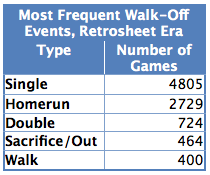
Error, wild pitch, fielder’s choice, and triple are the only other walk-off categories that occurred more than 100 times. Excluding the nearly 2,800 games won by walk-off home runs, the teams with the most walk-off victories (and defeats) are as follows:
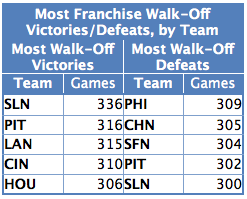
Again, this data only spans the Retrosheet era. It’s still surprising to see the Astros so high on career victories, though, considering how many other teams had a seven-year head start.
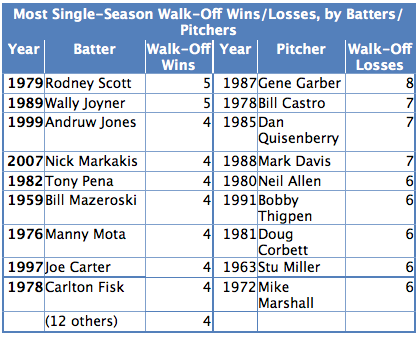
Finally, before we get too deep into the details of the batter and pitcher data, it seems like this is a good place to list the single-season leaders for walk-offs, for both pitchers and hitters. As with most everything else, this list excludes walk-off home runs:
The Batters
Looking at the remaining 7,100 non-home run walk-off events, the vast majority were officially scored as singles (4,805 walk-off singles). Many are more complicated than a mere base-hit (one-, two-, and even three-base errors, etc) but, for our purposes, they will be counted as a single.
We also find plenty of non-batting events in the data: stolen bases, balks, wild pitches, and passed balls are all there in the data. If we remove those from consideration for now - so that we don't credit, say, Cliff Floyd with a walk-off hit when John Rocker balks in the winning run - then the leaderboard for most career walk-off victories, non-home run variety looks like this (and, yes, we do count HBP, BB, errors, and other events that the batter initiated in this list):
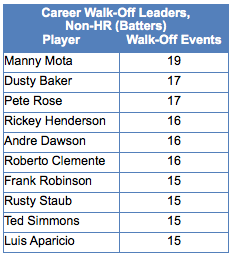
There are quite a few unsurprising names on that list, Hall of Famers known for their run producing ability. But there are also a number of very surprising names. Manny Mota is number one? Dusty Baker tied with Pete Rose for number two? Rusty Staub? Ted Simmons?
A couple of interesting things to note: nearly half of Mota's non-home run WoV's came as a pinch hitter (he also has one walk-off HR to his credit). That's nine times he was called in from the bench in a game-changing role in which he came through to win the game. Talk about your go-to guy off the bench. Also, Frank Robinson appears in the top 10 on this list, with 15 non-home run WoV's (including one sacrifice), which is very impressive in itself. However, he also sits atop the walk-off home run leaderboard with 12. Combining the two, he sits all alone at the top of the WoV leaderboard, with 27 homers and non-homers alike. Yet another reason to love the career of baseball's most underrated superstar.
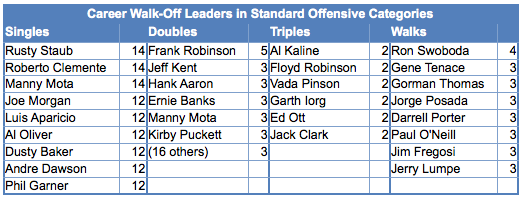
Breaking those down even further, here are the walk-off leaders in each of the more standard offensive categories:
And the less-than-standard offensive categories:
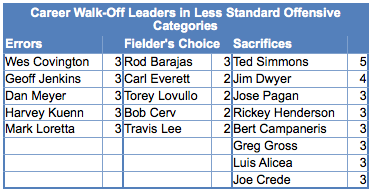
It should be noted that there are no players with more than one walk-off HBP. And please also note Frank Robinson atop the walk-off doubles list. That's 17 career walk-off extra base hits. He's the walk-off king.
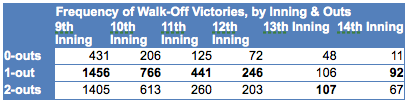
But what about the inning/outs situation? When are WoV's most likely to happen? The table below shows the frequency of non-home run WoV's in the 9th through 14th innings, broken down again by the number of outs.
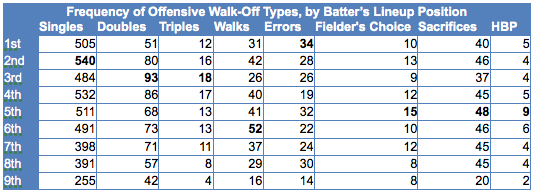
And, finally, who is most likely to get that WoV? Is it the high-average/high-OBP guys in the leadoff spot or the sluggers in the middle of the lineup, or does it even matter? With Manny Mota, Pete Rose, Andre Dawson and Frank Robinson all atop the leaderboard, it's hard to say.
The Pitchers
The "walk-off hit" has a very different meaning when you flip it around and start talking about the man on the mound. Whereas the batter and his teammates are thrilled by the moment - the journey from tension and worry to joy and exuberance is as quick as the flight of the ball - the pitcher and his teammates are devastated, walking off the field with heads hung down. As a pitcher, that is the one situation that you do not want to be in: the guy giving up the lead completely and for good, with no chance to recipricate.
Being the all-time leader in this category, then, is one of the more dubious honors in baseball. Who do we find on the leaderboard?
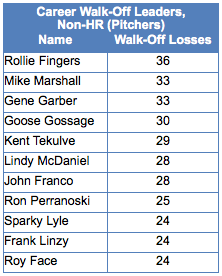
Similar to the leaderboard for hitters, this includes all events a pitcher might be considered responsible for, including wild pitches and HBPs. Passed balls and errors are excluded. We also continue to exclude home runs from the discussion.
Seeing Hall of Famers Rollie Fingers and Goose Gossage on the list shouldn't be too much of a surprise, considering the number of the games that they closed out. Frank Linzy and Ron Perranoski are the biggest surprises, as they only finished 342 and 458 games, respectively. After them, it's Mike Marshall who finished the fewest games in his career, with 549.
The fact of the matter is, if you keep putting the same guys out time and again in the ninth inning (and later) of tight ballgames, they're inevitably going to lose some games. It's almost amazing that, of Rollie's 709 games finished, he only gave up the walk-off in 36 of them (49 if you include home runs).
Not all walk-off losses (WoL) are the same, though. In the table below, the data is broken down by the size of the lead that was blown.
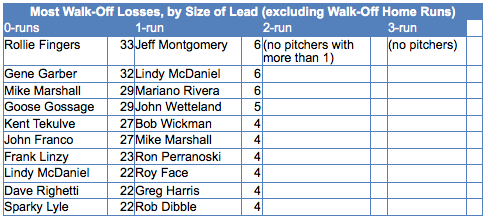
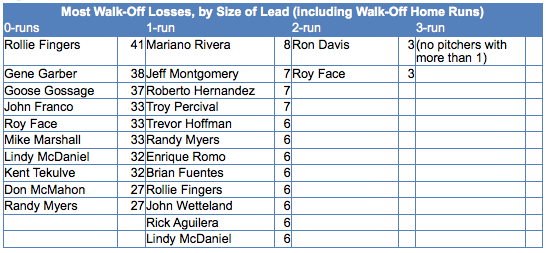
And, in the interest of thoroughness, the same list, but with walk-off home runs included, is provided below:
Finally, the question needs to be asked, what batter-pitcher matchup has ended in the most walk-offs?
Maybe not surprisingly, we don't have to go too far back to find the answer: between Sept 12, 2004, and Sept 1, 2005, Atlanta's Andruw Jones earned the walk-off victory in extra innings from Montreal's/Washington's Luis Ayala three separate times. Here are the three games (I had to include HRs in this search to find a unique candidate):
- Sept 12, 2004: Montreal @ Atlanta, 8-8, bottom 12, no outs, runner on first - RBI Double
- July 26, 2005: Washington @ Atlanta, 2-2, bottom 10, 2 outs, bases loaded - four pitch walk
- Sept 1, 2005: Washington @ Atlanta, 7-7, bottom 10, 0 outs, bases empty - solo home run
No other batter-pitcher matchup ended in a walkoff more than twice.
The Baserunners
One thing about walk-off's is that we remember them for the batter. The runner who earned his way onto the basepath and actually scores the run is easily ignored. For example, when we think back to Game 7 of the 2001 World Series, it's not Jay Bell that we remember for scoring the winning run, it's Luis Gonzalez.
But in the long history of the Major Leagues, it seems certain that there are some players who found themselves in these situations over and over again. At some point, you have to start thinking that they may have some actual skill at it. The leaders for most walk-off runs scored (and most walk-off winning runs scored) are as follows (excluding batter-runners scored via home runs):
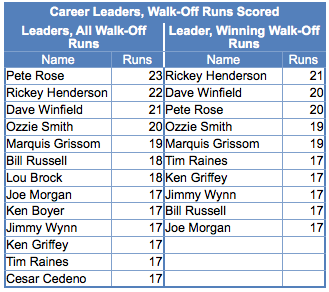
Now there's a list that shows some greatness. Nothing but Hall of Famers and quality run scorers. It makes perfect sense that they would be on base for so many WoV's.
Eyeballing the list, it seems that it’s the top of the order guys – the #1 and #2 hitters like Rickey and Rose – who cross the plate the most. And while this makes intuitive sense, it seems worth checking. The list, excluding batter-runners scoring themselves via home runs, is below:
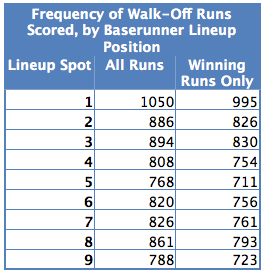
Okay, so no surprise there. But where do the winning runs come from, though? From what base?
It should be obvious that, across all WoV's, the winning run scores from third more often than any other base. But does this carry across all walk-off types, though? The table below shows the frequency in which the winning run scored from each base for the major offensive categories. If the game is tied, the first runner to cross home plate is considered the 'winning run'; if down by 1, it's the second runner to score, and so on.
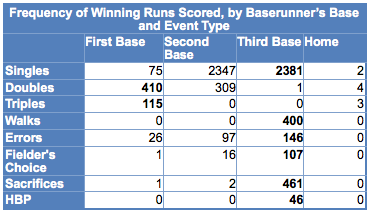
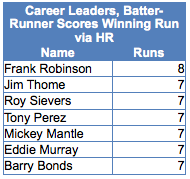
And just for kicks, here's a list of players who scored the most winning runs by driving themselves in via the home run. I know that we're not really focusing on the walk-off home runs in this post, but it seems worth exploring for a minute. It's good to see Frank Robinson at the top of the list again.
And finally, as with the pitchers, the question has to be asked, what is the most prolific walk-off batter-baserunner combo, and does it change if we look only at the winning runs? Excluding walk-off home runs, the list looks like this:
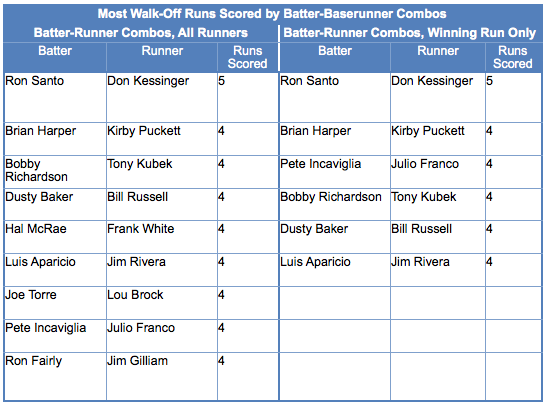
The most surprising thing about those lists is how none of the top walk-off run-scorers show up. It's probably a product of player movement, but it's hard to say for sure. Don Kessinger and Kirby Puckett are the only players on the list who were also driven in three different times by an additional player. Pete Rose and Rickey Henderson, while never being driven in by the same guy four times or more, do have two different teammates who they matched up with three times each.
(Oh, and I’d talk about the stolen base leaders right here, but, sadly, they aren’t all that interesting. Of the 22 walk-off steals, no player has done it more than once. George Brett, Pete Rose, Rod Carew, and Eddie Murray are the biggest names on the list, with no Rickey Henderson or Tim Raines to be found. A few are recorded as steals of home, but many are also due to errors. In short, it’s a mish-mash.)
Conclusion
Well, that’s about all I can manage to squeeze into this post without delving into utter minutiae. (How often has a game been won with a walk-off single by the number 7 hitter with a runner on second with one out in the 10th and the home team down by one run? Who scored the most winning runs from first base in 1973?) There seems to be an unending amount of information to be found in the walk-off listings. I just hope I’ve been able to share the interesting facts.
In the end, though, I don’t think there’s a typical walk-off scenario to be found. The hitters at the plate, the baserunners who score the winning runs, and the pitchers who are responsible for the loss are all sufficiently varied in their notoriety/stats/skills that it really does seem to be “the luck of the draw.”
If I did have to describe the “typical” walk-off victory – with the caveats above – it would be this: it’s a tie-game in the bottom of the ninth and the top of the order is coming up. The leadoff hitter (or #2 hitter) gets on base and is moved into scoring position, where he is driven in by either a base hit or home run from the middle-of-the-order power guys. It helps to have all-star-or-better quality players batting in either of those lineup positions.
I’m guessing you probably could’ve guessed that. Still, it’s always nice to have the data to back it up. Now, the next time you see your team get that walk-off hit, you can say that you saw it coming.
Larry Granillo lives in Milwaukee and writes the blog Wezen-Ball.com, where he uses some do-it-yourself statistical analysis and various contemporary accounts (including newspapers and magazines) to look at the game of baseball, both past and present - and, whenever possible, at where the two meet.