Rich Lederer • Baseball Beat
Patrick Sullivan • Change-Up
Jeremy Greenhouse • Touching Bases
Dave Allen • F/X Visualizations
Sky Andrecheck • Behind the Scoreboard
Marc Hulet • Around the Minors
Al Doyle • Past Times
Retired Uniforms:
Bryan Smith • WTNY
Joe Sheehan • Command Post
Jeff Albert • The Batter's Eye
RSS Feed
Home

*Examining the Past, Present, and Future*
Lineup Card
Recent Entries
» Putting Together a Reality Team
» Historical Hall of Fame Vote Comparisons: 2012
» An All-Christmas Team
» The New-Look Angels
» John Denny: The Forgotten Cy Young Award Winner
» Money Isn't Everything
» What Would It Take to Hit .400 in the 21st Century?
» Halos Heaven
» Brandon McCarthy's Breakout Season
» Link-o-Rama
» Historical Hall of Fame Vote Comparisons: 2012
» An All-Christmas Team
» The New-Look Angels
» John Denny: The Forgotten Cy Young Award Winner
» Money Isn't Everything
» What Would It Take to Hit .400 in the 21st Century?
» Halos Heaven
» Brandon McCarthy's Breakout Season
» Link-o-Rama
Best of Baseball Beat
Abstracts From the Abstracts
1977 Baseball Abstract
1978 Baseball Abstract
1979 Baseball Abstract
1980 Baseball Abstract
1981 Baseball Abstract
1982 Baseball Abstract
1983 Baseball Abstract
1984 Baseball Abstract
1985 Baseball Abstract
1986 Baseball Abstract
1987 Baseball Abstract
1988 Baseball Abstract
1978 Baseball Abstract
1979 Baseball Abstract
1980 Baseball Abstract
1981 Baseball Abstract
1982 Baseball Abstract
1983 Baseball Abstract
1984 Baseball Abstract
1985 Baseball Abstract
1986 Baseball Abstract
1987 Baseball Abstract
1988 Baseball Abstract
Bert Blyleven Series
Meeting Up and Hanging Out with Bert
The Results Are In And...
Aficionado Heavily Invested in Blyleven
Latest on Blyleven's Chances for the HOF
The Internet Zealot Responds
400 Down and 5 to Go...
Bert Be Home By Eleven?
Blyleven's Forgotten Season (1973)
HeyMan, Your Comments Don't Hold Water
The Waiting is the Hardest Part
Another Addition to the Blyleven Series
Search for the Truth
As Dominant as His HOF Contemporaries
Listen, Buster
A Larger Step for Blyleven
Answering the Naysayers (Part Two)
Another Small Step for Blyleven
Q&A: Blyleven on the Twins
The Majority Rules, Right?
It's All Dutch to Some
The Hall of Fame Case for Bert Blyleven
Q&A: Blyleven on Felix Hernandez
Clemens Rocketing Up Charts
Poz: An Interview With a KC Star
A HOF Chat with Tracy Ringolsby
Up Close and Personal
A Peek Into the Mind of a HOF Voter
Answering the Naysayers
It's That Time of the Year (Again)
"If Cooperstown is Calling..."
The Bert Alert
One Small Step for Blyleven...
Only the Lonely
The Results Are In And...
Aficionado Heavily Invested in Blyleven
Latest on Blyleven's Chances for the HOF
The Internet Zealot Responds
400 Down and 5 to Go...
Bert Be Home By Eleven?
Blyleven's Forgotten Season (1973)
HeyMan, Your Comments Don't Hold Water
The Waiting is the Hardest Part
Another Addition to the Blyleven Series
Search for the Truth
As Dominant as His HOF Contemporaries
Listen, Buster
A Larger Step for Blyleven
Answering the Naysayers (Part Two)
Another Small Step for Blyleven
Q&A: Blyleven on the Twins
The Majority Rules, Right?
It's All Dutch to Some
The Hall of Fame Case for Bert Blyleven
Q&A: Blyleven on Felix Hernandez
Clemens Rocketing Up Charts
Poz: An Interview With a KC Star
A HOF Chat with Tracy Ringolsby
Up Close and Personal
A Peek Into the Mind of a HOF Voter
Answering the Naysayers
It's That Time of the Year (Again)
"If Cooperstown is Calling..."
The Bert Alert
One Small Step for Blyleven...
Only the Lonely
Exclusive Interviews
Lee Sinins
Alex Belth
David Pinto
Will Carroll
Mike Carminati
Aaron Gleeman
Joe Sheehan
Jay Jaffe
Jeff Peek
Tracy Ringolsby
Joe Posnanski
Bill James Part I, II, III
Jon Lalonde
Chuck Tiffany
Dayn Perry
Fay Vincent
Nate Silver
Alex Belth
David Pinto
Will Carroll
Mike Carminati
Aaron Gleeman
Joe Sheehan
Jay Jaffe
Jeff Peek
Tracy Ringolsby
Joe Posnanski
Bill James Part I, II, III
Jon Lalonde
Chuck Tiffany
Dayn Perry
Fay Vincent
Nate Silver
Bullpen
Rich Lederer
The Odd Couple (with Alex Belth)
The MostUnder Over Underrated Player in Baseball (with Brian Gunn)
Three Wise Men (roundtable by Alex Belth)
Infrequently Asked Questions (interview with Matt Welch)
Interview (Orioles Think Tank)
Bernie and the Yanks (Bronx Banter)
Hope and Faith: How the LAA Win the World Series (Baseball Prospectus)
NL West (The Soul of Baseball)
Greatest Living Hitter? (Sports Illustrated)
Roundtable: 2008 HOF Ballot (Armchair GM)
The Most
Three Wise Men (roundtable by Alex Belth)
Infrequently Asked Questions (interview with Matt Welch)
Interview (Orioles Think Tank)
Bernie and the Yanks (Bronx Banter)
Hope and Faith: How the LAA Win the World Series (Baseball Prospectus)
NL West (The Soul of Baseball)
Greatest Living Hitter? (Sports Illustrated)
Roundtable: 2008 HOF Ballot (Armchair GM)
Patrick Sullivan
Designated Hitters
David Bromberg (Q&A: John Denny)
Mark Armour (H. Killebrew and Versatility)
Joe Lederer (Soundtrack of a Prospect)
David Bromberg (Clemente's Autograph)
David Bromberg (Woody Fryman)
D. Baumstein (WAR Against Age: Pitchers)
Doug Baumstein (The WAR Against Age)
Doug Baumstein (A Lifetime on the Road)
John Fraser (Pick Six)
Mark Armour (How to Score More Runs?)
Bill Parker (What Opening Day Tells Us)
Stan Opdyke (Pat Rispole)
Chris Jaffe (Evaluating Baseball's Mgrs)
Stan Opdyke (Baseball Radio in NYC, 1953)
A. Nathan (Performance of Baseball Bats)
Michael Weddell (Edgar Martinez/HOF)
Jon Weisman (100 Things Dodgers Fans...)
Stan Opdyke (Connie Mack and Vin Scully)
Eric Walker (Evaluating Run Production)
Brent Mayne (The Intangibles of Catching)
Chris Moore (Best Fastballs in Baseball)
Dave Baldwin (The Batter’s Brain)
Shawn Haviland (Ivy League to MLB)
Larry Granillo (Walking Off)
Rob Iracane (Solo HR Won't Break You)
Tommy Bennett (Charm of AM Radio)
Harry Pavlidis (Johan Santana's Fast Start)
John Walsh (WAR and Remembrance)
Eric Walker (Precisely Inaccurate)
Bob Timmermann (As They See 'Em)
Geoff Young (Unicycles and Delusions)
Baseball Analysis at Tufts (Groundballers)
Baseball Analysis at Tufts (GB Out Rates)
G. Rybarczyk ('09 Hit Tracker Projections)
Joe Lederer (Curt Schilling/HoF)
Conor Gallagher (Hall of Fallacies)
Chris Green (Jim Rice, HoF, the Numbers)
Shawn Hoffman (Baseball's Bear Mkt?)
Paul Anthony (Manny Syndrome)
Ross Roley (World Series Odds)
B. Timmermann (Catcher's Interference)
R.J. Anderson (Waiting the Hardest Part)
Maury Brown (Cubs, MLB, and Cuban...)
Myron Logan (Dee-Fense, Dee-Fense)
Craig Calcaterra (Frivolity, Part I, Part II)
Chad Finn (Ode to Baseball Cards)
David Cameron (Mariners Foibles)
Chris Dial (Chipper Jones)
Pat Lederer (Memory Lane)
David Appelman (Clutch Pitching)
Bob Rittner (DH)
Jonathan Mayo (Roger Clemens)
Lisa Winston (My Son-in-Law...)
Russ McQueen (The Yellow Hammer)
Bob Rittner (I'm OK, You're OK)
Mark Armour (In Defense of the HOF)
Pat Jordan (Friends)
Dan Levitt (Analysis of Terry Ryan)
Doug Baumstein (Trading Econ 101)
Ross Roley (Runner's Reluctance II)
Ross Roley (Runner's Reluctance I)
Mark Armour (No-Longer Lovable Sox)
Bruce Regal (Stealthy and Wise)
Brian Gunn (Roid Monster)
Current/McEvoy (Value of the SB)
John Rickert (Sinister Thefts)
Nate Silver (Sabermetrics)
David Vincent (Home Run Production)
Joe P. Sheehan (Enhanced Gameday II)
Mark Armour (An Ode to Sport)
David Gassko (All-Time Worm Burners)
Joe P. Sheehan (Enhanced Gameday)
John Walsh (When Titans Clash)
Fox/Williams (Quantifying Coaches II)
Fox/Williams (Quantifying Coaches I)
Jacob Luft (Bull Durham Rant)
Chad Finn (Strat-O-Matic)
Lisa Winston (Rotisserie Baseball)
Dave Studeman (Baseball Stats)
Steve Treder (Roger Craig)
Marc Normandin (Jeff Bagwell)
D. Appelman (Expanding Strike Zone)
Jeff Sackmann (Worst MiL Defenders)
Jeff Sackmann (Best MiL Defenders)
Maxwell Kates (Van Lingle Mungo)
David Appelman (Pitch Location)
Kent Bonham (Danny Ray Herrera)
Glenn Stout (Two Baseball Poems)
Bruce Regal (The Challenge Round)
Mark Lamster (Barry & Ty)
Geoff Young (NL West)
Tom Lederer (The Ryan Express)
Brian Erts (Great Leap Forward)
David Pinto (Parity and the N.L.)
Jacob Luft (Fathers and Daughters)
Jamey Newberg (Pete's Sake)
Jeff Albert (A. Jones Swing Analysis)
Jeff Albert (A-Rod Swing Analysis)
Keith Law (Death, Taxes, and Waivers)
Peter Abraham (Tales of Torre Tales)
Larry Borowsky (Let 'er Rip II)
Dan Levitt (Empirical Analysis of Bunting)
Jonah Keri (If I Met Warren Cromartie...)
Bob Klapisch (War Stories)
Bob Timmermann (John F. Kennedy HS)
Kent Bonham (Aluminum Adjustments)
Al Doyle (More Than Superstars)
Ross Roley (Instant Replay)
David Vincent (Barry Bonds Homers)
Chad Finn (Our Favorite Obscurities)
Bill Deane (1979 NL MVP)
Mark Armour (Rise/Fall of Artificial Turf)
Jeff Angus (Wally Moon Camp)
David Berri (Money and Baseball)
Larry Borowsky (Baseball w/o the #s)
Derek Zumsteg (The Irrational Market)
David Regan (Free Agent Contracts)
Peter Schmuck (Steroids and the HOF)
David Appelman (Pitchers, Pitch by Pitch)
Dan Fox (Swinging, Taking, Fouling, Etc)
Patrick Sullivan (Study of NYY CF/BOS LF)
Will Leitch (Baseball Journalism)
Jeff Sullivan (Pitcher Release Points)
Steve Treder ('69-'70 Giants)
Maury Brown (Charlie Finley)
John Brattain (Bob Johnson)
Bob Klapisch (The Case for Bert Blyleven)
Jeff Peek (Pride and Prejudice)
Dayn Perry (Bert and Warren)
Rob Neyer (If Don Sutton Was Great...)
Lisa Winston (Minor League Memories)
Alex Belth (Otis Redding Was Right)
David Cameron (Long Live the King)
Jeff Angus (Baserunning Study)
Bert Blyleven (Baseball Playoffs)
Boyd Nation (Not a Prospect List)
James Click (Batters-Baserunners Study)
Jeff Shaw (Why I Love Baseball)
David Gassko (BIP/BFP Fielding Study)
Jay Jaffe (Milwaukee Sausage Race)
Jamey Newberg (Remember When)
Bob Klapisch (Press Box to the Mound)
Dan Levitt (Predictive Value of BB)
David Vincent (Official Scorer)
Jon Weisman (Rick Monday)
Larry Borowsky (Let 'er Rip)
Will Carroll (Fictional Short Story)
Bob Timmermann (Japanese Baseball)
Cyril Morong (Best Pitching Seasons)
Sean Forman (Monte Carlo Win-Loss)
Brian Gunn (My Little Blue Book)
Joe Lederer (My Dad and Baseball)
Bill Deane (Bob Gibson, 1968)
Mark Armour (1977 Yankees)
Darren Viola (Retrosheet)
David Pinto (RFK)
Dayn Perry (Brave Heart)
Matt Welch (Dave Hansen)
Kevin Kernan (Jack McKeon)
Tom Lederer (Dodgers Road Trip)
Steve Lombardi (Slider)
Studes (Picturing Baseball)
Mike Carminati (Luck of the Drawl)
Eric Neel (Vin Scully)
J.C. Bradbury (Leo Mazzone)
John Sickels (Bill James)
Mark Armour (H. Killebrew and Versatility)
Joe Lederer (Soundtrack of a Prospect)
David Bromberg (Clemente's Autograph)
David Bromberg (Woody Fryman)
D. Baumstein (WAR Against Age: Pitchers)
Doug Baumstein (The WAR Against Age)
Doug Baumstein (A Lifetime on the Road)
John Fraser (Pick Six)
Mark Armour (How to Score More Runs?)
Bill Parker (What Opening Day Tells Us)
Stan Opdyke (Pat Rispole)
Chris Jaffe (Evaluating Baseball's Mgrs)
Stan Opdyke (Baseball Radio in NYC, 1953)
A. Nathan (Performance of Baseball Bats)
Michael Weddell (Edgar Martinez/HOF)
Jon Weisman (100 Things Dodgers Fans...)
Stan Opdyke (Connie Mack and Vin Scully)
Eric Walker (Evaluating Run Production)
Brent Mayne (The Intangibles of Catching)
Chris Moore (Best Fastballs in Baseball)
Dave Baldwin (The Batter’s Brain)
Shawn Haviland (Ivy League to MLB)
Larry Granillo (Walking Off)
Rob Iracane (Solo HR Won't Break You)
Tommy Bennett (Charm of AM Radio)
Harry Pavlidis (Johan Santana's Fast Start)
John Walsh (WAR and Remembrance)
Eric Walker (Precisely Inaccurate)
Bob Timmermann (As They See 'Em)
Geoff Young (Unicycles and Delusions)
Baseball Analysis at Tufts (Groundballers)
Baseball Analysis at Tufts (GB Out Rates)
G. Rybarczyk ('09 Hit Tracker Projections)
Joe Lederer (Curt Schilling/HoF)
Conor Gallagher (Hall of Fallacies)
Chris Green (Jim Rice, HoF, the Numbers)
Shawn Hoffman (Baseball's Bear Mkt?)
Paul Anthony (Manny Syndrome)
Ross Roley (World Series Odds)
B. Timmermann (Catcher's Interference)
R.J. Anderson (Waiting the Hardest Part)
Maury Brown (Cubs, MLB, and Cuban...)
Myron Logan (Dee-Fense, Dee-Fense)
Craig Calcaterra (Frivolity, Part I, Part II)
Chad Finn (Ode to Baseball Cards)
David Cameron (Mariners Foibles)
Chris Dial (Chipper Jones)
Pat Lederer (Memory Lane)
David Appelman (Clutch Pitching)
Bob Rittner (DH)
Jonathan Mayo (Roger Clemens)
Lisa Winston (My Son-in-Law...)
Russ McQueen (The Yellow Hammer)
Bob Rittner (I'm OK, You're OK)
Mark Armour (In Defense of the HOF)
Pat Jordan (Friends)
Dan Levitt (Analysis of Terry Ryan)
Doug Baumstein (Trading Econ 101)
Ross Roley (Runner's Reluctance II)
Ross Roley (Runner's Reluctance I)
Mark Armour (No-Longer Lovable Sox)
Bruce Regal (Stealthy and Wise)
Brian Gunn (Roid Monster)
Current/McEvoy (Value of the SB)
John Rickert (Sinister Thefts)
Nate Silver (Sabermetrics)
David Vincent (Home Run Production)
Joe P. Sheehan (Enhanced Gameday II)
Mark Armour (An Ode to Sport)
David Gassko (All-Time Worm Burners)
Joe P. Sheehan (Enhanced Gameday)
John Walsh (When Titans Clash)
Fox/Williams (Quantifying Coaches II)
Fox/Williams (Quantifying Coaches I)
Jacob Luft (Bull Durham Rant)
Chad Finn (Strat-O-Matic)
Lisa Winston (Rotisserie Baseball)
Dave Studeman (Baseball Stats)
Steve Treder (Roger Craig)
Marc Normandin (Jeff Bagwell)
D. Appelman (Expanding Strike Zone)
Jeff Sackmann (Worst MiL Defenders)
Jeff Sackmann (Best MiL Defenders)
Maxwell Kates (Van Lingle Mungo)
David Appelman (Pitch Location)
Kent Bonham (Danny Ray Herrera)
Glenn Stout (Two Baseball Poems)
Bruce Regal (The Challenge Round)
Mark Lamster (Barry & Ty)
Geoff Young (NL West)
Tom Lederer (The Ryan Express)
Brian Erts (Great Leap Forward)
David Pinto (Parity and the N.L.)
Jacob Luft (Fathers and Daughters)
Jamey Newberg (Pete's Sake)
Jeff Albert (A. Jones Swing Analysis)
Jeff Albert (A-Rod Swing Analysis)
Keith Law (Death, Taxes, and Waivers)
Peter Abraham (Tales of Torre Tales)
Larry Borowsky (Let 'er Rip II)
Dan Levitt (Empirical Analysis of Bunting)
Jonah Keri (If I Met Warren Cromartie...)
Bob Klapisch (War Stories)
Bob Timmermann (John F. Kennedy HS)
Kent Bonham (Aluminum Adjustments)
Al Doyle (More Than Superstars)
Ross Roley (Instant Replay)
David Vincent (Barry Bonds Homers)
Chad Finn (Our Favorite Obscurities)
Bill Deane (1979 NL MVP)
Mark Armour (Rise/Fall of Artificial Turf)
Jeff Angus (Wally Moon Camp)
David Berri (Money and Baseball)
Larry Borowsky (Baseball w/o the #s)
Derek Zumsteg (The Irrational Market)
David Regan (Free Agent Contracts)
Peter Schmuck (Steroids and the HOF)
David Appelman (Pitchers, Pitch by Pitch)
Dan Fox (Swinging, Taking, Fouling, Etc)
Patrick Sullivan (Study of NYY CF/BOS LF)
Will Leitch (Baseball Journalism)
Jeff Sullivan (Pitcher Release Points)
Steve Treder ('69-'70 Giants)
Maury Brown (Charlie Finley)
John Brattain (Bob Johnson)
Bob Klapisch (The Case for Bert Blyleven)
Jeff Peek (Pride and Prejudice)
Dayn Perry (Bert and Warren)
Rob Neyer (If Don Sutton Was Great...)
Lisa Winston (Minor League Memories)
Alex Belth (Otis Redding Was Right)
David Cameron (Long Live the King)
Jeff Angus (Baserunning Study)
Bert Blyleven (Baseball Playoffs)
Boyd Nation (Not a Prospect List)
James Click (Batters-Baserunners Study)
Jeff Shaw (Why I Love Baseball)
David Gassko (BIP/BFP Fielding Study)
Jay Jaffe (Milwaukee Sausage Race)
Jamey Newberg (Remember When)
Bob Klapisch (Press Box to the Mound)
Dan Levitt (Predictive Value of BB)
David Vincent (Official Scorer)
Jon Weisman (Rick Monday)
Larry Borowsky (Let 'er Rip)
Will Carroll (Fictional Short Story)
Bob Timmermann (Japanese Baseball)
Cyril Morong (Best Pitching Seasons)
Sean Forman (Monte Carlo Win-Loss)
Brian Gunn (My Little Blue Book)
Joe Lederer (My Dad and Baseball)
Bill Deane (Bob Gibson, 1968)
Mark Armour (1977 Yankees)
Darren Viola (Retrosheet)
David Pinto (RFK)
Dayn Perry (Brave Heart)
Matt Welch (Dave Hansen)
Kevin Kernan (Jack McKeon)
Tom Lederer (Dodgers Road Trip)
Steve Lombardi (Slider)
Studes (Picturing Baseball)
Mike Carminati (Luck of the Drawl)
Eric Neel (Vin Scully)
J.C. Bradbury (Leo Mazzone)
John Sickels (Bill James)
Search Baseball Analysts
Archives
By Category:
Around the Majors Content Only
Around the Minors Content Only
Baseball Beat Content Only
Baseball Beat/Change-Up Content Only
Baseball Beat/WTNY Content Only
Behind the Scoreboard Content Only
Change-Up Content Only
Change-Up/Around the Majors Content Only
Command Post Content Only
Crunching the Numbers Content Only
Designated Hitter Content Only
F/X Visualizations Content Only
Past Times Content Only
Saber Talk Content Only
The Batter's Eye Content Only
Touching Bases Content Only
Weekend Blog Content Only
WTNY Content Only
Around the Minors Content Only
Baseball Beat Content Only
Baseball Beat/Change-Up Content Only
Baseball Beat/WTNY Content Only
Behind the Scoreboard Content Only
Change-Up Content Only
Change-Up/Around the Majors Content Only
Command Post Content Only
Crunching the Numbers Content Only
Designated Hitter Content Only
F/X Visualizations Content Only
Past Times Content Only
Saber Talk Content Only
The Batter's Eye Content Only
Touching Bases Content Only
Weekend Blog Content Only
WTNY Content Only
By Month:
February 2012
January 2012
December 2011
October 2011
September 2011
August 2011
July 2011
June 2011
May 2011
April 2011
March 2011
February 2011
January 2011
December 2010
November 2010
October 2010
September 2010
August 2010
July 2010
June 2010
May 2010
April 2010
March 2010
February 2010
January 2010
December 2009
November 2009
October 2009
September 2009
August 2009
July 2009
June 2009
May 2009
April 2009
March 2009
February 2009
January 2009
December 2008
November 2008
October 2008
September 2008
August 2008
July 2008
June 2008
May 2008
April 2008
March 2008
February 2008
January 2008
December 2007
November 2007
October 2007
September 2007
August 2007
July 2007
June 2007
May 2007
April 2007
March 2007
February 2007
January 2007
December 2006
November 2006
October 2006
September 2006
August 2006
July 2006
June 2006
May 2006
April 2006
March 2006
February 2006
January 2006
December 2005
November 2005
October 2005
September 2005
August 2005
July 2005
June 2005
May 2005
April 2005
March 2005
February 2005
January 2005
December 2004
November 2004
October 2004
September 2004
August 2004
July 2004
June 2004
May 2004
April 2004
March 2004
February 2004
January 2004
December 2003
November 2003
October 2003
September 2003
August 2003
July 2003
June 2003
January 2012
December 2011
October 2011
September 2011
August 2011
July 2011
June 2011
May 2011
April 2011
March 2011
February 2011
January 2011
December 2010
November 2010
October 2010
September 2010
August 2010
July 2010
June 2010
May 2010
April 2010
March 2010
February 2010
January 2010
December 2009
November 2009
October 2009
September 2009
August 2009
July 2009
June 2009
May 2009
April 2009
March 2009
February 2009
January 2009
December 2008
November 2008
October 2008
September 2008
August 2008
July 2008
June 2008
May 2008
April 2008
March 2008
February 2008
January 2008
December 2007
November 2007
October 2007
September 2007
August 2007
July 2007
June 2007
May 2007
April 2007
March 2007
February 2007
January 2007
December 2006
November 2006
October 2006
September 2006
August 2006
July 2006
June 2006
May 2006
April 2006
March 2006
February 2006
January 2006
December 2005
November 2005
October 2005
September 2005
August 2005
July 2005
June 2005
May 2005
April 2005
March 2005
February 2005
January 2005
December 2004
November 2004
October 2004
September 2004
August 2004
July 2004
June 2004
May 2004
April 2004
March 2004
February 2004
January 2004
December 2003
November 2003
October 2003
September 2003
August 2003
July 2003
June 2003
Reference
Organizational Stats
Arizona Diamondbacks Bat / Pitch
Atlanta Braves Bat / Pitch
Baltimore Orioles Bat / Pitch
Boston Red Sox Bat / Pitch
Chicago Cubs Bat / Pitch
Chicago White Sox Bat / Pitch
Cincinnati Reds Bat / Pitch
Cleveland Indians Bat / Pitch
Colorado Rockies Bat / Pitch
Detroit Tigers Bat / Pitch
Florida Marlins Bat / Pitch
Houston Astros Bat / Pitch
Kansas City Royals Bat / Pitch
Los Angeles Angels Bat / Pitch
Los Angeles Dodgers Bat / Pitch
Milwaukee Brewers Bat / Pitch
Minnesota Twins Bat / Pitch
New York Mets Bat / Pitch
New York Yankees Bat / Pitch
Oakland Athletics Bat / Pitch
Philadelphia Phillies Bat / Pitch
Pittsburgh Pirates Bat / Pitch
St. Louis Cardinals Bat / Pitch
San Diego Padres Bat / Pitch
San Francisco Giants Bat / Pitch
Seattle Mariners Bat / Pitch
Tampa Bay Devil Rays Bat / Pitch
Texas Rangers Bat / Pitch
Toronto Blue Jays Bat / Pitch
Washington Nationals Bat / Pitch
Atlanta Braves Bat / Pitch
Baltimore Orioles Bat / Pitch
Boston Red Sox Bat / Pitch
Chicago Cubs Bat / Pitch
Chicago White Sox Bat / Pitch
Cincinnati Reds Bat / Pitch
Cleveland Indians Bat / Pitch
Colorado Rockies Bat / Pitch
Detroit Tigers Bat / Pitch
Florida Marlins Bat / Pitch
Houston Astros Bat / Pitch
Kansas City Royals Bat / Pitch
Los Angeles Angels Bat / Pitch
Los Angeles Dodgers Bat / Pitch
Milwaukee Brewers Bat / Pitch
Minnesota Twins Bat / Pitch
New York Mets Bat / Pitch
New York Yankees Bat / Pitch
Oakland Athletics Bat / Pitch
Philadelphia Phillies Bat / Pitch
Pittsburgh Pirates Bat / Pitch
St. Louis Cardinals Bat / Pitch
San Diego Padres Bat / Pitch
San Francisco Giants Bat / Pitch
Seattle Mariners Bat / Pitch
Tampa Bay Devil Rays Bat / Pitch
Texas Rangers Bat / Pitch
Toronto Blue Jays Bat / Pitch
Washington Nationals Bat / Pitch
All-Star Links
Official Websites
News and Notes
Baseball News Blog
Baseball Newstand
ESPN Baseball
Fox Sports Baseball
Pro Sports Daily
Roto World
The Roto Times
USA Today Baseball
Baseball Newstand
ESPN Baseball
Fox Sports Baseball
Pro Sports Daily
Roto World
The Roto Times
USA Today Baseball
Reference and Analysis
Baseball Almanac
Baseball America
Baseball Archive
Baseball Contracts
Baseball Cube
Baseball Graphs
Baseball Library
Baseball Musings Player Database
Baseball Page
Baseball Primer
Baseball Prospectus
Baseball Reference
Baseball Statistics
Baseball Truth
Boxscore Central
Diamond Mind Baseball
Doug's Stats
FanGraphs
Fast Balls (pitchfx catalog)
Hardball Dollars
Hardball Times
Hit Tracker
Retrosheet
Rotobase/Rotoblog
Stat Corner
STATS
Tango on Baseball
Yahoo Sports MLB
Baseball America
Baseball Archive
Baseball Contracts
Baseball Cube
Baseball Graphs
Baseball Library
Baseball Musings Player Database
Baseball Page
Baseball Primer
Baseball Prospectus
Baseball Reference
Baseball Statistics
Baseball Truth
Boxscore Central
Diamond Mind Baseball
Doug's Stats
FanGraphs
Fast Balls (pitchfx catalog)
Hardball Dollars
Hardball Times
Hit Tracker
Retrosheet
Rotobase/Rotoblog
Stat Corner
STATS
Tango on Baseball
Yahoo Sports MLB
Web Gems
Bill James Primer
Sabermetric Manifesto (Grabiner)
Pitching and Defense (McCracken)
Pitching and Defense (Tippett)
Transactions Primer (Neyer)
Baseball Stats (Batter's Box)
Prospect Report (Cameron)
Pitcher Workloads (Sheehan)
Goodbye to Old Baseball Ideas (Rickey)
Sabermetric Manifesto (Grabiner)
Pitching and Defense (McCracken)
Pitching and Defense (Tippett)
Transactions Primer (Neyer)
Baseball Stats (Batter's Box)
Prospect Report (Cameron)
Pitcher Workloads (Sheehan)
Goodbye to Old Baseball Ideas (Rickey)
Columnists
Baseball Blogs
Around the Majors
Athletics Nation
Baseball Crank
Baseball Musings
Baseball-Reference Blog
Batter's Box
Big League Stew
Bronx Banter
Catfish Stew
Cub Town
Dan Agonistes
Dodger Thoughts
DRays Bay
Ducksnorts
Futility Infielder
Halos Heaven
Inside the Rockies
It Might Be Dangerous
Knuckle Curve
LoHud Yankees Blog
Lookout Landing
Management by Baseball
Metaforian
Metsgeek
Mike's Baseball Rants
Only Baseball Matters
Redbird Nation
Red Reporter
Sabernomics (Braves)
Seth Speaks
ShysterBall
6-4-2 (Angels/Dodgers)
The Book
TheCubdom
The Cutting Edge
The House That Dewey Built
The View From The Bleachers
Tiger Blog
U.S.S. Mariner
Viva El Birdos
Where's Kernan
Athletics Nation
Baseball Crank
Baseball Musings
Baseball-Reference Blog
Batter's Box
Big League Stew
Bronx Banter
Catfish Stew
Cub Town
Dan Agonistes
Dodger Thoughts
DRays Bay
Ducksnorts
Futility Infielder
Halos Heaven
Inside the Rockies
It Might Be Dangerous
Knuckle Curve
LoHud Yankees Blog
Lookout Landing
Management by Baseball
Metaforian
Metsgeek
Mike's Baseball Rants
Only Baseball Matters
Redbird Nation
Red Reporter
Sabernomics (Braves)
Seth Speaks
ShysterBall
6-4-2 (Angels/Dodgers)
The Book
TheCubdom
The Cutting Edge
The House That Dewey Built
The View From The Bleachers
Tiger Blog
U.S.S. Mariner
Viva El Birdos
Where's Kernan
Minor Leagues
Arizona Fall League
BA Player Finder
Cal Leaguers
Jamey Newberg
JDM's Scoresheet Baseball
Minor League Baseball
Minor League Park Factors
Minor League Splits
No Pepper
Sickels' Minor League Ball
Warm October Nights
BA Player Finder
Cal Leaguers
Jamey Newberg
JDM's Scoresheet Baseball
Minor League Baseball
Minor League Park Factors
Minor League Splits
No Pepper
Sickels' Minor League Ball
Warm October Nights
Amateur
Boyd's World (College)
Cape Cod Baseball League
College Baseball Blog
College Baseball Insider
Collegiate Baseball Newspaper
College Splits
College Splits Blog
Dirtbags Baseball (Long Beach State)
NCAA Baseball
NCBWA
Team One Baseball (High School)
Texas A&M & Baseball
Cape Cod Baseball League
College Baseball Blog
College Baseball Insider
Collegiate Baseball Newspaper
College Splits
College Splits Blog
Dirtbags Baseball (Long Beach State)
NCAA Baseball
NCBWA
Team One Baseball (High School)
Texas A&M & Baseball
Historical
Cuban Baseball
House of David
Jim "Mudcat" Grant's Web Page
Negro League Baseball Players Assoc
Negro Leagues Baseball Museum
1919 Black Sox
Pacific Coast League
Philadelphia Athletics Historical Society
Shoeless Joe Jackson Society
SABR-L Archives
Walter O'Malley
House of David
Jim "Mudcat" Grant's Web Page
Negro League Baseball Players Assoc
Negro Leagues Baseball Museum
1919 Black Sox
Pacific Coast League
Philadelphia Athletics Historical Society
Shoeless Joe Jackson Society
SABR-L Archives
Walter O'Malley
Miscellaneous
Forums
Credits

Ticket Center
Tickets to Baseball -
Premium Red Sox Tickets - Tickets to Marlins Games - Cardinals Game Tickets - NY Yankee Tickets - Tickets Oakland Athletics - Dallas Cowboys Tickets - Arizona Cardinals Tickets - Tickets Seattle Seahawks - Buffalo Bills Tickets Online - Tickets to Dolphins Football
Buy Boston Red Sox tickets,
Philadelphia Phillies tix,
NY Yankees tickets,
NY Mets tickets, and
MLB All Star game tickets at ABC tickets
Not sure where to find the best online sportsbooks? Start your search with PlayersJet.
Get deals at SportsMemorabilia.com on baseball apparel, including Phillies jerseys and more for adults and children.
Shop the largest selection baseball equipment on sale at Sports Unlimited. Check out tons of baseball gloves, youth baseball gloves and catchers gear from Rawlings, Wilson, Nike & Under Armour.
2011 Draft Order
Courtesy of Baseball America
First-Round:
 1. Pirates (57-105)
 2. Mariners (61-101)
 3. Diamondbacks (65-97)
 4. Orioles (66-96)
 5. Royals (67-95)
 6. Nationals (69-93)
 7. Diamondbacks (for B. Loux)
 8. Indians (69-93)
 9. Cubs (75-87)
10. Padres (for Karsten Whitson)
11. Astros (76-86)
12. Brewers (77-85)
13. Mets (79-83)
14. Marlins (80-82)
15. Brewers (for Dylan Covey)
16. Dodgers (80-82)
17. Angels (80-82)
18. Athletics (81-81)
19. Red Sox (from DET for Martinez)
20. Rockies (83-79)
21. Blue Jays (85-77)
22. Cardinals (86-76)
23. Nationals (from CWS for Dunn)
24. Rays (from BOS for Crawford)
25. Padres (90-72)
26. Red Sox (from TEX for Beltre)
27. Reds (91-71)
28. Braves (91-71)
29. Giants (92-70)
30. Twins (94-68)
31. Rays (from NYY for Soriano)
32. Rays (96-66)
33. Rangers (from PHI for Lee)
Supplemental First Round:
34. Nationals (Dunn)
35. Blue Jays (Downs)
36. Red Sox (Martinez)
37. Rangers (Lee)
38. Rays (Crawford)
39. Phillies (Werth)
40. Red Sox (Beltre)
41. Rays (Soriano)
42. Rays (Balfour)
43. Diamondbacks (LaRoche)
44. Mets (Feliciano)
45. Rockies (Dotel)
46. Blue Jays (Buck)
47. White Sox (Putz)
48. Padres (Garland)
49. Giants (Uribe)
50. Twins (Hudson)
51. Yankees (Vazquez)
52. Rays (Benoit)
53. Blue Jays (Olivo)
54. Padres (Torrealba)
55. Twins (Crain)
56. Rays (Choate)
57. Blue Jays (Gregg)
58. Padres (Correia)
59. Rays (Hawpe)
| Change-Up | February 24, 2011 |
The Cubs in 2011
Sometimes it just all goes wrong. You could say that was the story of the 2010 Red Sox. They suffered injuries all over the roster. Kevin Youkilis, Dustin Pedroia, Jacoby Ellsbury, Mike Cameron, Josh Beckett, you name the Red Sox player and it's likely they missed a chunk of time. John Lackey also fell short of expectations, Jonathan Papelbon imploded down the stretch, and the end result was a 3rd place finish.
But then again, what about the MVP season Adrian Beltre put up? And didn't Clay Buchholz somehow post a 2.33 ERA? Jon Lester had another Cy Young caliber season. Jed Lowrie posted a better OPS+ than Troy Tulowitzki in limited time. You get the point. There were bright spots for the Red Sox, and it's how they managed to win 89 games.
For the Cubs, things went south quickly. They started terribly out of the gate, and a short-tempered Lou Piniella, on his last managerial legs, reacted poorly. He mishandled Carlos Zambrano, whose awful April and delicate temperament seemed to overwhelm Piniella. Inexplicably, Piniella actually played Koyie Hill regularly while one of the game's best hitting catchers sat on the bench. In an unceremonious end to his career, Pinella quit over the summer when the Cubs were 51-74.
It wasn't just Piniella's fault, of course. From 2004 to 2009, Aramis Ramirez hit .303/.368/.551 in over 3,300 plate appearances. In 2010, he hit .241/.294/.452 on the heels of his worst BABIP, .245, since his 21-year old season for the Pirates. Derrek Lee hit .304/.384/.515 from 2007 to 2009 and then fell to .251 /.335/.416 last season for the Cubs. Sure it's probably just one of those things and not attributable to much at all, but the fact that Lee went and hit .287/.384/.465 for the Braves over the last 39 games does little to discredit the notion that there was a corrosiveness surrounding the Cubs in 2010.
There were also the 412 plate appearances of .647 OPS output that Ryan Theriot contributed. Indeed, the most productive Cubs infielder in 2010 was Starlin Castro, an exciting development that bodes well for the North Siders' future. But let's be honest. If a 20-year old shortstop is your best hitting infielder, chances are you're doing it very, very wrong.
On the pitching side, Zambrano notwithstanding, things started out pretty good for the Cubs. The problems arose over the summer. In June and July, they yielded 323 runs over a 55-game stretch. That amounts to 5.87 runs per game, or 951 allowed extrapolated over a full season. No National League team in the last 10 seasons has managed 951 runs. It was a disaster. On the bright side, the Cubs did finish 24-13 under new Manager, Mike Quade, who returns this season.
So what about 2011? Lee is gone and Carlos Pena is in. While it may be a lot to ask of an antsy fan base to grin and bear such a low batting average and a ton of strikeouts, Pena looks poised for a big bounce-back. Dan Szymborski's ZIPS has Lee at .239/.363/.508 with 31 home runs. On the other corner, Ramirez is another great candidate to return to form. At second, Theriot's out of the picture and while Blake DeWitt and Jeff Baker might not amount to much, Theriot gone, and playing for the rival Cards no less, may well amount to addition by subtraction. Baker has hit .308/.363/.545 in his career against lefties, so Quade may have a tactical lever to pull in order to squeeze a bit more production out of second. At short, Castro's another year older and projects as a star one day. He might not get there this year but you never know when a player of his talent might make that leap. They're not the Phillies, the Red Sox or the Yankees but it should be a productive infield, which is a lot more than the Cubbies could say in 2010.
Behind the plate, Quade's mandate is simple. Play Geovany Soto. Play him as much as possible without risking injury. DH him in the AL parks. It was only nine games but I found this to be one of the very saddest things about the 2010 Cubs. Their pitchers hit .132/.170/.159 last season. In their nine interleague games in AL ballparks, Cubs DH's hit .154/.175/.179. They might as well have stuck with their pitcher. Sorry to get off topic but the point here is straightforward. Play Soto a lot. Play Hill as little as possible.
The outfield of (left to right) Alfonso Soriano, Marlon Byrd and Kosuke Fukudome returns in place and while it's old and not the most prolific bunch, it's also steady. None of them figures to turn in a stinker of a season provided they can stay healthy. I'm not a big Tyler Colvin fan but he's versatile and fine enough as a fourth option.
On the pitching side, Ryan Dempster returns and Quade has already named him the Opening Day starter. It's a small thing but I like the early announcement for a few reasons. First, it shows that Quade appreciates what Dempster has managed to accomplish over the last few seasons. Since 2008, he ranks 14th in Fangraphs Wins Above Replacement among all Major League pitchers. Rewarding Dempster for that sort of output reflects well on Quade. Second, it takes a hint pressure off of Zambrano and newcomer Matt Garza. Zambrano hasn't always reacted well to the expectations that come with a big paycheck in a media market like Chicago. And, like Zambrano, Garza is a fiery competitor who can feed off of, or be done in by, his emotions. Again, it's not a big deal but it reflects a level of thoughtfulness that was lacking during the Piniella days. The Cubs had a 103 team ERA+ last season, they return four of five starters, swap Garza in for Tom Gorzelanny and have added Kerry Wood to a bullpen that returns key pieces Carlos Marmol and Sean Marshall.
If the Cubs fail to make a playoff push this season, it will likely be due to a lack of depth. That's a shame for a club with Chicago's payroll but it's the reality. A Soriano injury means everyday Tyler Colvin. If Pena or Ramirez miss time, does Baker move to a corner infield position? There's not much rotation depth at all, and outside of the top three or four or five options depending on how you feel about live arms Andrew Cashner and Thomas Diamond, the bullpen gets thin quickly.
Nonetheless there's a path to success for the Cubs this season. It's tenuous because of how thin they are, but it's there. With health, more of the same from the pitching staff, above average corner infield production, continued excellence and more playing time for Soto and a leap forward from Castro, the Cubs have the look of a contender. They look even more like one with yesterday's Adam Wainwright news, and if you compare the Cubs' reaction to the news to Cincinnati's, who knows? Karma monitors these things, and maybe the Cubs will find it on their side this year?
| Change-Up | February 10, 2011 |
It's Kila Time in KC
It's February, when Hot Stove season slows, teams’ depth charts look more or less set, prospect rankings have come and gone, and pitchers and catchers are just beginning to trickle into their respective Spring Training homes. It feels early to start previewing teams in earnest. While we wait for the games to start, even the Spring games, time just seems to drag.
In baseball no-man’s land, projection season tides me over. “No way is A-Rod going to be better than Kevin Youkilis!” Really, I somehow become invested in this stuff. Baseball Prospectus released a revamped PECOTA this year, and I suggest subscribers have a look for themselves. Search by any which way you’d like.
One filter that I ran produced a surprising result. BP has Kila Ka’aihue as the 14th best hitter by True Average in MLB, 8th in the American League. I mentioned that prospect rankings have come and gone but for this post's purposes, it's worth mentioning that the one constant, even one truth it seems, is that the Kansas City Royals boast baseball’s best farm system. Ka’aihue factors into that in one sense, but he’s on the old side for a prospect. It’s hard to say whether or not he will be a part of the next contending Royals club.
While the future is bright, the 2011 Royals are a nightmare. Their starting pitching, with Zack Greinke now a Milwaukee Brewer, may well be the worst rotation we have seen in a long time. But their system is so stacked that enthusiasm is returning bit by bit, at least on the Kansas City Royals blogs. I suspect the more casual fans might take some more time.
The Royals will need to wage a PR battle to bridge their current product to the much better one coming down the pike. And they know this, as evidenced by the exhibition they plan to hold between their AAA and AA affiliates at Kauffman Stadium after their 12:10 game against the Los Angeles Angels on April 2nd. It’s a brilliant move. The fans know the good players are coming, so why not let them have a peek?
One other source for enthusiasm this season should be Ka’aihue. About to play in his 27-year old season, he’s a career .266/.391/.460 Minor League hitter in 4,148 plate appearances. For perspective, that’s more PA’s than Scott Podsednik has notched in his entire Major League career, and more than Nomar Garciaparra had from 2000 through the end of his career. Kila’s been around a while.
In AAA alone over the last three seasons, he’s hit .285/.424/.521 in 1,110 PA’s. In 2010 he broke out, hitting .319/.463/.598 for Omaha before getting the call up to Kansas City. There, he struggled. In 206 PA’s he hit just .217/.307/.394. Nonetheless his body of work over the course of his professional career should excite Royals fans.
PECOTA has had its share of famous misses with young players. Remember when Matt Wieters was going to win the MVP his rookie season? But it’s also been as good a barometer as any in many regards, and the fact that Kila ranks as highly as he does isn’t a sign that he should be penciled into the All Star Game now (although since there’s one player from every team, and this is the Royals…). Instead, it’s just something to look forward to, something in Kansas City to rally around. He’s paid more than his share of dues and finally, he’s set to begin a Big League season with a starting job. While Royals fans wait for talent to fill in around Kila and Billy Butler, they can take a rooting interest in the big Hawaiian as the losses mount.
| Change-Up | February 02, 2011 |
Is the Phillies Starting Rotation a Luxury or a Necessity?
Throughout the leadup to Cliff Lee's signing with the Philadelphia Phillies, most fans and media members believed it was only the Texas Rangers and New York Yankees vying for Lee's services. Many, including his prominent sportswriting peers, mocked Sports Illustrated's Jon Heyman for inserting a "mystery team" into the mix in the days leading up to the signing. Heyman was vindicated when Lee shocked the baseball world by signing with the Phillies, the team he helped reach the 2009 World Series.
Understandably, Phillies fans rejoiced. The rest of us pondered what a Roy Halladay, Lee, Roy Oswalt and Cole Hamels starting rotation might accomplish. They're four of the best - what - 30 pichers in baseball? Lee and Halladay are probably two of the five best. Heck, maybe the two best.
It's a stacked rotation, and one that promises to keep Philadelphia contending. But what about the rest of the team? It's worth examining how the offense and defense look so that we can determine whether this rotation puts an already excellent Phillies team over the top, or if they actually need those four starters.
We'll start with the offense. The Phillies last season managed a 99 wRC+, which means on a park and league adjusted basis, their offense was below average. Now, there are a few reasons why that's less concerning than it may appear. For one, the Phillies had a lot of injuries. You try running Juan Castro and his 29 OPS+ out there for 146 plate appearances and see what it does to your lineup! Next, the year the Phillies won the World Series, 2008, their team wRC+ was that same exact figure of 99. If your run prevention is good enough, an averagish offense is just fine. Finally, the figure is a bit misleading in that most of baseball's best offenses reside in the American League, even adjusted for league and park. 99 may be below average MLB-wide, but it was good enough for fourth best in the NL in both 2008 and 2010.
On the other hand, let's take a look at how Philadelphia managed that 99 wRC+ in 2010. There's Jayson Werth, far and away the best hitter on the 2010 team. He's now in Washington. Dom Brown and Ben Francisco are fine players, but they're not Werth. Carlos Ruiz hit every bit as well as Ryan Howard in 2010. Whether that speaks to Ruiz's career year or Howard's reputation and paycheck exceeding his real value, I'll let you decide. For his part, Howard's walk percentage dropped for the fourth consecutive season. I don't know that it's appropriate to expect significant bounce-back from the big first baseman. Raul Ibanez, now playing his 39-year old season, took a major step back in 2010 and is penciled in at left field.
Philadelphia hopes to get full seasons from their middle infield, which could mitigate the productivity losses they may take on elsewhere. Chase Utley played in only 115 games in 2010, Jimmy Rollins 88. What kind of player is Rollins at this point, though? UZR still likes him as a defender but between 2009 and 2010 he was a .248/.304/.406 hitter, "good" for a .316 wOBA. How much better of an offensive player is Rollins than, say, Alexei Ramirez? Below is a table comparing 2010 wOBA figures to how CAIRO (unfortunate timing on the acronym, I realize) sees them performing in 2011, courtesy of the Replacement Level Yankee Weblog.
| Name | 2010 | 2011 Cairo |
|---|---|---|
| Ruiz | .366 | .341 |
| Howard | .367 | .374 |
| Utley | .373 | .377 |
| Polanco | .323 | .325 |
| Rollins | .317 | .319 |
| Ibanez | .341 | .352 |
| Victorino | .339 | .338 |
| Werth/Francisco | .397 | .326 |
That looks about right to me, maybe slightly optimistic for someone like Ibanez. Modest upticks up and down the lineup, with a precipitous decline at catcher and in right field. The hope for the Phillies is that they can make up for what they figure to lose in output at catcher and right field with good health. If Utley and Rollins can play full seasons, Philadelphia stands a chance at putting together a similar offense to the one they had in 2010. Short of that, it's an attack in decline despite the name recognition up and down the lineup.
Of course there's that other part of baseball, too. When the Phillies won the World Series in 2008, their defense was the best in the National League according to UZR. In 2009, they dropped to fourth best. In 2010, with an aging roster another year older, they were eighth. Is there any reason to think that number will improve in 2011, when only one position player, Francisco or Brown, will be in his twenties?
The Phillies lost their biggest bat this offseason, and addressed the issue by signing Lee. With a full season of Oswalt and improved health throughout the roster, it may just work. But before we crown the 2011 Philadelphia Phillies, it's worth remembering that they can't really hit or field all that well. They'll need every last bit of that fantastic rotation they've assembled.
| Change-Up | January 27, 2011 |
Thursday Links
There's not a heck of a lot going on in baseball these days outside of a Wandy Rodriguez extension here or a manufactured Yankees controversy there. So today I will share some links.
On some of the perceived tension between Yankee ownership and Brian Cashman, Ben Kabak offers a sober take over at River Ave Blues. Yanks ownership controls the purse strings, and with money to burn they overpaid for Rafael Soriano. Cashman hasn't exactly tried to hide the fact that he disagreed with the move, either. The intuitive reaction is to assume that dissension between general management and ownership can only mean bad things, but Cashman and Kabak do a nice job explaining why that doesn't necessarily have to be.
Cashman's word is critical when he negotiates with agents and other players. It sounds like he may have told other relievers early on in the offseason that the Yanks had a compensation threshold for setup guys that they would not exceed. Except that, as the Hot Stove season wound down and the Yanks still had money and Soriano was still out there, ownership decided they would do whatever they had to in order to secure his services. That's ok, I suppose. It's ownership's call. But you can empathize with Cashman as he sets out to distance himself from the decision.
=========
Sticking in the AL East, Justin Bopp of Beyond the Box Score designed an awfully cool-looking infographic highlighting attendance trends over the last decade. There's a teaser in his title, which in part reads "Apparently Baseball is Popular."
==========
The baseball blogosphere's favorite Badger prodigy, Jack Moore, has a thorough take on the Wandy extension. "Meh," is how Larry David might react. It's hard to argue that it's an overpay since Wandy is in fact a very good pitcher. It's just that with Houston's farm system looking pretty bare and considering what pitchers like Matt Garza and Zack Greinke have been able to fetch, and further considering that Houston isn't good, it seems that Ed Wade could have gotten more value for Wandy on the trade market than in a 'Stros uniform. I think it's especially true when you think about the teams that could be in the mix for a starter (ahem, Yankees and Red Sox, ahem) over the next six months or so.
==========
Finally, for Baseball Prospectus subscribers, there's this provocative take by Tommy Bennett on how much relievers are really worth. Some notable teams may have paid some notable names a little too much money, it looks like.
| Change-Up | January 21, 2011 |
Wait, What? A Look Back at the Cardinals' Offseason
Aside from a role player here or a bullpen part there, the St. Louis Cardinals' roster is set for 2011. They bring back a big part of the nucleus of a team that won 86 games and finished five games short of qualifying for postseason play in 2010. St. Louis has not won a playoff game since they clinched a title in Game 5 of the 2006 World Series, and they have averaged just shy of 85 wins over the last five seasons. No shame there, but with Albert Pujols in the middle of the lineup and a rich tradition of success, it's not a stretch to say that it's been a frustrating run since October of 2006. GM John Mozeliak and Manager Tony La Russa have to be feeling hungry to get back to the early-to-mid aughts glory days of 100-win seasons and perennial contention.
That desire for a return to greatness in St. Louis makes this past offseason puzzling, to say the least. Before delving into the individual moves, it's important to acknowledge the constraints St. Louis faces. They're paying Matt Holliday and Chris Carpenter top dollar, Kyle Lohse is making an eight-figure salary as well. They'll pay Pujols $16 million this year, and the team payroll right now is coming in at just north of $100 million, an honest commitment to winning from a club situated in a modest Midwestern city. Throwing the biggest wrench in their plans, however, is the looming Pujols extension (or departure). Without knowing what it will take to sign one of the true all-time greats, it's difficult for Mozeliak to bring on other parts.
That's fine. I understand. But this is a roster that's a lot of the way there, building off of an 86-win season with cause for year-over-year improvement scattered throughout. Even though he was excellent, 2010 was one of Pujols's worst seasons of his career. Colby Rasmus, who has all the makings of a future star, clashed with La Russa in 2010. With that situation seemingly smoothed over, he figures to see another 100 plate appearances or so in 2011. Jake Westbrook is in the fold for the whole season, taking innings from Jeff Suppan and others who aren't as good as him. Brendan Ryan, for all of his defensive wizardry, managed just a 57 OPS+ in 2010. He's now playing for the Mariners (more on that move in a moment).
This is a club screaming for a couple of savvy tweaks on the margins to thrust them right back into contention with the upstart Cincinnati Reds. Instead, they made a big splash when they decided to add Lance Berkman to the fold. Berkman may well be a future Hall of Famer, but he has had knee troubles and is coming off his worst year. It's likely that he can still swing the bat, but he's a first baseman or designated hitter at this point in his career, and look at what the Twins just paid Jim Thome coming off a .283/.412/.627 campaign. The Cardinals saw fit to hand Berkman $8 million with no DH rule that I am aware of in the NL and maybe the best first baseman ever on their roster. He hasn't played the outfield since Curt Schilling, Mike Lowell and Manny Ramirez were leading the Red Sox to another title, and over the past six seasons has played just 124 games at a position other than first or DH. With two right-handed bats in Pujols and Holliday in the middle of the lineup you can understand prioritizing a lefty, but not to this extent. An option like Magglio Ordonez or Matt Diaz or heck, waiting around for Johnny Damon, would seem to have made more sense.
The other big move was for the Cardinals to throw in the towel on Ryan, their shortstop in 2009 and 2010, in favor of Ryan Theriot. There's no excusing how Ryan hit last season, but consider that he was still a 1.0 fWAR player as a 28-year old. That's how good his glove was. What's more, it was clearly an outlier season for Ryan at the plate. He's a better hitter than he showed in 2010. When you watch this video of Mozeliak addressing the Berkman signing, there are any number of alarms that should sound for Cards fans, but the biggest red flag for me is how he says he wants to address the offense, and that the middle infield seemed like a good place to do it. My guess is that thinking led to Ryan's departure and Theriot's arrival.
Theriot has been a full-time player for four seasons now and has hit at an 87 wRC+ clip over that time. Ryan has played two full seasons in the Bigs and posted an 81 wRC+. If Theriot is a better hitter, he's only marginally so. Ryan did hit .292/.340/.400 in 2009. Since 2007, Theriot ranks 6th in plate appearances among all shortstops and 5th in games played. He's 19th in fWAR over that time. Ryan, in half the plate appearances, has posted a fWAR of 5.0 to Theriot's 6.8. Theriot will make $3.3 million in 2011, Ryan $1 million. Did I mention Ryan's two years younger? I should note, too, that I spared Cards fans the B-Ref WAR comparison. It's even kinder to Ryan. It's great that Mozeliak thought he'd try and upgrade his offense at shortstop, but even if you grant that he did so with the addition of Theriot, what good does it do when you give those runs right back in the field?
To their credit, the Cards also re-upped Westbrook at a reasonable cost, but that's really it for this offseason. For a team on the cusp, they went out and acquired what might turn out to be a big bat to play a position he can no longer play at best, and one that might force him to the DL at worst. They also swapped out a better shortstop for an older one. The Pujols situation looming might account for budget constraints - nobody is blaming them for failing to land Carl Crawford. It doesn't account for the mismanagement, though.
| Change-Up | January 14, 2011 |
Bobby Jenks & Kyle Farnsworth
Well, this is post number two this week provoked by Dave Cameron's writing. The funny thing is that I really liked both pieces. I touched on a subtle point about tone with regard to defense and Wins Above Replacement on Wednesday. This morning, I want to address Dave's latest. As I mentioned, it's a good piece. Dave compares Kyle Farnsworth and Bobby Jenks, their respective last two campaigns, the contracts they signed, and the general reaction to both. I am Exhibit A for Dave. I loved the Jenks deal, I panned Tampa Bay's Farnsworth signing. I should also mention I am a Red Sox fan.
Here's Dave:
News Item #1 – AL East team with strong sabermetric leanings signs free-agent reliever. His peripherals are better than his ERA, and he’s considered to have some personality baggage. Reliever gets $12 million over two years – reaction is mostly positive.News Item #2 – AL East team with strong sabermetric leanings signs free-agent reliever. His peripherals are better than his ERA, and he’s considered to have some pesonality baggage. Reliever gets $3.5 million for one year – reaction is abject mocking.
As you may have figured out by now, News Item #1 refers to the Boston Red Sox’ signing of Bobby Jenks, which took place a month ago, while News Item #2 refers to the Tampa Bay Rays’ signing of Kyle Farnsworth, which broke today. I find the differences in response to these deals somewhat amusing.
Here are the numbers for Farnsworth and Jenks over the last two seasons.
Farns: 102 IP, 2.91 BB/9, 9.09 K/9, 0.62 HR/9, 43.0% GB%, 3.79 ERA, 3.08 FIP, 3.54 xFIP
Jenks: 106 IP, 2.89 BB/9, 9.34 K/9, 1.02 HR/9, 53.3% GB%, 4.08 ERA, 3.53 FIP, 3.13 xFIP
Go read the rest of it. He touches on changes in Farnsworth's delivery, and it's a nicely written and evidenced post about how there may not be much difference at all between Jenks and Farnsworth. Here is how he concludes it, however.
Once you factor in the size and length of their respective contracts, it seems pretty clear to me that the Rays got a better deal with Farnsworth than the Red Sox did with Jenks.
I find this conclusion problematic for a few different reasons. The first has to do with the innings Jenks and Farnsworth have been pitching. Let's first look at Leverage numbers, a metric tracked at Baseball Prospectus. 1.00 is the Leverage situation at the start of the game when the first pitch is thrown, and then from there it's driven by Win Expectancy. We will limit our look to Dave's comparison of 2009 and 2010 for obvious reasons. Going back further overwhelmingly favors Jenks, and it does seem that Farnsworth may have turned a corner with regard to mechanics. So 2009 and 2010 only it is.
| Player | 2009 | 2010 |
|---|---|---|
| Jenks | 1.65 | 1.43 |
| Farnsworth | 0.86 | 1.20 (KC), 0.94 (ATL) |
As you can see, Jenks has been pitching very important innings over the last few years. Farnsworth, not so much outside of a handful of key appearances for the Royals in 2010. It's important to remember, too, that Jenks has been closing games for a perennial contender while Farnsworth has pitched for the Royals. His ~20 innings with Atlanta in a pennant race were often low to medium leverage situations. If there were a playoff expectancy or championship expectancy figure, the gulf would be even wider.
Farnsworth's high leverage innings have come amid a push for 70 wins, while Jenks's have come in a pennant race. But let's set that aside for the moment and just look at how they have performed in their respective high leverage situations. Here it is, presented as OPS against.
| Player | 2009 | 2010 | Career |
|---|---|---|---|
| Jenks | .677 | .813 | .660 |
| Farnsworth | 1.422 | .802 | .736 |
Let's remember that Dave's conclusion on its face makes the narrow point that $3.5 million guaranteed for one season to Farnsworth is better than $12 million guaranteed to Jenks over two seasons. It's not terribly provocative in the context of how he presents it. They have similar peripherals, and there's reason to believe Farnsworth's improvement in 2009 and 2010 is real. Over and above the leverage point I have made above - both the innings pitched in those situations and how they have performed once there - there are additional considerations.
A $3.5 million investment for the Rays accounts for a greater percentage of their payroll than a $6 million annual investment does for the Red Sox. It's great that Tampa Bay has carved out a niche developing talent and finding undervalued assets but, just like the Boston Red Sox, the Rays are in the winning business. I understand they do not have the luxury of ponying up $12 million for someone like Jenks. In that context, given their similar output in 2009 and 2010, Farnsworth makes for a nice proxy. But let's not jump to the conclusion that the market is out of whack, or that Boston missed on Farnsworth by paying up for Jenks. Jenks comes at a premium for a number of reasons, and it's not just because professional evaluators only remember Farnsworth's failures as a Yankee.
Jenks is 30, Farnsworth 35. Jenks has five career postseason Saves, including two in the 2005 World Series as a rookie. Jenks has a quality track record extending back to 2005, while Farnsworth optimism hinges on 102 largely meaningless innings in 2009 and 2010. I don't like to overemphasize "clutch" statistics but when it comes to evaluating relief pitching I think all the information we can get is relevant. It's particularly so in the ultra-competitive American League East. In this light, when you consider age, leverage and career quality, even if the Rays have unearthed another gem in Farnsworth, the respective contracts look about right to me.
| Change-Up | January 12, 2011 |
Why Assume WAR Overemphasizes Defense?
Recently Dave Cameron took to ESPN Insider to pen a column about Andruw Jones, how he stacks up against Derek Jeter, and what his Hall of Fame prospects might look like. Dave's a great writer, as you know, and he's at his best when handling provocative topics. It's a compelling read since, according to WAR, Jones stacks up nicely next to the Yankee legend.
I really only have one issue with it. At the end, he starts to back off. I can respect that on the one hand, because there is so much we don't know about defense and how it might impact Wins Above Replacement totals. On the other, he leaves no room for the possibility that Jones's defense could make him even better than WAR shows him to be.
While no one can deny the number of base hits that Jeter has accumulated, the idea of Andruw Jones being in the defensive company of Hall of Famers Brooks Robinson and Ozzie Smith could certainly be a contentious claim. Data should be used to inform our discussions, but we should not be slaves to the numbers, and there is a reasonable discussion that can be had about the scale of credit that should be given to players for their defensive abilities.Certainly, Jones should get a significant boost for his defensive chops as he was widely seen as the game's best center fielder during his prime. He won 10 consecutive Gold Gloves, after all, so it is not only the numbers that see him as a historically elite defender. However, there are enough legitimate questions about defensive metrics, especially those from before this century, that we should be careful with equating defensive specialists with those whose value was created in more traditional ways.
I like that we're all going to stop short of assigning too much value to WAR. One number should not tell us everything. But with regard to defense, I don't like that our default assumption is that WAR overrates players who derive relatively more value from their defense. If we're throwing our hands up and saying "I don't know" then let's not then turn around and say "but I know if anything his defense is overvalued." Maybe when it's all said and done, when we really have a great sense for how to evaluate and then contextualize defense, players like Jones and Mike Cameron and Smith will have been sold short by WAR.
| Change-Up | January 06, 2011 |
Rich Lederer, Bert Blyleven, and Purity of Spirit
Before I jump into this thing I would like for readers to understand that, while this is Rich Lederer’s joint, he allows his fellow writers full editorial latitude. He’s never asked to see anything I’ve written before it went up on Baseball Analysts, for better or worse. Rich is on the west coast, I am on the east coast, and that means that this thing will appear atop the site before Rich rises Thursday morning. If he’s uncomfortable when he wakes up and sees it, oh well. He deserves his day in the sun and damned if I’m not going to do my part to make sure he gets it here.
There have been really nice tributes written around the web already. Criag Calcaterra said he probably wouldn’t have his gig at NBC’s Hardball Talk if not for Lederer. Alex Belth wrote a really nice blog post at Bronx Banter about how Rich was one of the original baseball bloggers, “a hobbyist”, and it’s a distinction I want to touch on further. More on that in a bit. Matt Welch of the Libertarian publication, Reason, chimed in too. And, of course, there was Jon Paul Morosi taking to his big media sports page to make sure the masses understood how Bert Blyleven went from 26.3% of the Hall of Fame vote the year before Rich wrote his first Blyleven article, to the cusp of immortality.
Rich asked if I would join him at Baseball Analysts late in the year back in 2005. We had forged an internet friendship through blogging over the previous couple of years and he said he liked my writing. I was floored, and it just so happened that my professional life was ramping in a way where I would have to scale back daily writing. Baseball Analysts allowed me a chance to write less frequently for a much, much larger audience.
Our connection runs deeper, though. My wife is a Long Beach native, where her parents still reside. As regular readers may know from the Jered Weaver posts or Area Code Games updates, Rich also lives in Long Beach. We took in this Angels-Red Sox game together in Anaheim and Rich stopped by our engagement party four months later in December of 2005. We’ve played golf with my father in law at Recreation Park Municipal Course, Rich’s Country Club and Trump National LA. We’ve taken in a Rays-Sox game at Fenway Park and dined together in Boston’s North End with Rich’s son Joe and my wife Johanna. We’ve had countless spirited baseball and political debates over too many Happy Hours on Second Street in Long Beach. Rich and his wife Barb were there at my wedding in Palos Verdes.
Rich, 25 years my senior and 3,000 miles away, is now one of my dearest friends, and it’s all because of the internet. That’s a timely idea today, too, because Bert Blyleven is a Hall of Famer because of the internet. It took a long time and assists go out to guys like Calcaterra and Joe Posnanski and others, but when Rich published Only the Lonely the day after Christmas in 2003, it was pretty much checkmate.
Every pitcher with 3,000 or more strikeouts who is eligible is in the Hall of Fame except for one pitcher. His name? Well, for those of you who may be color blind, the lone exception is none other than Rik Aalbert Blyleven. As shown, the Holland-born righthander ranks fifth all time in strikeouts. Other than Mr. Blyleven, there are only two pitchers--Roger Clemens and Randy Johnson--on the above list who are not in the Hall, and both will surely be inducted on the first ballot. Bert Blyleven, Only The Lonely.
Go back and have a look at the post yourself. It’s masterful in how plainly Rich is able to make the case. Blyleven was being held to an unfair standard.
Along the same lines of the flattening effect of the internet, I want to get back to that point Alex Belth made about Rich being "a hobbyist." It’s what I am too (it’s late here in NYC, I'm exhausted, and I have two more days at this conference), and I think that "hobbyist" status should equate to, if anything, more credibility and not less. Rich has no commercial aspirations at all, no agenda, no ax to grind. It’s not why he writes. And yet, as Hall voter after Hall voter started to admit that Rich’s persuasiveness was selling them on voting for Blyleven, others cringed.
Jon Heyman was the most famous of these writers, recently labeling Lederer an “internet zealot” while he spent 2,000 words writing an internet article on a player for whom he WAS NOT going to vote. Rich has had a series of mocking back-and-forths with Heyman over the years, although Jon was never man enough to identify Rich by name publicly. I love a good FJM’ing of mainstream nonsense, don’t get me wrong. But I always thought those Heyman episodes were a little unfortunate since, in (appropriately) taking the fight right back to Heyman, a professional with a much broader platform, Rich came off at times in a way that sells short just how sweet of a man he is.
Rich is sweet, you bet he is, but he also will never back down from his principles. He knew he was right. The mainstream quote that has stuck with me all year long was this one from the blogger Murray Chass.
Am I right? Yes. Why? Because my opinion counts and his doesn’t. My ballot was one of the 539 counted in the election. He did not have a vote. Therefore, his opinion is worthless as far as the election is concerned.
There it is, as plain as day. A non-voter’s HOF opinion is "worthless as far as the election is concerned." Boy oh boy, would that be news to Bert Blyleven. There’s just no way at all he would have been elected to the Hall if not for Rich Lederer, a non-voter of course.
It's too great of a day, however, to focus on the Blyleven holdouts. To bring it back, what Blyleven finally getting into Cooperstown means to me is a triumph of purity. Purity of truth in that Rich, time and again, employed logic and rational argument to make his point. Purity of spirit in that Rich’s motives have never been commercial. He thought Bert Blyleven deserved to be in Cooperstown, so he sat down to make his case. And finally, purity of unadulterated love of baseball. It’s the foundation of my friendship with Rich, it’s the foundation of why he started this site, it forms the foundation of many of his very warmest memories of his late father, George Lederer.
And I guess that’s why I find myself becoming a bit emotional as I write this. It's strange but somehow this whole thing has a lot of meaning, even over and above the road map to Cooperstown it offers Tim Raines and Jeff Bagwell. It’s perhaps the greatest and most tangible triumph of Sabermetric writing outside of actual front office influence, and if George Lederer were alive to see it all, holy hell would he be proud. His son, already having built a successful investment management career that has afforded his family opportunity and comfort, decided he’d write about baseball because, well, he wanted to. Rich Lederer, “the hobbyist” as Alex Belth calls him, toppled entrenched flat-eartherism to ensure that a man’s life’s work would be recognized appropriately. And now, Bert Blyleven, an all-timer in every regard as meaningful pitching metrics go, will get his due.
| Change-Up | December 29, 2010 |
Jim Rice, Chet Lemon, and How I Think About Wins Above Replacement
Inspired by Mike Axisa's new Twitter feed, @WARGraphs, I have been playing around with a new tool, or at least one that's new to me. As you may know, WAR Graphs is a Fangraphs feature where you can compare up to four players by Wins Above Replacement. Once one enters their desired search, three graphs appear. One shows how the players compare in their nth best seasons. The second shows how they compare year-by-year over the course of their careers. The final one shows how they stack up by age.
It's a neat tool, and a handy one when like-minded folks are looking to settle a quick dispute. For instance, as a Red Sox fan, a pet issue of mine has been the travesty that is Jim Rice's Hall of Fame enshrinement while Dwight Evans never amassed more than eight percent of the vote. Anyway, here are two of the three WAR Graphs for a Rice and Evans comparison.
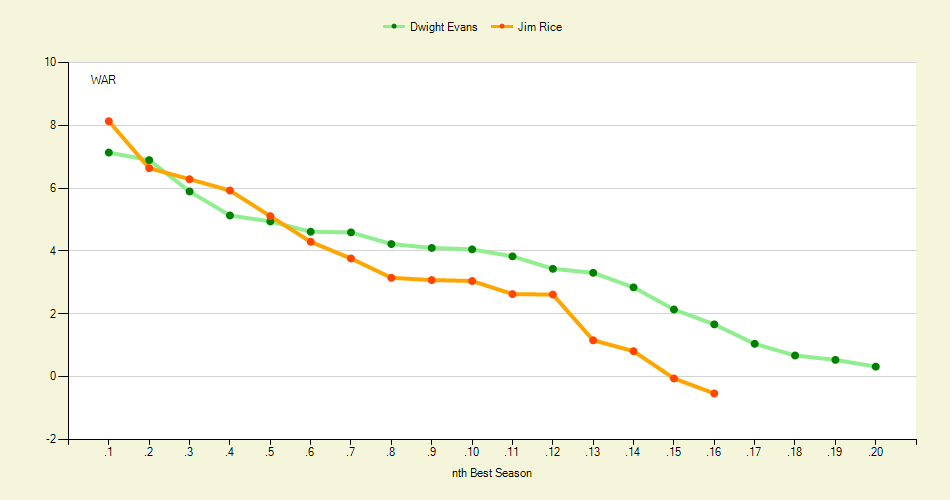
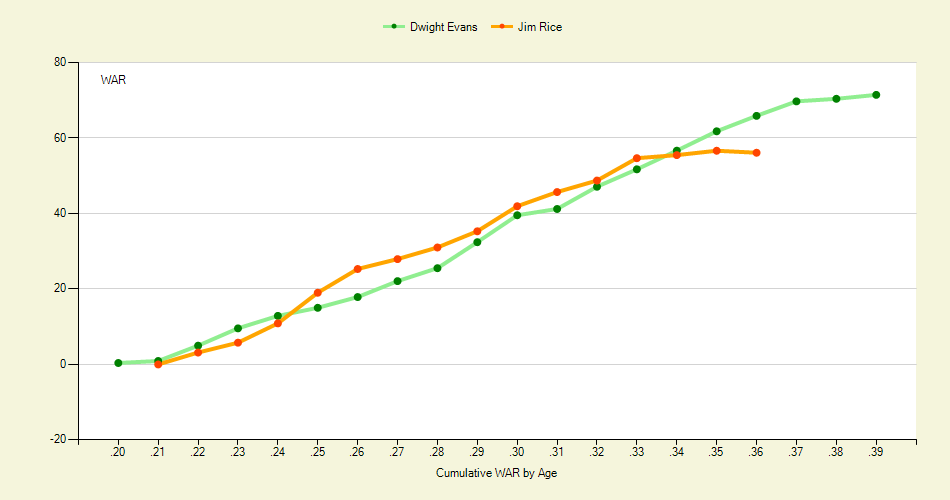
Because the topic is something of an obsession for me, I tweeted my findings from this WAR Graphs search last night.
Jim Rice & Dewey were similar, if you ignore Dewey's 35-40 seasons when he hit .283/.387/.470 (133 OPS+) http://is.gd/jFVpA Patrick Sullivan
PatrickSull
When he saw this, Dave Cameron responded with the following:
@PatrickSull My favorite - run Jim Rice against Chet Lemon; pick up jaw. David Cameron
d_a_cameron
And sure enough, here is the WAR Graphs comparison of Rice and Chet Lemon.
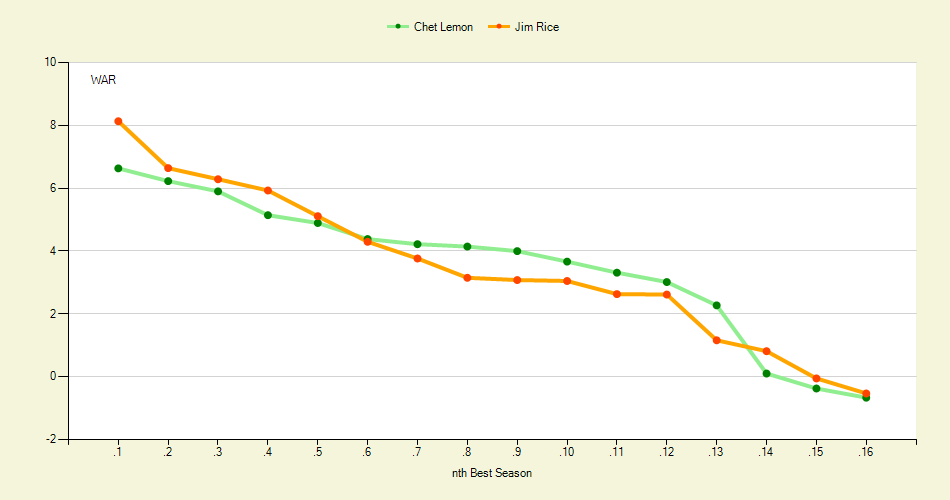
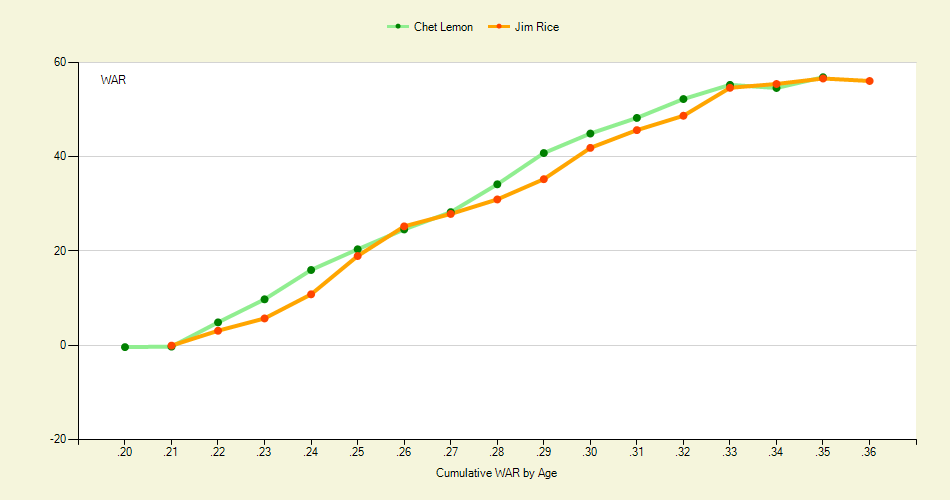
Chet Lemon and Jim Rice are more or less indistinguishable. Chet. Lemon.
**********
All of this was a long and graphical way of setting up the point of this post, which is to articulate a coherent way to think about WAR in the context of Hall of Fame voting. Jonah Keri has done a really nice job advocating for Tim Raines in a more visceral way than Rich Lederer has for Bert Blyleven. Rich has gradually won over voters by reminding them time and again of Blyleven's statistical dominance. Keri, on the other hand, will make his case with stats, but also with well-supported assertions along the lines of had Rickey Henderson never come along, Raines may well be regarded as the finest lead-off man ever. That resonates more than a WAR Graph with many.
To take it a step further, not only is something like WAR altogether unpersuasive to some, but when many see the WAR Graph above of Jim Rice and Chet Lemon, their gut may be to write off the statistic itself altogether. In other words, it's not that the graph shows that Rice and Lemon were comparable. No, the graph shows that WAR as a statistic is moronic.
But here's the thing about WAR. It lines up with so much of what we understand to be true, even before we start in on any sort of advanced statistical analysis. Here's a list of the top-10 position players by B-Ref WAR:
1. Babe Ruth
2. Barry Bonds
3. Ty Cobb
4. Willie Mays
5. Hank Aaron
6. Tris Speaker
7. Stan Musial
8. Rogers Hornsby
9. Eddie Collins
10. Ted Williams
The next five on the list are Mickey Mantle, Lou Gehrig, Honus Wagner, Rickey Henderson and Mel Ott. We are talking baseball royalty. It's not as though Nomar Garciaparra or someone crept into the top of the list because of some quirk in the statistic. It actually aligns beautifully with a list your grandfather might furnish you of the very best baseball players of all time.
Here are the top pitchers:
1. Roger Clemens
2. Walter Johnson
3. Tom Seaver
4. Pete Alexander
5. Lefty Grove
6. Phil Niekro
7. Greg Maddux
8. Gaylord Perry
9. Warren Spahn
10. Randy Johnson
The next five? BERT BLYLEVEN, Christy Mathewson, Bob Gibson, Nolan Ryan and Steve Carlton. Nobody is saying that this is the definitive list of the best pitchers of all time, ranked perfectly in order. Peak matters, for instance, and I don't want to speak for anybody else but I don't think you'll find too many stat heads saying that Niekro, Perry or Blyleven were better than Pedro Martinez or Sandy Koufax. But the point remains the same: that's a pretty darn good list in terms of how it compares to common baseball wisdom of the very best pitchers ever.
There are single-season examples, too, of the visceral or instinctive aligning with analytical conclusions. Growing up, I heard non-stop stories from my father and grandfather of how great Carl Yastrzemski was for the 1967 Impossible Dream Boston Red Sox. We would listen regularly to the WHDH-produced soundtrack to that season, including the ragtime adaptation a song whose chorus went "Caaaahhhhrrrll Yastrzemski" over and over again. Later in life, my father in law, a Long Beach, California native who studied law in Boston during the 1967 season, would tell me one story after another about how incredible Yaz was. This is a man who is no Red Sox supporter, and as prone to hyperbole as anyone you could meet. Given everything I had heard throughout my life about Yaz in 1967, you'd have thought he had one of the very best seasons ever. Having bought in more and more to advanced statistical analysis, I just assumed all of this was overblown.
Well you know what? Yaz did have one of the very best seasons ever. Go on and check it out. Aside from three insane Barry Bonds seasons, Yaz's 1967 stands as the finest year by a position player since 1958. All of that wonderful stuff I had heard about Yaz, all of what seemed like folklore, it ALL lined up perfectly with what WAR would tell you about Yaz's heroics in 1967. It was one of the truly great single seasons in baseball history.
When I see a graph like the one above of Lemon and Rice, I don't immediately assume Lemon was better than Rice or even that Lemon was the same caliber of player Rice was. I'm more skeptical of defensive data than offensive, and I have a ton of respect for what Rice did at his peak. But that's not how WAR is supposed to work, or at least it's not how I think it should work. Instead, I believe it should be your first pass.
Oh, I see here that Blyleven ranks 11th all time and Morris 119th. I probably would be wrong to vote in Morris then, and not Blyleven.
Huh, look at this: Tim Raines ranks 55th all time and Lou Brock 121st. Maybe I need to think a little differently about Raines's candidacy?
In the Rice and Lemon case, it just shows that maybe we've thought a bit disproportionately about both players. Rice is in the Hall of Fame while Lemon, well I hadn't even thought about Chet Lemon in over a decade. That doesn't seem right to me anymore now that I have taken Dave Cameron's suggestion to run the comparison.
WAR is not perfect but it cannot be ignored, either. My hope is that more Hall of Fame voters will look to the stat to help frame their decisions. If a certain player amassed many of his Wins Above Replacement in exceedingly favorable conditions, no problem. Dock him. If WAR sells short a player like Morris or Rice for whatever reason, you can make that case too. All I ask is that voters recognize how well the statistic holds up to everything we understand to be true about baseball. More often than not for the attentive baseball fan or writer, a quick pass at WAR will serve more as affirmation than an eyebrow-raising contradiction. That being the case, when it does not quite align with pre-conceived beliefs, it merits further investigation and not immediate write-off.
| Change-Up | November 16, 2010 |
Japanese Pitchers & the Hot Stove
I had been planning a write-up of the Japanese pitchers currently in Major League Baseball who could change uniforms this off-season but one of those players won’t be changing teams. Hiroki Kuroda will return to the Los Angeles Dodgers thanks to a 1-year, $12 million deal that was announced last night.
Kuroda’s numbers might not leap off the page but he pounds the strike zone and, when healthy, is a legitimate number 2 or 3 in a championship caliber rotation. There are 87 starting pitchers who have tossed 400 innings since 2008. Among them, Kuroda ranks 20th with a 3.18 K/BB ratio and also sports the 11th lowest BB/9.
That still leaves a number of Japanese pitchers who could impact the 2011 Hot Stove in a significant way. There’s Kenshin Kawakami, whose $6.67 million price tag is one the Braves are reportedly looking to shed. They may have a taker back in Japan, but Kawakami may be worth a look for teams here in the States. His ground ball rates are well below average, so the best fit would be on a team with superb outfield defense and deep pockets. Maybe the Yanks think about it and save themselves a Dustin Moseley start or five. Kawakami’s no superstar but he could make for nice rotation depth, particularly if the Braves would be willing to pick up a little of his salary.
With Kuroda now locked up, that leaves two compelling free agent options, Koji Uehara and Hisanori Takahashi. Here are their respective MLB numbers to date, Uehara with the Baltimore Orioles and Takahashi with the New York Mets:
| IP | GS | K/9 | BB/9 | K/BB | |
|---|---|---|---|---|---|
| Takahashi | 122.0 | 12 | 8.41 | 3.17 | 2.65 |
| Uehara | 110.2 | 12 (0 in '10) | 8.38 | 1.38 | 6.06 |
Takahashi had an excellent first season, and is now looking for a 3-year deal. He won’t come cheaply to whichever team inks him. Uehara, on the other hand, is the better pitcher and likely to cost a lot less. The risk lies in Uehara’s health but if a team can get comfortable with his medicals, he could offer big-time returns.
Finally, there are two Red Sox I would not be surprised to see suiting up elsewhere in 2011. Daisuke Matsuzaka can be frustrating, but he’s a perfectly fine turn-taker for any rotation. Matsuzaka has a career 5.52 ERA against the Yankees and a 5.09 figure against the Rays. For his career in Inter-League action, his ERA is 3.97. It makes sense beyond the simple quality-of-opposition adjustment, too. Matsuzaka walks too many batters and often cannot last long into games. The National League mitigates this weakness for a couple of reasons. First, facing a pitcher means less nibbling, which means fewer pitches, fewer walks, and the potential to last longer. Second, the strategic imperative in the Senior Circuit, regardless of how the pitcher is performing, is sometimes to pull the pitcher for a pinch hitter in a middle-innings high leverage run scoring opportunity. I really think Matsuzaka could thrive in the NL.
There’s also Hideki Okajima. Like Dice-K, he’s played an integral role in Boston’s run of success over the last four seasons. But despite a second half rebound last season, the long-term trend on Okajima is ugly. He’s been regressing pretty steadily. I imagine scouts could offer more insight as to why that might be the case, but it’s my belief that hitters have simply caught on. He has a unique delivery that was deceptive for a few seasons, but now hitters have a beat on him. He’s arbitration-eligible and will likely be due somewhere in the neighborhood of $3 million for the 2011 campaign. Boston has not yet decided if they would like to tender Okajima or not.
There’s no shortage of compelling story-lines this Hot Stove season. Jayson Werth and Carl Crawford will be huge-impact players, and the Cliff Lee sweepstakes are already underway in earnest. But it looks like Japanese pitchers in new roles on new teams could also influence the 2011 season, something to look out for in the coming weeks and months.
| Change-Up | November 03, 2010 |
The 2011 San Francisco Giants Lineup
The San Francisco Giants just won the World Series. They wear gorgeous uniforms, and they play in a world-class city performing in front of a rabid fanbase who jam one of the best ballparks in the world to watch their team. Whatever the lackluster television ratings might say, I think it was a great post-season for Major League Baseball. The Giants won and and the Dallas baseball market had a chance to experience World Series baseball as well. That's two big markets that the game can count on for years to come.
I offer that preface because I don't want to come off as though I am not allowing the Giants their moment. Really, I couldn't be happier for them. I've been digging into their roster over at B-Ref and Fangraphs and I think it's a fascinating mix of players. But what I am also finding is that there's a lot of work to do in order to put together anything resembling a championship-caliber lineup together for 2011, even when you factor their remarkable pitching. Jeff Fletcher addressed the topic at Fanhouse yesterday, and ends his column this way:
So you can expect next year's Giants to look a lot like this year's, with good young pitching and a patchwork lineup.Worked this year.
"If these (pitchers) stay healthy, they have a chance to do a lot of good things," Huff said. "Get some guys that pop the ball out, and that's all you need. Two or three runs is all you need."
Let's start with this year's lineup. Four - FOUR - players had a wOBA of over .330 who had 100 or more plate appearances.
Player       PA      wOBA
A. Huff      668     .388
P. Burrell   341     .371
B. Posey     443     .368
A. Torres    570     .363
Cody Ross came over from the Marlins and posted a .352 wOBA in 82 plate appearances, too. But that's it. For frame of reference, the lowly Houston Astros had five guys better the .330 mark. The Cincinnati Reds had ten. You get the picture.
For much of the season, the Giants were hanging on by a thread. On August 30th, they trailed the San Diego Padres by 5 games and were on the outside looking in for the Wild Card race, too. They finished the year on a tear, going 18-8 over the last month and clinching a post-season berth on the season's final day. Here is where the offense came from over that stretch:
Player       PA      OPS
C. Ross      65     .886
P. Burrell   94     .870
F. Sanchez   98     .840
A. Huff      121    .834
B. Posey     115    .818
J. Uribe     100    .800
"Smoke and mirrors" does a disservice to a team whose pitching dominates the way San Francisco's can and whose General Manager papered over his own roster blunders with mid-season fixes. Ross and Burrell paced the Giants playoff push, and then Ross was terrific into the post-season, too. It's important to ask what's sustainable and what's not. So, what about next year?
Huff is a free agent, but Fletcher seems to think he'll be back.
Look for them to re-sign Huff to at least a two-year deal, worth around $8 to $10 million a year.
That's fine, but it's not hard to see how such a move could go wrong. He's one season removed from .241/.310/.384 and turns 34 in December. I'd liken re-upping Huff now to the Red Sox re-signing Mike Lowell after his standout 2007, which Lowell capped by winning the World Series MVP. Great clubhouse guy, veteran, winning reputation, aging, solid performance track record. Plenty of people might feel good about a Huff extension because of all the goodwill generated in 2010, but that doesn't mean it will work out.
As for Burrell, he's gone. Uribe is unrestricted, too, and if I were Brian Sabean, he'd be getting a much longer look than Huff. Uribe's fielding versatility and sneaky pop make make him the type of player good teams should always try and carry, even if there won't be 650 plate appearances for him. Like Huff, Uribe will have his suitors but if you're going to overpay, do so for the younger middle infielder. The market is awful for middle infield types, anyway, and the Giants will have a gaping hole at shortstop since they're unlikely to pick up World Series MVP Edgar Renteria's option.
So let's say Uribe is back. Here is what we have:
C - Posey
1B - Open
2B - Sanchez
3B - Sandoval
SS - Uribe
OF - Ross
OF - Torres
OF - Rowand
That's still a lineup screaming for an impact bat. After all, even with Huff's career year, the Giants still were a below average offense. Posey could improve, I would expect some bounce-back from Sandoval and a full season of Ross's bat should help, but other than that, it's hard to see where the Giants might get increased production over and above 2010 without Huff's monster year mixed in.
There are a few necessary moves here. First, that's not a viable outfield at all. Thankfully, Ruben Amaro is reported rumored to be feeling sentimental for Rowand so the Giants could move him. It won't solve any money issues since the Giants would have to pick up a lot of his tab, but it frees up roster space and an outfield slot. I think the Giants would be nuts not to hop in the mix for one of Carl Crawford or Jayson Werth. Sure you'd have to pay up, but if you're not going to invest now, then when? The rotation is cost-controlled and as deep as can be. Both players field excellently, an added bonus in spacious AT&T Park. Finally, the team should be flush coming off the World Series win. A payroll bump has to be in the cards. It seems like too good a fit not to consider. Werth or Crawford paired with Posey could form an excellent offensive core for years to come, supporting a truly outstanding group of pitchers.
At first base, another position they'll need to address if Huff walks, I might opt for another buy-low guy like the Giants netted with Huff in 2010. Carlos Pena looks as good as any other there, but Derrek Lee could be an attractive short-term option, too.
I don't think that Brian Sabean should feel satisfied with his "patchwork" offense. It worked but he got lucky, like all World Series winning teams do, and should recognize as much by taking a big swing for 2011. He oversees one of the great franchises in the game, one that should be a choice destination for stars like Werth and Crawford given the atmosphere we've all just witnessed.
Strike while the iron's hot, Sabes.
| Change-Up | October 26, 2010 |
The Jays Gamble on a Neophyte
John Farrell was named Manager of the Toronto Blue Jays yesterday, a great choice for a team with a young and promising pitching staff looking to compete in the brutal American League East. Sports Illustrated’s Jon Heyman felt differently, however, and took to his Twitter feed with the following:
new #bluejays manager farrell well-regarded but theyre gambling on neophyte in division with francona, girardi, showalter, maddon Jon Heyman
SI_JonHeyman
We have been tough on Heyman here at times, I admit it. We think he’s been pretty obtuse in his belief that Bert Blyleven doesn’t belong in Cooperstown, and Rich wrote the definitive Heyman takedown over his Scott Boras servitude. With this in mind, I want to try and be cordial towards Heyman despite my frustration with his reaction to Farrell's hiring.
First, there was Heyman's use of the term “neophyte.” A “neophyte” is a novice. One example someone used when I asked whether others on Twitter considered the term derogatory was that Meg Whitman is a political “neophyte”. That sounds right to me. It’s not necessarily derogatory in that light. It’s just a fact. But when applied to someone like Farrell, who has spent his life in baseball, I think it’s misapplied.
In the narrowest sense, yes, Farrell is a “neophyte” as it relates to Major League Baseball Managing. But he appeared in eight separate Major League seasons as a pitcher, so he’s capable of relating to the day-to-day life of a Big Leaguer. Players value that. He also spent six years heading up the Cleveland Indians’ Player Development organization from 2001 to 2006, a time during which they turned out some awfully good players. He’s an excellent evaluator, and has a track record of getting the most out of talent. Finally, in his latest gig, he’s been pitching coach for a team that has won 375 games in four seasons. Player, front office guy, coach. I’m not sure you could come up with a more seasoned professional to take the reins. As far as his overall baseball experience is concerned, he’s anything but a "neophyte".
My wife thought I was nitpicking by isolating that word, however. “A neophyte is someone who is new to something, and Farrell is new to Managing,” she reminded me. Fine, that’s true. We’ll set that aside. She then said, “it’s the world ‘gambling’ that would offend me if I were Farrell.”
As I think more about it, it’s a fantastic point. Who are the better, more experienced Managerial options for Toronto? Would Art Howe or Don Baylor or Jimy Williams or Mike Hargrove be better? And if so, why? Joe Girardi had all of 162 games of Manager experience before the Yankees hired him, and he ended up leading New York to a World Series title last year. That seemed to work out ok. So where exactly is the “gamble”? Who's to say Bobby Valentine wouldn't be a "gamble"?
I think Farrell's the perfect choice for the Jays, a team whose future hinges on its young pitching staff's continued improvement. Shaun Marcum, Ricky Romero, Brett Cecil, Brandon Morrow and Marc Rzepczynski will average 26 years old for the 2011 season. Kyle Drabek, Zach Stewart and Brad Mills aren't far behind. Farrell will be able to lean on all of his professional skills - his MLB player experience, player development expertise and pitching coach track record - to help strengthen Toronto's biggest asset, its young pitching.
There may be others like Farrell around the league, but I can’t imagine a better extended apprenticeship than the one Farrell has served leading up to this moment in his career. I don’t mean to pick on Heyman, but I found his remarks to be unfair. Farrell has too much experience in baseball to be considered a “neophyte” (except in the narrowest sense), and his hiring is both sound and the byproduct of a long and drawn-out process by the Jays. They’ve done their diligence. If only Heyman would do the same prior to taking to his keyboard.
| Change-Up | October 20, 2010 |
Best Position Player Postseason Performances Since 2000, WPA Edition
At Red Sox Beacon last weekend, I decided to see where J.D. Drew's performance in Game 5 of the 2008 ALCS stood on the all-time great Red Sox postseason performances. The metric I chose was Win Probability Added, and thanks to Baseball Reference's Play Index tool, I was able to sort through the best (and worst) games this way.
I thought I would do it here, but limit our search to the five best hitting performances by WPA since 2000. There are no World Series games on here, which sort of screams for a follow-up post as the Fall Classic is set to start. I will also take a look at pitcher performances. There are some forgotten names listed (Erubiel Durazo!), and some no-doubter Hall-of-Famers as well, a dynamic that makes the playoffs so much fun. Sure, Josh Hamilton was great last night. But Bengie Molina!
Top Five Hitting Performances
5) Adam Kennedy, 10-13-02, ALCS Game 5, .634 WPA
The Minnesota Twins had taken the first game of the series, but Anaheim ripped off three straight wins in Games Two through Four. Game Five was big because the series was set to head back to the Metrodome, a difficult place to win. This was the first playoff series for the Twins since the 1991 World Series, when the Atlanta Braves took a 3-2 lead back to the Homerdome. The same had happened in the 1987 World Series, too. St. Louis showed up in Minneapolis for Game 6 with a 3-2 lead. We know how those ended.
So, even though momentum was Anaheim's, they wanted to wrap things up in California. In the top of the 7th, the Twins took a 5-3 lead over the Halos, and according to B-Ref, had an 80% win expectancy at this point. In the bottom of the 7th, things would change. Adam Kennedy, having already homered twice, would hit his third of the game off of youngster Johan Santana, a three-run shot that would give the Angels the lead for good. They would tack on, oh, another seven runs that inning, and win the game 13-5.
4) Alex Rodriguez, 10-6-04, ALDS Game 2, .684 WPA
Again with the Twins! A-Rod gets a lot of heat for laying an egg in Games 4-7 of the 2004 ALCS, but the Yanks never would have had a chance to participate if not for his performance in the ALDS that season. He hit .421/.476/.737 in the 2004 Division Series, and came up huge in Game 2 after the Yanks had dropped the first game of the series. Incidentally, Rodriguez lays claim to games 4, 6 and 11 on the list of best (most clutch) postseason performances since 2000.
Game 2 was a back-and-forth affair, and things looked bleak for the Yanks after the Twins took a 6-5 lead in the top of the 12th. Mariano Rivera had already pitched. In the bottom of the 12th, Ron Gardenhire pushed things a bit by bringing Joe Nathan back for a 3rd inning of work. Nathan got John Olerud swinging to lead off the 12th but then issued walks to Miguel Cairo and Derek Jeter on 9 pitches. Gardenhire stuck with Nathan though, now 46 pitches into his outing, and A-Rod made him pay with a double that plated Cairo and sent Jeter to third. After an intentional pass to Gary Sheffield, J.C. Romero relieved Nathan but Hideki Matsui hit a sac fly on the very first pitch from the southpaw.
Rodriguez finished the game 4-6 with a home run, the key double, three RBI and two runs.
3) Erubiel Durazo, 10-1-03, ALDS Game 1, .701 WPA
I remember this one well. Durazo was a beast, going 2-4 with 3 RBI, 2 walks and a run scored. His double in the 3rd came off of Pedro Martinez, and plated two runs to give the A's a 2-1 lead. In the 9th inning, Grady Little panicked. Byung-Hyun Kim started the inning with a 4-3 lead and induced a fly ball out. He then walked Billy McMillon and hit Eric Byrnes with a pitch.
Well this was when Kim still had the 2001 Yankee Stadium meltdown choker stigma, and the Boston fans were tough on him when he blew a few games down the stretch. Still, he had been an excellent pitcher and was a perfectly viable option for the Red Sox in this spot. He demonstrated as much on the next batter, getting Mark Ellis to strike out. Two outs.
Now the panic. Little decided with two outs to go and get Kim and bring in lefty Alan Embree. Problem was, Kim was no worse than Embree against lefties and even worse, Durazo had a reverse split! He hit lefties better! Embree entered nonetheless, Durazo singled and the game was tied. In the 12th, Durazo worked a lead-off walk and the A's went on to win 5-4.
2) Ivan Rodriguez, 10-13-03, NLDS Game 3, .717 WPA
This one's not too hard to figure out. The Marlins won the game 4-3 and Pudge had all four RBI. The first two came on a home run in the opening frame off of Kirk Rueter. The last two, the game-winners, came with the Giants ahead by a run with two outs and the bases loaded. Pudge singled off of Tim Worrell to give the Fish a 2-1 Series lead.
1) Jimmy Rollins, 10-19-09, NLCS Game 4, .753 WPA
One moment can change everything in the playoffs. To get a sense for the drama in the bottom of the 9th in Game Four of last year's NLCS, scroll to the 13:45 mark or so of this video. When Rollins came to bat, his team had an 83% chance of losing, and that's before you factor how good Jonathan Broxton had been for the Dodgers in 2009.
But Rollins squared up a fastball, ripped it into the right-center field gap, two runs scored and the Phillies would go on to qualify for the World Series for the second time in as many seasons. In the first inning, Rollins had singled and scored on a Ryan Howard home run.
| Change-Up | October 13, 2010 |
Comparing the Rangers & Yankees
Cliff Lee and the Texas Rangers dropped the Tampa Bay Rays in Game 5 of the American League Division Series last night, setting up an enticing matchup with the defending World Series champions.
The Rangers and Yankees respective run prevention units profile similarly. Each features a dominant ace, capable depth rounding out their rotations, and good bullpens where all roads lead to their shut-down Closers. Defensively, both teams are good, too. The Yankees probably have the outfield advantage with Curtis Granderson and Brett Gardner patrolling, while the Rangers enjoy the infield edge thanks to their stud middle infield of Elvis Andrus and Ian Kinsler.
Offensively, it’s an entirely different story. They’re both very good with the bats – the Yanks led the AL in runs and the Rangers were fourth – but they go about their work at the plate in different styles. Lineup anchors for Texas like Mike Young, Josh Hamilton and Kinsler all see fewer pitchers per plate appearance than the league average. And of course, one of the great all-time free swingers in baseball history is Vladimir Guerrero. He’s in the mix too, although he has struggled over the second half of the season. Only the Baltimore Orioles saw fewer pitchers per plate appearance than the AL West champions.
On the other hand, New York saw the most pitchers per plate appearances in the American League other than Boston or Tampa Bay. It’s really only Robinson Cano that will hack away for the Bombers, and it’s not like his approach needs tweaking. He makes it work to the tune of MVP candidacy. Even more troubling for Rangers pitching, not only can the Yanks get ahead in the count, but they hit better than any other team in baseball once there.
This contrast in hitting styles is where the ALCS will hinge. Right off the bat, the Yanks will have a chance to leverage their patience. C.J. Wilson had a nice year, but his traditional numbers outpace his peripherals. The biggest blemish on Wilson’s performance record is his high walk rate, 4.10 per 9 innings. He also throws his first pitch for a strike and induces swinging strikes on pitches outside the zone at a below average rate. Grooving the first one and forcing otherwise patient batters to chase bad balls are two tools the high-walk pitcher can turn to, but Wilson seems to have neither. The Yankees will be a test for him.
As you might imagine, Wilson struggled in three starts against New York this season, pitching just 14.1 innings and walking 5.65 guys per 9 innings. But Wilson’s smart (follow @str8edgeracer on twitter), and he doubtless knows his weakness and his opponent’s strength. In Tampa Bay for Game 2 of the ALDS, he limited his walk total to just two while facing a team even more patient than the Yankees. He’s a good pitcher with great make-up. I’m not counting him out by a long shot.
While Wilson could be a problem for Texas, Lee is the prototype to combat a patient offense. He walks nobody, and pounds the zone with pitches that move every which way. He goes in Game 3 for the Rangers at Yankee Stadium.
For the Yankees, their pitchers will have some latitude to expand the zone thanks to the Rangers’ approach. This is a risky game, however, because the Rangers righty-stacked lineup will crush mistakes from lefties. Vlad, Nelson Cruz, Kinsler and Young all murder southpaws, and if C.C. Sabathia or Andy Pettitte decide they want to get Texas to chase and they don’t bite, the Rangers’ righties should see some nice pitches to hit.
The pitcher-batter match-ups in this series should be terrific, a study in Game Theory from start to finish. I give the edge to the Yankees because of their superior approach at the plate. But it’s close, and if Sabathia and Pettitte are off even the slightest bit, it’s not hard to envision a scenario in which the Yankees head home to face Cliff Lee down 2-0. Watch individual pitches, match-ups, strategies and yes, umpiring within each plate appearance. It promises to be fascinating, and it's where this series will be won.
| Change-Up | October 12, 2010 |
Joe Mauer & Barry Bonds
It's hard to remember sometimes but Barry Bonds had just an awful reputation for failing to come through in the postseason by the time his stint with the Pittsburgh Pirates ended. This excerpt from a 2001 article for Slate that Ben McGrath wrote captures the sentiment well, though it incorporates some of his playoff failures as a Giant, too.
In five playoff series for the Pirates and Giants—all losing efforts—Bonds has batted .196 with just one home run and six RBIs over a span of nearly 100 at-bats. In 1997, the San Francisco Examiner declared, "Barry Bonds continues to struggle in clutch situations, to the point where failures now are almost expected." Last month, the New York Times' Murray Chass quipped, "If Bonds had played for the Yankees, George Steinbrenner would have called him Mr. O, not for October but for zero."
At the end of the 1992 season - Bonds's seventh in Major League Baseball, Bonds had won two MVP awards and was in line for an enormously lucrative free agent contract. Still, in 83 postseason plate appearances he had hit just .191/.349/.265. His Pirates had lost three consecutive National League Championship Series and time and again, when a key Bonds hit might have made all the difference, he came up short.
At the end of the 2010 season - Joe Mauer's seventh in Major League Baseball, Mauer has won an MVP award and should have a second. He's arguably off to the best start of any catcher in Major League Baseball history. His power stroke comes and goes, but that part of his game is just icing. He's phenomenal with or without hefty slugging totals. The Minnesota Twins rewarded Mauer with a $184 million extension this season.
Like Bonds, Mauer has been awful in the postseason. He's never won a game in the playoffs and is a career .286/.359/.314 hitter in 35 plate appearances. This past American League Division Series, Mauer hit .250/.308/.250. He came up short again.
It's interesting to contrast the way fans and media treated Bonds to the way they treat Mauer. Both were/are superstars en route to Hall of Fame careers who failed miserably under the brightest spotlight. Aside from a corner here or there of the internet, there doesn't seem to be much anger or ridicule towards Mauer. The same could hardly be said of Bonds. His detractors reveled in his high-profile failures.
That may be for any number of reasons. I'd like to think it's because we know postseason performance deviating from career norms to the upside or down is most likely due to the sample size than some innate character trait in the player in question. A more informed fanbase and media set are much more likely to cut the guy who falls short some slack. It happens, or so we've learned as the SABR movement has made its way mainstream.
One could also attribute this phenomenon to their respective dispositions. Bonds, by many accounts, was a jerk. Mauer, on the other hand, has a great reputation as an individual.
There's another potential explanation, of course. And while I don't want to use this space for social or political commentary, I'd urge you to consider alternative reasons why Mauer seems to escape media criticism while so many took such great joy in Bonds's struggles.
| Change-Up | October 06, 2010 |
Playoff Primer
There is no shortage of great sites where you can catch LDS previews. Baseball Prospectus and Fangraphs are both running in-depth previews of each series. Team-oriented sites like The Process Report, River Avenue Blues, Pinstriped Bible, Aaron Gleeman, Lonestar Ball, Crashburn Alley, Red Leg Nation, Red Reporter, McCovey Chronicles and Capitol Avenue Club also have you covered.
I thought we could take a different approach here and just pull out a handful of thematic storylines running through the 2011 post-season and have a look. For starters, let's look at two of the better rookies in recent memory set to square off out in San Francisco for the National League Division Series.
Jason Heyward wasted no time making a name for himself in 2010, homering in his first career plate appearance off of Chicago's Carlos Zambrano. If you don't think he's captivated the Atlanta faithful, I urge you to check this out:
It's with good reason, too. Heyward is the most promising player his age to come along in decades. Below is a look at the five best 20-year old seasons in terms of OPS+ since 1946 (65 years). Minimum 300 plate appearances:
| Num | Year | OPS+ | |
|---|---|---|---|
| 1 | Frank Robinson | 1956 | 142 |
| 2 | Jason Heyward | 2010 | 131 |
| 3 | Vada Pinson | 1959 | 128 |
| 4 | Orlando Cepeda | 1958 | 125 |
| 5 | Bob Horner | 1978 | 124 |
On its own, that's compelling but with names like Pinson and Horner on there, are there any guarantees that Heyward will become a superstar? Well there are no guarantees, but this next table tells you why Heyward stands out from the bunch at this stage. It's all about his approach.
| Year | BB% | |
|---|---|---|
| Frank Robinson | 1956 | 9.6 |
| Jason Heyward | 2010 | 14.6 |
| Vada Pinson | 1959 | 7.8 |
| Orlando Cepeda | 1958 | 4.5 |
| Bob Horner | 1978 | 6.7 |
Heyward's walk rate stands way above the others on that list, which bodes extrardinarily well for his future.
In the NLDS Heyward and the Braves face the San Francisco Giants and their standout rookie, Buster Posey. Here are the best OPS+ seasons by a catcher 23 and under with 300 plate appearances since 1961 (50 years):
| Num | Year | OPS+ | |
|---|---|---|---|
| 1 | Brian McCann | 2006 | 143 |
| 2 | Johnny Bench | 1970 | 141 |
| 3 | Joe Torre | 1964 | 140 |
| 4 | Gary Carter | 1977 | 137 |
| 5 | Buster Posey | 2010 | 128 |
Posey and Heyward play critical roles on their respective teams, too. Heyward trails only McCann among Braves position players in Fangraphs WAR. Posey trails only Andres Torres and Aubrey Huff on the Giants.
==========
New Digs
From the entirely non-predictive department, the last two teams to qualify for the playoffs in their first season in a new ballpark won the World Series. Both the 2009 New York Yankees and 2006 St. Louis Cardinals won the Fall Classic their first year in new Yankee and Busch Stadiums, respectively.
This year, the Twins will give it a go. It's been an incredible debut year for Minnesota at Target Field, as they have posted a home record of 53-28. The Twins will be without the services of Justin Morneau, one of the very best players in baseball, but they're used to it at this point. Since Morneau played his last game on July 7th, the Twins actually improved their record, going 49-29 to close the season. Over that same span, the Yankees were 41-36.
==========
2002 K-Rod Candidates
Jeff Fletcher has a good piece on Aroldis Chapman today, and how his presence to the Reds could be what Francisco Rodriguez was to the 2002 Angels. I agree with Fletcher, but there are others who fit that category too.
For one, there's AL Rookie of the Year candidate Neftali Feliz. The Rangers could expand their Closer's role to include additional high-leverage work. Remember, Feliz came up through the Minors as a starter. He could handle additional innings here and there.
There's also Craig Kimbrel of the Atlanta Braves, who has 40 strikeouts in just 20.2 innings of Big League work. He'll have to improve his control if he is going to dominate the way Atlanta might like him to. Kimbrel has 16 walks to go along with those 40 punch-outs. At the same time, the Braves won't need to lean too heavily on him given their relief depth, should Kimbrel struggle.
==========
Lefties Reign in the AL
Top-5 American League playoff starters by Fangraphs WAR:
| Num | Pitcher | fWAR |
|---|---|---|
| 1 | Cliff Lee | 7.0 |
| 2 | Francisco Liriano | 6.0 |
| 3 | C.C. Sabathia | 5.2 |
| 4 | C.J. Wilson | 5.1 |
| 5 | David Price | 4.3 |
Notice any commonality there?
The top righty was Carl Pavano of the Twins.
==========
Things You Should Read
This Dave Cameron piece on how Dusty Baker should deploy his pitching staff in Game One. Sure, the schedule allows Philly the chance to deploy its big-3, but it also allows the Reds to keep their outstanding bullpen fresh.
This guest post by Mike Fast on David Price on The Process Report was outstanding. Jeremy will really appreciate it, I think.
Joe Pawlikowski's take on A.J. Burnett's move to the Yankee bullpen is terrific, too.
So you want to dabble in the free agent pitching market, huh? Sure you might net yourself a gem like C.C. Sabathia. But how about Barry Zito, Javier Vazquez and Burnett? Where would the Red Sox be had John Lackey and Josh Beckett pitched the way Boston had hoped? In Zito, Vazquez, Burnett, Lackey and Beckett, that's $76.5 million doled out to starters who will not be taking a playoff rotation turn.
| Change-Up | September 24, 2010 |
The Streaking O's
Last year, I wrote about how the Baltimore Orioles could be on the cusp of something special. Then, this year, I wrote about how I was so wrong about the Baltimore Orioles and how it was really the Toronto Blue Jays that were the team flying under the radar. I even mocked myself for being so wrong on Baltimore.
I wish I had hung in there with the Orioles but who could have blamed me? The Orioles were awful, almost historically so. When play ended on Sunday, August 1st, Baltimore was sporting a record of 32-73 and were 34.5 games back of first place. That’s a 49-win pace and, playing games in baseball’s most competitive division, there seemed little hope that they could turn things around.
The dismal first 105 games was a top-to-bottom group effort. Let’s start with the job Andy MacPhail did last off-season. His three most high-profile moves were to bring in free agents Garrett Atkins and Mike Gonzalez, and to trade for veteran right-hander Kevin Millwood. Atkins hit .214/.276/.286 and was released on July 6th. Gonzalez has earned nearly $275,000 for each inning pitched, which might be OK if he were Mariano Rivera. But he’s Mike Gonzalez, and through August 1st he had a 5.40 ERA in just nine appearances. He stunk, and couldn’t stay healthy. As for Millwood, he’s pitched ok at times but that 3-16 record while blocking other potential Big League- ready arms has hardly served the team’s interests. Finally, presumably because he looked down at his roster before Opening Day and noticed Cesar Izturis (65 career OPS+) was his shortstop, MacPhail added Julio Lugo for depth. In 253 plate appearances, Lugo has 6 extra-base hits and 14 walks.
A group of youngsters expected to develop into legitimate Big League contributors share culpability as well. Brian Matusz, Jake Arrieta and Brad Bergesen all struggled through August 1st. One time uber-prospect Chris Tillman has yet to show that he can be effective in the Majors, and Koji Uehara missed much of the year with injury troubles. Offensively, Nolan Reimold backed up his breakout 2009 with a .210/.289/.350 start and a season-ending achilles injury. Matt Wieters continued to disappoint. Josh Bell, the player so many praised MacPhail for prying away from Ned Colletti in exchange for George Sherrill, has floundered in 151 plate appearances. It looks like even if the veterans had performed for the Orioles, those of us who were bullish on them last season were a year or two early on the youngsters.
But the veterans own the mess that is (was) 2010, too. Ty Wigginton has managed just a .318 on-base. Brian Roberts, through August 1st (last day of the Juan Samuel era), was at .250/.313/.318. Miguel Tejada never even looked interested, hitting .269/.308/.362 before being shipped off to San Diego. Adam Jones had a .306 on-base on August 1st. Nick Markakis hit .303/.384/.488 in his 23 and 24-year old seasons. He’s hit .292/.356/.438 in his 25 and 26 seasons. Through August 1st, his first 132 innings, staff “ace” Jeremy Guthrie was 4-11 with a 4.23 ERA.
It’s well outside of my expertise to understand the impact a Manager has on a ball club, but here are the facts as they relate to Baltimore in 2010. Dave Trembley started the year 15-39. Juan Samuel, with the interim reins, went 17-34. Buck Showalter, since taking over on August 3rd, is 28-19. That 49-win pace now looks more like 65-67 wins. 49 wins is no-man’s land but heck, the 2007 Rays won 66 before reaching the World Series in 2008. Last year's San Diego Padres went 23-13 over their last 36 games, and their success has carried over into 2010. Everything has changed in Baltimore. Just look at some of the performances below:
| Pre-Buck | Post-Buck | |
|---|---|---|
| A. Jones | .272/.306/.434 | .328/.396/.500 |
| M. Wieters | .246/.322/.370 | .271/.336/.421 |
| B. Roberts | .250/.313/.318 | .293/.372/.425 |
And for the pitchers, the two numbers presented below are K/BB and then ERA.
| Pre-Buck | Post-Buck | |
|---|---|---|
| B. Matusz | 1.94, 5.46 | 2.92, 2.97 |
| J. Arrieta | 0.76, 5.47 | 1.80, 3.78 |
| B. Bergesen | 1.33, 6.63 | 1.94, 2.29 |
| J. Guthrie | 2.00, 4.23 | 2.77, 3.29 |
| Baltimore Orioles | 1.71, 5.18 | 2.27, 3.59 |
There have been other exciting developments, too. Uehara has emerged as a potential shut-down reliever with just five walks in 39 innings pitched and Luke Scott has OPS'd over .900, for instance.
The Orioles have been the AL East's best team for 45 games or so, and with a young pitching nucleus returning and Andy MacPhail's stated commitment to beefing up the offense this off-season, the O's may yet be interesting in 2011. I am reluctant to say more than that given the competitiveness of the division and my own checkered history forecasting Orioles success. But Showalter's aboard, the youngsters are coming along and the veterans are performing the way they're supposed to. From there, you'll have to draw your own conclusions.
| Change-Up | September 15, 2010 |
Checking In On the NL West
At the conclusion of play on August 25th, the San Diego Padres had amassed a 76-49 record, and were 6.5 and 10.5 games clear of the San Francisco Giants and Colorado Rockies, respectively. With a little more than a month to play, a club supposed to be in rebuilding mode was running away with the National League West title.
They had done it by averaging a respectable 4.5 runs per game when you consider their home ballpark, and their pitching and defense had been in top form all season long. From the beginning of the season through August 25th, the Padres were only yielding 3.4 runs per game. A closer look at the personnel might have given some pause about this team, but 125 games into this season they looked every bit the part of a legitimate contender.
Over their next 17 games, 14 of them at home, the Padres would go 4-13. Prior to the start of Monday’s series in Denver against the Rockies, from August 26th through September 12th, San Diego averaged just 2.2 runs per game while yielding 4.2. They were awful, and the division seemed to be slipping away. Their playoff odds, a lock just weeks ago, had dwindled down to the 50% mark.
The collapse was a total team effort, saving maybe superstar Adrian Gonzalez. His production remained steady. But other key contributors for the Padres were cratering. David Eckstein had held his own for much of the year but is at just .197/.242/.213 since August 25th. Yorvit Torrealba had been a nice surprise but he’s hit .219/.306/.333 from August 1st through today. Newcomers Ryan Ludwick and Miguel Tejada faltered badly, too, as the former has slugged just .323 since the losing began while the latter has managed just a .253 on-base.
Meanwhile, the Rockies got hot. Carlos Gonzalez and Troy Tulowitzki went nuts, and their pitching has improved as well. While San Diego went 4-13, the Rox ripped off a 14-4 stretch. San Francisco was playing better baseball, too. They went 10-6 over that same stretch. The NL West was shaping up to be one heck of a race.
Over the last two nights, however, things have taken yet another turn. The Padres won consecutive games on the road in Colorado thanks to a couple of huge home runs, one from Matt Stairs last night and another from Miguel Tejada on Monday. Also of note, Jon Garland bounced back and pitched well last night after a dreadful month for him. The Padres playoff odds are back up around 70%, thanks not only to their two-night resurgence, but also to Clayton Kershaw’s complete game shutout in San Francisco last night.
San Diego now has two games in the loss column on the Giants and four on the Rockies. The Padres have eight games remaining on this road trip, including another in Denver, four in St. Louis against the flailing Cardinals and three at Dodger Stadium. Then it’s the Reds and Cubs at home before what could be one of the most exciting season-ending series in a long time: three in San Francisco against the Giants.
Everything is more or less settled in the American League, faux AL East drama and all. The Phillies have scooted ahead of the Braves, but the Braves seem poised to take the NL Wild Card (although the two teams do have six games remaining against one another). That leaves the NL West, where you’ll want to remain focused if pennant race drama is your thing this time of year.
| Change-Up | September 10, 2010 |
Friday Links
These are exciting times for the family of our fearless leader here at Baseball Analysts. Rich's father George, profiled here and here in the past on this site, will be inducted into the Long Beach Baseball & Softball Hall of Fame a week from Saturday night. I mention this today in this space because the publicity surrounding George’s induction tells you a lot about Rich Lederer, his priorities and his character.
This Long Beach Press-Telegram article offers a glimpse into Rich’s upbringing and how his values came to be. He spent his childhood hanging around Major League ballparks, and most of that time was in the company of his father and brothers. To this day, Rich’s love of family and baseball shine through for anyone lucky enough to call him a friend.
Rich will have a recap of the ceremony itself one week from Monday.
==========
Given Rich's past work on payroll efficiency, I found this graphical look at the current MLB standings to be fascinating. Great stuff from Kevin Dame at Hardball Times. Oh, those Cubs.
=========
Ben Kabak has a great write-up on Brett Gardner at River Avenue Blues.
On the season, Garnder is now at .284/.390/.384 through 504 plate appearances. He’s seventh in the AL in on-base percentage, ninth in walks with 70 and fourth in steals with 40. As a defender, too, his numbers are steller. His left field UZR is 16.9, and his arm is 5.3 runs above average. His eight outfield assists are second in the American League, and opposing teams have stopped running on his arm. Have I mentioned he’s making just $452,000 this year?
That Gardner has played as much as he has for the Yanks is Exhibit A that these aren't the mid-aughts Yanks, throwing money at anything and everything when they have a hole to fill. Gardner has subtle skills, and could easily be passed over by a dumber team with championship hopes. But the Yankees aren't dumb, and their ability to pay a very good player the minimum allows them the financial freedom to flex their financial muscles elsewhere.
==========
This is the most incredible thing I've read all year. Joey Votto does not have one single infield pop-up this season. I just don't even know what to say about that. Here's 'Duk from Big League Stew:
It's difficult to get your head around, but the above headline is true: Joey Votto has not hit an infield popup all season.
==========
Enjoy the start of the NFL season this weekend, and tomorrow has an excellent slate of college football. Even though the AL playoff slots are more or less wrapped up, the NL picture remains wide open. The two series to keep your eye on are the Cards in Atlanta and the Padres hosting the Giants.
San Francisco is just a game back of San Diego, and if the Cards have a miracle comeback in them, they'll have to make a dent this weekend.
| Change-Up | September 01, 2010 |
The Meaning of Marlon Byrd
When Marlon Byrd signed his 3-year, $15 million contract with the Cubs this past off-season, it was seen as yet another indicator that Jim Hendry was out of touch. Why add a 32-year old center fielder with a flimsy track record of success to a team with a $144 million payroll and legitimate championship aspirations?
Here is Christina Kahrl of Baseball Prospectus reacting to the acquisition:
My initial response on Twitter (@ChristinaKahrl) was that Byrd won't slug .420 away from Texas, and while that was a flip comment*, the more I think about it, the more I'm comfortable with the idea. It might cost less than half as much as signing Gary Matthews Jr. did, but that doesn't make the signing less than half as dumb. That's the basis of comparison I'm operating from, because we've heard this story before: toolsy 31-year-old ex-fourth outfielder has big year in a superheated bandbox, gets big money, and becomes a permanent punchline on his general manager's highlight reel. No doubt Jim Hendry's moved beyond the laughter, since he's on the downslope of the Milton Bradley experience.Byrd's performance record is entirely unmysterious.
Kahrl thought the one silver lining of the move would be that Sam Fuld, a 28-year old who hasn’t managed a .400 SLG in the PCL in 2010, might be able to get some playing time more quickly given Byrd’s ability to shift to the corner outfield positions. Christina was not alone. There was a guy named Sullivan right here at Baseball Analysts who wrote the following:
It's hard not to think back to the Milton Bradley episode and how much it distracted Chicago when looking at their moves this off-season. Losing Bradley and picking up Carlos Silva and Marlon Byrd, wherever you come down on the argument that they just had to part ways with Bradley, amounts to wheel-spinning. Byrd is no better than Bradley, Silva is just awful.
Ouch.
So how has Byrd performed? He’s hitting .302/.358/.446, good for a .356 wOBA and a 119 wRC+. Byrd ranks 3rd among National League center fielders in Runs Above Replacement. When you factor defense, his season looks even more impressive. He sits 12th in Fangraphs WAR among all National League position players. By any measure whatsoever, the Byrd signing has been a masterstroke for the Cubs, albeit a bittersweet masterstroke for Cubs fans as they ponder what might have been if their team’s other pieces were up to par.
A lot of Byrd’s success offensively has been tied to a high in-play average of .338, but then again his career figure is .325. He’s murdered lefties to the tune of a .953 OPS, and in case you think his output is tied to Wrigley, he’s been much better on the road than he has at home. Defensively, as you can deduce from his WAR number, he appears to have been terrific this season. Just five months into a 3-year deal, the complete story of the Byrd acquisition is as yet unwritten. He is hitting just .245/.268/.340 over the last 28 days. Nonetheless he's been good enough to date that it warranted attention.
I wanted to post this for a couple of reasons. The first was simply to point out a ray of light in an otherwise miserable Cubs season. Byrd seems to have exceptional make-up and character – check out his blog here – and has quickly become a fan favorite. When I attended Wrigley in late June to watch the Cubs take on Pittsburgh, I noticed how much the fans seated in the bleachers adored Byrd, cheering wildly as he took the field in the first inning. And Byrd impressed me by how much he seemed to be relishing the opportunity to patrol the Wrigley outfield in front of such appreciative fans. Byrd would be one of the great stories of 2010 if Derrek Lee and Aramis Ramirez had come to play this year.
Another reason I wanted to post this was to consider what it means when the saberists get it so wrong. A 32-year old whose offensive value had been tied to hitting in Texas, who had not even experienced real Big League success until age 29...well that’s not a guy worth inking to a guaranteed 3-year deal, right? That’s how my thinking went anyway. But there are considerations that teams take into account, granted inaccurately at times, that performance analysts do not.
I don’t know if what follows is true, but I bet a lot of it is, and I also bet this represents much of the case for Byrd that refutes the reasons not to sign him that Christina and I exclusively considered. Here goes:
Byrd is a guy with outstanding character who works hard and has never been in better shape. He will be a remarkable influence on his teammates, and the opportunity to play for a team with a rich tradition like the Cubs will not be lost on him. Whatever drop-off a move away from Arlington entails, consider all of these factors enough to counteract it. He’s a mature player, a true professional who got a late start but is now ready to take his game to a new level into his mid-30’s.
I bet there’s a scout out there, probably working for the Cubs, who had written something precisely to that effect on Byrd. That scout was dead right, and I know as a result of the Byrd case I will be looking into factors I previously had not considered when analyzing player movement.
| Change-Up | August 31, 2010 |
Everybody Try & Relax
This article is cross-posted at Red Sox Beacon, a site I started with Baseball Prospectus writer Marc Normandin. We're not sure where it will go but for now it's just a repository for a handful of us to jot down our thoughts on the Boston Red Sox. I will still be contributing here at least every Wednesday, and occasionally on weekends as well.
=========
Fresh off a series loss in St. Pete and with their playoff chances inching from slim towards none, there is a new narrative taking hold here in Boston . It's difficult to follow but the best I can boil it down to is "The Red Sox knew this was a ‘bridge year’ all along and are not going for it.” Those who hold this belief - ostensibly at least - point to the lack of deal-making at the deadline and to Theo Epstein's terribly misunderstood "bridge year" remark before the beginning of the year. That the team continues to rely on the likes of Daniel Nava and Darnell McDonald to claw back into the most competitive division in baseball means the front office is content to let the season slip away, or so it goes. Some examples:
At any point, to blame it all on the injuries is rather elementary and downright blind.
Fenway Park has gone from among the most fashionable places to be seen to just another ballpark, and the timing could not be worse for a Red Sox administration that might have been planning for another lean year.Seriously, might not that be, above all else, the reason the Sox put in a claim for Johnny Damon? The Sox lack star power. The Sox lack appeal.
Joe Haggerty’s Twitter feed, August 28th
Hawpe is just an example. The main point is that the #redsox lack of movement toward any players = not going for it
Chris Gasper, who basically took to Boston.com to throw a temper tantrum yesterday
Last night's defeat at Tropicana Field and the series weren't just lost over the weekend. They were lost in the last month, when fatal flaws went unfixed by the front office. While teams like the San Diego Padres (Ryan Ludwick and Miguel Tejada) and Minnesota Twins (Matt Capps and Brian Fuentes) have addressed needs, the Sox have preferred to stand pat and apply internal patches. The Padres and Twins look playoff-bound, the Sox do not.
Actions speak louder than words. Francona's actions tell the tale of a team that waited for reinforcements from its front office that never came.
Dan Shaughnessy in today’s Boston Globe
It’s not like they didn’t warn us. Remember Theo’s comments in December about the “bridge period’’? He said that’s not what he really meant, but it was a moment of truth. The reality is the Sox figured they were in for a soft season.
A number of reactions come to mind as I read mainstream writing along these lines, but the first is to spell out exactly what the Red Sox have been through this year. Let's start with the obvious. Dustin Pedroia and Kevin Youkilis, conservatively, are two of the 20 best position players in baseball. They’re probably two of the 15 best and possibly both top-10. Combined, they’ve missed 85 games in 2010. Imagine if the Brewers were without Prince Fielder and Ryan Braun, the Rays without Carl Crawford and Evan Longoria, or the Yankees without Robinson Cano and Mark Teixeira. You could stop right there and forgive the Red Sox for merely being a .565 team playing in baseball’s (sports’?) toughest division.
Of course the story of Boston’s misfortune runs much deeper. Jacoby Ellsbury, an established 3-win player entering his 26-year old season, has played in just 18 games. Victor Martinez, one of the best catchers in all of baseball, has missed 33 games. Since health is a skill, it’s hard to get too upset about Mike Cameron’s plight in 2010, but nonetheless the fringe Hall of Fame candidate who was coming off consecutive 4+ win seasons according to Fangraphs, has not been healthy all year long. At 37, some durability issues could be expected, but Cameron has managed just 180 largely ineffective plate appearances.
On the performance side, key Sox players have struggled. Josh Beckett has been terrible in his limited action this year. John Lackey has not pitched nearly as well as he is capable. J.D. Drew has managed a couple of hot streaks but he has not been able to piece together a typical Drew offensive season despite remaining healthy as his teammates fall all around him.
The Red Sox have endured as much adversity as any team in baseball. Just a few of the items mentioned above breaking their way and Boston’s in the thick of this race. This was a bridge year in the sense that Boston needed to ink some veterans to short contracts in order to remain a top-flight team while they waited for their youngsters to develop. Marco Scutaro, Cameron and Beltre all fall into this camp, but how do any of those signings indicate that Boston's front office thought they would have a soft year? They would probably be baseball’s best team with any luck at all in 2010. I look at the 2003, 2004 and 2007 clubs and I don't know - I think this may have been the very best Red Sox roster of the Theo Epstein era. This team was designed to compete and all year long, it has.
But that first point – that the Red Sox intended to try to win the World Series all along - is only partially responsive to the complaints circling the Boston airwaves and filling the broadsheets. The notion that they’re not “going for it” by failing to make trades is preposterous on its face. Whom would you like to have seen the Red Sox acquire?
If only the Red Sox had managed to get Brad Hawpe, then at least they’d be making a go of it. Had the Red Sox traded for bats like Ludwick or Tejada, then at least we’d know they were serious. Their bullpen has been so bad. How could they NOT add Matt Capps or Brian Fuentes. And for goodness sake, things have become so dour down in the baseball ops offices, the marketing folks are now calling the shots. How else to explain the attempt to acquire Johnny Damon?
It’s hard for me to unravel the logic of these complaints but for our purposes, let’s consider the Los Angeles Dodgers. On July 31st, they sat 5.5 games out of a playoff spot, just like the Red Sox. Ned Colletti was aggressive, acquiring Ted Lilly, Ryan Theriot and Octavio Dotel at the deadline for a number of promising pieces in the Dodgers farm system and a couple of established Big Leaguers. For the short-term, the moves have worked out really nicely. Theriot has managed a 109 OPS+ as a Dodger, and Lilly is 5-1 since arriving on the west coast. Dotel has been spotty at times, but he’s only tossed 11 innings.
So the Dodgers made moves and were rewarded with very good productivity from their new acquisitions. Meanwhile, the Red Sox did virtually nothing at the deadline. After looking at potential moves – say Scott Downs for Casey Kelly as an example – the Red Sox decided that the market just wasn’t shaping up the way it would need to in order to compel them to deal. A month later, LA’s playoff odds have dwindled to 4% while the Red Sox chances are also slim, but still two times that of the Dodgers. Making trades for the short-term guarantees nothing.
But even when the Red Sox gave it an honest shot with the Johnny Damon waiver claim, they were not insulated from this line of attack. Damon chose not to join the club, but you can’t say the Red Sox have not been active. But folks like Mazz claim that the Damon attempt was driven by the business side of things, since, you know, the Red Sox aren't really going for it. I’m still waiting for any actual reporting on the subject. It’s speculation, and flies in the face of how the Red Sox have operated under John Henry's ownership group. Baseball Ops has total autonomy once made aware of their budget.
Boston is on pace to win 92 games in 2010. This despite as bad a non-New York Mets injury season as I can recall. Oh, those poor 2009 New York Mets. After winning 89 games in 2008, they had high hopes last year. Like the Red Sox, they got crushed by the injury bug, losing Jose Reyes, Carlos Beltran and Johan Santana among others. Unlike the Red Sox, they won 70 games.
I understand that you have to fill space in newspapers but the simple explanation for the 2010 Boston Red Sox is “shit happens.” It’s unsatisfying, but it’s the truth. They had a plan, assembled a great roster and on any number of fronts they’ve run into just awful luck. 92 wins might cut it in any other division in baseball, but in the AL East it means you might not qualify for the playoffs. And as a result, while Kevin Youkilis looks on in a splint and Dustin Pedroia gets set for surgery, an entitled, spoiled, silly media gets to spend the final month of the season grasping at straws assigning ex post facto blame as to why the Red Sox didn’t win a handful more games.
| Change-Up | August 25, 2010 |
Aging Players - Bargains for 2011?
Back in January, before the start of the season but after much of the hot stove dust had settled, Dave Cameron wrote about how aging players represented a new inefficiency in the market. Consider the deals players like Ricky Romero, Brian McCann, Ervin Santana, Robinson Cano and Dustin Pedroia have signed, and it’s evident that many teams are looking to sign their key players pre-arbitration. Standout players like C.C. Sabathia, Mark Teixeira and Johan Santana entering their free agent years for the first time are paid lucratively too, of course. But Cameron notes that older players who may have already played out one big contract are too easily overlooked.
Teams have become cautious with the contracts they give to aging players, not wanting to get burned paying too much to a guy who may end up not having anything left in the tank, but I feel like we’re passing the point of caution and shifting towards a market failure. If a guy is a good player at 35, you should not expect him to be useless at 36. Yes, you regress his projection for aging, but players who go from good-to-terrible in a single season are the exception, not the rule.
Aubrey Huff, a 33-year old with “old guy” skills, hit .241/.310/.384 last season. This season, he’s been one of the best players in baseball, hitting .301/.394/.534 in one of the worst hitting environments in baseball. Huff had earned the entire $3 million the Giants paid him for the 2010 year with April and May’s output alone. The Twins continue to enjoy a monster season from Jim Thome, who’s earning just $1.5 million for the 2010 campaign.
Incidentally, both players will once again be free agents for the 2011 season, and so too will a number of other aging players who still likely have productivity left in them. Some will flop badly of course, but isn’t that the nature of the free agent market more generally? There may be more risk associated with older players, but it seems exceedingly “priced in” as compared to younger guys on the market.
We’ll leave the pitchers aside for the moment, and just take a look at some of the position players that will be hitting the market. We’re not talking Jayson Werth and Carl Crawford here, the guys that are likely to break the bank and project as shoo-in productive Big Leaguers for years to come. No, we’re talking guys like Thome and Huff, players who may or may not be worth a flier. And we’ll also include the likes of Adrian Beltre and Derek Jeter. They may not come cheaply, but the risk/reward still may skew in the team’s favor nonetheless. I will list their 3-year (2008-2010) B-Ref WAR totals, along with their age.
| Player | Age for 2011 Season | 2008-2010 B-Ref WAR |
|---|---|---|
| Lance Berkman | 35 | 10.8 |
| Derek Jeter | 37 | 10.5 |
| Manny Ramirez | 39 | 10.3 |
| Johnny Damon | 37 | 10.2 |
| Adrian Beltre | 32 | 9.4 |
| Aubrey Huff | 34 | 6.9 |
| Paul Konerko | 35 | 6.5 |
| Victor Martinez | 32 | 6.0 |
| Jim Thome | 40 | 5.1 |
| Mark Ellis | 34 | 5.1 |
| Brandon Inge | 34 | 4.6 |
| David Ortiz | 35 | 4.1 |
| Magglio Ordonez | 37 | 4.1 |
| Vladimir Guerrero | 36 | 3.9 |
| Alex Gonzalez | 34 | 3.9 |
| Hideki Matsui | 37 | 3.8 |
| Pat Burrell | 34 | 2.4 |
| Adam LaRoche | 31 | 1.5 |
Some of these players will make for excellent values, some will be overpaid, but it’s likely that a number of these guys will make a huge difference for their teams in the coming years. The challenge for GM’s is to figure out how to allocate resources to aging players. Do the Yankees have to go all in for Jeter? What’s Scott Boras going to get for Beltre? Can Thome do it again next year? What does Berkman have left? Manny would make for a productive DH, no?
Says here that teams brave enough to play in this market, on average, will see more ROI than elsewhere.
| Change-Up | August 18, 2010 |
Designating a DH in 2011
Identifying who the best baseball position players are is delicate business for executives trying to field the best team possible. You have to figure out what kind of offensive performer the guy is, and then what sort of glove he has, and then what it all means. You would never want David Ortiz playing outfield for your club, and you would never want Mark Kotsay to be your Designated Hitter. They’re equally preposterous.
The problem is that Kotsay actually does start at Designated Hitter for the Chicago White Sox. Year after year teams squander the opportunity that the DH presents – the chance to increase your odds of getting real productivity by removing defense from the evaluation picture. Whether it’s Jose Vidro, Rondell White, Scott Hatteberg, Carl Everett or even someone like Marlon Anderson in Game 2 of the 2004 World Series, every year there are wholly unqualified players filling the DH slot for teams. I still remember watching incredulously when I saw that Anderson would start at DH for St. Louis in that game.
Fortunately for teams lacking punch at the DH spot, there is an intriguing crop of aging 1B/DH types set to hit the free agent market after the 2010 season. And since only four American League teams have managed a team OPS north of .800 at the position, you’d better believe their services will be in demand. Seattle DH’s have “hit” .182/.260/.303 in 2010.
Joe Pawlikowski took a look back at the 2010 Free Agent DH class last week at Fangraphs, and now I’d like to look forward at the guys who will come available for the 2011 season.
===========
There are other sticks out there too like Hideki Matsui and Lyle Overbay but the list above represents all the viable DH options for teams looking to fill the slot in 2011. Short of these guys, teams would be best served putting their best AAA hitter in there and seeing how he performs. Whatever you do, just say no to the Mark Kotsays of the world at DH.
| Change-Up | August 04, 2010 |
The Surprising Toronto Blue Jays
 Last year about this time, on July 29th to be exact, I wrote a piece here at Baseball Analysts wondering how close the Baltimore Orioles were to competing in the AL East. They were 13 games under .500 at the time with a solid young core and a fast-rising crop of top prospects. Since then, the O’s are 54-114. Well it’s that time of year again and as a loyal Red Sox fan it’s my obligation to give another AL East team, the Toronto Blue Jays, that same treatment.
No, but seriously, the Blue Jays are good. They won their 8th game in 11 tries last night, including two straight in the Bronx against the New York Yankees. Against baseball’s best lineup, Blue Jays starters Brandon Morrow and Ricky Romero struck out a combined 13 Yanks in 14.1 innings, walking just 3 along the way. Romero tossed a complete game 2-hitter last night. For more on Morrow, check out Rich Lederer’s piece from Monday. The Blue Jays trail the Yankees by 9 games in the loss column for the Wild Card, and the Red Sox, who are in contention according to many, sit just 3 games ahead of the Jays in the loss column.
Coming into this season, without the services of Roy Halladay, things were supposed to be bleak north of the border. There seemed to be a consensus that the Jays would be the new Orioles, AL East doormats, while the Orioles would turn into the team the Jays have been for so long: the club that needed to just get the hell out of the AL East. Instead, both teams have held steady in their “rightful” 4th and 5th place in baseball’s toughest division. Looking around the Jays organization, there’s plenty to be excited about. The offense is pounding the ball, the pitching is young and promising, there’s lots of money coming off the books this year, prospects are on the way and the early returns on General Manager Alex Anthopoulos are terrific.
Let’s start with the offense. The Jays rank 26th in Major League Baseball in batting average, but rank 9th in the Majors in runs scored. Their free-swinging ways can cost them at times but on the whole, they’ve made it work thanks to a couple of big bats. Incredibly, Jose Bautista leads Major League Baseball with 33 home runs, 6 bombs clear of Joey Votto of the Cincinnati Reds. Vernon Wells, who hit .265/.317/.426 in 1,792 plate appearances from 2007 to 2009, has bounced back in a big way, slugging .534 this season with 22 round-trippers. He may not quite be earning that hefty contract, but this level of production for a couple of more seasons from Wells will ease the pain of one of the worst contracts in recent memory. Other highlights include the catching combo of John Buck and Jose Molina, one of the most effective backstop duos of 2010.
What’s most incredible about the Jays offense is its productivity despite lackluster seasons from Aaron Hill and Adam Lind. In 2009, his 27-year old season, Hill hit .286/.330/.499 and was one of the most productive second basemen in the game. Lind, just 25 last year, hit .305/.370/.562. This year Hill is “hitting” .213/.289/.395 while Lind has “contributed” a .219/.278/.379 line. Both are in their prime, both were productive last year, and both have been awful. As I think about what Hill and Lind’s catastrophic under-performance means for the longer-term hopes of the organization, I don’t worry too much. They both have track records and are young enough to straighten things out.
The overall run prevention has been just middle of the pack, but that’s due in large part to a mediocre defensive unit. The team’s FIP and xFIP ranks third and fourth respectively in the American League. Morrow’s peripheral statistics have been superb, while Romero has shown flashes of brilliance in just his second Major League season. Two more cost-controlled starters, Brett Cecil and Shaun Marcum, have turned in solid campaigns as well. This is a good young rotation, and one that figures to remain together for a few years:
              Age      AL xFIP Ranking
Romero        25             7
Marcum        28            10
Cecil         25            31
Morrow        23            12
The future is bright for Toronto’s starting pitching staff. For depth, they have arms like Kyle Drabek, Zach Stewart and Brad Mills on the way, and they could always dip into the free agent market for a 5th starter while they wait for their prospects to develop.
Speaking of the future, General Manager Alex Anthopoulos seems to be tending to it nicely. His swap of Alex Gonzalez and prospects for 26-year old Yunel Escobar was nothing short of a masterstroke. Sure Escobar had some problems in Atlanta, but he’s productive both offensively and defensively and cost-controlled. Anthopoulos parlayed a stopgap option like Gonzalez into his shortstop through 2013. The Jays GM will have some money to work with this off-season, too, as the team’s 2nd, 3rd and 4th highest paid players will all come off the books (assuming he does not offer arbitration to the inconsistent Edwin Encarnacion).
As it stands, the Jays will need to add depth at the corner infield positions and also determine if J.P. Arencibia is close enough to assume catching duties, as Buck will be a free agent after this season. Toronto does have a $1 million club option should they wish to retain Jose Molina.
But the core is in place. With continued development from the starting pitching, bounce back from Lind and Hill and a few more shrewd moves from Anthopoulos, the Jays could sneak into the AL East mix sooner than many think.
| Change-Up | July 28, 2010 |
The Fascinating Case of Rickie Weeks
Say you’re a Major League Baseball General Manager and your long-term planning shows an opening at second base in 2012. The farm system looks bare at the position and nobody currently on the big club looks like a candidate for the job that season. The plan would be to make some calls to feel out the trade market and parallel track an approach focused on the free agent market.
A look at the 2012 free agent class shows that Rickie Weeks would have to be high on your list of acquisition targets, but now comes the hard part. How do you budget for Weeks? What will the market bear for a player of Weeks’s skill and performance history?
Rickie Weeks, to date, has underachieved. Coming into the 2010 campaign, the second overall pick in the 2003 Amateur Draft had hit .247/.351/.415 for his career. He’s struggled with the glove, his bat has been inconsistent and he can’t seem to stay on the field. Weeks has never played more than 130 games in a season.
Still, he has shown flashes. He hit .251/.422/.481 in the second half of 2007, his 24-year old season. The enormous difference between his on-base percentage and his batting average suggested Weeks might be a special player, a middle infielder with superb pitch recognition skills and excellent power. From August 1st through the end of the 2007 season, Weeks hit .273/.442/.553.
Now a darling breakout candidate, a kid on the cusp of superstardom, the incredible finish to the 2007 campaign would not carry over. 41 games into the 2008 season Weeks was hitting .184/.317/.329. With a low batting average that was unlikely to remain suppressed for a full season, Weeks once again finished strong, hitting .261/.373/.448 over final two months of the 2008 season.
So now Weeks was entering his 26-year old campaign. He had amassed a good amount of Major League service time and even if he was inconsistent, he had played at a high enough level for extended stretches that there was still plenty of hope that Weeks could fulfill his promise. Perhaps his biggest drawback early in his career, his erratic fielding had even begun to stabilize in 2008. 2009 would be his year.
Unfortunately, 2009 would be anything but Weeks’s year. He would tear the tendon sheath in his left wrist on May 18th in the midst of his best season to date. For the first time in his career he was off to a good start, hitting .272/.340/.517. Now a wrist injury would call into question how he might ever bounce back.
A player has a few opportunities to make a lot of money in Major League Baseball. A draft pick as high as Weeks receives a hefty signing bonus. A player can start off his career with enough promise to compel their employer to buy out arbitration years and maybe a free agent season or two. Sticking at second base, think Robinson Cano or Dustin Pedroia for these sorts of contracts. Players can also make a lot of money on a year-to-year basis in arbitration. And finally, guys can hit it big on the unrestricted free agent market. For Weeks, the wrist injury that took out his 2009 season also eliminated any hopes he may have had for a big contract or multiple lucrative arb years before he became a free agent. His window was closing.
Understandably given the nature of his injury, Weeks started slowly this season. On May 23rd, he was hitting .246/.338/.374. Since then, he’s been one of the very best players in baseball. Weeks is hitting .307/.407/.589 over his last 58 games while playing a decent enough second base. He homered for the third consecutive game last night. Already he has been worth 4 Wins Above Replacement (according to Fangraphs), a higher total than any other full season of his career and remember, he has been strong finisher his whole career. At 27, Weeks seems to be putting it all together.
This brings me back to the beginning of the piece. What do you make of Rickie Weeks if you need to look to the free agent market for a second baseman in 2012? He might be a top-10 player in all of baseball, he might tank, his fielding may regress to the point where he must be moved off of second as he ages, the wrist injury could pop back up in some form or another. You get the picture. Right now, he is probably the most difficult player in baseball to project.
For his part, Weeks has eight months of baseball that will in all likelihood set up the rest of his life. If he performs, he will earn tens of millions of dollars well into his 30’s. If he doesn’t, he will likely play out lesser contracts for (relatively) short money.
From a baseball analyst’s perspective, when you take into account the factors that go into projecting future performance, there is no greater enigma right now than Weeks. And from a human perspective, for anyone trying to earn as much as possible in their respective fields, how can you not relate to a guy who has faced this much adversity and is now pushing for his chance to fulfill all that promise and strike it rich? Weeks has a small window to show what he can do. Meanwhile, teams around the league have to decide what sort of commitment they’re willing to make to a player who would come with no shortage or risk or reward.
| Change-Up | July 22, 2010 |
Fun with Wins Above Replacement - National League Edition
Yesterday I wrote about some of the surprises that a B-Ref Play Index search for individual teams’ all-time single season WAR leaders turns up, and limited it to the American League. Today, let’s look at the National League. Because I referenced some bad MVP decisions in yesterday’s piece, I want to make clear that I am not advocating that the MVP simply be handed to the player with the highest WAR (though you could come up with a worse system). It’s simply a solid representation of a player’s contribution and when you dig in, it can turn up some unexpected items.
As you might imagine, Hank Aaron is all over the top of the Braves list but the third best season in Braves history belongs to Darrell Evans. He hit .281/.403/.556 in 1973, good for a 9.0 WAR year, easily the very best year of his long career. The best position-player season of the last 20 years for the Braves was Marcus Giles’s 2003. I would have thought Chipper Jones.
Ron Santo Hall-of-Fame supporters looking to rile themselves up should check out the Cubs list. Santo is mixed right in there with Ernie Banks and a few others and in fact, from 1964 to 1969, no National Leaguer amassed a greater WAR total. Right behind Santo on THAT list are Willie Mays, Aaron and Roberto Clemente.
The first, second, third, fourth and fifth best seasons in Cincinnati Reds history belong to Joe Morgan. Do you get the sense that people don't quite appreciate what a great player he was? I know I expected him to be up there, but the five best seasons in the history of a franchise with no shortage of history and success like the Reds? It's incredible. Morgan bears some responsibility for a legacy that could be so much more due to his broadcasting style and occasional unfortunate commentary, but he really does seem unfairly underrated nonetheless. He's on the short short list of the very best players of all time.
He's long been a favorite of this site, but Jimmy Wynn claims 3 of the top 20 seasons in Astros history. It would be hard to identify a player whose reputation as a player is more hampered by context. He played home games in the Astrodome during a brutal pitcher's era and was a high-OBP/low-AVG type. He finished his career with just a .250 batting average but a 128 OPS+.
Adrian Beltre's 2004 is the second best season in Dodgers history. The rest of the list includes names you'd expect except for number seven. There's that guy again! It's Wynn, who hit .271/.387/.497 for the 1974 Dodgers.
Four of the ten best Mets seasons took place between 1996 and 1998, and the names blew my mind. I guess John Olerud's doesn't - he was an excellent player and his 1998 is tied for the best Mets season. Who's he tied with? Yup, Bernard Gilkey, who hit .317/.393/.562 for the 1996 Mets. Edgardo Alfonso's 1997 and Lance Johnson's 1996 rank 7th and 9th respectively. Alfonso's 2000 ranks 10th.
So Chase Utley's been pretty good, right? He's one of the best players of the last bunch of years, the very best player in fact during one of the most successful stretches in Philadelphia Phillies history. Well Mike Schmidt had NINE seasons better than Utley's second best. Ryan Howard's best season ranks 52nd in Phils history ($125 million LOL).
I have never heard of Sixto Lezcano, but apparently he had the 4th best season in Padres history. For any reader who feels inclined, I would love to learn more about Sixto if you could share memories in the comments section.
Rogers Hornsby, Stan Musial, Albert Pujols, Hornsby, Musial Pujols...check out the St. Louis Cardinals list and you get a real appreciation for the standing that Pujols already has in the game's history.
| Change-Up | July 21, 2010 |
Fun with Wins Above Replacement - American League Edition
I can’t imagine many readers of this site don’t know about Baseball-Reference’s Play Index, but in case not, know that it represents one of the great joys of being a baseball fan for those interested in mining baseball's past and present. The recent addition of Sean Smith’s historical WAR data has only made the Play Index that much more enjoyable. In a recent guest post I wrote at Wezen-Ball on Red Sox Hall of Famer Fred Lynn, I searched for the greatest individual seasons by Red Sox and sorted by WAR. The results were surprising, and so I decided to play with it some more. What follows are some of the more surprising items that caught my eye. I will follow up with a National League piece tomorrow.
Let’s stick with the Red Sox for starters. In 1995, they won the American League East and first baseman Mo Vaughn won the American League Most Valuable Player award. While it may not rival 1987’s George Bell over Alan Trammell sham, it was an awful choice. Albert Belle was much better than Vaughn and among stat-friendly types the 1995 vote goes down as one of the worst in recent memory. It’s hard to see how anyone could have believed Vaughn was better than Belle, Edgar Martinez or even Tim Salmon that season.
But that’s old news. What caught my eye as I sorted through the greatest individual Red Sox seasons of all time (as determined by WAR), was that another Red Sox, one of Vaughn’s teammates, appeared to have had a much stronger MVP case than Vaughn, too. John Valentin’s 8.5 WAR season, the strike-shortened season of 1995 no less, stands today as one of the finest years a Red Sox player has ever posted and wouldn’t you know it, the highest total in the AL for that year.
Valentin hit .298/.399/.533 while playing a very good shortstop for Boston that season. I want to be careful not to ascribe too much value to WAR since Valentin derived so much of his value that season from his fielding, an area of the game more easily quantified today than ever before but still inexact nonetheless. Still, you could imagine my surprise when Valentin’s name appeared so high on the list of all-time great Red Sox seasons, and atop the American League for 1995.
Perhaps the most surprising team list of all is the Angels. Here are the top individual seasons in Angels history:
               Season  WAR
Jim Fregosi     1964   8.1
Darin Erstad    2000   7.7
Jim Fregosi     1970   7.7
Troy Glaus      2000   7.6
V. Guerrero     2004   7.4
Nothing against Fregosi or Erstad but for a proud franchise like the Angels with a particularly strong recent history of success, one would just think that names with more zing than Fregosi or Erstad might sit atop their best ever list.
The Yankees’ list is just absurd. When purists or others criticize a stat like WAR, I like to urge them to check out some of the results and see if it aligns with their impressions of who the best players are. I realize this post is about surprises, but the Yankees’ list is surprising in its ridiculous predictability. The top 25 seasons ever recorded by Yankees is an exclusive list of just six players: Babe Ruth, Mickey Mantle, Lou Gehrig, Rickey Henderson, Alex Rodriguez and Joe DiMaggio. It’s almost as if WAR might be a reasonably accurate measure of a player’s value!
Speaking of Henderson, did you know that Jason Giambi has the 4th best season in A’s history, trailing only Eddie Collins and Jimmie Foxx, and better than any season Rickey notched in an Athletics uniform? Or that Reggie Jackson’s 9.7 WAR season in 1969 was the 3rd best A’s season in the last 50 years (trailing only Giambi and Rickey) and also the very best of his career? I hadn’t realized Reggie’s best year came so early on in his career. Go check the A’s list out for yourself! There’s a lot there.
To give you a sense for just how futile Seattle Mariners baseball was before the arrival of Edgar Martinez and Ken Griffey Jr., only one of their top-42 seasons by WAR pre-dates the duo’s arrival. Alvin Davis’s 5.6 WAR season in 1984 ranks as the 23rd best season by a position player in Mariners history, and is the only season to appear in the top-42 before 1990.
Ben Zobrist holds the Rays all-time single season WAR record, with his 7.1 figure in 2009. Amusingly for this Red Sox fan, Julio Lugo appears on the Rays top-10 list. Chalk it up to their short history, sure, but there were also some mighty lean years down in St. Pete.
Finally, to tie it all together, we get to the Blue Jays. There are many players and seasons on their list before you get to 1987 MVP winner Bell. Among others, some of the least distinguished you’ll find include Lloyd Moseby, Devon White, Marco Scutaro and Aaron Hill. They may not be baseball royalty, but they all had better seasons than the 1987 American League MVP winner!
I urge everyone to check out the Play Index, and specifically to play around with the WAR lists. It’s simultaneously fun, shocking and enlightening, and will only enhance your enjoyment and appreciation of baseball’s best and most memorable players and seasons.
| Change-Up | July 08, 2010 |
Daisuke Matsuzaka & Relative Value on the Free Agent Market
Let’s get a few things out of the way. Daisuke Matsuzaka’s value as a starting pitcher for the Boston Red Sox has not been commensurate with the $103 million they doled out to acquire the player. Also, just like many other Red Sox fans who feel frustrated watching Daisuke perform, his pitching can drive me nuts at times, too. He works slowly and walks way too many batters. In his final four seasons for the Seibu Lions, Matsuzaka averaged 2.3 walks issued per nine innings. For the Red Sox, his 162-game average BB/9 has jumped to 4.3. Combine the walks, his inefficiency and his unreliability from a health standpoint and it’s all just very maddening.
With all that said, I was taken aback yesterday morning when I read this Nick Cafardo headline from The Boston Globe. In a piece about Matsuzaka and another frustrating outing in St. Petersburg Monday night, the following headline appeared:
You wonder when it’ll start to pay off
This headline very much reflects conventional wisdom here in Boston. At my doctor's office yesterday, the nurse asked me "what are we gonna do about Daisuke?" I think we've reached a point where public perception on Daisuke is now far too negative. For perspective, I would like to look at his acquisition from a different angle.
The aim of this entry is not to defend the Matsuzaka signing like I did with J.D. Drew during the off-season. J.D. Drew is a terrific baseball player, one any team would be lucky to have. He is not overpaid at all, not by one cent. In fact, his signing has been one of the better free agent deals over the last five seasons or so. The aim of this entry is to showcase the sort of value teams are likely to receive when they turn to the free agent market. From this lens, compared to other free agent starting pitchers, Matsuzaka may not be the best signing of Theo Epstein’s time as Red Sox General Manager, but it’s important to keep in mind that the Japanese right-hander has also been a key contributor to some excellent Red Sox teams.
Since the 2006-2007 off-season, when Matsuzaka signed with the Red Sox, there have been 33 contracts handed out to starting pitchers whose total value met or exceeded $10 million. Of those 33, 9 have contributed no value at all, or even negative value. Jason Schmidt, Adam Eaton, Kei Igawa, Mark Mulder, Woody Williams, Oliver Perez, Aroldis Chapman, Randy Wolf and Jason Marquis (in his deal signed prior to this season) all have either added nothing to the Big League club or in some cases, actually altogether detracted from their teams’ winning efforts irrespective of money. That’s $254 million total doled out to pitchers who have just killed their teams or in Chapman’s case, not yet had a chance to contribute.
That leaves another 24 contracts for pitchers who have contributed to their teams’ winning efforts. Presented below are those 24, sorted by Millions of dollars spent per Win Above Replacement (thanks Fangraphs).
| Num | Player | Yr Signed | Total Contract Value | AAV | Total Contract WAR | WAR/season | $ per Win |
|---|---|---|---|---|---|---|---|
| 1 | Joel Pineiro | 2009-2010 | $16.00 | $8.00 | 1.8 | 3.60 | 2.22 |
| 2 | Mike Mussina | 2006-2007 | $23.00 | $11.50 | 8.2 | 4.10 | 2.80 |
| 3 | Greg Maddux | 2006-2007 | $10.00 | $10.00 | 3.5 | 3.50 | 2.86 |
| 4 | Jason Marquis | 2006-2007 | $21.00 | $7.00 | 7.3 | 2.43 | 2.88 |
| 5 | Ted Lilly | 2006-2007 | $40.00 | $10.00 | 10.9 | 3.11 | 3.22 |
| 6 | Andy Pettitte | 2009-2010 | $11.75 | $11.75 | 1.7 | 3.40 | 3.46 |
| 7 | Ryan Dempster | 2008-2009 | $52.00 | $13.00 | 5.5 | 3.67 | 3.54 |
| 8 | Andy Pettitte | 2006-2007 | $16.00 | $16.00 | 4.5 | 4.50 | 3.56 |
| 9 | Gil Meche | 2006-2007 | $55.00 | $11.00 | 10.7 | 3.06 | 3.59 |
| 10 | Andy Pettitte | 2007-2008 | $16.00 | $16.00 | 4.4 | 4.40 | 3.64 |
| 11 | C.C. Sabathia | 2008-2009 | $161.00 | $23.00 | 8.2 | 5.47 | 4.20 |
| 12 | Kenshin Kawakami | 2008-2009 | $23.00 | $7.67 | 2.7 | 1.80 | 4.26 |
| 13 | John Lackey | 2009-2010 | $82.50 | $16.50 | 1.6 | 3.20 | 5.16 |
| 14 | Derek Lowe | 2008-2009 | $60.00 | $15.00 | 4.1 | 2.73 | 5.49 |
| 15 | A.J. Burnett | 2008-2009 | $82.50 | $16.50 | 3.9 | 2.60 | 6.35 |
| 16 | Daisuke Matsuzaka | 2006-2007 | $103.00 | $17.00 | 8.9 | 2.54 | 6.69 |
| 17 | Jamie Moyer | 2008-2009 | $13.00 | $6.50 | 1.3 | 0.87 | 7.47 |
| 18 | Vicente Padilla | 2006-2007 | $33.75 | $11.25 | 4.5 | 1.50 | 7.50 |
| 19 | Tom Glavine | 2006-2007 | $10.50 | $10.50 | 1.3 | 1.30 | 8.08 |
| 20 | Carlos Silva | 2007-2008 | $48.00 | $12.00 | 3.5 | 1.40 | 8.57 |
| 21 | Barry Zito | 2006-2007 | $126.00 | $18.00 | 7.0 | 2.00 | 9.00 |
| 22 | Ben Sheets | 2009-2010 | $10.00 | $10.00 | 0.5 | 1.00 | 10.00 |
| 23 | Orlando Hernandez | 2006-2007 | $12.00 | $6.00 | 0.9 | 0.45 | 13.33 |
| 24 | Jeff Suppan | 2006-2007 | $42.00 | $10.50 | 1.5 | 0.43 | 24.42 |
As you can see, Matsuzaka is far from a bargain. But at the same time, he's in the same neighborhood as players like John Lackey and A.J. Burnett, and that's WITH his lost season of 2009. Of those 33 contracts I alluded to earlier, Matsuzaka ranks 18th in terms of dollars spent per Win Above Replacement. That's not great value, but it is just about the median.
This brings me back to the Cafardo headline. "You wonder when it will start to pay off." I look at that and think to myself that IT IS paying off. Maybe it has not been an optimal allocation of resources, maybe Matsuzaka has not lived up to expectations, but he has had two very good seasons, one lost to injury and is on pace to have another decent year. That's not a terrible return.
The purpose of the free agent market is for teams to round out personnel where their farm systems could not supply the talent needed. By its nature, the free agent market offers less value than players in their cost-controlled years. The beauty of this is that so long as the Red Sox draft well and get ridiculous value from the likes of Jon Lester, Dustin Pedroia and Kevin Youkilis, they can afford to overspend on Matsuzaka. And this principle doesn't just apply to big market teams. Derek Lowe hasn't exactly supplied great value for Atlanta, but they sit in first place. Other expensive "under-performers" like Aaron Harang, Carlos Guillen and Rich Harden suit up for teams atop their respective divisions. Free agent "misses" come with the territory.
Two of the more maligned players in my time following the Boston Red Sox closely, J.D. Drew and Daisuke Matsuzaka, both joined the team prior to the 2007 season. They will cost the Red Sox a combined $173 million when it is all said and done. Since their arrival, thanks in part to their considerable contributions, Boston is 99 games over .500, has won a World Series, lost in Game 7 of the 2008 ALCS and has qualified for the post-season in three consecutive years. Matsuzaka will probably never be the pitcher Boston fans hoped he would be, but Matsuzaka has also contributed greatly to some of the most successful Red Sox teams in franchise history. In this light, since all we root for is the Red Sox to win, maybe the nibbling, the DL stints, the posting fee and the big contract have been worth it after all?
| Change-Up | July 03, 2010 |
Miguel Cabrera & Historical Perspective
R.J. Anderson, in a piece at Fangraphs, sets the stage nicely:
The 2009 season ended poorly for Miguel Cabrera. An arrest and the Tigers’ collapse coincided with the worst month of his season which wasn’t all that poor by anyone else’s standards. The dialect associated with the 27 year old was unkind and the offseason carried with it rumors of a potential trade for budgetary concerns. Those passed and as such Cabrera has spent the 2010 season changing the language like Babylon.
Cabrera is back and producing like he never has before. His .337/.412/.628 line would easily be a career best, which is saying something given the career we're talking about. Since 1960, only 12 players amassed more plate appearances through their age-26 season than Cabrera. Of those with at least 4,000 PA's through their age 27 season, here is how Cabrera ranks in OPS+.
| Rk | Player | OPS+ | PA | From | To | Age | G | HR | GDP | SB | CS | BA | OBP | SLG | OPS | Tm |
|---|---|---|---|---|---|---|---|---|---|---|---|---|---|---|---|---|
| 1 | Albert Pujols | 167 | 4741 | 2001 | 2007 | 21-27 | 1091 | 282 | 141 | 38 | 23 | .332 | .420 | .620 | 1.040 | STL |
| 2 | Ken Griffey | 150 | 5262 | 1989 | 1997 | 19-27 | 1214 | 294 | 87 | 123 | 48 | .302 | .381 | .562 | .943 | SEA |
| 3 | Barry Bonds | 147 | 4255 | 1986 | 1992 | 21-27 | 1010 | 176 | 45 | 251 | 72 | .275 | .380 | .503 | .883 | PIT |
| 4 | Alex Rodriguez | 144 | 5687 | 1994 | 2003 | 18-27 | 1275 | 345 | 110 | 177 | 46 | .308 | .382 | .581 | .963 | SEA-TEX |
| 5 | Miguel Cabrera | 143 | 4766 | 2003 | 2010 | 20-27 | 1115 | 229 | 136 | 26 | 16 | .313 | .385 | .548 | .933 | FLA-DET |
Cabrera is off to as good a start as all but a handful of the very best hitters over the last 50 years. And now, at 27-years old, it appears he could be coming into his own as a truly elite power hitter. Not once has Cabrera finished in the top-5 in his league in slugging percentage. In 2010, despite playing home games at spacious Comerica Park, Cabrera leads the American League with a .630 figure.
Working in Cabrera's favor is the historical trend that hitters tend to tack on power around the age of 27. Below I present the average of the ten best slugging seasons by 24, 27, 30 and 33-year olds from 1990 through 2009:
Age     SLG
24     .588
27     .628
30     .634
33     .618
Some might say that the era in question, 1990 through 2009, could be skewed by the influence steroids played. Have players always been able to tack on power into their 30's? Well here is the same table, this time for 1970 through 1989.
Age     SLG
24     .550
27     .591
30     .582
33     .549
In both eras, elite sluggers were able to establish and maintain peak power levels at the age of 27. From 1990 through 2009, hitters were able to extend the period out another three years to their 33-year old season, while in the earlier timeframe power leveled back off to the levels seen prior to the 27 season. Depending on how you choose to interpret the data above, it would appear Cabrera has anywhere from three to six top-notch power hitting seasons ahead of him. More succinctly, the power spike could well be here to stay.
There are no guarantees, of course. Albert Pujols had his best two slugging seasons in his age 26 and 23 seasons respectively. Alex Rodriguez notched his best number at the age of 31. But something seems to be happening with Cabrera, and if history is any guide, it's quite possible that one of the more impressive young sluggers of all time is about to get even better. Even though Miggy's problems were mostly off-the-field at the end of 2009, the power spike is a welcome development for Tigers fans, who only months ago seemed to be questioning whether Cabrera was the sort of cornerstone player they wanted for their team. He's answering those questions emphatically in 2010.
| Change-Up | June 26, 2010 |
The Rest of the Way
For the first time in a while I feel like a fan of any other team in baseball. As a Red Sox fan, things have been great over the last 8 years or so. And they still are - don't get me wrong. But just like so many other teams face uncertainty, so too do the Red Sox now. In years past, you could pencil in a certain amount of production from the Red Sox players and chances were, in the aggregate, you'd end up pretty close to where you thought they'd be. This year though, who the hell knows?
From the start it's been a season of surprises. The team's core stunk for the first 15 games of the season or so, and the Rays and Yanks seemed to be running away. Then, thanks to outstanding work from some of the veterans in the lineup and surprising performances from journeymen cast into leading roles, the Red Sox have clawed their way back into the playoff race. Most satisfying of all, a team "experts" said wouldn't hit became baseball's best offense despite missing two starters for much of the season. Go and search "run prevention" and check out all the snark from the likes of Dan Shaughnessy, Nick Cafardo, Mike Silverman and others.
Questions still abound. Josh Beckett will not be back for a long time, which might even be a good thing if his pitching looks anything like it did before he went on the Disabled List. If you find someone who can shed light on Jacoby Ellsbury's health, let me know. The bullpen gets worse every game. John Lackey had something of an encouraging start in Denver the other night but his peripheral numbers still look awful. Relying on a AAAA guy like Darnell McDonald is beginning to take its toll. And now comes what is potentially the most devastating blow of all. Dustin Pedroia's health is in question after pounding a foul ball off the instep of his left foot last night in San Francisco. X-Rays were reported to be negative, but he's on crutches.
Back to being a Red Sox fan this season. Watching a team battle through imperfections and shortcomings when they had been all but written off has been an entirely new experience. It's been a blast. Watching a juggernaut fulfill its destiny is great, too. Don't get me wrong. But for one season, I am enjoying this. Nobody has any idea what to expect from the Red Sox the rest of the way because the answers lie in dynamics whose uncertainties extend well beyond even the difficult task of projecting forth human performance. We don't even know which humans to project! As a fan, the experience is heightened because it feels like this team needs us pulling for them more than ever. And that's what I find myself doing every night!
I am not confident that Josh Beckett will make a healthy and/or effective return. Same goes for Jacoby Ellsbury. It's hard to see signs of Mike Cameron turning a corner. He may surprise me, but I just want Lackey to eat innings at this point. Pedroia may be out for a while. And yet, thanks to guys like Jon Lester and Daniel Nava and Adrian Beltre and Daniel Bard and Kevin Youkilis, I can't help but love this team. I feel confident in the Red Sox as a whole even though when I think of the parts, I shudder.
This is the least analytical piece you may ever read on this site, so I apologize for betraying the spirit of the site's name. My brain's just been scattered as I think about this Red Sox team and I felt compelled to put some thoughts down. What I've come up with is this: uncertainty breeds a whole hell of a lot of excitement.
Have a great weekend, everyone.
| Change-Up | June 16, 2010 |
Are Things Looking Up for the Red Sox?
The Boston Red Sox weathered the slow start, guys we knew could play better started to do just that, the balls started to bounce their way, they now hit well with runners on base...so it's smooth sailing now, right? They've ironed out their problems and Boston just needs to keep after it and chip away at the 4-game deficit New York and Tampa Bay currently enjoy over them. Perhaps the hole they dug themselves may prove to be too big, but they're out of their rut.
But are they? I'm not so sure, and here's a handful of reasons why.
1) John Lackey continues to look awful.
Yes, he's 3-1 in his last 4 starts. Yes, the ERA is coming down. But it's June 16th and Lackey currently has a 4.87 K/9. Of the 61 starters in the American League who have tossed at least 60 innings, only 9 have posted a lower K/9. Only 2 pitchers have a less impressive K/BB.
But he's pitching better of late, no? It's hard for me to see that he is. Amazingly, that 4.87 K/9 is actually DOWN to 3.42 over this 4-start "good" stretch for Lackey. His ERA sits at 4.54 while his xFIP is 5.21. He's been bailed out by a superb Red Sox defense and some good balls-in-play fortune.
John Lackey's far from out of the woods, and it's hard to see how the Red Sox fulfill their goals for this season without an effective Lackey.
2) Injuries
The Daniel Nava story has been a blast. Darnell McDonald has filled in admirably. Bill Hall has really come around of late and his ability to play more or less every position, albeit badly, has been invaluable. Felix Doubront has been great in the Minors this year and it will be fun to watch him take the hill Friday night. Tim Wakefield's ability to fill in and make a start whenever needed is huge.
But let's be honest with ourselves. Scott Atchison started a game last Saturday. Nava led off while Hall played shortstop last night. The depth, the scrambling, the fill-ins, it's all great fun but it will also catch up in due time. The Red Sox need strong aggregate contributions from the likes of Josh Beckett, Daisuke Matsuzaka, Jacoby Ellsbury and Mike Cameron if they are going to be the team they can be in 2010.
3) Adrian Beltre will not keep this up.
I love the guy. He's been the best 3rd baseman not named Evan Longoria in the American League. He's raking, and like he always does, he's playing defense. The Red Sox and Scott Boras could not have scripted this any better. It's June and Boston has already got its money's worth out of Beltre while Boras licks his chops as Beltre once again will hit the free agent market after the 2010 season.
It's not going to last, though. Beltre is hitting .333 on the strength of a .367 BABIP, a figure he almost definitely will not be able to maintain. Beltre's ZIPS projection on his Fangraphs page for the rest of 2010 has him at .293/.337/.473 while he currently sits at .333/.366/.524. The drop-off might not feel precipitous, but the Red Sox will begin to get less and less out of Beltre.
4) Clay Buchholz is having a 2008 Daisuke type season.
In 2008, Dice-K was 18-3 with a 2.90 ERA. As Larry David might say, prett-AY prett-AY good. But beneath his win-loss record and earned run average, Matsuzaka had a pedestrian K/BB ratio and a downright awful 5 walks per 9 innings. Somehow he maintained a .260 BABIP-against for a full season and a ridiculous strand rate.
Fast forward to 2010 and Clay Buccholz is 9-4 with a 2.67 ERA. Ostensibly, Buchholz looks like a Cy Young candidate. But like Matsuzaka in 2008, his peripherals don't seem to line up with those of a great pitcher. He's posted just a 1.71 K/BB, and his good fortune shows itself in his .281 BABIP-against and his incredible, unsustainable 3.9 HR/FB%. Some of those fly balls Clay is giving up will begin to land on the other side of the fence, and some of those grounders will find more holes.
5) The Bullpen
In February, while many touted the Boston bullpen as a real strength, I expressed concerns. Hideki Okajima, Ramon Ramirez and Jonathan Papelbon all slipped in the 2nd half of 2009. Manny Delcarmen was more or less awful all season long. Daniel Bard seemed to be the only real sure bet in the pen.
Sure enough, it's more or less how 2010 has played out. Bard's been excellent, Papelbon somehow ekes by with seemingly weaker stuff, and the other three have been awful. Nobody has more appearances in the American League than Bard, so Boston will need others to step up before long, or else they will need to acquire another arm. It's likely that they will need both to happen, but it's hard to see a quick fix on the horizon.
==========
The storyline for the Red Sox this season has been that they have been able to battle through a slow start, some crippling under-performance and terrible injury luck to crawl back into playoff contention. All of these things are true. What I wanted to highlight in this post was that there are two sides to that coin. The Red Sox have also been the beneficiaries of unlikely performances, while there may not be a quick fix to some of the problems that continue to plague the team.
All in all, I would say the problems above are easily offset by the potential a healthy quartet of Beckett, Matsuzaka, Ellsbury and Cameron offer. But if those four cannot provide a boost down the stretch, look for items discussed herein to sink Boston's hopes.
| Change-Up | June 02, 2010 |
Fading Stars?
A little over a month ago in a piece about Geovany Soto's hot start, I noted the following about the Cubs offense:
When your biggest problems are Derrek Lee and Aramis Ramirez, there's hope.
Now, on June 2nd, the question has become "when your two biggest problems are Derrek Lee and Aramis Ramirez for the first third of the season, and you're 6.5 games out of a playoff spot as a result, is there still hope?". Lee is hitting a career-worst .232/.339/.366, while Ramirez, at .162/.227/.269, might be the very worst regular in baseball so far in 2010. Lee is not living up to his potential, Ramirez isn't living up to MY potential. Since I wrote the sentence above on April 29th, Lee has hit .252/.341/.365, Ramirez .169/.239/.241.
So, is there hope? For Chicago, given the strong play from those around Ramirez and Lee, the prospect of the two performing at anywhere near their career norms is tantalizing. Here is how Cubs regulars have performed thus far in 2010:
           AVG   OBP   SLG  wOBA
Soto      .260  .409  .415  .376
Fontenot  .324  .373  .481  .372
Castro    .310  .355  .414  .334
Soriano   .301  .368  .589  .414
Byrd      .299  .340  .490  .366
Fukudome  .294  .392  .490  .382
Lee is a career .283/.368/.500 hitter, while Ramirez put up a .292/.369/.539 line from 2006 to 2009. Add those two hitting the way they can and suddenly the Cubs have one of the best lineups in the National League. Will Ramirez and Lee turn it around? Let's take a look at some numbers that might offer a glimpse (the line drive numbers are from 2002 on).
                  BABIP   LD%     K%    BB%
Lee '10           .275    23.0   23.8   13.7
Lee Career        .322    21.3   23.1   11.3
Ramirez '10       .187    15.0   25.7    8.1
Ramirez Career    .288    19.8   15.5    7.3
In Lee's case, I think we can safely expect significant improvement. He's hitting the ball hard, and his strikeouts and walks are in line with his career totals. If anything, Lee's peripherals presented above look better than his career numbers.
As for Ramirez, everything looks pretty ominous. He is striking out way more than he ever did, while only walking slightly more often, and not hitting the ball as hard as he has in the past. His .187 BABIP is ridiculously low so he's likely to improve - really, he cannot get any worse - but there's a chance Ramirez may not return to form in 2010. Given what we've seen from the third baseman thus far, I don't think it's premature for the Cubs to contingency-plan for 3rd base while looking out for signs of improvement from Ramirez over the next 30-50 games or so. Maybe the best available way to glean how Lee and Ramirez figure to play the rest of the year is by looking at their Rest of Season Zips projections on Fangraphs.
          AVG   OBP   SLG  wOBA
Lee      .277  .363  .466  .366
Ramirez  .265  .337  .460  .349
That Ramirez projection looks optimistic to me, but one can hope.
Even if Lee and Ramirez return to form, the rest of the lineup that has performed so ably to date for the Cubs might regress. There are no guarantees. The lesson of this Cubs season so far is that teams need their stars to perform in order to fulfill expectations. The Cubs remain within striking distance, but a 2-4 stretch with just 11 total runs scored over their last 6 games has made it painfully obvious that this Cubs offense needs a productive Lee and Ramirez to mount a playoff charge.
| Change-Up | May 26, 2010 |
Kevin Youkilis: Better Than You Think
When the 2007 season wrapped, the Boston Red Sox were World Series Champions and their starting first baseman two seasons running was Kevin Youkilis. He was a championsip caliber player, which is to say that he was good enough to play everyday for a team that could win a championship. To heap more praise than the "championship caliber" label implies would have been to overstate his contributions.
To get an understanding of how Youkilis stacked up heading into 2008, you can check out our AL East preview from March of that year. Youkilis is referred to as "average at best" with the bat and is more or less an afterthought as we discuss the Red Sox. There was little in Youkilis's performance record that would have suggested he was poised to become one of the very best players in all of baseball. In 2006 and 2007, he hit .284/.385/.440, productive but not elite as first basemen go. Since the beginning of 2008, Youkilis has hit .311/.409/.567. He's a superstar.
I decided I wanted to write on this topic, on how good a player Youkilis had become, a few months back and was hoping Youkilis would get off to a good start so that I could. This past off-season, many in the Boston media criticized Theo Epstein's approach to assembling the 2010 team, doing so on the basis that without Jason Bay the Red Sox would lack an "impact" bat. The prevailing wisdom of December 2009 is summed up nicely in this Dan Shaughnessy quote:
The Sox still need a couple of bats. They still need one or two guys like Jason Bay, Matt Holliday, Adrian Gonzalez, or Miguel Cabrera.
Well let's have a look at some of the guys Dan mentions and see how they stack up against Youkilis since the start of the 2008 campaign:
               AVG   OBP   SLG  OPS+
J. Bay        .281  .381  .522   133
M. Holliday   .314  .396  .518   136
A. Gonzalez   .279  .386  .526   152
M. Cabrera    .311  .378  .549   139
K. Youkilis   .311  .409  .567   149
The only player of the bunch even comparable to Youkilis as an offensive player is Gonzalez. The Red Sox had their superstar slugger all along.
==========
Somehow, Baseball Reference got better recently. Using Sean Smith's Wins Above Replacement data, they have compiled WAR totals for all players and are even keeping running tallies in season. In their Play Index feature, you can now sort players by WAR. This represents a major enhancement because now Play Index data (1) incorporates fielding and (2) has a better offensive measure than, say, OPS+ thanks to proper weighting of things like on-base percentage and base running.
Ok, back to Youkilis now. If you asked smart baseball minds who the best four players in baseball have been over the last 2+ seasons, the responses would be more or less unanimous. Nobody questions the great Joe Mauer's place in the game, and the same goes for Albert Pujols. Two middle infielders whose numbers are just shockingly awesome, Chase Utley and Hanley Ramirez, round out the list. From there, however, if you ask folks who the 5th best position player in baseball is, or has been over the last 2+ seasons, that's when the answers start to range.
Certainly Adrian Gonzalez is in the mix, and so too is Yankees first baseman Mark Teixeira. It's hard to ignore Evan Longoria, Justin Morneau has really emerged, Ichiro Suzuki plays such a great right field and is a consistent offensive performer. Has David Wright fallen off too much? What about Youkilis's teammate, Dustin Pedroia? These would all be viable guesses, but I wonder how many would say Youkilis?
Well here it is, the top-10 players by WAR since 2008.
| Rk | Player | WAR/pos | PA | BA | OBP | SLG |
|---|---|---|---|---|---|---|
| 1 | Albert Pujols | 20.2 | 1537 | .337 | .447 | .639 |
| 2 | Joe Mauer | 18.5 | 1391 | .346 | .427 | .516 |
| 3 | Chase Utley | 16.9 | 1578 | .289 | .393 | .529 |
| 4 | Hanley Ramirez | 15.8 | 1535 | .318 | .402 | .533 |
| 5 | Kevin Youkilis | 14.8 | 1408 | .311 | .409 | .567 |
| 6 | Mark Teixeira | 13.4 | 1594 | .289 | .388 | .536 |
| 7 | Evan Longoria | 12.6 | 1372 | .283 | .359 | .534 |
| 8 | Adrian Gonzalez | 11.9 | 1570 | .279 | .386 | .526 |
| 9 | Justin Morneau | 11.9 | 1491 | .300 | .385 | .530 |
| 10 | Dustin Pedroia | 11.9 | 1653 | .306 | .370 | .472 |
I don't have much more to add, other than to point out what's now obvious: that Kevin Youkilis is a true superstar. Given that he is having his best season at the age of 31, in just his 5th year of full-time duty, it's hard not to wonder what might have been had he been given a Big League job earlier in his career. Nonetheless we should all appreciate what Youkilis has become, one of the best players in all of baseball and the caliber of player any championship-aspirant club would do well to build around.
| Change-Up | May 12, 2010 |
Jamie Moyer & The Hall of Fame
On his Twitter feed last night, Tyler Kepner mentioned that Dallas Braden considered Jamie Moyer to be one of his heroes. Said Braden, "I don't know how old he is. He played catch with Jesus." I won't necessarily deify Moyer in this piece, but I do want to address the notion that Moyer gaining baseball's version of immortality - Hall of Fame enshrinement - is somehow preposterous.
I turned my attention to Moyer's Hall candidacy after I noticed a tweet in Peter Abraham's feed, expressing incredulity at the mere mention of Moyer for the Hall. And I agree with Abraham on one level. Moyer WON'T get any real consideration for the Hall of Fame, so Pete's right in that sense. But it's more interesting to talk about whether or not he deserves the honor, and that conversation means we need to compare him to some other Hall-eligibles.
Joe Posnanski, and you'll be shocked to hear this, wrote a phenomenal blog entry a number of weeks back. It compared Rick Reuschel to Jack Morris and the case Joe made was well-researched, meticulous, and entirely responsive to the core points upon which the pro-Morris crowd tends to base its case. In it, Poz was also careful to note that he didn't want to pick on Morris and that he thought Jack was a very good pitcher.
To even be considered seriously for the Hall of Fame is a great honor, and you have to be a tremendous player to reach such great heights. Jack Morris won 254 games in his career, and he had memorable postseason performances, including one of the greatest ever in Game 7 of the 1991 World Series. He threw 240-plus innings 10 times — only 14 pitchers in baseball history did it more. Whenever I write one of these Morris pieces, it feels like I’m bashing his career, when that is not what I mean to do. He was a terrific pitcher.
I want to offer the very same caveat myself. This is not meant to pick on Morris, but rather it's meant to bring to light the body of work that Jamie Moyer has managed to craft over the course of his Major League Baseball career. Comparing Moyer to Morris, a fringe candidate with some ardent and influential supporters, just seems to make sense. So we'll start high-level, and kick the analysis off with a look at their career numbers.
         W    L    IP    BB/9   K/9   K/BB   ERA+
Moyer   262  197  3,948   2.6   5.4   2.11   105
Morris  254  186  3,824   3.3   5.8   1.78   105
Without knowing anything else about the two players, right off the bat, you can see that a comparison of the two is very much in play. They look identical, and again, without knowing more, you would give Moyer the edge. But we do know more.
For instance, we know that Morris made five All-Star Games and Moyer made just one. We know that Moyer managed a 4th, 5th and 6th place finish in Cy Young voting but never managed another showing in the top-10. Meanwhile, we know that Morris placed in the top-10 seven times, and even appeared on the MVP ballot five times. So maybe Moyer has just racked up a bunch of innings and some solid numbers, but Morris was a star. Right? Let's look at their respective peaks by comparing each of their five best seasons according to Sean Smith's Wins Above Replacement calculation.
          Moyer
 Yr   IP  K/BB  ERA+  WAR
'99  228  2.85   130  5.7
'02  231  2.94   128  5.3
'01  234  3.76   131  5.2
'03  215  1.95   132  3.9
'97  189  2.63   116  3.7
         Morris
 Yr   IP  K/BB  ERA+  WAR
'79  198  1.92  133   5.1
'87  266  2.24  126   4.9
'85  257  1.74  122   4.8
'86  267  2.72  127   4.7
'91  247  1.77  125   4.1
Well now, that's interesting. If you tally their respective five best seasons, Moyer totals out at 23.8 and Morris at 23.6, It's easy to forget, or at least it is for me, that Moyer was a total mainstay, a rock, for some of the better baseball teams in recent memory: the turn of the century Seattle Mariners. And I urge you to dig a little deeper, to have a look for yourself. They both have eight 3+ WAR seasons, both have ten 2+ WAR seasons. It's remarkable, but their careers look very similar. Moyer nets out with a more productive overall career thanks to a handful of seasons where he was worth a win or so throughout his 24 seasons.
But still, we know Morris was better, right? Because we know how excellent he was in the 1984 World Series for the Detroit Tigers, when he notched two complete game victories. And we DEFINITELY know about one of the finest baseball games ever pitched, Morris's complete game 10-inning masterpiece to lead the Minnesota Twins over the Atlanta Braves in the 1991 World Series. We tend to block out things like how Morris almost lost the 1992 World Series all by himself for the Toronto Blue Jays. That tends not to factor into his reputation as a clutch post-season pitcher. Instead, as far as 1992 is concerned, Morris was a 21-Game Winner For a World Series Winning Club. All the same, it's fair to say that thanks to his extraordinarily memorable performances in '84 and '91, his reputation is well-earned.
The point is to say that a number of voters look beyond Morris's numbers, they look beyond some of those shoddy post-season outings, and deem him Hall worthy thanks to three games he pitched: two in the '84 Series, one in '91. Rightly or wrongly, he gets extra credit for doing extraordinary things that stick in voters' memories. And that's fair enough. But is there anything in Jamie Moyer's career that might merit him the same sort of consideration over and above his performance record? Well, how about this?
HE'S TAKING A ROTATION TURN FOR THE TEAM THAT'S BEEN BEST IN THE NATIONAL LEAGUE THREE YEARS RUNNING AT THE AGE OF 47!
Moyer has posted a 32-19 record as a slightly above average pitcher since 2008, when he was 45 years-old. And with the way these Phillies pound the ball, above average, dependably taking the ball every fifth day, puts Moyer's team in a great position to win when he starts. He has been a critical contributor during the best Philadelphia Phillies stretch of baseball in history, all while pushing 50-years old. For heaven's sake, the man pitched a complete game shutout last week! If we're doling out extra credit for memorable performances, quirks, things that make a player stand alone, then what Jamie Moyer is doing these days qualifies as far as I'm concerned. To put it in perspective, here's your list of players who have pitched at least 200 innings in their 45-year old season and beyond:
| Rk | Player | ERA+ | IP | From | To | Age | G | GS | CG | SHO | H | BB | SO | ERA | Tm |
|---|---|---|---|---|---|---|---|---|---|---|---|---|---|---|---|
| 1 | Hoyt Wilhelm | 139 | 299.0 | 1968 | 1972 | 45-49 | 205 | 0 | 0 | 0 | 224 | 108 | 232 | 2.62 | CHW-TOT-LAD |
| 2 | Satchel Paige | 125 | 258.1 | 1952 | 1965 | 45-58 | 104 | 11 | 3 | 2 | 231 | 96 | 143 | 3.24 | SLB-KCA |
| 3 | Jack Quinn | 112 | 418.0 | 1929 | 1933 | 45-49 | 165 | 25 | 7 | 0 | 478 | 114 | 125 | 3.72 | PHA-BRO-CIN |
| 4 | Jamie Moyer | 101 | 397.1 | 2008 | 2010 | 45-47 | 69 | 64 | 1 | 1 | 413 | 110 | 237 | 4.28 | PHI |
| 5 | Nolan Ryan | 97 | 223.2 | 1992 | 1993 | 45-46 | 40 | 40 | 2 | 0 | 192 | 109 | 203 | 4.06 | TEX |
| 6 | Phil Niekro | 96 | 784.2 | 1984 | 1987 | 45-48 | 125 | 122 | 19 | 2 | 826 | 357 | 430 | 4.27 | NYY-CLE-TOT |
| 7 | Charlie Hough | 94 | 318.0 | 1993 | 1994 | 45-46 | 55 | 55 | 1 | 1 | 320 | 123 | 191 | 4.58 | FLA |
| 8 | Tommy John | 82 | 240.0 | 1988 | 1989 | 45-46 | 45 | 42 | 0 | 0 | 308 | 68 | 99 | 4.84 | NYY |
Look at that list! Moyer is handing Nolan Ryan his 45-and-older lunch!
Finally, it's worth noting that Moyer has a good post-season record of his own. Save a disastrous outing against the Milwaukee Brewers in the 2008 ALDS, he's been excellent. In 2001 Moyer went 3-0, including a most impressive outing at Yankee Stadium in Game 3 of the ALCS.
I don't think Jamie Moyer is a Hall of Fame caliber pitcher. I think he's exactly the kind of player who will be, and should be, remembered fondly by baseball fans who had the chance to enjoy watching him pitch. Maybe I will one day tell my grandchildren how Moyer had a devastating change up, pinpoint control, and was an effective pitcher for one of baseball's very best teams well into his late-40's. We might never see another pitcher like Moyer. That's awesome, but he's just not a Hall of Famer.
To me, that's Jack Morris too. He threw a million innings per season during a time when the trend to protect pitchers more and more was beginning to take hold. Wherever he went, his teams won. And my goodness, the 1984 and 1991 World Series! What a career he had.
Sometimes, it's ok just to leave it at that.
==========
Update: I see that Howard Megdal & Jon Daly have tackled the very same topic at The Perpetual Post this morning.
| Change-Up | May 09, 2010 |
A Passage to Remember
In today's Boston Sunday Globe, Dan Shaughnessy wrote a paragraph that reveals just about all you need to know about his character, his intellect and his baseball acumen. Concerning that last point, his baseball acumen, you'll recall he believes Jack Morris to have been a better pitcher than Curt Schilling.
I don't have any further comment.
It looks like those sun-deprived stat geeks eating pudding in their basement (the same nitwits who insist that homers and RBIs are overrated) outsmarted themselves in assessing this unit. Marco Scutaro is not better than Alex Gonzalez (not to rub it in, but Gonzo has 10 homers already for the Blue Jays). The Cameron-Ellsbury combo hasn’t gotten out of the trainer’s room, and Beltre is emerging as an Edgar Renteria or Rasheed Wallace, take your pick.
| Change-Up | May 08, 2010 |
Another Red Sox Update
A couple of weeks ago, I tried to detail what was wrong with the Boston Red Sox as best I could. It was pretty straightforward. The Red Sox could not pitch, they could not field, they could not hit. Since April 21st, the Red Sox are 10-6 but with the Yankees and Rays still playing terrific baseball, Boston does not have much to show for their improved play.
The fact remains, however, that the Red Sox have been settling in. Another Yankees blowout last night when the Red Sox seemingly had the starting pitching advantage hurts. So did last weekend's sweep at the hands of the Baltimore Orioles, who had just four wins coming into the set. With their stiff competition and regular lackluster efforts, this 10-6 stretch hasn't felt quite as good as it otherwise might. The doubters sure haven't seemed to quiet down at all.
Coming into the season, those who questioned Boston's chances did so on the grounds that letting Jason Bay walk without replacing his formidable bat with a comparable hitter amounted to an exceedingly large step backwards for the offense. It would be too much to fill with pitching and defense, no matter how highly one might think of Mike Cameron, Adrian Beltre and John Lackey. But let's just take a quick look at how that rationale plays out.
Last year, according to Fangraphs' WAR, Mike Lowell, Bay and David Ortiz contributed a combined 7.0 Wins Above Replacement. Lowell, slowed by mounting injuries, could no longer field his position at 3rd and David Ortiz hit like Neifi Perez for half the year. This season, they would need to replace Bay, find a legitimate everyday 3rd Baseman and, one way or another, get more from the DH position. The rest of the lineup would remain stable, with the one exception that Victor Martinez would be the everyday catcher for a full season.
If you average their 2008 and 2009 seasons, Beltre and Cameron combined for 7.5 wins per year between them. The plan to replace Bay and Lowell with Beltre and Cameron, while giving Ortiz, Lowell, and maybe Jeremy Hermida a chance to offer more production from the Designated Hitter position, was to amount to a better collection of position players.
And guess what? It has! Boston's 114 OPS+ is 2nd in Major League Baseball and 9 points better than the 105 figure they posted in 2009 when Bay was in the mix. Their .355 wOBA would be their best total as a team since the 2004 team managed a .358 total. Just like 2009, they're 3rd in the American League in runs scored. By any measure, this offense has been phenomenal.
Defensively, they've just been middle of the road but that's attributable more to injuries than anything. As any Red Sox fan can attest, whether he is at left field, center field or heavens, shortstop, Bill Hall does not belong on a Major League Baseball field. The 168 combined innings Hall, Jonathan Van Every and Darnell McDonald "contributed" in center field to date have been a complete joke. With either Jacoby Ellsbury or Cameron playing everyday, those 168 innings would never have come to pass. I still believe this is a top-notch defensive team.
That brings me to the starting pitching. You want to have a look at the difference between this year's team and last year's? See below:
         K/9   BB/9   K/BB   ERA  xFIP
2009    7.43   3.00   2.48  4.63  4.17
2010    6.95   3.65   1.90  5.10  4.39
Those numbers are just for Boston's starters, but keep in mind what we are really looking at there. This season, Daisuke Matsuzaka's delayed return notwithstanding, Boston's ducks were in a row. Josh Beckett, Jon Lester, Lackey, and Clay Buchholz were healthy and ready to go, and Tim Wakefield would tend to Dice-K's spot until he returned. Last year, that top line that looks so much better than the 2010 numbers, well that's filled with Brad Penny and John Smoltz and Junichi Tazawa and Michael Bowden and Paul Byrd. The 2009 unit that so badly outperformed Boston's starting pitching to date in 2010 was not exactly the 1995 Atlanta Braves (well, except for Smoltz).
The consistent excellence of Lester and Beckett anchored the Red Sox rotation in 2009. Respectively, they ranked 5th and 7th in the AL in WAR among starters. This season, Boston's top two starters have been Lester and Buchholz, who rank 18th and 20th in the AL thus far. Beckett has been one of the very worst pitchers in baseball to date, sporting a 59 ERA+.
Beckett's awful start has been mystifying. Digging into his Pitch Type data on Fangraphs, he is throwing fewer fastballs and curve balls than ever, and replacing them with more cutters and change ups. The result has been a big drop in strikeouts, a big hike in walks and much harder contact according to his Line Drive percentage allowed.
There is some hope. Beckett's 56.9% LOB rate is absurdly low. That will improve. Likewise, his .365 BABIP allowed is bound to normalize as well. Better luck will make Beckett a decent option for the Red Sox, but they obviously are counting on him for much, much more. John Farrell is a highly regarded pitching coach in Major League circles, and what he can do to get Beckett right will go a long way in determining whether or not the Red Sox can climb back into this race.
On May 8th, the Red Sox sit in fourth place, at .500, and six games out of a playoff spot. I hope that I have managed to demonstrate that their poor play to date has been attributable to terrible starting pitching and little more. So, if you're a pundit who thought the Red Sox might struggle because their rotation would not cut it, take a bow. You've nailed it thus far. Otherwise, Red Sox doubters, quiet down please.
| Change-Up | April 29, 2010 |
Geovany Soto's Ridiculous Start to 2010
It's April 29, the Cubs are 10-12, and they sit 2.5 games back of the Philadelphia Phillies and San Francisco Giants for the National League Wild Card. They're 4.5 games back of the hot-starting St. Louis Cardinals in their own division. It's been a mixed bag thus far for the Cubs, with slow starts by key players and bullpen woes mitigated in part by surprisingly strong performances from players they did not expect as much from. On the whole, despite coming off of a home series loss to the Washington Nationals, I think the Cubs should feel encouraged by how the season has played out to date. When your biggest problems are Derrek Lee and Aramis Ramirez, there's hope.
No player has contributed more to the Cubs winning efforts thus far in 2010 than Geovany Soto, as heartening a sign as any for Cubs fans. After a banner 2008, he fell off badly last season. Since he only had two years of full-time service to his name, it was hard to tell which Soto to expect. Well the 27-year old catcher has started the year at a .362/.516/.511 clip and while I don't think a .516 on-base represents the player Soto really is, his torrid start would seem to suggest that he is very much capable of another 2008.
How Soto has managed this start has been a case study in the virtuous cycle that is a solid approach at the plate. Let's dig into Fangraphs' plate discipline stats for Soto. We'll look at his 2010 numbers versus an averaged figure for 2008 and 2009.
Here's a quick rundown of the definitions of each of the stats listed:
* O-Swing%: The percentage of pitches a batter swings at outside the strike zone.
* Z-Swing%: The percentage of pitches a batter swings at inside the strike zone.
* Swing%: The overall percentage of pitches a batter swings at.
* Zone%: The overall percentage of pitches a batter sees inside the strike zone.
* SwStr%: The overall percentage of swinging strikes
          O-Swing%  Z-Swing%  Swing%  Zone%  SwStr%
'08-'09:   18.6     64.7      41.9    50.2    9.7
2010:      12.1     52.9      28.9    41.1    5.8
Here's what we learn from this: Soto is swinging at way fewer pitches outside of the strike zone, swinging at fewer pitches inside the strike zone, swinging less overall, seeing far fewer pitches inside the strike zone and incurring far fewer swinging strikes. What's more interesting is the inter-related nature of these numbers.
If you swing at fewer pitches outside of the strike zone (balls), you can be more selective within the strike zone while up in the count. If you aren't swinging at balls or difficult-to-hit strikes, you will walk more frequently and make better contact when you do swing. In Soto's case, this is revealed in his ridiculous 36.8 line drive percentage and unsustainable .417 batting average on balls in play (BABIP).
Basically, he's been perfect at home plate this season. In full counts, Soto has hit .333/.684/.333, compared to the 2009 NL average of .235/.475/.380. Unbelievably, he's posted a .500 on-base percentage in 18 plate appearances after the count ran to 1-2. Again, the 2009 NL average on-base percentage after the count was 1-2 in was .234. Basically, while most hitters more or less freak out and ditch selectivity altogether while down in the count, Soto has been unfazed.
This is all very unlikely to keep up, of course, but it's hard to imagine some of Soto's new approach won't stick. He seems to be coming to the plate with a real plan this year, and that's to swing less. The result is that he's hitting more, better than any other catcher in baseball this April.
| Change-Up | April 21, 2010 |
What's Wrong With the Red Sox?
Baseball's simplicity can be frustrating sometimes. Teams score runs by avoiding outs and efficiently advancing runners by mixing in power. Preventing runs means amassing outs without allowing too many base-runners or extra base hits. If you consistently score runs better than you prevent them, you win. AND THAT'S IT. As a Manager or General Manager, your job is to assemble personnel positioned to consistently score more runs than they allow. At the beginning of the season, it appeared that the Red Sox had such a team. 13 games into the 2010 season, it still appears the Red Sox have such a team.
So what about baseball's simplicity? Why is it frustrating? The 2010 Boston Red Sox serve as a great example in that as much as we want to stretch for an explanation for why they are off to such an awful start, the answer is much simpler than we'd like to think. It's because a bunch of really good baseball players are playing really poorly. That doesn't make for very good copy or talk radio, though.
Here's Nick Cafardo of The Boston Globe:
All one has to do is look at the team that demolished the Sox this Patriots Day weekend, the Rays, who went 11-16 to start last season and never recovered. In the AL East, you just can’t be 4-9 after 13 games, 6 games behind the Rays and 5 1/2 in back of the Yankees, and think it’s going to be easy to come back.That’s why it wasn’t too early to be concerned about David Ortiz after only two games of the season. It wasn’t too early to question whether Mike Cameron was a suitable replacement for Jason Bay. It wasn’t too early to wonder whether Victor Martinez could be the full-time catcher and still maintain his hitting.
Cafardo even floats the prospect of Jon Lester being sent to the Minors to fix his problems. Here's Michael Silverman of the Boston Herald, gleefully stomping on the Red Sox' grave 13 games in.
Everything is going wrong right now.And that means everyone was right.
By everyone, that means if you were worried that the “run prevention” philosophy was a bunch of bunk, the 4-9 Red Sox and their 10 errors and their nowhere-near-as-advertised defense have proved your point.
If you were worried that the offense was looking thin, the 4-9 Red Sox, now 0-for-their-last-32 with runners in scoring position, have proved your point.
If you were worried that David Ortiz [stats] was going to get off to a poor start, the 4-9 Red Sox and their designated hitter with the two RBI, .289 slugging percentage and .158 average have proved your point.
If you were worried about catchers Victor Martinez and Jason Varitek [stats] not being able to throw out base-stealers, the 4-9 Red Sox and the 22 stolen bases they have allowed - while throwing out just one runner - have proved your point.
If you were worried about the Yankees or the Rays, the 4-9 Red Sox, who are now a combined 1-6 against the twin towers of the AL East, have proved your point.
Here you have two attempts to diagnose structural problems with the way the Red Sox approached this past off-season. And what is the evidence that Boston faltered in putting together this roster? Why it's their first 13 games of course. If only the Red Sox had retained Jason Bay instead of Mike Cameron, then everything would be better (don't tell Cafardo and Silverman that Bay is off to a .245/.351/.327 start with the Mets).
Boston won 95 games last year, lost Bay, added a top-20 pitcher in John Lackey, an upgraded shortstop in Marco Scutaro and two veteran top-notch defenders in Mike Cameron and Adrian Beltre. You could argue whether or not those moves amounted to an improved team or not, but even if you come down on the side that they did not improve, nobody thought they would play .300 baseball and hit, pitch and field like some of the very worst teams in baseball. The team's composition is not the issue. They're just playing terribly. Just consider the following:
At the outset of the season, if you knew that even two or three of those 12 bullets would unfold, you would have known the Red Sox would struggle to start the year. It's the combination, THAT EVERYTHING IS GOING WRONG, that has made it so disastrous. I listed those bullets out to evidence that the Red Sox are simply playing really badly, and that their first 13 games are not an indictment on how this roster was constructed.
None of this to say that their start might not portend some problems. Martinez has looked disastrous behind home plate, his ineptitude tossing runners out turning Red Sox games into veritable track meets for opposing teams. Age could be a factor too, as Cameron (37) is already out for an extended period of time while players like Ortiz (34), Drew (34), Scutaro (34) and Beltre (31) all struggle. Finally, injuries of any sort can threaten a team's hopes. Ellsbury missed his 8th straight game last night and who knows how Daisuke Matsuzaka will hold up? All of these are legitimate concerns, albeit ones that applied to last year's roster too. They couldn't throw out anyone on the base paths in 2009 either, still had an oldish team and battled injuries all season long. Again, back to my point. It's hard to fault structural problems with the way this roster was assembled for Boston's slow start.
In the midst of a 4-10 stretch in 2004, Globe scribe Tony Massarotti, then at the Herald, thought he knew what was wrong with the Red Sox. He titled his article "Moneyball is going bankrupt" and wrote at length about how the Red Sox had a philosophical problem. They didn't understand what it took to play winning baseball consistently. Just like Michael Silverman thinks that "run prevention" is a bad thing as it relates to the 2010 Red Sox, Mazz disliked how Boston eschewed small ball, a style of play he favored.
In the meantime, while the Red Sox just stand around and wait, the Yankees try to create. New York stole three more bases last night, bringing its series total to seven, and had attempted nine steals in the series; the Red Sox have attempted none. New York has a sacrifice bunt; the Red Sox have none. The Yankees have struck out six times; the Red Sox have struck out 19.But the Red Sox have four home runs and the Yankees have one, so at least the slugging percentage and OPS will be up to snuff.
The victories? They come by chance in this system. They come on the nights where the Red Sox get good pitching and hit a few homers, and they actually manage to catch the ball. They come on the nights where everything lines up perfectly, and we all know that those occasions in life come along all too infrequently.
These are the sorts of things that sportswriters come up with, accountability free, when things are going badly. Boston was playing its worst baseball of the year when Mazz wrote that piece. As far as Mazz was concerned, it was not because they were simply playing like crap, but because they were not bunting enough. At best, it's terrible analysis. At its worst it's rabble-rousing. Whatever the case, things would "line up perfectly" enough for the Red Sox to win 98 games and their first World Series since 1918 in 2004.
In 2008, the Yankees won 87 games and finished in 3rd place in the AL East. Robinson Cano and Derek Jeter struggled, Hideki Matsui was not himself and Melky Cabrera was a disaster. Andy Pettitte did not perform like he typically would. It was no indictment necessarily of the roster but rather a team that exemplified the greatest truth when it comes to sports front office management: that projecting human performance, inherently, is subject to all sorts of pitfalls.
Maybe the Red Sox will bounce back, maybe they won't. As I see it, the most likely scenario is that they start to play like they can but this hole proves too much to overcome. I would say the next likeliest outcome is that the Red Sox are firing on all cylinders at some point when the Rays or Yanks falter over a two-week stretch, allowing Boston to climb back into the race. Finally, and this really is entirely possible, maybe this year too many guys have off years. If that's the case, the Red Sox might not win 80 games. And you know why that will be? Simple, of course: because a bunch of good players will have failed to play well.
| Change-Up | April 05, 2010 |
Stakeholders - Philadelphia Phillies
Since late February, a collection of bloggers, analysts, mainstream writers and senior front office personnel have joined us to discuss a specific team's hopes for 2010. Some have been in-depth, some light, some analytical, some less so but the series has been well received and we were thrilled about the lineup of guests we were able to attract. While it was intended as a preview series, time got away from us and so we are just going to keep at it until we have finished all 30 teams. We may even keep at it throughout the season. Today it's Tommy Bennett on the Philadelphia Phillies.
 Patrick Sullivan: So the Phillies have Roy Halladay. That's a very good thing as far as the 2010 club is concerned. But they also lost Cliff Lee, and there are some that viewed the move as just kind of wheel-spinning and unnecessary when you look at all the pieces exchanged. What were your thoughts?
Tommy Bennertt: The answer to this question depends entirely on how you frame the tradeoff. Compare the deal the Phillies now have Halladay signed to ($60M for 2011-2013) is almost certainly better than the deal that the Phillies could have reached with Cliff Lee, and I think it's pretty clear that Halladay is the superior pitcher. However, when you disaggregate the deal that brought Halladay to town from the one that sent Lee to Seattle, it looks a little bit more questionable.
Ultimately, I view the two trades together as a shifting forward of wins from four (or so) years in the future to the immediate present and next two years. Those two years are critical for the Phillies, because that's when you'll have Howard, Rollins, Werth, and the rest of the core together on the same team. As much as possible, you want to stack your wins in the same seasons, and I think this helps them do that. That being said, I think the prospects the Phillies gave up--especially Kyle Drabek and Michael Taylor--are going to be good players.
PS: What did you think of the off-season more generally? Did you support the Placido Polanco acquisition? Is Ruben Amaro lucky, good, neither?
TB: I thought Polly was a fine pickup. From the looking that I've done, the best bargains are usually found later in the winter, but it comes at the considerable cost of certainty. What Amaro did was trade value for certainty, and with a team that is this ready to compete, I think that is a completely justifiable tradeoff. The transition from second to third won't be as hard on Polanco as it would be on some other players (because of his defensive skill set, most notably his arm). Also, he's going to have a natural comfort level in Philadelphia from playing there in the past that frankly a lot of other guys would not. You can deny the measurability of intangibles all you want, but until you've survived the boos raining down from the upper decks, you can't really say you'll hack it in Philly.
PS: Ok, I'll stop with the negativity. Let's now discuss how the Phillies sure seem to have an awesome baseball team. Talk about Cole Hamels. I am already hearing some in the mainstream talking about how Hamels looks as sharp as ever and how he is poised for a big "bounce-back" year. We know the truth though, right? He will probably be really good again because, well, he is really good.
TB: Things that were very close to the same or better from '08 to '09 about Cole Hamels: K/9, BB/9, HR/9, GB%, FIP, SIERA.
Things that were worse from '08 to '09 about Cole Hamels: Strand rate, ERA, BABIP, IP.
Hamels is one of those cases that will really test your faith in DIPS theory. If you would rather rely on strand rate, ERA and BABIP, then you can say he's worse now than he was last offseason. Otherwise, just relax. It's fine. He's a great pitcher.
One impulse might be to say that Hamels was regressing to the mean after a stellar '08, but even that isn't really true when you look at his peripherals. He basically repeated every skill-based achievement last year except innings pitched that he had in '08. Like I said, though, Philly fans are fickle and there are some things you just can't get away with.
PS: Can we get Chase Utley an MVP award? Want to talk about him? How good is he and how good has he been? Want to put some historical context around it? He's terrific, of course, but I would guess there are still some who think that he's been the 3rd best position player throughout this great Phillies run.
TB: I have this theory that historically great second basemen are always underrated. The best second basemen ever (Joe Morgan, Rogers Hornsby, Nap Lajoie, Eddie Collins) are almost criminally underrated as ballplayers. Even Jackie Robinson, one of the most celebrated players in baseball history, isn't given the respect he deserves for his actual play on the field. So I think Utley has a bit of an uphill climb.
On the other hand, he's basically doing all the things you need to do to become a top-20, and perhaps top-10 or higher, second baseman all time. Basically, he's got a good shot at passing Sandberg and Alomar (and I think you can make a reasonable case that he'll do both), and once he's there he's basically in the top 10 all-time. I have a hard time conceiving of a Hall of Fame that doesn't include the ten best players at each position. In other words, barring injury, I think he's got a legitimate shot at the Hall, and a fortiori, a shot at a minimum of one MVP award.
Let me put it another way for perspective: Chase Utley is the best player on the Phillies and he's the best player in baseball that doesn't have a Cy Young, a Rookie of the Year, or an MVP award. Then again, he's got the most glorious television expletive in Philadelphia history.
PS: Ok, 2010. What do you expect of the Phillies? Will they get a serious challenge in the NL East? Do they have another title run in them?
TB:I'm legitimately worried about the Braves. Their weakest positions on offense are probably second base (Martin Prado) and right field (Jason Heyward). Those are still two pretty darn good players, and their pitching staff will do enough so that they'll win around 87-88 games. If Tommy Hanson doesn't hit a stumbling block, I think they can survive that thumping sound you hear (Jair Jurrjens falling back to earth).
If the Phils can hold off the Braves (or at least secure the Wild Card), I'm not sure there's a team they are likely to face before the World Series that would be able to go 1-2 like Halladay-Hamels in a short series. The bullpen could always, however, make things interesting. Call it Halladay, Hamels, rain, and pray for a complete game.
Tommy Bennett writes for Baseball Prospectus and can be found on Twitter @tommy_bennett
| Change-Up | April 04, 2010 |
Stakeholders and Beyond
When we decided back in February to forego our traditional roundtable format for this season's previews, there were a number of drivers. First, there are lots of previews everywhere around the web and we didn't want to go with something undifferentiated. Second, we thought the interview format with various baseball constituents would make for good reading. Third, candidly, we were all a bit short on time. Between travel, work, work travel, and school, we all had schedules not exactly conducive to preview season.
So Stakeholders seemed like it would be a good way to go. And it was. Some smart baseball folks have given it high praise and if you've missed it, here is the list of teams we have featured thus far (we will have the Philadelphia Phillies up a bit later today, too):
New York Yankees - Cliff Corcoran
Boston Red Sox - Zack Scott
Tampa Bay Rays - R.J. Anderson
Minnesota Twins - Aaron Gleeman
Kansas City Royals - Joe Posnanski
Seattle Mariners - Dave Cameron
Oakland Athletics - David Forst
New York Mets - Pat Andriola
Washington Nationals - Jonah Keri
St. Louis Cardinals - Bernie Miklasz
Milwaukee Brewers - Larry Granillo
Pittsburgh Pirates - Joe Sheehan
Los Angeles Dodgers - Jon Weisman
We have fallen woefully short of our goal of having all 30 teams done in time for the season and for that, I take personal responsibility. I spearheaded the initiative and for a whole bunch of reasons, did not finish it in time for the beginning of baseball season. BUT, as I said, we have been thrilled with the output. So we are going to keep after it, finish up all 30 teams, and then I plan to continue the series from time to time throughout the season.
Our readers are best served when we're engaging other baseball websites, writers and front office personnel. There's no reason that it has to be just a preview series. Stakeholders, though incomplete, was a success. Because we think it was a success, you can expect more quick interviews like the ones you have seen over the last 5 weeks in the coming weeks and months.
=========
Speaking of engaging other writers, kudos to Peter Abraham of The Boston Globe. Abraham highlighted in today's edition the Tufts University course, Sabermetrics: The Objective Analysis of Baseball. In the piece, Abraham mentions our very own Jeremy Greenhouse of Tufts, who, as you all know, has been doing groundbreaking work right here since his very first post. Abraham gets extra credit for running the piece on the same day that his colleague Dan Shaughnessy wrote his laziest mail-in of anti-stat drivel to date, which is saying something when you consider all the drivel that has come to define Shaughnessy's body of work.
Finally, still along the lines of baseball writers enaging one another, the guys from the hilarious and insightful Yankees blog Fack Youk asked me to preview the Boston Red Sox in a Stakeholders-style preview of their own. Go on and check it out if you'd like.
Happy Baseball, everyone. It's here.
| Change-Up | April 01, 2010 |
Stakeholders - Milwaukee Brewers
From now through the beginning of the regular season, we will not be posting in-depth round-tables previewing each division like we have in years past. Instead we will feature brief back-and-forths with "stakeholders" from all 30 teams. A collection of bloggers, analysts, mainstream writers and senior front office personnel will join us to discuss a specific team's hopes for 2010. Some will be in-depth, some light, some analytical, some less so but they should all be fun to read and we are thrilled about the lineup of guests we have teed up. Today it's Larry Granillo on the Milwaukee Brewers.
 Patrick Sullivan: Well let me just ask you right off the bat, Larry, what do you make of the 2010 Brewers in comparison to the 2009 club? Last year was fairly tumultuous from a personnel standpoint, most notably evidenced by J.J. Hardy's tenure as a Brewer coming to an end unceremoniously. How's this year's club looking?
Larry Granillo: I don't know exactly what happened with JJ Hardy last year, but it reeks of mismanagement. And, frankly, coming from the Doug Melvin regime, that's incredibly disappointing. Sure, JJ was hitting poorly, but his defense more than made up for it. To top it off, the demotion to Nashville, and the ensuing (blatant) service-time manipulation, wasn't even all that fruitful, as Melvin was only able to turn JJ into Carlos Gomez. I've heard that JJ isn't all that pleased with the Brewers organization these days, and I can't blame him one bit.
As for the rest of the 2010 Brewers, it's hard to say. The offense, despite the loss of Mike Cameron, should be pretty healthy still. When you have Ryan Braun and Prince Fielder hitting back to back for 150+ games a year, that's how things tend to be. But even a high-powered offense is helpless when you have the worst pitching staff in baseball, and the 80-win 2009 Brewers are pretty good proof of that. The 2010 staff isn't all that different - or, at least, isn't all that better talent-wise.
The biggest hope I have for the 2010 Brewers - and I think this is true for a lot of fans - is that the 2009 staff was *so* bad that it's not likely to happen again. So many pitchers had career-worst years - Parra, Bush, Looper, Suppan - that even a little regression to the mean will make the team better. If that does happen, and Braun and Fielder keep hitting the hide off the ball, then an 85-87 win season doesn't seem all that crazy. And, in this division, that might be all that they need.
PS: How good is Yovani Gallardo? How good do the Brewers need him to be in order to contend for post-season play?
LG: The one bright spot in the 2009 Brewers' rotation was the young ace, Yovani Gallardo. He pitched brilliantly in the first half, including being a major part of one of the best games I've ever seen live, but faded in the second-half. He tends to overthrow the ball at times, as young power pitchers are wont to do, and that takes its toll in the form of increased walks and high pitch counts. He'll have to learn to control that as he matures if he wants to be the superstar that we all know is in him. Luckily for us, he is only 24 years old.
How good is Yovani Gallardo? Let's just say that the Brewers aren't too far away from having two homegrown, legitimate MVP contenders and one homegrown, legitimate Cy Young contender playing together every year. I can't wait.
PS: What do you think Milwaukee's best shot at the playoffs is? Will it be easier to snag the Wild Card or to somehow catch St. Louis in a light-looking NL Central?
LG: Neither is much of a given, or even all that likely, but I'd have to say that catching the Cardinals is the Crew's best shot at the 2010 playoffs. The Cards took the division last year with 91 victories, and that was with Cy Young-caliber seasons from their top two pitchers and some memorable years by a few role players/rookies. And though I consider them (easily) the best team in the Central, I don't see them matching that total this year. It's entirely possible that an 86- or 88-win team could win this division. The Wild Card is bound to be more competitive than that.
PS: Try and put into perspective for Milwaukee fans and fans of other clubs just how good of a hitting pair Ryan Braun and Prince Fieder make. I mean, it's bordering on historic, wouldn't you say?
LG: I try to steer clear of words like "historic" just because I don't trust my own biases, but Prince and Braun are something, aren't they? The best thing about watching these two play everyday is just how consistent they are. You might see them pressing a bit in the occasional at-bat (those Miller Park fences look awfully close at times), but, for the most part, they keep true to the same approach day-in and day-out. There's no doubt in my mind that it helps the club win more games. I wouldn't say the Prince/Braun combo is on par with the likes of Griffey/A-Rod or Aaron/Matthews yet, but a duo like this comes along very rarely and we Brewers fans are lucky to see it. (Maybe they're a power-hitting version of the 1970s Yount/Molitor pair?)
PS: What are your expectations for Rickie Weeks?
LG: Sadly, this could be the 3rd year in a row you've asked that question, and I wouldn't realize it. There's a lot to like about Rickie Weeks, and his recent track-record seems to show an improving ballplayer. The optimism and loyalty the Brewers have shown him is definitely grounded in something.
He's also coming off his second wrist injury in the last three years (one on each wrist), and we all know how dangerous those can be. When it comes to Rickie Weeks, you have to remember this: an injury-plagued, 40-game season seems to be about as likely as an All-Star caliber campaign. Of course, with this being his age-27 season, the Brewers' loyalty to Rickie could be running out here in 2010. Maybe he can use that as a motivator.
PS: Talk a little more about some of the new regulars for the Brew Crew. I have four players in mind. How do you feel about Alcides Escobar, Carlos Gomez, Randy Wolf and Doug Davis? Comment on the Brewers' catching, too, if you would. Can't get worse than Jason Kendall, right?
LG: I'm pretty stoked about the Escobar era. The kid can flash some leather (though it should be noted that JJ wasn't exactly Adam Dunn out there). I'm not convinced that his bat will translate to the major league level all that well, but there is some potential there. The defense is the key, though. When you're pitching stinks, it's always nice to have someone who knows how to field the ball playing behind you.
Same goes for Gomez. His defense is great and will make the pitching staff better, but his bat has a long way to go. I will say this: I was disappointed when the Brewers traded JJ Hardy straight-up to the Twins for Gomez. I was disappointed when the club made it clear that they would not re-sign Mike Cameron. But I was never disappointed that Carlos Gomez is on the team. Now we just have to hope that he can improve that hitting a bit.
The biggest positive that the JJ-for-Gomez trade gave the Brewers was the $10 million the club saved by making Gomez the starting CF. Of course, they then went out and spent that money on the 33-yr old Randy Wolf who was coming off a career-year in Dodger Stadium. It's probably not the best signing, but, given the club's position and the lack of quality pitchers on the market, it was probably the best move they could make. He should help give the team some stability in the middle of the rotation.
As will Doug Davis. Davis is no one's idea of top-of-the-rotation pitcher, but he's a middle-of-the-pack innings eater. That'll make a difference with this staff. The biggest positive about the Wolf and Davis signings, though, is that they each mean fewer starts by the likes of Braden Looper (cut) and Jeff Suppan (on the "disabled" list and in danger of being cut). As I said before, that just may be enough for the 2010 Brewers.
PS: Thanks a lot, Larry!
Larry Granillo lives in Milwaukee and writes slightly-too-long posts about Charlie Brown, batting helmets, and Opening Day at the blog Wezen-Ball.com. He can be found on Twitter at @wezen_ball.
| Change-Up | March 31, 2010 |
Stakeholders - Tampa Bay Rays
From now through the beginning of the regular season, we will not be posting in-depth round-tables previewing each division like we have in years past. Instead we will feature brief back-and-forths with "stakeholders" from all 30 teams. A collection of bloggers, analysts, mainstream writers and senior front office personnel will join us to discuss a specific team's hopes for 2010. Some will be in-depth, some light, some analytical, some less so but they should all be fun to read and we are thrilled about the lineup of guests we have teed up. Today it's R.J. Anderson on the Tampa Bay Rays.
 Patrick Sullivan: I know it's a bit trite at this point but since we touched on it in the Yanks and Sox previews, I figure we might as well get it out of the way. Talk about the AL East and what it takes for a team like the Rays to compete.
R.J. Anderson: Luck is the most important factor besides talent. Look at the 2008 Rays and compare them to some of those teams the Blue Jays featured; that Rays team was better, but those Jays teams were nothing to sneeze at, and yet they only finished above third once in their entire run. Even the Yankees need some good luck in the sense that they need to avoid bad luck. Variability comes into play and -- if I may borrow a tired cliché – that’s why we play the games.
The most given answer is money. Not necessarily payroll, after all, the Rays are sporting a franchise high amount of it right now, but revenue. The truth is the Rays will never compete with the revenue streams that Boston and New York has. And part of that is natural. They don’t need a top five revenue stream to compete most years; they just need their market to come through for them. That leads to another often asked question: If the Tampa Bay area won’t back one of the best-ran organizations in all of sports producing a winning product in the toughest division in baseball, then what will they support?
PS: The Rays look excellent again in 2010, but to me that's because I think there are some real improvement candidates and some younger players who figure to be bigger impact guys. They also will probably play closer in line with their pythag. But with all that said, what did you think of their off-season? Did they leave an opportunity or two to make bigger improvements on the table? Or, Rafael Soriano aside, was more or less sitting tight a wise move given all the talent in the organization?
RA: It seems most previews dismiss the Rays’ off-season as a bunch of nothing. Their main non-Rafael Soriano addition was Kelly Shoppach. Not a sexy name, but he’s a league average hitter at catcher and turns into Albert Pujols against lefties. They also re-signed the ever useful Gabe Kapler, and added Hank Blalock and Joaquin Benoit on minor league deals.
There were talks with just about every left-handed designated hitter type on the market. From Johnny Damon to Russell Branyan to Jim Thome; Blalock won out, probably because he came on a minor league deal, but obviously they held interest in adding someone just in case Pat Burrell continued his exodus to the island of replacement level players.
Clearly the front office felt comfortable rolling with what they have. Why not? The 2009 team was better than their record suggests. There’ s also the depth that you reference. How many teams would be able to trade Scott Kazmir, Edwin Jackson, Jason Hammel, and Mitch Talbot within a calendar year and still have a well above average rotation?
PS: B.J. Upton and Pat Burrell. What do you expect of them in 2010?
RA: Boy, that’s a tough one.
Upton has looked fantastic in spring training, not statistically, but taking the ball the opposite way and avoiding pitchforks and hatchets from the locals. Really, people are concerned about whether he’s going to spend this season pouting about losing in arbitration and it’s ridiculous. After his outstanding 2007 season, the Rays actually lowered his salary and how did he respond? By posting his best career WAR, and doing it with a torn labrum. He’s become Tampa Bay’s version of J.D. Drew, only with “thug” undertones. Totally looking forward to when Upton signs a huge free agent deal and then gets slammed by the locals for being greedy and money hungry.
As for Burrell, you’d have to think he’s going to regress against lefties if not overall. He was also dealing with a neck injury for most of the season and boy, let’s hope that neck injury really took its toll. I guess the good news, is that even if he doesn’t, the Rays do have some alternative options. Blalock will pound righties, although he’s nothing special. There’s always the option of having someone like Matt Joyce DH while Ben Zobrist and Sean Rodriguez (or Kapler) play the field.
Plus they have players like Ryan Shealy and Dan Johnson sitting around in Durham. Make no mistake, these aren’t options of Frank Thomas or Edgar Martinez stature, but there’s enough of them laying around that someone might play the role of 2008’s Eric Hinske or, select your deity willing, 2007’s Carlos Pena. They might be run by Wall Street alumni, but they don’t follow the Black-Scholes model on risk assessment.
As for expectations, I think Upton returns to his four win self and gets chastised for not smiling enough. Conservatively, I’m just hoping Burrell turns into league average hitter.
PS: Understanding you can't know what will happen on the injury front, what will the starting rotation be on September 1st?
RA: Presumably the same as it will be on April 5th. Jeremy Hellickson will warrant a spot eventually, but who do you bump for him? Between Jeff Niemann injury history and unlikelihood to replicate 2009 he seems like the ugly duckling of the bunch. James Shields is going nowhere, maybe Matt Garza if he gets too expensive, but that seems a little ways out. Wade Davis and David Price seem unlikely to be dealt too. Plus Niemann makes Steve Trachsel look decisive and quick-paced on the mound. There’s a reason he’s called the Big Nyquil.
PS: Finally, talk about the near and long-term picture for the Rays. How much will their financial situation hurt them? Is there enough talent stockpiled so that it doesn't matter? Do you think a World Series window closes this year, or can they compete at a 95-win level - seemingly what it takes in the AL East, for years to come?
RA: The ludicrous thing about the Rays is that they’ll probably lose Rafael Soriano, Carlos Pena, and Carl Crawford this off-season. And when they do and replace them with Alex Torres, Matthew Sweeney (or whomever), and Desmond Jennings, they will project to be an above .500 team. Lots of things can change in a matter of 12 weeks, so trying to project what happens in 12 months is futile.
Even so, I think I can go on record and suggest that 95 wins is more likely to occur in 2010 than 2011, but I don’t know. They have $40 million coming off the books, and yeah, payroll will drop, but of course it will. They can take half of that freed cash and sign a first baseman who gets frozen out of the market and you might be looking at a 83-85 win team that still has upside and has enough cash to make a splash when they feel the time is right.
Even when this team is down, it won’t be in the cellar. The player development and scouting departments are simply too good to produce teams of that quality anytime soon.
PS: Thanks a lot, R.J.
R.J. Anderson writes for FanGraphs and Bloomberg Sports and can be found on Twitter @r_j_anderson. He endorses DRaysBay as the home to analysis of all things Rays.
| Change-Up | March 24, 2010 |
Stakeholders - Boston Red Sox
From now through the beginning of the regular season, we will not be posting in-depth round-tables previewing each division like we have in years past. Instead we will feature brief back-and-forths with "stakeholders" from all 30 teams. A collection of bloggers, analysts, mainstream writers and senior front office personnel will join us to discuss a specific team's hopes for 2010. Some will be in-depth, some light, some analytical, some less so but they should all be fun to read and we are thrilled about the lineup of guests we have teed up. Today it's Boston Red Sox Assistant Director of Baseball Operations, Zack Scott.
 Patrick Sullivan: How many running jokes do you guys have going in the office about the meme that you have somehow chosen defense over offense? If you were to read some of the Boston press, you would think that you guys were going to struggle to score 600 runs this year.
Zack Scott: It’s all about expectations. Our 2003-05 clubs set the bar high by leading the league in scoring each year, averaging 940 runs per season. Although we haven’t maintained that level of production, we had top 3 offenses in each of the last three seasons and I don’t see why we can’t have similar results in 2010. Jason Bay was one of our best hitters and replacing his offense will be a challenge, but Mike Cameron and Jeremy Hermida will give us back some of that production and we hope that the upgrade to Marco Scutaro at short and a full season of Victor Martinez make up for any remaining difference. I’m guessing that I just set myself up for some “Jose Offerman will replace Mo Vaughn’s OBP” jokes in the comments section.
It is funny to me that some members of the media forget or just ignore the fact that we won a championship in ’07 with a team that finished 3rd in runs scored and 1st in runs allowed. That club pretty much went wire to wire because we were a balanced team and we’re striving for that again in 2010.
PS: The 2007 comp is one I have tried to make a few times. Sure there was a totally unconscious David Ortiz pacing that lineup, but the 2009 versions of Kevin Youkilis, Victor Martinez and J.D. Drew would have been the 2nd, 3rd and 4th best hitters in that World Series winning lineup.
Speaking of 2007, one of the keys to that team's formula was a total shut-down bullpen. Understanding that these things can be difficult to project, what do you think of the 2010 relief corps? If I can be candid, for the first time in recent memory I think there are some legitimate questions out there. There seem to be enough solid arms in the organization for it to work itself out as the season progresses but in the interim, the onus is on Tito to figure out his bullpen personnel by trial. What are your impressions of the relief corps? Do the steps back that guys like Jonathan Papelbon, Hideki Okajima, Manny Delcarmen and Ramon Ramirez took in 2009 concern you?
ZS: It’s ironic that you praised our ’07 pen while expressing concern about this year’s group. Heading into the ’07 season we felt good about our lineup and starting rotation but didn’t quite know what to expect from guys like Okajima and Delcarmen.
Regarding our 2010 bullpen, I expect it to be a strength and think there are only a few teams that can match it. I realize that there were some performance blips but we have a good mix of power and experience. It will be especially interesting to watch the ongoing development of Daniel Bard. I also think that we improved our depth from a year ago by bringing in guys like Boof Bonser, Scott Atchison, and some solid minor league free agents.
PS: When you say you expect the bullpen to be a "strength", do you think that relative to your MLB competition? Or do you mean relative to other components of the club like your starting pitching, hitting or defense?
ZS: As I said before, I think that we are well-rounded team that’s strong in all areas, but our pen is especially strong relative to our competition. If you look at the top 4 or 5 relievers on each club, it’s hard to find a group that’s clearly better. I’m not saying that we’re a slam dunk to lead the league in all relevant categories or that we don’t have questions, but I have confidence in our core group of guys at this point.
PS: Got it. Right now, things look pretty set for your roster and how playing time figures to break down. I understand that any number of things can happen over the course of a season that impact playing time, but is there something that might not be on Red Sox' fans radars that might be a pleasant surprise? Maybe Bonser proves he's healthy and contributes in a 2008 Justin Masterson sort of role? Maybe Jed Lowrie regains his form when given the opportunity? Anything along those lines come to mind?
ZS: It’s difficult to anticipate surprises (oxymoron?), but I’m curious to see how Boof responds to our training staff’s shoulder strengthening program and working with John Farrell. He has always showed good stuff but is working to improve his consistency. Boof was drafted out of high school and was quickly regarded as a top prospect with the Giants, so it feels like he has been around for a long time. It’s hard to remember that he’s still only 28.
I’m also interested to see how Bill Hall adjusts to his role with us. His athleticism and versatility allow him to protect us in the infield and outfield. He has obviously struggled at the plate in recent seasons, but Tito will be able to put Bill in a better position to succeed and perhaps his new role relieves some pressure to perform.
PS: Want to discuss life in the AL East in 2010? Seems pretty hard out there....
ZS: The Yankees and Rays are two of the best teams in the game so we definitely have a tough road ahead, but this is nothing new since ’08. Assuming good health I expect all three of us to compete for a spot in the post-season which means it will be a long winter for one of us. The Orioles are on the right track and although the Jays may take a step back this year, they made some solid moves this winter that will help them in the future. I expect this division to be one of the toughest for many years.
PS: What about two players whose performance analysis can be challenging, Jacoby Ellsbury and Clay Buchholz. In Ellsbury's case, I had become resigned to lesser expectations after 2008. He would be a good player, a starter on a championship level club but not much better. But then he stole 70 bases last year without being caught very often and now he moves to left field where he figures to offer more defensive value. Can he continue to swipe bases like he did last year? Can he tack on more power? What about his defense?
In Buchholz's case, to put it simply, his Major League numbers just haven't translated from his dominant Minor League career. I understand that he's young and should get better with experience, but how do you regard Clay Buchholz? How good is he and how good can he be?
ZS: We obviously hope that both players continue to develop and improve with more experience. Jacoby is already an elite base stealer so I don’t see why he can’t continue to perform at that level as long as he’s healthy. At the plate he had success immediately and then struggled when opposing pitchers got a better feel for his strengths and weaknesses. Like most young players, it was then up to Jacoby to make the appropriate adjustments and he did just that. He’ll need to continue doing that in order to take another step forward. If you’ve ever seen Jacoby take bp, he puts on a pretty good show and definitely has above average raw power. He has it in him to hit more home runs but I think we’ll be happy if he improves his ability to get on base and continues to impact the game with his speed on the bases and in the field. Much was made about his move to LF with some members of the media implying that we don’t think he’s a good CF. That is far from the truth. He’s an above average outfielder who will continue to improve. Playing Mike Cameron is center is more about how we feel about Mike’s ability and experience and what outfield configuration makes sense collectively for our guys. I’m sure Jacoby will get some time in center this year and we don’t think playing LF will have a negative impact on his long-term development in center.
Clay’s path has been similar to Jacoby’s – he was dominant in the minors and had early big league success but struggled the following season. Clay didn’t turn things around as quickly as Jacoby, but he took a significant step forward in ’09. After experiencing failure for the first time in his career in ‘08, he improved his fastball command and slider and gained confidence in all of his pitches. Regarding his future potential, Clay certainly has an impressive repertoire of pitches and he’s still learning how to attack Major League hitters. It’s great that we have guys like Beckett, Lackey, and Lester to take some of the pressure off pitchers with less experience but also to create a competitive and educational environment. These guys are great resources for young pitchers and Clay knows that he has a unique opportunity to benefit from their presence. I expect Clay to continue to mature as a pitcher and take another step forward in 2010.
PS: Ok, I will end with a question about your top prospect. When I was in Fort Myers a week and a half ago, your colleagues I asked about Casey Kelly strained to speak in measured terms about their excitement over him. I had a chance to watch him work in a B-Game and he looked phenomenal. Want to take your own shot at saying all the right things and not pumping up your team's prospect?
ZS: When you watch Casey pitch, it’s hard to remember that he’s only 20 years old and has less than 100 professional innings under his belt. He has a very simple and repeatable delivery that leads to impressive control and fastball command, especially for such an inexperienced pitcher. He also shows the ability to have three above average pitches (fastball, curve, change) in the future, so it’s easy to get excited about his potential. But it’s important to temper that excitement because he still has plenty of work ahead. Now that he’s fully committed to pitching, Casey will experience his first full workload on the mound and that may present new challenges. And like Buchholz and Ellsbury early in their pro careers, Casey has yet to fail and will likely need to experience some adversity before he can reach his potential.
PS: Thanks a lot, Zack, and good luck to you and the Boston Red Sox in 2010.
| Change-Up | March 17, 2010 |
Stakeholders - New York Yankees
From now through the beginning of the regular season, we will not be posting in-depth round-tables previewing each division like we have in years past. Instead we will feature brief back-and-forths with "stakeholders" from all 30 teams. A collection of bloggers, analysts, mainstream writers and senior front office personnel will join us to discuss a specific team's hopes for 2010. Some will be in-depth, some light, some analytical, some less so but they should all be fun to read and we are thrilled about the lineup of guests we have teed up. Today it's Cliff Corcoran on the New York Yankees.
 Patrick Sullivan: The Yankees just won the World Series and had a terrific off-season. I know championships are the goal but in some ways, it seems like we are in the midst of the true Golden Age of New York Yankees management. They seem to draft well, make good trades, understand defense and on-base and they selectively leverage their financial heft. Candidly, as a Red Sox fan it sucks. Can we kick things off with a brief State of the Franchise on the Yankees?
Cliff Corcoran: Coming off a world championship, the Yankees have brought in Javier Vazquez, who finished fourth in the NL Cy Young voting last year, to replace the 6.92 ERA they got out of the fifth spot in the rotation last year. They have also replaced the 36-year-old Johnny Damon, who had become a butcher in the field, with the 29-year-old Curtis Granderson, who is no worse than average in the outfield. They traded a handful of prospects to get those two players, but still have the best pure hitting prospect in the game, Jesus Montero, ready to start the year at Triple-A, a few solid catching prospects on the way up should the defensively-challenged Montero not stick behind the plate, and a still-solid supply of pitching talent throughout the system topped by blue-chippers Joba Chamberlain and Phil Hughes who will battle this spring for the final major league rotation spot. The Yankees lack organizational depth behind their starting lineup, but with Granderson, Mark Teixeira, Robinson Cano, Nick Swisher, and Brett Gardner, the majority of their every-day starters will be in their 20s on Opening Day (though Teixeira turns 30 in mid-April), and with CC Sabathia, Chamberlain, Hughes, David Robertson, Alfredo Aceves, and their organizational depth, they have their share of young pitching as well. Most importantly, as you say, the organization, led by Brian Cashman and Hal Steinbrenner, is finally putting smarts behind its spending, exploiting not just their financial wherewithal on the free agent and trade markets, but the draft and amateur international markets, waiver wire, independent and international leagues, and doing so with a heady mixture of scouting and performance analysis. The Yankees as an organization still have their flaws, and Cashman has made his share of mistakes, but they are getting fewer and farther between as the impulsive, reckless, and fractured operating methods of the George Steinbrenner era fade into the past. The only things standing between the current Yankees and another dynasty are the similarly well-run Red Sox and Rays.
PS: Let's discuss Vazquez. His peripherals are almost always excellent. His stuff is awesome. He is coming off just a ridiculous 2009. And yet between his first stint with the Yanks and some comments his onetime manager Ozzie Guillen made about him, there seems to be some basis to question how well he will perform under pressure, and in particular in the AL East for the Yanks this year. I tend to put less stock in such things than most but in Vazquez's case, there seems to be a little something to it. What do you think?
CC: I don't put much stock in that sort of thing either. It's important to remember that Vazquez's only All-Star appearance came as a Yankee in 2004 after he went 10-5 with a 3.56 ERA in the first half of the 2004 season. He had shoulder problems in the latter half of that season, but didn't tell anyone until years later. Perhaps his decision to hide his injury was a response to the pressure he felt having just signed a four-year, $45 million extension that positioned him as the future Yankee ace, but that's conjecture. Returning to the Yankees this year, he's the fourth starter in Joe Girardi's rotation and is playing out the final year of a deal he signed with the White Sox two years ago for a team that just won the World Series without him. There's was probably more pressure on him in Atlanta last year, where he was a central part of the Braves' misguided attempt to contend ahead of schedule.
I'm less concerned about Vazquez's response to pressure than I am about the disconnect between his stuff/peripherals and his results. In his 2010 Gold Mine, Bill James posits that Vazquez's inconsistency is due to his heavy reliance on his changeup, a pitch which can result in a lot of missed bats but gets hit hard when the hitter knows its coming (Yankee fans, think Edwar Ramirez). It's an interesting theory, and might be cause for some concern given the fact that the Yankee staff seems to have changeup fever with A.J. Burnett and Phil Hughes trying to develop the pitch this spring, but James' pitch frequency statistics are suspect. James' numbers disagree with Fangraphs', which isn't necessarily damning in and of itself, but another item in James' Yankee chapter says that Hughes didn't throw a single cutter in 2008, when I know for a fact he featured the pitch in his last start of that season. Vazquez does seem to be something less than the sum of his parts in a typical season, and I certainly don't expect him to repeat the career year he had in the weaker league last year, but as a mid-rotation starter, he's a major asset, and, as I said before, replacing what he's replacing, he's a huge upgrade.
As for Ozzie Guillen, he didn't like Nick Swisher either . . .
PS: One of the fascinating stories about the World Champion 2009 New York Yankees was the bounce-back production they got from older players. It would have been hard to predict the seasons that Hideki Matsui, Derek Jeter, Jorge Posada and Johnny Damon managed. Damon and Matsui move on, Granderson and Johnson enter the fold, but is there any concern about drop-off this year? Even a guy like Nick Swisher had a career year. Are the additions of Granderson and Johnson (and Vazquez and Winn, for that matter) enough to compensate for the guys who figure to fall back? Or is this wishful thinking from a Red Sox fan, and Jeter, Posada, Swisher and others will pick up right where they left off in 2009? I guess this is all a very long-winded way of asking if the 2010 Yanks are better or worse than the 2009 edition.
CC: There will be some regression, no doubt, but I think it will be minimal. I expect the outfield to break even. Swisher hit .226 with a .394 slugging percentage in the new Yankee Stadium last year. That should correct itself and thus balance any regression in his .585 road slugging percentage. Brett Gardner and/or Randy Winn should be able to do what Gardner and Melky Cabrera did last year, if not more. Curtis Granderson, because of the big upgrade he represents on defense, should break even with Damon even before you factor in a potential rebound from his weak 2009 production, which is a distinct possibility given his his move to a ballpark that's not only friendlier to hitters overall, but much friendlier to left-handed power hitters. Mark Teixeira's 2009 was typical for him, and Robinson Cano just now rounding into the player he should be for the next five years or so.
The real concerns are Jeter, who will be 36 in June and is coming of one of his best seasons, Posada, who at 38 is coming off one of the best seasons ever by a catcher 37 or older, and DH, where the Yankees replaced a solid season from Hideki Matsui with the fragile Nick Johnson, whose power or lack thereof is also something of a concern. However, they should have an extra month of Alex Rodriguez to compensate for that, the bullpen should be at least as good, and if everyone stays healthy in the rotation (a big if with A.J. Burnett in there), they could make up for the rest of that regression if not more than that with the addition of Vazquez.
There's no doubt that the 2009 Yankees won it all because a lot of their coins came up heads, but I think they have far fewer question marks going into this season and thus stand a good chance to be almost as good if not even slightly better than they were in their championship year.
PS: Good or bad, is there anything about the 2010 edition of the Yanks that will surprise? Think Brett Gardner will start to be more appreciated? Things seem pretty set in terms of the makeup of that roster but since you follow the team more closely, I wanted to ask you if there is anything the rest of us should be on the lookout for.
CC: Well, there's a distinct possibility that Curtis Granderson could become a platoon left fielder who hits in the bottom half of the order, which might surprise a lot of people who generally regard him as an All-Star centerfielder and leadoff man. I'm pretty sure he'll hit in the fifth, sixth, or seventh spot for most of the season, or at least until Johnson goes down with an injury, and I think there's a very good chance he'll be shifted to left in deference to Gardner's superior defense. The platoon thing is less likely, but definitely possible if he continues to struggle against lefties in the early going, especially if he's in left field and Marcus Thames makes the team (which I think he will). As a full-time center fielder, Gardner could steal 50 to 60 bases and win a Gold Glove, though the latter is much less likely with Franklin Gutierrez in the league. Beyond that, I think David Robertson and Mark Melancon will emerge as a formidable, homegrown short relief duo by the end of the year, which might surprise those who don't pay much attention to non-closer relief prospects. Beyond that, I don't think there's much potential for surprise. The team's assets and liabilities are pretty well known outside of New York.
PS: Well this has been great, Cliff. Want to wrap with an AL East prediction?
CC: I think the Red Sox are baseball's most improved team heading into the 2010 season. Not only did they add the ace of the other team to reach last year's ALCS to an already strong rotation, but they've improved six positions with the additions of third baseman Adrian Beltre, center fielder Mike Cameron, and shortstop Marco Scutaro, a full-season of Victor Martinez behind the plate, the defensive upgrade of Jacoby Ellsbury in left field, and the ability to platoon Mike Lowell with David Ortiz at designated hitter. Add in a full season of Clay Buchholz, a possible rebound by Daisuke Matsuzaka, and a full season of Daniel Bard in the bullpen, and the Red Sox have the potential for a staggering amount of improvement over a team that won 93 games a year ago. Given the Yankees' potential for regression and injury, particularly with Derek Jeter, Jorge Posada, and Nick Johnson, I think all of that improvement will allow the Red Sox to edge the Yankees in the division (followed by the Rays, Orioles, and Blue Jays in that order), but the race should be close enough that a bit of fortune, good or bad for either team, could tip the balance.
That's, generally speaking, the same prediction I made last year: Sox win division, meet Yanks in ALCS, so take that for what you will.
PS: Thanks, Cliff.
Cliff Corcoran is the co-author of Bronx Banter on the SNY.tv blog network and also writes for SportsIllustrated.com and Baseball Prospectus books.
| Change-Up | March 09, 2010 |
Stakeholders - Oakland Athletics
From now through the beginning of the regular season, we will not be posting in-depth round-tables previewing each division like we have in years past. Instead we will feature brief back-and-forths with "stakeholders" from all 30 teams. A collection of bloggers, analysts, mainstream writers and senior front office personnel will join us to discuss a specific team's hopes for 2010. Some will be in-depth, some light, some analytical, some less so but they should all be fun to read and we are thrilled about the lineup of guests we have teed up. Today it's Oakland Athletics Assistant General Manager, David Forst.
 Patrick Sullivan: Well David, the bad news for 2009 was that you were a last place club. But a 17-10 record in September, just a -2 run differential for the year and a lot of young talent say to me that there's reason for optimism in Oakland . Are you guys comfortable with how you're currently positioned?
David Forst: Well, I think the nature of this job is such that you’re never comfortable where you’re at and that you’re always looking for a way to improve. Having said that, I think we were all happy with the way the team performed over the last two months of the 2009 season and particularly how some of our individual young players progressed at the Major League level. That’s not to say that we don’t still have a lot of work to do as an organization - we play in a division that has the potential to be the most evenly-matched from top to bottom in the game. And, despite having added some important veteran pieces (Ben Sheets, Coco Crisp, Kevin Kouzmanoff, et al) this winter, we are still a young team. But, it’s a young team that we’re excited about seeing on the field in 2010 and certainly beyond that.
PS: The AL West is getting ridiculous. Texas comes off 87 wins, adds Vladimir Guerrero and Rich Harden, and develops/graduates yet more top homegrown talent. Everyone knows about what Seattle has done this off-season, and I am convinced that the Angels one way or another will never again win less than 85 games. I can't imagine it changes your approach, you always want to be as good as you can be, but can you speak to the competitive dynamics taking shape in your division?
DF: You’re right – it doesn’t change our approach. We just don’t have the resources to react to every move our competition makes the way some of the teams in the AL East do. But, it’s also not like we got caught by surprise by the fact that there are other teams in our division who have money to spend and have smart people making the decisions on how to spend it. And that’s why we had to be somewhat pro-active this offseason in identifying pieces that fit what we’re trying to do and then be aggressive in pursuing them. Some of them worked out; Jake Fox, Coco Crisp, and Adam Rosales were all players we had discussed even before 2009 ended as guys we wanted to find a way to acquire. Some of them didn’t happen; it’s no secret we pursued players like Marco Scutaro, Adrian Beltre, and Aroldis Chapman, only to lose out after making what we thought were very competitive offers. But, the other piece of that puzzle was being in a position to pursue a guy like Ben Sheets. We’ve spent a few years now developing young, major league-ready players to fill our roster so that, when the time came to outbid everyone on a top of the rotation guy like Ben, we’d have the financial flexibility to do it. So, to answer your original question – we definitely know what a competitive and evenly matched division the AL West is going to be, not just in 2010, but in the years beyond, and we’re constantly doing what we can to be competitive for the long term.
PS: Without venturing into the proprietary or confidential, can you talk about Ben's medicals? What ultimately gave you guys the comfort to pull the trigger there?
DF: First of all, any time you’re talking about pitchers, there’s no such thing as a guarantee when it comes to medicals. Plenty of pitchers who have been healthy for years are just one throw away from something that’s going to force them to miss time. So, it’s all degrees of confidence and certainty when you’re talking about investing significant dollars in a pitcher. In Ben’s case, we were obviously comfortable enough with what we read and what we saw to make the financial offer that we did. Without getting too much into details, we sent two people (Billy Owens, our Director of Player Personnel, and Gil Patterson , our Minor League Pitching Coordinator) to see Ben throw only after our trainers and doctors had read his medical file and signed off on it to that point (almost 11 months post-op). What we were hoping to see was a workout that matched what we were reading on paper, and that was part of why we sent Gil. He has as much experience with rehab, both as a pitcher himself coming up in the Yankees system and as a coach who has helped numerous pitchers come back from surgery over the past 25 years, as anyone in the game. What we saw on video and got back in the form of a report was that, what Ben was able to do off the mound that day in Monroe was just as good an indicator of how healthy is he as the written medical files were. Add to that a positive exam and MRI with our orthopedist in Oakland , and we were as comfortable as we could possibly be with Ben. Like I said earlier, all you can do with pitchers is just be as certain as possible. The next person who comes up with a fool-proof way of predicting every injury will be the first.
PS: Can we talk about your outfield? Would you have traded Aaron Cunningham without Coco Crisp in the fold? What are you guys thinking about for a Michael Taylor ETA? Whither Travis Buck? How pissed will you be if even one fly ball lands on the outfield grass? I imagine you guys are excited about your outfield defense with Rajai Davis and Ryan Sweeney flanking Coco. I'm throwing a lot at you, but just some general thoughts about the state of the A's outfield would be great.
DF: Well, I will admit, it certainly looks crowded out there right now. But, as we’ve found out the last few years, these things have a way of sorting themselves out. There’s no doubt that outfield defense (and defense in general) was a priority for us of late, and with the possibility of Sweeney, Crisp, and Davis out there at the same time, we feel really good about the prospects of turning some doubles into outs. The rest of the candidates out there are no slouches either – we think Taylor has a chance to be an above average corner guy, Travis has put a lot of effort into his defense over the last year and made a lot of improvement, and Gabe Gross has always done a good job at all 3 OF spots. Bob has a lot of good options when it comes to the outfield, and we always say that having too many good, healthy major league players is never a problem.
PS: Thanks a lot, David. To wrap things up, could you just discuss what, if any, overarching goals the A's Baseball Ops staff has on a year to year basis? I am from Boston and a lifelong Red Sox fan, and we hear Theo discuss the goal of putting a product on the field every year capable of winning 95 games. Understanding you don't have Boston's resources at your disposal, 95 wins annually may be too much of a stretch. But what is it that you guys are trying to do year in and year out?
DF: Without sounding incredibly boring and cliché, our goal every year is to win the division. That’s what we get paid to do and that’s what our fans expect. Last time I checked, they don’t hand out trophies for Best Trade or Best Looking Prospects or Most Marginal Wins by Payroll (trust me, we’ve tried on that one). At the same time, we are aware of our resources and the balancing act that needs to be done so that we’re not sacrificing the success of future teams. Every front office in the game wants to have a team that is competitive each and every season. But, in a market like ours, if we misread where our club is in the “Success Cycle,” we run the risk of setting the franchise back years. So, we’re constantly assessing the current club, the options available to us to make improvements for the “now” and for the future, and having to decide what gives the A’s the best chance to be successful for an extended period of time. I hope that helps explain at least a little bit what we’re “trying to do year in and year out.”
PS: Thanks again, David, and good luck to the A's in 2010.
| Change-Up | March 08, 2010 |
A Quick Note on Josh Beckett & John Lackey
Some of the rationale for extending Josh Beckett that I have come across hinges on comparing Beckett to his new teammate, John Lackey. This makes sense, since they are just about the same age and are similar pitchers in many regards. The conclusion most often drawn, however, looks off-base to me. Yes, the Beckett decision has a lot to do with Lackey. No, the Red Sox should not sign Josh Beckett because they signed John Lackey.
 Each off-season presents its own set of challenges and opportunities. This off-season, the Red Sox thought that allocating a large chunk of their free-agent spend towards a marquee starting pitcher on the wrong side of 30 was a good idea. Since Beckett is probably a tick better than John Lackey and is himself set to enter free agency after the 2010 season, one school of thought is that the Red Sox’ logic would somehow be inconsistent were they to choose to let Beckett walk just one season after bringing aboard Lackey. It’s a dream storyline for talk radio, and you can be sure they’ll be ready to pounce in 2011 and beyond should Lackey falter and Beckett excel wearing some other uniform.
All a front office sets out to do is maximize their team’s chances for short term and long term success. And as I noted the last time I addressed the topic of a possible Beckett extension, signing pitchers over the age of 30 to long-term contracts is risky. Signing two of them, having as much as 25% of your annual payroll tied up in two aging starters, is even more risky. Should Beckett walk, it’s no indictment of his pitching. Instead, it will have simply been the wrong time for the Red Sox and Beckett to strike a long-term deal. Given a choice of Beckett or Lackey for the next five seasons, maybe Boston would have chosen Beckett if he was a free agent after 2009. But he wasn’t, Lackey was, the Red Sox wanted another pitcher and Lackey was available. Now Boston must manage their longer-term prudently, which could mean letting Beckett go.
And so while the sports radio guys salivate at the chance to tell you that “YOU HAVE TO SIGN BECKETT IF YOU SIGN LACKEY”, the reality goes something more like this. If you sign Lackey, you had better think long and hard before you decide two aging starting pitchers should account for 20-25% of your payroll. As Craig Calcaterra said on the topic, “it’s just business.”
| Change-Up | February 26, 2010 |
Stakeholders - St. Louis Cardinals
From now through the beginning of the regular season, we will not be posting in-depth round-tables previewing each division like we have in years past. Instead we will feature brief back-and-forths with "stakeholders" from all 30 teams. A collection of bloggers, analysts, mainstream writers and senior front office personnel will join us to discuss a specific team's hopes for 2010. Some will be in-depth, some light, some analytical, some less so but they should all be fun to read and we are thrilled about the lineup of guests we have teed up. Today it's Bernie Miklasz on the St. Louis Cardinals.
 Patrick Sullivan: Let's just get this out of the way right off the bat. I can't think of a less interesting sideshow of a non-story than the "Big Mac is a distraction" meme that seems to emanate from mainstream sports media circles. I think it's petty and self-fulfilling. Where do you come down on it? Is the team distracted? Do fans that you come across really care that much if Mark McGwire is the hitting instructor for the St. Louis Cardinals?
Bernie Miklasz:: I happen to agree with your opinion on McGwire. This is primarily a media-driven story generated to please, well, the media. Somewhere along the line mainstream baseball writers and columnists -- and I am a member of that particular tribe -- appointed themselves to sit on the high court and hand down moral judgments. That's above my pay grade. McGwire used steroids. He shouldn't have used steroids. He admitted using steroids. He apologized for using steroids. He'll never get into the Hall of Fame because of steroids. What else is there to add, really? Whatever McGwire says won't be good enough for some folks. We're now into dissecting apologies. We're going line by line and grading the confessor on his sincerity, candor, style, emotional appeal, etc. The judges at the Cannes film festival aren't this snooty.
As for McGwire being a distraction ... I'm in Jupiter, Fla. at the Cardinals' camp. McGwire is working hard. The players clearly enjoy working with him. He seems to be off to a good start. They're bonding. He's already fixed a loop in Ryan Ludwick's swing. They all seem to be happy. I don't see any distractions. I guess it's possible at some point. You never know when card-carrying members of the BBWAA will show up to deliver another sermon on the mount. Or mound.
PS: The Cardinals have a nice luxury in that they have three of the very best players in the game in Albert Pujols, Matt Holliday and Adam Wainwright. You could throw Chris Carpenter in there too if you'd like. From there, construct the road map to 90-95 wins for me. Which players have the potential to step forward this year? Is the back end of the rotation good enough?
BM: The back end of the rotation was pretty weak in 2009. The top three -- Adam Wainwright, Chris Carpenter and Joel Pineiro - combined for a 2.79 ERA in their 94 starts. The other six pitchers who started games had a 5.16 ERA. Despite that instability and ineffectiveness in the fourth spots, the team still won 91 games.
So what's changed? Pineiro left as a free agent. Brad Penny was recruited on a one-year deal and he seems like an ideal turnaround candidate for Dave Duncan, the horse whisperer of big-league pitching coaches. Duncan has coveted Penny for a long time, so I'm assuming Penny will benefit from the working relationship, as many other starters have before him. Kyle Lohse wasn't healthy last season - he had a sequence of weird, non-pitching injuries - and he should bounce back strong in 2010. There are a few decent options (Kyle McClellan, Jaime Garcia, the surgically-repaired Rich Hill) for the fifth-starter job, and all of them are better than Todd Wellemeyer, who was the No. 5 last season. I think there's a fair chance that the Cardinals will have a better rotation in 2010. Penny and Lohse are the keys. There's some anxiety over Ryan Franklin as a closer, but I'm thinking we'll address this in another question, no?
Offensively, the Cardinals should make gains in at least a couple of areas. They'll have a full season of Matt Holliday in left field. He likes the league. He likes the home ballpark. He likes the run-producing opportunities presented to a man who hits behind Albert Pujols. Ryan Ludwick's days of slugging .600 are probably over, but he's been working with batting coach Mark McGwire to reduce the loop in his swing; will that help Ludwick push his line-drive rate back to 2008 levels? Possibly. But I'm going to resist nitpicking Ludwick too much; over the last two seasons he ranks third among MLB outfielders in RBIs, fifth in homers and 13th in OPS.
Colby Rasmus had a subdued rookie season in 2009; his good start was negated by a hiatal hernia that sapped his strength. Rasmus is healthy now, and stronger. He did a reasonably solid job against lefties during his progression in the minors, so I'm going to suggest that he'll do a lot better than hit .160 against LHP's - which was what he did with them last season. David Freese certainly has a lot to prove at third base, but look at it this way: Cardinals' third basemen ranked 28th in the majors in OPS last season, and Freese should ratchet that up a bit. Right now the Cardinals have a sketchy, thin bench. It will be young. It could be a liability. But I also think GM John Mozeliak will address the area via trade at some point.
The Cardinals were mediocre at getting on base last season (.332 OBP) and that's a primary reason for hiring McGwire as the batting coach. He's emphasizing a more selective hitting approach.
The Cardinals should be better defensively. Brendan Ryan played exceptionally well at shortstop, but logged only 830 innings (26th among MLB shortstops). He'll play more (and prevent more runs) in 2010. I don't know what to say about Skip Schumaker at 2B; his defensive metrics in 2009 were rather unsightly, and he was almost hopeless in going to his left for ground balls. But he improved as the year went on. (Will you take my word on that? Probably not.) Dare we propose that Schumaker can approach average ratings in 2010? And Freese is a better fielder than the assortment of loose parts used at 3B by the Cardinals last season.
There's also this Pujols fellow. I'm told he's pretty good in all phases of the game.
PS: A quick reaction to your last answer: I find your commentary on the supporting cast to be altogether persuasive. I think there are some really interesting parts flying under the radar. But I find your remarks about Holliday and the "top three" (you acknowledge Pineiro's departure will hurt) a tad problematic because I think their performances are unlikely to hold constant. Matt Holliday had a .380 in-play average (Pujols' average was .299 by comparison). Without taking anything away from Adam Wainwright or Chris Carpenter, both out-pitched their fielding independent numbers and I still have to think Carpenter's health is something of a question. Thoughts?
BM: Granted, Holliday won't be able to sustain the burst of offense (.353 / .419 / .604) he provided after coming over from Oakland in late July. His numbers were sick. But even if Holliday fulfills his CHONE projection for 2010, we're talking about 25 homers, 100 runs, nearly 100 RBIs and an OPS of around .900. Plus above-average defense. Last season the Cardinals had all sorts of problems in the outfield. Ludwick's slugging fell off, Rasmus was diminished by the hernia, Rick Ankiel lost his plate discipline, and the other corner outfield spot was a wasteland. It explains why the Cardinals' outfield had a .743 OPS, which ranked 24th in the majors. If everyone holds up physically, and Holliday-Rasmus-Ludwick start 150 or more games, that OPS should spike in 2010. If there's any injury, watch out. But isn't that true of every contender?
As for the rotation, obviously there's a big problem if Carpenter goes down. When he's been healthy, the Cardinals are a playoff team. When he's been unable to pitch, the Cardinals don't make the playoffs. But you may have more of a reason to worry about Wainwright. He pitched 233 innings last season. He averaged 106 pitches per start. On the pitcher-abuse points chart, he was No. 6. Will this impact him in 2010? Interesting question. But Wainwright is a strong guy, and he gets smarter about pitching every year. So we'll see if all of those innings (and 3,614 pitches) took anything out of him.
PS: It doesn't hurt that the NL Central is awful, right?
BM: No question, that's been a factor in the Cardinals' success over the years. Interestingly, since becoming the Cardinals manager Tony La Russa has a higher winning percentage (.562) against NL West teams than he does against NL Central teams (.558).
But back to the Central question. How much is this a matter of the Cardinals being good as opposed to the others being so lousy? I suppose it depends on your perspective. But the Cardinals have had impressive stability and continuity, and that's a strength. This is La Russa's 15th season in St. Louis, and during that time the other five NL Central teams have employed 34 managers. And over these 15 years the Cardinals have had one owner and two GMs. And the second GM, John Mozeliak, was trained by the first, Walt Jocketty. But look around the rest of the division. Four of the other five NL Central franchises have been sold at least once, and the fifth, Houston, is for sale now. And I can't count all of the GMs and various rebuilding projects. The Cardinals get major points for having a consistent plan, philosophy, and steady leadership.
PS: There's an Ed Wade joke in here somewhere, but I'll abstain. Thanks so much for participating, Bernie. Want to offer up a quick 1-6 prediction for the NL Central and we'll wrap this up?
BM: 1. St. Louis: A lot of terrific pieces are in place, including Albert Pujols and the strong 1-2 rotation punch of Chris Carpenter and Adam Wainwright. But the Cardinals will need Carpenter to make 30 starts. And watch out for the closer, Ryan Franklin. He got swings and misses only 18 percent of the time last season, and the random nature of luck caught up to him late in the 2009 season. There isn't a clear alternative closer in the bullpen.
2. Chicago: I actually think the Cubs will be better than many think. No, the Cubs aren’t getting good value for their $140 million payroll. I like the projected Fukudome-Nady platoon in right. But if Zambrano and Lilly stay healthy, and if Soriano doesn't have another season in which he plays like an 83-year-old – well, there’s a chance if the Cardinals slip.
3. Cincinnati: The Reds have become something of a trendy pick. Not to win anything, but to move up. A rising team. I’ll buy some of that stock. I like the rotation and figure that the offense will wake up a bit in 2010.
4. Milwaukee: Not enough starting pitching.
5. Houston: Bad farm system, strange spending habits, declining stars. The arrow is definitely pointing down.
6. Pittsburgh: In the words of David Byrne: Same as it ever was.
Bernie Miklasz, 51, has been the lead sports columnist for the St. Louis Post-Dispatch since 1989. He's also written for the Dallas Morning News and the late Baltimore News-American. He grew up in Baltimore and learned baseball by watching Earl Weaver manage.
| Change-Up | February 25, 2010 |
Stakeholders - Washington Nationals
From now through the beginning of the regular season, we will not be posting in-depth round-tables previewing each division like we have in years past. Instead we will feature brief back-and-forths with "stakeholders" from all 30 teams. A collection of bloggers, analysts, mainstream writers and senior front office personnel will join us to discuss a specific team's hopes for 2010. Some will be in-depth, some light, some analytical, some less so but they should all be fun to read and we are thrilled about the lineup of guests we have teed up. It might be a misrepresentation to characterize today's guest as a Nats "stakeholder" but he certainly was a huge fan of the Montreal Expos. It's Jonah Keri on the Washington Nationals.
 Patrick Sullivan: First, thanks a lot for joining us, Jonah. It's no secret that you look back on your days as a Montreal Expos fan with fondness. So tell me, if the 2009 Washington Nationals were in the same division as the 1994 Expos and they faced one another 19 times, what would Washington's record have been in those games?
Jonah Keri: Expos 18, Nationals 1. Montreal wins the first 18 games of the season series, escalating their post-game drinking after each win. The Expos finally lose Game #19 after Larry Walker, Marquis Grissom, Pedro Martinez and John Wetteland consume so much Molson Canadian that they begin hallucinating, mistake Adam Dunn for a fire-breathing dragon, and jump into the St. Lawrence River.
PS: Speaking of Adam Dunn, any idea why he is still playing in the National League? I had the "chance" to watch him play a game at 1st Base for the Nats last September at Wrigley and it was one of the worst single-game defensive performances I've witnessed. Oh and did I mention he started 84 games in the outfield last season?
JK: He's playing in the NL because no AL team saw fit to match the Nats' offer. Teams are (mostly) wise to the limited value of one-dimensional players. Most of the teams that aren't wise to this (say, KC) don't have the money to sign 'em anyway.
PS: Makes sense. Where do you come down on a signing like Jason Marquis? On the one hand, he won't figure into the next (first) Nats World Series team but on the other, you need to field a competitive baseball team. My personal take is that sometimes bad teams take too much heat for playing in the free agent middle market. What do you think?
JK: I agree with the general point, that you still have to puts butts in seats - plus always the option to flip a vet for prospects later. Just depends on the particulars of a given signing. In this case the price didn't seem too egregious.
PS: Ok let's focus on the positive for a moment. Talk to me about Stephen Strasburg, Ryan Zimmerman and Nyjer Morgan. Don't talk to me about Shairon Martis.
JK: I expect Strasburg to be in the Nationals' rotation and pitching well by June 1, if not sooner. His unique contract ensures the Nats don't need to play any dodgy games of service time suppression; the Rays got the benefit of a full Evan Longoria season in 2008 for similar reasons, and that worked out great. Strasburg instantly becomes one of the two best players on the team, with enough star power to be the rare player who gooses attendance by himself by dint of the "Dude, let's go see the Nats tonight! Strasburg's pitching!" demographic.
Zimmerman's the real deal. He's still only 25 so there's additional power potential there, which is scary after he cranked 73 extra-base hits last season. He's also a great defender and a worthy challenger to Beefcake McWright for the title of best third baseman in the NL.
I'm not completely sold on Nyjer Morgan. Yes, I'm well aware of the UZR numbers that say that Nyjer Morgan was more valuable than Joe Morgan last season (I'm almost not kidding). I'm just not ready to throw a parade in someone's honor for one year's worth of defensive data. Yes, he looked good in limited playing time in previous seasons, but this was Morgan's first year as a (near-)everyday player. I'm not convinced this is a player who's a lock for nearly 3 wins of value on his defense alone. The fact that he turns 30 this year doesn't inspire confidence either. If I were the Nats, I would have shopped Morgan this off-season after what was likely a career year. The problem is that the teams who will properly identify his great defensive value are also probably intelligent enough to be skeptical of one-year numbers and generally aware of the risk of regression to the mean. So the Nats will be stuck with a cheap defensive whiz who gets on base and steals tons of bases. There are worse fates, even if 2009 was the best we'll ever see from Morgan.
PS: Ok, the starting pitching is horrible, the bullpen has a few interesting arms in Brian Bruney, Matt Capps, Tyler Walker and Ross Detwiler, and here's the lineup.
C - Pudge
1B - Dunn
2B - Kennedy
3B - Zimmerman
SS - Guzman
LF - Willingham
CF - Morgan
RF - Dukes
Am I nuts or is that a decent lineup? Tell me what you think and then give me a prediction for this Nats team. Where would you set the over/under on wins?
JK: Pudge is finished and Guzman is a pretty lousy hitter when he's not over .300. Otherwise, absolutely. Loved the Adam Kennedy signing in particular. It's entirely possible that Kennedy's .337 wOBA last year was a fluke and that he'll revert back to being a negative at bat. But he put up those numbers playing in the AL, in Oakland no less, and his BABIP wasn't so far above career norms (.326, vs. .311 lifetime) that it suggests a huge regression ahead. Yes he's 34, no he's never been anything close to an elite player - but for $1.25 million, after the season he had in '09, Kennedy's a good get.
Dunn, Zimmerman and Willingham speak for themselves, all very good offensive players. Morgan's a useful table-setter and Dukes has plenty of upside in him, if the Nats will just leave him alone and give him 500 PAs.
Wins might be another story. Factors like bullpen can make a huge difference in converting talent into actual wins, and you're right that the Nats haven't made much of an effort to build out that part of the roster - with good reason, because giving big contracts to relief pitchers when you're not a contender makes little sense. PECOTA has the Nats at 76 wins, CHONE says 74. If Strasburg is in the rotation all year, or most of the year, I could see it. Otherwise, given the holes that come after the team's top few players, I'd take the Under on that 75-win midpoint.
PS: Great. Thanks so much, Jonah. Seems like the Nats might be a pretty decent bet for biggest jump in year over year win totals.
Jonah Keri is a writer for Bloomberg Sports (check out Bloomberg Sports' full suite of fantasy baseball tools here). He's also writing a book about the Tampa Bay Rays, their climb from worst to first, and the Wall Street-inspired methods they used to get there (Spring 2011, ESPN Books/Ballantine).
| Change-Up | February 24, 2010 |
Stakeholders - Seattle Mariners
From now through the beginning of the regular season, we will not be posting in-depth round-tables previewing each division like we have in years past. Instead we will feature brief back-and-forths with "stakeholders" from all 30 teams. A collection of bloggers, analysts, mainstream writers and senior front office personnel will join us to discuss a specific team's hopes for 2010. Some will be in-depth, some light, some analytical, some less so but they should all be fun to read and we are thrilled about the lineup of guests we have teed up. We kick our Stakeholders series off today with none other than Dave Cameron on the Seattle Mariners.
 Patrick Sullivan: Dave Cameron, longtime Mariners fan, how much do you miss Bill Bavasi? It's OK, you can tell us, your friends at Baseball Analysts.
Dave Cameron: As a fan, not at all. As a blogger, more than you could imagine. We started blogging about the Mariners during the decline years of the Gillick era, when stuff started to go badly, so the first six years of USSMariner's existence essentially boiled down to a series of "Oh God no don't do that" posts, which were easy to write. Bill gave us Jose Vidro, Designated Hitter, for heaven's sake. From the perspective of someone who needed something to write about regularly, Bill was a gold mine. As any Royal fan will now tell you, covering a disaster of a GM doesn't take much creativity. It's easy.
Jack is not nice enough to provide similar material. The new front office stole all of our thunder, preaching the value of defense and guys who don't swing at everything. They basically implemented the plan we were begging Bill to put in place, and so now, we're left writing some version of a pat-on-the-back post. Oh, you found another undervalued good glove role player for the league minimum? Thanks, but what am I supposed to say that I haven't said yet? They're making us into cheerleaders, and frankly, I'm not comfortable in this role. I don't know how to root for a well run organization. I've never had these emotions before. They're new and they scare me.
But that doesn't mean I want Bill back.
PS: Everyone loves the off-season Seattle just had. We get it. But now I want to understand where you think they could have done better. I mean isn't there a real chance that the lineup is just awful?
DC: Interestingly, the move that I have the most reservations about has nothing to do with the offense. The "Your Brandon Is Better Than My Brandon" trade is the one move this winter that I think could end up turning out really poorly. Brandon Morrow is, without a doubt, a frustrating pitcher with a lot of red flags - lousy command, inconsistent secondary stuff, inability to get lefties out, a history of arm problems, and diabetes are just a few of the reasons he might never turn into anything. But he's still a 25-year-old pitcher making the league minimum with more strikeouts than innings pitched in his career. And the M's turned him into a relief pitcher.
Now, Brandon League is a good relief pitcher, and the bullpen needed help, but still, that trade has a lot of downside. Maybe the odds of Morrow putting it all together weren't great, but the potential payoff if he did was huge. The M's cashed in a high risk, high reward pitcher for a safer play to help them in 2010, but potentially surrendered a lot of long term value in the process. I can understand the reasoning behind the deal, but I still think that there were other ways to bolster the relief corps without sacrificing a guy with significant upside.
As for the offense, sure, there's a chance they could be terrible, but again, our DHs the last four years have been Carl Everett, Jose Vidro, and Ken Griffey Jr. We know how to cope with teams that can't score. And, honestly, I think this group of hitters is better than people give them credit for. Their runs scored total from a year ago is misleading, as the team performed horribly with men on base, and that's not predictive. A lot depends on Milton Bradley and how often he can stay in the line-up. If he gives the team 120+ games, the offense should be average-ish, maybe a tick below. Ichiro and Figgins are quality hitters, Bradley is as well when he's in the line-up, and Lopez/Kotchman/Gutierrez are all about average. Byrnes and Garko kill lefties and have enough upside to potentially be useful regulars. This isn't the 27 Yankees, but the Mariners should score 700 to 725 runs, which isn't awful for a team that plays half of its games in Safeco Field.
PS: I agree on Milton Bradley being the key to the offense. I'm rooting like heck for him. I've been accused of making too many excuses for Bradley but I just think he was never set up to succeed in Chicago. Who do you think will write more about Bradley this year, the Chicago or Seattle press? Out of the chute, Chicago has a HUGE edge.
DC: It will be interesting to see how the media in Seattle handles Milton. For the most part, it's a lower pressure group, and one that will not be as confrontational as the Chicago group was. But they won't turn a blind eye if he gives them something to write about. There is one beat writer in particular (Geoff Baker, Seattle Times) who won't hesitate to stir the pot when he senses a potential story, and he focuses quite heavily on the clubhouse interaction side of the game, so he won't be covering for Bradley if he's acting out. But, I think there are reasons to think this could work.
Seattle is not Chicago. Bradley has thrived in other low pressure markets like Texas and San Diego, which Seattle is more comparable too. And, while we obviously lean more towards the talent side of things in the chemistry debates, having Ken Griffey Jr around can only help. Bradley's been outspoken about his respect for Junior, and having someone he'll listen to may allow them to put out some small fires before they turn into an explosion. There are reasons to think that the Mariners may get the reasonably well behaved version of Bradley that was a big part of some good teams in the not too distant past.
But, of course, it could go badly wrong. There's no denying the fact that Milton has talked himself off of almost every team he's ever been part of. If he slumps out of the gate and the team isn't doing well, he's an easy target for people who will want to blame the team's regression on the decision to upset the clubhouse chemistry from a year ago. It's a pre-written narrative for the media, and they will take advantage of that storyline if handed the opportunity. So, it's in everyone's best interests for Bradley to hit the crap out of the ball in April and the team to get off to a hot start. If they're in last place in May, people will blame Milton, and I don't think the M's want to bet their season on Bradley responding well to criticism.
PS: Talk to me a little bit about Seattle's starting pitching after Felix Hernandez and Cliff Lee.
DC: As those two go, so go the Mariners. It's certainly a risk to put your eggs in the basket of two pitchers, and an extended DL stint for either one probably takes the Mariners out of contention. But, these two are legitimately among the top arms in baseball, and the Mariners will be the favorite in every game where they take the hill. If they can get 65 starts out of that pair, there's a good chance they'll get 45+ wins in those games, and they could then play below .500 ball the rest of the season and still be a playoff contender. That's the blueprint, essentially - win early and often when Felix and Lee are on the hill, try not to get pummeled when the other guys start.
Will it work? I don't know. But if it does, and the Mariners end up making the post-season, that duo makes them a nightmare to face in a short series. The Mariners certainly aren't as good as the Yankees, Red Sox, or Rays, but in a 7 game series where Felix and Lee take the hill four times, the differences are minimized. With these two guys, the Mariners have a roster built for October. Whether the surrounding pieces are good enough to get them there, we'll see, but there are certainly two cornerstones in place for a post-season run that ends
with a parade.
PS: Thanks so much for your time, David. Want to wrap with a prediction? Maybe even a kind word about Jered Weaver?
DC: I predict that there will be far too many words written about the Mariners this year. Based on the quantity of articles written this winter, it seems that the Mariners have become the new go-to-story for national media looking to focus on how an organization is changing the game, and unfortunately, this team is going to become something of a litmus test for the value of defense. There have been so many words written about how the M's have gone gaga for fielding that I feel like the skeptics of defensive metrics are just waiting for this team to struggle so they can hold the Mariners as evidence that defense doesn't really matter or UZR isn't accurate.
So, let me just throw this out there - this team very well might not win. They've bet big on a few guys staying healthy and productive, and they're counting on guys playing better than they have in the recent past in order to score enough runs to contend. There are a ton of risks in this roster, and it could all go horribly wrong. There are plausible scenarios where this team loses 90 games, and they have nothing to do with defense being overrated.
I am rooting for this team to do well as a fan, but also as someone who has fought hard for the acceptance of defensive value over the last few years. Defense matters, whether the Mariners end up winning with this particular roster or not.
As for Weaver, I still see him as a mid-rotation starter, but I will say that his splits have led me down an interesting path, which I think may end up leading us to better understand how certain pitchers can indeed use deceptive motions and arm slots to sustain "lucky" performances against same handed hitters. It's not exactly the highest compliment I could pay someone, but not every innings eater ends up pushing knowledge forward, so thanks for being weird, Jered.
Dave Cameron is a co-founder of USSMariner.com and is also the managing editor of the FanGraphs blog. He also contributes to the Wall Street Journal, and was the editor of the Maple Street Press 2010 Mariners Annual. His wife deserves a medal for allowing him to do all this.
| Change-Up | February 17, 2010 |
Boston's Bullpen
Ostensibly, the 2009 Red Sox had one of the very best bullpens in the American League, trailing only Oakland for bullpen ERA. I was reminded of this since I finally had a chance this week to dig into my Hardball Times 2010 Annual on a cross-country flight, and one of the points Evan Brunell's 2009 AL East round-up makes is that relief pitching was really the only area where Boston enjoyed an edge over the rival Yankees.
If ERA is your thing, Jonathan Papelbon had another excellent year. Hideki Okajima, Takashi Saito, Ramon Ramirez and Daniel Bard combined for over 235 innings of 3.21 ERA pitching. Billy Wagner pitched effectively down the stretch. Of the Red Sox relievers slated for regular work in 2009, it was only Manny Delcarmen that struggled.
While Wagner and Saito have both moved onto Atlanta, Delcarmen, Ramirez, Bard and Okajima are back. And when you peek more closely at the second half performance in 2009 of these four, the outcome is not quite as pretty. All four saw their performances drop off dramatically. Ramirez and Okajima's peripherals were awful, Delcarmen was finally shelved after his performance made it plainly evident that he was hurt and Bard suffered from some tough in-play luck. By the time the post-season started, the Red Sox bullpen was limping to the finish line. Papelbon's Game 3 meltdown against the Angels in the ALDS seemed a fitting ending for a team that struggled for bullpen consistency over their last 70 games or so.
With their starting pitching looking top notch, their defense much improved and a lineup in store for another big year, the Red Sox come into 2010 with some questions in the bullpen. Have a look at Boston's relief holdover contingent's fielding independent figures from 2009:
               xFIP
Papelbon       3.98
Bard           3.25
Delcarmen      5.32
Okajima        4.59
Ramirez        5.09
If you take Boston's starting rotation plus Tim Wakefield and then add these five, the Red Sox would appear to have one roster spot available in the bullpen. But given what I have run through thus far, it seems like contingency planning for subpar performance from Delcarmen, Okajima and/or Ramirez would be smart. Likewise, Papelbon's walk rate spike is worth monitoring. Bard seems like he might be the most solid of the bunch.
Smartly, the Red Sox seem to be planning for the worst case with a host of youngsters, live arms, reclamation projects and hangers-on with mixed track records in professional baseball. The list won't knock your socks (Sox?) off, but it would seem likely that a couple of effective arms would emerge from the likes of Joe Nelson, Brian Shouse, Boof Bonser, Ramon A. Ramirez, Michael Bowden, Fabio Castro, Scott Atchison, Dustin Richardson, Felix Doubront, Fernando Cabrera, Junichi Tazawa and others. Some will move on because they are out of options or because they negotiated out-clauses in their Minor League contracts, but it appears that the Red Sox should have enough alternatives throughout the organization to move quickly should the bullpen falter early.
Since he is out of options and because he would seemingly fit the Justin Masterson role of live righty arm who can spot start, I am rooting for Boof Bonser to have a big Spring. From there, I think the rest of it will have to sort itself out as the year goes on.
| Change-Up | February 03, 2010 |
Josh Beckett: To Extend or Not?
Whether you think they've shaped up as a bunch of banjo-hitting ninnies or the stingiest run prevention unit this side of the 1968 St. Louis Cardinals, or both, or somewhere in between, the Boston Red Sox have set their 2010 roster for all intents and purposes. While Red Sox players and fans alike gear up for another exciting season with high expectations, it falls to the Boston front office to focus on longer term roster planning, no small task given the personnel shifts that are sure to continue.
In the lineup David Ortiz, Victor Martinez and Adrian Beltre will become unrestricted free agents at the end of the 2010 season. Red Sox closer Jonathan Papelbon's contract also expires and given his not-so-subtle eagerness for his big payday, it's fair to say he will probably be moving on. The most critical looming free agent decision, however, will center on Josh Beckett. Beckett will pitch out his 30-year old season this year, his fifth in a Red Sox uniform.
The choice to extend Beckett will test Theo Epstein and his Baseball Operations staff. Beckett's popular, both with teammates and Boston's rabid fan base. We all know that Beckett has experienced an inordinate amount of post-season success. And yet, whether it's a nagging injury here or there, his proclivity to give up the gopher ball or the mere fact that he will be 31 in the first season of his new contract, the Red Sox have a number of red flags to consider. Let's take stock of the factors surrounding Beckett's case.
The first thing to understand is that Beckett is a truly elite pitcher. Since he joined the Red Sox, let's look at where he has ranked in the American League in both xFIP and Wins Above Replacement (WAR):
          xFIP      WAR
2006       21       30
2007        4        2
2008        2        8
2009        7        7
In just under 800 total innings pitched since 2006, Beckett has a 116 ERA+ but if you take out his outlier 5.01 ERA season his first year in Boston, that ERA+ figure jumps to 126 while averaging just under 200 innings per season. To see how he has stacked up since 2007 with other American League pitchers, consider below:
                IP      ERA+
Greinke        553.2     149
Halladay       710.1     141
F. Hernandez   629.2     133
Lackey         563.2     129
Sabathia       593.1     129
Beckett        587.1     126
You get the picture. Josh Beckett is an excellent power arm with historically standout peripherals and dependable durability, and that's a critical part of this equation. He's not Mike Hampton or Barry Zito. And yet, before you commit the sort of dollars it will take to secure Beckett's services, it's essential to understand how pitchers perform from 31 on.
Above, I showed where Beckett stacked up among American League pitchers from 2007 to 2009 with at least 500 innings pitched. Applying the same parameters but extending it out to include the National League and pitchers 31 and older, we get a total of 10 pitchers (as opposed to 35 under 31). Half of them posted ERA+ totals under 100 over that time, and the rest of the list looks like this:
                IP      ERA+
Lilly          588.2     124
D. Davis       542.0     110
Lowe           605.2     108
Pettitte       614.0     104
Washburn       523.1     102
The rest of the list includes Kevin Millwood, Jamie Moyer, Braden Looper, Jeff Suppan and Livan Hernandez. Aside from Ted Lilly, I think the Red Sox would be disappointed with output in line with any of the other 9 pitchers. But let's tinker with the list further. Let's say the Red Sox or any other team giving Beckett 5 years would like him to average 175 innings per season. So let's set the following Play Index list parameters: at least 875 innings (5x175) with an ERA+ of at least 110 from 2000 to 2009, age 31 and older. Here is what we get.
| Rk | Player | ERA+ | IP | Age | Tm |
|---|---|---|---|---|---|
| 1 | Randy Johnson | 137 | 1885.1 | 36-45 | ARI-NYY-SFG |
| 2 | Roger Clemens | 134 | 1454.1 | 37-44 | NYY-HOU |
| 3 | Curt Schilling | 133 | 1569.1 | 33-40 | TOT-ARI-BOS |
| 4 | John Smoltz | 132 | 1058.2 | 34-42 | ATL-TOT |
| 5 | Pedro Martinez | 126 | 935.0 | 31-37 | BOS-NYM-PHI |
| 6 | Greg Maddux | 117 | 1939.2 | 34-42 | ATL-CHC-TOT-SDP |
| 7 | Mike Mussina | 116 | 1790.2 | 31-39 | BAL-NYY |
| 8 | Tom Glavine | 114 | 1753.2 | 34-42 | ATL-NYM |
| 9 | Andy Pettitte | 113 | 1342.0 | 31-37 | NYY-HOU |
| 10 | Al Leiter | 111 | 1096.1 | 34-39 | NYM-TOT |
Whoa. You might have to go to the very bottom of that list before you even get to a non future Hall of Famer. In Major League Baseball, only the truly elite starting pitchers survive. And Jamie Moyer and Tim Wakefield, I suppose, but that's another story.
The first lesson here is that it's critical to understand that there is a premium to be paid on the unrestricted free agent market, and that you have to recalibrate performance expectations. You might not get the late-aughts Beckett for his next contract, and it might feel like you've overpaid at times, but when you consider how much value Boston got in this last contract, it could all even out. Let's take the John Lackey deal as an example and given Lackey's similarities to Beckett, it's not a bad proxy at all. If you believe Fangraphs free agent dollar values assigned to each win, all the Red Sox need from Lackey to make the deal worthwhile is output like Scott Baker or Carl Pavano produced in 2009, or Andy Sonnanstine in 2008. Can Beckett do that in his 31 to 35 seasons? Maybe.
The second lesson is that, given the odds of a 30-plus pitcher living up to his end of the deal, there are probably better areas to allocate your free agent spend. In Boston's case, this is especially true given the commitment they have made to John Lackey this off-season. As a Red Sox fan, I am not ready to state explicitly that they should let Beckett walk but $35-$40 million committed to Lackey and Beckett annually from 2011-2014 has the potential to hamper Boston's flexibility. As with anything else, this decision will come down to Boston's ability to meld medical, scouting and performance analysis insight to generate an accurate projection of Beckett's future output.
Now don't mess it up!
| Change-Up | January 27, 2010 |
On Xavier Nady & An Off-Season Lost
To the extent that you want more solid MLB-caliber players than not on the roster, the addition of Xavier Nady is a nice get for the 2010 Cubs. Short money, decent enough right-handed bat, positional flexibility, in some ways the move was a no-brainer. Almost any team in baseball would improve, some more than others, as a result of having Nady on their roster.
The problem for the Cubs, and any other team for that matter, is that resources and roster spots are finite. Coming off of 83 wins playing in one of baseball's weakest divisions, a few focused, tactical moves could have resulted in enough wins added to spring the North Siders into contention. As it stands at the end of the Hot Stove season, their starting rotation looks thin and injury prone while their offense looks to be improved. On the whole, it looks like this Cubs team should be just a bit better than last year's club. With luck, they'll contend. With Xavier Nady in the fold, they'll still need luck.
It's hard not to think back to the Milton Bradley episode and how much it distracted Chicago when looking at their moves this off-season. Losing Bradley and picking up Carlos Silva and Marlon Byrd, wherever you come down on the argument that they just had to part ways with Bradley, amounts to wheel-spinning. Byrd is no better than Bradley, Silva is just awful. Nady might hit southpaws better than Kosuke Fukudome, but how much of that differential offensively does Nady give back when he takes the field in right? As I see it, the most enticing part of this addition is that it protects against further Soriano deterioration. That's no small thing, but in an off-season where just a few shrewd moves could have made all that difference, Bradley, Byrd, Silva, Nady - the Cubs just haven't seem focused.
With the ownership commotion surrounding the club and Soriano's bi-weekly direct deposit hamstringing baseball operations, I can empathize. But at the same time, this was an off-season that called for even greater focus. There wasn't going to be a lot of money to spend, but the Cubs had a roster on the cusp. And it still is on the cusp, so it's not like they've mismanaged their way out of any hope for 2010. They just could have done more, and the announcement of the Nady signing tells me that they're not thinking strategically enough. Nady just won't make much of an impact, when there was impact at a great price still to be had on the free agent market.
You want to go short money and improve the club? Well what about Orlando Hudson or Felipe Lopez for a team whose second basemen hit .254/.310/.357 in 2009? If the Cubs opted to bolster their starting pitching instead, to avoid relying on some combination of Tom Gorzelanny and Randy Wells and Sean Marshall for 400 innings, then Jon Garland and his 200 league average innings could have helped. Garland would have led the 2009 Cubs in innings pitched. And heavens, Johnny Damon is still sitting out there. Maybe you don't want to hurt Alfonso Soriano's feelings or you otherwise sense a logjam in the outfield, but Damon is still an excellent player whose value seems to have plummeted without good reason.
Again, I want to stress that I can't get too worked up about any of the Cubs moves this off-season. I understand the chemistry stuff and the case for why Bradley had to go. Center field was a hole that Marlon Byrd should be able to fill. Xavier Nady adds some depth and a nice platoon partner if deployed appropriately. But if the Cubs looked at their roster and determined they only had a few moves to make this off-season, I wish they would have been executed with more focus and precision. Because a couple wins could mean all the difference in the National League Central.
| Change-Up | January 21, 2010 |
In Response to Murray Chass
Recently, former New York Times journalist and J.G. Taylor Spink Award winner Murray Chass took to the pages of his blog titled Murray Chass On Baseball to discuss Hall of Fame voting. He addressed an array of topics, from Hall voting eliciting strong opinions, to Tommy John's Hall of Fame candidacy, to my own personal "track record". There's no need to FJM someone like Chass - he's just writing on his blog that he refuses to acknowledge is a blog, snarling at (certain) stats and just sort of watching the world pass him by. Honestly, it has to be difficult. On a human level, I pity Murray Chass.
Since I guess Chass probably maintains a broad readership and has decided to come at me personally in his column, I suppose I should respond to a few of the points he made. It's evident to me that Chass doesn't like the tone of the Hall of Fame debate, and I suppose that's reasonable. Heck, we get awfully passionate around here about it, maybe excessively so on occasion. Chass points out one reader who emailed to say that one candidate "clearly deserved" enshrinement, and Chass thought that language was too strong. Fine, I suppose, but surely there are "clearly deserving" Hall candidates, no? Anyway, and Craig Calcaterra has already dealt with this nicely, problems arise when Chass veers off "can't we all just get along" course and into this:
“Clearly deserve” in whose judgment? His, of course. Does that make him right and me wrong? Of course not. Am I right? Yes. Why? Because my opinion counts and his doesn’t. My ballot was one of the 539 counted in the election. He did not have a vote. Therefore, his opinion is worthless as far as the election is concerned.That’s the real problem self-proclaimed experts have. They want to be the ones voting, but they don’t have that privilege. It’s their own fault. They chose the wrong profession. Accountants, lawyers, doctors, teachers and salesmen don’t get to vote for the Hall of Fame. Baseball writers do.
Someday, a curious individual might set out to understand why it was that baseball websites were able to amass strong followings at a time when the profession of mainstream media baseball writing was still so entrenched in American culture. How could Rob Neyer and Nate Silver and Jonah Keri and Joe Sheehan and Keith Law and David Cameron and Sky Andrecheck and Cliff Corcoran have risen to such prominence, when the baseball writing establishment was still churning out columns? Well, that individual researching why it was that new internet baseball writers succeeded will stumble across what Chass has written above, and it will all make sense.
You don't get credibility because you hung around clubhouses for 30 years. Or because you traveled on the team plane, have had cocktails with Lou Gorman, were at Fenway the day Bucky Dent hit his home run or because you can recall the fear in opposing pitchers' eyes as Jim Rice came to the plate. You don't even get credibility because you have a vote. You get credibility by doing good work. And if your work is good, it stands on its own. If a new age of writers comes along with a new way of thinking about the game, and a new medium like the internet emerges, you don't kick and scream and yearn for yester-year, you evolve and learn and continue to do good work.
As for the notion that a non-voter's opinion is "worthless", tell that to Bert Blyleven or the proprietor of this site. Blyleven has publicly expressed gratitude for Rich Lederer time after time, and recently Peter Gammons praised Rich's work as well. About a dozen writers have explicitly attributed their Blyleven support to Rich's Blyleven series. How many more writers have been persuaded and not admitted as much? Rich may not have a vote, and he may not have swayed Murray Chass, but his opinion is anything but "worthless".
To be sure, there are nobler causes to take up, but there is virtue in working to ensure the Hall of Fame voting process is more just. A baseball career is a man's life's work, and there is no more prestigious recognition than to be enshrined in Cooperstown. So if Murray Chass and Dan Shaughnessy can't be bothered to figure out who the best players were, others will have to take it up. Whether we're writers or salespeople or money managers or entrepreneurs or consultants or lawyers, we'll take it up. We'll do so by building strong cases for the candidates we think deserve enshrinement, and we'll do so by exposing and discrediting flimsy logic. Because flimsy logic, when it comes to the Hall of Fame, can lead to a man's life's work being remembered in the wrong light, or even not remembered at all. Readers, fans, other voters - they'll be the ones to decide whose judgment should be called into question. Not Murray Chass through a baseless assertion on his baseball blog.
==========
As I noted at the outset, Chass also came at me personally in his blog entry, and I want to address it quickly. It was actually quite harmless but let me just offer up a few thoughts. Chass wrote the following...
Patrick Sullivan, a name unknown to me, ridiculed Dan Shaughnessy, a highly respected columnist for the Boston Globe, for writing that … well, just about anything. I don’t know that Shaughnessy wrote a sentence that Sullivan didn’t ridicule.One of the statements he faulted Shaughnessy for was his belief that Jack Morris was better than Curt Schilling. Preposterous, Sullivan suggested. True, I say in agreement with Shaughnessy. But then I would probably take Shaughnessy’s view over Sullivan’s on any subject. Shaughnessy has a track record; Sullivan doesn’t, as far as I know.
I have had a similar debate with a reader over Morris and Bert Blyleven. Like Sullivan in his case for Schilling, the reader used statistics to argue his case for Blyleven. Most of the Hall arguments today seem to be statistics-centered.
All I can say is if you're going to be called out in public by a washed-up sportswriter on his baseball blog, this is how you want it to be done; in a fashion that is so self-evidently discrediting. We learned three things from this Chass excerpt:
1. Chass thinks Shaughnessy is right and I am wrong because Shaughnessy has a track record with which he's familiar.
2. Chass thinks Shaughnessy would be right and I would be wrong on ANY subject because Shaughnessy has a track record as a baseball sportswriter and I do not.
3. He thinks Jack Morris was better than Curt Schilling.
Two thoughts. One, how harebrained do you have to be to admit freely that you won't entertain the merits of a particular argument, but rather will simply appeal to authority? What a great way to discredit your whole philosophy in one fell swoop.
Two, and I can't be clear enough about this. If you think Jack Morris was a better pitcher than Curt Schilling, THEN YOU DON'T KNOW THE VERY FIRST THING ABOUT BASEBALL. Talk about life's work? The life's work of Murray Chass, all those days and nights hanging around a smelly clubhouse, and what does he have to show for it? A baseball mind that leads him to believe that Jack Morris is better than Curt Schilling. It's nothing short of embarrassing.
The piece ends the way so many of these do. After berating those of us who look to statistics to form the basis of our baseball-related arguments, he transitions to Tommy John's Hall of Fame case, comparing his to Blyleven's.
John had a career 288-231 record with a 3.34 earned run average. Blyleven’s record was 287-250 and his e.r.a. 3.31. John retired 57 percent of the batters he faced, Blyleven, with all his strikeouts, 59 percent.
Yup, stats. But not just any stats, moronic, wrong stats that say Tommy John yielded a career .430 on-base percentage and Bert Blyleven yielded a .410 figure. Truth is, John's career on-base against was .315 while Blyleven's was .301. I am not sure where that gets us, but at least we're dealing in reality.
Anyway, back away from the word processor, Murray. People, successful people, knowledgeable people who adore baseball, are all laughing at you.
| Change-Up | January 20, 2010 |
Do the Cubs Need More Risk?
The Chicago Cubs boast a core group of championship caliber position players that includes Aramis Ramirez, Derrek Lee, Geovany Soto, Alfonso Soriano, Marlon Byrd, Kosuke Fukudome and Ryan Theriot. Their front three starting pitchers, Ted Lilly, Ryan Dempster and Carlos Zambrano, form a perfectly adequate top end of a World Series aspirant club. In the bullpen, arms like Carlos Marmol, Angel Guzman, John Grabow and Sean Marshall offer Manager Lou Piniella a pool of live and (often) dependable arms for late in ballgames. All of this is to say that the Cubs, as currently constituted, look like a solid club.
Of course a "solid club" when you're looking up at the St. Louis Cardinals might not do the trick and to their credit, the Cubs are looking to round out their roster with a player or two still available on the free agent market. As I concluded in my piece over the weekend, it's likely that the Cubs will still have a strong pitching staff, just not one that stacks up to their outstanding 2009 unit. They can expect some improvement offensively, but for a team looking to make a big leap from 83 wins to contender, it doesn't look like the offense will do enough to get them over that line. The Cubs are looking for another starter.
Now, if you were to diagnose what went wrong with the Chicago Cubs in 2009, you would point to four separate players. Soriano and Soto battled injuries and sub-par performance all season long, Ramirez missed too many games and Milton Bradley failed to live up to his potential. The Cubs signed three of those four players to splashy free agent contracts, and Soto was the 2008 NL Rookie of the Year. All four are stud talents, and while the Cubs SHOULD be able to pencil in improvement from Soriano, Soto and Ramirez (Byrd fills in for Bradley), there is still a high-risk high-reward element at play.
This brings me to their starting pitching decision. The Cubs are rumored to be in hot pursuit of right-handed pitcher Ben Sheets, the man whose medicals are said to be disastrous. Even for smallish money, the choice to depend on Ben Sheets for 2010 would amount to a classic high risk/reward strategy for Chicago. With lingering uncertainty offensively, why fill out a borderline contender with another player who brings along as much downside as Sheets would?
If one were to assess where the Cubs might struggle in 2010, you might start with starting pitching depth. With the likes of Tom Gorzelanny, Randy Wells, and good grief, Carlos Silva filling out the back end of the rotation, and with some injury concerns surrounding Lilly and Zambrano, I am not sure a flier on Sheets is the play. Make me in charge of Cubs personnel choices and I would opt for the guy I know will take the ball every fifth day and give the offense a chance to win the game. In my estimation, the right target for the Cubs would be Jon Garland.
Garland is by no means the superstar some might have thought he would become after his breakout 2005 campaign with the Chicago White Sox, but his 162-game career average of 208 innings at a 104 ERA+ clip could be just what the doctor ordered for a Cubs team searching for stability.
| Change-Up | January 17, 2010 |
Jim Hendry's 2010 Strategy: Play Better
A few months back I wrote a piece on the Cubs and the merits of inaction. Sometimes when it's not your year, the best moves are the ones you don't make. Chicago battled injuries and under-performance all season long, and stumbled their way to a disappointing 83-win season.
Prompted in part by this piece from David Cameron at Fangraphs, I now realize that I had not thought through the Cubs roster and how they might project for 2010 properly. The gist of my piece was that, with their rock-solid pitching, bounceback seasons from key players could well be enough to catapult them back to the top of the National League Central. The problem, of course, is that their pitching is unlikely to hold up as well as it did in 2009.
Now, it's one thing for a guy who follows and roots for the Cubs from a distance to make a mistake of this nature. It's another thing entirely for the individual tasked with making sure the best Cubs roster possible takes the field on Opening Day to make a similar error. Consider the following remarks by Jim Hendry from yesterday's edition of suburban Chicago newspaper the Daily Herald:
"We have to have our best players play like they're our best players, and that's something they didn't do that last year,'' Hendry said in a quiet moment amid the insanity of the Cubs Convention. "We had five guys have terrible years all in the same year at the same time, and you don't figure that to happen, but it sure happened to us.''
One of the players Hendry identified was Carlos Zambrano.
"It would be huge for us if he does what he's capable of doing, which is 18-20 wins with a lot of innings and a lot of quality starts,'' Hendry said. "The good thing is he's upset about it. He knows it wasn't a good year and he says he's mad about it.
And you knew this one, a favorite of Craig Calcaterra's, was coming.
"He's also in better shape than I've seen him, so that's a real good sign.''
Of course he is. Anyway, in one sense Hendry is spot on. Leaving aside Zambrano for a moment, let's assume Hendry is referring to Alfonso Soriano, Milton Bradley, Aramis Ramirez and Carlos Marmol. Soriano has $90 million left on his contract, and turned in a .241/.303/.423 year in 117 games last year. It's safe to say Chicago needs more from their left fielder and should get a lot more output in 2010. Bradley has been shipped off to Seattle and replaced with the more dependable but less talented Marlon Byrd. Ramirez was excellent, but in only 342 plate appearances. Marmol struggled with his control all season long. You could also toss Geovany Soto in there, too. Chicago's backstop figures to be much better in 2010. So, yes, the Cubs will need better play from these roster spots and should be able to count on it.
For Cubs fans, though, there are a couple of red flags in Hendry's thinking as revealed by these comments. The first is that he thinks Zambrano was a problem for the Cubs last season. But when you look at Zambrano's career numbers, 2009 seems right in line. He threw fewer innings than you'd ideally like (169.1) and his walk rate was up but the rest of it was a typical Zambrano season. In fact, his strikeout rate was up too, and Fangraphs had Zambrano at 3.6 Wins Above Replacement (WAR), his best total since 2006. If the bedrock of an improved Cubs team in 2010 is a drastic uptick in Zambrano's output, then they're already in a hole.
The second problem with Hendry's thinking, and the one I alluded to at the outset of this piece, is the notion that the rest of the team will just stay constant while the disappointments from 2009 pick up the slack. Let's start with the starting pitching staff, an impressive 2009 unit that returns in place aside from Rich Harden. With rumors of an imminent Ben Sheets signing swirling, for our purposes, let's assume similar output from Sheets (or Gorzelanny) as the 2009 Harden. For the other four, here are their 2009 ERA's, 2009 xFIP (a fielding-independent and more accurate and predictive measure of actual pitching quality), and their 2010 CHONE and MARCEL projections.
              2009              2010
           ERA    xFIP     CHONE    MARCEL
Dempster  3.65    3.81     4.12     3.76
Lilly     3.10    3.98     4.21     3.73
Zambrano  3.77    4.27     4.28     3.84
Wells     3.05    4.24     4.53     3.66
The Cubs team ERA+ was 117 in 2009, good for 2nd best in the National League. Their starters' ERA was 3.71, another excellent figure. In 2010, Chicago's pitching will not be as good. Three of the four pitchers listed above figure to under-perform their 2009 levels, and don't even get me started on what happens if Carlos Silva starts to take a regular turn. It's a good pitching staff, but I don't see it as one of the league's very best the way it was in 2009.
Offensively, because 2009 was such a disappointment for the Cubs, it's easy to forget just how good Derrek Lee was last year. At age 33, he hit .306/.393/.579 while in his 30-32 seasons, from 2006 to 2008, he hit .301/.378/.485. As you might imagine, projections have him closer to those levels for 2010. While the Cubs offense figures to improve year over year, it figures to do so in spite of lost production from Lee.
=========
One of the most common themes in year-end performance self-evaluations at companies across America and around the world is the tendency to overstate successes and gloss over or ignore failures. Hendry's comments are not entirely analogous, but you can see a similar phenomenon taking hold. He's glossing over the great performance the Cubs got from their starting pitching in 2010. Ted Lilly and Derrek Lee were two of the very best players in baseball last season. He's brushing off the bad seasons in 2009 as though they were somehow fluky, but is someone like Soriano a guarantee to come back strong in 2010? How he thinks he's getting more out of Zambrano is beyond me. It seems like Hendry does not want to own some of his roster failures.
The best teams project future performance through an honest assessment of successes and failures, what's predictive and what's not. Taking the successes from a given season, penciling them in for the next season and banking on disappointments to return to form is a sure way to stay a few steps behind the teams more dynamically and realistically striving to improve.
| Change-Up | January 10, 2010 |
Suggestion to Sunday Boston Globe: Chuck the "Bill Chuck files"
The Boston Sunday Globe's Baseball Notes column achieved must-read status for me at an early age. Peter Gammons wrote it. Gordon Edes tackled it for a number of years. More recently it's been Nick Cafardo, not necessarily a personal favorite of mine but the template was in place and he's largely done a fine job. Last week, an up and comer on the Boston sports media scene, Amalie Benjamin, handled the duties.
There is one terrible, corrosive portion of the column that I want to address. It's something called the "Bill Chuck files", it's at the very end, and it's more often than not just misleading tripe. As far as I can tell, giving Cafardo and Benjamin the benefit of the doubt, it's designed to point out interesting statistical oddities and nothing more. The end result, however, is that a mass audience is subjected to nonsense. Here are a few examples from the last few weeks:
From Benjamin's 1/3 column:
From the Bill Chuck files: Runs produced (RBIs plus runs minus home runs) is a good tool to measure batter effectiveness. Albert Pujols led the majors in 2009 with 212 runs produced. Jason Bay ended up with 186, the same as Mark Teixeira...
How terrible is that? "Runs produced is a good tool to measure batter effectiveness." Here's how "effective" the measure is:
Dustin Pedroia led Kevin Youkilis in Runs Produced.
Aaron Hill led Joe Mauer.
Brian Roberts bested Ben Zobrist.
With proper context, sure, it's fine to mention it. Runs produced is a tool. It tells you something. But good grief, a good tool to measure batter effectiveness? No.
This was another gem from the same paragraph last week:
Over the last three seasons, Stephen Drew (left) hit .264 with 45 homers and 192 RBIs, while older brother J.D. Drew hit .276 with 54 homers and 196 RBIs. Stephen made $1.5 million in 2009, while J.D. made $14 million . . .
Given my mild obsession with J.D. Drew and his treatment by the mainstream media and many fans, you can imagine this one got under my skin. Here's a portion of the email I sent Benjamin last weekend:
First of all, Stephen has not had a chance to be an unrestricted free agent. JD has. From the outset, it's an unfair comparison. JD also makes more money than Chase Utley and Joe Mauer and Jon Lester and Felix Hernandez - that's the CBA's fault, not JD's. But salaries aside, the brothers Drew are not comparable players...JD has walked 240 times since 2007, Stephen 150. JD's OBP is .390 since 2007, Stephen's .322. JD has slugged .485, Stephen .436. Stephen has made 289 more outs (albeit in 330 more plate appearances). Finally, J.D. is one of baseball's best RF according to UZR. Stephen has a spotty defensive record at SS. JD is just a way better player, a fact that might be lost on your readership given the way you framed your comment.
And now, this week, we get this from Cafardo:
Carlos Beltran and Adrian Beltre each has had 6,877 plate appearances. Beltre has 1,700 hits, Beltran has 1,705. Beltre has 348 doubles, Beltran 340. Beltran has struck out 1,086 times, Beltre 1,084 times. Beltre is a lifetime .270 hitter with 250 homers and 906 RBIs. Beltran is a lifetime .283 hitter with 273 homers and 1,035 RBIs.
All that's needed here is some context because even I find this to be interesting. Adrian Beltre and Carlos Beltran have similar names, the same amount of plate appearances and a number of similar statistics. A lead-in like this might work.
"While Beltran is a far better player, an excellent center fielder who gets on base way more often and steals bases prolifically and as efficiently as anyone in baseball, there are nonetheless statling and coincidental similarities between Beltran and new Red Sox 3B Adrian Beltre."
Ok maybe that's a run-on and I need an editor but you get the point. With just the excerpt published in the Globe, I can only imagine how many Red Sox fans think their new third baseman is every bit the player the Mets' center fielder is. Just to hammer this point home.
           PA     BB   SB   CS  Outs
Belran    6,877  730  286   38  4,556
Beltre    6,877  478  111   38  4,837
Beltre is a nice player who should help the Red Sox a lot in 2010. Beltran is a few more good seasons away from having an excellent Hall of Fame case.
In fairness, writers like Michael Silverman of the Boston Herald and Benjamin have been doing a great job of articulating the meaning of more advanced defensive metrics for their local readership as the Red Sox have undergone their off-season makeover. But cherry picking certain statistics and presenting them as though they tell a story the way Cafardo and Benjamin have with Runs Produced, the Drew brothers comparison and now the Beltre/Beltran comparison, do a disservice to their sizeable audience.
| Change-Up | January 06, 2010 |
In Which a Baseball "Expert" Asserts Jack Morris Was Better Than Curt Schilling
I tend to think this medium is best left to its originators but I couldn't resist FJM'ing Dan Shaughnessy's latest "effort" for SI.com. It's so devoid of logic, so arrogant, so venomous towards those of us that like to think about the game, that I wanted to have a look at the column bit by bit and present it here at Baseball Analysts.
Fortunately, we expect the mood to pick up around here later today when the 2010 HOF class is announced. The latest BBTF vote tracker, through 118 ballots, has our guy Bert Blyleven trending above the 75% threshold. Let's cross our fingers.
Onto Shaughnessy...
===========
Baseball's 2010 Hall of Fame class will be announced on Wednesday, and I'm betting that Edgar Martinez comes up short in his first year of eligibility for Cooperstown. Edgar presents voters with a unique choice because he is the first candidate who compiled virtually all of his resume as a designated hitter.
This article is off to a great start. Edgar does present a tough choice. He didn't rack up a ton of plate appearances by Hall standards, and all of his value is derived from his hitting, so I am assuming we can anticipate an interesting discussion on just how good that hitter should be in order to be considered Hall-worthy as a DH.
In 18 seasons, all with the Seattle Mariners, Edgar batted .312 with an on-base percentage of .418 and a slugging percentage of .515. This makes him one of 20 players in hardball history with lifetime numbers over .300, .400 and .500, respectively. He has a higher on-base percentage than Stan Musial, Wade Boggs and Mel Ott. He is one of only eight players with 300 homers, 500 doubles and the aforementioned .300/.400/.500 line. He won a couple of batting titles and was an All-Star seven times.
Oh ok, I see where you’re going. Edgar is SO good as a hitter, that you probably have to put him in. .300/.400/.500 over a whole career is a pretty special accomplishment.
He stayed with the same team for his entire career, so there would be no controversy regarding which logo to put on his Hall cap.
Crisp writing. Way to stay on point. It's essential that we think about "Hall cap", particularly in the free agent era, as we decide which ballplayers merit consideration for the game’s most prestigious honor.
The Mariners have campaigned madly for Edgar and it pains me to withhold my vote, but I just can't bring myself to put him in Cooperstown alongside Ted Williams, Babe Ruth and Lou Gehrig.
Nobody cares at all that it “pains” you, Dan. Nobody.
And you know what, nobody is asking you to put him alongside Williams, Ruth or Gehrig. They’re three of the absolute very best of all time. Put him alongside Kirby Puckett and Tony Perez.
If I squint here, I think Dan is saying he’s a “small hall” guy. That would be fine. It really would. A Hall of Fame that enshrines fewer players, as Sky demonstrated yesterday, would be great. But Dan, not only did you vote Jim Rice in, but you were like Chuck Norris to John McCain, touting Rice's candidacy at every opportunity for what seemed like a full decade. You can’t – CAN’T – be a “small hall” proponent and also advocate for baseball’s 258th best position player of all time. It’s a complete joke.
I have been a Hall voter for more than 25 years and it's the most important task assigned to the baseball writers of America. In recent years the Hall ballot has become heavier as voters are asked to make character judgments regarding players who may have padded their statistics with illegal and/or banned substances.There's no problem with Edgar in this area. He was never tainted by the scourge of steroids, and he retired with an impeccable reputation, on and off the field.
Funny story: Tainted by the Scourge is actually the name of a Worcester garage band Dan followed around Central Massachusetts during his days at Holy Cross.
I just don't think he's a Hall of Famer, and that doesn't make him less than great. It doesn't take away his numbers. I like Dwight Evans, Dale Murphy, Alan Trammell and Andre Dawson, but I don't think they're Hall of Famers, either.
Oh, well ok. I happen to agree on all but Trammell (although I struggle badly with Dewey) but that's cool, sounds like you've been thoughtful about this. Interesting stuff. I’m eager to learn more about your thought process. These guys don't measure up to your standard and it's your ballot so hey, tell me about your standard.
Each Hall voter applies his own standards, and mine often references the famous line that Supreme Court Justice Potter Stewart applied to pornography. Stewart argued that he might not be able to define what was pornographic, "but I know it when I see it.''
/falls off chair
Indeed. Hall of Famers, just like pornography! Except, no. Just, no. You DON’T know it when you see it. Branch Rickey didn’t know it when he saw it. Robinson Cano LOOKS like a Hall of Famer to me. Sweet, powerful swing. Smooth and athletic in the field. But he’s not! He might yet become one, but I know he’s not because I can check his performance record and note that his does not stack up to others in the HOF. If I didn't know more about his numbers and that he hadn't played long enough, and I had the same standard of "knowing it when I see it" then I might conclude Cano was, right now, a Hall of Famer.
For me, it's the same with Hall of Famers. Some guys just strike you as Cooperstown-worthy and others do not. Edgar Martinez was a very fine hitter, but I never said to myself, "The Mariners are coming to Fenway this weekend. I wonder how the Sox are going to pitch to Edgar Martinez?''
YOU might not have said that but why don't you talk to Red Sox advance scouts? Because I am positive they agonized over it.
But there you have it, this is Dan’s standard. At this point, given how much we know about what makes a baseball player good, isn’t this just criminal. Isn’t this the very height of arrogance. Stat folks are often criticized for being arrogant themselves, but isn’t it the person that says “it is because I know it to be” who’s arrogant? Not the person who arrives at some sort of logical, objective and defensible conclusion based on reason?
I want to revisit a Bill James quote I used in a piece about Shaughnessy last year to reinforce this point:
"Virtually all sportswriters, I suppose, believe that Jim Rice is an outstanding player. If you ask them how they know this, they'll tell you that they just know; I've seen him play. That's the difference in a nutshell between knowledge and bullshit; knowledge is something that can be objectively demonstrated to be true, and bullshit is something that you just 'know.' If someone can actually demonstrate that Jim Rice is a great ballplayer, I'd be most interested to see the evidence."
Thanks, Bill! And great timing, because guess who Dan's going to bring up next?!?!
It was different with players like Eddie Murray and Jim Rice. They were feared. Murray got into Cooperstown in his first year of eligibility (thanks to 500 homers, no doubt), while it took Rice 15 years to finally get the required 75 percent of votes.
But what about Eddie Murray’s cap? So many teams!
Anyway, Murray and Rice were feared, but Edgar Martinez was not. That’s Shaughnessy’s point. Let's pretend this makes any sense at all - this "fear" stuff. The best way I can think to measure it is by the intentional walk.
Murray was walked intentionally 222 times (once every 57 plate appearances), an incredible figure. As a switch hitter who played for a very long time and had a ton of plate appearances, this isn’t too surprising. Beyond being a good hitter, Murray presented opposing managers late-inning bullpen match-up problems.
Edgar was intentionally walked 113 times (once every 77 plate appearances). Martinez hit in some stacked Mariner lineups though, with the likes of Ken Griffey, Jr., A-Rod, Jay Buhner, Tino Martinez, Paul Sorrento and others. It’s a respectable total, but one that was influenced downward by the excellent hitters surrounding Edgar. Remember, Roger Maris wasn’t walked intentionally once in 1961.
As for Rice, his career total of 77 intentional free passes (once every 118 plate appearances) places him tied for 180th all time. Among others, Geoff Jenkins and Terry Pendleton are tied with Rice.
So I would say it’s best not to use the “feared” argument at all, because once you start to investigate the claim in any meaningful way, you end up with a lot of information pulling you in different directions. Directions like the exact opposite one you're hoping for when you argue that Rice was a HOF'er because he was "feared."
Both were feared sluggers who spent a lot of time in the field before becoming DHs as elder statesmen.
But there you go again! With the “feared”! You just can’t help yourself! Why don’t we keep it simple? AVG/OBP/SLG – OPS+ - Plate Appearances
Murray: .287/.359/.476 – 129 – 12,817
Rice: .298/.352/.502 – 128 – 9,058
Edgar: .312/.418/.515 – 147 – 8,672
Ding Edgar for no defense. Ding him for not enough plate appearances, but good grief, admit he was a much, much better hitter than both Eddie Murray and Jim Rice!
This year I voted for Roberto Alomar, Bert Blyleven and Jack Morris.
I guess that’s good. Two of the three are deserving but there are some glaring omissions.
Alomar goes down as one of the greatest second basemen of all time and was the best at his position for just about the entire time he played. This is his first year on the ballot and I think he'll be the top vote-getter in the class of 2010.
Sure, ok.
Blyleven has been on the ballot for 13 years and may come up short again, but he won 287 games, ranks fifth all-time in strikeouts and compiled a 3.31 ERA over 22 seasons, pitching for a lot of bad ball clubs.
Yeah, you got it.
Morris won 254 games in 18 seasons and pitched one of the greatest World Series games of all time, a 10-inning, 1-0 Game 7 victory over the Braves in 1991. There's already support for Boston blowhard Curt Schilling, who won't be on the ballot for another three years, but Morris has to get in before Schilling gets in. Morris was better.
We're going to pause here so that everyone can appreciate this. Jack Morris is better than Curt Schilling. Let that sink in for a moment.
Here’s a man who covers baseball for a living. Think of what you do for a living, how you have trained to come to understand what you need to in order to carry out your job well. How you strive to learn as much as you can so that you can perform to the best of your abilities.
And now ponder for a moment what it must be like to spend your career working in baseball, to laying claim to and having others bestow upon you some measure of expertise. And you assert that Jack Morris was better than Curt Schilling. I get Dan's schtick, but it's just so beyond the pale.
Curt Schilling was a career 127 ERA+ pitcher with a 4.38 K/BB ratio in 3,261 innings. Jack Morris was a career 105 ERA+ pitcher with a 1.78 K/BB ratio in 3,824 innings. The innings difference is not insignificant, but those innings amount to an additional 563 frames of 6.46 ERA ball. Like, two or three full seasons of Adam Eaton. If you place a lot of stock in peripherals, a stat like K/BB, then although Schilling might be lacking in longevity compared to other Hall performers, he is still one of the best of all time. Jack Morris is kind of like Livan Hernandez or Tim Wakefield.
As for their post-season performance, Morris was 7-4 with a career 3.80 ERA in the playoffs. Schilling was 11-2 with a 2.23 ERA.
Now, you’re a Sports Editor. You like Shaughnessy because he’s plucky and he attracts readers because he appeals to some segment of sports fans I'll never understand while irritating another segment. But at what point does self-respect come into play? At what point do you say to yourself, “Enough’s enough. It reflects too poorly on my organization and me professionally to continue to provide this guy a forum”? Does that point ever arrive? Maybe not today, maybe not tomorrow, but with the likes of Joe Posnanski and Rob Neyer and Keith Law furthering their march into the mainstream, that day’s coming a lot sooner than Dan Shaughnessy may think. It's simply preposterous to lay any claim whatsoever to baseball expertise and simultaneously hold that Jack Morris was better than Curt Schilling. It's irreconcilable.
The toughest omissions this year were Dawson, Barry Larkin, Fred McGriff ... and Edgar.
But not Raines or Trammell. And certainly not McGwire, what with his taint of the scourge and all.
A lifetime .312 average is impressive and Edgar's OPS puts him in an elite class. But he wasn't a home run hitter (309), he couldn't carry a team, he didn't scare you, and (sorry) he rarely played defense. Edgar spent a couple of years at third for the M's in the early 1990s before taking over as full-time DH.
Two facts (a lifetime .312 average IS impressive, his OPS DOES put him in an elite class) and then meaningless and/or counter-factual assertions. He "wasn't a home run hitter" with "309" listed parenthetically. How does one amass 309 home runs without being a "home run hitter"?
"He couldn't carry a team." Good grief, well who can? 9 players HAVE to come to the plate! "He didn't scare you." He didn't scare who! You?! Why should he?! So dumb. So very dumb. Ask Andy Pettitte (career 1.132 OPS vs Edgar) or Bartolo Colon (1.049) or Chris Carpenter (1.183) if Edgar scared THEM!
The stat geeks, those get-a-lifers who are sucking all the joy out of our national pastime, no doubt will be able to demonstrate that Edgar was better than Lou Gehrig and Rogers Hornsby. I'm not buying. Stats don't tell the whole story. A man can drown in three feet of water.
Nope, nobody has said he was even close to as good as either of those players. And really, who sucks the joy out of baseball? The fan eager to enhance his or her understanding of the game or the sportswriter who trusts his eye/gut over any sort of elementary performance metics? Oh, hold on, I know, it's the third option; it's the writer who has built his career by being a know-nothing instigator. THAT guy sucks the joy out of the sport.
Edgar Martinez was a fine hitter and got on base a lot. But he was a corner infielder who didn't hit a lot of homers and then he became a guy who spent the majority of every game watching from the bench.
You know who else spends the majority of the games behind the bench? EVERY SINGLE PITCHER EVER VOTED INTO THE HALL OF FAME! But really, great point.
==========
Ok, that's done with. Hopefully Baseball Analysts readers for whom Rich Lederer's tireless work advocating for Bert Blyleven's candidacy has resonated can stop back later on today and we can all toast some good news. And to end on a positive note with Dan himself, given that he cast a vote for Bert, he will have had a hand in that potential bit of good news. So at least there's that!
| Change-Up | December 30, 2009 |
J.D. Drew, Bargain
Engage a J.D. Drew detractor, try and dissuade him, try and convince him Drew might be a good player, and the conversation will go something like this:
Supporter: J.D. Drew is very good at baseball.
Detractor: Drew is hurt all the time, doesn’t hit many home runs and doesn’t drive anybody in. What am I missing?
Supporter: Well, you’re missing that he is on base all the time, that he hits with quite a bit of power and that given the type of player he is, one that puts the ball in play more seldom than most, he’s bound to have smallish RBI totals. Also, he plays great defense.
Detractor: Fine, fine. Maybe it’s his demeanor that gets me. But you have to admit, he’s overpaid.
And it’s right about there that the legions of Drew supporters – and they’re out there – lose their energy. It seems we have arrived at a place on Drew where fans who think he’s not a very good player have come around on that front while the olive branch from the pro-J.D. side is to concede that Drew may be overpaid. To get a good sense for the mindset of the Drew detractor, check out this August piece from Bleacher Report. Keep in mind that Bleacher Report is all bloggy and of the intertubes and forward thinking and part of the future. Drew hate is not limited to the broadsheets and tabloids. Here’s a little taste:
The Red Sox are probably wishing that Victor Martinez was a right fielder so they could sit Drew and his $14 million salary for the rest of the season.Instead the Red Sox will keep trotting Drew out to right field while Martinez will have to check the lineup everyday to see if he is catching, playing first base, DHing or sitting on the bench.
The Red Sox front office is probably counting the days till Drew’s contract ends in 2011. Until then they are liable for the $28 million they still owe Drew.
Drew and Boras are probably laughing all the way to the bank thinking of how they duped the Red Sox into thinking Drew would actually earn the money they are paying him.
This is nothing new, either. Here is something called JT the Brick responding to news of Drew’s signing in Boston:
Christmas has come early to every member of the Boston sports media as J.D. Drew has agreed to a new five-year, $70 million contract. There is no doubt in my mind that Drew will eventually get run out of Beantown by the Red Sox fans and several members of the media after they figure out what he is all about.Drew comes to Boston as one of the most hated players in the modern history of the game and with a reputation as a player who always gets hurt and rarely smiles.
Boston sports media institution Bob Ryan wasted no time, saying to Theo Epstein on a conference call announcing the Drew acquisition, "“On behalf of an eager constituency, let’s hope the rumor is not true" before Epstein could even speak. Boston Dirt Dogs, in one of its characteristically bland posts lacking any sort of wit or creativity, described Drew's role this way:
Media Gathers In Anticipation of Press Conference to Introduce the Man Who Would Replace Trot Nixon at Five Times the Salary
Oh, how Steve Silva loves him some Trot Nixon. Anyway, you see the point. Many do not like J.D. Drew. Those who concede he might be decent at baseball will complain of his injuries or how much money he makes. That he's hit .276/.390/.485 since joining the Red Sox, or that he's a terrific defensive player, are no matter.
I imagine those reading this are familiar with the Fangraphs practice of assigning a dollar value to each Win Above Replacement (WAR). Baseball Analysts’ Sky Andrecheck has his own methodology as well. Dave Cameron at Fangraphs has already addressed the question of whether or not Drew is overpaid (he's not). This piece will not set out to determine whether or not Drew was worth the money per se – that discussion is subject to countless variables which are specific to individual team needs and budgets, and even how one assigns a dollar value to a player's performance.
Instead, we will just have a look at how his performance has stacked up against the other free agents in his class. After all, given the CBA, there is no sense in comparing Drew to a pre-arb player like Matt Kemp or guys who have never been unrestricted like Matt Holliday or Albert Pujols. By the same token, it’s not fair to evaluate Boston’s choice to ink Drew to a 5-year, $70M contract by pointing out cheaper players that might have put up comparable value. Unrestricted free agents are paid differently, and we should evaluate Drew vis-a-vis this peer group in determining to what extent he has “earned” his money. The Red Sox needed an outfielder heading into the 2007 season, had nobody they felt could fill the role internally and did not wish to make a trade. They turned to the free agent market.
So let’s see how Drew compares to his 2006-2007 free agent class. Then we can assess whether the Red Sox made a good decision, and if Drew has held up his end of the bargain. We will start first with a look at every free agent that signed a contract for a total value of more than $9.5 million in the off-season preceding the 2007 campaign. For Kei Igawa and Daisuke Matsuzaka, I have included posting fees in their respective total contract values. "Duration" is in years and "Total $" in millions of dollars.
Player	        POS    Duration	  Total $ Value
Soriano, A.	OF	  8	       136
Zito, B.	SP	  7            126
Matsuzaka, D.	SP	  6	       103.1
Lee, C. 	OF        6            100
Ramirez, A.	3B	  5	        75
Drew, J.D.	OF        5     	70
Meche, Gil	SP        5     	55
Matthews, Jr.	OF	  5     	50
Schmidt, J.	SP        3	        47
Igawa, K.	SP	  5	        46
Pierre, J.	OF        5      	44
Suppan, J.	SP	  4	        42
Lilly, T.	SP	  4	        40
Lugo, J.	SS	  4	        36
Padilla, V.	SP	  3	        33.75
Batista, M.	SP        3	        25
Eaton, A.	SP	  3	        24.5
Mussina, M.	SP	  2	        23
Marquis, J.	SP	  3             21
Huff, A.	1B        3     	20
Edmonds, J. 	OF        2             19
Baez, D.        RP        3             19
Garciaparra, N.	1B	  2	        18.5
Thomas, F.	DH	  2	        18.12
Roberts. D.	OF        3	        18
Speier, J.	RP        4	        18
Molina, B.	C	  3	        16
Pettitte, A.	SP	  1	        16
Bonds, B.	OF        1	        15.8
Gonzalez, Alex	SS	  3	        14
Durham Ray	2B        2             14
DeRosa, Mark	3B        3	        13
Catalanotto, F.	OF	  3	        13
Mulder, Mark	SP	  2	        13
Williams, W.	SP	  2	        12.5
Hernandez, O.	SP        2	        12
Walker, J.	RP	  3	        12
Dellucci, D.	OF	  3	        11.5
Schoenweis, S.	RP        3             10.8
Bradford, C.	RP	  3	        10.5
Glavine, T.	SP	  1	        10.5
Maddux, G.	SP        1	        10
Kennedy, A.	2B	  3	        10
Payton, J.	OF	  2	         9.5
Prior to the 2007 season, Drew signed the 6th richest free agent contract as reflected by total value over the life of the deal. Bob Ryan was aghast. I recall LA Times columnist T.J. Simers booked solid for a full week on Boston sports radio to rail against Drew.
I want to frame Drew's relative value as clearly as I can here, so I will next present a list of players who have provided negative or no value at all - replacement level value or worse - over the life of their respective deals signed. Let's try and contextualize the term overpaid as it relates to Major League Baseball players for folks like JT the Brick. We will use Fangraphs' Wins Above Replacement to measure on-field contribution.
Player     POS  Duration  Total $   WAR since '07
Schoenweis  RP	   3	   10.8	        -1.5
Dellucci    OF	   3	   11.5	        -1.5
Matthews    OF	   5	    50	        -1.1
Walker      RP	   3        12	        -0.6
Baez        RP	   3	    19	        -0.5
Mulder      SP	   2	    13	        -0.4
Igawa       SP	   5	    46	        -0.2
Speier      RP	   4	    18	        -0.2
Garciaparra 1B	   2	   18.5	        -0.2
Williams    SP	   2	   12.5	        -0.1
Roberts     OF	   3	    18	        -0.1
Catalanotto OF	   3	    13	        -0.1
Schmidt     SP	   3	    47  	 0
Eaton  	    SP	   3	   24.5          0
That's $313.8 million (!) paid out to players that have provided less value than your typical AAAA Minor League veteran kicking around just about any organization. You see that list right above this paragraph? THOSE guys are overpaid. Prior to the 2007 season, Ned Colletti saw fit to guarantee Nomar Garciaparra $18.5 million, in part to replace the offense J.D. Drew had provided. The Nomar deal was a masterstroke in comparison to his signing of Jason Schmidt. The Dodgers had decided they did not want to try and re-sign Drew once he decided he wanted to exercise his opt-out. Said Colletti:
"He wants out, he can have out. He's moving on, we're moving on. We'll find players who like playing here. If he doesn't want to be here, he has the right to leave, and he's exercising that right."
But Drew didn't necessarily want to leave Los Angeles. He just wanted more guaranteed money, and had every right to exercise the option in his contract. Here's Drew's agent, Scott Boras from the same ESPN article:
"J.D. was very happy in Los Angeles. He liked the players. He liked the team. & He's not opposed to going back," Boras said. "We let the Dodgers know we're interested in returning and discussing a new contract. Obviously, it was something we had to do in free agency."
Losing J.D. Drew is the best thing to happen to the Dodgers since they lost Milton Bradley...They can take the $33 million that he just dropped in their pockets -- $11 million annually -- and use it to get stronger and tougher and better.
So instead of entertaining re-signing Drew, how did the Dodgers address their roster prior to the 2007 campaign? They dished out $109.5 million to Nomar, Schmidt and Juan Pierre, three players who contributed a combined 3.4 wins in three seasons. You don't need to be Tom Tango or Sky Andrecheck to figure out that $32 million per win is not great value.
Ok, so we know there were a bunch of atrocious contracts handed out in the 2006-2007 off-season, by the Dodgers and plenty of other teams, so right off the bat we know Drew is going to be looking better than those that provided negative or no value. Well what if we set aside money for a moment and just try and assess who the best players of that class have been since the beginning of the 2007 season?
Player     POS  Duration  Total $   WAR since '07
Ramirez     3B	   5	    75	        12.3
Meche       SP     5        55          10.9
Drew        OF     5        70          10.3
Lilly       SP     4        40          10.0
Mussina     SP     2        23           8.2
DeRosa      IF     3        13           8.1
Soriano     OF     8       136           8.0
Matsuzaka   SP     6       103           7.7
Marquis     SP     2        21           7.3
If WAR is to be believed, J.D. Drew has been the third most productive player of his class since 2007, just behind Gil Meche and a ways behind Aramis Ramirez, who is just a terrific baseball player. Since we know he signed the sixth largest contract that off-season, checking in as the third most productive player suggests Drew has offered the Red Sox considerable value. To distill his peer group even further, how about we look at other outfielders, this time with a cost per win calculation included.
Player	Duration Total $  WAR	$ per win
Bonds	    1	  15.8	  3.9	4.05
Drew	    5	  70	  10.3	4.07
Lee	    6	  100	  9.2	5.43
Pierre	    5	  44	  3.6	7.33
Edmonds	    2	  19	  1.9	10.00
Payton	    2	  9.5	  0.7	13.57
Dellucci    3	  11.5	 -1.5	NA
Matthews    5	  50	 -1.1	NA
Roberts     3	  18	 -0.1	NA
Catalanotto 3	  13	 -0.1	NA
This list tells us that, outside of Barry Bonds and the one-year deal he signed in his last season, no team that signed a free agent outfielder before the 2007 season has enjoyed a better bargain on a per-season basis than the Red Sox have in paying for Drew's services.
Successfully negotiating the free agent market is a critical component of Major League Baseball roster composition. You can promote from within your organization, you can make a splashy trade, you can lock up your pre-arb players and buy out a year or two of their free agency. But you also must dabble in the free agent market in order to assemble a championship caliber club. Given this fact of life for MLB General Managers, it is useful to evaluate the "value" of a certain deal vis-a-vis other free agents and more specifically, other free agents that were available that year. Supply matters when evaluating value. And if you think of the J.D. Drew contract in this light, not only has his contract turned out to be a worthwhile one for the Red Sox, but it's been a full-fledged bargain.
| Change-Up | December 18, 2009 |
Boston Sports Journo Tries Hand at Logic, Irony Ensues
Cameron, while not as big a star as Lackey, is a top-tier defensive outfielder who has some power and can steal a base. General manager Theo Epstein did overdo it with the superlatives, saying, “He’ll get his 20 to 25 home runs every year, play outstanding defense, sees a lot of pitches at the plate. We just think he’s an underrated offensive player.”Well . . . no. He is not an underrated player. He is a guy who does hit 20-25 home runs a year, and who has a career .250 batting average and .340 on-base percentage. Offensively, he’s rated right where he should be: Average.
-Steve Buckley in the December 17 Boston Herald
You could force Steve Buckley to stare at that second paragraph for hours on end, just have him read it over and over, and the irony would not hit him. Yes, Mike Cameron has a career .250 batting average and yes he has a career .340 on-base percentage. If you choose not to take the time to understand more about his specific skill-set or you decide to ignore context, then sure, Cameron will look as though he's been an average offensive player to you. What's great about Buckley presenting those stats as his evidence that Cameron is average and not underrated is that it's precisely BECAUSE of those (and other) numbers that Cameron IS underrated.
Cameron's career OPS+ is 107, comfortably above average. 7 center fielders eclipsed the mark in 2009, 10 in 2008, 7 in 2007. wRC+ paints an even better picture, as it takes into account stolen bases and appropriately weights on-base versus slugging. His career 114 mark is better than Jermaine Dye, Johnny Damon or Joe Carter. Think Buckley would refer to any of those three as "average"?
Like his new teammate JD Drew, Cameron does not put the ball in play as often as most big league hitters. Since 1999, only Jim Thome has struck out more times. Over that same time period, however, Cameron ranks 21st in bases on balls, ahead of Damon, Carlos Beltran, Derrek Lee and Derek Jeter. Not bad at all, but also not the skill set that will grab the attention of the Steve Buckleys of the world.
Finally, Cameron has toiled for much of his career in Safeco and Petco and Shea, tough hitters parks all. Mike Cameron may turn out to be merely average in 2010. He is 37 now, after all. But with Buckley making the case simply by highlighting Cameron's career batting average and on base, I thought some additional context and reasoning were in order.
| Change-Up | December 16, 2009 |
Getting Defensive
“We talked about this a lot at the end of the year, that we’re kind of in a bridge period,’’ he said. “We still think that if we push some of the right buttons, we can be competitive at the very highest levels for the next two years. But we don’t want to compromise too much of the future for that competitiveness during the bridge period, but we all don’t want to sacrifice our competitiveness during the bridge just for the future. So we’re just trying to balance both those issues.’’
-Theo Epstein, as excerpted in Amalie Benjamin's December 9th Boston Globe report
John Henry and Theo Epstein are preparing you for the Big Slide. While they continue to raise ticket prices and drain every dollar out of Fenway, they are telling you to put your expectations on the shelf. No more “championship-driven’’ campaign for your Red Sox. The Sox are building a “bridge’’ for the future. They are giving up on competing with those big, bad Yankees.
-Dan Shaughnessy, December 10th Globe column
The Sox still need a couple of bats. They still need one or two guys like Jason Bay, Matt Holliday, Adrian Gonzalez, or Miguel Cabrera. But Boston’s loyal fans should be happy that the Sox are spending money and going for Lackey. It demonstrates that the brass is still trying to compete with the Yankees, still willing to commit big dollars in the quest for a championship.
Boston was due for a good old-fashioned Red Sox media sh*tstorm. After all, things have been pretty quiet over years around here. What is there to say about a team that has qualified for the playoffs in six of the past seven seasons, including two World Series titles and two ALCS Game 7 losses? There are only so many times the fan base can bitch about J.D. Drew when the team they're rooting for is winning 60% of the time. But, you know, Theo Epstein had the audacity to use the word "bridge" and if you think Dan Shaughnessy was going to show any sort of restraint or understanding or maturity or sobriety in handling that remark, well, you're not a Boston sports journalism enthusiast.
If you read the first quote above, it's pretty evident what Theo was saying. The Red Sox front office is really excited over their low-minors talent and, according to John Sickels, with good reason. Having graduated Jon Lester, Clay Buchholz, Jonathan Papelbon, Dustin Pedroia, Jacoby Ellsbury, Daniel Bard and others over the last few seasons, the high-minors cupboard, understandably, is looking somewhat bare. This means that the Red Sox need to be thoughtful about how they operate as they look to link up their current core to the 2011 and 2012 ETA's.
Maybe he could have worded Boston's situation differently or better anticipated the backlash that might ensue from the word "bridge" (really, you can't imagine how up in arms folks here were over the comment), but all Epstein said was that he would not compromise the Red Sox bright future for short-term gains. There would be no ridiculous package being sent away for Roy Halladay, no long-term free agent signing that might hamper the team down the road and/or block a better, cheaper option that might emerge in 2011 or 2012. While Shaughnessy might prefer a press conference jointly announcing the additions of Matt Holliday, Jason Bay, Adrian Gonzalez, Lackey, Cameron, Halladay, Jim Rice, Nick Esasky and a new book deal for a certain curly haired Boston scribe, as a fan, I'm thankful for Epstein's approach.
With regard to the third quote listed above, let's leave aside for a moment that Shaughnessy convinced himself that Boston's brass succumbed to pressure he applied in the December 10th column. Rather, let's focus on his assertion that, even after the additions of Lackey and Cameron, Boston needs "one or two guys like Jason Bay, Matt Holliday, Adrian Gonzalez, or Miguel Cabrera." The specific contention is obviously nuts - that a team that won 95 games last year and just added two very good baseball players NEEDS two of the 20 best hitters in the game - but I think a more tempered iteration might go something like this; "Who's gonna hit for this team?". It's a fair question.
Offensively, replacing Bay with Mike Cameron will hurt. Bay hit .274/.380/.534 as a Red Sox, while Cameron turns 37 soon and has managed a .350 on-base just once in the last eight seasons. Mike Lowell hit .290/.337/.474 in 2009, a batting line his replacement in the 2010 Red Sox lineup at this point, Casey Kotchman, will in all likelihood struggle to match. Kevin Youkilis will be 31 and is coming off of a career year. Will Drew be able to play 137 games again? You get the picture. There are some questions surrounding the Red Sox offense.
There also is some good news. Marco Scutaro, however much regression you factor in for him coming off of a career year in 2009, will serve as an upgrade at shortstop. In 2009, Red Sox shortstops combined to hit just .235/.297/.358. In addition, Victor Martinez will play a full season in a Red Sox uniform. Most of that time will be behind the plate, but the Red Sox also have a nifty little platoon option at their disposal. Jason Varitek, who OPS'd .807 against southpaws last year, could move Victor to first base against lefties, spell Kotchman and give Martinez a break from behind the dish. Thankfully, CHONE projects significant improvement for David Ortiz.
Losing Bay is a big hit, so you net it all out and I think we can expect some regression for the Red Sox offense. The question is, does it matter? Wins are wins, and if you can make up for a spotty offense with top-notch pitching and defense, maybe you can keep enough runs off the board to grade out as a better overall team. So let's look at the run prevention side of the ledger for the Red Sox.
In looking at the offense, we started with swapping Bay out for Cameron so we'll start there defensively, too. As David Cameron's prescient analysis pointed out, the gap in their defensive ability makes up for Bay's significant edge at the plate. If UZR is to be trusted, the Red Sox could be looking at a 20-run defensive improvement simply by playing Cameron instead of Bay. Cameron's been one of the best outfielders in the game over the last decade. Bay is one of baseball's very worst.
Elsewhere on the defensive side, Mike Lowell and Jacoby Ellsbury showed as two of the worst defensive players in baseball last season. Kevin Youkilis should be an upgrade over Lowell while Ellsbury, whether he is in left field or center, figures to improve considerably. There seems to be a consensus out there that his 2009 defensive performance was anomalous. Even if the Red Sox decided not to make one change on their pitching staff, by virtue of defensive improvements alone, I think the Red Sox might have made up for their lost offensive output.
But of course the Red Sox HAVE made changes to the pitching staff. Cliff Corcoran summed it up nicely in his recent piece for SI.com:
The Red Sox rotation behind Jon Lester and Josh Beckett struggled mightily in 2009. In the 98 games not started by Lester or Beckett this past season, Red Sox starters went 36-36 with a 5.40 ERA, and 1.57 WHIP. With Clay Buchholz having emerged as a legitimate mid-rotation starter in August and Daisuke Matsuzaka having made a strong comeback in mid-September, the Red Sox already had hope for improvement in their rotation heading into 2010, but the addition of Lackey, easily the best starting pitcher in a weak free agent market, ramps that improvement up from modest to drastic.
If you want a model for how the Red Sox can succeed without "one or two guys like Jason Bay, Matt Holliday, Adrian Gonzalez, or Miguel Cabrera", just look to 2007. Listed below are where the Red Sox ranked in 2007 and 2009 in a bunch of different offensive and defensive categories.
      RS  OPS+  RA  ERA+  DER  BABIP  UZR
2007   3   3     1    1    1     2     4
2009   3   3     3    3   13    14     7
*DER is Defensive Efficiency Rating, BABIP is batting average on balls in play, UZR is ultimate zone rating.
With their pitching and defense improvements, the Red Sox look like the 2007 run prevention unit once again. Fans waiting for the other shoe to drop in the form of a deal for Adrian Gonzalez might be disappointed, but the Red Sox could wrap for the off-season, take this team to Fort Myers and have every reason to believe they will once again be in the thick of things. If their offense can hold somewhat steady from 2009 to 2010, the pitching and defense improvements should be more than enough to help them blow right through their annual goal of 95 wins.
| Change-Up | December 09, 2009 |
OK in Arizona?
Like others I had no idea what Josh Byrnes might have been thinking when I first heard of yesterday's trade. Now, I'll admit it, I am no longer as appalled by the deal from the Diamondbacks' perspective as many of the writers and analysts I have seen. Arizona gave up Max Scherzer, a power pitcher with a longstanding history of arm troubles. As Keith Law noted in his write-up, it's likely that Scherzer will one day soon transition to the bullpen due to ongoing injury issues. He should be a good reliever, but not only could the D-Backs afford to give up a player who projects out as a quality 70-inning guy, but they absolutely should have. They gave up Dan Schlereth as well, a live-armed lefty whose limited performance record in pro baseball hasn't told us much about what he figures to become. We know he has a good arm, we know he struggled some in 2009 with Arizona.
In return, the Diamondbacks get two starters they hope to run out 30 times or so in 2010. Edwin Jackson is not as good as his 2009 performance might suggest, but he now transitions from the AL to the NL. Ask Brad Penny and John Smoltz how that worked out. While Scherzer might be more talented, Jackson should be able to offer more quality innings and quality starts over the next two seasons. In Ian Kennedy, Arizona receives a player who has dominated Minor League ball and struggled in spot Major League action. There's plenty still to like about Kennedy, and his return from a freak 2009 injury should not be much of an issue.
In the end this deal comes down to a relatively new and key performance projection factor, or what's often referred to as a player's "medicals" or "meds". Arizona might think they have a ticking time-bomb in Scherzer, while their diligence on Jackson and Kennedy (both with durability questions of their own) indicates they now have a couple of work-horses. If that's the case, with Brandon Webb back in the fold and Dan Haren taking the hill every 5th game, the Diamondbacks now have a nice little rotation. Whether the haul was maximized or not, at the very least, I don't think folks should be as dismissive of Arizona's decision to try and retrieve value elsewhere for Scherzer.
Oh, and yeah, the Yankees did great to acquire Curtis Granderson.
| Change-Up | December 08, 2009 |
Casey Kelly to Pitch, Steve Jobs to focus on Apple, Phil Micklelson to Forego Luge at 2010 Winter Olympics to Work on Golf
Any news is big news for Red Sox fans, and so yesterday when it was announced that prized farmhand Casey Kelly would pitch full-time and give up his career as a shortstop, reporters pounced. The Boston Globe and Boston Herald were quick to post stories. Twitter was abuzz.
Last night, I offered my two cents on my Twitter feed:
Big news for #redsox today: Casey Kelly chooses pitching. Elsewhere, Martin Brodeur remains goalie & NOT moving to forward.
I understand reporters have to cover these sorts of things - nothing at all against Amalie Benjamin or John Tomase. Benjamin's report, loaded with quotes from Red Sox Minor League infield instructor Gary DiSarcina, was terrific. The joke lies in the extent to which the writing was on the wall for Kelly. He could have continued at shortstop for part of the year if he wished. A bigtime recruit to play quarterback for the University of Tennessee, Kelly's ability to return to play college football offered him leverage even as the Sox urged him to focus on his pitching.
But just look at his numbers. He's a career .219/.282/.336 hitter in the Minors. Meanwhile, as a hurler, he has flashed command well beyond his years. It's no secret just how great the Red Sox brass thinks Kelly can be. At first glance, his 74 strikeouts in 95 professional innings pitched might underwhelm a bit. But when you consider he was 19 splitting the season between the Sally and Carolina leagues and sported a 4.63 K/BB, you can start to appreciate what the Red Sox see. For context, the list of Major League pitchers who were able to post a 4.63 K/BB in at least 95 innings in 2009 consisted of Zack Greinke, Javier Vazquez, Dan Haren and Roy Halladay.
We all have to make choices in our careers that shape how our professional lives play out. Yesterday Casey Kelly made a smart (and obvious) career move.
| Change-Up | December 06, 2009 |
The Problematic Cubs Outfielder
 The Chicago Cubs have an outfielder who tends to miss games due to injury, flashes brilliance, makes a lot of money and struggles with his attitude from time to time. His name is Alfonso Soriano. He turns 34 in January. In the last two seasons, Soriano has managed to hit just .260/.323/.476 in 226 games played. His defense in left field is suspect. Few players in baseball enjoy more job security.
Milton Bradley had an off year in 2009. With a career .450 slugging percentage and coming off of a career high .563 number in 2008, you can understand why Cubs fans were frustrated with Bradley's lack of power. Still, Bradley managed a .378 on-base percentage and netted out as an asset to the club on the field. He wasn't worth his contract in 2009, but he helped the Cubs win baseball games more than he hurt them. The Cubs cannot say that same thing of Soriano's 2009 season. Yet, probably because he has a more favorable contract and dozens of other reasons beyond me, by all accounts, the Cubs seem determined to move Bradley and not Soriano.
When the Cubs acquired Bradley after his career season in 2008, they knew precisely what they were getting. They knew he had the ability to get on base and hit with a lot of pop if he could stay on the field. Anything approaching his 2008 campaign could have put them over the top. They also knew of his past. They knew he was emotional and complex. They also knew he was sincere. Here's Jim Hendry at the announcement of Bradley's signing:
"As we left the restaurant and stood on the curb waiting for the driver ... [Bradley] said, 'I know it's going to take some time and you have some work to do, but I want to be a Chicago Cub if you want me,'" Hendry said.
Hendry was moved by this. So much so, that he felt comfortable looking past Bradley's occasional meltdown and offering him a lucrative multi-year offer.
And here's Bradley:
"I don't feel like everybody is against me anymore," Bradley said. "I really felt like that in the past, and that I had to watch my back about everything, and I learned you have to trust somebody at some point. In Oakland, I had great teammates [and in] San Diego, Texas. Once I got around good guys who all they wanted to do was support and play with you and be a friend, I felt that love. Anybody, all they want is to be loved."My whole life all I tried to do was fit in places. I felt like I finally fit. Getting elected to the All-Star team last year by the players was a complete honor. A lot of that changed me. I just felt more comfortable being more open and letting people know who I am."
So there it is. He wants to be loved. When he hasn't felt "loved" in the past, he has reacted very poorly at the first signs of adversity. No question, Bradley bears responsibility for all of his past transgressions, but he also has shown that in an environment of acceptance and happiness, he can thrive. But at this point, at 31, Bradley is a known quantity.
When an employer looks to add to its workforce, it's hiring criteria rests on two components: ability and fit. Ability is straightforward. Does he/she interview well? How's the resume? Can they sell? Can they program? Are they innovative marketers? You get the point.
Fit is a bit more complicated. In a hands-off environment, can the individual thrive autonomously? In a more micro-managed organization, will the prospective employee be able to conform? The calculus runs deeper still. If the fit is there, maybe you make tweaks in your style. Maybe you have a candidate that could make such an impact, you decide it's appropriate to handle that employee differently than others. On the other hand, maybe the individual's working style and personality align so perfectly with your organizational culture that you can look past a mediocre resume or lackluster interview.
In this regard, in the Human Resources department, the Cubs failed miserably with either their acquisition of Milton Bradley or their subsequent handling. Either they knew that they would have to go to great lengths to make him comfortable once they brought him on board and just failed, or they signed him thinking he would be an excellent fit. It's impossible to know.
It's not too late. Imagine the impact a press conference from the Winter Meetings in Indianapolis would have if the Cubs, with Jim Hendry and Lou Piniella at the podium, said something to the following effect:
In January of this year, we acquired one of the very best players in baseball in 2008. He failed to meet our expectations on the field in 2009, he failed to meet his own expectations as well. We also think that we could have done a better job of fostering a productive environment for Milton. In 2010, that all changes. We cannot wait to welcome Bradley back to the Chicago Cubs. We urge our fans to do the same.
There is no way to know what kind of impact this would have on Bradley's play, but I know this approach would be better than eating salary and trying to pass him off for pennies on the dollar. Moreover, instead of handing Soriano a lineup spot for 2010, at least take other teams' temperature on him as well. I recognize his contract is far more burdensome than Bradley's - he's owed $18M annually through 2014 - but spilled milk is spilled milk. And Soriano is far more problematic for the Cubs than Bradley is.
Bradley is younger than Soriano, projections (at least CHONE) have him looking like a good bet to outperform Soriano, and the market for Bradley is thin thanks to teams appropriately questioning whether Bradley would make for a good fit. In this light, the Cubs would be smarter to try and move Soriano at all costs than they would be trying to move Bradley.
| Change-Up | December 02, 2009 |
Stop Hawking Hawk
As a number of readers know, I am from Boston and a lifelong Red Sox fan. I also have married into a family of Cubs fans and so, in the spirit of concentrating on those things I feel I am most knowledgeable and passionate about, you will likely start to see the focus of the Wednesday Change-Up column narrow. Just as it did over this past weekend, more and more of my writing will center on the Red Sox and Cubbies. And to continue the theme, I thought I would look at the Hall candidacy of Andre Dawson, a Cub for six seasons and a Red Sox for two.
Joe Posnanski and more recently, Keith Law, presented arguments representing where I come down on the issue. This is not uncharted territory. Wrote Posnanski:
Dawson got on base less often than the average major leaguer of his time. That's just a very tough thing to overlook.
To counter that thinking, Ken Rosenthal has led a group of writers who contend that you can't blame Hawk for not getting on base more; that it was well within his skill set to get on base more often (the same argument was made for Jim Rice, by the way). I thought Law dealt with that line of reasoning nicely:
Yes, you will hear the argument that the value of OBP wasn't recognized during Dawson's career to the extent that it is today and that he shouldn't be penalized for it. But OBP measures how often a hitter doesn't make an out, and if you think that players, coaches and executives in the 1970s and 1980s didn't realize that making outs was bad, you are saying that people in the game in that era were, collectively, a giant box of rocks.
I would take Keith's point further. Whatever the conventional wisdom of the time, outs have always mattered the same. Each out brings you 1/27th of the way closer to the last chance for your team to score runs. That was the case in 1908, in 1946, in 2009 and certainly in 1985. Avoid outs, runners advance, runs score. It's that simple. Make outs and the club is that much closer to running out of chances to score.
Very few players managed to produce outs as prolifically as Dawson did during his career. On Baseball-Reference's Play Index, I ran a list of players who had at least 8,000 plate appearances during Hawk's playing days, 1976 to 1996. They are sorted by the number of outs made. Plenty of interesting tidbits leap off the screen but for our purposes here, let me compare Dawson to three Hall of Famers, as that seems to be the standard we should be concerned with.
During Dawson's playing career, Paul Molitor came up to the plate 235 more times than Dawson. Despite this, Dawson managed 391 more outs than Molitor. Put another way, Dawson managed this despite Molitor playing in what would amount to 50 full games more than Dawson, which would give Molitor a good 150-out head start on Hawk if you consider Molitor's career outs-per-PA numbers. Dawson managed to make up the 541-out difference. If you accept the commonly held calculation that an out is worth about -0.27 runs, then those outs Hawk gave back were worth about 146 runs, or 14-15 wins.
What about Robin Yount? He had 509 more plate appearances than Dawson between 1976 and 1996. That's about a season's worth of PA's for a platoon player or maybe a regular who does a 60-day DL stint (insert J.D. Drew jokes here). During that time, he made just 21 more outs than Dawson. How valuable would a guy that manages a .959 on-base percentage in 509 plate appearances be for a club? Let's not even give Yount credit for any hitting or power, and just assume those are all walks. With the run value of a walk at 0.30 and keeping with the -0.27 value of an out, Yount's mini-season (stretched out over 20 years of course), would be worth about 140 runs or, again, about 14 wins.
The crazy part about the Yount and Molitor cases is that, even though both were excellent players, neither was off the charts in terms of their ability to get on base. So what about someone like Rickey Henderson? Between '76 and '96, Henderson had 418 fewer plate appearances. So, in fairness, Dawson had 418 more chances to make outs than Rickey. But Dawson made 990 more outs. To put that into perspective, let's do this. Give Hawk back the 418 more chances to even up the plate appearances. We will forgive him that brutal 0-for-418 stretch that any player can go through. That still leaves him with 572 more outs. It would be as though in his 1985 season, when Dawson had 570 plate appearances, he made nothing but outs. Which, now that I look at it, he didn't come too far from doing given his paltry .295 on-base percentage that year.
You get the picture. Hawk's case amounts to counting up a bunch of numbers. He had 2,774 hits, 438 home runs, almost 1,600 RBI, 8 Gold Gloves, etc. That's fine. If you want to ignore a critical rate statistic like Dawson's .323 on-base and focus on the counting stats, then at least be thorough and consider ALL of the relevant counting statistics. Because those 7,479 outs sure stick out for me.
| Change-Up | November 29, 2009 |
Bob Ryan & the Burgeoning Boston Chapter of the Alex Gonzalez Fan Club
Bob Ryan took to the pages of the Boston Globe yesterday to list Alex Gonzalez's departure for Toronto as the latest in a series of shortstop mishandlings by Red Sox General Manager Theo Epstein. The logic seems to go something like this: Gonzalez suits my eye when I watch him field a baseball. He even hits a little bit. Theo has no credibility on shortstops. Therefore Gonzalez should have been retained.
But let's be perfectly clear on Alex Gonzalez. He's one of the very worst hitters in Major League Baseball and has been for a number of years running. He's now 33 years-old, and while his solid glove has made him as good as an average player or so in his best seasons, there is no reason for a championship-aspirant club to simply hand such a mediocrity the role. Not with Jed Lowrie in the fold, and not with Marco Scutaro very much available. Here's the class of hitter Gonzalez finds himself in, presented in a table of the worst hitters since 2005 as measured by OPS+ (min 1700 PA's):
| Rk | Player | OPS+ | BA | OBP | SLG |
|---|---|---|---|---|---|
| 1 | Adam Everett | 64 | .239 | .287 | .344 |
| 2 | Cesar Izturis | 64 | .257 | .304 | .319 |
| 3 | Brad Ausmus | 67 | .241 | .323 | .313 |
| 4 | Willy Taveras | 68 | .276 | .321 | .328 |
| 5 | Corey Patterson | 69 | .241 | .277 | .378 |
| 6 | Aaron Miles | 73 | .278 | .319 | .351 |
| 7 | Nick Punto | 74 | .249 | .324 | .327 |
| 8 | Omar Vizquel | 74 | .265 | .328 | .341 |
| 9 | Jason Kendall | 76 | .261 | .336 | .321 |
| 10 | Clint Barmes | 77 | .256 | .298 | .414 |
| 11 | Bobby Crosby | 78 | .239 | .302 | .366 |
| 12 | Dioner Navarro | 78 | .252 | .312 | .363 |
| 13 | Geoff Blum | 80 | .244 | .303 | .373 |
| 14 | Pedro Feliz | 81 | .252 | .295 | .412 |
| 15 | Alex Gonzalez | 81 | .258 | .306 | .396 |
| 16 | Yadier Molina | 81 | .269 | .327 | .365 |
| 17 | Brian Schneider | 81 | .250 | .325 | .356 |
But in fairness to Gonzalez, we should incorporate fielding into our analysis, something we can easily do thanks to Fangraphs' Wins Above Replacement (WAR) statistic. For a direct comparison to Scutaro, consider that in Gonzalez's two best seasons were 2.8 and 2.5 in 2003 and 2007 respectively. On the other hand, Scutaro, in his first two seasons as a full-timer in 2008 and 2009, averaged 3.6 Wins. Even if Scutaro should sign with Seattle or Texas or the Dodgers, Sean Smith projects Lowrie at .249/.334/.385 to Gonzalez's .249/.291/.374. Like Gonzalez, Lowrie has held up quite well with the glove at shortstop.
I feel for Bob Ryan and his loyal followers that they will have to wait for Gonzalez's number retirement ceremony to welcome their hero back to Fenway. But in the meantime, trust me, the Red Sox will be just fine without Alex Gonzalez.
| Change-Up | November 28, 2009 |
The Cubs and the Virtues of Inaction
Coming off consecutive NL Central crowns, 97 wins in 2008, and with bigtime acquisitions like Rich Harden and Milton Bradley set to be in the fold for a full season, Chicago Cubs fans had every reason to believe that the 2009 edition of their club could finally end their century-old title drought. Then the Cardinals started hot, the Cubs suffered some injuries, good players did not play to their potential and before long, it was evident that 2009 was going to be anything but the Cubs' year.
Human nature compels us to identify and address problems. It also compels us to shield ourselves from external criticism. Action, therefore, trumps inaction. "Do something" and fail, heck, at least you tried. As the Cubs look to rebound from their disappointing 2009, the boys in the buffet line smell blood. Milton Bradley must go, say the mainstream baseball commentariat. "He's too volatile." "They need to just release him." But you know how the old saying goes, "If you're taking your player personnel cues from Jon Heyman, Jay Mariotti and Phil Rogers, you've already forfeited any hope for 85 wins." Or something like that.
Barring exceptional opportunities in the trade or free agent markets and outside of some run-of-the-mill year-to-year tinkering, Cubs GM Jim Hendry should more or less stand pat this off-season. He returns a top-notch pitching staff, and has a stable of bats ready to bounce back from down years. Let's look at the Cubs hitting in 2009 and compare it to how Sean Smith's CHONE projection system sees them in 2010. If you are skeptical of such improvement up and down the lineup, remember the unit that could only muster a team OPS+ of 88 in 2009 had the second best figure - 102 - in 2008. Coming off one of the finest years of his career, only Derrek Lee figures to regress.
               2009                   2010
          AVG  OBP  SLG          AVG  OBP  SLG
Soto     .218 .320 .382   Soto  .265 .354 .456
Lee      .306 .390 .579   Lee   .283 .363 .485
Cubs 2B  .254 .310 .357  Fntnot .260 .329 .397
Theriot  .286 .346 .372  Thriot .280 .350 .367
Cubs 3B  .278 .352 .466  Ramirz .291 .361 .504
Cubs LF  .240 .304 .414  Sriano .259 .312 .471
Cubs CF  .260 .358 .417  Fukdme .258 .363 .403
Cubs RF  .264 .373 .412  Bradly .275 .383 .461
On the pitching side, Chicago's 117 team ERA+ trailed only the San Francisco Giants in 2009. They return Carlos Zambrano, Ted Lilly, Ryan Dempster, Randy Wells and Tom Gorzelanny. They may miss Harden, the electric righty whose stuff can dominate when he manages good enough health to take the mound. But his high walk-rate and tendency to give up the long ball make him dispensable. Kudos to Hendry for not feeling as though he needed to retain Harden. In limited action last season, both Sean Marshall and Gorzelanny outpitched him.
Since any GM needs always to prioritize improving the club, Hendry should be on the lookout for a bigtime deal, should one present. Given their woeful center field defense, a play for someone like Curtis Granderson at the right price would make some sense. Replacing Soriano should be a priority, but that will be tough to do given Soriano's contract and besides, that option already seems to be available with their current personnel. Sam Fuld in center, with Fukudome and Bradley in left and right is arguably a better outfield. A great defensive 5th outfielder could help. Hendry might consider one more starter to provide a little insurance at the back end of the rotation. I think Mike Fontenot is a perfectly acceptable everyday option at second base but if you want to find an upgrade there, I understand.
The point is that, coming off of an 84-win Pythag season in which so much of the roster underperformed expectations, the Cubs should not feel in any way desperate to make sweeping changes. This is especially the case considering key free agents Matt Holliday and Joel Pineiro look set to depart the 2009 NL Central Champion Cardinals. Jim Hendry's approach should stem from two beliefs: (1) that Milton Bradley's value as a Cub far exceeds his trade market value and (2) that the Cubs are already darn close to a 90-win team as is. From there, a sober look at where the realistic and cost-effective upgrades can be had should get the North-siders right back into contention.
| Change-Up | November 18, 2009 |
On Greinke and Things Related
Zack Greinke won the 2009 American League Cy Young Award yesterday, capturing 25 of 28 first place votes. I am going to dive into Baseball Reference's Play Index to try and gain some perspective on Greinke's 2009 season, but first let's have a look at a couple of mainstream baseball pieces that appeared yesterday.
Since we tend to wander into the realm of media criticism from time to time here, let's start off with the negative, a look at Steve Kornacki's defense of his first place vote for Justin Verlaner.
Writes Kornacki...
Verlander received my first-place vote because nobody was tougher on the mound with the season on the line for his team.He threw at least 120 pitches in six of his last eight outings and won his last three starts, forcing a one-game playoff against the Minnesota Twins with his final victory.
He was an inspirational "horse," using Tigers manager Jim Leyland's term for him, on a fading team.
Verlander was excellent in 2009, don't get me wrong. I don't know about "inspirational horse" but whatever, he was really good. But an honest 30-second comparison between Verlander and Greinke should do away with any confusion as to which pitcher had the better 2009 season. But Kornacki's writing in Detroit and more or less employed the classic BBWAA "I know what my eyes tell me" crutch to cast a vote for Verlander.
And that's fine. He's just one voter, and Greinke ran away with the thing. Unfortunately for Kornacki, as Tyler Kepner notes, yesterday may have represented a landmark in terms of advanced statistics infiltrating the mainstream, and Kornacki appears to have missed the boat. There's always next year, Steve!
You won't find a better piece of baseball writing all year in a daily newspaper, so be sure to go on over and check out Kepner's piece on yesterday's Greinke vote and its broader significance. But here are a couple of excerpts:
It was not surprising that Greinke won, since his earned run average, 2.16, was the lowest in the American League since 2000. But his decisive margin of victory over Seattle’s Felix Hernandez was a sign that voters overlooked his deficiency in another bedrock statistic: wins.
The article goes on to note that, thanks to his teammate Brian Bannister, Greinke has been turned on to more progressive pitching metrics. And really, in a world where so many still value wins, who can blame a Kansas City Royals starting pitcher for looking to convince himself that he really is pitching well? One can imagine how the dialogue between Bannister and Greinke might go:
Zack: Sheesh, sure feels like I am pitching well. But I only have 11 wins.
Brian: You are, and people are noticing. Here, check out Fangraphs. And Rob Neyer. And Poz.
Zack: Oh, cool. But wait, I have been digging into this stuff, and...wait...did we really just trade for Yuniesky Betancourt?
Brian: Let's not got there, Zack. Stay focused. You're an awesome pitcher.
I have read and re-read this next excerpt about 12 times now, because I can't even believe it. Kepner writes:
To that end, Bannister introduced Greinke to FIP, or Fielding Independent Pitching, the statistic Greinke named Tuesday as his favorite. It is a formula that measures how well a pitcher performed, regardless of his fielders. According to fangraphs.com, Greinke had the best FIP in the majors.“That’s pretty much how I pitch, to try to keep my FIP as low as possible,” Greinke said.
A big, hearty congrats to the guys over at Fangraphs. They're doing great work, and fans, media members and Cy Young Award winners alike are taking notice.
=====
OK, how great was Greinke in 2009? First of all, he eclipsed the 200 ERA+ mark. Let's just go ahead and put that one into perspective. Since 1959, it has been done 13 times by starters who have tossed at least 200 innings.
| Rk | Yrs | To | From | Age | ||
|---|---|---|---|---|---|---|
| 1 | Pedro Martinez | 3 | 1997 | 2000 | 25-28 | |
| 2 | Roger Clemens | 3 | 1990 | 2005 | 27-42 | |
| 3 | Greg Maddux | 2 | 1994 | 1995 | 28-29 | |
| 4 | Zack Greinke | 1 | 2009 | 2009 | 25-25 | |
| 5 | Kevin Brown | 1 | 1996 | 1996 | 31-31 | |
| 6 | Dwight Gooden | 1 | 1985 | 1985 | 20-20 | |
| 7 | Ron Guidry | 1 | 1978 | 1978 | 27-27 | |
| 8 | Bob Gibson | 1 | 1968 | 1968 | 32-32 |
Here is the complete list of 200-inning, 200 ERA+ or better seasons in the last 50 years. Zack's at the bottom, but he is also one of the youngest on the list. I bet we see him back on here in the next few seasons.
| Rk | Player | ERA+ | IP | Year | Age | Tm |
|---|---|---|---|---|---|---|
| 1 | Pedro Martinez | 291 | 217.0 | 2000 | 28 | BOS |
| 2 | Greg Maddux | 271 | 202.0 | 1994 | 28 | ATL |
| 3 | Greg Maddux | 262 | 209.2 | 1995 | 29 | ATL |
| 4 | Bob Gibson | 258 | 304.2 | 1968 | 32 | STL |
| 5 | Pedro Martinez | 243 | 213.1 | 1999 | 27 | BOS |
| 6 | Dwight Gooden | 228 | 276.2 | 1985 | 20 | NYM |
| 7 | Roger Clemens | 226 | 211.1 | 2005 | 42 | HOU |
| 8 | Roger Clemens | 221 | 264.0 | 1997 | 34 | TOR |
| 9 | Pedro Martinez | 219 | 241.1 | 1997 | 25 | MON |
| 10 | Kevin Brown | 216 | 233.0 | 1996 | 31 | FLA |
| 11 | Roger Clemens | 213 | 228.1 | 1990 | 27 | BOS |
| 12 | Ron Guidry | 208 | 273.2 | 1978 | 27 | NYY |
| 13 | Zack Greinke | 203 | 229.1 | 2009 | 25 | KCR |
But, as Tyler Kepner told us, yesterday was about pitching independent numbers. ERA and ERA+ both have quite a bit to do with the defense behind a pitcher. So let's stick with the same parameters as the last table, seasons where starters have thrown at least 200 innings since 1959 only this time we will sub in K/BB ratio for ERA+.
| Rk | Player | SO/BB | IP | Year | Age | Tm |
|---|---|---|---|---|---|---|
| 1 | Pedro Martinez | 8.88 | 217.0 | 2000 | 28 | BOS |
| 2 | Pedro Martinez | 8.46 | 213.1 | 1999 | 27 | BOS |
| 3 | Greg Maddux | 7.87 | 209.2 | 1995 | 29 | ATL |
| 4 | Greg Maddux | 5.03 | 202.0 | 1994 | 28 | ATL |
| 5 | Kevin Brown | 4.82 | 233.0 | 1996 | 31 | FLA |
| 6 | Zack Greinke | 4.75 | 229.1 | 2009 | 25 | KCR |
| 7 | Pedro Martinez | 4.55 | 241.1 | 1997 | 25 | MON |
| 8 | Bob Gibson | 4.32 | 304.2 | 1968 | 32 | STL |
| 9 | Roger Clemens | 4.29 | 264.0 | 1997 | 34 | TOR |
| 10 | Dwight Gooden | 3.88 | 276.2 | 1985 | 20 | NYM |
| 11 | Roger Clemens | 3.87 | 228.1 | 1990 | 27 | BOS |
| 12 | Ron Guidry | 3.44 | 273.2 | 1978 | 27 | NYY |
| 13 | Roger Clemens | 2.98 | 211.1 | 2005 | 42 | HOU |
========
As you can see from the company Greinke is keeping in the tables above, his 2009 campaign was truly one for the ages. That the voters recognized this, or that they at least looked past his win total and saw that he was the AL's best in 2009, is a great sign of progress. That Greinke himself, in the pages of the country's most famous newspaper, confessed to pitching to keep his FIP as low as possible, makes yesterday even more remarkable. And the cherry on top of it all is that Greinke is a genuinely modest and curious young man who has overcome incredible mental health struggles to get to where he is today. Baseball fans and suckers for compelling personal stories alike can get behind a story such as this one.
| Change-Up | November 11, 2009 |
Here's the Catch: Jorge Posada & Jason Varitek
Throughout baseball history, there have been a number of memorable positional rivalries that have unfolded within broader team battles. The 1950's in New York come to mind, when Duke Snider, Mickey Mantle and Willie Mays were all playing center field for their respective clubs. The Yankees also featured Phil Rizzutto while Brooklyn had Pee Wee Reese at shortstop. Bar room arguments raged.
Since the Boston Red Sox and New York Yankees could both reasonably lay claim to team of the decade thus far in the 21st century, positional battles within this rivalry have garnered attention. Nine or ten years ago, it looked like Derek Jeter and Nomar Garciaparra would battle head to head throughout their careers, but the Red Sox would trade Nomar away while Jeter remained and continues to perform at a remarkably high level. Nomar faded, but another positional dual emerged.
Jorge Posada has won 4 World Series rings and Jason Varitek 2. While nobody would dispute that Posada has had the better career, both are two of the finest catchers in the last 25 years or so, and with Posada coming off his latest title and Varitek looking like his time as a starter is coming to an end, a retrospective seems in order.
I want to be clear about one thing as it relates to Varitek and Posada. They are not comparable players. That statement takes nothing away from Varitek's terrific playing record and has everything to do with my belief that Posada is a first-ballot Hall-of-Famer. Posada's career OPS+ of 124 bests Varitek's season high of 123. Yes, they've both been very good players. But more than how they have performed on the field, it's their longevity, the number of times they've faced one another and the fact that each has toiled their entire MLB careers for the Yankees and Red Sox respectively that will forever link the two players.
Varitek has caught 1,381 games in his career, again, all as a Red Sox. Posada has caught 1,490 games, all as a Yankee. Varitek has played in 163 regular season games against the Yankees, Posada 184 against the Red Sox, They competed against one another in the 1999, 2003 and 2004 ALCS. They both won World Series championships with Johnny Damon.
The Red Sox and Yankee rivalry has had three separate "golden ages", if you will. There was the David Halberstam Summer of '49 era, when the Ted Williams Red Sox tried time and again to take down the Bronx Bombers. They managed to in 1946, but lost the World Series in 7 games to the St. Louis Cardinals. Meanwhile, the Yankees won the 1947 championship, their first of 6 titles in 7 years.
In the 1970's, the Red Sox once again boasted some great teams, except that their 1975 World Series appearance, which seemed at the time to portend great things for a young Red Sox club, turned out to be their only showing that decade in the Fall Classic. The Yankees won the AL pennant in 1976 and then took home the 1977 and 1978 titles. Like this most recent era, the Sox and Yanks each featured terrific catchers in Carlton Fisk and Thurmon Munson.
It's been better during the time of Jorge Posada and Jason Varitek that the rivalry has flourished more than any other period. For one, post-season expansion now allows for the Yanks and Sox to compete against one another in the LCS. Say what you will about the Wild Card, say what you will about how tired you are of the Red Sox and Yankees, but when these two clubs hook up in the post-season, it's just terrific theatre. Even the least dramatic of their three LCS tilts, the 1999 ALCS, was unbelievable. Like Posada and Varitek, I was at Fenway for Game 3 when Pedro Martinez faced Roger Clemens and I will never forget it. I haven't heard Fenway like it since. Not in 2003, 2004 or 2007. Game 3 of the 1999 ALCS was as loud and batsh*t insane as Fenway Park has ever been. So there's that - they now play each other sometimes in the playoffs. Also, the Red Sox now win World Series titles. The hammer and nail thing no longer applies. That makes the "rivalry" more of a rivalry.
Tim Wakefield played with Varitek on the 1999 Red Sox. Jeter, Andy Pettitte and Mariano Rivera were Posada's teammates on the '99 Yanks. These have been the mainstays (Pettite's Houston stint notwithstanding). But Varitek and Posada play the same position, and it's not just any position. It's catcher. They're field generals. They both switch hit. Varitek wears a big stupid "C" on his jersey. Their teammates gush over how important each player is, an attribute I typically don't care too much about but after 10+ years of it, you have to defer to the guys hanging around them everyday at some point, no? When Bill Simmons writes his Yankees/Red Sox book in 2034 looking back at this era of the rivalry, he had better devote a full chapter to the two backstops.
If you're a Yankees fan, how much do you love Posada for his ownership of Curt Schilling alone? Posada has tuned the loudmouth up for a .326/.383/.558 line in 47 plate appearances. Heck he has hit .274/.380/.493 against the Red Sox for his career. And these weren't the Aaron Sele and John Wasdin Red Sox. These were the Pedro, Derek Lowe, Schilling, Josh Beckett and Jon Lester Red Sox. Posada can go cold, he can be quiet for periods of time, but it's always his own doing. He is never, ever over-matched.
One cannot say the same of Varitek. In his career, he hit .171/.227/.214 against Mike Mussina. Against the Yankees, he managed just a .225/.305/.388 line. But on those big, bad, slugging 2003 Red Sox, how great was it when 'Tek would come to the plate right-handed against Pettitte or David Wells? Varitek slugged .630 for his career off of Wells and hit Pettitte at a .310/.388/.466 clip. Perhaps an indicator of his toughness, he has managed a .742 OPS against the immortal Mariano Rivera.
Over the last 30 years, of catchers with at least 5,000 plate appearances, Posada ranks 2nd with a .859 OPS and Varitek 5th with a .779 mark. Jorge is well on his way to Cooperstown, but Varitek might as well be joining him. That's because when fans look at Posada's plaque, they will always associate Varitek with him.
| Change-Up | October 27, 2009 |
Baseball Analysts - The HR Files
Two days before Game 1 of the World Series, three managerial moves dominated the Major League Baseball headlines. The San Diego Padres officially announced Jed Hoyer as their General Manager, the Cleveland Indians named their new Manager, Manny Acta, and the St. Louis Cardinals made Mark McGwire Hitting Coach.
Hoyer is 35 and as some may recall, a friend of Baseball Analysts. In 2007 he was kind enough to discuss with Rich and me his background and how he thinks about personnel evaluation, among other topics. I'm not sure there's a more comprehensive look at Hoyer's mindset anywhere else so if you're interested, check it out. Here's an excerpt:
Pat: Do you have any regrets about trading Hanley Ramirez?Jed: Do I wish that Hanley was still in our organization? Absolutely. But I don't have any regrets about trading him for Josh Beckett. While Josh didn't have the kind of year he had hoped for in 2006, that certainly hasn't changed the way we look at him as a pitcher. Pitching in the AL East is a challenge and the fact that Josh was eager to sign a long-term deal in Boston tells us that he is excited about meeting that challenge head-on. You can't acquire extremely talented 25-year old starting pitchers cheaply. We don't have Josh Beckett without trading Hanley Ramirez. And we are very excited to have Josh Beckett.
Jed's just a total pro, and we wish him all the best as he endeavors to rebuild a San Diego Padres organization that is currently in tough shape.
==========
In hiring Manny Acta, the Indians have given the reins over to a Manager with a career .385 win percentage. So, how and why is he qualified? What does General Manager Mark Shapiro see in Acta? Terry Pluto's report from the Cleveland Plain Dealer may offer a glimpse:
I asked Acta what were his favorite stats, and he gave an answer right from the Tribe's playbook: The on-base percentage and OPS (on-base plus slugging percentage).
Ah, yes. "The on-base percentage."
This interview with Squawking Baseball also confirms Acta's philosophy:
SB: You’re obviously a very statistically-inclined manager. How do you think that gives you an advantage over managers that aren’t as progressive?MA: I want to win. More than being statistically-inclined, I’m very open minded. If someone can show me things that I didn’t already know, I am willing to change. I’m not stubborn. If the statistical evidence shows I’m wrong, and it helps me and my team win baseball games, then I would be a fool not to listen.
SB: Looking back, have there been any decisions that you made that perhaps you wouldn’t have if you had not been so aware of sabermetrics?
MA: I would have bunted less when I managed in the minors. I still would have had the minor leaguers run, because winning isn’t the most important thing down there, and most players have the green light to work on their baserunning skills.
Acta seems to say all the right things and it's not hard to see why Shapiro might like him. Now that Acta takes over a club that was just a game away from the World Series in 2007 (albeit without the two Game 1 World Series starters, but still...), Acta should have a chance to prove his open-mindedness can generate results.
==========
The St. Louis Cardinals' choice to bring on McGwire as their Hitting Coach has predictably drawn criticism and also some wisecracks.
I'm inclined to give McGwire a chance. He saw a ton of pitches every season and his career 114 walks per 162 games played screams of precisely the sort of approach that I would want my offensive attack to adopt. Whether he will be able to teach inferior sluggers to focus on pitch recognition and patience, or if he even realizes that such a philosophy was much of what made him a great hitter, remains to be seen. But if the way he took to the plate is directionally where the Cards want to head as an organization, that would be good news to me if I were a St. Louis fan.
==========
The common thread in these three personnel choices is that there is a progressive approach that Hoyer, Acta and McGwire take in their respective roles. Hoyer is a Wesleyan grad who has worked alongside Theo Epstein his whole career in baseball, Acta speaks openly about sabermetric principles and McGwire's patient approach over the course of his career reflected many of these same principles. Baseball continues to evolve.
| Change-Up | October 21, 2009 |
We Came Out West Together With a Common Desire
After spending two days in Austin, Texas to start my work week, I was happy to be coming home to Boston. Since I was on a Jet Blue flight from Austin to Boston last night, replete with leather seats and television screens, I was even happier since I would be able to watch Game 4 of the ALCS. The FOX telecast started as we took to the skies.
I had the option of Joe Buck and Tim McCarver or my iPod, and having spent 48 hours or so in Austin, maybe the best music city in the country, you can understand why I might not have been eager to ditch the tunes for the telecast. Emmylou Harris was playing and as the game was about to start, the cameras cut to Derek Jeter and the Yankee bench. Emmylou belted out "We came out west together with a common desire." Two More Bottles of Wine was playing, and two more wins was all the Yankees needed to advance to their first Fall Classic since 2003.
The Yankees are ridiculously talented, without a doubt the best team in baseball based on their performance in 2009. That guarantees you nothing in the post-season, but it should be said. The Angels are also excellent, probably the second best team in baseball. I note these things because when you boil a game down, you can never set aside pure talent. Alex Rodriguez can hit. C.C. Sabathia can pitch. That's a lot of your Game 4 story right there.
But for me, looking a bit further, this game came down to Scott Kazmir's inability to command his off-speed stuff, and an excellent Yankee approach that seemed to be predicated on an understanding that Kazmir might struggle to command his off-speed stuff. For the latter, credit the Yankees advance scouting effort. What makes Kazmir so tough, however, is that he commands his fastball exceptionally well. The Yankees game plan seemed to be to bear down with their pitch recognition, pick up the fastball and attack it, and whenever possible let the braking ball pass. Chances are it will be a ball anyway.
To start the game, Jeter saw a fastball at the knees on the outside corner - a terrific pitch. On the next offering, another fastball, Jeter was ready and he muscled a base hit to right field. Jeter would be picked off, Johnny Damon would ground out and Mark Teixeira would come to the plate with two outs and nobody on. If you're a baseball fan, like you really really love the game within the game, you loved last night's Kaz/Tex match-ups.
In his first at-bat against Kazmir, Tex worked the count to 2 and 2. Kazmir then rolled a loose change-up to about 56 feet for ball 3. It was 3-2 and Tex knew what he was looking for. He crushed two inside fastballs foul. He was just a tick off. With nobody on base, Kazmir thought he would try his hand at a breaking ball. Sure enough, Tex was taking but Kaz managed to find the plate for strike 3. Tex walked confidently back to the dugout, like he knew that given his approach for the evening, what had just transpired was precisely the downside he had already calculated. Kazmir was out of the first inning.
The Yankees patience was on display once again in the second. A-Rod worked an easy walk after watching a few breaking pitches pass for balls. Jorge Posada owned Kazmir his first time up, almost laughing to himself as Kazmir's breaking pitches landed nowhere near the strike zone. After A-Rod stole easily - another advance scouting triumph given the jump he had - Posada worked a walk. Kazmir would settle down and induce three consecutive lazy fly balls to get out of the inning but still, the formula was clear for the Yanks. Wait out the soft stuff, pounce on Kazmir's fastballs that catch too much of the zone.
Teixeira would come to bat once again in the third with Damon on first. He got up 2-0 after watching two Kazmir fastballs go by for balls. Kaz then was the beneficiary of a gift called strike on a hanging breaking ball that looked both high and outside. Now it's on between these two again. Kaz lets a fastball go a little high and away and Tex, sitting on it, swings through it. He usually won't chase, but that's a pitch he wanted. Now, at 2-2, Kazmir could use some of his opponent Sabathia's command. Instead he bounces another slider to 57 feet or so. The count goes to 3-2 and as a result of the wild pitch, in a scoreless game with two outs, Damon advances and is now in scoring position. On the 3-2, Teixeira sits dead-red on a fastball and to his credit, Kaz breaks off his best pitch of the night; a hard cutter/slider that dives right into Tex's kitchen. He swings over it. Strike 3. Again, Tex had the exact right approach but Kazmir made a pitch. No sign of frustration or disappointment this time around either for Teixeira. He knew what he was up against tonight.
Kazmir's command struggles came to a head in the 4th. A-Rod worked Kazmir over a bit and then roped a single. After watching off-speed pitch after off-speed pitch bounce to the plate in his first plate appearance, Jorge Posada came to the plate a step ahead of Kazmir. The lefty thought he would change up his approach with Posada and started him with a fastball. Posada was all over it and ripped a double down the left field line.
Again, a moment that makes baseball so great. Hideki Matsui comes up with two ducks on the pond and with Kazmir on the ropes, Matsui promptly takes two sharp sliders for strikes. Had Kazmir commanded his off-speed like this all night, who knows what this series looks like this morning? Even better, on the 0-2, Kazmir busts Matsui in with a fastball he feebly offers at. A quick punch out. After a Robinson Cano fielder's choice that plated A-Rod, now it's Nick Swisher. And again, he works a tough at-bat and gets to a full count. Kazmir tries the inside slider that he got Tex with in the 3rd but misses badly. Ball 4, bases loaded. Again, the off-speed command evades Kazmir.
Now it's Melky, the one mediocre hitter in baseball's best lineup. Seemingly sick of letting hitters get away from him by offering poor breaking pitches, Kaz starts with two fastballs for strikes. Then, like the football team that runs twice on the goal line and then predictably goes play action on 3rd down, Kazmir rolls a crappy breaking ball to the plate. No way Cabrera was going to swing at that, yet another bouncer. After fighting two pitches off, Melky then delivers a base hit that scores two more Yankee runs.
The 4th was Kazmir's undoing. The rest of the game was all about Sabathia pitching lights out and the Yankees tatooing the dregs of the Halos bullpen. Sabathia commands all of his pitches and notably, in stark contrast to Kazmir, after bouncing a breaking ball to the plate on a 1-1 pitch to Torii Hunter in the 6th, Sabathia kicked the dirt on the mound. That pitch, the hard breaking ball bouncer that Kazmir must have featured a dozen times, is entirely unacceptable to C.C. I am not sure there's much difference between Sabatia and Kazmir's stuff. There's a world of difference between their command and control.
The Yanks would cruise to a win, thanks to their approach at the plate. They knew Kazmir's strengths and weaknesses and with an approach content to let his rare well-placed breaking balls beat them, wore down the talented Angels lefty. Now they're two games up, and one game from fulfilling that common desire they came out west to fulfill.
| Change-Up | October 17, 2009 |
Saturday Links
Before I hop into the links - we want to highlight the writers around the internet getting us through the post-season - let me just say that yesterday's performance by Pedro was nothing short of astounding. He kept the Dodgers off balance all day long, and carried himself with the same bravado that always characterized his pitching style. He backs down from nobody. It might not be 1999 anymore, but Pedro seemed not to care one bit. We'll never know what kind of baseball history Charlie Manuel robbed non-Dodger fans everywhere of witnessing, but back where it all began for Pedro, at Dodger Stadium, he regained his vintage form in his biggest start in 5 years.
====
Rob Iracane of Walkoff Walk was kind enough to allow me to contribute to his "This Guy Is Playing Golf Right Now" series, a look at some of the better players around baseball who did not qualify for post-season play. I chose to profile Dan Haren. Check it out!
...Pitchers emerge and fade, the better ones vacillating season-to-season in quality anywhere from above average to Cy Young Award candidate; and that's if they're fortunate enough to stay healthy. The best? I mean the very, very best? They get it done every season. Roy Halladay leads this list given Johan Santana's recent injury troubles, although Santana isn't far behind. Roy Oswalt's on it. So is C.C. John Lackey and Felix Hernandez may have a claim.You know who else is on it? Dan Haren.
====
We were thrilled to see Angel fan Sean Smith of Chone projection system fame stop by yesterday to comment on Rich and Jeremy's entertaining back and forth on the ALCS. We're not there yet, there's still plenty of baseball to be played this season, but you're going to want to keep tabs on his Baseball Projection site this off-season to see how your favorite team is shaping up.
====
As for specific team sites, you know Rev Halofan and the crew at Halos Heaven will be guiding you through every twist and turn during the playoffs. Understandably, the gang wasn't exactly enamored with last night's performance.
On the Yankees side, our buddies Alex Belth and Cliff Corcoran are still getting it done at Bronx Banter. Cliff approves of Mr. Sabathia's work last evening. I'm just impressed that he figured out the upside down exclamation mark in the title. Nice work, guys!
Also offering comprehensive playoff coverage is Jay Jaffe at his Futility Infielder blog. A Yankee fan with a soft spot for the Dodgers, he's a must read these days. He also just joined the Twittersphere, so if that's your thing, you can follow Jay here.
I have to say that in the few months since I have joined Twitter, it's been a blast. The ability to comment quickly and real-time makes it seem like the medium was made for sports. Keith Law, Rob Neyer, Jonah Keri, Iracane, Larry Granillo of Wezen Ball, Tommy Bennett of Beyond the Boxscore, Jon Weisman and Crashburn Alley and many more are tweeting with regular baseball updates. It's great fun.
====
Speaking of Weisman and Crashburn Alley, with their two teams squaring off in the NLCS, you'll want to keep tabs on both sites. Like Bronx Banter and Futility Infielder, Dodger Thoughts is a true classic, offering the best Dodgers content you'll find anywhere. As for Crashburn Alley, Bill Baer leads with the headline "Chase Knoblauch" this morning. OUCH!
====
Enjoy the weekend, everybody. Hoepfully we get Game 2 of the ALCS in tonight and boy oh boy, if the first two games are any indication, it appears like we may be in for a classic NLCS. Cliff Lee and Hiroki Kuroda tomorrow night at CBP.
| Change-Up | October 14, 2009 |
Ramblings on LCS Eve
Since the dance cards were set for the two League Championship Series, there's been no shortage of interesting baseball content being generated around the web. With three of the four LDS series having ended abruptly - of the LCS participants, only the Phillies failed to sweep their opponent - there was time to step back, reflect on what took place in the LDS and even shift gears a bit.
To start, there's been no shortage of controversy surrounding the umpiring thus far in the post-season. C.B Bucknor was atrocious in the Boston-Los Angeles series, while a horrible foul ball call compromised the Twins' chances of taking Game 2 of the ALDS at Yankee Stadium. With K-Zone type features viewable on nearly every pitch now for post-season telecasts, the practice of placing a human being behind home plate to determine if a 95-mph pitched passed the plate while in a tightly defined area known as the strike zone seems, well, antiquated. It's not hard to envision baseball turning to sensors and cameras like the ones tennis uses to help determine if balls are in or out or foul balls. And for calls on the basepaths, how much longer would a quick overrule take when video evidence clearly refutes the call on the field?
Jonah Keri took to the pages of the Wall Street Journal and wondered if umpires are even necessary. The whole piece, including a history of why umpires were deemed necessary to begin with, is well worth a read. But the following excerpt hammers home a critical point:
At the end of the day, Mr. Port [VP of Umpiring for MLB] says, the whole argument about umpires comes down to this: "Do we want the tradition of 18 people on the field doing their best to help their teams win, officiated by four trained gentlemen also doing their best? Or do we want to translate over to some sort of technologically advanced video endeavor that removes human elements from the game?"Joe Mauer could not be reached for comment.
To the extent that a wholesale technological officiating solution would be cost-effective or otherwise feasible, contrary to Port's contention, it would do nothing to "remove the human elements from the game" that any fan cares about. Humans compete hard all season long in baseball, only to have their fate determined by other humans. Only the latter are humans the paying customers do not come to see, and they also turn out to be ill-equipped and incapable of administering the rules appropriately. Keri's point here is that the human we care most about as it relates to the 11th inning play at Yankee Stadium is Mauer and not Phil Cuzzi. Let's get it right so Mauer and every other competitor in post-season play gets an honest shot at pursuing a World Series championship.
======
I will admit that the thought crossed my mind. With A-List Closers Huston Street, Jonathan Papelbon and Joe Nathan faltering badly in their respective Division Series appearances, it occurred to me that it must be nice to have a relief pitcher operating on an altogether different plane when the time comes to nail down a win. Mariano Rivera once again looked dominant in the Yankees 3-0 sweep of Minnesota.
So yes, that thought crossed my mind - that it sure must be nice to have Rivera. What did not cross my mind, however, was to draw overarching conclusions about the nature of post-season pitching based on a handful of innings of work from some very good relief pitchers in the first round of the 2009 playoffs. But that's why we have Tom Verducci. Tom, take it away!
Why is the ninth inning so much harder for pitchers in October than in the other six months? There is the element of pressure, of course. But there are also so much more detailed scouting reports and so much studying of that information. (Players couldn't possibly absorb and apply that much information over 162 games without frying their brains, but it works for a five- or seven-game series with off days.) Finally, there is also more intense focus by the batters in the postseason. No one gives away an at-bat in the ninth inning of a postseason game. No one. Yes, it does happen during the regular season.
So there's "pressure", there's "scouting", and there's "more intense focus" by the hitters. Got it. What about the prospect that the hitters are also just better in the post-season? Or better yet, maybe it was just random. Maybe with another 18 innings to look at, since these guys are excellent pitchers, we would see entirely different outcomes? Why don't we look historically at how relievers have fared in the 9th inning of post-season play versus the regular season to see if we're working with anything meaningful? That way there, we aren't devoting a full paragraph of conclusions drawn from 18 innings of work. Someone missed sample size class at baseball school.
Let's play a quick game. I will re-write that paragraph:
Why is the ninth inning so much harder for hitters in October than in the other six months? There is the element of pressure, of course. But there are also so much more detailed scouting reports and so much studying of that information. (Players couldn't possibly absorb and apply that much information over 162 games without frying their brains, but it works for a five- or seven-game series with off days.) Finally, there is also more intense focus by the pitchers in the postseason. No pitcher lets up for a hitter in the ninth inning of a postseason game. No one. Yes, it does happen during the regular season.
See what I did there? Doesn't make any less sense, does it? And in Verducci's world, it may have even been applicable had Street, Nathan and Papelbon pitched as they usually do. Assertions are fun!
======
The Arizona Fall League is under way. This is a very good thing, as most anyone who ever has attended will tell you. Promising players, beautiful weather, relaxed atmosphere. It's supposed to be just great fun. Your best source for real time information, at least as far as I can tell, is going to be Keith Law's Twitter feed. I am sure his column over at the World Wide Leader will be excellent as well. Law's on the ground in the Grand Canyon State, and updating frequently. MLB.com's AFL page is terrific, too, with the neatest feature of all being that there is Pitch f/x installed in Surprise and Peoria, home to 3 of the 6 teams. Here's Harry Pavlidis at Beyond the Boxscore recapping the first day's data.
Stephen Strasburg and Dustin Ackley are there. Jason Heyward, Mike Stanton and Buster Posey are there. Pitch f/x is there. You're going to want to keep tabs.
==========
We're back with a full NLCS preview tomorrow and a special ALCS look on Friday featuring our resident Southern California and New York natives going back and forth. There are four terrific teams still standing, and we can't wait to share our thoughts as the action unfolds.
| Change-Up | October 08, 2009 |
ALDS Roundtable: Boston Red Sox vs. Los Angeles Angels
Zombie Season here in the northeast! I put my wool Red Sox game-cap on this morning with my business casual attire as I left for work. Is it a silly look? Sure. Do the Red Sox start another playoff series tonight against a balanced Angels team that scares the living daylights out of me? You bet.
These are the 2nd and 3rd best teams in baseball (I'll never tell which team I think is which), and it ought to be one heck of a series. The gang's all here to discuss it. Enjoy!
| Game | Day | Date | Time ET | Matchup | Starting Pitchers |
|---|---|---|---|---|---|
| Gm 1 | Thu | Oct. 8 | 9:37 PM | BOS @ LAA | Lester vs. Lackey |
| Gm 2 | Fri | Oct. 9 | 9:37 PM | BOS @ LAA | Beckett vs. Weaver |
| Gm 3 | Sun | Oct. 11 | TBD | LAA @ BOS | Kazmir vs. Buchholz |
| Gm 4* | Mon | Oct. 12 | TBD | LAA @ BOS | Saunders vs. Undecided |
| Gm 5* | Wed | Oct. 14 | TBD | BOS @ LAA | TBA vs. TBA |
Sully: The Red Sox and Angels are meeting in the ALDS for the fourth time in six seasons. I look at the two teams and the first thing that stands out is that, unlike in past seasons, the Angels appear to have the superior offensive attack while the Red Sox boast better pitching. But when you peel back the onion, I am not so sure that's the story. The Angels pitching staff came on in the 2nd half while the Red Sox, thanks to the addition of Victor Martinez, really solidified their offense after the trade deadline. What are fans to make of these two teams?
Jeremy: I agree that the additions of Scott Kazmir for the Angels and Martinez for the Red Sox bolstered both teams. The Sox still probably have an edge in pitching, especially if they can use a shortened rotation. Meanwhile, the Angels have a definite edge fielding the ball, and they have home field advantage. I think the Angels' offense matches up well with the Sox' run prevention unit, and the Yankees' for that matter, since the Angels are renowned for putting the ball in play, while the Sox and Yankees both build their defenses around power pitching and subpar fielding. However, the Sox offense can take advantage of possibly facing two lefties in Kazmir and Joe Saunders.
Sky: I think the Martinez pickup is one of the biggest additions any playoff team made this summer and with him, I put the Sox hitting on even par with LA. Martinez was key because he not only is he a good player, but Boston badly needed someone who could hit behind the plate. Varitek - nice of a guy as he is - has had awful plate production for some time now and the upgrade is significant. Even with the addition of Kazmir, I like the Boston's pitching staff over LA's as well.
This is the third time in a row we'll be seeing the Boston-LA matchup and so far the Red Sox have dominated. Is it possible it starts to get in the heads of LA if they lose a Game 1? Or is that kind of momentum thinking mostly baseball myth?
Rich: I don't know, Sky. I think winning Game 1 is important because it gives you a huge advantage the rest of the way in a short series. The losing team has to win three of four. Other than that, I wouldn't overemphasize the importance of Game 1. To the extent that it's a bigger deal for the Angels to win the opener than the Red Sox, I think it would be due to the loss of home field advantage.
Sky: I tend to agree with you, Rich. I think the feeling of "here we go again" is something that perhaps would get to the fans, but not the players. Plus, with the history of a World Series championship just a few years ago, it's not as if the Angels are fighting 86 or 100 year psychological demons. Even in that situation I think that kind of effect would be somewhere between small or non-existent. The fact that I even brought it up shows I've been hanging out with Cub fans for too long...Anyhow, I'm really excited for this series, as it's a great matchup given the history of the clubs, the opposing styles of play, and the overall quality of the teams - either of which has a good shot at the title.
Rich: Speaking of 2002, the Angels lost the first game of the ALDS to the Yankees and then swept the next three games. The Halos then lost the first game of the ALCS to the Twins and swept the next four games. Finally, the club lost the opening game of the World Series to the Giants and won four of the next six to capture its first world championship ever.
Not that it has much relevance this year, but I'm quite certain that Mike Scioscia will remind his troops of those comebacks should the Angels lose the opening game to Boston. And, besides, he's got Jered Weaver starting in Game 2.
Sully: Weaver's your boy, Rich! By nature, a short baseball series is difficult to handicap but this one is even tougher than your average series. There are two reasons for this. First, there has been enough personnel turnover that a season's worth of statistics bear little meaning to the two teams taking the field now. Second, it's hard to figure out if some of the shorter-term player performances bear any predictive value. Are Kendry Morales and Howie Kendrick the best right side in baseball, the way they have played for two months now? Is JD Drew a .415/.550 guy like he has been in the 2nd half?
Rich: No and no. As for Morales and Kendrick, that's an easy one. They're both good but not nearly the best right side in baseball. For one, Boston's right side is better. But there are others as well. Mark Teixeira is better than Morales and Robinson Cano is better than Kendrick. Ryan Howard is better than Kendry as well and Chase Utley is way, way better than Howie. I might go as far as to say Albert Pujols at first base and anyone of us at second base would outperform those Angels. And I haven't turned two in a long, long time.
Jeremy: Pujols by himself is the best right side of the infield, left side of the infield, and the best team in baseball. And Sully, I'm surprised you're underselling your Sox infield with the reigning MVP at the keystone and the AL's second best hitter this year at first. Come to think of it, the only positions where I'd give the Angels a definite advantage this season are on the left side of the infield and in center.
Sully: I agree, guys. My only point is that if they've been this good for this long - Morales and Kendrick, what's 5, 10, 15 more games?
Rich: As a fan, I hope it's more than five games.
Sky: I'm not a big fan of the hot hand theory. For a two month period, the standard error of OBP, is 35 points - larger for SLG or OPS. The variability out there due to chance is just huge, so it's hard to read into what's going on. Kendrick in particular has had a big second half, but over the course of the year and over the course of his career, he's been about a league average hitter. Is it possible he's made adjustments and is a far better hitter than he was in May? Yes, but I'd bet that most of the uptick is due to random variation.
Sully: Ok let's start digging into some of the personnel. Can we agree the Red Sox have the two best starting pitchers in the series? Even the most charitable interpretation of the Angels pitching resurgence in the second half does not render John Lackey or Kazmir or Weaver better than Jon Lester or Josh Beckett, right?
Sky: I'll agree with that. I also like the Boston bullpen. Papelbon has a significant edge over Fuentes in my opinion, and in the postseason, the closer really takes on added importance - especially now that they've added more off days to the schedule. Fuentes also hasn't pitched more than 1 inning in a game all season long - it will be interesting to see if that changes come playoffs. We know the Sox won't be shy about putting Papelbon out there for extended outings.
Rich: The Angels bullpen has been up and down all year long. Like all Scioscia's closers, Fuentes has a lot of saves, but he doesn't inspire much confidence in highly leveraged situations. A lefthander, he's slinging 89-91 mph fastballs up there. The combination of his arm angle and breaking ball has been successful against left-handed batters (.239/.308/.282 with no HR in 78 TBF), but it's been rather pedestrian vs. right-handed hittters (.261/.358/.428 with 6 HR in 164 TBF). Kevin Jepsen has much better stuff. He developed a cutter during the season and was lights out for a long stretch during the second half. He also throws a 96+ mph fastball and a nasty breaking ball. I suspect he's not very well known right now but believe he may get his due on the national stage this week. I'd be remiss if I didn't mention Ervin Santana's potential impact on the bullpen. It's easy to forget that he was the Angels best starter last season. His fastball/slider combo figures to be a welcomed addition throughout the playoffs.
Dave: Yeah Jepsen has really flown under the radar as a very good reliever. This year he has struck out more batters per inning and walked fewer batters per inning than Fuentes. Plus he is an extreme ground ball pitcher (16% LD, 57% GB, 27% FB) while Fuentes is an extreme fly ball pitcher (17% LD, 36 % GB, 47% FB). It would be interesting to see what Scioscia would do if, say, he had both pitchers available going into the ninth up by one with Bay, Lowell and Vartiek due up. All three hit lefties much better. I think Scoscia would be giving up a lot sticking with his traditional closer there.
Sully: While the Red Sox may have more and better options, the specific deployment will be a more difficult task than meets the eye. Terry Francona will face some of the challenges that Scioscia figures to. Hideki Okajima, Manny Delcarmen, Ramon Ramirez and Daniel Bard have all struggled of late. In fact, Delcarmen will not even be on the roster for the ALDS. Will Takashi Saito and Billy Wagner be Francona's go-to setup men?
Rich: Kudos to Boston's front office for picking up Wagner. The lefty is still throwing gas and striking out batters like always. Incredible. Saito's strikeout rate is down and his walk and home run rates are up since his years with the Dodgers, but he's still been a pretty effective pitcher the past couple months. Neither reliever, however, has been used on back-to-back days very often. Both are approaching 40 and coming off injuries so they seem like high-beta risks and rewards from afar.
Dave: Jumping topics a little bit. One thing to consider is that if the Yankees want to force the Twins/Tigers winner to play games two days in a row they will take the long series that starts Wednesday. That means the Angels/Red Sox series will be the short one and both team will be forced to use four-man rotations. Do you guys think that is a clear advantage to either team?
Rich: Not really. I think both teams have a strong four. Lester, Beckett, Buchholz, and Dice-K vs. Lackey, Weaver, Kazmir, and Saunders. Saunders may be the weakest link here, mainly due to his poor strikeout rate. But he has been a much more effective pitcher since returning from the DL in August. He's throwing harder and with better command than in the first half of the season. Most writers and analysts have conceded the starting and relief pitching edge to the Red Sox. While I understand why, I don't think the advantage is as large as the consensus believes.
Sully: I think this series actually sets up nicely for the Red Sox. You have to think they can muster a split with the big pitching advantage in Games 1 and 2. Then, they're so good in Fenway that they might be able to win a high scoring affair or two should Buchholz or Matsuzaka falter. What do you guys forsee happening?
Sky: I like both the Red Sox pitching as well as hitting over the Angels, but it's close. I'm going with the Red Sox in 5, with the bullpen making the difference.
Jeremy: I think the Red Sox win in 4. I don't see them losing a game where Beckett or Lester pitches.
Sully: I think the Red Sox win in 4 as well, but I think that is a certifiable fanboy prediction. This series has me really uneasy; this might be the best Angels team of their whole recent run of success.
Dave: I think the Red Sox are the slightly better team, but with the home field advantage I am going to go Angels in 5.
Rich: This series is between two of the best three teams in baseball. It's a shame that one of them will get knocked out this early. But that's the nature of the post-season. I believe it could go either way. I'll give the smallest of edges to Boston until proven otherwise. Red Sox in five.
| Change-Up | October 07, 2009 |
ALDS Linkaroo
We considered giving an in-depth series preview the ol' college try for the Minnesota Twins and New York Yankees ALDS match-up but by the time the Twins secured the AL Central, so many good previews were already popping up at some great sights around the web, there wasn't much to add. Here's a sampling:
This is David versus Goliath, if Goliath wore pinstripes and David was tired from dousing himself with champagne the night before, but fortunately for the Twins their slingshot is still warm.
Papa Bear Rich Lederer chimed in with the following:
The ALDS between Minnesota and New York can be summed up by tonight's pitching matchup: Twins (Brian Duensing) at Yankees (C.C. Sabathia)Brian Duensing? Oh my!
Nine big league starts. In New York. Vs. The Yankees lineup. A small lefty finesse pitcher who spent more time in the minors than the majors this season. In three years at AAA, he has a 4.00 ERA with more hits allowed than innings and a 5.6 K/9 rate.
The Twins just got into the Big Apple this morning, weary-eyed and all. The Yankees are well rested. The Twins are relieved to be still playing. The Yankees won't be happy unless they win the World Series.
Oh, did I mention that the Yankees swept all seven games in head-to-head play this year? Well, it says here that the Bronx Bombers will make it 10 out of 10. Yankees in three.
I'm afraid I am with Rich here.
We'll have an in-depth roundtable previewing the Sox-Halos series tomorrow. Come on back!
| Change-Up | October 05, 2009 |
JD Drew
Over the weekend I happened across this Joe Posnanski blog entry on Theo Epstein after Posnanski heard the Boston Red Sox GM on a local radio station with Boston sports media personalities Tony Massarotti and Michael Felger. You can listen to that interview here. The money excerpt takes place beginning at the 15:55 mark or so, when Theo asks Mazz and Felgy, who typify the mindset of the average Red Sox fan in so many ways, why they haven't asked him about J.D. Drew.
As Red Sox fans will probably remember, Drew has been treated unfairly in Boston since before his signing was even announced in the off-season prior to the 2007 season. Bob Ryan famously remarked on a media conference call, “On behalf of an eager constituency, let’s hope the rumor is not true" in reference to the possibility that the Red Sox would sign Drew. It wasn't limited to the mainstream, either. Our friend Chad Finn was very much against the deal, and you can see here in this Baseball Think Factory thread, Sox fan Jim Furtado says "this will not end well for Drew or the Red Sox".
Now, we are three years in. And let's just list out his record:
Not that any of this will silence Drew's critics but seriously, by what measure was the Drew signing anything but a great one?
| Change-Up | September 23, 2009 |
Twenty Five
Towards the end of August of this season, as Jon Lester was wrapping up a month in which he would strike out over four times as many batters as he would walk and hold opposing hitters to a .178/.242/.271 line, I thought it might be interesting to see how he was stacking up from an historic perspective thus far in his young career. Let's leave aside his personal story for the moment and take note of the fact that at the age of 25, he has now posted back to back seasons of better than 140 ERA+ pitching while throwing a good amount of innings and backing it up with impressive peripherals. What's more, his strikeout rate has jumped more than 50% in 2009 over 2008 to nearly 10 strikeouts per nine innings, suggesting he may have developed to the point where he will be an elite pitcher for years to come.
But let's stick to the present. I wanted to have a look at how many other players in the last 50 years had pitched as impressively as Lester had in his 24 year-old and 25 year-old Big League seasons. So of course, I ventured over to Baseball Reference's Play Index. Parameters: Since 1959, the best combined 24-25 seasons, minimum 350 innings pitched, as determined by Adjusted ERA+. Admittedly I cherry-picked these parameters because they apply specifically to what I had observed about Lester - that he had been very good in his 24 and 25 seasons. Here is the list this criteria produced:
Player     From-To   ERA+   K/9    K/BB
Appier     '92-'93   173    6.77   2.26
Lincecum   '08-'09   170   10.51   3.48
Santana    '03-'04   166   10.11   4.30
Greinke    '08-'09   155    8.88   4.07
Pedro      '96-'97   154   10.36   3.85
Seaver     '69-'70   152    7.84   2.98
Clemens    '87-'88   148    9.02   3.77
Zito       '02-'03   145    6.40   1.98
Oswalt     '02-'03   145    7.89   3.47
Webb       '03-'04   143    7.78   1.80
McLain     '68-'69   143    6.28   3.55
Lester     '08-'09   143    8.16   2.91
Yes, it’s arbitrary but take a look at that. We are witnessing three of the best 25 year-old pitchers of the last 50 years. In fairness, Tim Lincecum and Zack Greinke are in a league all their own but Lester holds his own, showing up 12th on the list. And with his peripherals as strong as ever but his balls in play luck down a bit, Cole Hamels, another 25 year-old, probably deserves a spot here as well. Had he posted ERA numbers similar to his 2007 and 2008 seasons in 2009, he would be right there.
What’s even more interesting is that when you take a look at the head scratchers, the guys that might make you inclined not to place much stock in such a list, a look at their peripheral numbers accurately predicts which pitchers would continue their greatness and which pitchers might take a step back. Kevin Appier and Barry Zito, for instance, rank at the bottom of the list in K/9 and K/BB. Soon after their 24-25 seasons, Appier and Zito would both settle in as very good pitchers and not the great ones their ERA figures might have suggested they had become. You could place Brandon Webb in that category, too, but his ridiculous 119 walks in 2004 badly skews his numbers. Never again has he even approached that number of bases on balls. Denny McLain’s K/BB numbers were terrific but his K/9 figure did not quite stack up. Either way, injury and off-the-field trouble would derail McLain’s career.
So we have whittled the list down a bit. We’re going to keep Webb for the reasons specified above but eliminate Appier, Zito and McLain. Also, let’s take the following into account; since the All-Star Break 2008, in 43 starts, Lester has posted a 9.2 K/9 and 3.48 K/BB – numbers that push him a lot closer to that Lincecum and Greinke neighborhood than the Appier one. Like Timmy and Zack, Lester’s future looks bright. With our new list, Lester finds himself alongside the no-brainer 2009 AL and NL Cy Young Award winners, Johan Santana, Pedro Martinez, Tom Seaver, Roger Clemens, Roy Oswalt and Webb. Not bad company at all.
The Play Index is great fun for things like this. If you suspect one of your favorite players might be inching up (or down) into select company, have a look. In this case, I learned that baseball is currently showcasing some of the most promising - historically promising - young pitching talent to burst onto the scene simultaneously in years. And that Jon Lester is one heck of a pitcher.
| Change-Up | September 16, 2009 |
Blowin' Smoke
The Boston Red Sox have not played the Baltimore Orioles or the Toronto Blue Jays over their last four games but during that stretch they have won all four, having outscored their opposition 20-3 in the process. I am not sure what this will do to persuade Tony Massarotti of The Boston Globe that the Red Sox might have a chance in the post-season, but you never know. In a recent blog entry on boston.com titled "A Sox Smokescreen?", Mazz voices concern over Boston's ability to take on the better teams in baseball.
Boston is 24-6 this season against Toronto and Baltimore, which compels Mazz to all but encourage Red Sox fans to pack it in and settle in for football season. This was written last Wednesday, September 9th.
The Orioles have not been the Sox' only punching bag. The Sox are 11-4 against Toronto (another doormat) and went 11-7 against the inferior National League. That leaves the Sox at 46-45 against everyone else. All of this suggests the Sox are far closer to being a mediocre team than they are an elite one.
That last sentence is quite a statement - "the Sox are far closer to being a mediocre team than they are an elite one". For those unfamiliar with his work, Mazz has a history of writing nonsensical, provocative statements of this nature which vacillate between vitriolic and just plain dumb. He and Curt Schilling have famously butted heads in the past, to the point where Mazz threatened not to cover his charity events if Schilling continued to bypass the sports media and engage his fans directly. So who knows, maybe Mazz is doing his "look at me" routine or maybe he really does think the Sox are more mediocre than elite? Either way it reflects poorly on him.
Let's take stock of where the Red Sox are right now. They are 85-58, 5.5 games clear of the Texas Rangers for the AL Wild Card lead. They boast a +126 run differential, better than every team in baseball except for the New York Yankees and Los Angeles Dodgers. They are on pace for 96 wins, they have not had one month where they were under .500, and they have not had one month where they failed to outscore the opposition. They have weathered their share of bumps at times, there have been major swings all season long, but if the Red Sox are not an "elite" team, then I guess I should brush up on my vocab because apparently I don't know what the word "elite" means.
The thing about the Blue Jays and Orioles is that they still play Major League Baseball. In a league where the best teams tend to win 60% of their games and the worst 40%, that qualifier means that they are very much capable of beating the best teams in the league with regularity. They're just like the Red Sox or Yankees, only they win one less game a week or so. That the Red Sox have so dominated Toronto and Baltimore is not a red flag, but rather an indication that they are probably quite good. Or better yet, it's probably not all that significant at all and probably just attributable to small sample; sort of like Boston's poor play against the Texas Rangers this year. And if the Jays and O's are so bad, then sheesh, how bad are the Yankees? They've lost 3 of their last 4 against the AL East "doormats", yielding 30 runs over that span.
The truth of course is that, since it is more difficult to beat good teams, even good teams will have mediocre records against other good teams. This has always been the case. Here is how the last 10 World Series champions have fared against teams that played .500 ball or better.
Year   Team        W - L
2008   Philly      42-44
2007   Boston      44-40
2006   St. Louis   21-26
2005   Chicago     39-33
2004   Boston      40-31
2003   Florida     53-48
2002   Angels      37-40
2001   Arizona     42-43
2000   Yankees     42-43
1999   Yankees     39-26
Total it up and those teams played .509 baseball. In 2009 the Red Sox are 37-34 against teams who have won more games than they have lost, good for a .521 win percentage. When you factor that consideration, it sure makes a statement like this sound stupid, doesn't it? From the same piece linked at the top:
But we're now 138 games into the 162-game marathon, and we still have no evidence that the Sox of late 2009 can compete with the big boys.
Define a "big boy", Mazz. Would a record of 15-7 against the AL East and AL Central division leaders qualify? Might that be some evidence? Like so many other Massarotti "antagonistic for the hell of it" pieces, this one too falls flat.
I had the pleasure of having lunch in Cambridge with Jonah Keri and David Cameron last Saturday. The next day my Baseball Analysts colleague Jeremy Greenhouse accompanied me at Fenway to watch Jon Lester turn in yet another gem against the Tampa Bay Rays. All three are thoughtful, ridiculously intelligent and open to new and different ways of thinking about baseball. Read some of their work, then go back and check out a couple of Mazz pieces and then decide for yourself. Where is the best baseball writing taking place?
| Change-Up | September 10, 2009 |
Keys to the Pennant Races & Beyond
To be sure, there are better players than those included below on the rosters of Major League contenders. Mark Teixeira, Kevin Youkilis, Miguel Cabrera, Bobby Abreu, Chase Utley, Albert Pujols, Ubaldo Jimenez, Matt Cain - you know about all of them. What follows is a list of those players (and one unit for that matter) that figure to skew pennant races or the post-season one way or another who haven't factored like they are now all season long. A season is a process, and it is often the best playoff-qualifying team on October 1st that wins the World Series and not the team that has been the best all season long. These players, many not factors at all for their current clubs for much of the season, will impact their teams' chances for better or worse from here on out. In the case of the Dodgers offense, of course they have been "factors" all season long. I include it because it has been such an enigma of late. I include it because it seemed like it could be counted on for much of the year. It's not a specific player like every other entrant, but its performance is just as uncertain and critical as the other players listed.
National League
Bumgarner made his debut for San Francisco last night, an event that should have been met with great anticipation and zeal by Giants fans. In his 19 year-old season (he turned 20 on August 1), Bumgarner is a career 27-5 Minor League pitcher and boasts a 4.65 K/BB ratio. Problem is, the Giants only gave the kid the Big League nod because baseball's best pitcher was scratched with back problems.

Back problems could mean just one start but there is also the possibility that it could be something much worse. Should Tim Lincecum miss an extended period of time, it will be up to Bumgarner to take his turn in the rotation. With a lineup as inept as San Francisco's, a Lincecum gem is more of a necessity than a luxury. The Giants lost 4-3 last night, a respectable run prevention showing by any measure. But the Giants had only yielded as many as four runs in six of Lincecum's previous 20 starts. In other words, a typical Lincecum start last night wins. Lincecum's injury and Bumgarner's adaptability will play critical roles in the National League Wild Card race.
Penny's peripherals have been respectable all season long, and in two starts with the Giants so far he has been terrific. If Penny can maintain his effectiveness, he will give San Francisco one of the more solid one-through-five rotations in baseball, with Lincecum (Bumgarner), Matt Cain, Barry Zito and Jonathan Sanchez filling out the remaining spots.
As Red Sox fans can attest, Penny's mistakes seem to be hit as hard as any pitcher's in baseball. But when he limits the mistakes, or when the competition is less fierce (sorry, but let's be honest), he can definitely take a turn in a championship-aspirant rotation.
The Dodgers offense
Prior to the All-Star Game, even without Manny Ramirez for much of that time, this was an offense firing on all cylinders. Since the All-Star break, things have gone south. An offense that, despite playing home games in one of the more favorable pitcher's parks in baseball, was 2nd in the league in OPS heading into the break has ranked just 9th since then.
             Pre ASB             Post ASB
         AVG   OBP   SLG      AVG   OBP   SLG
Manny   .355  .487  .669     .264  .373  .466
Pierre  .328  .387  .417     .282  .345  .321
Kemp    .320  .384  .495     .308  .333  .538
Blake   .285  .364  .486     .252  .333  .409
Ethier  .250  .338  .475     .333  .410  .612
James Loney and Rafael Furcal never quite found their strokes this season. In Loney's case, help may be on the way in the form of Jim Thome, though the veteran's defensive limitations will preclude him from playing regularly. Thank heavens for Andre Ethier.
To kick off the month, Gonzalez is chasing a .371/.432/.714 August with a .357/.455/.679 September. With apologies to Seth Smith, Tulo and Dexter Fowler, it has been Gonzalez's emergence that have transitioned the Rockies from pesky Wild Card contender to a legitimate World Series-caliber force.
To the Rockies credit, they do not sit tight when they think they have a superior performer hanging around somewhere, whether it be on the dugout, the Minor Leagues or the waiver wire. Ask Garrett Atkins and Ryan Spilborghs. You'd better perform if you want to hang onto your job in Denver.
Rafael Betancourt & Franklin Morales
The Colorado bullpen is rounding into form thanks to these two. After injuries and struggles as a starter relegated Morales to the Minor Leagues after playing such a key role on the 2007 NL Champions, he has come back late in 2009 as a force out of the bullpen. Add Betancourt to the fold, whom the Rox acquired from the Cleveland Indians at the trade deadline, and all of a sudden it appears Colorado has the makings of a shut-down late inning 1-2 punch. In just under 40 combined innings since the All-Star Break for Colorado, the two have combined for 43 strikeouts, 14 walks and just 27 hits.
Look, the Red Sox couldn't wait around to see if Smoltz would turn this corner. They saw his stuff and liked it. They saw his peripherals and took note. If it were April when he made his first start, you can bet they would have kept running him out there through May, through June, etc to see if he would turn the corner he seems to have.
You might have come across this David Cameron piece about Smoltz after the Red Sox designated him. To me it wasn't controversial because of the key point it was making - that Smoltz still appeared to have good innings left in him. It was the ease with which he dismissed the Red Sox evaluative process.
Cardinal fans just picked up a pretty good pitcher for the league minimum, thanks to the continued overestimation of the usefulness of ERA. The sooner people realize that it’s an obsolete pitching statistic, the better off baseball will be.
Indeed. The Red Sox brass could learn a thing or two about how there is more to pitching than ERA. It was this dig that stood out for me; the presumption that Boston's front office - Theo Epstein and Tom Tippett and Bill James - overvalue ERA and worse, hold baseball back as a result. Boston was in the thick of a race and didn't have the luxury of finding out if Smoltz's strong peripherals and his complete ineptitude versus left handed batters would correct itself. With a comfortable lead in its division, St. Louis did have that luxury and has benefited.
Either way, Cameron looks pretty smart these days with Smoltz and Penny performing the way they are, the former with a ridiculous 28 strikeouts against just one walk in four starts with St. Louis.
Speaking of strong K/BB ratios, in four starts with the Phillies, Pedro is now at 27 strikeouts and four walks. He is still getting hit pretty hard at times but it looks as though Philadelphia has found themselves some options when it comes playoff time. Joe Blanton and J.A. Happ have also been great lately, and Cole Hamels and Cliff Lee are, well, Cole Hamels and Cliff Lee. Pedro may yet find himself on the outside looking in when October rolls around, but if he continues to pitch the way he has, Charlie Manuel won't have a choice.
Like Colorado, Philadelphia's bullpen stands to benefit from two late additions. Romero and Myers have returned from injuries and not a moment too soon with Brad Lidge struggling as badly as he has. These two will be worth watching down the stretch as the Phillies try and figure out optimal post-season deployment of their pitching talent. All of a sudden they have remarkable starting pitching depth and if Romero or Myers struggles, it may be worth considering converting one or more of their starters into relievers.
American League
After his second consecutive season spending extended time on the Disabled List, McCarthy returns to the Rangers rotation in the thick of a playoff chase. If not for Akinori Otsuka and Adam Eaton, it's almost as if McCarthy would be best known for occupying the short end of a bad Jon Daniels trade.
But here he is, the #49 prospect on Baseball America's 2005 Top 100 list, and he still has that wiry frame that has served so many other pitchers well. He has won his first two decisions since coming back, but with shaky peripherals in the process. He will need a couple more good starts to stick through September because the player whose rotation slot he took, Dustin Nippert, had been throwing pretty nicely.
Since being recalled from Triple-A Oklahoma City on August 7th, all Borbon has done is hit .329/.397/.486 with 13 steals against just one caught stealing. Marlon Byrd hasn't been so bad either (.287/.328/.486). Now Ron Washington is going to have some decisions to make. Josh Hamilton (.270/.318/.426) and Andruw Jones (.217/.329/.482) are set to return from injury but each game is crucial to the Rangers' hopes. If playing time is to be doled out on a meritocratic basis, Borbon and Byrd should not be sitting much down the stretch.
Since returning to the Big Leagues on the 4th of July, Kendrick is hitting .361/.397/.511. Since the All-Star break, it's .373/.405/.545. Who knows if Kendrick has finally arrived or if this is some sort of short-term blip - my guess is the former for what it's worth - but let's put this in perspective. An excellent fielding second baseman OPS'ing .900+ is more commonly known as an MVP candidate. Or Chase Utley. Or Joe Morgan.
You get the point. On a team with a lot of excellent players, Kendrick might be the Halos' very best at the moment.
I have heard some friends in baseball circles refer to "change of scenery" guys and to be candid, it made little sense to me. The concept is that the player, for whatever reason, is unable to perform up to his ability because of external factors specific to a given team or city. That makes enough sense, that a player's environment can impact their performance, but how could you know that any other environment would suit him better? Well in light of Smoltz, Penny, Julio Lugo, Matt Holliday and now Kazmir, I am becoming more of a believer. The southpaw is flashing a 1.35 ERA in his first 13.1 innings with the Halos.
On a team badly lacking pitching pitching depth, Detroit's World Series road-map consists of little more than two or three shut-down performances from Jackson and Justin Verlander per series, and then figure it out from there. Unfortunately for Tigers fans, Jackson is looking like he may no longer be capable of filling such a role.
      April 7 to June 6    June 7 to Sept 9
          ERA   K/BB          ERA   K/BB
Jackson   2.16  3.26          3.88  1.88
He has still been good, but the Tigers need the dominant Jackson back to make a run in the post-season. Unless their bats get a big boost...
...which brings me to Guillen. Miguel Cabrera is the only Tiger OPS'ing over .800 on the season, a problem for a team with thin starting pitching and a bullpen that can look shaky. But since the All-Star Break Guillen has been terrific, raking at a .276/.374/.530 clip. Magglio Ordonez has come on and the addition of Ryan Raburn has helped, too. It looks like the new road map for the Tigers might be simply to outslug teams. It would have seemed unlikely a few months ago, but their lineup may yet round together.
Clay Buchholz, anyone who can get them to October
Josh Beckett and Jon Lester are known commodities, even if the former has struggled of late. The Red Sox #4 and #5 starters, with Penny and Smoltz long gone, Tim Wakefield's back a major question, Daisuke Matsuzaka's return unclear, Junichi Tazawa struggling and Paul Byrd even in the mix to begin with, could be considered, um, uncertain. Which leaves Buchholz.
He has been inconsistent to date in 2009 but seems like he might - might - have turned a corner. In 21.1 innings in his last three starts he has yielded just 16 baserunners and posted a 4.25 K/BB ratio. If this, or even some loose variant of this, is the Buchholz Boston gets for the rest of the year and they manage to qualify for the post-season, they're contenders.
I won't belabor this one because Rob Neyer already did such a nice job with it. The Yankees are the best team in baseball, but if you could undergo any tinkering at all with their squad, what would you do? In a piece titled "How to make the Yankees perfect" Neyer writes:
Which is where Hughes comes in. Chamberlain is the Yankees' No. 4 starter. Sergio Mitre is the Yankees' No. 5 starter. Which means the Yankees, as things stand now, have only three reliable starters. And again, you need four of them when the leaves are turning in New England.I know, I know ... Phil Hughes has been so good in the bullpen: 1.11 ERA with an overpowering strikeout-to-walk ratio. Make him a starter again and he's not going to post numbers anything like those. But to help the Yankees, he doesn't have to be anywhere near that good; he just has to be measurably better than Chamberlain and Mitre. Particularly if -- and I know this is highly speculative -- Chamberlain regains his dominant stuff upon returning to a relief role.
Perhaps I'm overreacting to Chamberlain's recent struggles, and the Yankees are good enough to win the World Series even without a decent fourth starter. But the other day somebody asked me what could keep the Yankees from winning. I didn't have a good answer, because this is essentially a team without a weakness.
Except one. And with a little creativity, they could probably make it zero.
Will the Yankees shift personnel around this late in the season as Neyer is proposing? It might be the key to them nailing down their first title since 2000.
| Change-Up | September 02, 2009 |
Along Came Jones
Baseball pundits, purists, analysts and announcers disagree on a wide array of issues relating to the game. DH or no DH? What are the virtues of the sacrifice bunt? Small ball or the three-run homer? But one thing that everyone seems to agree on is that what makes baseball particularly neat is that you never know when you might witness something extraordinary. Maybe it's a perfect game, or a speedster steals home or a nail-biter between division foes ends in an unassisted triple play. When you show up at the park, you never know what you might witness.
One can extrapolate that very same principle over the course of a week, a month or an entire season. You just never know. For instance, Mark Reynolds has 40 home runs. I find that to be absolutely remarkable. The New York Yankees have had five key contributors - Jorge Posada, Derek Jeter, Johnny Damon, Hideki Matsui and Andy Pettitte - all on the wrong side of the age of 35, make marked improvements over their 2008 campaigns. What are the odds? And perhaps most stunningly of all, Garrett Jones, 28 year-old Garrett Jones, Garrett Jones of the 1,038 Minor League plate appearances in 11 seasons at a .258/.312/.450 clip, is hitting .291/.360/.602 for the Pittsburgh Pirates in 2009.
Jones' transaction history (thanks B-Ref) offers a glimpse of what an afterthought he was coming into 2009:
June 2, 1999: Drafted by the Atlanta Braves in the 14th round of the 1999 amateur draft. Player signed June 18, 1999.May 21, 2002: Released by the Atlanta Braves.
May 24, 2002: Signed as a Free Agent with the Minnesota Twins.
November 3, 2008: Granted Free Agency.
December 16, 2008: Signed as a Free Agent with the Pittsburgh Pirates.
And yet, here he is. Let's have a look at how Jones is stacking up in 2009. Let me caveat everything I am about to present by noting that small sample size warnings apply. Jones has played in just 53 games and come to the plate only 228 times in 2009. He may tank before the end of this season. Still, it's fun to have a look. Here is how he ranks among MLB hitters in AB/HR (minimum 200 PA's):
           AB/HR
Pujols     10.9
Pena       11.6
Reynolds   11.8
Jones      12.4
Dunn       12.8
And what about the Major League OPS+ leaders? Again, minimum of 200 plate appearances:
            OPS+
Pujols      190
Mauer       181
Gonzalez    162
Fielder     161
M. Ramirez  157
H. Ramirez  156
Dunn        156
G. Jones    153
Utley       152
Beltran     149
Ok ok, so we know that Jones is right there offensively with the best sluggers in the game for 2009. But is his rookie season, at the age of 28, taking on historic significance? Is there much precedent for the way Jones has performed in 2009? The answer is "no".
Oh sure there was Johnny Schulte in 1927 and Bill Kenworthy in 1914 - I am sure you remember both - but for ballplayers in their rookie campaigns at the age of 27 or later, it does not get much better than Jones in 2009. Have a look for yourself.
It's unlikely that Jones keeps up anything resembling this clip but let's put his rookie campaign in perspective, much the way we would when we witness a cycle, no-hitter or 4-home run game. Maybe they lack big-picture significance but they're significant achievements on their own.
| Change-Up | August 29, 2009 |
A Wednesday Night at Wrigley
 When I learned I would be arriving in Chicago on business earlier than originally planned Wednesday night, I decided to call the Cubs box office to pick up the best available single I could buy for that evening's game against the Washington Nationals. While my support for the Boston Red Sox will never waver, my wife comes from a long line of Cubs fans and I must admit that their devotion to the North Siders has rubbed off over the years. I like the Cubs. I like Wrigley Field. I like baseball. I managed a seat in the fifth row of section 115 (pictured terribly on the right).
When I arrived at the park about 30 minutes or so before the first pitch, a few things struck me. First, there was a nonstop procession of promotions; honorary batboys and batgirls and I swear to you there were four separate "first pitches". Interestingly it was Phillips Exeter grad Sam Fuld who somehow pulled promotion duty that evening. I couldn't tell if it was simply Sam's turn or if they just tell the 5'7" kid who went to Exeter and Stanford to go and make nice with the community. Whatever it was, Fuld was doing just about everything but preparing to play an actual baseball game leading up to the first pitch. Of course, he also wasn't in the lineup that night.
The other thing I noticed was a peculiar, unspoken game of one-upmanship in which Cubs fans try and evidence their love of the team by donning a $22 tee-shirt with some of the club's lesser known players' names on the back; the less heralded, the better. Ryan Theriot? I saw at least 25. Koyie Hill? You bet. Ryan Dempster? Everywhere. Tom Gorzelanny? Now on sale. I did not see one Milton Bradley tee shirt.
The clear fan favorite of the Chicago Cubs is Derrek Lee. The Cubs started to become what they are now - a veritable power brand in MLB - beginning in the 1998 season if you ask me. You could point to any number of players that will live on in peoples' memories as most representing this era of Cubs success (four playoff appearances in 11 seasons), but as time goes on and with steroid allegations tarnishing images as they seem to do, it just may be Lee that stands taller than the rest. Sure there's Sosa and Prior and Wood and Aramis and Zambrano, but Lee's steadiness, professionalism and off-the-charts awesome 2005 season position him a bit differently.
Maybe you're a Frank Chance kind of guy/gal but Lee has a fine argument as the best first baseman ever to wear a Cubs uniform. Looking back, it's a credit to my father-in-law's respect for his daughter's independence that he let me have her hand in marriage; in the Spring of 2004 I did after all argue to him that Hee Seop Choi would be better than Lee after they were traded for one another. I was adamant, too.
My scorecard pencil eraser saw work immediately. I had Nyjer Morgan leading off and playing center field, right where he was the previous night, right where he had been for the 48 other games he had played for the Washington Nationals in 2009. Willie Harris would take his position that night, however, as Morgan would miss the game with reported flu-like symptoms and then later be placed on the DL for the remainder of the year with a fractured hand. You can imagine my disappointment.
I love Fangraphs and think it's data is indispensable. But I am not one of these fans that takes their value lists at face. I am a skeptic, though would defer to it ahead of my own instinct most of the time if I had to make a call on a certain player. So back to Morgan. According to Fangraphs, he ranks 14th in total value this season amongst all Major League position players; better than Mark Teixeira, better than Troy Tulowitzki. I find this surprising but I do not necessarily doubt it. That's why I was so eager to see Morgan, a player whose value is so tied to his defense. What kind of jump does he get? I wanted to see how quickly and easily he could track down a surefire gap shot. But it wasn't to be.
The game itself was clean for seven innings or so. The Cubs managed two runs against Livan Hernandez and then another off of Jason Bergmann. Bradley had all three RBI for the Cubs through seven innings, two of which came after a long home run he pulled to right field off of Hernandez. As he made his way back to the Cubs dugout after crossing the plate, he opened and closed his hand repeatedly, the way one might if they were mocking someone for talking too much. He clearly has no use for the Chicago media or even the fans. As David Cameron notes, Bradley has not provided great value for the Cubs but he also has not been nearly as disastrous as, say, Alfonso Soriano.
Hernandez struck out the first two batters he faced and looked for all of Wrigley Field like he might have something special in him that night. Of course you would never know it from the radar gun. The velocity on at least ten of his pitches that I saw did not eclipse 66 miles per hour. But when his night was done he had given up just seven baserunners and two runs in six innings. He struck out six. For his part, Rich Harden was both dazzling and infuriating, struggling with command but blowing hitters away with his pure stuff. He pitched every bit as well as Hernandez, a back-handed compliment of sorts for a pitcher of Harden's ability ("hey, I went pitch for pitch with Livan Hernandez tonight, guys!").
Just as I was eager to witness Morgan's defensive prowess, I couldn't help but notice Adam Dunn's fielding ineptitude. It's something to behold. To lead off the eighth inning, Kosuke Fukudome hit a sharp ground ball no more than four feet to Dunn's right between the second baseman and where Dunn was playing, first base. He never moved. Later in the inning Dunn misplayed a Jeff Baker grounder that was charitably ruled a hit. The Cubs broke the game open, Dunn did not commit an error but he definitely cost his team two outs that at least 25 other Major League first baseman would have had no trouble at all handling. It was exhibit A for the inadequacy of traditional defensive statistics (errors, fielding percentage).
The Cubs would score six in the eighth, the Nats two in the ninth and the game would end up a 9-4 win for the Cubbies. Wrigley's energy was a bit zapped by the previous night's drubbing to the lowly Nationals and the overall disappointment that has characterized the 2009 season for Chicago. The lack of energy only served to make my personal experience all the more pure and somehow, timeless; it was August Major League Baseball between two teams without a chance this year featuring no shortage of intriguing players. I was at a beautiful, historic park in a world-class city. I had an Old Style, a hot dog, met some nice people, kept score. There were empty seats.
I love taking in a game with a friend as much as the next guy but there was something about this meaningless game in August, alone, away from my hometown that made me feel closer to the game than I had been in a long time. I'm recharged. The dog days are behind us.
Now bring on the stretch run.
| Change-Up | August 26, 2009 |
Billy Wagner & Post Tommy John Pitching
A deal finalized yesterday between the Mets and Red Sox gives Boston another live arm while raising questions about Billy Wagner's health and more broadly, how to handle a pitcher post-Tommy John Surgery. With respect to his chances for success this season and beyond, it seems Wagner is fortunate to be a relief pitcher.
David Young at SI.com pointed out as much in his recent piece focusing on Tim Hudson's chances for making a successful return to the Big Leagues.
Perhaps an argument in favor of going to the bullpen is the high-profile closers and relievers that have been able to perform well at the major-league level post-TJS. Danys Baez, Rod Beck, Manny Delcarmen, Octavio Dotel, Frank Francisco, Eric Gagne, Tom Gordon, Hong-Chih Kuo (twice), Jose Mesa, Rafael Soriano and Bob Wickman were all able to pitch competitively after receiving TJS.
There can be no questioning Wagner's record of success. He is a relief pitcher of historic stature, the career leader both in K/9 and K/BB for relief pitchers with at least 600 career innings. In two Big League innings for the Mets in 2009, he struck out four, walked one and did not allow a hit. It's unclear what role he will fill for Boston but their once dominant bullpen has stumbled a bit of late. Takashi Saito, Hideki Okajima and Jonathan Papelbon have remained steady, but Ramon Ramirez, Daniel Bard and Manny Delcarmen have looked shaky. Adding Wagner to the mix can only help.
With Wagner's health of central concern to Boston and the American League Wild Card race, I sought out some professional perspective on Wagner, how the Sox should handle him and what he will need to do in order to sustain success. Craig Friedman is Director of Methodology at Athletes' Performance and works with Cactus League clubs preparing MLB pitchers for a long season during Spring Training. Here is what he had to share:
Billy Wagner’s acquisition by the Red Sox brings up the lingering question of Tommy John surgery—can pitchers fully recover after surgery, and if so, how can the Sox (or any team) best set up the pitcher for long-term success?First, here is some insight on why surgery is needed in the first place: pitching velocity should be the summation of forces coming up the kinetic chain. From the ground through foot, legs, hips, torso, shoulders, elbow, hand , and finally to ball. If there is an issue with this kinetic linking as in faulty pitching technique where the hips are leaving the shoulders behind, increased stress is placed through the shoulder and elbow.
To help players recovering from Tommy John, there are both tactical considerations and physical ones:
Tactical considerations- watching pitch count over multiple games- one game of an elevated pitch count isn’t an issue if it is considered in the next games the player is in. Pitching volume should be manipulated throughout the season to make sure a pitcher is not being over-taxed. Under-recovery is also an issue that could create a sub-optimal environment in the human system- lack of sleep, and poor soft tissue quality, and poor conditioning could all lead to issues where the athlete is not as prepared as they could be the next time they take the mound.
Physical considerations- again related to kinetic linking- if there is a mobility, stability, or soft tissue issue anywhere in the body, force is not transferred efficiently through the body. These “energy leaks” force the athlete to compensate in order to make up the loss somewhere else in the chain. For example, if a pitcher has poor hip stability, energy is lost and not passed up the chain through the torso and increased stress is placed on the shoulder and elbow. It could even be as simple as having an issue with your big toe not engaging with the ground properly
So, there you have it; don't overuse him or under-use him, get him to bed early, keep him in shape and keep an eye on his "kinetic linking". Do all of that and the Red Sox may have the Billy Wagner of old, slamming the door late in games down the stretch.
==========
As Director of Methodology for Athletes' Performance, Craig Friedman designs and implements performance training systems for professional athletes of all sports as well as elite youth through college athletes. He also continues to specialize in Major League Baseball Spring Training preparation at the Arizona facility and served as a Performance Specialist for the German National Soccer Team during their run to a 3rd place finish at the 2006 World Cup in Germany. He is also involved with numerous developmental initiatives integrating performance training and technology for both Athletes' Performance and Core Performance as a leader of the Performance Innovation Team at AP.
Craig received both his Master of Science and Bachelor of Science degrees from the University of Tennessee, Knoxville, where he worked with the Women's Athletic Training Department. He gained additional experience as a graduate assistant at the University of Arizona as the Assistant Football Athletic Trainer, where he was responsible for the acute care, assessment, and rehabilitation of injured players before shifting his emphasis toward performance training.
| Change-Up | August 19, 2009 |
Your One Stop American League Round-Up
In the throes of the dog days of August, it's easy to lose sight of the importance of the baseball games being played night-to-night. In baseball there's the season's beginning, the excitement around the trade deadline and the September pennant races that seem to garner the most attention. But these are interesting times in Major League Baseball, and I thought it might be useful to stop and take stock of where we are at the moment. We'll start with the American Legaue.
In the AL East, the New York Yankees seem to be on cruise control, bashing their way to their first division crown since 2006. Their team OPS+ is 116 and with only one regular OPS'ing under .800, this is the finest edition of the Yankees in a number of years. They are getting hot at the right time, too, having gone 24-8 since the All-Star Break. Of the top-22 in OPS since the break, five are Yankees. One through nine, it's easily baseball's scariest lineup.
Elsewhere in the division, the Boston Red Sox are tied with the Texas Rangers for the American League Wild Card lead but it's been a tough slog for Boston of late. Just 13-17 since the All-Star Break, it's hard to envision these Red Sox qualifying for post-season play without really catching fire. Fear not, Sox fans. Paul Byrd goes tonight in Pawtucket. Help is on the way!
Three games back of the Red Sox and Rangers in the AL Wild Card race are the Tampa Bay Rays. The Rays field four legitimate MVP vote-getters every night, have a great front end of the rotation and an overachieving bullpen. And yet, they can't seem to string wins together consistently. Should they miss the playoffs this season, you can point to four players. Scott Kazmir and his 6.61 ERA is one, and here are the three others:
          AVG   OBP   SLG
Upton    .240  .316  .370
Burrell  .224  .326  .388
Navarro  .220  .252  .336
In the Central, the Detroit Tigers are three games clear of the Chicago White Sox. Detroit has added Jarrod Washburn and now Aubrey Huff, and despite a negative run differential for the month, are 10-7 in August. They don't really hit much, though, and while Justin Verlander continues to dazzle, Edwin Jackson has yielded a .896 OPS since the All-Star Break. If Washburn and Jackson struggle and the offense limps to the finish line, this division is there for the taking should Chicago or even Minnesota step up.
Kenny Williams has grown tired of his team's underachieving ways but don't blame 22 year-old rookie third baseman, Gordon Becham. He's been Chicago's best player of late, hitting .322/.415/.517 since the Break. The problem with the White Sox has been that Jermaine Dye and Paul Konerko are doing what old people do, slowing down. Meanwhile for 40% of their games Chicago pretends Jose Contreras and Freddy Garcia are still Major League starters. Get healthy, Mr. Peavy.
For Minnesota's part, their catcher's having a pretty good season, huh? I don't really feel compelled to jump into the absurd Joe Mauer vs. Mark Teixeira MVP debate, but a few things I have read especially resonated with me. There is this article from Dayn Perry at Fox Sports which reminds the BBWAA of the voting criteria, and that their job is not to award the hardware to "the player with the most RBI or most home runs or dirtiest uniform on a team bound for the playoffs."
There was also this tweet (hate that word but it is what it is) from Ken Tremendous, formerly of Fire Joe Morgan fame and writer for NBC's The Office and Parks and Recreation.
Joe Mauer is hitting .383/.448/.653/1.101. He has a 10.6 WARP3, and it's mid-August. If he doesn't win the MVP, I quit America.
But maybe David Cameron has it right over at FanGraphs. I tend to feel the same way these days about the Hall of Fame vote. In a piece he titles "Why Do We Care?". he writes...
If they want to think that Teixeira was the most important player to his team in the league this year, that’s fine. Most of us probably disagree, and we’re under no obligation to report that as any kind of factual statement. I’ll be telling people that Mauer was the most valuable player in the American League for 2009, and I’ve got a mountain of information to back it up. How other people view the definition of the word value has no real world impact on me.
As for Minnesota's team hopes, they sit 6.5 games back. Switch out Matt Tolbert, Alexi Casilla and anyone else who has manned second base for the Twins for Robinson Cano and the Twins are in the thick of a division race and there is no question at all about whether the guy putting up the best season ever for a catcher should capture a long overdue first MVP award. Also of note in the AL Central, Billy Butler is raking to the tune of a .331/.393/.589 line in the second half for the Kansas City Royals.
Out west we have witnessed quite a role reversal in 2009. The Texas Rangers lead baseball in Runs Saved Above Average while the Los Angeles Angels lead the Big Leagues in runs per game and batting average. Seven Angels regulars are OPS'ing over .800 on the season while the two that are not, Howie Kendrick and Erick Aybar have posted a .986 and .878 mark respectively in the second half. I wonder if Mike Scioscia has reconsidered some of his philosophies regarding how runs are plated.
The Rangers improved run prevention can be attributed in large part to their defense. Led by Elvis Andrus, Texas is second in the American League in Defensive Efficiency Rating. Texas has a tough road the rest of the way, with seven remaining against the Angels, six against the Rays and three against New York. Their last seven games of the season will be away from Arlington. They look strong - they might even be the favorites for the Wild Card - but let's see them close. It's been a while.
==========
I'll be back next Wednesday with a similar look at the National League.
| Change-Up | August 12, 2009 |
Shortstops Still Standing Out
There is a shortstop playing for one of the Florida teams this season batting .336/.391/.541, heating up at the right time and overall posting one of the better offensive years by a player at his position in recent memory. Yes, Hanley Ramirez (.351/.413/.556) is having another banner year but the first sentence here applies to Tampa Bay Rays shortstop, Jason Bartlett.
The players manning Tampa Bay's middle infield represent two of this year's biggest surprises in Bartlett and Ben Zobrist. Coming into this season, Bartlett was a career .276/.337/.362 hitter more renowned for his clubhouse presence (2008 team MVP!!) and glove than for his contributions with the bat. Now he's OPS'ing over .900. And really, how much playing time would Zobrist even have seen if Akinori Iwamura did not go down?
But I want to focus on shortstops for the purposes of this article. I wrote at the beginning of the 2007 season how 2006 was just the sixth ever season in which four or more shortstops eclipsed the 120 OPS+ mark. For all of the talk of how A-Rod, Nomar, Jeter and Tejada represented the peak for shortstop productivity by posting banner season after banner season around the turn of the century, that era seems never to have gone away.
Since 1985, there have been 103 seasons of 110 OPS+ batting by MLB shortstops playing at least 90 games (a convenient cutoff given Bartlett's DL stint this year). 42 of those seasons occurred between 1985 and 1998, the first 14 of the 25 years I analyzed. From 1999 through 2009, in those eleven years there have been 61 shortstops eclipse the 110 OPS+ mark in a given season.
While their simultaneous emergence captivated baseball fans everywhere, Alex Rodriguez would eventually move to third base, Nomar Garciaparra would fall off badly and Derek Jeter began producing unspectacular but steady seasons. When Miguel Tejada regressed significantly in 2007 after three great seasons in Baltimore, it seemed the age of the high-producing offensive shortstop may have come to a close.
But now there is a new crop of shortstops, young and old, toiling in smaller markets and to much less fanfare than did Nomar and Jeter and A-Rod during their shortstop heyday. In fact, 2009 may well be the best season in baseball history for shortstop productivity. Sticking with the metric mentioned earlier, players posting 110 OPS+ and higher, only 2002 matches this season in terms of the amount of players besting the mark. In both years, seven shortstops accomplished the feat.
2002
            AVG   OBP   SLG   OPS+
A-Rod      .308  .392  .623   158
Tejada     .308  .354  .508   128
Nomar      .310  .352  .528   127
Hernandez  .288  .356  .478   120
Cora       .291  .371  .434   119
Renteria   .305  .364  .439   113
Jeter      .297  .373  .421   111
2009
            AVG   OBP   SLG   OPS+
HanRam     .351  .413  .556   154
Bartlett   .336  .391  .541   139
Tulo       .275  .360  .535   126
Jeter      .318  .387  .452   121
Escobar    .307  .374  .464   120
Scutaro    .295  .386  .441   118
Tejada     .323  .350  .463   115
A quick glance at both lists makes it pretty easy to explain why the 2009 group gets so much less publicity. The first group was still considered part of a revolutionary time in baseball, and it didn't hurt that they were largely either in huge baseball markets or playing for the best teams in the game. A-Rod, Nomar and Jeter were referred to as the Holy Trinity, Tejada came on later but grabbed headlines for the great Oakland A's teams of the turn of the century. Edgar Renteria played for St. Louis at the time, a great market with a large and attentive fanbase.
This season's group is a different story. Ramirez and Bartlett's teams have combined to draw less than the Yankees this year. Speaking of the Yankees, it seems like for once Jeter might be overlooked! Newcomers Mark Teixeira, C.C. Sabathia and A.J. Burnett are grabbing headlines as the Yankees cruise to their best season in a few years. Troy Tulowitzki is in Denver, Yunel Escobar in Atlanta, Miggy is now in Houston and the excitement directed towards Marco Scutaro at the beginning of the season seems to have faded with the hopes of the Blue Jays.
We are still in the middle of a golden era of shortstop productivity, perhaps even at the peak of it. If the Marlins and Rays make a big push and qualify for the post-season, it will have to be thanks in large part to their respective shortstops. If that happens, then maybe this crop of slugging glove-men will get their due.
| Change-Up | August 04, 2009 |
Conventional Wisdom Had the Night Off
A quick one today because I was up way too late last night watching the Red Sox lose to the Tampa Bay Rays in 13 innings, but here is some of what happened last night around Major League Baseball:
Lest anyone question baseball's awesomeness, I would point you to the evening of August 4th, 2009. Baseball is fun and unpredictable, and I think it's safe to say that we are in for one hell of a stretch run over these last two months.
| Change-Up | July 29, 2009 |
How Close Are the O's?
 Just like each of the previous 11 seasons, it's been a tough year of baseball in Baltimore. They're 42-57 and in last place in the American League East. Almost without question, they will end up in last place, too. The Orioles will not even sniff 80 wins, a mark the franchise has failed to reach every season since 1997. You could forgive an Orioles fan for losing hope.
Compounding matters is the fact that Major League Baseball forces Baltimore to play an unbalanced schedule against some of the league's best teams. They will have played 57 games against the New York Yankees, Boston Red Sox and Tampa Bay Rays by the end of the season, clubs sporting the top three run differentials in the American League and three of the top five in all of baseball. The Toronto Blue Jays, the other American League East team, is not so bad either.
Despite all of this, there is ample cause for optimism in the Charm City. The Orioles boast an offensive core they can build around to go along with some of the most promising pitching prospects in all of baseball. Moreover, close to $46 million of payroll will come off the books after the 2009 season. The Orioles will be in a position both to promote good players from within and leverage new-found financial flexibility to fill holes. And before we get too far ahead of ourselves, they might also be able to address the 2010 club and beyond before Friday's trade deadline.
Let's take a look at what their 2010 lineup and pitching staff might look like and try and figure out what they might do to give themselves the best shot to compete next season (2009 stats shown below).
The Lineup
POS Name       Age  Level(s)   AVG   OBP   SLG
C   Wieters    23   AAA/MAJ   .289  .356  .446
1B  Snyder     22    AA/AAA   .300  .371  .501
2B  Roberts    31     MAJ     .279  .342  .434
3B  Wigginton  31     MAJ     .256  .303  .385
SS  Izturis    29   MAJ/AA    .263  .296  .320
LF  Reimold    25   AAA/MAJ   .327  .413  .565
CF  Jones      23     MAJ     .297  .352  .488
RF  Markakis   25     MAJ     .292  .348  .463
DH  Scott      31   MAJ/L-A   .283  .367  .546
Baltimore can count on average or better production from catcher, second base, all three outfield positions and designated hitter. From there, Baltimore President of Baseball Operations Andy MacPhail will be forced to make a series of judgment calls, beginning this week. Will Brandon Snyder be ready to fill everyday duties at first base (or DH if you want to slide Luke Scott to 1st)? What can George Sherrill get in the form of a third baseman or shortstop? Might Brian Fuentes' recent struggles compel the Angels to bid for Sherrill's services? Have they soured on Brandon Wood given his career .188/.250/.280 Major League mark? Wood would almost certainly be too much for Sherrill alone but what about Dodgers third base prospect Josh Bell? The National League's best club is rumored to be interested in Sherrill.
There are also a number of options on the free agent market. Adrian Beltre's offensive struggles this season might mean that he could be had on the cheap. He remains a top-notch defender and is a strong bounce-back candidate at the plate given how precipitous his decline has been. Chone Figgins might be another option at third, an all-around good guy who has won a lot and could be a terrific influence on a young team.
If Baltimore does not think Snyder is ready for an everyday job and decides to move Scott to first, maybe they could pursue a full-time DH like Vladimir Guerrero or Jermaine Dye. The 2010 free agent class of shortstops is thin but a number of them would represent an upgrade over Izturis. If Baltimore could acquire Marco Scutaro, Jack Wilson, Adam Everett or Orlando Cabrera at a reasonable price, it may be well worth their while.
In Matt Wieters, Brian Roberts, Nolan Reimold, Adam Jones, Nick Markakis and Luke Scott, the Orioles have a legitimate offensive nucleus. What they do to fill in the holes will go a long way in determining the type of season they have in 2010.
Pitching
Name      Age  Level(s)   IP    K/BB   WHIP   ERA
Uehara    34     MAJ     66.1   4.00   1.25  4.07
Guthrie   30     MAJ     115.1  1.82   1.38  5.23
Bergesen  23   AAA/MAJ   127.0  2.06   1.24  3.47
Hernandez 24  AA/AAA/MAJ 106.0  3.12   1.17  3.23
Tillman   21     AAA     96.1   3.81   1.15  2.71
Matusz    22   H-A/AA    111.1  3.87   1.05  1.94
Arrieta   23    AA/AAA   104.1  2.83   1.26  3.36
Berken    25  AA/AAA/MAJ 95.1   1.63   1.42  4.81
This is the part where O's fans should start to salivate. Chris Tillman will start tonight against Zack Greinke and the Kansas City Royals, which may well be the beginning of an era in Baltimore. Tillman, along with Brian Matusz, are both top-10 Baseball America prospects. Jake Arrieta gets honorable mention on the Baseball America midseason top-25 list.
Add some combination of these three to a healthy Koji Uehara (awesome periphs), David Hernandez and Brad Bergesen (two youngsters who have made the jump), and Jeremy Guthrie (a track record of MLB success) and all of a sudden the Orioles are looking at a very nice starting pitching staff. Baltimore's rotation will be its meal ticket for 2010 and beyond.
==========
Given their youth, Baltimore might consider tacking on a free agent to the rotation. They will also have to cobble together a bullpen. But as it stands right now this Orioles starting staff looks like it will be able to post a season's worth of above average pitching in 2010 and quite a bit better than that in 2011 and out. When you combine this with their offensive nucleus, the Orioles appear positioned to make the moves necessary to put a contender on the field.
Regardless of what they do at the trading deadline and during this upcoming off-season, Baltimore will field a young, talented group of players in 2010. But given the amount of salary coming off the books, Andy MacPhail has an opportunity to compete sooner rather than later and he should go for it. While Baltimore might be out of it for 2009, with Tillman on the bump and Wieters behind the plate tonight, there will be no mistaking for O's fans that the future has indeed arrived for a franchise looking to reclaim its proud history.
Thanks to Cot's Contracts and Baseball-Reference for much of the data contained herein.
| Change-Up | July 25, 2009 |
Please Know This: Dwight Evans was Much Better Than Jim Rice
Living in Boston I can tell you that the ridiculous tenor of the Jim Rice adulation and yes, revisionism, is in high gear on this induction weekend. It's to the point where people are now just making stuff up about the guy. Roger Clemens and Wade Boggs will watch Jim Rice's #14 retired at Fenway Park before #21 or #26 decorate the right field facade. It's all very silly.
But that's ok. The Rice ship has sailed. He's going to be inducted into Cooperstown tomorrow and he will not be the worst player in the Hall of Fame. What grates as a Red Sox fan, however, is just how overlooked Dwight Evans has become. In that spirit, I am going to re-run my first columnn that I wrote for Rich here at Baseball Analysts, a comparison of Evans and Rice.
The debate is a bit played out in baseball internet circles but nonetheless the timing is right. If the Boston Globe can devote full sections to Jim Rice, I can remind our little audience of just how good Dwight Evans was; how he was a better hitter, fielder and baserunner than Rice. Oh and he played longer. We've moved so far beyond the AVG/HR/RBI era of evaluating baseball players that Rice's inclusion and Evans's exclusion serves only to discredit a once venerable institution.
Without further ado, here is my post from January 10, 2007.
==============================
For my introductory Change-Up post at Baseball Analysts, I thought I would tackle something near and dear to my heart. It's a topic that also represents a hat-tip of sorts to my past, both as a fan and blogger. So let's get to it.
Based on the numbers below, which player would you contend had the better career?
           GAMES  AVG  OBP  SLG  OPS+
Player A:  2,089 .298 .352 .502  128
Player B:  2,606 .272 .370 .470  127
Here are some additional numbers, including plate appearances, total bases, bases on balls, outs made and times the player grounded into a double play:
           PA     TB     BB     OUTS   GIDP
Player A:  9,058  4,129  670    6,221  315
Player B: 10,569  4,230  1,391  6,965  227
To give you a sense of peak value, here are their respective best five seasons in terms of OPS+:
Player A    Player B
  158         163
  154         156
  148         148
  141         147
  137         137
To my eye, they look pretty comparable, though I would take Player B's career. He played longer, had a slightly better peak, and derived more of his offensive value from his on-base percentage than he did from his slugging percentage. Quality and quantity. The best of both worlds.
Now what if I told you that Player B played right field and Player A left field? The same output from a right fielder as a left fielder will always be more valuable from the guy playing right because it is a more demanding defensive position. And then what if I told you Player B also won eight Gold Gloves while Player A was considered a mediocre defender at best?
And then what if I told you that the two were not only contemporaries, but teammates? Wouldn't it stand to reason that the media and general public could come to a fair assessment of who the better player was?
Well in case you haven't yet figured it out, Jim Rice is Player A and Dwight Evans is Player B. Rice received 63.5% of Hall of Fame votes yesterday, making him a likely bet to get in on next year's thin ballot. Dewey, on the other hand, never managed 8% of the votes and only managed to stay on the ballot for three years.
So why the perception gap? I have a few theories. For one, Rice had his best seasons early in his career and leveled off some thereafter while Evans started relatively slowly and became a superstar during the middle part of his career. It seems that each had their reputations solidified during their early years - Rice as the superstar and Evans as the good defender with an OK bat.
Also, Rice's best seasons, particularly 1977 and 1978, came for some very good Boston Red Sox teams while Evans did his best work for more mediocre editions of the Carmine Hose in the early 80's. Further, Rice excelled in the back-of-the-trading-card AVG/HR/RBI numbers whereas Evans stood out because he walked a lot, mixed in some pop and played great defense. Evans's statistical edges come in categories less valued by the mainstream. Take all of this together and the inexplicable, that fans and media alike recall Rice's work more favorably than Dewey's, becomes a little easier to account for.
Fan opinion is one thing. Fans are busy. Fans have jobs. Fans do not devote their professional lives to the coverage of baseball. But the media owes the game and the integrity of the Hall of Fame more - not the least of which is a good faith attempt at understanding the sport. Wouldn't it be more useful for you to know, say, that Evans twice led the American League in OPS while Rice did just once (something I had no idea of before researching for this piece) than to listen to story after story about how "Rice was the most feared hitter in the league for a decade?"
Dwight Evans was a better player than Jim Rice and yet the Baseball Writers' Association of America would have you believe that they were not even in the same galaxy as players, with the conventional wisdom being that Rice was better. Well you can take the more "feared" guy. I'll take the more durable player who was the superior offensive force, defender and baserunner.
| Change-Up | July 23, 2009 |
Adam LaRoche to the Red Sox
The Red Sox traded for Adam LaRoche yesterday in a move that, on its own, underwhelms given Boston's potential to get something big done and the fierce competition they are sure to face for a playoff spot. But the trade deadline is still a week away.
LaRoche makes sense for the Red Sox because Mike Lowell is hobbled and aging quickly. He is no longer the fielder he once was and while he still can swing the bat a little bit, he can no longer move. He might be Major League Baseball's slowest baserunner and his ability to get to balls laterally has diminished severely. He has also demonstrated a more drastic platoon split of late, continuing to hit lefties nicely while struggling against right-handers.
Here's why the Red Sox did the deal. LaRoche is a career .269/.338/.486 hitter whom they acquired for two players that do not figure into their future plans. He has hit .296/.357/.544 in the 2nd Half for his career (he slugged .613 in the '08 2nd half). He also hits well against right-handers, posting a .275/.347/.500 clip for his career. All of this sets up a tidy straight-up platoon with Lowell, getting LaRoche in there when he is positioned to succeed and offering the gimpy Lowell much-needed regular rest. Kevin Youkilis's ability to play third affords Boston this kind of flexibility.
| Change-Up | July 22, 2009 |
One Night in Philadelphia
Momentum doesn't exist in baseball, at least as far as I can tell. Last night's thriller in Philadelphia will probably not propel the Phillies to another 10 consecutive wins and by the same token, it's not yet time for Cubs fans to "wait 'til next year" either. But the game seemed to accentuate so much about the constitution and performance of each team in 2009. It was a great game, one of the very best I have seen this season, and yet even well before Jayson Werth's game-winning home run, I couldn't help but marvel at Philadelphia's resilience and Chicago's offensive futility
Phillies starter Joe Blanton is exactly the kind of pedestrian right-hander the Cubs pounded on in 2008. Blanton's ERA has improved a bit since last year but make no mistake, he's the same pitcher he has always been. He has good control, can mix in some decent strikeout numbers from time to time and still gives up the long ball with the best of them. Coming off of a 10-1 loss at the hands of Rodrigo Lopez (Rodrigo Lopez!) and in the thick of the NL Central, the Cubbies had a chance to bounce back against Blanton.
On the hill for Chicago was Rich Harden, sort of the anti-Blanton. Whereas Harden's former Oakland teammate puts up strong innings numbers at right around a league average clip, Harden battles injuries and inconsistency constantly but sports the potential to dazzle on a given night. His performance last evening against the National League's best lineup was yet another painful reminder of just how good the Cubs pitching has been this year with so little to show for it.
A look at the Cubs and Phillies rosters, and even their 2009 statistics, would suggest that the teams are not too far apart.
       OPS+   ERA+
PHI     107    96
CHC      88   114
The Phillies hit the hell out of the ball and pitch just ok, while the Cubs are lights out on the mound and can't hit for their lives. But look at their respective lineups (cOPS+ = career OPS+).
     PHI      cOPS+  CHI       cOPS+
C    Ruiz     79     Soto      112
1B   Howard   141    Lee       122
2B   Utley    131    Fontenot  99
3B   Feliz    85     Ramirez   113
SS   Rollins  97     Theriot   91
LF   Ibanez   116    Soriano   114
CF   Victrno  99     Fukudome  97
RF   Werth    112    Bradley   116
As constructed, it doesn't seem like there should be a whole lot of difference between the two clubs. And I suppose in reality, there is not. The Cubs are just 6.5 games worse than Philadelphia. It is easy to get swept up in the negativity that can surround a club and with such high expectations coming into this season and a high-profile free agent flop (to date) like Milton Bradley on the roster, the Chicago media is already trying to figure out whom to blame for the Cubs' failed campaign. And yet they are just two games out of a playoff spot. It's funny, too. I wonder how many in the Chicago media who are crushing the Cubs are card-carrying members of the "pitching wins" club.
In last night's game, Chicago managed to take Philadelphia out of their comfort zone. The Phillies win by outslugging teams, but here they were at their hitter-friendly home ballpark going deep into the game in a 1-1 tie. Blanton and Harden were both very good, and then each handed the ball over to their respective bullpens. The relievers would somehow outdo both of them.
The devil is in the details, however. Both bullpens were excellent but here is what the Cubs mustered against Philadelphia relievers over the final six inning of the game. They managed to get on base just once when Brad Lidge plunked Aramis Ramirez. They saw just 61 pitches over that six-inning stretch. They did not get a hit, they could not work a walk. They rolled over. Philadelphia, on the other hand, saw 86 pitches in 5.2 innings. They made Chicago's bullpen work. Aesthetically, it was easy to tell the team that has been playing winning baseball and the one who has been underachieving all year, even as they were locked up 1-1 long into the night.
Here is the best analogy I can think of. Think of the 5th set of Wimbledon this year. Neither Andy Roddick nor Roger Federer could break the other, not until the 30th game at least. But that was because each dominated on their own serve. I liken the Cubs performance in extra innings last night to a tennis player that holds serve, only to make a bunch of unforced errors on their opponent's second serve. Sure Chicago's pitchers deserved credit for getting that far into the game but Cubby batters could not manage one base-runner against Chan Ho Park. Ryan Madson I understand, but Chan Ho Park!?!?
One mark of a great team is the ability to win games consistently in a variety of ways. Philadelphia hung tough for 12+ innings last night and finally delivered in dramatic fashion in the bottom half of the 13th. For their part, the Cubs pitched it well as they had all year but didn't hit and didn't show a whole lot of character. In other words, on a big stage in a big game playing the hottest team in baseball they squandered a golden opportunity - not by playing particularly badly but rather just by being the team they have been all season.
| Change-Up | July 15, 2009 |
Buc to the Bump
 More than four years after drafting Clay Buchholz out of Angelina County Junior College in the supplemental round of the 2005 Amateur Draft, the Boston Red Sox will send the 24-year old righty to the mound on Friday night for his 19th career Major League start. He will face the Toronto Blue Jays, a team rumored to be shopping their best player, Roy Halladay. Whether he is being "showcased" or given a shot to stick remains to be seen, but let's take a look at Buchholz's roller coaster professional career to see how we got to this point.
When the Red Sox drafted him, the only questions about Buchholz seemed to center on his makeup. Here is Baseball America, recapping the Boston draft pick:
While Buchholz hoped to become a regular shortstop, Angelina coaches saw him pitch at 88-89 mph at a tryout camp and thought he had upside on the mound if he could make mechanical adjustments. They were right. Buchholz' fastball sat at 92 mph and touched 97 this spring. When he's on, his slider grades as a 65 and his curveball as a 55 on the 20-80 scouting scale. Buchholz still needs to improve the consistency of his breaking pitches and his changeup, but it's hard to argue with his pure stuff. He went 11-1, 1.19 with 112 strikeouts in 76 innings as the ace of a prospect-laden pitching staff ...The biggest concern is his makeup, stemming from an incident in high school that has some clubs avoiding him entirely.
Here is Nick Cafardo of the Boston Globe, recapping the 2005 draft for the Sox.
With their next pick, the 42d, the Sox took Angelina (Texas) Junior College righthander Clay Buchholz, Stanford second baseman Jed Lowrie at No. 45, Waubonise Valley (Ill.) High School righthander Michael Bowden at No. 47, and Cross Creek (Ga.) high school catcher Jonathan Egan at No. 57.Buchholz has 97-mile-per-hour stuff and 13.6 strikeouts per nine innings. McLeod said he spent a lot of time on background checks with Buchholz, who has had off-field issues, and came away convinced that those issues were behind him.
Buchholz had two arrests to his name, one for theft and another for breaking and entering, but the Sox came away convinced that both incidents amounted to little more than youthful hijinks and were not indicative of the type of kid he was. It seems they were both right and wrong, to the extent that one can connect behavioral dots throughout different points in an individual's life. When Buchholz would eventually reach the Big Leagues, let's just say he would enjoy himself and did not always display the kind of maturity and professionalism his teammates, manager and front office personnel would have liked to have seen from him.
On the field, Buchholz dominated pro ball from the moment he took to the mound. He was excellent in short-season ball in the New York/Penn League in the summer of 2005, he tore through the Sally and Carolina Leagues in 2006 and then the Eastern and International Leagues in 2007, earning a late-season call-up from the eventual World Series champion Red Sox that year. Here is how he had fared throughout his Minor League career to that point.
          IP    K/9   K/BB   WHIP   ERA
2005     41.1   9.8   2.00   1.04  2.61
2006    119.0  10.6   4.24   1.02  2.42
2007    125.1   9.4   4.89   0.97  2.44
He would make his debut on August 14th, 2007, three days before his 23rd birthday. In three starts and one relief appearance, he was excellent - everything the Sox could have hoped for and more. There was, of course, this, a no-hitter in just his second career Major League start. While Boston management determined there was no need for Buchholz on the Red Sox post-season roster, he had secured his future. He would begin the 2008 season in the Boston rotation.
Unfortunately, he would also struggle mightily. Here is how he fared in his two Big League seasons. Note the contrast between 2007 and 2008.
          IP    K/9   K/BB   WHIP   ERA
2007     22.2   8.7   2.20   1.06  1.59
2008     76.0   8.5   1.76   1.76  6.75
 His command and seemingly his focus were off in 2008. The word that is tossed around in interviews with club personnel is "maturity". A consensus seemed to emerge that Buchholz lacked it both on and off the field between the time he threw the no-hitter and the time he landed back in the Minor Leagues for good in August of 2008. He was a known partier - no major black mark given his age, level of fame and good looks in a baseball-crazed town. On the mound he would try to strike too many guys out or fail to consider the situation or shake off the captain Jason Varitek. Add it all up and he left a little bit of a bad taste in the mouths of some key Red Sox.
He has returned to dominance since his demotion. Here are his Minor League stats in 2008 and 2009.
          IP    K/9   K/BB   WHIP   ERA
2008     58.2   9.4   3.39   1.04  2.30
2009     99.0   8.1   2.97   0.98  2.36
All of this brings us to Friday night, when Buchholz will make his first Major League start of 2009. Why Friday night? Well the Red Sox say that since Buchholz is on rest, it's an opportunity to allow them to align their rotation since they had two starting pitchers in the All-Star Game. It's one of those statements that sounds logical enough but when you apply any scrutiny at all, it just doesn't add up. Neither Josh Beckett nor Tim Wakefield actually pitched last night in St. Louis and even if they had, it would have been no more than an inning or so. Besides, why couldn't they start their three other starters and then turn to Beckett and Wake?
So then you get the other end of the spectrum. People say the reason that he is starting on Friday night, in Toronto no less where they are shopping this deadline season's prize, is that they are "showcasing" Buchholz. It's as though were it not for the sight of him on a Major League mound, teams' front office personnel might question Buchholz's very existence. That doesn't make much sense to me either. He's been an incredibly consistent and dominant Minor League pitcher and he has tossed a no-hitter in the Big Leagues. A July start in Toronto will do little to enhance or detract from his value.
That leaves two possibilities. One is that the Sox just want to give the kid a nod. He's been great all season long and deserves a chance at the Big League level - nothing more, nothing less. The other possibility is that they want to see how he performs Friday night and beyond in case they decide they want to move, say, Brad Penny. I think this is the most likely scenario. Other than Halladay, I am not sure of another player who could be available before the deadline for whom Boston would move Buchholz.
But make no mistake, the Red Sox are going to be involved in what is shaping up to be one of the most active and exciting trading seasons in recent memory. While Boston cherishes its organizational depth, it is also a team that is not afraid to go for it. As they say, "flags fly forever." They boast enough depth and possess the financial wherewithal to replenish with free agent stopgaps, that they can match just about any offer another team could without suffering too badly in the long term. And if you don't think they have the stomachs to deal with trading great talent, consider the Beckett (and Mike Lowell) for Hanley Ramirez and Anibal Sanchez trade.
On the night of September 6, 2006, Sanchez threw a no-hitter for the Florida Marlins, Ramirez was well on his way to winning the National League Rookie of the Year award while Beckett had a 5.11 ERA and Mike Lowell was plodding along with an ok, .286/.340/.474 mark. The Red Sox trailed the Yankees by 9 games in the AL East and the Minnesota Twins by 7 games in the Wild Card. Talk to the Red Sox brass about that night - it was a true low point - and yet just a year later, Lowell would win the World Series MVP with Beckett leading the way on the mound as the Red Sox won their second title in four seasons.
Now think about the 2009 Red Sox lineup and all of the question marks. Lowell's health is a major question so with Kevin Youkilis playing third base, Mark Kotsay or Jeff Bailey start regularly at first. Nick Green struggles defensively and his bat comes and goes. Julio Lugo is just awful. Youkilis and Dustin Pedroia have missed time with injuries this season. You have to figure J.D. Drew has at least one DL stint in him, no? Are you ready to conclude that David Ortiz is completely back, or could he slump badly again? Is Jason Varitek's .826 OPS likely to hold up?
Meanwhile, Boston features ten starting pitchers who I think can consistently get outs at the Major League level. There are the five starters currently in the rotation, Justin Masterson in the bullpen, Buchholz, Michael Bowden, and finally Junichi Tazawa and Felix Doubront in Portland. Every Boston reliever is worthy of high-leverage Big League work. Daniel Bard, currently Terry Francona's last option out of the bullpen, features a 10.6 K/9 and a 183 ERA+ in 2009. You get the point. A lot of these guys are worth more to other teams than they are to the Sox, while the only thing standing between the Red Sox and what could be their third title in six seasons is lineup depth.
When Buchholz takes to the hill to start the second half of the season for the Red Sox on Friday night, it will also signal the kick-off of what is sure to be the most exciting deadline for Boston since they dealt Nomar Garciaparra en route to winning the 2004 World Series (I omit last season's deadline and the Manny trade because it was an altogether different feel). They have the opportunity once again either to shore up organizational weaknesses or, if they so choose, go big and net another superstar.
Or maybe both?
| Change-Up | July 08, 2009 |
Capitol Crisis?
**Update below**
 The Washington Nationals took to the field in Denver last night for the 81st time in regular season play and just as they had 56 other times in 2009, they lost a baseball game. At the halfway mark of their season the Nats are now 24-57, "good" for a .296 win percentage that puts them on pace to win 48 games. It would be the lowest win total in a 162-game season since the 1962 New York Mets won 40. No other National League team has won less than 50 since those Mets and just the 2003 Detroit Tigers have failed to win 50 in either league since the advent of the 162-game season. What I want to know is this; will the Nationals win 50 games?
Let's take a close look at the Nats and also analyze the makeup of the other historically awful teams in recent memory to try and identify differences and similarities. In this morning's Washington Post, Tom Boswell diagnoses what's wrong with the Nats. He has me for a while but then he writes this:
As if that weren't enough, the Nats have few situational hitters. Zimmerman was excellent as a rookie; now, he thinks he's past such humble duties. Put a man on second with nobody out or a man on third with one out and no Nat changes his plan of attack. Bunt for a hit, hit-and-run, squeeze? The Nats? You could die waiting.
When a team is on pace for a sub-50 win season, it's safe to say that a lack of situational hitting is in all likelihood not one of the top, oh, 100 problems or so with that team.
First the bright side for the Nats. They are 7 wins off of their Pythagorean-win pace and even further off if you look at Baseball Prospectus's third order wins, which looks more closely at how a team is hitting and pitching and assigns expected run totals. That number has them 11 wins short of where they ought to be and not even the worst team in the National League. That distinction belongs to the San Diego Padres. So it would appear that they have been unlucky.
The Nationals are also getting better. They started the season with a 5-16 April and backed it up with an 8-20 May. They are 11-21 since June 1st, which may not sound all that great - heck it's terrible - but it does represent marked improvement over their 13-36 record in the first two months. Some of that is the result of better luck and some of that, to management's credit, is the result of some personnel changes.
They acquired the tall right hander in the first place so it's hard to give too much credit here but Washington did replace Daniel Cabrera with promising youngster Jordan Zimmerman. That they optioned Shairon Martis, he of the 5-3 win-loss record, tells me that they are thoughtful about peripheral statistics. It will be interesting to see how long they can tolerate one disastrous Scott Olsen start after another.
They haven't sat idly with their position players, either. They acquired Nyjer Morgan from the Pittsburgh Pirates. Morgan is exactly the kind of defensive player they need patrolling their outfield with some combination of Adam Dunn, Austin Kearns and Josh Willingham flanking the center fielder at the corner outfield spots. While Washington's pitching has been nothing to write home about, much of their horrendous run prevention can be attributed to its defense, which ranks worst in Major League Baseball according to Defensive Efficiency Rating.
There are rays of hope for the Nationals, something that could not be said for some of the other historically bad teams over the last 50 years or so. Look at the 1962 Mets roster and there is no recipe for consistency with those ingredients. It's loaded with players that had no real shot of succeeding as Major League regulars. And they were an expansion team, so you would expect as much.
The 2004 Arizona Diamondbacks, winners of 51 games, managed to hit .253/.310/.393 as a team, all while playing home games in an absolute hitters paradise. Their starting pitchers not named Randy Johnson and Brandon Webb combined for 459 innings of 7.22 ERA performance. Again, there was just no way a team like that could string together wins.
The 2003 Detroit Tigers, who went 43-119, were sort of like the 1962 Mets. There was just nothing there. Their best starting pitcher in 2003 in terms of ERA was Nate Cornejo, who posted a 4.67 figure. My favorite part of Cornejo's season is that he was ostensibly the best pitcher on the team while featuring 2.1 K/9 and .79 K/BB ratios. He was awful, and yet a big reason the Tigers pitching numbers were merely bad and not a complete disaster is because Cornejo managed a 95 ERA+. The team ERA+ was 81.
Washington is different. Ryan Zimmerman has blossomed into a top-20 MLB position player. Dunn is having one of his better seasons at the plate. Nick Johnson and Cristian Guzman are both healthy and playing solidly. Josh Bard is having a nice year and getting more time behind the plate now. John Lannan currently sports a 145 ERA+. Their pitching is bad, but not that bad. Maybe with Morgan in the fold, their run prevention improves a bit.
If the Nationals play the same way in the second half and simply hit their Pythag number, they win 55 games. If they hit their third-order wins number, they're looking at closer to 60 wins. Factor in personnel changes - some of the players contributing to their awful numbers are no longer in the mix - and maybe you can even push 65 wins. The biggest threat to the 2009 Nationals is what happens at the trade deadline. Just about any deal that retrieves young, cheap talent would be defensible so I am not saying that they should avoid making deals in order to avoid infamy. But this team as currently constituted is bad, just not historically so. Swap out Johnson or Guzman or Joe Beimel for some Minor Leaguers and then sure, things will look different.
Short of blowing up their Major League roster, however, I would say that they've got the 50-win threshold in the bag.
**Update**
This is one of the funniest reads I've seen in a while, courtesy of the DC Sports Blog. Last night's loss to Colorado was straight out of Major League, right down to the Austin Kearns Willie Mays Hayes-style headfirst slide to nowhere and the Harry Doyle/Monte "what the *^%& is this *&%#" announcing. Seriously, go read it.
| Change-Up | July 01, 2009 |
A Different Sort of Mid-Year Report
It's July 1, three months into the baseball season. With another three months remaining, it's a popular time for mainstream media members and basement dwellers alike to look back and determine their respective all-star teams, evaluate trade needs and look forward to what we might be able to expect the rest of the way.
In baseball we have grown accustomed to certain start and end points. The "first half" equals pre-All Star Game. So readily available, monthly splits are now popular. Understandably, the beginning of any given season represents the most widely cited starting point. There have been no shortage of great 10-game stretches by ballplayers in 2009, but remember when Emilio Bonifacio was making an MVP push back in mid-April?
One of many gifts that Fangraphs has given baseball enthusiasts is the ability to sort 365-day leaders in any number of statistics. So at the halfway mark of the 2009 season, I am going to take a different approach and put together an All-MLB team of sorts based on players' performances over the last 365 days - more or less a full season's worth of baseball. The only difference is that I will be using start and end points less commonly cited.
I will list my three top players since July 1st, 2008 at each position, toss in a starting rotation and then three relievers. You will notice that I highlight wOBA, as good a measure of offensive output as any. It combined on-base and slugging, but in a way that more accurately reflects their true respective values. Whereas OPS weights on-base and slugging equally, wOBA makes the proper adjustments. Its creator, Tom Tango, describes it this way:
Do we really need another statistic? Yes, we do. Instead of trying to take two statistics (OBP, SLG) and combine and correct their flaws in the hopes of getting one number, we prefer to start from scratch. Furthermore, by recasting the number onto the OBP scale, it makes it much easier for the reader to get a grasp on the number. wOBA is weighted on-base average (we call it an average rather than a percentage). When you look at wOBA numbers throughout the book, just think OBP, and you’ll be fine. In other words, an average hitter is around 0.340 or so, a great hitter is 0.400 or higher, and a poor hitter would be under 0.300.
Without further ado...
Catcher
             AVG   OBP   SLG   wOBA
Mauer       .356  .434  .547   .420
McCann      .308  .389  .509   .390
Soto        .263  .351  .441   .344
Notes: Joe Mauer is your clear leader here.
1st Base
             AVG   OBP   SLG   wOBA
Pujols      .345  .448  .702   .466
Teixeira    .309  .414  .591   .425
Youkilis    .314  .419  .592   .424
Notes: I can see an argument of Miguel Cabrera over Kevin Youkilis here, since Miggy has played 22 more games than Youk since last July 1.
2nd Base
             AVG   OBP   SLG   wOBA
Utley       .294  .403  .508   .398
Pedroia     .320  .388  .467   .378
Kinsler     .283  .353  .508   .378
Notes: Ben Zobrist didn't play enough games to get in the mix here but in case you had not noticed, he has been ridiculously awesome this season.
3rd Base
             AVG   OBP   SLG   wOBA
Wright      .331  .417  .537   .413
A-Rod       .267  .389  .535   .398
Longoria    .291  .366  .553   .391
Notes: Chipper Jones misses this list by a hair. Given how much more durable he has been than A-Rod, Longoria and Chipper, the extent to which David Wright (at least at the plate) has separated himself from the MLB third base pack is notable.
Shortstop
             AVG   OBP   SLG   wOBA
Ramirez     .325  .412  .559   .414
Jeter       .312  .382  .437   .368
Tulowitzki  .287  .367  .471   .354
Notes: There is a real logjam for that third slot. Jose Reyes did not play enough games, while Michael Young, Stephen Drew and Jhonny Peralta are all right there.
Left Field
             AVG   OBP   SLG   wOBA
Braun       .305  .383  .564   .406
Ibanez      .309  .371  .576   .401
Holliday    .292  .387  .479   .386
Note: Matt Holliday edges Jason Bay and Adam Dunn because the latter two don't play any defense.
Center Field
             AVG   OBP   SLG   wOBA
Beltran     .314  .400  .523   .399
Hunter      .309  .371  .529   .388
Granderson  .266  .361  .486   .372
Notes: Due to his standout defense, Matt Kemp may deserve a slot on this list. No matter how you cut it, these three plus Kemp have really separated themselves.
Right Field
             AVG   OBP   SLG   wOBA
Hawpe       .315  .396  .560   .405
Choo        .306  .403  .508   .398
Ethier      .297  .381  .538   .390
Notes: There are a lot of good right fielders in baseball right now. There are a few more players who may have a justified claim to this list.
Designated Hitter
             AVG   OBP   SLG   wOBA
Thome       .253  .382  .517   .385
Huff        .305  .359  .529   .373
Lind        .306  .361  .501   .369
Note: There is a pretty underwhelming crop of DH's in MLB these days.
======
Starting Pitching
               IP     K/BB   ERA
1. Lincecum   231.1   4.10   2.61
2. Greinke    211.2   5.20   2.68
3. Halladay   233.2   5.91   2.50
4. Sabathia   247.2   3.64   2.58
5. Haren      220.1   6.19   2.98
Notes: I leave Johan Santana off because he lags these guys on his fielding independent numbers and has a high strand rate.
Relievers
             K/9    K/BB    ERA
1. Rivera   10.23  12.50    2.45
2. Broxton  13.13   3.89    2.50
3. Nathan   10.52   4.22    1.38
Notes: Look at Mariano Rivera's K/BB!
======
There's my All-365 team. What would yours look like? Who's going to make a strong push over the next 365 days and show up on this thing next July 1? A couple of Justins - Verlander and Upton - come to mind.
As we get set for what is shaping up to be one of the most exciting second halfs in a while, whether looking back or ahead, we definitely welcome your take in the comments section on where things stand at the 2009 midway mark.
| Change-Up | June 24, 2009 |
Around the Majors - June 23
This seems like as good a morning as any to go Shyster-style around a night in the Big Leagues. I had a chance to log a decent amount of Extra Innings time, watching parts of six or seven games and came away with a few impressions that I thought I would share.
Two counts of bullpen malpractice. Count I: against Danys Baez for allowing five runs on four hits in the seventh. Count II: against a quartet of Fish relievers that immediately turned around and blew that lead in the eighth and ninth. Jorge Cantu singled in the winning run in the twelfth, but that can be blamed on the pen too, as Brian Bass walked Emilio Bonafacio for some strange reason, then uncorked a wild pitch to allow him to get to second before Cantu did his thing. Pfun Pfact: by the year 2017, use of the term "uncorked" in the wild pitch context will exceed its use in the wine context for the first time in recorded history. If you don't believe me, you can look it up.
I would add to that a couple of counts of managerial malpractice by O's skipper Dave Trembley. First, as Craig notes above, Danys Baez pitched the seventh inning and did so rather poorly. The bigger issue in my mind is the mere fact that he found himself on the hill to start the 7th. Koji Uehara had thrown 76 pitches, 59 of them strikes, and allowed just one earned run on seven hits. He didn't walk anybody. Uehara now has a 4.05 ERA, a 1.25 WHIP and perhaps most impressively, a 48/12 K/BB ratio. In other words, Uehara's good and not the type of guy you yank after he has tossed just 76 pitches.
The second count of managerial malpractice has to do with Trembley's bullpen mismanagement. This one is pretty simple, and it's something that a number of Managers can be accused of regularly; managing around the "Save". Since May 1st, George Sherrill has allowed two earned runs in 19 appearances, good for a 0.95 ERA. His OPS-allowed is somewhere around .480. He has been just about as lights-out as you could hope any reliever would be. In last night's 12-inning affair in Miami, Sherrill didn't pitch. He had thrown three consecutive games in Philadelphia over the weekend but Baltimore had an off-day Monday. He should have been available.
| Change-Up | June 17, 2009 |
October Baseball in Chicago?
On the plane from New York to Chicago yesterday, I had every intention of making my way over to Wrigley for last night's game between the Cubbies and Sox. I would find a single one way or another. After circling over Lake Michigan for a half hour and then touching down to pouring rain, I realized that there might be no game at all.
To see if these showers were just passing - maybe there was some way they would get it in - I went to the Chicago Tribune's mobile sports page to try and get some news on the game, the weather and what the chances the game would take place looked like. When I got there, I stumbled across this piece by Dan McGrath titled One opinion: Sox have better shot at playoffs than Cubs.
McGrath does not take a very analytical approach to the piece. Much of it is off the cuff and its intro makes light of how very underwhelming Chicago baseball has been this season. But nonetheless he does try and mount a case by breaking both teams down, comparing their competition and draws the conclusion that the Pale Hose look like a better bet for October than the Cubs. I disagree pretty strongly with McGrath's position on this one.
Let's just start with some facts. The Cubs are 30-30 and have scored 8 runs more than their opponents thus far in 2009. The White Sox are 30-34 and their opponents have outscored them by 27 runs. The Cubs are 2.5 games behind the San Francisco Giants in the NL Wild Card race and just 3 back of the Milwaukee Brewers for the NL Central. The White Sox are currently 4.5 out in the AL Central and trail the New York Yankees by 6.5 games for the AL Wild Card. While neither team has played the heavyweights from their respective leagues' East divisions (Red Sox and Yanks in Sox case, Phils and Mets for the Cubs), the Cubs have already played four games against the Los Angeles Dodgers, the class of the National League thus far. By a narrow margin, it would seem the White Sox have had the easier schedule to date and therefore figure to face a tougher slate down the stretch.
So the White Sox have a worse record, worse run differential, larger deficits to make up and need to do so against a tougher schedule. In and of themselves, these factors do not make conclusive the case that the Cubs are the more likely playoff bet but if you are going to say you like the White Sox' chances better, the onus falls on you to argue the position that much more persuasively. McGrath's defense in this respect falls way, way short.
Here is my favorite sentence, symptomatic of the rigor with which McGrath makes his case:
Even with Carlos Quentin ailing, the White Sox have enough guys having decent years that they've been impervious to teamwide slumps despite being shut out nine times.
Did you get that? They're impervious to slumps, but have been shut out nine times this season! Pick your garden variety crappy Major League Baseball offense. The A's? They've been shut out five times. Seattle can't hit, what about them? Again, five times. Sure the Giants must have been shut out a whole bunch? Three times. You get the point. It's hard to gloss over the fact that the Sox have been shut out nine times.
What's interesting is that the two teams have had a similar look thus far in 2009. They both pitch it very well while their respective offenses have slumped badly. This is in part thanks to injuries to star performers. Just as the White Sox badly miss slugger Carlos Quentin, the Cubbies can't get Aramis Ramirez back quickly enough. Did you know that with Mike Fontenot now playing mostly at third with Ramirez out, Aaron Miles is playing second and hitting .200/.240/.252! Maybe he remains on the Cardinals payroll?
The key difference between the Cubs and the Sox is that the former has a much better chance of seeing its offense improve dramatically. Geovany Soto, Alfonso Soriano and Milton Bradley all figure to hit much better the rest of the way than they have to date. Whatever the heck the Cubs decide to do at second base is going to be a lot better from here on out, too. Meanwhile, the Cubs do not have any clear regression candidates. Maybe Ryan Theriot just a bit? For the White Sox to improve on the offensive side, they first need Quentin back and a performing a lot closer to the way he did in 2008 than he was before he went down. Second, you need to place a lot of faith in guys like Chris Getz and Josh Fields and Brian Anderson, something that I find hard to do.
So to sum, the Cubs have a big leg up in the standings, have performed better to date and have better prospects to improve. It's why the various Baseball Prospectus playoff odds reports put their chances of making the playoffs anywhere between 25% and 35% or so. They're far from a slam dunk but they have a real shot. Those same measures have the White Sox around 5% to 10%, far worse than the Cubs' chances for all of the reasons I have described above.
| Change-Up | June 10, 2009 |
Baseball Junkies Rejoice
It's a great time to be a baseball fan. The Draft has historically been something of a mystery because there was very little readily available information on potential draftees. That's just not the case anymore. A lot happened yesterday and chances are, you might be scrambling to figure out just what your favorite team did to beef up its farm system. So today, you're going to want to take in what happened during the first three rounds of the draft, and also follow how the remainder of the day plays out. To that end Marc Hulet, doing yeoman's work as usual on the draft, will be getting readers here up to speed with a fresh post in a little bit but there are plenty of other outlets, too.
MLB.com had a great live draft tracker. They also broadcast the first round from MLB Network's Studio 42. Rich Lederer and Marc Hulet had you soup-to-nuts here at Baseball Analysts last night. Keith Law was all over this thing. So was John Sickels. So were Kevin Goldstein and Baseball Analysts co-founder Bryan Smith. Obviously Baseball America was chiming in with the goods.
Following on Twitter was great fun, too (I am a newbie, still trying to figure things out but having a blast so far - @PatrickSull). With pick number 12, Rany Jazayerli (@Jazayerli) wanted USC shortstop and Scott Boras client Grant Green badly for the Royals. Before they picked, he tweeted the following:
We're going to learn an awful lot about the Kansas City Royals as an organization in the next four minutes.
After they took Aaron Crow, Keith Law (@keithlaw) talked Rany off the ledge, assuring him that Crow was in fact a good selection. Jonah Keri (@jonahkeri) was just happy to have so many outlets to follow online so that he could take in Game 6 of the Stanley Cup finals. I was in Jonah's camp - following intently with my laptop open while watching one of the more exciting hockey games I have seen in a while.
Tonight's baseball for me will be a little more old-fashioned. I will be sitting in the grandstand at the game's oldest ballpark watching the New York Yankees and Boston Red Sox go head-to-head live. You can't beat a night out at the ballpark but with the amount of quality baseball content out there these days, following the game in 2009 from right in front of your computer is a close second.
| Change-Up | June 05, 2009 |
2009 Draft Day Spotlight: Tony Sanchez
The powerhouse programs in college athletics were not always so. For many years the Florida Gators were the third best football program in their state much like in basketball, the Duke Blue Devils took a back seat to Dean Smith's North Carolina Tar Heels. But one recruit, one coach, one season can help a program turn the corner.
Thanks to the climate in which they find themselves situated, I am pretty sure that the Boston College baseball program will never enter such college athletics rarefied air but that's ok. For now, after a strong showing in 2009, the program is at least on the map and they have Tony Sanchez to thank. The nation's top ranked amateur catcher has helped give BC baseball unprecedented visibility. They compete in the ACC and given the urban, first-rate education they can offer recruits in a northeast corridor city, maybe they are here to stay.

Sanchez hit .346/.443/.614 this season and watched his professional stock skyrocket. A Miami product who was overlooked as a high school player, he proved the top southeast programs that would not give him a look wrong throughout his collegiate athletic career. On the cusp of professional baseball riches, he set aside a little time on Tuesday night to speak with me about his time at BC, playing 25 innings of baseball and his general outlook as he sets his sites on the next phase of his baseball life.
Patrick: What are you up to these days?
Tony: Well a lot of guys are taking time off but I am not. I need to get prepared. I just got back from a workout with one of my summer ball teammates - took a BP with the wood bat. I fly to Kansas City tomorrow to work out for the Royals. After that I come back to Miami to hang out with family and friends and wait for next Tuesday.
Patrick: What do you like most and what do you like least about this time in your life? I imagine it's a period of great excitement and anticipation but at the same time great uncertainty. How are you feeling?
Tony: Everything is so surreal right now. I am on cloud 9 coming off a good showing for BC baseball in Texas, playing in a game like that in that environment and now with the draft right around the corner...it's surreal. For much of the year my advisers would not tell me what they were hearing from teams around the league - they didn't want me to get a case of draftitis. But now that the season is over and they are opening up and filling me in on what they're hearing and I have to say, it's exciting.
As for the downside, I will miss my BC baseball teammates. I don't like being away from them and I don't like that I won't have the chance to play with them any longer as I head into the Minor Leagues.
Patrick: What made you choose Boston College?
Tony: They were the only school that gave me a shot. Playing in Florida, there is just so much talent down there that it is easy to be overlooked. But when BC called, the opportunity to play in that conference and make an impact immediately. When I visited the school, I fell in love with it.
Patrick: 25 Innings - what was that like?
Tony: First of all, playing in that atmosphere against the #1 team in the country...with a crowd of 7,000 genuine college baseball fans who know the game, it was unbelievable. They were obviously pulling for their hometown team but as the game wore on, they seemed to fall in love with us, too. It was just unbelievable to be a part of.
Patrick: I read your interview with David Laurila at Baseball Prospectus and what struck me is that you definitely are saying all the right things. "My defense comes first, offense is a bonus." Yadier Molina being your favorite player, etc. But you have to know somewhere in the back of your mind that, as long as your defense is steady, pounding the baseball is your ticket to the Big Leagues.
Tony: Definitely. Being a catcher, hitting is your ticket. That's how you skyrocket through the Minors. I will still say that hitting takes a backseat to my defense but I know what I have to do in order to advance.

Patrick: Speaking of hitting, when you look at your college numbers what clearly stands out is that your power numbers have improved dramatically each year. You slugged .425 freshman year, then .517 and finally .614 this past season. What do you attribute that to?
Tony: Hard work. I'm a grinder, man. I have worked out really hard in the Bubble in the off-season, with my coaches and trainers at BC and with the wood bat in the summertime. It has all added up over time to help me become the hitter I now am.
Patrick: What's your biggest developmental opportunity. In what area of the game will you need to improve quickly in order to succeed at the next level?
Tony: Pitch calling. I am looking forward to showing up for Rookie ball and getting in the bullpen with my pitchers, learning their pitches and what their comfortable with, reviewing film with coaches and learning players' patterns.
Patrick: Another level of baseball sophistication?
Tony: That's right, and I am going to have to learn quickly how to mentally adapt my game.
Patrick: Keith Law of ESPN.com has you going 4th overall to the Pittsburgh Pirates in light of a recent visit Pirates management made to Boston. Care to talk about that at all?
Tony: Pittsburgh did come meet. We had a great dinner, they were easy guys to talk to and I really felt that there was a strong connection. I would love to be a Pirate. But as you well know, nobody knows what's going to happen on Draft Day.
Patrick: Ok, let me ask you about some of the guys you've played with and against. Let me start with two guys that graduated from my alma mater, The Roxbury Latin School. Tell me about Chris Kowalski and John Spatola.
Tony: I have lived with Chris for three years and he is one of my best friends in the world. We will be together until we die. We have spent the very best times in our lives together.
John is one of the smartest kids I know. He's got a quick wit, he's a great teammate and he's just an all-around great guy.
Patrick: Ok, now for some other guys around the ACC. I have to start with Dustin Ackley.
Tony: He's a freak. Here is how I explain it. You are better off pitching to him 0-0 than you are 0-2. Because at 0-2 it seems like he's still gonna crush it while 0-0 at least there's a chance he will take the pitch.
Patrick: That's funny, I know there's a little hyperbole in there but point taken. I have never heard that description.
Tony: He's lethal, and the thing is you can't really pitch around him because Kyle Seager is up next. It's "pick your poison" with those guys.
Patrick: How about another Tar Heel, Alex White?
Tony: You're talking about one of the best pitchers in college baseball. He kept it down almost all game against us but elevated when he wanted to, he moved the ball around and kept us off balance. He's just a great pitcher.
Patrick: What are your impressions of Miami shortstop Ryan Jackson?
Tony: I have been watching him since we were 12 and I always knew he was going to be special. Guys like us don't necessarily impress everyone - like me, he has his critics. But he has that intangible that I think will help him become a Big League shortstop. Travel ball, high school ball and most recently in college I have watched him and he has it. His glove alone could probably make him a Big Leaguers and if he hits, sky's the limit.
Patrick: Talk about catching Mike Belfiore (ranked #91 in draft by Law).
Tony: Catching Mike is probably one of the easier jobs I had to do at BC. He's one of those guys that you know he's gonna put the ball whereever you want it and it's going to be firm but easy to receive. He has such good composure on the mound that even if he's got men on base, you know he's going to get out of the inning unscathed because he just has that confidence that it takes to be a dominant pitcher. I really enjoyed catching Belf but he and I are still hoping that we might have a chance to work together again. Right now, we're banking on getting drafted by the same team, which would be unbelievable.
Patrick: Ok thanks a lot, Tony, and best of luck to you on draft day and beyond.
Tony: You got it, man. Thank you.
==========
I asked another standout Boston College athlete, my friend Brooks Orpik's younger brother Andrew Orpik, whether or not he had seen Sanchez around the weight room and if he could observe anything about his work ethic. Andrew just finished up his college hockey career and is now a member of the Buffalo Sabres organization. Here he is on Sanchez:
All sports share a weight room at BC except football, so I saw (Tony) in there a lot. He was always noticeable because for one he was one of the stronger kids in the weight room and he would be in there more than just when he had to be, which doesn't surprise me when seeing how good of a player he is.
If teams think that Sanchez has the skill to make it as a big league catcher, they should enter draft day knowing that the kid will do everything he can to maximize his abilities. His work ethic has been his meal ticket to date, and I don't see any reason why that should change when he becomes a professional ballplayer. He's talented and hungry, and about to make one organization's farm system a whole lot stronger.
Thanks to the Boston College Sports Information Department for the first photo and all of their help. The second photo is courtesy of the Cape Cod Baseball League.
| Change-Up | May 27, 2009 |
Padres & Snakes
In looking into the San Diego Padres recent 10-game win streak, snapped last night in Arizona, I found wisdom where I would not ordinarily think to seek it. Save some insidery commentary about the sort of effect Petco has on visiting hitters that didn't seem to make a whole lot of sense, John Kruk was spot on in his analysis of San Diego's recent winning ways and what the implications are for the rest of the season:
People might want to make a big deal about the San Diego Padres winning 10 consecutive games, but I don't think it's that great a story yet. Their 9-7 win against the Arizona Diamondbacks on Monday snapped an 11-game road losing streak, and was only the fourth time this month they had scored six or more runs.The Padres are beset with offensive issues much like their NL West rivals, the San Francisco Giants. The Padres are anchored by an impressive 1-2 punch at the top of their rotation in Chris Young and Jake Peavy, while the back end is held down by closer Heath Bell. All they really have on offense is first baseman Adrian Gonzalez, who has quietly become one of baseball's best players.
That sounds about right. They cannot win on the road, they have one guy on the team who can hit and their starting pitching cannot muster any consistency. In Heath Bell, Luke Gregerson and Edward Mujica they seem to have found a core of reliable arms to build around in the bullpen but beyond their relief pitching, there are no discernible strengths on this club.
As good as he can be, Jake Peavy still has not regained his once dominant form. He has allowed 3 earned runs or more in 6 of his starts in 2009. Compare that to his Cy Young campaign of 2007 when he yielded 3 or more earned runs just 10 times all season long. His peripherals look sound and he has been excellent in May, however. He is still a bona fide, top of the rotation hurler but let's see how long he remains in San Diego.
As for the rest of the rotation, well, have a look for yourself.
              IP    H  BB   K   K/9  K/BB  ERA
SP ex Peavy  197.1 191 90  137  6.3  1.5   4.98
I don't need to tell readers here that a 4.98 ERA while pitching half of your games at Petco Park is not very good. And on the offensive side, it's a similar story. They are hitting .234/.314/.389 despite featuring the League's leading home run hitter. Were one to back out Gonzalez's contributions this season then you would be looking at a run producing attack on par with their banjo hitting neighbors up the coast, the San Francisco Giants.
Nonetheless the Padres find themselves just four games back in the Wild Card race. I don't think there's much reason for hope in San Diego, which is something the Arizona Diamondbacks and their fans had in spades coming into the 2009 season. 26 games into the season their ace is hurt, they have yielded 28 more runs than they have scored and they're 6 games under .500. Players in their prime the D-Backs need to produce continue fall short of expectations, and boy was the Eric Byrnes contract extension a mistake.
          AVG   OBP   SLG
Tracy    .189  .252  .342
Drew     .190  .280  .333
Young    .177  .219  .320
Byrnes   .208  .257  .384
Still, as bleak as things seem I think there may still be hope for the Snakes. 21 year-old Justin Upton, hitting .325/.400/.617, has broken out. Same goes for the electric Max Scherzer, who had his best outing of the season last night. His ERA is down to 3.38 and he is striking out over a batter an inning. With Dan Haren once again pitching lights out, Brandon Webb coming back at the end of June and Doug Davis and Jon Garland playing their typical innings-eater roles, this is a rotation that can work.
But the offense has to come around, and there is good reason to think that it can. At Fangraphs, Dan Szymborski has published his ZIPS projections for the rest of the season, and here is how the quartet listed above looks according to his numbers:
          AVG   OBP   SLG
Tracy    .257  .315  .414
Drew     .266  .323  .439
Young    .231  .304  .454
Byrnes   .254  .313  .425
They're not lighting the world on fire, but they look a heck of a lot better than how they have fared thus far in 2009. Along with the health of Webb, it is the play of these four position players that will determine the fate of the 2009 Diamondbacks.
As noted at the top, the Diamondbacks ended the Padres 10-game winning streak last night in Phoenix. Says here that it was the start of a trend for both clubs.
| Change-Up | May 20, 2009 |
Depth for Depth's Sake or a DH?
Last night the Boston Red Sox defeated the Toronto Blue Jays 2-1 to pull within 2.5 games of the division leaders from north of the border. The story of the game was the return to the lineup of one David Ortiz, who had sat out the entire Red Sox series in Seattle over the weekend. The Boston faithful stood and cheered wildly in support of Big Papi each time he came to the dish. Chants of "Papi" and standing ovations, however, couldn't seem to pull the big slugger out of his slump (sleepwalk? death march?).
He was 0-3 with two strikeouts and two men left on base. Ortiz is now batting .203/.317/.293. His wOBA of .279 trails all but Ty Wigginton among American League Designated Hitters. While it would be nice to chalk Papi's problems to a mere slump, something that will work itself out - it's only May 20 after all - it's becoming difficult to imagine a return to form for Ortiz. We saw chinks in the armor last post-season when Ortiz, one of the most celebrated clutch performers in baseball history, managed to hit just .186. His bat has been slower, his approach clueless for some time now.
Despite this, Boston finds itself just four games out of the best record in all of Major League Baseball. All the while, Daisuke Matsuzaka, Kevin Youkilis and Dustin Pedroia have battled injuries, Jed Lowrie has been out for almost the entire season and Josh Beckett and Jon Lester have posted ERA+ figures of 85 and 77, respectively. Brad Penny has been worse than both of them. Boston's starting pitching ERA is 5.76, tied with Baltimore for very worst in the American League.
Fortunately for the Red Sox, there is reason to believe things will get better on the pitching front. If you're to believe Fielding Independent statistics, Lester and Beckett have been among the unluckiest pitchers in baseball. Both hurlers' peripherals look solid. Moreover, Youkilis returns to the Boston lineup tonight and Matsuzaka makes his first start since April 15th on Friday night. All around their Designated Hitter, things are looking up for Boston.
Working in their favor, it's not like the Red Sox have no recourse for dealing with their little Papi problem. Their pitching depth is the envy of Major League Baseball. That so many quality pitchers sit in the organization, many without prominent or even Big League roles, borders on absurdity. This is particularly so in the presence of a gaping hole at DH. Let's run through Boston's pitching depth.
How would this starting rotation look?
                  IP    H   BB  SO  ERA
Masterson        41.1  45   14  35  4.57
Penny            36.1  45   16  20  6.69
Buchholz (AAA)   39.1  23   12  42  1.60
Bowden (AAA)     42.0  19   16  28  0.86
Tazawa (AA)      43.1  38   13  42  3.12
It might not light the world on fire, but it would probably stand up favorably to how Boston's starting pitching unit has fared to date (remember the 5.76 ERA), a unit good enough to stake the Red Sox to a 23-16 record. This rotation, the one that might improve upon the 23-16 team's pitching to date, would leave Beckett, Lester, Matsuzaka, Tim Wakefield and John Smoltz out of the mix. Assuming Smoltz's rehab goes as planned (his rehab clock will be set to expire June 19), Boston would have ten quite legitimate Major League starters.
The depth is even more ridiculous in the bullpen. Prior to the season, in Fort Myers, Bill James told me that the Red Sox had the best bullpen on paper that he had ever seen. He was also quick to caveat that the best bullpen on paper means next to nothing given the unpredictability that comes with forecasting 50-80 innings worth of pitching. Still, James's commentary has proven prescient. Even with Masterson sliding into the rotation, Boston's 3.00 bullpen ERA trails only Kansas City's in the American League.
Jonathan Papelbon, Ramon Ramirez, Hideki Okajima, Manny Delcarmen, Takashi Saito and Daniel Bard are all worthy of pitching high leverage situations right now. And remember, with Clay Buchholz dealing in Pawtucket, Dice-K coming back and Smoltz beginning his rehab, that means there will be another relief arm or two whom Terry Francona can feel comfortable using in a big spot. At the very least, you can add Justin Masterson to that mix. Assuming good health, here is what the Boston pitching staff will probably look like one month from now:
Starters
Beckett
Lester
Matsuzaka
Wakefield
Smoltz
Relievers
Papelbon
Okajima
Ramirez
Masterson
Delcarmen
Saito
Bard
This leaves out Buchholz, Michael Bowden and Penny. Junichi Tazawa, too, if you want to accept the premise that it is likely that he is ready for Major League action. Still, look at that list. While depth is desirable given the unpredictable nature of pitcher health and effectiveness, you simply do not need your bottom three relievers to be as effective as Boston's will be - particularly with three or four pitchers left off the roster who would be of great use to other Big League clubs.
***********
All of this brings me back to Ortiz. Smoltz's rehab expiration of a month or so from now offers the Red Sox a nice timetable to evaluate their options. If Smoltz looks strong, they have lots of options. If Brad Penny improves, they have even more. If Smoltz has a setback, Penny continues to struggle and say, Beckett and/or Dice-K have a DL stint, that pitching depth may need to be tapped. And finally, maybe there is some way Ortiz regains his stroke. Then there is less urgency to look to do a deal.
But let's assume that things go reasonably smoothly for Smoltz and that he joins the rotation. Let's also assume that Buchholz and Bowden continue to pitch like MLB contributors and that the bullpen effectiveness keeps up from top to bottom. And finally, we'll assume that Ortiz is, as so many of us suspect he may be, finis. Then it's time for the Red Sox to look around. What follows are some of their potential options.
Sports Radio Caller Pipe Dreams?
Would the Mets consider a deal of Mike Lowell, Buchholz, Masterson and Delcarmen for Wright? Maybe not, but the third baseman seems to be under-appreciated in the Big Apple at times and New York could use some young arms to help in the bullpen and back of the rotation.
I understand that you might have to empty your farm system for either of these two players. But both guys just might be worth it. I can't imagine a package Florida or Minnesota could ask that I would not listen to if you put me in charge of the Red Sox. The only problem is that neither team may listen long enough to even entertain a deal.
Proven Producers on Teams Going Nowhere
After a slow start, he has been excellent in May and Oakland appears to be headed for another disappointing season. He is a free agent at year's end, so Billy Beane's ask might be manageable.
Berkman is signed through 2010 (with a '11 club option and a $2M club buyout) but given that Houston is in last place and sports what is arguably the league's worst farm system, Drayton McLane and Ed Wade would be wise to consider a fire sale sooner rather than later. Did I mention Russ Ortiz takes a regular turn in their rotation.
A Good Ol' Value for Value Baseball Deal
Mike Scioscia sure doesn't seem to value him the way the Red Sox might. I wonder what the Angels would want in return for him? Seems to me the Red Sox have the arms to get something done.
Colorado still seems to want Yorvit Torrealba getting innings, which makes me think that the right package could net Boston the young slugging catcher. Boston could DH Iannetta for a year, maybe two depending on what happens with Jason Varitek, and then slide him behind the dish longer term.
Less Pricey, Stop Gap Solutions
The White Sox seem down and out but Dye and Thome continue to produce. Both would come with favorable contract situations, too.
He has struggled in May and of all people, Andruw Jones is coming on strong and seems to be taking playing time away from him in Texas. Moreover, we all know how much Nolan Ryan would like to beef up his pitching arsenal.
Oakland may not wish to part with the cost-controlled, steady producer but for the right package, how long can you hold the line for a one-tool player like Cust?
Don't laugh, the Nationals first baseman that could never stay healthy has already played 38 games this year, as many as he played all of last season. His .438 on-base would look great in the Boston line-up and getting him off the field and into the DH role would only increase his chances of staying healthy. He's in the final year of a regrettable Nationals contract and Washington is going nowhere. He has to be there for the taking.
**********
Boston doesn't have to do a deal, of course. Dozens of players within the organization would represent an upgrade over Ortiz's production if slotted into the DH role and as I have mentioned numerous times, the Red Sox are obviously still a good team despite their gaping hole in the middle of the batting order. I also respect the political considerations that factor into such a deal. But given their pitching surplus and obvious upgrade opportunity, why not go for it? Their financial advantages and proven drafting acumen should allow Boston to undergo whatever restocking efforts a bigtime deal would necessitate, anyway.
| Change-Up | April 22, 2009 |
A Look at the Front-Runners - AL Edition
It's early, but it seems that fans and media alike of many teams are making post-season plans or pressing the panic button far too early. Baseball being a game that needs to play out over the long haul, it's best to peel back the onion just a little bit to identify why a team is winning or losing. Are the good teams lucky on balls in play? Getting ridiculous performances from players ready to plummet back to earth? Are the bad teams failing because they are stranding too many runners or just plain slumping? Maybe they're showing their true colors?
Last week I broke down the last place teams to try and identify who might be ready to turn things around.
These games count, so I do not want to downplay the impact of a tough start. Without a doubt, each of these teams has dug themselves a hole. But looking at the numbers alone, I think Boston and Cleveland fans should hold off on panicking just yet. Meanwhile, the Rangers have to be happy with the way they have hit the ball so far and it appears that given their strand rate, the run prevention figures to improve.In the National League, all three last place teams will see their pitching improve, while Houston is going to get a big jump offensively when they start hitting in the clutch and Lance Berkman and Carlos Lee come around.
Combined, Boston, Cleveland, Texas and Houston are 17-7 since I posted that piece. This week I will take a little different format but look at the first place teams to identify whose play is sustainable and whose is not. Dayn Perry has done a similar piece looking at teams and individuals alike over at Fox Sports.
AL East
The Toronto Blue Jays are off to a 10-4 start thanks to a well-rounded club whose OPS+ and ERA+ of 118 and 124 respectively are both 3rd in the American League. They are also sporting the league's most impressive Defensive Efficiency Rating.
Five players with an OPS north of .900 are pacing Toronto's offensive attack. While it would be easy to say that they will all fall back to earth, I am not so sure. I am not going to contend that Lyle Overbay finishes the year hitting .330 or that Aaron Hill slugs better than .600. And Marco Scutaro is hitting .281/.417/.561. Will he finish the year there? I wouldn't bet on it.
But there are some mitigating factors that should give Jays fans hope. For instance, is it so inconceivable that Overbay would have a big bounce-back year? He's getting up there but still just 32, and he did hit .312/.372/.508 in his first season with Toronto in 2006. He was injured in 2007 and struggled to regain his form last season. Maybe he's all the way back in 2009. Speaking of injuries, Hill is just 27 years old and missed much of last season. He could simply be building off of his strong 2007. Scutaro has never been much of a hitter but look at that disparity between his batting average and on-base. That suggests to me that he is up at the plate with a better approach and may be in for a career year.
The other two members of the Blue Jays tearing it up early are Travis Snider and Adam Lind. 21 and 25 respectively and both loaded with talent, I am not ready to dismiss either of their early performances. This group will fall back some - maybe a lot - but I still believe it constitutes a solid offensive core. Moreover, Scott Rolen appears resurgent while Alex Rios and Vernon Wells have not hit yet.
On the pitching side, Roy Halladay is not slowing down. David Purcey and Jesse Litsch have gotten off to slow starts but Ricky Romero looks terrific. Where their run prevention will settle in I am not sure but there seems to be enough guys under-performing not to write this unit off.
Toronto is in the best division in baseball - indeed one of the very best in recent memory. There is no telling at this point where they will finish up. What appears evident at this point, however, was that I was just terribly wrong in my AL East preview. I thought they would be awful and many Jays fans called me out - in comments and over email. It looks like they're right.
AL Central
It seems a little silly to dig in too much on the AL Central, with three teams atop the division at 7-6, Minnesota at 7-7 (without Joe Mauer) and Cleveland, the consensus favorite at 5-9 but 4-2 in their last six. This is truly anybody's division. Let's look at the three teams tied atop the division.
For Kansas City, Zack Greinke is off to an unbelievable start while Gil Meche and Kyle Davies have been excellent as well. They will have to figure out the back end of the rotation to stay in it for the long haul but they are definitely solid at the front end. In the bullpen, the sooner Trey Hillman abandons Kyle Farnsworth in high-leverage situations, the better for the Royals. Offensively, they're performing slightly below average, just as you might have expected them to.
The White Sox are riding three guys offensively. Carlos Quentin is following up a breakout 2008 with another stellar year thus far. Mainstays Paul Konerko and Jermaine Dye are both off to excellent starts. Whatever fallback you might expect from these players should be softened by increased production from Alexei Ramirez (.159/.213/.182) and Jim Thome (.304 on-base). On the pitching side, I am not sure I buy Bartolo Colon's start (3.86 ERA) but John Danks once again looks terrific. Jose Contreras looks done to me.
Detroit's offense looks to me like it is performing just a smidge below expectations. Yes, Miguel Cabrera is off to a ridiculous start and there is absolutely no way Brandon Inge does not come back to earth. But look at all of the other good players falling short of expectations in that lineup. That outfield will start to hit before long. It's Detroit's pitching that is all of a sudden awfully intriguing. With three youngsters simultaneously stepping in and stepping up, when they get Jeremy Bonderman back, this could be one of the best starting fives in the American League. Armando Galarraga and Edwin Jackson have been terrific, and boy does Rick Porcello have some talent. Justin Verlander is just fine and Bonderman is rumored to be coming along.
AL West
The Seattle Mariners are currently 9-5 with a +12 run differential; this despite a .296 wOBA and a 76 ERA+. They haven't hit at all, and I am not sure they ever will this year. But one thing we know, and we knew all along, is that they would be able to catch the ball. What I wasn't sure we knew was just how much of a measurable impact defense would have. This is what I wrote in our AL West preview:
The Mariners will be a real case study in how much we know about defense metrics. Consensus seems to be that Jarrod Washburn and Carlos Silva in particular stand to improve. Let's see how it plays out.
A resurgent Washburn, a healthy Erik Bedard and a lights-out defense that sports the best UZR in the game right now all signify to me that these M's might have some staying power. Their 2.94 team ERA may be unsustainable, but their offense will tick up. Besides, that's a division for the taking they're competing in.
--------
I will be back this weekend with a look at the National League division leaders.
Thanks to Fangraphs for many of the more in-depth statistics.
| Change-Up | April 15, 2009 |
Get Off the Ledge: Why Your Team Might Not Stink
We are over a week into the season and there are some promising teams off to crummy starts, as well as some bad teams who have started off the way many expected they would. Today we will have a look at the six last place teams and assess whether there is legitimate cause for long term concern or some bright spots to which fans might cling. We will seek to identify the ominous signs and highlight any glimmers of hope for these six clubs.
For starters, let's compare win-loss records to Pythagorean records to try and identify major disparities. It's conceivable that teams are hitting, pitching and fielding well but not yet closing out wins.
                 W-L         Pythag W-L
Boston           2-6            3-5
Cleveland        1-7            2-6
Texas            3-5            4-4
Washington       0-7            2-5
Houston          1-6            1-6
San Francisco    2-5            2-5
Nope, it does not appear that any team has been particularly unlucky. According to runs scored and runs allowed, they are all pretty much in line with their records. The Rangers have been the best of this bunch, allowing just four more runs than they have scored. So let's run some more in-depth diagnostics to see if we can identify anything that might stand out.
                RS  Rank   OPS  Rank
Boston          29   26   .708   22
Cleveland       38   13   .768   13
Texas           52    2   .857    3
Washington      34   21   .742   20
Houston         16   30   .662   29
San Francisco   27   29   .670   27
               RA  Rank  OPSa  Rank  UZR Rank
Boston         43   19   .838   23      11
Cleveland      64   30   .962   29      29
Texas          56   29   .864   25       9
Washington     54   28   .969   30      25
Houston        43   19   .900   27      22
San Francisco  41   16   .866   26      10
Ok, now we start to get into it. Last season, the San Diego Padres plated the fewest runs in Major League Baseball with 637. Currently Houston is on pace for 370 runs, while San Francisco and Boston are on pace for 625 and 588, respectively. Boston scored 845 last season. You get the point. There are some teams on this list who are absolutely going to improve offensively.
On the pitching side, did you know that Cleveland Indians starters are currently sporting a 10.91 ERA? Anthony Reyes leads their starters with a 6.00 mark. The very highest OPS allowed last season was .817 by the Texas Rangers. However awful you think Washington's run prevention is, they will improve off of their .969 OPS allowed mark. The same goes for every other team on that list.
Now let's look at some balls-in-play data.
Batting
               BABIP  Rank  LD%   Rank
Boston         .261    26   19.4   11
Cleveland      .306    13   21.3    5
Texas          .291    19   18.8   15
Washington     .349     1   22.9    3
Houston        .257    29   17.3   21
San Francisco  .318     9   19.5   10
Pitching
                BABIP  Rank  LD%   Rank
Boston          .322     7   17.8   20
Cleveland       .353     1   20.6    5
Texas           .329     6   22.8    1(t)
Washington      .350     2   22.1    4
Houston         .343     3   20.0   11
San Francisco   .331     5   18.3   17
A couple things stand out to me here. First, on both the hitting and pitching side for the Red Sox, there is considerable dislocation between their balls in play average and their line drive percentage. If a team ranks 11th in line drive percentage, that same team should be reaching base at a pretty good clip when making contact. And yet, the Red Sox find themselves 26th in the league at this point on batting average on balls in play. Similarly, their pitchers are doing a good job preventing opposing hitters from making square contact but they don't have results to show for it. Their .322 balls in play average allowed is the seventh highest in baseball. As time goes on, this should work itself out. Boston fans should take heart in this. Applying the same principles, Cleveland's hitting and San Francisco's pitching also figure to improve.
The next thing that stands out to me is that Washington is hitting the cover off the ball without a win to show for it. Now, they also rank second in Major League Baseball in strikeouts but still. You would think the way they are hitting the ball might translate into more runs.
Finally, let's look at some situational numbers. The first number is OPS with runners in scoring position while the second shows what percentage of runners each team strands to end an inning. It's the "left on base" percentage. You can also see where each team ranks in MLB for the respective figures. I am posting these numbers because they can influence results but not necessarily reflect a team's true quality.
               RISP OPS  Rank   LOB%  Rank
Boston           .626     27    72.8   13
Cleveland        .642     25    56.3   30
Texas            .949      5    64.3   25
Washington       .801     15    59.2   29
Houston          .490     30    69.7   20
San Francisco    .707     20    67.9   23
Take heart, Tribe fans. Your team will start to hit better in the clutch and a runner reaching first base will cease to equate to an automatic run. "How does a team score just 16 runs in a seven game stretch?" you ask. Well how about a .490 OPS with men in scoring position. Houston may not be a world class offensive club, but they'll come around.
These games count, so I do not want to downplay the impact of a tough start. Without a doubt, each of these teams has dug themselves a hole. But looking at the numbers alone, I think Boston and Cleveland fans should hold off on panicking just yet. Meanwhile, the Rangers have to be happy with the way they have hit the ball so far and it appears that given their strand rate, the run prevention figures to improve.
In the National League, all three last place teams will see their pitching improve, while Houston is going to get a big jump offensively when they start hitting in the clutch and Lance Berkman and Carlos Lee come around. For Nationals fans looking for hope, it may be a biased perspective but I would nonetheless point you to this piece by Manny Acta.
Next week I will take a look at the teams with the best records to see who has staying power and who might be in for a drop-off.
Thanks to Fangraphs for many of the more in-depth statistics.
| Change-Up | April 08, 2009 |
In Appreciation of Derek Lowe
On the golf course Sunday for our first round of the year outside my hometown of Boston, one of my pals, an avid Sox fan but one who does not follow the rest of the league closely, was incredulous that Atlanta - once the Mecca of MLB starting pitching - would be sending Derek Lowe to the hill to start their season.

"He's a very legitimate MLB ace," I replied. For once I looked pretty smart just a few hours later, as Lowe went out and shut down the defending World Series champs. He pitched eight shutout innings, allowing just two hits and no walks along the way.
My friend's view on Lowe represents the view of many in the Boston area. He has been marginalized over the years for a number of reasons. For one, popular ESPN columnist Bill Simmons made famous "the Derek Lowe face" because he had the nerve to blow a few saves throughout the course of the 2001 season. Here is Simmons on Lowe from back in '01:
In Lowe's case, you spend the ninth inning rooting for things to go smoothly for him ... and then something happens (a single or a walk), and you start searching for signs that he's OK, and he is OK, but maybe something else happens (a stolen base, a walk) and then ... BOOM!He makes the face.
My buddy J-Bug calls it The Derek Lowe Face...
The Derek Lowe Face is a little different. It's a frozen expression like The Aikman Face, only it's more anguished and tortured (imagine someone taking a dump and suddenly realizing that there's no toilet paper in the bathroom). And as soon as Lowe starts making that face, the umpires should halt the game and award it to whomever the Red Sox are playing. I have to admit, I'm haunted by The Derek Lowe Face.
I spend every one of his appearances saying to the TV, "Don't make it, don't make the face, stay cool, come on, stay with us, hang tough, kiddo." It never ends.
(Note to the Red Sox: I'd like to order the Ugueth Urbina please? And hold the mayo.)
Moreover, Lowe is known for his off-field partying and womanizing, which serves to hamper his image as a professional. His crotch-chop after striking out Terrence Long with the bases loaded and two outs in the final frame of Game 5 of the 2003 ALDS in Oakland did not help on this front, either. He's tall, he's gangling and his uniform does not seem to fit him very well. He does not strike many batters out. In his final year in Boston, he had the worst year of his career.
Add it all up you have a player whose terrific record of achievement manages to go overlooked. Even after winning all three post-season clinching games for the Red Sox in 2004, Boston was happy to see Lowe head west to Los Angeles after the season. Generally critical of their team's moves, Red Sox fans, although appreciative of Lowe's work over the years, did not question their team's decision to let Lowe walk. When he signed with the Atlanta Braves this past off-season, Deadspin, a site I happen to enjoy and one that I would consider to be a decent gauge for how sports fans think about various players, teams and issues, ran the following headline:
How Does A 14-11 Record Get You $60 Million? Here's How
Well, as readers of this site probably already know, Lowe has had a magnificent Major League Baseball career and does not appear to be slowing down. How did that four-year deal with the Dodgers work out - a deal the Red Sox were happy not to consider so that they could go out and get Matt Clement?
               IP   K/BB   WHIP  ERA+
2005-2008     850   2.63   1.23  122
Over the course of Lowe's Dodgers deal, 2005 through 2008, 20 other players notched 800 innings. Among them, Lowe ranks tenth in ERA+.
               IP     ERA+
Santana       918.2   152
Halladay      833     144
Webb          927     143
Oswalt        883     137
Sabathia      883.1   136
Lackey        814     130
Peavy         802.1   128
Zambrano      842.1   125
Haren         878.2   123
Lowe          850     122
I wonder how many would consider Lowe to be in the company of the other names on that list. I would say the Dodgers received great return on their investment in Lowe.
Before arriving in Los Angeles, Lowe was already an accomplished player. In 278 career relief appearances, Lowe has a 2.95 ERA. In 1999 he pitched 109 innings in relief, notching a 2.63 ERA and a 1.00 WHIP. The following season he tied for the AL lead with 42 saves. 2001 saw the birth of "the Derek Lowe face" - he struggled a bit - but bounced back in a big way in 2002, forming one of the best 1-2 combo's in recent memory with Pedro Martinez.
2002
           IP   K/BB  WHIP  ERA+
Lowe     219.2  2.65  0.98  177
Pedro    199.1  5.98  0.92  202
Barry Zito won the Cy Young Award that year in a classic awards vote that ignored park effects while over-emphasizing wins (Zito was 23-5). Pedro and Lowe finished second and third, respectively. In 2003 and 2004, Lowe slipped but was still a fairly dependable option every fifth day. As much as he struggled by his standards in 2004, Lowe still made 33 starts for a team that won the World Series. He was fantastic in the post-season.
=======
Since Lowe became a full-time starter in 2002, of all pitchers with at least 1,100 innings pitched, he ranks 9th in innings and 13th in ERA+. Over the last 25 seasons, of all pitchers to have notched at least 1,700 innings, Lowe ranks 14th in ERA+. Barring an unrealistically spectacular close to his career, Lowe's numbers will never rise to a level that garners him Hall of Fame consideration. He will end up more Jimmy Key, Kevin Appier or Bret Saberhagen than Curt Schilling, Kevin Brown or Mike Mussina. But nonetheless he has comfortably reached that next level down - the Hall of Very Good some call it - and as his record comes more into focus and some of his ancillary traits less so, time figures to treat Lowe's legacy well.
| Change-Up | April 07, 2009 |
Nice Start for the Fish
Over dinner in Fort Myers back in early March, a number of us were kicking around who the surprise teams were. Minnesota was mine; I liked their 1-through-5 starting pitching depth and thought that any offense anchored by Joe Mauer and Justin Morneau would be good enough. This was before Mauer was hurt, of course.
One Red Sox front office member's team was the Florida Marlins. Hanley Ramirez may be the best player in baseball, after all, and the roster is filled with young, hungry players all seemingly ready to come into their own around the same time. They're loaded with live arms, speedsters and power hitters, features that were all on display yesterday.
The Fish pounded the Washington Nationals 12-6 in most impressive fashion. Ricky Nolasco went six innings and the Marlins bullpen finished the final three frames. They combined for nine strikeouts, six hits and most importantly for a Florida staff that can get a little wild, no walks. Ramirez hit his first career grand slam. Jeremy Hermida and Jorge Cantu added home runs of their own.
Also homering was Emilio Bonifacio. His was of the inside-the-park variety. In his first game with the Marlins after coming over from their Opening Day opponent - the poor Nationals - Bonifacio had a debut for the ages. He hit a thrilling inside-the-park home run, added three singles, three stolen bases and four runs scored.
One never wants to put too much stock in just one day but in looking for how to describe this Florida club after one game, I thought Cody Ross did a pretty nice job describing their appeal. He said:
''If I'm a fan and this was one of the few games I've ever seen, I'd definitely want to come back and watch the Marlins play again.''
Agreed, Cody.
| Change-Up | April 05, 2009 |
2009 Over Unders
For two seasons running now, I have decided to run a piece in this space putting myself out there with picks on Over/Under MLB team win totals. The 2009 over/unders are out and the season gets underway tonight, so let's give it another go. Here is how I introduced 2007's predictions.
Many would argue that the crux of Sabermetrics is that you can predict a team's win total by analyzing a team's ability to score and prevent runs. Virtually all other research aimed at determining what contributes to a baseball club's winning efforts, on both an individual and team-wide level, is derived from this finding. Sabermetric projection mechanisms with these principles at their core offer a neat opportunity for the enterprising individual to take advantage of Vegas over/under win totals.Now, projections are never fool-proof and are often downright inaccurate. Just ask Tigers fans from last season [2006]. But I happen to believe that the astute fan has the opportunity to stick one to Vegas on these (hey, it makes up for football season). So without further ado, let me try my hand at each MLB team. I will offer up my prediction (over or under) and then briefly account for why I believe the arbitrage opportunity exists. And yeah, I will be on the record here so just as I stated back on Valentine's Day, feel free to check back and ridicule me if it turns out I am just dead wrong on a lot of these.
Last season I had a rough year (slightly below .500) but I went 21-9 in 2007. Onto my picks...
===========================
National League
Arizona - Over 86 (-115) Under 86 (-115)
Prediction: Under
What is Vegas missing here?
Barring 200 innings from Max Scherzer and bigtime jump seasons from two of Stephen Drew, Chris Young, Conor Jackson and Justin Upton, the back end of the rotation and lineup are just not good enough to allow Arizona to contend.
==============
Atlanta - Over 84.5 (-115) Under 84.5 (-115)
Prediction: Over
What is Vegas missing here?
Not much but I will take the over. By adding Derek Lowe, Javier Vazquez and Kenshin Kawakami, the Braves have dramatically bolstered their starting pitching. Kelly Johnson and Jeff Francoeur figure to improve and whatever you think of the man, Garret Anderson figures to imorove upon Gregor Blanco.
==============
Chicago Cubs - Over 92.5 (-115) Under 92.5 (-115)
Prediction: Over
What is Vegas missing here?
I like the over here because they won 97 last year and with all due respect to Kerry Wood, the Cubbies managed more-or-less a "pure addition" off-season. They should get an additional 100 innings from Rich Harden in 2009 and they managed to add Milton Bradley, the American League's finest hitter from 2008.
==============
Cincinnati - Over 78.5 (-115) Under 78.5 (-115)
Prediction: Under
What is Vegas missing here?
The bull case for this offense rests on Brandon Phillips bounce-back, big steps forward from Jay Bruce and Joey Votto and a return to form for starters Aaron Harang and Bronson Arroyo. Any two or three of these things seem probable to me but for the Reds to be a .500-type team, they need to fire on all cylinders. I don't see it happening.
==============
Colorado - Over 76.5 (-115) Under 76.5 (-115)
Prediction: Under
What is Vegas missing here?
They won 74 games last year and have lost Matt Holliday and Jeff Francis off of last year's team. Sure, there will be some guys bouncing back from injuries and I am as excited as anyone to see Chris Iannetta get some regular hacks but no. Not with this group.
==============
Florida - Over 75.5 (-115) Under 69 (-115)
Prediction: Over
What is Vegas missing here?
Not much at all - this looks like a good line to me. But I would be excited to get behind a pitching staff's like Florida's. With all of the high-K guys, there's tons of potential there and while the walks will in all likelihood preclude them from pushing 80 wins, you never know. Sometimes pitchers with talent like Josh Johnson and Anibal Sanchez and Chris Volstad and Ricky Nolasco can put it together.
==============
Houston - Over 72.5 (-115) Under 72.5 (-115)
Prediction: Under
What is Vegas missing here?
That looks right to me. They're not good, but they have enough individual stars sprinkled throughout the roster to stay out of truly awful territory.
==============
Los Angeles Dodgers - Over 85 (-130) Under 85 (even)
Prediction: Under
What is Vegas missing here?
Since the o/u number looks about in line with how I would call it, just give me the even money.
==============
Milwaukee - Over 81.5 (-115) Under 81.5 (-115)
Prediction: Over
Here is last year's remark on Milwaukee.
I am buying the "Rickie Weeks is poised to go crazy" story.
OK, seriously, I am buying it this year. Perhaps more importantly, C.C. or no C.C., they won 90 ballgames last season. Sub-.500 would be a long way to fall.
==============
New York Mets - Over 90.5 (-120) Under 90.5 (-105)
Prediction: Over
What is Vegas missing here?
89 wins last season coming back with a wholly dependable bullpen. I will take the "they will choke again" discount I think we are getting with this line, too.
==============
Philadelphia - Over 88 (-125) Under 88 (-105)
Prediction: Under
What is Vegas missing here?
How does Chase Utley bounce back? Is Cole Hamels really a 225-inning horse? Jamie Moyer? Still? Raul Ibanez will not replicate what Pat the Bat did. Joe Blanton gets pounded this season at Citizens Bank Park. Should I go on?
==============
Pittsburgh - Over 69 (-115) Under 69 (-115)
Prediction: Over
What is Vegas missing here?
The coming Andy LaRoche developmental leap...that the bullpen is pretty solid...that Nate McLouth and Ryan Doumit are both very much legit ballplayers.
==============
San Diego - Over 71 (-115) Under 71 (-115)
Prediction: Over
What is Vegas missing here?
That Tadahito Iguchi and Khalil Greene will be replaced by warm bodies, and that Chris Young and Jake Peavy will todd anywhere between 100 and 150 more innings than they did in 2008. I don't think the Padres are contenders by any stretch, but I do think this might be the easiest money on the board.
==============
San Francisco - Over 79 (-115) Under 79 (-115)
Prediction: Under
What is Vegas missing here?
Not a whole lot but give me the under by just a smidge. The lineup remains a wreck and I don't see the pitching taking any meaningful steps forward this season. Maybe Barry Zito bounces back a bit and Matt Cain takes a step in the right direction, but then Tim Lincecum probably comes off of his Cy Young numbers from 2008.
==============
St. Louis - Over 83.5 (-115) Under 83.5 (-115)
Prediction: Under
What is Vegas missing here?
Not much at all. I will concede that this starting rotation might have the widest range of outcomes in terms of how it performs in 2009 - they may well turn out to be quite good. But I can't get too comfortable with Chris Carpenter coming off injury and Joel Pineiro doing the Joel Pineiro thing. Is Kyle Lohse dependable? Is Adam Wainwright a number one? I don't know.
This is the call in which I am least confident.
==============
Washington - Over 72.5 (-115) Under 72.5 (-115)
Prediction: Over
What is Vegas missing here?
That catcher Jesus Flores is the only guy that does not hit in this lineup. Check it out - pretty much all of the Nats offensive regulars have it in them to really rake.
============================
American League
Baltimore - Over 72.5 (-115) Under 72.5 (-115)
Prediction: Under
What is Vegas missing here?
Matt Wieters, probably a few wins better than Gregg Zaun, starts in the Minors so that the O's can optimally manage his service time. I think their upside is a pesky 75-win team that wears down pitching staffs but with Wieters out and that pitching staff running out there, I will take the under on these guys.
==============
Boston - Over 94.5 (-115) / Under 94.5 (-115)
Prediction: Over
What is Vegas missing here?
The pitching is more or less guaranteed to be among the best in the American League. On offense, nobody except the catcher is a below average performer for their respective positions. Excellent, deep pitching and a solid, consistent offensive attack is a repeatable formula for teams interested in posting bigtime win totals.
==============
Chicago White Sox - Over 77.5 (-125) Under 77.5 (-105)
Prediction: Under
What is Vegas missing here?
Aging bats anchor a mediocre offense. Fluky 2008 performers set to return to earth headline a pitching attack that strikes fear in nobody now that Vazquez has headed south.
==============
Cleveland - Over 85.5 (-115) Under 85.5 (-115)
Prediction: Under
What is Vegas missing here?
That Cliff Lee regresses and all of CC's innings are gone. So that 85-win Pythag team set to get contributions from Victor Martinez and Travis Hafner once again unfortunately finds itself turning to Carl Pavano to contribute to its championship hopes. I understand the Cleveland bull case, the optimism, all of it. I am just not buying it.
==============
Detroit - Over 81.5 (-115) Under 81.5 (-115)
Prediction: Under
What is Vegas missing here?
Injury and age-related questions everywhere. I will admit that Rick Porcello is a damn interesting wild-card, however. If I am wrong, I'll be cool with it if I get to see that guy pitch lights-out this early on in his career.
==============
Kansas City - Over 77 (-115) Under 77 (-115)
Prediction: Over
What is Vegas missing here?
Why the hell not? They have some good starting and relief pitching, and a few interesting bats that could carry the lineup.
==============
Los Angeles Angels - Over 87.5 (-115) Under 87.5 (-115)
Prediction: Under
What is Vegas missing here?
Just too many injuries in that starting rotation. Also, check out Mark Teixeira's output as an Angel sometime.
==============
Minnesota - Over 83 (-115) Under 83 (-115)
Prediction: Over
What is Vegas missing here?
Scott Baker and Joe Mauer starting the year on the DL makes me skiddish about this call but I like the Twins a lot this year. I think their pitching will be deep and consistent, and expect them to edge Cleveland for the division title.
==============
New York Yankees - Over 94.5 (-115) Under 94.5 (-115)
Prediction: Under
What is Vegas missing here?
Not much - the Yanks are excellent. I just think the A-Rod injury could pose problems all season long.
=============
Oakland Athletics - Over 82 (-115) / Under 82 (-115)
Prediction: Over
What is Vegas missing here?
Jason Giambi, Orlando Cabrera and most of all, Matt Holliday represent significant upgrades over the guys they will be replacing from the 2008 squad. Travis Buck bounces back, and some of that young talent that Billy Beane hopes is ready steps forward.
==============
Seattle - Over 73 (-115) Under 73 (-115)
Prediction: Under
What is Vegas missing here?
Not much at all. They were a 67-win Pythag team last year, figure to get Erik Bedard back and they have drastically improved their defense, which figures to help save some runs. I worry about the offense but I think Russell Branyan could offer a nice little unexpected boost over and above Richie Sexson's, um, output in 2008. I guess I just think six wins is a little much.
==============
Tampa Bay - Over 89 (-115) Under 89 (-115)
Prediction: Over
What is Vegas missing here?
Nothing, really. B.J. Upton emeges as a consistent regular but the bullpen regresses. They get a little boost from more Scott Kazmir innings, and that one month without A-Rod may mean an extra win or two for them. I like them closer to 92 wins.
=============
Texas - Over 74.5 (-115) Under 74.5 (-115)
Prediction: Under
What is Vegas missing here?
No more Milton Bradley, but plenty of other sticks. There are also holes in this lineup but then, the defense improves with Elvis Andrus and the starting pitching should take a step forward. Shake it all together, and I guess I just think there are too many problems with this roster.
==============
Toronto - Over 77.5 (-115) Under 77.5 (-115)
Prediction: Under
What is Vegas missing here?
That this is the year Toronto falls right off the cliff. Talent defections, financial problems, injuries...it's going to add up in an ugly way north of the border this season.
=============
OK folks, have at it. Who do you like? Where did I mess up? What's the one over/under pick you take with your life on the line?
Oh, and Happy Baseball. Should be one hell of a season.
| Change-Up | April 03, 2009 |
AL West Preview
Today, Rich, Jeremy and I conclude the division series previews with the AL West. You can find past previews below:
AL Central
NL Central
AL East
NL East
NL West
The numbers presented are the averages of each of the projection systems featured on the Fangraphs player pages.
CATCHER
                 AVG   OBP   SLG
Napoli, M.      .246  .352  .480
Salty, J.       .259  .336  .421
Suzuki, K.      .265  .339  .382
Johjima, K.     .259  .307  .392
Rich: Mike Napoli cranked 20 home runs in 78 games while slugging .586, a higher rate than Joe Mauer, Brian McCann, Geovany Soto, and every other catcher in 2008.
Jeremy: The Rangers have a rare glut in catching depth, and Jarrod Saltalamacchia is the best hitter of the group. He put up a 27% line drive rate, which is really solid, but also a 37% strikeout rate, which is ridiculously high for someone who hit only three homers. The two factors resulted in a BABIP of .388 with a batting average of .253. Perhaps he should adjust to make more contact if it means sacrificing whatever power he may have, though of course it’s easier said than done.
Sully: I attended Game 3 of the ALDS last season, when Napoli hit a couple of moonshots at Fenway. I would love to see what he can do playing 125 games or so.
FIRST BASE
                 AVG   OBP   SLG
Morales, K.     .278  .321  .438
Davis, C.       .279  .329  .531
Giambi, J.      .239  .372  .463
Branyan, R.     .235  .330  .465
Rich: None of these four first basemen held down the job a year ago. Kendry Morales has had a huge spring (.395/.427/.671 with 14 XBH in 82 PA). He won't replace Mark Teixeira's numbers but will surpass those provided by Casey Kotchman, who served as the Angels first baseman for four months last season.
Jeremy: Chris Davis hits home runs. It’s kind of his thing. This is a great group for Three True Outcomes, and we haven’t even gotten to Jack Cust.
Sully: Kudos to the Mariners for giving Russell Branyan the job. I've long wondered how he might be able to perform with everyday playing time. The M's are going to find out.
SECOND BASE
                 AVG   OBP   SLG
Kendrick, H.    .309  .340  .448
Kinsler, I.     .287  .357  .472
Ellis, M.       .256  .329  .398
Lopez, J.       .281  .314  .418
Rich: Everybody except the AL West competitors would like to see what Howie Kendrick can do over a full season — if indeed he can stay healthy, which is something he has yet to accomplish. Kendrick, in fact, has never even played 100 games in a single season. His career walk rate (3.1%) and lack of home run power (12 HR in nearly 1000 career PA) suggest his ceiling may be much lower than his biggest supporters would like to believe.
Jeremy: Mark Ellis could foresee the collapse in the Free Agent market, but can he stop popping up a quarter of his fly balls?
Sully: Ian Kinsler hit .319/.375/.517 last season before going down. Given Kinsler's age - he's just 27, I will take the over on the projection listed above.
THIRD BASE
                 AVG   OBP   SLG
Figgins, C.     .281  .337  .370
Young, M.       .293  .347  .418
Chavez, E.      .251  .331  .435
Beltre, A.      .267  .322  .459
Rich: Although Eric Chavez is only 31, I suspect he is at or near the end of the road. If not for his contract (which pays him $11M in 2009 and $12M in 2010 with a $3M buyout in 2011), I'm afraid Chavez may have been jettisoned by now. His OPS+ has declined from 134 in 2004 to 108 to 105 to 102 to 87 in 2008. The trend is not Eric's friend.
Jeremy: Adrian Beltre. Contract year. Not that he needs incentives. Contrary to popular belief, he’s lived up to his contract, as Fangraphs win values say he’s added $6 million in surplus value over the life of his contract. He’s always had a nice glove, and Safeco is probably the hardest park for right handed power hitters in baseball, so I’d expect some smart team to trade for him (The A's, Rich?) and reap the benefits.
Sully: Rich Lederer, 6/25/2007:
While Michael Young may be the face of the franchise, did it really make sense to give the 30-year-old shortstop an extension for his age 32-36 seasons at a cost of $16M per? Young wasn't eligible to test the free agent waters until after the 2008 campaign. Make no mistake about it, Young is a productive player but the majority of his value rests in his batting average and defensive position. Young will earn his new contract if he continues to hit .310-.330 while playing a decent shortstop, but how valuable will he be if his average slips to .275-.295 as his power declines, especially if he winds up at a less desirable position on the Defensive Spectrum?
SHORTSTOP
                 AVG   OBP   SLG
Aybar, E.       .269  .310  .372
Andrus, E.      .251  .302  .327
Cabrera, O.     .276  .309  .379
Betancourt, Y.  .282  .307  .404
Rich: Can anybody hit here? These shortstops look like they are right out of the 1960s or 1970s. And Yuniesky Betancourt's advanced defensive metrics were horrible last year. But, hey, he saw a MLB-low 3.15 pitches per plate appearance in 2008!
Jeremy: Yeah, can I pass? I’ll say Orlando Cabrera is the only one here still holding his job in August.
Sully: There's nothing really to add about this group. Elvis Andrus will have to be Ozzie Smith reincarnate to make up for his bat.
LEFT FIELD
                 AVG   OBP   SLG
Abreu, B.       .282  .377  .441
Murphy, D.      .271  .327  .438
Holliday, M.    .297  .370  .500
Chavez, E.      .273  .319  .364
Rich: This is a big year for Matt Holliday. The five-year veteran will be a free agent at the end of the season and needs to prove that he can hit outside Coors Field. His career home (.357/.423/.645) and road (.280/.348/.455) splits are about as pronounced as anybody's. That said, Hit Tracker's Greg Rybarczyk, in a guest column on our site, projects Holliday to post a .418 OBP and .563 SLG for an OPS (.981) that is much closer to his home than road performance.
Jeremy: I’m right there with you, Rich. Why do people use Holliday’s road stats as a proxy for his true talent level? Every hitter is better at home. Why not just use park-adjusted stats. A 140 OPS+ and .410 park-adjusted wOBA are awesome, and it would make sense to expect something similar this year.
Sully: Abreu hit .327/.408/.522 in the second half of 2008. If that's the hitter the Angels are getting out of the gates this season, it could go a long way in holding them over while some of their starters heal up.
CENTER FIELD
                 AVG   OBP   SLG
Hunter, T.      .273  .331  .464
Hamilton, J.    .296  .365  .523
Sweeney, R.     .276  .340  .390
Gutierrez, F.   .260  .319  .411
Rich: While Franklin Gutierrez's offensive projections pale in comparison to Josh Hamilton's, he anchors a Seattle outfield that may be second to none defensively.
Jeremy: I’ve got to say, Josh Hamilton is highly overrated. So he tallied a bunch of RBI and put on a show during the home run derby. He was one of the worst defensive center fielders in baseball last year and was the third best hitter on his team behind Milton Bradley and Kinsler.
Sully: Now's the time for Ryan Sweeney. He took a big step forward last season, posting an above average offensive season in over 400 plate appearances. Now 24, he's the unquestioned starter on a team with high aspirations.
RIGHT FIELD
                 AVG   OBP   SLG
Guerrero, V.    .307  .372  .520
Cruz, N.        .273  .343  .501
Buck, T.        .266  .344  .429
Suzuki, I.      .311  .358  .399
Rich: Just about the time I thought Big Daddy Vladdy was starting to lose it, the 33-year-old ... err, 34-year-old ... right fielder hits .330/.391/.580 during the second half last season. The Angels exercised their team option for 2009 but Guerrero is unsigned for 2010 and beyond.
Jeremy: Vlad and Ichiro are the two *most unique* players I’ve seen in my life. Bobby Abreu and Guerrerro in the corners are the antithesis of Endy Chavez and Ichiro in every way. I expect big things from Cruz, who not only had that well publicized sizzling end to the season with the bat, but also steals bases and is a solid outfielder. This might be his last chance.
Sully: In his Minor League career, Travis Buck hit .326. Last year, he hit .226. I think he is a solid bounce-back candidate in 2009.
DESIGNATED HITTER
                 AVG   OBP   SLG
Rivera, J.      .274  .321  .457
Blalock, H.     .275  .336  .459
Cust, J.        .243  .382  .466
Griffey, K.     .248  .339  .426
Rich: Cust struck out, walked, or homered in 57 percent of his plate appearances last season. His 197 whiffs set an AL record and were the fourth-highest in the history of baseball. Did you know that the top four single-season totals took place in 2007 or 2008?
Jeremy: Interesting. I wonder how much of that is due to the fact that managers have a strong aversion to playing guys who struck out so often. I mean, there’s been a distinct change in styles of play, but managers have historically held a bias against batters who strike out, so as to avoid embarrassment. I’d imagine Juan Rivera plays a corner and Vlad or Abreu DHs. I’d also imagine neither Griffey nor Blalock plays more than 80 games.
Sully: It's amazing but Cust at DH might represent the single biggest positional advantage in the division. Maybe Napoli at catcher edges him.
STARTING PITCHING
                 K/9    BB/9    WHIP    ERA
Saunders, J.    5.61    2.70	1.34	4.09
Weaver, J.	7.45	2.58	1.26	3.78
Moseley, D.	5.77	3.21	1.53	5.27
Adenhart, N.	5.71	4.52	1.61	5.10
Loux, S.	4.50	2.86	1.45	4.77
                 K/9    BB/9    WHIP    ERA
Millwood, K.	6.29	2.77	1.44	4.61
Padilla, V.	6.24	3.37	1.44	4.88
Harrison, M.	4.98	3.40	1.52	5.17
McCarthy, B.	6.33	3.45	1.40	4.57
Jennings, J.	5.78	3.93	1.54	5.10
                 K/9    BB/9    WHIP    ERA
Braden, D.	6.34	2.97	1.40	4.48
Cahill, T.	5.75	5.16	1.57	4.68
Eveland, D.	6.69	3.94	1.45	4.25
Anderson, B.	5.64	3.26	1.44	4.81
Outman, J.	5.75	4.13	1.52	5.35
                 K/9    BB/9    WHIP    ERA
Hernandez, F.	7.93	3.11	1.32	3.78
Bedard, E.	9.24	3.44	1.26	3.51
Washburn, J.	5.19	2.89	1.39	4.44
Silva, C.	4.13	1.85	1.44	5.05
Rowland-Smith	7.18	3.80	1.40	4.09
Rich: If healthy, the Angels would have the best starting pitching in the division, perhaps by leaps and bounds. However, with John Lackey, Ervin Santana, and Kelvim Escobar shelved for April, the Halos will have to rely on prized prospect Nick Adenhart, journeyman Dustin Moseley, and never-has-been Shane Loux to comprise 60 percent of the rotation for at least the first month. I look for Adenhart to come through but am skeptical of Moseley and downright negative on Loux.
Jeremy: The Mariners have a pretty solid run prevention club. Felix Hernandez and Bedard make for an excellent front two, and the improved outfield defense will do wonders for the rest of the staff who have what you might call a strikeout problem. First step is admitting it, second is adding Endy Chavez and Franklin Gutierrez.
Sully: The Mariners will be a real case study in how much we know about defense metrics. Consensus seems to be that Jarrod Washburn and Carlos Silva in particular stand to improve. Let's see how it plays out.
BULLPEN
                 K/9    BB/9    WHIP    ERA
Fuentes, B.	9.69	3.41	1.22	3.30
Arredondo, J.	7.68	3.55	1.32	3.66
Shields, S.	8.62	3.61	1.30	3.61
                 K/9    BB/9    WHIP    ERA
Francisco, F.	9.82	4.10	1.31	3.59
Wilson, C.	8.07	4.30	1.43	4.37
Guardado, E.	6.32	3.27	1.43	4.61
                 K/9    BB/9    WHIP    ERA
Ziegler, B.	5.48	2.92	1.30	3.44
Springer, R.	7.69	3.06	1.19	3.19
Casilla, S.	8.19	3.78	1.37	3.94
                 K/9    BB/9    WHIP    ERA
Morrow, B.	9.42	4.88	1.37	3.76
Batista, M.	5.53	4.52	1.61	5.07
Aardsma, D.	8.83	5.02	1.50	4.46
Rich: There are a lot of question marks here. Joey Devine, whose 0.59 ERA in 2008 was the lowest ever for any pitcher with 40 or more innings pitched, will visit Dr. James Andrews next week and is likely to miss at least a few weeks of action, if not the entire season. His injury leaves the closer role in the hands of submariner Brad Ziegler, who set a record with 39 consecutive scoreless innings to start a major league career last summer. Meanwhile, the Angels will have to muddle through without Francisco Rodriguez, the Rangers will hand the ball to the unproven Frank Francisco in the ninth inning, and Brandon Morrow has decided he would rather close than start for the Mariners.
Jeremy: Parting to the bullpen is such a poor decision for Morrow. Why are the Mariners letting him choose his path? And the Angels’ pen won’t miss a beat without K-Rod.
Sully: In 12 appearances last September, hitters pounded Ziegler to the tune of a .362/.423/.617 line.
Bench
Rich: The Angels have an outstanding bench, led by Maicer Izturis and Gary Matthews and with Brandon Wood only a telephone call away.
Jeremy: Brandon Wood has to be better than Aybar, right? And Ramon Vazquez has to be better than Andrus, right? And a loaf of bread has to be better than Bettancourt, right? What’s going on at short?
Sully: Rich has a beat on this one. The Halos bench is the class of the AL West.
Do you foresee any surprises this season in the AL West?
Rich: If two or more of the Angels disabled starters fail to take the hill 20 times this season, then this division is up for grabs and the winner may be the first team to nab 81 victories.
Jeremy: The division is wide open, so any team could potentially surprise. But I feel like some teams will start to follow in the Rays’ footsteps, and not try to contend until ready. I think the Padres, Mariners, and Rangers, who all have progressive front offices best I can tell, will tank until they’re ready to compete. I don’t mean actually try to lose, but I mean they won’t actively try to make a run and make midseason trades so they can have a chance at third place (like the Astros did trading for Randy Wolf).
Sully: I'll take the Mariners to win more than 75 games, which would be a 14-game improvement off of their 2008 total.
Who are the awards candidates in the division?
Rich: MVP: Ken Griffey Jr. Oh wait, this is the 2009 Mariner version, not 1999.
CYA: Felix Hernandez is the best bet here. OK, the only bet.
ROY: Elvis Andrus is the only position player with any chance while Nick Adenhart, Brett Anderson, and Trevor Cahill are long shots as pitchers.
Jeremy:
MVP: Holliday
CYA: Hernandez
ROY: Anderson
Projected standings?
Rich:
1. Los Angeles Angels: The Halos certainly won't win 100 games again but could fall short of last year's 89 Pythag season and still win this weak, four-team division.
2. Oakland A's: If the young pitchers aren't up to the challenge and Beane trades Holliday in July, the A's could find themselves in the cellar come October.
3. Texas Rangers: At a projected win total of 72, I'm more inclined to bet the overs than the unders.
4. Seattle Mariners: The M's could finish in second place if everything goes right.
Jeremy:
Athletics: 87-75
Angels: 82-80
Rangers: 75-87
Mariners: 70-92
Sully:
1. Oakland Athletics - too many health questions in the Angels rotation. The default choice.
2. Los Angeles Angels - See above.
3. Seattle Mariners - outfield defense, healthier Bedard, better luck, more wins
4. Texas Rangers - The starting pitching is just awful.
| Change-Up | April 01, 2009 |
NL West Preview
Today, Rich, Jeremy and I preview the NL West. You can find past previews below:
AL Central
NL Central
AL East
NL East
The numbers presented are the averages of each of the projection systems featured on the Fangraphs player pages.
Let's get to it.
CATCHER
                AVG   OBP   SLG
Martin, R.     .284  .376  .430
Snyder, C.     .244  .340  .424
Iannetta, C.   .263  .370  .461
Molina, B.     .277  .310  .427
Hundley, N.    .235  .291  .398
Rich: Russell Martin's walk rate (14.0%) increased to a career high while his isolated power (.116) plunged to a new low. With manager Joe Torre promising to limit Martin, who faded once again down the stretch, to 140 games behind the plate, the 26-year-old catcher's counting stats are likely to flatten out but his rate stats may approach or exceed their best levels.
Jeremy: Strong group here overall. Martin has a unique set of skills for a catcher with his speed, but it still doesn't make sense to me why the Dodgers shift him to third on off days.
Sully: Chris Iannetta has a shot to be one of the better players in the National League. Although he had a great 2006 season with the bat splitting time at Double-A and Triple-A, he came through the Minors with a strong defensive reputation. Now it is his bat that is turning heads. I say he ends the year as the best catcher in the league not named Mauer or McCann.
FIRST BASE
                AVG   OBP   SLG
Loney, J.      .293  .348  .449
Tracy, C.      .274  .333  .436
Helton, T.     .291  .402  .458
Ishikawa, T.   .257  .325  .446
Gonzalez, A.   .281  .353  .497
Rich: Put Todd Helton in Petco Park and Adrian Gonzalez in Coors Field and their projections would look totally different. Make of it what you will but Travis Ishikawa has slugged six home runs in 76 plate appearances this spring.
Jeremy: James Loney took a big step back last year following a really promising 2007 .331/.381/.538 campaign. His power evaporated and he swung and missed much more often, but he’s certainly young enough to turn things around. And yes Rich, Gonzalez is a beast playing in unfriendly confines.
Sully: Chad Tracy is not a very good fielding first baseman and he has a career 102 OPS+. I know this roster-assembly thing is not easy but if you're a club with high aspirations, sheesh, can't you find someone in professional baseball who can offer you more than Tracy as a first base option?
SECOND BASE
                AVG   OBP   SLG
Hudson, O.     .279  .351  .414
Lopez, F.      .271  .342  .397
Barmes, C.     .265  .307  .406
Frandsen, J.   .275  .331  .397
Eckstein, D.   .273  .340  .350
Rich: Which Felipe Lopez did Arizona sign? The bum who "hit" .234/.305/.314 in 100 games with Washington or the hero who hit .385/.426/.538 in 43 games with St. Louis? While his 2009 rate stats will undoubtedly fall somewhere between these peaks and valleys, look for the eight-year veteran to benefit by hitting at the top of the lineup in Chase Field.
Jeremy: I’m realizing the Dodgers have quite a lineup. If a second baseman who projects to hit better than league average is your worst hitter, you’ve done well for yourself.
Sully: Good point on Orlando Hudson, Jeremy. He's the type of acquisition that might tip the balance of power in the NL West.
THIRD BASE
                AVG   OBP   SLG
Blake, C.      .264  .335  .441
Reynolds, M.   .258  .334  .478
Atkins, G.     .293  .355  .470
Sandoval, P.   .297  .329  .461
Kouzmanoff, K. .274  .324  .463
Rich: Did the Dodgers really sign Casey Blake, who turns 36 in August, to a three-year, $17.5M contract three months ago? Aside from the Raul Ibanez and Edgar Renteria signings, this one has to be one of the silliest of the off-season. But all is not lost, Dodger fans. Ned Colletti included a team option at $6M for 2012. You know, just in case.
Jeremy: Lot of free-swingers in this group. Pablo Sandoval swung at the highest percentage of pitches outside the strike zone of any player, by far. I wonder if he and Bengie Molina will push each other to see who can have the shortest at bats. Kevin Kouzmanoff has some pop that is sapped by PETCO, but you can’t blame his league worst strikeout to walk ratio on the ballpark. And we can’t forget that Mark Reynolds broke the single season strikeout record last year.
Sully: I think Garrett Atkins is one of the likelier bounce-back candidates in the division. He struggled in 2008, but he was very good in 2006 and 2007. Just 29, look for Atkins to return to form this season.
SHORTSTOP
                AVG   OBP   SLG
Furcal, R.     .284  .353  .411
Drew, S.       .274  .330  .453
Tulowitzki, T. .278  .348  .445
Renteria, E.   .284  .343  .406
Rodriquez, L.  .263  .324  .350
Rich: Fun stat comparison... In the second half last season, All-World shortstop Hanley Ramirez hit .282/.414/.495 while the brother of J.D. Drew hit .326/.372/.556.
Jeremy: I’m looking forward to watching Troy Tulowitzki play a full season. I think that he’s easily the Rockies’ best player.
Sully: Good one on Stephen Drew, Rich. That's something the projection systems can't capture. While it would be silly to ignore all of the past data, it's entirely possible that something clicked for Drew during the second half of 2008.
LEFT FIELD
                AVG   OBP   SLG
Ramirez, M.    .300  .397  .540
Jackson, C.    .291  .373  .452
Smith, S.      .283  .351  .452
Lewis, F.      .270  .346  .414
Headley, C.    .271  .347  .443
Rich: Seth Smith went 0-fer against lefthanders last season. Granted, the sample size was only 11 at-bats. But there is little in Smith's past to suggest that he can hit southpaws. To wit, the former second round draft pick has gone yard only four times in more than 500 plate appearances vs. lefties over the past four minor league seasons. Based on Smith's inability to hit LHB, I was surprised to learn that the Rockies sent Matt Murton (.311/.382/.484 career vs. LHP) to Triple-A on Monday.
Jeremy: Fred Lewis is one of my favorite players since he does so many things well—fielding, hitting, running. He could probably replicate Barry Bonds’ production if only Scott Boras were his agent.
Sully: If Chase Headley puts up those numbers this season while playing home games at Petco, that will make him a nice little corner outfielder - especially for the price. Not that anyone will notice, of course.
CENTER FIELD
                AVG   OBP   SLG
Kemp, M.       .299  .347  .478
Young, C.      .252  .321  .469
Spilborghs, R. .294  .369  .450
Rowand, A.     .275  .339  .430
Gerut, J.      .280  .344  .458
Rich: Aaron Rowand is the highest paid center fielder in the NL West by far and possibly the least productive offensively. So his value must be due to his defense, right? Well, his advanced defensive metrics (-7.3 UZR/150 games in 2008 and a fifth-worst -24 Plus/Minus over the 2006-2008 period) belie his reputation as a Gold Glove-caliber fielder. But do not despair Brian Sabean supporters. Rowand is "only" owed $12M per season for the next four years.
Jeremy: Matt Kemp and Chris Young are breakout candidates who could both join the 30-30 club if thing go their way. Meanwhile, Jody Gerut might be the best player of the group but certainly won’t be recognized as such.
Sully: It's not Ryan Spilborghs' bat that concerns me. It's that he is going to be asked to man full-time center field duties. He's wholly unqualified for half of his job.
RIGHT FIELD
                AVG   OBP   SLG
Ethier, A.     .294  .363  .475
Upton, J.      .260  .346  .456
Hawpe, B.      .278  .370  .490
Winn, R.       .284  .342  .415
Giles, B.      .280  .378  .429
Rich: While Manny was being the Dodger Manny and hitting .396/.489/.743, teammate Andre Ethier was putting up a .368/.448/.649 line over the same period. Just sayin'.
Jeremy: Similar to the situation in center field, Ethier and Justin Upton will steal the headlines while the perpetually underrated Randy Winn and Brian Giles sneak under the radar. Each one of these teams has a really solid outfield, but the Dodgers have something special.
Sully: You summed up this group well, Jeremy. They're all pretty nice players.
STARTING PITCHING
                 K/9    BB/9    WHIP    ERA
Kuroda, H.      5.84    2.39    1.29    3.93
Billingsley, C. 8.69    3.66    1.32    3.57
Kershaw, C.     7.76    4.05    1.41    4.17
Wolf, R.        7.53    3.51    1.41    4.47
McDonald, J.    6.97    3.58    1.39    4.67
                 K/9    BB/9    WHIP    ERA
Webb, B.        7.23    2.66    1.24    3.37
Haren, D.       8.08    2.00    1.19    3.59
Davis, D.       6.77    4.11    1.54    4.67
Garland, J.     4.58    2.64    1.45    4.73
Scherzer, M.    9.10    3.78    1.32    3.74
                 K/9    BB/9    WHIP    ERA
Cook, A.        4.01    2.40    1.42    4.40
Jimenez, U.     7.69    4.71    1.48    4.31
Marquis, J.     4.82    3.68    1.51    4.93
De La Rosa, J.  7.78    4.24    1.52    4.96
Morales, F.     6.04    5.36    1.62    5.12
                 K/9    BB/9    WHIP    ERA
Lincecum, T.   10.00    3.53    1.22    3.13
Cain, M.        7.85    3.67    1.31    3.66
Johnson, R.     8.58    2.47    1.25    3.98
Zito, B.        6.39    4.31    1.46    4.38
Sanchez, J.     8.87    4.30    1.42    4.21
                 K/9    BB/9    WHIP    ERA
Peavy, J.       9.05    2.89    1.18    3.25
Young, C.       8.06    3.80    1.27    3.71
Baek, C.        6.06    2.76    1.36    4.43
Correia, K.     6.80    3.62    1.42    4.27
Hill, S.        5.50    2.69    1.41    4.34
Rich: There are a number of good, young arms in this division. While San Francisco may not quite match up at the top with Arizona's Brandon Webb and Danny Haren, the starting rotation is every bit as good as its offense is bad. It goes five deep. And there's no mistaken who the No. 5 guy is. Just ask him.

Jeremy: The Giants have the best rotation in the division. It seems like a really odd decision for the Diamondbacks to have opted for Jon Garland over Randy Johnson. Ubaldo Jimenez has huge upside, flashing similar stuff to Felix Hernandez. They both use the standard four pitch repertoire and are the two hardest throwing starters in the Majors, as their fastballs average 95 miles per hour. But I don’t know if anything messes up a young pitcher worse than Coors field. Maybe Dusty Baker. Maybe.
Sully: If Arizona wants to compete for this division, they would be well served to stretch out Max Scherzer as soon as possible. Doug Davis, Garland and then four or five innings of Scherzer will not cut it for a championship caliber back-end of a rotation; even one that features Haren and Webb at the front.
BULLPEN
                 K/9    BB/9    WHIP    ERA
Broxton, J.    10.84    3.31    1.18    3.02
Mota, G.        7.67    3.73    1.40    4.36
Kuo, H.        10.40    3.29    1.22    3.24
                 K/9    BB/9    WHIP    ERA
Qualls, C       7.51    2.76    1.27    3.66
Rauch, J.       7.75    2.69    1.26    3.90
Pena, T.        6.63    2.63    1.27    3.77
                 K/9    BB/9    WHIP    ERA
Corpas, M.      6.55    2.57    1.31    3.80
Street, H.      9.16    2.81    1.19    3.45
Buchholz, T.    7.03    2.63    1.27    3.81
                 K/9    BB/9    WHIP    ERA
Wilson, B.      8.38    4.33    1.40    3.87
Howry, B.       7.20    2.26    1.28    3.98
Affeldt, J.     7.52    3.65    1.37    3.85
                 K/9    BB/9    WHIP    ERA
Bell, H.        8.86    3.10    1.23    3.25
Meredith, C.    6.54    2.53    1.31    3.72
Britton, C.     6.96    3.15    1.33    3.92
Rich: Who will close in Colorado? Manny Corpas or Houston Street? The odd man out may find himself on the trading block come July, especially if the Rockies appear to have little or no chance to make the playoffs.
Jeremy: Outstanding bullpens all around. Bob Howry had a 4.5 strikeout-to-walk ratio and managed a 5.35 ERA last year. How is that possible? Guillermo Mota and Chris Britton are the only names I see here that I don’t like.
Sully: Given the pitcher he has become, can you blame Heath Bell for expressing frustration with Mets pitching coach Rick Peterson?
BENCH
Rich: Ian Stewart, Jeff Baker, and whomever is replaced by Dexter Fowler in the outfield give Colorado a potent bench. Did I mention Juan Pierre? The Dodgers are on the hook for $28.5M over the next three years. But, get this, ol' Juanderful isn't even the highest-paid backup left fielder in the division. That distinction goes to Eric Byrnes, who will be paid $11M in each of the next two seasons. Wonderful.
Jeremy: Byrnes does make for a very good (if expensive) fourth outfielder. The Rockies now have a surplus of outfielders after taking on Matt Murton and Carlos Gonzalez from the As, not to mention Fowler waiting in reserve.
Sully: I agree with Rich, here. Colorado's bench is the strongest in the NL West.
Who are the awards candidates from the NL West?
Rich: MVP: Manny. No, not Corpas. Nice try.
Cy Young: The West has produced the last three NL Cy Young award winners: Webb in 2006, Peavy in 2007, and Lincecum in 2008. Let's make it four different pitchers in four years and give it to Haren in 2009.
Rookie of the Year: If it's not Fowler, the Rookie of the Year will not be coming from this division.
Jeremy: MVP: If Manny Ramirez does anything, the BBWAA will try to award him the MVP twice.
CYA: Lincecum
ROY: Fowler
Sully: Manny has almost no competition at all for the best player in the NL West. It's a stretch but not inconceivable to me that Iannetta breaks out and becomes a top-10 MVP type player.
You could pull any NL West starting pitcher's name out of a hat and have a decent chance of picking the winner. Between the past winners and the budding stars, what a great division for those who appreciate the art of pitching.
Unfortunately for the kid, I think Spilborghs will hit too well to make room for Fowler.
Any surprises this year?
Rich: San Diego Padres manager Bud Black doesn't lose his sanity.
Jeremy: The Giants could make a run at the division if they were to acquire another bat. They have prospects to spare. And someone in that Diamondbacks outfield will hit 30 homers.
Sully: Call me crazy, but I don't hate the Padres as much as some do. With Peavy and Chris Young healthy, I think they improve off of last season's win total by at least seven games.
Predictions?
Rich:
1. Arizona Diamondbacks: Youth, talent, and balance.
2. Los Angeles Dodgers: Will battle the Snakes for first place all season long.
3. San Francisco Giants: Won't finish first or fifth.
4. Colorado Rockies: Hey, I didn't trade Matt Holliday.
5. San Diego Padres: I've got the unders on Baseball Prospectus' 74-win projection.
Jeremy:
Los Angeles Dodgers: 87-75
Arizona Diamondbacks: 84-78
San Fransisco Giants: 81-81
Colorado Rockies: 78-84
San Diego Padres: 66-96
Sully:
Los Angeles by five games or so.
San Francisco
Arizona
San Diego
Colorado
==========
We will be concluding this series with the AL West on Friday.
| Change-Up | March 27, 2009 |
If You Read Just One Jon Heyman Column, Make it This One
I am going to take a stab, FJM style, at tackling what really is the quintessential Jon Heyman piece. It combines two elements that are featured in so much of his work; his disdain for (some) numbers and his continued, shameless PR work for Scott Boras Corp.
You might recall his commentary from the MLB Network studios the day the Hall of Fame results were announced. From Rich Lederer's January 13 piece.
"I never thought [Bert Blyleven] was a Hall of Famer when he was playing, and I saw him play his entire career.""[His popularity] is based on a lot of younger people on the Internet who never saw him play."
"It's not about stats...it's about impact."
You might also recall Rich's trip through the Heyman/SBC archives.
While Boras is no fool, Heyman is a tool for the Scott Boras Corporation. Boras knows how to game the system to get the best deals for his clients and will gladly use Heyman as long as the latter plays along or until the market realizes what is going on. As it stands now, it's almost as if Heyman, who is no stranger to the Boras suites during the winter meetings, is on the SBC payroll.
Anyway, Heyman is back today with a scatterbrained defense of Curt Schilling's Hall case, as well as more gratuitous Manny Ramirez praise.
Let's have a look (Heyman's writing in bold).
---------
Curt Schilling has to be in the Hall of Fame.
No, he doesn’t. If you think he belongs in the Hall of Fame, then that’s a different matter. Just make your case.
I write that without any hesitation, reservation or research. I don't need to look at his stats. I know what he's done.
Oh, never mind. You’re not interested in making the case. Because if you were, you would need to look at his stats. It would allow you to assess how he performed throughout his career.
The Hall of Fame should be about impact, not statistics. Numbers are nice, but they don't necessarily make the player.
"Impact, not statistics." And how exactly do you suggest we measure “impact”?
For instance, in 2001, Curt Schilling threw over 256 innings, struck out 293 batters, walked just 39 and had a 2.98 ERA. He threw another 48 innings in the post-season, giving up six earned runs, striking out 56 and walking six.
Some might say that those statistics offer a good indication of Schilling’s “impact” for that season.
Some Hall of Fame cases are being built on a pile of numbers now, and I can see how in rare cases a player's career can be re-evaluated by dissecting the latest data.
Ooooh. A not-so thinly veiled reference aimed at Rich over his Blyleven case. Well played, Heyman. Here’s Rich “dissecting the latest data" as it relates to Blyleven:
5th all time in strikeouts, 8th all time in shutouts, 19th in wins.
Pretty cutting edge stuff.
But in general, I think that's a funny way to get into Cooperstown. Conversely, Schilling is maybe the perfect example of a pitcher who had great impact but whose career regular-year numbers are merely excellent but not among the all-time best.
Yes, evaluating a player’s performance sure is a peculiar thing.
The Hall of Fame should be for players who did great things, staged big moments and affected things the way Schilling did.
Stats measure all of these things.
Like him or hate (and I can't say I fall into the former category there, as I consider him a cyber and in-person annoyance), Schilling had a tremendous impact on most games he pitched, and on the game itself. He was a star who pitched his team into four World Series, and to three titles. In 2001 and 2004 in particular, it was his pitching that made the difference.
1) It’s not in any way relevant to Schilling’s Hall case how you feel about him, Jon. No need for the caveats.
2) Most pitchers impact games they pitch. Mark Hendrickson impacts games he pitches. Stats help to measure what kind of impact.
I ran into Schilling's former Phillies teammate Dave Hollins the day Schilling announced his retirement, and after one of us joked about whether Schilling would follow through on his announcement or stage some dramatic comeback, Hollins offered the long-held view of Schilling, but in a nicer way. "You love to have him on your side every fifth day,'' Hollins said.
Former Phillies GM Ed Wade expressed a variation of that statement (only said much harsher) many years ago. It went something along the lines of, "He was a horse once every five days and a horse's ass the other four days.''
More character references. Terrific.
Although I never spent four consecutive days with Schilling, I don't doubt that. He always came off as a guy who thought he was an expert in everything simply because he had more pitching talent than just about anyone else. He still blows hard on his 38Pitches, a Web site I religiously avoid.
I don't particularly like Curt Schilling. I generally don't agree with his politics, I do think he is something of a grand-stander and I think he is perpetually conscious of his image in a way that puts me off. But he's a thoughtful guy, and I appreciate that a Big League player takes the time to write as much as does and directly engage fans of the game. Heyman thinks he's a blowhard because he is bypassing him and talking directly to us. He is threatened.
But anyway, here’s something I encourage everyone to do. Go read some of 38Pitches. Then read some of Heyman’s work. You can then judge for yourself who’s the blowhard.
Anyway, Schilling still gets credit for that fifth day, not demerits for the other four. Schilling was often great on that fifth day, and he was almost always great when it mattered most.
It takes a big man to look past those four days he never once had to spend with Schilling and evaluate him on his pitching. Or his impact. Or his moments...or however it is Jon Heyman evaluates baseball players.
There are people who believe that he played the famed "bloody sock'' game for all it was worth, that he purposely made it look good, or at least did nothing to stem the flow of blood. I wouldn't put much past Schilling, but I am convinced that he was hurt, and that he was bleeding, and that he should get credit for pitching heroically that day, for beating the Yankees and the jinx, and for helping the Red Sox win the World Series for the first time in 86 years
The bloody sock has nothing to do with how Curt Schilling performed.
He called a championship for Boston -- saying that was his intention the moment the Diamondbacks traded him there -- then he delivered. That's almost Namath-like. Joe Namath's career football numbers aren't so perfect, either, and nobody doubted his Hall of Fame qualifications.
Round and round we go. Joe Namath was probably not a Canton-worthy performer but he guaranteed a victory while playing in America's biggest media market so he became a big star. The media made him that. When it came time to vote him for the Hall, many of the same media members, Hall voters, referenced the guarantee in building his case.
So here you have Heyman citing a football player's Super Bowl guarantee, famous only because the media made it such, in helping to build his case for Schilling. It's all very, very stupid.
Championships are what it's all about…
I don’t know. Ty Cobb, Barry Bonds, Ted Williams and Willie McCovey were all pretty good.
…and Schilling played as great a role in winning championships as just about any player of his generation except Mariano Rivera.
Manny Ramirez, David Ortiz, Derek Jeter, Bernie Williams, Andy Pettitte, David Cone and Roberto Alomar might disagree.
That Schilling won "only'' 216 games shouldn't be counted against him. That he had "only'' maybe seven or eight great seasons shouldn't either. If it's about numbers, it shouldn't only be about total numbers. He had three 300-strikeout seasons, three 20-win seasons. He struck 3,116 batters while only walking 711.
He had all-time stuff. And as much as I hate to admit this, he had all-time heart. He was 10-2 with a 2.23 ERA in the postseason. He and Randy Johnson were the two biggest keys to the Diamondbacks winning the thrilling 2001 World Series, and he and Manny Ramirez were the keys to the Red Sox winning the historic 2004 Series.
This is my favorite part about these columns - the part where the writer rails against statistics, only to then cite statistics just paragraphs later.
So anyway, now we’re talking statistics. Which is it, Jon?
It's safe to say Schilling is about the last person I'd want to spend any appreciable time with. But if I had a game on the line I had to win, and if Sandy Koufax wasn't available that day, I'd give John Smoltz or Schilling the ball.
Oh, Schilling is the last person you’d want to spend time with? I think I know who the first is…might it be Manny Ramirez’s agent?
There is plenty of offensive firepower in the San Francisco Giants clubhouse. Or there was on the day I visited. Willie Mays was sitting at a table in the clubhouse, Willie McCovey was resting in the dugout, and Will Clark was chatting with current players. The Giants' starting pitching looks so good, it's truly a shame they don't have at least one active player anywhere near as good as any of those guys in their prime.
Among active players, Manny Ramirez would have made a nice addition to the Giants. He could have replicated the years of Barry Bonds, with comparable productivity, less controversy and more good cheer.
No, Manny Ramirez could not have replicated the years of Barry Bonds. And good grief, Jon. Please give us a break. With Stephen Strasburg looming, we don't even get to wait until next off-season for you to start shilling for Boras again.
Let us enjoy the start of the baseball season in peace.
| Change-Up | March 20, 2009 |
AL Central Preview (Featuring Joe Posnanski)
Joe Posnanski is the best and most prolific sports writer in the country. Quality and quantity. Rate stats and counting stats. He's No. 1 in both. A long-time, award-winning columnist for the Kansas City Star, Poz has branched out and now also writes for Sports Illustrated (including last week's cover story on Albert Pujols) and operates one of the must-read baseball blogs. He has a book, The Machine: A Hot Team, a Legendary Season, and a Heart-stopping World Series-The Story of the 1975 Cincinnati Reds, that is scheduled to be released on August 18th. We are honored that Joe took the time out of his busy schedule to participate in our AL Central preview.
Jeremy Greenhouse, kicking ass and taking names here at Baseball Analysts since he started a few weeks back, joins Poz and me from Davis Square.
We have the NL East, AL East and NL Central behind us. Let me recap how we do this.
For hitters we take five available projection systems at Fangraphs. I know I have mentioned this before but Fangraphs is seriously awesome. Without it, you might think Carlos Gomez was a lousy player. Anyway, we average all five of these projection systems to give you a sense for how the number crunchers see the players performing this season.
For pitchers, pretty much the same thing. We go with the four projection systems readily available on the Fangraphs player pages. We go with depth charts from ESPN.com. Some of the players penciled in below will not be starting, and some might not even break camp. But we figured this was a pretty good way to keep things consistent.
OK, here goes....
Catcher
                   AVG   OBP   SLG
Pierzynski, A.    .272  .311  .410
Mauer, J.         .315  .401  .451
Shoppach, K.      .250  .324  .462
Olivo, M.         .247  .277  .418
Laird, G.         .257  .312  .394
Poz: In my opinion, Joe Mauer was the MVP in 2006 and again in 2008, though he really didn't get much support either time. I suspect this is the year Victor Martinez makes the transition to first base; I do like Kelly Shoppach quite a lot. I didn't get why the Royals spent money on Miguel Olivo and John Buck, who are basically the same guy. I will say, though, that Olivo is faster than you would think: 7-for-7 in stolen bases last year.
Jeremy: Mauer really needs to get some MVP love. He logged the most innings behind the plate of his career last year and put up a .413 OBP. And color me skeptical on Shoppach. If he were to have become the player 2008 indicated he was, he probably would have before he was 28.
Sully: I've written about this before but someday writers will evaluate Mauer's Hall case and knock him because he didn't win an MVP (or maybe only won one).
First Base
                   AVG   OBP   SLG
Konerko, P.       .264  .353  .473
Morneau, J.       .288  .357  .501
Martinez, V.      .292  .365  .448
Jacobs, M.        .263  .315  .489
Cabrera, M.       .310  .380  .553
Poz: Justin Morneau seems to me the Jim Rice of our generation – good batting averages, lots of RBIs, big fear factor, an MVP candidate every year. I know Victor Martinez is not much of a catcher, but he just doesn't thrill me offensively as a first baseman. I've written at length about Mike Jacobs' weaknesses, but if he bangs 30 homers he would help the Royals. Miguel Cabrera is the best hitter in the division, in my opinion.
Jeremy: Isn’t it weird that Miguel Cabrera led the AL in homers last year with 37? Jacobs doesn’t belong on the field against left-handed pitching, but using him in a platoon could make for a dangerous combination. The problem is that the right-handed hitting Ryan Shealy has shown a rather strong reverse platoon split in his career, and even if Billy Butler could handle playing the field, the Royals would be left without a DH. Still, anything ought to be better than Ross Gload.
Sully: Cabrera is a pretty crummy fielding first baseman but he makes Jacobs look like Keith Hernandez over there.
Second Base
                   AVG   OBP   SLG
Getz, C.          .271  .334  .386
Casilla, A.       .265  .326  .349
Cabrera, A.       .270  .342  .395
Callaspo, A.      .279  .336  .378
Polanco, P.       .306  .352  .412
Poz: Been watching the Royals second-base “battle” closely, of course, and have been intrigued with the idea of Mark Teahen at second. Not as intrigued after watching him play the position. A scout tells me he thinks Placido Polanco wins the batting title this year.
Jeremy: Polanco’s ranked second in the league at making contact on pitches at which he swings each of the last two years, and has also been one of the couple hardest batters to strike out. If he continues to get a bit lucky in the BABIP department, he can definitely compete for a batting title. His .306 career average is top 15 among active players.
Sully: Asdrubal Cabrera is just 23 and already has demonstrated he can produce at the Big League level. Give me the over on his numbers.
Third Base
                   AVG   OBP   SLG
Fields, J.        .249  .324  .441
Crede, J.         .251  .304  .426
DeRosa, M.        .274  .353  .422
Gordon, A.        .264  .346  .446
Inge, B.          .235  .311  .397
Poz: I do think this could be a breakthrough year for Alex Gordon, though I'm not sure what breakthrough year means for him. The Brett comparisons seemed absurd at the time; now they seem destructive. With Brandon Inge and Adam Everett, the Tigers should catch everything on the left side.
Jeremy: If Fields turns into nothing more than a Quad-A player, the Sox will surely regret letting Crede walk. Crede has an excellent glove, and has been solid every year other than 2007. I think we all expected Gordon to break out at some point, but to me it seems like he’s just following a smooth career progression and will hopefully hit his peak in a year or two. I don’t see him showing the same potential as Evan Longoria or Ryan Zimmerman.
Sully: Mark DeRosa has gotten better in each of his 30-33 seasons. I am not sure when it is going to end, but Cleveland's got themselves a nice player.

Shortstop
                   AVG   OBP   SLG
Ramirez, A.       .289  .322  .471
Punto, N.         .251  .321  .333
Peralta, J.       .270  .336  .446
Aviles, M.        .289  .324  .440
Everett, A.       .240  .282  .343
Poz: Alexei Ramirez has lots of obvious flaws, but in many ways he was my favorite player to watch in 2009. I have no idea how much different Everett makes the Tigers, but he's the best defensive shortstop in the game. I'm down on Jhonny Peralta, but I was telling someone that at spring and then watched him hit a 450-foot homer to center, so I could be wrong.
Jeremy: There’s no way Mike Aviles can top last year, right? Ramirez is essentially the polar opposite of Everett. Everett is only four years older, but he’s been in the league since 2001 and has established himself as a light hitter with bat control and as one of the best defensive players in the game. Ramirez stormed upon the scene as a rookie last year, endearing himself to White Sox fans as a free swinger, but not faring too well in the field. He faced the lowest percentage of fastballs of any hitter last year and still swung more often than anyone but Vlad. He’s not likely to handle the transition to short too well. Perhaps an obvious comparison, but I’d move him to the outfield a la Alfonso Soriano. I think Peralta might ultimately belong at third.
Sully: Will Inge and Everett combine for a .300 on-base? I say "no".
Left Field
                   AVG   OBP   SLG
Quentin, C.       .268  .364  .494
Young, D.         .294  .333  .429
Francisco, B.     .269  .329  .430
Guillen, J.       .268  .318  .440
Guillen, C.       .290  .365  .457
Poz: David DeJesus moves from center to left, and he moves from first to third in the lineup. I wonder how he handles all that mentally. One baseball executive told me that Carlos Guillen is absolutely his favorite player in baseball because he will play anywhere, do anything you ask, and he's a pro. I like Guillen too – but that seems an odd “favorite player in baseball” choice.
Jeremy: The trade for Carlos Quentin was a great move last year, while Delmon Young and Jose Guillen were terrible acquisitions, and that’s not really hindsight. Most people’s verdicts on those moves were similar at the time those moves were made. Francisco might just be a place-holder for prospect Matt LaPorta. Once LaPorta comes up, Francisco could be relegated to being his caddy.
Sully: Carlos Guillen is my favorite converted shortstop playing left field in the AL Central.
Center Field
                   AVG   OBP   SLG
Wise, D.          .252  .303  .424
Gomez, C.         .279  .305  .368
Sizemore, G.      .279  .376  .496
Crisp, C.         .270  .331  .392
Granderson, C.    .280  .354  .488
Poz: The Grady Sizemore vs. Curtis Granderson argument is probably the most compelling and fun question in the division. Sizemore hits lefties better and walks a touch more which gives him a slight lead, but Curtis Granderson is probably MY favorite player in baseball, and not just because he's my Facebook friend.
Jeremy: Ground will be covered. Coco Crisp and Gomez are all glove no bat, but what gloves they are. Sizemore’s and Granderson’s careers to date have practically mirrored each other. Granderson is coming off an uncharacteristically poor year in the field, according to the advanced metrics. Sizemore is somehow heading into just his age 26 season and is my choice for MVP.
Sully: Gomez is so darn good with the glove that he does not need to develop quite as much as one might think in order to push Sizemore and Granderson. I would love to see what a .300/.325/.400 Gomez looks like in terms of value.
Right Field
                   AVG   OBP   SLG
Dye, J.           .273  .334  .500
Span, D.          .278  .350  .387
Choo, S.          .283  .363  .457
DeJesus, D.       .283  .355  .417
Ordonez, M.       .310  .372  .494
Poz: I remain in awe of Magglio Ordonez's comeback. He and Mike Sweeney seemed to be virtually identical hitters for a while there; but Magglio has had a great second act. I'm no Jose Guillen fan, but I do admit to getting great enjoyment out of watching him uncork throws. His arm is preposterously strong and preposterously erratic which provides many fun moments.
Jeremy: Denard Span was phenomenal once he earned his starting job in July. Shin-Soo Choo has been receiving his share of hype, and rightfully so after a .309/.397/.549 campaign. I could see Span and Choo supplanting Jermaine Dye and Ordonez as the class of the division as age takes its appropriate course.
Sully: I was a year early on Choo last season but I am eager to see what he can do in 2009. He's under the radar, but the type of guy that could tip the balance of power in the division if he replicates his production from last season.
Designated Hitter
                   AVG   OBP   SLG
Thome, J.         .251  .373  .498
Kubel, J.         .273  .335  .461
Hafner, T.        .264  .376  .479
Butler, B.        .287  .348  .443
Sheffield, G.     .246  .345  .422
Poz: I look for Butler to have his breakthrough season, and I look for Travis Hafner to continue his struggles. But, like always, I could be wrong.
Jeremy: Jim Thome seems ageless for a player with “old-player skills.” I’d say he currently ranks behind only Ryan Howard in opposite-field power. I wonder if he makes his way into the Hall of Fame. Gary Sheffield and Hafner appear to be over the hill, but inversely Butler is the first up-and-coming DH we’ve seen in several years.
Sully: Whatever chances you think the Tigers might have this season, it's hard to imagine Sheffield won't sink them. He's terrible now, totally unacceptable as a DH and he can't play in the field. And when Jim Leyland goes to replace him, how do you think he will take that?
Starting Pitching
                 K/9   BB/9   WHIP    ERA
Buehrle, M.     5.38   2.20   1.35   4.25
Danks, J.       7.58   3.05   1.34   4.15
Floyd, G.       6.32   3.40   1.42   4.63
Richard, C.     5.11   2.93   1.47   4.85
Colon, B.       5.99   2.59   1.43   4.85
                 K/9   BB/9   WHIP   ERA
Baker, S.       6.95   2.15   1.28   4.08
Liriano, F.     8.32   3.23   1.30   3.87
Slowey, K.      6.84   1.67   1.20   3.87
Blackburn, N.   4.72   2.01   1.37   4.46
Perkins, G.     5.71   3.16   1.48   4.98
                 K/9   BB/9   WHIP   ERA
Lee, C.         6.58   2.08   1.25   3.76
Carmona, F.     5.44   3.59   1.42   4.15
Sowers, J.      4.81   2.78   1.43   4.68
Pavano, C.      5.35   2.76   1.43   4.82
Reyes, A.       6.46   3.14   1.37   4.45
                 K/9   BB/9   WHIP   ERA
Meche, G.       7.14   3.20   1.37   4.13
Greinke, Z.     7.66   2.60   1.30   4.01
Bannister, B.   5.35   2.86   1.42   4.79
Davies, K.      6.03   3.99   1.56   5.15
Hochevar, L.    5.67   3.27   1.47   5.00
                 K/9   BB/9   WHIP   ERA
Verlander, J.   7.38   3.40   1.33   4.03
Bonderman, J.   7.25   3.09   1.37   4.27
Jackson, E.     6.03   3.89   1.53   4.94
Galarraga, A.   6.46   3.34   1.36   4.37
Miner, A.       5.66   3.70   1.45   4.30
Poz: Everyone seems to be looking for that third starter. I like Kyle Davies a lot to fill that role in Kansas City; dominant in September and has looked great all spring. If he's figured it out, I think Royals could have best 1-3 in the division. Twins have best 1-5. I don't know what to think about the Indians rotation. Cliff Lee figures to come down, and the league may have figured out Fausto Carmona.
Jeremy: I think each team has a solid ace in Lee, Zach Greinke, Justin Verlander, Francisco Liriano, and John Danks. The Twins have the best No. 2 in Kevin Slowey. He boasted the lowest walk rate among starters, and probably has more upside than Gil Meche. Carmona is a wild card. The only differences I see in the pitch f/x data from his great 2007 to his ghastly 2008 were in his use of the change/splitter against righties in 2007, and lack thereof in 2008. But it looks like the velocity, movement, and release point were more or less consistent both years, though fangraphs' data shows his velocity has been on a bit of a downward trend.
Sully: As a whole, I like Minnesota's staff more than most. It's like they have five solid 2-3 guys to run out there with some pretty decent depth in Philip Humber and Craig Breslow to boot. Slowey, Baker and Liriano all have the potential to exceed "solid 2-3" expectations, too.
Bullpen
                 K/9   BB/9   WHIP   ERA
Jenks, B.       7.60   2.80   1.21   3.30
Dotel, O.      10.77   3.79   1.31   4.09
Thornton, M.    9.05   3.57   1.29   3.63
                 K/9   BB/9   WHIP   ERA
Nathan, J.      9.86   2.61   1.07   2.51
Crain, J.       6.71   3.08   1.34   4.00
Mijares, J.     7.08   4.86   1.54   5.08
                 K/9   BB/9   WHIP   ERA
Wood, K.        9.62   3.45   1.23   3.39
Lewis, J.       7.92   3.60   1.36   3.99
Betancourt, R.  8.16   2.48   1.21   3.64
                 K/9   BB/9   WHIP   ERA
Soria, J.       9.16   2.61   1.07   2.57
Farnsworth, K.  8.46   3.82   1.44   4.60
Cruz, J.       10.52   4.59   1.33   3.51
                 K/9   BB/9   WHIP   ERA
Zumaya, J.      8.91   5.13   1.42   3.72
Rodney, F.      9.05   4.92   1.44   4.11
Lyon, B.        5.86   2.52   1.35   3.99
Poz: Lots of strikeouts in that Kansas City bullpen. I'm hoping for Joel Zumaya to make a full return; he's just fun to watch. Lots of pressure on Kerry Wood in Cleveland.
Jeremy: Zumaya still has the fastest pitch on record at 104 miles per hour, and has averaged between 97 and 99 each season. It would be a shame if his arm were to fall off before he managed another full season. Juan Cruz to Joakim Soria might be the best finishing duo today. The Indians look like they have the best overall bullpen.
Sully: Kansas City and Minnesota feature top-heavy bullpens but give me Cleveland's top to bottom.
Bench
Poz: Does bench even matter anymore with teams consistently going with 12 pitchers? Royals have Willie Bloomquist, who will either be a big help off the bench or a huge liability in the lineup. I'm an unabashed Gardy fan, and I love the way he uses the Twins bench.
Jeremy: Michael Cuddyer and Dave Dellucci are capable as fourth outfielders. Gordon Beckham of the Sox can probably be as productive as either Chris Getz or Ramirez up the middle.
Sully: With Delluci and Ryan Garko in the mix, I like the Tribe's depth.
Who are the awards candidates from the AL Central?
Poz: MVP: Sizemore, Granderson, Miguel Cabrera, Joe Mauer, Justin Morneau.
Morneau is always a candidate. I have two Tigers here though I think the Tigers will be lousy. It's a defense mechanism: If the Tigers do surprise, they will be the MVP reasons why.
Cy Young: Lee, Zack Greinke, Soria, Joe Nathan, Verlander.
I have a feeling about Greinke. I don't think Lee will have anything close to the same year, but he deserves to be on the list just for last season. Does Verlander bounce back?
Jeremy: MVP: Sizemore, Mauer
CYA: Lee, Greinke
ROY: Beckham, LaPorta
Sully: You guys covered them right there, I would say.
Any surprises this year?
Poz: I'm torn. Every year I pick the Royals to be my biggest surprise. But it could be the Detroit Tigers. Maybe this is the year that offense unloads.
Jeremy: I don’t think the White Sox will contend again unless Kenny Williams pulls off a few more trades. Maybe this is the year Ozzie Guillen gets the ax. I think Lee repeats as a top starter in the AL, which might go against the grain. He’s really good.
Sully: I think Paul Konerko will have a big bounce-back year. He's only 33 and remember, he hit .291/.372/.540 from 2004-2006. His batting average fell off a cliff in 2007 and in 2008 he battled injuries. This spring he is hitting .378/.417/.689 with four home runs.
Predictions?
Poz:
1. Cleveland Indians
2. Minnesota Twins
3. Kansas City Royals
4. Chicago White Sox
5. Detroit Tigers
I don't think there's much gap at all between 1-5. The Indians, the more I look at them, seem like a very flawed team. The Twins are just the Twins and with Mauer/Morneau/Gardy and a pitching staff that doesn't walk anybody they will probably be there. I have to pick the Royals as a contender – it's part of the job. I think the White Sox and Tigers are both very flawed, but the Sox won the division last year and the Tigers could score a lot of runs. Frankly, I have no idea.
Jeremy:
Cleveland Indians: 87-75
Minnesota Twins: 82-80
Detroit Tigers: 82-80
Kansas City Royals: 75-87
Chicago White Sox: 74-88
But I'll be pulling for the Royals for Joe's sake.
Sully:
1. Minnesota Twins
2. Cleveland Indians
3. Kansas City Royals
4. Detroit Tigers
5. Chicago White Sox
Mauer, Morneau and a consistent run prevention unit lead Minnesota to the division crown.
--------------
Thank you, Jeremy and thanks especially to Joe Posnanski. We will wrap the next two Fridays with the NL and AL West.
| Change-Up | March 13, 2009 |
NL Central Preview
With the AL and NL East behind us, we now turn our attention to the NL Central. Here's a reminder of how we are breaking this down.
Here’s the deal. For hitters we take PECOTA and the four projection systems on Fangraphs. Fangraphs, by the way, is awesome. They are doing terrific, differentiated, value-add work and if you are a regular reader of Baseball Prospectus and/or The Hardball Times, you should add Fangraphs to your favorites as well. Anyway, we average all five of these projection systems to give you a sense for how the number crunchers see the players performing this season.For pitchers, in the interest of keeping things simple and consistent, we go with the three projection systems readily available on the Fangraphs player pages. No PECOTA because the data presentation was not as compatible with the numbers we wanted to display.
We went with depth charts from ESPN.com. Some of the players penciled in below will not be starting, and some might not break camp. But we figured this was a pretty good way to go. As we draw closer to Opening Day with the other divisions, we will look to implement as accurate of an indication as possible with regard to who figures to start at each position.
We are changing three things this time.
1) Fangraphs has added Dan Szymborski's ZiPS projections, so we replace PECOTA with ZiPS. We are now simply averaging all available projections on the Fangraphs player pages.
2) We couldn't nail down a member of the mainstream media for this edition, so today you have staffers Rich Lederer, Jeremy Greenhouse and myself.
3) I took out W-L projections for starting pitchers because I do not think they are all that useful.
Without further ado...
Catcher
                 AVG   OBP   SLG
Soto, G.        .285  .361  .486
Kendall, J.     .259  .333  .330
Quintero, H.    .249  .291  .356
Molina, Y.      .271  .327  .375
Hernandez, R.   .261  .324  .419
Doumit, R.      .288  .345  .471
Jeremy: Ryan Doumit and Geovany Soto can both mash, but Doumit has problems staying on the field. Soto could be the one to put up the first 30 homerun season from a catcher in five years.
Rich: You got it, Jeremy. Soto is the class of this division but Doumit made lots of noise last year and is no longer flying under the radar.
Sully: Looks like Houston needs Pudge.
First Base
                 AVG   OBP   SLG
Lee, D.         .290  .369  .477
Fielder, P.     .281  .375  .539
Berkman, L.     .292  .398  .528
Pujols, A.      .330  .430  .612
Votto, J.       .289  .363  .496
LaRoche, Ad.    .269  .341  .482
Rich: The NL Central is rich in first basemen, including the best in the biz. If you can avoid drooling, just click on this link and enjoy.
Jeremy: Albert Pujols is the best player in baseball, and last year Lance Berkman was right up there with him. But I wouldn’t be surprised to see Joey Votto overtake Berkman this year. Votto was the second best rookie in the NL behind Soto, and is now entering a peak age 25-26 season. He was also one of three Reds to finish in the top five along with Jay Bruce, and, of course, Edinson Volquez.
Sully: I don't know, Jeremy. I still would have to take Berkman. There really isn't a bad player in the bunch here, though.
Second Base
                 AVG   OBP   SLG
Miles, A.       .285  .329  .367
Weeks, R.       .251  .359  .420
Matsui, K.      .272  .328  .397
Schumaker, S.   .290  .344  .397
Phillips, B.    .267  .317  .439
Sanchez, F.     .289  .329  .405
Jeremy: Yikes. Brandon Phillips is the only above average second baseman in this group. He’s a superb fielder and may be in line for some positive regression after a rather unlucky average on balls in play. Rickie Weeks is an enigma. He has as much potential as anyone, but he has confounded the scouts, and his stats are just as confusing. Last year among batters who qualified for the batting title, his .345 average on groundballs was best and .527 average on line drives in the league. I don’t know what to make of him.
Rich: I would reluctantly go with Phillips here. While he may not "believe that on-base percentage stuff," the free swinger is still better than the competition (although not nearly as much as his counting stats would suggest).
Sully: If Mike Fontenot gets more time than Aaron Miles and comes close to replicating his 2008, then the balance of power at second in the NL Central could look a little different.
Third Base
                 AVG   OBP   SLG
Ramirez, A.     .288  .359  .515
Hall, B.        .248  .316  .435
Blum, G.        .242  .299  .377
Barden, B.      .255  .314  .378
Encarnacion, E. .274  .351  .470
LaRoche, An     .241  .331  .384
Jeremy: I really hope Andy LaRoche pans out for the sake of Neal Huntington. Aramis Ramirez is another solid Cubbie. They have a bunch of All-Stars but no superstars.
Rich: This is the year when we find out if LaRoche is any good. He's 25 years old and has been basically handed the starting job despite an absolutely horrible two months in Pittsburgh (.152/.227/.232). Keep your eye on Neil Walker, a former catcher, if LaRoche fails to deliver the goods.
Sully: Ramirez is clearly the class of the NL Central third basemen. A healthy, productive Troy Glaus could change the dynamics at this position.
Shortstop
                 AVG   OBP   SLG
Theriot, R.     .284  .356  .361
Hardy, J.       .275  .335  .459
Tejada, M.      .291  .338  .441
Greene, K.      .249  .301  .426
Gonzalez, A.    .257  .311  .413
Wilson, J.      .272  .319  .376
Jeremy: J.J. Hardy is a really nice player—perhaps the best on the Brewers. I’m most interested in seeing how Khalil Greene does this year outside of Petco. Greene couldn’t do a thing right last year, but if he reverts back to 2007 form, he could be a really nice pickup for the Cards. Per Hit Tracker Online, Greene’s average standard distance on homeruns over the last three years been 382.9, 402.7, and 385.8 respectively. Was 2007 an anomaly?
Rich: Not a lot to pick from here but Greene could be the sleeper. He has spent virtually his entire career playing home games at Petco Park but will call Busch Stadium III home this year. His OPS has been 22 percent higher on the road (.802) than at home (.658). If healthy, Greene could hit 20-25 home runs and his team-dependent stats will benefit by being surrounded by a better lineup in St. Louis than San Diego.
Sully: Quietly, Ryan Theriot had an excellent 2008. If he's the worst player in the lineup, it's in all likelihood going to be on a good team.
Left Field
                 AVG   OBP   SLG
Soriano, A.     .277  .333  .518
Braun, R.       .299  .352  .579
Lee, C.         .293  .350  .515
Rasmus, C.      .244  .325  .412
Hopper, N.      .288  .338  .355
Morgan, N.      .277  .330  .362
Jeremy: Alfonso Soriano and Ryan Braun are actually somewhat similar players. They started out as atrocious infielders but gained a great amount of value when they moved to left. They’re both power/speed threats. And out of all left-fielders, they ranked 2nd and 3rd in swing rate on pitches outside the strike zone, behind the hacktastic Delmon Young.
Rich: Kudos to the Brewers for moving Braun off the hot corner last year. He went from being the worst-fielding third baseman in the majors to a decent left fielder with the potential of becoming a plus defensive player due to his athleticism.
Sully: It's the "have's" and the "have not's" for left field in the NL Central. Half the division trots an excellent left fielder out there everyday and half the division will in all likelihood be giving back runs to their opposition in left.
Center Field
                 AVG   OBP   SLG
Johnson, R.     .279  .343  .401
Cameron, M.     .243  .330  .442
Bourn, M.       .248  .314  .336
Ankiel, R.      .260  .322  .492
Taveras, W.     .271  .325  .332
McLouth, N.     .268  .345  .460
Jeremy: The Cardinals have some great upside in each of their outfielders. Colby Rasmus is a top-five prospect, Rick Ankiel has some of the best raw power and one of the best arms in the game, and Ryan Ludwick just demonstrated how awesome he can be if all the pieces fall into place. Of course, it’s doubtful all three of them pan out this year.
Rich: Little-known fact: Ankiel hit .270/.343/.537 with 20 HR in the first half last season. He then suffered an abdominal injury in late July and hit .169/.286/.308 over the next 28 games before being shut down for the remainder of the season in early September.
Sully: I am interested to see how Nate McLouth backs up his breakout 2008. If he can post a .200 (or greater) ISO for the third straight season, he will have another superstar campaign.
Right Field
                 AVG   OBP   SLG
Bradley, M.     .291  .392  .502
Hart, C.        .279  .329  .482
Pence, H.       .287  .339  .493
Ludwick, R.     .275  .347  .517
Bruce, J.       .280  .335  .507
Moss, B.        .263  .327  .434
Rich: Can Milton Bradley stay healthy for a full season? He hasn't played 100 games in the field since 2004. The guy can flat out hit (over .300/.400/.500 in each of the past two years) and, depending on playing time, will either will be an MVP candidate or a bust.
Jeremy: “Well, you can get a healthy guy to go out there and play 162 games, but he won’t do what I did in 120.” – Bradley
Sully: Nicely done, Jeremy.
Starting Pitching
                 K/9   BB/9   WHIP    ERA
Zambrano, C.    7.17   3.89   1.34   3.83
Harden, R.     10.86   3.63   1.15   2.88
Dempster, R.    7.30   3.60   1.31   3.93
Lilly. T.       7.86   3.10   1.28   4.06
Marshall, S.    6.56   3.37   1.37   4.36
                 K/9   BB/9   WHIP    ERA
Gallardo, Y.    8.66   3.46   1.29   3.70
Bush, D.        6.13   2.20   1.27   4.27
Suppan, J.      5.00   3.27   1.52   4.98
Looper, B.      5.09   2.53   1.36   4.44
Parra, M.       7.71   3.86   1.46   4.30
                 K/9   BB/9   WHIP    ERA
Oswalt, R.      6.93   2.16   1.25   3.66
Rodriguez, W.   7.54   3.32   1.39   4.35
Hampton, M.     4.84   3.45   1.50   4.90
Moehler, B.     5.20   2.54   1.45   4.88
Backe, B.       6.29   4.12   1.59   5.47
                 K/9   BB/9   WHIP    ERA
Wainwright, A.  6.34   2.71   1.30   3.73
Pineiro, J.     5.21   2.68   1.45   4.94
Carpenter, C.   6.91   2.41   1.23   3.60
Lohse, K.       5.71   2.58   1.37   4.34
Wellemeyer, T.  6.56   3.73   1.39   4.21
                 K/9   BB/9   WHIP    ERA
Harang, A.      7.79   2.38   1.29   4.20
Volquez, E.     8.94   4.22   1.36   3.85
Arroyo, B.      6.88   2.89   1.37   4.43
Cueto, J.       8.24   3.17   1.34   4.50
Owings, M.      7.04   3.29   1.38   4.61
                 K/9   BB/9   WHIP    ERA
Maholm, P.      6.03   2.98   1.39   4.35
Duke, Z.        4.58   2.45   1.50   4.89
Snell, I.       7.63   3.83   1.50   4.71
Gorzelanny, T.  6.38   3.96   1.46   4.51
Karstens, J.    5.64   2.81   1.40   4.62
Jeremy: The Cubs are on their way to leading the Majors in strikeouts for the ninth straight year, but the Reds might be able to match them K for K. Last year the Reds front four put up an 8.09 K/9 rate while the Cubs managed a 7.91 K/9 rate. Also, Carlos Zambrano and Micah Owings will have an interesting silver slugger race. The skill of hitting for pitchers is entirely undervalued.
Rich: While the Cubs rotation will get most of the attention, it says here that the Reds starting five will be every bit as good after adjusting for ballpark effects (unless Harden is healthy all year).
Sully: Just as compelling as the Cubs/Reds comparison is for best rotation in the division is the 'Stros/Bucs battle for the worst. Boy, do those two rotations look bad?
Bullpen
                 K/9   BB/9   WHIP    ERA
Marmol, C.     10.66   4.43   1.22   3.16
Samardzija, J.  6.37   4.24   1.49   4.57
Gregg, K.       8.06   3.95   1.33   3.81
                 K/9   BB/9   WHIP    ERA
Hoffman, T.     7.76   2.49   1.21   3.71
Villanueva, C.  7.92   3.05   1.29   4.00
Riske, D.       7.28   4.19   1.43   4.21
                 K/9   BB/9   WHIP    ERA
Valverde, J.   10.54   3.34   1.21   3.49
Brocail, D.     6.77   3.13   1.34   4.00
Geary, G.       6.02   3.12   1.34   3.81
                 K/9   BB/9   WHIP    ERA
Motte, J.       8.89   3.37   1.29   3.70
Franklin, R.    5.45   2.93   1.37   4.21
Perez, C.       9.40   5.17   1.42   3.99
                 K/9   BB/9   WHIP    ERA
Crodero, F.     9.93   3.92   1.32   3.55
Weathers, D.    6.09   3.80   1.43   4.18
Bray, B.        9.23   3.72   1.39   4.02
                 K/9   BB/9   WHIP    ERA
Capps, M.       7.03   1.69   1.12   3.33
Grabow, J.      7.65   3.98   1.40   4.09
Yates, T.       8.00   4.66   1.51   4.50
Jeremy: Who’s going to close in St. Louis? Chris Perez and Jason Motte both have similar profiles and it’s always an experience to see how Tony La Russa manages his pen.
Rich: There are some live arms in this division, headed by Carlos Marmol, who has struck out 210 batters while allowing only 81 hits in 156.2 IP over the past two seasons. No, that is not a misprint or a typo. The 26-year-old righthander steps into the closer role for the Cubs with the departure of Kerry Wood. Veteran Kevin Gregg is waiting in the wings if it turns out Marmol is more comfortable pitching the eighth rather than the ninth inning.
Sully: Look at that projected walk rate for Perez! Motte has got to start the year as the Closer in St. Louis.
Bench
Rich: Did anybody outside Cincinnati notice that Chris Dickerson hit .304/.413/.608 last year? He hit home runs, walked, and stole bases. Oh... and he turns 27 in April.
Sully: With Kosuke Fukudome and Miles/Fontenot, I like the Cubs depth.
Who are the awards candidates from the NL Central?
Jeremy:
ROY: Edinson Volquez (Actually, Rasmus.)
CYA: Rich Harden, with requisite disclaimers
MVP: Albert Pujols
Rich: Good one on the Rookie of the Year, Jeremy.
MVP: Let's get real now.
CYA: Harden, but only if he can throw 200 innings for the first time in his career. The only other pitcher I could see winning this award would be Volquez.
ROY: It won't be an Astro. How's that?
Any surprises this year?
Jeremy: I think the Reds and Astros will switch places in the standings.
Rich: The Reds play .500 ball for the first time since Bill Clinton's presidency.
Sully: I am with you guys on the Reds. All they need is a little bounce back from Aaron Harang and Bronson Arroyo along with anticipated developmental strides from their youngsters.
Predictions?
Jeremy:
Cubs: 95-67
Brewers: 86-76
Reds: 83-79
Cardinals: 81-81
Astros: 73-89
Pirates: 66-96
Rich: Chicago wins it in a run, run, runaway. Call it ten games. According to Baseball Prospectus, the Cubs have the easiest-rated schedule in the majors. Milwaukee, St. Louis, and Cincinnati will battle it out for second place. The winner may have an outside shot at a wild card berth although I would be surprised if any of these three teams wins more games than either the Mets or Phillies. Houston barely escapes the cellar, dropping at least a dozen games in the standings year over year. Pittsburgh finishes last for what will be the last time in the next five years.
Sully: I am with you, Rich. I think the Cubs will win their division by a greater margin than any other division winner in 2009.
========
Thanks, guys! AL Central next Friday...
| Change-Up | March 11, 2009 |
Fort Myers 2009
As I mentioned in last week's AL East preview, I spent last weekend in Fort Myers with my buddy Erik. We flew out of JFK last Thursday night and went to the Marlins-Sox game at City of Palms Park on Friday. We also attended the Sox-Rays game in Port Charlotte on Saturday.
Erik and I have been great friends for about 18 years or so. We come from neighboring suburbs of Boston and played basketball and baseball on our respective town teams against each other for a few years before enrolling in The Roxbury Latin School for seventh grade in the fall of 1992. We were then teammates, on every school baseball, basketball and football team we played on for six years. Erik went on to Williams College and played both baseball and football. I went to Penn to try and play baseball but was cut after the fall season my freshman year. Doug Glanville or Mark DeRosa I was not.
We stayed with my cousin Jared. Jared is the Red Sox Coordinator of Professional Scouting and of all the more senior members of the Sox front office, works most closely with former Royals GM Allard Baird. He was kind enough to let us stay with him, to get us great seats for both games and to let us hang around for the weekend with many of his baseball operations colleagues.
Needless to say, Erik and I had a blast. What follows is a series of photos we snapped, with some commentary where I feel like offering it.
==========
Jed Lowrie getting loose before the game.
----------
Josh Beckett started the game for the Sox.
----------
This was a cool match-up to watch. Beckett against the Marlins uber-prospect, Michael Stanton. Stanton is enormous. He could have played baseball and football at USC but instead chose to sign with the Marlins and as an 18-year old in the South Atlantic League, hit .293/.381/.611 (39 home runs) in 2008. Baseball America recently ranked Stanton the number 16 prospect in baseball.
Also, while we moved around a bit, these were our seats for the game. Pretty good.
---------
A few shots of the Marlins on-deck circle with Cameron Maybin warming up and another with Cody Ross walking up to the plate. If the Marlins are to make any noise this season, they will need these two to produce.
----------
This is Adam Mills. I was pumped when I found out Mills would be throwing, since I interviewed and profiled him on this site before the 2007 draft. He struck out two in two perfect innings of work.
----------
A view of City of Palms Park from the right field pavilion.
----------
We liked this guy's jersey.
----------
While Jared was in college, he worked for the Brewster Whitecaps of the Cape Cod League. Taylor Tankersley, then at Alabama, was on his team. Here he is warming up in the visitors' bullpen.
----------
We already talked about the #16 prospect in baseball according to Baseball America. Here is #17, first baseman Lars Anderson.
----------
This is Zach Daeges, a minor league left fielder who hit a line shot for a two-run home run off of Chris Volstad. He's 25 and a fringe prospect but he's a career .314/.415/.504 professional hitter who has not had an on-base below .400 since his freshman year at Creighton.
----------
Erik and I, then Jared and I standing in left field.
----------
After the game, Bill James hung around behind the plate. We had met before at breakfast last spring when Rich and his son Joe came to Boston for a game. He was nice enough to engage in a conversation about the makeup of the Sox team and pose for this picture with me.
----------
This is the view from our seats for the Sox-Rays game on Saturday.
----------
Jacoby Ellsbury getting set to lead off the game.
----------
James Shields was a pleasure to watch from this vantage point. He throws a heavy fastball and his change-up looks unhittable.
----------
Grant Balfour looked pretty good too. All of the scouts' radar guns came out when he took to the hill.
----------
Four friends taking in the game from a center field pavilion high-top table.
----------
Like many other things in Florida, I didn't quite know what to make of this sign.
==========
Spring Training is a great take for any baseball fan. Even though the WBC depleted some of the talent we were able to see on the field, the chance to be up close and personal with so many in and around the game is something that just wouldn't happen once the regular season starts.
We had so much fun last weekend that we've already decided to pencil in a Red Sox Spring Training trip for each year we can possibly do it.
| Change-Up | March 06, 2009 |
2009 AL East Preview (Featuring Pete Abraham)
I am reporting from Ft. Myers and heading over to City of Palms Park this afternoon, so it only seems fitting that we would have a look at the AL East today. Last week we previewed the NL East.
To recap:
Here’s the deal. For hitters we take PECOTA and the four projection systems on Fangraphs. Fangraphs, by the way, is awesome. They are doing terrific, differentiated, value-add work and if you are a regular reader of Baseball Prospectus and/or The Hardball Times, you should add Fangraphs to your favorites as well. Anyway, we average all five of these projection systems to give you a sense for how the number crunchers see the players performing this season.For pitchers, in the interest of keeping things simple and consistent, we go with the three projection systems readily available on the Fangraphs player pages. No PECOTA because the data presentation was not as compatible with the numbers we wanted to display.
We went with depth charts from ESPN.com. Some of the players penciled in below will not be starting, and some might not break camp. But we figured this was a pretty good way to go. As we draw closer to Opening Day with the other divisions, we will look to implement as accurate of an indication as possible with regard to who figures to start at each position.
Chipping in from Baseball Analysts today with commentary is Marc Hulet, contributor here and also at Fangraphs. We are also very thankful to have Pete Abraham, Yankees beat writer for the The Journal News.
Catcher
                 AVG   OBP   SLG
Navarro, D.     .267  .334  .389
Varitek, J.     .236  .328  .390
Posada, J.      .273  .366  .448
Barajas, R.     .243  .303  .392
Wieters, M.     .298  .382  .499
Pete: I think Jorge Posada will bounce back this year offensively. Throwing was never his strength, so he just needs to be able to keep runners a little honest. I wonder how much we'll see of Matt Wieters. It doesn't make much sense for Baltimore to start his clock yet.
Sully: Wieters in the Minors would be an absolute mockery. After he wins the MVP this season, I fully expect him to fix Healthcare and restore economic prosperity in America.
First Base
                 AVG   OBP   SLG
Pena, C.        .254  .370  .500
Youkilis, K.    .283  .377  .474
Teixeira, M.    .290  .383  .525
Overbay, L.     .265  .343  .419
Huff, A.        .279  .340  .471
Pete: Mark Teixeira will start slow; he always seems to. But will be bounce back in New York? That'll be interesting to watch. I don't think Kevin Youkilis is as good as he was last year. Carlos Pena, either.
Marc: The addition of Teixeira to the AL East obviously has huge implications. It will be interesting to see if Youkilis can repeat his stellar 2008 season, or if he reverts to his still-productive-but-not-a-star former self. I have to disagree with Peter. Offensively, I think Pena will be OK; he's still in his prime and should drive in 100 again.
Sully: Tex is hands down the best in the division and I have to agree with Pete. Youk's slugging jump last year was a blip, and not a new established norm. He's a really nice player, but not a perennial MVP candidate type.
Second Base
                 AVG   OBP   SLG
Iwamura, A.     .270  .346  .389
Pedroia, D.     .307  .368  .456
Cano, R.        .292  .331  .450
Hill, A.        .277  .334  .408
Roberts, B.     .282  .359  .424
Pete: I like Brian Roberts. Not sure I like him for four more years and $40 million. It's too bad Robinson Cano doesn't have the desire to be great that Dustin Pedroia does. The Yankees thought they did the right thing with his deal last year and then it blew up on them. He's a big project for Joe Girardi.
Marc: This position is definitely a strength in the division, with Pedroia, Roberts and Cano. If Aaron Hill is fully recovered from the concussion he suffered last season, you can add his name to that list too. Cano should definitely rebound; he's taken his lumps in the media and has something to prove.
Sully: That four year extension for Roberts was hard to figure for where Baltimore currently stands in the success cycle.
Third Base
                 AVG   OBP   SLG
Longoria, E.    .273  .347  .499
Lowell, M.      .275  .336  .444
Rodriguez, A.   .291  .387  .548
Rolen, S.       .263  .342  .434
Mora, M.        .271  .337  .431
Pete: (ed note: submitted pre-injury) A-Rod loves the drama and will have a huge year. Of course he'll then hit .052 in the playoffs. If he starts slow, however, the fans could really get ugly. They're already mad about the price of tickets. I'll be curious to see how Mike Lowell takes Boston trying to get rid of him all winter.
Marc: The injury to A-Rod changes the dynamics of this position with vague reports on exactly when he'll be back. The Yankees definitely did not have a fallback plan for the position. I'm betting 2009 is the year Mora plays like he's 37 years old.
Sully: Lowell's a pro and will handle the situation accordingly. So long as his fielding does not drop off, he will be a very valuable player once again.
Shortstop
                 AVG   OBP   SLG
Bartlett, J.    .274  .332  .366
Lowrie, J.      .265  .346  .410
Jeter, D.       .299  .367  .419
McDonald, J.    .231  .278  .312
Izturis, C.     .259  .310  .325
Pete: It speaks poorly of the shortstops in this division that Derek Jeter is still the guy you want over any of the rest of them. It's amazing how the Red Sox can't find a decent answer there. I'd like to point out that I once selected John McDonald to an American Legion All-Star team in Connecticut and gave him a Norwich Bulletin t-shirt.
Marc: Cesar Izturis should impress defensively in Baltimore but his offense will be abysmal. If Jed Lowrie wrestles the full-time job away from Lugo in Boston than the club will likely be better off offensively, but I like Lowrie a lot as a super-sub. The position is extremely weak offensively in Toronto with McDonald and Marco Scutaro, who is going to start regressing soon at the age of 33. It's hard to believe Toronto used No. 1 draft picks on college shortstops in 2002 and 2003 and never did end up with a long-term solution at the position.
Sully: With defense factored, will Lowrie be better than Jeter this season?
Left Field
                 AVG   OBP   SLG
Crawford, C.    .291  .334  .433
Bay, J.         .272  .364  .487
Damon, J.       .279  .352  .423
Lind, A.        .281  .330  .458
Pie, F.         .263  .317  .410
Pete: Johnny Damon is actually a pretty good defensive left field (well, not including throws). I think we're going to see some serious regression at the plate, however. His legs are not what they once were.
Marc: Generally speaking, I am really looking forward to watching the young outfield in Baltimore play, with Felix Pie, Adam Jones, and Nick Markakis included. Pie was a steal from Chicago and, if motivated, could be just as good as the other two players. Toronto could have the AL Rookie of the Year with Snider in left, who will share the position (and DH) with Adam Lind, another good, young player.
Sully: Out of Jason Bay and Carl Crawford, I will be interested to see who ends up as the better player at the end of the season according to Fangraphs. Bay has the good stick but can't field, Crawford's offense leaves a bit to be desired but can track anything down in left.
Center Field
                 AVG   OBP   SLG
Upton, B.       .279  .376  .432
Ellsbury, J.    .293  .350  .415
Gardner, B.     .260  .342  .359
Wells, V.       .274  .329  .457
Jones, A.       .274  .324  .420
Pete: Pecota has B.J. Upton not being so special. I can't argue against the math, but I do think what he did in the postseason could vault him forward. You could see him mature every day in October. If Brett Gardner can somehow get a .360 OBP, he'll change the way the Yankees look. But his swing might be too big for that.
Marc: I am a big Jacoby Ellsbury fan. He's going to really step up his game this season. The position in New York is thin... hmm, just like third base. There are a lot of cracks in the roster considering the payroll. Those pitchers better stay healthy. Count me as someone who thinks Upton is going to breakout in a big way this season.
Sully: We have consensus on Upton. I think he goes off in '09.
Right Field
                 AVG   OBP   SLG
Joyce, M.       .247  .324  .448
Drew, J.        .270  .381  .460
Nady, X.        .278  .332  .462
Rios, A.        .285  .338  .459
Markakis, N.    .297  .378  .477
Pete: J.D. Drew showed up hurt, which saves time. I'm surprised Brian Cashman didn't trade Nick Swisher or Xavier Nady. That probably speaks to Hideki Matsui's knees. I'll trust Tampa that Matt Joyce will help them.
Marc: I am not sold on Joyce, and his injury definitely hurts his chances of making the Opening Day roster in Tampa. Can Alex Rios finally breakout offensively (and consistently)? Please?
Sully: I laughed when I saw Pete and Marc's comments because I can't figure out why you hand Joyce a starting gig on a championship aspirant club.
Designated Hitter
                 AVG   OBP   SLG
Burrell, P.     .245  .368  .464
Ortiz, D.       .281  .387  .543
Matsui, H.      .279  .358  .442
Snider, T.      .262  .330  .462
Scott, L.       .261  .343  .477
Pete: Tampa had a lot of good choices and went with Burrell. Bobby Abreu would have been a good fit. I think Hideki Matsui is close to finished. He can barely run. It's also hard to know what to make of David Ortiz given his health in recent years.
Marc: Heath is definitely the big area of concern with the big two: Ortiz and Matsui. Will Aubrey Huff's big season of a year ago continue? I doubt it. It will be interesting to see how Burrell does in the AL with Tampa.
Sully: Give me the under on Papi and the over on Luke Scott.
Starting Pitching
                 W-L    K/9   BB/9   WHIP   ERA
Shields, J.     13-9   7.23   1.89   1.18  3.70
Kazmir, S.      10-8   9.75   3.86   1.30  3.68
Garza, M.       10-9   6.95   3.12   1.32  3.92
Price, D.        3-4   6.82   3.55   1.40  4.35
Sonnanstine, A. 11-9   6.31   1.94   1.26  4.07
                 W-L    K/9   BB/9   WHIP   ERA
Beckett, J.     13-8   8.25   2.32   1.21  3.68
Matsuzaka, D.   12-7   8.35   3.96   1.33  3.75
Lester, J.      11-8   6.85   3.45   1.37  4.00
Wakefield, T.    9-8   5.70   3.23   1.35  4.32
Penny, B.        8-7   5.76   3.27   1.44  4.30
                 W-L    K/9   BB/9   WHIP   ERA
Sabathia, C.    15-9   8.02   2.20   1.19  3.37
Burnett, A.     13-9   8.77   3.45   1.31  3.81
Wang, C.        11-6   4.63   2.79   1.37  3.96
Pettitte, A.    11-10  6.59   2.69   1.41  4.31
Chamberlain, J.  6-3   9.60   3.36   1.24  3.25
                 W-L    K/9   BB/9   WHIP   ERA
Halladay, R.    15-12  6.54   1.76   1.17  3.37
Litsch, J.      10-10  5.40   2.36   1.29  4.07
Purcey, D.       6-7   7.27   3.63   1.40  4.52
Richmond, S.     5-6   6.43   2.89   1.39  4.57
Janssen, C.      3-3   5.82   2.59   1.31  3.85
                 W-L    K/9   BB/9   WHIP   ERA
Guthrie, J.      9-9   5.98   2.97   1.33  4.09
Uehara, K.       ---------------
Waters, M.       6-8   5.51   4.17   1.55  5.12
Hill, R.         6-6   7.68   4.07   1.38  4.25
Liz, R.          6-7   7.34   5.05   1.58  5.30
Pete: The Yankees could be overwhelming and they have Phil Hughes in reserve. Boston took too many chances. Tampa was freakishly healthy last season.
Marc: New York is the beast in the starting pitching department, obviously. I can't see the A.J. Burnett deal working out in the end; he'll start strong and be dominant early, but the history of inconsistencies and injuries is sure to come back and bite. Boston's depth at starting pitcher is impressive.
Sully: Sort of like San Francisco's offense heading into last season, I am nothing short of astounded at how bad Baltimore's pitching looks. Of course San Fran wasn't the historically bad lineup I thought they would be so maybe there is hope for that O's staff.
Relief Pitching
                K/9   BB/9   WHIP    ERA
Percival, T.   7.42   4.06   1.29   3.94
Wheeler, D.    7.81   3.03   1.23   3.63
Balfour, G.   10.82   2.56   1.23   3.12
                K/9   BB/9   WHIP    ERA
Papelbon, J.   9.70   1.99   1.02   2.49
Okajima, H.    8.08   3.08   1.22   3.36
Masterson, J.  7.60   3.76   1.33   3.75
                K/9   BB/9   WHIP    ERA
Rivera, M.     8.33   1.71   1.04   2.67
Marte, D.      8.85   3.87   1.32   3.65
Bruney, B.     8.24   5.21   1.46   4.09
                K/9   BB/9   WHIP    ERA
Ryan, B.       9.09   3.85   1.27   3.45
Downs, S.      7.36   3.47   1.30   3.54
League, B.     6.33   3.48   1.39   4.02
                K/9   BB/9   WHIP    ERA
Sherrill, G    9.17   4.45   1.35   3.76
Ray, C.        7.98   3.54   1.27   3.77
Johnson, J.    6.10   3.62   1.44   4.32
Pete: The Red Sox made some smart moves here. Don't sleep on Brian Bruney of the Yankees. He's not as colorful as Joba Chamberlain but he could be every bit as effective.
Marc: Mariano Rivera is a robot. I am convinced of that; he'll still be dominating the AL East in 15 years. Baltimore will be helped by getting Chris Ray back (Tommy John surgery). The closer role could be a weak spot in Tampa, as well as Toronto - if B.J. Ryan cannot regain some consistency.
Sully: Personally, I think Bruney's walk numbers will plague him. Justin Masterson will be one to watch this year.
Bench
Pete: The Yankees treat the bench like an ashtray in a $100,000 car. It's there but they really don't pay much attention to it.
Marc: New York's bench will be almost non-existent. The Rays club has the best depth on the bench, with the likes of Ben Zobrist, Willy Aybar, Gabe Gross, etc. Toronto should have a lot of versatility. The Kevin Millar addition is growing on me, as long as it doesn't take at-bats away from Adam Lind and Travis Snider.
Sully: Rocco Baldelli, Josh Bard, Julio Lugo....Boston does a nice bench.
Who are the awards candidates from the AL East?
Pete:
MVP: Upton
Cy Young: Matsuzaka
Rookie: Price
Marc: I like Snider as the AL RoY (followed by David Price). C.C. has to be given mention as a Cy Young candidate, as does Halladay - although he'll get forgotten about by a lot of people when Toronto has a terrible season. AL MVP sleeper: Nick Markakis.
Sully: Sabathia for the Cy, Teixeira for MVP, Price for ROY.
Any surprises this year?
Pete: I think the Blue Jays could lose 90 games They have a chance to be dreadful.
Marc: If the Yankees continue to have injury woes, the depth is not there to patch the holes. Even with the starting rotation, I can see them finishing third in the division... but more likely they'll be in second place.
Sully: I am with Pete. Toronto is going to be horrendous.
Predictions?
Pete:
1. Yankees
2. Red Sox
3. Rays
4. Orioles
5. Blue Jays
Marc:
1. Boston
2. New York
3. Tampa
4. Baltimore
5. Toronto
Sully: As I get ready to head over to the Red Sox-Marlins game, is it any surprise that I am with Marc here?
=====
Special thanks to Pete for taking time out of his busy schedule. NL Central is up next week...
| Change-Up | March 04, 2009 |
The All-Time One-Teamers
We've made it to March and although the baseball season is right around the corner, the story lines still don't get all that interesting. Sure, there are some good previews out there (we will be continuing our own series of them on Friday with the AL East), but for the most part it's this guy or that guy are in the best shape of their life or another Jon Heyman/Scott Boras ventriloquist act on the latest concerning the Manny Ramirez talks. Mercifully, the latter may have come to an end yesterday.
The off-season, a time to discuss and analyze comings, goings, acquisitions, trades, defections and the like, is coming to a close and to celebrate, it seems like as good a time as any to have a look at the very best players to have played their entire careers in just one uniform. We will take a starting eight plus a DH, a right-handed and left-handed starter and a relief pitcher.
Mariano Rivera, Jorge Posada and Derek Jeter seem like good candidates to play their entire careers for the Yanks. Maybe Joe Mauer, the local boy, or the great Albert Pujols of the St. Louis Cardinals will play out their respective careers for one team, too. Perhaps Chipper Jones? But more and more, playing one's entire career for a single organization looks like a thing of the past. That's ok, too. Free agency has made baseball players rich, which strikes me as perfectly appropriate since the baseball players are the reason we watch and love the game. So this is not any sort of moral commentary, just a nod to the best players that never switched teams.
CATCHER: Johnny Bench, Cincinnati Reds
If Yogi Berra had not suited up four times for the 1965 Mets, would he have surpassed Bench here? You tell me:
           G     GC*   OPS+  AVG   OBP   SLG
Berra    2,120  1,699  125  .285  .345  .482
Bench    2,158  1,742  126  .267  .342  .476
* Games played at Catcher
Both are truly all-time greats and I am not sure how you would pick one or the other. It would have to come down to defense and from what I have read and heard, there was nobody better than Bench. Think having a good catcher helps? Both Berra and Bench were centerpieces on two of the great baseball dynasties of all time.
FIRST BASE: Lou Gehrig, New York Yankees
I used to own a lot of baseball history VHS tapes and watch them over and over again growing up. I can't remember if this was in one of those, or perhaps it was on an ESPN classic show about Gehrig or Cal Ripken. Anyway, someone on it says that the consecutive games streak devalues Gehrig's career while serving to inflate Ripken's. I came to believe this as gospel truth when I was 13 or so, and would regurgitate this nugget to anyone that would listen to me.
Well I still believe it to be the case about Gehrig but it is entirely unfair to Ripken. Anyway, did you know that Gehrig hit .340/.447/.632 for his career?!?! .340/.447/.632! The man slugged .765 in 1927! And the guy was an RBI machine despite having Babe Ruth (career .474 on-base) clogging the bases hitting in front of him! I find myself forgetting all of this sometimes, which is why I am always endlessly amused when I head back over to his B-Ref page. It's just unbelievable.
SECOND BASE: Charlie Gehringer, Detroit Tigers
Of note, he gets his strongest push for this slot from fellow Tiger, Sweet Lou Whitaker.
             G     OPS+  AVG   OBP   SLG
Gehringer  2,323   124  .320  .404  .480
Whitaker   2,158   126  .276  .363  .426
Gehringer was inducted into the Hall of Fame in 1949 while Whitaker is in the Bobby Grich & Dwight Evans Criminally Overlooked club.
THIRD BASE: Mike Schmidt, Philadelphia Phillies
George Brett is Schmidt's stiffest competition here, and it's actually a pretty interesting comparison if you want to just start tossing out numbers. They were contemporaries, and Brett played in about 300 more games, had 78 more triples, 257 more doubles, the same amount of RBI and more runs. He had 920 more hits and struck out 975 fewer times.
But here's where baseball gets really simple. Schmidt made outs less frequently, hit for way more power and had a better glove. Therefore, he was pretty clearly the superior player.
SHORTSTOP: Cal Ripken, Baltimore Orioles
Ripken featured the best of both worlds. He had a remarkable peak and also played more games than any shortstop in baseball history. Honus Wagner and Arky Vaughan may have had better peaks and if you want to count Alex Rodriguez as a shortstop, he was probably better, too. But taken together, peak and longevity, Ripken is right there among them as one of the all-time greats.
OUTFIELD (with one as DH):
Stan Musial, St. Louis Cardinals
Mel Ott, New York Giants
Mickey Mantle, New York Yankess
Ted Williams, Boston Red Sox
The numbers speak for themselves here. I am going to line these four up and show your their career stats, just because they're so damn fun to look at.
             G     OPS+  AVG   OBP   SLG
Musial     3,026   159  .331  .417  .559
Ott        2,730   155  .304  .414  .533
Mantle     2,401   172  .298  .421  .557
Williams   2,292   191  .344  .482  .634
STARTING PITCHERS: Walter Johnson, Washington Senators & Warren Spahn, Boston/Milwaukee Braves
This one is not all that close. Steve Carlton might have pushed Spahn but he bounced around towards the end of his career. Christy Mathewson might have done the same if it weren't for that one game he pitched for Cincinnati. He won the game, going all nine while giving up eight earned runs on 15 hits!
Walter Johnson pitched 5,914 innings at a 147 ERA+ clip. Spahn tossed 5,243 frames with a 118 ERA+.
RELIEF PITCHER: Mariano Rivera, New York Yankees
Baseball Reference shows 85 relief pitchers who have tossed 1,000 innings. Of those, Rivera leads with a 199 ERA+. The next best is 146.
==========
Ok, that's my team. If I missed anywhere or you have any other comments relating to guys toiling for their whole career with one squad, please do not hold back.
| Change-Up | February 27, 2009 |
National League East Division Preview (Featuring Kevin Kernan)
It’s preview season, folks, and we're shifting gears for 2009. We are scrapping the Two on Two format we have run the past few years. It was fun, conversational and we had some talented guests. But they were looooong and light on numbers. We're changing it up this season.
Here’s the deal. For hitters we take PECOTA and the four projection systems on Fangraphs. Fangraphs, by the way, is awesome. They are doing terrific, differentiated, value-add work and if you are a regular reader of Baseball Prospectus and/or The Hardball Times, you should add Fangraphs to your favorites as well. Anyway, we average all five of these projection systems to give you a sense for how the number crunchers see the players performing this season.
For pitchers, in the interest of keeping things simple and consistent, we go with the three projection systems readily available on the Fangraphs player pages. No PECOTA because the data presentation was not as compatible with the numbers we wanted to display.
We went with depth charts from ESPN.com. Some of the players penciled in below will not be starting, and some might not break camp. But we figured this was a pretty good way to go. As we draw closer to Opening Day with the other divisions, we will look to implement as accurate of an indication as possible with regard to who figures to start at each position.
You will then get brief commentary from me, from another Baseball Analysts contributor (today it’s Papa Bear, Rich) and then a member of the mainstream media. What’s a preview without someone who managed to emerge from their Mom’s basement?
Today we kick off with the NL East, and we are grateful to Kevin Kernan of the New York Post for participating.
Catcher
                AVG   OBP   SLG
Ruiz, C.       .253  .332  .378
Schneider, B.  .249  .326  .368
Baker, J.      .259  .337  .394
McCann, B.     .296  .362  .506
Flores, J.     .249  .306  .408
Kevin: Mets have to get some offense from Brian Schneider, who insists he is better prepared for the challenge of playing in New York this year.
Sully: The 25-year old Brian McCann is the strongest of this bunch but I will be interested to see if John Baker can build on his .299/.392/.447 stint in the Big Leagues last season.
Rich: McCann, hands down. His 2008 season was about halfway between his 2006 and 2007 campaigns. I see no reason why he won't put up similar numbers this year. In the meantime, I've got the unders on Baker repeating those rate stats as a sophomore.
First Base
                AVG   OBP   SLG
Howard, R.     .271  .369  .562
Delgado, C.    .265  .350  .492
Cantu, J.      .270  .321  .455
Kotchman, C.   .281  .348  .431
Dunn, A.       .246  .378  .506
Rich: Ryan Howard is in the prime of his career and reportedly in great shape. What's not to like? I meant with respect to Howard, not Florida's and Atlanta's first basemen.
Kevin: Over a 23 day span in September the revitalized Carlos Delgado slugged seven home runs and drove in 19 runs. Over that same stretch Ryan Howard hit 11 home runs and drove in 31 runs. Enough said.
Sully: Some announcer is going to remark in September that Jorge Cantu, with 23 home runs and 89 RBI is having "another productive year". Take it to the bank.
Second Base
                AVG   OBP   SLG
Utley, C.      .295  .376  .515
Castillo, L.   .276  .354  .340
Uggla, D.      .259  .340  .477
Johnson, K.    .281  .362  .453
Hernandez, A.  .245  .295  .337
Sully: In a division loaded with individual stars, Chase Utley remains the very best. Now 30, it will be interesting to see how long he can keep up the HOF-caliber output (with the bat and glove) that we have seen from Utley since he burst onto the MLB scene in 2005. Four second basemen have had a better OPS+ in their 26-29 seasons: Rogers Hornsby, Nap Lajoie, Eddie Collins and Rod Carew. Not bad.
Rich: If Utley is healthy from the get go, he is the class of this group, followed by Dan Uggla, Kelly Johnson, and . . . yuck . . . I'll leave it at those three.
Kevin: Draw up a second baseman that is a winner and you have Chase Utley. Jerry Manuel is trying to pump new life in Luis Castillo, saying he could bat leadoff. Utley, who is always self-motivating, is coming back from hip surgery.
Third Base
                AVG   OBP   SLG
Feliz, P.      .251  .297  .417
Wright, D.     .307  .397  .536
McPherson, D.  .228  .310  .439
Jones, C.      .322  .420  .545
Zimmerman, R.  .288  .351  .472
Sully: When you factor durability, it's hard to take Chipper Jones over David Wright but my goodness, how good is Chipper? If he can muster another excellent full season or two and steer clear of too steep of a decline phase, he has an outside chance of finishing up as the finest third baseman ever to play. Go look for yourself. It's nuts.
Rich: It is nuts. Nobody is passing Mike Schmidt anytime soon. As close as Chipper and Michael Jack are offensively, don't forget defense. Jones is a no brainer Hall of Famer but Schmidt is the best third baseman in the history of baseball.
Kevin: Look for Wright to make big-time adjustment this season as Mets are working on hitting the ball the other way in special drills designed by Manuel. Chipper is the model third baseman.
Shortstop
                AVG   OBP   SLG
Rollins, J.    .281  .343  .454
Reyes, J.      .294  .355  .456
Ramirez, H.    .306  .383  .524
Escobar, Y.    .291  .362  .409
Guzman, C.     .298  .337  .423
Sully: Not a bad one in the group, but give me the perennial MVP candidate, defensive warts and all.
Rich: Now we're talking, Sully. I love Jose Reyes but Hanley Ramirez might be the most valuable property in the game.
Kevin: Numbers don’t tell the entire story of this position. Jimmy Rollins has an inner toughness that enables him to lift his game at the most vital times. This is the Division of Shortstops. Not a bad duo for Dominican team in WBC with Reyes and Ramirez.
Left Field
                 AVG   OBP   SLG
Ibanez, R.      .282  .346  .466
Murphy, D.      .281  .347  .438
Ross, C.        .264  .329  .483
Anderson, G.    .280  .319  .433
Willingham, J.  .264  .361  .466
Sully: Whereas the NL East is loaded with talent around the infield, it is much thinner in the outfield. I am unsure as to who the best left fielder in the division is, but I do not think that one of Raul Ibanez, Cody Ross or Josh Willingham should be the best at their position in any division! On a side note, isn't Matt Diaz better than Garret Anderson?
Rich: Aren't left fielders supposed to hit? I mean, really hit? Take the best batting, on-base, and slugging average and you only get .282/.361/.483. Yikes!
Kevin: Just think how much fun this division would be if Mets had signed Manny Ramirez. Look for Mets Daniel Murphy to establish himself this season.
Center Field
                 AVG   OBP   SLG
Victorino, S.   .284  .345  .429
Beltran, C.     .278  .366  .502
Maybin, C.      .268  .332  .427
Anderson, J.    .283  .329  .376
Milledge, L.    .277  .345  .433
Sully: It's rare that someone joins a big market team and then becomes underappreciated but is that what we are seeing with Carlos Beltran? After his ridiculous 2004 post-season, Beltran joined the Mets and save for a lackluster first season in Flushing, has been one of the best players in baseball. He's on a HOF track.
Rich: No contest here. Beltran is the man. He's the full package, a five-tool player capable of changing games with his bat, glove, arm, or legs.
Kevin: No one has more confidence than Shane Victorino and that cannot be undersold. Beltran says his knees are healthy again. For all the money the Mets spent on Beltran, they have one playoff appearance to show for it.
Right Field
                 AVG   OBP   SLG
Werth, J.       .272  .365  .468
Church, R.      .266  .345  .448
Hermida, J.     .271  .352  .447
Francoeur, J.   .271  .319  .433
Dukes, E.       .260  .366  .458
Sully: If Elijah Dukes can stay healthy and clean up his act, the sky's the limit. He's an excellent defender with a good handle on the strike zone and solid pop.
Rich: Wow, this division really is thin in the outfield. While there is some talent in this group, it's been more promise than production thus far.
Kevin: Jeff Francouer has made some big changes in his swing. If Ryan Church falters, Mets will go out and get big-time right-fielder at the trade deadline.
Starting Pitching
Philadelphia
              W-L    K/9   BB/9   WHIP   ERA
Hamels, C.    14-8   8.42   2.35   1.13  3.36
Myers, B.     10-9   7.90   3.10   1.33  4.17
Blanton, J.   11-10  5.54   2.57   1.33  4.02
Moyer, J.     10-10  5.45   2.88   1.41  4.57
Kendrick, K.   8-8   4.44   2.87   1.45  4.81
New York
               W-L    K/9   BB/9   WHIP   ERA
Santana, J.   15-8   8.82   2.38   1.12  3.19
Maine, J.     10-10  7.78   3.81   1.34  3.99
Perez, O.     10-10  8.56   4.55   1.42  4.34
Pelfrey, M.   10-10  5.77   3.36   1.43  4.26
Garcia, F.     6-6   6.56   2.75   1.34  4.28
Florida
               W-L    K/9   BB/9   WHIP   ERA
Nolasco, R.   11-9   7.53   2.25   1.24   3.92
Johnson, J.    7-5   7.69   3.46   1.38   3.93
Volstad,C.     8-7   5.88   3.74   1.43   4.32
Sanchez, A.    6-6   7.29   4.04   1.43   4.32
Miller, A.     6-7   7.63   4.57   1.53   4.67
Atlanta
               W-L    K/9   BB/9   WHIP   ERA
Lowe, D.      13-9   5.99   2.46   1.27   3.60
Vazquez, J.   13-10  8.54   2.45   1.22   3.75
Jurrjens, J.  10-8   6.73   3.28   1.36   3.93
Kawakami, K.  --------
Glavine, T.    6-6   4.94   3.62   1.51   4.81
Washington
               W-L    K/9   BB/9   WHIP   ERA
Olsen, S.     9-12   6.45   3.47   1.44   4.66
Cabrera, D.   8-10   6.83   4.63   1.52   4.81
Lannan, S.    8-11   5.68   3.63   1.40   4.27
Hill, S.       4-5   5.69   2.76   1.41   4.32
Balester, C.   6-8   6.45   3.31   1.43   4.80
Sully: Live arms and long games in Miami this season!
Rich: While the Phillies and Mets sport the two best pitchers in the division (if not the league), don't underestimate Atlanta's starters, especially if Kenshin Kawakami is as good as his breaking ball. Derek Lowe has been underrated for far too long and Javier Vazquez's outstanding peripherals are bound to result in a better ERA in the NL than the AL.
Kevin: Johan Santana and Cole Hamels will fight it out for Cy Young. Little known Hamels fact: A former Mets farmhand named Fred Westfall was Hamels first pitching coach when he was in the Carmel Mountain Ranch Little League in San Diego and was the first to begin to teach Hamels the changeup.
Bullpen
Philadelphia
                 K/9    BB/9   WHIP   ERA
Lidge, B.      11.10    4.13   1.27   3.39
Madson, R.      7.22    2.92   1.33   4.00
Durbin, C.      6.48    3.42   1.37   4.15
New York
                 K/9    BB/9   WHIP   ERA
Rodriguez, F.  10.86    4.01   1.21   2.91
Putz, J.        9.89    3.21   1.19   3.21
Sanchez, D.     6.94    3.51   1.35   3.94
Florida
                 K/9    BB/9   WHIP   ERA
Lindstrom, M.   7.64    3.85   1.43   4.00
Nunez, L.       7.05    2.95   1.29   3.81
Kensing, L.     8.66    4.68   1.42   4.20
Atlanta
                 K/9    BB/9   WHIP   ERA
Gonzalez, M.    9.41    3.91   1.28   3.43
Acosta. M.      7.07    4.97   1.48   4.26
Boyer, B.       7.85    3.89   1.45   4.49
Washington
                 K/9    BB/9   WHIP   ERA
Hanrahan, J.    8.74    4.19   1.43   4.10
Rivera, S.      6.73    3.85   1.44   3.98
Shell, S.       7.46    3.14   1.33   4.18
Sully: Philadelphia and New York are head and shoulders above the rest of the division, at least as we look at it at this point. Bullpens are tough to predict and maybe some arms will emerge for the other teams but for now, it is the bullpen that seems to represent the biggest area of separation between the class of the division and the also-rans.
Rich: Brad Lidge was 48-for-48 in save opportunities (including the postseason) and led all relievers in Win Probability Added last season. Get this, he has averaged 12.50 K/9 over the course of his six-year career. K-Rod and J.J. are upgrades for the Mets, at least versus the post-Billy Wagner days last season.
Kevin: K-Rod t-shirt ($28) is four dollars more than David Wright t-shirt. Omar has put his money in the bullpen to try to match up with Lidge after Mets blew 29 saves in 2008.
Bench
Sully: I like Philadelphia's bench. Ronny Paulino might help, and Geoff Jenkins could bounce back and once again pound on righties the way he had his whole career.
Rich: The benches don't look all that great to me. Look for a late free agent signing or a rookie (Jordan Schafer?) making the difference here.
Kevin: Phils seem to understand this concept better than most teams.
Who are the awards candidates from the NL East?
Kevin: The MVP and Cy Young will come out of this division, Hamels or Santana. Reyes will be in the MVP race.
Rich: Kevin may be right. The MVP and Cy Young winners could very well come from the NL East. I'd like to see Utley get his due, but I think the Mets third baseman has all the Wright stuff this year. If the Cy Young Award winner emerges from this division, look for Hamels to nab his first or Santana his third. However, Ricky Nolasco's K-BB-GB rates were just as good as those put up by Hamels and Santana last year, and there wasn't a better pitcher in the league from June 10 - through the end of the season.
Sully: There are some obvious ones in Philadelphia and New York but how about Hanley or Chipper? Hanley may need the fish to surprise to get any attention and Chipper will have to defy the medical odds but I think both are MVP caliber talents.
Any surprises this year?
Sully: Rich alluded to this above, but I think Atlanta's starting pitching allows them to hang around deep into the season.
Rich: Uggla gets traded in July and winds up in the postseason.
Kevin: Mets will not choke.
Predictions?
Rich: I will be shocked if the Phillies or Mets don't wind up on top this year. The club that finishes second will win the wild card. Let's say, Mets, Phillies, Braves, Marlins, and Nationals with Florida closer to third than fifth.
Kevin:
1. Mets
2. Phils (wild card winner)
3. Atlanta
4. Florida
5. Nationals
Sully: Well isn't this boring? I think I am with both of you guys here. That looks right to me.
Thanks, Rich and thanks especially to Kevin! Until next Friday...
| Change-Up | February 25, 2009 |
Glory Days
"I had a friend who was a big baseball player back in High School." - Bruce Springsteen
I played high school baseball with three players who went on to play at Princeton University and others who played at smaller, Division 3 schools such as Brandeis, Williams College and Trinity College. I faced Big Leaguers Rich Hill, Mike Smith and Jonah Bayliss and was invited to participate in regional combines and team tryouts like the Area Code Games. All in all, I think I was exposed to some decent baseball.
But Jesus of Nazareth, I could not imagine facing the Long Beach Poly baseball teams of the mid 1990's with one potential future Hall of Famer, Chase Utley, and another standout, Milton Bradley, who is coming off a 163 OPS+ season. Bradley was taken in the second round of the 1996 Amateur Draft and signed immediately with the Montreal Expos. The Dodgers selected Utley in the 2nd round the very next season but Utley chose to go to UCLA instead of signing. Since, Bradley has shown flashes of greatness when he could stay on the field while Utley has had a steadier developmental timetable. He was never truly spectacular until his breakout 2005 campaign. Since, he's been as good as most any other second baseman in baseball history.
There have been other notable, productive high school teammate combos in the Major Leagues. Jason Giambi and Jeremy Giambi played alongside the late Cory Lidle, Shawn Wooten and Aaron Small at South Hills High School in West Covina, California. That's right, FIVE Major Leaguers on one high school team. Recent first rounders Mike Moustakas and Matt Dominguez played on the same team at Chatsworth High School; they were the first pair of position player teammates to be drafted in the first round since 1972, when Jerry Manuel and Mike Ondina were taken out of Rancho Cordova High School in California. High School teammates were also selected in the first round in 2002 (Scott Kazmir among them), 2000 and 1997 (including Michael Cuddyer).
Now, however, there is a new premier duo ready to take their talents to the Bigs. Baseball America released their top-100 prospects yesterday and numbers 1 and 23 batted 3 and 4 for Stratford High School in Goose Creek, SC. Matt Wieters is a 23 year-old, switch-hitting catcher who has hit .355/.454/.600 in his brief Minor League career. He might be the best player in the American League right now. Justin Smoak hit .304/.355/.518 in a brief Minor League stint after being drafted by the Texas Rangers last year but to give you a more complete sense for his potential, he is a former Cape League MVP who hit .383/.505/.757 in his final year playing for the University of South Carolina Gamecocks. Both should be contributing to their respective Major League teams this season.
Gregg Zaun currently stands in Wieters's way as the Baltimore backstop, but that won't last long. Wieters will be starting for the majority of the year. The path for Smoak is a little less clear. Chris Davis has earned a shot as the starting first baseman and Texas has moved veteran Hank Blalock to designated hitter. Smoak stands to begin the season down on the farm but will get his chance at one point or another. He will have to make the most of it if he wants to stick for good at the outset.
What I am interested in is some of the high school teammates that I am missing. Who are the best high school teammates to come out of your local area? Are there other Major Leaguers who played high school ball together going back further that I am not considering? Please feel free to share in the comments section.
| Change-Up | February 11, 2009 |
Uncle!
We do not like to address the topic of steroids around here. By now, it is evident that steroids played a prevalent role in the game for a significant period of time. I am not sure why anyone acts so shocked when it comes out (illegally of course, but no outrage there) that any one individual used steroids. And yet, since Saturday, to turn on your television or open your newspaper or navigate on over to your mainstream sports website of choice was to subject yourself to an endless loop of the three S's - silliness (release A-Rod!), sanctimony (what about the kids?!?!) and schadenfreude (A-Roid, A-Fraud, etc).
Anyway, we give up. Instead of continuing on with the analysis we love - a look ahead at the 2009 season, maybe some work on prospects (did you know PECOTA has Matt Wieters as the best player in the AL in 2009?!?) or even do some prep on the college season, I decided we shouldn't completely ignore the subject of steroids. While I don't think I have any incremental insight or value to add to the discussion that is taking place, I thought I would point you to some work and commentary that caught my eye.
==========
Writers at The Hardball Times had an interesting roundtable discussion on A-Rod and steroids more broadly:
Dave Studeman: My reaction is...meh. Why are we surprised that a slugger from the early part of the decade (or any time in the 1990's) took steroids? Can't we just say that lots of players took steroids, the time wasn't a good one for competitive and fair spirit, and move on? I don't have any negative reaction toward A-Rod as a result of this. In the grand scale of things, I think cheating on your wife is a much bigger lapse of ethics.As for the union, I don't know enough to have an opinion.
Geoff Young: One of the great ironies of this witch hunt is that while it attempts to solve a problem (or more accurately, gives the *appearance* of attempting to solve a problem), the process itself has desensitized many of us. We know lots of players took steroids and at this point we just don't care.
Dave Studeman: Geoff, I don't know if you're reacting directly to my comment, but the "witch hunt" hasn't desensitized me. I've never been focused on trying to uncover the past—I've always thought it was fruitless. Clearly, lots of parties are to blame for the steroids era, and trying to pin down who did what is only useful, IMO, if it helps us better handle the future. I don't see that it does. Once it became clear that many players had taken steroids (and this has been pretty clear for a long time), I never saw the point in determining who did what.
==========
Dan Shaughnessy, God bless him, had a pretty good piece in this morning's Boston Globe. I particularly liked the part when he compared New Englanders' reaction to the A-Rod news with their reaction to the news that Rodney Harrison, the Patriots All-Pro safety, had cheated.
But why do they hate him so much in New York ("A-Fraud") and everywhere else across this great land?....And remember how quickly New England forgave Rodney Harrison when the beloved safety explained he was just trying to get back on the field to help the team?...
Red Sox fans, gleeful over this A-Rod scandal, need to remember that there are 103 other players who tested positive in 2003. Someday, those names could be released. There's a pretty good chance that one or two of the Sox stars from 2003 will be on it. What do you say about A-Rod when that happens?
==========
To his credit, Jerry Crasnick of ESPN managed to track down Marvin Miller, the former MLBPA Union Boss. Miller, 91, is still as sharp as a tack.
On the media's role in perpetuating steroid use by referring to the drugs as "performance enhancers": "A kid who would love to be a professional athlete reads the sports pages or watches ESPN and is told over and over again, 'These are performance-enhancing drugs. They will make you a Barry Bonds or an A-Rod or a Roger Clemens.' The media, without evidence, keep telling young people all over the country, 'All you have to do to be a famous athlete with lots of money is take steroids.' The media are the greatest merchants of encouraging this that I've ever seen."Miller also criticized the Justice Department for engaging in "union-busting tactics" by using the confidentiality provision in the drug testing to get information from players, and said many of the "experts" who advocate for greater testing in sports have an inherent conflict because they run labs and stand to profit.
"It's a witch hunt in baseball, for sure, but it also extends to cycling and the Olympics," Miller said. "And the victims are the athletes. They're obviously the ones being hunted down here."
==========
And finally, here is Dan Szymborski, creator of the ZIPS projection system. He generally sticks to numbers over at Baseball Think Factory but he chimed in on this matter with an excellent article about how we are all complicit.
For fans, the belief has always been that athletic excellence is something that an athlete should risk everything for. Playing in pain, running into walls, brutal crushing tackles, are the currency of fandom's love and abiding respect.The famous Pete Rose-Ray Fosse collision in the 1970 All-Star Game provides a compelling example of this phenomenon. Played over and over again, fans bring this up as an example of hard-nosed play from Charlie Hustle. But the negative effects of that play still affect Ray Fosse. Nearly 40 years later, Fosse still has trouble lifting his arm on some days. His shoulder still occasionally throbs with the same pain he experienced constantly for years after that fracture...
...I dare anyone to try to name an era in sports in the last in which any semblance of purity, now suddenly demanded by the public, actually existed. By all means, please direct us to this golden time where no currently banned performance-enhancing drugs were available, but went unused by the wholesome players of yesteryear. It's certainly not the 80s or 90s or 2000s, when steroid use apparently came most popular. It certainly wasn't the 60s and 70s, when players were distributing now-banned amphetamines and starting to experiment with steroids themselves. The only difference between a slugger in 1938 and a slugger in 2008 is the quality of the goodies he can get his hands on.
==========
So there you have different takes on this situation, some commentary that stood out in a sea of talking heads feigning shock and outrage over A-Rod taking steroids. Some media members like to talk of the PR nightmare A-Rod has brought on himself (wow, wonder how that happens?!) Well the pieces linked and excerpted above managed to steer away from the emotions and take a look at this incident for what it is; something (another high profile player being outed) we should have all been able to see coming by this point.
I can't wait for the games to start.
| Change-Up | February 04, 2009 |
While the Gettin' Was Good
Raul Ibanez has been one of the most consistent offensive producers over his last three seasons in Seattle. His fielding leaves quite a bit to be desired, however, and he is entering his 37 year-old season.
Dave Ross will be 32 for the 2009 campaign. While he has shown flashes of proficiency with the bat, he has never eclipsed 350 plate appearances and has been known to struggle mightily over long stretches. Last season he was released outright by the Cincinnati Reds in August, cleared waivers and was subsequently picked up by the Red Sox.
What do these two men have in common? They were both free agents coming out of the 2008 campaign and signed a week apart from one another early on in the hot stove season - Ross with the Atlanta Braves on December 5th and Ibanez with the Philadelphia Phillies on December 12th.
Most seasons, or rather most off-seasons, two free agents receiving contracts more or less in line with what they figure to be worth would not make for interesting material. But this year, with their respective above average outfielder and dependable backup catcher peers still in the unemployment line, Ibanez and Ross (or at least their agents) come out looking awfully smart.
There happens to exist a perfectly compatible peer group for Ibanez this off-season. Outfielders Pat Burrell, Adam Dunn, Manny Ramirez and Bobby Abreu, like Ibanez, are all excellent offensive performers who struggle badly with the glove. Below are their ages and what one projection system, Marcel, has in store for them in 2009 (here are links to Marcel's projection system as well as a definition of wOba thanks to FanGraphs).
          Age       Marcel Projected wOba
Dunn       29               .372
Burrell    32               .369
Abreu      35               .365
Ramirez    37               .389
Ibanez     37               .344
So how has this off-season shaken out for this group? Ibanez, who looks like the least attractive option on that list, signed for three years and a guaranteed $30 million back in early December. In January, Burrell signed for two years and $16 million with the Tampa Bay Rays. Ramirez, Abreu and Dunn remain unemployed and will not even sniff what they might have received had they jumped on initial offers that are now surely off the table.
A free agent peer group for Dave Ross does not fit quite as nicely. He is younger than many of the other back-up catchers on the market and has performed, for the most part, a bit better than them. Still, I think a group of Johnny Estrada, Pudge Rodriguez, Sal Fasano, Adam Melhuse and Toby Hall could reasonably be labeled free agent "peers" of Ross. Let's apply the same numbers as we did with the outfielders above.
          Age       Marcel Projected wOba
Estrada    33               .305
Pudge      37               .309
Fasano     37               .298
Melhuse    37               .293
Hall       33               .281
Ross       32               .323
In this group, Estrada, Pudge and Fasano all remain free agents, Melhuse and Hall are headed to MLB Spring Training with Minor League deals and Ross has a two-year, $3 million guaranteed contract with the Atlanta Braves. If you looked solely at the numbers above, that might make some sense but it's worth pointing out that if you consult the Fangraphs page for Ross, you see that Marcel is easily his most optimistic projection. Remember, in 2007, the year in which he played more than any other in his career, Ross posted a .203/.271/.399 line. This is not necessarily a guy who stands out from the crowd listed above. Two years guaranteed, in this market, appears to be a coup.
Like Ibanez, Ross received the contract he did at least in part because he jumped on the initial offer(s) coming his way. Whether that was the result of foresight or dumb luck nobody will ever know. But what we do know for sure is that the gettin' was good early, not so good in the middle, and now it appears that All-Star and HOF caliber players will have to suit up teams they felt were low-balling them all along; all while Raul Ibanez - Raul Ibanez! - toils care-free knowing he will be clearing $300,000 or so every couple of weeks during baseball season for the next three years.
| Change-Up | January 28, 2009 |
The Case Against Poorly Constructed Cases
In his new, cutting edge and hip forum, the 3 Dot Blog, Bruce Jenkins takes up the Hall of Fame case for Jeff Kent, just as a number of other writers have since Kent announced his retirement last week. It's a casual piece and I suspect if Jenkins put more than fifteen minutes into it, he may have been able to come up with something better. Nonetheless, he makes three points that I simply can't let pass. There will come a day when professional sports writers and editors will take enough pride in their work that outright falsehoods will not make it to the pages of respected publications. Until then, those of us that like to hold the mainstream baseball media accountable from time to time in our piddly writings will never starve for material.
Here is the first Jenkins misstep.
What matters most for Kent, at least from this corner, is that he'll go down as "the greatest" at something. Doesn't matter what it is -- Sandy Koufax' fastball, Bill Mazeroski's glove, Cal Ripken's longevity -- that's a defining criterion. Kent is without question the greatest power hitter ever seen at his position, hitting 351 homers as a second baseman and 377 overall. You could make a case for many others as the best pure hitter, notably Rogers Hornsby, Joe Morgan, Frankie Frisch, Eddie Collins, Nap Lajoie and Charlie Gehringer. But Kent set the standard for power...
Let's set aside the flimsy standard of being "the greatest" at something means you deserve Hall of Fame enshrinement and address the contention that Kent is - "without question" mind you - the greatest power hitter to play second base. Let's keep things in the Bay Area and make an analogy. This would be like saying that Steve Young was without question the finest quarterback ever to play for the 49ers. I suppose you could make the argument if you wanted; Young is one of the best quarterbacks of all time. But he was probably not better than Joe Montana.
By the same token, Kent was indeed one of the best power hitting second basemen of all time. But to claim he is the best is to overlook so egregiously the accomplishments of Rogers Hornsby that it's hard to imagine Jenkins even took a look at their respective numbers. Here are the career slugging leaders among second basemen since 1901 with at least 6,000 career plate appearances.
               SLG
R. Hornsby    .577
J. Kent       .500
C. Gehringer  .480
T. Lazzeri    .467
J. Gordon     .466
B. Doerr      .461
R. Sandberg   .452
In his best power hitting season, Kent managed 33 home runs and a .596 slugging average. Hornsby eclipsed the .600 slugging average mark seven times and in three seasons bested Kent's career high of 33 home runs. Sure, a lot of Hornsby's slug was tied up in his unbelievable batting average (he hit .358 for his career). Still, his .219 ISO beats Kent's .210 career mark. The real differential between their respective career ISO numbers is even more drastic, as the league ISO was much higher during Kent's career than Hornsby's. To sum, there is simply no case whatsoever that Kent was a better power hitter than Rogers Hornsby. He hit more home runs, but so what?
Here is the next Jenkins remark that caught my eye.
...and if Ryne Sandberg makes the Hall (dubious choice in my mind), then Kent certainly qualifies.
Let me just state that I think Jeff Kent is probably a Hall of Famer. I have no problem with the contention that Kent deserves baseball immortality. What I object to is the iffy logic Jenkins employs here. So let's look at Sandberg on his own to see if he was in fact a "dubious choice" and then compare him to Kent to see if any Hall that includes Sandberg would simply have to open its doors to Kent as well.
Sandberg ranks 14th in career OPS+ among second basemen with at least 6,000 plate appearances. He won nine gold gloves, which admittedly loses meaning in a world where Derek Jeter and Michael Young and Rafael Palmeiro snag the honor. Nonetheless with nine to his name and thanks to other fielding metrics that quantify fielding quality, we can safely assume Sandberg was one of the finer keystone glove men during his time. Just as Bobby Grich's and Lou Whitaker's do, Sandberg's career stacks up among Hall of Fame second baseman.
Here is how Kent and Sandberg compare:
            PA    AVG  OBP  SLG  OPS+ WARP3
Sandberg   9,282 .285 .344 .452  114  108.7
Kent       9,537 .290 .356 .500  123  110.2
They're awfully close, with Sandberg's glove narrowing Kent's advantage with the bat. So I don't know which one I would have rather had on my team but to imply that Kent must go in if Sandberg is in seems to overrate Kent's career compared to Ryno's.
Finally, in sort of a throwaway line, Jenkins says the following:
The fact that he had more career RBIs than Mickey Mantle (there's something very wrong about that, but for the record: 1518 to Mantle's 1509).
Jenkins gets so close here. Yes, Bruce, there is something wrong about that. It's almost as if RBI are a completely useless measure when it comes to comparing two players!
This doesn't have much to do with the broader case for Kent that Jenkins sought to make but I thought it was pretty funny. Yes, Kent has more RBI than Mantle for his career. Just like Ruben Sierra had more RBI than Andres Galarraga in 1993.
For a great look at the merits of Jeff Kent's Hall of Fame candidacy, I would direct you to Jay Jaffe's piece at Baseball Prospectus. It explores all of the interesting aspects of Kent's career; his late start, the brutal hitter's ballpark he had most of his great years in, his defense...Jaffe concludes:
Kent was a very good player for a long time, and an often misunderstood one. His lack of charisma and his businesslike approach made him an easy target, though his humorlessness should never have been confused with a lack of passion for the game. From this vantage point, he looks to be a borderline Hall of Famer at best. Even with no particular love lost for him as a fan—one who spent years rooting against him as a Giant before settling down and appreciating his uneven virtues with the Dodgers—I'll admit that this still contradicts my gut instinct, but then that's one of the reasons for the five-year waiting period before a player reaches the ballot. Nonetheless, I strongly suspect he'll find his way into Cooperstown in due time, and if that's the case, it will hardly be the crime of the century.
Compare that writing and measured tone with Jenkins' absolutes ("without question" the best power hitter, etc).
| Change-Up | January 21, 2009 |
75 Days - Centering Our Focus
You can be sure that as Opening Day draws closer, Baseball Analysts will be covering each division soup to nuts. But as I write this we stand 75 days from the first pitch of the 2009 season, an occasion I notice that Buster Olney took to point out that the Cleveland Indians are poised for a bounce back (ok he wrote it 76 days ahead of Opening Day but I caught it on the 20th).
On the Tribe's off-season, in a piece called "Tribe Poised for a Turnaround" Olney writes:
And this winter, they seemingly have spent well, targeting their needs, making a couple of trades that have been deemed by rivals as nice deals. "As much as I don't believe in feeling good about winter accomplishments," said Indians general manager Mark Shapiro, "I do feel good about it."
Hey, Shapiro probably should feel good about it. He has an 85-win Pythag team coming back, and he has replaced Andy Marte with Mark DeRosa and added Kerry Wood. Those two moves should help. But also factoring into that 85-win calculus were quality contributions from partial seasons by C.C. Sabathia, Paul Byrd and Casey Blake. You can erase those from the 2009 edition of the Tribe.
Moreover, Cliff Lee will in all likelihood fall well short of his Cy Young campaign of 2008. Given the additions and subtractions that are able to reasonably be foreseen, Cleveland's season comes down to two injured players in 2008 returning to form. Travis Hafner and Victor Martinez have both enjoyed superstar seasons during their careers. Unfortunately, they are both on the wrong side of 30 and counting on these two amounts to a wild card, not any sort of output that can be counted upon. And even if you think Martinez will return to form, the guy he would replace at catcher from the 2008 club, Kelly Shoppach, was excellent last season. Sure, you can move Martinez to first to spell Ryan Garko sometimes when you want to give Shoppach innings, but suddenly Martinez's superstar output becomes ordinary. A lot of first basemen can hit.
All of this makes me wonder if the Minnesota Twins aren't the clear AL Central favorites heading into 2009. The Twins fell short of the White Sox last season but they won 88 games and the Pale Hose (sorry Mr. President) seem to have taken drastic steps backwards. There will be almost no turnover on the Minnesota roster. In fact, the most notable year-over-year change is one that took place in the middle of last season. The Twins will not have to suffer through 23 starts from Livan Hernandez (5.48 ERA) in 2009.
We all know that Minnesota features three superstar level players. Joe Mauer is the best catcher in baseball, and probably one of the five best players in the game. Justin Morneau and Joe Nathan are among the best at their respective positions as well. The next tier of Twins contributor features a group of players with a number of things in common. They have Big League experience, they're young and they're talented. Here are the pitchers, with their 2008 ERA+ figures listed.
                Age    ERA+
S. Baker         27    118
N. Blackburn     27    100
F. Liriano       25    104
K. Slowey        25    102
G. Perkins       26    92
B. Bonser        28    68
And the position players...
                Age    OPS+
D. Span          25    125
C. Gomez         23     79
D. Young         23    102
A. Casilla       24     94
J. Kubel         27    118
In fairness to Olney, he does not mention the Twins in his piece. For all we know, he too thinks the Twins are the team to beat. But from the tone of his article, it seems as though he believes this is a division there for the taking for Cleveland. I see it differently.
Cleveland's bull case amounts to "Hafner and Martinez are coming back" once you net out the additions and subtractions to their Big League roster. Meanwhile, Minnesota's young depth allows for more fluctuation, more margin of error, from the individual components. Minnesota is young and looking to protect a four-game Pythag record advantage from 2008 to 2009. Their core figures to improve on a net basis, a claim I am not so sure the Indians can make.
The Twins will be tough to beat in the AL Central in 2009.
| Change-Up | January 15, 2009 |
The Unjust, Long-Lasting Effects of Awards Voting on Hall of Fame Enshrinement
A number of years ago, Saturday Night Live ran a spoof of the ESPY Awards. It mocked the ESPY's because athletic contests, by definition, are competitions in themselves. Movies, television, theater and music are not, so it makes some sense to set up an awards ceremony to recognize the standouts. Major professional sports leagues do give out awards to individuals but even in this case, it is usually pretty easy - or rather - there exist objective measures to identify who the most deserving award recipients are. For instance, in baseball, the WPA, WARP, or Win Shares leader in any given season would be a perfectly suitable way to determine your MVP, Rookie of the Year or Cy Young pick.
But for better or worse, that is not how individual baseball honors have been awarded over the years. Instead, individuals within the electorate come up with all sorts of different definitions. "Best player on a contender." "The player with the most home runs on a playoff team." "The pitcher with the lowest ERA on a division winner." "Most RBI's." "Most wins." "Best player on a post-season qualifying team over the last two months of the season."
You get the point. Awards have prestige because they are MLB-sanctioned and have become a major aspect of baseball history but in and of themselves they are pretty meaningless. They tell you who a group of writers, some who pay close attention some who don't, some with an eye for the game some without, some knowledgeable on accurate performance metrics and some not, thinks deserves a given award as they, individually, have defined it. The awards mean nothing more, nothing less.
It should be different for the Hall of Fame. If you watched the Twins down the stretch in 2006, it would have been easy to become enamored with Justin Morneau. "All those RBI's!" "He carried them as they came back and won the AL Central!" Home Runs and RBI and extra base hits are more exciting than, say, walks or steady defense from the catcher position. But in time and upon reflection, one cannot possibly continue to hold that Morneau was better than his teammate Joe Mauer in 2006. Mauer's OBP-heavy 144 OPS+ bested Morneau's 140 number and Mauer is a FREAKING REALLY GOOD DEFENSIVE CATCHER while Morneau is a first baseman. So, in twenty years or so when it comes time to weigh Mauer's candidacy, don't tell me he only finished in the top-five in MVP voting "x" amount of times. Because he finished 6th in 2006 when he was easily the American League's best player (and on a division winner, no less).
Year after year when it comes time to vote for the Hall of Fame, the electorate - or at least the ones that come public with their ballots - cite awards results as though they have any meaning whatsoever in determining an individual's Hall worthiness.
Here's T.R. Sullivan on Bert Blyleven:
I see no Cy Young Awards and just two All-Star appearances.
And Mike Nadel, who bypasses Blyleven but votes for Jack Morris (and Jim Rice):
Jim Rice, top five in MVP voting six times in a 12-year span....Jack Morris, top 10 in Cy Young voting seven times.
My problem is that [Raines] never finished higher than fifth in the MVP balloting.
Sean McAdam on Blyleven:
For a guy who pitched 22 seasons, he received Cy Young votes in four years. Put another way, only once every five years, Blyleven was considered one of his league's 10 best pitchers. Sorry, but that doesn't exactly scream "all-time great" to me.
Or put another way, McAdam has no idea how Cy Young voting actually works. Each voter fills in his or her top three, which means that, for all McAdam knows, Blyleven was considered no worse than the fourth best pitcher in his league every single year of his career by the Cy Young voters. Anyway, you get the idea here. The electorate weighs awards voting heavily when considering who belongs in the Hall. It has to stop.
Combined, Blyleven, Raines and Alan Trammell have won ZERO Cy Young awards or MVP's. You would be hard pressed to find a Hall case against any one of the three that failed to mention that they underwhelmed their contemporary awards voters. Well let's look at some specific examples of awards voting during their playing days for an indication of how meaningful awards voting really ought to be. We will start with an award that had nothing to do with any of the players mentioned, the 1984 National League Cy Young voting.
         IP  SO   BB  K/9  K/BB  WHIP   ERA+
Sut     150  155  39  9.3  4.0   1.08   144
Doc     218  276  73  11.4 3.8   1.07   137
Here are Rick Sutcliffe and Dwight Gooden's numbers in the National League in 1984. Cleveland dealt Sutcliffe to the Cubs mid-season and the right-hander subsequently went on to go 16-1, pitching the Cubs into their first post-season appearance in 39 years. It was a big deal. But still, look at the numbers above. I don't know; if I was a voter I would have a hard time telling who the better pitcher was. Well the electorate did not have such a difficult time. Sutcliffe won unanimously, despite strikeout numbers that paled in comparison to Doc's and only pitching part of the season in the National League. Unanimously! Were Doc Gooden a HOF candidate, and Lord knows he could have been (that's another story), that he did not win the 1984 Cy Young award would work against him according to today's prevailing wisdom amongst the electorate.
           POS  AVG  OBP  SLG  OPS+
Trammell   SS  .343 .402 .551  155
Bell       LF  .308 .352 .605  146
This one is great; these are the 1987 numbers for both George Bell and Trammell, who toiled for the two best teams in the AL East but Trammell's Tigers were the division winners. Both hit very well, although clearly Trammell was the better performer. Again, like the 2006 voting, in some small way it's excusable. A .600 slugging number is big, and we all take to home runs and RBI's and when your ballot is due before the playoffs start and all those long fly balls are fresh in your memory, hey, let's just say I get it. Or at least I can excuse it. It's cool. But seriously, upon reflection and knowing what we know now, can't we all agree that the solid fielding shortstop with the .402 on-base and 155 OPS+ was better than the poor fielding left fielder with the .352 on-base and a 146 OPS+? And if we can agree on that, can we not also agree then that the fact that Trammell never won an MVP should not be held against him in any way?
           POS  AVG  OBP  SLG  SB  CS  OPS+
McGee      CF  .353 .384 .503  56  16  147
Raines     LF  .320 .405 .475  70   9  151
So this is more like the first example, the 1984 NL Cy Young voting. These numbers are from 1985. I look at these two players, squint for a while and then still can't really tell who was better. Raines was the superior offensive performer but then, he was also a left fielder. He should be the better offensive producer. The two were neck-and-neck for best player in the National League in '85. Of course Willie McGee's Cardinals won 101 games and were one of the better teams of the decade while the Expos were an 84-win 3rd place team in 1985, an entirely forgettable club. So ok, McGee got the nod for MVP, probably helped in part by his team's performance. Well where did Raines finish? Twelfth! He finished twelfth in the NL MVP voting that season. Oh and for good measure, first baseman Keith Hernandez, at .309/.384/.430 (3 SB, 3 CS), finished eighth that season.
           K/9  K/BB  ERA+  Post-ERA  Post W-L
Blyleven   6.7  2.8   118     2.47     5-1
Morris     5.8  1.8   105     3.80     7-4
We will end here in response to those who cite Morris's strong showings in CYA voting, something Blyleven was not able to do consistently. So let's just objectively compare the two pitchers. And you know what? Let's go all rate stats and post-season stats. There are some out there that want to cast aside Blyleven's career totals because they do not value longevity. "Hang around long enough and you are bound to compile some numbers." Okay, that's fine. We will ignore the 1,100 career innings pitched advantage, the 1,300 strikeouts and the 33 wins. Now look at those numbers above, rate numbers all, and tell me that Morris was superior to Blyleven. It's as preposterous a contention as I could imagine. There is no intellectually honest way to support that Morris was a better pitcher or had the better career than Blyleven. And yet Knowitalls across the country maintain that Morris was better. So when it comes time to cast HOF votes, for some like Mike Nadel and Jon Heyman and Bruce Jenkins, you know, it's not that the numbers discredit the Cy Young voting, it's the Cy Young voting that discredit the numbers and, by extension, the Hall of Fame case.
I am going to end this piece with a comment from Rich's Jon Heyman beatdown piece from Tuesday. It neatly sums up the fallacy of using awards voting for evidence of one's Hall worthiness. The remark was made by a reader named Jason, and I believe it was the 72nd comment if you want to check it out for yourself.
As for Blyleven, I saw him pitch on TV a few times as a kid (I'm within a bloop single of 40 yrs old) and never appreciated how good he was over his career until the "stat-heads" enlightened me. My perception was colored by the writers' lack of respect for BB in Cy Young voting. But there is no reason to compound ignorance with stupidity.
I can't say it any better. Indeed, "there is no reason to compound ignorance with stupidity."
| Change-Up | January 08, 2009 |
What Now? In Which We Ponder a World Where the Loss of Milton Bradley Has a Potentially De-Stabilizing Effect
 Since Jon Daniels was named Texas Rangers GM in October of 2005, the team has amassed a record of 236-245. His past trades with other Major League teams have netted the Rangers big club such luminaries as Brad Wilkerson, Terrmel Sledge, Adam Eaton, Akinori Otsuka, John Koronka, Ron Mahay, David Murphy and Kason Gabbard. In fairness, he did trade for a couple of months of Carlos Lee and Josh Hamilton has turned into a star since becoming a Ranger. Meanwhile, he has traded away Mark Teixeira, Alfonso Soriano, Francisco Cordero, Chris Young, Adrian Gonzalez, John Danks and Edinson Volquez. His free agent signings, outside of a one-year flier he took on Milton Bradley, have ranged from nondescript to failures.
The Rangers were a 76-win pythag team in 2008 and featured one of the worst pitching staffs in recent memory. It is also a staff that is not in any way shaping up to compete in 2009, either. Still, you might expect some improvement if for no other reason other than that they have nowhere to go but up. This would be fine and maybe they would have a shot in a weak AL West but their offense that was so good a year ago has taken a major hit. Here is how good Bradley was in 2008 (h/t B-Ref):
 Adjusted OPS+
Bradley     163
A-Rod       150
Quentin     148
Youkilis    143
Mauer       137
 Adjusted Batting Runs
Bradley          44
A-Rod            38
Morneau          36
Youkilis         36
Mauer            35
   Batting Wins
Bradley      4.1
A-Rod        3.6
Morneau      3.4
Mauer        3.3
Youkilis     3.3
   Offensive Win%
Bradley        .765
A-Rod          .714
Youkilis       .712
Quentin        .706
Markakis       .687
Here is Sean Forman of Baseball Reference on what the latter three categories are:
Adjusted Batting Runs - This is the linear weights method pioneered by Pete Palmer. It is a bit more accurate than Runs Created and also handles differing offensive environments more easily. It is adjusted to the park and league the player played in. It is also relative to league average, so negative values mean they were below average for the league. In my calculations, I consider league average without pitchers included. See the ESPN Baseball Encyclopedia for a full description.Batting Wins - Another Pete Palmer tool, this measures the number of wins a player added relative to the league average hitter. See the ESPN Baseball Encyclopedia for a full description.
Offensive Winning Percentage - This is an estimate of the winning percentage an average defense with nine of this player batting would have. As was pointed out to me, the standard formula using the league's runs scored doesn't work well for 19th century players because so many of their runs were unearned and they took lots of extra bases and the like. I'm of two minds on how to handle this. One approach is to tweak the runs created formula. Another would be to use the league runs created rather than league runs. I have done the latter, so now we use the sum of the league's runs created to calculate offensive winning percentage.
You get the point. Bradley was absolutely terrific last season and will not be a part of the 2008 squad. The news is not all bad for the Rangers offense, however. Taylor Teagarden, Nelson Cruz and Chris Davis are all set for their first full seasons of Big League ball. Here is how the trio fared for Texas in 2008, with their Minor League numbers included.
           2008 PA        MLB             MiLB
Teagarden    53     .319/.396/.809   .267/.390/.509
Cruz        133     .330/.421/.609   .298/.367/.539
Davis       317     .285/.331/.549   .302/.357/.595
The rest of the Rangers position players look strong at the plate, too.
Pos. 2008 OPS+
Kinsler 2B 134
Blalock 3B 121
Young SS 96
Murphy LF 106
Hamilton CF 136
With Frank Catalanotto or Jarrod Saltalamacchia ready to fill the position that Bradley vacates, designated hitter, the Rangers should have some concerns there. Recent rumblings indicate that Texas might make a play for Bobby Abreu or even Manny Ramirez, which would improve this offense but probably not get it all that close to where it was in 2008. The Rangers MLB-leading .329 batting average on balls in play (BABIP) portends regression whether they can somehow replicate Bradley's productivity or not.
But the offense wasn't the problem. The starters ERA in 2008 was 5.51, the relievers 5.15 and the team road ERA (lest you think that Arlington was the problem) was 5.26. Meanwhile, Daniels has done very little to address his team's pitching woes. This gets me back to the beginning of the article. Fairly or not, Daniels has to be on a short leash. Nolan Ryan, who I am going to assume is both something of a purist and deferential to a roster that does not feature the very worst pitching staff in baseball, is Daniels' boss.
So what can Daniels do? He needs to make the case that the Rangers are well-positioned for the future, make a good trade (probably with the Red Sox) for Saltalamacchia or Teagarden and hope that his youngsters at the Major League level affirm the notion that the Rangers future is bright. Because at the Minor League level, there can be no disputing this. In Neftali Feliz, Justin Smoak and Elvis Andrus, Texas boasts three of baseball's best prospects. And the Rangers system is not top-heavy by any means. Here is John Sickels:
The Rangers have three of the best prospects in baseball, several others who project as major league regulars, and a whole bevy of Grade C+ type guys, some of them breakout candidates for higher grades next year. I love the way they have run this farm system in recent years: they have mixed raw and polished talent in the draft, and have made a big push in Latin America. The Rangers are looking at every source of talent: college, high school, other countries, guys with tools, guys with skills. The result is a system with both depth and breadth, and the future of this organization is quite bright.
And that's the thing I (intentionally) omitted in the first paragraph. For all of Daniels failure in wheeling and dealing at the Major League level, he has managed to draft very well, bolster his organization's presence in Latin America and stockpile young talent when dealing established Major Leaguers. He netted Andrus, Engel Beltre, Saltalamacchia, Cruz and other promising assets in deadline deals.
With an unexpectedly large bounce in their pitching performance in 2009, the Rangers may have an outside shot at competing in a weak division this season. But in all likelihood this will be a lost season. If Nolan Ryan can hang in there with Daniels, see how his youngsters perform in 2009, monitor his trade decisions and trust he has learned from past mistakes, it may turn out that he would be best served standing up to external pressures to let Daniels go.
| Change-Up | December 31, 2008 |
A Viable Plan B?
Both the Los Angeles Angels and Boston Red Sox lost out on the Mark Teixeira sweepstakes and are now left to figure out which roster tweaks remain both available and viable this off-season. In itself, not going to $180 million, $190 million, $200 million for Tex's services is perfectly defensible but that does not change the notion that if you are not improving while teams around you are, you're effectively getting worse. For both teams to maintain the competitive advantages they have enjoyed for the last handful of seasons, they would be wise to consider other options.
One player that both teams might consider is Adam Dunn. He is the same age as Teixeira and has experience at first base. This piece will go into some depth comparing the two to see if the Angels or Red Sox should consider Dunn, who will be available at a fraction of Teixeira's cost. Dunn has indicated he would like to play right field for the Cubs and the Dodgers have now reportedly turned their attention from Manny Ramirez to Dunn, but perhaps those teams that were so hot for Teixeira should hop into the bidding for Dunn's services as well.
There is one item to get out of the way before we dive in. Dunn has been an absolutely awful outfielder. Interestingly, four of the remaining corner outfield free agents this off-season are four of the worst fielders in all of baseball. Dunn, Ramirez, Pat Burrell and Bobby Abreu are all terrible with the glove. Thanks to Fangraphs, here are their average UZR/150 figures for the past three seasons.
UZR/150
Dunn -16.6
Abreu -14.9
Ramirez -19.4
Burrell -17.5
UZR/150 is defined on the site as follows:
UZR/150 (ultimate zone rate per 150 games): The number of runs above or below average a fielder is, per 150 defensive games.
That Dunn has been so terrible in the field is an important point because it dramatically hampers his overall value as a player when you consider him for an outfield position. This is why, if you want to compare Tex (a terrific defensive first baseman) and Dunn in terms of, say, Baseball Prospectus' WARP or Fangraphs' Value Wins, you see that the numbers pretty drastically favor Tex. So for the purposes of this exercise, or at least initially, we are going to stick to offense (we will circle back to Dunn's first base defense in a little bit).
Let's start with a look at each player's career batting numbers.
AVG OBP SLG OPS+ OWP
Dunn .247 .381 .518 130 .670
Tex .290 .378 .541 134 .673
Readers of this site do not need a tutorial on OPS+ but some may not be familiar with Offensive Win Percentage which, most simply, means the percentage of games your team would win if it consisted of nine of that given player, assuming average run prevention on the same team.
As you can see, there is not much difference here. But let's dig in a little more. Pictured below is a comparison of Tex and Dunn by wOBA (weighted on base average), a number created by Tom Tango to improve upon OPS by appropriately weighting on-base and then scaling it to league average on-base (like how EQA does the same with batting average). After the graph, I list each of their figures starting in 2003, because that was Tex's rookie season:

wOBA
Dunn Tex
2003 .353 .345
2004 .403 .389
2005 .391 .405
2006 .365 .374
2007 .399 .406
2008 .383 .410
And how about the last three seasons, an arguably more reliable indicator of future performance?
AVG OBP SLG OPS+
Dunn .244 .379 .518 126
Tex .298 .393 .541 141
Teixeira clearly outperforms Dunn when you look at their three-year numbers, but just as we did with the wOBA numbers, let's once again have a look at their numbers since 2003:
AVG OBP SLG OPS+
Dunn .245 .379 .525 131
Tex .290 .378 .541 134
The narrowing is attributable to a few factors. For one, Dunn was terrific in 2004 (146 OPS+) and not so great in 2006 (114 OPS+). Adding his 2004 numbers is worthwhile because a 24 year-old who puts up such a great season is in all likelihood capable of doing it again at 29. This should be taken into consideration by incorporating more data; three-year splits omit Dunn's best work. And just so readers are clear that I am not cherry-picking, Dunn had a mediocre 2003 as well, which is accounted for. For Teixeira's part, his three-year numbers favor him because he has been consistent for much of the three years, and then went nuts as an Angel. If you run his numbers from Opening Day 2006 through his last game as an Atlanta Brave, his line is .286/.373/.536. Add in his Angels stretch of .358/.449/.632 and you get the three-year numbers above, .298/.393/.541. We don't want to eliminate these numbers. They happened, after all. What we want to do is bring in more data, so we note the numbers going back to 2003 and observe that there isn't a whole lot of difference between the two players offensively.
To be sure, there are stylistic differences between the two players. For one, Teixeira hits for more average and therefore will be a better RBI-man. Dunn walks more, and will therefore see more pitches per plate appearance. And here are their differences versus lefties and righties:
vs. RHP vs. LHP
Dunn .252/.398/.539 .235/.359/.474
Tex .281/.371/.541 .309/.393/.541
Tex is a switch hitter and remarkably consistent from both sides. This will offer the Yankees tactical advantages, as opposing managers will not be able to use their bullpen to match-up against Tex in later innings. On the other hand, though his productivity is still respectable, Dunn falls off against lefties. But most pitchers are right-handed, and Dunn enjoys a considerable advantage over Tex in this department.
There exists, relative to Tex, limited data on Dunn's ability to play first base.
Fielding as 1B
Games Innings UZR/150
Dunn 127 891.2 -12.5
Tex 853 7,345.2 3.5
Clearly Tex has been better, say a full win per season better, but what if Dunn were to play there more regularly? Isn't it conceivable that he could improve his first base glove work with more consistent play at the position? I don't think that he would ever catch Teixeira, but I think he could be within a win of him over the course of a season.
The case for Dunn hinges on four different points. First, as shown above, Teixeira and Dunn are very much comparable hitters. Tex was unreal down the stretch in 2008 and Dunn was mediocre in 2006 but if you go even further back - their numbers since 2003, their career numbers - you can see that there isn't much difference in productivity between them.
Second, while Dunn is a notoriously bad defensive player, he has earned the lion share of that reputation while toiling in the outfield. He is not a very good first baseman either but a couple of points warrant mentioning regarding his first base defense. There is a much narrower band between the worst and the best first baseman than there is for, say, the worst and best shortstop or even the worst and best right fielder. Relatively speaking, first base defense is of marginal importance. Moreover, it's likely that Dunn would improve at first if he got more regular time there.
Third, Dunn is known to be a laid back guy with a questionable work-ethic and desire to be the best he can be. This is important because he is currently a free agent, and teams need to perform their diligence in order to determine if he would be a worthwhile hire. So if I am the Red Sox, I say "We understand that you have been in Cincinnati for all of these years. Maybe you let your weight slip at times, maybe you didn't dig it out all the time on the base paths, maybe you lolligagged for a blooper or two here and there. But we still think you have the ability to be special. Will you join the reining AL MVP and Kevin Youkilis during the off-season at Athletes Performance Institute in Tempe? Because if you do, or if you make a similar commitment off the field, you will be a hero here in Boston."
And then just sit back. See what he has to say and make a judgment call. Corporations, Law Firms, Medical Facilities and just about any other entity that competes in some form or another has to make judgment calls on their talent. If Dunn lost 25 pounds and took 1,000 ground balls a day in the off-season, I think many would agree that he could be a top-tier MLB performer. Dunn's natural athleticism cannot be questioned; he was once recruited to be a quarterback at The University of Texas. He can become a decent first baseman. But I do think that signing Dunn would have to hinge on the belief that he would commit to being the best he could be.
Finally, teams need to take value into consideration. It's likely that the team that nets Dunn this off-season will do so for half as many years as Tex demanded and at an annual salary that is also half of what Tex signed for. From what I can see, when you take all of these components together, maybe Dunn would be a viable Plan B.
How does Dunn fit in with the contending teams that missed out on Teixeira? Rich Lederer emailed me regarding how it might play out with the Angels and had the following to say:
Dunn Could DH for the Angels and play occasionally in left or at first. Vladimir Guerrero in RF, Juan Rivera in LF, Kendry Morales at 1B, and Dunn at DH would be the way to go but Dunn could also play LF (allowing Rivera to DH or give Vlad a day off in RF) or 1B (with Morales serving as the DH). Gary Matthews could back all of them up, playing a corner outfield spot or DH'ing.All that said, my sense is that Dunn is not a Mike Scioscia type. As such, I don't see the Angels signing him.
I think that all sounds about right. But how about the Red Sox? They were ready to trade Mike Lowell when they were in the running for Tex and there is no reason to believe that still wouldn't be the case with Dunn. Lowell is fragile, and has had all of one productive season in the last four or so. Dunn could play first with Youkilis at third. What makes this option even more interesting is that if Boston decides they do not want to re-sign Youkilis or pick up David Ortiz's option after the 2010 season, they have a new 1B/DH combo ready to go. Lars Anderson, who hit .316/.436/.526 finishing up the season in AA Portland last season, would be ready to assume first base duties. Dunn could move to DH. If Boston wanted to re-up Youkilis, he could still play third. Given personnel choices coming down the pike, adding Dunn would seem to make sense for Boston.
Make no mistake, Adam Dunn is not Mark Teixeira. He is not quite the hitter and he is most definitely not the defensive asset that Tex is. But the decision comes down to this. If you were willing to go more or less all-in on Tex, if he was your guy this off-season and you were ready to pony up nearly $200 million for eight years (and trade the 2007 World Series MVP in the process), how can you be uninterested in even kicking the tires on Dunn at a quarter of the total financial outlay, half the contract duration and half the annual salary? Make me Boston's GM and this is an option that I would be pursuing aggressively.
| Change-Up | December 22, 2008 |
AL East SWOT
We conclude the SWOT series today with a look at the AL East. To my eye it's the best division in baseball but NL East, NL Central or AL Central fans might disagree. The Rays are coming off a breakout year, the Yanks are reloading, Boston looks strong again and who knows? Maybe this off-season's prize will end up in Baltimore?
Tampa Bay Rays
Strengths: The Rays starting pitching looks remarkable. James Shields, Scott Kazmir and Matt Garza all made names for themselves last post-season, while uber-talent David Price steps in for the 2009 season. Their least promising starter is 26 and threw 193 innings at a 102 ERA+ clip in 2008.
Weaknesses: Jonny Gomes is currently penciled in as the Rays designated hitter. He is a career .235/.329/.455 hitter who has been declining ever since a strong 2005 season. Tampa Bay would be well served to take a long look at Milton Bradley or Jason Giambi for the position.
Opportunities: The Rays have a number of guys who are on the verge of stardom. To highlight just one, B.J. Upton walked 97 times last season but didn't find his power stroke until the post-season, when he hit seven home runs and slugged .652. Look for him to put it together this season.
Threats: While the Rays offensive core of Evan Longoria, Carlos Pena and Upton is capable of shouldering the load for a championship level offense, there is a chance that the Rays get nothing from DH, their corner outfielders, shortstop and catcher (Dioner Navarro had OPS+ seasons of 70 and 79 before last year).
Boston Red Sox
Strengths: Each Boston infielder currently set to start in 2009 will probably be, at worst, a top-5 producer at their respective positions. Dustin Pedroia and Kevin Youkilis each had MVP-caliber seasons in 2008, while Jed Lowrie and Mike Lowell stand out thanks to a thin crop of AL players at their positions as much as their own ability. Adding Mark Teixeira would enhance this strength of course.
Weaknesses: It is quite possible that Justin Masterson or Clay Buchholz develop into perfectly acceptable options in the rotation for the championship-aspirant Red Sox. But when you look now and see Tim Wakefield and Masterson rounding out their starting staff, it does pose concerns, particularly when you consider Josh Beckett's injury history and Daisuke Matsuzaka's imminent return to earth.
Opportunities: Getting Lowrie a full season under his belt will finally, for the first time since 2004 or so, give the Red Sox a very good option at shortstop. Also, the set-up trio of Hideki Okajima, Manny Delcarmen and the newly acquired Ramon Ramirez will stabilize the bullpen from the outset.
Threats: Aren't the following all possible? J.D. Drew misses 50 games. Jacoby Ellsbury still isn't what Boston hoped he would be. Pedroia and Youkilis each bat .290. Mike Lowell battles injuries all season long. David Ortiz just isn't what he used to be. Jason Varitek is back as Boston's catcher.
The point is, Boston's depth is a problem right now. Fortunately for them, we have a long way to go this off-season.
New York Yankees
Strengths: Look at this rotation. If C.C. Sabathia and A.J. Burnett combine for 440 innings, if Chien-Ming Wang and Joba Chamberlain are healthy and Phil Hughes finds his form, then the Yankees might find themselves back on top in the East.
Weaknesses: Those slugging Yanks we have come to know over the years are taking on a different look. And by "taking on a different look" I mean considering going into 2008 with Johnny Damon and Brett Gardner both manning starting outfield spots. New York is losing its second and third best hitters from 2008 (Giambi and Bobby Abreu) to free agency. Maybe Manny Ramirez can save what was an average offense last year.
Opportunities: Moving into a new stadium and with a lot of payroll coming off the books, New York has taken advantage of even more financial flexibility than they have enjoyed over the last few years.
Threats: There are health concerns in this rotation that could quickly sink the Yanks' hopes in a competitive AL East. All of the current starters except for Sabathia have missed significant time over the last few seasons.
Toronto Blue Jays
Strengths: With a team ERA+ of 122, the Jays featured one of the best pitching staffs they have ever fielded in 2008. A.J. Burnett and Shaun Marcum are gone, but Roy Halladay, Jesse Litsch, Scott Richmond and Dustin McGowan form a nice core in the rotation. The bullpen returns more or less in place from last season.
Weaknesses: It is difficult to see where any productivity will come from in the infield. Lyle Overbay and Scott Rolen are not really an acceptable corner infield combo, while there are even more questions concerning the likes of Marco Scutaro, Aaron Hill and Joe Inglett. And don't get me started on John McDonald.
Opportunities: Toronto has an open rotation slot and it will be interesting to see how they fill it. Both Casey Janssen and David Purcey have a chance to be quality MLB starters. They will compete for the spot in Spring Training next March.
Threats: With financial problems plaguing the Jays, an aging offensive core not getting any better and free agent defections hampering the pitching staff, threats abound for this club. It seems like their window is closing.
Baltimore Orioles
Strengths: Baltimore has a top-heavy offense with a number of good players. Brian Roberts and Nick Markakis are both terrific, while Aubrey Huff, Melvin Mora and Luke Scott figure once again to be productive. There is an offensive core there.
Weaknesses: The pitching is just so bad. Let me list out their current depth chart as ESPN presents it:
Starting Pitcher:: Jeremy Guthrie, Chris Waters, Matt Albers, Radhames Liz, Garrett Olson
Relief Pitcher: George Sherrill, Jamie Walker, Jim Johnson, Kam Mickolio, Dennis Sarfate, Jim Miller
Opportunities: Matt Wieters is a career .365/.460/.625 Minor Leaguer. Just give him the catcher job already. And man, if they sign Teixeira, the average Orioles game might be five hours long in 2009.
Threats: Huff, Mora and Roberts are all on the wrong side of thirty and will be counted upon to anchor Baltimore's only hope, their offense. Should these three fall short of expectations due to age or injury, Baltimore could be truly awful.
| Change-Up | December 19, 2008 |
AL Central SWOT
2008 was supposed to be a two-team battle between the Detroit Tigers and Cleveland Indians. Cleveland had been to the 2007 ALCS and Detroit, already a strong club, added Miguel Cabrera, one of the most productive young hitters in baseball history. It was a two-team race all right, but it ended up being the Chicago White Sox and Minnesota Twins dueling it out. Let's see how everyone is looking at this point.
Chicago White Sox
Strengths: The Sox have a trio of both starters and relievers who anchored their excellent pitching staff in 2008 and will be counted upon to do so once again in 2009. Here is how these six pitchers performed last year.
IP H BB SO ERA+
Buehrle 218.7 240 52 140 121
Danks 195.0 182 57 159 138
Floyd 206.3 190 70 145 119
Jenks 61.7 51 17 38 174
Thornton 67.3 48 19 77 171
Dotel 67.0 52 29 92 122
A 7.18 K/9 would be acceptable as a team figure but when it is the top six pitchers on a staff that post that number, it gives me a little pause. Still, these six are a clear strength for Chicago.
Weaknesses: It's hard to see how this offense will muster a passable attack in 2009 barring a free agent pick-up or two. Paul Konerko and Jim Thome are not getting any younger and Jermaine Dye, the one other good hitter on the team not named Carlos Quentin, has been the subject of trade rumors (Dye himself is 35). Outside of these four names, it is hard to see where the productivity will come from.
Opportunities: With the core of his team aging, Kenny Williams would be wise to consider trading some of these pieces to get younger. Having already dealt Nick Swisher and Javier Vazquez, there are indications he is thinking this way.
Threats: Age and drop-off from the pitching staff could hamper Chicago's chances this season. It's a fascinating roster, one that might be able to compete for the division if all goes well this year. It is also a roster with a very small window. Either they win with this team this season, lose with this team this season (and thus their assets lose value) or they take what they have now and get younger. It will be fun to watch.
Minnesota Twins
Strengths: For the first time since 1997, Minnesota had a better OPS+ than ERA+. Joe Mauer's .399 OBP ranks third in the history of baseball among catchers with 2,000 career plate appearances. He's 26 and seems to be coming into his own after a hiccup 2007 campaign.
Weaknesses: Minnesota's biggest weakness is uncertainty in the starting rotation. The range of potential performance outcomes with this staff is probably wider than any other in baseball. They are all young and well regarded, but some combo of inconsistency and injuries have slowed them all down so far in each of their careers.
Opportunities: Man, if Francisco Liriano could ever return to his 2006 form (207 ERA+ at the age of 22!), Minnesota starts to look more like a front-runner than a team that could win the AL Central if things go right.
Threats: The Twins gave Nick Punto a 2-year, $8.5 million contract. This indicates to me that he will be playing everyday for them over the next two years. Punto had a nice season in 2008, but he is also one year removed from a 52 OPS+ year in 2007.
Cleveland Indians
Strengths: You want to see the list of center fielders with a career OPS+ at 125 or better through their age-25 season (min 2,500 plate appearances)?
OPS+
Mantle 174
Speaker 166
DiMaggio 156
Mays 153
Griffey 147
Cedeno 132
Sizemore 125
Snider 125
Cesar Cedeno aside, that's some baseball royalty right there. So yeah, Grady Sizemore is a strength for the Indians.
Weaknesses: Outside of Cliff Lee, a most deserving Cy Young candidate, Cleveland's starting pitching was terrible last season. Trading C.C. Sabathia did not help, of course.
Opportunities: If Ryan Garko, Victor Martinez and Travis Hafner can perform anything like they did at their peaks, then man, this team will be right back in the thick of things. On the pitching side, Scott Lewis will be a compelling addition to the rotation.
Threats: Garko, Martinez and Hafner may not bounce back. Martinez and Hafner are battling injuries and Garko's sub-.400 slugging percentage is a real red flag.
Kansas City Royals
Strengths: The lineup was bad in 2008, with a couple of holes and inadequate production from some of their stars. They have addressed the holes; not necessarily with stars but they will no longer have a 79 OPS+ guy at first base or a 59 OPS+ guy in center field. Mike Jacobs and Coco Crisp are not superstars but they are both perfectly adequate performers on an aspirant club.
Also, check out the year Joakim Soria had last season.
Weaknesses: Oh, let's just pick a few. Jose Guillen, his bloated salary, his .300 OBP and his bad attitude would all be good places to start. Brian Bannister unfortunately coming back down to earth would be another. That the organization lacked the good sense to steer clear of handing Brett Tomko the baseball was a weakness.
Opportunities: Gil Meche, Zack Greinke and Luke Hochevar have the ability to anchor a capable staff. If the three can perform consistently in 2009, the Royals may have a chance at pushing for .500.
Threats: Kyle Davies and Bannister probably don't belong in a Major League rotation. Shortstop Mike Aviles had a terrific season in 2008 but will be hard-pressed to bat .325 again.
Detroit Tigers
Strengths: Curtis Granderson, Magglio Ordonez and Carlos Guillen combine to constitute a dependable outfield. Ordonez is a prolific slugger, Guillen consistent and Granderson has emerged as one of the game's best all around players.
Weaknesses: Somehow this pitching staff just won't come together. Justin Verlander and Jeremy Bonderman were both great disappointments in 2008 and finally, Kenny Rogers just sucked. Nate Robertson's 6.38 ERA (70 ERA+) didn't help.
Opportunities: Verlander and Bonderman still have terrific stuff and could just as easily turn in terrific seasons in 2009 as they did disappointing ones last year. I think getting Zach Miner a season's worth of starts and Edwin Jackson should provide an upgrade over Rogers and some of the other starters they tried to cobble together last year.
Threats: While the lineup looks solid and it's not difficult to come up with a scenario in which Detroit's starters are once again good, the bullpen looks terrible. Losing Todd Jones may amount to addition by subtraction but the two anchors of their relief staff, Fernando Rodney and Joel Zumaya, have battled too many injuries to be considered dependable. Still, the off-season is young and the Tigers may yet address this issue.
| Change-Up | December 17, 2008 |
AL West SWOT
The Los Angeles Angels ran away with the AL West in 2008 but are they far-and-away the best team again coming into this season? Hard to say. Losing Mark Teixeira, or at least failing to replace him with another top-notch offensive producer, may not be as tolerable as some might think. Despite winning 100 games, the Angels were just an 88-victory Pythag team. Perhaps recognizing a newly vulnerable division rival, the A's seem to be making moves to gear up for a division challenge.
Let's have a look at how things are shaking down in the division as of mid-December.
Los Angeles Angels
Strengths: Of all the catchers in Major League Baseball who notched at least 250 plate appearances in 2008, Mike Napoli led the majors with an OPS+ of 147. I am not sure he qualifies as "flying under the radar" at this point given his .250/.400/.750 ALDS against the Red Sox, but Mike Scioscia has a nice lever at his disposal in that he can make up for a lot of lost production simply by getting Napoli into the lineup more often.
Weaknesses: Age and health in the outfield and at DH may pose problems for the Angels. Vladimir Guerrero, Gary Matthews, Jr and Torii Hunter all seem to be on the decline. This might be ok if there were a clear candidate in the infield to step up and carry more of the water. Minus Teixeira, it's hard to see who that could be.
Opportunities: Getting a full, healthy season from each of John Lackey, Ervin Santana and Jered Weaver should position the Angels to improve upon their 2008 starting pitching output, even if some drop-off from Joe Saunders can be expected.
Threats: The biggest threat to the Angels this off-season is that they fail to replenish the offense. Manny Ramirez could fit and they would love to bring back Teixeira. Short of one of these two, they would be wise to check out the middle market. Someone like Bobby Abreu or Pat Burrell would help, too.
Texas Rangers
Strengths: Thanks to the hitter friendly confines of their home ballpark, the Texas Rangers almost always seem to be among the league leaders in runs scored. This has earned them the reputation as a good hitting team and a bad pitching one, a logical (if lazy) enough conclusion. Well in 2008, it really held true. The Rangers offense was their finest in recent memory, better even than the Pudge/Juan-Gone glory days offenses. Their team OPS+ of 115 comfortably led the American League.
Weaknesses: One would be hard pressed to overstate how awful their pitching was. Their starters had an ERA of 5.51 while their relievers only fared slightly better, at 5.15. Their team ERA of 5.26 on the road should dispel any notion that the staff was decent, but hampered by their home ballpark. No, they were just awful.
Opportunities: With depth at catcher, the Rangers have the potential to add some young arms. They have already dealt Gerald Laird for high-strikeout prospect Gullermo Moscoso. What would the Red Sox give up for Taylor Teagarden or Jarod Saltalamacchia?
Threats: Milton Bradley posted a .321/.436/.521 line in 2008 and was the biggest reason the Rangers offense was as potent as it was. He is a free agent but even if they bring him back, it is hard to see how Bradley would match that output in 2009.
Oakland Athletics
Strengths: The A's biggest strength, and the reason they were able to pry away Matt Holliday, is their bullpen. Combined in 2008, Joey Devine and Brad Ziegler allowed 10 earned runs in over 105 innings of work. Anything that comes close to approximating that sort of performance for Oakland will once again position them to have a terrific bullpen, even without Huston Street.
Weaknesses: Oakland's offense was just terrible in 2008. Just one regular, Jack Cust, managed to slug over .400 for Oakland last season. Holliday will help, but he will need support from guys like Eric Chavez, Travis Buck and Daric Barton if the offense is to perform at a level that allows them to contend.
Opportunities: The A's have a chance at a good rotation if Gio Gonzalez and Sean Gallagher - uber-talents both - can begin to fulfill their potential.
Threats: Have Billy Beane's wheeling and dealing ways caught up with him? Having stockpiled the farm system last year after trading away guys like Dan Haren, Nick Swisher and Rich Harden, this season it looks like Beane would like to take aim at the Angels and complement his youngsters with more established talent. It works in the abstract, but when guys on the open market don't want to join your team, the strategy can be a problem.
Seattle Mariners
Strengths: As David Cameron noted in this piece, trading J.J. Putz gave Seattle perhaps the best outfield defense of any team in baseball.
By acquiring Gutierrez and Chavez, the M’s just have given themselves the ability to run out one of the best outfield defenses in baseball on days where they send a contact pitcher to the hill. A Chavez/Gutierrez/Ichiro outfield will make Silva and Washburn look significantly better than they really are, and by investing in the defense, the M’s have made it possible that they could salvage some value from a pair of bad contracts.
With their bad pitch-to-contact pitching staff, the more defense the better. Jack Zduriencik's first major move reflected an ability to align team strengths and weaknesses with subsequent roster constructions strategy that M's fans have not seen in some time.
Weaknesses: This team is just so bad. Their one good hitter from 2008, Raul Ibanez, is now a Phillie. Not that they should have signed Ibanez but when your one truly productive hitter from an already bad offense takes off, the next season can look daunting. The Mariners will need step-up seasons from Ichiro Suzuki, Adrian Beltre, and Kenji Johjima. All are capable of better seasons than what they posted in 2008.
Opportunities: Wladimir Balentien has a history of Minor League productivity, so I think the Mariners can feel comfortable that he will be better than he was in 2008. Of non-catchers with more than 250 plate appearances, only Andy Marte posted a worse OPS+ in the American League. Another easy opportunity for the M's to improve would be for Erik Bedard to turn in a healthy season. Jeff Clement and a full season of Brandon Morrow in the rotation (if he is indeed given that shot) could provide additional upside. Clement and Morrow were Seattle's first-round picks in 2005 and 2006, respectively.
Threats: Seattle had fewer wins than any other Mariners team in a non-strike shortened season since 1978. I would say that there is not much threatening a team that has nowhere to go but up.
| Change-Up | December 15, 2008 |
NL West SWOT
With the NL Central and NL East in the books, it is now time to turn our attention to the NL West. It only took 84 wins to take the division last season, so a shrewd tweak here or there (read: not Edgar Renteria) could catapult just about anyone into contention.
Los Angeles Dodgers
Strengths: Jonathan Broxton, Hong-Chih Kuo and Cory Wade, who combined contributed over 220 innings of top-notch relief, all return to anchor what was one of the very best bullpens in the National League. Los Angeles is taking on free agent losses all over their roster this off-season but one area Ned Colletti can feel comfortable leaving alone is his relief pitching.
Weaknesses: Manny Ramirez posted a 219 OPS+ with the Dodgers and was the chief reason their offense went from atrocious to one of the very best. There is a chance he may be back but his departure would leave a gaping hole int their offensive attack. Similarly on the pitching side, Derek Lowe's imminent signing with someone other than Los Angeles is going to be a real blow to their staff. Over the length of his contract with the Dodgers, Lowe averaged 212 innings and in his worst ERA+ year, he still managed 114. Despite his reputation as a solid innings eater, Lowe is much, much more. Last year's 211 innings of 131 ERA+ pitching will not be easy to replace.
Opportunities: The 2006 Jason Schmidt would do the trick in replacing Lowe and even though that may seem like an unlikely proposition, it also could be the Dodgers best hope.
Threats: As of today, Juan Pierre or Andruw Jones will start in the outfield for Los Angeles. It cannot be overstated just how much these two devastated their offensive attack in 2008. Pierre hit .283/.327/.328 last year, with 79% of his plate appearances coming before August 1. Jones hit .158/.256/.249 with all but 14 of his plate appearances taking place before the trade deadline. While Manny's arrival was doubtless the catalyst for the Dodgers late-season offensive improvement, replacing Pierre and Jones helped a whole lot as well.
OPS
APR .769
MAY .668
JUN .644
JUL .704
AUG .783
SEP .815
Arizona Diamondbacks
Strengths: Anchored by Brandon Webb and Dan Haren, the Snakes should once again feature terrific starting pitching. Despite throwing half their games in one of baseball's most hitter-friendly environments, Diamondbacks starters ended the season with the NL's third best starting pitching ERA. While Max Scherzer and Yusmeiro Petit are unproven at the Big League level, they should have no problem replicating the combined output of Randy Johnson and Micah Owings in 2008.
Weaknesses: A lineup that was supposed to all rise up as one and become Major League standouts in 2008 decided to put it off a year. Stephen Drew, Chris Young, Conor Jackson and Justin Upton - potential superstars all - did not hit the way the D-Backs needed them to in 2008 in order for them to repeat as division champs. Until a couple of them step up and show they can anchor a championship caliber offense, the offense will remain a weak spot.
Opportunities: I have already mentioned them. Scherzer, Petit and the young offensive core all have the ability to develop into terrific Major League contributors. Should a handful of these guys get there in 2009, Arizona will be contenders again.
Threats: Signing Felipe Lopez to take over for free agent Orlando Hudson was a savvy enough, under-the-radar move. Still, Lopez has put up some dud seasons (.245/.308/.352 in 2007) and asking him to fill in for one of baseball's most consistent second basemen in Hudson may be too tall an order.
Colorado Rockies
Strengths: Guess who is the same age as, plays the same position as, and had better rate statistics than 2008's National League Rookie of the Year? Chris Iannetta of the Rockies, a 25-year old who seems like he might be one of the better catchers in baseball for years to come. A solid defender with great command at the plate, here is how he stacked up in 2008 amongst NL Catchers with at least 300 plate appearances.
OPS+
McCann 134
Doumit 128
Iannetta 127
Soto 120
Martin 106
Snyder 103
Weaknesses: Colorado ranked 14th in National League Defensive Efficiency in 2008.
Opportunities: Bounce back from Troy Tulowitzki and Garrett Atkins, combined with more playing time for Ian Stewart, should make the infield offense (ex Todd Helton) much more productive. On the pitching side, Jeff Francis should be better, Greg Smith should add some depth and with a tick or two more command, Jorge de la Rosa (128 K's in 130 IP) should emerge.
Threats: Carlos Gonzalez replacing Matt Holliday could kill this offense, and I am afraid that Todd Helton will not be posting another 144 OPS+ season.
San Francisco Giants
Strengths: Tim Lincecum won the CYA in just his second MLB season. Matt Cain, who is even younger than Lincecum, also had a very nice 2008 campaign. Any hope the Giants have for 2008 rests with these two. Not Edgar Renteria; their hopes don't rest with him.
Weaknesses: Their offense was the weakest in the division and help does not appear to be imminent. Starters not named Cain or Lincecum took to the hill 95 times for the Giants in 2008 and posted a 5.32 ERA while playing home games in one of the most pitcher-friendly parks around.
Opportunities: If Aaron Rowand can return to form, with Fred Lewis and Randy Winn flanking him, the outfield offense might not be too bad.
Threats: If Lincecum or Cain falter at all, San Francisco's season is finished. To their credit they hung in there for much of 2008 but that was in large part due to their won-loss in games started by Lincecum.
San Diego Padres
Strengths: When you don't adjust for park, you might think that San Diego's offense is a big problem for them. This is just not the case. They are about average at the plate, thanks to standouts Adrian Gonzalez and Brian Giles, and some nice supporting parts as well.
Weaknesses: The starting pitching, especially if they end up dealing Jake Peavy, is scary bad. Chris Young would assume the number one role and after that, it is hard to see how they can cobble together anything even resembling a Big League staff. The rebuilding process for the Padres, especially given the confusing way their front office seems to operate, figures to be a long and painful one.
Opportunities: If Kevin Kouzmanoff can fulfill his potential and Young can toss 200 innings, that should help bump the Padres up from their 63-win total in 2008. Chase Headley starting from the outset should help, too.
Threats: I have a hard time seeing how Luis Rodriguez, a career .257/.316/.343 hitter, is a viable Major League option as an everyday shortstop, but maybe I am missing something. It's nice to help the bullpen and all, and however frustrating he may have been at times because he was not living up to expectations, the fact remains Khalil Greene was a pretty good player.
| Change-Up | December 12, 2008 |
Shaughnessy At It Again
Every year as the Hall-of-Fame vote nears, the debates over certain players intensify. As part of this tradition over the last few years, you can set your watch to a Dan Shaughnessy mail-in supporting the candidacy of Jim Rice. Shaughnessy's case for Rice and, in fairness, almost any writer's case for Rice, invariably contains the same three components.
One, there is a baseless assertion that Rice was "feared."
Shaughnessy, from yesterday's Boston Globe:
Rice was dominant. Rice was feared.
From The Boston Globe, January 9, 2008
He was more feared than Tony Perez, who is in the Hall of Fame.
I doubt Dan took the time to actually look into it but Perez was intentionally walked almost twice as many times as Rice was in his career.
In fact, when I look at this article from Shaughnessy from December of 2007, I know he didn't look into it.
People who played and watched major league baseball from 1975-86 know that Rice was the most feared hitter of his day. Managers thought about intentionally walking him when he came to the plate with the bases loaded.
What an insult to the managers of Rice's day. He was far too enticing of a double-play candidate to intentionally walk with the bases loaded. Even If there are no outs, the bases are full and you feel you have to give up a run, don't walk Rice. Just let him give you the two outs he probably will anyway. Rice ranks tied for 179th on the all-time intentional walk list. Included among the others with 77 career intentional walks are the likes of Geoff Jenkins and Clay Dalrymple (among others). On the other hand, Rice ranks sixth all-time in GIDP's, an exceptionally astounding tidbit when you consider that Rice had 9,058 plate appearances in his career. The five players ahead of him on the all-time list all had north of 12,300 plate appearances. Rice was an absolute out machine and if he had the longevity of most Hall of Famers, he would have been the Sadaharu Oh of double plays - so far in the clear of the next closest guy that his record would have been as safe as can be.
The second major component of a Shaughnessy Jim Rice Hall of Fame case contains statistical cherry picking that even the most hard headed flat-earthers would have to admire. Park factors don't matter, great on-base men that inflate your RBI totals don't matter. You just regurgitate numbers as though they have any meaning at all without context.
Also from yesterday...
...when Rice retired in 1989, he was one of only 13 players with eight or more seasons of 20 homers and 100 RBIs. The others were Ruth, Foxx, Gehrig, Aaron, Mays, DiMaggio, Killebrew, Musial, Ott, Schmidt, (Ted) Williams, and Banks.
Of the 17 players (who've been on the ballot) boasting at least 350 homers and a .290 average, all are in Cooperstown -- except for Rice and Dick Allen. He is the only player in major league history with three consecutive seasons of 35 homers and 200 hits. In the 12 seasons spanning 1975-86, Rice led the American League in games, at-bats, runs, hits, homers, RBIs, slugging, total bases, extra-base hits, multi-hit games, and outfield assists.
The case against Rice is simple.
1) Playing home games in Fenway drastically inflates the value of his production. Hitting in the same lineup as players like Wade Boggs and Dwight Evans (a much, much better Hall candidate btw) inflates his RBI total. Context matters.
2) He did not play for a very long time by Hall standards; did not play at a HOF level for enough seasons.
3) His defense or base running were not such that they make up for his batting statistics, which fall well short of HOF caliber.
The stats Shaughnessy reels off amount to noise in the presence of these items.
Finally, the Shaughnessy Rice defense will in all likelihood contain a jab at the rational among us who choose to devote some time to analyzing where players stack up against one another. Here is Shaughnessy yesterday:
On the other hand, we have members of Bill James Youth who've never been out of the house who believe Rice has no business being in the Hall.
For one, the "Bill James Youth" comment is a thinly veiled Adolf Hitler reference...in a sports column...about the Hall-of-Fame candidacy of Jim Rice. Stay classy, Dan.
Second, I mean, are we still doing the "blogger/stat geek lives in his or her parents' basement" thing? In 2008? Really? The web is here to stay, Dan. How's that NYT stock you've amassed over the years holding up?
******
Shaughnessy ends his piece yesterday with this:
Guess you had to be there. Or maybe talk to some of the players and managers who were there.
Now, it's possible that Shaughnessy means that you actually had to be physically "there". Let's say he doesn't, however. First, he was in Baltimore while Rice put up his best seasons so Shaughnessy himself wasn't really "there" but for fifteen or so nights a season. Second, such a stringent qualifier would discount the opinions of too many of his BBWAA brethren (I'm looking at you, Jenkins) who were not "there" to see Rice all that often.
So let's assume he means "you had to be paying close attention to baseball at the time when Jim Rice was playing." That's fair enough. Contemporary opinion should matter for something I suppose. I happen to believe that stats tell most, if not all, of the story if you know which numbers to look at and don't cut corners. But I don't think it's unreasonable to contend that contemporary opinion matters.
Well guess who started writing about baseball in earnest in 1977, Rice's first great season? None other than Bill James. And if you have read over Rich Lederer's Abstracts on the Abstracts series, you find that James devoted a lot of effort, smack in the middle of Rice's career, to analyzing what kind of player Rice was. Let's take a look.
Here is James from the 1978 Baseball Abstract:
"A number of numerical attacks on Reggie Jackson's status as a superstar have attempted to downgrade him by making statistical inferences which I think are misleading...He is described as a ballplayer who has never hit .300--but that is lilke describing Roberto Clemente as a guy who never hit 30 home runs, or Ty Cobb as a player who never hit 20. The fact remains, Jackson does an awful lot of things well, and most often does them well when his team needs them. His On-Base percentage last year was .378, better than most .300 hitters, and it's a more important statistic. His excellent SB% (.850), GIDP/AB ratio (1/175), and slugging percentage (.550) add up to a hell of a lot more than the eight singles by which he missed .300. But more to the point, Jackson has never played a season in a good hitting ballpark. His three home parks, in Oakland, Baltimore, and New York, are, except for Anaheim, the 3 toughest places to hit in the league. To compare his stats in Yankee (sic) to those of, say, Jim Rice in Fenway, is just ridiculous."
"It is difficult to say anything intelligent about the Red Sox without discussing the park they play in. The public perception of this team is that of a heavy hitting outfit with a suspect pitching staff. But the fact is that the heavy-hitting Boston offense, in 81 road games, scored only 365 runs, essentially an average total, while the 'mediocre' Boston pitching and defense limited their opponents to 305 runs on the road, the lowest total in the league. You might want to read that sentence again, because it is surely the most shocking contention in this book."
Here is James during Rice's awesome three-year peak, real-time offering up the goods on the extent to which Fenway Park would inflate any hitter's batting numbers. On the Orioles beat, think Shaughnessy was digging in with this level of analysis?
In the 1979 Baseball Abstract, James goes into great detail to run through the respective MVP cases of Rice and Ron Guidry. It's a fascinating read, well worth going back and checking out.
This is from Rich's piece on the 1979 Baseball Abstract:
Later, in "Guidry/Rice: A Post Script," James volunteers that "the purpose of this essay, of course, was not to put to rest the MVP debate as much as to introduce a variety of analytical theories and techniques that you might not be familiar with."
30 years later, there is at least one columnist who is all set with his own "analytical theories and techniques" thank you very much.
Oftentimes the mainstream will accuse the SABR-inclined of having it out for Rice. I can see why that may be the case - hell, here I am writing about Rice for what seems like the fiftieth time - but the reason he garners so much attention is that Rice provides the prototypical case for the need to consider context when statistically evaluating baseball players. In the 1980 Baseball Abstract, James dispels any notion that he personally has it out for Rice by claiming he "has virtually qualified for the Hall of Fame already." This was a reasonable assumption coming off his 1977-1979, three season Hall-worthy peak.
Just in case you thought that James was not getting it right when it comes to Rice, he unveiled in the 1986 Baseball Abstract a projection system that foresaw Rice retiring "in just a few more years with totals of 399 home runs, 1434 RBI and a .298 average, 2419 hits." James then concedes that his own methodology, in Rice's case, "probably is much too conservative." As Rich points out in his note, it wasn't conservative at all. Rice ended up with 382, 1451, .298, 2452. Bill's gut told him the projection was conservative but the projection, the data, ended up being right. Funny, that.
Here is the most amazing part about all of this. In Wednesday's column, Shaughnessy mentions James, acknowledging his now famous contention that Roy White was better than Rice. Shaughnessy also takes an excerpt from Rob Neyer, who himself responded to Shaughnessy's column yesterday. And yet, sticking to his guns in the face of well reasoned dissent, Shaughnessy simply asserts "Guess you had to be there", a statement so bankrupt, so lacking in creativity or thought that James was able to respond to it 23 years earlier.
I will end with Bill James, from his 1985 Baseball Abstract.
"Virtually all sportswriters, I suppose, believe that Jim Rice is an outstanding player. If you ask them how they know this, they'll tell you that they just know; I've seen him play. That's the difference in a nutshell between knowledge and bullshit; knowledge is something that can be objectively demonstrated to be true, and bullshit is something that you just 'know.' If someone can actually demonstrate that Jim Rice is a great ballplayer, I'd be most interested to see the evidence."
| Change-Up | December 10, 2008 |
SWOT Analysis - NL Central
Thanks to the Cubs dominance and the surprise Cardinals and Astros, the NL Central was one of baseball's best divisions in 2008. Here is how they appear to be shaping up this off-season.
Chicago Cubs
Strengths: The Cubbies had the lowest starting pitching ERA in the National League last season and from the "rich get richer" department, are rumored to be far along in talks to acquire Jake Peavy. Peavy, Zambrano, Harden, Dempster, Lilly...wow.
This rumor gives me an opportunity to bring up one of the biggest threats facing the defending World Series champs that I omitted on Monday. Chase Utley will miss the first few months of the season while he recovers from hip surgery. Philly seems to recognize this threat, as they are in pursuit of Mark DeRosa, who would go to Philly as part of a three-team deal that would net the Cubs Peavy.
Weaknesses: Chicago's bullpen was just mediocre last season and they are about to lose Kerry Wood. The acquisition of Kevin Gregg at best allows them to tread water. Thanks to Japanese disappointment Kosuke Fukudome, the Cubs ranked 14th in the NL in right field OPS. Fukodome may bounce back but at this point, it appears to be a weak spot in an otherwise deep lineup. Replacing Jim Edmonds' production will be no easy task. Quietly, the all-time great hit .256/.369/.568 in 2008.
Opportunities: Adding Peavy, I mean, wow. Outside of acquiring Peavy, the Cubs should look to add outfield help. Reed Johnson, Felix Pie and Fukodome splitting time between center and right field sounds like a risky proposition. The Cubs should take a good look at the deep free agent outfield pool of talent.
Threats: If they do in fact deal DeRosa, hoping Mike Fontenot replicates his .305/.395/.514 season in 2009 seems like a trap.
Milwaukee Brewers
Strengths: Milwaukee's young core of position players is championship caliber when hitting on all cylinders. Year over year, Prince Fielder, Rickie Weeks, Ryan Braun, Cory Hart and Bill Hall slipped badly in 2008 but I would expect bounce back from this group in 2009. I would expect the team OPS+ of 103 to tick up a decent amount this season.
Weaknesses: The Brewers ended 2008 with the second best starters' ERA in the National League but gone from that staff are 329 innings of 2.52 ERA pitching. C.C. Sabathia appears to be a Yankee and Ben Sheets will not be returning either.
Opportunities: 23-year old Yovani Gallardo gets a shot as the team's ace in 2008. I am not sure I would call that an "opportunity" for Milwaukee, but it sure is one for Gallardo.
With Sabathia now out of the picture, GM Doug Melvin will have to make sure he puts the $100 million or so he had allocated for him to good use. I am not sure re-signing Mike Lamb qualifies but let's see what else he has cooking.
Threats: The biggest threat to Milwaukee is that Melvin does not adequately address their starting pitching. With their pitching staff all but sure to take a few steps back, the threat of the offensive core not returning to their 2007 form looms as another threat.
Houston Astros
Strengths: It doesn't get much better in the middle of any lineup than Lance Berkman and Carlos Lee, who slugged .561 and .569 respectively in 2008.
Weaknesses: Acquiring Miguel Tejada has proven to be a disaster thus far. Amid, um, some confuision about his age that sparked controversy in 2008, Miggy was able to post just a .283/.314/.415 line last season. Tejada hurt but what killed the Astros more than anything was handing Michael Bourn (.229/.288/.300) their everyday center field and lead-off roles. Houston was dead last in the National League in OPS from both center and their lead-off hitter.
Opportunities: Houston is looking to dump Tejada but, surprise surprise, there doesn't seem to be much of a market for a rapidly aging shortstop with limited range who can no longer hit. If Hunter Pence could split the difference of his 2007 and 2008 batting average and on-base numbers, the Astros offense would be a lot better for it.
Threats: After Roy Oswalt, it is difficult to see how this rotation is going to function. Signing Mike Hampton doesn't seem to be the answer, either. Here's Ed Wade on the Hampton signing:
“A healthy Mike Hampton has always been a workhorse on the club. Mike just finished the season with Atlanta having not missed a start down the stretch in the second half of the season. ... I don’t think there’s any reason based on the performance at the end of the season, based on the medical information we gathered, for us to feel that he’s not going to be able to go out there every fifth day.”
You go, Ed Wade.
St. Louis Cardinals
Strengths: The Cards led the NL in OPS+ and were second in total bases last season, thanks in large part to another MVP campaign from Albert Pujols. That lineup more or less returns but with one notable tinker. Khalil Greene should represent an upgrade over what the Cards got at shortstop in 2008. Expect St. Louis to pound the ball again.
Weaknesses: Here are three St. Louis regulars against left handed pitching.
AVG OBP SLG
Kennedy .270 .299 .297
Schumaker .168 .238 .185
Ankiel .224 .268 .448
Opportunities: Adding Greene and lefty reliever Trever Miller were two nice under-the-radar early off-season moves for the Cards and indications from the Bellagio are that they are not done. Another dependable starter would round out the Cards' staff.
Threats: St. Louis boasted one of the National Legue's most productive outfields last season, but all three of their starters are late blooming late twenty-somethings without much of a track record of producing like they did in 2008.
Cincinnati Reds
Strengths: Anchored by Francisco Cordero, the Reds return (and in fairness, also lose) some of the key pieces from one of the league's best bullpens in 2008. Despite playing at the Great American Bandbox, Reds relievers posted the third best ERA in the NL last year.
Weaknesses: Their team OPS+ of 93 was pretty terrible and with Adam Dunn no longer in the fold, it's hard to see how they improve off of that figure. Offense will be hard to come by for Cinci in 2009.
Opportunities: In 2007, Aaron Harang and Bronson Arroyo combined for 442.3 innings of 3.97 ERA pitching. Last year the pair turned in 384.3 innings at a 4.78 clip. If these two return to form in 2009, and youngsters Edinson Volquez and Johnny Cueto come back strong, this could be one of the better run prevention units in baseball.
Threats: The biggest threat is that, even with the addition of Ramon Hernandez, the Reds' offense is not even close to where it needs to be in order to field a competitive team. The pitching will have to come through in spades.
Pittsburgh Pirates
Strengths: Nate McLouth, Adam LaRoche, Ryan Doumit and perhaps even Andy LaRoche are all championship caliber regulars. Pittsburgh had more or less an average offense in 2008 and for better or worse, the offense will once again be the strength of this time.
Weaknesses: The Bucs pitching is astoundingly awful. Of their hurlers who started more than 10 games, just one, Paul Maholm, had an ERA+ north of 86. EIGHTY-SIX!?!? Four other Pirates pitchers combined for 20 starts and in those starts posted a 9.04 ERA in 85.6 innings.
Opportunities: Um, improved pitching? Tom Gorzelanny and Ian Snell just HAVE to get better, no?
Threats: If the start of Andy LaRoche's big league career (.184/.288/.272) is any indication of things to come, the Bucs offense will suffer greatly. Also, a full season without Jason Bay and Xavier Nady could unmask some deficiencies in their attack.
| Change-Up | December 08, 2008 |
SWOT Analysis - NL East
As the Winter Meetings get underway, we decided we would roll out a series, division by division, on how each team shapes up at this juncture of the off-season. I hate to go all B-School on everyone but we thought we would structure it in the form of a SWOT (Strengths, Weaknesses, Opportunities, Threats) Analysis.
Today, we start with the National League East.
Philadelphia Phillies
Strengths: The bullpen was just remarkable in 2008 and they come back with the major components more or less in place. Ryan Madson setting up Brad Lidge should make this unit as formidable as any in the National League regardless of any slippage from the rest of the 'pen.
Assuming they address left field, the offense should again be excellent. Defensively, the Phills ranked 6th in the NL in team Defensive Efficiency, a number that should improve assuming Pat Burrell moves on.
Weaknesses: There aren't many but the starting pitching looks a bit questionable heading into 2009. Cole Hamels should be terrific but it seems unlikely, given past health concerns and his previous high of 183 innings, that he would be able to turn in another 227. Brett Myers is something of an enigma, Joe Blanton's flyball tendencies could catch up to him and it's hard to know what to expect from J.A. Happ and Kyle Kendrick. Signing Derek Lowe, whom they reportedly covet, would really solidify this rotation.
Opportunities: The offense should improve if their three superstars return to form. Each under-performed their three-year splits in 2008.
2008 2006-2008
Howard .251/.339/.543 .277/.385/.595
Rollins .277/.349/.437 .284/.342/.485
Utley .292/.380/.535 .310/.388/.542
Threats: Starting pitching implosion, failure to adequately address left field.
New York Mets
Strengths: Like Philadelphia, New York returns an excellent core. Johan Santana is probably the National League's best starting pitcher, while Carlos Beltran, David Wright and Jose Reyes three of the top ten position players in the Senior Circuit. There is no reason to think that they will not continue to shine.
Weaknesses: The Mets bullpen was a disaster in 2008 and with Billy Wagner out for all of 2009, things are not looking any rosier at this point in the off-season. Addressing his relief staff has to be a priority for Omar Minaya. Along with the bullpen, the back end of their starting rotation will need to be addressed as well. This is what makes the Aaron Heilman debate so interesting. There are those who believe he should be moved to the rotation, which is logical enough. But he is far and away their best reliever, so making him a starter amounts to addressing one problem by creating another.
Opportunities: Minaya has an abundance of free agent pitching talent from which he can hire new personnel to shore up holes in the bullpen and rotation.
Threats: Minaya cannot necessarily rest on his laurels when it comes to his offense. Two major contributors to his 2008 offensive attack might reasonably be expected to drop off some. Daniel Murphy does not have much of a track record producing like he did down the stretch last season, and Carlos Delgado will be hard-pressed to replicate last year's out put in this, his 37-year old season.
Florida Marlins
Strengths: Florida posted a team 105 OPS+ with their shortstop and second baseman chipping in with the two most productive seasons on the team. At the age of 24, Hanley Ramirez has emerged as a superstar in every sense. His defense leaves a bit to be desired but HanRam backed up his .332/.386/.562 2007 season with a .301/.400/.540 line in 2008. He joins Arky Vaughan and Alex Rodriguez as the only two shortstops since 1901 to turn in more than one OPS+ season of 145 before his 25th birthday. As for Dan Uggla, go ahead and try and list out the second basemen you would prefer ahead of him. It won't take you too long.
Weaknesses: For whatever reason, the Marlins struggle to hit left handers. In 2008 they hit .233/.314/.385 as a team against southpaws, and there does not appear to be any help imminent. More at-bats for Cameron Maybin may help but the guy he will be replacing in Florida's lineup, Josh Willingham, was one of their more productive hitters against lefties. Ramirez and Uggla both hit righties better than they do lefties.
Opportunities: Thanks to myriad injuries and some questionable personnel, the Marlins had one of the worst starting pitching units in the National League last season. While you won't see Florida making a play for Lowe or C.C. Sabathia, they do have internal options that should provide some hope. Andrew Miller, Josh Johnson, Chris Volstad and Anibal Sanchez, talented pitchers all and 80% of the Fish rotation, pitched a combined 330 innings in 2008. A few developmental steps forward and good health from these four should push the Marlins rotation closer to league average.
Threats: Aside from continued injury problems in the starting rotation, the biggest issue threatening the 2009 Marlins is their ability to get productivity from positions other than second base and shortstop. There is plenty of reason to hope Jeremy Hermida, Dallas McPherson, Maybin and Cody Ross all chip in with productive campaigns. There is also cause for ample skepticism.
Atlanta Braves
Strengths: Offense from the infield and catcher. The Braves have the luxury of penciling in well above average productivity from the catcher position and their infield. Improved pop from Casey Kotchman would be nice but Atlanta is solid with Chipper Jones, Kelly Johnson, Yunel Escobar and Brian McCann.
Weaknesses: Atlanta's starting pitching had the 11th ranked ERA in the NL in 2008. Their bullpen ranked 12th. Their left fielders ranked 15th in OPS. Their center fielders 10th. Their right fielders 16th. They couldn't pitch it in 2008 and their outfielders couldn't hit it. There's your recipe for the franchise's worst season in 18 years.
Opportunities: They have already begun to address their starting pitching woes by adding Javier Vazquez, whose peripherals indicate a far better pitcher than his bloated ERA might suggest. Atlanta is also aggressively pursuing A.J. Burnett.
Threats: If Chipper misses significant time and Jeff Francoeur does not somehow regain his form, it is hard to see how the Braves offense will function.
Washington Nationals
Strengths: Eh, in adding Josh Willingham and Scott Olsen, the Nats have tacked on two players who would have been among their very best in 2008. Nobody on their roster produced like Willingham last year and nobody in their rotation threw even close to as many innings as Olsen did.
Weaknesses: Everything. Their starting pitching looks dreadful, their bullpen just as bad and their offense looks worse than their pitching.
Opportunities: There is a little talent in this lineup. If Nick Johnson and Ryan Zimmerman could stay healthy, if Elijah Dukes could stay sane, if Lastings Milledge could take a developmental step forward, if Austin Kearns could fulfill his potential, then the Nats might have a halfway decent offensive attack. Problem is, only if all of those things happen does this offense function.
Threats: They really cannot be worse than they were in 2008 so it is hard to pinpoint a "threat".
==========
Check back for the next installment on Wednesday, when we look at the National League Central.
| Change-Up | December 03, 2008 |
A Note on the Champs
 If I were an owner of a Major League Baseball team, I would want my Baseball Operations staff to draft well and then to develop those players so that they could become Major League assets quickly. I would want them to keep tabs on every professional baseball player, within and outside the organization, so that they could be prepared for any acquisition opportunity that might arise. I would want them to have conviction about which players are worth taking risks on, and which to avoid. I would want them to understand every last nuance of the MLB transaction system in order to position the club to strike deals that others are not even considering. Finally, I would want them to understand team composition; how a team comprised of players with complementary skills can often make that club greater than the sum of its parts.
Put all of these characteristics together and I think you can start to get an appreciation of how the 2008 World Champion Phillies came to be. Of any championship team in recent memory, they had the best homegrown core of talent. They were opportunistic and aggressive (if not always successful) on the trade and free agent markets. They plucked a dandy in the Rule 5 draft. And with the incredible core of talent that came up through the Phillies system in place, they rounded out the roster beautifully on the margins.
Pat Gillick deserves a whole lot of credit and so too does Ed Wade. Say what you will about the man - I certainly would not pick him to lead my franchise - but Wade was in charge when this team started to come of age. That's worth something. The two holdovers from Wade and Gillick's respective tenures, Mike Arbuckle and Ruben Amaro, Jr., might deserve the most credit of all. However you want to divvy up kudos, the architects of the last ten years made the Phillies of 2008 a veritable case study in Major League Baseball talent management and acquisition.
==========
Arbuckle's departure might really hurt. He was responsible for scouting and drafting much of the Phillies' core. How much of the core? Well how about Pat Burrell, Jimmy Rollins, Chase Utley, Ryan Howard and Cole Hamels? Indeed their four best position players and their best pitcher.
Player Pos NL Position Vorp Rank Burrell LF 5 Rollins SS 3 Utley 2B 1 Howard 1B 6
As far as the pitchers go, you don't need me to spell out the World Series MVP's excellence. Hamels has emerged as a star. Brett Myers, Ryan Madson and Carlos Ruiz were all key contributors and Arbuckle draftees. There was a lot more that went into this roster, however.
How about Shane Victorino? Check out The Good Phight for a trip down memory lane on how the Phillies snagged him in the December 2004 Rule 5 Draft (and then subsequently mishandled Victorino during the 2005 campaign).
To further drive home Ed Wade's deficiencies with Victorino, Wade's handling of Victorino may have, among other things, cost the Phillies the playoffs in 2005. Remember, in 2005, the Phillies missed the playoffs by one game (one horrible horrible game). While Wade let Charlie Manuel give 107 at-bats in 2005 to inning-Endy Chavez and his .215/.243/.299 line, Victorino came into his own in Scranton, showing speed (17 stolen bases), power (18 home runs, .534 slugging), patience (51 walks, .377 on-base percentage), and defense (14 outfield assists), all the attributes he's showing now for the big-league club. Maybe the season would have gone differently if Chavez, along with his late-inning pinch-hit failings, had been replaced mid-season by Victorino.
Of course Victorino would not have had the chance to emerge as an everyday championship-caliber contributor had Pat Gillick not been disciplined enough to let Aaron Rowand walk after the 2007 season. The Philly fans loved Rowand, he played a terrific center field and in 2007, notched the highest slugging percentage of any Phillies center fielder in over 80 seasons. Problem was, he was 30 years old and in a position to command a long-term deal. Moreover, with the big club as stacked as it was with homegrown talent, understandably, Philadelphia's farm system had thinned. So Gillick offered Rowand arbitration and when he signed with the San Francisco Giants, the Phillies received two compensation picks, #34 and #51 in the 2008 draft, that they used on a pair of promising California high schoolers. Gillick simultaneously addressed the present and the future.
His plan was to let Victorino take over center and cover for some of Rowand's lost output by getting creative in right field. He signed what seemed to be the perfect platoon. Jayson Werth had a history of pounding southpaws, just as Geoff Jenkins had always tuned up right handers. Jenkins flopped in 2008, but Werth stepped up in a big way, posting a .273/.363/.498 line. The only other position left to address was the third base vacancy filled by Abraham Nunez's (merciful) departure. Gillick was panned by some saber-inclined fans for signing Pedro Feliz, who is just an awful on-base man. He is not, however, without attributes. He's a terrific fielder and Gillick knew that just about anyone would be an offensive upgrade over Nunez. Even Feliz. Philadelphia's offense suffered on a year-over-year basis, but that had as much to do with regression from Ruiz, Howard, Utley and Rollins as it did with Rowand's departure. Besides, Gillick's run prevention unit would more than make up for their offensive drop-off.
==========
Philadelphia's starting pitching was just average in 2008. Hamels emerged as a stud and somehow Jamie Moyer turned in another productive campaign. Kyle Kendrick and Adam Eaton struggled, and Myers did not regain his form until the end of the season. Given their home ballpark and Joe Blanton's fly ball tendencies, it was hard to see how that would work out. But somehow the mid-season trade worked out just fine for "Stand" Pat. Blanton was more or less an average innings eater as a Philadelphia starter, which was more than they could say they were getting out of 60% of their rotation before he arrived from Oakland.
No matter how you cut it, the real story of the 2008 Phillies was their bullpen. Their team 3.19 ERA out of the pen was nothing short of remarkable (88% of their relief innings were tossed at a 2.83 ERA clip), particularly when you consider where they play their home games. Take a look at their bullpen ERA numbers since they moved into Citizens Bank Park.
Bullpen ERA
2008 3.19
2007 4.43
2006 3.79
2005 4.24
2004 3.68
Gillick went about assembling his pen the right way; humbly and with plenty of margin for error. He stockpiled arms every which way you could think to amass talent. He netted the big fish, Brad Lidge, in a deal with the Houston Astros. He told Madson (another Arbuckle draftee) he was his set up guy. He signed J.C. Romero in June of 2007. Why not? The shrewd Boston Red Sox saw fit to ink him to a deal in December of 2006, how awful could he be just six months later? Gillick also collected journeyman arms like Chad Durbin, Clay Condrey and Rudy Seanez while also showing faith in youngster J.A. Happ. It was an approach that other teams could learn from. You don't really know what you are going to get in 50-90 innings from any one pitcher, so you had better cover your ass out there. The stars aligned for Philly in 2008 with regard to their bullpen, but it was also the result of Gillick's clever work assembling the pieces.
=========
Amaro has an excellent team returning in 2009. Although he has stated that he would like to return, it is likely that Burrell will move on to greener pastures. Aside from also replacing Moyer's rotation spot, this is Amaro's only major personnel choice facing him this off-season. It is conceivable that he could hope for a bounce back campaign from Jenkins but given his injury propensity and that Matt Stairs is currently the team's fourth outfielder, adding to the outfield will in all likelihood be a priority either way. The outfield free agent class is deep this off-season, so Amaro will have plenty of options.
The major decision looming for Amaro concerns his first baseman. Ryan Howard has two more years of arbitration eligibility but given his reward last season, Philly can more or less count on paying him at least $25 million over then next two years. That's just fine, and the Phillies should not blink at such a number but there are other factors. One, there is a media infatuation with Howard's HR/RBI (et tu, Bos?) numbers and it trickles down to the fan base. They want Howard locked up. Two, there is the possibility that Howard becomes disgruntled or even a distraction without a long-term deal in place.
Amaro should not be swayed. With two cost-controlled years remaining, Howard's value will never be higher on the open market. Amaro should listen to offers. At worst, the right package is never presented, Philadelphia retains his services for two years and Amaro has more data on which to base his decision of whether or not to give Howard that long-term, big money deal. There really is not any upside to offering a longer-term contract at this point. Remember, Miguel Cabrera was just given $153 million guaranteed, Manny Ramirez is requesting $25 million per and A-Rod signed on for a $275 million deal last season. By contrast, the Phillies have managed to lock up their stars at more manageable figures. Utley, Rollins and Lidge in particular all play for reasonable money given their respective productivity levels. That's the Phillies way and Amaro should work to keep it as such. Howard's output declined precipitously in 2008 so Amaro should not feel any urgency on this matter. He should keep in mind the Rowand case. Sometimes it's ok when your stars walk.
==========
The Phillies future continues to look bright. Their short-term farm system prospects may not look so hot but stability on the Major League roster should render this issue more or less moot. Longer term, with seven of the first 136 picks in last June's draft, it is likely that their system will once again begin to round into form. With Arbuckle gone, however, Amaro will have to pay particularly close attention to ensure that his player development staff continues its exemplary work. Amaro has the luxury of taking over a fantastic organization. He also has the burden of having to go nowhere but down.
It will be fun to keep an eye on how he goes about managing his roster in the coming years.
| Change-Up | October 22, 2008 |
Game One - A Look Back
David Pinto offers a good look at how Philadelphia took down Tampa Bay in Game One last night.
The Phillies dominated game one much more than the 3-2 score indicates. Hamels and the bullpen shut down the Rays offense, allowing five hits and two walks while striking out eight. The Phillies picked up plenty of hits, but the Rays pitching was in bend, don't break mode. They allowed no hits with runners in scoring position, but one of those ground outs scored a run. That was the difference maker. One or two big hits and the Phillies win this game in a blow out.
I decided I would use Game One as an historical jumping-off point of sorts. Thank goodness for Baseball Reference.
Chase Utley became only the third second baseman to homer in the first inning of Game One of the World Series. Joe Morgan did it against the Yanks in 1976, Craig Counsell homered off of Mike Mussina in the 2001 Fall Classic and in a game I attended, Dustin Pedroia took Jeff Francis deep last year at Fenway.
Looking closer, or rather altering the parameters, a second baseman has homered just 18 times in Game One of the Series and on just three occasions has a second baseman playing for the visitors homered. The last time a second baseman homered for the road team in Game One of the World Series? Why it was none other than Joe Morgan, this time playing for the very same franchise as Utley in the 1983 Series off of Baltimore's Scott McGregor. And damn, now that I look, McGregor was very good in 1983; 260 innings, 3.18 ERA. As Larry David would say, PRETT-AYY, PRETT-AYY good.

None of this is particularly earth shattering. But it's the World Series, an event whose significance needs no further explanation. The World Series! And it doesn't matter if the Yankees or Dodgers or Red Sox or Cubs or Rays or Robins or Athletics or Senators or Phillies are participating. It's a big deal, and worthy of its own historical backdrop.
As I write this, Carl Crawford just homered. He is the sixth left fielder in history to go yard for a home team trailing Game One of the World Series. The last one to do it with two outs? Tom Tresh, who passed away just last week, in 1963.
The following season, Tresh was a monster against the St. Louis Cardinals in the Fall Classic. He hit .273/.414/.636 and launched what might have been one of the biggest home runs in World Series history. The Series was tied heading into Game 5 and in the top of the ninth with two outs, Mickey Mantle at second and his team trailing Bob Gibson and the Cards 2-0, Tresh hit a two-run home run to spoil Gibson's shutout and send the game into extras. Unfortunately, the Yanks gave up three in the top of the tenth. Who was the hero for St. Louis? 2008 World Series color commentator for FOX, Tim McCarver, who hit a three-run home run off of Pete Mikkelsen to send the Cards back home with a 3-2 series lead. St. Louis would win it in seven.
See what I did there? I closed the loop. Tied it all back. Seriously, B-Ref's Play Index is more fun than anyone should be allowed.
| Change-Up | October 14, 2008 |
Quick ALCS Thoughts
I was at Fenway and did not get to catch much of the Phills-Dodgers game last night, so I will just share a few random thoughts on the ALCS.
| Change-Up | October 12, 2008 |
Heckuva job, Tito
Last night, with an off-day looming and his most dependable workhorse taking the hill at Fenway Monday afternoon, Terry Francona:
- Stayed with Josh Beckett way, way too long.
- Needlessly prioritized lefty/righty match-ups over simply deploying good pitchers in the fifth inning.
- Got 5.2 innings out of his best four relievers on a night his opponent got 3.1 innings out of their relief ace alone.
- Gave the ball to Mike Timlin when another Red Sox pitcher with a pulse was available in a tie-game in the 12th inning.
| Change-Up | October 10, 2008 |
Sox/Rays
The Tampa Bay Rays had a tremendous season and are very much capable of taking Boston out in the 2008 ALCS. Let me explain, however, why these two teams might not be as evenly matched as they appear. The important measures, as far as I am concerned, are how a team performed over the course of the season and how they performed heading into the post-season. Because rosters change, players get injured or heal up, and guys who start slow or fast often do not end the season that way, it's important to look at a team's constitution towards the end of the season. So here are some numbers.
2008
BOS TBR
OPS+ 108 103
ERA+ 114 114
OPS
BOS TBR
AUG .854 .836
SEP .796 .767
LDS .700 .856
OPS Allowed
BOS TBR
AUG .732 .738
SEP .721 .761
LDS .660 .683
So the Red Sox appeared to be slightly better all season long and they finished the season stronger than the Rays to boot. The difference, however, is not that great. Boston had a better hitting team, and by looking just at the surface, a pitching staff that was equal to Tampa Bay's. The two teams tied for second-best in the American League with a 114 ERA+.
But take a closer look at the make-up of the staffs for this series. Barring a couple of slug-fests or a game that goes many extra innings, there is not that great a chance that either team's fifth or sixth guy out of the bullpen is pitching important innings. This is relevant because baked into that 114 ERA+ number for the Rays are 81 innings of sub-90 ERA+ pitching. That may or may not seem like a lot to you but for the Red Sox, there are 260 innings of sub-90 ERA+ pitching. What this means is that a lot of players that will play no role whatsoever in this series (think Buchholz and Craig Hansen and David Aardsma and hopefully, Timlin) negatively impact Boston's statistics in a way that is entirely meaningless for the purposes of evaluating their chances.
The end result is that Boston is a little bit better at both plating and preventing runs. I like them in six games.
| Change-Up | October 09, 2008 |
Dodgers / Phills
Rob Neyer and David Cohen both make convincing cases that Philadelphia is every bit the team Los Angeles is and then some. Here's Rob:
...the Phillies have actually been hotter than the Dodgers. As Cohen also notes (not pictured above), Ryan Howard was even better than Manny Ramirez in September. And about Torre -- maybe he does carry around some sort of October fairy dust. But if so, why hasn't he used it since 2000?Look, I know the Dodgers are better than their record. They've got Manny Ramirez and Casey Blake and Rafael Furcal now, which makes a difference. But I also know the Phillies are a little bit better, and they've got the home field for this series. Which is why I'm picking them to win.
And here's David:
The Phillies finished much stronger than the Dodgers. The same story has been told about the Dodgers' strong finish. But the Phillies were 17-8 in September, the same exact record as the Dodgers for the month. And the Phillies were much stronger in the last 16 games. The Phillies finished 13-3, whereas the Dodgers went only 9-7 to finish the season.
Ok, let's dig a little deeper now. Here are some relevant numbers for the final few months of the season.
OPS
LAD PHI
AUG .783 .716
SEP .815 .793
LDS .787 .798
OPS Allowed
LAD PHI
AUG .731 .699
SEP .652 .740
LDS .628 .525
Run Differential for August and September
RS RA Diff
LAD 250 217 33
PHI 253 211 42
Run Differential for September
RS RA Diff
LAD 135 86 49
PHI 138 111 27
The notion that the Phillies finished stronger or that they are the better team is a difficult case to make when you take in all of the above numbers. Cohen points to the Dodgers 9-7 finish to the season but remember, Philadelphia was playing meaningful games until the very end. The Dodgers had vanquished the Diamondbacks by the time Los Angeles lost three of its last four games.
Going around the diamond, the teams look remarkably similar to me. A lot of the position players seem to cancel each other out, except that the Dodgers enjoy considerable advantages at catcher and in left field, while Philly's first and second basemen provide them a big edge. I think the Dodgers are a bit better to begin with but there is one built-in aspect to this match-up in particular that I think may dictate the series outcome. Pat Burrell and Jayson Werth pound on southpaws but are just .230/.348/.439 and .255/.360/.407 hitters respectively against righties. With the Dodgers' bevy of right-handed power arms lined up, Philly's offensive supporting cast should be neutralized.
I like the Dodgers in six.
| Change-Up | October 07, 2008 |
Boston Bullpen
As bad as Mike Scioscia was last night, Terry Francona was not much better. His bullpen management was curious at best, but one positive that may have emerged from the evening is that he might now realize that Manny Delcarmen is a really good pitcher.
After not using him in the first two games of the series, both hotly contested, close contests that called for high-leverage relief work, it had become evident that Tito did not really trust him. But then Delcarmen allowed just one baserunner in 1.2 innings in Game 3 and then got the win last night when he came in for the squeeze-out and the Aybar ground-out.
The Red Sox have an excellent bullpen so Francona may never have been exposed for overlooking Delcarmen, but have a look at how he stacks up against his peers in the Boston pen. He deserves to occupy more high-leverage Francona mind share.
Final Two Months of 2008 Season
IP H BB K R
Delcarmen 29.1 16 12 29 7
Masterson 28.0 21 12 24 6
Okajima 20.0 11 6 21 6
Papelbon 24.0 24 1 23 8
There aren't many relievers in baseball, much less on his own roster, to whom Delcarmen should be taking a back seat. Maybe Tito has now discovered that.
| Change-Up | October 07, 2008 |
The Squeeze
Ok, let's just get the squeeze out of the way. It was an idiotic, indefensible play and one that illuminates what I have long suspected; that there is an egocentrism to the way Mike Scioscia goes about his work. On the one hand, I cannot blame him. He has a career .551 win percentage and a World Series title in nine seasons managing a team that was an afterthought when he took the gig. Now the Los Angeles Angels are on the short, short list of marketable baseball franchises. Good for Mike.
But let's be clear about that suicide squeeze call. Erick Aybar, the previous evening's hero, was at the plate and Chone Figgins, one of the Angels best players in the ALDS was on deck. It was a tie game in the ninth, and the Red Sox had their cleanup hitter, Kevin Youkilis set to lead off the bottom half of the frame. With a man on third and one out in 2008, according to BP's Run Expectancy Matrix, teams can expect to score .96937 runs, or pretty much one run per inning. In other words, had Scioscia played it straight, it would have been extraordinary for the Angels not to have scored in that scenario. Maybe you can tweak that .96937 number down some because of the players involved but it remains that the likelier scenario for plating a run would have been to steer clear of the squeeze.
So what role did Mike Scioscia's ego play? Well I am searching all over the web and I cannot seem to find one article blaming the guy for the call. Here is what Mike had to say after the game (excerpted from an article in the NY Daily News titled, get this, Don't blame Mike Scioscia for calling bunt that squeezes Angels out of playoffs)
"It was a great count for it," was the way Scioscia put it. "And Erick's a terrific bunter. Delcarmen throws hard, but it was a buntable ball. Erick just didn't get it done. That happens."
"Erick just didn't get it done." What a guy.
Scioscia knows he is teflon. The media loves "the way the Angels play" ("the right way", etc), to the point where they now actually ignore the way the Angels play (mediocre fielding, second in the AL in caught stealing, generally poor fundamentals as was on display in the ALDS). So he made the "gutsy", "aggressive" call because hey, that's how Scioscia plays and he knew there was no personal downside. And if they had converted and K-Rod came in to slam the door? Forget about it. They would be mapping the parade route through Disney as we speak.
| Change-Up | October 07, 2008 |
LA Surprises?
In his column last Friday, Rich wondered "Why did so many underestimate the Dodgers when, in fact, they looked every bit as good as the Cubs coming into the NLDS?" This is a great question, and one worth exploring further.
Even on a park-adjusted basis, the Dodgers had better pitching than Chicago. We knew this coming in.
ERA+ K/BB WHIP
LAD 120 2.51 1.29
CHC 117 2.31 1.29
The untold story of this series was not that since Manny Ramirez joined the Dodgers, he has hit .396/.489/.743. We all knew that he had been unconscious. But as a team, the Dodgers boasted one of the very best offenses in the National League from August 1 on. Before Ramirez arrived, the Dodgers hit .256/.321/.376 in 2008. Since August 1, they produced at a .281/.355/.443 clip. Over that same period of time, the Cubbies have hit .274/.350/.439. When you adjust for park, it's safe to say that for two months running now, the Dodgers had been trotting out the more potent offensive attack.
Better pitching, better hitting? Sounds like a recipe for success to me.
===
Another LA (non) surprise was the productivity of Mike Napoli in the ALDS. I heard the TBS broadcast team refer to the Angels catcher as a "role player" after he blasted two home runs the other night. Paraphrasing, Buck Martinez said something to the effect of "So often in the post-season the role players step up and make the difference."
Napoli is no role player. In fact, he's probably the second best position player on the Halos, or at least was when Mike Scioscia decided to play him (trust me, more on Scioscia later on). By definition, any catcher who is an above average hitter probably is not a role player. And really, a 26 year-old backstop who hits .273/.374/.586 is a freakin' stud.
His .250/.450/.700 line did not quite save the Angels season, but he came damn close.
| Change-Up | September 23, 2008 |
Bob Ryan Prefers His Own Definition of "Great"
This is Bob Ryan in his column from this morning's edition of The Boston Globe.
The Red Sox never have been great this year. That just wasn't possible.
I will present the following without comment and leave it to you to decide whether or not you agree with Ryan.
Figure AL Rank
OPS+ 109 2
OPS Allowed .711 t3
ERA+ 115 3
Run Differential 158 1
On the topic of "greatness", one debate that might be more interesting is whether a guy with an 18-2 record is or is not great because of that record alone. Have a look below at Daisuke Matsuzaka's numbers from 2007 and 2008 (h/t THT).
2007 2008
W-L 15-12 18-2
ERA 4.40 2.80
K/G 8.90 8.20
BB/G 3.50 5.10
WHIP 1.32 1.32
HR/G 1.11 0.61
LOB% 73.9 80.9
RISP* .694 .556
DER .701 .743
* OPS Allowed
Reasonable minds can disagree over whether or not Matsuzaka's improved traditional numbers are the result of increased focus or legitimate improvement. Perhaps he has reached a new level of performance. I am unconvinced. The bold numbers above tell the story. He is allowing fewer home runs, stranding more runners and getting better defense behind him.
Home runs allowed is arguably a repeatable skill and he has improved drastically in that department. At the same time, his strikeout numbers are down and walk numbers up. It has been nice that the Red Sox have managed to win as often as they have with Dice-K, but those who think the Sox have a trio of aces heading into the playoffs might want to reconsider such classification for Matsuzaka.
| Change-Up | September 23, 2008 |
Generations of Hope
 This past weekend my wife and I were fortunate enough to have my father-in-law in town. While Johanna and her father Erich both grew up in Southern California, Erich's father George was born in Chicago and became a die-hard Cubs fan early on in life. To this day, Erich and his four siblings all continue to root for the Cubs. Johanna, her older sister Caitlin and their nine first cousins on their father's side - George's grandchildren - all bleed Cubbie blue. Here is a story that Erich likes to tell about his father.
My dad was eleven in 1935, living in Chicago. It was the depression and his father was out of work, but he had been a mechanic and manager of trucking for Standard Oil of Indiana before he got laid off. The Cubs were in the World Series that year. There was a Standard gas station across the street from Wrigley and my grandfather knew the proprietor from his work at Standard. For Game 3, the first at Wrigley, my grandfather took my dad to the station where they sat and watched the fans who could afford it go into Wrigley for the game.
After the Cubs finished off the rival Cardinals Saturday afternoon to clinch their second consecutive NL Central crown, Caitlin called Johanna from San Diego as the Cubs celebrated their post-season clinching victory on the field at Wrigley. She just assumed we were watching. To Erich's chagrin, Fox was carrying the Rays/Twins game but we were all over the score and well aware of the good news. George called his oldest child, Erich, to share in the moment. Caitlin and Johanna chatted about Chicago's post-season chances. Johanna then called her grandfather to celebrate the NL Central champs. He marveled that all of his descendants, each thousands of miles from the North Side (he lives in Long Beach now), had called him to share in his joy. That evening, before we went to dinner in Boston's South End, Johanna, her father Erich and I toasted the Cubs at City Bar in the Lenox Hotel.
The Wises of Long Beach are a family of Chicago Cubs fans.
==========
Sometimes with a team as popular, marketable and seemingly omnipresent as the Cubs, minor successes can become overblown. As this phenomenon relates to the 2008 edition of the Cubs, it seems to have diminished their stature. Story after story about those lovable Cubs fans, the effusiveness emanating from Wrigley, and for one magical night from Miller Park, has overshadowed just how damn good this team is that Chicago has fielded this season.
They have scored more runs than any National League team. Only the Dodgers, in their spacious confines, have allowed fewer runs. No Cubs regular sports an on-base percentage south of .350. Their 110 OPS+ is their highest total of any Cubs team in 71 seasons. The 118 ERA+ Cubs pitchers boast is second only to the Dodgers. Their 188 run-differential is best in the National League by 72 runs.
There will be time to dissect the Cubs further when we evaluate their chances vis-a-vis their opposition next week for the NLDS but for now, let us acknowledge a regular season of historic significance for one of Major League Baseball's most beloved franchises. The post-season promises unpredictable twists and turns but there can be no mistaking that this is the best October team Chicago will field in generations. 73 years later, George Wise may be headed back to Wrigley for the Fall Classic.
| Change-Up | September 18, 2008 |
Getting it Done, the Pitchers
And now for those pitchers keeping their teams' hopes alive during the stretch run...
Pos Name Team IP H BB SO ERA SP Oswalt HOU 75.1 49 15 59 1.79 SP Sabathia MIL 69.1 62 11 73 1.82 SP Myers PHI 68.0 56 11 65 1.72 SP E Santana LAA 64.0 58 9 65 2.81 SP J Santana NYM 62.2 52 17 54 2.15
CL Valverde HOU 19.2 9 3 25 0.46 RH Balfour TBR 24.2 16 10 32 1.82 LH Thornton CHW 19.2 13 7 26 2.75
Some interesting names on that list for sure.
| Change-Up | September 18, 2008 |
Getting it Done, Offense Edition
What follows is my Getting it Done All-Stars; those players playing for contenders doing everything that they can to push their clubs into the post-season. There are many doing their part, but I decided to break it down by position. I will follow up with Pitchers a bit later on. The numbers posted are how these players have performed since August 1st.
Pos Name Team AVG OBP SLG C Soto CHC .309 .390 .512 1B Pujols STL .355 .449 .697 2B Pedroia BOS .358 .422 .608 3B Wigginton HOU .331 .361 .710 SS Drew ARI .320 .348 .550 OF Ramirez LAD .400 .485 .738 OF Ethier LAD .366 .431 .697 OF Murphy NYM .362 .445 .543 DH Ortiz BOS .263 .388 .506
I love Manny Ramirez, did not even really begrudge him on the way out and yet I truly cannot believe how ridiculously he has performed in Los Angeles. I did not know he was good enough to put together the stretch he has.
| Change-Up | September 09, 2008 |
When Narratives Go Wrong: Cinderella Edition
John Romano's article this morning in the St. Pete Times was titled Rays have lost fighting spirit.
For much of the year, the Rays looked like improbable contenders. And now, at the most critical moment, they are playing that way.They insist it is not the pressure of being in first place that is making them lose.
We'll soon find out if that is true, because they won't have that pressure much longer.
Does beating Papelbon at Fenway after an electrifying, dramatic, go-ahead eighth inning home run by Jason Bay count as pressure?
Let me know, John Romano.
| Change-Up | September 09, 2008 |
National League Check Up
And now, the NL:
RS RA DIF OPS OPSa OPS+ ERA+
NYM 701 618 83 .756 .720 107 104
PHI 696 599 97 .761 .741 101 115
CHC 769 593 176 .806 .715 112 117
MIL 676 608 68 .765 .726 104 113
STL 685 633 52 .781 .768 111 102
HOU 643 665 -22 .744 .775 101 97
LAD 603 581 22 .721 .694 92 118
ARI 645 637 8 .737 .721 93 111
The Cubs might be limping to the finish line here but they have shown themselves easily to be the best team in the NL this season.
| Change-Up | September 09, 2008 |
American League Check Up
Sometimes it's good (particularly if you are a Red Sox fan in this case) to take a step back and look and see where teams stand vis-a-vis one another in a variety of fundamental categories that, combined, offer a somewhat comprehensive picture.
RS RA DIF OPS OPSa OPS+ ERA+
BOS 760 602 158 .814 .712 111 115
TBR 658 576 82 .759 .709 103 115
LAA 669 603 66 .737 .725 94 111
CHW 719 624 95 .790 .724 105 114
MIN 726 652 74 .747 .753 101 99
Now just a half game out of first place, Boston has really started to assert themselves. I will be back a bit later on with a similar look at the National League.
| Change-Up | September 09, 2008 |
Interesting Side Story to Playoff Chase
The Milwaukee Brewers lost to the Cincinnati Reds last night, while the Phillies won to close to within three games of the NL Wild Card lead. Also of note, the Astros are now ten games over .500 and five games back of the Brew Crew for the Wild Card slot. One of the very biggest series remaining this season is set to commence Thursday evening in Philly, where the Brewers will travel for four games that will go a long way in determining their post-season fate.
There is another interested party, an American League team, who is hoping Milwaukee can remain in the driver's seat. I will let the Cleveland Plain Dealer take it from here.
If the Brewers make the playoffs, the Indians get to choose the "player to be named" to complete the Sabathia deal. If the Brewers don't make the postseason, they get to choose the player they'll send the Indians.......On July 7, the Indians sent Sabathia to Milwaukee for outfielder Matt LaPorta, left-hander Zach Jackson, right-hander Rob Bryson and the player to be named. The Indians made a point of saying the unnamed player had the talent to reach the big leagues.
The player to be named could come from a list of four players. Outfielder Michael Brantley and third baseman Taylor Green are the most talented players on the list.
The Indians started scouting both players after the trade, but an ankle injury to Brantley and a hand injury to Green slowed the process.
Without much else on these two, here is how they compare this season.
Age Level G AVG OBP SLG
Brantley 21 AA 106 .319 .395 .398
Green 21 A 114 .289 .382 .443
As the article mentions, Green's season was cut short when he was hit in the hand by a pitch on August 12. Still, it looks like the Tribe should have their pick of a couple of promising players should Milwaukee hang on to their lead.
| Change-Up | September 05, 2008 |
| Change-Up | September 05, 2008 |
NL Central - Hitting the Skids
The once scorching Chicago Cubs and Milwaukee Brewers have lost five straight games and four straight games, respectively. The Cubs sit nine games in the clear of a playoff spot, but the Brewers may be in a more tenuous position.
Wild Card
GB
MIL --
PHI 4
STL 5
HOU 6
Four games may seem like it's plenty but as David Pinto points out, the Brewers have a tough row to hoe coming up.
Over the next six games, the Brewers play weak opponents. They have three more against the Padres and three against the Reds, all at home. Milwaukee needs to clean up over these six as they then begin a ten game road trip with four at Philadelphia and three at Chicago.
Outside of this weekend's critical series at Shea and their four-game home set with the Brew Crew, Philadelphia plays exclusively the fading Braves, the sinking Marlins and the Nationals. St. Louis seems like they do not have it in them to mount a charge, but they too have it pretty easy heading into the home stretch. They have the Cubbies six times, but Chicago may be in "get healthy" mode as they prepare for the post-season.
Finally, the Houston Astros are on fire. Winners of eight straight, they too have an easy slate the rest of the season. While the Cubs are probably in, the Brew Crew will have a fight on its hands. With the NL West and NL East races looking awfully competitive too, we sure seem to be in for a great finish in the Senior Circuit.
**Update**: Courtesy of Rob Neyer, Tom Hadricourt of the Milwaukee Journal-Sentinel has a beat on why the Brewers might be in trouble.
| Change-Up | September 05, 2008 |
Prescience, thy name is Sullivan
A few weeks ago in a post I put up on the Chicago White Sox, I wrote the following:
The White Sox do it all pretty well, and there are some excellent macro signs for the club as well. Alexei Ramirez, now the team's full-time second baseman, is slugging .515 and shows no signs of slowing down. With Ian Kinsler out for the remainder of the season, no AL team will trot out a better player at the position.
 That was August 19th. Here are Dustin Pedroia's numbers compared to Ramirez's since August 20.
AVG OBP SLG OPS
Pedroia .455 .500 .836 1.336
A. Ramirez .280 .288 .540 .828
Pedroia's unconscious stretch seems to have vaulted him into MVP consideration, and with good reason. Here are the American League VORP leaders (thanks, BP):
VORP
1. A-Rod 63.2
2. Sizemore 62.2
3. Huff (Huff!) 59.0
4. Pedroia 58.5
This means that Pedroia has been the very best offensive player in the American League on a contending team. And even if you don't like the "contending team" qualifier when it comes to MVP candidacy (I don't, just acknowledging voter reality), his "plus plus" defense may well vault him to the very top of the list anyway.
With regard to my credibility, looking on the bright side, maybe this absolves me of some of my Red Sox fanboy rep.
| Change-Up | August 26, 2008 |
Batting Around Some Topics
Our pal Jeff Albert, hitting coach for the Batavia Muckdogs, sat down for a terrific interview with Future Red Birds.
I know this question is pretty broad, but what are some of the things you are looking for in a player’s swing? Looking on video and in person are different things. With video, I generally look for how a player moves, angles of the upper body, swing path and sequence. In person, I want to see first if a player makes consistent barrel contact, then flight and direction of the ball, as well as rhythm and timing. From there it’s connecting the dots between what I see on video and live.What are some of the things you teach players get the most out of their ability?
I like to explain the overall concept, verbally and visually, and give them the initial opportunity to adjust in their own way. I try to take the player’s strengths and build from there, mostly focusing on body position and swing path from a mechanics perspective, and being ready to hit the fastball from an approach perspective. There are a lot of ways to complicate things, but I try to boil it down to one or two simple points of focus for each guy.
| Change-Up | August 26, 2008 |
AL Contenders: Remaining Schedules
We are entering the home stretch and four teams in the American League are having it out for three post-season spots. Presented below is relevant data pertaining to each contender's schedule make-up. One note; WAOWP means Weighted Average Opponents' Win Percentage.
Tampa Bay
W-L: 79-50, 1st in the AL East
Games Remaining: 33
Home: 16
Away: 17
WAOWP: .524
Home Record: 47-18
Road Record: 32-32
Boston
W-L: 75-55, 2nd in the AL East, 1st in AL Wild Card
Games Remaining: 32
Home: 20
Away: 12
WAOWP: .532
Home Record: 43-18
Road Record: 32-37
Chicago White Sox
W-L: 74-55, 1st in AL Central
Games Remaining: 31
Home: 13
Away: 18
WAOWP: .518
Home Record: 46-21
Road Record: 28-34
Minnesota
W-L: 74-56, 2nd in AL Central, 2nd in AL Wild Card
Games Remaining: 31
Home: 12
Away: 19
WAOWP: .491
Home Record: 46-23
Road Record: 28-33
So there you have it. Make of it what you will. Minnesota's schedule is easy but like the rest of the contenders they suck on the road. Boston has a bunch of home games but they play stiff competition. I am not sure we learn much from this, but there it is nonetheless.
| Change-Up | August 26, 2008 |
Perspective Time
 In a 4-3 win over the Detroit Tigers last night, Grady Sizemore hit home runs number 30 and 31, pushing his season line to a phenomenal .271/.383/.532 mark. Having turned just 26 three weeks ago or so, Sizemore has affirmed that his outstanding 2006 campaign (.290/.375/.533) was no outlier. It seems safe to say that he has arrived as a superstar for years to come.
Of course that he may have reached a new, sustained performance level should strike fear into the rest of the league. Sizemore is already a player of historic significance, as there just have not been many center fielders able to produce, both with the glove and the bat, the way Grady has so early on in his career. He won the 2007 Gold Glove, and defensive statistics show him to have been one of the finest defenders before last season as well. Offensively, well, have a look at the table below.
From To AVG OBP SLG OPS+
Griffey '89 - '93 .303 .375 .520 145
Lynn '74 - '78 .303 .372 .498 133
C Cedeno '70 - '74 .294 .346 .476 131
Sizemore '04 - '08 .280 .372 .494 126
Wynn '63 - '67 .254 .336 .4444 125
Over the last fifty years, that's your list of center fielders who have managed a 125 OPS+ or better in their first five seasons. If Sizemore stays healthy and settles into the .375/.520 hitter it appears he is, Sizemore will eventually take his place among the finest center fielders ever to play.
| Change-Up | August 19, 2008 |
Maddux to the Dodgers
So it looks like Greg Maddux is heading up the 5 to Los Angeles. Before you scoff, consider what Maddux will be asked to do. He is taking the rotation spot of all those pitchers not named Lowe, Billingsley, Kuroda and Kershaw. Here is how those pitchers have fared, versus how Maddux has in 2008.
IP K/BB K/9 WHIP ERA
#5 LAD 185 1.70 6.03 1.47 4.91
Maddux 153.3 3.07 4.70 1.22 3.99
Maddux should offer a nice boost to the back end of the Dodgers staff down the stretch. A one or two tick upgrade over the course of six or seven starts could be the difference between the post-season and early fall golf for Los Angeles. Assuming they did not have to give away too much here, this seems well worth it to me.
| Change-Up | August 19, 2008 |
White Hot
In the American League the Tampa Bay Rays have been the surprise story of the 2008 campaign. The Los Angeles Angels' dominance thus far comes in second, then the Boston Red Sox (if for no other reason than that they are the Red Sox, in all their loony glory), then the disappointing Yankees, etc.
Somewhere down the list you might find the Chicago White Sox, who have the AL Central's best record and MLB's third best run differential. They're a terrific team, and in case you have your doubts, check out some of the forensics. Below are their AL ranks in a number of different categories.
Offense
Runs: 3
OPS: 3
OPS+: 4
AVG: 7
OBP: 7
SLG: 2
HR: 1 (31 more than the second highest total)
Pitching
ERA: 4
ERA+:3
OPS Against: 5
K/9: 3
K/BB: 1
WHIP: 3
FIP: 2
Bullpen ERA: 4
==========
The White Sox do it all pretty well, and there are some excellent macro signs for the club as well. Alexei Ramirez, now the team's full-time second baseman, is slugging .515 and shows no signs of slowing down. With Ian Kinsler out for the remainder of the season, no AL team will trot out a better player at the position. Also coming around is Paul Konerko. He has battled injuries and horrendous BABIP luck all season long but he has reverted to form of late, posting a .293/.446/.561 line thus far in August. Oh and in case you haven't noticed, Carlos Quentin has outperformed Eric Byrnes this season (oops). The offense should continue to pound the ball.
There are those out there who believe that the pitching staff has been getting it done with smoke and mirrors. But they look about right to me. However lucky you think Gavin Floyd has been, and yes he has been lucky, take a look at Javier Vazquez. The man is second in the AL in strikeouts, his K/BB figure is in the top-10 as well and yet he sits with a 4.34 ERA. He has been lights out in August, though, so his higher profile stats should begin to come in line with his peripherals. John Danks continues to dazzle, Mark Buehrle is solid, and the bullpen, led by a resurgent Matt Thornton, is excellent as well.
It won't be easy for the Pale Hose from here on out. During the stretch run they will face the Rays, Angels, Red Sox, and then cap a ten game road trip with a critical three game set against the Twins in Minneapolis the final week of the season. Ten of their final thirteen games are on the road, and they also face their feisty division rivals, the Cleveland Indians, seven times. It won't be easy, but then, it's not easy for any team to get by the White Sox these days.
| Change-Up | August 13, 2008 |
So I Went to a Baseball Game Last Night
I have heard a number of people make reference to this but it really is true. You never know what is going to happen in any given baseball game. On any night, if you decide to devote the time, you could witness history.
The baseball season is long; hell, a baseball game is long. It requires considerable attention span, sometimes more than even the most ardent die-hards can allot. I think it's funny when baseball writers and other mainstream baseball figures pull rank by claiming they "watch every inning" as if doing that is somehow a life-enhancer. Not only that, but they don't watch every inning. Most of them watch one team's games.
The most knowledgeable baseball people I know not working in front offices work hard in various fields, value family time, exercising, golf, reading books, etc. Using the DVR and getting after it with the remote and the MLB Extra Innings package a few nights a week while keeping up online does the trick for me. I don't know, but I am ok without clubhouse time and bad buffet food.
Anyway, I say all of this because I went to Fenway Park last night, just as I do 15-20 other times each season, and thought it was just going to be another August game against the Rangers. Well it wasn't; it was a reminder that when you do decide to sit down and devote yourself to an entire, singular baseball game, it can often be damn rewarding. I witnessed a game that featured a tie for the most runs scored in an American League baseball game. Ever. There's a lot to say, and this Boston Globe piece sums it all up pretty nicely, but I want to focus on three items.
1) Charlie Zink sucks. I don't blame the Red Sox for giving it a shot. He had a 2.89 ERA this year in Pawtucket and Tim Wakefield went down with an injury. It seemed sensible enough. But his knuckler barely knuckles, he throws too many non-knuckle balls and he doesn't seem to strike enough batters out to be effective. I wish the kid all the best, but I would prefer not to see him take to the Fenway hill again in 2008.
2) Marlon Byrd looks good. Weird words to type, I know, but it's true. Since last season, in 190 games and about 750 plate appearances, Byrd is hitting .304/.366/.466. He's 30 now and a below average center fielder but he is precisely the sort of filler savvy teams should be on the lookout for. He will be a free agent at the end of this year and even though the last two seasons represent outliers for Byrd, there is enough of a body of work to start to feel good about his chances of helping a ballclub in 2009 and beyond. The only red flag is that over the same period, he is hitting .264/.315/.402 away from Arlington.
3) With his second home run of the game (a frozen rope over the monster) to give the Red Sox a lead in the bottom of the eighth last night, Kevin Youkilis got Fenway feeling like loud, intense, playoff-push Fenway again. And really, it's time to start talking about Youk as an MVP candidate. I don't necessarily think he is the most deserving candidate, but you look up and down BP's VORP list and A-Rod isn't getting it, and nobody from the Rangers or Indians is either. That leaves Youk, who is now hitting .316/.384/.564 while mixing in some good defense and big moments as well. With Mike Lowell potentially heading to the DL, he will also get to display his defensive versatility, which should only help his case.
At first glance you might think Youkilis is a great candidate for a nice pre-arb free agent deal but I am not so sure. He is slugging 100 points higher than his career slugging percentage this season and at age 29, it's hard to imagine him getting much better. He has publicly expressed frustration in the past with how the Red Sox managed his service time clock early in his career and right now he looks like a man on a mission. He wants that big free agent deal. So if you're the Red Sox, you can;
- Extend him (say, four years $40 million), and run the risk that his incentive structure becomes out of whack.
- Let him play out these years, needing to grind for every penny. The risk here is that relations become strained between Youk and the club but beyond that, what's the downside for the Red Sox here? That they lose out on him to the highest bidder for his 32-37 seasons? Oh well, I am sure that's a fate they can live with.
If I am the Red Sox I'd keep that fire lit under his ass and make him go year-to-year until he becomes unrestricted. Then you make your call if you want to enter the bidding.
| Change-Up | August 05, 2008 |
Here Goes
I resisted commenting on the Manny Ramirez trade because it seemed like the deal was all anyone was interested in discussing - on tv, in the newspapers and around the web. I didn't think I necessarily had insight to add. But a number of people (mostly fellow Sox fans) have emailed asking why I haven't weighed in yet. I will compile some of my thoughts here.
1) I am with those that believe he absolutely had to go. He made terribly inflammatory statements about the organization that had paid him $160 million, he strangled and threw to the ground Boston's 64-year old Traveling Secretary, he instigated a confrontation with teammate Kevin Youkilis, he was more or less insubordinate in asking out of the lineup in Seattle and back in Boston Friday before the trade deadline against Joba Chamberlain. There was no remaining professional relationship to repair.
2) Manny's situation was affecting the team badly. Team chemistry and its effects are not typically the domain of this site but the Red Sox had been as bad as they were all season long. Something was off and if you were honestly to ask yourself whether or not Boston was a championship team the morning of July 31, they did not even come close to passing the smell test; run differential, talent, experience be damned. There was no chance.
3) I will always believe this was the doing of Scott Boras. Manny has never been known as one to flaunt his money, which always made me believe that he was pretty content with his (um, healthy) financial situation. I think everyone has heard the stories of him leaving uncashed paychecks in his glovebox, etc. He had never indicated that playing out his option years in Boston would be a problem. His demeanor changed dramatically this season. This theory is based on very little in the way of fact but I think something approximating this series of events is what happened:
- Boras asked Manny for a meeting this off-season, and explained to him that getting out of his option years was his only hope for one last big contract.
- Manny had not given it a ton of thought but to his ears, Boras's pitch was spot on. He sold Manny.
- Manny turned all of his attention to getting out of the options.
Think about it, the following all represented change from Manny's previous seven seasons. He worked his ass of this off-season at API in Arizona. He came into Spring Training and made Curt Schilling look like a recluse with his media accessibility. And as mentioned above, he showed a tendency towards violence, and escalated his public remarks about the Red Sox to a level that rose to insubordination. All of it, save the violence in my opinion, was calculated.
4) That I do believe much of it was calculated preserves Manny's reputation and legacy in my mind. This was business, and even if you do not think the way he went about his business was particularly ethical, it was still just business. He wanted more guaranteed years, more money, etc. This might rub you the wrong way and it doesn't sit well with me, but it was just business, and how one conducts themselves in a professional setting is personal insofar as the individual is entitled to determine what they want and map out how to get there. Say what you want about Manny's methods, but he will be an unrestricted Free Agent at the end of the 2008 campaign. It worked. As for where things stand now, his behavior this season and the way he left town stings a bit, but there was too much good that overrides the recent negativity surrounding him. His legacy will be just fine.
5) Some have asserted he is the second best Red Sox hitter of all time but I think I disagree. Tris Speaker is way too overlooked and I think Jimmie Foxx presses him for third best. He was the best since Ted Williams, but not second best of all time after him.
I'll miss watching him suit up for the Red Sox, and I wish him well.
| Change-Up | July 29, 2008 |
Another Thought on the Trade Deadline
One of the items that I have not seen discussed regarding trade value calculus that I think is having major impact is compensation draft picks that come with impending free agents, particularly those of the Type A variety. This may seem like an obvious value component to readers of this site but remember, it was just four years ago that Brian Sabean intentionally signed Michael Tucker in the free agent market one day before the arbitration deadline.
It was well known at the time that the Kansas City Royals would not be offering Tucker arbitration so if Sabean had waited another two days, he could have had Tucker without surrendering his first round draft pick. Sabean's motives for such a move are more easily understood after reading the following excerpt from a 2004 San Francisco Chronicle article:
"Quite frankly, we're very reluctant to overspend in the draft. We're cautious in that regard because it's so fallible. Our focus is spending as much as we can and being as wise as we can at the major-league level and using the minor leagues as a supplement and not necessarily leaning on it totally. Teams that are allowed to have a three-to- five-year plan and allowed to lose or explain to their fans they're in a rebuilding mode have a greater latitude than we do. We always have to be in a reloading mode"
In the same piece he also says:
"Their [Baseball America's] credibility isn't worth a damn to me," he said. "I don't know what they use for a formula to decide what's a good organization and what isn't. Detroit was their No. 1 organization for three straight years, and obviously Detroit was getting an opportunity to draft at an excellent spot. However, none of those people have helped them win any games. So how do you feel about that organization being No. 1 now?"
This was in August of 2004. Detroit would win 95 games in 2006, making it to their first World Series in 22 years.
I highlight this in part because I like to have fun with Brian Sabean. Sorry, I just do. But in Sabean's defense not as much emphasis was being placed on the draft and player development three, four, five seasons ago. He took it to an absurd extreme but the point still stands. Now, however, teams seem to recognize the value of a high draft pick.
Last season the Red Sox felt like they insulated some of their risk in acquiring Eric Gagne by recognizing that a compensatory draft pick would come their way if Gagne walked in free agency. Sure enough, they had the 45th pick in June's draft as the result of an otherwise disastrous transaction.
Now perhaps I am selling the Texas Rangers short but I am hearing more about draft picks this year than in years past. Flags do fly forever but a short-term rental is a risky proposition given that just about any Major Leaguer is capable of thriving or failing miserably for a 60-game stretch. Draft picks had served to mitigate some of that risk, but this season it seems acquiring teams can no longer merely take heart in the draft pick(s) they receive along with the two month rental, but they now must pay up. The result has been that a sellers market has become an even juicier one.
Seriously, what is Adam Dunn and two first round picks worth to a team with a legitimate World Series chance? How about Mark Teixeira? And how do compensation picks alter the landscape for Manny Ramirez? Everyone talks about how hard it is to move Manny but what if the Sox pay the freight and the other team gets two draft picks after they decline his option and he turns around and declines arbitration?
Changes the game some, doesn't it?
| Change-Up | July 29, 2008 |
Where We At?
So have you checked the Major League standings recently? Leaving aside the American League West, which the Angels seem to have wrapped up, 11 teams are within two games of first place in their division, 12 teams are within three games and 13 teams are within four. It is going to be a remarkable stretch run here, folks, and I have a feeling we are in for a whirlwind couple of days leading up to the July 31 trade deadline.
Speaking of the deadline, it sure seems to be shaping up as a seller's market. Thirteen teams all have a realistic shot at the post-season and you cannot limit your analysis simply to assessing whether or not a need exists for a given team. If you are the Red Sox and you determine that Colorado is crazy for asking what they are for Brian Fuentes, in a normal market you could pass and hope for the best with what you have (a reasonable approach given that their 'pen was one of the best in baseball last year). But what if the Rays add Jason Bay? And the Yanks add Justin Duchscherer? If Boston were to stand pat, even though they would have the same formidable collection of talent, their chances of qualifying for October baseball would be diminished by Tampa and New York taking steps forward.
This isn't rocket science but it does serve to drive the price up for some seriously interesting commodities that figure to be available. If you think I am kidding on this "seller's market" thing, look no further than the Casey Blake deal the Los Angeles Dodgers struck with the Cleveland Indians. Jonathan Meloan has 335 strike outs in 263 Minor League innings. Carlos Santana is a catcher with a .279/.382/.456 career Minor League line and widely regarded as one of the very best catching prospects in baseball. Does that sound like the sort of booty a 35-year old outfielder with a career 106 OPS+ should fetch?
Anyway, stay tuned over the next few days. Some excellent players will be changing locales, while some teams without much of a prayer in 2008 have an excellent opportunity to set themselves up nicely for the future.
| Change-Up | July 29, 2008 |
Gaudin Dealin'
A few weeks back when I wrote up the Rich Harden deal I managed not to mention Chad Gaudin. A commenter took me to task for this and rightfully so, as Gaudin was not some extra throw-in but rather a guy that Lou Piniella would be looking to in key situations in big games down the stretch.
Since joining the Cubbies, here is what Gaudin has chipped in:
IP H BB SO ERA
Gaudin 10.7 8 2 12 1.69
Last night in a critical NL Central showdown in Milwaukee, Gaudin was called upon to face the middle of the potent Brewer lineup in a tie-game in the eighth inning. Keeping in mind that J.J. Hardy and Ryan Braun had each homered earlier in the game, have a look at what went down:
J.J. Hardy: Ball, Strike looking, Strike swinging, Hardy struck out swinging.
Ryan Braun: Strike looking, Strike looking, Ball, Braun struck out looking.
Prince Fielder: Ball, Ball, Intentional ball, Fielder intentionally walked.
Corey Hart: Ball, Strike (missed bunt), Foul, Hart struck out looking.
Gaudin made the heart of one of the very best lineups in the National League look foolish. If his excellent relief work is to continue, the timing could not be any better for Chicago. Bobby Howry has scuffled badly of late (7.15 July ERA) and Kerry Wood is reportedly not even close to returning. Gaudin will be the guy to get the ball to Carlos Marmol and Jeff Samardzija
Not a bad throw-in, huh?
| Change-Up | July 22, 2008 |
Kershaw Returns
Clayton Kershaw goes for the Dodgers tonight. Here is what he has done thus far in 2008:
IP ERA H R ER BB SO
MLB 38.7 4.42 39 19 19 24 33
MiLB (total) 61.1 1.91 39 19 13 19 59
(Since demotion) 18.0 1.00 7 2 2 4 12
He was a tad unlucky on balls in play and he walked too many batters when he was up with the Big club. He seems to have straightened out the control issues back with Jacksonville but then, Jacksonville is not Coors Field, is it? One could reasonably question the decision to bring Kershaw back for his first start since his demotion in Denver but either way it appears he may be up for good. Stay tuned.
| Change-Up | July 22, 2008 |
Designated "Hitter"
Last night Miguel Cairo, hitting .225/.298/.284, started at Designated Hitter for the Seattle Mariners. When the obit is drafted for the hapless 2008 Mariners, their disregard for the defensive spectrum, for the opportunity to gain offensive punch from the 1st Base and Designated Hitter positions, should be pointed to as the primary cause of death. Maybe this is too harsh in that Richie Sexson's rapid decline could not have been foreseen, but the Mariners have moved on from Sexson with a 1B/DH combo of Cairo and Jose Vidro.
Some numbers to take in below:
AVG OBP SLG
Cairo .225 .298 .284
Vidro .222 .266 .319
AL 1B .260 .344 .421
AL DH .246 .333 .416
SEA 1B .221 .312 .354
SEA DH .197 .249 .280
NL P .148 .182 .178
Seattle's Designated Hitter output approximates that of a National League pitcher about as closely as it does an American League DH's.
| Change-Up | July 22, 2008 |
Roadkill
Going into last night's game against the Seattle Mariners, the Boston Red Sox sported a road record of 21-32, "good" for the American League's fourth worst mark. Here are some of their road numbers, and how they stack up against their American League peers. Maybe this will help to clarify why it is they have struggled away from Fenway Park.
OPS
BOS .763
CHW .742
TEX .739
NYY .732
TBR .727
OPS Against
BOS .696
LAA .706
OAK .719
TOR .729
CHW .730
Oops, doesn't really clarify much at all, does it? On Sunday night's national telecast in Anaheim, Joe Morgan went on and on about how the Red Sox road woes represent their Achilles Heel. Jon Miller said that their poor body of work away from Boston precludes one from saying Boston is a great team.
But the numbers above tell a different story. They have been situationally bad on the road, allowing a disproportionately large number of runners on base to score while failing to drive their own players in. But Boston boasts Major League Baseball's second best run differential and their best hitter hasn't played for the last 45 games or so. And while many seem to think that their troubles on the road will hold them back (they might), the numbers above suggest that Boston will be just fine.
| Change-Up | July 15, 2008 |
Checking in on the Troy Glaus / Scott Rolen Deal
This past off-season featured one of the more interesting "challenge trades' in recent years. The St. Louis Cardinals sent along their third baseman, Scott Rolen, to the Toronto Blue Jays for theirs, Troy Glaus. This was not surplus-for-need or a salary dump; just one GM saying to the other, "I think I have the better of you here."
Rolen is a year older than Glaus but has also had the better career thanks in no small part to his defense. Some have even put forth the possibility that he is the very best defensive third baseman ever.
I thought the midway point, or rather the All-Star Break, would be an interesting point in time to have a look back to see who is "winning" this trade.
G PA AVG OBP SLG OPS+
Glaus 94 390 .276 .377 .486 128
Rolen 70 293 .267 .358 .431 112
It's no secret that it has been a rough year for JP Ricciardi, and it looks like this trade will not help him when it comes time for him to make his case as to why he deserves to hang onto his job.
| Change-Up | July 15, 2008 |
Required Reading Alert
Joe Posnanski is no stranger to this site, and he is one of the best sports writers in the country. Yesterday he penned a look back at Bobby Murcer and Bobby Bonds in a piece with plenty of baseball analysis but also one chock full of nuggets that make you ponder some of life's curiosities.
Isn't it interesting how two people can become linked forever? How fleeting can life's successes be? Isn't it strange how decisions made at a given point in time can alter the course of one's life forever, even if the implications are not understood realtime? Anyway, it is all in here.
Well, trade talks began for what had a chance to be one of the most overwhelming one-for-one deal in baseball history — a swap of two $100,000 players — Murcer for Bonds. On a level, it too made sense. Here was a chance to get Murcer away from New York, away from the shadow of Mantle, away from the fans who could not love him unconditionally. Here was a chance to send him to the other side of the country, to San Francisco, where he could see more fastballs, where the fans might appreciate his talents, his hard-charging style, his Oklahoma charm. Sure. Made sense.And here was a chance to get Bonds away from San Francisco, where he could never be Mays, where so many of the fans had come to notice the strikeouts more than he home runs and the stolen bases and the rifle throws. Sure, they could send him to New York, the Big Apple, where his big and overwhelming talents could win over Metropolis and give him the stardom that (maybe) he wanted.
Yes, it made sense … only it didn’t, not at all...
If you only read one full-length baseball article this week, it should be this one by Poz.
| Change-Up | July 15, 2008 |
On Josh Hamilton
I did not tune into last night's Home Run Derby but for a half hour or 45 minutes, but I sure seemed to pick the right time. Josh Hamilton put on one of the all-time great shows at Yankee Stadium, racking up 28 home runs in the first round. A left-handed hitter, you might think that Hamilton took advantage of Yankee Stadium's short right field. You would be dead wrong. Hamilton hit balls 25 rows into the third deck, 20 rows back into the right-center field bleachers, 30 feet onto whatever the hell that black area in Yankee Stadium is and, most impressively, he hit a ball square off the wall that sits behind the right-center field bleachers.
I am no Chris Berman defender. In fact I think he is on the very short list of most annoying sports commentators going. "Back...back...back...oh, wow...this one's headed to STATEN ISLAND!" Please.
But Berman was quite good during Hamilton's show. He mentioned Hamilton's personal history (how could you not?). He made it clear that this is a great story but that it is important to keep in mind that Hamilton's problems were his own doing; an excellent point to make on a night when countless youngsters are watching, mesmerized as this guy hits 500-footer after 500-footer. He wondered aloud if Hamilton's Batting Practice coach was "on a pitch count." I thought that was pretty funny.
And then Joe Morgan, feeling the need to chime in on Hamilton's travails and all that he has overcome, said the following (and I paraphrase). "You can talk about all that other stuff and it is all well and good but what impresses me most is that he has been able to adjust to Big League pitching after three years out of baseball."
Now, I think I know what Joe was getting at. He was trying to rein the discussion back in and focus on baseball, a perfectly reasonable thing to do. Unfortunately, the way he introduced his line of thinking, casting aside all Hamilton had overcome in such nonchalant fashion, made his comment come off petty and insensitive. No, Joe, the most amazing thing about Hamilton is not that he can hit Big League pitching after three years away. It's that he's alive, sober and successful at all, whether it be in baseball, plumbing or any other field. His life is on the right track.
And yeah, as FJM points out, Justin Morneau got hosed and ESPN may have glorified Hamilton's personal story wee too much.
==========
As for Hamilton the ballplayer, does anyone have any clue what to make of this guy? Without much of a Minor League track record and with the prospect of relapse hovering (he admits that he does not "trust himself" and has a personal advisor/sponsor to help him stay sober), how do you project him? There can be no doubt about his physical capabilities, especially after last night. The ball jumped off of his bat like none of the other participants.
He is a 27 year-old with a 138 OPS+ in his first 183 Big League games. I would love to know what you make of Hamilton, his potential and what the future might hold for the guy.
| Change-Up | July 08, 2008 |
Cubs Land Harden
"Wow, Hendry got the better of Beane." "This is a deal that seems to make sense for everyone." "Wait, maybe the A's got the better of this thing." That has been my thinking, in chronological order. Now let me explain.
Folks who knock the A's will in all likelihood underestimate the market for Harden's services. There are three components to this deal that conspire to bode badly for Chicago when I think about it.
1) Beane's track record trading pitchers; Oakland seems to have a good sense for their own pitchers' health and where they are in their career trajectory path. Beane picking up the phone and offering an Oakland pitcher in all likelihood strikes fear around MLB.
2) Jim Hendry can claim that Sabathia had nothing to do with this, but we all know that not to be the case. Right? Don't we?
3) This gave Beane the perfect opportunity. That this deal just feels below value, that my initial reaction makes me think the Cubs got the better of it, gives me even more pause. Why now for such a dominating performer like Harden? Why not drive the bidding up as July 31st draws closer? I am guessing because Beane knows that the next Harden injury could come on any given pitch and wipe out all of his value.
That said, the rationale from Hendry's standpoint is pretty straightforward. The Cubs give up a remarkable young talent in Sean Gallagher; there can be no downplaying his potential. He's excellent. They give up a 4th outfielder, a 25 year-old Minor League infielder who shows some promise but the clock is running on him and a catcher struggling mightily in AA. It's a modest haul for someone with Harden's dominant track record.
If he stays healthy, the Cubs have a club option and all in all are in for a maximum of $9 million. Again, not much commitment on the financial side either for a club with deep pockets like the Cubs have.
But the calculus in determining Harden's value must include his injury history. He has pitched 149 innings since the beginning of 2006. 149. So from Oakland's side, it goes like this.
This is a guy we have barely relied upon for a few seasons running now, a time period in which we have averaged 84.5 wins per season. We have a nice team this season, too. We now have four players for a guy who has meant very little to us during a stretch in which we were an above average club. This is a lot of addition, and not much subtraction.
Only by entering opportunity cost into the equation can this thinking turn fallacious. I guess that's why I think Oakland might have won this deal. I just do not think there was much of a market for Harden. His extraordinarily high injury risk discounts his value to the point where most teams would laugh in Beane's face if he asked for a top-100 Baseball America prospect like Gallahger, much less one of those plus three other players.
And that's fine with Beane; he can take it. He knows it only takes one team to bite. On the whole, I think Oakland won this thing but I cannot necessarily fault Hendry because I sense that he might understand the risk/reward parameters here. And, as they say, "Flags fly forever."
| Change-Up | July 08, 2008 |
Game Scores
So this is pretty fun.
In light of Hiroki Kuroda's masterpiece last night, I thought it might be fun to look at the best Game Score performances in each league thus far in 2008. Lucky for us, ESPN tracks such things. Note that Kuroda shows up twice in the National League, while James Shields does the same in the American League.
Date Opp Game Score
J. Lester 5/19 KCR 94
J. Shields 5/9 LAA 93
M. Garza 6/26 FLA 90
C. Lee 4/24 KCR 90
J. Shields 4/27 BOS 89 (tie)
K. Slowey 6/29 MIL 89 (tie)
Date Opp Game Score
T. Hudson 5/2 CIN 91
H. Kuroda 7/7 ATL 91
H. Kuroda 6/6 CHC 90
J. Peavy 4/5 LAD 86
B. Sheets 4/6 SFG 85 (tie)
B. Looper 6/11 CIN 85 (tie)
Here is the rundown on Game Score, courtesy of Wiki.
1. Start with 50 points.
2. Add 1 point for each out recorded, so 3 points for every complete inning pitched.
3. Add 2 points for each inning completed after the 4th.
4. Add 1 point for each strikeout.
5. Subtract 2 points for each hit allowed.
6. Subtract 4 points for each earned run allowed.
7. Subtract 2 points for each unearned run allowed.
8. Subtract 1 point for each walk.
| Change-Up | July 08, 2008 |
Buc's Back
Boston has recalled Clay Buchholz and is sending Justin Masterson back to Pawtucket to prepare for his return to the Big Leagues as a reliever. This is something of a double-edged sword as I see it. That Buchholz is back in the rotation is a fantastic thing for Red Sox fans. His peripheral numbers (3.34 FIP, 8.6 K/G) for Boston while he was up should do much to allay concerns that this may be a premature move back to the rotation. Also, check out his numbers in Pawtucket this year.
IP H BB SO ERA
Buchholz 43.2 36 17 43 2.47
What should perhaps be more concerning to Sox fans is the prospect of Masterson returning as some sort of bullpen savior. Boston's relief pitching struggles are well known and given last year's Eric Gagne disaster, there could be some reluctance to aggressively pursue outside help. Would you want to give up Michael Bowden for Brian Fuentes or Damaso Marte? Neither would I.
Still, Masterson's peripherals leave a bit to be desired and his .832 OPS yielded to left-handed batters makes one wonder if he could be any more than a low-leverage guy or a ROOGY at this point. His performance out of the pen at AAA will be something to monitor, and will probably be the main determinant for whether or not (or how aggressively) Boston decides to pursue outside help.
| Change-Up | July 08, 2008 |
Who's the Best Hitting Catcher in Baseball?
I just want to throw this out there because the people on my teevee love themselves some counting stats and intangibles. Last night, in discussing Evan Longoria's case for the last slot on the AL roster, Buck Showalter asserted that (paraphrasing) "even though his stats do not stack up, this is a guy the fans want to see." That's quite a statement given the individual in question. Longoria checks in with a 138 OPS+ as I write this.
Anyway, in a world where counting stats rule the day sometimes good players go unnoticed. Whether because of injury or team personnel reasons, some good players don't get the same opportunities their peers do to rack up the impressive counting stats. Consider the catcher position right now. Here are your All-Stars, featuring the Captain himself.
AVG OBP SLG
Mauer .325 .416 .452
Navarro .317 .371 .436
Varitek .215 .297 .354 (wow)
Soto .289 .375 .527
Martin .305 .402 .449
McCann .293 .362 .533
Ryan Doumit of the Pittsburgh Pirates is hitting .326/.372/.587 in 2008 and maybe my head has been buried in the sand somewhere, but I don't hear much of anything about the guy. Buried behind Ronny Paulino to start the year and then tabled with a concussion and shoulder injury for a few weeks, Doumit has only amassed 199 plate appearances. His .333 BABIP may portend some drop-off in the second half but keep in mind that he hits the daylights out of the ball. His Line Drive percentage has been north of 20% for two seasons running now.
| Change-Up | July 01, 2008 |
Changing Up "Change-Up"
I wanted to account for today's change in style; a departure from the longer work readers have become accustomed to here at Baseball Analysts. Rich, Marc, Al, and our Designated Hitters (and Bryan, Jeff, and Joe over the years as well) regularly write remarkable, in-depth analysis. Posts here are longer than posts on many other baseball blogs, the quality of the writing better, the level of editorial care more thorough. We take pride in all of that.
My interests and schedule have begun to make this sort of writing more challenging, however. Kindly, and to his credit, Rich has nonetheless decided to let me retain my voice here. In my Change-Up column, I will be contributing shorter, more frequent posts throughout one given day per week. Today's posts on Dusty Baker and Jason Varitek are pretty good indicators of the sort of work I plan to contribute here. The posts will be shorter, perhaps snarkier, but they will not deviate from the analytical principles upon which Rich built this place. Opinions will be evidenced, conjecture (I hope) absent. I will also link to other sites that we enjoy, and also post statistics that stand out to me presented without commentary from time to time. I will just be trying to have some fun writing about baseball one day per week and the plan is for you all to find it fun, too.
It will be a little different for this place, but it will be just one day a week. I am looking forward to it, I hope you all enjoy it and I definitely welcome any feedback.
| Change-Up | July 01, 2008 |
How's That Contract Year Working Out?
Taking cues from Andruw Jones, Jason Varitek is sucking some pretty good suck in 2008, his contract year. He's batting .222/.304/.373 on the season, good for a 77 OPS+.
The man that endeavors to be baseball's highest paid catcher in 2009 hasn't hit a lick this season. Not from the right side, the left side, at home or on the road. His .272 BABIP might portend improvement down the road but look a little closer. Applying THT's Line Drive percentage formula of LD% plus .120 of batting average, Varitek might actually be a little over his head on balls in play (his LD% is 12.2).
With a reputation for clutch play and leadership, it's particularly interesting to check out how Tek has performed in June with David Ortiz on the Disabled List. Heck if we want to discuss intangibles and evidence of doing the things teams need over and above what might be asked of you, let's compare him in June to the Unclutch Overlord himself, Nancy J.D. Drew.
AVG OBP SLG
Varitek .122 .205 .176
Drew .337 .468 .848
I know the catcher position is thin in MLB these days, but the Sox better think long and hard before capitulating to the "but Posada got paid" line of crap the Boras camp throws at them this off-season.
| Change-Up | June 30, 2008 |
Dusty Baker Manages, Fails; Observes, Succeeds
It doesn't get much more painful for the keyboard-toting baseball enthusiast living in Mom's basement than the bottom half of the eighth inning of Monday night's Pittsburgh-Cincinnati game. Down 3-2, the Reds pieced together a walk and a single to start the home half of the inning against the Bucs' Damaso Marte with Joey Votto (.283/.343/.483 in 2008), Edwin Encarnacion (.246/.332/.462) and Jay Bruce (.286/.356/.437) coming up. In 2,985 Minor League plate appearances, Votto lays claim to one (as in, one), sacrifice bunt. He has zero in the Bigs. Here is what unfolded:
Baker supporters might be quick to point to Bruce's .623 MLB OPS against southpaws but he has pounded lefties his whole Minor League career. If one were to think long and hard enough, a basis for Javier Valentin appearing in a baseball game might come to mind, but I know one thing: Jay Bruce's track record in 44 Big League plate appearances against lefties is not one of them.
So now, get this. In the ninth, the Reds would win the game. You know how? Dave Ross doubled and Ken Griffey Jr. homered. Just like that, in two plate appearances and as Dusty Baker watched idly, Cincinnati had won.
Do you think Baker might have learned a lesson? Nah, I doubt it.
| Change-Up | May 28, 2008 |
Checking In
Just as we intend to this season, Baseball Analysts profiled a number of soon-to-be draftees ahead of the 2007 Amateur Draft. We interviewed three position players and three pitchers, all drawing varying degrees of interest from Major League ball clubs. Among others, there was the uber-prospect, the seasoned college player, the signability guy and the player who had performed but failed to overwhelm scouts.
Let's check in with each of them to see how their professional careers have started out.
PA H BB AVG OBP SLG
Rk 28 7 1 .259 .286 .519 (2007)
A 102 28 7 .318 .392 .750 (2007)
AA 223 53 27 .288 .399 .592 (2008)
Prince Fielder clamored for a lucrative extension this Spring while Ryan Braun got one. Both young studs seem like the type you want to lock up but with LaPorta seemingly not far on the horizon, you can understand Milwaukee's hesitancy to lock up Big League dollars at LaPorta's position. He's raking and has already been named the Player of the Week in the Southern League twice this season.
PA H BB AVG OBP SLG
A- 223 55 32 .296 .404 .441 (2007)
A 219 48 32 .267 .393 .483 (2008)
The Colorado Rockies selected Rike with the 72nd overall pick in the 2007 draft and so far he has not disappointed. A Louisiana Tech product and the 2007 WAC Player of the Year, Rike seems to be the real deal thus far in his professional career.
PA H BB AVG OBP SLG
Rk 31 2 1 .067 .094 .067 (2007)
A- 23 4 2 .190 .261 .190 (2007)
A 14 3 0 .214 .214 .429 (2008)
Ranked the finest prospect in the Chicago Cubs organization by Baseball America, Vitters has unfortunately been battling tendinitis in his left hand. He went 3-for-4 with three doubles in his first game this season, then went hitless in his next 10 at-bats. He hasn't seen action in over a month. While Vitters has yet to display the hitting prowess he exhibited as an amateur, the sample size and hand injury are more telling than the stats. There is not much to say at this point other than that the Cubs hope he gets healthy sooner rather than later.
IP H BB SO ERA
A 31 20 9 29 1.74 (2008)
The 11th overall pick of last season's draft, Aumont has not disappointed pitching for the Wisconsin Timber Rattlers of the Midwest League. The 6-foot-7 native of Canada didn't allow an earned run in his first six appearances covering 17.2 innings. We will need to see quite a bit more of Aumont's professional body of work before we project him with any measure of certainty but so far, so good.
IP H BB SO ERA
A- 2.2 3 5 4 13.50 (2007)
McGeary made only two appearances in 2007, both in September. He has yet to play this season.
For details on McGeary, I will let the Washington Post take it away. The Nationals picked McGeary in the fifth round of last year's draft, gave him a $1.8 million bonus and also agreed to pay his tuition at Stanford University. For a glimpse into his life at Stanford, here is an excerpt from the piece:
Depending on the hour or the day of the week, he could be going to run on the track, sometimes at 6 a.m. He could be going to yoga. He could be going to the weight room. He could be going to throw on campus. He could be driving some 15 miles to Santa Clara University where, unlike at Stanford, he is welcome to use the baseball team's facilities, to throw with their players. Toss in what could be a crippling courseload -- Greek mythology; Hannibal; children, youth and the law; and a literature course to which he might relate, "Epic Journeys and Modern Quests" -- and it's safe to say that he'll be unique among pitchers in the New York-Penn or South Atlantic league this summer.
This (short) season will be a telling one for McGeary, as the Nats will get an opportunity to evaluate whether or not their gamble is paying dividends. Sure he has been hitting the books, the weight room and even the practice fields at Santa Clara. But he is not living the life of a professional. Whether this most unusual arrangement will work out for Washington or not will not ultimately be determined for some time, but keep an eye on McGeary's first chunk of Minor League ball this year.
IP H BB SO ERA
A- 35 32 9 37 2.04 (2007)
A 53 60 10 30 4.10 (2008)
On the one hand, Mills has weathered the pitcher's nightmare that is Lancaster quite capably in 2008. In fact, after allowing 13 ER in his first 13 IP, Mills has settled down and allowed given up 11 ER in his last 39.2 IP. He has struck out 13 batters without issuing a free pass in the past three games.
On the other hand, Mills is 23 years old and advanced for this level of play. Still, I think it is fair to say that the 5-11, 190-pounder out of UNC Charlotte is doing what he needs to do to pass the required tests in order to climb the Red Sox Minor League ranks. How he fares once promoted to AA Portland will be the tell-tale sign as to whether Mills is the performance analyst's pipe-dream or a legitimate "if he is good he might be good" success story.
==========
As mentioned above, we will profile a few players and live blog the draft once again. We plan once again to provide first class draft coverage so for those of you interested, we hope we have earned our way into your draft coverage rotation.
| Change-Up | May 21, 2008 |
The Night Grady Little Destroyed Byung-Hyun Kim
As a Red Sox fan, I will confess to having my pets. Amongst my friends, I catch a lot of heat for this. As it relates to the current edition of the Sox, I have been accused of being a J.D. Drew "apologist" and heck, maybe I am. I loved Mark Bellhorn (remember, he was actually booed in Fenway Park during Games 4 and 5 of the 2004 ALCS). Heck, I was clamoring from the hilltops for Roberto freaking Petagine to be given an honest-to-goodness chance as Kevin Millar lumbered through his hangover 2005 season. Petagine, who was given just 36 plate appearances for the big club in 2005, hit .327/.452/.635 for Pawtucket that season while Millar hit .272/.355/.399 for Boston. Newly acquired John Olerud rendered Petagine useless down the stretch in 2005 as far as Terry Francona was concerned.
Another such player was Byung-Hyun Kim, a guy I could not have been happier to root for after Boston acquired him on May 29, 2003, especially given that he was traded for the likes of Shea Hillenbrand. The addition of Kim paid immediate and season-long dividends for the Red Sox. He was phenomenal, as shown below.
IP SO BB H WHIP ERA ERA+
Kim 79.3 69 18 70 1.11 3.18 147
And yet, as good as he was for the Sox in 2003, here is how he is remembered around these parts:

This shot was taken before Game 3 of the 2003 ALDS. Keep in mind the above numbers. You might also consider that from September 1 on in 2003, Kim had allowed opponents a batting line of .136/.208/.182. He had been tremendous down the stretch. And yet, he was crushed by the home fans when his name was announced. Why? A fanbase already weary of a player who had failed so famously at Yankee Stadium, remembered his four Blown Saves during 2003 better than they did his stellar performance on the whole for the season. Moreover, he was tagged with a Blown Save in Game One of the series and Boston returned home on the brink of elimination, down 2-0 to a powerful Oakland Athletics squad.
So what happened in Game One? Staked to a one-run lead heading into the bottom of the ninth, Little hands Kim the ball to nail the win down. He promptly induces a Ramon Hernandez fly-out before walking Billy McMillon and hitting Chris Singleton. With men on first and second, he then strikes out Mark Ellis. With two outs, two men on and his best relief pitcher on the hill, what does Grady do? He pulls Kim in favor of Alan Embree with lefties Erubiel Durazo and Eric Chavez set to hit.
Here's what Little might have considered; Embree that season yielded a .696 OPS against lefties, compared to Kim’s .664. Further, Kim had been Boston's Closer and had just struck out Ellis! With one out remaining and a one-run lead in the ninth, Grady opts for Embree, who promptly gives up a single to Durazo which plates the game tying run. Because the run is charged to Kim, he gets the Blown Save. Oakland wins in the twelfth.
Of course after losing Game 2, a feisty (and dare I say a tinge racist) Boston crowd greets Kim for Game 3 with a chorus of boos. Grady capitulates and fails to use him for the remainder of the post-season. Yes, the very same Grady Little who would leave Pedro Martinez in the game too long in Game 7 of the ALCS just 12 days later.
Kim would never be the same after 2003, his age 24 season.
| Change-Up | May 13, 2008 |
A's & Rays Here to Stay?
There are two standout, surprise teams in the American League thus far in 2008 and they are not your garden variety May 13 standout clubs. The Oakland Athletics sit atop the AL West with a 23-16 record, also good for the best mark in the junior circuit. If only we lived in a pythag world, the A's would find themselves staked to a 4.5 game lead. By just about any advanced peripheral measure of the brand of baseball they have played, Oakland has been head-and-shoulders above the rest of the West. As it stands, they sit a half game up on the Los Angeles Angels.
Tampa Bay is 22-16 and their record more or less reflects the quality of their play. While the Rays got off to a start that seemed to affirm at least somewhat the optimism that some showed before the 2008 campaign began (hat tip to BP's PECOTA who were all over Tampa Bay), they have really begun to turn heads over their last five games. In one game north of the border in Toronto, three against the Angels and last night against the Yankees, Tampa Bay has won five straight. In the process they outscored their opposition 27-9.
A good quarter season, while not meaningless, tends not to portend what fans of hot-starters would like to think it does. Still, there are some measures we can take a look at to try and determine if Oakland and Tampa Bay's level of play might be sustainable. Put more accurately, we can analyze the parts of their play to date in 2008 that can be attributable to luck and/or flukiness, and which positive elements of their team composition appear legitimate and sustainable.
So let's dig in a little bit:
AVG OBP SLG OPS+
OAK .254 .340 .366 102
TBR .258 .328 .395 101
Both teams thus far have featured slightly above average offensive attacks, not excessively influenced by batting average, a figure that can tend to mask deeper problems as team batting average will tend to settle into a narrow band. There is nothing in here that would seem to be of concern. Both teams should be able to sustain their respective batting averages, and Oakland in all likelihood has some upside opportunity in the slugging column.
Looking a bit more closely at items that can prove to be artificial determinants when applied over the long haul, we see that the A's are sporting a red flag of sorts.
BABIP BA/RSP
OAK .295 .309
TBR .292 .277
AL .292 .271
Oakland is hitting .254 as a team, the league hits .271 with men in scoring position and Oakland is hitting .309 in these situations. It's unsustainable and minus improvement in other areas offensively, Oakland's run scoring will suffer. Fortunately for Oakland, there are reasons for optimism. Their 172 walks are best in the American League by a healthy clip. This suggests their fundamental approach at the plate is sound.
As far as specific individual improvement candidates go, the one that stands out the most is Travis Buck. He hit .288/.377/.474 in 2007 but in 71 PA's has mustered just a .154/.197/.277 line. He is in Sacramento now, and in limited action there he has yet to find his stroke. Continues regular time in AAA might help speed up a return to form by Buck, which would go a long way in mitigating any impending regression from others. Another hitter in the A's lineup from whom we can expect more is Daric Barton, the highly touted rookie. Barton is hitting a respectable .237/.342/.348 but keep in mind, this is someone who slugged .639 in his first 84 MLB plate appearances as a 22 year-old. He slugged .459 in his Minor League career while playing the majority of that time in very hitter unfriendly Sacramento.
For Tampa Bay, catcher Dioneer Navarro will not continue at his .362/.397/.449 pace but then Carlos Pena will not finish 2008 hitting just .209. Eric Hinske figures to cool off as well, but then Tampa Bay has received no production whatsoever from a middle infield that should improve significantly. Add up the good with the bad for this club and it all nets out to a place where this offense stays about as good as it has been; hovering around league average.
On the run prevention side, both clubs have been remarkable. Below we can take a look at their ERA+, their Fielding Independent Pitching (FIP) numbers and their respective Defensive Efficiency Ratings (DER). Though I imagine many Baseball Analysts readers do not need this primer, here are definitions of the latter two statistics from The Hardball Times stat glossary:
Fielding Independent Pitching, a measure of all those things for which a pitcher is specifically responsible. The formula is (HR*13+(BB+HBP-IBB)*3-K*2)/IP, plus a league-specific factor (usually around 3.2) to round out the number to an equivalent ERA number. FIP helps you understand how well a pitcher pitched, regardless of how well his fielders fielded. FIP was invented by Tangotiger.
Defense Efficiency Ratio. The percent of times a batted ball is turned into an out by the teams’ fielders, not including home runs. The exact formula we use is (BFP-H-K-BB-HBP-Errors)/(BFP-HR-K-BB-HBP). This is similar to BABIP, but from the defensive team's perspective. Please note that errors include only errors on batted balls.
ERA+ FIP DER
OAK 118 3.49 .706
TBR 109 3.90 .713
AL 100 4.17 .699
As you can see, both teams look entirely legitimate with regard to keeping runs off the board. Their peripheral numbers look great and they both appear to play very good defense. Keep in mind, too, that Scott Kazmir has made just two starts for the Rays while Rich Harden and Justin Duscherer (ok, maybe to nobody's surprise) have both missed time. One potential regression area for Oakland may be their bullpen (do yourself a favor and have a look at the season Santiago Casilla is having).
It's hard to imagine but it looks to my eyes at least that both Oakland and Tampa are entirely legitimate. They will both have tough fights on their hands in order to qualify for post-season play in the highly competitive American League but they have started the season on the right foot and both sure seem to feature the make-up of clubs capable of fighting through to the end.
| Change-Up | May 02, 2008 |
Welcoming the Lederers
The first time Rich and I had occasion to meet up with one another was back in August of 2005. We took in a Red Sox / Angels game in Anaheim. Rich recapped that evening in this piece. The last time we got together was in February when I was in California visiting my wife's family. With my father-in-law and another friend of mine, we played golf at Trump National in Los Angeles (see below), a beautiful piece of property with all 18 holes overlooking the Pacific Ocean but a course design that leaves a bit to be desired (especially when you consider the exorbitant price).
In between, Rich attended both my engagement party and wedding (both in Long Beach, Rich's hometown), and we have been able to meet up a couple of other times as well when I was on the west coast.
Well, this weekend, Rich and I will be hanging out on my turf. Rich and his son Joe will be heading east for a dream father/son baseball trip that kicks off right here in Boston. Rich is posting his full itinerary tomorrow before he gets on the plane to Boston, but I just wanted to mention today that much of the next week's writings will be devoted to our time together here in Boston, and subsequently Rich and Joe's adventures thereafter.
It kicks off Sunday when we will be having breakfast with a few members of Boston's front office before the Rays/Sox tilt at 1:35. Check back tomorrow for more on the Lederers' trip east.
| Change-Up | May 01, 2008 |
April's In the Books
In an effort not to further anger the estimable Buzz Bissinger, I think I am going to go with some straight data presentation today and steer clear of any opinion or interpretation. We are one month into the season, a fun point in time to look at the leaderboard, store it away and then revisit it once again in a few months and then again at the end of the season.
There are pretty much exactly six months in a MLB season. At the end of the year, it's fun to look at how teams and players fared on a month-to-month basis. A hot or cold June often goes unnoticed because it is just a portion of that team or player's productivity. June is no different than April, or at least it shouldn't be. What makes it different in terms of perception, however, is that one's April stats, on May 1, are his stats.
Anyway, just for fun, here are some miscellaneous leaders through the first month of the 2008 season.
==========
Offense
AL Team Runs
Detroit 142 Boston 136 LA Angels 134 White Sox 134 Oakland 134
NL Team Runs
Cubs 171 D-Backs 165 Dodgers 137 Cards 135 Phillies 133
AL OPS
DET .792 TEX .778 BOS .774 LAA .767 CHW .749
NL OPS
CHC .828 ARI .813 STL .788 PHI .780 ATL .778
AL Individual OPS
Quentin 1.052 Hinske 1.046 M. Ramrz 1.029 Kotchman .999 Hamilton .970
NL Individual OPS
Utley 1.195 C. Jones 1.145 Burrell 1.126 D. Lee 1.118 Pujols 1.117
AL Individual Isolated Power
Hinske .347 Quentin .321 M. Ramrz .276 Crede .269 Thome .261 Hamilton .261
NL Individual Isolated Power
Utley .405 Burrell .348 Berkman .347 D. Lee .318 McLouth .315
==========
Pitcing / Defense
AL Team ERA
OAK 3.22 TB 3.68 TOR 3.75 CHW 3.78 CLE 4.06
NL Team ERA
ARI 3.25 STL 3.41 LAD 3.56 NYM 3.66 ATL 3.68
AL K/BB
OAK 2.30 MIN 2.24 KC 2.12 TOR 2.02 CHW 1.98
NL K/BB
CIN 2.49 ARI 2.24 STL 2.19 LAD 2.18 HOU 2.03
AL Individual ERA
C. Lee 0.96 Greinke 1.25 Saunders 2.08 King Felix 2.22 E. Santana 2.48
NL Individual ERA
Volquez 1.23 Sheets 1.64 Lincecum 1.73 Webb 1.98 Peavy 2.09
AL Individual K/BB
Lee 16.00 Baker 5.40 Halladay 4.43 Beckett 4.14 Vazquez 3.70
NL Individual K/BB
Cueto 5.50 Santana 4.88 Wandy 4.80 Smoltz 4.50 Haren 4.14
AL Defensive Efficiency
BAL .740 TB .730 DET .721 OAK .718 BOS .715
NL Defensive Efficiency
ARI .737 PHI .723 STL .723 CHC .722 ATL .721
=========
What sticks out for me is just how much the cream has risen to the top in the National League early on while the AL leaderboard almost certainly does not look like what it will in September.
How about you? Who is for real? Who will fade?
| Change-Up | April 26, 2008 |
North Siders Make Outs Less Frequently, Score Runs
Though it's been said many times, many ways, one would find themselves hard-pressed to exemplify the merits of getting on base better than the Chicago Cubs of the last five seasons or so. Season after season, the likes of Derrek Lee, Aramis Ramirez, Moises Alou, Sammy Sosa, Jeromy Burnitz, Jacque Jones, Alfonso Soriano and others have been banging out home runs for the Cubbies and yet, they have never really been among the Senior Circuit's most prolific run scoring teams.
Fans and baseball personnel alike, when acknowledging a quality offensive player, will often say, "that guy can hit." For different individuals, it means different things but it almost surely means that a player can put a nice swing on a baseball. Rarely - hell never - will you hear someone say "that guy can really create runs." And yet, that is all a baseball player is charged with when he has a bat in his hands. His mandate ought to be to do everything he can to help his team put runs on the scoreboard.
Jacque Jones has a gorgeous swing. A classic lefty, to witness Jones catch a fastball flush and yank it out to right field is to enjoy one of the most pure moments there is in baseball. Meanwhile, to watch Derrek Lee take four close pitches for balls while watching one strike go by can often lead to frustration. After all, it's not just chicks. We all dig the long ball.
But long ball has not been a problem for the Cubs, at least not for some of these recent Cubs teams. They have demonstrated proficiency in slugging the baseball, but have time and again fallen short in getting men on base. As a fan, this phenomenon does not necessarily trigger intuitive disappointment. Heading to Wrigley, witnessing a couple of four-baggers and a four run output by the home team makes for an entertaining evening.
What Cubs fans are now learning is that watching the Cubbies hang a bunch of crooked numbers on the board also makes for an enjoyable time at the Friendly Confines. Seven Cubs that log regular playing time have notched on-base percentages of greater than .380 in 2008.
OBP
Fukudome .463
Soto .447
Lee .413
Johnson .394
Ramirez .392
DeRosa .389
Theriot .384
Avoiding outs leads to incremental opportunities for teammates and since most MLB'ers fall within a relatively narrow band of batting average output (say, .225 to .325 or so), more opportunities for other teammates means the law of averages will lead to more hits per game. Moreover, when you do not make an out it means you reach base so that those incremental converted opportunities lead to more players crossing home plate.
To take it a few steps further, strike zone management is critical even within the context of one plate appearance. Recognizing a ball and a strike allows a hitter to put a swing on balls that are tossed in there to be hit while letting pitches outside the zone to pass. Jacque Jones often flails at bad pitches because he must hit from behind in the count. Derrek Lee waits for his pitch and often creams it. The final benefit, one pointed out by John Dewan this week, shows just how helpful making pitchers throw more pitches can be. The more pitches you let go by, the more often you will get your pitch to hit, and the more pitches you see, as the game wears on you get into the dregs of other teams' pitching staffs (read: middle relievers) more quickly.
It would be difficult to overstate just how advantageous it is to field an offensive attack that possesses exceptional pitch recognition. Let's look at how Cubs teams have stacked up over the last five seasons in various critical offensive categories:
SLG OBP RS PA/BB
2004 2 11 7 11.74
2005 2 11 9 13.16
2006 10 16 15 14.67
2007 8 9 8 11.44
2008 5 2 1 8.46
The slug, on-base and run scoring numbers are National League rankings. The PA/BB number is simply their figure in that given season. The 2008 PA/BB number is an obvious outlier, just as their on-base and run scoring rankings are. The Cubs have slugged it in the recent past, but never put runs on the board like they have thus far in 2008.
Dusty Baker, the former Cubs Manager, has been on the record more times than we can seemingly keep track of touting the merits of "being aggressive" and denouncing those that reach base only to "clog" them. Presented with the data above, one has to wonder how even Dusty would explain the formidability of the 2008 edition of the Cubs offense.
These guys must really be able to "hit".
| Change-Up | April 09, 2008 |
The Good Ol' Jays
 Last Friday night I had a chance to watch my first full Red Sox game and I have to say, what struck me most was the awesomeness of the retro Blue Jays uniforms the home team sported. What also struck me was just how good the Jays might be this year. Their starting five is pretty close to as good as it gets in the American League and their bullpen has been excellent. Their team ERA is currently 3.69. The lineup has been inconsistent but the pieces are there to mount a steady and consistent offensive attack.
After the game while chatting with a friend who grew up in Toronto, we couldn't help but reminisce about the original Blue Jays that donned the powder blue's. Being born in 1980, I was just coming into a little bit of baseball consciousness and so I was able to reel off a Rance Mulliniks here and an Ernie Whitt there but I didn't have much beyond the standouts and these two. When my pal asserted that Toronto's first playoff team, the 1985 AL East Champion Jays, were a "helluva club" I decided to take a look at trusty B-Ref to see what this team was all about. Sure enough, it was truly one "helluva club".
The lineup was merely above average. Jesse Barfield (.289/.369/.536) was quite good and when he was healthy and in the lineup, so was Mulliniks (.295/.383/.454). The rest ranged from poor to pretty good. The team OPS+ was 103 and they scored 759 runs, good for fourth in the American League.
What made the 1985 Toronto Blue Jays a dominant, 99-win team (and 99-win Pythag team at that) was the finest run prevention unit the American League has seen in the last 30 years. The Blue Jays gave up 588 runs, or just 3.65 per game. They had a team ERA of 3.31 and an an astounding ERA+ figure of 129. Doyle Alexander, Dave Stieb, Jimmy Key and Jim Clancy, as starters, combined for 867.3 innings of 3.09 ERA pitching. The bullpen had a 3.27 ERA.
The Blue Jays defense had every bit as much to do with their spectacular run prevention as the pitchers did. Perhaps more. The Blue Jays yielded the third fewest walks and struck out only the eighth most batters in the American League in 1985 and yet their team ERA and ERA+ were head and shoulders above even the second best team that season. That means a whole lot of batted balls were converted into outs. They easily led the league in team defensive efficiency and it isn't hard to see why. A quick glance at some advanced defensive metrics reveal shortstop Tony Fernandez and right fielder Jesse Barfield to have been first-class defenders that season, while center fielder Lloyd Moseby and second baseman Damaso Garcia appear to have been quite good as well.
To further evidence the effect Toronto's defenders had on their overall run prevention, consider the following numbers comparing Stieb and Key's peripherals in 1985 versus their career, and then looking at their ERA's the same year against their career.
'85 K/BB Career K/BB '85 ERA Career Era
Stieb 1.74 1.61 2.48 3.44
Key 1.70 2.30 3.00 3.51
Stieb (let me digress and say Stieb is absurdly under-rated) had a k/bb number in line with his career totals and yet an ERA almost a full run less than his career figure. Key's k/bb was a lot worse in 1985 than it was for his career and yet his ERA was over a half run better. This is yet another indicator that the defense behind them was outstanding.
The Blue Jays would lose in the ALCS to the eventual champion Kansas City Royals after taking a 3-1 series lead. It seems they have been largely forgotten since, but at the very least they should assume their place amongst the very best non-champion teams. The 1954 Indians, the 2001 Mariners, the 1985 Blue Jays...you catch my drift.
With the pitching staff they feature in 2008, don't be too surprised if these Jays begin to resemble the 1985 ones in more than looks alone.
*photo above by Adrian Wyld - AP
| Change-Up | April 01, 2008 |
Opening Day Takeaways
So the real mainland Opening Day, call it First Full Slate Day, has come and gone and there was quite a bit for the baseball junkie to take in yesterday. It was Opening Day so we had a number of great pitchers taking to the hill (it's what aces do on Opening Day - they pitch), there were curious personnel choices, yet another Japanese phenom bursting onto the scene, veterans regaining their old form while for other vets the red flags and warning signs became even more ominous.
==========================
Brad Ausmus started at catcher for the Astros last night. Yes, this Brad Ausmus, the guy who turns 39 April 14th and has a .241/.326/.311 line to show for the last three seasons. Houston Manager said all the things you might have expected him to:
"The reason why I'm doing it is I want my starting pitcher to be comfortable," Cooper said. "This is a big year for us, and I want to make sure that he is comfortable and slowly kind of work the kid (J.R. Towles) in catching Roy (Oswalt) instead of just dropping the hammer on him, because that's not the right way to do it."We're going to slowly work him in. He'll catch the other guys for the most part. He and I have already talked about it. He is just happy to be here and be a part of this team."
I don't love this logic. Towles is 24 years-old and a career .301/.389/.471 hitter in the Minors. He's ready, and gave every indication as such in limited MLB time last season. Playing Ausmus accomplishes nothing. What also accomplishes nothing is pinch hitting for Ausmus with Darin Erstad, one of the few Major League players who is comparably pitiful at the plate (Erstad has hit .248/.310/.335 since 2005). In the top of the 7th last night in a four run game and with a man on first base with one out, Cooper sent Erstad to hit for Ausmus and then put Towles in to catch for the bottom half. It was an implicit endorsement of Erstad's bat over Towles's which, as far as I am concerned, amounts to an early indictment of Cooper's managerial chops.
==========
So here is a quick overview of Kosuke Fukudome's first day on the job for the Cubs: He had three of their five hits, six of their eight total bases, one of their four walks and all three of their RBI. As Larry David would say, prett-ay, prett-ay, prett-ay good.
==========
Here's the rundown on some of the name pitchers who took to the hill yesterday:
IP H BB SO ERA
Santana 7.0 3 2 8 2.57
Peavy 7.0 3 3 4 0.00
Harang 6.0 3 2 6 3.00
Bedard 5.0 3 4 5 1.80
Webb 6.0 3 4 6 3.00
Oswalt 5.1 11 1 6 5.06
Zito 5.0 8 1 1 7.20
Sabathia 5.1 6 3 7 8.44
Myers 5.0 5 2 2 5.40
Penny 6.2 4 2 4 0.00
==========
The Giants are well on their way to the level of suck many of us portended. Yesterday the team hit for a .172/.258/.172 line. Five singles, three walks, no extra base hits.
==========
James Shields threw 27 pitches in the first inning yesterday against Baltimore. He ended his outing after seven having thrown 86. That's what we call settling in.
==========
Jim Thome is a career .240/.342/.415 hitter against left handed pitching so it stood to reason that since he was facing the 6'7" southpaw and defending Cy Young Award winner C.C. Sabathia yesterday, that the opener might not be the best opportunity for him to get off to a great start.
Let's just say Thome is hitting .400/.400/1.600 in 2008 thus far.
==========
How are veteran relievers Tom Gordon, Kerry Wood and Eric Gagne feeling today?
==========
Tomorrow we close out our preview series with the AL East. Be sure to check back. Also, I would love to know what stood out for readers from Opening Day.
| Change-Up | March 25, 2008 |
2008 Over Unders
Last season I decided to run a piece putting myself out there with picks on Over/Under MLB team win totals. Well the 2008 numbers are very much in and I want to take another stab. Here is how I introduced last year's predictions.
Many would argue that the crux of Sabermetrics is that you can predict a team's win total by analyzing a team's ability to score and prevent runs. Virtually all other research aimed at determining what contributes to a baseball club's winning efforts, on both an individual and team-wide level, is derived from this finding. Sabermetric projection mechanisms with these principles at their core offer a neat opportunity for the enterprising individual to take advantage of Vegas over/under win totals.Now, projections are never fool-proof and are often downright inaccurate. Just ask Tigers fans from last season. But I happen to believe that the astute fan has the opportunity to stick one to Vegas on these (hey, it makes up for football season). So without further ado, let me try my hand at each MLB team. I will offer up my prediction (over or under) and then briefly account for why I believe the arbitrage opportunity exists. And yeah, I will be on the record here so just as I stated back on Valentine's Day, feel free to check back and ridicule me if it turns out I am just dead wrong on a lot of these.
Last season I went 21-9, while mentioning that the White Sox and D-Backs represented the "easiest money on the board." Not bad. Onto my picks...
===========================
National League
Arizona - Over 87.5 (-105) Under 87.5 (-125)
Prediction: Over
What is Vegas missing here?
That even though they played above their heads when you look at their 2007 Pythag, they added Dan Haren and have a lineup full of young talent that figures to begin to come together in 2008.
==============
Atlanta - Over 86.5 (-105) Under 86.5 (-125)
Prediction: Under
What is Vegas missing here?
That with John Smoltz hurt, this could be one of the very worst starting fives in all of baseball. They'll hit, though.
==============
Chicago Cubs - Over 88 (-110) Under 88 (-110)
Prediction: Over
What is Vegas missing here?
Not much. 88 sounds like it might be about right but I suspect the odds might underestimate the impact Kosuke Fukudome figures to have.
==============
Cincinnati - Over 78 (-125) Under 78 (-105)
Prediction: Over
What is Vegas missing here?
That the front end of their rotation, Francisco Cordero and the potential upgrades coming in the form of Jay Bruce and Joey Votto should push them closer to the .500 mark (if not better).
==============
Colorado - Over 83 (-125) Under 83 (-105)
Prediction: Under
What is Vegas missing here?
That this rotation after Jeff Francis looks really shaky if you aren't yet buying what Ubaldo Jimenez and Franklin Morales are selling.
==============
Florida - Over 69 (-110) Under 69 (-120)
Prediction: Over
What is Vegas missing here?
Florida is bad but 69 wins is pretty crappy. Dan Uggla and Hanley Ramirez (especially Ramirez) are really good.
==============
Houston - Over 74.5 (-105) Under 74.5 (-125)
Prediction: Under
What is Vegas missing here?
After Roy Oswalt, this rotation is just so, so bad.
==============
Los Angeles Dodgers - Over 87 (-105) Under 88.5 (125)
Prediction: Over
What is Vegas missing here?
There are indications that Joe Torre may get the right guys on the field, after all.
==============
Milwaukee - Over 85 (-110) Under 85 (-120)
Prediction: Over
I am buying the "Rickie Weeks is poised to go crazy" story.
==============
New York Mets - Over 93 (-120) Under 93 (-110)
Prediction: Under
What is Vegas missing here?
That there is injury risk all over the place on this team. I don't necessarily think they miss 93 by much but they're in a good division and I just don't see them getting enough out of Carlos Delgado, Moises Alou or Pedro Martinez to get to 93.
==============
Philadelphia - Over 87 (-105) Under 87 (-125)
Prediction: Under
What is Vegas missing here?
Aaron Rowand was really great last year.
==============
Pittsburgh - Over 70.5 (-125) Under 70.5 (-105)
Prediction: Over
What is Vegas missing here?
They were a 70 Pythag-win team last season with young talent and bounce-back guys everywhere.
==============
San Diego - Over 84 (-125) Under 84 (-105)
Prediction: Under
What is Vegas missing here?
The young and talented infield will not overcome the old and washed up outfield. The talented bullpen will not overcome the thin rotation. One of the better bets on this list if you ask me.
==============
San Francisco - Over 70.5 (-125) Under 70.5 (-115)
Prediction: Under
What is Vegas missing here?
That this lineup will be one of the very worst in recent memory.
==============
St. Louis - Over 75.5 (-115) Under 75.5 (-115)
Prediction: Under
What is Vegas missing here?
No pitching at all, no hitting after Albert Pujols and a gimpy Troy Glaus.
==============
Washington - Over 71.5 (-115) Under 71.5 (-115)
Prediction: Over
What is Vegas missing here?
The non-existent starting pitching depth scares me but there are a bunch of good bats in that lineup and the bullpen is ok. More like 73-75 wins I think.
============================
American League
Baltimore - Over 65.5 (-115) Under 65.5 (-115)
Prediction: Under
What is Vegas missing here?
Nothing. 65.5 seems good to me. I guess I think it could go under because I think Brian Roberts might be heading out of town.
==============
Boston - Over 94 / Under 94
Prediction: Under
What is Vegas missing here?
Josh Beckett is hurt and folks may be placing a little too much stock in too many of Boston's youngsters.
==============
Chicago White Sox - Over 78 (-105) Under 78 (-125)
Prediction: Under
What is Vegas missing here?
Maybe not that much anymore. I will still take the under because their good players are old and they are far too dependent on a few players that should not be regular MLB'ers.
==============
Cleveland - Over 90 (-105) Under 90 (-125)
Prediction: Over
What is Vegas missing here?
They are a young team coming off a 91-win Pythag year. Travis Hafner should bounce back some, too.
==============
Detroit - Over 93 (-105) Under 93 (-125)
Prediction: Under
What is Vegas missing here?
No way. For all of the hoopla surrounding their off-season upgrades, there is very little attention being paid to the regression candidates and age/injury risk that is on that roster.
==============
Kansas City - Over 73.5 (-125) Under 73.5 (-105)
Prediction: Over
What is Vegas missing here?
I dunno but I kind of like these guys. I think the pitching is good enough (especially the bullpen) and breakout from either Alex Gordon or Billy Butler could push them north of this figure.
==============
Los Angeles Angels - Over 91 (-115) Under 91 (-115)
Prediction: Under
What is Vegas missing here?
That John Lackey and Kelvim Escobar are critical to this team's success.
==============
Minnesota - Over 74 (-125) Under 74 (-105)
Prediction: Under
What is Vegas missing here?
74 sounds about right to me. I think I'll take the under by a tad.
==============
New York Yankees - Over 93.5 (-120) Under 93.5 (-110)
Prediction: Over
What is Vegas missing here?
That the Yanks have the depth and resources to overcome problems that may emanate from their Opening Day rotation...that the offense is still really awesome...that they won 94 games last season without meaningful contributions from their promising youngsters.
=============
Oakland Athletics - Over 73.5 / Under 73.5
Prediction: Over
What is Vegas missing here?
That the pitching is going to be steady and the lineup decent enough to allow them to hover around .500. An average team in nearly every sense.
==============
Seattle - Over 84 (-105) Under 84 (-125)
Prediction: Under
What is Vegas missing here?
Another great pick. The back end of the rotation is awful, the defense is awful, the offense is awful.
==============
Tampa Bay - Over 76.5 (-110) Under 76.5 (-120)
Prediction: Over
What is Vegas missing here?
I will just leave up what I said about Tampa Bay last season.
That Tampa Bay has a bunch of really good baseball players in their system and that this is the year they start to make some legitimate noise. The starting pitching leaves plenty to be desired but there is enough punch in that lineup to push their win total to around 75.=============
Texas - Over 75 (-125) Under 75 (-105)
Prediction: Under
What is Vegas missing here?
That rotation. Look at it.
==============
Toronto - Over 85 (-105) Under 85 (-125)
Prediction: Under
What is Vegas missing here?
That the injury bug looks poised to take them out once again this season. Scott Rolen and BJ Ryan start the year on the shelf.
=============
OK folks, have at it. Who do you like? Where did I mess up? What's the one pick you take with a gun to your head?
| Change-Up | March 19, 2008 |
'Round the Web
Between Marc's Young Guns series, the Ground Ball-Strikeout work Rich has been doing and the kickass start to the Two on Two series we have had, Baseball Analysts has been turning out quite a bit of work over the last few weeks. It's a good time to have a look outward, and check out some of the good work and notable items taking place at other baseball haunts around the web.
- David Pinto is holding his annual pledge drive at Baseball Musings. His is one of the very finest baseball sites around, combining three of the most valuable characteristics of a true blog. He aggregates much of the best content from around the web, chips in with astute commentary and analysis of his own and even compiles the invaluable Day by Day database. If you enjoy his site, you might consider a modest donation.
- Bruce Markusen recalls the day Thurmon Munson died over at Bronx Banter. It's a really nice read, and even includes an old baseball card of Munson.
- Susan Slusser's San Francisco Chronicle notes column contains this tidbit on Rich Harden; apparently the Yanks are interested.
Rich Harden will start at Phoenix today, and Joe Blanton at Mesa, splitting the scouting hordes that have been watching the two all spring. Both are potential candidates to be traded, and the Yankees apparently have expressed interest in Harden, according to one source.The A's, however, won't provide any real discount for Harden, even though he has been hurt much of the past three years. They probably would ask for right-hander Ian Kennedy, for starters, and perhaps pitchers Alan Horne and Jeff Marquez as well.
IP K BB WHIP ERA ERA+
Harden 464.7 431 201 1.26 3.60 123
Sort of sounds like a pending stalemate to me. On the one hand the Yankees have every right to ask for a discount to his overall abilities due to the injury risk they would be assuming. On the other, the A's might as well benefit from Harden's excellent pitching when he can be out there if they cannot get something worthwhile in return.
- It came up in our AL Central preview that Fernando Rodney and Todd Jones does not a good bullpen make. Said Rich:
A bullpen headed by Todd Jones and Fernando Rodney and bereft of Joel Zumaya's services for most of the first half is a weakness that can't be ignored.
Well add Rodney to the "bereft" list.
======
Be sure to check back in tomorrow. We will be previewing the NL Central.
| Change-Up | March 13, 2008 |
To Take or Not To Take
I can't imagine that many readers of this site do not have at least some form of addiction to Baseball Reference, a veritable data goldmine for any baseball junkie. I know I sure do.
Recently I have taken to coming up with some point of interest, and really digging in to see if any trends or incremental insights can be gleaned. Even if they cannot, it can be fascinating to present data in an organized format to see how teams differ with regard to their approaches (and abilities). What follows is a summation of how the American League fared when the count was 3-0 in 2007, with the final column presenting the AVG/OBP/SLG line for teams after 3-0.
PA AB AVG SLG Post-3&0 AVG/OBP/SLG
BOS 175 11 .455 1.182 .277/.761/.563
NYY 153 7 .429 .571 .350/.776/.675
TOR 148 9 .444 .667 .327/.767/.523
BAL 129 3 .333 .667 .235/.713/.395
TBR 133 8 .500 1.500 .316/.749/.518
CLE 176 16 .375 .813 .330/.789/.594 DET 128 9 .444 .778 .324/.732/.613 MIN 125 6 .333 .500 .315/.773/.554 CHW 132 6 .333 1.333 .324/.732/.613 KCR 101 7 .286 .714 .232/.717/.316
LAA 168 15 .600 1.267 .371/.806/.670 SEA 130 10 .200 .200 .301/.743/.398 OAK 141 0 NA NA .351/.815/.670 TEX 105 4 .250 .500 .297/.739/.525
I am not sure that there are conclusions to be drawn from any of this, but it sure looks interesting. What stuck out most for me were the Oakland Athletics, and what seems to be evidence of an organizational approach to hitting. We have long-known that the A's favor a patient style at the plate. A casual search looking at past articles related to Oakland's philosophical beliefs on how to approach an at-bat will yield a lot of words like "patience" and "selectivity" and "taking a walk".
It may just be semantics and not reflective of meaningful differences between the two clubs but being a Red Sox fan and living in Boston, when Theo Epstein speaks of an organizational approach, he will use a term like "strike zone management" or "pitch recognition". Oakland seems to believe that taking more pitches is an end to itself, while Boston might think that so long as you can recognize effectively a ball and a strike, aggressiveness is not necessarily a bad thing.
It's hard to say who is right based solely on the data above (or if there is any right way at all). Oakland did not put one ball in play on a 3-0 count in 2007. Of their 141 recorded plate appearances with three balls and no strikes, Oakland walked all 141 times. Equally interesting, they led the American League with a 1.485 OPS after 3-0.
There does appear to be a downside to this approach, however. Only Texas found themselves in more 0-2 counts than Oakland in 2007. If your mandate is to take pitches, you can find yourself in a quick hole. When the count was 0-2 last year, Oakland hit .150/.161/.238. After 0-2 they hit .175/.216/.281.
I am not sure that there are meaningful conclusions to be drawn with respect to whether or not there is an optimal hitting strategy; on 3-0 or otherwise. But mining the data gets you closer to answers, and Lord knows there is more than enough data out there.
Update ==========
Apropos of nothing and with a hat tip to Defensive Indifference, check out this curve ball Clayton Kershaw threw to Sean Casey on Sunday. Apparently he was sitting 95-98 all game, too.
| Change-Up | March 06, 2008 |
Assessing the Problem
As with many other endeavors, a sober and honest self-diagnosis when things go awry in baseball is a true rarity. Excuse making is rampant because it is hard to admit failure. When failure is undeniable and right there staring us in the face, it's quite easy to flail and grasp at straws looking for the reasons why. After all, it is often the case that the root of failure is attributable to causes that would amount to an indictment of some of the very core beliefs and principles of the responsible parties.
A prime example of this sort of behavior is on display in today's Chicago Tribune. Rick Morrissey has written a piece examining the White Sox problems in 2007 and how they are addressing them for 2008 titled "Sox have rhetoric, but what's behind words?" In it, we get numerous quotes from General Manager Kenny Williams (among others) talking about what they need to do to get back to their tip-top, 2005-2006 form.
"We as a staff—(manager) Ozzie Guillen, myself and all the coaches—we had to look at ourselves in the mirror and reassess some of the things we had done," general manager Ken Williams said. "We won the World Series and we came back and followed that up with 90 wins. OK, we were a veteran team, so we said, 'Go out there and play. You know what it takes to get yourself prepared.' Well, it got away from us."
Morrissey concludes the piece with another Williams quote, and then finishes it off with a line of his own.
"There's a little different focus and intensity," Williams said. "One of the best things that maybe could have happened was some of the criticisms that were levied against all of us during the off-season. Guys showed up in shape ready to go."I like that in the second game of the [spring] that Orlando Cabrera turns around to the rest of the bench and says, 'Hey, let's go. Spring training or not, I'm here to win.' Nick Swisher said something similar."
Wait a second. That sounds suspiciously like passion. Or swagger. Or both.
According to Morrissey and Williams, passion and swagger, or a lack of it for that matter, accounted for the 72-win Chicago White Sox in 2007. But let's just have a quick look at 2005, 2006 and 2007 for the White Sox and see if we can't identify more tangibly what might have gone wrong for them last season. In its most basic form, here is a glimpse at Chicago's run prevention and run scoring ability in each season.
OPS+ AL Rank ERA+ AL Rank
2005 95 9 (tie) 124 1
2006 103 4 103 6
2007 87 13 99 8 (tie)
Just once, how great would it be to hear something like this?
"Said, Williams: It's really pretty simple. In 2005 we pitched the living daylights out of the ball and had a bang-up defense out there to boot. We had four starting pitchers combine for 890 innings of 3.51 ERA pitching. Of our top three relievers, the lowest ERA of the bunch belonged to Dustin Hermanson; it was 2.04. Going a full season allowing only 645 runs while playing home games at our ballpark, I don't care how run of the mill your offense is, you will figure out a way to win games.In 2006, as you might expect, our run prevention fell off a bit. We were still a pretty decent pitching team but our bullpen was not nearly as strong. We picked up Javier Vazquez but he disappointed and Mark Buehrle took a major step backwards after a Cy Young type 2005. We were able to counteract all of that because we acquired Jim Thome, while Paul Konerko and Jermaine Dye went nuts. The stellar performance of these three had the dual effect of off-setting some pitching regression while masking some serious problems elsewhere in our lineup (we had three regulars with an OPS+ of 75 or less).
Given how instrumental three guys north of 30 were to our offense in 2006, I probably should have foreseen some of the problems we experienced coming in 2007. Unfortunately, I probably compounded them a bit by tacking on another player on the wrong side of 30, Darin Erstad. We ran him and Jerry Owens out there for three quarters of our innings in center field, only to have Erstad put up an OPS+ of 68 while Owens managed a 67. Meanwhile we kept pretending that Scott Podsednik was a good player and that Jose Contreras wasn't 51 years old. Predictably (in retrospect), Thome struggled to stay healthy while Dye and Konerko fell off pretty drastically from their 2006 performances. In short, it was a foreseeable situation that I failed to see.
Fortunately, I think we made some moves that figure to help the 2008 edition of the club. The team is playing hard thus far this Spring, and I look forward to seeing what kind of season we can put together."
I'm not going to hold my breath.
| Change-Up | February 20, 2008 |
Up in the Air: Personnel Uncertainties Facing Contenders - The American League
Each year teams arrive at Spring Training with question marks. Some personnel decisions will have marginal impact but for a number of teams with post-season aspirations, making the right choice in March and April will go a long way in determining their fate. What follows is a quick look at some of the more interesting spots that seem to be up in the air (or at least should be) coming into Spring Training.
For each position, I will present the player's AVG/OBP/SLG from 2007. It will be their MLB totals unless specified. Moreover, I will include their 2008 PECOTA and ZIPS projections. As far as I could tell, the Yankees, Blue Jays, Indians and Mariners - teams I do not focus on here but ones I would consider "contenders" - have their position spots more or less locked up.
Here are the key position player question marks coming into 2008.
Boston Center Field - Coco Crisp vs. Jacoby Ellsbury
Crisp Ellsbury
2007 .268/.330/.382 .353/.394/.509
2008 (Pecota) .278/.338/.407 .287/.346/.395
2008 (Zips) .271/.333/.410 .297/.349/.392
This one will be interesting. With Curt Schilling likely out for an extended period of time (if not the entire season), it would not be surprising to see Crisp dealt for starting pitching depth before Opening Day. Barring such a deal, however, Francona will be tested. Crisp is an appalingly frustrating hitter to watch and the vocal Boston fanbase is ready for a change. Not helping his cause is that his fielding prowess is not necessarily discernible to the naked eye. He is one of the very best defensive center fielders in baseball. Furthermore, Ellsbury dazzled in last year's playoffs, and Red Sox fans are chomping at the bit to see the kid get a fulltime shot.
But have a look at the numbers above. Given his superior glovework, Crisp looks like he is the better option. If Theo and the Boston brass stand pat and head into the season with both players on the roster, Francona's resolve will be tested.
Detroit Left Field - Marcus Thames vs. Jacque Jones
I am going to forego the above format on this one. Here are the respective outfielders' numbers from 2005 to 2007 against right-handed and left-handed pitching.
Vs. Right Vs. Left
Jones .285/.346/.465 .233/.275/.396
Thames .231/.287/.501 .261/.332/.526
So long as Jim Leyland sticks to it, this should be no positional battle at all but a very, very nice platoon for Detroit. A quick scan of the Tigers lineup would reveal either catcher or left field to be the clear weak spots. Dave Dombrowski has shown how thoughtful, strategic roster tinkering can easily mitigate such a weakness.
Minnesota Center Field - Carlos Gomez vs. Craig Monroe
Gomez Monroe
2007 .232/.288/.304 .219/.268/.370
2008 (P) .249/.302/.358 .245/.300/.412
2008 (Z) .241/.299/.346 .236/.286/.402
There is no right answer here for Rod Gardenhire. Monroe is probably not a passable defensive center fielder and his bat, though better than Gomez's, will not make up for his defensive ineptitude. Gomez can sure shag 'em but it is hard to imagine him being much more than an automatic out this year.
For a thorough analysis of the situation, including a look at the viability of Jason Pridie out there as well, I would turn you to Twins Geek.
Los Angeles Angels Designated Hitter - Kendry Morales vs. Garret Anderson
Morales Anderson
2007 .294/.333/.479 .297/.336/.492
2008 (P) .274/.321/.424 .279/.321/.440
2008 (Z) .274/.317/.424 .268/.312/.424
Given the combined love the Orange County fanbase and Mike Scioscia have for "G.A." I have a hard time believing Morales has much of a chance in this battle. That said, there are a few factors that should give Scioscia pause, or at least pursuade him to loosen Anderson's stranglehold on fulltime DH duties for the Halos.
Anderson is 36, Morales 25. At the age of 35, Anderson had his best season since 2003 last year. This outlier campaign followed successive seasons of atrocious output for a corner outfielder, much less his new position of Designated Hitter. The Angels would be well served to treat a slow start by Anderson as a serious red flag.
==========
As part of Baseball Analysts comprehensive coverage leading up to the start of the 2008 MLB season, I will follow this up with a look at key personnel choices in the National League and on pitching staffs in the coming weeks.
| Change-Up | February 06, 2008 |
A Giant Mess
So the Hall of Fame vote has come and gone, the top-prospects lists are out and have been discussed over and over again and it's a bit too early to launch into previews of any meaningful sort. There were two items that caught my attention this week, however. Dayn Perry wrote up a position-by-position look at the very worst in Major League Baseball. In it he says:
...it's challenging to impart just how bad the San Francisco offense is going to be in 2008.
After reading this I stumbled upon Dan Szymborski of Baseball Think Factory, who had realeased the first build of his 2008 Zips Projections. After noting that three San Francisco Giants had made their way onto Perry's list, I decided I would simply lay it out for you right here, in all its glory. Leaning on ESPN's listed depth chart for the Giants, here is the club's position-by-position Zips projection (AVG/OBP/SLG).
Catcher: Benjie Molina - .267/.300/.403
First Base: Dan Ortmeier - .255/.306/.407
Second Base: Ray Durham - .242/.319/.382
Third Base: Rich Aurilia - .262/.314/.398
Shortstop: Omar Vizquel - .249/.314/.308
Left Field: Dave Roberts - .266/.339/.372
Center Field: Aaron Rowand - .278/.340/.429
Right Field: Randy Winn - .282/.338/.429
==========
Dayn's right. There really are no words. The Giants will feature an offense that figures to be one of the very worst in recent memory.
| Change-Up | January 30, 2008 |
"Out" With The Old: A Better Way to Look at OBP
During their recent back-and-forth, in one of Buster Olney's responses to Rich Lederer, he boiled their differences on Jim Rice down thusly:
Many analysts don't think Rice walked enough and believe RBI is a junk stat and that Rice had no other skills other than amassing hits. Rice supporters like myself place a higher value in hits and RBI, especially given the context of the time. So be it.
Leave aside the tone of the statement, and even leave aside the oversimplification. Olney's willingness simply to count up hits and RBI with an apparent disregard for defense, baserunning or most importantly, out-making is what stands out. It's this final item, out-making, that this piece will endeavor to bring into more clarity.
Articulating the value of an out would be redundant. It's been written or said artfully already by many in and around baseball. Below are some excerpts that help lay it out as plain as day.
The currency of baseball is the out. There are a finite number of outs that a team can make in one game, and it is almost always 27 (or 3 outs/inning * 9 innings/game). A player consumes these outs to create runs, and at the simplest level, runs and outs are the only truly meaningful stats in baseball.
He always said, ‘you only get 27 outs in a game, so don't waste them...'
The higher a player’s OBP, the less often he’s costing his team an out at the plate. Viewed another way, 1-OBP = out %. In other words, OBP subtracted from the number 1 will yield the percentage of how often a hitter comes up to bat and uses up one of his team’s 27 outs for that game. A player can play all season, rack up impressive counting stats and still be using up far too many outs.
Maybe a tweak to how we think about outs and on-base percentage is in order. Dayn may be onto something here with this 1-OBP. I am going to take it a step further here and make it Outs/PA with "outs" defined as AB-H+CS+GDP. Baseball fans understand that outs are the only scarce resource in baseball. They understand that you only get 27 of them, and that each one you use puts you that much closer to running out of chances to score. So instead of tallying on-base percentage, which really only seems to resonate with folks who already buy in to advanced performance metrics, how about focusing on outs?
Discrediting Jimmy Rollins's 2007 MVP case by clamoring "but his on-base was only .344!!!" is obviously not sufficient. How about "did you know that Jimmy Rollins led all of Major League Baseball in outs in 2007?" Now that might help clarify things. To be sure, outs, on-base, outs per PA, etc. ignores what Bill James would call "advancement percentage" (which is really just slugging). It also fails to fully account for baserunning and clutch hitting. Still, tallying up outs per plate appearance is an instructive way to take a look at a major component of one's offensive makeup.
Here's a look at the top 10 and bottom 10 players in 2007 (minimum of 502 plate appearances) in Out %.
Bottom 10
Outs PA Out %
Rodriguez, I. 379 515 .736
Feliz 433 590 .734
Lopez, Jos 411 561 .733
Pena, T. 392 536 .731
Pierzynski 370 509 .727
Durham 383 528 .725
Uribe 408 563 .725
Molina 373 517 .721
Johjima 370 513 .721
Punto 386 536 .720
Top 10
Outs PA Out %
Ortiz, D. 384 667 .576
Helton 395 682 .579
Pena, C. 359 612 .587
Ordonez, M. 400 678 .590
Utley 362 613 .591
Rodriguez, A. 419 708 .592
Cust 302 507 .596
Posada 353 589 .599
Wright 427 711 .601
Jones, C. 362 600 .603
So let's break this down to one game to shed some meaning here. Dividing 27 by Out % tells us how many hypothetical plate appearances, or incremental run-scoring opportunities, a team full of one player would amass.
Out% 27/Out%
Ortiz .576 46.9
Pudge .736 36.7
To put these numbers into further perspective, let's look at some more 2007 figures. Here are the top-3 and bottom-3 scoring teams in the American League.
PA R R/PA
NYY 6,527 968 .148
DET 6,363 887 .139
BOS 6,426 867 .135
PA R R/PA
CHW 6,101 693 .114
KCR 6,139 706 .115
MIN 6,161 718 .117
Taking an average of these six R/PA figures, we get a figure of .128. Let's use this figure and once again compare Ortiz and Pudge. And remember, this is assuming that all else is equal between the two players (slugging, baserunning, etc).
Out% 27/Out% R/G
Ortiz .576 46.9 6.0
Pudge .736 36.7 4.7
Perhaps if the performance analysts focused their efforts on outs as both a counting and rate stat instead of tallying on-base, inroads could be made a bit more easily with mainstream figures. You and I know what a .400 on-base percentage means, but maybe that figure does not mean much to many others. On the other hand, if you know that a season full of plate appearances consists of 650-750 times at bat, and you know that David Ortiz only made an out just 384 times, that might start to mean something.
Likewise, by knowing that Rollins led the league in outs or that Pudge makes an out nearly three-quarters of the time he steps in the box, this too may help many fans start to evaluate offensive performance more appropriately.
Kicking and screaming about how too many do not understand what it takes to score runs does very little good. Rich's exchange with Buster Olney has led me to believe that trying to narrow the gap between the performance analysts and the mainstream is time better spent. Hopefully thinking about outs in this way furthers this cause.
| Change-Up | January 16, 2008 |
On the Margin - Positional Quality
In each baseball game, both teams field players at the same positions. Other sports feature more interchangeability between the various players on the playing surface. Magic Johnson won the NBA Finals MVP as a rookie when he subbed for Kareem Abdul-Jabbar at center to clinch the title. Magic's big enough and tall enough to do that. While there will always be valuable guys like Chone Figgins playing baseball, needless to say, Jason Varitek could not have replaced a slumping Julio Lugo in the World Series.
This phenomenon engenders a situation in which, for the purposes of team construction theory, baseball contests end up amounting to a series of indirect, one on one match-ups. Let's stick with the Red Sox. Varitek was just ok by his standards in 2007 (.255/.367/.421) but he was good enough that on a given night, chances were the Red Sox had the better catcher than the other team. The same could be said of Kevin Youkilis, Dustin Pedroia, Mike Lowell and Manny Ramirez. None of these players is the best at their given position but more likely than not, better than the guy in the other dugout penciled into the lineup at the same position. Have the upper hand at enough positions, mix in solid pitching and you are in business.
Like anything else, quality at a given position in Major League Baseball will fluctuate. From 1996 through 2005, an annual average of 4.3 National League right fielders posted an OPS+ of 130 or better. You can see the full list here. Between 2006 and 2007, not one right fielder managed to post such a number.
Perhaps I am late to the game here but I think that positional quality at a given snapshot in time should factor into teams' talent assemblage. To break this down, let's have a look at the top-5 National League right fielders in 2007, according to Baseball Prospectus's VORP.
C. Hart 39.2 B. Hawpe 37.4 K. Griffey 31.1 J. Hermida 27.3 R. Winn 26.4
So let's play GM now, National League GM to be exact. Such a weak top of the right field class screams opportunity to me. Sure, on the one hand you could throw a second-rate rookie out there and not take on too much risk because because even if he flops, other teams are not beating you too badly in right. On the other hand, a single bold move or exercising some creativity could net an enterprising team a decided advantage.
Take the Philadelphia Philles, for instance. They will be using a right field platoon of Geoff Jenkins and Jayson Werth. On the surface, there is not a whole lot to get excited about here. But let's look closer. Below are their respective three-year splits against both right-handed and left-handed pitchers:
Vs. RHP
AVG OBP SLG
Jenkins .292 .365 .504
Werth .243 .350 .389
Vs. LHP
AVG OBP SLG
Jenkins .209 .312 .372
Werth .316 .413 .471
It looks to me like the Phillies might have managed to put together the NL's best right field for 2008. With an excellent southpaw-hitting right-fielder in the fold already and Jenkins out there and available, the Phillies acted. Jenkins is the sort of player who is often panned by some as exactly the sort of mid-market overpriced talent you should steer clear of. You pay up for premium talent, develop and play the scrap-heap for the rest of your team. The Phillies spotted the opportunity, however, and figure to be rewarded.
Another option in a situation such as this is to really go for the kill. What would it have taken to pry Magglio Ordonez away from the Tigers? With two years left on his albeit pricey contract, would it have been worth it for a team that's close but not there yet to part with some prospects for the opportunity to blow away the right field pool in the National League? Would the Angels ever part with Vladimir Guererro?
You don't make such a deal without careful consideration but to the extent that you would ever be willing to deal prospects for a name brand superstar player, isn't this precisely the sort of time to do it? Widespread mediocrity at a given position should trigger the aggressive, smart GM to get either creative, bold or both in order to net his team a quick positional advantage.
| Change-Up | January 09, 2008 |
The Votes Are In
The votes have been tallied and a most deserving Goose Gossage will be enshrined in the Baseball Hall of Fame next summer. Nobody else will be going in with him. Here is how the votes broke down, with players who received less than 5% of votes not listed (don't worry, there are two BBWAA writers out there who saw fit to throw their support behind Travis Fryman).
PCT
Gossage 85.8
Rice 72.2
Dawson 65.9
Blyleven 61.9
Smith, L. 43.3
Morris 42.9
John 29.1
Raines 24.3
McGwire 23.6
Trammell 18.2
Concepcion 16.2
Mattingly 15.8
Parker 15.1
Murphy 13.8
Baines 5.2
Immediately leaping off the page to me is the outfield vote. Consider these five players, and tell me how 72.2% of voters can give the nod to one of them and just 13.8% to another.
PA AVG OBP SLG OPS+ RC/G
Rice 9,058 .298 .352 .502 128 6.0
Dawson 10,769 .279 .323 .482 119 5.4
Raines 10,359 .294 .385 .425 123 6.6
Parker 10,184 .290 .339 .471 121 5.5
Murphy 9,040 .265 .346 .469 121 5.7
To my eye, these guys look pretty comparable. Tim Raines was by far the greatest offensive force of the bunch and as Rich Lederer and others have pointed out, should have been a slam-dunk first ballot selection.
While Jim Rice has the next best offensive resume, it seems that the defensive contributions of Andre Dawson, Dale Murphy and Dave Parker - all Gold Glove level outfielders - have been far too heavily discounted by the electorate. I am not sure that Parker's case is as strong as Rice's, but Murphy's and Dawson's are. It's just too bad people don't fear solid hitting center fielders who can shag fly balls and don't play with a wall in left field that's just a knock-down sandwedge away (remember, Rice hit .277/.330/.459 away from Fenway). I will spare readers further snark and just point to Joe Posnanski to help address Rice's candidacy once and for all. Here he addresses the "dominantest hitter ever for 12-years" Rice crowd:
For instance, what (if) I told you there was a player who, over a 12-year period, led all of baseball in home runs and RBIs? I’m talking all of baseball. Even Rice did not do that. And what if I further told you this guy played center field for much of his career, he stole more than 200 bases (31 in his best season) and hit one of the three most famous home runs in baseball history. That guy would be a SURE Hall of Famer, wouldn’t he?Joe Carter (1984-1995 — that’s 12 years for you)
Homers (327), 1st in baseball
RBIs (1172), 1st in baseball
Carter was so highly thought of by voters that he couldn't even muster 4% of the vote in his one and only year on the ballot. Meanwhile, Rice looks like he is going to get in, which is fine I guess. But boy are there a lot of other players who should be in there before him.
==========
Bert Blyleven is up to 61.9% and on the right track. Hat tip to Rich, there.
==========
Poor Alan Trammell.
- A career 110 OPS+, good for 11th all time amongst shortstops with 6,000 PA's through 2002.
- A career .333/.404/.588 hitter in the post-season and the 1984 World Series MVP.
- Four gold gloves
- Should have run away with the 1987 MVP award, when he hit .343/.402/.551. Showing there is something of a longstanding tradition of BBWAA, um, confusion, George Bell won the award that season (RBI's are the best!).
==========
The following link is definitely parody, but have a look and decide for yourself if the divergences in logic between this spoof piece and the general electorate are all that vast.
Check out Art Garfamudis's ballot.
==========
Update: Here's exhibit A for what's wrong with the current voting system: Dan Shaughnessy, in one of his more odious pieces of blatant deceit in quite some time, chimes in on what a travesty it is that Rice was not elected. A snippet for you:
He hasn't cried about racism or favoritism (he'd probably already be in Cooperstown if he'd had the disposition of Kirby Puckett or Gary Carter), but he knows he was a better hitter than former teammates Perez and Wade Boggs and he suffers in silence while inching excruciatingly close to election.
| Change-Up | January 03, 2008 |
The Outsiders
For this column I had considered comparing the best of those on the outside looking into Cooperstown to the bottom players enshrined in the Baseball Hall of Fame. I soon realized that would be a useless exercise, however, as most everyone agrees that "better than the worst" should not be the standard. If everyone better than Rick Ferrell is to be enshrined, Cooperstown may have to invade Bowerstown, Toddsville, Hartwick and Middlefield just to make room.
Instead I decided I would just assemble a lineup of the best not in the Hall and let readers determine for themselves if any of these eight are Hall-worthy. Either this weekend or next week, maybe I will turn my attention to the pitchers but for now it's the position players. Readers of this site already have a pretty good sense of who the most glaring omissions are amongst the hurlers.
So without further ado, here is my All-Overlooked starting eight.
==========
Catcher
Ted Simmons - .285/.348/.437 - 117 OPS+ | 95.3 WARP3
Simmons played 19 seasons, was rarely injured and as his B-Ref page sponsor notes, he "had more RBIs than Bench, more runs than Carter, more hits than Berra or Fisk."
Hard to say it much better than that.
First Base
Will Clark - .303/.384/.497 - 137OPS+ | 105.2 WARP3
Clark's peak was tremendous, and there is little doubt that toiling for the better part of his career in Candlestick Park hampered the general public's appreciation for him. A terrific gloveman, Bill James famously ranked Clark among the best first baseman in baseball history in The New Bill James Historical Baseball Abstract. A Hall with Orlando Cepeda, Jim Bottomley and Tony Perez ought to be able to make some room for Clark.
Second Base
Bobby Grich - .266/.371/.424 - 125 OPS+ | 121.1 WARP3
Grich won four gold gloves, finished in the top-10 for bases on balls in a season six times (he was hit by a ton of pitches too) but failed to live up to the electorate's standards in the team-dependent numbers like runs or RBI. I would love to know why, say, Bobby Doerr has a better case than Grich.
He edged Lou Whitaker for this slot, whom Rich has convinced me should also be enshrined.
Third Base
Dick Allen - .292/.378/.534 - 156 OPS+ | 92.8 WARP3
Allen's shoddy defensive work over the course of his career harmed his candidacy but it is tough to imagine a hitter of Allen's greatness on the Cooperstown outs. His career OPS+ number is greater than Hank Aaron's.
Shortstop
Alan Trammell - .285/.352/.415 - 110 OPS+ | 129.4 WARP3
Trammell should be such a lock, yet he probably will not get in again. There is a tier of middle infielder that the electorate seems to overlook, whose offense does not stack up to the HOF position players further to the right of the defensive spectrum and whose defense does not stack up (at least in reputation) to their peers at their own positions. Think Trammell and Luis Aparicio, and Grich versus Bill Mazeroski.
This should be addressed.
Left Field
Tim Raines - .294/.385/.425 - 123 OPS+ | 123.9 WARP3
I would say Rich tackled this one pretty thoroughly last week.
Center Field
Andre Dawson - .279/.323/.482 - 119 OPS+ | 105.3 WARP3
I have come around on Dawson. His superior defensive work as a center fielder early in his career combined with his exceptional power numbers overcome his crummy on-base. Without injuries, I have a feeling his case would be a real slam dunk.
Right Field
Dwight Evans - .272/.370/.472 - 127 OPS+ | 120.2 WARP3
He was every bit the offensive force Jim Rice was, he played longer and won eight gold gloves. I addressed Evans's case in my first Change-Up column here at Baseball Analysts.
==========
So have at it. Tell me why those eight do not belong in the Hall, and which position players you think are more glaring omissions.
Edit: For Will Clark/Bill James ranking accuracy
==========
Update (01/04/08): Rob Neyer disagrees with me on Clark (he would put Keith Hernandez ahead of him), thinks Santo belongs ahead of Allen and Murphy ahead of Dawson.
As far as first base goes, a vote for Hernandez ahead of Clark places a whole lot of faith in the superiority of the mustached man's glove. Clark has him comfortably on the OPS+ front, and notched just a few less plate appearances over the course of his career. Maybe Keith really was that good a fielder but to my eye Clark looks like the superior option.
The Santo over Allen argument is all about fielding and longevity. Allen was a way better hitter (156 OPS+ vs. 125) but Santo has five gold gloves and about three full seasons worth of plate appearances over Santo. Still, I am comfy with my choice.
Murphy over Dawson is fair, but here is why I favor The Hawk. He and Murphy had similarly awesome peaks, but Dawson's was ended by a stroke of utter misfortune - his horrible knee injury on that Montreal turf. Murphy just kinda faded.
| Change-Up | January 02, 2008 |
Houston Signs a "Professional Baseball Player"
There's a new sheriff in town in Houston and he plans on winning. Now.
Ed Wade has traded for Miguel Tejada, and acquired Kazuo Matsui. He has supplemented his new 32 year-old middle infield with another veteran, 34 year-old center fielder, Darin Erstad. He has made other moves as well, but I want to focus on the Erstad signing. From the Houston Astros press release:
Erstad, 33, hit .248 (77-for-310) with four home runs and 32 RBI in 87 games for the Chicago White Sox in 2007. Including 11 seasons with the Los Angeles Angels of Anaheim from 1996-2006, he has hit .284 (1582-for-5568) with 118 home runs, 657 runs batted in, and 292 doubles in 1,407 Major League games.
Can you imagine a more insipid, uninspiring way to rally the fans than to reel off meaningless counting stats amassed over the time frame referenced? Let's even forget about Erstad for a moment. Could a passage do a better job of highlighting the insignificance of counting statistics without context? I am not even talking about park effects or replacement level for a given year. How about just some indication of how he stacked up against his competition? Oh, he has hit 118 home runs in 11 seasons? Why didn't you tell me? 657 RBI? .284? Sheesh, sign him up!
Of course a presser put out by the acquiring team wants to paint the signing in the most favorable light. When a transaction lacking justification grounded in any sort of reason whatsoever occurs, you will often read and hear quotes about intangibles and counting stats. You cannot refute either and as such, the very items designed to evidence the rationale for the acquisition in actuality tell you very little about the incoming player. From the same piece:
"Darin is one of the prototypical professional baseball players," said Wade. "He's made a career out of playing the game the right way. Darin is a veteran who brings a lot to our club and will really help us."
In case you did not know by now, Ed Wade and I diverge on how we think of the "prototypical professional baseball players." In my view, a professional baseball prototype should have the ability to play professional baseball. Someone who plays the game the "right way" ought to have some baseline level of competence.
For seven seasons now, we have seen little evidence that Darin Erstad can play Major League Baseball as a regular without severely hampering his teams' ability to win games. His defensive contributions notwithstanding, and they have been significant over the years, Erstad has had no business in a Big League starting lineup since the 2000 campaign. To wit, here are the worst five outfielders in terms of OPS+ since the start of the 2001 season (3,000 minimum plate appearances):
AVG OBP SLG OPS+
D. Erstad .270 .323 .369 83
C. Patterson .260 .299 .415 84
J. Pierre .301 .348 .376 86
J. Payton .279 .324 .430 95
J. Encarnacion .267 .317 .436 97
Over the same period, and with the same minimum amount of appearances applied once again, here are the bottom five run creating outfielders since 2001:
RC PA
D. Erstad 375 3,314
J. Gibbons 384 3,035
C. Patterson 394 3,289
P. Wilson 409 3,159
J. Guillen 436 3,095
Picking on such low-hanging fruit is not especially gratifying but criminally egregious transactions of this nature that are justified by the team with the nonsense Houston has floated out there deserve to be highlighted. The incentive-filled $1 million guaranteed contract that Houston has furnished Erstad is one of the very worst signings in recent memory. In a desperate, flailing attempt at competing now, Houston continues to dig its own grave.
| Change-Up | December 12, 2007 |
Capitol Improvement
Heading into last season, many suspected the Washington Nationals would be amongst the worst teams in baseball history. With no pitching and a flimsy lineup whose most promising players were injury prone (Nick Johnson, Austin Kearns, etc), forecasters spoke of impending, potentially historic disaster.
The Nats were not a good team in 2007 but they also were not even close to playing poorly enough to be considered among the worst teams of all time. They weren't even the worst team in their division, and in 2007 eight other MLB teams finished the year with fewer wins than Washington. While a 73-win season is hardly cause for celebration, Washington exceeded expectations and move into a new stadium for 2008. Given this, General Manager Jim Bowden believes the time is now and through a series of bold moves, has made marked improvements for his club on the offensive side.
Last year's Nationals won despite some truly atrocious performances from players who will not factor into the 2008 version of the club.
PA AVG OBP SLG
B. Schneider 477 .235 .326 .336
N. Logan 350 .265 .304 .345
R. Fick 221 .234 .309 .305
R. Langerhans 187 .198 .296 .370
That's 1,235 plate appearances of straight awfulness right there. Moreover, Felipe Lopez had an exceptionally down season; a 75 OPS+ campaign for a guy who, coming into the season, was considered a solid offensive middle infielder. In Lopez, Cristian Guzman and Ronnie Belliard, the Nats figure to assemble at least an average hitting middle infield.
In the outfield, the loss of Ryan Church hurts but the Nats should suffer no downgrade at all thanks to the addition of Lastings Milledge. Between Kearns, Milledge, Wily Mo Pena (124 OPS+ with Washington last year) and troubled newcomer Elijah Dukes, Washington figures to comfortably outproduce last year's outfield combo.
Corner infielders Dmitri Young and Ryan Zimmerman were the two best hitters on last year's club. Although Young is a clear regression candidate, that could easily be alleviated by contributions from the oft-injured Nick Johnson and/or continued improvement from the youngster Zimmerman. All in all, I see similar production in the aggregate coming from Washington's corner infielders in 2008.
At catcher, Brian Schneider was just awful but Paul Lo Duca is nothing spectacular either. Coming off of his worst season as a pro in 2007, it is hard to figure the 36 year-old will be all that great. Still, 2007 was such an outlier down season for him that one has to figure Lo Duca bounces back a little bit. Say, up to an 85 or 90 OPS+ type of campaign. This would represent considerable improvement over Schneider's output in 2007.
Where Bowden still has his work to do is on the pitching side. The bullpen boasted a 3.81 ERA in 2007 but the starting pitching once again figures to be atrocious. A serviceable innings eater or two would do wonders for this club. Whether Bowden can pull this off will go a long way in determining whether the Nats make any noise or not in the competitive National League East next season.
There is no denying that Bowden has taken the initial steps, however. This figures to be a lineup without any glaring holes featuring a candidate or two capable of posting a superstar campaign sprinkled in (Zimmerman, Pena, Milledge, Kearns, Young). That's all it takes to have a top-of-the-league type of offense. We will see what Bowden does from here.
| Change-Up | November 28, 2007 |
Too Soon?
Playing in a division with the Boston Red Sox and New York Yankees can be a real challenge, one that J.P. Ricciardi has not always been up to. He has been known for moves ranging from the shrewd to the completely senseless (raise your hand, Royce Clayton). More than anything, Ricciardi has seemed like the man without a plan and year in and year out, the Blue Jays fall just about a full tier short of the the level on which Boston and New York perform (the Jays did finish in second ahead of Boston in 2006).
That may change in 2008. In 2007 they were an 87-win Pythag team and they were such thanks to surprise performances from a number of young players. Moreover, the team was hurt by critical injuries, surprise under-performance and the sort of utter ineptitude that one has to think cannot be replicated at a couple of positions. In other words, off of this 87-win base there seems to be considerable room for improvement.
Toronto's core will not be going anywhere. Frank Thomas, Vernon Wells and Alex Rios figure to once again anchor the offense. Roy Halladay, A.J. Burnett and B.J. Ryan are the key hurlers. What has become interesting when looking at the Jays and their prospects for 2008 is the emergence of a number of young pitchers. Rich did a comprehensive profile of Dustin McGowan a couple of weeks back. Fellow youngsters Jesse Litsch and Shaun Marcum were also very good in 2007. Here is the line the three combined for last season:
IP SO BB H WHIP ER ERA
TOR Youngsters 439.7 316 146 411 1.27 197 4.03
Over and above the three starters, the Jays had three relievers fill in admirably for the injured B.J. Ryan in 2007. Here is how Jeremy Accardo, Scott Downs and Casey Jannsen fared in 2007:
IP SO BB H WHIP ER ERA
TOR Relievers 198 153 68 165 1.18 49 2.23
Of these six pitchers (the three starters and three relievers), only Downs is over the age of 26. There are no guarantees that these pitchers will replicate their performance but given how young they are on average, forecasting similar performance does not seem unreasonable. The Blue Jays finished third in the American League with a 112 ERA+ and with improved health from B.J. Ryan and a full season from A.J. Burnett (unlikely, I know), this Jays staff may catapult to the head of the American League.
On the offensive side, two positions stand out as real areas for improvement. Adam Lind was a .316/.377/.505 career Minor League hitter and burst onto the Major League scene as a late-season call-up in 2006. Last year, in 311 plate appearances, Lind managed a terrible .238/.278/.400 line. I think he is a great candidate for improvement and even if he does not, the Jays have the steady Reed Johnson to cover him.
The other position is shortstop. J.P. really bungled this one with the signing of Clayton last season and to make matters worse, John McDonald offered no relief whatsoever. Jays shortstops hit .237/.276/.322 in 2007. I don't really have much to offer here in the way of analysis but really, how the hell can they not improve off of that? One has to really question Ricciardi's decision to extend McDonald (a career 58 OPS+ hitter) but so long as his playing time is limited, he should not be too much of a problem. Also in the "figures to improve" category is Lyle Overbay, who only appeared in 122 games and put up a rotten .240/.315/.391 line.
=======================
It's never too soon to start looking ahead to the following season. Overcoming the Red Sox and Yankees will be a tall order but when I scan the 2007 teams to try and pick out a potential surprise club, Toronto sure seems to fit the bill. I'll be interested to see what sort of moves Ricciardi makes to tinker on the margins with his already solid club.
| Change-Up | November 21, 2007 |
Know Your Really, Really Available Players Under Contract: What are You Getting in Johan Santana?
The Minnesota Twins have made it well known that for the right price, their superstar left-hander Johan Santana can be had. Santana, in possession of a no-trade clause, has made it known that he will not be going anywhere without a handsome extension in place, probably in the range of five or six seasons at $25 million annually or so.
Whether Santana is a good investment or not at that price depends on the team and situation. How deep are your pockets? Are you willing to commit that much money for that many years to a pitcher? Do you want to part with top-flight prospects for the mere opportunity to negotiate one of the largest deals for any pitcher in history?
Don't get me wrong, if any pitcher is worth it, it is Santana. From 2004 through 2007, Santana boasted the 2nd, 6th, 10th and 39th best single-seasons (minimum 200 IP) over that four year stretch in terms of ERA+. He threw about 1,370 innings over that time. Since his high and low innings pitched totals during said time frame constitute a pretty narrow band (233.7 in 2006, 219.0 in 2007), you can average the seasons with a reasonable measure of accuracy and come out with a figure of 158 ERA+. Since 2004, Johan Santana has been a 158 ERA+ pitcher, all the while pitching an average of 228 innings per season.
The bulk of the work analyzing Santana's future prospects point to his uncharacteristic bout with gopheritis in 2007. While his other figures fall right in line with his previous numbers, he gave up 33 round trippers last season, nine more than he had in any other. This figure is bound to revert back to career norms, and Santana figures to become one of the very best again, and not a mere top-10 or 15 starter. But things happen as you start to try and project further out and when it comes to pitchers, sometimes really weird things happen.
Santana will be 29 for the 2008 season, his ninth in the Bigs. Over the last fifty years, here is what the list of players who averaged 200 innings per year and posted at least a 158 ERA+ over their 29-34 seasons looks like:
Since 1957, 29-34 Seasons, 1,200 Innings with a 158 or better ERA+
IP ERA+
Greg Maddux ('95-'00) 1,407 169
Let's take it a step further. In 2007 Santana posted a career worst ERA+ of 130. Let's generate the same list of pitchers, only we will ratchet the ERA+ figure down from Santana's average of 158 over the last four seasons to his worst total of 130 in 2007. So here it is; 200 innings per season and a 130 ERA+ (Santana's worst as a starter) from 29 to 34.
Since 1957, 29-34 Seasons, 1,200 Innings with a 130 or better ERA+
IP ERA+
Greg Maddux ('95-'00) 1,407 169
Roger Clemens ('92-'97) 1,255 150
Bob Gibson ('65-'70) 1,667 146
Kevin Brown ('94-'99) 1,322 145
Curt Schilling ('96-'01) 1,353 138
Tom Glavine ('95-'00) 1,378 137
Jim Palmer ('75-'80) 1,632 131
Gaylord Perry ('68-'73) 1,911 131
All of this is to say that a team that is prepared to part with top-tier prospects for the rights to guarantee Santana $150 miilion better know what they are getting. If Santana pitches over the life of the deal the way he did in 2007, his worst campaign yet, would that be acceptable? Because just to do that he would have to have one of the best 29-34 stretches of the last fifty years.
Expectation management is a good thing. Santana's new team will be getting a damn good pitcher, probably the very best one in fact. But they are also getting someone who is more or less guaranteed not to replicate the lofty standard he has set over the last four seasons.
| Change-Up | November 15, 2007 |
Know Your Free Agents: Centerfielders are plentiful, value plays not so much
Teams are faced with some tough choices as they relate to centerfield this off-season. The name-brand players are there for the taking, but only at steep prices. Torii Hunter, Andruw Jones, Aaron Rowand and Mike Cameron are all free agents, and all have track records as solid (even in down years) contributors for contending teams.
Time ticks, however, and given the defensive demands of the position, one would have to think long and hard about just how prudent it would be to take on any one of these players. Each is on the wrong side of 30. They all figure to regress defensively. And even if they all continue to notch strong offensive seasons, a move out of centerfield to one of the corner outfield spots or, say, first base would sap a great deal of their value.
There is another option who is most definitely on the market, but the trade market and not the free agent one. Let's see how he stacks up. We will start with three-year splits, and incorporate three-year averages for Win Shares and WARP3. Then you will see presented 2007 figures.
AGE AVG OBP SLG WS WARP3
Hunter 32 .279 .335 .487 18 6.3
Jones 31 .249 .341 .507 21 5.1
Rowand 30 .283 .344 .453 17 6.4
Cameron 35 .259 .342 .461 21 6.0
Non-FA 28 .279 .332 .415 16 6.7
AVG OBP SLG OPS+ WS WARP1
Hunter .287 .334 .505 122 24 5.5
Jones .222 .311 .413 88 16 4.6
Rowand .309 .374 .515 123 23 7.8
Cameron .242 .328 .431 103 22 5.1
Non-FA .268 .330 .382 83 16 6.0
The non-FA, as many of you might have guessed, is Coco Crisp. He had an off-the-charts defensive year and though he has been more or less anemic at the plate for two seasons running now, he came to the Red Sox after the 2005 season as a solid offensive option for a center fielder.
Teams in the center field market have some nice options to consider in the free agent market. Torii Hunter and Aaron Rowand figure to continue to be solid players for a few more years. I fully expect a couple of bounce-back years from Andruw Jones. Mike Cameron, at 35, looks like more of a risk. The problem is that all of these guys would like long-term deals, and every one of them figures to decline. Anyone remember the end of Bernie Williams's run in center field for the Yanks? Even if you hover around an .800 OPS, if you can't field you are not of much use.
All of this makes Crisp an attractive option. He is owed $4.75 million in 2008 and $5.75 million in 2009. With the emergence of Jacoby Ellsbury for Boston, Crisp is nothing if not expendable. For Boston's part, if the market is not as heated as they would like for Crisp's services, trading Ellsbury as part of a package for, say, Johan Santana or Miguel Cabrera should be considered an option. Crisp figures to be anywhere from useful to excellent for the two seasons he is under contract.
For teams capable of taking on the financial burden of a player they know will decline, this year's centerfield free agent crop offers a number of players who figure to offer nice return for the first couple of years of their contracts. For teams with shallower pockets, the trade market and more specifically, a good look at Boston's Coco Crisp and Jacoby Ellsbury will offer a better alternative.
| Change-Up | November 07, 2007 |
Know Your Free Agents - Wherein We Eagerly Await the Contract Ned Is about to Furnish Carlos Silva
Carlos Silva, the 28 year-old right-handed starting pitcher for the Minnesota Twins is about to hit the market. In any sort of rational world, where players make money commensurately with their ability, Silva would be happy to be entering free agency. In the world we currently inhabit, Silva is doing cartwheels straight out of the Metrodome and the chilly streets of Minneapolis as he is set to strike it rich. Here are Silva's numbers over the last four seasons, all with the Twins.
IP H BB SO W-L ERA ERA+
2004 203.0 255 35 76 14-8 4.21 112
2005 188.3 212 9 71 9-8 3.44 129
2006 180.3 246 32 70 11-15 5.94 75
2007 202.0 229 36 89 13-14 4.19 103
He is a groundball pitcher, a good thing by most any account but his ability to induce groundballs is really the only element of his game that prevents him from being an all out disaster on the mound. See the following:
G/F HR ERA+
2004 1.58 23 112
2005 1.55 25 129
2006 1.29 38 75
2007 1.57 20 103
His consistency in 2004, 2005 and 2007 inspire confidence but his disastrous 2006 shows that Silva walks a fine line on the mound. As you can see in 2006, when the sinker ain't sinkin' and the balls are flying out of the yard, Silva becomes a crummy pitcher pretty quickly. Any team willing to pony up the $30-$40 million guaranteed will have to be assured that Silva has become a surefire groundball machine because minus that skill, his effectiveness all but disappears.
Given his affinity for Derek Lowe and his pitching style, I see Ned Coletti and the Los Angeles Dodgers jumping into the mix for Silva's services. But while Silva is most definitely a groundball pitcher, Derek Lowe he is not. Lowe induces a greater number of groundballs and yields fewer hits. In fact, just about every pitcher in baseball yields fewer hits. In 2004, 2006 and 2007 Silva was among the top-10 in Major League Baseball as far as hits allowed go.
Silva may well be a good pitcher over the life of the contract he is about to sign. Unfortunately, given the (un)success rate of free agent pitchers in his class over the last few years and the blatant red flags detailed above, I would have to slap a big, fat "buyer beware" sign on him. The risks outweigh the potential rewards from my vantage point.
| Change-Up | November 01, 2007 |
The Longterm Health of the Red Sox - Part Three
When the Boston Red Sox hired Theo Epstein in November of 2002, he announced at his press conference that "We're going to turn the Red Sox into a scouting and player development machine." Five years and two World Series titles later, I think it is safe to say that Epstein has succeeded in this endeavor.
There have been rumblings that too much is being made of the Red Sox farm system, that it is their financial advantage that has made the difference. More brazen critics of Epstein have pointed to his checkered track record in the free agent market to assert that he might not be all he is cracked up to be. This thinking is fallacious in that it fails to acknowledge the synergies between all of a GM's responsibilities.
Think about it. Even with a fat payroll, without a good farm system and cheap Big League contributors, Theo cannot afford to take a risk on J.D. Drew or Julio Lugo. Take away the inexpensive talent and you need to sign a middling, more expensive option. Think Luis Castillo for about $5 million instead of Dustin Pedroia for near the league minimum. Such a swap would financially preclude even most of the wealthiest teams from pursuing top-tier free agents.
But what about the prudence of such free agent signings? Haven't many of them been just awful for the Red Sox? The Boston brass is well aware of the risks associated with such signings. They would not take on the risk of Julio Lugo picking up where he left off for the Dodgers or J.D. Drew's health failing him (or having a bizarre outlier season) if they did not know that cheap talent was on the diamond all around them. As they proved this year, the worst case scenario for the free agent signings is baked into their win-loss expectation bands.
If Drew and Lugo disappoint, we win 89. If Drew and Lugo disappoint but Beckett comes into his own and Pedroia is everything we think he can be, we win 100. But then if Manny drops off a bit and Coco still can't really hit, maybe we win 95.
What the "scouting and player development machine" allows Boston to do is leverage their revenue advantages so that they can comfortably project a best and worst case scenario. Outliers to the downside will not kill their chances, while surprises to the upside make them potentially dominant.
The rest of this piece will take a look at past Red Sox drafts in the Epstein Era in hopes of providing some clarity with respect to how the Red Sox arrived where they are as well as how the longer-term health of the organization is looking.
=========================
A quick look at this draft reveals disappointing results outside of Jonathan Papelbon. The Red Sox flipped David Murphy at the trade deadline (along with others) for uber-bust Eric Gagne while Matt Murton was involved in the Nomar Garciaparra deal that brought Orlando Cabrera to town the last time Boston won the World Series. Abe Alvarez has disappointed, as ultimately his command has not been able to make up for his lacking velocity.
Still, Papelbon alone makes this draft something of a success.
With no first round picks in 2004, the results ended up looking a lot like 2003. Boston netted a gem in Pedroia and the only other standout from this crop was traded away in just a horrible deal. Cla Meredith was sent along with Josh Bard to San Diego in the Doug Mirabelli deal of early 2006.
This was the mother load. Jacoby Ellsbury was a World Series MVP candidate. Craig Hansen has already pitched with the big club and despite some disappointing setbacks, seemed to pull things together in Pawtucket at the end of the 2007 season. We all know about Clay Buchholz, and Jed Lowrie and Michael Bowden figure to be contributing for either the Red Sox or one MLB team or another shortly.
Further down the draft we see Mark Wagner, a catcher who just may be heir apparent to Jason Varitek. At hitter's paradise Lancaster, the 23 year-old Southern Californian posted a .318/.406/.533 in 95 games as he battled injuries throughout the year.
While outside of Justin Masterson the top of this draft has disappointed some, down-draftees Ryan Kalish and Lars Anderson offer quite a bit of hope. Failing to come to terms with Matt LaPorta may end up being something of a regret down the road.
As far as 2007 goes, the jury obviously is still out. I can report first hand, however, that the Red Sox are awfully excited about what they came away with.
====================
All in all, the longer term outlook for the franchise remains strong. Some development from the top of the 2006 class will go a long way to ensuring that the Red Sox will be able to continue to plug some cheap talent on the big club year after year.
Said another way, the "machine" seems to be cranking just fine.
| Change-Up | October 24, 2007 |
Series Preview - Peelin' Back the Onion a Bit
After attending Saturday and Sunday nights' masterpieces at Fenway Park, this will be tough but I am checking the fanboyism at the door and just looking at the numbers to see just what we are looking at here in these two teams. The Colorado Rockies are on fire. We get that much, right? But let's step back and determine if they truly have become as good a ballclub as the odds-on favorites Boston Red Sox or if Rox fans can expect this magical run to come to an unceremonious end.
Over the course of the entire season, it is clear to see that Boston was the better club:
AVG OBP SLG OPS+ OPS+ Lg Rank
COL .280 .354 .437 103 Sixth
BOS .279 .362 .444 107 Third
ERA ERA+ ERA+ Lg Rank DefEff
COL 4.32 111 Third .701
BOS 3.87 123 First .704
Both teams have been very good all year long, but Boston has been head and shoulders above Colorado when it comes to both run scoring and run prevention. Also, I would be remiss if I did not point out another enormous disparity, payroll:
COL: $54,041,000
BOS: $143,026,214
Heck, Boston should have the better club. But since a baseball season is a work in progress and Colorado had an historic run to finish up the season and get to this point (while Boston limped to the finish line and did not exactly cruise in the ALCS), let's look at some additional numbers.
Second Half
AVG OBP SLG
COL .283 .358 .454
BOS .286 .366 .452
ERA
COL 3.86 (4.71 first half)
BOS 3.98 (3.76 first half)
September / October (not including playoffs)
AVG OBP SLG
COL .298 .373 .488
BOS .286 .366 .472
ERA
COL 4.09
BOS 4.31
As you can see, the gap narrows considerably. Colorado takes no back seat at all to Boston when you compare the two after the All Star Break and in September/October. Finally, let's take a look at how the two have fared in the post-season to try and deduce what we can.
AVG OBP SLG
COL .242 .326 .390
OPP .221 .296 .362
AVG OBP SLG
BOS .304 .388 .513
OPP .236 .287 .364
You can talk about historic streaks and days off and double plays grounded into and bullpens and who plays the game the right way and momentum and all that other stuff but the above numbers seem to be the ones being missed by the general public. Yes, Boston played a tight series against Cleveland but the reality is that they are hitting and pitching the ball ridiculously well. Meanwhile, Colorado's bats went a bit cold thus far in the playoffs. That will have to change for them to have a chance in this series.
For fun, here are the five best hitters and five best pitchers in the series, according to VORP:
VORP
Ortiz 86.2
Holliday 75.0
Helton 51.9
Lowell 46.5
Tulowitzki 37.8
VORP
Beckett 58.6
Francis 42.7
Matsuzaka 37.0
Schilling 33.5
Corpas 31.8
Enjoy the series, everyone, and be sure to hang stop in here for wall-to-wall Series coverage.
| Change-Up | October 10, 2007 |
Playoff Postmorta - The Blame Game
The New York Yankees, Los Angeles Angels, Philadelphia Phillies and Chicago Cubs all had their 2007 World Series hopes dashed quickly in the LDS. The four teams were dominated by their respective competition. Have a look:
AVG OBP SLG
NYY .228 .300 .404
CLE .315 .417 .524
LAA .192 .250 .253 BOS .269 .369 .495
COL .267 .339 .495 PHI .172 .274 .366
CHC .194 .307 .255 ARI .266 .358 .532
Let this post serve as your one-stop destination for figuring out whom to rail against when your local sportswriter fails you and is just picking out his or her favorite target again. The fact is that many of the players that the losing teams depended on all season long fell flat on their face in the LDS.
That is not to say they lack the innards to rise to the occasion and get it done when it matters most. No, all it means is that they did not perform as well as they could have - and as their teams needed them to - over a three or four game stretch. Next season, should they be fortunate once again to appear in the post-season, these players may well carry their teams.
These lists will show you what exactly went wrong for the respective losing teams. This will be our last look back at the LDS before we turn ahead with an NLCS preview tomorrow morning and an ALCS primer on Friday. Without further ado, here are the players whose performances most crippled their teams chances of advancing.
New York Yankees
AVG OBP SLG '07 OPS
Melky .188 .188 .375 .718
Posada .133 .235 .200 .969
Jeter .176 .176 .176 .840
A-Rod .267 .353 .467 1.067
IP H BB K ERA '07 ERA
Wang 5.7 14 4 2 19.06 3.70
Clemens 2.3 4 2 1 11.57 4.18
Of note: Derek Jeter had 17 outs in 17 plate appearances.
Los Angeles Angels
AVG OBP SLG '07 OPS
Anderson .222 .300 .333 .828
Cabrera .250 .308 .333 .742
Figgins .231 .231 .385 .825
Vlad .200 .333 .200 .950
Kendrick .200 .182 .200 .797
IP H BB K ERA '07 ERA
Lackey 6.0 9 2 4 6.00 3.01
Escobar 5.0 4 5 5 5.40 3.40
K-Rod 0.3 1 1 1 54.00 2.81
Of note: Los Angeles scored in just two of the 27 innings they came to bat.
Philadelphia Phillies
AVG OBP SLG '07 OPS
Rowand .083 .083 .333 .889
Utley .182 .308 .182 .976
Burrell .182 .308 .455 .902
IP H BB K ERA '07 ERA
Kendrick 3.7 5 2 2 12.27 3.87
Of note: It's hard to pass around too much blame here as two of the three games were very much within reach. In short, Philadelphia's bats simply failed them and their surprise rookie phenom Kyle Kendrick appeared over his head in a Game 2 start at Citizens Bank Park.
Chicago Cubs
AVG OBP SLG '07 OPS
Lee .333 .385 .333 .913
Soriano .143 .200 .143 .897
Ramirez .000 .077 .000 .915
IP H BB K ERA '07 ERA
Lilly 3.3 7 4 4 16.20 3.83
Hill 3.0 6 2 3 9.00 3.92
Marmol 3.0 3 3 6 9.00 1.43
Of note: When your three offensive superstars let you down the way Chicago's did, you are not going to advance very far.
============================
OK, that's it for negativity and regret in this space. Starting tomorrow we revel in the excitement of the two League Championship Series.
| Change-Up | September 19, 2007 |
Joe Pepitone & Terry Francona
So there are two baseball-related items on my mind this morning. Coming off of Sunday night's tour-de-force Curb Your Enthusiasm episode in which Larry David's Joe Pepitone game jersey is lost at the dry cleaners and then, um, recovered (read: stolen back) by his houseguest Leon Black, I just had to figure out "why Joe Pepitone?"
Also, Terry Francona absolutely gave the Toronto Blue Jays a win last night. I need to get a few things off my chest on that front.
First Pepitone, however. For starters, like David, Pepitone was born in Brooklyn. He was a New Yorker through and through and when he was signed at the age of 18 by the Yanks in 1958, there was great anticipation in and around New York for his arrival with the Big Club. It came in 1962, but with Mickey Mantle in center field and Moose Skowron manning first base, he was relegated to spot duties and struggled, posting a .239/.255/.442 line.
Still, with his pop and smooth glove the Yanks felt Pepitone was ready for fulltime duties in 1963. They traded Skowron to make room for him, and "Pepi" became the everyday first baseman. With the ability to play both first and center and nice pop, when I read about him I couldn't help but think of Darrin Erstad. Early in his career, Erstad was the better player because he could get on base with regularity. Now, however, Erstad can neither get on base nor hit with any pop, so Pepitone is the better player. Average them out and they net out similarly, although Pepitone gets the slight edge at the plate.
AVG OBP SLG OPS+
Pepitone .258 .301 .432 105
Erstad .284 .339 .411 95
Anyway, Pepitone had a pretty nice career and was known for his fiery play on the field and local popularity. Given this it is no surprise that David, who does little to hide his Yankee loyalties on Curb Your Enthusiasm and famously was the voice of George Steinbrenner on Seinfeld, would have incorporated his affinity for Joe Pepitone into an episode.
*********************
Having gotten seven strong innings out of young lefty Jon Lester and clinging to a 2-1 lead last night in Toronto, Terry Francona had a number of options available to him. He chose Eric Gagne, who had pitched well in consecutive outings over the weekend against the Yankees. Take in the following:
* Gagne has a 9.00 ERA as a Red Sox
* Neither Hideki Okajima nor Jonathan Papelbon had appeared in a game since 9/14.
* Manny Delcarmen (2.37 ERA) threw three pitches in the seventh inning.
* After getting the first two outs, Gagne surrendered a walk, a base hit and another walk to load the bases. The tying run was at third, the go-ahead run on second.
I don't need to tell you how this ended, but Gagne remained on the hill, walked a run, and surrendered a two-run double to Russ Adams. The Red Sox lost 4-3.
Terry Francona is an awful bullpen manager, and very well may cost the Red Sox in the post-season.
| Change-Up | September 12, 2007 |
Pat the Bat
This happens all the time. Fans and media members spend time bemoaning some player that does not suit their fancy for one reason or another, only to have that player come on strong to carry their team to glory. Then the individual who had been killing the player will talk of how the player has come out of nowhere when, in reality, the player had been quite good all along, just under-appreciated.
The guy Phillies fans and media alike love to hate is causing many of them quite a dilemma these days. A sub-.500 team as late as July 7, Philadelphia now finds themselves 2.5 games out of a wildcard slot. There is no individual more responsible for this late season surge than Pat Burrell. He has been the best hitter in baseball since the All-Star Break and better yet, has been getting it done in one clutch situation after another. The haters may just have to come around.
Pat Burrell can't field and can't run and I will concede that if he could do those things he would be a much better baseball player. If Magglio Ordonez could don the tools of ignorance once a week and spell Pudge Rodriguez instead of Mike Rabelo, that would help the Tigers a whole lot and make Mags a much more valuable player. He cannot of course, because he has limitations as a player. Just like Ryan Howard, just like Johan Santana, just like Burrell and every other athlete. Pat Burrell hits very well and this makes him a very good player. Focusing on what he cannot do while ignoring what he does quite well does Burrell a real disservice.
Burrell has been a good player for quite some time now. He is a career .259/.367/.484 hitter, good for a 119 OPS+. Since 2005, here is how he has been performing at the plate.
PA AVG OBP SLG OPS+
2005 669 .281 .389 .504 125
2006 567 .258 .388 .502 124
2007 522 .266 .406 .525 137
Pretty good, huh? Pat Burrell still can't field, still can't run and still strikes out all the time. He is also Philadelphia's only hope for reaching the post-season. He's hitting .332/.447/674 since the All-Star Break and fans seem to be coming around, as evidenced by the palpable excitement at Citizens Bank Park that can be sensed everytime he grabs a bat these days.
I imagine even Bill Conlin and Mike Schmidt and Jack McCaffery and Pat Gillick might soon be coming around.
| Change-Up | August 29, 2007 |
Check 1-2, Check 1-2
Last night's slate featured the first place team against the second place team in five of the six Major League divisions. All five games were tightly contested with bullpens figuring prominently across the board. Without further ado, here's a brief recap of my takeaways from each matchup.
Presented without comment, Joba Chamberlain's Major League career numbers:
IP SO BB H ERA
Joba 10.0 17 3 4 0.00
After Johnny Damon launched a 246 foot home run off of Daisuke Matsuzaka in the bottom of the seventh inning, Joba entered the game and despite giving up a walk and a base hit to Kevin Youkilis and Mike Lowell, looked as dominant as ever. I honestly cannot remember being more impressed with a pitcher's stuff than I am with Chamberlain's.
The offensive stars for each team were players that have been at the fore of this latest iteration of the Sox-Yanks rivalry. Manny Ramirez and Jason Varitek homered for Boston, while Derek Jeter and Damon did the same for New York. Jorge Posada continued his fantastic season, going 2-for-4 with a double.
Boston's lead is down to seven games. With 30 games remaining, that means that if the Sox go 15-15, New York would have to win 22 of their last 30. It's possible, but Boston fans should feel pretty comfortable about where they stand at the moment.
This one pissed Seattle fans off and I can't really blame them. J.J. Putz, inactive since August 24, never saw the light of day in a game that was tied at six after seven innings. Seattle's second best reliever George Sherrill pitched a perfect ninth, which was nice and all but unfortunately by that time the Halos had jumped out to a 10-6 lead.
Brandon Morrow was a defensible choice to start the eighth inning. He's good, though not as good as Putz and Sherrill. Bringing in Rick White to relieve Morrow after he struggled a bit was indefensible. When the eighth was said and done, the Angels had scored four runs on four hits and three walks. They also might have locked up the AL West, and there wasn't a damn thing J.J Putz was allowed to do about it.
The stars were out in Philadelphia. Tom Glavine threw seven shutout innings while Carlos Delgado supplied all of the Mets' offense with his two-run shot in the second. On the Phillies side, Jimmy Rollins and Ryan Howard paced the offense, while Brett Myers threw two perfect innings for the win. Howard ended the game off of Guillermo Mota in the 10th with a two-run homer of his own.
Philadelphia is now four games behind the Mets for the NL East lead and three back of the San Diego Padres for the Wild Card. Chase Utley is back but Cole Hamels is hurt. It will be interesting to see what this Phillies team can muster over the last month of the season. Fortunately for them, seven of their final ten are against the Washington Nationals.
Scott Linebrink came into last night's contest with a 97 ERA+ as a Brewer, entered with a 3-1 lead in the seventh (after all, Jeff Suppan had thrown 82 pitches) with a runner on first and nobody out and proceeded to give up two doubles, a single, made a throwing error and when it was all said and done, had allowed four runs to cross the plate. For this sort of performance, the Brewers gave up not one, not two, but three promising young pitchers on July 26. Here is how the trio has performed at various levels of pro ball in 2007.
Age K/9 K/BB
Joe Thatcher 25 11.67 5.58
Will Inman 20 10.00 3.04
Steve Garrison 20 6.33 3.06
The Brewers are now below .500 and in third place. From Doug Melvin on down, this team's performance has been just awful for a good three months now.
Speaking of the Padres, they took their second straight from Arizona last night - against the great Brandon Webb no less - to pull within one game of the NL West lead. Khalil Greene and Mike Cameron were the offensive stars for the Pads, while Justin Germano held his own to outduel Webb.
For the Snakes, Connor Jackson continued to flash the skills D-Backs fans had been waiting to see, going 3-for-3 with a home run, double, two RBI and a walk. He's hitting .321/.361/.538 in August.
======================
Tune back in tonight for some more exciting ball as all of these teams once again take to the field against one another. Weeks like these make the MLB Extra Innings package worth every penny.
| Change-Up | August 22, 2007 |
The Anatomy of a Slide
When play was said and done on May 13, the Milwaukee Brewers had a record of 25-12, good for a .676 win percentage. On June 22, they had an 8.5 game lead in the National League Central. Today, they trail the Chicago Cubs by one game in the NL Central, have gone 40-49 since May 13 and have just a .516 win percentage overall. Since June 22, they are 23-29. I will concede this is not the timeliest of pieces given that Milwaukee has taken two of three in Arizona from the D-Backs but I wanted to follow up Rich's effort on Monday featuring Ryan Braun with a look at the team as a whole.
How can a team be so good for a sustained stretch, and then so bad thereafter? Well check out the numbers below.
4/1 - 5/13 5/14 - 8/21
Estrada .304/.328/.461 .263/.282/.380
Weeks .237/.344/.443 .204/.342/.306
Hardy .325/.376/.616 .252/.304/.412
Jenkins .323/.374/.616 .251/.327/.472
As for the pitchers most responsible for the slide, presented in the respective columns is the same chronological timeframe.
ERA K/9 K/BB ERA K/9 K/BB
Suppan 3.00 4.7 2.80 5.89 4.9 1.22
Capuano 2.93 7.0 2.20 6.59 8.8 2.89
Vargas 2.65 9.8 2.85 5.50 6.3 1.66
Cordero 0.54 12.4 3.29 4.50 11.6 4.00
It's not rocket science, but it helps to see it laid out in plain view. The Brewers have slid as far back as they have because eight players who were tremendous for them at the start of the season have been terrible since they topped out with their .676 win percentage.
What has gone wrong is that Johnny Estrada, Rickie Weeks, J.J. Hardy, Geoff Jenkins, Jeff Suppan, Chris Capuano, Claudio Vargas and Francisco Cordero - key players all - started off phenomenally, maybe above their heads, and have since played well short of their respective ability levels since. Ben Sheets had been pitching phenomenally when he went down and his absence had done the Brew Crew no favors.
All is not even close to lost for the Brewers, as they are demonstrating in the desert right now. Last season's American League representative in the fall classic, the Detroit Tigers, went 25-32 over their final 57 games. There's a reason they play 162 of these things. If Milwaukee, and specifically the players mentioned above (save Capuano, who is no longer with the Big Club), can play somewhere around their ability levels, I give them a good chance to make the post-season.
That's because those first 38 games counted, even though the weather was raw and the NBA and NHL playoffs might have diverted some attention from our national pastime. Still, the time is now for these Milwaukee Brewers and it will be fascinating to see if they can reverse course once again down the stretch.
**********
Thanks to Baseball Musings' Day By Day Database.
Also, for excellent Wisconsin sports coverage (something dear to my heart at the moment since I have a man-weekend trip to Madison for the Michigan-Wisconsin football game in November), be sure to check out The Wisconsin Sports Bar.
| Change-Up | August 15, 2007 |
Consumer Sentiment
We find ourselves smack in the middle of the dog days of August right now. The pull-your-hair-out, hang-on-every-pitch intensity of the final two weeks of a close pennant race is still a month's off, and it seems like with football starting up, Tiger winning another major and other news stories coming from elsewhere in the sports world, baseball is just dragging a bit.
It shouldn't be. There are seven teams with a legitimate crack at the postseason in the American League, and another ten in the Senior Circuit. Just as the games counted back in early April, and just as they sure as hell will count in late September, some critical contests are being played right now. A trip around the blogosphere should serve to stave off late summer baseball fatigue and reignite the passion we all have for the game.
Things got interesting quickly in the American League East. Once 14.5 games out in front of the New York Yankees, the Boston Red Sox found themselves just four up yesterday. For just the second time all season long, the Red Sox pulled out a win when trailing after eight innings. Mike Lowell hit the game-tying home run with one out in the ninth and then with two outs, Jason Varitek doubled and Coco Crisp played Varitek on a single to right field to give Boston a 2-1 win. Randy Booth at Over the Monster is relieved to have an exciting one fall Boston's way for the first time in what has felt like a long while. Red from Surviving Grady agrees with the sentiment. He just expresses himself a bit, um, differently.
It's been far, far too long since we've had a dramatic, drop-yer-beers-and-grab-yer-balls finish like that.Jimmy from Dewey's House reminds us of the potential impact Clay Buchholz could have on matters should the Sox call him up like they are rumored to be considering.
At The Replacement Level Yankee Weblog, they take a pretty sober approach toward things. The Yankees are an excellent team, but even they will acknowledge they have been playing a bit over their heads. SG documented the believers and the non-believers, and noted chronologically the progress New York had made in a post that went up on Sunday. They also took time to remember Scooter.
Alex Belth is no stranger to these parts, and he and his co-writer Cliff Corcoran always keep close tabs on the Bombers at Bronx Banter. Cliff offered up his own Rizzuto memorial, and Alex, as only Alex can, offered up a post on Sunday with a title that captured the essence of a good run in baseball as well as any other statement I've seen. It was called, "When You're Hot, You Win."
After New York was trounced 12-0 last night by Baltimore, Boston gained a game and their lead now stands at 5. Though well back of a playoff spot, this post from Orioles Hangout will give you a decent sense for the vibes being felt in and around The Charm City. They took two of three from Boston in dramatic fashion over the weekend and then went into the Bronx and laid the 12-0 drubbing on the Yanks.
Toronto is doing their typical thing, hovering around .500, playing decent ball but not really threatening anybody. Not giving up hope just yet, Mike Green of Batters Box took a look at some past late-season comebacks. D-Rays Bay, God bless their souls, hangs in their with their team through thick and thin and their latest entry is an interesting look at Jonny Gomes. I imagine they might be refreshing their browsers a couple of times today for a David Price update.
In the Central, the Tribe and Tigers are locked in a fantastic race. The division has become much more crucial now that the Yankees are in the Wildcard fold. Neither team has played well of late but hey, they all count. There is plenty of time for both teams to get things squared away. Bill Ferris of Detroit Tigers Weblog is not letting his team's recent play dampen his enthusiasm for the critical stretch of games the Tigers have coming up.
Am I crazy for being geeked about this stretch of games? Given the way the Tigers have played lately I probably am, but I guess I’m anxious to see what the team is made of. I’m not going to take the position that the season will be decided over the next 2 weeks, that’s just silly. Unless the team is 4-9 or worse, or 9-4 or better, their status probably won’t really change. Still, the chance to see them take on the teams they are competing with for playoff spots should be exciting.
Brian of Tigerblog recaps last night's 6-2 win over the Tribe to take a one game lead in the division. James Pete recaps the game from the Cleveland perspective with an analysis of the contest. Let's just say he's not all that psyched with Joe Borowski.
Looking down-division in the Central, Aaron Gleeman offers a comprehensive take on how the Twins got to where they are now, and how they should approach the rest of the season. The Cheat from South Side Sox offered a stream-of-consciusness post on some Pale Hose related matters on Sunday. Rob and Rany checked in yesterday with a characteristically snarky and enjoyable offering on the state of the Royals.
Out west, the Angels hold a three game lead over the Mariners but as Rev Halofan points out, they have a helluva grind comin gup over the next two-plus weeks. Dave Cameron offered a nice look at a major reason for Seattle's solid play of late - Jeff Weaver's resurgence.
Here's a look from Athletic Nation on some of Oakland's unlikely sources of 2007 good play. In Arlington, you'll take what you can get at this point and signing two promising draft picks is just about as good as any other news Rangers fans can be receiving at this point.
The National League East has tightened up, with 3.5 games separating the New York Mets, Philadelphia Phillies and Atlanta Braves. Pedro Martinez could end up playing a major role in the 2007 baseball season, and Matthew Cerone of MetsBlog has a look at his latest rehab effort. A Citizen's Blog details Tadahito Iguchi's contributions to Philly since he came over. How many of you were like me and counted Philadelphia out when Chase Utley went down? Will Schaffer of Chop-n-Change has Chipper Jones coming up huge again for Atlanta on a night when both New York and Philadelphia won. I am not sure if you have noticed, but the Washington Nationals have been decent of late. Chris Needham provides a comprehensive take.
Nobody wants to win the Central. The Cubs are 3-7 in their last ten and Milwaukee continues to play mediocre ball. Jeff at Brew Crew Ball thinks it's time to pounce on a soft week in the schedule (of course the Cubs also get CIN and STL at home). Al at Bleed Cubbie Blue had a nice vent on Sunday addressing Chicago's crummy recent play.
Will Leitch has a great take on the phenomenon that is Rick Ankiel and St. Louis Cardinals fans. Charlie at Bucs Dugout laments Pittsburgh's lacking organizational depth. JD from Red Reporter pointed me to the SI article recapping Cincinnati's 1990 sweep of the Oakland Athletics. Rare in sports that a contest is at once a major upset and also just a total drubbing.
Stay with the Snake Pit in order to keep tabs on the team with the National League's best record. Geoff Young from Ducksnorts reminds Padres fans not to panic while Dan Lucero has things looking up in Denver. Jon Weisman offers up his own most embarassing moment in light of last night's Mark Sweeney gaffe, though I am not sure the new Dodger will take consolation - not with the Dodgers free-falling in the standings as they are. As you can imagine if you have read his past work, John Perricone has some opinions to share regarding Barry Bonds.
===============
So there you have it, a quick tour around the baseball blogosphere. Please post some other sites or good pieces from the web that you think capture fan sentiment in the comments section. We would love to check them out.
| Change-Up | August 01, 2007 |
WTF?
It's 12:21 pacific time on deadline day in Brian Sabean's office at AT&T Park. He has determined that, come hell or high water, he is dealing expensive starter Matt Morris. In all likelihood it will be to a contender looking to stash an experienced arm on its depth chart. And because Morris is guaranteed another $3 million this year, $9.5 million next and a $1 million buyout for the 2009 season, Sabean is resigned to the fact that he will have to eat some of this dough in order to ship Morris.
The phone rings
Sabean: Brian Sabean here.
Dave Littlefield: Hi Brian, how's it going. I would chat but we don't have much time left. What do I have to do to make Morris a Buc?
Sabean: (covers phone mouthpiece and yells to his colleagues) Guys! It's Littlefield. He wants Morris!
Dick Tidrow: You're shitting me.
Sabean: (gets back on phone) Dave, what would your initial offer be for Morris?
Littlefield: Rajai Davis and a player to be named. Straight up. No money changes hands. He's the sort of veteran we could use around these parts and I think Davis and another player in our system is a fair offer.
Sabean: (once again holding mouthpiece of the phone) Oh my God.
Tidrow: What? What's the offer? And how much money would we take on?
Sabean: Hold on, Dave. (puts phone on hold) Rajai Davis and a player to be named, and he bears the all of the financial burden.
Tidrow: You're shitting me.
Sabean: Nope. (takes phone off hold) You have yourself a deal, Dave. Congrats, you will really like Matt. He didn't fit in with us but I think he will make a nice addition.
Littlefield: Pleasure doing business, Brian.
==========
In case there is any confusion, that is probably a pretty decent proxy for how yesterday's swap of Matt Morris and Rajai Davis between the San Francisco Giants and Pittsburgh Pirates played out. It's the most non-sensical, criminally damaging move I can remember seeing executed by a team. Pittsburgh, with a payroll just north of $38 million in 2007, has agreed to a $13.5 million commitment to Matt Morris.
Morris turns 33 next week and has not been even an average pitcher in four years. He will in all likelihood constitute a larger percentage of his team's 2008 payroll than just about any other player in baseball. After a smoke and mirrors start to the 2007 season, he has posted a 7.50 ERA or so since mid June. There is just no overstating, or even accurately putting into words, just how little sense this deal makes for Pittsburgh.
Rajai Davis is 26 years old, a good fielding center fielder and one of the fastest players in all of Major League Baseball. In over 600 Minor League contests, he has averaged about 65 steals per 162 games played, and at an exceptional success rate to boot. In July, he appeared to be turning a corner with his bat, as he hit .389/.450/.500 this past month in limited time. His ceiling is low, but he could conceivably be a decent MLB starting center fielder if he develops a bit more. On top of this, the Giants will get another player from Pittsburgh's system.
The worst part of this is the opportunity cost that their financial outlay to Morris will represent. Just think of some of the ways this money could have been better spent. No, the Bucs will never be playing at the high end of the free agent market and the middle of the market is usually bogged down with the, well, Matt Morris's of the world. But do you think Pirates fans would have preferred Matt Wieters or Rick Porcello to Daniel Moskos? What about Andrew Miller or Tim Lincecum in Brad Lincoln's stead?
There are a number of ways to leverage financial assets, and acquiring mediocrities (say hello Cesar Izturis, Sean Casey, Jeromy Burnitz, Matt Lawton et al) is a fool-proof way to ensure your small market franchise never competes, never excites your fanbase and never develops intriguing youngsters at the top-end of the amateur draft pool. Dave Littlefield's incompetence is well documented, but this latest deal is so criminal in its senselessness that it would warrant the most radical of actions from Pittsburgh fans.
Don't go to the ballpark. Don't buy another piece of memorabilia. Don't turn on your televisions to watch the games. Don't flip on the radio to listen in. Your team does not care about you, and you should not care about it. Not until ownership makes even a token gesture that it is committed to putting a viable product on the field should Buc fans reciprocate with any sort of commitment of their hard earned dollars.
| Change-Up | July 25, 2007 |
Business Trips, Bar Exams and Baseball
Johanna's Barbri books and 1-L notes are spread all over the couch and even though I leave for Chicago for a brief business trip first thing tomorrow morning, I managed to get a dinner heated up and on the table that my Mom prepared (God bless her). My wife sits for the bar exam tomorrow, and I am on a 7 o'clock flight in the morning. Things are hectic around here, but there's always time for baseball.
There are two teams of great concern in this household. My wife is a lifelong Cubs devotee, and I am a Boston Red Sox fan. Since we are MLB Extra Innings subscribers, both teams' Tuesday night contests made it into our television rotation. What follows are recaps of the Boston-Cleveland and Chicago-St.Louis games, with some peripheral thoughts mixed in.
==========
With Daisuke Matsuzaka and C.C. Sabathia hooking up, this tilt figured to be fast-paced and low scoring. The game went just as you might have guessed. Matsuzaka threw seven scoreless, and Hideki Okajima and Jonathan Papelbon each worked a perfect inning to close out the contest.
In a losing effort, Sabathia and Rafael Betancourt combined to pitch every bit as well as Boston's hurlers did. Sabathia struck out seven in seven innings pitched, did not walk a batter and allowed just five singles. Betancourt completed the final two innings of the game, allowing just a double off the bat of Julio Lugo with one out in the eighth.
Two things stuck out. First, J.D. Drew was nothing short of an embarassment tonight. Second, baseball (like most other sports) is indeed a game of inches.
Drew has hit lefties at a .259/.361/.430 clip over the course of his career, considerably worse than his line against right handers but not so bad that you need to hold him out against the likes of Sabathia. Or so you would not have thought.
Sabathia owned him all night. After starting Drew off with two balls during his first plate appearance in the third, Sabathia threw ten consecutive strikes, three of which Drew managed to get a piece of (foul). Drew struck out three times in three PA's. It was as big a mismatch as I can remember watching, and something Terry Francona had best remember should these teams meet in October.
The two most critical singles of the game missed being put-outs by a combined 4 inches. Both came in the Red Sox half of the fourth inning. With one out, a soft liner to right off of the bat of Kevin Youkilis landed mere inches in front of a diving Trot Nixon's glove. Two batters later, after Manny Ramirez had singled cleanly and Coco Crisp struck out, Mike Lowell hit a flare off the end of his bat that Ben Francisco started back on. He should have come right in, as those two steps he took backwards accounted for the difference and then some between where the ball landed and Francisco's glove. Like Nixon, he had barely trapped the ball, missing the putout by the slimmest of margins.
Youkilis scored, Dice-K remained in command, the bullpen hung on and Boston continued its recent resurgence. They have now won five consecutive games.
==========
The Cubs and Cardinals constitute one of baseball's best rivalries, and with the surging Carlos Zambrano on the hill for the Chicago, this figured to be a fun one to watch.
I am not sure anyone has pitched better than Zambrano since June 1. During that time "Z" has yielded just over a baserunner per inning, while striking out about one batter per frame in the process. He has also been working deep into games. In other words, instead of pitching like, well, Kip Wells as he was for the first two months of the season, he has once again pitched like we all know he can.
Speaking of Wells, he took the hill for St. Louis tonight. Coming into the game sporting a 73 ERA+, Wells was in the midst of a brutal campaign but a very good month. In four July starts coming into the Cubs game, Wells had a 2.81 ERA. Even though the game figured to be very much in Chicago's favor, a closer look at Wells's recent work might have portended how the game played out.
To the extent that the game was a low-scoring affair, both starters were pretty good. Neither Zambrano nor Wells were at their best, but to their credit, both cruised at times and when they got into trouble, managed to work out of a couple of jams. The outcome of the game hinged largely on a Scott Rolen error, appropriate in that so much of St. Louis's mediocrity in 2007 is attributable to the simultaneous slip from three Cardinals position player mainstays: Rolen, Jim Edmonds and Albert Pujols.
OPS+
2007 Career
Rolen 92 128
Edmonds 81 135
Pujols 163 170
OK, so Albert is not too far off of his career clip but he is .100 slugging points off of his 2006 numbers and on this 0-5 night in which he made the last out of the game, his diminshed stature was palpable. In his final two at bats, with an opportunity to knot the game up or take the lead both times, Pujols made the final out of the inning twice (including the game-ender) and left four men on base. Rolen and Edmonds combined for one hit and two walks. With Chris Carpenter now on the shelf for the rest of the season, this has all been too much for the club to bear.
The Cubs rode the bat of one of baseball's steadiest commodities, Aramis Ramirez, to victory. He collected four hits, including the go-ahead single in the seventh (an RBI he collected thanks to the aforementioned Rolen error with 2 outs and nobody on). Since he joined the Cubs, Ramirez has more or less sat at .350/.550 for an OBP/SLG line and this year is no different.
==========
The Cubs closed it out thanks to 2 and 2/3rds from their pen, and a couple slept soundly in Boston. Gotta love baseball. Those partial to the NFL and other baseball detractors lament the long season and near-daily play. Not baseball lovers, though. For those of us that cherish the game, the long season offers a nightly respite from our day-to-day affairs. Things have never been busier or more stressful for either of us, but you wouldn't have known that if you saw how intently we took in games 100 and 98 for the Sox and Cubs, respectively, tonight.
| Change-Up | July 18, 2007 |
Who's Buyin', Who's Sellin'?
I want to start off by revisiting this piece from earlier in the season when I solicited some individual performance predictions for the halfway mark.
Commenter Richard nailed Jeremy Guthrie, Justin Morneau, Mark Teixeira and Curtis Granderson (among others).
I will be doing a comparison of early season leaders and year-end standouts to demonstrate that a baseball season is indeed a marathon and not a race at the regular season's end. I will also be pointing out some more of our prescient readers.
Today's order of business is a look towards the trade deadline.
==========
I came up with my own very unscientific and rough guide to help me rank the teams that ought to be buying and selling between now and the July 31 Major League Baseball trade deadline. I tried to consider a way in which I could combine what a team's realistic chances of reaching the post-season were with their organizational depth and wherewithal to withstand a hit to the farm system.
If you are good and have a deep system, you buy. You have a shot to win and the strength from which to deal. If you have no chance to win and your farm system stinks, you sell. You need fresh young talent and you have no shot anyway. If you fall somewhere in between these two categories, you in all likelihood hold tight unless bowled over by an offer.
In order to come up with this system, I am leaning heavily on Baseball Prospectus. Specifically, I reference Clay Davenport's Postseason Odds Report and Kevin Goldstein's pre-season organizational farm system rankings. In combining each team's post-season odds ranking with their farm system one, I have come up with the following list. The lower the figure, the more sense it would seem to make for that team to be considering buying. The higher the figure, they should be considering all out firesale mode so as to try and stock up for the future. Without further ado...
LAD 8 LAA 8 MIL 11 BOS 12 NYM 14 NYY 16 COL 16 DET 17 CLE 20 ARI 23 ATL 24 MIN 25 SEA 27 CHC 30 TBD 31 CIN 34 SDP 37 TOR 38 FLA 38 KCR 38 OAK 39 BAL 39 SFG 39 PHI 41 TEX 45 STL 47 PIT 50 CHW 51 HOU 54 WAS 58
Below I will profile some of the more interesting situations. Teams about which I do not have anything thoughtful to say, I will skip over.
Los Angeles Dodgers
Their two biggest problems right now are their two most famous players. Nomar Garciaparra and Juan Pierre are killing this team. Since internal solutions abound on the offensive side, there is no real need for them to go out and get another bat. Instead what they ought to be thinking about is adding a starting pitching arm. With Jason Schmidt's status in jeopardy and the fill-in combo of Mark Hendrickson and Hong-Chih Kuo proving catostrophic, it's time to look externally for help. Roy Oswalt, Jose Contreras or Dontrelle Willis are some of the names that could make some sense.
Los Angeles Angels
Like their Southern California brethren up the freeway in Los Angeles, the Angels could use another arm. Now that Halos' fans long, Orange County-wide Shea Hillenbrand nightmare is behind them, there really is not a glaring hole in the offense. But then, is Garret Anderson really the answer? I suppose an extra bat would be nice, but even nicer would be someone pitching better than Ervin Santana and Bartolo Colon have been. Jermaine Dye could be a solid addition to the offense, while Mike Maroth and Steve Trachsel could be under-the-radar boons for teams looking to be a bit thrifty around the deadline.
Milwaukee Brewers
With a strong lineup and a lights out bullpen to turn to, it's hard for me to say of the Brewers should really be looking to pick up another arm or not. Ben Sheets's injury hurts, but Yovani Gallardo slides in. Unfortunately this does little to solve the problems that Jeff Suppan and Chris Capuano constitute. Both have been in free-fall mode for about two months now. Perhaps a look at one of the lower cost options I mentioned above might be worthwhile. I wonder what the Red Sox would want for Kason Gabbard, who has looked tremendous of late and figures to lose his rotation spot anyway once Curt Schilling returns.
Boston Red Sox
A difference making starting pitcher would do the trick, but there is no sense in courting a lower cost option because of the depth Boston possesses in Gabbard, David Pauley,Clay Buchholz, etc. Mark Buehrle would have been a nice option, but that is obviously off the table. Oswalt or Willis might make some sense. As for their offensive problems, they will have to fix themselves. There are no better options that offer better chances of improvement for the Red Sox than Julio Lugo and J.D. Drew turning things around. Coco Crisp should be better too, and if not, Jacoby Ellsbury provides some nice insurance. A bullpen arm like Eric Gagne or Brad Lidge could help, but Boston's bullpen is hardly a weakness. They have the organizational depth to deal but may be best served by letting their own players sort out their problems.
New York Mets
Like the Red Sox, the Mets are imperfect but it is difficult to identify the right deal. Their hitting is very good and should only get better with improvement from Carlos Beltran and Carlos Delgado. Their starting pitching is excellent. With Aaron Heilman struggling at times, however, perhaps a bullpen arm would make sense. I look for Omar Minaya to targer a reliever in the next couple weeks.
New York Yankees
With Phil Hughes set to re-join the rotation, the Yanks will get the best deadline pickup of anybody. In addition, they might want to consider upgrading their 1B situation. They have neglected the position all year long and their offense has suffered for it. Should Mark Teixeira and Hughes be in pinstripes come August 1, the Bombers immediately become one the very most formidable clubs in baseball. Will it be enough to overcome the hole they find themselves in?
Detroit Tigers
If the Tigers get an outfielder and a reliever, they could cruise to a World Series. Craig Monroe kills them, and so does their bullpen. The Phillies seem to be the most sensible partner. I wonder what a package of either Pat Burrell or Aaron Rowand along with Ryan Madson would take. Whatever it is, the Tigers have it in their system.
Cleveland Indians
I don't think the Tribe needs to do a whole lot. Like Boston, the most likely solutions to their problems will come simply from improvement. Josh Barfield has to get better, and some combination of their corner outfield talent will emerge as formidable. Like so many other teams, if they want to tinker, they might send a modest offering to another club for a relief arm. Other than that, I think Cleveland looks good to go.
Arizona Diamondbacks
Arizona is in such good shape for the future that it would be a shame to see them mortgage any of it for an unlikely run at 2007 glory. The temptation has to be there for them given that they find themselves just 3.5 games out of a playoff spot. Still, their pythagorean record suggests they are playing well over their heads. If I am Josh Byrnes, I hold tight, take my chances with the guys I have (a number of whom very well may pick it up in the second half) and at worst, gear up for one hell of a ride in 2008 and beyond.
Atlanta Braves
The Braves are two games out of the playoffs at the moment but with Jarod Saltalamacchia graduated to the Bigs, their farm system does not have a ton to offer. Further, they figure to be a better club in the second half with Salty taking time from Scott Thorman and improvement coming from Andruw Jones. If they were so inclined, they could make a bargain play for a starter but there is no need for the Braves to make a big splash.
For what it's worth, I think you can slot Seattle, the Cubs and San Diego in with Atlanta as well. Sure, all could use a Big League addition or two to help spring their stretch runs but these teams are no slam dunk to make the post-season, and none of their farm systems boast the requisite depth to even net a pennant race changer.
Oakland Athletics
I think you are going to see the A's involved in the trading market in a big way. Mike Piazza is a bat that a number of teams would covet, Dan Johnson is expendable with the emerging Daric Barton waiting in the wings and Chad Gaudin is a screaming "sell high" candidate with the spiffy ERA and 8-4 win-loss record and the mediocre peripherals. What's more, the A's system for the first time in a while is lacking imminent impact players.
Baltimore Orioles
Steve Trachsel would help a lot of teams and for those prospect-laden clubs who find themselves one decent starter short of championship contention like the Dodgers, Angels and Brewers, Trachsel could net a lot in return. Even though he is signed to a less than favorable deal, Chad Bradford is a guy the O's would be wise to dangle.
San Francisco Giants
Add Matt Morris to the list of under-the-radar starters that could be a real difference maker down the stretch. Far be it from Brian Sabean to deal a cagey veteran like Morris for some youth but even Sabes might see that you have to strike while the iron is hot. Morris could help any number of clubs in need of another starting pitcher.
Philadelphia Phillies
It might feel like they are still contending but they really are not. In Cole Hamels, Chase Utley, Ryan Howard and Jimmy Rollins, they have their core. They are so close to being a contending team, too, that a savvy deal this season could make all the difference for 2008 and beyond. Rowand, Burrell, Madson and Jamie Moyer could all fetch worthwhile talent. How Pat Gillick plays this trade deadline will be critical to Philadelphia's future success.
Texas Rangers
The Rangers also have a great opportunity to set their future squads up. Mark Teixeira and Eric Gagne are sure to net a lot in return, and Kevin Millwood could do the same if Texas is willing to eat some of his contract. Jon Daniels has had a rough start to his tenure in Arlington but he was awarded an extension through 2009. This deadline will go a long way in determining if he is there into the next decade.
St. Louis Cardinals
The Cardinals are getting old and there is very little in their farm system to get excited about. Albert Pujols and Chris Carpenter constitute a nice start, but from there they need to rebuild. Dangling Russ Springer, Mike Maroth and Jason Isringhausen might be some good first steps in restoring the Cardinals.
Chicago White Sox
Like the Rangers, the Pale Hose have some nice chips to try and set themselves up for more success in the coming years. Dye, Contreras, Jon Garland and Jose Contreras all will have appeal to teams looking to add a player to push them over the hump.
Houston Astros
Brad Lidge. Roy Oswalt. Given their recent run of success, it would be hard to imagine the 'Stros without these two guys but who better to deal in order to yield the greatest return. Lidge should be a goner even with a modest offer on the table but another club would have to really wow me in order to part with Oswalt.
Washington Nationals
The worst team in baseball has the worst farm system in baseball. This makes things challenging, particularly as they get set to move into a new ballpark in 2008. Still, with Dmitri Young having an excellent year and Chad Cordero firing on all cylinders as usual, they have two chips to try and set themselves up. Young would make a nice addition as the Angels DH while teams far and wide should be lining up for Cordero. Let's see what Jim Bowden will do.
==========
It would be great to here from readers on how they think their favorite teams should be approaching the deadline.
| Change-Up | July 10, 2007 |
All-Star Game Stream of Consciousness
Let's be honest. The All-Star Game is a tough take these days. A number of the participants don't belong, neither team plays all that hard (no matter how much Bud Selig wants it to count) and the event just comes off as forced.
But to spice up the experience for myself and hopefully some readers willing to refresh Baseball Analysts throughout the contest, I thought I would write about some of the players, teams and themes as they pop into my head. There will be some quick player analyses, some glimpses at who might or might not belong, which teams look formidable for the second half and I can't imagine there will not be some critique of Fox's coverage.
I will start by saying that AT&T Park is absolutely beautiful. I was at this game in 2003, Sidney Ponson's first start as a Giant. That might not seem all that cool but it was an electric night in the park because believe it or not, Ponson was pretty good that year and it was one of the more impactful deadline deals of that season. He pitched well, but took the loss and in a season during which he put up a .321/.529/.749 line, I saw Barry Bonds go one for three with a lousy single and a lousy walk. If I sound bitter, I am. The other time I went to go see Bonds while I was in college, he did not even start.
Anyway, AT&T Park is great and even if it has lost some of its luster, the All-Star Game is still the All-Star Game. So hang around if you are inclined, drop some of your own thoughts in the comments section and we'll enjoy the game.
==========
So this is pretty cool. Willie Mays is getting one of those Ted-Williams-in-'99-at-Fenway type of tributes. It's a nice idea. When the game comes to your town, you honor your club's best.

Anyway, in case you didn't know, Mays was awesome. He hit .302/.384/.557 over the course of his career while playing a whale of a center field for most of those seasons. Also, Joe Buck just made a good point. He was the first African American player whose entire career unfolded in an integrated Major League Baseball. I dunno, I think it's a cool tidbit, something I had never considered and pretty damn significant.
==========
Presented without comment: Eric Byrnes is miked up for Fox in a kayak floating around McCovey Cove with his pet bulldog.
==========
Jake Peavy and Dan Haren were excellent choices to start this game. Both are deserving on their own merits and given that they both toil in their league's respective West divisions, it's a nice hat tip to West Coast baseball with the game in San Francisco and all. Peavy has tossed 119 innings of 184 ERA+ ball while Haren has thrown 129.3 innings and boasts a 187 ERA+.
And after giving up a single to Ichiro, Peavy just induced a double play off the bat of Derek Jeter. Strikeouts and groundballs is Peavy's M.O. Somewhere, Rich Lederer smiles.
After Prince Fielder drops a routine throw from Chase Utley on one corner of the diamond, David Wright makes a sparkler to end the inning on the other side. Peavy is out of the 1st unscathed.
==========
Carlos Beltran had a 95 OPS+ in 2005 and now, at the age of 30, boasts a good-but-not-great 118 figure. Granted he had an excellent year in 2006 (153 OPS+) but it was easily his best year. Is it possible that Beltran just might not be that good?
==========
Tim and Joe wondered why Jose Reyes attempted the steal with Barry Bonds up and no outs in the first (I went with "because he's really fast and is successful about 80% of the time"). Anyway, now that he has been knocked in on a two-out single by Ken Griffey Jr., Buck explains to us how the scenario that played out demonstrated "what Reyes does for the Mets."
==========
Brad Penny is walking more batters and striking out fewer hitters than last year but boasts a 183 ERA+. His career figure is 108.
Sell. High.
==========
Russell Martin, the NL's starting catcher tonight, has walked 34 times in 2007. His American League counterpart donning the Tools of Ignorance, Pudge Rodriguez, has drawn 5 bases on balls this year.
Meanwhile, after noting Martin has swiped 16 bases thus far in 2007, Joe asks Tim, a former catcher himself, what his career high was. "Thirteen," McCarver responds as sure as can be. Go ahead and look. His high was nine in 1966.
==========
Psst. Joe. Ichiro re-signed.
There has been a lot of talk that David Ortiz is having a down year. He's not. He is hitting fewer home runs than he has in years past but thanks to his .434 on-base, he has been just about as productive an offensive contributor as the Sox could have hoped for.
Dane Cook. Sigh.
==========
Another Lederer guy, Cole Hamels, takes the hill. He's got a killer change-up, which has allowed him to notch 124 strikeouts so far this season. At just 23 years old, the sky's the limit for this kid.
Speaking of limits, Magglio Ordonez is maxed out. A career .309 hitter, he is batting .367 this season. He has not slugged over .500 since 2003. He is slugging .604 in 2007. Like Penny, I would be selling high on Mags.
==========
Buck, McCarver and Rosenthal on PED's. Kill me. Despite my hometown team's ace being on the hill, mark the bottom of the 4th inning of the 2007 All-Star Game as the least enjoyable frame of baseball I have ever watched.
==========
OK, I took my fair share of Classics courses and have a decent understanding of the events that unfolded in the Battle of Thermopylae. And I get it that Chris Young and Derrek Lee are big guys who fought briefly one Saturday afternoon at Wrigley. Heck Young may have taken some Classics too - Princeton's got a helluva department. But what in God's name is Tim McCarver talking about when he calls the Young/Lee melee "The Battle of Thermop-A-Lee Two"? Were Leonidas and Xerxes big?
Ichiro just hit an inside-the-park home run. Did I mention this is an All-Star Game? How many of these things could there possibly have been? 2-1 AL midway through the game.
==========
Chase Utley graduated a year ahead of my wife from Long Beach Polytechnic High School. He is now on a really short list of the game's best players. A second baseman, this season he is hitting an astounding .325/.401/.571.
==========
Home run, Carl Crawford. He hit it off of Francisco Cordero. Carl is a really interesting player. On the one hand, he is supremely athletic and a great left fielder. On the other, he does not walk as much as you would like to see. But then he steals bases often and efficiently. And yet he plays left field, where guys with a line like Crawford's are a dime a dozen. I can't get a read on him.
Beltran triples off of Justin Verlander to that same nook in right field where Ichiro hit his inside the parker and Crawford cleared the wall. Griffey sacrifices him home on another sharply hit ball to right field. 3-2 AL.
==========
Top of the 7th and we have a Freddy Sanchez sighting. Sanchez is hitting.296/.326/.383.
==========
So Jim Leyland has some decent options to nail this thing down. Johan Santana in the seventh, with Hideki Okajima, Jonathan Papelbon, J.J Putz, John Lackey and Bobby Jenks yet to appear? Yikes.
Victor Martinez just homered with Mike Lowell aboard to make it 5-2. Given the options mentioned above that Leyland has, I think that will do it.
Time for bed.
| Change-Up | July 05, 2007 |
Mid-Year Handicap: The American League
With every team in the Bigs now past the 81-game mark, it seems like a good time to take a look at how we got here, where we might be going and which teams look like the best shot to be playing meaningful October baseball. I am going to look at only those teams I view as having a chance at the post-season, point out what they have done well, where they could improve and what their prospects look like going forward.
AL East
Boston Red Sox
52-31
411 runs scored (6th in AL), 324 runs allowed (1st in AL)
The others had their shot. Since May 31, Curt Schilling has been injured, the lineup has done nothing and the Sox have gone 16-15. Boston hit .264/.348/.413 in June, an abysmal line for a lineup containing the talent Boston's does. Slugging .413 for a month while playing home games in Fenway Park is not easy to do. Fortunately for them, they play in the league's worst division. The closest thing resembling a charge that any team could muster was the 17-13 stretch the New York Yankees have put together since the same date.
Boston will snap out. Come hell, high water, Jacoby Ellsbury or Alex Cora, they will get more out of center field and shortstop than they have thus far in 2007. Boston is 11th in the AL in center field OPS thus far, having posted a .256/.313/.373 line. Their shortstops (Julio Lugo, ahem) have been dead last (.201/.268/.303). In addition, Manny Ramirez (.285/.385/.467) and J.D. Drew (.261/.373/.402) have not yet hit like they can.
Boston's pitching has been superb, and they have received better production than they could have hoped for from Kevin Youkilis, Dustin Pedroia and Mike Lowell. Each of these components could regress in the second half, but the aforementioned improvement candidates figure to offset them. Further, Boston has the farm system to deal for an extra part or two come deadline time.
With an 11.5 game lead on the morning of July 5, I just don't see how anyone can catch these Red Sox. But then, my father probably felt the same way on July 5, 1978.
AL Central
Cleveland Indians
51-33
453 runs scored (2nd in AL), 389 runs allowed (9th in AL)
Detroit Tigers
48-34
482 runs scored (1st), 395 runs allowed (10)
Minnesota Twins
43-40
394 runs score (9th), 369 runs allowed (4th)
Last week I would have felt really good about including Minnesota on this list. I feel strongly that Detroit's offense is in for a major fall back to earth in the second half and I thought that given their bullpen struggles and crummy 3-5 starting pitching, they would be in for a mediocre second half. But I am starting to think that Andrew Miller, Kenny Rogers and the soon-to-return Joel Zumaya easily make up for the regression Magglio Ordonez, Gary Sheffield, Carlos Guillen, Placido Polanco and Curtis Granderson are all likely to endure. Detroit is for real, and with Justin Verlander and Jeremy Bonderman anchoring that starting rotation, they have a great chance at making another post-season run.
Minnesota is probably not going to catch Detroit, but there is hope for the Twins. Any offensive production from position players not named Morneau, Hunter, Cuddyer or Mauer would go a long way. As would some quality starting pitching from any one of its youngsters. Minnesota may have a run in them, but they will have to climb over two teams that I regard as clearly superior to them.
Cleveland's offense is fantastic and I think due some inprovement. Travis Hafner should improve in the second half, and the lefty half of the right field / left field platoon that was so brilliantly pieced together (or so I thought) has not lived up to its billing. David Dellucci has been terrible, and just as we in Boston suspected, Trot Nixon's power is zapped. Jason Michaels, Casey Blake and Franklin Gutierrez have all been solid, however. I also have to think they can get more out of Josh Barfield than the downright Lugo-esque .257/.283/.337 line he has achieved thus far.
On the pitching side, it's been C.C. Sabathia and Fausto Carmona and then little else for Cleveland. Paul Byrd has been serviceable, I guess, but the 4th and 5th slots in their rotation have been a black hole. Though he has improved a bit of late, Cliff Lee has had a rough go of it this year. Jake Westbrook and Jeremy Sowers have been a disaster. Improvement from any of these three combined with some of the hitting improvement that should come means Cleveland should be sitting pretty the rest of the year.
AL West
Los Angeles Angels
51-33
421 runs scored (5th in the AL), 360 runs allowed (3rd in the AL)
Seattle Mariners
46-35
404 runs scored (7th), 400 runs allowed (11th)
There just is not a whole lot to say about this one. The AL West should be the Angels in a landslide. Seattle doesn't hit it or pitch it all that well and have been lucky to win as many as they have. They will fall off. Meanwhile, it's hard to see how the Angels could fall off. Orlando Cabrera and Reggie Willits may regress, but Ervin Santana and a healthy Howie Kendrick should more than make up.
Oakland is omitted because there have been reports out there that they will be deadline sellers and it makes a lot of sense. They just don't have the horses to get it done this year and I think Billy Beane will recognize this.
======================
Nothing is settled yet, but I would be shocked if the four teams that would qualify for post-season play today if the season ended, are not vying to represent the American League in the Fall Classic come October.
Anyone else see some darkhorses that I might be missing?
| Change-Up | June 27, 2007 |
Ready to Deal?
It is that time of year again. It's late June, teams are figuring what they have and what they need, with the bad teams looking to ship older, expensive talent for young, inexpensive promise. The biggest name that has been floating around for the last week or so is the Chicago White Sox's Mark Buehrle (although today's Chicago Sun Times reports he is on the cusp of signing an extension with the Pale Hose). No matter, I planned on profiling Buehrle and will forge on.
In that he does not strike out many batters year after year but manages to put up impressive numbers, Buehrle is somewhat anomalous. Still, it is impossible to argue with his productivity and in Buehrle's case, you might even contend that his propensity to pitch to contact - and consistently do so while getting outs - affords him his greatest attribute, the inning pitched. Buehrle racks them up with the best of them.
Since Buehrle's first full season in 2001, only Livan Hernandez has pitched more innings. Of the top-10 in innings pitched, only Tim Hudson and Randy Johnson boast more impressive ERA-plus figures. Nobody is younger. How do you argue with that record? Second in innings pitched, a 122 ERA-plus and younger than anyone else in the top-10 for innings pitched since 2001.
Line him up with Barry Zito, who was awarded a 7-year, $126 million dollar contract by the San Francisco Giants last off-season, and they are virtually indistinguishable from a statistical standpoint. Zito had a Cy Young Award to his credit, a few more strikeouts and some Oakland Athletics Moneyball cache. But Buehrle has a World Series ring, and if you were to toss out each player's best and worst season, Buehrle starts to look quite a bit better than Zito (I know, how convenient).
Hampering Buehrle's market value is his poor 2006 season. He had a career low 204 innings pitched, a career low 93 ERA+ and a career low 4.32 K/9. But take a look at where he ranks among MLB pitchers, season by season, according to Baseball Prospectus's VORP (Value Over Replacement Player).
2001: 8
2002: 10
2003: 59
2004: 12
2005: 9
2006: 155
2007: 18
That 2006 season is a clear outlier, and looks like little more than a World Series hangover to me. I have to admit, before digging through some of these numbers I had been lukewarm on Buehrle. To watch a Buehrle start is not to witness the artistry of Johan Santana or the power of The Big Unit, and so he has never left the impression on me that the other pitchers of his quality and stature have. The prospect of my beloved Boston Red Sox parting with one of their premier prospects seemed ludicrous to me. But upon further reflection, what more could you want out of the free agent market for a pitcher? If you are not going to pay up for a 28 year-old left-handed bulldog who takes the ball every fifth day, almost always gives you a shot to win and turns the ball over to the pen deep in the game, then what pitcher will you shell out dough for? A.J. Burnett?
Barry Zito serves as a nice counterpoint to the case I am making now and to that I would respond accordingly. First, $126 million was absurd from the outset. Nobody should give Buehrle or any other free agent pitcher that kind of money. Second, toss out Zito's 2002 season, which occurred five full seasons prior to the one before which he was awarded the enormous contract, and he looks a lot more pedestrian over his career.
Trading a promising prospect or two for three months of Buehrle, his post-season track record and experience, plus an exclusive negotiating window in which to offer him another five years and maybe $75 million or so would be an excellent deal for any contending team in 2007.
Maybe that's why Kenny Williams is reportedly about to extend him.
| Change-Up | June 20, 2007 |
Stocked Sox
Before I delve into the Boston Red Sox and the current health of their organization, I should point out some of the great work Rich has done enhancing both the aesthetics and functionality of the site. By far my favorite new sidebar feature is Rich's listing of every club with a Baseball Reference link to their top-to-bottom organizational offensive and pitching statistics. Directly from Baseball Analysts, I was able to view how every hitter and hurler in Boston's organization was faring this year.
Let me tell you, I liked what I saw. As I see it, Boston currently boasts five top-flight prospects - guys one can reasonably expect to continue to progress and one day contribute meaningfully at the Major League level. Over and above these five, the Sox boast organizational pitching depth at AAA, something that ought to come in handy with Curt Schilling about to have an MRI on his shoulder, another 40 year-old in the rotation and Josh Beckett's blisters ready to flare at any moment. David Pauley, Kason Gabbard and Devern Hansack have combined for 205.2 innings and a 3.29 ERA thus far in 2007 with impressive peripherals as well (7.59 K/9, 3.09 K/BB). Jon Lester may well be ready to come back soon as well.
The rest of the piece will look at the aforementioned elite five. They span low-A to AAA, two pitchers and three position players. All entered professional baseball with high hopes and are now rounding into a form that makes it reasonable to portend future Major League Baseball success. My ranking follows:
1) Clay Buchholz, RHP, Portland Sea Dogs - 4-2, 69 IP, 1.96 ERA, 12.3 K/9, 5.53 K/BB, 0.87 WHIP
With Phil Hughes, Tim Lincecum and Yovani Gallardo all having graduated to the Bigs, if Buchholz is not the best pitching prospect in the Minors, he is certainly in the discussion. The 22-year old boasts tremendous, low-to-mid 90's fastball command, a snap-hook and a lights out change up. Opponents have posted a mere .512 OPS against him this year. I would say that a Boston call-up for Buchholz is unlikely in 2007 given the pitching depth the team boasts in AAA but I think you can more or less pencil him in the 2008 rotation - if not to start the year, soon thereafter.
2) Jacoby Ellsbury, CF, Pawtucket Red Sox - .333/.412/.450, 27 SB / 4 CS (AA/AAA combined)
The former Oregon State Beaver has slowed down a bit since being called up to Pawtucket in the middle of May or so but you can't ignore his .452/.578/.644 start for the Portland Sea Dogs. He already plays gold glove caliber defense in center field and swipes bases with regularity and efficiency. Although his batting average and slugging have taken a hit since bumping up to the International League, he is still getting on base (.365). Given his defense and speed, there is no need to punish him for an otherwise underwhelming month in AAA.
3) Lars Anderson, 1B, Greenville Drive - .320/.407/.500
Anderson may turn some heads by ranking so high on this list but he is a 6'4", 215 pound left-handed hitting first baseman who is tearing up the South Atlantic League with no discernible holes in his swing (he hits LHP's and RHP's more or less the same). The Sox selected the California native in the 18th round of the 2006 Amateur draft thanks to their deep pockets. He had only slipped that far because he figured to have high bonus demands. At this point, it looks like the Sox may have a real gem on their hands.
4) Michael Bowden, RHP, Portland Sea Dogs - 5-2, 75.2 IP, 2.63 ERA, 8.62 K/9, 3.27 K/BB, 1.15 WHIP (A/AA)
At just 20 years old and pitching solidly in AA ball, Bowden has done little to dampen hopes after a ridiculous start to his season for the Lancaster JetHawks of the California League. Lancaster's notoriously friendly hitting confines make his start to the season even more ridiculous than it was on its face (he posted a 1.37 ERA in 8 starts for the JetHawks). While he has not been as lights out in the Northeast as he was in the Southwest, his peripherals still look solid enough (nearly a K per inning) and I expect that he will improve as he continues to adjust.
5) Brandon Moss, OF, Pawtucket Red Sox - .304/.402/.548
After consecutive disappointing, sub-.800 OPS seasons in 2005 and 2006 with Portland of the Eastern League, the bloom looked like it may be coming off of Moss's rose. Now at 23 and playing in Pawtucket, he is coming into his own. He plays plus defense and affords the Sox a number of options at the Big League level should he continue his quality play. The Sox can feel comfortable flipping Wily Mo Pena for a reliever without compromising outfield depth. The sting of losing Manny Ramirez in the near future could be eased by Moss's emergence. Merely a nice piece of organizational depth coming into 2007, Moss now figures prominently in any Big League plans the Sox might have.
============
With baseball's best record, ready pitching help at AAA and stars throughout the system, things haven't looked this good for the Boston Red Sox in quite some time. Of course, as any good Yankee fan would remind the overzealous Boston fan, prospects are just prospects and it is only June. Just like their promising Minor Leaguers, the Boston Red Sox have a long way to go.
| Change-Up | June 13, 2007 |
Byrning Up in the Desert
This title really does not bear a lot of truth here but I could not resist the double-entendre. When I went to take a look at how Eric Byrnes had gotten off to such a hot start, I thought it would be a simple "inflated numbers at Chase Field" and I would be done with it. But have a look at these 2007 home/road splits for Byrnes:
AVG OBP SLG
Home .276 .336 .433
Road .363 .423 .605
Hmmm. Everyone knows the D-Backs play in a tremendously favorable hitter's park. And yet, Byrnes has been nothing short of mediocre there. It's been on the road where Byrnes has gotten it done. So why has he spiked this season?
Byrnes sports a career 102 OPS+ by virtue of being farther above average as a slugger (.456 career number) than he has been below average as an on-base man (.328). His good advanced defensive metrics and hustling style of on-field play give him a boost to a point where he has probably been about a dead-average player over the course of his career. There's considerable value in that, but the former UCLA Bruin has been so much more thus far in 2007.
Byrnes is crushing first pitches this year, faring well when getting up 1-0 in the count, and just mashing after being down a strike:
AVG OBP SLG
Count 0-0 .481 .491 .889
Count 1-0 .391 .391 .478
Count 0-1 .615 .643 .686
All of these figures are up considerably from past campaigns for Byrnes. His aggressiveness has suited him well. Inflated batting averages in partial seasons tend to be screaming foreshadowers of impending regression and Byrnes may not be an exception. He is a career .267 hitter (including this season) who has posted a .319 AVG thus far in 2007 (including a ridiculous .352 BABIP). The smart money says that will come down, but in all likelihood not too far. Eric's ability to elevate the ball (he consistently ranks among the league leaders in FB%) combined with his early-count aggressiveness may mean he maintains the uptick in average and slugging while enjoying a slight upgrade this season in his walk rate.
This would not be without precedent and, in fact, some of Byrnes's closest Baseball-Reference comps have full seasons of batting average inflation to thank for their best campaigns. Glenallen Hill and Leon Roberts each enjoyed their best years when they were able to muster batting averages over and above their previous highs. Isolated power and walk rate don't tend to fluctuate all that greatly but, in a given season, batting average sure can. Basically, Byrnes is hitting singles more frequently than he has in the past. In other words, balls that once found mitts are finding holes.
Will it continue? There is no way to know. I am inclined to guess "no" but then a look at Byrnes's comps shows that he is bound to have at least one all-star caliber year predicated upon an inflated batting average. And as I mentioned before, it just may be his aggressive early-count approach that keeps him hanging around National League leaderboards. I don't think it is far-fetched to chalk the 31-year-old outfielder's early-count mashing to a stylistic approach change and not simply dumb luck. If pitchers do not come around to the fact that Byrnes will try to get on them early and often, he will continue to make square contact early in counts and his batting average will in all likelihood stay north of .300. If pitchers wise up, it's back to the average ballplayer he always has been.
In my fantasy league, now in its 6th season of existence with more or less the same cast of characters, the trading dynamics have worked like this; at the outset, smart GMs fleeced dumb GMs by getting them to undervalue a slow starter or overvalue a mediocrity that blows out of the gates. Now, GMs are so protective of their slow starters for fear of not getting fair value and so panic-stricken by the prospect of giving up real value for a surprisingly hot early-season player that nobody trades with one another anymore for fear of embarassingly losing the deal. Maybe the next frontier will be to idenitfy those players who just may sustain surprisingly over-achieving performance over the duration of a full season and target them. Eric Byrnes may fit that category in 2007.
| Change-Up | June 06, 2007 |
2007 Draft Spotlight: Adam Mills
"He's barely six feet tall, sits in the high 80's and only commands two pitches at an elite level." "He has funny arm action." "He played his college ball against weak competition." "We're taking you in this round or that round."
Adam Mills of UNC Charlotte (or just Charlotte as the athletic department chooses to go by) has heard it all from the scouts. But now, at this point, after Mills has so dominated in his senior season, it sounds like they're grasping at straws. Mills, who is a candidate for several player and pitcher of the year awards, set the career record for wins at Charlotte (a school that also produced John Maine) while leading the nation in ERA. Here are his final stats in 2007:
W-L ERA GS CG IP H R ER BB SO
Adam Mills 14-2 1.01 18 8 142.2 93 27 16 27 141
I am sensitive to the fact that Mills did not compete against elite lineups all season, but what would you like the kid to have done? What performance level would you like him to have achieved in order to convince you he might be able to play at the next level? A 0.25 ERA? Two K's per inning? When the big boys don't come knocking with scholarship offers, all you can do is go to the school that gives you an offer and then pitch your butt off. And besides, as we will get into in a little bit, Mills has shown that he can get it done against better competition.
As far as how his 49ers team fared, they cruised to an Atlantic 10 championship and advanced all the way to the Columbia, South Carolina regional final before falling to the host Gamecocks to end their season on Monday night. Charlotte easily led the nation in ERA with an incredible 2.31 figure. It was one of the most memorable baseball seasons in the school's history.
I had an opportunity to chat with Adam yesterday to recap his season and talk about his future. The interview follows.
Patrick: Even though your season ended disappointingly yesterday, you must be happy with it. You led your team to the regional championship and led the nation in ERA. Talk about this season a little bit and what it has meant for you.
Adam: It meant a lot. I knew we would have a good team but I thought we would be more of a hitting club. We lost good pitchers off of last year's team so to lead the nation in team ERA was quite an accomplishment. (Spencer) Steadley and (Zach) Rosenbaum were excellent too. Personally, yeah, to lead the country in ERA and to set the team wins record and to go as far as we did, I will never forget it.
PS: Your performance has been phenomenal this season and yet most predict you will not be going until the 4th or 5th round at the earliest. Why the discrepancy between your performance, which would suggest you are at least a first 100-pick, and the perception that you are not a top tier talent?
AM: People are going to say what they want. I am not going to knock teams I played against, nor am I going to say I would have pitched just as well had I pitched in the ACC or PAC-10. I will say that I have been consistent against all levels of competition. I pitch multiple styles, and given my relationship with my catcher Kris Rochelle, we have been able to attack weaknesses in other teams' hitters. If teams are aggressive early in a count, we'll pitch backwards and start them off with off-speed. Pitching is not about being 6'5" and throwing 98. It's about getting outs.
PS: Is your stock being excessively punished for playing in a weaker conference?
AM: The way I look at it is this. I have four pitches and hit spots. If you spot two pitches on a given day, you'll get outs. If you spot three or four, you'll have a lot of fun getting outs. I can't do anything about who is in the batters box.
PS: Fair enough. Given the "competition" criticism, how satisfying was it to beat NC State in the first game of the regionals?
AM: Oh it felt real good. There had been a lot of talk of weak competition and it was like "well you guys dog me because of the level of competition, well here is what I can do against an ACC team." So it felt great but then, that's how I pitch; in a way that translates to tougher competition.
PS: Here is what Wolfpack Manager Elliot Avent had to say about you after the outing:
"Adam Mills was everything he was billed to be. He is what the word 'pitcher' means. He commands both sides of the plate and keeps the ball down...He didn't give us anything to hit. I thought Mills was pretty much everything he's cracked up to be. He took care of things and got it done today."If the scouts don’t, it sure sounds to me like the manager of a power conference program certainly thinks you are one of the best.
AM: To hear that means a lot. Anytime you hear that from a guy like him means a lot. I may not be 6'5' and I may not throw 98 but I can pitch and it means a lot to hear someone like Coach Avent recognize that.
PS: Sounds like you really enjoyed your time in the Northwoods League. How is the competition there? Does it stack up to the Cape League ?
AM: Erik Walker (who tragically died last fall) was my Charlotte teammate and he started in the Cape one summer before coming out to the Northwoods League and he said that the Northwoods League was a better all-around experience. You play in nice stadiums in front of a big crowd every game. As far as competition, I understand the hitting is comparable but the pitching is deeper in the Cape League.
PS: How many pitches do you throw and which is your most effective?
AM: I throw four pitches. A fastball (four and two seam) that I can really spot. I also throw a knuckle-curve, a 12-6 pitch that I throw in any count. My slider is my out pitch, which I use to punch hitters out. And then I have a change-up that is good as well.
PS: Scouts I have spoken with indicate you are a two-pitch guy (fastball and slider) in pro ball. Do you think you have a broad enough repertoire to succeed at the highest levels of professional baseball?
AM: Yes, I would like to think I do. I was throwing four pitches early on this year and striking a lot of batters out. But then as the year went on, Coach emphasized pitching to contact more and so I would go with whatever I knew I could get guys out with. I was able to get guys out with just two pitches and so quite often, I did.
PS: So limiting your repertoire later in the year was a conscious choice?
AM: For the most part. If I can get guys out throwing fewer pitches, I will.
PS: Have you ever competed against fellow Maryland native and Angels farmhand Nick Adenhart? Rich Lederer is a Southern California native (and something of an Angels fan though he would not admit it) and needs to know such things.
AM: We played on the same legion team and competed against one another in high school.
PS: Whom do you pattern your delivery and approach after? Is there a pro pitcher that readers could think of as being a good comp for you in terms of style?
AM: I have always liked the way the following three guys pitch, but would never compare myself to them.
Pedro Martinez: Pedro always commanded what was happening in the batters box. You had to respect the way he took control of a game and I have always tried to emulate that.
Mike Mussina and Greg Maddux: These guys do not overpower you but know their stuff and are confident in going with what they have that day. They both also rely on command like I do. My mistakes might get hit hard at the next level, but I won't make many of them.
PS: I don't doubt you, Adam. Thanks for taking some time and best of luck on Thursday.
AM: Thank you.
==========
Adam Mills had an ERA barely over 1 this year, has pitched consistently against all levels of competition, has no signability issues whatsoever and fantastic makeup. He commands multiple pitches, knows how to pitch and maintains his poise in tough situations. Given the low success rate of MLB draft picks anyway, I just don't see how there is much risk in taking Mills well before the experts have him slotted to go.
You go ahead and reach on the tall guy with the ultra-live arm and not much else. I'll reach on the kid that can pitch.
| Change-Up | May 30, 2007 |
2007 Draft Spotlight: Jack McGeary
Founded in 1645, The Roxbury Latin School is the oldest school in continuous existence in North America. For more background, I will let wikipedia take it away.
...the school serves close to 300 boys in grades seven through twelve. John Eliot founded the school "to fit [students] for public service both in church and in commonwealth in succeeding ages."...The school maintains a need-blind admissions policy, admitting boys without consideration of the ability of their families to pay the full tuition...Other significant claims to fame are its students' high SAT score average – the highest of any New England independent school, according to Boston magazine – and its acceptance rates at the most competitive universities, despite maintaining a low tuition relative to its peers..."
Roxbury Latin is also my alma mater, something I say with pride but not immodesty given that I am pretty sure I could not gain admission these days with a machine gun. The school has a proud athletic tradition, consistently fielding teams ranging from competitive to championship caliber in the Independent School League. The ISL is a 16-team league consisting of some of the most prestigious secondary academic institutions in the nation. Its hockey, lacrosse and soccer are all top notch, while when it comes to sports like football, basketball and baseball - my three sports incidentally - the league is considerably weaker.
ISL baseball is not without some tradition and occasional elite play. Mike Smith, who had a cup of coffee with the Blue Jays, and Jonah Bayliss, currently of the Pittsburgh Pirates, graduated from St. Sebastian's and Lawrence Academy respectively. But one through sixteen, particularly when you compare the league on a national level, it just does not stack up.
I should also note that the Boston area is not exactly fertile terrain for MLB pitching standouts. Since 1987, only 38 pitchers born in Massachusetts have even appeared in the Bigs (thanks again, B-Ref). And of those 38, only Tom Glavine, Pete Smith, Ken Hill and Jason Bere have tossed more than 1,000 innings. Rich Hill, Chris Capuano and Glavine are the best active Massachusetts natives.
This is what makes Jack McGeary's story so fascinating. It would be hard to overstate just how much more highly regarded of a prospect McGeary is than just about any other player in the ISL's history. Further, he is one of the very best high school pitching prospects to hail from the Bay State in recent memory. In their latest Draft Tracker (dated May 9), Baseball America ranks McGeary the 24th best prospect available, saying:
McGeary's stuff has been steady this spring. While his velocity isn't wowing scouts, he's sat at 87-91 mph with above-average command of three offerings. His curveball (76-78 mph) and changeup were both effective offerings in his last outing.
Here are Jack's numbers from this high school season:
G IP R ER H BB K ERA
McGeary 7 40 9 5 11 21 80 0.88
Jack throws a fastball, curveball and change-up, and garnered national attention last summer in a number of elite combines and exhibitions. He has committed to Stanford, a decision that has drawn some criticism in baseball circles given the dearth of quality MLB players produced by the program over the years. Still, if he is selected by a team that offers the right situation for him, he may not go to Stanford at all.
==========
I had an opportunity to talk to Jack, and follow up with a round of questions that he was kind enough to answer over email.
 Patrick Sullivan: How has your time at Roxbury Latin prepared you for what now lies ahead? Has it in any way stunted your development as a professional baseball prospect?
Jack McGeary: In a baseball sense, I'd say RL hasn't necessarily helped, but it hasn't hurt, either. Obviously playing a 15 game schedule can never be beneficial to a player. With that said, no matter how many games we play a week, I would only pitch once, so I guess in some ways the small schedule doesn't matter too much.
Like most other high schoolers, though, my development and maturity as a player come in the off-season and all the summer events. The summer circuit was huge for my development as a player.
Patrick: There are reports out there that you will not sign for anything less than $2 million, and certainly not slot money for where you are projected to go. Is this true? If so, please comment on your rationale.
Jack: This is completely made up. We have not discussed any number with anyone, and I'm not sure how this would even happen.
Patrick: Despite its prestige as a baseball program, Stanford has not produced many quality Major League pitchers during Coach Marquess's tenure. Mike Mussina and Jack McDowell aside, there really is no other quality Big League pitcher to speak of in the last 30 years (Marquess's time as coach). If you aspire to make your living as a Major League Baseball player, why not commit to another school of academic repute with a better track record of developing MLB talent?
Jack: I have a few answers to this question. First, no "baseball" school boasts Stanford's academic reputation. Secondly, I think that development is more a result of individual work than from a program. I'd say the best pitchers in the Major League rely and have relied more on their OWN analysis of themselves than anyone else's. Therefore, I don't think you can look at a school and say they're bad at developing pitchers. Thirdly, the current pitching coach at Stanford, who has not been there too long, has a solid record with pitchers in the past couple years (see Greg Reynolds).
Patrick: All fair points. In his ESPN blog, Keith Law said the following of you:
"He's not as polished as a command pitcher who's considered a first-round talent should be..."
A few questions here. First, are critics making the mistake of placing too much emphasis on the short ISL season? Second, how would you describe yourself as a pitcher - command, power, or perhaps a hybrid?
Jack: Anytime there's a short sample of evidence (only 7 starts) results can be a bit skewed. For example, if you can't quite find a rhythm for a couple games, all of a sudden you don't have command. I'm sure Greg Maddux has had stretches in his career where he couldn't quite find his command.
I think I possess some elements of a power pitcher and some of a command pitcher. I feel like I can work off my fastball and am confident to use it whenever. Also, I think I have a power pitcher's curveball--one that's pretty hard with a sharp bite. However, I also feel like I can beat teams even when I don't have a great fastball. I'm able to locate well enough to set up hitters and beat them in other ways than just the fastball.
Patrick: How many pitches do you command at an elite level?
Jack: I feel like I can command all three pitches (fastball, curveball, change-up) at an elite level. I always have confidence in my fast and curve and will throw either in any count. I didn't have the most consistent command with my change-up this spring, but I think that's partly because I didn't throw it a lot. I think the more you throw a pitch, the more comfortable you get with it.
Patrick: Does the prospect of being selected by the Boston Red Sox excite you?
Jack: Absolutely. Growing up in Boston, I'm obviously a big Sox fan, and I think every local kid wants to play for them. So to have this possibility is definitely exciting. Just being part of this whole draft process is exciting.
Patrick: It sure is, Jack. It's exciting for all of us in the Roxbury Latin community as well. Best of luck and thanks for taking some time.
==========
McGeary has his detractors. Since he caught many by surprise last summer with a number of standout performances against elite competition, scouts were paying close attention to this high school baseball season to affirm what they had seen last year. Though his stats will not show it, there have been whispers questioning his command, and whether or not he, as Law wrote, possesses the "polish" of a 1st rounder.
Still, the kid is 6'3" tall, is lefthanded, throws 87-89 and touches 91 with regularity. His curveball is devastating, and when he commands his change up, he has proven unhittable at his current level of play. With coaching, hard work and natural development, that repertoire can take a pitcher far. And then there is the item of make-up, something front office personnel try desperately to get a read on before making a selection. Here is what one National League scout told me regarding McGeary:
...this kid is very poised, polished and advanced for his age. Many young prospects have good arms but are still just young kids. Jack McGeary is a young man who shows command of not only pitches but of himself. He is an excellent representation of his family, his school, his team and his community. He will be a success in more than just baseball. He is a true leader. It will be fun to follow his progress in either college or pro ball.
Splitting hairs over the command of an 18 year-old pitching early season ball in dreary weather against schools where baseball is an afterthought is all part of the job for the Major League scout. I understand that. But for those inclined to dismiss McGeary as a legitimate 1st round talent, remember to keep in mind the words above. He is a tremendous kid, is about to graduate from one of the most rigorous academic schools in the country and will be much more grounded than many of his peers in this draft class. I am not sure exactly what that counts for, but if I were getting ready to allocate the kind of money teams pay out to these draft picks, I would have to think long and hard about just how much McGeary's make-up should elevate his stock.
==========
For additional footage/coverage on McGeary, be sure to check out the following:
- His MiLB.com Draft Report page, with a link to scouting video footage.
- A television spot on him from the local Boston ABC affiliate.
- Another spotlight on him from NESN, the local Red Sox cable carrier.
| Change-Up | May 23, 2007 |
Who's Up, Who's Down?
OK folks, we are looking for some audience participation on this one. We are over a quarter of the way through the season now, and so I present to you the top-10 in the AL and NL in both OPS and ERA. What I want to know is, come the All-Star Break, who will still be amongst the top-10, who will drop out, and if you are really brave, name some players that you think might replace the dropouts. We will revisit this at the All-Star Break and do it again, asking what the top-10's will look like come the end of the season.
I will share my thoughts a little later on in the comments section.
AL OPS
AVG OBP SLG OPS
1. Vladimir Guerrero .345 .452 .641 1.093
2. Alex Rodriguez .311 .397 .689 1.086
3. Magglio Ordonez .344 .425 .650 1.075
4. Jorge Posada .374 .436 .604 1.040
5. David Ortiz .314 .433 .604 1.037
6. Torii Hunter .319 .353 .606 .959
7. Kevin Youkilis .342 .428 .528 .956
8. Derek Jeter .365 .447 .488 .935
9. Mike Lowell .325 .382 .545 .927
10. B.J. Upton .309 .385 .540 .924
NL OPS
AVG OBP SLG OPS
1. Barry Bonds .282 .503 .618 1.121
2. Chipper Jones .301 .396 .635 1.030
3. Derrek Lee .381 .455 .558 1.013
4. Todd Helton .359 .474 .538 1.012
5. Ken Griffey Jr. .311 .415 .578 .992
6. Prince Fielder .294 .377 .599 .976
7. Hanley Ramirez .335 .413 .543 .957
8. Matt Holliday .339 .376 .581 .956
9. J.J. Hardy .311 .353 .595 .948
10. Miguel Cabrera .321 .398 .547 .945
AL ERA
ERA
1. Dan Haren 1.74
2. John Lackey 2.43
3. Gil Meche 2.44
4. Fausto Carmona 2.55
5. Josh Beckett 2.66
6. Justin Verlander 2.68
7. Joe Kennedy 2.70
8. Kelvim Escobar 2.82
9. Andy Pettitte 2.83
10. James Shields 2.94
NL ERA
ERA
1. Jake Peavy 1.63
2. Tim Hudson 2.42
3. Tom Gorzelanny 2.43
4. Brad Penny 2.54
5. Ted Lilly 2.69
5. Noah Lowry 2.69
7. Shawn Hill 2.70
8. Jason Bergmann 2.76
9. Jason Marquis 2.76
9. Ian Snell 2.76
Good Luck, all. Like I said, we will revisit this come the All-Star Break, track accuracy and publicly recognize the most impressive guesses.
| Change-Up | May 16, 2007 |
The Blueprint?
Jay-Z is well known as one of the most versatile rappers ever, and his career has been constituted by numerous iterations. He was the up-and-coming contributor with Jermaine Dupree on Money Ain't a Thang and the iconic, legendary artist in his most brilliant form later on with The Blueprint. His loyalists revere him, the clubbers dance to him.
Well if you will allow me the liberty, I might submit that John Smoltz is his baseball equivalent, and his career path makes you wonder if he hasn't offered up a "blueprint" himself for power pitchers that encounter some arm trouble.
Smoltz started off his career as a dependable starter, became a Cy Young Award winner, eventually proved a little injury prone, converted to a dominant closer, and has emerged late in his career as an excellent starter once again. I am no physician (and certainly not a "medhead") and have nothing in the way of medical expertise, but this piece will ponder aloud whether or not Smoltz's career path offers an example for how to handle a power pitcher who encounters arm troubles.
Over the last 20 seasons, here is the top-5 list of pitchers sorted by innings pitched through their age-26 season (do I even need to thank Baseball Reference at this point?):
IP ERA+
Greg Maddux 1,442 115
Alex Fernandez 1,346.1 114
Javier Vazquez 1,229.1 109
Mark Buehrle 1,224 128
John Smoltz 1,223.1 109
To the extent that he threw a boatload of innings and was above average while throwing them, Smoltz was a very good pitcher. Despite having bone chips removed from his elbow, Smoltz was also solid during the strike-shortened 1994 campaign, and then tremendous in 1995 when the Braves won the World Series.
He kicked things up a notch in 1996 and 1997, but may have done so at a cost.
Year IP SO BB ERA ERA+ 1996 253.7 276 55 2.94 149 1997 256 241 63 3.02 139
Smoltz landed on the Disabled List multiple times between the 1998 and 1999 seasons and after proving the workhorse he had become to be, the mere 354 innings he tossed between the two seasons was a clear indicator that something was amiss. Smoltz had Tommy John surgery after the 1999 campaign and missed all of 2000. The Braves decided they would bring him back as a closer.
In his new role, Smoltz was nothing short of dominant. Smoltz saved 154 games from 2001 to 2004 and posted ERA+ campaigns of 131, 127, 371 and 157 respectively. He was 37 during the 2004 season and could have easily settled into his new role to ride out his career. Smoltz converted back to a starter, however, and didn't miss a beat. In 2005 and 2006 he was one of the very best in the National League and is once again experiencing success in 2007, this time at the age of 40.
Deducing causal relationships between disparate circumstances is a dicey game but one has to wonder whether or not Smoltz's time as a closer after his surgery helped to prolong his career and restore him to excellence as a starter. On the face it seems intuitive. The reliever incurs less incremental wear and tear from long outings than the starter. He also throws fewer pitches, but tosses more frequently. This allows him to hone his individual pitches and re-sharpen command, as the reliever can get by with a narrower repertoire than the starter can.
Over an IM chat the other day, Rich and I were talking about which other pitchers might/may have benefited from such treatment. A.J. Burnett and Bartolo Colon came to mind. Both are power pitchers and both have had stretches of excellence. Below are some of their career numbers:
IP BB SO ERA ERA+
A.J. Burnett 1036.7 443 916 4.21 111
Bartolo Colon 1908 654 1491 3.97 116
Burnett has averaged just 144 innings per season over the last six. Perhaps after his 2003 or 2004 seasons, Burnett might have ultimately benefited from a couple of years as a reliever. Similarly, coming off his injury-plagued 2006, perhaps the Smoltz-treatment would have done well by Colon.
John Smoltz is about to win his 200th game and has saved another 154. Other than Smoltz, only Dennis Eckersley has at least 150 wins and 150 saves. Smoltz's career has been tremendous and his career pattern in roles from starter, to reliever, back to starter hold him out as somewhat unique. In the future, Smoltz may be looked back upon not only as an excellent pitcher, but also as the treatment standard for easing injured power starting pitchers back to prominence.
| Change-Up | May 04, 2007 |
Year of the Shortstop?
Last Thursday David Pinto posted a note on his Baseball Musings site about the quality of offensive output coming from shortstops in the National League East. He concluded the post with this question referring to Jimmy Rollins, Jose Reyes and Hanley Ramirez:
So is this the Nomar/Jeter/A-Rod trio of this generation?
They may be, but the truth is that the extraordinary production from shortstops extends well beyond the National League East in 2007. Thanks to the getting-ridiculously-more-awesome-by-the-day Baseball Reference and its fantastic new Play Index tool (subscribe if you have not yet), I was able to put into historical context just how fantastic this year's crop of shortstops have been.
Thanks to the Play Index, I was able to look back over time at those seasons that stood out in terms of quality shortstop offensive play. I looked for seasons in which multiple shortstops posted an OPS+ of 120 or better. For historical analyses of this sort, OPS+ does the trick because it adjusts for both ballpark and competitive environment. I chose "120" because it seems like a nice, round number and 20% above league average for a shortstop is one heck of a good season.
A shortstop with at least 502 plate appearences has posted an OPS+ of 120 or better only 147 times since 1901. There have only been six seasons in which four shortstops posted an OPS+ of 120 or better, and only one of those came before 1998. Never have five shortstops accomplished the feat.
1983
Player OPS+ Robin Yount 151 Cal Ripken 144 Alan Trammell 138 Dickie Thon 126
1998
Player OPS+ Nomar Garciaparra 142 Alex Rodriguez 135 Barry Larkin 134 Derek Jeter 126
2002
Player OPS+ Alex Rodriguez 152 Nomar Garciaparra 132 Miguel Tejada 122 Jose Hernandez 121
2003
Player OPS+ Alex Rodriguez 148 Edgar Renteria 131 Derek Jeter 127 Nomar Garciaparra 121
2005
Player OPS+ Jhonny Peralta 139 Michael Young 133 Miguel Tejada 133 Derek Jeter 121
2006
Player OPS+ Derek Jeter 138 Carlos Guillen 137 Miguel Tejada 126 Bill Hall 126
So there you have it, every season in which four shortstops have notched an OPS+ of 120 or better in the history of baseball. But given expansion, are these even the most impressive seasons for shortstops? In 1983, there were 26 available Major League starting shortsop jobs and from 1998 on, there were 30. How about in the pre-expansion years? Were there ever three shortstops in a 16-team league that pulled it off, because that would be a greater percentage than four out of 26 or 30?
The answer is yes. Buoyed by some of the greatest shortstops in the game's history, there are three distinct eras where we see three shortstops getting to 120 or better on multiple occasions. We will group them into the Honus Wagner, Arky Vaughn and Lou Boudreau eras while also showing the two outlier seasons in which it took place.
The Wagner Era
1901: 3 (Bobby Wallace- 136, George Davis- 130, Kid Elberfield- 124) 1903: 3 (Wagner- 161, Freddy Parent- 124, Elberfield- 121) 1906: 3 (Wagner- 168, Terry Turner- 123, George Davis- 120)
Note: Wagner played a lot of outfield and third base in 1901 but did manage a 160 OPS+. From 1899 to 1912, 134 was Wagner's lowest OPS+ season.
The Vaughn Era
1933: 3 (Arky Vaughn- 146, Joe Cronin- 124, Luke Appling- 121) 1940: 3 (Vaughn- 134, Cronin- 123, Appling- 123)
Note: Save 1939 when Vaughn put up a 119 OPS+, Vaughn bested the 130 mark in each year from 1933 to 1940.
The Boudreau Era
1943: 3 (Vern Stephens- 142, Appling- 142, Lou Boudreau- 133) 1947: 3 (Boudreau- 128, Appling- 125, Pee Wee Reese- 120) 1949: 3 (Stephens- 138, Eddie Joost- 137, Appling- 124)
Note: In fairness to Luke Appling, the eras are broken out as they are as much because they fit neatly with respect to chronology as they are because of the respective greatness of Wagner, Vaughn and Boudreau. As you can see, Appling's career spanned both Vaughn's and Boudreau's, he was a consistently excellent performer and a most deserving Hall of Famer.
The Outliers
1956: 3 (Ernie Banks- 137, Gil McDougald- 127, Harvey Kuenn- 126) 1964 (20 teams): 3 (Jim Fregosi- 141, Denis Menke- 136, Eddie Bressoud- 125)
Lest you start to believe that 120 OPS+ seasons are run of the mill for shortstops, consider that from 1970 to 1981, there were three total years in which shortstops reached that mark. And all of this brings us to 2007. I am mindful of all of the necessary caveats. We're barely a month in and I am just about positive that the OPS+ leaderboard for shortstops will look a lot different at the end of the season than it does now. Still, we may be in for a season of historic shortstop productivity in 2007. Check out your current list of shortstops with an OPS+ of 120 or better:
Player OPS+ Jose Reyes 169 Hanley Ramirez 165 Jimmy Rollins 157 J.J. Hardy 143 Edgar Renteria 142 Derek Jeter 140 Carlos Guillen 138 Jhonny Peralta 138 Miguel Tejada 133 Alex Gonzalez 127
Now, Alex Gonzalez will not end the year on this list, and it is likely that a few others drop out as well but it looks to me like we may be in for something special in 2007.
Athletes are bigger, stonger and faster than they have ever been. Seven footers can make three point shots and take defenders off the dribble in basketball and 275-pound linebackers can move laterally quickly enough to flag down even the speediest running backs. So why shouldn't a shortstop be able to hit in this day and age?
Cal Ripken was the first of the bigger-stronger-faster types and when Nomar, A-Rod and Jeter emerged more or less simultaneously, it was believed that the revolution was upon us. Maybe it was, but it is being taken to a whole new level in 2007.
| Change-Up | April 25, 2007 |
Best in Class
Every year we all place a little too much stock in early season results. Yet while it's too early to discern much of anything at this point, there is still more evidence than we had four weeks ago when we were all running around like we knew something predicting what would unfold this season.
With that in mind, I would like to take a look at the five teams that have looked to me like the best in the Bigs thus far. Some boast sterling records, all have impressive run differentials and in my opinion, at least four of the five will be playing October baseball. I will have a look at what has gone right thus far for each team, where the clubs might see some improvement, and offer up an overall forecast for where these teams stand.
1) New York Mets
Boy did I miss it with these guys badly. The Mets have been by far the most dominant team in baseball thanks to a lineup getting contributions from some surprising standouts and an unyielding 1-through-12 pitching staff.
Why they may be in for a slowdown:
Player AVG OBP SLG Shawn Green .342 .415 .562 Moises Alou .382 .442 .529 Jose Valentin .283 .362 .500
K/9 WHIP ERA
Pitching Staff 6.75 1.22 2.46
None of the above is remotely sustainable. Green, Alou and Valentin will all regress significantly while there is no way this pitching staff will continue to dominate on an historic level, much less be even one of the better staffs in the league. I will concede that the bullpen figures to be tremendous all season long, but I question how well John Maine, El Duque, Tom Glavine and Oliver Perez can continue to hold up.
Why they may not slow down at all:
Player AVG OBP SLG David Wright .274 .376 .342 Carlos Delgado .203 .273 .291
Wright and Delgado, career .304/.375/.518 and .281/.389/.554 hitters respectively, have the ability to offset the inevitable regression from those mentioned above.
All in all, I don't see this Mets team falling too far off but the pitching staff will begin to show its truer colors before long. I took the Phillies at the beginning of the season and though I am tempted to back off my prediction, I will hang in there given their four game win streak. The Mets win the Wild Card at worst, however.
2) Los Angeles Dodgers
The Dodgers are 13-7, tied for the most wins in the Bigs and boast a 99-69 run differential. They have been excellent in the early going and better still for them, it has come mostly against division foes.
Why they may be in for a slowdown:
Player AVG OBP SLG Luis Gonzalez .313 .397 .500
Player K/9 WHIP ERA Mark Hendrickson 7.02 0.66 1.62 Brett Tomko 9.00 1.53 2.65 Brad Penny 3.08 1.33 1.37
While these players are all in for a fall from April grace, the real reason the Dodgers are going to come back to earth is that their offense has been getting it done with smoke and mirrors. Overall, the team has hit at a pedestrian .267/.333/.384 clip while with runners in scoring position, Los Angeles has hit .294/.378/.435. You say clutch, I say unsustainable.
Why they may not slow down at all:
AVG OBP SLG
Rafael Furcal 2007 .170 .235 .213
Furcal Career .285 .350 .412
AVG OBP SLG (Numbers yielded)
Derek Lowe 2007 .400 .486 .500
Lowe Career .262 .319 .378
Lowe and Furcal will be much, much better before it is all said and done. Of the teams on this list I think the Dodgers are the likeliest to miss out on post-season play. But you never know - the games count in April too and perhaps Los Angeles has staked themselves out far enough to stave off their NL West opponents over the long haul.
3) Boston Red Sox
The Red Sox have gotten off to a great start thanks to a lights out starting staff and strong hitting. The Blue Jays tempered New England's enthusiasm a bit over the last couple of nights, offering Tim Wakefield and Julian Tavarez something of a reality check as they took two straight from Boston at the Fens and outscored them 17-6 in the process.
Why they may be in for a slowdown:
K/9 WHIP ERA
Josh Beckett 9.12 1.05 2.55
Tim Wakefield 5.54 1.12 2.08
The Bullpen 6.39 1.22 2.55
Josh Beckett may well be good but he is not this good. Tim Wakefield may well be dependable but he is not winning the Cy Young Award. The Bullpen may be better than people thought it would be but it will not continue like this.
Why they may not slow down at all:
Player AVG OBP SLG Manny Ramirez .197 .296 .296 Kevin Youkilis .242 .342 .333 Julio Lugo .265 .359 .324 Dustin Pedroia .191 .309 .234 Coco Crisp .214 .250 .304 Jacoby Ellsbury .434 .483 .660 (in Portland of the Eastern League)
This offense will get going, and will easily offset any regression from the pitching staff. Boston is the real deal.
4) New York Yankees
The Yankees are 8-11 but only because they have been abysmal in close games. They have a +20 run differential and have been decimated by injuries. Like every other year, they will be heard from and until mathematically eliminated, should not be counted out.
Why they may be in for a slowdown:
AVG OBP SLG
Alex Rodriguez .385 .444 1.013
K/9 WHIP ERA
Andy Pettitte 4.62 1.30 1.78
Both A-Rod and Pettitte are super players but both are performing well above where they will settle into as the season wears on.
Why they may not slow down at all:
Player AVG OBP SLG Derek Jeter .316 .389 .392 Bobby Abreu .293 .398 .360 Robinson Cano .307 .354 .387 Johnny Damon .250 .364 .375
All of these players figure to get better. Further, Hideki Matsui returned to the lineup and homered last night, while Mike Mussina and Carl Pavano will return soon. Also, Philip Hughes makes his debut against Toronto tomorrow. Between under-performance, an encouraging run differential, health that figures to improve and Hughes, the Yanks have a lot to be optimistic about.
5) San Diego Padres
The Padres are 12-8 and are sporting a +15 run differential while weathering some terrible output from players they were counting on to chip in quite a bit. The Padres look like they are in it for the long haul to me.
Why they may be in for a slowdown:
AVG OBP SLG
Khalil Greene .300 .333 .600
K/9 WHIP ERA
The Bullpen 6.81 0.91 1.98
Nothing against Greene, as he may very well make a nice leap this year but there is no way he slugs .600 in 2007. And again, as much as I love the Pads bullpen, this is just ridiculous. Only one Padres reliever has an ERA over 3.00 and just two have an ERA over 1.69! It's not sustainable.
Why they may not slow down at all:
Player AVG OBP SLG Kevin Kouzmanoff .122 .204 .204 Mike Cameron .203 .289 .253 Brian Giles .318 .366 .412
K/9 WHIP ERA
Clay Hensley 3.60 2.25 9.45
As you can see, the Padres are getting very little from some of their key players, though one could argue Brian Giles does not belong on this list. I think what Kouz and Cameron have to offer with the sticks will make up for regression on the run prevention side and the Padres will stay in the thick of things out west.
| Change-Up | April 18, 2007 |
The Early Season Injury Bug
Injuries - sure they happen, but who can withstand them? Weathering the health ups and downs that invariably come with a long season is an essential component to most any winning team. When we interviewed Red Sox Assistant General Manager Jed Hoyer back in February, one of the most interesting tidbits that Hoyer offered up was the following:
When we were relatively injury-free through July, we played well. But once we started getting banged up, we fell quickly. That's not an excuse at all, because the mark of a good team is one that is deep enough to overcome injuries. In 2005, we made the playoffs without Schilling or Foulke for most of the season. In 2004, we didn't have Nomar or Trot for long stretches. Last year, we weren't deep enough in the rotation or the lineup to sustain injuries.
No excuses for Boston's play in 2006. Injuries happen and everyone should anticipate them going into the season and construct their rosters and organizations accordingly.
There has been a ridiculous spate of high-profile injuries to kick the 2007 season. Some teams are better positioned than others to fill in for their fallen. What follows is a look, from AL East to NL West, at the key injured players around Major League Baseball, who their replacements might be and what it means for the respective teams.
Baltimore
You're not going to believe this, but Jaret Wright is injured. Jeremy Guthrie filled in with one shaky start in which he got the win and figures to continue to do so until Wright is back from his sore shoulder. Guthrie figures to be able to provide output in Wright's neighborhood, which is much more of a commentary on Wright's mediocrity than Guthrie's promise.
*edit* As Ben noted in the comments section, Guthrie did not fill in for Wright and is not necessarily taking his place. Due to the weather and scheduling, the O's have not had to name a replacement starter for Wright.
New York Yankees
Yankee regulars Hideki Matsui, Mike Mussina and Carl Pavano have joined Chien-Ming Wang on the Disabled List, though all figure to return before the end of April. Melky Cabrera will bridge the gap just fine until Matsui returns while I think the Yanks could toss out any number of Minor League warm bodies and continue to win thanks to their lineup. Last night offered a glimpse at what the Bomber formula for victory will in all likelihood look like for a few weeks. A crappy, 5-inning effort from their starter (Chase Wright last night) and a hitting clinic by their offense. They'll be fine.
Toronto
Toronto has been absolutely decimated by the injury bug, but might be in better shape than you think. Jason Frasor is a high strikeout guy with a track record of Major League success who should do an acceptable job while B.J. Ryan recovers. Adam Lind is a promising outfield prospect who, I contended, should have had a job ahead of Reed Johnson all along. With Johnson now down, Lind gets a shot. The Troy Glaus injury probably hurts the most because Toronto does not have a comparable replacement, but Glaus's injury is the least severe of Toronto's key injuries.
Cleveland
Cliff Lee threw three innings in an extended Spring Training game and appears to be on his way back from his abdominal strain. It's a good thing for Cleveland too, as Fausto Carmona is not the answer. Even more fortunately for Cleveland, the horrible weather rolling through the midwest lately has forced a number of post-ponements so Carmona has only seen the mound for one start. On the plus side for the Tribe, Victor Martinez is back.
Los Angeles Angels
Vladimir Guerrero was hit by a pitch in Boston Monday but is expected to return on Friday. Exhale, Halo fans.
Oakland
Milton Bradley is expected to hit the shelf soon with an achy hamstring. Bobby Kielty is a clear step down from Bradley, but should be an acceptable holdover given Bradley returns within a few weeks.
Chicaco Cubs
Mark Prior and Kerry Wood have taken up residence on the all too familiar DL and now Alfonso Soriano is expected to miss the rest of this week with a sore hamstring. An MRI showed nothing wrong with it, which is great news for Cubs fans. In the interim, the promising Felix Pie takes over. In his first game yesterday, he doubled off of Greg Maddux and had an outfield assist.
Houston
Free Agent pick up Jason Jennings is on the 15-day DL with shoulder tendinitis. Matt Albers takes his spot in the rotation, and although Albers has been a solid Minor League pitcher, he does not appear to have the stuff to succeed in the Bigs - at least not at this point. 'Stros fans should be hoping that Jennings recovers and returns in good form.
St. Louis
The loss of Chris Carpenter is just devastating for the Cards. They are holding their breath as the plan right now has rest as the formula to heal Carpenter's elbow. If rest does not work, Carpenter will undergo surgery that will sideline him for an extended period of time. It's hard to imagine that St. Louis would be able to withstand a downgrade from Carpenter to Randy Keisler. Juan Encarnacion's wrist is reportedly healing up but I don't see the free-swinger making much of a difference even when he does return.
Los Angeles Dodgers
Thanks to the strong start from Luis Gonzalez and their overall outfield depth, the Dodgers have not felt the loss of Matt Kemp in any real significant way. Still, Kemp took batting practice yesterday and appears to be on pace to return when he comes off the DL. Something tells me Juan Pierre and his .242 on-base will still be manning center field when he does.
More concerning for Dodger fans is the Jason Schmidt situation. Word is he hasn't even sniffed 90 MPH with his fastball in 2007, and some scouts have said he is more in the low-to-mid 80's. So even though the loss of Schmidt hurts, you do not want him taking the mound anyway in his current form. Mark Hendrickson takes his spot in the rotation and should represent an upgrade from Schmidt's pitiful output thus far in 2007. The best case scenario for Dodgers fans is that Schmidt somehow fixes himself and returns as the effective power pitcher he has been over the years.
San Diego
Josh Bard is on the 15-day Disabled List in order to nurse a groin strain. Provided he returns on time the injury should not hurt the Pads too badly but Rob Bowen is no long term solution.
| Change-Up | April 11, 2007 |
Lock 'Em Up
The San Diego Padres announced yesterday that they had signed starting pitcher and former two-sport Princeton star Chris Young to a 4-year, $14.5 million contract that could go up to five years and $23 million should the Pads decide to exercise a club option.My first reaction had me scratching my head as to why Young, who is emerging as something of an elite starter, would take such a heavily discounted deal in such a spend-happy environment on starting pitching. But upon further review, the deal makes sense for both sides. Young has essentially locked in his arbitration figures up through 2010, when he would have been eligible to become an unrestricted free agent. He now gets the security to buy himself and his family a nice place in one of the most pleasant places to live in the world and he has guaranteed himself a large chunk of change - something playing year to year would not have afforded him. As Rich Lederer said to me last night, it's not the last $10 million you make, it's the first.
In return for this security, the Padres have a club option to lock Young up for what otherwise would have been his first free agent season for what will in all likelihood turn out to be a significantly discounted price. And in the interim, the Padres get Young's considerable output (he was 6th in the NL in ERA last season) at a mere fraction of the cost of what division rivals will pay hurlers of Young's quality like Barry Zito or Jason Schmidt.
For teams in non-premium markets - heck for all teams - these deals make sense. The player gives up some portion of his unrestricted free agent seasons in exchange for financial security. The club gives up the temptation to optimize return on investment and nickel-and-dime a quality player in exchange for locking him up at what still amounts to a below market rate, all the while harboring goodwill for when the next rounds of negotiations set to kick off at the contract's expiration. All around, pre-arbitration contracts tend to be equitable.
And finally, these contracts are good for baseball in that they are the only real antidote for combating the inequality that a non-salary cap league fosters. If small market teams would hand out more deals like this, the Yankees and Red Sox would lose some of their edge and be forced to build more from within. Teams could lock their best up through their primes, and then extend them again if it is in the budget and worthwhile, or let the Yanks or Sox or Dodgers or Cubs have at 'em through their mid-to-late 30's.
This is by no means a novel concept, but just an under-utilized one. Billy Beane and John Hart understood this concept through the '90s, while Beane continues to employ it. So too do GM's like Mark Shapiro, Terry Ryan, Theo Epstein, Omar Minaya, John Schuerholz, Walt Jocketty and of course, Kevin Towers. Mind you there have been some bad pre-arb lock-ups too, but what follows is a list of young players offering up some serious bang for their buck.
Name POS Annualized Salary 2006 OPS+/ERA+ Albert Pujols 1B $14.29 Million 180 Johan Santana SP $10 Million 151 Joe Mauer C $8.25 Million 144 Grady Sizemore CF $4.39 Million 135 Victor Martinez C $4.57 Million 124 Dan Haren SP $3.16 Million 108 David Dejesus CF $2.70 Million 103 Jose Reyes SS $5.81 Million 118 David Wright 3B $9.17 Million 136 Chase Utley 2B $12.14 Million 127 Brian McCann C $4.47 Million 146 Jason Bay LF $4.56 Million 136 Brandon Webb SP $4.88 Million 154 Jeff Francis SP $3.31 Million 116 Jake Peavy SP $3.63 Million 103 Adrian Gonzalez 1B $2.38 Million 125And here is a list of who I believe to be the best candidates to lock up right now. If their respective clubs are not thinking about how to extend these guys, they should be.
Name POS 2006 OPS+/ERA+ Nick Markakis RF 106 (.896 2nd Half OPS) Jonathan Papelbon RP 500 Bobby Jenks RP 113 Jeremy Sowers SP 125 Curtis Granderson CF 99 Joel Zumaya RP 232 Mark Teahen 3B/OF 114 Jered Weaver SP 171 Nick Swisher OF 126 Felix Hernandez SP 96 Ryan Howard 1B 170 Hanley Ramirez SS 116 Ryan Zimmerman 3B 111 Prince Fielder 1B 111 Adam Wainwright SP 141 (as RP) Stephen Drew SS 115 Garret Atkins 3B 138So there you have it, GM's. Get to work on these guys and you will have some bargain output for years to come.
In the comments section, I would love to know who readers think I missed, and also those players I listed that you feel teams are better suited to wait out and continue to harvest production at the near-minimum.
Salary info courtesy of the invaluable site, Hardball Dollars.
| Change-Up | April 04, 2007 |
Opening Thoughts
2007 opened for every team in Major League Baseball between Sunday and Tuesday and there were plenty of storylines and subplots that accompanied the first days of what promises to be a fun season. I will bullet through some of the first impressions I came away with after reviewing much of the action.
Player OPS Tony Pena Jr. 2.750 Adam Dunn 2.600 Brian McCann 2.500 Paul Konerko 2.417 Miguel Cabrera 2.247 Vladimir Guerrero 2.063 Edgar Renteria 2.000 John Buck 2.000 Casey Kotchman 1.950 Grady Sizemore 1.850
That's what has jumped out at me thus far. What do you guys got?
| Change-Up | March 28, 2007 |
Over Unders
On Valentine's Day I asked readers "Who Do You Love" by going through the odds for each team to win the World Series. I chimed in on who I thought looked cheap and who looked expensive, and then readers contributed their two cents as well. Well World Series odds are fun and all but not as fun as the Over/Under win total figures.
Many would argue that the crux of Sabermetrics is that you can predict a team's win total by analyzing a team's ability to score and prevent runs. Virtually all other research aimed at determining what contributes to a baseball club's winning efforts, on both an individual and team-wide level, is derived from this finding. Sabermetric projection mechanisms with these principles at their core offer a neat opportunity for the enterprising individual to take advantage of Vegas over/under win totals.
Now, projections are never fool-proof and are often downright inaccurate. Just ask Tigers fans from last season. But I happen to believe that the astute fan has the opportunity to stick one to Vegas on these (hey, it makes up for football season). So without further ado, let me try my hand at each MLB team. I will offer up my prediction (over or under) and then briefly account for why I believe the arbitrage opportunity exists. And yeah, I will be on the record here so just as I stated back on Valentine's Day, feel free to check back and ridicule me if it turns out I am just dead wrong on a lot of these.
===========================
National League
Arizona - Over 77.5 (-120) Under 77.5 (-110)
Prediction: Over
What is Vegas missing here?
That the Snakes are by and large average or better at every position on the field and boast one of the very strongest pitching staffs in all of baseball. They still might be a year away from championship contention but this is easily a .500 club. I mean they were an 80-win team last year based on their Pythag total. This might be the easiest money on the board.
==============
Atlanta - Over 81.5 (-115) Under 81.5 (-115)
Prediction: Over
What is Vegas missing here?
Probably not a whole lot but we are talking about a club that led the NL in OPS+ last season and played more like an 85-win team based on their run differential. 81.5 is in the ballpark but I like them for a few more wins than that.
==============
Chicago Cubs - Over 85.5 (-115) Under 85.5 (-115)
Prediction: Under
What is Vegas missing here?
Again, probably not a whole lot. I don't have a lot of conviction in this one. 85.5 may be the exact appropriate figure for the Cubbies.
==============
Cincinnati - Over 76.5 (-115) Under 76.5 (-115)
Prediction: Under
What is Vegas missing here?
That Cincinnati's back of the rotation is brutal. That their infield can't hit at all. That the Reds are too dependent on Ken Griffey Jr. I don't know, I think the Reds win more like 70-75 games.
==============
Colorado - Over 74.5 (-130) Under 74.5 (Even)
Prediction: Over
What is Vegas missing here?
That Todd Helton, Matt Holliday, Garret Atkins, Troy Tulowitzki and Chris Iannetta constitute a nice offensive core. That Aaron Cook, Jeff Francis and Rodrigo Lopez are all reasonably decent. That Brian Fuentes and other live arms like Ramon Ramirez and Manuel Corpas make their bullpen pretty darn good. They're not great, but they'll win north of 75 games.
==============
Florida - Over 78.5 (-125) Under 78.5 (-105)
Prediction: Under
What is Vegas missing here?
Probably not a whole lot - 78.5 sounds fine. I don't feel too strongly about this one but my thinking goes like this: they were an 80-win Pythag team in 2006 and got some stellar play from guys that I think are pretty decent candidates to take a little step back this year. Namely, Dan Uggla and Hanley Ramirez.
==============
Houston - Over 78.5 (-115) Under 78.5 (-115)
Prediction: Over
What is Vegas missing here?
Here's another team I don't feel like I have a great grasp on. But only once since 1995 have they won fewer than 80 games and something tells me they will scrap another competitive club together this season.
==============
Los Angeles Dodgers - Over 88.5 (-130) Under 88.5 (Even)
Prediction: Under
What is Vegas missing here?
Probably that Juan Pierre and Luis Gonzalez suck. All bets are off if Grady Little plays his best this season.
==============
Milwaukee - Over 81.5 (-115) Under 81.5 (-115)
Prediction: Over
This is a perception number. The Brewers are the Brewers - how could they win more than 81 games? Well look at their roster. Star power at the top, plenty of solid filler and some truly promising youngsters. This looks more like an 85-win team to me than an 81-win one.
==============
New York Mets - Over 88 (-115) Under 88 (-115)
Prediction: Under
What is Vegas missing here?
That Carlos Beltran and Paul Lo Duca will not replicate their outlier 2006 seasons. That the starting pitching is bad. I would have the Mets closer to 85 wins.
==============
Philadelphia - Over 88.5 (-115) Under 88.5 (-115)
Prediction: Over
What is Vegas missing here?
88.5 actually sounds about right to me. I am going over just because I happen to really like the makeup of the team. The lineup will rake, the rotation is rock solid and I think one way or another they will piece together a solid enough bullpen.
==============
Pittsburgh - Over 71.5 (Even) Under 71.5 (-130)
Prediction: Over
What is Vegas missing here?
They are pretty close to average or above at just about every position and their rotation, with guys like Ian Snell, Zach Duke, Tom Gorzelanny and Paul Maholm, has a shot at being average in its own right. Average or just below average equals 75-80 wins, not 71.
==============
San Diego - Over 84 (-125) Under 84 (-105)
Prediction: Over
What is Vegas missing here?
I think 84 would sound just about right if you didn't know just how good Kevin Kouzmanoff was. In Akron and Buffalo respectively last season Kouzmanoff posted OPS's of 1.109 and 1.022 as a member of the Indians organization. Now he comes over in the Josh Barfield deal and I think he is ready to contribute in a big way right off the bat. I am calling 88 wins for the Pads.
==============
San Francisco - Over 81.5 (-115) Under 81.5 (-115)
Prediction: Under
What is Vegas missing here?
They're just not a very good team. Have a look at the roster and in the comments section let me know how they get over .500. Is Matt Morris taking them there? Pedro Feliz?
==============
St. Louis - Over 84.5 (-110) Under 84.5 (-120)
Prediction: Under
What is Vegas missing here?
That the Cards are relying on a lineup that is both injury-prone and thin even when healthy.
==============
Washington - Over 66.5 (-110) Under 66.5 (-120)
Prediction: Under
What is Vegas missing here?
Pass.
============================
American League
Baltimore - Over 73.5 (-115) Under 73.5 (-115)
Prediction: Under
What is Vegas missing here?
Not much - that figure looks just about right. My problem with the O's is that I think this may be the year where some of their middling supporting cast like Melvin Mora, Jay Gibbons and Kevin Millar all fall off the table and contribute next to nothing. They do have some exciting arms in their rotation, however.
==============
Boston - Over 90.5 (-115) Under 90.5 (-115)
Prediction: Over
What is Vegas missing here?
This is the 2003 Sox all over again and that squad won 95 games. Boston has a lineup that won't quit, superb starting pitching and a bullpen that will keep the opposition in plenty of games they have no business winning. It's a volatile combo, but one that I think gets them over the 90-win hump.
==============
Chicago White Sox - Over 86.5 (-115) Under 86.5 (-115)
Prediction: Under
What is Vegas missing here?
A lot. In fact, along with Arizona, this may be the easiest money on the board. Their left field, center field and shortstop offensive output will be a joke and the starting pitching is not good enough to win with only Jim Thome, Jermaine Dye and Paul Konerko carrying the offensive load.
==============
Cleveland - Over 84.5 (-115) Under 84.5 (-115)
Prediction: Over
What is Vegas missing here?
Probably just the concept of Pythagorean Win-Loss records. Cleveland was a lot better than their record indicated last season and I don't see much reason to expect them to regress.
==============
Detroit - Over 87.5 (-130) Under 87.5 (Even)
Prediction: Under
What is Vegas missing here?
That a lot of things went really right for Detroit last season. They are a good team, but 87.5 looks a little to lofty for my blood. A tough one, but I call it under by a smidge.
==============
Kansas City - Over 67.5 (-125) Under 67.5 (-105)
Prediction: Over
What is Vegas missing here?
Nothing. I like the line and wouldn't touch it. But only slightly better-than-expected performance from Alex Gordon could push them by a win or two over the 67-win mark.
==============
Los Angeles Angels - Over 89.5 (-125) Under 89.5 (-105)
Prediction: Under
What is Vegas missing here?
That the Halos can't hit. At all. But they're pitching is so good that the 89.5 is not out of the picture. Call it 87.
==============
Minnesota - Over 83.5 (-115) Under 83.5 (-115)
Prediction: Over
What is Vegas missing here?
That this bullpen is so good that the starters won't need to do all that much and that this team can actually hit a little bit now. 86 wins.
==============
New York Yankees - Over 97 (-115) Under 97 (-115)
Prediction: Under
What is Vegas missing here?
The Yanks are excellent, but 97 wins is a whole lot of wins. With Chien-Ming Wang banged up and taking into account their reliance on Carl Pavano, I see New York's starting pitching as enough of a question to feel confident about an under-97 call.
=============
Oakland - Over 84.5 (-110) Under 84.5 (-120)
Prediction: Under
What is Vegas missing here?
That Oakland lost its best hitter and best pitcher from last season and is depending on too many unproven or injury-prone players to get to the 85-win mark.
==============
Seattle - Over 75.5 (-115) Under 75.5 (-115)
Prediction: Over
What is Vegas missing here?
I don't love how this team is assembled but I will call a King Felix breakout, a little bit of a Jarrod Washburn bounceback, and a decent enough lineup to get the win total up into the high-70's.
==============
Tampa Bay - Over 67 (-130) Under 67 (Even)
Prediction: Over
What is Vegas missing here?
That Tampa Bay has a bunch of really good baseball players in their system and that this is the year they start to make some legitimate noise. The starting pitching leaves plenty to be desired but there is enough punch in that lineup to push their win total to around 75.
=============
Texas - Over 81.5 (Even) Under 81.5 (-130)
Prediction: Over
What is Vegas missing here?
That Texas was an 86-win Pythag team last season, Oakland got worse and there is not much reason to think Texas will regress. Yes they lose Gary Matthews, Jr. and Mark DeRosa, but Brandon McCarthy helps and more can be expected from the likes of Mark Teixeira, Ian Kinsler and Gerald Laird.
==============
Toronto - Over 86.5 (-110) Under 86.5 (-120)
Prediction: Under
What is Vegas missing here?
That Royce Clayton is a joke, Reed Johnson and Lyle Overbay are coming back to earth and the back end of the rotation is just brutal.
=============
OK, I went through what I think Vegas is missing with these lines and told you who I like and dislike in relation to the odds this season.
Now you tell me what I am missing.
| Change-Up | March 21, 2007 |
More Game than Name
A few weeks back I listed out the players whose name recognition and reputation, in my view, outstrip their actual value on the field. I thought I would follow it up by flipping things around. The following players, while not without flaws of their own, have more game than name.
Catcher: Josh Bard
I know. It was only 263 plate appearances with the Padres but he was just so good. Bard hit .333/.404/.522...as a catcher...in one of the most challenging hitting environments in all of baseball. Bard's utter inability to catch Tim Wakefield's knuckler proved to be the best thing that could have happened to his career. After acquiring Bard along with Coco Crisp and David Riske for Andy Marte, Guillermo Mota and Kelly Shoppach, Boston quickly flipped Bard and reliever Cla Meredith for Doug Mirabelli in one of the most lopsided deals in recent memory. The Pads pantsed Boston. Now the Padres have decided to part ways with future Hall of Famer Mike Piazza so that they can hand the full time reins over to Bard. This season will prove a real test for the backstop.
First Base: - Nick Johnson
I struggle with this one just as I do with a few of my other choices because health is in fact a contributor to one's overall ability to contribute to a winning team's efforts. That said, a guy that is able to get it done when he is on the field is deserving of recognition. Nick Johnson falls into this category. Johnson blossomed in 2003 with the Yanks, posting a 141 OPS+, but only appeared in 96 games due to a hand injury. Since, he has continued to battle injuries and post tremendous numbers, only he has done so toiling in relative obscurity with the Expos/Nationals. But in 2005 Johnson posted a .289/.408/.479 line and followed it up with an impressive .290/.428/.520. When healthy, there are few other first basemen you would want on your club more than Johnson.
Second Base - Ray Durham
Durham did have something of a career year last season so I am reluctant to focus too much on it but it warrants mentioning that he hit .293/.360/.538 while playing 2nd Base in another one of baseball's most challenging parks for offensive production. But go back over Durham's resume. For nine seasons now he has consistently ranked in the upper third-to-quartile of MLB 2nd Basemen. Over the course of his career he has amassed a WARP3 total of 81.1, precisely 8.1 wins shy of everyone's favorite misguided Hall snub, Jim Rice. Durham is still very good, has been for a long time and I don't get the sense fans realize it.
Third Base - Chipper Jones
I understand that many realize Chipper Jones has been an excellent player over the course of his career. But sheesh, take a look at his career numbers. He currrently ranks 14th on the active list with a 142 OPS+ and those ahead of him are largely outfielders, 1st Basemen and designated hitters. Only Mike Piazza and Alex Rodriguez have a more impressive OPS+ number amongst those who did not play those positions. Chipper has struggled to stay on the field consistently over the last few seasons but when he is out there he continues to produce at superstar levels. Barring a late career free-fall, Chipper will be heading to the Hall of Fame.
Shortstop - Carlos Guillen
Since Guillen was dealt for..wait for it...wait for it...Ramon Santiago after the 2003 season, he has had two MVP caliber seasons and an injury-plagued solid one.
AVG OBP SLG
2004: .318 .379 .542
2005: .320 .368 .434 (just 87 games)
2006: .320 .400 .519
Like Bard and Durham, Guillen is another playing a traditionally defensive-oriented position posting impressive figures in a pitcher's park. At 31, Guillen may be headed for the backside of his career but he is still one of the ten best position players in the American League and should be a key component to a hopeful 2007 Tigers bunch.
Outfield - Jason Bay
Since the second he stepped out into the bright lights of the Big League stage, Jason Bay has performed like nothing short of a superstar. It seems almost scary that he is just 28-years old. Here are his numbers since he came onto the scene in 2003:
PA AVG OBP SLG OPS+
2003: 107 .287 .421 .529 148
2004: 472 .282 .358 .550 135
2005: 707 .306 .402 .559 148
2006: 689 .286 .396 .532 136
There is no reason to believe that Bay will slow down. He is a bona fide star and should continue to produce accordingly.
Outfield - Grady Sizemore
You can take Andruw Jones and Carlos Beltran. Take Vernon Wells, Torii Hunter and Johnny Damon too. Sizemore is my guy, the best center fielder in baseball and well on his way to a career of superstardom. I know readers of this site are most likely fully aware of just how good he has been now for two seasons but being only 24-years old and having never appeared in the post-season, Sizemore still has not received his due from the mainstream press. A Division championship and another MVP'ish season should change that this year.
Outfield - Moises Alou
After the 2001 season, Alou signed a three-year deal with the Cubs that looked like it would pay off nicely for Chicago. Alou was a major bust in his first two seasons with the Cubbies, however.
Games AVG OBP SLG OPS+
2002 132 .275 .337 .419 100
2003 151 .280 .357 .462 113
He came through in his contract year at the age of 37, however, posting a .293/.361/.557 line for a 128 OPS+. Obviously, the Giants were there with open arms to snatch up the aging Alou and equally obviously, the statheads were out in force to pan the deal. Although Alou battled injury with the Giants, look at these rate stats he put up. Maybe the Giants had the last laugh.
Games AVG OBP SLG OPS+
2005 123 .321 .400 .518 141
2006 98 .301 .352 .571 132
If the Mets can keep Alou on the field, they will have a nice addition to an already potent lineup. And if not, in Shawn Green and Lastings Milledge, they have decent enough depth so as not to have to rely to heavily on the 40-year old.
Right Handed Pitcher - Aaron Harang
The numbers were tremendous for Harang in 2006. 234.3 innings of 128 ERA+ pitching is really getting it done. Lest you think he was a one year wonder, the peripherals portend more success for Harang going forward. His Batting Average on Balls in Play (BABIP) was a very high .326 and his K/BB ratio of 3.86 was 4th in the National League. This guy misses bats and doesn't put too many men on base via the free pass. With any luck at all on balls in play in 2007, Harang could find himself competing for a Cy Young Award.
Left Handed Pitcher - Erik Bedard
Bedard has frustrated some by not quite fulfilling his tantalizing potential. Whether battling injury problems or shaky control, Bedard has been unable (to date) to mature into the pitcher the O's hoped they might have. I think that changes this year. Bedard has steadily been cutting back on his walks and tossed a career high 196.3 innings last season. His strikeout numbers have always been impressive. Look for Bedard to be one of the better pitchers in the American League in 2007.
========
So this is my list of faves based on little more than my perception that these guys are better than most think. I would love to know who readers think are the players that do not quite get their due.
| Change-Up | March 07, 2007 |
More Name than Game
All over the world and in all lines of work superior performers are passed up for inferior ones. Despite best efforts to establish meritocratic workplaces - be they companies, restaurants or sports teams - employers often fail in this endeavor for any number of reasons. Chief among them is the employee who time and again is recognized for his or her efforts based on name recognition and reputation alone. After a productive stretch, that employee's reputation is cemented and therefore becomes bullet proof.
The list that follows seeks to compile those players in Major League Baseball whose names far outstrip their games. Bear in mind it is not necessarily a "most over-rated" list but rather an assemblage of those players at each position who seem to have attained perpetual kid glove treatment and permanent employment.
Catcher: Ivan Rodriguez
Pudge hit .300/.332/.437 last season, good for a 98 OPS+. Amazingly, this was a bounceback season for the backstop. In 2005, he put up a .276/.290/.444 line and over the last two seasons, Rodriguez has walked a total of just 37 times. For some context, Manny Ramirez had notched his 37th walk of just the 2006 season alone before Memorial Day last year. Still in good shape and a solid defensive catcher at the age of 35, I expect Pudge to have a gig for years to come despite his offensive woes.
First Base: Nomar Garciaparra
The same guy, who, as a shortstop, one season hit .357/.418/.603 and seemed a lock to be a future Hall-of-Famer now struggles to put up a mid .800's OPS as a first baseman. Still, anyone capable of showing the promise Nomar did at the end of the 20th century will be afforded opportunity that others will not. So I see Nomar playing 1st Base well into his 30s, his numbers declining steadily as he just tries to stay healthy. In his current form, Nomar is an average first baseman. There is value in that, but not the kind of value Nomar figures to extract from teams on the basis of his name alone.
Second Base: Marcus Giles
Although he is only 29, Giles still made his way onto my list by virtue of the notion that he not only seems to be living off of his performance levels from 2003, but with his acquisition by the San Diego Padres, one gets the sense he is also living off of his brother's name. Giles's 262/.341/.387 line, a 90 OPS+ in 2006, suggests he is not the player many think him to be.
Shortstop: Cesar Izturis
I know there really aren't many informed fans out there that still believe Cesar Izturis is any sort of decent player but the fact that he has a full-time Big League job alone merits his inclusion on this list. The guy with the 68 OPS+ still manages to swindle his way into lineups with alarming regularity, all because of the good name he established for himself early on in his career when he hit at an acceptable enough level to justify regular playing time. At this point, is it not evident that he is a drain on any team?
Third Base: Hank Blalock
It's hard to believe that the once promising third baseman could have fallen so hard but Blalock's .266/.325/.401 season in 2006 made him one of the very worst regulars in all of baseball. Blalock is only 26, but his declining output is real cause for concern. Consider the following trend:
Season OPS+ 2003 118 2004 111 2005 94 2006 84
Blalock still seems to have job security, however, because he showed so much promise at a young age. Still, it's hard to see how Blalock merits such treatment.
Left Field: Luis Gonzalez:
Gonzalez will be 40 by the time the 2007 season ends and he is coming off of a .271/.352/.444 season, good enough for merely a 97 OPS+ playing home games at the hitter friendly Chase Field. Well not only was Gonzalez handed a job by Grady Little and the Los Angeles Dodgers, but it was at the expense of younger, better, cheaper talent. Put differently, with one signing the Dodgers got older, worse and more expensive. Not a good combo.
Center Field: Torii Hunter
There is a lot to like about Torii Hunter. He plays a very good center field and seems like a great teammate. He goes all out after every ball. That said, his offensive contributions are badly over blown. Hunter is just OK as a hitter, as evidenced by his career 102 OPS+. Still, the way you hear many talk about him, you would think he is some sort of supreme talent. Hunter is a good player, probably one of his position's 10 best but just you wait until this off-season. Hunter is about to get paid like a superstar, something he is not.
Right Field: Gary Sheffield
The case on Sheff is pretty straightforward. He is 38 years old and two full seasons removed from being anything resembling a superstar contributor. He has endured shoulder problems to boot. Still, the defending American League champs saw fit to acquire Sheffield. Far be it from me to criticize the great Dave Dombroski, but Sheffield is going to disappoint badly in 2007.
Left Handed Pitcher: Jarrod Washburn
Still living off of his reputation forged as a member of the World Series winning Angels, Washburn hasn't been very good at all for some years now. Still, the Mariners saw fit to award Washburn a lucrative deal and subsequently paid for it dearly as Jarrod struggled through his first season in Seattle. Having struck out just 4.96 batters every nine innings in 2006, I don't see much reason to believe the 32 year-old will improve significantly.
Right Handed Pitcher: Jaret Wright
In many ways, Jaret Wright is still living off of his post-season performance from 1997. Save a renaissance of sorts in 2004 with Atlanta, and when he has even been able to make it on the field, Wright has labored anywhere in between mediocre and downright awful. The New York Yankees awarded Wright a lucrative deal after his 2004 season, one of their worst signings of the Cashman era. Now it is on to Baltimore for Wright, where he hopes to recapture some of his 2004 magic with Leo Mazzone. In ten mediocre, injury-plagued seasons, Wright has earned over $23 million.
A big name can earn a player a nice payday. But a big game can earn a team a playoff spot. You can have the names, I'll take the games.
| Change-Up | February 21, 2007 |
Time to Get Their Phil
The Mets blew away the National League East last season and aside from having to survive part of this year without Pedro Martinez, look every bit as formidable. So the NL East is theirs, right? Jimmy Rollins disagrees, and I do too.
I stumbled across an ESPN.com article by Jayson Stark wherein he mentions a Rollins quote from January 23rd and then delves into the Starkisms we have come to expect - quotes from anonymous GM's, lighthearted hyperbole taking jabs at the sorry state of Philly sports and clubhouse chemistry type lines having to do with "bulletin board material." According to Stark, here is what Rollins said:
"I think we are the team to beat in the NL East -- finally."
Since the dreary Terry Francona era came to an end in Philadelphia, the Phillies have been a consistently above average club, coming in second place in four of the six seasons while averaging 85 wins. The bulk of the National League East media focus coming into each season seems to center either on the perpetually contending Atlanta Braves or the big-spending New York Mets, and this season is no different. The Mets feature a young nucleus and are coming off their first Division Championship since the Reagan administration while the Braves boast young emerging stars of their own and are hungry to return to post-season play.
So what of the Phillies in 2007? Should they be considered the team to beat like their shortstop asserts or will this be another blah, barely above .500, semi-contending season those in and around the City of Brotherly Love have come to expect? To answer this, let's first compare the 2006 Phillies to this season's and then take a look at how they stack up to the rest of their division.
In 2006, the Phils led the National League in runs scored with 865. There is some good news and bad news with respect to how the bats stand to fare in relation to last year's club. Most notably, Philadelphia will lose out on 438 plate appearances of 120 OPS+ hitting from Bobby Abreu. In addition, David Dellucci's defection, and more specifically his 301 plate appearances of 125 OPS+, will be missed. Without question, getting to 865 runs without Abreu or Dellucci will be a tall order.
There is one significant change that will help the offense. The bulk of at-bats that went to David Bell and Abraham Nunez in 2006 will be Wes Helms's in 2007. Now Philly fans will not be confusing Helms for Mike Schmidt but he will represent an upgrade over what the Phillies received from their third basemen in 2006. And if by some chance he can come close to his 2006 AVG/OBP/SLG line of .329/.390/.575 then the Phills will have pulled off one of the real steals of the off-season. Even if he does not, it was a nice deal. Check out some of the scenarios below compared to what Philly got from the Hot Corner in 2006.
AVG OBP SLG
Wes Helms (Career) .254 .337 .447
Wes Helms (2007 PECOTA Projection) .287 .355 .477
Phillies 3rd Basemen in 2006 .254 .337 .347
As you can see, to the extent that Charlie Manuel has the good sense to keep Abraham Nunez in the dugout, the Phils stand to get a serious uptick at third this season. Where Philly may have some offensive trouble is in the outfield. Pat Burrell is a dependable slugger but neither Aaron Rowand nor Shane Victorino stand to light the league on fire. What they lack in pop they will hope to make up in depth, as Jayson Werth and perhaps even youngster Michael Bourn offer insurance should Rowand or Victorino falter badly.
Overall, I see the offense taking some small steps back. The losses of Abreu and Dellucci will hurt badly but Helms will alleviate the net downgrade. Further, the two best players on the Phillies are both at a point in their career where improvement is not out of the question. Ryan Howard is just 27 and Chase Utley 28 and although they both have already ascended to superstardom, there is still the possibility that they reach even more impressive heights.
Where the Phillies really stand to make their hay is in the starting pitching department. Brett Myers has emerged as a legitimate ace, Cole Hamels appears to be on the verge himself and the newly acquired Freddy Garcia is one of the most dependable horses in the game. At the back end of the rotation, some combination of Jamie Moyer, Adam Eaton and Jon Lieber should be able to provide reliable output. On its own the rotation looks formidable but what is so tantalizing about this staff is the incremental upgrade it figures to provide over and above the 2006 version. Freddy Garcia alone will provide a multi-win upgrade over and above the 200.1 innings of 6.47 ERA pitching that Gavin Floyd, Randy Wolf and Ryan Madson contributed in 40 combined 2006 starts. Factor in continued development from the 26-year-old Myers and 23-year-old Hamels and it is hard to forecast anything but remarkable improvement on the run-prevention side of the Phillies ledger.
In the bullpen, the Phils figure to be no better or worse than last season. Tom Gordon, Madson and Geoff Geary constitute a decent trio and from there it will be up to Manuel to cobble something together. Another option not to be ruled out is the possibility of General Manager Pat Gillick taking advantage of his newfound starting pitching depth and shipping Jon Lieber off for some bullpen help. Heck maybe Lieber himself will join the 'pen. I ought to note that there is one factor working in the relievers' favor; their starters figure to hand the ball off to them less frequently and in cleaner situations, thereby lightening the overall burden they will have to bear.
So what does the aggregate look like? From my vantage point I see the Phils giving back some runs on the offensive side but saving a whole bunch more thanks to the phenomenal front three of Myers, Hamels and Garcia. Philadelphia's starting staff has a good chance of going from one of the very worst in the National League in 2006 to one of the very best this season. With Pedro Martinez injured and the Mets having played over their heads in 2006 according to their Pythag record, New York looks to me more like an 88-90 win team than a runaway favorite. The Marlins still are not quite there, Atlanta's starting pitching is too thin and the Nationals are just abominable. With a bolstered starting staff that is the class of the division, I see the Phillies just the way Rollins does - as the team to beat in the National League East.
| Change-Up | February 14, 2007 |
Who Do You Love?
Can one really gain an edge over the sports books? I find it hard to believe that there is anything I can consider that the Vegas folks have not when it comes to football, basketball, hockey, tennis, golf or boxing. On the other hand, I always look forward to when the pre-season baseball odds come out.
Vegas lines are initially set and subsequently moved based on public opinion. Baseball, more than any of the sports mentioned above, lends itself to empirical analysis and therefore in my opinion, also affords the analytical type a few opportunities to get in on some bargains. (Note: feel free to bookmark this, return at the end of the season and then mock me mercilessly if I am just dead wrong on some of these.)
Posted below are this season's odds to win the World Series according to bodog.com:
ARI 50/1 ATL 30/1 BAL 90/1 BOS 9/1 CHA 9/1 CHN 9/1 CIN 45/1 CLE 20/1 COL 100/1 DET 5/1 FLA 35/1 HOU 35/1 KCR 85/1 LAA 10/1 LAD 15/1 MIL 45/1 MIN 22/1 NYM 9/1 NYY 7/2 OAK 20/1 PHI 15/1 PIT 100/1 SDP 30/1 SFG 10/1 SEA 100/1 STL 9/1 TBD 200/1 TEX 40/1 TOR 15/1 WAS 150/1
Immediately jumping off the page as bargains to me are the Arizona Diamondbacks in the National League and the Texas Rangers in the Junior Circuit. The D-Backs are coming off of a Pythag Record of 80-82 in 2006 and although they have lost contributors Miguel Batista, Johnny Estrada and Luis Gonzalez, they have added Doug Davis and Randy Johnson. Further, an abysmal offense that posted just a 93 OPS+ as a team in 2006 figures to receive a boost from maturing youngsters Chris Young, Carlos Quentin, Conor Jackson and Stephen Drew. With the National League's best starting pitcher still anchoring their staff, I give the Snakes a good shot at pushing their win total into the high-80's, which may just be good enough to qualify for the post-season in the mediocre NL West. And with Brandon Webb and the Unit at the front of the rotation, I give them a much better than 50/1 shot to win a title.
As for the Rangers, they are coming off a 2006 in which they posted an 86-win Pythag campaign despite crummy seasons out of some good players. Brad Wilkerson and Hank Blalock are just not even close to as bad as they played in 2006 and although he did not exactly struggle last year, Mark Teixeira stands to improve upon his 2006 season. Gerald Laird figures to be an uptick over Rod Barajas behind the plate. In fairness, all of this may serve merely to make up the production lost from the defections of Gary Matthews Jr. and Mark DeRosa, as both had fantastic 2006's. But the pitching figures to improve too, as Brandon McCarthy comes south and into the rotation from the Chicago White Sox. Finally, even though he may not be in 2003 form, Eric Gagne figures to help the Texas bullpen. At 40/1, I will take my chances with this squad.
The Cleveland Indians, at 20/1, look like a fantastic buy. Despite winning only 78 games in 2006, The Tribe underperformed their Pythag by 11 games. So when you start with a baseline of 89 wins, and consider the changes the Tribe made in the off-season, it's hard not to consider them to be right in the thick of things in the AL Central. The young infield of Ryan Garko, Josh Barfield, Andy Marte and Jhonny Peralta figure to improve on the 2006 version, if for no other reason than Aaron F. Boone will no longer be sucking up AB's. The most significant upgrade will come in left field, where David Dellucci will replace Jason Michaels as the everyday starter. Dellucci has posted consecutive outstanding seasons and offers considerable upside to the offensive black hole that was left field for the 2006 Indians. Cleveland boasts considerable insurance for the outfield to boot, with Michaels, Trot Nixon and Shin-Soo Choo ready to step in for any of the starters.
On the flip side, there are a number of teams who figure to regress in 2007. The ones that come to mind in my book are teams that made over-hyped off-season acquisitions, outperformed their Pythag in 2006 and/or lost key personnel. The Oakland Athletics immediately jump out. Despite their 93 wins in 2006, Oakland's run differential suggested they were more on the order of an 85-win team. Further, the A's lost their best hitter, Frank Thomas, and best pitcher, Barry Zito, to free agency. Mike Piazza will be able to make up some of Thomas's production and Oakland is fortunate otherwise to be relying heavily on youth but I see 2007 as a step-back season for the A's. Oakland is only at 20/1 but that still seems like it overvalues their chances.
Not to pick on the Bay Area but the San Francisco Giants at 10/1 is a joke. They won 76 games in 2006 (also their Pythag total) and added Barry Zito, Ryan Klesko, Rich Aurilia, Steve Kline and Dave Roberts. What am I missing here? I like Zito as much as the next guy and think he will help San Francisco quite a bit. I also happen to believe that Matt Cain is going to make some major strides this season. That all said, this team is too old and too mediocre at too many positions to be considered any sort of serious contender. If you can get any of your buddies to wager the Giants to win it all at 10/1, take all the action you can.
Some others off the cuff: I think the two Chicago squads at 9/1 look way too pricey while Atlanta and Philadelphia look cheap at 30/1 and 15/1 respectively.
So, baseball fans, today is Valentine's Day. Based on the above odds, who do you love?
| Change-Up | February 07, 2007 |
Blocked and Loaded
What if Miller Huggins hadn't opted for a shake-up of his starting nine on June 2, 1925 and what if Wally Pipp had not suffered a skull fracture a month later? Is it conceivable that the Yankees would have missed out on Lou Gehrig's .295/.365/.531 partial seaon in 1925? Would his .313/.420/.549 never have come to be in 1926 and can you imagine having a guy riding the pine who is capable of the .373/.474/.765 line Gehrig put up in 1927?!?
It's an extreme example but one that manifests the opportunity cost of letting a younger, more talented player take a backseat to an "established" veteran. The phenomenon is often referred to as "blocking"; when a player who is younger, in all likelihood better and most likely cheaper takes a back seat to a veteran whose performance fails to live up to his reputation. Heading into 2007, there are a number of players that slot outside their clubs' current starting nine depth charts who almost certainly would be a better option than the guy in front of him. I will try and highlight some of the coming season's most egregious block candidates around the Bigs and point to a couple of projection systems, PECOTA and ZIPS, to help evidence my choices.
Matt Diaz, Atlanta Braves
PECOTA (AVG/OBP/SLG) ZIPS (AVG/OBP/SLG)
Matt Diaz .302/.345/.486 .311/.348/.483
Jeff Francoeur .288/.330/.506 .268/.303/.469
Jeff Francoeur is the local kid who burst onto the scene in the Summer of 2005 but has cooled ever since. His raw athleticism and strength make scouts drool while his 2006 season of 29 home runs and 103 RBI's serve to cloak just how big of an offensive liability he is. His .293 on-base and 23 walks versus 132 strike outs in 686 plate appearances last year tell you all you need to know about him. For his part Matt Diaz is a dependable item. He has hit respectably whenever given regular time and plays a solid enough corner outfield. Atlanta's left field job should be his.
Josh Fields, Chicago White Sox
PECOTA ZIPS
Josh Fields .260/.328/.459 .262/.336/.445
Scott Podsednik .264/.329/.371 .261/.331/.354
Darin Erstad .241/.295/.321 .273/.326/.379
Josh Fields has played third base for most of his career but has also played some outfield and almost certainly is athletic enough to make the switch fulltime. The White Sox even list him on their depth chart as an outfielder. Unfortunately, there is a gaggle of mediocre outfielders crowding the outfield scene on the South Side. In addition to Scott Podsednik and Darrin Erstad, there is also Ryan Sweeney, a couple of years younger than Fields who may develop into the better player but for now is more or less the same hitter with significantly less pop. The Pale Hose hopes for 2007 in part rest on Ozzie Guillen realizing Fields is his best option for left field.
Matt Murton, Chicago Cubs
PECOTA ZIPS
Matt Murton .304/.365/.476 .299/.361/.446
Jacque Jones .284/.343/.473 .263/.320/.456
I am willing to concede that in this instance maybe the defensive gap more than makes up the offensive difference but I don't know. Murton has the much more sound approach at the plate, is six years Jones's junior and much cheaper. In other words, Murton looks like the superior option, particularly if the Cubbies could find someone to take Jones off of their hands.
Chris Ianetta, Colorado Rockies
PECOTA ZIPS
Chris Ianetta .291/.379/.481 .269/.358/.465
Javy Lopez .287/.339/.472 .260/.312/.399
There is a major tenet of team-building that Dan O'Dowd and the Rockies seem to be violating heading into 2007. When it is time to give a youngster a job, when the evidence suggests that he has demonstraded the ability to handle everyday duties, you give him a job. Insuring yourself by tacking a Javy Lopez on cheaply for one year is all well and good but the signs I have seen this off-season point to the Rox planning on Lopez being the starter. It's too bad. The 24 year-old Ianetta has the potential to be one of the better hitting catchers in baseball right now, which is reason alone to play him. When you consider the potential to stunt his development by burying him behind Lopez, then the decision to start him on the bench drifts from stupidity towards lunacy.
Billy Butler, Kansas City Royals
PECOTA ZIPS
Billy Butler .295/.347/.455 .292/.339/.447
Reggie Sanders .259/.323/.466 .252/.312/.438
I understand that Billy Butler is only 21 and you need to balance long-term and short-term interests for your club. But I also understand that a downtrodden franchise needs to demonstrate to its fanbase that it is serious about winning. Trotting the 39 year old Sanders out there everyday for production guaranteed to be well below acceptable levels for a Major League corner outfielder messages that the status quo is perfectly acceptable in Kansas City. Alternatively, handing the left field reins over to Butler, who would join quality players David DeJesus and Emil Brown in the outfield and fellow stand-out rookie Alex Gordon in the lineup, delivers an altogether different message. Give Butler the job.
Matt Kemp, Los Angeles Dodgers
PECOTA ZIPS
Matt Kemp .295/.346/.507 .292/.342/.478
Juan Pierre .290/.337/.371 .296/.341/.380
Signing crummy players to long, expensive contracts is bad. Overlooking good, young, cheap players is bad. Signing a crummy player to a long, expensive contract that will serve to block the good, young, cheap player is downright criminal. Now I understand that Kemp has his defensive shortcomings as a center-fielder but for one season he would have been passable and definitely netted out superior than Pierre. I say one season because if the Dodgers were serious about opening their pocketbook for a center-fielder, two that are genuinely good players are free agents after the 2007 season (Torii Hunter and Andruw Jones). Andruw Jones flanked by Kemp and Andre Ethier would have looked pretty nice in 2008, don't you think Dodger fans? Instead it's four more years of Pierre and who knows when Kemp will get his regular shot?
Adam Lind, Toronto Blue Jays
PECOTA ZIPS
Adam Lind .296/.349/.493 .296/.350/.466
Reed Johnson .275/.329/.420 .286/.346/.423
This one is not too egregious given that Johnson is a pretty good player and coming off a career season. But the numbers above give you a pretty good indication that Adam Lind figures to be the better option if just given the job outright. And in the ultra-competitive AL East, can the Blue Jays afford to give away runs and wins? If the Jays want to optimize their chances of qualifying for their first post-season berth since they won the World Series in 1993, they will give Lind the nod.
**********
These are the players that I see catching the short end of the stick in 2007. Maybe I have too little faith and some of the teams will make the right personnel decisions. Or perhaps I will even look sillier. Maybe Reggie Sanders will have a huge year?
Right.
In the comments section, I would love to know which position players readers think will be deserving of a more prominent role than they will be given.
| Change-Up | February 05, 2007 |
On College Baseball, Broadening Horizons, the Cape Cod League and the ACC
All I really wrote about at Dewey's House was the Red Sox. I kept an eye on the rest of the league, played fantasy baseball and all that but did not take a very keen interest in even Minor League Baseball, much less amateur ball.
I knew that would have to change when I accepted Rich's invitation to contribute regularly at Baseball Analysts. Rich and Bryan's site has become known for its dependability and insight not just on Major League baseball past and present, but Minor League and College baseball as well.
Brushing up on College baseball in order to produce this piece in February...in Boston...has not come naturally. Whereas Rich, situated in Long Beach, California, is surrounded by baseball powerhouses and even attended Saturday's USC-Long Beach State tilt, I am here battling the cold in a region where the top baseball program's field is better known for hosting raucous football tailgates than it is for playing host to any sort of quality amateur baseball.
To be fair, I make it sound worse than it is. In fact, Massachusetts is something of an amateur baseball hotbed. The obvious reason for this is that the state hosts the finest summer amateur league in the country: the Cape Cod League. Its alums read like a who's who of the best Major Leaguers that played college ball. Each summer many of the nation's most promising underclassmen descend on the Cape, ditch aluminum for wood, and suit up for teams in places like Cotuit instead of Corvallis or Coral Gables, or Chatham in lieu of Chapel Hill or Charlottesville.
My grandparents always had a place in Cape Cod, and my grandfather and I used to attend a number of the Yarmouth-Dennis Red Sox games (incidentally Y-D won the 2006 CCL title). Anyone with even an inkling of baseball interest who spends some of his or her summers on Cape Cod possesses warm memories of Cape League baseball.
The second reason that amateur baseball is better than one might suspect around here is that Boston College is now competing in the Atlantic Coast Conference. The biggest conference games on BC's slate used to be Notre Dame, St. John's and UCONN. Now local fans of amateur baseball no longer have to wait until their summer vacations for quality play. No, the Eagles will play host to two top-10 teams in North Carolina and Virginia, and also to national players Wake Forest and North Carolina State as well.
All of this is a longwinded way of saying that because I am on board with Baseball Analysts and determined to expand my baseball knoweledge base into the Minor League and College games, where I am situated geographically offers me no excuses. All Summer long I will be able to take in the best amateurs in baseball on Cape Cod and in the interim, I will have national powers coming in and out of Chestnut Hill. To top it all off, my high school alma mater, the tiny Roxbury Latin School (280 boys or so in grades 7-12), boasts Baseball America's 5th rated high school prospect. Jack McGeary is a 6'3", 200-pound southpaw who has already committed to Stanford. You can be sure I will be making my way over to watch him pitch this Spring.
With the College season kicking into full gear this weekend, I am going to try my hand at offering up something of a preview. Below are the nation's top 10 teams according to the latest coaches poll, and to tie the piece together, I will identify the respective teams' Cape League participants. In addition, I will note each program's 2007 Team USA selections because these players tend to plan on playing in the Cape League before deciding to suit up for the national team.
This will by no means be your catch-all preview for the college season. It's simply a way of offering a glimpse at some of the top teams and their CCL participants. At the end, I will provide a list of links where you can find more comprehensive college coverage.
***********
#1 - Rice
The Owls are coming off a 57-13 campaign in 2006, one in which they fell short in Omaha but ended up ranked third in the nation. They started this season off in fine fashion Saturday, with a 5-0 win over Central Missouri State. Tyler Henley, Rice's leadoff man and center fielder, was an integral part of Yarmouth Dennis's championship team this past summer, hitting .286/.397/.552. Southpaw Cole St. Clair played for Team USA.
#2 - Clemson
Coming off an ACC regular season title, an ACC Tournament championship and an appearance in Omaha, you could say hopes are high this Spring for the Tigers. Clemson may boast the nation's best right side of the infield, with Taylor Harbin manning second base and Andrew D'Alessio at first. Harbin struggled at the plate in the Cape League last summer for the Falmouth Commodores but was fantastic in his sophomore college season, batting .319/.361/.520. For his part D'Alessio capped his .312/.380/.648 Clemson campaign with a .344/.438/.443 summer for the Harwich Mariners. Both are considered fantastic glovesmen. Left-handed reliever Daniel Moskos had been slated to play for the Cotuit Kettleers before being selected for Team USA.
#3 - Miami FL
The Hurricanes are also coming off of an Omaha appearance and looking to contend for both a conference and national title. They may want to narrow their focus for the time being and simply try and stack up against the likes of the Mercer Bears. The 'Canes dropped their first two games of the season to Mercer this weekend. Miami boasts a strong weekend rotation that includes Manny Miguelez, who pitched respectably last summer for the Orleans Cardinals. Jemile Weeks, Miami's star sophomore second baseman, was earmarked for the Brewster Whitecaps before deciding to compete for Team USA. With an unbelievable recruiting class to boot, the 'Canes should turn things around and make noise in 2007.
#4 - University of South Carolina
Like Miami, the Gamecocks will be unveiling a phenomenal recruiting class and are the SEC favorites in 2007. Coming off of a 2006 year in which they went 41-25 and lost to conference rivals Georgia in the Super Regionals, South Carolina should come out hungry for a trip to Omaha, where they have not been since 2004 (a drought as far as the Gamecocks are concerned). Two sophomores who were two of the very best the Cape League had to offer this past summer will lead the way in 2007 for USC. Justin Smoak is a switch hitting first baseman with a great glove who may very well be the first pick in 2008's amateur draft. He was the CCL MVP, hitting .286/.382/.565 for the Cotuit Kettleers. Reese Havens, the Gamecocks shortstop, joined Smoak in Cotuit and impressed scouts with his solid approach from the left side of the plate and strong arm at shortstop.
#5 - North Carolina
After losing last year's decisive third game of the College World Series Championship set to Oregon State in heartbreaking fashion, the 'Heels will be a team on a mission in 2007. Six North Carolina players participated in the 2006 Cape Cod League and while hard-throwing closer Andrew Carignan and right-handed starter Robert Woodard both looked strong, position players Josh Horton, Chad Flack, Reid Fronk and Matt Spencer all struggled. The Tarheels will need significant contributions from all of these players in order to reach their lofty goals for this season. Sophomore catcher Tim Federowicz played for Team USA in lieu of joining the Chatham Athletics.
#6 - Texas
Augie Garrido's club went 41-21 last year but finished in disappointing fashion as their season ended abruptly at home in the regionals. This year they are the Big 12 favorites once again and will be depending on their five Cape Cod League participants to help fulfill their aspirations. Southpaws Kyle Walker and Austin Wood struggled on the Cape this past year, as did outfielder Kyle Russell. On the other hand the two Wareham Gatemen, left-handed pitcher Riley Boening and third baseman Bradley Suttle both looked strong. Boening's highlight was a 5-0 shutout of Justin Smoak and the heavy hitting Kettleers in the CCL playoffs, a game in which he struck out 14 batters. Another sophomore catcher, Preston Clark, pleayed for Team USA over the summer. The Longhorns split their first two contests in Round Rock against the University of San Diego to start the season this weekend, and then dropped the rubber match yesterday.
#7 - Arkansas
Like Texas, Arkansas's season ended in 2006 after losing at home in the regionals. Arkansas started the 2007 season this weekend by dropping Lousiana Tech in the opener Friday night, then the Razorbacks lost on Saturday only to take yesterday's game to close out the weekend series. Shaun Seibert, a Brewster Whitecap last summer who posted a CCL best 0.39 ERA and compiled a 6-0 W-L record, will be key to any success the Hogs have in 2007. Junior lefty Nick Schmidt spurned the Harwich Mariners for Team USA.
#8 - CS Fullerton
The Titans have started strong by sweeping this weekend's set from Stanford to kick the season off. Fullerton had a phenomenal 2006 season, going 50-15 and losing only to eventual runner-ups North Carolina in the CWS semi-finals. Neither Matt Wallach, Evan McArthur nor Jared Clark really impressed in Cape League action last summer but make no mistake, this Titans team is once again loaded. One of baseball's most promising prospects, right-handed pitcher Wes Roemer, played for the national team over last summer.
#9 - Virginia
The Cavaliers met the same fate as Texas and Arkansas in 2006, losing on their home turf in the Regionals. This year, UVA will look to live up to expectations unprecedented in the history of the school's baseball program. Their #9 ranking is their highest ever. Now they have to show they belong in the top-10. Their best player, everyone's all-world Sean Doolittle, does it all. He plays first, hits a ton, is on base all the time and in his spare time pitches well enough to be on the Roger Clemens Award watch list heading into 2007. He was slated to play for the Harwich Mariners in 2006 but opted to play for Team USA. Jeremy Farrell, David Adams and Brandon Guyer are all highly regarded but struggled over the summer in the CCL. Patrick Wingfield saw very limited action for Yarmouth-Dennis.
#10 - Vanderbilt
Vanderbilt had a solid 2006 campaign, going 38-27 and losing in Atlanta to Georgia Tech in the regionals. Vandy has high hopes for 2007 and rightfully so. In addition to their two best players, who did not make their way to the Cape (David Price and Pedro Alvarez, who played for Team USA), Vanderbilt boasts several quality CCL participants. Right-handed starter Ty Davis and SS/OF Dominic de la Osa looked best amongst the Commodores on the Cape last summer, while Diallo Fon, Ryan Flaherty and David Macias also took part.
**********
For some of the most comprehensive coverage of amateur baseball on the web, be sure to visit the following sites:
The Official Site of The Cape Cod Baseball League
Baseball America's College Baseball Coverage (lots of premium content)
Boyd's World (the most comprehensive and sophisticated statisitcal coverage of College Baseball)
| Change-Up | January 24, 2007 |
Last Impressions Are Lasting Impressions Part 2: The Hurlers
Last Friday, I took a look at those hitters whose Post-All Star break numbers might portend a 2007 that will surprise baseball fans. This week, I will tackle the pitchers. Whose second half of the year in 2006 spells great things for 2007? Here goes one guy's take.
Starting Pitchers
Andy Pettitte
Post-All Star Break 2006: 93.1 IP, 2.80 ERA, 3.19 K/BB, 8.29 K/9
While teams tripped over themselves to ink the Gil Meches and Jeff Suppans of the world, the Yankees signed the guy that may very well have been the best pitcher in baseball over the last few months of 2006. Andy Pettitte, with little fanfare, dominated after the All Star break in 2006. While the press focuses their attention on the Bombers' neighbors to the northeast and their signing of Daisuke Matsuzaka, the Yanks might have made the low-cost (relatively speaking) deal of the off-season.
C.C. Sabathia
Post ASB 2006: 103.0 IP, 2.97 ERA, 4.33 K/BB, 7.95 K/9
Doesn't it seem like this guy is perpetually on the cusp of superstardom? Now cast aside as a guy whose time has come and gone, the general baseball public seems to have settled on the notion that Sabathia is a mid-rotation, serviceable entity and little more. I disagree. Sabathia flashed good peripherals in 2006 and was phenomenal in the second half. Just 26, his time is yet to come.
Matt Cain
Post ASB 2006: 99.1 IP, 3.26 ERA, 2.48 K/BB, 8.97 K/9
He's 22 and one of the most valuable commodities in baseball - a young pitcher with years of cheap service time ahead of him. The San Francisco Giants, and in particular their General Manager Brian Sabean, may have a reputation for assembling old teams but Cain is one of the best young players, position or hurlers, in all of baseball. I look for Cain to be a Cy Young candidate in 2007.
Rich Hill
Post ASB 2006: 80.0 IP, 2.93 ERA, 3.29 K/BB, 8.89 K/9
Rich Hill has been putting up video game type Minor League numbers for quite some time now. Stat-heads who like to contend that Minor League performance can very easily predict MLB numbers have witnessed their dissenters pointing to Hill as an example that it takes a little something extra in "The Show." Time and again Hill would warrant a call up, and time again he would fall flat on his face. Until the summer of 2006 that is. Hill seems to have figured out what he needs to do in order to translate his Minor League dominance into Major League competence.
Ben Sheets
Post ASB 2006: 85.2 IP, 3.15 ERA, 8.80 K/BB, 9.25 K/9
Everybody knows about Sheets and the numbers he put up in 2004. Everybody also seems to have written off the 28 year-old right-hander after consecutive injury-plagued seasons. Injury risk is real and I have no idea how Sheets is going to hold up going forward but fans ought to recognize that this guy is still one hell of a dominant force when he is out there. With their promising young nucleus, Sheets may well be the difference between Milwaukee competing for a division crown and faltering once again.
Relievers
Dennys Reyes
Post ASB 2006: 29.0 IP, 0.31 ERA, 3.30 K/BB, 10.24 K/9
If you want a data point for the ground-ball/strikeout type that Rich has demonstrated are so damn effective, Reyes is your guy. A lot of the time he strikes 'em out and does it without letting 'em put it in play. But even when they do hit it, the result is often harmless as Reyes induces grounders with the best of them. Major League defenders are capable of scooping up grounders and tossing hitters out at will. Look for Reyes's star to shine a little brighter in 2006. He'll get the recognition he deserves.
Cla Meredith
Post ASB 2006: 45.0 IP, 1.00 ERA, 5.50 K/BB, 6.60 K/9
Doug Mirabelli, huh? And Josh Bard as a throw in? Meredith dominated down the stretch in 2006, as he walked a batter about every full moon or so and effectively employed a strategy whereby he let hitters make a little contact at spacious Petco Park. Not quite a household name, look for Meredith to emerge as a bullpen star in 2007.
Takashi Saito
Post ASB 2006: 36.1 IP, 1.98 ERA, 4.17 K/BB, 12.39 K/9
Takashi Saito was as dominant as they come late in 2006. I am well aware that he will be 37 on Opening Day of 2007 but this guy clearly has the stuff to shut down Major League hitters and better still, his motion and delivery remain unfamiliar to the vast majority of them. Saito will still be one of the National League's very best in 2007.
You never know with the pitchers but these are the guys that I think will take up a lot more of the public's mindshare than you might anticipate in 2007. Each showed impressive stuff to close out 2006 and each should continue to impress in the forthcoming year.
| Change-Up | January 19, 2007 |
Last Impressions Are Lasting Impressions
GM's. Fantasy owners. Even everyday fans. Anyone interested in baseball always has an interest in identifying those players most likely to exceed expectations. Whether a leg up on one's competitors or barstool sports argument fodder, finding the sleepers represents a feather in the cap.
One method in identifying such players is taking a look at the prior season's second-half statistics. Simply pulling up Post-All Star numbers from a given season is hardly the best means of predicting the proceeding season's dark-horse improvement candidates. On the whole, more scientific methods that factor a wider array of data points like PECOTA or ZIPS will prove more accurate. Still, second-half numbers can help to pick out the guys flying under the radar heading into a new year.
Sometimes players who have mediocre numbers over a full campaign post a strong second half, and their full-season numbers may not portend what the following season has in store as well as their second-half numbers. I am well aware that second-half numbers can also represent little more than a 60-game hot stretch. But this piece will seek to find the players at each position (pitchers next week) who impressed after the All-Star break last season and look primed for big things in 2007.
Catcher
Brian McCann
Post-All Star Break 2006 (AVG/OBP/SLG): .324/.372/.630
As promising young backstops go, everyone knows about Joe Mauer but what about Brian McCann? The 22-year-old catcher who posted a 146 OPS+ in 2006 is highly regarded, but I am not sure baseball fans fully appreciate just how good Brian McCann appears to be. I'll still take Mauer for his superior ability to reach base, but catchers that can hit this well at such a young age are a rarity, and I think 2007 is the season McCann begins to get the appreciation he deserves.
First Base
Richie Sexson
Post ASB 2006: .322/.399/.613
Now 32-years-old and being written off by General Managers and fantasy owners everywhere after posting a full season that hardly stood out after a crummy first half (.706 OPS), the savvy fan can look for a bigtime bounce back from Richie Sexson. He was phenomenal in the second half, and his impressive numbers listed above are even more so when you consider that Sexson plays his home games in the spacious Safeco Field in Seattle.
Second Base
Robinson Cano
Post ASB 2006: .365/.380/.638
Sure, I would like to see him with a little more discipline at the plate and, yes, I understand that the .365 batting average is hardly sustainable. But we are talking about a 24-year-old second baseman with one of the prettiest, most athletic looking swings in the game who hits with power like no other at his position in today's game. If he stays healthy, Cano should be an absolute force in 2007.
Third Base
Garret Atkins
Post ASB 2006: .354/.437/.625
Atkins has been highly touted since he joined the Colorado Rockies and showed promise here and there over the years before putting it all together over his final 73 games of 2006. Confident and smack in his prime at the age of 27, look for Atkins to emerge and join the impressive group of top-tier third basemen. Miguel Cabrera, Aramis Ramirez and David Wright would be best served to press on and not look back. Atkins is gaining on them.
Shortstop
Rafael Furcal
Post ASB 2006: .339/.399/.564
For those who wrote off Rafael Furcal after his slow start in 2006, they sure missed one heck of a good baseball player during the stretch run. How good was Furcal? His .963 second half OPS was good for 16th best in the National League. And remember, he's a shortstop...with one of the best gloves in the game...playing home games at Dodger Stadium. In short, he was one of the very best players in baseball after the All-Star Game. Look for him to be excellent once again in 2007.
Left Field
Chris Duncan
Post ASB 2006: .295/.374/604
I know, I know. His minor league track record underwhelms. Many smarter than me will probably have Duncan on their "primed for a 2007 crash landing" list. Not me and I will tell you why. I love the high on-base percentage without the superb batting average. It's suggestive of a mature, sustainable approach. This is not Jeff Francoeur smacking and hacking his way to a .400/.400/.500 type of 35-game start to his MLB career. Duncan looked the part of a veteran player combining a great physical and mental approach. That's why I believe that even if he does not quite keep it up, he will still be a very good player.
Center Field
Ryan Church
2006 Post ASB: .305/.376/.550
Ryan Church famously and absurdly lost his starting role and roster spot on the Opening Day Washington Nationals to Brandon Watson and although it took him too long to get back up with the big club, when he did, he impressed. 28 years old now and ready to assume a full-time starting gig in the Big Leagues for the first time in his career, Church has a chance to be one of the best center fielders in the National League.
Right Field
J.D. Drew
Post ASB 2006: .279/.410/.530
Maybe this is a homer call but that's a damn impressive line from an agile outfielder playing home games at Chavez Ravine. Now J.D. will be playing home games at Fenway (we think), and I look for him to come to play in order to silence a Red Sox fan base grumbling as a result of Drew's soft perception (deserved or undeserved).
There you have it, baseball fans. These are the guys I expect to exceed expectations in 2007. GM's still have time for a trade, fantasy owners can make a mental note for their upcoming drafts and the barstoolers can store up some ammo. These eight will come to play in 2007.
| Change-Up | January 10, 2007 |
Mixed Up Sox
[Editor's note: Patrick Sullivan has agreed to join Baseball Analysts as a regular contributor. Sully, as he is known throughout the baseball blogosphere, joins us from The House That Dewey Built. He should be familiar to our readers, both as a guest columnist and as a participant in the AL East roundtables the past two years. I have the utmost respect for his analytical and writing skills and am confident that he will be a great addition to our staff. You can learn more about our special friendship here and here. Please welcome Pat aboard and feel free to address him as Sully in the comments section.]
For my introductory Change-Up post at Baseball Analysts, I thought I would tackle something near and dear to my heart. It's a topic that also represents a hat-tip of sorts to my past, both as a fan and blogger. So let's get to it.
Based on the numbers below, which player would you contend had the better career?
GAMES AVG OBP SLG OPS+
Player A: 2,089 .298 .352 .502 128
Player B: 2,606 .272 .370 .470 127
Here are some additional numbers, including plate appearances, total bases, bases on balls, outs made and times the player grounded into a double play:
PA TB BB OUTS GIDP
Player A: 9,058 4,129 670 6,221 315
Player B: 10,569 4,230 1,391 6,965 227
To give you a sense of peak value, here are their respective best five seasons in terms of OPS+:
Player A Player B 158 163 154 156 148 148 141 147 137 137
To my eye, they look pretty comparable, though I would take Player B's career. He played longer, had a slightly better peak, and derived more of his offensive value from his on-base percentage than he did from his slugging percentage. Quality and quantity. The best of both worlds.
Now what if I told you that Player B played right field and Player A left field? The same output from a right fielder as a left fielder will always be more valuable from the guy playing right because it is a more demanding defensive position. And then what if I told you Player B also won eight Gold Gloves while Player A was considered a mediocre defender at best?
And then what if I told you that the two were not only contemporaries, but teammates? Wouldn't it stand to reason that the media and general public could come to a fair assessment of who the better player was?
Well in case you haven't yet figured it out, Jim Rice is Player A and Dwight Evans is Player B. Rice received 63.5% of Hall of Fame votes yesterday, making him a likely bet to get in on next year's thin ballot. Dewey, on the other hand, never managed 8% of the votes and only managed to stay on the ballot for three years.
So why the perception gap? I have a few theories. For one, Rice had his best seasons early in his career and leveled off some thereafter while Evans started relatively slowly and became a superstar during the middle part of his career. It seems that each had their reputations solidified during their early years - Rice as the superstar and Evans as the good defender with an OK bat.
Also, Rice's best seasons, particularly 1977 and 1978, came for some very good Boston Red Sox teams while Evans did his best work for more mediocre editions of the Carmine Hose in the early 80's. Further, Rice excelled in the back-of-the-trading-card AVG/HR/RBI numbers whereas Evans stood out because he walked a lot, mixed in some pop and played great defense. Evans's statistical edges come in categories less valued by the mainstream. Take all of this together and the inexplicable, that fans and media alike recall Rice's work more favorably than Dewey's, becomes a little easier to account for.
Fan opinion is one thing. Fans are busy. Fans have jobs. Fans do not devote their professional lives to the coverage of baseball. But the media owes the game and the integrity of the Hall of Fame more - not the least of which is a good faith attempt at understanding the sport. Wouldn't it be more useful for you to know, say, that Evans twice led the American League in OPS while Rice did just once (something I had no idea of before researching for this piece) than to listen to story after story about how "Rice was the most feared hitter in the league for a decade?"
Dwight Evans was a better player than Jim Rice and yet the Baseball Writers' Association of America would have you believe that they were not even in the same galaxy as players, with the conventional wisdom being that Rice was better. Well you can take the more "feared" guy. I'll take the more durable player who was the superior offensive force, defender and baserunner.